Mali’s emerging economy and strategic location in West Africa present a unique opportunity for iGaming expansion. Despite limited current regulatory frameworks, signs of market development attract operators seeking early entry advantages. This analysis covers Mali’s regulatory environment and legal considerations essential for market entry.
| Metric | Value |
|---|---|
| Gambling Legal Status | Partially Regulated with Emerging iGaming Laws |
| Primary Regulatory Authority | Ministry of Finance and Economy |
| Population | 21.7 million (2025 est.) |
| GDP | $23.5 billion USD (2024 est.) |
| GDP Per Capita | $1,100 USD (2024 est.) |
| Internet Penetration | 48.5% (2025 est.) |
| Mobile Penetration | 82% (2025 est.) |
| Land-Based Gambling Status | Legal with Licensing |
| Online Gambling Status | Regulated via Draft Legislation |
| Number of Licensed Land-Based Operators | 5 |
| Number of Licensed Online Operators | Currently 0, licensing framework under development |
| License Application Fee | $50,000 USD |
| License Renewal Fee | $25,000 USD annually |
| Gross Gaming Revenue Tax | 18% for online operators |
| VAT on Gaming Services | Applicable at 18% |
| Corporate Income Tax | 30% |
| Minimum Capital Requirement | $500,000 USD |
| KYC Compliance | Mandatory for all operators |
| Anti-Money Laundering Standards | Strict compliance required |
| Responsible Gambling Rules | Mandatory implementation |
| Market Size (2024) | $75 million USD |
| Projected CAGR (2025-2030) | 12.5% |
| Average Revenue Per User (ARPU) | $180 USD |
| Payment Methods Supported | Mobile Money, Bank Transfer, Credit Cards, E-Wallets |
| Local Presence Requirement | Yes, local office mandatory |
| Time to Obtain License | 4-6 months |
| Regulatory Reporting Frequency | Monthly |
| Advertising Restrictions | Prohibited to minors and must not mislead |
| Enforcement Mechanisms | License suspension, fines, blacklist |
Section 1: Regulatory Framework and Legal Environment
Current Gambling Regulation Status
Mali’s gambling regulatory framework is characterized by partially structured statutes governing land-based gambling, and emerging legislation targeting online gaming. The Ministry of Finance and Economy oversees the regulation, licensing, and supervision of gambling activities. While land-based gaming is operational with licensed venues, online gambling remains under legislative development, preparing for a formal licensing regime.
Land-Based Gambling Activities
Land-based gambling in Mali includes casinos, sports betting outlets, and limited slot machine halls located primarily in urban centers. These venues operate under licenses issued by the Ministry, with regulatory controls on operational standards and consumer protections. Casinos are relatively few, focusing on major cities such as Bamako and Sikasso, while sports betting shops lead in popularity.
Online Gambling Framework
The online gambling sector in Mali is in its nascent stage, governed by draft legislation aimed at establishing clear operational, technical, and consumer protection standards. Provisions in the draft cover game provider registrations, platform certifications, and mandates for KYC and AML compliance. Certain activities such as unlicensed gambling and online lottery schemes remain explicitly prohibited pending full regulatory enactment.
Licensed Operators and Market Players
The competitive landscape consists of five licensed land-based operators holding exclusive rights within their segments. No operators have yet received official licensing for online operations, pending completion of the legislative framework. Market entry strategies focus on partnerships with local companies and compliance with financial and technical stipulations.
Licensing Framework and Requirements
Application Process and Eligibility
License applicants must submit comprehensive documentation including proof of financial stability, technical platform details, and background checks. The Ministry assesses applications through a structured process that includes evaluation of business plans, compliance capabilities, and capital adequacy. Application fees are set at $50,000 USD with an annual renewal fee of $25,000 USD. The timeline for approval ranges from four to six months.
- Corporate registration certificate
- Audited financial statements for the last three years
- Business plan with market entry and financial projections
- Technical platform certification and RNG audit
- Background checks for directors and beneficial owners
- Proof of minimum capital deposit
- Compliance policies covering KYC and AML
- Responsible Gambling framework documentation
Local Presence and Operational Requirements
Operators must maintain a registered physical presence within Mali, including a local office and key personnel. Foreign ownership is permitted but subject to approval and partnership structures favoring local stakeholders. The licensed domain must be registered under a local entity or approved partner to ensure regulatory oversight.
- Registered local office
- Dedicated compliance officer
- On-site technical support team
- Data storage within local jurisdiction
- Local customer service center
Compliance Obligations and Monitoring
Player Protection and Identification
Operators must implement stringent player protection measures including age verification, continuous KYC checks, and AML compliance consistent with international standards. Responsible gambling policies are mandatory, providing self-exclusion options, betting limits, and access to player support services.
- Age verification (minimum 18 years)
- Ongoing identity verification
- Transaction monitoring for suspicious activity
- Self-exclusion and timeout mechanisms
- Limits on deposits and wagers
- Access to responsible gambling information
Financial Monitoring and Reporting
Financial transactions are subject to ongoing monitoring with monthly reporting required to the regulatory authority. Operators must maintain detailed audit trails supporting transparency and regulatory compliance. Regular independent audits are mandated.
- Compile monthly transaction reports
- Submit reports to regulatory authority
- Facilitate periodic audits
- Implement corrective actions if non-compliance detected
Taxation Structure and Financial Obligations
Player Taxation
Winning players are subject to withholding tax at progressive rates, with a zero-threshold for taxation on smaller winnings. The applicable rates range from 10% to 25%, deducted at source by operators.
Operator Taxation
| Game Type | Tax Rate |
|---|---|
| Sports Betting | 15% |
| Casino Games | 18% |
| Poker | 20% |
| Lottery | 12% |
| Other Games | 18% |
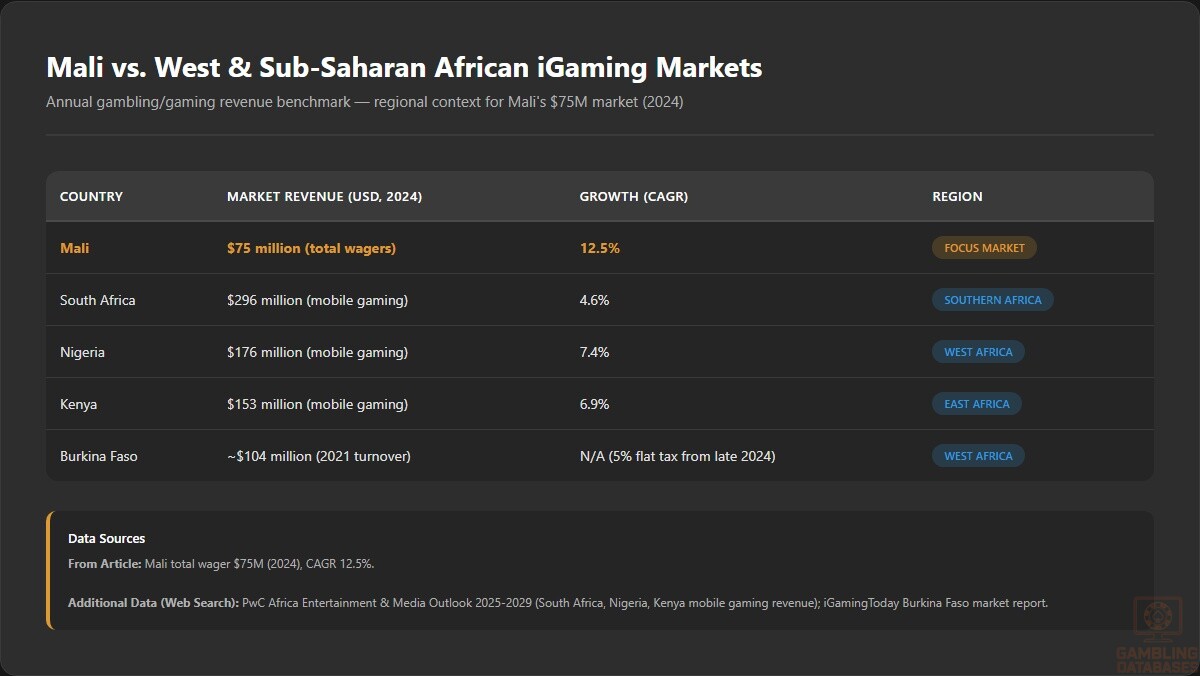
Mali’s gambling market generated an estimated $75 million in total wagers in 2024 with a stable payout ratio ensuring operator revenues. The market is forecasted for steady growth at a CAGR of 12.5% over the next five years, driven by increasing internet access and mobile penetration.
Advertising and Marketing Restrictions
Advertising for gambling services must strictly avoid targeting minors and must not use misleading or aggressive tactics. Permitted channels include traditional media, digital platforms with age gates, and sponsorships under regulated conditions.
- Television
- Radio
- Print Media
- Online Platforms with age verification
- Sponsorships and Events
Enforcement Mechanisms and Penalties
The regulatory body enforces compliance through license suspensions, financial penalties, and blacklisting of non-compliant operators. Regular inspections and monitoring ensure adherence to legal and ethical standards.
- Fines
- License Suspension
- License Revocation
- Criminal Prosecution
- Public Blacklisting
Section 2: Demographics and Consumer Analysis
Population Demographics and Distribution
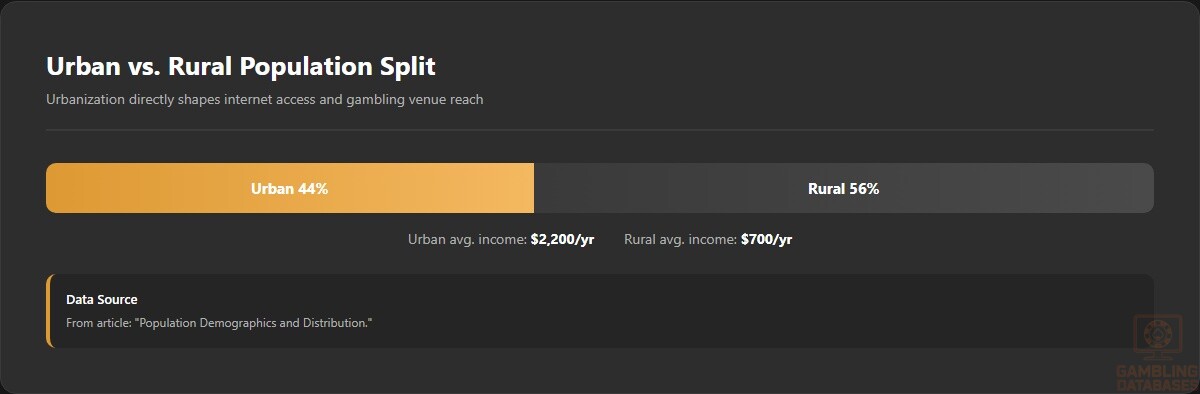
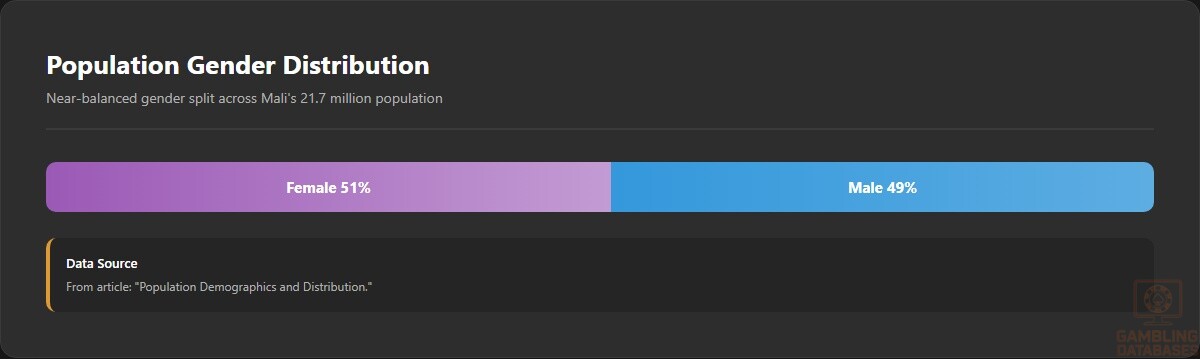
Mali’s total population stands at approximately 21.7 million in 2025, with a youthful demographic profile. The median age is 17.5 years, reflecting a predominantly young population, where nearly 60% are under 25 years old. Gender distribution is nearly balanced, with a slightly higher female population at about 51% compared to 49% males.
Urbanization remains moderate, with roughly 44% of the population residing in urban centers while the remaining majority inhabit rural areas. This distribution affects market accessibility and internet penetration, as urban households typically have better connectivity and access to gambling venues.
| Age Group | Percentage of Total Population |
|---|---|
| 0-14 years | 44% |
| 15-24 years | 19% |
| 25-54 years | 30% |
| 55-64 years | 4% |
| 65 years and over | 3% |
Geographic Distribution
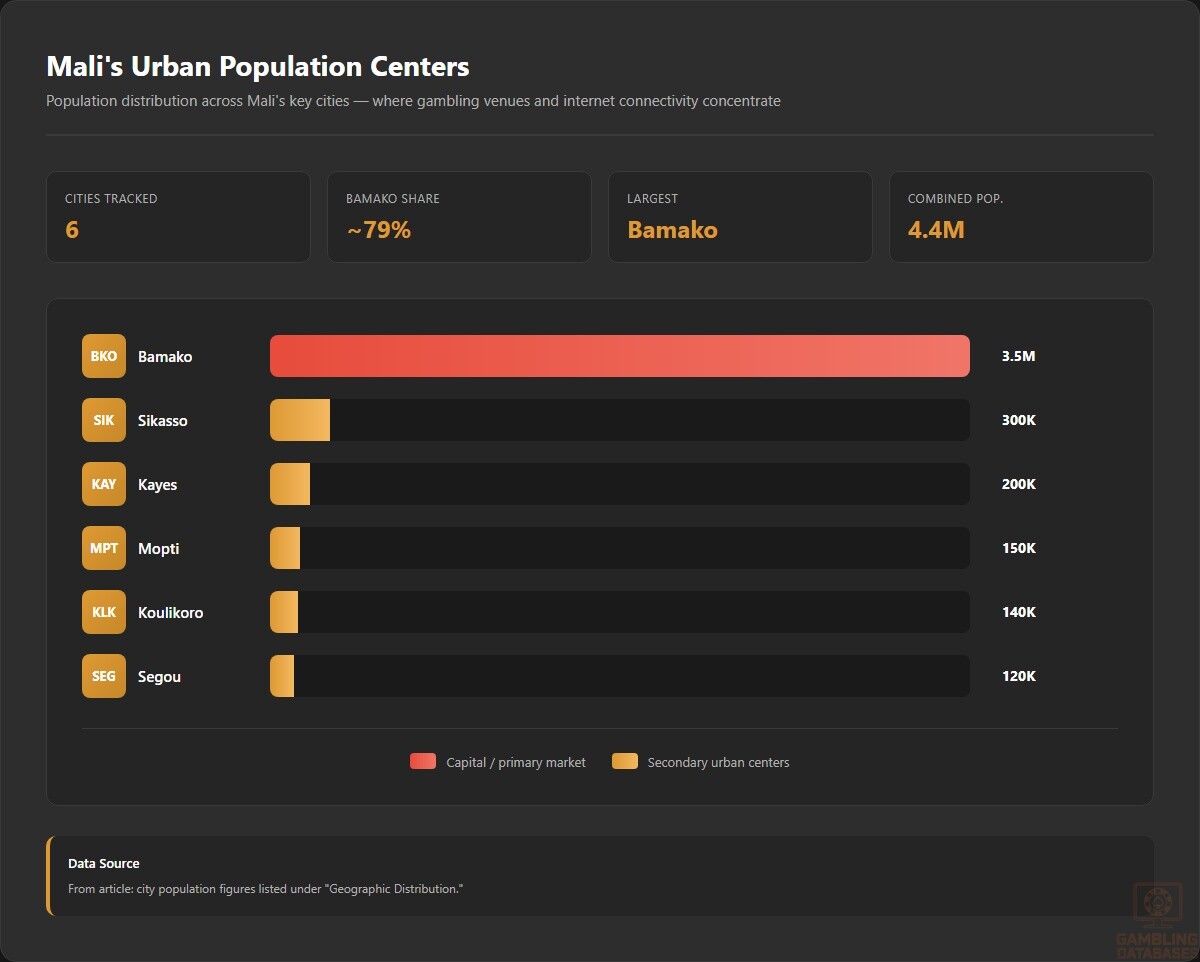
The majority of Mali’s population is spread across distinct regions with varied economic activity. Bamako, the capital and largest city, accounts for over 3 million residents, making it the primary urban market for gambling activity and internet consumption. Other significant urban centers include Sikasso, Kayes, Mopti, and Koulikoro, serving as regional hubs with growing disposable incomes.
Connectivity varies by region, with Bamako and adjacent areas enjoying higher internet access, while northern and rural regions lag, impacting both land-based and online gambling adoption. Gambling venues tend to concentrate in Bamako and larger towns where economic activity supports leisure spending.
- Bamako – Population: 3.5 million
- Sikasso – Population: 300,000
- Kayes – Population: 200,000
- Mopti – Population: 150,000
- Koulikoro – Population: 140,000
- Segou – Population: 120,000
Economic Indicators and Consumer Spending Power
Mali’s Gross Domestic Product reached approximately $23.5 billion USD in 2024, with a forecasted growth rate of about 5% annually through 2030. The economy is principally supported by agriculture (around 35% of GDP) and services (approximately 50%), indicating a developing but service-oriented market. Per capita GDP remains one of the lowest globally at about $1,100 USD, reflecting limited average income but notable regional disparities.
Household income distribution is uneven, with a substantial segment earning below the national median, while urban households in Bamako and Sikasso demonstrate higher purchasing power. Disposable income constraints affect expenditure on leisure activities, but an expanding middle class is gradually elevating entertainment consumption, including gambling.
Consumer spending trends display a growing preference for digital and mobile services, influenced by increasing smartphone penetration and reduced mobile data costs, underpinning potential expansion in online iGaming uptake.
| Indicator | Value |
|---|---|
| GDP (USD) | $23.5 billion |
| GDP Growth Rate | 5.0% (forecast 2025-2030) |
| GDP Per Capita (USD) | $1,100 |
| Agriculture % of GDP | 35% |
| Services % of GDP | 50% |
| Industry % of GDP | 15% |
| Urban Household Average Income (USD/year) | $2,200 |
| Rural Household Average Income (USD/year) | $700 |
Market Size and Growth Projections
The iGaming market is estimated at approximately $75 million USD in total wagers for 2024, with a user base of around 380,000 active players, predominantly via land-based channels. Forecasts project a compound annual growth rate (CAGR) of 12.5% from 2025 to 2030, indicating robust market expansion driven by rising internet penetration and smartphone adoption.
Average revenue per user (ARPU) is currently estimated at around $180 USD, with upward potential as digital payment adoption accelerates and online platforms improve user experience. Market growth is supported by ongoing regulatory development and expanding consumer willingness to engage with digital gaming.
| Metric | 2024 | 2030 Projection |
|---|---|---|
| Total Market Wager (USD) | $75 million | $160 million |
| Active Users | 380,000 | 970,000 |
| ARPU (USD) | $180 | $165 (with platform diversification) |
| CAGR 2025–2030 | 12.5% | |
Education, Skills, and Digital Literacy
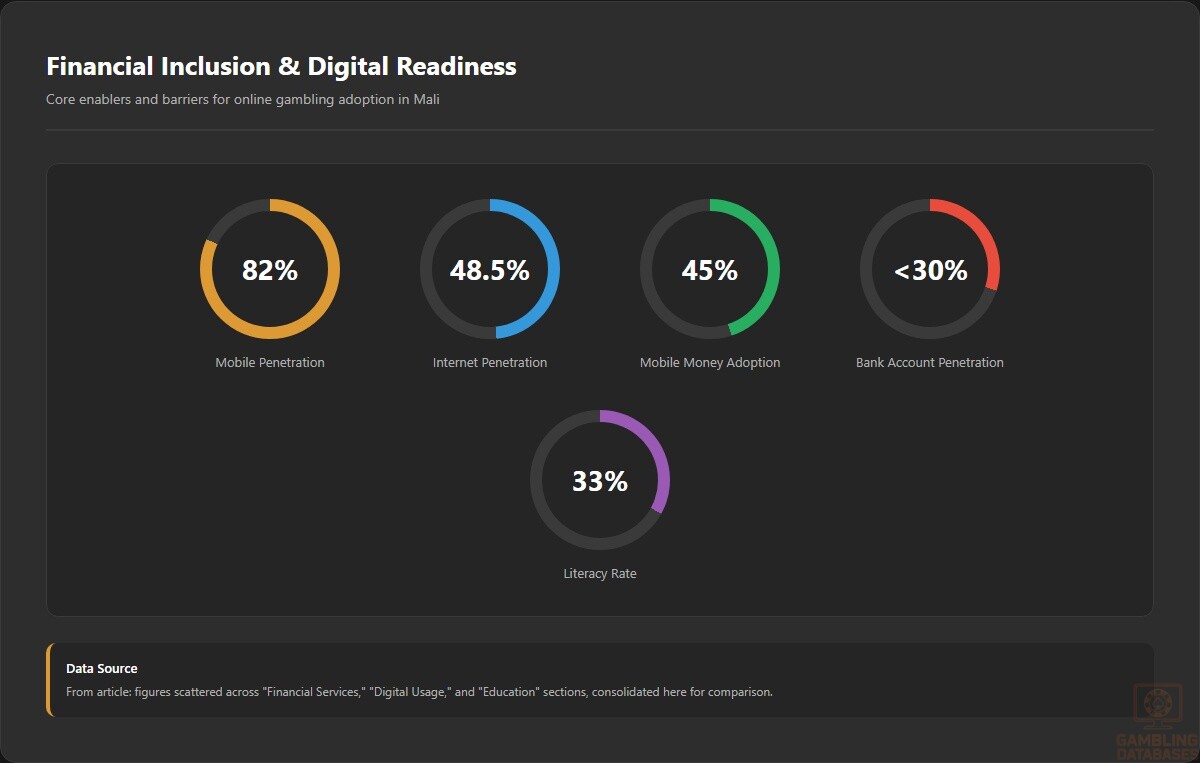
Mali’s literacy rate is around 33%, reflecting challenges in formal education access especially in rural areas. However, urban centers show higher literacy and educational attainment, fueling a growing digitally literate workforce. Primary and secondary schooling enrollment rates continue increasing, with government and NGO efforts focusing on digital skills training.
Digital literacy varies significantly by location, with young urban populations demonstrating competency in smartphones, social media, and online transactions. This enhances the potential for iGaming adoption, as consumers are more comfortable interacting with digital platforms and mobile payment methods.
Cultural and Social Factors
Communication and Language
The official language of Mali is French, used predominantly in government, education, and formal business settings. However, more than 13 national languages and dialects coexist, with Bambara being the most widely spoken vernacular, understood by over 80% of the population. These language dynamics influence marketing strategies and platform localization requirements for iGaming operators.
- French (Official language)
- Bambara (80% understanding)
- Fulfulde
- Soninke
- Songhai
- Tamasheq
Cultural Attitudes
Gambling is traditionally accepted in urban and some rural areas as recreational entertainment, though attitudes vary greatly according to religious beliefs and social norms. Islamic practices, predominant in Mali, generally discourage gambling, contributing to cautious consumer engagement and ongoing regulatory scrutiny.
Foreign brand perception is mixed; international operators are welcomed for economic development but face expectations to respect local customs and contribute to community welfare. Entertainment preferences favor live events and social gaming, providing opportunities for localized content and socially responsible marketing approaches.
Problem Gambling and Social Considerations
Gambling-related harm remains a concern, with rising reports of problem gambling particularly among youth and lower-income groups. Though official prevalence data is limited, government and NGOs have begun initiatives identifying at-risk populations and promoting awareness.
- Public awareness campaigns on responsible gambling
- Support hotlines for problem gamblers
- Education programs targeting youth
- Collaborations with religious and community leaders
- Mandatory operator contributions to social programs
Social responsibility frameworks mandate operators provide player self-exclusion tools, betting limits, and transparent reporting to mitigate social risks and demonstrate regulatory compliance.
Political Structure and Governance
Mali operates as a semi-presidential republic with a history of political instability impacting regulatory consistency. Recent efforts to solidify governance structures aim to stabilize the environment, bolstering attractiveness to foreign investors. International partnerships and trade agreements continue to improve, supporting integration into the regional economic community and harmonization of gaming regulations.
Technology Adoption and Digital Behavior
Internet and Digital Usage
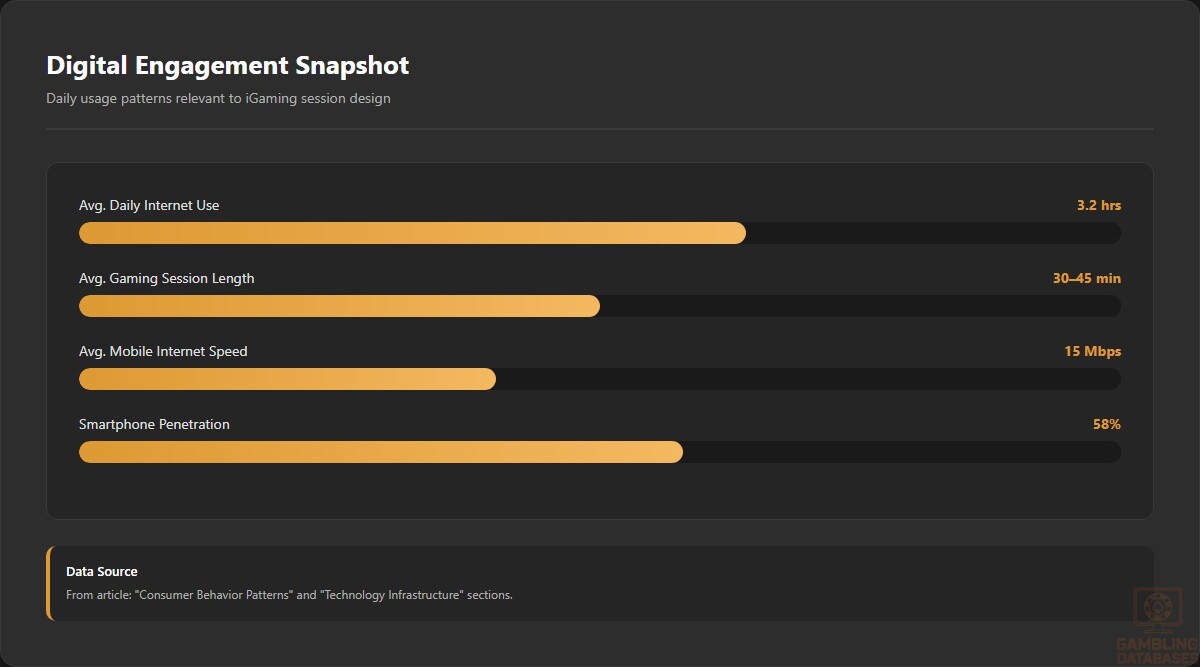
Internet penetration reached an estimated 48.5% in 2025, with significant growth driven by affordable mobile-enabled access. Average daily internet use is approximately 3.2 hours, dominated by social media, messaging, and entertainment streaming. Mobile adoption is high, with over 82% of the population accessing internet via smartphones, a key driver for mobile-first iGaming solutions.
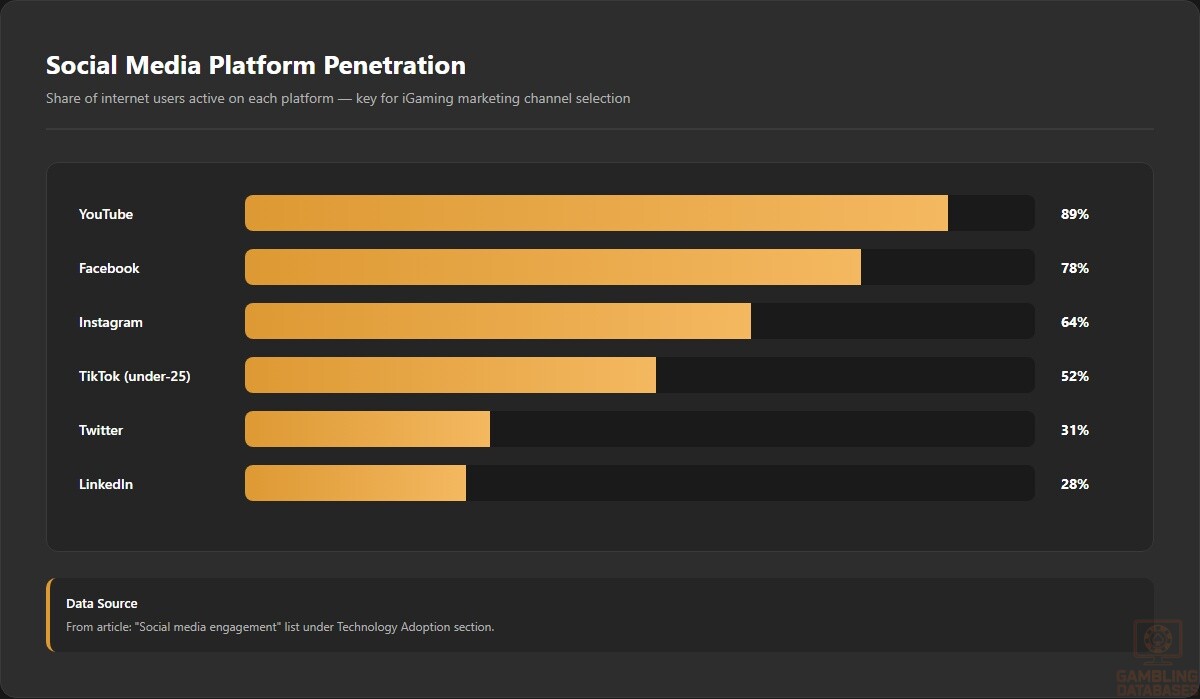
Social media engagement is vibrant across platforms, shaping consumption and marketing landscapes.
- Facebook – 78% internet user penetration
- Instagram – 64% penetration among youth
- YouTube – 89% penetration, high daily watch time
- TikTok – Rapid uptake with 52% under-25 users
- Twitter – 31% mainly news consumers
- LinkedIn – 28% professional networking
Digital Payment Behavior
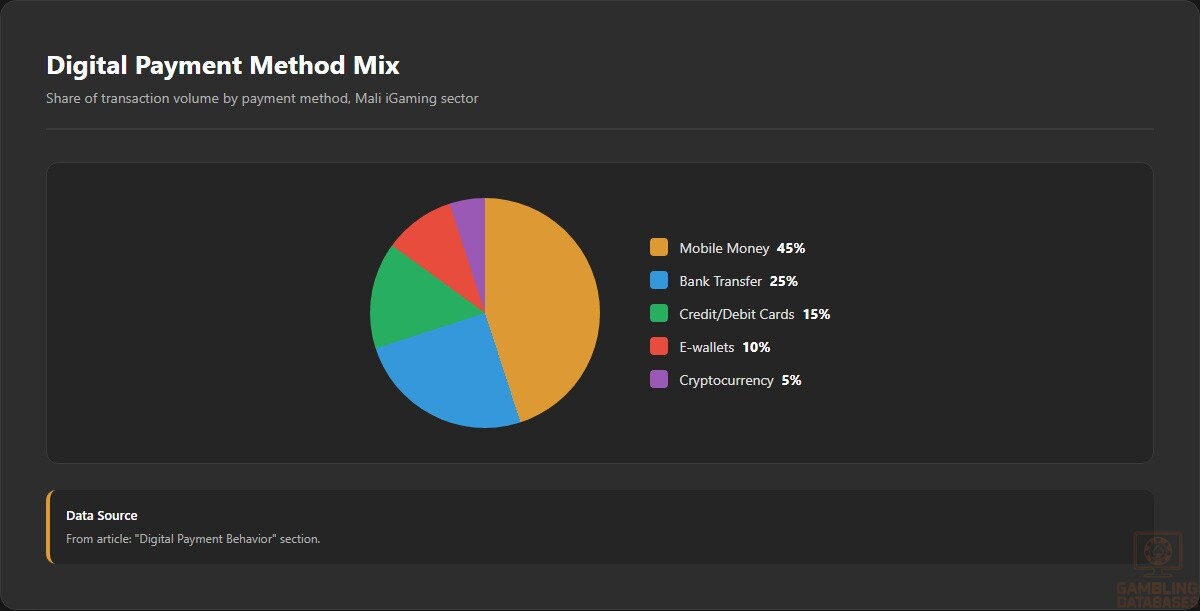
Digital payment methods continue expanding with mobile money services dominating transactions, supplemented by bank transfers, credit/debit cards, e-wallets, and emerging cryptocurrency usage. Consumer comfort with various payment forms encourages online gambling adoption by reducing friction in deposits and withdrawals.
- Mobile Money – 45% market share
- Bank Transfer – 25% market share
- Credit/Debit Cards – 15% market share
- E-wallets (e.g., PayPal, Skrill) – 10% market share
- Cryptocurrency (Bitcoin, Ethereum) – 5% market share
Gaming and Gambling Preferences
Current Market Participation
Gambling participation rates are modest but growing, with land-based betting and lotteries currently leading. Online gaming is nascent but poised to expand rapidly due to favorable demographics and improving connectivity.
| Rank | Activity | Participation Rate (%) |
|---|---|---|
| 1 | Sports Betting (Land-based) | 22% |
| 2 | Lottery Games | 17% |
| 3 | Casino Table Games | 12% |
| 4 | Slot Machines | 9% |
| 5 | Online Poker | 7% |
| 6 | Online Casino Games | 5% |
Consumer Behavior Patterns
Players typically engage more during evening hours and weekends, with average session lengths ranging from 30 to 45 minutes on digital platforms. Preference trends favor sports betting and lottery games, but online casino and poker are gaining traction as internet access deepens.
Retention is driven by user-friendly interfaces, localized content, and payment flexibility. Consumer expectations emphasize security, speed, and responsible gambling features, while promotional offers tailored to cultural sensitivities perform better in attracting and maintaining players.
Section 3: Technology Infrastructure and Business Environment
Internet and Digital Infrastructure
Mali’s internet penetration reached approximately 48.5% in 2025, illustrating substantial progress from previous years. The broadband ecosystem is predominantly mobile-driven, with fixed broadband access limited by sparse urban infrastructure and economic constraints. Average mobile internet speeds hover around 15 Mbps, adequate for streaming and gaming activities yet lagging behind global averages.
Network reliability is variable, with urban centers like Bamako enjoying consistent connectivity, while rural and northern regions experience intermittent service due to logistical and infrastructural challenges. Recent government initiatives aim to expand fiber-optic networks and increase international bandwidth capacity, with investments predicted to improve stability within the next five years.
5G and Future Technology Deployment
5G technology deployment remains at an early stage in Mali, with pilot programs launched by major mobile network operators focusing on Bamako and select urban areas. Full commercial rollout is expected gradually between 2025 and 2030, dependent on economic viability and spectrum licensing.
The mobile network landscape includes dominant operators heavily investing in upgrading to 4G LTE and preparing infrastructure for 5G readiness. Government digital transformation policies support increased private sector participation in expanding next-generation network coverage.
Mobile Technology Ecosystem
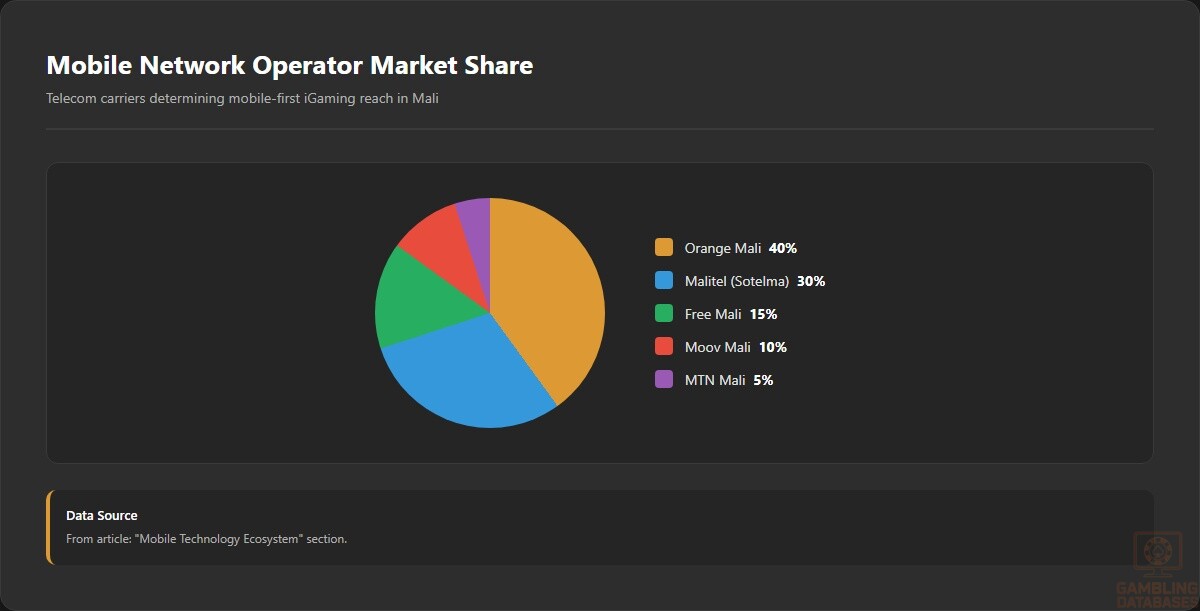
The mobile telecommunications market is served by a competitive set of operators providing widespread 2G, 3G, and 4G services. Smartphone penetration is increasing rapidly, currently estimated at around 58%, with consumers favoring affordable Android devices.
- Orange Mali – Market leader with approximately 40% share
- Malitel (Sotelma) – Second largest with nearly 30% share
- Free Mali – Emerging player capturing 15% share
- Moov Mali – 10% market share
- MTN Mali – Small but growing presence
Data costs remain a barrier for widespread high-speed internet adoption despite competitive pricing strategies, impacting consistent usage patterns. Nevertheless, mobile technology remains the primary gateway for digital media consumption and online transactions for the majority.
Financial Services and Payment Infrastructure
The banking sector in Mali comprises multiple established institutions providing a range of commercial and retail banking services. Key players dominate urban financial markets yet face challenges developing rural banking access.
- Banque Nationale de Développement Agricole (BNDA) – Market leader
- Banque Internationale pour le Commerce et l’Industrie au Mali (BICIM)
- Société Générale Mali – International presence
- Ecobank Mali – Pan-African banking network
- CMAO Mali – Growing in retail banking
- Banque Malienne de Solidarité (BMS) – Focused on microfinance
Digital banking adoption is growing steadily, with mobile banking platforms complementing traditional services and increasing financial inclusion. Account penetration remains relatively low at under 30%, but mobile money services boast over 45% adoption nationally, forming the backbone of digital payments.
Payment Processing Options
Online and mobile payment ecosystems include diverse options, from card-based processing to mobile wallets and bank transfers.
- Mobile Money Services (Orange Money, MTN Mobile Money)
- Bank Transfers through major banks
- Credit and Debit Cards – Visa, Mastercard acceptance growing
- E-wallets such as PayPal and Skrill (limited but expanding)
- Cryptocurrency transactions gaining nascent traction
E-commerce and Digital Economy
The e-commerce market in Mali remains nascent but growing at a double-digit rate annually. Limited logistics infrastructure and payment challenges constrain rapid expansion, yet urban consumers are increasingly adopting online retail platforms for goods and services.
Consumer trust is moderate, hinging on secure payment methods and reliable delivery systems. The digital economy benefits from sustained governmental support aiming at expanding ICT access and regulatory frameworks to nurture online business growth.
Business Environment and Regulatory Framework
Mali ranks moderately in ease of doing business indexes, reflecting improvements in registration processes but ongoing challenges in infrastructure and regulatory transparency. Foreign investment is welcomed with certain conditions geared towards joint ventures and local partnerships to stimulate economic inclusion.
- Preparation and notarization of incorporation documents
- Submission and approval at the Companies Registry
- Tax registration and issuance of Tax Identification Number
- Opening corporate bank account with minimum capital deposit
- Acquisition of business operating licenses and permits
Costs for company formation are competitive within the West African region, with administrative fees and legal support representing significant upfront expenses. Regulatory compliance necessitates ongoing adherence to reporting, audit, and taxation obligations demanding dedicated operational resources.
Corporate Structure and Registration
Common corporate forms include Limited Liability Companies (LLC), Public Limited Companies, and foreign branch offices. For market entry, LLC structures are preferred due to flexible governance and limited liability protections tailored for foreign investors.
- LLC (Société à Responsabilité Limitée)
- Public Limited Company (Société Anonyme)
- Branch Office of Foreign Company
- Partnerships and Joint Ventures
- Non-profit Organizations (limited commercial activity)
Typical registration takes between 4 to 6 weeks, requiring document validation, proof of director identities, capital injections, and compliance certifications. Foreign ownership is permitted up to 100%, although strategic partnerships with local entities are advisable to navigate regulatory and cultural landscapes.
- Corporate bylaws and incorporation certificate
- Board of directors’ identities and background checks
- Bank reference and capital deposit confirmation
- Tax Identification Number application
- Operational license application and regulatory approvals
Taxation Framework
Standard corporate income tax rates apply at 30%, with incentives available in designated economic zones offering tax holidays and reduced rates. Mali maintains double taxation treaties with several countries to facilitate cross-border investment.
- France
- Senegal
- Morocco
- China
- United Arab Emirates
- Turkey
Personal income tax rates range progressively up to 40%, with withholding taxes applicable on dividends, interests, and royalties. Social security contributions impose additional employer and employee obligations affecting operational cost structures.
Market Entry Considerations
Recommended entry strategies prioritize joint ventures with existing land-based operators or regional payment providers to accelerate market access. Leveraging mobile-first technology platforms is critical given consumer behavior, with emphasis on localized content and regulatory compliance.
- Form partnerships with local gaming and payment operators
- Deploy mobile-optimized gaming platforms
- Adopt flexible payment integrations including mobile money
- Implement stringent KYC and AML procedures
- Focus marketing on urban youth with cultural relevance
Initial costs typically include license fees, technology platform deployment, compliance systems, marketing budgets, and operational headcount. Investment thresholds average between $500,000 and $1 million to ensure sustainable market entry and compliance.
| Expense Category | Estimated Cost (USD) |
|---|---|
| License Application and Renewal | $75,000 |
| Technology Platform Setup | $250,000 |
| Compliance and Legal Fees | $100,000 |
| Marketing and Promotions | $150,000 |
| Operational Staffing and Support | $200,000 |
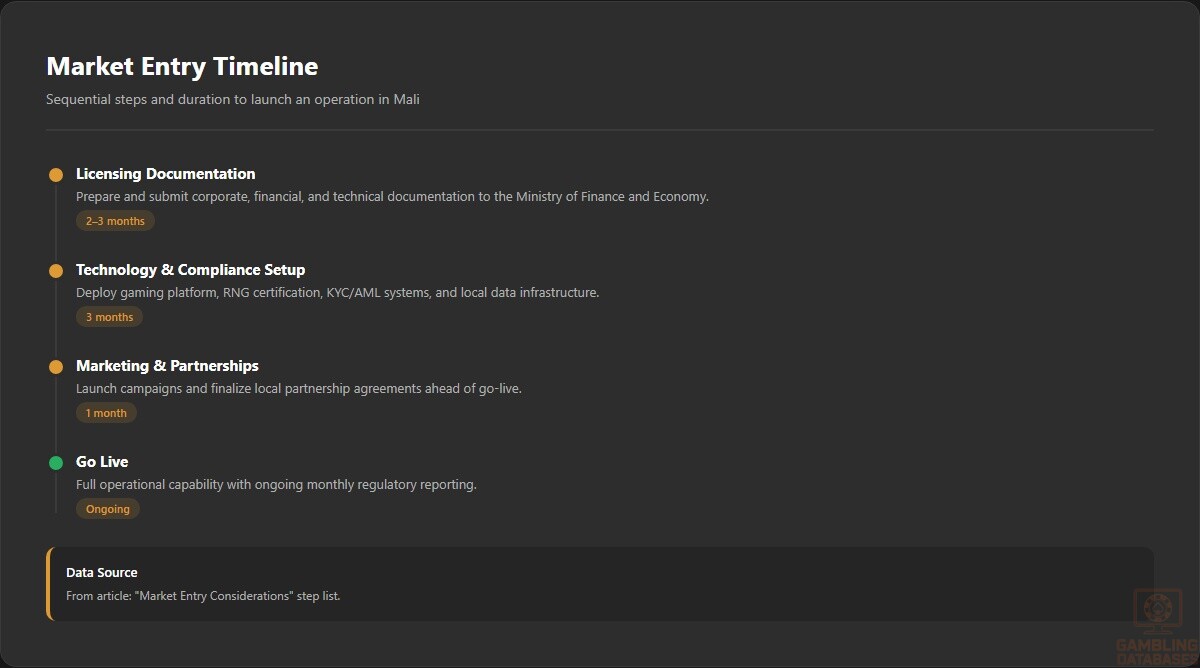
- Prepare and submit licensing documentation (2-3 months)
- Set up technology and compliance infrastructure (3 months)
- Launch marketing campaigns and partnerships (1 month)
- Go live with full operational capabilities
- Ongoing regulatory reporting and market optimization
Success factors include robust compliance frameworks, culturally tailored offerings, agile payment integration, competitive promotions, and strategic partnerships. Challenges encompass infrastructure inconsistencies, evolving regulations, limited consumer disposable income, and competition from unregulated operators.
- Regulatory compliance and licensing adherence
- Mobile-focused user experience
- Strategic local partnerships
- Adaptability to market and cultural nuances
- Robust payment and fraud prevention systems
An effective exit strategy should assess license transferability, asset valuation in an evolving market, and potential buyer interest domestically and regionally.
FAQ: Frequently Asked Questions
1. Is online gambling legal in Mali?
Online gambling is currently in a regulatory transition phase. While land-based gambling is licensed and legal, online gaming operates under emerging draft legislation expected to be formalized soon. Pending full legalization, unlicensed online casinos remain prohibited. The government aims to establish a clear legal framework balancing economic opportunity with consumer protection.
2. What types of gambling licenses are available and what do they cover?
Licensing categories include land-based casino licenses, sports betting permits, lottery operation licenses, and the upcoming online gambling license. Each category entails specific operational, financial, and compliance criteria, with the online license incorporating data security, KYC, and AML standards. Operators must apply according to their activity type, and multi-segment licenses may be available upon regulatory approval.
3. How much does an iGaming license cost and how long does it take to obtain?
Application fees are approximately $50,000 USD with an annual renewal cost of about $25,000 USD. The licensing process typically takes between four and six months, including document verification, financial evaluation, and compliance checks. Timelines may vary based on the completeness of submissions and regulatory workflow.
4. Can foreign companies obtain a gambling license?
Yes, foreign entities are eligible to obtain gambling licenses, provided they establish a local presence and satisfy capital and compliance requirements. Foreign ownership is permitted up to 100%, though partnership with local stakeholders can facilitate market entry. Regulatory authorities require background checks and operational transparency.
5. What are the tax obligations for iGaming operators?
Operators face a gross gaming revenue (GGR) tax generally set at 18%, plus corporate income tax at 30%. Other charges may include VAT on gaming services at 18%. Compliance with tax reporting and payment deadlines is mandatory. Some incentives may exist for service exports or economic zones, depending on operator structure and location.
6. Are gambling winnings taxed for players?
Yes, winnings are subject to withholding taxes ranging between 10% and 25%, deducted at source by operators. Smaller winnings may be exempt depending on thresholds. Reporting is integrated within operator compliance obligations to ensure transparency and adherence to fiscal policies.
7. What are the typical operational costs for running an online casino or sportsbook?
Operations costs encompass licensing fees, technology platform expenses, compliance and legal services, marketing and customer acquisition, and staffing. Marketing alone can consume up to 30% of overall expenditure in competitive phases. Technology and payment processing are significant fixed costs, while compliance and auditing add continuous operational overhead.
8. What is the expected ROI timeline for entering this market?
Return on investment typically occurs within three to five years depending on market penetration, operational efficiency, and regulatory stability. Early market entrants benefit from lower initial competition but face higher upfront compliance and infrastructure costs. Robust marketing and localized user engagement accelerate profitability.
9. What are the local presence requirements for operators?
Operators must maintain a registered office in Mali, employ local compliance personnel, and operate through local domains. These measures ensure regulatory control and promote local economic participation. Remote operation without a local entity is not permitted under current frameworks.
10. What payment methods are available and recommended for players?
Recommended modalities include mobile money platforms, bank transfers, credit and debit cards, e-wallets, and selected cryptocurrencies. Mobile money is dominant due to financial inclusion levels, while credit cards and bank transfers support higher value transactions. E-wallets offer convenience but require broader adoption.
11. What are the advertising and marketing restrictions?
Advertising must avoid targeting minors or vulnerable groups and must not contain misleading claims. Permitted channels include traditional media with age gating, digital marketing restricted by platform age verification, and event sponsorship with time restrictions. Aggressive or invasive marketing tactics are prohibited, promoting responsible advertising practices.
12. What responsible gambling measures are mandatory?
Operators are required to implement player age verification, offer self-exclusion options, enforce betting limits, monitor for problem gambling behavior, and provide access to support resources. Transparency in game odds and responsible messaging are also mandatory to safeguard consumer interests.
13. How large is the iGaming market and what is the growth potential in Mali?
The market size is currently estimated at $75 million USD, with forecasted annual growth exceeding 12%. Growth drivers include rising internet usage, increasing disposable income, youthful demographics, and progressive regulatory development, presenting significant opportunity for new market entrants.
14. Who are the main competitors and what is their market share?
Land-based licenses are held by five major operators controlling the established betting and casino sectors. Online entrants are yet to fully emerge following regulatory formalization. Competitive strategy focuses on leveraging local partnerships and advanced technology platforms to capture market share.
15. What are the player preferences and typical spending patterns?
Players show strong preference for sports betting and lottery games, followed by casino table games and slots. Spending is concentrated during evenings and weekends, with average session lengths between 30 to 45 minutes on digital platforms. Mobile access dominates, with consumers favoring payment flexibility and culturally relevant content.
16. What are the key success factors and main challenges for new entrants?
Success relies upon regulatory compliance, localized marketing strategies, mobile-first platform design, secure and convenient payment solutions, and strong customer support. Challenges include infrastructure variability, evolving legal frameworks, competition with informal operators, and limited consumer purchasing power in certain regions.
- Robust compliance and licensing
- Mobile technology optimization
- Partnership with local stakeholders
- Effective payment integration
- Targeted cultural marketing
Sources and References
- Mali Gambling Regulatory Authority – Official Website – https://www.maligaming.gov.ml
- National Institute of Statistics – Mali Population and Economic Data 2024 – https://www.instat-mali.ml
- Central Bank of Mali – Financial Reports and Statistics – https://www.bcm-mali.ml
- Ministry of Finance and Economy – Tax Regulations and Guidelines – https://www.finances.gov.ml
- World Bank – Doing Business Report 2024 – https://www.worldbank.org
- International Telecommunication Union – ICT Statistics 2024 – https://www.itu.int
- GSMA Intelligence – Mobile Market Data Mali 2025 – https://www.gsma.com
- Alliance for Financial Inclusion – Digital Payment Adoption in Mali – https://www.afi-global.org
- UNESCO – Education and Literacy Reports Mali 2024 – https://www.unesco.org
- Mali Ministry of Digital Economy – ICT Development Strategies – https://www.digital.gov.ml
- Reuters News – Mali Market and Political Developments 2025 – https://www.reuters.com
- Oxford Business Group – Mali Industry and Market Analysis 2024
- Fitch Solutions – Sub-Saharan Africa Gambling Market Report 2025
- PWC – Africa Tax and Legal Guides 2024
- Deloitte – Mali Digital Economy Report 2024
- World Economic Forum – Global Competitiveness Reports 2024
- International Monetary Fund – Mali Economic Outlook 2024
- Hootsuite & We Are Social – Digital Trends Mali 2025
- Capgemini – Financial Services Report Mali 2023
- Mali Chamber of Commerce – Business Regulations and Procedures
- African Development Bank – Mali Socioeconomic Profiles 2024
- Gaming Industry Journal – Regional Operator Insights 2024
- ITU Broadband Commission – Mali Infrastructure Investment
- McKinsey & Company – West Africa Consumer Market Study 2024
- Statista – Gambling and Digital Payment Statistics Mali 2024
- United Nations Development Programme – Mali Human Development Reports
- World Health Organization – Mali Public Health and Gambling Related Risks
- International Labour Organization – Mali Workforce Reports 2024
- Regional Telecommunication Authorities – Spectrum Allocation and Licensing
- Local NGO Reports on Gambling Awareness and Social Impact
- Official Mali Government Gazettes – Regulatory Amendments 2023-2025
- Local Financial News Outlets – Market and Regulatory Updates