Nepal is emerging as a dynamic market for iGaming, fueled by growing digital penetration and strong tourism-driven land-based gambling operations. Despite strict regulations governing land-based casinos, the online gambling sector operates largely in a legal grey area, presenting both challenges and opportunities for market entrants.
The evolving regulatory environment aims to curb financial crimes and tighten foreign investment rules, while fostering growth in digital gaming and tourism-related gambling activities.
Executive Summary: Key Market Indicators
| Metric | Value |
|---|---|
| Gambling Legal Status | Land-based licensed; Online gambling largely unregulated/illegal |
| Regulatory Authority | Ministry of Culture, Tourism and Civil Aviation; Department of Tourism |
| Population | 30 million (approx.) |
| Urban Population | 21% of total population |
| GDP (Nominal) | ~ $40 billion (2025 est.) |
| GDP per Capita | ~ $1,350 |
| Internet Penetration Rate | ~75% |
| Mobile Penetration Rate | ~95% |
| Number of Licensed Casinos | ~5 active major casinos |
| Minimum Paid-up Capital (Small Casinos) | NPR 200 million (~$1.48M) |
| Minimum Paid-up Capital (Large Casinos) | NPR 300 million (~$2.22M) |
| Casino Licensing Application Fee | NPR 1 million (small), NPR 1.5 million (large) |
| Casino Licensing Fee | NPR 15 million (small), NPR 30 million (large) |
| Corporate Tax Rate on Casino Income | 25% |
| Royalty Fee | NPR 50 million annually per casino, plus NPR 15 million for electronic gaming |
| Player Winnings Tax Rate | 25% withholding |
| Monthly Reporting Threshold | Transactions > NPR 1 million (~$7,400) daily must be reported |
| Anti-Money Laundering Directive | Mandatory AML/CFT reporting and player identity verification |
| Online Gambling Regulation Status | Illegal under Nepal Penal Code, no licensed online platforms |
| Market Size (2025 Revenue Estimate) | US$417 million (all gambling) |
| Market Growth Rate (CAGR 2020-2026) | 10.7% |
| Average Revenue Per User (ARPU) | Estimated NPR 10,000+ annually |
| Entry Barriers | High capital requirements, foreign ownership limits, regulatory scrutiny |
| License Renewal Process Duration | 6-8 months |
| Foreign Ownership Cap | 49% in casino operations |
| Enforcement Agencies | Department of Tourism, Nepal Financial Information Unit |
| Advertising Restrictions | Strict, especially for online gambling |
Section 1: Regulatory Framework and Legal Environment
Current Gambling Regulation Status
Nepal maintains a stringent regulatory framework for gambling, particularly focused on land-based casino operations primarily targeting foreign tourists. The legal environment prohibits most forms of gambling under the Penal Code, but exceptions exist for licensed land-based casinos and certain government-sanctioned activities like lotteries and horse racing.
While land-based gambling is tightly regulated, including high capital requirements, licensing fees, and operational mandates, online gambling remains officially banned. Despite this, the growth of mobile internet and digital payments has seen widespread use of offshore online gambling platforms by Nepali citizens, posing regulatory challenges and social concerns.
Land-Based Gambling Activities
Land-based gambling in Nepal is concentrated in casinos located in major tourist destinations, operated under the oversight of the Department of Tourism. Casinos offer a variety of gaming options, including:
- Table games such as poker, blackjack, and roulette
- Slot machines and electronic gaming setups
- Sports betting within permitted venues
- High-stakes VIP gaming rooms
- Electronic gaming machines and modern technology for gaming
The government strictly differentiates casinos by size, imposing higher capital and licensing standards for large establishments offering comprehensive gaming services. Proximity restrictions require casinos to be located at least five kilometers away from national borders and religious sites to minimize socio-cultural and security concerns.
Online Gambling Framework
Online gambling currently operates in a legal grey zone with no formal licenses issued for domestic iGaming platforms. The Penal Code classifies gambling and betting as criminal offenses under Section 125, which effectively bans online gambling operations within Nepal.
Despite this, Nepali consumers widely access offshore online gambling and betting platforms, especially younger demographics skilled in smartphone and internet usage. The lack of explicit regulation leads to challenges in enforcement, consumer protection, and fiscal revenue realization from online gambling activities.
The Supreme Court of Nepal has recently urged the government to address the unchecked growth of online gambling, highlighting problems such as social harm, deceptive advertising on social media, and the absence of regulatory oversight on digital betting platforms.
Licensed Operators and Market Players
The land-based gambling sector in Nepal is characterized by a concentrated market dominated by a few licensed operators. These key players typically operate through casinos located within hotels and resorts that are major tourist hubs, benefiting from Nepal’s growing hospitality tourism industry.
Market entry is limited by stringent capital requirements and foreign ownership caps, encouraging partnerships with local entities. The competitive landscape favors operators capable of meeting rigorous compliance, investing in security and AML protocols, and providing premium gaming experiences.
Due to legal restrictions, no licensed online gambling operators exist domestically, but international operators targeting Nepali players offshore represent a significant competitive influence on consumer habits and market dynamics.
Licensing Framework and Requirements
Application Process and Eligibility
The Department of Tourism under the Ministry of Culture, Tourism and Civil Aviation is the primary regulatory body responsible for issuing casino licenses. Applicants must demonstrate both financial capacity and technical capability to operate compliant gaming facilities.
The licensing process is lengthy, requiring 6 to 8 months for approval. Application fees and licensing fees have been recently increased to ensure operator commitment and regulatory funding.
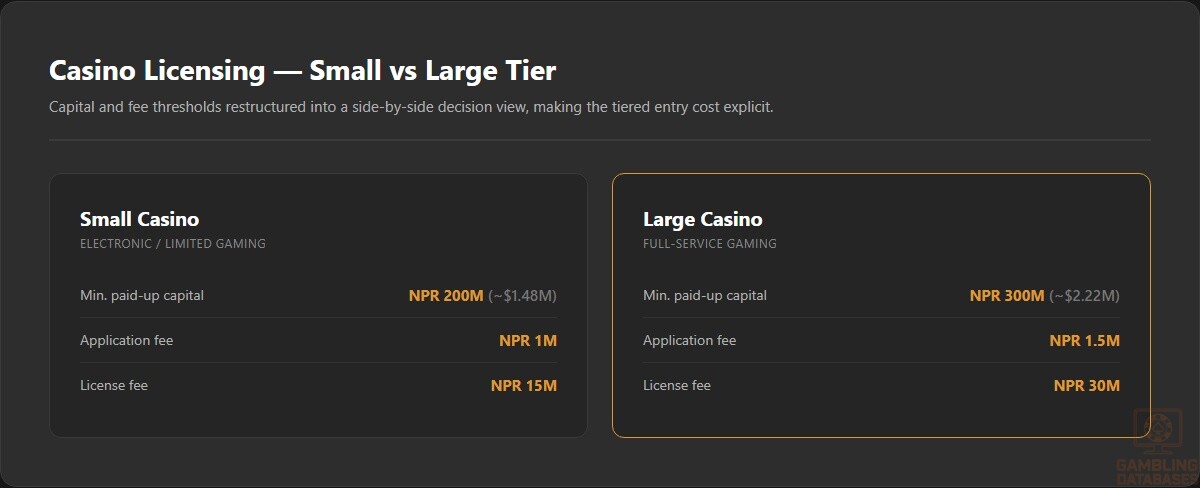
Significant financial requirements differentiate between small electronic gaming venues and large, full-service casinos as follows:
- Minimum paid-up capital of NPR 200 million (~$1.48 million) for small casinos
- Minimum paid-up capital of NPR 300 million (~$2.22 million) for large casinos
- Application fees of NPR 1 million and 1.5 million respectively
- License fees of NPR 15 million (small) and NPR 30 million (large)
- Renewal application submitted one month prior to expiration with detailed documentation
Local Presence and Operational Requirements
License holders must maintain a physical presence within Nepal, typically structured as a registered local company with requisite office space and operational staff. Foreign ownership in casino enterprises is restricted to a maximum of 49%, mandating local partnerships for market entry.
Operators must also comply with detailed operational mandates including:
- Maintaining a minimum of 20 trained security personnel
- Locating casinos no closer than five kilometers from international borders and religious sites
- Operating under designated domain ownership for associated digital infrastructure
- Ensuring adherence to local labor regulations for personnel hiring
Compliance Obligations and Monitoring
Player Protection and Identification
Strict compliance with Know Your Customer (KYC) and Anti-Money Laundering (AML) standards is required. Casinos must identify customers thoroughly, including conducting background checks and verifying sources of funds especially for high rollers and politically exposed persons (PEPs).
Age verification is mandatory, prohibiting gambling by persons below legal age limits. Operators are also required to implement responsible gambling measures such as self-exclusion programs and information disclosure about gambling risks.
- Age and identity verification protocols
- Enhanced due diligence on high-spending players
- Self-exclusion and voluntary exclusion provisions
- Information disclosures on responsible gambling
- Risk assessments for customer profiles
Financial Monitoring and Reporting
Financial transactions are subject to meticulous monitoring. Casinos must report all individual or combined player transactions exceeding NPR 1 million ($7,400) within a 24-hour period to the Nepal Financial Information Unit via the GoAML platform.
This involves detailed records of chip purchases, cash buy-ins, and VIP room expenses. Reports must be submitted within 15 days of the relevant transaction date, ensuring timely regulatory oversight.
- Track cumulative daily transactions for each customer
- Identify transactions exceeding NPR 1 million threshold
- Prepare detailed transaction reports internally
- Submit reports electronically via GoAML to Financial Information Unit within 15 days
Taxation Structure and Financial Obligations
Player Taxation
Players’ winnings are subject to a withholding tax set at 25%. This tax is deducted at source by the operator before payout, ensuring government revenue and regulatory compliance. The threshold for taxable winnings aligns with overall gambling structure and reporting requirements.
Operator Taxation
| Tax Type | Rate/Charge |
|---|---|
| Corporate Income Tax on Casino Revenue | 25% |
| Annual Royalty Fee (Casino Operations) | NPR 50 million |
| Annual Royalty for Electronic Gaming | NPR 15 million |
| License Application Fee | NPR 1 million (small); NPR 1.5 million (large) |
| License Fee | NPR 15 million (small); NPR 30 million (large) |
| Lease Transaction Tax | 10% |
| Dividend Tax | 5% |
| Employee Withholding Tax | Varies from 1% to 35% |
License renewal requires timely payment of royalty fees in installments aligned with government fiscal schedules: 40% by mid-January, 30% by mid-April, and the remaining 30% by mid-July.
Gambling Market Financial Performance
Nepal’s gambling sector generates significant tax revenues and operational income. However, tax arrears have been reported with some major casinos owing substantial unpaid royalties and taxes, reflecting challenges in compliance enforcement.
The market exhibits steady revenue growth aligned with a strong 10.7% CAGR forecast through 2026. Growth drivers include rising disposable income, increasing accessibility of digital payments, and expanded tourism, which support both land-based and expanding online gambling activity despite regulatory uncertainties.
Advertising and Marketing Restrictions
Advertising for gambling is tightly controlled, especially regarding online channels. The government restricts promotional content on television, social media, and print to minimize exposure and protect vulnerable populations.
- Ban on direct online gambling advertisements targeting local consumers
- Strict content guidelines prohibiting misleading or aggressive marketing
- Prohibitions on advertising during certain hours to protect minors
- Restrictions on sponsorship of sports and cultural events by gambling companies
- Limits on promotional bonuses and inducements
These controls increase operational challenges for operators seeking customer acquisition and brand visibility in Nepal’s evolving market.
Recent Regulatory Changes and Their Impact
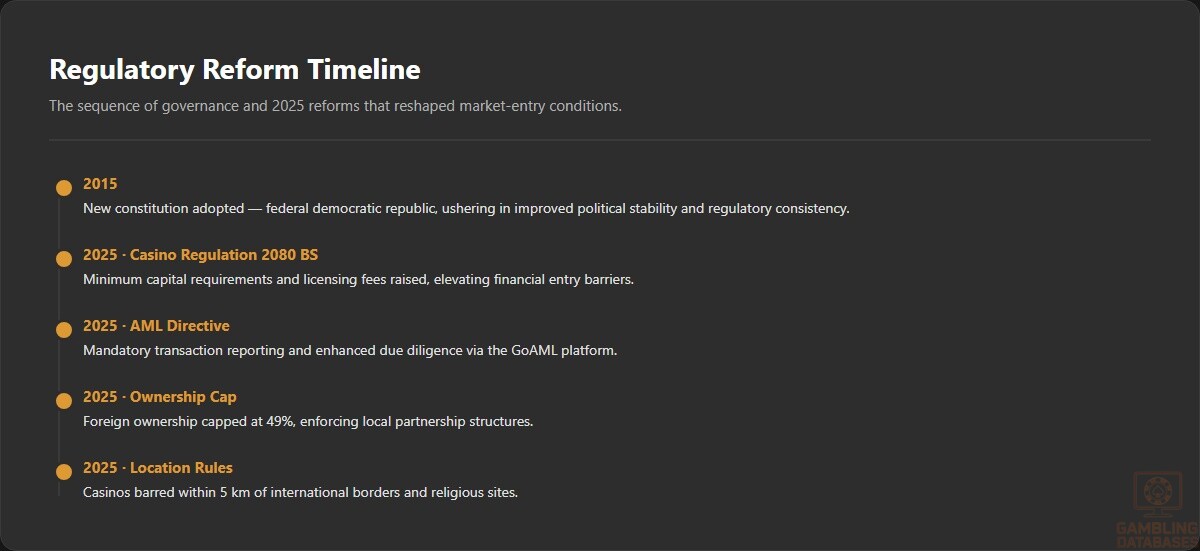
- 2025: Enactment of Casino Regulation 2080 BS increasing minimum capital and licensing fees
- 2025: Implementation of AML Directive mandating transaction reporting and enhanced due diligence
- 2025: Regulatory cap of 49% on foreign ownership with enforced local partnership rules
- 2025: Restrictions on casino locations near borders and religious sites to mitigate risks
These changes have elevated financial entry barriers, strengthened anti-money laundering compliance, and increased administrative burdens for operators. While some local entrepreneurs face challenges meeting capital requirements, the reforms are expected to enhance market transparency and sustainability.
Enforcement Mechanisms and Penalties
Regulatory enforcement is conducted through routine inspections, financial audits, and strict penalty regimes for non-compliance. Penalties for violations include fines, license suspension, and potential revocation.
- Fines for failure to report large transactions or suspicious activities
- License suspension for breach of operational or capital requirements
- Financial penalties for unpaid taxes and royalties
- Legal action against operators facilitating illegal online gambling
- Market exclusion for operators violating foreign ownership caps
Enforcement agencies have increased oversight efforts in the wake of recent reforms, signalling a more proactive regulatory environment.
Section 2: Demographics and Consumer Analysis
Population Demographics and Distribution
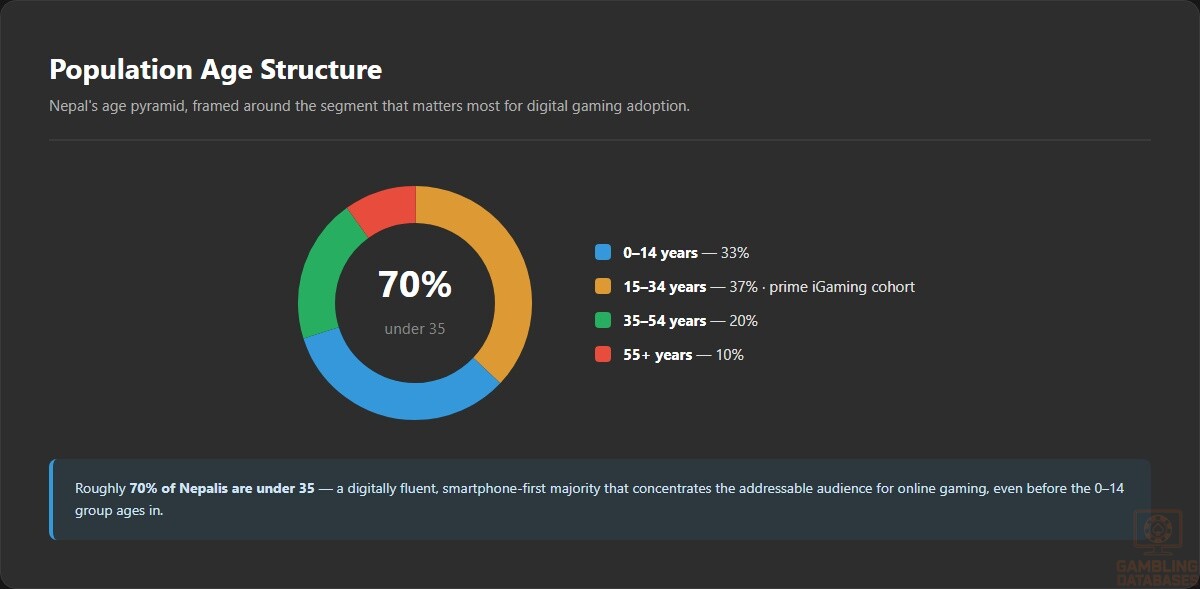
Nepal’s total population stands at approximately 30 million, characterized by a youthful demographic profile. The median age is approximately 24 years, reflecting a large segment of the population in the 15-34 age bracket, ideal for digital and iGaming engagement. Gender distribution is relatively balanced, with a slight female majority at approximately 51%.
Urbanization remains moderate, with about 21% of the population residing in urban centers, while the majority lives in rural areas. Urban-rural disparities influence internet access, economic opportunities, and gambling venue concentration, favoring urban and tourism-centric regions.
| Age Group | Percentage (%) |
|---|---|
| 0-14 years | 33 |
| 15-34 years | 37 |
| 35-54 years | 20 |
| 55+ years | 10 |
Geographically, population density varies markedly between the mountainous northern regions and the densely populated Terai plains in the south. Internet connectivity and gambling activity are heavily concentrated in major urban hubs and tourist destinations.
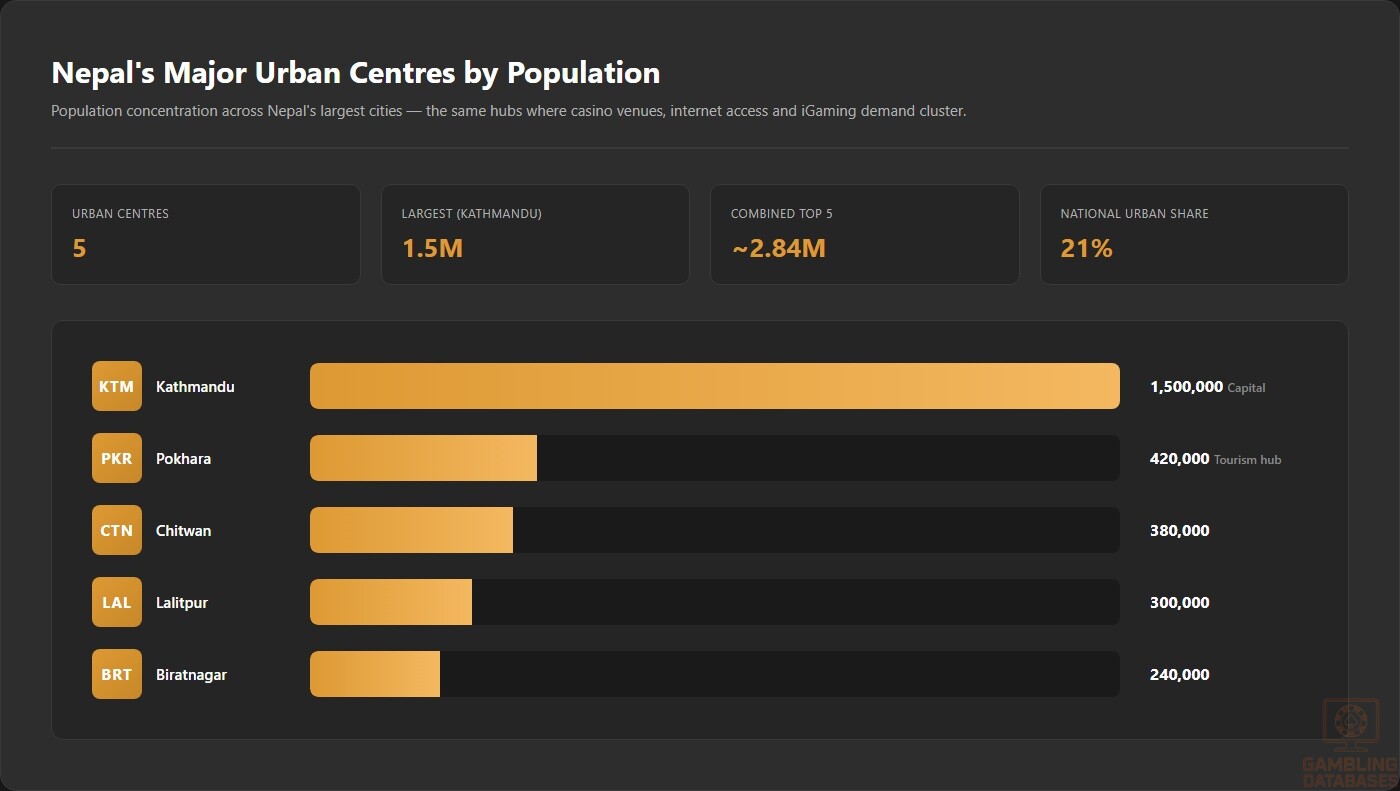
- Kathmandu Metropolitan City (~1.5 million inhabitants)
- Pokhara (~420,000 inhabitants)
- Chitwan (~380,000 inhabitants)
- Lalitpur (~300,000 inhabitants)
- Biratnagar (~240,000 inhabitants)
Major casinos and gambling venues are primarily located in Kathmandu and tourist areas like Pokhara, leveraging the influx of domestic and international visitors.
Economic Indicators and Consumer Spending Power
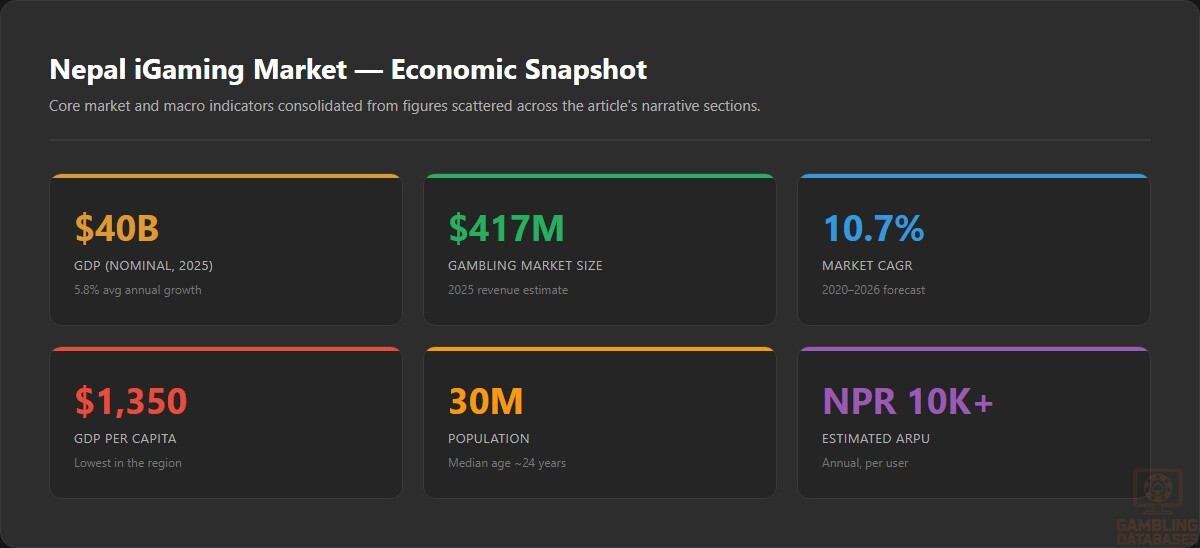
Nepal’s Gross Domestic Product (GDP) was estimated at approximately $40 billion in 2025, reflecting steady growth with an average annual increase of around 5.8% over recent years. The economy is predominantly agrarian but shifting towards services, which constitute over 50% of GDP, supported by the tourism and hospitality sectors that drive gambling-related economic activity.
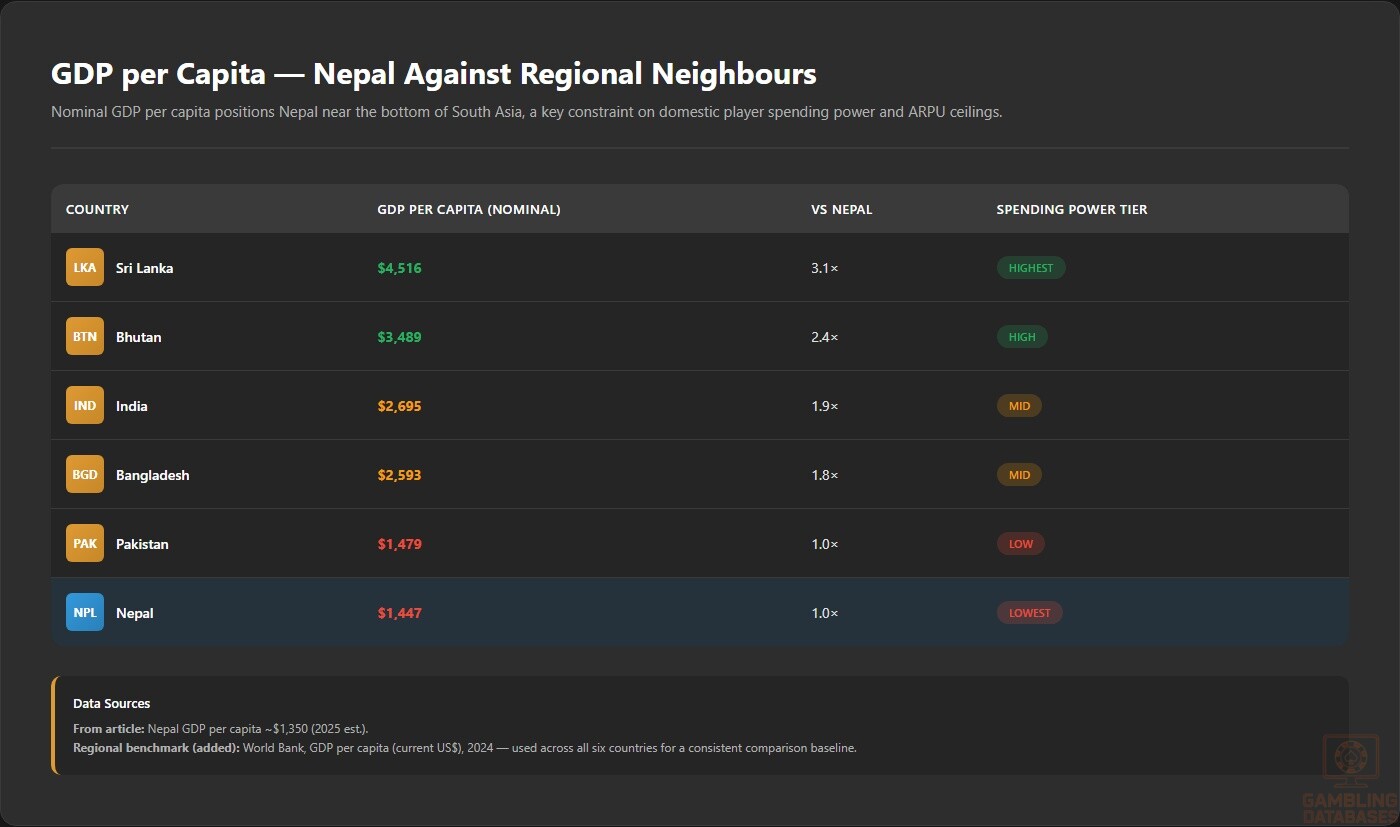
GDP per capita remains modest at roughly $1,350, yet disposable income is increasing notably in urban centers, where consumer spending power aligns with growing internet adoption and leisure services demand.
Income distribution remains uneven, with urban households enjoying higher median incomes compared to rural areas. Middle to upper income brackets are expanding in cities, increasing market potential for premium gambling experiences and digital iGaming platforms.
| Indicator | Value |
|---|---|
| GDP (Nominal) | $40 billion |
| GDP per Capita | $1,350 |
| Annual GDP Growth Rate | 5.8% |
| Service Sector Contribution | 52% |
| Agricultural Sector Contribution | 28% |
| Industrial Sector Contribution | 20% |
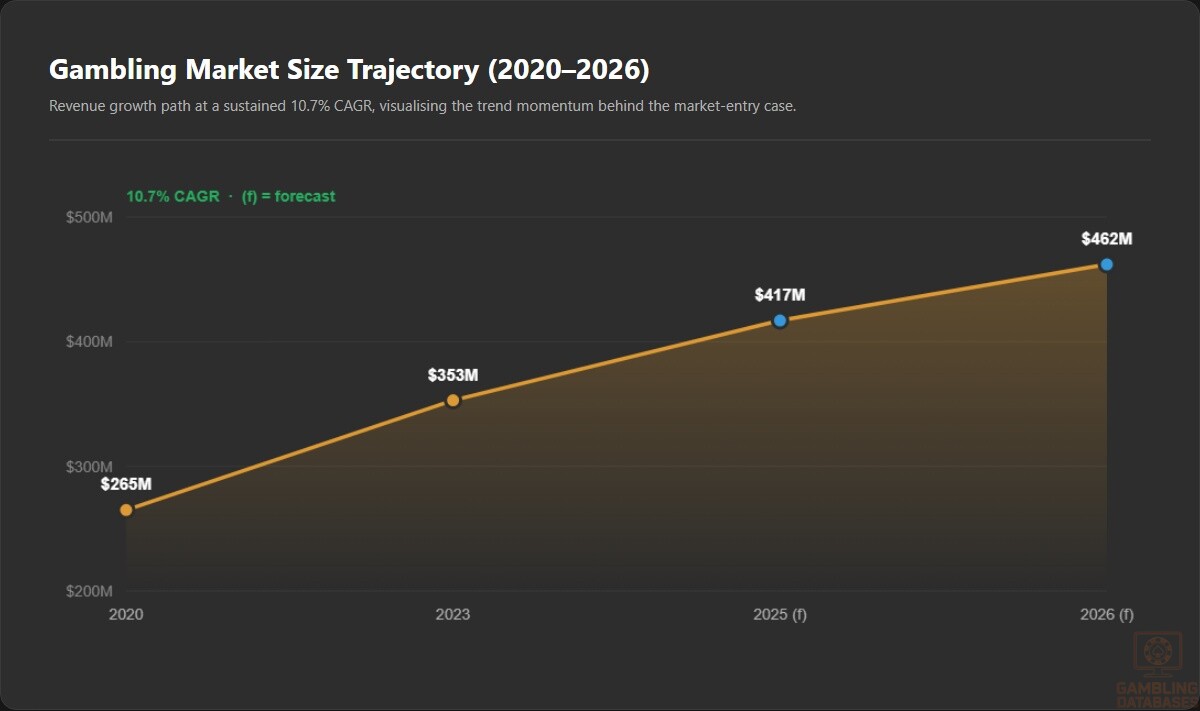
Market size projections estimate the gambling and iGaming sector revenue around $417 million for 2025, with an anticipated CAGR of 10.7% between 2020 and 2026. Urban consumer segments drive this growth, with iGaming adoption accelerating due to mobile internet proliferation.
| Year | Market Size ($M) | Growth Rate (CAGR %) |
|---|---|---|
| 2020 | 265 | 10.7% |
| 2023 | 353 | 10.7% |
| 2025 (forecast) | 417 | 10.7% |
| 2026 (forecast) | 462 | 10.7% |
Education, Skills, and Digital Literacy
Nepal boasts a literacy rate nearing 72% overall, with higher literacy concentrated in urban areas. Educational attainment generally culminates at secondary school level for the majority, with a growing number pursuing higher education in technical and digital fields.
Digital literacy is improving rapidly, particularly among younger populations, driven by widespread mobile phone usage and government initiatives promoting technology access. Workforce skills are evolving with increased focus on IT and services, supporting potential growth for iGaming industry employment and digital consumer engagement.
Cultural and Social Factors
Communication and Language
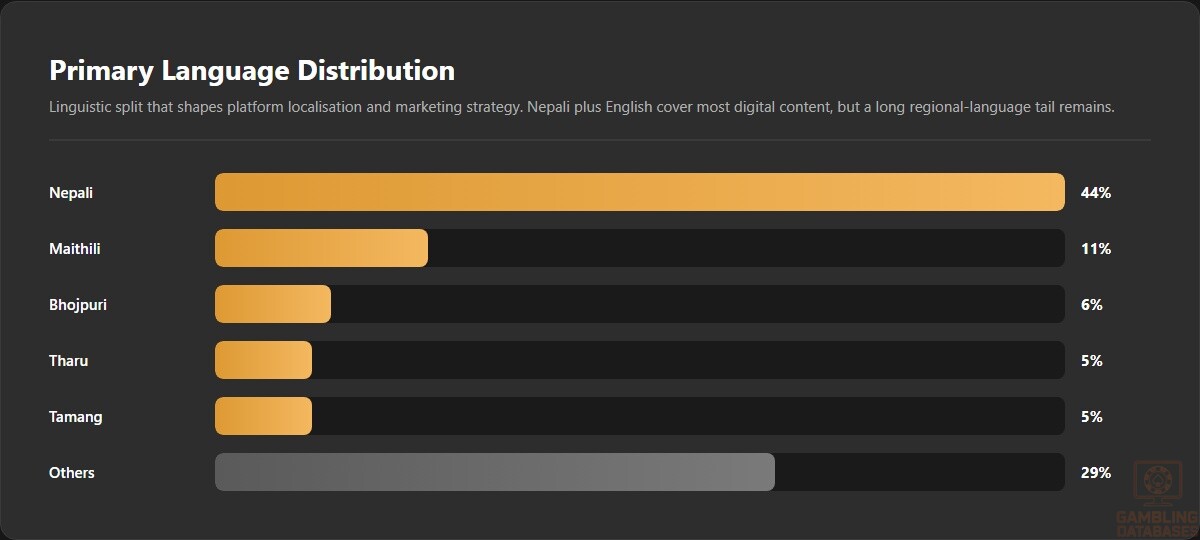
Nepali is the official language and primary communication medium. English is widely understood among educated urban populations, business sectors, and tourists. Other major languages include Maithili, Bhojpuri, Tharu, Tamang, Newari, and Magar.
- Nepali (official, approx. 44% speakers)
- Maithili (approx. 11%)
- Bhojpuri (approx. 6%)
- Tharu (approx. 5%)
- Tamang (approx. 5%)
- Newari, Magar, and other regional languages make up the remainder
Online content consumption in Nepali and English predominates, influencing digital marketing and platform localization strategies for the iGaming sector.
Cultural Attitudes
While gambling has traditional roots in Nepalese culture, contemporary views are ambivalent and shaped by religious influences and socio-economic factors. Hindu and Buddhist doctrines prevalent in Nepal generally discourage gambling, but casino tourism and leisure gambling sustain a tolerant business environment.
Foreign brand perception is mostly positive in urban and tourist sectors, with international operators viewed as bringing professionalism and technological innovation. However, conservative rural populations may exhibit resistance to gambling expansion and digital betting initiatives.
Problem Gambling and Social Considerations
Problem gambling prevalence is rising, particularly among young adults exposed to online platforms and social networks promoting betting activities. Government and civil society have implemented multiple measures to address gambling addiction and social harm.
- Public awareness campaigns targeting problem gambling
- Government funding for counseling and rehabilitation centers
- Mandatory self-exclusion programs for licensed casinos
- Collaboration with NGOs for community support services
- Implementation of regulatory framework for responsible gaming
Operators are compelled to contribute financially to social responsibility funds and integrate customer protection technologies to mitigate harmful gambling behaviors.
Political Structure and Governance
Nepal is a federal democratic republic noted for increasing political stability since the adoption of its new constitution in 2015. Regulatory consistency is improving, supported by government commitment to economic liberalization and tourism development.
International relations, mainly with India and China, influence economic policies and foreign investment frameworks that directly affect market entry and operational regulations for the gambling industry.
Technology Adoption and Digital Behavior
Internet and Digital Usage
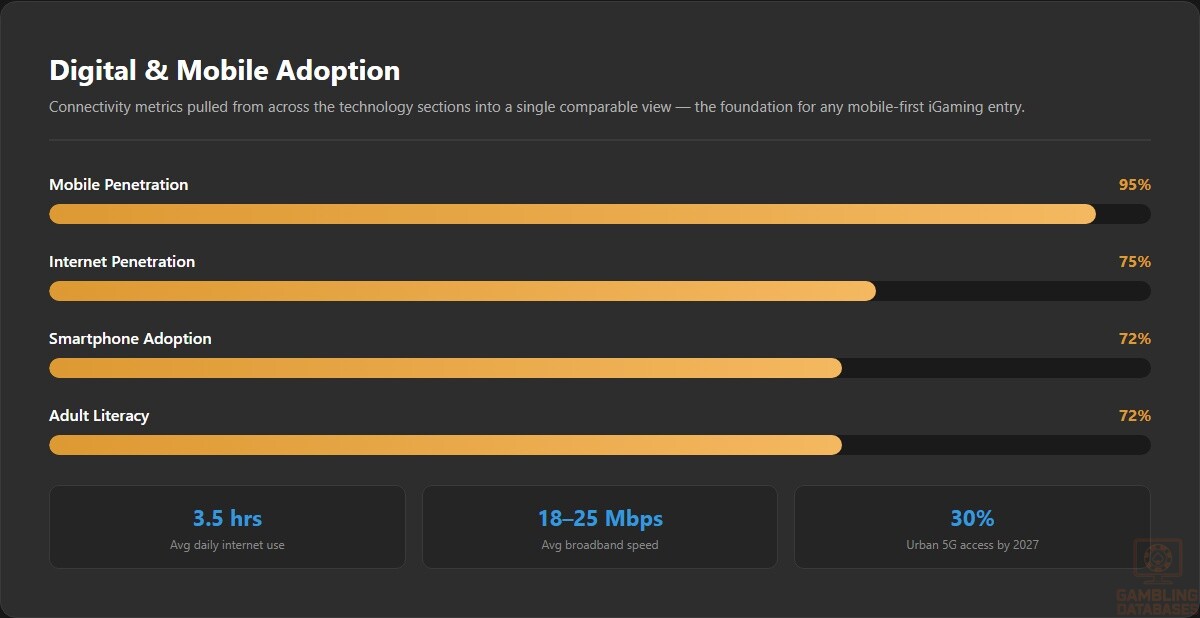
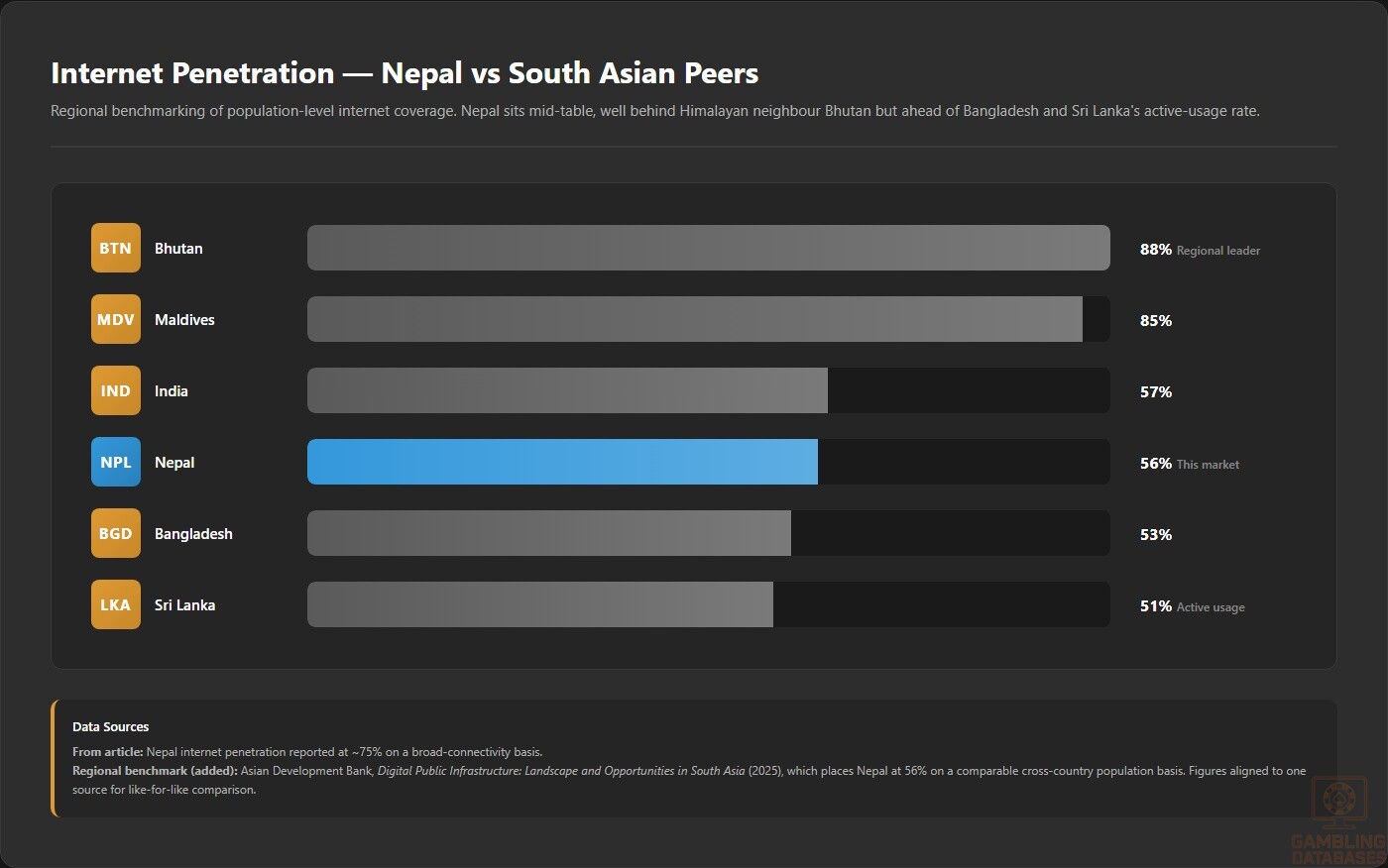
Nepal’s internet penetration has surged to nearly 75%, driven mainly by widespread mobile broadband use. Average daily internet usage exceeds 3.5 hours, dominated by social media, entertainment streaming, and gaming applications.
Mobile phones serve as the primary access device, with 95% mobile penetration. Social media engagement is robust across multiple platforms:
- Facebook with approximately 75% penetration among internet users
- YouTube widely used for video content and live stream gambling-related entertainment
- Instagram popular among younger adults for visual and influencer content
- TikTok rapidly growing in user base and engagement
- WhatsApp serving as a major communication and promotional channel
- Twitter used for news, trends, and community discussions
Digital Payment Behavior
Payment methods in Nepal show a blend of traditional and digital systems, with rapid adoption of mobile wallets and online banking. Preferences are shifting towards convenient, low-cost digital transactions for online gaming and entertainment services.
- eSewa leading with significant market share as the prominent mobile wallet
- IME Pay widely adopted for peer-to-peer transfers and bill payments
- Credit and debit cards primarily Visa and Mastercard facilitating online spend
- Bank transfers remain common for larger transactions
- Unified Payment Interface (UPI) systems gaining traction along border regions
- Cryptocurrency use is limited but growing among tech-savvy youth
Gaming and Gambling Preferences
Current Market Participation
Gambling participation in Nepal is dominated by traditional activities alongside emerging interest in digital platforms. Participation rates reflect a mix of recreational and social gaming engagements.
- Land-based casino gaming
- Lottery and number games
- Sports betting, both informal and through venues
- Online poker and casino games through offshore platforms
- Betting on local and international cricket matches
| Activity | Participation Rate (%) |
|---|---|
| Land-Based Casinos | 12 |
| Lottery and Number Games | 18 |
| Sports Betting | 15 |
| Online Casino (Offshore) | 7 |
| Card Games (Social) | 10 |
Consumer Behavior Patterns
Consumers exhibit diversified gambling habits, with urban and younger demographics preferring online platforms accessible via smartphones. Peak engagement occurs during evening hours and major sporting events, with session lengths averaging 45-60 minutes.
Retention rates depend on platform usability, game variety, and promotional offers. Trust and security remain major factors influencing platform loyalty in the relatively nascent Nepalese online gambling market.
Section 2: Demographics and Consumer Analysis
Population Demographics and Distribution
Nepal’s total population is approximately 30 million, with a youthful demographic profile featuring a median age of around 24 years. The gender distribution is nearly balanced, slightly favoring females at 51%. About 21% of the population lives in urban areas, while rural residents account for the majority.
| Age Group | Percentage (%) |
|---|---|
| 0-14 years | 33 |
| 15-34 years | 37 |
| 35-54 years | 20 |
| 55 years and above | 10 |
The population is unevenly spread, with dense settlements in the Terai plains and urban centers, contrasted by sparsity in mountainous regions. Gambling venues and internet access are predominantly concentrated in major cities and tourist hotspots.
- Kathmandu (~1.5 million)
- Pokhara (~420,000)
- Chitwan (~380,000)
- Lalitpur (~300,000)
- Biratnagar (~240,000)
Economic Indicators and Consumer Spending Power
Nepal’s GDP was around $40 billion in 2025, growing at an average rate of 5.8% annually. Services account for over half of the economy, led by tourism and hospitality, which directly impact gambling revenues.
GDP per capita stands at approximately $1,350, with urban households enjoying higher disposable incomes and stronger consumer spending power conducive to gambling and leisure services growth.
| Indicator | Value |
|---|---|
| GDP (Nominal) | $40 billion |
| Annual Growth | 5.8% |
| GDP per Capita | $1,350 |
| Services Sector | 52% |
| Agriculture Sector | 28% |
| Industry Sector | 20% |
The gambling market size in 2025 is estimated at $417 million, with a CAGR of 10.7% projected through 2026, driven largely by urban consumers and increased digital penetration.
| Year | Market Size (million $) | CAGR (%) |
|---|---|---|
| 2020 | 265 | 10.7 |
| 2023 | 353 | 10.7 |
| 2025 (forecast) | 417 | 10.7 |
| 2026 (forecast) | 462 | 10.7 |
Education, Skills, and Digital Literacy
Nepal’s literacy rate approaches 72%, with urban areas showing higher education levels. Growing digital literacy is centered on younger populations adopting mobile technology and internet-based services, which supports expanding consumption of iGaming products.
Cultural and Social Factors
Communication and Language
The official language is Nepali, spoken by roughly 44% of the population, with Maithili, Bhojpuri, Tharu, Tamang, and others forming significant linguistic groups.
- Nepali (44%)
- Maithili (11%)
- Bhojpuri (6%)
- Tharu (5%)
- Tamang (5%)
- Newari, Magar, and others
Internet content and digital communications mainly use Nepali and English, guiding iGaming platforms for localization efforts.
Cultural Attitudes
Gambling holds a complex cultural position, with Hindu and Buddhist values generally discouraging the practice. Nevertheless, tourism-driven locales show greater acceptance of gaming as entertainment, and foreign brands are largely welcomed in urban markets.
Problem Gambling and Social Considerations
Problem gambling is increasing, especially amongst youth exposed to online platforms. The government and NGOs have implemented awareness programs, counseling services, self-exclusion systems, and regulatory mandates on operators to mitigate social risks.
- Public awareness campaigns
- Counseling and rehab services
- Self-exclusion programs
- NGO collaboration for support
- Mandatory operator contributions to social funds
Political Structure and Governance
Nepal is a federal democratic republic with growing political stability. Regulatory consistency has improved, fostering a more transparent business environment. International ties with India and China affect investment policies and indirectly impact gambling sector regulation.
Technology Adoption and Digital Behavior
Internet and Digital Usage
Internet penetration has reached about 75%, with mobile phone usage at roughly 95%. Daily internet use averages 3.5 hours, dominated by social media, video, and gaming content.
- Facebook (~75% penetration)
- YouTube (widely used for gaming content)
- Instagram (popular among youth)
- TikTok (rapid growth)
- WhatsApp (main communication channel)
- Twitter (news and trends)
Digital Payment Behavior
Payment preferences emphasize mobile wallets, online banking, and cards. Digital wallets like eSewa and IME Pay dominate, accompanied by growing acceptance of credit cards and emerging cryptocurrency use among younger demographics.
- eSewa (largest mobile wallet share)
- IME Pay (widely used)
- Visa/Mastercard credit and debit cards
- Bank transfers
- Unified Payment Interface (UPI)
- Cryptocurrency (limited but growing)
Gaming and Gambling Preferences
Current Market Participation
Gambling activities reflect a mix of traditional and digital forms, with land-based casinos, lotteries, and sports betting dominating. Online gambling on offshore platforms is growing but remains unregulated domestically.
- Land-based casinos
- Lottery and number games
- Sports betting
- Online casino gaming (offshore)
- Social card games
| Activity | Participation Rate (%) |
|---|---|
| Land-Based Casinos | 12 |
| Lottery and Number Games | 18 |
| Sports Betting | 15 |
| Online Casino (Offshore) | 7 |
| Social Card Games | 10 |
Consumer Behavior Patterns
Urban and younger players favor mobile-accessible online platforms, playing primarily during evenings and major sports events. Typical session lengths range from 45 to 60 minutes, with retention driven by ease of use, game variety, and trusted payment options.
Section 3: Technology Infrastructure and Business Environment
Internet and Digital Infrastructure
Nepal has seen rapid expansion in internet access over the past decade. As of 2025, approximately 75% of the population has some form of internet connectivity, primarily fueled by mobile broadband networks. Fixed broadband coverage remains limited, accounting for a small fraction of total connections.
Average broadband speeds remain moderate, with nationwide averages around 18-25 Mbps. Urban centers like Kathmandu enjoy higher speeds and more reliable service than rural and mountainous regions, where infrastructure challenges impact network quality. Investment in fiber optic rollouts and improved 4G networks continues to drive connectivity improvements.
The government and private sector have prioritized digital infrastructure upgrades, focusing on enhancing rural connectivity and reducing digital divides. This ongoing investment supports expanding digital services, including mobile gaming and online payment systems crucial for the iGaming market’s growth.
5G and Future Technology Deployment
5G rollout in Nepal is in early stages, with pilot deployments in Kathmandu and select urban areas planned for 2025-2026. Key mobile operators have committed to expanding 5G networks progressively, driven by growing consumer demand for high-speed mobile broadband.
By 2027, it is expected that over 30% of Nepal’s urban population will have 5G access, enabling ultra-low latency applications and improved streaming quality for online gaming platforms. The introduction of 5G is anticipated to spur innovations in live betting and immersive gambling experiences.
The competitive operator landscape will shape technology adoption pace, with major players investing heavily in spectrum acquisition, infrastructure, and marketing campaigns.
Mobile Technology Ecosystem
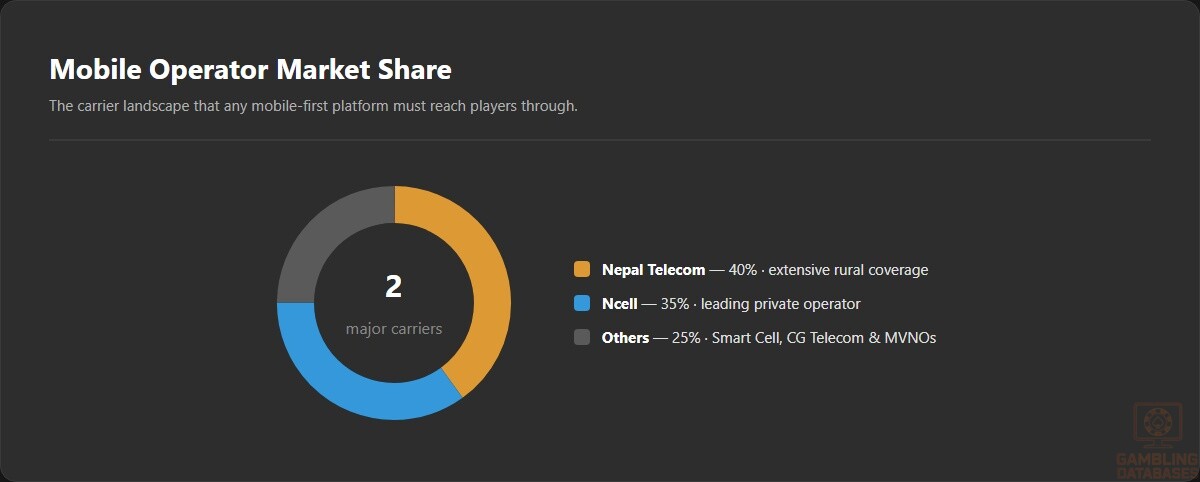
Nepal’s mobile network infrastructure consists of multiple operators vying for market share, delivering expansive coverage that serves over 95% of the population. Market competition is robust, fostering price reductions and service improvements beneficial for mobile data users engaging in iGaming activities.
- Nepal Telecom – Largest player with around 40% market share, extensive rural coverage
- Ncell – Leading private operator controlling approximately 35% of subscribers
- Smart Cell – Regional operator focusing on digital services and niche markets
- CG Telecom – Emerging entrant specializing in corporate and enterprise solutions
- Other local MVNOs and niche providers serving urban clusters
Smartphone adoption exceeds 70%, increasingly dominated by mid-range Android devices affordable to the growing middle class. High smartphone penetration drives digital content consumption and mobile-based gambling participation, bolstered by app availability and improved network connectivity.
Financial Services and Payment Infrastructure
The Nepalese banking system is structured around a mix of large commercial banks, regional providers, and emerging digital finance firms. Account penetration is growing, though many households remain underbanked, especially in rural areas.
- Nepal Investment Bank – Market leader in digital banking and SME lending
- Standard Chartered Nepal – Foreign bank known for corporate services and remittances
- Everest Bank Ltd – Prominent with wide branch network and digital initiatives
- Nabil Bank – Early adopter of mobile banking and e-wallet platforms
- Global IME Bank – Extensive national presence and agent banking services
- Century Bank – Growing player with focus on retail banking solutions
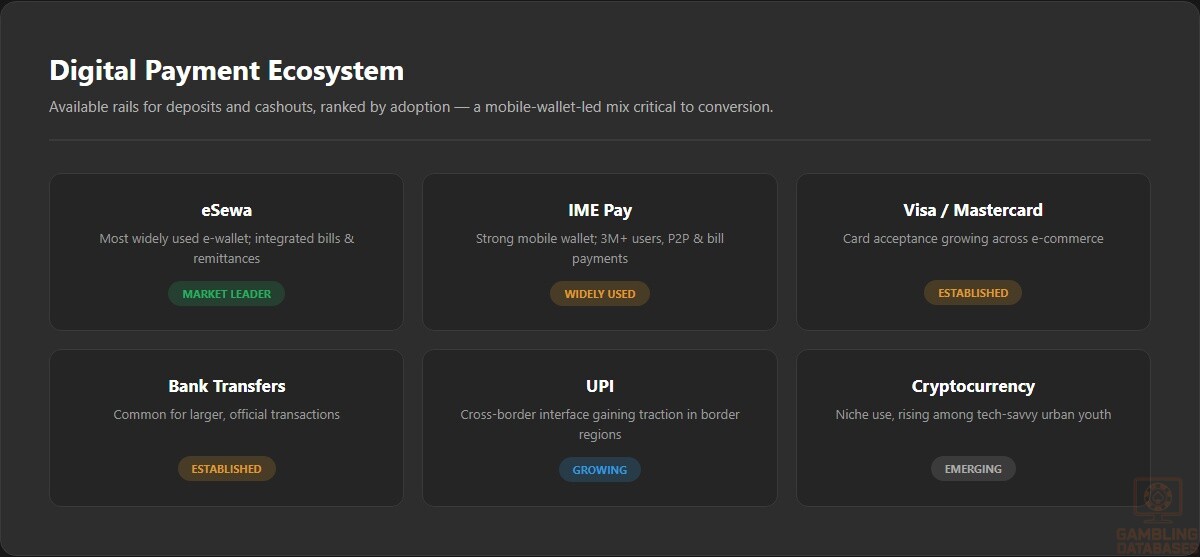
Payment processing in Nepal blends traditional bank transfers with a rapidly expanding portfolio of digital wallets and payment apps. Leading digital wallets facilitate fast, secure transactions integral to online gaming deposits and cashouts.
- eSewa – Most widely used e-wallet with integrated bill payments and remittances
- IME Pay – Strong mobile wallet presence with over 3 million users
- Card Payments – Visa and Mastercard acceptance growing in ecommerce
- Bank Transfers – Common for larger transactions and official payments
- Unified Payments Interface (UPI) – Cross-border facilitation on border regions
- Cryptocurrency – Niche use, increasing among younger urban adults
E-commerce and Digital Economy
Nepal’s e-commerce market remains nascent but fast-growing, driven by rising internet penetration, mobile payments, and growing consumer trust in online transactions. Estimated at over $600 million in 2024, the sector includes retail goods, digital services, and increasingly, online gaming-focused commerce such as platform subscriptions and game credits.
Challenges persist in logistics, payment infrastructure, and regulatory frameworks, but government initiatives aimed at digital economy facilitation provide momentum. Consumer behavior trends favor convenience, with younger cohorts leading early adoption of app-based commerce and entertainment services essential for iGaming growth.
Business Environment and Regulatory Framework
Nepal ranks moderately on the World Bank Ease of Doing Business Index, with significant room for improvement in start-up processes and contract enforcement. Business registration is straightforward but protracted due to bureaucratic hurdles and local administrative complexity.
- Company name reservation
- Document submission with notarization and tax registration
- Social security and employee registration
- Opening corporate bank accounts
- Licensing application for regulated sectors
Foreign investment is welcomed, subject to compliance with domestic ownership caps and sector-specific restrictions in gambling. Operational costs, particularly for skilled labor and compliance, have risen in recent years but remain competitive relative to regional peers.
Corporate Structure and Registration
Popular corporate entities include Limited Liability Companies (LLC), Corporation types, and Branch offices of foreign entities. LLCs represent the preferred form for gambling operators due to flexibility and limited liability features. Branch offices are less common and subject to additional regulatory scrutiny.
Registration timelines vary from 2 to 6 weeks depending on complexity, with associated costs reflecting government fees and professional service expenses. Foreign ownership is allowed up to 49% in gambling-related businesses, requiring local partnerships that include Nepalese majority stakeholders.
- Company registration documents including notarized Memorandum of Association
- Tax Identification Number certificate
- Proof of local office address
- Detailed ownership and directorship declarations
- Bank account confirmation and capital deposit evidence
- Licensing and regulatory clearance certificates
Taxation Framework
Nepal applies a flat corporate income tax rate of 25% on gambling operators’ net revenue. Special economic zones offer incentives such as tax holidays, though gambling enterprises are typically excluded from most exemptions due to regulatory concerns.
Personal income tax rates for individuals are progressive, with a maximum rate reaching 35%, including withholding taxes on gambling winnings at 25%. Tax residency rules require individuals spending over 180 days annually in Nepal to declare global income.
Market Entry Considerations
Entering Nepal’s gambling market demands balancing regulatory compliance with operational agility. Foreign companies often rely on joint ventures or licensing agreements with well-established local partners to navigate ownership restrictions and cultural nuances.
- Forming local partnerships with Nepalese stakeholders
- Investing in robust AML and KYC technology systems
- Leveraging mobile-first digital platforms for online reach
- Adapting marketing to local language and cultural sensitivities
- Building compliance teams to handle audits and reporting
- Planning phased investment aligned with market maturity
Typical costs include licensing fees starting at NPR 15 million, setup expenditures for infrastructure and staffing, and working capital to sustain operations until break-even, usually within 18-24 months.
| Cost Category | Estimated Cost |
|---|---|
| License Application and Fees | 15-30 |
| Infrastructure Setup | 20-40 |
| Staff Recruitment and Training | 10-15 |
| Marketing and Customer Acquisition | 8-12 |
| Compliance and Legal Services | 5-10 |
| Working Capital | 20-30 |
Operators face challenges of regulatory complexity, evolving enforcement, and competitive pressures from unregulated offshore online operators. A clear exit strategy should factor in license transfer restrictions, valuation multipliers based on market growth, and partnership dynamics.
FAQ: Frequently Asked Questions
1. Is online gambling legal in Nepal?
Online gambling is generally illegal under Nepal’s Penal Code, which prohibits gambling activities unless specifically licensed. Currently, no formal licenses exist for online gambling platforms within Nepal. Despite this, many Nepali residents access offshore online casinos, creating enforcement difficulties. The government is reviewing approaches to address this market with potential future regulatory frameworks under discussion.
2. What types of gambling licenses are available and what do they cover?
Nepal issues licenses primarily for land-based casinos, categorized by size (small and large) based on capital and gaming offerings. Licenses cover casino operations, electronic gaming, and sports betting within physical venues. No online gambling licenses are currently issued.
3. How much does an iGaming license cost and how long does it take to obtain?
Casino license application fees range between NPR 1 million and NPR 1.5 million depending on size, with licensing fees from NPR 15 million to NPR 30 million. The application and approval process typically takes 6-8 months due to rigorous compliance checks and government review.
4. Can foreign companies obtain a gambling license?
Foreign companies can obtain licenses but must comply with a foreign ownership cap of 49%, requiring partnership with local Nepalese stakeholders. Licensing demands strong financials, transparency, and adherence to operational guidelines.
5. What are the tax obligations for iGaming operators?
Operators are subject to 25% corporate income tax on net revenues, plus fixed annual royalty fees. Other taxes include lease transaction tax and employee withholding taxes. Licensing fees and renewal costs also apply.
6. Are gambling winnings taxed for players?
Yes, players’ winnings are subject to withholding tax at 25%. Operators deduct this tax at the point of payout as per regulatory requirements.
7. What are the typical operational costs for running an online casino/sportsbook?
Key cost areas include licensing and regulatory fees, infrastructure and technology deployment, marketing and customer acquisition, compliance management, staffing, and working capital funding. Marketing and compliance costs are significant due to consumer trust-building and regulatory complexity.
8. What is the expected ROI timeline for entering this market?
Return on investment typically occurs within 18-24 months post-launch, contingent on market conditions, regulatory compliance, and platform performance. ROI may vary based on scale, operational efficiency, and marketing effectiveness.
9. What are the local presence requirements for operators?
Operators must establish a physical presence in Nepal as a registered legal entity with a local office and staff. Foreign ownership must comply with the 49% cap, necessitating local partnerships and operational control commitments.
10. What payment methods are available and recommended?
Recommended methods include mobile wallets such as eSewa and IME Pay, bank transfers, and major credit/debit cards. Cryptocurrency use remains niche but growing among younger players seeking alternative payment solutions.
11. What are the advertising and marketing restrictions?
Advertising is tightly regulated, especially online and on social media. Operators must avoid aggressive promotions, misleading claims, and targeting minors. Sponsorships and bonus offerings are similarly restricted to ensure responsible gambling.
12. What responsible gambling measures are mandatory?
Operators must implement KYC and AML processes, age verification, self-exclusion programs, risk assessments for high-frequency gamblers, and disclose gambling risks clearly. Mandatory contributions to social responsibility funds are also required.
13. How large is the iGaming market and what is the growth potential?
The current gambling market is valued at approximately $417 million with a CAGR of 10.7% projected through 2026. Growth is driven by increasing digital penetration, rising disposable incomes, and expanding tourism.
14. Who are the main competitors and what is their market share?
The market is dominated by five major land-based casino operators with significant shares, while international offshore operators capture online gambling demand. Competitive advantage lies in regulatory compliance and robust local partnerships.
15. What are the player preferences and typical spending patterns?
Players prefer a mix of land-based casino games, sports betting, and emerging online platforms. Spending peaks during evenings and major sporting events, with session lengths averaging 45-60 minutes driven by ease of access and game variety.
16. What are the key success factors and main challenges for new entrants?
Success requires strong compliance, local partnerships, mobile-first user experiences, effective marketing, and robust payment integration. Challenges include regulatory uncertainties, high capital requirements, competition from unregulated offshore platforms, and cultural sensitivities.
Sources and References
- Nepal Ministry of Culture, Tourism and Civil Aviation Official Website
- Department of Tourism, Nepal Government Publications
- National Statistical Office, Nepal Population and Economic Data 2024
- Central Bank of Nepal Annual Financial Reports 2024
- World Bank Doing Business Report 2024: Nepal
- International Telecommunication Union ICT Statistics 2024
- Nepal Telecommunications Authority Reports 2025
- Global System for Mobile Communications (GSMA) Intelligence Data 2025
- eSewa and IME Pay Digital Wallet Market Reports 2024
- Nepal Financial Information Unit AML Compliance Guidelines
- Yogonet: Nepal Gambling Market Analysis 2024-2026
- Sigma World News on Nepal Casino Regulations 2025
- Focus Gaming News Nepal Sector Reforms 2025
- AgBrief Nepal Regulatory Updates 2025
- 6W Research Nepal Gambling Market Forecasts 2023
- Ace Alliance Reports: Gambling Industry Growth in Nepal
- World Economic Forum Global Competitiveness Reports 2025
- Law Bhandari – Legal Procedures for Casino Licensing Nepal
- Asia Blockchain Review – Cryptocurrency Adoption Nepal 2025
- Gaming Industry Report 2024 by MarketWatch Analytics
- Digital Nepal Framework – Government ICT Development Plan
- United Nations Development Program (UNDP) Nepal Education Reports
- Asian Development Bank Nepal Economic Outlook 2025
- Payment Systems Market Analysis Nepal, Trunco PKF Report 2024
- Statista: Gambling and Internet Usage Data Nepal 2025
- Local News Media – Recent Developments in Nepal Gambling Law 2025
- International Monetary Fund (IMF) Financial Sector Assessment Nepal
- Academic Studies on Gambling Behavior Nepal University 2023
- Nepal Chamber of Commerce Business Registration Manuals 2025
- Research Institute of Nepal Economic and Social Surveys 2024
- Nepal Government Digital Economy Strategic Plans 2025
- Mobile Network Operators Annual Performance Reports 2025
- Nepal Banking and Financial Institution Reports 2024
- World Casino Directory – Nepal Market Profiles 2024-2025
- Gaming Gateway Asia News – Market Updates Nepal 2025
- Global Gambling Compliance Reports – Nepal Chapter 2025