
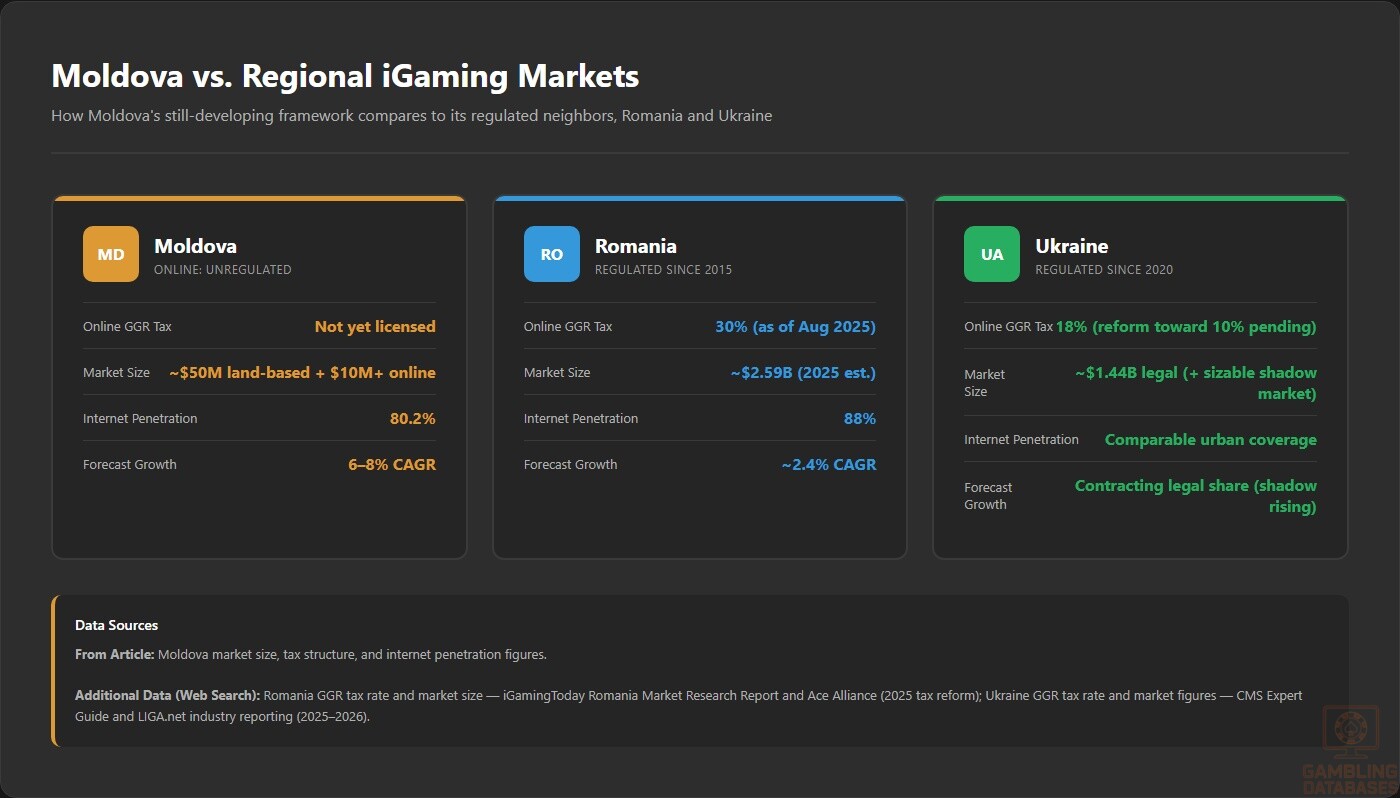
Moldova presents a unique opportunity for iGaming operators due to evolving regulatory changes and growing interest in gaming activities. While the market is still developing its online gambling framework, regulatory reforms and a state-run lottery system create a gateway for entry. This analysis examines Moldova’s legislative environment, licensing requirements, and compliance landscape to guide market entrants effectively.
| Metric | Value |
|---|---|
| Gambling Legal Status | Legal with state monopoly on lotteries; regulated land-based casinos; developing online gambling laws |
| Population | Approx. 2.6 million |
| GDP (Nominal) | ~$14 billion USD (2024 est.) |
| Average Monthly Salary | ~$400 USD |
| Internet Penetration Rate | 73% |
| Mobile Penetration Rate | 85% |
| Regulatory Authority | Licensing Chamber under Ministry of Economy |
| Primary Gambling Law | Law no. 291 of 2016 |
| Online Gambling Regulation Status | Not fully regulated; no specific licenses yet for online betting or casinos |
| Land-Based Casino Licenses | Issued annually by Licensing Chamber |
| License Validity | 1 year, renewable |
| Casino License Cost | 600,000 Moldovan lei (approx. $30,000) |
| Slot Hall License Cost | 200,000 Moldovan lei or 25,000 lei per machine |
| Foreign Ownership Restrictions | Foreign shareholders limited to 49% of capital |
| License Application Timeline | Approximately 3-6 months |
| Gross Gaming Revenue (GGR) Tax Rate | Up to 15% depending on game type |
| Player Tax on Winnings | Taxable at raised rates since 2022, approximately 15-20% |
| Advertising Restrictions | Ban lifted for low-risk gambling ads (lotteries, sports betting) with conditions; bans on high-risk gambling ads |
| Responsible Gambling Measures | Mandatory player protection and awareness warnings on advertisements |
| Anti-Money Laundering Compliance | Strict KYC/AML with monitoring by consumer protection authorities |
| Operational Requirement | Minimum share capital of 5 million MDL; physical presence required for licenses |
| Market Size (Estimated Revenue) | USD $50 million+ (land-based primarily) |
| Online Market Growth Potential | High, pending full regulatory framework |
| Market Entry Barriers | Strict licensing, capital requirements, complex compliance |
| Payment Systems Integration | Mandatory integration with state monitoring system |
| Enforcement Body | State Inspectorate and Public Services Agency |
| Penalty for Non-Compliance | Fines, license suspension, operational bans |
| Operator Competitive Landscape | Dominated by state lottery and few private land-based operators; no licensed online operators |
| Growth Forecast (CAGR) | 6-8% over next 5 years (est.) |
| Average Revenue Per User (ARPU) | Approximately $20 USD (land-based) |
Section 1: Regulatory Framework and Legal Environment
Current Gambling Regulation Status
Moldova’s gambling market is regulated under Law no. 291 of 16.12.2016, which governs the organization, conduct, and state oversight of gambling activities. It establishes the rights and obligations of operators and players, as well as restrictions aimed at protecting morality and public interest.
The sector includes a state monopoly on lotteries, regulated land-based casinos and slot machine halls, and a developing regulatory approach to online gambling. Supervision is conducted by the Licensing Chamber under the Ministry of Economy and monitored by the State Inspectorate for consumer protection.
Land-Based Gambling Activities
Land-based gambling in Moldova comprises casinos, slot halls, sports betting shops, and lottery terminals. Casinos operate under annual licenses, requiring significant capital investment and local presence. Slot halls are licensed either as venues or per machine, enabling smaller-scale operators. Sports betting is permitted but mostly facilitated by the state lottery and a limited number of licensed entities.
All land-based venues must comply with strict operational standards, including safety, fair play, and integration with the state’s monitoring system. Gambling operators must ensure age restrictions are enforced, and individuals under 21 are prohibited from employment in direct gambling control roles.
Online Gambling Framework
Online gambling in Moldova remains largely unregulated with no specific licensing framework established, although legislative efforts toward comprehensive regulation are ongoing. Despite this, online betting and casino games are accessible to Moldovan players predominantly through international operators.
The Licensing Chamber does not currently issue online gambling licenses based on defined regulatory conditions, and the market lacks local licensed online operators. However, recent government initiatives aimed at legislative amendments suggest forthcoming structured controls, including licensing, taxation, and oversight mechanisms for the online sector.
Licensed Operators and Market Players
The Moldovan iGaming market is dominated by the state-run National Lottery, which holds monopoly rights over lotteries and significant participation in sports betting and other forms. Several private companies operate licensed land-based casinos and slot halls, while online market players are exclusively foreign operators holding no Moldovan licenses.
Operators entering Moldova must anticipate a regulated competitive environment for land-based gaming, with stringent licensing and capital requirements. The online segment presents an open opportunity, albeit with legal ambiguities and expected regulatory development.
Licensing Framework and Requirements
Application Process and Eligibility
The Licensing Chamber under the Ministry of Economy is the principal regulatory authority responsible for issuing gambling licenses. The application process is detailed and requires thorough financial, technical, and legal documentation.
License applications typically take from three to six months for approval. Applicants must demonstrate substantial financial capacity, operational expertise, and compliance with public safety standards. Annual license fees vary by license type, with casino licenses costing approximately 600,000 MDL.
Eligibility criteria include:
- Corporate legal form as a joint-stock or limited liability company
- Minimum share capital of 5 million Moldovan lei, with restrictions on pledged or borrowed funds
- Clean criminal records for directors and key management personnel
- Relevant professional experience in gambling operations within Moldova or the EU
- Compliance with sanitary, fire safety, and public order requirements
- Technical readiness to integrate gaming devices with state monitoring systems
- Exclusion of public authorities and bankrupt entities from ownership
Local Presence and Operational Requirements
License holders must maintain a physical presence in Moldova, owning or leasing the premises where gambling activities occur. Operators are legally required to employ qualified management and accounting personnel, whose credentials and backgrounds are subject to regulatory approval.
Foreign ownership is capped at 49% of authorized capital, compelling international entrants to establish local partnerships or majority Moldovan ownership. The entity’s main business must be gambling-related activities, with restrictions on ancillary operations like alcohol or tobacco sales.
Domain registration for online operators will likely require local jurisdictional control once applicable legislation comes into effect, ensuring regulatory reach and consumer protection.
Compliance Obligations and Monitoring
Player Protection and Identification
Moldova mandates strict age verification, with a minimum player age of 18 for participation and minimum 21 years for employment in gambling operations. Operators must implement comprehensive KYC and anti-money laundering (AML) measures aligned with Moldovan financial regulations.
Responsible gambling frameworks require player self-exclusion options, clear disclosure of risks, and regular public awareness campaigns. Advertisements must include mandatory warnings about the negative impacts of gambling, occupying at least 20% of ad content or space for permitted low-risk gambling advertising.
- Verification of player identity and age before access
- Monitoring for suspicious financial transactions
- Provision of self-exclusion and cooling-off options
- Disclosure of odds and RTP for games
- Regular reporting to regulatory bodies on player protection metrics
Financial Monitoring and Reporting
Operators must submit periodic reports on financial transactions, revenue, and payouts to the Licensing Chamber and tax authorities. This includes real-time connection of gaming devices to the state’s online monitoring system, ensuring transparency and compliance with tax obligations.
Regulations require detailed transaction tracking systems to detect money laundering and fraudulent activity. Reports are submitted monthly, covering gross gaming revenues, tax withholdings, and operational compliance.
- Monthly submission of detailed financial statements
- Audits conducted by state inspectors on-site and remotely
- Verification of player payout records and prize fund guarantees
- Continuous monitoring of transaction flows and identification of anomalies
- Renewal of license contingent on compliance reporting
Taxation Structure and Financial Obligations
Player Taxation
Players are subject to taxation on gambling winnings, with rates having increased around 50% since early 2022. The withholding tax typically ranges from 15% to 20%, applied by operators before payout. Thresholds exempt smaller winnings, but larger prizes are fully taxable under Moldovan law.
Operator Taxation
| Gambling Activity | Tax Rate |
|---|---|
| Casinos (GGR Tax) | 15% |
| Slot Machine Halls | 10-15% |
| Sports Betting | 12% |
| Lotteries (State Monopoly) | Variable, state-controlled |
In addition, licensees pay fixed license fees annually, with renewal fees and operational taxes structured to support regulatory oversight costs.
Gambling Market Financial Performance
Land-based gambling generates annual revenues exceeding $50 million USD, primarily from casinos and lotteries. Despite the absence of regulated online gambling, the growing player base accessing offshore operators signals substantial latent market potential.
Year-over-year growth has been moderate, constrained by regulatory uncertainties. However, expected legislative reforms targeting online gambling are projected to drive stronger market expansion and increased tax revenues within the next five years.
Advertising and Marketing Restrictions
Moldova recently lifted a near-total ban on gambling advertising for low-risk categories such as lotteries and sports betting. Advertising is permitted only between 10 PM and 7 AM, with mandatory negative impact warnings occupying at least 20% of the advert’s duration or surface.
- Permitted advertising times strictly regulated
- Prohibition on outdoor banners and online advertisements for high-risk gambling
- Advertising in printed media limited to 15% of space per issue
- Small-size lottery ads allowed at retail points
- Revenue from gambling ads directed to social and sports initiatives
Recent Regulatory Changes and Their Impact
The advertising restrictions introduced in 2021 and lifted partially by late 2024 have had significant effects on the market structure and competition. The total ban on advertising had driven players toward offshore operators lacking local licenses and tax obligations.
The partial lifting aims to balance player protection with market development, allowing regulated operators to compete more effectively and contribute to public finances through advertising revenues.
Enforcement Mechanisms and Penalties
Compliance enforcement is robust, involving the State Inspectorate and other public authorities empowered to impose penalties. License holders face fines, suspension, or license revocation for violations including tax evasion, failure to comply with monitoring obligations, or allowing underage gambling.
- Monetary fines proportional to the severity of violations
- License suspension or temporary bans for operational breaches
- Confiscation of gaming equipment if standards are not met
- Legal actions against fraudulent or illegal operators
- Regular inspections and audits to enforce compliance
Section 2: Demographics and Consumer Analysis
Population Demographics and Distribution
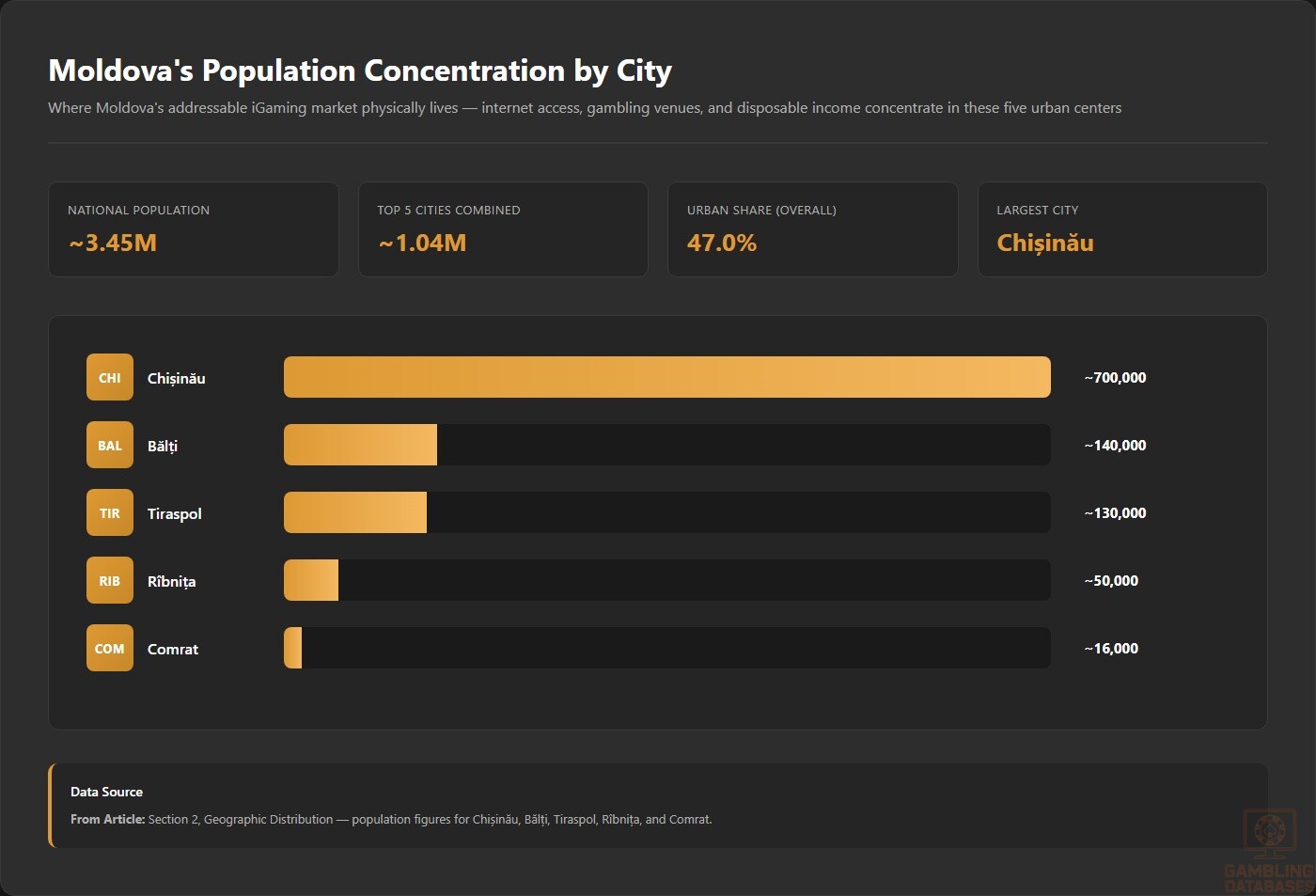
Moldova’s estimated population in 2025 stands at approximately 3.45 million individuals, reflecting a gradual decline driven by negative natural growth and net migration outflows. The median age has increased to about 40.4 years, indicating an aging population trend with significant social and economic implications.
The gender ratio favors females, with roughly 911 men per 1,000 women. Age distribution reveals about 20.3% of the population under 20 years old, 64.8% between 20 and 64 years, and 14.9% aged 65 or older, underscoring a shrinking youth base and growing elderly segment.
| Age Group | Population Share (%) |
|---|---|
| 0-19 years | 20.3% |
| 20-64 years | 64.8% |
| 65+ years | 14.9% |
Urbanization is moderate, with 47.0% of residents living in urban areas. While overall population density is approximately 120 people per km², concentration is much higher in cities. Population decline rates are expected to continue, influenced by sustained emigration trends.
Geographic Distribution
The major urban centers in Moldova house the bulk of economic and social activity, with internet access and gambling venues concentrated primarily in these regions. The capital city carries the largest population share, with secondary centers fostering regional markets.
- Chișinău – approx. 700,000 inhabitants
- Bălți – approx. 140,000 inhabitants
- Tiraspol – approx. 130,000 inhabitants
- Rîbnița – approx. 50,000 inhabitants
- Comrat – approx. 16,000 inhabitants
Rural areas exhibit lower internet penetration and limited access to gambling venues, focusing market opportunities largely on metropolitan regions with developed infrastructure.
Economic Indicators and Consumer Spending Power
Moldova’s nominal GDP in 2025 is valued at approximately $14 billion USD, with forecasts indicating a gradual recovery with a compound annual growth rate (CAGR) around 1.5% influenced by trade integration with the EU. The economy is predominantly driven by services (approx. 61%), followed by industry and agriculture.
Average monthly salaries hover near $400 USD, reflecting limited consumer discretionary income but moderate growth potential amid urban middle-class expansion. Income distribution exhibits moderate inequality with distinct income brackets influencing spending behavior.
| Indicator | Value |
|---|---|
| GDP (Nominal) | $14 billion USD |
| Average Monthly Salary | $400 USD |
| Unemployment Rate | ≈5.8% |
| Inflation Rate | 3.5% |
| Service Sector Contribution to GDP | 61% |
Household disposable income is constrained by inflation pressures but is supported by remittances from abroad. Consumer spending on entertainment and online services is growing, fueled by increasing digital adoption particularly in urban centers.
Market Size and Growth Projections
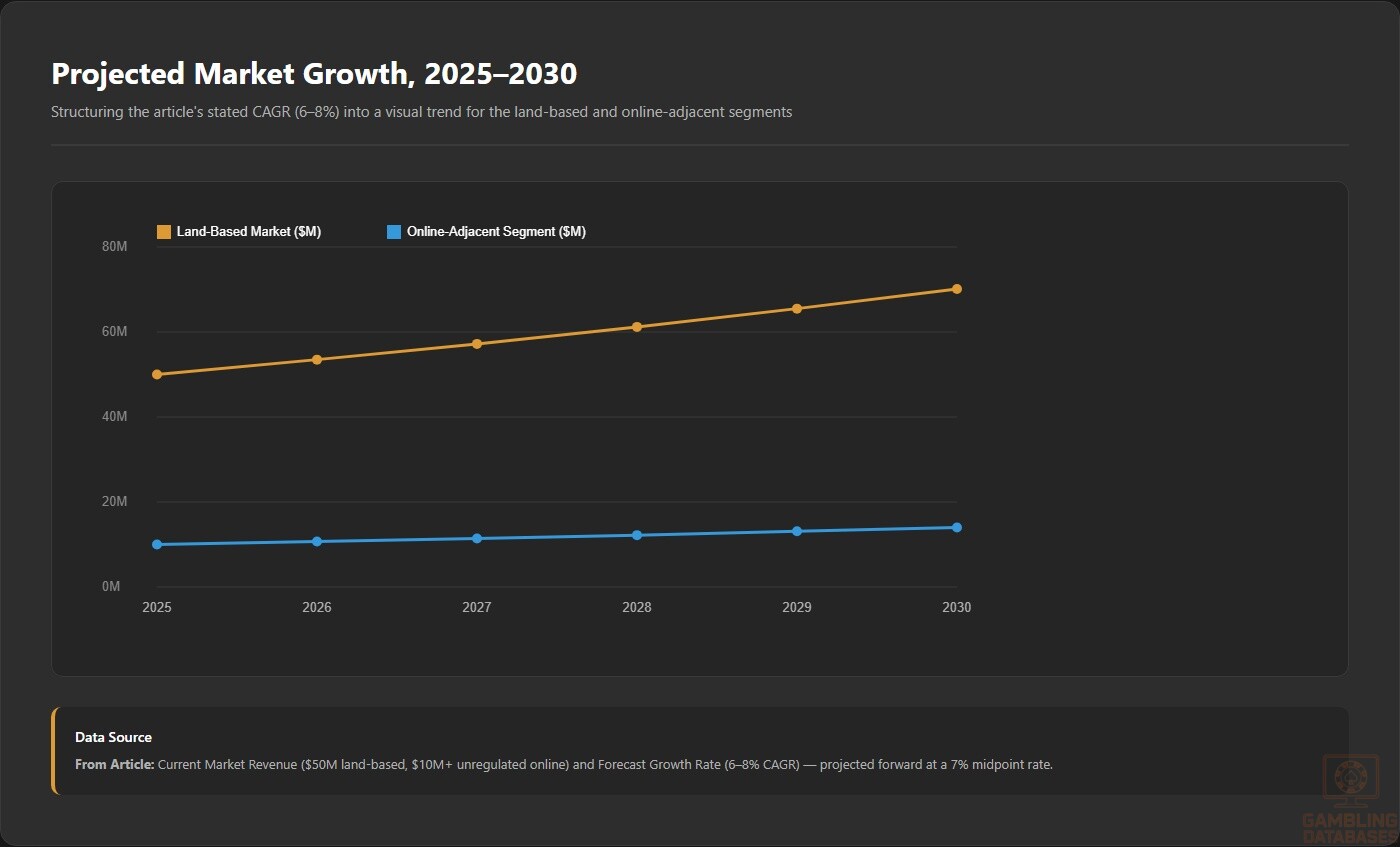
The Moldovan iGaming market remains in early stages, with land-based gambling generating concentrated revenues. Market analyses estimate land-based gambling revenues at around $50 million, while online gambling transactions are unregulated but constitute a growing shadow economy due to offshore operator access.
Forecasts anticipate a CAGR of approximately 6-8% for legalized market segments with significant expansion potential in regulated online platforms. The average revenue per user (ARPU) for land-based gaming approximates $20 USD, reflective of moderate consumer spending levels.
| Metric | Value |
|---|---|
| Current Market Revenue | $50 million USD (land-based) |
| Online Market Size (Unregulated) | Estimated $10 million USD+ |
| Forecast Growth Rate (CAGR) | 6-8% over 5 years |
| Average Revenue Per User (ARPU) | $20 USD |
| Player Base Growth | Projected 4-5% annually |
Education, Skills, and Digital Literacy
Moldova enjoys high literacy rates exceeding 98%. Educational attainment is improving, with a focus on technical and vocational training strengthening the available workforce skills. Digital literacy is growing rapidly, particularly among younger demographics, facilitated by expanding internet access and government programs promoting IT skills.
These factors contribute to a burgeoning base of digitally savvy potential consumers for online gambling services, fostering favorable market conditions for digital product adoption and innovation.
Cultural and Social Factors
Communication and Language
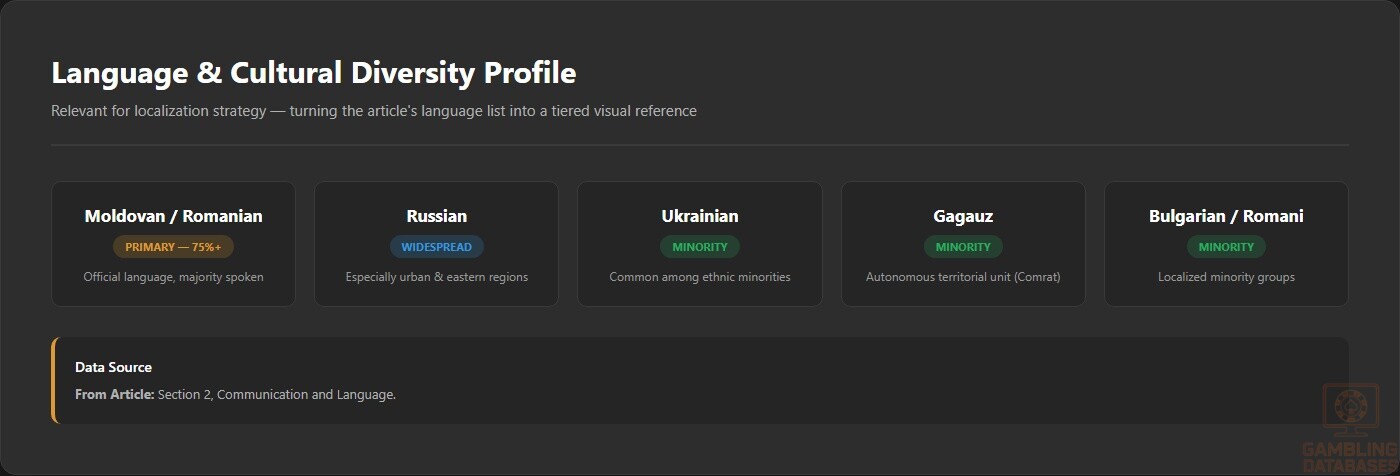
Moldova is linguistically diverse, with multiple languages widely spoken, influencing communication and marketing strategies for iGaming operators.
- Moldovan/Romanian – primary official language spoken by over 75%
- Russian – widely spoken, especially in urban and eastern regions
- Ukrainian – common among ethnic minorities
- Gagauz – spoken in autonomous territorial units
- Bulgarian and Romani – minority language groups
Cultural Attitudes
Gambling acceptance in Moldova is moderate, with traditional entertainment and betting activities being socially accepted particularly in urbanized areas. Religious influences, primarily from Orthodox Christianity, mold public attitudes towards gambling, fostering cautious consumption patterns inclined towards regulated, socially responsible providers.
Foreign brands face mixed perceptions; trust and reputation matter greatly, and success often depends on localization of services and compliance with local norms and regulations.
Problem Gambling and Social Considerations
Prevalence of problem gambling is growing moderately, coinciding with increased access to gambling, especially unregulated online platforms. At-risk groups include young adults and economically vulnerable populations.
- Government-funded addiction treatment programs
- Public awareness campaigns on gambling risks
- Mandatory responsible gambling disclosures
- Self-exclusion registries and support hotlines
- Collaboration with NGOs to assist problem gamblers
Social responsibility is enforced through regulations requiring operators to contribute to prevention funds and consumer protection initiatives.
Political Structure and Governance
Moldova functions as a parliamentary republic with relative political stability facilitating regulatory consistency. The government aligns reforms with EU accession ambitions, enhancing trade and regulatory harmonization. International relations positively influence investor confidence and business environment conditions.
Technology Adoption and Digital Behavior
Internet and Digital Usage
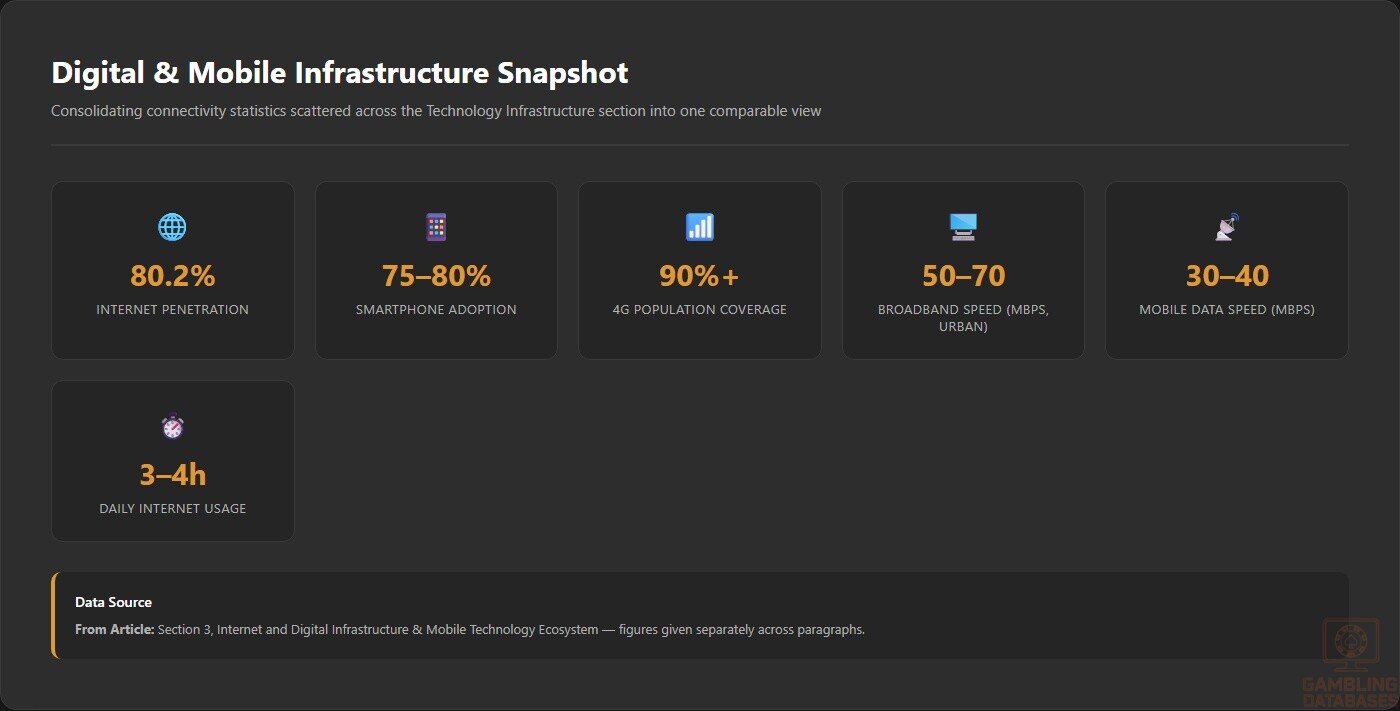
Moldova’s internet penetration reached approximately 80.2% in early 2025, with over 2.4 million users nationwide. Mobile connectivity drives much of this access, supported by widespread 3G and 4G coverage. Daily internet usage averages 3-4 hours, reflecting active engagement primarily through social media and entertainment platforms.
- Facebook – dominant platform with high penetration and daily use
- Instagram – popular among younger demographics for visual content
- YouTube – extensive video consumption platform
- TikTok – rapidly growing, especially among under-30 users
- Telegram – significant for messaging and content sharing
- LinkedIn – moderate use among professionals
Digital Payment Behavior
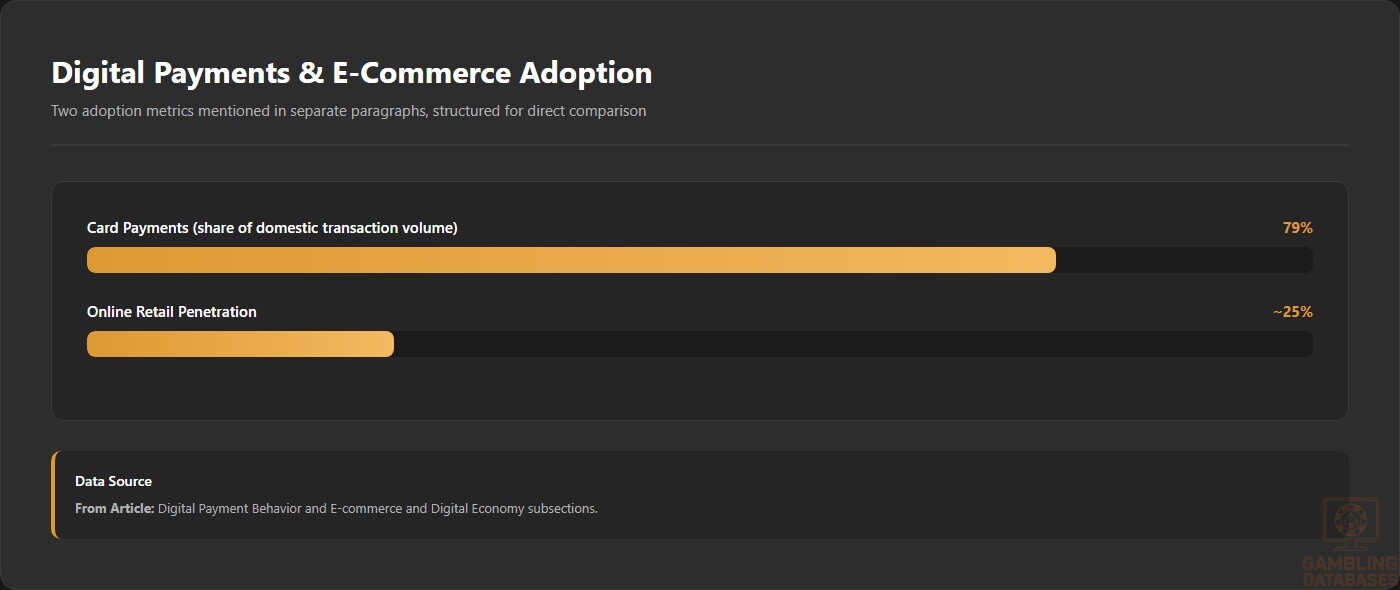
Digital payments are growing rapidly, with citizens increasingly favoring cards and e-wallets over cash for online and offline transactions. Card payments currently dominate the market, representing significant transaction volumes for goods, services, and online commerce.
- Card payments (debit and credit) – 79% of transaction volume domestically
- Bank transfers – steady use in business and large purchases
- E-wallets – emerging segment with rapid adoption among youth
- Mobile banking apps – convenience driving higher usage
- Cryptocurrency usage – niche but growing among tech-savvy groups
Gaming and Gambling Preferences
Current Market Participation
The most popular gambling activities in Moldova include lotteries, sports betting, slot machines, and casino games, predominantly in land-based formats. Participation rates vary regionally with urban centers showing higher engagement due to venue accessibility and disposable income levels.
- Lotteries
- Sports betting (pre-match and in-play)
- Slot machine gaming
- Casinos (table games, electronic gaming)
- Online gambling (primarily offshore platforms)
| Activity | Participation Rate (%) |
|---|---|
| Lotteries | 27% |
| Sports Betting | 18% |
| Slot Machines | 15% |
| Casino Table Games | 10% |
| Online Platforms | 8% |
Consumer Behavior Patterns
Moldovan gamblers typically prefer short session times with frequent play, especially on lottery and betting platforms. Peak activity occurs in evening hours on weekdays and weekends, with retention impacted by game variety, promotions, and payment convenience.
Consumers display growing interest in mobile-compatible platforms and applications, aligning with increasing smartphone penetration. Operators offering localized content, multiple language options, and secure payment systems tend to enjoy higher engagement and loyalty.
Section 3: Technology Infrastructure and Business Environment
Internet and Digital Infrastructure
Moldova has experienced notable improvements in internet penetration, with approximately 80.2% of the population connected as of 2025. Access is split between fixed broadband services and a dominant mobile internet segment, reflecting extensive 3G and 4G network coverage nationwide. Average download speeds in urban areas range between 50-70 Mbps on broadband, while mobile data speeds average 30-40 Mbps, indicating solid infrastructure responsiveness for digital services.
Reliability remains high in cities but diminishes in rural regions due to infrastructural constraints. Investments by both government and private telecom providers continue to focus on expanding fiber-optic networks and improving last-mile connectivity, which remain priorities to sustain digital economy growth.
5G and Future Technology Deployment
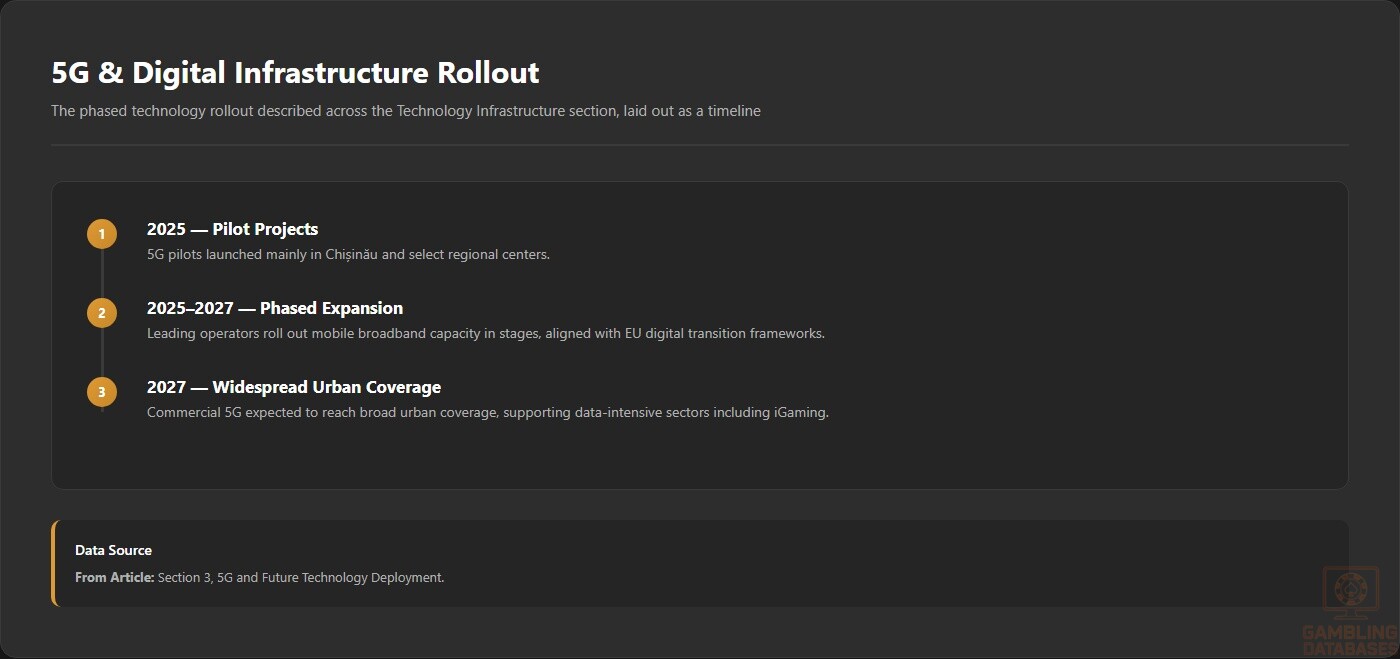
5G rollout in Moldova is in early stages, with pilot projects launched mainly in Chișinău and select regional centers. Commercial availability is expected to expand gradually over the next 3-4 years, driven by a competitive telecom market and regulatory incentives. National plans prioritize 5G deployment to enhance digital services, IoT applications, and smart city initiatives, aligning with EU digital transition frameworks.
The leading mobile network operators have announced phased 5G network expansions, anticipating widespread coverage in urban hubs by 2027, setting the stage for increased mobile broadband capacity supporting iGaming and other data-intensive sectors.
Mobile Technology Ecosystem
Mobile Network Infrastructure
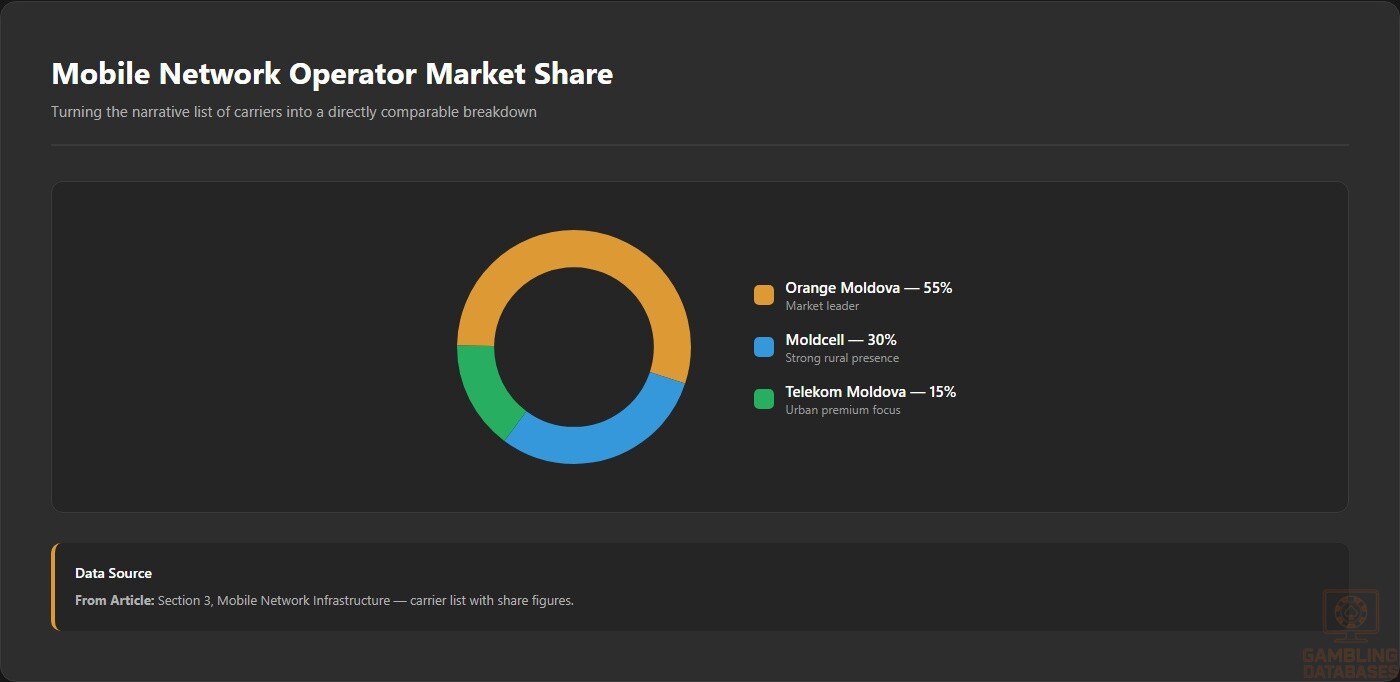
The Moldovan mobile network landscape comprises three principal operators providing nationwide coverage. Market share distribution favors one dominant player, with strong rivalry fostering affordable data plans and competitive service quality.
- Orange Moldova – market leader with approximately 55% share
- Molldova Cellular – about 30% market share, strong rural presence
- Telekom Moldova – holding approximately 15%, focusing on urban premium segments
Mobile data costs remain moderate, supporting widespread adoption and continuous subscriber base growth. 4G accessibility covers over 90% of populated areas, enhancing mobile internet experience crucial for digital gaming platforms.
Device Penetration
Smartphone adoption is high among the population, with an estimated 75-80% of adults owning smartphones by 2025. Android devices dominate the market share, while iOS captures a significant premium segment. Device usage patterns indicate heavy engagement with mobile apps and multimedia, underpinning opportunities for mobile-focused iGaming products.
Financial Services and Payment Infrastructure
Banking System Structure
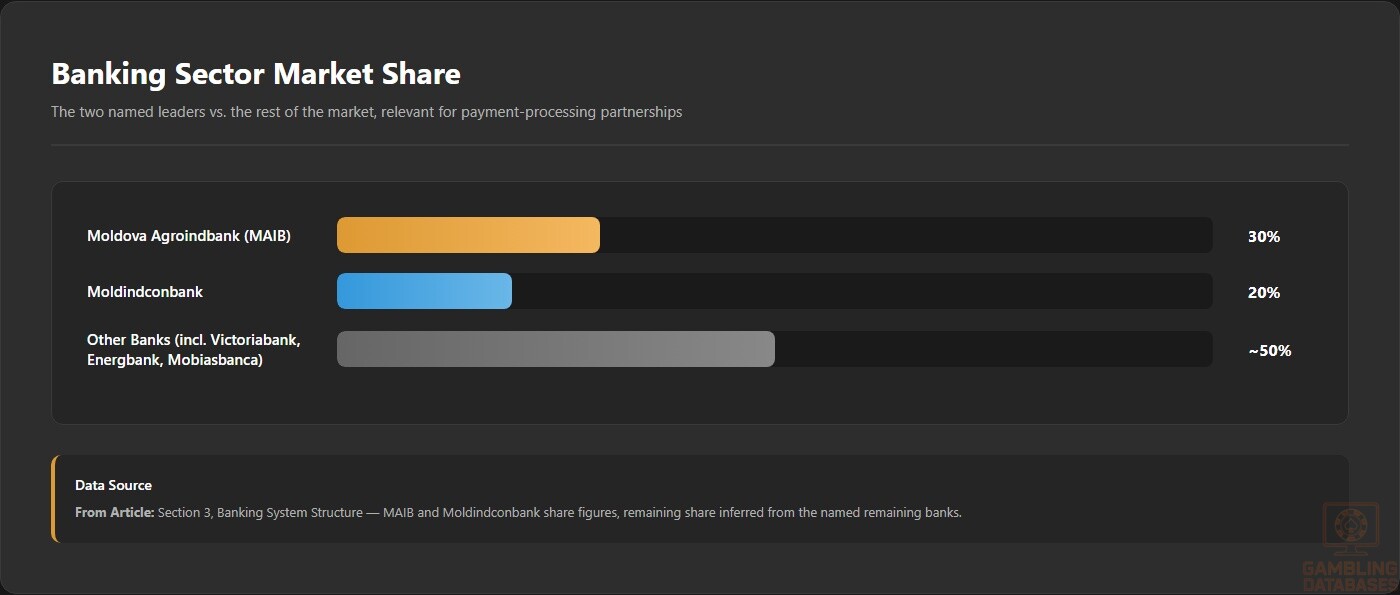
The Moldovan banking sector is moderately concentrated, featuring several key players with robust digital banking offerings enhancing financial inclusion. Adoption of mobile and internet banking services has accelerated, aligning with national digitalization policies aimed at cashless economy facilitation.
- Moldova Agroindbank (MAIB) – largest bank, 30% market share
- Moldindconbank – second largest, 20% share
- Moldova-Agroindbank – strong regional presence
- Victoriabank – focused on retail and SME clients
- Energbank – specialized in corporate finance
- Mobiasbanca – part of OTP Group, digital banking leader
Payment Processing Options
Payment landscape combines card schemes, e-wallets, bank transfers, and emerging fintech solutions, facilitating secure transactions for gambling operators and players alike. Card penetration is significant, with Visa and Mastercard widely accepted. E-wallet providers are growing, complementing traditional payment methods.
- Visa and Mastercard credit/debit cards – primary payment cards
- Bank transfers – used for larger transactions and corporate payments
- E-wallets – like Paysera, Skrill, Neteller gaining traction
- Mobile banking applications – increasingly used for peer-to-peer and bill payments
- Cryptocurrency payments – nascent but rising in niche segments
E-commerce and Digital Economy
Moldova’s e-commerce sector is expanding, driven by increasing internet access and consumer trust in digital payments. Online retail penetration is estimated at around 25%, with growth fueled by younger, urban demographics and mobile commerce platforms.
Digital services, including entertainment and fintech apps, are adopting progressively sophisticated models to capture consumer attention, supported by improving logistics and customer service infrastructures. Consumer confidence in online transactions has improved due to regulatory enhancements and fraud prevention measures.
Business Environment and Regulatory Framework
Ease of Business Operations
Moldova ranks moderately in World Bank’s Doing Business indices, reflecting ongoing improvements in business registration and operational efficiency. Company formation can take 7-10 business days, with streamlined procedures to reduce administrative burdens.
Foreign investors benefit from relatively open policies but face stringent compliance requirements in gambling and regulated sectors. Operational costs are moderate compared to Western Europe, though rising with inflation and administrative demands.
Corporate Structure and Registration
Moldova supports various entity forms, including limited liability companies (LLC), joint-stock companies (corporations), and branch offices of foreign firms. The LLC structure remains preferred due to simplified governance and flexible management.
Legal entities must comply with rigorous documentation and reporting standards, although digital platforms have accelerated registration and compliance processes.
- Certificate of incorporation
- Articles of association
- Identification documents of founders and directors
- Proof of registered office in Moldova
- Tax registration confirmation
- Bank account opening confirmation
Taxation Framework
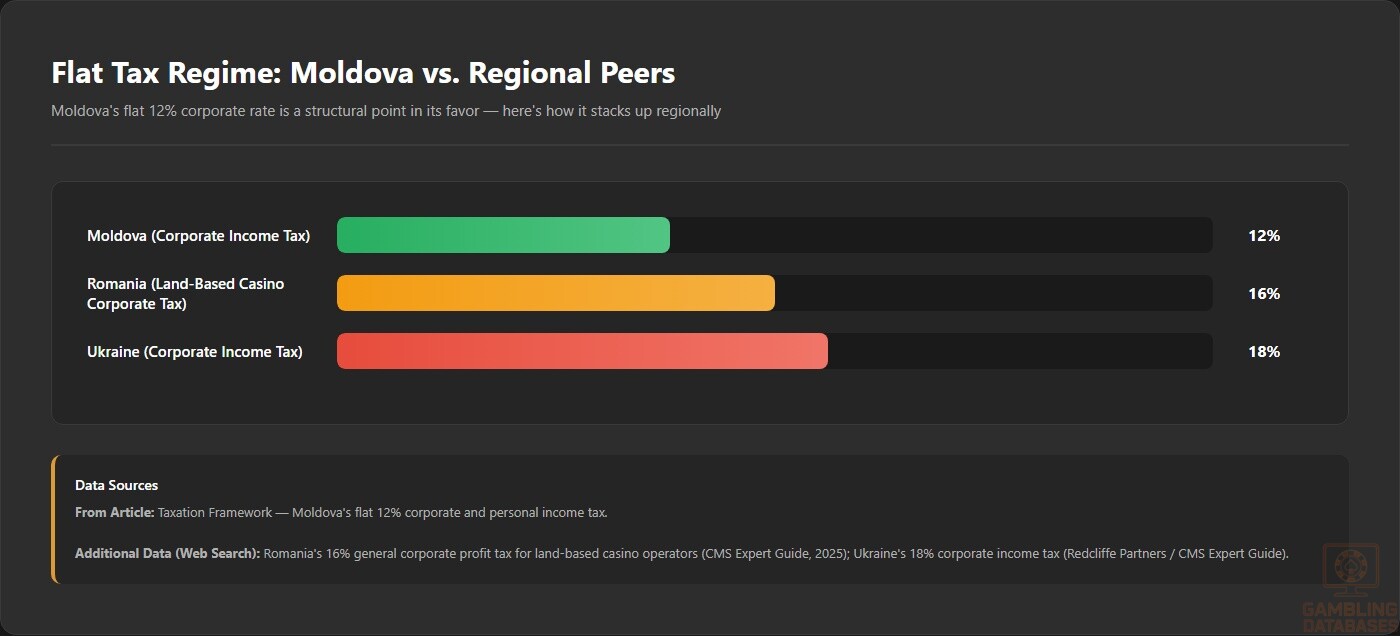
Corporate income tax in Moldova is levied at a flat rate of 12%, with incentives available for businesses in designated economic zones. Tax treaties with more than 50 countries provide for double taxation avoidance, enhancing Moldova’s attractiveness for international operations.
- Romania
- Russia
- Germany
- Turkey
- Italy
- France
- UK
- Others
Personal income tax is similarly flat at 12%, supplemented by mandatory social contributions. Resident status and withholding taxes are regulated to align with international standards.
Market Entry Considerations
Recommended Entry Strategies
Successful market entry hinges on establishing local presence with Moldovan partnerships, leveraging compliance-focused technology platforms, and adopting multi-channel customer engagement tailored to local languages. Market entrants should emphasize regulatory compliance, robust payment integrations, and culturally adapted marketing to build trust and loyalty.
- Joint ventures with Moldovan entities
- Acquisition of existing licensed operators
- Use of local payment processors and financial institutions
- Localization of platform interfaces and support
- Investment in player protection and responsible gambling systems
Typical Costs and Timelines
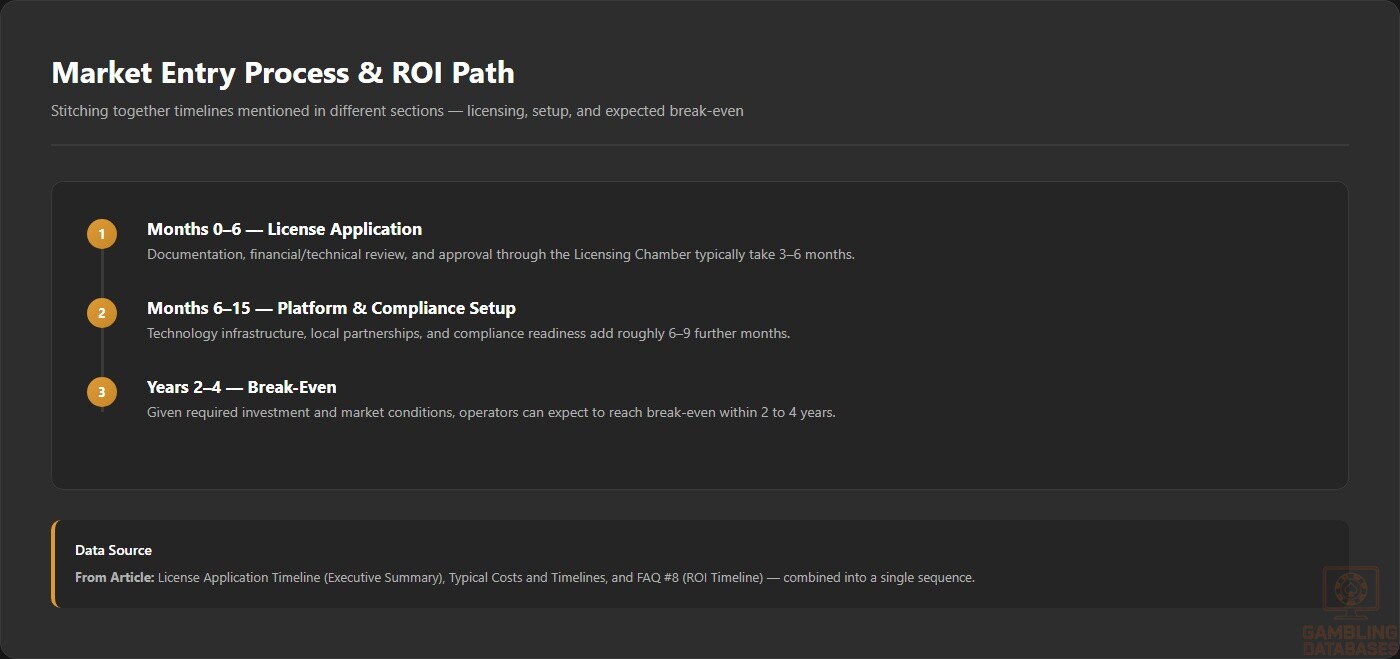
Initial investments for iGaming operators include licensing fees, technology infrastructure, legal and consulting expenses, and market development budgets. License acquisition takes 3-6 months, while platform setup and compliance readiness may require 6-9 additional months.
| Category | Estimated Cost (USD) |
|---|---|
| License Fees | $30,000–$60,000 annually |
| Legal & Consulting Services | $40,000–$70,000 |
| Technology and Platform Setup | $100,000–$250,000 |
| Marketing and Customer Acquisition | $50,000–$150,000 |
| Operational & Compliance Staffing | $60,000–$120,000 |
Success Factors and Challenges
Key enablers include understanding regulatory nuances, effective localization, and strong player protection practices. Challenges encompass rigid licensing requirements, limited online regulation, and competition with offshore operators. Cultural sensitivity and agile adaptation to evolving legislation are essential to long-term success.
- Robust regulatory compliance
- Localized marketing and customer service
- Secure and versatile payment options
- Adaptable technology platforms
- Building trust through responsible gambling policies
Exit Strategy Planning
Exit strategies are facilitated by licensing transfer options subject to regulator approval and active secondary market activity for gambling operations. Valuations depend on operator scale, compliance history, and market penetration, with liquidity enhanced by Moldova’s policy alignment with EU norms.
FAQ: Frequently Asked Questions
1. Is online gambling legal in Moldova?
Currently, online gambling in Moldova is not fully regulated, with no specific licensing framework for online operators. Access to international online gambling sites is common among players, but local regulation is expected soon, with draft legislation aiming to introduce licenses, taxation, and player protections. For now, online gambling legality exists in a grey area awaiting formal regulation.
2. What types of gambling licenses are available and what do they cover?
Gambling licenses cover land-based casinos, slot machine operations, sports betting venues, and lottery activities. The Licensing Chamber issues annual licenses with distinct fees and operational requirements per sector. Online gambling licenses do not yet formally exist but are anticipated with forthcoming regulatory reforms. Each license type requires compliance with capital, technical, and operational standards.
3. How much does an iGaming license cost and how long does it take to obtain?
Casino licenses typically cost around $30,000 annually, with slot machine and betting licenses priced lower, dependent on scope. The licensing process may take 3 to 6 months, depending on application completeness and regulatory scrutiny. Preparation for licensing involves submitting detailed documentation, undergoing inspections, and compliance verification.
4. Can foreign companies obtain a gambling license?
Foreign companies can apply for gambling licenses, subject to restrictions such as foreign ownership caps at 49%, requiring local partnerships or majority Moldovan ownership. They must meet financial, technical, and personnel eligibility criteria and demonstrate compliance with Moldovan laws. Establishing a local physical presence is mandatory for license approval.
5. What are the tax obligations for iGaming operators?
Operators are subject to gross gaming revenue (GGR) taxes, ranging from 10% to 15%, varying by gambling activity. Additionally, annual fixed license fees apply alongside corporate income tax at 12%. Operators must comply with tax reporting and withholding requirements, including player winnings where applicable.
| Gambling Activity | Tax Rate |
|---|---|
| Casinos (GGR) | 15% |
| Sports Betting | 12% |
| Slot Machine Halls | 10-15% |
| Lotteries | Variable (State Monopoly) |
6. Are gambling winnings taxed for players?
Yes, players are subject to withholding taxes on gambling winnings, typically ranging from 15% to 20%. Operators generally withhold taxes before payouts, with thresholds exempting smaller prizes. Recent legislation increased rates to align with enhanced fiscal policies targeting gambling income.
7. What are the typical operational costs for running an online casino/sportsbook?
Operational costs include licensing fees, software platform maintenance, payment processing, marketing, staffing, and compliance monitoring. Technology investment can be considerable, especially for security and regulatory interface integration. Marketing expenses must meet regulatory advertising restrictions, while staff salaries reflect local wage standards.
8. What is the expected ROI timeline for entering this market?
Given prevailing market conditions and required investments, operators can anticipate a break-even period within 2 to 4 years. This timeframe depends on market entry strategy, player acquisition efficiency, and regulatory developments particularly in online segments, which could accelerate growth if formal frameworks are enacted promptly.
9. What are the local presence requirements for operators?
Operators must maintain a physical office and operational infrastructure in Moldova, including qualified personnel recognized by regulators. Foreign ownership restrictions elevate the need for partnerships or subsidiaries domiciled within Moldova, ensuring compliance with licensing rules and operational standards.
10. What payment methods are available and recommended?
Popular payment options include card payments (Visa and Mastercard), local bank transfers, e-wallets like Skrill and Neteller, and increasingly popular mobile banking solutions. Cryptocurrency use remains niche but growing. Integration of multiple methods is essential for player convenience and market competitiveness.
11. What are the advertising and marketing restrictions?
Advertising gambling is regulated with restrictions on timing, placement, and content, particularly prohibiting promotion of high-risk games. Advertising is allowed mainly between 10 PM and 7 AM for low-risk categories like lotteries and sports betting, with mandatory responsible gambling warnings occupying a significant portion of ads. Outdoor and online ads targeting minors are banned.
12. What responsible gambling measures are mandatory?
Operators must implement strict player age verification, provide self-exclusion tools, display risk warnings prominently, and report responsible gambling statistics to regulators. Public awareness campaigns and mandatory player protection funding ensure social responsibility compliance in alignment with Moldovan laws.
13. How large is the iGaming market and what is the growth potential?
The land-based gambling market currently generates approximately $50 million in revenue, with online gaming largely untapped but growing through offshore access. Market potential is significant, given planned regulatory reforms, expanding digital infrastructure, and increasing consumer digital engagement, projected to grow at 6-8% CAGR over the next five years.
14. Who are the main competitors and what is their market share?
The market is led by the state lottery with dominant share, complemented by several private land-based casino operators. The online segment is fragmented with foreign offshore operators but no licensed local presence currently. Competitive dynamics remain in flux pending imminent regulatory changes.
15. What are the player preferences and typical spending patterns?
Players show preference for lotteries and sports betting, followed by slot machines and table games. Sessions are typically short, with high frequency, and increasing mobile engagement. Spending tends to be moderate, reflecting broader economic conditions, with enhanced retention linked to localized content and convenient payment options.
16. What are the key success factors and main challenges for new entrants?
Success hinges on regulatory compliance, cultural adaptation, and robust technology platforms offering secure payments and mobile accessibility. Challenges include navigating evolving regulations, penetrating a market with existing offshore competition, and building consumer trust under strict responsible gambling mandates.
Sources and References
- MoldovaGambling Regulatory Authority – Official Website – https://servicii.gov.md/en/service/003000537
- National Statistical Office – Population and Economic Data 2024 – https://www.worldometers.info/world-population/moldova-population/
- Central Bank of Moldova – Financial Statistics and Reports – https://infomarket.md/en/banks/378625/
- Ministry of Finance – Tax Regulations and Guidelines – https://legal-monitor.md/en/projects/jocuri-de-noroc-%D1%81um-c%C3%A2%C8%99tig%C4%83-bani-companiile-offshor-ilegale
- World Bank – Doing Business Report 2024 – https://www.worldbank.org/en/country/moldova/overview
- International Telecommunication Union – ICT Statistics – https://www.itu.int/en/ITU-D/Regional-Presence/Europe/Documents/Publications/Digital%20Development%20Country%20Profile_Moldova_06.12.21.pdf
- Gaming Industry Report – Altenar.com – 2025
- Grata International – Gambling Sector in Republic of Moldova – https://gratanet.com/publications/gambling-sector-in-the-republic-of-moldova
- Digital 2025 Moldova Report – Datareportal.com – https://datareportal.com/reports/digital-2025-moldova
- Europarl Think Tank – Moldova: Economic Indicators – https://www.europarl.europa.eu/thinktank/en/document/EPRS_ATA(2025)777919
- Casino City Moldova – Moldovan Casino Market Overview – https://www.casinocity.md/casino-and-card-room-gaming/
- IT Industry Reports – Moldova Smartphone Penetration and Network – https://www.worldeconomics.com/GDP/Moldova.aspx
- LegalPost.eu – Regulatory Overview – http://www.legalpost.eu/2025/04/an-overview-of-regulatory-framework-on.html
- RMIS JRC Legislation – Moldova Licensing Law – https://rmis.jrc.ec.europa.eu/uploads/legislation/MoldovaLawPermitting.pdf
- IPN.md – Payment Instrument Trends – https://ipn.md/en/cards-will-become-the-main-payment-instrument-in-moldova-within-two-years-at-most-expert-says/
- Gaminglaw.eu – EU Projects on Gambling Legislation – https://www.gaminglaw.eu/news/eu-financed-project-assists-the-amendment-of-gambling-legislation-in-moldova/
- Gambling Insider – Advertising Regulation Changes – https://www.gamblinginsider.com/news/27824/certain-restrictions-on-gambling-advertising-in-moldova-removed
- Online World Casino Directory – Moldova Overview – https://online.worldcasinodirectory.com/moldova
- PopulationPyramid.net – Moldova Demographic Structure – https://www.populationpyramid.net/republic-of-moldova/2025/
- Datareportal – Social Media Usage in Moldova – https://datareportal.com/digital-in-moldova
- Tribuna Juridica – Impact of Monopoly on Gambling Sector – https://www.tribunajuridica.eu/arhiva/An8vS/7.%20Gheorghe%20Renita.pdf
- CEE Legal Matters – Moldova Gaming Sector Focus – https://ceelegalmatters.com/moldova/28966-for-the-love-of-the-game-cee-s-gaming-sector
- CasinofinderHQ – Moldova Casino Guide – https://www.casinofinderhq.com/moldova/
- World Population Review – Moldova Stats – https://worldpopulationreview.com/countries/moldova
- PopulationOf.net – Republic of Moldova Data – https://www.populationof.net/republic-of-moldova/
- Countrymeters.info – Live Moldova Population – https://countrymeters.info/en/Republic_of_Moldova
- CI-Legislation.com – Gambling Laws – https://cis-legislation.com/document.fwx?rgn=93340
- FocusGN – Gambling Advertising Ban Updates – https://focusgn.com/moldovan-parliament-signals-approval-for-lifting-strict-ban-on-gambling-advertising
- Incorpore.md – Business License Guide Moldova – https://incorpore.md/en/guide-business-licenses-moldova/




Quick question about jurisdiction coverage here. Does Moldova’s regulatory framework allow operators to serve players from EU countries like Romania or Bulgaria? I’m also curious if there are any geolocation restrictions mentioned in that Law no. 291 framework. Also, are US players completely blocked from accessing any of these licensed operators, or is that handled case-by-case? The article mentions the Licensing Chamber issues the licenses but I don’t see specifics on cross-border player acceptance.
Good question on the jurisdictional specifics. Moldova’s Law no. 291 doesn’t explicitly prohibit cross-border player access in the way some EU regulators do, but there’s an important distinction here. Currently, there are no licensed online operators in Moldova at all, so the regulatory framework you’re asking about applies to land-based casinos and the state lottery system, which don’t have meaningful cross-border reach. Regarding EU players specifically: Moldova isn’t in the EU, so Romanian or Bulgarian operators would typically fall under their own national regulators (Romania’s ONJN or Bulgaria’s Commission on Gambling), not Moldova’s Licensing Chamber. US players are generally restricted by US federal law (UIGEA) from accessing most regulated gambling internationally, regardless of Moldova’s stance. Since Moldova hasn’t issued online gambling licenses yet, the question of geolocation blocks is still theoretical. When they do establish an online licensing regime, we’d expect them to follow EU patterns and require geolocation verification, but that’s speculation at this stage. The 5 million MDL minimum share capital requirement and mandatory physical presence for licensees suggests they’re building a domestic-focused market initially.