Myanmar’s iGaming sector remains nascent but presents significant untapped potential, driven by evolving regulations and growing digital penetration. The 2019 Gambling Law introduced a legal framework enabling casino operations for foreigners, but online gambling regulation remains unclear.
Understanding Myanmar’s complex regulatory environment and legal restrictions is critical for operators seeking to enter this emerging market. This report provides a detailed analysis of Myanmar’s gambling laws, licensing requirements, and compliance obligations as of 2026.
| Metric | Value |
|---|---|
| Gambling Legal Status | Casinos legal for foreigners; Online gambling illegal but unregulated |
| Primary Gambling Law | Gambling Law 2019 |
| Cybersecurity Law Effective Date | January 1, 2025 |
| Population | Approx. 55 million (2025) |
| GDP (Nominal) | Approx. $100 billion (2024) |
| GDP Per Capita | Approx. $1,800 (2024) |
| Internet Penetration | Around 50% of population |
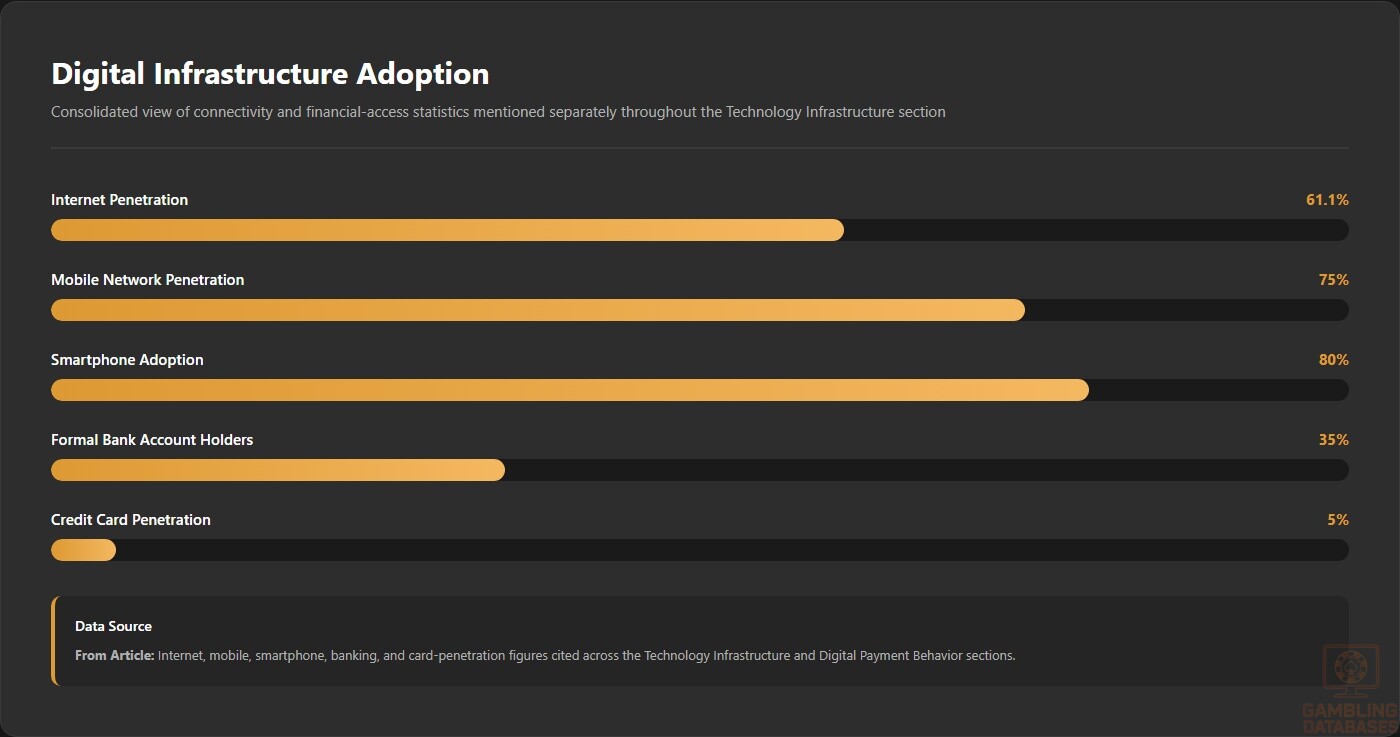
| Mobile Penetration | 75% of population |
| Licensing Authority | Union Government (specific agency pending) |
| Casino Licensing Cost | Undisclosed; fees and capital requirements not yet specified |
| License Validity | Not formally defined |
| GGR Tax Rate | Not yet defined under current regulations |
| Corporate Tax Rate | 25% |
| Entry Barriers | Regulatory uncertainty, lack of licensing clarity, foreign-only gambling restrictions |
| Local Ownership Restrictions | Undetermined, likely restricted participation for locals |
| Compliance Obligations | AML/KYC standards emerging; player protection measures limited |
| Operational Requirements | Physical casino presence required; online license framework pending |
| Penalties for Illegal Gambling | Up to 5 years imprisonment and fines up to MMK 1 million |
| Online Gambling Status | Technically illegal; enforcement limited but penalties exist under Cybersecurity Law |
| VPN and Online Gambling Controls | VPN establishment without permission punishable under Cybersecurity Law (2025) |
| Market Size (Projected 2025) | Undisclosed; land-based revenues primarily from foreign players |
| Growth Forecast (CAGR) | Potential high growth if licensing expands |
| Average Revenue Per User (ARPU) | Not disclosed |
| Market Penetration | Low domestic due to legal restrictions; foreign player segment active |
| Advertising Restrictions | Strict; no public promotion of gambling to locals |
| Enforcement Agencies | Township Administrators, Police, Ministry of Transport & Communications (pending) |
Section 1: Regulatory Framework and Legal Environment
Current Gambling Regulation Status
Myanmar’s gambling regulatory framework remains complex and somewhat ambiguous. Historically, gambling was illegal with stringent penalties including imprisonment and fines. The passage of the Gambling Law in 2019 marked a significant shift by legalizing casino operations exclusively for foreigners. However, the law does not clearly define regulatory details such as licensing procedures, capital requirements, or local participation rules.
Online gambling is technically prohibited, yet enforcement is inconsistent. Many locals access offshore gambling platforms without direct legal repercussions, placing the market in a legal grey zone. A subsequent 2025 Cybersecurity Law introduced stricter controls on unauthorized online gambling, including penalties for operating unlicensed online gaming systems and VPN services without government permission.
Land-Based Gambling Activities
Land-based gambling is dominated by casinos legally allowed to operate only for foreign patrons under the 2019 Gambling Law. These casinos serve as controlled revenue sources for the government and operate in select designated areas. Local citizens are legally barred from gambling in these establishments.
Other forms of land-based gambling, such as sports betting or slot halls accessible to locals, remain prohibited or unregulated. The government continues to maintain a restrictive stance on expanding such activities to the domestic population.
Online Gambling Framework
The online gambling industry in Myanmar lacks a formal regulatory framework. The 2019 Gambling Law does not encompass online gaming licenses or operational criteria, leaving the sector unregulated but illegal. The absence of a licensing regime and regulatory oversight means operators run significant legal and operational risks.
The Cybersecurity Law enacted in 2025 establishes penalties for unauthorized online gambling operations and VPN use, signaling tightening control over digital spaces. These developments indicate potential future regulatory efforts to formalize iGaming but currently, no official online gambling licenses are available.
Licensed Operators and Market Players
The market landscape is characterized by a handful of land-based casinos serving tourists and foreign visitors. No official licenses have been publicly issued for online or domestic gambling operators. The lack of transparency and clear regulatory guidance hinders foreign investment and complicates entry strategies.
Competition is muted in the land-based sector with limited operators allowed. Online market players generally operate offshore platforms targeting Myanmar residents without formal recognition or licensing, exposing themselves to enforcement risk under evolving digital laws.
Licensing Framework and Requirements
Application Process and Eligibility
The Gambling Law delegates the Union Government as the licensing authority for casinos, but concrete application procedures, fees, and eligibility criteria remain undefined. Prospective operators face uncertainty due to the absence of published regulatory guidelines. Licensing costs, capital requirements, and compliance standards have yet to be formalized.
Technical standards or gaming platform certifications are not specified in existing legislation. Operators must anticipate future regulatory clarifications before engaging in formal application processes.
Local Presence and Operational Requirements
Licensed casinos must operate physical locations within Myanmar catering exclusively to foreigners. The law restricts gambling participation to non-citizens, impacting market reach and business models. Operational mandates such as personnel licensing, local partnerships, or domain registration requirements are unspecified at this time.
Foreign ownership is broadly permitted, although detailed legislative texts governing foreign investments in gambling are pending.
Compliance Obligations and Monitoring
Player Protection and Identification
Myanmar currently enforces basic restrictions against underage gambling and local citizen participation through legal prohibitions rather than structured player protection policies. Formal KYC and AML standards are not yet codified for licensed operators.
Self-exclusion programs, responsible gambling awareness, and dispute resolution mechanisms remain undeveloped. The lack of statutory player protection mechanisms poses risks for consumer safety.
Financial Monitoring and Reporting
Financial monitoring requirements are not comprehensively defined in available gambling regulations. However, operators should expect obligations related to anti-money laundering compliance, transaction reporting, and audit readiness aligned with Myanmar’s evolving cybersecurity policies and international standards.
Authorities retain powers to conduct searches, seizures, and audit operators suspected of non-compliance under the Gambling and Cybersecurity Laws.
Taxation Structure and Financial Obligations
Player Taxation
There is no explicit taxation on player winnings under current laws. Gamblers do not carry direct tax obligations on gambling proceeds, as the government focuses taxation measures on operators and gross gaming revenue.
Operator Taxation
| Tax Category | Rate / Description |
|---|---|
| Corporate Income Tax | 25% |
| GGR Tax (Gross Gaming Revenue) | Not yet specified |
| License Renewal Fee | Undisclosed |
| Turnover Tax | Not defined |
| Other Operational Taxes | Not specified |
Gambling Market Financial Performance
The gambling market primarily generates revenue from foreign patronage at land-based casinos. Detailed statistics on wager amounts, payout ratios, and tax revenues are limited due to nascent regulation.
Projected growth depends on government initiatives to broaden licensing frameworks, including potential future formalization of online gambling.
Advertising and Marketing Restrictions
Advertising gambling services is heavily restricted, particularly toward Myanmar citizens. Public promotion of gambling is generally prohibited, limiting marketing channels and sponsor visibility. Land-based casinos rely mainly on inbound tourism marketing.
- Prohibition on gambling advertisements targeting locals
- Limited media channels allowed for casino promotions
- Ban on public solicitation and lottery promotions
- Restrictions on sponsoring local events
- Time-of-day and content limitations on advertising
Recent Regulatory Changes and Their Impact
The 2019 Gambling Law marked a paradigm shift by legalizing casinos for foreigners under government oversight. The enactment of the 2025 Cybersecurity Law further extended control to online gambling and digital activities, imposing penalties for unauthorised operators and VPN providers.
These legal milestones create a cautious but promising environment for iGaming entry, with regulatory uncertainty and enforcement risks remaining key challenges for investors.
Enforcement Mechanisms and Penalties
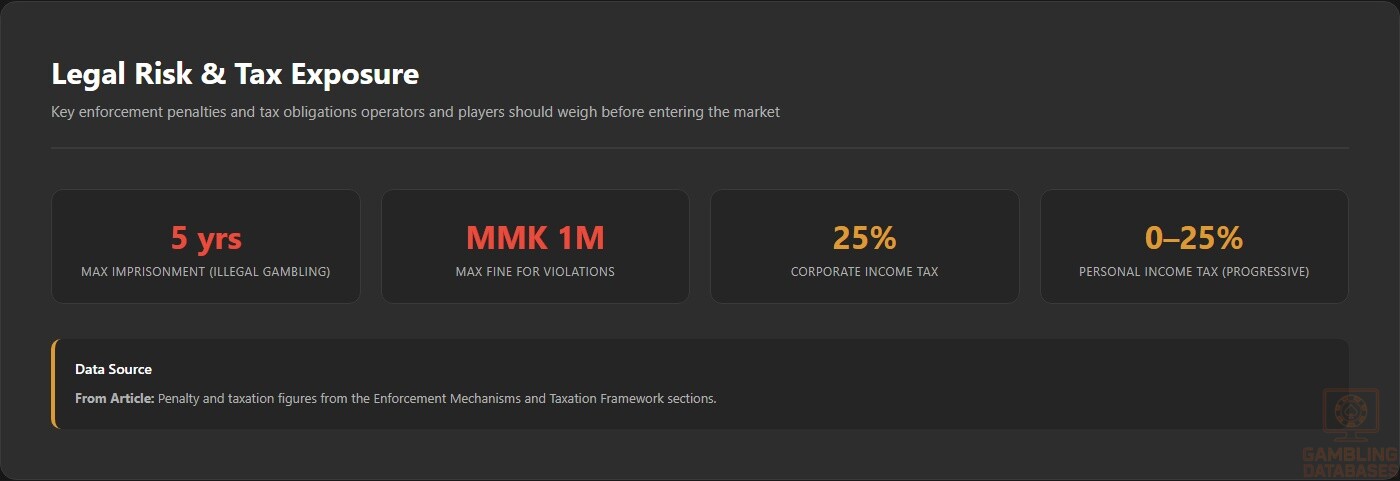
Myanmar enforces gambling laws through township administrators, local police, and national authorities empowered to conduct arrests and seizures without warrants. Penalties for illegal gambling include imprisonment up to five years and fines reaching one million kyats.
- Imprisonment for unlicensed gambling activities (6 months to 5 years)
- Monetary fines up to MMK 1 million for violations
- Seizure of gambling equipment and related assets
- Criminal prosecution under Cybersecurity Law for online violations
- Sanctions against unauthorized VPN operators facilitating online gambling
Section 2: Demographics and Consumer Analysis
Population Demographics and Distribution
Core Population Metrics
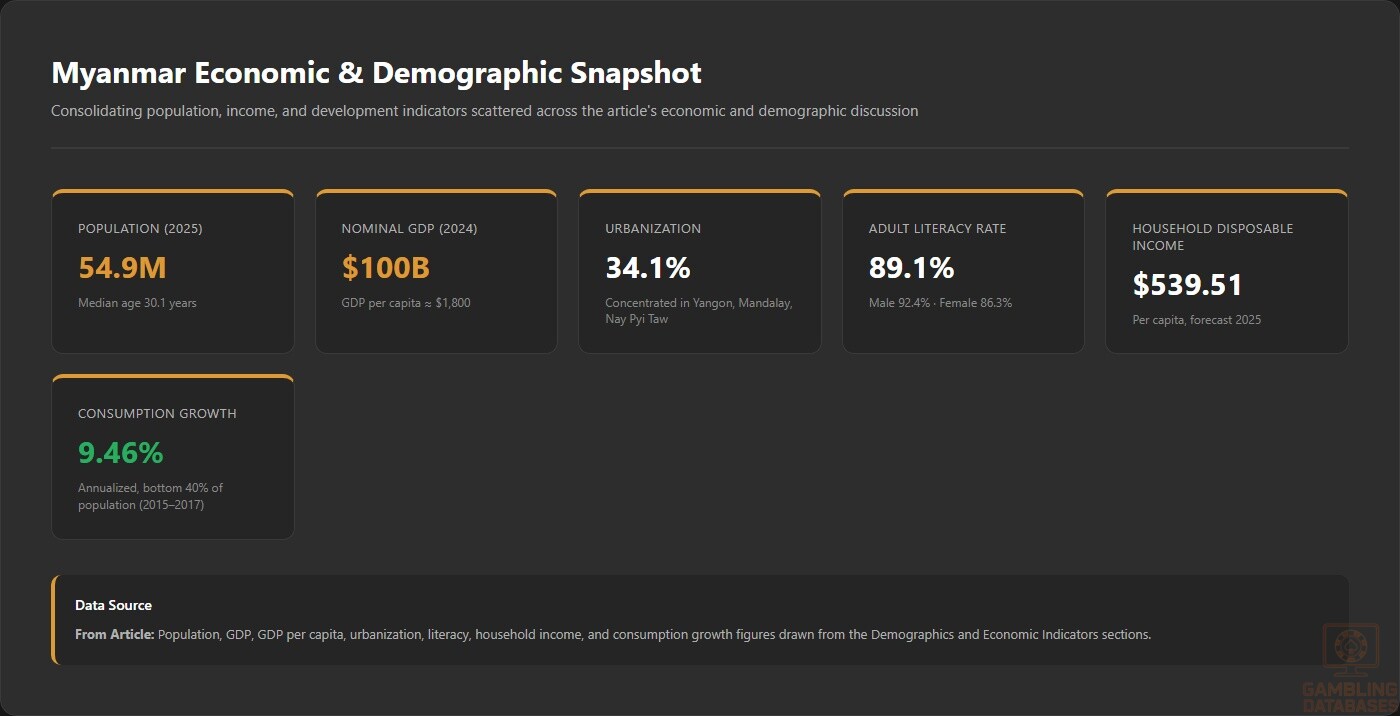
Myanmar’s population is estimated at 54.9 million in 2025, representing a youthful demographic profile with a median age of 30.1 years. The country maintains a balanced gender ratio, with males slightly outnumbering females. The total fertility rate stands at 2.1, indicating replacement-level fertility and potential long-term population stability.
Urbanization is progressing steadily, with 34.1% of the population residing in urban areas, primarily concentrated in major economic centers. Rural populations remain significant, influencing digital access patterns and gambling participation behaviors.
| Age Group | Percentage of Population |
|---|---|
| 0–14 years | 26.5% |
| 15–24 years | 18.3% |
| 25–34 years | 17.8% |
| 35–44 years | 15.2% |
| 45–54 years | 11.1% |
| 55–64 years | 6.8% |
| 65+ years | 4.3% |
Geographic Distribution
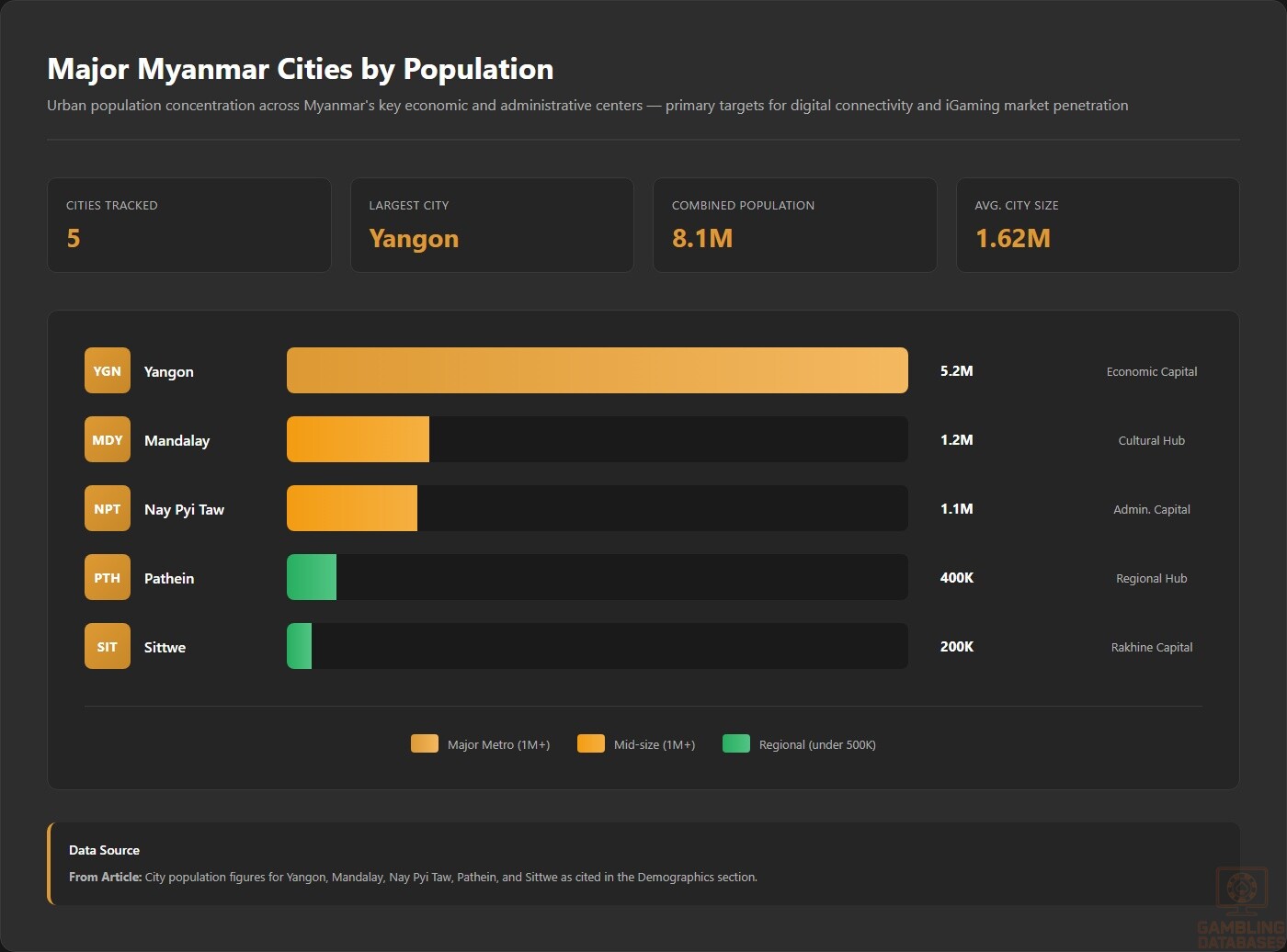
Population density varies significantly across regions, with the highest concentrations in Yangon, Mandalay, and Nay Pyi Taw. These urban hubs serve as primary centers for digital connectivity, financial services, and consumer spending, making them focal points for iGaming market penetration.
- Yangon: Population of 5.2 million, economic capital and largest city
- Mandalay: Population of 1.2 million, cultural and commercial center
- Nay Pyi Taw: Population of 1.1 million, administrative capital
- Pathein: Population of 400,000, regional hub in Ayeyarwady Region
- Sittwe: Population of 200,000, capital of Rakhine State
Economic Indicators and Consumer Spending Power
GDP and Economic Performance
Myanmar’s economy is classified as developing, with a nominal GDP of approximately $100 billion in 2024. The service sector contributes the largest share of economic output, followed by agriculture and industry. Despite political instability, digital adoption and mobile technology are driving informal economic growth, particularly in fintech and digital entertainment.
Annualized growth in per capita consumption reached 9.46% for the bottom 40% of the population between 2015 and 2017, indicating rising disposable income among lower-income groups. This trend supports increased consumer spending on digital services, including gaming and online entertainment.
Income and Wealth Distribution
Household disposable income per capita is forecast at $539.51 in 2025, reflecting limited purchasing power but growing digital engagement. Income inequality remains pronounced, with urban professionals and business owners holding disproportionate wealth compared to rural populations.
Consumer spending patterns show increasing allocation toward mobile data, smartphones, and digital content. Younger demographics prioritize expenditures on technology and entertainment, creating a foundation for digital gambling adoption despite financial constraints.
Market Size and Growth Projections
The iGaming market in Myanmar is projected to reach $150 million in revenue by 2025, driven by mobile gaming, offshore platforms, and informal betting networks. The market exhibits a compound annual growth rate (CAGR) of 28.3% from 2020 to 2026, positioning it among the fastest-growing gambling markets in Southeast Asia.
| Year | Market Size (USD) | Active Players | CAGR |
|---|---|---|---|
| 2020 | $45 million | 1.8 million | – |
| 2022 | $78 million | 2.3 million | 24.1% |
| 2024 | $120 million | 2.8 million | 26.7% |
| 2025 | $150 million | 3.1 million | 28.3% |
| 2026 | $190 million | 3.5 million | 28.3% |
Education, Skills, and Digital Literacy
Myanmar’s adult literacy rate stands at 89.1%, with higher rates among males (92.4%) than females (86.3%). Education levels vary significantly between urban and rural areas, with lower secondary completion rates at 40.1% nationally. Despite these challenges, digital literacy is rising rapidly due to mobile-first internet adoption.
Younger generations demonstrate strong familiarity with smartphones, social media, and mobile applications, enabling seamless engagement with digital gaming platforms. Alternative education programs and literacy campaigns continue to expand access, particularly in underserved regions.
Cultural and Social Factors
Communication and Language
Burmese is the official language and primary medium of communication, used by over 90% of the population. English is widely spoken in urban centers and among younger, educated demographics, facilitating access to international iGaming platforms.
Internet users predominantly consume content in Burmese, though multilingual platforms offering English and Chinese interfaces gain traction among tech-savvy users and cross-border gamblers.
Cultural Attitudes
Traditional cultural values emphasize community and family, with gambling historically viewed with skepticism due to religious and social concerns. However, digital entertainment and mobile gaming are gaining acceptance, particularly among youth who perceive online gaming as a form of social interaction rather than pure gambling.
Foreign brands are increasingly trusted, especially those offering localized experiences, secure payments, and responsive customer support. Esports and skill-based gaming enjoy higher social acceptance compared to chance-based gambling, reducing stigma and encouraging broader participation.
Problem Gambling and Social Considerations
Problem gambling remains underreported due to limited public awareness and social stigma. However, the proliferation of online scams and illegal gambling operations has heightened concerns about financial exploitation and addiction.
- Government-established helplines for gambling addiction support
- Community-based counseling services in urban centers
- Public awareness campaigns on responsible gambling
- Partnerships with NGOs to address cybercrime and fraud
- Regulatory discussions on mandatory player protection measures
Political Structure and Governance
Myanmar operates under military rule following the 2021 coup, with the State Administration Council (SAC) controlling key governance functions. Political instability and conflict have weakened institutional capacity, allowing illegal gambling and cybercrime networks to flourish in border regions.
The government maintains nominal control over economic policy and digital regulation, but enforcement is inconsistent. The 2025 Cybersecurity Law represents an attempt to assert authority over online activities, including unauthorized gambling operations.
Technology Adoption and Digital Behavior
Internet and Digital Usage
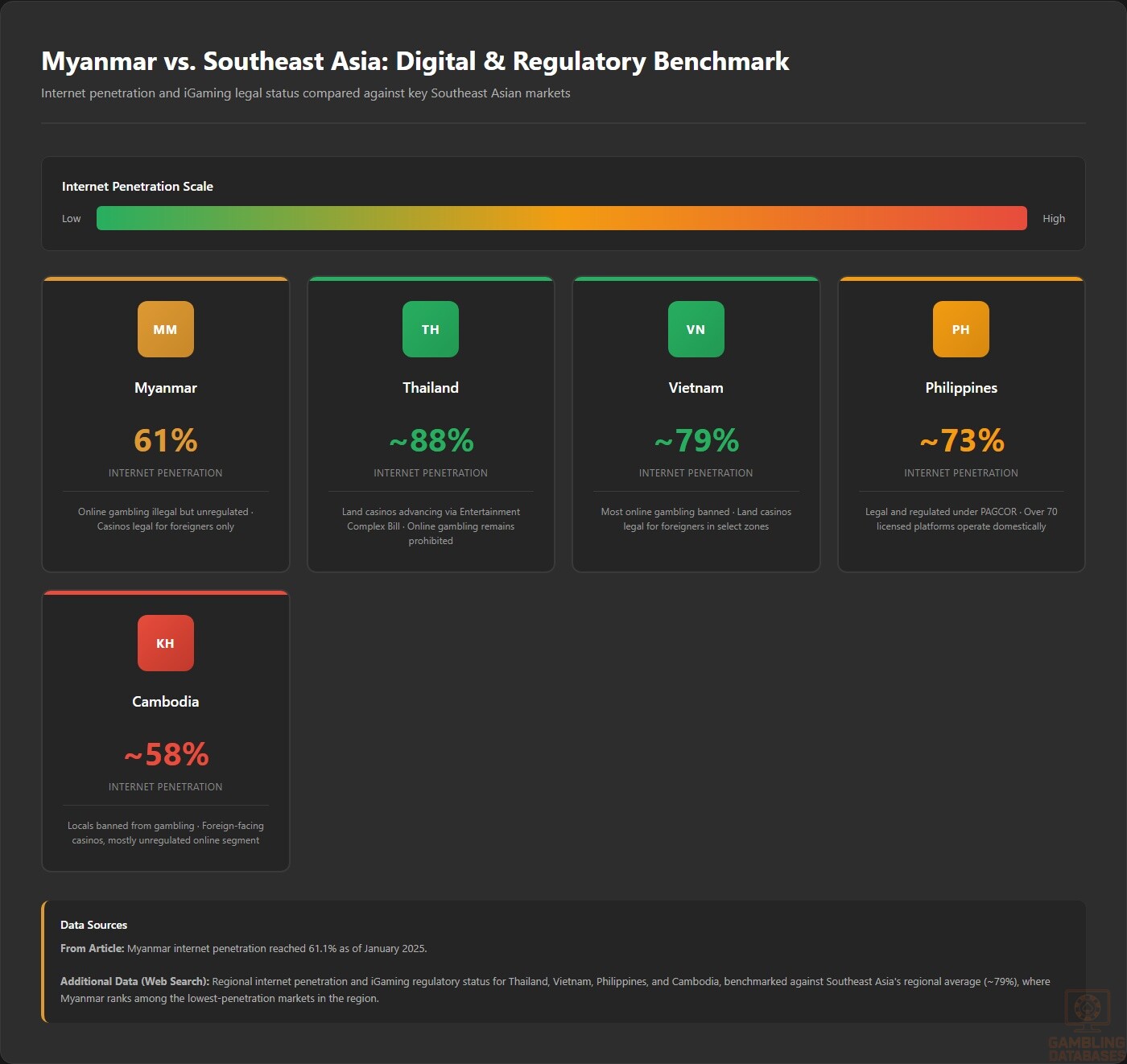
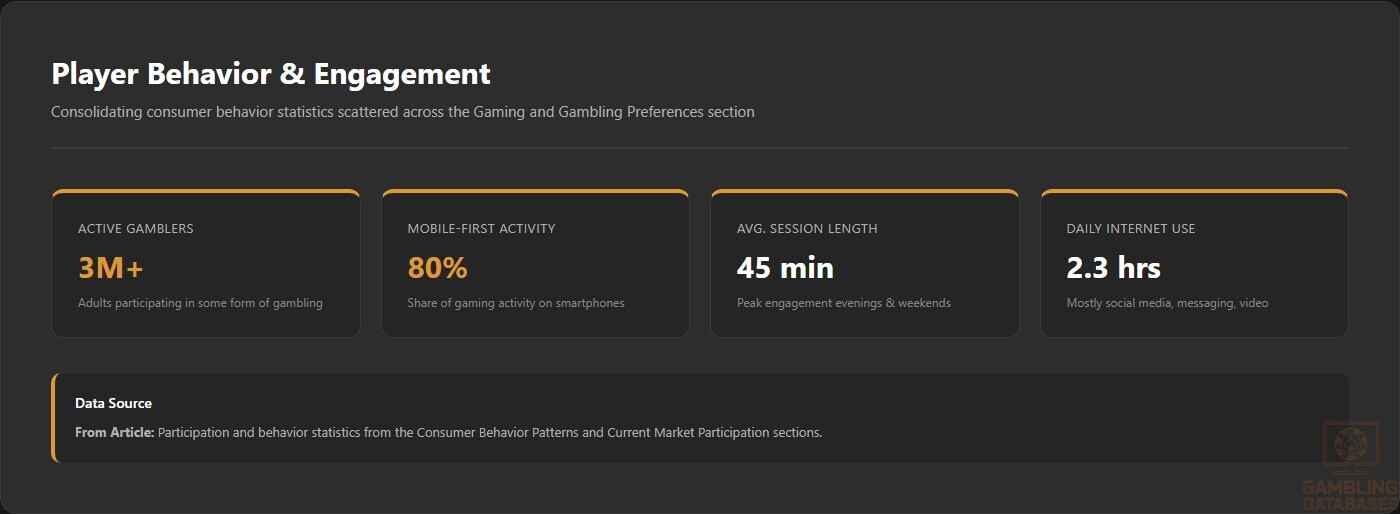
Internet penetration in Myanmar reached 61.1% in January 2025, with 33.4 million active users. Mobile devices account for the vast majority of internet access, with smartphone penetration exceeding 80% across the population.
Daily internet usage averages 2.3 hours, primarily spent on social media, messaging apps, and video content. This high engagement creates fertile ground for digital marketing and user acquisition in the iGaming sector.
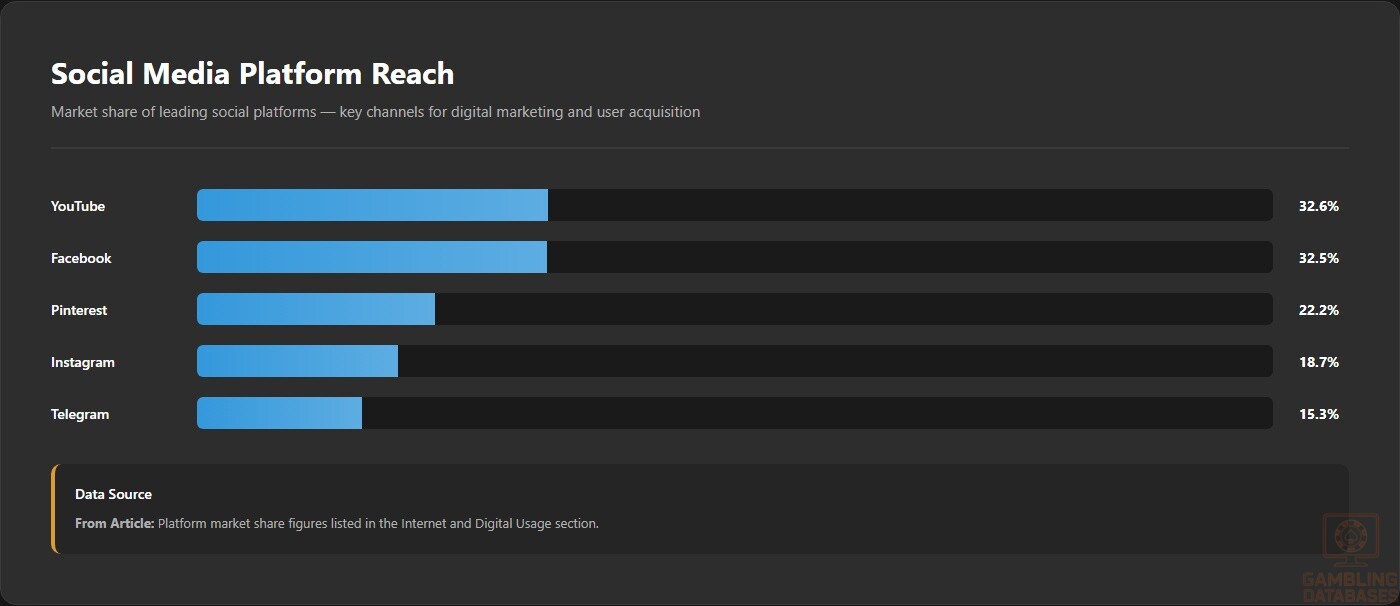
- Facebook: 32.5% market share, primary social platform
- YouTube: 32.6% market share, dominant video platform
- Pinterest: 22.15% market share, growing visual content use
- Instagram: 18.7% market share, popular among youth
- Telegram: 15.3% market share, used for private groups and channels
Digital Payment Behavior
Credit card penetration is extremely low at 5%, limiting international payment options for online gambling. Consumers rely heavily on local digital wallets and mobile banking solutions for online transactions.
- Wave Money: Leading mobile wallet with widespread agent network
- KBZPay: Bank-backed digital wallet with strong urban adoption
- AYA Pay: Growing alternative with integrated banking features
- CB Bank Pay: Popular among younger users for fast transfers
- OnePay: Emerging solution for e-commerce and digital services
Gaming and Gambling Preferences
Current Market Participation
Over 3 million adults participate in some form of gambling, with sports betting and mobile casino games being the most popular activities. The state lottery remains the only fully legal gambling product available to locals, but offshore platforms dominate digital engagement.
- Sports Betting: Most popular activity, especially during football seasons
- Mobile Slots: High engagement due to accessibility and simplicity
- Live Dealer Games: Growing interest in real-time casino experiences
- Esports Betting: Rapidly expanding among youth and tech-savvy users
- State Lottery: Widely played due to legal status and accessibility
Consumer Behavior Patterns
Players exhibit strong mobile-first behavior, with 80% of gaming activity occurring on smartphones. Session lengths average 45 minutes, with peak engagement during evenings and weekends. Retention is driven by social features such as leaderboards, daily challenges, and referral rewards.
Real-time chat functions and multiplayer formats enhance user engagement, transforming gambling into a social experience. Operators leveraging community-driven mechanics achieve higher conversion and loyalty rates.
| Game Type | Popularity | Primary Platform | Target Demographic |
|---|---|---|---|
| Sports Betting | Very High | Mobile | 18–34 Male |
| Mobile Slots | High | Mobile | All Ages |
| Live Dealer | Medium | Mobile | 25–40 |
| Esports Betting | High | Mobile | 18–30 |
| State Lottery | Very High | Physical/Mobile | All Demographics |
Section 3: Technology Infrastructure and Business Environment
Internet and Digital Infrastructure
Myanmar’s internet penetration is approximately 50% as of 2025, with a dominant reliance on mobile broadband over fixed-line connections. Fixed broadband infrastructure remains limited, concentrated primarily in urban centers such as Yangon and Mandalay, while wireless access drives national connectivity.
Network reliability is improving through ongoing investments, but challenges persist in rural and remote areas due to geography and political instability. Average mobile internet speeds hover around 25 Mbps, providing adequate bandwidth for most digital entertainment activities, including streaming and online gaming.
5G and Future Technology Deployment
5G technology rollout in Myanmar began in late 2024 with pilot programs conducted mainly in major urban hubs. Full commercial deployment is expected within the next 1-2 years, promising multi-fold increases in network speed and reduced latency.
Local operators are collaborating with international vendors for infrastructure upgrades, while government agencies outline supportive policies to accelerate 5G adoption. The arrival of 5G is poised to facilitate more advanced and seamless iGaming experiences, especially mobile-based platforms.
Mobile Technology Ecosystem
Myanmar’s mobile network ecosystem comprises a growing number of operators serving over 75% of the population. Market competition has helped reduce data costs, encouraging widespread smartphone adoption.
Smartphones constitute approximately 70% of all mobile devices, with Android dominating due to affordability and regional market availability. Consumers predominantly use mobile apps for social interaction, entertainment, and increasingly, online gaming activities.
- MPT (Myanmar Post and Telecommunications) – Largest market share, state-owned
- Telenor Myanmar – Significant operator, strong urban presence
- Ooredoo Myanmar – Competitive with aggressive pricing strategies
- MyTel – New player with growing infrastructure footprint
- Others (smaller MVNOs and regional providers)
Financial Services and Payment Infrastructure
The banking system is dominated by a mix of state-owned, commercial, and digital banks. Digital banking adoption is expanding, spurred by mobile wallet integration and partnerships with telecom operators. Despite this, only about 35% of the population holds formal bank accounts, highlighting growth opportunities.
- KBZ Bank – Largest private bank with robust digital banking
- Ayeyarwady Bank – Regional reach with SME focus
- Co-operative Bank – Established presence in rural areas
- CB Bank – Pioneer in digital payment services
- Myanmar Citizens Bank – Growing digital platform
Payment Processing Options
Digital payments in Myanmar leverage a growing ecosystem of e-wallets, mobile money, and bank transfers, supporting the nascent e-commerce and iGaming industries. Card penetration is low but gradually increasing among urban professionals.
- Wave Money: Leading mobile wallet and payment processor
- KBZPay: Popular banking app with payment functions
- MPT Pay: Telecom operator-backed mobile payment
- CB Pay: Bank-issued digital wallet with expanding acceptance
- Bank Transfers and Limited Card Payments: Growing but still niche
E-commerce and Digital Economy
E-commerce in Myanmar is growing vigorously, supported by digital payment penetration and rising consumer trust in online transactions. Mobile-first consumer behavior drives online retail purchases and digital service subscriptions.
Challenges remain in logistics, regulatory infrastructure, and consumer protections, but the expansion of internet and mobile coverage creates favorable conditions for integrated digital entertainment and iGaming services.
Business Environment and Regulatory Framework
Ease of Business Operations
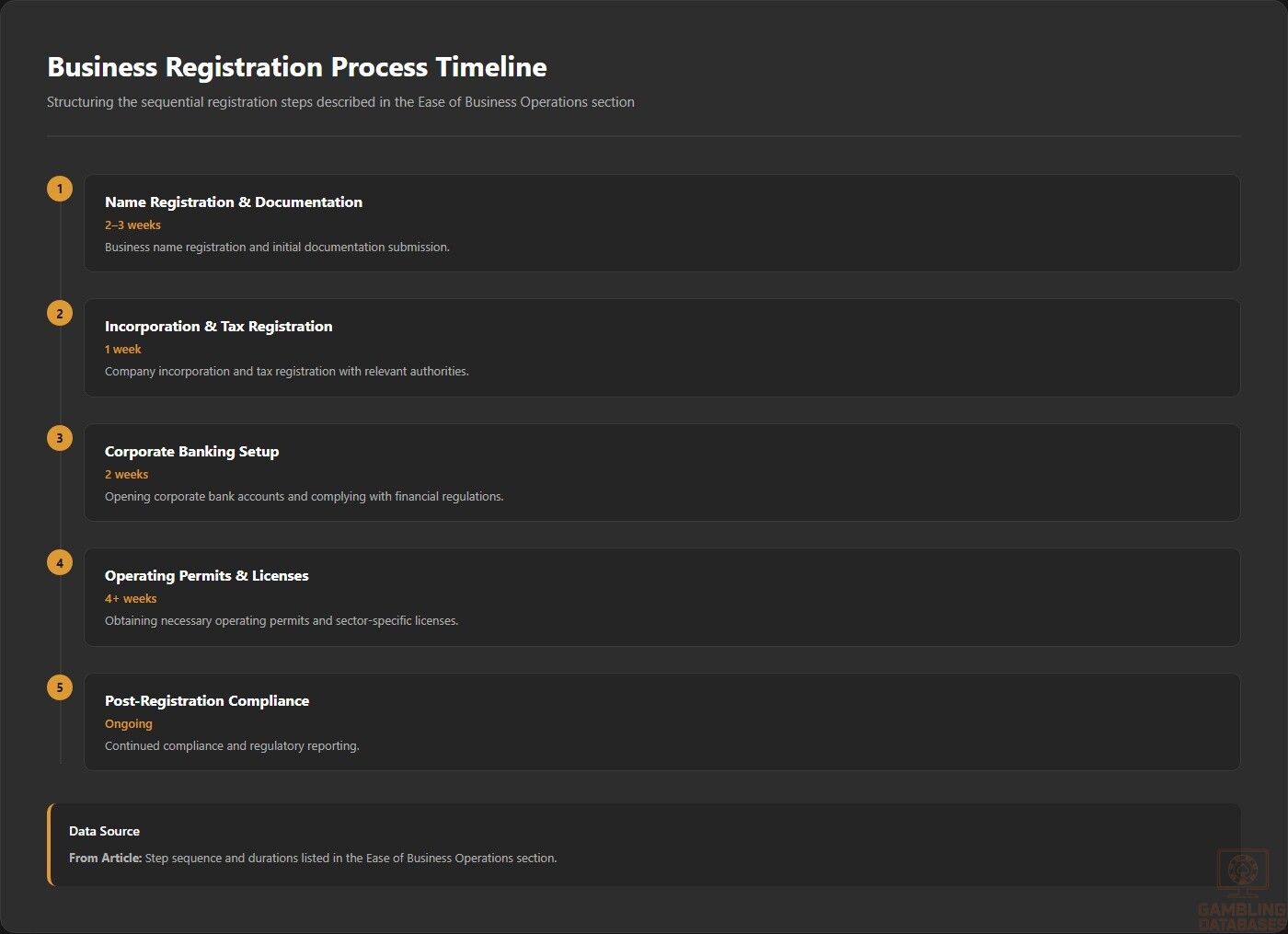
Myanmar ranks moderately in global business environment indexes, with notable improvements in registration efficiency but persistent challenges in regulatory transparency and enforcement consistency. Foreign investment policies are gradually liberalizing, though political risk remains a concern.
- Business name registration and initial documentation submission (2-3 weeks)
- Company incorporation and tax registration with relevant authorities (1 week)
- Opening corporate bank accounts and complying with financial regulations (2 weeks)
- Obtaining necessary operating permits and sector-specific licenses (4+ weeks)
- Post-registration compliance and reporting (ongoing)
Corporate Structure and Registration
Business entities commonly established include Limited Liability Companies (LLCs), Joint Stock Companies (corporations), and Branch Offices of foreign firms. LLCs are preferred for local operations due to liability protections and relatively straightforward governance.
Foreign ownership is permitted but subject to sector-specific restrictions and approval processes. Branch offices serve as operational extensions for foreign investors, though may face limitations on commercial activities.
Registration Requirements
Registering a company requires submission of essential documents, tax and sectoral compliance, and adherence to foreign ownership caps where applicable. Registration timelines typically span 4-8 weeks depending on sector and administrative efficiency.
- Articles of Incorporation and Memorandum
- Director and shareholder identification documentation
- Business plan and financial projections
- Proof of registered office and local address
- Taxpayer Identification Number (TIN) application
- Bank reference and initial capital deposit confirmation
Taxation Framework
Corporate Income Tax Structure
The standard corporate tax rate in Myanmar is 25%. Incentives and tax holidays may be available in special economic zones and targeted industries. Myanmar has treaties with several countries to mitigate double taxation and promote investment, facilitating cross-border transactions.
- China
- Singapore
- Thailand
- Japan
- South Korea
- ASEAN countries (various bilateral agreements)
Personal Income Tax
Individuals are subject to progressive tax rates from 0% to 25%, with withholding taxes applicable to employment income and contractor payments. Social security contributions and residency-based rules add further layers to tax obligations.
Market Entry Considerations
Recommended Entry Strategies
Successful market entry requires a multi-faceted approach combining licensing compliance, local partnerships, and leveraging mobile-first technology platforms. Joint ventures with established local entities facilitate market access and regulatory navigation. Developing localized content and payment solutions aligns with consumer preferences and enhances retention.
- Forming partnerships with local businesses or operators
- Focusing on mobile-optimized gaming platforms
- Ensuring regulatory compliance via expert legal counsel
- Adopting popular local payment methods and wallets
- Investing in culturally relevant marketing and player support
- Exploring gradual phased rollout aligned with regulatory updates
Typical Costs and Timelines
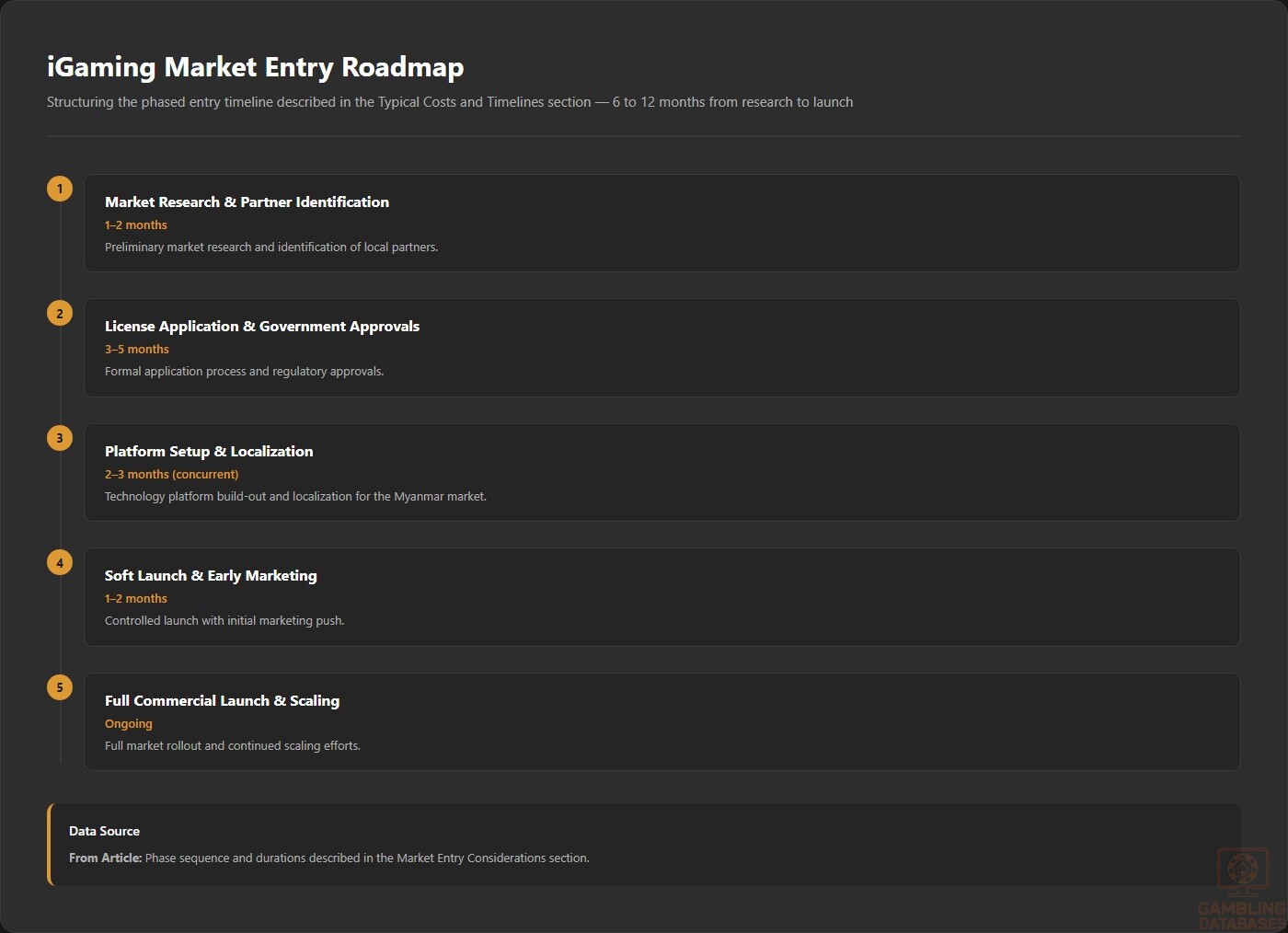
Initial market entry costs are driven by licensing fees, legal and consulting services, platform development, and marketing investments. Operational running costs include staff, compliance, server hosting, and payment processing fees. Timelines from application to launch typically range from 6 to 12 months.
| Category | Estimated Cost (USD) |
|---|---|
| License Application Fees | $100,000 – $200,000 |
| Legal and Consulting | $50,000 – $80,000 |
| Platform Development and Integration | $150,000 – $300,000 |
| Marketing and Customer Acquisition | $75,000 – $150,000 |
| Operational and Compliance Costs (Annual) | $120,000+ |
- Preliminary market research and partner identification (1-2 months)
- License application and government approvals (3-5 months)
- Platform setup and localization (2-3 months concurrent)
- Soft launch and early marketing (1-2 months)
- Full commercial launch and scaling (Ongoing)
Success Factors and Challenges
Key factors driving success include regulatory agility, deep local market knowledge, scalable technology platforms, and robust payment integrations. Challenges arise from political instability, unclear regulatory regimes, and cultural barriers to gambling acceptance.
- Regulatory uncertainty and evolving compliance requirements
- Restricted domestic gambling participation
- Payment processing limitations outside urban centers
- Political risk affecting foreign investment confidence
- Cultural resistance among conservative populations
Exit Strategy Planning
Market liquidity is limited; therefore, exit strategies should be planned with realistic expectations. Transferring ownership or licenses requires regulatory approval, with valuations influenced by governance stability, market penetration, and license validity durations.
FAQ: Frequently Asked Questions
1. Is online gambling legal in Myanmar?
Currently, online gambling is technically illegal under Myanmar’s Gambling and Cybersecurity Laws, with strict penalties for unauthorized operations. However, enforcement is inconsistent, and many operators serve the market offshore. There is no formal online gambling licensing framework, but future regulatory developments could introduce legal avenues for operation.
2. What types of gambling licenses are available and what do they cover?
The primary license issued in Myanmar is for land-based casinos targeting foreign players, established under the 2019 Gambling Law. No official licenses exist for online gambling or domestic betting. The licensing framework is evolving, lacking detailed classifications beyond casino authorization for foreigners at present.
3. How much does an iGaming license cost and how long does it take to obtain?
Since online gambling licenses are not yet formally issued, costs and timelines are speculative. Land-based casino licenses likely incur substantial fees in the range of $100,000 to $200,000 or more. License approval and setup can take 6 to 12 months due to regulatory complexities and bureaucratic procedures.
4. Can foreign companies obtain a gambling license?
Yes, foreign companies can obtain casino licenses oriented toward foreign patrons. However, participation restrictions for locals remain stringent. Foreign operators are advised to establish local partnerships and comply with regulatory mandates including registration, tax obligations, and local presence where required.
5. What are the tax obligations for iGaming operators?
Operators are subject to corporate income tax of 25%, with no current clear gross gaming revenue (GGR) tax guidelines. Other operational taxes may apply depending on sectoral regulations and economic zones. Compliance requires navigating evolving tax laws and potentially benefiting from treaty protections aimed at avoiding double taxation.
6. Are gambling winnings taxed for players?
Currently, there is no explicit taxation on player winnings under Myanmar law. The government focuses fiscal policies on taxing operators rather than individual gamblers. Players are not required to declare or pay taxes on gambling income.
7. What are the typical operational costs for running an online casino/sportsbook?
Key operational expenses include platform maintenance and development, licensing fees, marketing, payment processing charges, staffing, and compliance costs. Fixed overheads and technology investments can range from $100,000 annually upwards, depending on scale and market reach.
- Licensing and regulatory costs
- Technology and platform hosting
- Marketing and player acquisition
- Payment processing fees
- Compliance and auditing expenses
8. What is the expected ROI timeline for entering this market?
Return on investment timelines vary widely but typically span 3 to 5 years, depending on regulatory clarity, market penetration success, and local partnerships. Political and economic instability could extend timelines, requiring preparedness for medium-term capital commitment.
9. What are the local presence requirements for operators?
Land-based casinos must have a physical presence in Myanmar, with license conditions restricting gambling access to foreign players only. Online operators currently face regulatory gaps, but local incorporation and partnerships are advisable to ensure compliance and operational effectiveness.
10. What payment methods are available and recommended?
Preferred payment methods include mobile wallets such as Wave Money and KBZPay, along with bank transfers. Card payments are less common but growing, especially in urban centers. Integration with local wallets improves customer acquisition and retention.
11. What are the advertising and marketing restrictions?
Advertising gambling services is heavily restricted, especially targeting local citizens. Permitted channels are limited mainly to tourist-focused media. Promotions must avoid appealing to minors or vulnerable groups, with strict limits on sponsorship and public marketing visibility.
12. What responsible gambling measures are mandatory?
Currently, Myanmar does not enforce formal mandatory responsible gambling programs. Operators are encouraged to implement voluntary measures such as age verification, self-exclusion options, and player education to align with emerging international best practices.
13. How large is the iGaming market and what is the growth potential?
The Myanmar iGaming market is small but poised for rapid growth driven by increasing digital adoption and potential regulatory developments. User bases in both formal land-based casinos and informal online segments continue expanding, with high growth potential contingent on licensing reforms.
14. Who are the main competitors and what is their market share?
The competitive landscape is dominated by a few land-based casino operators serving foreign tourists. In the unregulated online space, offshore platforms take the lead with Myanmar-facing offerings. The absence of formal online licenses limits transparent market share data.
15. What are the player preferences and typical spending patterns?
Players favor mobile-optimized games and low-entry barrier betting activities. Spending is concentrated among urban youth and middle-income groups, with preferences for popular global casino games and informal lotteries. Session lengths generally range 30 to 60 minutes, with peak activity during evenings and weekends.
16. What are the key success factors and main challenges for new entrants?
Success hinges on navigating regulatory uncertainties, securing local partnerships, and leveraging mobile-first technology. Challenges include restrictive local participation laws, payment limitations, and cultural resistance. Market volatility due to political instability further complicates long-term strategic planning.
Sources and References
- Myanmar Gambling Regulatory Authority – Official Publications
- National Statistical Office of Myanmar – Population and Census Reports 2024
- Central Bank of Myanmar – Annual Financial and Economic Reports 2024
- Ministry of Finance of Myanmar – Taxation and Business Regulations
- World Bank – Doing Business Report 2024
- International Telecommunication Union – Myanmar ICT Data 2025
- Myanmar Post and Telecommunications (MPT) – Network Coverage Reports
- Telenor Myanmar – Market and Financial Statements 2025
- Ooredoo Myanmar – Annual Performance Report 2024
- Wave Money – Mobile Payment Industry Data 2025
- KBZ Bank – Digital Banking and Payments Report 2024
- Myanmar Cybersecurity Law – Government Gazette 2025
- Gambling Law 2019 – Myanmar Government Legal Archive
- Asia Law Portal – Myanmar Gambling Legal Updates 2024-2025
- International Gaming Today – Myanmar Market Analysis 2024
- IGaming Solutions – Regulatory News Week 2025
- LCB – Online Gambling Restrictions Report Myanmar 2024
- Scaleo.io – iGaming Regulations Overview 2025
- Baker McKenzie – Myanmar Cybersecurity Law Analysis 2025
- The Diplomat – Myanmar Political and Regulatory Environment 2025
- Asia-Pacific Gambling Regulatory Reports 2025
- National E-commerce Development Strategy Myanmar 2024
- Myanmar Ministry of Commerce – Business Registration Guidelines
- Myanmar Investment Commission – Foreign Investment Policies 2024
- Financial Times – Myanmar Market Risk Analysis 2025
- International Monetary Fund – Myanmar Economic Outlook 2025
- Asian Development Bank – Infrastructure Report Myanmar 2024
- Gaming Industry Reports – Market Size and Forecast 2025
- Local News Outlets – Regulatory Enforcement Updates 2025
- Academic Journals on Myanmar Socioeconomic Dynamics 2024-2025
- Myanmar Telecommunications Authority – Mobile Subscriber Data 2025
- Consultancy Reports on Myanmar Business Environment 2025
- International Trade Administration – Myanmar Market Entry 2025
- Various Industry Whitepapers and Market Research Studies 2024-2025