
Namibia offers a growing iGaming opportunity supported by evolving regulation and expanding digital infrastructure. The country’s regulatory framework is anchored in comprehensive gambling laws enacted in recent years, aiming to formalize the market and curb illegal activities.
The government’s focus includes strong consumer protections, licensing enforcement, and a developing national gambling policy emphasizing social responsibility and market integrity.
Executive Summary: Key Market Indicators
| Metric | Value |
|---|---|
| Gambling Legal Status | Legal with regulated licensing system |
| Primary Gambling Legislation | Gaming and Entertainment Control Act 2018, Lotteries Act 2017 |
| Regulatory Authorities | Gambling Board of Namibia, Lotteries Board |
| Population | 2.7 million (2025 estimate) |
| Median Age | 22 years |
| GDP (Nominal) | Approx. USD 15 billion |
| GDP per Capita | ~USD 5,500 |
| Internet Penetration | 54% of population |
| Mobile Penetration | 92% of population |
| Online Gambling License Types | Casino, gambling house, bookmaker, totalisator, supplier, testing agent |
| License Application Fee | Varies; typically N$20,000+ (approx. €963) |
| License Processing Time | 3-6 months average |
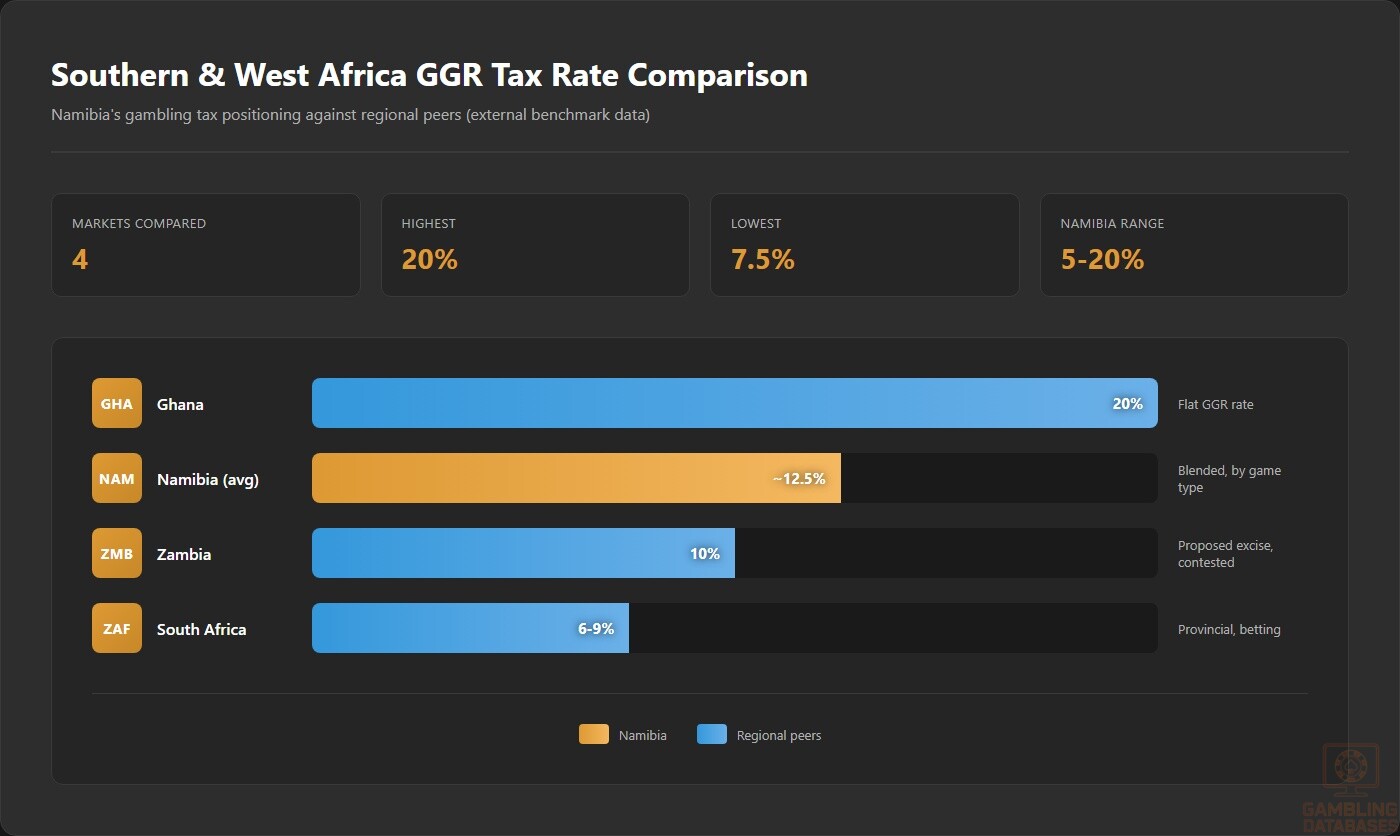
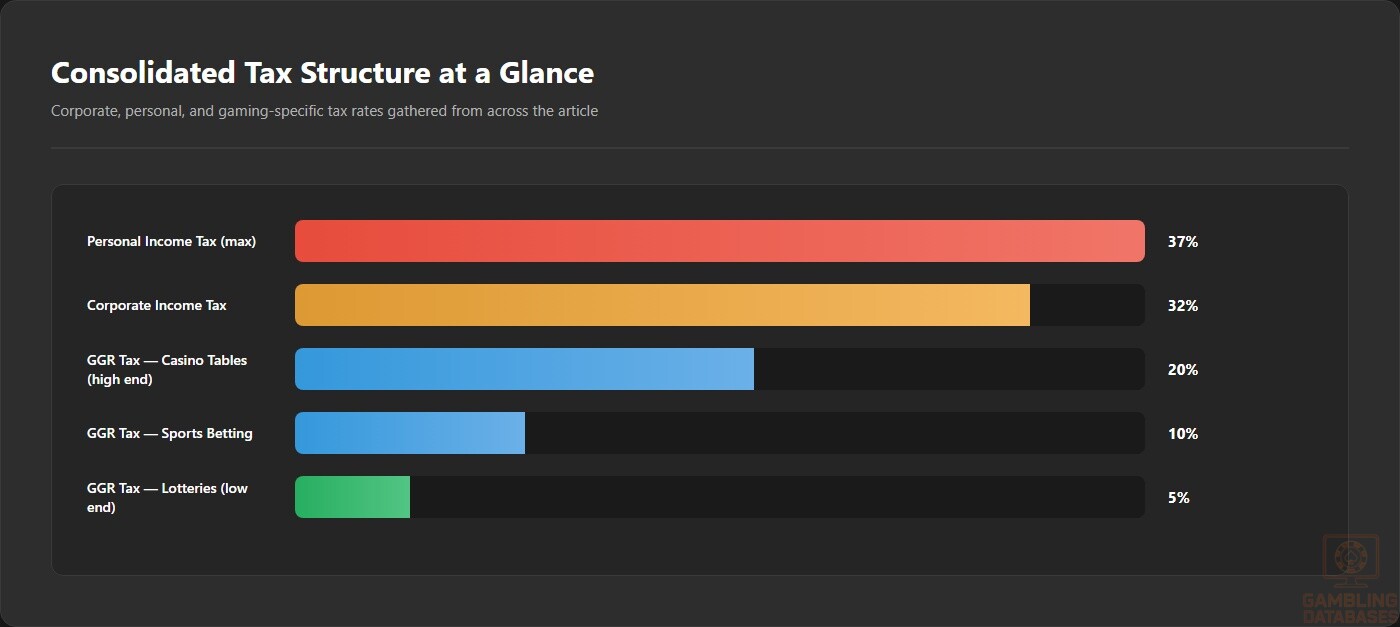
| Gross Gaming Revenue (GGR) Tax | Ranges between 5% – 20% depending on game type |
| Corporate Income Tax | 32% (standard rate) |
| Player Taxation | Winnings subject to withholding or tax on declared income |
| Market Entry Barriers | Strict licensing, local presence requirements, compliance obligations |
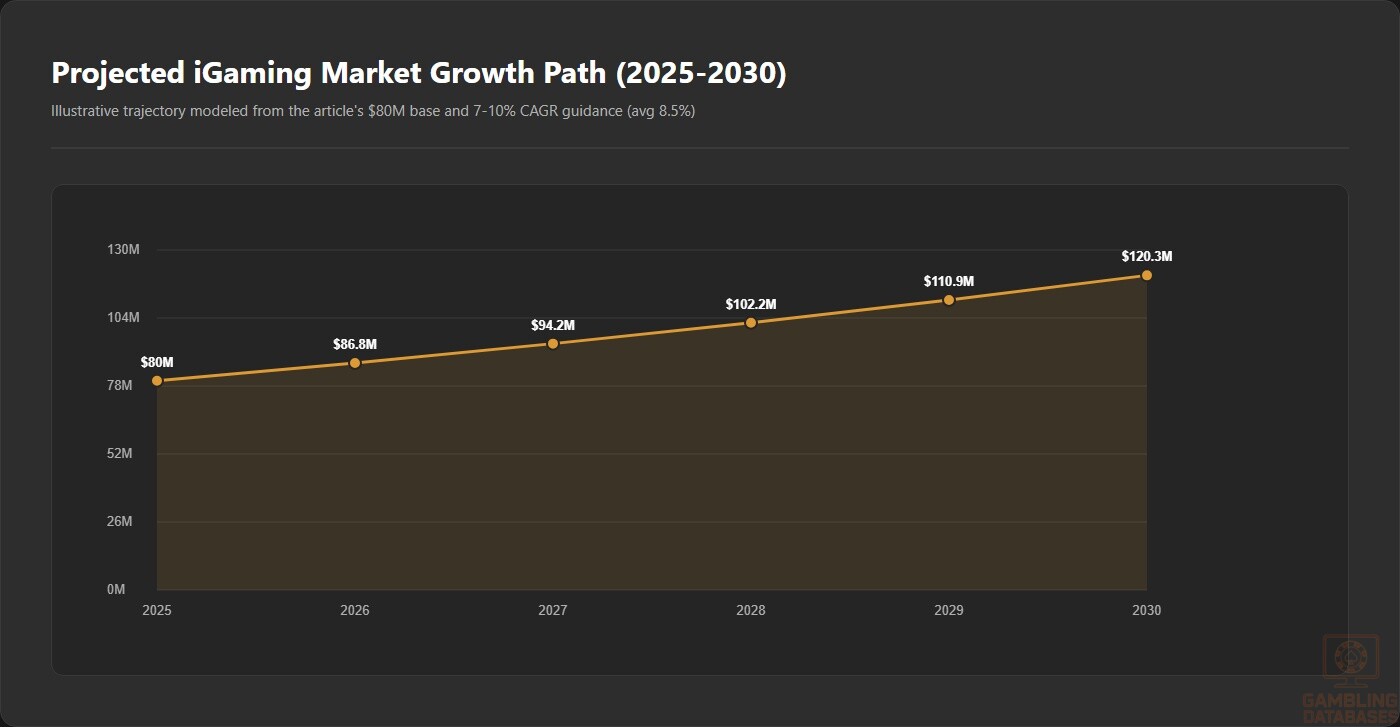
| Market Size Estimate | USD 80 million (projected 2025) |
| Favorable Market Factors | Growing middle class, mobile connectivity, regulatory reforms |
| Technology Infrastructure | Improving broadband; central monitoring system mandated |
| Responsible Gambling Measures | Mandatory self-exclusion, addiction prevention focus |
| Recent Regulatory Changes | Enhanced enforcement since 2021; national policy in development |
| Advertising Restrictions | Permitted with license; content and timing regulated |
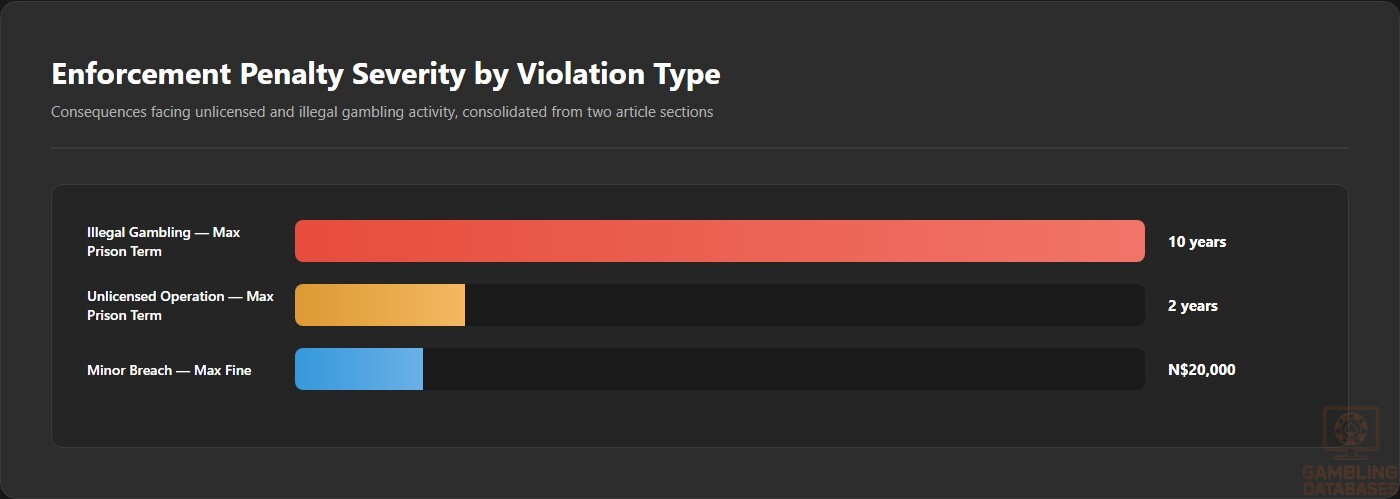
| Unlicensed Gambling Enforcement | Fines up to N$20,000 and/or prison up to 2 years |
| Maximum Penalty for Illegal Gambling | Up to 10 years imprisonment |
| Average Revenue Per User (ARPU) | Estimated N$1,500 per active player/year |
| Market Growth Forecast (CAGR) | 7-10% projected 2025-2030 |
| Local Partner Requirement | Foreign operators encouraged to partner with Namibian entities |
Section 1: Regulatory Framework and Legal Environment
Current Gambling Regulation Status
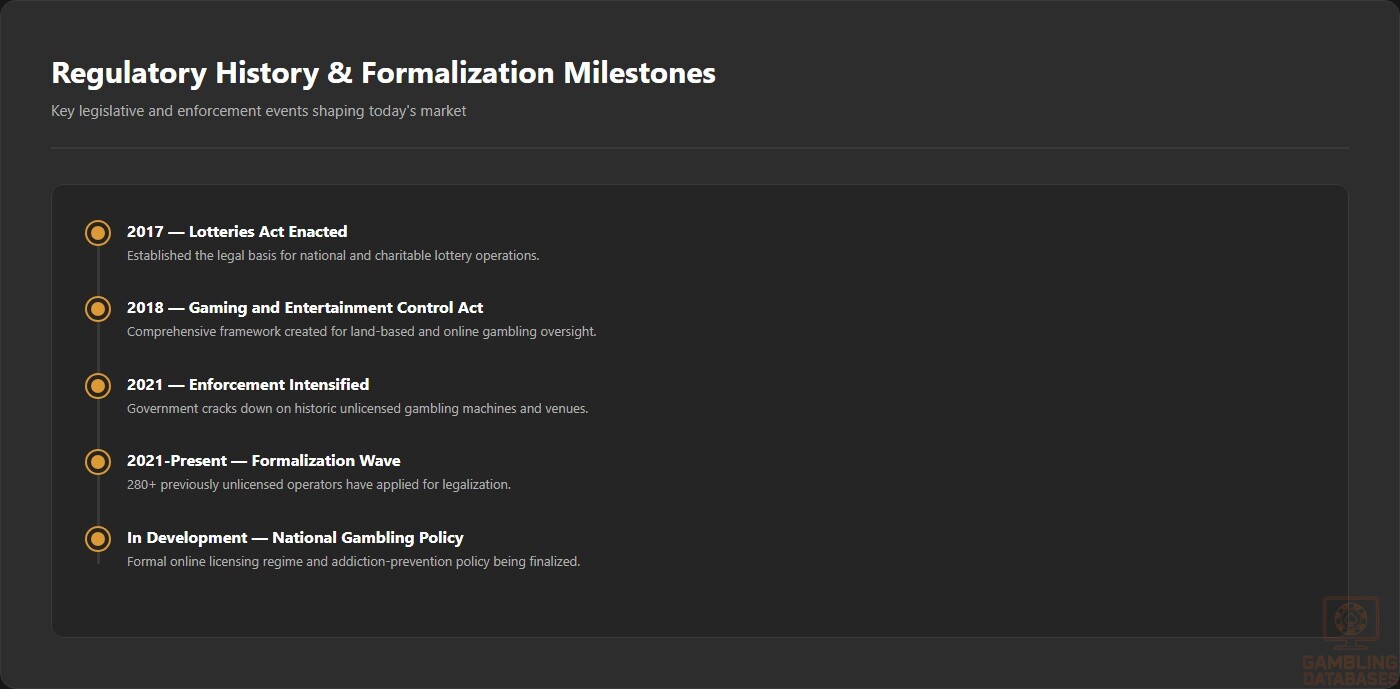
Namibia’s gambling activities are regulated under the Gaming and Entertainment Control Act of 2018, supplemented by the Lotteries Act of 2017. Together, these legal instruments constitute a comprehensive framework overseeing all forms of gambling, including land-based and online activities.
Land-based gambling includes casinos, gambling houses, betting shops, and lottery operations. Casino licenses are granted to operators meeting specific accommodation standards, such as having a minimum number of guest rooms and star ratings for establishments hosting casinos. Gambling houses and bookmakers require separate licenses regulated by the Gambling Board of Namibia.
Online gambling is recognized in legislation but the licensing process for digital operators remains in development, spurring a regulatory environment that aims to integrate online gaming within a controlled and compliant framework. Online gambling operators must obtain licenses from both the Gambling Board and the Lotteries Board, ensuring a dual regulatory oversight system.
Land-Based Gambling Activities
Land-based gambling in Namibia caters to various gaming categories, including:
- Licensed casinos operating in officially graded accommodation establishments
- Gambling houses hosting slot machines and table games
- Sports betting venues with bookmaker licenses
- Totalisator operators managing betting pools
- Licensed lottery operators conducting national and charitable lotteries
The government continues to address a historic prevalence of unlicensed gambling machines and venues, with regulatory enforcement intensified since 2021 to bring these operations into compliance. Venue licensing is tightly controlled with specific criteria for premises, including layout plans and operational zones.
Online Gambling Framework
Online iGaming regulation is in a transitional phase, with Namibia officially prohibiting unlicensed digital gambling activities while preparing a formal licensing regime. Operators must register and comply with technical standards, including mandatory connections to a national central monitoring system that tracks betting activities and enforces player protections.
The regulatory authorities emphasize the prevention of unauthorized gambling, with strict penalties for violations including imprisonment and significant fines. The framework includes controlling permitted game types, wagering limits, and anti-money laundering (AML) protocols to ensure market integrity.
Licensed Operators and Market Players
The Namibian market consists of a mixture of licensed national operators and emerging entrants seeking compliance under newly enforced regulations. Since 2021, over 280 previously unlicensed operators have applied for legalization, reflecting the government’s commitment to formalize the sector.
Market entry strategies typically involve obtaining the required dual licensing, establishing local partnerships, and investing in compliance with technical and social responsibility obligations. The competition landscape remains moderately fragmented while gradually consolidating under the oversight of the Gambling Board.
Licensing Framework and Requirements
Application Process and Eligibility
The Gambling Board of Namibia administers licensing, with the minister responsible for policy directives. Applicants must meet rigorous financial, technical, and operational standards. The application process involves submission of detailed documentation, including business plans, premises layouts, and proof of financial capacity.
Licenses cover a range of categories including casinos, gambling houses, bookmakers, totalisators, suppliers, and testing agents. Fees vary by license type and financial requirements include demonstrating sufficient capital and compliance with regulatory obligations. Licenses are generally reviewed within a 3-6 month timeframe.
Applicants typically submit the following documents:
- Corporate registration and incorporation certificates
- Financial statements audited by recognized firms for the past three years
- Detailed operational and market strategy business plans
- Technical documentation for gaming platforms and RNG certification
- Criminal background checks for principals and beneficial owners
- Proof of minimum capital deposit in a Namibian licensed bank
Local Presence and Operational Requirements
Operators are required to establish a local presence in Namibia, including physical offices and key staff resident in the country. Domain registration must comply with Namibian legal jurisdiction requirements.
Foreign ownership is permitted but subject to regulatory review; partnerships with domestic entities are strongly encouraged to support local economic participation. Operationally, licensed entities must comply with reporting, auditing, and monitoring obligations imposed by the Gambling Board.
Compliance Obligations and Monitoring
Player Protection and Identification
Namibia enforces strict age verification requirements, ensuring that no gambling is accessible to individuals under the legal age limit. KYC and AML processes follow international best practices, requiring operators to verify client identities and scrutinize transactions for suspicious activity.
Responsible gambling measures are mandatory, including player self-exclusion systems and limits on wager amounts to mitigate problem gambling risks. Operators must provide educational materials and support tools designed to raise awareness and prevent addiction.
Key player protection mandates include:
- Mandatory age verification for all users
- Implementation of KYC procedures consistent with AML laws
- Self-exclusion options for problem gamblers
- Limits on deposits and wagering amounts
- Provision of responsible gambling information and resources
Financial Monitoring and Reporting
Operators must maintain detailed transaction records and submit regular financial reports to the Gambling Board, including audited accounts and tax filings. All transactions are monitored through the central system to ensure compliance and detect irregularities.
- Monthly submission of comprehensive financial reports to regulators
- Quarterly audits conducted by approved third-party auditors
- Real-time monitoring of betting activity via central system
- Annual renewal declarations outlining compliance and financial health
Taxation Structure and Financial Obligations
Player Taxation
Players are subject to taxes on winnings, which are either withheld at source or declared as taxable income depending on the game type and payout size. Thresholds vary, but the government enforces clear guidelines to ensure tax compliance without discouraging participation.
Operator Taxation
The primary tax on operators is based on Gross Gaming Revenue (GGR), with rates differing by type of gambling activity such as casino games, sports betting, and lotteries. Corporate tax at the standard rate applies alongside fixed fees for licensing and turnover-based levies.
| Game Type | GGR Tax Rate |
|---|---|
| Casino Table Games | 20% |
| Slot Machines | 15% |
| Sports Betting | 10% |
| Lotteries | 5% |
License renewal fees and turnover taxes are additional fiscal obligations, reinforcing the government’s approach to incentivize transparency and accountability.
Gambling Market Financial Performance
Namibia’s gambling market has shown steady growth, supported by regulatory enhancements and increased digital participation. Total wagered amounts and tax revenues have escalated year-over-year, driven by reform measures and formalization of previously unlicensed activities.
Growth trajectories suggest an expanding consumer base with willingness to engage in both land-based and online platforms under a regulated environment providing player protections and compliance certainty.
Advertising and Marketing Restrictions
Advertising of gambling products is permitted only for licensed operators and under strict content and timing regulations to prevent targeting minors or vulnerable groups. The government monitors promotional activities keenly, enforcing restrictions on channels and messaging to align with responsible gaming ethics.
Advertising must comply with the following constraints:
- Licensing verification before placement
- Prohibition of ads targeting underage persons
- Restrictions on promotional bonuses and inducements
- Time-of-day limitations to reduce exposure to vulnerable audiences
- Ban on misleading or exaggerated claims about winnings
Recent Regulatory Changes and Their Impact
Since 2021, Namibia has intensified enforcement against unlicensed gambling, introducing stricter penalties and increasing licensing uptake. The national gambling policy under development aims to institutionalize addiction prevention and community engagement strategies, impacting operator compliance costs and market practices.
Enforcement Mechanisms and Penalties
The regulatory framework applies a range of enforcement tools to ensure compliance, including fines, license suspensions, and criminal prosecutions for severe breaches. Penalties for illegal gambling activities can reach imprisonment of up to 10 years, underscoring the government’s zero-tolerance stance towards unauthorized operations.
Types of enforcement actions include:
- Monetary fines up to N$20,000 for minor breaches
- License revocations for non-compliant operators
- Seizure of unlicensed gambling equipment
- Criminal charges and imprisonment for illegal gambling
- Public awareness campaigns to encourage lawful participation
Section 2: Demographics and Consumer Analysis
Population Demographics and Distribution
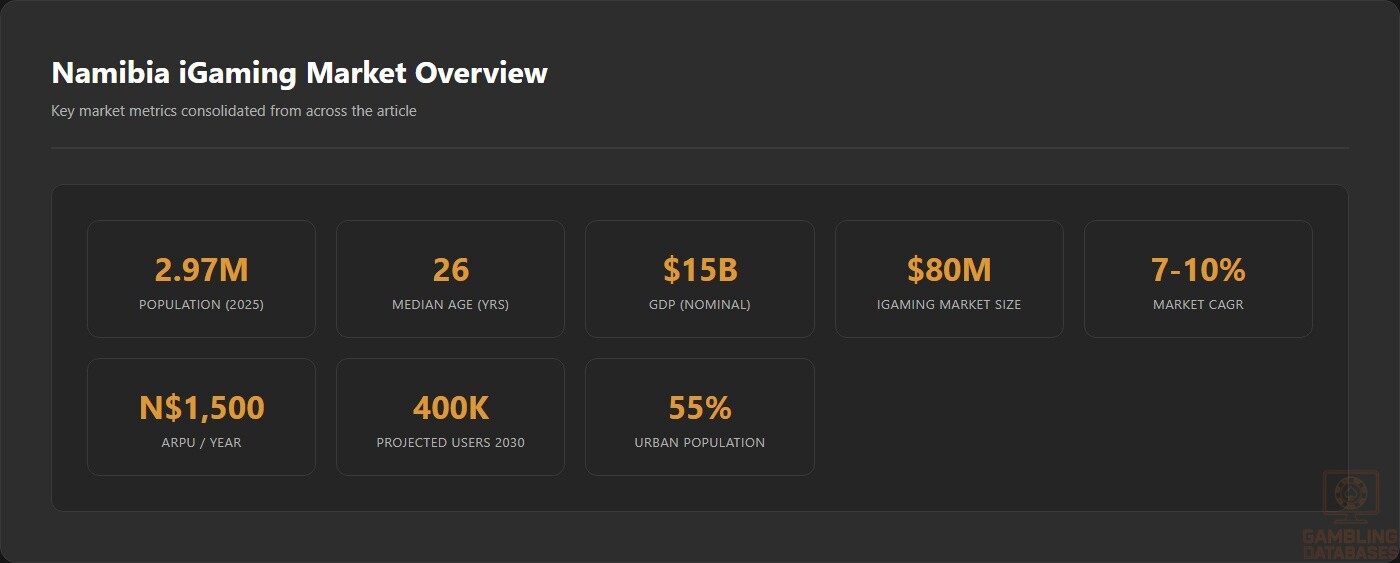
Namibia’s estimated population in 2025 is approximately 2.97 million, with a median age of 26 years. The population exhibits a slightly higher number of women than men, with a sex ratio of roughly 954 men per 1,000 women. Approximately 45% of the population is under 20 years old, showcasing a young demographic profile typical of emerging markets.
Urbanization is significant, with over 55% of the population residing in urban centers as of 2025. This urban majority is concentrated chiefly in the northern and central regions, driving demand for entertainment and digital services including online gambling.
| Age Group | Population (%) |
|---|---|
| 0-19 years | 44.8% |
| 20-64 years | 51.2% |
| 65+ years | 4.1% |
The population density remains low at about 4 people per km², with vast rural areas less accessible to formal gambling venues. Internet and mobile penetration, however, enable digital reach even into these low-density regions.
Geographic Distribution
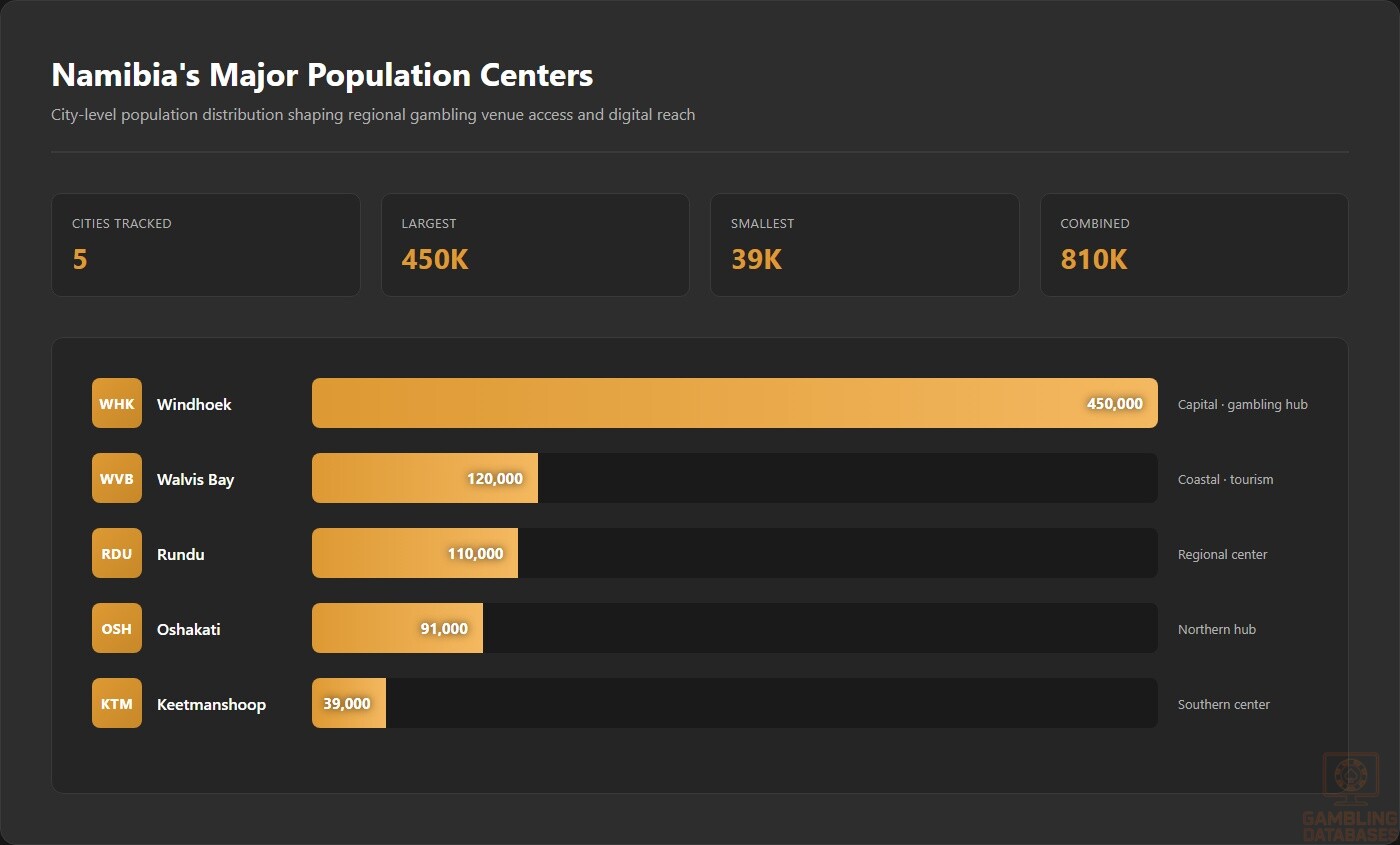
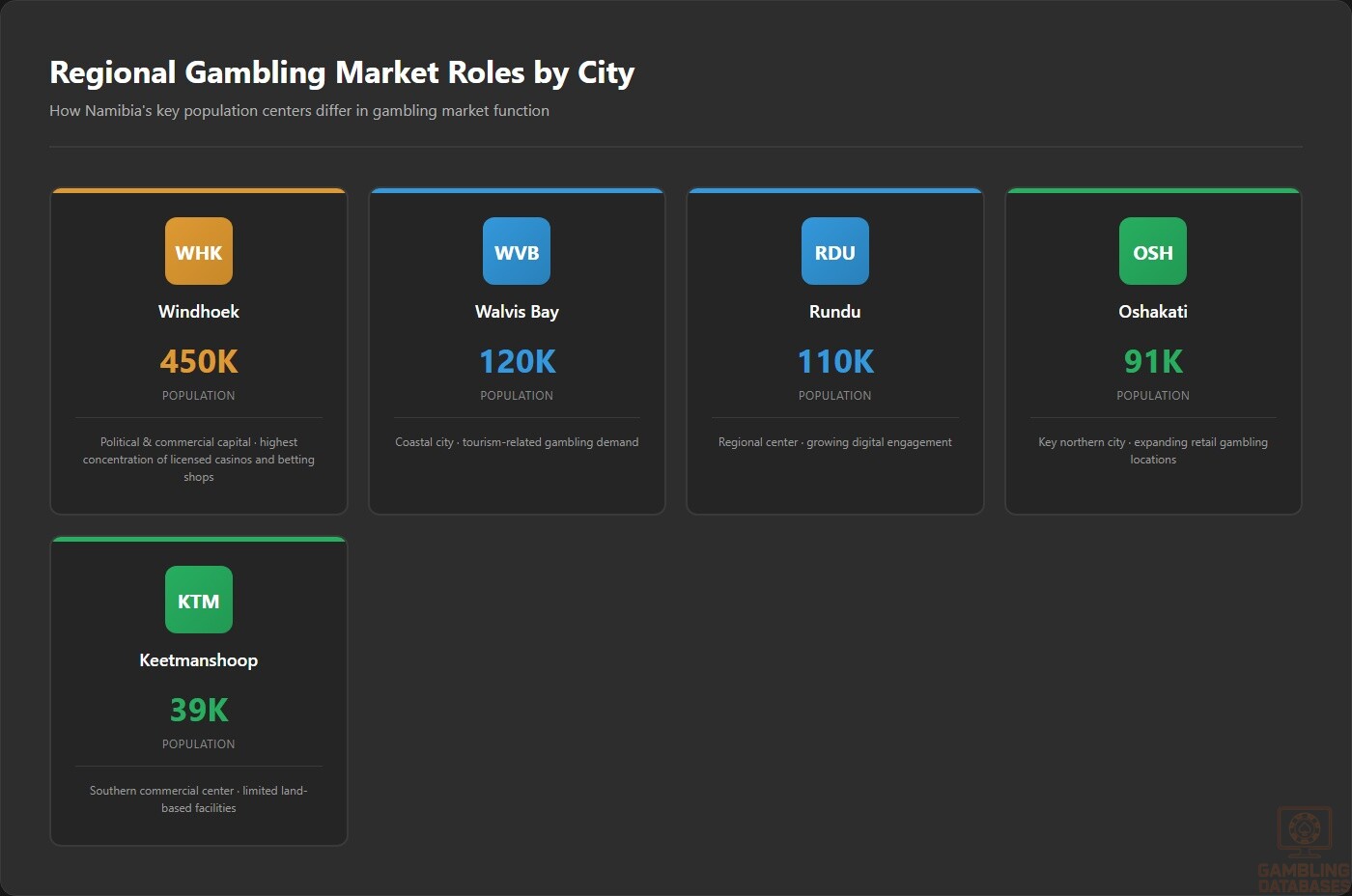
Namibia’s urban population is concentrated in a few key regional centers with varying economic activities and gambling venue access. The capital city, Windhoek, serves as the political and commercial hub hosting most licensed casinos and betting shops, followed by coastal and mining centers.
- Windhoek: Approx. 450,000 residents, highest concentration of gambling venues
- Rundu: Regional center with approximately 110,000 inhabitants, growing digital engagement
- Walvis Bay: Coastal city with 120,000 people, hub for tourism-related gambling demand
- Oshakati: Key northern city with 91,000 residents, expanding retail gambling locations
- Keetmanshoop: Southern commercial center with 39,000 population, limited land-based gambling facilities
Internet access is unevenly distributed but improving in urban and suburban areas, enhancing online gambling penetration. Land-based gambling venues remain largely clustered in major cities, reflecting income and population density disparities.
Economic Indicators and Consumer Spending Power
Namibia’s economy demonstrates steady growth with GDP projected at approximately USD 15 billion in 2025 and an annual growth rate of about 3.1%. Key sectors supporting this growth include retail, financial services, and government activities, despite recent declines in mining and agriculture.
Per capita GDP hovers around USD 5,500, with wide disparities as unemployment remains high at nearly 37%. Income inequality measured by a Gini coefficient of 59.1 indicates substantial wealth concentration affecting consumer spending patterns.
Disposable income trends reveal that urban populations exhibit stronger purchasing power with a growing middle class, while rural populations face challenges of poverty and limited access to digital payment solutions, impacting overall gambling participation.
| Indicator | Value |
|---|---|
| GDP (nominal) | USD 15 billion |
| GDP Growth Rate (annual) | 3.1% |
| GDP Per Capita | USD 5,500 |
| Unemployment Rate | 36.9% |
| Poverty Rate | 27.5% |
| Gini Coefficient | 59.1 |
Market Size and Growth Projections
The iGaming market in Namibia is nascent but growing, driven by rising internet penetration and regulatory formalization. The estimated current market size ranges around USD 80 million with a projected compound annual growth rate (CAGR) of approximately 7-10% through 2030.
Average revenue per user (ARPU) is estimated at roughly N$1,500 per year, reflecting moderate consumer spending potential modulated by socio-economic diversity across regions.
| Metric | Value |
|---|---|
| Current Market Size (USD) | 80 million |
| Annual Growth Rate (CAGR) | 7-10% |
| Estimated ARPU | N$1,500/year |
| Projected User Base 2030 | ~400,000 active players |
Education, Skills, and Digital Literacy
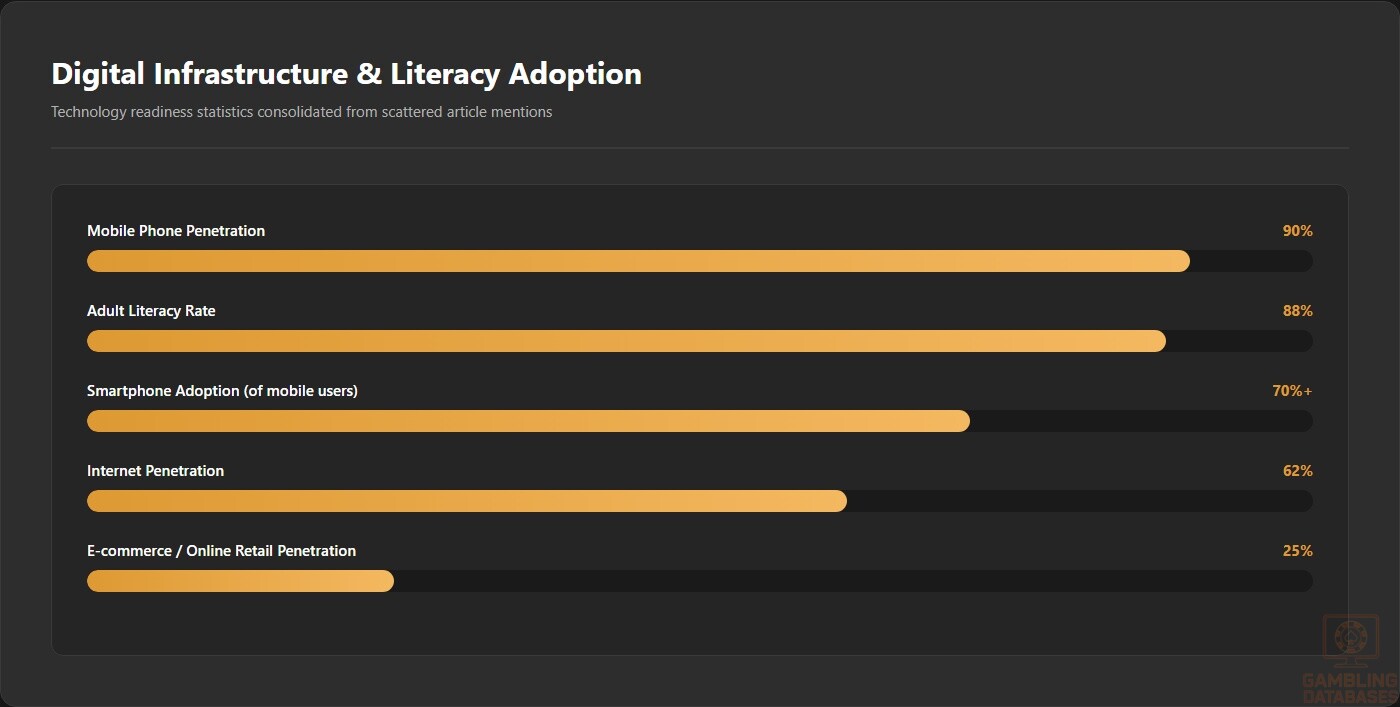
Namibia is advancing digital literacy through governmental initiatives targeting universal enabling skills by 2030. Current literacy rates exceed 88%, correlated with increased internet accessibility in urban areas.
Efforts include outreach in rural communities to bridge digital divides, train users in online safety, media literacy, and digital transactions while enabling inclusive participation in digital economies including iGaming.
Workforce skills are uneven, with urban centers exhibiting higher levels of formal education while rural zones lag behind, impacting adoption rates of complex online platforms.
Cultural and Social Factors
Communication and Language
Namibia is linguistically diverse, with multiple official and indigenous languages widely spoken. English serves as the official administrative language and predominant medium for online and commercial communication.
- English (official administrative language)
- Oshiwambo
- Khoekhoegowab (Nama/Damara)
- Otjiherero
- Afrikaans
Internet content and customer interfaces tailored to English dominate, though localized language options exist in some digital platforms to improve accessibility and user experience.
Cultural Attitudes
Gambling is culturally accepted to varying degrees, with higher engagement in urban and youth demographics. Religious and traditional communities generally exhibit ambivalence or caution towards gambling, often emphasizing responsible play.
Foreign iGaming brands are generally welcomed when compliant with local regulations, contributing to a dynamic but conscious market shaped by social responsibility concerns and regulatory enforcement.
Problem Gambling and Social Considerations
Growing participation in sports betting and online gaming has heightened awareness of potential social harms, particularly among low-income groups susceptible to gambling-related financial distress.
The government and regulatory bodies have instituted measures targeting problem gambling prevention and support, embedding social responsibility into license conditions.
- Mandatory self-exclusion registries
- Public awareness and education campaigns
- Collaboration with health services for addiction treatment
- Regulatory monitoring of high-risk advertising
- Enforcement of deposit and wager limits
Political Structure and Governance
Namibia operates a stable parliamentary democracy with a history of regulatory consistency supporting economic growth. The government’s supportive stance on digital sector development provides a favorable environment for iGaming investment.
International relations and membership in regional economic communities facilitate cross-border cooperation, enhancing market potential and regulatory harmonization prospects.
Technology Adoption and Digital Behavior
Internet and Digital Usage
Internet penetration stands at approximately 62% of the population, with significant increases over recent years. The average mobile internet connection speed is around 21.6 Mbps, supporting quality user experiences for online gaming platforms.
Mobile device prevalence is high, with roughly 90% mobile phone penetration, facilitating mobile-first gambling product designs and digital payment adoption.
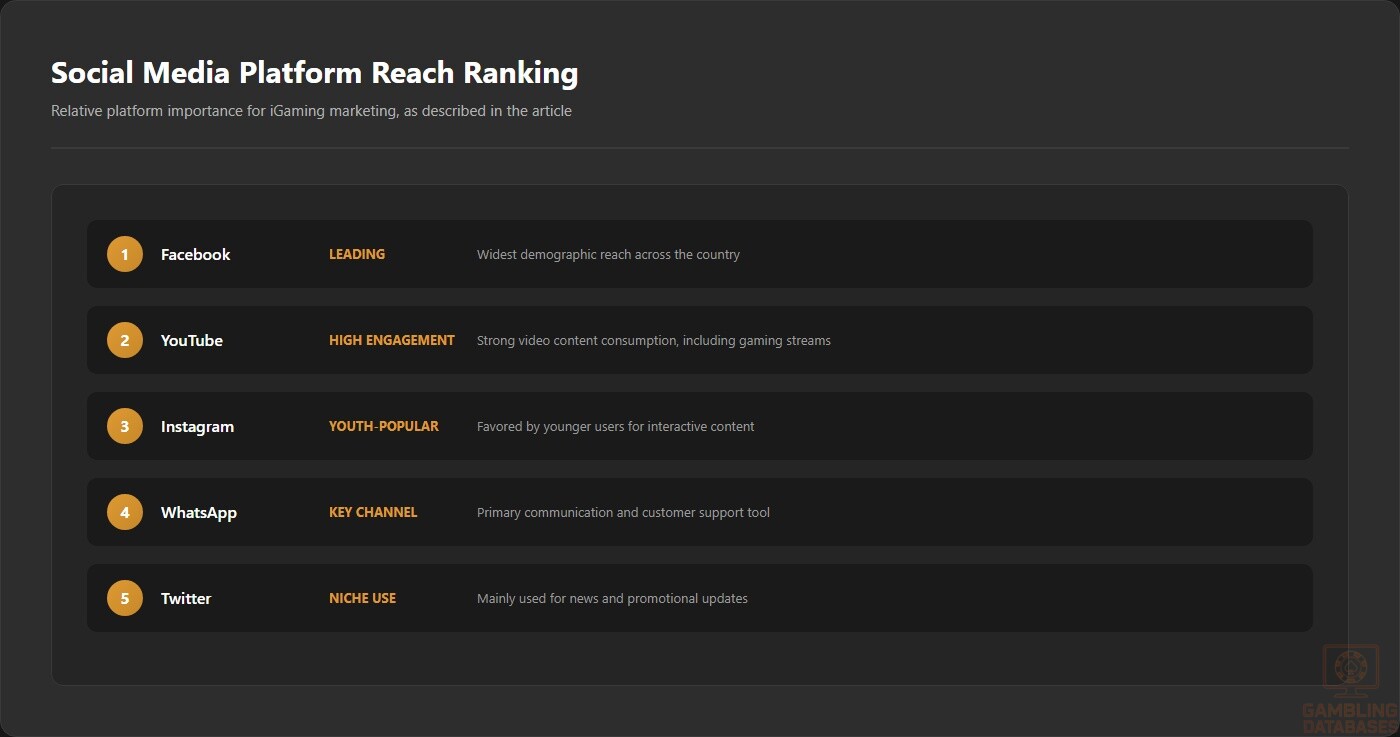
Namibian social media behavior is dynamic and multi-platform, supporting marketing opportunities for iGaming.
- Facebook: Leading platform with wide demographic reach
- YouTube: High engagement with video content, including gaming streams
- Instagram: Popular among younger users for interactive content
- WhatsApp: Key communication channel for customer support and community
- Twitter: Utilized mainly for news and promotional updates
Digital Payment Behavior
Payment preferences in Namibia strongly emphasize mobile money solutions, bank transfers, and digital wallets, catering especially to unbanked and underbanked populations.
Credit and debit card usage is growing in urban areas, while cash-on-delivery remains a fallback payment method for many consumers without full digital access.
- Mobile Money platforms (e.g., PayToday, Mobipay)
- Digital Wallets (e.g., EasyWallet, eWallet)
- Bank Transfers via major banks (FNB, Bank Windhoek)
- Credit/Debit Cards (Visa, Mastercard)
- Cash on Delivery still significant in e-commerce contexts
Gaming and Gambling Preferences
Current Market Participation
Sports betting dominates participation, reflecting preferences for local and international events. Casino games, including slots and table games, are more prevalent among urban wealthier customers.
Lottery participation remains widespread but is generally lower in contribution to market revenues compared to online and land-based sports betting.
| Activity | Participation Rate (%) |
|---|---|
| Sports Betting | 38% |
| Casino Games (slots, table) | 22% |
| Lotteries | 15% |
| Online Poker | 9% |
| Bingo and Other Games | 6% |
Consumer Behavior Patterns
Users chiefly prefer mobile platforms for convenience and accessibility, with peak activity occurring during evenings and weekends. Average session lengths vary, with sports bettors exhibiting longer engagement periods during live events.
Consumer spending aligns with disposable income levels, with urban middle-class users showing higher retention and frequency of play. Promotional offerings and bonuses significantly influence acquisition and loyalty.
Section 2: Demographics and Consumer Analysis
Population Demographics and Distribution
Namibia’s estimated population is approximately 2.97 million in 2025, with a median age of 26 years. The population skews young, with nearly 45% under the age of 20, and a slightly higher number of women than men, with a sex ratio of about 954 men per 1,000 women.
Urbanization is substantial, with over 55% of the population living in urban centers mainly in the central and northern regions. These urban hubs concentrate gambling venues and digital connectivity, fueling the iGaming market growth.
| Age Group | Population (%) |
|---|---|
| 0-19 years | 44.8% |
| 20-64 years | 51.2% |
| 65+ years | 4.1% |
Population density remains low at roughly 4 people per km², reflecting vast rural areas with limited infrastructure, though increasing digital penetration helps bridge this gap.
Geographic Distribution
Urban centers serve as focal points for economic activity and gambling operations. Windhoek, the capital, is home to the largest concentration of gambling venues, including casinos and sports betting shops. Other significant cities have growing gambling participation amid improving internet connectivity.
- Windhoek: ~450,000 residents, major gambling hub
- Rundu: ~110,000 people, rising digital access
- Walvis Bay: Coastal city with ~120,000, tourism-driven gambling demand
- Oshakati: Northern city with ~91,000, expanding retail gambling
- Keetmanshoop: Southern commercial center, ~39,000 people
Economic Indicators and Consumer Spending Power
Namibia’s GDP stands at about USD 15 billion in 2025, growing at approximately 3.1%. The economy is diversifying, though high unemployment (~37%) and inequality (Gini coefficient of 59.1) constrain broad-based consumer spending power.
Per capita income hovers around USD 5,500, with urban households showing stronger spending capabilities. Disposable income disparities shape market participation in gambling.
| Indicator | Value |
|---|---|
| GDP (nominal) | USD 15 billion |
| GDP Growth Rate | 3.1% |
| Per Capita GDP | USD 5,500 |
| Unemployment Rate | 36.9% |
| Poverty Rate | 27.5% |
| Gini Index | 59.1 |
Market Size and Growth Projections
The iGaming market is estimated at approximately USD 80 million, with projected growth rates (CAGR) between 7% and 10% over the next five years. The user base is expected to expand to over 400,000 active players by 2030, with average revenue per user around N$1,500 annually.
| Metric | Value |
|---|---|
| Market Size (USD) | 80 million |
| CAGR | 7-10% |
| ARPU | N$1,500 per year |
| Projected Users 2030 | ~400,000 |
Education, Skills, and Digital Literacy
Namibia’s literacy rate exceeds 88%, with government programs targeting full digital literacy by 2030. Training efforts focus on rural and underrepresented populations to enhance skills in online safety and digital participation, crucial for extending iGaming’s reach.
Urban populations exhibit higher educational attainment and digital skills, fostering greater interaction with online gambling platforms than rural counterparts.
Cultural and Social Factors
Communication and Language
Namibia is linguistically diverse; English is the official language used predominantly in commerce and digital content. Other major languages include Oshiwambo, Khoekhoegowab, Otjiherero, and Afrikaans, influencing multilingual marketing strategies in iGaming.
- English (official)
- Oshiwambo
- Khoekhoegowab
- Otjiherero
- Afrikaans
Cultural Attitudes
Gambling is socially acceptable, especially among urban and younger demographics, though traditional and religious communities tend to be more conservative. Foreign iGaming brands receive cautious acceptance when compliant with local laws, highlighting an environment oriented towards responsible gaming.
Problem Gambling and Social Considerations
Rising gambling participation has raised awareness about problem gambling impacts. The government mandates self-exclusion programs, public education, addiction support collaborations, and limits on wager sizes to mitigate social harms.
- Self-exclusion registries
- Public awareness campaigns
- Health sector partnerships for addiction treatment
- Ad regulation for high-risk demographics
- Deposit and wager limits enforcement
Political Structure and Governance
Namibia is a stable parliamentary democracy with consistent regulatory policies supporting economic growth, digital innovation, and business. Membership in regional economic communities facilitates regulatory alignment and international cooperation.
Technology Adoption and Digital Behavior
Internet and Digital Usage
Internet penetration is about 62%, with mobile internet speeds averaging 21.6 Mbps. Mobile phone penetration reaches roughly 90%, enabling broad mobile-first access to iGaming services. Social media usage is diverse and active.
- Facebook – highest social reach
- YouTube – popular for video content consumption
- Instagram – favored by youth for interactive content
- WhatsApp – key communication and support platform
- Twitter – used primarily for updates and promotions
Digital Payment Behavior
Mobile money solutions dominate payment methods, especially outside major urban centers, complemented by credit/debit cards and bank transfers in urban areas. Cash on delivery remains relevant for cautious consumers.
- Mobile Money (PayToday, Mobipay)
- Digital Wallets (EasyWallet, eWallet)
- Bank Transfers (FNB, Bank Windhoek)
- Credit/Debit Cards (Visa, Mastercard)
- Cash on Delivery
Gaming and Gambling Preferences
Current Market Participation
Sports betting is Namibia’s leading gambling activity, followed by casino games, lotteries, online poker, and bingo. Urban players drive casino and online participation, while lotteries remain common in more rural settings.
| Activity | Participation Rate (%) |
|---|---|
| Sports Betting | 38% |
| Casino Games | 22% |
| Lotteries | 15% |
| Online Poker | 9% |
| Bingo and Others | 6% |
Consumer Behavior Patterns
Mobile devices are favored for their convenience and accessibility. Peak gambling activity occurs in evenings and weekends, with sports bettors showing longer session durations during live events. Spending follows disposable income levels, with promotional offers strongly influencing loyalty and acquisition.
Section 3: Technology Infrastructure and Business Environment
Internet and Digital Infrastructure
Namibia’s internet penetration is estimated at approximately 62% of the population, with a growing emphasis on mobile broadband access. Fixed broadband remains limited, concentrated mainly in higher-income urban areas, resulting in mobile networks serving as the backbone for internet consumption and digital activities.
Average mobile internet speeds hover around 21.6 Mbps, enabling stable online gaming experiences, though network reliability varies regionally, with rural and remote localities facing connectivity challenges. Investments in fiber optic expansion and government digital infrastructure plans aim to address these gaps, improving overall service quality.
5G and Future Technology Deployment
As of 2025, 5G deployments are in early stages, primarily across Windhoek and major urban corridors. Internet service providers and mobile operators plan to expand 5G coverage slowly over the next five years, targeting subscription growth and enhanced digital service capabilities.
Key mobile operators collaborate with technology vendors to upgrade network infrastructure aligned with Namibia’s digital transformation blueprint, promoting 5G adoption across enterprises including iGaming platforms seeking high-speed, low-latency environments.
Mobile Technology Ecosystem
Mobile Network Infrastructure
Namibia has a competitive mobile operator landscape offering extensive 2G, 3G, 4G LTE coverage nationwide. Data costs remain moderately high relative to average incomes but are trending downward due to increased market competition.
- MTN Namibia – Largest market share with comprehensive urban and semi-rural coverage
- TN Mobile – Significant national footprint focusing on affordable data plans
- MTC Namibia – State-owned operator with extensive rural reach and government contracts
- Paratus Group – Providing enterprise and fiber broadband solutions complementing mobile networks
- Airtel Namibia – Smaller operator with niche market segments focusing on price competitiveness
Device Penetration
Smartphone adoption is expanding rapidly, exceeding 70% of mobile users, with most devices being mid-range Android models. This device availability supports mobile-first service models for iGaming, with user preference leaning towards apps and mobile-optimized websites.
Feature phones persist among lower-income populations, limiting advanced app usage but permitting SMS-based gaming products and mobile money transactions. Device affordability programs backed by operators enhance digital inclusivity.
Financial Services and Payment Infrastructure
Banking System Structure
The Namibian banking sector is well-developed, with multiple large financial institutions offering digital banking and payment services. Digital account penetration remains mixed, as many rural populations rely on mobile money and cash-based methods.
- First National Bank (FNB) – Market leader with advanced digital banking services
- Bank Windhoek – Strong retail presence with comprehensive payment platforms
- Standard Bank Namibia – Extensive corporate banking solutions and online services
- Bank BIC Namibia – Emerging player focusing on SME digital finance
- Trustco Bank – Niche services targeting savings and mobile integration
Payment Processing Options
The payment ecosystem includes a combination of traditional and modern options tailored to diverse consumer needs. Card penetration remains moderate, while mobile money and e-wallet solutions dominate daily transactions in urban and rural areas.
- Mobile Money platforms: PayToday, Mobipay facilitating widespread wallet-based payments
- E-wallets: EasyWallet, InstantPay used for online transaction convenience
- Bank Transfers: Integrated via SWIFT and local clearing for reliable payments
- Credit/Debit Cards: Visa and Mastercard availability growing among urban players
- Cash Payments: Still relevant via agent networks and retail partnerships
E-commerce and Digital Economy
Namibia’s e-commerce sector continues to expand, fueled by increasing digital literacy and mobile internet access. Online retail penetration is estimated at around 25%, with rising consumer trust supported by improved logistics and secure payment gateways.
Digital services, including entertainment and gaming, benefit from this momentum, aided by growing consumer familiarity with online transactions and responsive customer service mechanisms.
Business Environment and Regulatory Framework
Ease of Business Operations
Namibia is ranked favorably in the World Bank’s Doing Business report, demonstrating streamlined business registration and moderate operational costs. Foreign investment policies encourage market entry, with protective frameworks balancing investor rights and national interests.
- Preparation and notarization of documents (2-3 weeks)
- Registration submission and corporate approval (5-7 business days)
- Tax registration and obtaining tax ID (3-5 days)
- Corporate bank account opening and capital deposit (1-2 weeks)
Corporate Structure and Registration
Businesses typically register as Limited Liability Companies (LLCs), Corporations, or Branch Offices of foreign entities. LLCs are recommended for flexible ownership and liability protection, while branch offices suit internationally established operators seeking direct market interaction.
Foreign ownership is permitted without restrictions but requires adherence to local regulatory compliance and operational presence mandates.
- Certificate of Incorporation
- Memorandum and Articles of Association
- Proof of registered office and local address
- Tax registration certificate
- Identity documents of directors and shareholders
Taxation Framework
Corporate Income Tax Structure
The standard corporate tax rate in Namibia is 32%. Entities operating in special economic zones may benefit from reduced rates and tax holidays. Namibia has numerous double taxation treaties facilitating international business and mitigating withholding tax burdens.
- South Africa
- Germany
- United Kingdom
- China
- United States
Personal Income Tax
Individuals are taxed progressively up to a maximum rate of 37%. Withholding tax applies on certain gambling winnings. Social security contributions are mandatory for employees, supported by regulations defining tax residency based on physical presence and income source.
Market Entry Considerations
Recommended Entry Strategies
Success in Namibia’s iGaming market depends on localization, regulatory compliance, and technological adaptability. Foreign operators should prioritize establishing local partnerships, complying with data sovereignty laws, and customizing offerings to culturally diverse and digitally evolving consumers.
- Partner with local gaming operators or distributors
- Ensure compliance with Namibian licensing and operational rules
- Optimize platforms for mobile-first consumers
- Implement robust responsible gambling tools
- Engage in targeted marketing using popular social networks
Typical Costs and Timelines
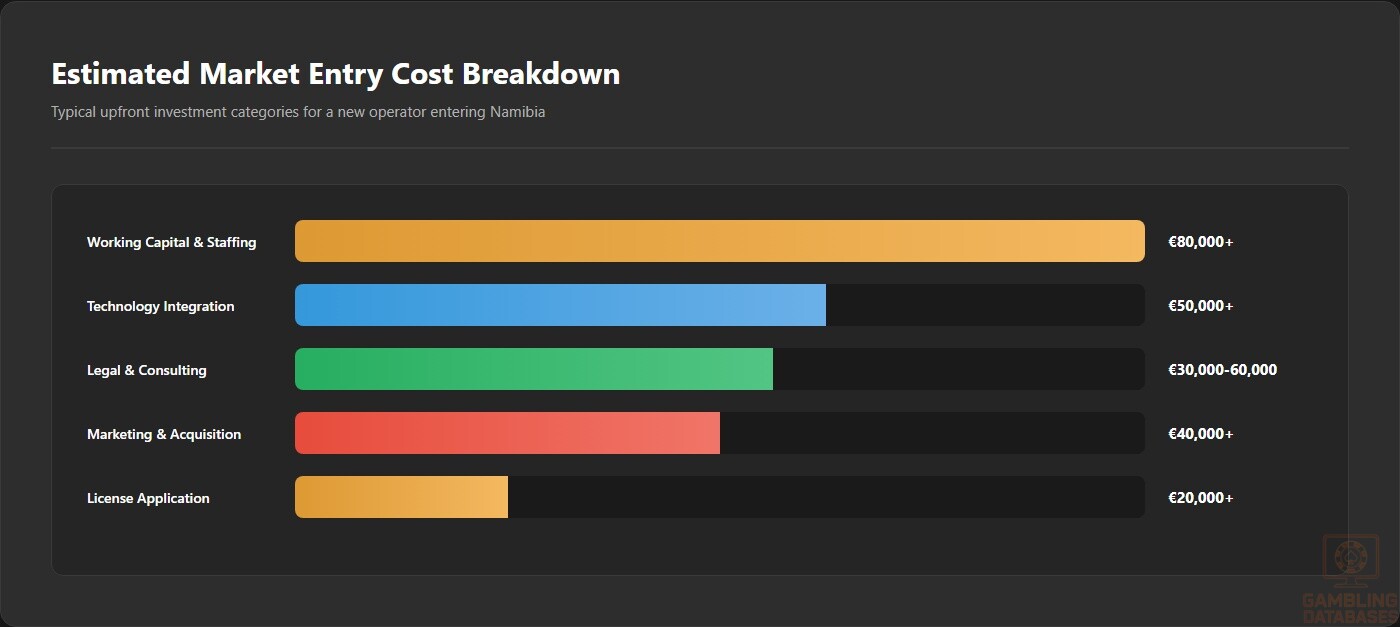
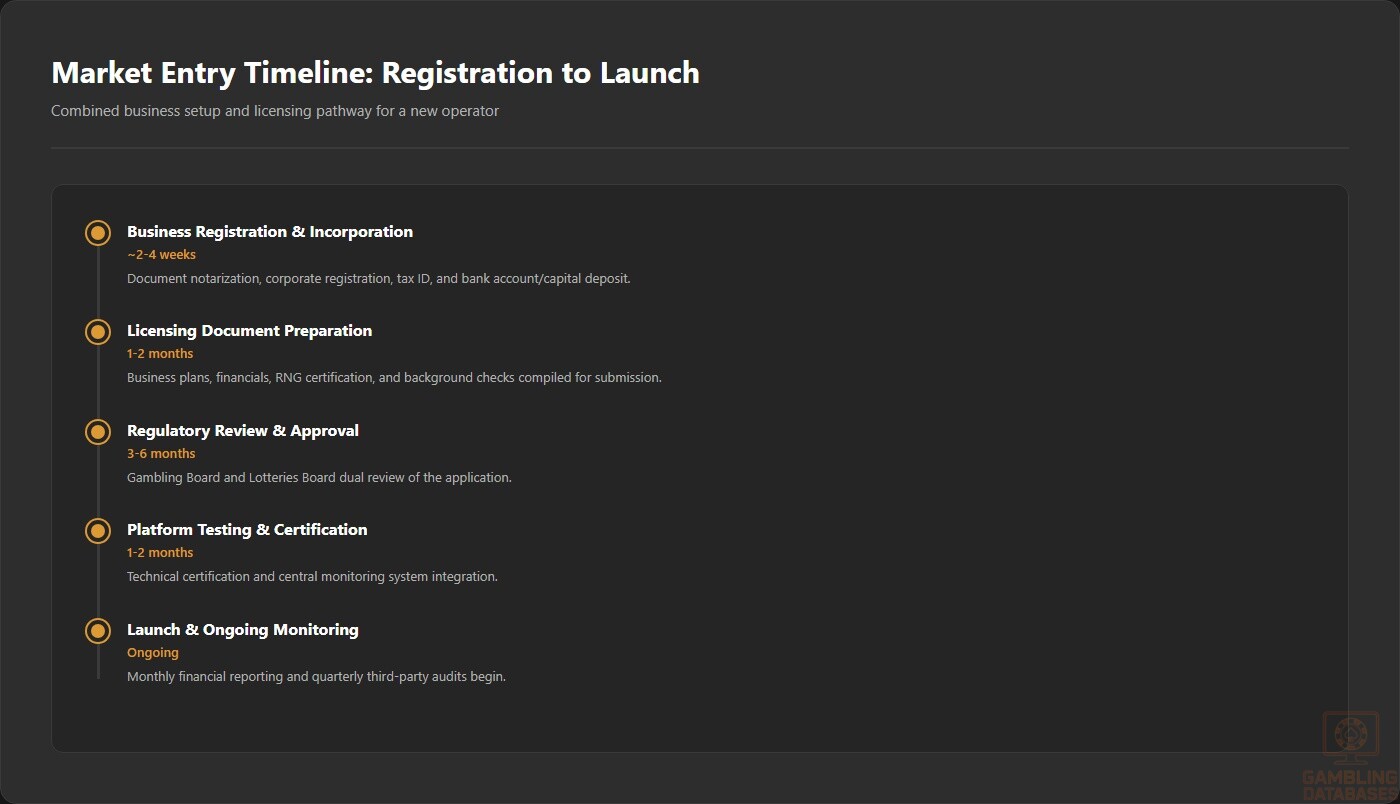
Initial market entry costs encompass licensing fees, legal counsel, technology integration, and local staffing. Operational expenses include marketing, platform maintenance, and compliance efforts. Timeframes for establishment range between 6-12 months depending on regulatory approvals and readiness.
- License application and fees: Approx. €20,000 and up
- Legal and consulting services: €30,000-€60,000
- Technology integration and platform setup: €50,000+
- Marketing and customer acquisition: €40,000+
- Initial working capital and staffing: €80,000+
- Preparation and submission of licensing documents (1-2 months)
- Regulatory review and approval phase (3-6 months)
- Platform testing and compliance certification (1-2 months)
- Launch and ongoing monitoring (ongoing)
Success Factors and Challenges
Key enablers include strong regulatory relationships, adaptive technology, culturally relevant marketing, and commitment to social responsibility. Challenges often arise from network limitations in rural areas, socio-economic disparities, and evolving legislation requiring agility in compliance.
- Robust compliance and reporting systems
- Strong local partnerships and stakeholder engagement
- Optimized mobile and low-bandwidth platform design
- Effective risk management and anti-fraud controls
- Proactive consumer protection initiatives
Exit Strategy Planning
Market liquidity for ownership transfers is moderate with regulatory approval required for license transfers. Valuation multiples align with regional comparables, influenced primarily by market size, revenue growth, and compliance records. Strategic exits emphasize partnership continuity and regulatory good standing.
FAQ: Frequently Asked Questions
1. Is online gambling legal in Namibia?
Online gambling is legal in Namibia but strictly regulated. Operators must obtain licenses from the Gambling Board and Lotteries Board, ensuring compliance with local laws and technical standards. Unlicensed online gambling is prohibited, with penalties including fines and imprisonment. The regulatory framework seeks to balance market growth with consumer protection and social responsibility.
2. What types of gambling licenses are available and what do they cover?
Namibia offers several license categories covering different gambling activities. These include licenses for casinos, gambling houses, bookmakers, totalisators (pool betting), suppliers, and testing agencies. Each license type entails distinct operational and technical requirements aligned with the gambling activity’s nature and regulatory oversight.
3. How much does an iGaming license cost and how long does it take to obtain?
License application fees typically start around N$20,000 (approx. €963), though total costs including consulting and compliance can exceed €50,000. Processing timelines range from 3 to 6 months, encompassing documentation review, site inspections (if applicable), and technical certification. Ongoing fees include renewal and tax obligations tied to revenue.
4. Can foreign companies obtain a gambling license?
Foreign companies are eligible for Namibian gambling licenses provided they meet local regulatory requirements. These include demonstrating financial capacity, technical standards, and establishing a local physical presence. Partnerships with Namibian entities are encouraged to facilitate compliance and market integration. No ownership restrictions explicitly bar foreign participation.
5. What are the tax obligations for iGaming operators?
Operators face taxes primarily based on Gross Gaming Revenue (GGR), with rates from 5% to 20% depending on game type. Corporate income tax at 32% applies on profits. License fees and turnover-based levies form additional fiscal duties. The structured taxation incentivizes transparency and supports government revenue while enabling market sustainability.
6. Are gambling winnings taxed for players?
Players are subject to taxation on gambling winnings, either through withholding at source or declaration in income filings, depending on the game and payout size. Personal income tax rates max out at 37%. The system aims to maintain fairness without discouraging participation through excessive taxation.
7. What are the typical operational costs for running an online casino or sportsbook?
Operational costs include licensing fees, regulatory compliance, platform development, marketing, payment processing, and staffing. Marketing and customer acquisition can account for a significant budget portion due to competitive dynamics. Ongoing costs also cover technical maintenance and compliance reporting to regulators.
8. What is the expected ROI timeline for entering this market?
Return on investment typically emerges between 18 to 36 months, influenced by market penetration speed, regulatory agility, and marketing effectiveness. Initial capital outlay and operational expenses delay break-even but stable revenue growth supports long-term profitability.
9. What are the local presence requirements for operators?
Operators must maintain a physical presence in Namibia, including offices and resident personnel responsible for compliance and customer service. This presence facilitates regulatory oversight and supports effective market engagement. Local partnerships augment operational capabilities and compliance assurance.
10. What payment methods are available and recommended?
Recommended payment methods emphasize mobile money and e-wallets due to widespread consumer adoption, alongside card payments in urban areas. Bank transfers provide secure alternatives while cash remains a fallback in less digitized regions, ensuring inclusive payment options that fit local consumer behavior.
11. What are the advertising and marketing restrictions?
Advertising is limited to licensed operators only, with restrictions on channels, content, and timing designed to protect minors and vulnerable groups. Promotional claims must be accurate and responsible, prohibiting misleading messages or incentivizing excessive gambling. Social media marketing is allowed under regulatory approval.
12. What responsible gambling measures are mandatory?
Mandatory measures include self-exclusion programs, deposit limits, wagering caps, and mandatory provision of educational materials. Operators must monitor player behavior for signs of problem gambling and cooperate with regulators on prevention initiatives, ensuring ethical and sustainable market practices.
13. How large is the iGaming market and what is the growth potential?
The estimated market size is around USD 80 million with a CAGR of 7-10% forecasted over the next five years. Growth drivers include digital penetration, regulatory clarity, and rising consumer demand, positioning Namibia as an emerging opportunity in Southern Africa’s gaming sector.
14. Who are the main competitors and what is their market share?
The market features a mix of licensed local operators and international entrants, with no single dominant player yet. Competitive dynamics evolve as licensing enforcement brings previously unlicensed operators into the formal sector, creating opportunities for consolidation and brand differentiation.
15. What are the player preferences and typical spending patterns?
Players prefer sports betting and casino games, with mobile platforms favored for accessibility. Spending patterns vary with income, with moderate average revenue per user but growing engagement from middle-class urban consumers. Promotional offers influence retention and frequency of play.
16. What are the key success factors and main challenges for new entrants?
Success factors include regulatory compliance, strong local partnerships, mobile-first technology, and proactive responsible gambling programs. Key challenges comprise network infrastructure variability, socio-economic disparities, regulatory complexity, market education, and competitive pressures from informal gambling.
Sources and References
- Namibia Gambling Board – Official Regulatory Website – http://www.meft.gov.na/gambling-board
- Lotteries Board of Namibia – Official Website – http://www.lotteriesboard.na
- Namibia Statistics Agency – Population and Economic Reports 2024-2025
- World Bank – Namibia Economic Overview 2025 – https://www.worldbank.org/en/country/namibia/overview
- International Telecommunication Union – Africa ICT Data 2024
- Digital 2024: Namibia, DataReportal – https://datareportal.com/reports/digital-2024-namibia
- Namibia Central Bank – Financial Sector Reports 2024-2025
- Ministry of Finance Namibia – Taxation and Business Regulations 2025
- World Bank Doing Business Report 2024 – Namibia Section
- Namibia Communications Regulatory Authority – Network and Spectrum Reports 2024
- African Gaming Compliance & Industry Insights, 2025 Edition
- Transfi – Payment Gateways and Local Payment Methods in Namibia 2025
- PopulationPyramid.net – Namibia Demographics 2025
- Namibia Economic Outlook Update April 2025 – Bank of Namibia
- Gambling Industry Review – Emerging African Markets 2024
- Exploring the Diffusion of Gambling Information in Namibia – Academic Research Paper, 2024
- Local News Reports on Gambling Regulation in Namibia, 2025
- Telecommunications Reports – Paratus Group Namibia 2024
- Mobile Network Operator Market Shares in Namibia – MTN, MTC, TN Mobile – 2025 Data
- Casino City Namibia – Gambling Venue and Market Information 2025
- Namibia Payment Processing Overview – Novalnet, 2025
- Sigma World – Problem Gambling and Social Measures in Namibia, 2025
- International Monetary Fund – Namibia Financial Statistics 2025
- Namibia Ministry of Trade and Industry – Business Registration Guidelines 2025
- LinkedIn Industry Insights – Namibian Gaming and Payment Sectors 2025
- African Gambit – Regulatory Overhaul in Namibian Gambling 2025
- Namibia National Population Commission Reports 2024
- Gaming Board of Namibia – Licensing and Compliance Reports 2025
- Western Cape Gambling and Racing Board – Comparative African Licensing Frameworks 2024
- Google Advertising Policies – Gambling Ads in Namibia, 2025


Anyone else having issues with the Namibia operator apps? Trying to track the 7-10% CAGR growth they’re projecting but the Android client keeps crashing when I load betting slips. Mobile site loads fine on 4G but the native app is basically unusable. With 92% mobile penetration mentioned in the article, you’d think these licensees would prioritize app stability. The 3-6 month licensing window gives them time to get infrastructure right before launch. Are the operators even stress-testing on lower bandwidth connections? Namibia’s internet penetration is only 54% so connection reliability should be priority one.
You’ve identified a real pain point that’s becoming clearer as Namibian operators scale. The technical infrastructure note in the article mentions a central monitoring system is mandated, but that’s compliance-focused, not player experience-focused. App optimization on variable connectivity is indeed crucial given the bandwidth constraints. What you’re experiencing likely reflects that most Namibian licensees are still in early deployment phases. The 3-6 month licensing window is processing time, not development time, so many operators are launching with MVP-level apps. The 92% mobile penetration figure is misleading in this context—it’s mostly 2G/3G feature phones in rural areas, not smartphone users with app store access. For operators targeting the growing middle class in Windhoek and Walvis Bay, responsive web-based betting (which you noted works better) is actually the smarter immediate play. Desktop traffic will lag behind mobile web for at least 18 months in the Namibian market.
Thanks for that context. Didn’t realize the 92% figure was mostly feature phones—that completely changes how I’m thinking about operator strategy there. So if web-based is the play for the next 18 months, makes sense why the article emphasizes central monitoring systems rather than cutting-edge native apps. I’ll test some of the licensed operators’ mobile sites instead of wrestling with their Android versions.
Hold up. The article mentions dual regulatory oversight from both the Gambling Board AND the Lotteries Board but doesn’t explain how conflicts get resolved. Two regulatory bodies means twice the compliance burden, which sounds nice on paper, but what happens when they disagree on license terms? Also the N$20,000 fine for unlicensed gambling is pocket change compared to the 10-year prison sentence. That huge gap makes me wonder if enforcement is actually consistent or if wealthy operators get fined while small-time players get crushed with jail time. The market size estimate of USD 80 million seems inflated too, given only 54% internet penetration and a 2.7 million population. Where’s the breakdown showing how they reached that number?
Regarding the dual-board structure, that’s a valid structural concern that regulators are still refining. The Gaming and Entertainment Control Act 2018 does create overlapping jurisdictions—the Gambling Board handles casino, bookmaker, and supplier licenses while the Lotteries Board manages lottery-specific operations. In practice, there’s a tiered review process where the Gambling Board is primary for most iGaming applications, with Lotteries Board input on specific game offerings. Conflicts are rare because the Act delegates authority fairly cleanly, but you’re right that it’s not transparent to applicants. On the enforcement asymmetry you mentioned, the N$20,000 fine (roughly EUR 963) is actually the floor for *operating* without a license; the 10-year prison sentence applies to larger-scale illegal gambling operations. The USD 80 million projection uses a conservative model: they’re estimating around 53,000-67,000 active online players at an ARPU of N$1,500 annually, which the article states. That’s roughly 2-2.5% of the adult population, reasonable for a 54% internet penetration market in early regulation phase. The forecast assumes that reaches 4-5% by 2030 as licensing expands and mobile infrastructure improves.