
Togo presents a compelling iGaming market opportunity driven by evolving regulatory frameworks and a growing appetite for gambling, both land-based and digital. While the country maintains legalized and regulated land-based gambling, including lotteries, casinos, and sports betting, the online gambling segment remains in a developing but partially regulated state.
This analysis details Togo’s current regulatory environment, licensing requirements, compliance obligations, and taxation policies governing gambling activities. It aims to inform potential operators about the legal landscape and market entry considerations in Togo as of 2025.
Executive Summary: Key Market Indicators
| Metric | Value |
|---|---|
| Country | Togo |
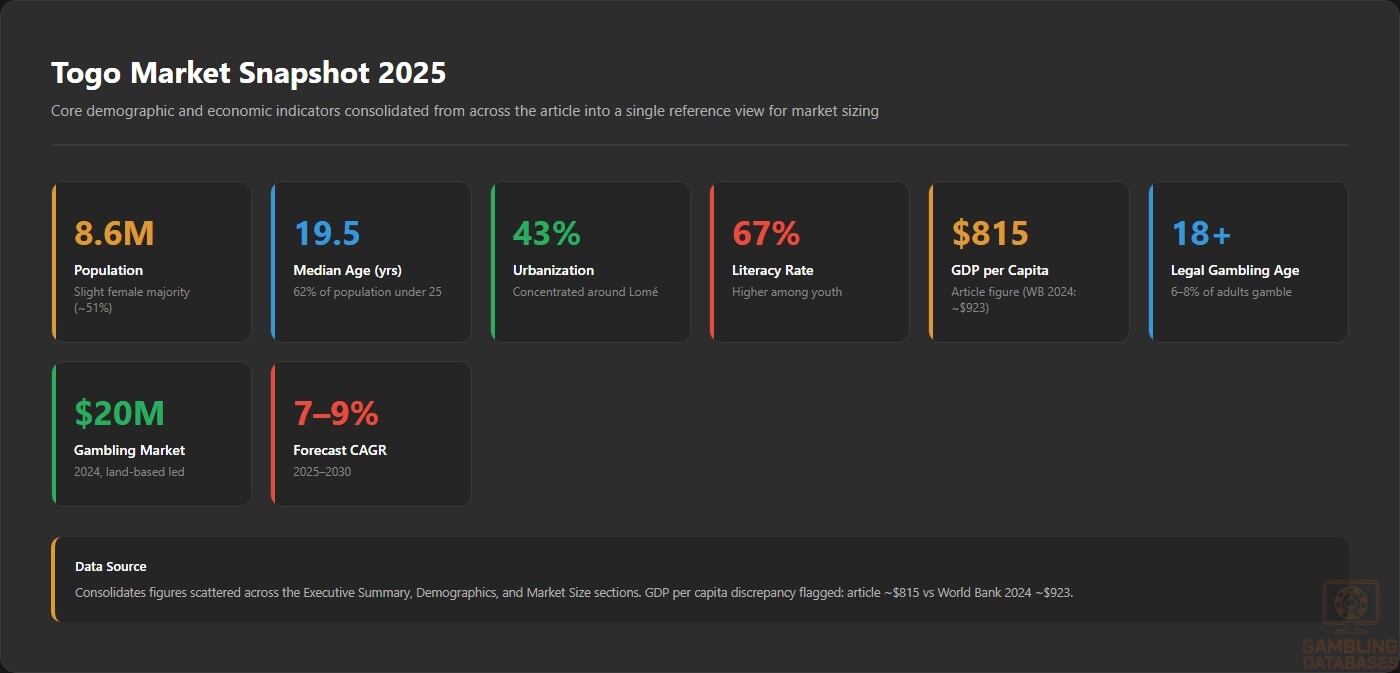
| Population | 8.6 million |
| GDP (Nominal) | Approx. $7 billion USD |
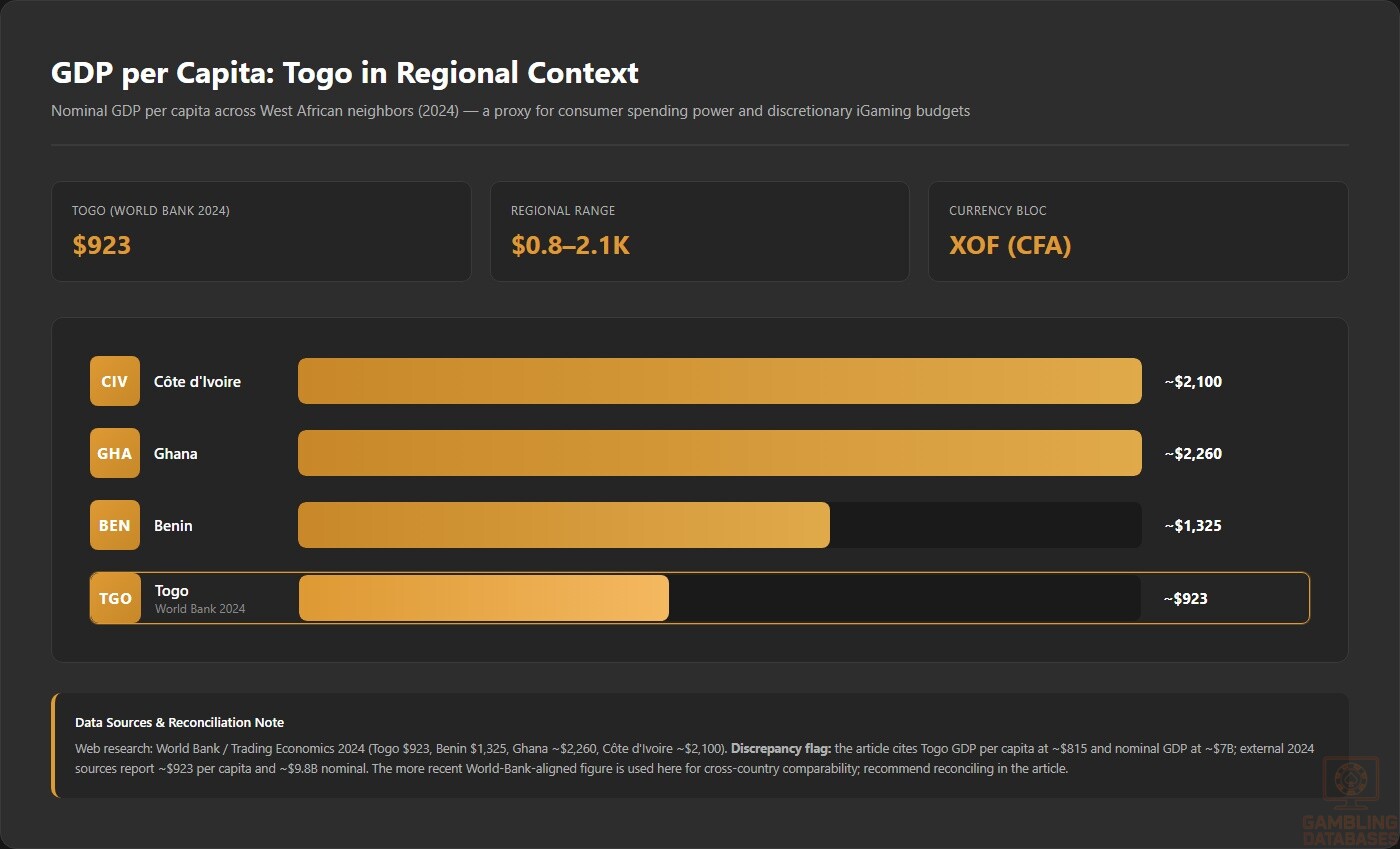
| GDP per Capita | Approx. $815 USD |
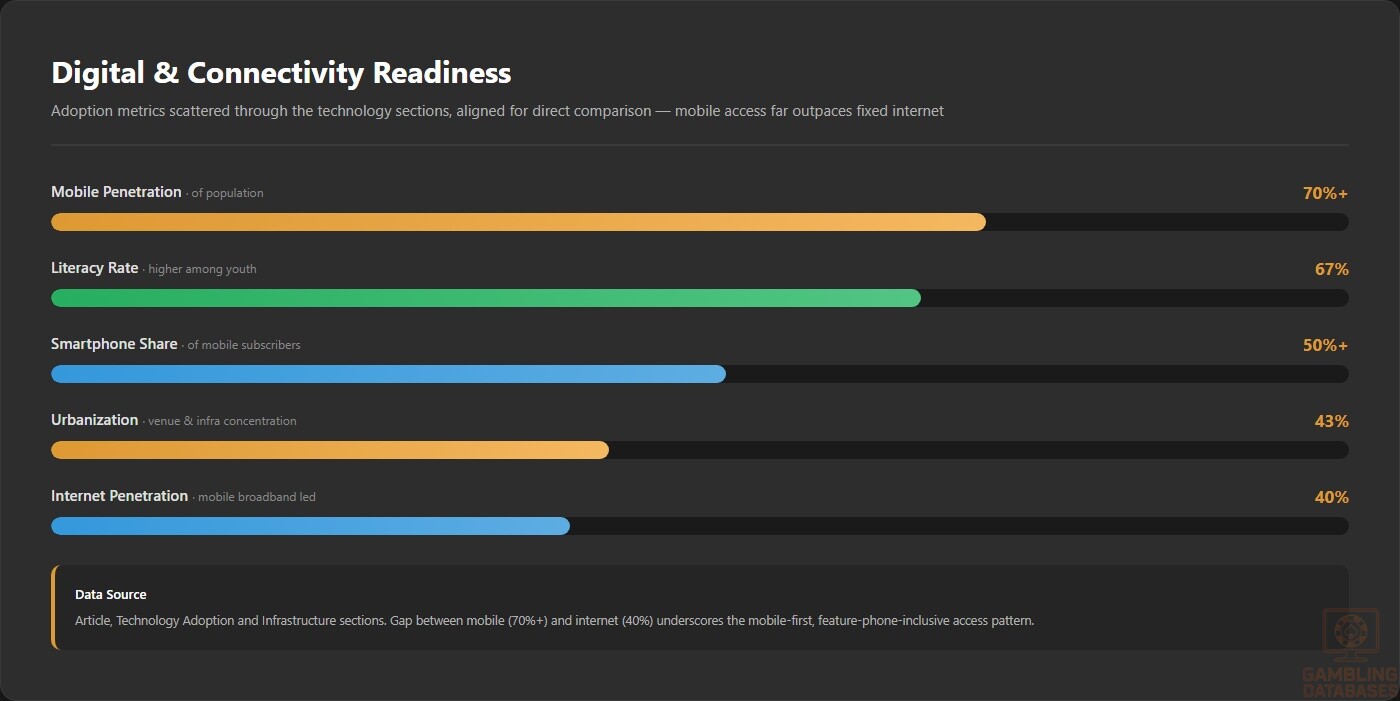
| Internet Penetration | About 40% |
| Mobile Penetration | Over 70% |
| Land-Based Gambling Status | Legal and Regulated |
| Online Gambling Status | Legal but partially regulated, online licensing framework pending |
| Regulatory Authority | Ministry of Finance and Economy; Loterie Nationale Togolaise (LONATO) |
| National Lottery Operator | LONATO (State-Run) |
| Gambling License Required | Yes, for land-based and online operators |
| License Application Timeframe | Approx. 4 to 8 weeks |
| Application Fees | Undisclosed; moderate fees expected |
| Gross Gaming Revenue (GGR) Tax | Applicable to land-based operators; specific rates undisclosed |
| Online Gambling Taxation | Currently unclear, expected regulation update in 2025 |
| Minimum Capital Requirement | Not specified; due diligence and financial vetting enforced |
| Compliance Requirements | KYC, AML, age verification, responsible gambling measures |
| Legal Gambling Age | 18 years+ |
| Market Entry Barriers | Licensing vetting, local compliance, pending online framework |
| Market Size (Estimated Revenue) | Approx. $20 million USD (land-based, 2024) |
| Revenue Growth Forecast (CAGR) | Estimated 7-9% CAGR (2025-2030) |
| Average Revenue Per User (ARPU) | Estimated $30 – $40 USD |
| Payment Infrastructure | Mobile money dominant, limited card usage |
| Foreign Ownership Rules | Permitted with compliance; preference for local partnerships |
| Enforcement Agencies | Ministry of Finance, Togolese police |
| Advertising Restrictions | Age restrictions, content limitations imposed |
| Responsible Gambling Measures | Mandatory self-exclusion, information disclosure |
| Projected Industry Trends | Formalized online license framework, increased foreign investment |
Section 1: Regulatory Framework and Legal Environment
Current Gambling Regulation Status
Togo maintains a regulated gambling environment where land-based gambling activities including casinos, sports betting venues, slot machine halls, and the national lottery operate under a formal licensing system. The industry is overseen primarily by the Ministry of Finance and Economy along with the state-run lottery entity, LONATO. This approach ensures that gambling contributes to economic development while minimizing adverse social effects.
Physical casinos and sports betting shops are active mainly within urban centers such as the capital Lomé, catering to both local and tourist demand. The lottery remains a popular and heavily regulated form of gambling, with proceeds supporting government welfare programs.
The regulatory focus has historically emphasized land-based activities, with legislation clearly defining licensing requirements, operator obligations, and player protections. Despite this, the online gambling segment lacks a fully formalized licensing framework as of 2025, placing online operators in a legal gray zone that is expected to be addressed by upcoming regulatory reforms.
Land-Based Gambling Activities
Togo’s land-based gambling is established and diverse. Casinos offer table games, slot machines, and other traditional gaming options under strict regulatory oversight. Licensed sports betting venues are widespread, providing locals with access to legal betting services on various sports.
The national lottery LONATO holds a monopoly on lottery operations, managing draws and ticket sales across the country. This blend of regulated gambling forms constitutes the backbone of the domestic gambling market, supported by clear legal statutes and government supervision.
Online Gambling Framework
Online gambling in Togo is currently legal but operates within an incomplete regulatory framework. While operators require licenses to offer services, a formal and specific licensing system for iGaming is not fully implemented. Many international operators continue serving Togolese players using offshore licenses, creating a partially regulated landscape.
This regulatory gap results in uncertainty regarding tax obligations and compliance standards for online gambling. However, the government has expressed intentions to introduce more comprehensive regulations by the end of 2025, aiming to formalize licensing, taxation, and operational controls for the online segment.
Licensed Operators and Market Players
The gambling market features a mix of domestic and international operators active in land-based and lottery services. Licensed casinos and sports betting companies function under government scrutiny, while the online market is dominated by offshore platforms pending local regulation.
Market dynamics favor operators with strong financial standing and compliance capabilities due to mandatory vetting processes. Entry strategies commonly involve demonstrating industry expertise, financial stability, and responsible gaming policies aligned with government standards.
Licensing Framework and Requirements
Application Process and Eligibility
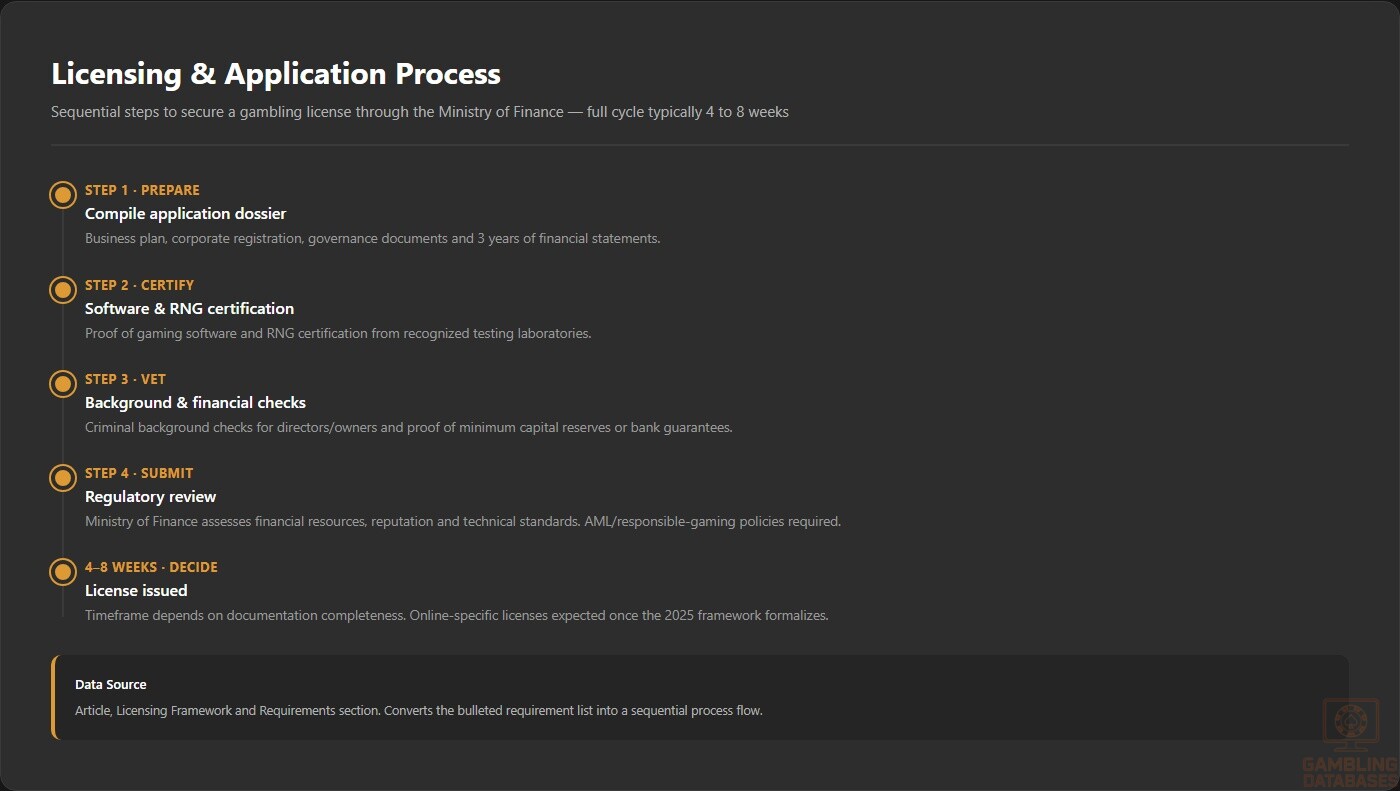
The Ministry of Finance and Economy administers the licensing of gambling operators. Prospective licensees undergo a vetting process assessing financial resources, corporate reputation, and technical standards of gaming platforms. Licensing applies equally to physical establishments and online operators once regulations evolve.
Application procedures include submission of a detailed business plan, corporate documents, financial statements, personal background checks, and proof of software certifications from recognized testing laboratories. The entire process typically spans four to eight weeks depending on the completeness of documentation and regulatory review.
- Completed license application form
- Business plan and market strategy
- Corporate registration and governance documents
- Financial statements from previous three years
- Certification of gaming software and RNGs
- Criminal background checks for directors and owners
- Proof of minimum capital reserves or bank guarantees
- Responsible gambling and anti-money laundering policies
Local Presence and Operational Requirements
Operators must establish a legal entity that complies with Togolese corporate law. While a physical office in the country is favored for land-based operations, the requirements for online operators remain evolving but are expected to include local registration and domain ownership controls.
Foreign ownership is permitted without explicit restrictions but partnering with local stakeholders can facilitate regulatory acceptance. Personnel obligations include employing compliance officers and ensuring staff adhere to legal and operational standards.
Compliance Obligations and Monitoring
Player Protection and Identification
Strict player protection regulations mandate operators verify the identity and age of all gamblers, with a minimum legal gambling age of 18 years. Anti-money laundering (AML) and know-your-customer (KYC) procedures are comprehensive and regularly audited by authorities.
- Mandatory age verification before account creation
- KYC checks including identity documents and address proofs
- AML transaction monitoring and reporting
- Responsible gambling tools such as self-exclusion programs
- Information disclosure about risks and responsible play
Operators must provide clear options for self-exclusion and support programs to minimize gambling-related harm. Information on responsible gambling must be readily accessible on all platforms.
Financial Monitoring and Reporting
Operators are required to monitor all financial transactions to detect suspicious activities and comply with anti-fraud measures. Regular reports must be submitted to the Ministry of Finance detailing revenues, taxes paid, and player activity data.
- Monthly submission of transaction and revenue reports
- Quarterly compliance audits by the regulator
- Annual financial statements and tax declarations
- Immediate reporting of suspicious transactions
Taxation Structure and Financial Obligations
Player Taxation
Currently, Togo does not impose explicit tax obligations on players’ winnings. Taxation focus lies primarily on operators rather than individual gamblers. This policy is expected to continue, pending future legislation targeting online revenues.
Operator Taxation
| Category | Tax Rate |
|---|---|
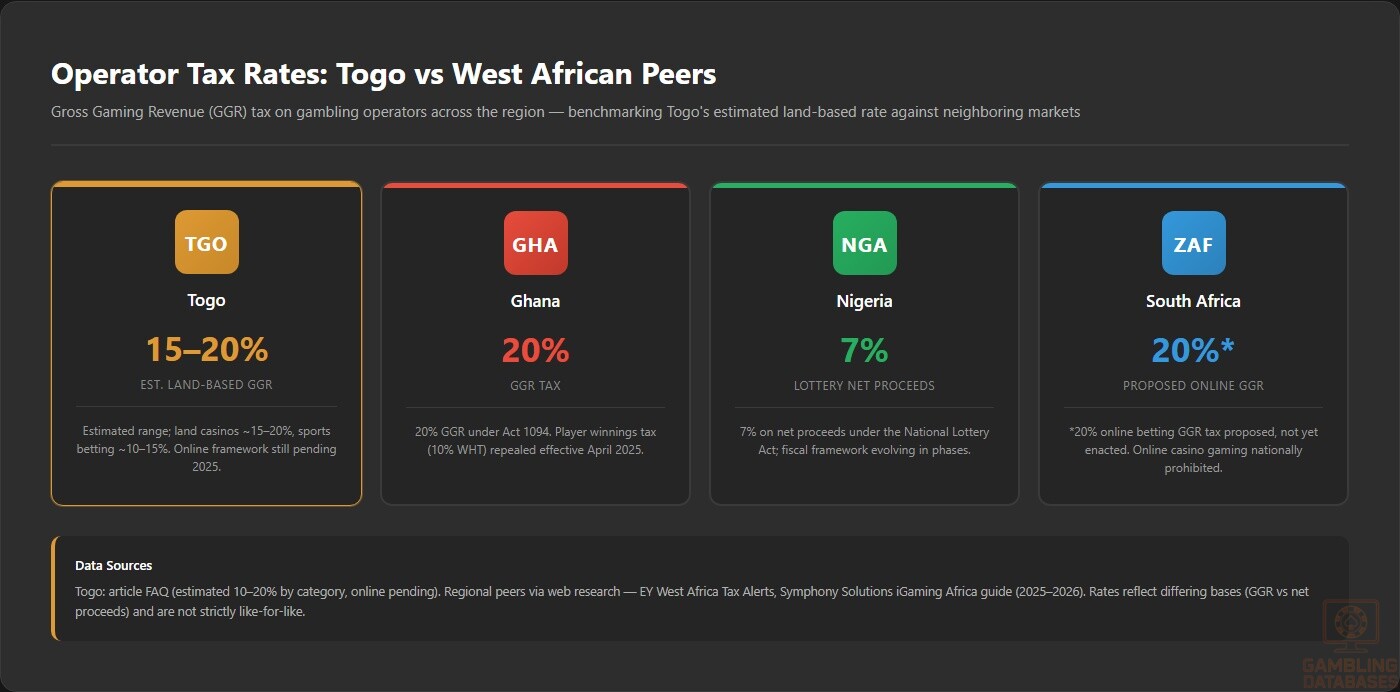
| Gross Gaming Revenue (Land-Based Casinos) | Undisclosed (estimated 15-20%) |
| Sports Betting Operators | Estimated 10-15% |
| Lottery Revenues | Flat fee plus percentage of sales |
| Online Gambling Operators | Pending regulatory framework |
Additional financial obligations include license renewal fees and turnover taxes on gambling revenues. Operators benefit from clear and stable taxation protocols in the land-based sector but face uncertainty in the online market.
Gambling Market Financial Performance
Togo’s gambling sector shows steady revenue growth with a market size estimated at approximately $20 million USD in 2024. Year-over-year growth is forecasted at 7-9% CAGR over the next five years driven by rising consumer demand and expansion of online services once regulatory clarity is achieved.
Revenues are distributed mainly among casinos, the national lottery, and sports betting, with online gambling poised to grow significantly upon formal licensing implementation.
Advertising and Marketing Restrictions
Advertising is legally constrained to protect minors and vulnerable groups. Operators face restrictions on advertising content, requiring responsible messaging and limiting promotions that encourage excessive gambling.
- Prohibition of gambling ads targeting underage audiences
- Mandatory inclusion of responsible gambling messages
- Restrictions on bonus and promotional campaigns
- Limited advertising channels approved by regulators
- Ban on deceptive or misleading advertising content
Sponsorship of events and promotional activity must comply with ethical standards and regulatory approval.
Recent Regulatory Changes and Their Impact
Togo has maintained its core gambling framework without major changes in recent years but is actively preparing new legislation to address the online segment. These amendments are expected to introduce formal online gambling licenses, define operator tax rates, and strengthen compliance obligations.
The anticipated reforms will increase entry costs and compliance burdens but also open the door for wider market participation and foreign investment, improving market stability and consumer protections.
Enforcement Mechanisms and Penalties
The Ministry of Finance and the Togolese police enforce gambling laws, with penalties for unlicensed operations including fines, license revocations, and criminal prosecution. Compliance audits and investigative actions ensure adherence to regulatory standards.
- Fines for unlicensed gambling activities
- Suspension or revocation of licenses for violations
- Criminal charges for illegal operators
- Seizure of assets and equipment used in unlawful gambling
- Regular inspections and compliance monitoring
Effective enforcement maintains market integrity and protects consumers from illegal gambling risks.
Section 2: Demographics and Consumer Analysis
Population Demographics and Distribution
Togo’s total population is approximately 8.6 million people, characterized by a youthful demographic profile. The median age is around 19.5 years, reflecting a large proportion of young adults and children. The population is roughly evenly split by gender, with a slight majority of females at about 51%.
Urbanization is moderate, with roughly 43% of the population residing in urban areas and the remainder dispersed across rural regions. Lomé, the capital city, functions as the focal point for economic activities and demographic concentration.
| Age Group | Percentage of Total Population |
|---|---|
| 0-14 years | 42% |
| 15-24 years | 20% |
| 25-54 years | 31% |
| 55-64 years | 4% |
| 65 years and older | 3% |
The youth domination of the population suggests a growing base for future consumer markets, including iGaming demographics. Urban centers host a larger share of gambling venues and internet connectivity, while rural regions show limited digital infrastructure but high mobile penetration via basic phones.
Geographic Distribution
Togo’s population disperses unevenly across its five main regions, with economic activities concentrated in the south, particularly the Maritime region surrounding Lomé. Internet access and gambling venues follow this pattern, with urban areas enjoying more developed infrastructure and access to licensed gambling establishments.
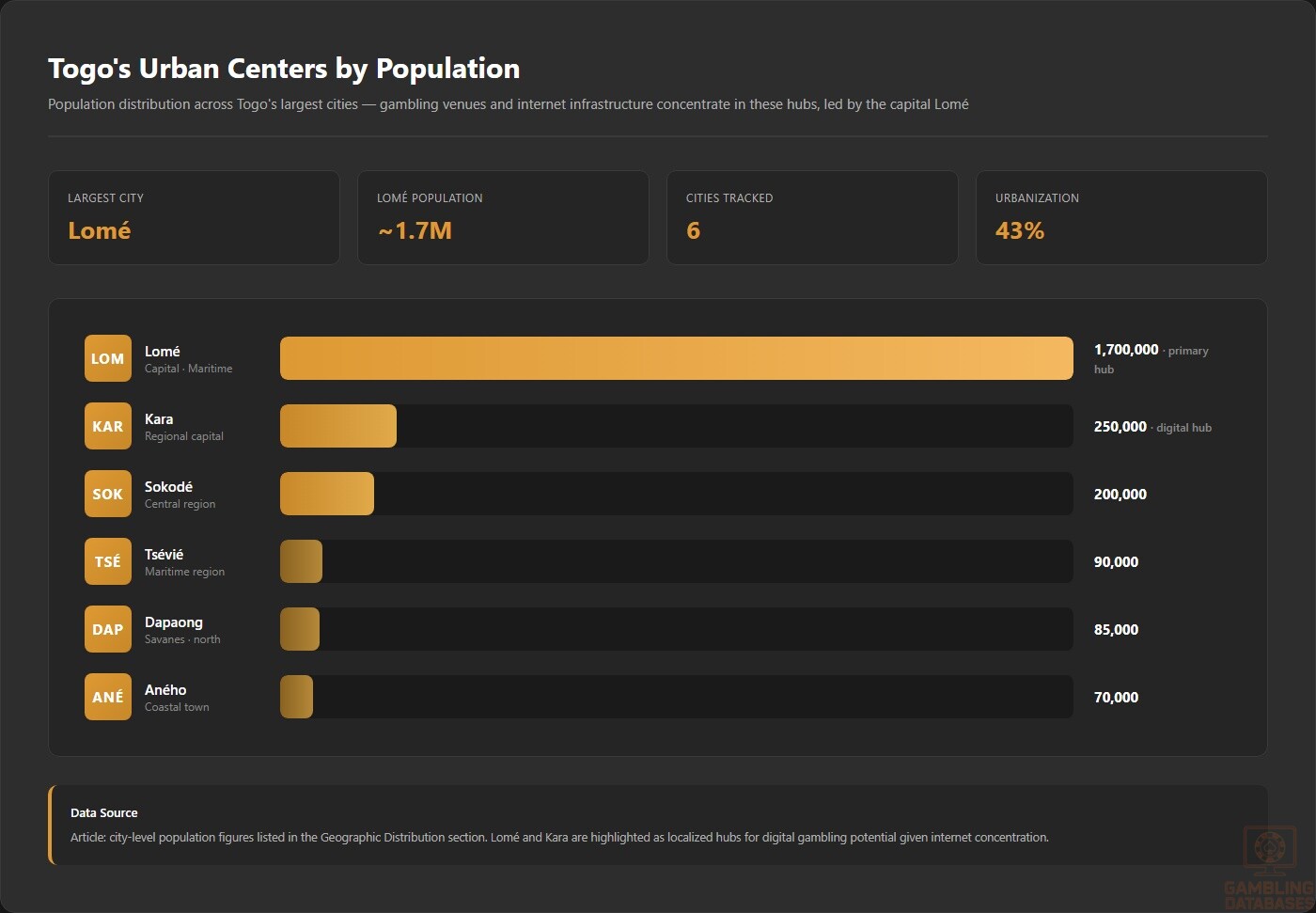
Major distribution includes coastal urban zones with higher income levels and northern rural regions with agriculture-centric economies. Internet usage surges around Lomé and Kara, creating localized hubs for digital gambling potential.
- Lomé: Capital city, population ~1.7 million
- Kara: Regional capital, population ~250,000
- Sokodé: Third largest city, population ~200,000
- Tsévié: Growing urban area, population ~90,000
- Dapaong: Northern city, population ~85,000
- Aného: Coastal town, population ~70,000
Economic Indicators and Consumer Spending Power
Togo’s GDP stands at approximately $7 billion USD, with modest annual growth in the range of 3-4% driven by agriculture, services, and nascent industrial sectors. The service sector dominates the economy, contributing around 50% to GDP, highlighting growing consumer-driven activities.
Per capita GDP remains modest at approximately $815 USD, reflecting income constraints but also untapped consumer pockets, especially among urban youth with increased mobile and internet access willing to engage with digital services.
| Indicator | Value |
|---|---|
| Gross Domestic Product (GDP) | $7 billion USD |
| GDP Growth Rate | 3.5% |
| GDP per Capita | $815 USD |
| Inflation Rate | 2.7% |
| Unemployment Rate | 5.8% |
| Service Sector Contribution | 50% |
| Agriculture Sector Contribution | 40% |
| Industry Sector Contribution | 10% |
Income distribution reveals significant disparities, with urban households exhibiting higher disposable incomes compared to rural regions. Consumer spending leans toward essentials, but discretionary spending on entertainment and digital services is rising in cities.
Income and Wealth Distribution
The average household income in urban areas ranges around $100-150 USD monthly, while rural incomes are considerably lower. The country exhibits moderate income inequality, with a Gini coefficient of approximately 43, pointing to economic challenges among lower-income brackets affecting widespread consumer engagement.
Middle-class expansion is gradual but noticeable, fueling demand for mobile data, digital entertainment, and leisure activities such as online gambling where infrastructure permits. Disposable incomes allocated to entertainment and gambling remain niche but growing.
Market Size and Growth Projections
Togo’s iGaming market is emerging from a small base, with overall gambling market revenues estimated near $20 million USD in 2024, primarily from land-based segments. Online gambling accounts for a minor portion due to regulatory gaps but presents considerable growth potential.
Market growth projections suggest a steady 7-9% CAGR from 2025 to 2030, driven by rising mobile internet coverage and increasing consumer familiarity with digital platforms. The estimated active gambling population currently comprises about 6-8% of total adults, expected to expand as online options become more accessible and regulated.
| Year | Market Revenue (USD Million) | Growth Rate (%) | Active Gambling Population (%) | Estimated ARPU (USD) |
|---|---|---|---|---|
| 2024 | 20 | – | 6% | 30 |
| 2025 | 21.5 | 7.5% | 7% | 32 |
| 2026 | 23.1 | 7.4% | 7.5% | 34 |
| 2027 | 24.8 | 7.4% | 8% | 36 |
| 2028 | 26.6 | 7.5% | 8.5% | 38 |
| 2029 | 28.6 | 7.5% | 9% | 40 |
| 2030 | 30.7 | 7.3% | 9.5% | 42 |
Education, Skills, and Digital Literacy
Togo features a literacy rate nearing 67%, with youth literacy higher due to expanded primary and secondary education programs. Educational attainment beyond secondary level remains limited but is improving steadily through government initiatives.
Digital literacy is uneven but growing rapidly, especially in urban centers where mobile phone usage and internet access have expanded. Younger demographics exhibit high familiarity with social media, messaging apps, and online payment tools, making them prime targets for digital entertainment and iGaming experiences.
Cultural and Social Factors
Communication and Language
French is the official language and is predominantly used in formal communication, education, and business. Indigenous languages such as Ewe, Kabiyé, and Mina are widespread, particularly in media and daily interactions.
- French (official language, used in business and education)
- Ewe (spoken mainly in southern regions)
- Kabiyé (prevalent in northern regions)
- Mina (common in coastal areas)
- Dagomba and other Gur languages (minority groups)
Cultural Attitudes
Gambling is generally accepted in Togolese society, especially in forms such as the national lottery and sports betting, which are popular recreational activities. Cultural acceptance aligns with social entertainment, although conservative and religious groups express caution about gambling’s social impact, limiting overt promotion in some areas.
Foreign gambling brands are viewed with cautious optimism, contingent on respect for local norms and responsible gaming. Entertainment preferences skew towards social and communal forms, with digital platforms increasingly supplementing traditional leisure activities.
Problem Gambling and Social Considerations
Problem gambling prevalence in Togo is modest but rising, particularly among urban youths engaged in sports betting and lottery. Awareness of gambling addiction is increasing, prompting government and NGO actors to develop support frameworks.
- National awareness campaigns on gambling risks
- Mandatory responsible gambling policies for licensed operators
- Gambling addiction helplines and counseling services
- Legislative mandates for self-exclusion programs
- Public education initiatives in schools and communities
Social responsibility is a regulatory priority, with mandates for operators to fund prevention programs and ensure transparent player protections to minimize harmful gambling effects.
Political Structure and Governance
Togo is a presidential republic with a stable political environment conducive to business development. Regulatory consistency has improved in recent years, supporting investor confidence, although bureaucratic challenges remain.
The government maintains international ties facilitating trade and investment, and regulatory reforms in the gambling sector reflect commitment to modernization aligned with broader economic goals.
Technology Adoption and Digital Behavior
Internet and Digital Usage
Internet penetration stands at approximately 40%, with daily users averaging 3-4 hours online, primarily via mobile devices. Mobile adoption is robust, exceeding 70%, fueled by affordable smartphones and expanding 3G/4G networks.
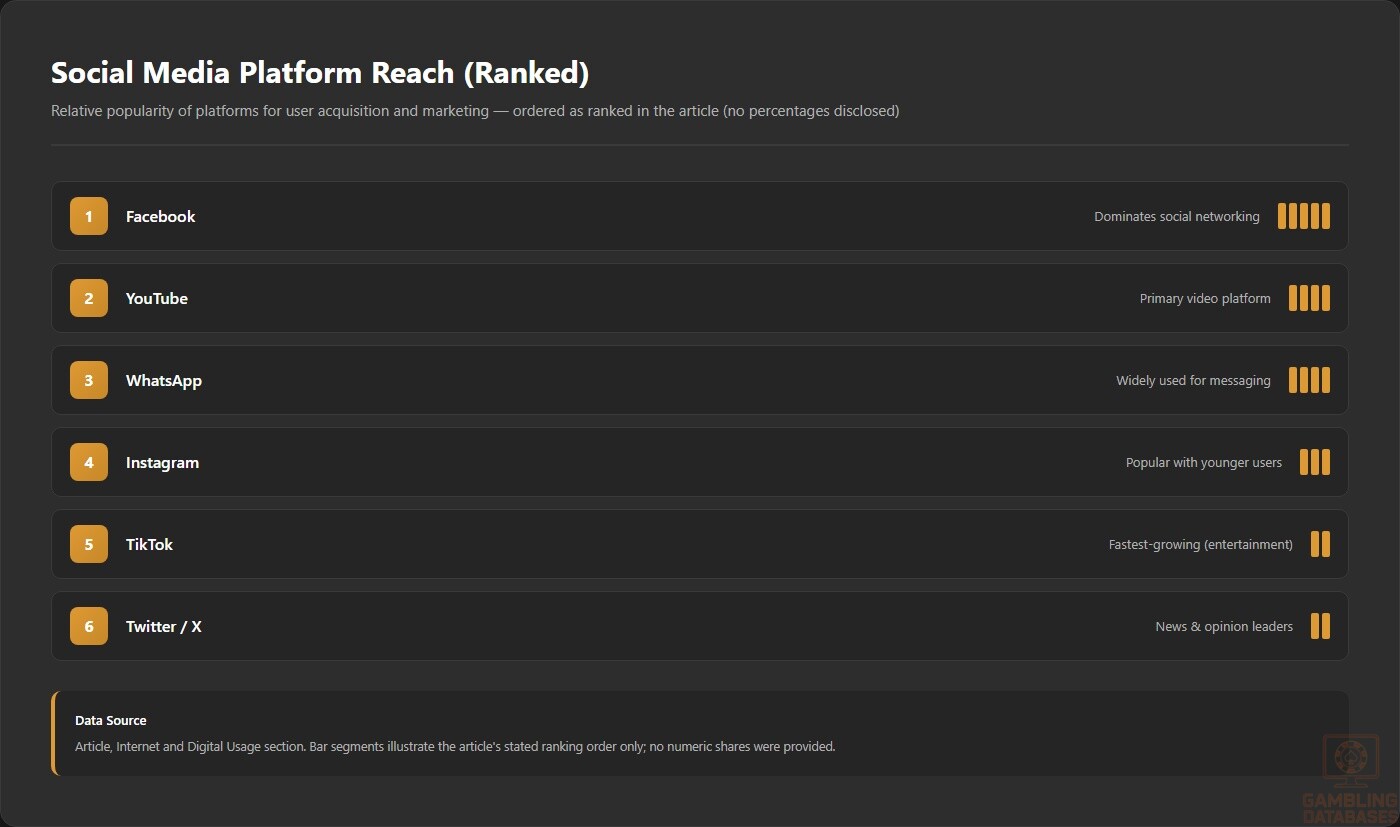
Social media engagement is vibrant, playing a key role in communication, entertainment, and digital marketing. This dynamic creates fertile ground for iGaming platforms seeking to leverage digital channels for user acquisition and retention.
- Facebook (dominates social networking)
- YouTube (primary video consumption platform)
- WhatsApp (widely used for messaging)
- Instagram (popular among younger demographics)
- TikTok (growing fast in entertainment content)
- Twitter (used by news and opinion leaders)
Digital Payment Behavior
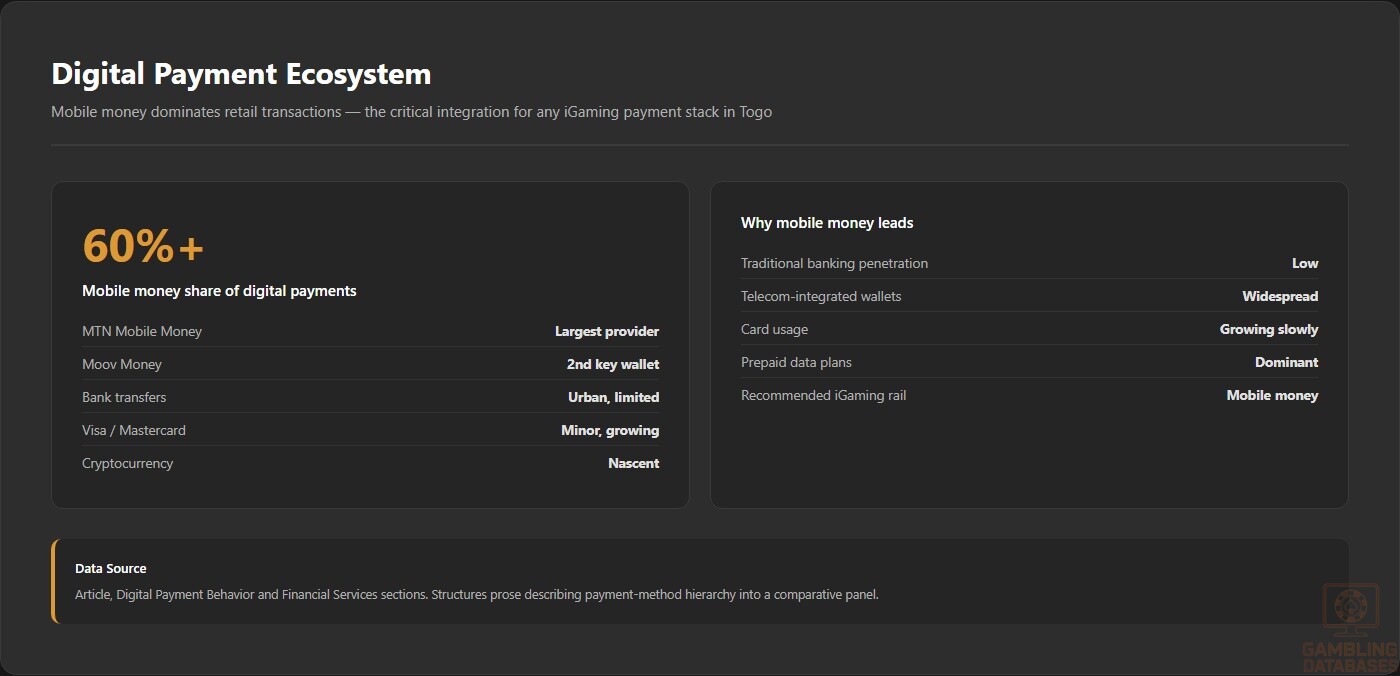
Togolese consumers favor mobile money services as the primary digital payment method due to limited traditional banking penetration. E-wallets lead online transactions, supported by local mobile operators offering integrated payment solutions.
- Mobile Money (dominant method, >60% market share)
- MTN Mobile Money
- Moov Money
- Bank Transfers (limited to urban banking clients)
- Credit/Debit Cards (minor usage, growing slowly)
- Cryptocurrency (still nascent, exploratory phase)
Online transaction growth correlates with rising smartphone adoption and improvements in network infrastructure, creating stronger foundations for digital commerce and gaming payments.
Gaming and Gambling Preferences
Current Market Participation
Gambling participation is selective but expanding. The most prevalent activities include national lottery ticket purchases, informal betting on sports, and land-based casino visits in urban centers.
- National Lottery (highest participation rate, ~45% adults)
- Sports Betting (legal and popular, ~22% participation)
- Slot Machines in Casinos (~15% participation)
- Informal Betting Pools (~10% participation)
- Online Gambling (limited, ~5% participation)
| Activity | Participation Rate (%) |
|---|---|
| National Lottery | 45 |
| Sports Betting | 22 |
| Slot Machines | 15 |
| Informal Betting Pools | 10 |
| Online Gambling | 5 |
Consumer Behavior Patterns
Spending habits show a preference for small but frequent wagers, with a strong leaning toward socially interactive gambling experiences such as lottery and sports betting. Digital platform adoption grows primarily among urban youth, who prefer mobile-optimized sites and apps.
Peak gambling activity occurs during evenings and weekends, aligned with leisure time. Retention strategies emphasizing gamification, loyalty rewards, and social sharing have proven effective in this market segment, signaling potential for robust digital customer engagement.
Section 3: Technology Infrastructure and Business Environment
Internet and Digital Infrastructure
Togo’s internet penetration remains moderate at around 40%, primarily driven by mobile broadband rather than fixed-line connections. Broadband internet is sparse outside major urban areas, with most users relying on 3G and 4G mobile networks.
Average internet speeds hover around 8-12 Mbps for download in urban centers, sufficient for streaming and digital entertainment but constrained in rural zones. Investment in fiber optic infrastructure has improved backbone capacity, yet last-mile infrastructure gaps persist, especially outside Lomé.
Network reliability varies, with frequent outages and latency issues noted in less developed regions. The government and private sector initiatives aim to address these limitations through infrastructure upgrades and expansion programs.
5G and Future Technology Deployment
5G coverage in Togo is in its nascent phase with pilot projects launched in Lomé and select urban districts. Full commercial rollout is anticipated between 2026 and 2028, contingent on regulatory approvals and telecom investment.
Major operators are preparing for 5G through spectrum acquisition and network modernization, with plans to extend high-speed mobile connectivity beyond metropolitan areas. This technology is expected to catalyze growth for data-intensive industries including iGaming and digital services.
Mobile Technology Ecosystem
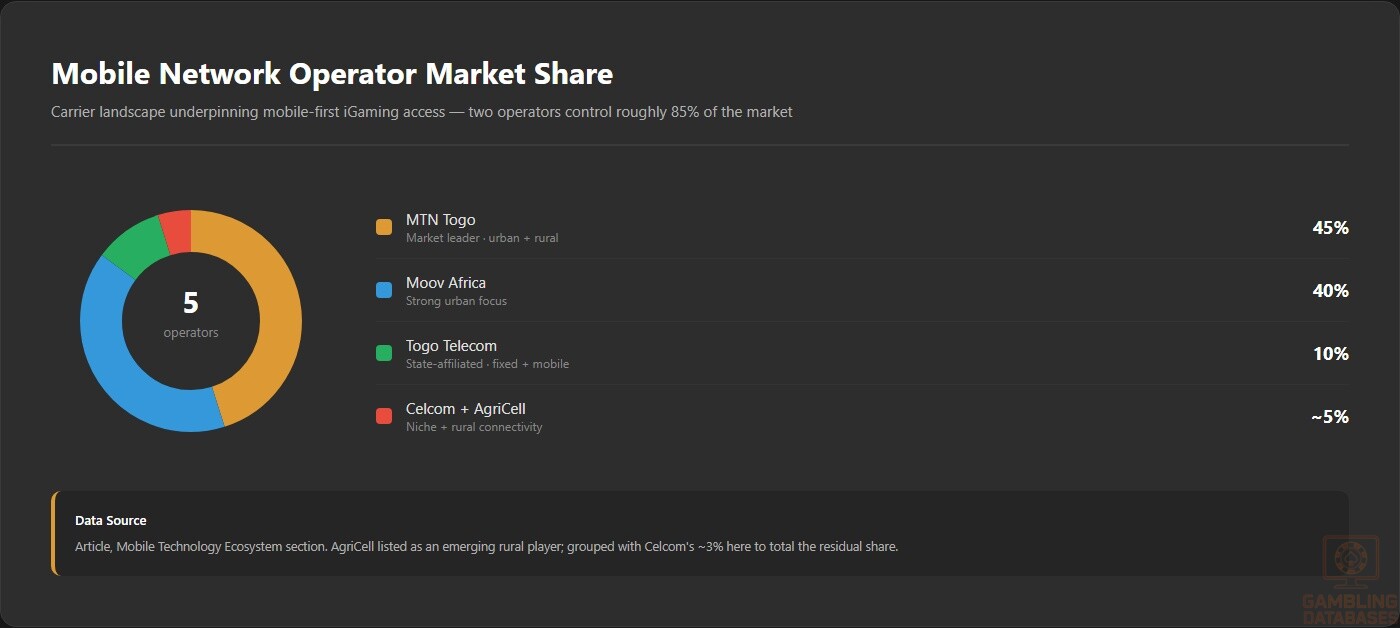
Togo’s mobile network infrastructure is competitive, featuring several operators providing wide coverage and affordable data packages. Market share is concentrated among a few key players offering 3G and 4G services with expanding LTE coverage.
- MTN Togo (market leader, ~45% share, extensive urban and rural coverage)
- Moov Africa (second largest, ~40%, strong urban focus)
- Togo Telecom (state-affiliated, ~10%, fixed and mobile services)
- Celcom (small operator targeting niche markets, ~3%)
- AgriCell (focused on rural connectivity, emerging player)
Mobile data costs are moderately high compared to regional peers but falling due to increased competition. Prepaid data plans dominate consumer preferences, supporting widespread mobile internet adoption.
Smartphone penetration exceeds 50% of mobile subscribers, driven by affordability of low-end and mid-range devices. Users favor Android OS devices, favored for low cost and app ecosystem compatibility. This device penetration supports rich mobile internet usage patterns key for iGaming engagement.
Financial Services and Payment Infrastructure
The banking system remains underdeveloped but expanding, with growing digital banking adoption in urban centers. Traditional banking services focus on corporate clients, while retail banking faces challenges related to inclusion and trust.
- Ecobank Togo (leading pan-African bank with strong digital services)
- Banque Togolaise de Banque
- Orabank Togo (regional bank with SME lending focus)
- Union Togolaise de Banque
- UBA (United Bank for Africa) – offering corporate and retail solutions
Mobile money dominates retail financial transactions, providing accessible digital wallets and payment platforms via telecom operators. Payment processing options include bank transfers, card payments, mobile wallets, and nascent cryptocurrency services.
- MTN Mobile Money (largest provider, high market penetration)
- Moov Money (second key mobile financial service)
- Bank Transfers (limited usage but increasing in urban areas)
- Visa and Mastercard card acceptance expanding slowly
- Bitcoin and other cryptocurrencies (early adoption mainly by niche users)
E-commerce and Digital Economy
Togo’s e-commerce market is at an early growth stage, with online retail penetration growing steadily due to increased internet and smartphone usage. Consumer trust in online payments is gradually improving, helped by mobile money’s reliability.
The digital economy is supported by various startups and digital service providers focusing on logistics, payments, and online marketplaces. These developments form a supportive ecosystem for iGaming platforms addressing the tech-savvy youth population.
Business Environment and Regulatory Framework
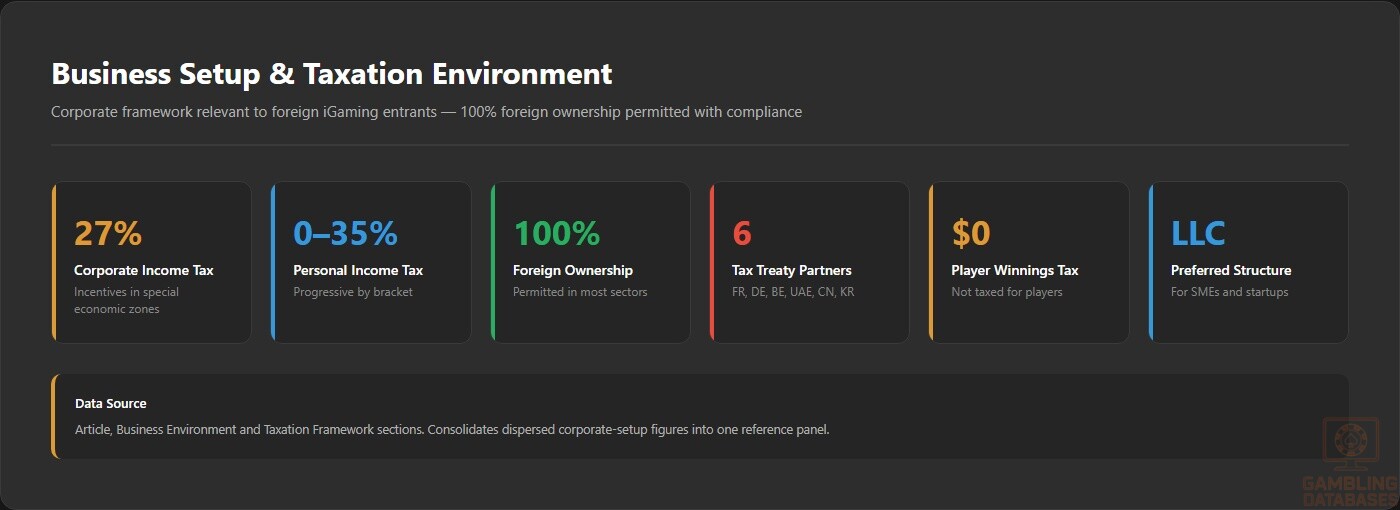
Togo ranks moderately in the World Bank’s Ease of Doing Business report, with some bureaucratic complexities offset by reforms promoting foreign investment and entrepreneurship. Business registration is streamlined but can involve delays depending on sectoral specifics.
Operational costs remain relatively low compared to regional hubs, with affordable labor and office rents reported in Lomé. Foreign investors benefit from liberal policies that permit 100% foreign ownership in most sectors, including iGaming, subject to compliance with local laws.
- Company name reservation and document preparation
- Submission to the Centre de Formalités des Entreprises (CFE)
- Tax registration and obtaining a tax identification number (TIN)
- Social security registration and labor compliance
- Opening a corporate bank account
- Obtaining sector-specific permits and licenses
Corporate structures include limited liability companies (LLCs), commercial companies, and branch offices of foreign firms. LLCs are preferred for local operations due to liability protections and ease of governance.
- Limited Liability Company (most common for SMEs and startups)
- Commercial Company (larger capital firms)
- Branch Office (for foreign entities without separate incorporation)
Registration costs are modest, with fees varying by company type and capital amount. Reporting and compliance obligations adhere to national tax and labor laws.
- Company registration form and articles of association
- Identity documents of shareholders and directors
- Proof of registered office address
- Capital deposit confirmation
- Tax and social security registration documents
- Sector-specific permits (gambling license, if applicable)
Taxation Framework
The corporate income tax rate stands at a standard 27%, with incentives for firms operating in special economic zones including tax holidays and reduced rates for qualifying activities. Togo has bilateral tax treaties with several countries to prevent double taxation.
- France
- Germany
- Belgium
- United Arab Emirates
- China
- South Korea
Personal income taxation ranges from 0 to 35%, depending on income brackets. Employers and employees contribute to social security schemes, with strict residency requirements influencing tax obligations for expatriates.
Market Entry Considerations
Entering Togo’s iGaming market requires a clear regulatory compliance strategy combined with strong local partnerships. Platform localization and adaptation to mobile-centric usage are critical given consumer behavior and infrastructure.
- Form strategic alliances with local entities for market credibility
- Focus on mobile-first technology platforms tailored to regional network strengths
- Ensure compliance with upcoming online gambling licensing regulations
- Leverage mobile money payment integrations to maximize user convenience
- Invest in localized marketing addressing language and cultural preferences
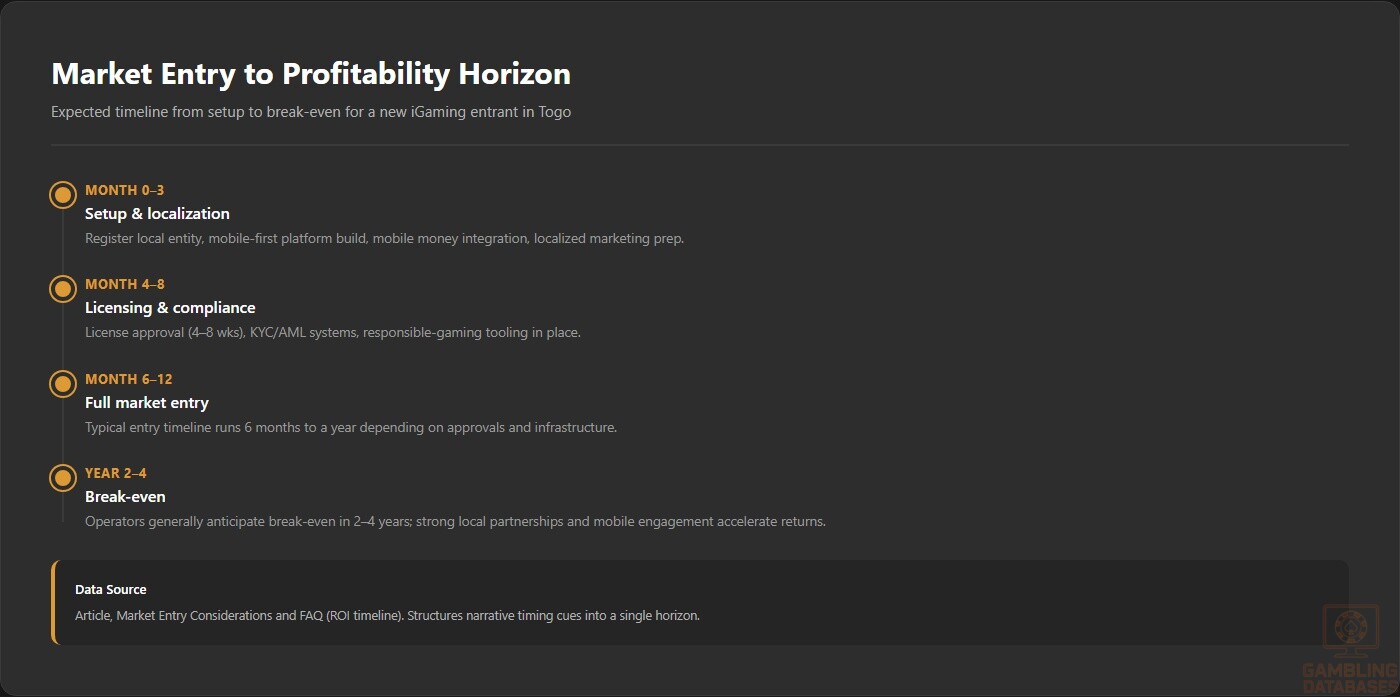
Typical initial costs include licensing fees, technology setup, marketing campaigns, and human resource expenses. Market entry timelines range from six months to a year depending on regulatory approvals and infrastructure deployment.
| Cost Category | Estimated Cost |
|---|---|
| Licensing and Application Fees | 50 – 150 |
| Technology Platform Setup | 100 – 250 |
| Marketing and User Acquisition | 60 – 120 |
| Staffing and Operations | 40 – 80 |
| Legal and Consulting | 30 – 70 |
- Comprehensive regulatory understanding and local engagement
- Effective mobile payment integration and platform optimization
- Agile marketing and user retention strategies
- Robust compliance and responsible gambling systems
- Management of operational costs and scalability planning
Key challenges include infrastructural inconsistencies, regulatory uncertainties in online gambling, and competitive pressures from offshore operators. Successful entrants emphasize adaptability, compliance rigor, and localized digital engagement.
FAQ: Frequently Asked Questions
1. Is online gambling legal in Togo?
Online gambling is currently legal but operates within a partially regulated framework. While land-based licenses are clearly defined, online licenses are under development, and many foreign operators serve Togolese players using international licenses. The government has announced plans to establish formal online gambling regulations, including licensing and taxation, expected to be implemented soon.
2. What types of gambling licenses are available and what do they cover?
Togo offers licenses for land-based casinos, sports betting, and the national lottery. Online gambling licenses are anticipated but not fully formalized as of 2025. Land-based licenses typically cover gaming operations, slot machines, and sports betting venues. Future regulations may introduce differentiated online licenses for casino games, sports betting, and lottery products.
3. How much does an iGaming license cost and how long does it take to obtain?
Licensing fees for gambling operators vary depending on the license scope. For land-based operations, fees range moderately with an application process lasting four to eight weeks. Online gambling licenses, once introduced, will likely have structured fees and similar timeframes. Additional costs arise from compliance and platform certifications.
4. Can foreign companies obtain a gambling license?
Yes, foreign companies can apply for gambling licenses in Togo. There are no explicit ownership restrictions, but operators must comply with local regulations and establish a legal entity or partnership to facilitate regulatory oversight and market access. Local presence requirements for online operators may intensify with regulatory updates.
5. What are the tax obligations for iGaming operators?
Operators pay taxes mainly on gross gaming revenues, with land-based rates currently estimated between 10% and 20% depending on the gambling category. Online taxation frameworks are expected to mirror these structures once formalized. Operators also face license renewal fees, corporate income taxes, and turnover-based levies as applicable.
6. Are gambling winnings taxed for players?
Gambling winnings are not directly taxed for players in Togo. The regulatory framework focuses taxation obligations on operators rather than individual bettors. This favorable player tax environment encourages participation while operators manage tax compliance and reporting.
7. What are the typical operational costs for running an online casino/sportsbook?
Operational costs include licensing fees, technology platform maintenance, payment processing, marketing, staffing, and compliance. Marketing and user acquisition often represent significant budget portions, alongside technology investments required for a quality user experience and regulatory adherence.
8. What is the expected ROI timeline for entering this market?
ROI expectations vary with the entry strategy, but operators generally anticipate break-even within two to four years, considering initial setup costs and gradual market penetration. Strong local partnerships and effective mobile engagement accelerate revenue generation and profitability.
9. What are the local presence requirements for operators?
Operators must register a local legal entity, and land-based operators require physical premises. Online operators will likely face requirements for local domain registration and compliance officers based in Togo. These measures ensure regulatory reach and consumer protection.
10. What payment methods are available and recommended?
Mobile money services dominate payment options, with MTN Mobile Money and Moov Money leading market share. Bank transfers and card payments are available but used less frequently. Cryptocurrency use is low but growing in niche segments, with mobile money integration being essential for wide coverage.
11. What are the advertising and marketing restrictions?
Advertising must exclude minors and vulnerable groups, include responsible gambling messaging, and avoid deceptive claims. Promotional campaigns are regulated to prevent excessive gambling encouragement. Sponsorships require regulatory approval and adherence to ethical standards.
12. What responsible gambling measures are mandatory?
Operators must implement age verification, KYC processes, anti-money laundering controls, and provide self-exclusion tools. Information disclosure about risks and support services is compulsory. Regulatory frameworks prioritize consumer protection and harm minimization.
13. How large is the iGaming market and what is the growth potential?
The Togolese iGaming market is currently small, with approximately $20 million in annual revenues dominated by land-based activities. Online gambling is nascent but forecast to grow at 7-9% CAGR over the next five years, driven by increasing internet access and regulatory formalization.
14. Who are the main competitors and what is their market share?
The market includes domestic casino operators, sports betting companies, and LONATO’s national lottery monopoly. Online market competition is mainly from offshore operators serving Togolese players. Market shares align with licensing status and distribution reach, with dominant land-based players holding significant portions.
15. What are the player preferences and typical spending patterns?
Players favor lotteries and sports betting, followed by casinos and informal betting pools. Spending is characterized by low to moderate stakes with frequent participation. Digital preferences skew toward mobile-first platforms with convenience and fast payment processing as key drivers.
16. What are the key success factors and main challenges for new entrants?
Success depends on regulatory compliance, mobile-optimized technology, strong local partnerships, and effective marketing. Challenges include infrastructural weaknesses, regulatory uncertainty in online licensing, and competition from offshore operators. Flexibility and localized approaches are essential to navigate these complexities.
Sources and References
- Togo Government Ministry of Finance and Economy Official Portal – https://finances.gouv.tg
- Loterie Nationale Togolaise (LONATO) Official Website – https://lonato.tg
- Togo National Institute of Statistics – Population and Economic Reports 2024 – https://ins-togo.org
- World Bank – Doing Business Report 2024 – https://doingbusiness.worldbank.org
- International Telecommunication Union (ITU) – ICT Country Profiles 2024 – https://itu.int
- Central Bank of West African States (BCEAO) – Financial and Banking Reports Togo 2024 – https://bceao.int
- MTN Togo Corporate Website and Annual Reports – https://mtn.com.tg
- Moov Africa Togo Official Website – https://moov.tg
- Ecobank Togo Digital Banking Portal – https://ecobank.com/togo
- Orabank Togo Corporate Information – https://orabank.net
- World Economic Forum – African Digital Economy Report 2025
- International Monetary Fund (IMF) – Togo Country Report 2024
- United Nations Development Programme (UNDP) – Human Development Reports
- Freedom House – Freedom on the Net Togo 2024
- GSMA Intelligence – Mobile Connectivity Reports 2024
- Global Betting & Gaming Consultants (GBGC) – African Market Reports 2025
- Gaming Industry Regulatory Updates – iGaming Today, 2025
- Africa Business Magazine – Market Analysis Togo 2025
- Local News Outlets – Togo Economic and Regulatory News 2024-2025
- Legal Advisory Firms Specializing in African Gaming Regulation
- Consulting Reports from Deloitte and PwC on West African Gambling Markets
- Togo Chamber of Commerce – Investment Guide 2024
- OECD – Tax Treaties and Corporate Taxation Data
- Academic Journals on African Digital Economy and Consumer Behavior
- NGO Reports on Gambling Addiction and Social Responsibility Programs in Togo
- Telecommunications Regulatory Authority Togo – Spectrum and Licensing Data
- Mobile Payment Providers Annual Usage Reports
- Togo Ministry of Commerce and Industry – Business Registration Guidelines
- International Casino Association Reports – African Market Section



The licensing timeline they’re quoting (4-8 weeks) seems suspiciously fast given that Togo’s online framework isn’t even finalized yet. How are operators supposed to get approved for something that doesn’t have clear rules? And they mention “undisclosed” fees and tax rates—that’s exactly the kind of opacity that gets operators burned. I’d want to see actual license holders’ experiences before touching this market. Anybody here actually gotten approved in Togo, or is this all theoretical?
You’ve flagged a legitimate concern. The 4-8 week timeline is aspirational at best—it assumes a complete application with no back-and-forth, which rarely happens in emerging markets. The opacity around fees and tax rates is indeed problematic for operators doing financial modeling. What we’re seeing in Togo specifically is that the Ministry of Finance is still drafting the formal online licensing framework, which means the current approval process is essentially discretionary. We’d recommend operators budget for 12-16 weeks minimum and factor in potential requests for additional documentation around AML/KYC infrastructure. As for actual license holders, the market is still sparse—most active operators are either grandfathered in from land-based operations or operating in a gray zone. The 2025 regulatory update should clarify this significantly, but yes, waiting for published case studies from real licensees would be prudent before committing capital.
Thanks for the reality check. 12-16 weeks makes way more sense than their estimate. So if the framework isn’t even finalized, operators are basically gambling on what the actual rules will be once they launch. Have you seen operators pull out of markets when regulations changed after they’d already invested in licensing and infrastructure?
It happens regularly. We saw it in Kenya around 2017-2018 when operators had licensed under one regime and the government introduced stricter tax rates mid-year. Some absorbed the cost, others exited. The difference is that Togo’s framework is being built now, so operators entering in 2025 will actually have more clarity than those who went in during 2023-2024. The regulatory update scheduled for 2025 should establish the baseline rules before licensing opens formally. That said, operators should definitely include regulatory risk clauses in their financial projections and maintain relationships with local compliance counsel who can track Ministry updates. Togo’s not a market where you can operate blind.
The mobile money dominance caught my eye since I’m always betting through my phone. Togo’s got over 70% mobile penetration but only 40% internet—so basically everyone’s on MTN Money or similar instead of cards. Testing the payment flow on mobile would be the real test before launching. Android app stability matters way more here than desktop performance. Anyone know if the local operators handle mobile withdrawals fast, or do they have the usual 3-5 day delays?
You’re tracking an important nuance. Mobile money dominance in Togo does reshape both the operator experience and player behavior. MTN Mobile Money and Moov Money handle roughly 60-65% of digital transactions there, so payment integration is critical. The withdrawal speed issue you mentioned is particularly relevant—most mobile money disbursements clear within 24 hours locally, which is actually faster than card-based systems. However, operators should note that there’s a daily transaction ceiling on most mobile money accounts (typically around 500,000 XOF or roughly $750 USD), which affects high-volume players. Testing the Android app against intermittent connectivity is essential given that many users are on 3G networks. The usability difference between desktop and mobile matters less in Togo than payment infrastructure reliability.