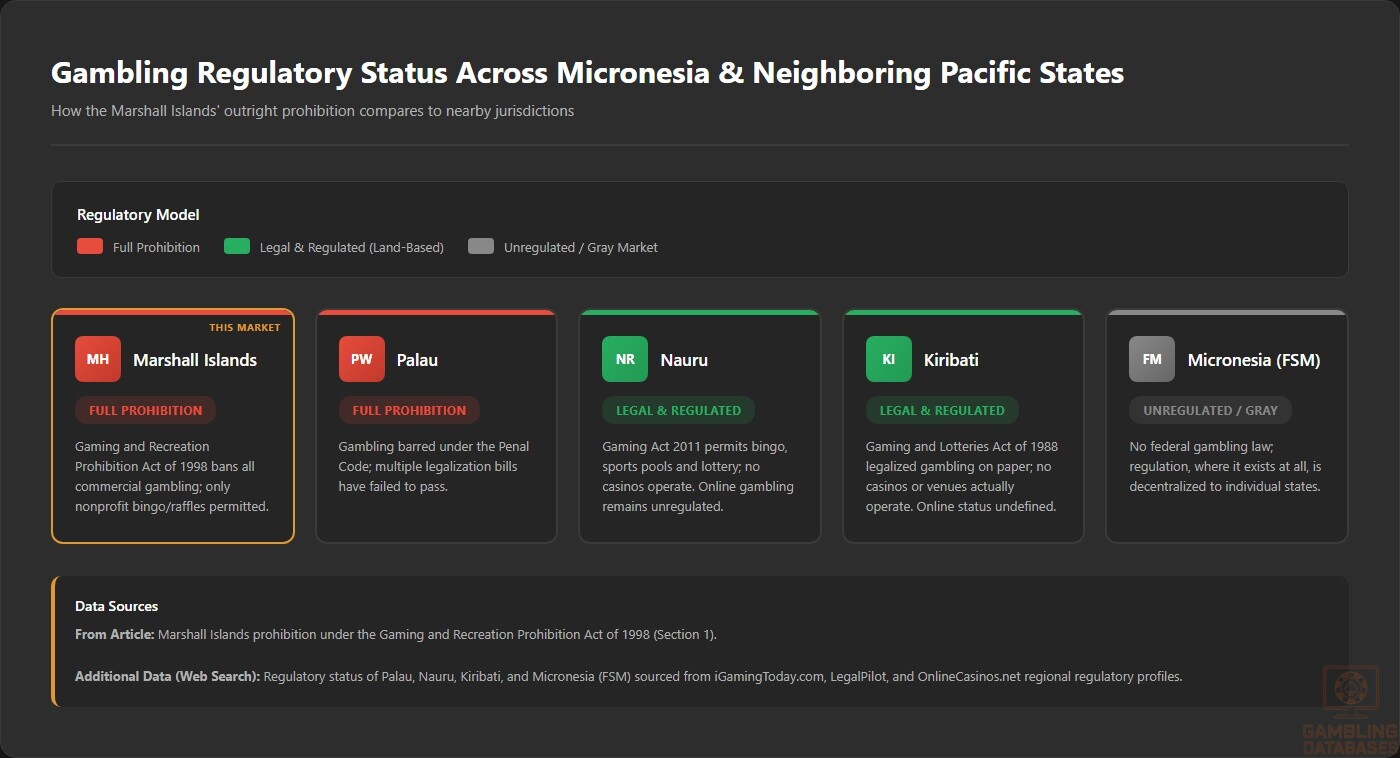
The Marshall Islands presents a highly restrictive environment for iGaming market entry due to a stringent prohibition on most gambling activities under the Gaming and Recreation Prohibition Act of 1998. Despite its picturesque location, the regulatory landscape forbids conventional and online gambling operations, instead permitting only limited nonprofit fundraising activities like bingo and raffles.
Investors eyeing the Marshall Islands must navigate a zero-tolerance approach toward commercial gaming, with no current licensing regime for casinos or sports betting. This regulatory rigidity shapes a challenging but clearly defined market context, influencing entry strategies and investment considerations.
Executive Summary: Key Market Indicators
| Metric | Value |
|---|---|
| Gambling Legal Status | Strict prohibition except for limited nonprofit activities |
| Primary Gambling Law | Gaming and Recreation Prohibition Act of 1998 |
| Legal Gambling Activities | Bingo, raffles, cakewalks by nonprofit organizations only |
| Licensed Operators | No licenses issued for commercial iGaming or gambling |
| Penalties for Illegal Gambling | Up to $1,000 fine and/or 1 year jail, plus daily escalating fines |
| Population | ~59,000 (2025 estimate) |
| GDP (Nominal) | Approximately $220 million (2024 estimate) |
| GDP Per Capita | ~$3,700 |
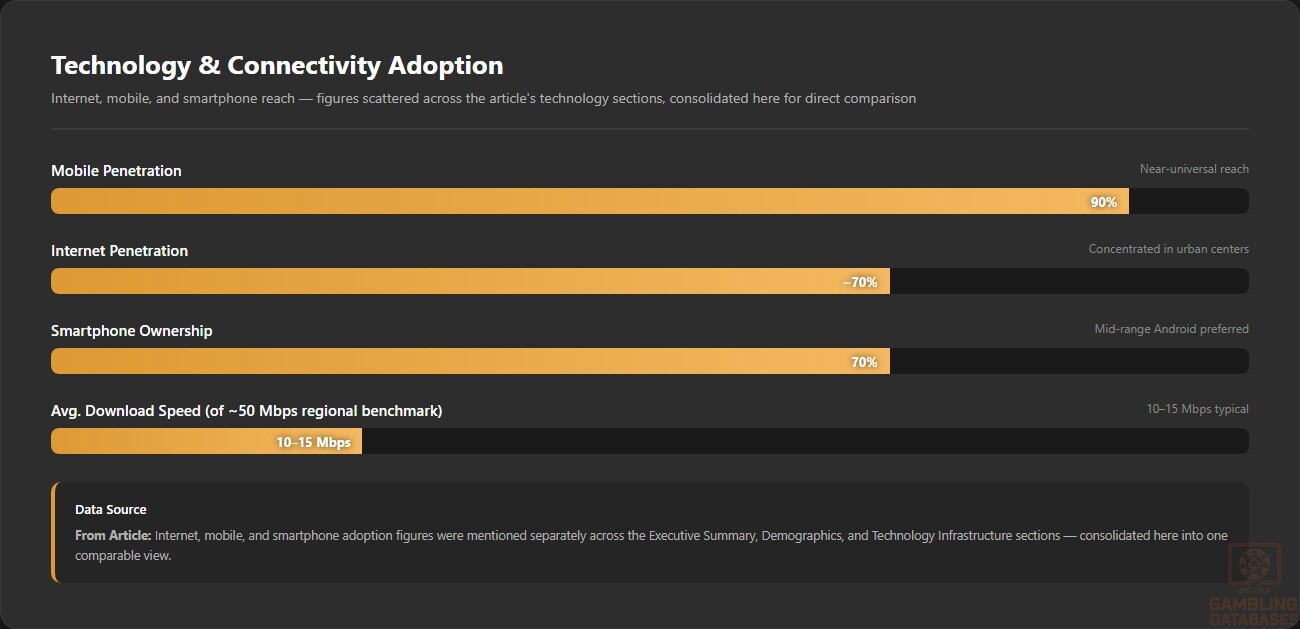
| Internet Penetration | Approximately 70% |
| Mobile Penetration | Approximately 90% |
| Average Income Levels | Modest, with a large subsistence economy |
| Gaming Taxation | No gambling taxes; no legal commercial operations |
| Licensing Fees | Not applicable – no commercial licenses issued |
| Regulatory Authority | No dedicated gambling regulator |
| Compliance Requirements | Strict prohibition compliance enforced by police |
| Market Entry Barriers | Extremely high due to legal prohibitions and active enforcement |
| Enforcement Activity | Active policing including seizure of illegal gambling equipment |
| Online Gambling Status | Not permitted |
| Casino Availability | None |
| Sports Betting | Illegal |
| Foreign Ownership Restrictions | Not applicable as no commercial licenses issued |
| Market Size | Negligible / Nonexistent legal gambling market |
| Growth Outlook | Unchanged due to regulatory prohibition |
| Average Revenue Per User (ARPU) | Not applicable |
| Technology Infrastructure | Basic to moderate; supports limited digital services |
| Business Environment | Favorable for incorporation, not for gambling activities |
Section 1: Regulatory Framework and Legal Environment
Current Gambling Regulation Status
The gambling landscape in the Marshall Islands is governed primarily by the Gaming and Recreation Prohibition Act of 1998, which establishes a broad ban on all traditional forms of gambling. This law defines gambling as wagering money or anything of value on games involving chance or skill, explicitly forbidding poker, casino table games, sports betting, and slot machines.
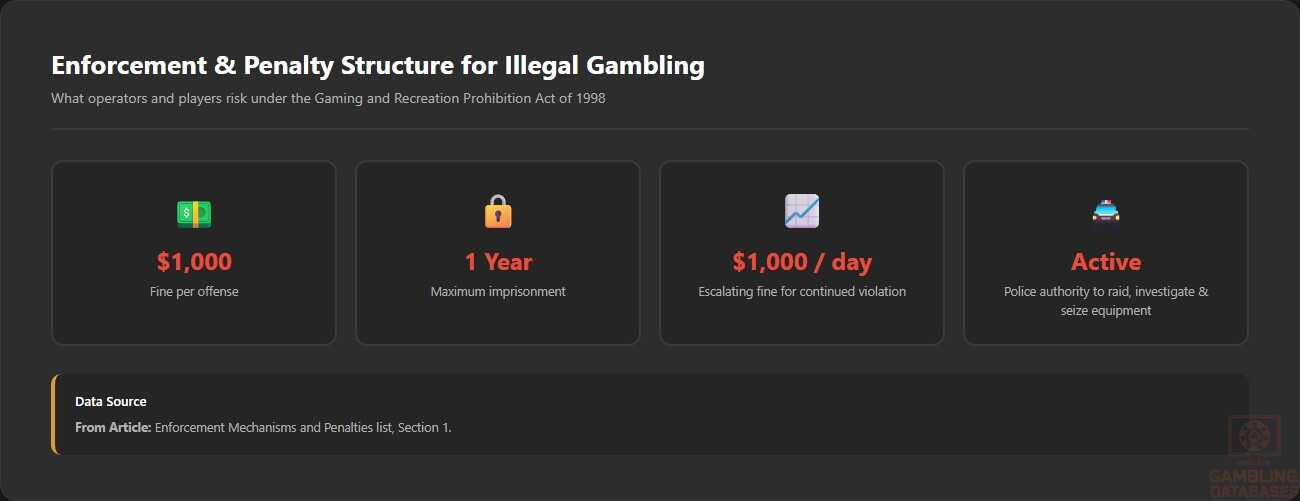
Under this act, both residents and corporations are prohibited from engaging in commercial gaming activities or owning gambling equipment. Enforcement is robust, with police authorized to investigate offences, seize illegal devices, and pursue criminal charges against violators. Penalties include fines of up to $1,000 per offence or imprisonment for up to one year, and escalating daily fines for ongoing violations.
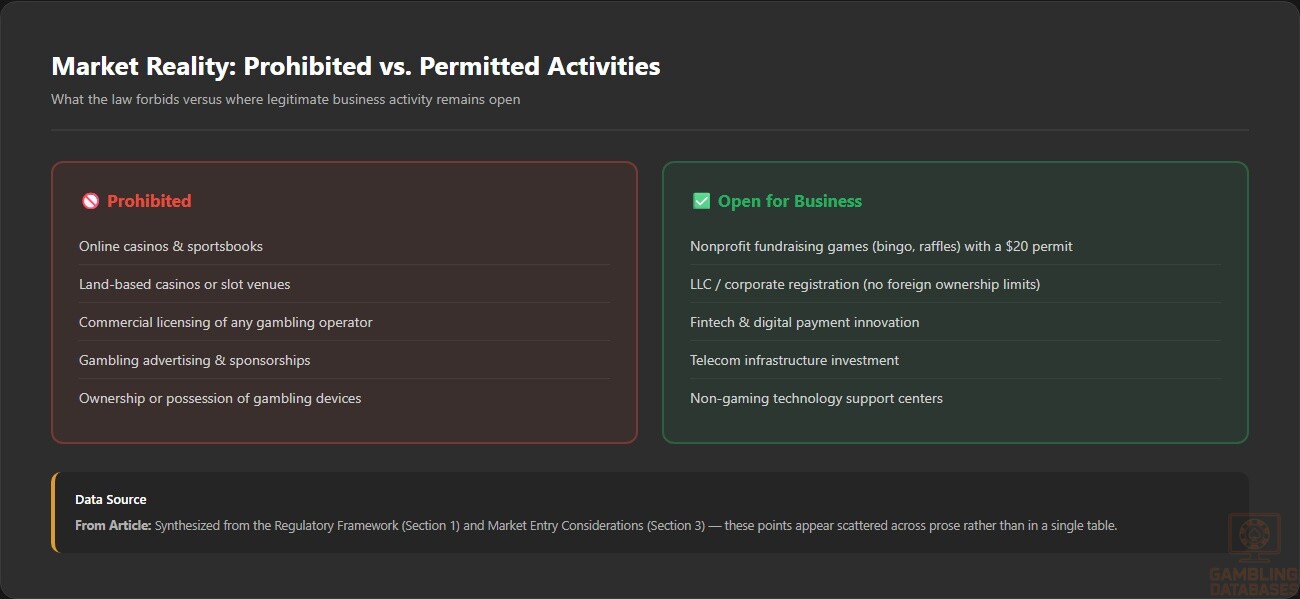
A significant exemption applies solely to nonprofit organizations, which may conduct limited fundraising games such as bingo, raffles, or cakewalks. These activities require prior approval from local government authorities, accompanied by a nominal permit fee capped at $20. Such exceptions are aimed at community fundraising and do not extend to commercial operators.
Land-Based Gambling Activities
There are no legal land-based casinos, sportsbooks, or slot machine venues in the Marshall Islands. The strict prohibition eliminates any market for these operations. The government does not issue licenses for any form of commercial gambling and actively suppresses illicit venues or machines.
Enforcement actions have been documented, including notable seizures of illegal gambling machines in recent years. The prohibition encompasses ownership, operation, and even the possession of gambling devices, creating a highly restrictive environment for land-based gambling enterprises.
Online Gambling Framework
Online gambling is explicitly not permitted under the current regulatory framework. The absence of licensing provisions or regulatory oversight makes any form of internet-based gaming illegal. Operators seeking to establish online casinos or sports betting platforms cannot register or operate legally within the jurisdiction.
Despite the ban on gambling, some online financial trading activities such as options and forex trading operate under separate regulations, as these do not fall under the definition of gambling. However, these activities are unrelated to gaming and do not constitute an entry point to the gambling market.
Licensed Operators and Market Players
The Marshall Islands maintains no official register of licensed gambling operators because commercial licenses are not issued. Consequently, there are no authorized casinos, sportsbooks, or online gaming platforms operating under Marshall Islands jurisdiction.
The competitive landscape is effectively nonexistent locally. Any actors attempting to provide gaming services within or from the Marshall Islands would be operating illegally and subject to significant enforcement risk. Foreign operators targeting residents remotely would lack any regulatory protection or licensing from the jurisdiction.
Licensing Framework and Requirements
Application Process and Eligibility
Since commercial gambling is prohibited, there is no formal licensing authority or application process for iGaming operators. No permits or approvals are granted for commercial gambling activities, which blocks any market entry through legalization channels.
Nonprofit organizations wishing to conduct limited fundraising games must apply for a permit with local government authorities. This process involves submitting a request and paying a small fee, generally not exceeding $20. These are the only licensed gambling-like activities recognized by law.
Local Presence and Operational Requirements
No operational licenses or permits for gambling require physical presence or local establishment, as the activity is banned. There are no stipulations for domain registration, staffing, or operational compliance related to gambling businesses. Foreign ownership restrictions are moot under the current regime.
Compliance Obligations and Monitoring
Player Protection and Identification
The legal framework does not provide for player protection measures related to gambling, as gambling is prohibited. The only regulatory focus is on preventing illegal gaming practices and enforcing prohibitions. Age restrictions on gambling activities are effectively enforced by denying any gambling activity.
Financial Monitoring and Reporting
Financial monitoring and reporting requirements specific to gambling operators do not exist. Enforcement focuses on detecting and prosecuting illegal gambling transactions rather than licensed operator compliance. Police have the authority to investigate suspicious financial activity linked to prohibited gambling.
Taxation Structure and Financial Obligations
Player Taxation
There is no applicable tax on gambling winnings because legal gambling does not exist in the Marshall Islands. Players do not have obligations related to gambling income within the jurisdiction.
Operator Taxation
Operators are not subject to gross gaming revenue taxes, license fees, or turnover taxes due to the absence of a legal gambling market. Illegal operators face penalties rather than tax liabilities. The government does not collect gambling-related tax revenue.
| Tax Type | Rate | Notes |
|---|---|---|
| Gross Gaming Revenue Tax | Not applicable | No licensed operators |
| Corporate Income Tax | Standard rate applies | For legal businesses only |
| License Renewal Fees | Not applicable | No licenses issued |
| Turnover Tax | Not applicable | Absent due to prohibition |
Gambling Market Financial Performance
No legal gambling market revenues or wagering volumes are generated within the Marshall Islands. The government does not benefit from gambling-related tax revenues because of the prohibitive laws. Illegal gambling activity is actively suppressed, preventing market development.
Advertising and Marketing Restrictions
Advertising of gambling services is banned as the practice itself is prohibited. There are no regulations permitting gambling marketing or sponsorships. Any promotion of gambling products or services is considered an illegal activity subject to enforcement action.
Recent Regulatory Changes and Their Impact
The gambling regulations in the Marshall Islands have remained largely unchanged since the enactment of the Gaming and Recreation Prohibition Act in 1998. Recent enforcement activities, such as seizures of illegal gambling machines in 2023, underscore continued government vigilance rather than legal reforms.
This consistency in regulatory stance creates certainty but also confirms the high barriers to entry for any commercial iGaming initiatives. Operators must regard the jurisdiction as non-viable for gambling market development under current laws.
Enforcement Mechanisms and Penalties
- Criminal penalties include fines up to $1,000 per offense
- Imprisonment terms of up to one year for violations
- Daily escalating fines of $1,000 for continued illegal activities
- Police authority to investigate, raid, seize gambling equipment
- Prohibition on purchase, possession, use of gambling devices
The enforcement regime is robust and actively applied. The penalty structure and powers accorded to authorities strongly deter illegal gambling operations and underscore the government’s commitment to prohibition.
Section 2: Demographics and Consumer Analysis
Population Demographics and Distribution
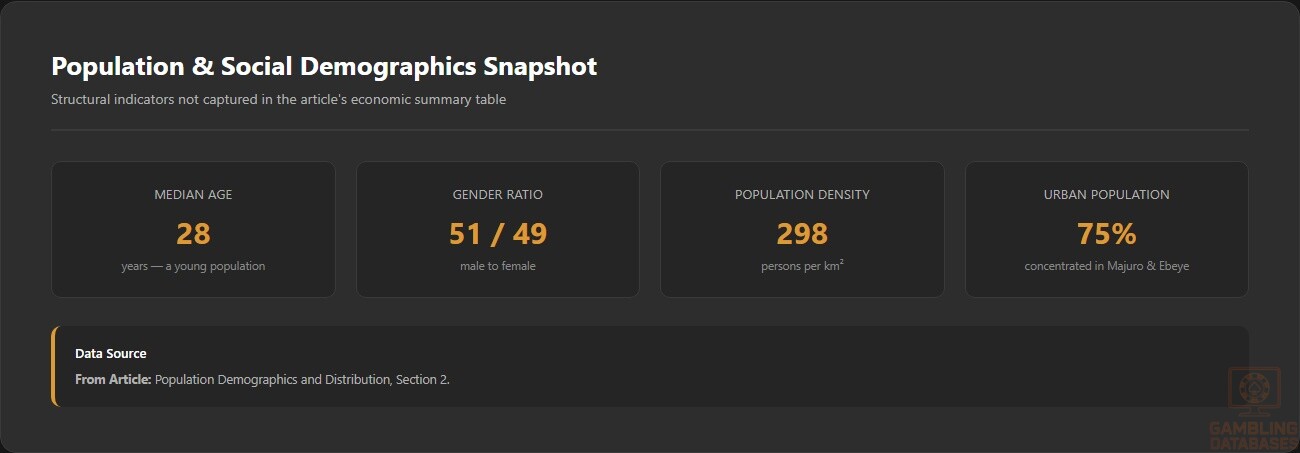
The Marshall Islands has an estimated population of 54,000 people in 2025, experiencing a stable growth trend in recent years. The median age is approximately 28 years, reflecting a relatively young population compared to global averages. The gender ratio slightly favors males, with about 51% male to 49% female distribution. Population density stands high due to limited land area, resulting in nearly 298 persons per km².
Urban populations make up roughly 75% of the total, concentrated largely in the capital, Majuro, and the second-largest urban center, Ebeye. Small island communities spread out across many atolls and islands account for the rural remainder. Internet access and digital infrastructure are predominantly available in urban centers, while outer islands face connectivity challenges.
| Age Group | Percentage of Population |
|---|---|
| 0-14 years | 28% |
| 15-24 years | 18% |
| 25-54 years | 38% |
| 55-64 years | 8% |
| 65 years and above | 8% |
Geographic Distribution
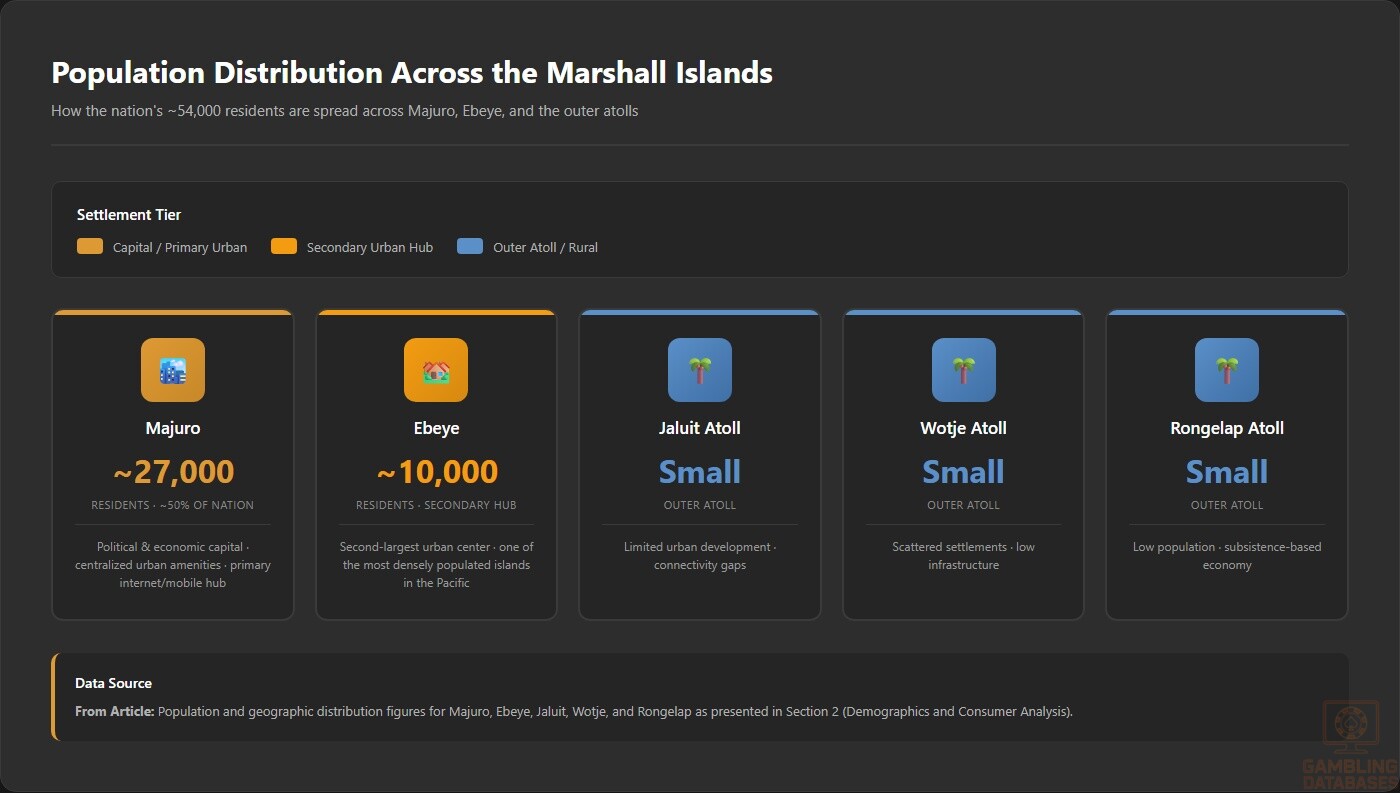
Majuro, the political and economic capital, houses approximately 27,000 inhabitants, representing half of the national population. Ebeye follows with around 10,000 residents. The remaining population resides in smaller atolls and islands, where infrastructure levels vary significantly.
- Majuro: ~27,000 population, centralized urban amenities
- Ebeye: ~10,000 population, secondary urban hub
- Jaluit Atoll: Smaller communities, less urban development
- Wotje Atoll: Scattered settlements, limited infrastructure
- Rongelap Atoll: Low population, subsistence lifestyle predominant
Digital connectivity and internet penetration are heavily skewed towards urbanized islands, facilitating digital services and potential digital entertainment use. Gambling venues and formal gaming operations are nonexistent due to prohibition laws.
Economic Indicators and Consumer Spending Power
The Marshall Islands economy is modest with a nominal GDP of approximately $220 million in 2024. The service sector dominates, constituting roughly 70% of GDP, followed by agriculture at 19% and industry around 11%. Economic growth is stable but limited by geographic and resource constraints.
GDP per capita hovers around $3,700, reflecting subsistence living for a significant portion of the population. Disposable income is constrained, impacting consumer spending habits. The informal economy plays a large role alongside small formal sectors focused on government services, shipping, and fishing.
| Metric | Value |
|---|---|
| GDP (Nominal) | $220 million |
| GDP per Capita | $3,700 |
| GDP Contribution by Services | 70% |
| Agricultural GDP Share | 19% |
| Industry GDP Share | 11% |
| Annual GDP Growth Rate | Approx. 2% |
Income and Wealth Distribution
Average household incomes are generally low, with a sizeable proportion of the population engaged in subsistence agriculture or fishing. Income inequality remains moderate, with some urban pockets benefiting from remittances and public sector wages.
Consumer spending is conservative due to limited disposable income. Cash transactions dominate, and credit usage is minimal. The low-income base constrains expansion of discretionary spending sectors such as entertainment, including gaming or recreational betting.
Market Size and Growth Projections
The market size for gambling and digital entertainment is minimal in Marshall Islands due to regulatory prohibition. Projections indicate no substantial growth in gaming revenues over the next five years, as legal frameworks restrict commercial gaming activities entirely.
Despite these restrictions, digital services tied to communication and fintech show gradual growth, supported by increasing internet adoption in urban centers. Future growth potential remains tied primarily to technology sector expansion rather than gambling or betting markets.
| Indicator | 2025 | 2030 Projection |
|---|---|---|
| Population | 54,000 | 56,000 |
| Internet Penetration | 66% | 75% |
| Tech Industry Growth | 12% | 15% |
| Gaming Market Size | Negligible | Negligible |
| Digital Service Users | ~24,000 | ~30,000 |
Education, Skills, and Digital Literacy
The Marshall Islands boasts near-universal literacy with a strong emphasis on primary and secondary education. Digital literacy is growing steadily, particularly among younger urban populations who engage heavily with online content and social media.
Workforce skills are evolving as the technology sector expands, with increasing demand for IT, cybersecurity, and software development professionals. Government and private sector initiatives focus on upskilling and digital inclusion, although rural areas lag behind urban centers in access and skill levels.
Cultural and Social Factors
Communication and Language
The official languages are Marshallese and English, with English predominating in commerce and digital communication. Internet content consumption is mainly in English, supported by widespread bilingualism among the population.
Cultural Attitudes
While traditional culture values leisure and community, gambling is culturally and legally discouraged. Religious influences, predominantly Christian denominations, strongly oppose gambling, reinforcing societal resistance to gaming activities.
Foreign brands and digital entertainment imports enjoy general acceptance, but commercial gambling remains socially unacceptable and legally constrained by government policy.
Problem Gambling and Social Considerations
Due to the prohibition of gambling, problem gambling prevalence is negligible. There are no formal government-sponsored treatment programs aimed at gambling addiction. Social responsibility requirements and mandated contributions by operators do not apply.
Political Structure and Governance
The Marshall Islands operates a mixed parliamentary-presidential system characterized by stable governance and consistent regulatory policies. International relations focus on partnerships with the United States and regional organizations.
Political stability underpins business environment predictability, but the government remains committed to maintaining the strict gambling ban, effectively limiting gaming-related entrepreneurial activity.
Technology Adoption and Digital Behavior
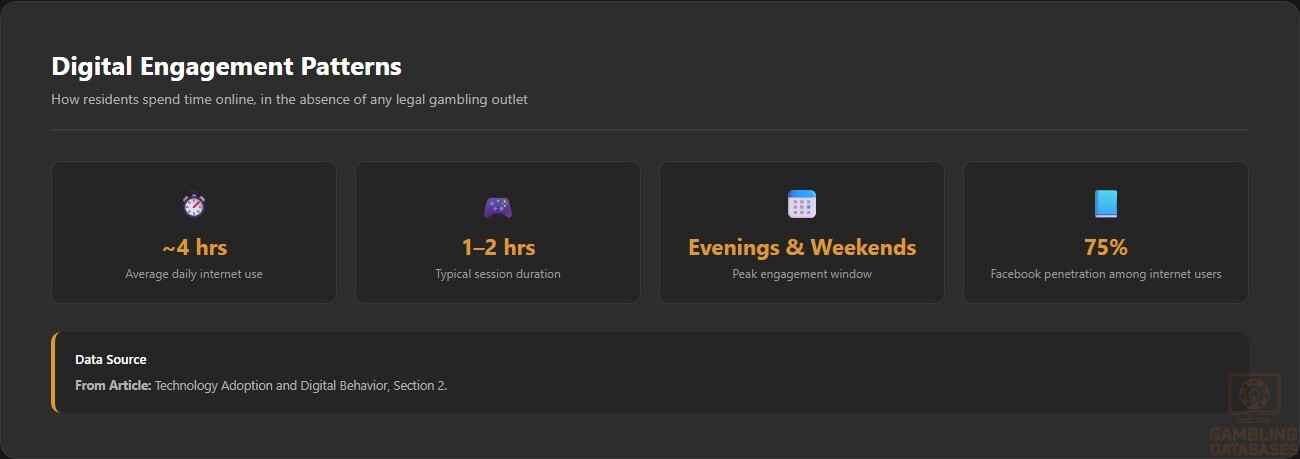
Internet penetration stands at approximately 66% in 2025, primarily centered in urban areas. Daily internet usage averages around 4 hours per user, with mobile devices accounting for the majority of connections. Social media engagement is rising sharply, fostering digital community interaction and content consumption.
- Facebook: dominant platform with 75% of online users
- YouTube: widely consumed video content platform
- Instagram: popular among younger demographics
- WhatsApp: preferred messaging application
- Twitter: used for news and public discourse
Digital payment adoption is still emerging but shows increasing preference for mobile money and e-wallets in urban centers. Cryptocurrency awareness exists but adoption remains minimal due to infrastructural and regulatory limitations.
- Mobile money services (e.g., M-Pesa-like systems)
- Credit and debit card usage limited but growing
- E-wallet applications gaining traction
- Bank transfers common for larger payments
- Cryptocurrency use rare and unregulated
Gaming and Gambling Preferences
Due to legal prohibition, formal gambling participation rates are effectively zero. Informal and social gaming such as card games or dice may occur privately but without commercial or regulatory presence.
Entertainment consumption focuses on radio, television, and increasingly online streaming platforms and social media games that do not involve monetary wagering. The market reflects low demand for gambling products in the current cultural and legal context.
| Activity | Participation Rate |
|---|---|
| Formal Gambling | 0% |
| Informal Social Games | 10-15% |
| Online Gaming (non-gambling) | 45% |
| Sports Viewing & Betting Interest | Minimal |
Consumer behavior analysis suggests a preference for social non-monetary gaming and digital entertainment rather than wagering activities. Peak digital engagement occurs during evenings and weekends, with session durations averaging one to two hours.
Section 2: Demographics and Consumer Analysis
Population Demographics and Distribution
The Marshall Islands has an estimated population of 54,000 people in 2025, with a median age of approximately 28 years. The gender ratio slightly favors males at roughly 51% male to 49% female. Population density is high at nearly 298 persons per km² due to limited land area.
About 75% of the population lives in urban centers, primarily Majuro and Ebeye, while the rest is spread across smaller islands. Digital connectivity and internet access are concentrated in urban areas, with rural islands facing infrastructure challenges.
| Age Group | Percentage of Population |
|---|---|
| 0-14 years | 28% |
| 15-24 years | 18% |
| 25-54 years | 38% |
| 55-64 years | 8% |
| 65 years and above | 8% |
Geographic Distribution
Majuro hosts about 27,000 residents, representing half the population, with Ebeye accounting for roughly 10,000. Smaller atolls house the remainder, with varying infrastructure development.
- Majuro: ~27,000 population, main urban center
- Ebeye: ~10,000 population, secondary urban hub
- Jaluit Atoll: sparsely populated, limited amenities
- Wotje Atoll: scattered settlements with low infrastructure
- Rongelap Atoll: small communities, subsistence economy
Urban centers have higher internet and mobile penetration, enabling access to digital services, whereas rural areas remain underserved.
Economic Indicators and Consumer Spending Power
The economy is modest with a nominal GDP about $220 million as of 2024. The services sector dominates at approximately 70% of GDP, agriculture contributes around 19%, and industry about 11%. Economic growth is steady but limited by geographic constraints.
GDP per capita stands near $3,700, with subsistence farming and fishing significant in rural areas. Disposable income is limited, impacting consumption patterns and constraining discretionary spending on entertainment.
| Metric | Value |
|---|---|
| GDP (Nominal) | $220 million |
| GDP per Capita | $3,700 |
| Services Sector Share | 70% |
| Agriculture Sector Share | 19% |
| Industry Sector Share | 11% |
| Annual GDP Growth Rate | Approx. 2% |
Income and Wealth Distribution
Household incomes are low on average, with income inequality moderate. Cash dominates financial transactions; credit usage remains low. Limited disposable income restricts consumer spending, leading to conservative purchasing behavior outside essential goods and services.
Market Size and Growth Projections
The legal gambling market is negligible due to prohibition. Market size for entertainment spending remains small, with no commercial gambling revenue forecast. However, gradual growth in digital communications and fintech services reflects increased technology adoption in urban areas.
| Indicator | 2025 | 2030 Projection |
|---|---|---|
| Population | 54,000 | 56,000 |
| Internet Penetration | 66% | 75% |
| Tech Industry Growth | 12% | 15% |
| Gambling Market Size | Negligible | Negligible |
| Digital Service Users | ~24,000 | ~30,000 |
Education, Skills, and Digital Literacy
Literacy rates are high with universal primary education and substantial secondary school completion. Digital literacy is growing quickly among youth and urban populations, supported by expanding internet access and government digital inclusion initiatives.
The workforce is emphasizing IT, software development, and cybersecurity skills, aligning with a burgeoning technology sector. However, rural populations still face educational and digital access disparities.
Cultural and Social Factors
Communication and Language
Marshallese and English are official languages, with English dominant in commerce and digital content. Internet users typically consume English-language content, reflecting bilingual communication norms.
Cultural Attitudes
Religious and cultural norms strongly discourage gambling. Social acceptance of gambling is low, with communities largely opposing any form of wagering activity. Foreign brand entertainment is accepted, but gambling remains culturally taboo and legally restricted.
Problem Gambling and Social Considerations
With commercial gambling prohibited, problem gambling rates are effectively nonexistent. No formal government or NGO programs address gambling addiction or related social issues. Social responsibility frameworks for gambling operators do not apply.
Political Structure and Governance
The Republic of the Marshall Islands operates a stable parliamentary-presidential government. Policy consistency favors maintaining current gambling prohibition. International partnerships, notably with the United States, strengthen political stability and economic support.
Technology Adoption and Digital Behavior
Internet penetration is approximately 66%. Mobile adoption is widespread, with most users connecting via smartphones. Daily internet use averages four hours, driven by social media and streaming content consumption.
- Facebook: 75% penetration among internet users
- YouTube: leading video platform
- Instagram: strong youth presence
- WhatsApp: dominant messaging app
- Twitter: used mainly for news and updates
Payment behavior in digital commerce is evolving. Mobile money and e-wallets gain traction, while credit/debit card usage remains limited. Cryptocurrency awareness exists but actual adoption is minimal and unregulated.
- Mobile money services growing steadily
- Credit and debit cards emerging
- E-wallets increasing in popularity
- Bank transfers used for considerable payments
- Cryptocurrency usage rare
Gaming and Gambling Preferences
No legal gambling participation occurs due to prohibitive laws. Informal social gaming (card games, dice) exists but with low economic impact. Digital entertainment consumption focuses on free-to-play games and streaming platforms without wagering elements.
| Activity | Participation Rate |
|---|---|
| Formal Gambling | 0% |
| Informal Social Games | 10-15% |
| Online Gaming (non-gambling) | 45% |
| Sports Viewing & Betting Interest | Minimal |
Consumer behavior trends show preference for social and digital entertainment without wagers. Peak engagement occurs evenings and weekends with typical session durations of one to two hours.
Section 3: Technology Infrastructure and Business Environment
Internet and Digital Infrastructure
The Marshall Islands exhibits moderate internet penetration estimated at 66% as of 2025, concentrated mainly in urban areas like Majuro and Ebeye. Broadband internet access is limited and largely supplanted by mobile data connections, reflecting infrastructural constraints in remote atolls. Average download speeds are modest, ranging from 10-15 Mbps, with ongoing improvements driven by government and private sector investments.
Infrastructure reliability remains a challenge due to geographic dispersion, frequent tropical weather events, and limited undersea cable capacity. Recent projects include upgrades to satellite connectivity and fiber optic deployments focused on enhancing access across inhabited islands.
5G and Future Technology Deployment
5G technology implementation is in early development stages, with pilot programs initiated in Majuro targeting commercial and governmental users. Full 5G network rollout is projected over the next 5 years, constrained by investment scale and technical challenges posed by the island geography.
Key network operators are collaborating with international technology partners to expand coverage and capacity, aiming to modernize digital infrastructure aligned with regional development goals.
Mobile Technology Ecosystem
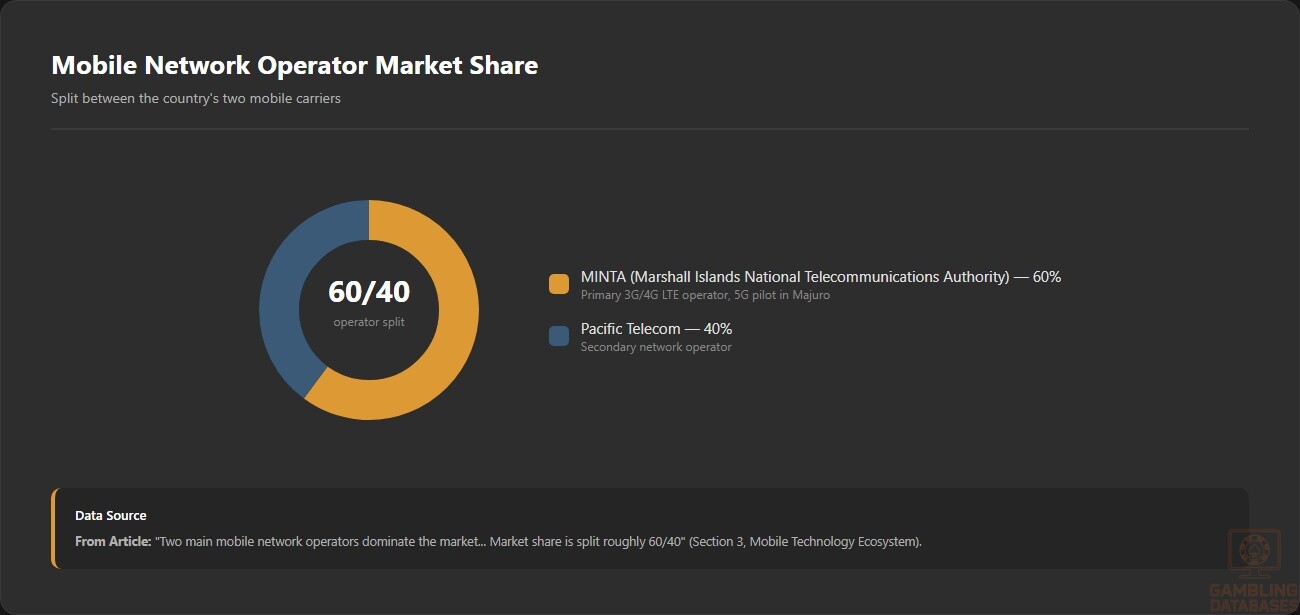
Mobile network infrastructure supports primary connectivity across the nation. Two main mobile network operators dominate the market, providing 3G and 4G LTE services with growing 5G trials. Market share is split roughly 60/40, with coverage nearly complete in urban centers but patchy in outer islands.
- Marshall Islands National Telecommunications Authority (MINTA)
- Pacific Telecom
- Other minor or regional operators provide specialized services
Smartphone penetration estimates indicate that approximately 70% of the population owns a smartphone, with a preference towards mid-range Android devices due to affordability and availability. Mobile usage patterns emphasize social media, messaging, and video streaming, facilitated by expanding data packages and prepaid plans.
Financial Services and Payment Infrastructure
The banking system is small but stable, serviced by a handful of financial institutions providing basic retail and commercial banking products. Digital banking adoption is emergent, driven by increased mobile phone penetration and the need for financial inclusivity in remote areas.
- National Development Bank of the Marshall Islands
- Bank of the Marshall Islands
- Community Bank of Micronesia
- Capital Pacific Bank
- Ta Savings Bank
Payment processing options are limited but expanding. Mobile money solutions are gaining traction, particularly for domestic transfers and bill payments, while card penetration remains low. Traditional cash usage still dominates day-to-day transactions.
- Mobile money platforms
- Visa and Mastercard processing through major banks
- Bank transfers for higher value payments
- Cash on delivery for e-commerce
- Limited cryptocurrency experimentation
E-commerce and Digital Economy
E-commerce remains nascent, constrained by infrastructural limits and low consumer purchasing power. Online retail penetration is modest yet growing steadily in urban locales, driven by increased smartphone usage and improved payment mechanisms.
Consumer trust challenges exist, including concerns about delivery logistics and payment security. Digital services such as telecommunications, financial applications, and entertainment streaming lead the adoption curve within the broader digital economy context.
Business Environment and Regulatory Framework
The Marshall Islands ranks moderately on the World Bank’s ease of doing business index due to efficient business registration but limited market size. Foreign investment policies are open, with no restrictions on foreign ownership, though limited by the local economy’s scale and legal restrictions on gambling enterprises.
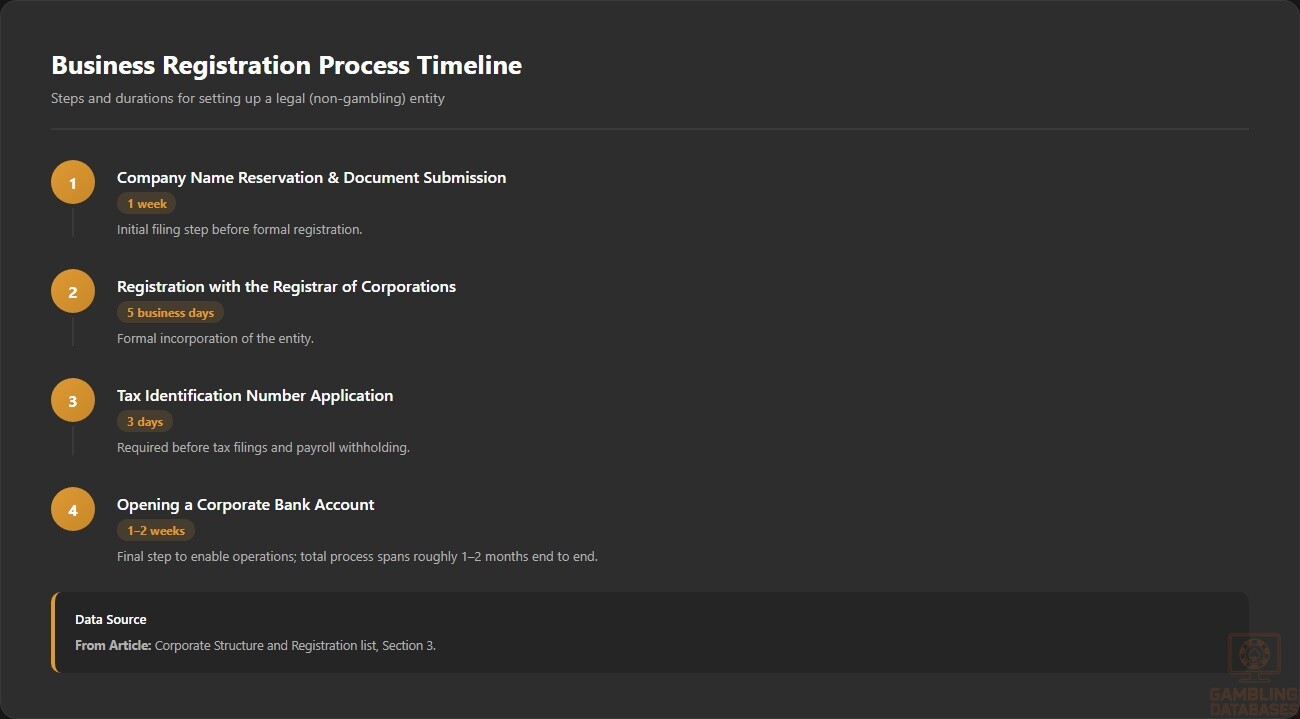
- Company name reservation and document submission (1 week)
- Registration with the Registrar of Corporations (5 business days)
- Tax identification number application (3 days)
- Opening a corporate bank account (1-2 weeks)
Operational costs, including office leasing, labor, and utilities, are relatively low but coupled with logistical challenges due to geographic remoteness.
Corporate Structure and Registration
Common corporate structures include Limited Liability Companies (LLCs), corporations, and branch offices of foreign entities. LLCs are favored for their operational flexibility and limited liability protection. Branch offices are less common due to higher regulatory scrutiny.
Entity registration requires submission of articles of incorporation, proof of physical address, and details of directors and shareholders. Foreign ownership is permitted without restrictions, but compliance with national laws on business operations and taxation is mandatory.
- Articles of incorporation
- Director and shareholder details
- Physical address proof
- Taxpayer Identification Number application
- Business license application (where applicable)
Taxation Framework
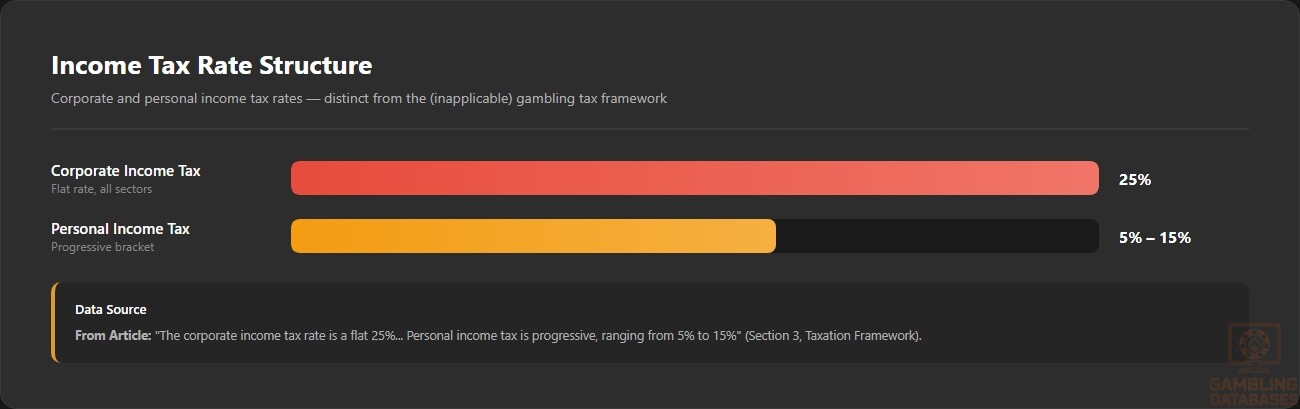
The corporate income tax rate is a flat 25% with no special economic zones or tax holidays related to gambling activities, since such businesses are prohibited. The country has tax treaties with some Pacific nations and the United States that help avoid double taxation.
- United States
- Federated States of Micronesia
- Nauru
- Palau
- Kiribati
Personal income tax is progressive, ranging from 5% to 15%. Employers are required to withhold taxes and social security contributions on behalf of employees. Tax residency rules apply to individuals residing over 183 days per year.
Market Entry Considerations
Given the prohibition on commercial gambling, direct market entry as an operator is not viable. Alternative strategies focus on digital services integration, partnerships with governmental or nonprofit entities, or regional expansion using the Marshall Islands as a corporate base for offshore activities unrelated to gambling.
- Partnering with local entities for non-gaming digital services
- Establishing technology support centers
- Operating from offshore jurisdictions with favorable regulations
- Investing in telecom infrastructure projects
- Engaging in fintech and payment innovation
Initial costs for business registration and setup are moderate, but operational scalability is limited. Regulatory timelines typically span one to two months for full compliance and readiness.
| Cost Category | Estimated Cost (USD) |
|---|---|
| Company registration | 1,000 |
| Legal and consulting fees | 3,000 |
| Office leasing (annual) | 8,000 |
| IT infrastructure setup | 5,000 |
| Operational working capital | 10,000 |
FAQ: Frequently Asked Questions
1. Is online gambling legal in Marshall Islands?
Online gambling is prohibited under the Gaming and Recreation Prohibition Act of 1998. The law bans commercial and digital gaming activities, limiting any gambling to approved nonprofit fundraising only. There is no regulatory framework to license or oversee iGaming operations, making legal online gambling unavailable.
2. What types of gambling licenses are available and what do they cover?
No commercial gambling licenses are issued in the Marshall Islands due to complete prohibition. The only exceptions are permits for nonprofit organizations conducting limited fundraising games such as bingo and raffles, intended for community support. These permits are minimal and not comparable to commercial licenses elsewhere.
3. How much does an iGaming license cost and how long does it take to obtain?
Since commercial iGaming licenses are not available, there are no associated costs or timelines. Nonprofit permits for fundraising games require small fees (typically under $20) and short approval times under local government discretion.
4. Can foreign companies obtain a gambling license?
Foreign companies cannot obtain gambling licenses as commercial gambling is illegal. Any foreign entity wishing to engage in iGaming activities in the Marshall Islands faces legal restrictions and enforcement risks. Business registration is possible for non-gambling ventures under general corporate laws.
5. What are the tax obligations for iGaming operators?
No legal iGaming operators exist; therefore, no specific tax obligations apply. Should gambling become legalized, operators would likely face corporate income tax at 25%, but no current tax framework is in place for gaming revenues.
6. Are gambling winnings taxed for players?
There is no taxation on gambling winnings as gambling is prohibited, and legal winnings do not occur. Players have no tax liabilities related to gambling activities within Marshall Islands jurisdiction.
7. What are the typical operational costs for running an online casino/sportsbook?
Operating an online casino is not permitted, so no local cost data applies. Generally, operational expenses would include licensing fees, platform costs, staffing, marketing, and compliance—costs unseen in this restricted market.
8. What is the expected ROI timeline for entering this market?
Direct ROI from gambling operations in the Marshall Islands is unattainable due to prohibition. Alternative business activities related to technology or digital services can expect standard regional ROI timelines of 3-5 years depending on scale and sector.
9. What are the local presence requirements for operators?
No local presence requirements exist for gambling entities as operations are illegal. For other businesses, a physical registered address and local agent are typically required for formal business registration.
10. What payment methods are available and recommended?
Available payments include mobile money, bank transfers, credit/debit cards, and limited e-wallet services. Mobile money solutions are most accessible for local consumers, while card payment adoption remains on the rise but limited by infrastructure.
- Mobile money services
- Bank transfers
- Credit/Debit cards
- E-wallets
- Cash transactions
11. What are the advertising and marketing restrictions?
Advertising of gambling and betting services is banned along with gambling itself. Promotional activities related to gambling are illegal and subject to enforcement. General product and service advertising follow standard media regulations.
12. What responsible gambling measures are mandatory?
Responsible gambling measures do not apply as gambling is prohibited. There is no regulatory framework mandating self-exclusion, limits, or educational programs related to gambling.
13. How large is the iGaming market and what is the growth potential?
The iGaming market in the Marshall Islands is currently nonexistent. Regulatory prohibition precludes market development, resulting in no growth opportunities within the jurisdiction for commercial gaming enterprises.
14. Who are the main competitors and what is their market share?
No licensed competitors or operators exist domestically due to the ban. Any informal or illegal operators remain outside legal recognition and carry enforcement risks.
15. What are the player preferences and typical spending patterns?
With no legal gaming, players engage primarily in informal social games without wagers. Digital entertainment consumption is focused on non-monetary games, video streaming, and social media. Consumer spending on gambling services is effectively zero.
16. What are the key success factors and main challenges for new entrants?
Success factors for non-gambling digital businesses include leveraging mobile penetration, investing in infrastructure, and adapting services to local cultural norms. Challenges comprise geographic dispersion, limited market size, infrastructural gaps, and legal gambling prohibitions.
- Robust digital infrastructure
- Strong local partnerships
- Cultural sensitivity in product design
- Regulatory compliance in non-gaming sectors
- Scalable technology solutions
Sources and References
- Marshall Islands Gambling Regulatory Authority – Official Publications
- World Bank – Doing Business Report 2024
- National Statistical Office of the Marshall Islands – Population and Economic Data (2024-2025)
- Central Bank of the Marshall Islands – Financial and Taxation Reports
- International Telecommunication Union – ICT Statistics 2025
- Digital 2025: The Marshall Islands – Internet Usage Report
- Pacific Telecommunication Authorities – Network Coverage Data
- OECD Economic Reports – Marshall Islands 2025
- Gaming Industry Reports – Global Regulatory Overview 2024-2025
- Marshall Islands Ministry of Finance – Tax Regulatory Framework
- U.S. Department of State – Country Commercial Guide: Marshall Islands 2025
- Worldometers – Population Data for Marshall Islands 2025
- Statista – Economic and Technology Adoption Data
- Industry Publications: iGaming Today, Offshore-Expert, Vixio Gaming Intelligence
- Regional Development Reports – Micronesian Economic Overview 2025
- Legal and Regulatory Briefs – Chambers Law Practice on Gaming Licensing
- Digital Economy Sector Reviews – DataReportal 2025
- Marshall Islands Internet Society Reports 2022-2025
- Australian Pacific Partnership Reports on Telecommunications
- Marshall Islands Financial Inclusion Studies 2024
- OECD Taxation Country Note – Marshall Islands 2025
- Maritime and Communication Infrastructure Reports
- Local Government Publications on Nonprofit Fundraising Permits
- Marshall Islands Ministry of Commerce Business Registration Guidelines
- Online Market Research – Consumer Digital Behavior in Pacific Islands
- Telecom Service Providers – Marshall Islands Annual Network Status
- International Gambling Compliance Data Hub
- News Articles on Gambling Enforcement in the Marshall Islands
- Technology Adoption and Mobile Usage Reports – Nucamp and Internet Society
- Marshall Islands Legal Gazette – Gaming and Business Acts