
Turkey’s iGaming sector offers substantial growth potential driven by a youthful, tech-savvy population exceeding 85 million and high internet penetration of 88.3%. Despite the promising market size, stringent government regulation, including a state monopoly on sports betting and lottery, restricts private operator participation.
The tightly controlled legal framework, supported by rigorous enforcement against unauthorized gambling, presents significant entry barriers. This analysis provides an in-depth look at Turkey’s regulatory framework and legal environment shaping the iGaming market.
| Metric | Value |
|---|---|
| Population | 85 million+ |
| Internet Penetration | 88.3% |
| Mobile Penetration | High, widespread smartphone use |
| GDP (Nominal) | Approx. $950 billion (2025 est.) |
| Average Income per Capita | Approx. $11,000 USD |
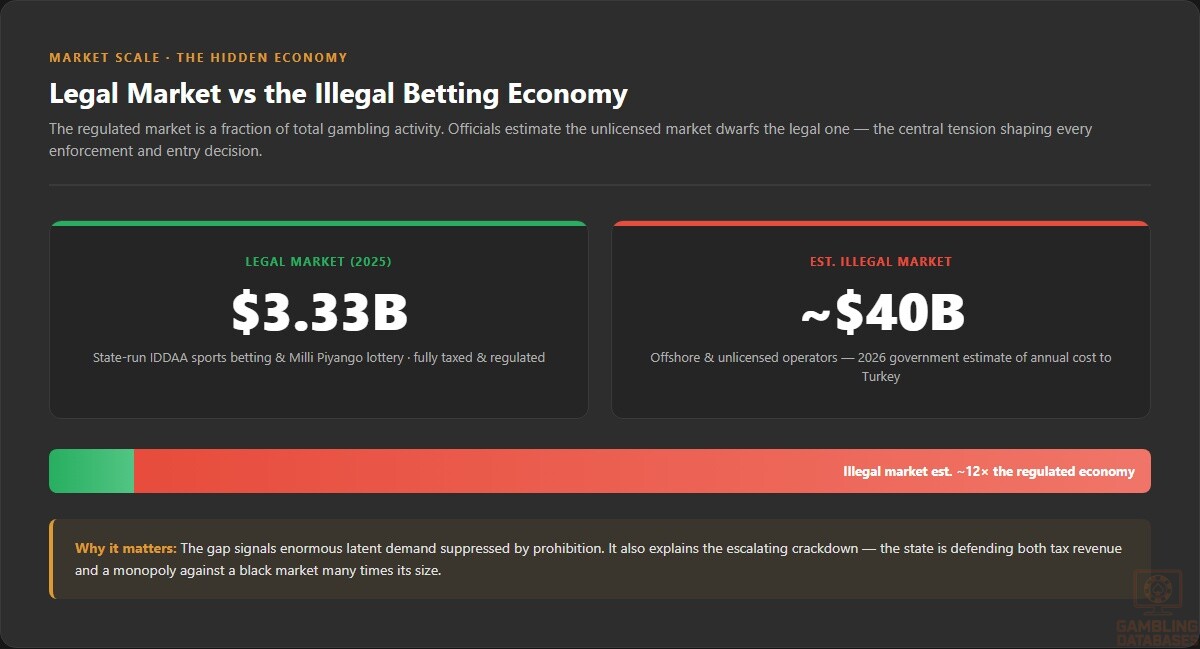
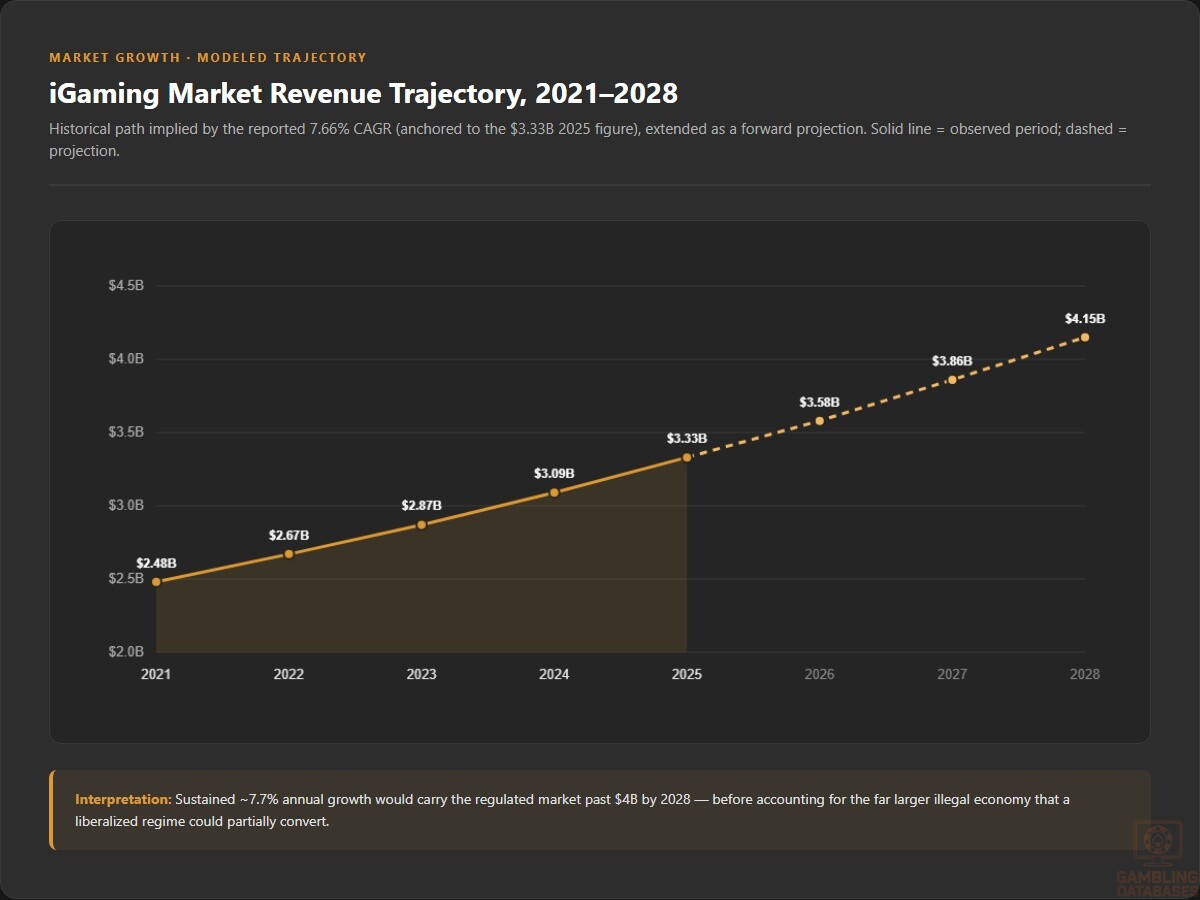
| iGaming Market Revenue (Projected) | $3.33 billion (2025) |
| Market Growth Rate (CAGR) | 7.66% annually (2021-2025) |
| Legal Status of Gambling | Strictly regulated with state monopoly |
| Legal Online Gambling | State-run sports betting only (IDDAA) |
| Casino Operations | Completely banned since 1998 |
| Lottery Provider | Milli Piyango (National Lottery), state-owned |
| Licensing Authority | Ministry of Youth and Sports, Directorate General of Spor Toto |
| License Availability (Private Operators) | Not available for betting/gaming targeting Turkish residents |
| License Application Timeline | Government monopoly; private licensing prohibited |
| Licensing Costs | Not publicly applicable for private operators |
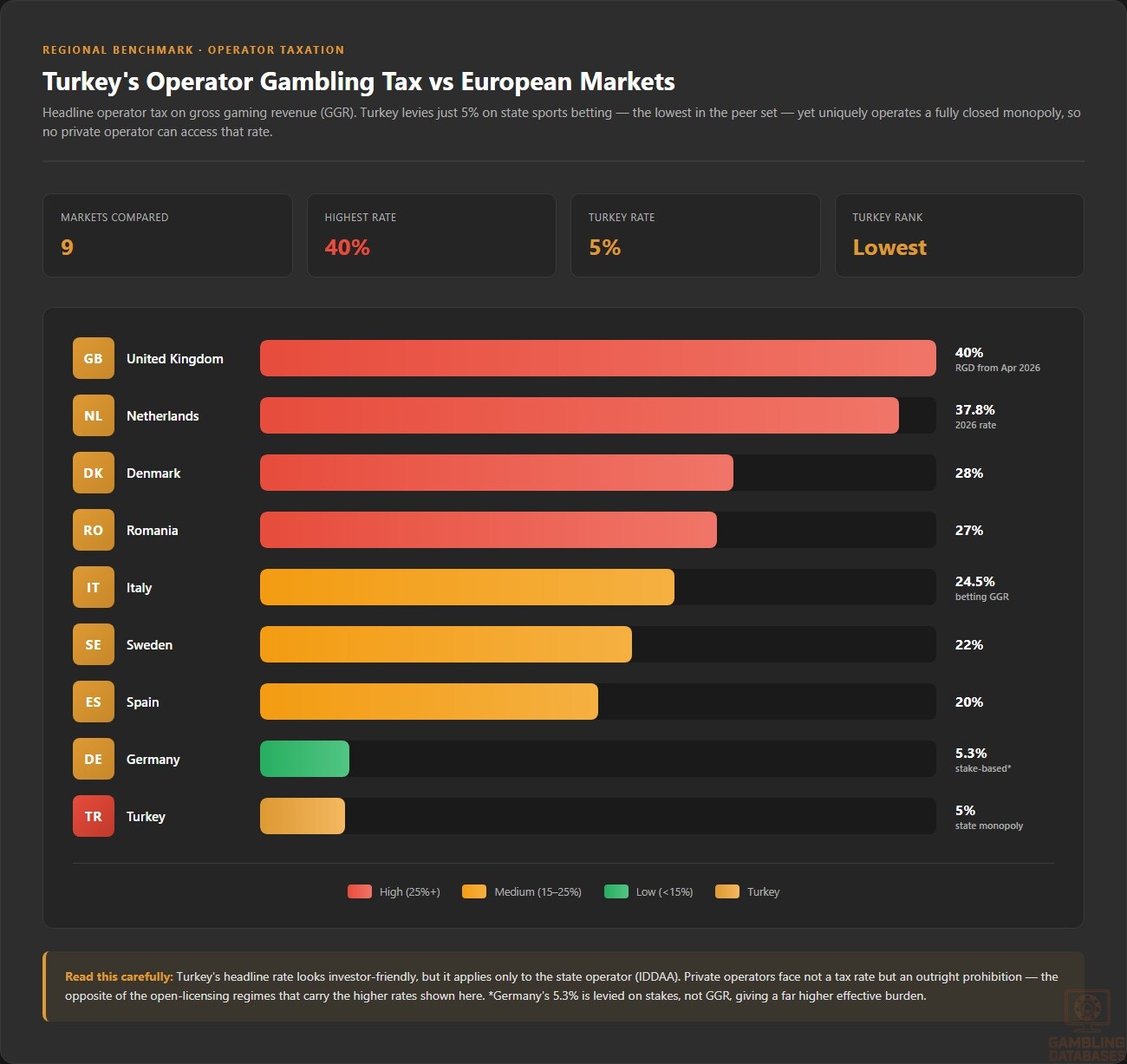
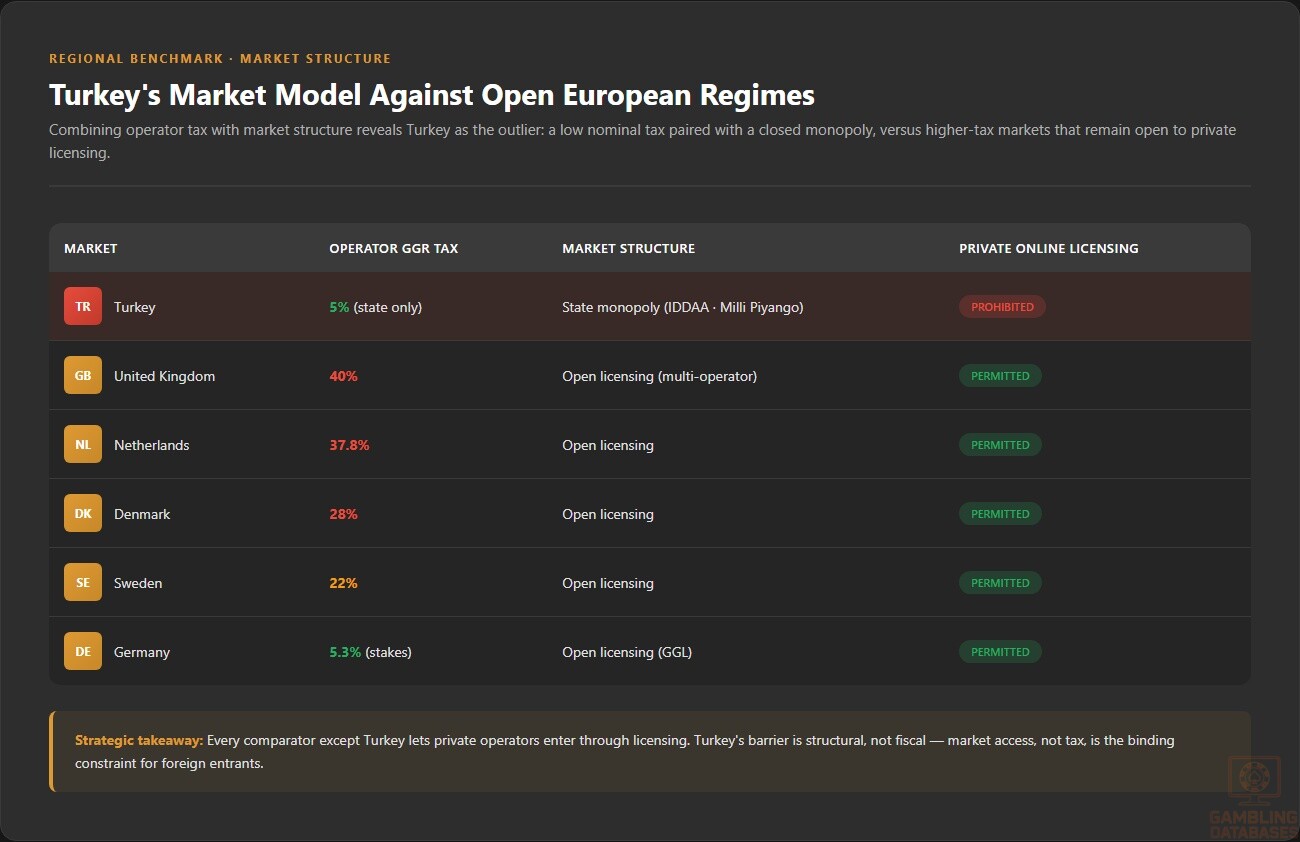
| Gross Gaming Revenue (GGR) Tax | Sports betting and lotteries taxed at 5%-10% |
| Corporate Income Tax Rate | 25% standard rate (2025) |
| Withholding Tax on Player Winnings | 15% on winnings above legal thresholds |
| Payment Processing | Strict controls; fintech companies penalized for unauthorized gambling payments |
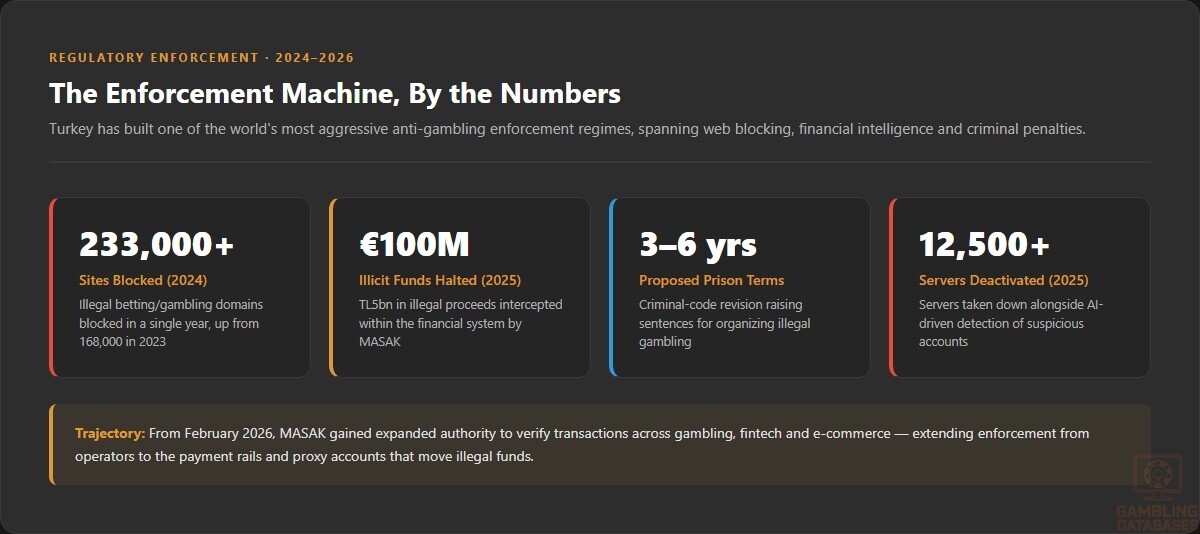
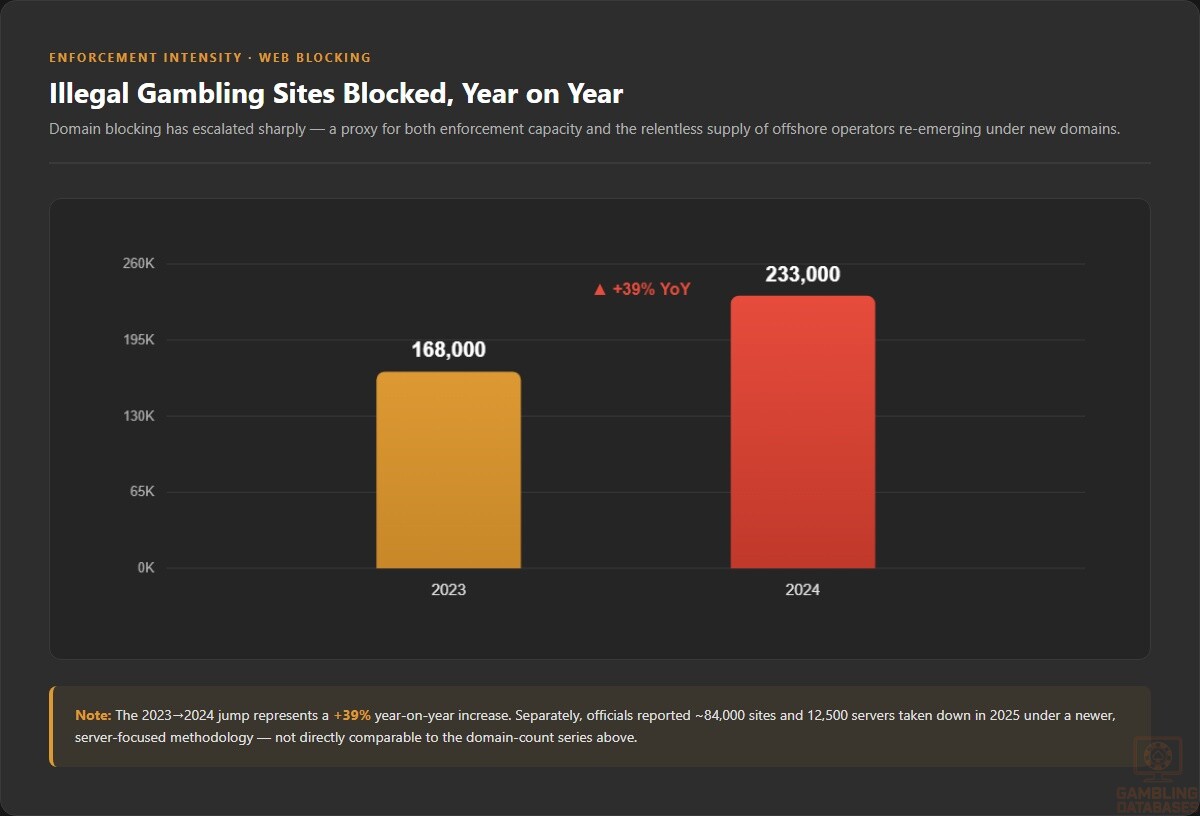
| Enforcement Actions | Blocking of 233,000+ illegal gambling websites (2024); fines, arrests, asset seizures |
| Advertising Restrictions | Severe limits on gambling promotion in media |
| Responsible Gambling Measures | Mandatory state-led player protections; exclusions apply mostly to state betting services |
| Compliance Requirements | Mandatory KYC, AML per Financial Crimes Investigation Board (MASAK) |
| Market Entry Barriers | High, due to monopoly and enforcement against unauthorized operators |
| Growth Opportunities | Mobile gaming, skill games, culturally adapted content |
Section 1: Regulatory Framework and Legal Environment
Current Gambling Regulation Status
Gambling in Turkey is one of the most tightly controlled sectors in Europe and the Middle East. The legal environment enforces a comprehensive prohibition on all private casino operations, both land-based and online, outlawed since 1998 due to social and criminal concerns.
The government maintains exclusive control over sports betting and lotteries. The state-owned IDDAA holds the monopoly for all legal sports betting, and the National Lottery (Milli Piyango) is operated by the Turkey Wealth Fund. Online gambling beyond these state-sanctioned services is illegal, with effective mechanisms in place to block access to unauthorized foreign sites and penalize users and operators.
Land-Based Gambling Activities
All casinos operating on Turkish soil were banned in 1998, reflecting concerns over social harms and criminal affiliations. No land-based casino venues are legally permitted. Sports betting is exclusively provided through IDDAA’s state-run channels, including physical betting shops nationwide.
Lottery services are similarly monopoly-controlled by the government body Milli Piyango. Apart from these, no other forms of legalized land-based gambling activities are permitted in Turkey. The environment thus excludes arcades, slot machine halls, and private betting shops.
Online Gambling Framework
Online gambling is restricted solely to government-operated sports betting services. Private online casinos, poker rooms, or sportsbooks cannot legally target Turkish residents under current legislation. The Directorate General of Spor Toto oversees licensing and regulation of legal sports betting platforms.
The authorities enforce robust internet restrictions, obliging ISPs to block access to offshore unauthorized gambling websites. Financial institutions are mandated to prevent transactions linked to illegal gambling, with fintech companies facing license revocation and criminal charges if they facilitate unlicensed gambling payments.
Licensed Operators and Market Players
The legal market is exclusively served by state-owned entities: IDDAA for sports betting and Milli Piyango for lotteries. No private operators are licensed to offer services targeting Turkish customers, creating a monopoly that inhibits competition but ensures centralized control.
This has led to a thriving but illegal online gambling underground, despite strict crackdowns. Effective market entry for private firms requires navigating prohibitive barriers, partnering locally, or focusing on non-regulated niche segments like skill games potentially exempt from gambling laws.
Licensing Framework and Requirements
Application Process and Eligibility
The licensing regime is state-controlled, with no private licenses issued for online or land-based gambling targeting the Turkish market. The Ministry of Youth and Sports and the Directorate General of Spor Toto are the primary regulatory bodies for licensed activities.
Applicants wishing to operate legal sports betting must comply with strict financial, technical, and operational standards, primarily reserved for state entities. Licensing costs and fees are not publicly applicable for private operators as the market is closed to external licensing.
Local Presence and Operational Requirements
Legal operators must maintain a physical presence within Turkey, including registered offices and compliant infrastructure for sports betting platforms. Foreign ownership is generally restricted in practice due to the monopoly, and partnerships with local state entities are essential where available.
The Turkish government enforces domain registration mandates for authorized sites and requires stringent cybersecurity and data protection standards aligned with national laws. Personnel involved in licensed operations must undergo background checks and meet integrity criteria.
Compliance Obligations and Monitoring
Player Protection and Identification
Player age limits are set at 18 years, with mandatory KYC and AML checks integrated into state-operated sports betting platforms. Responsible gambling measures include self-exclusion programs and mandatory disclosure of odds and risk information to players.
The Financial Crimes Investigation Board (MASAK) oversees anti-money laundering compliance, ensuring operators prevent fraud and illicit financial flows. These protections are enforced rigorously in authorized sectors but are largely absent from illegal gambling services.
- Age verification at account registration
- Mandatory Know Your Customer (KYC) procedures
- Anti-Money Laundering (AML) compliance per MASAK guidelines
- Responsible gambling programs including self-exclusion
- Disclosure of game odds and risk warnings to players
Financial Monitoring and Reporting
Operators are required to implement continuous transaction monitoring, report suspicious activities to authorities, and comply with regular audits from regulatory bodies. Financial records must be maintained systematically and made available for government inspection.
- Submission of monthly financial and operational reports to the Ministry of Youth and Sports
- Annual audits conducted by authorized state auditors
- Real-time transaction monitoring for fraud and illegal activity
- Reporting of suspicious transactions to MASAK and anti-fraud units
Taxation Structure and Financial Obligations
Player Taxation
Players winning from government-sanctioned betting are subject to a withholding tax of 15% on winnings above legally defined thresholds. Winnings from unregulated international platforms are technically taxable as personal income but enforcement is limited due to cross-border challenges.
Operator Taxation
| Game Type | Tax Rate |
|---|---|
| Mutual Odds Sports Betting | 5% of gross revenue (monthly) |
| Horse Racing Betting | 7% of gross revenue (monthly) |
| Games of Luck (Lottery) | 10% of gross revenue (monthly) |
Additionally, corporate entities pay a 25% corporate income tax on profits. License renewals, if applicable to state operators, have specific fees mandated by government regulation, but no private license renewals occur due to the monopoly system.
Gambling Market Financial Performance
Turkey’s gambling market revenue reached approximately $3.33 billion in 2025, with steady growth of around 7.66% annually. The majority of revenue stems from the state monopoly sports betting and lottery provision. Illegal online gambling contributes unregulated revenue but is suppressed through active enforcement.
Tax revenues from legal gambling form a significant source of government funds, complemented by heavy fines and penalties imposed on illegal operators and facilitating entities including illegal payment processors.
Advertising and Marketing Restrictions
Advertising of gambling activities is strictly controlled under Turkish law. Promotion is only legally permitted for state-sanctioned gambling services, with explicit bans on misleading or unapproved advertisements across traditional and digital media.
- Prohibition of gambling advertisements on radio and television
- Ban on online marketing of unlicensed gambling services
- Restrictions on sponsorship by gambling entities
- Mandatory content approval for any legal gambling ads
- Time-based restrictions limiting gambling ad exposure
Recent Regulatory Changes and Their Impact
Recent years have seen intensified enforcement with a record number of 233,000+ illegal gambling websites blocked in 2024 alone. Legislative amendments strengthened cooperation between regulatory agencies, Internet providers, and financial institutions to curb illegal gambling.
This has raised barriers to market entry for private firms and increased compliance costs for those operating within the legal framework, reinforcing the government monopoly model. Operators outside this scope face escalating risks of penalties and asset seizures.
Enforcement Mechanisms and Penalties
Penalties for illegal gambling operations range from heavy fines to criminal imprisonment. Enforcement encompasses online gambling websites, illegal casinos, unauthorized payment processors, and even individuals participating in unlicensed gambling.
- Website blocking and domain seizure
- Fines on illegal operators and facilitators
- Criminal prosecution and potential prison sentences
- Revocation of licenses for fintech companies processing illegal payments
- Asset seizure and freezing of illegal gambling revenues
Section 2: Demographics and Consumer Analysis
Population Demographics and Distribution
Turkey’s population in 2025 is estimated at approximately 86 million, presenting a young but gradually aging demographic profile. The median age is around 34.9 years, reflecting a transition from a historically youthful population to more mature age groups.
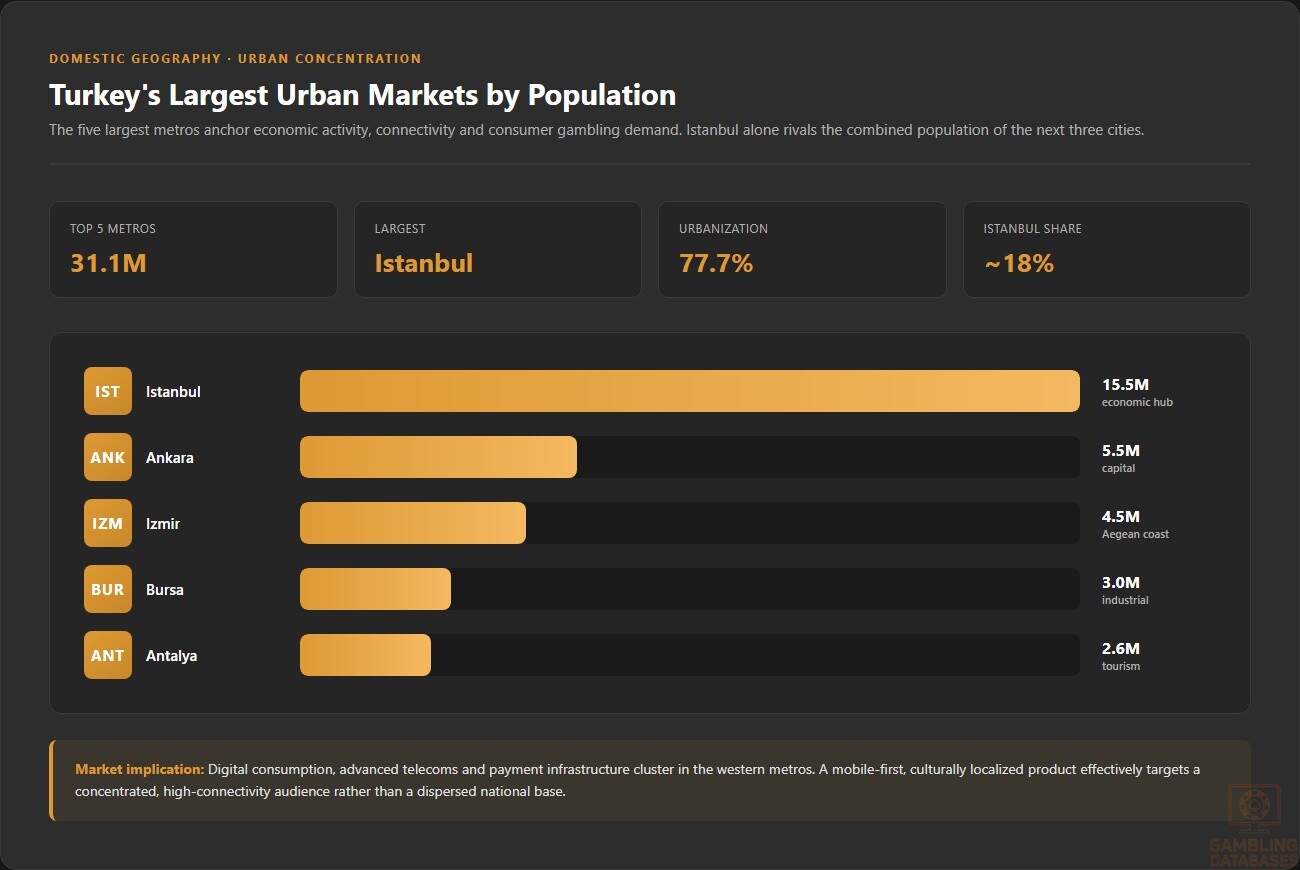
The age distribution indicates that nearly 30% of the population is under 20 years old, about 60% are between 20 and 64, and the senior population aged 65 and above comprises roughly 10.4%. Gender ratios are balanced with about 970 men for every 1000 women. Urbanization continues to increase, with approximately 78% of the population living in urban centers, a factor influencing technology adoption and market consumption.
| Age Group | Percentage of Total Population |
|---|---|
| 0-19 years | 29.8% |
| 20-64 years | 59.9% |
| 65 years and older | 10.4% |
Geographically, Turkey exhibits diverse regional economic and population concentrations. The western and northwestern regions, including Istanbul, Ankara, and Izmir, serve as major economic hubs with higher incomes and denser populations. Economic activity and internet connectivity levels are substantially higher in these urban areas compared to eastern and rural provinces, where infrastructure is less developed.
Major cities are focal points for gambling participation and online consumer behavior, supported by advanced telecommunications and payment systems.
- Istanbul – Population approximately 15.5 million
- Ankara – Population approximately 5.5 million
- Izmir – Population approximately 4.5 million
- Bursa – Population approximately 3 million
- Antalya – Population approximately 2.6 million
Economic Indicators and Consumer Spending Power
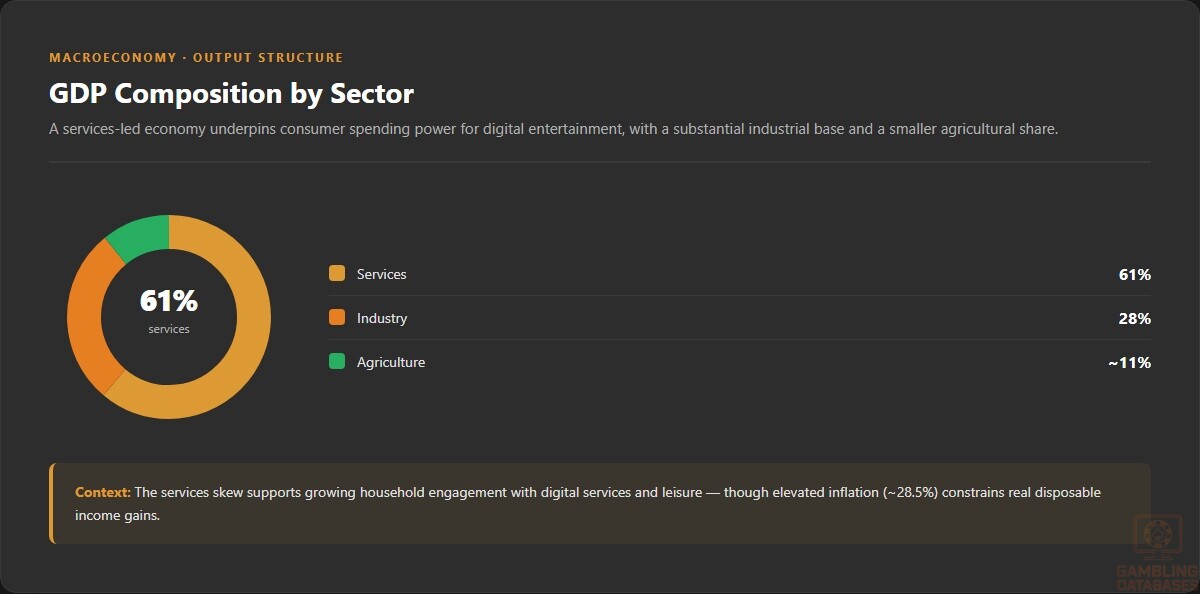
Turkey’s GDP is positioned near $950 billion (2025 estimate), supported by a diversified economy with dominant sectors in industry (28%), services (around 61%), and agriculture. Annual GDP growth has been strong, with recent quarters showing growth rates around 4.8% year-on-year, propelled by domestic consumption and investment.
Inflation remains a challenge, currently elevated at approximately 28.5%, though government programs aim to reduce it to single digits by 2027. Disposable income trends reveal moderate growth, underpinning sustained consumer spending power, although inflationary pressures constrain real income increases.
| Indicator | Value |
|---|---|
| GDP (Nominal) | $950 billion USD |
| GDP Growth Rate (YoY) | 4.8% |
| Inflation Rate | 28.5% |
| Average Income Per Capita | $11,000 USD |
| Urbanization Rate | 77.7% |
Inclusive of a growing middle class, income distribution reveals disparities with notable income inequality measures. Household consumption patterns emphasize durable goods, digital services, and leisure activities, reflecting expanding consumer engagement with mobile technology and online platforms.
Market Size and Growth Projections
The Turkish iGaming market, although legally constrained, is a lucrative sector with revenue projected to reach $3.33 billion in 2025. The market exhibits a compound annual growth rate (CAGR) of approximately 7.66% between 2021 and 2025, signaling robust expansion driven by rising demand for digital entertainment and mobile gaming.
Sports betting dominates the betting vertical, capturing over half of the market revenue, with casino games, poker, and bingo commanding substantial shares. User base growth and increasing average revenue per user (ARPU) are fueled largely by mobile device adoption and culturally localized game offerings.
| Metric | Value |
|---|---|
| Total Market Revenue (2025) | $3.33 billion USD |
| Market CAGR (2021-2025) | 7.66% |
| Sports Betting Revenue Share (2024) | 55.6% |
| Casino Games Revenue Share (2024) | 25% |
| Poker Revenue Share (2024) | 10% |
| Bingo Revenue Share (2024) | 5% |
| Lottery Revenue Share (2024) | 4.4% |
| Mobile Gaming Penetration | 81% play weekly or daily |
Education, Skills, and Digital Literacy
Turkey boasts a literacy rate exceeding 96%, reflecting a well-established educational system. Secondary and tertiary education enrollment rates continue to improve, fostering a workforce equipped with modern skills.
Digital literacy has increased significantly with widespread internet and mobile adoption, particularly among younger demographics. Workforce skills in technology and services sectors support digital economy growth, including e-commerce and online gaming industries.
Cultural and Social Factors
Communication and Language
The official and dominant language is Turkish, spoken by nearly 85-90% of the population as a first language. Minority languages such as Kurdish, Arabic, and others are spoken in various communities but have limited presence in commercial and digital media.
- Turkish (official, predominant language)
- Kurdish (widely spoken in southeastern regions)
- Arabic (spoken in pockets, especially near border areas)
- Other minority languages (Armenian, Laz, Circassian, etc.)
- English (growing use in business and youth segments)
Cultural Attitudes
Gambling remains a socially sensitive topic in Turkey, influenced by religious and cultural norms favoring conservative values. The state’s monopoly reflects societal caution towards gaming, with legal prohibitions on casinos and strict regulation of betting services.
Nonetheless, there is a strong underground and offshore iGaming demand, especially among younger urban consumers who engage with localized content and mobile platforms confidentially. Foreign gambling brands face challenges in market penetration due to regulatory restrictions and social attitudes but may find opportunities through culturally adapted offerings.
Problem Gambling and Social Considerations
Approximately 10% of adults report gambling participation within a recent monthly period, with male participation rates notably higher than female. Problem gambling prevalence is a growing concern, prompting government and civil society to enhance intervention efforts.
- National awareness campaigns targeting responsible gambling
- Support programs and counseling services for at-risk groups
- Self-exclusion and limit-setting initiatives integrated in legal betting
- Collaboration with healthcare providers for treatment referrals
- Research and data collection to monitor gambling behaviors
Social responsibility frameworks increasingly influence operator compliance mandates, although illegal underground markets pose enforcement challenges.
Political Structure and Governance
Turkey operates a presidential republic system, characterized by centralized executive authority and a strong regulatory framework. Political stability supports consistent enforcement of legislative policies, including those impacting iGaming and digital markets.
Government initiatives emphasize digital transformation and economic diversification, aligning with broader development goals. Regulatory consistency facilitates strategic market entry planning, while international relations influence cross-border payment and data flow considerations relevant to online gambling.
Technology Adoption and Digital Behavior
Internet and Digital Usage
Internet penetration in Turkey reached an estimated 88.3% in early 2025, reflecting nearly 77 million users nationwide. Daily internet usage averages several hours, supported by affordable mobile connectivity and expanding broadband infrastructure.
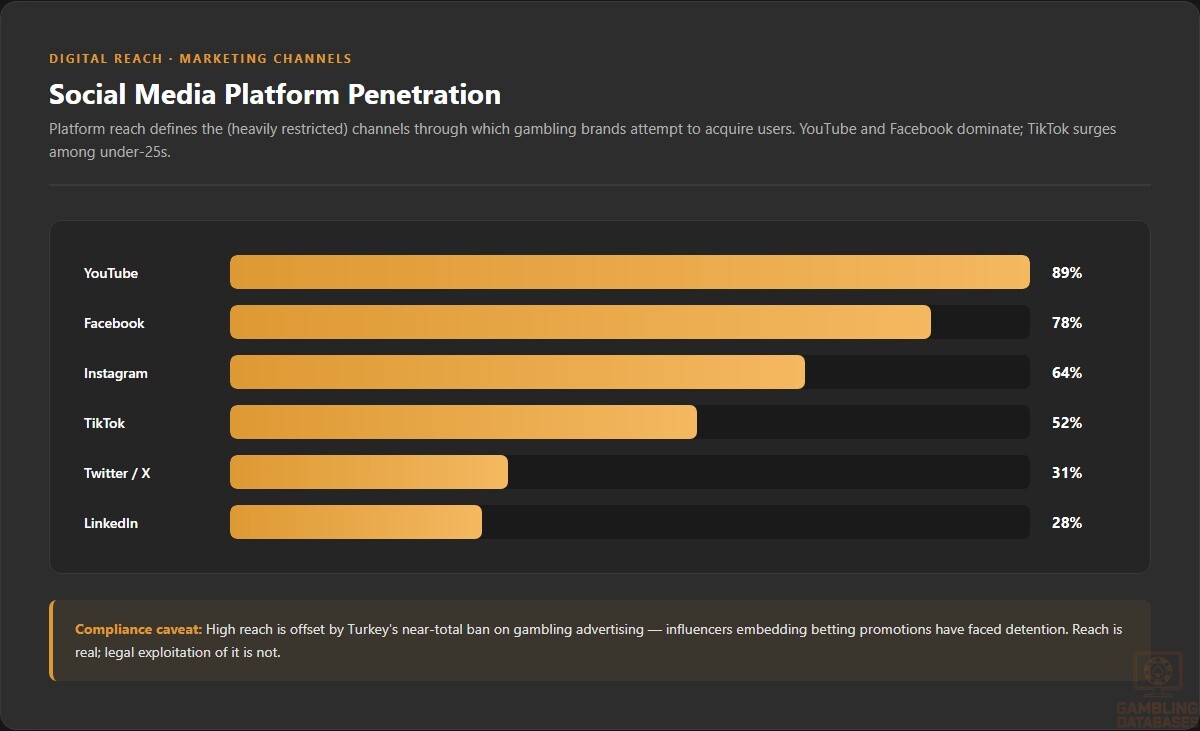
Social media platforms exhibit strong engagement, especially among younger demographics. Mobile devices dominate digital access, driving consumer shifts towards mobile-first entertainment including gaming.
- YouTube – 89% penetration, average 45 minutes daily watch time
- Facebook – 78% penetration, daily average engagement 2.3 hours
- Instagram – 64% penetration, strong youth engagement
- TikTok – Rapid growth, approx. 52% penetration under age 25
- Twitter – Used by 31%, primarily for news and trends
- LinkedIn – 28% penetration among professionals
Digital Payment Behavior
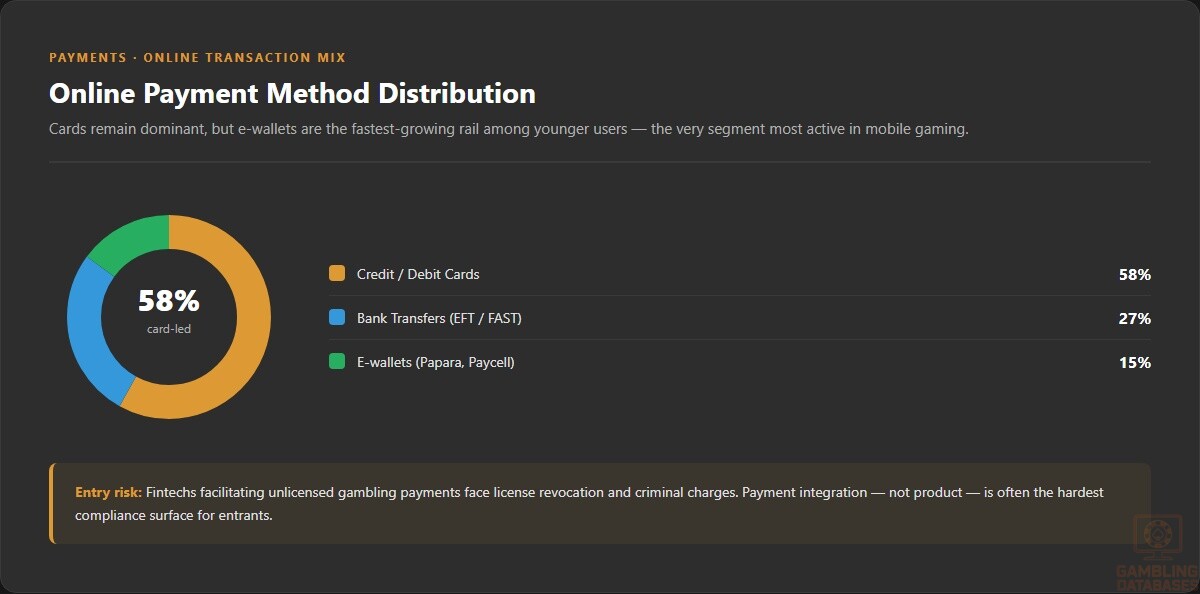
Digital payments are rapidly expanding, fostering growth in e-commerce and digital entertainment sectors. Credit and debit cards remain dominant, with emerging usage of e-wallets and online banking transfers.
Cryptocurrency adoption is nascent but growing among tech-savvy consumers, although regulatory oversight limits mainstream usage for gambling transactions.
- Credit/Debit Cards – 58% market share of online payments
- Bank Transfers – 27% online transaction volume
- E-wallets – Emerging 15% share, popular with younger users
- Mobile Payment Apps – Increasing adoption in urban areas
- Cryptocurrency – Small but growing segment
Gaming and Gambling Preferences
Current Market Participation
Participation in gambling activities reaches about 10% of adults monthly, with sports betting leading in popularity. Online platforms for poker, bingo, and casino-style games also attract sizable audiences despite regulatory challenges.
- Sports Betting
- Online Casino Games (Slots, Table Games, Live Dealers)
- Poker
- Bingo
- Lottery
Games combining skill and luck, such as live blackjack and poker, enjoy strong following. Mobile-first game design tailored to Turkish cultural preferences further boosts engagement and retention.
Consumer Behavior Patterns
Turkish consumers show a preference for mobile gaming, with session lengths averaging between one and two hours daily. Peak usage occurs during evenings and weekends, aligning with leisure time.
Spending patterns emphasize microtransaction models and frequent low-value bets, characteristic of skill-luck hybrid games. Retention strategies focus on localized content and promotions adapted to Turkish culture, fostering loyal user bases even amid regulatory constraints.
Section 3: Technology Infrastructure and Business Environment
Internet and Digital Infrastructure
Turkey’s internet penetration reached approximately 88.3% in early 2025, reflecting widespread access across urban and many rural areas. Broadband internet accounts for over half of fixed connections, although mobile internet usage dominates due to high mobile penetration.
Average fixed broadband speeds are about 100 Mbps, while mobile network speeds average 25-40 Mbps depending on location. National investments focus on improving fiber-optic infrastructure, reducing latency, and expanding coverage in less connected provinces.
5G and Future Technology Deployment
The Turkish government launched the 5G network tender in mid-2025, aiming for commercial rollout by 2026, initially targeting major cities like Istanbul, Ankara, and Izmir. Planned 5G frequency bands include 700 MHz, 3.5 GHz, and 26 GHz.
5G implementation will enhance low-latency, high-speed connectivity, enabling smart city solutions, IoT expansion, cloud computing, and more robust mobile gaming experiences. Early 5G pilot deployments are already operational in select airports and sports stadiums.
Mobile Technology Ecosystem
Turkey’s mobile network infrastructure is competitive and advanced, with three major providers dominating market share: Turkcell, Türk Telekom, and Vodafone Turkey. The market supports extensive 4G LTE coverage nationwide, with aggressive 5G planning under way.
- Turkcell – largest market share, leading in data services
- Türk Telekom – significant fixed and mobile bundle offerings
- Vodafone Turkey – strong urban presence, focusing on youth market
- TurkNet – niche player with fiber focus
- Millenicom – specialized regional operator
Smartphone adoption exceeds 85%, with growing preferences for mid to high-end Android and iOS devices. Mobile gaming and streaming drive significant daily usage, especially among millennials and Gen Z.
Financial Services and Payment Infrastructure
Turkey’s banking sector is well developed, featuring strong digitalization with widespread use of mobile and online banking. Account penetration is high, with increasing fintech innovation driven by open banking initiatives and FAST instant payment systems.
- Ziraat Bank – largest state bank with broad retail presence
- İş Bankası – leading private-sector bank
- Garanti BBVA – strong digital banking platform
- Akbank – focus on SME and retail segments
- Yapı Kredi – digital banking innovation forefront
Popular payment methods include credit/debit cards (Visa, MasterCard), bank transfers, e-wallets like Papara and Paycell, and emerging mobile payment apps. Cryptocurrency remains a niche option with limited legal clarity.
- Credit/Debit Cards – most widely used for online payments
- Bank Transfers & EFT – common for large transactions
- Digital Wallets – growing rapidly among younger users
- Mobile Payment Apps – increasing adoption in urban centers
- FAST Instant Payments – real-time PES transactions
E-commerce and Digital Economy
Turkey’s e-commerce market is expanding robustly, supported by growing internet access and consumer familiarity with online payment. Market value was around $18 billion in 2024, driven by retail and digital services sectors.
Consumer trust in online platforms is increasing, with demand for safe payment options and reliable delivery. The government promotes digital transformation initiatives to sustain growth momentum in the digital economy.
Business Environment and Regulatory Framework
Turkey ranks approximately 33rd globally by ease of doing business, reflecting ongoing improvements in administrative efficiency and foreign investment policies. Starting a business is streamlined via a centralized MERSIS system allowing registration in one business day.
Foreign direct investment is welcomed with liberal policies, and recent reforms focus on reducing bureaucratic hurdles and improving transparency.
- Prepare and notarize company documents
- Submit application to Trade Registry via MERSIS portal
- Obtain tax identification and register with social security
- Open corporate bank account with minimum required capital deposit
- Commence operations following official registration receipt
Corporate Structure and Registration
Common business entities include Limited Liability Company (LLC), Joint Stock Company (JSC), and Branch Office for foreign entities. LLCs are most prevalent for SMEs, requiring minimum capital of 10,000 TRY, while JSCs require 50,000 TRY and allow for public share trading.
Foreign ownership is permitted without significant restrictions, though some sectors remain sensitive. Corporate governance and compliance requirements align with international standards, helping build investor confidence.
- Articles of Association and notarized signatures
- Shareholder identification and passports
- Proof of address and business address registration
- Bank receipt of capital deposit
- Application form submitted via MERSIS system
- Tax and social security registrations
Taxation Framework
Corporate income tax in Turkey is standardized at 25% for fiscal year 2025, with some sectors such as banking subject to 30%. Tax treaties with over 86 countries mitigate double taxation risks.
Personal income tax is progressive, with rates from 15% to 40% depending on income level. Social security contributions are required for employees and employers, aligned with global standards.
| Tax Type | Rate |
|---|---|
| Corporate Income Tax | 25% |
| Corporate Tax (Financial Institutions) | 30% |
| Personal Income Tax (Progressive) | 15% to 40% |
| Withholding Tax on Dividends | 15% |
| VAT | 1% to 20% |
Market Entry Considerations
For new entrants, partnering with local firms or focusing on compliant gaming categories is essential due to Turkey’s strict regulatory regime. Adapting platforms to mobile-first environments with localized content supports consumer engagement.
- Establish local legal entity or joint venture
- Focus on skill-based and non-monetary gaming niches
- Develop mobile-optimized, culturally adapted platforms
- Invest in compliance and robust KYC/AML systems
- Leverage digital marketing with local restrictions awareness
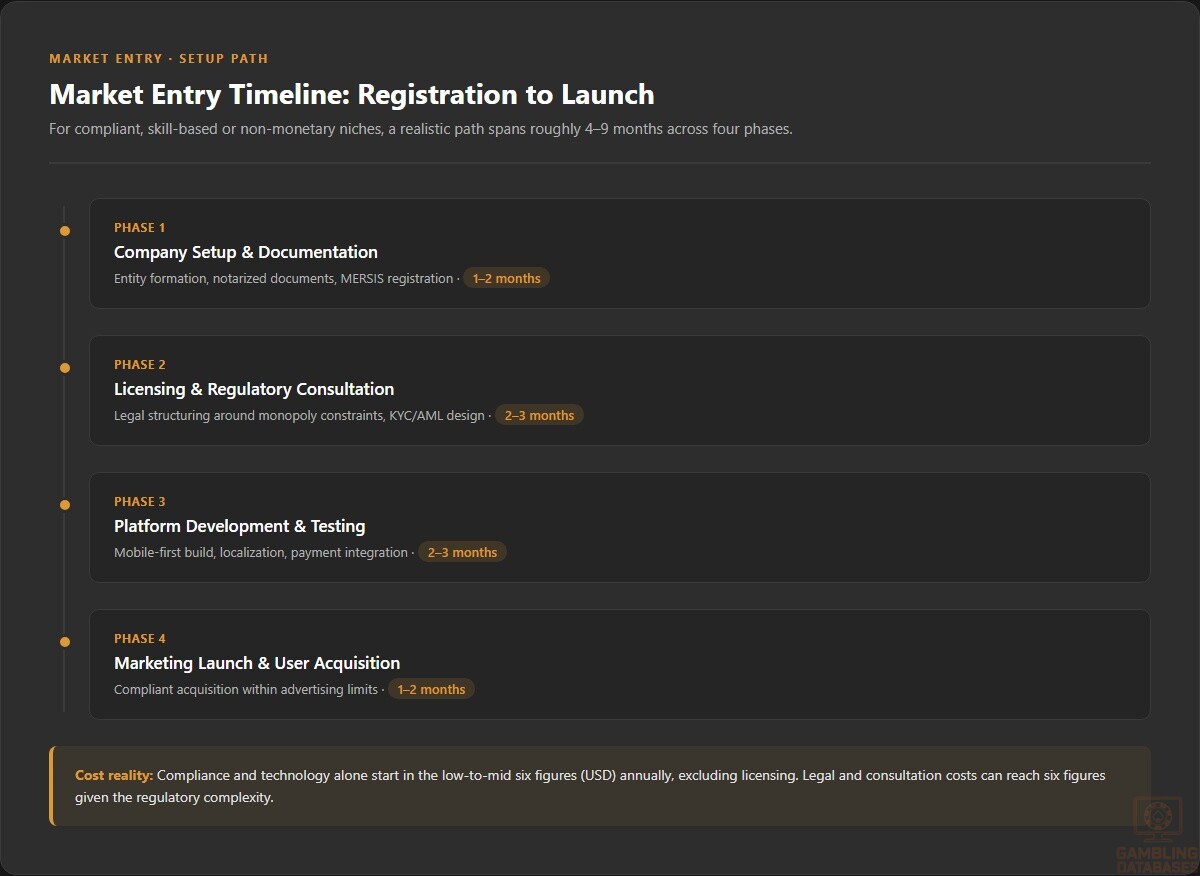
Initial setup costs vary widely depending on scale, but licensing and legal consultation costs can reach six figures in USD. Operational timelines from registration to market launch typically span 4 to 9 months.
- Company set-up and document preparation (1-2 months)
- Licensing and regulatory consultation (2-3 months)
- Platform development and testing (2-3 months)
- Marketing launch and user acquisition (1-2 months)
Success Factors and Challenges
Successful market entry demands deep regulatory understanding, strong technical infrastructure, and cultural alignment. Major challenges include government enforcement, payment processing restrictions, and competition with illegal markets.
- Compliance with strict regulatory and advertising laws
- Strong cybersecurity and data protection measures
- Effective local partnerships and stakeholder engagement
- Robust payment integration avoiding illegal channels
- Innovative user acquisition tailored to market nuances
Exit Strategy Planning
Turkey’s market liquidity for iGaming assets is limited due to monopoly constraints and enforcement risks. License transferability is restricted, often requiring renegotiation of local partnerships. Valuation multiples depend heavily on market access rights and established user bases.
FAQ: Frequently Asked Questions
1. Is online gambling legal in Turkey?
Online gambling in Turkey is tightly regulated and essentially limited to state-run sports betting and lottery services. Private operators targeting Turkish residents are prohibited under current laws, with strict enforcement against unauthorized platforms. The government blocks illegal gambling websites and restricts related financial transactions.
2. What types of gambling licenses are available and what do they cover?
Licenses in Turkey are exclusively issued for state-controlled sports betting and national lottery operations. No private licenses are available for online casinos, sportsbooks, or poker rooms targeting Turkish residents. The licensing regime is centralized under the Ministry of Youth and Sports and the Directorate General of Spor Toto.
3. How much does an iGaming license cost and how long does it take to obtain?
As private licensing is prohibited, there are no publicly available costs or timelines for commercial iGaming licenses targeting Turkey. State-operated licenses involve government budgets and processes. Any move toward private licensing would require significant regulatory reform.
4. Can foreign companies obtain a gambling license?
Foreign companies cannot obtain licenses to legally offer gambling services to Turkish residents as the market is monopolized by state entities. Partnerships with state operators or targeting niche segments outside gambling definitions may be possible. Strict foreign ownership restrictions apply in licensed sectors.
5. What are the tax obligations for iGaming operators?
Operators legally allowed, primarily state entities, pay taxes on gross gaming revenue ranging from 5% to 10% depending on game type. Corporate income tax is 25%, including on profits from gambling operations. Private operators face severe risks as unlicensed activity is punished with heavy fines and penalties.
6. Are gambling winnings taxed for players?
Players winning from state-run betting and lottery are subject to withholding tax at 15% on amounts above specified thresholds. Winnings from unauthorized operators are theoretically taxable but hard to enforce. Players should be aware of legal tax obligations on gambling winnings.
7. What are the typical operational costs for running an online casino/sportsbook?
Operational costs include platform licensing, compliance systems, payment integration, marketing, and local staffing. Costs can vary significantly but generally start from several hundred thousand dollars annually for compliance and technology alone, excluding licensing fees. Illegal operators avoid many such costs but risk enforcement.
8. What is the expected ROI timeline for entering this market?
ROI is difficult to predict due to regulatory restrictions and market monopoly. Legal operators under monopoly settings have government backing but limited competition. Private entrants face legal risks, delayed market access, and uncertain revenue streams, potentially extending ROI beyond 3-5 years if possible.
9. What are the local presence requirements for operators?
Legal operators must maintain a physical presence with registered offices, compliant technical infrastructure, and local personnel. Foreign ownership is restricted, and partnerships with domestic state bodies are critical for authorized market participation.
10. What payment methods are available and recommended?
Payment options consist mainly of credit/debit cards, bank transfers, increasingly popular e-wallets, and mobile payment applications. Operators must comply with stringent financial regulations, avoiding unlicensed payment channels that expose to penalties.
- Credit and debit cards (Visa, MasterCard)
- Bank transfers (EFT, FAST system)
- Digital wallets (Papara, Paycell)
- Mobile payment apps
- Limited cryptocurrency use
11. What are the advertising and marketing restrictions?
Advertising for gambling is heavily restricted to state-sanctioned services, with bans on broadcasting gambling ads on TV, radio, and online for unauthorized operators. Sponsorship and promotional content require government approvals and must avoid misleading claims.
12. What responsible gambling measures are mandatory?
State operators implement mandatory age verification, self-exclusion programs, mandatory disclosure of odds, and KYC/AML measures. Illegal operators offer no mandated protections, whereas licensed operators face rigorous monitoring.
- Age restriction enforcement
- Self-exclusion options
- Disclosure of odds and risks
- KYC and AML compliance
- Collaboration with responsible gambling bodies
13. How large is the iGaming market and what is the growth potential?
Turkey’s iGaming market is valued at over $3.33 billion with a compound annual growth rate exceeding 7.5%, driven by rising demand in mobile gaming and sports betting. Despite regulatory challenges, underground and offshore markets signal strong consumer interest and untapped potential.
14. Who are the main competitors and what is their market share?
The legal market is dominated by state operators, primarily IDDAA for sports betting and Milli Piyango for the lottery, holding near-total market share. The illicit sector comprises numerous international offshore operators serving Turkish players despite enforcement.
15. What are the player preferences and typical spending patterns?
Players prefer sports betting, followed by casino-style games, poker, and bingo, with a notable emphasis on mobile platforms. Spending tends towards frequent micro-bets and short session lengths, with loyalty driven by localized content and culturally relevant promotions.
16. What are the key success factors and main challenges for new entrants?
Success depends on regulatory compliance, effective localization, robust technology infrastructure, and secure payment integrations. Challenges include legal restrictions, strong enforcement, limited license availability, and competition from illegal operators.
- Deep regulatory expertise
- Strong local partnerships
- Mobile-first, culturally adapted content
- Robust KYC/AML systems
- Effective marketing within legal constraints
Sources and References
- Turkey iGaming Market Research Report – iGamingToday – https://www.igamingtoday.com/turkey-igaming-market-research-report/
- Turkey Gambling Regulation Overview – CMS Expert Guide – https://cms.law/en/int/expert-guides/cms-expert-guide-to-gambling-laws-in-cee/turkey
- Digital 2025: Turkey – DataReportal – https://datareportal.com/reports/digital-2025-turkey
- Türkiye’s New Law Increasing Corporate Tax Rates – EY Global – https://www.ey.com/en_gl/technical/tax-alerts/tuerkiye-s-new-law-increasing-the-corporation-tax-rates-enters-i
- Turkey Ease of Doing Business Report 2025 – Take-profit.org – https://take-profit.org/en/statistics/ease-of-doing-business/turkey/
- Turkish 5G Network Connectivity – Anadolu Agency – https://www.aa.com.tr/en/economy/turkiye-s-5g-network-connectivity-to-boost-communication-next-year/3670857
- Payment Rails and Digital Wallets in Turkey – Transfi Blog – https://www.transfi.com/blog/turkeys-payment-rails-how-they-work—eft-fast-digital-wallet-growth
- Turkish Telecom Market Insights 2025 – MarketReportAnalytics – https://www.marketreportanalytics.com/reports/turkey-telecom-market-91579
- Doing Business in Turkey 2025 – Remote People Guide – https://remotepeople.com/countries/turkey/doing-business-in-turkey/
- Company Registration in Turkey – FO Consultancy – https://www.fo-consultancy.com
- AI Adoption in Turkey – Turkish Statistical Institute – https://www.tuik.gov.tr/
- Turkey Population and Demographics 2025 – Worldometers – https://www.worldometers.info/world-population/turkey-population/
- Turkey Economic Outlook 2025 – OECD – https://www.oecd.org/en/publications/oecd-economic-surveys-turkiye-2025_d01c660f-en.html
- Turkish Gaming Market Growth and AI Impact – Daily Sabah – https://www.dailysabah.com/business/tech/turkiyes-gaming-market-poised-for-continued-growth-with-ai
- Turkey Corporate Tax and Business Environment – Ozbek CPA – https://ozbekcpa.com/tax-rates-in-turkey/
- Turkey Payment and Banking System – Global Legal Insights – https://www.globallegalinsights.com/practice-areas/fintech-laws-and-regulations/turkey/
- Telecom Market Report and Mobile Operators – LinkedIn Analysys Mason Report – https://www.linkedin.com/posts/jonathan-daniel-394b381ab_turkey-state-of-the-telecoms-market-2024-activity-7361325047656898560-Uzmc
- Turkey Internet Law Changes 2025 – Istanbul Lawyer Firm – https://istanbullawyerfirm.com/blog/turkey-internet-law-changes-2025
- Turkey Ease of Doing Business Historical Data – World Bank – https://www.worldbank.org/en/data
- Turkey Gambling Traffic and Marketing – RichAds – https://richads.com/blog/how-to-get-gambling-traffic-in-turkey/
- Turkey Tax System Overview – Immigrant Invest – https://immigrantinvest.com/blog/taxes-in-turkey/
- Turkey Gambling Enforcement and Penalties – iGaming Expert – https://igamingexpert.com/features/turkey-gambling-green/
- Turkey Online Gambling and Payment Restrictions – SLotegrator – https://slotegrator.pro/analytical_articles/creating-a-successful-online-casino-business–a-guide-for-turkish-investors/
- Turkish Corporate Law and Business Structures – Invest.gov.tr – https://www.invest.gov.tr/en/investmentguide/pages/establishing-a-business.aspx
- AI Adoption Trends in Turkey – MLQ AI News – https://mlq.ai/news/turkey-announces-august-5g-tender-with-first-signals-expected-in-2026/
- Turkey Tax and Corporate Guidance – Mondaq – https://www.mondaq.com/turkey/gaming/163198/requirements-for-companies-operating-online-game-platforms
- Gaming Industry Trends – Global Reports 2025 Edition
- World Bank Doing Business Reports 2024
- International Telecommunication Union ICT Data 2025








Turkey’s iGaming market is fascinating from a crypto perspective, but the regulatory environment makes it nearly impossible for decentralized operators. The fact that they’ve blocked 233,000+ gambling sites in 2024 shows how serious the enforcement is. However, this creates an opportunity for privacy-focused platforms using blockchain. The 15% withholding tax on winnings is brutal for traditional operators, but crypto casinos with provably fair algorithms and anonymous wallet deposits sidestep that entirely. Bitcoin, Monero, and privacy coins are already being used by Turkish bettors accessing offshore platforms. The real question is whether the government will escalate to ISP-level blocks like China does, or if they’ll maintain the current website-blocking approach. KYC requirements under MASAK are impossible to enforce on decentralized exchanges, so that’s where the market will actually move. No KYC casinos are genuinely the future for restricted jurisdictions like Turkey.
Regarding the enforcement escalation you mentioned, you’re identifying a real pattern we’re tracking across MENA and Balkan jurisdictions. Turkey’s approach has actually evolved beyond simple website blocking. The 2024 enforcement actions included fines on fintech companies and payment processors, which is a significant escalation from DNS-level blocks. The MASAK (Financial Crimes Investigation Board) requirements are specifically designed to catch traditional payment rails rather than blockchain transactions, which is a gap you’ve correctly identified. That said, it’s worth noting that several Turkish users accessing crypto casinos through VPNs have reported account freezes when attempting to withdraw through regulated exchanges that conduct AML screening on-ramp/off-ramp points. The decentralization itself doesn’t fully solve the last-mile problem of converting crypto back to Turkish Lira. The provably fair algorithms you mentioned do provide technical transparency, but they don’t eliminate the regulatory risk for users—Turkey has prosecuted individual players of illegal sites, not just operators. The real opportunity may be in skill-based gaming and esports betting, which operate in a gray zone and don’t trigger the same enforcement resources as casino operations.