Afghanistan represents one of the most restrictive gambling markets globally, operating under strict Islamic law that categorically prohibits all forms of gambling activities. The country offers no legal framework for iGaming operations, with comprehensive bans enforced by Taliban authorities since August 2021.
With a population of 43.8 million and extremely limited digital infrastructure, Afghanistan presents insurmountable regulatory, political, and operational barriers for iGaming market entry. All forms of gambling are classified as haram under Sharia law, with severe penalties for violations.
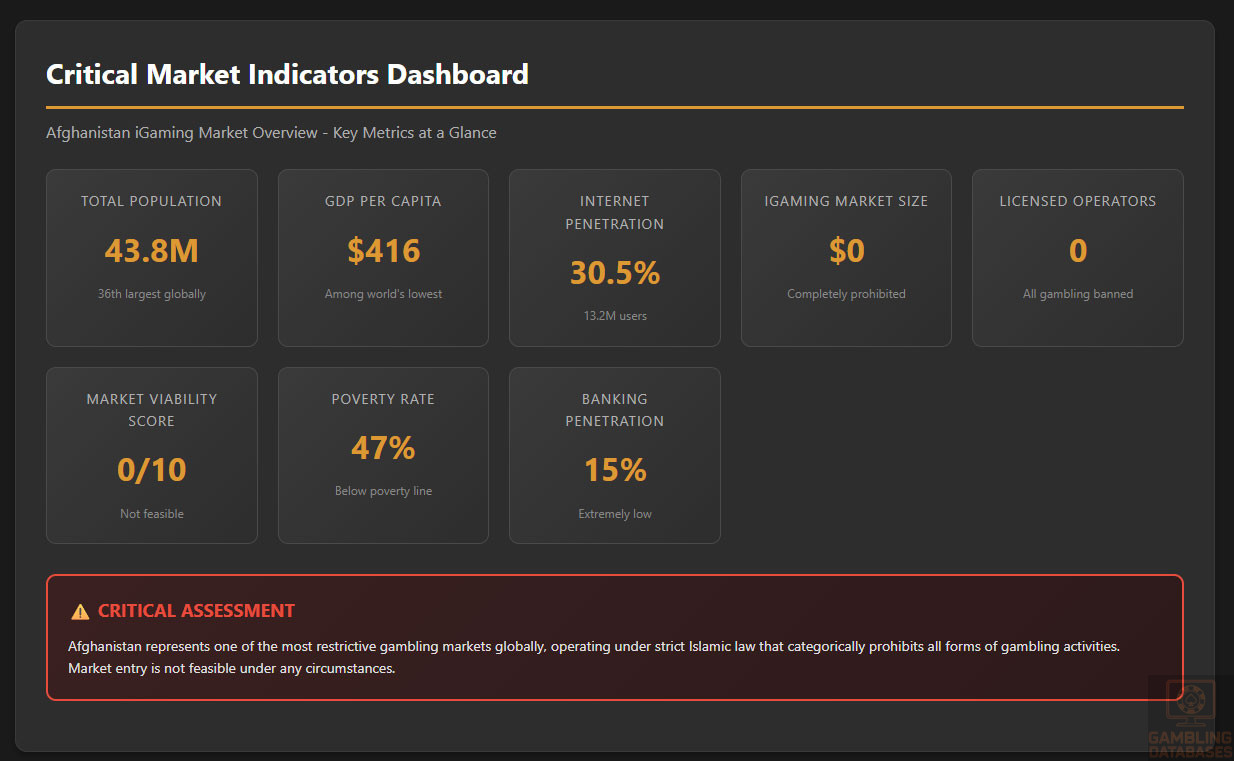
Executive Summary: Key Market Indicators
| Indicator | Value | Assessment |
|---|---|---|
| Gambling Legal Status | Completely Prohibited | All forms banned under Sharia law |
| Online Gambling Framework | No Legal Framework | No licensing system exists |
| Regulatory Authority | Ministry for Promotion of Virtue and Prevention of Vice | Enforcement through morality police |
| License Availability | None | No gambling licenses issued |
| Total Population (2025) | 43.8 million | 36th largest globally |
| Median Age | 17.3 years | Extremely young population |
| Urban Population | 26.7% | 11.7 million urban residents |
| GDP (2023) | USD 17.15 billion | 124th largest economy |
| GDP Per Capita (2023) | USD 416 | Among world’s lowest |
| GDP Growth (2024) | 2.5% | Modest recovery |
| GDP Growth Forecast (2025) | 2.6% | Below regional average |
| Internet Penetration | 30.5% | 13.2 million users |
| Mobile Connections | 51.6% | 22.3 million connections |
| Smartphone Adoption | Low | Limited device penetration |
| Social Media Users | 9.4% | 4.05 million users |
| Median Mobile Speed | 8.13 Mbps | 149th globally in broadband speed |
| Fixed Internet Speed | 3.58 Mbps | Very low connectivity quality |
| Literacy Rate (Adult) | 37% | Male 52%, Female 22.6% |
| Banking Penetration | 15% | Extremely low financial inclusion |
| Corruption Index Score (2024) | 17/100 | Ranked 165th of 180 countries |
| Poverty Rate | 47% | Below poverty line |
| Unemployment Rate | 23%+ | High joblessness |
| iGaming Market Size | USD 0 | No legal market exists |
| Legal Operators | 0 | All gambling prohibited |
| Market Entry Viability | Not Feasible | Complete legal prohibition |
| Penalties for Gambling | Severe | Fines, imprisonment, property confiscation |
| Political Stability | Very Low | Taliban governance since 2021 |
| Investment Risk Level | Extreme | Red-level jurisdiction |
| Market Attractiveness Score | 0/10 | Not viable for iGaming operations |
Section 1: Regulatory Framework and Legal Environment
Current Gambling Regulation Status
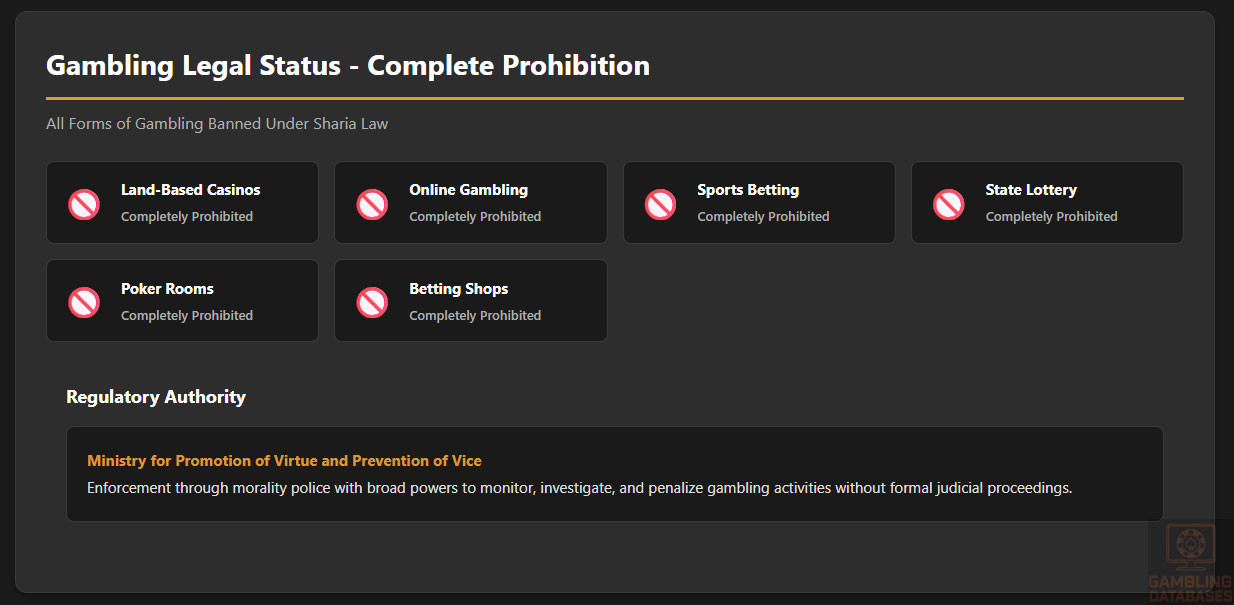
Afghanistan maintains a comprehensive prohibition on all forms of gambling, rooted in Islamic Sharia law which has been strictly enforced since the Taliban’s return to power in August 2021. The country’s legal framework categorizes gambling as haram, making it fundamentally incompatible with the nation’s religious and legal foundations.
The Ministry for the Promotion of Virtue and the Prevention of Vice serves as the primary enforcement body, operating dedicated morality police with broad powers to monitor, investigate, and penalize gambling activities. This enforcement extends beyond traditional gambling to include activities like chess, which authorities suspended in May 2025 due to concerns about its association with gambling.

Land-Based Gambling Activities
All land-based gambling operations are strictly prohibited throughout Afghanistan. There are no legal casinos, sports betting venues, slot machine halls, or any other physical gambling establishments permitted to operate within the country’s borders.

Penalties for operating or participating in land-based gambling include substantial fines, imprisonment ranging from months to years, and confiscation of property. The morality police have authority to detain offenders without formal judicial proceedings in many cases.
Online Gambling Framework
Online gambling is comprehensively illegal in Afghanistan with no regulatory framework or licensing system in place. The prohibition encompasses all forms of digital gaming including online casinos, sports betting platforms, poker rooms, and lottery services.
While Afghanistan’s internet penetration remains low at 30.5%, authorities actively monitor online activities. The Taliban government has demonstrated willingness to implement nationwide internet shutdowns, as occurred in September 2025 when connectivity dropped to less than 1% of normal levels for 48 hours.
The government has announced plans to restrict or block access to social media platforms including Facebook, citing concerns about immoral content. Such measures would further limit any potential access to offshore gambling sites.
Internet service providers face pressure to block gambling-related websites, though the country’s limited technical infrastructure makes comprehensive filtering challenging. However, individuals caught accessing online gambling sites face the same severe penalties as those engaging in land-based gambling.
Licensed Operators and Market Players
Number of Licensed Operators: Zero. Afghanistan does not issue gambling licenses of any kind, making it impossible for operators to conduct legal gambling activities within the jurisdiction.
Market Structure: No legal gambling market exists. Any gambling activity occurs entirely underground and illegally, with participants and operators facing significant legal and physical risks.
International Operators: No international gambling companies maintain legal operations in Afghanistan. Major global operators explicitly exclude Afghanistan from their service territories due to the complete prohibition and associated risks.
Market Concentration: Not applicable. The absence of a legal framework means no legitimate market concentration data exists.
| License Type | Availability | Legal Status |
|---|---|---|
| Casino License | Not Available | Prohibited under Sharia law |
| Sports Betting License | Not Available | Prohibited under Sharia law |
| Online Gambling License | Not Available | Prohibited under Sharia law |
| Lottery License | Not Available | Prohibited under Sharia law |
| Poker Room License | Not Available | Prohibited under Sharia law |
| Betting Shop License | Not Available | Prohibited under Sharia law |
Licensing Framework and Requirements
Application Process and Eligibility
Regulatory Authority: No gambling regulatory authority exists in Afghanistan. The Ministry for the Promotion of Virtue and the Prevention of Vice enforces gambling prohibitions but does not issue licenses or regulate gambling operations.
Application Process: Not applicable. Afghanistan does not accept gambling license applications of any kind. Any attempt to obtain authorization for gambling operations would be rejected and potentially result in legal action.
Financial Requirements: Not applicable due to complete prohibition of gambling activities.
Technical Standards: No technical standards or certifications are established for gambling operations as none are permitted.
Background Checks: Not applicable. No vetting process exists as gambling operations cannot be licensed.
| Requirement Category | Status | Details |
|---|---|---|
| Application Fee | Not Applicable | No licensing system exists |
| Initial Capital Requirement | Not Applicable | Gambling operations prohibited |
| Bank Guarantee | Not Applicable | No financial requirements established |
| Processing Time | Not Applicable | Applications not accepted |
| License Duration | Not Applicable | No licenses issued |
| Renewal Requirements | Not Applicable | No licensing framework |
Local Presence and Operational Requirements
Physical Presence: Not applicable. Gambling operations of any kind are prohibited regardless of operational structure or local presence.
Domain Requirements: Afghanistan controls the .af domain through the Afghanistan Network Information Center. However, no gambling-related domains would be permitted registration or operation.
Personnel Requirements: No staffing or management requirements exist as gambling operations are entirely prohibited.
Foreign Ownership: Not relevant. Both foreign and domestic gambling operations face the same complete prohibition.
Compliance Obligations and Monitoring
Player Protection and Identification
Afghanistan has no player protection framework for gambling as all gambling activities are prohibited. No age verification, KYC procedures, or responsible gambling measures are required because no legal gambling operations exist.
The concept of regulated player protection is incompatible with the country’s legal framework, which views all gambling as inherently harmful and contrary to Islamic principles.
Financial Monitoring and Reporting
No financial monitoring or reporting requirements exist for gambling operations as such operations are entirely illegal. Banks and financial institutions are prohibited from processing gambling-related transactions.
Afghanistan’s banking sector, already isolated from international financial systems through sanctions and SWIFT restrictions, would face severe consequences for facilitating any gambling-related activities.
Taxation Structure and Financial Obligations
Player Taxation
| Tax Type | Rate | Applicability |
|---|---|---|
| Winnings Tax | Not Applicable | All gambling prohibited |
| Withholding Tax | Not Applicable | No legal gambling winnings |
| Declaration Requirements | Not Applicable | Illegal activity not taxed |
Operator Taxation
Afghanistan maintains no taxation system for gambling operators because all gambling operations are prohibited by law. There are no GGR taxes, NGR considerations, operational fees, license costs, or any other gambling-specific tax structures.
The absence of gambling taxation reflects the fundamental incompatibility of gambling with Afghanistan’s legal and religious framework, rather than a gap in fiscal policy.
| Tax Category | Rate | Status |
|---|---|---|
| GGR Tax | Not Applicable | No legal gambling operations |
| Corporate Income Tax | Not Applicable | Gambling businesses illegal |
| License Fee (Annual) | USD 0 | No licensing system |
| Turnover Tax | Not Applicable | Prohibited activity |
Gambling Market Financial Performance
| Metric | Value | Notes |
|---|---|---|
| Total Amount Wagered (Annual) | USD 0 | No legal gambling market |
| Total Payouts to Players | USD 0 | No legal gambling market |
| Net Gaming Revenue | USD 0 | No legal gambling market |
| Tax Revenue Generated | USD 0 | No gambling taxation |
| Market Size (USD) | USD 0 | Comprehensive prohibition |
| YoY Growth Rate | Not Applicable | No legal market exists |
Advertising and Marketing Restrictions
All forms of gambling advertising and marketing are completely prohibited in Afghanistan. No gambling-related content may be broadcast on television, published in print media, displayed on outdoor advertising, or distributed through online channels.
The prohibition extends beyond direct advertising to include any content that could be interpreted as promoting gambling activities. This includes sponsorship of sports teams or events, affiliate marketing, and social media promotion.
The Taliban government’s control over media and communications infrastructure, combined with periodic internet restrictions and platform blocking, creates an environment where gambling marketing would face immediate suppression.
| Channel | Status | Penalties |
|---|---|---|
| Television | Completely Prohibited | Severe legal consequences |
| Radio | Completely Prohibited | Severe legal consequences |
| Print Media | Completely Prohibited | Severe legal consequences |
| Outdoor/Billboard | Completely Prohibited | Severe legal consequences |
| Online/Digital | Completely Prohibited | Severe legal consequences |
| Social Media | Completely Prohibited | Severe legal consequences |
| Sponsorship | Completely Prohibited | Severe legal consequences |
| Affiliate Marketing | Completely Prohibited | Severe legal consequences |
Recent Regulatory Changes and Their Impact
The Taliban’s return to power in August 2021 marked the most significant regulatory change affecting gambling in Afghanistan. The new government immediately reinforced the complete prohibition on gambling, implementing even stricter enforcement measures than previous administrations.
In September 2025, authorities imposed a nationwide telecommunications shutdown affecting mobile and internet services, demonstrating their willingness and capability to control digital communications. This action, attributed to combating immorality, exemplifies the government’s aggressive approach to enforcing moral codes.
In May 2025, the Taliban suspended chess nationwide, citing concerns that it constitutes a form of gambling under Sharia law. This decision expanded the scope of prohibited activities beyond traditional gambling to include games of strategy that could potentially involve wagering.
The Ministry for the Promotion of Virtue and the Prevention of Vice has gained expanded enforcement powers, operating with minimal judicial oversight. This has created an environment where suspected gambling activities can be investigated and punished through administrative rather than judicial processes.
Enforcement Mechanisms and Penalties
Afghanistan enforces gambling prohibitions through multiple mechanisms involving religious authorities, morality police, and general law enforcement agencies. The Ministry for the Promotion of Virtue and the Prevention of Vice operates as the primary enforcement body with broad authority.
Penalties for gambling violations include substantial monetary fines, imprisonment ranging from months to several years, and confiscation of property used in gambling activities. The morality police have authority to detain individuals suspected of gambling without formal judicial proceedings.
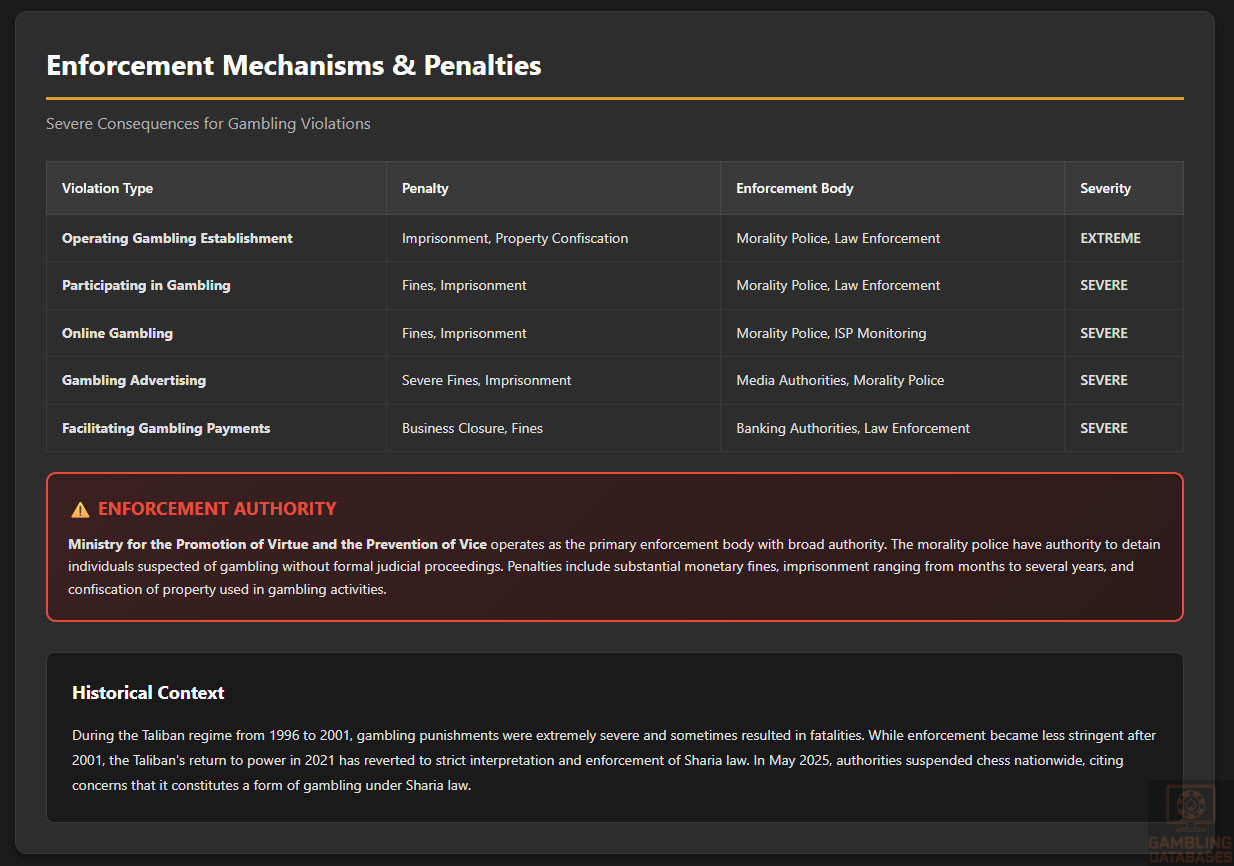
During the Taliban regime from 1996 to 2001, gambling punishments were extremely severe and sometimes resulted in fatalities. While enforcement became less stringent after 2001, the Taliban’s return to power in 2021 has reverted to strict interpretation and enforcement of Sharia law.
| Violation Type | Penalty | Enforcement Body |
|---|---|---|
| Operating Gambling Establishment | Imprisonment, Property Confiscation | Morality Police, Law Enforcement |
| Participating in Gambling | Fines, Imprisonment | Morality Police, Law Enforcement |
| Online Gambling | Fines, Imprisonment | Morality Police, ISP Monitoring |
| Gambling Advertising | Severe Fines, Imprisonment | Media Authorities, Morality Police |
| Facilitating Gambling Payments | Business Closure, Fines | Banking Authorities, Law Enforcement |
Section 2: Demographics and Consumer Analysis
Population Demographics and Distribution
Core Population Metrics
Afghanistan’s population stands at approximately 43.8 million as of 2025, making it the 36th most populous country globally. The nation experiences robust population growth, with annual increases of 2.5-3% despite ongoing challenges from conflict, economic hardship, and emigration.
The population structure is characterized by extreme youth, with a median age of just 17.3 years. Approximately 43% of the population is under 15 years old, creating one of the world’s youngest demographic profiles.
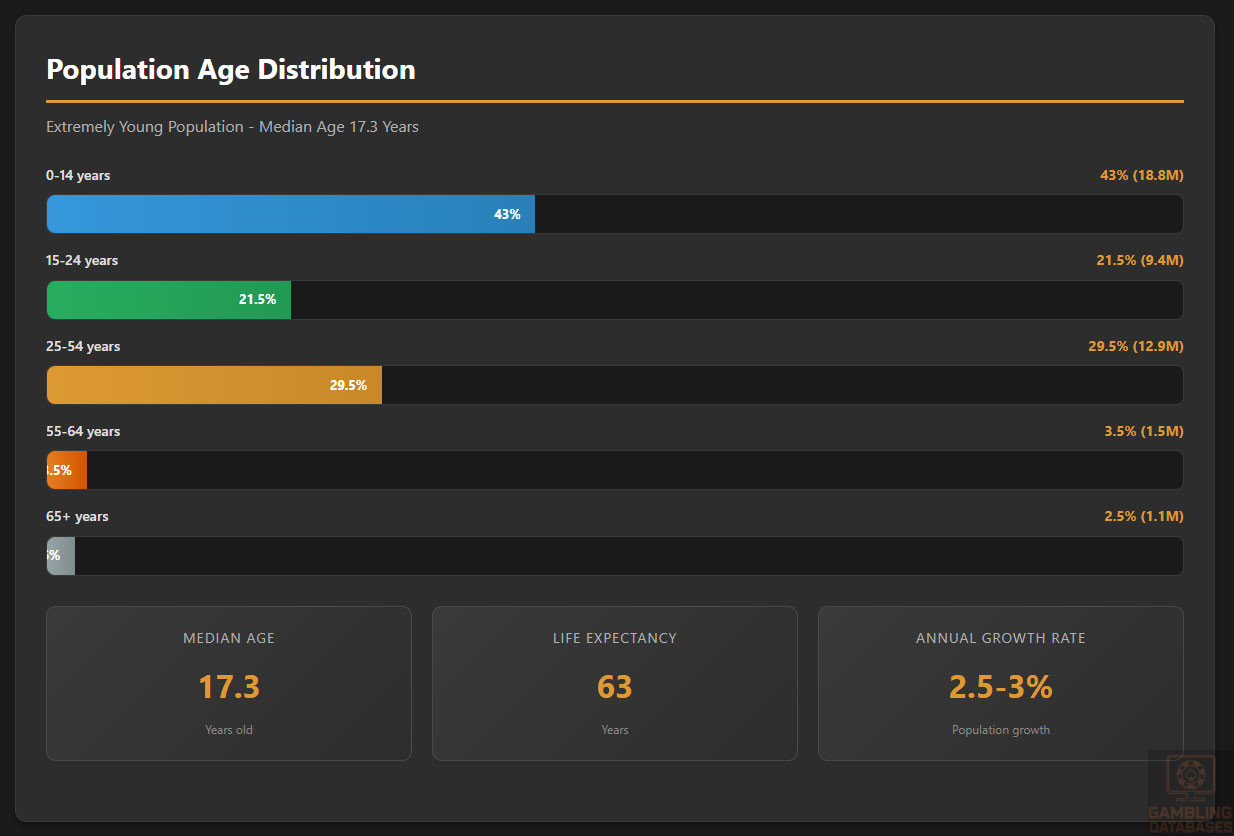
Life expectancy remains low at approximately 63 years, reflecting the country’s underdeveloped healthcare system, ongoing conflict, and challenging living conditions. Infant mortality rates stand at approximately 6.8%, significantly higher than global averages.
| Age Group | Percentage of Population | Approximate Numbers |
|---|---|---|
| 0-14 years | 43% | 18.8 million |
| 15-24 years | 21.5% | 9.4 million |
| 25-54 years | 29.5% | 12.9 million |
| 55-64 years | 3.5% | 1.5 million |
| 65+ years | 2.5% | 1.1 million |
Geographic Distribution
Afghanistan remains predominantly rural, with only 26.7% of the population (11.7 million people) living in urban areas. This represents one of the lowest urbanization rates globally, though cities have experienced rapid growth following the return of refugees.
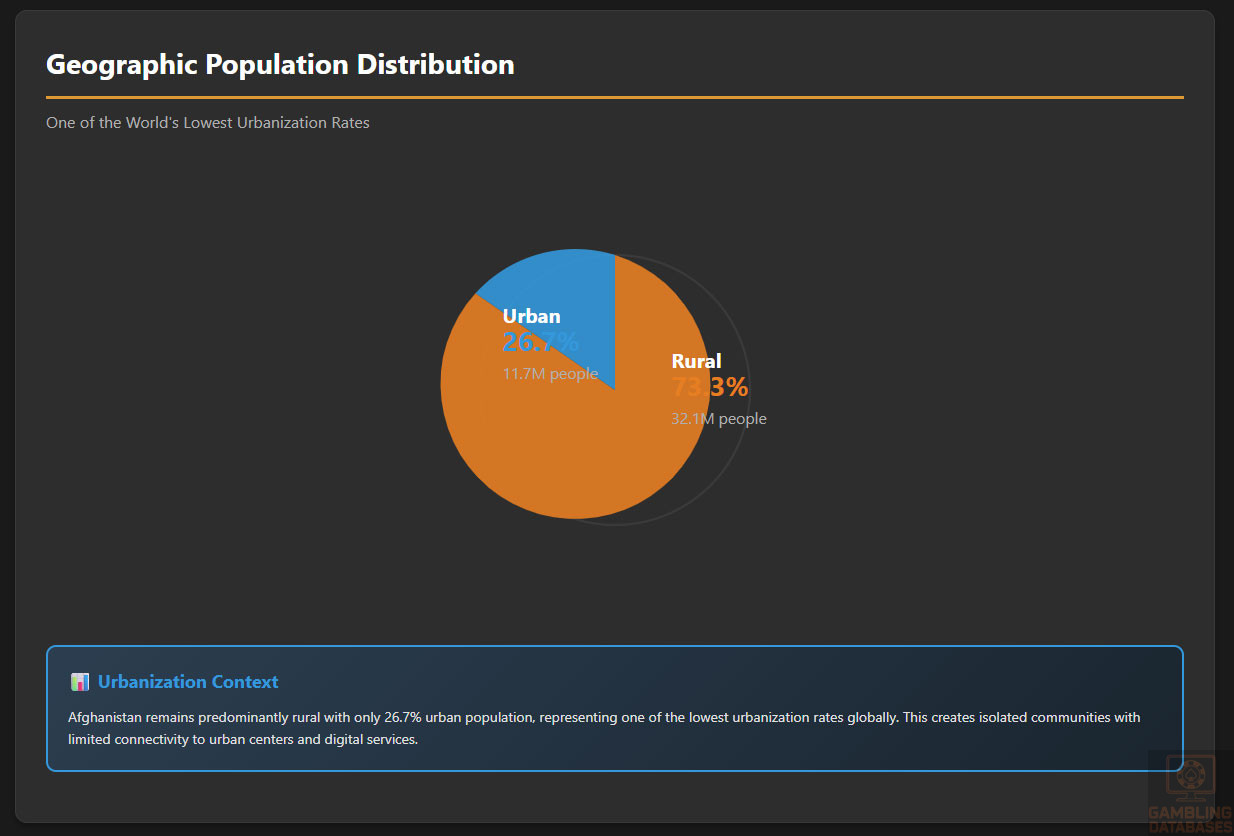
Kabul, the capital city, is the only urban center exceeding one million residents, with a population exceeding 4 million. Other major cities include Herat, Kandahar, Mazar-i-Sharif, and Jalalabad.
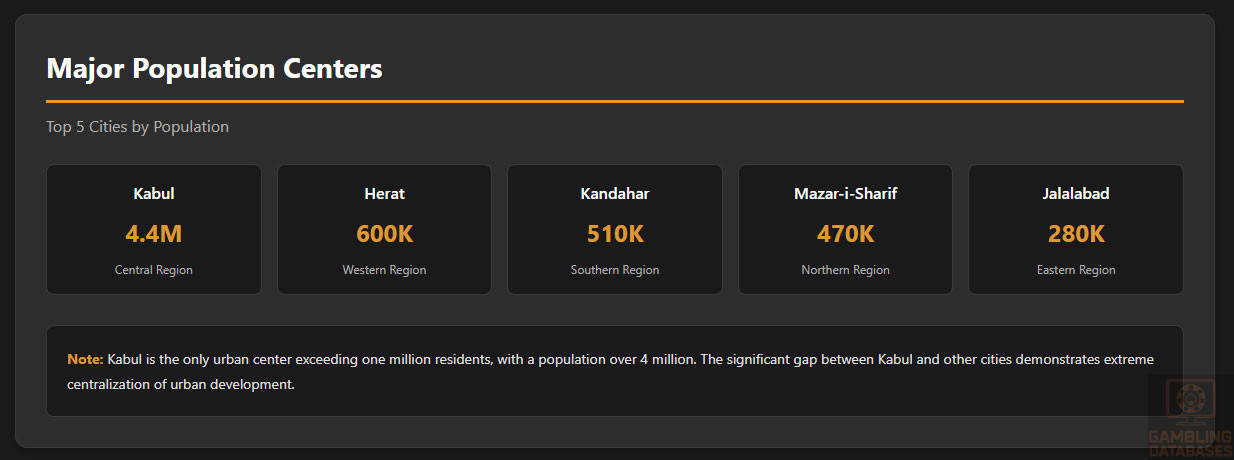
Population density varies significantly by region, with mountainous areas remaining sparsely populated while river valleys and trade route corridors concentrate larger populations. The country’s challenging terrain creates isolated communities with limited connectivity to urban centers.
| City | Approximate Population | Region |
|---|---|---|
| Kabul | 4.4 million | Central |
| Herat | 600,000 | Western |
| Kandahar | 510,000 | Southern |
| Mazar-i-Sharif | 470,000 | Northern |
| Jalalabad | 280,000 | Eastern |
Economic Indicators and Consumer Spending Power
GDP and Economic Performance
Afghanistan’s economy remains one of the world’s smallest and least developed, with a nominal GDP of USD 17.15 billion in 2023. This places the country 124th globally in economic size, representing just 0.02% of the world economy.
GDP per capita stands at USD 416 as of 2023, ranking among the world’s lowest income levels. This figure declined sharply following the Taliban takeover in 2021, when GDP contracted by approximately 20-28% due to frozen assets and aid suspension.
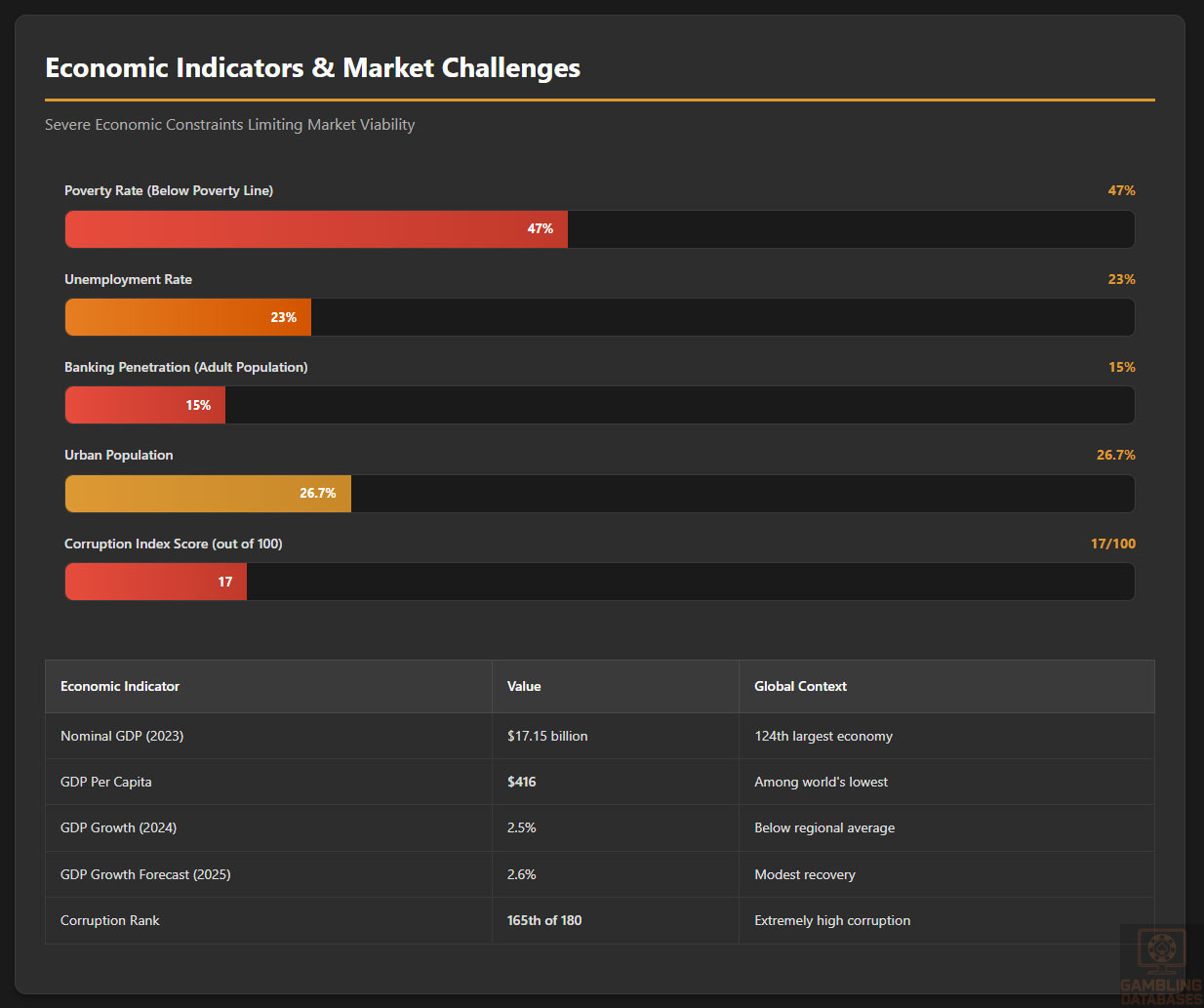
Economic recovery began in 2023 with GDP growth of 2.5% in 2024 and projected 2.6% growth in 2025. However, these modest gains lag significantly behind regional averages and occur amid rapid population growth, meaning per capita income remains stagnant.
The economy relies heavily on agriculture, which employs 60-80% of the workforce but contributes less than one-third of GDP. Mining, construction, and commerce drive recent growth, while manufacturing and services remain constrained by poor business conditions.
| Indicator | Value | Year |
|---|---|---|
| Nominal GDP | USD 17.15 billion | 2023 |
| GDP Per Capita | USD 416 | 2023 |
| GDP Growth Rate | 2.5% | 2024 |
| GDP Growth Forecast | 2.6% | 2025 |
| GDP Growth Forecast | 3.4% | 2026 |
| Unemployment Rate | 23%+ | 2024 |
| Poverty Rate | 47% | 2024 |
Income and Wealth Distribution
Afghanistan exhibits severe income inequality and widespread poverty, with approximately 47% of the population living below the poverty line. The economic collapse following 2021 pushed millions more into poverty as international aid dried up and employment opportunities vanished.
Average household income remains extremely low, with many families surviving on less than USD 2 per day. Disposable income for discretionary spending, including entertainment, is negligible for the vast majority of the population.
The middle class, already small before 2021, has contracted significantly. High unemployment exceeding 23%, combined with restrictions on women’s workforce participation, further constrains household earning capacity and consumer spending power.
Wealth concentration remains high, with limited economic opportunities creating stark divides between urban elites and rural populations. The informal economy, including hawala money transfer systems, plays a dominant role in financial transactions.
| Metric | Value/Status |
|---|---|
| Population Below Poverty Line | 47% |
| Extreme Poverty (under USD 1.90/day) | 34.3% |
| Unemployment Rate | 23%+ |
| Average Daily Wage | Under USD 2 |
| Women’s Workforce Participation | Severely Restricted |
| Middle Class Size | Very Small and Declining |
Market Size and Growth Projections
Afghanistan has no legal iGaming market due to the comprehensive prohibition on all gambling activities. The market size for legal online gambling operations stands at zero, with no revenue generated through licensed channels.
No market growth projections exist because the fundamental legal and religious framework prohibits gambling entirely. Unlike jurisdictions considering legalization or regulatory reforms, Afghanistan shows no indication of softening its stance on gambling prohibition.
The combination of strict Sharia law enforcement, Taliban governance, extreme poverty, minimal digital infrastructure, and cultural opposition to gambling creates insurmountable barriers to market development. Even in a hypothetical legalization scenario, consumer spending capacity would remain insufficient to support viable operations.
| Metric | Current Value | 5-Year Projection |
|---|---|---|
| Legal Market Size | USD 0 | USD 0 |
| Licensed Operators | 0 | 0 |
| Active Legal Players | 0 | 0 |
| ARPU (Annual) | Not Applicable | Not Applicable |
| Market Penetration Rate | 0% | 0% |
| Expected CAGR | Not Applicable | Not Applicable |
Education, Skills, and Digital Literacy
Educational Foundation
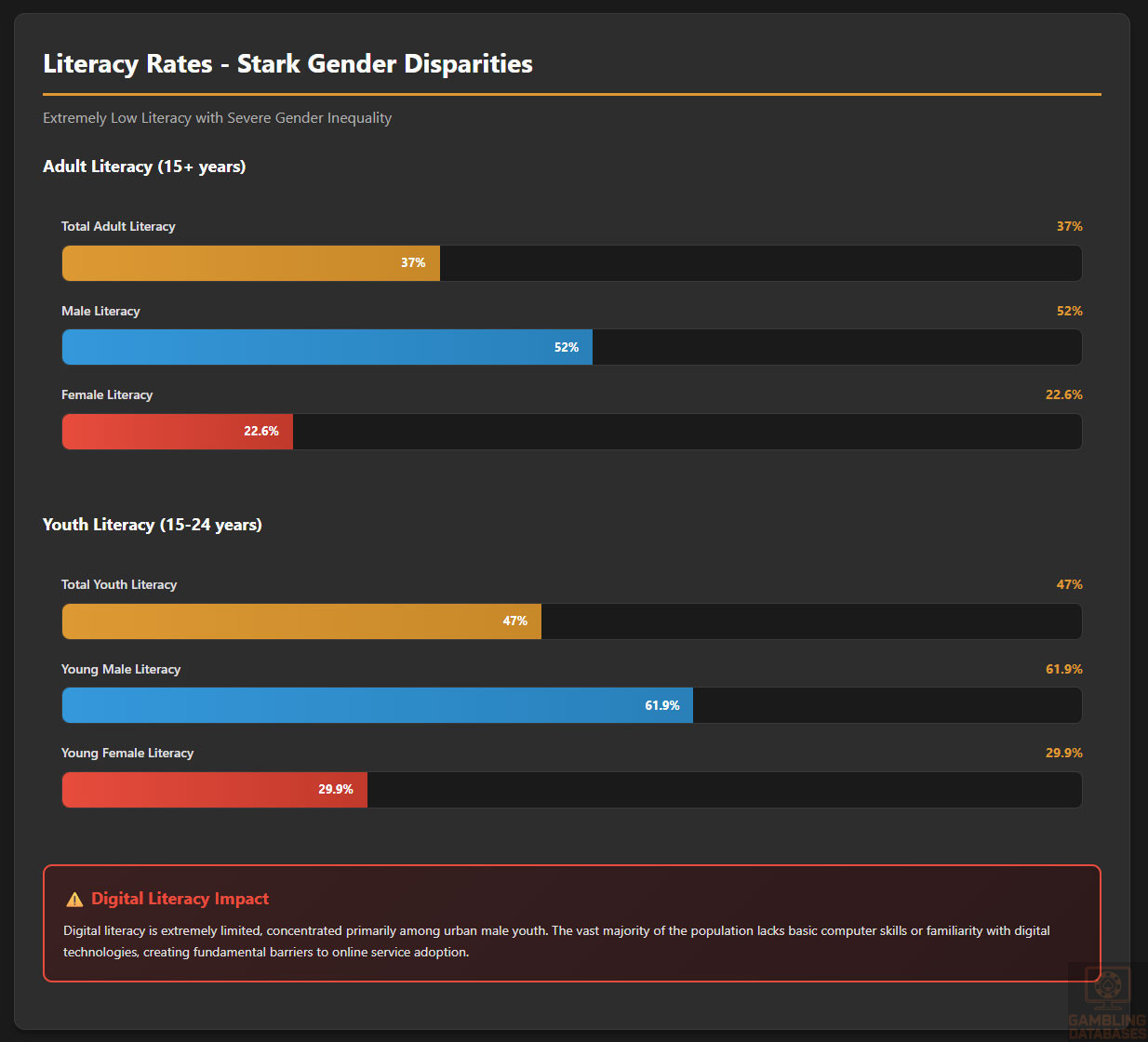
Afghanistan has one of the world’s lowest literacy rates at 37% for adults aged 15 and above. Gender disparities remain extreme, with male literacy at 52% and female literacy at just 22.6%.
Youth literacy (ages 15-24) stands at 47%, significantly below the average for low-income countries. Young men achieve 61.9% literacy while young women reach only 29.9%, indicating persistent educational inequality.
Educational infrastructure remains severely underdeveloped, with many rural areas lacking schools entirely. The Taliban’s restrictions on female education beyond primary school have further decimated educational opportunities, particularly for girls and women.
Digital literacy is extremely limited, concentrated primarily among urban male youth. The vast majority of the population lacks basic computer skills or familiarity with digital technologies, creating fundamental barriers to online service adoption.
| Indicator | Rate/Status |
|---|---|
| Adult Literacy Rate (Total) | 37% |
| Adult Literacy Rate (Male) | 52% |
| Adult Literacy Rate (Female) | 22.6% |
| Youth Literacy (15-24) | 47% |
| Youth Literacy (Male) | 61.9% |
| Youth Literacy (Female) | 29.9% |
| Primary School Completion | Very Low |
| Secondary Education Access | Extremely Limited |
| Digital Literacy | Minimal |
Cultural and Social Factors
Communication and Language
Afghanistan is multilingual, with Dari and Pashto serving as official languages. Dari is understood by approximately 79% of the population, while Pashto is understood by 51%. Uzbek (11%) and Turkmen (7%) are also spoken in northern regions.
English proficiency remains extremely low, concentrated among small urban educated populations. This language barrier would significantly complicate any international business operations, though it is irrelevant given gambling’s prohibition.
Internet language preferences skew toward Dari and Pashto, with limited English content consumption. The Taliban government emphasizes local languages in official communications and increasingly restricts foreign media access.
Cultural Attitudes Toward Gambling
Afghan culture views gambling as fundamentally incompatible with Islamic values. Nearly 99% of the population practices Islam (80-89% Sunni, 10-15% Shia), creating overwhelming religious opposition to gambling activities.
Gambling is considered haram under Islamic law, meaning it is forbidden and sinful. This religious prohibition enjoys near-universal acceptance across Afghan society, transcending ethnic, regional, and socioeconomic divisions.
Cultural attitudes reinforced by Taliban governance make gambling socially unacceptable beyond its legal prohibition. Individuals engaging in gambling risk not only legal penalties but also social ostracism and family dishonor.
The concept of risk-taking for entertainment purposes conflicts with cultural values emphasizing family responsibility, religious duty, and community welfare. Entertainment preferences center on social gatherings, sports (particularly cricket and soccer), and family activities rather than gambling.
| Category | Percentage |
|---|---|
| Muslim Population | 99%+ |
| Sunni Islam | 80-89% |
| Shia Islam | 10-15% |
| Other Religions | Less than 1% |
| Gambling Acceptance | Near Zero |
| Religious Opposition to Gambling | Universal |
Problem Gambling and Social Considerations
Afghanistan maintains no data on problem gambling prevalence because gambling activities are completely prohibited. No treatment facilities, support services, or research programs addressing gambling addiction exist within the country.
The religious framework views gambling as inherently problematic rather than distinguishing between recreational and problem gambling. All gambling is considered harmful to individuals, families, and society regardless of frequency or amounts involved.
No social responsibility requirements exist for operators because no legal gambling operations are permitted. The government’s approach focuses on prevention through prohibition rather than harm reduction or treatment.
| Metric | Status |
|---|---|
| Problem Gambling Prevalence | No Data (Gambling Prohibited) |
| Treatment Facilities | None |
| Support Services | None |
| Gambling Helplines | None |
| Research Programs | None |
| Operator Contributions Required | Not Applicable |
Political Structure and Governance
Afghanistan operates under Taliban governance following their takeover in August 2021. The Islamic Emirate of Afghanistan applies strict interpretation of Sharia law across all aspects of governance and society.
Political stability remains extremely low, with the country facing international isolation, frozen assets, and lack of formal recognition by most governments. The Taliban government maintains control through military force and religious authority rather than democratic processes.
International relations remain strained, with most countries refusing formal diplomatic recognition. Afghanistan faces comprehensive sanctions limiting international trade and financial transactions, further isolating the economy from global markets.
| Indicator | Value/Status |
|---|---|
| Government Type | Islamic Emirate (Taliban) |
| Political Stability | Very Low |
| Corruption Index Score (2024) | 17/100 |
| Corruption Rank | 165th of 180 countries |
| International Recognition | Minimal |
| Sanctions Status | Extensive Sanctions |
| Regulatory Predictability | Very Low |
Technology Adoption and Digital Behavior
Internet and Digital Usage
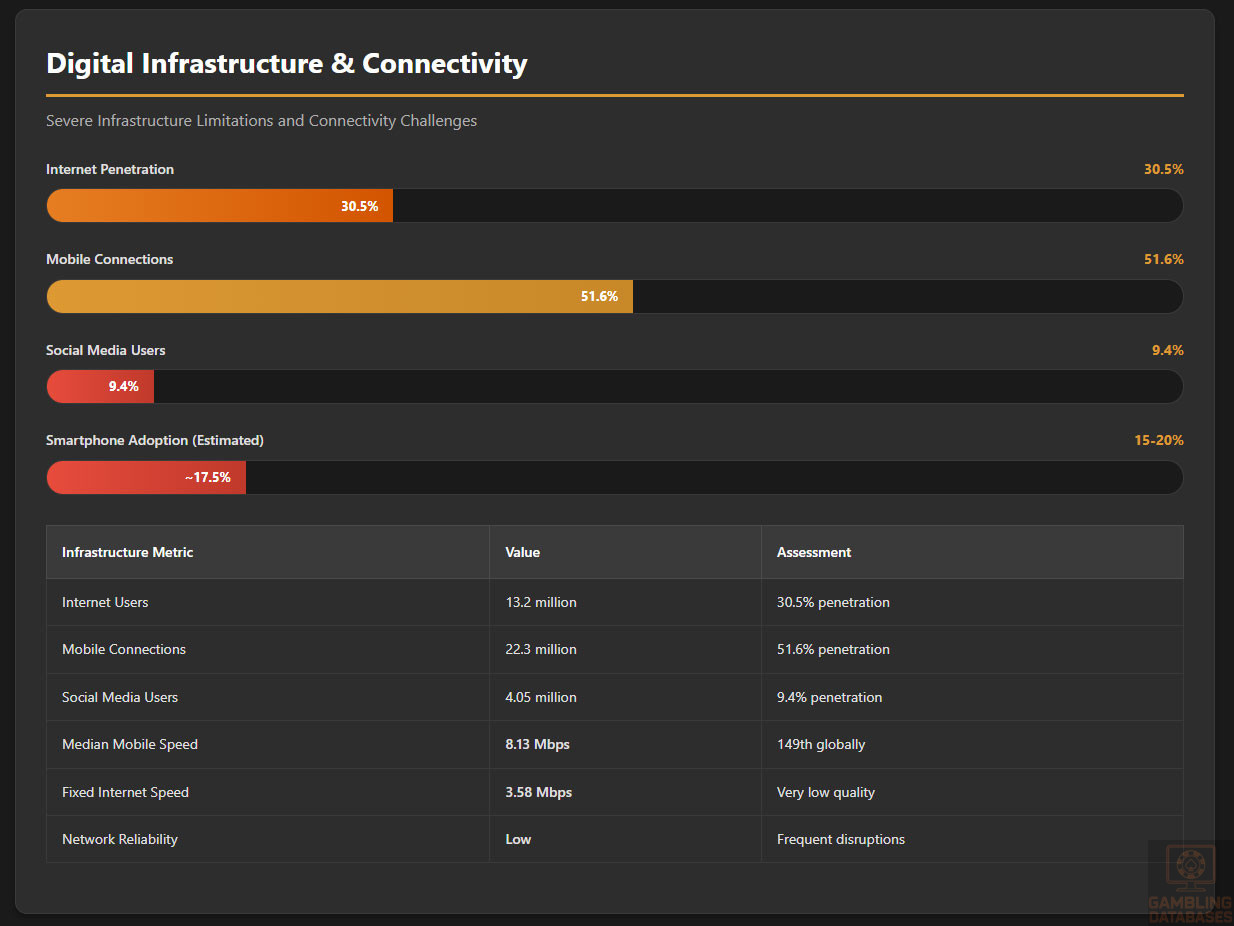
Internet penetration in Afghanistan reached 30.5% at the start of 2025, with 13.2 million users out of 43.8 million total population. This represents growth of 6.3% from 2024 but remains significantly below global and regional averages.
Daily internet usage patterns remain limited, with most users accessing services primarily through mobile devices. Urban male youth comprise the majority of internet users, while rural populations and women have minimal access.
Social media adoption is extremely low at 9.4% penetration (4.05 million users). Facebook remains accessible as of October 2025 despite government threats to restrict or block the platform for moral concerns.
E-commerce participation is minimal, limited by lack of trust in online transactions, inadequate payment infrastructure, and low purchasing power. Digital service adoption remains concentrated in urban areas, particularly Kabul.
| Metric | Value | Penetration Rate |
|---|---|---|
| Internet Users | 13.2 million | 30.5% |
| YoY Internet Growth | +781,000 | +6.3% |
| Social Media Users | 4.05 million | 9.4% |
| Mobile Connections | 22.3 million | 51.6% |
| Smartphone Adoption | Low | Estimated 15-20% |
| Daily Internet Usage | Limited | Concentrated Urban Male |
| E-commerce Participation | Minimal | Under 5% |
Digital Payment Behavior
Digital payment adoption remains extremely low in Afghanistan, with cash dominating over 85% of transactions. Banking penetration stands at only 15% of the adult population, among the world’s lowest financial inclusion rates.
The Afghanistan Payments System, developed before 2021, integrated banks and mobile operators into a national switch. However, the banking sector’s isolation from SWIFT and international systems severely limits functionality.
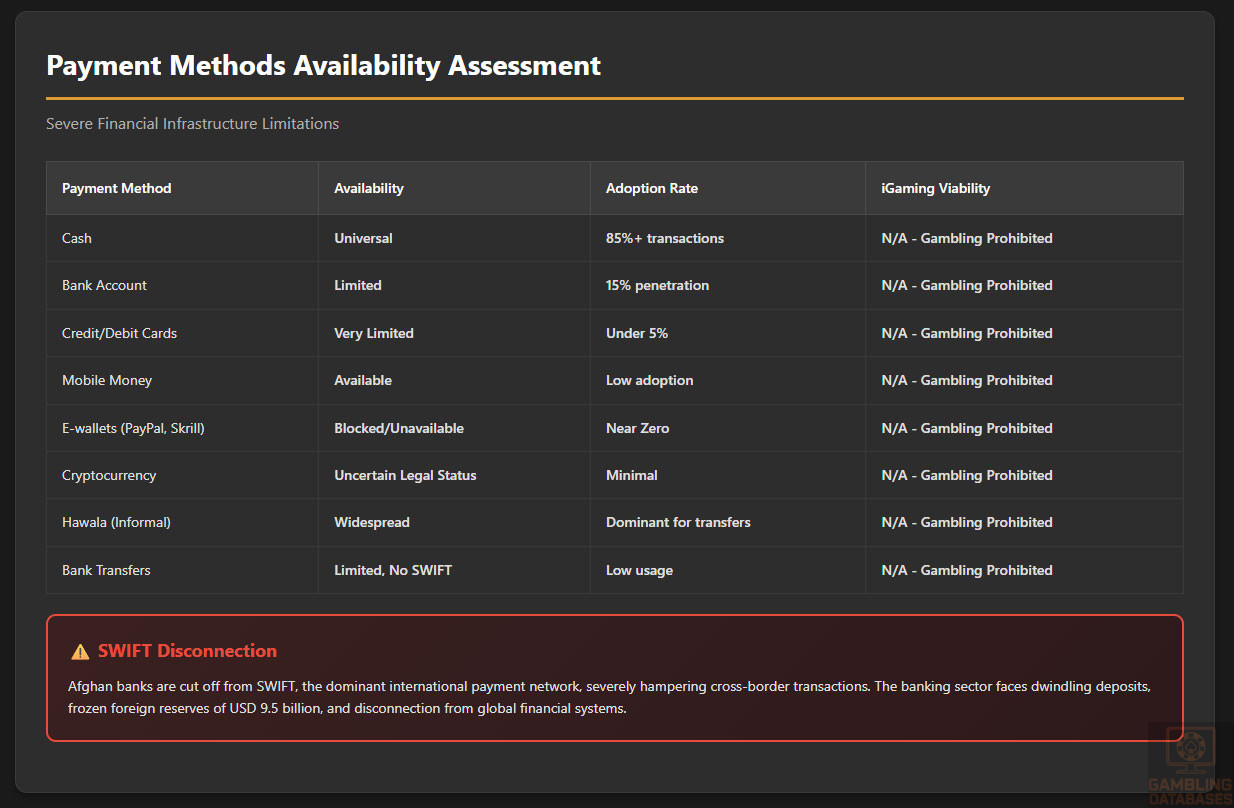
Mobile money services exist through operators like Roshan and Afghan Wireless but face limited adoption due to low trust, cash preference, and restricted banking infrastructure. Hawala remains the dominant informal transfer system.
Credit card penetration is negligible, with most Afghans lacking access to formal banking services. E-wallets like PayPal and Skrill are unavailable or blocked. Cryptocurrency adoption remains minimal due to regulatory uncertainty and technical barriers.
| Payment Method | Availability | Adoption Rate |
|---|---|---|
| Cash | Universal | 85%+ of transactions |
| Bank Account | Limited | 15% penetration |
| Credit/Debit Cards | Very Limited | Under 5% |
| Mobile Money | Available | Low adoption |
| E-wallets (International) | Blocked/Unavailable | Near Zero |
| Cryptocurrency | Uncertain Legal Status | Minimal |
| Hawala (Informal) | Widespread | Dominant for transfers |
| Bank Transfers | Limited | Low usage |
Gaming and Gambling Preferences
Current Market Participation
Legal gambling participation in Afghanistan is zero percent due to the comprehensive prohibition on all gambling activities. No population segments engage in legal gambling because no legal gambling venues or services exist.
Underground gambling may occur in limited, clandestine settings, but reliable data is impossible to obtain given the severe legal and social risks. Any such activity would be extremely marginal and highly risky for participants.
Sports popularity, particularly cricket and soccer, exists independently of betting. Afghan citizens follow these sports for entertainment without the wagering component common in countries where sports betting is legal.
| Metric | Value |
|---|---|
| Legal Gambling Participation | 0% |
| Online Gambling Participation | 0% (Legal) |
| Sports Betting Participation | 0% (Legal) |
| Casino Game Preference | Not Applicable |
| Average Spending Per Player | USD 0 (Legal Market) |
| Mobile vs Desktop | Not Applicable |
Consumer Behavior Patterns
Consumer behavior analysis for gambling in Afghanistan is not applicable because no legal gambling market exists. The population’s entertainment spending focuses on social activities, traditional games without wagering, and family gatherings.
Even in a hypothetical scenario where gambling became legal, consumer behavior would be constrained by extreme poverty, religious prohibition, cultural opposition, and minimal disposable income for entertainment spending.
Section 3: Technology Infrastructure and Business Environment
Internet and Digital Infrastructure
Connectivity and Network Performance
Afghanistan’s internet infrastructure remains underdeveloped, with connectivity quality significantly below global standards. Internet penetration of 30.5% places the country among the least connected globally.
Fixed broadband speed averaged just 3.58 Mbps download as of January 2025, ranking Afghanistan approximately 149th of 158 countries globally. Mobile internet download speeds reached 8.13 Mbps, showing 69% improvement from 2024 but remaining inadequate for data-intensive applications.
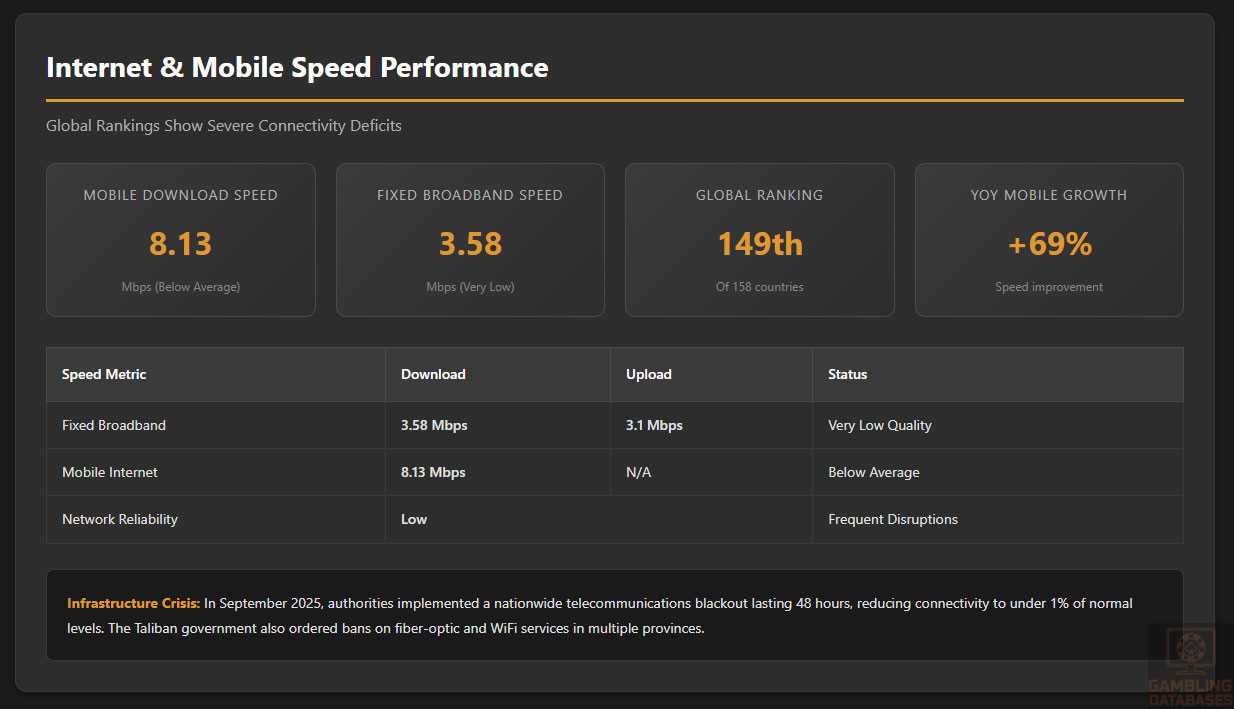
Network reliability faces constant challenges from infrastructure damage, power shortages, and government-imposed shutdowns. In September 2025, authorities implemented a nationwide telecommunications blackout lasting 48 hours, reducing connectivity to under 1% of normal levels.
The Taliban government in September 2025 ordered bans on fiber-optic and WiFi services in multiple provinces to “prevent immorality,” though mobile data services continued with limited reliability. These actions demonstrate the government’s willingness to severely disrupt digital services.
| Metric | Value (2025) | Global Ranking |
|---|---|---|
| Fixed Broadband Download | 3.58 Mbps | ~149th of 158 |
| Fixed Broadband Upload | 3.1 Mbps | Very Low |
| Mobile Download Speed | 8.13 Mbps | Below Average |
| YoY Mobile Speed Growth | +69% | Improving |
| Network Reliability | Low | Frequent Disruptions |
| Urban vs Rural Gap | Extreme | Rural Access Minimal |
5G and Future Technology Deployment
Afghanistan has limited 4G coverage, with no 5G deployment planned or underway. Mobile network operators focus on expanding 3G and 4G coverage to reach underserved populations rather than advancing to next-generation technologies.
The country’s telecommunications infrastructure requires massive investment to reach current global standards, let alone prepare for 5G deployment. Economic constraints, political instability, and ongoing security challenges prevent meaningful infrastructure modernization.
Approximately 90% of the population receives 2G mobile network coverage, but only 21 provinces have 3G coverage. 4G availability remains limited to major urban centers, serving a small fraction of the population.
Mobile Technology Ecosystem
Mobile Network Infrastructure
Afghanistan’s mobile market features five major operators: Afghan Wireless (AWCC), Roshan, Etisalat Afghanistan, MTN Afghanistan, and state-owned Salaam Telecom. These operators provide varying coverage levels, with AWCC and Roshan claiming the most extensive networks.
Mobile connections totaled 22.3 million in early 2025, equivalent to 51.6% population penetration. However, this figure includes voice-only services, and actual mobile internet access remains significantly lower.
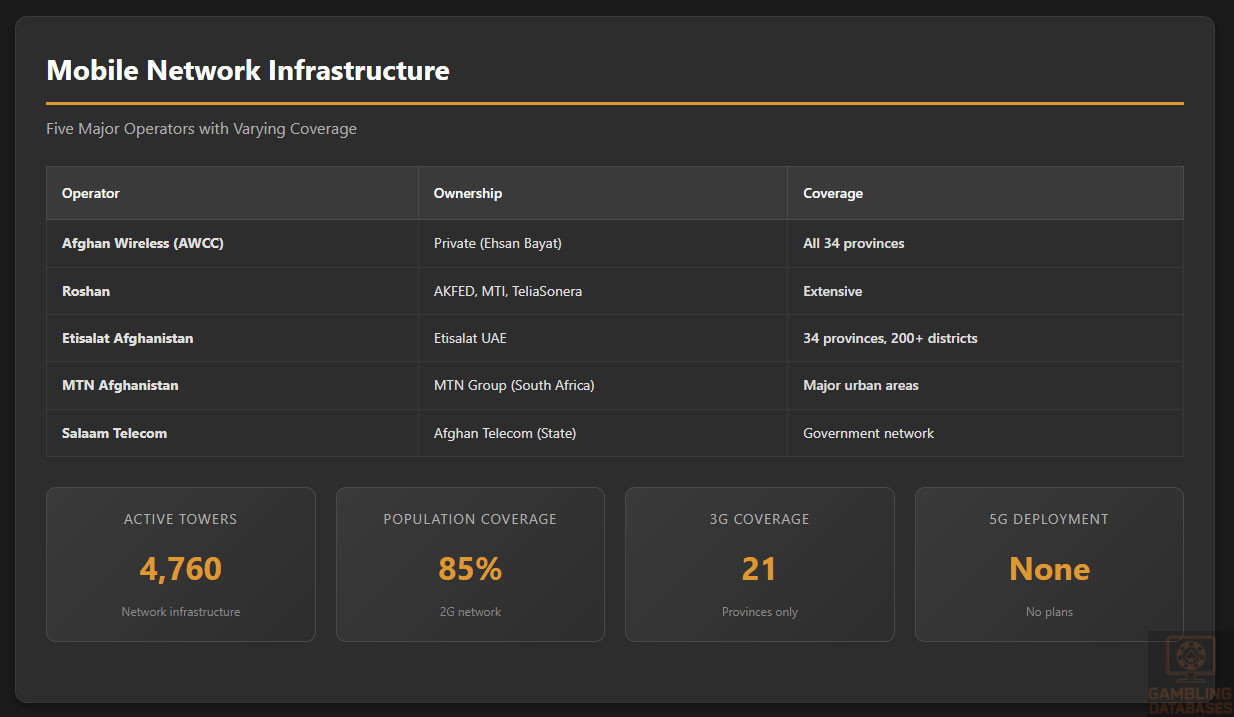
Network infrastructure consists of approximately 4,760 active towers covering an estimated 85% of the population. The Ministry of Communications plans 700 additional towers to reach remaining areas, though funding and security concerns impede deployment.
| Operator | Ownership | Coverage |
|---|---|---|
| Afghan Wireless (AWCC) | Private (Ehsan Bayat) | All 34 provinces |
| Roshan | AKFED, MTI, TeliaSonera | Extensive |
| Etisalat Afghanistan | Etisalat UAE | 34 provinces, 200+ districts |
| MTN Afghanistan | MTN Group (South Africa) | Major urban areas |
| Salaam Telecom | Afghan Telecom (State) | Government network |
Device Penetration
Smartphone adoption in Afghanistan remains low, estimated at 15-20% of the population. Most mobile users rely on basic feature phones capable of voice and SMS but lacking full internet browsing capabilities.
Device costs relative to income levels create significant barriers to smartphone ownership. Even basic smartphones represent substantial investments for families earning under USD 2 daily.
Android dominates the smartphone market, with iOS devices extremely rare due to cost constraints. Device specifications tend toward entry-level models with limited memory and processing power.
| Metric | Value/Status |
|---|---|
| Total Mobile Connections | 22.3 million |
| Mobile Penetration | 51.6% |
| Smartphone Adoption | 15-20% |
| Feature Phone Usage | 80-85% |
| Android Market Share | Dominant |
| iOS Market Share | Minimal |
| Network Towers | 4,760 active |
| Population Coverage | 85% |
Financial Services and Payment Infrastructure
Banking System Structure
Afghanistan’s banking sector comprises approximately 12 banks (mix of state-owned and commercial) operating under severe constraints following the Taliban takeover and subsequent international isolation. The sector faces dwindling deposits, frozen foreign reserves, and disconnection from global financial systems.
Da Afghanistan Bank serves as the central bank, but its approximately USD 9.5 billion in foreign reserves remain frozen by the United States and other countries. This asset freeze devastated the banking system’s liquidity and credibility.
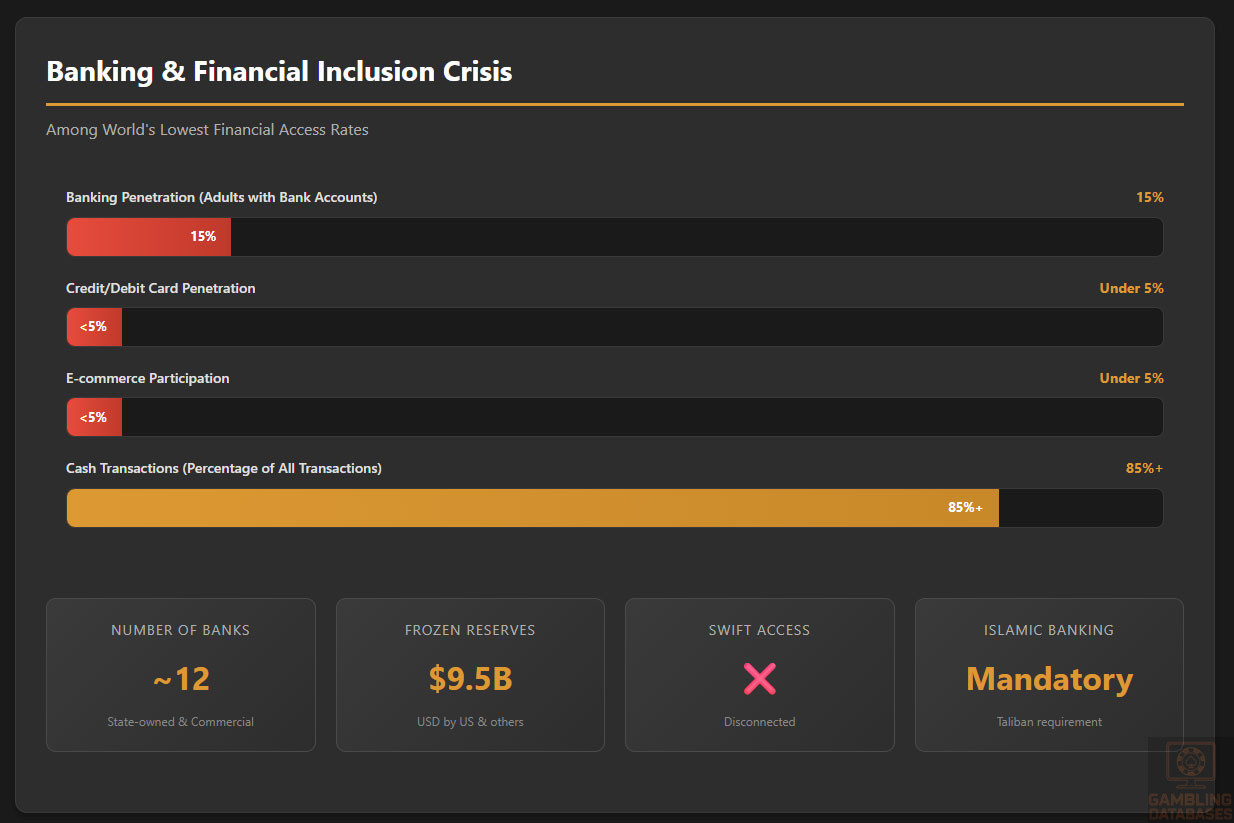
Banking penetration stands at only 15% of adults, among the world’s lowest financial inclusion rates. Trust in formal banking collapsed after the 2021 crisis, with many Afghans withdrawing savings and avoiding banks entirely.
The Taliban’s mandatory transition to Islamic banking further constrains the sector’s financial intermediation role. Islamic banking principles prohibit interest-based lending, limiting traditional banking operations.
| Indicator | Value/Status |
|---|---|
| Number of Banks | Approximately 12 |
| Banking Penetration | 15% |
| Central Bank | Da Afghanistan Bank |
| Frozen Reserves | USD 9.5 billion |
| SWIFT Access | Disconnected |
| Banking System Status | Severely Constrained |
| Islamic Banking Mandate | Required |
| International Integration | Minimal |
Payment Processing Options
Payment processing options for iGaming in Afghanistan are non-existent due to gambling prohibition. Even for legitimate businesses, payment processing faces severe limitations from banking sector isolation and lack of international financial connectivity. Afghan banks are cut off from SWIFT, the dominant international payment network, severely hampering cross-border transactions.
Credit and debit card penetration remains negligible, with most Afghans lacking access to formal banking products. International e-wallet services like PayPal, Skrill, and Neteller are unavailable or blocked in Afghanistan.
Hawala, an informal money transfer system using brokers rather than banks, dominates remittances and transfers. This system is difficult to trace and has been associated with money laundering concerns, though it remains essential for Afghans conducting business.
Cryptocurrency adoption remains minimal due to regulatory uncertainty, technical barriers, and limited understanding. The legal status of cryptocurrencies remains unclear under Taliban governance.
| Payment Method | Availability for Businesses | iGaming Viability |
|---|---|---|
| Credit/Debit Cards | Minimal | Not Applicable (Gambling Prohibited) |
| Bank Transfers | Limited, No SWIFT | Not Applicable (Gambling Prohibited) |
| E-wallets (PayPal, Skrill, etc.) | Unavailable/Blocked | Not Applicable (Gambling Prohibited) |
| Mobile Money | Available but Limited | Not Applicable (Gambling Prohibited) |
| Cryptocurrency | Unclear Legal Status | Not Applicable (Gambling Prohibited) |
| Hawala (Informal) | Widespread | Not Applicable (Gambling Prohibited) |
| Cash | Dominant (85%+) | Not Applicable (Gambling Prohibited) |
E-commerce and Digital Economy
Digital Market Development
Afghanistan’s e-commerce market remains extremely underdeveloped, with online retail representing less than 1% of total retail activity. Most commerce occurs through traditional cash-based transactions in physical marketplaces.
Consumer trust in online transactions is minimal, compounded by payment infrastructure limitations, delivery challenges, and lack of legal protections for online purchases. Security concerns about providing personal and financial information online further inhibit adoption.
Digital service consumption focuses primarily on mobile communications, social media (where accessible), and basic information access. Paid digital services like streaming subscriptions, online education, or digital entertainment remain extremely rare.
Cross-border e-commerce faces particular challenges from customs procedures, payment restrictions, and limited international shipping infrastructure. Economic sanctions further complicate international transactions.
| Metric | Value/Status |
|---|---|
| E-commerce Market Size | Under 1% of retail |
| Online Retail Penetration | Minimal |
| Digital Service Subscriptions | Very Low |
| Consumer Trust in Online Transactions | Very Low |
| Payment Infrastructure Quality | Poor |
| Cross-border E-commerce | Extremely Limited |
Business Environment and Regulatory Framework
Ease of Business Operations
Afghanistan presents one of the world’s most challenging business environments. The World Bank discontinued publishing Doing Business rankings, but Afghanistan historically ranked near the bottom globally on ease of doing business indicators.
Starting a business requires navigating opaque bureaucratic processes with uncertain timelines. Corruption, documented by Afghanistan’s ranking of 165th out of 180 countries on the Corruption Perceptions Index, adds unpredictability and cost to business operations.
Foreign investment faces extreme barriers including political instability, security risks, sanctions, asset freeze concerns, lack of legal protections, and Taliban governance uncertainty. International businesses have largely withdrawn from Afghanistan since 2021.
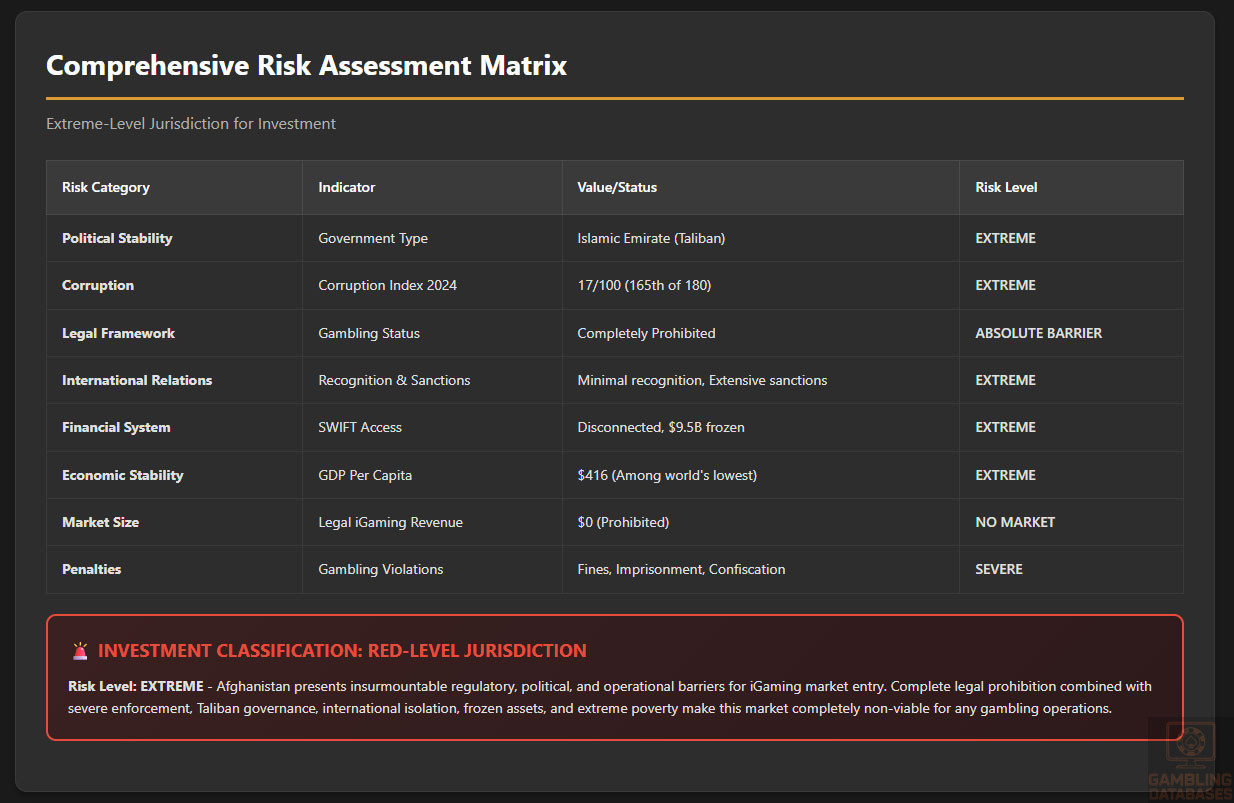
Operational costs vary widely, but office rent, utilities, and salaries remain comparatively low due to the depressed economy. However, security costs, bribery, and infrastructure challenges create hidden expenses that significantly increase true operational costs.
| Indicator | Status/Ranking |
|---|---|
| Ease of Doing Business | Extremely Difficult |
| Corruption Index (2024) | 17/100 (165th of 180) |
| Political Stability | Very Low |
| Foreign Investment Climate | Extremely Hostile |
| Legal System Reliability | Very Low |
| Contract Enforcement | Poor |
| Property Rights Protection | Weak |
Corporate Structure and Registration
Available Entity Types
Afghanistan’s business registration system offers various entity types including limited liability companies, corporations, and branch offices. However, the Taliban’s governance has created uncertainty about legal frameworks and business regulations established under previous governments.
For gambling operations specifically, entity registration is irrelevant because gambling businesses cannot legally operate regardless of corporate structure. Any attempt to register a gambling-related business would be rejected and potentially result in legal action.
Registration Requirements
Standard business registration in Afghanistan requires multiple steps including name reservation, documentation preparation, registration with the Afghanistan Investment Support Agency, tax registration, and various permits. However, processes remain opaque with uncertain timelines ranging from weeks to months.
Foreign ownership faces restrictions in certain sectors, though specific percentages vary by industry. The Taliban government’s policies on foreign investment remain unclear and subject to change without notice.
Minimum capital requirements exist for some business types but enforcement is inconsistent. Annual reporting and audit requirements theoretically apply to registered businesses, but compliance monitoring and enforcement capabilities are limited.
| Requirement | Details |
|---|---|
| Registration Timeline | Weeks to months (highly variable) |
| Registration Costs | Variable, includes government fees and facilitation costs |
| Foreign Ownership | Restricted in certain sectors |
| Minimum Capital | Varies by entity type |
| Annual Compliance | Required but inconsistently enforced |
| Gambling Business Registration | Impossible – All gambling prohibited |
Taxation Framework
Corporate Income Tax Structure
Afghanistan’s corporate tax system theoretically applies standard rates to business income, but gambling-specific taxation is non-existent because gambling operations are prohibited. The Ministry of Finance collected over USD 2 billion in tax revenue in 2022, focusing on legitimate business sectors.
The Taliban government emphasizes domestic revenue mobilization to offset lost international aid, but tax collection faces challenges from limited capacity, informal economy dominance, and business sector contraction.
| Tax Type | Rate/Status |
|---|---|
| Standard Corporate Tax | 20% (standard rate for businesses) |
| Gambling-Specific Tax | Not Applicable (Gambling Prohibited) |
| Withholding Taxes | Various rates apply |
| VAT/GST | Not implemented |
Market Entry Considerations
Recommended Entry Strategies
For iGaming Operations: Market entry is not recommended under any circumstances.
Afghanistan presents absolute barriers to iGaming market entry due to comprehensive legal prohibition, religious opposition, Taliban governance, extreme poverty, inadequate infrastructure, political instability, and international isolation. No viable entry strategy exists for gambling operations.
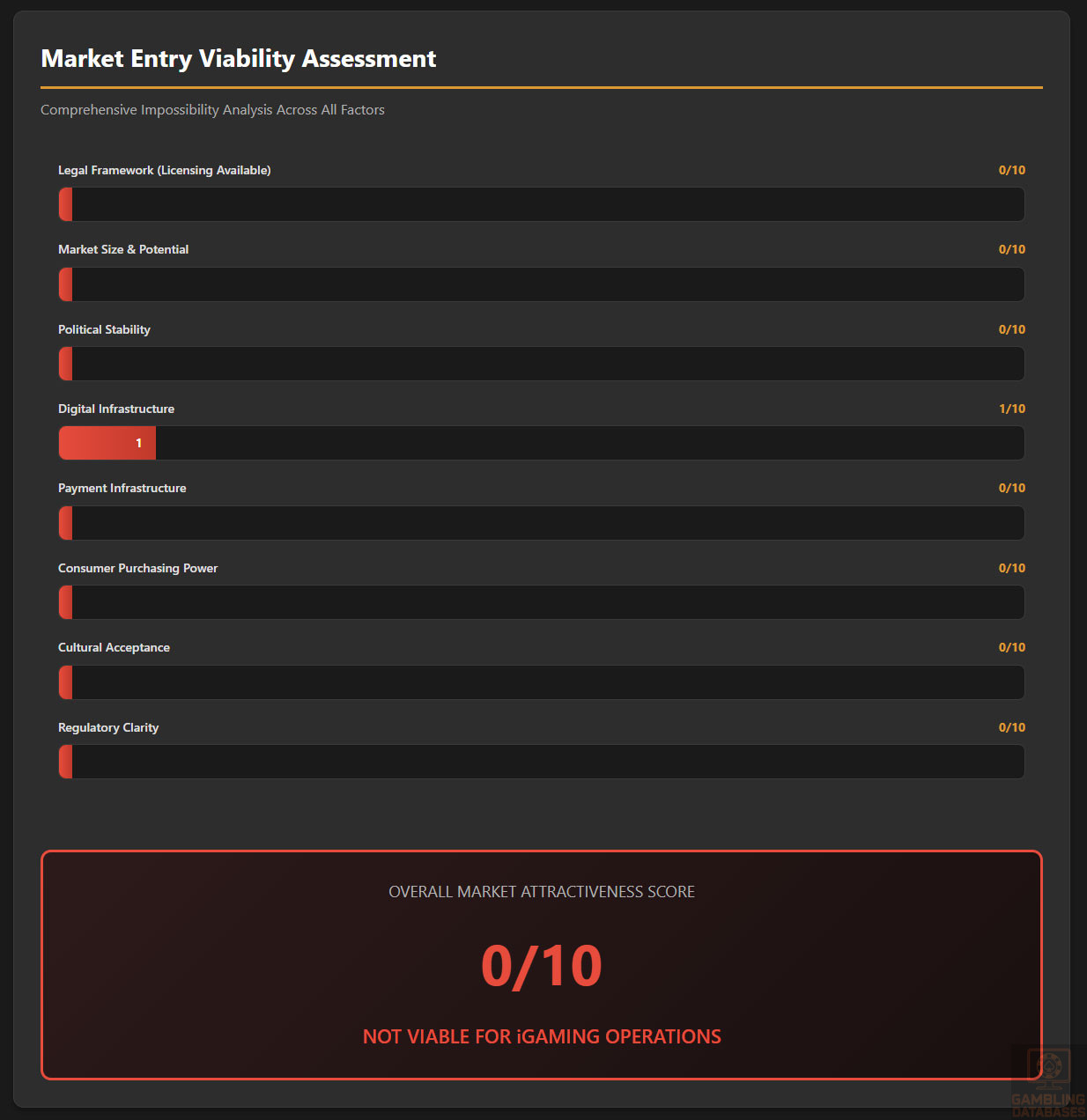
The combination of Sharia law enforcement, severe penalties including imprisonment and property confiscation, cultural rejection of gambling, and absence of any regulatory framework makes Afghanistan completely unsuitable for iGaming investment.
| Entry Strategy | Viability | Reasoning |
|---|---|---|
| Direct Licensing | Impossible | No licensing system exists; gambling prohibited |
| Local Partnership | Impossible | All gambling illegal regardless of ownership |
| Offshore Operation | Illegal | Players face severe penalties; payment processing impossible |
| White Label | Impossible | No legal gambling market exists |
| Acquisition | Not Applicable | No gambling operators to acquire |
Typical Costs and Timelines
Cost and timeline analysis for iGaming market entry in Afghanistan is not applicable because gambling operations cannot legally function. Below is a hypothetical framework showing why investment would be impossible:
| Cost Category | Status |
|---|---|
| License Application Fee | Not Applicable – No licensing available |
| License Processing Time | Not Applicable – Applications not accepted |
| Initial Capital Requirement | Not Applicable – Operations prohibited |
| Legal/Consulting Fees | Would advise complete market avoidance |
| Time to Market | Impossible – Cannot launch legally |
| Risk of Asset Loss | 100% – Property subject to confiscation |
| Risk of Legal Penalties | Extreme – Fines, imprisonment |
Success Factors and Challenges
Key Success Enablers
No success factors exist for iGaming operations in Afghanistan because gambling is comprehensively prohibited.
In a hypothetical legal gambling scenario (which shows no signs of occurring), success would require fundamental changes including legal framework establishment, religious authority acceptance, cultural shift in attitudes, massive infrastructure development, banking system normalization, political stability, and international recognition. None of these conditions are present or anticipated.
Major Operational Challenges
Afghanistan presents insurmountable operational challenges for iGaming including:
Legal and Regulatory: Complete prohibition under Sharia law with severe penalties including imprisonment and property confiscation. No licensing framework exists and none is planned.
Political and Security: Taliban governance with extreme instability, international isolation, frozen assets, sanctions, and unpredictable policy changes. Security risks include violence and arbitrary detention.
Economic: Extreme poverty with 47% below poverty line, GDP per capita of USD 416, 23% unemployment, and minimal disposable income for entertainment spending.
Infrastructure: Internet penetration of 30.5%, median mobile speed of 8.13 Mbps, frequent government-imposed shutdowns, and unreliable connectivity. Banking system isolation from SWIFT with only 15% banking penetration.
| Challenge Category | Severity | Impact |
|---|---|---|
| Legal Prohibition | Absolute | Complete barrier to entry |
| Religious Opposition | Universal | Cultural rejection of gambling |
| Payment Processing | Impossible | No viable payment methods |
| Political Instability | Extreme | Unpredictable regulatory environment |
| Infrastructure Deficit | Severe | Inadequate for online services |
| Market Size | Zero | No legal market exists |
| Consumer Purchasing Power | Minimal | Extreme poverty |
Cultural Considerations
Afghan culture fundamentally opposes gambling based on Islamic principles shared by 99% of the population. No seasonal opportunities, sports events, or cultural occasions create gambling demand because wagering contradicts religious law.
Trust-building with foreign brands is impossible for gambling services because the activity itself is prohibited and culturally rejected. Customer service excellence, localization efforts, or responsible gambling programs are irrelevant when the fundamental service cannot legally exist.
Exit Strategy Planning
Exit strategy planning is not applicable for iGaming in Afghanistan because market entry is impossible. No legal gambling operations exist to exit, and any illegal operations face asset confiscation and criminal prosecution rather than orderly business sales.
FAQ: Frequently Asked Questions
Legal & Licensing
1. Is online gambling legal in Afghanistan?
No. Online gambling is completely illegal in Afghanistan. All forms of gambling, including online casinos, sports betting, poker, and lottery services, are strictly prohibited under Islamic Sharia law enforced by the Taliban government.
The prohibition has no exceptions and applies to all residents and visitors. Afghanistan has no regulatory framework for gambling, making it impossible to conduct legal gambling operations of any kind within the country.
2. What types of gambling licenses are available and what do they cover?
No gambling licenses are available in Afghanistan. The country does not issue casino licenses, sports betting licenses, online gambling licenses, lottery licenses, or any other gambling-related permits.
Afghanistan operates under strict Islamic law that categorizes all gambling as haram (forbidden). The Ministry for the Promotion of Virtue and the Prevention of Vice enforces gambling prohibitions rather than regulating licensed operations.
3. How much does an iGaming license cost and how long does it take to obtain?
This question is not applicable to Afghanistan because gambling licenses do not exist. No application process is available, no fees are established, and no timeline exists for obtaining gambling authorization.
Any attempt to apply for gambling-related business authorization would be rejected immediately and could result in legal consequences including fines and imprisonment.
4. Can foreign companies obtain a gambling license in Afghanistan?
No. Foreign companies cannot obtain gambling licenses in Afghanistan because no licensing system exists. Both foreign and domestic gambling operations face the same complete prohibition.
Foreign businesses attempting to operate gambling services in Afghanistan would face severe penalties including asset confiscation, business closure, fines, and potential imprisonment of personnel. International operators universally exclude Afghanistan from their service territories.
Financial & Taxation
5. What are the tax obligations for iGaming operators in Afghanistan?
No tax obligations exist for iGaming operators in Afghanistan because gambling operations are entirely prohibited. Afghanistan has no GGR tax, license fees, operational taxes, or any gambling-specific taxation structure.
The absence of gambling taxation reflects the fundamental legal prohibition rather than a regulatory gap. Gambling is not recognized as a legitimate business activity that could be taxed.
6. Are gambling winnings taxed for players in Afghanistan?
No. Gambling winnings are not taxed in Afghanistan because all gambling is illegal. Players caught gambling face criminal penalties including fines and imprisonment rather than tax obligations on winnings.
The government’s approach treats gambling as a prohibited activity to be prevented and punished, not as a revenue source to be taxed.
7. What are the typical operational costs for running an online casino or sportsbook in Afghanistan?
Operational costs cannot be calculated because running online casinos or sportsbooks is completely illegal in Afghanistan. No legal gambling operations exist to establish cost benchmarks.
Any attempt to operate gambling services would face immediate shutdown, asset confiscation, and criminal prosecution rather than routine operational expenses.
8. What is the expected ROI timeline for entering the Afghanistan gambling market?
Return on investment is impossible because market entry is illegal. Afghanistan presents zero gambling market opportunity due to comprehensive prohibition, making any investment in gambling operations a guaranteed total loss.
Beyond financial loss, operators face severe legal consequences including imprisonment and property confiscation. The market presents absolute prohibitive barriers rather than investment opportunities.
Operations & Compliance
9. What are the local presence requirements for gambling operators in Afghanistan?
Local presence requirements are not applicable because gambling operations cannot legally function in Afghanistan. No physical office, staff requirements, or operational mandates exist for gambling businesses because such businesses are entirely prohibited.
Establishing any presence for gambling purposes would constitute illegal activity subject to immediate enforcement action by morality police and law enforcement authorities.
10. What payment methods are available and recommended for iGaming in Afghanistan?
No payment methods are available for iGaming in Afghanistan because all gambling is prohibited. Banks and financial institutions are forbidden from processing gambling-related transactions.
Afghanistan’s banking system is isolated from international networks including SWIFT, making cross-border gambling payments impossible even if they were legal. Credit card penetration is negligible, e-wallets are unavailable, and mobile money services cannot legally process gambling transactions.
11. What are the advertising and marketing restrictions for gambling services?
All gambling advertising and marketing are completely prohibited in Afghanistan. No gambling-related content may be broadcast, published, displayed online, or distributed through any channel.
The prohibition extends beyond direct advertising to include sponsorships, affiliate marketing, social media promotion, and any content that could be interpreted as promoting gambling. Violations face severe penalties from enforcement authorities.
12. What responsible gambling measures are mandatory in Afghanistan?
No responsible gambling measures exist in Afghanistan because gambling operations are entirely prohibited. The country has no player protection framework, age verification requirements, self-exclusion systems, or responsible gambling obligations.
Afghanistan’s approach treats all gambling as inherently harmful rather than distinguishing between recreational and problem gambling. Prevention occurs through complete prohibition rather than harm reduction measures.
Market Opportunity
13. How large is the iGaming market and what is the growth potential?
The legal iGaming market size in Afghanistan is zero. No legal gambling market exists, no licensed operators function, and no legal revenue is generated from gambling activities.
Growth potential is non-existent because the fundamental legal and religious framework prohibits gambling entirely. No indicators suggest policy change toward legalization, and the Taliban government has strengthened rather than relaxed prohibitions since taking power.
14. Who are the main competitors and what is their market share?
There are no legal gambling competitors in Afghanistan. No licensed operators hold market share because no legal gambling market exists.
Underground gambling may occur in extremely limited, clandestine settings, but reliable data is impossible to obtain and such activity remains highly illegal with severe consequences for participants.
15. What are the player preferences and typical spending patterns?
Legal player preferences and spending patterns do not exist in Afghanistan because gambling is prohibited. No data on gambling behavior can be collected legally.
Afghan entertainment preferences focus on social activities, traditional games without wagering, sports viewing, and family gatherings. The population’s extreme poverty (47% below poverty line, GDP per capita USD 416) would prevent meaningful gambling spending even if it were legal.
16. What are the key success factors and main challenges for new market entrants?
Key Success Factors: None exist. Success is impossible because gambling is comprehensively prohibited under Sharia law with severe enforcement.
Main Challenges: Complete legal prohibition, religious opposition shared by 99% of population, Taliban governance with extreme instability, severe penalties including imprisonment and asset confiscation, inadequate infrastructure, extreme poverty, banking system isolation, cultural rejection of gambling, and zero market opportunity.
Recommendation: Do not attempt market entry under any circumstances. Afghanistan represents absolute prohibitive barriers for iGaming operations with no viable path to legal operation.
Sources and References
- Gambling Regulation in Afghanistan – iGamingToday.com (2024)
- Afghanistan Gambling Laws and Regulations – LegalPilot.com (2025)
- Are Online Casinos Legal in Afghanistan – LCB.org
- Taliban Suspends Chess in Afghanistan – France24 (May 2025)
- Taliban Bans Chess Over Gambling Concerns – RTE News (May 2025)
- Afghanistan Population Statistics – Worldometer (2025)
- Demographics of Afghanistan – Wikipedia
- Afghanistan Population Dashboard – UNFPA (2025)
- Afghanistan GDP and Economic Data – World Bank (2025)
- Afghan Economy Shows Signs of Gradual Recovery – World Bank Press Release (April 2025)
- IMF Projects Afghanistan GDP Growth at 2.6% in 2025 – Amu TV (April 2025)
- Economy of Afghanistan – Wikipedia
- Afghanistan Economy Overview – Asian Development Bank (2025)
- Digital 2025: Afghanistan – DataReportal (March 2025)
- Internet in Afghanistan – Wikipedia
- Afghanistan Regains Internet Access After Blackout – NBC News (October 2025)
- Afghanistan Imposes Internet Blackout – Al Jazeera (September 2025)
- Internet Access in Afghanistan: Comprehensive Overview – Tech Space 2.0 (February 2025)
- Afghanistan Digital Payments and AfPay – Currency Research
- Rethinking Payments in Afghanistan – World Bank Blog (2024)
- Da Afghanistan Bank Official Website
- Distrustful of Taliban, Afghans Ditch Banks – Radio Free Europe (May 2024)
- Afghanistan Literacy Rate – UNESCO (2024)
- Afghanistan Literacy Statistics – World Bank Data
- Community-based Literacy in Afghanistan – UNESCO Kabul (2024)
- Afghanistan Corruption Index – Transparency International (2024)
- Afghanistan Falls Three Spots in Global Corruption Ranking – TOLOnews (February 2025)
- Corruption in Afghanistan – Wikipedia
- Corruption Perceptions Index 2024 – Transparency International
- Afghanistan Mobile Operators – Ministry of Communications & IT
- Communications in Afghanistan – Wikipedia
- Top Mobile Network Operators in Afghanistan – Tech Junction (February 2025)
- Afghanistan Telecoms, Mobile and Broadband – BuddeComm
- Afghanistan Overview – World Bank Country Page
- Da Afghanistan Bank – Wikipedia
- Index of Economic Freedom: Afghanistan – Heritage Foundation
🎯 Gambling Databases Country Rating: Afghanistan
| Evaluation Dimension | Score | Rating |
|---|---|---|
| Operator Ease Score | 0.0/10 | ⛔️ Absolutely Prohibitive – Market Entry Impossible |
| Player Access Score | 0.0/10 | ⛔️ Completely Illegal with Severe Penalties |
| Overall Market Attractiveness | 0.0/10 | ⛔️ AVOID AT ALL COSTS – Extreme Legal and Physical Danger |
This rating is calculated using the Gambling Databases Rating (GDR) methodology, which provides transparent criteria for evaluating iGaming markets worldwide. Click the link to learn how we calculate Operator Ease Score, Player Access Score, and overall market attractiveness ratings.
⚠️ CRITICAL RISK WARNINGS
READ THIS BEFORE CONSIDERING MARKET ENTRY:
- ALL FORMS OF GAMBLING ARE COMPLETELY PROHIBITED under Sharia law enforced by Taliban authorities since August 2021. This includes sports betting, online casinos, poker, lotteries, and ALL gambling activities.
- SEVERE PENALTIES: Imprisonment ranging from months to years, substantial fines, property confiscation, and detention without formal judicial proceedings by morality police.
- MINISTRY FOR PROMOTION OF VIRTUE AND PREVENTION OF VICE operates dedicated morality police with broad powers to monitor, investigate, and penalize gambling activities without judicial oversight.
- ZERO LICENSING FRAMEWORK: No gambling licenses issued under any circumstances. Any attempt to obtain authorization would result in immediate legal action.
- EXTREME POVERTY: GDP per capita of $416 (among world’s lowest), 47% below poverty line, 23%+ unemployment – population has zero disposable income for gambling.
- INFRASTRUCTURE COLLAPSE: 30.5% internet penetration, 3.58 Mbps fixed broadband, government imposes nationwide telecommunications shutdowns (September 2025: connectivity dropped to under 1% for 48 hours).
- BANKING ISOLATION: Only 15% banking penetration, SWIFT disconnected, $9.5 billion in reserves frozen internationally, payment processing impossible.
- HISTORICAL CONTEXT: During Taliban regime 1996-2001, gambling punishments resulted in fatalities. Current enforcement reverts to strict Sharia interpretation.
- CULTURAL REJECTION: 99%+ Muslim population views gambling as haram (forbidden and sinful). Universal religious and social opposition across all demographics.
- SCOPE EXPANSION: Taliban suspended chess in May 2025, expanding prohibition beyond traditional gambling to games potentially associated with wagering.
📊 Operator Ease Score Breakdown
| Criterion | Weight | Score | Justification (INCLUDING ALL DEDUCTIONS) |
|---|---|---|---|
| Legal & Regulatory Framework | 30% | -1.0/3.0 | All gambling completely illegal under Sharia law (0 points base). Active enforcement with severe penalties: imprisonment, fines, property confiscation (-1.0 points for active enforcement with criminal penalties). Morality police operate with broad powers without judicial oversight. No distinction between casino, sports betting, poker, or lottery – ALL prohibited. Taliban expanded scope to include chess (May 2025). Result: -1.0/3.0 |
| Licensing Process | 25% | 0.0/2.5 | ZERO licensing available (0 points). No gambling regulatory authority exists. Ministry for Promotion of Virtue and Prevention of Vice enforces prohibitions but issues NO licenses. Applications would be rejected and result in legal action. No application process, no fees, no requirements – because gambling operations cannot exist under any circumstances. Result: 0.0/2.5 |
| Taxation & Costs | 20% | 0.0/2.0 | No taxation framework for gambling operations because all gambling is prohibited by law (0 points). While operational costs (rent, salaries) are theoretically low due to depressed economy, this is irrelevant as operations cannot legally exist. No GGR tax, no corporate tax structure for gambling, no licensing fees. The absence of taxation reflects fundamental legal incompatibility, not favorable tax environment. Result: 0.0/2.0 |
| Operational Requirements | 15% | 0.0/1.5 | Not applicable – gambling operations prohibited regardless of structure (0 points). Even if attempted: Banking sector disconnected from SWIFT (-0.25), only 15% banking penetration, $9.5B reserves frozen internationally. Payment processing impossible: credit cards negligible penetration, international e-wallets unavailable/blocked, cryptocurrency unclear legal status (-0.25). Internet infrastructure inadequate: 30.5% penetration, 3.58 Mbps fixed broadband, government telecommunications shutdowns. All operational requirements are moot because operations face immediate shutdown and prosecution. Result: 0.0/1.5 |
| Market Environment | 10% | 0.0/1.0 | Corruption Index: 17/100, ranked 165th of 180 countries (+0 points for extremely difficult environment). Political stability: Very Low – Taliban governance, international isolation, frozen assets (-0.25). Advertising: ALL gambling advertising completely prohibited (-0.5). Regulatory instability: Taliban takeover August 2021, expanding prohibitions (chess banned May 2025), periodic internet shutdowns (-0.25). Taliban government controls media and communications, implementing nationwide shutdowns. Business environment among world’s most challenging. Result: 0.0/1.0 |
👥 Player Access Score Breakdown
| Criterion | Weight | Score | Justification (INCLUDING ALL DEDUCTIONS) |
|---|---|---|---|
| Legal Status for Players | 40% | 0.0/4.0 | ALL gambling completely illegal with severe player penalties (0 points). Players face fines, imprisonment ranging from months to years, and property confiscation for participating in any gambling activities. Morality police have authority to detain suspected gamblers without formal judicial proceedings. No distinction between sports betting, casino, poker, or lottery – all prohibited. Online gambling faces same severe penalties as land-based. During 1996-2001 Taliban regime, gambling punishments resulted in fatalities. Current enforcement reverts to strict Sharia interpretation. Result: 0.0/4.0 |
| Practical Accessibility | 30% | 0.0/3.0 | Severe restrictions with extensive barriers (0 points base). Payment methods: Cash dominates 85%+ of transactions, banking penetration only 15%, credit/debit cards under 5% penetration (-0.5), international e-wallets unavailable/blocked (-0.5), cryptocurrency unclear legal status (-0.5). ISP monitoring active with government announcing plans to block social media platforms including Facebook. September 2025: nationwide telecommunications shutdown reduced connectivity to under 1% for 48 hours. Internet penetration only 30.5%, median mobile speed 8.13 Mbps. Afghanistan controls .af domain – no gambling domains permitted. Result: 0.0/3.0 |
| Player Penalties | 20% | 0.0/2.0 | Severe criminal penalties (0 points). Players face: substantial monetary fines, imprisonment ranging from months to several years, property confiscation, detention without formal judicial proceedings by morality police. Historical context: 1996-2001 Taliban regime imposed extremely severe punishments that sometimes resulted in fatalities. Current Taliban government since August 2021 has reverted to strict enforcement of Sharia law. Social penalties include community ostracism and family dishonor in addition to legal consequences. Result: 0.0/2.0 |
| Market Availability | 10% | 0.0/1.0 | Zero licensed operators – all gambling prohibited (0 points). No legal casinos, sports betting venues, lottery, or any gambling establishments exist. No offshore alternatives accessible due to: ISP monitoring, payment processing impossibility, government telecommunications control (including periodic nationwide shutdowns), and severe penalties for accessing gambling sites. Market size: $0. Legal operators: 0. The prohibition is absolute and enforced. Result: 0.0/1.0 |
🔍 Key Highlights
Strengths (If Any)
- NONE EXIST FOR GAMBLING OPERATIONS. Afghanistan offers zero advantages, opportunities, or strengths for any iGaming market entry. The market is completely closed.
- The only “strength” is the absolute clarity of the prohibition – there is no ambiguity that might create costly legal mistakes. Gambling is unequivocally illegal.
⛔️ CRITICAL RISKS AND CHALLENGES
- Complete Prohibition: ALL gambling products banned under Sharia law – sports betting, online casinos, poker, lotteries, even chess (suspended May 2025). Zero distinction between product types. No “grey area” or “offshore option” exists.
- Extreme Enforcement Actions: Ministry for Promotion of Virtue and Prevention of Vice operates morality police with broad powers. Detention without judicial proceedings. Penalties include imprisonment (months to years), substantial fines, property confiscation. Historical fatalities during 1996-2001 Taliban regime.
- Zero Financial Infrastructure: Banking penetration 15% (world’s lowest), SWIFT disconnected, $9.5B reserves frozen internationally, payment processing impossible, credit cards under 5% penetration, international e-wallets blocked, cryptocurrency status unclear.
- Telecommunications Control: Government imposes nationwide shutdowns (September 2025: under 1% connectivity for 48 hours). Plans to block social media including Facebook. Internet penetration 30.5%, fixed broadband 3.58 Mbps (149th globally). ISP monitoring active.
- Economic Devastation: GDP per capita $416 (among world’s lowest), 47% below poverty line, 23%+ unemployment, average daily wage under $2. Zero disposable income for entertainment. Economy contracted 20-28% post-2021.
- Taliban Governance: Islamic Emirate since August 2021 with strict Sharia interpretation. Political stability “Very Low,” corruption index 17/100 (165th of 180 countries), minimal international recognition, extensive sanctions.
- Universal Cultural Rejection: 99%+ Muslim population views gambling as haram (forbidden and sinful). Religious opposition universal across all ethnic, regional, and socioeconomic groups. Social ostracism and family dishonor in addition to legal penalties.
- No Market Exists: Market size $0, zero licensed operators, zero legal players, no regulatory framework, no licensing system, no industry infrastructure. This is not an “emerging market” – it’s a non-market.
Player-Specific Issues
- Players CANNOT legally access ANY gambling products – sports betting, casinos, poker, lottery, or any other form
- ALL payment methods blocked or unavailable for gambling: banking isolated from international systems, e-wallets unavailable, cryptocurrency unclear status, cash transactions monitored
- ISP monitoring active with government control over telecommunications including periodic nationwide shutdowns
- SEVERE player penalties: imprisonment, fines, property confiscation, detention without judicial proceedings, social ostracism, family dishonor
- Historical context: fatalities occurred under 1996-2001 Taliban regime for gambling violations
💰 Reality Check: Can You Actually Make Money Here?
Initial Investment Required: IRRELEVANT – Operations are impossible
Monthly Operating Costs: IRRELEVANT – Operations are impossible
Effective Tax Rate on Revenue: NOT APPLICABLE – No taxation because operations are prohibited by law
Customer Acquisition Cost: INFINITE – Cannot acquire customers for illegal activity
Time to Breakeven: NEVER – Operations face immediate shutdown and prosecution
Time to Positive ROI: NEVER – Investment would be 100% loss plus criminal penalties
Profitability Assessment: Afghanistan represents the absolute worst possible market for iGaming globally. There is ZERO possibility of legal operations, ZERO possibility of profitability, and 100% certainty of: asset confiscation, criminal prosecution, imprisonment, and potentially life-threatening consequences. The question is not “can you make money” but “can you avoid prison and asset seizure.” Even considering market entry demonstrates catastrophically poor business judgment. The market does not exist, will not exist, and cannot exist under current governance. Population has zero disposable income (47% below poverty, $416 GDP per capita), infrastructure is non-functional (3.58 Mbps broadband, periodic nationwide shutdowns), and Taliban governance since 2021 has created one of Earth’s most hostile environments for ANY international business, let alone prohibited gambling operations.
⚖️ Legal Risk Assessment
| Stakeholder Type | Risk Level | Specific Risks |
|---|---|---|
| Offshore Casino Operators | EXTREME/CRITICAL | Immediate ISP blocking, payment processing impossible, criminal prosecution, imprisonment, property confiscation, potential extradition to Taliban-controlled jurisdiction, morality police detention without judicial proceedings, risk of physical harm or fatality based on historical precedent |
| Sports Betting Operators | EXTREME/CRITICAL | NO distinction from casino – ALL gambling equally prohibited. Same severe penalties: criminal prosecution, imprisonment, property confiscation, detention without judicial proceedings. Sports betting offers ZERO safe harbor or reduced risk. |
| Affiliates/Advertisers | EXTREME/CRITICAL | ALL gambling advertising completely prohibited. Prosecution risk, imprisonment, fines, property confiscation, morality police investigation. Taliban expanding enforcement scope (chess banned May 2025). Afghan nationals face severe social ostracism and family consequences in addition to legal penalties. |
| Payment Processors | EXTREME/CRITICAL | Facilitating gambling payments results in business closure, severe fines, criminal prosecution, property confiscation. Banking sector disconnected from SWIFT, isolated internationally. Any involvement triggers morality police action. |
| Company Directors/Executives | EXTREME/CRITICAL | Personal criminal liability, imprisonment, property confiscation, detention without judicial proceedings, travel restrictions, risk of physical harm. Historical Taliban regime (1996-2001) imposed punishments resulting in fatalities. International executives face risks when traveling through countries with Afghanistan extradition agreements. |
🚨 Extradition and International Enforcement
Extradition Treaties: Afghanistan’s international standing is unclear under Taliban governance. Most countries do not formally recognize the Taliban government, creating legal ambiguity around extradition. However, this offers NO protection – lack of formal extradition treaties does NOT mean safety. Taliban authorities have demonstrated willingness to detain foreign nationals without judicial proceedings.
Enforcement History: Taliban regime 1996-2001 imposed extreme punishments for gambling violations including fatalities. Current Taliban government since August 2021 has reverted to strict Sharia law interpretation and enforcement through Ministry for Promotion of Virtue and Prevention of Vice with broad powers and minimal oversight.
Safe Jurisdictions: NOT APPLICABLE – The concept of “safe jurisdictions” is irrelevant because NO gambling operations should target Afghanistan under any circumstances. Any targeting would violate international norms and expose operators to severe legal, reputational, and potentially physical risks.
Travel Risk: EXTREME for anyone associated with gambling operations targeting Afghanistan. Foreign nationals entering Afghanistan face risks of: detention without judicial proceedings, morality police investigation, property confiscation, inability to access diplomatic protection, and potentially life-threatening situations. Travel to Afghanistan is universally warned against by Western governments.
📋 Final Verdict
Afghanistan receives an Operator Ease Score of 0.0/10 and a Player Access Score of 0.0/10, resulting in an overall market attractiveness rating of 0.0/10.
HONEST ASSESSMENT: Afghanistan represents the absolute worst gambling market globally – not just “difficult” or “restricted” but completely impossible and extremely dangerous. ALL gambling is prohibited under Sharia law with severe penalties including imprisonment, property confiscation, and detention without judicial proceedings by morality police. The Taliban government since August 2021 enforces strict Islamic law with historical precedent of gambling punishments resulting in fatalities during 1996-2001 regime. Beyond legal prohibition, the market offers nothing: GDP per capita $416, 47% poverty rate, 3.58 Mbps broadband, periodic nationwide telecommunications shutdowns, banking disconnected from SWIFT, 99%+ Muslim population with universal religious opposition to gambling. This is not a market – it is a life-threatening trap. Any consideration of market entry demonstrates catastrophically poor judgment.
✅ Who Should Enter / ❌ Who Should Avoid
✅ Consider Entry If You Are:
- NO ONE. ABSOLUTELY NO ONE SHOULD CONSIDER ENTRY UNDER ANY CIRCUMSTANCES.
- There are ZERO scenarios, business models, partnership structures, or operational approaches that make Afghanistan viable for gambling operations.
- This is not hyperbole – it is objective reality based on comprehensive legal prohibition, extreme enforcement, Taliban governance, and universal cultural rejection.
❌ Definitely Avoid If You Are:
- ANY gambling operator of ANY type – casino, sports betting, poker, lottery, skill gaming, fantasy sports, or any other gambling format
- Offshore operator – Payment processing impossible, ISP blocking active, customer acquisition impossible, severe penalties for operators and players
- Licensed operator from another jurisdiction – No reciprocity, no licensing pathway, immediate rejection of any application
- Affiliate or advertiser – ALL gambling advertising prohibited, prosecution risk with imprisonment and fines
- Payment processor or financial services provider – Facilitating gambling results in business closure, criminal prosecution, property confiscation
- Technology provider or platform supplier – Supplying infrastructure for prohibited activity carries same legal risks as operating
- Anyone with ANY connection to gambling industry – Even indirect association creates legal and physical risks in Taliban-controlled Afghanistan
⚠️ BOTTOM LINE: Afghanistan is not a market – it is a legal, financial, and physical danger zone for gambling operations that must be avoided absolutely and completely by all industry participants without exception.