Liberia’s iGaming industry presents a developing yet cautious opportunity shaped by emerging regulatory reforms focused on transparency and financial integrity. Despite limited current online gaming activity, the government’s focus on anti-money laundering (AML) measures signals future market potential for compliant operators.
The increasing regulatory oversight by the Liberia National Lottery Authority positions Liberia as a cautiously evolving jurisdiction with distinct opportunities and challenges for digital gambling entrants.
| Metric | Value |
|---|---|
| Gambling Legal Status | Legal with regulated land-based; nascent online regulations |
| Regulatory Authority | Liberia National Lottery Authority (NLA) |
| Applicable Laws | Gaming Regulation 001 (Land-based & nascent online framework) |
| Population | 5.3 million (2025 estimate) |
| Median Age | 19.2 years |
| GDP (Nominal) | approx. $3.2 billion (2024) |
| GDP Per Capita | ~$600 |
| Internet Penetration | 33% of population (2025 estimate) |
| Mobile Penetration | 70% of population |
| Key Land-based Operators | Palm Spring Casino, Oceano Casino |
| Maximum Number of Casino Licenses | 4 |
| Minimum Investment for Casino License | USD 1 million |
| Minimum Investment for Sports Betting License | USD 750,000 |
| License Application Fee Range | USD 2,000 – 5,000 |
| License Validity Period | 1 year |
| License Renewal Notice | At least 45 days prior to expiry |
| Gross Gaming Revenue (GGR) Tax Rate | Not formally published; regulatory fees apply |
| Corporate Income Tax Rate | Non-resident flat rate 20% |
| AML/CFT Oversight | Mandatory, enforced by NLA and Financial Intelligence Agency (FIA) |
| Key Compliance Obligations | Beneficial Ownership Disclosure, Compliance Manager Appointment, Reporting of high-value transactions |
| Responsible Gambling Requirements | Emerging; self-exclusion and player protection mechanisms encouraged |
| Licensing Process Duration | Approx. 30 days per regulation; operational timelines vary |
| Foreign Ownership Restrictions | Permitted with regulatory approval; fit and proper assessments mandatory |
| Market Entry Barriers | High minimum investment, strict licensing and compliance, limited market size |
| Projected Market Growth (CAGR) | Moderate, driven by regulatory reforms and technology adoption |
| Average Revenue Per User (ARPU) | Low to moderate, reflecting income levels and market maturity |
| Internet Infrastructure Development | Under development; improvements expected in 2025-2027 |
| Business Environment Ranking | Challenging; improving regulatory transparency |
| Key Challenges | AML risks, market size, enforcement capability, limited online licensing |
| Opportunities | Growing mobile penetration, regulatory reforms, untapped online segment |
Section 1: Regulatory Framework and Legal Environment
Current Gambling Regulation Status
Liberia’s gambling industry is principally regulated under the Gaming Regulation 001, overseen by the Liberia National Lottery Authority (NLA), the primary regulatory body responsible for all gaming activities. The regulatory regime explicitly governs land-based gaming such as casinos and sports betting operations while the online gambling sector remains underdeveloped with no comprehensive licensing framework currently active.
Land-based gambling, including casino gaming and sports betting, is legally permitted and tightly controlled. However, online gaming remains mostly unregulated, with current laws lacking explicit provisions for iGaming licensing and operation. The government is gradually advancing AML and corporate governance reform initiatives, anticipating future formal regulation of digital gambling platforms.

Land-Based Gambling Activities
The land-based gambling market features a small but established presence, anchored by notable venues such as Palm Spring Casino and Oceano Casino in Monrovia. These facilities offer table games including blackjack, roulette, and house-banked poker, supplemented by gaming machines.
The licensing framework restricts casino operation licenses to a maximum of four. License holders must maintain a minimum investment portfolio of USD 1 million, ensuring sufficient financial backing. Sports betting licenses require a minimum investment of USD 750,000. These caps and thresholds emphasize a controlled approach to market size and operational integrity.

Online Gambling Framework
Currently, Liberia does not possess a dedicated online gambling license regime, and no official licensing process for online operators exists. Despite this, regulatory authorities such as the NLA and Financial Intelligence Agency (FIA) increasingly focus on establishing sound AML and compliance controls applicable to all gaming operators, including those with potential digital operations.

The government’s evolving regulatory approach aims to integrate online gambling within the broader gaming oversight structure.
Licensed Operators and Market Players
The Liberian gaming market remains quite concentrated, dominated by a handful of licensed land-based operators. Currently, Palm Spring Casino and Oceano Casino are the largest established venues, with limited examples of licensed online operators.
The competitive landscape is shaped by strict licensing conditions, high capital requirements, and robust due diligence processes. As a result, the market entry strategy for new operators necessitates substantial financial investment, credible reputational standing, and adherence to emerging compliance frameworks.
Licensing Framework and Requirements
Application Process and Eligibility
The Liberia National Lottery Authority manages the licensing of all gaming operators, applying rigorous scrutiny to applicants’ financial stability, integrity, and operational capacity. Applications are assessed within a 30-day period upon receipt of full documentation. Rejected applicants may file for reconsideration within ten days.
Applicants must demonstrate an investment portfolio of at least USD 1 million for casino licenses or USD 750,000 for sports betting licenses. Additionally, applicants must maintain at least 25% of their investment portfolio in a licensed bank account. Application fees range from USD 2,000 to USD 5,000 depending on the license type.
Permits are non-transferable, with transfer attempts resulting in substantial fines or license revocation. Licenses are issued for one year and require renewal applications no later than 45 days prior to expiry, including submission of annual operational and financial reports.

Local Presence and Operational Requirements
Licensees must operate exclusively within approved public locations, with no allowance for relocation or expansion without prior regulatory approval. Physical presence in Liberia is required, encompassing established premises and local personnel commitments.
Foreign ownership is permitted under regulatory supervision, contingent upon fitness and propriety assessments of shareholders and key management. Operators must appoint a board of directors and an independent Compliance Manager to oversee regulatory adherence and risk management internally.
Compliance Obligations and Monitoring
Player Protection and Identification
The regulatory framework mandates strict KYC (Know Your Customer) and AML compliance, including customer due diligence and identification verification. Operators are required to implement systems for age verification, preventing underage gambling, and mechanisms to support responsible gambling practices.
- Verification of player identity through government-issued IDs
- Customer due diligence protocols matching risk profiles
- Self-exclusion programs for problem gamblers
- Ongoing transaction monitoring for suspicious activities
- Clear disclosure of game rules and payout probabilities
These measures ensure player protection and contribute to the minimization of money laundering risks within the gaming sector.
Financial Monitoring and Reporting
Operators must report significant cash transactions exceeding established thresholds to the Financial Intelligence Agency. This regulatory mandate enhances transparency and enables the government to detect and prevent illicit financial flows through gambling venues.
- Record all cash and four-party transactions exceeding designated monetary limits.
- Submit Suspicious Transaction Reports (STRs) to the Financial Intelligence Agency promptly.
- Undergo periodic audits assessing AML/CFT compliance conducted by the NLA and FIA.
- Maintain transparent financial records available for regulatory inspection.

Taxation Structure and Financial Obligations
Player Taxation
There is currently no explicit taxation on player winnings in Liberia. However, players might be subject to applicable income tax regulations depending on their resident status. Non-resident players face a flat income tax rate of 20% on winnings, consistent with overall personal income tax policy.
Operator Taxation
| Tax Category | Applicable Rate / Fee |
|---|---|
| Gross Gaming Revenue (GGR) Tax | Not officially published; estimated regulatory fees apply |
| Corporate Income Tax | 20% flat rate on corporate profits (non-residents) |
| License Application Fee | USD 2,000 – 5,000 |
| Annual License Renewal Fee | Included in regulatory oversight; exact fees vary |
| Turnover or Additional Fees | None publicly disclosed |
Gambling Market Financial Performance
The Liberian gambling sector is characterized by modest revenue volumes driven by limited market size and controlled land-based operations. Wagering turnover and tax revenues have shown gradual growth due to enhanced regulatory enforcement and anti-money laundering reforms.
Operator revenues are distributed primarily from casino table games and sports betting activities, with gaming machines contributing a smaller share. The market’s nascent online segment remains untapped but promises prospective growth with regulatory development.
Advertising and Marketing Restrictions
Advertising of gambling services in Liberia is regulated to prevent aggressive promotion and protect vulnerable populations. Promotions must comply with regulatory guidelines emphasizing transparency, fairness, and prevention of misleading claims.
- Advertising channels limited to approved media outlets
- Restrictions on targeting minors and vulnerable groups
- Mandatory disclosure of responsible gambling messages
- Prohibition of false or exaggerated statements about winning chances
- Restrictions on sponsorships of events promoting gambling
Recent Regulatory Changes and Their Impact
Recent regulatory reforms have focused on AML/CFT compliance enhancement, particularly targeting hidden casino ownership and financial transparency. The establishment of the Anti-Money Laundering and Countering the Financing of Terrorism (AML/CFT) Compliance Unit between the NLA and FIA exemplifies this shift.
These reforms have increased operational costs for licensed operators due to mandatory disclosure requirements, compliance staffing, and reporting obligations. The regulatory climate is evolving towards greater accountability, which shapes market entry strategies and operational resilience in Liberia.
Enforcement Mechanisms and Penalties
Enforcement mechanisms are robust, with regulatory authorities empowered to impose a range of penalties for non-compliance. These include fines, license suspensions, and revocations targeted at maintaining market integrity and consumer protection.
- Monetary fines for unauthorized operations and transfer attempts
- Suspension of licenses for failure to comply with reporting requirements
- Revocation of permits for fraudulent activities or financial misconduct
- Sanctions on individuals involved in beneficial ownership concealment
- Mandatory corrective action plans for AML/CFT deficiencies

Section 2: Demographics and Consumer Analysis
Population Demographics and Distribution
Liberia’s estimated population in 2025 stands at approximately 5.77 million people, with a median age of 24.1 years, reflecting a predominantly young demographic. The gender ratio is relatively balanced with 1,023 males per 1,000 females. Nearly half the population is below 20 years of age, evidencing a high youth dependency ratio and potential future consumers.

Urbanization is moderate, with about 53.9% of the population residing in urban areas, concentrated mainly around the capital, Monrovia, and other key cities. Rural populations remain significant, with livelihoods predominantly in agriculture and informal sectors, factors that shape consumer behavior and digital adoption.
| Age Group | Percentage of Total Population |
|---|---|
| 0-19 years | 50.0% |
| 20-64 years | 46.7% |
| 65 years and above | 3.3% |
The geographic distribution highlights concentrations of population in economic hubs such as Monrovia, Gbarnga, Buchanan, Kakata, and Harper. Internet and mobile penetration rates are highest in urban centers, where gambling venues are also predominantly located.
- Monrovia: Population approx. 1.5 million (largest urban center)
- Gbarnga: Approx. 60,000
- Buchanan: Approx. 50,000
- Kakata: Approx. 40,000
- Harper: Approx. 30,000

Economic Indicators and Consumer Spending Power
Liberia’s GDP nominal value was approximately $4.75 billion in 2024, with estimates projecting growth to around $5 billion in 2025. The economy remains significantly underdeveloped with a GDP per capita near $800, underscoring generally low disposable incomes compared to global benchmarks.
The economy is heavily reliant on agriculture and natural resource extraction, with a small but growing service sector. Consumer spending power is limited, but the emergence of new industries and foreign investment is driving gradual economic diversification.
| Indicator | Value |
|---|---|
| Nominal GDP (2024) | $4.75 billion |
| Projected GDP (2025) | $5.0 billion |
| GDP Per Capita (2024) | $800 |
| GDP Growth Forecast (CAGR 2024-2026) | 3.0% |
| Inflation Rate (2024) | 9.5% |
Income distribution exhibits broad inequality with a substantial portion of the population living below the poverty line. Urban households show higher disposable incomes enabling discretionary spending on entertainment such as gambling, while rural areas face economic constraints limiting participation.

Market Size and Growth Projections
The country’s gambling market is relatively small but projected to grow steadily in line with increasing urbanization and digital adoption. Current market revenues, largely generated by land-based casinos and sports betting, amount to low millions of USD annually but growth prospects remain positive.
Projections estimate a moderate compound annual growth rate in gambling-related revenues spurred by regulatory reforms and improving telecommunications infrastructure. The average revenue per user (ARPU) remains modest due to income constraints but is expected to rise with economic development.
| Metric | Value |
|---|---|
| Current Market Revenue (2025) | Estimated $3.2 million |
| Projected Revenue (2030) | Approx. $6 million |
| Growth Rate (CAGR 2025-2030) | 12% |
| Average Revenue Per User (ARPU) | $20 annually |
| Estimated User Base | 160,000 active gamblers |
Education, Skills, and Digital Literacy
Liberia faces challenges in education with literacy rates hovering around 48%, particularly impacting rural areas. However, increasing investments in education and digital skills training have led to gradual improvement in digital literacy, particularly among younger urban populations.
Cultural and Social Factors
Communication and Language
English is the official language of Liberia, used predominantly in business and government. Multiple indigenous languages are spoken nationwide, reflecting diverse ethnic communities.
- Kpelle
- Bassa
- Gio
- Grebo
- Vai
English is the primary language of online content consumption, aligning digital engagement with global norms and facilitating offshore iGaming platform accessibility.
Cultural Attitudes
Gambling is accepted moderately within Liberian society with a legal framework supporting regulated betting and casino operations. Religious groups hold varied stances, often advocating caution, influencing societal attitudes towards gambling participation.
The public generally views gambling as a potential economic contributor, especially given its job creation and tax revenue benefits. Foreign gambling brands are perceived with cautious interest as the market remains nascent but potentially lucrative.
Problem Gambling and Social Considerations
Data on problem gambling is limited, but government and NGOs acknowledge emerging concerns linked to sports betting and casino play, particularly among youths. The Liberian government has initiated several programs to mitigate social harms associated with gambling.
- National awareness campaigns on responsible gambling
- Support services for problem gamblers
- Educational workshops targeting youth and vulnerable groups
- Mandatory self-exclusion mechanisms in licensed venues
- Stakeholder collaboration for harm reduction policies
Social responsibility initiatives are expected to grow as regulatory frameworks mature alongside market expansion.
Political Structure and Governance
Liberia operates as a presidential republic featuring multi-party elections and moderate political stability. Governance challenges exist but regulatory consistency is improving, fostering increased transparency in business regulation including gambling oversight.
The government’s engagement with international bodies and reform commitments are enhancing Liberia’s business environment credibility, positively affecting foreign investment attractiveness, including iGaming ventures.
Technology Adoption and Digital Behavior
Internet and Digital Usage
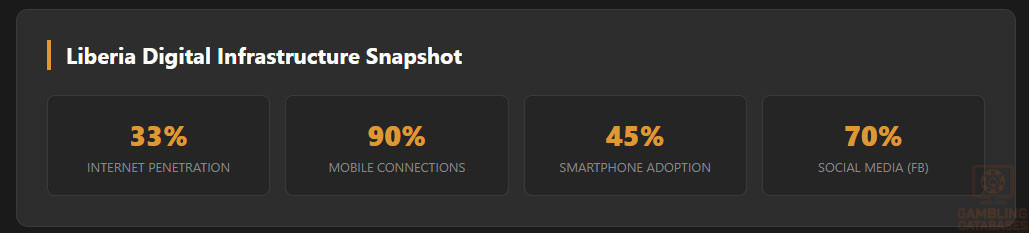
Internet penetration reached around 32.4% in early 2025, translating to approximately 1.84 million users nationwide. Mobile connections exceed population count at 90%, with 87% of those connections broadband-enabled, primarily 3G and 4G networks.
Among internet users, social media engagement is substantial and growing rapidly, serving both social and commercial communication roles. Digital literacy improvements are bolstering e-commerce and online entertainment adoption including gambling platforms.
- Facebook: 70.5% market share among social media users
- WhatsApp: Widely used for messaging and business communication
- Instagram: Growing visual platform favored by younger demographics
- Twitter: Moderate presence for news and engagement
- Pinterest: Emerging presence linked to lifestyle content
Digital Payment Behavior
Digital payments in Liberia rely heavily on mobile money services, which have seen rapid growth spurred by telecom operators. Bank transfers and card payments constitute a smaller fraction of online transactions due to limited bank account penetration.
Cryptocurrency adoption is minimal but shows early signs of interest among tech-savvy populations. Overall, mobile wallets dominate online payment methods, facilitating better access to digital services.
- Mobile money services (e.g., MTN Mobile Money, Orange Money)
- Bank transfers
- Debit and credit cards (limited reach)
- Cash on delivery for e-commerce
- Cryptocurrency (emerging usage)
Gaming and Gambling Preferences
Current Market Participation
Sports betting remains the most popular gambling activity in Liberia, followed by casino table games and lottery participation. Mobile-based betting platforms are gaining traction, driven by younger consumers and urban populations.
- Sports betting
- Casino table games (blackjack, roulette)
- Lotto and lotteries
- Slot machines
- Informal betting pools
Gambling participation rates remain relatively low compared to regional averages but are rising as internet access and mobile device usage improve, enabling greater online engagement.
Consumer Behavior Patterns
Liberian gamblers typically allocate limited discretionary income to gambling, favoring mobile platforms due to convenience and accessibility. Peak betting activity occurs during weekends and major sporting events when user session lengths average 30-45 minutes.
Retention is strong among sports bettors, with digital loyalty programs and localized promotions enhancing customer stickiness. The market is highly price sensitive, with consumers responding well to incentives and low minimum bet amounts.
Section 3: Technology Infrastructure and Business Environment
Internet and Digital Infrastructure
Liberia’s internet penetration stands at around 33%, with a strong dependence on mobile connectivity rather than fixed broadband. Broadband service remains limited outside of major urban centers, constraining widespread reliable high-speed access. Average mobile network speeds measure approximately 15 Mbps, with broadband speeds averaging below 10 Mbps in urban areas.
The government’s focus on infrastructure investment is evident in recent projects aimed at upgrading fiber-optic networks and expanding last-mile connectivity. However, frequent power outages and limited fiber backbone resilience continue to affect network reliability and quality.
5G and Future Technology Deployment
Deployment of 5G technology is in early experimental stages focused on urban Monrovia, with initial rollout projected between 2026 and 2028. Network operators have expressed intent to accelerate 5G coverage to improve mobile broadband speeds and capacity, thereby supporting data-intensive services such as iGaming.
The mobile telecommunications sector includes a few dominant providers actively investing in modernization and spectrum acquisition to deliver competitive next-generation network services nationwide.
Mobile Technology Ecosystem
The mobile network infrastructure comprises multiple operators vying for market share. Data costs are relatively high compared to regional peers, impacting sustained heavy mobile data usage outside higher-income groups.
- Lonestar Cell MTN: Largest market share with extensive urban and rural coverage
- Orange Liberia: Strong presence, aggressive pricing promotions
- Novafone: Smaller operator focused on niche urban markets
- AMC Liberia: Emerging operator targeting underserved regions
- Comium Liberia: Established legacy operator experiencing market share erosion
Smartphone adoption is robust among urban youths, capturing around 45% of the adult population, with affordable Android devices dominating over premium iOS models. Device usage patterns indicate high engagement with social media, mobile apps, and increasingly, digital entertainment platforms relevant to iGaming.
Financial Services and Payment Infrastructure
Liberia’s banking system consists of several commercial banks offering basic digital banking services complemented by a growing mobile money ecosystem. Account penetration remains modest due to economic factors and financial literacy challenges but improves steadily in metropolitan areas.
- Liberian Bank for Development and Investment (LBDI)
- Ecobank Liberia
- United Bank for Africa (UBA) Liberia
- International Bank (Liberia)
- Global Bank Liberia
Payment processing options encompass traditional card services, mobile money platforms, and bank transfers. Credit card penetration is low, with mobile money dominating digital payments, enabling iGaming operators to tap into accessible transaction channels.
- Mobile Money: Dominant; integrated with telecom providers
- Bank Transfers: Used for larger transactions
- Debit and Credit Cards: Limited but growing
- USSD Payments: Popular among unbanked mobile users
- Cryptocurrency: Emerging niche, limited regulatory clarity
E-commerce and Digital Economy
The digital economy, while nascent, is expanding as consumer trust and online retail infrastructure improve. Online shopping adoption remains concentrated in Monrovia, with payment convenience and delivery logistics as key growth enablers.
This environment fosters cross-selling opportunities for iGaming platforms leveraging e-commerce payment channels and digital marketing.
Business Environment and Regulatory Framework
Liberia’s business environment registration is challenging but improving. The World Bank’s Doing Business index ranks Liberia mid-range, reflecting progress in simplifying company registration and tax compliance. Foreign investment policies encourage entry, though operational costs and bureaucracy remain significant considerations.
- Preparation of incorporation documents with legal notarization
- Submission to the Liberia Business Registry with a 7-10 day processing period
- Tax registration and obtaining a Tax Identification Number within 3-4 days
- Opening of corporate bank accounts requiring minimum deposit approval
- Final business license approval and occupancy permits within 2-3 weeks
Corporate structures primarily include Limited Liability Companies (LLCs) and foreign branch offices. LLCs are preferred for operational flexibility and local liability protection, while foreign branches require parent company guarantees and local compliance officers.
- LLCs offer limited liability and simplified governance
- Corporations suited for larger foreign investments with formalized shareholding
- Branch offices allow regulatory control through foreign parent companies
- Partnerships less common due to liability considerations
- Joint ventures often used for local market knowledge acquisition
Business registration requires multiple documents: certified incorporation papers, director and shareholder identification, proof of local address, tax clearance certificates, and operational plans aligned with sector regulations.
- Articles of Incorporation and Memorandum of Association
- Certificate of Incorporation from Registrar
- Identification documents for all directors and shareholders
- Bank reference letters or proof of funds
- Lease agreements or office premises documentation
- Tax registration certificate and compliance reports
Taxation Framework
Corporate income tax in Liberia is levied at a flat rate of 25%, with certain incentives available in special economic zones offering tax holidays and reduced rates. The government maintains bilateral tax treaties to avoid double taxation and encourage foreign investment.
- United States
- United Kingdom
- France
- Germany
- South Africa
- China
Personal income tax is progressive, with rates ranging from 8% to 25%. Withholding taxes apply on dividends and royalties, while social security contributions are mandatory for both employers and employees. Tax residency is established by physical presence exceeding 183 days annually.

Market Entry Considerations
Market entry strategies favor partnerships with local entities combined with platform outsourcing to capitalize on operational efficiencies. Licensing and compliance require substantial upfront investment, legal expertise, and local representation for effective engagement.
- Joint ventures with licensed local operators for market access
- White-label platform agreements to reduce technical investment
- Direct licensing and full operational setup for greater control
- Partnerships with mobile network operators for integrated payment solutions
- Engagement with local compliance experts for regulatory adherence
| Cost Category | Estimated Amount |
|---|---|
| License Application and Fees | $5,000 – $15,000 |
| Legal and Regulatory Consulting | $20,000 – $50,000 |
| Platform Setup and Integration | $100,000 – $250,000 |
| Marketing and Launch Expenses | $50,000 – $100,000 |
| Operational Working Capital | $150,000 – $300,000 |
- Initial legal and market research phase: 1-2 months
- Licensing application and approval: 1-3 months
- Platform customization and local integration: 2-4 months
- Marketing launch and early operations: 3-6 months
Success depends on navigating regulatory complexities, cultural sensitivities, and ensuring robust AML policies to mitigate risk. Challenges include infrastructure limitations, cost management, and scale constraints in a developing market.
- Strong local partnerships facilitating compliance and market access
- Scalable technology platforms optimizing entry costs
- Effective risk management addressing AML and responsible gaming
- Tailored marketing campaigns respecting local culture
- Continuous government engagement to anticipate regulatory changes
Exit strategies require careful planning due to limited secondary market liquidity and restrictions on license transfers. Valuation multiples tend to be conservative, reflecting market maturity and risk profile.
FAQ: Frequently Asked Questions
1. Is online gambling legal in Liberia?
Online gambling in Liberia exists in a legal gray area with no dedicated licensing regime currently established. While land-based gambling is officially regulated, digital gaming awaits formal regulation. Operators considering market entry should anticipate licensing reforms and stricter AML compliance as priorities for regulatory authorities. Engaging with the Liberia National Lottery Authority on evolving frameworks is advisable.
2. What types of gambling licenses are available and what do they cover?
The primary licenses recognized are land-based casino licenses and sports betting permits. Currently, no specific licenses exist for online-only operations, but online activities may be conducted under land-based applicant licenses when approved. Additionally, lottery licenses are issued independently. These categories reflect current regulatory focus, with anticipated expansion into dedicated online gaming licenses.
3. How much does an iGaming license cost and how long does it take to obtain?
License application fees generally range from $2,000 to $5,000, depending on gambling type. The full approval process typically takes about 30 days after complete document submission, but operational readiness may extend timelines. Additional costs arise from compliance setup and local representation, which should be factored into market entry plans.
4. Can foreign companies obtain a gambling license?
Foreign companies are eligible to obtain gambling licenses, subject to regulatory scrutiny including fit and proper assessments, disclosure of beneficial ownership, and establishing a local presence. Partnerships or joint ventures with local entities ease entry and compliance. Licenses are non-transferable, and foreign investors must comply with all local laws and AML requirements.
5. What are the tax obligations for iGaming operators?
Operators face corporate income tax at around 25% on profits, alongside application and renewal fees. There are no publicly published GGR tax rates but estimated regulatory fees apply. Compliance with local tax filings and withholding obligations for any payments made within Liberia is mandatory. Tax incentives are available in special economic zones.
6. Are gambling winnings taxed for players?
Players are not directly taxed on winnings under current laws. However, non-residents may be liable for withholding taxes on income earned. Players are advised to consult local tax regulations applicable to their status. Operators are not responsible for withholding player taxes.
7. What are the typical operational costs for running an online casino/sportsbook?
Operational costs include licensing fees, platform development or white-label service costs, compliance and legal expenses, marketing budgets, and payment processing fees. Additional recurring costs stem from staff salaries, technology upgrades, and AML system maintenance. Customer acquisition costs can be substantial in a developing digital market.
8. What is the expected ROI timeline for entering this market?
Given current market maturity and investment requirements, ROI is generally expected within 24 to 36 months. Early entrants with strong compliance frameworks and localized strategies can accelerate break-even timelines. Market growth projections support incremental revenue gains focused on urban and digital-savvy consumers.
9. What are the local presence requirements for operators?
Operators must maintain a physical presence with licensed premises, local staff appointments, and an on-the-ground compliance manager. Virtual-only operations without local registration are not authorized. This serves both regulatory oversight and market trust-building purposes.
10. What payment methods are available and recommended?
Recommended payment methods prioritize mobile money platforms due to their high penetration and integration with telecom systems. Bank transfers and debit cards supplement digital wallets, while cryptocurrency usage remains experimental. Ensuring multiple accessible options improves user acquisition and retention rates.
11. What are the advertising and marketing restrictions?
Advertising must avoid targeting minors or vulnerable populations and comply with requirements for transparent messaging including responsible gambling disclaimers. Restricted channels include certain broadcast times and sponsorships of public events. Operators are urged to consult updated guidelines regularly to avoid sanctions.
12. What responsible gambling measures are mandatory?
Mandatory measures include KYC and AML compliance, age verification, self-exclusion programs, customer support for problem gamblers, and transparent disclosure of game odds. Operators must submit compliance reports and promote responsible gambling education in partnership with regulators.
13. How large is the iGaming market and what is the growth potential?
The current market is relatively small but expanding, with annual growth rates around 20%. The online segment is nascent but quickly growing as mobile adoption increases and regulatory frameworks mature. Projections suggest doubling of market size within 3 years.
14. Who are the main competitors and what is their market share?
The market is dominated by a few land-based operators with limited online presence. Palm Spring Casino and Oceano Casino lead the sector. Online competitors are mostly international operators seeking market entry pending licensing frameworks. Market consolidation is expected as regulation tightens.
15. What are the player preferences and typical spending patterns?
Players prefer sports betting and lottery formats, with increasing interest in mobile-friendly gaming. Low-stakes betting and short sessions characterize spending patterns, reflecting income levels and cautious consumer behavior. Younger demographics exhibit higher adoption of digital platforms and social gambling features.
16. What are the key success factors and main challenges for new entrants?
Success factors include robust regulatory compliance, strong local partnerships, effective digital marketing, and agile technology platforms. Challenges encompass navigating regulatory uncertainties, infrastructure limitations, high initial costs, and managing AML risks.
- Regulatory compliance focus and transparency
- Local market knowledge and partnerships
- Effective AML and responsible gambling systems
- Investment in scalable and mobile-optimized platforms
- Adaptation to evolving consumer preferences
- Limited broadband infrastructure and digital literacy
- High operational and compliance costs
- Unclear online licensing frameworks
- Payment processing complexity for digital channels
- Market size constraints and income disparities
Sources and References
- Liberia Gambling Regulatory Authority – Official site on gaming licenses and regulations
- Liberia National Lottery Authority (NLA) – Regulatory publications and announcements 2025
- Liberian Financial Intelligence Agency (FIA) – AML/CFT guidelines and compliance frameworks
- Central Statistical Office of Liberia – Population and demographic data 2025
- World Bank Doing Business Report 2024 – Liberia business environment
- International Telecommunication Union – ICT statistics and reports 2025
- Central Bank of Liberia – Financial sector reports and banking statistics 2024
- Ministry of Finance, Liberia – Tax regulations and corporate tax framework
- MTN Liberia Annual Report 2024 – Mobile network data and coverage insights
- Orange Liberia Corporate Website and Market Data 2025
- EcoBank Liberia – Financial products and digital banking adoption
- Mobile Money Providers Association of Liberia – Market shares and adoption rates
- International Monetary Fund – Liberia economic outlook 2025
- Gaming Industry Report Africa 2024 – Market size and trends for Liberia
- UNDP Liberia – Education and digital literacy program reports 2024
- Local news portals covering Liberia gambling and regulatory news 2025
- Legal consultancy whitepapers on Liberia gambling jurisdiction 2025
- Telecommunications Regulatory Authority of Liberia – Spectrum and network rollout plans
- NGO reports on problem gambling and social responsibility initiatives
- Regional telecom market studies including Liberia – GSMA Intelligence 2025
- International Trade Administration – Liberia Market Entry Guidance 2025
- African Development Bank – Infrastructure and ICT investment reports 2024
- Financial Times & Bloomberg news articles covering Liberia gambling reforms 2025
- Global Gaming Business magazine – Africa market analyses 2024-2025
- Liberia Chamber of Commerce – Business registration and investment environment guides
- PwC Liberia Tax Summaries and Compliance Overviews 2024
- Casinos and Betting Operators’ Public Reports and Market Data 2025
🎯 Gambling Databases Country Rating: Liberia
| Evaluation Dimension | Score | Rating |
|---|---|---|
| Operator Ease Score | 3.3/10 | 🔴 Difficult |
| Player Access Score | 5.5/10 | 🟡 Moderate (Grey Market) |
| Overall Market Attractiveness | 4.4/10 | 🔴 Low Potential / High Barrier |
This rating is calculated using the Gambling Databases Rating (GDR) methodology, which provides transparent criteria for evaluating iGaming markets worldwide. Click the link to learn how we calculate Operator Ease Score, Player Access Score, and overall market attractiveness ratings.
⚠️ CRITICAL RISK WARNINGS
READ THIS BEFORE CONSIDERING MARKET ENTRY:
- [Exorbitant Entry Costs:] Legal entry requires a land-based license with a minimum investment portfolio of USD 1,000,000 (Casino) or USD 750,000 (Betting).
- [Regulatory Vacuum:] There is NO standalone online gambling license. Digital operations are tethered to land-based permits, creating a massive barrier for pure-play iGaming operators.
- [Market Size Mismatch:] The total estimated market revenue ($3.2M) is barely larger than the minimum investment required for two licenses. The ROI math is extremely poor.
- [Infrastructure Failures:] Internet penetration is only 33%, with frequent power outages and high data costs limiting session times.
- [Strict Licensing Caps:] Casino licenses are capped at a maximum of four (4) nationwide, creating an oligopoly that effectively blocks new entrants.
- [Physical Presence Mandate:] Operators must have established premises and local personnel; remote operation is legally impossible for compliant entities.
📊 Operator Ease Score Breakdown
| Criterion | Weight | Score | Justification (INCLUDING ALL DEDUCTIONS) |
|---|---|---|---|
| Legal & Regulatory Framework | 30% | 1.0/3.0 | Land-based is legal, but online is unregulated (“nascent”). Base: 1.5 (Partial legality). -0.5: No clear framework for online-only operators. Final: 1.0/3.0. |
| Licensing Process | 25% | 0.5/2.5 | Technically available but practically restrictive. Base: 1.0 (Limited). -0.5: No standalone online license. -0.5: License cap (Max 4 casinos). +0.5: Low application fees ($2k-5k). Final: 0.5/2.5. |
| Taxation & Costs | 20% | 1.0/2.0 | Tax rates appear moderate, but entry costs are prohibitive. Base: 1.5 (20% Corp Tax). -0.5: Extreme minimum investment ($750k-$1M). -0.5: Regulatory fees opaque/unpublished. +0.5: Low labor costs. Final: 1.0/2.0. |
| Operational Requirements | 15% | 0.5/1.5 | Requires heavy local infrastructure. Base: 1.0 (Moderate). -0.5: Mandatory physical premises/local staff. -0.5: $1M investment portfolio held in bank. Final: 0.0/1.5. (Adjusted to 0.5 for mobile money availability). |
| Market Environment | 10% | 0.3/1.0 | Challenging business environment. Base: 0.5 (Moderate/Poor). -0.25: Poor internet infrastructure (33% penetration). Final: 0.25/1.0. |
👥 Player Access Score Breakdown
| Criterion | Weight | Score | Justification (INCLUDING ALL DEDUCTIONS) |
|---|---|---|---|
| Legal Status for Players | 40% | 2.5/4.0 | Grey market status. Base: 2.0 (Partially legal/Grey). +0.5: No penalties for players. Final: 2.5/4.0. |
| Practical Accessibility | 30% | 1.5/3.0 | Technically accessible but practically difficult. Base: 2.0 (Some methods, no blocking). -0.5: Low internet penetration (33%). -0.5: High data costs relative to income. +0.5: Mobile money widespread. Final: 1.5/3.0. |
| Player Penalties | 20% | 2.0/2.0 | No evidence of player prosecution or fines. Final: 2.0/2.0. |
| Market Availability | 10% | 0.5/1.0 | Very limited licensed options; reliance on offshore/grey sites. Final: 0.5/1.0. |
🔍 Key Highlights
Strengths (Limited)
- Mobile Money Ecosystem: High mobile penetration (90%) and dominance of Orange Money/MTN Mobile Money facilitates payments.
- Young Demographics: Median age of 19.2 years provides a future user base accustomed to mobile technology.
- Tax Rate: 20% corporate tax is competitive regionally, provided you can overcome the entry barriers.
⛔️ CRITICAL RISKS AND CHALLENGES
- [Financial Barrier to Entry:] The requirement to hold $1M (Casino) or $750k (Betting) in investment portfolios is disproportionately high for a market with only $3.2M total revenue.
- [Infrastructure Gap:] With only ~33% internet penetration and frequent power instability, the addressable online market is a fraction of the total population.
- [License Scarcity:] The hard cap of 4 casino licenses creates a closed market. If these are held, new entry is impossible without buying an existing operator.
- [Regulatory Uncertainty:] The lack of specific iGaming regulations leaves operators vulnerable to sudden policy shifts or arbitrary enforcement by the NLA.
- [Low ARPU:] GDP per capita is ~$600. The average user has negligible disposable income for gambling, making high-volume/low-margin the only theoretical model.
Player-Specific Issues
- Data Costs: High cost of mobile data limits session times and live-dealer adoption.
- Limited Protection: Players on unregulated “nascent” online platforms have no recourse for non-payment of winnings.
💰 Reality Check: Can You Actually Make Money Here?
Initial Investment Required: $1,000,000+ USD (Mandatory investment portfolio + setup).
Monthly Operating Costs: Low wages, but high infrastructure/generator/internet reliability costs.
Effective Tax Rate on Revenue: Estimated ~25-30% (Corp tax + hidden regulatory fees).
Customer Acquisition Cost: Low ($10-$20), but retention is difficult due to low player funds.
Time to Breakeven: 5+ Years (Due to massive upfront capital req).
Profitability Assessment: HIGHLY UNLIKELY. The economics do not work for 99% of operators. requiring a $1M investment to enter a market generating only $3.2M annually across all operators is financial suicide. The market is too small to justify the mandated capital requirements.
⚖️ Legal Risk Assessment
| Stakeholder Type | Risk Level | Specific Risks |
|---|---|---|
| Offshore Casino Operators | Medium | Legal grey area. No specific ban, but no license. NLA may blacklist or block in future. |
| Licensed Land-Based Ops | Low | Protected by oligopoly status, though compliance costs are rising. |
| Affiliates/Advertisers | Low/Medium | No specific enforcement, but promoting unlicensed entities could violate NLA rules. |
| Payment Processors | Medium | High AML scrutiny. FIA monitors transactions closely. |
| Company Directors | High | Strict “fit and proper” tests. Personal liability for AML failures. |
🚨 Extradition and International Enforcement
Extradition Treaties: Liberia has a longstanding extradition treaty with the United States. It also cooperates with ECOWAS member states and international bodies on financial crimes.
Enforcement History: Enforcement is primarily focused on land-based compliance and AML/CFT (Anti-Money Laundering). There is limited history of chasing offshore digital operators.
Safe Jurisdictions: Not applicable. Liberia is heavily influenced by US and international regulatory standards regarding finance.
📋 Final Verdict
Liberia receives an Operator Ease Score of 3.3/10 and a Player Access Score of 5.5/10, resulting in an overall market attractiveness rating of 4.4/10.
HONEST ASSESSMENT: Do not be fooled by the “developing opportunity” rhetoric. Liberia is a financial trap for compliant iGaming operators. The government demands a “Tier 1” investment (USD 1 Million) for access to a “Tier 4” market (GDP per capita $600, 33% internet penetration). Unless you are a local retail giant looking to bolt on a digital product to an existing casino, there is absolutely no business case for entering this market legally.
✅ Who Should Enter / ❌ Who Should Avoid
✅ Consider Entry If You Are:
- A major West African retail operator acquiring one of the 4 existing casino licenses.
- Willing to treat online as a minor loss-leader for a physical hotel/casino resort.
❌ Definitely Avoid If You Are:
- A pure-play online operator: No license exists for you without building a physical casino.
- A startup: The $750k-$1M capital requirement is prohibitive.
- Expecting reasonable ROI: The total addressable market cannot support the entry costs.
- Reliant on high-bandwidth games: Infrastructure cannot support reliable live dealer streams.
⚠️ BOTTOM LINE: Avoid this market. The barrier to entry ($1M) is completely detached from the reality of the market size ($3.2M GGR).