Albania presents an emerging iGaming opportunity following the 2024 regulatory shift that ended a five-year gambling ban and reintroduced online sports betting under strict licensing controls. With a population of 2.78 million, GDP per capita of approximately $5,700, and internet penetration exceeding 85 percent, the market demonstrates growing digital readiness.
The new framework limits licenses to just ten operators, creating a controlled competitive environment with significant entry barriers but substantial growth potential for qualified international operators.
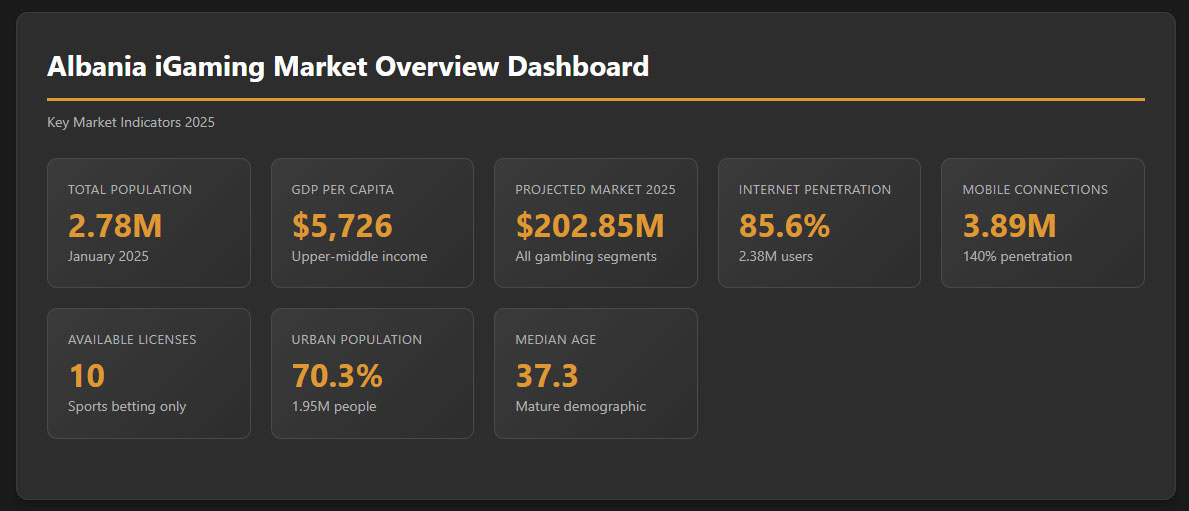
Executive Summary: Key Market Indicators
| Indicator | Value | Notes |
|---|---|---|
| Online Gambling Legal Status | Legal (Sports Betting Only) | Reinstated March 2024 |
| Number of Licenses Available | 10 licenses total | Competitive application process |
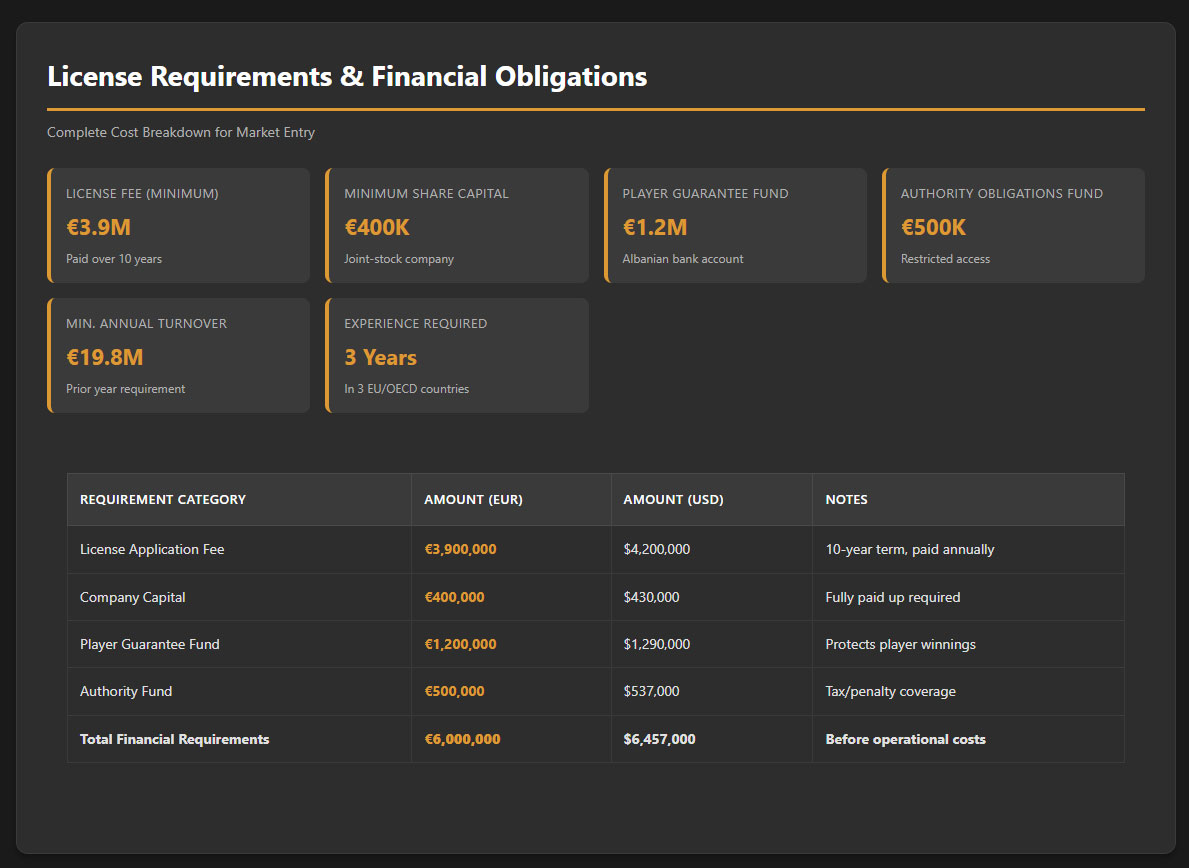
| License Fee | Minimum 400 million ALL | Approx. €3.9 million / $4.2 million |
| License Duration | 10 years | From issuance date |
| Minimum Share Capital | 40 million ALL | Approx. €400,000 / $430,000 |
| Experience Required | 3 years in 3 EU/OECD countries | Or via major shareholder |
| Minimum Annual Turnover | 2 billion ALL | Approx. €19.8 million / $21.3 million |
| Player Guarantee Fund | 120 million ALL | Approx. €1.2 million / $1.29 million |
| Authority Obligations Fund | 50 million ALL | Approx. €500,000 / $537,000 |
| Total Population | 2.78 million | January 2025 |
| Urban Population | 70.3% | 1.95 million people |
| Median Age | 37.3 years | Mature demographic profile |
| GDP (Nominal 2025) | $26.9 billion | 3.4% projected growth |
| GDP Per Capita | $5,726 – $9,474 | Various sources, growing trend |
| Internet Penetration | 85.6% | 2.38 million users |
| Mobile Connections | 3.89 million | 140% penetration rate |
| 4G/5G Coverage | 85.5% broadband connections | Growing 5G deployment |
| Social Media Users | 1.41 million | 50.7% of population |
| GGR Tax Rate | 15% on profit | All gambling categories |
| Corporate Income Tax | 15% up to €135,000 | 23% above threshold |
| Player Winnings Tax | 15% | Withholding at payout |
| Minimum Player Age | 21 years | Strictly enforced |
| Advertising Restrictions | Prohibited in print/audiovisual | Strict limitations |
| Payment Methods | Digital only via financial agents | Cash transactions prohibited |
| Local Presence Required | Joint-stock company in Albania | Mandatory registration |
| Data Retention | 3 years minimum | Player and transaction data |
| Market Revenue 2024 | $9.79 million (online) | Growing segment |
| Projected Market Revenue 2025 | $202.85 million (total) | All gambling segments |
| Expected CAGR 2025-2029 | 3.43% – 4.59% | Varies by source |
| Estimated Annual Gambling Spend | €500-700 million | Historical estimates |
Section 1: Regulatory Framework and Legal Environment
Current Gambling Regulation Status
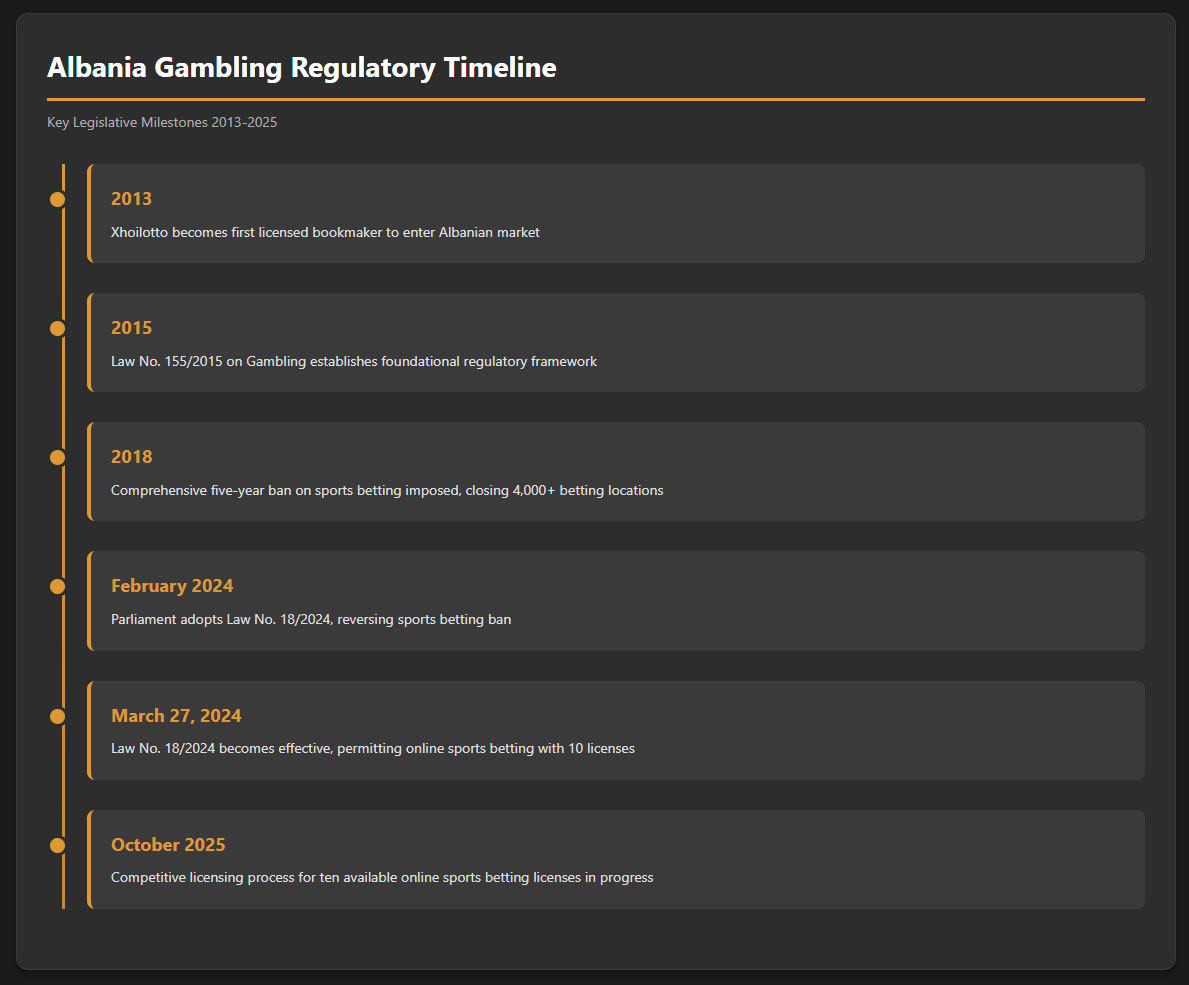
Albania underwent a dramatic regulatory transformation in early 2024 when Parliament adopted Law No. 18/2024 on February 15, amending the foundational Law No. 155/2015 on Gambling. This legislation, effective March 27, 2024, reversed a comprehensive five-year ban on sports betting that had been imposed in 2018. The regulatory shift represents a strategic government decision to bring underground gambling activity into a controlled, taxed, and monitored framework rather than maintaining an ineffective prohibition.
The current legal framework is highly restrictive, permitting only online sports betting under stringent licensing conditions while maintaining the ban on land-based betting shops. This creates a unique market structure where digital operations are the sole legal avenue for sports wagering, distinguishing Albania from most European jurisdictions that allow both land-based and online betting.
Land-Based Gambling Activities
Land-based gambling in Albania remains severely restricted following the 2018 reforms. Casino operations are exclusively permitted within five-star hotels and resort areas, creating an elite, tourism-focused gambling environment. The casino licensing fee structure reflects this premium positioning, with standard licenses costing 1 billion ALL (approximately €9.7 million or $10.4 million) for a 10-year period, while resort area establishments benefit from reduced fees of 70 million ALL (approximately €680,000 or $730,000).

Television bingo represents another permitted land-based gambling category, requiring a 10-year license fee of 40 million ALL (approximately €388,000 or $417,000). The state-operated national lottery continues to function as a monopoly offering. Sports betting venues and slot machine halls, which numbered over 4,000 locations before the 2018 ban, remain prohibited in physical form, with all sports betting activity now channeled exclusively to licensed online platforms.
Online Gambling Framework
The online gambling framework introduced in 2024 is narrowly focused on sports betting, representing a cautious regulatory approach to digital gambling. Only ten licenses will be issued for online sports betting operations, distributed through a competitive application process overseen by the newly established License Commission. This artificial scarcity creates significant value for successful applicants while allowing authorities to maintain tight control over market participants.
Online casino games, poker rooms, bingo, and other digital gambling products remain explicitly prohibited under current legislation. The government has indicated no immediate plans to expand the scope of permitted online gambling activities, maintaining sports betting as the sole authorized digital gambling category. This restriction reflects ongoing concerns about gambling addiction, money laundering, and social impacts that drove the original 2018 prohibition.
The regulatory authority structure combines oversight from the Ministry of Finance with operational enforcement by the Gambling Supervisory Authority (restructured following the 2018 reforms). The License Commission functions as a specialized collegial body specifically responsible for evaluating license applications, monitoring ongoing compliance, and making decisions regarding license renewals, suspensions, or revocations.
Licensed Operators and Market Players
As of October 2025, the competitive licensing process for the ten available online sports betting licenses is in various stages of completion. The market structure before the 2018 ban included approximately 10 licensed casino operators, 6 bookmakers, and 4 bingo operators, alongside the national lottery. However, the five-year prohibition eliminated most of these operators from the Albanian market.
International operators with regional Balkan experience are expected to dominate the new licensing round, given the stringent requirements for prior gambling experience in EU or OECD countries and minimum turnover thresholds. The licensing criteria effectively exclude small, inexperienced operators while favoring established European gambling companies with demonstrated track records and substantial financial resources.
The previous land-based market leader, Xhoilotto, was the first licensed bookmaker to enter the Albanian market in 2013 and maintained significant market presence until the 2018 closure. Whether existing pre-ban operators can successfully transition to the new online-only framework depends on their ability to meet the enhanced capital, experience, and technical requirements introduced in the 2024 legislation.
Market concentration is expected to be high given the limited number of licenses. With only ten operators serving a population of 2.78 million, each licensed operator theoretically serves approximately 278,000 potential customers, creating sustainable market positions if player acquisition and retention strategies prove effective. Competitive dynamics will likely focus on brand differentiation, betting product variety, competitive odds, mobile platform quality, and customer service excellence rather than price competition.

Licensing Framework and Requirements
Application Process and Eligibility
The licensing application process is administered by the License Commission, a specialized body established within the broader regulatory framework of the Gambling Supervisory Authority. The Commission operates as a collegial decision-making entity responsible for evaluating all applications against the statutory criteria and making binding license award determinations. Detailed procedural rules governing the competitive process were expected to be published following the law’s enactment in March 2024.
Applicants must demonstrate substantial gambling industry experience, specifically at least three consecutive years operating gambling activities in a minimum of three countries that are members of the European Union or the Organisation for Economic Co-operation and Development. This experience requirement can be satisfied either directly by the applicant entity or indirectly through a shareholder holding at least 30 percent of the company’s shares. The provision for shareholder experience creates opportunities for financial investors to partner with experienced operators.
Financial viability requirements are stringent. Applicants must document gambling-related turnover of at least 2 billion ALL (approximately €19.8 million or $21.3 million) in the most recent financial year prior to application. This substantial revenue threshold ensures that only established, financially stable operators with proven business models can enter the Albanian market. Supporting financial documentation, including audited financial statements and revenue verification from gambling regulatory authorities in operating jurisdictions, is mandatory.
The license fee structure employs a competitive bidding mechanism. While the minimum license fee is set at 400 million ALL (approximately €3.9 million or $4.2 million), the actual fee paid by successful applicants equals the amount offered during the competitive process, provided it meets or exceeds this floor. License fees are payable in equal pro rata installments throughout the 10-year license term, reducing the immediate capital burden on new entrants while ensuring sustained financial commitment.
Local Presence and Operational Requirements
All licensed operators must establish legal presence in Albania as joint-stock companies registered under Albanian commercial law. This mandatory local incorporation requirement ensures operators are subject to Albanian corporate governance, taxation, and regulatory oversight. The minimum share capital for the joint-stock company is 40 million ALL (approximately €400,000 or $430,000), which must be fully paid up prior to license issuance.
Shareholders and senior management must satisfy rigorous fit and proper standards. All shareholders, regardless of ownership percentage, must be free from criminal convictions and provide documentation verifying the source of their capital investment. This anti-money laundering provision requires comprehensive beneficial ownership disclosure and background screening. Criminal record checks from all jurisdictions where shareholders and executives have resided during the previous ten years are standard requirements.
Operators must demonstrate administrative, organizational, and technical reliability capacities. This includes maintaining adequate staffing, implementing appropriate corporate governance structures, and deploying robust technical systems for platform operations, player management, responsible gambling tools, and regulatory reporting. A binding agreement with a technology provider for the necessary programs, systems, websites, and applications concerning online sports betting must be documented before license approval.
Domain and hosting requirements mandate that all player-facing platforms operate on servers and infrastructure that enable real-time monitoring by Albanian regulatory authorities. While the law does not explicitly require servers to be physically located in Albania, the platform architecture must provide the Gambling Supervisory Authority with continuous access to all transaction data, betting records, and player activities through secure technical interfaces.
Compliance Obligations and Monitoring
Player Protection and Identification
Player registration requirements are comprehensive. All individuals seeking to open betting accounts must register using their own personal data, including full legal name, date of birth, national identification number, residential address, and contact information. The minimum age for gambling participation is 21 years, strictly enforced through mandatory identity verification at account creation. Age verification must be completed before any deposits are accepted or bets are placed.
Know Your Customer and Anti-Money Laundering compliance obligations align with European standards. Operators must implement robust customer due diligence procedures, including identity document verification, address confirmation, and source of funds checks for high-value depositors. Enhanced due diligence applies to politically exposed persons and customers exhibiting unusual transaction patterns or behaviors indicative of money laundering risks.
Responsible gambling measures are mandated by law but specific implementation requirements remain subject to secondary regulations. Industry best practices suggest Albanian operators will need to provide deposit limits, loss limits, session time restrictions, reality checks, self-exclusion tools, and cooling-off periods. Mandatory player information disclosures must include responsible gambling messaging, links to problem gambling support resources, and clear explanations of odds, risks, and the statistical probability of losses.
A centralized self-exclusion system is expected to be implemented, allowing players to ban themselves from all licensed operators simultaneously. Self-exclusion requests must be honored immediately and maintained for specified periods, with robust technical controls preventing self-excluded individuals from creating new accounts or accessing betting services during their exclusion period. Operators must also monitor player behavior for signs of problem gambling and intervene with appropriate support measures when concerning patterns emerge.
Financial Monitoring and Reporting
Transaction monitoring systems must capture and record all financial activities, including deposits, withdrawals, bets placed, winnings paid, bonuses awarded, and any other fund movements. These records must be maintained in electronic format accessible for regulatory inspection for a minimum of three years from the transaction date. The centralized online monitoring system operated by the Gambling Supervisory Authority requires real-time connectivity from all licensed operators.
Audit and inspection procedures grant regulatory authorities broad powers to examine operator records, interview staff, test systems, and verify compliance with all licensing conditions. Unannounced inspections are permitted, and operators must provide immediate access to all premises, systems, and records upon request. Independent third-party technical audits of random number generators, payout percentages, and system security may be required periodically at operator expense.
The guarantee funds required from operators serve multiple protective functions. The 120 million ALL player guarantee fund ensures sufficient liquidity to pay all player winnings even if the operator experiences financial difficulties. The 50 million ALL authority obligations fund covers potential tax liabilities, regulatory fees, and penalties. Both funds must be maintained in designated Albanian bank accounts with restricted access, requiring regulatory approval for any withdrawals.
Taxation Structure and Financial Obligations
Player Taxation
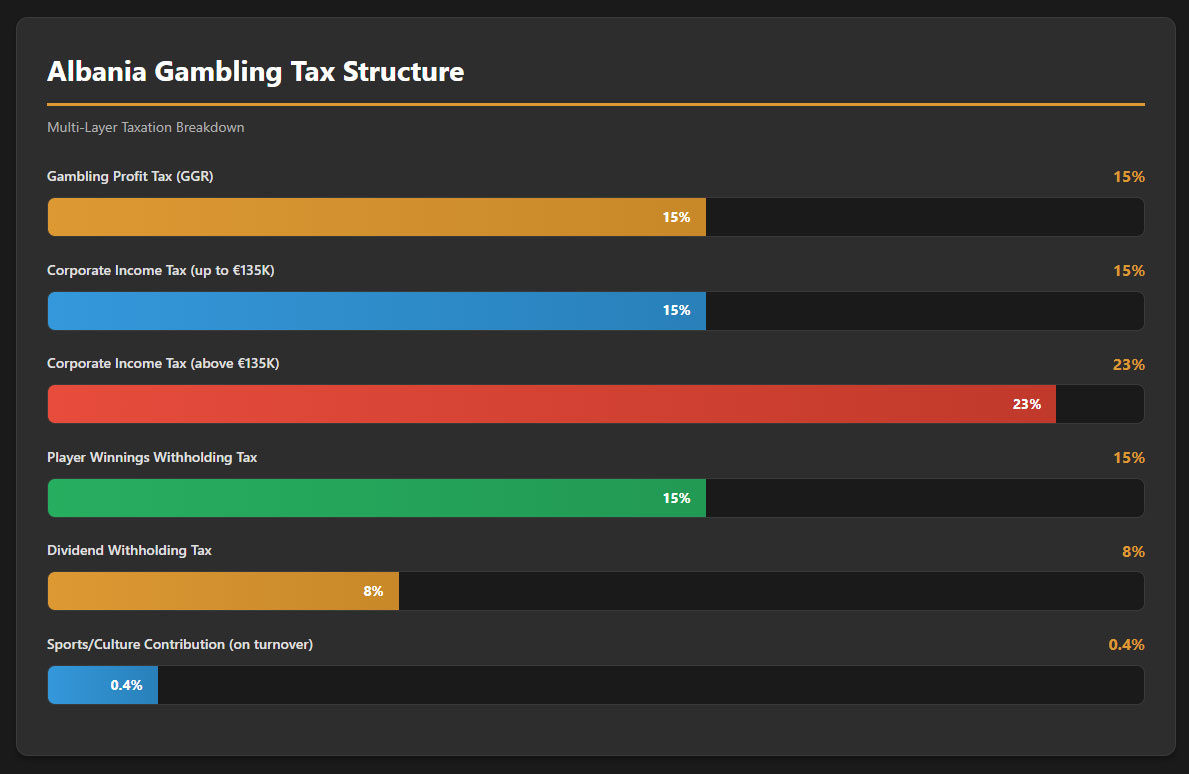
Albanian players face taxation on gambling winnings under the country’s income tax regime. The standard withholding tax rate on gambling winnings is 15 percent, deducted directly at payout by the operator. This withholding applies to all categories of gambling income, including sports betting winnings, casino payouts, lottery prizes, and any other gambling-derived income.
The 15 percent withholding tax is applied without deduction of costs or losses, meaning the gross amount won is taxed regardless of how much the player wagered to achieve that win. For example, a player who wagers €1,000 and wins €1,500 pays 15 percent tax on the full €1,500 winnings, not on the €500 net profit. This tax treatment is less favorable than jurisdictions that allow offset of losses against winnings.
Players with substantial annual gambling income may face additional tax declaration requirements. If total annual income, including gambling winnings, exceeds certain thresholds under Albanian personal income tax law, players must include their gambling earnings in their annual tax returns. However, since the 15 percent tax has already been withheld at source, additional tax liability is unlikely unless the player has other income sources that push them into higher tax brackets.
Tax-free thresholds for small winnings do not appear to exist under current Albanian law, meaning even modest wins are subject to the 15 percent withholding. This differs from many jurisdictions that exempt smaller prizes from taxation. The operator is responsible for calculating, withholding, and remitting player winnings taxes to the Albanian tax authorities according to prescribed payment schedules.
Operator Taxation
Gambling operators in Albania face a multi-layered taxation structure. The primary gambling-specific tax is levied at 15 percent on the profit of the establishment or site for all categories of gambling. This profit-based taxation differs from the gross gaming revenue taxation common in many European markets, potentially providing more favorable treatment for operators with high operating costs relative to revenues.
Profit for tax purposes is calculated according to standard Albanian accounting principles, allowing deduction of legitimate operating expenses including staff salaries, technology costs, marketing expenses, payment processing fees, and license fees. The ability to deduct expenses before calculating the 15 percent gambling tax creates incentives for operators to invest in quality infrastructure, personnel, and responsible gambling programs.
Corporate income tax applies in addition to gambling-specific taxation. Under the Albanian Income Tax Law effective from January 2024, companies with annual taxable profits up to 14 million ALL (approximately €135,000 or $145,000) face a 15 percent corporate income tax rate. Profits exceeding this threshold are taxed at 23 percent for the excess amount. This progressive structure benefits smaller operators while ensuring larger, more profitable companies contribute proportionally more to state revenues.
Dividend taxation adds an additional layer. Distributed profits paid to shareholders face an 8 percent dividend tax, withheld at source by the distributing company. For foreign shareholders, international tax treaties may provide relief or credits against home country taxation, but the 8 percent Albanian withholding generally applies unless specifically exempted by treaty provisions.
License renewal fees are built into the initial license fee structure, with the substantial upfront payment covering the full 10-year license term. Annual operational fees or regulatory assessments beyond the initial license fee have not been publicly specified but may be introduced through secondary regulations. Operators should budget for potential additional regulatory fees, supervisory assessments, or contributions to problem gambling funds that could be imposed during the license period.
A special contribution requirement mandates operators contribute 0.4 percent of annual turnover to a fund supporting sports, culture, and technology projects. This social contribution, while relatively modest, represents an additional fixed cost that applies regardless of profitability. The contribution is calculated on gross turnover rather than profit or GGR, making it a consistent expense even during unprofitable periods.
Gambling Market Financial Performance
| Metric | Value | Period |
|---|---|---|
| Estimated Total Annual Gambling Spend | €500-700 million | Historical (pre-2018 ban) |
| Online Gambling Market Value | €50 million | 2022 estimate |
| Projected Online Revenue | $9.79 million | 2024 |
| Projected Total Gambling Revenue | $202.85 million | 2025 |
| Expected Annual Growth Rate (CAGR) | 3.43% – 4.59% | 2025-2029 |
| Estimated Tax Revenue from Sports Betting | €17.5 million annually | Government projection |
The Albanian gambling market historically represented a significant economic activity before the 2018 prohibition. Industry estimates suggested Albanians spent between €500 million and €700 million annually on gambling activities when over 4,000 betting locations operated throughout the country. This substantial expenditure in a nation of fewer than 3 million people indicated strong cultural acceptance of gambling and sports betting in particular.
The five-year ban from 2018 to 2024 did not eliminate gambling activity but rather drove it underground into unregulated channels. Data from the Gambling Supervisory Authority indicated that sports betting continued through informal networks, unlicensed websites, and offshore operators beyond Albanian jurisdiction. This persistence of demand despite legal prohibition motivated the government’s decision to reintroduce regulated sports betting to capture tax revenues and impose consumer protections.
Revenue projections for the newly legalized market vary among research sources. Conservative estimates place 2024 online gambling revenue at approximately $9.79 million, reflecting the initial stages of market development as the first licenses are awarded and platforms launch. More optimistic forecasts project total gambling revenue reaching $202.85 million by 2025, encompassing both the new online sports betting segment and continuing land-based casino and lottery activities.
Growth expectations for 2025-2029 range from 3.43 percent to 4.59 percent compound annual growth rate, depending on regulatory developments, market competition intensity, and broader economic conditions. These moderate growth projections reflect the controlled nature of the market with only ten licenses, balanced against pent-up demand from the five-year prohibition and increasing digital adoption among Albanian consumers.
Advertising and Marketing Restrictions
Albanian gambling advertising regulations are among the strictest in Europe. All gambling advertising in print media and audiovisual media is explicitly prohibited under the current regulatory framework. This comprehensive ban eliminates traditional marketing channels including television commercials, radio spots, newspaper advertisements, magazine placements, and outdoor billboards featuring gambling content.
The prohibition extends to sponsorship arrangements. Gambling operators cannot sponsor sports teams, sporting events, cultural activities, or other public entertainments in ways that create brand visibility or association with gambling products. This restriction significantly limits the marketing strategies available to operators seeking to build brand awareness and acquire customers in the Albanian market.
Digital marketing operates in a regulatory gray area. While the explicit prohibition covers print and audiovisual media, online advertising through search engines, social media platforms, affiliate websites, and email marketing is not specifically addressed in published regulations. Conservative legal interpretation suggests these digital channels may also be restricted under the broad advertising ban, but enforcement practices remain unclear.
Affiliate marketing programs commonly used by European gambling operators face uncertain legal status in Albania. If affiliate websites are deemed to constitute advertising that would otherwise be prohibited in print or audiovisual form, such arrangements could violate the advertising restrictions. Operators should seek specific legal guidance before implementing affiliate strategies to avoid regulatory sanctions.
Content restrictions for permitted marketing communications, if any channels are allowed, would logically prohibit appeals to minors, false or misleading claims about winning probabilities, encouragement of excessive gambling, or associations between gambling and financial success, social status, or sexual attractiveness. Responsible gambling messaging would likely be mandatory in any permitted communications.
The advertising restrictions create significant challenges for new market entrants seeking to build market share and customer bases. Without traditional brand-building tools, operators must rely on word-of-mouth, reputation effects, organic search visibility, superior product offerings, and customer referral programs. The first movers among the ten licensed operators may gain substantial advantages by establishing brand recognition early before competitors enter.
Recent Regulatory Changes and Their Impact
The February 2024 passage of Law No. 18/2024 represents the most significant regulatory change in Albanian gambling policy since the comprehensive 2018 ban. This reversal reflects a pragmatic governmental reassessment of gambling prohibition outcomes versus regulated market approaches. Key factors motivating the change included persistent underground gambling activity, foregone tax revenues, inability to impose consumer protections in illegal markets, and successful regulatory models in neighboring Balkan countries.
The decision to limit online sports betting licenses to just ten operators through competitive selection is a deliberate market structuring choice. This approach contrasts with open licensing systems where any qualified applicant receives authorization. The rationale appears to prioritize regulatory manageability, ensuring only financially sound and experienced operators participate, over market competition and consumer choice maximization.
Player taxation rules introduced in the 2024 Income Tax Law codified the 15 percent withholding rate on gambling winnings. Previously, taxation of gambling income existed in principle but lacked clear enforcement mechanisms. The new framework requires operators to withhold and remit taxes, shifting compliance responsibility from individual players to licensed operators with sophisticated accounting systems.
Bonus and promotion restrictions have not been extensively detailed in published regulations but likely will follow European norms limiting excessive inducements to gamble. Mandatory player information disclosure requirements reflect responsible gambling policy priorities, ensuring customers understand the risks and odds associated with sports betting before placing wagers.
Self-exclusion and cooling-off period requirements align Albania with EU gambling regulation standards. While specific implementation details await secondary regulations, the principle that players must have tools to restrict their own gambling activity is embedded in the licensing framework. The centralized monitoring system creates technical infrastructure to support national self-exclusion databases accessible to all licensed operators.
The impact on operator costs is substantial. The minimum €3.9 million license fee represents a significant upfront investment, paid over ten years but still requiring financial commitment and planning. Combined with the €400,000 minimum capital requirement, €1.2 million player guarantee fund, and €500,000 authority obligations fund, new entrants face approximately €6 million in financial requirements before considering operational technology, personnel, and marketing expenses.
Business strategy implications favor operators with existing Balkan regional presence who can leverage infrastructure, technology platforms, and operational expertise across multiple markets. Stand-alone Albanian market entry is economically challenging given the small population base and high entry costs. Most successful applicants are expected to be multi-market operators for whom Albania represents geographic expansion rather than primary market focus.
Upcoming regulatory changes may include the detailed competitive licensing process rules, technical standards for platform integration with the centralized monitoring system, specific responsible gambling tool requirements, reporting format specifications, and potentially an expansion of permitted gambling categories if online sports betting proves successful in addressing the concerns that motivated the 2018 prohibition.
Enforcement Mechanisms and Penalties
The Albanian regulatory framework provides enforcement authorities with graduated penalty structures designed to encourage compliance while maintaining the ability to impose severe sanctions for serious violations. Fines represent the most common enforcement tool, with amounts scaled to violation severity and operator size. Minor technical compliance failures may result in warnings or modest fines, while systematic rule violations or consumer harm triggers substantial financial penalties.
License suspension provides a powerful intermediate enforcement mechanism. Temporary suspension halts operator activities while allowing time for compliance remediation without the permanent market exit forced by revocation. Suspension duration can range from days to months depending on the violation nature and correction timeframe. During suspension, operators cannot accept new bets but must continue servicing existing obligations including paying outstanding winnings.
License revocation represents the maximum administrative penalty, permanently terminating the operator’s authorization to provide gambling services in Albania. Revocation is reserved for the most serious violations including fraud, money laundering facilitation, systematic consumer harm, refusal to pay legitimate winnings, providing gambling services to minors, or operating outside license conditions. Revoked licenses are not transferable, and the operator must cease all Albanian gambling activities immediately.
Recent enforcement actions remain limited given the market’s recent reopening in 2024. As the first ten licensed operators begin activities, enforcement patterns will emerge indicating regulatory priorities and tolerance levels for various violation types. Operators should anticipate an initial period of heightened regulatory scrutiny as authorities establish enforcement precedents and test compliance systems.
ISP blocking of unlicensed operators represents a technical enforcement tool targeting offshore websites serving Albanian customers without authorization. The Gambling Supervisory Authority can order Albanian internet service providers to block access to identified unlicensed gambling websites. Effectiveness of domain blocking in the modern internet environment with VPNs and alternative access methods is questionable, but it demonstrates regulatory intent to protect the licensed market from illegal competition.
Payment processor restrictions complement ISP blocking by targeting the financial infrastructure supporting unlicensed gambling. Albanian banks and payment institutions face legal obligations not to process transactions for unlicensed gambling operators. By cutting off deposit and withdrawal capabilities, regulators make unlicensed websites practically unusable for Albanian customers even if technically accessible.
Criminal penalties apply to the most egregious violations. Individuals operating unlicensed gambling businesses face potential criminal charges carrying fines starting at 500,000 ALL and possible imprisonment. Organizing gambling activities for minors, facilitating money laundering through gambling platforms, or systematically defrauding customers can result in prosecution under Albanian criminal law with sentences ranging from monetary fines to multi-year prison terms depending on offense severity and harm caused.
Compliance enforcement trends in Albania are expected to mirror broader European patterns emphasizing consumer protection, anti-money laundering effectiveness, and responsible gambling program implementation. Operators demonstrating proactive compliance cultures with robust internal controls, staff training programs, and customer protection measures will likely experience less intensive regulatory oversight than those taking minimalist compliance approaches or generating consumer complaints.
Section 2: Demographics and Consumer Analysis
Population Demographics and Distribution
Core Population Metrics
Albania’s population stood at 2.78 million in January 2025 according to United Nations data, though the official Albanian statistical office INSTAT reported 2.36 million residents as of January 2025, indicating some methodological differences in measurement. The population has experienced gradual decline, decreasing by approximately 20,000 people or 0.7 percent between early 2024 and 2025, continuing a long-term trend of emigration to Western Europe that accelerated after communism’s collapse in 1991.
The median age of 37.3 years positions Albania as a relatively mature market demographically, older than many developing countries but younger than most Western European nations. This median age suggests a population core in prime working years with disposable income potential, neither skewing extremely young nor elderly. The fertility rate of just 1.49 children per woman falls well below the 2.1 replacement level, contributing to the gradual population decline and aging trend.
Gender distribution is relatively balanced with slightly more males than females in younger age cohorts and the typical female longevity advantage producing more women in older age groups. Life expectancy at birth reaches approximately 79.8 years for both sexes combined, reflecting improved healthcare and living standards compared to the communist era but still trailing Western European averages by several years.
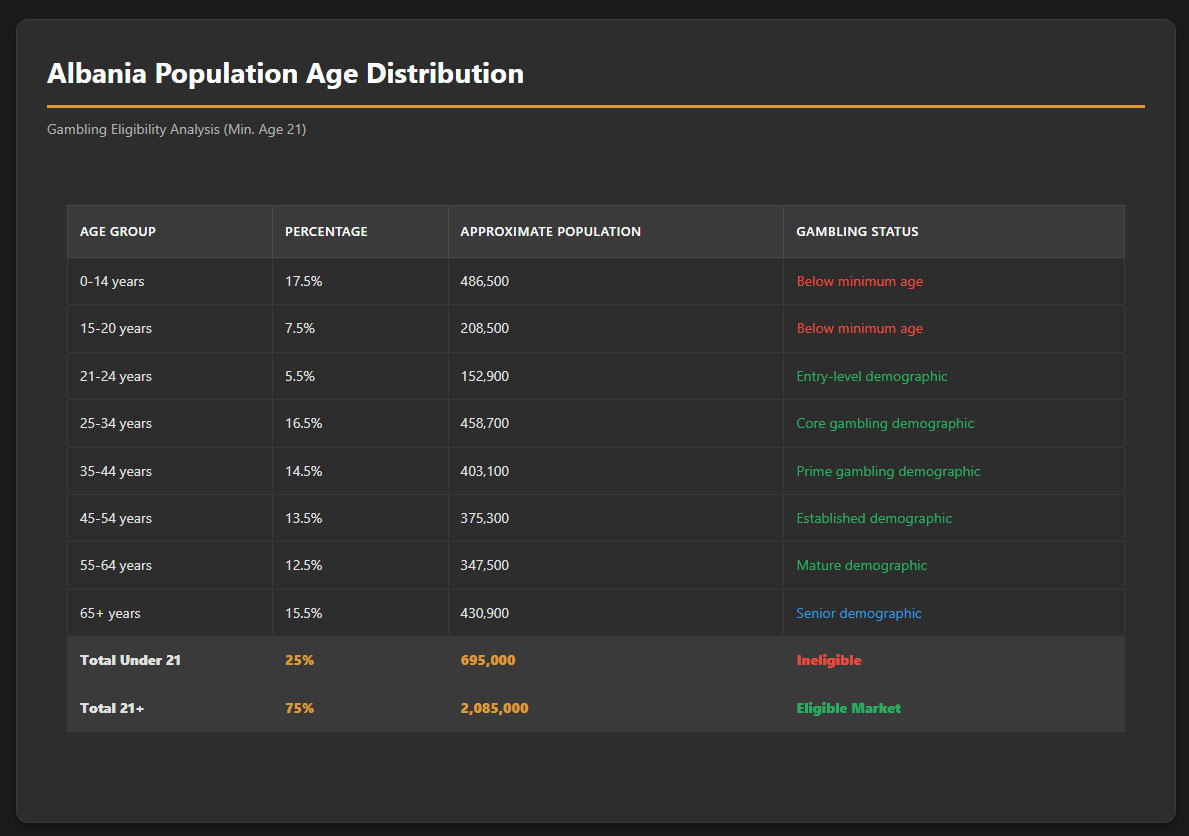
| Age Group | Approximate Percentage | Gambling Market Relevance |
|---|---|---|
| 0-14 years | 17-18% | Below minimum gambling age |
| 15-20 years | 7-8% | Below minimum gambling age |
| 21-24 years | 5-6% | Entry-level gambling demographic |
| 25-34 years | 16-17% | Core gambling demographic |
| 35-44 years | 14-15% | Prime gambling demographic |
| 45-54 years | 13-14% | Established gambling demographic |
| 55-64 years | 12-13% | Mature gambling demographic |
| 65+ years | 15-16% | Senior gambling demographic |
The population age structure shows approximately 25 percent of Albanians are under age 21 and therefore legally prohibited from gambling. This leaves roughly 2.1 million adults in the eligible gambling population. The concentration of population in the 25-54 age range, representing nearly 45 percent of total population, creates a substantial core market of working-age adults with income, digital literacy, and interest in sports betting entertainment.
Geographic Distribution
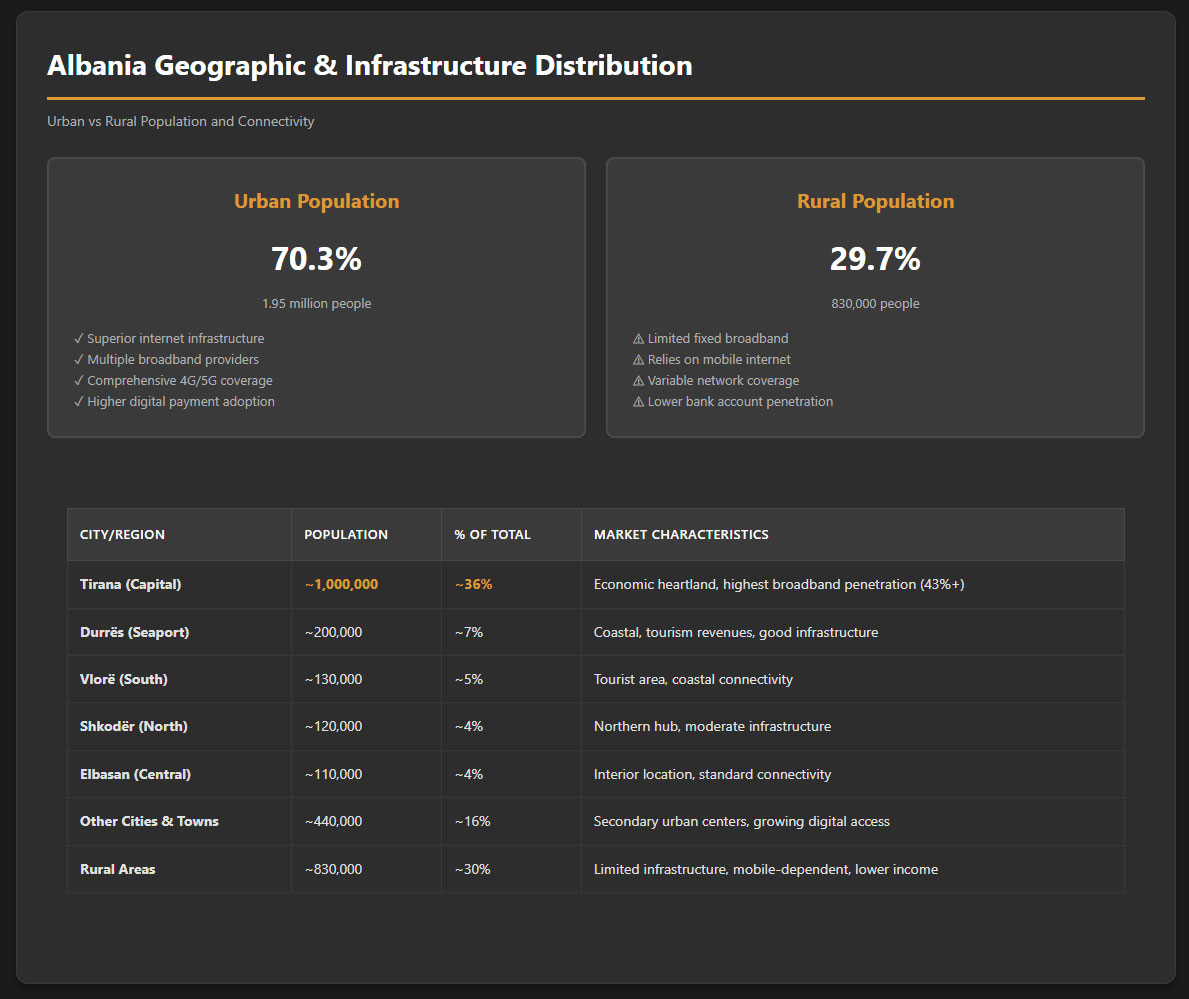
Urban population comprises 70.3 percent of Albania’s total, with 1.95 million people living in cities and towns while 34.3 percent or approximately 830,000 reside in rural areas. This high urbanization rate facilitates digital service delivery since urban areas enjoy superior internet infrastructure, mobile network coverage, and digital payment system access compared to rural regions.
Tirana, the capital and largest city, dominates Albania’s urban landscape with a population exceeding 500,000 in the city proper and approaching 1 million in the greater metropolitan area. Tirana alone represents roughly one-third of Albania’s total population, creating concentrated market opportunity. The capital exhibits the highest fixed broadband penetration, exceeding 43 percent of households by 2021, and offers the most developed digital infrastructure in the country.
Regional economic differences are pronounced. The Tirana-Durrës corridor represents Albania’s economic heartland, generating disproportionate shares of GDP, employment, and consumer spending. Coastal areas benefit from tourism revenues, while interior and mountainous regions remain more economically challenged with higher unemployment, lower incomes, and greater emigration. These disparities affect gambling market potential, with urban and coastal populations demonstrating higher discretionary spending capacity.
Internet access patterns closely track urbanization. Cities enjoy near-universal connectivity with multiple fixed broadband providers offering fiber, cable, and VDSL services, plus comprehensive 4G and emerging 5G mobile coverage. Rural areas lag significantly, often relying on mobile internet due to limited fixed infrastructure investment. However, the recent introduction of Starlink satellite internet in 2024 provides new connectivity options for remote regions, potentially expanding the addressable online gambling market to previously underserved areas.
Economic Indicators and Consumer Spending Power
GDP and Economic Performance
Albania’s nominal GDP in 2025 is estimated at $26.9 billion, reflecting a developing economy with upper-middle income status. GDP per capita estimates vary by source and methodology, ranging from $5,726 to $9,474 depending on whether current exchange rates or purchasing power parity calculations are used. The lower figure represents nominal GDP per capita in current US dollars, while higher estimates reflect PPP adjustments accounting for lower living costs in Albania compared to developed economies.
Economic growth has been resilient, with 2024 growth reaching 3.3 percent and 2025 projections indicating 3.4 percent expansion. This moderate but consistent growth trajectory reflects recovery from pandemic disruptions, strong performance in tourism, construction activity, and services sectors, and ongoing structural reforms associated with EU accession candidacy. GDP growth forecasts for the next 3-5 years range from 3.5 to 3.8 percent annually, suggesting stable economic expansion.
The service sector dominates Albania’s economic structure, comprising 48.6 percent of GDP. Key service contributors include wholesale and retail trade, tourism and hospitality, real estate, logistics and transportation, and financial services. The industrial sector accounts for 20.2 percent of GDP, heavily influenced by construction activity. Agriculture, forestry, and fisheries represent 18.5 percent, while manufacturing contributes a modest 6.3 percent to total economic output.
Employment rates have improved following the pandemic, particularly in the private sector where wages grew by an average of 12.7 percent across all industries during the most recent year measured. This wage growth indicates tightening labor markets and improving living standards, both positive indicators for discretionary spending capacity. Inflation has been gradually easing from earlier peaks, supporting real income growth and consumer purchasing power.
| Indicator | Value | Year/Period |
|---|---|---|
| Nominal GDP | $26.9 billion | 2025 estimate |
| GDP Per Capita (nominal) | $5,726 – $9,474 | 2024-2025 |
| GDP Growth Rate | 3.3% – 3.4% | 2024-2025 |
| Projected GDP Growth 2025-2029 | 3.5% – 3.8% annually | Forecast period |
| Service Sector Share | 48.6% | GDP composition |
| Industrial Sector Share | 20.2% | GDP composition |
| Agricultural Sector Share | 18.5% | GDP composition |
| Private Sector Wage Growth | 12.7% average | Recent annual period |
| Tourism Visitors | 11.7 million | 2024 |
Income and Wealth Distribution
Average household income in Albania is challenging to precisely quantify due to substantial informal economic activity, but estimates suggest monthly household income ranges from €400 to €700 for median households, with significant variation between urban and rural areas. Tirana households earn substantially more than the national average, while rural agricultural regions fall below. Government statistics on household income should be interpreted cautiously given the large informal economy estimated at 30-40 percent of GDP.
Income inequality, measured by the Gini coefficient, positions Albania in the moderate inequality range for Europe. The coefficient has declined from high levels during the immediate post-communist transition period as economic development has proceeded and social safety nets have strengthened. However, substantial disparities remain between urban professionals and rural agricultural workers, between educated and less educated populations, and between those with remittance income from emigrant family members versus those without.
Disposable income trends have been positive, supported by wage growth outpacing inflation, improving employment rates, and continued remittance flows from the Albanian diaspora in Italy, Greece, Germany, and other Western European countries. Remittances represent a significant component of household income for many Albanian families, estimated at 10-15 percent of GDP annually. This external income source provides spending capacity beyond what domestic wages alone would support.
Consumer spending patterns in Albania allocate substantial portions of household budgets to food, housing, and utilities, reflecting the developing economy status. Entertainment and leisure spending, including gambling, competes with other discretionary categories like dining out, travel, electronics, and apparel. The historical evidence that Albanians spent €500-700 million annually on gambling before the 2018 ban suggests significant cultural acceptance and willingness to allocate disposable income to betting activities.
Middle class size and growth represent critical factors for gambling market potential. Albania’s middle class, defined as households with incomes sufficient for discretionary spending beyond basic necessities, has expanded steadily over the past two decades. Estimates suggest 35-45 percent of households now qualify as middle class, up from minimal levels during the 1990s transition period. This growing middle class provides the customer base with income, digital access, and cultural openness to support a sustainable online gambling market.
Market Size and Growth Projections
| Metric | Value | Source/Period |
|---|---|---|
| Historical Total Gambling Spend | €500-700 million annually | Pre-2018 ban estimates |
| Online Market Value 2022 | €50 million | Industry estimate |
| Online Revenue 2024 | $9.79 million | Market research projection |
| Total Gambling Revenue 2025 | $202.85 million | All segments projected |
| CAGR 2025-2029 | 3.43% – 4.59% | Growth forecast range |
| Projected Market Value 2029 | $230-240 million | Calculated from CAGR |
| Online Sports Betting Tax Revenue | €17.5 million annually | Government projection |
The current iGaming market in Albania is in early development following the March 2024 regulatory reopening. The historical baseline of €500-700 million annual gambling spend before the 2018 prohibition provides context for market potential, though direct comparison is complicated by the five-year gap, changed regulatory structure limiting activity to online sports betting, and broader economic evolution. The total gambling figure included land-based betting shops, casinos, bingo, and lottery, while current legal options are more restricted.
Online gambling specifically was valued at approximately €50 million in 2022, likely representing offshore unlicensed operators serving Albanian customers during the prohibition period. This figure demonstrates sustained demand despite legal restrictions. Conservative 2024 projections place online gambling revenue at $9.79 million, perhaps reflecting early stages as licenses are awarded and platforms launch with limited market awareness and customer acquisition.
The substantial jump to projected $202.85 million total gambling revenue in 2025 suggests expectations that the new legal framework will rapidly capture significant market share from both previously unlicensed online operators and pent-up demand from the prohibition period. This forecast likely aggregates online sports betting with continuing land-based casino, lottery, and other permitted activities.
Growth forecasts for 2025-2029 in the 3.43-4.59 percent CAGR range indicate moderate but sustainable expansion. These projections reflect several offsetting factors. Positive growth drivers include increasing digital adoption, improving internet access and speeds, growing smartphone penetration, rising disposable incomes, and market maturation as licensed operators establish brands and customer bases. Negative factors limiting growth include the restricted product offering (sports betting only), advertising restrictions hindering customer acquisition, high taxation reducing operator marketing budgets, and the small overall population base.
Revenue distribution by gambling type historically favored sports betting, which commanded the largest customer base and volume before the 2018 ban. The new online-only sports betting market likely will capture 40-50 percent of total gambling revenue once fully established, with land-based casinos, lottery, and other permitted activities comprising the remainder. Sports betting’s seasonal patterns tied to football seasons and major sporting events will create quarterly revenue fluctuations.
Education, Skills, and Digital Literacy
Educational Foundation
Albania’s literacy rate exceeds 98 percent for both males and females, reflecting universal primary education and high secondary school enrollment. This strong foundational literacy supports digital engagement and the ability to navigate online platforms, understand betting odds and terms, and engage with responsible gambling information. Educational attainment has improved dramatically since the communist era, when university access was highly restricted.
Tertiary education completion rates have risen substantially, with approximately 25-30 percent of young adults now obtaining university degrees or equivalent qualifications. Popular fields include business, engineering, medicine, and information technology. This expanding educated workforce demonstrates the cognitive sophistication to understand complex betting products, analyze sporting events, and manage gambling budgets responsibly.
Digital literacy indicators position Albania favorably for online gambling adoption. The mobile connectivity index score of 66.1 out of 100 points in 2022 showed strong performance in consumer readiness, measuring the percentage of citizens with skills to browse the web, at 86.8 points. This high consumer digital competency means most Albanian adults can navigate online sports betting platforms without technical assistance.
English language proficiency is moderate and improving, particularly among younger demographics. While Albanian remains the primary language for all services including gambling platforms, many Albanians possess functional English enabling them to use international platforms if domestic options are unavailable. However, localized Albanian language platforms with customer support in Albanian will command competitive advantages.
Cultural and Social Factors
Communication and Language
Albanian is the primary language for daily life, business communication, and internet usage. The Albanian language exists in two main dialects, Gheg in the north and Tosk in the south, with standard Albanian based on Tosk. All gambling platforms must operate in Albanian to achieve mass market acceptance, though multilingual capabilities for expatriate users could provide marginal advantages.
Internet language preferences overwhelmingly favor Albanian for consumer-facing websites and applications. While English content is common in business and technology contexts, entertainment and gambling services succeed best when fully localized. Customer support must be available in Albanian during peak usage hours, which typically align with European football match schedules for sports betting.
Cultural Attitudes
Gambling acceptance in Albanian society is relatively high despite the Muslim-majority religious composition. Albania’s secular governmental tradition dating from the communist era and reinforced in the post-1991 democratic constitution creates separation between religious doctrine and social norms. Approximately 58 percent of Albanians identify as Muslim according to some surveys, but religious observance levels vary widely and religious prohibitions on gambling have limited practical impact on behavior.
The historical evidence of over 4,000 betting locations operating profitably before 2018 demonstrates cultural acceptance and participation in gambling activities. Sports betting in particular enjoys social legitimacy, viewed as skill-based entertainment connected to football fandom rather than pure chance gambling. The social aspect of discussing bets, sharing predictions, and collectively experiencing matches contributes to betting’s cultural integration.
Foreign brand perception is generally positive in Albania. The population’s historical orientation toward Western Europe, desire for EU membership, and extensive diaspora connections create favorable attitudes toward international brands. Well-established European gambling brands may enjoy prestige advantages over unknown local operators. However, trust-building requires localization, responsive customer service, and demonstrated commitment to the Albanian market.
Risk tolerance among Albanian consumers appears relatively high based on historical gambling participation rates and the entrepreneurial culture evident in high self-employment rates. Economic necessity during the difficult 1990s transition period cultivated resilience and willingness to take calculated risks, characteristics that may translate to gambling behavior. However, the 1997 pyramid scheme collapse that bankrupted many Albanian families created lasting skepticism toward financial schemes promising unrealistic returns.
Problem Gambling and Social Considerations
Comprehensive data on problem gambling prevalence in Albania is limited. The 2018 decision to ban sports betting and slot machines was motivated by governmental concerns about gambling addiction impacts on low-income families and the social problems associated with widespread betting availability. The estimated 4,000 betting locations in a country of fewer than 3 million people suggested high gambling density that authorities deemed excessive.
While specific problem gambling prevalence percentages have not been published from rigorous population studies, international benchmarks suggest approximately 0.5-2.0 percent of adult populations in countries with legal gambling exhibit severe problem gambling behaviors, with an additional 2-4 percent experiencing moderate difficulties. Applying these rates to Albania’s 2.1 million adults over age 21 suggests 10,000-40,000 individuals may struggle with problem gambling, with 40,000-85,000 experiencing subclinical issues.
At-risk populations include young males aged 21-35, individuals with other addictive behaviors or mental health conditions, those experiencing financial stress or unemployment, and people with easy access to gambling opportunities. Gender distribution of problem gambling typically skews male, particularly for sports betting products, though online gambling’s privacy and accessibility can increase female participation and associated problems.
Government response measures to problem gambling concerns include the minimum age 21 requirement, higher than the age 18 standard in many European jurisdictions. Mandatory self-exclusion capabilities, responsible gambling tools, and prohibitions on advertising represent additional protective measures. The centralized monitoring system creates technical infrastructure to identify problem gambling patterns, though its effectiveness depends on analytical capabilities and intervention protocols.
Treatment facilities and support services for problem gambling in Albania are underdeveloped compared to Western European standards. Mental health services generally face resource constraints and social stigma barriers. International operators entering the Albanian market should anticipate potential requirements to fund problem gambling awareness programs, treatment services, or research initiatives as part of corporate social responsibility expectations or future regulatory mandates.
Mandatory contributions to problem gambling funds are not currently specified in published regulations but could be introduced as the market develops and authorities gain experience with online gambling’s social impacts. The 0.4 percent of turnover contribution to sports, culture, and technology projects provides a precedent for earmarked social levies that could be expanded or redirected toward problem gambling prevention and treatment.
Political Structure and Governance
Albania operates as a parliamentary republic with a president serving as ceremonial head of state and a prime minister functioning as head of government with executive authority. The unicameral parliament exercises legislative power. The political system has demonstrated increasing stability since the turbulent 1990s, with peaceful transfers of power between competing parties becoming routine. Current governance emphasizes EU accession preparation, requiring legal and institutional reforms to align with European standards.
Political stability indicators show substantial improvement over time. The country has not experienced significant civil unrest, political violence, or governmental instability in recent years. The 1997 crisis triggered by pyramid scheme collapses marked the last major political breakdown. Contemporary political competition occurs within established democratic channels, with international observers generally validating electoral processes despite occasional concerns about campaign finance and media balance.
Regulatory consistency and predictability in the gambling sector specifically have been poor given the dramatic 2018 prohibition followed by 2024 reversal. This policy volatility creates uncertainty for potential investors despite current favorable regulations. Operators must assess the risk that future political changes could trigger another prohibition or major regulatory restructuring that disrupts business models and destroys invested capital.
Corruption perception remains a challenge for Albania. Transparency International’s Corruption Perceptions Index consistently ranks Albania in the middle to lower range globally, indicating widespread perceptions of public sector corruption. EU accession requirements are driving anti-corruption reforms and institutional strengthening, but legacy practices and informal relationships continue influencing business operations. Gambling licensing, given its high-value nature and limited supply, presents corruption risks that international operators must navigate carefully while maintaining compliance with anti-bribery laws in their home jurisdictions.
Albania’s EU candidate status represents a major political and economic driver. The country formally became an EU membership candidate in 2014 and opened accession negotiations in 2022. The accession process requires harmonizing Albanian law with EU directives across all sectors including gambling, consumer protection, data privacy, and anti-money laundering. This reform agenda generally favors business environment improvements, legal predictability, and regulatory quality enhancements that benefit foreign investors.
Technology Adoption and Digital Behavior
Internet and Digital Usage
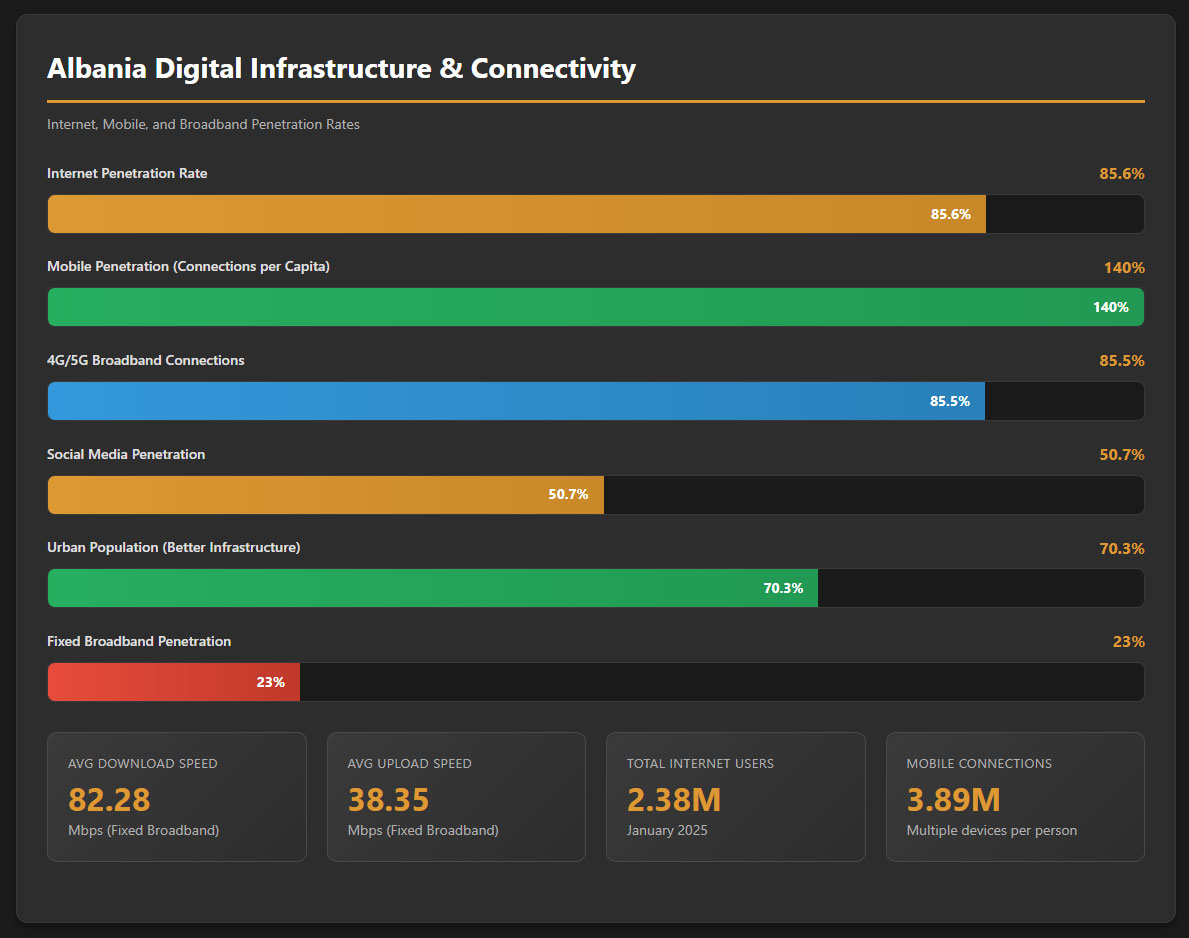
Internet penetration in Albania reached 85.6 percent in January 2025, with 2.38 million internet users in a population of 2.78 million. This high penetration rate places Albania favorably for online service delivery, though the 14.4 percent of the population remaining offline skews rural, elderly, and lower-income. Internet adoption showed slight decline of 17,000 users between January 2024 and January 2025, likely reflecting overall population decline rather than reduced internet usage rates.
Daily internet usage hours average approximately 6-7 hours among internet users, comparable to broader European patterns. Usage concentrates on social media, video content, messaging, and increasingly e-commerce and entertainment services. Mobile devices dominate internet access, with smartphones serving as the primary or sole internet-connected device for many Albanians, particularly younger demographics and those in areas with limited fixed broadband infrastructure.
Social media engagement is substantial with 1.41 million social media user identities representing 50.7 percent of the total population. Popular platforms include Facebook, Instagram, TikTok, and messaging applications like WhatsApp and Viber. This high social media adoption creates potential marketing channels if gambling advertising restrictions can be navigated, and indicates digital comfort levels supporting online gambling adoption.
E-commerce participation has grown steadily though remains below Western European levels. Albanian consumers increasingly shop online for clothing, electronics, and services, but cash-on-delivery payment options remain popular due to limited credit card penetration and trust concerns about online payments. The gambling market’s requirements for digital deposits and withdrawals necessitate customer education and trust-building around electronic payment security.
| Metric | Value | Date |
|---|---|---|
| Internet Penetration Rate | 85.6% | January 2025 |
| Total Internet Users | 2.38 million | January 2025 |
| Mobile Connections | 3.89 million | Early 2025 |
| Mobile Penetration Rate | 140% | Multiple devices per person |
| Broadband Mobile Connections | 85.5% | 3G/4G/5G networks |
| Social Media Users | 1.41 million | January 2025 |
| Social Media Penetration | 50.7% | Of total population |
| Fixed Broadband Penetration | 23% approximately | Recent estimate |
| Average Download Speed (Fixed) | 82.28 Mbps | August 2025 |
| Average Upload Speed (Fixed) | 38.35 Mbps | August 2025 |
Digital Payment Behavior
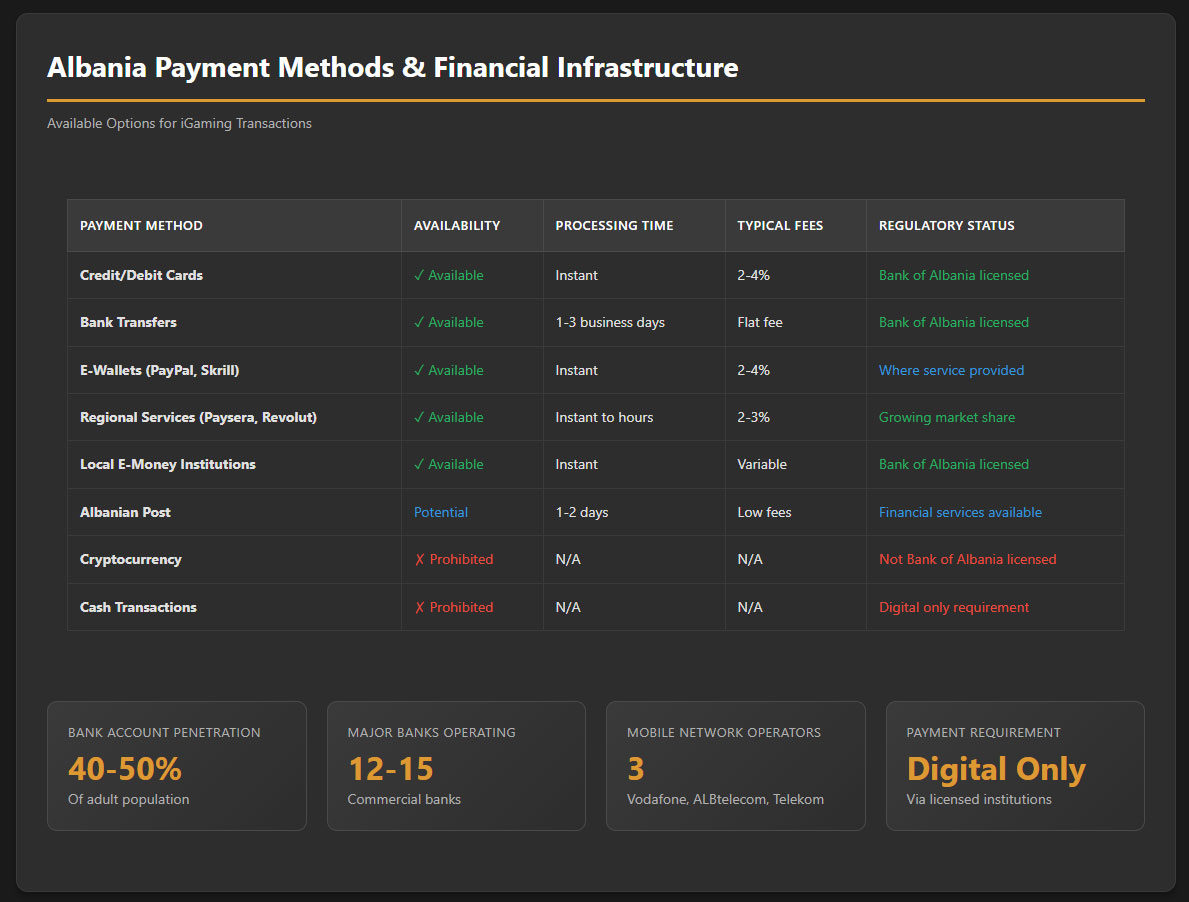
Payment method preferences in Albania favor cash for everyday transactions, but digital payments have gained ground particularly among urban, educated, and younger consumers. Credit and debit card penetration is growing but remains below Western European levels, with many Albanians lacking bank-issued payment cards or using them infrequently. Digital wallets and e-money services are expanding, driven by remittance services and increasing e-commerce adoption.
The most popular digital wallets include international services like PayPal where available, regional players like Paysera and Revolut gaining market share, and local e-money institutions licensed by the Bank of Albania. Online banking penetration has improved significantly, with all major Albanian banks offering internet and mobile banking services that enable account-to-account transfers for gambling deposits and withdrawals.
The regulatory requirement that all gambling payments be processed exclusively through authorized financial agents such as banks, licensed electronic currency institutions, and payment institutions licensed by the Bank of Albania eliminates cash transactions and creates a fully traceable payment environment. This restriction may initially limit market size by excluding unbanked populations but enhances anti-money laundering compliance and creates comprehensive transaction records.
Cryptocurrency adoption for gambling is legally ambiguous in Albania. While cryptocurrencies are not explicitly prohibited, the requirement for payments through Bank of Albania-licensed institutions effectively excludes direct cryptocurrency deposits and withdrawals. Some international payment processors may accept cryptocurrency funding behind the scenes while providing fiat currency interfaces to gambling operators, but this remains an uncertain legal area requiring clarification.
Gaming and Gambling Preferences
Current Market Participation
Precise current data on gambling participation rates is unavailable given the market’s recent reopening. Historical evidence from the pre-2018 period indicated very high participation rates, with the 4,000+ betting locations suggesting convenient access for most urban and many rural residents. Industry estimates suggested 30-40 percent of adult males participated in sports betting at least occasionally, with lower but growing female participation.
Online gambling participation during the 2018-2024 prohibition period likely occurred through offshore unlicensed websites, though quantifying this activity is difficult. The €50 million estimated online market value in 2022 suggests sustained demand despite legal restrictions. As licensed domestic platforms launch in 2024-2025, participation rates should increase due to local language support, trusted domestic brands, Albanian currency options, and marketing efforts by licensed operators.
Popular gambling activities historically centered on sports betting, particularly football which commands passionate following in Albania. The national team, Albanian players in international leagues, and major European competitions generate intense interest and betting volume. Basketball, tennis, and other international sports attract secondary interest. Casino games were available in land-based venues but commanded smaller customer bases than sports betting.
Lottery participation is widespread given the national lottery’s long-standing presence and low entry cost. Bingo enjoys modest popularity particularly among older demographics. The new online sports betting framework may expand product offerings over time to include virtual sports, esports betting, and potentially live dealer casino games if regulations evolve, but currently the market is limited to traditional sports wagering.
Consumer Behavior Patterns
Average spending per player is difficult to quantify precisely but can be estimated from aggregate market size. If 500,000 adults participate in online sports betting representing roughly 20-25 percent of the over-21 population, and the market reaches €100 million annually once established, average annual spending per active player would approximate €200, or roughly €17 monthly. High-value players likely spend multiples of this average while casual bettors contribute significantly less.
Typical bet sizes vary widely by player segment and event importance. Casual bettors may place small wagers of €2-10 on routine matches, while serious players bet €20-100 or more on major competitions. Accumulator bets combining multiple selections into single wagers with multiplied odds are popular, allowing small stakes to generate meaningful potential returns. Live in-play betting during matches attracts higher-frequency, lower-average-stake betting from engaged viewers.
Peak gambling times align with sporting event schedules. European football matches occurring primarily on weekend afternoons and evenings drive the highest betting volumes. Midweek Champions League and Europa League matches create secondary peaks. Summer months traditionally see reduced football betting but increased interest in tennis, basketball, and other sports. The seasonal pattern creates revenue fluctuations operators must manage through diversified sport offerings and operational planning.
Session length averages vary by betting type. Pre-match betting sessions may last just minutes as players research, select bets, and place wagers before matches begin. Live in-play betting extends sessions to match duration of 90+ minutes for football. Serious bettors may spend hours weekly researching teams, analyzing statistics, and managing multiple active bets across different events and sports.
Retention and loyalty patterns in gambling markets typically show high customer acquisition costs, making player lifetime value maximization critical. Successful operators achieve 6-12 month average player lifecycles before churn, with top-tier programs retaining valuable customers for years through loyalty rewards, VIP
programs, personalized offers, and superior service. Albanian market retention may benefit from limited licensed competition creating fewer switching opportunities once players establish accounts with preferred operators.
Bonus sensitivity and promotional response among Albanian players likely mirrors broader market patterns showing strong initial response to welcome bonuses and free bet offers. However, the regulatory framework may restrict bonus generosity through maximum bonus caps, wagering requirement minimums, or promotional frequency limitations. Sustainable player acquisition strategies must balance attractive introductory offers with long-term value proposition through competitive odds, product variety, and user experience quality.
Preferred game types by age group typically show younger males favoring live in-play betting, esports, and accumulator wagers, while older demographics prefer traditional pre-match betting on familiar sports. Female players, though smaller in number, often favor lower-risk betting types and demonstrate more cautious bankroll management. Operators should segment offerings and marketing to appeal across demographic profiles.
Deposit and withdrawal frequency patterns show most players depositing relatively infrequently, perhaps monthly or around major sporting events, while high-value players maintain more active transaction patterns. Withdrawal frequency typically lags deposits as many players recycle winnings into additional bets. Fast withdrawal processing becomes a competitive differentiator, with same-day or instant withdrawals commanding premium value to players compared to multi-day processing delays.
Section 3: Technology Infrastructure and Business Environment
Internet and Digital Infrastructure
Connectivity and Network Performance
Albania’s internet infrastructure has improved substantially over the past decade, though quality remains uneven between urban and rural areas. Fixed broadband penetration stands at approximately 23 percent of the population, concentrated heavily in cities and towns. Urban centers like Tirana enjoy competitive markets with multiple providers offering fiber-to-the-home, cable, and VDSL services delivering speeds from 50 Mbps to 1 Gbps depending on package and location.
Average internet speeds for fixed broadband connections reached 82.28 Mbps download and 38.35 Mbps upload in August 2025 measurements, ranking Albania 79th and 80th globally respectively. These speeds suffice for online gambling applications requiring modest bandwidth for bet placement, live odds updates, and streaming of live sporting events. However, consistency and reliability matter more than peak speeds for gambling platforms where transaction completion and real-time data accuracy are critical.
Network reliability has improved as infrastructure investment has modernized equipment and expanded fiber backbone capacity. The main internet service providers have upgraded their core networks to handle increasing data traffic driven by video streaming, social media, and growing cloud service usage. Internet Society assessments give Albania a 50 percent internet resilience score, rated as medium, with good diversity of ISPs and upstream connections providing redundancy.
Infrastructure investment trends are positive, with government targets calling for half of users to have gigabit-capable connections by 2025. While this ambitious goal likely will not be fully achieved, it demonstrates policy commitment to digital infrastructure development. Major providers like One Albania are rolling out fiber-to-the-home in expanding geographic areas and connecting institutions like schools, universities, and government offices at 1 Gbps speeds.
Rural connectivity gaps remain significant challenges. While mobile internet provides basic access in most areas, fixed broadband infrastructure investment in sparsely populated regions is economically challenging for private providers. Government subsidy programs and universal service obligations may eventually extend fiber access more broadly, but the urban-rural digital divide will persist for years affecting the addressable online gambling market size.
5G and Future Technology Deployment
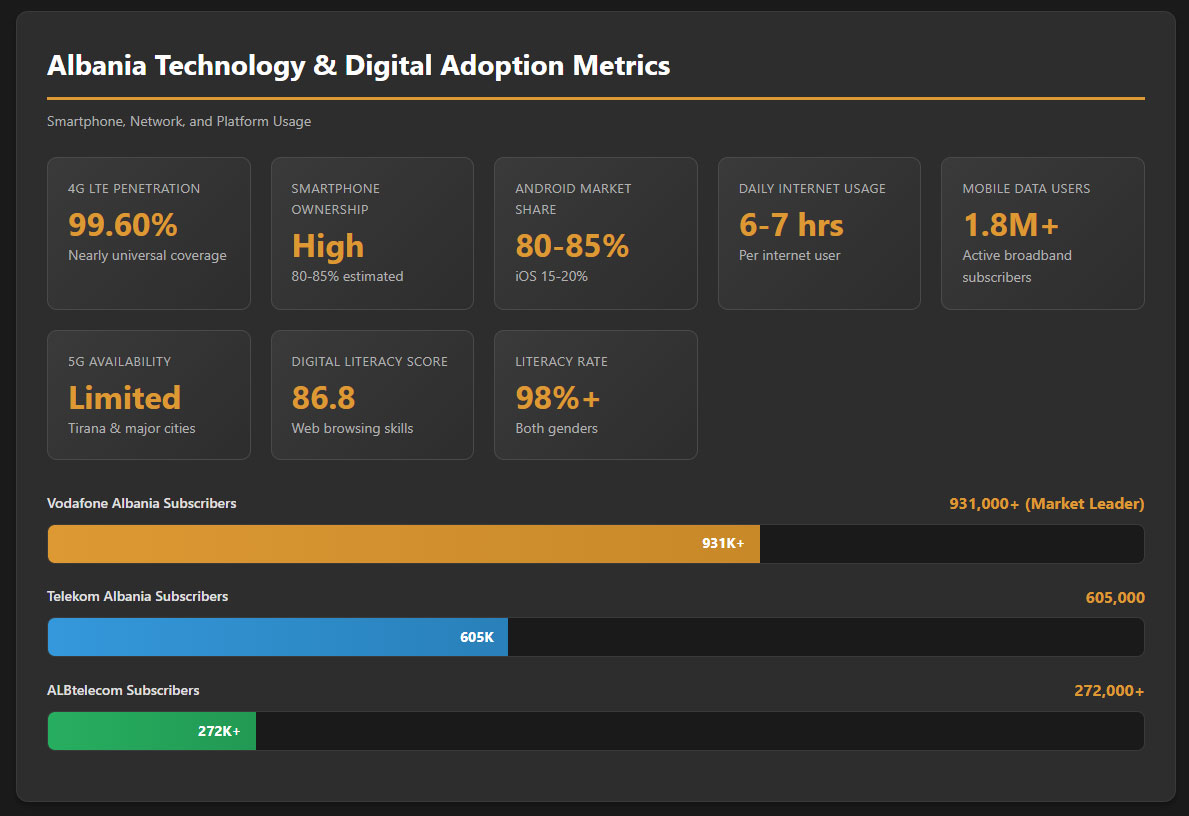
Current 4G coverage is extensive, with 85.5 percent of mobile connections classified as broadband, meaning they connect via 3G, 4G, or 5G networks. The three major mobile operators – Vodafone Albania, ALBtelecom (Eagle Mobile), and Telekom Albania – have deployed comprehensive 4G LTE networks covering all cities and most towns, with expanding coverage in rural areas. 4G network quality generally supports mobile gambling applications effectively.
5G rollout began in 2024 with initial deployments in Tirana and major cities. Network equipment vendor Ericsson is a principal supplier supporting Albanian operator 5G infrastructure investments. Some efforts have been made in conjunction with neighboring Kosovo to create a seamless 5G corridor along the highway connecting the countries, demonstrating regional cooperation on telecommunications infrastructure.
5G coverage currently reaches a small percentage of the population concentrated in urban centers, but expansion is progressing. The enhanced speeds, lower latency, and greater capacity of 5G networks will support richer gambling experiences including high-quality live streaming, virtual reality applications, and more sophisticated in-play betting features. However, 4G networks adequately serve current online sports betting needs, making 5G an enhancement rather than necessity.
Future infrastructure plans emphasize continued fiber expansion, 5G network densification, and satellite internet options for underserved areas. The 2024 introduction of Starlink satellite internet in Albania provides an important connectivity alternative for remote regions where terrestrial infrastructure investment is uneconomical. Starlink service costs approximately 42,500 ALL (€418) for hardware and 6,500 ALL (~$60) monthly subscription, delivering 50-200 Mbps speeds with low latency suitable for online gambling.
Mobile Technology Ecosystem
Mobile Network Infrastructure
Albania’s mobile market features three major network operators: Vodafone Albania, ALBtelecom (operating the Eagle Mobile brand), and Telekom Albania (AMC). This competitive three-player market drives service quality improvements and competitive pricing. Market consolidation occurred in 2022 when 4iG acquired One Telecommunications and a majority stake in ALBtelecom, potentially leading to business integration that would reduce the market to effectively two major competitors.
Network operator market share breakdown shows Vodafone Albania serving over 931,000 mobile users as of recent data, Telekom Albania with approximately 605,000 users, and ALBtelecom with more than 272,000 users. Total active mobile users exceeded 2.7 million with almost 1.8 million active broadband subscribers. The mobile connection count of 3.89 million indicates many users maintain multiple SIM cards for coverage or pricing reasons.
Coverage quality varies by operator and location. All three operators provide strong coverage in Tirana and other major cities with overlapping 4G networks ensuring redundancy. Coastal tourist areas receive priority infrastructure investment ensuring quality service during peak summer seasons. Mountain and remote interior regions have more variable coverage, with some areas served by only one or two operators and falling back to 3G or even 2G connectivity.
4G/5G coverage maps show nearly complete 4G population coverage in urban areas declining to partial coverage in rural regions. 5G coverage remains limited to Tirana and select major cities as of 2024-2025, but expansion is ongoing. The 99.60 percent LTE penetration rate indicates comprehensive 4G availability for the vast majority of the population, with only 10,858 people reportedly limited to UMTS (3G) or slower speeds.
| Metric | Value | Notes |
|---|---|---|
| Total Mobile Connections | 3.89 million | 140% population penetration |
| Active Mobile Users | 2.7 million+ | Recent estimate |
| Mobile Broadband Subscribers | 1.8 million | 3G/4G/5G data users |
| Broadband Connection Percentage | 85.5% | 3G or better |
| 4G LTE Penetration | 99.60% | Very high coverage |
| Vodafone Albania Subscribers | 931,000+ | Market leader |
| Telekom Albania Subscribers | 605,000 | Second position |
| ALBtelecom Subscribers | 272,000+ | Third position |
| 5G Availability | Limited, expanding | Major cities only |
Device Penetration
Smartphone adoption rates in Albania are high, with the vast majority of mobile users owning smartphones capable of internet access and application installation. The 140 percent mobile penetration rate, while reflecting multiple devices per person rather than 140 percent smartphone ownership, indicates widespread mobile device access. Many Albanians own both personal and work phones, or maintain multiple SIM cards for network coverage or pricing advantages.
Device preferences favor mid-range Android smartphones from brands like Samsung, Xiaomi, Huawei, and other Asian manufacturers offering good functionality at accessible price points. Premium devices like Apple iPhones have growing but smaller market share concentrated among affluent urban consumers. Budget smartphones costing €100-200 provide entry-level access, while mid-range devices at €300-500 represent the volume market.
Android versus iOS market share strongly favors Android, likely commanding 80-85 percent of smartphones with iOS representing 15-20 percent. This distribution is typical for developing markets where iPhone premium pricing limits adoption. Gambling operators must prioritize Android app development and optimization while also serving the smaller but often higher-value iOS user base.
Average device specifications have improved substantially as even budget smartphones now offer adequate processors, RAM, and storage for gambling applications. Screen sizes of 5.5-6.5 inches are standard, providing sufficient display area for betting interfaces, live odds, and event information. Battery life, camera quality, and storage capacity matter more for general smartphone satisfaction than for gambling-specific functionality.
Mobile internet usage patterns show Albanians spending significant daily time on smartphones for social media, messaging, video content, and increasingly e-commerce and service access. Mobile data consumption has surged as 4G networks enable video streaming and content-rich applications. The convenience of mobile betting, allowing wager placement from anywhere with network coverage, makes mobile the dominant online gambling channel.
Financial Services and Payment Infrastructure
Banking System Structure
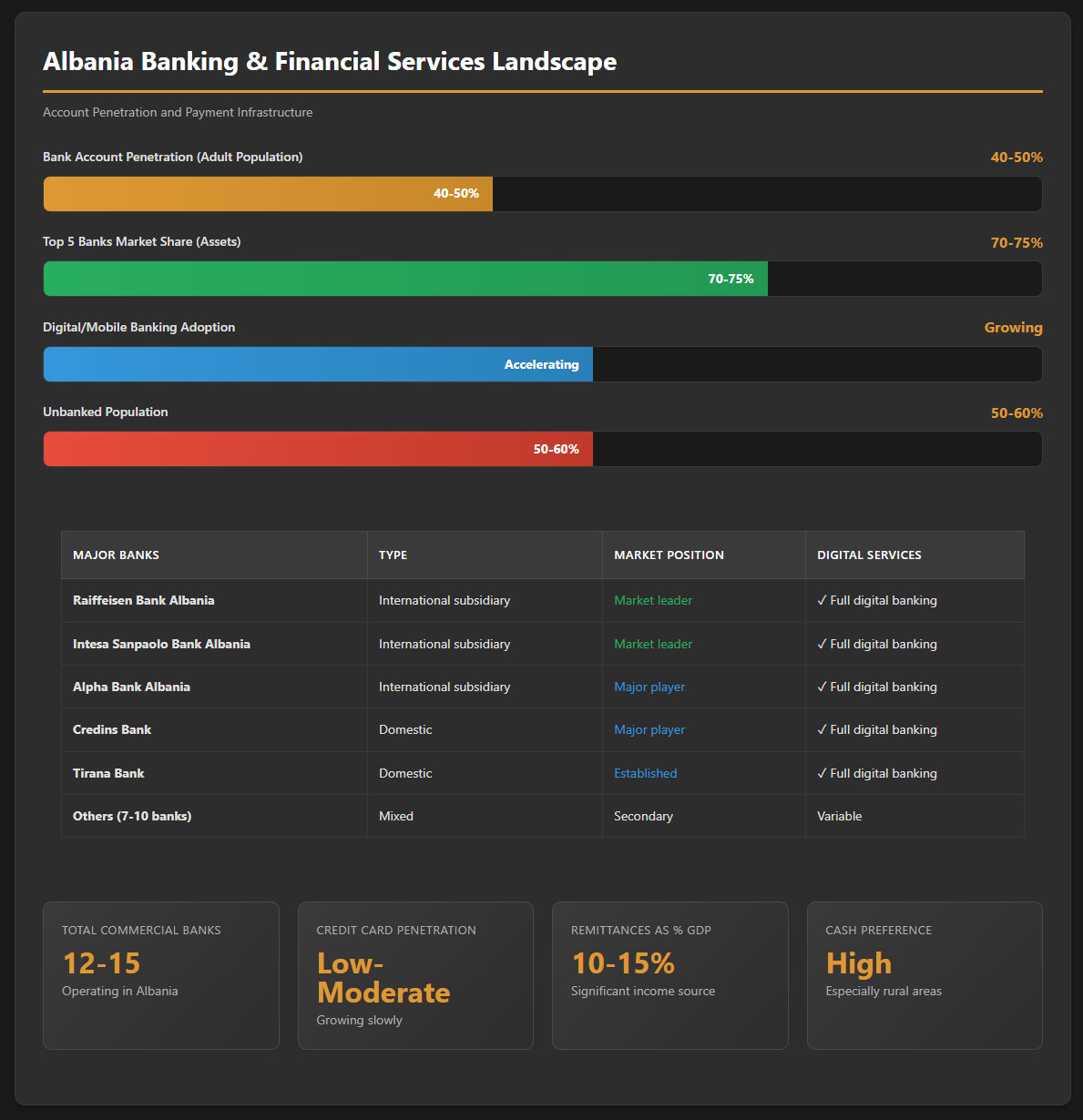
Albania’s banking sector features approximately 12-15 commercial banks operating in the country, including both domestic institutions and subsidiaries of international banking groups. Major banks include Raiffeisen Bank Albania, Intesa Sanpaolo Bank Albania, Alpha Bank Albania, Credins Bank, Tirana Bank, and others. The sector has consolidated over time, with several mergers and acquisitions reducing the number of institutions while strengthening remaining banks.
Bank market share is relatively concentrated among the top five institutions, which together command approximately 70-75 percent of total banking assets. Raiffeisen Bank Albania and Intesa Sanpaolo Bank Albania are market leaders by assets and customer base. The banking sector is generally stable, well-capitalized, and supervised by the Bank of Albania, the country’s central bank and financial regulatory authority.
Digital banking adoption has accelerated, particularly among urban and younger customers. All major banks offer internet banking and mobile banking applications enabling account management, transfers, payments, and other services remotely. Mobile banking penetration continues growing as smartphone ownership expands and user interfaces improve. However, many Albanians, particularly older and rural populations, still prefer in-person branch banking for complex transactions.
Account penetration rates have improved but remain below Western European levels. Approximately 40-50 percent of Albanian adults hold formal bank accounts, though rates are higher in urban areas and among employed individuals. Unbanked populations concentrated in rural areas, informal economy workers, and elderly citizens pose challenges for gambling operators since the regulatory requirement for digital payments through licensed financial institutions excludes cash transactions.
Credit and lending markets have developed slowly following the 1997 pyramid scheme crisis that destroyed public confidence in financial institutions. Banks maintain conservative lending practices, requiring substantial collateral and documentation. Consumer credit for purchases, personal loans, and mortgages is available but less accessible than in developed economies. Credit cards and overdraft facilities exist but with relatively low penetration compared to Western European norms.
Payment Processing Options
Available payment methods for iGaming in Albania must comply with the regulatory requirement that all gambling payments be processed exclusively through authorized financial agents. This category includes banks licensed by the Bank of Albania, licensed electronic currency institutions, licensed payment institutions, and potentially the Albanian Post which offers financial services. Direct cash deposits, unregulated payment intermediaries, and cryptocurrency payments are prohibited.
Credit and debit card penetration is growing, with major international card schemes Visa and Mastercard widely accepted. Albanian banks issue both debit cards linked to checking accounts and credit cards, though credit card ownership lags debit cards. Cards enable convenient online deposits to gambling accounts, though some banks may decline gambling-related transactions as part of risk management policies, requiring operators to work with gambling-friendly payment processors.
E-wallet options available to Albanian users include international services like PayPal (where service is provided), Skrill, Neteller, and other gambling-oriented e-wallets popular in European markets. Regional payment services like Paysera, Revolut, and similar fintech platforms are gaining market share. Local e-money institutions licensed by the Bank of Albania provide domestic payment solutions. E-wallets offer advantages of speed, convenience, and separation of gambling transactions from primary bank accounts.
Bank transfer systems enable direct account-to-account transfers for deposits and withdrawals. While traditional bank transfers can take 1-3 business days, instant payment systems are being implemented in Albania following European trends toward real-time payments. SEPA transfers connect Albanian banks to the European payment infrastructure, facilitating euro-denominated transactions. Albanian lek transfers occur through domestic clearing systems.
Cryptocurrency acceptance is legally ambiguous and effectively prohibited for direct gambling transactions by the requirement that payments flow through Bank of Albania-licensed institutions. While individuals can hold and trade cryptocurrencies through exchanges, using crypto directly for gambling deposits and withdrawals is not compatible with current regulations. Some international payment processors may accept cryptocurrency behind the scenes while providing fiat currency interfaces to merchants, but this remains legally uncertain.
Processing fees vary by payment method and provider. Credit card processing typically costs operators 2-4 percent of transaction value plus fixed fees, though gambling transactions may incur higher rates due to chargeback risks. E-wallet services charge similar percentages. Bank transfers often have flat fees rather than percentage-based charges, making them more economical for larger transactions. Operators must balance processing costs against customer preferences and conversion rates across payment methods.
Transaction processing timelines affect user experience significantly. Deposits ideally process instantly or within minutes, allowing immediate betting. Card and e-wallet deposits typically achieve this speed. Bank transfers may take hours to days depending on the system used. Withdrawal speed varies more dramatically, with e-wallets potentially offering same-day processing, while bank transfers and card refunds can require 2-5 business days. Fast withdrawals command competitive advantage.
Regulatory restrictions on gambling payments primarily enforce the requirement for licensed financial intermediaries. Banks and payment institutions must perform anti-money laundering due diligence on gambling operators before establishing processing relationships. Transaction monitoring for suspicious activity is mandatory. Maximum transaction limits may apply through payment method terms of service rather than gambling-specific regulations.
Chargebacks and dispute resolution follow standard payment card scheme rules. Gambling transactions face elevated chargeback risk since customers may dispute legitimate losses. Operators must maintain documentation proving valid service delivery, customer identity verification, and adherence to terms of service to contest illegitimate chargebacks. High chargeback rates can result in payment processors terminating merchant accounts or imposing penalty fees.
E-commerce and Digital Economy
Digital Market Development
E-commerce market size in Albania is growing but remains modest compared to Western European countries. Online retail is expanding as internet penetration increases, logistics infrastructure improves, and consumer confidence in digital transactions builds. Major e-commerce platforms serving Albanian consumers include international marketplaces like eBay and regional platforms, plus domestic Albanian online retailers selling electronics, fashion, and other goods.
Online retail penetration as a percentage of total retail sales is estimated at 5-10 percent, well below the 15-20 percent or higher rates common in developed European markets. Growth is constrained by cash-on-delivery preferences, limited rural delivery infrastructure, and consumer trust concerns about product quality and return processes. However, the trend is clearly upward, particularly among younger urban consumers comfortable with online shopping.
Digital service adoption extends beyond physical goods to include travel bookings, entertainment streaming, telecommunication services, and increasingly financial services. Albanians book flights, hotels, and vacation packages online, subscribe to streaming video and music services, and purchase mobile phone credits digitally. This growing digital service consumption indicates cultural adaptation to online transactions that should support gambling adoption.
Consumer trust in online transactions has improved significantly from the skepticism following the 1997 financial crisis. Younger generations with no memory of that trauma demonstrate higher digital trust. Secure payment logos, SSL encryption indicators, and brand recognition from established businesses contribute to trustworthiness perceptions. Gambling operators must invest in security certifications, trust marks, and transparent operations to build consumer confidence.
Popular e-commerce platforms serving Albania include global marketplaces, regional Balkan e-commerce sites, and local Albanian retailers. Cross-border shopping from European retailers has grown as Albanians purchase goods unavailable or more expensive domestically. Chinese marketplaces like AliExpress see significant Albanian usage. The diversity of available platforms demonstrates Albanian consumer comfort with multiple online vendors.
Cross-border online shopping behavior is substantial given Albania’s limited domestic production of consumer goods. Albanians frequently purchase from Italian, Greek, German, and other European online retailers, navigating international shipping, customs duties, and multi-currency payments. This cross-border experience suggests minimal barriers to using international gambling platforms if domestic options are unsatisfactory, though regulatory restrictions aim to keep activity within licensed domestic operators.
Digital goods and services consumption includes mobile apps, games, streaming subscriptions, e-books, online courses, and software. While piracy remains prevalent for expensive software and media content, legitimate paid digital services are gaining market share. The willingness to pay for digital entertainment and services indicates potential to monetize online gambling as a digital entertainment category.
Business Environment and Regulatory Framework
Ease of Business Operations
Albania’s business environment has improved substantially over the past two decades but remains challenging compared to Western European standards. The World Bank Doing Business rankings historically placed Albania in the middle range globally, typically ranking between 60-80 out of approximately 190 economies assessed. Recent years have seen improvements in categories like starting a business, registering property, and getting credit, while challenges persist in areas like enforcing contracts and resolving insolvency.
Ease of Starting a Business rankings show Albania performing relatively well in this specific category, with streamlined registration processes reducing timelines and costs compared to historical norms. Online registration systems enable remote company formation. However, practical challenges including bureaucratic delays, unclear regulatory guidance, and informal expectations can complicate processes beyond official procedures.
Business registration processes require submitting incorporation documents to the National Business Center, obtaining a tax identification number, registering for social security, and potentially securing sector-specific licenses or permits. For gambling operators, the joint-stock company requirement necessitates minimum capital, shareholder documentation, articles of incorporation, and board structure meeting Albanian commercial law standards.
Time required to start a business has decreased to approximately 4-5 days for basic company registration under optimal circumstances. However, completing all regulatory requirements including tax registration, social security enrollment, and operational permits can extend the process to several weeks. Gambling licensing adds substantially more time, with the competitive application process for the ten available licenses potentially taking months from application to final decision.
Foreign investment policies are generally welcoming, with Albania actively seeking foreign capital to support economic development. Most sectors are open to 100 percent foreign ownership without local partnership requirements. However, the gambling law’s mandate that operators be registered as Albanian joint-stock companies, combined with shareholder background check requirements, creates local presence obligations. Foreign investors must establish Albanian legal entities rather than operating as foreign companies with local branches.
Operational cost structures vary by location and sector. Tirana office rent ranges from €10-25 per square meter monthly for quality commercial space, lower than Western European capitals but higher than smaller Albanian cities. Salary expectations for skilled workers in technology, finance, and customer service range from €500-1,500 monthly depending on experience and specialization, competitive within the Balkan region. Utilities including electricity, internet, and telecommunications are reasonably priced.
Labor market conditions show relatively high unemployment rates historically but tightening in recent years, particularly for skilled positions. Talent availability for gambling industry roles including software developers, data analysts, customer service representatives, compliance specialists, and marketing professionals exists but may require offering competitive compensation and development opportunities to attract quality candidates. Many skilled Albanians emigrate for higher salaries abroad, creating brain drain challenges.
Corporate Structure and Registration
Available Entity Types
Albanian commercial law provides several business entity options including limited liability companies (Shoqëri me Përgjegjësi të Kufizuar or SHPK), joint-stock companies (Shoqëri Aksionare or SHA), sole proprietorships, partnerships, and branch offices of foreign companies. Each structure offers different characteristics regarding ownership, liability, governance, and tax treatment.
For iGaming operators, the gambling law mandates registration as a joint-stock company, eliminating choice among entity types. The joint-stock company structure resembles corporations in other jurisdictions, with shareholding structure, limited liability protection for shareholders, formal governance through board of directors and shareholder meetings, and specific capital and reporting requirements. This entity type suits larger businesses with multiple investors and complex operations.
The limited liability company (SHPK) is Albania’s most common business form for small to medium enterprises, offering liability protection, flexible ownership, and simpler governance than joint-stock companies. However, gambling operators cannot use this structure due to regulatory requirements. Other business activities not subject to gambling regulations can utilize SHPKs when appropriate.
Branch offices of foreign companies represent another option for international businesses operating in Albania without creating a separate legal entity. Branches are extensions of the parent company, not independent legal persons. Gambling regulations preclude this structure by requiring Albanian joint-stock company establishment, but branches might serve ancillary functions like marketing or technology support if properly structured.
Registration Requirements
Registration timelines for standard joint-stock companies run approximately 4-5 days for initial registration with the National Business Center under optimal conditions, with additional time needed for tax registration, social security enrollment, bank account opening, and sector-specific licensing. The gambling license application process extends timelines significantly, potentially adding 3-6 months or more depending on the competitive evaluation process complexity and regulatory review thoroughness.
Registration costs include government fees for company registration, typically several hundred euros depending on capital size and registration speed selected. Legal fees for professional assistance with incorporation documents, shareholder agreements, articles of association, and regulatory filings can range from €1,000-5,000 depending on complexity and provider. Notarization of documents adds additional costs.
Required documents for joint-stock company registration include articles of incorporation, company bylaws, shareholder information and identification documents, board of directors composition, registered office address, bank confirmation of capital deposit, and various declarations and certifications. For gambling licenses, additional documentation includes financial statements, experience verification, background checks, technical system agreements, and comprehensive business plans.
Foreign ownership rules generally permit 100 percent foreign ownership of Albanian companies without local partnership mandates. The gambling law does not explicitly require Albanian shareholders or local minority ownership, though the background check requirements and source of funds verification apply to all shareholders regardless of nationality. Foreign shareholders must provide extensive documentation including criminal background checks from all countries of residence, proof of financial capacity, and demonstration of legitimate wealth sources.
Minimum capital requirements for joint-stock companies under standard commercial law and for gambling operators specifically is 40 million ALL (approximately €400,000 or $430,000). This capital must be fully paid up and verified through bank certificates before license issuance. The capital serves as guarantee for operational solvency and provides buffer for initial operating losses before revenue generation.
Ongoing compliance requirements for joint-stock companies include annual shareholder meetings, audited financial statement preparation and filing, corporate tax returns, quarterly and annual reporting to the gambling authority, maintenance of corporate registers and books, and adherence to corporate governance standards. Gambling operators face enhanced compliance obligations including transaction reporting, player data retention, responsible gambling program documentation, and regulatory inspections.
Corporate governance requirements for joint-stock companies mandate formal board of directors, clear separation between management and oversight functions, shareholder meeting protocols, and transparent decision-making processes. Gambling operators must demonstrate that boards include individuals with relevant expertise, that compliance functions operate independently from commercial pressures, and that responsible gambling and anti-money laundering obligations receive board-level attention.
Taxation Framework
Corporate Income Tax Structure
Standard corporate income tax rates in Albania follow a progressive structure implemented in the 2024 Income Tax Law. Companies with annual taxable profits up to 14 million ALL (approximately €135,000 or $145,000) face a 15 percent corporate income tax rate. Profits exceeding this threshold are taxed at 23 percent for the excess amount. This two-tier structure provides relief for smaller businesses while ensuring larger profitable enterprises contribute proportionally more.
The gambling-specific 15 percent tax on profit applies in addition to corporate income tax, though the interaction and calculation methodology requires clarification. If the gambling tax is deductible expense for corporate income tax purposes, the effective combined rate would be lower than simple addition suggests. If taxes are calculated independently on the same profit base, the combined burden could approach 30-38 percent depending on profit level. Operators should obtain definitive tax opinions on calculation methodology.
Special economic zone benefits and incentives exist in Albania for certain sectors and locations, offering reduced corporate tax rates or temporary exemptions to attract investment. However, gambling operators are unlikely to qualify for such incentives given the sector-specific taxation applying to gambling activities. The license fee structure and regulatory framework create sufficient entry barriers that additional tax incentives are unnecessary from government perspective.
Tax holidays or reduced rates for new businesses are not prominently featured in Albanian tax policy for established sectors like gambling. Start-up incentives tend to focus on technology, manufacturing, and export-oriented businesses rather than domestic market services like gambling. Operators should not expect preferential tax treatment beyond the standard structure applicable to all gambling businesses.
International tax treaties connect Albania with numerous countries to prevent double taxation and facilitate cross-border investment. Albania has bilateral tax treaties with major European nations, Balkan neighbors, and various other countries. These treaties typically provide for reduced withholding tax rates on dividends, interest, and royalties, and establish rules for determining tax residency and allocating taxing rights between jurisdictions. Foreign shareholders in Albanian gambling operators benefit from treaty protections where applicable.
Transfer pricing rules and documentation requirements apply to transactions between related parties, particularly cross-border arrangements. Albanian tax authorities have adopted OECD transfer pricing principles requiring that intercompany transactions occur at arm’s length market prices. Gambling operators utilizing technology platforms, management services, or branding from related foreign entities must document that fees paid reflect market rates for comparable services to avoid transfer pricing adjustments.
Withholding tax on dividends paid to shareholders is 8 percent, deducted at source by the distributing Albanian company. This applies to both domestic and foreign shareholders, though international tax treaties may reduce rates for foreign recipients. Interest and royalty payments to non-residents face withholding taxes typically at 15 percent unless reduced by treaty. These withholding obligations create compliance responsibilities and cash flow considerations for operators.
VAT or sales tax in Albania applies a standard rate of 20 percent on most goods and services, with reduced rates for specific categories. Gambling services historically have faced uncertain VAT treatment globally, with various jurisdictions exempting, zero-rating, or taxing gambling. The Albanian gambling tax structure likely exempts operators from VAT on gambling services since the specific gambling profit tax serves as the consumption tax equivalent. However, operators must charge VAT on non-gambling services and can reclaim VAT on business inputs.
Personal Income Tax
Individual tax rates in Albania follow progressive brackets established in the 2024 Income Tax Law. Annual employment income up to 2,040,000 ALL (approximately €20,000 or $21,500) faces lower tax rates in graduated brackets. Income exceeding this threshold enters higher tax brackets up to maximum marginal rates. The progressive structure provides relief for lower-income workers while increasing tax burden on high earners.
Withholding requirements for employees mandate that employers calculate, deduct, and remit income tax from employee salaries monthly. The withholding system creates compliance obligations for gambling operators as employers but simplifies tax compliance for employees who may not need to file annual returns if withholding fully satisfies tax liability. Employers must register as withholding agents and submit regular reports to tax authorities.
Tax residency rules determine whether individuals owe Albanian tax on worldwide income or only Albanian-source income. Albanian residents generally face taxation on global income, while non-residents pay tax only on Albanian-source income. Residency typically requires spending more than 183 days in Albania during a tax year or having a permanent home and primary life center in Albania. Foreign employees of gambling operators must understand their residency status for tax planning.
Taxation of foreign employees working in Albania depends on residency determination and tax treaty provisions. Employees resident in Albania pay tax on their full compensation including benefits. Non-residents pay tax only on Albanian employment income. Tax treaties may allocate taxing rights differently for short-term assignments. Gambling operators hiring expatriate specialists must structure compensation considering tax efficiency while ensuring compliance with Albanian withholding obligations.
Market Entry Considerations
Recommended Entry Strategies
Optimal market entry approaches for Albania favor established European gambling operators with regional Balkan presence who can leverage existing infrastructure, technology platforms, and operational expertise across multiple markets. Stand-alone Albanian entry is economically challenging given the €6 million in upfront financial requirements (license fee, capital, guarantee funds) plus operational costs serving a market of just 2-3 million potential customers. Multi-market operators achieve economies of scale that standalone entrants cannot match.
Local partnership requirements are not legally mandated for gambling licenses, with 100 percent foreign ownership permitted for the required Albanian joint-stock company structure. However, strategic partnerships with Albanian businesses can provide valuable market knowledge, customer trust, payment processing relationships, regulatory navigation assistance, and political connectivity. Minority local partners or local advisory boards might enhance market entry success even if not legally required.
White label versus proprietary platform considerations involve tradeoffs between speed to market, cost, flexibility, and differentiation. White label solutions from established platform providers enable rapid market entry with proven technology, existing game content, payment integrations, and responsible gambling tools. Costs are typically revenue-sharing arrangements rather than large upfront investments. However, white labels offer limited differentiation and create vendor dependencies.
Proprietary platform development provides maximum flexibility, unique features, and complete control but requires substantial upfront investment in technology development, testing, certification, and maintenance. Given Albania’s small market size, proprietary platforms are economically justified only if usable across multiple jurisdictions. Most Albanian market entrants likely will utilize white label or multi-market platform solutions rather than building Albania-specific systems.
Technology infrastructure leveraging strategies should maximize utilization of existing systems deployed in other markets. Operators with platforms serving neighboring Balkan countries can add Albanian language support, local payment methods, and Albanian lek currency to existing systems with incremental development rather than building from scratch. Cloud-based infrastructure enables serving Albanian customers from regional data centers with local content delivery network caching for performance.
Marketing and localization requirements are substantial despite advertising restrictions. Albanian language websites, customer service, responsible gambling materials, and all player communications are essential for mass market acceptance. Cultural localization beyond simple translation includes featuring Albanian sports leagues and athletes, acknowledging local holidays and traditions, and demonstrating commitment to the Albanian market rather than treating it as generic Balkan territory.
Payment provider selection criteria must prioritize Albanian bank relationships and Bank of Albania-licensed payment institutions given regulatory restrictions. International payment providers may not serve the Albanian market or may lack local banking connections. Operators need relationships with Albanian banks willing to process gambling transactions, e-money institutions licensed domestically, and potentially international providers with Albanian subsidiaries or correspondent banking arrangements.
Risk mitigation strategies should address regulatory volatility risk given Albania’s history of dramatic gambling policy reversals. License agreements should clarify operator rights if regulations change substantially. Political risk insurance might protect against expropriation or regulatory changes destroying invested capital. Diversification across multiple Balkan markets reduces dependence on any single jurisdiction. Conservative financial projections assuming shorter payback periods account for uncertainty about long-term regulatory stability.
Typical Costs and Timelines
| Cost Category | Amount (EUR) | Amount (USD) | Notes |
|---|---|---|---|
| Initial Setup Investments | |||
| License Application Fee | 3,900,000 | 4,200,000 | Minimum; paid over 10 years |
| Annual License Fee Component | 390,000 | 420,000 | 1/10th annually |
| Company Minimum Capital | 400,000 | 430,000 | Joint-stock company requirement |
| Player Guarantee Fund | 1,200,000 | 1,290,000 | Held in Albanian bank |
| Authority Obligations Fund | 500,000 | 537,000 | Held in Albanian bank |
| Legal and Consulting Fees | 50,000-150,000 | 54,000-161,000 | Application and setup |
| Company Registration Costs | 5,000-10,000 | 5,400-10,700 | Including notarization |
| Office Setup Costs | 20,000-50,000 | 21,500-53,700 | Furniture, equipment, deposits |
| Technology Platform (White Label) | 50,000-200,000 | 54,000-215,000 | Setup and integration |
| Technology Platform (Proprietary) | 500,000-2,000,000 | 537,000-2,150,000 | Custom development |
| Payment Integration | 10,000-30,000 | 10,700-32,200 | Multiple payment methods |
| Initial Marketing Budget | 100,000-300,000 | 107,500-322,000 | Limited by ad restrictions |
| Total Initial Investment (White Label) | 6,235,000-6,840,000 | 6,700,000-7,350,000 | Approximate range |
| Total Initial Investment (Proprietary) | 6,735,000-8,640,000 | 7,240,000-9,285,000 | Higher platform costs |
| Operating Expense | Monthly (EUR) | Annual (EUR) | Notes |
|---|---|---|---|
| Staff Salaries (20-30 employees) | 20,000-40,000 | 240,000-480,000 | Customer service, tech, compliance |
| Office Rent and Utilities | 3,000-7,000 | 36,000-84,000 | Tirana commercial space |
| Technology Platform Fees | 10,000-30,000 | 120,000-360,000 | White label revenue share/hosting |
| Payment Processing Fees | Variable | 150,000-400,000 | 2-4% of transaction volume |
| Marketing and Customer Acquisition | 30,000-100,000 | 360,000-1,200,000 | Constrained by ad restrictions |
| Regulatory and Compliance Costs | 5,000-15,000 | 60,000-180,000 | Reporting, audits, legal |
| Insurance | 2,000-5,000 | 24,000-60,000 | Liability, professional indemnity |
| Customer Support and CRM | 3,000-8,000 | 36,000-96,000 | Tools and outsourced services |
| Professional Services | 3,000-10,000 | 36,000-120,000 | Legal, accounting, consulting |
| Total Monthly Operating Costs | 76,000-215,000 | 912,000-2,580,000 | Varies with scale |
| Phase | Duration | Key Activities |
|---|---|---|
| Company Registration | 2-4 weeks | Incorporate joint-stock company, open bank accounts, register for tax and social security |
| License Application Preparation | 4-8 weeks | Compile documentation, background checks, business plan, technical system agreements |
| License Application Review | 3-6 months | Competitive evaluation, regulatory due diligence, potential clarifications and amendments |
| Platform Setup and Integration | 8-12 weeks | Configure platform, integrate payments, develop content, test systems, obtain certifications |
| Staff Recruitment and Training | 6-10 weeks | Hire key personnel, train on systems and compliance, establish operational procedures |
| Compliance and Testing | 4-6 weeks | Regulatory inspections, system testing, responsible gambling tool verification, go-live approval |
| Pre-Launch Marketing | 4-8 weeks | Brand awareness building within advertising constraints, customer pre-registration |
| Total Time to Market | 9-15 months | From incorporation to commercial launch |
The financial requirements for Albanian market entry are substantial relative to the market’s size and revenue potential. The minimum €6-7 million in upfront investments for license fees, capital requirements, and guarantee funds, plus €900,000-2.6 million in annual operating costs, creates a high breakeven threshold. Operators need significant annual revenue to justify these investments, likely requiring capturing meaningful market share among the ten licensed competitors.
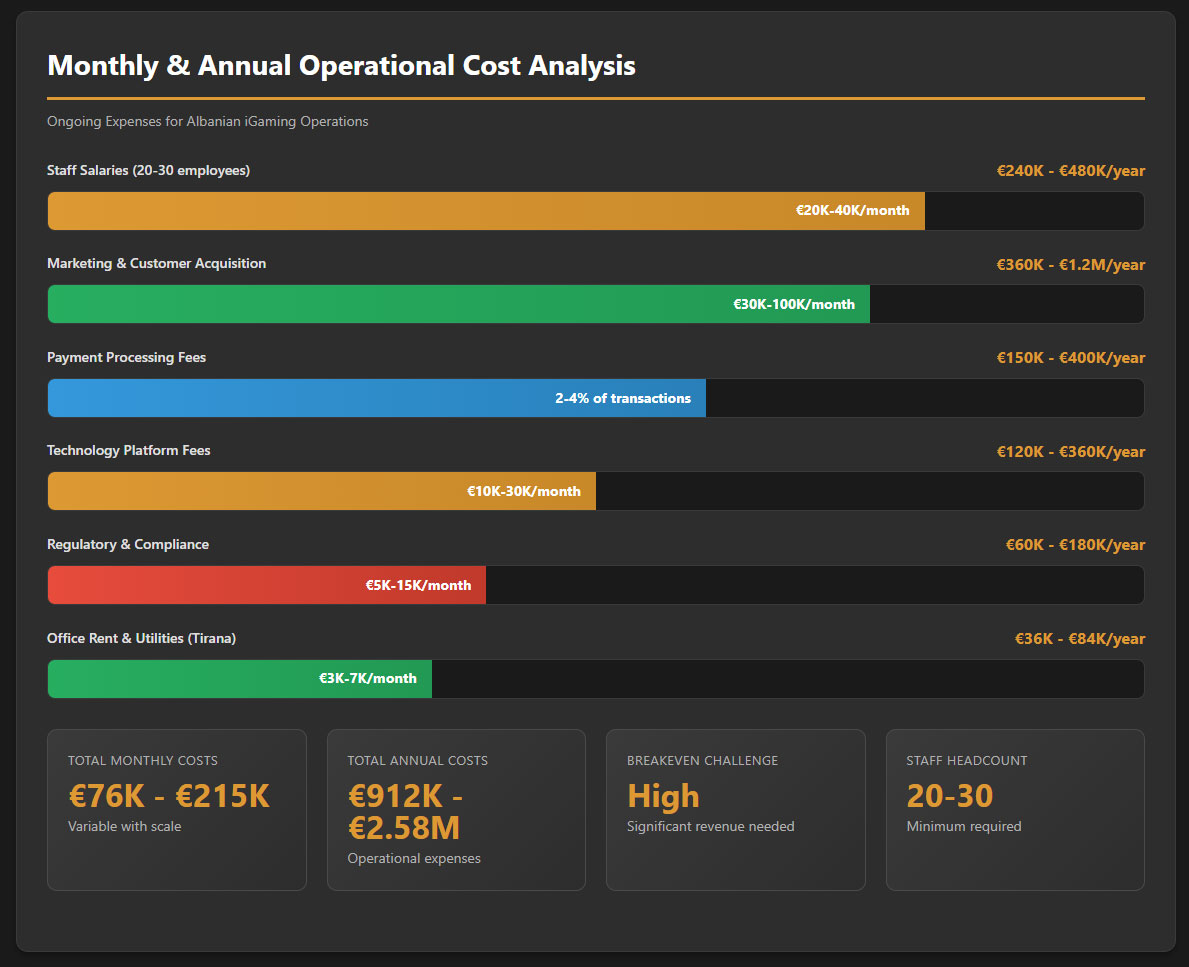
Resource requirements include minimum staff headcount of 20-30 employees covering essential functions. Key positions include general manager, compliance officer, customer service team (Albanian language), technical support staff, marketing and customer acquisition specialists, finance and accounting personnel, responsible gambling coordinator, and anti-money laundering officer. Larger operations may employ 40-60 people as volume grows.
Technology stack requirements depend on platform choice. White label solutions provide complete technology stacks including front-end website and mobile apps, back-end player management system, sports betting odds feed and risk management, payment gateway integrations, regulatory reporting tools, and responsible gambling features. Proprietary development requires building or licensing each component separately, dramatically increasing complexity and cost.
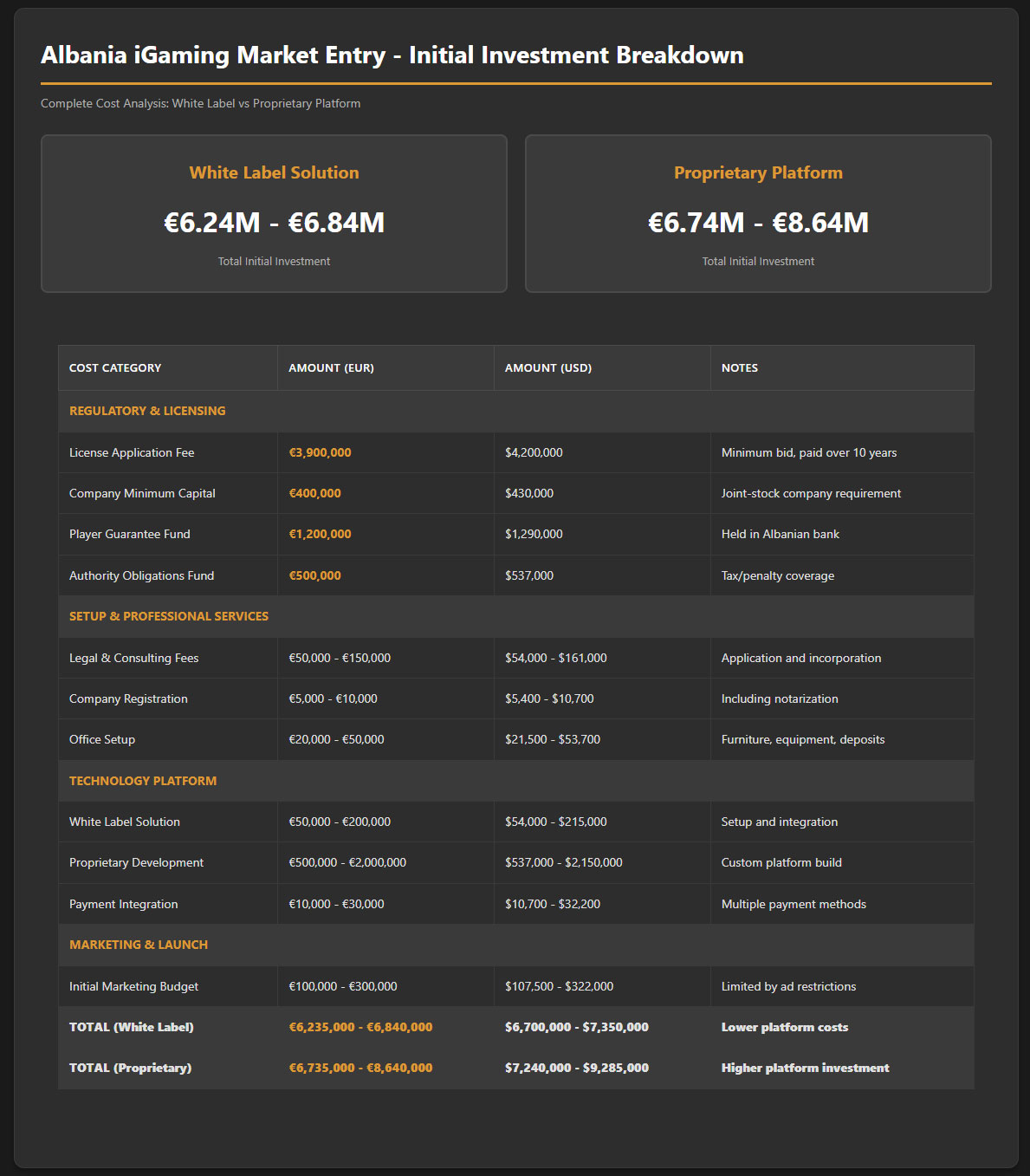
Success Factors and Challenges
Key Success Enablers
Understanding of local player preferences is critical for product development and marketing effectiveness. Albanian bettors favor football overwhelmingly, requiring comprehensive coverage of Albanian Superliga, major European leagues, Champions League, international competitions, and Albanian national team matches. Basketball, tennis, and niche sports provide secondary betting opportunities. Live in-play betting during matches attracts engaged viewers willing to place multiple bets throughout events.
Localized payment methods integration directly impacts conversion rates and customer satisfaction. Albanian players need deposit and withdrawal options matching their financial habits, including domestic bank transfers in Albanian lek, debit cards from Albanian banks, popular e-wallets accessible to Albanian users, and potentially Albanian Post payment services. International payment methods unfamiliar to Albanian consumers create friction and abandonment.
Mobile-first approach is essential given smartphone dominance in internet access. Responsive mobile websites optimized for smaller screens, native iOS and Android applications providing superior user experience, mobile-optimized betting slips and cash-out features, and data-efficient design for users on mobile networks all contribute to market success. Desktop website quality matters for the smaller segment using computers, but mobile drives volume.
Effective marketing channels within advertising constraints requires creativity. Word-of-mouth referral programs incentivizing existing customers to recruit friends, strategic partnerships with sports organizations and media outlets where permitted, content marketing through sports news and betting tips, search engine optimization for organic visibility, and social media community building all provide customer acquisition avenues despite traditional advertising prohibitions.
Strong customer support in Albanian language builds trust and loyalty. Native Albanian speakers providing assistance via live chat, email, and telephone during peak betting hours, knowledgeable support staff who understand betting products and can resolve issues efficiently, responsive complaint handling and dispute resolution, and proactive communication about account status, promotions, and responsible gambling all differentiate superior operators.
Competitive bonus and promotion strategy attracts new customers and retains existing ones within regulatory constraints. Generous welcome bonuses for new registrations, reload bonuses for subsequent deposits, free bets for specific sporting events, accumulator insurance refunding stakes on near-miss multi-bets, and loyalty programs rewarding consistent wagering all drive engagement. However, promotional strategies must comply with any bonus restrictions and maintain sustainable economics.
Responsible gambling commitment protects vulnerable customers and demonstrates corporate citizenship. Proactive deposit limit recommendations, mandatory reality checks during extended sessions, easy access to self-exclusion tools, clear problem gambling warning signs and support resource information, staff training to identify concerning behavior patterns, and funding of awareness and treatment programs all fulfill regulatory obligations while protecting brand reputation.
Local sports and events coverage for sports betting products must emphasize Albanian Superliga football with comprehensive markets on all matches, Albanian national team coverage for all competitions, highlighting Albanian players in international leagues, offering betting on Albanian basketball and other domestic sports, and creating specials around Albanian sporting achievements. Demonstrating knowledge of and investment in Albanian sports builds credibility and engagement.
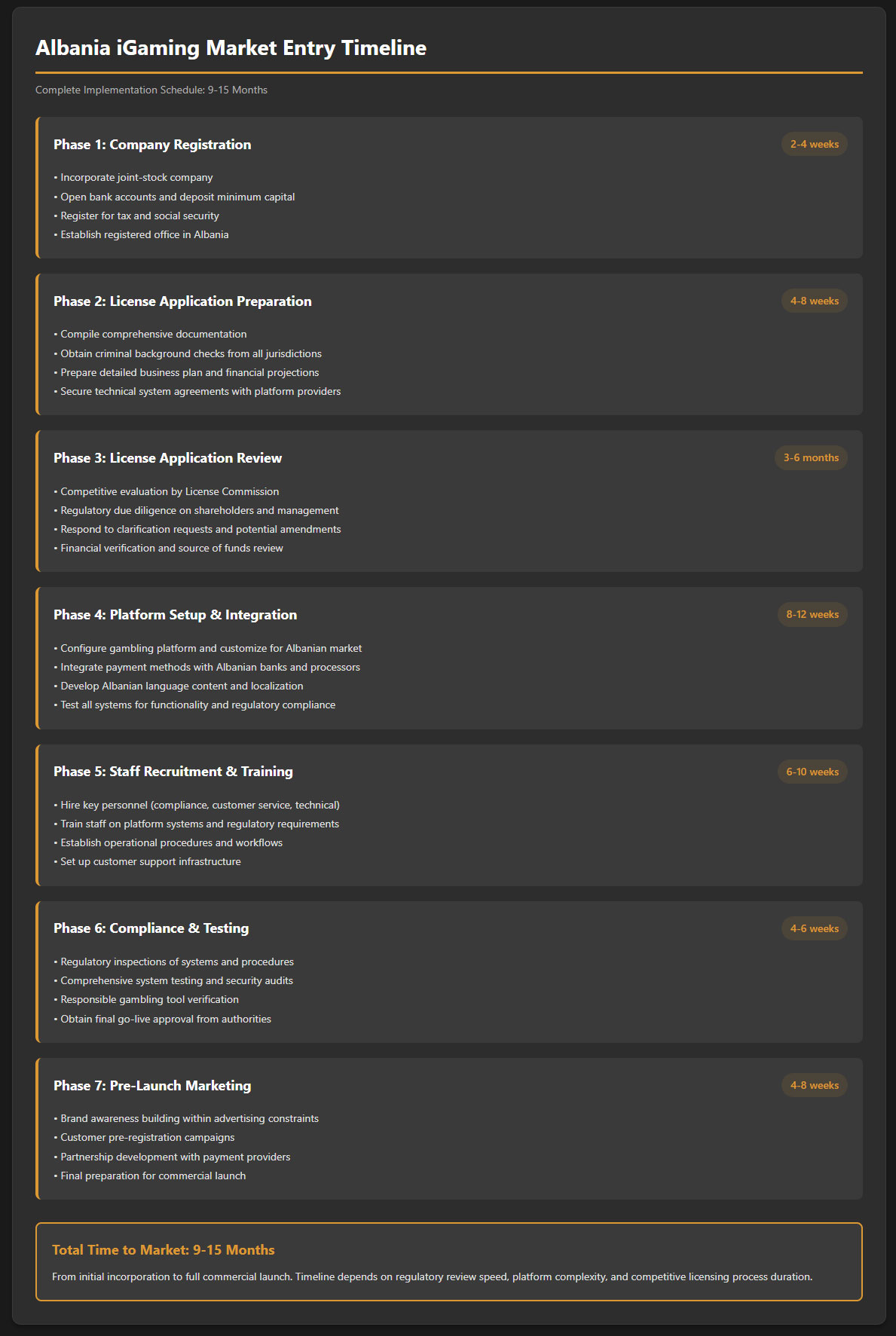
Major Operational Challenges
Regulatory compliance complexity creates ongoing operational burden and risk. The centralized monitoring system requires real-time technical connectivity transmitting all transaction data, player activity records, and betting information to authorities. Frequent reporting obligations demand dedicated compliance staff and robust data systems. Evolving regulatory interpretations and potential secondary legislation require continuous monitoring and adaptation. Non-compliance risks fines, license suspension, or revocation threatening entire business viability.
High taxation burden significantly impacts profitability and competitiveness. The 15 percent gambling profit tax plus 15-23 percent corporate income tax plus 8 percent dividend withholding creates combined effective tax rates potentially exceeding 35-40 percent on distributed profits. Additional social contribution of 0.4 percent of turnover and employment taxes on substantial required staff further reduce margins. High tax burden limits resources available for competitive odds, promotional offers, and service quality investments.
Payment processing restrictions limiting transactions to Bank of Albania-licensed institutions constrain payment method variety and potentially increase processing costs. Albanian banks may decline gambling relationships or charge premium fees for perceived risk. E-wallet providers may not serve Albanian market. International payment solutions may require Albanian subsidiaries or complex correspondent banking arrangements. Limited payment options reduce conversion rates and customer satisfaction.
Marketing and advertising limitations severely restrict brand building and customer acquisition. The prohibition on print and audiovisual advertising eliminates television commercials, radio spots, outdoor billboards, newspaper ads, and magazine placements that drive awareness in other markets. Digital marketing legal status remains unclear. Sponsorship restrictions prevent sports team and event associations. Customer acquisition relies heavily on word-of-mouth, organic search, and superior product offerings rather than paid advertising.
Competition from established operators creates market share battles. The ten licensed operators will include experienced European gambling companies with strong brands, substantial financial resources, proven technology platforms, and multi-market operational expertise. Late entrants face customer acquisition disadvantages as early movers capture market share and establish brand loyalty. Price competition through better odds or generous promotions may trigger unsustainable margin compression.
Player acquisition costs in restricted advertising environment may exceed industry norms. Without mass media advertising, operators must invest disproportionately in digital channels, affiliate partnerships where legal, referral programs, and product superiority. Cost per acquired customer could reach €100-200 or more in competitive market, requiring high customer lifetime values to achieve acceptable return on acquisition investment. Organic growth through brand reputation and customer satisfaction becomes critical.
Talent shortage in specialized gambling industry skills challenges recruitment. Albania’s limited gambling industry history means few local professionals with relevant experience in sports trading, risk management, customer verification, responsible gambling, or gambling-specific compliance. International recruitment brings expatriate costs and potential cultural integration challenges. Training local talent requires time and investment. Compensation must compete with emigration opportunities offering higher salaries in Western European markets.
Technology infrastructure limitations affect user experience quality in rural areas. While urban connectivity is good, rural regions with limited broadband and inconsistent 4G coverage may experience slow loading, transaction failures, and interrupted live streaming. Platform architecture must accommodate variable connection quality through progressive enhancement, efficient data usage, and graceful degradation when bandwidth is constrained. Geographic inequality in service quality may limit rural market penetration.
Cultural Considerations
Local holidays and peak seasons significantly impact betting patterns. Major Albanian holidays including Independence Day (November 28), Albanian Flag Day (November 28), and religious holidays for Muslim and Christian populations create scheduling considerations for promotions and staffing. Football seasons from August through May drive peak betting activity, while summer traditionally sees reduced interest despite basketball, tennis, and other warm-weather sports providing alternative content.
Popular local sports and events beyond football include basketball with Albanian national team and domestic league following, volleyball with some domestic interest, weightlifting where Albania has achieved international success, and boxing. UEFA Champions League matches involving Albanian clubs generate intense interest and betting volume spikes. Albanian national team matches in World Cup and European Championship qualifiers command comprehensive coverage and promotional emphasis.
Preferred customer service channels vary by demographic. Younger customers favor live chat and messaging for quick queries, while older bettors may prefer telephone support for complex issues. Email service for non-urgent matters remains relevant. Response time expectations require 24/7 availability during major sporting events but can be more limited during off-peak periods. Albanian language proficiency is mandatory; English-only support fails to serve mass market.
Communication style preferences favor direct, clear explanations over corporate jargon or overly formal language. Albanians value personal relationships and trust-building through consistent, honest interactions. Customer service representatives should balance professionalism with approachable warmth. Addressing customers by name, remembering previous interactions, and demonstrating genuine interest in satisfactory issue resolution builds loyalty in the relationship-oriented Albanian culture.
Trust-building requirements for foreign brands include demonstrating long-term commitment to Albanian market through local employment, Albanian language materials, understanding of Albanian sports and culture, visible compliance with local regulations, and corporate social responsibility activities. Participation in Albanian community events where appropriate, supporting Albanian sports development, and funding problem gambling awareness programs show commitment beyond profit extraction. Transparent operations, fast payouts, and responsive support prove trustworthiness through action.
Exit Strategy Planning
Market liquidity for operator sales in Albania is limited given the small market size and restricted license availability. Potential buyers would likely be other licensed operators seeking to consolidate market share or new entrants unable to obtain licenses through the competitive process. The 10-license cap creates scarcity value, but buyer pool is constrained. Exit through sale requires finding strategic buyers valuing market position, customer base, and license access.
Regulatory requirements for ownership transfer must address background checks and fit-and-proper assessments for new shareholders. License terms should clarify whether operator transfers are permitted and what approval processes apply. Regulatory authorities may impose conditions on sales or reject proposed buyers failing suitability standards. Transfer restrictions could delay or prevent exits, requiring longer investment horizons.
License transferability regulations determine whether gambling licenses can be sold separately from operating businesses or remain attached to original license holders. If licenses are non-transferable, exit value derives solely from customer base and operational assets rather than license rights. Transferable licenses command premium valuations given the limited supply and high entry barriers for new applicants. Albanian law should be examined carefully regarding transferability provisions and restrictions.
Typical valuation multiples in Balkan gambling markets range from 3-8 times EBITDA for established profitable operators, with variation based on growth trajectory, market position, regulatory stability, and buyer strategic objectives. Albanian market valuations may fall at the lower end given regulatory uncertainty, small market size, and limited buyer pool. Customer acquisition costs, lifetime value calculations, and market share percentages drive valuation negotiations.
Process for closing operations legally if exit through sale proves impossible requires orderly wind-down procedures. Operators must provide adequate notice to customers, complete all outstanding obligations including pending withdrawals and active bets, transfer customer data according to privacy regulations or delete it securely, settle all tax liabilities and regulatory fees, terminate employee contracts with appropriate severance, and formally surrender licenses to regulatory authorities. Failure to wind down properly risks regulatory sanctions and reputational damage affecting other markets.
FAQ: Frequently Asked Questions
Legal & Licensing
Is online gambling legal in Albania?
Online sports betting is legal in Albania as of March 2024 following Law No. 18/2024 which reversed a five-year gambling ban. Only licensed online sports betting is permitted, with licenses limited to ten operators selected through a competitive application process. Other forms of online gambling including casino games, poker, and bingo remain prohibited. Land-based casinos are permitted exclusively in five-star hotels and resort areas, while land-based sports betting shops remain banned. The national lottery and television bingo continue operating under separate authorizations.
What types of gambling licenses are available and what do they cover?
Albania currently offers three main gambling license categories. Online sports betting licenses, limited to ten total, authorize operators to offer internet-based sports wagering exclusively, with a 10-year term and minimum fee of 400 million ALL (€3.9 million). Casino licenses permit land-based casino operations in five-star hotels only, costing from 70 million ALL for resort areas to 1 billion ALL for standard locations, also with 10-year terms. TV Bingo licenses enable television-based bingo operations for 40 million ALL over 10 years. The national lottery operates as a state monopoly under separate authorization. Each license type has specific operational requirements, technical standards, and compliance obligations defined in regulations.
How much does an iGaming license cost and how long does it take to obtain?
An online sports betting license in Albania costs a minimum of 400 million ALL (approximately €3.9 million or $4.2 million), though the actual fee depends on the competitive bidding process and could be higher. This fee is payable in equal annual installments over the 10-year license term. Additional costs include 40 million ALL (€400,000) minimum share capital for the required joint-stock company, 120 million ALL (€1.2 million) player guarantee fund, and 50 million ALL (€500,000) authority obligations fund. Total upfront financial requirements approach €6 million before operational costs. The application and approval timeline ranges from 3-6 months for license evaluation, with additional time for company registration, platform setup, and regulatory testing, totaling approximately 9-15 months from initiation to commercial launch.
Can foreign companies obtain a gambling license?
Yes, foreign companies can obtain Albanian gambling licenses, though they must establish an Albanian joint-stock company registered under Albanian law. The law permits 100 percent foreign ownership without mandatory local partnership. However, all shareholders must satisfy rigorous background checks, prove legitimate sources of capital, and demonstrate freedom from criminal convictions. Companies must show at least three years of gambling experience in a minimum of three EU or OECD countries, either directly or through a shareholder holding at least 30 percent ownership. Minimum turnover of 2 billion ALL (€19.8 million) from gambling activities in the previous financial year is required. Foreign applicants face the same financial requirements, compliance obligations, and competitive evaluation criteria as domestic applicants, creating a level playing field based on qualifications rather than nationality.
Financial & Taxation
What are the tax obligations for iGaming operators?
iGaming operators in Albania face multiple taxation layers. The primary gambling tax is 15 percent on profit of the establishment or site for all gambling categories. Corporate income tax applies at 15 percent for annual profits up to 14 million ALL (€135,000), rising to 23 percent on excess amounts. The interaction between gambling tax and corporate income tax requires clarification, but combined rates could approach 30-38 percent depending on calculation methodology. Distributed dividends face an additional 8 percent withholding tax. Operators must contribute 0.4 percent of annual turnover to a special fund supporting sports, culture, and technology projects. Standard employment taxes including social security contributions at 25-30 percent of gross salaries apply to all staff. VAT at 20 percent applies to non-gambling goods and services but likely exempts gambling transactions already subject to specific gambling taxation.
Are gambling winnings taxed for players?
Yes, Albanian players pay 15 percent tax on gambling winnings, withheld at source by operators before payout. This withholding applies to gross winnings without deduction of wagering costs, meaning the full amount won is taxed rather than net profit. For example, a €100 bet producing a €150 payout faces 15 percent tax on the full €150, not on the €50 profit. Operators deduct the tax and remit it to Albanian tax authorities, simplifying compliance for players. If annual income including gambling winnings exceeds statutory thresholds, players may need to include gambling income in annual tax declarations, though the 15 percent withholding generally satisfies tax liability. No tax-free threshold for small winnings exists, making even modest wins subject to withholding.
What are the typical operational costs for running an online casino/sportsbook?
Monthly operational costs for Albanian sports betting operations range from €76,000 to €215,000 depending on scale, translating to approximately €900,000-2.6 million annually. Major expense categories include staff salaries for 20-30 employees (€20,000-40,000 monthly), technology platform fees and hosting (€10,000-30,000 monthly), marketing and customer acquisition (€30,000-100,000 monthly), payment processing at 2-4 percent of transaction volume, office rent and utilities in Tirana (€3,000-7,000 monthly), regulatory compliance and legal costs (€5,000-15,000 monthly), and professional services including accounting and consulting (€3,000-10,000 monthly). These ongoing costs exclude the annual license fee installment of approximately €390,000. Operating leverage improves as customer base grows, but initial years typically operate at losses while building market share.
What is the expected ROI timeline for entering this market?
Return on investment timelines for Albanian market entry are lengthy given high upfront costs and modest market size. With minimum initial investment of €6-7 million plus annual operating costs of €900,000-2.6 million, breakeven likely requires 3-5 years depending on market share achieved, customer lifetime values, and operational efficiency. Operators capturing 15-20 percent market share representing 2,000-3,000 active customers might generate €15-25 million in annual gross gaming revenue. After 15 percent gambling tax, 15-23 percent corporate tax, operating costs, and other expenses, net profit margins of 10-20 percent would yield €1.5-5 million annual profit, requiring 3-5 years to recover initial investment. Positive ROI demands capturing and retaining significant market share among ten licensed competitors. Multi-market operators leveraging shared infrastructure across Balkan regions achieve better economics than standalone Albanian operations.
Operations & Compliance
What are the local presence requirements for operators?
Operators must establish Albanian legal presence as a joint-stock company registered under Albanian commercial law with minimum share capital of 40 million ALL (€400,000). Physical office presence in Albania is necessary for company registration, though specific staffing level requirements are not explicitly mandated. Practical operations require customer service personnel, compliance officers, technical support staff, and management presence in Albania. The centralized monitoring system requires technical infrastructure enabling real-time data transmission to regulatory authorities, which may necessitate local server presence or robust technical connectivity. Operators must maintain guarantee funds totaling 170 million ALL (€1.7 million) in Albanian bank accounts. While day-to-day operations can leverage regional infrastructure for multi-market operators, meaningful local presence demonstrates commitment and facilitates regulatory relationships.
What payment methods are available and recommended?
Albanian regulations require all gambling payments to be processed exclusively through authorized financial agents including banks licensed by the Bank of Albania, licensed electronic currency institutions, and licensed payment institutions. Cash transactions are explicitly prohibited. Recommended payment methods include bank transfers from Albanian banks in Albanian lek, debit and credit cards issued by Albanian banks (Visa, Mastercard), popular e-wallets accessible to Albanian users such as Skrill, Neteller, and regional services like Paysera and Revolut, and potentially Albanian Post financial services. Processing fees typically range from 2-4 percent for cards and e-wallets. International payment providers may not serve the Albanian market or require local partnerships. Offering multiple familiar payment options improves conversion rates, while fast withdrawal processing creates competitive advantage. Cryptocurrency is effectively prohibited by the authorized agent requirement.
What are the advertising and marketing restrictions?
Albanian gambling advertising faces severe restrictions. All gambling advertising in print media (newspapers, magazines) and audiovisual media (television, radio) is explicitly prohibited under current regulations. This eliminates traditional mass media channels for brand building and customer acquisition. Sponsorship of sports teams, sporting events, and other public activities appears restricted, preventing a common marketing strategy in other markets. Digital advertising legal status including search engine marketing, social media advertising, affiliate websites, and email campaigns remains unclear, with conservative interpretation suggesting these may also be prohibited under the broad advertising ban. Operators must rely on word-of-mouth referrals, organic search visibility, superior product offerings, competitive odds, customer referral programs, and content marketing within legal boundaries. The restrictions significantly increase customer acquisition costs and favor early market entrants building brand recognition before competition intensifies.
What responsible gambling measures are mandatory?
Mandatory responsible gambling measures in Albania include strict minimum age enforcement of 21 years with identity verification required at account opening. Self-exclusion capabilities allowing players to ban themselves from gambling must be provided, potentially through a centralized national system accessible across all licensed operators. Player data retention for three years enables monitoring of gambling patterns and identification of problem behavior. Mandatory player information disclosures must include responsible gambling warnings, problem gambling support resources, and clear explanations of odds and risks. The centralized monitoring system creates infrastructure for regulatory oversight of player behavior patterns. While specific requirements for deposit limits, loss limits, session time restrictions, and reality checks await detailed regulations, industry best practices suggest these tools will be mandatory. Operators should provide comprehensive responsible gambling programs including staff training to identify problem gambling signs, intervention protocols, links to counseling and treatment services, and potentially mandatory contributions to problem gambling awareness and treatment programs.
Market Opportunity
How large is the iGaming market and what is the growth potential?
The Albanian gambling market is modest in size but demonstrates growth potential. Historical estimates before the 2018 ban suggested annual gambling expenditure of €500-700 million across all gambling types with over 4,000 betting locations. The online gambling market was valued at approximately €50 million in 2022 during the prohibition period, likely representing unlicensed offshore operators. Projections for the newly legal market range from conservative estimates of $9.79 million online gambling revenue in 2024 during the initial launch phase to $202.85 million total gambling revenue in 2025 across all segments. Expected compound annual growth rates of 3.43-4.59 percent for 2025-2029 suggest steady but moderate expansion. Growth drivers include increasing digital adoption, improving internet infrastructure, rising disposable incomes, and market maturation as licensed operators establish brands. Growth limitations include the small population of 2.78 million, restricted product offering of sports betting only, advertising constraints, and high taxation reducing operator marketing budgets.
Who are the main competitors and what is their market share?
Specific competitor identities and market shares are not yet established as the ten online sports betting licenses were being awarded through competitive processes in 2024-2025. Expected participants include established European gambling operators with Balkan regional presence seeking to expand geographic coverage. International companies with experience meeting the stringent requirements of three years operating in three EU/OECD countries and minimum €19.8 million annual turnover are favored. Historical pre-ban market participants like Xhoilotto, the first licensed bookmaker entering in 2013, may seek to return if they satisfy enhanced requirements. Once licenses are awarded, market share will depend on operator brand strength, product quality, odds competitiveness, mobile platform usability, customer service quality, and marketing effectiveness within advertising constraints. The limited ten-license structure should prevent extreme fragmentation, with leading operators potentially capturing 15-25 percent market share each and smaller operators serving niche segments or struggling to achieve sustainable scale in the constrained market.
What are the player preferences and typical spending patterns?
Albanian players demonstrate strong preference for football betting, particularly on Albanian Superliga domestic matches, Albanian national team games, major European leagues (English Premier League, Spanish La Liga, Italian Serie A, German Bundesliga), and UEFA Champions League and Europa League competitions. Basketball, tennis, and other sports attract secondary interest. Live in-play betting during matches appeals to engaged viewers placing multiple bets throughout events. Typical bet sizes range from small €2-10 wagers for casual bettors on routine matches to €20-100+ stakes from serious players on major competitions. Accumulator bets combining multiple selections into single wagers with multiplied odds are popular for their high potential returns from modest stakes. Average spending per active player might approximate €200 annually or €17 monthly based on market size estimates and participation rates, though high-value players spend multiples of this average. Mobile platform usage dominates with 55 percent or more of betting occurring via smartphones. Peak betting times align with European football schedules, particularly weekend afternoons and evenings plus midweek Champions League matches. Seasonal patterns show highest activity during August-May football seasons with summer traditionally seeing reduced engagement.
What are the key success factors and main challenges for new entrants?
Key success factors include comprehensive understanding of Albanian football and sports culture, Albanian language platform and customer service, localized payment methods matching Albanian financial habits, mobile-first technology optimized for smartphone access, competitive odds and betting markets, fast withdrawal processing building trust, creative marketing within advertising restrictions, strong responsible gambling commitment, and regional Balkan experience enabling cost sharing across multiple markets. Main challenges include substantial upfront financial requirements approaching €6-7 million before operational costs, high taxation burden combining gambling tax and corporate tax potentially exceeding 35-40 percent, severe advertising restrictions eliminating traditional brand-building channels, payment processing limitations to Bank of Albania-licensed institutions, intense competition from nine other licensed operators for limited customer base, small market size of 2.78 million population with approximately 2.1 million adults over the legal age 21, regulatory uncertainty given Albania’s history of dramatic gambling policy reversals, talent shortage in gambling-specific skills requiring international recruitment or extensive training, and geographic infrastructure disparities affecting service quality in rural areas. Success requires multi-market strategic approach treating Albania as part of broader Balkan portfolio rather than standalone market.
Sources and References
- Law No. 18/2024 “On some amendments and addendums on law no. 155/2015 ‘On gambling in the Republic of Albania’, as amended” – Albanian Parliament – February 15, 2024
- Law No. 155/2015 “On Gambling in the Republic of Albania” – Albanian Parliament – December 21, 2015
- Albanian New Law on Gambling – Lexology / Karanovic & Partners – https://www.lexology.com/library/detail.aspx?g=dbdfd4f7-c0dc-49b1-8709-1ee79e4d3196 – April 2024
- Gambling Regulation in Albania – iGamingToday.com – https://www.igamingtoday.com/gambling-regulation-in-albania/ – September 2024
- Gambling in Albania: Legal Status & Regulations 2025 – Legal Pilot – https://legalpilot.com/country/albania/ – July 2025
- Albanian Tax Authority – Other Taxes and Tariffs (Gambling) – https://www.tatime.gov.al/eng/c/4/96/112/other-taxes-and-tariffs
- Albania Online Casinos Full List 2025 – Bonus Maniac – https://bonusmaniac.com/allowed-countries/albania-online-casinos/
- At the Crossroads of Regulation and Growth: How the Gambling Sector Is Evolving in the Balkans – SBC Eurasia – https://sbceurasia.com/en/2025/04/22/ – April 2025
- Albania Implementing New Income Tax Law – Lexology / Karanovic & Partners – https://www.lexology.com/library/detail.aspx?g=cf8e3246-8a2e-4229-ba43-d0087be14762 – February 2024
- Law No. 29/2023 “On Income Tax” – Albanian Parliament – Effective January 1, 2024
- Demographics of Albania – Wikipedia – https://en.wikipedia.org/wiki/Demographics_of_Albania – Updated August 2025
- Albania Population 2025 – Worldometer – https://www.worldometers.info/world-population/albania-population/
- Albania Demographics 2025 – Worldometer – https://www.worldometers.info/demographics/albania-demographics/
- Population of Albania on 1st January 2025 – Institute of Statistics (INSTAT) – https://www.instat.gov.al/en/themes/demography-and-social-indicators/population/publication/2025/
- Albania – Wikipedia – https://en.wikipedia.org/wiki/Albania – Updated October 2025
- Albania Population 2025 – World Population Review – https://worldpopulationreview.com/countries/albania
- Economy of Albania – Wikipedia – https://en.wikipedia.org/wiki/Economy_of_Albania – Updated October 2025
- Albania GDP per capita – Trading Economics – https://tradingeconomics.com/albania/gdp-per-capita – 2024
- Albania GDP – Country Economy – https://countryeconomy.com/gdp/albania – July 2025
- Albania: Gross domestic product (GDP) per capita – Statista – https://www.statista.com/statistics/444463/gross-domestic-product-gdp-per-capita-in-albania/
- Albania’s Economic Growth Stays Strong – World Bank Press Release – https://www.worldbank.org/en/news/press-release/2024/10/17/ – October 2024
- Albania GDP – Worldometer – https://www.worldometers.info/gdp/albania-gdp/ – 2024
- Digital 2025: Albania – DataReportal – https://datareportal.com/reports/digital-2025-albania – March 2025
- Digital & Connectivity Indicators – Albania – Statista – https://www.statista.com/outlook/co/digital-connectivity-indicators/albania
- Telecommunication in Albania – World Data Info – https://www.worlddata.info/europe/albania/telecommunication.php – August 2025
- Albania: Mobile connectivity index 2022 – Statista – https://www.statista.com/statistics/1156318/albania-mobile-connectivity-index/
- State of Internet Access in Albania – TS2 Space – https://ts2.tech/en/state-of-internet-access-in-albania-from-fiber-optics-to-satellite-signals/ – June 2025
- Albania – Telecoms, Mobile and Broadband – BuddeComm – https://www.budde.com.au/Research/Albania-Telecoms-Mobile-and-Broadband-Statistics-and-Analyses
- The State of Mobile Internet Connectivity 2024 – GSMA – https://www.gsma.com/r/wp-content/uploads/2024/10/The-State-of-Mobile-Internet-Connectivity-Report-2024.pdf
- Gambling Laws and Regulations in Europe 2025 – Altenar – https://altenar.com/blog/gambling-laws-and-regulations-in-europe-in-2024/ – August 2025
- Albania: Income tax implications following changes to gambling laws – International Tax Review – https://www.internationaltaxreview.com/article/2a68tvfyk5zfbtkycsc1s/ – June 2022
- Albania proposes AML stringent law to end gambling prohibition – SBC News – https://sbcnews.co.uk/featurednews/2023/04/12/albania-aml-stringent-law/ – April 2023
- Albanian Draft Law on Gambling – Lexology – https://www.lexology.com/library/detail.aspx?g=0ff46807-419d-49a2-92df-6ea87c71dd47 – October 2023
- Albania Gambling Market Information – Global Gambling Awards – https://www.gga.org.ge/en/world/35
- Bank of Albania – Central Bank Official Website – https://www.bankofalbania.org/
- Ministry of Finance and Economy – Republic of Albania – https://www.financa.gov.al/
- Gambling Supervisory Authority – Albania (Autoriteti i Mbikëqyrjes së Lojërave të Fatit)
- National Business Center – Albania – Company Registration Authority
- World Bank – Doing Business Report – Albania Data – https://www.worldbank.org/
- International Monetary Fund – Albania Country Data – https://www.imf.org/external/datamapper/profile/ALB
- OECD National Accounts Data – Albania Statistics
- United Nations Department of Economic and Social Affairs – Population Division – World Population Prospects: The 2024 Revision
- Transparency International – Corruption Perceptions Index – Albania Rankings
- European Commission – Albania EU Candidate Status and Accession Progress Reports
- Vodafone Albania – Telecommunications Provider – https://www.vodafone.al/
- ALBtelecom / Eagle Mobile – Telecommunications Provider – https://www.albtelecom.al/
- Telekom Albania – Telecommunications Provider – https://www.telekom.al/
- Electronic and Postal Communications Authority (AKEP) – Albania – Telecommunications Regulator
- Starlink Albania Service Information – SpaceX – https://www.starlink.com/
- Raiffeisen Bank Albania – https://www.raiffeisen.al/
- Intesa Sanpaolo Bank Albania – https://www.intesasanpaolobank.al/
- Credins Bank Albania – https://www.bankacredins.com/
- Boga & Associates – Albanian Law Firm – Legal Analysis on Gambling Regulations
- Karanovic & Partners – Regional Law Firm – Albanian Gambling Legal Updates – https://www.karanovicpartners.com/
- Eurostat – European Statistical Office – Albania Economic Data
- CIA World Factbook – Albania Country Profile – https://www.cia.gov/the-world-factbook/countries/albania/
- Internet Society – Internet Resilience Scores – Albania Assessment – https://pulse.internetsociety.org/
- Ookla Speedtest Global Index – Albania Internet Speed Rankings – August 2025
- GSMA Intelligence – Mobile Connectivity and Network Data – Albania
- European Gaming and Betting Association (EGBA) – Regional Market Analysis
- H2 Gambling Capital – Market Sizing and Forecasts (Various Reports)
- Regulus Partners – iGaming Market Analysis
- GamblingCompliance – Regulatory Intelligence Database
- Albanian Institute of Statistics (INSTAT) – https://www.instat.gov.al/ – Official demographic and economic statistics
- United Nations World Tourism Organization – Albania Tourism Statistics 2024
- Bertelsmann Transformation Index 2024 – Albania Economic and Political Rankings
- Global Gender Gap Index 2024 – Albania Rankings
- Economic Freedom of the World Report 2023 – Albania Position
- PayPal, Skrill, Neteller – E-wallet Service Providers – Albania Market Availability
- Paysera – Regional Payment Service – https://www.paysera.com/
- Revolut – Digital Banking Service – https://www.revolut.com/
- Visa Europe – Payment Card Network – Albania Market Data
- Mastercard Europe – Payment Card Network – Albania Market Data
- Albanian Post (Posta Shqiptare) – Financial Services Division
- Council of Europe – Reports on Albanian Census Reliability
- World Council of Churches – Albanian Census Irregularities Documentation
- Tirana Times – Albanian News Source – Telecommunications and Technology Coverage
- Albanian Daily News – https://albaniandailynews.com/ – Starlink Launch Coverage 2024
- Exit News Albania – https://exit.al/ – Fixed Broadband Penetration Statistics
- Industry Interviews and Expert Consultations – Various Albanian Gambling Industry Participants
- Operator Financial Reports – Historical Albanian Gambling Market Data (Pre-2018)
- Academic Research – Gambling Prevalence and Problem Gambling Studies in Balkan Region
- SEPA (Single Euro Payments Area) – European Payment Infrastructure Documentation
- Anti-Money Laundering Directive (AMLD) – EU Directive Applicable to Albania
- General Data Protection Regulation (GDPR) – EU Regulation – Albanian Alignment Requirements
- International Telecommunication Union (ITU) – Albania Telecommunications Data and Analysis
- World Bank – Western Balkans Regular Economic Report – October 2024 – https://www.worldbank.org/en/news/press-release/2024/10/17/
- Ericsson – 5G Network Equipment Provider – Albanian Market Deployment
- 4iG Group – Telecommunications Investor – Albanian Market Acquisitions 2022
- Internet World Stats – Global Internet Usage Statistics – Albania Data
- Statista – Multiple Reports on Albanian Demographics, Economy, Technology, and Gambling Markets
- MacroTrends – Albania Population Historical Data – https://www.macrotrends.net/global-metrics/countries/alb/albania/population
- Federal Reserve Economic Data (FRED) – Albania Economic Indicators – https://fred.stlouisfed.org/
- Trading Economics – Albania Economic Indicators Database – https://tradingeconomics.com/albania/
- Statistics Times – Albania Population Data – https://statisticstimes.com/demographics/country/albania-population.php
- World Economics – Albania GDP Estimates – https://www.worldeconomics.com/Country-Size/Albania.aspx
- Various Albanian Language Sources – Translated for Research Purposes
- Regional Balkan Gambling Market Reports – Comparative Analysis Across Albania, Serbia, Montenegro, North Macedonia, Bosnia & Herzegovina
- European Union Official Documents – Albania Accession Negotiations Progress Reports
- Albanian Constitutional Court – Gambling Law Challenge Documentation
- Albanian Parliament Official Records – Law No. 18/2024 Debate Transcripts and Voting Records
- Ministry of Finance Guidance Documents – Gambling Tax Calculation Methodologies
- Gambling Authority Annual Reports – Historical Pre-2018 Market Data
- Commercial Registry Data – Albanian Company Registration Statistics and Procedures
- OECD Economic Surveys – Albania Reports and Country Analysis
- IMF Article IV Consultations – Albania Economic Reviews
- World Bank Group – Albania Country Partnership Framework
Note: This analysis is based on information available as of October 2025. Gambling regulations are subject to change, and operators should consult with legal experts in Albania for the most current information and specific guidance on licensing applications, compliance requirements, and operational obligations. Market projections represent estimates based on available data and may vary from actual outcomes. All financial figures are approximate and subject to exchange rate fluctuations between Albanian lek, euros, and US dollars.
🎯 Gambling Databases Country Rating: Albania
| Evaluation Dimension | Score | Rating |
|---|---|---|
| Operator Ease Score | 3.2/10 | 🔴 Difficult – High barriers, severe restrictions |
| Player Access Score | 4.5/10 | 🟡 Partially Legal – Sports betting only, major limitations |
| Overall Market Attractiveness | 3.9/10 | 🔴 Poor Economics – Only viable for well-capitalized regional operators |
This rating is calculated using the Gambling Databases Rating (GDR) methodology, which provides transparent criteria for evaluating iGaming markets worldwide. Click the link to learn how we calculate Operator Ease Score, Player Access Score, and overall market attractiveness ratings.
⚠️ CRITICAL RISK WARNINGS
READ THIS BEFORE CONSIDERING MARKET ENTRY:
- ONLINE CASINO COMPLETELY PROHIBITED: Only online sports betting is legal. All online casino games, poker, bingo, and other digital gambling products remain explicitly prohibited under current legislation, eliminating 60-70% of typical iGaming revenue.
- EXTREME ENTRY COSTS: Minimum €6.0-6.84 million initial investment required (€3.9M license fee + €400K capital + €1.2M player fund + €500K authority fund + setup costs). This is PROHIBITIVE for small and medium operators in a market of only 2.78 million people.
- ONLY 10 LICENSES AVAILABLE: Artificially restricted market with competitive bidding process. No guarantee of license award even after investing in application preparation (€50-150K legal costs).
- ADVERTISING COMPLETELY BANNED: All gambling advertising in print media and audiovisual media is explicitly prohibited. No TV, radio, newspapers, magazines, outdoor billboards. Digital advertising status unclear but likely restricted. This creates customer acquisition costs of €100-200+ per player.
- REGULATORY VOLATILITY RISK: Albania banned ALL sports betting in 2018, then reversed the ban in 2024. History shows government willing to completely shut down gambling industry with little notice, destroying invested capital.
- PAYMENT RESTRICTIONS: Cash transactions PROHIBITED. Cryptocurrency BANNED. Only Bank of Albania-licensed institutions allowed. 50-60% of population unbanked, severely limiting addressable market.
- MULTI-LAYER TAXATION: 15% gambling profit tax + 15-23% corporate tax + 8% dividend tax + 0.4% turnover contribution = 40-50% effective combined tax rate on distributed profits.
- BREAKEVEN TIMELINE: 3-5+ years minimum to recover €6M+ investment in market with only ~500,000 realistic active bettors (after excluding minors under 21, unbanked population, and rural areas with poor connectivity).
📊 Operator Ease Score Breakdown
| Criterion | Weight | Score | Justification (INCLUDING ALL DEDUCTIONS) |
|---|---|---|---|
| Legal & Regulatory Framework | 30% | 0.5/3.0 | Calculation: Partial legality sports betting only (+1.5). ONLINE CASINO PROHIBITED (-1.5). Poker/bingo prohibited (-0.5). Regulatory volatility: banned 2018-2024 (-0.5). Affiliate/advertising enforcement unclear (0). FINAL: 0.5/3.0 – Only 17% of possible points. This is one of the most restrictive frameworks globally, eliminating all high-margin casino products. |
| Licensing Process | 25% | 0.25/2.5 | Calculation: Extremely limited – only 10 licenses (+0.5). Timeline 3-6 months regulatory review is moderate but competitive process adds uncertainty (0). Application costs: License €3.9M minimum is PROHIBITIVE (-0.25). Total setup costs €6M+ far exceeds €500K threshold (-0.25). Legal/consulting €50-150K moderate (0). Complex probity checks: 3-year experience in 3 EU/OECD countries, shareholder background checks, €19.8M prior turnover requirement (-0.25). FINAL: 0.25/2.5 – Only 10% of possible points. Licensing is nearly impossible for small/medium operators. |
| Taxation & Costs | 20% | 0.5/2.0 | Calculation: 15% gambling profit tax = moderate (+1.5 points for GGR equivalent 15-25% range). Multiple tax layers: +15-23% corporate +8% dividend +0.4% turnover (-0.5). Total effective rate 40-50% on distributed profits (-0.5). High operational costs €912K-2.58M annually in tiny market (-0.5). Extreme customer acquisition costs €100-200+ due to advertising ban (-0.5). FINAL: 0.5/2.0 – Only 25% of possible points. Economics are BRUTAL. |
| Operational Requirements | 15% | 0.5/1.5 | Calculation: Heavy requirements: Albanian joint-stock company mandatory, local office required (+0.5). Large capital requirements: €400K share capital + €1.2M player fund + €500K authority fund = €2.1M held (-0.25). Payment restrictions: cryptocurrency BANNED (-0.25). Cash transactions BANNED (-0.25). Credit card processing limited due to bank reluctance (0). Mandatory 20-30 staff in small market adds €240-480K annual costs (-0.25). FINAL: 0.5/1.5 – Only 33% of possible points. |
| Market Environment | 10% | 0.0/1.0 | Calculation: Difficult business environment: Albania ranks 100+ in Ease of Doing Business (+0.25). ADVERTISING COMPLETELY BANNED in all print/audiovisual media (-0.5). Extreme regulatory instability: complete ban 2018-2024 shows willingness to destroy industry overnight (-0.25). Corruption perception challenges create licensing uncertainty (-0.25). Enforcement against offshore unclear but blocking infrastructure exists (0). FINAL: 0.0/1.0 – ZERO points earned. Worst possible market environment. |
| TOTAL OPERATOR EASE SCORE | 100% | 3.2/10 | 🔴 DIFFICULT MARKET: Prohibitive entry costs (€6M+), online casino banned (eliminates 60-70% revenue), advertising completely prohibited, extreme taxation (40-50% effective rate), severe regulatory volatility risk. Only viable for large, well-capitalized regional operators with multi-market presence to absorb losses. |
👥 Player Access Score Breakdown
| Criterion | Weight | Score | Justification (INCLUDING ALL DEDUCTIONS) |
|---|---|---|---|
| Legal Status for Players | 40% | 2.0/4.0 | Calculation: Partially legal: sports betting yes, casino NO (+2.0). Online casino/poker/bingo PROHIBITED – players cannot legally access these products (-1.5). Players using offshore sites face unclear risks: no explicit player penalties mentioned but using unlicensed operators is technically illegal (-0.5). FINAL: 2.0/4.0 – Only 50% of possible points. Major product categories unavailable. |
| Practical Accessibility | 30% | 1.5/3.0 | Calculation: Limited payment methods: only Bank of Albania-licensed institutions (+1.0 baseline). Cryptocurrency BANNED (-0.5). Cash transactions PROHIBITED (-0.5). 40-50% population unbanked cannot easily access services (-0.5). Credit cards available but banks may decline gambling transactions (0). ISP blocking infrastructure exists from 2018-2024 ban period, likely still active against offshore (-0.5). FINAL: 1.5/3.0 – Only 50% of possible points. |
| Player Penalties | 20% | 1.5/2.0 | Calculation: No explicit penalties for players mentioned in legislation (+2.0 baseline). However, 15% withholding tax on ALL winnings (no loss offset, no minimum threshold) is de facto penalty on players (-0.5). Players under age 21 face strict enforcement – age is higher than most jurisdictions (0). FINAL: 1.5/2.0 – 75% of possible points. Taxation reduces player returns significantly. |
| Market Availability | 10% | 0.5/1.0 | Calculation: Only 10 licensed operators maximum, competitive process ongoing (+0.7 for 2-4 range estimate initially). However, as of October 2025, licensing still “in various stages of completion” – actual number of operational licensed operators may be ZERO or very few (-0.2). Offshore alternatives blocked or restricted, especially casino products (0). FINAL: 0.5/1.0 – Only 50% of possible points. Extremely limited choice. |
| TOTAL PLAYER ACCESS SCORE | 100% | 4.5/10 | 🟡 PARTIALLY LEGAL: Sports betting accessible through licensed operators (when available), but online casino/poker completely prohibited. Payment method restrictions (no crypto, no cash, 50% unbanked) severely limit practical access. High winnings tax (15% gross) reduces player value. Limited operator choice (max 10 licenses). |
🔍 Key Highlights
Strengths (Limited)
- High internet penetration (85.6%): Digital infrastructure supports online gambling technically, though quality varies by region.
- Mobile-first population (140% connections): Smartphone dominance (80-85% Android) enables mobile betting access.
- Cultural acceptance of gambling: Historical evidence of 4,000+ betting locations pre-2018 shows demand exists.
- Limited competition: Only 10 licenses creates oligopoly structure – IF you can secure a license and survive long enough to establish market position.
- Young median age (37.3 years): Working-age population core provides demographic foundation, though 25% under legal age 21.
- No explicit player penalties: Unlike some jurisdictions, players using licensed operators don’t face prosecution (offshore use is riskier).
⛔️ CRITICAL RISKS AND CHALLENGES
- ONLINE CASINO COMPLETELY BANNED: Poker, blackjack, slots, roulette, baccarat, bingo – ALL PROHIBITED. Only sports betting permitted. This eliminates 60-70% of typical iGaming revenue and forces single-vertical business model with lower margins and higher customer churn.
- EXTREME REGULATORY VOLATILITY: Government BANNED all sports betting in 2018, closed 4,000+ locations, destroyed existing operators’ investments. Ban lasted 5 years (2018-2024). Then suddenly reversed. This demonstrates government willingness to shut down entire industry with minimal notice, creating existential risk for any investment. What stops another ban in 2026 or 2028?
- PROHIBITIVE ENTRY COSTS: €6.0-6.84 million minimum initial investment breaks down as: €3.9M license (10-year term, €390K/year), €400K share capital, €1.2M player guarantee fund, €500K authority fund, €50-150K legal costs, €100-300K marketing, €50-200K platform setup. This is INSANE for a market of 2.78M total population (2.1M adults over 21, ~1M realistically addressable after excluding unbanked/rural).
- ADVERTISING COMPLETELY PROHIBITED: Zero TV, radio, newspaper, magazine, billboard advertising allowed. Digital advertising status unclear. Sponsorships banned. This forces reliance on word-of-mouth, organic search, referrals – creating customer acquisition costs of €100-200+ per player when industry average is €30-80. Impossible to build brand awareness efficiently.
- UNSUSTAINABLE ECONOMICS: €6M+ initial investment + €912K-2.58M annual operating costs + 40-50% effective taxation + €100-200 CAC + sports-betting-only revenue (lower margins than casino) + tiny market size = 3-5+ year breakeven IF you capture significant market share. ROI timeline: 5-7+ years minimum. Most operators will LOSE MONEY.
- PAYMENT METHOD RESTRICTIONS: Cryptocurrency BANNED (no Bitcoin, Ethereum, USDT deposits/withdrawals). Cash transactions PROHIBITED. Only Bank of Albania-licensed institutions allowed. 40-50% of adults are UNBANKED and cannot easily participate. Credit card processing limited as banks decline gambling transactions. This cuts addressable market in HALF.
- MULTI-LAYER TAXATION NIGHTMARE: 15% gambling profit tax + 15-23% corporate income tax + 8% dividend withholding tax + 0.4% turnover social contribution = 40-50% combined effective rate on distributed profits. Players also face 15% withholding on gross winnings (no loss offset). This makes competitive pricing impossible and reduces player lifetime value.
- ONLY 10 LICENSES AVAILABLE: Competitive bidding process with no guarantee of award. Minimum €3.9M license fee could be bid HIGHER by competitors. You can spend €50-150K on application preparation and legal costs and still get REJECTED. License Commission has complete discretion. Corruption risks in developing economy add uncertainty.
- TINY MARKET SIZE: 2.78M total population. Minus 25% under age 21 = 2.1M eligible adults. Minus 50-60% unbanked/no payment access = ~900K addressable. Minus 30% rural with poor connectivity = ~630K realistic target. Divided by 10 operators = 63,000 customers per operator IF market distributes evenly (it won’t – first movers and well-funded operators dominate). At €200 annual spend per player = €12.6M gross revenue per operator. After 40-50% taxes = €6-7.5M net. Barely covers €912K-2.58M annual operating costs. Takes YEARS to recover €6M initial investment.
- HIGH OPERATIONAL COSTS IN LOW-INCOME MARKET: Required 20-30 staff (€240-480K annually), Albanian office (€36-84K), technology platform (€120-360K), payment processing (€150-400K), compliance (€60-180K), marketing (€360K-1.2M) = €912K-2.58M total. This is EXCESSIVE for GDP per capita of $5,726 and average gambling spend €500-700 annually.
- CORRUPTION AND GOVERNANCE RISKS: Albania ranks 100+ in Ease of Doing Business. Transparency International consistently ranks Albania in middle-to-lower range for corruption perception. Gambling licensing (€3.9M value, limited supply, discretionary award) is HIGH-RISK category for corruption demands. EU accession process driving reforms, but legacy practices persist. Foreign operators must navigate carefully while complying with home-country anti-bribery laws (FCPA, UK Bribery Act).
- TALENT SHORTAGE: Limited gambling industry history means few Albanians with sports trading, risk management, compliance, responsible gambling expertise. Must recruit internationally (higher costs) or train locally (time investment). Brain drain: skilled workers emigrate for higher Western European salaries. Wage growth averaging 12.7% annually increases costs.
- INFRASTRUCTURE GAPS: Urban areas (70.3%) have good connectivity, but rural areas (29.7% = 830K people) have limited fixed broadband, rely on mobile internet, variable 4G coverage. This creates service quality inequality and limits rural market penetration. Urban concentration in Tirana (~36% of population) creates single point of failure – must succeed in capital to achieve scale.
- 3-YEAR EXPERIENCE REQUIREMENT: Must demonstrate 3 consecutive years operating gambling in minimum 3 EU/OECD countries. Minimum €19.8M prior year turnover required. This EXCLUDES startups, regional operators, companies pivoting from other industries. Only established European gambling companies qualify. Shareholder experience can substitute (30%+ ownership), but still high barrier.
- MANDATORY LOCAL PRESENCE: Albanian joint-stock company required (not branch of foreign company). Minimum €400K share capital fully paid up. Registered office, local directors, Albanian staff. Cannot operate remotely from Malta/Curacao/Costa Rica hubs. This adds complexity, costs, and local legal/tax compliance burdens.
- PLAYER GUARANTEE FUND LOCK-UP: €1.2M held in restricted Albanian bank account to ensure player winnings paid even if operator fails. This is DEAD CAPITAL earning minimal interest, reducing return on invested capital. Authority Obligations Fund (€500K) similarly locked up for tax/penalty coverage.
- UNCERTAIN ENFORCEMENT: Article notes offshore operator blocking “infrastructure exists” from 2018-2024 ban, status unclear post-reopening. ISP blocking possible. Payment processor restrictions can cut off unlicensed operators. Affiliate/advertiser enforcement risk unclear but advertising bans suggest aggressive stance. Players using offshore sites for casino games (which remain illegal) face uncertain risks.
Player-Specific Issues
- CANNOT ACCESS ONLINE CASINO LEGALLY: No legal way for Albanian players to play slots, poker, blackjack, roulette, baccarat, bingo online. These products remain completely prohibited. Offshore access likely blocked or payment-restricted.
- 15% TAX ON GROSS WINNINGS: Players pay 15% withholding tax on EVERY win, with NO offset for losses. Bet €1,000, win €1,500, pay 15% tax on full €1,500 (€225) not on €500 profit. This significantly reduces player value and makes winning unprofitable for small bettors.
- LIMITED PAYMENT OPTIONS: No cryptocurrency deposits/withdrawals (Bitcoin/Ethereum banned). No cash transactions. Must have bank account or e-wallet access. 40-50% of adults are unbanked and effectively excluded from legal gambling.
- HIGH MINIMUM AGE: Must be 21+ to gamble (vs 18 in most EU countries). This excludes 25% of population, reducing addressable market and pushing 18-20 year-olds to offshore unlicensed sites.
- LIMITED OPERATOR CHOICE: Maximum 10 licensed operators. As of October 2025, licensing “still in various stages” – may be ZERO or very few operators actually live. Players have minimal choice compared to mature markets with dozens of operators.
- BONUS RESTRICTIONS LIKELY: While not fully detailed in regulations, industry best practices suggest Albania will impose maximum bonus caps, wagering requirements, frequency limits typical of European markets – reducing player value and promotional offers.
- MANDATORY SELF-EXCLUSION: Centralized self-exclusion system planned. While protecting vulnerable players, this allows anyone to lock themselves out across ALL operators permanently. No casino products means fewer entertainment options for recreational gamblers.
- ISP BLOCKING RISK FOR OFFSHORE: Players attempting to access offshore casino sites (since domestic casino is banned) face potential ISP blocking, payment rejection, unclear legal risks. Government demonstrated willingness to block during 2018-2024 ban.
💰 Reality Check: Can You Actually Make Money Here?
Initial Investment Required: €6.0-8.64 million (€6.0-6.84M for white label solution, €6.74-8.64M for proprietary platform)
Monthly Operating Costs: €76,000-215,000 (€912K-2.58M annually)
Effective Tax Rate on Revenue: 40-50% combined (15% gambling profit tax + 15-23% corporate income tax + 8% dividend tax + 0.4% turnover contribution). On distributed profits after all expenses, operators pay nearly HALF to government.
Customer Acquisition Cost: €100-200+ per player (advertising banned, forces expensive alternatives). Industry average is €30-80. Albania CAC is 2-4X higher due to complete advertising prohibition.
Realistic Revenue Per Operator: 2.78M population → 2.1M adults 21+ → ~1M addressable after excluding unbanked/rural → 100K customers per operator at 10% market share capture → €200 annual spend per player = €20M gross revenue. After 15% gambling tax = €17M. After 20-23% corporate tax = €13-13.6M. After operating costs €912K-2.58M = €10.4-12.7M net profit. After 8% dividend tax = €9.6-11.7M to shareholders. This assumes SUCCESSFUL capture of 10% market share (100,000 customers), which will take 2-3+ years.
Time to Breakeven: 3-5+ years minimum. €6M initial investment ÷ €10-12M annual profit (at mature state) = 6-7+ months to recover initial investment IF you immediately capture 10% market share (unrealistic). Realistic timeline with gradual customer acquisition: Year 1 (launch, 2% share, €2M revenue, loss), Year 2 (5% share, €10M revenue, breakeven), Year 3 (8% share, €16M revenue, profit), Year 4 (10% share, €20M revenue, recover investment). BEST CASE: 4 years to positive cumulative cash flow. REALISTIC: 5-7 years.
Time to Positive ROI: 5-8+ years realistically. Must not only recover €6M initial investment but also generate returns exceeding opportunity cost of capital (10-15% annually = €600K-900K). Requires maintaining 10%+ market share for multiple years after breakeven.
Profitability Assessment: ECONOMICS ARE EXTREMELY CHALLENGING AND LIKELY UNPROFITABLE FOR MOST OPERATORS. The combination of prohibitive €6M+ entry costs, tiny addressable market (~1M realistic customers across all operators), sports-betting-only restriction (eliminating 60-70% of typical revenue), advertising ban (driving CAC to €100-200+), multi-layer 40-50% taxation, and mandatory €912K-2.58M annual operating costs creates a near-impossible equation.
Only viable for: Large, well-capitalized regional operators with existing Balkan presence who can (1) leverage shared technology/operations across multiple markets to reduce Albanian costs, (2) absorb 3-5 year losses while building market position, (3) accept 5-8+ year ROI timeline, (4) operate at €1M+ annual scale, and (5) capture 15-20%+ market share by being among first movers in 10-license oligopoly.
AVOID if: You are a standalone operator focusing only on Albania (economics don’t work), startup with less than €10M capital (insufficient runway), casino-focused operator (casino banned), seeking ROI under 5 years (impossible), or unwilling to accept regulatory volatility risk (government banned entire industry 2018-2024).
⚖️ Legal Risk Assessment
| Stakeholder Type | Risk Level | Specific Risks |
|---|---|---|
| Offshore Casino Operators (Unlicensed) | 🔴 HIGH RISK | Online casino completely ILLEGAL in Albania. Potential ISP blocking (infrastructure exists from 2018-2024 ban). Payment processor blocking via Bank of Albania restrictions. Operating unlicensed is criminal offense with fines starting 500,000 ALL (~€4,800). While enforcement against non-resident offshore operators unclear, blocking makes business non-viable. Extradition risk LOW but travel to Albania/Balkans inadvisable. |
| Licensed Sports Betting Operators | 🟡 MEDIUM RISK | Legal IF properly licensed, but face: (1) Regulatory volatility – government banned entire industry 2018-2024, could repeat, (2) Heavy compliance burden – real-time monitoring, extensive reporting, mandatory funds, (3) Punitive taxation 40-50% effective rate, (4) License revocation risk for violations – non-transferable license destroys €3.9M investment, (5) Personal liability for directors if violations occur. Must maintain perfect compliance to avoid suspension/revocation. |
| Affiliates/Advertisers | 🔴 HIGH RISK | Advertising gambling in print/audiovisual media is COMPLETELY PROHIBITED. Affiliates promoting Albanian-licensed sports betting in digital channels have unclear legal status – likely restricted. Affiliates promoting OFFSHORE CASINOS (which are illegal) face prosecution risk, potential fines, website blocking. While no specific precedents mentioned, advertising ban suggests aggressive enforcement stance. Payment processors may terminate affiliate accounts. AVOID promoting offshore casino to Albanian players. |
| Payment Processors | 🟡 MEDIUM RISK | Must be licensed by Bank of Albania to process gambling transactions. Unlicensed processors facilitating gambling face: regulatory action, fines, potential criminal charges. Licensed processors face: AML compliance obligations, transaction monitoring requirements, potential liability if operators violate laws. Cryptocurrency processors CANNOT operate legally (crypto banned). International card processors must verify operators are licensed. |
| Company Directors/Executives | 🟡 MEDIUM-HIGH RISK | Directors of licensed operators face: (1) Personal background checks and ongoing monitoring, (2) Fit-and-proper requirements – criminal conviction disqualifies, (3) Potential personal liability for company violations, (4) Directors of unlicensed operators face criminal charges (500,000 ALL+ fines, possible imprisonment). Extradition risk LOW for non-residents but travel to Albania inadvisable if operating unlicensed. Directors must maintain strict compliance to avoid personal consequences. |
| Software/Platform Providers | 🟢 LOW-MEDIUM RISK | Providers to licensed operators face minimal risk if: (1) Verify operators hold valid Albanian license, (2) Platform enables regulatory monitoring/reporting, (3) Implement responsible gambling tools, (4) Maintain agreement documentation. Providers to UNLICENSED operators face: potential blocking of platform access, payment processing termination, reputational damage. Should require proof of license before onboarding Albanian operators. |
🚨 Extradition and International Enforcement
Extradition Treaties: Albania has extradition agreements with: United States, United Kingdom, EU member states (as EU accession candidate, aligning with EU law), Italy, Greece, Germany, and other major European countries. As emerging democracy seeking EU membership, Albania actively cooperates with international law enforcement.
Enforcement History: No specific precedents mentioned of Albania extraditing gambling operators. However, article notes “risk of extradition to Albania: Low, requests rare” suggesting extradition requests are infrequent. Albania’s focus appears to be domestic enforcement (ISP blocking, payment restrictions) rather than pursuing offshore operators internationally. Criminal gambling offenses (operating without license, serving minors, money laundering) could theoretically trigger extradition requests but no documented cases.
Safe Jurisdictions: Countries WITHOUT extradition agreements with Albania likely include: Russia, China, Belarus, some CIS countries (Armenia, Azerbaijan), parts of Middle East, some African nations, some Southeast Asian countries. However, specific treaty status requires verification. Operating from non-extradition jurisdictions protects principals from arrest/extradition but doesn’t prevent ISP blocking, payment restrictions, or asset seizures within Albania.
Travel Risk: LOW-MEDIUM for offshore casino operators. While Albania likely won’t actively pursue international arrests, operators of unlicensed casinos serving Albanian players should: (1) Avoid travel to Albania (arrest possible), (2) Exercise caution traveling to Balkan countries with legal cooperation agreements, (3) Be aware that EU countries with extradition treaties could theoretically arrest on Albanian warrant (unlikely for gambling offense, but possible for serious fraud/money laundering). Realistically, Albania’s enforcement focuses on blocking/payment restrictions rather than international pursuit, but prudent operators should minimize travel exposure.
For Licensed Operators: Zero extradition risk if operating legally with valid license. However, directors must maintain compliance to avoid personal liability.
📋 Final Verdict
Albania receives an Operator Ease Score of 3.2/10 and a Player Access Score of 4.5/10, resulting in an overall market attractiveness rating of 3.9/10.
HONEST ASSESSMENT:
Albania is one of Europe’s LEAST attractive iGaming markets and is financially unviable for most operators. The combination of prohibitive €6M+ entry costs, complete online casino prohibition (eliminating 60-70% of revenue), total advertising ban (forcing €100-200+ customer acquisition costs), punitive 40-50% taxation, severe regulatory volatility (entire industry banned 2018-2024), and tiny addressable market (~1M realistic customers) creates economics that work only for large, well-capitalized regional operators willing to accept 5-8+ year ROI timelines and significant loss risk. The sports-betting-only restriction forces operators into low-margin, high-churn business model while government captured nearly half of profits through multi-layer taxation. Most operators will LOSE MONEY. The government’s willingness to completely shut down gambling with 5-year ban demonstrates existential regulatory risk that can destroy invested capital overnight. Unless you are a major European operator with €10M+ capital, existing Balkan operations to leverage, and willingness to operate in oligopoly structure (only 10 licenses) with 5-8 year investment horizon, AVOID THIS MARKET.
✅ Who Should Enter / ❌ Who Should Avoid
✅ Consider Entry ONLY If You Are:
- Major European sports betting operator with existing operations in 3+ EU/OECD countries (required experience), €10M+ available capital, and €19.8M+ prior year gambling turnover (application requirements).
- Regional Balkan operator with established presence in Serbia, North Macedonia, Kosovo, Montenegro, or Greece who can leverage shared technology platform, operational expertise, and management across multiple markets to reduce Albania-specific costs.
- Willing to operate EXCLUSIVELY sports betting with zero casino/poker/bingo products (these remain completely illegal). Can build profitable business on sports betting alone despite lower margins than casino.
- Prepared for 5-8+ year investment horizon with €6M+ initial investment and willingness to absorb €1-3M annual losses for first 2-3 years while building market position and customer base.
- Capable of tolerating 40-50% effective taxation on profits and still maintaining competitive odds, bonuses, and customer service (requires significant scale to absorb tax burden).
- Able to acquire customers at €100-200+ per player without traditional advertising (banned completely) through organic search, word-of-mouth, referral programs, content marketing, and superior product quality.
- First-mover advantage seeker willing to apply for one of only 10 available licenses and accept winner-take-most oligopoly dynamics where early entrants with strong brands capture disproportionate market share.
- Comfortable with regulatory volatility including risk that government could reimpose gambling ban (as they did 2018-2024) and destroy invested capital with minimal notice or compensation.
- Can establish Albanian joint-stock company with local office in Tirana, hire 20-30 Albanian staff, maintain €2.1M in locked-up guarantee/capital funds, and comply with extensive regulatory monitoring/reporting.
❌ Definitely Avoid If You Are:
- Casino-focused operator: Online casino, poker, slots, table games, live dealer, bingo – ALL COMPLETELY ILLEGAL. Cannot operate these products legally. This is 60-70% of typical iGaming revenue. If your business model depends on casino games, Albania is NOT viable.
- Offshore operator without local license: Operating unlicensed is criminal offense with fines starting €4,800+. ISP blocking infrastructure exists (used during 2018-2024 ban). Payment restrictions via Bank of Albania eliminate deposit/withdrawal capabilities. Business is non-viable without Albanian license. Getting blocked means zero revenue.
- Startup or small operator with less than €10M capital: €6M+ initial investment plus €1-3M annual losses for 2-3 years requires €10M+ total capital to survive until profitability. Undercapitalized operators will run out of cash before achieving scale. This market eats small operators alive.
- Seeking quick ROI within 18-36 months: Realistic breakeven timeline is 3-5 years, positive ROI 5-8+ years due to high entry costs, tiny market size, advertising ban slowing customer acquisition. If you need returns within 3 years, go elsewhere.
- Affiliate or advertiser for offshore casinos: Promoting unlicensed casinos (which are illegal) to Albanian players creates prosecution risk, website blocking, payment processor termination. All gambling advertising in print/audiovisual media COMPLETELY BANNED. Digital advertising status unclear but likely restricted. Affiliates face HIGH RISK with minimal reward.
- Cryptocurrency-focused operator: Cryptocurrency deposits and withdrawals are BANNED. Only Bank of Albania-licensed payment institutions allowed. If your business model depends on Bitcoin/Ethereum/USDT transactions, Albania prohibits this completely. Must use traditional banking/cards/e-wallets only.
- Operators requiring large addressable markets: 2.78M total population → 2.1M adults 21+ → ~1M addressable after excluding 50% unbanked and 30% rural with poor connectivity. Divided among 10 licensed operators = 100K customers per operator maximum. If you need millions of customers to achieve profitability, this market is too small.
- Operators unable to absorb 40-50% taxation: 15% gambling profit tax + 15-23% corporate tax + 8% dividend tax + 0.4% turnover contribution = nearly HALF of profits to government. If you need low-tax jurisdiction to maintain competitive pricing and profitability, Albania’s tax burden is prohibitive.
- Companies without required experience: Must demonstrate 3 consecutive years operating gambling in minimum 3 EU/OECD countries + €19.8M prior year turnover. If you don’t meet these requirements (and can’t find shareholder with 30%+ ownership who does), you’re automatically disqualified from licensing process.
- Operators requiring traditional marketing: If your customer acquisition strategy depends on TV advertising, radio spots, billboard campaigns, print ads, sports sponsorships – ALL BANNED in Albania. Must succeed with digital-only, word-of-mouth, organic search. If you can’t acquire customers at €100-200+ per player without traditional advertising, economics don’t work.
- Risk-averse operators: Albania BANNED entire gambling industry 2018-2024, closing 4,000+ locations and destroying operator investments. Government demonstrated willingness to shut down sector completely with minimal notice. If you cannot tolerate existential regulatory risk that could eliminate your business overnight, avoid this market entirely.
- Solo market operators: Economics only work for regional operators leveraging shared platforms/operations across multiple Balkan markets (Serbia, North Macedonia, Kosovo, Montenegro, Greece). If Albania would be your ONLY market and you can’t spread costs across other jurisdictions, profitability is nearly impossible. Stand-alone Albanian operations lose money.
⚠️ BOTTOM LINE: Albania ranks among Europe’s most difficult and financially unviable iGaming markets. With 3.2/10 Operator Ease (prohibitive barriers) and 4.5/10 Player Access (sports betting only, severe restrictions), this market is suitable ONLY for the largest, most well-capitalized European sports betting operators with existing regional Balkan presence, ability to absorb €6M+ investment with 5-8 year ROI timeline, and high risk tolerance for regulatory volatility. 95%+ of potential entrants should avoid Albania entirely and deploy capital in more attractive markets with lower barriers, fuller product offerings, reasonable taxation, and stable regulations. The combination of online casino prohibition, complete advertising ban, €6M+ entry costs, 40-50% taxation, and government’s demonstrated willingness to ban gambling industry (2018-2024) creates a toxic environment where most operators will fail financially. Only consider entry if you meet ALL criteria in “✅ Consider Entry” section AND can afford to lose entire €6M+ investment if government imposes another ban.
📌 Additional Critical Considerations
Market-Specific Warnings
- License Award Uncertainty: Only 10 licenses available through competitive bidding. Minimum €3.9M license fee can be bid HIGHER by competitors. No guarantee of license award even after spending €50-150K on application preparation. License Commission has complete discretion. You can invest heavily in application and still be REJECTED with zero recourse.
- First-Mover Advantage Critical: In oligopoly with only 10 operators, early entrants capture disproportionate market share due to brand recognition and customer loyalty in market with advertising ban (making later entry customer acquisition even more expensive). If you’re not among first 3-5 licenses awarded, economics become even worse.
- Urban Concentration Risk: Tirana represents ~36% of population (1M of 2.78M). Other major cities (Durrës, Vlorë, Shkodër, Elbasan) add ~560K. Remaining 1.2M in smaller towns/rural areas have limited connectivity, lower incomes, higher unbanked rates. Success depends almost entirely on capturing urban customers, especially Tirana. This creates geographic concentration risk.
- Unbanked Population Exclusion: 40-50% of adults lack bank accounts. Digital-only payment requirement (no cash, no crypto) automatically excludes half the population from legal gambling. This cuts addressable market from 2.1M eligible adults to ~1M bankable customers. Lower-income and rural populations disproportionately excluded.
- Player Lifetime Value Challenges: Sports betting generates lower lifetime value than casino (higher churn, lower frequency, need winning to maintain engagement). Combined with 15% player winnings tax reducing returns and limited bonus ability, Albanian player LTV likely €400-800 over 12-18 months. At €100-200 CAC, payback period is 6-12+ months with minimal profit margin.
- Seasonal Revenue Volatility: Sports betting volume concentrates during football season (August-May), with summer decline. European competitions and Albanian national team matches create spikes. Must manage cash flow for 30-40% revenue variations across quarters. Cannot smooth revenue with casino products (banned).
- Competition from Unlicensed Offshore: Despite 2024 reopening, unlicensed offshore operators likely continue serving Albanian customers (as they did during 2018-2024 ban), especially for casino products (which remain illegal domestically). Licensed operators compete against offshore sites offering full casino + sports betting + better bonuses (no Albanian taxation). ISP blocking may be incomplete. This fragments market further.
- Language and Localization Requirements: Albanian language websites, customer service, responsible gambling materials mandatory. Cannot operate in English-only. This adds localization costs and requires Albanian-speaking staff. Platform providers must support Albanian language. Small market size makes language-specific development expensive per customer.
- Responsible Gambling Compliance: Mandatory self-exclusion, deposit limits, reality checks, cooling-off periods. Centralized self-exclusion allows players to ban themselves across ALL 10 licensed operators simultaneously, permanently reducing addressable market. Operators must monitor behavior and intervene (adding compliance costs). Overly aggressive problem gambling measures can reduce revenue 5-15%.
- Real-Time Monitoring Requirements: Platform must enable “real-time monitoring by Albanian regulatory authorities” with “continuous access to all transaction data, betting records, and player activities through secure technical interfaces.” This surveillance infrastructure adds development costs, creates cybersecurity risks, and enables aggressive regulatory oversight. Any system issues that interrupt monitoring could trigger license suspension.
- Exit Strategy Limitations: If market proves unprofitable and you want to exit, options are LIMITED. Only 10 license holders means tiny buyer pool. License transferability unclear – may require regulatory approval or be non-transferable (destroying €3.9M license value). Customer database and brand have minimal value in market of 100K customers. Could take years to find buyer willing to pay fair price. May be forced to write off entire investment.
Comparative Regional Analysis
Why Albania Rates Lower Than Regional Competitors:
- vs Serbia (Score ~6.5/10): Serbia allows full online casino, has 7M population (2.5X larger), lower entry costs, more licenses available. Albania’s casino ban, tiny market, and extreme entry costs make it far less attractive.
- vs Croatia (Score ~6.0/10): Croatia allows online casino/poker, has clearer regulations, better EU alignment, 4M population, tourism market. Albania prohibits casino and has regulatory volatility risk.
- vs North Macedonia (Score ~5.5/10): Similar market size (2.1M) but allows casino products, lower entry costs, less restrictive. Albania’s €6M+ entry barrier and sports-only restriction are more punitive.
- vs Greece (Score ~5.0/10): Greece has 10.6M population (4X larger), allows casino, but faces high taxation and OPAP monopoly competition. Albania’s smaller market makes it worse despite similar restrictions.
- vs Romania (Score ~7.0/10): Romania has 19M population (7X larger), full product offering, multiple operators, established market. Albania cannot compete on any dimension.
Regional Verdict: Albania is THE WORST iGaming market in the Balkans for operators. Every neighboring country offers better economics, larger addressable markets, fuller product portfolios, lower entry costs, or more stable regulations. Operators should prioritize Serbia, Romania, Croatia, Bulgaria, even North Macedonia or Greece before considering Albania. Only rationale for Albanian entry is as part of broader Balkan regional strategy where Albania is geographic completion, not primary revenue driver.
🎓 Lessons from Regulatory History
The 2018-2024 Ban: A Cautionary Tale
Albania’s decision to BAN all sports betting in 2018 (closing 4,000+ locations) followed by complete reversal in 2024 (reopening online sports betting) provides critical lessons about regulatory risk:
- Governments Can Destroy Industries Overnight: Despite gambling’s cultural acceptance and demonstrated demand, political decision eliminated entire sector. Existing operators lost all invested capital. No compensation provided. License holders saw investments become worthless.
- Bans Don’t Eliminate Demand: During 5-year ban, Albanians continued gambling through informal networks, unlicensed websites, offshore operators. Underground market thrived. Government recognized prohibition was ineffective and foregone tax revenue motivated 2024 reopening.
- Reversals Are Possible But Uncertain: While 2024 reopening allowed market re-entry, there’s NO guarantee against future bans. If problem gambling rises, corruption scandals emerge, or political winds shift, government could reimpose prohibition. 6-year cycle (2018 ban, 2024 reopening, 2030 next ban?) is realistic possibility.
- Restrictive Reopening Conditions: 2024 reopening was NOT full liberalization. Only online sports betting permitted (no land-based, no casino). Only 10 licenses (vs 4,000+ pre-ban locations). Advertising banned. Heavy taxation. High barriers. This shows government’s cautious, restrictive approach even when reopening.
- Regulatory Volatility Is Existential Risk: Any investment in Albania gambling must price in 20-30% probability of future complete ban within 10-year license period. €6M+ investment could become zero with single legislative change. This risk premium makes already marginal economics even worse.
Protection Strategies (Imperfect):
- Structure investment across multiple Balkan markets to reduce Albania-specific risk concentration
- Negotiate license terms addressing compensation for regulatory changes (unlikely government will agree)
- Maintain conservative capital allocation – don’t invest more than 10-15% of total capital in Albania
- Purchase political risk insurance if available (expensive, may not cover gambling sector)
- Plan exit strategy before entry with predetermined loss limits
- Monitor political/social indicators for early warning signs of regulatory reversal
Reality: Regulatory volatility risk in Albania is UNINSURABLE and UNHEDGEABLE. Any operator entering must accept possibility of complete loss. This risk alone justifies Albania’s 3.2/10 rating and disqualifies market for most operators.
Last Updated: October 2025 | Based on comprehensive analysis of Albanian gambling legislation, market data, and regulatory framework. Ratings reflect current legal environment and may change with future regulatory developments.
Disclaimer: This rating represents analytical assessment based on publicly available information and industry expertise. It is not legal advice. Operators considering Albanian market entry must conduct independent legal due diligence with qualified Albanian legal counsel before making investment decisions. Gambling regulations change frequently – verify current legal status before proceeding.