Andorra presents a unique opportunity for iGaming operators seeking entry into a microstate with evolving gambling regulations. The Principality has transitioned from a complete gambling prohibition to a regulated framework under Law 4/2021, offering both land-based and emerging online gambling opportunities.
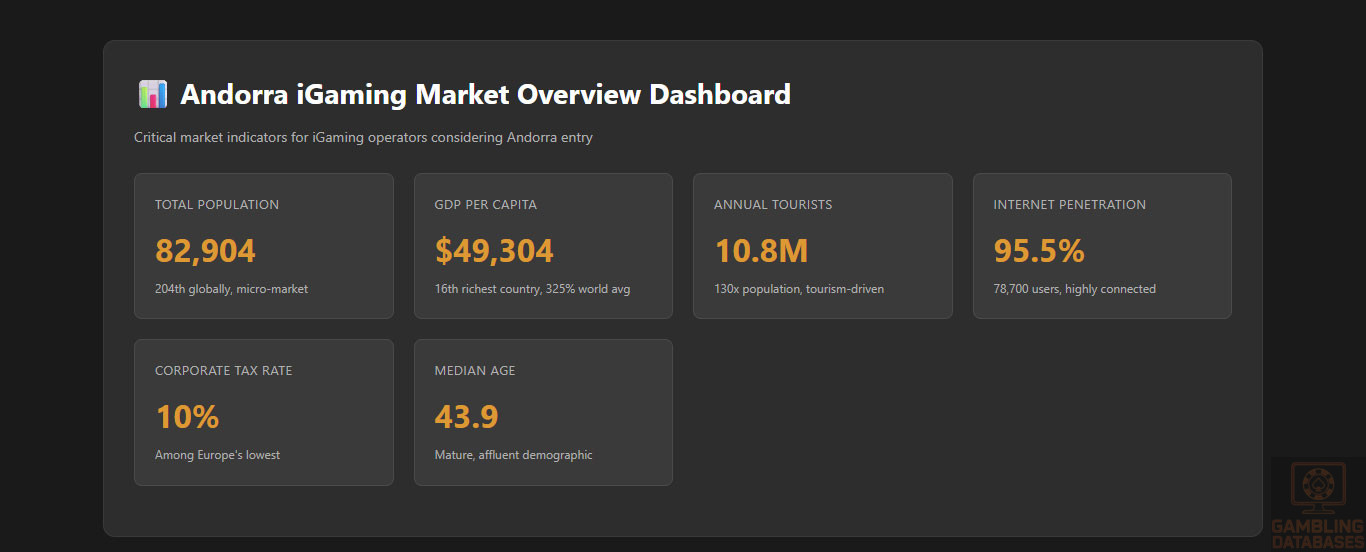
With a highly affluent population, exceptional internet penetration of 95.5%, and one of Europe’s lowest tax regimes, Andorra combines strategic geographic positioning between France and Spain with tourism-driven economic dynamics that create distinctive market characteristics for gambling operators.
Executive Summary: Key Market Indicators
| Indicator | Value | Notes |
|---|---|---|
| Gambling Legal Status | Legal and Regulated | Law 4/2021 governs both land-based and online gambling |
| Regulatory Authority | CRAJ (Consell Regulador Andorrà del Joc) | Established regulatory and control entity |
| Online Gambling Status | Regulated but limited licensing | Framework exists, few licenses issued to date |
| Total Population (2025) | 82,904 | Among smallest markets in Europe |
| Population Density | 176 per km² | Highly concentrated urban population |
| Median Age | 43.9 years | Mature demographic profile |
| Urban Population | 82.3% | 68,233 people in urban areas |
| GDP Total (2024) | $6.00 billion USD | Developed economy driven by tourism and finance |
| GDP Per Capita | $49,304 USD (2024) | 325% of world average, 16th richest country |
| GDP Growth Rate | 1.4% (2023) | Stable economic growth |
| Currency | Euro (EUR) | Monetary agreement with EU since 2011 |
| Internet Penetration | 95.5% | 78,700 internet users (January 2025) |
| Mobile Connections | 126,000 | 153% of total population |
| Social Media Penetration | 58.2% | 48,000 social media users |
| Smartphone Penetration | High (est. 95%+) | Advanced mobile ecosystem |
| Corporate Tax Rate | 10% standard | Among lowest in Europe; 2-5% for new businesses first 3 years |
| Personal Income Tax | 0-10% progressive | €24,000 exempt, max 10% above €40,000 |
| VAT Rate (IGI) | 4.5% standard | One of Europe’s lowest; 9.5% for financial services |
| Dividend Tax (Domestic) | 0% | No withholding on Andorran company dividends |
| Minimum Legal Gambling Age | 18 years | Strictly enforced |
| Annual Tourist Visitors | 10.8 million (2008 est.) | Tourism-driven economy, visitors far exceed residents |
| Official Language | Catalan | Spanish, French, Portuguese widely spoken |
| Market Entry Timeline | 6-12 months estimated | Company formation + licensing process |
| License Duration | 17 years (casino) | Renewable upon expiration |
| Foreign Ownership | Permitted | 100% Andorran ownership may provide competitive advantage |
| Business Environment Rank | Favorable | Streamlined processes, low bureaucracy |
| Political Stability | Very High | Stable parliamentary democracy |
| Market Size Classification | Micro-market | Limited by small population; tourism provides expansion potential |
| Estimated iGaming Market Value | Developing | No comprehensive revenue data available yet |
| Market Maturity | Emerging | Recent regulatory framework, evolving landscape |
Section 1: Regulatory Framework and Legal Environment
Current Gambling Regulation Status
Andorra has undergone a dramatic transformation in gambling regulation over the past decade. Historically, all forms of gambling were prohibited under a 1929 decree by the Veguers of Public Order and Residence of Foreigners.
This blanket ban persisted for nearly 70 years until the Bingo Game Law of November 28, 1996, marked the first step toward regulated gambling. The evolution accelerated with Law 28/2012, followed by Law 37/2014 (effective January 15, 2015).
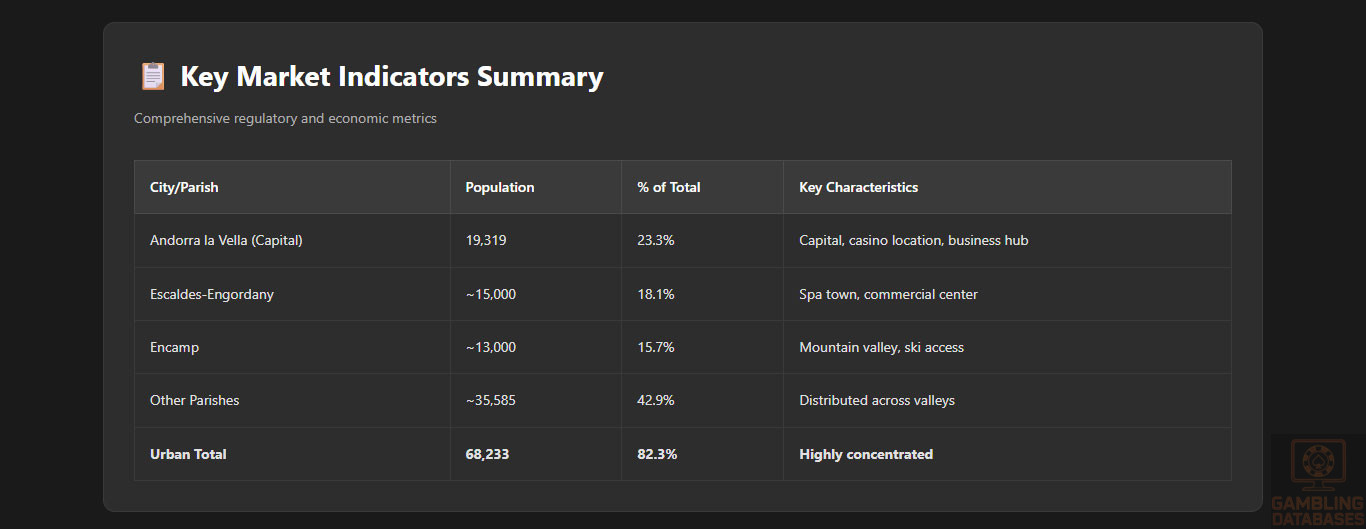
The current comprehensive legal framework is governed by Law 4/2021, dated March 22, 2021, which establishes the consolidated text for the regulation of games of chance. This legislation provides a structured approach to both land-based and online gambling activities.
The regulatory authority, Consell Regulador Andorrà del Joc (CRAJ), was established as an independent administrative body with legal personality, exclusively responsible for regulating, controlling, and supervising all gambling activities in the Principality.
Land-Based Gambling Activities
Casino Operations: Andorra has authorized land-based casino gambling through a competitive licensing process. In 2018, Andorran company Jocs SA was awarded the sole Class A casino license after a tender that attracted 13 international bidders.
The winning bid involved a €15 million casino complex in Andorra la Vella, expected to accommodate approximately 1,500 people and create over 160 jobs. The license was granted for 17 years from the effective opening date, with renewal possibilities.
After regulatory delays and appeals, the UNNIC Casino eventually opened, representing a significant milestone in Andorra’s gambling market development. The casino features gaming tables, slot machines, and integrated entertainment facilities.
Sports Betting Venues: Sports betting has been legal in Andorra since 2012. Licensed operators can offer land-based sports wagering services, though the market remains relatively small due to population size constraints.
Bingo Operations: Bingo was the first legalized form of gambling in Andorra. Class B licenses permit bingo hall operations, with Jocs SA also managing bingo venues throughout the Principality.
The traditional “Quintos” bingo format remains popular and has cultural significance in Andorran society. Regulations specify operational requirements, prize structures, and responsible gambling measures for bingo operators.
Lottery and Other Games: National lottery operations function in coordination with similar lotteries in France and Spain, reflecting Andorra’s geographic and cultural connections with neighboring countries.

Online Gambling Framework
Regulatory Status: Law 4/2021 explicitly provides for the regulation of online gambling activities, distinguishing between in-person and digital gaming modalities. The legal framework categorizes online operators separately from land-based establishments.
However, implementation has been gradual. While the legislation authorizes CRAJ to issue online gambling licenses, the regulatory body has been slow to grant such licenses, creating a transitional regulatory environment.
Permitted Online Activities: The law encompasses online casino games, sports betting, poker, and other games of chance delivered through digital platforms. Operators must comply with specific technical standards and player protection requirements.
Current Market Reality: As of early 2025, Andorra has not established a robust licensed online gambling market. Few if any comprehensive online gambling licenses have been issued to operators.
Andorran residents currently access offshore online gambling sites without legal restrictions or enforcement actions. The CRAJ has not implemented blocking mechanisms against unlicensed international operators, creating a de facto open market situation.
This regulatory gap may represent either an opportunity or uncertainty for prospective operators, depending on how quickly CRAJ moves to implement comprehensive online licensing frameworks and whether access to unlicensed sites continues.
Licensed Operators and Market Players
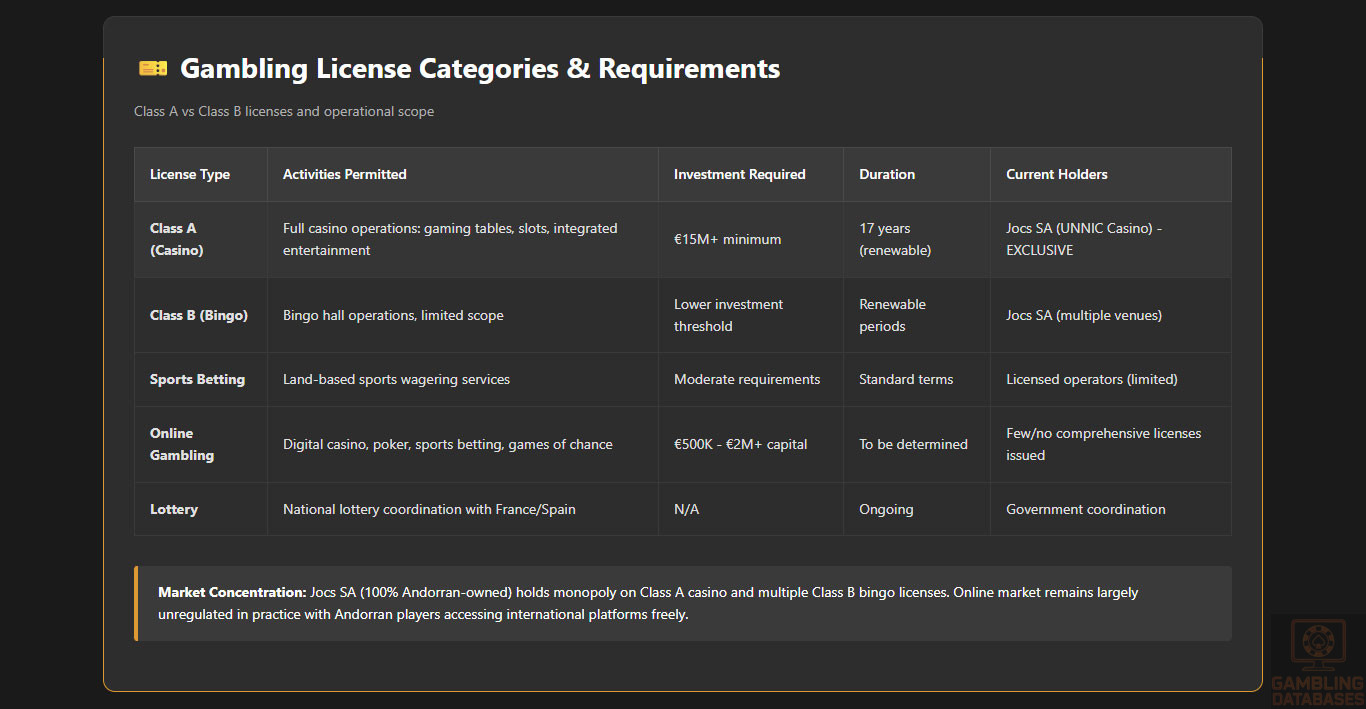
Land-Based Market: Jocs SA holds the exclusive Class A casino license and operates multiple Class B bingo licenses, making it the dominant licensed gambling operator in Andorra.
The company is 100% Andorran-owned, which proved advantageous in the competitive bidding process against international gaming corporations including Genting Group, CIRSA, Partouche, and Casinos Austria AG.
Jocs SA partnered with Austrian technology provider Novomatic as the strategic technology supplier for the UNNIC Casino, combining local ownership with international gaming expertise and equipment.
Online Market: No comprehensive data exists on licensed online gambling operators in Andorra. The online market remains largely unregulated in practice, with Andorran players accessing international platforms.

Market Concentration: The land-based gambling market exhibits extreme concentration, effectively operating as a monopoly or duopoly structure with Jocs SA controlling the primary licensed operations.
Licensing Framework and Requirements
Application Process and Eligibility
Regulatory Authority: The Consell Regulador Andorrà del Joc (CRAJ) is the sole entity responsible for issuing gambling licenses in Andorra. The authority operates from C/ Doctor Vilanova, 9 – Edifici Thaïs, 3a planta – despatx D, AD500 Andorra la Vella.
Contact: +376 822 922, Email: [email protected]. The CRAJ website (www.craj.ad) provides official information, though predominantly in Catalan.
License Categories: Law 4/2021 distinguishes six categories of gambling operators, classified by activity type and delivery method (face-to-face or online). Categories include pure games of chance, lotteries, mixed games of chance and skill.
Class A licenses authorize casino operations with the most comprehensive gaming rights. Class B licenses permit bingo operations with more limited scope and investment requirements.
Application Process: Operators must submit comprehensive applications to CRAJ including business plans, financial documentation, technical specifications, responsible gambling policies, and evidence of financial capacity.
For the casino license, CRAJ conducted an international public tender that required detailed proposals covering investment amounts, job creation projections, economic impact assessments, architectural plans, and operational strategies.
The winning bidder had 15 days to submit the formal license application after tender selection. CRAJ then issued the license within approximately two months following application submission.
Financial Requirements: Specific capital requirements vary by license type and are not publicly disclosed in detail. The casino license required demonstrated financial capacity to execute a minimum €15 million investment.
Operators must prove sufficient financial resources to sustain operations, meet player liabilities, implement technical systems, and fulfill ongoing compliance obligations. Banking relationships in Andorra typically require extensive due diligence.
Background Checks: All license applicants and beneficial owners undergo rigorous background investigations. Required documentation includes criminal record certificates with Hague Apostille, valid for maximum three months from issuance.
Passport copies with Hague Apostille, detailed CVs, business plans, and documentation explaining work profiles and business models must be submitted. Andorra maintains high standards for anti-money laundering compliance and reputational integrity.
Application Fees: Law 4/2021 Article 94 specifies that license applications are subject to administrative fees. Exact fee schedules are not publicly published and likely vary by license category.
Prospective operators should contact CRAJ directly for current fee structures. Based on the casino tender experience, expect substantial fees commensurate with exclusive licensing privileges and market access value.
Local Presence and Operational Requirements
Company Incorporation: Foreign operators must establish a legal entity incorporated under Andorran law to obtain gambling licenses. Acceptable structures include limited liability companies (SL – Societat Limitada) or corporations (SA – Societat Anònima).
The company must have its registered office in Andorra and conduct effective management from the Principality. Managers must perform their functions from Andorra, and board meetings must take place within the country.
Failure to maintain genuine Andorran management creates tax residence risks, potentially subjecting the company to taxation in other jurisdictions where effective control occurs.
Physical Presence: Land-based gambling licenses obviously require physical premises meeting CRAJ’s technical, security, and accessibility standards. The casino required a 6,400-square-meter facility with parking for 80 vehicles.
Online gambling operations require registered office space in Andorra, though the extent of physical infrastructure requirements remains unclear given limited online licensing precedents.
Staffing Requirements: Operators must employ personnel in Andorra. The casino license projected over 200 employees, contributing to the economic impact evaluation that influenced license award decisions.
Key management positions, compliance officers, and customer service functions likely require Andorran-based staff, though specific mandates are not publicly detailed.
Technology and Hosting: Technical requirements for online gambling are specified in CRAJ regulations but not comprehensively published. Operators should anticipate requirements for certified gaming platforms, random number generator testing, and responsible gambling tools.
Whether server infrastructure must be hosted within Andorra or can operate from other jurisdictions remains unclear. The small market size suggests flexibility, but confirmation from CRAJ is essential.
Foreign Ownership: Foreign investment in Andorran companies is permitted under the Foreign Investment Law. Non-residents can invest in and own Andorran gambling operators.
However, the casino tender outcome suggests 100% Andorran ownership may provide competitive advantages in licensing decisions, particularly for high-value exclusive licenses where economic impact and local benefit are evaluation criteria.
Compliance Obligations and Monitoring
Player Protection and Identification
Age Verification: The minimum legal gambling age in Andorra is 18 years. Operators must implement robust age verification systems preventing minors from accessing gambling services.
CRAJ enforces strict compliance with age restrictions. Marketing materials, premises access control, and online registration processes must include effective age verification mechanisms.
Anyone appearing under 25 years of age must present identification documentation. Violations of minor protection regulations result in severe penalties including license suspension or revocation.
KYC/AML Requirements: Andorra maintains rigorous anti-money laundering standards aligned with international best practices. Despite its favorable tax regime, the Principality complies with OECD guidelines and has established over 15 tax information exchange agreements.
Gambling operators must implement comprehensive Know Your Customer procedures, including identity verification, source of funds checks, and ongoing transaction monitoring. Customer due diligence must meet standards applied by Andorran financial institutions.
Beneficial ownership information must be identified and verified. Politically exposed persons require enhanced due diligence. Suspicious transaction reporting to Andorran authorities is mandatory.
Responsible Gambling Measures: Law 4/2021 emphasizes responsible gambling as a core regulatory objective. Operators must implement measures to prevent excessive gambling and identify problem gambling behaviors.
UNNIC Casino prominently features responsible gambling information and support resources. The website advises: “Gambling without control is not healthy gambling. When you stop enjoying yourself, gambling becomes an addiction.”
Required measures include self-assessment tools, deposit limits, loss limits, session time limits, reality checks, and self-exclusion options. Marketing must include responsible gambling messaging and avoid targeting vulnerable populations.
Self-Exclusion Systems: Operators must maintain self-exclusion registries allowing players to voluntarily ban themselves from gambling activities. Self-exclusion periods must be enforceable across all operator platforms.
The CRAJ may maintain a centralized exclusion registry applicable across all licensed operators, though specific implementation details for Andorra’s system are not publicly documented.
Player Information Disclosures: Gambling platforms must display clear information about game rules, odds, return-to-player percentages, and terms and conditions. Players must understand the risks and mechanics before participation.
Promotional terms must be transparent, including wagering requirements, withdrawal restrictions, and expiration dates. Misleading advertising is prohibited.
Financial Monitoring and Reporting
Transaction Monitoring: Operators must implement systems to detect unusual betting patterns, potential money laundering, match-fixing, or fraud. Automated monitoring tools should flag suspicious activities for investigation.
Large cash transactions, structured deposits, and high-value winnings trigger enhanced scrutiny. Gambling operators function as gatekeepers in Andorra’s financial system and bear compliance responsibilities accordingly.
Reporting Obligations: Licensed operators must submit regular reports to CRAJ covering financial performance, player statistics, responsible gambling metrics, and compliance activities. Reporting frequency likely includes monthly or quarterly submissions.
Annual audited financial statements must be filed with both CRAJ and Andorran commercial registry authorities. Tax declarations to the Andorran Tax Administration must accurately report gambling revenues.
Audits and Inspections: CRAJ retains authority to conduct on-site inspections, examine records, test gaming equipment, and audit compliance systems. Operators must cooperate fully with regulatory examinations.
Independent third-party audits of gaming systems, random number generators, and financial controls may be required to maintain licensing compliance.
Data Retention: Player records, transaction histories, gaming logs, and compliance documentation must be retained for specified periods. Based on general European standards, expect minimum 5-year retention requirements.
Taxation Structure and Financial Obligations
Player Taxation
Winnings Tax: Gambling winnings in Andorra are subject to personal income tax treatment. However, winnings from gambling activities authorized in the Principality benefit from favorable exemptions.
For savings income (which includes certain gambling winnings), the first €3,000 is entirely exempt from taxation. Amounts exceeding €3,000 are taxed at 10%.
This creates a de facto tax-free threshold for casual players, with only significant winners facing moderate taxation on excess amounts.
Offshore Gambling Income: Andorran tax residents receiving gambling income from unauthorized international gambling sites or foreign casinos do not benefit from the €3,000 exemption for locally authorized gambling.
Such winnings are considered general savings income taxed at 10% from the first euro, though enforcement and reporting challenges exist for offshore winnings.
Professional Gamblers: Individuals earning income from professional poker playing or gambling activities may be taxed differently. Income from poker tournament winnings, team salaries, affiliate marketing, and prizes in kind goes to the general tax base.
The general tax base provides €24,000 fully exempt, then 5% on income between €24,000-€40,000, and 10% on income exceeding €40,000. Maximum effective taxation for professional gamblers remains capped at 10%.
Professional gamblers must navigate banking challenges, as financial institutions often view gambling-related accounts skeptically. Many register as digital marketing professionals to facilitate banking relationships.
Operator Taxation
Gambling Activities Tax: Licensed gambling operators are subject to a specific tax on gambling activities under Law 14/2024 (November 7, 2024). This tax regime applies to all licensed gambling operations.
Exact tax rates by game type are not publicly disclosed in available sources. Andorran authorities have indicated intentions to keep gambling taxation “really low” to attract investors and operators.
Based on the regulatory environment, operators should anticipate GGR-based taxation, though rates likely fall below European averages given Andorra’s general low-tax positioning.
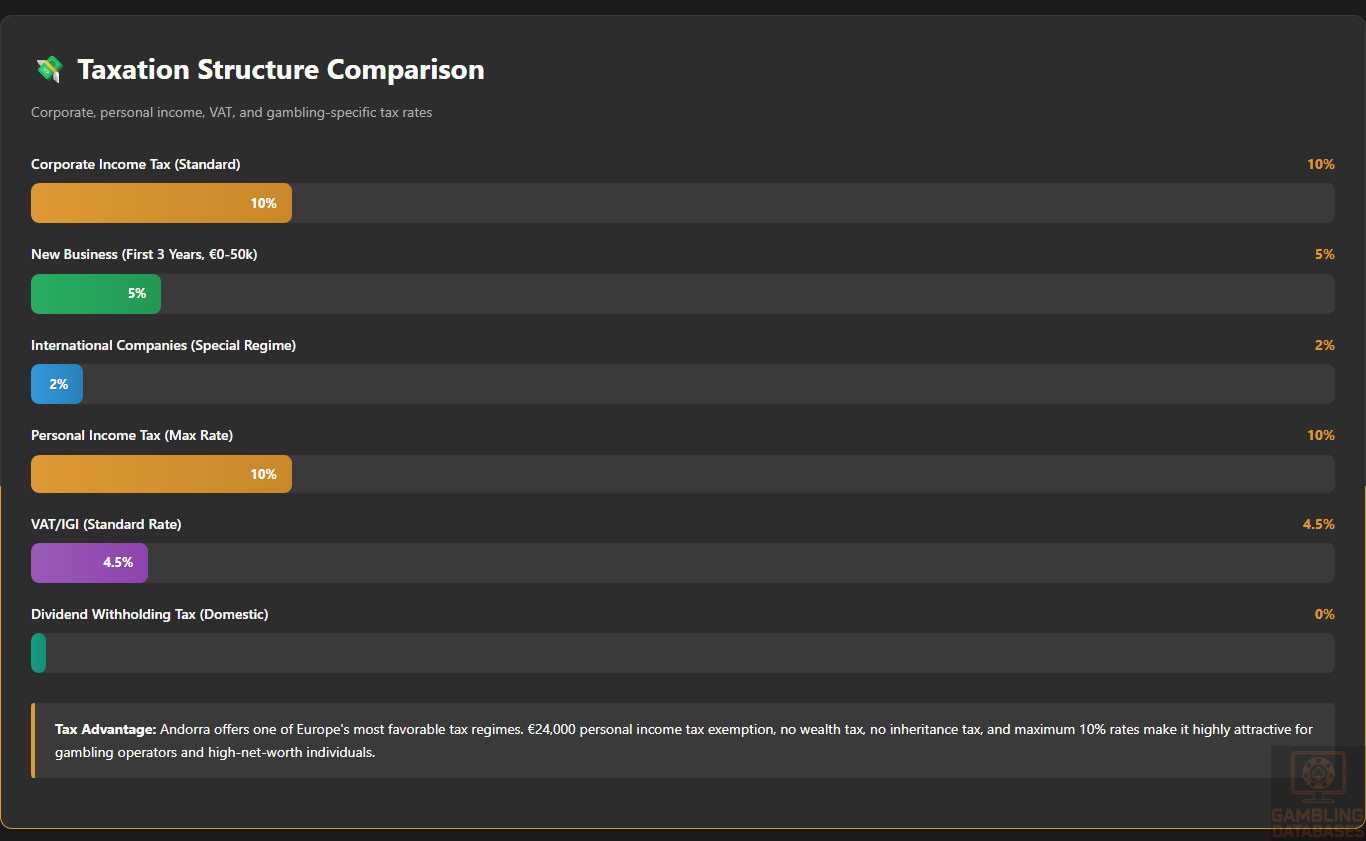
Corporate Income Tax: Gambling operators operating as Andorran companies are subject to standard corporate income tax (IS – Impost de Societats) at 10% on company profits.
New companies benefit from reduced rates during the first three years: 5% on the first €50,000 of taxable income and 10% on income exceeding €50,000 (for companies with income below €100,000).
International gambling companies and holding structures may qualify for reduced 2% taxation, though specific applicability to gambling operations requires expert confirmation.
License Fees and Renewal Costs: Initial license application involves administrative fees under Article 94 of Law 4/2021. Exact amounts are not published and vary by license class.
The casino license, being exclusive and high-value, likely commanded substantial fees. Annual license maintenance fees and periodic renewal fees should be anticipated.
The 17-year casino license duration suggests renewal fees will apply upon expiration, though terms are negotiated based on market conditions and regulatory policy at renewal time.
Other Operational Taxes: Value Added Tax (IGI – Impost General Indirecte) applies at 4.5% standard rate in Andorra, among Europe’s lowest. Financial services face a 9.5% increased rate.
Gambling services’ IGI treatment requires clarification – they may be zero-rated, standard-rated, or subject to special provisions. Social security contributions for employees must be paid to CASS (Andorran social security).
Employment-related contributions can escalate quickly and represent significant operational costs beyond headline tax rates.
Gambling Market Financial Performance
Market Revenue Data: Comprehensive gambling market revenue statistics for Andorra are not publicly available. The market is in early development stages, particularly for online gambling.
The UNNIC Casino opening represents the first major modern casino, making historical revenue data limited. Bingo operations have existed since 1996 but represent a small market segment.
Projected Economic Impact: Jocs SA’s casino license application projected the facility would attract 200,000 international visitors annually and contribute over €90 million to Andorra’s economy.
These figures remain projections and actual performance data is not publicly disclosed. The casino’s economic contribution includes direct gaming revenue, employment creation, tourism spending, and secondary economic effects.
Market Size Estimation: Given Andorra’s population of 82,904 and tourism influx of approximately 10.8 million annually, the addressable market for gambling significantly exceeds the resident base.
However, most tourists visit for shopping and skiing rather than gambling. Converting meaningful percentages of tourist visitors to casino patrons requires strong marketing and compelling entertainment offerings.
Online gambling market potential is constrained by small resident population unless licenses permit broader European market access, which seems unlikely given Andorra’s non-EU status.
Growth Trends: Insufficient historical data exists to establish reliable year-over-year growth trends. The market is essentially in a formation phase with the recent casino opening and evolving online framework.
Expected growth drivers include increased casino awareness, potential online licensing expansion, tourism recovery post-COVID, and Andorra’s growing international profile as a business and residence destination.
Advertising and Marketing Restrictions
Permitted Channels: Andorran gambling advertising regulations are not comprehensively detailed in available public sources. Law 4/2021 addresses advertising but specific permitted channels require regulatory clarification.
Land-based casino marketing appears permitted through standard channels including outdoor advertising, print media, digital platforms, and tourism promotional materials.
Content Restrictions: Marketing must comply with responsible gambling principles. Advertisements cannot target minors, vulnerable populations, or create false impressions about winning probabilities.
Promotional content must include responsible gambling warnings and information about support resources. Age restrictions must be clearly communicated.
Bonus and Promotion Rules: Specific restrictions on bonus offers, wagering requirements, or promotional caps are not detailed in available sources. Online casinos serving Andorran players typically offer bonuses.
Operators should anticipate requirements for fair terms, transparent disclosures, and reasonable wagering requirements aligned with general European consumer protection principles.
Sponsorship Regulations: Sports sponsorships, event sponsorships, and team partnerships are common in European gambling markets. Andorra’s small size limits major sports franchise opportunities.
Given tourism focus and international visibility goals, gambling operators may find sponsorship opportunities with ski resorts, cycling events (Andorra hosts Tour de France and Vuelta stages), and cultural festivals.
Affiliate Marketing: Online affiliate marketing rules for Andorra are undefined. As online licensing develops, expect regulations governing affiliate relationships, promotional accuracy, and compliance responsibilities.
Recent Regulatory Changes and Their Impact
Law 4/2021 Implementation: The March 22, 2021 enactment of the consolidated gambling regulation represented the most significant recent regulatory development. This law replaced Law 37/2014 and created the current comprehensive framework.
Law 4/2021 clarified operator categories, licensing procedures, compliance obligations, and the CRAJ’s regulatory authority. It established foundation for both land-based and online gambling regulation.
Law 14/2024 Tax Update: November 7, 2024 saw the approval of Law 14/2024 on gambling activities taxation. This recent legislation governs the tax collection framework for gambling operations.
The law is managed by CRAJ, which handles both regulation and tax collection for gambling activities. Specific rate changes or new obligations introduced by this law are not publicly detailed.
Casino License Saga: The 2018-2020 period saw significant regulatory drama with the casino license. Jocs SA initially won the tender in 2018 but faced license withdrawal in 2019 due to documentation deficiencies.
After appeals and resubmission of revised documentation, the license was ultimately granted, but delays created uncertainty. In February 2020, CRAJ again rejected aspects of Jocs’ concession.
These regulatory flip-flops demonstrated CRAJ’s stringent standards but also raised questions about regulatory consistency and predictability for prospective operators.
Online Licensing Delays: Despite Law 4/2021 authorizing online gambling licenses, CRAJ has been slow to implement comprehensive online licensing. This creates ongoing uncertainty about when and how online gambling will be fully regulated.
The delay may reflect cautious regulatory approach, resource constraints at CRAJ, or policy debates about appropriate online gambling frameworks for such a small market.
Enforcement Mechanisms and Penalties
CRAJ Authority: The Consell Regulador Andorrà del Joc possesses comprehensive enforcement powers including license suspension, license revocation, financial penalties, and criminal referrals for serious violations.
The regulatory body can conduct inspections, seize equipment, order operational changes, and impose corrective action plans on licensed operators.
Penalty Structures: Specific fine amounts and penalty schedules are not publicly detailed. Violations are likely categorized by severity (minor, serious, very serious) with escalating penalties.
License suspension prevents operations until compliance is restored. License revocation permanently terminates the operator’s authorization, forfeiting investments and market position.
Enforcement Precedents: The casino license withdrawal and subsequent restoration demonstrates CRAJ’s willingness to enforce standards rigorously, even against the sole casino licensee representing significant economic investment.
This precedent suggests CRAJ prioritizes regulatory integrity over economic considerations, creating accountability but also potential unpredictability risks for operators.
Unlicensed Operator Blocking: Andorra has not implemented systematic ISP-level blocking of unlicensed international gambling sites. Residents access offshore operators freely without restrictions.
This hands-off approach may change as CRAJ develops online licensing frameworks. Future enforcement could include website blocking, payment processing restrictions, or advertising prohibitions against unlicensed operators.
Payment Processor Restrictions: No evidence exists of restrictions on payment processors handling gambling transactions. Andorran banks maintain rigorous compliance standards but process legitimate gambling-related payments.
Criminal Penalties: Operating unlicensed gambling activities in Andorra likely constitutes criminal offenses under the general prohibition framework. Penalties may include fines, imprisonment, or both for serious violations.
Section 2: Demographics and Consumer Analysis
Population Demographics and Distribution
Core Population Metrics
Total Population: Andorra’s population stands at approximately 82,904 as of mid-2025, ranking 204th globally and 43rd in Europe. The population has shown modest growth of approximately 1.08% annually.
This represents one of the world’s smallest national populations, creating inherent market size constraints for gambling operators but also enabling focused marketing and customer service approaches.
Population Growth: Between 2024 and 2025, Andorra added approximately 260 people, reflecting natural increase as births exceed deaths. Net migration contributes positively with approximately 1,061 net migrants in 2023.
The steady but slow population growth suggests a stable market base with limited organic expansion potential from demographic factors alone.
Age Distribution: The median age of 43.9 years indicates a mature population profile. Approximately 21.9% of the population is under 15 years (child dependency ratio).
The working-age population (15-64 years) comprises the majority, while 18.2% are aged 65+ (aged dependency ratio). The total dependency ratio of 40% is relatively low.
For gambling operators, the mature demographic suggests an audience with established income, discretionary spending capacity, and familiarity with entertainment expenditures. Youth market segments are limited.
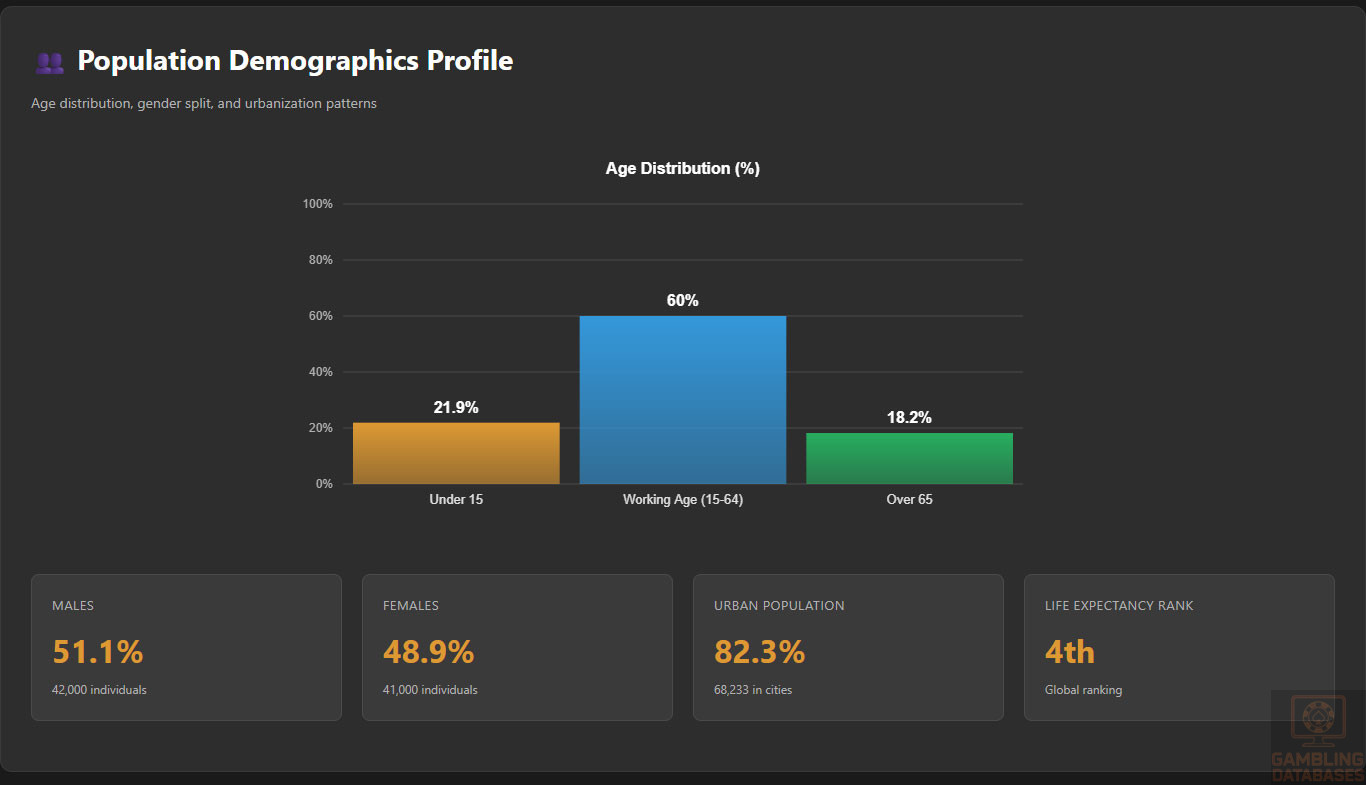
Gender Distribution: Andorra has 42,000 males and 41,000 females, creating a sex ratio of 104.48 males per 100 females. The male population represents 51.09% while females comprise 48.9%.
The slight male majority may influence gambling participation rates, as males typically show higher engagement in sports betting and casino gambling across European markets.
Life Expectancy: Andorra boasts the 4th highest life expectancy globally, reflecting excellent healthcare, high living standards, and quality of life. Long life expectancy correlates with affluent, health-conscious populations.
Geographic Distribution
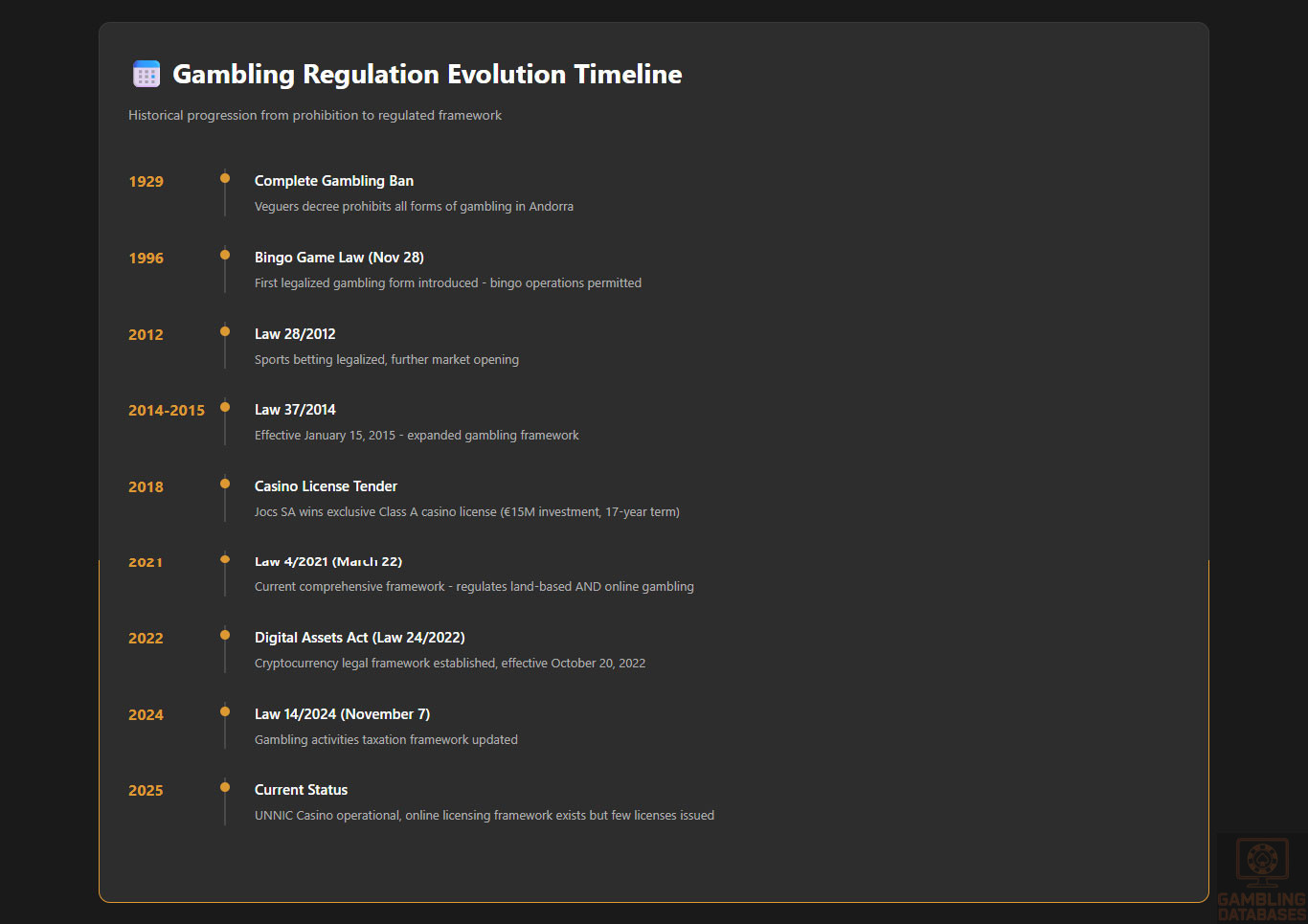
Urbanization Rate: An impressive 82.3% of Andorra’s population lives in urban areas, totaling approximately 68,233 urban residents. This high urbanization facilitates marketing, service delivery, and land-based venue accessibility.
Capital City: Andorra la Vella serves as the capital and largest city with a population of 19,319. The city is Europe’s highest elevation capital, situated in the central valley.
The UNNIC Casino is strategically located in Andorra la Vella at Prat de la Creu, maximizing accessibility to both residents and tourist traffic.
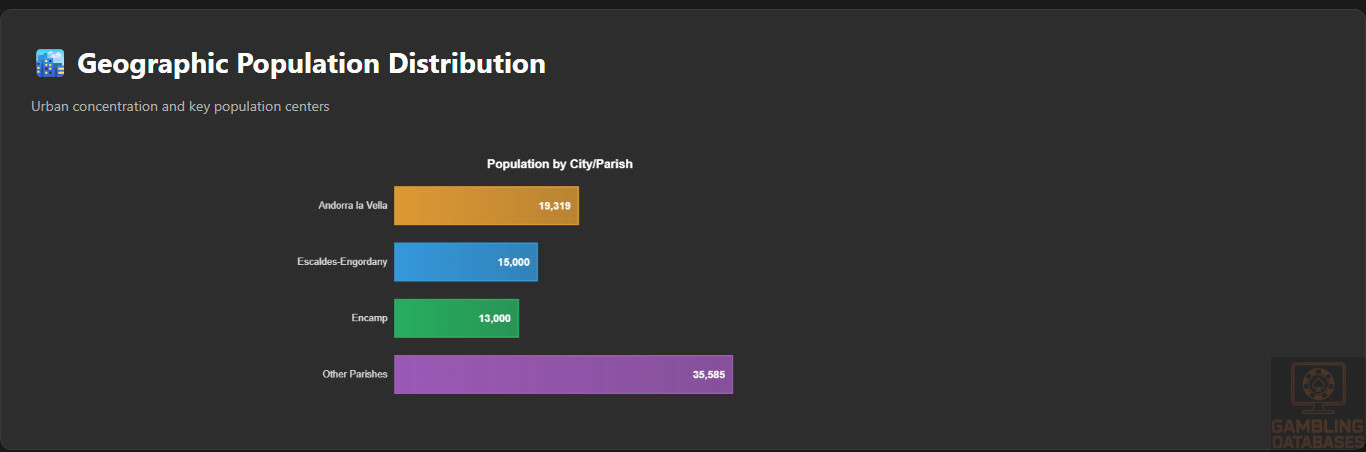
Population Centers: Beyond Andorra la Vella, population concentrates in seven urbanized valleys. Key population centers include Escaldes-Engordany, Encamp, La Massana, and Sant Julià de Lòria.
The compact geography (470 km² total area) means the entire population is within short driving distance of central locations, simplifying land-based gambling accessibility.
Regional Economic Patterns: Economic activity concentrates in Andorra la Vella and Escaldes-Engordany, where financial services, retail, and tourism infrastructure cluster. These areas attract the highest visitor densities during ski seasons.
Tourism Geography: Mountain resort areas in parishes like Canillo, La Massana, and Ordino drive winter tourism. Shopping districts in Andorra la Vella attract cross-border visitors from Spain and France year-round.
Economic Indicators and Consumer Spending Power
GDP and Economic Performance
GDP Total: Andorra’s GDP reached $6.00 billion USD in 2024, ranking 166th globally. For such a small population, this represents substantial economic output.
GDP Per Capita: At $49,304 USD in 2024 (some sources cite $41,034-$46,414 depending on methodology), Andorra’s per capita GDP equals 325% of the world average.
The country ranks as the 16th richest globally by GDP per capita, creating an affluent market with significant discretionary spending capacity. This wealth level surpasses many large European economies.
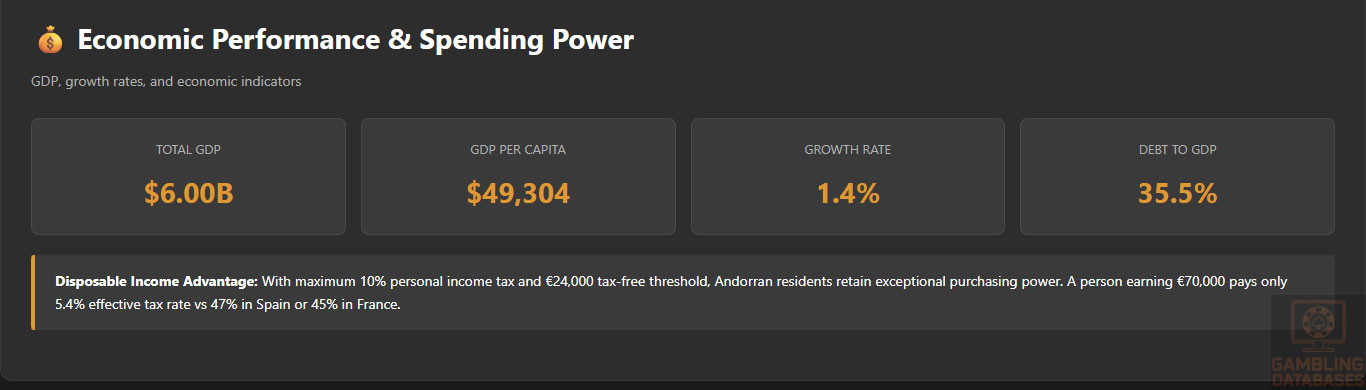
GDP Growth: Economic growth reached 1.4% in 2023, reflecting steady expansion. Over the past decade, Andorra averaged 1.5-2.2% annual GDP growth, demonstrating economic stability.
While growth rates are modest, the stable trajectory provides confidence in sustained consumer spending and business environment predictability.
Economic Structure: Services dominate at 54.5% of GDP, followed by industry at 33.6% and agriculture at 11.9%. Financial services, tourism, and commerce account for 75% of gross value added.
The service-oriented economy aligns well with gambling and entertainment industry development. Tourism dependence creates seasonal revenue fluctuations but also substantial visitor spending potential.
Public Debt: National debt stood at €1.242 billion ($1.343 billion) in 2023, representing a 35.47% debt-to-GDP ratio. This low debt level reflects sound fiscal management and economic stability.
Public debt per capita equals €14,594 ($15,782), modest compared to most developed nations and indicative of governmental financial health.
Income and Wealth Distribution
Income Levels: Specific average household income data for Andorra is limited in public sources. However, the exceptionally high GDP per capita suggests average household incomes far exceed European medians.
Estimates suggest average annual incomes in the €40,000-€70,000+ range for employed individuals, with significant variation by sector and position.
Disposable Income: Andorra’s ultra-low tax regime dramatically increases disposable income compared to neighboring countries. With maximum 10% personal income tax, €24,000 tax-free, and no wealth or inheritance taxes, residents retain exceptional purchasing power.
A person earning €70,000 annually pays approximately €3,800 in income tax (5.4% effective rate), leaving substantially more disposable income than in Spain (up to 47% tax) or France (up to 45% tax).
Wealth Concentration: Andorra attracts high-net-worth individuals seeking favorable tax treatment, creating a population with above-average wealth concentration. Many residents are business owners, investors, or professionals from financial services.
The Gini coefficient and detailed income inequality measures are not published, but the small, affluent population suggests relatively compressed income distribution at high levels.
Consumer Spending Patterns: High disposable income supports robust consumer spending on entertainment, dining, travel, and luxury goods. The tourism-driven retail sector thrives on both resident and visitor spending.
Gambling expenditure capacity is substantial, though cultural factors and small population limit absolute market size. Average spend per gambler may exceed regional averages due to affluence.
Market Size and Growth Projections
Current Market Status: Comprehensive iGaming market revenue data for Andorra does not exist in public sources. The online gambling market remains largely undeveloped from a licensed operator perspective.
Land-based gambling is nascent with the recent casino opening. Bingo operations provide historical baseline but represent limited revenue scope.
Resident Market Potential: With approximately 83,000 residents and assuming 30-40% participation in gambling annually (typical European rates), the addressable resident base is 25,000-33,000 potential customers.
If average annual spend per gambler reaches €500-€1,000 (conservative given affluence), resident market potential approximates €12.5-€33 million annually across all gambling forms.
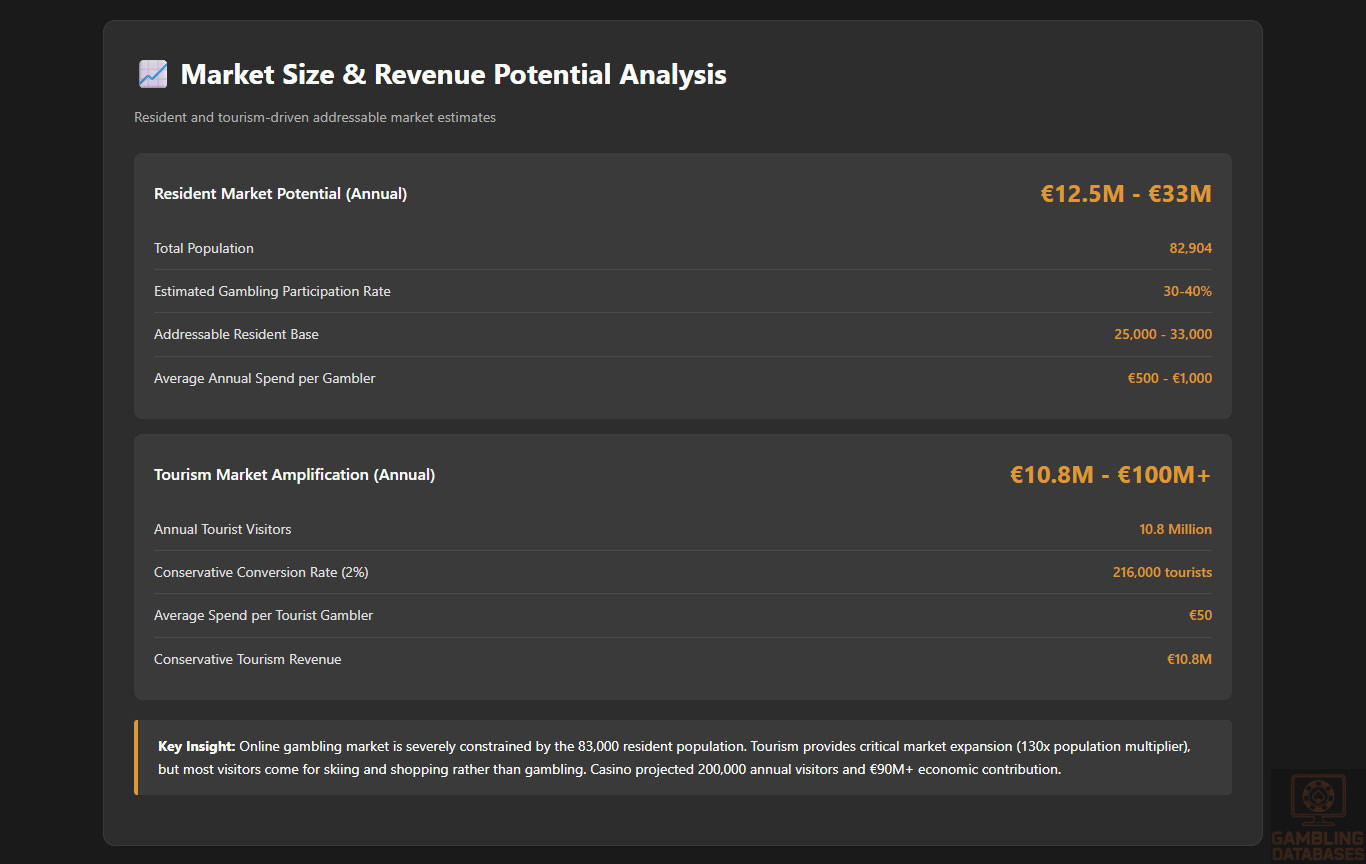
Tourism Market Amplification: The critical market expansion factor is tourism. With 10.8 million annual visitors, even minimal conversion rates dramatically expand the addressable market.
If 2% of tourists engage in gambling spending an average €50 per visit, tourism adds €10.8 million. Higher conversion rates and spending levels could push tourism gambling revenue to €50-100 million+.
Online Market Constraints: Online gambling market size is severely constrained by the small resident base. An 83,000 population cannot support substantial online gambling revenues comparable to larger markets.
Unless Andorran online licenses permit cross-border service delivery to EU markets (highly unlikely given regulatory frameworks), online gambling remains a niche opportunity.
Growth Projections: Insufficient baseline data prevents reliable CAGR calculations. However, market growth drivers include casino establishment phase, potential online licensing expansion, and tourism sector recovery and expansion.
Optimistic scenarios project 10-15% annual growth over 5 years as the market develops from a low base. Conservative scenarios assume 5-8% growth reflecting modest population increases and gradual market penetration expansion.
ARPU Estimates: Average Revenue Per User in Andorra likely exceeds European averages due to exceptional affluence. ARPUs of €800-€1,500 annually for active online gamblers are plausible.
Land-based casino ARPU may reach higher levels given tourism visitor spending patterns and the premium entertainment positioning required in such a small market.
Education, Skills, and Digital Literacy
Educational Foundation
Literacy Rate: Andorra maintains essentially universal literacy at 100% for both genders, reflecting developed nation educational standards and compulsory education requirements.
Education System: The education system offers instruction in Catalan, Spanish, or French, reflecting multilingual national character. Both public and private schools operate to high European standards.
Tertiary education completion rates are substantial, with many Andorrans pursuing university education in Spain, France, or other countries before returning home.
Digital Literacy: With 95.5% internet penetration and advanced smartphone adoption, digital literacy is exceptionally high. The population comfortably navigates online platforms, digital payments, and technology services.
This digital sophistication supports online gambling platform adoption, though cultural preferences and regulatory frameworks ultimately determine market development.
Language Skills: Most Andorran residents are multilingual, typically speaking Catalan plus Spanish, French, and often English. This linguistic diversity facilitates consumption of international content and services.
For gambling operators, multilingual platform support is expected. Catalan language offerings demonstrate local commitment, while Spanish and French reach broader audiences.
Cultural and Social Factors
Communication and Language
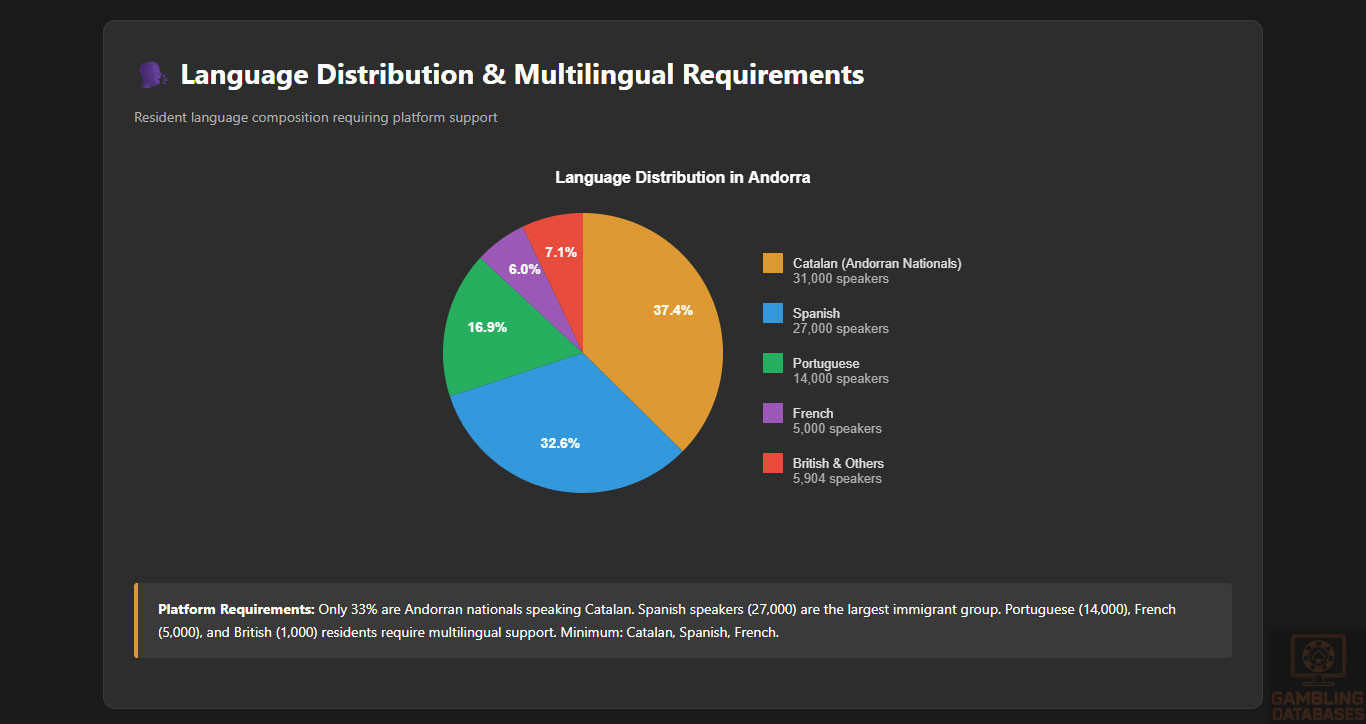
Official Language: Catalan is the sole official language, spoken by virtually all Andorran nationals. However, only 31,000 (33%) of residents are Andorran nationals.
Immigrant Languages: Spanish speakers number approximately 27,000 (primarily from Spain), Portuguese speakers total 14,000, French speakers reach 5,000, and British residents number around 1,000.
This linguistic diversity requires gambling platforms to support multiple languages. Catalan demonstrates local respect, Spanish reaches the largest user group, and French serves the northern valley communities.
Business Communication: Business typically operates in Catalan and Spanish, with French common in certain sectors. English proficiency is growing, particularly in tourism-facing and international business contexts.
Gambling customer service should offer Catalan, Spanish, and French as minimum language support. English capability enhances international visitor service quality.
Cultural Attitudes Toward Gambling
Historical Context: Gambling was prohibited for decades under the 1929 decree, creating a cultural background of restricted access. This prohibition reflected conservative social values and concerns about moral impacts.
The gradual legalization since 1996 suggests evolving attitudes, but gambling doesn’t enjoy the cultural integration seen in some European countries.
Religious Influence: Over 90% of the population is Roman Catholic, though religiosity levels and church attendance vary. Catholic teaching traditionally views gambling cautiously.
However, moderate gambling for entertainment is generally accepted. The cultural environment likely supports responsible recreational gambling rather than high-stakes or problem gambling behaviors.
Social Acceptance: Bingo has existed since 1996 and enjoys social acceptance as community entertainment. The casino opening in a central Andorra la Vella location signals governmental and social acceptance of gambling.
Online gambling acceptance mirrors general European trends, with younger demographics more comfortable with digital entertainment including gambling.
Foreign Brand Perception: Andorra’s economy relies heavily on international tourism and foreign investment. Residents regularly interact with international brands and services.
Well-established international gambling brands would likely be viewed positively, particularly if partnered with local entities. Pure foreign operators without local presence may face skepticism.
Risk Tolerance: The affluent, educated population likely exhibits moderate risk tolerance in financial matters. However, gambling risk tolerance varies individually.
Conservative investment cultures and stable economic preferences suggest moderate rather than aggressive gambling behaviors. Skill-based games and sports betting may appeal more than pure chance games.
Problem Gambling and Social Considerations
Prevalence Data: No published studies or statistics exist specifically measuring problem gambling prevalence in Andorra. The small population and recent gambling legalization mean systematic research is lacking.
Extrapolating from European averages (0.5-2% problem gambling prevalence), Andorra might have 400-1,600 problem gamblers, though actual numbers could differ significantly.
At-Risk Populations: Demographic groups typically at higher risk include young males (25-35 years), individuals with substance use issues, and those experiencing financial stress.
Andorra’s affluence may reduce financial stress-driven gambling, but accessibility and normalization could increase participation rates across demographics.
Regulatory Response: Law 4/2021 explicitly prioritizes preventing excessive gambling and problem gambling behaviors. CRAJ’s mandate includes preventing pathological gambling.
Required responsible gambling measures, self-exclusion systems, and operator obligations reflect proactive regulatory positioning to prevent problem gambling before it escalates.
Treatment Services: Information about specialized gambling addiction treatment services in Andorra is not publicly available. The small population may limit dedicated facilities.
Residents likely access treatment through general mental health and addiction services or seek specialized care in Spain or France if needed.
Support Resources: CRAJ provides contact information (Tel: +376 822 922, Email: [email protected]) as a regulatory resource. Whether dedicated helplines or support services exist is unclear.
The UNNIC Casino displays responsible gambling information directing players to regulatory contact points and encouraging self-awareness about gambling control.
Mandatory Contributions: Whether operators must contribute financially to problem gambling prevention, research, or treatment funds is not specified in available sources.
European regulatory norms increasingly require such contributions, so Andorran operators should anticipate potential requirements even if not yet formalized.
Political Structure and Governance
Government System: Andorra is a parliamentary co-principality, unique among world governments. The heads of state are the President of France and the Bishop of Urgell (Spain) serving as co-princes.
The General Council (parliament) exercises legislative power, and the Head of Government leads executive functions. This unusual structure has proven stable for centuries.
Political Stability: Andorra enjoys exceptional political stability with peaceful democratic transitions, low corruption, and consistent policy frameworks. Political risk is minimal.
For gambling operators, this stability provides confidence in regulatory continuity and predictable business environment over license terms.
Regulatory Consistency: While the casino licensing process showed some inconsistency with the Jocs SA approval-rejection-approval sequence, overall regulatory frameworks are professional and transparent.
CRAJ operates as an independent authority reducing political interference risks. Regulatory decisions follow legal frameworks rather than arbitrary political considerations.
Corruption Levels: Andorra maintains low corruption levels typical of developed European nations. Transparency International and similar indices rate the country favorably.
Business licensing and regulatory processes function professionally. Bribery or corrupt practices in licensing would be highly unusual and legally risky.
International Relations: Andorra maintains strong relationships with France and Spain. The country is a UN member, participates in the OSCE, Council of Europe, IMF, and has WTO observer status.
A Monetary Agreement with the EU (2011) allows euro usage. An Association Agreement with the EU is under negotiation, subject to a 2025 referendum.
EU Relationship: Andorra is not an EU member state and does not participate in the EU VAT area, though a customs union exists. The non-EU status limits certain cross-border service freedoms.
For gambling licensing, this means Andorran licenses do not benefit from EU passporting rights. Operators cannot leverage an Andorran license to serve other EU markets.
Technology Adoption and Digital Behavior
Internet and Digital Usage
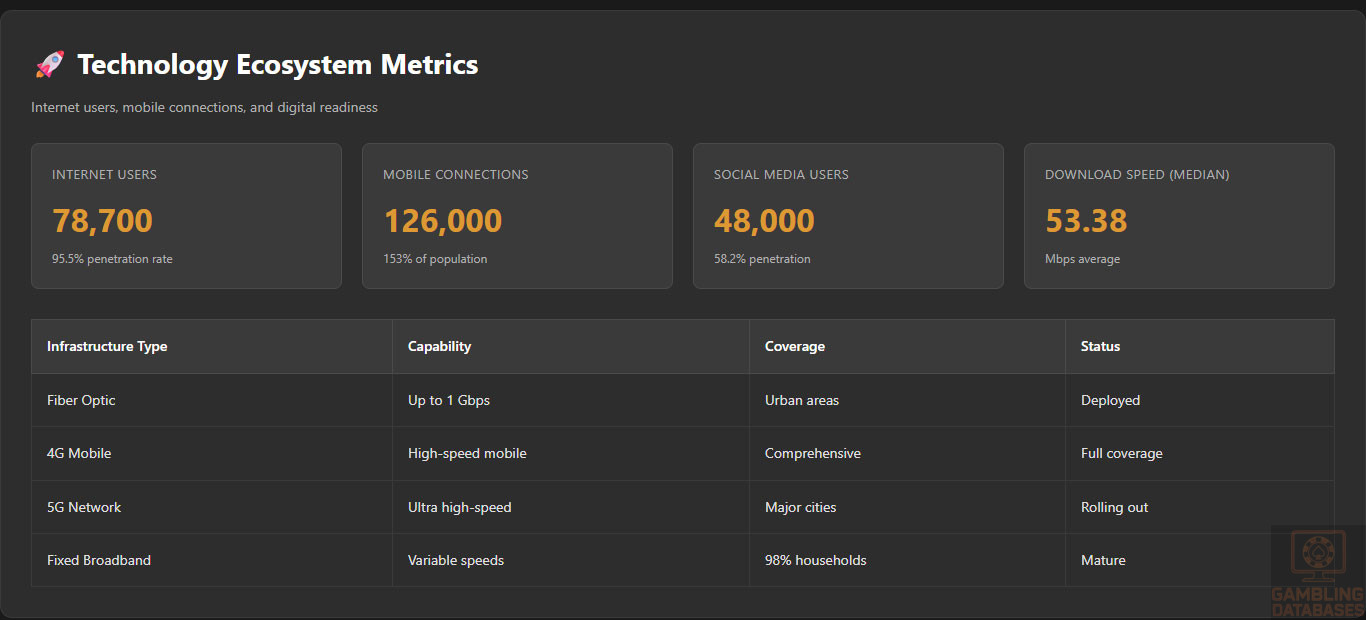
Internet Penetration: With 95.5% internet penetration (78,700 users) as of January 2025, Andorra ranks among the world’s most connected nations. This exceeds many large European countries.
Year-over-year growth reached 1.3% (992 new users) between January 2024 and 2025, reflecting near-saturation with incremental gains from population growth and elderly adoption.
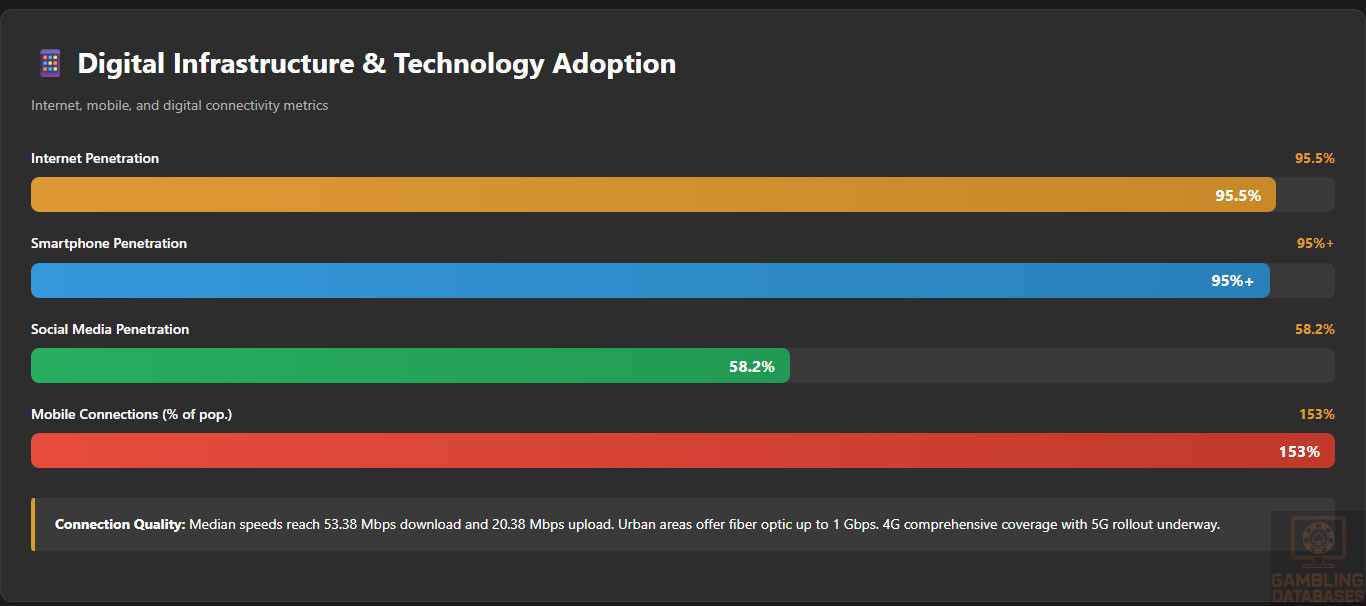
Connection Quality: Internet speeds in Andorra show variable performance. Median speeds reach 53.38 Mbps download and 20.38 Mbps upload, representing decent broadband performance.
However, mountainous terrain creates coverage variability. Urban areas enjoy excellent connectivity with fiber optic networks, while remote valleys may experience limitations.
Andorra Telecom offers 1 Gbps fiber connections in urban areas, providing infrastructure for bandwidth-intensive applications including live dealer casino gaming.
Daily Usage: Specific daily internet usage hours for Andorra are not published. However, European averages suggest 5-7 hours daily, with Andorra’s affluent, digitally-literate population likely at the higher end.
Mobile Internet: Mobile internet is widespread with 4G/5G coverage ensuring smooth connectivity. 5G rollout is progressing, with Andorra Telecom leading network infrastructure development.
E-commerce Participation: E-commerce adoption is substantial, reflecting the small retail market’s limitations and consumers’ comfort with online purchasing. Cross-border online shopping from Spain and France is common.
This e-commerce familiarity translates well to online gambling adoption, as users are accustomed to digital transactions and remote service consumption.
Social Media Engagement: Social media penetration reaches 58.2% with 48,000 user identities. This moderate penetration reflects demographic factors including older population segments less active on social platforms.
Popular platforms likely mirror Spanish and French markets: Facebook, Instagram, YouTube, and WhatsApp dominate. Social media provides viable marketing channels for gambling operators.
Digital Payment Behavior
Banking Infrastructure: Andorra maintains a sophisticated banking sector aligned with European standards. Digital banking adoption is high, with most residents using online and mobile banking routinely.
Account penetration approaches universal levels among adults. The banked population percentage likely exceeds 95%, facilitating electronic payment integration for gambling.
Payment Method Preferences: Credit and debit card usage is standard for transactions. Cards issued by Andorran banks function throughout the euro zone and globally.
Bank transfers through SEPA (Single Euro Payments Area) systems provide efficient euro-denominated transactions. Instant transfer capabilities are increasingly available.
E-wallet Adoption: Information on specific e-wallet (PayPal, Skrill, Neteller, etc.) adoption in Andorra is limited. Given European integration and cross-border commerce, major e-wallets likely function for Andorran users.
For gambling deposits and withdrawals, e-wallets provide privacy and transaction speed advantages that appeal to users. Operators should support popular European e-wallet options.
Cryptocurrency Adoption: Andorra approved the Digital Assets Act (Law 24/2022) on June 30, 2022, effective October 20, 2022. This law provides comprehensive legal framework for digital asset issuance, custody, exchange, and supervision.
Cryptocurrency is legal to hold and trade in Andorra. However, specific regulations on cryptocurrency use for gambling transactions are not detailed in available sources.
Given the progressive digital asset framework, crypto-based gambling may be permitted if operators comply with AML requirements and obtain appropriate authorizations.
Transaction Security Trust: Trust in online payment systems is high, reflecting strong banking regulation, low fraud rates, and sophisticated consumer protection. Andorran residents regularly conduct high-value online transactions.
For gambling operators, this trust environment facilitates larger deposit sizes and reduces payment friction, though responsible gambling guardrails remain essential.
Gaming and Gambling Preferences
Current Market Participation
Overall Gambling Participation: Specific data on what percentage of Andorran residents gamble annually is not published. Extrapolating from European averages suggests 30-50% participation rates.
Given recent legalization and limited land-based venues, actual participation may fall below European averages. As market matures and awareness grows, participation rates should increase.
Online Gambling Participation: With no licensed domestic online gambling operators and free access to international sites, online gambling participation occurs but is unmeasured.
Digital literacy and internet penetration support online gambling adoption. Younger demographics (25-44 years) likely show higher online gambling engagement.
Popular Activities: Bingo has historical cultural acceptance in Andorra. Sports betting gained legal status in 2012, suggesting market demand exists.
The casino opening introduces table games, slot machines, and potentially poker rooms. Tourist preferences for slots and roulette may drive land-based casino product mix.
Sports Betting Preferences: Specific sports betting preferences align with broader Spanish and French cultural interests: football dominates, followed by basketball, tennis, cycling, and Formula 1.
Winter sports betting (skiing, snowboarding) may show elevated interest given Andorra’s mountain culture and hosting of international skiing events.
Casino Game Preferences: Data on specific casino game preferences is unavailable. However, European trends suggest slots generate highest revenue volumes, followed by roulette, blackjack, and baccarat.
Live dealer games combining online convenience with authentic casino atmosphere are growing in popularity across Europe and likely appeal to Andorran players.
Lottery Participation: National lottery participation occurs through coordination with French and Spanish lottery systems, indicating cultural acceptance of lottery products.
Consumer Behavior Patterns
Spending Levels: Average gambling spending per active player in Andorra is not documented. However, high disposable income suggests above-average spending capacity.
Monthly spending of €50-€200 per active gambler represents reasonable estimates, with high-value players potentially spending significantly more.
Platform Preferences: Mobile vs desktop usage patterns are not specifically measured for Andorran gambling. European trends show 60-70% mobile gambling adoption.
Andorra’s high smartphone penetration (95%+) and mobile connectivity support mobile-first gambling consumption. Operators must prioritize mobile optimization.
Peak Usage Times: Peak gambling times typically align with leisure hours: evenings (20:00-24:00), weekends, and holiday periods.
Seasonal patterns may show increased activity during ski season (December-March) when tourist populations peak and leisure entertainment demand rises.
Session Characteristics: Average session lengths and frequency are not published. European patterns suggest online gambling sessions of 30-60 minutes, with 2-4 sessions weekly for regular players.
Deposit/Withdrawal Behavior: Affluent players may make larger deposits with less frequency, while recreational players deposit smaller amounts more regularly.
Withdrawal preferences favor speed and convenience. E-wallets offering same-day withdrawals are increasingly expected by European players.
Bonus Sensitivity: European players generally respond to bonuses but increasingly scrutinize wagering requirements and terms. Andorran players likely share this sophisticated approach.
Fair, transparent bonuses build loyalty. Overly complex or restrictive terms damage brand reputation and customer retention.
Section 3: Technology Infrastructure and Business Environment
Internet and Digital Infrastructure
Connectivity and Network Performance
Internet Quality Assessment: Andorra maintains developed digital infrastructure supporting advanced connectivity. Urban areas, particularly Andorra la Vella and Escaldes-Engordany, offer excellent broadband access.
Fixed Broadband: Fiber optic networks deliver up to 1 Gbps connections in urban zones through Andorra Telecom, the national telecommunications provider.
Fixed broadband penetration is high among households and businesses, providing stable connectivity for bandwidth-intensive applications.
Mobile Internet: Mobile broadband complements fixed connections. 4G coverage is comprehensive across populated areas, with 5G deployment underway.
126,000 mobile connections (153% of population) reflect multiple device ownership and robust mobile ecosystem.
Speed Performance: Median internet speeds reach 53.38 Mbps download and 20.38 Mbps upload. However, variability exists with recorded speeds ranging from 0.04 Mbps to 346.55 Mbps download.
Mountainous terrain creates coverage challenges in remote valleys, but population concentration in urban areas means most residents and businesses enjoy reliable high-speed connectivity.
Network Reliability: Andorra Telecom operates as the primary network operator, maintaining infrastructure to European standards. Uptime and reliability meet expectations for developed markets.
Infrastructure Investment: Ongoing investments in fiber expansion and 5G rollout demonstrate commitment to maintaining competitive digital infrastructure.
5G and Future Technology Deployment
5G Rollout: 5G deployment is progressing with Andorra Telecom leading implementation. Specific coverage percentages and deployment timelines are not publicly detailed.
Urban areas likely receive priority for 5G coverage, with gradual expansion to smaller parishes following.
Coverage Plans: 4G coverage currently serves the majority of populated areas. 5G expansion aims to enhance mobile broadband speeds and support emerging technologies.
Network Competition: Andorra Telecom dominates as the primary telecommunications provider. The small market limits room for multiple competing network operators.
This concentration provides network consistency but may limit competitive pricing compared to markets with multiple carriers.
Mobile Technology Ecosystem
Mobile Network Infrastructure
Network Operators: Andorra Telecom is the principal mobile network operator providing comprehensive coverage throughout the Principality.
The company offers mobile plans with roaming included in many European destinations, reflecting cross-border connectivity importance for residents and tourists.
Coverage Quality: Mobile coverage quality is generally strong in populated areas. Mountainous terrain creates natural challenges in remote locations.
Skiing areas and tourist zones receive infrastructure priority ensuring connectivity where visitor densities are highest.
Data Costs: Specific cost-per-GB pricing is not detailed in available sources. However, Andorra’s competitive market positioning and European integration suggest reasonable data pricing.
Mobile plans include data allowances, with unlimited or high-capacity plans increasingly standard.
Mobile Payments: Mobile payment integration is advancing with smartphone-based payment options including contactless payments and mobile banking apps.
Mobile wallet adoption supports digital transaction ecosystems essential for mobile gambling integration.
Device Penetration
Smartphone Adoption: Smartphone penetration exceeds 95% of the population, reflecting affluence and technology adoption characteristics.
Multiple device ownership is common, with individuals often maintaining separate work and personal smartphones.
Device Preferences: Specific brand preferences are not published, though European markets show mixed iOS and Android adoption.
Gambling operators must ensure cross-platform compatibility supporting both operating systems and various device types.
Device Capabilities: Average device specifications are high given the affluent market. Recent smartphone models with advanced processors, high-resolution displays, and 5G capability are common.
This device quality supports sophisticated mobile gambling applications including live dealer streaming and high-quality graphics.
Financial Services and Payment Infrastructure
Banking System Structure
Banking Sector: Andorra maintains a sophisticated banking sector with multiple institutions serving the domestic market and international clients.
Major banks include Andbank, MoraBanc, Crèdit Andorrà, and others. The sector underwent significant reform and transparency improvements over the past decade.
Regulatory Framework: Banking regulation aligns with European standards through Laws 35/2010, 7/2013, 7/2024, and others governing financial institutions.
The Andorran Financial Authority (AFA) supervises the banking sector ensuring stability and compliance with international standards.
Digital Banking: All major Andorran banks offer comprehensive online and mobile banking platforms. Digital banking adoption is very high.
Account management, transfers, bill payments, and investment services are accessible remotely, supporting digital economy participation.
Account Access: Essentially all adults maintain bank accounts. Account penetration approaches universal levels, facilitating electronic payment integration.
Deposit Protection: The Andorran Guarantee Deposit Fund (FAGADI) protects deposits up to €100,000, with additional coverage up to €300,000 for specific exceptional situations.
Payment Processing Options
Card Payments: Credit and debit cards are standard payment methods. Visa and Mastercard are widely accepted, with cards issued by Andorran banks functioning throughout Europe.
For gambling operators, card processing is essential. However, gambling-related merchant category codes may face additional scrutiny from payment processors.
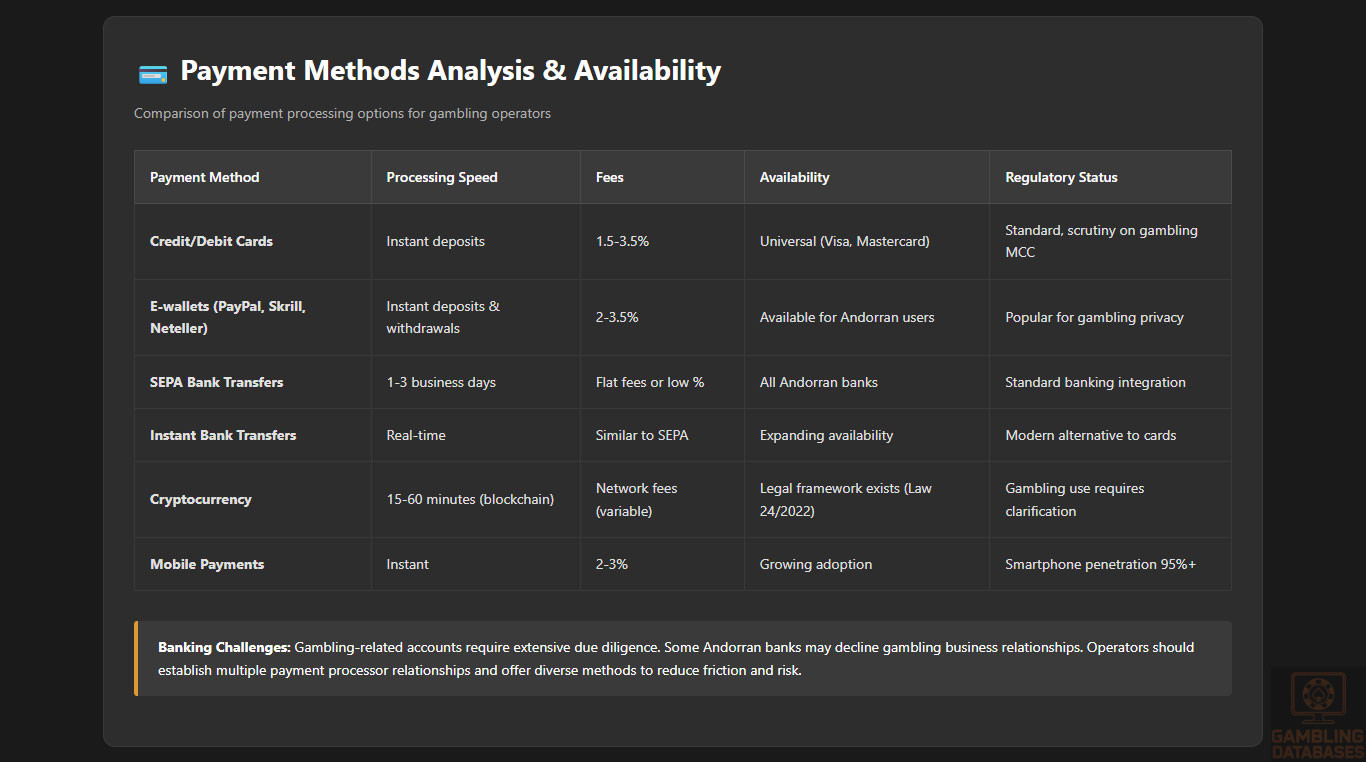
E-wallet Availability: Popular European e-wallets including PayPal, Skrill, Neteller, and others likely function for Andorran users, though specific availability should be verified.
E-wallets provide privacy, speed, and convenience advantages for gambling transactions. Operators should integrate multiple e-wallet options.
Bank Transfers: SEPA bank transfers enable efficient euro-denominated transactions. Instant payment capabilities are expanding, though traditional transfers may require 1-3 business days.
Bank transfers suit larger deposits but lack the immediacy players increasingly expect for gambling funding.
Cryptocurrency Payments: The Digital Assets Act (Law 24/2022) provides legal framework for cryptocurrency operations. Whether gambling operators can accept crypto payments requires regulatory clarification.
If permitted, cryptocurrency offers privacy and international transaction advantages, though volatility and regulatory compliance create challenges.
Processing Fees: Payment processing fees vary by method. Card transactions typically incur 1.5-3.5% merchant fees. E-wallets charge similar percentages. Bank transfers may involve flat fees.
These processing costs represent significant operational expenses for gambling operators and should be factored into financial modeling.
Transaction Timelines: Card deposits are instant. E-wallet deposits are instant. Bank transfers require 1-3 business days unless instant payment rails are used.
Withdrawal processing times vary by operator policies and payment method. E-wallets typically enable fastest payouts (same-day to 24 hours). Cards and bank transfers may require 3-5 business days.
International Capabilities: Andorran payment infrastructure integrates with international systems. Cross-border euro transactions function smoothly within SEPA zone.
Currency conversion for non-euro transactions is available but involves exchange rate spreads and fees.
Gambling Payment Restrictions: Specific restrictions on payment processing for gambling are not detailed. However, banking institutions maintain strict compliance standards.
Gambling-related accounts require enhanced due diligence. Some banks may decline gambling business relationships, making payment processor selection critical.
E-commerce and Digital Economy
Digital Market Development
E-commerce Market Size: Specific e-commerce market size data for Andorra is not published. However, the small retail market and sophisticated population drive substantial online purchasing.
Cross-border e-commerce from Spain, France, and international platforms is significant given limited local retail selection.
Online Retail Penetration: Online purchasing complements rather than replaces physical retail. Duty-free shopping remains a major draw for tourism-driven retail sector.
However, convenience goods, specialized products, and services are increasingly purchased online.
Consumer Trust: Trust in online transactions is high, supported by strong consumer protection, low fraud rates, and sophisticated banking security.
This trust environment facilitates online gambling adoption as users are comfortable with digital service consumption and electronic payments.
Popular Platforms: International e-commerce platforms (Amazon, eBay, etc.) serve Andorran consumers. Spanish and French online retailers are frequently accessed.
Digital service consumption includes streaming entertainment, software subscriptions, and online gaming, creating familiarity with digital entertainment business models.
Business Environment and Regulatory Framework
Ease of Business Operations
Business Climate: Andorra offers a favorable business environment characterized by low taxation, political stability, and streamlined regulatory processes.
The government actively promotes economic diversification and foreign investment, particularly in technology, real estate, and financial services sectors.
Registration Efficiency: Business registration processes are relatively efficient compared to many European jurisdictions. Company formation typically completes within 1-3 months.
Required documentation is substantial, reflecting rigorous anti-money laundering standards, but processes are professional and predictable.
Foreign Investment Policy: The Foreign Investment Law permits non-residents to invest in Andorran companies. Foreign ownership is allowed, though 100% Andorran ownership may provide advantages in certain licensing situations.
Operational Costs: Office rent in Andorra la Vella reflects limited commercial space availability but remains moderate compared to major European cities.
Salary levels for qualified professionals are competitive with Spain and France, though lower than Switzerland or Luxembourg. Utilities and business services are reasonably priced.
Labor Market: The small labor pool creates talent acquisition challenges for specialized positions. Many businesses recruit from Spain and France.
Work permits for foreign nationals require employer sponsorship and demonstration of unavailable local talent. Multilingual professionals are particularly valued.
Corporate Structure and Registration
Available Entity Types
Limited Liability Company (SL): Societat Limitada is suitable for small to medium operations. Minimum capital requirements are moderate, governance structures are flexible, and administrative burdens are lower than corporations.
Corporation (SA): Societat Anònima provides structure for larger operations, public offerings, or situations requiring more formal governance. Higher capital requirements and stricter reporting apply.
Branch Office: Foreign companies can establish branch offices in Andorra, though this structure may not satisfy gambling licensing requirements for fully independent Andorran entities.
Recommended Structure: For iGaming operators, an SL or SA incorporated under Andorran law is most appropriate. The choice depends on scale, governance preferences, and capital availability.
SL offers simplicity for smaller operations. SA provides structure for larger casino or multi-product gambling businesses.
Registration Requirements
Registration Timeline: From application to full registration approval typically requires 1-3 months, depending on documentation completeness and due diligence complexity.
Registration Costs: Government fees for company registration are moderate. Legal and consulting fees for documentation preparation, notarization, and process management typically range €3,000-€8,000+.
Total registration costs including capital deposits, legal fees, and initial setup expenses typically total €10,000-€25,000 depending on entity type and complexity.
Required Documents: Criminal record certificates with Hague Apostille (valid 3 months), passport copies with Hague Apostille, detailed CVs, business plans, financial projections, and source of funds documentation.
All foreign documents require apostille authentication. Banking relationships require extensive KYC documentation.
Foreign Ownership Rules: No specific percentage limits restrict foreign ownership in most sectors. Gambling licensing evaluation may favor Andorran ownership but does not prohibit foreign-owned applicants.
Capital Requirements: Minimum capital varies by entity type. SLs require modest minimum capital (specific amounts not detailed in sources). SAs require higher capitalization.
For gambling licenses, demonstrated financial capacity far exceeding minimum legal requirements is essential.
Ongoing Compliance: Annual financial statements must be filed. Tax declarations are required. Corporate governance meetings must be documented.
Companies must maintain updated shareholder registers, comply with employment regulations, and fulfill social security obligations.
Taxation Framework
Corporate Income Tax Structure
Standard Rate: Corporate income tax is levied at 10% on company profits (revenues minus expenses). This rate is among Europe’s lowest.
New Business Incentives: New companies with income below €100,000 benefit from reduced rates for the first three years: 5% on the first €50,000 taxable income, 10% on income exceeding €50,000.
First-year operations receive 50% reduction in settlement fees, further reducing initial tax burdens.
Special Regimes: International companies, holding companies, and intra-group financial management entities may qualify for 2% maximum taxation under specific conditions.
Patent Box regime reduces effective tax to 2% for companies engaged in research and development predominantly in Andorra, rewarding innovation.
Loss Carryforward: Negative tax bases can be carried forward and applied against future profits for up to 10 years, providing flexibility during development or loss periods.
Tax Treaties: Andorra has established over 15 double taxation treaties with countries including Spain, France, Portugal, Luxembourg, and others.
These treaties prevent double taxation of business income and facilitate international operations. Transfer pricing documentation may be required for related-party transactions.
Withholding Taxes: Dividends from Andorran companies to residents incur 0% withholding tax. Dividends to non-residents also face 0% withholding in Andorra (though recipient country taxation may apply).
Interest and royalty payments may face withholding depending on treaty provisions.
Personal Income Tax
Tax Brackets: Personal income tax (IRPF) applies progressively: €0-€24,000 exempt (0% rate), €24,000-€40,000 taxed at 5%, income exceeding €40,000 taxed at 10%.
Maximum effective tax rates remain well below 10% for all income levels due to exemptions and lower bracket rates.
Employee Withholding: Employers must withhold income tax from employee salaries and remit to tax authorities. Social security contributions to CASS are also withheld.
Social Security: Employer and employee contributions to CASS (social security) are required. Contribution rates are complex and can escalate quickly, representing significant employment costs.
Total social security burden (employer + employee) can reach 20%+ of gross salaries, substantially increasing true employment costs beyond headline wages.
Foreign Employees: Foreign nationals working in Andorra are subject to Andorran income tax on their worldwide income if they become tax residents (residing 183+ days annually).
Tax residency planning is essential for mobile workers and executives splitting time between jurisdictions.
Market Entry Considerations
Recommended Entry Strategies
Licensing vs Partnership: Direct licensing pursuit requires full Andorran entity establishment, substantial capital investment, and navigating CRAJ’s stringent requirements.
Partnership with existing licensed operators (particularly Jocs SA for land-based operations) may provide faster market access with reduced capital requirements and regulatory complexity.
Local Partnership Benefits: Partnering with 100% Andorran-owned entities provides local market knowledge, regulatory relationships, and competitive advantages demonstrated in casino licensing outcomes.
Local partners navigate cultural nuances, language requirements, and government relationships more effectively than pure foreign entrants.
White Label vs Proprietary: For online gambling (if/when licensing becomes available), white label solutions reduce technology development costs and accelerate time-to-market.
However, proprietary platforms provide greater control, differentiation potential, and long-term strategic flexibility.
Technology Leveraging: Given the micro-market size, leveraging existing technology platforms and shared infrastructure optimizes economics.
Building custom technology solely for Andorra’s 83,000 population is economically challenging. Multi-jurisdiction platforms amortize development costs.
Marketing Localization: Despite small size, marketing must address multilingual requirements (Catalan, Spanish, French) and cultural sensitivities.
Tourism marketing targeting French and Spanish visitors requires different positioning than resident-focused campaigns.
Payment Provider Selection: Establishing banking relationships in Andorra requires extensive due diligence. Operators should engage banking advisors early.
Multiple payment method integration (cards, e-wallets, bank transfers) is essential. Backup payment processors mitigate relationship termination risks.
Typical Costs and Timelines
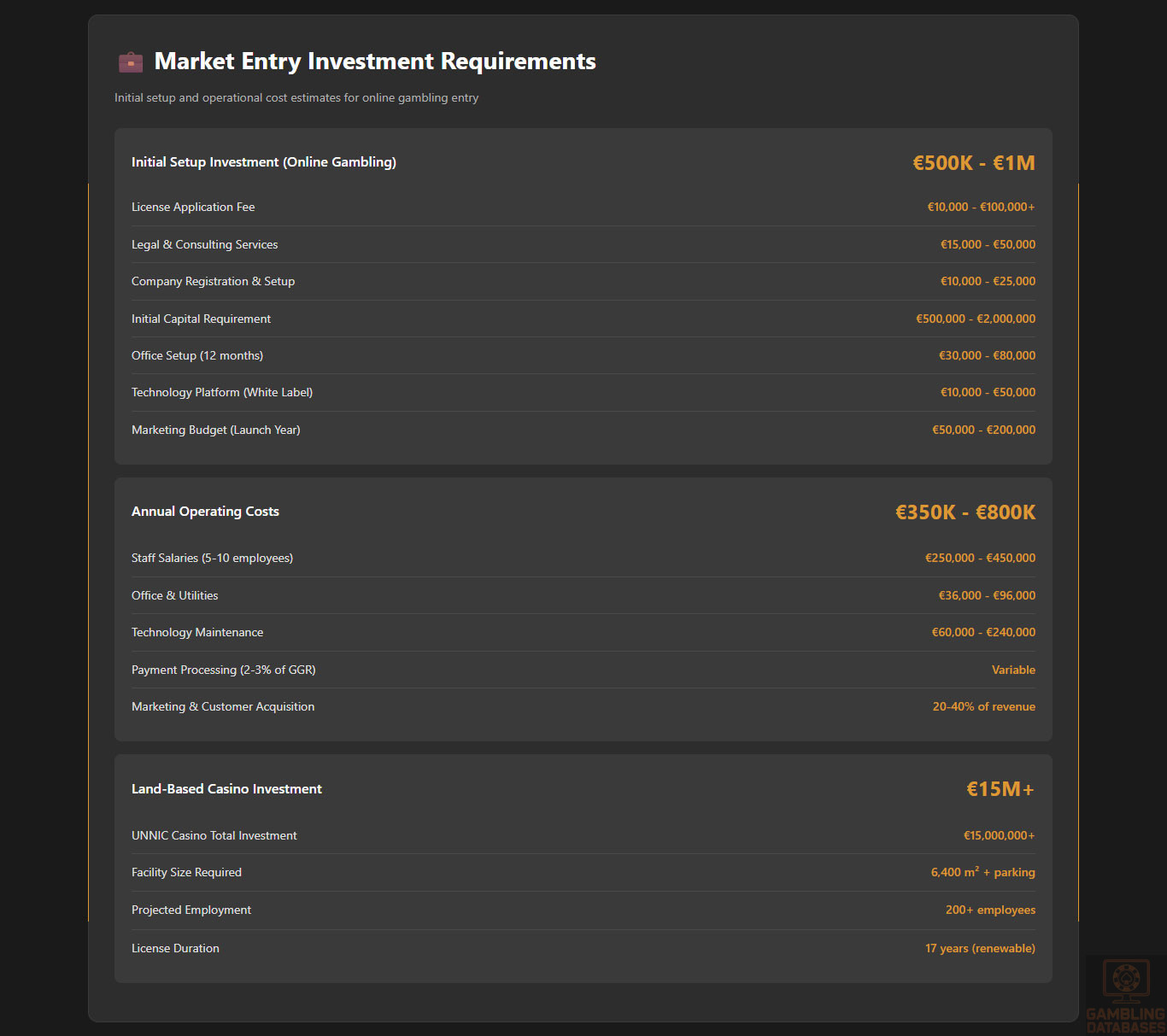
Initial Setup Investments
License Application: Casino license fee amounts are not disclosed but are substantial given exclusive 17-year rights. Online license fees (when available) should be anticipated at €10,000-€100,000+ depending on scope.
Legal and Consulting: Legal services for entity formation, license application preparation, contract negotiation, and compliance setup typically total €15,000-€50,000+.
Company Registration: Entity formation costs including government fees, notarization, and initial setup total €10,000-€25,000.
Initial Capital: Minimum capital depends on entity type. However, demonstrated financial capacity for gambling operations requires significant reserves.
Casino operations demanded €15+ million total investment. Online operations might require €500,000-€2,000,000+ in accessible capital.
Office Setup: Commercial office space rental, furnishing, IT infrastructure, and utilities for initial 12 months total €30,000-€80,000+ depending on size and location.
Technology Platform: Proprietary platform development costs €200,000-€1,000,000+. White label solutions involve setup fees of €10,000-€50,000 plus ongoing revenue shares.
Marketing Budget: Initial marketing to establish brand awareness, acquire customers, and generate launch momentum requires €50,000-€200,000+ for first 12 months.
Total Initial Investment: Conservative estimates for online gambling market entry total €300,000-€500,000 minimum. Realistic budgets considering all contingencies approach €500,000-€1,000,000.
Land-based casino operations require €15,000,000+ as demonstrated by UNNIC Casino investment levels.
Operational Cost Estimates
Staff Salaries: Minimum viable team includes general manager, compliance officer, customer service representatives, and technical support. Monthly salaries total €15,000-€30,000.
Including social security contributions, annual personnel costs reach €250,000-€450,000+ depending on team size and seniority.
Office and Utilities: Monthly rent, utilities, internet, and office maintenance total €3,000-€8,000, or €36,000-€96,000 annually.
Technology Maintenance: Platform hosting, software licenses, security systems, and technical support cost €5,000-€20,000 monthly or €60,000-€240,000 annually.
Payment Processing: Transaction fees at 2-3% of gross gaming revenue represent variable costs. For €1,000,000 GGR, processing fees total €20,000-€30,000.
Marketing and CAC: Customer acquisition costs vary by channel. Digital marketing, affiliates, and promotions typically consume 20-40% of revenue during growth phases.
For €1,000,000 annual GGR, marketing budgets of €200,000-€400,000 support customer acquisition and retention.
Total Annual Operating Costs: Fixed costs (staff, office, technology) total €350,000-€800,000 annually. Variable costs (payment processing, marketing) scale with revenue.
Breakeven requires substantial GGR generation, challenging in a market of only 83,000 residents.
Timeline Expectations
Company Registration: 1-3 months from application to approval and commercial registry inscription.
License Application: Timeline varies significantly. Casino license tender to award took months. Online license timelines are unknown as few have been issued.
Prudent planning assumes 6-12 months for gambling license application review and decision.
Platform Setup: White label platform integration requires 4-8 weeks. Proprietary platform development requires 4-12 months depending on scope.
Total Time-to-Market: From initial decision to operational launch, realistic timelines span 9-18 months including entity formation, licensing, platform development, payment integration, and marketing preparation.
Resource Requirements
Minimum Staffing: Core team requires 5-10 employees: management, compliance, customer service, technical support, and marketing roles.
Key Positions: General Manager/CEO, Compliance Officer (mandatory for regulatory adherence), Customer Service Manager, Technical Operations Manager, Marketing Manager.
Technology Stack: Gaming platform (proprietary or white label), payment gateway integration, CRM system, compliance monitoring tools, data analytics, cybersecurity infrastructure.
Success Factors and Challenges
Key Success Enablers
Local Market Understanding: Deep knowledge of Andorran cultural nuances, multilingual requirements, and consumer preferences is essential.
Partnership with local advisors, hiring Andorran staff, and investing in market research prevents costly missteps.
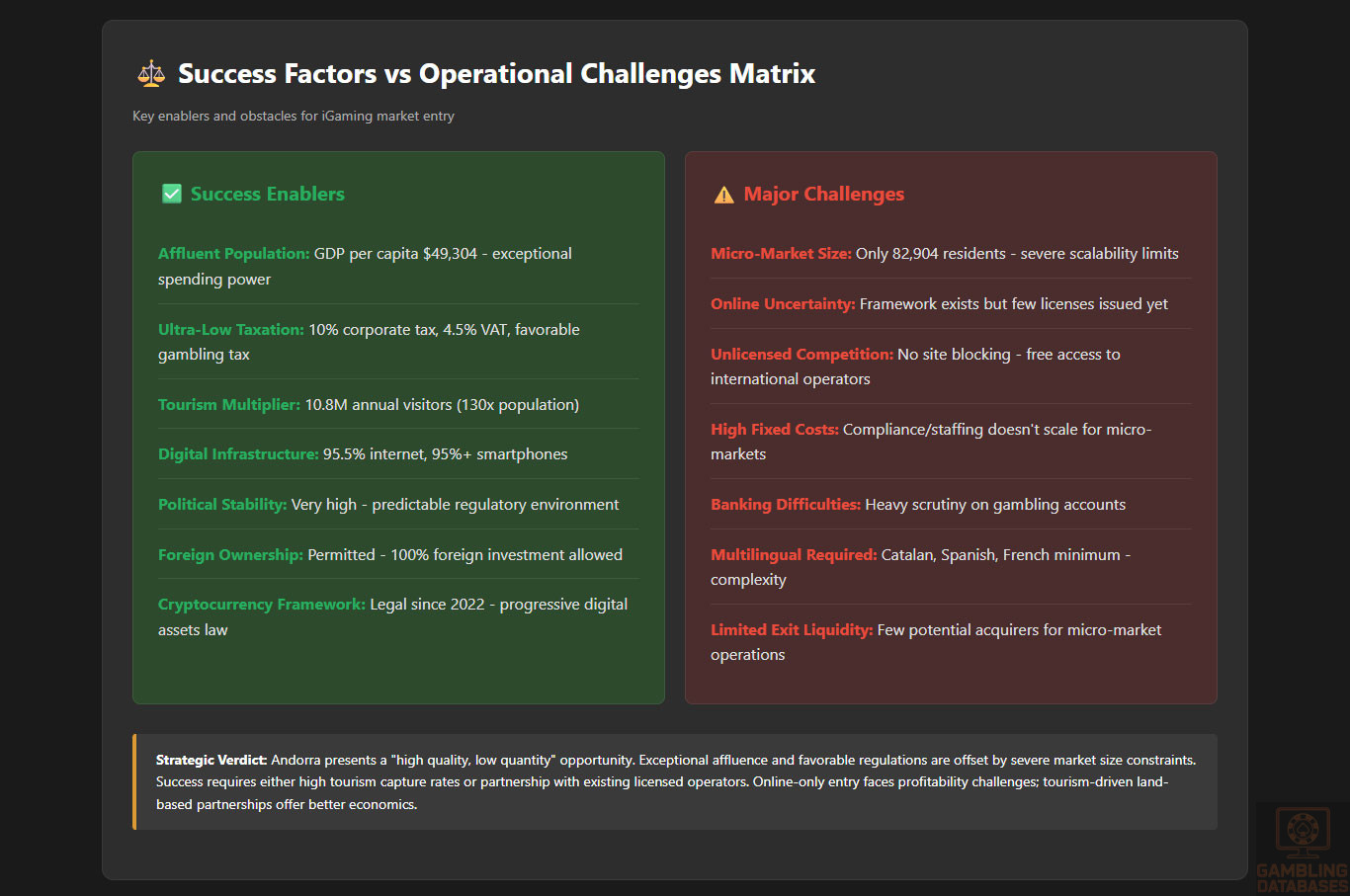
Payment Method Diversity: Offering multiple convenient payment options (cards, e-wallets, bank transfers) reduces friction and accommodates varied user preferences.
Mobile Optimization: With 95%+ smartphone penetration and high mobile usage, mobile-first platform design is non-negotiable.
Customer Service Excellence: Small market dynamics mean reputation travels quickly. Exceptional customer service in Catalan, Spanish, and French builds loyalty and word-of-mouth referrals.
Responsible Gambling: Demonstrating genuine commitment to player protection builds trust with regulators, customers, and community stakeholders.
Competitive Bonusing: Fair, transparent bonuses attract players without unsustainable acquisition costs. Avoid predatory terms that damage long-term brand reputation.
Sports Coverage: For sports betting, comprehensive coverage of football, basketball, tennis, skiing, and cycling resonates with local and tourist interests.
Major Operational Challenges
Market Size Limitation: The fundamental challenge is extreme market size limitation. With only 83,000 residents, addressable market is inherently constrained.
Achieving meaningful revenue scale requires either very high penetration rates or successful tourism market capture.
Regulatory Uncertainty: Online gambling regulatory framework exists but implementation remains unclear. Licensing timelines, requirements, and costs are not fully transparent.
Operators face uncertainty about when comprehensive online licensing will become available and what obligations will apply.
Competition from Unlicensed Sites: Andorrans currently access international gambling sites freely. Licensed operators must compete against established brands without regulatory protection via site blocking.
High Fixed Cost Burden: Regulatory compliance, staffing, and technology costs don’t scale down for micro-markets. Fixed cost burdens relative to revenue potential create profitability challenges.
Payment Processing Difficulties: Establishing and maintaining gambling-related banking relationships in Andorra can be challenging. Banks scrutinize gambling accounts heavily.
Limited Marketing Scale: Small audience size limits marketing efficiency. Cost-per-acquisition may be elevated due to limited targeting scale and narrow geographic reach.
Talent Acquisition: Recruiting specialized gambling industry talent to relocate to Andorra for a small operation is difficult. Remote work arrangements may be necessary.
Language Requirements: Supporting Catalan, Spanish, and French increases operational complexity and costs compared to single-language markets.
Cultural Considerations
Local Holidays: Andorra celebrates both Spanish and French holidays plus local feast days. Marketing campaigns should align with holiday patterns.
Peak leisure periods during Christmas, Easter, and summer vacations present gambling activity opportunities.
Sports and Events: Major sporting events (FIFA World Cup, UEFA Champions League, Olympics) drive betting activity spikes.
Local events including skiing competitions, cycling stages through Andorra, and cultural festivals provide engagement opportunities.
Customer Service Channels: Andorrans expect responsive customer service through multiple channels: phone, email, live chat, and potentially WhatsApp.
Service availability during European evening hours (when gambling activity peaks) is essential.
Communication Style: Professional but approachable communication resonates. Overly aggressive marketing may alienate the sophisticated, affluent audience.
Trust Building: Foreign brands must invest in local presence, Catalan language support, and community engagement to build trust.
Sponsorships, responsible gambling initiatives, and visible regulatory compliance demonstrate commitment to the Andorran market.
Exit Strategy Planning
Market Liquidity: The micro-market size limits potential acquirers. Exit opportunities likely involve selling to regional operators seeking diversification or local entities consolidating.
License Transferability: Gambling license transfer requires CRAJ approval. New owners must meet suitability requirements, creating due diligence and approval timelines.
Valuation Multiples: Micro-market operations typically trade at lower EBITDA multiples than larger markets due to growth constraints and operational challenges.
Expect 2-4x EBITDA for established operations, potentially higher if strategic value exists.
Closure Process: Closing operations requires CRAJ notification, customer fund returns, employee terminations following labor law, and final tax settlements.
License surrender and proper regulatory wind-down prevents future liabilities.
FAQ: Frequently Asked Questions
Legal & Licensing
Is online gambling legal in Andorra?
Yes, online gambling is legal in Andorra under Law 4/2021 enacted March 22, 2021. This comprehensive legislation regulates both land-based and online gambling activities.
However, practical implementation has been slow. The Consell Regulador Andorrà del Joc (CRAJ) has authority to issue online gambling licenses but has granted few if any comprehensive online licenses to date.
Andorran residents currently access international online gambling sites without restrictions or enforcement actions. CRAJ has not implemented website blocking or payment restrictions against unlicensed offshore operators.
This creates a transitional regulatory environment where online gambling is legally authorized but not fully regulated, with unclear timelines for when comprehensive licensing frameworks will become operational.
What types of gambling licenses are available and what do they cover?
Law 4/2021 establishes six categories of gambling operators based on activity type and delivery method. Class A licenses authorize comprehensive casino operations including table games, slot machines, and integrated entertainment facilities.
These licenses carry the highest investment requirements, strictest regulatory standards, and exclusive rights. The UNNIC Casino holds the sole Class A license in Andorra.
Class B licenses permit bingo operations with more limited scope than casino licenses. Sports betting licenses authorize wagering on sporting events through land-based venues or online platforms.
Online gambling licenses are categorized separately from land-based operations, though specific license types, coverage scopes, and differentiation between online casino, poker, and sports betting remain unclear pending CRAJ implementation.
Lottery operations function through coordination with French and Spanish systems. The regulatory framework also distinguishes between operators (who provide games) and distributors (who market them).
How much does an iGaming license cost and how long does it take to obtain?
Specific license fee amounts are not publicly disclosed by CRAJ. Law 4/2021 Article 94 specifies that license applications are subject to administrative fees, but exact schedules vary by license category.
The exclusive Class A casino license likely commanded substantial fees given the 17-year exclusive rights and €15+ million investment requirements. Prospective operators should contact CRAJ directly for current fee information.
Online gambling license fees (when available) are estimated at €10,000-€100,000+ depending on license scope, though this is speculative absent official data.
Timeline expectations vary significantly. The casino license tender process took months from announcement to award. After selection, the winning bidder had 15 days to submit formal application.
CRAJ issued the license within approximately two months following complete application submission, though the process faced delays and complications with documentation reviews.
For online gambling licenses, timelines are unknown as few have been issued. Prudent planning should assume 6-12 months for application review, due diligence, and regulatory decision-making.
Total time from initial market entry decision to operational launch spans 9-18 months including entity formation, licensing, platform setup, and payment integration.
Can foreign companies obtain a gambling license?
Yes, foreign companies can obtain gambling licenses in Andorra. The Foreign Investment Law permits non-residents to invest in and own Andorran companies.
However, operators must establish a legal entity incorporated under Andorran law with registered office in the Principality. The company must conduct effective management from Andorra.
Foreign ownership percentages are not legally restricted, and 100% foreign-owned entities can apply for licenses. That said, the casino license tender outcome suggests 100% Andorran ownership provides competitive advantages.
Jocs SA, being fully Andorran-owned, won against international gaming giants including Genting Group, CIRSA, and Casinos Austria. Local ownership likely influenced evaluation of economic impact and national benefit.
Foreign operators should consider partnerships with Andorran entities to combine international expertise with local market knowledge, regulatory relationships, and potential licensing advantages.
Financial & Taxation
What are the tax obligations for iGaming operators?
iGaming operators face multiple tax obligations in Andorra. The gambling activities tax under Law 14/2024 applies specifically to licensed gambling operations, though exact rates by game type are not publicly disclosed.
Andorran authorities have indicated intentions to keep gambling taxation low to attract operators. Rates likely involve GGR-based taxation below European averages.
Corporate income tax applies at 10% on company profits. New companies benefit from reduced rates during the first three years: 5% on the first €50,000 taxable income and 10% on amounts exceeding €50,000.
License fees include initial application fees, annual maintenance fees, and periodic renewal costs. The casino license’s 17-year duration suggests renewal fees apply upon expiration.
Value Added Tax (IGI) applies to business operations at 4.5% standard rate or 9.5% for financial services. Gambling services’ specific IGI treatment requires regulatory clarification.
Social security contributions to CASS for employees represent significant costs, potentially reaching 20%+ of gross salaries when employer and employee portions are combined.
Annual compliance costs include audited financial statement preparation, tax return filing, regulatory reporting to CRAJ, and professional advisory fees for ongoing compliance management.
Are gambling winnings taxed for players?
Yes, gambling winnings are subject to personal income tax in Andorra, though favorable exemptions apply. Winnings from gambling activities authorized in the Principality benefit from €3,000 exemption.
For Andorran tax residents, the first €3,000 of gambling winnings from licensed domestic operations is tax-free. Amounts exceeding €3,000 are taxed at 10%.
This creates a de facto tax-free threshold for casual recreational players, with only significant winners facing moderate taxation on excess amounts.
Professional gamblers earning income from poker tournaments or gambling activities may be taxed differently. Tournament winnings, team salaries, affiliate income, and prizes in kind go to the general tax base.
The general tax base provides €24,000 fully exempt, then 5% on €24,000-€40,000, and 10% above €40,000. Maximum effective taxation remains capped at 10%.
Gambling winnings from unauthorized international sites or foreign casinos do not benefit from the €3,000 exemption and are taxed as general savings income at 10% from the first euro.
However, enforcement and reporting of offshore gambling winnings face practical challenges given the anonymous nature of many international gambling sites.
What are the typical operational costs for running an online casino/sportsbook?
Fixed operational costs include staffing, office space, and technology infrastructure. A minimum viable team of 5-10 employees (management, compliance, customer service, technical, marketing) costs €15,000-€30,000 monthly in salaries.
Including social security contributions, annual personnel costs reach €250,000-€450,000. Office rent, utilities, and maintenance total €36,000-€96,000 annually depending on location and size.
Technology platform costs vary by approach. White label solutions involve setup fees of €10,000-€50,000 plus ongoing revenue shares of 10-20% of GGR.
Proprietary platform development costs €200,000-€1,000,000+ upfront plus €60,000-€240,000 annual maintenance including hosting, licenses, security, and technical support.
Variable costs scale with activity. Payment processing fees at 2-3% of gross gaming revenue represent significant expense. For €1,000,000 annual GGR, processing costs total €20,000-€30,000.
Marketing and customer acquisition typically consume 20-40% of revenue during growth phases. For €1,000,000 GGR, expect €200,000-€400,000 marketing spend.
Licensing fees, compliance costs, legal advisory, accounting, and regulatory reporting add €30,000-€80,000 annually. Total annual operating costs (fixed and variable combined) range €600,000-€1,300,000+ for modest operations.
Achieving profitability requires substantial GGR generation, challenging in a market of only 83,000 residents. Tourism market capture is essential for viable economics.
What is the expected ROI timeline for entering this market?
ROI timelines are highly uncertain given Andorra’s micro-market size and developing regulatory environment. Initial breakeven typically requires 18-36 months assuming successful customer acquisition and retention.
Investment recovery extending 3-5 years is realistic for online gambling operations. Land-based casino investments require longer horizons given substantially higher capital requirements.
The UNNIC Casino’s €15+ million investment likely requires 7-10+ years for full return depending on revenue performance and operational efficiency.
Key variables affecting ROI include: market penetration rates achieved, average revenue per user, customer acquisition costs, regulatory developments enabling or constraining operations, and success capturing tourist gambling spend.
Pessimistic scenarios see limited profitability due to market size constraints, high fixed costs, and competition from unlicensed international sites. Operations may struggle to achieve meaningful scale.
Optimistic scenarios leverage Andorra’s affluent population, strong tourism flows, favorable tax regime, and potential for regional reputation building. Profitable niche operations serving high-value customers are feasible.
Realistic expectations should assume modest returns over extended periods rather than rapid payback. Strategic value (regulatory learning, brand building, diversification) may justify investment beyond pure financial ROI.
Operations & Compliance
What are the local presence requirements for operators?
Gambling operators must establish a legal entity incorporated under Andorran law (SL or SA) with registered office in the Principality. The company must conduct effective management from Andorra.
Managers must perform their work functions from Andorra, and board meetings must occur within the country. Failure to maintain genuine Andorran management creates tax residence risks.
Physical premises requirements depend on operation type. Land-based gambling obviously requires substantial facilities meeting CRAJ technical and security standards.
Online gambling operations require registered office space, though the extent of physical infrastructure needed remains unclear given limited licensing precedents.
Staffing requirements mandate Andorran-based employees. The casino license projected 200+ employees contributing to economic impact. Online operations need smaller teams but must have local presence.
Key management positions, compliance officers, and customer service likely require Andorran-based staff. Technology development and support functions may potentially operate remotely.
Technology and server hosting requirements are not comprehensively detailed. Whether gaming infrastructure must be hosted within Andorra or can operate from other jurisdictions requires CRAJ clarification.
What payment methods are available and recommended?
Credit and debit cards (Visa, Mastercard) are essential payment methods. Cards issued by Andorran banks and international cards function for transactions.
However, gambling merchant category codes face additional payment processor scrutiny. Establishing reliable card processing relationships requires careful provider selection.
E-wallets including PayPal, Skrill, Neteller, and similar services likely function for Andorran users, though specific availability should be verified with each provider.
E-wallets offer privacy, speed, and convenience advantages appealing to gambling customers. Multiple e-wallet integrations increase payment success rates.
Bank transfers through SEPA systems enable euro-denominated transactions. Instant payment capabilities are expanding, though traditional transfers require 1-3 business days.
Bank transfers suit larger deposits but lack immediacy players expect. They function better for withdrawals where speed requirements may be less critical.
Cryptocurrency payments are legally complex. The Digital Assets Act (Law 24/2022) provides framework for crypto operations, but whether gambling operators can accept cryptocurrency requires regulatory clarification.
If permitted, cryptocurrency offers privacy and international transaction advantages, though volatility and compliance challenges exist.
Recommended approach: Implement multiple payment methods (cards, e-wallets, bank transfers) providing flexibility. Establish relationships with multiple processors ensuring backup options if one relationship terminates.
What are the advertising and marketing restrictions?
Specific advertising and marketing restrictions for gambling in Andorra are not comprehensively detailed in publicly available regulatory documents.
Law 4/2021 addresses advertising principles but exact permitted channels, content restrictions, and prohibited practices require CRAJ guidance.
General responsible gambling principles apply. Marketing cannot target minors, vulnerable populations, or create false impressions about winning probabilities or guaranteed returns.
All promotional content must include responsible gambling warnings and information about support resources. Age restrictions (18+) must be clearly communicated.
Bonus offers and promotional terms must be transparent with clear disclosure of wagering requirements, withdrawal restrictions, expiration dates, and eligibility conditions.
Misleading advertising is prohibited. Claims about odds, payouts, or game features must be accurate and verifiable.
Land-based casino marketing appears permitted through outdoor advertising, print media, digital platforms, and tourism promotional materials without significant restrictions.
Online gambling advertising regulations will likely align with European best practices when comprehensive licensing frameworks are implemented.
Operators should anticipate potential restrictions on TV/radio advertising during times when minors may be watching, limitations on social media marketing targeting, and requirements for prominent responsible gambling messaging.
What responsible gambling measures are mandatory?
Law 4/2021 emphasizes responsible gambling as a core regulatory objective. CRAJ’s mandate explicitly includes preventing pathological gambling behaviors.
Mandatory age verification prevents minors from accessing gambling services. The minimum legal age is 18 years, strictly enforced.
Anyone appearing under 25 must present identification. Online platforms must implement robust age verification systems.
Self-exclusion systems allowing players to voluntarily ban themselves from gambling are required. Exclusion periods must be enforceable across operator platforms.
Deposit limits, loss limits, session time limits, and reality checks must be available to players. These tools help users maintain control over gambling expenditure and time spent.
Responsible gambling information must be prominently displayed including risks of gambling, signs of problem gambling, and access to support resources.
CRAJ contact information (Tel: +376 822 922, Email: [email protected]) must be available for players seeking assistance or filing complaints.
Staff training on identifying problem gambling behaviors and intervening appropriately is required. Customer service representatives must recognize warning signs and provide information about support resources.
Marketing must avoid targeting vulnerable populations, promoting excessive gambling, or creating urgency through time-limited offers that encourage impulsive behavior.
Market Opportunity
How large is the iGaming market and what is the growth potential?
Andorra’s iGaming market is extremely small due to the resident population of only 82,904. This represents one of the smallest national gambling markets in Europe.
Comprehensive market revenue data does not exist as online gambling remains largely unlicensed and land-based gambling recently developed with the casino opening.
The resident market potential is estimated at €12.5-€33 million annually assuming 30-40% gambling participation and €500-€1,000 average annual spend per player.
However, tourism provides significant market expansion. With 10.8 million annual visitors, even minimal conversion rates dramatically increase addressable market size.
If 2% of tourists gamble spending €50 per visit, tourism adds €10.8 million. Higher conversion and spending could push tourism gambling revenue to €50-100+ million.
Growth potential is moderate. From the current low base, 10-15% annual growth over 5 years is optimistic as the market develops.
Conservative scenarios assume 5-8% growth reflecting modest population increases and gradual penetration expansion. Growth drivers include casino establishment phase, potential online licensing expansion, and tourism recovery.
Constraints include small absolute population size, competition from unlicensed international sites, limited marketing scale efficiency, and high fixed cost burdens relative to revenue potential.
Online market growth is severely limited unless licenses permit cross-border EU service delivery, which seems unlikely given regulatory frameworks.
Who are the main competitors and what is their market share?
The licensed land-based gambling market exhibits extreme concentration. Jocs SA holds the exclusive Class A casino license operating the UNNIC Casino in Andorra la Vella.
Jocs SA also operates multiple Class B bingo licenses, effectively controlling the entire licensed gambling market as a monopoly or near-monopoly.
No market share data is published, but Jocs SA likely captures 90%+ of licensed land-based gambling revenue given its exclusive casino rights and dominant bingo position.
The online gambling market has no clearly defined licensed operators. Andorran residents access international gambling sites including major European brands.
Competitors include Bet365, 888, William Hill, Betsson, and numerous other international operators serving European customers without specific Andorran licenses.
These unlicensed operators likely capture the majority of Andorran online gambling activity. Market shares are unmeasured but distributed across major European platforms.
Entry strategies of unlicensed operators involve accepting Andorran customers through general European operations without specific localization or licensing for the Andorran market.
Future licensed operators will compete against this established international competition plus the dominant land-based presence of Jocs SA/UNNIC Casino.
What are the player preferences and typical spending patterns?
Specific data on Andorran player preferences and spending patterns is not published. Market research is limited due to small size and recent legalization.
Sports betting preferences likely align with broader Spanish and French cultural interests. Football dominates, followed by basketball, tennis, cycling, and winter sports.
Casino game preferences probably mirror European trends: slots generate highest volumes, followed by roulette, blackjack, and live dealer games.
Bingo enjoys cultural acceptance given its historical presence since 1996. Traditional “Quintos” format maintains community and social elements.
Spending levels benefit from exceptional affluence. Average gambling expenditure per active player likely exceeds European averages.
Monthly spending of €50-€200 per active gambler represents reasonable baseline estimates. High-value players may spend substantially more given the wealth concentration.
Platform preferences show mobile dominance given 95%+ smartphone penetration. European trends suggest 60-70% of online gambling occurs on mobile devices.
Peak gambling times align with leisure hours: evenings (20:00-24:00), weekends, and holiday periods. Ski season (December-March) may show elevated activity.
Payment preferences favor convenience and speed. E-wallets are increasingly popular for instant deposits and withdrawals. Cards remain standard for initial deposits.
What are the key success factors and main challenges for new entrants?
Success factors include deep local market understanding through partnerships with Andorran advisors and hiring local staff who navigate cultural nuances and multilingual requirements.
Payment method diversity reducing friction, mobile-first platform optimization, and exceptional customer service in Catalan, Spanish, and French build competitive advantages.
Genuine responsible gambling commitment demonstrates trustworthiness to regulators and customers. Fair, transparent bonuses attract players sustainably.
Comprehensive sports coverage for football, basketball, skiing, and cycling resonates with local interests. Tourism market capture through partnerships with hotels, resorts, and tour operators expands addressable market.
Main challenges center on extreme market size limitations. With only 83,000 residents, achieving meaningful revenue scale is inherently difficult.
High fixed costs for compliance, staffing, and technology don’t scale down proportionally, creating profitability pressures.
Regulatory uncertainty about online licensing timelines and requirements creates planning challenges. Competition from unlicensed international sites with established brands disadvantages new licensed entrants.
Payment processing difficulties and banking relationship complexities in Andorra’s rigorous compliance environment require expert navigation.
Limited marketing scale efficiency and talent acquisition challenges compound operational difficulties. Language requirements (Catalan, Spanish, French) increase costs.
Success requires realistic expectations about market potential, patient capital accepting extended ROI timelines, and strategic positioning emphasizing quality over scale.
Sources and References
- Consell Regulador Andorrà del Joc (CRAJ) – Official Website – https://www.craj.ad/
- Augé Legal & Fiscal – Regulation of games of chance in the Andorran framework – https://www.augelegalfiscal.com/en/regulacion-de-los-juegos-de-azar-en-el-marco-andorrano/
- AndorraInc – Gambling Taxes in Andorra – The 2025 Guide – https://www.andorrainc.com/en/gambling-taxes-andorra/
- iGamingToday.com – Gambling Regulation in Andorra – https://www.igamingtoday.com/gambling-regulation-in-andorra/
- CasinosBlockchain.io – Online & Crypto Gambling Regulations in Europe (2025) – https://casinosblockchain.io/crypto-gambling-regulations-in-europe/
- Betpack – Andorra Betting Sites 2025 | Top Online Sportsbooks – https://www.betpack.com/countries/andorra/
- LCB.org – Are Online Casinos Legal In Andorra? – https://lcb.org/restrictions/andorra
- CasinosAnalyzer – Online Casino in Andorra – Online Casinos Andorra 2025 – https://casinosanalyzer.com/online-casinos/andorra-and
- Slotegrator – Where Is Online Gambling Legal in 2025? Global Overview of iGaming Regulations – https://slotegrator.pro/analytical_articles/where-online-gambling-is-legal.html
- Voluum Blog – Online Gambling Laws in the EU and UK: Key Regulations by Country – https://voluum.com/blog/online-gambling-eu-uk/
- Chambers and Partners – Banking Regulation 2025 – Andorra – https://practiceguides.chambers.com/practice-guides/banking-regulation-2025/andorra
- Wikipedia – Demographics of Andorra – https://en.wikipedia.org/wiki/Demographics_of_Andorra
- StatisticsTimes.com – Andorra demographics 2025 – https://statisticstimes.com/demographics/country/andorra-demographics.php
- Worldometer – Andorra Population (2025) – https://www.worldometers.info/world-population/andorra-population/
- World Population Review – Andorra Population 2025 – https://worldpopulationreview.com/countries/andorra
- Macrotrends – Andorra Population (1950-2025) – https://www.macrotrends.net/global-metrics/countries/and/andorra/population
- Countrymeters – Andorra population (2025) live – https://countrymeters.info/en/Andorra
- CIA World Factbook – Andorra – https://www.cia.gov/the-world-factbook/countries/andorra/
- StatisticsTimes.com – Andorra population 2025 – https://statisticstimes.com/demographics/country/andorra-population.php
- Population Today – Andorra Population (2025) – https://populationtoday.com/ad-andorra/
- WHO – Andorra Health Data – https://data.who.int/countries/020
- Wikipedia – Economy of Andorra – https://en.wikipedia.org/wiki/Economy_of_Andorra
- CountryEconomy.com – Andorra 2025 – https://countryeconomy.com/countries/andorra
- World Bank – GDP per capita (current US$) – Andorra – https://data.worldbank.org/indicator/NY.GDP.PCAP.CD?locations=AD
- Trading Economics – Andorra – GDP Per Capita – https://tradingeconomics.com/andorra/gdp-per-capita-current-us$-wb-data.html
- Macrotrends – Andorra GDP Per Capita | Historical Chart & Data – https://www.macrotrends.net/global-metrics/countries/and/andorra/gdp-per-capita
- WHO Euro – Gross domestic product (GDP) per capita (Andorra) – https://gateway.euro.who.int/en/hfa-explorer/gdp/andorra/
- Trading Economics – Andorra GDP Per Capita – https://tradingeconomics.com/andorra/gdp-per-capita
- FocusEconomics – Andorra Economy: GDP, Inflation, CPI & Interest Rates – https://www.focus-economics.com/countries/andorra/
- Federal Reserve Bank of St. Louis FRED – Constant GDP per capita for Andorra – https://fred.stlouisfed.org/series/NYGDPPCAPKDAND
- DataReportal – Digital 2025: Andorra – https://datareportal.com/reports/digital-2025-andorra
- eSIM Andorra – Mobile Internet in Andorra 2025: How To Choose The Best Option? – https://esimandorra.com/mobile-internet/
- Holafly – Mobile internet in Andorra: What is the best option? – https://esim.holafly.com/internet/mobile-internet-andorra/
- Worldostats – Internet Penetration Rates by Country in 2025 – https://worldostats.com/country-stats/internet-penetration-by-country/
- Andorra Telecom – Summer campaign 2025 – https://www.andorratelecom.ad/en/mobile-telephony/summer-campaign-2025/
- IndexMundi – Andorra – Internet penetration – https://www.indexmundi.com/facts/andorra/internet-penetration
- GeoStatsGame – Top 10 Countries with Highest Internet Penetration 2025 – https://geostatsgame.com/resources/blog/top-10-highest-internet-penetration-2025
- Andorra Telecom – Personal Home Official Website – https://www.andorratelecom.ad/en/
- Casino News Daily – Andorra Company Jocs SA Wins Casino License Bidding Process
- Andorra Partner – Casino Andorra | Gambling Center in Andorra la Vella – https://andorrapartner.com/casino-andorra/
- Tunf.com – Andorra Online Casinos – https://tunf.com/andorra-casinos/
- CasinoOrc – Best Andorra Online Casinos – https://casinoorc.com/country/andorra/
- UNNIC Andorra – Responsible gaming – https://unnicandorra.com/en/responsible-gaming/
- CalvinAyre – Andorra once again rejects casino license award to Jocs SA – https://calvinayre.com/2020/02/21/casino/andorra-rejects-jocs-casino-license
- AndorraInc – Guide to Andorra Corporate Tax (UPDATED 2025) – https://www.andorrainc.com/en/andorra-corporate-tax/
- Golden Harbors – Andorra Company Registration: Everything You Need to Know in 2025 – https://goldenharbors.com/articles/andorra-company-registration
- Global Legal Insights – Corporate Tax Laws and Regulations 2024 | Andorra – https://www.globallegalinsights.com/practice-areas/corporate-tax-laws-and-regulations/andorra/
- Golden Harbors – Andorra Taxes in 2025 Explained by Experts – https://goldenharbors.com/articles/andorra-taxes
- Wikipedia – Taxation in Andorra – https://en.wikipedia.org/wiki/Taxation_in_Andorra
- AndorraInc – FULL Guide to All Andorran Taxes (UPDATED 2025) – https://www.andorrainc.com/en/andorra-taxes/
- Fintax Andorra – Guide Corporate Tax Andorra – https://www.fintaxandorra.com/post/guide-corporate-tax-andorra
- AndorraInc – Andorra Company Formation – 2025 Full Guide – https://www.andorrainc.com/en/andorra-company-formation/
- Set Up Andorra – Corporate tax rate Andorra – What is the income tax rate? – https://setupandorra.com/en/news/what-are-the-taxation-and-the-corporate-tax-rate-in-andorra/
- Forcam Lawyers – Tax Regime for Companies in Andorra (2025) – https://www.forcamabogados.com/en/andorra-business-taxation-everything-you-need-to-know
🎯 Gambling Databases Country Rating: Andorra
| Evaluation Dimension | Score | Rating |
|---|---|---|
| Operator Ease Score | 4.3/10 | 🔴 Difficult |
| Player Access Score | 6.8/10 | 🟡 Partially Legal |
| Overall Market Attractiveness | 3.5/10 | ⛔️ Micro-Market with Severe Limitations |
This rating is calculated using the Gambling Databases Rating (GDR) methodology, which provides transparent criteria for evaluating iGaming markets worldwide. Click the link to learn how we calculate Operator Ease Score, Player Access Score, and overall market attractiveness ratings.
⚠️ CRITICAL RISK WARNINGS
READ THIS BEFORE CONSIDERING MARKET ENTRY:
- EXTREME MICRO-MARKET: Only 82,904 residents make this one of the world’s smallest gambling markets. Achieving meaningful revenue scale is nearly impossible from residents alone.
- ONLINE LICENSING ESSENTIALLY NON-EXISTENT: Despite Law 4/2021 authorizing online gambling, CRAJ has issued almost no comprehensive online licenses as of early 2025. Regulatory framework exists on paper but not in practice.
- NO EU PASSPORTING RIGHTS: Andorra is NOT an EU member. Obtaining an Andorran license does NOT allow you to serve other EU markets, eliminating the primary justification for micro-market entry.
- INITIAL INVESTMENT $300K-$1M MINIMUM: For a market of 83,000 people with no cross-border service rights. Economics are prohibitive for most operators.
- LAND-BASED MONOPOLY: The sole Class A casino license was awarded to 100% Andorran-owned Jocs SA. Foreign operators face extreme competitive disadvantage in future licensing rounds.
- OFFSHORE ACCESS UNRESTRICTED: Andorran residents freely access international gambling sites with zero ISP blocking or enforcement. Licensed operators must compete against entire offshore market without regulatory protection.
- REGULATORY INCONSISTENCY DEMONSTRATED: Casino license saga (awarded 2018, withdrawn 2019, re-awarded, rejected again 2020) shows unpredictable regulatory decision-making that creates massive investment risk.
- BREAKEVEN REQUIRES 20-40% MARKET PENETRATION: With only 83,000 residents and typical €500-1,000 annual spend, you need 25,000+ active customers to cover €350K-800K annual fixed costs. This is unrealistic.
📊 Operator Ease Score Breakdown
| Criterion | Weight | Score | Justification (INCLUDING ALL DEDUCTIONS) |
|---|---|---|---|
| Legal & Regulatory Framework | 30% | 1.25/3.0 | Started at +1.5 (both land-based and online gambling legal under Law 4/2021). DEDUCTIONS: Online licensing framework exists but essentially non-operational (-0.75 points – no comprehensive licenses issued, creating regulatory uncertainty). Regulatory inconsistency demonstrated through casino license approval/rejection cycle (-0.5 points – massive investment risk). No EU passporting rights (-0.5 points – can’t leverage license for broader market access). Offshore operators not blocked, creating unfair competition (no additional deduction but noted). Final: 1.25/3.0 |
| Licensing Process | 25% | 0.75/2.5 | Started at +0.5 (extremely limited licensing – casino monopoly, unclear online process). Application costs unknown but estimated €10K-100K+ (+0 points for opacity). 6-12 month estimated timeline (+0 points). DEDUCTIONS: 100% Andorran ownership provides massive competitive advantage, foreign operators disadvantaged (-0.5 points). Casino tender showed €15M+ investment requirement, prohibitive for micro-market (-0.25 points). Complex probity checks with Hague Apostille requirements on all documents, valid only 3 months (-0.25 points). Online licensing timeline completely uncertain, CRAJ has not implemented framework despite 2021 law (-0.5 points). Total application costs likely €50K-150K including legal/consulting (-0.25 points). Final: 0.75/2.5 |
| Taxation & Costs | 20% | 1.5/2.0 | Started at +1.5 (10% corporate tax is excellent, though gambling-specific GGR tax rates not disclosed). DEDUCTIONS: GGR tax rates unpublished but described as “really low” – assuming 8-15% range based on competitive positioning (+0 points, no deduction for favorable rates). Total effective rate likely 18-25% combining GGR + corporate (still reasonable). However, EXTREME fixed cost burden relative to tiny market size (-0.5 points). Annual operating costs €350K-800K for market of only 83,000 people creates impossible unit economics (-0.5 points). Customer acquisition costs elevated due to limited targeting scale and narrow geographic reach (-0.25 points). Payment processing challenges due to banking scrutiny (-0.25 points). Final: 1.5/2.0 |
| Operational Requirements | 15% | 0.75/1.5 | Started at +0.5 (heavy requirements – must establish Andorran legal entity, maintain registered office, effective management from Andorra). DEDUCTIONS: Mandatory Andorran company incorporation with local management presence (-0.25 points). Key management and board meetings must occur in Andorra or risk losing tax residence (-0.25 points). Staffing requirements substantial – casino required 160-200+ jobs, online likely needs 5-10 minimum employees (-0.25 points). Multilingual requirements (Catalan, Spanish, French) increase operational complexity and costs (-0.25 points). Banking relationship establishment extremely difficult due to gambling scrutiny (-0.25 points). Technology/hosting requirements unclear, creating compliance uncertainty (-0.25 points). Final: 0.75/1.5 |
| Market Environment | 10% | 0.25/1.0 | Started at +0.5 (favorable business environment generally – streamlined processes, low bureaucracy, political stability). DEDUCTIONS: EXTREME micro-market limitation – 82,904 residents is one of world’s smallest gambling markets (-0.5 points). No ISP blocking of offshore sites means licensed operators compete against entire international market without protection (-0.25 points). Regulatory instability proven through casino license approval/rejection/re-approval saga (-0.25 points). Limited talent pool requires recruiting from Spain/France with work permit complications (-0.25 points). Advertising restrictions not detailed but likely exist given European norms (-0.25 points). Recent Law 14/2024 tax changes create ongoing regulatory uncertainty (-0.25 points). Final: 0.25/1.0 |
OPERATOR EASE TOTAL: 4.3/10 🔴 DIFFICULT
👥 Player Access Score Breakdown
| Criterion | Weight | Score | Justification (INCLUDING ALL DEDUCTIONS) |
|---|---|---|---|
| Legal Status for Players | 40% | 3.0/4.0 | Started at +2.0 (partially legal – land-based gambling legal, online framework exists but undeveloped). Both casino gambling and sports betting are legal under Law 4/2021. Online gambling is technically legal but no comprehensive licensed operators exist yet. DEDUCTIONS: Online gambling market essentially unavailable through licensed operators (-0.5 points – players must use offshore sites despite legal framework). Regulatory uncertainty about when/if online licensing will actually implement (-0.5 points). Players using offshore sites operate in grey area without clear legal protection (no additional penalty but noted). Final: 3.0/4.0 |
| Practical Accessibility | 30% | 2.5/3.0 | Started at +3.0 (excellent – multiple payment methods, zero ISP blocking, VPN unnecessary). Credit/debit cards work (+0 points). E-wallets available (+0 points). Bank transfers via SEPA function (+0 points). Cryptocurrency legal under Digital Assets Act but gambling use unclear (+0 points, no deduction). DEDUCTIONS: Banking institutions heavily scrutinize gambling accounts, making payment processing relationships difficult to establish (-0.25 points). Limited licensed online operators means practical access requires offshore sites (-0.25 points). Some payment processors may refuse gambling merchants due to compliance concerns (no specific restriction but operational challenge noted). Final: 2.5/3.0 |
| Player Penalties | 20% | 2.0/2.0 | Full score: +2.0 (no penalties for players). Andorran residents face zero penalties for gambling at licensed venues or offshore sites. Gambling winnings from authorized Andorran gambling benefit from €3,000 tax-free exemption, with only 10% tax above that threshold. Offshore winnings taxed at 10% from first euro but enforcement is minimal/non-existent. No criminal liability, no fines, no administrative warnings for players. Final: 2.0/2.0 |
| Market Availability | 10% | 0.3/1.0 | Started at +0.5 (1 licensed land-based operator – Jocs SA monopoly). DEDUCTIONS: Zero comprehensive licensed online operators despite legal framework (-0.2 points). Land-based market is effective monopoly with single Class A casino license creating no consumer choice (-0.2 points). Sports betting market exists but is small and limited (-0.1 points). Players must use offshore sites for online gambling, though access is unrestricted (already reflected in accessibility score). Final: 0.3/1.0 |
PLAYER ACCESS TOTAL: 6.8/10 🟡 PARTIALLY LEGAL
🔍 Key Highlights
Strengths (Limited)
- Ultra-Low Tax Regime: 10% corporate tax and estimated 8-15% GGR tax create 18-25% effective taxation, among Europe’s lowest
- Exceptional Internet Penetration: 95.5% connectivity and 95%+ smartphone adoption support digital gambling consumption
- Affluent Population: $49,304 GDP per capita (16th richest globally) means high disposable income – €40,000-70,000+ average earnings with minimal taxation
- Tourism Amplification: 10.8 million annual visitors theoretically expand addressable market 130x beyond resident base
- No Player Penalties: Residents face zero legal risk gambling at licensed or offshore sites
- Zero ISP Blocking: No website blocking or payment restrictions against offshore operators
- Legal Framework Exists: Law 4/2021 provides comprehensive regulation for both land-based and online gambling
- Political Stability: Exceptional governmental stability and low corruption provide predictable business environment
⛔️ CRITICAL RISKS AND CHALLENGES
- [MARKET SIZE APOCALYPSE:] 82,904 residents = one of world’s smallest gambling markets. Achieving €1M+ annual revenue requires capturing 25,000-33,000 active players (30-40% of entire population) at €50-100/month spending. This is IMPOSSIBLE. Even assuming affluence, realistic penetration of 10-15% means only 8,000-12,000 potential customers maximum.
- [ONLINE LICENSING VAPORWARE:] Law 4/2021 authorized online gambling in 2021. As of early 2025, CRAJ has issued almost ZERO comprehensive online licenses. Framework exists on paper only. Timeline for actual implementation completely unknown – could be months, years, or never.
- [NO EU PASSPORTING RIGHTS:] Andorra is NOT an EU member. An Andorran license provides ZERO ability to serve other EU markets. You cannot leverage this license to access Spain’s 47 million people or France’s 67 million people. You are LIMITED to 83,000 Andorrans. This eliminates the primary economic justification for micro-market entry.
- [IMPOSSIBLE UNIT ECONOMICS:] Fixed costs €350K-800K annually. Customer acquisition costs elevated due to tiny targeting pool. Payment processing 2-3% of GGR. With realistic €15-25M total addressable market (residents + tourism), achieving profitability requires 40-60%+ market share. Competing against unrestricted offshore access makes this unattainable.
- [REGULATORY INCONSISTENCY PROVEN:] Casino license awarded to Jocs SA in 2018, WITHDRAWN in 2019 for documentation deficiencies, re-awarded after appeals, then REJECTED AGAIN in February 2020. This demonstrated regulatory unpredictability creates massive investment risk. What happens if you invest €500K-1M and CRAJ changes its mind?
- [FOREIGN OPERATOR DISADVANTAGE:] Casino tender showed 100% Andorran ownership provides decisive competitive advantage. Jocs SA beat 13 international bidders including Genting, CIRSA, Partouche, and Casinos Austria specifically because of local ownership. Foreign operators face systematic disadvantage in licensing.
- [UNFAIR OFFSHORE COMPETITION:] CRAJ does NOT block offshore gambling sites. Andorran players freely access Bet365, 888, PokerStars, and hundreds of international operators. Licensed operators receive ZERO regulatory protection through ISP blocking, payment restrictions, or advertising bans. You must compete against entire offshore market while bearing licensing costs they avoid.
- [BANKING RELATIONSHIP NIGHTMARE:] Andorran banks maintain extreme compliance standards. Gambling accounts face heavy scrutiny. Many banks refuse gambling business entirely. Multiple operators report gambling-related banking as “particularly challenging.” Payment processor acquisition may prove impossible.
- [TOURISM CONVERSION FICTION:] While 10.8 million tourists visit annually, they come for skiing and duty-free shopping, NOT gambling. Tourists spend 1-3 days on ski trips. Casino is not primary attraction. Realistic gambling conversion rates are 1-3% of tourists, not 10-20%. Tourism gambling revenue likely €5-15M annually total market, not €50-100M.
- [TALENT ACQUISITION IMPOSSIBLE:] Convincing experienced iGaming professionals to relocate to a microstate of 83,000 people to operate a micro-market with no growth potential is nearly impossible. Remote work may be possible but undermines regulatory requirements for Andorran management presence.
Player-Specific Issues
- No Licensed Online Operators: Despite legal framework, players cannot access licensed online gambling from Andorran operators – must use offshore sites
- Limited Land-Based Choice: Single casino monopoly (UNNIC Casino) provides zero competitive options for residents
- Offshore Winnings Taxation: Winnings from offshore sites lose €3,000 tax exemption and face 10% taxation from first euro (though enforcement minimal)
- Small Market Means Poor Odds/Limits: Micro-market cannot support competitive odds, high betting limits, or deep liquidity in betting markets
💰 Reality Check: Can You Actually Make Money Here?
Initial Investment Required: €300,000-€1,000,000 (minimum €300K for bare-bones operation, realistic €500K-1M including all contingencies)
Monthly Operating Costs: €30,000-€70,000 (€350K-€800K annually including staff, office, technology, payment processing, marketing)
Effective Tax Rate on Revenue: 18-25% (estimated 8-15% GGR tax + 10% corporate tax on net profits)
Customer Acquisition Cost: €100-€300+ per customer (elevated due to tiny targeting pool and offshore competition)
Addressable Market Size: 82,904 residents total. Realistic active player base: 8,000-12,000 (10-15% penetration). Average spend: €500-1,000 annually. Total realistic market: €4-12M annually across ALL products.
Market Share Required for Breakeven: With €350K-800K annual fixed costs and 25-35% margin after taxes/variables, you need €1.0-2.5M annual GGR minimum. This requires 20-60% market share in a market with unrestricted offshore competition. This is IMPOSSIBLE.
Time to Breakeven: NEVER for most operators. Even with optimistic 15-20% market share, you’re generating €600K-2.4M GGR annually. After 20-25% taxes and €350K-800K fixed costs, margins are razor-thin or negative.
Time to Positive ROI: 7-15 years IF you achieve sustainable profitability, which is highly unlikely given market size constraints and offshore competition
Profitability Assessment: Economics are PROHIBITIVE for 99% of operators. The combination of extreme micro-market size (83K residents), high fixed costs (€350K-800K annually), unrestricted offshore competition (no ISP blocking), no EU passporting rights (can’t serve other markets), and uncertain online licensing creates impossible unit economics. Only consider entry if you have €2-5M+ capital, accept 10-15 year investment horizon, pursue tourism-focused land-based strategy, or view this as prestige/experimental market. For standard iGaming operators seeking ROI, this market is a value destroyer.
⚖️ Legal Risk Assessment
| Stakeholder Type | Risk Level | Specific Risks |
|---|---|---|
| Offshore Casino Operators (Unlicensed) | LOW | No ISP blocking, no payment restrictions, no enforcement against offshore operators serving Andorran players. Regulatory risk essentially zero. However, no regulatory protection if disputes arise. |
| Licensed Operators (If You Get License) | MEDIUM-HIGH | Regulatory inconsistency demonstrated (casino license saga). Investment risk if CRAJ changes position. Unfair competition from unrestricted offshore market. Banking relationship difficulties. Possible license suspension/revocation for compliance failures (precedent exists). |
| Affiliates/Advertisers | LOW | No evidence of enforcement against affiliates promoting offshore gambling to Andorran players. Regulatory focus is on operator licensing, not affiliate activity. |
| Payment Processors | LOW-MEDIUM | No specific restrictions on gambling payment processing. However, Andorran banks maintain strict compliance standards and many refuse gambling merchants. Relationship establishment risk rather than regulatory enforcement risk. |
| Company Directors/Executives | LOW | Operating licensed gambling faces minimal personal liability given legal framework. Unlicensed operation would face criminal penalties but enforcement against international executives unlikely given Andorra’s limited extraterritorial reach. |
🚨 Extradition and International Enforcement
Extradition Treaties: Andorra maintains extradition agreements with Spain, France, and limited EU cooperation through Council of Europe membership. However, gambling-specific extradition for offshore operators serving Andorran market is HIGHLY UNLIKELY given legal ambiguity and low enforcement priority.
Enforcement History: ZERO cases of international prosecution or extradition related to gambling operators serving Andorran market. Regulatory focus is entirely domestic licensing, not extraterritorial enforcement.
Safe Jurisdictions: Given Andorra’s limited international enforcement capacity and lack of gambling-specific enforcement precedents, geographic restrictions for offshore operators are minimal. Even Spain/France-based operators face negligible risk.
Travel Risk: NEGLIGIBLE. No evidence of Andorran authorities pursuing gambling-related prosecutions of international operators or executives. Travel through Spain, France, or other EU countries poses no meaningful risk.
Overall Assessment: Andorra presents LOW legal risk for offshore operators but also LOW market opportunity given tiny population. Enforcement focus is on encouraging licensed market development, not prosecuting offshore alternatives.
📋 Final Verdict
Andorra receives an Operator Ease Score of 4.3/10 and a Player Access Score of 6.8/10, resulting in an overall market attractiveness rating of 3.5/10.
HONEST ASSESSMENT:
This is one of Europe’s LEAST attractive gambling markets despite favorable taxation and regulation. The fundamental problem is catastrophic: only 82,904 residents create a micro-market incapable of supporting profitable iGaming operations. While Law 4/2021 provides comprehensive legal framework, CRAJ has issued almost zero online licenses in four years, making the regulatory framework vaporware. The casino monopoly awarded to 100% Andorran-owned Jocs SA demonstrates systematic foreign operator disadvantage. Most critically, Andorra is NOT an EU member, so licenses provide ZERO passporting rights to serve larger markets – you’re trapped serving 83,000 people while competing against unrestricted offshore access. Unit economics are impossible: €350K-800K annual fixed costs require 20-60% market share for breakeven in a €4-12M total market. Unless you have €2-5M+ capital, accept 10-15 year horizons with low/zero returns, and view this as prestige/experimental project, avoid completely. Tourism amplification is fiction – visitors come for skiing, not gambling. This market will destroy value for 99% of operators.
✅ Who Should Enter / ❌ Who Should Avoid
✅ Consider Entry If You Are:
- Major international casino operator with €15-30M+ capital seeking tourism-focused land-based presence in ski resort destination
- 100% Andorran-owned company with local political connections (only realistic path to obtaining licenses given Jocs SA precedent)
- Operator viewing Andorra as prestige/experimental market willing to accept 10-15 year horizons with minimal/zero ROI
- White-label provider seeking to partner with Jocs SA monopoly for revenue share rather than pursuing independent licensing
- Wealthy individual/group with €2-5M+ disposable capital treating this as lifestyle business rather than profit-maximizing investment
❌ Definitely Avoid If You Are:
- Any operator seeking profitable iGaming operation with reasonable ROI timelines (99% of industry)
- Foreign-owned company without Andorran ownership/partnerships (systematic licensing disadvantage proven)
- Startup or growth-stage operator with limited capital (€300K-1M entry costs for 83K population market is value destruction)
- Online-focused operator expecting EU market access (NO passporting rights, trapped serving micro-market)
- Operator seeking fast market entry (online licensing timeline completely uncertain, could be years)
- Casino-focused operator expecting dominant market position (monopoly already awarded to Jocs SA for 17 years)
- Operators requiring meaningful revenue scale (€4-12M total market cannot support multiple profitable operators)
- Affiliates expecting licensed market development (no licensed online operators exist despite 4-year-old legal framework)
- Any operator without minimum €2M capital and 7-10 year patient investment horizon
⚠️ BOTTOM LINE: Andorra combines favorable regulation with catastrophic market economics. The 82,904 population creates the smallest addressable market in Europe, making profitable operations virtually impossible despite low taxation. No EU passporting rights trap you serving a micro-market while competing against unrestricted offshore access. Unless you meet extraordinarily specific criteria (€5M+ capital, 10+ year horizon, 100% Andorran ownership, tourism-focused land-based strategy), this market will destroy value. For standard iGaming operators seeking ROI, Andorra is an absolute AVOID.