Angola represents an emerging opportunity in the African iGaming landscape, with a newly established regulatory framework that commenced accepting operator licenses in February 2025. The country’s evolving digital infrastructure, growing internet penetration, and young demographic profile create favorable conditions for market entry.
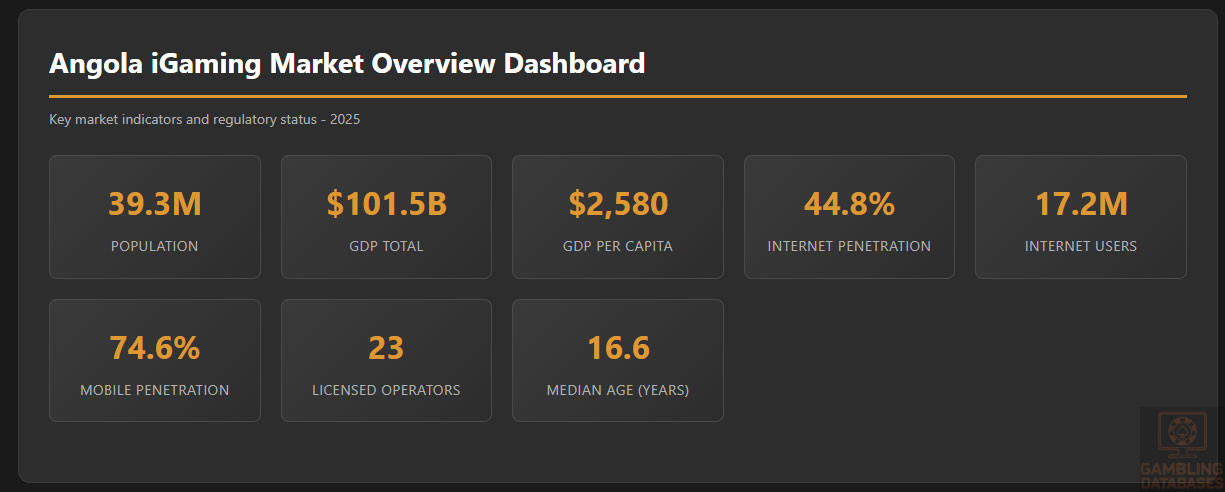
With 23 licensed operators currently active and government projections targeting 100 million USD in annual gaming sector contributions, Angola is positioning itself as a competitive iGaming jurisdiction. However, operators must navigate complex licensing requirements, moderate taxation levels, and infrastructure challenges that characterize this developing market.
Executive Summary: Key Market Indicators
| Indicator | Value | Details |
|---|---|---|
| Gambling Legal Status | Regulated | New licensing framework active from February 18, 2025 |
| Online Gambling Status | Legalized | Sports betting, online casinos, and lottery games permitted |
| Regulatory Authority | ISJ | Instituto de Supervisão de Jogos |
| Total Population | 39.3 million | 2025 estimate |
| Median Age | 16.6 years | One of Africa’s youngest populations |
| GDP Total | $101.5 billion | 2024 estimate |
| GDP Per Capita | $2,580 | 2024 estimate |
| GDP Growth Rate | 4.4% | 2024 actual; 3.2% projected for 2025 |
| Internet Penetration | 44.8% | 17.2 million users (January 2025) |
| Mobile Connections | 28.7 million | 74.6% penetration rate |
| Smartphone Penetration | Moderate | Growing rapidly in urban areas |
| License Duration | 10 years | Renewable for successive 3-year periods |
| GGR Tax Rate Range | 1.1% – 20% | Varies by gambling category |
| Player Winnings Tax | 10% – 15% | Varies by game type |
| Corporate Tax Rate | 25% | Standard rate for businesses |
| Licensed Operators | 23 | 10 gaming, 3 sports betting, 10 online (2024) |
| Gambling Tax Revenue | 10.1 billion AOA | $10.6 million USD (2023) |
| Urban Population | 68% | Concentrated in Luanda and major cities |
| Inflation Rate | 19.8% | May 2025; declining from 27.5% peak |
| Currency | Angolan Kwanza | AOA; experienced depreciation against USD |
| Legal Gambling Age | 18 years | Strictly enforced with KYC requirements |
| Foreign Ownership | Permitted | Must establish local company |
| Banking Penetration | ~50% | Significant underbanked population |
| Mobile Money Adoption | Growing | Multiple providers active (Unitel Money, Afrimoney) |
| Average Internet Speed | 12.7 Mbps | Mobile download; 19.96 Mbps fixed-line |
| Doing Business Rank | 177th | World Bank ranking; reforms underway |
| HDI Ranking | 150th | 0.591 index score (2022) |
| Primary Language | Portuguese | Official and business language |
| Market Entry Timeline | 6-12 months | License application to market launch |
| Projected Sector Growth | $100 million | Government target for annual contributions |
Section 1: Regulatory Framework and Legal Environment
Current Gambling Regulation Status
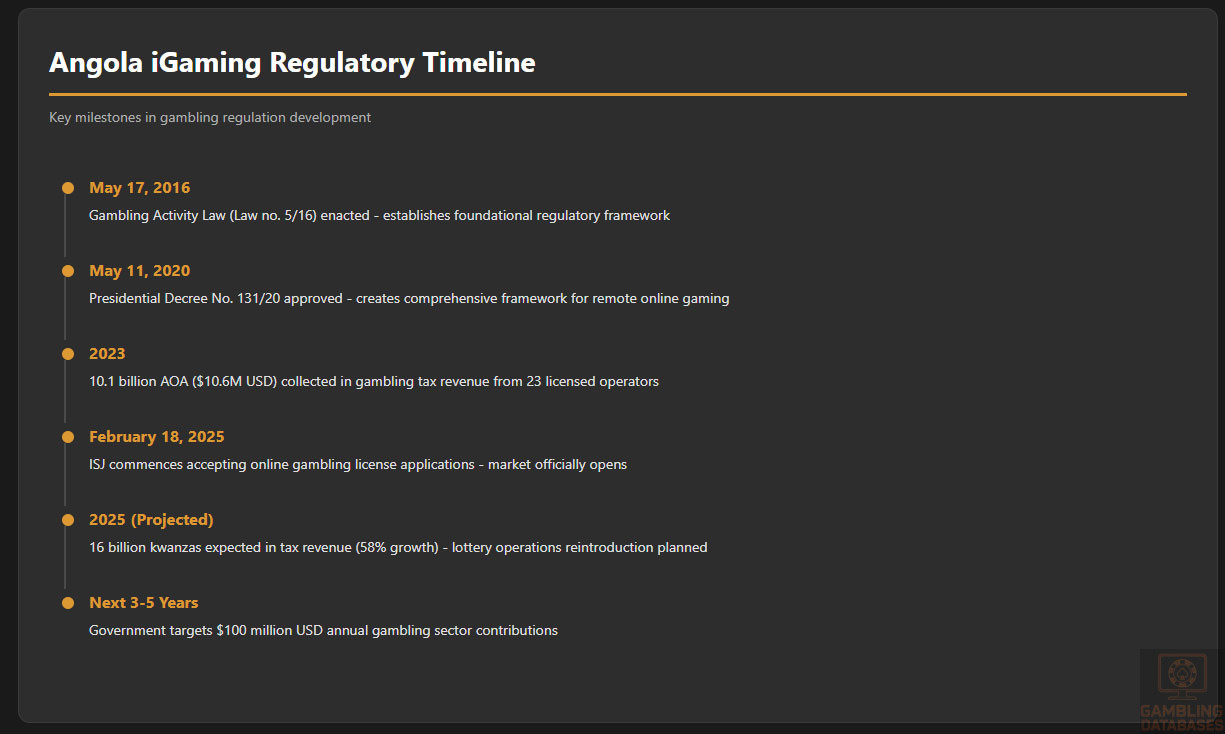
Angola’s gambling sector operates under a comprehensive regulatory framework established by the Gambling Activity Law (Law no. 5/16 of May 17, 2016) and subsequent amendments. The Instituto de Supervisão de Jogos (ISJ) serves as the primary regulatory authority responsible for licensing, supervision, and enforcement of all gambling activities within the country.
In a significant development for the African gambling market, Angola announced in February 2025 that ISJ would commence accepting license applications from operators seeking to enter the Angolan market starting February 18, 2025. This marks a pivotal expansion of the country’s online gambling regulatory framework, signaling Angola’s commitment to establishing a well-regulated and competitive gaming sector.
The fundamental principle governing Angola’s gambling sector is that exploitation rights are reserved to the Angolan State. However, these rights can be acquired through concession agreements as established in Article 5 of the Gambling Activity Law. This creates a structured pathway for private operators to participate in the market while maintaining governmental oversight and control.
Land-Based Gambling Activities
Angola permits various forms of land-based gambling operations, each subject to specific licensing requirements and operational standards. Casino operations represent the most established segment of the land-based gambling market, with facilities concentrated primarily in Luanda and other major urban centers. Operators must meet stringent security, transparency, and responsible gaming requirements.

Slot machine halls and gaming venues constitute another permitted category, falling under the broader casino and gaming hall regulations. The Gaming Law establishes minimum distance requirements between establishments to protect competition and prevent market saturation in specific geographic areas. This special regime allows multiple companies to operate casinos in the same geographical area provided they respect competitive spacing requirements.
Social games and certain lottery operations also fall under the land-based regulatory framework. The government is actively working to reintroduce lottery games, with concession contract negotiations underway for the winner of a public tender held by the State. This expansion is expected to launch by the end of 2025.

Online Gambling Framework
The Regulation on the Exploitation of Remote Online Gaming in Angola, approved by Presidential Decree No. 131/20 of May 11, 2020, establishes the comprehensive framework for online gambling operations. This regulation applies to the exploration and practice of online games and betting conducted remotely using electronic, computer, telematic, and interactive media or any other technological means.
The new licensing framework encompasses three primary categories of online gambling. Sports betting operations represent a major focus, allowing operators to offer wagering on sporting events through digital platforms. Online casino games including slots, table games, and live dealer options are permitted under appropriate licensing. Gambling-related lotteries conducted through digital channels complete the trio of authorized online gambling categories.
Online gambling and betting can only be carried out under a license granted to a public limited company (sociedade anónima). This corporate structure requirement ensures appropriate capitalization, transparency in ownership, and accountability mechanisms for regulatory oversight. The framework explicitly requires that all online gambling platforms implement responsible gambling measures, display information about responsible gambling practices, and implement strict age verification systems to prevent access by minors.
Prohibited activities and restrictions apply to operations that fail to obtain proper licensing or that target vulnerable populations. The regulatory framework mandates clear boundaries between different gambling categories, requiring operators to maintain distinct systems for different gambling activities to ensure appropriate regulatory oversight and consumer protection for each category.
Licensed Operators and Market Players
As of 2024, Angola’s gambling market comprises 23 licensed operators distributed across different gambling categories. The market structure includes 10 operators in the gaming sector (primarily casino operations), 3 operators holding territorial sports betting licenses, and 10 operators licensed for online gambling activities.
The market demonstrates moderate concentration with established players holding significant market positions. Unitel, one of Angola’s major telecommunications operators, has leveraged its mobile network infrastructure to develop Unitel Money, creating synergies between mobile payments and gambling activities. This convergence of telecoms and gaming represents an emerging trend in the Angolan market.
International operators can participate in the Angolan market by establishing local companies. Foreign investors are permitted to own gambling licenses without mandatory local partnerships, provided they create an Angolan-registered legal entity. This flexibility in ownership structure has attracted interest from international gaming operators seeking to expand their African footprint.
The competitive landscape is evolving rapidly following the February 2025 opening of the online licensing framework. The government projects that the gambling sector should contribute amounts in kwanzas equivalent to 100 million dollars over the coming years, indicating expectations for significant market expansion. This growth will likely intensify competition as new entrants challenge established operators.
| Category | Number of Operators | Market Characteristics |
|---|---|---|
| Gaming Sector (Casinos) | 10 | Primarily land-based operations in major cities |
| Territorial Sports Betting | 3 | Land-based betting venues with regulatory approval |
| Online Gambling | 10 | Digital platforms for sports betting, casino games, lottery |
| Total Licensed Operators | 23 | Active as of 2024; growth expected post-February 2025 |
Licensing Framework and Requirements
Application Process and Eligibility
The Instituto de Supervisão de Jogos (ISJ) administers the licensing process for all gambling operations in Angola. Operators seeking to enter the market must submit comprehensive applications demonstrating financial stability, technical capability, and commitment to responsible gaming principles. The regulatory framework requires rigorous criteria including financial capacity, adherence to security protocols, and proven responsible gaming practices.
License duration varies based on the regulatory regime. Under the exclusive regime, licenses to operate online gaming and betting are valid for 10 years and are renewable. For operations outside the exclusive regime, licenses are valid for 5 years with renewal options. Following initial issuance, licenses can be extended for successive periods of 3 years upon successful renewal applications.
Only entities with regular contributory and tax status qualify for licensing consideration. Applicants must demonstrate full compliance with Angolan tax obligations and social security contributions. This requirement ensures that only financially responsible operators with established local presence participate in the regulated market.
Background check procedures apply to all natural or legal persons wishing to acquire, directly or indirectly, qualifying holdings in a gaming operator. Prior authorization from ISJ is mandatory for shareholding acquisitions that reach or exceed the limits of 20%, 33%, or 50% of a gaming operator. The ISJ must also approve any entity that acquires control of a gaming operator regardless of the percentage shareholding.
Local Presence and Operational Requirements
Operating entities must establish meaningful local presence in Angola to qualify for and maintain gaming licenses. Companies must maintain a bank account with an Angolan financial institution at a national address for all transactions related to online gambling and betting activities. This ensures that financial flows remain visible to regulatory authorities and subject to Angolan banking oversight.
All licensed companies must have their registered office in Angola. The regulatory framework specifies that licenses outside the exclusive regime may be awarded to private legal persons governed by Angolan law and having their registered office in Angola. This physical presence requirement creates accountability and ensures operators can be effectively supervised by regulatory authorities.
The totality of share capital of exploiting entities must be represented by shares that allow the issuer of the license to know the identity of respective holders. Operators are obligated to communicate to ISJ all acts or businesses that imply the acquisition, transmission, or encumbrance of shares within 30 days from the date the company became aware of the act or business. This transparency requirement prevents unknown beneficial ownership and supports anti-money laundering efforts.
Companies are also required to ensure compliance with current Angolan laws on the prevention of money laundering and financing of terrorism. This includes implementing robust customer due diligence procedures, transaction monitoring systems, and suspicious activity reporting mechanisms aligned with international standards and Angolan regulatory expectations.
Technical and Infrastructure Requirements
Operating entities must install and maintain a technical system for the exploitation of online gaming and betting that meets ISJ’s technical standards. The system must be capable of creating a registration and an account for each player, tracking all gambling activities, and generating comprehensive reports for regulatory compliance purposes.
The framework establishes specific technical requirements for different gambling categories. Sports betting operators face distinct requirements from online casino platforms, reflecting the technical differences between these gambling sectors. This specialized approach ensures appropriate regulation for each gambling category while maintaining flexibility for operators to innovate within their licensed verticals.
All gambling platforms must implement strict age verification systems to prevent access by minors. The legal gambling age in Angola is 18 years, and operators must employ robust verification mechanisms during registration and potentially at transaction points to ensure compliance. Failure to prevent underage gambling represents a serious regulatory violation subject to penalties including license suspension or revocation.
Statistical monitoring requirements form part of the technical framework. Licensed operators must maintain detailed records of gambling activities, providing regulatory authorities with data for market analysis and compliance monitoring. This data-driven approach enables evidence-based policy adjustments and helps ISJ identify emerging risks or compliance issues.
Compliance Obligations and Monitoring
Player Protection and Identification
Operating entities are obligated to collect and maintain comprehensive personal data on all registered players. Required information includes full name, date of birth, nationality, profession, address and residence, telephone contact, email address, and identification document details. This information supports both regulatory compliance and responsible gambling initiatives.
KYC (Know Your Customer) and AML (Anti-Money Laundering) compliance standards align with international best practices. Operators must verify player identity during registration, implement ongoing monitoring for suspicious transactions, and report potential money laundering or terrorist financing activities to appropriate authorities. The Data Protection Law (Law no. 22/11 of June 17, 2011) governs the processing of personal data, and the Agência de Proteção de Dados (APD) oversees compliance.
Operators must create mechanisms that prevent minors and other socially vulnerable groups from registering. Age verification goes beyond simple checkbox confirmations, requiring document verification and potentially additional checks for accounts exhibiting suspicious activity. Operators failing to prevent underage gambling face severe penalties including fines, license suspension, and potential criminal charges.
Responsible gambling measures mandated by law include displaying information about responsible gambling practices prominently on all platforms. Players have the right to clear information on the rules of games, to receive their winnings promptly, and to have their personal data protected in accordance with applicable legislation. Operators must inform players about data processing activities and limit data collection to what is strictly necessary for gambling operations.
Self-exclusion system requirements enable players to voluntarily exclude themselves from gambling activities for specified periods. Operators must implement effective self-exclusion mechanisms that prevent excluded players from accessing gambling services across all platforms operated by the license holder. Cross-operator self-exclusion systems may be required as the regulatory framework matures.
Financial Monitoring and Reporting
Transaction monitoring systems must track all financial activities including deposits, wagers, winnings, and withdrawals. Operators must implement automated systems capable of identifying unusual transaction patterns that may indicate money laundering, fraud, or problem gambling behaviors. These systems should generate alerts for manual review by compliance personnel.
Reporting requirements and schedules vary by regulatory category and operator size. Operators must submit regular reports to ISJ documenting gambling activities, financial performance, player statistics, and compliance metrics. Monthly or quarterly reporting cycles are typical, with annual comprehensive reviews required for license renewals.
Audit and inspection procedures grant ISJ authority to examine operator records, systems, and facilities to verify compliance with licensing conditions. Operators must cooperate fully with regulatory inspections, providing access to relevant documentation and technical systems upon request. Independent third-party audits may be required periodically to verify the integrity of gaming systems and financial reporting.
Data retention requirements mandate that operators preserve transaction records, player communications, and compliance documentation for specified periods. These records must be readily accessible for regulatory review and may be required for dispute resolution, investigation of complaints, or enforcement proceedings. Typical retention periods range from 5 to 7 years depending on the nature of the records.
Taxation Structure and Financial Obligations
Player Taxation
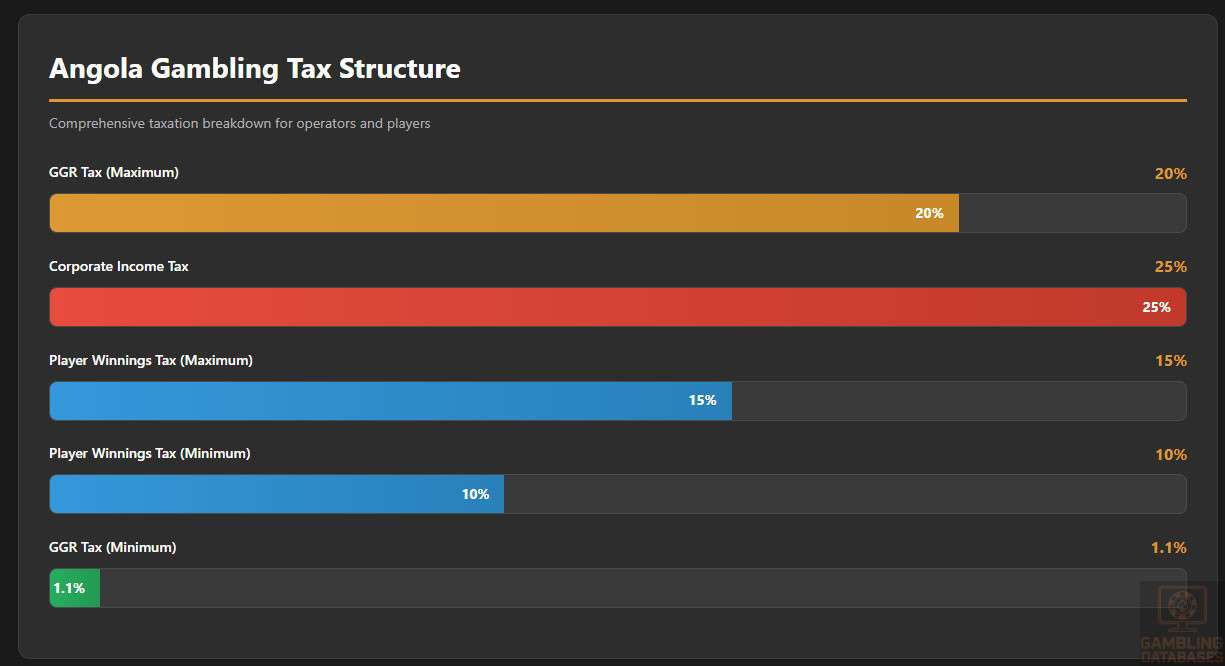
The total value of prizes awarded to players is subject to tax, with rates varying between 10% and 15% depending on the type of game. This player winnings tax is withheld by operators at the point of payout, reducing the administrative burden on individual players while ensuring tax collection. The tax applies to gross winnings before deduction of the original stake.
Players are entitled to receive their net winnings after applicable withholding taxes. Operators must clearly communicate the tax treatment of winnings to players, ensuring transparency about the amounts retained for tax purposes. Dispute resolution mechanisms must be available for players who believe winnings taxes were incorrectly calculated or withheld.
Tax-free thresholds may apply to smaller winnings, though specific threshold amounts have not been publicly disclosed in available regulatory documentation. The tax framework aims to balance revenue collection with maintaining player engagement and ensuring the competitiveness of legal, regulated gambling compared to unlicensed alternatives.
Operator Taxation
The Gaming Law provides for different rates of special tax on gambling, ranging from a minimum of 1.1% to a maximum of 20% of the gross revenue from gambling activities, depending on the form of gambling in question. This graduated tax structure recognizes different margin profiles across gambling verticals and aims to create an equitable tax burden across the industry.
Historical context shows that gambling tax rates in Angola have been subject to significant pressure from industry stakeholders. The president of the Games Association noted that the association managed to reduce the tax from 45% two years ago to 25% currently, with expectations for further reductions to 18% or 20%, and ongoing advocacy for rates around 12%. Industry representatives argue that Angola’s gambling taxes remain higher than international norms.
Corporate income tax applies to gambling operators at standard Angolan rates. As of current regulations, the standard corporate tax rate is 25% on taxable profits. This applies in addition to gambling-specific taxes, creating a combined tax burden that operators must account for in financial planning and pricing strategies.
Fixed operational taxes and annual fees include license application fees, license renewal fees, and potentially other regulatory charges. While specific fee schedules have not been publicly disclosed in available documentation, these represent significant upfront and ongoing costs that operators must budget for when planning market entry.
| Tax Type | Rate/Amount | Application |
|---|---|---|
| GGR Tax (Gambling) | 1.1% – 20% | Varies by gambling category |
| Player Winnings Tax | 10% – 15% | Withheld at payout; varies by game type |
| Corporate Income Tax | 25% | Standard rate on taxable profits |
| License Application Fee | Not disclosed | One-time payment upon application |
| License Renewal Fee | Not disclosed | Required for license extensions |
| Annual Regulatory Fee | Not disclosed | Ongoing compliance and oversight costs |
Gambling Market Financial Performance
In 2023, the Angolan State collected 10.1 billion kwanzas from the gaming sector, equivalent to approximately $10.6 million USD. This represents revenue from 23 licensed operators across all gambling categories. The government projected that tax revenues would reach 16 billion kwanzas in 2024, representing a 58% increase and signaling strong sector growth.
Looking forward, the Director-General of ISJ stated that over the next few years, the gaming sector should contribute amounts in kwanzas equivalent to 100 million dollars. This ambitious projection reflects expectations that the new online licensing framework will significantly expand the regulated market and attract substantial new investment from both domestic and international operators.
Total market size in terms of gross gaming revenue has not been publicly disclosed, but can be estimated based on tax collections and known tax rates. Assuming an average effective GGR tax rate of 15-20%, the 2023 tax collection of $10.6 million would imply total GGR in the range of $53-70 million. This represents a developing market with substantial room for growth as internet penetration increases and the online gambling framework matures.
Year-over-year growth trends show accelerating expansion. The projected increase from 10.1 billion kwanzas in 2023 to 16 billion kwanzas in 2024 represents 58% growth, significantly outpacing general economic growth rates. This rapid expansion reflects pent-up demand for regulated gambling services and the positive impact of regulatory modernization on market development.
Advertising and Marketing Restrictions
Angola’s gambling regulations include provisions governing advertising and marketing activities, though detailed restrictions have not been fully elaborated in public documentation. Operators must ensure that all marketing communications promote responsible gambling and do not target vulnerable populations, particularly minors.
Prohibition on marketing to minors is strictly enforced. All gambling advertisements must include clear age restrictions and warnings about the risks of gambling. Marketing materials cannot feature minors or appeal to underage audiences through themes, imagery, or placement in media consumed primarily by children.
Promotional limitations apply to bonus offers and wagering requirements. While specific caps on bonus amounts or maximum wagering requirements have not been publicly specified, operators must ensure that promotional terms are fair, transparent, and do not encourage excessive gambling. Misleading advertising regarding odds, payout rates, or terms and conditions is prohibited.
Content restrictions require that advertising accurately represents gambling products and does not make false claims about winning probabilities or potential returns. Testimonials and endorsements must be genuine and not create unrealistic expectations. Gambling cannot be portrayed as a solution to financial problems or as a risk-free activity.
Recent Regulatory Changes and Their Impact
The most significant recent regulatory change occurred in February 2025 when ISJ announced it would commence accepting license applications for online gambling operations starting February 18, 2025. This marked a comprehensive expansion of Angola’s online gambling market and represented the culmination of regulatory development efforts that began with Presidential Decree No. 131/20 in May 2020.
The new licensing framework timing provides operators with structured entry pathways into a market that previously operated with limited formal oversight of online activities. The two-week preparation period between announcement and activation allowed potential operators to gather necessary documentation and align operations with regulatory requirements.
The Gambling Activity Law enacted in 2016 (Law no. 5/16) established the foundational regulatory framework, but has been supplemented by subsequent decrees and regulations. The 2020 Presidential Decree on Remote Online Gaming (Decree No. 131/20) specifically addressed the digital gambling environment, creating the legal basis for the 2025 licensing launch.
Impact on operator costs and business strategy has been significant. Lower tax rates improve unit economics for operators, potentially enabling more competitive bonusing, better odds for players, and sustainable business models. However, operators must still navigate substantial compliance costs related to technical systems, reporting requirements, and regulatory fees.
Enforcement Mechanisms and Penalties
The Gaming Law establishes a comprehensive penalty structure for gambling-related offenses. Depending on the nature of the offense, violators can be sentenced to up to two years’ imprisonment or fines up to AOA 50,000,000 (fifty million kwanzas, approximately $52,000 USD at recent exchange rates).
License suspension and revocation constitute the most severe administrative penalties available to ISJ. Operators who fail to maintain compliance with licensing conditions, engage in fraudulent activities, or repeatedly violate regulatory requirements risk having their licenses suspended pending remediation or permanently revoked.
Recent enforcement actions and precedents are not extensively documented in public sources, but the regulatory framework clearly empowers ISJ to investigate complaints, conduct inspections, and take corrective action. The emphasis on data protection, responsible gambling, and anti-money laundering compliance suggests these areas receive particular regulatory scrutiny.
ISP blocking of unlicensed operators represents a potential enforcement tool, though Angola’s approach to blocking foreign gambling sites is not well documented. The government’s focus on channeling gambling activity into the regulated market suggests that blocking unlicensed operators could intensify as the domestic licensing framework matures.
Payment processor restrictions may be employed to prevent unlicensed operators from serving Angolan players. Banks and payment service providers can be directed not to process transactions for unlicensed gambling operators, creating operational barriers for offshore sites attempting to serve the Angolan market without proper authorization.
Section 2: Demographics and Consumer Analysis
Population Demographics and Distribution
Core Population Metrics
Angola’s total population stands at approximately 39.3 million people as of 2025, making it the 39th largest country globally by population. The population continues to grow at a robust rate of approximately 3.1% annually, reflecting high fertility rates and improving healthcare outcomes. This growth rate significantly exceeds global averages and creates an expanding consumer base for digital services including iGaming.
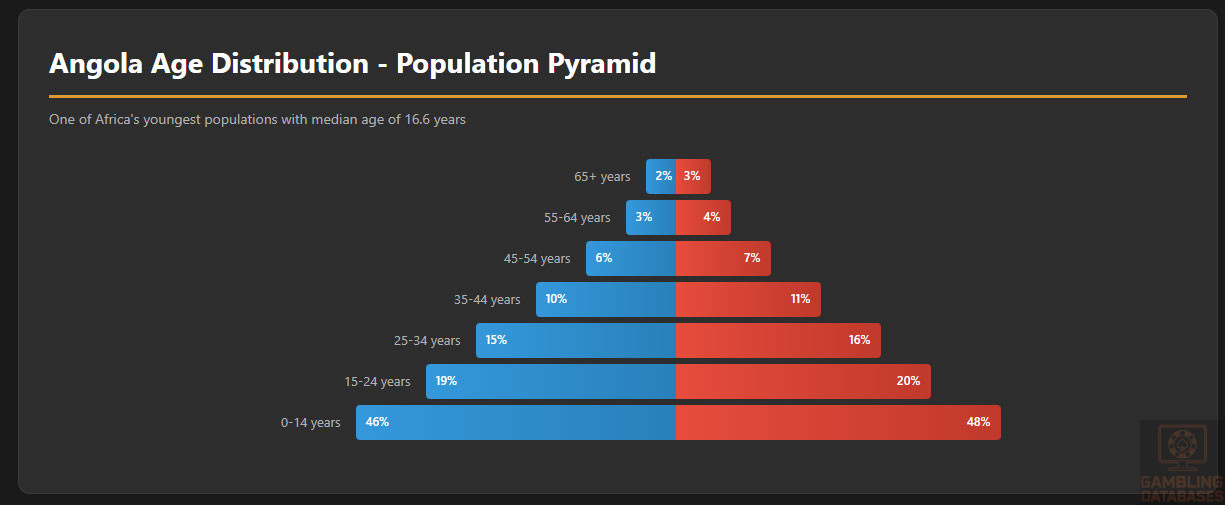
The median age of 16.6 years makes Angola one of the youngest populations globally. This extraordinarily young demographic profile has profound implications for the gambling market. While only those 18 and older can legally gamble, the large cohort approaching gambling age and the tech-savvy nature of younger consumers creates favorable long-term growth prospects.
Age distribution demonstrates a classic expansive population pyramid with a wide base of young people. The 0-14 age group comprises approximately 46-48% of the population. The 15-24 age group represents roughly 19-20% of the total. The 25-34 age bracket, a key gambling demographic, accounts for approximately 15-16% of the population. The 35-44 group represents about 10-11%, while those 45-54 comprise 6-7%. The 55-64 age group accounts for 3-4%, and those 65 and older represent only 2-3% of the total population.
Gender ratios are relatively balanced with slight male predominance in younger age groups. Life expectancy has improved significantly in recent years, though it remains below global averages at approximately 61-63 years. The young population structure combined with improving life expectancy suggests sustained population growth for decades to come.
Geographic Distribution
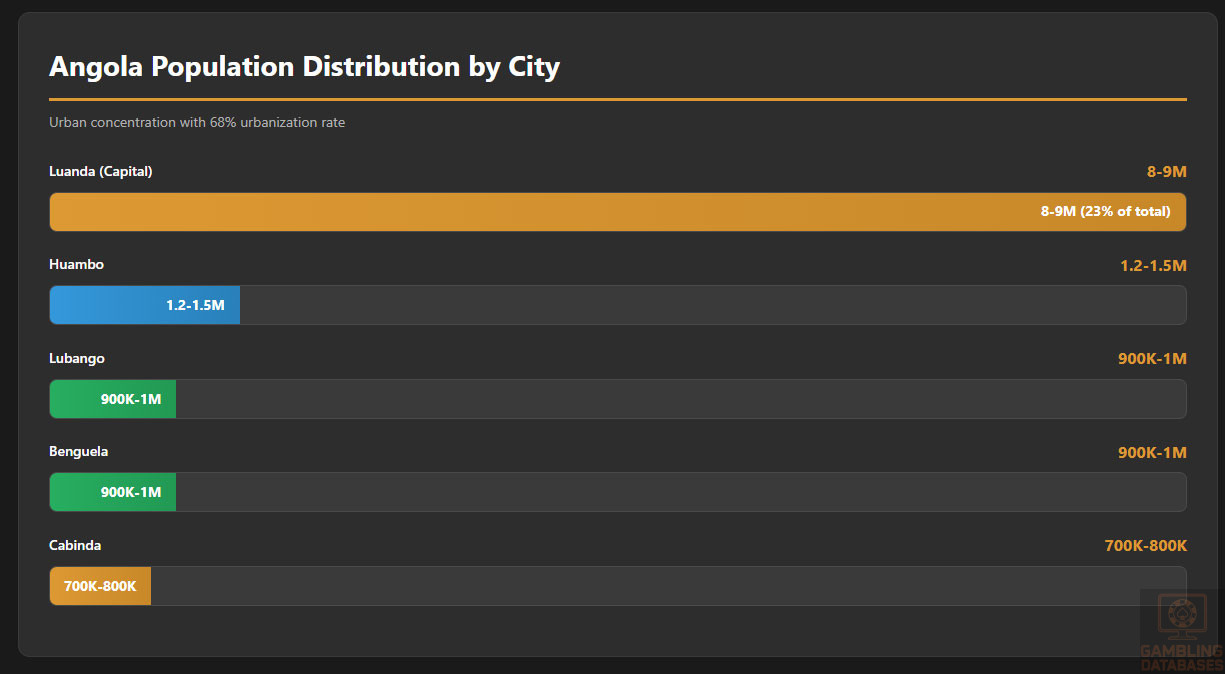
Angola demonstrates high levels of urbanization with approximately 68% of the population residing in urban areas. This urban concentration creates favorable conditions for iGaming operators, as urban residents typically have better internet access, higher incomes, and greater exposure to digital entertainment options compared to rural populations.
Luanda, the capital city, dominates the urban landscape with a population estimated at 8-9 million people, representing approximately 20-23% of the national population. This massive concentration of population, wealth, and infrastructure in a single city creates a natural focal point for iGaming operators. Luanda offers the best internet connectivity, highest concentration of banked individuals, and greatest consumer purchasing power in the country.
Other major population centers include Huambo with approximately 1.2-1.5 million residents, Lubango with 900,000-1 million, Benguela with 900,000-1 million, and Cabinda with 700,000-800,000 residents. These secondary cities represent important regional markets with growing digital infrastructure and rising consumer demand for online entertainment services.
Regional economic differences are substantial. Luanda and coastal provinces benefit from oil industry wealth, port infrastructure, and government investment. Interior provinces remain more agricultural and less developed with limited digital infrastructure. This geographic divide means iGaming operators will likely see highly concentrated demand from urban coastal areas, particularly Luanda, in the near to medium term.
Internet access geographic patterns reflect this urban-rural divide. Urban areas, especially Luanda, enjoy relatively good 4G coverage and increasingly available fixed broadband. Rural areas often rely on 2G or 3G mobile networks with inconsistent coverage, making online gambling access challenging for rural residents despite their inclusion in the total addressable market.
Economic Indicators and Consumer Spending Power
GDP and Economic Performance
Angola’s GDP totaled approximately $101.5 billion in 2024, positioning the country as the 75th largest economy globally by nominal GDP. This substantial economic base reflects Angola’s status as one of Africa’s major oil producers, though the government is actively pursuing economic diversification to reduce dependence on petroleum exports.
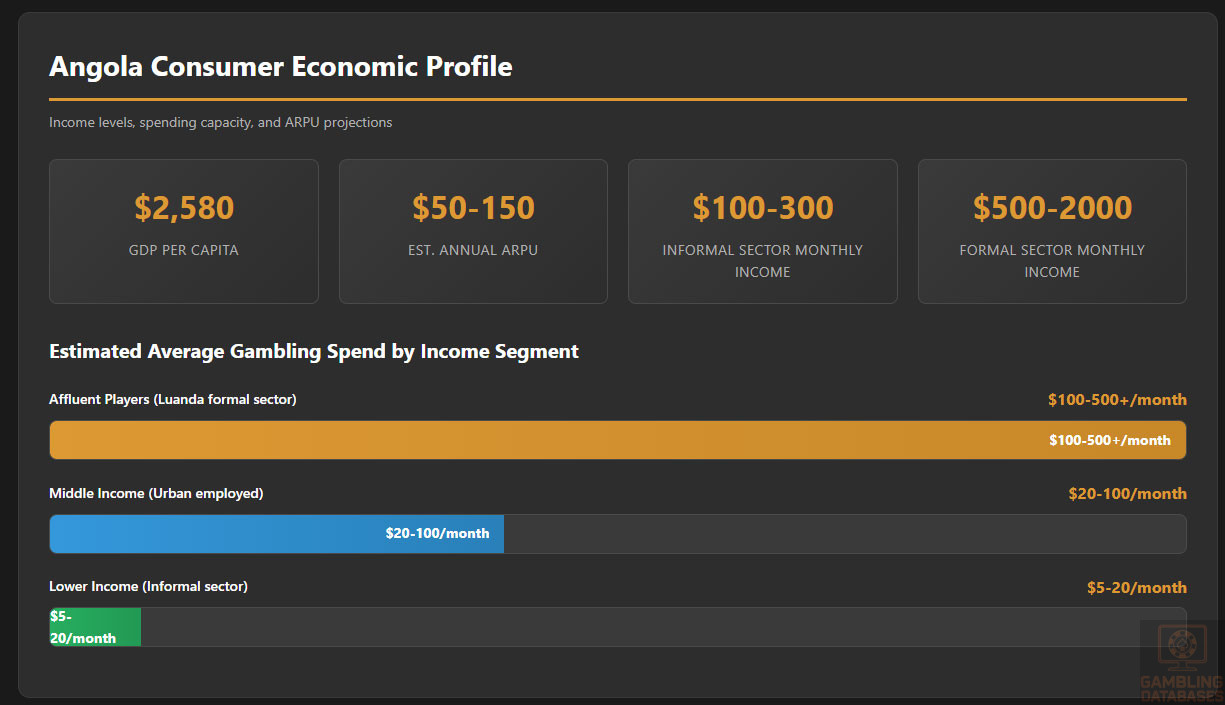
GDP per capita stood at approximately $2,580 in 2024, placing Angola in the lower-middle income category by World Bank classifications. While this figure is modest by global standards, it represents significant purchasing power in the African context and indicates a consumer base capable of discretionary spending on entertainment including gambling.
The economy recorded its strongest growth performance in five years in 2024, with real GDP expanding 4.4%, well above the 1.1% growth of 2023. This recovery was driven mainly by the non-oil sector, with agriculture and fisheries’ share of GDP more than doubling from 6.2% in 2010 to 14.9% in 2023, underscoring Angola’s commitment to economic diversification.
GDP growth forecasts project more modest expansion of 3.2% in 2025, mostly driven by strong dynamism of the non-oil sectors, as the oil sector is expected to return to its declining trend. The African Development Bank projects growth to reach 4.1% in 2024 and strengthen to 4.5% in 2025, though these forecasts vary across institutions.
Economic sector composition shows oil remains central to the economy, accounting for 28.9% of GDP and 95% of total exports. However, the services sector is growing rapidly, driven by commerce and telecommunications. Agriculture, fisheries, and mining (particularly diamonds) are expanding, creating a more balanced economic foundation that supports sustainable growth in consumer spending.
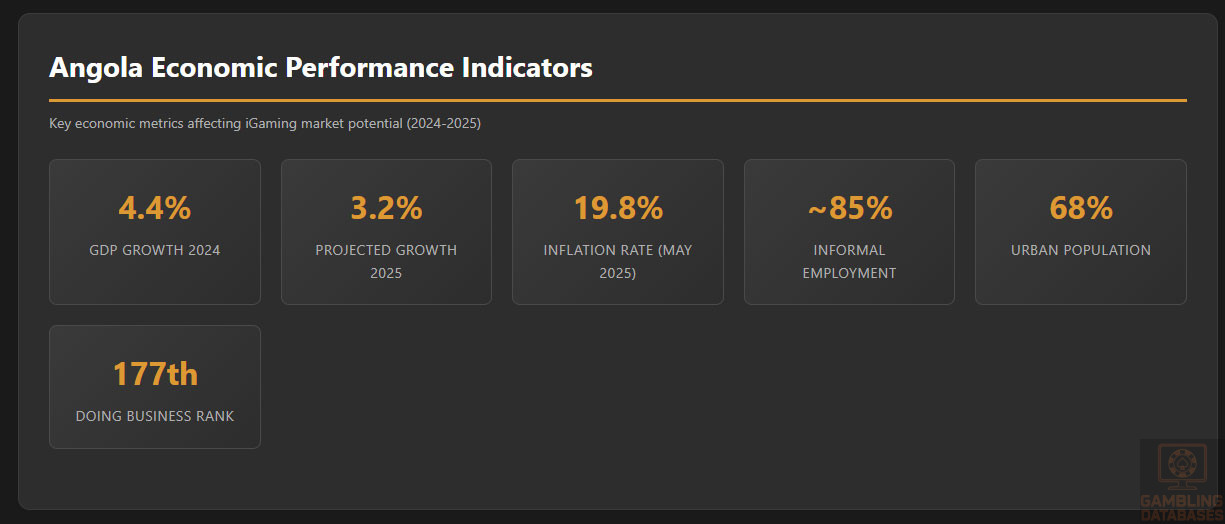
Employment rates and wage levels vary significantly between formal and informal sectors. Approximately 85% of the workforce operates in the informal economy according to Angola’s national statistics institute. Formal sector employment offers higher wages but remains limited. Informal sector workers often have irregular income streams, creating challenges for consistent gambling participation but also demand for mobile-accessible entertainment.
Inflation represents a significant challenge for consumer purchasing power. Inflation accelerated from 20.4% in 2023 to 27.5% in early 2025, driven by higher food prices and diesel price adjustments. However, inflation has been declining recently, reaching 19.8% in May 2025. This high inflation environment erodes real incomes and creates uncertainty that may impact discretionary spending including gambling.
| Indicator | Value | Trend |
|---|---|---|
| GDP Total | $101.5 billion | Growing |
| GDP Per Capita | $2,580 | Modest growth |
| Real GDP Growth 2024 | 4.4% | Strong recovery |
| Projected Growth 2025 | 3.2% | Moderating |
| Inflation Rate (May 2025) | 19.8% | Declining from peak |
| Oil Sector GDP Share | 28.9% | Declining |
| Agriculture/Fisheries Share | 14.9% | Growing |
| Informal Employment | ~85% | Stable |
| Public Debt to GDP | ~70% | Declining from 89% |
| Currency (AOA vs USD) | Depreciated 10% in 2024 | Stabilizing |
Income and Wealth Distribution
Income inequality in Angola is substantial, though specific Gini coefficient data is not readily available in recent public sources. The concentration of wealth in Luanda and among those connected to the oil industry creates stark disparities between urban and rural populations, and between formal and informal sector workers.
Average household income varies dramatically by region and employment sector. Formal sector employees in Luanda may earn monthly salaries equivalent to $500-2,000 or more, while informal sector workers and rural populations often subsist on $100-300 monthly or less. This creates a bifurcated market where a minority of relatively affluent consumers account for disproportionate spending power.
Banking penetration of approximately 50% indicates that half of Angolans have bank accounts, though many are “underbanked,” meaning they use accounts primarily to withdraw salaries as cash once or twice monthly rather than for active transaction management. The remaining 50% unbanked population represents both a challenge and opportunity for mobile money-enabled gambling solutions.
Disposable income trends are pressured by high inflation, particularly food price increases that consume a large share of household budgets for lower-income families. However, the growing middle class in urban areas, particularly Luanda, demonstrates increasing capacity for discretionary spending on entertainment, dining, and digital services including potential gambling activities.
Consumer spending patterns in Angola reflect the dominant role of cash transactions, though digital payment adoption is growing rapidly. Mobile money services like Unitel Money and Afrimoney are expanding financial access and creating new payment channels that could facilitate online gambling participation even among unbanked or underbanked consumers.
Market Size and Growth Projections
Current iGaming market revenue in Angola is estimated at approximately $50-70 million based on government tax collection data and estimated effective tax rates. This represents a developing market with substantial room for expansion as regulatory frameworks mature and internet penetration increases.
Historical revenue growth has been strong, with the government reporting gambling tax collections of 10.1 billion kwanzas ($10.6 million) in 2023 and projecting 16 billion kwanzas ($16.8 million) in 2024. This 58% year-over-year growth in tax collections indicates rapid market expansion driven by new operator entries and growing consumer adoption.
Revenue forecasts for the next 3-5 years are ambitious. The government projects the gambling sector should contribute amounts in kwanzas equivalent to $100 million over the coming years. If this represents annual tax contributions, and assuming a 15-20% effective tax rate, it would imply total market GGR of $500-670 million, representing roughly 7-10x growth from current levels.
Expected CAGR (Compound Annual Growth Rate) would need to exceed 40-50% annually to achieve the government’s $100 million tax collection target within 3-5 years. While aggressive, such growth rates are not unprecedented in emerging African iGaming markets experiencing regulatory formalization, rising internet penetration, and mobile technology adoption.
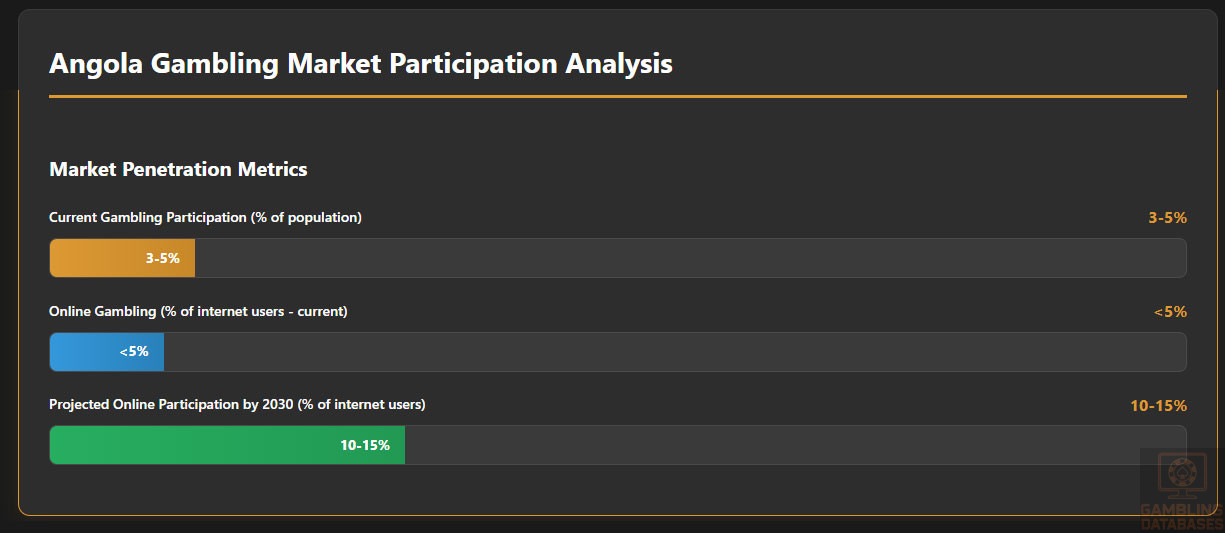
Projected user base growth depends on expanding internet access and gambling participation rates. With 17.2 million internet users in early 2025 and internet penetration growing 3.1% annually, the addressable market is expanding rapidly. If gambling participation rates among internet users reach 10-15% over the next 5 years (comparable to more mature markets), Angola could see 1.7-2.6 million active gamblers by 2030.
Average Revenue Per User (ARPU) in Angola is likely modest compared to developed markets, perhaps $50-150 annually based on income levels and spending patterns. However, ARPU should grow as the market matures, payment methods improve, and operators develop more sophisticated player retention and monetization strategies.
Market penetration rates currently remain low, with gambling participation estimated at less than 5% of internet users. As regulatory clarity improves, payment options expand, and operators invest in marketing and localization, penetration rates should increase toward 10-15% of internet users, creating substantial growth potential even before accounting for rising internet access.
Online versus land-based revenue split currently favors land-based operations given the longer establishment of casino and betting shop licenses. However, online gambling should capture increasing market share as mobile access improves, digital payment adoption grows, and operators launch compelling mobile-first products tailored to local preferences.
Education, Skills, and Digital Literacy
Educational Foundation
Literacy rates in Angola have improved significantly but remain moderate by global standards. Overall adult literacy is estimated at 70-75%, with higher rates among younger cohorts who have benefited from expanded educational access. Gender gaps in literacy persist but are narrowing, particularly in urban areas.
Education levels show that primary school completion has risen substantially, though secondary and tertiary completion rates remain limited. Many Angolans complete primary education but do not progress to secondary school due to economic pressures, limited school availability in rural areas, or early entry into informal employment.
Digital literacy varies dramatically between urban and rural populations and across age groups. Young urban Angolans demonstrate strong digital skills, comfortable navigating smartphones, social media, and mobile applications. Older and rural populations show lower digital literacy, creating a divide in potential gambling platform adoption.
Workforce skill levels are constrained by limited tertiary education and vocational training. The gambling sector employs approximately 6,000 people according to industry association data, with 1,703 in administrative and operational roles and 4,177 as game mediators. Attracting technical talent for platform development and operations represents a challenge for operators.
Technology adoption readiness is high among younger, urban populations who have embraced smartphones and mobile internet rapidly. This tech-savvy demographic cohort represents the core target market for online gambling operators and demonstrates willingness to adopt new digital services including gaming and gambling applications.
Cultural and Social Factors
Communication and Language
Portuguese serves as Angola’s official language and the primary language for business, government, and formal communication. All gambling operations, websites, marketing materials, and customer service must be available in Portuguese to effectively serve the Angolan market. English proficiency is limited outside of educated urban elites.
Internet language preferences heavily favor Portuguese, with minimal English language consumption except among highly educated professionals. Operators attempting to serve the Angolan market with English-only platforms will fail to connect with the mass market and may face regulatory challenges regarding accessibility and consumer protection.
Business communication norms in Angola reflect Portuguese colonial heritage combined with African cultural traditions. Formality in initial business interactions is expected, with relationships developing over time. Local partnerships or hiring experienced Angolan business development professionals can accelerate market entry and regulatory navigation.
Cultural Attitudes Toward Gambling
Gambling acceptance levels in Angolan society appear moderate to positive based on the established presence of casinos, betting shops, and the government’s active promotion of the gambling sector for economic development and tax revenue generation. Unlike some African countries where religious opposition constrains gambling development, Angola’s regulatory expansion suggests social acceptance.
Religious influences on gambling perception exist but do not appear to dominate policy discussions. Angola’s population is predominantly Christian (Catholicism and Protestant denominations), with small Muslim and indigenous belief communities. While some religious groups may oppose gambling, the government’s pursuit of gambling sector growth indicates this opposition has not blocked market development.
Foreign brand perception and trust is generally positive, particularly for established international brands with quality reputations. Angola’s history as a Portuguese colony and ongoing economic ties to Portugal, Brazil, and other lusophone countries means Portuguese and Brazilian brands may enjoy cultural affinity advantages. However, foreign operators must demonstrate commitment to the local market through appropriate licensing, local employment, and Portuguese language service.
Risk tolerance indicators suggest Angolans demonstrate entrepreneurial spirit, evidenced by the 85% informal sector employment rate. This entrepreneurial orientation may correlate with higher risk tolerance and openness to gambling as a form of entertainment and potential income supplementation, though research specifically measuring gambling-related risk tolerance is unavailable.
Problem Gambling and Social Considerations
Prevalence of gambling addiction in Angola has not been extensively studied or published in available research. As the gambling market expands, particularly online gambling which can present higher addiction risks due to accessibility and speed of play, problem gambling rates will likely increase and require regulatory and industry response.
Government response measures to problem gambling are embedded in the regulatory framework through requirements for responsible gambling information, self-exclusion systems, and player protection measures. However, comprehensive treatment infrastructure, public awareness campaigns, and research into gambling harm appear limited compared to more mature gambling jurisdictions.
Social responsibility requirements for operators include displaying responsible gambling information, implementing age verification systems, providing self-exclusion mechanisms, and limiting data collection to necessary purposes. As the market matures, regulators may introduce additional requirements such as mandatory spending limits, session time restrictions, or contributions to problem gambling treatment funds.
Political Structure and Governance
Angola operates as a presidential republic with President João Lourenço serving since 2017. The government has pursued economic reforms aimed at diversification, anti-corruption measures, and attracting foreign investment. Political stability has improved compared to the civil war era that ended in 2002, though governance challenges persist.
Political stability indicators show Angola ranks moderately in terms of political risk. The country scores 150th out of 193 countries on the Human Development Index with a score of 0.591, indicating development challenges. The Corruption Perception Index ranking suggests corruption remains an issue, though anti-corruption efforts have intensified under the current administration.
Regulatory consistency and predictability are improving as Angola modernizes its legal and regulatory frameworks. The structured approach to gambling regulation, with clear laws, defined regulatory authority, and transparent licensing processes, demonstrates government commitment to creating a stable operating environment that can attract legitimate investment.
International relations impact on business is generally positive, with Angola maintaining relationships with Portugal, Brazil, China, and other major economies. Trade agreements and investment treaties provide some protection for foreign investors, though operators should conduct thorough due diligence on investment protection frameworks before committing substantial capital.
Technology Adoption and Digital Behavior
Internet and Digital Usage
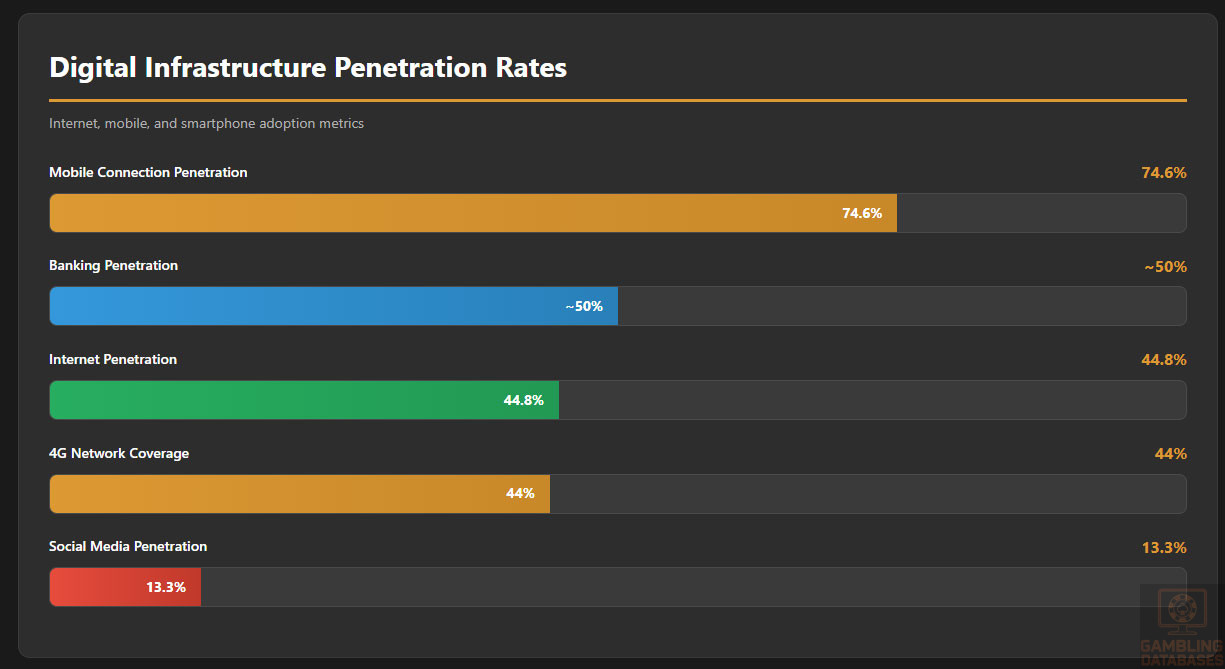
Internet penetration stands at 44.8% of the population, with 17.2 million internet users as of January 2025. This represents 3.1% annual growth, adding 513,000 new users between January 2024 and January 2025. While penetration lags the continental average and significantly trails leaders like Morocco (92%), the growth trajectory is positive and creates expanding market opportunities.
Daily internet usage hours among connected Angolans are not precisely documented in available sources, but mobile internet dominates access patterns given the 28.7 million mobile connections versus limited fixed broadband penetration. Users likely spend 2-4 hours daily on mobile internet for social media, messaging, entertainment, and information consumption.
Social media engagement is substantial, with 5.10 million social media user identities in Angola as of January 2025, equating to 13.3% of the total population. Facebook represents the dominant platform, with advertising reach of approximately 5 million users. Social media provides important marketing channels for gambling operators to reach engaged digital consumers.
E-commerce participation rates remain modest but are growing rapidly. Digital payment adoption through mobile money services (Unitel Money, Afrimoney, Multicaixa Express) and banking apps is expanding, creating the payment infrastructure necessary for online gambling transactions. Consumers increasingly comfortable with e-commerce transactions for retail goods will more readily adopt online gambling.
Digital Payment Behavior
Payment method preferences in Angola reflect a transitioning economy moving from cash dominance toward digital transactions. Mobile money represents the most accessible digital payment option for many Angolans, particularly the unbanked or underbanked 50% of the population. Bank cards (debit more than credit) serve the banked population in urban areas.
Most popular digital wallets include Multicaixa Express with over 1 million Google Play Store downloads, making it likely the most used digital wallet in Angola. Unitel Money, operated by major telecom Unitel, positions itself as the “National Mobile Bank of Angola” and serves millions of users. Afrimoney, launched by Africell in April 2023, targets the underbanked population and is growing rapidly.
Other digital wallet solutions include e-Kwanza (BAI bank), Agiliza (Banco Millennium Atlântico), and AKI, which operate through app-based or USSD channels. International e-wallets like Skrill and Neteller are available but serve primarily more affluent, internationally-oriented consumers rather than the mass market.
Online transaction patterns reflect mobile-first behavior with small, frequent transactions dominating. Average transaction sizes are modest given income levels, likely in the range of $5-50 for typical consumer purchases. Gambling transactions will likely mirror this pattern with small deposits and frequent micro-transactions rather than large deposits.
Trust in online payment systems is developing. The expansion of mobile money and digital banking demonstrates growing consumer comfort with digital financial services, particularly when provided by trusted brands like major banks or telecommunications companies. International payment brands like Visa and Mastercard also carry trust advantages.
Cryptocurrency adoption for gambling remains minimal in Angola. While some international gambling sites accept crypto, local regulatory framework does not specifically address cryptocurrency gambling, and adoption rates are low among the general population. Crypto is unlikely to represent a significant payment channel in the near term for the mainstream Angolan gambling market.
| Payment Method | Market Position | Gambling Suitability |
|---|---|---|
| Multicaixa Express | Leading digital wallet (1M+ downloads) | High – widely adopted, mobile-friendly |
| Unitel Money | Major mobile money provider | High – large user base, instant transfers |
| Afrimoney | Growing mobile money (launched 2023) | Medium – expanding, targets unbanked |
| Bank Cards (Visa/Mastercard) | Moderate penetration, urban focused | Medium – trusted but limited reach |
| Bank Transfers | Available for banked population | Medium – secure but slower |
| e-Kwanza, Agiliza, AKI | Smaller digital wallet providers | Low-Medium – niche but growing |
| International e-wallets | Limited (Skrill, Neteller available) | Low – small, affluent audience only |
| Cryptocurrency | Minimal adoption | Very Low – regulatory uncertainty |
Gaming and Gambling Preferences
Current Market Participation
Percentage of population that gambles is difficult to quantify precisely given limited market research data, but industry observers estimate that perhaps 3-5% of Angolans participate in gambling activities at least occasionally. With 39.3 million total population, this would suggest 1.2-2 million people engage in some form of gambling, primarily through land-based casinos, betting shops, and informal channels.
Percentage that gambles online is even smaller, likely 1-2% of the population or less currently. With 17.2 million internet users, if 5-10% participate in online gambling, this would suggest 860,000 to 1.7 million online gamblers. However, given the recent licensing framework launch, actual online gambling participation through licensed Angolan operators is probably lower, with many users accessing unlicensed international sites.
Popular gambling activities likely follow patterns observed across Africa and globally. Sports betting, particularly football (soccer) betting, represents the most popular form of gambling given Africa’s passion for football and the social nature of sports wagering. Casino games including slots and table games attract players seeking variety and potentially larger payouts.
Sports betting versus casino games preference appears to tilt toward sports betting based on general African market patterns and the presence of three territorial sports betting operators among the 23 total licensees. However, casino games (particularly slots) represent substantial revenue generators and appeal to players seeking more diverse gaming experiences.
Lottery participation rates are difficult to assess given that lottery operations were previously limited and are only now being reintroduced through public tender processes. Historical lottery participation may have been high given lottery’s accessibility and low entry costs, and renewed lottery operations could capture significant market share.
Consumer Behavior Patterns
Average spending per player varies dramatically by income level and gambling vertical. Lower-income players might wager $5-20 monthly on sports betting or slots, while more affluent players could spend $100-500+ monthly. Average monthly spend across all players might range from $20-50, though comprehensive data is unavailable.
Platform preferences strongly favor mobile over desktop given Angola’s mobile-first internet access pattern. With smartphones representing the primary internet access device for most Angolans, gambling operators must prioritize mobile-optimized websites or dedicated mobile applications. Desktop/laptop gambling will remain niche, concentrated among office workers and more affluent consumers.
Peak gambling times likely align with leisure hours – evenings after work, weekends, and around major sporting events. For sports betting specifically, match times (often European football matches in evening Angolan time) drive concentrated betting activity. Paydays early in each month may see increased gambling activity as consumers receive salaries.
Bonus sensitivity and promotional response among Angolan players is likely high given income constraints and the value-seeking behavior typical in emerging markets. Welcome bonuses, free bets, and deposit matches will effectively attract new players. However, operators must balance aggressive bonusing with sustainable economics and regulatory requirements.
Section 3: Technology Infrastructure and Business Environment
Internet and Digital Infrastructure
Connectivity and Network Performance
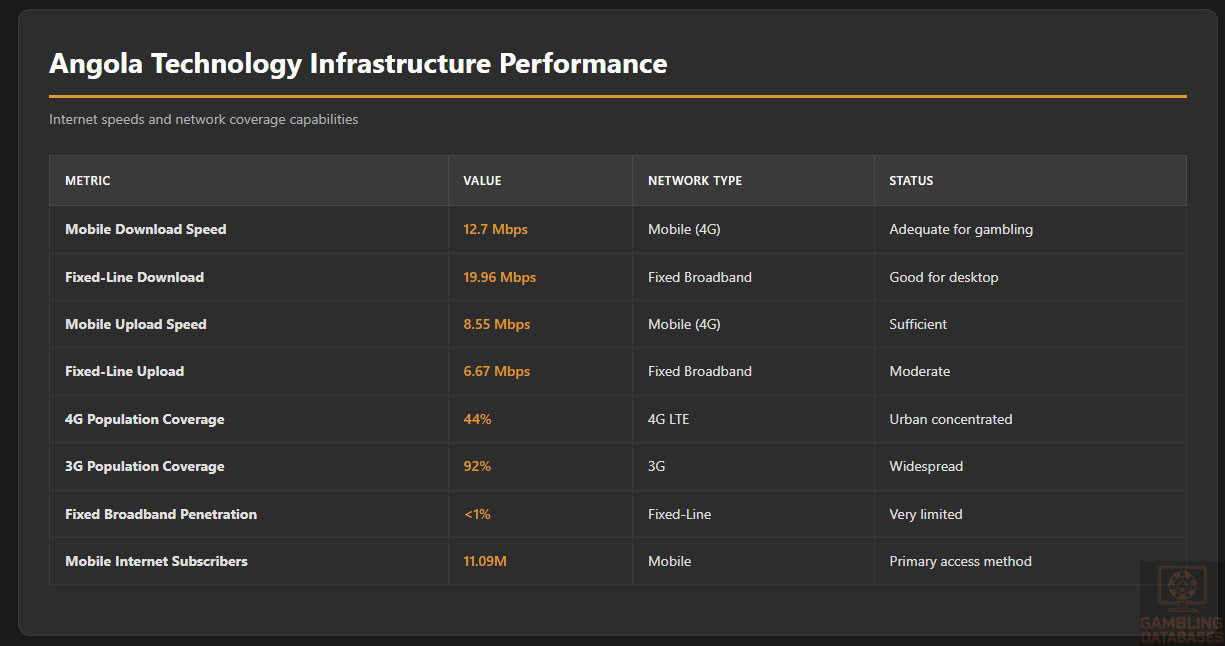
Internet penetration of 44.8% (17.2 million users) places Angola slightly above the continental average but well behind African leaders. Fixed broadband penetration remains very low at under 1% of the population, with only 137,705 fixed-line internet subscribers as of September 2023 according to INACOM data. Mobile internet dominates, with 11.09 million mobile internet subscribers.
Average internet speeds are modest but improving. As of February 2024, Angola recorded median mobile download speeds of 12.7 Mbps and upload speeds of 8.55 Mbps. Fixed-line connections averaged 19.96 Mbps download and 6.67 Mbps upload. These speeds are less than half the global median for mobile and less than a tenth the global median for fixed-line, but are adequate for most gambling applications.
Network reliability and uptime face challenges due to infrastructure limitations and frequent power outages. The fractured electricity system served 75% of urban populations as of 2021 but only 7.3% of rural populations as of 2018. Power outages remain frequent, impacting both network infrastructure and user devices, creating frustrations for real-time gambling experiences.
Infrastructure investment trends are positive, with government prioritizing digital infrastructure expansion. The expansion of the terrestrial fiber optic network, Angola’s accession to the 2África submarine fiber optic cable, and the consolidation of the national space program with commercialization of Angosat 2 satellite capacity represent major initiatives improving connectivity foundations.
Fixed internet speeds improved approximately 18% from 2024 to 2025, likely due to new fiber deployments and upgrades in urban centers. However, mobile median speeds saw a decline of about 28% during 2023, perhaps due to more users crowding onto networks or technical issues, highlighting the volatility in quality as networks expand and user bases grow.
5G and Future Technology Deployment
Current 4G coverage reached approximately 44% of the Angolan population as of 2022 according to GSMA Mobile Connectivity Index data, while 92% of the population was covered by 3G wireless network access. This indicates that while basic mobile internet is widely available, higher-speed 4G coverage remains concentrated in urban areas and along major transportation corridors.
5G rollout commenced in late 2021 when the Ministry of Telecommunications set up a 5G hub to assess use cases. Licenses were granted to Africell, Movicel, and Unitel to offer 5G services using spectrum in the 3.3-3.7GHz range. While initial deployments have begun in Luanda, nationwide 5G coverage remains years away.
Future infrastructure plans include continued fiber optic network expansion with approximately 2,000 kilometers of installation prepared, the implementation of digital terrestrial television, and interconnection with border countries via terrestrial optical fiber. These investments will gradually improve network capacity, speeds, and reliability supporting data-intensive applications like live gambling streams.
Mobile Technology Ecosystem
Mobile Network Infrastructure
Angola has three mobile network operators. Unitel, launched in 2001, is the market leader and historically held a near-monopoly on mobile internet. Movicel, which started as a state-owned mobile division, became the second operator. Africell entered the market in 2022, ending the long-standing duopoly and introducing new competition.
4G coverage quality varies significantly by operator and geography. Unitel expanded 4G services substantially from 2021 onward and maintains the most extensive 4G footprint. Africell, having entered recently with modern infrastructure, is building comprehensive networks and aims for nationwide coverage by 2025. Movicel’s 4G deployment has lagged competitors.
Data costs and pricing models have become more competitive with Africell’s market entry. While specific pricing is not detailed in available sources, the entrance of a third operator has increased price competition, benefiting consumers through lower data costs and more generous data bundles. Prepaid models dominate given limited credit history and banking penetration.
Mobile payment integration through carrier billing or mobile money wallets is well-established through services like Unitel Money and Afrimoney. These services enable gambling operators to offer payment options accessible even to unbanked users, potentially expanding market reach beyond the 50% banked population.
Device Penetration and Usage
Smartphone adoption rates are high among internet users but moderate across the total population. With 17.2 million internet users in a population of 39.3 million, and assuming most internet users access via smartphones, smartphone penetration likely ranges from 40-50% of the population. Urban areas show much higher penetration while rural areas lag significantly.
Android versus iOS market share heavily favors Android, likely representing 85-95% of the smartphone market. This reflects price sensitivity and the availability of affordable Android devices from Chinese manufacturers. iOS devices remain luxury items for affluent consumers. Gambling operators must prioritize Android app development and optimization.
Average device specifications trend toward mid-range and entry-level smartphones. While flagship devices are available, most Angolans use smartphones in the $50-200 price range with modest processing power, limited RAM, and smaller storage capacity. Applications must be optimized for lower-spec devices to reach the mass market.
Mobile internet usage patterns show smartphones serve as the primary internet access device for most users. Time spent on mobile internet, data consumption for video and social media, and comfort with mobile applications all point to mobile-first design as essential for gambling products targeting the Angolan market.
Financial Services and Payment Infrastructure
Banking System Structure
Angola has 26 commercial banks registered to operate, though the market is highly concentrated. Five banks – Banco Angolano de Investimentos (BAI), Banco Economico, Banco de Fomento Angola (BFA), Banco BIC Angola (BIC), and Banco de Poupança e Crédito (BPC) – control over 80% of total banking assets, deposits, and loans.
Digital banking adoption has grown substantially, particularly accelerated by the COVID-19 pandemic and government encouragement of cashless transactions. Major banks offer mobile banking apps and internet banking platforms. However, usage often remains limited to checking balances and basic transfers rather than full transaction management.
Account penetration rates of approximately 50% mean half of Angolans have bank accounts, representing significant progress from historical levels below 10%. However, many account holders are “underbanked,” using accounts primarily to receive salary deposits and immediately withdrawing cash, limiting the utility of traditional bank-based payment methods for gambling.
Payment Processing Options for iGaming
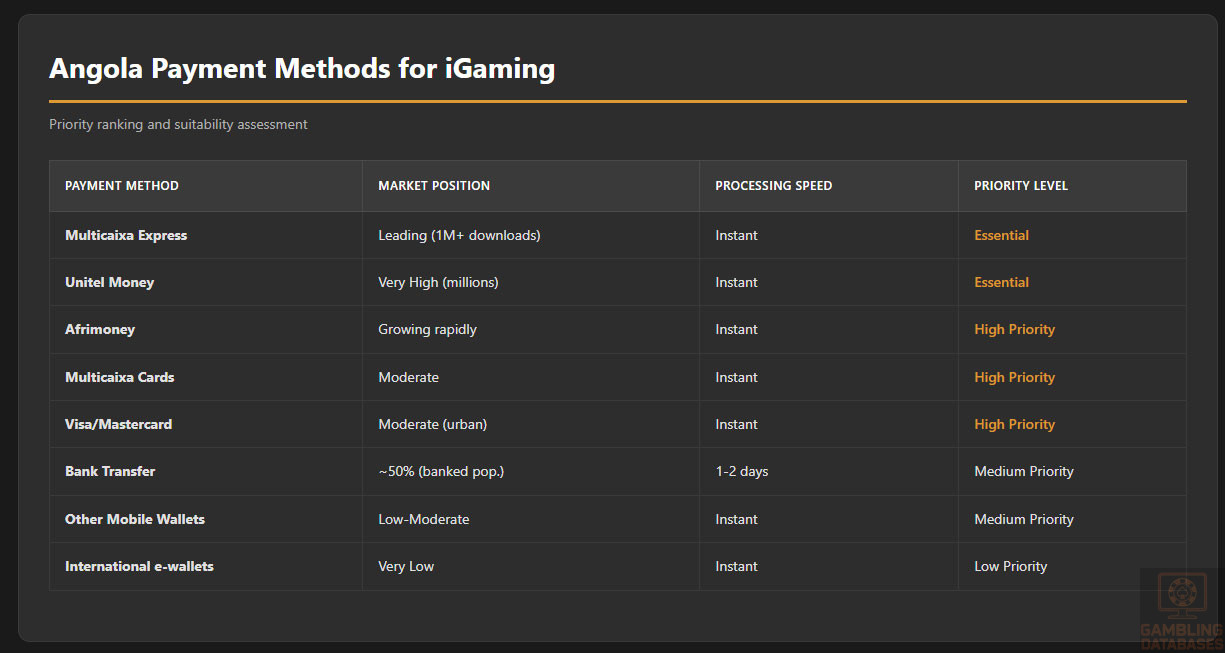
Available payment methods for iGaming in Angola must include mobile money given its market dominance and accessibility to unbanked populations. Multicaixa Express, Unitel Money, and Afrimoney should be priority integrations. Bank transfers serve banked populations but process more slowly than mobile payments.
Credit and debit card penetration is moderate in urban areas but limited nationally. Visa and Mastercard are the dominant international card networks, with Multicaixa serving as the national card scheme. Card payments require integration with Multicaixa networks and potentially individual bank partnerships for optimal acceptance.
E-wallet options beyond local mobile money include international services like Skrill and Neteller, which some Angolans use, particularly for international transactions or remittances. However, these serve a niche market and should be considered supplementary rather than primary payment methods.
Processing fees and typical charges vary by payment method and provider. Mobile money transactions often carry percentage-based fees of 1-3% or flat fees depending on transaction size. Bank transfers may be free for account holders or carry minimal fees. Card processing typically costs 2-4% of transaction value.
Transaction processing timelines favor mobile money and cards for instant deposits. Bank transfers may process same-day or require 1-2 business days. Withdrawals to mobile money or bank accounts typically process within 24-48 hours depending on operator policies and KYC verification requirements.
Regulatory restrictions on gambling payments require that operators maintain bank accounts with Angolan financial institutions for all gambling-related transactions. All prizes must be paid in national currency (kwanza) and through bank transfers, ensuring traceability and regulatory oversight while complicating cryptocurrency or foreign currency transactions.
| Payment Method | Penetration | Processing Speed | Recommended Priority |
|---|---|---|---|
| Multicaixa Express | High (1M+ users) | Instant | Essential |
| Unitel Money | Very High (millions) | Instant | Essential |
| Afrimoney | Growing rapidly | Instant | High Priority |
| Multicaixa Cards | Moderate | Instant | High Priority |
| Visa/Mastercard | Moderate (urban) | Instant | High Priority |
| Bank Transfer | ~50% (banked pop.) | 1-2 days | Medium Priority |
| Other Mobile Wallets | Low-Moderate | Instant | Medium Priority |
| International e-wallets | Very Low | Instant | Low Priority |
E-commerce and Digital Economy
Digital Market Development
E-commerce market size in Angola is growing but remains in early stages of development. Online retail penetration represents a small percentage of total retail, with most commerce still conducted through physical stores and informal markets. However, the COVID-19 pandemic accelerated digital adoption, and younger urban consumers increasingly embrace online shopping.
Digital service adoption rates are rising across multiple sectors. Mobile banking, digital payments, online media consumption, and app-based services are all experiencing growth. This broader digital transformation creates favorable conditions for online gambling adoption as consumers become comfortable with digital transactions and services.
Consumer trust in online transactions is developing but requires careful nurturing. Partnerships with recognized brands (major banks, telecommunications operators, established international gambling operators) can transfer trust and credibility. Clear communication about security measures, licensing status, and player protection builds confidence among cautious consumers.
Popular e-commerce platforms are emerging but the sector remains fragmented. Many businesses use social media (particularly Facebook and Instagram) as sales channels, conducting transactions through messaging apps and mobile money payments. This informal e-commerce model demonstrates consumer comfort with mobile-mediated commerce that gambling operators can leverage.
Business Environment and Regulatory Framework
Ease of Business Operations
Angola ranks 177th in the World Bank’s Doing Business index, indicating significant challenges in the business regulatory environment. This low ranking reflects complexities in starting businesses, registering property, enforcing contracts, and navigating bureaucratic processes. However, the government has undertaken reforms to improve the business climate and attract foreign investment.
Business registration processes require navigating multiple government agencies and can be time-consuming. The standard process involves name reservation, document preparation and notarization, registration with the commercial registry, tax registration, and social security registration. Each step involves fees, documentation requirements, and processing times.
Time required to start a business has improved from historical levels but remains longer than in many countries. Entrepreneurs should expect the company registration process to take 4-8 weeks or more depending on entity type, documentation completeness, and efficiency of legal and consulting support engaged.
Foreign investment policies have become more welcoming under recent government reforms. The Private Investment Law (Law 10/18) provides the framework for foreign investment, offering equal treatment to foreign and domestic investors in most sectors. Special incentives may be available for investments in priority sectors or less-developed regions.
Operational cost structures in Angola reflect the country’s oil-driven economy and import dependence. Office rent in prime Luanda locations can be expensive by African standards, though rates have moderated from historical peaks. Salaries for skilled professionals are competitive regionally, while less-skilled labor costs less but may require significant training.
Labor market conditions present both opportunities and challenges. Angola’s young population provides a large potential workforce, but skill gaps exist particularly in technical and management roles. Operators may need to combine local hiring for customer service and operational roles with expatriate recruitment or extensive training for specialized technical and management positions.
Corporate Structure and Registration
Available entity types in Angola include the Sociedade por Quotas (similar to LLC), Sociedade Anónima (corporation/public limited company), branch offices of foreign companies, and representative offices. For iGaming operations, a Sociedade Anónima is required as the Gaming Law specifies that online gambling and betting licenses are granted only to public limited companies.
The Sociedade Anónima structure requires that the totality of share capital be represented by shares, enabling transparency in ownership as required by gambling regulations. This corporate form allows for multiple shareholders, professional management structures, and the formal governance frameworks expected by regulators for licensed gambling operations.
Registration requirements include preparing articles of association, appointing directors and statutory auditor, obtaining notarization of founding documents, registering with the Commercial Registry, obtaining tax identification numbers, and registering with social security. Foreign shareholders are permitted without requiring local partners for most business activities including gambling operations.
Registration costs include government fees for commercial registry, notary fees for document authentication, legal fees for documentation preparation and filing, and initial capital deposit requirements. Total costs for establishing a Sociedade Anónima might range from $5,000 to $15,000 or more depending on complexity and professional services engaged.
Minimum capital requirements vary by entity type. While specific minimums for gambling-licensed companies have not been publicly disclosed, operators should expect substantial capital requirements demonstrating financial stability sufficient to honor player deposits and winnings. Capital in the range of $100,000 to $500,000 or higher is likely necessary.
Ongoing compliance requirements include annual financial statement preparation and filing, annual general meetings of shareholders, maintaining statutory books and records, annual tax returns, and audits by statutory auditor. Gaming operators face additional reporting obligations to ISJ including regular activity reports, financial statements, and compliance certifications.
Taxation Framework
Standard corporate tax rates in Angola are 25% on taxable profits for most business activities. This rate applies to gambling operators’ profits after deduction of allowable expenses and gambling-specific taxes. The corporate tax burden combines with GGR taxes (1.1-20%) to create the total tax load on gambling operations.
Tax holidays or reduced rates for new businesses may be available under the Private Investment Law for investments in priority sectors or less-developed regions. However, gambling operations are unlikely to qualify for preferential tax treatment given their profitability potential and government interest in maximizing gambling tax revenues.
International tax treaties provide some protection against double taxation for operators structured with foreign parent companies. Angola has tax treaties with Portugal, Cape Verde, and other countries. Operators should structure ownership and profit repatriation strategies considering treaty benefits and transfer pricing requirements.
Withholding tax on dividends, interest, and royalties applies when profits are distributed to foreign shareholders or when payments are made to foreign service providers. Dividend withholding tax is typically 10% for companies and 15% for individuals, though treaty rates may differ. Interest and royalty payments face 15% withholding tax unless reduced by treaty.
VAT/GST does not apply to gambling services themselves as gambling is typically exempt or zero-rated. However, VAT at standard rates (currently 14%) applies to purchases of goods and services by gambling operators. Operators can generally reclaim input VAT on business purchases against output VAT on any taxable supplies they make.
Personal Income Tax
Individual tax rates in Angola follow a progressive structure with brackets ranging from approximately 0% on very low incomes up to marginal rates of 25% on higher incomes. Employees are subject to withholding tax on salaries, with employers responsible for calculating, withholding, and remitting taxes to authorities on behalf of employees.
Social security contributions represent additional costs for both employers and employees. Employer contributions are approximately 8% of gross salary for social security purposes. Employee contributions are around 3% of gross salary. These contributions fund pension, disability, and other social protection programs.
Taxation of foreign employees depends on residency status. Tax residents (generally those present in Angola for 183 days or more in a calendar year) are taxed on worldwide income. Non-residents are taxed only on Angola-source income. Foreign employees typically qualify for residency and face taxation on their full compensation.
Market Entry Considerations
Recommended Entry Strategies
Direct licensing represents the optimal market entry approach for operators with experience in regulated markets and sufficient capital to navigate the licensing process. Establishing an Angolan Sociedade Anónima, applying for an ISJ license, and building proprietary operations provides maximum control and long-term value capture.
Local partnerships, while not mandatory for ownership, can provide significant advantages in regulatory navigation, market understanding, and operational execution. Engaging experienced Angolan consultants, legal counsel, and potentially operational partners accelerates market entry and reduces execution risk despite not being legally required.
White label versus proprietary platform considerations depend on operator resources and strategic objectives. White label solutions enable faster market entry with lower upfront technology costs but sacrifice differentiation and long-term platform control. Proprietary platforms require greater investment but enable customization, unique player experiences, and avoidance of ongoing platform fees.
Technology infrastructure leveraging strategies should prioritize mobile optimization given Angola’s mobile-first internet access pattern. Cloud-based platforms with content delivery networks optimized for African users ensure acceptable performance despite infrastructure limitations. Integration with local payment methods (Multicaixa, Unitel Money, Afrimoney) is non-negotiable for market success.
Marketing and localization requirements demand Portuguese language across all touchpoints including website, mobile apps, customer service, marketing materials, and responsible gambling information. Localization extends beyond translation to include local sports coverage (Angolan football leagues, African competitions), culturally relevant promotions, and local currency display and transaction handling.
Payment provider selection should prioritize integration with dominant mobile money platforms (Unitel Money, Afrimoney, Multicaixa Express) as primary deposit and withdrawal methods. Card processing through Multicaixa network and major international schemes (Visa, Mastercard) serves the banked urban population. Partnerships with multiple payment providers ensures redundancy and maximum market coverage.
Typical Costs and Timelines
Initial setup investments breakdown into several major categories. License application and fees likely range from $50,000 to $150,000 or more including application fees, regulatory assessments, and compliance documentation. Legal and consulting fees for entity formation, license application, regulatory compliance, and ongoing counsel might total $50,000 to $200,000 depending on complexity.
Company registration costs including entity formation, notarization, registration fees, and initial capital deposit might total $10,000 to $30,000. Initial capital requirements mandated by gambling regulations could range from $100,000 to $500,000 or higher depending on license type and regulatory expectations for financial stability.
Office setup costs for physical presence in Angola including rent deposits, furniture, equipment, and telecommunications infrastructure might require $20,000 to $100,000 depending on location quality and office size. Technology and platform costs vary dramatically between white label ($50,000-200,000 annually) and proprietary development ($500,000-2,000,000+ for initial build).
Initial marketing budget for brand launch, player acquisition, promotional offers, and initial campaigns should be substantial given competitive pressures. Operators should budget $200,000 to $1,000,000+ for the first year of marketing depending on market share ambitions and competitive intensity.
Operational cost estimates include monthly staff salaries for local team (customer service, operations, compliance, management) potentially ranging from $20,000 to $100,000+ monthly depending on team size and seniority. Office rent and utilities in Luanda might cost $5,000 to $20,000 monthly for adequate space. Technology maintenance including platform fees, hosting, support, and development ranges from $10,000 to $50,000+ monthly.
Payment processing fees typically consume 2-4% of processed volumes depending on payment methods and negotiated rates. Marketing and customer acquisition costs on an ongoing basis might represent 30-50% of revenue in competitive markets. Total monthly operational costs could range from $100,000 to $500,000+ depending on scale ambitions.
Timeline expectations for market entry begin with company registration requiring 4-8 weeks. License application processes may span 3-6 months from submission to approval depending on application quality and regulatory workload. Platform setup for white label solutions might require 2-4 months, while proprietary platform development could take 6-12 months. Total time from market entry decision to launch could range from 6-12 months for streamlined execution to 18-24 months for more complex implementations.
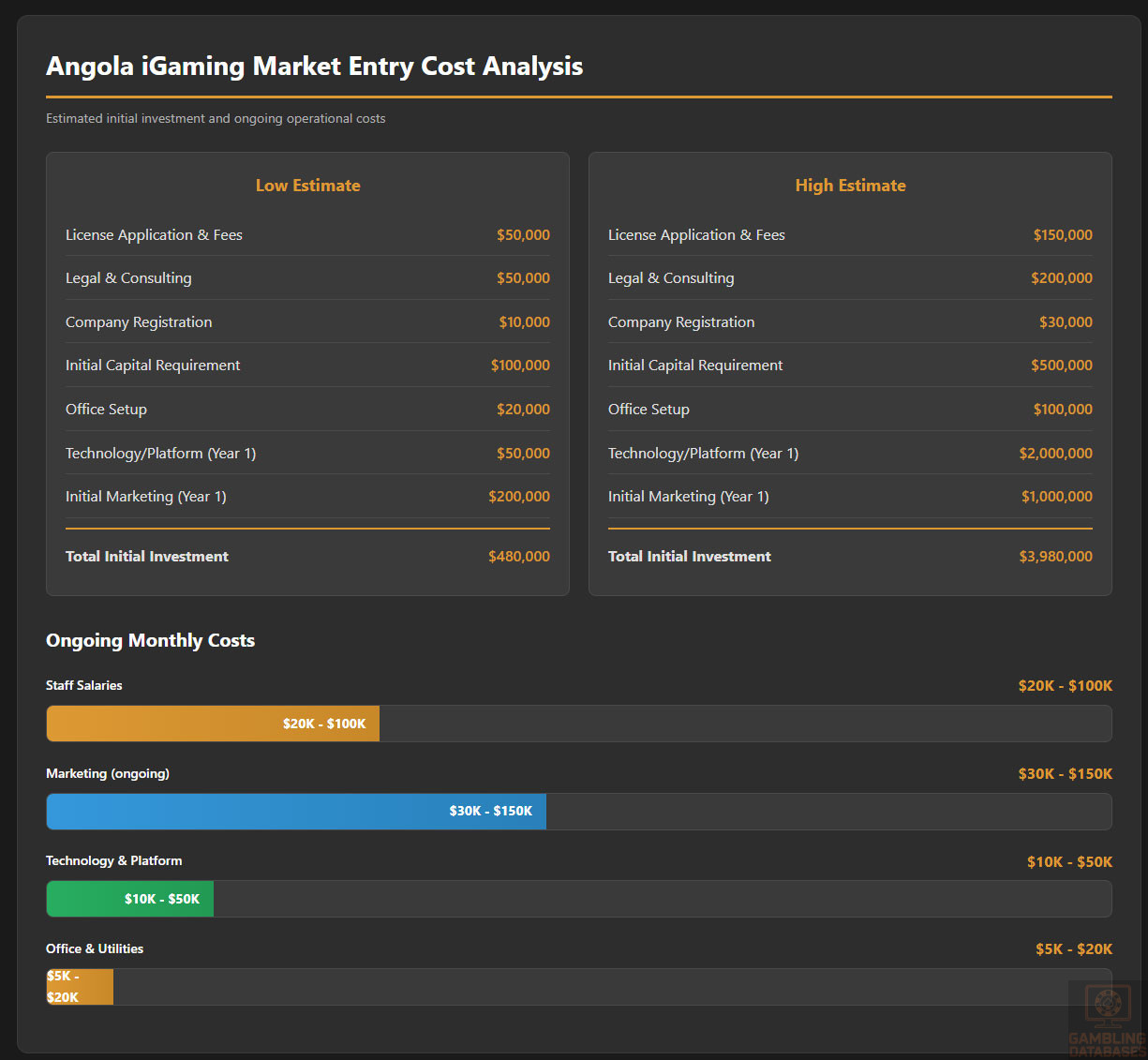
Resource requirements for successful market entry include minimum staff headcount of 10-20 people initially, scaling to 30-50+ as operations grow. Key positions needed include General Manager/Country Director, Compliance Officer, Finance Manager, Marketing Manager, Customer Service Manager, and technical support staff. Many operators supplement local teams with regional or global support for technology, risk management, and specialized functions.
| Cost Category | Low Estimate | High Estimate |
|---|---|---|
| License Application & Fees | $50,000 | $150,000 |
| Legal & Consulting | $50,000 | $200,000 |
| Company Registration | $10,000 | $30,000 |
| Initial Capital Requirement | $100,000 | $500,000 |
| Office Setup | $20,000 | $100,000 |
| Technology/Platform (Year 1) | $50,000 | $2,000,000 |
| Initial Marketing (Year 1) | $200,000 | $1,000,000 |
| Total Initial Investment | $480,000 | $3,980,000 |
| Ongoing Monthly Costs | ||
| Staff Salaries | $20,000 | $100,000 |
| Office & Utilities | $5,000 | $20,000 |
| Technology & Platform | $10,000 | $50,000 |
| Marketing (ongoing) | $30,000 | $150,000 |
| Payment Processing (variable) | 2-4% of volume | 2-4% of volume |
| Total Monthly Operational | $65,000+ | $320,000+ |
Success Factors and Challenges
Understanding local player preferences is critical for product-market fit. Angolan players prefer mobile-accessible platforms given smartphone dominance. Portuguese language across all touchpoints is non-negotiable. Sports betting focused on football (local leagues, European competitions, African tournaments) captures the highest engagement. Casino games should include popular slots and potentially live dealer games for premium segments.
Localized payment methods integration determines market accessibility. Operators must integrate Multicaixa Express, Unitel Money, and Afrimoney as primary payment options to reach both banked and unbanked populations. Card payment support serves urban banked populations but cannot be the exclusive option. Low minimum deposits ($2-5) accommodate income levels and enable broad participation.
Mobile-first approach is essential given that smartphones represent the primary or sole internet access device for most Angolans. Responsive mobile websites or native Android apps optimized for mid-range and entry-level devices ensure accessibility. Simple, fast-loading interfaces that function well on 3G networks reach users beyond premium 4G coverage areas.
Effective marketing channels include social media advertising (Facebook primary platform with 5 million users), potentially influencer partnerships, sports sponsorships (local football clubs or leagues), and mobile marketing. Traditional media (TV, radio) reaches broader demographics but costs more and may face advertising restrictions. Affiliate marketing can drive performance-based growth.
Strong customer support in Portuguese language builds trust and resolves issues rapidly. Multichannel support including phone, email, WhatsApp, and potentially live chat serves different user preferences. 24/7 availability for live gambling products ensures assistance during peak activity hours. Well-trained, empathetic support staff create positive experiences that drive retention.
Competitive bonus and promotion strategy balances acquisition effectiveness with sustainable economics. Welcome bonuses, free bets, and deposit matches attract new players. Reload bonuses and loyalty programs retain existing players. Promotions tied to major sporting events (Champions League, African Cup of Nations, World Cup) capitalize on peak engagement periods. Compliance with regulatory restrictions on promotions is mandatory.
Responsible gambling commitment protects vulnerable players and ensures regulatory compliance. Self-exclusion systems, deposit limits, session time warnings, and access to problem gambling resources demonstrate social responsibility. Proactive identification of problem gambling behaviors and intervention support sustainable industry growth and positive regulatory relations.
Local sports and events coverage for sports betting differentiates operators and engages the local market. Offering betting markets on Angolan Girabola football league, African club and national team competitions, and popular global sports (European football, NBA, tennis) provides breadth. Live betting and streaming where feasible enhance engagement.
Major Operational Challenges
Regulatory compliance complexity requires dedicated resources and expertise. Understanding and adhering to licensing conditions, reporting requirements, responsible gambling obligations, AML/KYC standards, and data protection rules demands experienced compliance personnel. Regulatory changes require agile adaptation to maintain good standing with ISJ.
High taxation burden compared to some other markets impacts unit economics. Combined GGR taxes (1.1-20% depending on category), corporate income tax (25%), player withholding taxes (10-15%), and various fees create substantial tax load. Operators must structure pricing, odds, and cost structures to remain profitable while offering competitive products.
Payment processing restrictions including requirements for Angolan bank accounts, kwanza-denominated payouts, and limited international payment options create operational complexity. Currency risk from kwanza volatility (10% depreciation against USD in 2024) requires hedging strategies or acceptance of foreign exchange impacts on dollar-denominated costs.
Marketing and advertising limitations that may exist or emerge restrict promotional strategies. Understanding permitted channels, content restrictions, and compliance requirements for gambling advertising prevents regulatory violations. Prohibition on marketing to minors requires careful audience targeting and content creation.
Player acquisition costs in competitive markets can exceed sustainable levels if not carefully managed. Customer lifetime value analysis, cohort tracking, and channel optimization ensure marketing efficiency. Balancing growth ambitions with profitability requirements prevents unprofitable scale.
Talent shortage in specialized areas (gaming technology, risk management, trading, compliance) requires creative solutions. Combining local hiring for customer-facing and operational roles with expatriate expertise or regional support for specialized functions addresses skill gaps. Training and development programs build local capabilities over time.
Technology infrastructure limitations including modest internet speeds, network reliability issues, and frequent power outages require platform optimization and user education. Graceful degradation on slow connections, clear communication during service disruptions, and lightweight application design mitigate infrastructure challenges.
Cultural Considerations for Market Success
Local holidays and peak seasons drive gambling activity patterns. New Year, Easter, Christmas, and Independence Day (November 11) represent key celebration periods. Football seasons (European leagues run August-May, African competitions vary) create engagement windows. Payroll cycles (typically early month) may influence deposit timing and promotional scheduling.
Popular local sports beyond football include basketball (growing popularity particularly among youth), handball, and potentially other sports. However, football dominates the sports betting landscape to an overwhelming degree. Angolan national team matches and Girabola league games generate patriotic engagement and betting interest.
Preferred customer service channels vary by demographic and urgency. Younger users comfortable with digital channels prefer WhatsApp messaging or email. Phone support serves those needing immediate assistance or preferring voice communication. Multiple channel options accommodate diverse preferences and ensure accessibility.
Communication style preferences in Angola blend Portuguese formal politeness with African warmth. Respectful language, patience, and genuine care in customer interactions build trust. Avoiding overly corporate or impersonal communication while maintaining professionalism strikes the right balance for Angolan audiences.
Trust-building requirements for foreign brands include demonstrating proper licensing (displaying ISJ approval prominently), emphasizing player protection measures, showcasing local presence (Angolan office, local employees, Portuguese language), and potentially partnering with recognized local brands or personalities as ambassadors.
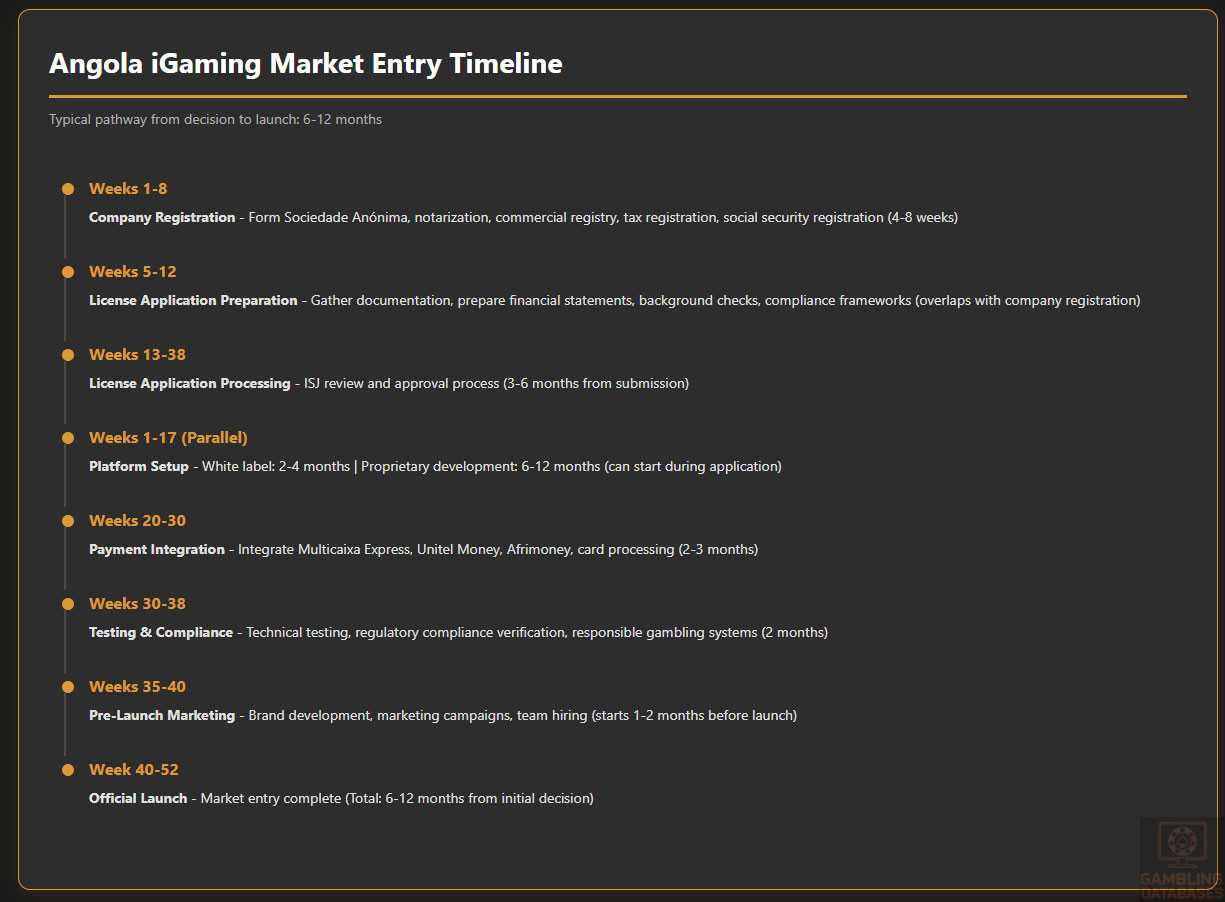
Exit Strategy Planning
Market liquidity for operator sales in Angola is developing but limited. The small number of current operators and evolving regulatory framework means few precedents exist for operator acquisitions. However, as the market matures and consolidation occurs, M&A activity should increase creating exit opportunities for successful early entrants.
Regulatory requirements for ownership transfer require ISJ approval for any acquisition of qualifying holdings (20%, 33%, 50% thresholds) or control changes. Buyers must meet the same licensing criteria as original license holders, potentially limiting the pool of qualified acquirers to licensed operators or applicants meeting financial and character standards.
License transferability depends on ISJ approval and buyer qualification. Licenses are not automatically transferable but rather subject to regulatory review ensuring the acquiring entity maintains standards. This approval process creates some exit friction but protects regulatory integrity.
Typical valuation multiples for gambling operators vary widely based on profitability, growth trajectory, market position, and buyer strategic interest. Established profitable operators might command 5-10x EBITDA or higher in transactions. Growth-stage operators trading at revenue multiples of 2-5x are common depending on market conditions.
Process for closing operations legally requires ISJ notification, orderly wind-down of player accounts including return of balances, preservation of records for regulatory retention periods, tax clearance, and formal deregistration of the corporate entity. Premature or disorderly closure risks regulatory sanctions impacting principals’ ability to operate elsewhere.
FAQ: Frequently Asked Questions
Legal & Licensing
1. Is online gambling legal in Angola?
Yes, online gambling is legal in Angola under a regulatory framework established by the Gambling Activity Law (Law no. 5/16) and the Regulation on the Exploitation of Remote Online Gaming (Presidential Decree No. 131/20). The Instituto de Supervisão de Jogos (ISJ) began accepting license applications for online gambling operations on February 18, 2025.
The legal framework covers three primary categories of online gambling: sports betting operations, online casino games, and gambling-related lotteries. Only properly licensed operators are permitted to offer these services to Angolan residents. Operating without a license is illegal and subject to penalties including fines up to 50 million kwanzas and potential imprisonment.
2. What types of gambling licenses are available and what do they cover?
Angola offers licenses for land-based casino operations, territorial sports betting operations, and online gambling platforms. Online gambling licenses cover sports betting, casino games including slots and table games, and lottery operations conducted through digital channels.
License duration varies by regime. Under the exclusive regime, licenses are valid for 10 years and renewable. Outside the exclusive regime, licenses are valid for 5 years with renewal options. After initial issuance, licenses can be extended for successive periods of 3 years.
Each license type comes with specific operational requirements, technical standards, and compliance obligations. Sports betting operators face different requirements from casino platform operators, reflecting the distinct nature of these gambling categories. Operators may hold multiple licenses to offer comprehensive gambling services across categories.
3. How much does an iGaming license cost and how long does it take to obtain?
Specific license fees have not been publicly disclosed by ISJ, but industry sources suggest total costs including application fees, compliance assessments, legal fees, and initial setup likely range from $100,000 to $300,000 or more. Initial capital requirements demonstrating financial stability may range from $100,000 to $500,000 depending on license scope.
The timeline from application submission to license approval typically spans 3-6 months depending on application completeness and regulatory processing capacity. However, operators should plan for 6-12 months total from deciding to enter the market through establishing an Angolan company, submitting application, obtaining approval, and launching operations.
Annual renewal fees and ongoing regulatory charges apply once licensed, though specific amounts are not publicly available. Operators should budget for significant ongoing compliance costs including reporting systems, audits, and regulatory fees beyond initial licensing expenses.
4. Can foreign companies obtain a gambling license?
Yes, foreign companies can obtain gambling licenses in Angola by establishing an Angolan legal entity. Online gambling licenses must be granted to a public limited company (Sociedade Anónima) governed by Angolan law with registered office in Angola. Foreign ownership is permitted without mandatory local partnerships.
Foreign operators must create a locally registered company, appoint local directors (though foreign directors are also permitted), maintain an Angolan bank account for all gambling transactions, and comply with all local regulatory requirements. The foreign parent company can own 100% of the Angolan entity’s shares.
Any acquisition of qualifying holdings (20%, 33%, 50% thresholds) or control changes require prior ISJ approval. This ensures regulators know beneficial owners and can assess character and financial suitability of all controlling shareholders regardless of nationality.
Financial & Taxation
5. What are the tax obligations for iGaming operators?
iGaming operators face multiple tax obligations in Angola. The special gambling tax on Gross Gaming Revenue ranges from 1.1% to 20% depending on the gambling category. Sports betting and casino games likely fall in the middle to upper portion of this range. Corporate income tax of 25% applies to taxable profits after deducting allowable expenses and gambling-specific taxes.
Operators must also withhold and remit player winnings tax of 10-15% depending on game type. This tax is deducted from player payouts at source. Various regulatory fees, license renewal charges, and potentially other assessments apply beyond these primary taxes.
Dividend distributions to foreign shareholders incur withholding tax of 10% for corporate shareholders or 15% for individual shareholders, though tax treaty rates may apply if beneficial. All taxes must be filed and paid according to prescribed schedules, typically monthly for gambling taxes and annually for corporate income tax.
6. Are gambling winnings taxed for players?
Yes, gambling winnings are subject to withholding tax of 10-15% depending on the type of game. This tax is deducted by operators from player payouts before winnings are credited to player accounts or paid out. Players receive net winnings after tax withholding.
The withholding tax applies to gross winnings before deduction of the original stake in most applications, though specific calculation methodologies may vary by game type. Operators are responsible for calculating, withholding, and remitting these taxes to authorities on behalf of players.
Players are not required to file separate tax returns for gambling winnings as the withholding tax represents final taxation on these amounts. However, professional gamblers deriving primary income from gambling might face different tax treatment and should consult tax advisors for specific guidance.
7. What are the typical operational costs for running an online casino/sportsbook?
Monthly operational costs for an online gambling operation in Angola typically range from $100,000 to $500,000 or more depending on scale and ambition. Major cost categories include staff salaries ($20,000-100,000+ monthly), technology platform and hosting ($10,000-50,000), marketing and player acquisition ($30,000-150,000+), office rent and utilities ($5,000-20,000), and payment processing fees (2-4% of transaction volume).
Variable costs tied to revenue include gambling taxes (1.1-20% of GGR), player withholding taxes (10-15% of winnings), and payment processing fees. These costs scale with business volume, while fixed costs like staff and office remain relatively constant regardless of revenue levels.
Initial setup costs before launch include license fees, legal expenses, company formation, initial capital deposits, office setup, technology development or platform fees, and initial marketing budgets. Total initial investment might range from $500,000 to $4 million depending on strategy, with white label approaches on the lower end and proprietary development on the higher end.
8. What is the expected ROI timeline for entering this market?
Return on investment timelines in emerging markets like Angola typically span 2-4 years from initial investment to profitability and 4-7 years to full payback of initial capital. The first 12-18 months focus on market entry, brand building, and customer acquisition, typically generating losses as marketing spend exceeds contribution margin.
Years 2-3 should see revenue acceleration as brand awareness grows, customer base scales, and marketing efficiency improves. Operators may achieve breakeven or modest profitability during this period. Years 4-7 can deliver strong returns as established customer base generates predictable revenue with lower acquisition costs and improved operational leverage.
Success depends heavily on execution quality, competitive intensity, regulatory stability, and market growth rates. Early entrants in rapidly growing markets can achieve faster payback (3-5 years), while late entrants in crowded markets may require longer timelines (5-8+ years). Conservative financial planning should assume longer payback periods with upside potential from superior execution.
Operations & Compliance
9. What are the local presence requirements for operators?
Operators must establish an Angolan legal entity (Sociedade Anónima for online gambling licenses) with registered office in Angola. A physical office presence in Angola is mandatory, typically located in Luanda for access to infrastructure and talent. The office must house administrative, compliance, and customer service functions with local employees.
Operators must maintain a bank account with an Angolan financial institution for all gambling-related transactions. All prize payments must be made in kwanza through bank transfers. Technical systems may be hosted internationally, but operators must ensure reliable access for Angolan players and regulatory oversight.
Minimum staffing requirements are not explicitly specified in regulations, but operators typically need 10-20 employees initially growing to 30-50+ as operations scale. Key positions include general manager, compliance officer, finance manager, marketing manager, and customer service staff. Some technical and specialized roles may be filled by regional or global teams.
10. What payment methods are available and recommended?
Mobile money represents the most important payment category given widespread adoption and accessibility to unbanked populations. Essential integrations include Multicaixa Express (1 million+ users), Unitel Money (millions of users), and Afrimoney (rapidly growing). These platforms enable instant deposits and fast withdrawals for the majority of the market.
Card payments through Multicaixa national scheme and international networks (Visa, Mastercard) serve the banked urban population. Bank transfers work for deposits but process more slowly than mobile payments. International e-wallets like Skrill and Neteller serve a small, affluent niche. Operators should prioritize mobile money and local cards over international payment methods to maximize market reach and facilitate financial inclusion.
Payment provider selection should emphasize local partnerships with established financial institutions and mobile network operators. Direct integrations with Multicaixa, Unitel, and Africell/Afrimoney provide competitive advantages. Payment aggregators serving the Angolan market can accelerate integration but may increase processing costs.
Minimum deposit thresholds should be low ($2-5 equivalent in kwanza) to accommodate income levels and enable broad participation. Processing fees of 2-4% are typical, though negotiated rates vary by volume and provider. Instant deposit availability is essential for user experience, while withdrawal processing within 24-48 hours meets market expectations.
11. What are the advertising and marketing restrictions?
Angola’s gambling regulations require that marketing communications promote responsible gambling and not target vulnerable populations, particularly minors. All advertisements must include age restrictions (18+) and warnings about gambling risks. Marketing materials cannot feature minors or appeal to underage audiences through themes, imagery, or media placement targeting children.
Promotional terms for bonuses and offers must be fair, transparent, and not encourage excessive gambling. Misleading advertising regarding odds, payout rates, or terms and conditions is prohibited. Gambling cannot be portrayed as a solution to financial problems or as a risk-free activity.
While comprehensive advertising restrictions similar to some European markets have not been extensively detailed in public regulations, operators should anticipate potential restrictions on TV and radio advertising during certain hours, limitations on outdoor advertising near schools or family areas, and content requirements emphasizing responsible gambling.
Social media and digital marketing likely offer the most flexibility for reaching target audiences, though operators must still ensure compliance with content restrictions and age-appropriate targeting. Sponsorship of sports teams or events represents an effective marketing channel common in African markets, subject to regulatory approval and brand suitability standards.
12. What responsible gambling measures are mandatory?
Mandatory responsible gambling measures include displaying information about responsible gambling practices prominently on all platforms. Operators must implement strict age verification systems preventing access by anyone under 18. Self-exclusion mechanisms enabling players to voluntarily exclude themselves for specified periods are required.
Operators must provide clear information on game rules, odds, and prize structures. Player data must be protected in accordance with Angola’s Data Protection Law, with collection limited to what is strictly necessary for gambling operations. Players have rights to access their data, understand how it is used, and have it protected securely.
KYC and AML compliance is mandatory, requiring identity verification during registration and ongoing transaction monitoring for suspicious activity. Operators must report potential money laundering or terrorist financing to authorities and maintain detailed records for regulatory review.
As the market matures, additional requirements may emerge including deposit limits, session time warnings, loss limits, cooling-off periods, and mandatory contributions to problem gambling treatment funds. Proactive implementation of best-practice responsible gambling measures demonstrates social commitment and may preempt stricter regulatory mandates.
Market Opportunity
13. How large is the iGaming market and what is the growth potential?
Angola’s current iGaming market is estimated at $50-70 million in annual gross gaming revenue based on government tax collections and estimated effective tax rates. This represents a developing market with substantial growth potential as regulatory frameworks mature, internet penetration increases, and consumer adoption accelerates.
The government projects the gambling sector should contribute amounts in kwanzas equivalent to $100 million in annual tax revenues over the coming years. If this represents a 15-20% effective tax rate, it implies total market size of $500-670 million, representing approximately 7-10x growth from current levels within 3-5 years.
Growth drivers include expanding internet access (44.8% penetration growing 3.1% annually), increasing smartphone adoption, improving payment infrastructure through mobile money expansion, regulatory clarity from the February 2025 licensing framework launch, and Angola’s young demographic profile with median age of 16.6 years creating waves of new consumers reaching gambling age.
Regional comparisons suggest Angola’s market potential aligns with its economic and demographic profile. With 39.3 million population and GDP per capita of $2,580, Angola represents a mid-sized African opportunity larger than smaller markets but not reaching the scale of Nigeria or South Africa. Realistic medium-term market size likely ranges $200-400 million in GGR.
14. Who are the main competitors and what is their market share?
The competitive landscape comprises 23 licensed operators as of 2024, distributed across 10 gaming sector operators (casinos), 3 territorial sports betting operators, and 10 online gambling operators. Market concentration data is limited, but the relatively small number of operators suggests moderate concentration with likely 2-3 market leaders capturing 50-70% of total revenue.
Unitel, through its telecommunications infrastructure and Unitel Money payment platform, enjoys significant competitive advantages in reaching mobile consumers. While not exclusively a gambling operator, Unitel’s payment dominance creates potential advantages if it partners with or acquires gambling operations.
International operators with African experience (NetBet, Betway, Sporty Group, and others) may enter the Angolan market following the February 2025 licensing launch. These experienced operators bring brand recognition, sophisticated technology platforms, and operational expertise that could rapidly capture market share from local operators.
Market share dynamics will evolve rapidly following the licensing framework launch. Early movers establishing brand presence, securing payment partnerships, and building customer bases will enjoy first-mover advantages. However, deep-pocketed international operators entering later with aggressive marketing and superior products can disrupt initial market positions.
15. What are the player preferences and typical spending patterns?
Angolan players strongly prefer mobile-accessible gambling platforms given smartphone dominance for internet access. Portuguese language across all touchpoints is non-negotiable for mass market appeal. Sports betting, particularly football betting on local Angolan leagues, African competitions, and European matches, represents the most popular gambling category.
Casino games appeal to players seeking variety and potentially larger payouts.
Slots dominate casino game preferences due to simplicity and accessibility, while table games and potentially live dealer games serve more experienced or affluent players. Lottery games may capture significant market share when reintroduced given their low entry costs and broad demographic appeal.
Typical spending patterns reflect modest income levels with average monthly gambling expenditure likely ranging from $10-50 for mass market players and $100-500+ for more affluent segments. Deposit sizes tend to be small ($5-20 typical) with frequent transactions rather than large infrequent deposits. This micro-transaction pattern aligns with mobile money usage norms.
Peak gambling activity occurs during evening leisure hours (7pm-midnight), weekends, and around major sporting events. Football match times drive concentrated sports betting activity. Early-month periods following salary payments may see increased deposits and gambling activity as consumers have fresh income available.
Bonus sensitivity is high among Angolan players given income constraints and value-seeking behavior. Welcome bonuses, free bets, and deposit matches effectively attract new registrations. However, wagering requirements must be reasonable to avoid player frustration. Ongoing promotions tied to popular sporting events maintain engagement and encourage repeat deposits.
16. What are the key success factors and main challenges for new entrants?
Key success factors include mobile-first platform design optimized for Android devices on 3G/4G networks, integration with dominant mobile money payment methods (Multicaixa Express, Unitel Money, Afrimoney), comprehensive Portuguese language localization, competitive sports betting odds particularly on football, and strong customer service in Portuguese language through multiple channels.
Marketing effectiveness through social media, sports sponsorships, and potentially influencer partnerships drives brand awareness and customer acquisition. Responsible gambling commitment and regulatory compliance excellence build trust with both consumers and regulators. Local market understanding through Angolan employees or consultants accelerates execution and reduces cultural missteps.
Main challenges include navigating complex regulatory requirements and maintaining ongoing compliance, managing combined tax burden of GGR taxes plus corporate income tax while remaining profitable, competing against established operators with brand recognition and market presence, acquiring customers profitably in potentially price-competitive markets, and operating within infrastructure constraints including modest internet speeds and power reliability issues.
Payment processing complexity given requirements for Angolan bank accounts, kwanza-only payouts, and currency volatility creates operational challenges. Talent shortage in specialized gambling industry roles necessitates creative recruitment and training strategies. Balancing growth ambitions with profitability discipline prevents unprofitable expansion that burns capital without building sustainable businesses.
Sources and References
- Instituto de Supervisão de Jogos (ISJ) – Angola’s Official Gambling Regulatory Authority
- PPC Land – “Angola expands online gambling market with new licensing framework” (February 2025) – https://ppc.land/angola-expands-online-gambling-market-with-new-licensing-framework/
- CMS Expert Guides – “Gambling law and regulation in Angola” (September 2023) – https://cms.law/en/int/expert-guides/cms-expert-guide-to-gambling-laws-in-africa/angola
- Lexology – “Angola | New Gaming Law comes into force” (November 2024) – https://www.lexology.com/library/detail.aspx?g=0a60e683-31b7-4a3a-82a3-9f57eeb99c9b
- Games Magazine Brasil – “Angola authorizes betting and online gambling with licenses for 10 years” – https://www.gamesbras.com/english-version/2020/5/19/angola-authorizes-betting-and-online-gambling-with-licenses-for-10-years-17524.html
- iGaming Today – “Gambling Regulation in Angola” – https://www.igamingtoday.com/gambling-regulation-in-angola/
- Wikipedia – “Gambling in Angola” (July 2025) – https://en.wikipedia.org/wiki/Gambling_in_Angola
- Ver Angola – “Companies that will explore online gambling and betting have a ten-year extension” – https://www.verangola.net/va/en/052020/Lifestyle/19994/Companies-that-will-explore-online-gambling-and-betting-have-a-ten-year-extension.htm
- Ver Angola – “Games generated 10.1 billion kwanzas in taxes for Angola in 2023” (July 2024) – https://www.verangola.net/va/en/072024/Society/40783/Games-generated-101-billion-kwanzas-in-taxes-for-Angola-in-2023.htm
- iGaming Afrika – “Creating an Enabling Environment for Gaming Operators: Reforming the Gambling Landscape in Angola” (August 2024) – https://igamingafrika.com/creating-an-enabling-environment-for-gaming-operators-reforming-the-gaming-landscape-in-angola/
- World Bank – “Angola Overview: Development news, research, data” – https://www.worldbank.org/en/country/angola/overview
- Worldometers – “Angola Demographics 2025 (Population, Age, Sex, Trends)” – https://www.worldometers.info/demographics/angola-demographics/
- African Development Bank – “Angola Economic Outlook” (March 2019) – https://www.afdb.org/en/countries/southern-africa/angola/angola-economic-outlook
- IMF – “Angola and the IMF” – https://www.imf.org/en/Countries/AGO
- World Population Review – “Angola Population 2025” – https://worldpopulationreview.com/countries/angola
- Country Economy – “Angola 2025” – https://countryeconomy.com/countries/angola
- Statistics Times – “Angola population 2025” – https://statisticstimes.com/demographics/country/angola-population.php
- DataReportal – “Digital 2025: Angola” (March 2025) – https://datareportal.com/reports/digital-2025-angola
- TS2 Space – “State of Internet Access in Angola: From Urban Hubs to Satellite Lifelines” (June 2025) – https://ts2.tech/en/state-of-internet-access-in-angola-from-urban-hubs-to-satellite-lifelines/
- Freedom House – “Angola: Freedom on the Net 2024 Country Report” – https://freedomhouse.org/country/angola/freedom-net/2024
- BuddeComm – “Angola – Telecoms, Mobile and Broadband – Statistics and Analyses” – https://www.budde.com.au/Research/Angola-Telecoms-Mobile-and-Broadband-Statistics-and-Analyses
- Wikipedia – “Telecommunications in Angola” (August 2025) – https://en.wikipedia.org/wiki/Telecommunications_in_Angola
- Statista – “Penetration rate of internet users in Angola 2014-2021” – https://www.statista.com/statistics/1225637/internet-penetration-rate-in-angola/
- Statista – “Angola: number of mobile connections 2016-2023” – https://www.statista.com/statistics/1225670/number-of-mobile-connections-angola/
- Menos Fios – “Internet penetration rate in Angola grows to 33%” (June 2024) – https://www.menosfios.com/en/taxa-de-penetracao-de-internet-em-angola-cresce-para-33/
- TechAfrica News – “Raxio Angola Brings World-Class Digital Infrastructure” (October 2025) – https://techafricanews.com/2025/10/02/raxio-angola-brings-world-class-digital-infrastructure-to-unlock-faster-more-reliable-internet/
- Transfi – “Angola’s Payment Rails & How They Work – EMIS, Multicaixa & Digital Banking Adoption” (August 2025) – https://www.transfi.com/blog/angolas-payment-rails-how-they-work—emis-multicaixa-digital-banking-adoption
- eWalletsReview – “Digital Wallets in Angola: A Comprehensive Guide” (September 2023) – https://ewalletsreview.com/digital-wallets-in-angola-a-comprehensive-guide/
- Nellcorp Blog – “The Impact of Real-Time Payments on Banking and Consumer Behavior in Angola” (January 2025) – https://blog.nellcorp.com/the-impact-of-real-time-payments-on-banking-and-consumer-behavior-in-angola/
- Menos Fios – “Discover the 12 digital wallets in Angola” (February 2022) – https://www.menosfios.com/en/conheca-as-12-carteiras-digitais-em-angola/
- GSMA Mobile for Development – “Mobile Money in Angola: How Afrimoney is paving the way” (November 2023) – https://www.gsma.com/solutions-and-impact/connectivity-for-good/mobile-for-development/programme/mobile-money/mobile-money-in-angola-how-afrimoney-is-paving-the-way/
- NOWPayments – “Best Payment Gateways and Solutions for Seamless Transactions in Angola” (January 2025) – https://nowpayments.io/blog/payment-gateway-angola
- U.S. Department of Commerce – “Angola – Trade Financing” – https://www.trade.gov/country-commercial-guides/angola-trade-financing
- Novalnet – “Payment Processing in Angola” (April 2025) – https://www.novalnet.com/payment-countries/angola/
- AFSIC – “The Growing Economy of Angola” (May 2024) – https://www.afsic.net/the-growing-economy-of-angola/
- FocusEconomics – “Angola Population (million)” (June 2025) – https://www.focus-economics.com/country-indicator/angola/population/
- Macrotrends – “Angola Population Growth Rate 1961-2025” – https://www.macrotrends.net/global-metrics/countries/ago/angola/population-growth-rate
- Bank for International Settlements – “Payment systems in Angola” (CPMI) – https://www.bis.org/cpmi/paysys/angola.pdf
- AMAN Alliance – “Angola: Gambling taxes brought in €10.6M in 2023” – https://aman-alliance.org/Home/ContentDetail/78344
- Gambling Activity Law – Law no. 5/16 of May 17, 2016 (Angola)
- Presidential Decree No. 131/20 of May 11, 2020 – Regulation on the Exploitation of Remote Online Gaming in Angola
- Data Protection Law – Law no. 22/11 of June 17, 2011 (Angola)
- Private Investment Law – Law 10/18 (Angola)
- National Institute of Telecommunications (INACOM) – Angola telecommunications regulatory data
- Banco Nacional de Angola (BNA) – Central Bank statistics and regulatory publications
- Instituto Nacional de Estatística (INE) – Angola national statistics institute
- GSMA Mobile Connectivity Index – Angola data
- World Bank Doing Business Report – Angola rankings and indicators
- United Nations Development Programme – Human Development Index Angola data
- Ookla Speedtest Global Index – Angola internet speed data
🎯 Gambling Databases Country Rating: Angola
| Evaluation Dimension | Score | Rating |
|---|---|---|
| Operator Ease Score | 5.8/10 | 🟡 Moderate – Emerging regulated market with reasonable access |
| Player Access Score | 6.5/10 | 🟡 Partially Legal – Regulated framework active, infrastructure challenges |
| Overall Market Attractiveness | 6.2/10 | 🟡 Moderate – High growth potential offset by operational challenges |
This rating is calculated using the Gambling Databases Rating (GDR) methodology, which provides transparent criteria for evaluating iGaming markets worldwide. Click the link to learn how we calculate Operator Ease Score, Player Access Score, and overall market attractiveness ratings.
⚠️ CRITICAL RISK WARNINGS
READ THIS BEFORE CONSIDERING MARKET ENTRY:
- Infrastructure Challenges: 44.8% internet penetration, 12.7 Mbps average mobile speeds, and frequent power outages create operational reliability issues
- Combined Tax Burden of 30-45%: GGR tax (1.1-20% depending on category) + 25% corporate tax + 10-15% player withholding tax creates effective rates exceeding 50% on some revenue streams
- Payment Complexity: Mandatory Angolan bank account requirement, kwanza-only payouts, 10% currency depreciation in 2024, and 50% unbanked population require complex payment infrastructure
- High Inflation Environment: 19.8% inflation (May 2025) erodes consumer purchasing power and creates economic uncertainty affecting discretionary gambling spend
- Regulatory Uncertainty: New licensing framework launched February 2025 – limited precedents for enforcement actions, compliance interpretation, and regulatory stability
- Capital Requirements: Estimated $100,000-500,000+ initial capital requirement plus $480,000-4,000,000 total initial investment makes entry capital-intensive
- Talent Scarcity: Limited local expertise in gaming technology, compliance, and operations requires expensive expatriate hiring or extensive training programs
- Market Concentration Risk: Only 23 licensed operators currently active; government targeting $100M annual tax revenues may incentivize aggressive revenue maximization policies
📊 Operator Ease Score Breakdown
| Criterion | Weight | Score | Justification (INCLUDING ALL DEDUCTIONS) |
|---|---|---|---|
| Legal & Regulatory Framework | 30% | 2.0/3.0 | Sports betting, online casino, and lottery all LEGAL under Presidential Decree 131/20 (+3.0). NEW licensing framework (February 2025) creates regulatory uncertainty (-0.5). Limited enforcement precedents and evolving interpretation (-0.5). Final: 2.0/3.0 |
| Licensing Process | 25% | 1.4/2.5 | Licensing available with clear authority (ISJ) (+2.0). 3-6 month application timeline reasonable (+0.5). Foreign ownership permitted without local partners (+0.5). Estimated $50,000-150,000 application costs (-0.25). Must establish Sociedade Anónima (public limited company) adds complexity (-0.25). Background checks for 20%/33%/50% shareholding thresholds (-0.25). Estimated $100,000-500,000 capital requirement (-0.25). Limited public information on exact requirements and fees (-0.25). Company registration 4-8 weeks adds timeline (-0.25). Final: 1.4/2.5 |
| Taxation & Costs | 20% | 0.9/2.0 | GGR tax 1.1-20% depending on category – likely 15-20% for sports/casino (+1.5). Corporate income tax 25% creates combined burden (-0.5). Player withholding tax 10-15% reduces payout appeal (-0.25). Total effective tax rate 40-50%+ on gross revenue (-0.5). High operational costs: $100,000-500,000+ monthly including staff, office, tech, marketing (-0.5). License fees undisclosed but likely substantial (-0.25). Customer acquisition costs potentially $50-150+ in competitive market with low ARPU (-0.25). Currency risk: 10% kwanza depreciation in 2024 impacts dollar-denominated costs (-0.25). Historical industry lobbying to reduce taxes from 45% shows previous burden was prohibitive (+0.5 for improvement). Final: 0.9/2.0 |
| Operational Requirements | 15% | 0.7/1.5 | Mandatory local company (Sociedade Anónima) with registered office in Angola (-0.25). Required Angolan bank account for ALL gambling transactions (-0.25). Prizes MUST be paid in kwanza via bank transfer – no crypto, limits international payment options (-0.25). Totality of share capital must be represented by shares allowing ISJ to know holders – transparency requirement adds compliance burden (-0.1). Must communicate shareholding changes within 30 days (-0.1). AML/KYC compliance aligned with international standards but adds costs (+0.5). Technical system must meet ISJ standards with comprehensive reporting (-0.1). Age verification strictly enforced for 18+ requirement (-0.1). Data retention 5-7 years typical (-0.1). Staff requirements: minimum 10-20 initially, scaling to 30-50+ (-0.1). Portuguese language mandatory across ALL operations – limits vendor options (-0.1). Final: 0.7/1.5 |
| Market Environment | 10% | 0.3/1.0 | Doing Business rank 177th globally – significant bureaucratic challenges (-0.5). HDI ranking 150th indicates development constraints (-0.1). Corruption perception suggests governance issues (-0.1). Infrastructure limitations: 44.8% internet penetration, 12.7 Mbps mobile speeds, frequent power outages (-0.25). High inflation 19.8% creates economic instability (-0.1). However, improving business climate with recent reforms (+0.25). Government actively promoting gambling sector growth (+0.2). Young population (median age 16.6) offers long-term demographic advantage (+0.2). Final: 0.3/1.0 |
| TOTAL OPERATOR EASE SCORE | 100% | 5.8/10 | Weighted sum: (2.0×0.30) + (1.4×0.25) + (0.9×0.20) + (0.7×0.15) + (0.3×0.10) = 5.8/10 |
👥 Player Access Score Breakdown
| Criterion | Weight | Score | Justification (INCLUDING ALL DEDUCTIONS) |
|---|---|---|---|
| Legal Status for Players | 40% | 3.5/4.0 | Sports betting, online casino, and lottery all LEGAL for players 18+ (+4.0). Must use licensed operators only (-0.25). Players using unlicensed offshore sites operate in grey area (-0.25). Final: 3.5/4.0 |
| Practical Accessibility | 30% | 1.8/3.0 | Multiple mobile money payment options available: Multicaixa Express, Unitel Money, Afrimoney (+1.5). Bank cards (Visa/Mastercard) through Multicaixa network (+0.5). Only 50% banking penetration limits card access (-0.25). Credit card restrictions possible (not explicitly detailed but common in Africa) (-0.25). Cryptocurrency NOT explicitly supported, regulatory uncertainty (-0.5). Kwanza-only transactions required by regulation (-0.25). No evidence of systematic ISP blocking of offshore sites (+0.5). Internet penetration only 44.8% – 60% of population cannot access online gambling (-0.5). Average mobile speeds 12.7 Mbps adequate but not optimal (-0.1). Frequent power outages disrupt service (-0.1). Final: 1.8/3.0 |
| Player Penalties | 20% | 1.8/2.0 | No evidence of player-facing penalties for using licensed operators (+2.0). Player winnings taxed 10-15% at source (deducted by operator, not player responsibility) (-0.1). Using unlicensed offshore operators carries uncertain risk but no documented player prosecutions (-0.1). Final: 1.8/2.0 |
| Market Availability | 10% | 0.7/1.0 | 23 licensed operators currently active (+1.0). Market breakdown: 10 gaming/casino, 3 sports betting, 10 online – reasonable variety (+0.2). New licensing framework (February 2025) expected to bring more operators (+0.2). Market still developing with limited operator diversity compared to mature markets (-0.3). No major international brands yet established reduces choice (-0.2). Offshore access available but not promoted due to regulatory framework (-0.2). Final: 0.7/1.0 |
| TOTAL PLAYER ACCESS SCORE | 100% | 6.5/10 | Weighted sum: (3.5×0.40) + (1.8×0.30) + (1.8×0.20) + (0.7×0.10) = 6.5/10 |
🔍 Key Highlights
Strengths
- Full Product Legality: Sports betting, online casino, and lottery all legal under comprehensive regulatory framework – no product category prohibitions
- Foreign Ownership Permitted: 100% foreign ownership allowed without mandatory local partnerships, providing control and simplifying structure
- Young Demographics: Median age 16.6 years creates continuous wave of new consumers reaching gambling age 18+, supporting long-term growth
- High Growth Trajectory: Government projecting gambling sector to contribute $100M annually (10x current $10.6M in 2023), indicating aggressive expansion plans
- Mobile Money Infrastructure: Multicaixa Express (1M+ users), Unitel Money (millions), Afrimoney provide payment access even to 50% unbanked population
- Growing Internet Access: 17.2 million users (44.8% penetration) growing 3.1% annually, expanding addressable market consistently
- Improving Taxation: Industry successfully lobbied to reduce GGR taxes from 45% to current 1.1-20% range, showing regulatory responsiveness to operator concerns
- First-Mover Opportunity: February 2025 licensing launch means early entrants can establish brand dominance before major international competition arrives
⛔️ CRITICAL RISKS AND CHALLENGES
- Combined Tax Burden 40-50%+: GGR tax (15-20% likely for sports/casino) + 25% corporate tax + 10-15% player withholding tax creates total effective rates exceeding 50% on gross revenue, severely constraining margins
- Infrastructure Limitations: Only 44.8% internet penetration (60% of population unreachable), 12.7 Mbps average mobile speeds (28% DECLINE from 2023), frequent power outages affecting connectivity and operations
- Low GDP Per Capita $2,580: Limited consumer purchasing power results in low ARPU estimates ($50-150 annually), requiring massive scale to achieve profitability
- High Inflation 19.8%: Erodes real consumer income and creates economic uncertainty affecting discretionary gambling spend; peaked at 27.5% earlier in 2025
- Currency Risk: Angolan kwanza depreciated 10% against USD in 2024; all transactions must be in kwanza creating FX exposure on dollar-denominated costs (staff, technology, licensing)
- Payment Restrictions: Mandatory kwanza-only payouts via bank transfer eliminates cryptocurrency options and international payment flexibility; requires Angolan bank account for ALL transactions
- 50% Unbanked Population: Half of consumers lack bank accounts, limiting payment options despite mobile money availability; “underbanked” users often withdraw salaries as cash immediately
- Capital-Intensive Entry: Estimated $480,000-4,000,000 total initial investment (varies by strategy) plus $100,000-500,000 ongoing monthly costs create high barriers requiring deep pockets
- Regulatory Uncertainty: Framework launched February 2025 means no established enforcement precedents, compliance interpretation guidance, or track record of regulatory stability
- Talent Scarcity: ~85% informal economy employment, limited gaming expertise locally requires expensive expatriate recruitment or extensive training; gambling sector employs only 6,000 people nationwide
- Geographic Concentration: 68% urban population heavily concentrated in Luanda (8-9M people, 20-23% of country); infrastructure outside Luanda significantly worse limiting addressable market
- Long ROI Timeline: Realistic breakeven 2-4 years, full capital payback 4-7 years due to high initial investment, customer acquisition costs, and market development phase
- Operational Complexity: Portuguese language mandatory across ALL touchpoints, local company formation required (Sociedade Anónima), physical office presence in Angola, 10-20+ local staff minimum
- Undisclosed Fee Structure: License application fees, renewal fees, annual regulatory charges not publicly disclosed creates budget uncertainty and potential for unexpected costs
- Limited Precedent: Only 23 operators currently active, market structure evolving rapidly, no public M&A valuations or exit examples limiting strategic planning
Player-Specific Issues
- 60% Population Cannot Access: With only 44.8% internet penetration, 21.6 million Angolans lack internet access entirely, excluding them from online gambling
- Payment Method Limitations: 50% unbanked population must rely on mobile money; cryptocurrency not supported; international payment methods limited
- Reduced Winnings: 10-15% player withholding tax deducted at source reduces net payouts compared to offshore operators who may not withhold
- Infrastructure Frustrations: Slow mobile speeds (12.7 Mbps), frequent power outages, network reliability issues create poor user experience affecting enjoyment and retention
- Limited Operator Choice: Only 23 licensed operators currently; major international brands not yet established reduces competitive pressure for better odds and bonuses
- Kwanza-Only Transactions: Currency depreciation (10% in 2024) reduces value of winnings held in player accounts over time if not withdrawn immediately
- Age Verification Burden: Strict 18+ enforcement with document verification creates registration friction, though necessary for regulatory compliance and harm prevention
💰 Reality Check: Can You Actually Make Money Here?
Initial Investment Required: $480,000-$4,000,000+ (varies dramatically based on white label vs. proprietary platform, marketing intensity, office setup)
Monthly Operating Costs: $100,000-$500,000+ including staff ($20,000-100,000), technology ($10,000-50,000), marketing ($30,000-150,000), office ($5,000-20,000), plus 2-4% payment processing fees on volume
Effective Tax Rate on Revenue: 40-50%+ calculated as: GGR tax 15-20% (mid-range estimate for sports/casino) + 25% corporate tax on remaining profit + 10-15% player withholding tax. Example: On $100 GGR, pay $15-20 GGR tax, leaving $80-85. At 40% net margin that’s $32-34 profit, taxed at 25% = $8-8.5 corporate tax. Total taxes: $23-28.5 on $100 GGR = 23-28.5% direct, but player withholding adds another 10-15% reducing effective payouts.
Customer Acquisition Cost: Estimated $50-150+ per player in developing market with limited digital advertising infrastructure and low ARPU; could escalate to $200-300+ as competition intensifies post-February 2025 licensing launch
Average Revenue Per User: $50-150 annually based on GDP per capita $2,580 and discretionary spending patterns; significantly lower than developed markets requiring massive player volumes for profitability
Time to Breakeven: 2-4 years realistically, assuming successful execution. First 12-18 months typically loss-making due to heavy marketing investment and brand building phase.
Time to Positive ROI: 4-7 years for full capital payback depending on initial investment size, execution quality, competitive intensity, and regulatory stability
Profitability Assessment: Economics are CHALLENGING but viable for well-capitalized operators with 5+ year horizons. The combination of 40-50%+ effective taxation, low ARPU ($50-150 annually), modest internet penetration (44.8%), and high operational costs ($100,000-500,000 monthly) means only operators achieving scale of 50,000-100,000+ active users can reach sustainable profitability. Infrastructure limitations (slow speeds, power outages) and currency risk (10% depreciation in 2024) add operational complexity. POSITIVE FACTORS: Full product legality (no casino ban), young demographics (median age 16.6), high growth projections (government targeting 10x revenue increase), and first-mover advantages in nascent market. BOTTOM LINE: This is an emerging market play requiring patient capital, operational excellence, and willingness to invest through 3-4 year development phase before achieving profitability. Not suitable for startups or operators seeking quick ROI. Best suited for established operators with African experience, $5M+ capital, and long-term growth strategy.
⚖️ Legal Risk Assessment
| Stakeholder Type | Risk Level | Specific Risks |
|---|---|---|
| Licensed Operators (All Products) | 🟡 MEDIUM | Regulatory compliance burden with new framework (launched Feb 2025), limited enforcement precedents create interpretation uncertainty, tax rate changes historically occurred (reduced from 45% to current levels), currency depreciation risk (10% in 2024), infrastructure reliability issues affecting service delivery, talent scarcity requiring expensive solutions |
| Unlicensed Offshore Operators | 🟡 MEDIUM-LOW | No evidence of systematic ISP blocking currently, no documented prosecutions of offshore operators, payment restrictions (kwanza-only via local banks) create operational barriers, regulatory framework emphasizes licensed channel development over offshore enforcement, future blocking possible as licensed market matures |
| Affiliates/Advertisers | 🟢 LOW | No documented enforcement actions against affiliates or advertisers, regulatory framework focuses on operator licensing not affiliate restrictions, advertising restrictions exist (no minors, responsible gambling messaging) but enforcement precedents limited, promoting licensed operators appears safe, offshore promotion exists in grey area |
| Payment Processors | 🟡 MEDIUM | Must facilitate kwanza-only transactions via Angolan banks for licensed operators, supporting unlicensed operators violates banking regulations, mobile money providers (Unitel, Africell/Afrimoney) subject to regulatory oversight, AML/KYC compliance mandatory, transaction monitoring requirements, currency controls and FX management complexity |
| Company Directors/Executives | 🟢 LOW | Licensed operators face standard corporate governance requirements, background checks required for qualifying shareholdings (20%/33%/50%), ISJ must know identity of all shareholders, personal liability limited to standard corporate framework, no evidence of director-level prosecutions, extradition risk minimal for licensed compliant operations |
| Players | 🟢 VERY LOW | No player-facing penalties documented, legal framework targets operator licensing not player behavior, using licensed operators fully legal for 18+ users, offshore site usage exists in grey area but no prosecutions, 10-15% withholding tax on winnings automatic (not player filing requirement) |
🚨 Extradition and International Enforcement
Extradition Treaties: Angola has extradition agreements with Portugal (former colonial power, strong bilateral ties), possibly other Portuguese-speaking countries (CPLP community), and potentially some African neighbors. Specific bilateral extradition treaties are not extensively documented in public sources but likely exist with major trading partners.
Enforcement History: NO documented cases of international prosecution or extradition related to gambling offenses from Angola. The regulatory framework is new (February 2025 licensing launch), and enforcement has historically focused on domestic licensing rather than international pursuit of offshore operators or their principals.
Safe Jurisdictions: Countries typically lacking extradition agreements with African nations include Russia, China, many CIS countries (Kazakhstan, Belarus), some Middle Eastern nations, and jurisdictions with banking secrecy traditions. However, for LICENSED operators complying with Angolan law, extradition risk is essentially zero.
Travel Risk: MINIMAL for licensed operators in compliance. Angola’s enforcement priority is bringing operators into the regulated framework, not prosecuting individuals. Even for unlicensed offshore operators, there is no evidence of Angola pursuing international enforcement actions or requesting extradition. Travel through Portugal or other Portuguese-speaking countries carries no elevated risk as Angola has not demonstrated extra-territorial enforcement ambitions for gambling offenses.
Overall Assessment: Angola’s gambling enforcement is DOMESTIC-FOCUSED on licensing and taxation, not international pursuit. Licensed operators face zero extradition risk. Unlicensed operators face operational barriers (payment restrictions, potential future blocking) but not personal legal jeopardy for executives or directors.
📋 Final Verdict
Angola receives an Operator Ease Score of 5.8/10 and a Player Access Score of 6.5/10, resulting in an overall market attractiveness rating of 6.2/10.
HONEST ASSESSMENT: Angola represents a genuine EMERGING MARKET OPPORTUNITY with significant growth potential offset by substantial operational challenges. The February 2025 licensing framework launch creates first-mover advantages for operators willing to navigate infrastructure limitations, modest consumer purchasing power, and high combined taxation. This is NOT a quick-win market – success requires $5M+ capital, 5-year investment horizon, and operational excellence in mobile-first product development, Portuguese language localization, and mobile money payment integration. The 40-50%+ effective tax rate and low ARPU ($50-150 annually) mean profitability requires achieving scale of 50,000-100,000+ active users, which takes 3-4 years in a developing market with 44.8% internet penetration. HOWEVER, the complete legality of all gambling products (sports, casino, lottery), young demographics (median age 16.6), and government’s aggressive growth targets (10x revenue increase projected) create legitimate long-term potential for patient, well-capitalized operators with African market experience.
✅ Who Should Enter / ❌ Who Should Avoid
✅ Consider Entry If You Are:
- Established operator with $5M+ capital and ability to sustain 2-4 years of losses during market development phase
- Experienced in African markets with understanding of infrastructure constraints, mobile money payments, and developing market consumer behavior
- Mobile-first technology provider with platforms optimized for low-bandwidth (12.7 Mbps), mid-range Android devices, and 3G/4G networks
- Patient investor with 5-7 year horizon seeking first-mover advantages in high-growth emerging market rather than immediate profitability
- Portuguese-language capable with existing content, customer service, and operational capabilities in Portuguese reducing localization costs
- Willing to operate all legal products (sports, casino, lottery) to maximize revenue per user in low-ARPU environment
- Comfortable with 40-50%+ taxation and able to structure operations profitably despite combined GGR + corporate + withholding tax burden
- Committed to compliance excellence with new regulatory framework, understanding that setting positive precedents with ISJ creates long-term competitive advantages
❌ Definitely Avoid If You Are:
- Startup with less than $5M capital – market requires substantial investment through multi-year development phase before profitability
- Seeking ROI within 18-24 months – realistic timeline is 4-7 years for full capital payback given market development requirements
- Unable to develop Portuguese language operations – English-only platforms will fail to reach mass market in Portuguese-speaking country
- Desktop/laptop-focused operator – 74.6% mobile penetration vs. minimal fixed broadband means mobile-first approach is non-negotiable
- Expecting developed market ARPU – $2,580 GDP per capita limits spending to $50-150 annually, requiring 10x user volumes vs. developed markets for same revenue
- Risk-averse regarding regulatory uncertainty – February 2025 framework launch means limited precedents and potential for regulatory adjustments as market matures
- Cryptocurrency-focused operator – regulatory framework requires kwanza-only transactions via Angolan banks, eliminating crypto payment options
- Unable to manage currency risk – 10% kwanza depreciation in 2024 creates FX exposure on dollar-denominated costs (technology, licensing, expatriate staff)
- Expecting low-tax jurisdiction – 40-50%+ effective tax burden is African reality; operators seeking 15-20% total taxation should look elsewhere
- Lacking African operational experience – infrastructure challenges (power outages, slow speeds, payment complexity) require tested operational capabilities
⚠️ BOTTOM LINE: Angola is a HIGH-RISK, HIGH-REWARD emerging market suitable ONLY for well-capitalized, experienced operators with 5+ year horizons, African market expertise, and ability to execute mobile-first Portuguese-language operations profitably despite 40-50% taxation and $50-150 ARPU. If you meet these criteria, the 10x projected market growth and first-mover advantages justify the investment. If not, wait until market matures or focus on easier opportunities with faster ROI timelines.