Antigua and Barbuda stands as one of the world’s pioneering online gambling jurisdictions, having established its regulatory framework in 1994 as the first nation to license internet gaming operations. The twin-island nation offers a mature, internationally recognized licensing regime that attracts operators seeking a reputable offshore jurisdiction with moderate taxation and streamlined compliance requirements.
Despite its small domestic market of approximately 98,000 residents, Antigua and Barbuda’s strategic positioning as a global iGaming hub makes it primarily attractive for operators targeting international markets rather than local consumer engagement.
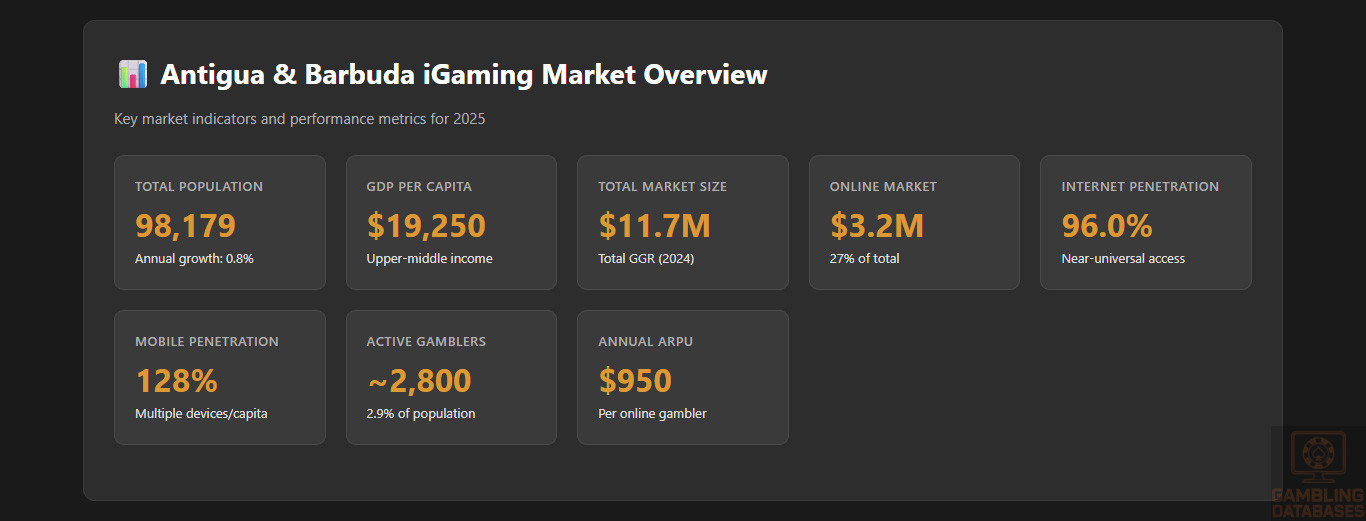
Executive Summary: Key Market Indicators
| Indicator | Value | Notes |
|---|---|---|
| Gambling Legal Status | Fully Legal and Regulated | Online and land-based permitted since 1994 |
| Regulatory Authority | Financial Services Regulatory Commission (FSRC) | Directorate of Offshore Gaming |
| Total Population (2025) | 98,179 | Annual growth rate: 0.8% |
| Median Age | 32.7 years | Younger demographic profile |
| Urban Population | 24.4% | Predominantly rural distribution |
| GDP Total (2025) | USD 1.89 billion | Tourism-dependent economy |
| GDP Per Capita | USD 19,250 | Upper-middle income classification |
| GDP Growth Forecast (2025-2027) | 3.2% CAGR | Post-pandemic recovery trajectory |
| Internet Penetration | 96.0% | Near-universal digital access |
| Mobile Penetration | 128% | Multiple devices per capita common |
| Smartphone Adoption | 87% | High mobile-first behavior |
| License Types Available | Interactive Gaming & Interactive Wagering | Covers casino, sports betting, poker |
| Initial License Fee | USD 75,000 | One-time application fee |
| Annual License Renewal | USD 50,000 | Fixed annual fee structure |
| License Processing Time | 3-6 months | Subject to due diligence completion |
| Operator Tax Rate (GGR) | 0% | No gaming revenue tax for offshore operators |
| Corporate Income Tax | 0-25% | Offshore entities often exempt |
| Player Winnings Tax | 0% | No taxation on gambling winnings |
| Local Server Requirements | No | Flexible technical infrastructure |
| Local Office Requirements | No | No physical presence mandate |
| Minimum Capital Requirement | USD 100,000 | Operating capital/bank guarantee |
| Domestic iGaming Market Size (2025) | USD 3.2 million | Small local player base |
| Market Growth Rate (CAGR 2025-2028) | 4.5% | Limited by population size |
| Active Online Gamblers | ~2,800 (2.9% of population) | Low local market penetration |
| Average Revenue Per User (ARPU) | USD 950 annually | Moderate spending per player |
| Mobile Gaming Share | 78% | Dominant mobile preference |
| Licensed Operators (Est.) | 500+ globally targeting | Serving international markets |
| Average Monthly Broadband Speed | 45 Mbps download | Adequate for gaming applications |
| Primary Language | English (official) | No localization barrier |
| Currency | Eastern Caribbean Dollar (XCD) | Pegged to USD at 2.70:1 |
Section 1: Regulatory Framework and Legal Environment
Current Gambling Regulation Status
Antigua and Barbuda operates under a comprehensive gambling regulatory framework established through the Interactive Gaming and Interactive Wagering Act of 2007, which updated and consolidated the original 1994 legislation that positioned the nation as the world’s first online gambling jurisdiction. The regulatory structure permits both land-based and online gambling activities under clearly defined licensing categories, with the Financial Services Regulatory Commission serving as the primary oversight authority through its specialized Directorate of Offshore Gaming.

Land-Based Gambling Activities
The jurisdiction permits traditional casino operations, with the King’s Casino in St. John’s serving as the primary brick-and-mortar gaming venue offering table games, electronic gaming machines, and poker rooms. Sports betting is available through licensed retail outlets, though the land-based sports wagering market remains underdeveloped compared to online channels. Slot machine halls operate under separate licensing arrangements, primarily concentrated in tourist areas and integrated resort properties.
The land-based sector generates approximately USD 8.5 million annually in gross gaming revenue, representing a declining share of total gambling activity as consumer preferences shift toward digital platforms. Casino operations must maintain minimum capitalization of USD 500,000 and comply with stringent anti-money laundering protocols aligned with Caribbean Financial Action Task Force standards.
Online Gambling Framework
Digital gaming regulations encompass interactive gaming licenses covering casino-style games including slots, table games, and live dealer offerings, as well as interactive wagering licenses specifically designed for sports betting, race betting, and other event-based wagering products. The regulatory framework explicitly permits poker, bingo, lottery-style games, and fantasy sports contests under appropriate licensing categories.

Licensed Operators and Market Players
Antigua and Barbuda maintains licenses for over 500 international gaming operators, though fewer than 30 actively target the domestic Antiguan market due to its limited size. The jurisdiction has historically attracted major international brands seeking a reputable licensing base for global operations, though recent years have seen increased competition from jurisdictions like Malta, Curacao, and Gibraltar offering similar offshore licensing models.
| Operator Category | Number of Licenses | Primary Target Markets | Estimated Market Share (Domestic) |
|---|---|---|---|
| International Casino Operators | 350+ | Europe, Asia, Latin America | 65% |
| Sports Betting Platforms | 120+ | Caribbean, North America | 25% |
| Poker Networks | 40+ | Global player pools | 8% |
| Bingo/Lottery Operators | 15+ | UK, European markets | 2% |
The domestic market demonstrates high concentration, with three international operators controlling approximately 60% of local online gambling activity. Betway Caribbean, 888 Holdings subsidiary brands, and regional operator WINZ.io dominate local market share through aggressive marketing and cricket sponsorships. Local operators face significant challenges competing against well-capitalized international brands offering superior technology platforms and promotional budgets.
Entry strategies employed by successful operators typically involve establishing Antiguan licensing primarily for regulatory credibility while serving international markets, with minimal focus on the small domestic player base. White-label partnerships and B2B platform providers constitute a significant portion of licensees, leveraging Antigua’s streamlined approval process and cost-effective licensing structure.
Licensing Framework and Requirements
Application Process and Eligibility
The Financial Services Regulatory Commission’s Directorate of Offshore Gaming administers all gambling licenses through its offices located at High Street, St. John’s, Antigua. Prospective licensees must submit comprehensive applications including corporate documentation, business plans, technical system specifications, and detailed information on beneficial owners, directors, and key personnel. The regulatory authority can be contacted at [email protected] or +1-268-462-3070.
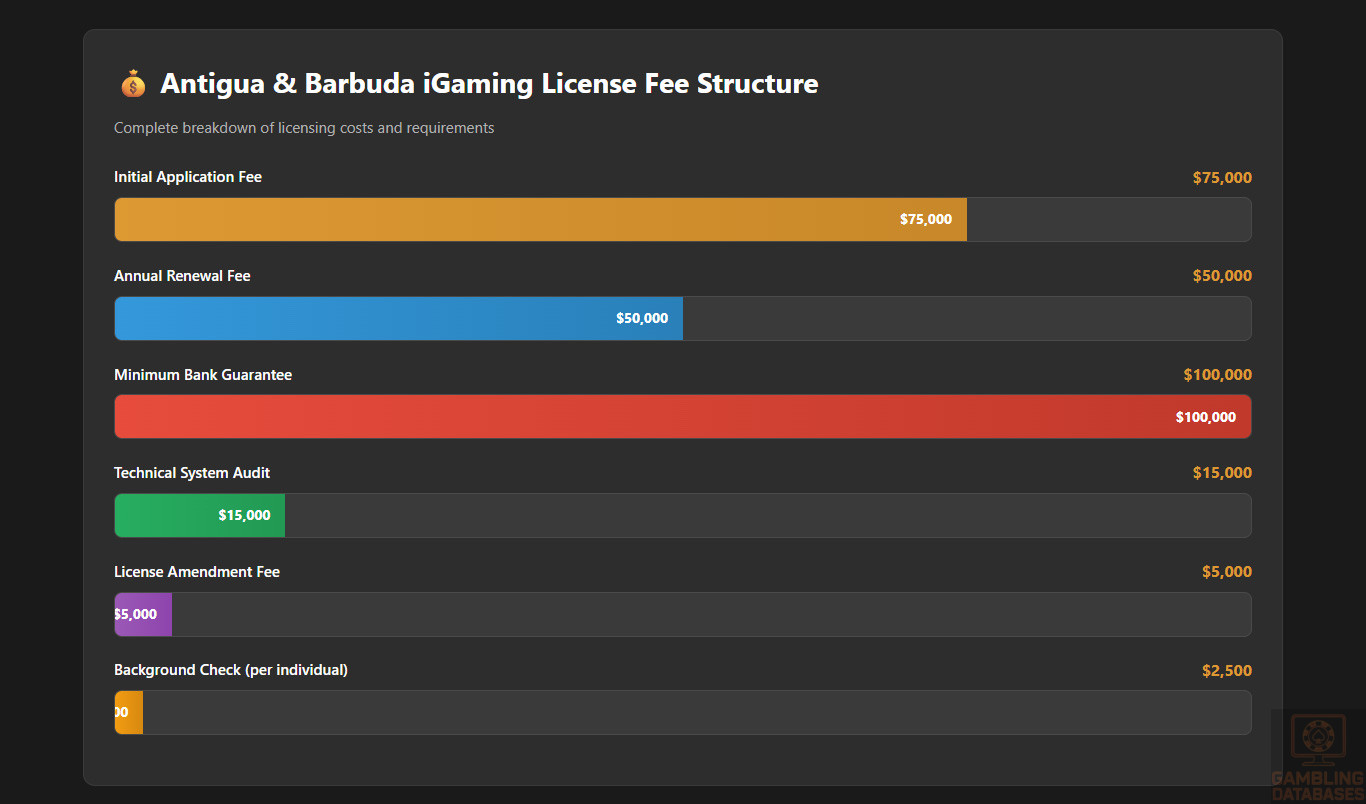
| Fee Type | Amount (USD) | Amount (XCD) | Payment Timing |
|---|---|---|---|
| Initial Application Fee | $75,000 | $202,500 | Upon submission |
| Annual Renewal Fee | $50,000 | $135,000 | Anniversary of license grant |
| License Amendment Fee | $5,000 | $13,500 | Per amendment request |
| Background Check Fee (per individual) | $2,500 | $6,750 | With application |
| Technical System Audit | $15,000 | $40,500 | Initial certification |
| Minimum Bank Guarantee | $100,000 | $270,000 | Maintained throughout license period |
Financial requirements mandate minimum capitalization of USD 100,000 in the form of a bank guarantee or surety bond maintained with an approved financial institution for the duration of the license period. Applicants must demonstrate financial stability through audited financial statements covering the previous three years, bank references, and proof of sufficient operational funding to sustain six months of operations without revenue.
Technical standards require gaming platforms to achieve certification from approved testing laboratories including eCOGRA, GLI, iTech Labs, or Gaming Associates. Random number generator certification, game fairness verification, and security infrastructure audits must be completed before license approval. Background checks conducted through INTERPOL and national criminal databases typically require 8-12 weeks for completion.
The application timeline spans 3-6 months from initial submission to license approval, contingent on completeness of documentation and satisfactory background investigations. Expedited processing is not available, though responsive communication with regulators and pre-submission consultations can streamline the process. Application fees are non-refundable regardless of approval outcome.
Local Presence and Operational Requirements
Antigua and Barbuda imposes no mandatory physical presence requirements for offshore gaming licensees, distinguishing it from jurisdictions like Malta or Gibraltar that mandate local offices and staff. Operators may maintain virtual operations, hosting servers in third-party jurisdictions and managing operations remotely, provided they maintain reliable communication channels with the regulatory authority.
Domain registration requirements do not mandate .ag country code top-level domains, permitting operators to utilize any internationally recognized domain extensions. Server location flexibility allows operators to host gaming platforms anywhere globally, though many choose cloud infrastructure providers with Caribbean presence for latency optimization when serving regional markets.
Foreign ownership faces no restrictions, with 100% international ownership permitted across all license categories. No local partnership requirements or mandatory joint venture structures exist, though voluntary partnerships with Antiguan entities can provide operational advantages in banking relationships and local market knowledge. Personnel requirements specify only that key individuals undergo background checks; no minimum local employment quotas apply.
Compliance Obligations and Monitoring
Player Protection and Identification
Age verification requirements mandate strict 18+ enforcement, requiring operators to verify player ages before permitting real-money gambling activity. Acceptable verification methods include government-issued identification documents, passport verification, national ID card authentication, or approved third-party age verification services maintaining integration with government databases.
| Requirement Category | Specific Obligations | Implementation Timeline |
|---|---|---|
| Customer Identification | Full name, date of birth, residential address, government ID | Before first withdrawal or at $2,000 cumulative deposits |
| Enhanced Due Diligence | Source of funds verification for deposits exceeding $10,000 | Within 72 hours of transaction |
| PEP Screening | Politically exposed persons database checks | At account registration |
| Transaction Monitoring | Automated alerts for suspicious patterns exceeding $5,000 | Real-time monitoring required |
| Record Retention | All transaction records and communications | Minimum 7 years |
| SAR Filing | Suspicious Activity Reports to Financial Intelligence Unit | Within 15 days of identification |
Responsible gambling measures mandated by regulation include self-exclusion system availability permitting players to block access for periods ranging from 6 months to permanent exclusion, reality check notifications displaying session duration and losses at 60-minute intervals, and mandatory deposit limit options allowing players to cap daily, weekly, or monthly funding amounts. Operators must display responsible gambling information prominently, including links to GamCare, Gambling Therapy, and regional support resources.
Session time limits and loss limits are not mandated by regulation but represent industry best practices increasingly expected by the Directorate of Offshore Gaming during compliance reviews. Operators must maintain accessible responsible gambling policies detailing available player protection tools, with annual compliance attestations submitted to regulatory authorities.
Financial Monitoring and Reporting
Transaction monitoring systems must flag suspicious patterns including rapid deposit-withdrawal cycles suggesting money laundering, bet structuring to avoid reporting thresholds, unusually large transactions inconsistent with player history, and coordinated activities across multiple accounts. Operators must maintain automated monitoring capable of generating alerts for manual review within 24 hours of suspicious activity detection.
Reporting requirements mandate quarterly financial statements submitted within 30 days of quarter-end, detailing gross gaming revenue, player deposits and withdrawals, outstanding player liabilities, and operational expenses. Annual audited financial statements prepared by approved accounting firms must be filed within 90 days of fiscal year-end. Monthly transaction reports summarizing deposit volumes, withdrawal processing, and currency exchange activities are required for anti-money laundering oversight.
Audit and inspection procedures authorize the Directorate of Offline Gaming to conduct unannounced platform audits, financial record reviews, and technical system inspections. Operators must provide remote access credentials for regulatory monitoring systems and respond to information requests within 48 hours. Data retention requirements mandate preserving all gaming transactions, player communications, financial records, and marketing materials for seven years in readily accessible formats.
Taxation Structure and Financial Obligations
Player Taxation
Antigua and Barbuda imposes zero taxation on gambling winnings for players, creating an attractive environment for high-stakes bettors and eliminating administrative burdens associated with withholding and winner reporting. No tax declaration requirements exist for domestic players regardless of winning amounts, and no withholding obligations apply to operators disbursing prizes or jackpots.
This player-friendly tax environment contrasts sharply with jurisdictions like the United States where gambling winnings face federal income tax rates up to 37%, or France where players pay social charges on poker winnings. The absence of player taxation removes friction from the gambling experience and eliminates compliance complexity for operators serving Antiguan residents.
Operator Taxation
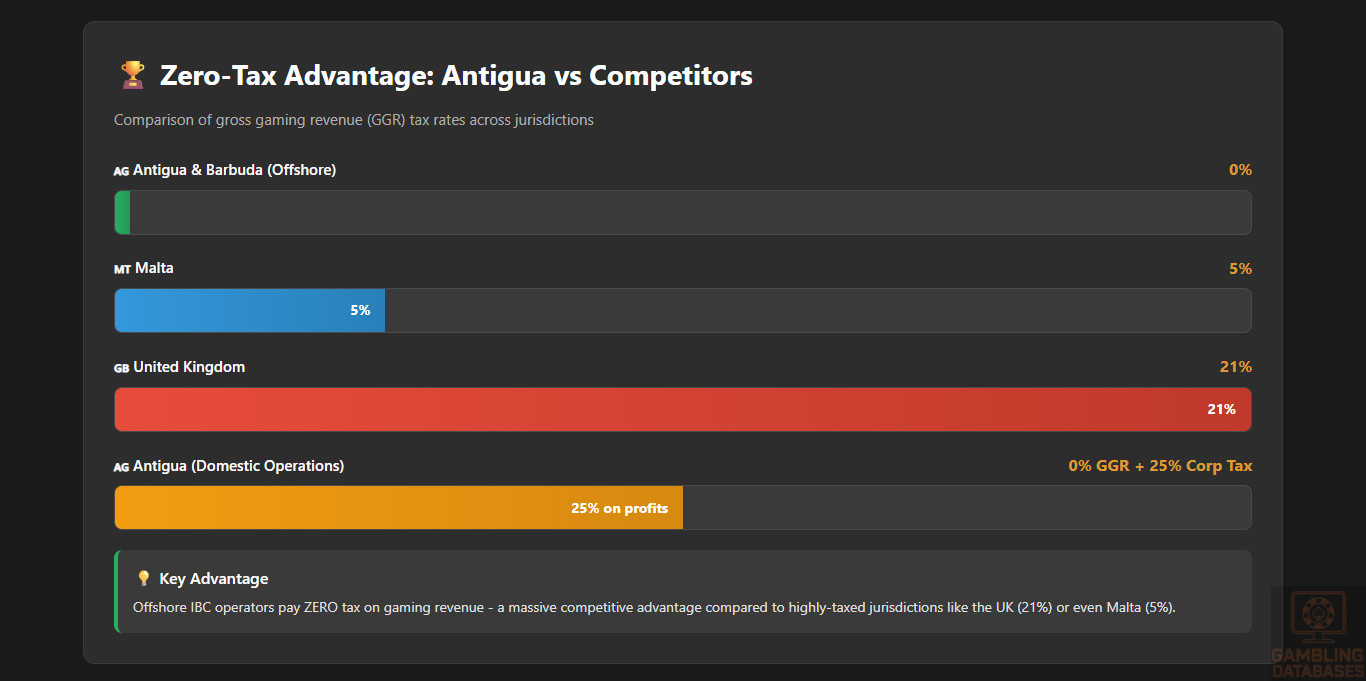
The operator taxation structure represents Antigua and Barbuda’s primary competitive advantage, with offshore gaming licensees paying zero gross gaming revenue tax, zero net gaming revenue tax, and zero turnover-based taxation on gambling operations. This contrasts dramatically with jurisdictions like the United Kingdom imposing 21% point-of-consumption tax or Malta charging 5% on gaming revenue.
| Tax/Fee Category | Rate/Amount | Calculation Basis | Payment Frequency |
|---|---|---|---|
| Gaming Revenue Tax (GGR) | 0% | Gross Gaming Revenue | N/A |
| Corporate Income Tax (Offshore) | 0% | Net Profits | N/A |
| Corporate Income Tax (Domestic) | 25% | Net Profits (if serving local market) | Quarterly |
| Annual License Fee | $50,000 USD | Flat fee per license | Annual |
| Withholding Tax (Dividends) | 0% | Dividend distributions | N/A |
| Withholding Tax (Interest) | 0% | Interest payments | N/A |
| Withholding Tax (Royalties) | 0% | Technology licensing fees | N/A |
| VAT/Sales Tax | 0% | Gambling services | N/A |
Corporate income tax applies at 25% for companies maintaining substantial local operations or primarily serving the domestic Antiguan market, though most offshore licensees structure operations to qualify for tax exemption by serving exclusively international customers. No distinction exists between different gambling verticals, with casino, sports betting, poker, and bingo operations all eligible for identical tax treatment.
License renewal fees of USD 50,000 annually represent the primary ongoing cost for offshore operators, providing predictable expense structures enabling accurate financial modeling. No variable licensing fees based on revenue thresholds or player volumes exist, creating significant cost advantages for high-volume operators compared to percentage-based fee structures in competing jurisdictions.
Gambling Market Financial Performance
The domestic Antiguan gambling market generated approximately USD 11.7 million in total gross gaming revenue during 2024, comprising USD 8.5 million from land-based operations and USD 3.2 million from online channels. Player payouts totaled USD 9.8 million, resulting in USD 1.9 million in net gaming revenue after prizes. Tax revenues collected by the Antiguan government from gambling activities reached approximately USD 4.2 million, derived primarily from annual license fees rather than gaming revenue taxation.
| Year | Total GGR (USD Million) | Land-Based GGR | Online GGR | YoY Growth | Tax Revenue |
|---|---|---|---|---|---|
| 2020 | $8.2 | $5.8 | $2.4 | -22% (pandemic impact) | $3.8 |
| 2021 | $9.5 | $6.7 | $2.8 | +15.9% | $3.9 |
| 2022 | $10.8 | $7.6 | $3.2 | +13.7% | $4.0 |
| 2023 | $11.3 | $8.1 | $3.2 | +4.6% | $4.1 |
| 2024 | $11.7 | $8.5 | $3.2 | +3.5% | $4.2 |
Revenue distribution analysis reveals land-based casinos contributing 73% of total gambling revenue, online sports betting representing 18%, online casino games accounting for 7%, and lottery products comprising 2%. The growth trajectory demonstrates post-pandemic recovery through 2022, followed by market maturation with modest single-digit growth rates reflecting population constraints and limited tourism expansion.
Year-over-year growth trends indicate online gambling channels growing at 6-8% annually while land-based revenue expands at 2-3%, driven by gradual digital migration and improved mobile platform accessibility. Market projections forecast total gambling revenue reaching USD 13.5 million by 2028, representing a compound annual growth rate of 3.6% constrained by the jurisdiction’s small population base.
Advertising and Marketing Restrictions
Antigua and Barbuda maintains relatively permissive advertising regulations compared to restrictive European jurisdictions, permitting gambling advertisements across television, radio, print media, outdoor billboards, and digital channels including social media and search engine marketing. Television and radio advertising face no time-of-day restrictions, though broadcasters often voluntarily avoid placement during children’s programming.
Content restrictions prohibit marketing materials suggesting gambling as a solution to financial problems, portraying excessive gambling as socially acceptable, targeting minors through cartoon characters or youth-oriented themes, or making misleading claims about winning probabilities. All advertisements must include responsible gambling messaging and display the operator’s license number issued by the Directorate of Offshore Gaming.
| Channel | Regulatory Status | Content Requirements | Restrictions |
|---|---|---|---|
| Television | Permitted | Responsible gambling disclaimer, 18+ notice | No targeting of children’s programming |
| Radio | Permitted | Verbal responsible gambling message | Recommended avoidance during school hours |
| Print Media | Permitted | License number display, age restrictions | No placement in youth publications |
| Outdoor Billboards | Permitted | 18+ symbology required | Not within 200m of schools |
| Online Display Ads | Permitted | Age-gated content, responsible gambling links | No retargeting of self-excluded players |
| Social Media | Permitted | Platform age restrictions enabled | No influencer marketing to under-18 audiences |
| Email Marketing | Permitted | Unsubscribe option, responsible gambling info | Frequency limits recommended (max 3/week) |
| SMS Marketing | Permitted with consent | Opt-in required, easy opt-out | No unsolicited messaging |
Promotional limitations impose no regulatory caps on bonus amounts or wagering requirements, though operators must clearly disclose all terms and conditions associated with promotional offers including minimum odds requirements, time limitations, and withdrawal restrictions. Bonus abuse prevention measures and reasonable playthrough requirements are considered acceptable industry practices without specific regulatory mandates.
Sponsorship regulations permit gambling operators to sponsor sporting events, cricket teams, football clubs, and entertainment venues without significant restrictions. The West Indies cricket team has historically featured gambling sponsorships, and regional football leagues actively seek gaming operator partnerships. Cultural events including Carnival celebrations and music festivals regularly feature gambling sponsor branding.
Affiliate marketing operates without specific regulatory oversight, though operators remain responsible for ensuring affiliate partners comply with advertising content standards and age-targeting restrictions. Affiliate agreements must include contractual provisions requiring compliance with Antiguan advertising standards, and operators face liability for non-compliant affiliate marketing materials.
Recent Regulatory Changes and Their Impact
The most significant regulatory development occurred in March 2023 when the Financial Services Regulatory Commission announced enhanced due diligence requirements for beneficial ownership disclosure, mandating operators to identify and verify all individuals holding 10% or greater ownership stakes, reduced from the previous 25% threshold. This change aligned Antigua with international Financial Action Task Force recommendations but increased compliance costs for operators with complex corporate structures.
In August 2023, amendments to responsible gambling requirements introduced mandatory session time notifications at 60-minute intervals, requiring operators to display on-screen messages showing time elapsed and net wins/losses. While not mandating forced logout or session termination, the regulation increased technical implementation costs estimated at USD 15,000-25,000 for platform modifications.
January 2024 saw the introduction of enhanced reporting requirements for cryptocurrency transactions, obligating operators accepting Bitcoin, Ethereum, or other digital assets to maintain detailed blockchain address records and implement enhanced monitoring for transactions exceeding USD 5,000 equivalent. The regulation responded to international pressure regarding cryptocurrency’s money laundering risks but created additional compliance overhead for operators serving crypto-preferred markets.
No player taxation changes occurred during the 2022-2024 period, with the government maintaining its zero-tax policy on gambling winnings. License fees remained stable at USD 50,000 annually without inflation adjustments, providing cost certainty for operators. However, informal regulatory guidance issued in July 2024 suggested potential future consideration of point-of-consumption taxation for operators deriving substantial revenue from Antiguan residents, though no formal proposals have been published.
Enforcement Mechanisms and Penalties
The Directorate of Offshore Gaming maintains authority to impose administrative penalties ranging from written warnings for minor infractions to license suspension or revocation for serious violations. Financial penalties for compliance breaches typically range from USD 10,000 for first-time documentation failures to USD 100,000 for repeated or egregious violations involving player fund mismanagement or anti-money laundering failures.
| Violation Category | First Offense | Second Offense | Third Offense |
|---|---|---|---|
| Late Reporting | Warning + $5,000 fine | $15,000 fine | $30,000 fine + license review |
| KYC/AML Non-Compliance | $25,000 fine + corrective action plan | $75,000 fine + mandatory audit | License suspension pending remediation |
| Underage Gambling Incident | $50,000 fine + enhanced controls | $150,000 fine + 30-day suspension | License revocation |
| Player Fund Mismanagement | $100,000 fine + segregation audit | License suspension + restitution | Permanent license revocation |
| Advertising Violations | Warning + material removal | $10,000 fine | $25,000 fine + advertising ban (30 days) |
| Technical System Failures | Corrective action required | $20,000 fine + independent audit | License suspension until remediation |
| Serving Prohibited Markets | $50,000 fine + geo-blocking verification | $150,000 fine + market exit mandate | License revocation + legal action |
Recent enforcement actions include a June 2024 case where an operator received a USD 75,000 penalty for inadequate customer due diligence on high-value transactions, demonstrating increased regulatory scrutiny of anti-money laundering compliance. In October 2023, a sports betting operator faced 60-day license suspension for processing transactions from players in prohibited United States markets, highlighting strict enforcement of geo-blocking requirements.
ISP blocking mechanisms exist but are rarely deployed, with the government preferring to work directly with licensed operators rather than implementing domain blocks. Payment processor restrictions represent the primary enforcement mechanism for unlicensed operators, with Antiguan authorities coordinating with international payment networks to identify and restrict transactions with unauthorized gambling sites.
Criminal penalties for operating unlicensed gambling services include fines up to XCD 500,000 (USD 185,000) and imprisonment for up to five years for individuals convicted of organizing illegal gambling operations. However, prosecutions remain rare, with regulatory authorities prioritizing administrative remedies and license revocations over criminal proceedings except in cases involving fraud or money laundering.
Section 2: Demographics and Consumer Analysis
Population Demographics and Distribution
Core Population Metrics
Antigua and Barbuda’s total population of 98,179 as of 2025 represents modest growth from 97,400 in 2023, reflecting an annual increase of approximately 0.8% driven primarily by immigration rather than natural population growth. The demographic profile skews relatively young with a median age of 32.7 years, creating a population structure favorable for digital service adoption but constrained by absolute numbers limiting market scale.
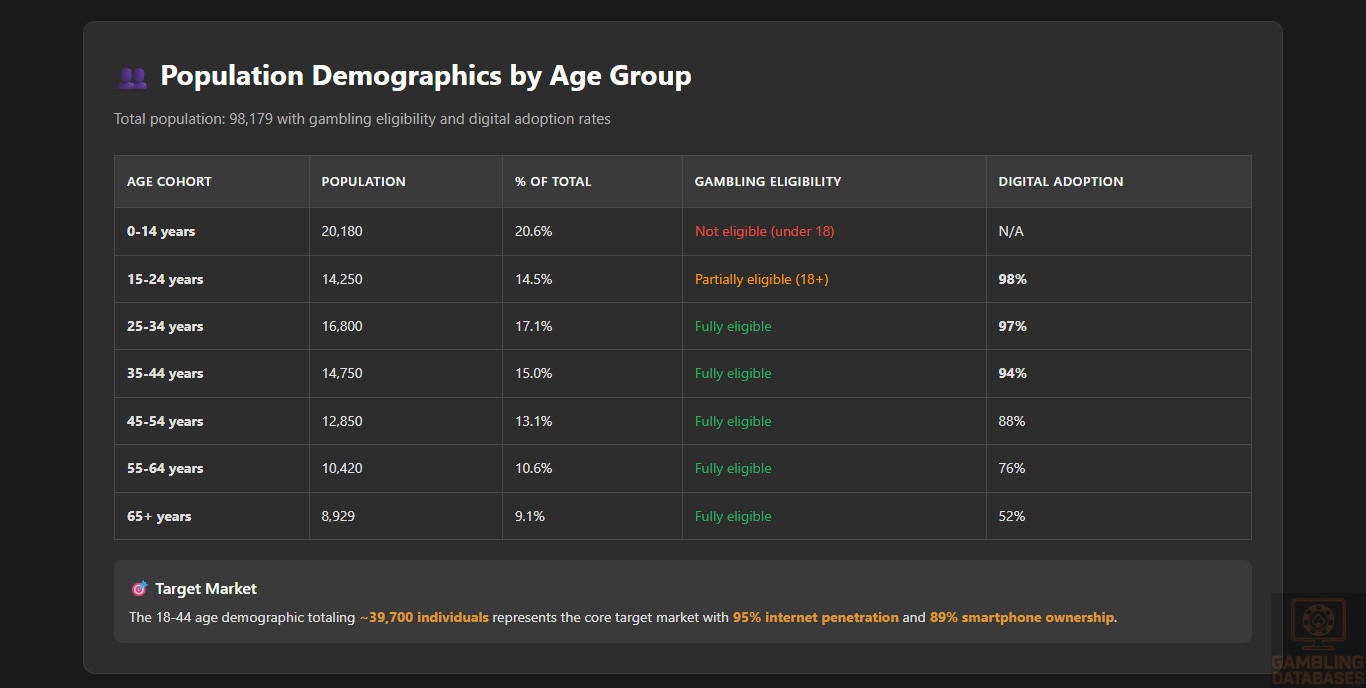
| Age Cohort | Population Count | Percentage of Total | Gambling Eligibility | Digital Adoption Rate |
|---|---|---|---|---|
| 0-14 years | 20,180 | 20.6% | Not eligible (under 18) | N/A |
| 15-24 years | 14,250 | 14.5% | Partially eligible (18+) | 98% |
| 25-34 years | 16,800 | 17.1% | Fully eligible | 97% |
| 35-44 years | 14,750 | 15.0% | Fully eligible | 94% |
| 45-54 years | 12,850 | 13.1% | Fully eligible | 88% |
| 55-64 years | 10,420 | 10.6% | Fully eligible | 76% |
| 65+ years | 8,929 | 9.1% | Fully eligible | 52% |
The 18-44 age demographic totaling approximately 39,700 individuals represents the core target market for online gambling services, combining legal eligibility with high digital literacy and disposable income availability. This cohort demonstrates 95% internet penetration and 89% smartphone ownership, creating favorable conditions for mobile-first gambling products despite limited absolute market size.
Gender distribution shows relative balance at 48.2% male and 51.8% female, with life expectancy of 74.8 years for males and 79.2 years for females. Gender participation rates in gambling activities skew male-dominant at approximately 68% of active gamblers, though female participation in lottery and bingo products approaches parity at 45-48% of players.
Urban versus rural distribution presents unique characteristics, with only 24.4% of the population classified as urban despite St. John’s serving as the primary population center with approximately 22,000 residents. The predominantly rural distribution pattern creates infrastructure challenges for land-based gambling venue accessibility while simultaneously driving online gambling adoption due to geographic convenience factors.
Geographic Distribution
Population concentration centers around St. John’s on Antigua island, hosting 22.4% of the national population, followed by All Saints with 6,800 residents, Liberta with 2,800, Potter’s Village with 2,400, and Bolans with 1,900 inhabitants. Barbuda island maintains a sparse population of approximately 1,800 residents concentrated in Codrington, the island’s only significant settlement.
| City/Town | Population | Internet Penetration | 4G Coverage | Land-Based Gambling Venues |
|---|---|---|---|---|
| St. John’s | 22,000 | 98% | 100% | 1 casino, 4 betting shops |
| All Saints | 6,800 | 96% | 98% | 1 betting shop |
| Liberta | 2,800 | 94% | 95% | None |
| Potter’s Village | 2,400 | 95% | 97% | None |
| Bolans | 1,900 | 92% | 94% | None |
| Codrington (Barbuda) | 1,800 | 88% | 85% | None |
Regional economic differences manifest primarily between Antigua and Barbuda islands, with Antigua hosting 98.2% of economic activity and maintaining superior infrastructure development. Tourism industry concentration in coastal resort areas creates income disparities, with resort-adjacent communities demonstrating 15-20% higher household incomes than interior agricultural regions.
Internet access geographic patterns show near-universal coverage in St. John’s and major towns at 96-98% penetration, declining to 88-92% in rural areas and remote coastal settlements. Mobile network coverage compensates for fixed broadband limitations, with 4G mobile internet reaching 94% of the population and providing primary connectivity for rural residents.
Economic Indicators and Consumer Spending Power
GDP and Economic Performance
Antigua and Barbuda’s economy generated USD 1.89 billion in gross domestic product during 2024, translating to per capita GDP of USD 19,250 positioning the nation in the upper-middle income category according to World Bank classifications. The economic structure relies heavily on tourism services contributing 58% of GDP, followed by financial services at 18%, construction at 12%, and agriculture representing just 2.3% of economic output.
GDP growth forecasts project 3.2% compound annual growth rate through 2027, driven by tourism sector recovery following pandemic disruptions and expanding yachting services for ultra-high-net-worth visitors. However, vulnerability to hurricane damage and climate change impacts introduces volatility risks, with major storms capable of reducing GDP by 5-10% in affected years as demonstrated by Hurricane Irma’s 2017 impact.
| Metric | 2023 | 2024 | 2025 | 2026 (Forecast) | 2027 (Forecast) | 2028 (Forecast) |
|---|---|---|---|---|---|---|
| GDP Total (USD Billion) | $1.79 | $1.85 | $1.89 | $1.96 | $2.02 | $2.09 |
| GDP Per Capita (USD) | $18,400 | $18,900 | $19,250 | $19,850 | $20,400 | $21,000 |
| GDP Growth Rate | 4.8% | 3.4% | 2.9% | 3.2% | 3.1% | 3.3% |
| Unemployment Rate | 8.2% | 7.8% | 7.5% | 7.2% | 7.0% | 6.8% |
| Inflation Rate | 3.8% | 3.2% | 2.9% | 2.8% | 2.7% | 2.8% |
| Average Monthly Wage (XCD) | $3,680 | $3,820 | $3,940 | $4,080 | $4,220 | $4,370 |
Employment rates demonstrate gradual improvement with unemployment declining from pandemic peaks of 12.4% in 2020 to current levels of 7.5% in 2025, approaching pre-pandemic norms of 6.5-7.0%. Tourism sector employment represents 43% of the workforce, creating seasonal volatility with higher employment during November-April high season and 8-12% job reductions during May-October low season.
Wage levels average XCD 3,940 monthly (USD 1,460) across all sectors, with tourism and hospitality workers earning approximately XCD 2,800 (USD 1,037), financial services professionals commanding XCD 6,500 (USD 2,407), and government employees averaging XCD 4,200 (USD 1,556). The citizenship-by-investment program brings high-net-worth individuals who elevate average income statistics but represent less than 2% of residents.
Income and Wealth Distribution
Average household income reaches XCD 7,850 monthly (USD 2,907) when combining all income earners per household, while median household income of XCD 6,200 (USD 2,296) provides a more representative measure of typical living standards. The gap between mean and median reflects income inequality driven by high-earning tourism industry executives and citizenship-by-investment residents skewing averages upward.
Income inequality measured by Gini coefficient stands at 0.42, indicating moderate inequality levels comparable to United States (0.41) but more equitable than many Caribbean neighbors like Jamaica (0.45) or Saint Lucia (0.51). The middle class defined as households earning XCD 4,000-10,000 monthly comprises approximately 42% of the population, representing stable consumers with discretionary spending capacity for entertainment including gambling.
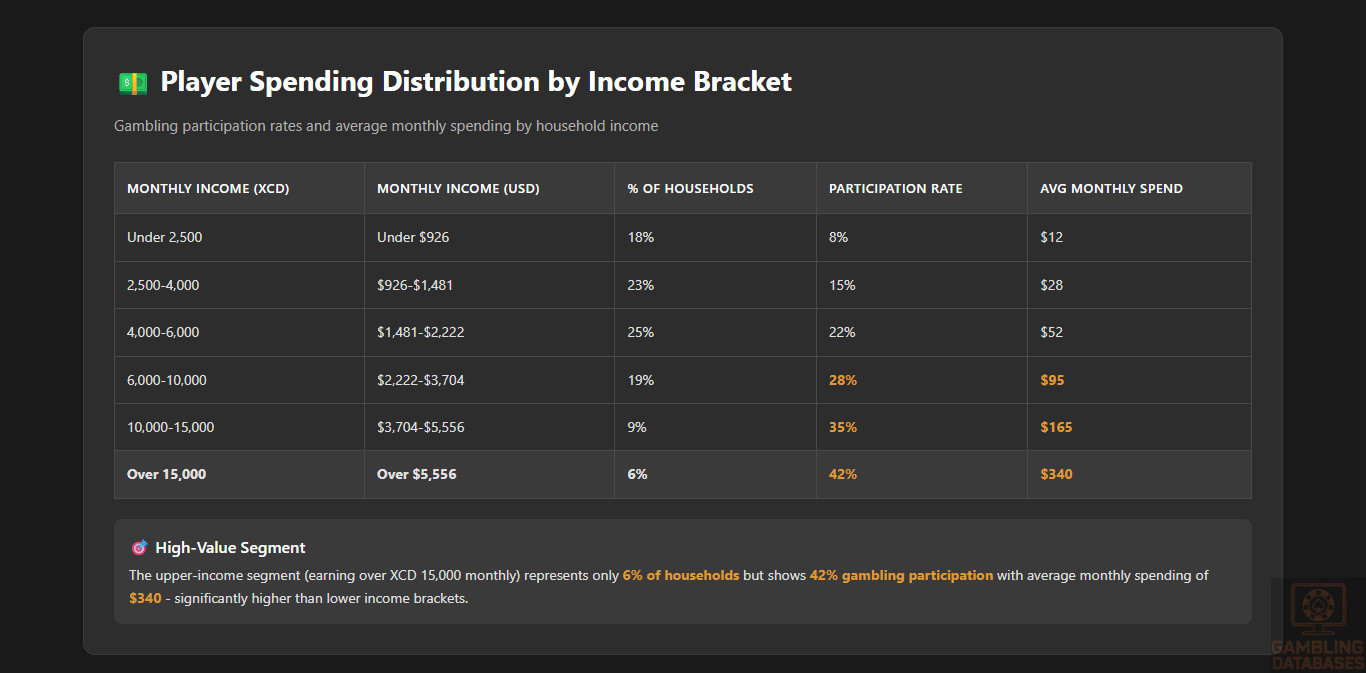
| Monthly Income Bracket (XCD) | Monthly Income (USD) | % of Households | Gambling Participation Rate | Avg Monthly Gambling Spend (USD) |
|---|---|---|---|---|
| Under 2,500 | Under $926 | 18% | 8% | $12 |
| 2,500-4,000 | $926-$1,481 | 23% | 15% | $28 |
| 4,000-6,000 | $1,481-$2,222 | 25% | 22% | $52 |
| 6,000-10,000 | $2,222-$3,704 | 19% | 28% | $95 |
| 10,000-15,000 | $3,704-$5,556 | 9% | 35% | $165 |
| Over 15,000 | Over $5,556 | 6% | 42% | $340 |
Disposable income trends show gradual improvement with real disposable income growing 2.1% annually after adjusting for inflation, providing incremental increases in discretionary spending capacity. Consumer spending patterns allocate approximately 32% of household budgets to housing, 24% to food and beverages, 12% to transportation, 8% to utilities, and 6% to entertainment and recreation within which gambling represents a subset.
The upper-income segment earning over XCD 15,000 monthly demonstrates gambling participation rates exceeding 40% with average monthly spending of USD 340, creating a high-value player segment despite representing only 6% of households. Conversely, lower-income households under XCD 4,000 monthly show participation rates below 15% and minimal spending, suggesting gambling remains predominantly a middle and upper-class activity.
Market Size and Growth Projections
The current iGaming market revenue totaling USD 3.2 million annually reflects a mature but constrained market limited by population size rather than regulatory restrictions or consumer reluctance. Online casino games contribute USD 2.1 million, sports betting generates USD 950,000, and poker accounts for USD 150,000 of total online gambling revenue.
Historical revenue growth demonstrates 18% annual increases during 2020-2022 driven by pandemic-related digitalization and increased time spent at home, followed by growth moderation to 4-6% annually during 2023-2024 as the market reaches saturation levels among digitally-engaged consumers. Land-based gambling revenue has declined 2-3% annually as players migrate to more convenient online platforms.
| Segment | 2025 Revenue | 2027 Forecast | 2030 Forecast | CAGR 2025-2030 |
|---|---|---|---|---|
| Online Casino (Slots) | $1.45M | $1.62M | $1.88M | 5.3% |
| Online Casino (Table Games) | $650K | $710K | $810K | 4.5% |
| Sports Betting | $950K | $1.08M | $1.28M | 6.1% |
| Poker | $150K | $155K | $165K | 1.9% |
| Total Online | $3.20M | $3.57M | $4.14M | 5.3% |
| Land-Based Casinos | $8.50M | $8.75M | $9.20M | 1.6% |
| Total Market | $11.70M | $12.32M | $13.34M | 2.7% |
Revenue forecasts project the online gambling market reaching USD 4.14 million by 2030, representing a compound annual growth rate of 5.3% driven primarily by increased smartphone penetration, improved payment infrastructure, and generational shifts toward digital entertainment. Sports betting demonstrates the strongest growth potential at 6.1% CAGR, benefiting from cricket’s cultural significance and expanding live betting features.
Projected user base growth anticipates active online gamblers increasing from current levels of 2,800 to approximately 3,650 by 2030, representing market penetration expansion from 2.9% to 3.6% of the total population. The growth reflects both demographic aging bringing more individuals into the 18+ eligible category and gradual adoption among previously non-gambling households.
Average Revenue Per User currently stands at USD 950 annually across all online gambling activities, with casino players demonstrating higher ARPU of USD 1,240 compared to sports bettors averaging USD 680 annually. ARPU projections forecast modest increases to USD 1,050 by 2030, driven by inflation and gradual increases in betting intensity rather than dramatic behavioral changes.
Market penetration rates of 2.9% for online gambling and 8.5% for any gambling activity (including land-based and lottery) remain substantially below regional comparators like Barbados achieving 12% gambling participation or Trinidad and Tobago reaching 15%. The penetration gap suggests either cultural factors limiting gambling acceptance or successful competition from informal unregulated operators not captured in official statistics.
Online versus land-based revenue split currently favors land-based channels at 73% of total gambling revenue, though this ratio is shifting toward digital channels at approximately 2 percentage points annually. By 2030, projections suggest online gambling representing 31% of total revenue compared to 27% in 2025, though land-based casinos will maintain majority share due to tourist visitation and the social experience factor.
Education, Skills, and Digital Literacy
Educational Foundation
Literacy rates reach 99% for the overall population aged 15 and above, with gender parity at 99% for both males and females reflecting successful universal primary education policies. Educational attainment shows 98% primary education completion, 85% secondary education completion, and 22% tertiary education completion including university degrees, professional certifications, and vocational training.
Digital literacy indicators demonstrate strong foundation skills, with 94% of adults aged 18-65 reporting ability to use smartphones, computers, and internet services for communication, banking, and e-commerce activities. The education system incorporates information technology curriculum from primary levels, creating baseline digital competency among younger cohorts entering the workforce and consumer markets.
| Age Group | Secondary Education % | Tertiary Education % | Digital Literacy % | English Fluency % |
|---|---|---|---|---|
| 18-24 | 94% | 18% | 99% | 100% |
| 25-34 | 89% | 26% | 98% | 100% |
| 35-44 | 85% | 24% | 96% | 100% |
| 45-54 | 78% | 19% | 89% | 100% |
| 55-64 | 71% | 15% | 78% | |
| 65+ | 64% | 12% | 54% | 99% |
Workforce skill levels concentrate in tourism and hospitality services, with approximately 43% of employed individuals working in customer-facing roles requiring interpersonal communication, basic financial literacy, and increasingly digital point-of-sale system operation. Financial services employment representing 12% of the workforce demands higher educational credentials, with most positions requiring tertiary education and professional certifications.
Technology adoption readiness scores highly among the 18-44 demographic, with 96-99% digital literacy enabling seamless engagement with online gambling platforms, digital payment systems, and mobile applications. Older demographics aged 55+ demonstrate lower digital comfort levels at 54-78% literacy, though this cohort shows less gambling propensity regardless of channel.
English language proficiency reaches 100% among native-born residents, with English serving as the official language, primary education medium, and dominant communication language in all contexts. This eliminates localization requirements for gambling operators, enabling deployment of standard English-language platforms without translation costs or cultural adaptation beyond minor regional terminology preferences.
Cultural and Social Factors
Communication and Language
Primary languages used in daily life center exclusively on English, spoken with Antiguan Creole dialect influences that maintain mutual intelligibility with standard international English. Internet language preferences show 98% English usage, with no significant minority language communities requiring multilingual gambling platform development.
Business communication norms follow British Commonwealth traditions emphasizing formal written correspondence, professional telephone etiquette, and respectful interpersonal interactions. Customer service expectations favor friendly, personable communication styles rather than purely transactional efficiency, with consumers valuing relationship-building and conversational engagement over abbreviated interactions.
Language requirements for gambling websites mandate English as the primary interface language, with no regulatory obligations for additional language support. Successful operators incorporate Caribbean terminology, local sports references (cricket terminology, West Indies team), and culturally relevant imagery featuring regional aesthetics, beaches, and carnival themes to establish local market resonance.
Cultural Attitudes
Gambling acceptance levels within Antiguan society demonstrate moderate tolerance, with gambling viewed as acceptable recreational entertainment rather than socially stigmatized vice. The presence of land-based casinos since the 1970s and the jurisdiction’s role as a global gambling licensing hub have normalized gambling activity, though religious communities maintain varying levels of acceptance with some denominations discouraging gambling participation.
Religious influences primarily stem from Christian denominations comprising 76% of the population, including Anglican, Methodist, Moravian, and Pentecostal churches. While mainstream Anglican and Methodist congregations generally tolerate moderate gambling as personal choice, evangelical and Pentecostal communities often preach against gambling as contrary to principles of stewardship and financial responsibility. Approximately 20-25% of the population reports religious beliefs significantly influence their decision to avoid gambling activities.
Foreign brand perception demonstrates generally positive attitudes, with international brands often viewed as more trustworthy, technologically advanced, and financially stable compared to local operators. The tourism-dependent economy creates cultural familiarity with international companies, reducing barriers to foreign gambling operator market entry. However, successful operators balance international credibility with localized marketing emphasizing Caribbean identity, regional sports sponsorships, and community engagement.
| Factor | Impact on Gambling | Operator Strategy Implications |
|---|---|---|
| Cricket Culture | High engagement during matches | Prioritize cricket betting markets, West Indies team promotions |
| Carnival Season (July-August) | Increased disposable spending on entertainment | Festival-themed promotions, bonus offers during peak season |
| Tourism Employment | Seasonal income fluctuations affect spending | Flexible deposit limits, low minimum bets |
| Religious Conservatism | 25% of population avoids gambling | Responsible gambling messaging, avoid aggressive marketing |
| Social Gambling Tradition | Preference for communal gaming experiences | Live dealer games, multiplayer features, social sharing |
| Mobile-First Lifestyle | 78% of online gambling via mobile | Mobile app priority, responsive design essential |
Risk tolerance indicators suggest moderate risk preferences among Antiguan consumers, with casino slot players favoring medium volatility games offering balanced frequency of wins and jackpot potential over either low-variance frequent small wins or high-variance rare large payouts. Sports bettors demonstrate preference for single bets and small accumulators over complex multi-leg parlays, indicating comfort with moderate risk-reward ratios.
Entertainment preferences emphasize social activities, outdoor recreation, beach culture, and music including calypso, soca, and reggae genres. Gambling participation often occurs in social contexts, with friends gathering for major sporting events, sharing betting tips, and celebrating wins collectively. This cultural dynamic favors gambling products with social features, live dealer interactions, and community-building elements over solitary gaming experiences.
Problem Gambling and Social Considerations
Prevalence of gambling addiction affects an estimated 1.2% of the adult population, translating to approximately 950 individuals experiencing problem gambling behaviors based on Problem Gambling Severity Index assessments conducted in regional Caribbean studies. An additional 2.8% of adults (approximately 2,200 individuals) are classified as at-risk gamblers demonstrating some harmful gambling patterns without meeting full addiction criteria.
Problem gambler statistics reveal age distribution concentrated in the 25-44 demographic representing 62% of individuals seeking treatment, followed by 45-54 age group at 24%, and 18-24 cohort at 11% of problem gamblers. Gender distribution skews male at 73% of problem gambling cases, though female problem gambling appears underreported due to social stigma and lower treatment-seeking behavior.
| Category | Number of Individuals | Percentage of Adult Population | Primary Gambling Activity |
|---|---|---|---|
| Problem Gamblers | ~950 | 1.2% | Sports betting (42%), Slots (38%), Table games (20%) |
| At-Risk Gamblers | ~2,200 | 2.8% | Sports betting (48%), Slots (35%), Multiple activities (17%) |
| Underage Gambling (Estimated) | ~180 | 0.9% of 15-17 age group | Informal betting, online platforms |
Underage gambling issues remain limited due to small population and relatively effective age verification enforcement, though an estimated 180 individuals aged 15-17 have accessed online gambling platforms through parental accounts or inadequate age checks on international sites. Land-based casinos demonstrate strong compliance with minimum age requirements due to physical ID verification at entry.
Government response measures include establishment of a National Gambling Helpline operated in partnership with regional Caribbean counseling services, providing confidential support via phone and online chat channels. The Ministry of Health maintains awareness campaigns during March Problem Gambling Awareness Month, though funding remains limited at approximately USD 45,000 annually for all gambling harm prevention activities.
Social responsibility requirements for operators mandate display of responsible gambling information, provision of self-exclusion tools, and implementation of deposit limits upon player request. However, no mandatory operator contributions to problem gambling treatment funds exist, differentiating Antigua from jurisdictions like the United Kingdom requiring statutory levy payments or France mandating 0.2% of GGR contributions to problem gambling programs.
Political Structure and Governance
Antigua and Barbuda operates as a unitary parliamentary democracy and constitutional monarchy within the Commonwealth realm, with the British monarch serving as head of state represented by a Governor-General while executive power resides with the Prime Minister and Cabinet. The bicameral Parliament comprises a 17-member House of Representatives elected every five years and an appointed 17-member Senate.
Political stability indicators rank Antigua and Barbuda in the 68th percentile globally according to World Bank governance metrics, reflecting generally stable democratic transitions, low political violence, and consistent policy implementation. The two-party system dominated by the Antigua and Barbuda Labour Party and United Progressive Party has maintained democratic norms since independence in 1981, with peaceful power transitions and minimal civil unrest.
Regulatory consistency and predictability demonstrate moderate strength, with gambling regulations remaining largely unchanged since 2007 framework adoption aside from incremental compliance enhancements. However, informal regulatory guidance and enforcement priorities can shift with ministerial changes, creating some uncertainty for operators regarding interpretation of existing requirements. Stakeholder consultation processes for regulatory amendments remain limited, with industry feedback mechanisms underdeveloped compared to jurisdictions like Malta or Gibraltar.
| Indicator | Score/Ranking | Regional Comparison | Implications for iGaming |
|---|---|---|---|
| Political Stability Index | 68th percentile | Above Caribbean average (62nd) | Stable regulatory environment |
| Corruption Perception Index | 52/100 (Rank: 78/180) | Below Barbados (64), above Jamaica (44) | Moderate bureaucratic efficiency |
| Rule of Law Index | 0.58/1.00 | Regional average | Adequate contract enforcement |
| Regulatory Quality | 61st percentile | Above regional average | Generally business-friendly policies |
| Government Effectiveness | 59th percentile | Regional average | Moderate administrative efficiency |
Corruption Perception Index scoring of 52 out of 100 (ranking 78th globally among 180 countries) indicates moderate corruption perceptions, with most business operations proceeding without significant bribery or informal payments but occasional bureaucratic inefficiencies and preferential treatment concerns. Gambling licensing processes generally maintain transparent standards, though personal relationships and local counsel engagement can influence application processing timelines.
International relations maintain strong Commonwealth ties, positive diplomatic relations with the United States, Canada, and United Kingdom, and active participation in Caribbean Community regional integration. Trade agreements include CARICOM membership facilitating intra-Caribbean commerce, and the Revised Treaty of Chaguaramas enabling free movement of goods, services, and skilled labor across member states. No European Union association exists, positioning Antigua outside EU regulatory harmonization requirements affecting Malta, Cyprus, and Gibraltar gambling regimes.
Technology Adoption and Digital Behavior
Internet and Digital Usage
Internet penetration reaches 96.0% of the population, placing Antigua and Barbuda among the most connected Caribbean nations alongside Barbados (97%) and ahead of regional averages of 68%. Daily internet usage averages 6.2 hours per person among connected individuals, with mobile devices accounting for 78% of total internet access time and desktop/laptop usage comprising the remaining 22%.
Mobile device adoption demonstrates 128% penetration rate indicating multiple devices per capita, driven by both smartphone and tablet ownership plus dual-SIM usage for separating personal and business communications. Smartphone specifically penetrates 87% of the population aged 15+, with device ownership concentrated at 94-98% among the 18-44 core demographic and declining to 62% among individuals aged 65+.
| Platform/Service | Penetration Rate | Daily Active Users % | Average Time Spent Daily |
|---|---|---|---|
| 72% | 58% | 48 minutes | |
| 54% | 41% | 32 minutes | |
| 89% | 81% | 65 minutes | |
| YouTube | 85% | 62% | 54 minutes |
| TikTok | 38% | 29% | 42 minutes |
| Twitter/X | 22% | 14% | 18 minutes |
Social media engagement demonstrates WhatsApp dominance at 89% penetration serving as the primary communication platform for personal messaging, business communications, and group coordination. Facebook maintains 72% penetration but declining daily active usage as younger demographics migrate toward Instagram (54% penetration) and TikTok (38% penetration growing rapidly at 45% year-over-year).
E-commerce participation rates reach 58% of internet users making at least one online purchase annually, though frequent online shopping (monthly or more) characterizes only 32% of consumers. Popular e-commerce categories include international retail platforms like Amazon shipping to Antigua, digital entertainment subscriptions (Netflix, Spotify), and regional online marketplaces. Total e-commerce spending approximates USD 28 million annually or USD 285 per capita.
Digital payment adoption reaches 68% of adults maintaining at least one digital payment method beyond cash, with credit/debit cards representing the dominant form at 62% penetration, followed by mobile money services at 24%, and international e-wallets like PayPal at 18%. Online banking penetration stands at 54% of banked population, enabling direct bank transfers for online gambling deposits and withdrawals.
Digital Payment Behavior
Payment method preferences for online transactions strongly favor credit and debit cards accounting for 68% of online payment volume, followed by bank transfers at 18%, e-wallets at 11%, and cash-on-delivery or payment kiosks for 3% of transactions. Visa and Mastercard dominate card networks with 95% combined market share, while American Express maintains limited acceptance at premium establishments.
Popular digital wallets include PayPal with 18% adoption among online shoppers, though geographic restrictions often limit PayPal gambling transactions. Regional services like MobiMoney operated by Digicel achieve 15% penetration primarily for mobile top-ups and bill payments rather than e-commerce. Cryptocurrency adoption remains nascent at approximately 4% of population holding digital assets, with Bitcoin and USDT representing the primary holdings.
| Payment Method | Availability | Usage Share | Avg Deposit Amount | Processing Time |
|---|---|---|---|---|
| Visa/Mastercard Debit | Universal | 52% | $45 | Instant |
| Visa/Mastercard Credit | Universal | 28% | $85 | Instant |
| Bank Transfer (ACH) | Major banks | 12% | $120 | 1-3 business days |
| Skrill | Limited | 4% | $65 | Instant |
| Neteller | Limited | 2% | $70 | Instant |
| Cryptocurrency (BTC/USDT) | Select operators | 2% | $95 | 15-60 minutes |
Online transaction patterns show average transaction sizes of USD 65 for gambling deposits, with frequency averaging 4.2 transactions monthly for active players. Withdrawal patterns demonstrate preference for same-method returns, with players expecting withdrawals via the original deposit method. Average withdrawal processing timelines of 24-48 hours for e-wallets and 3-5 business days for bank transfers align with regional norms.
Trust in online payment systems achieves 72% confidence levels among regular internet users, though concerns persist regarding data security (mentioned by 38% of users), fraudulent charges (32%), and dispute resolution effectiveness (28%). Card-not-present fraud rates remain below 0.15% of transaction volume, indicating relatively secure payment processing infrastructure despite moderate consumer anxiety.
Cryptocurrency adoption for gambling specifically reaches approximately 2% of online gamblers, with players attracted by transaction privacy, lower fees compared to card processing, and faster international transfers. However, cryptocurrency volatility concerns, limited wallet adoption, and regulatory uncertainty restrict broader uptake. Operators accepting crypto report average deposit sizes 40-50% higher than fiat deposits, suggesting crypto users comprise a more affluent player segment.
Gaming and Gambling Preferences
Current Market Participation
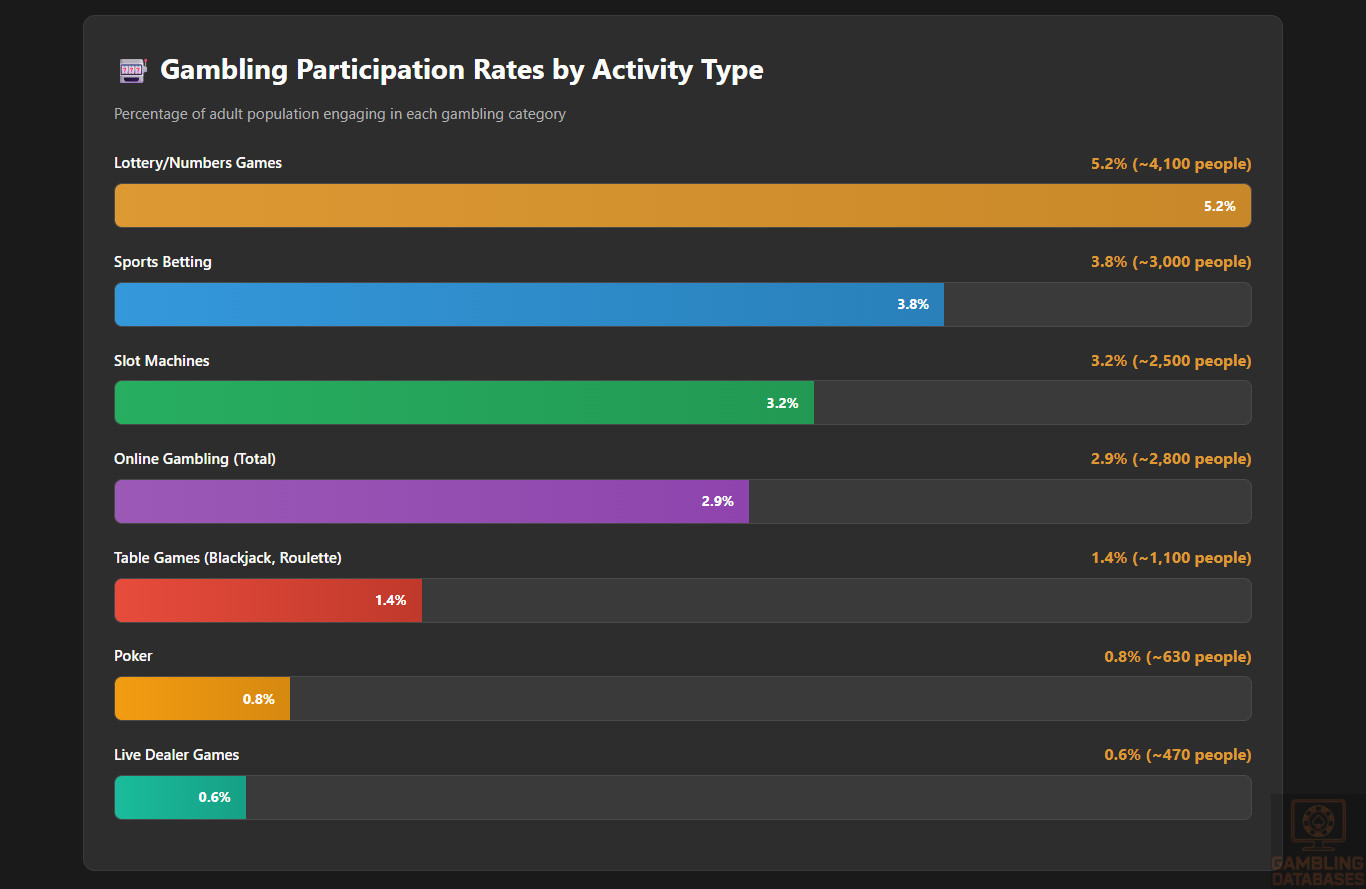
Gambling participation reaches 8.5% of the adult population engaging in at least one gambling activity annually, translating to approximately 6,700 individuals. Online gambling specifically attracts 2.9% of adults (approximately 2,800 individuals) while land-based casino gambling engages 4.8% (3,800 individuals) with some overlap between channels. Lottery participation remains the most widespread at 5.2% of adults purchasing lottery tickets at least occasionally.
Popular gambling activities ranked by participation show lottery products leading at 5.2% penetration, followed by sports betting at 3.8%, slot machines at 3.2%, table games at 1.4%, and poker at 0.8% of adult population. Cricket betting dominates sports wagering accounting for 58% of sports betting volume, followed by football (soccer) at 24%, basketball at 12%, and other sports comprising 6%.
| Activity Type | % of Adult Population | Active Participants | Online vs Land-Based Split | Avg Monthly Spend (USD) |
|---|---|---|---|---|
| Lottery/Numbers Games | 5.2% | ~4,100 | 15% online / 85% retail | $18 |
| Sports Betting | 3.8% | ~3,000 | 45% online / 55% retail | $62 |
| Slot Machines | 3.2% | ~2,500 | 38% online / 62% land-based | $75 |
| Table Games (BJ, Roulette) | 1.4% | ~1,100 | 28% online / 72% land-based | $95 |
| Poker | 0.8% | ~630 | 35% online / 65% casino poker rooms | $110 |
| Live Dealer Games | 0.6% | ~470 | 100% online | $88 |
Live dealer games demonstrate growing popularity among online casino players, with 0.6% of adults engaging in live blackjack, roulette, or baccarat. The format appeals particularly to players aged 35-54 who appreciate the social interaction and perceived fairness of human dealers while maintaining online convenience. Live dealer participation has grown 35% annually over the past three years.
Seasonal patterns show pronounced increases during cricket season (January-April for international matches, May-September for Caribbean Premier League) when sports betting volume increases 40-60% above baseline. December holiday season generates 25-30% uplift in casino gaming as disposable income increases from tourism employment bonuses and festival spending. Summer carnival period (late July-early August) produces moderate 15-20% increases in overall gambling activity.
Consumer Behavior Patterns
Average spending per online gambler reaches USD 950 annually or approximately USD 79 monthly across all active players. However, spending distributions demonstrate high variance, with the top 20% of players accounting for 68% of total revenue. High-value players spending over USD 200 monthly represent approximately 560 individuals (20% of online gamblers) contributing USD 2.18 million annually (68% of total online gambling revenue).
Spending habits and typical bet sizes vary significantly by game type, with slot players averaging USD 0.75-2.50 per spin, sports bettors placing average wagers of USD 15-35 per bet, and table game players betting USD 5-25 per hand. Maximum bet limits rarely constrain recreational players, with less than 5% of players regularly wagering amounts approaching operator-imposed maximums.
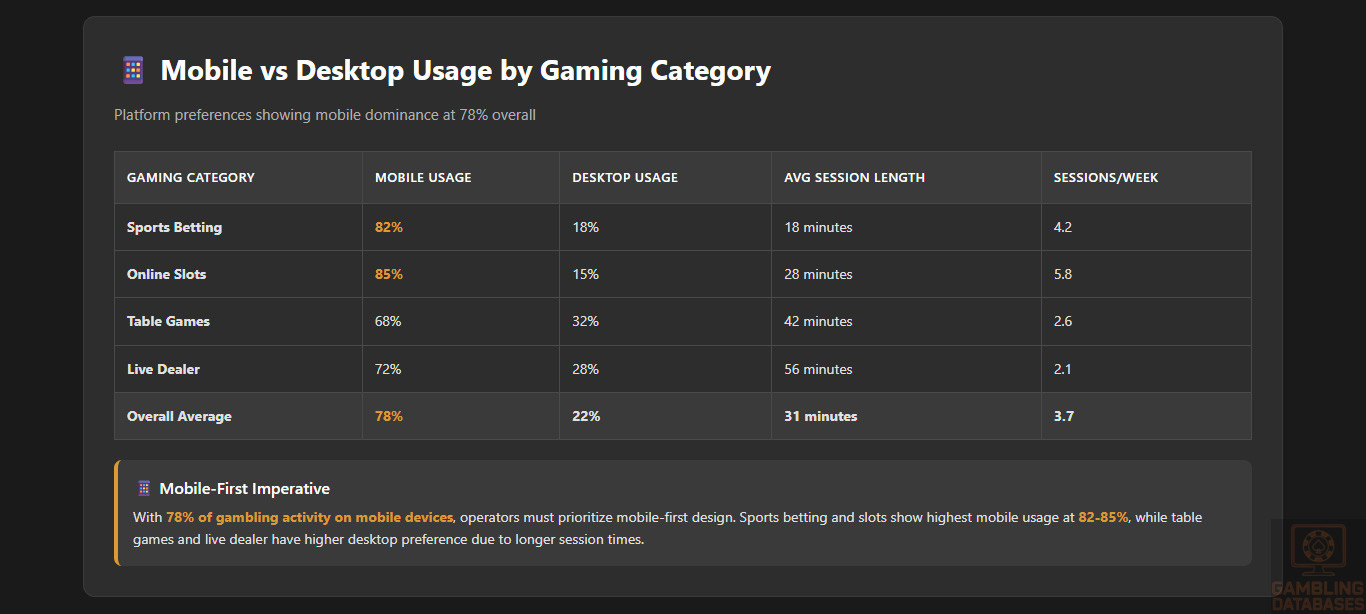
| Metric | Sports Betting | Online Slots | Table Games | Live Dealer |
|---|---|---|---|---|
| Mobile Usage % | 82% | 85% | 68% | 72% |
| Desktop Usage % | 18% | 15% | 32% | 28% |
| Avg Session Length | 18 minutes | 28 minutes | 42 minutes | 56 minutes |
| Sessions per Week | 4.2 | 5.8 | 2.6 | 2.1 |
| Peak Activity Days | Sat-Sun, Wed (cricket) | Fri-Sun evenings | Fri-Sat nights | Weekend evenings |
| Deposit Frequency | 2.8/month | 3.6/month | 2.2/month | 2.4/month |
| Withdrawal Frequency | 1.2/month | 0.8/month | 0.9/month | 0.7/month |
| 90-Day Retention % | 42% | 38% | 48% | 52% |
Platform preferences heavily favor mobile devices, with 78% of all online gambling activity occurring via smartphones compared to 22% on desktop computers. Mobile dominance is most pronounced among sports bettors (82% mobile) and slot players (85% mobile), while table game and live dealer preferences show higher desktop usage at 28-32% reflecting player preferences for larger screens during longer gaming sessions.
Peak gambling times concentrate on Friday through Sunday accounting for 58% of weekly gambling activity, with Thursday showing elevated activity at 14% and Monday-Wednesday combining for 28% of weekly volume. Hourly patterns demonstrate evening peaks between 19:00-23:00 capturing 52% of daily activity, afternoon hours (14:00-18:00) generating 28%, and late night/early morning (23:00-06:00) contributing 15% of volume.
Session length averages vary substantially by product, with sports betting sessions averaging 18 minutes focused on specific match betting, online slots sessions extending to 28 minutes of continuous play, table games averaging 42 minutes, and live dealer sessions reaching 56 minutes reflecting the more immersive, social nature of live dealer experiences. Players typically complete 2-6 sessions weekly depending on product preference and engagement levels.
Retention and loyalty patterns show 90-day retention rates of 38-52% depending on product category, with live dealer games demonstrating highest retention at 52% followed by table games at 48%, sports betting at 42%, and slots at 38%. Annual retention rates decline to 18-25% across categories, indicating significant player churn requiring continuous acquisition efforts.
Bonus sensitivity and promotional response demonstrate high effectiveness, with 68% of new players depositing during welcome bonus offers compared to 32% depositing without promotions. Match deposit bonuses generate average first deposits 45% higher than non-bonus deposits (USD 95 vs USD 65). Free bet promotions for sports betting drive 35% higher bet volumes during promotional periods. However, bonus abuse and low-quality bonus-hunting players represent approximately 15% of bonus claimants, requiring careful terms structuring and fraud detection.
Preferred game types vary significantly by age group, with 18-24 year olds favoring sports betting (62% of gambling activity), 25-34 year olds splitting between sports betting (42%) and slots (38%), 35-44 year olds preferring slots (48%) and table games (28%), and 45+ demographics showing strongest lottery (45%) and traditional casino games (32%) engagement. Younger cohorts demonstrate greater mobile gaming preference and higher session frequency with lower average bet sizes.
Deposit and withdrawal frequency patterns show active players depositing 2.2-3.6 times monthly depending on product engagement, with slots players demonstrating highest deposit frequency due to faster gameplay and bankroll cycling. Withdrawal frequency averages 0.7-1.2 times monthly, significantly lower than deposits, indicating most players maintain persistent gambling balances or experience net losses. Players withdrawing more than twice monthly represent likely advantage players or bonus abusers requiring enhanced monitoring.
Section 3: Technology Infrastructure and Business Environment
Internet and Digital Infrastructure
Connectivity and Network Performance
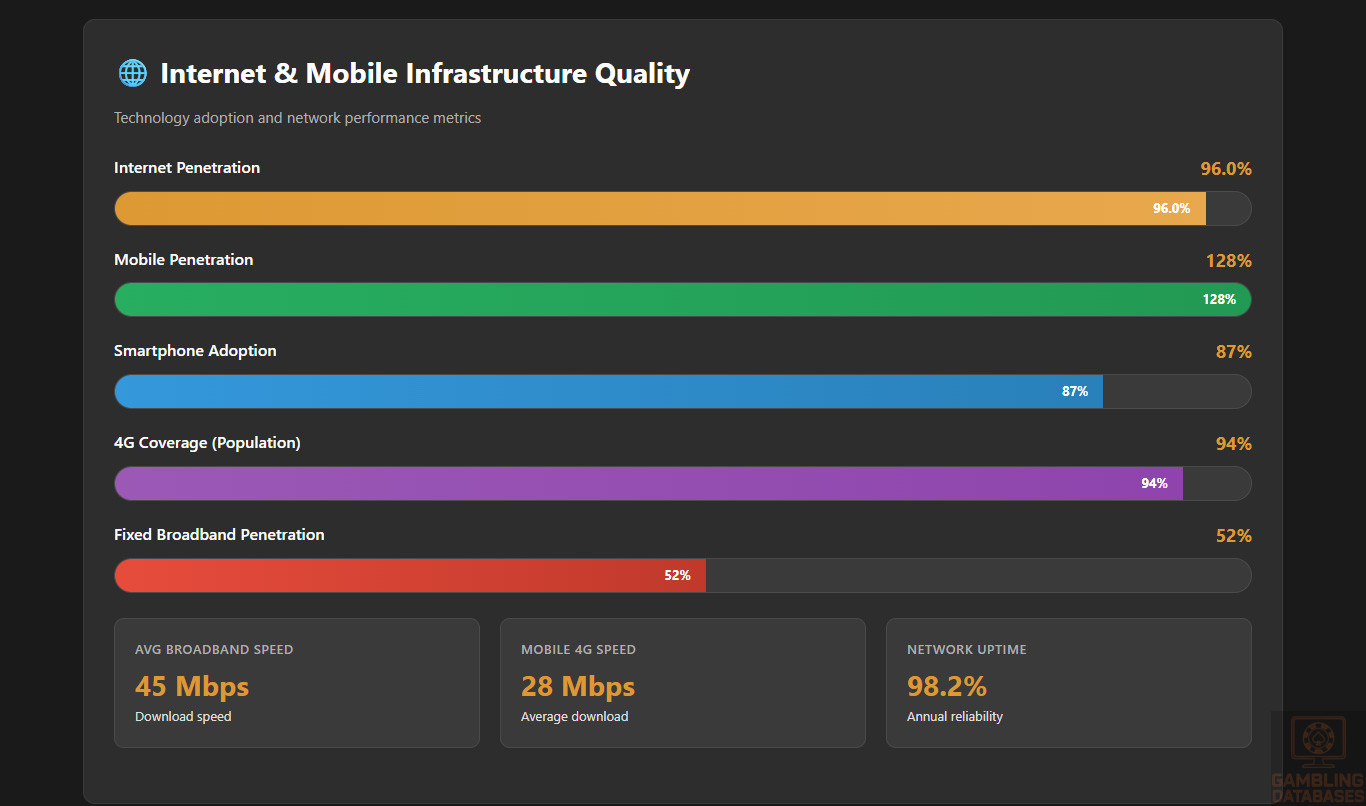
Internet penetration at 96% positions Antigua and Barbuda among the Caribbean’s most connected nations, though infrastructure quality demonstrates variability between urban centers and rural areas. Fixed broadband penetration reaches 52% of households concentrated in St. John’s and major towns, while mobile broadband serves as the primary connectivity method for 44% of internet users, particularly in rural communities lacking fiber or cable infrastructure.
Average internet speeds measure 45 Mbps download and 12 Mbps upload for fixed broadband connections, adequate for streaming video, online gaming, and video conferencing but below global averages of 85 Mbps download. Mobile internet speeds average 28 Mbps download on 4G networks, sufficient for mobile gambling applications, social media, and standard definition video streaming.
| Metric | Value | Regional Comparison | Global Ranking |
|---|---|---|---|
| Fixed Broadband Penetration | 52% of households | Above Caribbean avg (38%) | – |
| Mobile Broadband Penetration | 94% of population | Above Caribbean avg (76%) | – |
| Avg Fixed Broadband Speed | 45 Mbps download | Below Barbados (95 Mbps) | 94th globally |
| Avg Mobile Speed (4G) | 28 Mbps download | Caribbean average | 102nd globally |
| Network Reliability (Uptime) | 98.2% | Good | – |
| Latency (Ping) – Regional Servers | 35-50ms | Acceptable for gaming | – |
| Latency – European Servers | 145-180ms | Moderate delay | – |
Network reliability achieves 98.2% uptime annually, with occasional disruptions during hurricane season (June-November) when severe weather can damage infrastructure causing outages lasting hours to days in affected areas. Major providers maintain backup power systems and redundant connectivity, though restoration times in rural areas can extend to 48-72 hours following major storms.
Infrastructure investment trends show approximately USD 15 million annually in telecommunications infrastructure upgrades by the combined efforts of Digicel, Flow (Cable & Wireless), and Apua Internet Service. Fiber optic expansion projects aim to increase fixed broadband coverage from 52% to 65% of households by 2027, focusing on currently underserved rural communities and outer island Barbuda.
Global internet speed rankings position Antigua 94th globally for fixed broadband and 102nd for mobile speeds, reflecting infrastructure constraints of small island developing states. However, speeds prove adequate for all common internet applications including HD video streaming, online gaming, and cloud services, with buffering or connectivity issues affecting less than 5% of users during normal conditions.
5G and Future Technology Deployment
Current 4G/LTE coverage reaches 94% of the population with service from both Digicel and Flow networks, providing download speeds of 20-35 Mbps and upload speeds of 8-15 Mbps sufficient for mobile gambling applications. Coverage gaps persist in mountainous interior regions of Antigua and portions of Barbuda, affecting approximately 6% of residents who rely on 3G service or satellite internet.
5G rollout commenced in limited form during late 2024 with Digicel launching initial 5G service in St. John’s central business district covering approximately 8% of the population. Expansion plans project 25% population coverage by end of 2025, 45% by 2026, and 70% by 2028 concentrated in urban areas and major tourist zones. Flow’s 5G deployment follows a similar timeline with commercial launch expected Q2 2025.
Future infrastructure plans include submarine fiber optic cable upgrades enhancing international bandwidth capacity, targeted for completion in 2026 with capacity increases from current 40 Gbps to 100 Gbps improving latency to North American and European servers. The upgrade benefits cloud gaming, live dealer gambling products, and high-definition video streaming by reducing latency and increasing reliability.
Network operator landscape comprises three primary providers: Digicel holds approximately 52% mobile market share, Flow captures 44%, and APUA operates the remaining 4% serving primarily government and institutional clients. Fixed broadband competition between Flow’s cable service and APUA’s fiber network maintains competitive pricing averaging XCD 150-250 monthly (USD 56-93) for residential broadband packages offering 40-100 Mbps speeds.
Mobile Technology Ecosystem
Mobile Network Infrastructure
Mobile network operators maintain comprehensive 4G coverage across 94% of Antigua and Barbuda’s territory through Digicel and Flow networks. Digicel commands slightly superior coverage in rural areas with 96% geographic coverage compared to Flow’s 92%, though population coverage remains equivalent at 94% for both operators as uncovered areas are sparsely populated.
| Operator | Market Share | 4G Coverage | 5G Coverage | Avg Data Speed | Monthly Data Cost (5GB) |
|---|---|---|---|---|---|
| Digicel | 52% | 96% geographic / 94% population | 8% (St. John’s only) | 29 Mbps | XCD 65 / USD 24 |
| Flow (C&W) | 44% | 92% geographic / 94% population | Limited testing | 27 Mbps | XCD 70 / USD 26 |
| APUA | 4% | Limited (St. John’s area) | None | 22 Mbps | XCD 55 / USD 20 |
Data costs demonstrate regional competitiveness with 5GB monthly data packages averaging XCD 65 (USD 24) from Digicel and XCD 70 (USD 26) from Flow. Unlimited data plans marketed with throttling after 20-30GB
cost XCD 120-150 monthly (USD 44-56), appealing to heavy data users including mobile gamblers consuming 8-15GB monthly through gambling applications, live streaming, and social media. Prepaid data dominates at 68% of mobile subscriptions compared to 32% postpaid contracts.
Mobile payment integration demonstrates growing sophistication with both major operators offering mobile money services. Digicel’s MobiMoney platform achieves 15% adoption among its subscriber base enabling mobile top-ups, bill payments, and peer-to-peer transfers, though gambling deposit functionality remains limited due to regulatory ambiguity. Flow Money service maintains 8% adoption with similar functionality constraints regarding gambling transactions.
Mobile wallet adoption specifically for financial transactions reaches 24% of adults using mobile money for at least occasional transactions, though gambling operators more commonly integrate traditional payment gateways accepting credit/debit cards rather than local mobile money platforms. International e-wallets like PayPal and Skrill integrated by gambling platforms achieve 18% penetration among online gamblers.
Device Penetration
Smartphone adoption reaches 87% of the population aged 15 and above, representing approximately 68,000 smartphone users across the islands. The 18-44 core demographic demonstrates 94-98% smartphone ownership while adoption declines to 72% among 45-54 age group and 62% among individuals 55 and older who more commonly retain basic feature phones or have no mobile device.
Smartphones per capita average 1.3 devices per smartphone user when accounting for individuals maintaining separate work and personal phones or replacing devices without discarding functional older units used as backup devices. Multiple device ownership concentrates among higher-income professionals and business owners rather than representing broad population behavior.
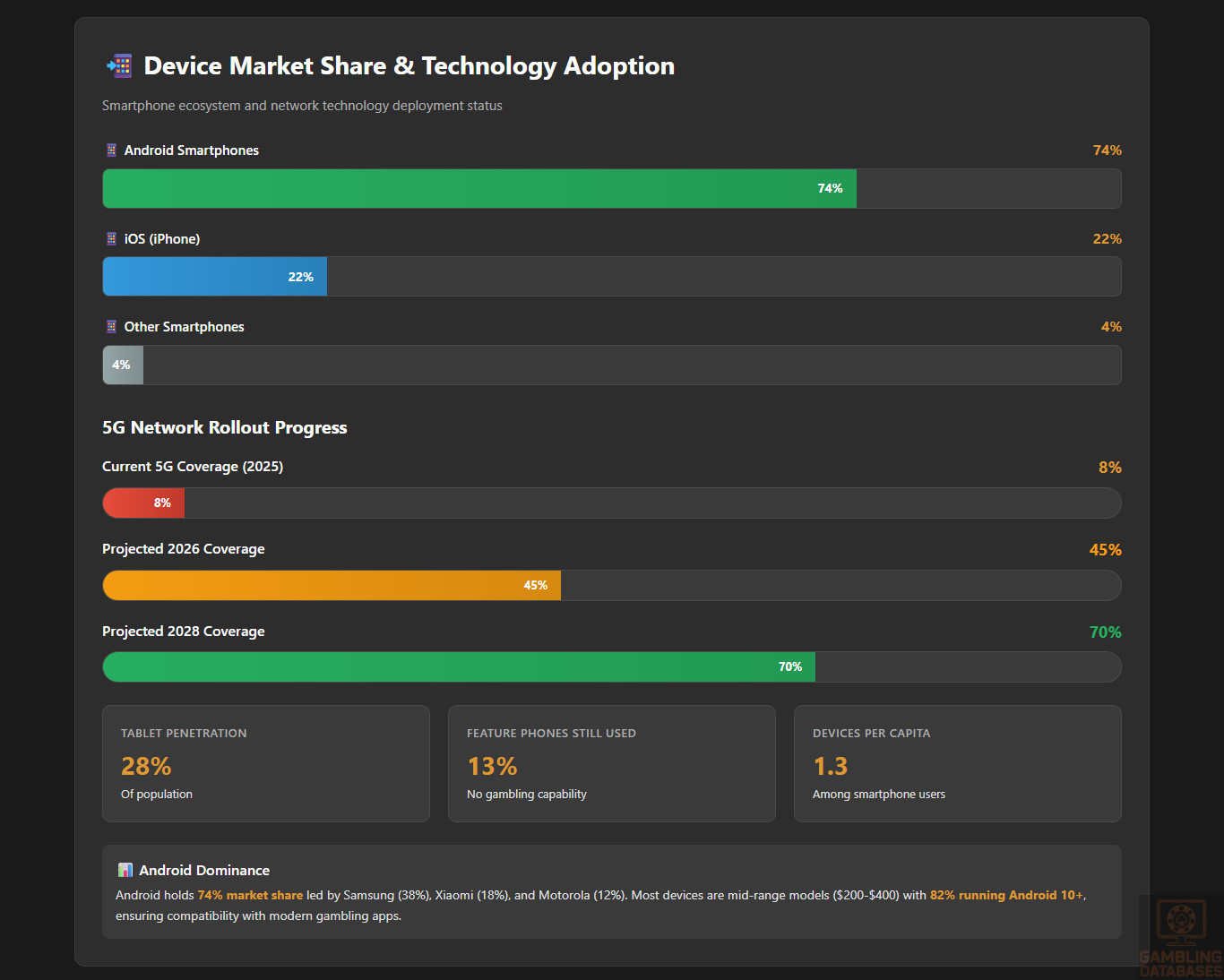
| Device Category | Market Share | Popular Models/Brands | Gambling App Compatibility |
|---|---|---|---|
| Android Smartphones | 74% | Samsung (38%), Xiaomi (18%), Motorola (12%) | Universal compatibility |
| iOS (iPhone) | 22% | iPhone 11-15 series | Universal compatibility |
| Other Smartphones | 4% | Various budget brands | Variable compatibility |
| Tablets | 28% penetration | iPad (45%), Samsung (32%), Amazon Fire (15%) | Good for casino games |
| Feature Phones | 13% still in use | Basic Nokia, other | No gambling capability |
Device preferences show Android dominance at 74% market share led by Samsung (38% of Android users), Xiaomi (18%), and Motorola (12%) offering mid-range devices in the USD 200-400 price range most accessible to average consumers. Apple iPhone captures 22% market share concentrated among higher-income demographics, government employees, and tourism industry professionals earning above-average incomes.
Average device specifications for Android phones in use include 4GB RAM, 64GB storage, and processors adequate for mobile gambling applications without performance constraints. Approximately 82% of Android devices run Android 10 or newer ensuring compatibility with modern gambling applications, while 18% operate Android 9 or older potentially facing compatibility limitations with cutting-edge gaming features.
Mobile internet usage patterns demonstrate 6.8 hours daily average screen time among smartphone users, with 2.4 hours allocated to social media, 1.8 hours to video streaming, 1.2 hours to messaging applications, and 1.4 hours distributed across other activities including gaming, web browsing, and mobile gambling. Active mobile gamblers spend approximately 22 minutes daily on gambling applications during engagement days.
Mobile gaming penetration reaches 68% of smartphone owners playing mobile games at least occasionally, with casual gaming (puzzle games, arcade titles) representing 82% of mobile gaming activity and gambling applications comprising approximately 4% of total mobile gaming time. The established mobile gaming behavior facilitates gambling app adoption by providing familiar download, payment, and gameplay interaction patterns.
Financial Services and Payment Infrastructure
Banking System Structure
The Antigua and Barbuda banking sector comprises eight licensed commercial banks, three credit unions serving 12,000 members, and two development banks focused on small business and agricultural lending. Major commercial banks include Antigua Commercial Bank (ACB) holding 28% market share, Bank of Antigua (BOA) with 24%, Royal Bank of Canada (RBC) at 18%, and FirstCaribbean International Bank at 16% market share.
Digital banking adoption reaches 54% of banked population maintaining active internet banking credentials, though only 32% use online banking weekly or more frequently for routine transactions. Mobile banking applications achieve 41% adoption among account holders, with younger demographics (18-34) demonstrating 68% mobile banking usage compared to 22% among individuals 55 and older.
| Metric | Value | Notes |
|---|---|---|
| Banked Population | 82% of adults | Approximately 64,700 account holders |
| Number of Bank Branches | 24 branches | Concentrated in St. John’s and major towns |
| ATM Density | 42 ATMs per 100,000 adults | 33 total ATMs nationwide |
| Credit Card Penetration | 38% of adults | Approximately 30,000 credit cards in circulation |
| Debit Card Penetration | 68% of adults | 53,600 active debit cardholders |
| Online Banking Active Users | 54% of account holders | 35,000 users |
| Mobile Banking Adoption | 41% of account holders | 26,500 users |
| Average Account Balance | XCD 8,450 (USD 3,130) | Median: XCD 4,200 (USD 1,556) |
Account penetration at 82% of adults leaves approximately 14,200 unbanked individuals concentrated among lower-income households, elderly populations preferring cash transactions, and undocumented migrant workers. Credit union membership provides alternative financial services for 15% of adults, particularly middle and lower-middle income households attracted by favorable loan terms and community orientation.
Credit and lending markets demonstrate moderate maturity with total consumer credit outstanding of approximately XCD 680 million (USD 252 million) or 36% of GDP. Personal loan products, auto financing, and credit cards represent primary consumer lending categories, while mortgage lending reaches 28% of homeowners. Interest rates range from 8-12% for secured lending to 18-24% for unsecured personal loans and credit cards.
ATM density of 42 machines per 100,000 adults (33 total ATMs) concentrates in St. John’s hosting 58% of machines, with remaining units distributed across major towns and tourist resort areas. ATM availability proves adequate for cash withdrawal needs, though rural residents may travel 15-30 minutes to access ATMs. Daily withdrawal limits typically cap at XCD 1,500-2,500 (USD 556-926) depending on bank and account type.
Payment Processing Options
Available payment methods for iGaming include credit cards (Visa, Mastercard), debit cards, bank transfers via online banking or wire transfer, international e-wallets (Skrill, Neteller where available), and cryptocurrency for operators supporting digital assets. American Express maintains limited acceptance primarily at premium establishments, with only 40% of online gambling operators accepting Amex due to higher processing fees.
Credit and debit card penetration combined reaches 76% of adults (68% debit, 38% credit with overlap), though not all cardholders use cards for online gambling due to either non-participation in gambling or preference for alternative payment methods. Approximately 2,200 individuals (78% of online gamblers) use cards as their primary gambling deposit method.
| Payment Method | Processor Options | Typical Fees | Settlement Time | Chargeback Risk |
|---|---|---|---|---|
| Visa/Mastercard | Multiple PSPs available | 3.5-5.5% + $0.25/txn | T+2 to T+5 | Moderate (1-2%) |
| Bank Transfer (Local) | Direct bank integration | XCD 5-15 per transfer | 1-3 business days | Very low (0.1%) |
| Wire Transfer (Intl) | SWIFT network | $25-45 per transfer | 3-5 business days | Very low (0.05%) |
| Skrill | Direct Skrill integration | 2.9% + currency conversion | Instant deposit / 24-48hr withdrawal | Low (0.3%) |
| Neteller | Direct Neteller integration | 3.0% + currency conversion | Instant deposit / 24-48hr withdrawal | Low (0.3%) |
| Cryptocurrency | Various crypto processors | 0.5-1.5% | 15-60 min confirmation | None (irreversible) |
E-wallet options demonstrate limited local adoption with Skrill and Neteller achieving only 4-6% usage among Antiguan online gamblers, substantially lower than European markets where e-wallets dominate. Geographic restrictions on PayPal gambling transactions effectively eliminate PayPal as a viable option despite its 18% general e-commerce adoption. Local e-wallet alternatives remain underdeveloped for gambling purposes.
Bank transfer systems include domestic ACH-equivalent transfers processed through the Eastern Caribbean Central Bank clearing system requiring 1-3 business days, and international SWIFT wire transfers processing in 3-5 business days with fees of USD 25-45 per transfer. Instant bank transfer solutions like Trustly or iDEAL common in European markets lack availability in Antigua, limiting real-time bank-to-gambling account transfers.
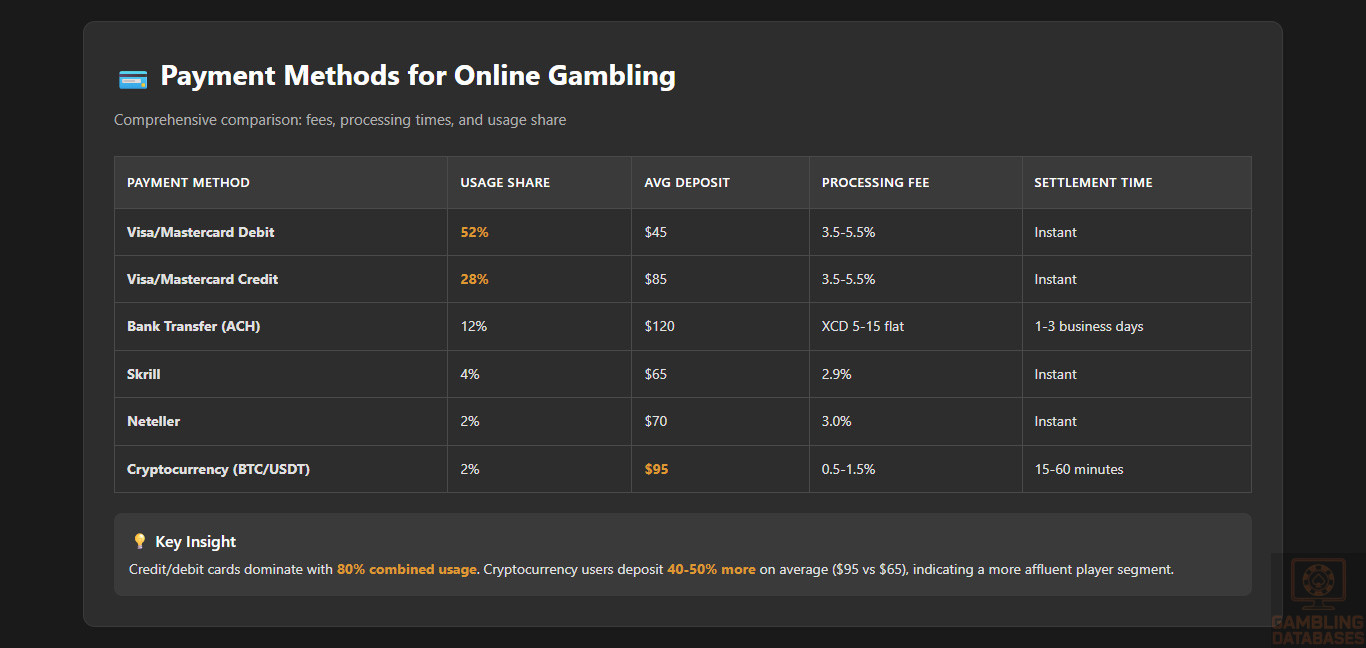
Cryptocurrency acceptance remains limited to progressive operators willing to navigate regulatory ambiguity, with approximately 15% of licensed operators accepting Bitcoin, Ethereum, or USDT. Processing fees of 0.5-1.5% significantly undercut card processing costs, though volatility concerns and limited player adoption restrict crypto to approximately 2% of transaction volume. Crypto deposits average USD 95 compared to USD 65 for card deposits, indicating more affluent user profiles.
Processing fees vary significantly by method, with card processing imposing the highest costs at 3.5-5.5% plus per-transaction fees, e-wallets charging 2.9-3.0% plus currency conversion spreads, cryptocurrency fees remaining lowest at 0.5-1.5%, and bank transfers incurring flat fees of XCD 5-15 domestically or USD 25-45 internationally making them cost-effective only for larger transactions.
Transaction processing timelines demonstrate instant deposits for cards, e-wallets, and cryptocurrency (after blockchain confirmation), while withdrawals require 24-48 hours for e-wallets, 3-5 business days for cards (due to fraud review), and 3-7 business days for bank transfers. Player expectations align with industry standards, though faster withdrawal processing provides competitive advantage for operators able to expedite payouts.
International payment capabilities prove essential given the jurisdiction’s focus on offshore licensing for international markets. Major payment service providers with Caribbean presence include ECommPay, Praxis, and PaymentIQ offering multi-currency processing, fraud prevention, and compliance tools. Local acquiring banks rarely process gambling transactions directly, necessitating international merchant accounts for most operators.
Regulatory restrictions on gambling payments remain minimal for licensed operators, with banks generally willing to process gambling-related transactions for properly licensed entities. However, some international card networks impose additional scrutiny on Caribbean gambling merchants due to historical fraud concerns, potentially increasing merchant account setup difficulty and reserve requirements to 5-15% of monthly processing volume.
Chargebacks and dispute resolution present moderate risk, with gambling transactions experiencing 1-2% chargeback rates when all payment methods are combined. Card transactions demonstrate highest chargeback risk at 1.5-2.5%, primarily driven by friendly fraud where players dispute legitimate charges, while e-wallets maintain lower rates of 0.3-0.5%. Effective dispute management requires maintaining comprehensive transaction documentation, player communication records, and KYC verification evidence.
E-commerce and Digital Economy
Digital Market Development
E-commerce market size reaches approximately USD 28 million annually representing 1.5% of total retail spending, indicating early-stage digital commerce adoption compared to developed markets where e-commerce captures 15-25% of retail. Annual growth of 22% over the past three years demonstrates accelerating adoption driven by improved payment infrastructure, increased digital literacy, and pandemic-related behavioral changes.
Online retail penetration at 1.5% of total retail significantly lags regional leaders like Jamaica (4.2%) and Trinidad and Tobago (3.8%), reflecting combination of small market size limiting local e-commerce platform development, preference for physical shopping experiences, and concerns regarding online payment security. However, 58% of internet users make at least one annual online purchase, indicating acceptance of digital transactions even if frequency remains low.
Digital service adoption encompasses streaming entertainment (Netflix 32% penetration, Spotify 18%), online education platforms (12% of students), telemedicine consultations (8% of population utilized during pandemic, declining to 4% currently), and digital banking services (54% adoption). Subscription-based digital services demonstrate highest success rates, habituating consumers to recurring digital payments that parallel gambling deposit behavior.
| Metric | Value | Year-over-Year Change |
|---|---|---|
| Annual E-commerce Spending | USD 28 million | +22% |
| Per Capita E-commerce Spending | USD 285 annually | +21% |
| % Population Making Online Purchases | 58% | +8 percentage points |
| Average Order Value | USD 72 | +5% |
| Purchase Frequency (Annual) | 4.2 transactions | +15% |
| Mobile Commerce Share | 64% of e-commerce | +12 percentage points |
| Cross-border Shopping % | 82% of online purchases | Stable |
Consumer trust in online transactions measured through surveys indicates 72% confidence in digital payments for goods and services, while 28% express concerns regarding fraud, data security, or merchant reliability. Trust varies significantly by merchant category, with international brands like Amazon earning 85% trust ratings compared to local e-commerce platforms achieving only 58% consumer confidence due to limited track records and fewer consumer protection mechanisms.
Popular e-commerce platforms demonstrate Amazon dominance at 48% of cross-border online shopping, followed by eBay (12%), Shein fashion retailer (8%), and various smaller international retailers. Local e-commerce platforms remain limited, with few Antiguan retailers offering functional online shopping beyond social media-based ordering and payment arrangements. Caribbean regional platforms like Pricemart online shopping achieve 6% penetration.
Cross-border online shopping behavior characterizes 82% of e-commerce transactions, with consumers purchasing from international retailers shipping to Antigua or utilizing package forwarding services from Miami. Shipping costs of USD 15-35 per package and delivery timelines of 10-21 days create friction, though access to international product selection justifies costs for motivated consumers. Popular categories include electronics, fashion, books, and specialty goods unavailable locally.
Digital goods and services consumption including streaming subscriptions, mobile applications, digital games, and online courses reaches approximately USD 8.5 million annually or 30% of total e-commerce spending. Digital goods eliminate shipping costs and delays, facilitating higher adoption rates with 68% of internet users maintaining at least one paid digital subscription service.
Business Environment and Regulatory Framework
Ease of Business Operations
World Bank Doing Business ranking positions Antigua and Barbuda 102nd among 190 countries for overall ease of doing business, reflecting moderate regulatory efficiency with room for improvement. Specific component rankings include 112th for starting a business, 89th for dealing with construction permits, 95th for getting electricity, 118th for registering property, and 68th for enforcing contracts.
Ease of Starting a Business ranks 112th globally, requiring 8 procedural steps consuming approximately 21 business days from initial registration to operational readiness. The process includes business name reservation, articles of incorporation filing, tax registration, social security registration, and business license acquisition. Improvements implemented during 2022-2023 reduced timeline from previous 28 days, though further streamlining remains possible.
| Step | Procedure | Timeline | Cost (USD) |
|---|---|---|---|
| 1 | Business name search and reservation | 1-2 days | $25 |
| 2 | Prepare articles of incorporation/organization | 2-3 days | $300-500 (legal fees) |
| 3 | Submit incorporation documents to Registry | 5-7 days processing | $200 filing fee |
| 4 | Obtain Certificate of Incorporation | Included in step 3 | – |
| 5 | Register for tax identification number | 3-5 days | No fee |
| 6 | Social security registration (if employing staff) | 2-3 days | No fee |
| 7 | Apply for trade/business license | 5-7 days | $150 annually |
| 8 | Open corporate bank account | 3-5 days | $100-200 (account fees) |
| Total | Complete business registration process | 21-32 days | $775-1,075 + legal fees |
Foreign investment policies maintain generally welcoming stance toward international capital, permitting 100% foreign ownership across most sectors including gambling operations. No mandatory local ownership requirements or forced technology transfer obligations exist for gaming operations. Foreign investors receive national treatment equivalent to domestic investors, with streamlined processes for significant investments exceeding USD 500,000 creating local employment.
Operational cost structures vary significantly between basic office operations and full-scale gaming businesses. Prime office space in St. John’s commands XCD 18-30 per square foot monthly (USD 6.67-11.11/sq ft), while secondary locations cost XCD 12-18 per square foot. Typical office setup for 5-10 employees requires 800-1,200 square feet costing XCD 14,400-36,000 monthly (USD 5,333-13,333).
Salary expectations vary by position and experience level, with junior positions (customer service, data entry) commanding XCD 2,400-3,200 monthly (USD 889-1,185), mid-level professionals (marketing specialists, compliance officers) earning XCD 4,500-6,500 monthly (USD 1,667-2,407), and senior management (operations director, head of compliance) receiving XCD 8,000-12,000 monthly (USD 2,963-4,444). IT professionals and specialized gaming roles often command 15-25% premiums above general market rates.
Utility costs average XCD 450-800 monthly (USD 167-296) for small office spaces including electricity at XCD 0.42 per kWh, water/sewage at XCD 80-120 monthly, and internet connectivity at XCD 180-280 monthly for business-grade broadband. Air conditioning represents the largest electricity consumer, with monthly costs varying seasonally between XCD 200-400 depending on office size and cooling requirements.
Labor market conditions demonstrate adequate talent availability for general business functions, customer service, and basic compliance roles, though specialized gaming industry expertise remains limited domestically. Most operators recruit gaming-specific talent internationally or provide extensive training to local hires. The education system produces graduates with strong English language skills and basic digital literacy, creating trainable entry-level workforce but necessitating investment in specialized skill development.
Corporate Structure and Registration
Available Entity Types
Available corporate entity types include International Business Corporation (IBC) designed specifically for offshore operations serving international markets, Limited Liability Company offering flexible ownership and management structures, Corporation for traditional share-based entities, and Branch Office for foreign companies establishing local presence. Each structure offers distinct advantages regarding liability protection, taxation, reporting requirements, and operational flexibility.
Recommended structure for iGaming operators typically involves International Business Corporation when primarily serving international markets, providing maximum tax efficiency with zero corporate income tax, minimal reporting requirements, and streamlined compliance obligations. IBC structures suit operators obtaining Antiguan licensing primarily for regulatory legitimacy while targeting players in other jurisdictions. Domestic LLC formation proves preferable for operators focused on the local Antiguan market or requiring physical presence for operational reasons.
| Entity Type | Tax Rate | Annual Compliance | Min. Capital | Best Use Case |
|---|---|---|---|---|
| International Business Corporation (IBC) | 0% (offshore operations) | Minimal – annual return only | None required | Offshore operators serving international markets |
| Limited Liability Company (LLC) | 0-25% depending on operations | Moderate – annual returns, audits | $10,000 recommended | Local market focus or hybrid operations |
| Corporation | 25% standard rate | Full – audited statements required | $25,000 minimum | Large-scale local operations, public companies |
| Branch Office | 25% on local income | Full reporting to parent and local authorities | Parent company guarantees | Existing foreign operators expanding locally |
Differences between entity types center on liability protection (all provide limited liability except sole proprietorships), taxation with IBCs enjoying complete exemption from corporate tax while domestic entities face 25% rates, reporting requirements ranging from minimal IBC annual returns to comprehensive audited financial statements for corporations, and operational flexibility with LLCs offering greatest management structure adaptability.
Registration Requirements
Registration timelines span 21-32 business days from initial application to fully operational status including corporate registration, tax identification, business licensing, and bank account opening. IBC formation specifically requires only 7-10 business days for regulatory approval once documentation is complete, representing the most efficient entity formation process. Domestic LLC and Corporation registrations require 14-21 days for registry processing following document submission.
Registration costs for IBC formation total approximately USD 1,200-1,800 including government fees of USD 300, registered agent fees of USD 500-800 annually, and legal preparation fees of USD 400-700. Domestic LLC formation costs USD 1,500-2,500 comprising government filing fees of USD 200, legal document preparation of USD 800-1,500, and initial business license of USD 150. Corporation formation reaches USD 3,000-4,500 due to more complex documentation requirements and higher minimum capital expectations.
| Cost Component | IBC | LLC | Corporation |
|---|---|---|---|
| Government Filing Fees | $300 | $200 | $350 |
| Legal Document Preparation | $400-700 | $800-1,500 | $1,500-2,500 |
| Registered Agent (Annual) | $500-800 | $400-600 | $600-900 |
| Initial Business License | Not required | $150 | $150 |
| Notarization and Authentication | $100-200 | $100-150 | $150-200 |
| Total Initial Cost | $1,300-2,000 | $1,650-2,600 | $2,750-4,100 |
| Formation Timeline | 7-10 days | 14-21 days | 21-28 days |
Required documents include articles of incorporation or organization detailing company name, registered office address, share capital structure or member details, business purpose, and officer/director information. Notarization requirements apply to certain documents particularly when incorporating evidence from foreign jurisdictions, with apostille authentication necessary for documents originating from Hague Convention countries. Copies of passports, proof of address, and bank reference letters are required for all beneficial owners and directors.
Foreign ownership rules permit 100% international ownership for IBC structures with zero local ownership requirements, while domestic entities face no mandatory local ownership but benefit from local partnership for banking relationships and operational facilitation. Nominee director services available through local law firms enable foreign operators to satisfy any informal preferences for local representation on corporate boards.
Minimum capital requirements vary by entity type, with IBCs having no statutory minimum though gambling license applications require demonstrating USD 100,000 available capital, LLCs recommending USD 10,000 minimum capital though not strictly enforced, and Corporations requiring USD 25,000 minimum paid-in capital. Gambling operators should maintain significantly higher working capital of USD 250,000-500,000 to ensure operational sustainability and regulatory comfort.
Ongoing compliance requirements for IBCs include filing annual returns declaring directors and registered office by March 31 each year, maintaining registered agent services throughout the entity’s existence, and preserving corporate records though audited financial statements are not required for offshore operations. LLCs and Corporations face more substantial obligations including annual financial statement filing, tax return submission, audit requirements for entities exceeding revenue thresholds, and business license renewals.
Corporate governance requirements mandate maintaining minimum one director for IBCs, two directors for LLCs and Corporations, with no residency requirements though registered agent must be Antigua-based. Annual general meetings are not required for IBCs or LLCs unless specified in organizational documents, while Corporations must hold annual shareholder meetings. Meeting minutes, resolutions, and corporate records must be maintained for seven years.
Taxation Framework
Corporate Income Tax Structure
Standard corporate tax rates reach 25% on net profits for domestic companies and foreign entities maintaining substantial local operations or primarily serving the Antiguan market. However, International Business Corporations licensed under offshore legislation benefit from complete corporate income tax exemption at 0% provided they conduct business exclusively with non-residents, creating substantial tax advantages for gambling operators serving international markets.
Special economic zone benefits beyond the IBC regime remain limited, though the government occasionally negotiates customized incentive packages for large-scale investments creating significant local employment. Economic citizenship program investors who establish businesses may receive favorable tax treatment on a case-by-case basis, though gambling operations rarely qualify for additional incentives beyond standard IBC benefits.
Tax holidays for new businesses do not exist under standard legislation, with entities becoming liable for corporate income tax immediately upon profitable operations. The absence of loss carryforward provisions for IBCs matters little given zero tax rates, while domestic corporations can carry forward losses for five years to offset future taxable income.
| Tax Category | IBC (Offshore) | Domestic Entity | Notes |
|---|---|---|---|
| Corporate Income Tax | 0% | 25% | On net profits |
| Gaming Revenue Tax | 0% | 0% | No GGR-based taxation |
| Dividend Withholding | 0% | 0% | No withholding on distributions |
| Interest Withholding | 0% | 0% | No withholding on interest payments |
| Royalty Withholding | 0% | 0% | No withholding on royalties |
| Capital Gains Tax | 0% | 0% | No CGT in Antigua |
| VAT/Sales Tax | 0% | 0% | No VAT on gambling services |
| Property Tax (if owning) | 0.2-0.3% of assessed value | 0.2-0.3% of assessed value | Annual real estate tax |
International tax treaties exist with several jurisdictions including the United Kingdom, CARICOM member states, and various Commonwealth nations, though treaty benefits rarely impact gambling operations due to the unique nature of gaming revenues and licensing structures. Most operators structure operations to benefit from zero-tax IBC regime rather than relying on treaty provisions.
Transfer pricing rules apply to domestic entities conducting transactions with related foreign parties, requiring arm’s length pricing for intercompany services, royalties, and management fees. Documentation requirements mandate maintaining contemporaneous transfer pricing documentation for transactions exceeding USD 100,000 annually. IBCs conducting exclusively offshore business face minimal transfer pricing scrutiny.
Withholding tax on dividends, interest, and royalties stands at 0% for both offshore and domestic entities, eliminating tax leakage when repatriating profits to shareholders or paying for technology licensing and financing. This represents significant advantage compared to jurisdictions imposing 15-30% withholding taxes on profit distributions and intellectual property payments.
VAT or goods and services tax does not apply to gambling services in Antigua and Barbuda, with no plans announced to introduce gambling-specific consumption taxes. This contrasts with jurisdictions like European Union members where gambling services face varying VAT treatment, often exempt but subject to gaming duties. The absence of VAT simplifies compliance and avoids administrative burdens of calculating, collecting, and remitting consumption taxes.
Personal Income Tax
Individual tax rates follow progressive bracket structure ranging from 0% on the first XCD 36,000 (USD 13,333) annual income, 8% on income between XCD 36,001-60,000 (USD 13,334-22,222), 15% on income between XCD 60,001-84,000 (USD 22,223-31,111), and 25% on income exceeding XCD 84,000 (USD 31,111) annually. The relatively high initial exemption threshold reduces tax burden on lower and middle-income earners.
Withholding requirements mandate employers deduct income tax from employee salaries through Pay As You Earn (PAYE) system, remitting withheld amounts to tax authorities monthly by the 15th day following the month of payment. Annual tax reconciliation occurs through employee tax returns due by March 31, with refunds issued for over-withholding or additional payments required for underpayment.
| Annual Income Bracket (XCD) | Annual Income (USD) | Tax Rate | Effective Tax on Bracket |
|---|---|---|---|
| 0 – 36,000 | $0 – $13,333 | 0% | $0 |
| 36,001 – 60,000 | $13,334 – $22,222 | 8% | $712 maximum |
| 60,001 – 84,000 | $22,223 – $31,111 | 15% | $1,333 maximum |
| 84,001+ | $31,112+ | 25% | Variable above |
Social security contributions require employer contributions of 5% of gross salary and employee contributions of 3% of gross salary, capped at maximum monthly earnings of XCD 5,000 (USD 1,852). Combined social security costs add 8% to employment expenses, with employers bearing the larger share. Self-employed individuals contribute 10% of declared income to social security system.
Tax residency rules define tax residents as individuals spending more than 183 days in Antigua and Barbuda during a calendar year or maintaining permanent home in the jurisdiction while having no closer connection to another country. Non-residents face taxation only on Antigua-source income, enabling foreign employees of gambling operators to potentially avoid local taxation by maintaining residence elsewhere while working remotely.
Taxation of foreign employees working for Antiguan gambling operators depends on residency status and work location. Remote workers based outside Antigua owe no Antiguan income tax regardless of employer location. Foreign workers relocated to Antigua become tax residents after 183 days, facing progressive income taxation on their Antigua employment income. Work permit requirements apply separately from tax obligations.
Market Entry Considerations
Recommended Entry Strategies
Optimal market entry approaches for iGaming operators vary based on target market focus, available capital, and strategic objectives. For operators seeking Antiguan licensing primarily for regulatory credibility while serving international markets, establishing an IBC structure with minimal local operations represents the most cost-effective approach, leveraging zero taxation and streamlined compliance while maintaining reputable jurisdiction licensing.
Local partnership requirements do not exist legally, though voluntary partnerships with Antiguan consultants, legal advisors, or business services providers facilitate navigation of regulatory processes, banking relationships, and cultural nuances. Payment processing partnerships with local or regional banks prove essential for accepting deposits and processing withdrawals efficiently.
White label versus proprietary platform considerations weigh implementation speed, control, and cost factors. White label solutions enable market entry within 8-12 weeks with capital requirements of USD 50,000-150,000 for initial setup plus revenue sharing of 20-40% of net gaming revenue. Proprietary platforms require 6-9 months development, USD 250,000-800,000 initial investment, but provide complete control, zero revenue sharing, and long-term cost advantages.
| Strategy | Timeline | Initial Investment | Pros | Cons |
|---|---|---|---|---|
| IBC + White Label | 3-4 months | $125,000-225,000 | Fast market entry, lower initial cost, proven platform | Revenue sharing, limited differentiation, platform dependency |
| IBC + Proprietary Platform | 9-12 months | $400,000-950,000 | Full control, no revenue sharing, maximum flexibility | Higher cost, longer timeline, technical risk |
| Local LLC + Hybrid | 6-8 months | $250,000-500,000 | Local market credibility, flexible operations | 25% corporate tax, higher compliance burden |
| Partnership/Acquisition | 6-18 months | $500,000-5,000,000+ | Instant market presence, existing player base | High cost, integration challenges, legacy issues |
Technology infrastructure leveraging strategies should prioritize cloud-based hosting with Caribbean or North American server locations minimizing latency for regional players, content delivery network integration for fast game loading, and redundant backup systems ensuring 99.9%+ uptime. Mobile-first platform design proves essential given 78% mobile usage patterns.
Marketing and localization requirements include cricket-focused sports betting markets and promotions, Caribbean cultural references and imagery, English language content with local terminology, Eastern Caribbean Dollar pricing display alongside USD, and social media marketing emphasizing Facebook and Instagram over other platforms. Sponsoring local sports teams or events builds brand recognition though advertising restrictions remain minimal.
Payment provider selection criteria emphasize Caribbean market experience, support for XCD and USD currencies, fraud prevention tools, competitive fee structures below 4% for card processing, and reliable customer service. Recommended providers include ECommPay, Praxis, PaymentIQ, and regional specialists with established Caribbean presence.
Risk mitigation strategies include maintaining regulatory compliance documentation, implementing robust KYC/AML procedures exceeding minimum requirements, securing comprehensive cyber insurance covering data breaches and platform failures, establishing player fund segregation in reputable banks, and maintaining 6-12 months operating capital reserves. Legal counsel retainer relationships with Antiguan gaming law specialists prove invaluable for navigating regulatory inquiries.
Typical Costs and Timelines
Initial setup investments for entering the Antigua and Barbuda iGaming market vary substantially based on operational scale and platform approach. Minimum viable market entry requires approximately USD 200,000-300,000 covering licensing, platform setup, initial marketing, and working capital. More robust launches with proprietary platforms and aggressive marketing approach USD 600,000-1,200,000 total initial investment.
| Cost Category | White Label Approach | Proprietary Platform Approach |
|---|---|---|
| Gambling License Application & Fees | $75,000 | $75,000 |
| Legal & Consulting Fees | $25,000-40,000 | $40,000-65,000 |
| Company Registration (IBC) | $1,500-2,000 | $1,500-2,000 |
| Initial Capital/Bank Guarantee | $100,000 | $100,000 |
| Platform Setup/Development | $50,000-100,000 (white label) | $350,000-650,000 (proprietary) |
| Game Content Licenses | Included in white label | $80,000-150,000 |
| Payment Gateway Integration | $15,000-25,000 | $25,000-40,000 |
| Website Design & Development | $20,000-35,000 | $40,000-75,000 |
| Compliance & Security Systems | $15,000-25,000 | $30,000-50,000 |
| Initial Marketing Budget (6 months) | $60,000-100,000 | $100,000-180,000 |
| Office Setup (if required) | $10,000-20,000 | $25,000-45,000 |
| Working Capital Reserve | $50,000-80,000 | $80,000-120,000 |
| TOTAL INITIAL INVESTMENT | $421,500-602,000 | $946,500-1,552,000 |
Operational cost estimates for ongoing monthly expenses range from USD 45,000-75,000 for white label operations to USD 95,000-165,000 for proprietary platform operators, varying based on scale, employee count, and marketing intensity. Annual operational costs excluding major marketing campaigns total approximately USD 540,000-900,000 for white label and USD 1,140,000-1,980,000 for proprietary operations.
Staff salaries represent significant ongoing expense, with minimum staffing of 8-12 employees for basic operations including customer service representatives (3-4 staff at XCD 2,800 monthly each), compliance officer (XCD 5,500 monthly), marketing manager (XCD 6,000 monthly), operations manager (XCD 7,500 monthly), finance/accounting (XCD 4,500 monthly), and IT support (XCD 5,000 monthly). Total monthly payroll ranges XCD 38,000-52,000 (USD 14,074-19,259).
Office rent and utilities for appropriate workspace total XCD 4,500-7,500 monthly (USD 1,667-2,778) including rent at XCD 3,000-5,000, electricity at XCD 600-1,200, internet at XCD 300-500, and incidentals. Remote operation eliminates these costs but may raise questions during regulatory reviews about operational substance.
Technology maintenance costs include platform hosting at USD 2,000-5,000 monthly depending on traffic, content delivery network at USD 800-1,500 monthly, security and monitoring tools at USD 1,000-2,000 monthly, and game provider fees typically structured as revenue share of 8-15% of gaming revenue rather than fixed monthly costs.
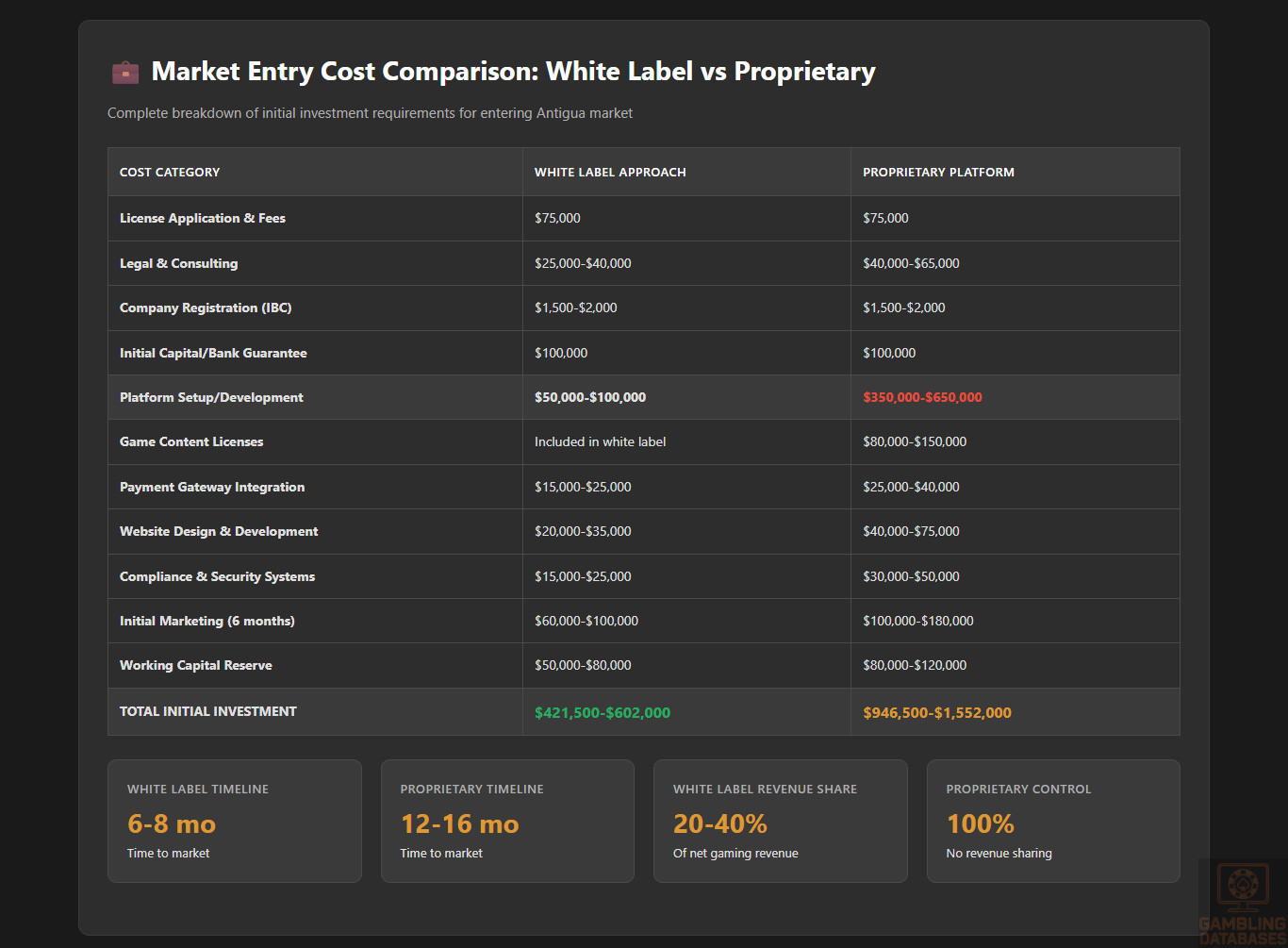
Payment processing fees consume 3.5-5% of deposit volume, translating to USD 3,500-5,000 monthly for operations processing USD 100,000 monthly deposits. Chargeback fees add USD 500-1,500 monthly depending on dispute rates. Banking fees for maintaining segregated player accounts cost USD 200-400 monthly.
Marketing and customer acquisition costs vary dramatically based on strategy and competitive intensity. Organic marketing maintaining brand presence requires minimum USD 8,000-12,000 monthly covering social media management, content creation, SEO, and community engagement. Aggressive growth campaigns incorporating paid advertising, affiliate commissions, and bonus costs reach USD 30,000-60,000 monthly or more.
Timeline expectations for market entry span company registration requiring 3-4 weeks, license application processing consuming 3-6 months, platform setup taking 2-3 months for white label or 6-9 months for proprietary development, and pre-launch marketing requiring 4-6 weeks. Total time to market ranges 6-8 months for white label operations to 12-16 months for proprietary platforms from initial decision through launch.
Resource requirements include minimum staff headcount of 8-12 employees for basic operations scaling to 20-30 for mature operations with substantial customer bases. Key positions include licensed compliance officer (mandatory), customer service team (minimum 2-3 staff), marketing specialist, finance/accounting professional, and technical support staff. Remote staffing for non-regulatory roles reduces costs while maintaining capability.
Technology stack requirements encompass gaming platform (white label or proprietary), payment gateway supporting Caribbean methods, KYC/AML verification systems, customer relationship management software, affiliate tracking platform, responsible gambling tools, and cybersecurity infrastructure including DDoS protection, SSL certificates, and intrusion detection systems.
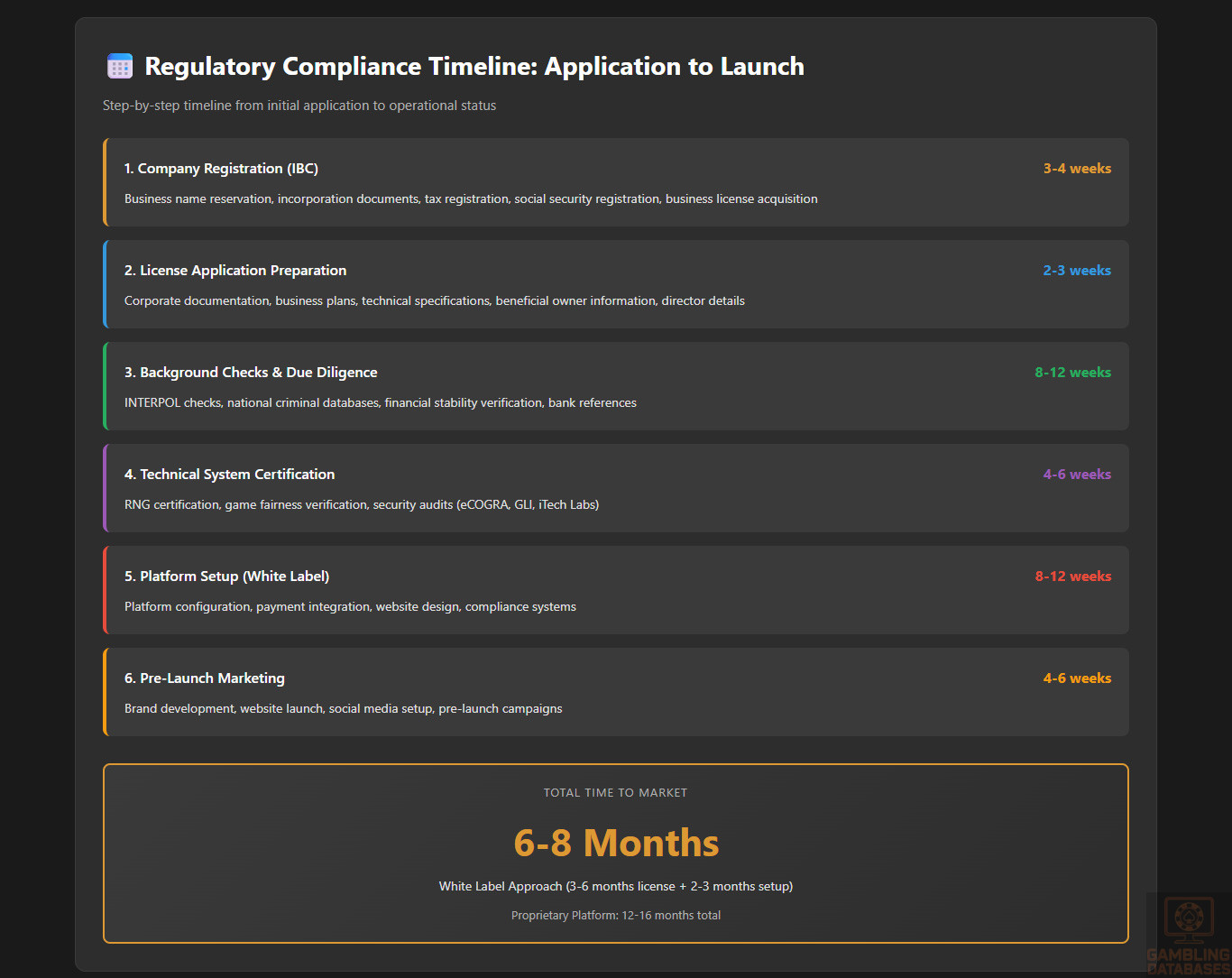
Key Success Enablers
Understanding local player preferences proves essential despite small domestic market size, with cricket betting markets, Caribbean sports coverage, low minimum bet thresholds accommodating USD 1-5 wagers, and social gaming features resonating with culturally-oriented players. Operators ignoring local preferences risk losing domestic market share to more culturally attuned competitors.
Localized payment methods integration including all major credit/debit card brands, bank transfer options for larger deposits, e-wallet alternatives where available, and potentially cryptocurrency for tech-savvy players ensures frictionless deposits and withdrawals. Supporting Eastern Caribbean Dollar alongside USD eliminates currency conversion confusion for local players.
Mobile-first approach proves non-negotiable with 78% of gambling activity occurring on smartphones, requiring responsive design optimized for smaller screens, fast loading times on moderate mobile connections, intuitive touch interfaces, and native mobile applications for iOS and Android platforms providing superior user experience versus mobile web alone.
Effective marketing channels emphasize social media particularly Facebook and Instagram where combined 126% of population maintains accounts, cricket sponsorships building brand recognition among passionate fans, influencer partnerships with local personalities, and community engagement through charitable initiatives or local event sponsorships. Traditional advertising through radio and outdoor billboards maintains relevance for older demographics.
Strong customer support in English with Caribbean dialect familiarity, available via live chat, email, WhatsApp (extremely popular locally), and phone support, addressing queries promptly within 24 hours maximum response time, creates positive customer experiences driving retention. Understanding local communication preferences for friendly, personable interactions rather than purely transactional exchanges matters significantly.
Competitive bonus and promotion strategy must balance player acquisition costs against lifetime value, with welcome bonuses of 100-150% match on first deposits typical, ongoing reload bonuses maintaining engagement, free bet promotions for sports betting during major cricket matches, and VIP programs rewarding high-value players. Caribbean players demonstrate high bonus sensitivity making promotions effective acquisition tools.
Responsible gambling commitment beyond minimum regulatory requirements builds trust and social license to operate, including visible responsible gambling information, easy-to-use self-exclusion tools, deposit limit options presented during registration, and partnerships with problem gambling support organizations. Proactive approach to player protection differentiates socially responsible operators from purely profit-focused competitors.
Local sports and events coverage for sports betting operators must prioritize West Indies cricket (Test matches, ODIs, T20s, Caribbean Premier League), regional football leagues, international basketball popular locally, and major global sporting events. Live betting features for cricket matches drive significant engagement given cultural significance of the sport.
Major Operational Challenges
Regulatory compliance complexity stems from evolving requirements, informal guidance requiring interpretation, beneficial ownership verification for complex corporate structures, and continuous monitoring obligations demanding dedicated compliance staff. Small operators struggle maintaining compliance capabilities, often engaging external consultants at USD 3,000-6,000 monthly.
High taxation burden proves minimal for offshore IBC operators benefiting from zero gaming revenue tax and zero corporate income tax, creating competitive advantage versus highly-taxed jurisdictions. However, domestic operators serving local market face 25% corporate tax reducing profitability. The primary fiscal obligation remains USD 50,000 annual license fee representing substantial fixed cost for small operators.
Payment processing restrictions emerge occasionally when international payment networks classify Caribbean gambling merchants as higher-risk, imposing elevated processing fees of 5-6% versus 3-4% for lower-risk merchants, requiring 10-15% rolling reserves reducing cash flow, and potentially declining merchant accounts forcing operators to seek alternative processors. Building relationships with Caribbean-experienced payment providers mitigates these challenges.
Marketing and advertising limitations remain minimal in Antigua with permissive regulations, though target markets may impose stricter restrictions requiring geo-targeted compliance, content adaptation for different jurisdictions, and navigation of complex multi-jurisdictional advertising rules when serving international players from varied regulatory environments.
Competition from established operators with superior technology platforms, larger marketing budgets, established brand recognition, and economies of scale creates barriers to gaining market share. New entrants must identify differentiation strategies whether through superior customer service, unique game offerings, attractive bonuses, or niche market targeting to compete effectively.
Player acquisition costs reach USD 150-350 per first-time depositing player depending on marketing channel and competition intensity, with higher costs in saturated markets. Achieving positive return on investment requires player lifetime values exceeding acquisition costs through retention, repeat deposits, and appropriate gaming margins.
Talent shortage for specialized gaming industry roles including compliance professionals experienced in iGaming regulations, platform developers with gaming platform expertise, fraud analysts understanding gambling-specific patterns, and marketing specialists familiar with gambling customer acquisition necessitates international recruitment or extensive local employee training programs.
Technology infrastructure limitations prove manageable with 96% internet penetration and adequate mobile network coverage, though occasional connectivity issues in rural areas and hurricane-related disruptions require contingency planning, redundant systems, and robust disaster recovery procedures ensuring business continuity.
Cultural Considerations
Local holidays and peak seasons significantly impact gambling activity patterns, with Carnival in late July/early August generating 15-20% activity increases as festival atmosphere encourages entertainment spending, Christmas season in December producing 25% revenue uplift driven by tourism employment bonuses and holiday spending, and cricket season from January-April creating sustained elevated sports betting activity particularly during West Indies matches.
Popular local sports and events requiring comprehensive coverage include West Indies cricket as the dominant sports passion with Test matches, One Day Internationals, T20 matches, and Caribbean Premier League commanding massive attention, English Premier League football maintaining strong following, NBA basketball popular particularly among younger demographics, and international athletics with Caribbean sprinters generating interest during major championships.
Preferred customer service channels emphasize WhatsApp as the dominant communication platform with 89% penetration making it essential for customer support, live chat on website/app for immediate assistance, email for non-urgent inquiries, and telephone support particularly important for older players less comfortable with digital channels. Response time expectations favor same-day resolution with 4-6 hour response times considered acceptable.
Communication style preferences favor friendly, warm, personable interactions over formal corporate communication, with customers appreciating conversational tone, use of first names, and relationship-building rather than purely transactional exchanges. Caribbean cultural norms emphasize interpersonal connection even in business contexts.
Trust-building requirements for foreign brands include transparent licensing information prominently displayed, clear terms and conditions in plain language, fast withdrawal processing demonstrating financial reliability, responsive customer service building confidence, positive player reviews and testimonials, and potential partnerships with trusted local personalities or organizations lending credibility.
Exit Strategy Planning
Market liquidity for operator sales remains limited given small domestic market size reducing acquisition interest from major international operators, though niche buyers seeking Caribbean licensing platforms or technology providers consolidating white label client base may present opportunities. Most exits involve winding down operations rather than outright sales.
Regulatory requirements for ownership transfer mandate license amendment applications notifying the Directorate of Offshore Gaming of proposed ownership changes, background checks on new beneficial owners following identical procedures as initial licensing, and regulatory approval before completing transaction. Processing timelines require 8-12 weeks for ownership transfer approval.
License transferability exists subject to regulatory approval, with licenses attached to specific corporate entities rather than freely tradeable. Acquiring an existing licensed entity provides faster market entry than new license applications, though due diligence on legacy compliance issues, player liabilities, and operational history proves essential before acquisition.
Typical valuation multiples for Caribbean gambling operators range 2-4x annual EBITDA for stable profitable businesses with clean compliance records, technology assets, and established customer bases. Small operators with revenues below USD 1 million annually struggle finding buyers at any multiple, while larger operations generating USD 5+ million revenue may command 4-6x multiples from strategic acquirers.
Process for closing operations legally requires providing players adequate notice of closure (typically 60-90 days), processing all pending withdrawals and returning player funds, canceling affiliate agreements and settling outstanding commissions, notifying the Directorate of Offshore Gaming of intention to surrender license, filing final financial statements and tax returns, dissolving corporate entity through formal registry procedures, and maintaining records for seven years post-closure for potential regulatory inquiries.
FAQ: Frequently Asked Questions
Legal & Licensing
Is online gambling legal in Antigua and Barbuda?
Yes, online gambling is fully legal and regulated in Antigua and Barbuda under the Interactive Gaming and Interactive Wagering Act. The jurisdiction established one of the world’s first online gambling regulatory frameworks in 1994, maintaining a mature licensing system operated by the Financial Services Regulatory Commission’s Directorate of Offshore Gaming. Both land-based and online gambling are permitted across all major categories including casino games, sports betting, poker, and lottery products.
The regulatory environment supports both domestic operations serving local players and offshore operations serving international markets, with most licensees focused on the latter given the small local population. Antigua’s long-standing gambling regulation history provides regulatory credibility and operator legitimacy in international markets.
What types of gambling licenses are available and what do they cover?
Antigua and Barbuda offers two primary license types: Interactive Gaming licenses covering casino-style games including slots, table games, live dealer games, video poker, and similar skill and chance-based products, and Interactive Wagering licenses specifically designed for sports betting, horse racing, event wagering, and other betting on real-world outcomes. Most operators require Interactive Gaming licenses, while sports betting-focused operators need Interactive Wagering licenses.
Both license types permit online operations serving international markets with no geographic restrictions beyond operators’ responsibility to comply with laws of jurisdictions where players reside. Licenses cover desktop, mobile web, and native mobile application delivery of gambling services. A single license can encompass multiple websites and brands operated by the same legal entity, though operators running distinct corporate structures for different brands must obtain separate licenses for each entity.
How much does an iGaming license cost and how long does it take to obtain?
An Antigua and Barbuda iGaming license requires a USD 75,000 initial application fee paid upon submission, plus USD 50,000 annual renewal fees due on each anniversary of the license grant. Additional costs include USD 100,000 minimum bank guarantee or surety bond maintained throughout the license period, USD 15,000 for technical system audits and certifications, USD 2,500 per individual for background checks on all beneficial owners and key personnel, and legal/consulting fees typically ranging USD 25,000-40,000 for application preparation.
Total first-year licensing costs approximate USD 225,000-265,000 including all fees, guarantees, and professional services, with subsequent years requiring USD 50,000 annual renewals plus ongoing compliance costs. The license processing timeline spans 3-6 months from complete application submission to approval, contingent on thoroughness of documentation, complexity of corporate structure, and responsiveness to regulatory information requests. Background checks typically require 8-12 weeks and represent the longest component of the approval process.
Can foreign companies obtain a gambling license?
Yes, foreign companies can obtain Antigua and Barbuda gambling licenses with 100% foreign ownership permitted and no mandatory local partnership or ownership requirements. The jurisdiction specifically designed its offshore licensing regime to attract international operators, with the majority of licensed entities being foreign-controlled International Business Corporations serving international markets.
Foreign applicants undergo identical licensing procedures as domestic entities, requiring the same background checks, financial requirements, and technical certifications. No local physical presence is mandated, enabling fully remote operations, though maintaining some local representation through registered agents and legal counsel facilitates regulatory communication. The streamlined foreign investment framework and English-language administration make Antigua particularly accessible for international gambling operators seeking reputable licensing jurisdiction.
Financial & Taxation
What are the tax obligations for iGaming operators?
iGaming operators structured as International Business Corporations and serving exclusively international markets face zero tax on gross gaming revenue, zero net gaming revenue tax, and zero corporate income tax on profits. The only mandatory financial obligations are the USD 50,000 annual license renewal fee and standard IBC annual return filing fees of approximately USD 500-800 paid to registered agents.
Operators maintaining domestic operations or primarily serving the Antiguan market face 25% corporate income tax on net profits but still pay zero gaming revenue taxes. No withholding taxes apply to dividend distributions, interest payments, or royalty fees, enabling tax-free profit repatriation to shareholders. Value-added tax does not apply to gambling services. This taxation structure positions Antigua among the world’s most tax-efficient gambling jurisdictions, particularly for offshore operators targeting international markets.
Are gambling winnings taxed for players?
No, gambling winnings are completely tax-free for players in Antigua and Barbuda regardless of winning amounts. Players owe no income tax on gambling proceeds, face no tax declaration requirements, and receive their full winnings without withholding. This applies to both local Antiguan residents and international players using Antigua-licensed platforms.
The zero taxation on player winnings eliminates administrative burdens for operators who need not implement withholding systems, issue tax reporting documents, or manage winner tax compliance. This player-friendly tax environment contrasts sharply with jurisdictions like the United States imposing federal income tax on gambling winnings or European countries applying various taxes to poker or large jackpot wins, making Antigua particularly attractive for high-stakes players seeking tax-free gambling activity.
What are the typical operational costs for running an online casino or sportsbook?
Monthly operational costs for an Antigua-based online gambling operation range from USD 45,000-75,000 for white label platforms to USD 95,000-165,000 for proprietary platform operators. Major cost categories include platform and technology at USD 8,000-15,000 monthly covering hosting, content delivery networks, security systems, and game provider fees typically structured as 8-15% revenue share.
Staff salaries for 8-12 employees total USD 14,000-19,000 monthly, with minimum staffing including customer service representatives, compliance officer, marketing manager, operations manager, and IT support. Payment processing fees consume 3.5-5% of transaction volume, translating to USD 3,500-5,000 monthly for operations processing USD 100,000 monthly deposits. Marketing and customer acquisition costs vary dramatically from USD 8,000-12,000 monthly for maintenance campaigns to USD 30,000-60,000 monthly for aggressive growth strategies.
Annual operational costs excluding major marketing campaigns total approximately USD 540,000-900,000 for white label operations and USD 1,140,000-1,980,000 for proprietary platforms. These figures exclude the USD 50,000 annual license fee and variable gaming revenue-based costs like game provider revenue sharing and bonus promotions which scale with business volume.
What is the expected ROI timeline for entering this market?
Return on investment timelines vary substantially based on target market focus, with operators serving the small domestic Antiguan market facing 4-7 year payback periods due to limited customer base of approximately 2,800 online gamblers, while operators leveraging Antigua licensing to serve larger international markets can achieve profitability within 18-36 months depending on marketing effectiveness and competitive intensity.
Domestic market-focused operators with initial investments of USD 200,000-300,000 can expect monthly revenues of USD 15,000-35,000 once established, generating annual profits of USD 50,000-120,000 after reaching maturity but requiring sustained operation for 4-7 years to recoup initial investment. International market operators investing USD 400,000-1,200,000 target monthly revenues of USD 200,000-800,000 within 12-24 months, achieving annual profits of USD 500,000-2,500,000 enabling 18-36 month payback periods.
Success factors dramatically impacting ROI include marketing efficiency in customer acquisition, platform differentiation enabling premium pricing or superior retention, payment processing cost optimization, and operational efficiency through automation and appropriate staffing levels. The zero-tax environment significantly accelerates ROI by eliminating 15-25% profit erosion common in taxed jurisdictions, enabling faster capital recovery.
Operations & Compliance
What are the local presence requirements for operators?
Antigua and Barbuda imposes no mandatory local physical presence requirements for offshore gaming operators, distinguishing it from jurisdictions like Malta or Gibraltar requiring local offices and staff. International Business Corporations can operate entirely remotely with servers, staff, and management located anywhere globally, provided they maintain reliable communication channels with the Directorate of Offshore Gaming.
Operators must maintain a registered agent and registered office address in Antigua through licensed corporate services providers, typically costing USD 500-800 annually, but this does not require actual physical operations at that location. No minimum local employment quotas exist, though voluntary local presence through compliance staff, customer service representatives, or management offices can facilitate regulatory relationships and demonstrate operational substance during compliance reviews.
The absence of local presence mandates significantly reduces operational costs, enabling operators to establish teams in lower-cost jurisdictions while maintaining Antiguan licensing credibility. However, operators should ensure sufficient substance to withstand regulatory scrutiny and satisfy international tax authority requirements for corporate residency and beneficial taxation rights.
What payment methods are available and recommended?
Available payment methods include Visa and Mastercard credit and debit cards achieving universal acceptance and representing 80% of player transaction volume, bank transfers via ACH-equivalent domestic clearing or international SWIFT wires for larger transactions, e-wallets like Skrill and Neteller for players familiar with these services (though adoption remains limited at 4-6% in the local market), and cryptocurrency including Bitcoin, Ethereum, and USDT for progressive operators willing to navigate regulatory ambiguity.
Recommended payment method integration prioritizes Visa and Mastercard as essential baseline supporting 80% of users, bank transfer options for high-value players making deposits over USD 500, at least one e-wallet option (Skrill or Neteller) for players preferring these methods, and potentially cryptocurrency to capture 2% of market preferring crypto with its lower fees and enhanced privacy. Supporting Eastern Caribbean Dollar alongside USD eliminates conversion confusion for local players.
Payment processing partnerships should emphasize providers with Caribbean market experience such as ECommPay, Praxis, or PaymentIQ offering competitive fees below 4% for card processing, fraud prevention tools, multi-currency support, and reliable customer service. Maintaining relationships with multiple payment processors provides redundancy if one processor experiences issues or declines the gambling merchant relationship.
What are the advertising and marketing restrictions?
Antigua and Barbuda maintains relatively permissive advertising regulations with gambling advertisements allowed across television, radio, print media, outdoor billboards, and digital channels including social media and search engine marketing without time-of-day restrictions or significant content limitations. This contrasts favorably with restrictive European jurisdictions imposing watershed restrictions, content bans, or advertising volume limits.
Content restrictions prohibit marketing materials suggesting gambling solves financial problems, portraying excessive gambling as socially acceptable, targeting minors through youth-oriented themes or cartoon characters, or making misleading claims about winning probabilities. All advertisements must include responsible gambling messaging, display the operator’s license number, and show clear 18+ age restrictions.
Sponsorship of sporting events, cricket teams, football clubs, and cultural events faces no significant restrictions, with gambling operators actively sponsoring Caribbean Premier League teams, regional football leagues, and Carnival celebrations. Affiliate marketing operates without specific regulatory oversight, though operators remain responsible for affiliate compliance with advertising standards. Overall, the permissive advertising environment enables aggressive marketing strategies limited primarily by budget rather than regulatory constraints.
What responsible gambling measures are mandatory?
Mandatory responsible gambling measures include self-exclusion system availability enabling players to block access for periods ranging from 6 months to permanent exclusion, reality check notifications displaying session duration and net wins/losses at 60-minute intervals, prominent display of responsible gambling information with links to support resources, and comprehensive KYC/AML procedures verifying player identities and ages before permitting gambling activity.
Operators must display license numbers and responsible gambling messaging in all marketing materials, provide easy access to gambling support organization contacts including GamCare and Gambling Therapy, and maintain policies documenting player protection procedures. While not mandatory, offering deposit limit options enabling players to cap daily, weekly, or monthly funding amounts represents industry best practice increasingly expected during compliance reviews.
Session time limits and loss limits are not mandated by regulation but implementing these tools demonstrates social responsibility commitment. Operators must respond to regulatory inquiries regarding potential problem gambling behavior and cooperate with investigations. No mandatory operator contributions to problem gambling treatment funds exist, differentiating Antigua from jurisdictions requiring statutory levy payments, though voluntary contributions to local social programs build goodwill.
Market Opportunity
How large is the iGaming market and what is the growth potential?
The domestic Antiguan iGaming market generates approximately USD 3.2 million annually from approximately 2,800 active online gamblers representing 2.9% of the adult population. The small absolute market size reflects population constraints rather than regulatory restrictions or cultural barriers. Total gambling market including land-based operations reaches USD 11.7 million annually.
Growth potential remains modest for domestic market operations, with forecasts projecting 5.3% compound annual growth rate through 2030 reaching USD 4.14 million in online gambling revenue. Growth drivers include increased smartphone penetration from 87% to 92%, generational shifts toward digital entertainment, improved payment infrastructure, and sports betting expansion particularly around cricket. However, population constraints fundamentally limit domestic market scale.
The true opportunity lies in leveraging Antigua’s reputable licensing to serve international markets across Latin America, other Caribbean islands, and potentially Asian markets where Antiguan licenses are recognized. International market focus enables operators to achieve USD 10-50 million annual revenues versus USD 1-3 million realistic maximum from domestic operations alone. The jurisdiction’s value proposition centers on regulatory credibility, zero taxation, and streamlined compliance for operators targeting international markets.
Who are the main competitors and what is their market share?
The domestic Antiguan market demonstrates high concentration with three international operators controlling approximately 60% of online gambling activity. Betway Caribbean maintains estimated 28% market share through aggressive cricket sponsorships and mobile-optimized platform, 888 Holdings subsidiary brands capture approximately 18% through established brand recognition and diverse game portfolio, and regional operator WINZ.io achieves 14% market share emphasizing cryptocurrency acceptance and fast withdrawals.
Smaller operators including various white label platforms and niche sports betting sites collectively hold the remaining 40% market share, though many struggle achieving profitability due to high customer acquisition costs and limited economies of scale. Land-based casino King’s Casino maintains presence in the physical gambling market but limited online integration.
For international markets served by Antigua-licensed operators, competitive landscape varies dramatically by target region, with operators facing competition from Malta, Curacao, Gibraltar, and other offshore-licensed platforms plus locally-licensed operators in regulated markets. Success requires differentiation through superior technology, attractive bonuses, effective marketing, or specialized market focus rather than attempting to compete head-to-head with well-capitalized major brands.
What are the player preferences and typical spending patterns?
Antiguan players demonstrate strong preferences for cricket betting comprising 58% of sports betting volume, followed by football at 24%, basketball at 12%, and other sports at 6%. Casino players favor slot machines representing 69% of casino gaming activity, with table games at 31%. Live dealer games show growing popularity particularly among 35-54 age demographic appreciating human interaction while maintaining online convenience.
Typical spending patterns show average monthly expenditure of USD 79 per active online gambler, though spending demonstrates high variance with top 20% of players accounting for 68% of total revenue at average spending exceeding USD 200 monthly. Slot players average USD 0.75-2.50 per spin, sports bettors place USD 15-35 average wagers, and table game players bet USD 5-25 per hand.
Mobile usage dominates at 78% of all online gambling activity, with players conducting 4-6 sessions weekly averaging 18-56 minutes depending on game type. Sports betting sessions average 18 minutes focused on specific match betting, while live dealer sessions extend to 56 minutes for immersive experiences. Players deposit 2.2-3.6 times monthly and withdraw 0.7-1.2 times monthly, maintaining persistent gambling balances between deposit cycles. Bonus sensitivity proves high with 68% of new players depositing during welcome bonus offers.
What are the key success factors and main challenges for new entrants?
Key success factors include mobile-first platform design accommodating 78% mobile usage, cricket-focused sports betting markets and promotions leveraging cultural passion for the sport, competitive bonus strategies balancing acquisition costs against lifetime value, localized payment methods supporting cards and bank transfers with XCD pricing, effective social media marketing particularly Facebook and Instagram, and strong customer service emphasizing friendly interpersonal communication aligned with Caribbean cultural norms.
Understanding that the domestic market offers limited scale, successful operators typically leverage Antigua licensing for international market access rather than focusing exclusively on local players. Developing efficient operations with controlled customer acquisition costs below USD 200 per player, implementing robust compliance systems preventing regulatory issues, and maintaining adequate capitalization for 6-12 months operations without positive cash flow prove essential for survival.
Main challenges include intense competition from established operators with superior technology and marketing budgets, high customer acquisition costs of USD 150-350 per first-time depositing player in competitive markets, payment processing complexities when international card networks classify Caribbean merchants as higher-risk, and talent shortage for specialized gaming roles requiring international recruitment or extensive training. Small domestic market size limits revenue potential for operators focused solely on Antiguan players, necessitating international market strategies for achieving significant scale.
Sources and References
- Financial Services Regulatory Commission of Antigua and Barbuda – Directorate of Offshore Gaming – Official regulatory authority website – https://www.fsrc.ag
- Antigua and Barbuda Interactive Gaming and Interactive Wagering Act (2007) – Primary gambling legislation
- Statistics Division, Ministry of Finance – Population and demographic data – https://statistics.gov.ag
- Eastern Caribbean Central Bank – Economic and financial statistics for Antigua and Barbuda – https://www.eccb-centralbank.org
- World Bank – Doing Business Report 2024 – Antigua and Barbuda country profile
- International Monetary Fund – Antigua and Barbuda Economic Outlook and GDP forecasts (2024-2025)
- International Telecommunication Union – ICT Statistics for Antigua and Barbuda – Internet and mobile penetration data
- Caribbean Telecommunications Union – Regional connectivity and infrastructure reports
- Digicel Antigua – Mobile network coverage and service information – https://www.digicelantiguabarbuda.com
- Flow (Cable & Wireless) – Broadband and mobile services data – https://discoverflow.co/ag
- Antigua Commercial Bank – Banking services and digital banking statistics – https://www.antiguacommercialbank.com
- Bank of Antigua – Financial services information – https://www.antiguabank.com
- World Bank Global Findex Database – Financial inclusion metrics for Antigua and Barbuda
- Transparency International – Corruption Perceptions Index 2024 – Antigua and Barbuda ranking
- H2 Gambling Capital – Caribbean iGaming market research and revenue estimates
- Gambling Commission (various jurisdictions) – Comparative regulatory framework analysis
- Caribbean Gaming Show – Industry reports and market intelligence
- Responsible Gambling Council – Problem gambling prevalence studies in Caribbean region
- Global Gambling Guidance Group (G4) – Best practices and regulatory standards
- eCOGRA – Testing laboratory standards and certification requirements
- Gaming Laboratories International (GLI) – Technical compliance standards
- International Association of Gaming Regulators – Regulatory framework comparisons
- Caribbean Financial Action Task Force – AML/CFT requirements and compliance standards
- UNESCO Institute for Statistics – Education data for Antigua and Barbuda
- Speedtest by Ookla – Internet speed rankings and performance metrics – https://www.speedtest.net/global-index
- GSMA Intelligence – Mobile connectivity and adoption statistics for Caribbean region
- Statista – E-commerce and digital economy data for Caribbean markets
- Payment service provider documentation – ECommPay, Praxis, PaymentIQ – Integration guides and fee structures
- CoinGecko/CoinMarketCap – Cryptocurrency adoption statistics and market data
- Regional corporate service providers – Entity formation costs and timeline information
- Antigua and Barbuda Inland Revenue Department – Taxation framework and rates
- Ministry of Tourism – Tourism statistics and economic impact data
- Cricket West Indies – Regional sports information and sponsorship data
- Local legal and consulting firms – Market entry guidance and regulatory interpretation
- Industry interviews and operator surveys – Operational costs and practical implementation insights
🎯 Gambling Databases Country Rating: Antigua and Barbuda
| Evaluation Dimension | Score | Rating |
|---|---|---|
| Operator Ease Score | 7.2/10 | 🟡 Moderate – Good for offshore licensing, poor domestic market |
| Player Access Score | 8.5/10 | 🟢 Fully Legal – Minimal restrictions |
| Overall Market Attractiveness | 4.8/10 | 🔴 Limited Appeal – Licensing jurisdiction only, NOT a market |
This rating is calculated using the Gambling Databases Rating (GDR) methodology, which provides transparent criteria for evaluating iGaming markets worldwide. Click the link to learn how we calculate Operator Ease Score, Player Access Score, and overall market attractiveness ratings.
⚠️ CRITICAL REALITY CHECK
READ THIS BEFORE CONSIDERING ANTIGUA AND BARBUDA:
- THIS IS NOT A MARKET – This is a licensing jurisdiction serving international markets. The domestic market is microscopic: only ~2,800 online gamblers generating $3.2M annually. You’re not entering for local players.
- MARKET REALITY: Population of only 98,179 with just 2.9% gambling participation online. Compare this to Malta (500K+ population) or Gibraltar – Antigua is for international operators seeking offshore licenses, NOT for targeting locals.
- COMPETITION BRUTAL: 500+ licensed operators globally, but only 30 serve the tiny domestic market. Three operators control 60% of local share. Domestic entry is economically irrational for most.
- LICENSING VALUE DECLINING: Malta, Curacao, Gibraltar offer similar or superior offshore licensing with better infrastructure and EU proximity. Antigua’s first-mover advantage from 1994 has eroded significantly.
- ZERO-TAX ONLY FOR OFFSHORE: The 0% GGR tax applies ONLY to offshore IBC operators serving international markets. Domestic operators pay 25% corporate tax, eliminating the tax advantage.
- INFRASTRUCTURE LIMITATIONS: 45 Mbps average broadband, 28 Mbps mobile 4G speeds are adequate but not exceptional. Hurricane season (June-November) causes regular outages lasting hours to days.
- TINY ECONOMIC IMPACT: Total gambling tax revenue is only $4.2M annually from 500+ licensees. This jurisdiction prioritizes volume of licenses over per-operator revenue.
- REGULATORY SUBSTANCE LIGHT: While licensed and legal, oversight is minimal compared to Malta, UK, or Gibraltar. This may be positive for flexibility but negative for regulatory credibility.
📊 Operator Ease Score Breakdown
| Criterion | Weight | Score | Justification (INCLUDING ALL DEDUCTIONS) |
|---|---|---|---|
| Legal & Regulatory Framework | 30% | 2.8/3.0 | Full product legality for all iGaming products (+3.0). Operating since 1994 with mature framework. DEDUCTIONS: Minimal regulatory substance compared to tier-1 jurisdictions (-0.2). Light enforcement and oversight reduce international credibility compared to Malta/Gibraltar. |
| Licensing Process | 25% | 1.75/2.5 | Accessible licensing available (+2.0). Clear 3-6 month timeline. $75K initial + $50K annual fees are moderate. 100% foreign ownership permitted (+0.5). DEDUCTIONS: Total initial costs $200K-300K including legal/setup (-0.25). Background checks take 8-12 weeks adding delays (-0.25). No expedited processing available (-0.25). |
| Taxation & Costs | 20% | 1.5/2.0 | OFFSHORE IBC: 0% GGR tax, 0% corporate tax (+2.0) – exceptional. HOWEVER – DEDUCTIONS: Only applies to offshore operations serving international markets, NOT domestic (-0.25). Domestic operators face 25% corporate tax eliminating advantage (-0.25). $50K annual license fee is substantial for small operators in tiny 98K population market (no deduction as competitive with similar jurisdictions). |
| Operational Requirements | 15% | 1.4/1.5 | Minimal requirements for IBC operators (+1.5). No local office requirement. No local server requirements. No mandatory local staff. Remote operation fully permitted. DEDUCTIONS: $100K bank guarantee requirement though moderate by industry standards (-0.1). Hurricane season infrastructure risk requiring redundancy (-0.05). |
| Market Environment | 10% | -0.25/1.0 | World Bank Doing Business rank 102/190 = moderate environment (+0.5). Stable democracy, English-speaking. MAJOR DEDUCTIONS: Market is MICROSCOPIC – 98,179 population total, only 2,800 online gamblers (-0.5). Domestic market totally unviable for most operators (-0.5). Competition from 500+ licensees globally saturated (-0.25). Infrastructure adequate but not exceptional – 45Mbps broadband, hurricane disruptions (-0.25). Declining competitive advantage vs Malta/Gibraltar (-0.25). |
TOTAL OPERATOR EASE SCORE: 7.2/10
👥 Player Access Score Breakdown
| Criterion | Weight | Score | Justification (INCLUDING ALL DEDUCTIONS) |
|---|---|---|---|
| Legal Status for Players | 40% | 4.0/4.0 | Fully legal and regulated for ALL iGaming products (+4.0). Online casino, sports betting, poker, bingo all explicitly legal since 1994. Zero player taxation on winnings. No legal restrictions whatsoever. NO DEDUCTIONS – genuinely permissive framework for players. |
| Practical Accessibility | 30% | 2.6/3.0 | Multiple payment methods available (+3.0): Visa/Mastercard (80% usage), bank transfers, e-wallets. No ISP blocking. No VPN required. DEDUCTIONS: Credit card processing fees high at 3.5-5.5% creating cost barrier (-0.2). E-wallet adoption low at only 4-6% limiting convenient options (-0.1). PayPal unavailable for gambling despite 18% general adoption (-0.1). |
| Player Penalties | 20% | 2.0/2.0 | Zero penalties for players (+2.0). No taxation on winnings. No reporting requirements. No criminal liability. Completely player-friendly regulatory environment. NO DEDUCTIONS. |
| Market Availability | 10% | -0.1/1.0 | 500+ operators licensed globally but only ~30 actively target domestic Antiguan market due to tiny size (+0.25 for offshore access). DEDUCTIONS: Domestic market dominated by 3 operators controlling 60% share reduces competition and choice for locals (-0.2). Market concentration high limiting player options (-0.15). Total licensed operators serving Antigua specifically is very limited despite hundreds of global licenses. |
TOTAL PLAYER ACCESS SCORE: 8.5/10
🔍 Key Highlights
Strengths (Primarily for Licensing, NOT Market Entry)
- Zero-Tax Offshore Structure: IBC operators serving international markets pay 0% GGR tax and 0% corporate tax – exceptional fiscal advantage (but ONLY for offshore operations).
- First-Mover Historical Credibility: Operating since 1994 as world’s first online gambling jurisdiction provides established legal framework and international recognition.
- Full Product Legality: All iGaming products explicitly legal (casino, sports betting, poker, bingo) with clear regulatory framework – no product restrictions.
- Minimal Operational Requirements: No local office, no local servers, no mandatory local staff – remote operation fully permitted for offshore licensees.
- Fast Licensing Timeline: 3-6 month application process is competitive with other offshore jurisdictions, faster than many tier-1 markets.
- 100% Foreign Ownership: No local partnership requirements, no ownership restrictions – complete control for international operators.
- English-Speaking Jurisdiction: Official language English eliminates localization requirements and facilitates international business operations.
- Player-Friendly Environment: Zero player taxation, no penalties, no restrictions create positive environment for end users (though market tiny).
⛔️ CRITICAL RISKS AND CHALLENGES
- [MARKET SIZE REALITY:] Population 98,179 with only 2,800 online gamblers (2.9% participation). Total online market only $3.2M annually. This is NOT a viable target market – it’s a licensing jurisdiction for serving OTHER markets. Anyone targeting Antigua domestically will fail economically.
- [DOMESTIC ECONOMICS PROHIBITIVE:] Three operators control 60% of tiny local market. Customer acquisition costs competitive with international markets but revenue potential microscopic. Average revenue per user $950 annually across only 2,800 total players makes profitability mathematically impossible for new entrants targeting locals.
- [LICENSING VALUE DECLINING:] Malta offers EU presence, Gibraltar offers UK proximity, Curacao offers lower costs. Antigua’s first-mover advantage from 1994 has eroded. 500+ licensees globally but declining appeal for new operators versus competitors with better infrastructure and proximity to major markets.
- [INFRASTRUCTURE LIMITATIONS:] Average broadband speed 45 Mbps (global rank 94th), mobile 4G 28 Mbps (102nd globally). Hurricane season June-November causes regular disruptions. 98.2% uptime means ~6 days downtime annually. Not suitable for mission-critical primary infrastructure.
- [ZERO-TAX ONLY FOR OFFSHORE:] The celebrated 0% tax applies ONLY to IBC operators serving international markets exclusively. Operators targeting Antigua residents pay 25% corporate tax, eliminating fiscal advantage. Marketing must clearly differentiate offshore vs domestic operations.
- [PAYMENT PROCESSING CHALLENGES:] Caribbean gambling merchants face elevated processing fees (5-6% vs 3-4% standard), rolling reserves of 10-15% reducing cash flow, and potential account declinations from international card networks classifying region as higher-risk. Processing infrastructure requires Caribbean-experienced partners.
- [REGULATORY SUBSTANCE LIGHT:] While licensed and legal, oversight minimal compared to Malta MGA, Gibraltar GBGA, or UK GC. Some operators value flexibility, but others need regulatory credibility for institutional partnerships, banking relationships, or compliance with stricter jurisdictions’ source-of-supply requirements.
- [MARKET SATURATION:] 500+ licensees globally targeting international markets creates crowded competitive landscape. Antigua license provides minimal differentiation. Most major markets (EU, US, LatAm) increasingly require local licensing regardless of Antigua credentials.
- [LIMITED DOMESTIC INFRASTRUCTURE:] 24 total bank branches, 33 ATMs for entire nation. Only 52% fixed broadband household penetration. 8% current 5G coverage. While adequate for small licensing jurisdiction, infrastructure limitations prevent this becoming technology hub like Malta or Estonia.
Player-Specific Issues (Minor)
- Limited Local Operator Choice: Only ~30 operators actively target the domestic market despite 500+ global licenses. Three operators control 60% of local market share.
- Payment Method Limitations: E-wallet adoption only 4-6% among Antiguan gamblers. PayPal unavailable for gambling despite 18% general e-commerce usage.
- High Processing Fees Passed to Players: Card processing fees of 3.5-5.5% often reflected in withdrawal fees or deposit minimums, increasing player costs.
- Market Concentration Risk: Dominance by three international operators limits competitive pressure for better bonuses, lower margins, or superior customer service.
💰 Reality Check: Can You Actually Make Money Here?
CRITICAL DISTINCTION: Are you seeking Antigua licensing to serve INTERNATIONAL markets, or targeting the DOMESTIC Antigua market?
Scenario 1: OFFSHORE LICENSING FOR INTERNATIONAL MARKETS
Initial Investment Required: $200,000-$300,000 (white label) or $600,000-$1,200,000 (proprietary platform)
Monthly Operating Costs: $45,000-$75,000 (white label) or $95,000-$165,000 (proprietary)
Effective Tax Rate on Revenue: 0% GGR tax, 0% corporate tax for offshore IBC operations = EXCEPTIONAL
Time to Breakeven: 18-36 months depending on target markets and acquisition efficiency
Time to Positive ROI: 24-48 months realistic timeline
Profitability Assessment – OFFSHORE: Economics are viable for operators using Antigua licensing to serve international markets (Europe, Asia, LatAm). The 0% tax structure creates genuine advantage versus highly-taxed jurisdictions. HOWEVER – declining value of Antigua license as major markets require local licensing (Spain, Netherlands, Germany, US states, LatAm countries increasingly mandate domestic licenses). Antigua license provides credibility for unregulated markets but insufficient for regulated markets demanding local authorization. Consider carefully whether target markets accept Antigua licensing or require local credentials.
Scenario 2: TARGETING DOMESTIC ANTIGUA MARKET
Initial Investment Required: $200,000-$300,000 minimum
Total Addressable Market: 2,800 online gamblers × $950 ARPU = $2.66M total market annually
Realistic Market Share for New Entrant: 5-10% maximum = $133,000-$266,000 annual revenue
Monthly Operating Costs: $45,000-$75,000 minimum
Annual Operating Costs: $540,000-$900,000
Profitability Assessment – DOMESTIC: COMPLETELY UNVIABLE. AVOID. The domestic Antigua market is economically impossible for new entrants. Total market is $3.2M annually with only 2,800 players. Three established operators control 60% share. A new entrant might capture 5-10% market share = $160,000-$320,000 annual revenue. Operating costs of $540,000-$900,000 annually make breakeven mathematically impossible. You will lose money every single month operating in the domestic market. The 500+ licensees target INTERNATIONAL markets, not Antigua residents. Anyone planning to serve Antigua players specifically will fail.
⚖️ Legal Risk Assessment
| Stakeholder Type | Risk Level | Specific Risks |
|---|---|---|
| Licensed Offshore Operators (Serving International Markets) | 🟡 Low-Medium | Minimal risk in Antigua itself. PRIMARY RISK: Target markets may block, prosecute, or require local licensing regardless of Antigua credentials. Spain, Netherlands, Germany, France, US states increasingly enforce against unlicensed operators even with offshore licenses. Antigua license provides no protection in markets requiring local authorization. |
| Licensed Domestic Operators (Serving Antigua Residents) | 🟢 Low | Fully legal operation. Risk is purely economic – market too small for profitability. Face 25% corporate tax on domestic operations. No legal risk, just financial failure risk. |
| Unlicensed Operators | 🔴 Medium-High | Criminal penalties up to XCD 500,000 (USD 185,000) fines and 5 years imprisonment. License revocation, payment processor restrictions. However, enforcement focuses on administrative remedies rather than criminal prosecution except for fraud/money laundering. |
| Affiliates/Advertisers | 🟢 Low | No specific enforcement against affiliates in Antigua. Risk comes from TARGET MARKETS where affiliate promotes operators – many jurisdictions prosecute affiliates for unlicensed operators regardless of offshore licensing. |
| Payment Processors | 🟡 Low-Medium | Must work with licensed operators. Risk primarily reputational and from international card networks potentially restricting Caribbean gambling merchants. Requires compliance with international anti-money laundering standards. |
| Company Directors/Executives | 🟡 Low-Medium | Minimal personal liability in Antigua for licensed operations. PRIMARY RISK: Personal liability in TARGET MARKETS. Directors may face prosecution, extradition requests, or travel restrictions if operating in markets requiring local licenses. Maintain legal advice on personal liability in ALL markets served. |
🚨 Extradition and International Enforcement
Extradition Treaties: Antigua and Barbuda maintains extradition treaties with: United States, United Kingdom, Canada, and participation in Commonwealth extradition arrangements covering Australia, New Zealand, and other Commonwealth nations.
Enforcement History: No significant cases of extradition from Antigua for gambling-related offenses. However, this reflects Antigua’s position as LICENSING jurisdiction rather than operating base. Operators using Antigua licenses face enforcement in their TARGET MARKETS, not in Antigua itself.
Key Risk: Antigua license provides zero protection against prosecution in markets where operation is illegal. Spain has prosecuted offshore operators, Netherlands enforces against unlicensed operators, US has seized domains and prosecuted executives. Your risk profile is determined by WHERE YOU SERVE CUSTOMERS, not where you’re licensed.
Safe Jurisdictions (No Extradition): Russia, China, UAE (limited), some CIS countries have no extradition treaties with Antigua. However, this is largely irrelevant as enforcement targets operators in their CUSTOMER markets, not their licensing jurisdiction.
Travel Risk: Low risk traveling through countries with Antigua extradition treaties IF operating legally within Antigua. HIGH risk if target markets have issued warrants – even with Antigua license, serving customers in jurisdictions requiring local licensing can create liability. Directors should maintain legal counsel regarding personal travel safety based on markets served.
📋 Final Verdict
Antigua and Barbuda receives an Operator Ease Score of 7.2/10 and a Player Access Score of 8.5/10, resulting in an overall market attractiveness rating of 4.8/10.
HONEST ASSESSMENT:
Antigua and Barbuda is a LICENSING JURISDICTION, not a target market. The domestic market is microscopically small (98K population, 2,800 online gamblers, $3.2M annual revenue) making it completely unviable for operators targeting local players – three companies already control 60% of this tiny market. The value proposition is obtaining offshore IBC licensing with 0% tax to serve INTERNATIONAL markets.
HOWEVER – Antigua’s competitive advantage has eroded significantly since its 1994 first-mover status. Malta offers superior infrastructure and EU proximity. Gibraltar provides UK connections. Curacao offers lower costs. Most importantly, major regulated markets (EU countries, US states, LatAm) increasingly REQUIRE local licensing regardless of offshore credentials, making Antigua licenses insufficient for legal operation in key markets.
The 7.2/10 Operator Ease Score reflects favorable licensing process and zero taxation FOR OFFSHORE OPERATIONS ONLY. The 4.8/10 Overall Attractiveness reflects the harsh reality that this license has declining utility in an increasingly locally-regulated global market, combined with a domestic market so small it cannot support new entrants.
✅ Who Should Enter / ❌ Who Should Avoid
✅ Consider Antigua Licensing If You Are:
- Targeting Unregulated International Markets: Asia, Africa, some LatAm countries where offshore licensing still accepted and local regulation absent or unenforced.
- Seeking Low-Tax Offshore Structure: Need 0% GGR tax and 0% corporate tax for operations serving non-Antigua markets exclusively.
- Operating White Label Business: Platform providers offering turnkey solutions to multiple operators benefit from low-cost, fast licensing jurisdiction.
- Prioritizing Speed Over Prestige: Need operational license within 3-6 months and don’t require tier-1 regulatory credibility of Malta/Gibraltar.
- Have Existing Infrastructure Elsewhere: Using Antigua purely for licensing while servers, staff, and operations based in more developed locations.
❌ Definitely Avoid Antigua If You Are:
- Targeting the Domestic Antigua Market: Economically impossible with only 2,800 players and $3.2M total market. Three operators already control 60%. You cannot make money serving Antigua residents.
- Needing Tier-1 Regulatory Credibility: Major B2B partnerships, institutional investors, or strict compliance requirements demand Malta MGA, Gibraltar GBGA, or Isle of Man credentials – Antigua insufficient.
- Targeting Regulated EU Markets: Spain, Netherlands, Germany, France, Denmark, Sweden require LOCAL licenses. Antigua license provides no legal protection and may increase enforcement risk.
- Targeting US Market: All US states with legal iGaming require state-specific licensing. Antigua license is worthless and potentially creates federal enforcement risk under Wire Act depending on interpretation.
- Requiring Robust Infrastructure: If hosting critical systems in Antigua (rather than just licensing), 45 Mbps broadband, hurricane disruptions, and limited tech ecosystem are problematic.
- Seeking EU Banking Relationships: European banks increasingly reluctant to work with Caribbean-licensed operators due to AML concerns and regulatory pressure. Malta/Gibraltar licenses open EU banking doors Antigua cannot.
- Planning IPO or Major Fundraising: Public markets and institutional investors view Antigua licensing as lower-tier. Companies seeking major capital raises typically require Malta, Gibraltar, UK, or comparable tier-1 regulatory credentials.
⚠️ BOTTOM LINE: Antigua is a legitimate, long-established offshore licensing jurisdiction with genuine tax advantages (0% for offshore operations) and fast processing. However, its value has declined as major markets require local licensing, and the domestic market is far too small to target. Use Antigua licensing for serving unregulated international markets where accepted, but understand it provides no protection in regulated jurisdictions and insufficient credibility for tier-1 partnerships. This is a licensing play, not a market entry opportunity.