Armenia presents an evolving opportunity for iGaming operators as one of the regulated markets in the South Caucasus region. The country has established a licensing framework overseen by the Ministry of Finance, with comprehensive regulations covering online and land-based gambling activities.
Recent legislative reforms in 2025 have significantly transformed the tax structure and compliance requirements, introducing higher duties and stricter oversight mechanisms while maintaining market accessibility for licensed operators.
Executive Summary: Key Market Indicators
| Indicator | Value/Status |
|---|---|
| Gambling Legal Status | Legal and Regulated |
| Regulatory Authority | Ministry of Finance |
| Online Gambling Status | Licensed and Permitted |
| Annual License Fee (Online Gaming) | AMD 600 million (~$1.5 million USD) |
| Gambling Tax Rate (2025) | 10% turnover tax (effective July 2025) |
| Betting Duty (Online Casinos) | 0.35% per bet (doubled from 0.175% in April 2025) |
| Betting Duty (Sports Betting) | 0.2% per bet (doubled from 0.1% in April 2025) |
| Corporate Income Tax | 18% |
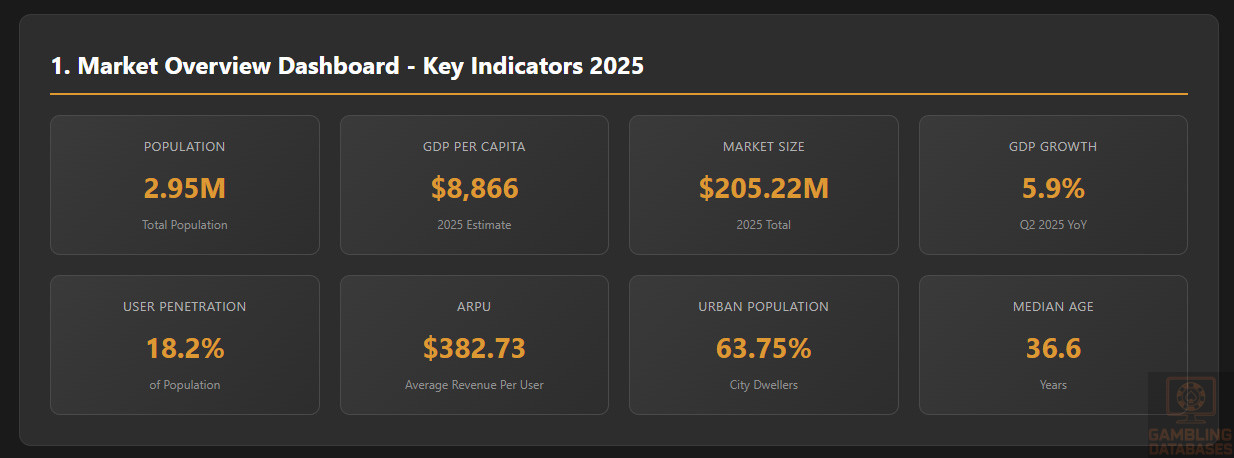
| Population (2025) | 2.95 million |
| Median Age | 36.6 years |
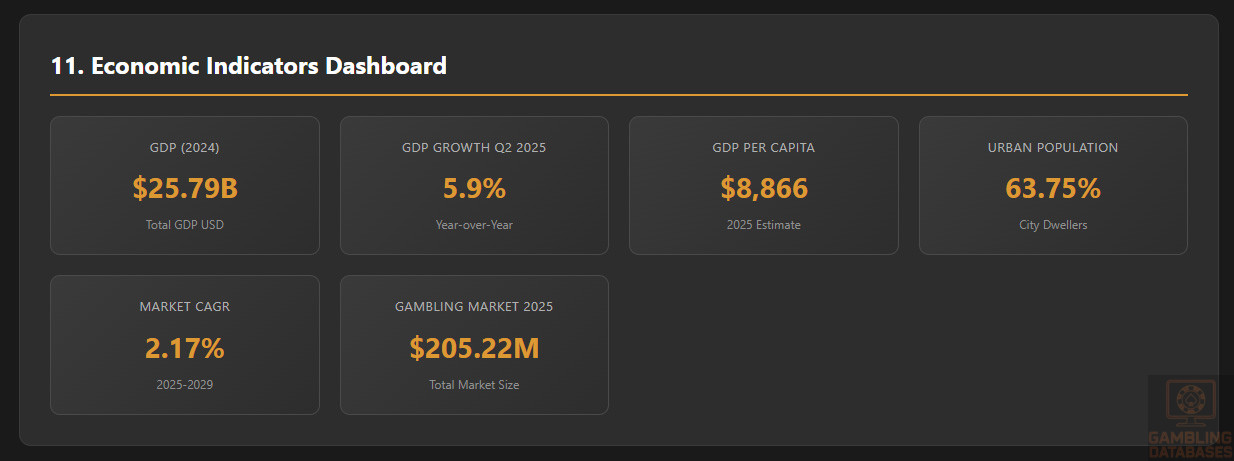
| Urban Population | 63.75% |
| GDP (2024) | $25.79 billion USD |
| GDP Per Capita (2025) | $8,866 USD |
| GDP Growth (Q2 2025) | 5.9% YoY |
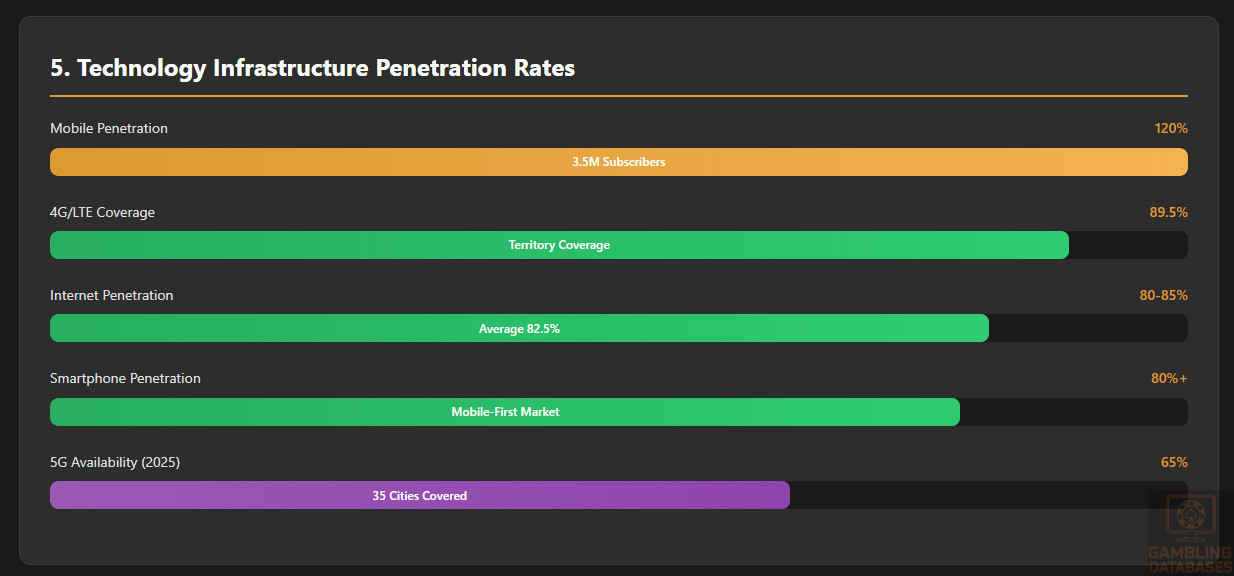
| Internet Penetration | 80-85% |
| Smartphone Penetration | 80%+ |
| Mobile Penetration | 120% (3.5 million subscribers) |
| 4G/LTE Coverage | 89.5% of territory |
| 5G Availability (2025) | 65% population coverage across 35 cities |
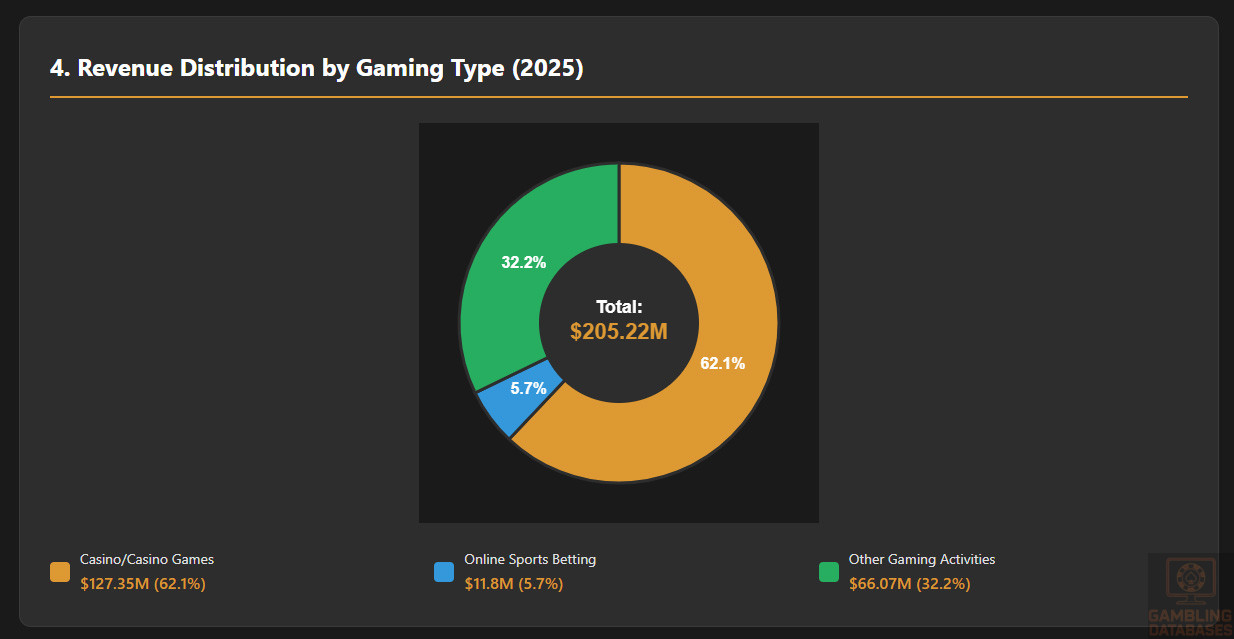
| Gambling Market Size (2025) | $205.22 million USD |
| Market CAGR (2025-2029) | 2.17% |
| Projected Market Size (2029) | $223.65 million USD |
| Casino/Casino Games Revenue (2025) | $127.35 million USD |
| Online Sports Betting Revenue (2025) | $11.8 million USD |
| Average Revenue Per User (ARPU) | $382.73 USD (2025) |
| Gambling User Penetration (2025) | 18.2% |
| Projected Users (2029) | 572,600 |
| Total Wagered (2024) | AMD 7 trillion (~$17.7 billion USD) |
| Minimum Gambling Age | 21 years (raised from 18 in January 2025) |
Section 1: Regulatory Framework and Legal Environment
Current Gambling Regulation Status
Armenia operates a regulated gambling market under comprehensive legislation that governs all forms of gaming activities. The primary regulatory framework is established through the Law of the Republic of Armenia “On Winning Games and Gambling Houses” which provides the foundation for licensing, operation, and supervision of gambling establishments.
Land-Based Gambling Activities
Land-based gambling in Armenia is categorized into three main types. Games of chance include activities organized on gaming tables and gaming machines where outcomes depend primarily on chance or predominantly on player skills, abilities, or knowledge such as poker, operated through mechanical or electronic devices.

Totos represent games where outcomes depend on the occurrence, non-occurrence, or manner of events predicted by players, where the betting events remain beyond the gambling operator’s control. These encompass sports betting and related activities in physical venues.
Casino operations face varying annual state duty requirements based on location. Tsakhkadzor commands AMD 180 million, Sevan requires AMD 150 million, Jermuk mandates AMD 100 million, and Meghri imposes AMD 35 million in annual fees for land-based casino licenses.
Online Gambling Framework
Digital gaming regulations in Armenia permit online casino games, internet-based winning games, and online sports betting under proper licensing. The regulatory scope covers all forms of internet gambling organized by Armenian-registered commercial entities holding valid licenses from the Ministry of Finance.
Significant legislative changes took effect January 1, 2025, through the new law “Regulation of Gaming Activities.” This legislation prohibits Armenian residents from participating in or accessing gambling organized in foreign jurisdictions and bans advertising of gambling services conducted outside Armenia or on non-Armenian domain names.
Technical infrastructure requirements mandate that operators maintain physical presence in Armenia, including servers, software, hardware, and gaming platforms located within the country. This localization requirement aims to ensure regulatory oversight and tax compliance while limiting offshore gambling access.
Prohibited activities include operating without valid Armenian licenses, accepting bets from jurisdictions where gambling is illegal, and providing services to individuals on the Ministry of Finance’s exclusion list. Unlicensed operators face IP blocking measures, payment processing restrictions, and potential criminal penalties.
Licensed Operators and Market Players
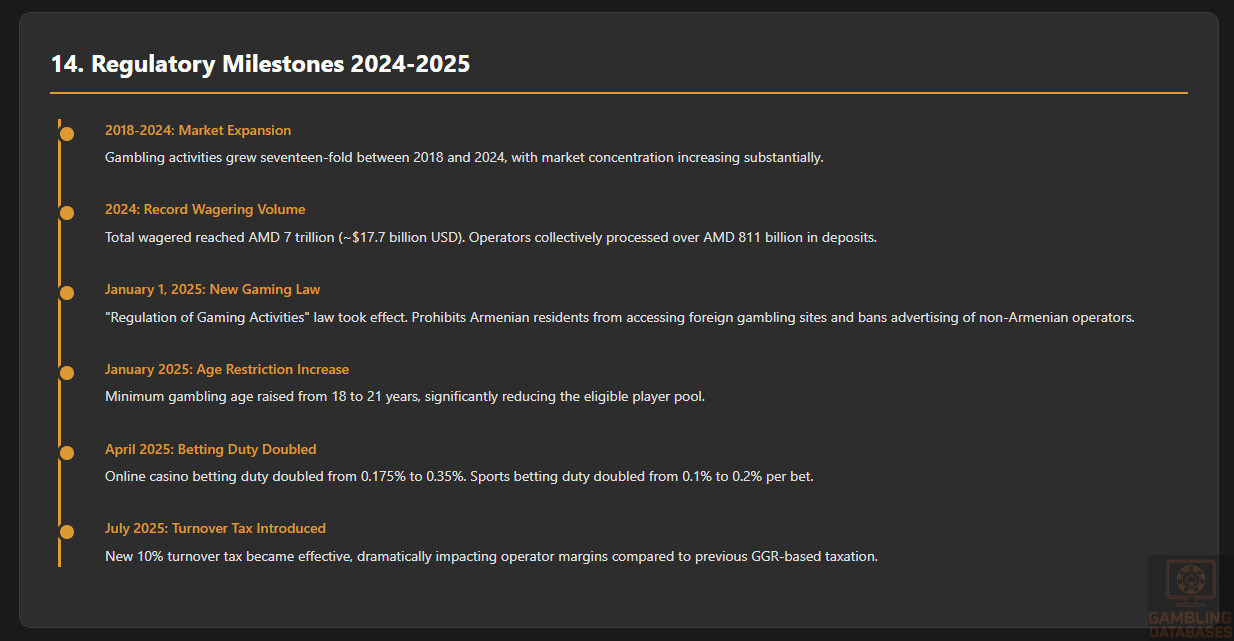
The Armenian gambling market consists of both local and international operators holding licenses from the Ministry of Finance. While specific market share data for individual operators remains limited, the market has attracted significant investment with operators collectively processing over AMD 811 billion in deposits during 2024.
Market concentration has increased substantially, with gambling activities growing seventeen-fold between 2018 and 2024. The majority of betting activity occurs online, reflecting global digital transformation trends and high smartphone penetration among Armenian consumers.
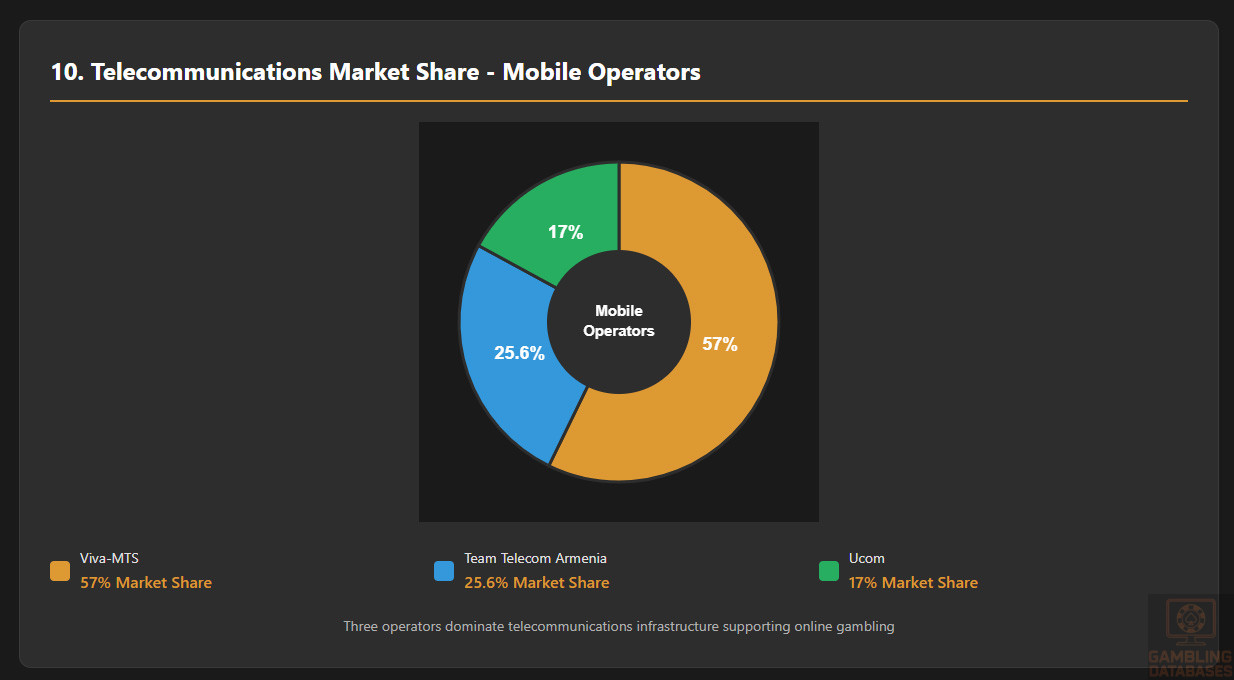
Three mobile network operators dominate telecommunications infrastructure supporting online gambling: Viva-MTS commands approximately 57% of mobile subscriptions, Team Telecom Armenia holds 25.6%, and Ucom maintains 17% market share. These providers enable the mobile-first gambling experience prevalent in the market.
International operators entering the Armenian market typically establish local subsidiaries to meet physical presence requirements. Foreign ownership is permitted under Armenian law, though operators must register commercial entities within Armenia and maintain operational infrastructure domestically.
Licensing Framework and Requirements
Application Process and Eligibility
The Ministry of Finance serves as the primary licensing authority for all gambling activities in Armenia. Applications for licenses require submission of comprehensive documentation including company registration details, beneficial ownership information, technical system specifications, and financial stability evidence.
The licensing timeline spans 23 working days from application submission for initial review, with potential extension of an additional 23 working days if submitted documentation requires further study. Upon approval decision, licenses are issued within one month following payment of the first annual state duty installment.
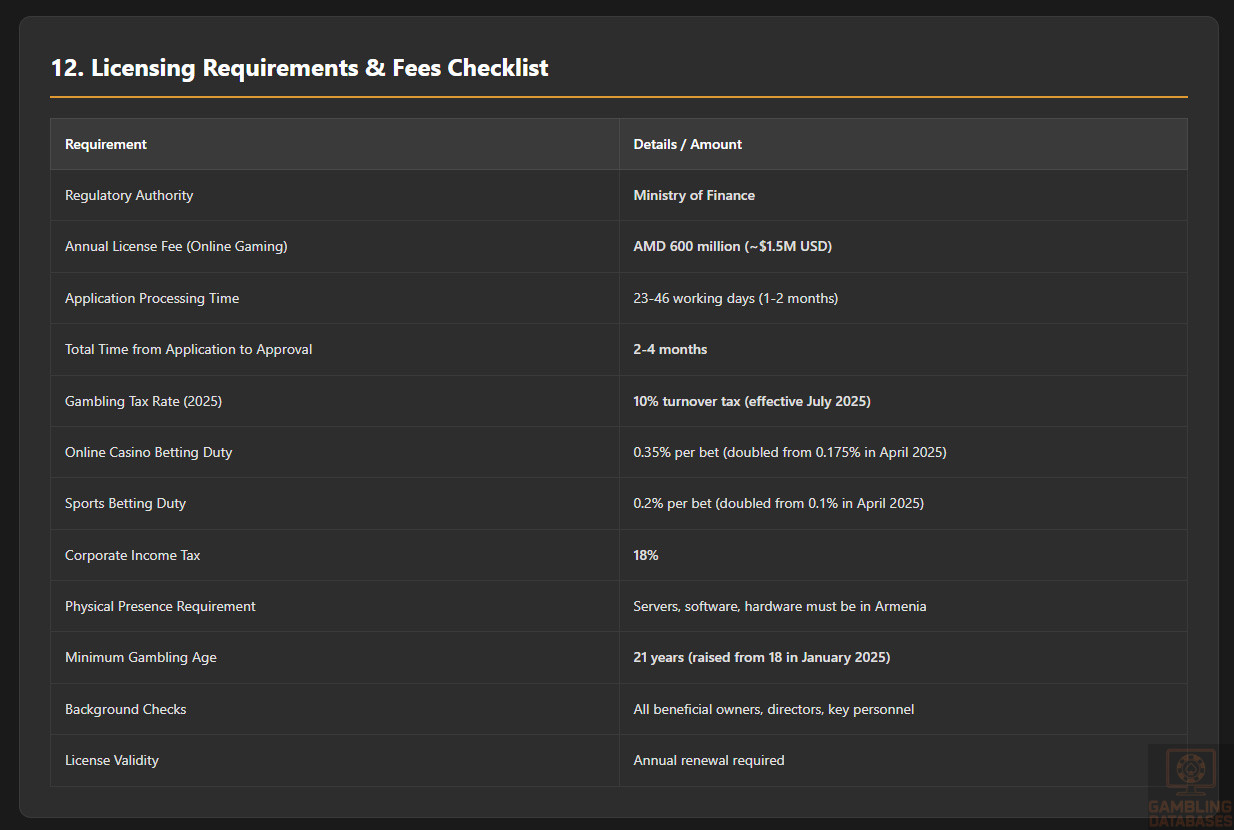
Financial requirements for online gambling licenses include an annual state duty of AMD 600 million (approximately $1.5 million USD), which must be paid before license issuance. This represents a substantial entry barrier designed to ensure only financially stable operators enter the market.
Background check procedures examine all beneficial owners, directors, and key personnel associated with applicant companies. These investigations verify absence of criminal records, financial misconduct, or prior license revocations in any jurisdiction.
| License Type | Annual State Duty | Processing Time | Additional Requirements |
|---|---|---|---|
| Online Gambling/Casino | AMD 600 million (~$1.5M USD) | 23-46 working days | Local servers, Armenian entity |
| Sports Betting (Online) | AMD 600 million (~$1.5M USD) | 23-46 working days | Local servers, Armenian entity |
| Land-Based Casino (Tsakhkadzor) | AMD 180 million (~$453K USD) | 23-46 working days | Physical premises in designated zone |
| Land-Based Casino (Sevan) | AMD 150 million (~$378K USD) | 23-46 working days | Physical premises in designated zone |
| Land-Based Casino (Jermuk) | AMD 100 million (~$252K USD) | 23-46 working days | Physical premises in designated zone |
| Land-Based Casino (Meghri) | AMD 35 million (~$88K USD) | 23-46 working days | Physical premises in designated zone |
| Lottery | Varies by scope | 23-46 working days | Armenian founders only |
Local Presence and Operational Requirements
Physical presence mandates require online gambling operators to establish registered commercial entities in Armenia. All gaming servers, software systems, hardware infrastructure, and gaming platforms must be physically located within Armenian territory to qualify for licensing.
Domain requirements specify that licensed operators must use Armenian domain extensions or internationally recognized domains registered to Armenian entities. The recent 2025 legislation prohibits advertising of gambling services on non-Armenian domains, reinforcing the localization mandate.
Personnel obligations include employing qualified technical staff for server maintenance, customer support representatives fluent in Armenian, and compliance officers responsible for regulatory adherence. While specific minimum headcount requirements vary by operation scale, regulators expect adequate staffing for license scope.
Foreign ownership restrictions permit 100% foreign ownership of gambling operators, providing no citizenship requirements exist for founders of gaming companies. However, lottery operations maintain stricter requirements, permitting only Armenian citizens or Armenian-registered legal entities as founders.
Compliance Obligations and Monitoring
Player Protection and Identification
Age verification requirements mandate that all gambling operators verify participants have reached the minimum age of 21 years before allowing gambling activity. This age threshold increased from 18 to 21 years effective January 2025, applying to sports betting and lottery games.
KYC and AML compliance standards require operators to collect and verify player identity documents, maintain transaction records, and report suspicious activities to the State Revenue Committee. Enhanced due diligence applies to high-value transactions and politically exposed persons.
Responsible gambling measures mandated by law include providing self-exclusion mechanisms through the Ministry of Finance’s central exclusion list. The exclusion system covers all licensed operators, preventing excluded individuals from participating in any gambling activities across the entire market.
Operators must restrict access to individuals whose legal capacity has been limited due to placing their families in difficult financial situations through gambling. The Ministry maintains and distributes this exclusion list to all licensed operators who must check against it before allowing participation.
Financial Monitoring and Reporting
Transaction monitoring systems are required to track all deposits, withdrawals, wagers, and payouts in real-time. A new unified electronic system for monitoring all gambling activities is under development, scheduled for implementation by 2028 to enhance regulatory oversight and tax compliance verification.
Reporting requirements mandate operators to submit detailed financial statements on monthly and quarterly schedules. Tax obligations transitioned to self-reporting in 2025, though the forthcoming monitoring center will provide independent verification capabilities reducing reliance on voluntary operator disclosures.
Audit and inspection procedures grant the State Revenue Committee authority to conduct on-site inspections and desk audits of operator records. Documentary control and examination of submitted reports form the current supervisory framework pending the new monitoring authority’s establishment.
Data retention requirements obligate operators to maintain comprehensive records of all gambling transactions, player accounts, and compliance activities for periods specified by anti-money laundering legislation and tax authorities.
Taxation Structure and Financial Obligations
Player Taxation
Tax rates on winnings implement a two-tier structure effective 2025. Gambling companies act as tax agents withholding 5% at source for significant individual wins. When smaller wins accumulate throughout the year, operators must withhold 10% during the player’s annual income declaration process.
Withholding procedures require operators to deduct applicable taxes from player winnings before payout and remit these amounts to tax authorities according to prescribed schedules. This tax agent role transfers enforcement burden from individual players to licensed operators.
Player tax obligations include declaring gambling income in annual tax returns where winnings exceed specified thresholds. The dual taxation approach aims to capture revenue from both large single wins and accumulated smaller winnings throughout the tax year.
Tax-free thresholds remain undefined in current legislation, with all gambling winnings potentially subject to taxation depending on amount and frequency. The withholding system ensures collection occurs before players receive funds, maximizing government revenue capture.
Operator Taxation
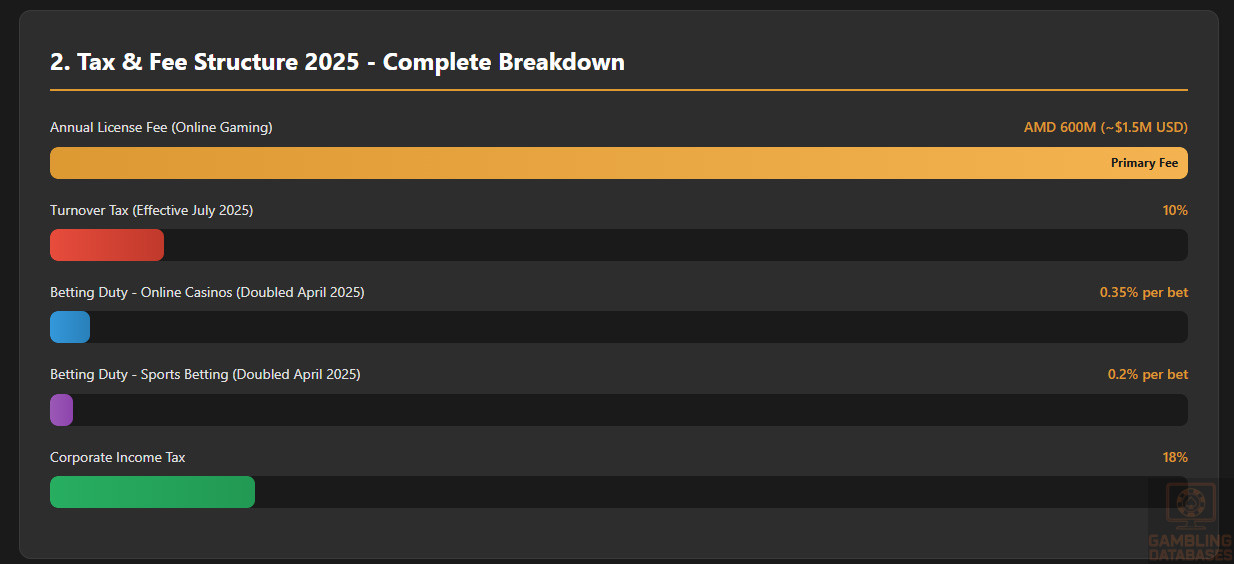
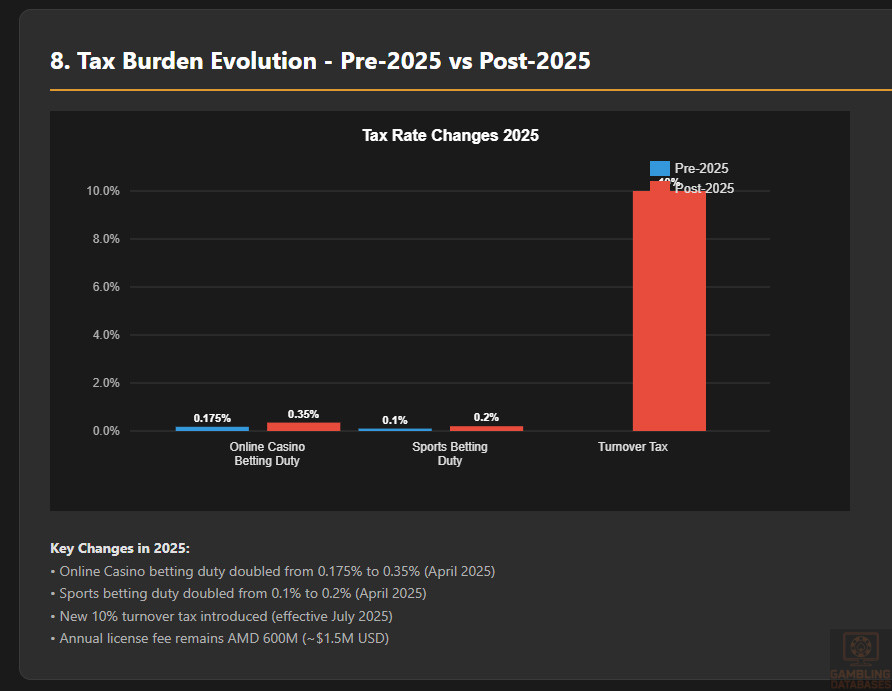
Armenia implemented dramatic tax reforms affecting gambling operators in 2025. The Parliament approved legislation introducing a 10% turnover tax on all licensed gambling activities effective July 1, 2025, replacing the previous per-bet duty structure for greater simplicity and transparency.
Prior to July 2025, a doubled per-bet tax structure applied: online casinos paid 0.35% per bet (increased from 0.175%), and sports betting operators paid 0.2% per bet (increased from 0.1%). These rates doubled effective April 1, 2025, as interim measures before the July turnover tax implementation.
Fixed operational taxes include the annual licensing fee of AMD 600 million for online gambling operations, representing substantial upfront capital requirements. This fee applies regardless of operational revenue, creating significant fixed cost pressure particularly for new market entrants.
Corporate income tax applies at the standard Armenian rate of 18% on net profits after accounting for gambling-specific duties and fees. This represents the only traditional tax applicable to gambling operations, as gambling activities receive exemption from most other standard business taxes due to the high licensing fees.
| Tax Type | Pre-2025 Rate | April-June 2025 | July 2025 Onward |
|---|---|---|---|
| Online Casino Bet Duty | 0.175% per bet | 0.35% per bet | – |
| Sports Betting Duty | 0.1% per bet | 0.2% per bet | – |
| Turnover Tax | N/A | N/A | 10% of turnover |
| Annual License Fee | AMD 600M (~$1.5M) | AMD 600M (~$1.5M) | AMD 600M (~$1.5M) |
| Corporate Income Tax | 18% | 18% | 18% |
| Projected Additional Revenue | – | AMD 13B annually | AMD 100B annually |
Gambling Market Financial Performance
Total amount wagered annually in Armenia reached extraordinary levels by 2024. Over AMD 7 trillion (approximately $17.7 billion USD) was wagered on gambling activities, marking a seventeen-fold increase compared to 2018 levels. The vast majority of this betting volume occurred through online channels.
Online casino deposits specifically exceeded AMD 811 billion (approximately $2 billion USD) in 2024 according to parliamentary testimony. This substantial deposit volume demonstrates both the market’s maturity and the scale of financial flows through the regulated gambling sector.
Revenue to government through gambling taxation showed significant growth trajectories. The 2022 gambling sector contributed AMD 18.8 billion (approximately $43.5 million USD) to state coffers, representing 10.4% of the entire services sector contribution.
Market revenue projections for 2025 estimate total gambling market revenue at $205.22 million USD, with the casino and casino games segment generating $127.35 million and online sports betting contributing $11.8 million. Alternative estimates place total market size at approximately $147 million with higher growth projections.
| Metric | 2021 | 2022 | 2024 | 2025 Projection |
|---|---|---|---|---|
| Total Wagered | – | – | AMD 7T ($17.7B) | – |
| Online Casino Deposits | – | – | AMD 811B ($2B) | – |
| Player Losses (GGR) | $150M | – | – | – |
| Government Tax Revenue | – | AMD 18.8B ($43.5M) | – | – |
| Total Market Revenue | – | – | – | $205.2M |
| Casino/Casino Games | – | – | – | $127.4M |
| Online Sports Betting | – | – | – | $11.8M |
Advertising and Marketing Restrictions
Permitted advertising channels for gambling operations face significant restrictions as of 2025. Only locally licensed operators may advertise gambling services in Armenia, with foreign gambling advertising completely prohibited under the January 2025 legislation.
Content restrictions mandate that all gambling advertisements target audiences aged 21 or older, aligning with the raised minimum gambling age. Television and radio advertising faces time restrictions, permitting broadcasts only between 10:00 PM and 6:00 AM to limit youth exposure.
Geographic advertising limitations prohibit gambling promotions at Armenian entry points including airports and border crossings. Hotel advertising also faces restrictions, with proposals to eliminate gambling advertisements even in four-star and higher-rated establishments to improve tourism perception.
Promotional limitations under discussion include potential caps on bonus offers and wagering requirement restrictions, though specific parameters remain under parliamentary review. The government aims to balance market competitiveness with responsible gambling objectives through these promotional controls.
Affiliate marketing rules require affiliates to adhere to the same advertising restrictions as operators, including age targeting and time limitations. Payment of affiliate commissions for directing Armenian residents to unlicensed foreign operators may face penalties under the new framework.
Penalty structures for advertising violations include fines of AMD 1 million (approximately $2,500 USD) for first offenses, escalating to AMD 4 million ($10,000) for second violations and AMD 8 million ($20,000) for third breaches. These graduated penalties aim to enforce compliance without immediately destroying operator businesses.
Recent Regulatory Changes and Their Impact
March 2025 marked a pivotal moment when the Armenian National Assembly approved comprehensive gambling tax reforms during a second reading on March 6. The legislation passed with 58 votes in favor, 2 against, and 17 abstentions, demonstrating substantial political support for stricter regulation.
The doubled betting duties implemented April 1, 2025 immediately increased operator costs. Online casinos saw per-bet taxation double from 0.175% to 0.35%, while sports betting operators faced increases from 0.1% to 0.2% per bet. These interim measures generated estimated additional monthly revenue of $2.7 million for the state.
July 2025 brought the most significant change: implementation of a 10% turnover tax replacing the per-bet duty structure. This fundamental shift simplifies tax calculation while increasing total tax burden, with government projections estimating AMD 100 billion (approximately $241.9 million) in additional annual state revenue.
The January 2025 law “Regulation of Gaming Activities” introduced sweeping changes including prohibition of Armenian participation in foreign-organized gambling, advertising bans for offshore operators, and server localization requirements. These measures aim to capture all Armenian gambling activity within the regulated domestic market.
Minimum gambling age increased from 18 to 21 years effective January 2025, reducing the addressable market size while aiming to protect younger adults from gambling-related harm. This change particularly affects sports betting and lottery participation demographics.
Future regulatory developments include establishment of a dedicated gambling monitoring center by 2028. Parliament included an escalation clause warning that if this regulatory body fails to become operational by the deadline, tax rates could increase three-fold, four-fold, or even five-fold, creating strong incentives for timely implementation.
Enforcement Mechanisms and Penalties
Penalty structures for unlicensed operations include potential criminal prosecution, though civil penalties dominate the current enforcement regime. ISP blocking measures target unlicensed foreign operators, with authorities gaining expanded powers under 2025 legislation to restrict access to offshore gambling websites.
Payment processor restrictions prevent Armenian banks and payment service providers from processing transactions with unlicensed gambling operators. This financial isolation strategy aims to make unlicensed operations commercially unviable within Armenia.
Recent enforcement actions have focused primarily on taxation compliance rather than unlicensed operations, with the State Revenue Committee conducting audits and inspections of licensed operators. The forthcoming unified monitoring system will dramatically enhance real-time compliance verification capabilities.
Compliance enforcement trends indicate government prioritization of revenue collection over prohibition. Prime Minister Pashinyan explicitly stated complete gambling bans remain impractical, as Armenian residents would simply use foreign websites, making taxation and regulation preferable to unsuccessful prohibition.
Section 2: Demographics and Consumer Analysis
Population Demographics and Distribution
Core Population Metrics
Total population of Armenia stands at approximately 2.95 million as of 2025, representing a small but economically active market in the South Caucasus region. The population has experienced modest decline from its 1992 peak of 3.63 million due to emigration related to economic challenges and regional conflicts.
Age distribution breakdown shows a mature population structure with significant working-age concentration. The 0-14 age group represents approximately 19% of the population, while 15-64 year-olds comprise about 68% of residents. The 65+ demographic accounts for roughly 13% of the total population.
The median age of 36.6 years positions Armenia as a relatively mature market with substantial purchasing power among middle-aged consumers. This demographic profile suits gambling market development, as disposable income and gambling propensity typically peak in the 35-54 age ranges.
Gender ratios show relative balance with women comprising approximately 53.4% of the population compared to 46.6% male representation. Life expectancy reaches 73.2 years overall, with significant gender disparity: males average 69.6 years while females reach 77.3 years.
| Age Group | Percentage | Estimated Population | Gambling Eligibility |
|---|---|---|---|
| 0-14 years | ~19% | ~561,000 | Prohibited |
| 15-20 years | ~6% | ~177,000 | Prohibited (under 21) |
| 21-34 years | ~20% | ~590,000 | Eligible |
| 35-44 years | ~16% | ~472,000 | Eligible |
| 45-54 years | ~14% | ~413,000 | Eligible |
| 55-64 years | ~12% | ~354,000 | Eligible |
| 65+ years | ~13% | ~384,000 | Eligible |
| Total Eligible (21+) | ~75% | ~2.21 million | Legal Market |
Geographic Distribution
Urban versus rural distribution patterns show strong urbanization with 63.75% of the population (approximately 1.88 million people) residing in urban areas. Rural populations account for 36.25%, though these areas face significant challenges in infrastructure and economic opportunity access.
Major cities and population centers concentrate in the capital Yerevan and several regional hubs. Yerevan dominates with over 1 million residents, serving as the commercial, cultural, and technological center. Other significant cities include Gyumri, Vanadzor, Vagharshapat, Hrazdan, and Abovyan.
Regional economic differences create varying consumer spending power and gambling participation rates. Yerevan residents enjoy substantially higher incomes and better access to both land-based and online gambling options compared to provincial areas.
Internet access geographic patterns follow urban-rural divides, with near-universal connectivity in cities but more limited rural access despite improving infrastructure. The 5G network rollout prioritizes urban centers, currently covering 65% of the population across 35 cities including both the capital and regional towns.
Economic Indicators and Consumer Spending Power
GDP and Economic Performance
Current GDP reached $25.79 billion USD in 2024 according to World Bank data, demonstrating sustained economic growth despite regional challenges. The economy has transformed significantly from its Soviet-era industrial base to a more diversified services and technology-oriented structure.
GDP per capita stands at $8,866 USD in 2025 according to World Economics estimates, reflecting substantial growth from $4,269 in 2020. This represents more than doubling of per capita income over five years, indicating strong economic recovery and development momentum.
GDP growth forecasts remain robust with Q1 2025 posting 5.1% year-over-year growth and Q2 2025 achieving 5.9% expansion. The government’s 2025 budget projects 5.1% annual growth with inflation controlled at 3% (±1.5%), creating favorable conditions for consumer spending.
Economic sector composition has shifted toward services, which now dominate the economy. The gambling and gaming sector represents a measurable 10.4% of total services sector revenue, highlighting its economic significance beyond entertainment value.
Employment rates and wage levels show gradual improvement, though official unemployment stands at 17.3% with independent estimates suggesting potentially higher figures. Over one-third of Armenia’s population lives in poverty, constraining discretionary spending for gambling among lower-income segments.
Income and Wealth Distribution
Average household income data remains limited in public sources, though GDP per capita figures suggest monthly household incomes in the range of $600-800 for average families. Urban households, particularly in Yerevan, command significantly higher incomes enabling greater gambling participation.
Median household income likely falls below average figures due to income inequality, with wealth concentrated among urban professionals, business owners, and technology sector workers. The growing IT industry has created a new middle class with substantial disposable income.
Income inequality measures reflect typical post-Soviet patterns with emerging wealth gaps between urban and rural areas, employed and unemployed populations, and those with versus without higher education. This creates a tiered gambling market with different segments exhibiting vastly different spending capacities.
Disposable income trends show improvement alongside GDP growth, particularly for employed urban residents. The growing middle class represents the core target demographic for online gambling operators, combining digital literacy, financial resources, and entertainment spending willingness.
| Indicator | Value | Year | Trend |
|---|---|---|---|
| Total GDP | $25.79 billion | 2024 | Growing |
| GDP Per Capita | $8,866 | 2025 | Rising (+4.3% from 2024) |
| GDP Growth Rate (Q1) | 5.1% | 2025 | Strong |
| GDP Growth Rate (Q2) | 5.9% | 2025 | Accelerating |
| Projected Annual Growth | 5.1% | 2025 | Stable |
| Inflation Rate (July 2025) | 3.4% | 2025 | Controlled |
| Unemployment Rate (Official) | 17.3% | 2025 | High but improving |
| Poverty Rate | ~33% | 2025 | Gradual decline |
Market Size and Growth Projections
Current iGaming market revenue reached $205.22 million USD in 2025 according to Statista projections, with casino and casino games dominating at $127.35 million. Online sports betting contributes approximately $11.8 million, while the remaining revenue comes from lottery and other gambling verticals.
Historical revenue growth shows explosive expansion with total wagered amounts increasing seventeen-fold between 2018 and 2024. This growth trajectory reflects increasing digitalization, smartphone adoption, and operator marketing investments rather than proportional player base expansion.
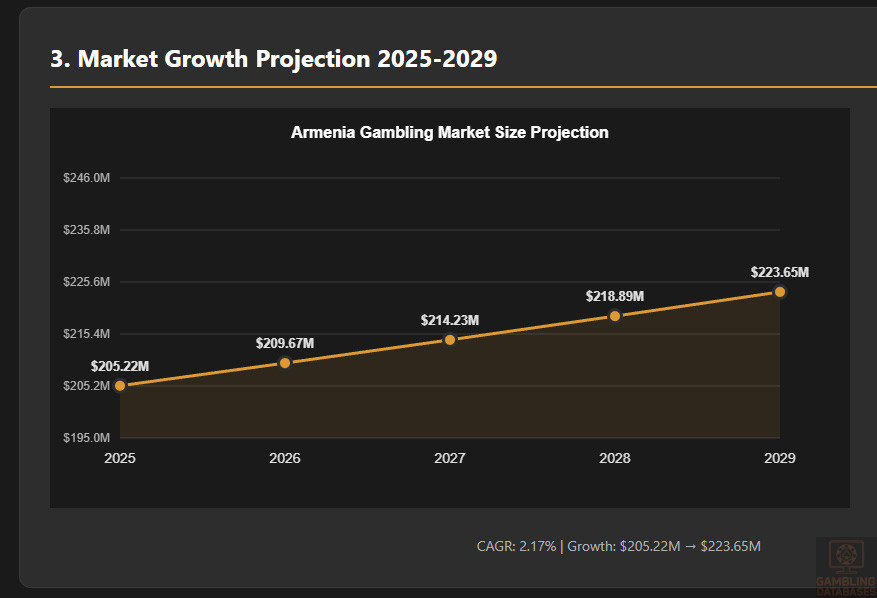
Revenue forecasts for 2025-2029 project a compound annual growth rate of 2.17%, reaching $223.65 million by 2029 according to Statista. Alternative estimates suggest slightly higher growth rates of 4.73% CAGR, potentially driving market size to $147-160 million by 2029.
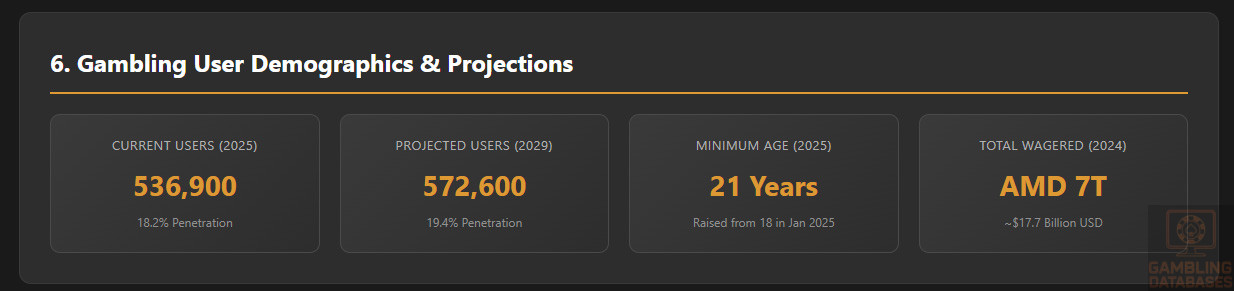
The projected user base growth anticipates 572,600 active gamblers by 2029, up from current penetration of 18.2% of the population. This represents approximately 536,000 current users based on 2025 population figures and penetration rates.
Average Revenue Per User currently stands at $382.73 USD annually in 2025, positioning Armenia as a mid-tier ARPU market. This figure reflects the balance between high-spending urban users and more modest rural or lower-income participants.
Market penetration rates at 18.2% in 2025 leave substantial room for growth compared to mature European markets where penetration can exceed 30-40%. However, the raised minimum age to 21 years constrains addressable market size relative to jurisdictions maintaining 18+ thresholds.
| Metric | 2025 | 2029 | CAGR |
|---|---|---|---|
| Total Market Revenue | $205.22M | $223.65M | 2.17% |
| Casino/Casino Games | $127.35M | ~$140M (est.) | ~2.4% |
| Online Sports Betting | $11.8M | ~$13.5M (est.) | ~3.4% |
| Active Users | ~536,000 | 572,600 | 1.7% |
| User Penetration | 18.2% | ~19.5% | +1.3pp |
| ARPU | $382.73 | ~$390 (est.) | ~0.5% |
| Total Wagered | ~$18B (est.) | ~$20B (est.) | ~2.7% |
Education, Skills, and Digital Literacy
Educational Foundation
Literacy rates in Armenia reach exceptionally high levels at 99.76% for adults, reflecting the strong educational legacy of the Soviet system. Male literacy stands at 99.81% while female literacy reaches 99.7%, showing negligible gender gaps in basic education.
Education levels demonstrate strong tertiary attainment with the 2011 census recording 539,394 persons (19.4% of population above 6 years) holding higher professional education qualifications. This creates a substantial pool of digitally capable, sophisticated consumers.
Digital literacy indicators position Armenia favorably among post-Soviet states. High smartphone penetration above 80% and internet usage reaching 80% of the population demonstrate widespread digital comfort and capability essential for online gambling adoption.
Workforce skill levels particularly in technology sectors have strengthened significantly, with Armenia developing as a regional IT and software development hub. This technical sophistication translates to consumer comfort with complex online platforms and digital payment systems.
Cultural and Social Factors
Communication and Language
Primary languages used in daily life center on Armenian, spoken by approximately 98% of the population. Yazidi and Kurdish serve as minority languages, with Russian maintaining widespread understanding due to Soviet-era education and continuing cultural ties.
Business communication norms blend post-Soviet formality with increasingly Western-influenced practices, particularly in Yerevan’s business community. Customer service expectations include responsive support in Armenian language during local business hours.
Language requirements for gambling websites mandate Armenian as the primary interface language, though multilingual options enhance appeal to diaspora users and international residents. Payment instructions, terms and conditions, and responsible gambling information must be clearly presented in Armenian.
Cultural Attitudes
Gambling acceptance levels in Armenian society show increasing tolerance despite traditional conservative values. The sector’s growth from $150 million in player losses in 2021 to over $200 million market size in 2025 indicates widespread participation overcoming cultural stigma.
Religious influences on gambling perception remain meaningful given Armenia’s identity as the first Christian nation (301 AD) and the Armenian Apostolic Church’s 93%+ affiliation rate. However, religious opposition has not translated into prohibition movements, with regulation preferred over bans.
Foreign brand perception and trust show openness to international operators, though local presence requirements ensure all operators establish Armenian identities. Consumers respond positively to international gambling brands operating under Armenian licenses.
Risk tolerance indicators suggest moderate-to-high risk appetite among Armenian gamblers, with substantial betting volumes relative to income levels. The $382 average annual spending per user represents meaningful discretionary income allocation despite modest national income levels.
Problem Gambling and Social Considerations
Prevalence of gambling addiction has increased dramatically according to psychology experts, with problem gambler numbers growing tenfold over the past five years. This alarming trend drove many of the 2025 regulatory tightening measures including age increases and advertising restrictions.
Number of problem gamblers remains difficult to quantify without comprehensive studies, though the $150 million in player losses reported for 2021 suggests thousands of individuals experiencing gambling-related harm. The 17-fold increase in wagering since 2018 likely corresponds to proportional addiction growth.
At-risk population statistics concentrate among young adults and lower-income individuals facing economic stress. Military suicides linked to gambling debt became a particular concern, with over half of 2024 military suicides attributed to gambling problems according to parliamentary testimony.
Underage gambling issues motivated the January 2025 age increase from 18 to 21 years. The government identified particular vulnerability among 18-20 year-olds who lacked sufficient financial maturity and risk awareness despite legal adult status.
Government response measures include the mandatory self-exclusion list maintained by the Ministry of Finance, judicial capacity limitation for individuals bankrupting families through gambling, and planned establishment of a dedicated monitoring center by 2028.
Treatment facilities and support services remain underdeveloped relative to problem gambling prevalence. The lack of comprehensive treatment infrastructure represents a gap that regulations attempt to address through prevention rather than intervention.
Political Structure and Governance
Government system operates as a parliamentary republic with Prime Minister Nikol Pashinyan leading since 2018. The political environment has stabilized following the 2020 Nagorno-Karabakh conflict and subsequent 2025 peace agreement with Azerbaijan.
Political stability indicators show improvement with the August 2025 peace declaration ending nearly four decades of conflict. This stability enhances business confidence and reduces geopolitical risk for international investors entering the gambling market.
Regulatory consistency and predictability have improved under current leadership, with systematic approaches to gambling regulation replacing ad-hoc policy changes. The comprehensive 2025 reforms demonstrate capacity for complex legislative initiatives despite political pressures.
Corruption perception remains a concern typical of post-Soviet states, though reform efforts continue. The gambling sector’s high licensing fees and reporting requirements aim to ensure transparency and reduce opportunities for corruption in licensing and oversight.
International relations impact on business includes deepening Western orientation, with Armenia pursuing EU membership. Parliament approved EU accession endorsement in February 2025, positioning Armenia for closer European integration that may influence future gambling regulations toward EU standards.
Technology Adoption and Digital Behavior
Internet and Digital Usage
Internet penetration rates reached 80-85% of the population in 2025, with approximately 2.37 million internet users. This high penetration enables widespread online gambling access, though the 15-20% offline population remains excluded from digital gaming opportunities.
Daily internet usage hours average substantial time online, driven by social media engagement, entertainment consumption, and increasingly remote work arrangements. High engagement levels create opportunities for gambling operators to reach consumers through digital marketing channels.
Mobile device adoption rates exceed 80% smartphone penetration, with 93.9% of residents owning phones of some type. The mobile-first nature of internet access in Armenia makes mobile-optimized gambling platforms essential rather than optional for market success.
Social media engagement shows high participation rates with 1.85 million social media users as of 2023, representing 66.6% of the population. Popular platforms include Facebook, Instagram, and international services, providing advertising channels despite gambling marketing restrictions.
E-commerce participation rates have grown substantially, with consumers increasingly comfortable making online purchases and digital transactions. This familiarity with e-commerce translates directly to comfort with online gambling deposits and withdrawals.
Digital Payment Behavior
Payment method preferences in Armenia favor bank cards and bank transfers, with digital wallets gaining traction. Traditional cash-based transactions still dominate retail, but online payments show rapid adoption particularly among younger, urban demographics.
Most popular digital wallets include international services like PayPal where available, regional payment solutions, and mobile operator payment systems. Local payment method integration proves essential for maximizing deposit conversion rates.
Online transaction patterns show increasing frequency and comfort with digital payments, accelerated by pandemic-driven digitalization. Average transaction sizes for e-commerce provide benchmarks for expected gambling deposit amounts.
Trust in online payment systems has improved significantly with banking sector modernization and regulatory oversight enhancements. Security concerns that previously limited online spending have diminished as infrastructure matures.
Cryptocurrency adoption for gambling remains limited given Armenia’s regulatory focus on licensed, monitored operations. The server localization and monitoring requirements make cryptocurrency-based gambling difficult to reconcile with compliance obligations.
Gaming and Gambling Preferences
Current Market Participation
Percentage of population that gambles annually reaches approximately 18.2% based on market penetration data, translating to roughly 536,000 active gamblers from the eligible 21+ population. This participation rate leaves substantial room for market expansion.
Percentage that gambles online dominates total gambling activity, with the vast majority of the AMD 7 trillion wagered in 2024 occurring through online channels. Desktop traffic currently leads at 66.97% versus 32.45% mobile, though mobile shows 19.5% growth indicating shifting preferences.
Popular gambling activities ranking by participation shows online casino games dominating revenue at $127.35 million, followed by online sports betting at $11.8 million. Lotteries maintain steady participation particularly in designated resort cities.
Sports betting versus casino games preference tilts heavily toward casino games based on revenue distribution. Casino gaming generates over 10 times the revenue of sports betting, suggesting either higher casino game participation or significantly higher spending per casino player.
Live dealer games popularity data remains limited, though global trends toward live casino suggest this represents a growth segment for operators. Armenian players’ preference for social interaction may favor live dealer formats over pure RNG games.
Consumer Behavior Patterns
Average spending per player annually reaches $382.73 based on ARPU calculations, though significant variance exists between casual players and high-rollers. This figure translates to approximately $32 monthly spending per active user.
Spending habits and typical bet sizes vary by game type and player segment. The substantial wagered amounts relative to market revenue suggest relatively high payout percentages or significant variance in betting volumes across the user base.
Platform preferences currently favor desktop at nearly 67% of traffic, contrasting with global mobile-first trends. However, the 19.5% mobile growth rate suggests rapid transition toward mobile-dominant usage patterns within 1-2 years.
Peak gambling times likely concentrate in evening hours after work and on weekends, following typical entertainment consumption patterns. Seasonal variations may align with salary payment cycles and holiday periods when discretionary spending increases.
Session length averages remain undocumented in available data, though the high annual wagered amounts relative to user counts suggest either long session durations or high session frequency among active players.
Retention and loyalty patterns appear strong given the dramatic growth in wagering volumes without proportional user base expansion. This suggests deepening engagement among existing users rather than primarily new customer acquisition driving growth.
Bonus sensitivity and promotional response likely remain high given the competitive market and operators’ efforts to differentiate offerings. However, the 10% turnover tax implementation may constrain promotional budgets, reducing bonus generosity.
| Metric | Value | Trend |
|---|---|---|
| Internet Penetration | 80-85% | Stable/Growing |
| Internet Users | 2.37 million | Stable |
| Smartphone Penetration | 80%+ | Growing |
| Phone Ownership | 93.9% | Stable |
| Social Media Users | 1.85 million (66.6%) | Growing |
| Desktop Web Traffic | 66.97% | Declining (-7.4% YoY) |
| Mobile Web Traffic | 32.45% | Rising (+19.5% YoY) |
| Gambling Participation | 18.2% of population | Growing |
| Active Gamblers | ~536,000 | Growing slowly |
| Annual Spending/User | $382.73 | Stable |
Section 3: Technology Infrastructure and Business Environment
Internet and Digital Infrastructure
Connectivity and Network Performance
Internet penetration rates reach 80-85% in 2025 with quality assessment showing solid mid-tier performance compared to regional neighbors. Armenia positions as neither the best nor worst connected South Caucasus nation, with Georgia slightly ahead but Armenia exceeding Azerbaijan in some metrics.
Fixed broadband versus mobile internet breakdown shows mobile dominance for access with 147.4% mobile penetration (4.10 million connections for 2.95 million population). Fixed broadband serves approximately 315,319 users (10.76 per 100 persons), with fiber accounting for 83.3% of fixed connections.
Average internet speeds reached 40.14 Mbps for fixed connections and 22.35 Mbps for mobile as of early 2023, representing a 43.7% annual increase for fixed speeds. These speeds adequately support online gambling platforms though lag behind top-tier European markets.
Network reliability and uptime statistics indicate stable service from major providers including Ucom, Viva Armenia, and Team Telecom Armenia. The competitive three-operator market drives infrastructure investment and service quality improvements.
5G and Future Technology Deployment
Current 4G/5G coverage shows comprehensive 4G/LTE deployment across 89.5% of Armenian territory covering 898 settlements. This near-universal 4G access provides the foundation for mobile gambling across both urban and rural areas.
5G rollout timeline accelerated dramatically in 2025 with Ucom launching the country’s largest 5G network reaching 65% of the population across 35 cities. The deployment uses non-stand-alone architecture maximizing reuse of existing 4G infrastructure for cost efficiency.
Future infrastructure plans include continued 5G expansion by all three mobile operators, with Team Telecom partnering with Ericsson for infrastructure upgrades. Millimeter-wave trials in Yerevan business districts promise gigabit speeds for dense urban areas.
Network operator landscape competition among Viva-MTS (57% market share), Team Telecom (25.6%), and Ucom (17%) drives innovation and infrastructure investment. Government spectrum policy favors operators over neighboring countries, accelerating deployment.

Mobile Technology Ecosystem
Mobile Network Infrastructure
Number of mobile network operators stands at three: Viva-MTS, Team Telecom Armenia, and Ucom. This competitive but not fragmented market structure balances infrastructure investment with service competition.
Network operator market share breakdown shows Viva-MTS commanding 57% dominance, Team Telecom holding 25.6%, and Ucom maintaining 17%. All three offer 2G, 3G, 4G, and now 5G services with modern, reliable networks.
4G/5G coverage maps show near-complete 4G coverage with 5G rapidly expanding. Ucom’s aggressive 5G deployment extends to regional cities like Aparan, Martuni, and Sisian, not just the capital.
Data costs and pricing models remain competitive with budget options like Team’s AMD 1,500 tariff serving cost-conscious users. Unlimited data packages face slower uptake due to inflation constraints on discretionary spending.
| Operator | Market Share | 2G | 3G | 4G | 5G |
|---|---|---|---|---|---|
| Viva-MTS | 57% | Yes (99.3%) | Yes (98.1%) | Yes (48.5%) | Launching |
| Team Telecom | 25.6% | Yes (88.9%) | Yes (60%) | Yes (60%) | Planned |
| Ucom | 17% | Yes | Yes | Yes | Yes (65% pop) |
Device Penetration
Smartphone adoption rates exceed 80% of the population representing approximately 2.36 million smartphone users. This high penetration makes mobile-optimized gambling platforms essential for market penetration.
Smartphones per capita approach one device per person among the connected population, with many users owning multiple devices for personal and professional use.
Device preferences and popular brands favor affordable Android devices given economic constraints, though iPhone penetration exists among affluent urban consumers. Budget-friendly smartphone demand drives local manufacturer growth.
Android versus iOS market share heavily favors Android with approximately 81-85% dominance, similar to neighboring Azerbaijan’s 81.29% Android share. iOS accounts for roughly 15-19% of devices, concentrated among higher-income users.
Financial Services and Payment Infrastructure
Banking System Structure
Major banks operating in Armenia include both domestic institutions and international banking groups. The banking sector has modernized significantly since 2000s reforms breaking the ArmenTel telecommunications monopoly’s payment dominance.
Digital banking adoption rates show strong growth with online and mobile banking usage increasing among younger demographics. Traditional branch banking remains important for older users and rural populations.
Account penetration rates indicate moderate banking inclusion with significant urban-rural divides. Yerevan residents maintain near-universal banking access while rural areas lag in formal financial service usage.
Credit and lending markets maturity has improved with Armenian banks’ lending growing 10% in 2019 and continued expansion. Banking sector assets and credit exposures nearly doubled between 2012 and 2018.
Payment Processing Options
Available payment methods for iGaming include bank cards (credit and debit), bank transfers, and emerging digital wallet options. Traditional banking products dominate due to regulatory emphasis on traceable, monitored transactions.
Credit and debit card penetration shows moderate adoption concentrated among employed urban residents. Card usage for online transactions has grown substantially though cash remains king for in-person purchases.
E-wallet options availability includes some international services though local adoption lags European levels. PayPal, Skrill, and Neteller availability varies with some services restricted or limited in Armenia.
Cryptocurrency acceptance faces regulatory ambiguity with the gambling sector’s localization and monitoring requirements creating challenges for crypto integration. Licensed operators must maintain traceable, reportable payment flows incompatible with cryptocurrency anonymity.
Processing fees and typical charges vary by method with bank transfers often offering lowest-cost options and card payments incurring 2-4% merchant fees. International payment processing adds currency conversion costs.
Transaction processing timelines range from instant for domestic bank transfers to 1-3 business days for international card transactions. Withdrawal processing speed represents competitive differentiation among operators.
International payment capabilities exist for licensed operators requiring currency conversion and international banking partnerships. The Armenian Dram (AMD) serves as primary currency though USD and EUR acceptance facilitates diaspora player deposits.
Business Environment and Regulatory Framework
Ease of Business Operations
World Bank Doing Business ranking places Armenia in mid-tier globally, with particular strength in specific areas like contract enforcement while facing challenges in others. Overall business environment has improved under reform-oriented government leadership.
Business registration processes follow standardized procedures with clearly defined steps. Online registration systems streamline company formation for standard entity types.
Time required to start a business has decreased through digitalization initiatives, though the gambling sector faces additional licensing timeline requirements beyond standard business registration.
Foreign investment policies welcome international capital with 100% foreign ownership permitted for gambling operations. No special restrictions apply to foreign investors beyond those applicable to all operators.
Corporate Structure and Registration
Available Entity Types
LLC (Limited Liability Company) represents the most common structure for iGaming operators, offering liability protection and relatively simple administration. Corporations (joint stock companies) suit larger operations planning significant capitalization.
Branch office options exist for established foreign gambling companies seeking Armenian market entry, though full subsidiary registration often proves preferable for licensing and operational flexibility.
Recommended structure for iGaming operators typically involves Armenian LLC or CJSC (closed joint stock company) providing proper legal basis for license application while limiting shareholder liability.
Registration Requirements
Registration timelines span 1-3 weeks for standard commercial entity registration excluding gambling license processing. Combined entity registration plus license approval extends to 2-4 months total.
Registration costs include government fees of approximately $100-300 for entity registration plus legal and notarization fees of $500-2,000 depending on complexity and service provider selection.
Required documents include articles of association, shareholder information, beneficial ownership declarations, registered office address proof, and director appointment documentation. Notarization requirements apply to founding documents.
Foreign ownership rules permit 100% foreign ownership of gambling companies with no local partner requirements, unlike lottery operations restricted to Armenian citizen founders.
Minimum capital requirements vary by entity type with LLCs requiring minimal capital (AMD 100,000 or ~$250) while joint stock companies mandate higher capitalization. Gambling licenses require separate financial stability demonstration.
Taxation Framework
Corporate Income Tax Structure
Standard corporate tax rates stand at 18% on net profits, among the lower rates in the region. Gambling operators pay this standard rate on profits after accounting for gambling-specific duties and license fees.
Special economic zone benefits exist in Armenia though gambling operations typically operate under standard tax regimes rather than SEZ frameworks given regulatory oversight requirements.
International tax treaties cover numerous countries helping Armenian operations avoid double taxation on cross-border transactions and profit repatriation. Treaty network facilitates international holding structures.
Withholding tax on dividends, interest, and royalties applies according to domestic law and treaty provisions, typically ranging 5-10% for treaty countries and up to 15% for non-treaty jurisdictions.
Personal Income Tax
Individual tax rates apply to employee salaries with progressive or flat rate structures. Social security contributions require both employer and employee payments adding to total employment costs.
Tax residency rules determine obligation scope with residents taxed on worldwide income and non-residents on Armenian-source income only. Six-month presence typically establishes tax residency.
| Tax Type | Rate | Application |
|---|---|---|
| Corporate Income Tax | 18% | Net profits after gambling duties |
| Gambling Turnover Tax | 10% | Total turnover (from July 2025) |
| Online Casino Bet Duty | 0.35% | Per bet (April-June 2025) |
| Sports Betting Duty | 0.2% | Per bet (April-June 2025) |
| License Fee (Annual) | AMD 600M ($1.5M) | Online gambling operations |
| Player Winnings Tax | 5-10% | Withheld by operator |
| VAT | 20% | Not applicable to gambling |
| Dividend Withholding | 5-15% | Based on treaties |
Market Entry Considerations
Recommended Entry Strategies
Optimal market entry approaches favor establishing wholly-owned Armenian subsidiaries meeting all localization requirements. Direct licensing proves more viable than partnership structures given 100% foreign ownership permissions.
Local partnership requirements remain optional rather than mandatory for online gambling operations, though partnerships with established Armenian businesses can facilitate market entry through operational knowledge and relationship networks. Payment provider partnerships prove essential given banking integration complexities.
White label versus proprietary platform considerations involve balancing speed-to-market against control and margins. White label solutions enable faster entry with 2-3 month deployment versus 6-12 months for proprietary platforms, though revenue sharing reduces long-term profitability.
Technology infrastructure leveraging strategies should emphasize mobile optimization given rapid mobile traffic growth despite current desktop dominance. Investment in Armenian language interfaces and local payment method integration proves essential rather than optional.
Marketing and localization requirements demand comprehensive Armenian language content across all customer touchpoints. Cultural sensitivity regarding gambling’s social impacts and alignment with responsible gambling messaging helps navigate the regulatory environment’s increasing scrutiny.
Payment provider selection criteria should prioritize local banking integration, AMD currency support, and compliance with transaction monitoring requirements. International payment processors must work alongside domestic banking relationships to serve both local and diaspora customers effectively.
Risk mitigation strategies include staged market entry with initial licensing followed by scaled marketing investment once operational stability confirms. Building cash reserves for the substantial AMD 600 million annual license renewals prevents liquidity crises.
Typical Costs and Timelines
Initial setup investments breakdown includes multiple significant cost categories. License application fees comprise the AMD 600 million (~$1.5 million) annual state duty representing the single largest entry cost and creating substantial barriers to entry for undercapitalized operators.
Legal and consulting fees for license application, entity registration, and ongoing compliance typically range $50,000-150,000 depending on complexity and external advisory requirements. Local legal counsel proves essential for navigating Armenian regulatory frameworks.
Company registration costs remain modest at $1,000-3,000 for standard entity formation including government fees, notarization, and basic legal services. This represents minimal expense relative to total entry investment.
Initial capital requirements beyond the license fee include working capital for operations prior to revenue generation, typically $200,000-500,000 depending on launch scale and marketing ambitions. Cash reserves must cover 3-6 months of operations.
Office setup costs for required physical presence range $20,000-100,000 annually depending on location and scale. Yerevan center locations command premium rents while peripheral or smaller city locations offer cost savings.
Technology and platform costs span $100,000-500,000 for white label solutions including integration, customization, and first-year licensing fees. Proprietary platform development escalates costs to $500,000-2,000,000 with longer development timelines.
Initial marketing budget requirements depend on competitive positioning strategy but typically demand $200,000-1,000,000 for market entry campaigns. Customer acquisition costs in competitive markets require substantial investment for meaningful market share capture.
| Cost Category | Low Estimate | High Estimate | Notes |
|---|---|---|---|
| License Application Fee | $1,500,000 | $1,500,000 | Annual fee, paid upfront |
| Legal & Consulting | $50,000 | $150,000 | License prep + ongoing |
| Company Registration | $1,000 | $3,000 | Entity formation |
| Initial Working Capital | $200,000 | $500,000 | 3-6 months runway |
| Office Setup | $20,000 | $100,000 | First year costs |
| Technology/Platform | $100,000 | $2,000,000 | White label vs proprietary |
| Initial Marketing | $200,000 | $1,000,000 | Launch campaigns |
| Server Infrastructure | $30,000 | $100,000 | Local hosting required |
| Payment Integration | $10,000 | $50,000 | Multiple methods |
| Compliance Systems | $20,000 | $80,000 | KYC/AML tools |
| TOTAL INITIAL INVESTMENT | $2,131,000 | $5,483,000 | First year |
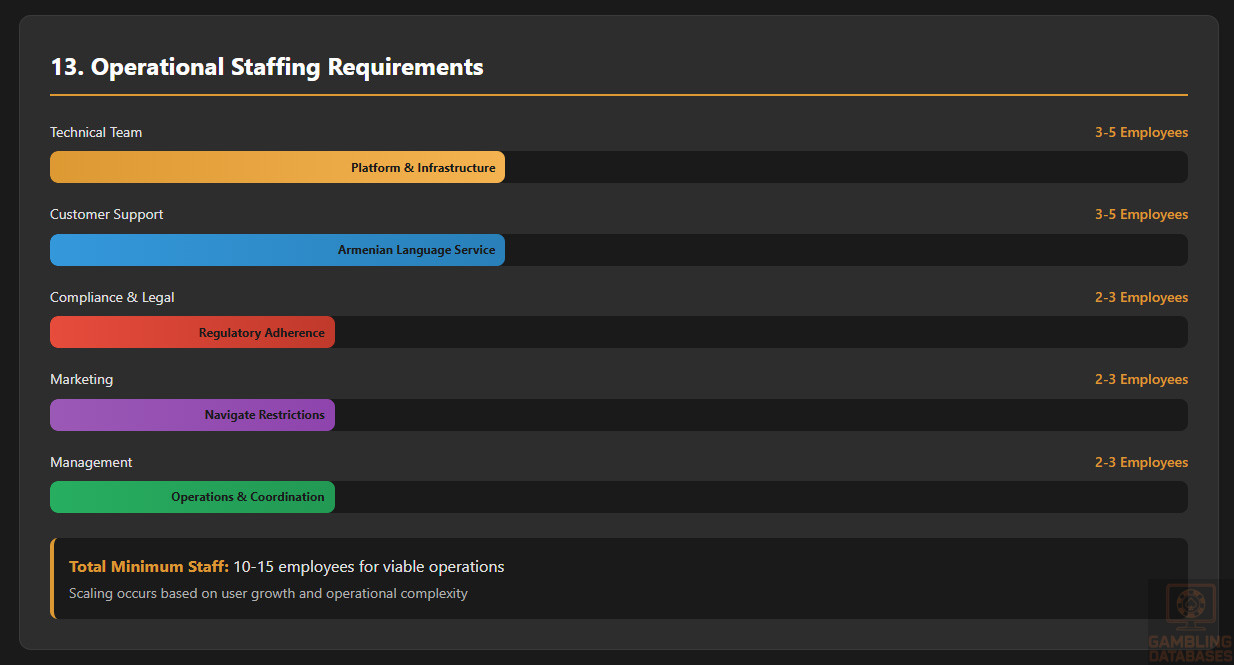
Operational cost estimates on monthly and annual basis include staff salaries representing significant ongoing expenses. Technical staff command AMD 400,000-800,000 monthly ($1,000-2,000), customer support AMD 200,000-400,000 ($500-1,000), and management AMD 1,000,000+ ($2,500+) depending on experience.
Office rent and utilities in Yerevan range $1,000-5,000 monthly for suitable commercial space, with utilities adding $200-500 monthly. Smaller offices or regional locations reduce costs but may impact talent recruitment.
Technology maintenance includes platform licensing fees, hosting costs, software updates, and technical support, typically totaling $10,000-40,000 monthly depending on platform complexity and user volumes.
Payment processing fees consume 2-5% of transaction volumes depending on payment methods and processing partners. These variable costs scale with revenue but represent significant margin pressure.
Marketing and customer acquisition costs typically require $50,000-200,000 monthly for competitive market presence given advertising restrictions limiting channel options and increasing costs for remaining permitted channels.
| Expense Category | Monthly Cost Range | Annual Cost Range |
|---|---|---|
| Staff Salaries (10-20 employees) | $15,000 – $40,000 | $180,000 – $480,000 |
| Office Rent & Utilities | $1,200 – $5,500 | $14,400 – $66,000 |
| Technology/Platform Fees | $10,000 – $40,000 | $120,000 – $480,000 |
| Payment Processing (variable) | 2-5% of revenue | 2-5% of revenue |
| Marketing & Advertising | $50,000 – $200,000 | $600,000 – $2,400,000 |
| Legal & Compliance | $3,000 – $10,000 | $36,000 – $120,000 |
| Customer Support | $5,000 – $15,000 | $60,000 – $180,000 |
| Server/Hosting | $2,000 – $8,000 | $24,000 – $96,000 |
| TOTAL MONTHLY (excl. taxes) | $86,200 – $318,500 | $1,034,400 – $3,822,000 |
| Annual License Renewal | – | $1,500,000 |
| 10% Turnover Tax | Variable | 10% of turnover |
Timeline expectations for market entry include company registration requiring 2-4 weeks from documentation preparation to registration certificate issuance. This represents the fastest component of the entry process.
License application processing spans 23-46 working days (approximately 1-2 months) plus additional time for documentation preparation and stakeholder background checks. Expect 2-4 months total from initial application to license approval.
Platform setup timelines vary dramatically by approach: white label deployments complete in 2-3 months including customization, integration, and testing. Proprietary platforms require 6-12 months for development, testing, and regulatory approval.
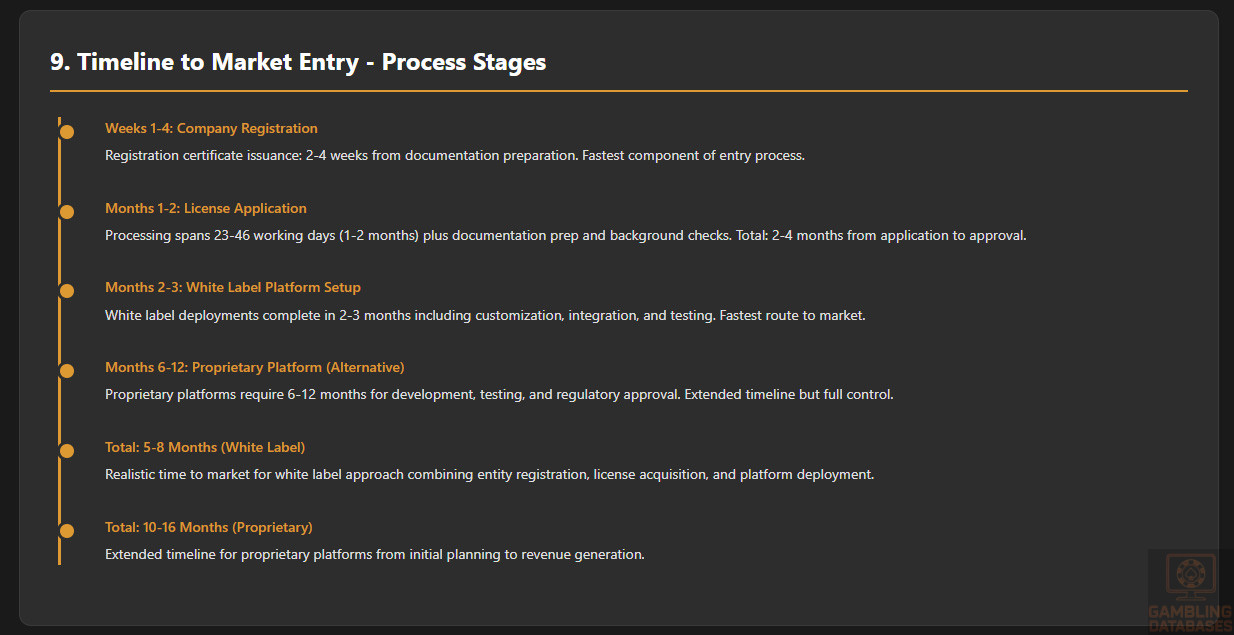
Total time to market realistically spans 5-8 months for white label approaches combining entity registration, license acquisition, and platform deployment. Proprietary platforms extend timelines to 10-16 months from initial planning to revenue generation.
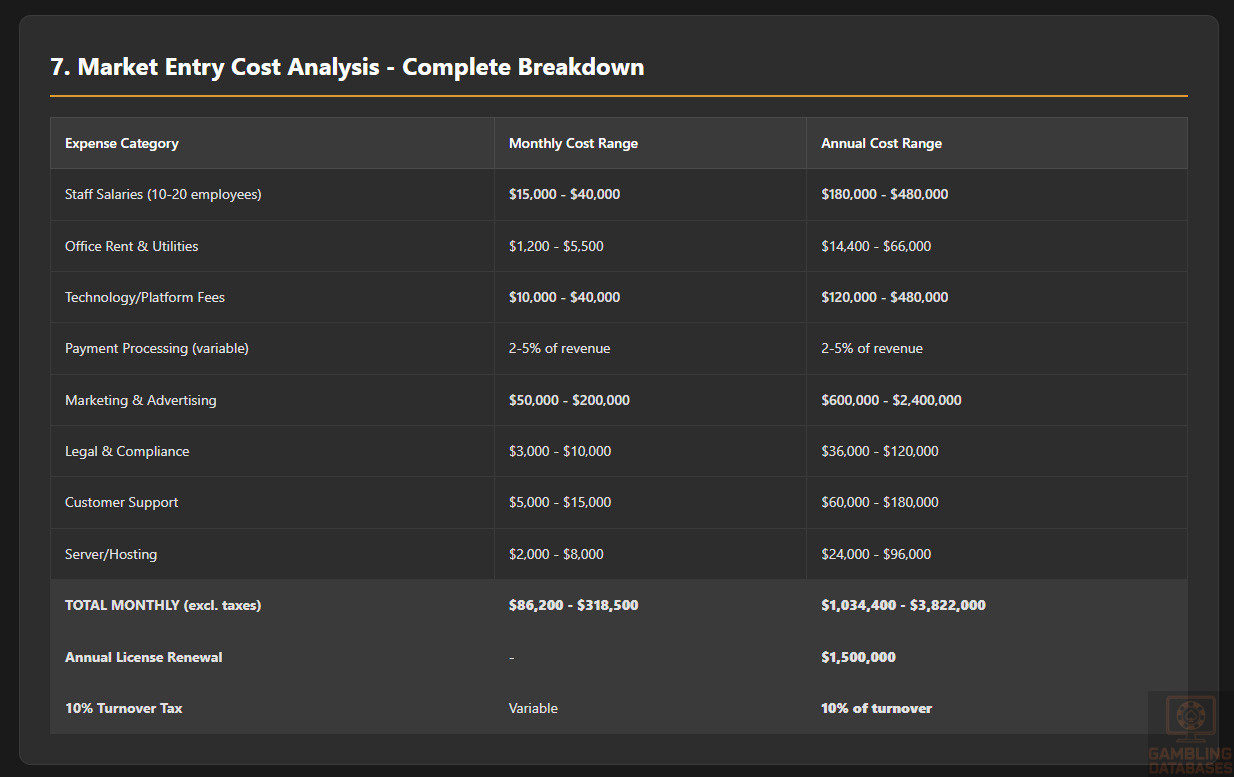
Resource requirements include minimum staff headcount of 10-15 employees for viable operations: technical team (3-5), customer support (3-5), compliance and legal (2-3), marketing (2-3), and management (2-3). Scaling occurs based on user growth.
Key positions needed encompass Technical Director managing platform and infrastructure, Compliance Officer ensuring regulatory adherence, Customer Support Manager handling Armenian-language service, Marketing Manager navigating advertising restrictions, and General Manager coordinating operations and stakeholder relationships.
Success Factors and Challenges
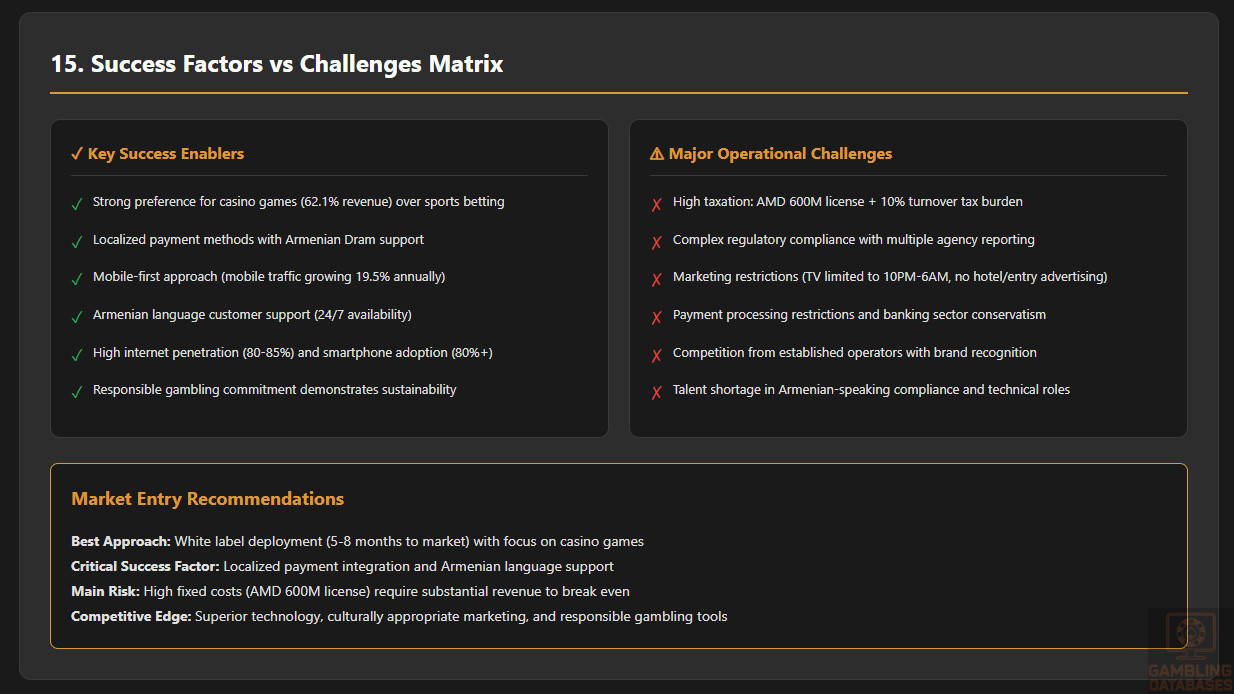
Key Success Enablers
Understanding of local player preferences proves essential with Armenian gamblers showing strong preference for casino games over sports betting based on revenue distribution. Operators must prioritize slot and table game libraries over sportsbook development.
Localized payment methods integration maximizes deposit conversion with Armenian Dram support, local bank transfer options, and familiar payment interfaces reducing friction. International payment methods serve diaspora players but cannot replace local integration.
Mobile-first approach becomes increasingly critical as mobile traffic grows 19.5% annually despite current desktop dominance. Responsive design and native mobile applications position operators for shifting usage patterns rather than reacting after market transition completes.
Effective marketing channels and partnerships face constraints from advertising restrictions limiting television, radio, hotel, and entry point promotions. Digital channels, affiliate partnerships, and brand building through permitted channels require creative approaches.
Strong customer support in Armenian language distinguishes operators in a market where language represents cultural identity. 24/7 support availability, rapid response times, and culturally appropriate communication styles build loyalty.
Competitive bonus and promotion strategy must balance player acquisition against the 10% turnover tax burden. Creative promotional structures emphasizing entertainment value rather than pure monetary incentives may prove necessary.
Responsible gambling commitment gains importance as government scrutiny intensifies following problem gambling increases. Proactive self-exclusion support, deposit limits, and responsible gambling tools demonstrate commitment to sustainable operations.
Major Operational Challenges
Regulatory compliance complexity increases substantially under 2025 reforms requiring comprehensive transaction monitoring, player taxation withholding, and reporting to multiple government agencies. The forthcoming unified monitoring system will further increase compliance burdens.
High taxation burden represents the most significant financial challenge with the AMD 600 million annual license fee creating fixed costs requiring substantial revenue to recoup. The 10% turnover tax dramatically reduces gross margins compared to GGR-based taxation markets.
Payment processing restrictions and banking sector conservatism limit payment method options compared to European markets. International payment processors may face difficulties establishing Armenian banking relationships necessary for local operations.
Marketing and advertising limitations severely constrain customer acquisition channels with television restricted to 10PM-6AM, hotel and entry point advertising banned, and foreign operator advertising prohibited. These restrictions increase customer acquisition costs through remaining channels.
Competition from established operators presents entry barriers as existing players hold market knowledge, customer databases, and brand recognition. New entrants must differentiate through superior technology, better bonuses, or niche targeting.
Player acquisition costs escalate in mature markets where most interested players already hold accounts with existing operators. Switching incentives must overcome switching costs and established loyalties.
Talent shortage in specific skills including Armenian-speaking customer support representatives with gambling industry knowledge, compliance professionals understanding Armenian regulations, and technical staff capable of managing localized infrastructure creates recruitment challenges.
Cultural Considerations
Local holidays and peak seasons influence gambling activity with increased participation during New Year, Christmas (January 6 in Armenian Apostolic tradition), and summer months when tourism and disposable income peak. Promotional calendars should align with these patterns.
Popular local sports and events for sports betting include football (soccer) with strong European league following, boxing, chess (Armenia consistently ranks among top chess nations), and wrestling. International sporting events generate betting spikes.
Preferred customer service channels emphasize direct communication with phone support remaining important alongside modern chat options. Armenian customers expect personal service rather than purely automated responses.
Communication style preferences blend post-Soviet directness with Armenian hospitality traditions. Customer support should balance efficiency with warmth, avoiding overly formal corporate communication or excessive casualness.
Trust-building requirements for foreign brands necessitate demonstrating Armenian commitment through local presence, Armenian language proficiency, and cultural awareness. Highlighting licensing from Armenian authorities rather than foreign credentials builds legitimacy.
Exit Strategy Planning
Market liquidity for operator sales remains limited given the small market size and high entry costs deterring potential acquirers. Strategic buyers would most likely come from regional gambling groups seeking portfolio expansion.
Regulatory requirements for ownership transfer involve Ministry of Finance approval ensuring new owners meet licensing criteria including background checks and financial stability demonstrations. License transfers require similar scrutiny to initial applications.
License transferability provisions allow license assignment to qualified buyers meeting all licensing requirements. The AMD 600 million annual fee remains payable regardless of ownership changes.
Typical valuation multiples in market remain difficult to establish given limited transaction history. Expect 2-4x annual EBITDA for profitable operations, though high licensing costs and tax burdens may compress multiples below global norms.
Process for closing operations legally requires Ministry of Finance notification, customer account closure with withdrawal processing, employee termination compliance, and final tax settlement. License surrender does not entitle fee refunds for unused annual periods.
FAQ: Frequently Asked Questions
Legal & Licensing
Is online gambling legal in Armenia?
Yes, online gambling is legal and regulated in Armenia under a comprehensive licensing framework administered by the Ministry of Finance. Both online casino games and sports betting are permitted for operators holding valid Armenian licenses. The legal framework was significantly updated in 2025 with new legislation titled “Regulation of Gaming Activities” taking effect January 1, 2025.
However, the 2025 reforms prohibited Armenian residents from participating in gambling organized outside Armenia and banned advertising of foreign gambling services. All licensed operators must maintain physical presence in Armenia including servers, software, and hardware located within the country.
The minimum gambling age increased from 18 to 21 years effective January 2025, applying to all forms of gambling including sports betting and lottery games. Operators must verify age through identification documentation before allowing participation.
What types of gambling licenses are available and what do they cover?
Armenia offers several gambling license types covering different activities. Online gambling licenses permit internet casino games, online winning games, and online sports betting operations. These licenses cost AMD 600 million (approximately $1.5 million USD) annually and require comprehensive compliance with localization and monitoring requirements.
Land-based casino licenses permit games of chance operated through gaming tables and machines in physical locations. License fees vary by designated zone: Tsakhkadzor (AMD 180 million), Sevan (AMD 150 million), Jermuk (AMD 100 million), and Meghri (AMD 35 million) annually.
Lottery licenses permit prize pool draws but face stricter ownership requirements than other gambling licenses. Only commercial organizations registered in Armenia with founders who are Armenian citizens or Armenian-registered legal entities may operate lotteries. Geographic restrictions limit lottery operations to the four designated resort cities.
Sports betting licenses for land-based operations fall under the toto category covering events where outcomes depend on occurrences beyond operator control. These licenses permit acceptance of bets on sports events and other predictive gaming in physical venues.
How much does an iGaming license cost and how long does it take to obtain?
An online gambling license in Armenia costs AMD 600 million (approximately $1.5 million USD) annually, representing one of the highest license fees in the region. This amount must be paid before license issuance and renews annually regardless of operational revenue or profitability.
The application processing timeline spans 23 working days from submission for initial review, with potential extension of an additional 23 working days if documentation requires further study. This translates to approximately 1-2 months for processing after application submission.
Upon approval, the Ministry of Finance issues the license within one month following receipt of the first annual state duty payment. Total timeline from initial application preparation to license receipt typically spans 2-4 months depending on documentation completeness and complexity.
Additional costs beyond the license fee include company registration ($1,000-3,000), legal and consulting fees ($50,000-150,000), and initial setup investments for technology, office space, and working capital totaling $500,000-2,000,000 depending on operation scale.
Can foreign companies obtain a gambling license?
Yes, foreign companies can obtain gambling licenses in Armenia with 100% foreign ownership permitted. No local partnership requirements exist for online casino or sports betting operations, though lottery licenses require Armenian citizen founders.
Foreign operators must establish registered commercial entities in Armenia before license application. LLC (Limited Liability Company) or CJSC (Closed Joint Stock Company) structures work well for foreign-owned gambling operations, providing liability protection while meeting regulatory requirements.
All physical infrastructure including servers, software, hardware, and gaming platforms must be located within Armenian territory regardless of ownership nationality. This localization requirement ensures regulatory oversight and facilitates the government’s monitoring capabilities.
Background checks apply to all beneficial owners, directors, and key personnel regardless of nationality. These investigations examine criminal records, financial misconduct history, and prior gambling license issues in any jurisdiction worldwide.
Financial & Taxation
What are the tax obligations for iGaming operators?
Armenian gambling operators face multiple tax obligations creating substantial financial burdens. The primary gambling-specific tax is a 10% turnover tax on all licensed gambling activities implemented July 1, 2025, replacing previous per-bet duty structures.
The annual license fee of AMD 600 million (approximately $1.5 million USD) represents a significant fixed cost payable regardless of revenue generation. This fee renews annually for the duration of operations.
Corporate income tax applies at 18% on net profits after accounting for gambling duties and license fees. This standard Armenian corporate rate applies to all gambling operators without special exemptions.
Operators serve as tax agents for players, withholding 5% at source for significant individual wins and 10% for accumulated smaller winnings during annual income declarations. These withholding obligations create administrative burdens and payment processing complexities.
Prior to July 2025, a per-bet duty structure applied with online casinos paying 0.35% per bet and sports betting operators paying 0.2% per bet. These rates doubled from previous levels in April 2025 as interim measures before turnover tax implementation.
Are gambling winnings taxed for players?
Yes, gambling winnings are taxed for players in Armenia under a system implemented in 2025. Licensed gambling operators act as tax agents withholding applicable taxes before distributing winnings to players.
For significant individual wins, operators must withhold 5% tax at the source of the bet before paying out winnings. This applies to single wins exceeding specified thresholds set by tax authorities.
When players accumulate smaller wins throughout the year, gambling companies withhold 10% during the player’s annual income declaration process. This captures tax on cumulative winnings that individually fall below the significant win threshold.
Tax-free thresholds for gambling winnings remain undefined in current legislation, with all winnings potentially subject to taxation depending on amount and timing. The withholding system ensures collection before players receive funds rather than relying on voluntary tax reporting.
Players retain responsibility for declaring gambling income in annual tax returns, though the operator withholding system aims to capture the majority of tax liability automatically. Additional taxes may apply if operators under-withhold.
What are the typical operational costs for running an online casino or sportsbook?
Operational costs for Armenian online gambling operations are substantial due to high licensing fees and compliance requirements. Monthly operational expenses typically range $86,000-320,000 excluding gambling-specific taxes, translating to $1.0-3.8 million annually.
The AMD 600 million annual license fee ($1.5 million USD) represents the single largest fixed cost. This amount remains payable regardless of revenue or profitability, creating significant break-even requirements.
Staff salaries for a team of 10-20 employees cost $15,000-40,000 monthly ($180,000-480,000 annually). This covers technical staff, customer support representatives, compliance officers, marketing personnel, and management.
Technology and platform fees range $10,000-40,000 monthly ($120,000-480,000 annually) depending on whether operators use white label solutions or proprietary platforms. These costs include hosting, software licensing, and maintenance.
Marketing and customer acquisition expenses typically require $50,000-200,000 monthly ($600,000-2.4 million annually) for competitive market presence. Advertising restrictions increase costs by limiting available channels and intensifying competition for remaining options.
The 10% turnover tax adds significant variable costs directly proportional to betting volumes. For operators processing $20 million annual turnover, this represents $2 million in gambling tax beyond the license fee and corporate income tax.
What is the expected ROI timeline for entering this market?
ROI timeline for Armenian gambling market entry extends longer than many jurisdictions due to high fixed costs and substantial initial investment requirements. Total initial investment of $2.1-5.5 million creates significant capital requirements before revenue generation begins.
Break-even timeline typically spans 18-36 months for well-executed entries depending on customer acquisition success and operational efficiency. The AMD 600 million annual license fee requires generating approximately $125,000 monthly just to cover this single cost.
Positive ROI realization generally occurs in years 3-5 for successful operations achieving meaningful market share. The small market size ($205 million total in 2025) limits upside potential, with 5-10% market share representing realistic medium-term targets.
Market size constraints mean operators capturing 5% market share generate approximately $10 million annual revenue. After 10% turnover tax ($1 million), license fee ($1.5 million), and operational costs ($1.5-4 million), profit margins remain compressed requiring scale for adequate returns.
Higher-performing operations achieving 10%+ market share and optimizing operational costs may reach ROI in 2-3 years, while smaller operations or those facing competitive challenges may require 4-5 years or fail to achieve positive returns.
Operations & Compliance
What are the local presence requirements for operators?
Local presence requirements in Armenia are comprehensive and strictly enforced. All gambling operators must establish registered commercial entities within Armenia before applying for licenses, with LLC or CJSC structures recommended for foreign investors.
Physical infrastructure localization mandates that all gaming servers, software systems, hardware, and gaming platforms be located within Armenian territory. Operators cannot host critical systems in foreign data centers or rely on international infrastructure.
Office presence requires maintaining registered business premises in Armenia serving as operational headquarters. While specific size requirements remain flexible, operators must demonstrate genuine operational presence rather than nominal registration addresses.
Staffing obligations include employing qualified personnel for key functions including technical operations, customer support, compliance monitoring, and management. While minimum headcount remains unspecified, regulators expect staffing levels appropriate for operation scale.
Domain and website hosting requirements specify that operators use Armenian domains or internationally recognized domains registered to Armenian entities. Server localization ensures gaming platforms physically operate from within Armenia rather than serving Armenian customers from foreign locations.
What payment methods are available and recommended?
Available payment methods in Armenia center on traditional banking products with bank transfers and debit/credit cards dominating. Armenian Dram (AMD) support proves essential for local market penetration, though USD and EUR options serve diaspora players.
Bank transfers provide reliable deposit and withdrawal options with same-day settlement available for domestic transactions. These methods typically offer lowest processing fees while ensuring full traceability meeting regulatory monitoring requirements.
Credit and debit card acceptance is expected by players, with Visa and Mastercard widely held among urban, employed demographics. Processing fees of 2-4% represent standard costs, with international card transactions adding currency conversion charges.
Digital wallets show emerging adoption though penetration lags European levels. Integration of popular international e-wallets like Skrill or Neteller depends on their willingness to establish Armenian banking relationships and comply with localization requirements.
Cryptocurrency acceptance faces regulatory challenges given monitoring and localization requirements. The government’s emphasis on traceable, reportable transactions conflicts with cryptocurrency’s anonymity features, making crypto integration difficult for licensed operators.
Recommended payment strategy emphasizes local bank transfer integration as primary method supplemented by major card networks. Partnership with established Armenian payment processors facilitates compliance while ensuring reliable transaction processing.
What are the advertising and marketing restrictions?
Advertising restrictions in Armenia significantly constrain marketing strategies following 2025 legislative changes. Only locally licensed operators may advertise gambling services, with foreign gambling advertising completely prohibited.
Television and radio advertising faces time restrictions permitting broadcasts only between 10:00 PM and 6:00 AM. This late-night limitation reduces reach while increasing costs per impression for remaining time slots.
Geographic advertising bans prohibit gambling promotions at Armenian entry points including airports and border crossings. Hotel advertising also faces restrictions with proposals to eliminate gambling advertisements even in four-star establishments.
Age targeting requirements mandate all gambling advertisements target audiences aged 21 or older, aligning with the raised minimum gambling age. Content must not appeal to minors or portray gambling as solution to financial problems.
Digital advertising remains permitted though subject to age targeting and licensed operator restrictions. Social media, display advertising, and affiliate marketing provide primary customer acquisition channels given traditional media limitations.
Penalty structures for violations include graduated fines starting at AMD 1 million ($2,500) for first offenses, escalating to AMD 4 million ($10,000) for second violations and AMD 8 million ($20,000) for third breaches.
What responsible gambling measures are mandatory?
Responsible gambling measures in Armenia center on a mandatory self-exclusion system administered by the Ministry of Finance. This centralized exclusion list covers all licensed operators, preventing excluded individuals from participating in any gambling activities across the entire market.
Age verification requirements mandate operators verify all participants have reached the minimum age of 21 years before allowing gambling. Documentation checks and identity verification systems must prevent underage access.
Judicial exclusion applies to individuals whose legal capacity has been limited by courts due to placing families in difficult financial situations through gambling. Operators must check Ministry of Finance exclusion lists before allowing participation.
Transaction monitoring for problem gambling indicators helps identify players exhibiting concerning patterns. While specific monitoring requirements remain under development pending the 2028 unified monitoring system implementation, operators should implement voluntary safeguards.
Player taxation withholding at 5-10% serves dual purposes of revenue collection and creating friction that may moderate excessive gambling. While not explicitly a responsible gambling measure, the withholding system reduces net winnings available for re-wagering.
Information disclosure requirements likely will expand as regulations evolve, potentially mandating odds explanations, RTP disclosures, and problem gambling helpline information. Proactive operators should implement these measures ahead of regulatory mandates.
Market Opportunity
How large is the iGaming market and what is the growth potential?
The Armenian gambling market generated approximately $205.22 million in total revenue during 2025 according to Statista projections. Casino and casino games dominate with $127.35 million while online sports betting contributes $11.8 million with lottery and other verticals comprising the remainder.
Growth potential shows moderate expansion with projected CAGR of 2.17% through 2029, reaching $223.65 million market size. Alternative estimates suggest slightly higher 4.73% growth rates potentially driving the market toward $160 million by 2029.
Historical growth demonstrates explosive expansion with wagered amounts increasing seventeen-fold between 2018 and 2024, reaching AMD 7 trillion ($17.7 billion) in total bets. This growth reflects digitalization and increased player engagement rather than proportional new player acquisition.
User base projections anticipate 572,600 active gamblers by 2029, up from approximately 536,000 current users based on 18.2% population penetration. Growth potential exists in converting non-gamblers though the raised 21-year minimum age constrains addressable market expansion.
ARPU at $382.73 annually positions Armenia as a mid-tier market with room for growth as GDP per capita increases and digital payment adoption expands. However, poverty rates exceeding 33% of the population limit upside among lower-income segments.
Who are the main competitors and what is their market share?
Specific operator market shares remain difficult to quantify given limited public disclosure, though the market includes both locally-established operators and international companies holding Armenian licenses. Competition has intensified substantially with operators collectively processing over AMD 811 billion in deposits during 2024.
The market structure shows concentration trends with established operators holding advantages in brand recognition, customer databases, and operational experience. New entrants face customer acquisition challenges competing against operators with multi-year head starts.
International operators entering Armenia typically establish wholly-owned subsidiaries meeting localization requirements rather than partnering with local operators. The ability to hold 100% foreign ownership enables direct market participation without partnership dilution.
Competitive dynamics favor operators with strong technical platforms, generous bonuses, and effective marketing within permitted channels. The AMD 600 million annual license fee creates barriers limiting market entry to well-capitalized operators.
Market share distribution likely follows typical patterns with top 3-5 operators controlling 60-80% of market revenue while smaller operators compete for remaining share. The small total market size limits room for numerous viable operators.
What are the player preferences and typical spending patterns?
Player preferences strongly favor casino games over sports betting based on revenue distribution, with casino gaming generating over 10 times sports betting revenue. Slots and table games dominate player engagement and spending.
Desktop versus mobile usage currently tilts toward desktop at 66.97% of traffic, though mobile grows rapidly at 19.5% annually. Within 1-2 years, mobile will likely become the dominant access method requiring mobile-optimized platforms.
Typical spending patterns show average annual expenditure of $382.73 per active user, translating to approximately $32 monthly. Significant variance exists between casual players wagering modest amounts and high-rollers driving substantial volumes.
Betting frequency appears high given the seventeen-fold wagering growth without proportional user base expansion. This suggests existing players increasing session frequency and bet sizes rather than primarily new player acquisition driving market expansion.
Payment preferences lean toward bank transfers and card payments given these methods’ dominance in Armenian e-commerce. Armenian Dram denomination proves essential with players expecting local currency accounts rather than forced USD or EUR conversions.
Bonus sensitivity likely remains high in this competitive market, with players responsive to welcome bonuses, reload offers, and loyalty programs. However, the 10% turnover tax implementation may constrain operator promotional budgets reducing bonus generosity.
Game preferences within casino gaming favor slots for volume with table games attracting higher-value players. Live dealer games show growth potential appealing to players seeking social interaction and authenticity.
What are the key success factors and main challenges for new entrants?
Key success factors begin with sufficient capitalization to cover the AMD 600 million annual license fee plus operational costs through 18-24 months before achieving profitability. Undercapitalized entries fail before establishing market presence.
Mobile platform excellence becomes increasingly critical as traffic shifts from desktop to mobile at 19.5% annual growth. Responsive design and native applications position operators for future usage patterns.
Armenian language proficiency across all customer touchpoints differentiates operators in this market where language represents cultural identity. Translation quality must exceed machine-generated content requiring native Armenian speakers.
Payment integration with local banking systems maximizes deposit conversion while ensuring regulatory compliance. Operators must establish relationships with Armenian banks and payment processors rather than relying purely on international solutions.
Creative marketing within advertising restrictions requires identifying permitted channels and maximizing their effectiveness. Digital marketing, affiliate partnerships, and brand building through allowed methods become essential given traditional media limitations.
Main challenges include the high fixed cost structure with AMD 600 million annual license fee requiring substantial revenue before profitability. Small market size limits upside potential with 5-10% share representing realistic medium-term achievement.
Regulatory complexity increases through 2025 reforms with multiple reporting requirements, player taxation withholding, and forthcoming unified monitoring system. Compliance costs and administrative burdens increase operational complexity.
The 10% turnover tax dramatically impacts margins compared to GGR-based taxation in other markets. This tax structure makes high-volume, low-margin operations less viable than in jurisdictions taxing net gaming revenue.
Customer acquisition costs escalate due to advertising restrictions eliminating cost-effective channels. Competition for permitted advertising inventory drives up costs while limiting reach and targeting capabilities.
Problem gambling concerns and social stigma create reputational risks as government scrutiny intensifies. Operators must balance growth ambitions with responsible gambling commitments and social license to operate.
Sources and References
- World Casino Directory – “Armenia Announces Legislative Changes to Gambling Taxation in 2025” – March 11, 2025 – https://news.worldcasinodirectory.com/armenia-tightens-gambling-regulations-with-new-tax-reforms-117540
- LSA Legal – “Betting & Gambling Laws in Armenia 2025 – What’s Legal” – July 2, 2025 – https://www.lsa.am/articles/betting-gambling-in-armenia-in-2025-whats-legal-and-how-online-platforms-are-regulated/
- iGaming Today – “Armenia iGaming Market Research Report” – 2025 – https://www.igamingtoday.com/armenia-igaming-market-research-report/
- Next.io – “Armenian Parliament approves gambling tax hike” – March 10, 2025 – https://next.io/news/regulation/armenian-parliament-approves-gambling-tax-hike/
- Inside Bitcoins – “Armenia’s Gambling Industry Faces Unprecedented Tax Overhaul Amid Growing Concerns” – March 9, 2025 – https://insidebitcoins.com/news/armenias-gambling-industry-faces-unprecedented-tax-overhaul-amid-growing-concerns
- SiGMA World – “Betting in Armenia: rules, risk, and what’s next?” – August 18, 2025 – https://sigma.world/news/rules-and-risk-future-of-betting-armenia/
- Slotegrator – “Where Is Online Gambling Legal in 2025? Global Overview of iGaming Regulations” – June 24, 2025 – https://slotegrator.pro/analytical_articles/where-online-gambling-is-legal.html
- Lexology – “Q&A: land-based gambling in Armenia” – May 18, 2022 – https://www.lexology.com/library/detail.aspx?g=b7af673f-1d9c-4292-b721-552a5433a85a
- iGaming Business – “Armenia tightens gambling regulations” – October 6, 2020 – https://igamingbusiness.com/casino-games/armenia-tightens-gambling-regulations/
- Next.io – “Armenia faces potential online gambling tax hike” – February 6, 2025 – https://next.io/news/regulation/armenia-potential-online-gambling-tax-hike/
- Worldometer – “Armenia Population (2025)” – https://www.worldometers.info/world-population/armenia-population/
- Wikipedia – “Demographics of Armenia” – https://en.wikipedia.org/wiki/Demographics_of_Armenia
- Worldometer – “Armenia Demographics 2025 (Population, Age, Sex, Trends)” – https://www.worldometers.info/demographics/armenia-demographics/
- MacroTrends – “Armenia Population (1950-2025)” – https://www.macrotrends.net/global-metrics/countries/arm/armenia/population
- Wikipedia – “Armenia” – https://en.wikipedia.org/wiki/Armenia
- World Population Review – “Armenia Population 2025” – https://worldpopulationreview.com/countries/armenia
- Countrymeters – “Armenia population (2025) live” – https://countrymeters.info/en/Armenia
- Statistics Times – “Armenia population 2025” – https://statisticstimes.com/demographics/country/armenia-population.php
- Trading Economics – “Armenia – Population, Total” – https://tradingeconomics.com/armenia/population-total-wb-data.html
- World Health Organization – “Armenia – Health Data Overview” – https://data.who.int/countries/051
- Wikipedia – “Economy of Armenia” – https://en.wikipedia.org/wiki/Economy_of_Armenia
- World Economics – “Armenia Nominal GDP Per Capita | 2025” – https://www.worldeconomics.com/GrossDomesticProduct/Current-GDP-Per-Capita/Armenia.aspx
- Statista – “Armenia- gross domestic product (GDP) per capita 2029” – https://www.statista.com/statistics/440691/gross-domestic-product-gdp-per-capita-in-armenia/
- Trading Economics – “Armenia – GDP Per Capita” – https://tradingeconomics.com/armenia/gdp-per-capita-us-dollar-wb-data.html
- Trading Economics – “Armenia GDP per capita” – https://tradingeconomics.com/armenia/gdp-per-capita
- MacroTrends – “Armenia GDP Per Capita 1990-2025” – https://www.macrotrends.net/global-metrics/countries/ARM/armenia/gdp-per-capita
- FRED (Federal Reserve Economic Data) – “Constant GDP per capita for Armenia” – https://fred.stlouisfed.org/series/NYGDPPCAPKDARM
- Trading Economics – “Armenia GDP” – https://tradingeconomics.com/armenia/gdp
- MassisPost – “Armenia’s GDP Grew by 5.1% in the First Quarter of 2025 and 5.9% in the Second” – August 20, 2025 – https://massispost.com/2025/08/armenias-gdp-grew-by-5-1-in-the-first-quarter-of-2025-and-5-9-in-the-second/
- Wikipedia – “Telecommunications in Armenia” – https://en.wikipedia.org/wiki/Telecommunications_in_Armenia
- BYYD – “Mobile Marketing in the Caucasus 2025: Key Insights from Georgia, Armenia, and Azerbaijan” – April 18, 2025 – https://www.byyd.me/en/blog/2025/04/mobile-marketing-in-the-caucasus/
- TS2 Space – “State of Internet Access in Armenia: From Fiber to the Final Frontier” – May 30, 2025 – https://ts2.tech/en/state-of-internet-access-in-armenia-from-fiber-to-the-final-frontier/
- Statista – “Digital & Connectivity Indicators – Armenia | Forecast” – https://www.statista.com/outlook/co/digital-connectivity-indicators/armenia
- Statista – “Smartphones – Armenia | Statista Market Forecast” – https://www.statista.com/outlook/cmo/consumer-electronics/telephony/smartphones/armenia
- DataReportal – “Digital 2023: Armenia” – February 14, 2023 – https://datareportal.com/reports/digital-2023-armenia
- Mordor Intelligence – “Armenia Telecom MNO Market Size, Share & 2030 Growth Trends Report” – August 12, 2025 – https://www.mordorintelligence.com/industry-reports/armenia-telecom-mno-market
- StatCounter Global Stats – “Mobile & Tablet Android Version Market Share Armenia” – https://gs.statcounter.com/android-version-market-share/mobile-tablet/armenia
- Media Landscapes – “Mobile coverage – Armenia” – https://medialandscapes.org/country/armenia/telecommunications/mobile-coverage
- BuddeComm – “Armenia – Telecoms, Mobile and Broadband – Statistics and Analyses” – https://www.budde.com.au/Research/Armenia-Telecoms-Mobile-and-Broadband-Statistics-and-Analyses
- Statista – “Gambling – Armenia | Statista Market Forecast” – https://www.statista.com/outlook/amo/gambling/armenia
- Casino Industry News – “Global Gambling & Casino Statistics” – https://casinoindustrynews.com/global-casino-statistics/
- SiGMA World – “Armenia’s gambling reforms: necessity or overreach?” – March 11, 2025 – https://sigma.world/news/armenias-gambling-necessity-overreach-experts/
- Demand Sage – “54 Online Gambling Statistics (2025): Market Size & Trends” – August 16, 2025 – https://www.demandsage.com/online-gambling-statistics/
- American Gaming Association – “Commercial Gaming Revenue Tracker” – 2025 – https://www.americangaming.org/resources/commercial-gaming-revenue-tracker/
- Armenian Parliament Official Website – parliament.am – Legislative documents and committee proceedings
- Ministry of Finance of the Republic of Armenia – Official licensing procedures and requirements
- State Revenue Committee of the Republic of Armenia – Tax and compliance guidelines
- Public Services Regulatory Commission of Armenia – Telecommunications and infrastructure regulation
- National Statistical Service of the Republic of Armenia – Population and economic statistics
- International Telecommunication Union (ITU) – Armenia telecommunications data
- World Bank – Armenia economic indicators and development data
- International Monetary Fund (IMF) – Armenia macroeconomic statistics and forecasts
Gambling Databases Country Rating: Armenia
📊 Rating Summary
| Rating Category | Score | Rating |
|---|---|---|
| Operator Ease Score | 3.8/10 | ⚠️ Challenging |
| Player Access Score | 6.2/10 | ⚠️ Moderate |
| Overall Market Attractiveness | 5.0/10 | ⚠️ Moderately Difficult |
This rating is calculated using the Gambling Databases Rating (GDR) methodology, which provides transparent criteria for evaluating iGaming markets worldwide. Click the link to learn how we calculate Operator Ease Score, Player Access Score, and overall market attractiveness ratings.
⚠️ CRITICAL RISK WARNING
URGENT: Armenia presents a highly challenging and financially risky market for most iGaming operators. While online gambling is legal and regulated, the following critical factors severely limit market viability:
- EXTREME TAXATION: 10% turnover tax (not GGR) + doubled betting duties + 18% corporate tax creates effective tax burden exceeding 50-60% of revenue
- PROHIBITIVE ENTRY COSTS: AMD 600 million ($1.5M USD) annual license fee before earning a single dollar
- MANDATORY LOCAL PRESENCE: All servers, software, and infrastructure must be physically located in Armenia
- RECENT REGULATORY CRACKDOWN: 2025 reforms introduced hostile measures including foreign operator bans, advertising restrictions, and increased duties
- TINY MARKET SIZE: Only $205M total market with just 537,400 gambling users in a population of 2.95 million
- OFFSHORE GAMBLING PROHIBITED: Armenian residents banned from accessing foreign-licensed operators; active enforcement expected
BOTTOM LINE: Only viable for well-capitalized operators ($5M+ entry budget) willing to commit long-term (5+ years) to a small, heavily taxed market with increasingly hostile regulatory environment.
🏢 Operator Ease Score Breakdown
| Criterion | Weight | Score | Justification (INCLUDING ALL DEDUCTIONS) |
|---|---|---|---|
| Legal & Regulatory Framework | 30% | 1.5/3.0 | CALCULATION: Started at +3.0 (full product legality for licensed operators). DEDUCTIONS: -0.5 for 2025 crackdown prohibiting Armenian residents from accessing foreign-licensed gambling; -0.5 for active enforcement measures including IP blocking and payment restrictions against offshore operators; -0.5 for advertising restrictions targeting foreign operators on non-Armenian domains. REALITY: While online casino and sports betting are legal for LICENSED operators, the 2025 reforms created hostile environment with foreign operator ban, localization requirements, and increased enforcement. |
| Licensing Process | 25% | 0.75/2.5 | CALCULATION: Started at +1.0 (limited licensing, 2-4 month timeline). DEDUCTIONS: -0.25 for AMD 600 million ($1.5M USD) annual license fee exceeding €500k threshold; -0.25 for complex probity checks on all beneficial owners and key personnel taking additional time; +0.5 for application costs under €100k (separate from license fee). TOTAL BARRIER: Estimated $1.8-2.2M first-year entry cost including license, legal fees, setup. WARNING: License fee alone creates massive barrier; must be paid BEFORE any revenue generation. |
| Taxation & Costs | 20% | -0.25/2.0 | CALCULATION: Started at 0 points (turnover tax, not GGR). DEDUCTIONS: -1.0 for total effective tax rate exceeding 60% (10% turnover + 0.35% online casino duty + 0.2% sports betting duty + 18% corporate income tax + AMD 600M fixed cost = 50-70% depending on margin); -0.5 for multiple tax layers (turnover tax + betting duties + corporate tax); -0.5 for high operational costs ($1.03-3.8M annually excluding taxes). MATH EXAMPLE: On AMD 1 billion wagered: 10% turnover (AMD 100M) + duties (AMD 3.5M) + if 8% margin then GGR is AMD 80M, corporate tax AMD 14.4M + AMD 600M license = AMD 717.9M total tax on AMD 80M GGR = 897% of GGR or 72% of turnover. REALITY: Economics are brutal and make profitability nearly impossible at small scale. |
| Operational Requirements | 15% | 0.25/1.5 | CALCULATION: Started at +0.5 (heavy requirements). DEDUCTIONS: -0.25 for mandatory physical presence in Armenia (servers, software, hardware must be located domestically – this is EXTREME requirement). REALITY: Must establish complete technical infrastructure in Armenia, cannot operate remotely. Requires 10-20 staff minimum including technical team, compliance, support, marketing. Office space, server hosting, local banking relationships all mandatory. |
| Market Environment | 10% | 0.55/1.0 | CALCULATION: Started at +0.5 (moderate business environment, Armenia ranks ~41-47 globally). DEDUCTIONS: -0.5 for severe advertising restrictions (TV limited to 10PM-6AM, hotels/entry points banned, foreign operator advertising prohibited); -0.25 for regulatory instability (major 2025 reforms drastically changed tax structure and rules); -0.25 for active enforcement against offshore operators expected (IP blocking, payment restrictions, exclusion lists). ADDITIONS: +0.5 for relatively stable political environment and clear regulatory authority. +0.55 for growing digital economy (80-85% internet penetration, 5G rollout). WARNING: Market grew 17x between 2018-2024 but 2025 reforms suggest government viewing gambling negatively and increasing restrictions. |
OPERATOR EASE TOTAL: 3.8/10
👥 Player Access Score Breakdown
| Criterion | Weight | Score | Justification (INCLUDING ALL DEDUCTIONS) |
|---|---|---|---|
| Legal Status for Players | 40% | 2.5/4.0 | CALCULATION: Started at +4.0 (fully legal for Armenian-licensed operators). DEDUCTIONS: -1.5 for January 2025 law prohibiting Armenian residents from participating in gambling organized in foreign jurisdictions (this is MAJOR restriction eliminating offshore access legally). REALITY: Players CAN legally access Armenian-licensed operators offering online casino and sports betting, but CANNOT legally use offshore sites. Minimum gambling age raised from 18 to 21 years effective January 2025, further restricting access. Players face no direct penalties for using offshore sites currently, but legal framework exists for future enforcement. |
| Practical Accessibility | 30% | 2.0/3.0 | CALCULATION: Started at +2.0 (some payment methods, minimal current blocking). DEDUCTIONS: -0.5 for expected ISP blocking of offshore operators (technical infrastructure for blocking is being established); +0.5 for good local payment infrastructure (Armenian Dram support, local bank transfers, familiar interfaces). REALITY: Licensed operators offer multiple payment methods. Banking sector conservative but functional. International payment processors may face difficulties. No cryptocurrency ban mentioned but payment processing restrictions likely. Mobile-first market (80%+ smartphone penetration) favors accessible platforms. |
| Player Penalties | 20% | 2.0/2.0 | CALCULATION: Full points – no penalties for players currently. Players using offshore sites do not face fines or criminal liability under current enforcement. However, 2025 law creates framework where future player penalties could be introduced. Operators and affiliates face penalties, not players directly. Player taxation occurs through withholding by operators, not player liability. |
| Market Availability | 10% | 0.7/1.0 | CALCULATION: Estimated 2-4 licensed operators based on market concentration data showing significant consolidation. Multiple local and international operators hold licenses, but specific market share data limited. Offshore alternatives being actively blocked through IP restrictions and payment processing prohibitions. Score: +0.7 for 2-4 licensed operators providing reasonable choice for players seeking legal options. |
PLAYER ACCESS TOTAL: 6.2/10
🔍 Key Highlights
Strengths (Limited)
- Full Product Legality for Licensed Operators: Unlike many jurisdictions, Armenia permits both online casino and sports betting for properly licensed operators, providing complete product range for legal operators
- Clear Regulatory Framework: Ministry of Finance provides single point of authority; licensing process is defined with 23-46 working day timeline; no ambiguity about legal status once licensed
- Growing Digital Infrastructure: 80-85% internet penetration, 80%+ smartphone adoption, 65% 5G coverage across 35 cities supports online gambling accessibility
- Moderate Market Growth: 2.17% CAGR projected through 2029; market grew 17x between 2018-2024 showing historical acceptance of gambling
- No Player Penalties: Players using licensed operators face no legal risks; even offshore usage currently not penalized directly
- Foreign Ownership Permitted: International operators can hold licenses through local subsidiaries; no nationality restrictions on ownership
⛔️ CRITICAL RISKS AND CHALLENGES
- [Product Prohibitions:] January 2025 law bans Armenian residents from accessing foreign-licensed gambling completely. Advertising of gambling on non-Armenian domains prohibited. This eliminates offshore competition but signals hostile regulatory attitude.
- [Enforcement Actions:] IP blocking infrastructure being established; payment processing restrictions on offshore operators; exclusion lists maintained by Ministry of Finance; unlicensed operators face criminal penalties. 2025 reforms indicate government moving toward aggressive enforcement.
- [Financial Barriers – EXTREME:] AMD 600 million ($1.5M USD) annual license fee is HIGHEST RISK FACTOR; must be paid before operations begin. 10% turnover tax (not GGR) mathematically devastating – means 100% of 10% house edge goes to tax before any operating costs. Betting duties doubled April 2025 (online casinos 0.35%, sports betting 0.2%). 18% corporate income tax on top. TOTAL EFFECTIVE TAX: 50-70% of all revenue depending on margin structure. On $10M wagered with 8% margin: $1M turnover tax + $35K duties + $144K corporate tax + $1.5M license = $2.679M tax on $800K GGR = 335% of profit. MATH DOESN’T WORK.
- [Payment Restrictions:] Banking sector conservative; international payment processors face difficulties establishing relationships. Payment processing costs 2-5% of revenue. No cryptocurrency explicitly banned but payment restrictions likely. AMD 811 billion processed in 2024 suggests functional infrastructure, but concentrated among established players.
- [Advertising Limits – SEVERE:] Television restricted to 10PM-6AM only. Hotel advertising banned completely. Entry point advertising prohibited. Foreign operator advertising banned. Social media and digital channels remain but face future restrictions likely. Customer acquisition costs will be extremely high ($300-800+ estimated) due to channel limitations. These restrictions were introduced in 2025 reform package indicating trend toward more restrictions.
- [Legal Risks for Staff/Partners:] Company directors and beneficial owners undergo extensive background checks and ongoing scrutiny. Unlicensed operation carries criminal penalties. Affiliates and advertisers promoting offshore operators face site blocking and payment termination. Armenia has extradition treaties with many countries including EU members; executives of unlicensed operators face international prosecution risk.
- [Operational Complexity:] MANDATORY physical infrastructure in Armenia – servers, software, hardware must be located domestically (this is rare and extreme requirement). Minimum 10-20 staff needed: technical team (3-5), customer support (3-5), compliance (2-3), marketing (2-3), management (2-3). Office space mandatory. Armenian language support essential. Total setup time 5-16 months depending on platform approach. Monthly costs $86K-318K excluding $1.5M license.
- [Competition:] Market consolidated significantly; gambling activities grew 17x 2018-2024. Established operators hold customer databases, brand recognition, and operational knowledge. Market too small ($205M total) for many operators to achieve profitability given cost structure. New entrants face customer acquisition battle against entrenched players.
- [Market Size Reality:] Only 537,400 gambling users in population of 2.95 million = 18.2% penetration. Total market $205M with casino/games $127M and sports betting only $11.8M. Average revenue per user $383 annually. Projected growth to only $223.6M by 2029. THIS IS TINY MARKET. With $1.5M license + $1M+ operating costs, need $3-5M+ annual revenue just to break even = 2.5% of total market share required just to survive.
- [Regulatory Trajectory:] 2025 reforms were HOSTILE: tax doubled, duties doubled, age raised to 21, foreign operators banned, advertising restricted, local infrastructure mandated. This indicates government sees gambling negatively despite legalization. Expect further restrictions, not liberalization. Problem gambling increases mentioned as concern suggesting social pressure for more controls.
Player-Specific Issues
- Offshore Access Banned: Armenian players legally prohibited from using foreign-licensed gambling sites as of January 2025; enforcement infrastructure being built
- Limited Operator Choice: Only 2-4 licensed operators realistically operating due to high barriers; market concentration limits competition and player options
- Age Restriction Increased: Minimum age raised from 18 to 21 years in January 2025, eliminating 18-20 year old segment completely
- IP Blocking Expected: Technical measures for blocking offshore sites being implemented; VPN likely required for offshore access (illegal)
- Payment Restrictions: Limited payment method variety compared to international markets; conservative banking sector limits options
- Language Barriers: Armenian language essential; Russian widely understood; English support limited among local operators
- Customer Protection Weak: Small market means limited resources for dispute resolution; government exclusion list exists but comprehensive responsible gambling framework unclear
💰 Reality Check: Can You Actually Make Money Here?
Initial Investment Required: $1.8-2.5 million USD
- Annual license fee: $1.5M (AMD 600M) – MANDATORY before operations
- Company registration & legal: $50-100K
- Platform setup: $100-500K (white label) or $500K-1M+ (proprietary)
- Initial marketing: $100-300K
- Working capital: $50-200K
Monthly Operating Costs: $86,000-318,000 USD excluding taxes
- Staff (10-20 employees): $15-40K
- Technology/Platform: $10-40K
- Marketing: $50-200K
- Payment processing: 2-5% of revenue (variable)
- Legal/Compliance: $3-10K
- Customer support: $5-15K
- Infrastructure: $2-8K
- Office/Rent: $1.2-5.5K
Effective Tax Rate on Revenue: 50-70% total burden
- 10% turnover tax (on all bets, not profit)
- 0.35% online casino betting duty (doubled April 2025)
- 0.2% sports betting duty (doubled April 2025)
- 18% corporate income tax (on profits after other taxes)
- AMD 600M annual license (fixed cost regardless of revenue)
EXAMPLE CALCULATION: Operator processes AMD 10 billion ($25M USD) in annual wagers:
- Turnover tax: AMD 1 billion ($2.5M) – 10% of all bets
- Betting duties: AMD 35 million ($87,500) – 0.35% of casino bets
- Assuming 8% house edge: GGR = AMD 800M ($2M)
- Less operating costs: AMD 600M ($1.5M) = AMD 200M operating profit ($500K)
- Corporate tax: AMD 36M ($90K) – 18% of profit
- License fee: AMD 600M ($1.5M)
- TOTAL TAX: AMD 1.671 billion ($4.18M) on AMD 800M GGR ($2M) = 209% tax rate on gross gaming revenue
- NET RESULT: LOSS of AMD 1.471 billion ($3.68M)
Customer Acquisition Cost: $300-800+ USD per player (estimated high due to advertising restrictions)
Time to Breakeven: 4-7 years minimum (if achievable at all)
Time to Positive ROI: 6-10+ years (highly uncertain)
Profitability Assessment: ECONOMICS ARE PROHIBITIVE FOR MOST OPERATORS. The combination of $1.5M annual fixed license fee plus 10% turnover tax creates impossible mathematics at small-medium scale. Operators need massive scale (multi-million dollar monthly wagering) to overcome the fixed costs. Even at scale, 50-70% effective tax burden compresses margins to razor-thin levels. Customer acquisition costs of $300-800 mean years to recover CAC through $383 average annual revenue per user. Market size of only $205M total means capturing 2-5% market share ($4-10M revenue) still results in losses after all costs and taxes. REALISTIC ASSESSMENT: Only viable for operators with $10M+ capital willing to operate at a loss for 3-5 years while building scale, and only if market grows significantly beyond current projections. For 95% of operators, Armenia is financially unviable. The math simply doesn’t work.
⚖️ Legal Risk Assessment
| Stakeholder Type | Risk Level | Specific Risks |
|---|---|---|
| Offshore Casino Operators | ⛔️ CRITICAL | Armenian law specifically prohibits Armenian residents from participating in foreign-licensed gambling. IP blocking infrastructure being established. Payment processors restricted from processing offshore gambling transactions. Criminal penalties for unlicensed operation. Advertising banned. Domain blocking active. Marketing to Armenian players is illegal. VERDICT: DO NOT OPERATE OFFSHORE IN THIS MARKET – ACTIVE ENFORCEMENT INCOMING. |
| Licensed Operators (Casino + Sports Betting) | ⚠️ HIGH | Extreme taxation burden (50-70% effective rate) makes profitability unlikely without massive scale. $1.5M annual license fee is non-refundable fixed cost. Mandatory local infrastructure (servers, staff, office) creates significant operational burden. Regulatory environment increasingly hostile with 2025 reforms doubling taxes and adding restrictions. Future tax increases likely. Advertising severely restricted. Exit difficult due to limited buyer market. VERDICT: HIGH RISK due to unfavorable economics and regulatory trajectory. |
| Affiliates/Advertisers | ⛔️ CRITICAL (for offshore) / ⚠️ MEDIUM (for licensed) | OFFSHORE PROMOTION: Advertising gambling on non-Armenian domains is illegal as of January 2025. Affiliates promoting offshore operators face site blocking, payment processing termination, and potential prosecution. LICENSED PROMOTION: Severe advertising restrictions (TV 10PM-6AM only, hotels/entry points banned) limit channels. Must only promote Armenian-licensed operators. VERDICT: Promoting offshore = CRITICAL RISK; Promoting licensed = MEDIUM RISK due to restrictive environment. |
| Payment Processors | ⛔️ CRITICAL (for offshore) / ⚠️ MEDIUM (for licensed) | Payment processors handling offshore gambling transactions face regulatory action, fines, and license revocation. Conservative banking sector means limited processors willing to serve gambling sector. Armenian Central Bank has authority to restrict gambling-related transactions. For licensed operators, 2-5% processing fees and relationship difficulties are operational challenges rather than existential risks. VERDICT: Processing offshore = CRITICAL RISK; Processing licensed = MEDIUM RISK. |
| Company Directors/Executives | ⚠️ HIGH (unlicensed) / 🟡 MEDIUM (licensed) | UNLICENSED OPERATIONS: Directors and executives of unlicensed operators face personal criminal liability. Armenia has extradition treaties with EU countries, making travel risky. Background checks examine criminal records globally. LICENSED OPERATIONS: Directors must pass probity checks and maintain compliance. Personal liability for regulatory violations. Reputation risk if company fails due to financial challenges. VERDICT: Operating unlicensed = HIGH PERSONAL RISK; Operating licensed = MEDIUM RISK due to financial exposure and reputational damage from likely business failure. |
🚨 Extradition and International Enforcement
Extradition Treaties: Armenia has extradition agreements with:
- Most European Union member states
- Council of Europe convention members
- CIS countries (Russia, Kazakhstan, Belarus, etc.) through multilateral agreements
- Limited bilateral treaties with other countries
Enforcement History: Limited documented cases of international prosecution for gambling offenses specific to Armenia as of 2025. However, the 2025 reforms creating explicit prohibitions on foreign operator access establish legal framework for future enforcement. Armenian authorities prioritize organized crime and financial crimes, which could encompass large-scale unlicensed gambling operations.
Safe Jurisdictions (No Extradition): Countries without extradition treaties with Armenia where gambling executives may be safer from prosecution:
- Many Middle Eastern countries (though local gambling laws may be restrictive)
- Certain Asian jurisdictions
- Some African nations
- Note: Russia and CIS countries have mutual legal assistance agreements with Armenia
Travel Risk: Executives of unlicensed operators targeting Armenian market should consider extradition risk when traveling through:
- European Union countries
- CIS member states
- Major transit hubs with extradition agreements
PRACTICAL ASSESSMENT: While Armenia has not historically been aggressive about international enforcement for gambling, the 2025 legal framework creates basis for future action. Executives operating unlicensed gambling services targeting Armenian residents should treat travel through countries with Armenian extradition treaties as moderate-high risk, particularly if operations reach significant scale.
📋 Final Verdict
Armenia receives an Operator Ease Score of 3.8/10 and a Player Access Score of 6.2/10, resulting in an overall market attractiveness rating of 5.0/10.
HONEST ASSESSMENT: Armenia represents one of the most financially challenging regulated gambling markets globally due to its combination of extreme taxation, tiny market size, and increasingly hostile regulatory environment. While online casino and sports betting are fully legal for licensed operators, the $1.5 million annual license fee combined with 10% turnover tax creates mathematics that make profitability essentially impossible at small-to-medium scale. The 2025 regulatory reforms doubled betting duties, banned foreign operators, restricted advertising, raised the minimum age to 21, and mandated local infrastructure – all signals of a government moving toward restriction rather than liberalization. For the vast majority of operators, Armenia is a financially unviable market where substantial capital will be lost pursuing impossible economics.
✅ Who Should Enter / ❌ Who Should Avoid
✅ Consider Entry If You Are:
- Major international gambling company with $10M+ capital available for Armenian market specifically
- Willing to operate at a loss for 3-5 years while building scale to overcome fixed costs
- Capable of processing $50M+ annual wagering volume to make economics marginally viable
- Looking for portfolio diversification and can absorb losses from Armenia within broader profitable operations
- Have existing technical infrastructure and platform that can be localized to Armenia relatively cheaply
- Possess strong regional expertise in South Caucasus markets and see strategic long-term value beyond pure financial returns
- Have established relationships with Armenian government and business community that provide competitive advantages
❌ Definitely Avoid If You Are:
- ⛔️ Startup or small operator with less than $5M dedicated capital – Fixed costs will bankrupt you before achieving scale
- ⛔️ Offshore operator without Armenian license – January 2025 laws ban foreign operators; IP blocking and enforcement active
- ⛔️ Operator seeking profitability within 24-36 months – Realistic timeline is 5-10 years if achievable at all
- ⛔️ Casino-focused operator unable to offer sports betting – Sports betting only represents $11.8M of $205M market; casino games dominant but still heavily taxed
- ⛔️ Operator with limited marketing budget – Severe advertising restrictions mean CAC of $300-800+ requiring massive marketing spend
- ⛔️ Company without experience in heavily regulated, high-tax jurisdictions – Compliance burden and tax complexity require expertise
- ⛔️ Affiliate or advertiser for offshore/foreign-licensed casinos – Explicitly illegal to advertise non-Armenian licensed gambling; prosecution risk
- ⛔️ Payment processor for offshore gambling operators – Restricted by Armenian law; face regulatory action and license revocation
- ⛔️ Operator requiring flexible hosting/infrastructure – Mandatory physical presence in Armenia (servers, software, hardware) eliminates cloud flexibility
- ⛔️ Companies seeking easy exit strategies – Tiny market means limited buyers; license transfer complex; likely stuck for years
- ⛔️ Operators focused on cryptocurrency – Conservative banking sector and payment restrictions make crypto integration difficult
- ⛔️ Marketing-dependent operators – TV restricted to overnight hours, hotel/entry advertising banned, limited remaining channels
⚠️ BOTTOM LINE: Armenia is suitable ONLY for the largest, most well-capitalized international operators willing to accept 5-10 year losses while building a presence in a strategically interesting but financially punishing market. For 95%+ of iGaming companies, Armenia represents a capital destruction opportunity that should be avoided entirely. The mathematics of $1.5M annual license + 10% turnover tax + 0.35% duties + 18% corporate tax in a $205M market simply don’t work. DO NOT ENTER unless you have deep pockets, high risk tolerance, and strategic reasons beyond pure profit.
Last Updated: October 2025 | Data Source: Armenia iGaming Market Analysis 2025
Disclaimer: This rating is based on available information as of October 2025. Tax rates, regulations, and enforcement practices can change rapidly. Operators must conduct their own legal due diligence and consult with qualified Armenian legal counsel before making any market entry decisions. This assessment is not legal advice and should not be relied upon as such.