Australia presents a complex yet lucrative opportunity for iGaming operators, ranking among the world’s highest per-capita gambling markets with annual player losses exceeding AUD 24 billion. However, the Interactive Gambling Act 2001 strictly prohibits online casino operations while permitting licensed sports betting and lotteries, creating a unique regulatory landscape that requires careful navigation and strategic market entry planning.
Executive Summary: Key Market Indicators
| Indicator | Value | Notes |
|---|---|---|
| Online Casino Gaming Legal Status | Prohibited | Banned under Interactive Gambling Act 2001 |
| Online Sports Betting Status | Legal (Licensed) | Pre-match only; in-play betting prohibited |
| Population (2025) | 27.5 million | Growing at 1.6% annually |
| Median Age | 38.3 years | Aging population trend |
| Urban Population | 86.5% | Highly concentrated in major cities |
| GDP (2025) | USD 1.82 trillion | 17th largest global economy |
| GDP Per Capita | USD 67,400 | High purchasing power |
| GDP Growth Rate (2024-25) | 1.3% | Lowest since early 1990s (excluding COVID) |
| Internet Penetration | 97.1% | 26.1 million users |
| Mobile Connections | 128% of population | 34.4 million connections |
| Smartphone Penetration | 97% | Among highest globally |
| Total Gambling Market (2025) | USD 15.43 billion | All gambling forms combined |
| Online Gambling Market (2024) | USD 5.2 billion | Sports betting and lotteries only |
| Market Growth CAGR (2025-2033) | 5.88% | Expected to reach USD 8.9 billion by 2033 |
| Sports Betting Market (2024) | AUD 6.81 billion | Fastest growing segment at 22.1% CAGR |
| Per Capita Gambling Losses (2022-23) | AUD 1,555 | Among world’s highest |
| Average Revenue Per User (ARPU) | USD 809.94 | High spending players |
| Gambling Participation Rate | 72.8% | Of adults gambled in past 12 months |
| Market Penetration (2025) | 70.6% | Expected 19.4 million users by 2029 |
| Wagering License Application Fee | AUD 10,000-100,000 | Varies by state/territory |
| Casino License Application Fee | AUD 100,000+ | Land-based only; multi-million for major casinos |
| Corporate Income Tax Rate | 30% | Standard rate for gaming operators |
| Goods and Services Tax (GST) | 10% | Applies to most gaming services |
| Point of Consumption Tax | Varies by state | 8-15% on wagering revenue |
| Regulatory Authority (Federal) | ACMA | Australian Communications and Media Authority |
| Ease of Doing Business Rank | 14th globally | Strong business environment |
| Corruption Perception Index | 13th globally | High transparency and governance |
| Mobile Internet Speed (Median) | 103.46 Mbps | Up 10.2% year-over-year |
| Fixed Internet Speed (Median) | 77.90 Mbps | Up 43.2% year-over-year |
| Problem Gambling Prevalence | 0.6-1.0% | Approximately 160,000-270,000 adults |
Section 1: Regulatory Framework and Legal Environment
Current Gambling Regulation Status
Australia operates under a dual regulatory system where federal legislation governs online gambling through the Interactive Gambling Act 2001, while state and territory authorities regulate land-based operations and license online wagering providers. This creates a complex but well-defined legal framework that strictly prohibits certain online gambling forms while permitting others under license.
Land-Based Gambling Activities
Casino Operations: Australia hosts 13 major land-based casinos distributed across states and territories. Crown Melbourne and The Star Sydney represent the largest operations, though both have faced significant regulatory scrutiny in recent years. The Victorian Gambling and Casino Control Commission concluded in March 2024 that Crown Melbourne had returned to suitability after implementing extensive remediation programs.

Sports Betting Venues: Licensed sports betting operates through both physical TAB (Totalisator Agency Board) outlets and authorized bookmakers. Each state maintains its own TAB operation or equivalent, with Tabcorp historically dominating the retail wagering market. In August 2024, the Victorian Gambling and Casino Control Commission fined Tabcorp AUD 4.6 million for compliance failures, and in June 2024, Tabcorp received an additional AUD 370,417 fine for allowing minors to gamble. These actions demonstrate regulators’ zero-tolerance approach to violations.
Electronic Gaming Machines (Pokies): Australia operates 76 percent of the world’s pub and club poker machines despite having only 0.3 percent of global population. In financial year 2020-21, Australians wagered nearly AUD 150 billion through electronic gaming machines, resulting in player losses of AUD 12 billion. Per capita losses from pokies alone reached AUD 608, representing approximately half of total gambling losses. Victoria has implemented major reforms including reducing maximum machine deposits from AUD 1,000 to AUD 100 effective December 2025, mandatory pre-commitment systems, and venue closures between 4am and 10am (excluding Crown Casino).
Other Land-Based Activities: Legal land-based gambling extends to bingo halls, keno lounges, lotteries sold through retail outlets, charitable gaming operations, and raffles conducted by eligible organizations. Each activity requires specific licenses determined by state or territory regulations.

Online Gambling Framework
Digital Gaming Regulations: The Interactive Gambling Act 2001 forms the cornerstone of Australia’s online gambling regulation. The Act makes it illegal for operators to offer real-money online casino games, including slots, roulette, blackjack, and poker, to Australian residents. The legislation targets providers rather than players—accessing these services is not an offense for consumers, but offering them carries severe penalties including fines, prosecution, and ISP blocking.
Permitted Online Activities: Licensed operators may legally offer pre-match sports betting and race wagering to Australian customers through online and telephone channels. Online lottery ticket sales are also permitted under state lottery licenses. However, in-play sports betting (placing bets after an event has commenced) remains prohibited under the 2016 amendments to the Interactive Gambling Act, though this restriction is widely circumvented through telephone betting channels.
Prohibited Activities: Expressly banned online gambling services include casino-style games, poker rooms, in-play sports betting through digital channels, and any gambling services offered without an Australian license. In mid-2024, Australia banned credit cards and digital currencies for online wagering transactions to reduce gambling-related financial harm. Between October and December 2024, ACMA investigated 301 complaints and identified 16 breaches, resulting in 75 websites being referred for ISP blocking.
Regulatory Oversight Bodies: The Australian Communications and Media Authority operates at the federal level, monitoring and enforcing interactive gambling laws, maintaining a register of Australian-licensed providers, and coordinating ISP blocking of illegal offshore sites. As of September 2025, ACMA has requested ISPs block more illegal online gambling and affiliate sites, exercising expanded enforcement powers granted in recent legislative reforms.
State and territory regulators include the Victorian Gambling and Casino Control Commission, NSW Independent Liquor & Gaming Authority, Northern Territory Racing Commission, Queensland Office of Liquor and Gaming Regulation, and equivalent bodies in other jurisdictions.
Licensed Operators and Market Players
Australia’s online wagering market features both major domestic operators and international brands holding Australian licenses. The Northern Territory has historically been the preferred licensing jurisdiction for online operators due to its streamlined processes and operator-friendly regulatory approach.
| Operator | Market Position | License Jurisdiction | Estimated Market Share |
|---|---|---|---|
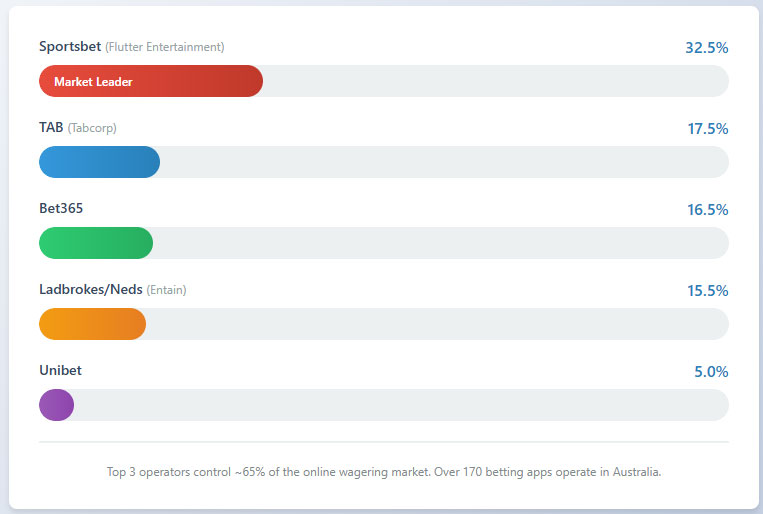
| Sportsbet (Flutter Entertainment) | Market Leader | Northern Territory | 30-35% |
| TAB (Tabcorp) | Traditional Leader | Multiple State Licenses | 15-20% |
| Bet365 | International Major | Northern Territory | 15-18% |
| Ladbrokes (Entain) | Major Competitor | Northern Territory | 8-10% |
| Neds (Entain) | Growing Brand | Northern Territory | 5-8% |
| Unibet | International Player | Northern Territory | 4-6% |
| BlueBet | Australian-owned | Northern Territory | 2-4% |
| PointsBet | Australian-founded | Northern Territory | 2-3% |
Market Dynamics: The Australian wagering market exhibits significant concentration among top operators, with Sportsbet commanding approximately one-third of online sports betting activity. International operators including Bet365, Ladbrokes, and Unibet have successfully established strong market positions by combining global technology platforms with localized marketing campaigns focused on Australian sporting events including AFL, NRL, cricket, and horse racing. The market features over 170 licensed mobile betting applications, creating intense competition for customer acquisition and retention.
Competitive Landscape: Operators compete primarily on promotional offers, odds competitiveness, platform usability, event coverage breadth, and customer service quality. The cost of customer acquisition has increased substantially, with operators investing heavily in sponsorships of major sporting codes, teams, and media rights. Market consolidation continues, with Flutter Entertainment’s ownership of Sportsbet and Entain’s control of multiple brands demonstrating the scale advantages in this highly competitive market.
Licensing Framework and Requirements
Application Process and Eligibility
Regulatory Authority Selection: Prospective operators must first determine the appropriate licensing jurisdiction based on their intended business model. For online sports betting and race wagering, the Northern Territory Racing Commission represents the most popular choice, having licensed numerous major operators. Queensland’s Office of Liquor and Gaming Regulation handles lottery operator licenses. State-specific regulators oversee land-based operations including casinos, pokies venues, and retail betting outlets within their territories.
Financial Requirements: License applicants must demonstrate substantial financial capacity and stability. For online wagering licenses, operators typically must provide evidence of access to capital ranging from AUD 500,000 to several million dollars depending on projected scale of operations. Casino license applicants face significantly higher thresholds, often requiring proof of access to tens or hundreds of millions in capital. Financial guarantees or bonds may be required to ensure operators can meet ongoing obligations including player payouts and tax remittances.
Technical Standards: Gaming systems must undergo independent testing and certification to verify fairness, security, and integrity. Operators must demonstrate that random number generators meet international standards, that player funds are held in segregated trust accounts, and that systems include robust controls against fraud, money laundering, and underage gambling. Technical infrastructure must support responsible gambling tools including deposit limits, loss limits, time-out periods, and self-exclusion capabilities.
Background Checks and Probity: All directors, major shareholders (typically those holding 5% or more), key executives, and individuals in positions to influence operations must undergo comprehensive probity investigations. These checks examine criminal history, financial history, business conduct, associates, and overall suitability to be involved in gambling operations. The process typically takes 3 to 6 months for individuals and involves interviews, document verification, and potentially international inquiries for non-Australian applicants.
| License Type | Application Fee | Annual Fee | Processing Time |
|---|---|---|---|
| Online Wagering (Northern Territory) | AUD 10,000-50,000 | Based on turnover | 3-6 months |
| Interactive Gambling (Queensland) | AUD 2,147-21,460 | Quarterly fees negotiated | 6-12 months |
| Lottery Operator (Queensland) | AUD 21,460 | Quarterly (negotiated) | 6-12 months |
| Casino Operator (Major) | AUD 100,000-5,000,000 | AUD 1,000,000+ annually | 12-24 months |
| Venue Operator (Pokies – Victoria) | AUD 500-5,000 | Per machine fees | 8-16 weeks |
| Gaming Equipment Supplier | AUD 100-1,000 | AUD 500-2,000 | 4-12 weeks |
| Bookmaker License (Retail) | AUD 5,000-50,000 | Varies by state | 3-6 months |
Local Presence and Operational Requirements
Physical Presence: Most jurisdictions require licensed operators to maintain a physical office presence within Australia, though requirements vary by license type and state. Online operators typically must establish a registered business address and designate a responsible manager residing in Australia. Larger operations may need to demonstrate significant local employment and infrastructure investment. Some states mandate that key operational functions including customer service, compliance monitoring, and management occur within the licensing jurisdiction.
Domain and Hosting: While there is no absolute requirement for operators to use Australian-registered domain names, holding an Australian license provides legal protection and consumer trust that offshore operators lack. Server location requirements vary—some regulators require critical gaming servers to be located within Australia or in approved jurisdictions, while others permit international hosting provided data security and access standards are met. All operators must ensure their systems are accessible to regulators for audit and inspection purposes.
Personnel Requirements: Operators must employ appropriately qualified personnel in key positions including compliance officers, responsible gambling coordinators, anti-money laundering officers, and technical managers. Many jurisdictions require these individuals to hold specific certifications or undergo regulator-approved training. For casino operations, extensive staffing requirements cover gaming floor personnel, surveillance operators, security staff, and management, all of whom may require individual licenses or permits.
Foreign Ownership: Australia generally permits foreign ownership of gambling licenses, though conditions apply. Foreign-owned entities typically must establish an Australian subsidiary, demonstrate financial transparency, and show that ultimate beneficial owners meet probity standards.
Some jurisdictions impose restrictions on cumulative foreign ownership or require a minimum percentage of Australian ownership for certain license types. Recent regulatory inquiries at Crown Melbourne and The Star Sydney have intensified scrutiny of foreign ownership structures and corporate governance arrangements.
Compliance Obligations and Monitoring
Player Protection and Identification
Age Verification: The minimum gambling age throughout Australia is 18 years for all gambling products. Operators must implement robust age verification before allowing any person to create an account or place wagers. Since September 2024, AUSTRAC requires all online gambling service providers to complete applicable customer identification procedures before establishing accounts or offering services. This requirement strengthens existing Know Your Customer protocols and aligns gambling operators with banking sector identification standards.
KYC and AML Compliance: Anti-money laundering and counter-terrorism financing obligations under the AML/CTF Act apply comprehensively to gambling operators. Operators must verify customer identity using reliable and independent documentation, monitor transactions for suspicious patterns, maintain records for seven years, and report designated transactions and suspicious matters to AUSTRAC. Several major corporate bookmakers have recently been required by AUSTRAC to appoint independent auditors to assess their AML/CTF compliance, with one entering into an enforceable undertaking. Further enforcement actions are expected throughout 2025.
Responsible Gambling Measures: The National Consumer Protection Framework for Online Wagering establishes minimum consumer protections across all jurisdictions. Mandatory measures include activity statements showing gambling expenditure, voluntary pre-commitment tools allowing customers to set deposit and loss limits, account closure mechanisms, and prohibition on extending credit to customers. Operators must display responsible gambling messages prominently, provide links to support services, and train staff in identifying and responding to problem gambling indicators.
Self-Exclusion Systems: BetStop, the National Self-Exclusion Register, launched in August 2023 and requires all betting providers to verify customers against the registry. Operators must not allow individuals on the register to create accounts or receive marketing communications. By the end of Q2 2024-25, 35,671 individuals had registered for self-exclusion, with 26,020 active registrations. State-level self-exclusion programs also operate for land-based venues, and New South Wales is implementing gaming reforms including a statewide exclusion register with potential facial recognition technology integration.
Information Disclosure: Recent regulatory changes mandate specific player information disclosures. Operators must provide clear information about odds, probabilities of winning, house edges on different products, and the mathematical disadvantage players face. Marketing materials and platforms must display warnings about gambling risks, and operators must send periodic activity statements to customers summarizing their gambling expenditure, wins, and net losses over specified timeframes.
Financial Monitoring and Reporting
Transaction Monitoring: Operators must implement automated transaction monitoring systems capable of detecting unusual patterns, potential money laundering, structuring behaviors, and other suspicious activities. These systems must generate alerts for manual review by trained compliance staff. Since the 2024 credit card ban, operators must ensure payment methods exclude prohibited instruments and verify that customers are not circumventing restrictions through alternative means.
Regulatory Reporting: Financial reporting obligations vary by jurisdiction but generally include monthly or quarterly submission of revenue data, tax calculations, player activity statistics, responsible gambling metrics (self-exclusions, account closures, limit activations), and compliance incident reports. Operators must maintain detailed records of all transactions, customer interactions, and system changes, making these available to regulators upon request. Some jurisdictions require real-time data access for regulatory monitoring.
Audit and Inspection: Regulators conduct regular audits of operator compliance, examining financial records, gaming systems, customer complaints handling, marketing materials, and adherence to license conditions. For major operators, regulators may require independent audits by accredited firms on annual or more frequent bases. Following the casino royal commissions, Crown Melbourne and The Star properties operate under continuous independent monitoring, with reports submitted to regulators assessing remediation progress against identified deficiencies.
Data Retention: Operators must retain comprehensive records for periods ranging from three to seven years depending on record type and regulatory requirements. This includes customer identification documents, transaction records, marketing communications, responsible gambling interactions, surveillance footage (for land-based operations), game outcomes, and all correspondence with regulators. Records must be maintained in formats accessible to regulators and preserved even after customers close accounts or operators cease operations.
Taxation Structure and Financial Obligations
Player Taxation
Winnings Tax Status: Gambling winnings in Australia are generally not taxed for recreational players. This tax-free treatment applies whether the gambling activity occurs online or at land-based venues, and regardless of the amount won. Players are not required to report gambling winnings on personal income tax returns, and operators do not withhold taxes from payouts. This favorable tax treatment for players contributes to Australia’s high gambling participation rates and distinguishes it from many other jurisdictions where significant winnings trigger tax obligations.
Professional Gambler Treatment: Individuals who gamble as a business rather than recreation may have winnings treated as assessable income subject to taxation. The Australian Taxation Office examines factors including volume and frequency of gambling activity, systematic approaches to gambling, whether the person has other income sources, and business-like record keeping. This classification affects relatively few individuals and primarily impacts professional sports bettors and poker players operating at high levels.
Operator Taxation
Australia’s gambling taxation occurs primarily at the state and territory level, creating a complex mosaic of different tax regimes based on gambling product type, operator license type, and jurisdiction. This structure means operators must navigate multiple tax obligations simultaneously.
| Gambling Product | Tax Base | Typical Rate Range | Notes |
|---|---|---|---|
| Online Sports Betting | Net Revenue | 8-15% Point of Consumption | Varies by state where customer located |
| Online Race Betting | Net Revenue | 5-15% | Lower rates for racing to support industry |
| Casino Gaming (Land-based) | Gross Gaming Revenue | 10-30% tiered structure | Higher rates at higher revenue levels |
| Electronic Gaming Machines | GGR from machines | 25-50% | Varies significantly by state and venue type |
| Lottery (Lotto-style) | Gross Revenue | 73.48% (Queensland example) | Extremely high rates offset by exclusivity |
| Lottery (Instant Scratch) | Gross Revenue | 55% | Lower than lotto but still substantial |
| Keno | Player Loss | 20-30% | Varies by jurisdiction |
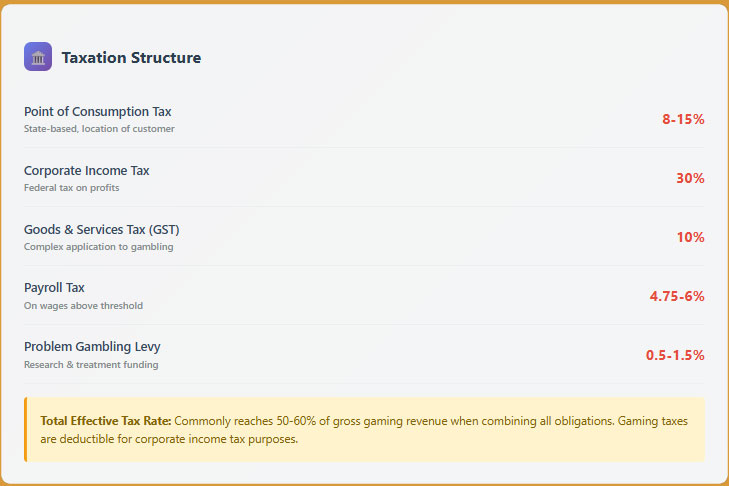
Point of Consumption Tax: Most states impose point of consumption taxes on online wagering, calculated based on the location of the customer rather than where the operator is licensed. When a Victorian customer places a bet with a Northern Territory-licensed operator, Victorian point of consumption tax applies to that transaction. Rates typically range from 8 to 15 percent of net wagering revenue (stakes minus payouts). Victoria pioneered this approach, and other states have followed, significantly increasing the tax burden on online operators compared to historical arrangements.
Corporate Income Tax: In addition to gambling-specific taxes, operators pay standard corporate income tax on profits at the 30 percent rate. Some smaller companies with turnover below AUD 50 million may qualify for the 25 percent small business rate, though most gambling operators exceed this threshold. Gaming-specific taxes are deductible expenses when calculating corporate income tax liability, somewhat offsetting the cumulative tax burden.
Goods and Services Tax: GST of 10 percent applies to most goods and services in Australia, including certain gambling activities. The application to gambling is complex—generally, gambling supplies are input-taxed, meaning operators cannot claim GST credits on related expenses. However, fees charged to customers for non-gambling services may attract GST. Lottery products have specific GST treatment with different rules for government-operated versus privately-operated lotteries.
License Fees and Levies: Beyond taxes on revenue, operators pay annual license fees that vary from thousands to millions of dollars depending on license type and jurisdiction. Queensland’s lottery operator pays quarterly license fees negotiated with government in addition to the 73.48 percent tax on gross revenue. Casino operators typically pay annual license fees of AUD 1 million or more. Additional levies may fund problem gambling research, treatment services, and regulatory administration.
Gambling Market Financial Performance
Australia’s gambling industry generates substantial revenue, reflecting the nation’s status as one of the world’s highest per-capita gambling markets. Financial data reveals both the market’s scale and its growth trajectory, though recent economic headwinds have moderated expansion rates in some segments.
| Metric | Value (AUD) | Value (USD) | Year-over-Year Change |
|---|---|---|---|
| Total Amount Wagered | AUD 244.3 billion | USD 164.3 billion | +18.2% |
| Total Gambling Expenditure (Player Losses) | AUD 32.0 billion | USD 21.5 billion | +13.8% |
| Per Capita Annual Losses | AUD 1,555 | USD 1,046 | +11.5% |
| Gaming Machines Turnover | AUD 191.2 billion | USD 128.6 billion | +20.9% |
| Gaming Machines Revenue | AUD 15.8 billion | USD 10.6 billion | +22.8% |
| Online Gambling Turnover | AUD 75.4 billion | USD 50.7 billion | +165.7% |
| Wagering Expenditure (Race and Sports) | AUD 5.815 billion | USD 3.91 billion | +27.3% |
| Land-Based Casino Turnover | AUD 20.0 billion | USD 13.4 billion | +22.6% |
| Keno Turnover | AUD 1.8 billion | USD 1.2 billion | +18.7% |
| Lottery Turnover | AUD 7.6 billion | USD 5.1 billion | -1.1% |
Revenue Distribution Analysis: Electronic gaming machines dominate Australia’s gambling landscape, accounting for approximately 49 percent of total gambling expenditure despite representing a smaller portion of total turnover. The AUD 15.8 billion in gaming machine revenue reflects their high house edge and the captive nature of venue-based gambling. Wagering on racing and sports contributed AUD 5.815 billion in 2020-21, with this figure experiencing explosive growth of 27.3 percent as online wagering platforms expanded aggressively and COVID-19 restrictions drove migration from retail to digital channels.
Online Gambling Surge: The 165.7 percent year-over-year increase in online gambling turnover to AUD 75.4 billion marks the most dramatic shift in Australia’s gambling landscape. This figure excludes racing and sports betting, representing primarily offshore casino gaming activity by Australian players despite its illegal status under Australian law. The surge prompted regulatory concern and contributed to ACMA’s intensified enforcement actions including ISP blocking of offshore operators. Online wagering per capita reached AUD 397.50, representing 31 percent of total gambling turnover—a proportion expected to continue growing.
Tax Revenue Generation: State and territory governments collect substantial revenue from gambling taxes, though exact figures vary by jurisdiction. Victoria’s gaming machine revenue alone generates approximately AUD 2 billion annually in state taxes. Point of consumption taxes on online wagering generated hundreds of millions in additional state revenue since implementation.
Total government gambling tax revenue across all jurisdictions and products exceeds AUD 6 billion annually, making gambling a significant contributor to state budgets and complicating policy reform efforts given fiscal dependencies.
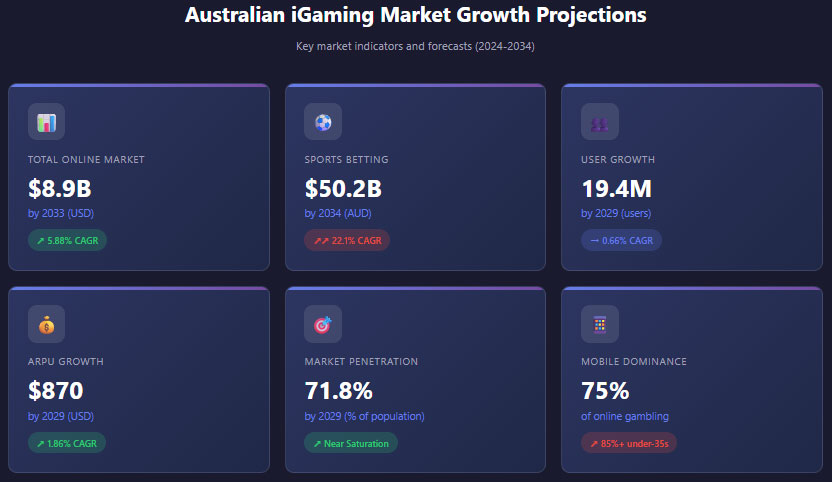
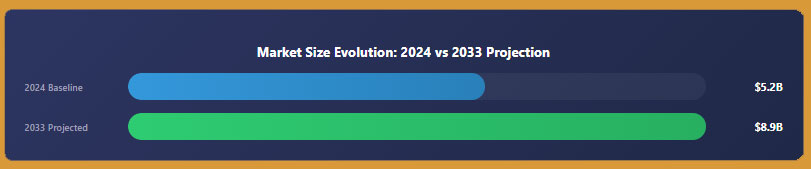
Growth Trends: Historical data shows gambling expenditure increasing from AUD 21.243 billion in 2019-20 to AUD 24.039 billion in 2020-21, a 13.2 percent increase reflecting both COVID-19 impacts (venue closures driving online migration) and underlying market growth. Projections indicate continued expansion, with the online gambling market alone expected to grow from USD 5.2 billion in 2024 to USD 8.9 billion by 2033 at a 5.88 percent CAGR. Sports betting demonstrates even more aggressive growth projections of 22.1 percent CAGR, potentially reaching AUD 50.15 billion by 2034.
Advertising and Marketing Restrictions
Australia’s gambling advertising regulations have tightened substantially in recent years following public concern about pervasive marketing, particularly during sports broadcasts popular with children and young adults. The regulatory framework combines federal legislation, state rules, and industry self-regulation through codes of practice.
Broadcast Media Restrictions: Gambling advertisements are prohibited during live sports broadcasts on free-to-air television, pay television, and radio from five minutes before the event commences through five minutes after conclusion. This ban applies between 5:00 AM and 8:30 PM, protecting children from exposure during daytime and evening viewing hours.
Sports betting advertisements may still appear during breaks in live sports coverage outside the prohibited windows, though this remains controversial and subject to ongoing reform proposals. The Murphy Report recommended a complete ban on gambling advertising across all broadcast media, though the government has not yet implemented this comprehensive prohibition.
Online and Digital Marketing: Online gambling advertising faces fewer explicit restrictions, though the AANA Wagering Advertising and Marketing Communications Code establishes self-regulatory standards. Advertisements must not appeal strongly to minors, must not encourage excessive gambling, must include responsible gambling messages, and must not create misleading impressions about odds of winning. Social media platforms apply their own policies, generally prohibiting gambling advertising targeted at users under 18. Operators heavily utilize online channels including search engine marketing, display advertising, social media, and partnerships with sports websites and apps.
Outdoor and Transit Advertising: Victoria banned betting advertisements on roads, public transport, and within 150 meters of schools under section 4.7.1 of the Gambling Regulation Act 2003. These restrictions apply to static advertising including billboards, bus shelters, station platforms, bridges, and noise walls. Other states have implemented or are considering similar geographic restrictions to reduce gambling advertising exposure in public spaces.
Sponsorship Regulations: Sports sponsorships by gambling operators remain largely permissible, with major betting brands sponsoring AFL teams, NRL clubs, cricket competitions, and individual athletes. However, restrictions limit sponsor logo prominence during broadcasts subject to advertising bans, and naming rights for stadiums and competitions face increasing scrutiny. Some sporting codes have voluntarily reduced gambling sponsorships in response to community concerns, and future regulatory tightening appears likely.
Promotional Limitations: Bonus offers and promotional inducements must comply with responsible gambling principles. Operators cannot offer credit for gambling or promote betting as a solution to financial problems. Promotional terms and conditions must be clearly disclosed, including wagering requirements, time limits, and restrictions. Recent regulatory changes in some jurisdictions have limited the value or frequency of promotional offers, particularly introductory bonuses designed to attract new customers.
Content Restrictions: Marketing materials must not misrepresent the probability of winning, must not suggest gambling is a legitimate income source, must not encourage gambling as an escape from personal problems, and must not portray gambling as glamorous or a pathway to social acceptance. Advertisements must include responsible gambling messaging and helpline information. Testimonials and celebrity endorsements must not create false expectations about typical outcomes.
Affiliate Marketing Rules: Affiliate marketers promoting gambling services must adhere to the same advertising standards as operators. ACMA has increased enforcement against affiliate websites promoting illegal offshore casino services, with referrals for ISP blocking of sites that facilitate access to prohibited services. Operators remain responsible for ensuring their affiliates comply with advertising restrictions and must implement monitoring systems to detect and address violations.
Penalties for Violations: Breaches of advertising restrictions can result in formal warnings, mandatory corrective advertising, financial penalties, and in serious or repeated cases, license sanctions. Between October and December 2024, ACMA’s investigation of 301 complaints resulted in identification of 16 breaches, demonstrating active enforcement. Industry participants expect further advertising restrictions in 2025 and beyond, with comprehensive reform proposals under government consideration.
Recent Regulatory Changes and Their Impact
Australia’s gambling regulatory environment has experienced significant evolution in 2024-25, driven by casino royal commission findings, community concerns about gambling harm, and technological developments. These changes materially affect operator compliance costs, business strategies, and market entry planning.
Credit Card and Digital Currency Ban (2024): In mid-2024, Australia banned credit cards and digital currencies for online wagering transactions. This prohibition aims to reduce gambling-related debt and financial harm by preventing customers from gambling with borrowed funds or anonymous cryptocurrency. Operators must implement systems preventing these payment methods and verify customer payment sources. The ban increases operational complexity and potentially reduces conversion rates from customers preferring these payment options, though debit cards, bank transfers, and approved e-wallets remain available.
Enhanced Customer Identification Requirements (September 2024): AUSTRAC’s requirement that operators complete applicable customer identification procedures before establishing accounts or offering services took effect in September 2024 after a one-year transition period. This strengthens existing KYC obligations by aligning gambling operators with banking sector standards. Operators must verify customer identity using document verification, biometric checks, or approved digital identity services before allowing any gambling activity. The change increases onboarding friction and compliance costs while enhancing AML/CTF controls.
Victorian Gaming Machine Reforms (2024-25): Victoria implemented sweeping pokies reforms including reducing maximum deposits from AUD 1,000 to AUD 100 effective December 2025, mandatory pre-commitment becoming effective December 2025, and mandatory venue closures between 4:00 AM and 10:00 AM implemented August 2024 (excluding Crown Casino). These measures respond to community concerns about gaming machine harm and align with research demonstrating effectiveness of limit-setting tools. Venue operators face significant technology upgrade costs and potential revenue impacts from reduced player spending capacity.
Casino Operator Scrutiny and Remediation (2022-2025): The Victorian Gambling and Casino Control Commission determined Crown Melbourne returned to suitability in March 2024 after two years of remediation following royal commission findings. However, The Star Sydney’s license remains suspended until at least March 2025, with independent supervision continuing and a AUD 15 million fine imposed for regulatory breaches. These actions establish new compliance expectations for all casino operators including enhanced governance, culture change programs, continuous monitoring, and immediate reporting of significant incidents.
Western Australia Gambling Law Reforms (February 2025): Western Australia introduced tougher gambling laws providing the Gaming and Wagering Commission with expanded investigative powers and substantially higher fines for non-compliance. These reforms reflect a nationwide trend toward stricter enforcement and higher penalties for regulatory violations. Operators in Western Australia face increased compliance scrutiny and material financial consequences for breaches.
BetStop National Self-Exclusion Register (August 2023-ongoing): The mandatory national self-exclusion register requires all licensed operators to verify customers against the database and prohibit account creation or marketing to registered individuals. By Q2 2024-25, 35,671 people had registered, with 26,020 active exclusions. Operators must implement real-time checking systems and processes for immediately closing accounts when customers self-exclude. The register represents a significant operational requirement with ongoing compliance monitoring by regulators.
Advertising Reform Proposals (2024-2025): Following the Murphy Report’s recommendation for comprehensive gambling advertising bans, the federal government delayed implementation but continues consultation on reform options. Industry participants anticipate significant advertising restrictions in 2025 or 2026, potentially including bans on broadcast advertising outside sporting events, limits on digital marketing, and restrictions on sponsorships. Such changes would materially affect customer acquisition strategies and costs, potentially advantaging established operators with strong brand recognition over new entrants.
ISP Blocking Intensification (2024-2025): ACMA has accelerated ISP blocking of illegal offshore gambling sites and affiliates, requesting blocks of additional sites in September 2025. Between October and December 2024, 75 websites were referred for blocking after investigation of 301 complaints identified 16 breaches. This enforcement targets both offshore casino operators (whose services are illegal to offer to Australians) and affiliate sites promoting such services. The intensified blocking makes offshore operation increasingly untenable and reinforces the importance of obtaining proper Australian licensing.
Cashless Gaming Trials and Implementation: Several jurisdictions are implementing or trialing cashless gaming systems for electronic gaming machines and retail betting.
Impact on Business Strategy: Recent regulatory changes increase compliance costs, limit marketing effectiveness, potentially reduce customer lifetime values through tighter responsible gambling controls, and create uncertainty for business planning. New entrants must factor higher compliance infrastructure costs into launch budgets. Established operators must invest in remediation and system upgrades to meet evolving standards. The regulatory trajectory favors larger, well-capitalized operators capable of absorbing compliance costs while maintaining market presence, potentially consolidating the market further.
Enforcement Mechanisms and Penalties
Australian gambling regulators have demonstrated increasing willingness to exercise enforcement powers, with substantial penalties imposed on even major operators for compliance failures. The enforcement landscape establishes clear expectations that regulatory requirements are not merely aspirational but strictly enforced obligations.
Administrative Penalties: Regulators may impose warnings, conditions on licenses, requirements for remedial action, mandatory audits, and oversight regimes short of license suspension or revocation. Crown Melbourne and The Star properties operate under enhanced supervision with independent monitors reporting to regulators on remediation progress. Such arrangements impose substantial costs on operators while restricting operational flexibility.
Financial Penalties: Recent enforcement actions demonstrate regulators’ willingness to impose material fines. The Star Sydney received a AUD 15 million fine in October 2024 for regulatory breaches. Tabcorp was fined AUD 4.6 million in August 2024 for compliance failures and AUD 370,417 in June 2024 for allowing minor gambling. These penalties represent significant financial consequences designed to deter violations and demonstrate to the public that regulators take compliance seriously.
License Suspension and Revocation: The ultimate enforcement tool involves suspending or revoking an operator’s license, terminating their ability to conduct gambling activities. The Star Sydney’s license suspension since 2022 (continuing until at least March 2025) demonstrates regulators’ preparedness to use this power even against major operators when serious deficiencies are identified. While economic impacts on employees and connected businesses are considered, suitability concerns override financial considerations when operators demonstrate unwillingness or inability to meet regulatory standards.
ISP Blocking: For offshore operators offering illegal services to Australians, ACMA utilizes ISP blocking to disrupt access. This mechanism has proven increasingly effective, with 75 websites blocked between October and December 2024 alone. Once blocked, offshore operators lose Australian traffic and face brand damage. The blocking regime makes unlicensed operation in the Australian market commercially unviable for operators depending on legitimate payment processors and public visibility.
Payment Processor Restrictions: Regulators coordinate with financial institutions and payment processors to restrict transactions with unlicensed operators. Banks and payment providers face their own regulatory obligations to prevent facilitation of illegal gambling. This creates practical barriers to offshore operators receiving deposits from or making payouts to Australian customers, complementing ISP blocking efforts.
Criminal Penalties: Serious violations can trigger criminal proceedings. The Interactive Gambling Act creates criminal offenses for offering prohibited services, with penalties including imprisonment for individuals and substantial fines for companies. While criminal prosecution is less common than administrative action, the possibility creates significant deterrent effect and personal liability for directors and executives involved in illegal operations.
Precedent Setting: Recent enforcement actions against major casino operators, corporate bookmakers, and offshore operators establish precedents influencing all operators. The message is clear: regulatory compliance is non-negotiable, violations will be detected through enhanced monitoring, penalties will be substantial and proportionate to operator size, and remediation requirements are comprehensive and intrusive. This enforcement environment demands robust compliance systems and proactive rather than reactive approaches to regulatory obligations.
Section 2: Demographics and Consumer Analysis
Population Demographics and Distribution
Core Population Metrics
Australia’s population of 27.5 million as of March 2025 reflects continued growth despite recent economic headwinds, with demographic characteristics that create a favorable environment for iGaming operations. The population grew by 423,400 people or 1.6 percent in the year ending March 2025, driven primarily by net overseas migration of 315,900 and natural increase of 107,400.
| Age Group | Population (millions) | Percentage of Total | iGaming Relevance |
|---|---|---|---|
| 0-14 years | 5.1 | 18.5% | Below legal gambling age |
| 15-24 years | 3.3 | 12.0% | Entry-level gambling demographic |
| 25-34 years | 3.8 | 13.8% | High digital engagement, growing income |
| 35-44 years | 3.7 | 13.5% | Peak earning years, prime gambling demographic |
| 45-54 years | 3.5 | 12.7% | Established income, high disposable spending |
| 55-64 years | 3.0 | 10.9% | Pre-retirement, substantial wealth accumulation |
| 65+ years | 4.6 | 16.7% | Growing segment, increasing digital adoption |
| Legal Gambling Age Population (18+) | 21.4 | 77.8% | Total addressable market |
Median Age Implications: At 38.3 years, Australia’s median age positions the country as a mature developed market with substantial purchasing power concentrated in prime working ages. The median age has increased from 33.4 years in 1994, reflecting declining birth rates and increasing life expectancy. For iGaming operators, this aging demographic profile suggests emphasis on products appealing to middle-aged consumers while developing offerings for the growing 65-plus segment increasingly comfortable with digital platforms.
Gender Distribution: Australia’s population is 49.62 percent male and 50.38 percent female, with approximately 204,000 more females than males. Life expectancy stands at 81.1 years for males and 85.1 years for females, creating a larger female population in older age brackets. Gambling participation data shows 80.5 percent of men and 66.2 percent of women gambled in the past 12 months, with 48 percent of men and 28 percent of women gambling at least weekly. This gender gap presents opportunities for operators to develop products and marketing specifically targeting female players.
Urban Concentration: With 86.5 percent of Australians living in urban areas (23.3 million people), the population demonstrates extreme concentration in cities. Major cities are home to 73 percent of the population, with 25 percent in inner and outer regional areas and only 1.9 percent in remote and very remote regions. This urban concentration simplifies marketing and customer service logistics, as operators can effectively reach the vast majority of potential customers through metropolitan-focused campaigns.
Geographic Distribution
Australia’s population concentrates overwhelmingly in coastal cities along the eastern and southeastern seaboards, with vast interior regions remaining sparsely populated. This geographic distribution creates distinct target markets with different characteristics and gambling preferences.
| City/Metropolitan Area | Population (millions) | Key Characteristics |
|---|---|---|
| Greater Sydney (NSW) | 5.4 | Financial center, diverse population, high incomes |
| Greater Melbourne (VIC) | 5.2 | Cultural hub, sports-focused, multicultural |
| Greater Brisbane (QLD) | 2.6 | Fastest growing major city, subtropical lifestyle |
| Greater Perth (WA) | 2.2 | Mining wealth, isolated location, high wages |
| Greater Adelaide (SA) | 1.4 | Aging population, lower costs, wine region |
| Gold Coast (QLD) | 0.7 | Tourism hub, younger demographic, entertainment focus |
| Greater Canberra (ACT) | 0.5 | National capital, high education, government employment |
| Greater Newcastle (NSW) | 0.5 | Industrial heritage, growing service economy |
Regional Economic Differences: Western Australia and Northern Territory exhibit higher per-capita incomes driven by mining sector wages, though recent commodity price fluctuations have moderated growth. New South Wales and Victoria represent the largest markets by population and economic activity, accounting for approximately 60 percent of national GDP. Queensland experiences rapid population growth driven by interstate migration of retirees and families seeking lower housing costs and lifestyle benefits.
Internet Access Patterns: Urban areas enjoy superior internet infrastructure with fiber and 5G networks widely deployed, while regional and remote areas rely more heavily on fixed wireless and satellite connections. Internet penetration exceeds 97 percent even in regional areas, though connection speeds and reliability vary. This near-universal connectivity means operators can effectively reach customers regardless of location, though product optimization for varying connection qualities remains important.
Gambling Venue Concentration: Electronic gaming machines concentrate heavily in New South Wales and Victoria, which together account for approximately 70 percent of pokies in Australia. Queensland restricts pokies to casinos and reduces their density in communities.
Western Australia maintains the strictest gaming machine regulations with limited availability. This regulatory diversity means gambling product preferences vary regionally, with New South Wales and Victorian consumers more habituated to gaming machines while other states show different preferences.
Economic Indicators and Consumer Spending Power
GDP and Economic Performance
Australia’s economy demonstrates resilience despite recent challenges including declining per-capita GDP, elevated inflation, and housing affordability pressures. Understanding current economic conditions is critical for operators assessing market entry timing and forecasting customer spending patterns.
| Indicator | Current Value | Trend | Regional Comparison |
|---|---|---|---|
| Total GDP (2025) | USD 1.82 trillion | Growing 1.3% FY 24-25 | 17th largest globally |
| GDP Per Capita (2025) | USD 67,400 | Declining in real terms | Top 20 globally |
| GDP Growth (Q2 2025) | 0.6% quarterly | Modest recovery underway | Below OECD average |
| Annual GDP Growth (June 2025) | 1.8% | Lowest since 1990s excluding COVID | Lagging developed peers |
| GDP Per Capita Growth | -0.4% annually | 7 consecutive quarterly declines | Worst among OECD nations |
| Inflation Rate (June 2025) | 2.1% annually | Returning to target band | Below recent peaks |
| Core Inflation (Sept 2024) | 3.5% | Persistent services inflation | Above RBA target midpoint |
| Unemployment Rate | 4.0-4.5% | Near full employment | Low by historical standards |
| Wage Growth (June 2025) | 3.4% annually | Moderating from 2024 peak | Below inflation in recent years |
Economic Challenges: Real GDP per capita fell for seven consecutive quarters through early 2024 before slight recovery, with another decline in March 2025 quarter. This performance positions Australia as an outlier among developed economies and reflects sustained erosion of purchasing power. While nominal wages grew 3.4 percent annually, this failed to keep pace with inflation running above 3.5 percent through much of 2024, resulting in declining real incomes. Food prices rose 11.7 percent and gas 33.9 percent since 2022, while energy rebates capped electricity increases that otherwise would have reached 14.9 percent.
Sector Performance: The service sector constitutes 61.1 percent of the economy and employs 79.2 percent of Australians, providing the foundation for economic activity. Mining remains crucial for exports and government revenue, particularly in Western Australia where iron ore and natural gas dominate. However, declining productivity growth—which fell below historical trends—limits the economy’s supply capacity and weighs on long-term growth prospects. The Reserve Bank of Australia lowered productivity growth assumptions, reducing GDP growth forecasts for outer years.
Consumer Implications: The cost-of-living crisis and declining real incomes create headwinds for discretionary spending categories including gambling. However, gambling often demonstrates counter-cyclical characteristics, with some consumers increasing gambling activity during economic stress as entertainment or hoped escape from financial pressures. The 13.8 percent increase in gambling expenditure from 2019-20 to 2020-21 occurred during COVID-19 economic disruptions, suggesting resilience in gambling demand even during economic weakness.
Income and Wealth Distribution
Australian household income levels support substantial consumer spending capacity, though wealth concentration and cost-of-living pressures affect different segments unevenly. Understanding income distribution helps operators identify target demographics and calibrate product offerings.
| Metric | Value (AUD) | Value (USD) | Commentary |
|---|---|---|---|
| Median Household Income (Annual) | AUD 91,000 | USD 61,200 | After-tax income |
| Average Household Income (Annual) | AUD 116,000 | USD 78,000 | Mean exceeds median due to high earners |
| Median Full-Time Weekly Earnings | AUD 1,923 | USD 1,293 | Before tax |
| Average Weekly Ordinary Time Earnings | AUD 1,838 | USD 1,236 | Full-time adult employees |
| Median Wealth per Adult | AUD 386,000 | USD 259,500 | Among world’s highest |
| Mean Wealth per Adult | AUD 660,000 | USD 444,000 | Reflects property ownership concentration |
| Gini Coefficient | 0.33 | – | Moderate inequality by global standards |
Income Distribution by Bracket: Approximately 23 percent of households earn below AUD 50,000 annually, representing lower-income segments including retirees, part-time workers, and single-income households. The AUD 50,000-100,000 bracket encompasses roughly 30 percent of households, forming the middle-income core. Households earning AUD 100,000-150,000 represent 20 percent, while those exceeding AUD 150,000 constitute 27 percent of the population. This distribution suggests strong purchasing power across broad segments, with particular depth in middle and upper-middle income ranges.
Disposable Income Trends: Real household disposable income declined sharply in 2023-24, with Australia experiencing the steepest fall among developed nations since 2019. Households absorbed elevated interest rates on mortgages, rising essential costs, and wage growth failing to match inflation. However, employment remained strong near full employment levels, preventing income collapse and maintaining baseline consumption capacity. As inflation moderates and wage growth continues, real income recovery appears likely through 2025-26.
Middle Class Characteristics: Australia’s substantial middle class exhibits home ownership rates around 65 percent nationally (varying by state and age cohort), significant superannuation (retirement savings) assets, and consumption patterns oriented toward services and experiences. This demographic demonstrates willingness to spend on entertainment and leisure including gambling, particularly when products are positioned as entertainment rather than investment vehicles. The middle class decline in purchasing power creates pressure but not elimination of discretionary spending capacity.
Wealth Concentration: Property ownership drives Australian wealth, with median wealth per adult among the world’s highest at approximately AUD 386,000. However, this wealth concentrates among homeowners predominantly in older age brackets, while younger Australians face severe housing affordability challenges.
In 2024, median home values exceeded AUD 1 million in Sydney and approached that level in Melbourne, requiring household incomes substantially above median for affordability. This creates generational wealth gaps, with implications for gambling participation—younger cohorts face tighter discretionary budgets while older homeowners control substantial assets.
Market Size and Growth Projections
Australia’s iGaming market demonstrates robust growth trajectories despite regulatory constraints, with online segments outpacing traditional land-based gambling. Multiple research sources provide converging estimates that together paint a comprehensive picture of market scale and future expansion.
| Metric | 2024 Baseline | 2025 Projection | 2029-2034 Projection | CAGR |
|---|---|---|---|---|
| Total Gambling Market | USD 15.1 billion | USD 15.43 billion | USD 16.88 billion (2029) | 2.26% |
| Online Gambling Market (Sports Betting & Lotteries) | USD 5.2 billion | USD 5.5 billion | USD 8.9 billion (2033) | 5.88% |
| Online Gambling (Alternative Estimate) | AUD 9.1 billion | AUD 9.8 billion | AUD 19.4 billion (2034) | 7.89% |
| Sports Betting Market | AUD 6.81 billion | AUD 8.3 billion | AUD 50.15 billion (2034) | 22.10% |
| Sports Betting (Alternative Estimate) | USD 2.44 billion | USD 2.8 billion | USD 5.10 billion (2030) | 13.2% |
| Casino & Casino Games Segment | – | USD 7.02 billion | – | – |
| Number of Users | 18.9 million | 19.0 million | 19.4 million (2029) | 0.66% |
| Market Penetration Rate | 70.3% | 70.6% | 71.8% (2029) | – |
| Average Revenue Per User (ARPU) | USD 798 | USD 809.94 | USD 870 (2029) | 1.86% |
Market Size Context: The total Australian gambling market of USD 15.43 billion in 2025 encompasses all legal gambling forms including land-based casinos, electronic gaming machines, wagering (racing and sports), lotteries, and keno. Within this total, online gambling represents approximately USD 5.2-5.5 billion or roughly 35 percent of the market, with this online share projected to increase substantially as digital migration continues.
Sports betting demonstrates the most aggressive growth trajectory, with some projections indicating the segment could expand from AUD 6.81 billion in 2024 to AUD 50.15 billion by 2034, representing a 22.1 percent CAGR driven by mobile adoption, live betting (via phone), event coverage expansion, and integration with sports viewing experiences.
Historical Growth Analysis: Online gambling turnover increased 165.7 percent year-over-year to AUD 75.4 billion in 2022-23, marking explosive growth. However, this figure includes significant illegal offshore casino activity by Australian players, explaining the dramatic surge. Legal online wagering on sports and racing grew 27.3 percent from AUD 4.567 billion to AUD 5.815 billion in 2020-21, demonstrating robust but more moderate expansion in licensed activities. Total gambling expenditure increased 13.8 percent to AUD 32.0 billion in 2022-23, recovering from COVID-19 disruptions and reflecting both increased participation and migration to online channels.
User Growth Projections: The number of gambling users is expected to grow modestly from 18.9 million in 2024 to 19.4 million by 2029, representing a 0.66 percent CAGR. This slow growth reflects market maturity, with 70.6 percent penetration already achieved. Future growth derives primarily from population increases and aging into legal gambling age rather than converting non-gamblers. The modest user growth contrasts with substantial revenue growth projections, indicating that increased spending per user rather than user base expansion drives market growth.
ARPU Expansion: Average revenue per user of USD 809.94 in 2025 ranks among the world’s highest, reflecting Australians’ propensity for gambling spending. ARPU is projected to increase to approximately USD 870 by 2029, representing 1.86 percent annual growth. This expansion suggests operators can increase customer lifetime values through product development, personalization, enhanced engagement, and effective promotional strategies. However, responsible gambling requirements including mandatory limits may constrain ARPU growth for some customer segments.
Online vs Land-Based Split: Online channels represent approximately 35 percent of total gambling revenue in 2025, projected to reach 50 percent or more by 2033 as digital migration continues. Sports betting demonstrates the highest online penetration at approximately 80 percent, while gaming machine gambling remains predominantly land-based at approximately 95 percent venue-based. Lotteries show mixed distribution with both retail and online channels significant. This shift to online creates opportunities for digital-first operators while pressuring traditional venue-based businesses.
Regional Comparison: Australia’s per-capita gambling losses of AUD 1,555 annually position it among global leaders, significantly exceeding regional neighbors. New Zealand’s per-capita gambling losses approximate AUD 800, roughly half Australia’s level. Asian markets including Singapore, Macau, and Philippines show different patterns with casino tourism dominating over distributed retail and online gambling. Australia’s combination of high penetration, high ARPU, and favorable regulatory environment (for licensed sports betting) creates unique market characteristics distinct from regional comparisons.
Education, Skills, and Digital Literacy
Educational Foundation
Australia’s highly educated population demonstrates strong digital literacy and technological adoption, creating favorable conditions for online gambling platforms requiring customer comfort with digital transactions, account management, and mobile applications.
Literacy and Education Levels: Australia achieves near-universal literacy at 99 percent, ensuring that online gambling platforms requiring text comprehension and navigation face minimal barriers. Approximately 60 percent of working-age Australians hold post-secondary qualifications including university degrees, diplomas, and vocational certificates. This educational attainment translates to workforce skills heavily concentrated in services, technology, and professional sectors. The high education levels correlate with comfort adopting new technologies, understanding terms and conditions, and managing financial transactions online—all critical capabilities for online gambling participation.
Digital Literacy Indicators: With 97.1 percent internet penetration and 97 percent smartphone ownership, Australians demonstrate exceptional digital engagement. Average daily internet usage approaches 6 hours across all age groups, with younger demographics (16-34) exceeding 7 hours daily. This extensive online time includes e-commerce transactions, online banking usage exceeding 90 percent of adults, and social media engagement at 77.9 percent penetration. Such digital immersion means online gambling platforms compete for attention within an already-crowded digital ecosystem but benefit from customers highly comfortable with online financial transactions.
Technology Adoption Readiness: Australia consistently ranks among early adopters of new consumer technologies. Smartphone penetration reached 97 percent, among the world’s highest. Contactless payment adoption exceeds 95 percent of card transactions, with mobile wallet usage growing rapidly (Apple Pay, Google Pay, Samsung Pay collectively account for significant transaction volumes). Cryptocurrency awareness and usage, while still minority activities, exceed regional averages. This technology enthusiasm creates receptive audiences for gambling innovation including live betting interfaces, augmented reality experiences, and gamification features.
English Language Proficiency: English serves as the primary language for approximately 72 percent of Australians, while 28 percent speak languages other than English at home. Major non-English languages include Mandarin (2.7%), Arabic (1.4%), Vietnamese (1.3%), Cantonese (1.2%), and Punjabi (0.9%). However, English proficiency among non-native speakers remains high due to education system requirements and workplace demands.
For gambling operators, English-language platforms serve the vast majority of customers effectively, though operators targeting specific ethnic communities may benefit from multilingual support, particularly in Mandarin for the substantial Chinese-Australian population.
Cultural and Social Factors
Communication and Language
Internet Language Preferences: English dominates online activity in Australia, with 95-plus percent of internet users conducting online activities primarily in English. This linguistic homogeneity simplifies content creation, customer service, and marketing compared to multilingual markets. However, operators should consider that ethnic communities may prefer content in native languages, particularly for complex gambling concepts, terms and conditions, and responsible gambling information. Mandarin and Arabic language support could provide competitive advantages for operators targeting these substantial demographic segments.
Business Communication Norms: Australian communication styles tend toward directness, informality, and egalitarianism compared to more hierarchical or formal Asian cultures. Customer service expectations emphasize friendly, efficient, and straightforward interactions rather than elaborate courtesy or formality. Gambling marketing successfully employing colloquial language, humor, and sports-focused messaging resonates with Australian audiences. However, this informality must balance with responsible gambling messaging requirements and avoid trivializing gambling risks.
Cultural Attitudes
Gambling Acceptance Levels: Australia exhibits exceptionally high cultural acceptance of gambling, with 72.8 percent of adults participating in gambling activities in the past 12 months (80.5 percent of men, 66.2 percent of women). Gambling integrates deeply into social rituals including Melbourne Cup sweepstakes in workplaces, AFL and NRL season betting among friend groups, and pokies venue visits as social outings.
This cultural normalization means gambling operators face minimal social stigma compared to markets where gambling carries stronger negative connotations. However, increasing awareness of gambling harm and problem gambling has begun moderating pure acceptance with growing emphasis on responsible gambling.
Religious Influences: Australia’s religious landscape shows declining identification with organized religion, with 38.9 percent identifying as having no religion in the 2021 census, up from 30.1 percent in 2016. Christianity remains the largest religious group at 43.9 percent (declining from 52.1 percent in 2016), with Catholics at 20 percent and Anglicans at 9.8 percent. Islam accounts for 3.2 percent, Buddhism 2.4 percent, and Hinduism 2.7 percent. Christian denominations in Australia generally do not prohibit gambling, though some conservative Protestant groups discourage it. Islamic prohibition on gambling affects Muslim communities, potentially limiting participation among this demographic. Overall, religious considerations present minimal obstacles to gambling industry operations given the secular orientation of most Australians.
Foreign Brand Perception: Australians demonstrate openness to international brands across consumer categories, with companies like Bet365 (UK-based) successfully establishing major market positions. However, local presence matters—brands must demonstrate commitment to Australian market through local sponsorships, Australian sporting event coverage, customer service based in Australia or compatible time zones, and compliance with Australian regulations. Successful international operators balance global brand strength with local market customization, avoiding perception as distant foreign entities extracting profits without contributing to Australian sporting and community ecosystems.
Risk Tolerance: Australian culture exhibits relatively high risk tolerance as evidenced by the gambling participation rates far exceeding global norms. This risk comfort extends beyond gambling to investment behavior, entrepreneurship rates, and consumer spending patterns. The cultural emphasis on “having a go” (taking chances) creates psychological compatibility with gambling activities. However, this risk tolerance coexists with increasing awareness that excessive gambling risks can lead to financial and personal harm, creating tension between cultural acceptance and harm prevention that shapes regulatory approaches.
Entertainment Preferences: Australians demonstrate passionate engagement with sports, particularly Australian Rules Football (AFL), Rugby League (NRL), cricket, horse racing, and increasingly soccer and basketball. Major sporting events including the Melbourne Cup, AFL Grand Final, State of Origin rugby series, and international cricket matches attract massive audiences and gambling activity. Sports betting operators achieve maximum engagement by offering comprehensive coverage of Australian sports, competitive odds, live streaming integration, and promotional campaigns aligned with sporting calendars. Beyond sports, Australians show strong interest in reality television, entertainment events, and cultural festivals, though these translate less directly to gambling opportunities under current regulations.
Problem Gambling and Social Considerations
Australia’s status as a high-gambling nation inevitably produces significant problem gambling impacts, creating regulatory pressures and corporate social responsibility expectations that operators must address.
| Indicator | Value | Details |
|---|---|---|
| Problem Gambling Prevalence | 0.6-1.0% | Percentage of adult population |
| Estimated Problem Gamblers | 160,000-270,000 | Based on adult population of 21.4 million |
| Moderate Risk Gamblers | 2.0-3.0% | At-risk but not yet problem level |
| Estimated Moderate Risk Population | 428,000-642,000 | Potential future problem gamblers |
| BetStop Registrations (August 2023-Q2 FY25) | 35,671 total | 26,020 currently active |
| Gender Distribution (Problem Gamblers) | 65% male, 35% female | Men over-represented relative to general participation |
| Age Groups Most Affected | 25-44 years | Peak problem gambling incidence |
| Primary Problem Products | Gaming machines, sports betting | High-frequency, high-intensity products |
Prevalence and Impact: Problem gambling affects between 160,000 and 270,000 Australian adults, representing 0.6 to 1.0 percent of the population—rates comparable to other developed gambling markets. An additional 2.0 to 3.0 percent exhibit moderate risk gambling behaviors, representing 428,000 to 642,000 adults who may progress to problem gambling without intervention. These individuals experience financial hardship, relationship breakdowns, mental health deterioration, and in severe cases, suicide ideation. For every problem gambler, an estimated 6 to 10 additional people (family members, employers, friends) experience negative impacts, meaning harm affects potentially 1.5 to 2.5 million Australians indirectly.
Demographic Patterns: Problem gambling disproportionately affects males, who represent 65 percent of problem gamblers despite 50 percent of the population. The 25-44 age range shows highest problem gambling prevalence, likely reflecting combination of gambling exposure, financial pressures, and risk-taking behaviors. Lower socioeconomic groups exhibit higher problem gambling rates, creating concerning patterns where those least able to afford losses experience disproportionate harm. Indigenous Australians show elevated problem gambling rates, partly attributable to gaming machine concentration in areas with significant Indigenous populations.
Product-Specific Risks: Electronic gaming machines generate the highest problem gambling rates due to continuous play, rapid bet-to-result cycles, near-miss features, and immersive characteristics. Research consistently identifies pokies as the most harmful gambling product. Online sports betting shows increasing problem gambling association, particularly among younger males, driven by 24/7 availability, in-app promotional offers, and integration with sports viewing. Race betting traditionally shows lower problem gambling rates than other products, though high-intensity online wagering can still produce harm.
Underage Gambling: Strict age verification requirements and penalties for allowing minor gambling keep direct underage participation relatively low. However, concerns persist about youth exposure to gambling advertising, normalization of betting through sports sponsorships, and simulated gambling in video games preparing pathways to real-money gambling. Recent regulatory actions including Tabcorp fines for allowing minor gambling demonstrate zero tolerance, though enforcement challenges remain particularly for online environments where age verification depends on document submission that may be circumvented.
Government Response Measures: The National Consumer Protection Framework for Online Wagering establishes minimum protections including activity statements, pre-commitment tools, account closure, and credit prohibition. BetStop National Self-Exclusion Register provides unified exclusion across all licensed operators. Individual states implement additional measures including gaming machine pre-commitment (Victoria), reduced stake limits, mandatory breaks in play, and cashless gaming trials. Gambling Help Online (1800 858 858) provides free 24/7 counseling and support services funded by gambling taxes and operator levies.
Treatment and Support Services: Each state operates problem gambling counseling services funded through gambling taxation and operator contributions. Services include financial counseling, psychological treatment, family support, and residential programs for severe cases. However, treatment capacity remains limited relative to problem gambling prevalence, with waiting lists common. Online counseling and self-help resources supplement face-to-face services, improving accessibility particularly in regional areas.
Operator Responsibility Requirements: Licensed operators must contribute to problem gambling research and treatment through levies typically ranging from 0.5 to 1.5 percent of revenue. Corporate social responsibility expectations include funding independent research, supporting treatment services, implementing sophisticated player protection technologies, training staff in harm minimization, and demonstrating genuine commitment to reducing harm rather than merely compliance with minimum requirements. Operators failing to demonstrate adequate social responsibility face reputational damage and regulatory scrutiny as evidenced by casino royal commission findings.
Political Structure and Governance
Government System: Australia operates as a federal parliamentary constitutional monarchy with Queen (now King) as titular head of state represented by a Governor-General, and a Prime Minister leading the elected government. The bicameral Parliament consists of the House of Representatives (lower house) and Senate (upper house). State and territory governments exercise substantial powers including gambling regulation, creating the complex dual regulatory structure affecting gaming operators.
Political Stability: Australia demonstrates high political stability with peaceful democratic transfers of power, strong institutional frameworks, independent judiciary, and low corruption. The current Labor government led by Prime Minister Anthony Albanese won office in May 2022, ending nine years of Coalition (Liberal-National) government.
Corruption Perception: Australia ranks 13th globally on Transparency International’s Corruption Perception Index, indicating high transparency and effective governance. This clean governance environment means licensing processes, regulatory decisions, and enforcement actions generally follow established rules rather than discretionary favoritism or corrupt influence. Operators can expect fair treatment provided they meet regulatory requirements, though recent casino inquiries revealed some instances of regulatory capture and insufficient oversight that reforms are addressing.
Regulatory Consistency: While gambling regulation varies across states and territories, creating complexity, each jurisdiction maintains relatively consistent and predictable regulatory approaches within its boundaries. License terms, tax rates, and compliance requirements remain stable over multi-year periods, allowing business planning. However, the recent wave of reforms following casino royal commissions demonstrates that major regulatory shifts can occur when problems are identified, creating some uncertainty about future requirements.
Technology Adoption and Digital Behavior
Internet and Digital Usage
Australia’s technology infrastructure and digital adoption rates rank among the world’s highest, creating optimal conditions for online gambling platforms requiring reliable connectivity, sophisticated device capabilities, and customer digital literacy.
| Metric | Value | Year-over-Year Change | Global Comparison |
|---|---|---|---|
| Internet Penetration | 97.1% | +1.0% | Top 10 globally |
| Total Internet Users | 26.1 million | +256,000 | 0.33% of global users |
| Daily Internet Usage (Average) | 5 hours 51 minutes | Stable | Above global average |
| Daily Internet Usage (Ages 16-24) | 7 hours 11 minutes | +3% | Among highest globally |
| Daily Internet Usage (Ages 25-34) | 7 hours 4 minutes | +2% | Very high engagement |
| Mobile Internet Penetration | 97.4% | +0.8% | Near saturation |
| Mobile Connections | 34.4 million | +1.3% | 128% of population |
| Smartphone Penetration | 97% | +1% | Among world’s highest |
| Social Media Penetration | 77.9% | +2.1% | Above OECD average |
| Social Media Users | 20.9 million | +450,000 | High engagement levels |
| E-commerce Penetration | 13.8% | +0.8% | Below US/UK, above OECD |
| Online Banking Usage | 90%+ | +3% | Very high adoption |
Connectivity Quality: Median mobile internet speeds reached 103.46 Mbps in January 2025, up 10.2 percent year-over-year, providing ample bandwidth for data-intensive gambling applications including live streaming, high-definition graphics, and real-time betting interfaces. Fixed broadband median speeds of 77.90 Mbps increased 43.2 percent annually, reflecting NBN (National Broadband Network) upgrades and fiber deployment expansion. However, Australia’s fiber penetration of 28.3 percent lags the OECD average of 44.6 percent and neighbors like New Zealand (70.3 percent), with fixed wireless access filling gaps at 10 percent adoption. Despite infrastructure criticisms, actual speeds suffice for all current gambling applications.
Device Ecosystem: The 128 percent mobile connection rate (34.4 million connections for 27 million population) indicates widespread multi-device ownership with individuals maintaining multiple smartphones, tablets, and mobile broadband connections.
Android and iOS split the market approximately 55/45 percent, requiring gambling operators to develop for both platforms. Average device specifications have improved substantially, with budget smartphones now offering processing power, screen quality, and connectivity enabling sophisticated gambling applications previously requiring high-end devices.
Digital Engagement Patterns: Australians spend nearly 40 hours weekly online, roughly equivalent to full-time employment hours. This extensive digital time distributes across entertainment (streaming video, music, gaming), social media, e-commerce, information seeking, and increasingly, gambling. The challenge for gambling operators involves capturing attention within this crowded digital landscape through compelling user experiences, personalized engagement, and integration with other digital activities (particularly sports viewing for sports betting).
Digital Payment Behavior
Australia’s payment landscape demonstrates rapid evolution toward digital and contactless transactions, creating favorable conditions for online gambling requiring seamless deposit and withdrawal experiences.
Payment Method Preferences: Debit cards (including both dedicated debit cards and debit functionality on credit cards) represent the primary payment method for online transactions, used by approximately 85 percent of online shoppers. Credit card usage for online purchases remains significant at 60-70 percent, though the 2024 ban on credit cards for gambling eliminates this option for wagering.
Bank transfers including instant payment systems like PayID and Osko enable real-time account-to-account transfers adopted by approximately 40 percent of online consumers. E-wallets including PayPal (40 percent penetration), digital wallets (Apple Pay, Google Pay, Samsung Pay collectively 35 percent), and gambling-specific payment solutions provide alternative options.
Digital Wallet Growth: Digital wallets account for approximately 31 percent of e-commerce payments in Australia according to Worldpay’s Global Payments Report 2024. Apple Pay, Google Pay, and Samsung Pay adoption accelerates rapidly, particularly among younger demographics, driven by convenience, security features, and integration with smartphones already ubiquitous in daily life. For gambling operators, digital wallet integration provides faster onboarding (eliminating manual card entry), improved security, and alignment with customer preferences. However, some digital wallet providers restrict gambling transactions, requiring operators to maintain diverse payment options.
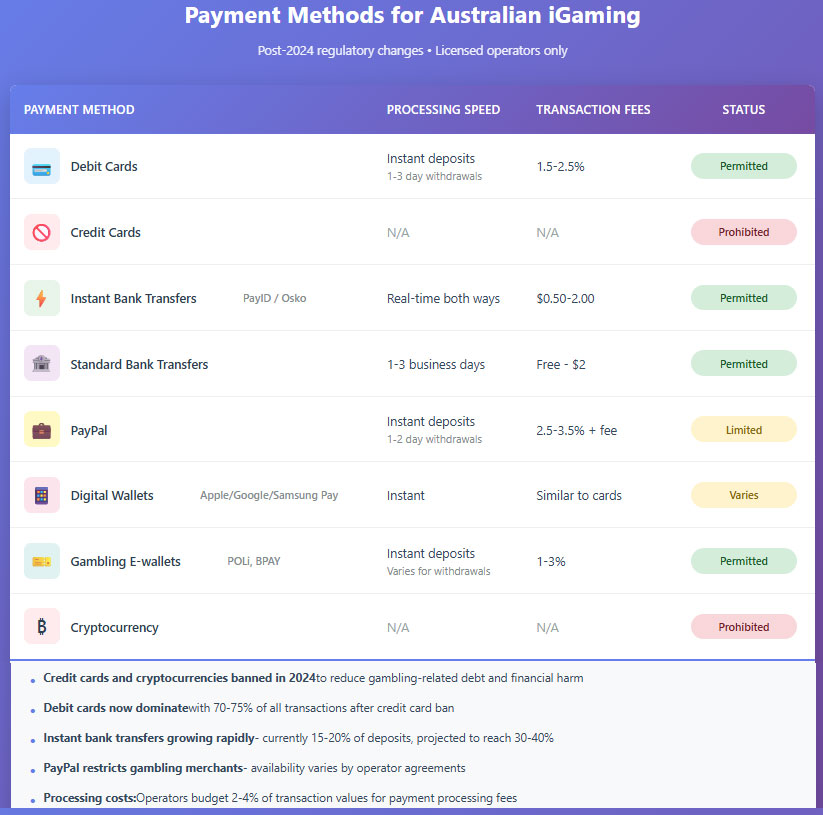
Transaction Patterns: Average online transaction sizes vary by purchase type, with gambling deposits typically ranging from AUD 20 to AUD 200 per transaction for recreational players, and substantially higher for high-value customers. Transaction frequency for active gamblers can reach multiple transactions weekly or even daily. Instant deposit processing is expected standard, while withdrawal processing times represent key customer satisfaction factors, with operators offering faster withdrawals (same-day or instant) gaining competitive advantage over those requiring 3-5 business days.
Cryptocurrency Adoption: Cryptocurrency awareness in Australia exceeds 25 percent of adults, with approximately 5-8 percent owning or having owned cryptocurrencies. However, the 2024 ban on digital currencies for online gambling transactions eliminates cryptocurrency as a legal deposit option for Australian-licensed operators. This prohibition reflects regulatory concerns about anonymity facilitating money laundering, difficulty implementing responsible gambling limits on blockchain transactions, and price volatility creating consumer protection issues. Despite regulatory prohibition, offshore unlicensed operators may accept cryptocurrency, creating compliance challenges for regulators.
Trust in Online Payments: High online banking adoption (90 percent-plus) indicates strong consumer trust in digital financial transactions. However, gambling-specific concerns exist, with some consumers preferring payment methods providing transaction reversal capabilities (though chargebacks for gambling purchases face restrictions). Operators must demonstrate security through SSL encryption, PCI DSS compliance, segregated player funds in trust accounts, and clear security messaging to maintain customer confidence, particularly given past operator failures internationally that resulted in customer fund losses.
Gaming and Gambling Preferences
Current Market Participation
Understanding Australian gambling participation patterns, product preferences, and spending behaviors is essential for operators developing product strategies and marketing campaigns targeting this highly engaged market.
| Gambling Product | Participation Rate | Frequency (Active Participants) | Demographic Skew |
|---|---|---|---|
| Lotteries/Scratchies | 64% | Weekly to monthly | Broad demographic appeal, slightly older skew |
| Race Betting (Horse/Greyhound/Harness) | 39% | Weekly for regular bettors | Male skewed (55%), 35-55 age concentration |
| Sports Betting | 34% | Multiple times per week | Strong male skew (70%), younger (18-44) |
| Electronic Gaming Machines (Pokies) | 33% | Monthly to weekly | Older demographic (45+), regional areas |
| Casino Table Games | 8% | Occasional (monthly or less) | Urban, higher income, younger adults |
| Poker (Any Format) | 6% | Variable (casual to daily) | Male dominated (75%), 25-45 years |
| Bingo | 5% | Weekly for regular players | Female skewed (65%), older (55+) |
| Keno | 4% | Weekly for regular players | Club and pub venue attendees |
Overall Participation: With 72.8 percent of Australian adults gambling in the past 12 months, and 38 percent gambling at least weekly (48 percent of men, 28 percent of women), Australia exhibits exceptionally high engagement rates. This broad participation spans socioeconomic groups, ages, and geographic regions, though patterns vary by product type. Multiple product usage is common, with average gamblers participating in 2.3 different gambling activities, creating opportunities for operators offering diverse product portfolios.
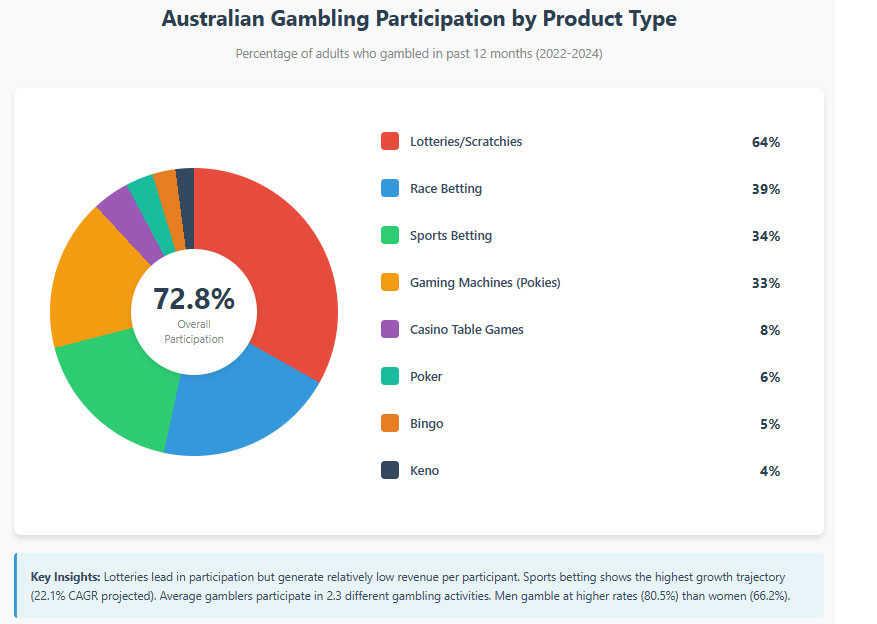
Online Gambling Penetration: Approximately 45-50 percent of Australian gamblers have used online gambling services (primarily sports and race betting), with this proportion increasing steadily, particularly among younger demographics. During COVID-19 lockdowns in 2020-21, online gambling participation surged to 78 percent as venue closures forced digital migration. While some customers returned to land-based gambling post-pandemic, sustained online engagement remains substantially elevated compared to pre-COVID baselines, accelerating the structural shift toward digital channels.
Popular Gambling Activities Ranked: Lotteries lead participation due to accessibility, low cost, and social acceptability. However, lotteries generate relatively low revenue per participant due to infrequent purchases and small stake sizes. Sports betting ranks fourth by participation but demonstrates highest growth trajectory and increasing revenue contribution, driven by mobile apps enabling continuous engagement and integration with sports viewing experiences. Electronic gaming machines, despite third-place participation ranking, generate by far the highest revenue due to high-frequency play, extended sessions, and substantial per-session spending among regular players.
Sports Betting vs Casino Preferences: Given regulatory prohibition on online casino gaming, sports betting dominates legal online gambling. Australian sports bettors show strong preferences for domestic sports including AFL (Australian Football League), NRL (National Rugby League), cricket, horse racing, and increasingly soccer and basketball. International sports including English Premier League, NBA, NFL, and UFC attract significant betting interest. Live betting (available via telephone given online in-play restrictions) represents approximately 40 percent of sports betting turnover for major operators, demonstrating customer preference for real-time engagement despite regulatory obstacles to online in-play wagering.
Seasonal Patterns: Gambling activity exhibits pronounced seasonality aligned with sporting calendars and cultural events. The Melbourne Cup in early November generates massive betting activity, with workplace sweepstakes and first-time annual bettors participating. AFL season (March to September) and NRL season (March to October) drive consistent sports betting engagement with finals series producing volume spikes. Cricket season (October to March) maintains betting interest during summer months. Christmas and New Year periods see reduced gambling activity as venues operate limited hours and consumers focus on non-gambling entertainment, while January typically represents the year’s slowest gambling month.
Consumer Behavior Patterns
Detailed understanding of how Australian gamblers behave—spending levels, betting patterns, platform preferences, timing, and engagement metrics—enables operators to optimize products, marketing, and retention strategies for this distinctive market.
| Metric | Value | Segment Variation |
|---|---|---|
| Average Spending Per Player (Annual) | AUD 1,200 | Wide variation: AUD 100 to AUD 50,000+ |
| Average Spending Per Online Gambler (Annual) | AUD 1,800-2,400 | Higher than land-based due to convenience |
| Median Monthly Gambling Spend | AUD 100 | Mean substantially higher due to high spenders |
| High-Value Player Threshold | AUD 500+ monthly | Represents 15-20% of players, 60-70% of revenue |
| Average Sports Bet Size | AUD 20-50 | Lower for multi-leg bets, higher for single events |
| Typical Gaming Machine Session Spend | AUD 100-200 | Problem gamblers significantly higher |
| Mobile vs Desktop Usage | 75% mobile, 25% desktop | Younger demographics 85%+ mobile |
| Peak Gambling Days | Friday, Saturday, Sunday | 70% of weekly activity on weekends |
| Peak Gambling Times | 7:00 PM – 11:00 PM | Evening leisure hours dominate |
| Average Session Length (Online Sports Betting) | 12-18 minutes | Longer during live events being watched |
| Sessions Per Week (Active Bettors) | 3-5 | Daily users represent 15-20% of active customers |
| Deposit Frequency (Active Players) | 2-3 times monthly | High-value players deposit weekly or more |
| Withdrawal Frequency | 1-2 times monthly | Many players rarely withdraw, reinvesting winnings |
| Bonus Utilization Rate | 60-70% | High sensitivity to promotional offers |
| Customer Acquisition Cost | AUD 300-800 | Increasing due to advertising restrictions and competition |
| Customer Lifetime Value (Average) | AUD 1,500-3,000 | High-value players AUD 10,000+ |
| 12-Month Retention Rate | 35-45% | Varies significantly by product and operator |
Spending Distribution: Gambling spending follows typical 80/20 power law distribution with approximately 20 percent of players generating 70-80 percent of revenue. High-value players spending AUD 500-plus monthly represent the most profitable segment but also present heightened responsible gambling risks requiring enhanced monitoring and intervention capabilities. The median monthly spend of AUD 100 contrasts sharply with mean spending substantially higher, reflecting the impact of high rollers on aggregate statistics. Operators must balance revenue maximization from high-value players with responsible gambling obligations to identify and assist problem gamblers before severe harm occurs.
Mobile Dominance: With 75 percent of online gambling occurring via mobile devices, and this proportion reaching 85 percent-plus among under-35 demographics, mobile-first or mobile-only strategies are essential for new market entrants. Desktop usage persists primarily among older demographics (55-plus) and for certain activities including complex multi-leg sports bets or racing form study requiring larger screens.
Successful operators prioritize mobile app development, with apps providing superior user experience compared to mobile browser-based gambling through faster loading, push notification capabilities, biometric authentication, and offline functionality for research and bet building.
Platform Preferences: Among mobile users, iOS and Android apps split approximately 45/55 percent, requiring operators to maintain both platforms. Native apps outperform progressive web apps for user engagement, retention, and customer satisfaction, though development and maintenance costs are higher. Some operators adopt hybrid strategies with native apps for iOS and Android while maintaining responsive web applications for desktop users and as backup access for users unable or unwilling to download apps.
Temporal Patterns: Gambling activity concentrates heavily on weekends, with Friday through Sunday accounting for approximately 70 percent of weekly betting volume. This weekend concentration reflects alignment with sporting event schedules (most AFL and NRL games occur Thursday through Sunday) and leisure time availability. Evening hours from 7:00 PM to 11:00 PM represent peak activity across all gambling forms as customers finish work and dinner, settle for evening entertainment. Secondary activity peaks occur during lunch breaks (12:00 PM to 1:30 PM) and morning commutes (7:00 AM to 9:00 AM) for mobile bettors.
Session Characteristics: Online sports betting sessions average 12-18 minutes, typically encompassing review of available markets, bet selection, stake sizing, and bet placement. Sessions extend substantially when customers watch events live while monitoring their wagers. Gaming machine sessions in venues can last multiple hours for regular players, though median session length approximates 45-60 minutes. Online casino gaming (though illegal in Australia, usage patterns from legal jurisdictions suggest) shows longer average sessions than sports betting, typically 30-45 minutes, reflecting the continuous-play nature of slots and table games.
Bet Sizing and Risk Preferences: Australian sports bettors demonstrate preference for accumulator/multi-leg bets combining multiple selections for higher potential payouts despite lower probability of winning. Average bet sizes for singles range AUD 30-80, while multi-leg bets average AUD 15-25 per bet due to multiplied odds increasing potential returns. This multi-bet preference creates challenges for operators managing liability but opportunities for promotion through boosted odds on popular multi-bet combinations. Risk tolerance varies by demographic, with younger males showing highest risk appetite through larger bets and longer-odds selections.
Bonus Sensitivity: Australian gamblers demonstrate high responsiveness to promotional offers, with 60-70 percent of customers utilizing bonuses when available. Sign-up bonuses represent critical customer acquisition tools, with matched deposits, free bets, and cashback offers standard across operators. However, recent regulatory scrutiny of inducements and potential future restrictions on bonus offers create uncertainty about sustainability of current promotional intensity. Operators increasingly focus on retention-focused promotions for existing customers rather than purely acquisition-driven offers, improving customer lifetime value economics.
Loyalty and Churn: Annual retention rates of 35-45 percent reflect moderate customer loyalty in this highly competitive market with low switching costs and aggressive competitor acquisition efforts. Customers commonly maintain accounts with multiple operators (average 2.8 accounts among active online bettors) and distribute spending based on odds comparisons, bonus offers, and specific event markets. True loyalty remains limited, with operators competing continuously for share of wallet through competitive pricing, superior products, and engagement programs.
Preferred Game Types by Age: Younger adults (18-34) strongly prefer sports betting, particularly on AFL, NRL, soccer, and basketball, with mobile apps enabling integration with sports viewing. Middle-aged adults (35-54) show more diversified preferences including sports betting, horse racing, and electronic gaming machines. Older adults (55-plus) demonstrate highest pokies engagement while maintaining traditional race betting interest and lottery participation. These age-based preferences require targeted product development and marketing strategies recognizing distinct demographic cohorts.
Section 3: Technology Infrastructure and Business Environment
Internet and Digital Infrastructure
Connectivity and Network Performance
Australia’s internet infrastructure provides generally adequate connectivity for online gambling services, though the country’s vast geography and political debates over National Broadband Network implementation have created a complex infrastructure landscape with performance variations.
Internet Penetration Quality: The 97.1 percent internet penetration represents near-universal access among the adult population relevant to gambling operators. However, this headline figure masks quality variations, with metropolitan areas enjoying fiber and 5G connectivity delivering speeds exceeding 100 Mbps, while regional and remote areas often depend on fixed wireless or satellite connections providing 10-50 Mbps. For online gambling applications requiring real-time data transmission (live betting, live dealer games if legalized), these regional speed limitations can affect user experience, though current sports betting applications function adequately even on slower connections.
Fixed Broadband Deployment: Australia’s National Broadband Network (NBN) rollout, completed in 2020 with ongoing upgrades, created a mixed-technology approach combining fiber-to-the-premises (FTTP), fiber-to-the-node with copper connections (FTTN), hybrid fiber-coaxial (HFC), fixed wireless, and satellite technologies. Fiber penetration of 28.3 percent lags OECD average of 44.6 percent and significantly trails New Zealand (70.3 percent), reflecting political compromises that reduced fiber deployment in favor of cheaper multi-technology approach. However, ongoing NBN Co investments are upgrading networks, with median fixed broadband speeds increasing 43.2 percent year-over-year to 77.90 Mbps, providing adequate bandwidth for current and foreseeable gambling applications.
Network Reliability: Australian internet networks generally provide reliable connectivity with uptime exceeding 99 percent in metropolitan areas. Regional areas experience more frequent disruptions during extreme weather events (bushfires, floods, cyclones) that damage infrastructure.
For gambling operators, reliability requirements include redundant server architectures, cloud-based platforms with automatic failover, and communication strategies for service disruptions affecting customer access. The increasing frequency of extreme weather events due to climate change presents ongoing infrastructure resilience challenges.
Infrastructure Investment: NBN Co committed billions in additional investment to upgrade networks toward higher-speed tiers, targeting 90 percent of premises accessing 1 Gbps wholesale speeds by 2025. Telstra, Optus, and TPG Telecom invest continuously in mobile and fixed networks, with 5G deployment proceeding rapidly in urban areas. This investment trajectory suggests continued connectivity improvements supporting richer gambling experiences including higher-definition streaming, augmented reality features, and more data-intensive applications.
Speed Rankings: Australia’s median mobile internet speed of 103.46 Mbps positions favorably among developed nations, though trailing leaders like South Korea, Singapore, and UAE exceeding 150 Mbps. Fixed broadband speeds of 77.90 Mbps median place Australia in the middle tier of developed nations—adequate for current needs but not market-leading. Only 7.3 percent of Australians access speeds of 100 Mbps or faster (subscribing to gigabit plans), compared to OECD average of 19.6 percent and South Korea’s 39 percent, indicating opportunity for speed tier upgrades as fiber deployment expands.
5G and Future Technology Deployment
5G Coverage and Rollout: 5G networks launched in Australia in 2019, with coverage expanding progressively. By 2025, 5G population coverage reaches approximately 75-80 percent in major cities and 40-50 percent nationally, though actual 5G device and plan adoption lags behind coverage availability. Telstra leads 5G deployment with widest coverage, followed by Optus and TPG Telecom (operating under Vodafone brand). 5G delivers peak speeds exceeding 200 Mbps and typically 100-150 Mbps in real-world conditions, representing substantial improvement over 4G’s 30-50 Mbps average speeds.
4G Coverage: 4G LTE networks cover 98-plus percent of the population, providing baseline mobile connectivity for gambling applications. All major operators operate extensive 4G networks, with speeds ranging 20-80 Mbps depending on location and congestion. For gambling operators, 4G remains the primary mobile connectivity technology for the next 3-5 years as 5G adoption grows gradually, meaning applications must perform effectively on 4G networks to reach mass market.
Future Infrastructure Plans: Beyond 5G expansion, Australian carriers begin exploring 6G technologies expected commercially in 2030s, though current focus remains 5G densification and 4G maintenance. Fixed wireless access (FWA) using 5G technology presents alternative to fixed broadband for some households, with 10 percent adoption already achieved—nearly double OECD average. This FWA growth creates additional pathways for high-speed internet access, particularly in areas where fiber deployment faces economic challenges.
Network Operator Competition: Telstra dominates with approximately 45 percent mobile market share and 40 percent fixed broadband share, leveraging infrastructure advantages from legacy monopoly position. Optus holds roughly 30 percent mobile and 25 percent fixed broadband market share, while TPG Telecom accounts for 20 percent mobile and 15 percent fixed broadband. This competitive market structure drives network investment and prevents monopolistic pricing, benefiting consumers and businesses including gambling operators requiring data connectivity.
Mobile Technology Ecosystem
Mobile Network Infrastructure
Operator Landscape: Three major mobile network operators serve Australia—Telstra, Optus (Singtel subsidiary), and TPG Telecom (formed from merger of TPG and Vodafone Hutchison Australia). Numerous Mobile Virtual Network Operators (MVNOs) including Boost Mobile, Belong, Amaysim, and others resell capacity on these networks, creating pricing competition while relying on the three physical network operators for infrastructure.
Coverage Quality: Telstra provides most extensive coverage reaching 99.5 percent of population, including superior regional and rural coverage due to infrastructure investments and universal service obligations. Optus covers 98.5 percent of population with strong metropolitan and coastal coverage but gaps in remote interior. TPG Telecom reaches 96 percent of population, focused on urban and suburban areas with limited regional penetration. For gambling operators, this coverage geography means platforms must function across varying network conditions, with optimization for congested urban networks and lower-bandwidth rural connections.
Data Costs and Pricing: Mobile data costs in Australia decreased substantially in recent years through competition, with typical consumer plans offering 20-100 GB monthly data for AUD 30-60. Unlimited data plans exist but remain premium-priced at AUD 70-plus monthly. Cost per gigabyte ranges AUD 0.30-1.50 depending on plan structure. For gambling operators, data usage concerns have diminished as generous data allowances become standard, reducing customer friction from usage worries. However, applications should remain data-efficient to accommodate users on limited plans or in situations where WiFi unavailable.
Mobile Payment Integration: Australian mobile networks support carrier billing for app purchases and subscriptions, though this payment method faces restrictions for gambling transactions due to consumer protection concerns about bill shock and debt accumulation. Near Field Communication (NFC) capabilities in modern smartphones enable contactless payments including Apple Pay, Google Pay, and Samsung Pay adopted widely for retail transactions. While useful for general commerce, NFC doesn’t directly apply to online gambling payments, though mobile wallet integration (discussed under payment infrastructure) leverages device security features.
Device Penetration and Preferences
Smartphone Ownership: At 97 percent smartphone penetration, Australia ranks among global leaders, with smartphones having achieved near-universal adoption among adults under 65. Device ownership spans socioeconomic groups, with even lower-income households typically maintaining smartphone access due to necessity for employment, government services, and social connection. Multiple device ownership is common, with 25-30 percent of adults maintaining secondary or older smartphones for specific purposes.
Operating System Distribution: Android devices account for approximately 55 percent of smartphones in Australia, with iOS (iPhone) holding 45 percent—higher than global iOS share of 27 percent due to Australia’s wealth levels and Apple’s strong brand position. This relatively balanced distribution requires gambling operators to maintain feature parity across both platforms, with iOS development often prioritized due to higher-value customer demographics but Android essential for market coverage. Windows Phone, BlackBerry, and other operating systems have negligible market share.
Device Specifications and Capabilities: The average Australian smartphone purchased in 2024-25 features specifications including 5G connectivity, 6-inch-plus displays with 1080p-plus resolution, 6-8 GB RAM, 128-256 GB storage, multi-camera systems, and processors enabling sophisticated applications. Even budget devices (AUD 300-500) now offer capabilities sufficient for rich gambling experiences including video streaming, complex graphics rendering, and secure transaction processing. This hardware baseline enables operators to develop feature-rich applications without concern for lowest-common-denominator device limitations.
Popular Brands: Apple maintains strongest brand loyalty and highest market share value-wise despite Android’s unit volume lead. Samsung dominates Android market with approximately 35 percent of smartphones, followed by Oppo (8 percent), Google Pixel (7 percent), Xiaomi (6 percent), and various other brands. Brand fragmentation on Android requires testing across multiple manufacturer implementations of Android OS to ensure compatibility, while iOS’s controlled ecosystem simplifies development despite Apple’s stricter app review requirements.
Replacement Cycles: Australian smartphone replacement cycles average 2.5-3 years, with younger demographics replacing more frequently (2 years) while older users extend to 3-4 years. This relatively rapid replacement ensures the installed base of devices remains current, minimizing legacy device support requirements. Operators can confidently target recent OS versions (iOS 15-plus, Android 11-plus) covering 85-90 percent of active devices.
Tablet Penetration: Tablet ownership reaches approximately 55 percent of households, with iPads dominating at 65 percent of tablet market. Tablets serve supplementary roles for content consumption, with gambling usage lower than smartphones but still significant. Operators benefit from ensuring applications scale appropriately for tablet displays (10-13 inches) even when tablet-specific development represents lower priority than smartphone optimization.
Financial Services and Payment Infrastructure
Banking System Structure
Australia’s sophisticated banking system provides robust financial infrastructure supporting online gambling transactions, though recent credit card and cryptocurrency restrictions require payment strategy adjustments.
Major Banks: Four major banks—Commonwealth Bank of Australia (CBA), Westpac, ANZ, and National Australia Bank (NAB)—dominate with approximately 75 percent combined market share. CBA leads with 25 percent market share, followed by Westpac at 20 percent, ANZ at 15 percent, and NAB at 15 percent. Regional banks including Bendigo Bank, Bank of Queensland, and Suncorp provide additional competition, while digital-only banks like ING Direct and Up challenge traditional players with technology-focused offerings. Foreign banks including HSBC, Citibank, and BNP Paribas operate primarily in corporate and investment banking rather than retail.
Digital Banking Adoption: Over 90 percent of Australian adults use online banking, with mobile banking apps achieving 85 percent-plus penetration among smartphone owners. This digital banking maturity means customers are highly comfortable with online financial transactions, reducing trust barriers for online gambling deposits and withdrawals. Real-time payment infrastructure including NPP (New Payments Platform), PayID, and Osko enables instant account-to-account transfers, improving customer experience compared to traditional 1-3 day bank transfers.
Account Penetration: Approximately 99 percent of Australian adults maintain bank accounts, achieving near-universal financial inclusion. This universal banking access means payment barriers are minimal—essentially all potential gambling customers possess the basic financial infrastructure for participating. Unbanked populations consist primarily of homeless individuals, recent immigrants during account establishment, and individuals with severe financial problems or mental health issues.
Credit and Lending Markets: Australian credit markets are well-developed with mortgage debt exceeding 100 percent of GDP and credit card penetration around 55 percent of adults. However, the 2024 credit card ban for gambling means this payment method is unavailable for licensed operators. Personal loan availability and Buy Now Pay Later services exist but face regulatory restrictions preventing gambling use. This credit restriction landscape means operators must emphasize debit-based payment methods, bank transfers, and approved e-wallets.
Payment Processing Options
The payment processing landscape for Australian gambling operators has evolved significantly following recent regulatory changes, requiring flexible multi-channel approaches while excluding previously popular methods.
| Payment Method | Availability | Processing Speed | Typical Fees | Customer Adoption |
|---|---|---|---|---|
| Debit Cards | Permitted | Instant deposits, 1-3 day withdrawals | 1.5-2.5% per transaction | 85% penetration |
| Credit Cards | Prohibited (2024 ban) | N/A | N/A | Previously 60-70% |
| Bank Transfers (Standard) | Permitted | 1-3 business days both directions | Free to AUD 2 | 40% use occasionally |
| Instant Bank Transfers (PayID/Osko) | Permitted | Real-time deposits and withdrawals | AUD 0.50-2 per transaction | 35% adoption, growing rapidly |
| PayPal | Limited (PayPal restricts gambling) | Instant deposits, 1-2 day withdrawals | 2.5-3.5% plus fixed fee | 40% have accounts |
| Digital Wallets (Apple/Google/Samsung Pay) | Varies by provider | Instant for supported operators | Similar to card fees | 35% use for general payments |
| Gambling-Specific E-wallets (POLi, BPAY) | Permitted | Instant deposits, varies for withdrawals | 1-3% transaction fee | 15-20% among active gamblers |
| Cryptocurrency | Prohibited (2024 ban) | N/A | N/A | 5-8% own crypto |
| Prepaid Cards/Vouchers | Limited availability | Instant deposits, no withdrawals | Varies | Low single digits |
Primary Payment Methods: Following the credit card ban, debit cards represent the dominant payment method for approximately 70-75 percent of transactions. Instant bank transfers via PayID and Osko are growing rapidly as customers appreciate real-time processing and lower fees, currently accounting for 15-20 percent of deposits with potential to reach 30-40 percent. Traditional bank transfers maintain 8-12 percent share for larger deposits and customers preferring direct bank-to-operator transfers. E-wallets and other methods comprise the remaining 5-10 percent.
Processing Fees: Payment processing costs represent significant operational expenses for gambling operators. Debit card fees typically range 1.5-2.5 percent per transaction, lower than credit cards’ historical 2.5-3.5 percent but still substantial for high-volume operators processing millions in monthly deposits. Instant bank transfers cost AUD 0.50-2 per transaction, providing more favorable economics for larger transactions but potentially less competitive for small deposits. E-wallet fees vary from 2-4 percent depending on provider and volume. Operators must balance customer payment preferences against processing costs when determining which methods to support.
Transaction Processing Times: Deposit speed represents critical customer experience factor, with instant processing now expected standard. All major payment methods except traditional bank transfers support instant deposit crediting. Withdrawal speed differentiates operators, with leading platforms offering same-day or instant withdrawals via instant bank transfer methods gaining competitive advantage.
International Payment Capabilities: Australian banking infrastructure supports international payments via SWIFT transfers, foreign exchange services, and international card networks. For operators licensed in Australia but headquartered internationally, payment processing can be structured through Australian merchant accounts or international processor relationships supporting AUD transactions. However, regulatory requirements mandate that player funds be held in Australian trust accounts, necessitating local banking relationships regardless of operator domicile.
Regulatory Restrictions: Beyond credit card and cryptocurrency prohibitions, gambling payment processing faces restrictions on extending credit to customers (players must fund accounts from their own resources), requirements for transaction monitoring to detect money laundering, and obligations to facilitate player-initiated withdrawal requests without unreasonable delay. Payment processors themselves face pressure from regulators and advocacy groups to block transactions to unlicensed offshore operators, creating compliance obligations for processors and practical barriers to offshore operators attempting to serve Australian customers.
Chargebacks and Dispute Resolution: Gambling transactions traditionally face restrictions on chargeback rights, with banks and card networks limiting customers’ ability to dispute legitimate gambling transactions. However, fraudulent transactions, unauthorized account access, or situations where operators fail to process withdrawals may support chargeback claims. Operators must implement robust fraud detection, secure authentication, and transparent terms to minimize disputes. Excessive chargeback rates can result in payment processor termination, creating operational crises for affected operators.
E-commerce and Digital Economy
Digital Market Development
Australia’s digital economy demonstrates maturity across multiple dimensions, providing context for online gambling’s position within broader digital commerce trends.
E-commerce Market Size: Online retail in Australia reached approximately AUD 40 billion in 2024, representing 13.8 percent of total retail sales. While this penetration exceeds the OECD average of 12 percent, it trails the United States (18 percent) and United Kingdom (25 percent), suggesting continued growth potential. E-commerce grew at 8-10 percent CAGR over 2020-2024, accelerated by COVID-19 pandemic that forced digital adoption. Fashion, electronics, homewares, and groceries lead e-commerce categories, with services including entertainment, travel, and gambling constituting additional digital spending.
Online Services Adoption: Beyond physical goods, Australians extensively consume digital services including streaming video (Netflix, Disney+, Stan with 70 percent household penetration), streaming music (Spotify, Apple Music with 60 percent adoption), online education, telemedicine, and financial services. This diverse digital consumption means gambling operators compete for consumer attention and spending within crowded digital entertainment landscape. Success requires compelling value propositions differentiating gambling entertainment from alternative digital diversions.
Consumer Trust: Consumer confidence in online transactions remains strong, with 85 percent of internet users making online purchases in the past year. Trust indicators include satisfaction with online shopping experiences, low fraud rates (less than 0.1 percent of transactions), effective consumer protection frameworks, and dispute resolution mechanisms. For gambling operators, this baseline trust translates to customer willingness to deposit funds online provided operators demonstrate security, fairness, and financial reliability through licensing, independent audits, and transparent operations.
Cross-Border Shopping: Approximately 40 percent of Australian online shoppers purchase from international retailers, driven by product availability, pricing advantages despite shipping costs, and access to global brands. This international shopping comfort suggests Australian consumers are sophisticated online buyers comparing options across borders. For gambling, the prohibition on offshore unlicensed operators creates legal risks for consumers, though estimated hundreds of thousands continue accessing offshore casino sites despite illegality and ISP blocking efforts.
Business Environment and Regulatory Framework
Ease of Business Operations
Australia provides a generally favorable business environment characterized by transparent regulations, efficient administration, developed infrastructure, and strong rule of law, though costs and regulatory complexity present challenges in certain areas including gambling.
World Bank Rankings: Australia ranked 14th globally on the World Bank’s Doing Business Index (prior to discontinuation of the ranking in 2021), indicating relatively business-friendly conditions. Specific areas of strength included enforcing contracts (1st globally), resolving insolvency (15th), and protecting minority investors (58th). Areas requiring more effort included starting a business (58th) and dealing with construction permits (78th). These rankings position Australia in the upper tier of business environments, though not the absolute easiest among developed nations.
Starting a Business: Establishing a company in Australia requires 3-4 steps typically completed in 2-3 business days for straightforward incorporations. The process involves registering with Australian Securities and Investments Commission (ASIC), obtaining Australian Business Number (ABN), registering for Goods and Services Tax if applicable, and setting up required business accounts. Costs for basic company registration approximate AUD 500-1,500 including government fees and minimal professional assistance. However, gambling operators face substantially longer timelines and higher costs due to licensing requirements, probity investigations, and compliance infrastructure establishment.
Foreign Investment Policies: Australia maintains Foreign Investment Review Board (FIRB) oversight of foreign investments exceeding specified thresholds, with screening particularly strict for sensitive sectors including telecommunications, transport, and critical infrastructure.
Gambling operations typically require FIRB approval due to business size and community sensitivity, adding 30-90 days and fees of AUD 10,000-plus to establishment processes.
Generally, foreign investment is welcomed provided it delivers economic benefits, but national security and community concerns can trigger rejections or conditions, particularly for state-owned enterprises or investments from certain countries.
Operational Costs: Business operating costs in Australia rank among the world’s highest due to elevated wages, commercial property costs, and regulatory compliance expenses. Office rent in Sydney and Melbourne CBDs ranges AUD 600-1,000 per square meter annually, comparable to major global cities. Professional salaries for technology, compliance, and marketing roles range AUD 80,000-180,000 annually depending on experience and specialization. Mandatory employer superannuation contributions (currently 11.5 percent of wages) and payroll taxes (state-based, typically 4.75-6.0 percent above thresholds) increase employment costs by 16-22 percent beyond base salaries.
Corporate Structure and Registration
Selecting appropriate corporate structure represents a critical early decision for gambling operators entering the Australian market, with implications for liability, taxation, governance, and regulatory compliance.
| Entity Type | Characteristics | Suitability for iGaming | Setup Cost & Time |
|---|---|---|---|
| Proprietary Limited Company (Pty Ltd) | Limited liability, separate legal entity, 1-50 shareholders | Standard choice for small-medium operators | AUD 500-1,500; 2-3 days |
| Public Company Limited | Unlimited shareholders, can raise capital publicly, stricter governance | Suitable for large-scale operations or ASX listing | AUD 2,500-5,000; 1-2 weeks |
| Foreign Company Branch | Extension of foreign entity, limited liability, parent fully liable | Less common; used when parent retains direct control | AUD 1,000-3,000; 1-2 weeks |
| Partnership | No separate legal entity, partners personally liable | Unsuitable for gambling operations | N/A |
| Trust | Trustee holds assets for beneficiaries | Sometimes used as part of complex structures | AUD 1,500-5,000; 1-2 weeks |
Recommended Structure: Proprietary Limited (Pty Ltd) companies represent the standard structure for most gambling operators, providing limited liability protection, straightforward governance, and regulatory acceptance. International operators typically establish Australian subsidiaries as Pty Ltd companies rather than operating as branches, allowing separation of Australian operations and limiting parent company exposure to Australian liabilities. For operators planning eventual ASX listing or seeking broad capital raising, Public Company Limited structures are necessary but involve higher compliance costs and governance requirements.
Registration Process and Timeline: Company registration through ASIC typically requires 1-3 business days for straightforward applications. Required information includes company name (must be unique and not misleading), registered office address in Australia, at least one director residing in Australia, company secretary details, and share structure. Following ASIC registration, additional steps include obtaining ABN, registering for GST, establishing business bank accounts, and implementing required corporate governance frameworks. For gambling operators, the company registration represents merely the first step, with gambling license application following once the corporate structure is established.
Foreign Ownership Rules: Australia permits 100 percent foreign ownership of gambling companies, though FIRB approval is typically required for investments exceeding thresholds (AUD 281 million for developed countries with free trade agreements, lower for others and state-owned enterprises). Certain license types may impose Australian ownership minimums or require substantial Australian presence, varying by jurisdiction. Directors and shareholders must meet probity standards regardless of nationality, requiring background checks and potentially Australian criminal record checks for foreign principals.
Ongoing Compliance Requirements: Companies must maintain current ASIC registrations through annual review fees (AUD 283 for Pty Ltd companies), update ASIC of any structural changes within 28 days, hold annual general meetings for shareholders, maintain proper accounting records, prepare annual financial statements, lodge income tax returns, and comply with Corporations Act requirements.
Gambling operators face additional requirements including gaming regulator reporting, annual license fee payments, regular audits, and compliance certifications. Total compliance costs including accounting, audit, legal, and regulatory reporting typically range AUD 50,000-500,000 annually depending on operator size and complexity.
Taxation Framework
Corporate Income Tax Structure
Understanding Australia’s taxation regime is critical for financial modeling and determining the true cost of market entry, with gambling operators subject to both general corporate taxes and industry-specific gaming taxes.
| Tax Type | Rate/Amount | Application to iGaming |
|---|---|---|
| Standard Corporate Income Tax | 30% | Applies to taxable profits after deductions |
| Small Business Corporate Rate | 25% | If turnover below AUD 50 million (most operators exceed) |
| Goods and Services Tax (GST) | 10% | Complex application to gambling; generally input-taxed |
| Dividend Withholding Tax | 0-30% | On dividends to foreign shareholders; varies by treaty |
| Interest Withholding Tax | 10% | On interest to foreign lenders; treaty variations |
| Royalty Withholding Tax | 30% | On royalties to foreign entities; treaty variations |
| Fringe Benefits Tax | 47% | On certain employee benefits provided |
Corporate Tax Calculation: Corporate income tax applies to taxable income, calculated as assessable income minus allowable deductions. For gambling operators, assessable income includes all gambling revenue (stakes minus payouts), interest income, and other business income. Allowable deductions include operating expenses, salaries, marketing costs, technology costs, gaming taxes paid to states/territories, interest on business loans, and depreciation on assets. Gaming-specific taxes paid to states represent deductible expenses, creating a offset where effective overall tax burden is less than the sum of state gaming taxes plus federal corporate tax.
Tax Holidays and Incentives: Australia generally does not offer tax holidays or reduced rates for gambling operators, contrasting with some jurisdictions using favorable taxation to attract operators. Some special economic zones or innovation programs offer benefits for qualifying businesses, but gambling operations typically do not qualify for these programs due to industry-specific regulatory approaches. The taxation framework represents stable but relatively high-cost environment without special concessions.
International Tax Treaties: Australia maintains comprehensive tax treaty network with over 40 countries including United Kingdom, United States, Malta, Gibraltar, and many Asian nations, providing relief from double taxation and reduced withholding rates on cross-border payments. Treaties typically reduce dividend withholding from 30 percent to 0-15 percent depending on ownership percentage and treaty terms. Interest withholding may be reduced from 10 percent to 0-10 percent. Operators with international parent companies benefit from treaty planning to minimize withholding taxes on profit repatriation.
Transfer Pricing: Operators with related-party transactions must comply with transfer pricing rules ensuring transactions occur at arm’s length prices. Common gambling transfer pricing issues include software licensing fees paid to foreign affiliates, management fees for services from parent companies, and cost allocation for shared services. Australian Taxation Office scrutinizes transfer pricing in gambling sector due to history of profit shifting, requiring contemporaneous documentation demonstrating compliance with arm’s length principles. Improper transfer pricing can result in adjustments, penalties, and increased tax assessments.
Personal Income Tax and Employment
Employment costs represent major operating expenses for Australian gambling operators, with personal income tax withholding, superannuation contributions, and payroll taxes adding substantially to base salary costs.
Individual Tax Rates: Australian personal income tax applies progressive rates from 19 percent (on income from AUD 18,201 to AUD 45,000) to 45 percent (on income above AUD 180,000), plus 2 percent Medicare levy. Effective tax rates for typical gambling industry salaries include approximately 32.5 percent for AUD 80,000 annual salary, 39 percent for AUD 120,000, and 47 percent for AUD 200,000. Employers withhold income tax from salaries under Pay As You Go (PAYG) system, remitting to tax office monthly or quarterly.
Superannuation Contributions: Employers must contribute 11.5 percent of ordinary time earnings (increasing to 12 percent in July 2025) to employee superannuation (retirement) funds. This represents non-discretionary cost above base salaries, effectively increasing employment costs. Superannuation contributions are tax-deductible for employers but represent significant cash outflow. For a AUD 100,000 annual salary, employers pay AUD 11,500 in superannuation, creating actual cost of AUD 111,500 before other on-costs.
Payroll Tax: States and territories impose payroll taxes on wages exceeding annual thresholds (typically AUD 700,000-1.2 million varying by state). Rates range from 4.75 percent to 6.0 percent depending on jurisdiction and wages above threshold. Multi-state employers must navigate complex rules determining tax allocation across jurisdictions. For large gambling operators with national presence, payroll tax represents substantial ongoing cost of 5 percent-plus of total salary expenses above thresholds.
Tax Residency Rules: Individuals resident in Australia for tax purposes pay tax on worldwide income, while non-residents pay tax only on Australian-source income at higher rates (32.5 percent from dollar one rather than 19 percent from AUD 18,201).
Foreign employees of gambling operators typically become Australian tax residents if working in Australia for more than 6 months, creating tax obligations on global income. Operators must understand residency rules to properly withhold taxes and advise employees of tax obligations.
Market Entry Considerations
Recommended Entry Strategies
Successful market entry requires strategic planning addressing regulatory pathways, technology platforms, partnership strategies, payment solutions, and marketing approaches appropriate for Australia’s unique characteristics.
Licensing Strategy: For online sports betting operators, Northern Territory licensing represents the most accessible pathway, with streamlined processes, established frameworks, and acceptance by other states for point-of-consumption tax purposes. Operators should engage experienced Australian gaming lawyers early to guide license application, structure corporate entities appropriately, and navigate probity processes. Budget 6-12 months from application to license grant, though initial preparations (company establishment, banking relationships, platform development) can occur in parallel.
Partnership vs. Standalone Operation: New market entrants face choices between wholly-owned operations, joint ventures with Australian partners, white-label arrangements using established platforms, or acquisition of existing license holders. Each approach offers different benefits and drawbacks. Wholly-owned operations provide maximum control and revenue retention but require substantial capital investment and longer time-to-market. Joint ventures with Australian partners can accelerate market entry and provide local expertise but involve sharing control and profits. White-label arrangements minimize technology investment and accelerate launch but limit differentiation and transfer significant value to platform providers. Acquisitions of existing operators provide immediate market presence but require substantial capital and face regulatory approval processes.
Technology Platform Selection: Operators must choose between building proprietary platforms, licensing established platforms, or hybrid approaches. Proprietary development provides complete control and potential competitive differentiation but requires AUD 5-20 million investment and 12-24 months development time.
Payment Provider Strategy: Given payment complexity following credit card ban, operators should establish relationships with multiple payment processors providing debit card processing, instant bank transfer capabilities, and e-wallet options. Leading processors for Australian gambling include Datacash, Eway, Pin Payments, and international providers with Australian subsidiaries. Diversification across multiple processors provides redundancy if one provider experiences technical issues or terminates relationship. Budget 3-5 percent of transaction values for payment processing costs.
Localization Requirements: Success requires thorough localization beyond merely accepting AUD currency. Critical localization elements include comprehensive coverage of Australian sports (AFL, NRL, cricket, horse racing as core with A-League, NBL, and international sports as supplements), odds formats familiar to Australians (decimal odds standard, not fractional or American), customer service operating in Australian time zones (or 24/7 with staff familiar with Australian sports and culture), marketing messaging using Australian vernacular and humor styles, and sponsorships of Australian sporting properties demonstrating market commitment.
Typical Costs and Timelines
Financial planning for Australian market entry requires comprehensive understanding of both one-time establishment costs and ongoing operational expenses, with timelines extending longer than many operators initially anticipate.
| Cost Category | Range | Details |
|---|---|---|
| Initial Setup Investments | ||
| License Application & Fees | $50,000-$200,000 | Varies by jurisdiction and license type |
| Legal & Consulting Fees | $150,000-$500,000 | Gaming lawyers, consultants, probity preparation |
| Company Registration & Corporate Setup | $10,000-$50,000 | ASIC registration, governance, policies |
| Initial Capital Requirements | $500,000-$5,000,000 | Proof of financial capacity for license |
| Office Setup Costs | $100,000-$500,000 | Premises, furniture, equipment, initial rent |
| Technology & Platform Costs | $500,000-$10,000,000 | Platform license or development, integration, testing |
| Initial Marketing Budget | $2,000,000-$10,000,000 | Launch campaign, sponsorships, customer acquisition |
| Payment Processing Setup | $50,000-$200,000 | Merchant accounts, integration, security deposits |
| Compliance Systems | $200,000-$1,000,000 | AML software, responsible gambling tools, monitoring |
| Total Initial Investment | $3.5M-$27M | Varies dramatically by scale and approach |
| Expense Category | Monthly Range | Annual Range |
|---|---|---|
| Staff Salaries (20-50 employees) | $200,000-$600,000 | $2.4M-$7.2M |
| Office Rent & Utilities | $15,000-$50,000 | $180,000-$600,000 |
| Technology Platform License/Maintenance | Revenue-based: 15-25% of GGR | Variable |
| Payment Processing Fees | 2-4% of deposits | Variable |
| Marketing & Customer Acquisition | $300,000-$2,000,000 | $3.6M-$24M |
| Compliance & Legal | $50,000-$150,000 | $600,000-$1.8M |
| Gaming Taxes (Point of Consumption) | 8-15% of Net Revenue | Variable |
| License Fees & Levies | Variable | $50,000-$500,000 |
| Insurance | $10,000-$40,000 | $120,000-$480,000 |
| Total Operational (excluding taxes on revenue) | $0.6M-$3.0M | $7M-$36M |
| Phase | Duration | Key Activities |
|---|---|---|
| Pre-Application Preparation | 2-4 months | Market research, business planning, corporate structure, preliminary legal review |
| Company Registration | 2-4 weeks | ASIC registration, ABN, banking, governance setup |
| License Application Preparation | 2-3 months | Documentation compilation, probity prep, financial proofs |
| License Application Processing | 3-6 months | Regulator review, probity investigations, clarifications |
| Platform Development/Integration | 3-9 months | Technology setup, testing, certification (overlaps with licensing) |
| Pre-Launch Preparation | 1-2 months | Marketing setup, staff training, final compliance checks |
| Total Time to Market | 12-18 months | From decision to live operations |
Resource Requirements: Minimum viable team for launching operations includes CEO/Managing Director (Australian resident required for many licenses), CFO/Finance Director, Chief Compliance Officer, Head of Trading/Sportsbook, Head of Marketing, Head of Technology, Customer Service Manager, plus support staff totaling 20-30 people at launch expanding to 40-60 within first year depending on growth. Key positions require gambling industry experience, with compliance and trading roles especially critical to secure from experienced professionals. Salary costs represent largest ongoing expense category after gaming taxes and marketing.
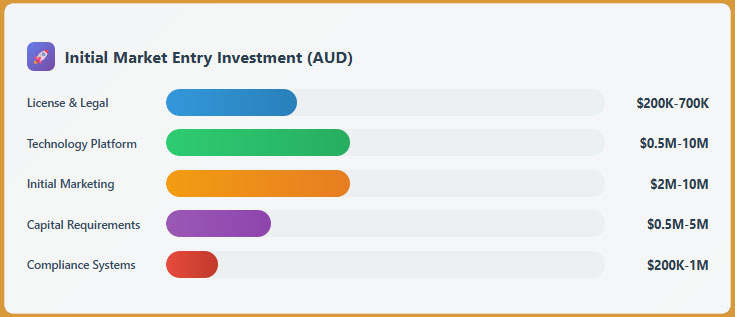
Success Factors and Challenges
Key Success Enablers:
- Deep Australian Sports Knowledge: Understanding nuances of AFL, NRL, cricket, and horse racing is essential. Successful operators employ Australian traders familiar with local sports, offer markets aligned with customer interests, and engage in sports-focused marketing.
- Localized Payment Methods: Integration of instant bank transfers (PayID/Osko), debit cards, and Australian e-wallets optimized for local banking infrastructure improves conversion and reduces friction compared to international payment approaches.
- Mobile-First Design: With 75 percent mobile usage, superior mobile apps featuring intuitive interfaces, fast loading, minimal data usage, and integrated sports streaming create competitive advantages.
- Competitive Pricing: Australian market demonstrates high price sensitivity with customers maintaining multiple accounts to bet at best odds. Operators need competitive pricing strategies, potentially accepting lower margins to gain market share.
- Marketing Partnerships: Sponsorships of AFL/NRL teams, sporting codes, media partnerships, and ambassador relationships build brand recognition and credibility in this sponsorship-heavy market.
- Customer Service Excellence: 24/7 support, knowledgeable staff resolving betting queries quickly, proactive responsible gambling monitoring, and fast withdrawal processing drive satisfaction and retention.
- Responsible Gambling Leadership: Demonstrating genuine commitment to harm minimization through sophisticated tools, transparent communication, staff training, and support for research builds regulatory goodwill and brand reputation.
- Local Presence: Operators perceived as genuinely Australian or strongly committed to Australian market outperform those viewed as extracting profits without reinvestment.
Major Operational Challenges:
- High Customer Acquisition Costs: Intense competition and advertising restrictions drive CAC to AUD 300-800 per customer, requiring strong lifetime value to achieve positive returns.
- Complex Multi-Jurisdiction Taxation: Point-of-consumption taxes varying by state require sophisticated systems tracking customer location, calculating tax obligations across eight jurisdictions, and complying with different reporting requirements.
- Payment Processing Limitations: Credit card and cryptocurrency bans eliminate previously popular payment methods, requiring adaptation to debit-focused strategies and management of higher transaction costs.
- Advertising Restrictions: Current and anticipated future restrictions on gambling advertising limit marketing channels, increase costs, and favor established brands with existing recognition.
- Intense Competition: Market dominance by Sportsbet, TAB, Bet365, and other major operators creates barriers for new entrants, with established players defending market positions aggressively.
- Technology Infrastructure Requirements: Building or licensing platforms meeting Australian regulatory requirements, integrating Australian sports data feeds, and providing mobile-optimized experiences requires substantial investment.
- Compliance Complexity: Navigating federal online gambling laws, state point-of-consumption taxes, AML/CTF obligations, responsible gambling requirements, and advertising restrictions demands sophisticated compliance capabilities.
- Regulatory Uncertainty: Potential reforms to advertising, taxation, problem gambling measures, and online gambling scope create planning challenges and risk of material regulatory change post-launch.
Cultural Considerations:
- Australian Sporting Calendar: Align promotions with AFL/NRL seasons, Melbourne Cup, cricket season, and major sporting events driving peak betting activity.
- Communication Preferences: Australians appreciate direct, informal communication without excessive formality. Email and SMS remain effective channels supplementing app notifications.
- Trust-Building for Foreign Brands: International operators must demonstrate commitment through Australian sponsorships, local customer service, fast payouts, and community contributions to overcome skepticism about foreign ownership.
- Responsible Gambling Sensitivity: Increasing community awareness of gambling harm requires operators to visibly demonstrate responsible gambling commitment, avoiding aggressive marketing and providing genuine support for customers experiencing problems.
FAQ: Frequently Asked Questions
Legal & Licensing
1. Is online gambling legal in Australia?
Online gambling legality in Australia is complex. Online sports betting and race wagering are fully legal when offered by Australian-licensed operators, with Northern Territory representing the primary licensing jurisdiction. Online lottery services are also permitted. However, online casino gaming including slots, table games, poker, and live dealer games is strictly prohibited under the Interactive Gambling Act 2001, with this prohibition applying to operators, not players. In-play sports betting (placing bets after events commence) is illegal through online/digital channels but permitted via telephone. Offshore operators offering casino games to Australians operate illegally and face ISP blocking by ACMA.
2. What types of gambling licenses are available and what do they cover?
Australian gambling licenses vary by state/territory and product type. Key categories include: Online Wagering Licenses (Northern Territory most common) covering sports betting and race wagering through digital channels; Interactive Gambling Licenses (Queensland) for online lottery and permitted interactive gaming; Casino Licenses for land-based casino operations in each state (online casino prohibited nationally); Gaming Machine Licenses for operating electronic poker machines in approved venues; Bookmaker Licenses for retail sports/race betting operations; Lottery Operator Licenses for government-authorized lottery games. Each license type has specific scope, conditions, and requirements set by the issuing regulatory authority.
3. How much does an iGaming license cost and how long does it take to obtain?
License costs vary dramatically by type and jurisdiction. Online wagering licenses (Northern Territory) typically require application fees of AUD 10,000-50,000 with additional legal and consulting costs of AUD 150,000-500,000 for application preparation and probity processes. Total time from application to license grant ranges 3-6 months for straightforward applications to 12 months for complex structures. Casino licenses involve application fees from AUD 100,000 to several million dollars with processing times of 12-24 months. Lottery operator licenses in Queensland require AUD 21,460 application fee plus quarterly ongoing fees. Initial capital requirements for online licenses typically range AUD 500,000-5,000,000 depending on projected operation scale. Operators should budget 12-18 months total from decision to live operations including all preparation, application, and setup phases.
4. Can foreign companies obtain a gambling license?
Yes, foreign companies can obtain Australian gambling licenses, with many major operators including Bet365, Ladbrokes, and Unibet operating under foreign ownership. However, specific requirements apply: foreign entities typically must establish Australian subsidiaries (Pty Ltd companies) rather than operating as branches; at least one director must be Australian resident; all directors, major shareholders, and key executives must pass probity investigations regardless of nationality; Foreign Investment Review Board (FIRB) approval is generally required for investments exceeding thresholds; and some jurisdictions may prefer or require partial Australian ownership or substantial local presence. The Northern Territory has proven particularly accommodating to international operators, evidenced by its large portfolio of licensed overseas-owned wagering operators.
Financial & Taxation
5. What are the tax obligations for iGaming operators?
Australian iGaming operators face multiple tax obligations: Gaming-Specific Taxes including point-of-consumption taxes of 8-15 percent on net wagering revenue, applied by the state/territory where customers reside rather than operator location; Corporate Income Tax at 30 percent on taxable profits (gaming taxes are deductible expenses); Goods and Services Tax (GST) of 10 percent with complex application to gambling (generally input-taxed); Payroll Tax of 4.75-6.0 percent on wages exceeding state thresholds (varies by jurisdiction); License Fees and Levies ranging from tens of thousands to millions annually; Problem Gambling Levies of 0.5-1.5 percent of revenue for research and treatment. Total effective tax rate commonly reaches 50-60 percent of gross gaming revenue when combining all obligations. International operators also face potential withholding taxes on dividends (0-30 percent), interest (10 percent), and royalties (30 percent) paid to foreign entities, though tax treaties often reduce these rates.
6. Are gambling winnings taxed for players?
No, gambling winnings in Australia are generally not taxed for recreational players. This applies regardless of the amount won, gambling activity type, or whether gambling occurs online or at land-based venues. Players are not required to report winnings on tax returns, and operators do not withhold taxes from payouts. This tax-free treatment contributes to Australia’s high gambling participation rates. The only exception applies to professional gamblers who gamble as a business rather than recreation, where winnings may be treated as assessable income subject to normal income tax rates. The Australian Taxation Office determines professional gambler status based on systematic approaches, frequency and volume of activity, whether gambling represents primary income source, and business-like record keeping. This classification affects relatively few individuals.
7. What are the typical operational costs for running an online casino/sportsbook?
Monthly operational costs for Australian online sportsbooks typically range AUD 600,000-3,000,000+ depending on scale, encompassing: Staff Salaries (AUD 200,000-600,000 monthly for 20-50 employees including management, trading, compliance, marketing, technology, and customer service); Marketing and Customer Acquisition (AUD 300,000-2,000,000 monthly, largest variable expense); Technology Platform (15-25 percent of gross gaming revenue if licensed, or amortized development costs for proprietary platforms); Payment Processing (2-4 percent of deposit volumes); Gaming Taxes (8-15 percent of net revenue for point-of-consumption taxes); Office and Infrastructure (AUD 15,000-50,000 monthly); Compliance and Legal (AUD 50,000-150,000 monthly); License Fees (amortized, varying by jurisdiction). First-year total operational expenses commonly reach AUD 10-40 million before achieving profitability, with breakeven typically occurring 18-36 months post-launch for well-capitalized operators executing effective strategies. Note: Online casinos are illegal in Australia, so these costs apply only to legal sports betting and racing wagering operations.
8. What is the expected ROI timeline for entering this market?
ROI timelines for Australian iGaming market entry vary significantly based on capital efficiency, marketing effectiveness, and competitive positioning. Typical scenarios include: Fast-Growth, High-Investment Approach—Initial investment AUD 15-30 million, breakeven at 24-36 months, positive ROI at 48-60 months, requiring aggressive customer acquisition and brand building competing directly with major operators. Moderate-Growth, Capital-Efficient Approach—Initial investment AUD 5-12 million, breakeven at 18-30 months, positive ROI at 36-48 months, focusing on niche segments or lower-cost customer acquisition channels. White-Label or Partnership Approach—Initial investment AUD 3-8 million, breakeven at 12-24 months, positive ROI at 24-36 months, though total returns limited by revenue sharing with platform providers. Success factors critically affecting ROI include customer acquisition costs (currently AUD 300-800 per customer), customer lifetime value (AUD 1,500-3,000 average, AUD 10,000+ for high-value players), retention rates (35-45 percent annually), and regulatory costs. Market entry requires patient capital with 3-5 year investment horizons for material returns.
Operations & Compliance
9. What are the local presence requirements for operators?
Australian gambling licenses generally require meaningful local presence, though specific requirements vary by jurisdiction. Common requirements include: Corporate Structure—Australian-registered company (typically Pty Ltd) with registered office in licensing jurisdiction; Director Residency—at least one director must be Australian resident; Physical Office—operational office in Australia with staff conducting core business functions; Key Personnel—responsible manager residing in Australia and accessible to regulators; Banking—Australian bank accounts with player funds held in trust accounts at Australian financial institutions; Data and Systems—regulators may require certain systems or data to be maintained in Australia or accessible for audit purposes; Customer Service—effective customer support during Australian business hours. Northern Territory licensing tends toward lighter physical presence requirements compared to some state licenses, though all jurisdictions expect genuine Australian operations rather than letterbox arrangements. Substantial foreign operations are permitted provided Australian subsidiary maintains real presence and authority.
10. What payment methods are available and recommended?
Following 2024 regulatory changes, available payment methods for Australian online gambling include: Debit Cards (primary method, 70-75 percent of transactions, instant deposits)—highly recommended; Instant Bank Transfers via PayID/Osko (growing rapidly, 15-20 percent share, real-time processing both directions)—highly recommended; Traditional Bank Transfers (8-12 percent, slower processing)—necessary for completeness; E-wallets including gambling-specific solutions like POLi and BPAY (5-10 percent combined)—recommended for user choice. Prohibited methods include credit cards (banned 2024) and cryptocurrencies (banned 2024). Limited availability includes PayPal (restricts gambling merchants) and digital wallets like Apple Pay/Google Pay (varies by provider). Recommended strategy involves supporting debit cards plus instant bank transfers as core methods, supplemented by 2-3 e-wallet options providing customer choice. Multiple payment processor relationships are advisable for redundancy. Processing fees range 1.5-4 percent depending on method, with instant bank transfers often most cost-effective for larger transactions.
11. What are the advertising and marketing restrictions?
Australian gambling advertising faces significant and increasing restrictions: Broadcast Media—gambling ads prohibited during live sports broadcasts (5 minutes before through 5 minutes after events) from 5:00 AM to 8:30 PM on TV and radio; ads still permitted during breaks outside these windows but subject to ongoing reform consideration. Outdoor Advertising—Victoria bans betting ads on roads, public transport, and within 150 meters of schools; other states considering similar restrictions. Content Restrictions—ads cannot appeal to minors, misrepresent winning probabilities, suggest gambling solves financial problems, or glamorize gambling; must include responsible gambling messages. Sponsorships—sports sponsorships generally permitted but under scrutiny, with restrictions on logo prominence during broadcast ban periods. Online/Digital—less restricted currently but subject to self-regulatory codes and anticipated future restrictions; cannot target minors. Promotional Offers—must clearly disclose terms including wagering requirements; some jurisdictions limit bonus values or frequency. Anticipated 2025-2026 reforms may substantially tighten advertising rules based on Murphy Report recommendations. Operators should expect more restrictive environment and plan for reduced advertising effectiveness increasing customer acquisition costs.
12. What responsible gambling measures are mandatory?
Australian operators must implement comprehensive responsible gambling frameworks including: National Self-Exclusion—integration with BetStop register, blocking registered individuals from creating accounts or gambling; Account Controls—deposit limits, loss limits, session time limits available to all customers; Activity Statements—regular statements showing gambling expenditure, wins/losses, and net position; Account Closure—simple processes enabling customers to close accounts quickly; Credit Prohibition—no credit cards (banned 2024), no operator-extended credit allowed; Reality Checks—periodic reminders of time/money spent during sessions; Verification—identity verification before gambling (AUSTRAC requirements from September 2024); Age Verification—robust processes preventing underage gambling (18+ required); Information Disclosure—clear odds, house edges, and gambling harm warnings; Staff Training—employees trained in identifying problem gambling and intervention approaches; Support Links—prominent display of Gambling Help Online, helpline numbers, and support resources; Monitoring Systems—automated systems flagging high-risk behaviors for intervention. Operators must demonstrate genuine commitment beyond minimum compliance, with regulators scrutinizing corporate culture and actual harm minimization outcomes.
Market Opportunity
13. How large is the iGaming market and what is the growth potential?
Australia’s iGaming market represents substantial opportunity with strong growth trajectories: Current Market Size—total gambling market valued at USD 15.43 billion (2025), with online gambling representing USD 5.2-5.5 billion or approximately 35 percent of total; Growth Projections—online gambling market expected to grow at 5.88-7.89 percent CAGR reaching USD 8.9-11.1 billion by 2033-2034; sports betting segment growing fastest at 13.2-22.1 percent CAGR potentially reaching AUD 50 billion by 2034; User Metrics—19.0 million current users (70.6 percent penetration) growing modestly to 19.4 million by 2029, with growth driven by spending increases rather than user base expansion; ARPU—among world’s highest at USD 809.94 (2025), projected to increase to USD 870 by 2029, indicating capacity for revenue growth from existing customers; Per Capita Spending—Australians lose AUD 1,555 annually on gambling, positioning Australia among global leaders in gambling intensity; Growth Drivers—mobile adoption, sports betting popularity, technology improvements, expanded event coverage, and digital payment convenience support continued expansion despite regulatory headwinds. Growth potential remains strong particularly in sports betting, though online casino gaming remains prohibited limiting total addressable market compared to jurisdictions permitting full online gambling.
14. Who are the main competitors and what is their market share?
Australian online wagering market demonstrates significant concentration among major operators: Sportsbet (Flutter Entertainment)—market leader with estimated 30-35 percent share, strongest brand recognition, most comprehensive AFL/NRL coverage, aggressive marketing; TAB (Tabcorp)—15-20 percent share, traditional market leader declining from historical dominance, strong in racing, retail presence, older demographic; Bet365—15-18 percent share, international brand strength, superior technology platform, competitive pricing, comprehensive sports coverage; Ladbrokes/Neds (Entain)—combined 13-18 percent share, Neds growing with younger appeal while Ladbrokes maintains traditional positioning; Unibet—4-6 percent share, international operator with Australian license, European sophistication, niche market position; Other Licensed Operators including BlueBet, PointsBet, Picklebet, BoomBet, and 10+ additional brands—collectively 15-20 percent share. Market exhibits high concentration with top three operators controlling approximately 60-70 percent of online wagering, creating significant barriers for new entrants. Over 170 betting apps operate in market, though many represent small market shares below 1 percent each. Successful entry requires differentiation through superior product, targeted marketing, pricing strategy, or niche positioning rather than direct frontal competition against category leaders.
15. What are the player preferences and typical spending patterns?
Australian gambling consumers demonstrate distinct preferences and behaviors: Product Preferences—lotteries most widely participated (64 percent) but lowest revenue per participant; race betting popular (39 percent participation) particularly horse racing; sports betting growing rapidly (34 percent participation) with strong male skew, dominated by AFL, NRL, cricket; pokies high engagement (33 percent) generating largest revenue despite land-based restriction; Spending Patterns—median monthly gambling spend AUD 100, average substantially higher due to high-value players; 20 percent of players generate 70-80 percent of revenue following typical power law distribution; average online gambler spending AUD 1,800-2,400 annually exceeds land-based counterparts; Behavioral Characteristics—75 percent mobile usage (85 percent-plus for under-35s), requiring mobile-first strategies; weekend concentration with 70 percent of weekly activity Friday-Sunday; evening peak activity 7:00 PM-11:00 PM; average session length 12-18 minutes for sports betting; Engagement Patterns—active bettors place 3-5 sessions weekly; high-value players (15-20 percent of customers) generate disproportionate revenue; bonus utilization rates of 60-70 percent indicate high promotional sensitivity; annual retention rates of 35-45 percent reflect moderate loyalty with customers maintaining multiple accounts (average 2.8); Demographics—male dominance in sports betting (70 percent) particularly pronounced; younger demographics (18-44) prefer sports betting and mobile apps; older demographics (45-plus) favor pokies and traditional racing; middle-aged prime working cohorts (35-54) demonstrate highest overall spending due to disposable income.
16. What are the key success factors and main challenges for new entrants?
Key Success Factors include: Deep understanding of Australian sports (AFL, NRL, cricket, racing) with comprehensive market coverage and competitive odds; mobile-first technology platform with superior user experience including fast loading, intuitive navigation, and integrated features; localized payment methods optimized for Australian banking infrastructure post-credit card ban; competitive pricing strategy acknowledging customer price sensitivity and multi-account behavior; strategic marketing partnerships through sports sponsorships building brand recognition; exceptional customer service with knowledgeable staff resolving queries quickly; visible responsible gambling commitment demonstrating genuine harm minimization; Australian market focus showing commitment to local market rather than extraction-focused approach.
Main Challenges include: High customer acquisition costs (AUD 300-800 per customer) requiring strong lifetime values for positive economics; intense competition from entrenched major operators with brand recognition and scale advantages; complex multi-state taxation requiring sophisticated systems tracking customer locations and calculating obligations; payment processing limitations following credit card and cryptocurrency bans increasing costs and reducing options; advertising restrictions limiting marketing channels and increasing costs; online casino prohibition excluding large market segment available in other jurisdictions; regulatory uncertainty with potential future reforms to advertising, taxation, and responsible gambling requirements; compliance complexity navigating federal, state, and territory regulations across multiple dimensions; capital intensity requiring AUD 5-30 million investment with 3-5 year horizons for material returns. Success requires well-capitalized operators with patient capital, gambling industry expertise, technology capabilities, and strategies differentiating from established competitors rather than direct frontal attacks on category leaders.
🎯 Gambling Databases Country Rating: Australia
| Evaluation Dimension | Score | Rating |
|---|---|---|
| Operator Ease Score | 3.6/10 | 🔴 Difficult – Sports Betting Only |
| Player Access Score | 4.5/10 | 🔴 Restricted – Casino Prohibited |
| Overall Market Attractiveness | 4.1/10 | 🔴 Challenging Market Entry |
This rating is calculated using the Gambling Databases Rating (GDR) methodology, which provides transparent criteria for evaluating iGaming markets worldwide. Click the link to learn how we calculate Operator Ease Score, Player Access Score, and overall market attractiveness ratings.
⚠️ CRITICAL RISK WARNINGS
READ THIS BEFORE CONSIDERING MARKET ENTRY:
- Online Casino Gaming is COMPLETELY PROHIBITED: The Interactive Gambling Act 2001 makes it illegal to offer casino games (slots, roulette, blackjack, poker, live dealer) to Australian residents. Only sports betting and race wagering are legal online.
- ACTIVE ISP BLOCKING: ACMA blocked 75 websites between October-December 2024 alone. Offshore casino operators face systematic blocking making market access impossible.
- EXTREME TAX BURDEN: Combined point-of-consumption taxes (8-15%) plus corporate income tax (30%) creates 50-60% effective tax rate on gross gaming revenue – among world’s highest.
- ASTRONOMICAL CUSTOMER ACQUISITION COSTS: CAC ranges AUD 300-800 per customer due to intense competition, advertising restrictions, and market saturation with 170+ licensed betting apps.
- PAYMENT METHOD BANS: Credit cards and cryptocurrency BANNED for gambling transactions since mid-2024, eliminating popular deposit methods and increasing processing costs.
- ADVERTISING CRACKDOWN: Comprehensive broadcast bans during sports events, affiliate site blocking (16 breaches identified in Q4 2024), and anticipated 2025-2026 reforms will severely restrict marketing.
- ENFORCEMENT AGAINST AFFILIATES: ACMA actively investigates and blocks affiliate websites promoting offshore casinos. Affiliates face prosecution risk and site termination.
- EXTRADITION RISK: Extradition treaties with USA, UK, EU members, Canada, and New Zealand enable international prosecution for gambling law violations.
📊 Operator Ease Score Breakdown
| Criterion | Weight | Score | Justification (INCLUDING ALL DEDUCTIONS) |
|---|---|---|---|
| Legal & Regulatory Framework | 30% | 0.5/3.0 | Sports betting legal (+1.5). Online casino COMPLETELY PROHIBITED under Interactive Gambling Act 2001 (-1.5). Active ISP blocking with 75 websites blocked in Q4 2024 alone (-0.5). In-play betting restricted to telephone only (-0.25). Recent enforcement actions against major operators including AUD 15M fine to The Star, AUD 4.6M to Tabcorp (-0.25). Final: 0.5/3.0 |
| Licensing Process | 25% | 1.4/2.5 | Northern Territory offers accessible licensing (+2.0). Application fees AUD 10,000-50,000 moderate (+0.25). However, total legal/consulting costs AUD 150,000-500,000 are excessive (-0.5). Complex probity checks taking 3-6 months (-0.25). FIRB approval required for foreign investment adding 30-90 days (-0.25). Processing time 3-6 months reasonable but capital requirements AUD 500,000-5M substantial. Final: 1.4/2.5 |
| Taxation & Costs | 20% | 0.0/2.0 | Base GGR tax 8-15% would score +1.5. Multiple tax layers: point-of-consumption (8-15%) + corporate income tax (30%) + GST (10%) (-0.5). Total effective tax rate 50-60% of GGR is PROHIBITIVE (-1.5). Extreme customer acquisition costs AUD 300-800 per customer (-0.5). High operational costs with salaries AUD 80,000-180,000 plus 11.5% superannuation plus 4.75-6% payroll tax (-0.5). Office rent Sydney/Melbourne AUD 600-1,000/sqm annually (-0.5 already counted). Marketing costs AUD 300,000-2M monthly unsustainable. Final: 0.0/2.0 |
| Operational Requirements | 15% | 0.25/1.5 | Moderate requirements baseline (+1.0). Mandatory Australian resident director required (-0.25). Large capital requirements AUD 500,000-5M held in trust (-0.25). Credit card ban eliminates 60-70% of previous payment volume (-0.25). Cryptocurrency ban (-0.25). Complex multi-state compliance across 8 jurisdictions for point-of-consumption tax (-0.25). BetStop self-exclusion integration mandatory with 35,671 registrations. AUSTRAC customer identification requirements from September 2024 increase onboarding friction. Final: 0.25/1.5 |
| Market Environment | 10% | 0.25/1.0 | Excellent business environment ranked 14th globally (+1.0). However, SEVERE advertising restrictions during sports broadcasts 5am-8:30pm (-0.5). Enforcement against affiliates with 16 breaches identified in Q4 2024 (-0.25). Recent casino royal commissions creating regulatory instability (-0.25). Active ISP blocking campaign against offshore operators (-0.25 already counted in Legal Framework). Murphy Report recommendations for comprehensive ad bans pending. Market dominated by top 3 operators controlling 60-70% share. Final: 0.25/1.0 |
| TOTAL OPERATOR EASE SCORE | 3.6/10 | ||
👥 Player Access Score Breakdown
| Criterion | Weight | Score | Justification (INCLUDING ALL DEDUCTIONS) |
|---|---|---|---|
| Legal Status for Players | 40% | 1.0/4.0 | Partially legal status: sports betting and race wagering permitted (+2.0). Online casino gaming PROHIBITED – players cannot legally access casino games from Australian-licensed operators (-1.5). Players not penalized for using offshore sites (+0.5). Law targets operators not consumers. However, offshore access increasingly difficult due to ISP blocking. Final: 1.0/4.0 |
| Practical Accessibility | 30% | 1.5/3.0 | Good payment infrastructure baseline (+2.0). Credit cards BANNED for gambling since 2024 (-0.5). Cryptocurrency BANNED (-0.5). Active ISP blocking with 75 sites blocked in Q4 2024 making offshore casino access difficult (-0.5). Debit cards, PayID/Osko, e-wallets available. 97.1% internet penetration and 97% smartphone ownership enable easy access to legal services. 170+ licensed sports betting apps available. Final: 1.5/3.0 |
| Player Penalties | 20% | 2.0/2.0 | NO penalties for players gambling online, even at offshore sites. Interactive Gambling Act targets operators not consumers. Players free to use licensed Australian operators or offshore services without legal risk. Gambling winnings completely tax-free for recreational players. This represents one of the few genuinely player-friendly aspects of Australian regulation. Final: 2.0/2.0 |
| Market Availability | 10% | 0.0/1.0 | Excellent availability for sports betting: 170+ licensed betting apps, major operators including Sportsbet (30-35% share), TAB (15-20%), Bet365 (15-18%) would normally score +1.0. HOWEVER, ZERO licensed online casino operators due to complete prohibition. Players seeking casino games must use illegal offshore sites facing ISP blocking. This fundamental restriction eliminates half the iGaming market. For casino players, effectively no legal access. Final: 0.0/1.0 (averaging sports betting availability with casino prohibition) |
| TOTAL PLAYER ACCESS SCORE | 4.5/10 | ||
🔍 Key Highlights
Strengths (Limited)
- World-Class ARPU: USD 809.94 average revenue per user among world’s highest, with Australians losing AUD 1,555 per capita annually on gambling – indicating high-value customers willing to spend.
- Massive Sports Betting Market: AUD 6.81 billion sports betting market growing at 22.1% CAGR with 72.8% adult gambling participation rate (80.5% men, 66.2% women).
- Excellent Digital Infrastructure: 97.1% internet penetration, 97% smartphone penetration, median mobile speeds 103.46 Mbps, 90%+ online banking usage enable seamless digital gambling.
- No Player Winnings Tax: Gambling winnings completely tax-free for recreational players, enhancing player value perception and participation incentives.
- Strong Business Environment: Ranked 14th globally for ease of doing business with transparent regulations, strong rule of law, and low corruption (13th on Corruption Perception Index).
⛔ CRITICAL RISKS AND CHALLENGES
- Online Casino COMPLETE PROHIBITION: Interactive Gambling Act 2001 makes casino gaming (slots, table games, poker, live dealer) ILLEGAL for operators. This eliminates approximately 50% of typical iGaming revenue. Casino-focused operators CANNOT operate legally in Australia under any circumstances.
- EXTREME Tax Burden (50-60% Effective Rate): Point-of-consumption taxes (8-15%) applied by customer location state + corporate income tax (30%) + GST (10%) creates 50-60% effective tax rate on gross gaming revenue. Among world’s highest tax regimes making profitability extremely difficult even at scale.
- PROHIBITIVE Customer Acquisition Costs: AUD 300-800 per customer (USD 200-540) due to intense competition among 170+ betting apps, advertising restrictions, and market saturation. Top 3 operators control 60-70% market share. New entrants face extreme difficulty achieving profitable CAC:LTV ratios.
- Payment Method BANS: Credit cards (previously 60-70% of transactions) BANNED mid-2024. Cryptocurrency BANNED. Eliminates popular deposit methods, increases processing costs (2-4% for remaining methods), reduces conversion rates significantly.
- Advertising CRACKDOWN Intensifying: Broadcast bans during live sports (5am-8:30pm), Victoria bans outdoor ads within 150m of schools, ACMA blocked 75 websites in Q4 2024 including affiliate sites. Murphy Report recommendations for comprehensive advertising bans pending implementation in 2025-2026. Future marketing costs will increase dramatically.
- ISP Blocking AGGRESSIVE: 75 websites blocked October-December 2024 alone (301 complaints investigated, 16 breaches identified). ACMA actively expanding blocking to offshore casino operators and affiliate sites. Offshore operation commercially unviable.
- Multi-Jurisdiction Compliance COMPLEXITY: Point-of-consumption taxes vary across 8 states/territories requiring sophisticated geo-location tracking, separate tax calculations and reporting for each jurisdiction, different rates (8-15%), and complex compliance obligations.
- HIGH Operational Costs: Monthly operational expenses AUD 600,000-3M (USD 400,000-2M). Office rent Sydney/Melbourne AUD 600-1,000/sqm annually. Professional salaries AUD 80,000-180,000 plus 11.5% mandatory superannuation plus 4.75-6% payroll tax. First-year total expenses commonly AUD 10-40M before profitability.
- Enforcement Against ALL Participants: Major operators fined: The Star Sydney AUD 15M (2024), Tabcorp AUD 4.6M (2024) + AUD 370,417 for allowing minors. Affiliates face prosecution and site blocking. Payment processors face regulatory action. Directors face personal liability and extradition risk.
- Regulatory INSTABILITY: Recent casino royal commissions, credit card/crypto bans (2024), enhanced customer identification requirements (September 2024), Victorian gaming machine reforms (2024-25), BetStop self-exclusion mandate (August 2023), anticipated advertising reforms (2025-2026) create unpredictable environment.
Player-Specific Issues
- Casino Gaming UNAVAILABLE Legally: Zero licensed online casino operators. Players seeking casino games must use illegal offshore sites facing ISP blocking, payment processing difficulties, and no regulatory protections.
- Payment Options REDUCED: Credit cards and cryptocurrency banned, limiting deposit methods to debit cards, bank transfers, and approved e-wallets. Inconveniences players and reduces transaction success rates.
- ISP Blocking DISRUPTS Access: 75 offshore sites blocked in Q4 2024. Players attempting to access offshore casinos face blocked websites, though VPNs may circumvent (creating additional friction).
- In-Play Betting RESTRICTED: Online in-play sports betting (after event starts) ILLEGAL. Players must use telephone betting channels, creating significant inconvenience versus competitors in other markets.
💰 Reality Check: Can You Actually Make Money Here?
Initial Investment Required: AUD 3.5M-27M (USD 2.4M-18M) depending on scale. Minimum viable entry: AUD 5-12M for moderate approach.
Monthly Operating Costs: AUD 600,000-3,000,000 (USD 400,000-2M) excluding revenue-based taxes. Annual operational expenses AUD 7M-36M before tax on revenue.
Effective Tax Rate on Revenue: 50-60% of gross gaming revenue consumed by taxes. Example: AUD 100 GGR → AUD 8-15 point-of-consumption tax → AUD 85-92 remaining → 30% corporate tax → AUD 59.50-64.40 net (40-41% effective rate on GGR before other costs, but can reach 50-60% with all levies).
Customer Acquisition Cost: AUD 300-800 (USD 200-540) per customer and INCREASING due to advertising restrictions and competition. Among world’s highest CAC.
Customer Lifetime Value: AUD 1,500-3,000 (USD 1,000-2,000) average. High-value players AUD 10,000+ but represent only 15-20% of customer base generating 60-70% of revenue.
Time to Breakeven: 18-36 months for well-capitalized operators with effective execution. Many operators never achieve breakeven due to CAC:LTV economics and tax burden.
Time to Positive ROI: 36-60 months realistic for fast-growth approach. Capital-efficient approaches may achieve ROI in 24-36 months but with lower total returns.
Profitability Assessment: Economics are PROHIBITIVE for most operators. The combination of 50-60% effective tax rate, AUD 300-800 CAC, and intense competition from entrenched players makes profitable operation extremely difficult. Only operators meeting ALL of the following criteria should consider entry: (1) Capital reserves exceeding AUD 10M, (2) Proven technology platform and operations team, (3) 5+ year patient capital horizon, (4) Willingness to operate ONLY sports betting (casino prohibited), (5) Realistic expectations of 50-60% revenue consumed by taxes, (6) Ability to achieve scale rapidly (requires AUD 10M+ annual marketing spend), (7) Competitive advantage through technology, odds, or niche positioning. For 95% of potential entrants, Australia represents a capital-destroying opportunity due to prohibitive economics.
⚖️ Legal Risk Assessment
| Stakeholder Type | Risk Level | Specific Risks |
|---|---|---|
| Offshore Casino Operators | ⛔ CRITICAL | ISP blocking (75 sites in Q4 2024), payment processor termination, ACMA enforcement actions, potential criminal prosecution under Interactive Gambling Act, brand damage, extradition risk for executives traveling to countries with treaties (USA, UK, EU, Canada, New Zealand). Commercial operation impossible due to systematic blocking. |
| Licensed Sports Betting Operators | 🔴 HIGH | 50-60% effective tax rate destroying profitability, AUD 300-800 CAC unsustainable economics, product restrictions (casino prohibited, in-play betting phone-only), payment method bans (credit cards, crypto), advertising restrictions increasing costs, multi-jurisdiction compliance complexity, regulatory fines (AUD 4.6M to Tabcorp, AUD 15M to The Star), license suspension risk if non-compliant. |
| Affiliates/Advertisers | ⛔ CRITICAL | ACMA actively blocking affiliate sites (16 breaches identified Q4 2024, 75 sites blocked). Prosecution risk for promoting offshore casinos. Site termination. Payment processor account closures. Advertising restrictions eliminate major marketing channels. Extradition risk for international affiliates. DO NOT promote offshore casinos to Australian audience. |
| Payment Processors | 🔴 HIGH | Regulatory action from AUSTRAC and financial regulators, fines for facilitating illegal gambling, license revocation, obligations to block transactions to unlicensed operators, pressure from advocacy groups, reputational damage. Credit card and crypto processing for gambling explicitly banned. |
| Company Directors/Executives | 🔴 HIGH | Personal liability for company violations, probity investigations examining criminal/financial history, extradition risk when traveling to countries with treaties, potential imprisonment for serious violations of Interactive Gambling Act, reputational damage, travel restrictions if subject to enforcement action. |
🚨 Extradition and International Enforcement
Extradition Treaties: Australia maintains comprehensive extradition treaties with: United States, United Kingdom, all European Union member states, Canada, New Zealand, Singapore, South Korea, and 40+ other countries. These treaties enable Australian authorities to request extradition of individuals involved in illegal gambling operations targeting Australian residents.
Enforcement History: Recent enforcement demonstrates regulatory seriousness: The Star Sydney license suspended 2022-2025 with AUD 15M fine. Tabcorp fined AUD 4.6M (August 2024) + AUD 370,417 (June 2024). 75 websites blocked in Q4 2024 alone. Crown Melbourne required 2+ years remediation before returning to suitability (March 2024). ACMA actively investigating 301 complaints in Q4 2024 identifying 16 breaches. Multiple major operators under AUSTRAC enforcement for AML/CTF compliance failures. Affiliate sites being systematically blocked and prosecuted.
Safe Jurisdictions (No Extradition): Countries WITHOUT extradition agreements with Australia include: Russia, China (limited treaty), Belarus, Ukraine, some Middle Eastern nations, several African nations. If you operate from these countries, direct extradition risk is lower BUT: (1) Asset seizure still possible in countries with cooperation agreements, (2) Travel severely restricted – cannot safely travel to any country with extradition treaty, (3) Payment processors will still terminate accounts, (4) ISP blocking still prevents market access. Even from “safe” jurisdictions, Australian market is commercially unviable due to blocking.
Travel Risk: ⛔ CRITICAL: Directors and executives of offshore casino operators targeting Australia face ARREST RISK when traveling through any country with Australian extradition treaty. This includes transit through major hubs: USA (LAX, JFK, etc.), UK (Heathrow), Singapore, Hong Kong, Dubai (UAE has limited cooperation), most of Europe. Effectively restricts international travel for anyone involved in offshore casino operations serving Australians.
📋 Final Verdict
Australia receives an Operator Ease Score of 3.6/10 and a Player Access Score of 4.5/10, resulting in an overall market attractiveness rating of 4.1/10 🔴 Challenging Market Entry.
HONEST ASSESSMENT: Australia represents one of the world’s most DECEPTIVE gambling markets – exceptional fundamentals (world-leading ARPU, 72.8% adult participation, 97% smartphone penetration, AUD 24B total gambling market) mask PROHIBITIVE barriers that destroy operator economics. The complete online casino prohibition eliminates 50% of typical iGaming revenue. The 50-60% effective tax rate on gross gaming revenue ranks among world’s highest. Customer acquisition costs of AUD 300-800 per customer combined with intense competition from 170+ licensed apps and dominant players controlling 60-70% market share make profitable operation nearly impossible for new entrants.
FOR OFFSHORE CASINO OPERATORS: This market is a NO-GO ZONE. Systematic ISP blocking (75 sites blocked in Q4 2024 alone), payment processor termination, ACMA enforcement against affiliates, criminal penalties under Interactive Gambling Act, and extradition risk for executives make operation commercially unviable and legally dangerous. The Interactive Gambling Act creates criminal offenses with imprisonment for offering casino games to Australians. ACMA’s aggressive enforcement demonstrates zero tolerance. DO NOT attempt to serve this market from offshore.
FOR LICENSED SPORTS BETTING OPERATORS: Entry is theoretically possible but economics are EXTREMELY CHALLENGING. Requires: (1) Minimum AUD 10M capital, (2) Acceptance of 50-60% revenue consumed by taxes, (3) Ability to sustain AUD 300-800 CAC during customer acquisition phase, (4) 5-year patient capital horizon, (5) Competitive advantage versus entrenched operators, (6) Willingness to operate in sports betting ONLY (no casino). Even meeting all criteria, profitability is difficult and ROI timelines extend to 3-5 years. Market favors established operators with scale economies and brand recognition. New entrants face extreme difficulty achieving profitable economics.
✅ Who Should Enter / ❌ Who Should Avoid
✅ Consider Entry If You Are:
- Major international sports betting operator with AUD 15M+ capital, proven technology platform, and 5+ year investment horizon
- Willing to operate EXCLUSIVELY sports betting with ZERO expectation of casino product authorization (casino will NEVER be legal)
- Prepared for 50-60% effective tax rate consuming majority of gross gaming revenue, making this one of world’s highest-taxed markets
- Able to sustain AUD 300-800 CAC for 24-36 months during customer acquisition phase requiring AUD 10M+ annual marketing spend
- Have competitive advantage through superior technology, odds competitiveness, niche positioning, or established brand recognition in Australian market
- Prepared for complex multi-state compliance across 8 jurisdictions with different point-of-consumption tax rates and reporting requirements
❌ Definitely Avoid If You Are:
- Casino-focused operator: ⛔ Online casino gaming COMPLETELY ILLEGAL under Interactive Gambling Act 2001. Zero exceptions, zero possibility of legalization.
- Offshore operator without Australian license: ⛔ ISP blocking (75 sites in Q4 2024), ACMA enforcement, payment blocking, criminal prosecution risk make operation impossible.
- Affiliate or advertiser for offshore casinos: ⛔ ACMA actively blocking sites (16 breaches in Q4 2024), prosecution risk, payment processor termination, extradition risk. DO NOT promote offshore casinos to Australians.
- Startup with less than AUD 10M capital: 🔴 Economics require substantial capital to achieve scale. Undercapitalized operators will fail before reaching profitability.
- Seeking quick ROI within 24 months: 🔴 Realistic breakeven: 18-36 months. Positive ROI: 36-60 months. Requires patient capital.
- Cryptocurrency-focused operator: 🔴 Cryptocurrency BANNED for gambling transactions since 2024. No possibility of using crypto for deposits/withdrawals.
- Operators expecting reasonable taxation: 🔴 50-60% effective tax rate is NON-NEGOTIABLE. If you need sub-30% tax to achieve profitability, avoid Australia.
- Cannot compete with AUD 300-800 CAC: 🔴 Market saturation with 170+ apps and dominant players make customer acquisition extremely expensive. If your business model requires sub-USD 100 CAC, avoid Australia.
⚠️ BOTTOM LINE: Australia’s gambling market is ONLY suitable for the largest, most well-capitalized international sports betting operators with 5-year horizons, AUD 10M+ capital, proven platforms, and realistic expectations about 50-60% taxes and extreme competition. Casino operators, offshore operators, affiliates, startups, and operators seeking reasonable ROI timelines should AVOID this market entirely. For 95% of potential entrants, Australia represents a capital-destroying opportunity masked by attractive superficial metrics.