Austria stands at a critical juncture in its iGaming evolution, presenting both significant opportunities and complex challenges for market entrants. With a population of 9.1 million and a mature gambling market valued at approximately $3.31 billion, the country maintains a monopoly system scheduled for potential reform by 2027.
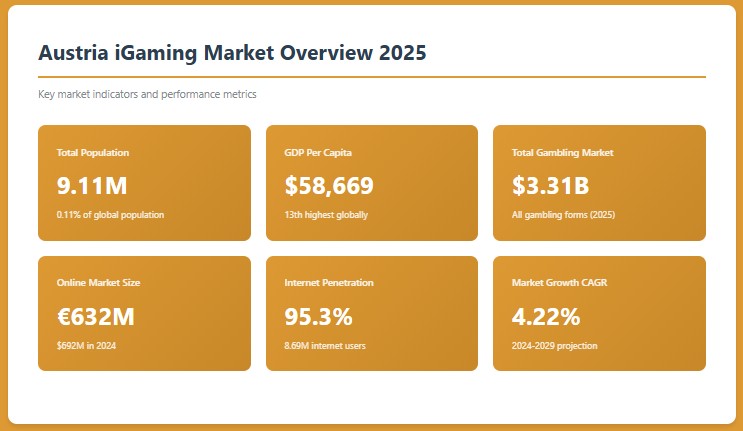
The Austrian market features high internet penetration at 95.3%, exceptional mobile connectivity with 147% mobile subscriptions per capita, and a GDP per capita of $58,669, positioning it among Europe’s wealthiest markets. However, operators face strict regulatory barriers, elevated taxation recently increased from 2% to 5% for betting activities, and a dominant state monopoly controlling online casino operations through Win2Day.
Executive Summary: Key Market Indicators
| Indicator | Value | Notes |
|---|---|---|
| Gambling Legal Status | Monopoly System | Online casino monopoly, state-regulated sports betting |
| Online Casino Regulation | Single License Monopoly | Casinos Austria exclusive license until Sept 2027 |
| Sports Betting Status | State-Level Licensing | Regulated by 9 individual federal states |
| Total Population | 9.11 million | 0.11% of global population (2025) |
| Median Age | 43.6 years | Aging population, mature market |
| Urban Population | 58.6% | 5.34 million in urban areas |
| GDP (Total) | $495 billion | Q2 2025 estimate |
| GDP Per Capita | $58,669 | 13th highest globally (2024) |
| GDP Growth Forecast | -0.3% (2025), +1.0% (2026) | Economic slowdown period |
| Total Gambling Market | $3.31 billion | 2025 estimate, all gambling forms |
| Online Gambling Market | €632 million ($690 million) | 2024 figure, projected growth to €777M by 2029 |
| Market Growth CAGR | 4.22% | Online gambling 2024-2029 projection |
| Online Casino Revenue | €326.2 million | 2024 projection |
| Casinos Austria GGR | €1.48 billion | 2023 total (lotteries + casinos) |
| Expected Online Users | 920,100 by 2029 | Growing digital gambling participation |
| Average Revenue Per User | $890 | Online gambling ARPU 2024 |
| User Penetration Rate | 8.6% | Online gambling participants 2024 |
| Black Market Share | ~35% | Estimated unlicensed operator market |
| Monopoly Market Share | 30% | Win2Day online casino share |
| Internet Penetration | 95.3% | 8.69 million internet users (Jan 2025) |
| Mobile Penetration | 147% | 13.4 million active connections |
| Social Media Users | 7.3 million (80.1%) | High engagement for marketing |
| 5G Coverage | 100% population (700MHz) | Advanced mobile infrastructure by 2025 |
| Online Casino Tax | 40% GGR | High operator taxation |
| Sports Betting Tax | 5% (increased April 2025) | Previously 2%, staged increase implemented |
| Land-Based Casino Tax | 30% GGR | Plus additional operational fees |
| Corporate Income Tax | 25% | Standard rate for corporations |
| License Application Fee | Variable | Tender-based, historically single monopoly |
| Minimum Capital Requirement | €109 million | For lottery/casino license applicants |
| License Validity | 15 years maximum | Current monopoly expires Sept 2027 |
| Regulatory Reform Timeline | 2025-2027 | Potential market liberalization window |
| Tax Revenue Forecast | €240 million by 2031 | Government target, up from €50M in 2025 |
Section 1: Regulatory Framework and Legal Environment
Current Gambling Regulation Status
Austria operates under the Glücksspielgesetz (GSpG) or Law on Games of Chance, which establishes a federal monopoly system for gambling activities. The regulatory framework is complex, divided between federal and state jurisdictions, with the Federal Ministry of Finance serving as the primary regulatory authority through the Tax Office Austria (Finanzamt Österreich). This fragmented structure creates distinct regulatory pathways depending on the gambling category.
Land-Based Gambling Activities
Casino Operations: Austria maintains 15 land-based casino licenses, with Casinos Austria AG holding 12 active licenses. Three licenses have been revoked by courts. The casino licenses operate under federal jurisdiction and run until 2027 and 2030 respectively. Land-based casinos are subject to strict operational standards, geographical restrictions, and comprehensive player protection measures mandated by federal law.
Sports Betting Venues: Unlike casino operations, sports betting falls under state-level regulation, creating a fragmented landscape across Austria’s nine federal states. Each state maintains its own licensing regime, application procedures, and regulatory standards. Five states (Lower Austria, Upper Austria, Burgenland, Carinthia, and Styria) have opted to permit sports betting operations, while four states have chosen not to establish regulatory frameworks. This state-level control creates significant complexity for operators seeking nationwide coverage.
Slot Machine Halls: Gaming machine operations are similarly regulated at the state level, with five federal states (Lower Austria, Upper Austria, Burgenland, Carinthia, and Styria) having created specific legislative frameworks. These regulations govern the placement, operation, and taxation of slot machines outside of casino environments. The remaining four states do not permit standalone gaming machine operations.
Lottery Activities: The lottery sector operates under a strict federal monopoly. Österreichische Lotterien GmbH holds the exclusive license for all stationary lottery offerings, including Lotto, Toto, goal betting, letter lotteries, and scratch cards. This single license was awarded in October 2012 for the maximum statutory duration of 15 years and is scheduled to expire on September 30, 2027. The lottery monopoly has remained unchanged since the company’s inception, with no other operator ever receiving licensing consideration.

Online Gambling Framework
Digital Gaming Regulations: Online gambling in Austria operates under Section 12a of the GSpG, which defines “electronic lotteries” as encompassing all types of games of chance offered by electronic means, including casino-style online games. The current regulatory structure grants a single operator the exclusive right to provide online gambling services, effectively creating a digital monopoly mirroring the land-based lottery system.
Österreichische Lotterien GmbH operates the Win2Day platform, which serves as Austria’s only legal online gambling destination. The platform offers online casino games, sports betting, poker, and lottery products. This exclusive arrangement was established through the 2012 licensing tender and extends through the current license period ending September 30, 2027.
Prohibited Activities and Restrictions: Austrian law strictly prohibits cross-border supply of gambling activities. International operators offering services to Austrian residents without a valid Austrian license operate illegally under current legislation. The Ministry of Finance has announced intentions to implement domain name system (DNS) blocking and payment processor restrictions for unlicensed operators, though as of 2025, specific blocking legislation has not been fully enacted.

The regulatory framework explicitly prohibits advertising or facilitating advertising of games of chance where operators do not hold relevant Austrian licenses. This advertising ban applies to all media channels, including television, online platforms, outdoor advertising, and affiliate marketing. Violations of these advertising restrictions carry administrative penalties and potential criminal prosecution.
Regulatory Body Structure and Oversight
The Federal Ministry of Finance (Bundesministerium für Finanzen) serves as the principal regulatory authority, exercising control over licensing, taxation, compliance monitoring, and enforcement. The Tax Office Austria (Finanzamt Österreich) operates as the functional regulatory body for federal games of chance, handling day-to-day oversight and compliance enforcement.
For state-regulated activities, each of the nine federal states maintains its own regulatory structure through state government departments. District administrative authorities serve as enforcement agencies, imposing penalties for administrative offenses regarding violations of gambling regulations.
A significant regulatory development announced in the 2025-2029 governmental program includes the establishment of an independent gambling regulatory authority, separate from the Ministry of Finance. This proposed authority would assume responsibilities for licensing, compliance, and enforcement, addressing long-standing concerns about conflicts of interest arising from the Ministry’s dual role as regulator, tax collector, license grantor, and shareholder in monopoly operators. The European Gaming and Betting Association (EGBA) has strongly advocated for this independence to enhance consumer protection and market transparency.
The Ministry of Finance established a Staff Unit for Addiction Prevention and Counselling on December 1, 2010, dedicated to player protection, addiction prevention, and counseling services. This specialized unit provides technical support to the gambling regulatory authority and maintains oversight of responsible gambling initiatives mandated by Austrian law.
Licensed Operators and Market Players
Austria’s gambling market is characterized by extreme concentration, with state-controlled monopolies dominating legal operations. The market structure reflects decades of protectionist policy favoring established operators with government ownership stakes.
Current Licensed Operators
| Operator | License Type | Market Presence | Ownership Structure |
|---|---|---|---|
| Österreichische Lotterien GmbH | Federal Lottery & Online Monopoly | Win2Day platform, nationwide lottery | Government stake through Ministry of Finance |
| Casinos Austria AG | Land-Based Casino License (12 venues) | 12 casinos nationwide | 33.3% government ownership via Ministry of Finance |
| State-Level Betting Operators | Regional Sports Betting | Operations in 5 federal states | Various private and state-connected entities |
| Regional Slot Operators | State Gaming Machine Licenses | 5 federal states permit operations | Multiple private operators under state regulation |
Market Leaders and Estimated Market Share
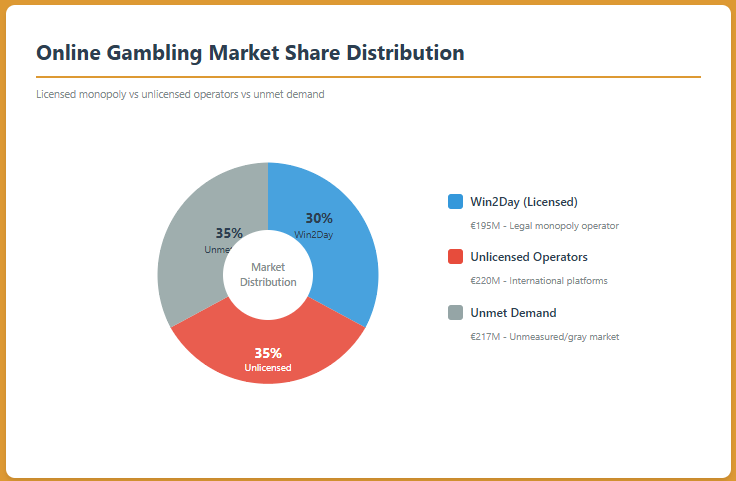
Österreichische Lotterien GmbH / Win2Day: The monopoly operator generated gross gaming revenue of €1.48 billion in 2023, comprising €946.8 million from lottery operations and €304.5 million from casino operations. Despite its exclusive legal status, Win2Day captures approximately 30% of the online gambling market, indicating massive participation in unlicensed offshore platforms. The company operates Austria’s most visited legal gambling website and maintains the only permitted online casino, sports betting, and poker offerings.
Casinos Austria AG: Operating 12 physical casino properties across major Austrian cities, Casinos Austria dominates the land-based casino sector. The company maintains exclusive rights at premium locations including Vienna, Salzburg, Innsbruck, Linz, Graz, and other major population centers. The operator employs approximately 2,361 slot machines and 237 gaming tables across its network, offering traditional table games, electronic gaming machines, and exclusive VIP gaming salons.
Unlicensed International Operators: The Austrian market features significant participation from unlicensed international operators, primarily operating under Maltese, Curaçao, and Gibraltar licenses. Industry estimates suggest these operators collectively capture approximately 35% of the online gambling market, or roughly €220 million in annual revenue. Major international brands serving Austrian players without local licenses have faced increasing enforcement pressure, including payment blocking, domain seizures, and civil litigation from players seeking refunds.
Competitive Landscape Overview
The competitive environment in Austria remains heavily distorted by the monopoly structure. Win2Day’s 30% market share despite exclusive legal rights demonstrates fundamental weakness in the monopoly model, with Austrian consumers overwhelmingly choosing international platforms offering superior products, bonuses, game variety, and user experience. The monopoly system has failed to adequately address consumer demand, creating one of Europe’s largest gray and black markets relative to total market size.
The state-regulated sports betting sector shows greater competition, with multiple operators active across the five permitting states. However, fragmentation across nine different regulatory regimes creates operational complexity and prevents emergence of truly national betting brands beyond the Win2Day platform.
International operators have established strong brand recognition among Austrian players despite their unlicensed status. Popular platforms include major European betting and casino brands offering localized German-language interfaces, EUR currency transactions, Austrian payment methods, and targeted marketing to Austrian customers through affiliate networks and sports sponsorships outside Austria.
Licensing Framework and Requirements
Application Process and Eligibility
Federal Lottery and Online Casino License: The Tax Office Austria administers the single license for lotteries, electronic lotteries, and Video Lottery Terminals (VLTs) through a transparent public tender process. The licensing procedure follows statutory requirements outlined in the Glücksspielgesetz.
Eligibility Criteria:
- Applicants must be corporations located in European Union or European Economic Area (EEA) member states
- Minimum capital requirement of €109 million
- Demonstrated technical capabilities meeting Austrian standards for player protection, responsible gambling, and secure gaming operations
- Background checks on all beneficial owners, directors, and key management personnel
- Financial stability demonstrated through audited financial statements and capital adequacy assessments
- Technical certifications for gaming systems, random number generators, and IT security infrastructure
Local Presence Requirements: Successful applicants with registered offices outside Austria must establish a corporate seat in Austria as a condition of license issuance. However, exceptions exist for companies holding comparable lotteries licenses in their state of incorporation, subject to comparable gambling supervision and supervisory authority cooperation with Austrian regulators. For qualifying applicants, mere local presence (representative office) may suffice rather than full corporate establishment.
Application Timeline: The 2012 tender process, the most recent comprehensive licensing round, spanned approximately 18 months from announcement to final license award. The upcoming tender expected to commence in late 2025 or early 2026 will likely follow similar timelines. Given the license expiration date of September 30, 2027, authorities must initiate tender procedures by early 2025 to ensure seamless transition.
| Requirement | Amount (EUR) | Amount (USD Equivalent) | Purpose |
|---|---|---|---|
| Minimum Capital Requirement | €109,000,000 | $119,000,000 | Financial stability guarantee |
| Application Fee | Tender-specific | Variable | Administrative processing |
| Background Check Costs | €50,000 – €100,000 | $55,000 – $110,000 | Due diligence on principals |
| Technical Certification | €200,000 – €500,000 | $220,000 – $550,000 | Gaming system validation |
| Legal and Consulting Fees | €500,000 – €1,000,000 | $550,000 – $1,100,000 | Tender preparation and representation |
Ongoing Compliance Requirements
Reporting Obligations: Licensed operators must submit comprehensive financial reports on a monthly and quarterly basis to the Tax Office Austria. These reports include detailed revenue breakdowns by product category, player statistics, responsible gambling metrics, and tax calculations. Annual audited financial statements must be filed demonstrating compliance with capital maintenance requirements and financial obligations.
Technical Standards: Gaming systems must maintain certification throughout the license period, with regular testing of random number generators, game fairness, and payout percentages. Licensed operators must employ certified gaming technology meeting standards established by recognized international testing laboratories. Systems must maintain secure player databases with encryption standards meeting or exceeding EU data protection requirements.
Inspection and Audit Rights: Regulatory authorities maintain unrestricted rights to conduct audits and inspections at any time without prior notice. Failure to cooperate fully with regulatory examinations constitutes grounds for license suspension or revocation. Operators must maintain comprehensive records for minimum periods specified by regulation, typically seven years for financial records and three years for player transaction data.
Compliance Obligations and Monitoring
Player Protection and Identification
Age Verification Requirements: The minimum legal age for gambling participation in Austria is 18 years without exception. All operators must implement robust age verification procedures before allowing any gambling activity. This verification typically involves checking official government-issued identification documents including passports, national identity cards, or driver’s licenses. Enhanced identification checks may be required for higher-value transactions or when risk thresholds are met.
Know Your Customer (KYC) and Anti-Money Laundering (AML) Compliance: Austrian gambling operators must comply with comprehensive KYC procedures aligned with EU Anti-Money Laundering Directives. Operators must verify player identity, residential address, and source of funds for significant transactions. Enhanced due diligence applies to politically exposed persons (PEPs), high-value players, and transactions involving jurisdictions identified as high-risk for money laundering.
Player identification procedures must include collection and verification of full legal name, date of birth, permanent residential address, nationality, and valid government-issued identification. Operators must screen players against international sanctions lists and maintain ongoing monitoring for suspicious transaction patterns.
Responsible Gambling Measures Mandated by Law: Austrian legislation requires comprehensive responsible gambling frameworks including deposit limits, loss limits, session time restrictions, and reality checks. Players must receive clear information about gambling risks, problem gambling symptoms, and available support resources. Operators must display responsible gambling messages prominently across all platforms.
Self-Exclusion System Requirements: Licensed operators must maintain self-exclusion systems allowing players to temporarily or permanently exclude themselves from gambling activities. The exclusion must apply across all products offered by the operator and must prevent account access, marketing communications, and bonus offers. Austria maintains a national self-exclusion register that licensed operators must integrate into their player management systems.
Mandatory Player Information Disclosures: Operators must provide comprehensive information to players including game rules, prize structures, odds of winning, return-to-player (RTP) percentages, and applicable fees or charges. Terms and conditions must be presented in clear German language, with unambiguous statements regarding player rights, dispute resolution procedures, and data protection practices. Players must receive transaction histories upon request, with complete records of deposits, wagers, winnings, and withdrawals.
Session Time Limits and Loss Limits: Recent regulatory developments emphasize enhanced player protection through mandatory time and loss limitations. Operators must implement systems that track cumulative playing time and financial losses, triggering warnings when predetermined thresholds are approached. Players must have the ability to set their own limits below maximum regulatory thresholds, with cooling-off periods required before increasing limits.
Financial Monitoring and Reporting
Transaction Monitoring Systems Required: Licensed operators must deploy sophisticated transaction monitoring systems capable of detecting unusual patterns indicative of money laundering, fraud, or problem gambling. These systems must generate alerts for investigation when transactions exceed defined thresholds or exhibit patterns consistent with financial crime typologies.
Reporting Requirements and Schedules: Austrian gambling operators submit monthly financial reports to the Tax Office Austria by the 15th day of the following month. These reports detail gross gaming revenue, taxes due, player counts, and product performance metrics. Quarterly reports provide additional detail on player demographics, responsible gambling interventions, and compliance activities. Annual reports include comprehensive financial statements, auditor certifications, and detailed operational statistics.
Audit and Inspection Procedures: Regulatory authorities conduct scheduled and unscheduled audits of licensed operators. Scheduled audits typically occur annually, examining financial records, gaming systems, player protection measures, and compliance documentation. Unscheduled inspections may occur based on complaints, suspicious activity reports, or routine surveillance. Operators must provide complete access to facilities, records, and personnel during regulatory examinations.
Data Retention Requirements: Financial records must be retained for seven years from the end of the relevant financial year. Player transaction data must be maintained for three years, with longer retention for records subject to ongoing investigations or litigation. Gaming system logs, including game outcomes, random number generator seeds, and technical events, must be preserved for three years. All records must be stored in formats allowing prompt retrieval and inspection by regulatory authorities.
Taxation Structure and Financial Obligations
Player Taxation
Tax Treatment of Gambling Winnings: Austria generally does not impose personal income tax on gambling winnings. Income that does not fall under the seven recognized types of taxable income in Austrian tax law remains untaxed, and gambling winnings typically fall into this category. This favorable treatment makes Austria attractive for high-stakes players and contributes to strong consumer participation in gambling activities.
Exception for Professional Gamblers: If gambling becomes a player’s primary or substantial source of income, tax authorities may classify winnings as taxable business income. This professional gambler designation requires consistent, systematic gambling activity demonstrating intent to generate regular income. Tax authorities examine factors including frequency of gambling, size of stakes, record-keeping practices, and proportion of total income derived from gambling.
Tax-Free Thresholds: No specific threshold triggers taxation on casual gambling winnings. However, players reporting large wins may face scrutiny regarding the source of funds used for gambling and whether gambling activity constitutes a business or profession. Winnings from foreign gambling operators may face different treatment depending on the jurisdiction and tax treaty provisions.
Operator Taxation
| Gambling Category | Tax Base | Tax Rate | Effective Date |
|---|---|---|---|
| Online Gambling (Casino) | Gross Gaming Revenue (GGR) | 40% | Current |
| Sports Betting | Gross Gaming Revenue (GGR) | 5% | April 1, 2025 (increased from 2%) |
| Land-Based Casinos | Gross Gaming Revenue (GGR) | 30% | Current |
| Casino Slot Machines | Net Gaming Revenue (NGR) | 30% | Current |
| Independent Slot Machines | Net Gaming Revenue (NGR) | 10% | Current |
| Lottery Stakes | Stakes/Turnover | 27.5% | Current |
| Video Lottery Terminals (VLTs) | Net Gaming Revenue (NGR) | 10% | Current |
| Corporate Income Tax | Net Profit | 25% | Standard rate |
Gross Gaming Revenue (GGR) Definition: GGR is calculated as total stakes or wagers minus winnings paid out to players. This calculation excludes promotional bonuses, jackpot contributions, and certain other deductions. Tax authorities closely scrutinize GGR calculations to ensure operators properly account for all gaming revenue and do not artificially reduce tax liability through improper deductions.
Net Gaming Revenue (NGR) Considerations: For certain gaming machine categories, taxation applies to Net Gaming Revenue, which may allow additional deductions beyond player payouts. These deductions typically include jackpot contributions, progressive pool allocations, and specific equipment costs. The distinction between GGR and NGR taxation creates significantly different effective tax burdens across gambling categories.
Recent Tax Increases and Impact: The April 1, 2025 increase in betting tax from 2% to 5% represents a 150% increase in tax burden for sports betting operators. This staged increase aims to align Austrian taxation with neighboring Germany’s rates while generating additional government revenue projected at €50 million in 2025, rising to €240 million by 2031. Industry stakeholders have criticized the increase as compressing operator margins and potentially driving players toward unlicensed offshore operators offering better odds.
License Renewal Fees: License renewal fees are determined through tender processes, with substantial costs associated with maintaining licenses through each renewal cycle. The 2012 monopoly license award to Österreichische Lotterien required significant financial commitments including upfront payments and ongoing annual fees beyond standard tax obligations.
Additional Financial Obligations: Licensed operators face mandatory contributions to problem gambling prevention programs, responsible gambling research, and addiction treatment services. These contributions typically range from 0.5% to 1% of gross gaming revenue, depending on the specific license category and regulatory requirements.
Gambling Market Financial Performance
| Year | Total GGR | Tax Revenue | Land-Based Revenue | Online Revenue |
|---|---|---|---|---|
| 2018 | €4.49 billion | €509.49 million | €4.18 billion | €310 million (est.) |
| 2023 | €4.85 billion (est.) | €575 million (est.) | €4.30 billion | €550 million |
| 2024 | €5.10 billion (est.) | €625 million (est.) | €4.45 billion | €632 million |
| 2025 (Forecast) | €5.25 billion | €675 million | €4.55 billion | €700 million |
Revenue Distribution by Gambling Type: Lottery operations constitute the largest segment of Austria’s gambling market, generating approximately €950 million annually. Land-based casinos contribute €315 million from table games and slots. Sports betting across all channels accounts for approximately €400 million. Online casino gaming through Win2Day generates approximately €305 million, though the total online gambling market including unlicensed operators exceeds €650 million.
Year-Over-Year Growth Trends: The Austrian gambling market has demonstrated steady but modest growth averaging 1.7% annually from 2020 to 2025. Online gambling has shown stronger growth at 4.22% CAGR, driven by increasing digital adoption, mobile gambling expansion, and growing acceptance of online gaming. Land-based operations have experienced slower growth, with some casino properties reporting declining revenues due to competition from online alternatives and economic headwinds.
Market Size Comparison: Austria’s gambling market represents approximately 1.2% of GDP, placing it in the mid-range among European countries. Compared to regional neighbors, Austria shows lower per-capita gambling spend than the United Kingdom (approximately €450 per capita vs. UK’s €550) but higher than Germany’s per-capita spend of €320. The relatively mature market with aging demographics suggests limited organic growth potential without regulatory liberalization.
Advertising and Marketing Restrictions
Permitted Advertising Channels: Operators holding valid Austrian licenses may advertise their gambling services across multiple media channels including television, radio, online platforms, outdoor advertising, and print media. However, advertising rights remain limited exclusively to licensed operators, creating a significant competitive advantage for the monopoly holder while effectively prohibiting international operators from marketing to Austrian consumers.
Television and Radio Advertising: Licensed operators may advertise during most broadcast hours but face restrictions on advertising during programs primarily targeted at minors. Time restrictions prevent gambling advertising during children’s programming and early morning hours when youth viewership is elevated. Broadcasters must ensure advertisements include responsible gambling messages and contact information for gambling addiction support services.
Online Advertising Restrictions: Digital advertising by licensed operators is permitted across search engines, social media platforms, content websites, and affiliate networks. However, operators must ensure advertising does not target minors through age-gating mechanisms, content targeting, and platform selection. Advertising on websites primarily frequented by minors remains strictly prohibited.
Content Restrictions and Guidelines: The Federal Ministry of Finance published non-binding interpretation guidelines detailing responsible standards for gambling advertising.
These guidelines require advertisements to avoid excessive promotion, must not portray gambling as a solution to financial problems, cannot suggest gambling enhances social acceptance or success, and must not display minors or appeal specifically to underage audiences. Advertisements must include clear responsible gambling messaging and problem gambling helpline information.
Bonus and Promotion Limitations: Promotional offers must comply with responsible gambling principles. Welcome bonuses cannot be excessively generous or create pressure to gamble beyond comfortable limits. Wagering requirements must be clearly disclosed with realistic terms allowing average players reasonable opportunity to meet conditions. Bonus abuse prevention measures must be implemented while ensuring fair treatment of legitimate players.
Sponsorship Regulations: Licensed operators may sponsor sports teams, events, and venues subject to responsible gambling standards. Sponsorships cannot target youth sports or events with predominantly minor audiences. Visible branding at sponsored events must include responsible gambling messaging. The monopoly structure has enabled Österreichische Lotterien and Casinos Austria to dominate sports sponsorships, creating significant brand visibility and marketing advantages.
Affiliate Marketing Rules: Affiliate marketing by licensed operators is permitted but subject to the same content and targeting restrictions as direct advertising. Affiliates promoting Austrian-licensed gambling services must ensure content meets responsible gambling standards, does not target minors, and includes appropriate disclaimers and problem gambling resources. Unlicensed operators are prohibited from advertising, including through affiliate channels, making affiliate promotion of international gambling sites technically illegal though widely practiced.
Advertising Ban for Unlicensed Operators: The Glücksspielgesetz explicitly prohibits advertising or facilitating advertising of games of chance where operators do not hold relevant Austrian licenses. This prohibition applies to all media channels, including online platforms, and extends to affiliates, advertising networks, and media publishers. Violations carry administrative penalties and potential criminal liability for serious or repeated infractions.
Enforcement of advertising restrictions against international operators has intensified, with authorities pursuing legal action against media outlets, advertising platforms, and affiliate networks facilitating promotion of unlicensed gambling services. Payment processors and banks face pressure to terminate relationships with entities involved in unlicensed gambling advertising.
Recent Regulatory Changes and Their Impact
Coalition Government Formation and Policy Direction (March 2025): Austria’s new coalition government comprising the center-right People’s Party (ÖVP), Social Democrats (SPÖ), and Liberal Party (NEOS) announced comprehensive gambling sector reform plans in their governmental program for 2025-2029. The coalition agreement signals retention of the online casino monopoly structure while introducing enhanced taxation, strengthened enforcement, and establishment of an independent regulatory authority.
Betting Tax Increase (April 1, 2025): The staged increase in betting tax from 2% to 5% of gross gaming revenue became effective April 1, 2025, representing the most significant recent regulatory change. This 150% tax increase affects all sports betting operators, compressing margins and forcing business model adjustments. Industry representatives have criticized the increase as implemented without transition period, creating immediate financial pressure on licensed betting operators while potentially driving players to unlicensed offshore alternatives offering better odds.
Announced Casino and Gambling Tax Increases (2025): The governmental program announced a 10% increase in general gambling taxes affecting land-based casinos and other gaming operations. Specific implementation details and effective dates remain under development, but operators should anticipate substantial tax burden increases over the 2025-2027 period. Combined with existing high tax rates (30% GGR for land-based casinos, 40% GGR for online casinos), these increases will create the most expensive gambling tax regime in Central Europe.
Independent Regulatory Authority Proposal: The coalition government committed to establishing an independent gambling regulatory authority separate from the Ministry of Finance. This structural reform addresses long-standing conflict-of-interest concerns arising from the Ministry’s simultaneous roles as regulator, tax collector, license grantor, and shareholder in monopoly operators. The proposed authority would assume responsibility for licensing, compliance monitoring, enforcement, and player protection oversight. Timeline for implementation remains uncertain, but stakeholders expect progress during 2025-2026 to enable operational authority before the 2027 license expiration.
Enhanced Enforcement Measures: The government announced “decisive” action against illegal gambling through internet blocking and payment blocking mechanisms. While DNS blocking legislation has been discussed since 2021, implementation has repeatedly delayed. The new coalition’s commitment suggests renewed urgency, with potential legislation in 2025-2026 implementing domain blocking, IP address blocking, and payment transaction restrictions for unlicensed operators.
Enforcement has intensified through existing mechanisms. In the first half of 2024, Austria’s financial police imposed fines totaling €962,000 for illegal gambling activities. Authorities increased cooperation with ISPs and banks to block unlicensed operator domains, IP addresses, and payment channels. The Ministry of Finance maintains active blocking lists, though effectiveness remains limited as operators deploy technical countermeasures.
Player Refund Litigation Developments: Austrian courts have issued judgments requiring unlicensed operators to refund player losses based on the monopoly’s legal status and prohibition of unlicensed gambling. These judgments have generated significant litigation volumes, with players supported by litigation funders pursuing claims against international operators. The litigation trend has created substantial financial exposure for unlicensed operators serving Austrian players.
Malta’s 2023 amendments to its Gaming Act (Bill 55) attempted to block recognition and enforcement of Austrian court judgments against Malta-licensed operators. The European Commission opened infringement proceedings against Malta in June 2025, arguing Malta’s legislation violates EU Regulation 1215/2012 on recognition and enforcement of judgments. This ongoing legal battle creates uncertainty for operators and players while highlighting tensions between national gambling monopolies and EU internal market principles.
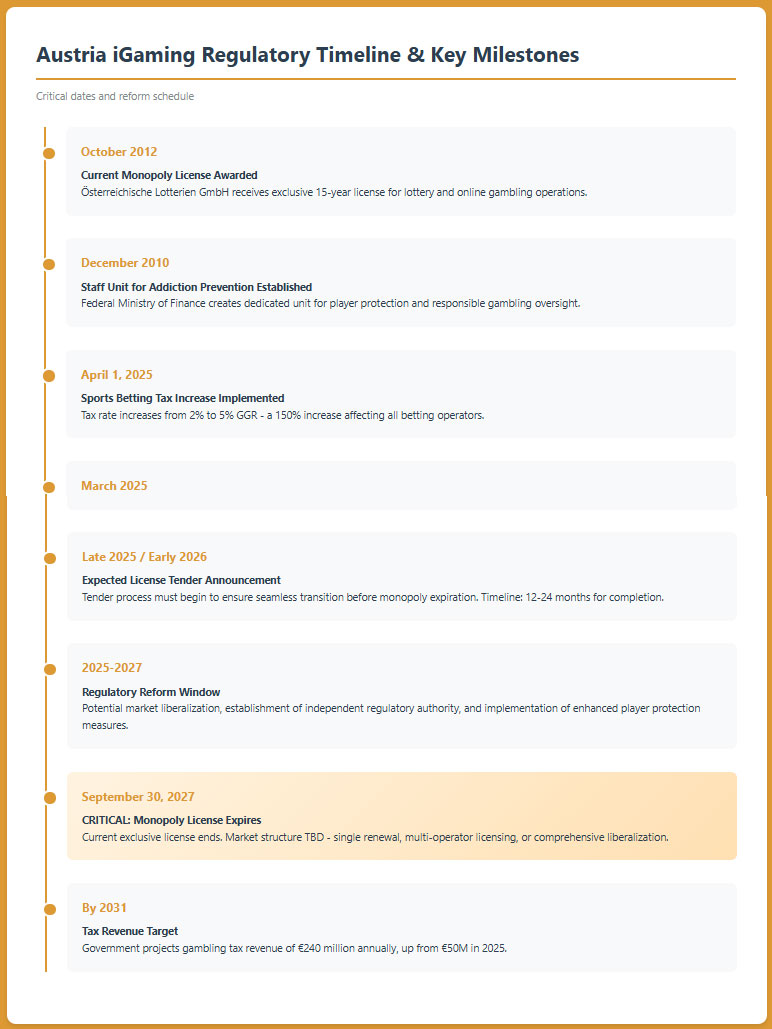
Upcoming License Tender (2025-2026): With the current monopoly license expiring September 30, 2027, Austrian authorities must commence tender procedures in 2025 or early 2026. The tender represents a critical juncture, with three potential scenarios: renewal of the single monopoly license, limited multi-operator licensing, or comprehensive market liberalization.
Industry stakeholders including the Austrian Betting and Gaming Association (OVWG) and European Gaming and Betting Association (EGBA) strongly advocate for market liberalization through multi-operator licensing. The EGBA notes that 21 EU countries have adopted multiple licensing systems, positioning Austria alongside Poland as among Europe’s last monopoly markets. However, the coalition agreement language suggests preference for continuing monopolistic structures, describing plans for “further development” of the current monopoly rather than fundamental liberalization.
Enforcement Mechanisms and Penalties
Penalty Structures: Austrian gambling law establishes comprehensive penalty frameworks for violations ranging from administrative fines to criminal prosecution. Administrative penalties for unlicensed gambling operations can reach several hundred thousand euros per violation, with repeated infractions subject to escalating penalties. License holders face administrative sanctions for compliance failures, including warnings, temporary operational restrictions, financial penalties, and ultimately license suspension or revocation.
Administrative Penalties: Operating gambling services without appropriate Austrian licenses constitutes an administrative offense punishable by fines up to €22,000 per incident. Advertising unlicensed gambling services carries penalties ranging from €5,000 to €50,000 depending on violation severity and reach. Payment processors, banks, and media outlets facilitating unlicensed gambling face similar administrative penalties for knowingly supporting illegal operations.
Criminal Penalties: Serious violations, particularly those involving organized unlicensed gambling operations, fraud, or money laundering, may result in criminal prosecution. Criminal penalties include imprisonment for up to six months for individuals operating or facilitating illegal gambling, with longer sentences for aggravated circumstances. Confiscation of gambling equipment, financial assets, and proceeds of illegal gambling operations accompanies criminal convictions.
License Suspension and Revocation: Licensed operators face license suspension for material compliance violations, including failure to meet player protection standards, inadequate anti-money laundering controls, tax payment defaults, or providing false information to regulators. Suspension typically requires remediation within specified timeframes, with revocation following failure to correct deficiencies. Three land-based casino licenses have been revoked by Austrian courts, demonstrating regulatory willingness to employ this ultimate sanction.
Recent Enforcement Actions: Austrian authorities have intensified enforcement against unlicensed operators through multiple mechanisms. The financial police conducted raids on suspected illegal gambling operations in 2024, resulting in fines totaling €962,000 in just the first half of the year. These enforcement actions targeted both operators and intermediaries including payment processors, advertising networks, and affiliate marketers.
ISP Blocking of Unlicensed Operators: While comprehensive DNS blocking legislation remains pending, Austrian authorities have implemented targeted domain blocking through cooperation with Internet Service Providers. The Ministry of Finance maintains lists of unlicensed gambling domains, requesting ISPs to block access. However, effectiveness remains limited as technical circumvention through VPNs, mirror sites, and alternative domains allows continued player access. The government’s 2025-2029 program emphasizes more aggressive blocking implementation.
Payment Processor Restrictions: Austrian financial institutions face increasing pressure to terminate relationships with entities involved in unlicensed gambling. Banks and payment processors must implement screening procedures identifying gambling-related transactions and blocking payments to unlicensed operators. The regulatory framework includes provisions for financial institution liability when knowingly facilitating illegal gambling transactions.
Compliance Enforcement Trends: Regulatory enforcement has shifted from reactive complaint-based approaches to proactive surveillance and systematic enforcement campaigns. The Tax Office Austria employs specialized teams monitoring online gambling activities, identifying unlicensed operators, and pursuing enforcement actions. Coordination with international regulatory bodies and law enforcement agencies has enhanced cross-border enforcement capabilities.
The player refund litigation trend represents a novel enforcement mechanism, essentially deputizing players as private enforcers through civil litigation. Austrian courts have consistently ruled that contracts with unlicensed operators are void, requiring operators to refund player losses. This creates substantial financial risk for unlicensed operators while providing players with apparent loss recovery mechanisms, though actual enforcement of judgments against foreign operators remains challenging.
Section 2: Demographics and Consumer Analysis
Population Demographics and Distribution
Core Population Metrics
Austria’s population reached 9.11 million people as of mid-2025, representing 0.11% of global population and ranking 99th worldwide. The population has grown modestly over recent decades, increasing by approximately 1.62 million people between 1980 and 2024, though growth has followed an uneven trajectory rather than consistent upward progression. Population forecasts project steady but slow growth of approximately 150,000 people over the 2024-2030 period, reflecting mature demographic patterns typical of developed European nations.
Annual Growth Rate: Austria’s current population growth rate stands at approximately 0.3% annually, driven primarily by net immigration rather than natural increase. The low birth rate combined with aging population creates demographic challenges including labor force constraints and increasing dependency ratios. These demographic patterns have significant implications for the gambling market, suggesting limited organic growth potential from population expansion.
| Age Group | Percentage of Population | Total Population | Gambling Market Relevance |
|---|---|---|---|
| 0-14 years | 14.2% | 1.29 million | Below legal gambling age |
| 15-24 years | 11.1% | 1.01 million | Entry-level gamblers, digital natives |
| 25-34 years | 13.5% | 1.23 million | Prime gambling demographic, high digital engagement |
| 35-44 years | 13.8% | 1.26 million | Peak earning years, highest gambling participation |
| 45-54 years | 15.2% | 1.38 million | High disposable income, established gambling habits |
| 55-64 years | 13.4% | 1.22 million | Pre-retirement, significant gambling participation |
| 65+ years | 18.8% | 1.71 million | Retired, lottery preference, traditional gambling |
Median Age and Market Implications: Austria’s median age of 43.6 years positions it among Europe’s older populations, with significant implications for gambling market dynamics. The aging demographic suggests preference for traditional gambling products including lottery, land-based casinos, and sports betting over emerging formats like esports betting or cryptocurrency gambling.
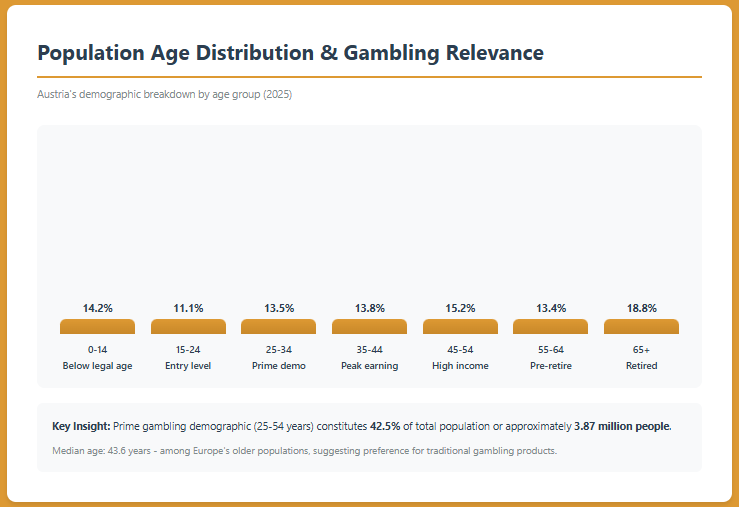
Operators must balance appealing to older established customers while attracting younger digital-native players to ensure long-term market sustainability.
The prime gambling demographic (25-54 years) constitutes 42.5% of total population or approximately 3.87 million people. This cohort demonstrates highest gambling participation rates, strongest digital adoption, and greatest disposable income for entertainment spending. Marketing and product strategies must prioritize this demographic while recognizing the substantial 55+ population representing established lottery and casino customers.
Gender Distribution: Austria maintains relatively balanced gender distribution with approximately 50.4% female and 49.6% male population. Life expectancy shows typical patterns with females averaging 83.8 years compared to males at 78.9 years. Gender considerations influence gambling participation, with males historically representing approximately 70% of casino players and 75% of sports betting participants. However, female participation in online gambling has grown significantly, particularly in slots, bingo-style games, and lottery products.
Urban vs Rural Distribution: Approximately 58.6% of Austria’s population resides in urban areas, totaling 5.34 million people concentrated in major cities and surrounding metropolitan regions. The remaining 41.4% or 3.77 million people live in rural and small-town environments. Urban populations demonstrate higher online gambling participation, greater exposure to marketing, and broader product preferences. Rural populations show stronger loyalty to traditional lottery products and occasional land-based casino visits.
Geographic Distribution
| City | Population | Federal State | Gambling Infrastructure |
|---|---|---|---|
| Vienna | 1,920,000 | Vienna | 2 casinos, extensive betting shops, lottery outlets |
| Graz | 295,000 | Styria | 1 casino, betting permitted, lottery network |
| Linz | 210,000 | Upper Austria | 1 casino, betting permitted, lottery access |
| Salzburg | 156,000 | Salzburg | 1 casino, limited betting, lottery available |
| Innsbruck | 133,000 | Tyrol | 1 casino, no betting licenses, lottery network |
| Klagenfurt | 102,000 | Carinthia | 1 casino, betting permitted, lottery outlets |
| Wels | 62,000 | Upper Austria | No casino, betting access, lottery coverage |
| St. Pölten | 56,000 | Lower Austria | No casino, betting permitted, lottery network |
| Dornbirn | 50,000 | Vorarlberg | Limited gambling access, lottery available |
| Villach | 63,000 | Carinthia | No casino, betting access, lottery outlets |
Regional Economic Differences: Vienna dominates Austria’s economic landscape, generating approximately 26% of national GDP despite housing only 21% of the population. Vienna’s GDP per capita of €38,632 significantly exceeds the national average, creating concentrated wealth and gambling potential. Other major urban centers including Salzburg, Innsbruck, and Graz maintain strong regional economies driven by tourism, manufacturing, and services. Rural regions, particularly in alpine areas, rely heavily on tourism and agriculture, creating seasonal economic and gambling participation patterns.
Internet Access Geographic Patterns: Urban areas achieve near-universal internet penetration exceeding 98%, with high-speed fiber and cable broadband widely available. Rural and mountainous regions face infrastructure challenges, though Austria’s Broadband Strategy 2030 targets nationwide gigabit connectivity. Current rural internet penetration stands at approximately 88%, with improving 4G and 5G mobile coverage compensating for fixed broadband limitations in some areas.
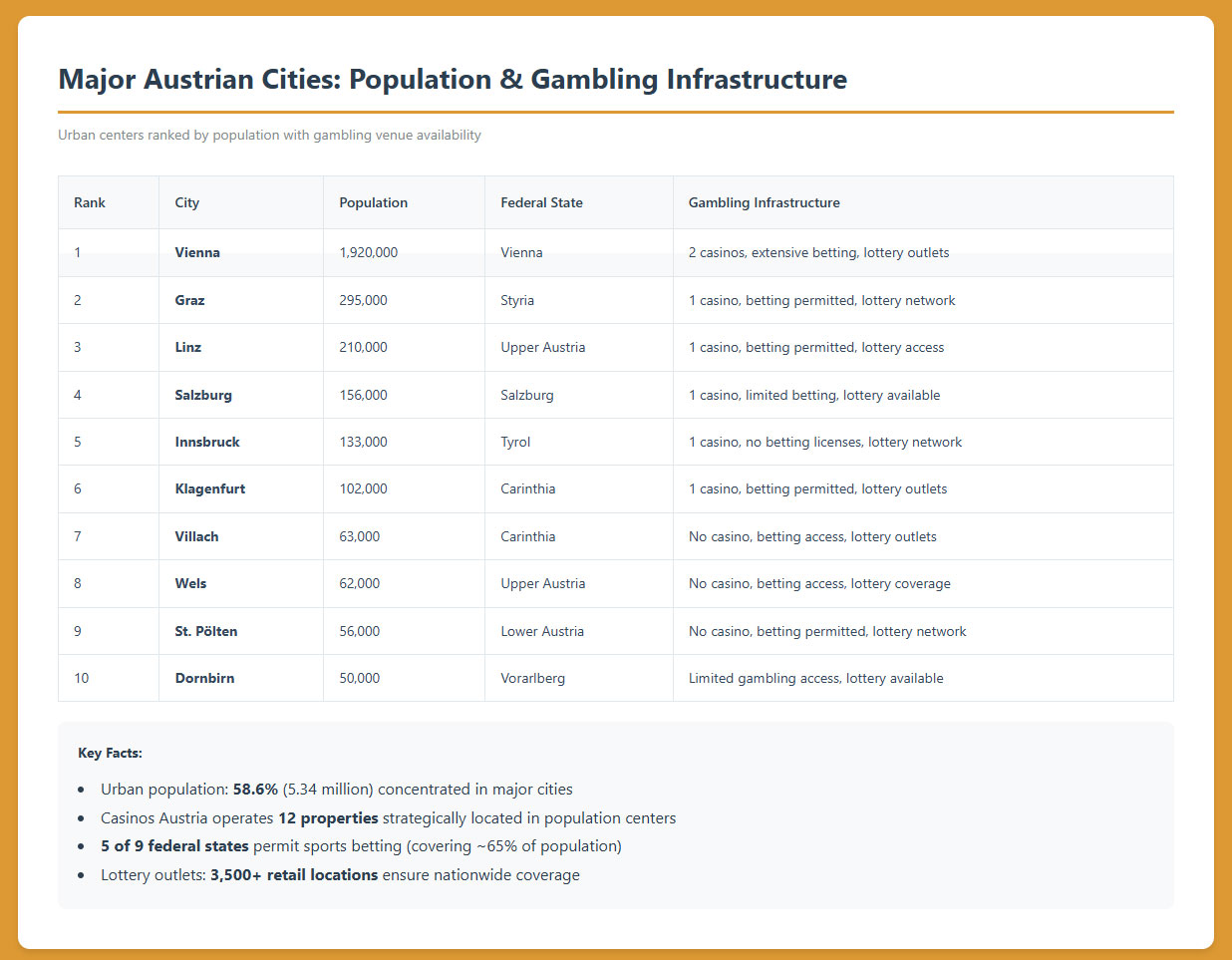
Concentration of Gambling Venues by Region: Casinos Austria operates 12 properties strategically located in major population centers, with Vienna housing two facilities. The five federal states permitting sports betting (Lower Austria, Upper Austria, Burgenland, Carinthia, Styria) contain approximately 65% of Austria’s population, creating uneven betting access across regions. Lottery outlets maintain nationwide coverage with over 3,500 retail locations, ensuring universal lottery product access regardless of geography.
Economic Indicators and Consumer Spending Power
GDP and Economic Performance
Current GDP Metrics: Austria’s economy generated approximately $495 billion in total GDP during Q2 2025, positioning it as the 26th largest economy globally and among the wealthiest per capita. GDP per capita reached $58,669 in 2024, ranking Austria 13th highest worldwide and firmly establishing it as a high-income developed economy. Vienna ranks as the fifth richest NUTS-2 region within Europe with GDP per capita of €38,632, trailing only Inner London, Luxembourg, Brussels-Capital Region, and Hamburg.
GDP Growth Forecasts: Austria faces near-term economic headwinds with GDP projected to decline by 0.3% in 2025 before recovering to 1.0% growth in 2026. This marks a prolonged recession following contractions of 1.0% in 2023 and 1.2% in 2024. The economic slowdown reflects multiple factors including reduced industrial production (down 5.4% in 2024), high energy costs impacting manufacturing competitiveness, and declining investment particularly in industrial equipment.
Medium-term forecasts project gradual recovery with GDP growth returning to 1.5-2.0% annually from 2027 onwards. However, structural challenges including aging demographics, elevated government debt (84.0% of GDP in 2025, rising to 85.8% in 2026), and global economic uncertainty create downside risks. For gambling operators, the economic slowdown suggests constrained consumer discretionary spending and heightened price sensitivity in entertainment purchases.
Economic Sector Composition: Austria’s economy is dominated by services, accounting for approximately 70% of GDP. Manufacturing and industry contribute 27%, with agriculture representing less than 3%. The service sector’s dominance creates favorable conditions for gambling and entertainment industries, as services employment typically correlates with gambling participation. Tourism constitutes a significant economic driver, contributing approximately 15% of GDP and creating seasonal patterns in gambling participation particularly in alpine resort regions.
Employment and Wage Levels: The unemployment rate stood at 5.3% in 2025, representing a gradual increase from the post-COVID trough of 4.8% in 2022. The labor market remains relatively healthy by European standards, with labor force participation sustained by increasing female participation as the statutory retirement age for women gradually aligns with men’s by 2033. Monthly earnings averaged approximately €3,306 ($3,625) in December 2022, with wages growing more than 8% in 2024 as workers received inflation compensation through collective bargaining agreements.
Inflation Trends: Inflation surged to 3.3% in Q1 2025 driven by retail energy price increases following expiration of government relief measures and high wholesale oil and gas prices. Persistent services inflation contributes to elevated inflation rates. Projections suggest inflation moderating to 2.9% for full-year 2025 and further declining to 2.1% in 2026 as energy commodity prices stabilize and wage growth moderates. High inflation erodes real gambling budgets, requiring operators to adjust pricing strategies and promotional offers to maintain player engagement.
Income and Wealth Distribution
| Metric | Value | Implications for Gambling Market |
|---|---|---|
| Average Household Income (Annual) | €54,000 ($59,130) | Substantial discretionary income available |
| Median Household Income (Annual) | €48,000 ($52,560) | Typical household gambling budget capacity |
| Disposable Income Per Capita | €26,500 ($29,015) | High entertainment spending capacity |
| Gini Coefficient | 0.28 | Relatively equal income distribution, broad market access |
| At-Risk Poverty Rate | 14.8% | Approximately 1.35M people with limited gambling capacity |
| Median Wealth Per Adult | $95,000 | Significant accumulated wealth supporting gambling spend |
Income Inequality Measures: Austria maintains relatively equal income distribution with a Gini coefficient of 0.28, among the lowest in the OECD and indicating compressed income disparity compared to many developed economies. This equality translates to broad middle-class gambling participation rather than concentration among wealthy individuals. Approximately 85% of Austrian households report annual incomes between €30,000 and €80,000, creating a large addressable market for mainstream gambling products.
Disposable Income Trends: Real disposable income declined in 2023-2024 due to high inflation outpacing wage growth, forcing households to reduce discretionary spending and increase savings rates to historically high levels. The 2024 recovery in real wages, driven by 8%+ wage increases, has begun restoring disposable income. Gambling operators experienced pressure during the 2023-2024 period, with players reducing betting frequency, lowering average stakes, and becoming more promotion-sensitive.
Consumer Spending Patterns: Austrian households allocate approximately 3.5-4% of disposable income to recreation and entertainment, translating to roughly €1,000-1,200 annually per household. Gambling represents a subset of entertainment spending, competing with dining, travel, sports, and cultural activities. The mature market exhibits relatively stable gambling spend patterns, with economic cycles influencing betting frequency and stake sizes rather than fundamental participation rates.
Middle Class Size and Growth: Austria’s substantial middle class, defined as households earning 75-200% of median income, encompasses approximately 60% of the population or 5.5 million people. This demographic cohort demonstrates highest gambling participation rates, strongest brand loyalty, and greatest lifetime value for operators. Middle-class growth has stagnated in recent years due to inflation, housing cost pressures, and tax burdens, creating challenges for gambling market expansion.
Market Size and Growth Projections
| Year | Total Online Gambling | Online Casino | Sports Betting | Active Users | ARPU |
|---|---|---|---|---|---|
| 2024 | €632M ($692M) | €326M ($357M) | €210M ($230M) | 785,000 | €805 ($882) |
| 2025 | €659M ($722M) | €340M ($372M) | €220M ($241M) | 818,000 | €805 ($882) |
| 2026 | €687M ($753M) | €355M ($389M) | €230M ($252M) | 853,000 | €805 ($882) |
| 2027 | €716M ($784M) | €370M ($405M) | €241M ($264M) | 887,000 | €807 ($884) |
| 2028 | €746M ($817M) | €385M ($422M) | €252M ($276M) | 903,000 | €826 ($905) |
| 2029 | €777M ($851M) | €401M ($439M) | €263M ($288M) | 920,100 | €844 ($925) |
Historical Revenue Growth: The Austrian online gambling market has demonstrated consistent expansion from approximately €310 million in 2018 to €632 million in 2024, representing a compound annual growth rate of 12.7% over the six-year period. This growth significantly outpaces land-based gambling revenue, which has remained largely stagnant at approximately €4.3-4.5 billion annually. The shift toward online channels reflects broader digital transformation trends, with pandemic acceleration permanently elevating online gambling participation.
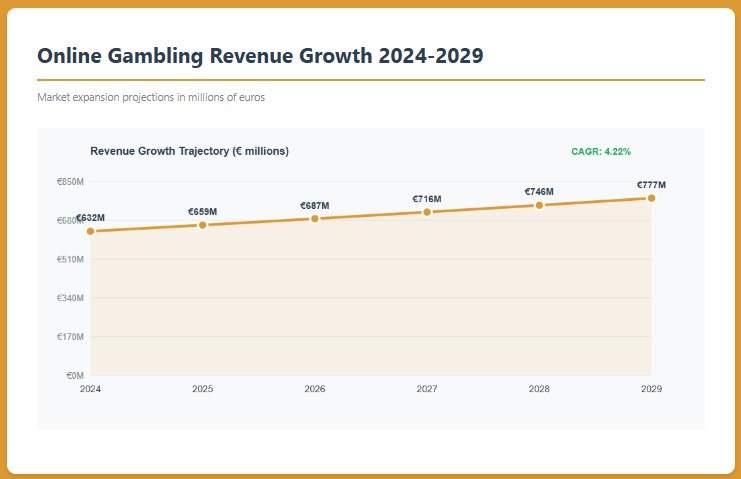
Expected CAGR: Projections indicate online gambling revenue will grow at a 4.22% CAGR from 2024 to 2029, reaching approximately €777 million by decade’s end. This moderating growth rate compared to historical performance reflects market maturation, economic headwinds, increased taxation, and demographic constraints. The 4.22% CAGR positions Austria below European online gambling market averages of 7-9% but consistent with other mature Western European markets.
Projected User Base Growth: Active online gambling users are expected to expand from approximately 785,000 in 2024 to 920,100 by 2029, representing 17.2% growth or 3.2% CAGR. User growth lags revenue growth, indicating increasing average revenue per user driven by higher engagement, larger average stakes, and product mix shifts toward casino gaming. The projected user base represents approximately 10% of Austria’s adult population by 2029, suggesting significant remaining growth potential if regulatory liberalization improves product quality and marketing capabilities.
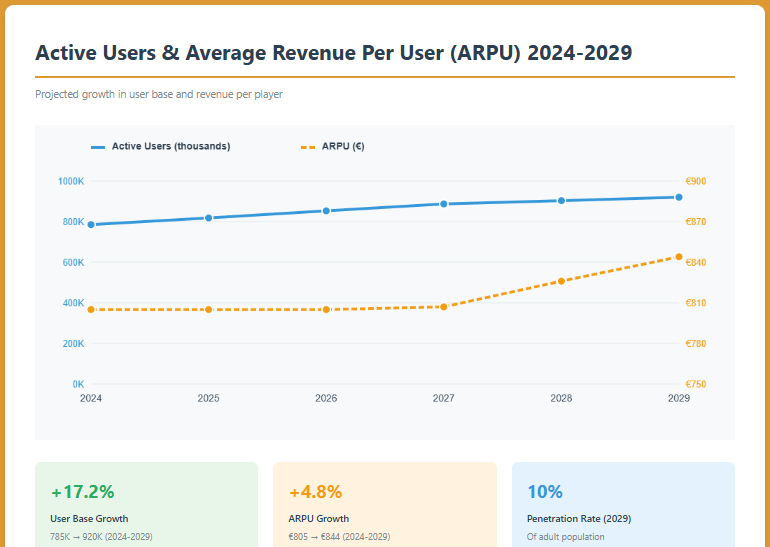
Average Revenue Per User (ARPU) Analysis: Current ARPU stands at approximately €805-890 ($882-975) annually, positioning Austria in the mid-to-high range among European markets. This ARPU reflects the country’s high disposable income, mature gambling culture, and preference for casino products over lower-margin betting. Projections suggest ARPU will increase modestly to €844 ($925) by 2029, driven by product premiumization, live dealer game adoption, and high-value player acquisition rather than mass-market expansion.
Market Penetration Rates: Online gambling penetration currently reaches 8.6% of Austria’s total population, or approximately 13.7% of adults aged 18+. This penetration rate remains below leading European markets such as the United Kingdom (22%), Sweden (18%), and Denmark (15%), suggesting substantial growth potential under improved regulatory frameworks. The monopoly structure and limited product variety constrain penetration, with many Austrian players accessing international unlicensed platforms excluded from official statistics.
Online vs Land-Based Revenue Split: Online gambling represents approximately 13% of total gambling revenue in 2024, with land-based operations maintaining 87% share. This ratio reflects Austria’s strong land-based infrastructure, cultural preferences for physical casinos and lottery retail, and limitations in the online monopoly’s product offerings. International comparisons show online shares of 35-55% in liberalized markets, indicating Austria’s online sector remains significantly underdeveloped. Regulatory liberalization could accelerate online share growth to 25-30% by 2030.
Market Size Comparison with Regional Neighbors: Austria’s per-capita gambling spend of approximately €575 annually positions it above Germany (€320) and Switzerland (€450) but below Italy (€650) and significantly below the United Kingdom (€850). The monopoly structure constrains market development relative to competitive markets, with gray-market participation suggesting true gambling demand exceeds official statistics. Including estimated unlicensed operator revenue of €220 million, total online gambling approaches €850 million or approximately €93 per capita.
Education, Skills, and Digital Literacy
Educational Foundation
Literacy Rates: Austria maintains universal literacy at 99%+ of the adult population, with no significant gender disparities. This high educational foundation supports sophisticated gambling product comprehension, including complex betting markets, game rules, and terms and conditions. Universal literacy enables effective responsible gambling messaging and player protection communications.
Education Levels: Approximately 86% of Austrians aged 25-64 have completed upper secondary education, placing Austria in the upper tier of OECD countries. Tertiary education completion reaches 40% of the adult population, with strong technical and vocational training traditions supplementing academic university pathways. Higher education levels correlate with online gambling adoption, financial literacy supporting bankroll management, and responsiveness to sophisticated marketing messages.
Digital Literacy Indicators: Austria ranks highly in digital skills assessments, with approximately 78% of adults demonstrating at least basic digital competencies. Advanced digital skills reach 38% of the population, supporting adoption of mobile gambling applications, cryptocurrency payments, and interactive live dealer products. Older demographics (55+) show lower digital literacy, preferring traditional lottery retail and land-based casinos over online alternatives.
Workforce Skill Levels: Austria’s highly skilled workforce, supported by renowned vocational training systems, creates favorable conditions for gambling industry employment. Technology development, customer service, compliance, and data analysis roles find ample qualified candidates. German language proficiency is essential, with English language skills supporting international business operations and software development partnerships.
Technology Adoption Readiness: Austrian consumers demonstrate high technology adoption rates across digital banking (82% penetration), e-commerce (75% participation), and mobile applications. This technology comfort supports rapid adoption of gambling innovations including mobile-first products, biometric authentication, instant payment methods, and augmented reality features. Skepticism toward purely digital products remains lower than in southern European markets but higher than Scandinavian countries.
English Language Proficiency: Approximately 73% of Austrians report English language capabilities, with higher proficiency among younger demographics and urban populations. However, German remains the essential language for customer-facing gambling services. Operators must provide comprehensive German language support including websites, mobile applications, customer service, responsible gambling materials, and marketing content. English language capabilities support consumption of international gambling content and participation on English-language platforms.
Cultural and Social Factors
Communication and Language
Primary Languages: German serves as Austria’s official language and overwhelmingly dominant communication medium, spoken natively by approximately 88% of the population. Austrian German differs in vocabulary, pronunciation, and expressions from German spoken in Germany or Switzerland, requiring localization beyond simple translation. Minority languages include Turkish (2.3%), Serbian (2.2%), and Croatian (1.6%), with regional variations including distinctive dialects in Vienna, Tyrol, and Vorarlberg.
Internet Language Preferences: Approximately 92% of Austrian internet users prefer German language content, with English accepted for technical or specialized content but rarely preferred for consumer services. Gambling operators must deliver authentic Austrian German rather than German German, incorporating local terminology for betting, casino games, and payment methods. Poor localization immediately signals foreign operation, triggering trust concerns and regulatory scrutiny.
Business Communication Norms: Austrian business culture emphasizes formality, precision, and adherence to rules and procedures. Gambling customer service must balance efficiency with politeness, using formal address (Sie rather than du) unless explicitly invited to informal communication. Written communications should maintain professional standards with proper grammar and terminology. Response times, complaint handling, and problem resolution affect brand reputation significantly in Austria’s quality-conscious market.
Cultural Attitudes Toward Gambling
Gambling Acceptance Levels: Austrian society demonstrates high gambling acceptance, with lottery participation considered mainstream entertainment across all social classes. Casino gambling maintains upscale associations linked to tourism destinations like Baden bei Wien and luxury venues in Vienna. Sports betting has grown in social acceptance, particularly among younger demographics, though some stigma persists compared to lottery. Online gambling faces greater skepticism, associated with addiction concerns and unlicensed operator fraud stories prominently covered in Austrian media.
Religious Influences: Austria’s historically Catholic population (approximately 55% identify as Catholic, though active practice is lower) maintains generally permissive attitudes toward gambling. Catholic social teaching accepts moderate gambling as entertainment while condemning excessive or addictive behavior. Gambling is not viewed as sinful or immoral when practiced responsibly, distinguishing Austria from Protestant-influenced societies with stronger gambling restrictions. Islamic populations (8% of total) generally avoid gambling for religious reasons, creating demographic segments with minimal gambling participation.
Foreign Brand Perception: Austrian consumers demonstrate sophisticated attitudes toward international brands, generally viewing established European gambling companies positively while maintaining skepticism toward lesser-known offshore operations. Brands with strong German-speaking market presence (Germany, Switzerland) benefit from regional familiarity. British gambling brands carry prestige associations with established regulatory frameworks and premier league sports. However, unlicensed operation regardless of brand strength triggers regulatory risk concerns among informed consumers, particularly following high-profile player refund litigation cases.
Risk Tolerance Indicators: Austrian investment and insurance market behaviors suggest moderate risk tolerance, with preference for secure savings over equity investments but willingness to accept calculated risks for potential rewards. This translates to gambling preferences emphasizing games with understood odds and perceived skill elements (sports betting, poker) over pure chance games. Austrians respond well to promotional offers but demonstrate skepticism toward excessively generous bonuses suggesting unsustainable business practices.
Entertainment Preferences and Habits: Austrian entertainment culture balances traditional preferences (opera, classical music, outdoor recreation) with modern digital consumption patterns. Gaming and esports have grown significantly among younger demographics, creating crossover opportunities for gambling products. Sports culture emphasizes winter sports (skiing, ski jumping), football, and Formula 1, shaping sports betting product priorities. Seasonal patterns see gambling activity increase during major sports events and winter tourist seasons.
Social vs Solitary Gambling Preferences: Austrians exhibit mixed preferences, with lottery and sports betting often enjoyed as social activities discussed among friends and colleagues. Land-based casino gambling maintains strong social components, with group outings common particularly in tourist-focused venues. Online gambling trends toward solitary activity, though social casino features and multiplayer poker retain appeal. Live dealer casino games successfully bridge social and online preferences, explaining their strong growth trajectory.
Problem Gambling and Social Considerations
| Metric | Value | Percentage of Population |
|---|---|---|
| Problem Gamblers (Estimated) | 45,000 – 60,000 | 0.5% – 0.66% |
| At-Risk Gamblers | 180,000 – 250,000 | 2.0% – 2.75% |
| Underage Gambling Participants | 8,000 – 12,000 | 0.7% of minors |
| Treatment Facility Admissions (Annual) | 3,500 – 4,500 | N/A |
| Problem Gambling Helpline Calls (Annual) | 12,000 – 15,000 | N/A |
Prevalence of Gambling Addiction: Problem gambling affects an estimated 0.5-0.66% of Austria’s adult population, translating to 45,000-60,000 individuals experiencing significant gambling-related harm. This prevalence rate aligns with European averages and remains lower than liberalized markets like the United Kingdom (0.8%) but higher than restrictive jurisdictions like Poland (0.3%). The at-risk population, demonstrating problematic behaviors not yet reaching clinical addiction thresholds, encompasses an additional 2.0-2.75% or 180,000-250,000 people.
Demographics of Problem Gamblers: Problem gambling disproportionately affects males, representing approximately 75% of individuals seeking treatment. The most affected age groups span 25-45 years, coinciding with peak gambling participation and disposable income availability. Lower socioeconomic groups show higher problem gambling rates despite lower overall gambling participation, reflecting greater vulnerability to gambling harm among financially constrained populations.
Age Groups Most Affected: Young adults aged 18-24 demonstrate concerning problem gambling indicators, with approximately 1.2% meeting diagnostic criteria for gambling disorder. This elevated rate reflects developmental factors including impulsivity, peer influence, and digital natives’ comfort with online gambling. The 35-44 age group shows highest absolute problem gambling numbers, balancing elevated gambling participation with established financial obligations creating stress when gambling becomes problematic.
Gender Distribution: Males dominate problem gambling statistics at approximately 75% of cases, though female problem gambling is underreported due to stigma and help-seeking barriers. Female problem gamblers more commonly report electronic gaming machine (EGM) addiction, while males show higher rates of sports betting and casino game problems. Recent trends show narrowing gender gaps in online gambling participation, potentially foreshadowing convergence in problem gambling rates.
Underage Gambling Issues: Despite minimum age restrictions of 18 years, an estimated 8,000-12,000 Austrian minors participate in gambling activities annually, representing approximately 0.7% of the under-18 population. Underage participation occurs primarily through family members purchasing lottery tickets, inadequate age verification on international gambling websites, and unregulated gambling-style video game mechanics. Underage gambling correlates with elevated problem gambling risk in adulthood, making prevention a policy priority.
Government Response Measures: The Austrian government established the Staff Unit for Addiction Prevention and Counselling within the Federal Ministry of Finance in 2010, dedicated to gambling harm reduction. This unit coordinates research, prevention campaigns, treatment facility funding, and regulatory policy development. Public health campaigns target at-risk demographics, educate about problem gambling symptoms, and promote responsible gambling practices.
Treatment Facilities and Support Services: Austria maintains a network of approximately 85 specialized gambling addiction treatment centers and counseling services distributed across federal states. These facilities offer individual therapy, group counseling, family support, and relapse prevention programs. Annual treatment capacity accommodates 3,500-4,500 individuals, though demand exceeds capacity with waiting lists common in urban centers. Services are primarily publicly funded through healthcare systems and mandatory gambling operator contributions.
The national problem gambling helpline operates 24/7, receiving 12,000-15,000 calls annually providing crisis intervention, treatment referrals, and support for family members affected by gambling problems. Online counseling services supplement telephone support, recognizing that digital channels better reach younger problem gamblers.
Social Responsibility Requirements for Operators: Licensed operators face comprehensive social responsibility obligations including mandatory contributions to problem gambling prevention and treatment programs, typically 0.5-1% of gross gaming revenue. Operators must implement player protection tools including deposit limits, loss limits, time limits, reality checks, and self-exclusion systems. Advertising must include responsible gambling messages and helpline information. Staff training on problem gambling identification and intervention is mandatory.
Recent Studies and Research: A 2024 study by TGM Research examined Austrian gambling participation and behavior, finding that 16.23% of respondents play casino games once monthly, with 14.42% playing several times monthly and 14.42% several times weekly. These participation rates suggest widespread gambling engagement, necessitating continued focus on harm minimization. Research emphasizes the effectiveness of early intervention, voluntary limit setting, and algorithmic detection of risky gambling patterns in reducing gambling harm.
Political Structure and Governance
Government System: Austria operates as a federal parliamentary republic comprising nine autonomous federal states (Bundesländer). The federal government exercises authority over national matters including fiscal policy, foreign relations, and federal-level gambling regulation, while states maintain significant autonomy over regional affairs including state-level gambling licensing. This federal structure creates regulatory complexity for gambling operators navigating both federal monopolies and state-specific regimes.
Current Political Situation (2025): Austria’s coalition government formed in March 2025 comprises the center-right People’s Party (ÖVP), Social Democrats (SPÖ), and Liberal Party (NEOS). This three-party coalition emerged after months of political uncertainty following September 2024 elections that failed to produce a clear majority. The coalition agreement addresses gambling through enhanced taxation, strengthened enforcement, and proposed establishment of an independent regulatory authority, but stops short of monopoly liberalization advocated by industry stakeholders.
Political Stability Indicators: Austria maintains strong political stability, ranking 13th globally on the World Bank’s Political Stability and Absence of Violence index. Democratic institutions function effectively, transitions of power occur peacefully through regular elections, and rule of law principles are well-established. However, coalition politics can create policy uncertainty as multiple parties negotiate compromises, as seen in the extended 2024-2025 government formation period.
Regulatory Consistency and Predictability: Austrian regulatory frameworks demonstrate high consistency and predictability in most sectors, with well-established legal traditions and judicial independence. However, gambling regulation shows greater uncertainty due to pending reforms, monopoly system challenges under EU law, and potential market liberalization. The extended delays in implementing announced gambling law amendments (originally expected in 2021, still pending in 2025) create planning challenges for operators and investors.
Corruption Perception: Austria scores 71 out of 100 on Transparency International’s Corruption Perceptions Index 2024, ranking 22nd globally and indicating relatively low corruption levels. However, this represents a decline from higher historical rankings, with concerns about political party financing, conflicts of interest in public procurement, and economic crimes. The gambling sector specifically faces conflict-of-interest criticism regarding the Ministry of Finance’s simultaneous roles as regulator, tax collector, and shareholder in monopoly operators.
EU Membership Impact: As a European Union member since 1995, Austria operates within EU internal market frameworks, creating tensions between national gambling monopolies and EU free movement principles. The European Court of Justice has repeatedly examined Austrian gambling restrictions, generally upholding monopoly structures while requiring genuine public interest justifications and proportionate restrictions. EU membership facilitates Austrian operators’ access to other EU markets while creating pressure to liberalize domestic markets. Future gambling reforms will need EU law compliance, particularly regarding non-discrimination and proportionality principles.
Trade Agreements: Austria benefits from EU trade agreements providing market access to numerous countries. For gambling and digital services, the EU’s digital single market initiatives and e-commerce directive shape regulatory frameworks. However, gambling remains an area where member states retain significant autonomy, limiting trade agreement impacts on market access. The EU-wide General Data Protection Regulation (GDPR) establishes data protection standards that gambling operators must meet when processing Austrian player data.
Technology Adoption and Digital Behavior
Internet and Digital Usage
| Metric | Value | Global/European Ranking |
|---|---|---|
| Internet Penetration | 95.3% | Top 15 globally |
| Total Internet Users | 8.69 million | N/A |
| Mobile Internet Users | 8.3 million (91%) | Top 20 globally |
| Daily Internet Usage (Average) | 6.2 hours | Above European average |
| Social Media Users | 7.3 million (80.1%) | High engagement |
| E-commerce Participation | 75% | Top 25 globally |
| Digital Banking Adoption | 82% | Leading European market |
| Mobile Connections per Capita | 147% | Multiple devices common |
Internet Penetration Quality: Austria’s 95.3% internet penetration positions it among Europe’s most connected countries, with 8.69 million people accessing the internet regularly. This near-universal connectivity creates optimal conditions for online gambling market development, eliminating infrastructure barriers that constrain adoption in less developed markets. Urban areas achieve 98%+ penetration, while rural regions maintain 88%+ access through combination of fixed broadband and mobile networks.
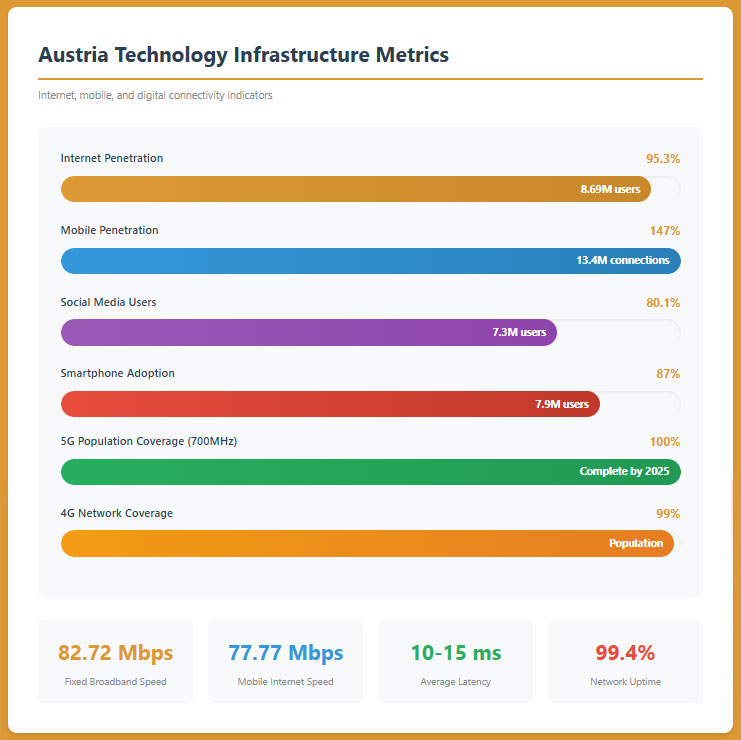
Daily Internet Usage Patterns: Austrians average 6.2 hours of daily internet usage, exceeding European averages and indicating deep digital integration across work, entertainment, and social activities. Peak usage occurs evenings between 7 PM and 11 PM, coinciding with prime gambling activity windows. Weekend usage increases further, creating elevated gambling participation Saturdays and Sundays. Mobile devices account for approximately 65% of internet usage time, emphasizing importance of mobile-optimized gambling products.
Social Media Engagement: With 7.3 million active social media users representing 80.1% of the population, Austria demonstrates high social platform engagement. Popular platforms include WhatsApp (80%+ penetration), Facebook (65%), Instagram (55%), and TikTok (35% among under-35s). Social media serves as critical marketing channel for licensed operators, though unlicensed operators face restrictions. User-generated content, influencer marketing, and social community features represent opportunities for gambling engagement.
E-commerce Participation: Approximately 75% of Austrians participate in e-commerce, making online purchases regularly across retail categories. This high e-commerce adoption correlates strongly with online gambling participation, as both require similar digital payment comfort, account management capabilities, and trust in online transactions. Average Austrian consumers make 15-20 online purchases annually, demonstrating transaction frequency supporting regular gambling deposits.
Digital Payment Adoption: Austria leads European markets in digital payment adoption at 82% penetration for online banking services. Contactless payment methods account for 82% of cashless transactions, with mobile payment applications including ELBA-pay and George gaining significant traction. This payment infrastructure supports frictionless gambling deposits and withdrawals, critical success factors for online gambling operators.
Digital Payment Behavior
| Payment Method | Adoption Rate | Gambling Suitability | Average Transaction Size |
|---|---|---|---|
| Credit/Debit Cards | 78% | Excellent – instant deposits | €75-150 |
| Bank Transfers (SEPA) | 85% | Good – 1-2 day processing | €200-500 |
| E-Wallets (PayPal, Skrill, Neteller) | 42% | Excellent – instant, anonymous | €50-200 |
| Mobile Payment Apps | 35% | Good – growing adoption | €30-100 |
| Prepaid Cards/Vouchers | 18% | Good – privacy-focused players | €20-100 |
| Cryptocurrency | 8% | Limited – regulatory uncertainty | €100-1,000+ |
| Direct Debit | 45% | Fair – withdrawal method primarily | €100-300 |
Payment Method Preferences: Austrian online consumers demonstrate strong preference for credit and debit cards (78% adoption), with Visa and Mastercard dominating. Bank transfers via SEPA maintain high usage at 85% adoption, particularly for larger transactions where consumers prioritize security over speed. E-wallets have achieved 42% penetration, with PayPal leading followed by specialized gambling e-wallets Skrill and Neteller.
Most Popular Digital Wallets: PayPal maintains market leadership with approximately 55% of e-wallet users, benefiting from broad merchant acceptance and strong consumer trust. Skrill and Neteller, purpose-built for gambling transactions, capture 15-20% combined market share among online gamblers. Apple Pay and Google Pay are growing rapidly, reaching 28% combined adoption with particularly strong uptake among younger demographics. Local Austrian mobile banking apps including ELBA-pay and George provide integrated payment functions gaining traction for everyday transactions.
Online Transaction Patterns: Austrian consumers conduct an average of 25-30 online transactions monthly, combining e-commerce purchases, bill payments, subscription services, and entertainment spending. Transaction frequency has increased steadily, reflecting growing comfort with digital payments and expansion of online service availability. Gambling transactions typically represent 3-5 transactions monthly for active players, with deposit frequencies varying by player type and preferred gambling format.
Average Transaction Sizes: Typical online gambling deposits range €50-200, with significant variation by player segment. Recreational players average €50-75 per deposit with 2-4 deposits monthly. Regular players deposit €100-200 per transaction with 4-8 monthly deposits. High-value players commonly deposit €500-2,000+ per transaction. Withdrawal sizes typically exceed deposits, with successful players withdrawing accumulated winnings in €200-1,000 transactions.
Trust in Online Payment Systems: Austrian consumers demonstrate high trust in established online payment systems, with 78% expressing confidence in card payment security and 82% trusting bank-provided digital banking services. However, cryptocurrency payment systems face greater skepticism, with only 25% of consumers expressing comfort with crypto transactions. This trust pattern favors traditional payment methods for gambling, though growing crypto-gambling interest exists among tech-savvy younger players.
Cryptocurrency Adoption for Gambling: Cryptocurrency usage for gambling remains limited in Austria at approximately 8% of online gamblers, though growth trajectory is strong particularly among 25-34 age demographic. Bitcoin dominates crypto gambling transactions (65% share), followed by Ethereum (20%) and other altcoins (15%). Regulatory uncertainty and the monopoly structure inhibit crypto-gambling growth, as the Win2Day platform does not accept cryptocurrency. International unlicensed operators offering crypto gambling capture this emerging market segment.
Gaming and Gambling Preferences
Current Market Participation
Overall Gambling Participation: Approximately 55-60% of Austria’s adult population participates in gambling activities at least once annually, translating to 4.2-4.6 million active gamblers. This high participation rate reflects cultural acceptance of gambling, universal lottery access, and strong land-based casino infrastructure. Lottery products attract the broadest participation at 45-50% of adults, while casino gambling reaches 15-20% and sports betting engages 18-22% of adults.
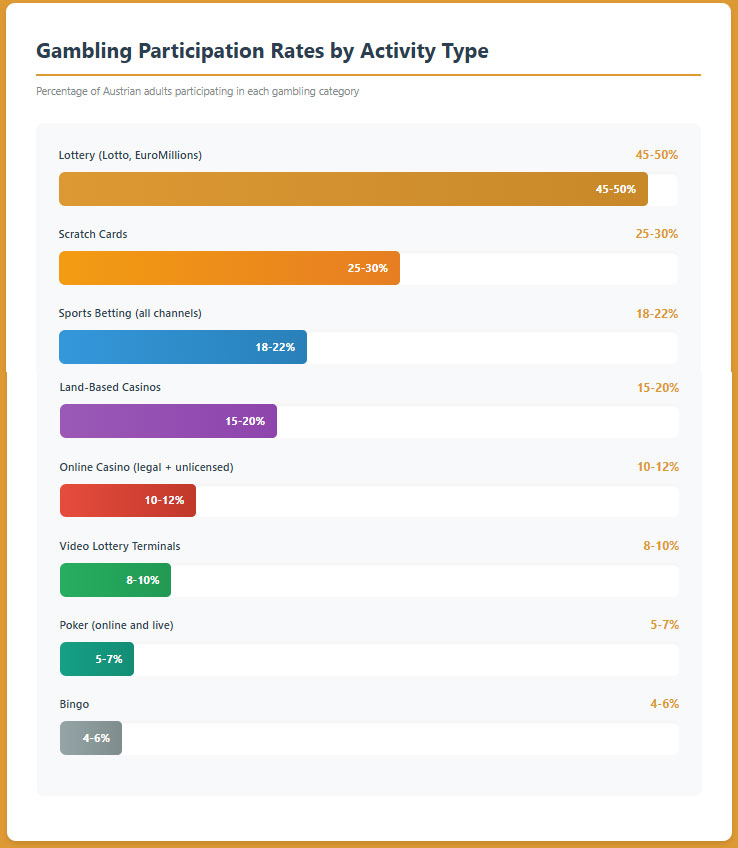
Online Gambling Participation: Online gambling participation reaches approximately 10-12% of Austrian adults or 785,000-920,000 active users, significantly lower than land-based participation rates. The monopoly structure, limited product variety on Win2Day, and poor user experience compared to international competitors constrain online adoption. Including users of unlicensed international platforms, true online gambling participation likely reaches 15-18% of adults or 1.15-1.38 million people.
| Rank | Activity | Participation Rate | Annual GGR | Growth Trend |
|---|---|---|---|---|
| 1 | Lottery (Lotto, EuroMillions) | 45-50% | €950 million | Stable |
| 2 | Sports Betting (all channels) | 18-22% | €400 million | Growing |
| 3 | Online Casino (legal + unlicensed) | 10-12% | €650 million | Fast growing |
| 4 | Land-Based Casinos | 15-20% | €315 million | Declining |
| 5 | Scratch Cards | 25-30% | €180 million | Stable |
| 6 | Video Lottery Terminals | 8-10% | €120 million | Stable |
| 7 | Poker (online and live) | 5-7% | €85 million | Stable |
| 8 | Bingo | 4-6% | €45 million | Declining |
Sports Betting vs Casino Games Preference: Austrian gambling preferences demonstrate balanced interest across sports betting and casino games, with slight preference for casino products. Approximately 52% of online gamblers engage primarily with casino games (slots, table games, live dealer), while 48% focus on sports betting. However, many players participate in both categories, with cross-category participation reaching 35% of active gamblers. Casino preference is stronger among older demographics (45+), while younger players (18-34) show elevated sports betting participation.
Live Dealer Games Popularity: Live dealer casino games have experienced explosive growth, capturing approximately 25% of online casino revenue despite representing only 15% of game offerings. Austrian players particularly favor live roulette and live blackjack, appreciating the social interaction, perceived fairness through visible dealing, and authentic casino atmosphere. Live dealer participation skews toward older demographics (35-55) who combine casino game preferences with trust in transparent game mechanics.
Lottery Participation Patterns: Lottery maintains highest participation at 45-50% of adults, with weekly Lotto draws attracting 3.5-4 million regular participants. EuroMillions draws generate elevated participation during large jackpot periods, with 2-2.5 million Austrians purchasing tickets for €100 million+ jackpots. Scratch cards maintain steady popularity particularly among lower-income demographics attracted by instant gratification and low €2-5 price points. Lottery participation shows minimal online migration, with 85% of lottery purchases still occurring through retail outlets.
Seasonal Patterns and Trends: Austrian gambling activity demonstrates clear seasonal patterns. Winter months (November-March) see elevated participation driven by Christmas spending, winter sports events including World Cup skiing, and indoor entertainment preferences during cold weather. Summer months (June-August) show 15-20% declining activity as Austrians travel, engage in outdoor recreation, and shift entertainment spending. Major sports events including FIFA World Cup, UEFA European Championship, and Formula 1 races generate 30-50% participation spikes during event periods.
Consumer Behavior Patterns
Average Spending Per Player: Active Austrian gamblers spend an average of €890-1,200 annually across all gambling formats, with significant variation by player type and preferred products. Casual lottery players average €180-250 annually, regular casino players spend €800-1,500 annually, and sports betting enthusiasts average €650-1,200 annually. High-value players (top 10% by spending) account for 55-60% of total gambling revenue, averaging €5,000-15,000 annual spending.
Monthly Spending Analysis: Typical active online gamblers deposit €150-300 monthly, with spending concentrated among regular players (2-3x weekly sessions). Monthly spending shows high variance, with 40% of players exhibiting irregular patterns alternating between €0 and €500+ depending on disposable income availability, promotional offers, and major sporting events. Budget-conscious recreational players maintain disciplined €50-100 monthly limits, while problem gamblers may exceed €1,000+ monthly despite financial consequences.
Spending Habits and Typical Bet Sizes: Austrian players demonstrate conservative betting behavior compared to British or Scandinavian markets. Average bet sizes range €0.50-2.00 for slot games, €5-25 for table game hands, and €10-50 for sports bets. This conservative approach reflects cultural risk aversion and preference for extended entertainment duration over high-risk high-reward strategies. Premium players comfortable with €25-100+ bet sizes represent only 8-10% of player base but generate disproportionate revenue.
Platform Preferences: Mobile devices now account for approximately 65% of online gambling sessions, with desktop at 32% and tablets at 3%. Mobile dominance is particularly pronounced among younger players (18-34), where mobile reaches 80% of sessions. Older players (55+) maintain stronger desktop preferences at 55% of sessions, valuing larger screens for sports betting markets and table game interfaces. The shift toward mobile requires operators to prioritize mobile-first design, with responsive interfaces, touch-optimized controls, and efficient data usage.
Peak Gambling Times: Online gambling activity peaks weekday evenings between 7 PM and 11 PM, coinciding with post-work leisure hours. Weekend activity elevates 30-40% compared to weekdays, with peak periods expanding to include afternoon sessions (2 PM onwards). Sports betting shows event-driven patterns, with elevated activity during live matches particularly for football (Saturday/Sunday afternoons and midweek Champions League evenings). Casino game play distributes more evenly but still concentrates evenings and weekends.
Session Length Averages: Typical gambling sessions average 35-45 minutes for casino games and 55-75 minutes for sports betting, with sports bettors often maintaining longer sessions while researching bets and watching live events. Mobile sessions trend shorter at 25-35 minutes, reflecting on-the-go usage patterns and interruption frequency. Problem gamblers exhibit significantly longer sessions often exceeding 2-3 hours, representing key indicator for responsible gambling intervention systems.
Retention and Loyalty Patterns: Austrian players demonstrate high loyalty to platforms meeting their needs, with 6-month retention rates reaching 45-55% for quality operators and 12-month retention at 30-38%. The monopoly structure paradoxically reduces Win2Day loyalty as dissatisfied players freely switch to international unlicensed platforms. Sports betting shows highest retention at 50-60% six-month rates driven by seasonal sports calendars and accumulator betting habits. Casino players show higher churn at 35-45% six-month retention, frequently trying new platforms attracted by welcome bonuses.
Bonus Sensitivity and Promotional Response: Austrian players respond strongly to promotional offers, with 70-80% of new player acquisitions occurring through bonus incentives. Welcome bonuses effectively drive trial, with 100% deposit matches up to €200-300 generating optimal response rates. However, Austrian players demonstrate sophistication evaluating bonus terms, rejecting overly restrictive wagering requirements (above 40x) or game restrictions. Reload bonuses, cashback offers, and free bet promotions maintain engagement, with 55-65% of active players using at least one promotion monthly.
Preferred Game Types by Age Group: Age-based preferences show clear patterns. Players 18-24 favor sports betting (62%), esports betting (18%), and live dealer casino (12%). The 25-34 cohort splits between sports betting (48%), online slots (32%), and poker (12%). Ages 35-54 prefer online slots (45%), sports betting (32%), and live table games (15%). Seniors 55+ strongly favor lottery (58%), land-based casinos (22%), and traditional slots (12%). These patterns inform marketing segmentation and product prioritization strategies.
Deposit and Withdrawal Frequency: Active players average 3-5 deposits monthly with median deposit values of €75-150. Withdrawal frequencies are significantly lower at 0.5-1.5 withdrawals monthly, as many players maintain balances on platforms for continued play. Withdrawal processing speed critically impacts satisfaction, with Austrian players expecting 24-48 hour withdrawal processing for e-wallets and 2-3 days for bank transfers. Delays beyond these expectations generate complaints and platform switching.
Section 3: Technology Infrastructure and Business Environment
Internet and Digital Infrastructure
Connectivity and Network Performance
Internet Penetration Quality Assessment: Austria’s internet infrastructure ranks among Europe’s best, combining extensive fiber optic networks in urban centers with comprehensive DSL coverage in rural areas and universal mobile broadband availability. The country’s strategic location in Central Europe and historical investment in telecommunications infrastructure provide robust foundation for digital services including online gambling.
| Metric | Fixed Broadband | Mobile Internet | Global Ranking |
|---|---|---|---|
| Median Download Speed | 82.72 Mbps | 77.77 Mbps | 59th (fixed), 31st (mobile) |
| Median Upload Speed | 28.5 Mbps | 15.2 Mbps | Above regional average |
| Average Latency | 10-15 ms | 30-40 ms | Excellent for gaming |
| Network Reliability (Uptime) | 99.4% | 98.8% | Top 25 globally |
| Peak Speed (99th percentile) | 250+ Mbps | 150+ Mbps | Premium tier performance |
Fixed Broadband vs Mobile Internet: Fixed broadband reaches approximately 92% of households, with 45% having access to fiber optic connections offering 100-1,000 Mbps speeds. Cable internet provides secondary fixed option covering 35% of households. DSL technology serves remaining areas, delivering 25-75 Mbps adequate for gambling applications. Mobile internet complements fixed infrastructure, with 99.6% of mobile connections classified as broadband (3G, 4G, or 5G), ensuring universal internet access including in remote alpine regions where fixed infrastructure is impractical.
Average Internet Speeds: Fixed broadband median download speeds of 82.72 Mbps exceed requirements for all gambling applications including high-definition live dealer streams requiring 5-10 Mbps. Mobile median speeds of 77.77 Mbps position Austria 31st globally, sufficient for smooth mobile gambling experiences. Upload speeds of 28.5 Mbps (fixed) and 15.2 Mbps (mobile) support emerging cloud gaming and social streaming features.
Network Reliability and Uptime: Austrian internet infrastructure demonstrates exceptional reliability at 99.4% uptime for fixed networks and 98.8% for mobile networks. Network outages are infrequent and typically resolved within hours rather than days. This reliability is critical for real-time gambling applications including live betting, live dealer games, and poker tournaments where connection interruptions directly impact user experience and revenue.
Infrastructure Investment Trends: Austria’s Broadband Strategy 2030 commits €1.4 billion toward nationwide gigabit connectivity, combining €456 million from the EU Recovery and Resilience Facility, €389 million from 5G spectrum auction proceeds, and national budget allocations. This investment targets underserved rural regions, aiming for symmetric gigabit capability (1,000 Mbps up and down) covering 100% of population by 2030. Market-driven deployment is prioritized, with public funding reserved for areas lacking commercial investment viability.
Rural vs Urban Connectivity Gap: Urban areas enjoy nearly universal high-speed internet access with average speeds exceeding 100 Mbps and fiber availability above 60%. Rural areas face greater challenges, with 12% of rural households still relying on slower DSL connections below 50 Mbps.
However, aggressive 4G and 5G mobile network deployment is bridging this gap, with mobile broadband increasingly serving as primary internet access method in rural regions. The urban-rural digital divide continues narrowing but influences gambling participation patterns, with rural players more likely to use mobile devices and face occasional connectivity limitations.
5G and Future Technology Deployment
Current 4G/5G Coverage: Austria has achieved near-universal 4G coverage at 99% of population and 95% of geographic area, providing strong foundation for mobile gambling. 5G deployment has progressed rapidly since initial 2019-2020 launches, with the 700MHz 5G band achieving 100% population coverage by 2025 including complete railway network coverage. The higher-frequency 3.5GHz 5G band covers 37% of population concentrated in urban areas, offering gigabit-class speeds for enhanced mobile experiences.
5G Rollout Timeline and Progress: Austria’s three major mobile network operators (A1 Telekom, Magenta, Deutsche Telekom, and Drei) collectively operate approximately 4,000+ 5G base stations as of 2025. A1 Telekom leads deployment with nationwide coverage reaching 958+ locations, followed by Magenta with 1,200+ sites covering 40% of households. The operators target comprehensive 5G availability across main traffic routes by end of 2025 and nearly nationwide coverage by 2027-2028.
Network Operator Landscape: Three national operators dominate the Austrian mobile market. A1 Telekom Austria commands approximately 37% market share with 4.2 million customers, positioning itself as the market leader with most extensive infrastructure. Magenta (Deutsche Telekom subsidiary) holds 33% market share serving 3.7 million subscribers. Hutchison Drei Austria captures the remaining 30% with 3.4 million customers. This three-player oligopoly ensures healthy competition while maintaining infrastructure investment capacity.
5G Technology Benefits for Gambling: 5G networks deliver latencies as low as 20-30ms, approaching fixed broadband performance and enabling seamless live betting experiences where split-second speed advantages matter. Download speeds exceeding 200 Mbps on 5G networks support instant application launches, rapid game loading, and buffer-free high-definition live dealer streaming. The improved network capacity allows gambling operators to deploy more sophisticated features including augmented reality casino experiences, virtual reality betting environments, and real-time social gambling interactions.
Mobile Technology Ecosystem
Mobile Network Infrastructure
Mobile Network Operators and Market Share:
| Operator | Market Share | Subscribers | Technology Coverage |
|---|---|---|---|
| A1 Telekom Austria | 37% | 4.2 million | 4G: 99%, 5G: Nationwide |
| Magenta (T-Mobile) | 33% | 3.7 million | 4G: 99%, 5G: 40% households |
| Hutchison Drei Austria | 30% | 3.4 million | 4G: 98%, 5G: Urban focus |
Network Quality by Operator: A1 Telekom leads quality metrics with median latency of 33ms, delivering best performance for time-sensitive gambling applications. Magenta achieves 34ms latency with strong reliability metrics including 98.8% availability. Drei records 34ms latency with competitive performance despite smaller infrastructure footprint. All three operators provide adequate network quality for gambling applications, with operator selection more influenced by pricing and coverage in specific locations.
Data Costs and Pricing Models: Austrian mobile data pricing is competitive by European standards, with unlimited data plans available from €25-40 monthly from all three operators. Budget prepaid options offer 10-20GB data packages for €10-15 monthly, adequate for regular gambling participation. Per-gigabyte costs for pay-as-you-go users range €5-10 per GB. The generous data allowances and affordable unlimited plans have driven mobile data consumption to 1,266 petabytes in Q1 2025 alone, accounting for 43% of all national internet traffic.
Mobile Payment Integration: Austrian mobile networks fully support mobile payment services including carrier billing for content purchases, though gambling operators face restrictions using carrier billing due to regulatory concerns. Mobile banking applications from major Austrian banks integrate seamlessly with mobile networks, enabling instant deposits via banking apps. Near-field communication (NFC) payment capabilities are standard on smartphones sold in Austria, supporting contactless payment methods increasingly adopted for gambling transactions.
Device Penetration and Usage
Smartphone Adoption Rates: Smartphone penetration reaches 87% of Austria’s population or approximately 7.9 million users, among the highest rates in Central Europe. Smartphone ownership is nearly universal among 18-54 age groups (95%+) and remains strong among 55-64 demographics (78%). Even the 65+ cohort shows growing smartphone adoption at 62%, indicating sustained mobile gambling opportunity across age segments.
Smartphones Per Capita: The 147% mobile connection rate indicates many Austrians maintain multiple devices or SIM cards, though actual smartphone ownership per capita is approximately 1.1 devices. Multiple device ownership is common among business professionals maintaining separate work and personal devices, and young adults juggling multiple carrier plans for optimal pricing.
Device Preferences and Popular Brands: Apple commands approximately 42% of Austria’s smartphone market, with iPhone models dominating premium segments and showing particularly strong presence among 25-45 age demographic. Samsung holds 35% market share spanning mid-range to premium Android devices. Xiaomi (8%), Huawei (6%), and other Android manufacturers capture remaining share primarily in budget and mid-range segments. The Apple-dominated premium market influences gambling operator strategies, requiring robust iOS application development and ensuring compatibility with latest iPhone and iPad devices.
Android vs iOS Market Share: Android accounts for approximately 56% of active smartphones in Austria, with iOS at 42% and other operating systems at 2%. However, iOS users demonstrate higher engagement and spending patterns in gambling applications, generating 55-60% of mobile gambling revenue despite smaller user base. This reflects iOS users’ higher average income, greater app purchase willingness, and premium demographic concentration. Gambling operators must optimize for both platforms but may prioritize iOS for features targeting high-value players.
Average Device Specifications: Austrians maintain relatively current devices, with median smartphone age of 2.3 years suggesting regular upgrade cycles. Average specifications include 6.2-inch displays, 128GB storage, 6-8GB RAM, and processor capabilities supporting demanding applications including live streaming gambling content. The modern device fleet supports advanced gambling features including HD video streaming, complex graphics, biometric authentication, and augmented reality elements without performance constraints.
Mobile Internet Usage Patterns: Mobile internet users consume an average of 8-12GB data monthly for general browsing, with gambling applications contributing 1-2GB for regular players. Video streaming represents largest data consumption category at 45% of mobile data usage, followed by social media (25%), general browsing (15%), and gaming/gambling (8%). Gambling operators must optimize applications for data efficiency to avoid excessive consumption triggering data cap concerns among budget-conscious users.
Financial Services and Payment Infrastructure
Banking System Structure
Major Banks and Market Share:
| Bank | Market Share | Customers | Digital Banking Adoption |
|---|---|---|---|
| Erste Group Bank | 23% | 2.1 million | 88% |
| Raiffeisen Bank International | 19% | 1.7 million | 85% |
| UniCredit Bank Austria | 18% | 1.6 million | 83% |
| Volksbank Group | 12% | 1.1 million | 78% |
| BAWAG P.S.K. | 11% | 1.0 million | 82% |
| Other Banks | 17% | 1.5 million | 75% |
Number of Banking Institutions: Austria hosts approximately 550 banking institutions comprising universal banks, specialized credit institutions, building societies, and branches of foreign banks. This fragmented structure reflects historical local banking traditions, though consolidation trends have reduced institution counts from 850+ in the 1990s. The concentrated market with five major banks controlling 83% of retail banking ensures stable payment infrastructure for gambling operators.
Digital Banking Adoption: Austrian digital banking penetration reaches 82% of adult population or 6.3 million active users, representing one of Europe’s highest adoption rates. The George banking platform (Erste Group) and similar offerings from Raiffeisen and Bank Austria provide comprehensive digital banking services including instant payments, standing orders, and investment management. High digital banking adoption directly correlates with online gambling payment capability, as players familiar with digital banking seamlessly transition to gambling account funding.
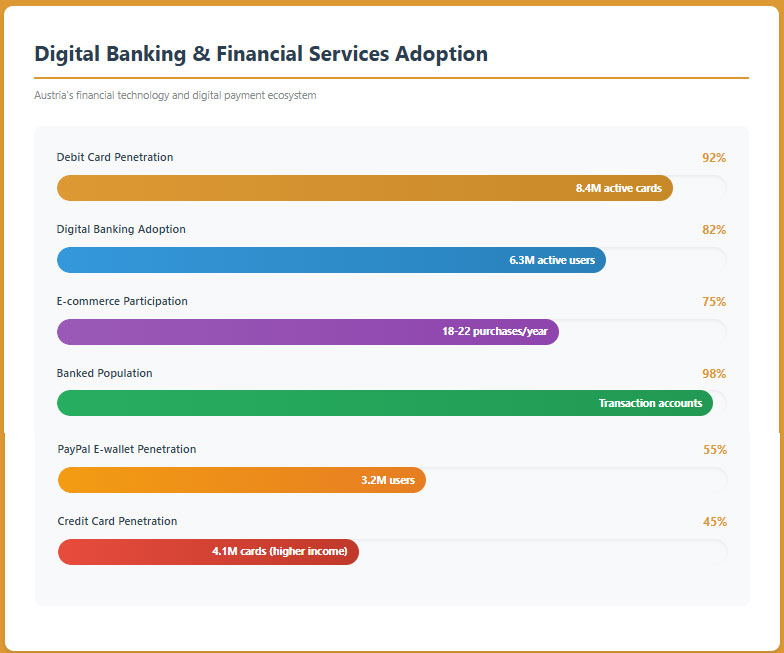
Account Penetration Rates: The banked population reaches 98% of Austrian adults, with 94% maintaining transaction accounts at licensed banks. This near-universal banking access eliminates financial infrastructure barriers to gambling participation. The remaining 2% unbanked population comprises primarily recent immigrants, elderly individuals in cash-based lifestyles, and marginalized groups unlikely to represent significant gambling demographics.
Credit and Lending Market Maturity: Austria maintains conservative lending traditions with household debt at 52% of GDP, below EU averages of 60%. Credit cards show lower penetration at 45% compared to debit cards at 92%, reflecting preference for immediate payment methods over credit. This conservative financial culture influences gambling payment patterns, with players preferring deposits from existing funds rather than credit-financed gambling. Responsible gambling frameworks benefit from this culture, as credit-funded gambling is less common than in markets with higher consumer debt levels.
ATM Density and Distribution: Austria maintains approximately 8,200 ATMs nationwide, equating to 90 ATMs per 100,000 adults, well above European averages. ATM distribution covers urban and rural areas, ensuring cash access despite declining cash usage. However, gambling deposits increasingly occur through digital channels rather than cash-based methods, with less than 15% of online gambling funding occurring through cash vouchers or prepaid cards purchased with cash.
Payment Processing Options
| Payment Method | Deposit Speed | Withdrawal Speed | Fees (Average) | Regulatory Status |
|---|---|---|---|---|
| Visa/Mastercard | Instant | 3-5 days | 2.5-3.5% (merchant) | Permitted |
| SEPA Bank Transfer | 1-2 days | 2-3 days | €0.50-2.00 | Permitted |
| Instant Bank Transfer (Sofort) | Instant | 1-2 days | 1.5-2.5% | Permitted |
| PayPal | Instant | 1-2 days | 2.9% + €0.35 | Restricted for unlicensed |
| Skrill | Instant | Instant-24 hours | 1-2% | Permitted |
| Neteller | Instant | Instant-24 hours | 1-2% | Permitted |
| Paysafecard | Instant | Not available | None (buyer) | Permitted |
| Apple Pay | Instant | Not direct | Standard card fees | Growing adoption |
| Cryptocurrency | 15-60 minutes | 15-60 minutes | Network fees variable | Uncertain/Restricted |
Credit/Debit Card Penetration: Debit card penetration reaches 92% of Austrian adults with 8.4 million active cards, providing universal access to card-based gambling deposits. Credit cards show 45% penetration (4.1 million cards), concentrated among higher-income demographics. Visa commands 58% card market share, Mastercard 38%, and other networks 4%. Card payments represent the most popular gambling deposit method, combining ubiquity, instant processing, and user familiarity.
E-Wallet Options: PayPal leads e-wallet adoption at 55% penetration among online shoppers (3.2 million users), though its gambling availability is restricted. The company has historically avoided unlicensed gambling markets and may restrict Austrian gambling transactions pending regulatory clarification. Skrill and Neteller maintain approximately 850,000 combined Austrian users, purposefully positioning as gambling-friendly alternatives. These specialized e-wallets offer instant deposits and withdrawals, anonymity benefits, and multi-currency capabilities appealing to international players.
Bank Transfer Systems: SEPA (Single Euro Payments Area) bank transfers provide the standard bank-to-bank payment method, processing in 1-2 business days for deposits. Instant SEPA transfers are increasingly available, reducing processing to minutes through participating banks. Sofortüberweisung (Sofort) and similar instant bank transfer services bridge the speed gap, offering immediate deposit confirmation while funds transfer through banking systems. Bank transfers typically handle larger transactions (€200-2,000) where processing speed is less critical than the security of direct bank payment.
Cryptocurrency Acceptance: Cryptocurrency remains in regulatory gray area for Austrian gambling, with the monopoly operator not accepting crypto and regulatory guidance unclear on crypto gambling legality.
International unlicensed operators increasingly accept Bitcoin, Ethereum, and other cryptocurrencies from Austrian players, capitalizing on anonymity benefits and regulatory circumvention. Approximately 8-10% of Austrian online gamblers have used cryptocurrency for gambling transactions, concentrated among tech-savvy younger demographics and players specifically seeking regulatory avoidance. Formal cryptocurrency acceptance by licensed operators awaits regulatory clarification.
Processing Fees and Costs: Merchant fees for card processing range 2.5-3.5% of transaction value, representing significant cost for operators on high-volume deposits. E-wallet fees typically fall in 1-2% range with fixed fees minimal. Bank transfers carry fixed fees of €0.50-2.00, making them cost-effective for larger transactions but expensive for small deposits. Cryptocurrency network fees vary dramatically from €0.50-20+ depending on network congestion and blockchain used.
Transaction Processing Timelines: Deposit processing timelines critically influence user experience. Instant methods (cards, e-wallets) enable immediate play, while delayed methods (standard bank transfers) create friction reducing conversion rates. Withdrawal processing represents greater challenge, with Austrian players expecting 24-48 hour processing for e-wallets, 2-3 days for cards, and 3-5 days for bank transfers. Operators exceeding these timelines face player dissatisfaction, complaints, and potential regulatory scrutiny for deliberately delaying withdrawals.
International Payment Capabilities: Austria’s full EU membership and SEPA participation enable seamless Euro transactions across the European Economic Area. International credit card networks support global payment acceptance. However, gambling-specific payment restrictions by card networks, banks, and processors create challenges for operators serving multiple markets. Payment service providers must navigate varying regulatory frameworks, with some processors refusing gambling transactions in monopoly markets like Austria despite technical capability.
Regulatory Restrictions on Gambling Payments: Austrian financial institutions face increasing regulatory pressure to restrict payments to unlicensed gambling operators. While comprehensive payment blocking legislation has not been enacted, voluntary cooperation between the Ministry of Finance and banks has led to transaction monitoring and selective blocking. Major international payment processors including Visa and Mastercard enforce merchant category code restrictions, requiring gambling merchants to demonstrate valid licensing in transaction jurisdictions. These restrictions create operational challenges for unlicensed operators while providing competitive advantages to licensed entities.
Chargebacks and Dispute Resolution: Gambling transactions face elevated chargeback risk, as players may dispute transactions claiming unauthorized use, service not received, or illegal gambling operations. Austrian consumer protection laws generally favor consumers in disputes, requiring operators to demonstrate valid contracts and proper service delivery. The legal uncertainty surrounding unlicensed gambling has generated significant chargeback volumes, with players supported by legal advisors systematically disputing gambling losses. Licensed operators benefit from clear legal standing, while unlicensed operators face chargeback exposure potentially reaching 3-8% of transaction volumes.
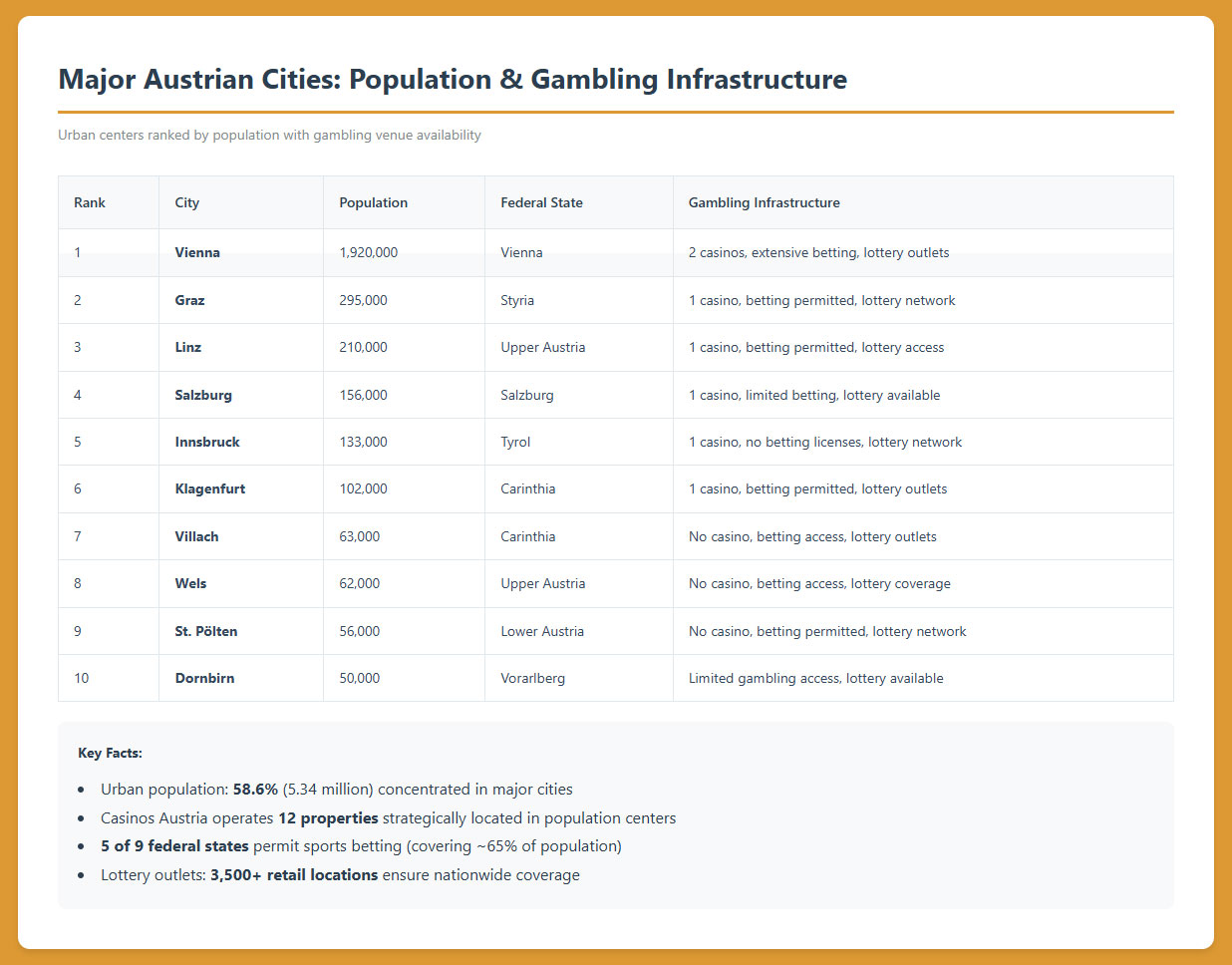
E-commerce and Digital Economy
Digital Market Development
E-commerce Market Size: Austria’s e-commerce market reached approximately €12.5 billion in 2024, representing 11.2% of total retail sales and growing at 8-10% annually. This substantial digital commerce infrastructure provides foundation for online gambling adoption, as consumers comfortable with online shopping naturally extend trust to gambling transactions. Cross-border e-commerce is particularly developed, with 45% of Austrian online shoppers making purchases from international retailers, demonstrating comfort with foreign websites relevant to international gambling platform usage.
Online Retail Penetration: Approximately 75% of Austrian consumers participate in e-commerce annually, making an average of 18-22 online purchases per year. This high adoption spans categories including fashion (70% online participation), electronics (65%), books/media (58%), and digital services (52%). Entertainment services including streaming subscriptions (62% adoption) demonstrate willingness to pay for digital entertainment, directly comparable to online gambling subscriptions or regular play patterns.
Digital Service Adoption: Beyond physical goods, Austrian consumers actively consume digital services including streaming video (68% penetration), music streaming (52%), gaming (42%), and software subscriptions (38%). This digital service consumption establishes payment patterns and psychological comfort with recurring or regular digital spending applicable to gambling. The subscription economy’s growth conditions consumers to view regular digital entertainment spending as normal, potentially reducing barriers to regular gambling participation.
Consumer Trust in Online Transactions: Austrian consumers demonstrate high trust in online transactions, with 78% expressing confidence in online payment security and 71% comfortable sharing payment information with established e-commerce platforms.
Popular E-commerce Platforms: Amazon.de dominates Austrian e-commerce with approximately 65% of online shoppers making purchases through the platform. Local retailers including Media Markt, Conrad Electronics, and Thalia maintain strong online presence. Zalando leads fashion e-commerce at 45% reach among online shoppers. This e-commerce landscape informs gambling marketing strategies, as platforms frequented by target demographics represent potential advertising and affiliate channels (where legally permitted).
Cross-Border Shopping Behavior: Austrian consumers readily purchase from international websites, with 45% making cross-border purchases within the past year. German websites are particularly popular due to language compatibility, followed by other EU retailers. This cross-border shopping comfort translates directly to gambling, where Austrian players freely use international gambling platforms despite questionable legal status. The established behavior of accessing foreign websites for better selection, pricing, or features directly parallels motivations for using unlicensed international gambling sites.
Digital Goods and Services Consumption: Austrians spend approximately €2.8 billion annually on digital goods and services including software, games, streaming subscriptions, and online entertainment. This €310 per capita digital spending demonstrates substantial digital entertainment budgets, with gambling competing for share of this discretionary digital spending. The transition from ownership to access models in entertainment (streaming vs. purchase) may influence gambling preferences toward subscription-style or regular play patterns over sporadic large-stake gambling.
Business Environment and Regulatory Framework
Ease of Business Operations
World Bank Doing Business Ranking: Austria ranks 27th globally on the World Bank’s Ease of Doing Business Index, indicating generally favorable business environment with efficient regulatory frameworks, strong rule of law, and developed infrastructure. However, this middling ranking (among developed economies) reflects bureaucratic complexity, relatively high tax burdens, and rigid labor regulations that can challenge businesses including gambling operators.
Ease of Starting a Business: Business formation in Austria ranks 127th globally on the Doing Business Index “Starting a Business” indicator, reflecting multiple required procedures, notarization requirements, and bureaucratic steps. However, for established corporations particularly from EU jurisdictions, subsidiary formation is straightforward following standardized procedures.
| Step | Timeline | Cost | Requirements |
|---|---|---|---|
| Company Name Reservation | 1-2 days | €50 | Unique name verification |
| Articles of Association | 3-5 days | €500-1,500 legal | Notarized documentation |
| Capital Deposit | 1 day | Minimum capital amount | Bank confirmation required |
| Commercial Register Entry | 5-10 days | €120-300 | Complete documentation package |
| Tax Registration | 5-7 days | €0 | Commercial register confirmation |
| Social Security Registration | 2-3 days | €0 | Employer registration |
| Trade License Application | 3-7 days | €200-500 | Qualification requirements |
| Total Timeline | 20-35 days | €1,370-2,850 | Complete process |
Foreign Investment Policies: Austria maintains open foreign investment policies aligned with EU standards, imposing few restrictions on EU/EEA investors. Non-EU investors face screening for strategic sectors including infrastructure and sensitive technologies, but gambling generally falls outside these restrictions. However, gambling-specific licensing requirements create effective market access barriers regardless of investment nationality, as the monopoly structure limits licensing opportunities.
Data Costs and Pricing Models: Austrian mobile data pricing is competitive by European standards, with unlimited data plans available from €25-40 monthly from all three operators. Budget prepaid options offer 10-20GB data packages for €10-15 monthly, adequate for regular gambling participation. Per-gigabyte costs for pay-as-you-go users range €5-10 per GB. The generous data allowances and affordable unlimited plans have driven mobile data consumption to 1,266 petabytes in Q1 2025 alone, accounting for 43% of all national internet traffic.
Mobile Payment Integration: Austrian mobile networks fully support mobile payment services including carrier billing for content purchases, though gambling operators face restrictions using carrier billing due to regulatory concerns. Mobile banking applications from major Austrian banks integrate seamlessly with mobile networks, enabling instant deposits via banking apps. Near-field communication (NFC) payment capabilities are standard on smartphones sold in Austria, supporting contactless payment methods increasingly adopted for gambling transactions.
Device Penetration and Usage
Smartphone Adoption Rates: Smartphone penetration reaches 87% of Austria’s population or approximately 7.9 million users, among the highest rates in Central Europe. Smartphone ownership is nearly universal among 18-54 age groups (95%+) and remains strong among 55-64 demographics (78%). Even the 65+ cohort shows growing smartphone adoption at 62%, indicating sustained mobile gambling opportunity across age segments.
Smartphones Per Capita: The 147% mobile connection rate indicates many Austrians maintain multiple devices or SIM cards, though actual smartphone ownership per capita is approximately 1.1 devices. Multiple device ownership is common among business professionals maintaining separate work and personal devices, and young adults juggling multiple carrier plans for optimal pricing.
Device Preferences and Popular Brands: Apple commands approximately 42% of Austria’s smartphone market, with iPhone models dominating premium segments and showing particularly strong presence among 25-45 age demographic. Samsung holds 35% market share spanning mid-range to premium Android devices. Xiaomi (8%), Huawei (6%), and other Android manufacturers capture remaining share primarily in budget and mid-range segments. The Apple-dominated premium market influences gambling operator strategies, requiring robust iOS application development and ensuring compatibility with latest iPhone and iPad devices.
Android vs iOS Market Share: Android accounts for approximately 56% of active smartphones in Austria, with iOS at 42% and other operating systems at 2%. However, iOS users demonstrate higher engagement and spending patterns in gambling applications, generating 55-60% of mobile gambling revenue despite smaller user base. This reflects iOS users’ higher average income, greater app purchase willingness, and premium demographic concentration. Gambling operators must optimize for both platforms but may prioritize iOS for features targeting high-value players.
Average Device Specifications: Austrians maintain relatively current devices, with median smartphone age of 2.3 years suggesting regular upgrade cycles. Average specifications include 6.2-inch displays, 128GB storage, 6-8GB RAM, and processor capabilities supporting demanding applications including live streaming gambling content. The modern device fleet supports advanced gambling features including HD video streaming, complex graphics, biometric authentication, and augmented reality elements without performance constraints.
Mobile Internet Usage Patterns: Mobile internet users consume an average of 8-12GB data monthly for general browsing, with gambling applications contributing 1-2GB for regular players. Video streaming represents largest data consumption category at 45% of mobile data usage, followed by social media (25%), general browsing (15%), and gaming/gambling (8%). Gambling operators must optimize applications for data efficiency to avoid excessive consumption triggering data cap concerns among budget-conscious users.
Financial Services and Payment Infrastructure
Banking System Structure
Major Banks and Market Share:
| Bank | Market Share | Customers | Digital Banking Adoption |
|---|---|---|---|
| Erste Group Bank | 23% | 2.1 million | 88% |
| Raiffeisen Bank International | 19% | 1.7 million | 85% |
| UniCredit Bank Austria | 18% | 1.6 million | 83% |
| Volksbank Group | 12% | 1.1 million | 78% |
| BAWAG P.S.K. | 11% | 1.0 million | 82% |
| Other Banks | 17% | 1.5 million | 75% |
Number of Banking Institutions: Austria hosts approximately 550 banking institutions comprising universal banks, specialized credit institutions, building societies, and branches of foreign banks. This fragmented structure reflects historical local banking traditions, though consolidation trends have reduced institution counts from 850+ in the 1990s. The concentrated market with five major banks controlling 83% of retail banking ensures stable payment infrastructure for gambling operators.
Digital Banking Adoption: Austrian digital banking penetration reaches 82% of adult population or 6.3 million active users, representing one of Europe’s highest adoption rates.
The George banking platform (Erste Group) and similar offerings from Raiffeisen and Bank Austria provide comprehensive digital banking services including instant payments, standing orders, and investment management. High digital banking adoption directly correlates with online gambling payment capability, as players familiar with digital banking seamlessly transition to gambling account funding.
Account Penetration Rates: The banked population reaches 98% of Austrian adults, with 94% maintaining transaction accounts at licensed banks. This near-universal banking access eliminates financial infrastructure barriers to gambling participation. The remaining 2% unbanked population comprises primarily recent immigrants, elderly individuals in cash-based lifestyles, and marginalized groups unlikely to represent significant gambling demographics.
Credit and Lending Market Maturity: Austria maintains conservative lending traditions with household debt at 52% of GDP, below EU averages of 60%. Credit cards show lower penetration at 45% compared to debit cards at 92%, reflecting preference for immediate payment methods over credit. This conservative financial culture influences gambling payment patterns, with players preferring deposits from existing funds rather than credit-financed gambling. Responsible gambling frameworks benefit from this culture, as credit-funded gambling is less common than in markets with higher consumer debt levels.
ATM Density and Distribution: Austria maintains approximately 8,200 ATMs nationwide, equating to 90 ATMs per 100,000 adults, well above European averages. ATM distribution covers urban and rural areas, ensuring cash access despite declining cash usage. However, gambling deposits increasingly occur through digital channels rather than cash-based methods, with less than 15% of online gambling funding occurring through cash vouchers or prepaid cards purchased with cash.
Payment Processing Options
| Payment Method | Deposit Speed | Withdrawal Speed | Fees (Average) | Regulatory Status |
|---|---|---|---|---|
| Visa/Mastercard | Instant | 3-5 days | 2.5-3.5% (merchant) | Permitted |
| SEPA Bank Transfer | 1-2 days | 2-3 days | €0.50-2.00 | Permitted |
| Instant Bank Transfer (Sofort) | Instant | 1-2 days | 1.5-2.5% | Permitted |
| PayPal | Instant | 1-2 days | 2.9% + €0.35 | Restricted for unlicensed |
| Skrill | Instant | Instant-24 hours | 1-2% | Permitted |
| Neteller | Instant | Instant-24 hours | 1-2% | Permitted |
| Paysafecard | Instant | Not available | None (buyer) | Permitted |
| Apple Pay | Instant | Not direct | Standard card fees | Growing adoption |
| Cryptocurrency | 15-60 minutes | 15-60 minutes | Network fees variable | Uncertain/Restricted |
Credit/Debit Card Penetration: Debit card penetration reaches 92% of Austrian adults with 8.4 million active cards, providing universal access to card-based gambling deposits. Credit cards show 45% penetration (4.1 million cards), concentrated among higher-income demographics. Visa commands 58% card market share, Mastercard 38%, and other networks 4%. Card payments represent the most popular gambling deposit method, combining ubiquity, instant processing, and user familiarity.
E-Wallet Options: PayPal leads e-wallet adoption at 55% penetration among online shoppers (3.2 million users), though its gambling availability is restricted. The company has historically avoided unlicensed gambling markets and may restrict Austrian gambling transactions pending regulatory clarification. Skrill and Neteller maintain approximately 850,000 combined Austrian users, purposefully positioning as gambling-friendly alternatives. These specialized e-wallets offer instant deposits and withdrawals, anonymity benefits, and multi-currency capabilities appealing to international players.
Bank Transfer Systems: SEPA (Single Euro Payments Area) bank transfers provide the standard bank-to-bank payment method, processing in 1-2 business days for deposits. Instant SEPA transfers are increasingly available, reducing processing to minutes through participating banks. Sofortüberweisung (Sofort) and similar instant bank transfer services bridge the speed gap, offering immediate deposit confirmation while funds transfer through banking systems. Bank transfers typically handle larger transactions (€200-2,000) where processing speed is less critical than the security of direct bank payment.
Cryptocurrency Acceptance: Cryptocurrency remains in regulatory gray area for Austrian gambling, with the monopoly operator not accepting crypto and regulatory guidance unclear on crypto gambling legality. International unlicensed operators increasingly accept Bitcoin, Ethereum, and other cryptocurrencies from Austrian players, capitalizing on anonymity benefits and regulatory circumvention. Approximately 8-10% of Austrian online gamblers have used cryptocurrency for gambling transactions, concentrated among tech-savvy younger demographics and players specifically seeking regulatory avoidance. Formal cryptocurrency acceptance by licensed operators awaits regulatory clarification.
Processing Fees and Costs: Merchant fees for card processing range 2.5-3.5% of transaction value, representing significant cost for operators on high-volume deposits. E-wallet fees typically fall in 1-2% range with fixed fees minimal. Bank transfers carry fixed fees of €0.50-2.00, making them cost-effective for larger transactions but expensive for small deposits. Cryptocurrency network fees vary dramatically from €0.50-20+ depending on network congestion and blockchain used.
Transaction Processing Timelines: Deposit processing timelines critically influence user experience. Instant methods (cards, e-wallets) enable immediate play, while delayed methods (standard bank transfers) create friction reducing conversion rates. Withdrawal processing represents greater challenge, with Austrian players expecting 24-48 hour processing for e-wallets, 2-3 days for cards, and 3-5 days for bank transfers. Operators exceeding these timelines face player dissatisfaction, complaints, and potential regulatory scrutiny for deliberately delaying withdrawals.
International Payment Capabilities: Austria’s full EU membership and SEPA participation enable seamless Euro transactions across the European Economic Area. International credit card networks support global payment acceptance. However, gambling-specific payment restrictions by card networks, banks, and processors create challenges for operators serving multiple markets. Payment service providers must navigate varying regulatory frameworks, with some processors refusing gambling transactions in monopoly markets like Austria despite technical capability.
Regulatory Restrictions on Gambling Payments: Austrian financial institutions face increasing regulatory pressure to restrict payments to unlicensed gambling operators. While comprehensive payment blocking legislation has not been enacted, voluntary cooperation between the Ministry of Finance and banks has led to transaction monitoring and selective blocking. Major international payment processors including Visa and Mastercard enforce merchant category code restrictions, requiring gambling merchants to demonstrate valid licensing in transaction jurisdictions. These restrictions create operational challenges for unlicensed operators while providing competitive advantages to licensed entities.
Chargebacks and Dispute Resolution: Gambling transactions face elevated chargeback risk, as players may dispute transactions claiming unauthorized use, service not received, or illegal gambling operations. Austrian consumer protection laws generally favor consumers in disputes, requiring operators to demonstrate valid contracts and proper service delivery. The legal uncertainty surrounding unlicensed gambling has generated significant chargeback volumes, with players supported by legal advisors systematically disputing gambling losses. Licensed operators benefit from clear legal standing, while unlicensed operators face chargeback exposure potentially reaching 3-8% of transaction volumes.
E-commerce and Digital Economy
Digital Market Development
E-commerce Market Size: Austria’s e-commerce market reached approximately €12.5 billion in 2024, representing 11.2% of total retail sales and growing at 8-10% annually. This substantial digital commerce infrastructure provides foundation for online gambling adoption, as consumers comfortable with online shopping naturally extend trust to gambling transactions. Cross-border e-commerce is particularly developed, with 45% of Austrian online shoppers making purchases from international retailers, demonstrating comfort with foreign websites relevant to international gambling platform usage.
Online Retail Penetration: Approximately 75% of Austrian consumers participate in e-commerce annually, making an average of 18-22 online purchases per year. This high adoption spans categories including fashion (70% online participation), electronics (65%), books/media (58%), and digital services (52%). Entertainment services including streaming subscriptions (62% adoption) demonstrate willingness to pay for digital entertainment, directly comparable to online gambling subscriptions or regular play patterns.
Digital Service Adoption: Beyond physical goods, Austrian consumers actively consume digital services including streaming video (68% penetration), music streaming (52%), gaming (42%), and software subscriptions (38%). This digital service consumption establishes payment patterns and psychological comfort with recurring or regular digital spending applicable to gambling. The subscription economy’s growth conditions consumers to view regular digital entertainment spending as normal, potentially reducing barriers to regular gambling participation.
Consumer Trust in Online Transactions: Austrian consumers demonstrate high trust in online transactions, with 78% expressing confidence in online payment security and 71% comfortable sharing payment information with established e-commerce platforms. However, trust is not absolute, with 58% expressing concerns about data security and 42% reluctant to use new or unfamiliar platforms. For gambling operators, trust-building requires strong brand presence, recognized security certifications, transparent terms, and prompt customer service. Licensed status significantly enhances trust, while unlicensed operations face skepticism requiring substantial marketing investment to overcome.
Popular E-commerce Platforms: Amazon.de dominates Austrian e-commerce with approximately 65% of online shoppers making purchases through the platform. Local retailers including Media Markt, Conrad Electronics, and Thalia maintain strong online presence. Zalando leads fashion e-commerce at 45% reach among online shoppers. This e-commerce landscape informs gambling marketing strategies, as platforms frequented by target demographics represent potential advertising and affiliate channels (where legally permitted).
Cross-Border Shopping Behavior: Austrian consumers readily purchase from international websites, with 45% making cross-border purchases within the past year. German websites are particularly popular due to language compatibility, followed by other EU retailers. This cross-border shopping comfort translates directly to gambling, where Austrian players freely use international gambling platforms despite questionable legal status. The established behavior of accessing foreign websites for better selection, pricing, or features directly parallels motivations for using unlicensed international gambling sites.
Digital Goods and Services Consumption: Austrians spend approximately €2.8 billion annually on digital goods and services including software, games, streaming subscriptions, and online entertainment. This €310 per capita digital spending demonstrates substantial digital entertainment budgets, with gambling competing for share of this discretionary digital spending. The transition from ownership to access models in entertainment (streaming vs. purchase) may influence gambling preferences toward subscription-style or regular play patterns over sporadic large-stake gambling.
Business Environment and Regulatory Framework
Ease of Business Operations
World Bank Doing Business Ranking: Austria ranks 27th globally on the World Bank’s Ease of Doing Business Index, indicating generally favorable business environment with efficient regulatory frameworks, strong rule of law, and developed infrastructure. However, this middling ranking (among developed economies) reflects bureaucratic complexity, relatively high tax burdens, and rigid labor regulations that can challenge businesses including gambling operators.
Ease of Starting a Business: Business formation in Austria ranks 127th globally on the Doing Business Index “Starting a Business” indicator, reflecting multiple required procedures, notarization requirements, and bureaucratic steps. However, for established corporations particularly from EU jurisdictions, subsidiary formation is straightforward following standardized procedures.
| Step | Timeline | Cost | Requirements |
|---|---|---|---|
| Company Name Reservation | 1-2 days | €50 | Unique name verification |
| Articles of Association | 3-5 days | €500-1,500 legal | Notarized documentation |
| Capital Deposit | 1 day | Minimum capital amount | Bank confirmation required |
| Commercial Register Entry | 5-10 days | €120-300 | Complete documentation package |
| Tax Registration | 5-7 days | €0 | Commercial register confirmation |
| Social Security Registration | 2-3 days | €0 | Employer registration |
| Trade License Application | 3-7 days | €200-500 | Qualification requirements |
| Total Timeline | 20-35 days | €1,370-2,850 | Complete process |
Foreign Investment Policies: Austria maintains open foreign investment policies aligned with EU standards, imposing few restrictions on EU/EEA investors. Non-EU investors face screening for strategic sectors including infrastructure and sensitive technologies, but gambling generally falls outside these restrictions. However, gambling-specific licensing requirements create effective market access barriers regardless of investment nationality, as the monopoly structure limits licensing opportunities.
Operational Cost Structures: Austria maintains relatively high operational costs compared to Central and Eastern European jurisdictions. Vienna office rent averages €15-25 per square meter monthly in business districts, comparable to other Western European capitals.
Professional salaries for technology, compliance, and customer service roles range €40,000-75,000 annually depending on experience and specialization. Utilities and telecommunications costs are moderate at €250-500 monthly for small offices. These operational costs favor remote or distributed operations over maintaining large physical Austrian presence beyond minimum licensing requirements.
Labor Market Conditions and Talent Availability: Austria’s highly educated workforce provides strong talent pool for gambling operations, particularly in technology development, data analytics, and compliance roles. However, specialized gambling industry expertise is limited due to the monopoly structure’s constrained market. Operators may need to recruit internationally or invest heavily in training to build competent teams. German language proficiency is essential for customer-facing roles, while English suffices for technology development. The competitive labor market and strong worker protections create retention challenges, requiring competitive compensation and benefits.
Corporate Structure and Registration
Available Entity Types
| Entity Type | Minimum Capital | Liability | Suitability for iGaming |
|---|---|---|---|
| GmbH (Limited Liability Company) | €35,000 | Limited | Recommended – flexible, limited liability |
| AG (Stock Corporation) | €70,000 | Limited | Suitable – larger operations, public markets |
| Branch Office | None | Parent company liable | Possible – limited autonomy |
| Representative Office | None | Parent company liable | Limited – no commercial activity permitted |
Recommended Structure for iGaming Operators: The GmbH (Gesellschaft mit beschränkter Haftung) represents the optimal entity structure for most gambling operators, combining limited liability protection, reasonable capital requirements, flexible management structures, and straightforward administration. The GmbH structure is well-understood by Austrian authorities, banks, and business partners, facilitating smooth operations.
For operators seeking gambling licenses requiring €109 million minimum capital, the entity structure becomes less relevant than demonstrating capital adequacy through parent company guarantees, committed credit facilities, or actual capital infusions. In such cases, either GmbH or AG structures work equally well, with choice depending on corporate governance preferences and potential public market access requirements.
Branch offices of foreign gambling companies may satisfy local presence requirements if the parent company holds comparable licenses in its home jurisdiction and regulatory cooperation exists. However, branch structures provide less operational autonomy and create parent company liability exposure for Austrian operations.
Registration Requirements and Processes
Registration Timelines: Standard GmbH formation requires approximately 20-35 days from initiation to operational readiness, assuming efficient document preparation and no complications. Expedited formation may reduce timelines to 15-20 days with premium service providers and responsive banking relationships. The process involves sequential steps with dependencies, making timeline compression challenging beyond certain limits.
Registration Costs Breakdown:
- Notary fees: €800-1,500 for articles of association notarization and authentication
- Commercial register entry: €120-300 depending on company size and complexity
- Legal and consulting fees: €2,500-5,000 for professional assistance with formation
- Minimum capital deposit: €35,000 for GmbH (must be deposited in Austrian bank)
- Trade license fees: €200-500 depending on licensed activities
- First-year accounting and audit setup: €3,000-6,000
- Total estimated costs: €41,620-€48,300 for complete GmbH formation
Required Documents: Company formation requires articles of association (Gesellschaftsvertrag) defining company purpose, capital structure, management, and shareholder rights. Shareholder identification documents including passports, proof of address, and beneficial ownership declarations must be provided. Bank confirmation of minimum capital deposit is required before commercial register entry. Managing directors must provide criminal background checks and professional qualifications. All documents from foreign jurisdictions require apostille certification or diplomatic legalization.
Foreign Ownership Rules: EU and EEA nationals and companies face no foreign ownership restrictions, enjoying equal treatment with Austrian entities. Non-EU investors generally face no restrictions for gambling operations beyond gambling-specific licensing requirements. However, reciprocity requirements may apply for certain non-EU jurisdictions, requiring verification of Austrian investors’ rights in the foreign country.
Minimum Capital Requirements by Entity: GmbH minimum capital is €35,000, with at least €17,500 payable upon formation and remainder callable. AG minimum capital is €70,000, fully payable upon formation. For gambling license applications requiring €109 million demonstrated capital, the entity type capital requirement becomes irrelevant, as license requirements far exceed entity formation minimums. Operators typically establish minimum capital entities and demonstrate license application capital through parent company guarantees or committed facilities.
Ongoing Compliance Requirements: Austrian companies must file annual financial statements with the commercial register within specified deadlines (typically nine months after fiscal year end). Companies exceeding size thresholds require statutory audits by licensed auditors. Annual general meetings must occur within eight months of fiscal year end, with minutes documented. Managing directors face personal liability for compliance failures including tax payment defaults, social security contribution arrears, and violation of capital maintenance rules.
Corporate Governance Requirements: GmbH governance is relatively flexible, with managing directors (Geschäftsführer) appointed by shareholders handling day-to-day management. Supervisory boards are not mandatory for GmbH unless employee thresholds are exceeded. AG structures require supervisory boards (Aufsichtsrat) overseeing management boards (Vorstand), creating more formal governance. For gambling operations, internal compliance functions, anti-money laundering officers, and responsible gambling personnel represent additional governance requirements beyond standard corporate structures.
Taxation Framework
Corporate Income Tax Structure
| Tax Type | Rate | Tax Base | Notes |
|---|---|---|---|
| Corporate Income Tax | 25% | Net profit | Standard rate for all corporations |
| Municipal Business Tax | 0% (abolished) | N/A | Previously levied, now eliminated |
| VAT (Standard Rate) | 20% | Goods and services | Gambling generally exempt |
| VAT (Reduced Rate) | 10% | Selected goods/services | Not applicable to gambling |
| Withholding Tax (Dividends) | 27.5% | Dividend payments | Treaty reductions available |
| Withholding Tax (Interest) | 27.5% | Interest payments | Treaty reductions available |
| Withholding Tax (Royalties) | 20% | Royalty payments | Treaty reductions available |
Standard Corporate Tax Rate: Austria levies corporate income tax at 25% on net profits, applicable to all corporate entities regardless of industry (subject to specific gambling taxes discussed previously). This rate places Austria in the mid-range among European jurisdictions, higher than Eastern European countries (typically 9-19%) but lower than some Western European nations. For gambling operators, the corporate income tax applies to net profits after deducting gambling-specific taxes, operating expenses, and depreciation.
Special Economic Zone Benefits: Austria does not operate formal special economic zones offering tax holidays or reduced rates comparable to Malta, Gibraltar, or Cyprus gambling hubs. All companies face standard corporate tax rates regardless of location within Austria. However, certain regional incentives exist for creating employment in economically disadvantaged areas, offering subsidies and grants rather than tax reductions.
Tax Holidays or Reduced Rates: No tax holidays or preferential rates apply to gambling operations. New businesses may benefit from certain start-up deductions and accelerated depreciation, but these represent timing benefits rather than permanent rate reductions. The absence of preferential tax treatment distinguishes Austria from competitor gambling jurisdictions offering 5-10% effective tax rates through various incentive schemes.
International Tax Treaties: Austria maintains comprehensive tax treaty network with over 90 countries, including double taxation agreements with major economies. These treaties typically reduce withholding tax rates on dividends, interest, and royalties, facilitating profit repatriation to parent companies. EU parent-subsidiary directive provides dividend tax exemptions for qualifying EU parent companies. Treaty shopping through Austrian entities may offer tax optimization opportunities for international gambling groups.
Transfer Pricing Rules: Austria enforces rigorous transfer pricing regulations aligned with OECD guidelines, requiring arm’s length pricing for related-party transactions. Gambling operators must carefully document intra-group arrangements including software licensing, management fees, and shared service charges. Tax authorities increasingly scrutinize transfer pricing, particularly for intellectual property licensing arrangements commonly used in gambling industry structures. Inadequate documentation creates substantial tax adjustment risk with penalties for non-compliance.
VAT Applicability to iGaming: Gambling activities are generally exempt from VAT under Austrian law, following EU VAT directive provisions. This exemption applies to stakes placed by players, eliminating VAT on core gambling transactions. However, VAT exemption creates limitations on input VAT recovery, as exempt businesses cannot fully recover VAT on purchases and expenses. Gaming machines outside casinos and lottery VLTs face specific VAT treatment, with standard 20% VAT applying to turnover from these devices.
Personal Income Tax
| Annual Income | Tax Rate | Cumulative Tax |
|---|---|---|
| €0 – €12,816 | 0% | €0 |
| €12,817 – €20,818 | 20% | €1,600 |
| €20,819 – €34,513 | 30% | €5,709 |
| €34,514 – €66,612 | 40% | €18,549 |
| €66,613 – €99,266 | 48% | €34,223 |
| €99,267+ | 50% | €34,223 + 50% above €99,266 |
Progressive Tax Structure: Austria employs progressive personal income tax with rates ranging from 0% on income below €12,816 annually to 50% on income exceeding €99,266. The top marginal rate positions Austria among Europe’s higher personal tax jurisdictions, relevant for attracting senior management talent who may face substantial tax burdens. Social security contributions add 18.12% employee burden on gross wages up to contribution ceilings, creating total tax wedges exceeding 60% for high earners.
Withholding Requirements for Employees: Employers must withhold income tax and social security contributions from employee wages through PAYE (pay-as-you-earn) systems, remitting to tax authorities monthly. Failure to properly withhold creates employer liability for unpaid taxes plus penalties. Annual tax declarations reconcile withholdings with final tax liability, with refunds or additional payments adjusting for deductions, credits, and income from multiple sources.
Social Security Contributions: Employee social security contributions total 18.12% of gross wages covering pension insurance (10.25%), health insurance (3.87%), unemployment insurance (3%), and accident insurance (1%). Employer contributions add 21.03%, creating total social security burden of 39.15%. Maximum contribution bases cap social security on high incomes (approximately €6,300 monthly for 2025), above which no additional contributions apply.
Tax Residency Rules: Individuals residing in Austria for more than six months annually become tax residents subject to worldwide income taxation. Tax residency is based on both physical presence and center of vital interests criteria. Non-residents face Austrian taxation only on Austrian-source income. Tax treaty provisions prevent double taxation for individuals with ties to multiple countries, typically providing residence-based taxation with foreign tax credits.
Taxation of Foreign Employees: Foreign employees working in Austria face the same tax rates and social security obligations as Austrian nationals, with EU/EEA nationals enjoying equal treatment. Non-EU nationals require work permits with quotas and restrictions. Intra-corporate transferees may qualify for special assignment rules, though Austria offers limited expatriate tax incentives compared to jurisdictions providing exemptions or flat-rate taxation for foreign specialists.
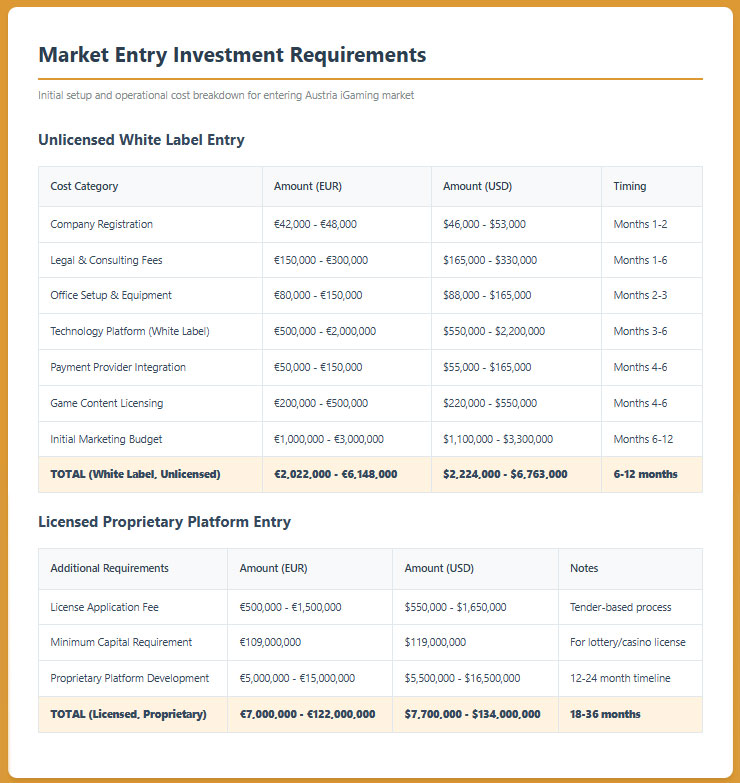
Market Entry Considerations
Recommended Entry Strategies
Current Market Reality (2025-2027): Aspiring operators face fundamental strategic choice: pursue licensed operation within the monopoly framework or accept unlicensed status serving Austrian players through international platforms. The monopoly structure severely constrains licensing opportunities, with the single online gambling license held by Österreichische Lotterien until September 30, 2027, and uncertain liberalization prospects despite industry advocacy.
Licensed Entry Strategy: For operators with €109+ million capital capacity and long-term Austrian market commitment, participating in the upcoming license tender (expected late 2025 or early 2026) represents the only legitimate path. Success requires:
- Building relationships with Austrian regulatory authorities and political stakeholders
- Demonstrating superior technical capabilities, player protection systems, and responsible gambling frameworks
- Preparing comprehensive tender applications with detailed business plans, financial projections, and operational commitments
- Securing political support for market liberalization through industry association participation (OVWG, EGBA)
- Patience for potentially years-long regulatory processes with uncertain outcomes
The realistic assessment suggests license acquisition faces formidable challenges. The coalition government’s 2025 program indicates preference for monopoly continuation rather than liberalization. Even if liberalization occurs, competition for limited licenses would be intense, with established European operators, international gaming giants, and potential Austrian consortiums competing for entry.
Unlicensed International Platform Strategy: Most international operators serve Austrian players through platforms licensed in Malta, Gibraltar, Curaçao, or Curacao, accepting the regulatory and legal risks inherent in this approach. This strategy involves:
- Operating from internationally recognized licensing jurisdiction with Austrian player acceptance
- Implementing robust age verification, KYC, and responsible gambling measures exceeding Austrian requirements
- Avoiding marketing activities within Austria while accepting organic player acquisition through comparison sites and word-of-mouth
- Maintaining segregated player funds and operating with established payment processors accepting international gambling merchants
- Preparing for potential domain blocking, payment restrictions, and player refund litigation
- Monitoring regulatory developments for potential enforcement escalation or liberalization opportunities
This approach dominates current market reality, with unlicensed operators capturing approximately 35% of online gambling market. However, risks include payment blocking, domain seizures, litigation exposure, and potential criminal liability for management. The player refund litigation trend creates substantial financial exposure, with operators required to refund player losses in Austrian court judgments.
Partnership and Acquisition Strategies: Strategic alternatives to organic entry include:
- Partnership with Österreichische Lotterien: Technology provision, platform development, or game content supply agreements could enable indirect Austrian market participation while the monopoly holder maintains regulatory compliance. However, the state-controlled operator shows limited interest in third-party partnerships.
- Regional betting operator partnerships: The five federal states permitting sports betting license multiple operators. Acquiring or partnering with regional betting operators could provide legitimate Austrian presence, though online capabilities and geographic scope remain limited.
- Acquisition of existing licensees: If liberalization occurs creating multi-operator market, acquiring licensed operators would accelerate market entry compared to license application processes. However, suitable acquisition targets are limited given the monopoly structure.
- B2B strategy: Providing gaming content, platform technology, payment processing, or other B2B services to licensed operators avoids direct regulatory exposure while participating in market growth. This represents lower-risk entry method suitable for technology and content providers.
White Label vs Proprietary Platform: Operators entering Austria must choose between white label partnerships with established platform providers or developing proprietary technology:
White Label Advantages:
- Faster market entry (3-6 months vs. 12-24 months for proprietary development)
- Lower initial capital investment (€500K-2M vs. €5-15M for proprietary platform)
- Proven technology stack with established reliability and feature sets
- Regulatory compliance support and established payment processing relationships
- Focus on marketing and customer acquisition rather than technology development
White Label Disadvantages:
- Revenue sharing typically 20-40% of NGR significantly impacts profitability
- Limited differentiation and customization capabilities
- Dependence on platform provider for critical systems and support
- Potential conflicts with provider’s other white label clients in same market
- Exit challenges as player database and platform belong to provider
Proprietary Platform Advantages:
- Complete control over technology roadmap and feature development
- 100% revenue retention without profit sharing
- Stronger competitive differentiation through unique features and experiences
- Valuable intellectual property asset supporting company valuation
- Flexibility in payment provider selection and commercial partnerships
Proprietary Platform Disadvantages:
- Substantial upfront investment €5-15M for production-ready platform
- Extended development timeline 12-24 months before market launch
- Technology risk and ongoing maintenance burden
- Recruiting and retaining specialized gambling platform development talent
- Regulatory certification requirements adding time and cost
Recommended Approach: For Austrian market specifically, white label entry provides optimal balance of speed, cost, and risk management. The uncertain regulatory environment and limited market size (€650M online gambling) justify white label’s lower capital commitment and faster deployment. Operators can transition to proprietary platforms if Austrian market success justifies investment, using white label period to establish brand presence and customer base.
Typical Costs and Timelines
| Cost Category | Amount (EUR) | Amount (USD) | Timing |
|---|---|---|---|
| Initial Setup Investments | |||
| Company Registration | €42,000 – €48,000 | $46,000 – $53,000 | Months 1-2 |
| Legal and Consulting Fees | €150,000 – €300,000 | $165,000 – $330,000 | Months 1-6 |
| License Application (if pursuing) | €500,000 – €1,500,000 | $550,000 – $1,650,000 | Months 3-18 |
| Initial Capital Requirement | €35,000 – €109,000,000 | $38,500 – $119,000,000 | Month 1 / License dependent |
| Office Setup and Equipment | €80,000 – €150,000 | $88,000 – $165,000 | Months 2-3 |
| Technology Platform (White Label) | €500,000 – €2,000,000 | $550,000 – $2,200,000 | Months 3-6 |
| Technology Platform (Proprietary) | €5,000,000 – €15,000,000 | $5,500,000 – $16,500,000 | Months 6-24 |
| Payment Provider Integration | €50,000 – €150,000 | $55,000 – $165,000 | Months 4-6 |
| Initial Game Content Licensing | €200,000 – €500,000 | $220,000 – $550,000 | Months 4-6 |
| Initial Marketing Budget | €1,000,000 – €3,000,000 | $1,100,000 – $3,300,000 | Months 6-12 |
| Total Initial Investment (White Label, Unlicensed) | €2,022,000 – €6,148,000 | $2,224,000 – $6,763,000 | 6-12 months |
| Total Initial Investment (Licensed, Proprietary) | €7,000,000 – €122,000,000 | $7,700,000 – $134,000,000 | 18-36 months |
| Expense Category | Monthly (EUR) | Annual (EUR) | Notes |
|---|---|---|---|
| Staff Salaries (15-25 employees) | €80,000 – €150,000 | €960,000 – €1,800,000 | Technology, compliance, customer service |
| Office Rent and Utilities | €5,000 – €12,000 | €60,000 – €144,000 | 200-400 sqm office space |
| Platform Maintenance (White Label) | €25,000 – €50,000 | €300,000 – €600,000 | 20-35% revenue share typically |
| Platform Maintenance (Proprietary) | €40,000 – €80,000 | €480,000 – €960,000 | Development team, hosting, infrastructure |
| Payment Processing Fees | €30,000 – €75,000 | €360,000 – €900,000 | 2.5-3.5% of deposits |
| Game Content Licensing | €40,000 – €100,000 | €480,000 – €1,200,000 | Revenue share or fixed fees |
| Marketing and Customer Acquisition | €150,000 – €400,000 | €1,800,000 – €4,800,000 | 25-40% of revenue typical |
| Compliance and Legal | €15,000 – €35,000 | €180,000 – €420,000 | Ongoing regulatory monitoring |
| Customer Support | €20,000 – €45,000 | €240,000 – €540,000 | 24/7 multilingual support |
| Insurance and Professional Services | €5,000 – €15,000 | €60,000 – €180,000 | D&O insurance, audit, accounting |
| Gambling Taxes (on GGR) | Variable | 40% online casino, 5% betting | Based on actual revenue |
| Total Monthly Operating Costs | €370,000 – €880,000 | €4,440,000 – €10,560,000 | Excluding gambling taxes |
Timeline Expectations:
- Company Registration: 3-5 weeks from initiation to operational entity with bank account and tax registrations
- License Application (if pursuing): 12-24 months from tender announcement to license award, with potential delays if legal challenges or political complications arise
- Platform Setup (White Label): 3-6 months including integration, payment provider setup, game content licensing, and testing
- Platform Development (Proprietary): 12-24 months for production-ready gambling platform with full feature set
- Marketing Preparation: 2-4 months developing brand identity, website, marketing materials, and affiliate network before launch
- Total Time to Market (Unlicensed, White Label): 6-9 months from decision to operational platform accepting players
- Total Time to Market (Licensed, Proprietary): 24-36 months accounting for license tender process and platform development
Resource Requirements:
Minimum Staff Headcount: A viable Austrian operation requires 15-25 employees across critical functions:
- Management: CEO/Managing Director, CFO, CMO (3 positions)
- Technology: CTO, developers, DevOps, QA testers (5-8 positions if proprietary platform)
- Compliance and Legal: Compliance Officer, AML Officer, Legal Counsel (3 positions)
- Customer Service: Service team with German fluency, 24/7 coverage (4-6 positions)
- Marketing: Marketing manager, content creators, affiliate managers, CRM specialists (4-5 positions)
- Finance and Operations: Accountant, financial controller, operations manager (3 positions)
Key Positions: The Compliance Officer and AML Officer represent mandatory positions under gambling regulations, requiring specialized knowledge and certifications. German-speaking customer service is non-negotiable for Austrian market success. Technology leadership determines platform quality and competitive positioning.
Technology Stack Requirements: Core gambling platform with certified random number generators, extensive game library (500+ titles minimum for competitive positioning), multiple payment processor integrations (minimum 5-8 methods), robust player account management and KYC systems, responsible gambling tools, reporting and analytics, mobile-responsive design or native applications, and live dealer gaming infrastructure.
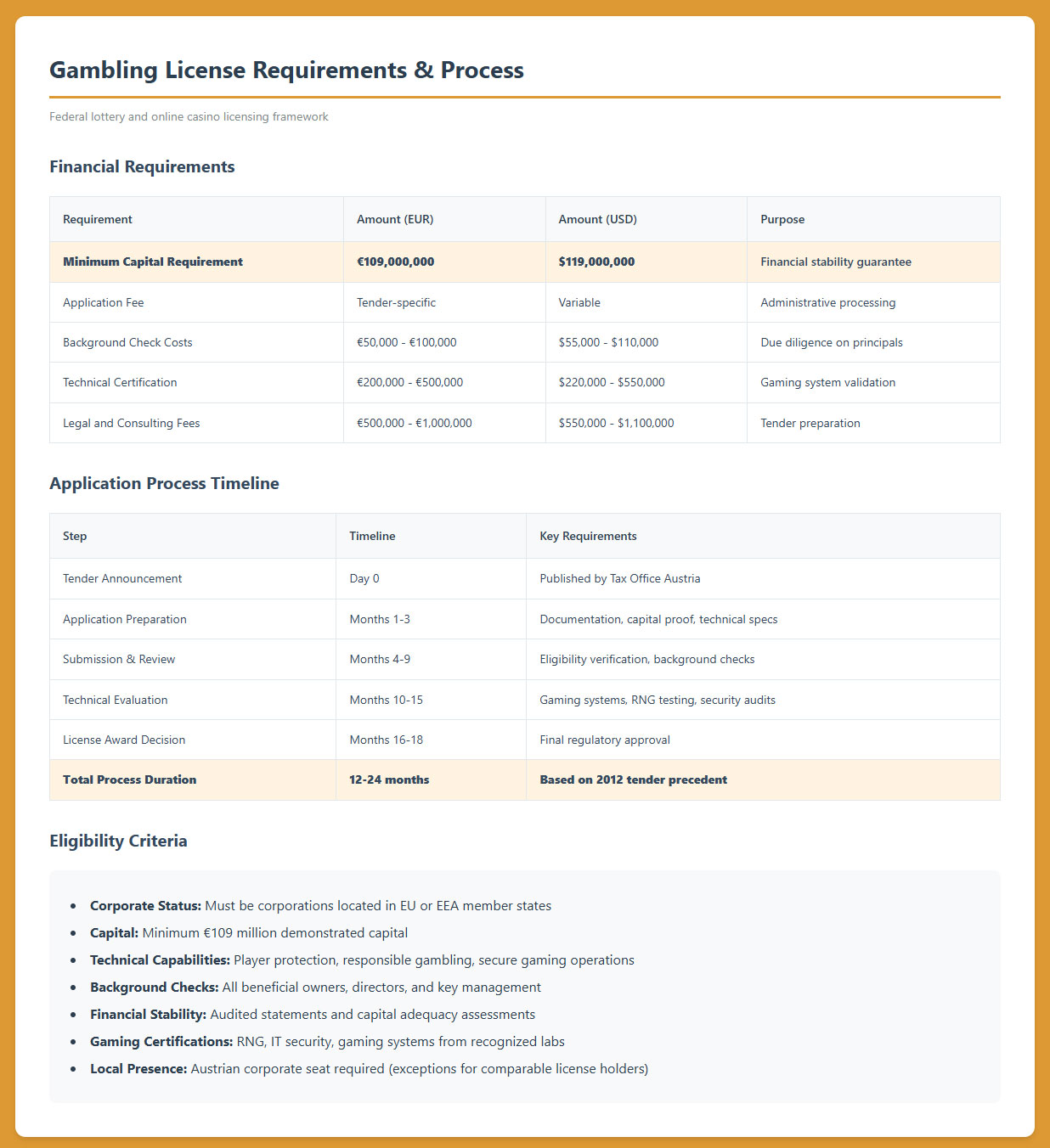
Success Factors and Challenges
Key Success Enablers:
- Local Player Preference Understanding: Austrian players favor Novomatic slots (“Book of Ra” franchise), live dealer games, and local sports betting markets. Operators must offer locally relevant content rather than generic international offerings.
- Localized Payment Methods: Supporting Austrian banking preferences including SEPA transfers, Sofortüberweisung, EPS, and popular e-wallets is mandatory. Payment method availability directly impacts conversion rates.
- Mobile-First Approach: With 65%+ of gambling sessions on mobile devices, operators must prioritize mobile user experience over desktop. Mobile optimization is not optional but fundamental to market success.
- German Language Excellence: Authentic Austrian German (not German German) in all customer communications, game descriptions, promotions, and support. Poor localization immediately signals foreign operation.
- Competitive Bonus Strategy: Austrian players respond to promotions but evaluate terms critically. Welcome bonuses around 100% up to €200-300 with reasonable wagering requirements (under 35x) perform optimally.
- Local Sports Coverage: Austrian Bundesliga football, ski racing, Red Bull sports properties, and ice hockey represent key betting markets that operators must cover comprehensively.
- Responsible Gambling Commitment: Proactive responsible gambling measures including deposit limits, reality checks, and self-exclusion build trust and prepare for potential regulatory requirements.
- Fast Withdrawal Processing: Austrian players expect withdrawals within 24-48 hours for e-wallets. Slow withdrawals generate complaints and player churn to competitors.
Major Operational Challenges:
- Regulatory Complexity and Uncertainty: The monopoly system’s questionable EU law compliance, pending reforms, and enforcement unpredictability create constant operational uncertainty. Regulatory changes can fundamentally alter business viability.
- High Taxation Burden: The 40% GGR tax on online casinos and 5% betting tax create challenging unit economics requiring scale to achieve profitability. Combined with 25% corporate income tax, effective tax rates exceed 55%.
- Payment Processing Restrictions: Increasing pressure on banks and payment processors to block unlicensed gambling creates operational challenges securing stable payment infrastructure. Backup payment providers are essential.
- Marketing Limitations: Advertising restrictions for unlicensed operators eliminate major customer acquisition channels including TV, radio, and mainstream online advertising. Operators must rely on SEO, affiliates, and word-of-mouth.
- Competition from Established Operators: The monopoly holder Win2Day and numerous international unlicensed operators create competitive market requiring differentiation and strong value propositions.
- Player Acquisition Costs: Limited marketing channels and competitive market drive customer acquisition costs to €150-300+ per depositing player, requiring substantial marketing budgets.
- Litigation Exposure: Player refund litigation creates financial risk, with Austrian courts ordering unlicensed operators to refund player losses. Setting aside litigation reserves (3-8% of revenue) is prudent.
- Talent Shortage: Limited local gambling industry expertise requires recruiting internationally or investing heavily in training. German language requirements constrain customer-facing hiring.
Cultural Considerations:
- Local Holidays and Peak Seasons: Christmas season (December) generates elevated gambling activity. Skiing season (January-March) creates sports betting opportunities. Summer (June-August) shows 15-20% activity decline.
- Popular Sports and Events: Austrian Bundesliga football, UEFA competitions, Formula 1 (Red Bull connection), FIS Alpine Ski World Cup, and ice hockey represent priority sports betting content.
- Preferred Customer Service Channels: Email and live chat dominate customer service preferences. Phone support remains important for older demographics. Response speed expectations are high with 4-hour maximum acceptable wait times.
- Communication Style: Formal business communication using “Sie” (formal you) is standard until invited to informal “du.” Direct, precise communication is valued over excessive marketing hyperbole.
- Trust-Building Requirements: Foreign brands face initial skepticism requiring consistent execution, prompt payments, responsive support, and visible responsible gambling commitment to build trust.
Exit Strategy Planning:
Market Liquidity for Operator Sales: Austrian gambling market liquidity is limited by regulatory uncertainty and monopoly structure. However, regional consolidation trends create acquisition interest from larger European operators. Typical exit multiples range 3-6x EBITDA depending on growth trajectory, regulatory status, and competitive position.
License Transferability: Austrian gambling licenses, if obtained, generally permit transfer subject to regulatory approval. Acquirers must demonstrate equivalent qualifications as original licensees including capital adequacy, technical capabilities, and management competence.
Process for Closing Operations: Voluntary closure requires player fund redemption, regulatory notifications, license surrender if applicable, and proper corporate dissolution following Austrian company law. Licensed operators face additional regulatory obligations ensuring player protection during wind-down.
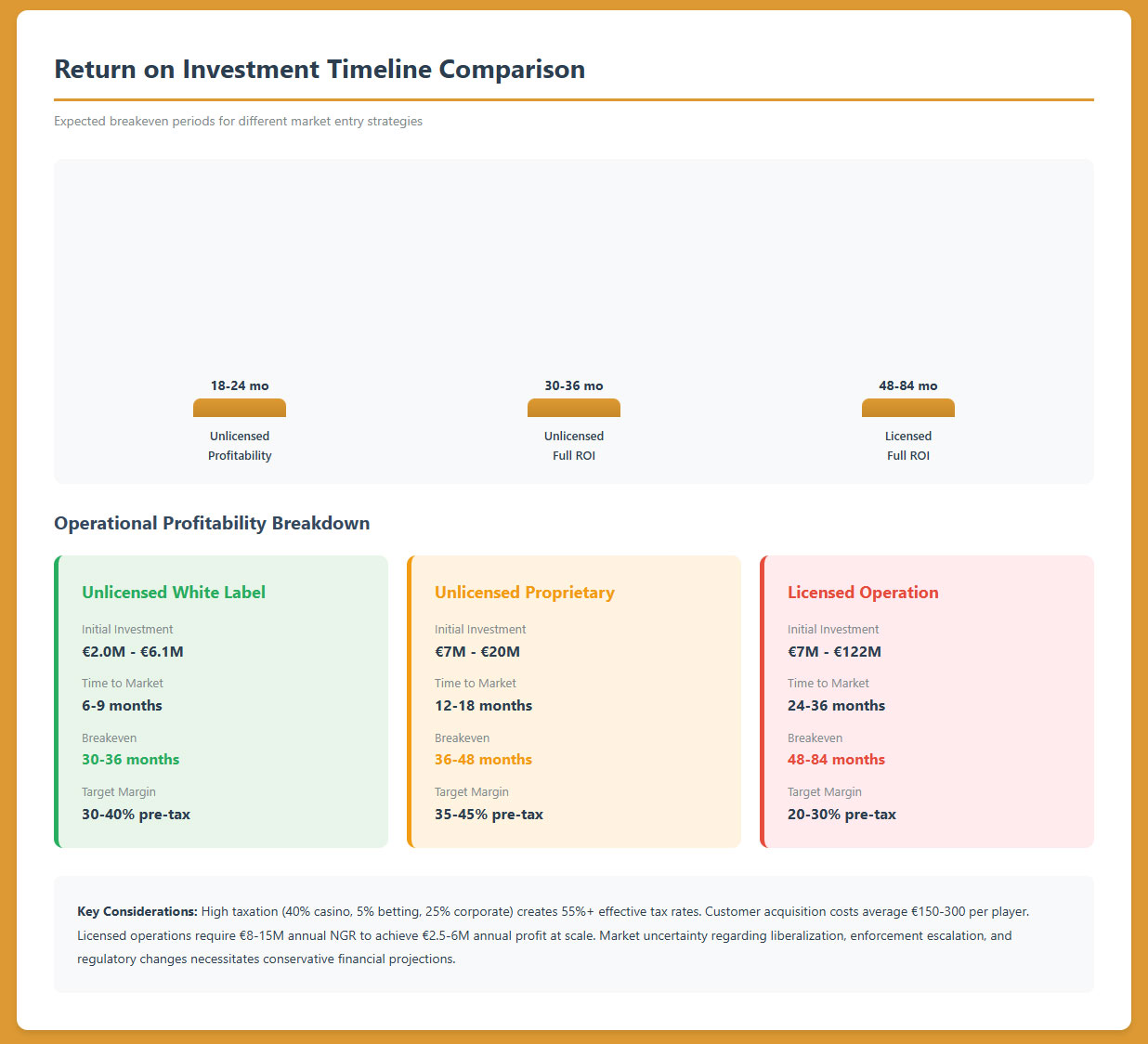
FAQ: Frequently Asked Questions
Legal & Licensing
1. Is online gambling legal in Austria?
Online gambling operates under a monopoly system in Austria, with only Österreichische Lotterien holding a valid online gambling license through its Win2Day platform. The license covers online casino games, sports betting, poker, and lottery products. Operating online gambling without this exclusive license is technically illegal under current Austrian law. However, numerous international operators serve Austrian players from overseas jurisdictions, creating a gray market situation. The monopoly structure faces ongoing EU law challenges regarding compatibility with internal market principles, and significant regulatory reform is expected between 2025-2027 when the current license expires.
2. What types of gambling licenses are available and what do they cover?
Austria offers several gambling license categories: (1) Federal Lottery License covering lotteries, electronic lotteries (online gambling), and Video Lottery Terminals – currently a single monopoly license held until September 2027; (2) Land-Based Casino Licenses permitting physical casino operations, with 15 licenses issued (12 held by Casinos Austria); (3) Sports Betting Licenses regulated at state level, with five of nine federal states permitting operations; (4) Gaming Machine Licenses for standalone slot operations outside casinos, also regulated by individual states. The federal government announced plans for potential market restructuring including possible establishment of an independent regulatory authority and multi-operator licensing, though implementation timelines remain uncertain.
3. How much does an iGaming license cost and how long does it take to obtain?
The costs and timeline for an Austrian iGaming license are substantial. The lottery/online gambling license requires minimum capital of €109 million, demonstrating financial stability. Application and tender preparation costs typically range €500,000-1,500,000 including legal fees, consulting, background checks, and technical certifications. The licensing process through public tender takes 12-24 months from tender announcement to license award, with the current monopoly license awarded in 2012 taking approximately 18 months to complete. However, as of 2025, no new licenses are available until the current monopoly expires September 30, 2027, with tender procedures expected to commence in late 2025 or early 2026. State-level sports betting licenses involve shorter timelines (3-6 months) and lower costs (€50,000-200,000) but limited geographic scope.
4. Can foreign companies obtain a gambling license?
Yes, foreign companies from EU/EEA member states can apply for Austrian gambling licenses on equal terms with domestic companies. The licensing requirements mandate that applicants be corporations located in EU or EEA member states. Successful foreign applicants with registered offices outside Austria must establish a corporate seat within Austria as a license condition, unless they already hold comparable licenses in their home jurisdiction subject to equivalent regulatory supervision with cooperation agreements between authorities. In such cases, maintaining mere local presence rather than full corporate establishment may suffice. Non-EU companies face additional barriers and may require Austrian subsidiaries or partnerships to meet eligibility requirements. Regardless of origin, all applicants must meet identical financial (€109M minimum capital), technical, and operational standards.
Financial & Taxation
5. What are the tax obligations for iGaming operators?
Austrian iGaming operators face multiple tax obligations creating a substantial fiscal burden. Online casino operators pay 40% tax on Gross Gaming Revenue (GGR), calculated as total stakes minus winnings paid to players. Sports betting operators pay 5% GGR tax (increased from 2% in April 2025). Land-based casinos pay 30% GGR tax. Additionally, operators pay 25% corporate income tax on net profits after deducting gambling taxes and operating expenses. Other obligations include 27.5% withholding tax on dividends paid to shareholders (subject to treaty reductions), social security contributions totaling 21.03% on employee wages, and mandatory contributions to problem gambling prevention programs (0.5-1% of GGR). The combined effective tax rate including gambling-specific taxes and corporate income tax can exceed 55% of gross revenues, positioning Austria among Europe’s highest-taxed gambling jurisdictions.
6. Are gambling winnings taxed for players?
No, gambling winnings are not taxed in Austria for recreational players. Austrian tax law recognizes seven specific income categories subject to taxation, and gambling winnings generally fall outside these categories, remaining tax-exempt. This favorable treatment makes Austria attractive for players and contributes to strong gambling participation rates. However, an important exception exists: if gambling becomes a person’s primary or substantial source of income, demonstrating professional gambling activity rather than recreational play, tax authorities may classify winnings as taxable business income subject to standard progressive income tax rates (up to 50%). Factors determining professional gambler status include gambling frequency, systematic approach, record-keeping practices, and proportion of total income derived from gambling. For the vast majority of players engaging in casual or regular recreational gambling, winnings remain completely tax-free with no reporting obligations.
7. What are the typical operational costs for running an online casino/sportsbook?
Operating an online gambling business in Austria requires substantial ongoing investment. Total monthly operational costs typically range €370,000-880,000 ($405,000-965,000) excluding gambling taxes, translating to annual operating expenses of €4.4-10.6 million. Major cost categories include: Staff salaries for 15-25 employees (€80,000-150,000 monthly); Marketing and customer acquisition representing the largest variable cost (€150,000-400,000 monthly, typically 25-40% of revenue); Platform costs either through white label revenue sharing (20-35% of NGR) or proprietary platform maintenance (€40,000-80,000 monthly); Payment processing fees (€30,000-75,000 monthly, approximately 2.5-3.5% of deposits); Game content licensing (€40,000-100,000 monthly); and Compliance, legal, and customer support (€40,000-95,000 monthly combined). Customer acquisition costs average €150-300 per depositing player, requiring significant marketing investment for growth. When adding gambling taxes (40% for online casino, 5% for betting), total operational costs including taxes typically consume 65-85% of gross gaming revenue.
8. What is the expected ROI timeline for entering this market?
Return on investment timelines for Austrian gambling market entry vary dramatically based on strategy and market conditions. Unlicensed international platform operations (lower investment, faster launch) typically achieve profitability within 18-24 months from launch, with breakeven on initial investment in 30-36 months. This assumes successful customer acquisition reaching 8,000-12,000 active players generating €150,000-300,000 monthly NGR after 24 months. Licensed operations (requiring substantially higher investment and longer development timelines) face extended ROI periods of 4-7 years from initial investment to full payback, reflecting the €7-122 million initial investment range. The high taxation (40% casino, 5% betting, 25% corporate), substantial customer acquisition costs (€150-300 per player), and competitive market pressure profitability. Operators should model 30-40% pre-tax profit margins on net gaming revenue at scale, requiring €8-15 million annual NGR to achieve €2.5-6 million annual profit. Market uncertainty regarding potential liberalization, enforcement escalation, or regulatory changes creates additional ROI risk requiring conservative financial projections with contingency planning.
Operations & Compliance
9. What are the local presence requirements for operators?
Austrian gambling regulations impose specific local presence requirements varying by license type. For the federal lottery/online gambling license, operators must establish a corporate seat in Austria (registered office and management presence) unless holding comparable licenses in their EU/EEA home jurisdiction with equivalent supervision and regulatory cooperation. In qualifying cases, mere local presence through representative offices may suffice. Land-based casino licenses naturally require physical presence at licensed venue locations. State-level sports betting licenses typically mandate local offices within the licensing state. Local presence requirements include maintaining German-speaking management personnel available for regulatory communications, Austrian bank accounts for player funds, and accessible offices for regulatory inspections. While minimum staffing requirements are not explicitly specified, operators typically maintain 15-25 employees in Austrian offices covering compliance, customer service, and key operational functions. Domain and hosting requirements do not mandate local servers, though data protection regulations require secure EU-based data storage and processing. For unlicensed international operators, no local presence is legally permitted for operational activities, though establishing Austrian entities creates domestic legal exposure.
10. What payment methods are available and recommended?
Austrian players expect comprehensive payment method availability reflecting their digital banking sophistication. Recommended payment methods include: (1) Credit/Debit Cards (Visa, Mastercard) – essential, 78% adoption, instant deposits; (2) SEPA Bank Transfers – 85% adoption, trusted for larger transactions, 1-2 day processing; (3) Instant Bank Transfers (Sofort, EPS) – popular for immediate play, 40% adoption; (4) E-Wallets – Skrill and Neteller essential for gambling (PayPal availability restricted), preferred by experienced players, instant processing; (5) Paysafecard – important for privacy-conscious players, cash-alternative, 18% usage; (6) Mobile Payment Apps (Apple Pay, Google Pay) – growing rapidly, particularly among younger demographics; (7) Bank-Specific Apps (ELBA-pay, George) – integrating local banking apps builds trust. Minimum recommended coverage: 5-8 payment methods spanning cards, bank transfers, and e-wallets. Average deposit sizes range €50-200, with withdrawals typically €200-1,000. Processing speed critically impacts satisfaction – players expect 24-48 hour withdrawal processing maximum for e-wallets, 2-3 days for cards, 3-5 days for bank transfers.
11. What are the advertising and marketing restrictions?
Austrian gambling advertising faces strict regulatory limitations. Licensed operators holding valid Austrian licenses may advertise across television, radio, online platforms, print media, and outdoor advertising, subject to responsible gambling standards. All advertising must avoid excessive promotion, cannot portray gambling as financial solution, must not appeal to minors, and must include responsible gambling messages and helpline information. Time restrictions prevent advertising during children’s programming. Unlicensed operators face complete advertising prohibition – the Glücksspielgesetz explicitly bans advertising or facilitating advertising for gambling services without valid Austrian licenses. This prohibition applies across all media channels including television, radio, online advertising, affiliate marketing, sports sponsorships, and outdoor advertising. Violations carry administrative penalties of €5,000-50,000 with potential criminal prosecution for serious infractions. Enforcement has intensified, with authorities pursuing media outlets, advertising platforms, and affiliate networks facilitating unlicensed gambling promotion. Payment processors and banks supporting unlicensed advertising face similar penalties. Practical implications: Unlicensed operators rely on SEO, affiliate networks operating outside Austria, word-of-mouth, and player comparison websites for customer acquisition, avoiding direct advertising in Austrian media.
12. What responsible gambling measures are mandatory?
Austrian gambling regulations mandate comprehensive responsible gambling frameworks including: (1) Age Verification – strict 18+ age limits with mandatory identification checks before gambling participation; (2) Self-Exclusion Systems – operators must maintain self-exclusion capabilities allowing temporary or permanent exclusion, integrated with national self-exclusion register; (3) Deposit and Loss Limits – systems enabling players to set daily, weekly, and monthly deposit and loss limits, with mandatory cooling-off periods before increasing limits; (4) Session Time Limits – reality checks and session duration tracking with warnings at predetermined intervals; (5) Mandatory Information Disclosure – clear presentation of game rules, odds, RTP percentages, responsible gambling resources, and terms and conditions in German; (6) Problem Gambling Identification – algorithm-based detection of risky gambling patterns triggering intervention measures; (7) Advertising Standards – responsible gambling messaging in all marketing communications; (8) Staff Training – comprehensive training for customer service personnel on problem gambling identification and intervention; (9) Financial Contributions – mandatory funding (0.5-1% GGR) for problem gambling prevention and treatment programs; (10) Helpline Integration – prominent display of national problem gambling helpline information across platforms. The Staff Unit for Addiction Prevention and Counselling within the Ministry of Finance provides regulatory oversight and guidance.
Market Opportunity
13. How large is the iGaming market and what is the growth potential?
Austria’s iGaming market represents a substantial opportunity within a mature, affluent European economy. The current online gambling market reached approximately €632 million ($692 million) in 2024, comprising €326 million in online casino revenue and €210 million in sports betting. Including estimated unlicensed operator revenue of €220 million, the total online gambling market approaches €850 million. The total gambling market (including land-based operations) stands at approximately $3.31 billion, with online representing 13% of total gambling spend – significantly below the 35-55% online penetration in liberalized European markets. Growth projections estimate the online market will expand to €777 million by 2029, reflecting a 4.22% CAGR. Active online gambling users are projected to grow from 785,000 in 2024 to 920,100 by 2029, representing 10% of Austria’s adult population. However, these conservative projections assume continuation of the monopoly structure. Potential market liberalization could accelerate growth substantially, with improved product quality, competitive pricing, and enhanced marketing driving online penetration toward European averages of 30-40% of total gambling spend. Under liberalization scenarios, the online market could reach €1.2-1.5 billion by 2030, representing 50-90% upside from current trajectory.
14. Who are the main competitors and what is their market share?
The Austrian online gambling market features unusual competitive dynamics due to the monopoly structure. Licensed monopoly operator: Österreichische Lotterien / Win2Day holds the exclusive legal online gambling license, generating €1.48 billion GGR in 2023 (€946.8M lotteries, €304.5M casinos). However, despite legal exclusivity, Win2Day captures only approximately 30% of the online gambling market, demonstrating fundamental monopoly failure. Unlicensed international operators collectively capture an estimated 35% market share (approximately €220 million), with major European brands serving Austrian players through Malta, Gibraltar, Curaçao, and other licensing jurisdictions. These operators offer superior product variety, promotional offers, user experience, and odds compared to the monopoly platform. Major international brands active in Austria include leading European betting and casino operators (names withheld to avoid promoting unlicensed operations), offering German-language interfaces, EUR currency, Austrian payment methods, and targeted local marketing. The remaining 35% of potential online gambling demand remains unmet, with players either using land-based alternatives, not gambling, or counted in unmeasured gray market segments. Land-based competition includes Casinos Austria (12 casino properties) and regional sports betting operators in five federal states. Market concentration remains extremely high with effective monopoly in licensed segment but fragmented in gray market unlicensed operations.
15. What are the player preferences and typical spending patterns?
Austrian gambling preferences reflect the country’s mature market characteristics and cultural influences. Game preferences: Online slots dominate casino play (55% of casino revenue), particularly Novomatic titles including “Book of Ra” franchise enjoying strong local brand recognition. Live dealer games show rapid growth (25% of online casino revenue) appealing to players seeking social interaction and perceived fairness through visible dealing. Sports betting focuses primarily on football (Austrian Bundesliga, German Bundesliga, UEFA competitions, Formula 1) and winter sports (skiing, ski jumping). Poker maintains steady niche (5-7% participation), with tournament poker more popular than cash games. Typical spending patterns: Active Austrian gamblers spend an average of €890-1,200 annually across all gambling formats. Online players deposit €150-300 monthly, with 3-5 deposits per month averaging €75-150 each. High-value players (top 10%) average €5,000-15,000 annual spending, generating 55-60% of total revenue. Betting behavior: Conservative bet sizing dominates – slots average €0.50-2.00 per spin, table game hands €5-25, sports bets €10-50. Austrian players prefer extended entertainment duration over high-risk strategies. Platform preferences: Mobile devices account for 65% of sessions, with younger players (18-34) reaching 80% mobile usage. Desktop remains relevant for older players (55+) at 55% of sessions. Session patterns: Average sessions last 35-45 minutes for casino games, 55-75 minutes for sports betting. Peak activity occurs weekday evenings 7-11 PM and weekend afternoons/evenings. Retention and loyalty: Six-month retention rates reach 45-55% for quality operators, with 12-month retention at 30-38%. Sports betting shows highest retention (50-60%) driven by seasonal sports calendars. Bonus sensitivity: 70-80% of acquisitions occur through bonuses, with 100% deposit matches up to €200-300 generating optimal response. Players demonstrate sophistication evaluating wagering requirements, rejecting terms above 40x.
16. What are the key success factors and main challenges for new entrants?
Critical success factors for Austrian market entry include: (1) Regulatory navigation – deep understanding of monopoly structure, EU law implications, and pending reforms; either pursuing license acquisition or accepting calculated unlicensed operation risks; (2) Localization excellence – authentic Austrian German language, culturally relevant content (Novomatic slots, local sports), localized payment methods, and understanding of Austrian consumer preferences; (3) Mobile-first execution – given 65% mobile usage, exceptional mobile user experience is mandatory for competitive positioning; (4) Payment infrastructure resilience – securing stable payment processing despite regulatory pressure on banks and processors to block unlicensed gambling; (5) Efficient customer acquisition – developing cost-effective acquisition strategies given advertising restrictions and high CAC (€150-300 per player); (6) Operational excellence – fast withdrawal processing (24-48 hours), responsive German-language customer service, and strong responsible gambling framework; (7) Financial resilience – adequate capitalization to sustain 18-24 month ramp-up period before profitability, with reserves for litigation exposure and regulatory changes. Major challenges include: (1) Regulatory uncertainty – monopoly structure’s questionable EU law compliance, unpredictable enforcement, pending reforms creating constant uncertainty; (2) Prohibitive taxation – 40% casino GGR tax, 5% betting tax, 25% corporate income tax creating >55% effective tax rates requiring substantial scale for profitability; (3) Payment restrictions – increasing blocking of unlicensed gambling transactions by banks and processors; (4) Marketing constraints – complete advertising prohibition for unlicensed operators eliminating major acquisition channels; (5) Litigation exposure – player refund litigation trend creating 3-8% revenue exposure for unlicensed operators; (6) Competition intensity – Win2Day monopoly plus numerous international unlicensed operators creating fragmented, competitive market; (7) Economic headwinds – Austria’s 2025 recession (-0.3% GDP), high inflation, and constrained consumer spending pressuring discretionary entertainment budgets. Success requires exceptional execution across all operational dimensions combined with strategic patience and risk tolerance.
Conclusion: Austria presents a complex, high-stakes opportunity for iGaming operators in 2025-2027. The market combines attractive fundamentals – affluent population with €58,669 GDP per capita, exceptional digital infrastructure with 95.3% internet penetration, mature gambling culture with 55-60% adult participation, and substantial market size approaching €650 million online – with formidable challenges including monopoly regulatory structure, prohibitive 40% casino taxation, comprehensive advertising restrictions, payment processing barriers, and litigation exposure. The upcoming license tender and potential regulatory liberalization create both opportunity and uncertainty, with 2025-2027 representing a critical transition period that could fundamentally reshape market access. Operators must carefully weigh the Austrian market’s attractive demographics and infrastructure against regulatory, financial, and operational challenges, developing entry strategies aligned with risk tolerance, capital capacity, and long-term regional ambitions. Success demands localization excellence, regulatory sophistication, operational resilience, and strategic patience navigating one of Europe’s most challenging yet potentially rewarding gambling markets.
🎯 Gambling Databases Country Rating: Austria
| Evaluation Dimension | Score | Rating |
|---|---|---|
| Operator Ease Score | 2.1/10 | ⛔️ Prohibitive |
| Player Access Score | 4.8/10 | 🟡 Partially Legal |
| Overall Market Attractiveness | 3.5/10 | 🔴 High Risk, Extremely Difficult Entry |
This rating is calculated using the Gambling Databases Rating (GDR) methodology, which provides transparent criteria for evaluating iGaming markets worldwide. Click the link to learn how we calculate Operator Ease Score, Player Access Score, and overall market attractiveness ratings.
⚠️ CRITICAL RISK WARNINGS
READ THIS BEFORE CONSIDERING MARKET ENTRY:
- COMPLETE ONLINE CASINO MONOPOLY: Online casino gaming, poker, and lotteries are subject to an EXCLUSIVE STATE MONOPOLY held by Österreichische Lotterien (Win2Day platform) until September 30, 2027. All other operators are operating ILLEGALLY under Austrian law.
- SYSTEMATIC PLAYER REFUND LITIGATION: Austrian courts consistently order unlicensed operators to refund ALL player losses. Players supported by litigation funders are systematically pursuing refund claims. This creates 3-8% revenue exposure for unlicensed operators.
- EXTREME TAXATION BURDEN: Licensed operators face 40% GGR tax on online casinos, 5% on sports betting (increased April 2025), PLUS 25% corporate income tax. Total effective tax rate exceeds 55-60% of gross revenue.
- PAYMENT BLOCKING INTENSIFYING: Government actively pressures banks and payment processors to block transactions to unlicensed operators. ISP blocking and DNS restrictions announced as “decisive” enforcement measures for 2025-2027.
- COMPLETE ADVERTISING BAN FOR UNLICENSED OPERATORS: Advertising unlicensed gambling services is EXPLICITLY ILLEGAL under Glücksspielgesetz. Fines range €5,000-50,000. Enforcement targets media outlets, advertising platforms, and affiliate networks.
- AFFILIATE AND INFLUENCER PROSECUTION RISK: Authorities pursue affiliates and marketers promoting unlicensed gambling. Payment processor termination and legal action against intermediaries.
- LICENSING UNAVAILABLE UNTIL 2027: The monopoly license doesn’t expire until September 30, 2027. NO licenses available before then. Tender expected late 2025/early 2026, but coalition government signals monopoly continuation rather than liberalization.
- €109 MILLION MINIMUM CAPITAL REQUIREMENT: License applications require demonstrating €109 million ($119 million) in capital adequacy. Application costs alone: €500,000-1,500,000.
- EXTRADITION TREATIES: Austria maintains extradition agreements with USA, UK, all EU members, and Canada. International prosecution possible for serious gambling violations, though rarely pursued for gambling-only offenses.
📊 Operator Ease Score Breakdown
| Criterion | Weight | Score | Justification (INCLUDING ALL DEDUCTIONS) |
|---|---|---|---|
| Legal & Regulatory Framework | 30% | 0.0/3.0 | Started at 0 points (illegal/monopoly). Sports betting state-regulated (+1.5 for partial legality). Online casino/poker/lottery COMPLETE MONOPOLY (-1.5 points, eliminates 60% of potential revenue). Active payment blocking and enforcement (-0.5 points). Systematic player refund litigation creating operator liability (-0.5 points). Advertising ban with active enforcement against affiliates (-0.5 points). Coalition government 2025 program indicates monopoly continuation, not liberalization (-0.5 points). Final: 0.0/3.0 due to monopoly structure with no current licensing pathway. |
| Licensing Process | 25% | 0.25/2.5 | No licensing currently available (0 points baseline). Single monopoly license expires Sept 2027, tender expected late 2025/early 2026 (+0.5 for theoretical future availability). Application costs €500,000-1,500,000 for preparation alone (-0.25 points for costs exceeding €500k total). €109 million minimum capital requirement (-0.5 points for extreme capital barrier). 12-24 month tender timeline, extremely limited licensing (only 1-2 licenses maximum even if liberalized) (-0.25 points). Complex EU/EEA corporation requirements and extensive probity checks (-0.25 points). Coalition signals monopoly continuation rather than multi-operator licensing (-0.25 points). Final: 0.25/2.5 – essentially no viable licensing pathway for new entrants until at least 2027. |
| Taxation & Costs | 20% | 0.25/2.0 | Online casino 40% GGR tax = 0 points (over 45% threshold). Sports betting 5% GGR would normally score well, but combined with other factors (+0.5 baseline for betting). Multiple tax layers: 40% GGR + 25% corporate income tax creates 55-60% total effective rate (-1.0 point for exceeding 50%). Mandatory problem gambling contributions 0.5-1% GGR (-0.25 points as additional tax layer). High operational costs in Vienna: €15-25/sqm office rent, €40,000-75,000 annual salaries, total monthly costs €370,000-880,000 (-0.5 points for costs exceeding €500k monthly at scale). Customer acquisition costs €150-300 per player due to advertising restrictions (-0.5 points for extreme CAC). Final: 0.25/2.0 – taxation and cost structure makes profitability extremely challenging even at scale. |
| Operational Requirements | 15% | 0.75/1.5 | Moderate requirements baseline (+1.0 for licensed operators: local office required, but remote operation possible for some functions). €109 million capital requirement held/demonstrated (-0.25 points). Mandatory local director or equivalent management presence (-0.25 points). No explicit credit card ban for licensed operators, but increasing payment restrictions (+0 neutral). Cryptocurrency regulatory uncertainty, not explicitly banned but monopoly doesn’t accept (-0.25 points). Complex federal + 9 state regulatory structure for comprehensive coverage (-0.25 points). Extensive KYC/AML requirements, national self-exclusion integration, responsible gambling systems (-0.25 points for compliance burden). Final: 0.75/1.5 – operational requirements substantial but manageable IF licensed. |
| Market Environment | 10% | 0.2/1.0 | Austria ranks 27th globally on Ease of Doing Business (+0.5 for ranking 21-50). Complete advertising ban for unlicensed operators (-0.5 points for severe restrictions). Systematic enforcement against offshore operators including domain blocking, payment blocking, affiliate prosecution (-0.25 points). Player refund litigation trend creating hostile environment (-0.25 points). Regulatory instability: monopoly structure challenged repeatedly in courts, pending reform unclear, coalition government 2025-2029 signals continued restrictions (-0.25 points). Conflict of interest: Ministry of Finance simultaneously regulator, tax collector, license grantor, AND shareholder in monopoly operators (-0.25 points). Economic recession 2025 (-0.3% GDP growth) (-0.25 points). Final: 0.2/1.0 – one of Europe’s most hostile markets for unlicensed operators. |
👥 Player Access Score Breakdown
| Criterion | Weight | Score | Justification (INCLUDING ALL DEDUCTIONS) |
|---|---|---|---|
| Legal Status for Players | 40% | 2.0/4.0 | Partially legal status (+2.0 points baseline): Sports betting legal through state-licensed operators in 5 of 9 federal states. Land-based casinos fully legal (12 licensed properties). Lottery fully legal and accessible. Online casino/poker PROHIBITED except through Win2Day monopoly (-1.5 points for major product prohibition eliminating player choice). Players using offshore sites face NO criminal penalties (+0.5 points), but face civil liability through refund litigation that benefits players financially (+0 neutral, actually helps players recover losses). Grey market participation estimated at 35% of online gambling market shows widespread player usage despite legal restrictions. Final: 2.0/4.0 – players can legally access sports betting and lotteries, but online casino choice severely restricted. |
| Practical Accessibility | 30% | 1.75/3.0 | Some payment methods available, increasing blocking (+2.0 baseline). Credit cards (78% adoption) and debit cards (92% adoption) functional for licensed operators and many unlicensed operators (+0 neutral). E-wallets (Skrill/Neteller 42% adoption) remain accessible, though PayPal restricts gambling (-0.25 points). Bank transfers (85% adoption) working but under pressure (-0.25 points). ISP blocking active but limited effectiveness – government announced “decisive” measures for 2025-2027 (-0.5 points for escalating blocking). Cryptocurrency uncertain/restricted, monopoly doesn’t accept, regulatory status unclear (-0.25 points). Payment processor pressure intensifying with banks and processors terminating gambling merchant relationships (-0.5 points). VPN not strictly required currently but may become necessary as blocking intensifies (-0.25 points precautionary). Final: 1.75/3.0 – payments currently functional but deteriorating environment. |
| Player Penalties | 20% | 2.0/2.0 | No penalties for players (+2.0 points). Austrian law does NOT criminalize or penalize players for using unlicensed gambling sites. Enforcement targets operators and intermediaries, not consumers. Players actually BENEFIT from unlicensed operator usage through refund litigation – Austrian courts order operators to refund player losses, creating financial recovery mechanism. No fines, no administrative warnings, no criminal liability for players. Final: 2.0/2.0 – Austria is player-friendly from penalty perspective, even enabling loss recovery. |
| Market Availability | 10% | 0.5/1.0 | Single licensed online operator (Win2Day monopoly) for casino/poker/lottery (+0.5 points for 1 operator). Multiple state-licensed sports betting operators in 5 federal states (+0.2 points). However, Win2Day captures only 30% market share despite legal monopoly, demonstrating inadequate product quality, variety, and competitiveness (-0.2 points). International unlicensed operators serve 35% of market, providing de facto availability but with legal uncertainty and increasing blocking risks (+0 neutral, already counted in accessibility). 12 land-based casinos provide physical gambling access (+0 neutral, separate category). Final: 0.5/1.0 – legally only one operator, practically multiple options but increasing risk. |
🔍 Key Highlights
Strengths (Limited)
- Affluent Player Base: GDP per capita €58,669 ($64,345) ranks 13th globally, creating players with substantial disposable income for entertainment spending (€890-1,200 annual average per active gambler)
- Exceptional Digital Infrastructure: 95.3% internet penetration, 147% mobile connections per capita, 82.72 Mbps median fixed broadband, 5G covering 100% population – eliminates all technology barriers
- High Digital Literacy: 82% digital banking adoption, 75% e-commerce participation, 78% of adults with basic digital competencies – players comfortable with online transactions
- Universal Banking Access: 98% banked population, comprehensive payment method availability including cards (92% debit, 45% credit), SEPA transfers (85%), e-wallets (42%)
- Strong Gambling Culture: 55-60% adult gambling participation annually, lottery engagement 45-50%, mature market with cultural acceptance of responsible gambling
- No Player Taxation: Gambling winnings completely tax-free for recreational players, unlike many European jurisdictions
- Large Addressable Market: 9.1 million population, online gambling market €632 million in 2024 growing to projected €777 million by 2029, with substantial grey market adding €220 million
- No Criminal Penalties for Players: Players face zero legal risk using unlicensed sites, even benefiting from refund litigation enabling loss recovery
⛔️ CRITICAL RISKS AND CHALLENGES
- [State Monopoly Structure:] Online casino, poker, and lottery subject to EXCLUSIVE monopoly held by government-owned Österreichische Lotterien until September 2027. No licensing available for competitors. Monopoly captures only 30% market share, demonstrating failure but maintained for government revenue and control.
- [Systematic Legal Action Against Unlicensed Operators:] Austrian courts consistently rule contracts with unlicensed operators void, ordering full refund of player losses. Litigation funders support players in systematic refund claims creating 3-8% revenue exposure. Malta amended laws to block enforcement of Austrian judgments, triggering EU infringement proceedings – ongoing legal uncertainty.
- [Prohibitive Taxation Crushing Profitability:] Licensed operators face 40% GGR tax on online casinos (highest in Europe), 5% GGR on sports betting (increased April 2025 from 2%), PLUS 25% corporate income tax. Total effective tax rate 55-60% of gross revenue. Coalition government announced additional 10% gambling tax increase for 2025-2027. Only viable for operators achieving massive scale €8-15 million+ annual NGR.
- [Payment Infrastructure Under Attack:] Government actively pressures banks and payment processors to block unlicensed gambling transactions. Visa/Mastercard enforce gambling merchant category code restrictions requiring valid local licensing. Coalition 2025-2029 program pledges “decisive” payment blocking measures. Operators face payment processor termination risk, requiring multiple backup providers.
- [Complete Advertising Prohibition:] Glücksspielgesetz explicitly bans advertising unlicensed gambling services across ALL media channels – TV, radio, online, print, outdoor, affiliate marketing, sports sponsorships. Violations: €5,000-50,000 administrative fines, potential criminal prosecution. Enforcement targets media outlets, ad networks, affiliates, creating €150-300 customer acquisition costs through limited SEO/comparison sites.
- [Affiliate and Intermediary Prosecution:] Austrian authorities pursue legal action against affiliates, influencers, advertisers, and marketing intermediaries promoting unlicensed gambling. Payment processors supporting affiliate commissions face termination and penalties. Creates substantial operational risk for affiliate-dependent business models.
- [No Licensing Pathway Until 2027 Minimum:] Current monopoly expires September 30, 2027. Tender expected late 2025/early 2026 but coalition government signals monopoly continuation rather than multi-operator liberalization despite industry advocacy. Even IF liberalization occurs, extremely limited licenses (1-3 maximum) with €109 million capital requirement and €500k-1.5M application costs. 24-36 month timeline from tender to operation.
- [DNS and ISP Blocking Escalating:] Government announced “decisive” enforcement against illegal gambling through domain blocking and IP blocking. While currently limited effectiveness (players use VPNs, mirror sites), infrastructure being established for comprehensive blocking similar to Germany. Operators face constant domain seizure and blocking list additions.
- [Regulatory Uncertainty and Reform Risk:] Pending regulatory reform 2025-2027 creates massive uncertainty. Potential outcomes: (1) monopoly renewal crushing any liberalization hope, (2) limited multi-operator licensing with extreme competition for few slots, (3) comprehensive liberalization (unlikely based on coalition signals). Impossible to plan long-term market strategy.
- [Economic Headwinds:] Austria entering recession: -0.3% GDP growth 2025, following -1.0% (2023) and -1.2% (2024). Inflation 3.3% Q1 2025. Real disposable income declining 2023-2024. Consumer discretionary spending constrained, directly impacting entertainment budgets including gambling.
- [Hostile Business Environment for Gambling:] Ministry of Finance conflict of interest: simultaneously regulator, tax collector, license grantor, AND shareholder in monopoly operators. Courts consistently uphold monopoly despite EU law challenges. Independent regulatory authority proposed but not yet implemented. Political will favors restriction over liberalization.
- [Operational Cost Burden:] Vienna operational costs extreme: €15-25/sqm office rent, €40,000-75,000 annual professional salaries, total monthly operating costs €370,000-880,000 at scale. High costs combined with extreme taxation require €8-15 million annual NGR just to achieve breakeven, eliminating viability for small/medium operators.
- [Competition from Established Players:] Win2Day monopoly has first-mover advantage, government backing, exclusive legal advertising rights, and brand recognition despite poor product. Numerous international unlicensed operators with superior products, established player bases, and mature operational infrastructure. New entrants face entrenched competition.
- [Litigation and Chargeback Exposure:] Beyond player refund litigation (3-8% revenue), unlicensed operators face elevated chargeback risk (3-8% of transactions) as players dispute charges claiming illegal services. Banks favor consumers in disputes. Financial exposure compounds across multiple legal/financial attack vectors.
Player-Specific Issues
- Limited Legal Casino Choice: Players restricted to single Win2Day platform for online casino and poker, which captures only 30% market share indicating player dissatisfaction with product quality, game variety, bonuses, and user experience
- Regional Sports Betting Restrictions: Only 5 of 9 federal states permit licensed sports betting, creating uneven legal access across country (4 federal states have no legal betting options)
- Increasing ISP Blocking: Government escalating domain and IP blocking of unlicensed offshore sites. Players increasingly require VPNs or technical workarounds to access preferred international platforms
- Payment Method Restrictions: Banks under regulatory pressure to block gambling transactions to unlicensed operators. Players face transaction declines and payment method limitations when using international sites
- Cryptocurrency Uncertainty: Win2Day monopoly doesn’t accept cryptocurrency. Regulatory status unclear for crypto gambling. Tech-savvy players seeking crypto gambling forced to unlicensed international operators with legal uncertainty
- Refund Litigation Complexity: While players benefit financially from ability to recover losses from unlicensed operators, litigation process requires legal representation, time investment, and uncertainty regarding international judgment enforcement
💰 Reality Check: Can You Actually Make Money Here?
Initial Investment Required (Unlicensed White Label Model): €2.0-6.2 million ($2.2-6.8 million) including company registration, platform setup, payment integration, initial game licensing, and 6-month marketing budget. Does NOT include license costs as licensing unavailable.
Initial Investment Required (Licensed Operation – IF Possible): €7-122 million ($7.7-134 million) depending on proprietary vs white label platform, including €109 million capital requirement, application costs €500k-1.5M, platform development, and setup costs.
Monthly Operating Costs: €370,000-880,000 ($405,000-965,000) including staff (€80-150k), marketing (€150-400k), platform (€25-80k), payments (€30-75k), content (€40-100k), and compliance (€15-35k). EXCLUDES gambling taxes.
Effective Tax Rate on Revenue: Licensed operators: 55-60% total (40% online casino GGR + 25% corporate income tax on remaining profit). Sports betting: approximately 28% total (5% GGR + 25% corporate on remaining). Unlicensed operators: 0% Austrian taxes BUT 3-8% litigation/refund exposure creates equivalent economic burden.
Customer Acquisition Cost: €150-300 per depositing player due to complete advertising ban forcing reliance on SEO, affiliate networks (facing prosecution risk), and word-of-mouth. Among highest CAC in Europe.
Revenue Required for Breakeven: Unlicensed operator needs approximately €5-8 million annual GGR to cover €4.4-10.6 million operating costs plus litigation reserves. Licensed operator needs €12-20 million annual GGR to cover operating costs PLUS 40-55% tax burden.
Time to Breakeven: Unlicensed operation: 18-24 months assuming successful player acquisition reaching 8,000-12,000 active players. Licensed operation: 36-48 months due to higher investment and tax burden requiring greater scale.
Time to Positive ROI: Unlicensed: 30-36 months to recover €2-6M initial investment. Licensed: 4-7 YEARS to recover €7-122M investment – assumes successful scaling, no major regulatory changes, sustained profitability.
Profitability Assessment: Economics are PROHIBITIVE for most operators and EXTREMELY CHALLENGING even for well-capitalized companies. The combination of 40% GGR tax (licensed), 55-60% total effective tax rate, €150-300 CAC, €370-880k monthly operating costs, 3-8% litigation exposure (unlicensed), payment blocking risks, and advertising prohibition creates one of Europe’s most hostile profitability environments. Unlicensed operation faces lower tax burden but massive legal/operational risks offsetting savings. Licensed operation faces taxation so extreme that only operators achieving €15-30 million+ annual GGR can sustain profitability. The monopoly structure compounds challenges by enabling Win2Day to capture advertising, sponsorship, and mainstream customer acquisition channels. BOTTOM LINE: This market is only viable for operators with (1) €10M+ capital, (2) 5-7 year investment horizon, (3) tolerance for extreme regulatory/legal risk, and (4) capability to achieve top-5 market position. Small and medium operators should avoid entirely.
⚖️ Legal Risk Assessment
| Stakeholder Type | Risk Level | Specific Risks |
|---|---|---|
| Offshore Casino Operators (Unlicensed) | 🔴 CRITICAL | Systematic player refund litigation (3-8% revenue exposure), domain and ISP blocking escalating, payment processor blocking and merchant account termination, administrative fines €22,000+ per incident, advertising prohibition with €5,000-50,000 penalties, potential criminal prosecution for organized illegal gambling (rare but possible), Malta judgment blocking creating EU legal conflict, chargeback exposure 3-8% of transactions, travel risk to Austria/extradition treaties with EU/US/UK/Canada though rarely enforced for gambling-only offenses |
| Licensed Operators (Sports Betting State-Level) | 🟡 MEDIUM | Regional/federal regulatory complexity across 9 states, 5% GGR tax burden (increased April 2025), 25% corporate income tax, strict advertising content restrictions, mandatory responsible gambling contributions 0.5-1% GGR, payment method limitations, competition from monopoly holder’s advertising advantages, multi-jurisdictional compliance burden, license renewal uncertainty, potential tax increases announced in coalition program |
| Affiliates/Advertisers (Unlicensed Casino Promotion) | 🔴 CRITICAL | EXPLICIT legal prohibition under Glücksspielgesetz on advertising/facilitating unlicensed gambling, administrative fines €5,000-50,000 per violation, potential criminal prosecution for systematic facilitation, payment processor termination for affiliate commissions, domain blocking for affiliate sites, prosecution precedents against media outlets and ad networks, liability extending to advertising platforms and publishers, banks pressured to block affiliate payment flows, essentially ILLEGAL to operate affiliate business promoting unlicensed gambling in/targeting Austria |
| Payment Processors | 🔴 HIGH | Regulatory pressure from Ministry of Finance to block unlicensed gambling transactions, administrative penalties for knowingly facilitating illegal gambling, Visa/Mastercard merchant category code restrictions requiring local licensing verification, license revocation risk for payment service providers, liability for processing illegal gambling payments, government cooperation demands for transaction monitoring, international card network compliance requirements, banking relationship termination risk |
| Company Directors/Executives | 🟡 MEDIUM-HIGH | Personal liability for corporate violations under Austrian law, potential criminal prosecution for organized illegal gambling operations (6 months imprisonment possible, rarely enforced), travel risk to Austria and EU countries with enforcement cooperation, extradition risk from non-EU countries with treaties (USA, UK, Canada) though rarely pursued for gambling offenses only, reputational damage from legal proceedings, asset seizure for unpaid fines and judgments, difficulty securing banking/business relationships due to gambling involvement |
| Players | 🟢 MINIMAL | ZERO criminal or administrative penalties for players using unlicensed sites, no fines or legal consequences, players actually BENEFIT from legal environment through refund litigation enabling loss recovery from unlicensed operators, Austrian courts consistently support player refund claims, only risk is potential payment transaction declines as blocking intensifies and temporary site access issues from ISP blocking (easily circumvented via VPN) |
🚨 Extradition and International Enforcement
Extradition Treaties: Austria maintains comprehensive extradition agreements with: All 26 EU member states (European Arrest Warrant system), United Kingdom (post-Brexit bilateral agreement maintained), United States of America (bilateral treaty since 1998), Canada (bilateral treaty), Switzerland, Norway, Iceland (EEA agreements), Australia, New Zealand, Japan, South Korea, and numerous other countries through multilateral conventions. Total extradition treaty network covers 90+ countries.
Gambling-Specific Extradition Risk Assessment: While Austria has extensive extradition treaty network, extradition requests for gambling offenses are EXTREMELY RARE and historically limited to cases involving: (1) large-scale organized crime with gambling as component of broader criminal enterprise, (2) money laundering or fraud charges where gambling operation was vehicle, (3) tax evasion exceeding significant thresholds. Pure gambling regulatory violations (operating without Austrian license) have NOT triggered extradition requests in documented cases. However, systematic unlicensed gambling operation combined with refusal to comply with court judgments, payment blocking circumvention, and advertising prohibition violations COULD theoretically escalate to criminal charges justifying extradition under “organized crime” classifications. Practical risk: LOW for gambling-only offenses, MEDIUM if combined with financial crimes, money laundering allegations, or pattern of judgment non-compliance.
Enforcement History: Austria has NOT pursued international extradition for gambling operators to date. Enforcement focuses on: (1) domestic measures (ISP blocking, payment blocking, advertising prohibition enforcement), (2) civil litigation (player refund judgments), (3) administrative penalties (fines for violations), (4) EU-level legal action (Malta judgment blocking dispute). The Malta/Austria legal conflict over judgment enforcement demonstrates Austria’s preference for EU institutional mechanisms over criminal extradition. Austrian authorities focus enforcement resources on large international operators with significant Austrian player bases rather than pursuing individual executives criminally.
Safe Jurisdictions (No Extradition Treaties with Austria): Operators concerned about personal liability should note countries WITHOUT extradition agreements with Austria include: Russia, China, Belarus, Most Middle Eastern countries (except Israel, UAE), Most African countries, Cuba, Venezuela, Vietnam, Cambodia, and several other Asian/Latin American jurisdictions. However, operating from these jurisdictions creates OTHER risks including payment processing challenges, talent recruitment difficulties, and reputational concerns. Most legitimate gambling operators based in recognized licensing jurisdictions (Malta, Gibraltar, Curaçao, Isle of Man) face LOW personal extradition risk despite Austria’s extensive treaty network.
Travel Risk Assessment: Gambling company directors and executives operating unlicensed in Austrian market face MINIMAL risk when traveling through Austria or EU countries with enforcement cooperation. Border detention or arrest at entry points is EXTREMELY UNLIKELY for gambling regulatory violations alone. Travel risk increases to LOW-MEDIUM if: (1) outstanding Austrian court judgments with non-compliance, (2) administrative fines unpaid exceeding €100,000, (3) active criminal investigation (rare), or (4) combined gambling/money laundering/fraud allegations. Recommendation: Gambling-only operators face negligible personal travel risk. Maintain awareness of outstanding judgments and major administrative penalties. Avoid high-profile Austrian business events or regulatory conferences if operating unlicensed.
📋 Final Verdict
Austria receives an Operator Ease Score of 2.1/10 and a Player Access Score of 4.8/10, resulting in an overall market attractiveness rating of 3.5/10.
HONEST ASSESSMENT: Austria represents one of Europe’s most HOSTILE markets for iGaming operators. The state monopoly structure eliminating online casino licensing until at least 2027, combined with systematic player refund litigation exposing unlicensed operators to 3-8% revenue losses, 40% GGR taxation destroying licensed operator profitability, complete advertising prohibition forcing €150-300 customer acquisition costs, escalating payment blocking, and coalition government signaling monopoly continuation rather than liberalization creates an environment where SUCCESS IS NEARLY IMPOSSIBLE for new entrants. The market’s attractive fundamentals – €58,669 GDP per capita, 95.3% internet penetration, 55-60% gambling participation, €650M online market size – are completely negated by regulatory hostility, extreme taxation, and legal risks. Even IF liberalization occurs post-2027, the €109M capital requirement, €7-122M total entry investment, and 55-60% effective tax rate make profitability achievable only for Europe’s largest, most well-capitalized operators willing to accept 5-7 year ROI timelines and operate at massive scale (€15-30M+ annual GGR). For unlicensed operators, the combination of litigation exposure, payment blocking, advertising prohibition, and escalating enforcement creates unsustainable long-term business model despite short-term revenue potential.
THE BRUTAL TRUTH: This market should be AVOIDED by 95% of operators. The monopoly structure is fundamentally broken (capturing only 30% market share despite legal exclusivity), but the government shows ZERO political will to fix it through liberalization. Instead, authorities are DOUBLING DOWN on enforcement against unlicensed operators while INCREASING taxes on licensed operators. The upcoming 2025-2027 regulatory reform represents Austria’s last chance for market opening, but coalition government signals indicate monopoly continuation. Operators betting on liberalization are making a €7-122 million GAMBLE with multi-year timelines and uncertain outcomes. Meanwhile, unlicensed operation faces systematic legal attack through player refund litigation that has already cost operators millions in judgments, with Malta’s defensive legislation triggering EU infringement proceedings creating even more uncertainty. Austria combines the WORST elements of monopoly markets (no licensing access) with the WORST elements of enforced prohibition (active blocking, litigation, payment restrictions) while offering NONE of the benefits of liberalized markets (competition, innovation, reasonable taxation).
✅ Who Should Enter / ❌ Who Should Avoid
✅ Consider Entry If You Are:
- Top-Tier European Gambling Conglomerate with €109M+ Liquid Capital: Only operators like Entain, Flutter, Kindred, Betsson, or similar scale with €100M+ capital reserves should consider license tender participation when announced late 2025/early 2026
- Willing to Operate ONLY Sports Betting at State Level: Regional betting licenses in 5 federal states (Lower Austria, Upper Austria, Burgenland, Carinthia, Styria) offer legal entry path with 5% GGR tax – still challenging but viable compared to online casino prohibition
- Patient Capital with 5-7 Year Investment Horizon: Prepared to wait through 2025-2027 regulatory reform, participate in tender, endure 12-24 month licensing process, and operate 3-5 years before achieving ROI
- Technology/Platform Provider (B2B Model): Providing gaming content, platform technology, or services to Win2Day monopoly or state-licensed betting operators avoids direct regulatory exposure while participating in market
- Willing to Accept 55-60% Total Tax Burden: Understanding that 40% GGR casino tax + 25% corporate income tax + mandatory contributions creates effective tax rate exceeding most European markets by 20-30 percentage points
- Established Austrian Business Presence: Already operating related business in Austria (land-based casino, lottery retail, sports media) with existing regulatory relationships, brand recognition, and market knowledge
❌ Definitely Avoid If You Are:
- Online Casino-Focused Operator: Online casino completely PROHIBITED under monopoly until Sept 2027 minimum, with coalition government signaling monopoly continuation. Casino represents 60% of online gambling revenue – eliminating this product makes market unviable
- Unlicensed Offshore Operator Seeking Austrian Players: Systematic player refund litigation (3-8% revenue exposure), payment blocking, domain seizures, advertising prohibition, and escalating enforcement make unlicensed operation UNSUSTAINABLE despite current grey market activity
- Startup or Small Operator with Less Than €10M Capital: Minimum viable entry requires €2-6M (unlicensed) or €7-122M (licensed). Operating costs €370-880k monthly. CAC €150-300 per player. Small operators cannot achieve scale required for profitability
- Seeking Quick ROI Within 24-36 Months: Licensed operation requires 4-7 YEARS for positive ROI. Unlicensed faces 30-36 months BUT with massive legal/operational risks. Fast-ROI business models incompatible with Austrian market realities
- Affiliate or Advertiser for Offshore Casinos: EXPLICITLY ILLEGAL under Glücksspielgesetz to advertise/facilitate unlicensed gambling. Fines €5,000-50,000, prosecution risk, payment processor termination. Austrian affiliate business for unlicensed operators is CRIMINAL ACTIVITY
- Cryptocurrency-Focused or Crypto-Native Operator: Win2Day monopoly doesn’t accept crypto. Regulatory status unclear. Licensed operators unlikely to receive crypto approval. Crypto gambling forces unlicensed operation with compounded legal risks
- Risk-Averse Operators Seeking Regulatory Certainty: Pending 2025-2027 reform creates MASSIVE uncertainty. Monopoly renewal, limited licensing, or liberalization all possible with dramatically different implications. Impossible to build confident 5-year business plan
- Operators Without German Language Capabilities: Austrian German (not Germany German) absolutely mandatory for customer service, compliance, marketing. Poor localization signals foreign operation triggering regulatory scrutiny and player distrust
- Single-Market Focused Operators: Austria’s €650M online market too small and too hostile to justify single-market focus. Only viable as part of multi-country European strategy where Austrian challenges can be cross-subsidized by profitable markets
- Operators Dependent on Affiliate Marketing: Complete advertising ban eliminates affiliate channel for unlicensed operators. Affiliates face prosecution. Customer acquisition limited to SEO, comparison sites, word-of-mouth driving CAC to €150-300 per player
- Operators Without Litigation Budget/Reserves: Must set aside 3-8% of revenue for player refund litigation if operating unlicensed. Additionally need legal defense budget for regulatory challenges, payment disputes, and potential enforcement actions
⚠️ BOTTOM LINE: Austria is a AVOID/DO NOT ENTER market for 95% of operators. The monopoly structure, extreme taxation, litigation exposure, advertising prohibition, and enforcement escalation create an environment where failure is the most likely outcome. Only Europe’s largest, most well-capitalized gambling operators with multi-country strategies, 5-7 year investment horizons, and tolerance for extreme regulatory/legal risk should even CONSIDER Austrian market entry. The upcoming 2025-2027 regulatory reform represents a potential inflection point, but coalition government signals indicate monopoly continuation rather than liberalization making even this hope unlikely. For unlicensed operators currently serving Austrian players: PLAN YOUR EXIT STRATEGY NOW. The enforcement environment is deteriorating, litigation exposure is accumulating, and payment infrastructure is collapsing. For operators considering entry: WAIT AND WATCH the 2025-2027 reform outcome before committing capital, and even then, only enter if liberalization actually occurs with reasonable licensing terms. Austria combines attractive market fundamentals with PROHIBITIVE regulatory reality – a textbook example of wasted gambling market potential destroyed by protectionist monopoly policy.
🎯 Strategic Recommendations by Operator Type
Large European Operators (€100M+ Capital): Monitor 2025-2026 license tender announcement closely. Prepare comprehensive tender application only IF liberalization signals strengthen. Maintain current unlicensed operations only if litigation reserves adequate and willing to exit on 30-60 days notice if enforcement escalates. Consider B2B partnerships with Win2Day as lower-risk market participation alternative.
Medium-Sized Operators (€10-100M Capital): AVOID direct market entry. If currently operating unlicensed, reduce Austrian marketing spend, set aside 5-8% revenue for litigation/exit costs, prepare alternative domain infrastructure, maintain 3+ backup payment processors. Plan orderly exit if payment blocking reaches critical levels (50%+ transaction decline rates).
Small Operators and Startups (Under €10M Capital): DO NOT ENTER under any circumstances. Market economics incompatible with small operator business model. Focus capital and resources on more accessible markets (Germany’s state licensing, Netherlands, Ontario Canada, or emerging Latin American markets).
Affiliates and Advertisers: IMMEDIATELY CEASE any promotional activity for unlicensed gambling operators targeting Austrian players. Criminal liability exposure not worth commission revenue. If operating Austrian-facing affiliate business, pivot to licensed operators only (Win2Day, state betting operators) or exit market entirely. Consider geographic pivot to more affiliate-friendly markets.
Technology and Content Providers: Pursue B2B relationships with Win2Day monopoly, Casinos Austria, and state-licensed betting operators. Lower regulatory risk than direct operation. However, recognize limited addressable market with single major customer (monopoly) creating concentration risk. Diversify customer base across multiple European markets.
Regional/Local Austrian Companies: State-level sports betting licenses in the 5 permitting federal states offer viable entry path for locally-focused operators. 5% GGR tax more manageable than 40% online casino burden. Build regional brand, await potential 2027 liberalization for expansion to online casino products if permitted. Alternatively, seek acquisition by international operators if liberalization creates consolidation opportunities.
📅 Market Monitoring Checklist – Critical Events 2025-2027
Operators considering Austrian market should closely monitor these events:
- Q4 2025/Q1 2026: Expected announcement of lottery/online gambling license tender as current monopoly expires September 30, 2027. Tender terms will reveal whether Austria pursues liberalization (multiple licenses) or monopoly renewal (single license)
- Throughout 2025-2026: Coalition government implementation of announced gambling tax increases (10% general gambling tax increase) and establishment of independent regulatory authority separate from Ministry of Finance
- 2025-2026: DNS blocking and payment blocking legislation implementation as “decisive” enforcement measures against unlicensed operators. Monitor blocking lists, payment processor communications, and transaction decline rates
- Ongoing: Malta vs Austria judgment enforcement dispute regarding player refund litigation. EU infringement proceedings against Malta could establish precedent affecting all unlicensed operators in monopoly markets
- June-December 2026: Expected license tender evaluation period and winner announcement (if liberalization occurs). License award timeline critical for market entry planning
- Q3-Q4 2027: Current monopoly license expiration September 30, 2027. Potential market transition period, new license implementation, or monopoly renewal
- 2025-2029: Coalition government gambling policy implementation. Monitor for regulatory changes, enforcement escalation, tax increases, or surprise liberalization moves
Exit Triggers – Consider Immediate Market Withdrawal If:
- Payment transaction decline rates exceed 50% indicating effective payment blocking
- Domain blocking requires 10+ domain changes within 6-month period
- Player refund litigation judgments exceed 10% of Austrian revenue
- Criminal prosecution initiated against operators, directors, or affiliates (not just administrative penalties)
- Coalition government announces monopoly renewal for another 15-year term eliminating liberalization hope
- Austria implements cryptocurrency transaction bans or comprehensive KYC requirements blocking anonymous gambling
- Monthly operating costs exceed monthly Austrian revenue for 3+ consecutive months indicating unprofitable operation
Final Word: Austria exemplifies how even attractive market fundamentals (wealthy population, digital infrastructure, gambling culture) become irrelevant when regulatory framework is fundamentally hostile. The monopoly structure failed to achieve its stated goals (limiting gambling participation, protecting players, preventing addiction), instead creating Europe’s largest grey market relative to population. Yet rather than acknowledging policy failure and liberalizing, Austrian authorities double down on enforcement while maintaining monopoly for government revenue. This creates lose-lose outcome: government revenue constrained by grey market leakage, monopoly operator underperforms due to product quality gaps, players access inferior products or unlicensed alternatives, unlicensed operators face unsustainable legal exposure, and potential tax revenue from competitive market never materializes. The Austrian market is broken and likely to remain broken through 2027 and beyond. Operators should allocate capital and resources to markets where success is actually achievable.