Azerbaijan presents a complex and evolving gambling market characterized by strict mainland prohibitions contrasted with emerging opportunities in designated zones. Following a 27-year gambling ban instituted in 1998, Azerbaijan passed groundbreaking legislation in July 2025 permitting casino operations exclusively on artificial islands in the Caspian Sea.
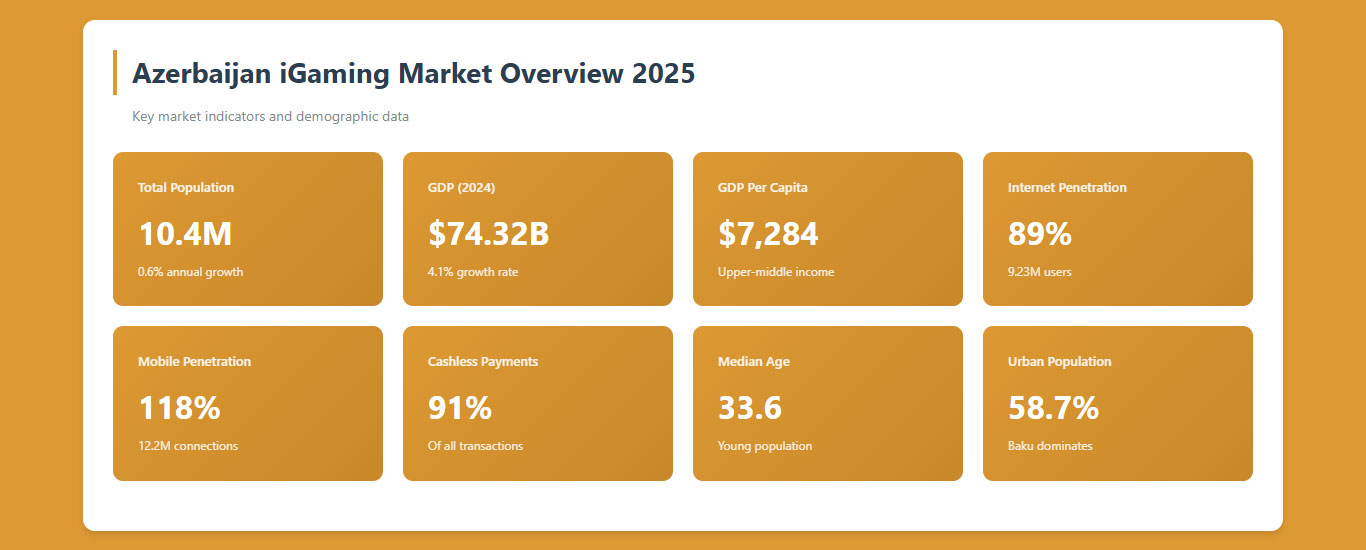
This regulatory shift signals potential market liberalization while maintaining strict controls. With a population of 10.4 million, 89 percent internet penetration, and rapid digital payment adoption, Azerbaijan demonstrates strong technological readiness.
However, market entry remains highly restricted, requiring careful navigation of regulatory constraints and emerging licensing frameworks for operators considering this frontier market.
Executive Summary: Key Market Indicators
| Indicator | Value | Notes |
|---|---|---|
| Gambling Legal Status | Highly Restricted | Banned on mainland since 1998; casinos allowed only on artificial islands from 2025 |
| Online Gambling Status | Prohibited | No legal online casino licenses available; international sites operate in gray area |
| Legal Gambling Forms | State Lotteries, Sports Betting | Very limited; heavily regulated by Ministry of Finance |
| Total Population | 10.4 million | As of 2025; 0.6% annual growth |
| Median Age | 33.6 years | Young, digitally active population |
| Urban Population | 58.7% | Concentrated in Baku and major cities |
| GDP (Total) | $74.32 billion | 2024 estimate; oil-dependent economy |
| GDP Per Capita | $7,284 – $7,458 | 2024-2025 estimates |
| GDP Growth Rate | 3-4.1% | 2025 projection: 3%; 2024 actual: 4.1% |
| Internet Penetration | 89% | 9.23 million users; 0.6% YoY growth |
| Mobile Penetration | 118% | 12.2 million connections; multiple SIM ownership common |
| Smartphone Adoption | High | Android 81.3%, iOS 18.1%; mobile-first market |
| Social Media Users | 6.73 million | 64.9% of population; 87.6% growth 2023-2024 |
| Cashless Payment Adoption | 91% | As of early 2025; 9 of 10 transactions are cashless |
| Casino License Fee (Artificial Islands) | $200,000 annually | 340,000 AZN; new framework from 2025 |
| Regulatory Authority | Ministry of Finance | Controls all gambling licensing and oversight |
| Tax Structure | Not Yet Published | Artificial island casino taxation framework pending |
| Corporate Income Tax | 20% | Standard rate; special zones may offer incentives |
| Language | Azerbaijani | Russian widely spoken; limited English proficiency |
| Currency | Azerbaijani Manat (AZN) | 1 USD ≈ 1.70 AZN; 1 EUR ≈ 1.79 AZN |
| Average Monthly Salary | 1,098 AZN ($646) | January-July 2025 average |
| Mobile Internet Speed | 56.19 Mbps | Median download; 23.6% increase YoY |
| Fixed Internet Speed | 62.69 Mbps | Median download; 89.8% increase YoY |
| Market Entry Difficulty | Very High | Extremely limited licensing; artificial island projects unproven |
| Political Stability | Stable but Authoritarian | Aliyev family regime; limited press freedom; high corruption perception |
| Religion | 95% Muslim | 85% Shia, 15% Sunni; conservative attitudes toward gambling |
| Investment Outlook | High Risk, Long-Term | Regulatory uncertainty; artificial island infrastructure unbuilt |
Section 1: Regulatory Framework and Legal Environment
Current Gambling Regulation Status
Historical Context and Recent Developments
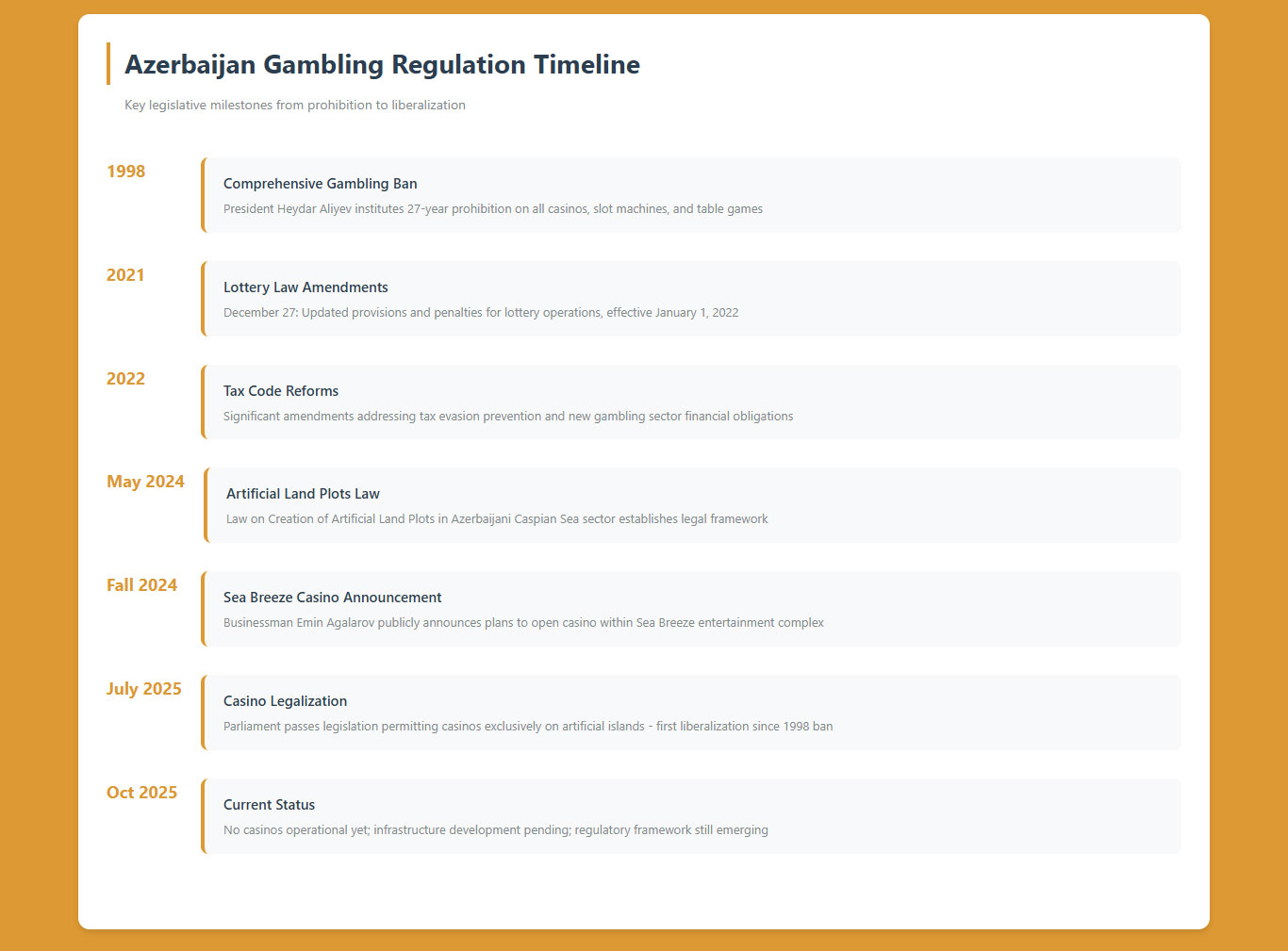
Azerbaijan implemented a comprehensive gambling ban in 1998 under President Heydar Aliyev, prohibiting all forms of casino operations, slot machines, and table games. This ban remained firmly in place for 27 years as part of policies addressing concerns about gambling addiction and public safety.

The legislative shift followed earlier groundwork laid in May 2024 with the Law on Creation of Artificial Land Plots in the Azerbaijani Sector of the Caspian Sea. Prominent businessman Emin Agalarov publicly announced plans in fall 2024 to open a casino within his Sea Breeze entertainment complex.
Lawmakers justified the policy change by citing revenue generation potential, tourism development, job creation, and reducing capital flight. Azerbaijani citizens currently travel abroad or use online platforms to gamble, with the new law aimed at reducing the shadow market.
Land-Based Gambling Activities
Casino Operations: Casinos remain strictly prohibited throughout mainland Azerbaijan. The July 2025 legislation creates an exception permitting casino operations exclusively on designated artificial islands in the Caspian Sea under strict national regulations and licensing requirements.
Licensed casinos on artificial islands must pay an annual license fee of 340,000 AZN (approximately $200,000). The regulatory framework establishes legal and organizational principles for operating casinos on such territories while maintaining the prohibition elsewhere.
Sports Betting Venues: Land-based sports betting is permitted under heavily restricted conditions. Only state-approved operators with Ministry of Finance licensing can operate sports betting facilities. State-sponsored operators like Topaz dominate the limited legal sports betting market.
Slot Machine Halls: Slot machines and gaming halls are comprehensively prohibited throughout Azerbaijan. Organizing or operating slot machine facilities constitutes illegal gambling activity subject to significant administrative fines and potential criminal liability.
Lotteries: State-authorized lotteries represent one of few legal gambling forms. The Law on Lotteries governs lottery organization and conduct, with licensing restricted to legal entities registered in Azerbaijan meeting strict financial and operational criteria.

Online Gambling Framework
Digital Gaming Regulations: Online casino gambling is explicitly banned in Azerbaijan. No licenses are available for online casino operations within the country. The Ministry of Finance maintains strict prohibition against digital casino platforms targeting Azerbaijani residents.
International online casinos operate in a regulatory gray area. While not licensed locally, enforcement against international operators and players remains inconsistent. However, authorities actively restrict access to unauthorized gambling websites, and facilitating such access is punishable by law.
Sports Betting Online: Online sports betting exists in limited form through state-approved operators. Licensing is extremely restrictive, with the government maintaining tight control through designated platforms. All online gambling operators must obtain Ministry of Finance licensing to operate within legal boundaries.
Regulatory Enforcement: Recent crackdowns intensified against online casino advertisements on social networks. Lawyer Alimamed Nuriev emphasized that virtual gambling involving fraud is illegal, with participants facing long-term imprisonment and substantial fines for fraudulent virtual gambling schemes.
Licensed Operators and Market Players
Sports Betting Operators: Topaz operates as the largest state-sponsored sports betting platform in Azerbaijan, enjoying government backing and sponsoring the Azerbaijan Premier League. The market remains highly concentrated with minimal competition due to restrictive licensing.
Lottery Operators: State-approved lottery organizers hold exclusive licenses granted by the Ministry of Finance. Market participation is limited to entities with significant capital reserves, clean legal records, and demonstrated operational capability under strict government oversight.
International Operators: No international casino operators currently hold legal licenses for Azerbaijan. International online casinos serve Azerbaijani players from offshore jurisdictions without local authorization, operating outside the regulatory framework and at legal risk.
Artificial Island Casino Projects: As of October 2025, no casinos have opened on artificial islands despite the July 2025 legal authorization. The Sea Breeze entertainment complex project represents the most prominent announced development, though timelines remain uncertain and infrastructure unbuilt.
Licensing Framework and Requirements
Regulatory Authority Structure
Ministry of Finance: The Ministry of Finance serves as the primary regulatory body for all gambling activities in Azerbaijan. It issues licenses, enforces compliance, implements regulatory amendments, and oversees operations for lotteries, sports betting, and the new artificial island casino framework.
State Tax Office: The State Tax Office of Azerbaijan works alongside the Ministry of Finance to collect gambling revenues and ensure proper tax compliance. Both agencies coordinate to maintain industry oversight and prevent unauthorized activities.
Contact Information: Licensing applications and inquiries must be directed to the Ministry of Finance of the Republic of Azerbaijan, located in Baku. Specific contact protocols for artificial island casino licensing have not been publicly disclosed as the framework remains nascent.
Application Process and Eligibility
Lottery License Requirements: Lottery licenses are granted exclusively to legal entities registered in Azerbaijan meeting strict financial and operational criteria. Entities or individuals with criminal records or previous gambling law violations are generally ineligible for licensing consideration.
Applicants must demonstrate sufficient capital reserves to cover operational costs and player payouts. Additional financial guarantees or bonds may be required to ensure compliance and protect player funds throughout operations.
Sports Betting License: Sports betting licenses follow similar strict eligibility requirements under the Law on Physical Education and Sports. Licensing is limited, with preference given to state-affiliated entities or those with strong government connections.
Artificial Island Casino License: The new artificial island casino licensing framework requires annual fees of 340,000 AZN ($200,000). Detailed application procedures, eligibility criteria, financial requirements, and operational standards have not been fully published as of October 2025.
Background Checks and Timelines: All gambling license applications undergo rigorous background checks covering financial history, criminal records, business integrity, and operational capability. Processing timelines vary but typically extend several months to over a year depending on complexity.
Financial Requirements and Guarantees
License Fees: Artificial island casino licenses cost 340,000 AZN annually (approximately $200,000 at 1.70 AZN/USD exchange rate). Lottery and sports betting licenses involve separate fee structures set by the Ministry of Finance and not publicly disclosed.
Minimum Capital Requirements: Lottery operators must demonstrate substantial capital reserves sufficient to cover operational expenses and guarantee player payouts. Specific minimum amounts vary by operation scale and are determined during the licensing evaluation process.
Financial Guarantees: Operators must provide financial bonds or bank guarantees to secure license approval. These instruments protect player funds and ensure regulatory compliance throughout the license term, with amounts determined by the Ministry of Finance.
Local Presence and Operational Requirements
Physical Presence Mandates: All licensed gambling operators must establish legal entities registered in Azerbaijan. Lottery licenses are explicitly restricted to Azerbaijani-registered legal entities meeting operational and financial criteria set by regulatory authorities.
Artificial Island Operations: Casino operations on artificial islands must comply with specific territorial requirements. Casinos can operate only on designated artificial land plots in the Azerbaijani Caspian Sea sector, with operations prohibited elsewhere in the country.
Foreign Ownership Restrictions: Detailed foreign ownership limitations for artificial island casinos have not been published. Traditional Azerbaijani business regulations typically impose restrictions on foreign ownership in strategic sectors, suggesting similar constraints may apply to gambling.
Domain and Hosting: Online gambling operators serving Azerbaijan typically require local server presence or partnerships with approved technology providers. Specific technical requirements for state-approved sports betting platforms are determined by regulatory authorities on case-by-case basis.
Compliance Obligations and Monitoring
Player Protection and Identification
Age Verification: Strict identification checks are implemented to prevent underage gambling and ensure regulatory compliance. The minimum legal gambling age in Azerbaijan is 18 years, with operators required to verify age before allowing participation.
Know Your Customer (KYC): All licensed operators must implement rigorous KYC procedures adhering to strict anti-money laundering and counter-terrorism financing regulations. Player identity verification is mandatory before account activation or transaction processing.
Responsible Gambling Measures: Operators must implement player protection mechanisms including self-exclusion systems and responsible gambling tools. The specific requirements vary by license type, with state-approved operators subject to Ministry of Finance oversight and enforcement.
Self-Exclusion Systems: Licensed operators must provide mechanisms allowing players to voluntarily exclude themselves from gambling activities. Self-exclusion duration options and implementation procedures are determined by regulatory guidelines established by the Ministry of Finance.
Financial Monitoring and Reporting
Anti-Money Laundering (AML): Strict adherence to AML and counter-terrorism financing regulations is mandatory for all licensed gambling operators. The Law on Prevention of Legalization of Criminally Obtained Funds governs financial monitoring requirements.
Transaction Monitoring: Operators must implement systems monitoring transactions for suspicious activity. Large transactions, unusual patterns, and high-risk behaviors require enhanced scrutiny and reporting to relevant authorities per AML regulations.
Reporting Obligations: Regular reporting to the Ministry of Finance on operations, financial performance, and compliance status is required for all licensed operators. Reporting frequency and specific requirements vary by license type and operational scale.
Audit and Inspection: The Ministry of Finance conducts periodic audits and inspections of licensed operators to ensure ongoing compliance with licensing conditions, financial requirements, player protection standards, and operational regulations.
Taxation Structure and Financial Obligations
Player Taxation
Winnings Tax: Tax treatment of player gambling winnings in Azerbaijan has not been comprehensively published. Based on regional norms, winnings may be subject to personal income tax above certain thresholds, though specific rates and exemption levels remain unclear.
Withholding Procedures: Licensed operators may be required to withhold taxes on player winnings above specified amounts. Implementation details for the new artificial island casino framework have not been published as of October 2025.
Player Obligations: Players may have declaration requirements for substantial gambling winnings under Azerbaijan’s personal income tax framework. Tax residency rules and international tax treaties affect obligations for foreign nationals gambling in Azerbaijan.
Operator Taxation
Gambling-Specific Taxes: The specific gross gaming revenue (GGR) tax rates, net gaming revenue (NGR) considerations, and turnover taxes for artificial island casinos have not been published. The Ministry of Finance will establish taxation frameworks as operators launch.
Annual License Fees: Artificial island casino operators pay 340,000 AZN ($200,000) annually in license fees. This represents a fixed operational cost separate from revenue-based taxation that may be implemented.
Corporate Income Tax: All Azerbaijani entities, including gambling operators, are subject to standard corporate income tax at 20 percent of taxable profits. Special economic zones may offer reduced rates or tax holidays for qualifying investments.
Value Added Tax (VAT): Azerbaijan applies VAT to most goods and services. The standard VAT rate and its applicability to gambling services have not been clearly defined for the new artificial island casino operations.
| Tax Type | Rate | Notes |
|---|---|---|
| Corporate Income Tax | 20% | Standard rate for all entities |
| Casino Annual License Fee | 340,000 AZN ($200,000) | Artificial island casinos only |
| GGR/NGR Tax | Not Published | Framework pending for casino operations |
| VAT Standard Rate | 18% | Applicability to gambling unclear |
| Withholding Tax – Dividends | 10% | May vary under tax treaties |
| Withholding Tax – Interest | 10% | May vary under tax treaties |
| Social Security (Employer) | 22-25% | On employee salaries |
Gambling Market Financial Performance
Market Size: Comprehensive data on Azerbaijan’s total gambling market size is not publicly available due to the sector’s restricted nature. The legal market consists primarily of state lottery sales and limited sports betting through approved platforms.
Gray Market Activity: Significant gambling activity occurs through international online platforms operating without local licenses. Azerbaijani citizens access offshore casino and betting sites, with market size estimates difficult to quantify due to the informal nature.
Capital Flight: Lawmakers cited substantial funds leaving Azerbaijan as citizens travel abroad to gamble or use foreign online platforms. The artificial island casino legislation aims to retain this spending domestically and generate tax revenues.
Projected Growth: The artificial island casino framework could generate significant tax revenues once operational, though projections remain speculative. Initial projects like the Sea Breeze complex have not disclosed investment amounts or expected revenues.
Advertising and Marketing Restrictions
Permitted Advertising Channels
State-Approved Gambling Only: Advertising and promotion are strictly forbidden for unauthorized gambling activities. Only state-approved gambling products including official lotteries and regulated sports betting may be advertised under government oversight.
Marketing Channel Restrictions: Specific regulations governing television, radio, online, outdoor, and print advertising for legal gambling products are enforced by the Ministry of Finance. All marketing materials must not target minors or vulnerable groups.
Online Advertising Crackdown: Recent enforcement actions intensified against online casino advertisements on social networks. Authorities monitor social media platforms and take legal action against entities promoting illegal gambling services to Azerbaijani residents.
Content and Promotional Restrictions
Misleading Advertising Prohibition: All gambling advertising must avoid misleading or aggressive content. Marketing materials undergo government scrutiny to prevent false claims about winning probabilities, payout rates, or guaranteed returns.
Minor Protection: Gambling advertisements must not appeal to minors or feature content attractive to underage audiences. Placement restrictions prevent gambling promotions during children’s programming or in media targeting youth demographics.
Bonus and Promotion Limits: Specific restrictions on bonus offers, wagering requirements, and promotional incentives have not been published for artificial island casinos. State-approved sports betting operators face limitations on promotional activities.
Recent Regulatory Changes and Their Impact
2021-2022 Legislative Amendments
Law on Amendments to Lotteries: The Amendment Law was adopted December 27, 2021, entering force January 1, 2022. This legislation introduced updated provisions and penalties for violations while clarifying legal boundaries for lottery operations.
Connected amendments modified laws on Telecommunications, Prevention of Money Laundering, Information Protection, Advertising, Physical Education and Sports, and the Tax Code. Telecommunication operators gained authority to block access to illegal gambling sites.
Gambling Definition Expansion: The amendments defined gambling games as lotteries, sports betting, and other betting games involving distribution of winnings based on uncertainty or coincidence, except for approved lotteries and sports betting conducted per specific laws.
Tax Code Changes: Significant Tax Code amendments effective January 1, 2022, addressed tax evasion prevention, provided certain exemptions, broadened tax burdens, and introduced new concepts affecting the gambling sector’s financial obligations.
2024-2025 Major Reforms
Artificial Land Plots Law: On May 7, 2024, Azerbaijan adopted the Law on Creation of Artificial Land Plots in the Azerbaijani Sector of the Caspian Sea, defining legal and organizational frameworks for artificial territories including construction rights.
Casino Legalization (July 2025): Parliament passed legislation in third reading permitting casino establishment on artificial islands. This marked the most significant gambling liberalization since the 1998 ban, creating new market entry possibilities.
The July 2025 law establishes regulations for business activity on artificial islands, creating conditions for investment and entrepreneurship promotion. Casinos outside artificial islands remain prohibited, maintaining the mainland ban.
Operator Impact: The regulatory change creates potential market entry opportunities for casino operators willing to invest in artificial island infrastructure. However, operational timelines remain uncertain as physical infrastructure development has not commenced at scale.
Enforcement Mechanisms and Penalties
Violation Penalties and Sanctions
Criminal Liability: Article 244-1 of the Criminal Code criminalizes unauthorized organization and conduct of gambling activities. Violators face significant administrative fines and potential criminal prosecution including imprisonment.
Fraud-Related Gambling: Virtual gambling involving fraud carries particularly severe penalties. Offenders face long-term imprisonment and substantial fines, as emphasized by legal authorities during recent enforcement campaigns against fraudulent gambling schemes.
License Violations: Operating without proper licensing or violating license conditions results in administrative fines, license suspension, or permanent revocation. The Ministry of Finance enforces compliance through regular inspections and investigations.
Enforcement Actions and Trends
Website Blocking: Access to unauthorized gambling websites is actively restricted through ISP-level blocking. Telecommunication operators must implement measures preventing organization and operation of gambling through telecommunications services and blocking access to foreign platforms.
Payment Processor Restrictions: Financial institutions face requirements preventing transaction processing for illegal gambling activities. Banks and payment providers must implement controls blocking transfers to unlicensed gambling operators.
Recent Enforcement: Intensified crackdowns occurred against online casino social media advertising, particularly targeting potentially fraudulent operations. Authorities pursue both operators and facilitators of illegal gambling access.
Section 2: Demographics and Consumer Analysis
Population Demographics and Distribution
Core Population Metrics
Azerbaijan’s population stands at 10.4 million as of 2025, representing modest growth of 0.6 percent year-over-year. The country ranks 94th globally by population size, accounting for 0.13 percent of total world population.
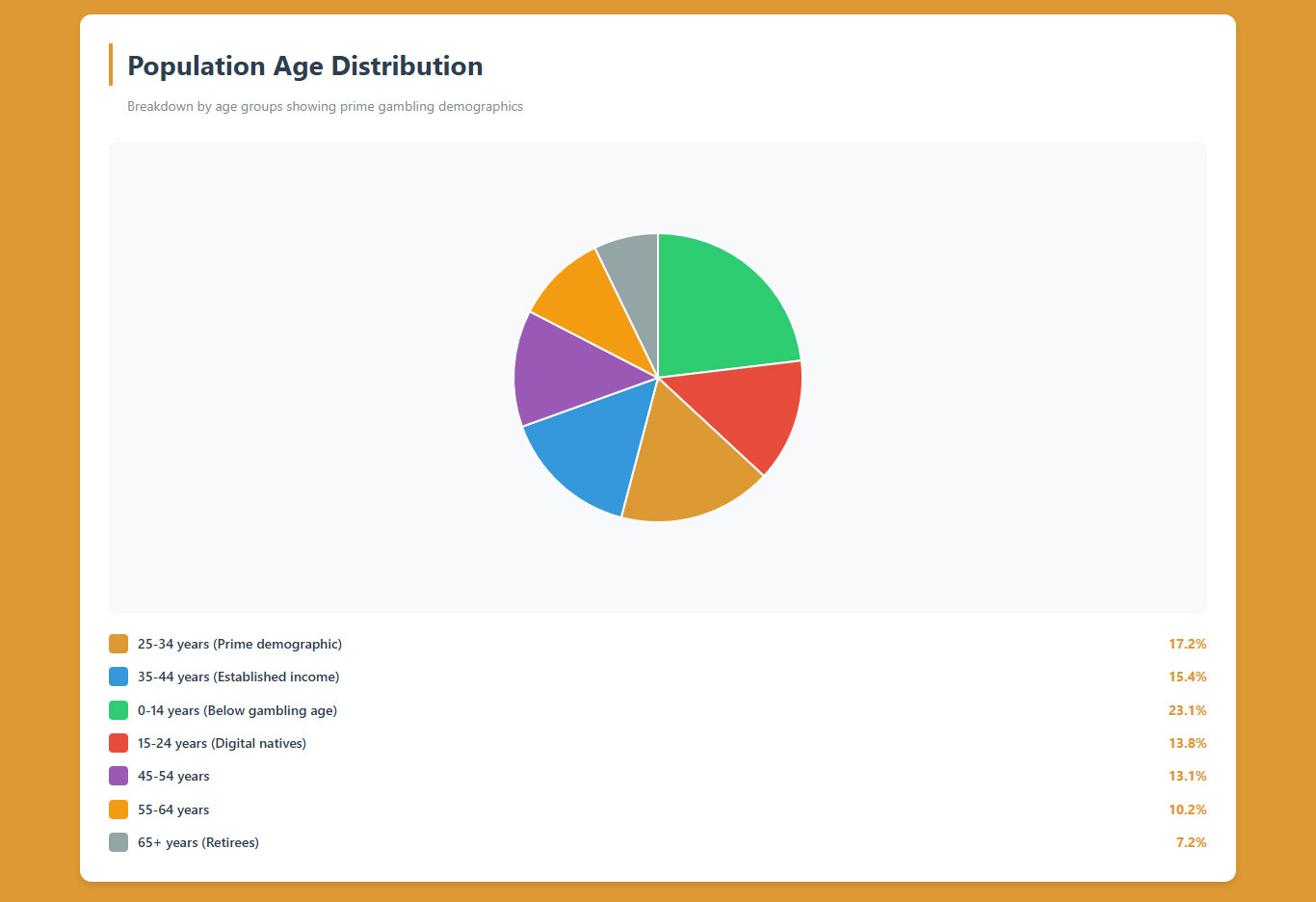
The median age is 33.6 years, indicating a relatively young and economically active demographic profile favorable for digital services adoption. This positions Azerbaijan younger than most European nations but older than many developing Asian markets.
The urban-rural split shows 58.7 percent of the population residing in urban areas while 41.3 percent live in rural regions. Urban concentration facilitates digital infrastructure deployment and gambling market accessibility, though rural penetration remains substantial.
| Age Group | Percentage of Population | Characteristics |
|---|---|---|
| 0-14 years | 23.1% | Below gambling age; future market potential |
| 15-24 years | 13.8% | Digital natives; high mobile adoption |
| 25-34 years | 17.2% | Prime gambling demographic; peak earning years |
| 35-44 years | 15.4% | Established income; family responsibilities |
| 45-54 years | 13.1% | Higher disposable income; stability-focused |
| 55-64 years | 10.2% | Pre-retirement; conservative spending |
| 65+ years | 7.2% | Retirees; limited gambling participation |
The dependency ratio shows that the working-age population (15-64 years) must support a relatively modest dependent population. Child dependency stands at 33 percent while aged dependency reaches only 9.2 percent, indicating low pressure on productive population.
Annual population growth of 150,097 people is projected for 2025, driven by natural increase of 153,774 births exceeding deaths, partially offset by net emigration of 3,677 individuals. Migration patterns reveal more people leaving than arriving.
Literacy rates reach 99.8 percent among adults aged 15 and above, with male literacy at 99.9 percent and female literacy at 99.7 percent. This high educational foundation supports digital services adoption and online platform usage.
Geographic Distribution
Baku – Capital City: Baku dominates as the political, economic, and cultural center, housing approximately 2.3 million residents or roughly 22 percent of the national population. The capital concentrates wealth, infrastructure, and digital connectivity significantly above national averages.
Major Urban Centers: Secondary cities include Ganja (population approximately 335,000), Sumqayit (340,000), Mingachevir (106,000), and Shirvan (90,000). These urban centers provide regional economic hubs with developing infrastructure and growing middle-class populations.
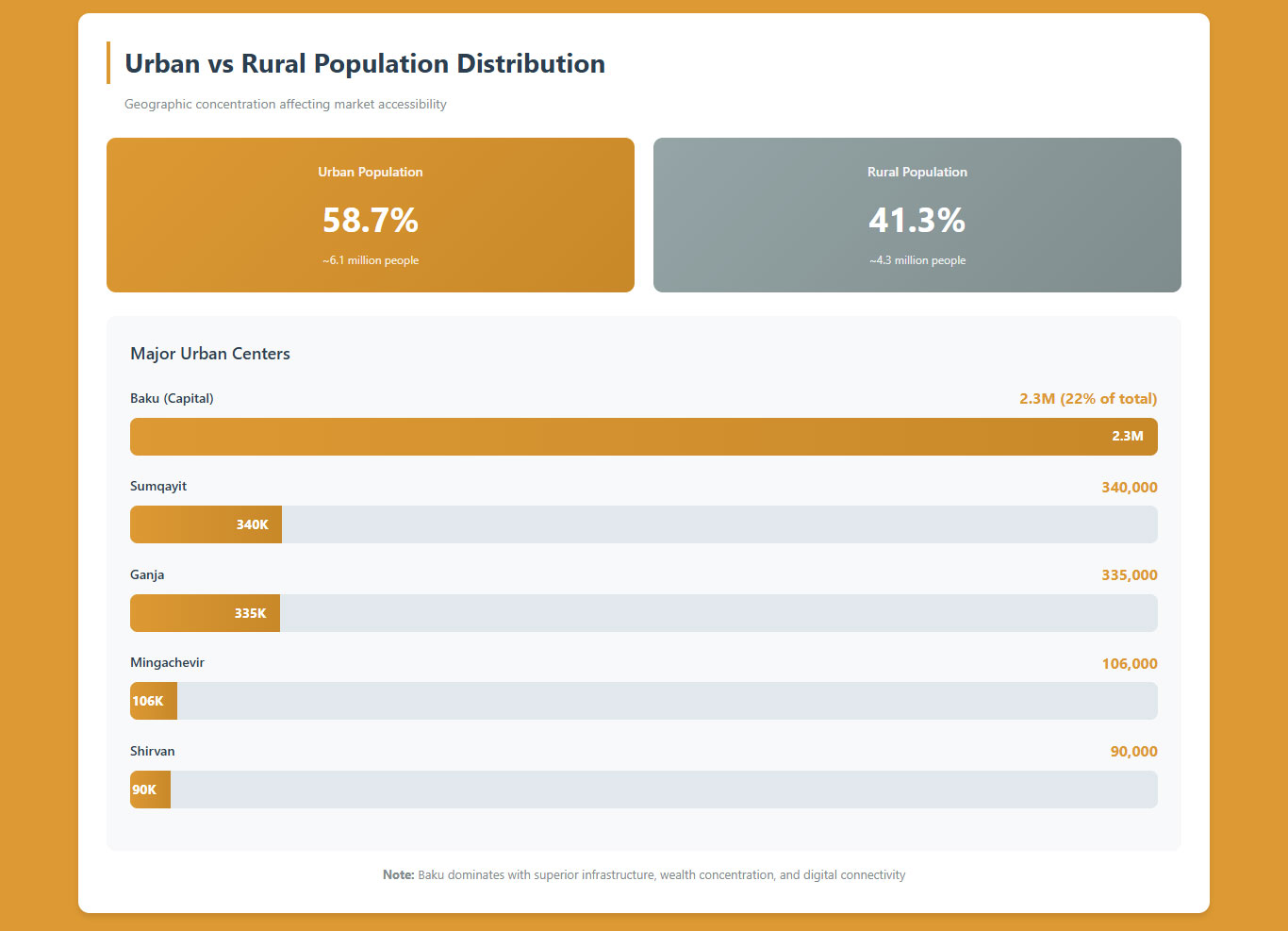
Regional Economic Differences: Stark disparities exist between Baku and regions. Oil wealth concentrates in the capital while rural areas and secondary cities remain significantly underdeveloped. This creates bifurcated market conditions affecting consumer spending power.
Internet Access Patterns: Urban areas, particularly Baku, enjoy superior internet infrastructure with higher speeds and broader coverage. Rural connectivity has improved but remains limited compared to cities, affecting digital service accessibility.
Economic Indicators and Consumer Spending Power
GDP and Economic Performance
Azerbaijan’s total GDP reached $74.32 billion in 2024, reflecting the country’s substantial but narrowly-based economic foundation. The economy remains heavily dependent on oil and gas, which constitute two-thirds of GDP and 90 percent of export revenues.
GDP per capita stands at $7,284 to $7,458 depending on calculation methodology, positioning Azerbaijan as an upper-middle-income country by World Bank classifications. However, this figure masks significant wealth concentration and regional disparities.
Economic growth reached 4.1 percent in 2024, driven primarily by non-oil sector expansion of 6.2 percent. The non-oil economy benefited from construction, ICT, transportation, and tourism growth supported by rising real incomes and infrastructure investment.
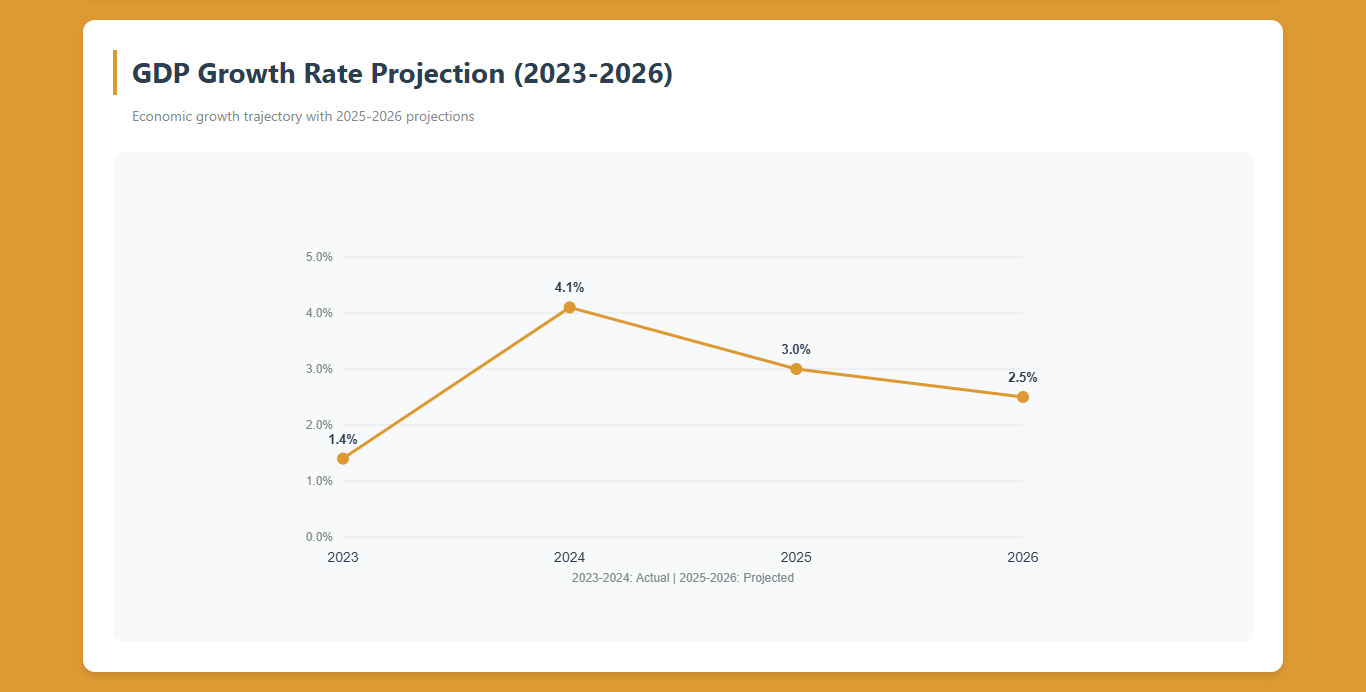
Growth projections for 2025 moderate to 3 percent with further slowdown to 2.5 percent expected in 2026. This deceleration reflects oil sector constraints, global commodity price sensitivity, and structural economic challenges beyond petroleum dependence.
| Indicator | 2023 | 2024 | 2025 Projection |
|---|---|---|---|
| Real GDP Growth | 1.4% | 4.1% | 3.0% |
| Non-Oil GDP Growth | 3.7% | 6.2% | 5.0% (est.) |
| GDP (Billion USD) | $72.5 | $74.32 | $77.0 (est.) |
| GDP Per Capita (USD) | $7,133 | $7,284 | $7,458 |
| Inflation Rate (Annual) | 8.8% | 4.9% | 4.5% (est.) |
| Unemployment Rate | 6.0% | 5.8% (est.) | 5.5% (est.) |
The petroleum sector dominance creates economic volatility tied to global oil prices. Oil and gas generate 60 percent of state finances, making government budgets and public spending highly sensitive to energy market fluctuations.
Average monthly nominal salary reached 1,098 AZN ($646) for January-July 2025, representing gradual improvement but remaining modest by international standards. Salary levels vary dramatically between oil sector workers and other industries.
Inflation moderated to 4.9 percent in August 2025 compared to the previous year, down from higher rates in 2023. Consumer price stability improves purchasing power but remains a concern for fixed-income households.
Income and Wealth Distribution
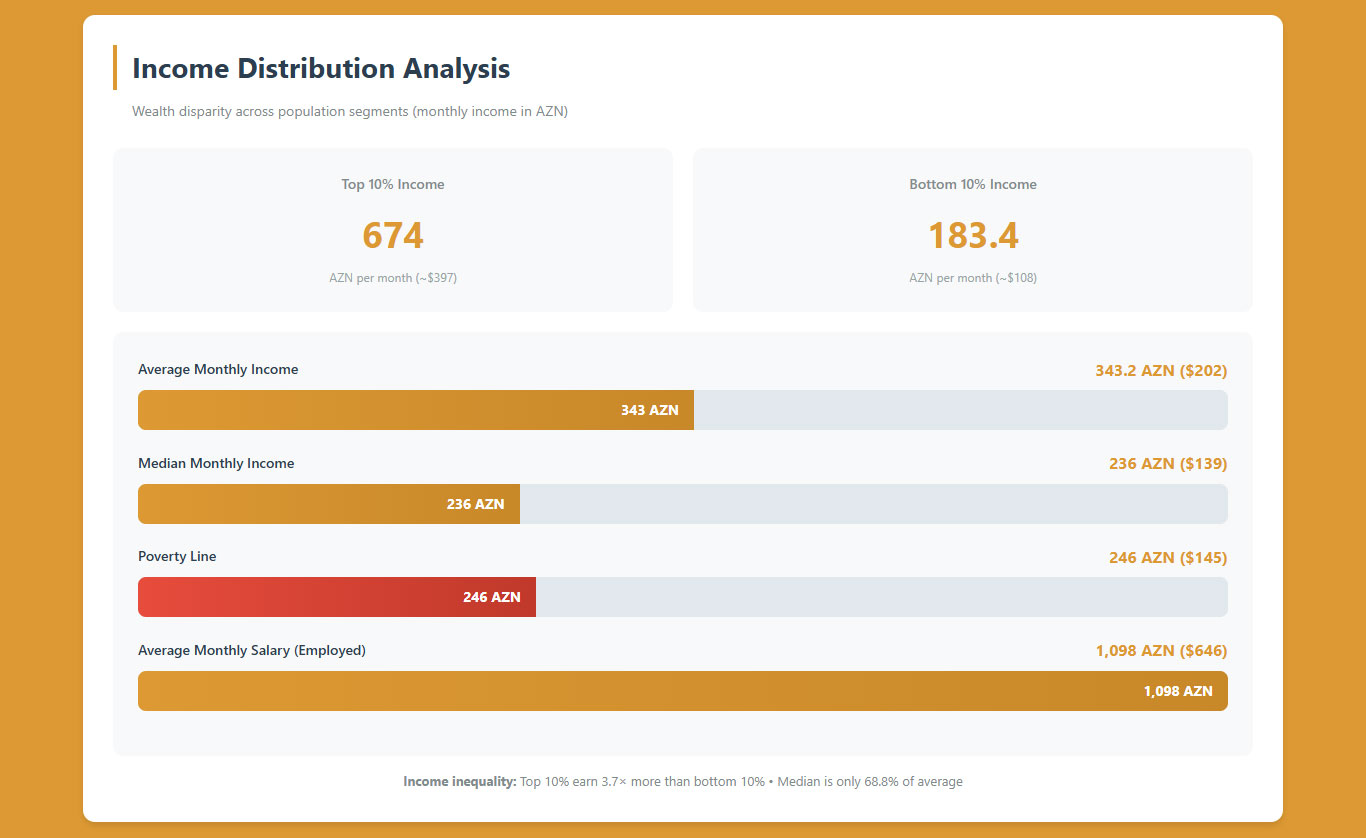
Average per capita monthly income stands at 343.2 AZN (approximately $200) according to official statistics, though independent researchers question this figure’s accuracy. Urban incomes exceed rural incomes by 7.5 percent, reflecting regional economic disparities.
The official poverty line (minimum subsistence level) is set at 246 AZN per person monthly. Average income sits only 28 percent above this threshold, indicating limited financial cushion for the typical citizen.
Median income calculations by the Baku Research Institute reveal significant inequality. The median monthly income equals approximately 68.8 percent of the average income, suggesting wealth concentration among higher earners skewing average figures upward.
Income distribution analysis shows the top 10 percent of earners command 674 AZN monthly while the bottom 10 percent struggle with 183.4 AZN monthly. This 3.7-fold disparity illustrates substantial income inequality within Azerbaijan’s population.
| Income Metric | Amount (AZN) | Amount (USD) | Notes |
|---|---|---|---|
| Average Monthly Income | 343.2 | $202 | Official statistics; reliability questioned |
| Median Monthly Income | 236 (est.) | $139 | 68.8% of average; BRI calculation |
| Poverty Line | 246 | $145 | Minimum subsistence level |
| Average Monthly Salary | 1,098 | $646 | Employed workers only |
| Top 10% Income | 674 | $397 | Per month |
| Bottom 10% Income | 183.4 | $108 | Per month |
Wealth concentration among ruling elites represents a defining economic characteristic. Oil revenues have enriched government-connected individuals while the broader population experiences limited prosperity gains despite official poverty reduction claims.
Leading economist Rovshan Aghayev states government poverty reduction claims remain unsubstantiated as Azerbaijan fails to provide transparent statistical data necessary to measure real income inequality and living standards accurately.
Transparency issues plague income statistics. Azerbaijan does not disclose income distribution by quintiles or deciles, share received by population groups, P80/20 and P90/10 ratios, poverty depth index, or chronic poverty assessments.
Remittances from abroad contribute to household incomes. Central Bank balance of payments data shows 2.8 billion AZN ($1.66 billion) in cash remittances during 2023, averaging 277 AZN per person annually or 23 AZN monthly.
Market Size and Growth Projections
Current iGaming Market Status: No legal regulated online iGaming market exists in Azerbaijan. The market consists exclusively of illegal gray market activity through international platforms and limited legal sports betting through state-approved operators.
Gray Market Estimates: Quantifying gray market size proves challenging due to the informal nature of offshore casino and betting participation. Azerbaijani citizens access international sites without regulatory oversight, with spending difficult to track systematically.
Sports Betting Market: The legal sports betting market remains small and concentrated around state-sponsored operators like Topaz. Market size data is not publicly disclosed, suggesting modest revenues under tight government control.
Artificial Island Casino Projections: Future market size depends entirely on artificial island casino development success. Annual license fees of $200,000 suggest operators anticipate substantial revenues to justify investment, though projections remain speculative.
Regional Comparison: Compared to neighboring Georgia (population 3.8 million with legal online gambling) and Turkey (population 85 million with strict prohibitions), Azerbaijan’s restrictive framework limits market development despite reasonable population size.
Long-Term Growth Potential: If Azerbaijan liberalizes online gambling regulations, market potential exists given 89 percent internet penetration, 91 percent cashless payment adoption, and young demographic profile. However, regulatory trajectory remains highly uncertain.
Education, Skills, and Digital Literacy
Educational Foundation
Azerbaijan maintains near-universal literacy with 99.8 percent of adults aged 15 and above able to read and write. This strong educational foundation supports digital technology adoption and online platform usage across age groups.
Educational attainment levels show substantial completion rates for primary and secondary education. The State Strategy on Development of Education prioritizes educational advancement as part of national development policy.
Digital literacy remains concentrated in urban areas and younger demographics. Baku residents and individuals under 40 demonstrate significantly higher comfort with digital technologies compared to rural and older populations.
English language proficiency is limited outside business and educated urban circles. Most Azerbaijanis communicate primarily in Azerbaijani with Russian as secondary language, requiring localization for consumer-facing services.
Cultural and Social Factors
Communication and Language
Primary Languages: Azerbaijani (Turkic language family) serves as the official state language and primary communication medium for 92 percent of the population. Russian remains widely spoken, particularly among older generations and in business contexts.
Internet Language Preferences: Online content in Azerbaijani is preferred by consumers, though Russian-language content reaches substantial audiences. English content has limited reach outside educated urban demographics and international business sectors.
Localization Requirements: Gambling operators must provide Azerbaijani-language interfaces, customer support, and promotional materials to effectively reach mainstream consumers. Russian language support extends market reach to older demographics.
Religious and Cultural Attitudes
Religious Composition: Approximately 95 percent of Azerbaijan’s population identifies as Muslim, with 85 percent Shia and 15 percent Sunni. Azerbaijan has the second-highest Shia population percentage globally after Iran.
Gambling Religious Perspective: Islamic teachings generally prohibit gambling, creating cultural resistance to gambling activities. However, Azerbaijan’s secular governance and Soviet legacy result in less strict religious adherence compared to Middle Eastern nations.
Social Gambling Acceptance: Despite religious prohibitions, gambling participation exists through offshore platforms and cross-border travel. The government’s artificial island casino authorization signals pragmatic economic prioritization over religious considerations.
Foreign Brand Perception: International brands often face trust barriers requiring substantial marketing investment and local partnerships. State connections and government endorsement significantly influence consumer confidence in service providers.
Problem Gambling and Social Considerations
Problem Gambling Data: Comprehensive statistics on gambling addiction prevalence in Azerbaijan are not publicly available. The 27-year gambling ban limited research into problem gambling rates, though offshore platform usage suggests participation exists.
Social Responsibility Framework: As artificial island casino regulations develop, problem gambling prevention requirements remain undefined. International operators should anticipate mandatory responsible gambling measures including self-exclusion systems and player protection tools.
Treatment Infrastructure: Dedicated gambling addiction treatment facilities are limited or non-existent given the historical gambling prohibition. As legal gambling emerges, treatment infrastructure may require development.
At-Risk Populations: Without research data, specific at-risk demographic identification proves challenging. Traditional patterns suggest young males represent higher-risk groups for problem gambling behaviors.
Political Structure and Governance
Government System and Stability
Azerbaijan operates as a presidential republic under the Aliyev family regime. President Ilham Aliyev succeeded his father Heydar Aliyev in 2003, maintaining authoritarian control over political, economic, and social spheres.
Political stability remains high from an investment continuity perspective, though achieved through authoritarian governance rather than democratic institutions. The regime maintains tight control over media, opposition, and civil society.
Corruption perception indexes rank Azerbaijan poorly, with endemic corruption characterizing government operations and business environments. Transparency International and similar organizations consistently highlight corruption concerns.
Oil wealth has significantly strengthened regime stability and enabled lavish international event hosting. The government uses petroleum revenues for political consolidation and international lobbying rather than broad economic development.
International Relations and Trade
Regional Positioning: Azerbaijan maintains complex relationships with neighboring countries including Russia, Iran, Turkey, Georgia, and Armenia. Recent conflict resolution with Armenia over Nagorno-Karabakh reshapes regional dynamics.
European Engagement: Azerbaijan is not an EU member but maintains Council of Europe membership and OSCE participation. The country serves as an energy supplier to Europe, particularly following Russia-Ukraine tensions.
Trade Corridors: Azerbaijan’s position along the Middle Corridor connecting China to Europe creates opportunities for transport and logistics sectors. Peace-building efforts may unlock new trade routes and investment flows.
Investment Climate: Foreign direct investment focuses heavily on petroleum sector. Non-oil sector foreign investment faces bureaucratic obstacles, corruption, and political favoritism affecting business predictability.
Technology Adoption and Digital Behavior
Internet and Digital Usage
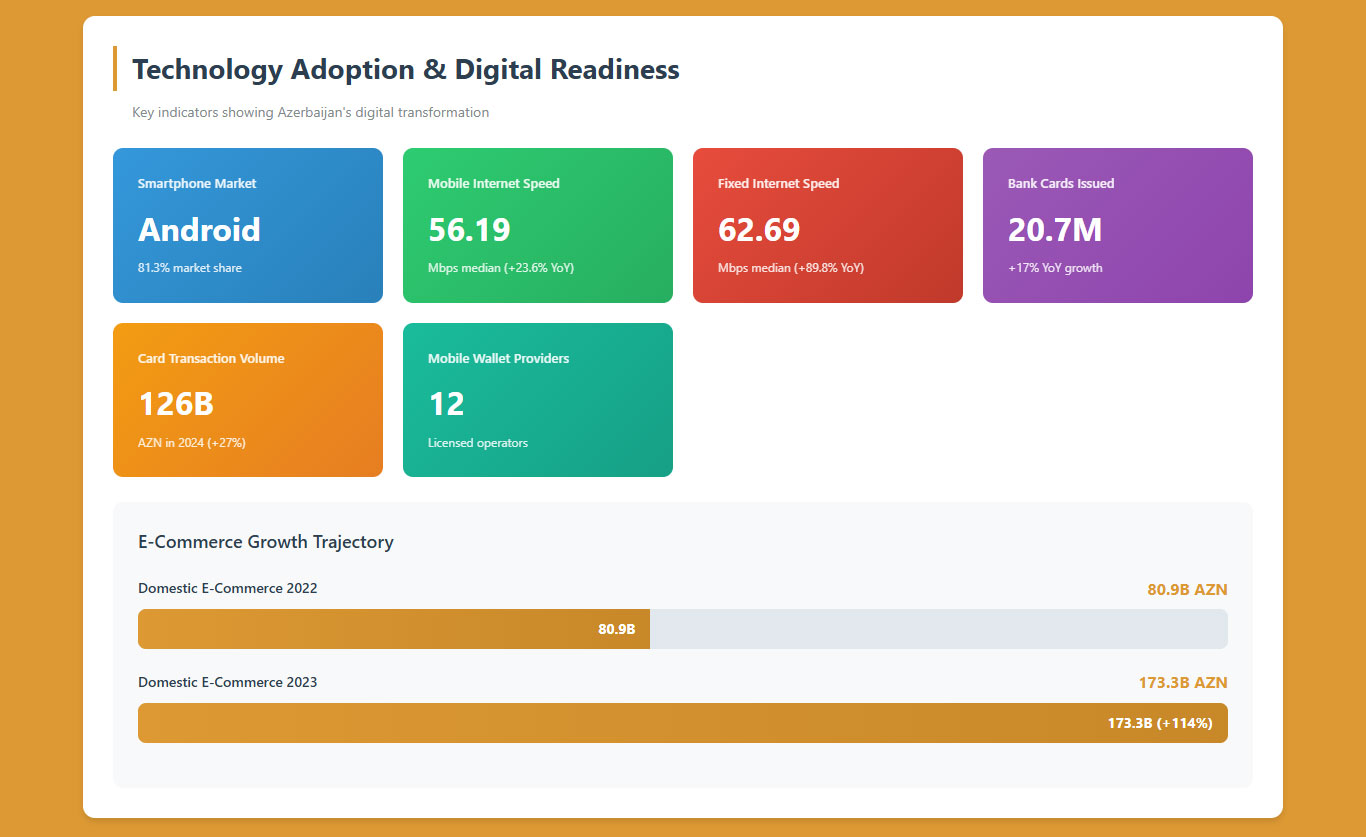
Internet penetration stands at 89 percent of the population, representing 9.23 million users as of January 2025. This high penetration rate increased by 57,000 users (0.6 percent) between January 2024 and January 2025.
Mobile internet dominates connectivity with 71.4 percent of total web traffic occurring via mobile devices. Desktop accounts for 27.3 percent while tablet usage remains minimal at 1.3 percent.
Daily internet usage averages are not precisely published but mobile-first behavior suggests substantial time spent online, particularly among younger demographics. Social media engagement reaches 6.73 million users (64.9 percent of population).

Social media user growth exploded by 87.6 percent from January 2023 to January 2024, though this dramatic increase may reflect measurement methodology changes rather than purely organic growth.
| Metric | Value | Penetration Rate |
|---|---|---|
| Internet Users | 9.23 million | 89.0% |
| Mobile Connections | 12.2 million | 118% |
| Social Media Users | 6.73 million | 64.9% |
| Mobile Web Traffic | 71.4% | Of total traffic |
| Fixed Broadband Subscribers | 2.15 million | 20.7% |
| Smartphone Adoption | High | Android 81.3%, iOS 18.1% |
Internet speeds have improved dramatically. Median mobile internet download speed reached 56.19 Mbps, increasing 23.6 percent year-over-year. Fixed internet download speed hit 62.69 Mbps, surging 89.8 percent annually.
E-commerce participation is growing with increasing consumer trust in online transactions. Digital services consumption expands across payment, shopping, entertainment, and communication categories as infrastructure improves.
Digital Payment Behavior
Cashless payment adoption reached 91 percent of all transactions as of early 2025, representing dramatic transformation from cash-dominated economy. Nine out of ten payment card transactions now occur without physical currency.
Bank card transactions totaled 126 billion AZN ($74.1 billion) in 2024, growing 27 percent from 2023. Domestic cashless transactions increased 67 percent by volume and 91 percent by transaction count in the first four months of 2025.
The number of bank cards increased 17 percent year-over-year to 20.7 million in early 2025. This exceeds two cards per capita, indicating multiple card ownership and active participation in electronic payment systems.
Mobile wallet adoption is expanding with twelve licensed providers operating in Azerbaijan. Popular services include Apple Pay, Google Pay, PashaPay, GoldenPay, and TURAN e-wallet, offering contactless and instant payment solutions.
| Payment Method | Market Share | Notes |
|---|---|---|
| Mobile Payments | 58% | Dominant method; rapid growth |
| Credit Cards | 27% | Traditional but declining share |
| E-Wallets | 11% | Growing adoption; multiple providers |
| Bank Transfer | 1% | Direct transfers; limited for retail |
| Prepaid Cards | 1% | Minimal usage |
| Cash | 9% | Declining rapidly; 91% cashless adoption |
Popular digital wallets include international options like PayPal, Skrill, and WebMoney alongside local providers. AniPay, the Central Bank-launched instant payment system, facilitates rapid transfers and QR code payments.
Cryptocurrency awareness exists but regulatory status and adoption for gambling purposes remain unclear. Azerbaijan has not established comprehensive cryptocurrency frameworks affecting potential gambling payment integration.

Gaming and Gambling Preferences
Current Participation Rates: Precise gambling participation statistics are unavailable due to prohibition and gray market nature. However, lawmakers cited significant citizens gambling abroad or via online platforms as justification for artificial island casino legalization.
Sports Betting Popularity: Sports betting through state-approved operators represents the most accessible legal gambling form. Football (soccer) dominates betting interest given Azerbaijan Premier League and international competition following.
Casino Game Preferences: With no legal land-based casinos for 27 years, preferences remain based on offshore platform usage. International casino sites serving Azerbaijanis likely reveal preferences for slots, roulette, and blackjack.
Mobile vs Desktop Preference: Given 71.4 percent mobile web traffic dominance, gambling participation would likely skew heavily toward mobile platforms. Desktop usage would occur primarily in office or home settings.
Spending Patterns: Average spending per gambling participant cannot be quantified without market data. However, modest median incomes ($139 monthly) suggest recreational gambling at low stakes predominates over high-roller activity.
Seasonal Trends: Football season drives sports betting activity with peak interest during European championships and World Cup events. Holiday periods and major cultural celebrations may influence casino gaming participation.
Section 3: Technology Infrastructure and Business Environment
Internet and Digital Infrastructure
Connectivity and Network Performance
Azerbaijan’s internet infrastructure has undergone rapid modernization, achieving 89 percent population penetration representing 9.23 million users. This positions the country among regional leaders in connectivity, surpassing many neighboring nations in digital access.
Fixed broadband subscriptions reached 2.15 million in 2023, representing approximately 20.7 percent household penetration. While lower than mobile internet adoption, fixed broadband provides stable high-speed connectivity for urban households and businesses.
Average internet speeds have improved dramatically year-over-year. Median mobile internet download speed reached 56.19 Mbps in January 2025, representing a 23.6 percent increase from the previous year and supporting bandwidth-intensive applications.
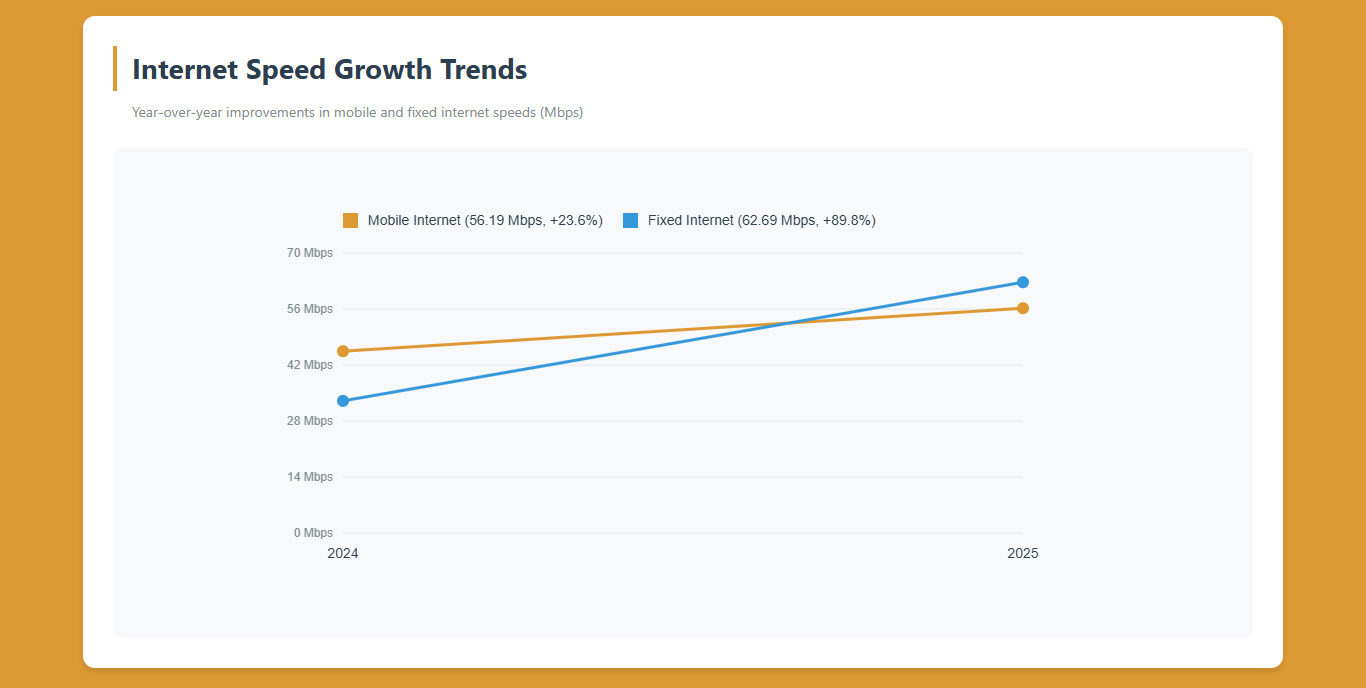
Fixed internet download speeds hit 62.69 Mbps median, surging 89.8 percent annually. This remarkable improvement reflects infrastructure investments and network upgrades bringing Azerbaijan closer to European connectivity standards.
| Connection Type | Download Speed | Year-over-Year Growth |
|---|---|---|
| Mobile Internet (Median) | 56.19 Mbps | +23.6% |
| Fixed Internet (Median) | 62.69 Mbps | +89.8% |
| Mobile Internet (Average – 2024) | 45.45 Mbps | +31.4% |
| Fixed Internet (Average – 2024) | 33.03 Mbps | +22.3% |
Network reliability and uptime statistics are not comprehensively published but infrastructure quality concentrates in Baku and major urban centers. Rural connectivity has improved but experiences lower speeds and reliability compared to cities.
The government prioritizes ICT sector development as part of economic diversification strategy. The Ministry of Digital Development and Transport spearheads infrastructure investment alongside telecommunications operators expanding coverage and capacity.
Global internet speed rankings position Azerbaijan competitively within the Caucasus region. While not matching Western European speeds, Azerbaijan outperforms many former Soviet republics in network performance and accessibility.
5G and Future Technology Deployment
4G/LTE coverage extends across most populated areas with major operators providing widespread service. Azercell, Bakcell, and Azerfon (operating as Nar Mobile) compete to expand LTE networks reaching rural territories previously underserved.
5G deployment remains in trial phases with commercial rollout delayed. Azercell and Bakcell completed 5G trials but postponed announcing commercial services due to insufficient demand, lack of suitable spectrum allocation, and questions about investment return.
Current LTE network capacity adequately meets demand for high-speed data and broadband services, reducing urgency for 5G deployment. Operators focus on optimizing 4G coverage and capacity rather than rushing 5G introduction.
Future infrastructure plans include gradual 5G rollout as spectrum becomes available and use cases justify investment. The timeline for widespread 5G deployment likely extends several years given market dynamics and infrastructure priorities.
Mobile Technology Ecosystem
Mobile Network Infrastructure
Three mobile network operators dominate Azerbaijan’s telecommunications market. Azercell, the largest operator with over 35 percent market share, leads in subscribers and coverage. State-owned AzTelecom maintains participation in mobile operators.
Bakcell operates as the second-largest provider serving substantial subscriber base across Azerbaijan. Azerfon (Nar Mobile) represents the third operator, granted licensing in 2006 to increase market competition.
Mobile connections total 12.2 million, representing 118 percent population penetration. Multiple SIM card ownership is common, with individuals maintaining separate numbers for personal and business use or leveraging promotional pricing.
Network quality varies by operator and geography. Azercell generally leads in coverage comprehensiveness, while urban areas enjoy competitive service from all three operators. Rural coverage gaps persist despite expansion efforts.
| Operator | Market Share | Technology | Ownership |
|---|---|---|---|
| Azercell | ~35%+ | 2G/3G/4G | Partially state-owned (MCIT 35%) |
| Bakcell | ~30% | 2G/3G/4G | Private |
| Azerfon (Nar) | ~25% | 2G/3G/4G | State telecom participation |
| Catel | Minimal | Legacy | Limited operations |
Data costs remain relatively high compared to regional neighbors, possibly reflecting market consolidation and limited competition. Cost per gigabyte pricing affects consumer data consumption patterns and mobile internet usage intensity.
Mobile payment integration is rapidly advancing with operators supporting contactless payments, mobile wallet services, and value-added financial services. Network infrastructure increasingly enables fintech innovation beyond traditional telecommunications.
Device Penetration and Preferences
Smartphone adoption is high across Azerbaijan with Android dominating at 81.3 percent market share. iOS commands 18.1 percent, indicating Apple’s premium positioning appeals to affluent urban consumers but remains niche.
Device preferences skew toward mid-range Android smartphones balancing functionality with affordability. Samsung, Xiaomi, and Huawei represent popular brands, while iPhone ownership signals status among higher-income demographics.
Average device specifications support modern mobile applications including video streaming, gaming, and resource-intensive apps. Memory, processing power, and screen quality continue improving as consumers upgrade to newer models.
Mobile internet usage dominates with 71.4 percent of total web traffic occurring via mobile devices. This mobile-first behavior requires gambling operators to prioritize mobile-optimized platforms and native app development.
Financial Services and Payment Infrastructure
Banking System Structure
Azerbaijan’s banking sector includes numerous domestic and international banks competing for market share. Major banks include International Bank of Azerbaijan (IBA), Kapital Bank, Pasha Bank, AccessBank, Unibank, TuranBank, and YapiKredi Bank Azerbaijan.
International Bank of Azerbaijan operates as one of the largest institutions with extensive branch networks and digital banking services. Kapital Bank and Pasha Bank aggressively pursue digital transformation and fintech integration.
Digital banking adoption is accelerating with mobile banking apps gaining user acceptance. Banks invest in user-friendly interfaces, instant payments, and integrated financial services responding to consumer demand for convenience.
Account penetration rates have improved but remain below developed economy standards. Banking access concentrates in urban areas with rural populations less likely to maintain formal banking relationships.
Payment Processing Options
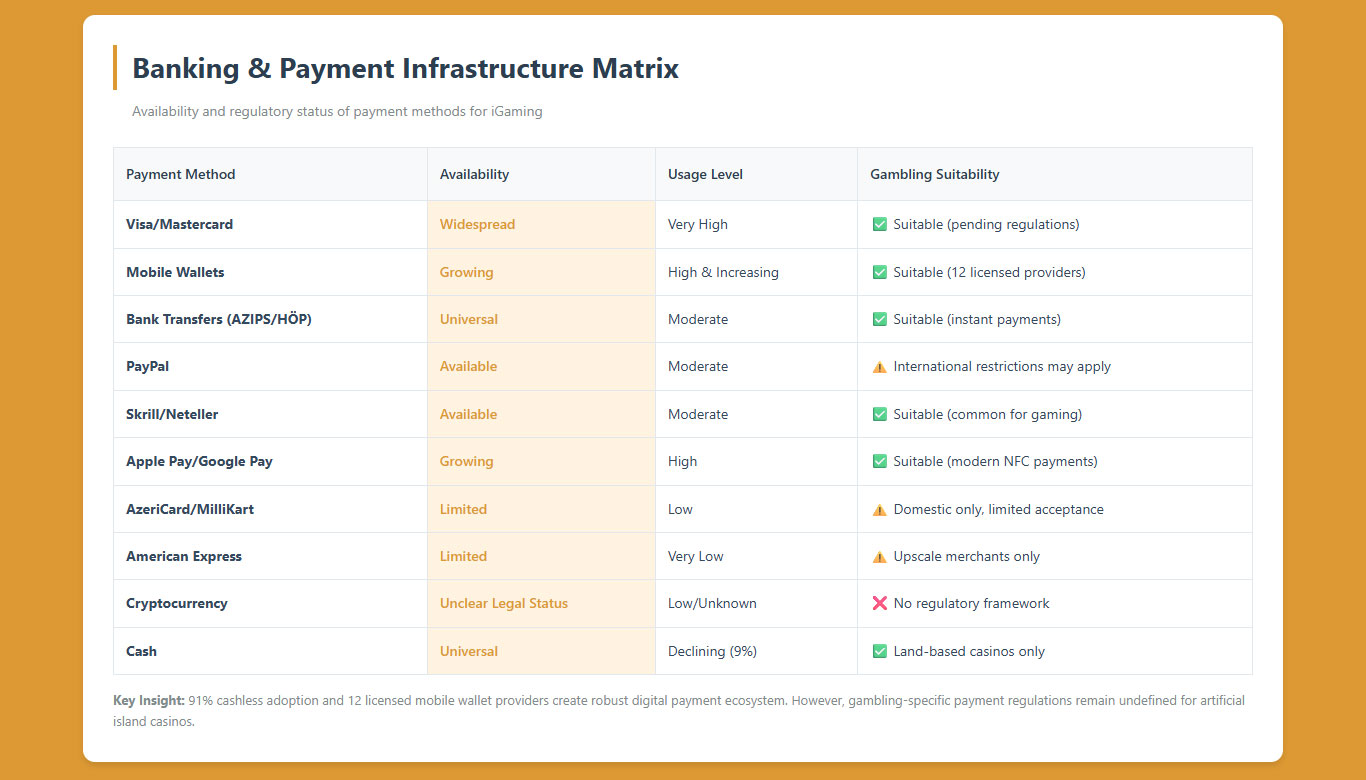
Cashless payment infrastructure has transformed dramatically with 91 percent of transactions now occurring electronically. This represents one of the highest cashless adoption rates globally, driven by government policy, infrastructure investment, and consumer behavior change.
Credit and debit cards dominate with Visa and Mastercard representing principal payment schemes. Domestic card brands AzeriCard (owned by International Bank of Azerbaijan) and MilliKart (owned by 17 banks and EBRD) maintain limited presence.
American Express and Diners Club cards are accepted at select merchants, primarily upscale hotels, restaurants, and international businesses. Coverage remains far below Visa and Mastercard acceptance levels.
| Payment Method | Availability | Usage Level |
|---|---|---|
| Visa/Mastercard | Widespread | Very High |
| AzeriCard | Limited | Low |
| MilliKart | Limited | Very Low |
| Mobile Wallets | Growing | High and Increasing |
| Bank Transfers | Universal | Moderate |
| Cryptocurrency | Unclear Legal Status | Low/Unknown |
| PayPal | Available | Moderate |
| Skrill/Neteller | Available | Moderate |
E-wallet options include international services like PayPal, Skrill, WebMoney, and Paysera alongside domestic providers. Twelve licensed mobile wallet providers operate including Apple Pay, Google Pay, PashaPay, GoldenPay, and the upcoming TURAN e-wallet.
Bank transfer systems support instant payments through AZIPS (Azerbaijan Interbank Payment System) for real-time large-value transactions and HÖP for retail payments. AniPay, the Central Bank instant payment system, enables QR code payments and rapid transfers.
Processing fees vary by payment method and provider. Card transaction fees typically range 1.5-3 percent for merchants, while bank transfers and mobile wallets may offer lower costs depending on transaction type.
Transaction processing timelines have accelerated with instant payment systems enabling real-time transfers. Traditional bank transfers complete within one business day domestically, while international transactions follow standard SWIFT timelines.
Cryptocurrency acceptance for gambling remains unclear given ambiguous regulatory status. Azerbaijan has not established comprehensive cryptocurrency frameworks, creating uncertainty about legal usage for iGaming transactions.
Regulatory restrictions on gambling payments are not yet defined for artificial island casinos. Traditional banking regulations may prohibit financial institutions from processing transactions for unlicensed gambling operators.
E-commerce and Digital Economy
Digital Market Development
E-commerce market size is growing with increasing consumer trust in online transactions. Card payment volumes of 126 billion AZN ($74.1 billion) in 2024 reflect substantial digital commerce activity across retail, services, and bill payments.
Domestic e-commerce transactions increased from 80.9 billion AZN in 2022 to 173.3 billion AZN in 2023, representing 114 percent growth. This explosive expansion demonstrates rapid consumer adoption of online shopping and digital services.
POS terminal payments surged 81 percent and e-commerce payments jumped 108 percent year-over-year in 2023. This growth trajectory positions Azerbaijan among the fastest-growing digital payment markets globally.
Popular e-commerce platforms include both international services and domestic marketplaces. Cross-border online shopping is common, with Azerbaijanis purchasing from Turkish, Russian, Chinese, and European retailers.
Consumer trust in online transactions has improved significantly as payment security, delivery reliability, and merchant professionalism advance. However, cash-on-delivery remains popular for consumers cautious about prepayment.
Business Environment and Regulatory Framework
Ease of Business Operations
Azerbaijan ranked 34th globally in the World Bank’s final 2020 Doing Business report, though this ranking was subject to controversy. The country specifically ranked 9th out of 190 countries for ease of starting a business.
It is important to note that the World Bank discontinued the Doing Business Index in 2021 following data manipulation scandals. Azerbaijan’s 2020 score was allegedly artificially lowered by World Bank officials, casting doubt on historical rankings.
The replacement Business Ready (B-READY) index launched in 2024 with initial coverage of 50 countries. Azerbaijan was not included in the first B-READY report, leaving current ease-of-doing-business assessment dependent on other sources.
Business registration processes have been streamlined with online systems reducing bureaucratic hurdles. The Ministry of Taxes provides efficient registration portals, though corruption and informal requirements may complicate procedures.
| Indicator | Value/Status | Notes |
|---|---|---|
| Doing Business Rank (2020) | 34th of 190 | Allegedly manipulated; index discontinued |
| Starting a Business Rank | 9th of 190 | 2021 data; streamlined procedures |
| Corruption Perception | High | Endemic corruption affects operations |
| Political Stability | Stable (Authoritarian) | Predictable but limited democratic freedoms |
| Private Sector Development | Weak | State dominates economy; over 50% work for government |
| Regulatory Transparency | Low | Limited public data; unclear requirements |
Foreign investment policies officially welcome FDI but practical barriers include corruption, bureaucratic obstacles, and political favoritism. Oil sector attracts most foreign investment while non-oil sectors face challenges.
Operational cost structures vary dramatically between Baku and regions. Office rent in central Baku approaches European levels while secondary cities offer substantially lower costs. Salaries, utilities, and services similarly show geographic disparities.
Labor market conditions provide educated workforce with strong technical skills, particularly in engineering, IT, and sciences. However, brain drain affects talent availability as skilled professionals emigrate for higher wages abroad.
Corporate Structure and Registration
Limited Liability Company (LLC): LLCs represent the most common structure for small and medium businesses in Azerbaijan. They offer liability protection, flexible ownership structures, and relatively straightforward compliance requirements.
Joint-Stock Company (JSC): Joint-stock companies suit larger enterprises and those seeking to issue shares. They require higher minimum capital, more stringent governance, and greater reporting obligations than LLCs.
Branch Office: Foreign companies can establish branch offices representing the parent entity without creating separate legal entities. Branches face restrictions on certain business activities and taxation differences.
Representative Office: Representative offices conduct limited non-commercial activities including market research and liaison functions. They cannot engage in revenue-generating operations or sign commercial contracts.
Recommended Structure for iGaming: Artificial island casino operators would likely require Azerbaijani-registered legal entities, probably LLCs or JSCs depending on scale. Specific requirements have not been published for casino licensing.
| Entity Type | Min. Capital | Liability | Best For |
|---|---|---|---|
| LLC | 2 AZN | Limited | Small-medium businesses; foreign investors |
| Joint-Stock Company | Higher (varies) | Limited | Large enterprises; public offerings |
| Branch Office | None | Parent company liable | Foreign company local presence |
| Representative Office | None | Parent company liable | Non-commercial activities only |
| Sole Proprietorship | None | Unlimited | Individual entrepreneurs |
Registration timelines have improved with efficient online systems. Company registration can complete within days for straightforward cases, though complex structures or foreign ownership may extend processing to several weeks.
Registration costs include government fees, legal fees, notarization, and translation expenses. Basic LLC registration costs several hundred dollars in official fees, with professional service provider fees adding substantially to total costs.

Required documents include founding agreements, articles of association, director identification, address confirmation, and beneficial ownership declarations. Notarization and translation to Azerbaijani may be required for foreign-language documents.
Foreign ownership rules generally permit 100 percent foreign ownership in most sectors, though strategic sectors face restrictions. Gambling sector foreign ownership rules are undefined for the new artificial island framework.
Ongoing compliance includes annual financial reporting, tax declarations, audit requirements for larger entities, and maintaining registered office and resident director where required. Compliance complexity varies by entity type and business activities.
Taxation Framework
Corporate Income Tax Structure
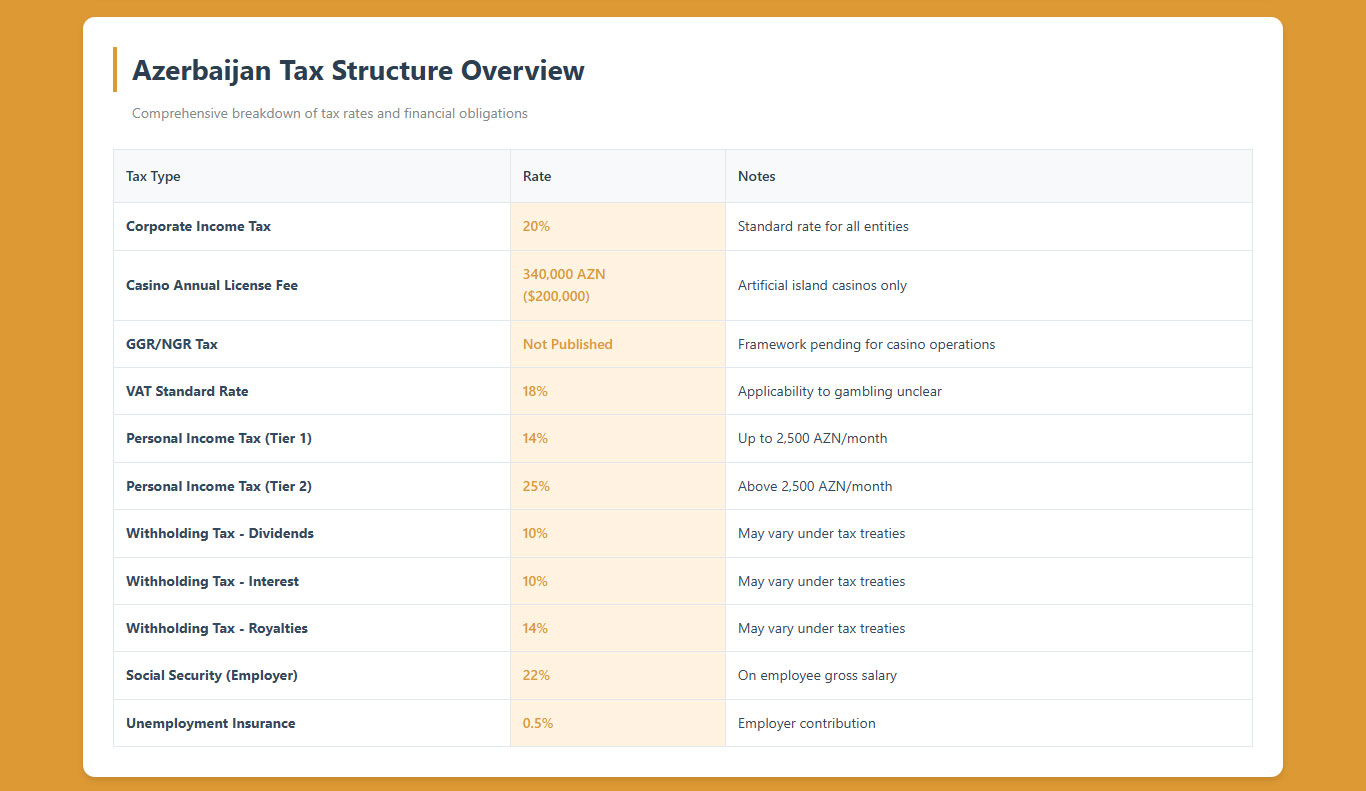
Standard corporate income tax is levied at 20 percent of taxable profits for all Azerbaijani entities. This rate applies to domestic and foreign companies earning Azerbaijan-source income.
Special economic zones may offer reduced corporate tax rates or tax holidays to incentivize investment. Specific incentives depend on sector, investment amount, and location within designated development zones.
International tax treaties exist with numerous countries affecting withholding tax rates on cross-border payments. Azerbaijan has signed double taxation avoidance agreements with major trading partners and investment source countries.
Transfer pricing rules govern transactions between related parties to prevent profit shifting. Documentation requirements apply to companies with related-party transactions, following international transfer pricing standards.
| Tax Type | Rate | Application |
|---|---|---|
| Corporate Income Tax | 20% | On taxable profits |
| VAT (Standard) | 18% | On goods and services |
| Personal Income Tax | 14% + 25% | 14% up to 2,500 AZN/month; 25% above |
| Withholding Tax – Dividends | 10% | May be reduced by treaty |
| Withholding Tax – Interest | 10% | May be reduced by treaty |
| Withholding Tax – Royalties | 14% | May be reduced by treaty |
| Social Security (Employer) | 22% | On employee gross salary |
| Unemployment Insurance | 0.5% | Employer contribution |
Personal Income Tax and Payroll
Individual income tax employs a two-tier progressive structure. Monthly income up to 2,500 AZN is taxed at 14 percent, while income exceeding this threshold faces 25 percent taxation on the excess amount.
Employers must withhold income tax from employee salaries and remit to tax authorities. Monthly tax returns and payments are required for all employers with staff.
Social security contributions are mandatory with employers contributing approximately 22 percent of gross salary covering pensions, healthcare, and disability insurance. Employees contribute 3 percent from their gross wages.
Unemployment insurance requires 0.5 percent employer contribution. Total employer payroll burden reaches approximately 22.5 percent above gross salary, significantly impacting employment costs.
Market Entry Considerations
Recommended Entry Strategies
For Artificial Island Casinos: Direct licensing and facility development represents the only legal path. Operators must secure 340,000 AZN annual licenses, invest in physical infrastructure on designated artificial islands, and comply with forthcoming operational regulations.
Partnership Approach: Given Azerbaijan’s business environment, partnerships with well-connected local entities may facilitate regulatory navigation, licensing approval, and operational success. Government connections significantly influence business outcomes.
Phased Development: Conservative operators should consider phased approaches – securing licensing first, developing minimal viable operations, and expanding based on market response and regulatory clarity.
For Sports Betting: Extremely limited licensing availability makes market entry through legal channels nearly impossible for new operators. The state maintains tight control through designated operators, leaving minimal opportunity for competition.
Online Gambling: No legal entry strategy exists for online casino operators as Azerbaijan prohibits digital gambling licensing. Operating offshore to serve Azerbaijanis carries legal risks and enforcement uncertainty.
Typical Costs and Timelines
Artificial Island Casino Setup Costs:
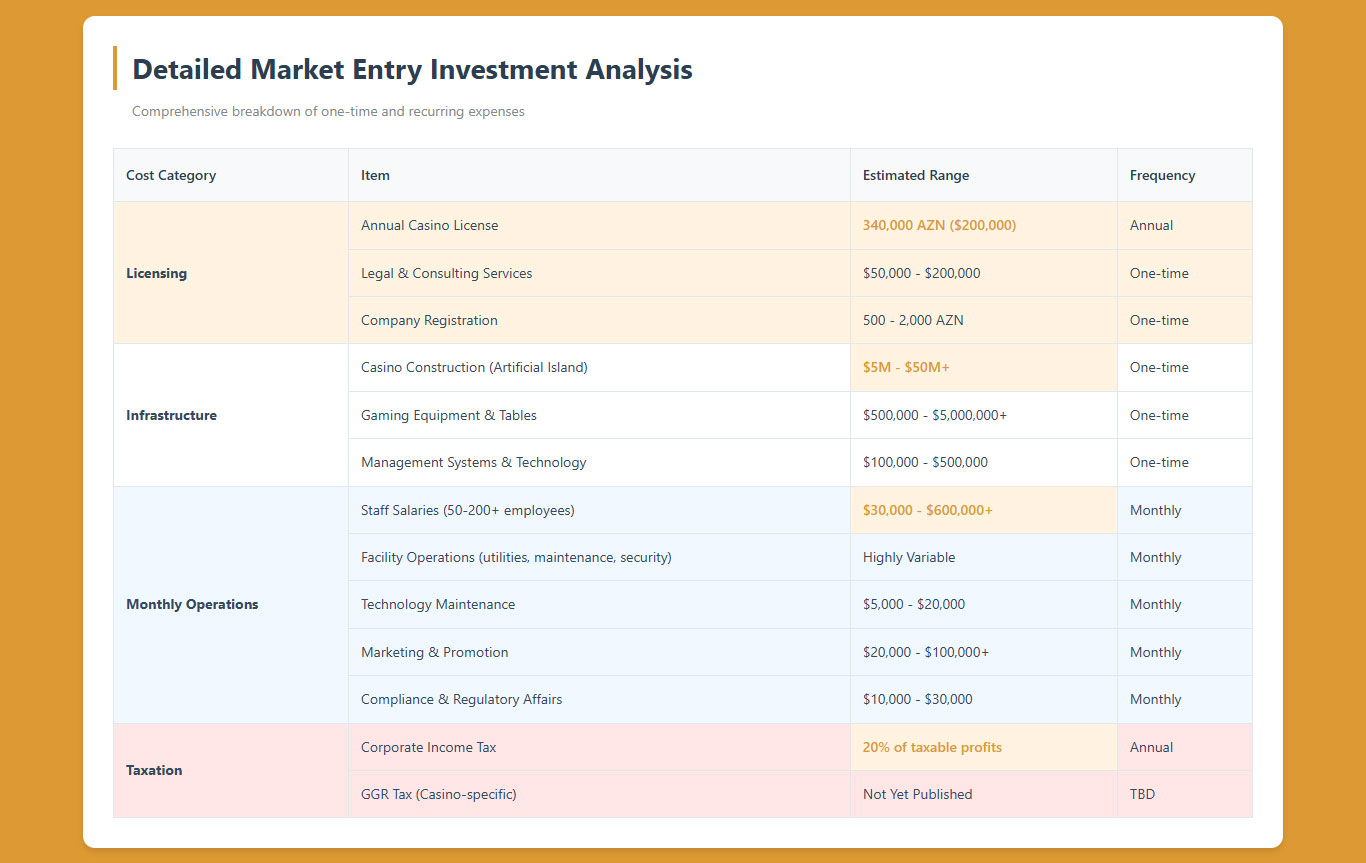
- Annual License Fee: 340,000 AZN ($200,000)
- Physical Infrastructure: Highly variable; millions of dollars for casino construction on artificial islands
- Company Registration: 500-2,000 AZN including professional services
- Legal and Consulting: $50,000-$200,000 for licensing, compliance, and setup advisory
- Initial Capital Requirements: To be determined by licensing authority
- Gaming Equipment: $500,000-$5,000,000+ depending on casino size and quality
- Technology Platform: $100,000-$500,000 for management systems
Monthly Operational Costs (Estimated):
- Staff Salaries: 50-200+ employees at 1,000-5,000 AZN average = $30,000-$600,000+ monthly
- Facility Operating Costs: Utilities, maintenance, security – highly variable
- Technology Maintenance: $5,000-$20,000 monthly
- Marketing: $20,000-$100,000+ monthly depending on scale
- Compliance and Regulatory: $10,000-$30,000 monthly
Timeline Estimates:
- Company Registration: 1-4 weeks
- License Application and Approval: Unknown; 6-18 months estimated
- Physical Infrastructure Development: 12-36+ months for casino construction
- Total Time to Market: 24-48+ months from initiation to casino opening
Success Factors and Challenges
Critical Success Enablers:
Understanding local consumer preferences is paramount given limited market research availability. Initial operators must invest in market intelligence to identify optimal gaming offerings, price points, and service expectations.
Government relationships and political connections significantly influence licensing success, regulatory navigation, and operational permissions. Engaging well-connected local advisors and partners proves nearly essential.
Premium positioning may attract affluent Azerbaijanis and regional tourists given limited legal gambling supply. Differentiation through luxury amenities, entertainment offerings, and unique experiences can justify premium pricing.
Localized marketing in Azerbaijani and Russian languages with culturally appropriate messaging maximizes market penetration. Understanding cultural sensitivities around gambling helps craft effective promotional strategies.
Major Operational Challenges:
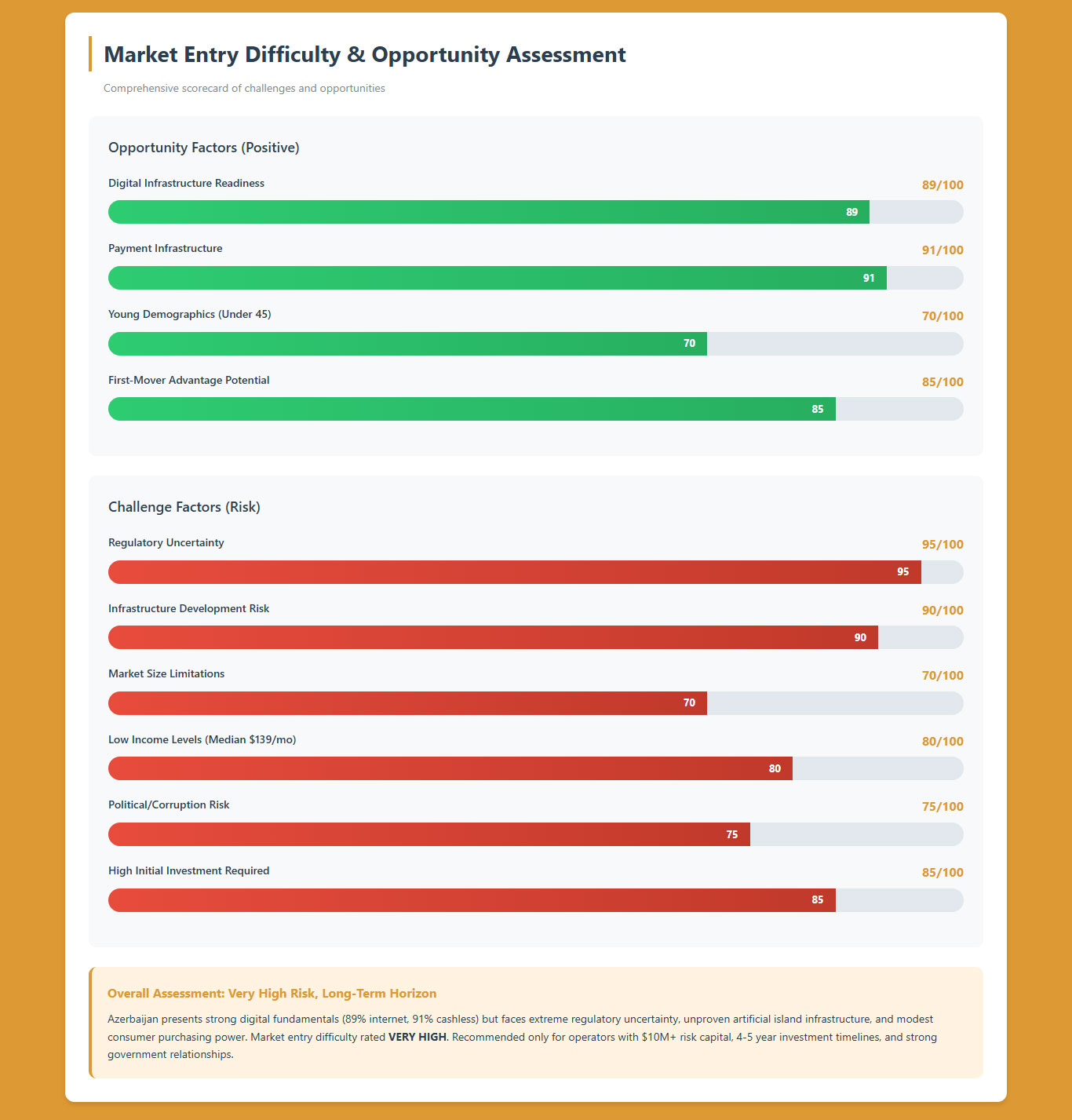
Regulatory uncertainty dominates all planning as artificial island casino regulations remain incompletely defined. Tax rates, compliance requirements, and operational restrictions may emerge that fundamentally alter business models.
Infrastructure development on artificial islands faces unique challenges including construction logistics, utilities provision, transportation access, and environmental considerations. No precedent exists for this development model in Azerbaijan.
Limited market size constrains revenue potential – Azerbaijan’s 10.4 million population and modest incomes may not support multiple large casinos. Operators must attract regional tourists or accept limited market capacity.
Payment processing for international visitors may face challenges if banking relationships prove difficult to establish or if foreign card acceptance encounters restrictions.
Talent shortage in casino management, gaming operations, and hospitality may necessitate importing foreign expertise at high cost. Training local staff requires time and investment.
Competitive Dynamics:
First-mover advantages exist for early artificial island casino operators who can establish brand recognition and customer bases before competition emerges. However, first movers also bear regulatory uncertainty risks.
Turkish casino markets in North Cyprus pose competition for Azerbaijani gamblers who currently travel abroad. Artificial island casinos must offer compelling reasons to gamble domestically versus established foreign alternatives.
Offshore online casinos will continue serving Azerbaijanis regardless of artificial island casino development. Land-based operations cannot capture online gambling demand without regulatory liberalization.
Exit Strategy Planning
Market liquidity for casino sales in Azerbaijan is completely unknown given no historical precedent. Finding buyers for artificial island casino assets may prove challenging without established secondary market.
License transferability rules have not been published, creating uncertainty about whether licenses can be sold with casino businesses or require new application processes.
Typical valuation multiples cannot be determined without operational track record. Early operators should prepare for extended hold periods rather than expecting rapid exits.
Legal process for closing operations remains undefined under new framework. Operators should negotiate exit provisions in initial licensing agreements to preserve flexibility.
FAQ: Frequently Asked Questions
Legal and Licensing
1. Is online gambling legal in Azerbaijan?
No, online casino gambling is explicitly prohibited in Azerbaijan. The Ministry of Finance does not issue licenses for online casino operations, and operating or promoting online casinos targeting Azerbaijani residents is illegal.
Only state-approved lotteries and limited sports betting through government-designated operators are permitted in digital form. International online casinos operate in a gray area serving Azerbaijani players from offshore jurisdictions without local authorization.
Authorities actively restrict access to unauthorized gambling websites and prosecute those facilitating illegal gambling activities. Recent enforcement actions have intensified against social media advertising for online casinos, particularly fraudulent operations.
Players accessing international gambling sites face unclear legal risks. While enforcement focuses primarily on operators rather than individual players, using unlicensed platforms remains technically illegal and outside regulatory protections.
2. What types of gambling licenses are available and what do they cover?
Azerbaijan currently offers three extremely limited license types. Lottery licenses permit organization and operation of state-approved lotteries, restricted to Azerbaijani-registered legal entities meeting strict financial and operational criteria.
Sports betting licenses allow operation of betting facilities on sports events under the Law on Physical Education and Sports. Licensing is highly restricted with preference for state-affiliated entities.
Artificial island casino licenses, introduced in July 2025, permit casino operations exclusively on designated artificial land plots in the Azerbaijani sector of the Caspian Sea. Mainland casino operations remain prohibited.
No online gambling licenses are available. No slot machine hall licenses exist. No poker room licenses are granted. The gambling licensing framework is among the world’s most restrictive.
3. How much does an iGaming license cost and how long does it take to obtain?
Artificial island casino licenses cost 340,000 AZN (approximately $200,000) annually. This represents the only published licensing fee for the new casino framework introduced in July 2025.
Application timelines have not been officially published as the regulatory framework remains nascent. Based on regional comparisons and Azerbaijan’s bureaucratic environment, operators should anticipate 6-18 months for license application processing.
Additional costs include legal representation, compliance consulting, background check fees, and financial guarantee instruments. Total licensing costs could reach $250,000-$500,000 including professional services.
Lottery and sports betting license costs are not publicly disclosed. Given tight government control and limited availability, these licenses are effectively unavailable to new applicants without extraordinary political connections.
4. Can foreign companies obtain a gambling license?
Foreign ownership rules for artificial island casino licenses have not been explicitly published. However, licensing requires establishing an Azerbaijani-registered legal entity meeting Ministry of Finance criteria.
Lottery licenses explicitly restrict eligibility to legal entities registered in Azerbaijan. This suggests foreign companies must create local subsidiaries rather than operating through branch offices or foreign entities.
Foreign ownership percentages, if restricted, have not been disclosed. Azerbaijan’s general business regulations often impose limitations on strategic sector foreign ownership, suggesting similar constraints may apply to gambling.
Practical reality suggests foreign operators will need well-connected local partners to navigate licensing processes successfully. Political relationships and government connections heavily influence business outcomes in Azerbaijan’s authoritarian environment.
Financial and Taxation
5. What are the tax obligations for iGaming operators?
Specific gambling tax structures for artificial island casinos have not been published. The Ministry of Finance will establish gross gaming revenue (GGR) tax rates, net gaming revenue (NGR) considerations, and other gambling-specific taxation.
All Azerbaijani entities face standard corporate income tax at 20 percent of taxable profits. This applies to casino operators alongside any gambling-specific taxes that may be implemented.
Annual license fees of 340,000 AZN ($200,000) represent fixed operational costs separate from revenue-based taxation. License fees must be paid regardless of profitability.
Value-added tax at 18 percent applies to most goods and services in Azerbaijan. The applicability of VAT to gambling services has not been clarified for casino operations.
Withholding taxes on dividends (10 percent), interest (10 percent), and royalties (14 percent) apply to cross-border payments. International tax treaties may reduce these rates for qualifying entities.
6. Are gambling winnings taxed for players?
Player taxation on gambling winnings has not been comprehensively defined for artificial island casino operations. Based on regional norms, winnings may be subject to personal income tax above certain thresholds.
Azerbaijan’s personal income tax employs two tiers: 14 percent on monthly income up to 2,500 AZN and 25 percent on amounts exceeding this threshold. How gambling winnings factor into these brackets remains unclear.
Operators may be required to withhold taxes on player winnings above specified amounts, though specific thresholds and procedures have not been published. Implementation details will emerge as casinos begin operations.
Tax-free thresholds for small winnings may exist but have not been defined. Neighboring countries often exempt modest winnings from taxation while taxing substantial jackpots.
7. What are the typical operational costs for running an online casino or sportsbook?
Online casinos and sportsbooks cannot legally operate in Azerbaijan, making typical operational cost analysis impossible. However, for artificial island land-based casinos, costs are substantial.
Monthly staff costs for 50-200 employees at average salaries of 1,000-5,000 AZN could range $30,000-$600,000 depending on scale and expertise requirements. Casino managers and specialized staff command premium wages.
Facility operating expenses including utilities, maintenance, security, and cleaning vary dramatically based on casino size. Island location may inflate costs due to logistics and infrastructure limitations.
Marketing and customer acquisition costs could reach $20,000-$100,000+ monthly depending on promotional intensity and market competition. Attracting customers to island locations requires substantial marketing investment.
Technology platform maintenance, compliance monitoring, regulatory reporting, and payment processing add $15,000-$50,000 monthly. Gaming equipment maintenance and replacement represent ongoing capital expenditures.
8. What is the expected ROI timeline for entering this market?
Return on investment timelines are highly speculative given zero operational precedent for artificial island casinos. Initial operators face extraordinary risks and uncertain financial outcomes.
Development timeline of 24-48 months from initiation to casino opening means investors must sustain capital deployment for 2-4 years before generating revenue. Construction and licensing costs accumulate during this period.
Initial ramp-up periods typically require 6-12 months post-opening to reach stable operations and customer base development. Break-even may require 3-5 years of operations depending on initial investment scale.
Total time to positive ROI could extend 5-8+ years from initial commitment. Only well-capitalized operators with long investment horizons should consider Azerbaijan market entry.
Market size limitations suggest modest revenue potential relative to investment requirements. Azerbaijan’s 10.4 million population with median income around $139 monthly cannot support unlimited casino capacity.
Operations and Compliance
9. What are the local presence requirements for operators?
Gambling operators must establish Azerbaijani-registered legal entities to obtain licensing. Branch offices or foreign entities operating without local registration cannot secure gambling licenses.
Physical presence on designated artificial islands is mandatory for casino operations. Casinos can only operate in specified zones on artificial land plots in the Caspian Sea.
Specific requirements for office space, management personnel, and local staffing have not been published. Regional gambling regulations typically mandate local offices and resident directors.
Domain and server hosting requirements for any digital components (player databases, surveillance systems) may require local infrastructure. Technology requirements await regulatory clarification.
10. What payment methods are available and recommended?
Credit and debit cards via Visa and Mastercard represent the most widely available payment methods with 91 percent cashless transaction adoption. Card acceptance is essential for any gambling operation.
Mobile wallets including Apple Pay, Google Pay, PashaPay, and GoldenPay are rapidly growing with twelve licensed providers. Contactless payment infrastructure supports modern payment preferences.
Bank transfers through AZIPS and HÖP systems enable instant and retail payments. AniPay, the Central Bank instant payment system, facilitates QR code payments increasingly popular among consumers.
E-wallets like PayPal, Skrill, WebMoney, and Paysera serve international and domestic users. These methods may facilitate cross-border transactions for foreign visitors.
Cash handling remains necessary despite 91 percent cashless adoption. Nine percent cash transactions and tourist preferences require cash acceptance capabilities alongside electronic methods.
Cryptocurrency integration faces regulatory uncertainty. Azerbaijan lacks comprehensive cryptocurrency frameworks, making digital currency acceptance legally ambiguous for gambling operations.
11. What are the advertising and marketing restrictions?
Advertising and promotion are strictly forbidden for unauthorized gambling activities. Only state-approved gambling products including official lotteries and regulated sports betting may be advertised.
All marketing materials must undergo government oversight to prevent misleading claims, aggressive content, or appeals to minors and vulnerable groups. The Ministry of Finance scrutinizes gambling advertising.
Recent enforcement intensified against online casino advertisements on social networks. Authorities monitor social media platforms and prosecute entities promoting illegal gambling services.
Specific channel restrictions (television, radio, outdoor, print, online) for artificial island casino advertising have not been published. Operators should anticipate conservative regulations limiting promotional activities.
Sponsorship regulations affecting sports teams, events, and media properties remain undefined for casino operators. Traditional sports betting operators like Topaz sponsor football leagues under government approval.
Bonus and promotion limitations may restrict welcome offers, wagering requirements, and promotional incentives. Responsible gambling considerations typically constrain aggressive promotional tactics.
12. What responsible gambling measures are mandatory?
Specific responsible gambling requirements for artificial island casinos have not been published. However, international best practices and regional trends suggest several measures will be mandated.
Age verification at 18+ is mandatory to prevent underage gambling. Strict identification checks are required for all gambling participation with operators liable for underage access.
Self-exclusion systems allowing players to voluntarily ban themselves from gambling activities will likely be required. Duration options and cross-operator exclusion mechanisms await regulatory definition.
Know Your Customer (KYC) and Anti-Money Laundering (AML) compliance is mandatory under the Law on Prevention of Legalization of Criminally Obtained Funds. Rigorous player identification and transaction monitoring are required.
Player information disclosures about game odds, house edge, and responsible gambling resources may be mandated. Display of helpline numbers and problem gambling warning signs represents standard practice.
Session time limits, loss limits, and reality checks are increasingly common responsible gambling tools. Azerbaijan may adopt these measures as casino operations commence.
Market Opportunity
13. How large is the iGaming market and what is the growth potential?
No legal regulated iGaming market currently exists in Azerbaijan. The market consists exclusively of gray market activity through international platforms and limited legal sports betting.
Quantifying gray market size proves impossible without regulatory data. However, lawmakers cited significant citizens gambling abroad or via online platforms as justification for artificial island casino legalization.
Artificial island casino market size depends entirely on infrastructure development success and regulatory framework evolution. Initial single-casino operations would generate modest revenues compared to mature markets.
Growth potential exists if Azerbaijan liberalizes online gambling regulations. With 89 percent internet penetration, 91 percent cashless payment adoption, and 10.4 million population, market foundations are strong.
Regional comparison shows Georgia (3.8 million population) operates legal online gambling generating substantial tax revenues. Azerbaijan’s larger population suggests proportionally greater potential if regulations change.
Long-term growth projections remain highly speculative. Regulatory trajectory, economic development, and government policy toward gambling liberalization will determine market evolution over 5-10 year horizons.
14. Who are the main competitors and what is their market share?
No artificial island casinos currently operate as of October 2025 despite July 2025 legal authorization. The Sea Breeze entertainment complex represents the most prominent announced project without operational timeline.
Legal sports betting market is dominated by state-sponsored operator Topaz enjoying government backing and Azerbaijan Premier League sponsorship. Market concentration is extreme with minimal competition.
Lottery market consists of state-approved operators holding exclusive licenses. Market share data is not publicly disclosed for lottery sales.
International online casinos serve Azerbaijani players from offshore jurisdictions without local licensing. Market leaders likely mirror global online gambling brands but cannot be definitively identified.
Turkish casinos in North Cyprus and other regional gambling destinations compete for Azerbaijani customers who travel abroad. Artificial island casinos must compete against established foreign alternatives.
15. What are player preferences and typical spending patterns?
Player preferences cannot be precisely quantified due to prohibition and limited market research. However, sports betting popularity is evident through state-approved operator activity.
Football (soccer) dominates betting interest given Azerbaijan Premier League following and international competition enthusiasm. European championships and World Cup events drive peak betting activity.
Casino game preferences likely mirror international patterns with slots, roulette, and blackjack attracting mainstream participation. High-roller baccarat and poker appeal to smaller affluent segments.
Mobile gambling preference is virtually certain given 71.4 percent mobile web traffic dominance. Desktop usage would concentrate in office or home settings.
Average spending per player remains unknown but modest median income of $139 monthly suggests recreational gambling at low stakes predominates over high-roller activity.
Typical bet sizes would be small by international standards reflecting limited disposable income. Premium positioning targeting affluent Azerbaijanis and foreign visitors may support higher-stakes gaming.
16. What are the key success factors and main challenges for new entrants?
Key Success Factors:
Government relationships and political connections are absolutely critical. Azerbaijani business success heavily depends on regime connections, making well-connected local partners nearly essential.
Premium positioning differentiates operators in supply-constrained market. Luxury amenities, entertainment offerings, and unique experiences justify premium pricing and attract affluent customers.
Understanding local preferences through market research investments identifies optimal gaming offerings, service expectations, and price points given limited existing data.
Mobile-first technology platform design serves 71.4 percent mobile web traffic dominance. User experience optimized for smartphones maximizes accessibility and engagement.
Localized marketing in Azerbaijani and Russian with culturally appropriate messaging maximizes penetration. Cultural sensitivity around gambling and Islamic considerations shapes effective promotional strategies.
Main Challenges:
Regulatory uncertainty dominates all planning as artificial island casino regulations remain incompletely defined. Tax rates, compliance requirements, and operational restrictions may fundamentally alter business models.
Limited market size constrains revenue potential. Azerbaijan’s 10.4 million population and modest incomes cannot support unlimited casino capacity, restricting growth opportunities.
Infrastructure development on artificial islands faces unique challenges including construction logistics, utilities provision, transportation access, and unprecedented development model.
Talent shortage in casino management, gaming operations, and hospitality necessitates importing foreign expertise at high cost. Training local workforce requires time and investment.
Competition from established foreign gambling destinations and offshore online casinos limits market capture. Convincing Azerbaijanis to gamble domestically rather than abroad or online requires compelling value propositions.
Sources and References
- Legal Pilot – Is Gambling Legal in Azerbaijan? Laws & Regulations Explained 2025 – https://legalpilot.com/country/azerbaijan/
- iGaming Today – Gambling Regulation in Azerbaijan – https://www.igamingtoday.com/gambling-regulation-in-azerbaijan/
- Yogonet International – Azerbaijan lifts gambling ban on artificial islands in Caspian Sea – https://www.yogonet.com/international/news/2025/07/10/110991-azerbaijan-lifts-gambling-ban-on-artificial-islands-in-caspian-sea
- SBC Eurasia – Azerbaijan Passes Law to Allow Casinos on Artificial Islands in the Caspian Sea – https://sbceurasia.com/en/2025/07/10/azerbaijan-passes-law-to-allow-casinos-on-artificial-islands-in-the-caspian-sea/
- Slotegrator – This month in iGaming: July 2025 – https://slotegrator.pro/industry-news/azerbaijan-the-eu-and-mga-requirements/
- Mondaq – Amendments To Gambling Regulations – Azerbaijan – https://www.mondaq.com/gaming/1151766/amendments-to-gambling-regulations
- LCB.org – Are Online Casinos Legal In Azerbaijan? – https://lcb.org/restrictions/azerbaijan
- Worldometer – Azerbaijan Population (2025) – https://www.worldometers.info/world-population/azerbaijan-population/
- Worldometer – Azerbaijan Demographics 2025 – https://www.worldometers.info/demographics/azerbaijan-demographics/
- Countrymeters – Azerbaijan population (2025) live – https://countrymeters.info/en/Azerbaijan
- Wikipedia – Demographics of Azerbaijan – https://en.wikipedia.org/wiki/Demographics_of_Azerbaijan
- State Statistical Committee of the Republic of Azerbaijan – Monthly macroeconomic indicators – https://www.stat.gov.az/news/macroeconomy.php
- Wikipedia – Economy of Azerbaijan – https://en.wikipedia.org/wiki/Economy_of_Azerbaijan
- World Economics – Azerbaijan Nominal GDP Per Capita – https://www.worldeconomics.com/GrossDomesticProduct/Current-GDP-Per-Capita/Azerbaijan.aspx
- Statista – Gross domestic product (GDP) in current prices in Azerbaijan from 1992 to 2030 – https://www.statista.com/statistics/457496/gross-domestic-product-gdp-in-azerbaijan/
- Trading Economics – Azerbaijan GDP – https://tradingeconomics.com/azerbaijan/gdp
- EBRD – Real GDP growth in Azerbaijan projected to moderate to 3 per cent in 2025 – https://euneighbourseast.eu/news/latest-news/ebrd-real-gdp-growth-in-azerbaijan-projected-to-moderate-to-3-per-cent-in-2025/
- DataReportal – Digital 2025: Azerbaijan – https://datareportal.com/reports/digital-2025-azerbaijan
- Mordor Intelligence – Azerbaijan Telecom MNO Market Size, Share & 2030 Growth Trends – https://www.mordorintelligence.com/industry-reports/azerbaijan-telecom-mno-market
- BuddeComm – Azerbaijan – Telecoms, Mobile and Broadband – Statistics and Analyses – https://www.budde.com.au/Research/Azerbaijan-Telecoms-Mobile-and-Broadband-Statistics-and-Analyses
- BYYD – Mobile Marketing in the Caucasus 2025: Key Insights from Georgia, Armenia, and Azerbaijan – https://www.byyd.me/en/blog/2025/04/mobile-marketing-in-the-caucasus/
- Tech.az – Social media and internet statistics in Azerbaijan – https://tech.az/en/posts/social-media-and-internet-statistics-in-azerbaijan-research-3788
- Transfi – Azerbaijan’s Payment Rails & How They Work – AZIPS, HÖP & Mobile Wallets – https://www.transfi.com/blog/azerbaijans-payment-rails-how-they-work—azips-hop-mobile-wallets
- Payments Cards & Mobile – Azerbaijan 2025 – Digital & Card Payment Yearbooks – https://www.paymentyearbooks.com/reports/azerbaijan-2025/
- Paymentwall – Payment Methods in Azerbaijan – https://www.paymentwall.com/en/payment-methods/azerbaijan
- Jeton Blog – Azerbaijan Payment Gateways – https://blog.jeton.com/azerbaijan-payment-gateways
- GlobalData – Azerbaijan Cards and Payments – Opportunities and Risks to 2029 – https://www.globaldata.com/store/report/azerbaijan-cards-and-payments-market-analysis/
- Ezeepayment – 11 Best Mobile Payment Apps in Azerbaijan [2025] – https://ezeepayment.com/mobile-payment-apps-in-azerbaijan/
- PayCEC – What online payment method does Azerbaijan use? – https://www.paycec.com/faq/what-online-payment-method-does-azerbaijan-use
- Epoint – The volume of online payments with cards is increasing in Azerbaijan! – https://epoint.az/en/article/azerbaycanda-kartlarla-onlayn-odenislerin-hecmi-artir
- Caliber.Az – Azerbaijan’s digital leap: Fintech at core of strategy – https://caliber.az/en/post/azerbaijan-s-digital-leap-fintech-at-core-of-strategy
- Baku Research Institute – Azerbaijan’s Hidden Poverty Statistics – https://bakuresearchinstitute.org/en/azerbaijans-hidden-poverty-statistics/
- The Borgen Project – Everything You Need to Know About Poverty in Azerbaijan – https://borgenproject.org/poverty-in-azerbaijan/
- Baku Research Institute – Structure of Azerbaijani National Income – https://bakuresearchinstitute.org/en/structure-of-azerbaijani-national-income/
- Baku Research Institute – What Are the Median Incomes and Wages in Azerbaijan? – https://bakuresearchinstitute.org/en/what-are-the-median-incomes-and-wages-in-azerbaijan/
- ACON Consulting – How to Start a Business in Azerbaijan in 2025 – https://acon.az/business-in-azerbaijan
- World Bank – Doing Business in Azerbaijan – https://archive.doingbusiness.org/en/data/exploreeconomies/azerbaijan
- Wikipedia – Ease of doing business index – https://en.wikipedia.org/wiki/Ease_of_doing_business_index
- Remote People – Doing Business in Azerbaijan in 2025 [Expert Guide] – https://remotepeople.com/countries/azerbaijan/doing-business-in-azerbaijan/
- World Bank – Accelerating the Growth of High-Speed Internet Services in Azerbaijan – https://www.worldbank.org/en/country/azerbaijan/publication/broadband-in-azerbaijan
- Central Bank of the Republic of Azerbaijan – Official Website
- Ministry of Finance of the Republic of Azerbaijan – Official Website
- Ministry of Digital Development and Transport of the Republic of Azerbaijan – Official Website
Note: This analysis is based on publicly available information as of October 2025. Azerbaijan’s gambling regulatory framework for artificial island casinos is nascent and evolving. Operators should conduct independent due diligence and consult legal advisors before making market entry decisions.
The analysis presents factual information about Azerbaijan’s restrictive gambling environment. Market entry carries substantial risks including regulatory uncertainty, infrastructure challenges, limited market size, and political factors. Only well-capitalized operators with long investment horizons and high risk tolerance should consider Azerbaijan market entry.
🎯 Gambling Databases Country Rating: Azerbaijan
| Evaluation Dimension | Score | Rating |
|---|---|---|
| Operator Ease Score | 1.8/10 | ⛔️ Prohibitive |
| Player Access Score | 2.3/10 | ⛔️ Illegal (Limited Gray Market) |
| Overall Market Attractiveness | 2.0/10 | ⛔️ Avoid Unless Very Specific Circumstances |
This rating is calculated using the Gambling Databases Rating (GDR) methodology, which provides transparent criteria for evaluating iGaming markets worldwide. Click the link to learn how we calculate Operator Ease Score, Player Access Score, and overall market attractiveness ratings.
⚠️ CRITICAL RISK WARNINGS
READ THIS BEFORE CONSIDERING MARKET ENTRY:
- Online Casino Gaming is COMPLETELY PROHIBITED in Azerbaijan – No licenses available, explicit ban in force since 1998 maintained through July 2025 reforms
- Land-Based Casinos BANNED on Mainland – Only permitted on unbuilt artificial islands in Caspian Sea with uncertain timeline (no operational casinos as of October 2025)
- Active ISP Blocking – Authorities block unauthorized gambling websites, with telecommunication operators legally required to prevent gambling access
- Affiliate/Advertiser Enforcement – Recent crackdowns on social media gambling advertisements, with legal action against entities promoting illegal gambling
- Fraud-Related Gambling = Criminal Liability – Virtual gambling involving fraud carries “long-term imprisonment and substantial fines” per Article 244-1 Criminal Code
- Extremely Limited Licensing – Sports betting restricted to state-approved operators (Topaz dominates); new artificial island casino licenses theoretically available but infrastructure non-existent
- High Regulatory Uncertainty – Artificial island casino framework incomplete: taxation rates unpublished, operational standards undefined, no precedent exists
- Payment Restrictions Unclear – Regulations preventing financial institutions from processing illegal gambling transactions; cryptocurrency status undefined
- Infrastructure Does Not Exist – Despite July 2025 legalization, NO artificial island casinos operational; Sea Breeze project announced but timeline uncertain and physical construction not commenced
- Market Size Severely Limited – 10.4M population with median monthly income only $139 (68.8% of $202 average); poverty line at $145/month leaves minimal gambling discretionary income
📊 Operator Ease Score Breakdown
| Criterion | Weight | Score | Justification (INCLUDING ALL DEDUCTIONS) |
|---|---|---|---|
| Legal & Regulatory Framework | 30% | -0.5/3.0 | Started at 0 (illegal baseline). State lotteries and sports betting legal but extremely restricted (+0.5). Online casino COMPLETELY PROHIBITED (-1.5). Active ISP blocking of unauthorized sites (-0.5). Recent enforcement crackdowns against social media casino ads (-0.5). Affiliate/advertiser prosecution risk (-0.5). Total: -0.5/3.0 (floor at 0, shown as negative to emphasize severity) |
| Licensing Process | 25% | 0.25/2.5 | Started at 0 (no accessible licensing). Artificial island casino licenses theoretically available (+0.5). Annual fee 340,000 AZN ($200K) under €250k threshold (+0.25). BUT: Sports betting licensing effectively impossible for new entrants (state monopoly, -0.5). Online casino: no licensing available (-0.5). Application procedures unpublished for artificial islands (-0.25). No operational precedent, complete regulatory uncertainty (-0.5). Foreign ownership rules undefined (-0.25). Infrastructure construction timeline 24-48+ months (-0.5). Total setup costs millions of dollars (-0.25). Total: 0.25/2.5 |
| Taxation & Costs | 20% | 0.25/2.0 | Cannot properly evaluate – taxation framework UNPUBLISHED for artificial island casinos. Known: 20% corporate income tax (0 points for standard rate). $200K annual license fee is fixed cost separate from revenue taxation. GGR/NGR tax rates: NOT PUBLISHED – assume will be punitive given regional norms (+0.5 cautiously, but could be 0). Estimated total effective tax rate 40-50%+ once published (-0.5). Infrastructure development costs: millions for casino construction on artificial island (-0.5). Monthly operational costs estimated $30K-$600K+ for staff alone (-0.5). Customer acquisition costs likely high given no existing market data (-0.5). Total time to breakeven: 3-5+ years minimum (-0.25). Total: 0.25/2.0 |
| Operational Requirements | 15% | 0.0/1.5 | Started at 0 (excessive requirements). Must establish Azerbaijani-registered legal entity (mandatory local presence). Artificial island casino must be built on designated Caspian Sea plots – ZERO existing infrastructure (-0.5). Construction logistics, utilities provision, transportation access all undefined and unprecedented (-0.25). Foreign ownership restrictions likely but unpublished (-0.25). Payment processing restrictions unclear; banks prohibited from processing illegal gambling transactions (-0.25). Credit card/cryptocurrency status for legal casinos undefined (-0.25). Must navigate authoritarian government and corruption perception (-0.25). Talent shortage in casino management requires importing foreign expertise (-0.25). Total: 0.0/1.5 (floor) |
| Market Environment | 10% | 0.15/1.0 | Started at +0.25 (difficult business environment). World Bank Doing Business rank 34/190 in 2020, but this data was manipulated and index discontinued (+0.25). High corruption perception endemic in government operations (-0.25). Authoritarian regime with limited press freedom creates unpredictable environment (-0.25). Advertising for unauthorized gambling strictly forbidden (-0.5). Recent crackdowns on online casino social media ads (-0.25). Active enforcement against international operators serving Azerbaijanis (-0.25). 89% internet penetration and 91% cashless adoption are positives (+0.4). Market completely unproven for legal casinos (no precedent) (-0.25). Total: 0.15/1.0 |
| TOTAL OPERATOR EASE SCORE | 1.8/10 ⛔️ PROHIBITIVE | ||
👥 Player Access Score Breakdown
| Criterion | Weight | Score | Justification (INCLUDING ALL DEDUCTIONS) |
|---|---|---|---|
| Legal Status for Players | 40% | 1.0/4.0 | Started at +0.5 (illegal but players not penalized). State lotteries and sports betting legal (+1.5 partial legality). Online casino COMPLETELY PROHIBITED – major product category banned (-1.5). Land-based casinos banned on mainland (-0.5). Players using offshore online casinos operate in gray area without direct enforcement against players (+0.5). However, ISP blocking makes access difficult (-0.5). Payment processors restricted from processing illegal gambling transactions affects players (-0.5). Total: 1.0/4.0 |
| Practical Accessibility | 30% | 0.8/3.0 | Started at +1.0 (limited methods, some blocking). Active ISP blocking of unauthorized gambling websites (-0.5). VPN required for offshore casino access (-0.5). Payment methods for illegal gambling restricted; financial institutions prohibited from processing (-0.5). Credit card availability for offshore gambling unclear (-0.5). Cryptocurrency status undefined for gambling purposes (-0.5). 91% cashless payment adoption is positive for legal gambling (+0.3). 89% internet penetration supports access (+0.3). Mobile-first market (71.4% mobile traffic) benefits mobile gambling (+0.2). Total: 0.8/3.0 |
| Player Penalties | 20% | 1.5/2.0 | Players not directly penalized for using offshore sites (+2.0). However, fraud-related virtual gambling carries criminal penalties (-0.5). Enforcement focuses on operators and facilitators, not players, but legal uncertainty exists around gray market participation. Total: 1.5/2.0 |
| Market Availability | 10% | 0.3/1.0 | Started at +0.25 (no licensed operators, offshore only). Legal sports betting: Topaz (state-sponsored) dominates; minimal competition (+0.25). State lotteries available (+0.1). Zero licensed online casinos (0 points for casino category). Zero operational land-based casinos despite July 2025 legalization (0 points). Offshore international casinos serve Azerbaijanis but face ISP blocking (-0.05). Total: 0.3/1.0 |
| TOTAL PLAYER ACCESS SCORE | 2.3/10 ⛔️ ILLEGAL (LIMITED GRAY MARKET) | ||
🔍 Key Highlights
Strengths (Very Limited)
- High Digital Readiness: 89% internet penetration (9.23M users) and 91% cashless payment adoption create strong technological foundation
- Young Population: Median age 33.6 years with 17.2% aged 25-34 (prime gambling demographic) and high digital literacy
- Mobile-First Market: 71.4% mobile web traffic, 118% mobile penetration (12.2M connections), 81.3% Android adoption supports mobile gambling
- Historic Legalization (July 2025): First casino legalization in 27 years creates potential first-mover advantage for artificial island operators
- Relatively Modest License Fee: $200K annual fee is lower than many regulated markets (but revenue taxation unpublished)
- Players Not Prosecuted: Enforcement focuses on operators/facilitators; players using offshore sites face low direct legal risk
⛔️ CRITICAL RISKS AND CHALLENGES
- [Product Prohibitions]: Online casino COMPLETELY BANNED – eliminates primary revenue source for modern operators. Land-based casinos prohibited on mainland; only artificial islands permitted. This fundamentally limits business models to sports betting (state-controlled) or speculative artificial island investment.
- [Infrastructure Non-Existent]: Despite July 2025 legalization, ZERO artificial island casinos operational as of October 2025. Sea Breeze project announced but construction not commenced. Timeline to first operational casino: 24-48+ months minimum. No precedent, no infrastructure, complete uncertainty.
- [Regulatory Uncertainty – EXTREME]: Taxation rates UNPUBLISHED for artificial island casinos. Operational standards undefined. Foreign ownership rules unclear. Technical requirements unknown. Compliance obligations not established. Entering this market means operating with zero regulatory clarity.
- [Enforcement Actions]: Recent crackdowns on social media casino advertising. ISP-level blocking of unauthorized gambling sites mandatory for telecom operators. Criminal penalties for fraud-related gambling include “long-term imprisonment and substantial fines” (Article 244-1). Payment processors prohibited from processing illegal gambling transactions.
- [Financial Barriers – SEVERE]: Total investment required: MILLIONS for artificial island casino construction + $200K annual license + millions in operational costs. Estimated monthly costs $30K-$600K+ staff alone. Time to breakeven: 3-5+ years minimum. Revenue taxation framework unpublished but likely 40-50%+ effective rate. Customer acquisition costs unknown but likely high given no existing legal market.
- [Market Size Constraints]: 10.4M population with median monthly income $139 (poverty line $145). Limited disposable income for gambling. Average monthly salary $646 but concentrated in Baku. Regional income disparities severe. Market cannot support multiple large casinos – first mover captures most available demand.
- [Payment Restrictions]: Credit card and cryptocurrency status UNDEFINED for legal artificial island casinos. Banks prohibited from processing illegal gambling transactions. Payment infrastructure for legal casinos completely unproven. 91% cashless adoption is positive, but regulatory restrictions may limit methods.
- [Advertising Limits]: Advertising strictly forbidden for unauthorized gambling. State-approved gambling only may advertise under government oversight. Recent enforcement against social media casino promotions. Customer acquisition will be expensive and restricted.
- [Legal Risks for Staff/Partners]: Affiliates promoting offshore casinos face prosecution. Influencers and advertisers targeted in recent crackdowns. Extradition risk low but travel to countries with extradition treaties (USA, UK, EU) may pose risks for offshore operator executives.
- [Operational Complexity]: Must build casino on artificial island with no existing utilities, transportation, or infrastructure. Construction logistics unprecedented. Must establish Azerbaijani legal entity. Must navigate authoritarian government and endemic corruption. Foreign ownership rules undefined. Talent shortage requires importing expensive foreign casino management expertise.
- [Competition]: Sports betting: Topaz (state-sponsored) dominates with government backing and Premier League sponsorship. New sports betting licenses effectively impossible. Turkish casinos in North Cyprus compete for Azerbaijani gamblers traveling abroad. Offshore online casinos will continue serving Azerbaijanis regardless of artificial island development.
- [Business Environment]: High corruption perception. Authoritarian regime with limited press freedom. World Bank Doing Business rankings were manipulated. Transparency International highlights corruption concerns. Oil wealth concentrated among ruling elites. Private sector weak; over 50% population works for government or state entities.
Player-Specific Issues
- Cannot Access Online Casinos Legally: Complete prohibition means zero licensed online casino options
- ISP Blocking: Offshore casino sites actively blocked; VPN required for access
- Payment Method Restrictions: Banks prohibited from processing illegal gambling transactions; credit card/crypto status unclear even for legal betting
- Limited Legal Options: Only state lottery and Topaz sports betting legally available; no variety or competition
- No Land-Based Casinos: Despite 27-year wait for legalization, zero operational casinos exist (artificial islands not built)
- Gray Market Uncertainty: Using offshore sites operates in legal gray area; while players not prosecuted currently, status could change
💰 Reality Check: Can You Actually Make Money Here?
Initial Investment Required: $5,000,000 – $20,000,000+ (artificial island casino construction, infrastructure, licensing, setup)
Annual License Fee: $200,000 (340,000 AZN)
Monthly Operating Costs: $100,000 – $800,000+ (staff $30K-$600K, facility operations, utilities, security, technology, compliance, marketing)
Effective Tax Rate on Revenue: UNKNOWN – GGR/NGR taxation UNPUBLISHED; expect 40-60%+ based on 20% corporate tax + likely punitive gambling-specific taxes
Customer Acquisition Cost: UNKNOWN – No existing legal casino market makes estimation impossible; likely $200-$500+ given advertising restrictions and limited legal market precedent
Time to Breakeven: 3-5 years MINIMUM (assumes successful infrastructure construction, regulatory compliance, market acceptance, and favorable unpublished taxation)
Time to Positive ROI: 5-7+ years (highly speculative; depends entirely on unpublished taxation, actual construction costs, operational efficiency, and market demand which is completely unproven)
Profitability Assessment:
Economics are EXTREMELY SPECULATIVE and likely PROHIBITIVE for most operators. You are being asked to invest $5M-$20M+ to build a casino on an artificial island that doesn’t exist yet, under a regulatory framework where taxation rates are unpublished, operational standards are undefined, and zero precedent exists. The 10.4M population with $139 median monthly income (barely above $145 poverty line) cannot support multiple large casinos. Market size is severely limited.
Even if you successfully navigate construction (24-48+ months), unpublished taxation could easily reach 50-60%+ effective rates making profitability impossible. Customer acquisition costs will be high given advertising restrictions. Competition from Turkish casinos and offshore sites will persist. Market demand is completely unproven – Azerbaijanis may continue traveling abroad or using offshore sites rather than visiting artificial island casinos.
AVOID unless you: (1) Have $20M+ capital you can afford to lose, (2) Have 7-10 year investment horizon with no ROI expectations for first 5 years, (3) Have direct government connections to navigate corruption and secure favorable unpublished terms, (4) Are willing to be guinea pig testing completely unprecedented artificial island casino model, (5) Can accept total loss if regulatory framework changes or taxation proves prohibitive.
⚖️ Legal Risk Assessment
| Stakeholder Type | Risk Level | Specific Risks |
|---|---|---|
| Offshore Casino Operators (Unlicensed) | 🔴 High | ISP blocking mandatory for telecom operators. Payment processing restrictions. Recent crackdowns on social media advertising. Criminal penalties for fraud-related gambling (long-term imprisonment + substantial fines). No legal licenses available. Active enforcement against facilitators. |
| Artificial Island Casino Operators (Licensed) | 🟡 Medium-High | Complete regulatory uncertainty – taxation unpublished, operational standards undefined, no precedent. Infrastructure construction costs and timeline unknown. Must invest millions before revenue. Unpublished taxation could be prohibitive. Market demand unproven. Government corruption perception high. First movers bear all risks. |
| Sports Betting Operators (Licensed) | 🟡 Medium | Licensing effectively impossible for new entrants (state-controlled market). Topaz dominates with government backing. Heavy regulatory compliance. Taxation likely punitive once published. Advertising restrictions. Limited market size. No online casino product permitted (revenue source eliminated). |
| Affiliates/Advertisers (Offshore Casinos) | 🔴 High | Recent enforcement crackdowns specifically targeting social media casino advertising. Legal action against entities promoting illegal gambling. Site blocking. Payment processor termination. Criminal penalties possible under Article 244-1 if deemed facilitating fraud-related gambling. Highly risky activity. |
| Payment Processors | 🔴 High | Financial institutions explicitly prohibited from processing illegal gambling transactions. Regulatory action possible. License revocation risk. Must refuse unauthorized gambling payments. Compliance burden high. Legal status unclear even for artificial island casinos (framework unpublished). |
| Company Directors/Executives (Offshore) | 🟡 Medium | Extradition risk LOW – Azerbaijan has limited international enforcement reach. Travel risk MODERATE to countries with extradition treaties (USA, UK, EU, Canada). Personal liability for criminal gambling organization. Fraud-related gambling carries imprisonment risk. However, enforcement focuses domestically; international prosecution unlikely. |
| Players (Using Offshore Sites) | 🟢 Low | Players NOT directly prosecuted under current enforcement approach. Gray market usage tolerated. ISP blocking creates access difficulty but not player penalties. Fraud-related gambling carries criminal penalties, but legitimate play not targeted. Main risks: ISP blocking, payment restrictions, potential future policy changes. |
🚨 Extradition and International Enforcement
Extradition Treaties: Azerbaijan has extradition agreements with Russia, Turkey, Iran, Georgia, Ukraine, and limited CIS countries. NO extradition treaties with USA, UK, most EU members, Canada, or major Western jurisdictions.
Enforcement History: No documented cases of international prosecution or extradition specifically for gambling offenses. Azerbaijan’s enforcement focuses domestically on ISP blocking, social media advertising crackdowns, and local facilitators. International reach limited.
Safe Jurisdictions: Western Europe (UK, Germany, France, Spain, Italy), USA, Canada, Australia – no extradition agreements with Azerbaijan. Russia, China, most CIS countries also safe from Azerbaijani extradition requests.
Travel Risk: LOW for offshore casino operators based outside Azerbaijan. Even when traveling through countries with Azerbaijan extradition agreements (Turkey, Georgia, Ukraine), risk remains low as Azerbaijan rarely pursues international gambling enforcement. Domestic ISP blocking is primary enforcement mechanism.
Overall Assessment: Extradition risk from Azerbaijan is LOW. The country lacks enforcement reach beyond its borders and focuses on domestic ISP blocking and social media advertising control. Unlike USA or Australia which pursue international gambling operators aggressively, Azerbaijan has not demonstrated international enforcement capability or interest. Main risk is operating within Azerbaijan or holding assets subject to Azerbaijani jurisdiction.
📋 Final Verdict
Azerbaijan receives an Operator Ease Score of 1.8/10 and a Player Access Score of 2.3/10, resulting in an overall market attractiveness rating of 2.0/10.
HONEST ASSESSMENT:
This is one of the world’s most difficult and speculative gambling markets. Online casino gaming is completely prohibited with no legal path to entry. Land-based casinos are theoretically legal on artificial islands as of July 2025, but ZERO infrastructure exists, taxation is unpublished, and no operational precedent exists 27 years after the original ban. You would be investing $5M-$20M+ to build a casino on an artificial island that doesn’t exist, under regulations that aren’t defined, for a market with $139 median monthly income barely above the $145 poverty line. The 10.4M population cannot support multiple large casinos, regulatory uncertainty is extreme, and profitability is highly questionable even if you successfully navigate unprecedented construction and licensing challenges. Sports betting is restricted to state-controlled operators making new entry effectively impossible. Offshore operators face ISP blocking, payment restrictions, and advertising crackdowns with recent enforcement intensifying. Unless you have $20M+ to risk as a guinea pig testing an unproven artificial island model with zero expectation of ROI for 5-7 years, AVOID THIS MARKET COMPLETELY.
✅ Who Should Enter / ❌ Who Should Avoid
✅ Consider Entry ONLY If You Are:
- Ultra-High Net Worth Individual/Entity with $20M+ Disposable Capital – Can afford total loss without financial distress
- 7-10 Year Investment Horizon with Zero ROI Expectations First 5 Years – Prepared for extended period before profitability
- Direct Government Connections in Azerbaijan – Can navigate authoritarian regime, endemic corruption, and secure favorable treatment in unpublished regulatory framework
- Willing to Pioneer Completely Unprecedented Model – First artificial island casino globally; zero precedent for construction, operations, or market acceptance
- Experienced in Frontier Market Infrastructure Development – Can manage construction of casino on artificial island with no existing utilities, transportation, or support infrastructure
- Targeting Regional/International Tourism Beyond Azerbaijan – Not relying solely on 10.4M population with limited disposable income; planning to attract Georgian, Turkish, Russian, Iranian high-rollers
- Have Exit Strategy Accepting Illiquidity – No secondary market for artificial island casino sales; may never find buyer
❌ Definitely Avoid If You Are:
- Online Casino Operator – Online casino completely and permanently prohibited; zero licensing path available
- Offshore Operator Serving Azerbaijanis Without Local License – ISP blocking active, payment restrictions, advertising crackdowns, criminal penalties for fraud-related gambling
- Sports Betting Operator Seeking New License – Market controlled by state-sponsored Topaz; new licensing effectively impossible
- Startup or Mid-Size Operator with Less Than $20M Capital – Minimum viable investment far exceeds capacity; infrastructure costs alone millions of dollars
- Seeking ROI Within 5 Years – Timeline to profitability 5-7+ years minimum given construction, licensing, market development
- Affiliate or Advertiser for Offshore Casinos – Recent enforcement crackdowns specifically target social media gambling advertising; prosecution risk high
- Risk-Averse Investor Requiring Regulatory Certainty – Taxation unpublished, operational standards undefined, zero precedent, complete uncertainty
- Operators Requiring Diversified Product Mix Including Online Casino – Online casino prohibited; artificial island limited to land-based only
- Payment Processors Without Government Approval – Banks prohibited from processing illegal gambling; legal framework for artificial island casinos undefined
- Expecting Liquid Investment with Clear Exit – No secondary market; finding buyer for artificial island casino highly uncertain
- Anyone Unwilling to Operate in High-Corruption Environment – Transparency International highlights endemic corruption; government connections essential for success
⚠️ BOTTOM LINE: Azerbaijan is a PROHIBITIVE market for 99% of gambling operators. Online casino is permanently banned. Artificial island casinos are theoretical only – zero infrastructure exists, taxation is unpublished, and you’d be investing $5M-$20M+ as a guinea pig with no precedent. The market’s $139 median monthly income and 10.4M population cannot support multiple operators. Unless you fit the extremely narrow criteria above (ultra-high capital, decade-long horizon, government connections, willingness to pioneer unprecedented model), DO NOT ENTER THIS MARKET. Even sports betting is restricted to state monopoly. This is a frontier speculation, not a viable business opportunity for rational operators.
🌍 Context: Alternative Risk Assessment
Based on separate regional risk analysis:
| Parameter | Assessment |
|---|---|
| Overall Risk Level | 🟡 Medium |
| Legislative Framework | Ambiguous / Local Regulation |
| Authority Activity Level | Medium |
| Risk of Prosecution (Non-Residents) | Low |
| Risk Upon Entering Country | Low |
| Extradition Risk to Azerbaijan | Low |
| Precedents (Against Non-Residents) | No Data Available |
Risk Level Commentary: Azerbaijan: Work possible with caution; local legal review recommended before large-scale campaigns. Extradition risk to the country is low, requests are rare.
GDR Analysis Reconciliation: This “Medium Risk” assessment for offshore operators aligns with our High Risk rating for unlicensed offshore operators but acknowledges low extradition risk. The “work with caution” advice is appropriate given ISP blocking, payment restrictions, and advertising crackdowns, though international enforcement remains limited. Local legal review is essential before any campaigns targeting Azerbaijani players.
📈 Comparison to Regional Markets
| Country | Population | Online Casino Status | Operator Ease | Key Difference |
|---|---|---|---|---|
| Azerbaijan | 10.4M | ⛔️ Prohibited | 1.8/10 | Only artificial island casinos theoretically legal; zero operational infrastructure |
| Georgia | 3.8M | 🟢 Legal & Regulated | ~6-7/10 (est.) | Fully legal online gambling with established licensing; Tbilisi casino hub operational |
| Turkey | 85M | ⛔️ Prohibited | ~1-2/10 | Complete ban similar to Azerbaijan; but North Cyprus casinos serve Turkish market |
| Armenia | 3.0M | 🟡 Limited Legal Status | ~3-4/10 (est.) | Some land-based casinos; online status unclear; smaller market than Azerbaijan |
| Russia | 144M | 🟡 Special Zones Only | ~2-3/10 | Online prohibited; land-based only in designated zones (Sochi, Kaliningrad, etc.) |
Regional Context: Azerbaijan’s model most closely resembles Russia’s “special zone” approach but with even less infrastructure. Georgia represents the only truly open regional market with functional online licensing. Turkey’s prohibition is stricter with more aggressive enforcement. Azerbaijan sits between Turkey (completely closed) and Georgia (fully open), but closer to Turkey in practical terms given zero operational casinos.
🎲 Product-Specific Viability Assessment
| Product Category | Legal Status | Market Access | Viability Rating | Recommendation |
|---|---|---|---|---|
| Online Casino | ⛔️ Prohibited | Offshore only (ISP blocked) | 0/10 | AVOID COMPLETELY – No legal path, active blocking, enforcement against advertisers |
| Online Sports Betting | 🟡 Restricted Legal | State-approved only (Topaz) | 1/10 | AVOID – New licenses effectively impossible; state monopoly controls market |
| Land-Based Casino (Artificial Island) | 🟡 Theoretically Legal | Licensing available but no infrastructure | 2/10 | EXTREME CAUTION – Requires $5M-$20M+ investment, 24-48+ months, complete regulatory uncertainty. Only for ultra-high capital pioneers. |
| Land-Based Casino (Mainland) | ⛔️ Prohibited | Banned since 1998, maintained in 2025 | 0/10 | AVOID COMPLETELY – Illegal with criminal penalties |
| State Lottery | 🟢 Legal | State-approved entities only | 2/10 | AVOID – Requires Azerbaijani registration, strict eligibility, government connections essential |
| Peer-to-Peer Betting | ❓ Unclear | Not addressed in legislation | 1/10 | AVOID – Legal status undefined; likely falls under prohibited gambling |
| Esports Betting | 🟡 Falls Under Sports Betting | If licensed, theoretically possible | 1/10 | AVOID – Would require sports betting license (effectively impossible for new entrants) |
| Fantasy Sports | ❓ Unclear | Not addressed in legislation | 1/10 | AVOID – Legal status undefined; skill-game argument untested in Azerbaijan |
⏱️ Market Entry Timeline (Artificial Island Casino)
If you ignore all warnings and proceed anyway, here’s the realistic timeline:
| Phase | Duration | Key Activities | Costs |
|---|---|---|---|
| Phase 1: Preparation | 3-6 months | Legal entity registration in Azerbaijan; engage local advisors with government connections; commission feasibility study; secure land rights on artificial island plot; initial regulatory consultations | $200K-$500K |
| Phase 2: Licensing | 6-18 months | Casino license application to Ministry of Finance; probity checks and background verification; negotiate terms (taxation, operational requirements); await approval (timeline completely uncertain given no precedent) | $200K annual license fee + $100K-$300K legal/consulting |
| Phase 3: Infrastructure Design | 6-12 months | Architectural design for casino facility; engineering for utilities (power, water, sewage on artificial island); transportation access planning (ferry, bridge, helicopter?); environmental assessments; permitting | $500K-$1M design/engineering |
| Phase 4: Construction | 12-24 months | Build casino facility on artificial island; install utilities infrastructure; construct transportation access; gaming floor buildout; hotel/resort amenities (if included); landscaping; security systems | $5M-$15M+ construction |
| Phase 5: Operational Setup | 3-6 months | Gaming equipment procurement and installation; technology systems (management, surveillance, cashless); staff recruitment and training (50-200+ employees); security protocols; compliance systems; marketing preparation | $1M-$3M equipment/systems + $100K-$300K pre-opening costs |
| Phase 6: Regulatory Approval & Opening | 2-6 months | Final regulatory inspections; operational license activation; compliance verification; soft opening/testing; grand opening marketing campaign; VIP acquisition | $500K-$1M marketing + operational costs |
| TOTAL TIME TO MARKET | 32-72 months (2.5-6 years) | ||
| TOTAL INVESTMENT REQUIRED | $7.5M-$21M+ (excluding working capital) | ||
Critical Unknown Variables That Could Extend Timeline or Increase Costs:
- Unpublished taxation framework could require business model restructuring
- Foreign ownership restrictions could force partnership negotiations
- Artificial island infrastructure may not exist or require additional investment
- Environmental or political challenges could delay construction
- Regulatory approval timeline completely uncertain (no precedent)
- Equipment import restrictions or duties could increase costs
- Talent recruitment difficulties could require expensive foreign hires
- Transportation infrastructure to artificial island may need separate development
💡 Alternative Strategies (All Problematic)
Strategy 1: White-Label Sports Betting Partnership with Topaz
Viability: 1/10 ⛔️
Topaz is state-sponsored and dominates market. Unlikely to accept white-label partners when they control market entirely. Even if possible, you’d be junior partner with no control, limited revenue share, and subject to state priorities over commercial logic.
Strategy 2: Offshore Online Casino Targeting Azerbaijanis
Viability: 2/10 ⛔️
ISP blocking active. Payment restrictions. Recent advertising crackdowns. Criminal penalties for fraud-related gambling. Affiliates prosecuted. Market size limited ($139 median income). Customer acquisition expensive. Regulatory risk high. Extradition risk low but enforcement against facilitators increasing. NOT RECOMMENDED.
Strategy 3: Lottery License Application
Viability: 2/10 ⛔️
Requires Azerbaijani legal entity registration. Strict eligibility (no criminal record, substantial capital reserves). Government connections essential. License fees and requirements unpublished. Market likely saturated with state-approved operators. Margins low. Regulatory burden high. NOT RECOMMENDED unless you have direct government connections.
Strategy 4: Wait-and-See Until First Artificial Island Casino Opens
Viability: 3/10 🔴
This is the least-bad strategy if you’re committed to Azerbaijan market. Wait for Sea Breeze or another operator to open first artificial island casino (2-4 years minimum). Observe regulatory framework as it develops. Learn from pioneer’s successes/failures. Enter as second/third operator if economics prove viable and taxation acceptable. Lose first-mover advantage but reduce risk dramatically.
Strategy 5: Focus on Neighboring Georgia Instead
Viability: 7/10 🟢
Georgia has legal online gambling licensing, operational casinos in Tbilisi, functional regulatory framework, and only 3.8M population (smaller but actually accessible). Instead of pioneering Azerbaijan’s artificial island model, enter Georgia’s established market where regulations exist, taxation is known, and infrastructure is operational. Azerbaijanis can travel to Georgia for gambling (many already do). STRONGLY RECOMMENDED over Azerbaijan.
📞 Regulatory Contact Information
Primary Regulatory Authority:
- Ministry of Finance of the Republic of Azerbaijan
- Address: Baku, Azerbaijan (specific licensing department contact not publicly disclosed)
- Function: Issues all gambling licenses (lottery, sports betting, artificial island casinos); enforces compliance; collects gambling revenues
- Note: Specific contact protocols for artificial island casino licensing unpublished as of October 2025
Secondary Authorities:
- State Tax Office of Azerbaijan – Tax collection and compliance for gambling revenues
- Ministry of Digital Development and Transport – Oversees telecommunications and ISP blocking enforcement
⚠️ Warning: Azerbaijan’s authoritarian government and endemic corruption mean official channels may be insufficient. Direct government connections and local advisors with regime relationships are essentially mandatory for successful licensing navigation. Expect informal requirements beyond published regulations.
📚 Key Regulatory Documents
- Law on Lotteries (1998, amended 2021-2022) – Governs lottery organization and licensing
- Law on Physical Education and Sports – Includes sports betting provisions
- Law on Creation of Artificial Land Plots in the Azerbaijani Sector of the Caspian Sea (May 2024) – Foundation for artificial island development
- Casino Legalization Law (July 2025) – Permits casino establishment on artificial islands; maintains mainland prohibition
- Criminal Code Article 244-1 – Criminalizes unauthorized gambling organization with imprisonment and fines
- Amendment Law (December 27, 2021, effective January 1, 2022) – Updated lottery provisions, penalties, and telecommunications blocking authority
- Tax Code (amended January 1, 2022) – Addressed gambling sector tax evasion prevention (but artificial island casino taxation still unpublished)
Accessibility Note: Many regulatory documents are available only in Azerbaijani language. English translations may be unofficial or incomplete. Professional legal translation services required for compliance.
🔄 Recent Regulatory Changes Summary
| Date | Change | Impact |
|---|---|---|
| 1998 | Comprehensive gambling ban implemented | All casinos, slot machines, table games prohibited for 27 years |
| Dec 27, 2021 | Amendment Law to Lotteries adopted | Updated lottery provisions, penalties; telecom operators gained authority to block illegal gambling sites |
| Jan 1, 2022 | Amendment Law enters force; Tax Code changes | Strengthened enforcement; addressed tax evasion; broadened ISP blocking |
| May 7, 2024 | Law on Creation of Artificial Land Plots passed | Legal foundation for artificial islands in Caspian Sea; enables casino development zones |
| Fall 2024 | Emin Agalarov announces Sea Breeze casino plans | First major public artificial island casino project; timeline uncertain |
| July 2025 | Parliament passes casino legalization (third reading) | Historic liberalization: casinos permitted exclusively on artificial islands; $200K annual license fee established; mainland ban maintained |
| 2024-2025 | Social media advertising crackdowns intensify | Enforcement against online casino promotions; affiliates targeted; fraud-related gambling warnings issued |
| Oct 2025 | Current status: Zero operational artificial island casinos | Despite legalization, no infrastructure exists; taxation unpublished; regulatory framework incomplete |
🎯 Final Recommendation Summary
| Your Situation | Recommendation | Rationale |
|---|---|---|
| Online Casino Operator | ⛔️ DO NOT ENTER | Product completely prohibited; no legal path; active enforcement |
| Sports Betting Operator | ⛔️ DO NOT ENTER | State monopoly; new licenses impossible; market closed |
| Startup/Mid-Size Operator (<$20M capital) | ⛔️ DO NOT ENTER | Minimum investment exceeds capacity; timeline too long; risk too high |
| Large Operator ($20M+ capital, 7-10yr horizon) | 🔴 EXTREME CAUTION | Only viable if ultra-high risk tolerance, government connections, pioneering mindset. Even then: questionable economics. |
| Offshore Operator (Unlicensed) | ⛔️ DO NOT ENTER | ISP blocking, payment restrictions, advertising enforcement, limited market size, low income |
| Affiliate/Advertiser | ⛔️ DO NOT ENTER | Recent prosecution campaigns; high legal risk; not worth commission potential |
| Payment Processor | ⛔️ DO NOT ENTER | Banks prohibited from processing illegal gambling; legal framework undefined for artificial islands |
| Investor/Developer Interested in Regional Markets | 🟢 CONSIDER GEORGIA INSTEAD | Georgia has functional legal framework, operational casinos, known regulations. Azerbaijan is speculative frontier with extreme uncertainty. |
Disclaimer: This analysis is for informational purposes only and does not constitute legal advice. Operators considering Azerbaijan market entry must engage qualified local legal counsel for specific guidance. Regulatory frameworks remain incomplete and subject to change. All financial projections are estimates based on incomplete information. Past performance and regulatory statements do not guarantee future outcomes.