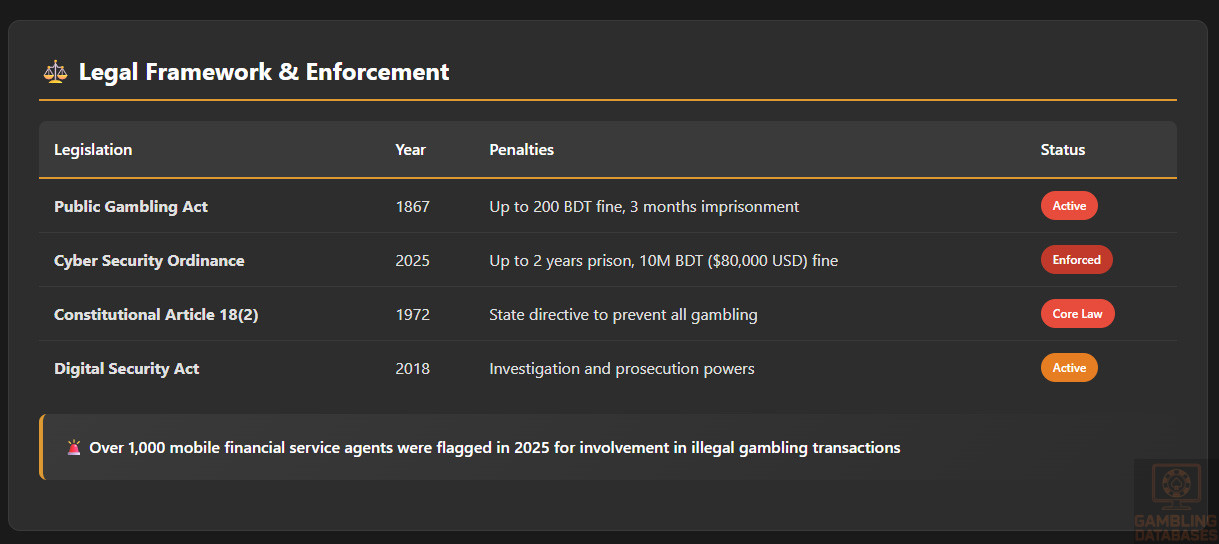
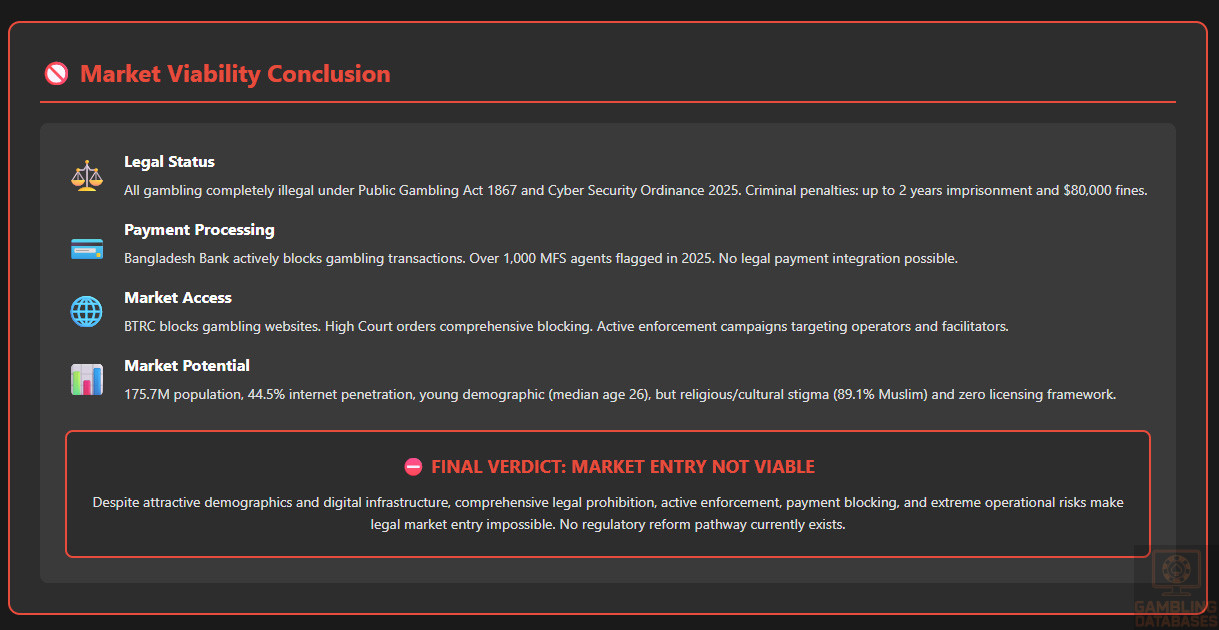
Bangladesh presents a highly restrictive market for iGaming operations due to comprehensive gambling prohibitions under Islamic law and colonial-era legislation. The Public Gambling Act of 1867 outlaws all forms of gambling except horse racing and government-authorized lotteries. With recent enforcement actions under the Cyber Security Ordinance 2025, authorities are actively cracking down on online gambling activities.

This analysis examines the complete regulatory landscape, demographic trends, technology infrastructure, and business environment factors relevant to understanding this challenging yet demographically compelling market.
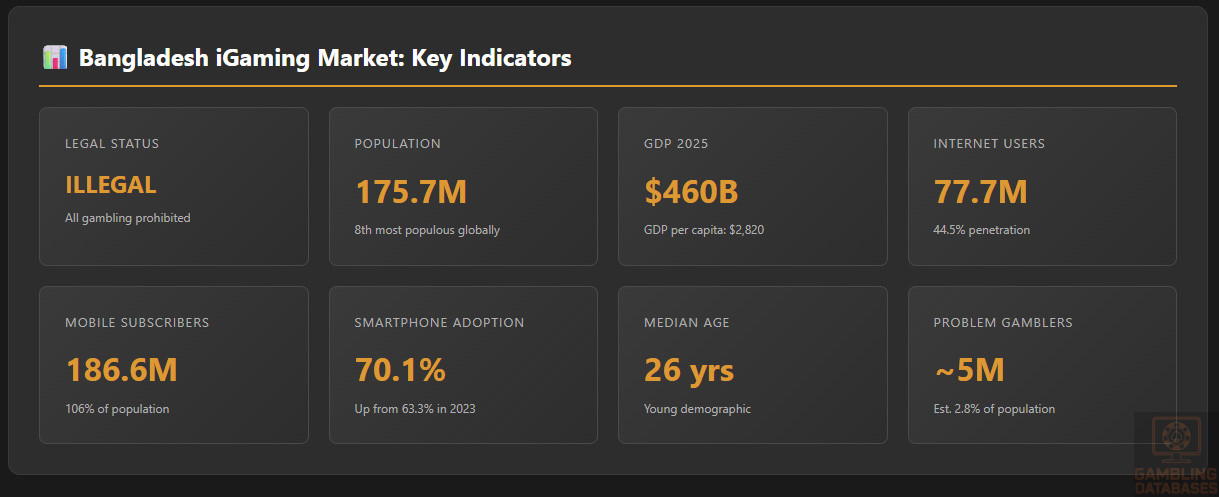
Executive Summary: Key Market Indicators
| Indicator | Value | Notes |
|---|---|---|
| Legal Status | Illegal | All gambling prohibited except horse racing and authorized lotteries |
| Primary Legislation | Public Gambling Act 1867 | Inherited from British colonial rule |
| Recent Enforcement Law | Cyber Security Ordinance 2025 | Up to 2 years imprisonment, fines up to BDT 10 million ($80,000 USD) |
| Licensing Available | No | No legal framework for operator licensing |
| Population | 175.7 million | 8th most populous country globally |
| Median Age | 26 years | Young, digitally-oriented demographic |
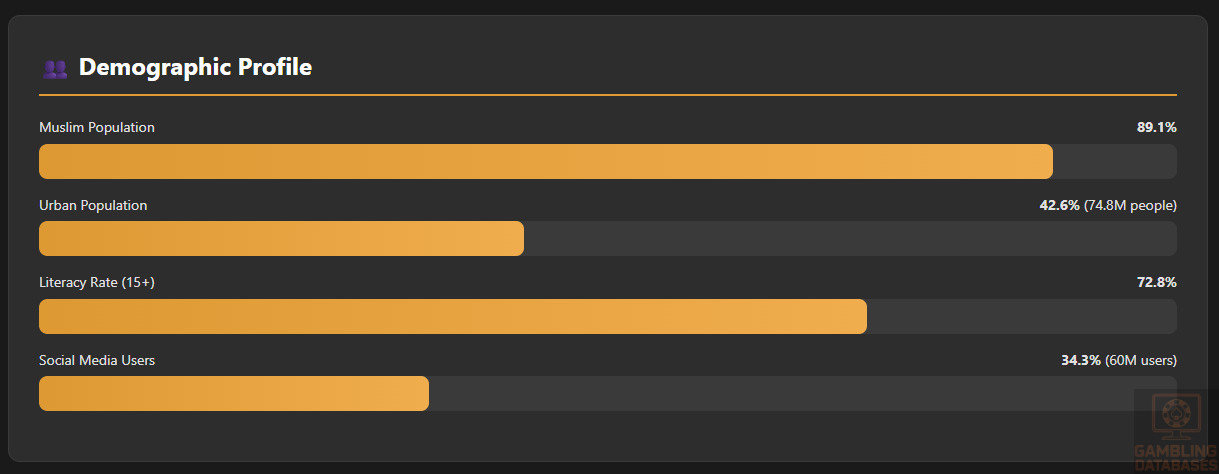
| Urban Population | 42.6% | 74.8 million people in urban areas |
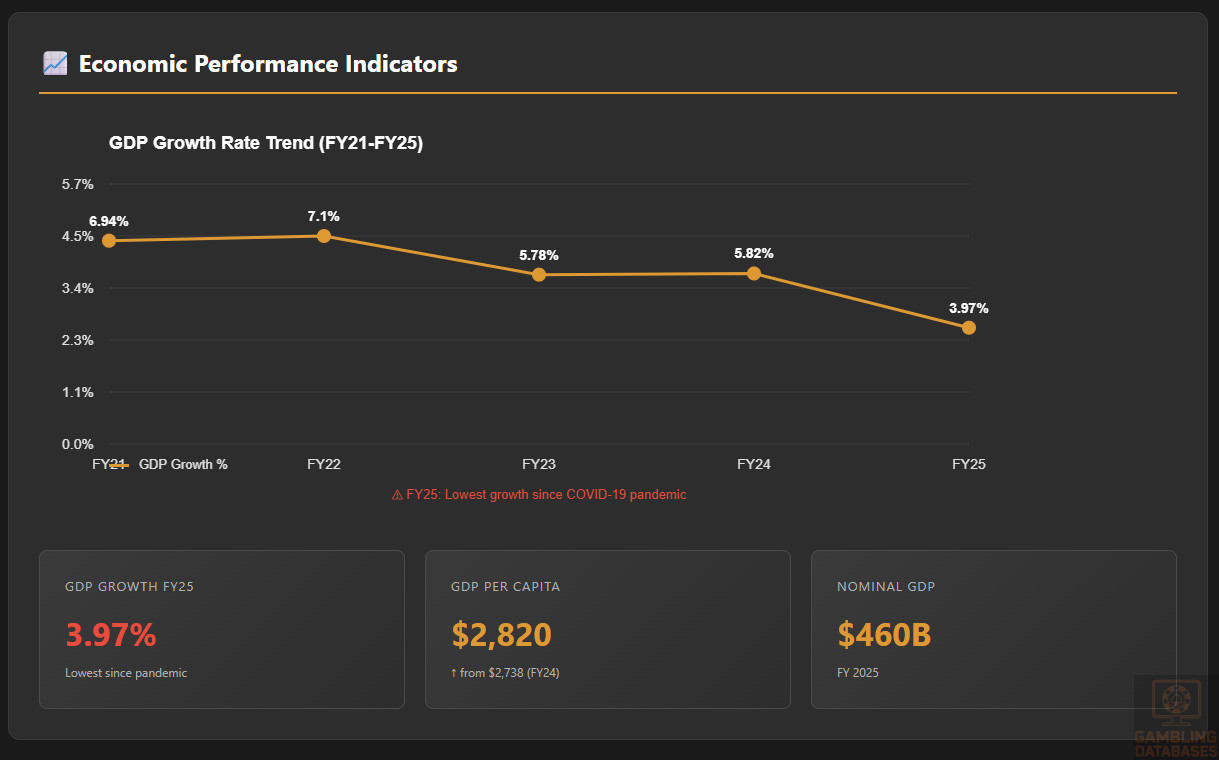
| GDP 2025 | $460 billion USD | Nominal GDP |
| GDP Per Capita 2025 | $2,820 USD | Increased from $2,738 in FY24 |
| GDP Growth Rate FY25 | 3.97% | Lowest since COVID-19 pandemic |
| Internet Penetration | 44.5% | 77.7 million internet users |
| Mobile Subscribers | 186.6 million | 106% of population (multiple SIM cards common) |
| Smartphone Adoption | 70.1% | Increased from 63.3% in 2023 |
| Mobile Internet Users | 116 million | Declined from 129.2 million in June 2024 |
| 4G Coverage | 100% | Full national 4G network coverage |
| Household Internet Access | 50.4% | Increased from 43.6% in 2023 |
| Social Media Users | 60 million | 34.3% of total population |
| Primary Religion | 89.1% Muslim | Islamic law prohibits gambling |
| Literacy Rate | 72.8% | Population aged 15+ |
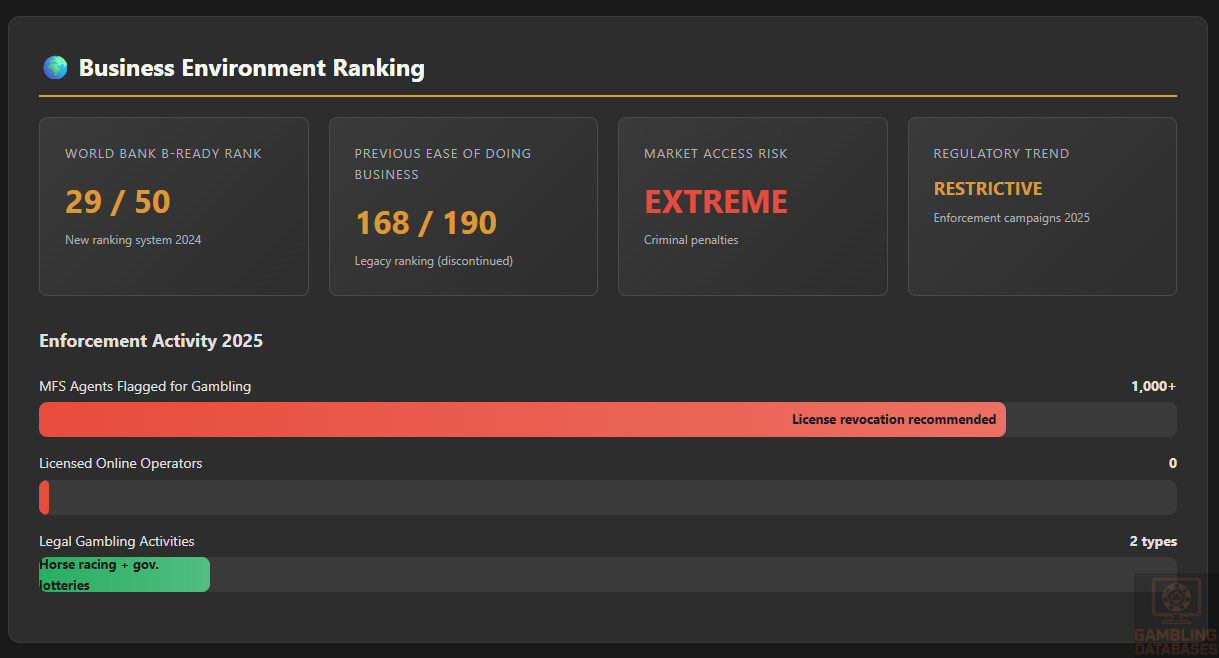
| World Bank B-Ready Rank | 29 of 50 | Previous Ease of Doing Business: 168 of 190 |
| Estimated Problem Gamblers | 5 million | Approximately 2.8% of population |
| Market Access Risk | Extreme | Criminal penalties, payment blocking, ISP restrictions |
| Regulatory Trend | Increasingly Restrictive | Active enforcement campaigns launched 2025 |
| Payment Provider Cooperation | High Risk | 1,000+ mobile financial agents flagged for gambling transactions |
| Estimated Underground Market | Unknown | No official data; widespread illegal activity reported |
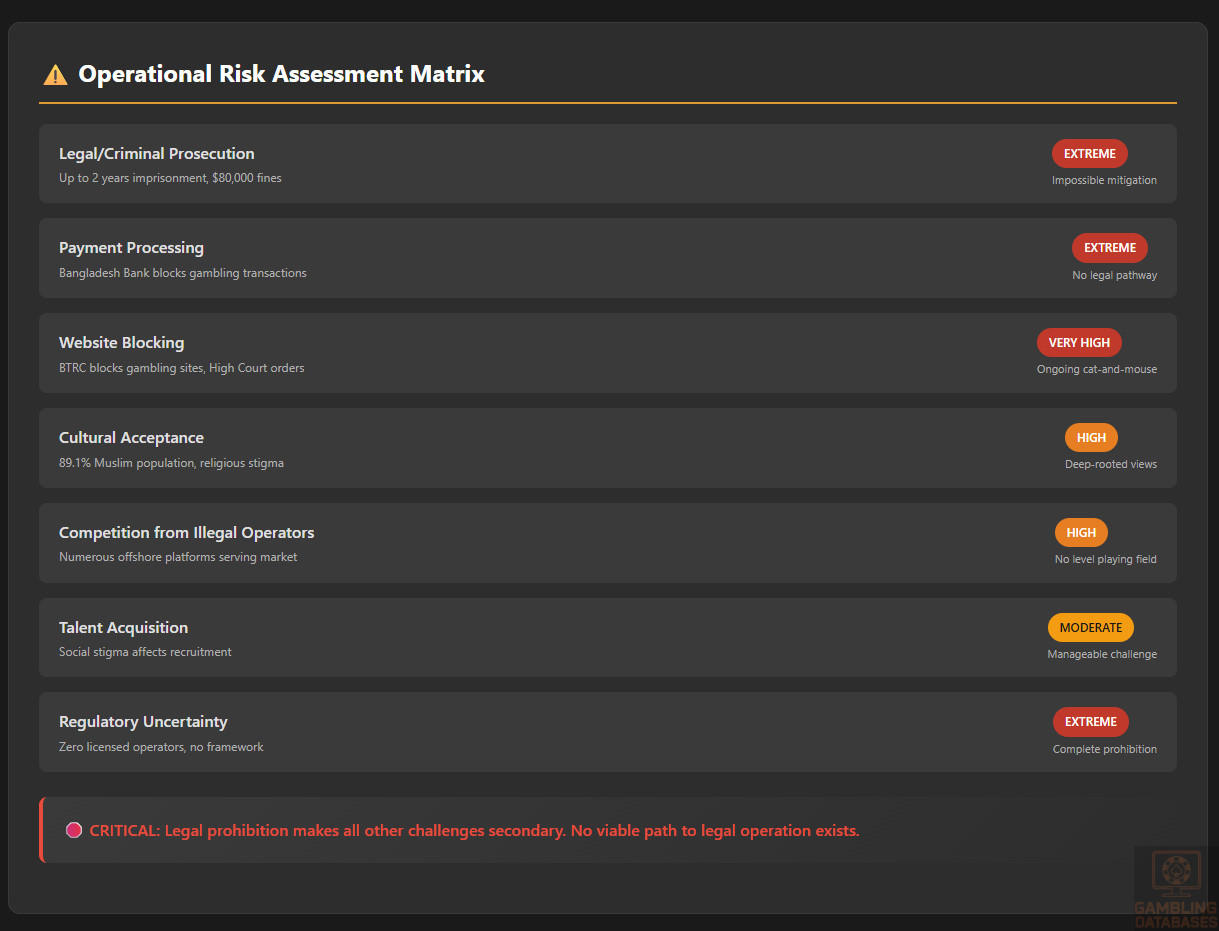
| Corporate Income Tax | 22.5% – 27.5% | Varies by company type and listing status |
| VAT Rate | 15% | Standard rate |
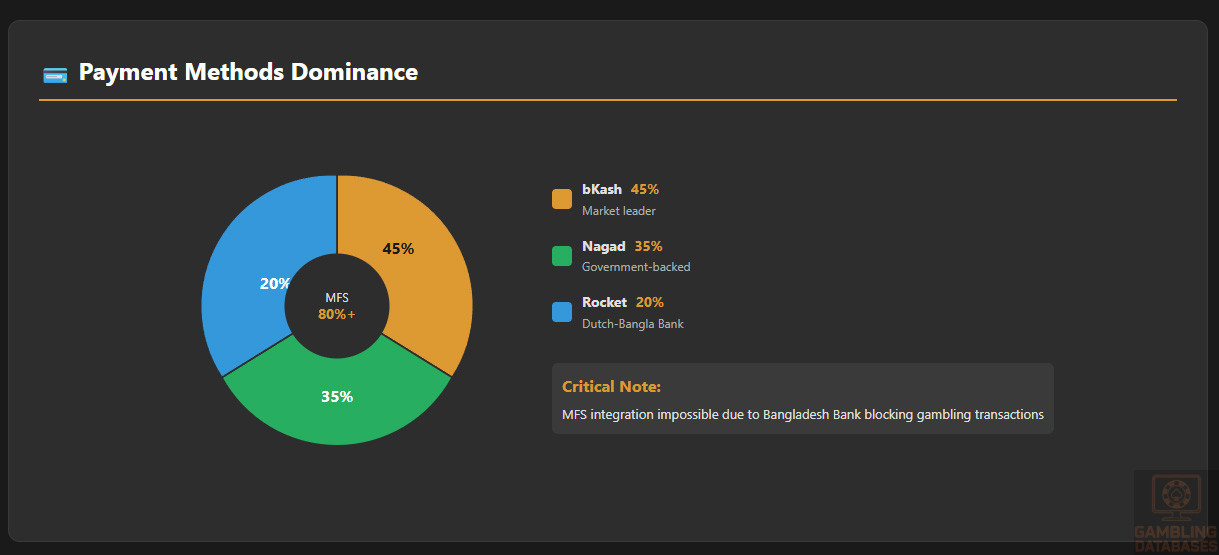
| Major Payment Methods | bKash, Nagad, Rocket | Mobile financial services dominate; 80%+ market share |
| Currency | Bangladeshi Taka (BDT) | Exchange rate approximately 120 BDT = 1 USD |
Section 1: Regulatory Framework and Legal Environment
Current Gambling Regulation Status
Bangladesh maintains one of the world’s strictest gambling prohibition regimes, rooted in both Islamic religious principles and British colonial legislation dating to 1867. The regulatory framework reflects the country’s constitutional commitment to prevent gambling activities and the religious beliefs of its predominantly Muslim population.
Land-Based Gambling Activities
Casino Operations: All casino operations are strictly prohibited throughout Bangladesh. No licenses are available for land-based casino establishments. Operating or maintaining a common gaming house constitutes a criminal offense under the Public Gambling Act of 1867. Penalties include fines up to 200 BDT ($1.67 USD) and imprisonment up to three months for venue operators.
Sports Betting Venues: Physical sports betting shops and bookmaking operations are illegal except for horse racing. Licensed horse racing betting is permitted under special provisions with operators subject to a 21% tax on earnings. All other forms of sports betting through physical venues face prosecution under existing gambling laws.
Slot Machine Halls: Electronic gaming machines, slot halls, and arcade gambling facilities are completely prohibited. No licensing framework exists for any form of electronic gaming equipment in public venues. The prohibition extends to all games of chance operated through mechanical or electronic devices.
Other Land-Based Activities: Government-authorized lotteries represent the only other legal gambling activity. These lotteries are classified as games of skill rather than gambling under Bangladesh law. Private lottery operations remain illegal. Traditional games involving stakes played in private settings technically violate the law but face minimal enforcement.

Online Gambling Framework
Digital Gaming Regulations: Online gambling exists in a legal grey area under the Public Gambling Act of 1867, which predates the internet era. The legislation contains no specific provisions addressing online gambling, creating ambiguity regarding digital platforms. However, Article 18(2) of the Bangladesh Constitution directs the state to prevent all forms of gambling, establishing a clear policy position against online gaming activities.
Prohibited Activities: The Cyber Security Ordinance 2025 explicitly criminalizes the creation, operation, and promotion of online gambling platforms. Section 20 of this ordinance addresses online gambling as a criminal offense punishable by up to two years imprisonment, fines up to 10 million BDT (approximately $80,000 USD), or both. Related offenses under Sections 21 and 22 prohibit fraud and manipulation in connection with gambling activities.
Enforcement Mechanisms: The Criminal Investigation Department (CID) launched nationwide enforcement campaigns in 2025 targeting online gambling operators and facilitators. Authorities employ multiple enforcement tools including ISP blocking of gambling websites, payment processor restrictions, investigation of mobile financial service agents, and prosecution under the Digital Security Act. Over 1,000 mobile financial service agents were identified in 2025 for involvement in illegal gambling transactions.
Regulatory Body Structure: Bangladesh lacks a dedicated gambling regulatory authority. The Bangladesh Telecommunication Regulatory Commission (BTRC) oversees internet service providers and can implement website blocking. The Bangladesh Bank monitors financial transactions and can restrict payment processing. The Criminal Investigation Department conducts investigations and enforcement actions. Multiple government ministries coordinate anti-gambling efforts including Post and Telecommunications, Information, Home Affairs, and Law ministries.
Licensed Operators and Market Players
Legal Operators: Zero licensed online gambling operators exist in Bangladesh due to the comprehensive prohibition. No legal framework permits the licensing of iGaming platforms. Horse racing operations and government lotteries represent the only authorized gambling activities, neither of which extend to online platforms under current regulations.
Unlicensed Foreign Operators: Numerous international gambling websites accept Bangladeshi players despite the legal prohibition. These offshore operators function without Bangladesh licenses or regulatory oversight. Many utilize local agents and mobile financial services for payment processing. The exact number of operators serving the Bangladesh market remains unknown due to the illegal nature of these operations.
Market Structure: The underground online gambling market in Bangladesh operates through foreign-licensed platforms, illegal local agents, and informal payment networks. Social media advertising on Facebook and YouTube drives significant traffic to gambling sites. Match-fixing syndicates in football leagues operate betting operations. Estimates suggest approximately 5 million Bangladeshis engage in online gambling despite the legal prohibition.
Competitive Landscape: No legitimate competitive market exists due to the blanket prohibition. Unlicensed operators compete for Bangladesh market share without regulatory constraints. Sports betting sites dominate, particularly those offering cricket betting given the sport’s popularity. International casino sites accepting Asian players commonly serve Bangladesh customers. Market concentration data is unavailable given the illegal status of all operations.
Licensing Framework and Requirements
Application Process and Eligibility
Licensing Authority: No gambling licensing authority operates in Bangladesh. No application process exists for obtaining gambling operation licenses. The regulatory framework provides no pathway for legal gambling licensing under current law. Constitutional provisions require the state to prevent gambling rather than regulate it.
Financial Requirements: Not applicable. No capital requirements, financial guarantees, or application fees exist because no licensing framework is available. Would-be operators cannot obtain licenses regardless of financial resources or technical capabilities.
Technical Standards: No technical certification requirements exist for gambling systems as no legal gambling operations are permitted. Gaming software, random number generators, and platform security cannot receive Bangladesh regulatory approval because no regulatory framework exists.
Background Checks: Not applicable. No probity investigations or background check procedures exist for gambling operator applicants given the absence of any licensing regime. Law enforcement focuses on identifying and prosecuting gambling operators rather than evaluating their fitness for licensing.
Local Presence and Operational Requirements
Physical Presence: Operating gambling activities from Bangladesh territory is illegal. No local office requirements exist because no legal operations are permitted. Foreign operators serving Bangladesh customers illegally do not maintain local presence to avoid prosecution.
Domain and Hosting: Bangladesh does not permit .bd domain registration for gambling websites. The BTRC blocks access to known gambling domains. No local server hosting is permitted for gambling platforms. International operators use foreign domains and offshore hosting to serve Bangladesh customers.
Personnel Requirements: No staffing requirements exist for gambling operations as none are legally permitted. Employing individuals in Bangladesh to facilitate gambling operations exposes both employer and employee to criminal prosecution.
Foreign Ownership: The question of foreign ownership is moot given that no domestic or foreign companies can legally operate gambling businesses in Bangladesh. No restrictions or permissions regarding foreign investment in gambling exist because the entire sector is prohibited.
Compliance Obligations and Monitoring
Player Protection and Identification
Age Verification: No regulatory requirements for age verification exist as online gambling is illegal. Underground operators implement varying age verification standards, typically minimal. The legal gambling age question is irrelevant when all gambling is prohibited.
KYC/AML Compliance: No gambling-specific KYC or AML requirements exist in Bangladesh. Financial institutions must comply with general KYC/AML regulations under the Money Laundering Prevention Act 2012 and Anti-Terrorism Act 2009. These laws prohibit facilitating illegal activities including unlicensed gambling. Bangladesh Bank has directed financial institutions to use artificial intelligence to identify gambling-related transactions.
Responsible Gambling Measures: No mandated responsible gambling requirements exist for operators as legal operations are prohibited. Problem gambling support services are extremely limited. No charity services specifically address gambling addiction due to the illegal status and religious prohibition. International services like GamCare provide some support accessible to Bangladeshi players.
Self-Exclusion Systems: No regulatory requirement or framework exists for self-exclusion programs. Illegal operators may offer voluntary self-exclusion features but face no regulatory obligations. Players seeking to exclude themselves from gambling have no official registry or protection system.
Financial Monitoring and Reporting
Transaction Monitoring: Bangladesh Bank requires financial institutions to monitor transactions for illegal activities including gambling. The 2025 directive mandates AI-based systems to identify merchants and customers involved in online gambling. Mobile financial service providers must report suspicious gambling-related transactions. Over 1,000 MFS agents had licenses recommended for revocation in 2025 due to gambling transaction facilitation.
Reporting Requirements: Financial institutions must report suspicious transactions potentially related to money laundering or illegal activities. No gambling-specific reporting exists because operations are illegal. Law enforcement receives reports of gambling activity through multiple channels including financial institution alerts, public complaints, and investigative work.
Audit Procedures: No gambling operation audits occur as no legal operators exist. Financial institution audits may reveal gambling transaction processing. Law enforcement conducts investigations rather than regulatory audits when gambling activities are detected.
Data Retention: General data retention requirements apply to financial institutions per Bangladesh Bank regulations. No gambling-specific retention requirements exist. Evidence of illegal gambling transactions may be retained as part of criminal investigations.
Taxation Structure and Financial Obligations
Player Taxation
Winnings Tax: No specific tax on gambling winnings exists in Bangladesh tax law. Given that gambling is illegal, winnings from unlawful activities technically constitute illegal proceeds. Players do not report or pay taxes on illegal gambling winnings. Legal horse racing winnings and lottery prizes face taxation under general income tax provisions.
Withholding Procedures: No withholding mechanisms exist for online gambling winnings as operations are illegal. Legal lottery operators withhold taxes on prizes. Underground gambling operations make no tax withholdings.
Declaration Requirements: Bangladesh tax law requires declaration of all income sources. Gambling winnings from illegal activities should theoretically be declared but rarely are. No separate gambling income category exists on tax returns.
Tax-Free Thresholds: No gambling-specific tax-free thresholds exist. General income tax exemption limits apply to all income sources. The basic tax exemption threshold for individual taxpayers is 350,000 BDT ($2,917 USD) annually for the 2024-2025 tax year.
Operator Taxation
Gross Gaming Revenue Tax: No GGR tax framework exists as gambling operations are illegal. Legal horse racing operators face a 21% tax on earnings. This represents the only gambling-specific taxation in Bangladesh law.
Corporate Income Tax: If gambling operations were legal, they would face standard corporate income tax rates ranging from 22.5% to 27.5% depending on company type, listing status, and sector. Publicly traded companies enjoy lower rates. Banks and financial institutions face rates up to 37.5%.
License Fees: No license fees exist as no licensing framework is available. Government-authorized lottery operators may pay fees or revenue shares but these arrangements are not publicly disclosed.
Annual Operational Taxes: No gambling-specific operational taxes exist beyond standard business taxes. Legal businesses pay corporate income tax, VAT at 15%, and various local government fees.
Gambling Market Financial Performance
Total Market Size: No official data exists on gambling market size in Bangladesh due to the illegal status of most activities. Underground market estimates are unreliable. Media reports suggest millions of Bangladeshis participate in illegal online gambling. Anecdotal evidence indicates significant money flows to offshore gambling operators.
Government Revenue: The government collects minimal gambling-related revenue limited to horse racing taxes. No online gambling tax revenue exists. Enforcement actions may result in fines but these represent penalties rather than structured taxation.
Growth Trends: Media reports and enforcement agency statements indicate rapid growth in online gambling participation from 2020-2024. The COVID-19 pandemic accelerated online gambling activity. Recent enforcement campaigns aim to reverse this growth trend.
Revenue Distribution: Insufficient data exists to analyze revenue distribution by gambling type. Horse racing and government lotteries represent minimal legal activity. Underground sports betting and online casino games dominate illegal activity based on law enforcement reports.
Advertising and Marketing Restrictions
Permitted Channels: No gambling advertising is permitted in Bangladesh. All channels including television, radio, print media, outdoor advertising, and online platforms are prohibited from carrying gambling promotions. The constitutional mandate to prevent gambling extends to advertising restrictions.
Content Restrictions: All gambling advertising content is prohibited regardless of messaging. Educational campaigns about gambling risks are rare. Anti-gambling messaging occasionally appears in public service announcements.
Celebrity Endorsements: High-profile gambling advertising scandals have occurred involving Bangladeshi celebrities. Cricket star Shakib Al Hasan faced investigation and public backlash for promoting a sports betting website. His sister faced investigation related to the Mahadev betting app case. Such endorsements violate Bangladesh law and cultural norms.
Online Marketing: Despite prohibitions, gambling advertisements appear on social media platforms, particularly Facebook and YouTube. These advertisements typically originate from outside Bangladesh. The government has called for removal of gambling advertisements from social media platforms. A 2025 High Court petition demanded action against gambling ads on Facebook, YouTube, WhatsApp, Bigo Live, TikTok, Likee, and Google Play Store.
Affiliate Marketing: Affiliate marketing for gambling sites operates in Bangladesh despite legal prohibitions. Local agents recruit players and facilitate transactions. These activities are illegal but persist due to enforcement challenges. Affiliate marketers face prosecution if identified.
Sponsorship Regulations: Gambling-related sponsorship of sports teams, events, or other activities is prohibited. Historical evidence shows illegal gambling syndicates influence football clubs through financial incentives. Match-fixing and manipulation remain significant problems in lower-tier football leagues.
Recent Regulatory Changes and Their Impact
Cyber Security Ordinance 2025: The most significant recent development is the Cyber Security Ordinance 2025, which explicitly criminalizes online gambling operations. This ordinance represents the first comprehensive legal framework specifically addressing digital gambling. Maximum penalties of two years imprisonment and 10 million BDT fines provide stronger enforcement tools than the colonial-era Public Gambling Act.
CID Enforcement Campaign 2025: Bangladesh’s Criminal Investigation Department launched nationwide enforcement operations in 2025 targeting online gambling under the new cyber security law. This represents the first major coordinated enforcement effort specifically focused on digital gambling. Over 1,000 mobile financial service agents were identified for involvement in gambling transactions, with license revocation and penalties recommended.
High Court Intervention 2025: In May 2025, the Bangladesh High Court ordered a comprehensive report on online gambling within 30 days. The court issued rules requiring government explanation for why internet gateways to gambling platforms should not be removed. Another rule sought explanation for why a 24-hour monitoring cell should not be established to track online gambling activities. This judicial intervention reflects growing concern about online gambling proliferation.
Banking Sector Directives 2025: Bangladesh Bank issued directives to banks and financial institutions to deploy artificial intelligence systems for identifying gambling-related transactions. This technological approach to enforcement represents a significant escalation in anti-gambling efforts. Financial institutions face pressure to block gambling payments proactively.
Enforcement Mechanisms and Penalties
Criminal Penalties: Under the Public Gambling Act 1867, operating a common gaming house carries penalties of 200 BDT fine and up to three months imprisonment. Participating in gambling at such venues carries 100 BDT fine and up to one month imprisonment. Under the Cyber Security Ordinance 2025, creating, operating, or promoting online gambling platforms carries up to two years imprisonment, fines up to 10 million BDT ($80,000 USD), or both penalties.
Financial Penalties: Mobile financial service agents facilitating gambling transactions face license revocation and financial penalties. Banks and payment processors enabling gambling transactions may face regulatory sanctions from Bangladesh Bank. The exact financial penalty structures remain unclear but enforcement actions in 2025 target significant agent networks.
ISP Blocking: The Bangladesh Telecommunication Regulatory Commission blocks access to known gambling websites at the ISP level. Enforcement remains inconsistent as blocked sites often return under new domains. VPN usage allows some users to circumvent blocking. The High Court 2025 order demands comprehensive blocking of gambling site access.
Payment Restrictions: Bangladesh Bank restricts payment processing for gambling activities. Cryptocurrency transactions remain illegal under the Foreign Exchange Regulation Act 1947, Money Laundering Prevention Act 2012, and Anti-Terrorism Act 2009. These restrictions impede both legal and illegal gambling payment processing.
| Offense | Legislation | Maximum Fine | Maximum Imprisonment |
|---|---|---|---|
| Operating gambling venue | Public Gambling Act 1867 | 200 BDT ($1.67 USD) | 3 months |
| Gambling participation | Public Gambling Act 1867 | 100 BDT ($0.83 USD) | 1 month |
| Online gambling operation | Cyber Security Ordinance 2025 | 10,000,000 BDT ($80,000 USD) | 2 years |
| Gambling-related fraud | Cyber Security Ordinance 2025 Sections 21-22 | Variable | Variable |
| MFS agent facilitation | Bangladesh Bank regulations | License revocation + fines | Potential prosecution |
Section 2: Demographics and Consumer Analysis
Population Demographics and Distribution
Core Population Metrics
Bangladesh ranks as the eighth most populous country globally with an estimated 175.7 million people in 2025. The population demonstrates a young demographic profile with a median age of just 26 years, positioning Bangladesh advantageously for digital service adoption. The population growth rate of 1.22% annually indicates continued expansion though at a moderating pace compared to historical levels.
Gender distribution shows 86.37 million males and 89.32 million females, creating a female majority of 2.96 million. The sex ratio stands at 96.7 males per 100 females. Life expectancy has improved to 73.4 years reflecting healthcare advancements. The young population structure creates a large working-age cohort with approximately 115 million people in the productive age groups.
| Age Group | Population (millions) | Percentage | Characteristics |
|---|---|---|---|
| 0-14 years | 47.5 | 27% | Youth dependency; future market |
| 15-24 years | 33.0 | 19% | Adolescents; early digital adopters |
| 25-34 years | 30.5 | 17% | Prime gambling demographic |
| 35-44 years | 26.4 | 15% | Peak earning years |
| 45-54 years | 19.3 | 11% | Established financial position |
| 55-64 years | 12.3 | 7% | Pre-retirement; lower digital adoption |
| 65+ years | 12.0 | 7% | Elderly dependency; minimal online activity |
The total fertility rate has declined dramatically from nearly 7 children per woman in the 1970s to approximately 2.1 in 2025, reaching replacement level. This demographic transition indicates maturing population structure. Approximately 28% of the population falls in the 10-24 age bracket, representing nearly 50 million young people who demonstrate high digital engagement and technology adoption rates.
Geographic Distribution
Bangladesh exhibits one of the world’s highest population densities at 1,350 people per square kilometer across its 130,170 square kilometer land area. Urban areas house 42.6% of the population totaling 74.8 million people, while 57.4% remain in rural areas. Urbanization accelerates at 3.13% annually, driving migration to cities for economic opportunities.
Dhaka, the capital and largest city, dominates the urban landscape with a sprawling metropolitan area housing over 20 million people in the greater Dhaka region. Other major urban centers include Chittagong (port city, second largest), Khulna (industrial hub), Rajshahi (silk city), Sylhet (tea region), and Barisal (river port). These cities concentrate internet connectivity, digital services, and disposable income.
| City | Population (millions) | Economic Profile | Internet Penetration |
|---|---|---|---|
| Dhaka | 20+ (metro) | Capital; commerce, government, services | Very High (78%+) |
| Chittagong | 5-6 | Port city; trade, shipping, industry | High (65-75%) |
| Khulna | 2-3 | Industrial center; manufacturing | Moderate-High (55-65%) |
| Rajshahi | 1-1.5 | Education; silk production | Moderate (50-60%) |
| Sylhet | 0.5-0.7 | Tea cultivation; remittance hub | Moderate (50-60%) |
| Rural areas | 100+ | Agriculture-based economy | Low-Moderate (46%) |
Regional economic disparities create significant variation in consumer purchasing power and technology access. Urban areas in Dhaka and Chittagong divisions demonstrate substantially higher internet penetration at 60-78% compared to rural areas at 46%. This digital divide affects market accessibility for online services including gambling platforms.
Economic Indicators and Consumer Spending Power
GDP and Economic Performance
Bangladesh’s nominal GDP reached approximately $460 billion USD in 2022, positioning the country among significant emerging markets. GDP per capita increased to $2,820 USD in fiscal year 2024-2025 according to Bangladesh Bureau of Statistics provisional data, up from $2,738 the previous year. This represents continued income growth despite economic headwinds.
The GDP growth rate of 3.97% in FY25 represents the slowest expansion since the COVID-19 pandemic, reflecting global economic pressures and domestic challenges. The agriculture sector grew 1.79%, industry expanded 4.34%, and services increased 4.51%. Export-oriented garment manufacturing remains the economic backbone generating substantial foreign exchange.
| Indicator | Value | Year-over-Year Change |
|---|---|---|
| Nominal GDP | $460 billion USD | +10.54% (2022 vs 2021) |
| GDP Per Capita | $2,820 USD | +$82 (+3.0%) |
| GDP Growth Rate | 3.97% | -0.25 percentage points |
| Agriculture Growth | 1.79% | Impacted by natural disasters |
| Industrial Growth | 4.34% | Led by manufacturing sector |
| Services Growth | 4.51% | Steady expansion |
| Inflation Rate | 6.17% (Feb 2022) | Rising cost pressures |
Bangladesh graduated from Least Developed Country status in 2018 when it achieved Gross National Income of $1,724 per capita, demonstrating substantial development progress. Foreign exchange reserves faced pressure following the Ukraine conflict due to rising import costs, particularly for fuel and commodities. The country’s garment export sector generates over 80% of export earnings but faces challenges from tariff uncertainties.
Income and Wealth Distribution
Average household income in Bangladesh varies dramatically between urban and rural areas and across income quintiles. Urban households demonstrate significantly higher earnings with greater access to formal employment and business opportunities. The growing middle class represents an increasingly important consumer segment with rising disposable income for discretionary spending including entertainment and leisure activities.
Income inequality remains a significant challenge measured through the Gini coefficient and wealth concentration data. The wealthiest quintile captures a disproportionate share of national income while lower-income groups struggle with subsistence-level earnings. Remittances from overseas Bangladeshi workers contribute substantially to household incomes, particularly in rural areas and specific regions like Sylhet.
| Income Bracket | Monthly Household Income (BDT) | USD Equivalent | Population Share |
|---|---|---|---|
| Low Income | Below 15,000 | Below $125 | 35-40% |
| Lower-Middle Income | 15,000 – 30,000 | $125 – $250 | 25-30% |
| Middle Income | 30,000 – 60,000 | $250 – $500 | 20-25% |
| Upper-Middle Income | 60,000 – 120,000 | $500 – $1,000 | 8-12% |
| High Income | Above 120,000 | Above $1,000 | 3-5% |
Disposable income trends show gradual improvement as per capita income rises, though living costs also increase particularly in urban areas. Consumer spending patterns prioritize necessities including food, housing, and healthcare, with limited remaining budget for entertainment. However, the growing middle and upper-middle class segments demonstrate increasing willingness to spend on leisure activities, digital services, and entertainment including potential gambling expenditure.
Market Size and Growth Projections
Official data on gambling market size does not exist in Bangladesh due to the illegal status of most gambling activities. Underground market estimates prove unreliable given the clandestine nature of operations and reluctance of participants to acknowledge involvement. Media reports and law enforcement statements suggest millions of Bangladeshis participate in illegal online gambling, indicating substantial market activity despite legal prohibitions.
Anecdotal evidence from enforcement agencies indicates rapid growth in online gambling participation from 2020-2024, accelerated by COVID-19 pandemic lockdowns and increased internet access. High Court petitions in 2025 claimed approximately 5 million people suffer from online gambling addiction, representing roughly 2.8% of the population. If accurate, this suggests tens of millions may engage in occasional gambling activity.
| Metric | Conservative Estimate | Moderate Estimate | Notes |
|---|---|---|---|
| Active Participants | 5-8 million | 10-15 million | Based on enforcement data and media reports |
| Problem Gamblers | 3-5 million | 5-7 million | High Court petition cited 5 million |
| Market Penetration | 3-5% | 6-9% | Percentage of adult population |
| Annual Market Size | $200-400 million | $500 million – $1 billion | Highly speculative; no official data |
| ARPU (Annual) | $40-80 | $50-100 | Based on GDP per capita ratios |
| Growth Rate 2020-2024 | 15-25% | 25-40% | Accelerated during pandemic |
Market projections remain highly uncertain given the illegal status and aggressive enforcement actions launched in 2025. The Cyber Security Ordinance and coordinated crackdowns aim to suppress market growth significantly. Payment processing restrictions and ISP blocking create operational barriers for both operators and players. Future market trajectory depends heavily on enforcement effectiveness and whether legal reforms eventually emerge.
Education, Skills, and Digital Literacy
Educational Foundation
Bangladesh has achieved a literacy rate of 72.8% for the population aged 15 and above as of 2025, representing significant progress from historical levels but still lagging developed nations. Gender parity in education has improved substantially with near-equal enrollment rates in primary and secondary education. However, quality concerns persist regarding educational outcomes and skill development.
Tertiary education completion rates remain relatively low compared to regional competitors, though expanding. Universities produce graduates in various fields but skill mismatches with market demand create employment challenges. Digital literacy varies significantly by age cohort, urban-rural location, and education level. Younger urban populations demonstrate high digital competency while older rural residents lag substantially.
English language proficiency remains limited outside major cities and educated classes, though improving among youth. Most Bangladeshis prefer content and services in Bengali (Bangla) language. Technology adoption readiness is high among younger demographics who have grown up with mobile devices and internet access. The workforce increasingly possesses basic digital skills though advanced technical capabilities remain concentrated in urban areas and IT sector professionals.
Cultural and Social Factors
Communication and Language
Bengali (Bangla) serves as the primary language for 99% of the population and dominates daily communication, business transactions, and online content consumption. The language uses its own script which requires proper localization for websites and applications serving Bangladesh users. English functions as a secondary language for educated urban populations and business contexts but cannot serve as the primary interface for mass-market services.
Internet users strongly prefer Bengali language content and services. Successful digital platforms in Bangladesh provide Bengali interfaces, customer support, and localized content. Payment instructions, terms and conditions, and all customer communications must be available in Bengali to achieve broad market penetration. Regional dialects exist particularly in Chittagong and Sylhet but Bengali standardization enables communication across regions.
Cultural Attitudes Toward Gambling
Gambling faces strong cultural stigma in Bangladesh rooted in Islamic religious teachings that prohibit gambling as haram (forbidden). With 89.1% of the population identifying as Muslim, religious perspectives heavily influence social attitudes and policy positions. The Constitution’s directive for the state to prevent gambling reflects this cultural-religious consensus against gambling activities.
Foreign brands face trust challenges in Bangladesh particularly for financial services and high-risk categories. Bangladeshi consumers prefer locally-rooted businesses or internationally established brands with proven track records. For illegal gambling services, this manifests in reliance on international operators already serving Asian markets, accessed through local agent networks that provide Bengali-language support and familiar payment methods.
Problem Gambling and Social Considerations
Prevalence and Demographics
Problem gambling prevalence data remains limited given the illegal status of gambling and cultural stigma against acknowledging participation. A 2025 High Court petition claimed approximately 5 million Bangladeshis suffer from online gambling addiction, though this figure’s reliability is unclear. If accurate, this represents roughly 2.8% of the total population or potentially 4-5% of the adult population.
Media reports document serious social harms including individuals selling land and assets to finance gambling, family breakdowns, and suicides following gambling losses. The rapid growth of smartphone access and social media advertising has exposed younger populations to gambling platforms. Rural areas previously insulated from gambling access now face increased exposure through mobile internet connectivity.
| Indicator | Reported Impact | Most Affected Groups |
|---|---|---|
| Estimated Problem Gamblers | 3-5 million | Young males, urban and rural |
| Financial Harm Cases | Widespread asset sales reported | Families, land owners |
| Suicide Cases | Multiple media reports | Individuals with severe losses |
| Age Groups Affected | Teenagers to middle-aged | Concentration in 18-40 age range |
| Gender Distribution | Predominantly male | Limited female participation |
| Underage Gambling | Significant concern | Teenagers with smartphone access |
Government and Support Services
Bangladesh lacks dedicated problem gambling treatment facilities or support services. No charity organizations specifically address gambling addiction due to the illegal status and religious prohibition. Private mental health services may treat gambling-related issues within broader addiction or behavioral health frameworks but specialized gambling treatment programs do not exist.
International support services like GamCare provide telephone and online chat support accessible to Bangladeshi problem gamblers, though awareness of these resources remains limited. Language barriers and cultural factors inhibit help-seeking behavior. The stigma associated with gambling combined with its illegal status prevents many problem gamblers from seeking assistance.
Government response focuses on enforcement and prohibition rather than harm reduction or treatment. The 2025 enforcement campaign aims to eliminate gambling access rather than provide support for affected individuals. No mandatory contributions to problem gambling funds exist as no legal gambling operations function in Bangladesh. Public awareness campaigns about gambling risks remain minimal.
Political Structure and Governance
Government System and Stability
Bangladesh operates as a parliamentary democracy with a prime minister serving as head of government. Political stability has varied over recent decades with periodic tensions between major political parties. Governance quality faces challenges related to corruption, regulatory consistency, and institutional capacity. The Corruption Perceptions Index typically ranks Bangladesh in the lower half globally indicating significant governance issues.
Regulatory consistency and predictability pose concerns for businesses given policy changes, enforcement variation, and bureaucratic discretion. The business environment has improved in recent years with reforms aimed at attracting investment and modernizing regulations. However, institutional weaknesses persist in areas including contract enforcement, property rights protection, and regulatory transparency.
International relations generally remain stable with Bangladesh maintaining diplomatic and economic ties across major powers. The country is not an EU member but benefits from preferential trade access to European markets under Everything But Arms provisions. Bilateral and multilateral trade agreements facilitate export-oriented manufacturing particularly in the garment sector.
Technology Adoption and Digital Behavior
Internet and Digital Usage
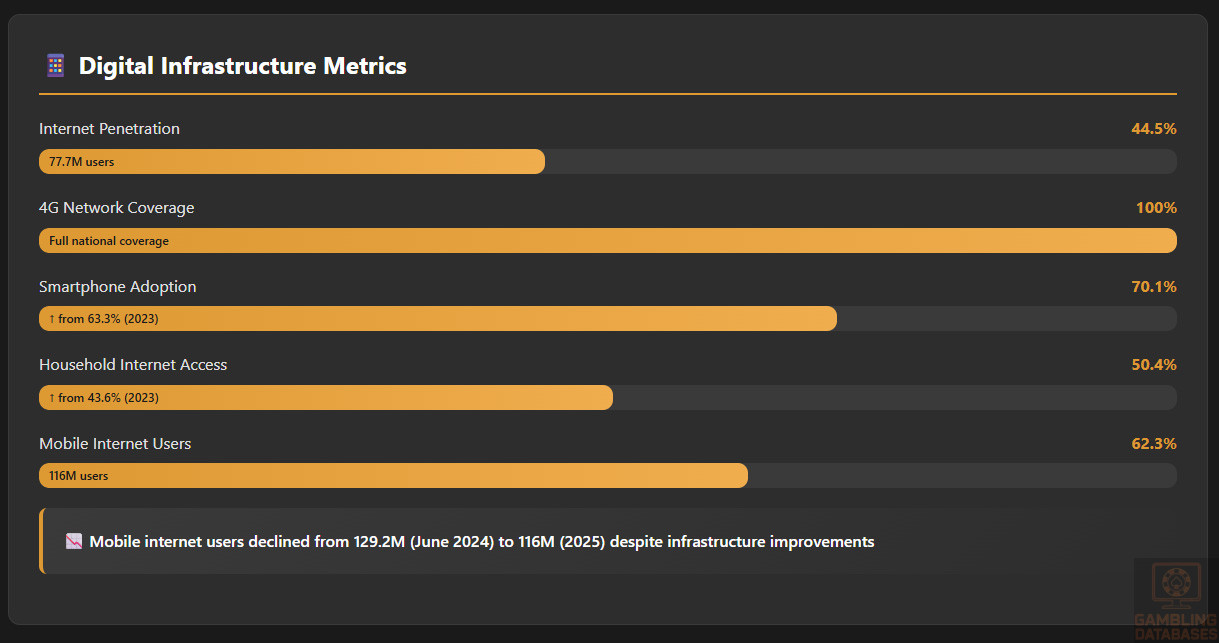
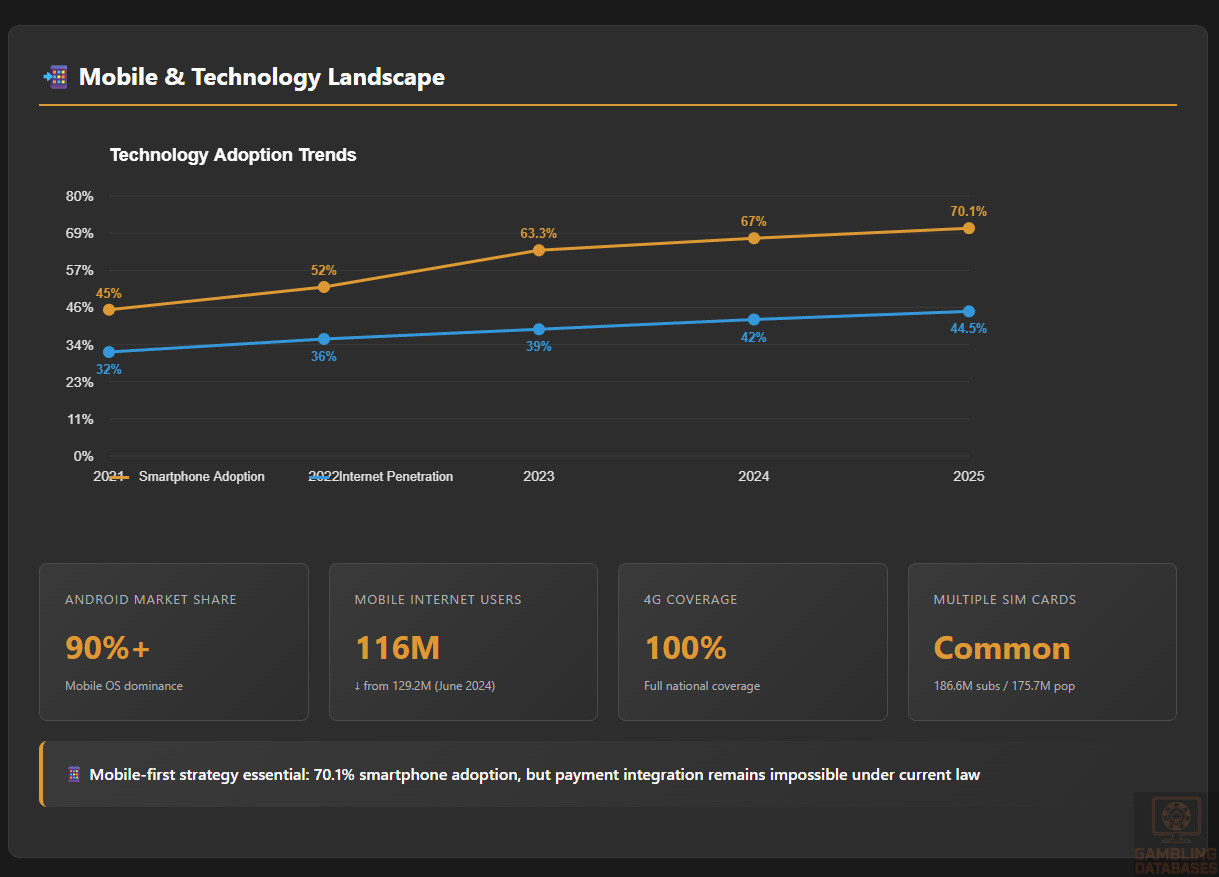
Internet penetration reached 44.5% of the population in January 2025 with 77.7 million internet users according to DataReportal analysis. This represents growth of 1.2% or 939,000 new users compared to January 2024. However, recent data from Bangladesh Telecommunication Regulatory Commission shows decline in mobile internet users from 129.2 million in June 2024 to 116 million by January 2025, indicating market volatility.
Daily internet usage averages vary by demographic segment with younger urban users spending multiple hours online daily while older rural populations use internet sparingly if at all. Mobile devices dominate internet access with fixed broadband serving a small minority of users. Social media engagement is high among connected populations with 60 million social media users representing 34.3% of the total population.
| Metric | Value | Year-over-Year Change |
|---|---|---|
| Total Internet Users | 77.7 million | +939,000 (+1.2%) |
| Internet Penetration | 44.5% | +0.5 percentage points |
| Mobile Internet Users | 116 million | -13.2 million (-10.2%) |
| Household Internet Access | 50.4% | +6.8 percentage points |
| Urban Internet Access | 60.3% | Higher than national average |
| Rural Internet Access | 46% | Narrowing urban-rural gap |
| Social Media Users | 60 million | 34.3% penetration |
| Median Mobile Download Speed | 28.26 Mbps | +5.26 Mbps (+22.9%) |
| Median Fixed Download Speed | 48.91 Mbps | +9.08 Mbps (+22.8%) |
E-commerce participation grows steadily as trust in online transactions increases and digital payment infrastructure improves. Popular e-commerce platforms include Daraz, Pickaboo, and various local retailers establishing online presence. Digital service consumption spans entertainment streaming, food delivery, ride-hailing, and increasingly financial services through mobile banking applications.
Digital Payment Behavior
Mobile financial services dominate digital payments in Bangladesh with bKash, Nagad, and Rocket commanding over 80% combined market share. bKash leads with more than 60% of all mobile financial transactions and 70+ million registered users. Nagad, operated by Bangladesh Post Office, serves 74 million customers with daily transactions averaging $12 million. These platforms have revolutionized financial inclusion enabling millions without bank accounts to participate in digital economy.
Payment method preferences strongly favor mobile financial services over traditional banking for person-to-person transfers, bill payments, mobile recharges, and increasingly merchant payments. Credit and debit card penetration remains relatively low concentrated among urban middle and upper classes. Bank transfers occur primarily for larger transactions and formal business payments. Cryptocurrency adoption for payments remains illegal and minimal given Bangladesh Bank prohibitions.
| Payment Method | Market Share | Users (millions) | Primary Use Cases |
|---|---|---|---|
| bKash | 60%+ | 70+ | P2P transfers, merchant payments, bills, remittances |
| Nagad | 15-20% | 74 | Government services, transfers, payments |
| Rocket (DBBL) | 8-12% | Unknown | Bank-linked wallet services |
| Other MFS | 5-10% | 10-15 | Upay, SureCash, etc. |
| Credit/Debit Cards | 5-8% | 5-8 | Online shopping, ATM withdrawals |
| Bank Transfers | 3-5% | Variable | Large transactions, business payments |
| Cash | Declining | Universal | Still dominant in informal economy |
Trust in online payment systems has grown substantially though concerns about fraud and security persist. Average transaction sizes vary by payment type with P2P transfers typically ranging from 500-5,000 BDT while merchant payments and bill payments span wider ranges. Transaction frequency is high among active MFS users who may conduct multiple transactions weekly for various purposes including sending money to family, paying bills, and shopping online.
Gaming and Gambling Preferences
Current Market Participation
Reliable data on gambling participation rates does not exist given the illegal status and social stigma. Estimates based on enforcement reports and media coverage suggest 5-15 million Bangladeshis may engage in gambling activities at least occasionally. Sports betting dominates preferences particularly on cricket matches given the sport’s massive popularity in Bangladesh. Football betting also attracts participants especially during major tournaments.
Online casino games have gained traction with slots, roulette, and card games accessible through international platforms. Live dealer games appeal to players seeking more authentic casino experiences. Lottery participation occurs through legal government-authorized lotteries and illegal underground operations. Seasonal patterns align with major sporting events including cricket tournaments, football World Cups, and regional competitions.
Consumer Behavior Patterns
Average spending per player remains speculative without official data. Based on GDP per capita and regional comparisons, monthly gambling expenditure likely ranges from 1,000-5,000 BDT ($8-42 USD) for regular participants. Problem gamblers may spend substantially more, potentially exhausting available resources and selling assets to continue gambling. Bet sizes typically remain modest reflecting limited disposable income among most participants.
Mobile platforms dominate access given smartphone penetration and mobile-first internet usage patterns. Desktop usage is minimal outside office environments and internet cafes. Peak gambling times likely align with cricket match schedules and evening leisure hours when individuals have free time after work. Weekend activity may increase for sports betting corresponding to match schedules.
| Behavior Metric | Estimated Pattern | Notes |
|---|---|---|
| Average Monthly Spend | 1,000-5,000 BDT ($8-42) | Regular participants; problem gamblers much higher |
| Typical Bet Size | 100-500 BDT ($0.83-4.17) | Modest stakes reflecting income levels |
| Platform Preference | 85-90% mobile | Smartphone-based access dominates |
| Popular Game Types | Sports betting (cricket, football) | Slots and casino games secondary |
| Session Frequency | Multiple times weekly | Active participants; casual players less frequent |
| Peak Activity Times | Evenings, weekends, match days | Leisure time and sporting events |
| Deposit Frequency | Weekly or bi-weekly | Aligned with income receipt patterns |
| Withdrawal Behavior | Infrequent | Most players lose more than they win |
Retention and loyalty remain unclear without operator data. Bonus sensitivity is likely high given price consciousness among Bangladeshi consumers. Promotional offers and free bet incentives probably drive significant participation. Player preferences by age show younger participants (18-35) dominating online gambling while older demographics engage less frequently in digital gambling though may participate in traditional informal gambling.
Section 3: Technology Infrastructure and Business Environment
Internet and Digital Infrastructure
Connectivity and Network Performance
Bangladesh has achieved 100% 4G network coverage with 3G reaching 99.80% of the population as of 2025. This near-universal mobile network availability provides the foundation for mobile internet access across urban and rural areas. Fixed broadband infrastructure remains limited serving primarily urban commercial and residential customers with only 14.3 million ISP/PSTN subscribers compared to 116 million mobile internet users.
Average internet speeds have improved significantly with median mobile download speeds reaching 28.26 Mbps in January 2025, up 22.9% year-over-year. Fixed broadband connections deliver median download speeds of 48.91 Mbps, up 22.8% annually. These speeds suffice for most online applications including video streaming, gaming, and web-based services though still lag behind developed markets and some regional competitors.
| Infrastructure Type | Coverage/Speed | Year-over-Year Improvement |
|---|---|---|
| 4G Network Coverage | 100% | Full coverage achieved |
| 3G Network Coverage | 99.80% | Near-universal |
| 5G Deployment | Not yet launched | Expected by 2026-2027 |
| Mobile Download Speed | 28.26 Mbps (median) | +5.26 Mbps (+22.9%) |
| Fixed Download Speed | 48.91 Mbps (median) | +9.08 Mbps (+22.8%) |
| Mobile Internet Users | 116 million | -13.2 million (concerning decline) |
| Fixed Broadband Subscribers | 14.3 million | Modest growth |
Network reliability and uptime generally prove adequate in urban areas though rural locations may experience intermittent connectivity. Infrastructure investment continues with operators expanding 4G coverage and preparing for 5G rollout. The government’s Digital Bangladesh initiative prioritizes connectivity expansion to underserved areas. However, recent decline in mobile internet subscriptions from 129.2 million to 116 million raises concerns about affordability and economic pressures affecting connectivity.
5G and Future Technology Deployment
5G network deployment has not yet commenced in Bangladesh as of 2025 though planning and preparation activities are underway. Major mobile operators including Grameenphone, Robi, Banglalink, and Teletalk are expected to begin 5G rollout in 2026-2027 pending spectrum allocation and infrastructure investment. Initial deployment will focus on major urban centers before expanding to secondary cities and eventually rural areas.
The timeline for nationwide 5G coverage extends beyond 2030 given the investment requirements and infrastructure buildout needed. However, existing 4G networks provide sufficient capacity for current online services including gaming and streaming applications. Future 5G deployment will enable enhanced mobile broadband experiences, lower latency for real-time applications, and support for emerging technologies.
Mobile Technology Ecosystem
Mobile Network Infrastructure
Four mobile network operators serve Bangladesh: Grameenphone (market leader with 86.51 million subscribers), Robi (57.40 million), Banglalink (37.95 million), and state-owned Teletalk (6.59 million). Total mobile phone subscribers reached 186.6 million in January 2025, representing 106% of the population indicating multiple SIM card ownership is common.
Network operator competition drives service improvements and price reductions benefiting consumers. Grameenphone leads in overall mobile experience quality according to OpenSignal with video experience scores of 57.6 points and download speeds of 23.3 Mbps. Data costs have declined substantially making mobile internet more affordable, though recent economic pressures and taxation increases have constrained affordability for lower-income users.
| Operator | Subscribers (millions) | Market Share | Network Quality |
|---|---|---|---|
| Grameenphone | 86.51 | 46% | Leader in speed and experience |
| Robi | 57.40 | 31% | Strong challenger |
| Banglalink | 37.95 | 20% | Value-focused operator |
| Teletalk | 6.59 | 3% | State-owned operator |
| Total | 188.45 | 100% | Teledensity 106% |
Device Penetration
Smartphone adoption reached 70.1% of mobile phone users in 2025, up from 63.3% in 2023 and 52.1% in 2022. This rapid smartphone penetration enables access to mobile applications and mobile-optimized websites. An estimated 123-130 million smartphones are in use across Bangladesh concentrated in urban areas and among younger demographics.
Android devices dominate the market with estimated 90%+ share due to affordable device availability from Chinese manufacturers including Xiaomi, Oppo, Vivo, and Samsung. iOS/iPhone penetration remains minimal restricted to affluent urban consumers. Average device specifications improve continuously as low-cost smartphones offer increasingly capable features including larger screens, better processors, and adequate RAM for mobile applications.
Mobile internet usage patterns show heavy reliance on smartphones for all online activities including social media, messaging, entertainment, e-commerce, and financial services. Mobile data consumption per user averages 8.2 GB monthly as of 2025, up substantially from 1.2 GB in 2020. This growth reflects increased video streaming, social media engagement, and application usage driving demand for faster networks and larger data packages.
Financial Services and Payment Infrastructure
Banking System Structure
Bangladesh’s banking sector comprises over 60 commercial banks including state-owned, private domestic, and foreign banks. Major banks include Sonali Bank (largest state-owned), Dutch-Bangla Bank (DBBL), BRAC Bank, City Bank, Standard Chartered Bangladesh, and numerous others. Banking penetration has improved but remains limited with significant portions of the population lacking formal bank accounts.
Digital banking adoption grows steadily with major banks offering mobile banking applications and internet banking services. However, mobile financial services through bKash, Nagad, and Rocket reach far more Bangladeshis than traditional banking. Account penetration rates show approximately 50-60% of adults have some form of financial account including bank accounts or MFS accounts. Credit and lending markets remain underdeveloped with limited consumer credit availability outside major urban centers.
Payment Processing Options
Mobile financial services dominate payment processing in Bangladesh offering the most accessible and widely-used payment infrastructure. bKash processes millions of daily transactions for person-to-person transfers, merchant payments, bill payments, mobile recharges, and remittance receipts. Nagad and Rocket provide similar services with government service payment integration and bank linkages respectively.
Credit and debit card acceptance remains limited outside major retail chains, hotels, and online platforms. International card networks including Visa and Mastercard operate in Bangladesh but penetration is low. E-wallet options beyond local MFS platforms are largely unavailable – PayPal, Skrill, and Neteller do not officially serve Bangladesh market. Cryptocurrency transactions remain illegal under Bangladesh Bank directives citing Foreign Exchange Regulation Act, Money Laundering Prevention Act, and Anti-Terrorism Act violations.
| Payment Method | Availability | Processing Fees | Suitability for iGaming |
|---|---|---|---|
| bKash | Widely available | 1-2% MDR for merchants | Blocked for gambling; high risk |
| Nagad | Widely available | 1-2% MDR for merchants | Blocked for gambling; high risk |
| Rocket | Available | 1-2% MDR for merchants | Blocked for gambling; high risk |
| Credit/Debit Cards | Limited penetration | 3-4% MDR | Banks restrict gambling transactions |
| Bank Transfers | Available | Fixed fees vary | Slow; monitoring for gambling |
| International E-wallets | Not available | N/A | PayPal, Skrill, Neteller not operational |
| Cryptocurrency | Illegal | N/A | Prohibited by Bangladesh Bank |
| Cash Agents | Informal networks | Variable | Used by illegal operators; prosecution risk |
Processing fees for mobile financial services typically range 1-2% for merchant payments, significantly lower than the 3.5% charged for card transactions. Transaction processing timelines are near-instantaneous for MFS transfers. International payment capabilities remain restricted with limitations on cross-border transactions and foreign exchange controls. Chargebacks and dispute resolution mechanisms exist but vary by payment method with MFS platforms offering customer complaint processes.
For gambling operations, payment processing faces severe restrictions. Bangladesh Bank has directed financial institutions to identify and block gambling transactions. The 2025 enforcement campaign flagged over 1,000 mobile financial service agents for facilitating gambling payments, with license revocations and penalties recommended. This creates extreme operational risk for any gambling operator attempting to process payments through legitimate Bangladesh financial infrastructure.
E-commerce and Digital Economy
Digital Market Development
E-commerce market size in Bangladesh has grown substantially reaching several billion dollars annually with continued rapid expansion. The Digital Bangladesh initiative and improving internet connectivity drive online retail adoption. Popular e-commerce platforms include Daraz, Pickaboo, Othoba, Rokomari, and numerous specialized retailers across categories including fashion, electronics, books, and groceries.
Online retail penetration remains relatively low at 5-8% of total retail but grows quickly from a small base. Digital service adoption extends beyond shopping to food delivery (Foodpanda, Pathao Food), ride-hailing (Uber, Pathao), digital content streaming, and online education. Consumer trust in online transactions has improved as platforms demonstrate reliability and payment security, though concerns about counterfeit products and delivery reliability persist.
Cross-border online shopping faces limitations due to foreign exchange restrictions and customs procedures. Most e-commerce activity involves domestic merchants and local delivery. Digital goods and services consumption grows including mobile game in-app purchases, streaming service subscriptions, and software/application purchases. The digital economy contributed approximately 4.2% to GDP in 2025, exceeding earlier projections and creating an estimated 350,000 jobs.
Business Environment and Regulatory Framework
Ease of Business Operations
Bangladesh ranked 168th out of 190 economies in the final World Bank Ease of Doing Business report published in 2020. In the successor Business Ready (B-Ready) report released in 2024, Bangladesh ranked 29th among 50 countries evaluated in the initial phase. This represents significant improvement though comparability between the two methodologies is limited.
The B-Ready report scored Bangladesh at 56.99 for Regulatory Framework, 41.64 for Public Services, and 70.49 for Operational Efficiency. The relatively strong operational efficiency score contrasts with weaker public services delivery. Business registration processes have been streamlined though still involve multiple steps and approvals. Time required to start a business has decreased but remains longer than regional leaders.
| Indicator | Ranking/Score | Comparison |
|---|---|---|
| World Bank Ease of Doing Business 2020 | 168 of 190 | Behind India (63), Nepal (94), Pakistan (108) |
| B-Ready 2024 Overall | 29 of 50 | Behind Nepal, Indonesia; ahead of Pakistan (37) |
| B-Ready Regulatory Framework | 56.99 | Moderate scoring (50-70 range) |
| B-Ready Public Services | 41.64 | Low scoring (below 50) |
| B-Ready Operational Efficiency | 70.49 | High scoring (above 70) |
| Corruption Perceptions Index | Lower half globally | Governance challenges persist |
Foreign investment policies permit 100% foreign ownership in most sectors though some restrictions apply in strategic industries. Operational cost structures vary significantly between Dhaka and secondary cities. Office rent in Dhaka central business districts can be expensive while provincial cities offer lower costs. Labor market conditions provide access to large workforce at competitive wage rates though skill shortages exist in specialized technical areas.
Corporate Structure and Registration
Available Entity Types
Foreign companies can establish presence in Bangladesh through several entity structures including Private Limited Company, Public Limited Company, Branch Office, Liaison Office, and Representative Office. Private Limited Companies represent the most common structure for foreign businesses as they permit commercial operations and provide limited liability protection.
Private Limited Companies require minimum two shareholders and two directors with at least one director being a Bangladesh resident. Public Limited Companies must have minimum seven shareholders and three directors, suitable for larger operations or those planning stock exchange listing. Branch Offices allow foreign companies to conduct business using parent company name and capital but the parent bears full liability for branch activities.
Liaison Offices and Representative Offices permit limited activities focused on liaison, coordination, and information gathering without engaging in commercial transactions. These structures suit companies exploring the market before establishing full operations. For gambling operations, entity structure is irrelevant as licensing is not available under any corporate form.
Registration Requirements
Company registration in Bangladesh involves multiple steps including name clearance from Registrar of Joint Stock Companies and Firms (RJSC), preparation of incorporation documents, payment of registration fees, and obtaining registration certificate. Timeline from application to approval typically ranges 2-4 weeks for Private Limited Companies, though complications can extend this period.
Registration costs include government fees of approximately 3,000-5,000 BDT ($25-42 USD) plus legal fees ranging 20,000-50,000 BDT ($167-417 USD) depending on complexity and professional service providers engaged. Required documents include memorandum and articles of association, identification documents for shareholders and directors, registered office address proof, and various declarations and forms.
| Step | Timeline | Cost Range | Key Requirements |
|---|---|---|---|
| Name Clearance | 3-5 days | 600 BDT ($5) | Unique name not conflicting with existing |
| Document Preparation | 5-10 days | Legal fees variable | MOA, AOA, shareholder/director details |
| RJSC Registration | 7-14 days | 3,000-5,000 BDT | Submit complete documentation |
| TIN Certificate | 3-7 days | No fee | Tax identification number |
| Trade License | 7-15 days | 2,000-10,000 BDT | City corporation/municipality approval |
| VAT Registration | 5-10 days | No fee | If turnover exceeds threshold |
| Total Timeline | 1-2 months | 50,000-100,000 BDT | Including legal and professional fees |
Foreign ownership rules permit 100% foreign shareholding in Private Limited Companies for most business sectors. No local partnership is mandated for general businesses though some strategic sectors require government approval or local participation. Minimum capital requirements depend on whether foreign investment is involved – companies without foreign investment have no minimum capital requirement while those with foreign investment typically require $50,000 minimum capital brought through banking channels.
Ongoing compliance requirements include filing annual returns with RJSC, submitting audited financial statements, conducting annual general meetings, and maintaining statutory registers and records. Corporate governance requirements mandate proper board meetings, shareholder meetings, and documentation of corporate decisions. Foreign companies must appoint local directors and maintain registered office in Bangladesh.
Taxation Framework
Corporate Income Tax Structure
Corporate income tax rates in Bangladesh vary based on company type, listing status, and business sector. Publicly traded companies enjoy lower tax rates to incentivize stock market listings. Banks and financial institutions face higher rates. Standard rates for private companies range 22.5% to 27.5% depending on specific circumstances.
| Company Type | Tax Rate | Notes |
|---|---|---|
| Publicly Traded Company | 22.5% | Listed on stock exchange |
| Non-Publicly Traded Company | 27.5% | Private companies |
| One Person Company | 22.5% | Special structure for entrepreneurs |
| Bank, Insurance, Financial Institution | 37.5% | Higher rate for financial sector |
| Mobile Phone Operator | 40% | Telecom sector premium rate |
| Cigarette Manufacturer | 45% | Sin tax premium |
Special economic zones offer tax incentives including tax holidays for new businesses, reduced tax rates, and duty-free import of capital machinery. These incentives aim to attract foreign investment and promote industrial development. Tax treaties exist with numerous countries to prevent double taxation and facilitate cross-border investment, though gambling operations would not benefit from treaty protections given their illegal status.
Transfer pricing rules apply to related-party transactions requiring arm’s length pricing documentation. Withholding tax rates on dividends, interest, and royalties paid to non-residents typically range 10-20% depending on payment type and applicable tax treaties. VAT applies at standard rate of 15% to most goods and services with some exemptions and reduced rates for specific categories.
Personal Income Tax
Individual income tax in Bangladesh follows progressive rate structure with rates ranging from 0% to 25% depending on income levels. The basic tax exemption threshold for the 2024-2025 tax year is 350,000 BDT ($2,917 USD) for individual taxpayers, 400,000 BDT for female taxpayers, 450,000 BDT for senior citizens aged 65+, and 475,000 BDT for persons with disabilities.
| Income Bracket (BDT) | Tax Rate | Notes |
|---|---|---|
| 0 – 350,000 | 0% | Tax-free threshold (standard taxpayer) |
| 350,001 – 450,000 | 5% | Entry-level tax rate |
| 450,001 – 750,000 | 10% | Middle income bracket |
| 750,001 – 1,150,000 | 15% | Upper-middle income |
| 1,150,001 – 1,650,000 | 20% | High income bracket |
| Above 1,650,000 | 25% | Top marginal rate |
Employers must withhold income tax from employee salaries based on applicable rates. Social security contributions are minimal compared to developed countries with limited mandatory employer or employee contributions. Tax residency rules determine whether individuals pay tax on worldwide income or only Bangladesh-source income, with residents defined as those present in Bangladesh for 182 days or more in a tax year.
Market Entry Considerations
Legal Market Entry Assessment
Critical Finding: Legal market entry for iGaming operations is not possible in Bangladesh under current law. No licensing framework exists, no regulatory pathway is available, and all gambling operations face criminal prosecution. The following analysis addresses theoretical entry considerations if legal reforms were to occur, or for operators assessing illegal market access risks.
Illegal Operation Risks: Operating without license in Bangladesh carries severe penalties under the Cyber Security Ordinance 2025 including up to 2 years imprisonment and fines up to 10 million BDT ($80,000 USD). Payment processing faces active blocking with over 1,000 MFS agents flagged in 2025. ISP blocking prevents website access. Criminal Investigation Department conducts ongoing enforcement operations. Reputational and legal risks are extreme.
Theoretical Entry Strategies (If Legal Framework Existed)
If Bangladesh were to legalize and regulate gambling, optimal market entry approaches would likely include:
Local Partnership Strategy: Partnering with established Bangladesh business groups would provide local market knowledge, regulatory navigation capability, and customer trust. Joint ventures with telecommunications companies, banks, or large conglomerates could leverage existing customer bases and distribution networks. Local partnerships would be essential for payment processing, customer acquisition, and regulatory relationships.
White Label Approach: Licensing white label platform technology to local operators would minimize foreign operator exposure while enabling rapid market entry. Local partners would handle regulatory compliance, payment processing, and customer service while international technology providers supply gaming platforms, content, and operational expertise. This model reduces capital requirements and regulatory burden for international operators.
Mobile-First Strategy: Given 70%+ smartphone adoption and mobile-dominated internet usage, mobile-optimized or mobile-only platforms would be essential. Progressive web apps or native applications distributed through alternative app stores (not Google Play which restricts gambling apps) would reach the mass market. Mobile payment integration through bKash, Nagad, and Rocket would be mandatory for market penetration.
Localization Requirements
Successful market entry would require comprehensive localization including Bengali language interface for all customer-facing elements, customer support in Bengali, culturally appropriate marketing messaging, integration with local payment methods, local customer service hours, and content relevant to Bangladesh users particularly cricket betting given the sport’s dominant popularity.
Price point optimization would be critical given average GDP per capita of $2,820 USD. Low minimum bets, affordable deposit amounts, and bonus structures targeting value-conscious consumers would be necessary. Marketing channels would focus on social media particularly Facebook given its 60 million users in Bangladesh, cricket sponsorships and partnerships if permitted, and influencer marketing targeting young urban males.
Payment Strategy Requirements
Payment provider selection would be the most critical operational challenge. bKash, Nagad, and Rocket dominate payment preferences but actively block gambling transactions. Alternative payment solutions would need development potentially including cryptocurrency despite current prohibition, informal agent networks accepting extreme risk, international e-wallets if regulatory changes permitted their operation, or prepaid voucher systems distributed through retail networks.
Typical Costs and Timelines
Initial Setup Investment Breakdown
| Cost Category | Estimated Amount (USD) | Notes |
|---|---|---|
| License Application Fee | N/A – No licensing available | Would likely be $50,000-200,000 if framework existed |
| Company Registration | $500-1,000 | Standard business registration costs |
| Initial Capital Requirement | $50,000 minimum | For foreign investment registration |
| Legal & Consulting Fees | $20,000-50,000 | Local legal counsel, regulatory advice |
| Office Setup (Annual) | $12,000-36,000 | Dhaka office space and utilities |
| Technology Platform | $100,000-500,000 | White label or proprietary development |
| Payment Integration | $20,000-50,000 | Technical integration if partnerships achieved |
| Initial Marketing Budget | $100,000-300,000 | Launch campaign and customer acquisition |
| Working Capital | $200,000-500,000 | Player balances, operational reserves |
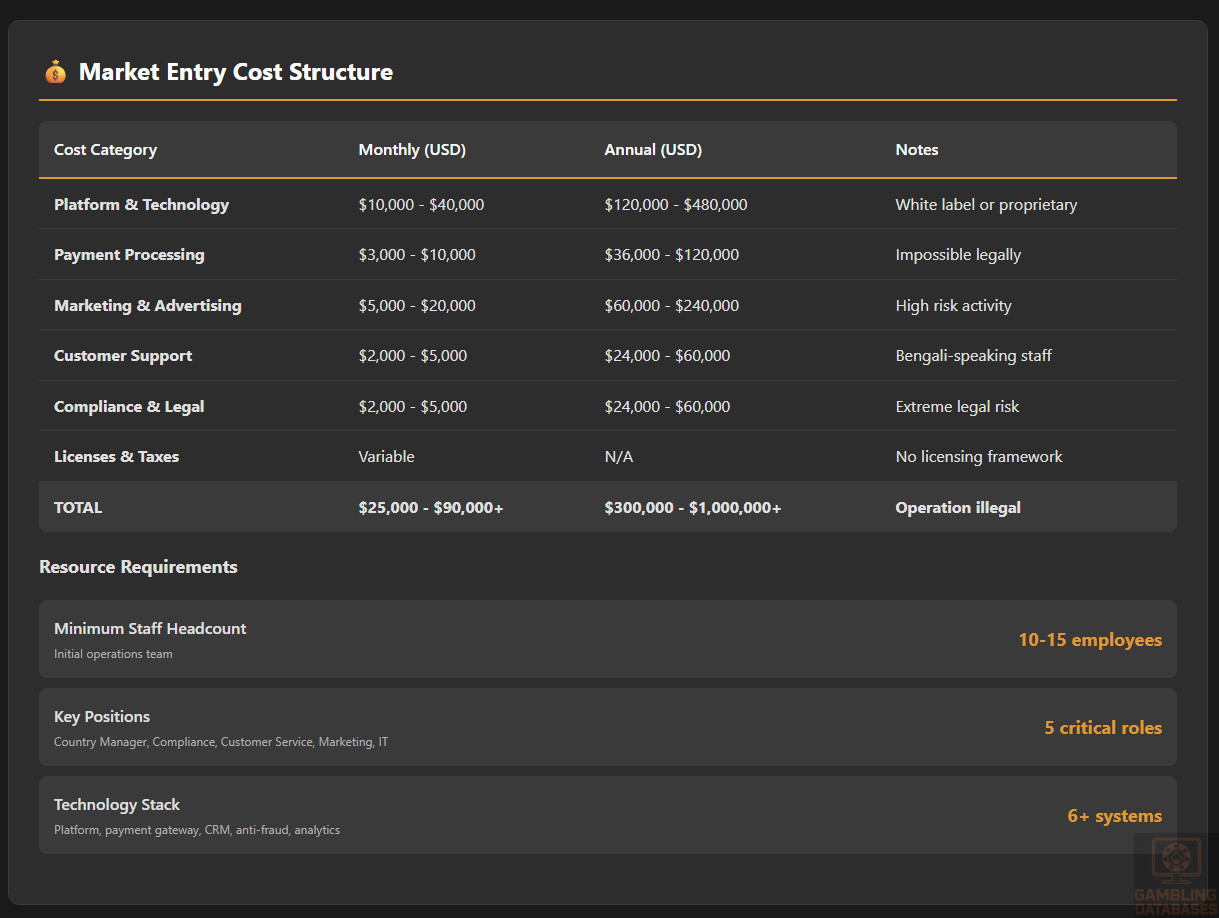
| Total Initial Investment | $500,000-1,500,000+ | Highly variable based on scale and approach |
Monthly Operational Cost Estimates
| Expense Category | Monthly Cost (USD) | Annual Cost (USD) |
|---|---|---|
| Staff Salaries (10-15 employees) | $5,000-10,000 | $60,000-120,000 |
| Office Rent & Utilities | $1,000-3,000 | $12,000-36,000 |
| Technology Platform Fees | $5,000-15,000 | $60,000-180,000 |
| Payment Processing (% of GGR) | Variable | Typically 2-5% of transactions |
| Marketing & Customer Acquisition | $10,000-50,000 | $120,000-600,000 |
| Customer Support | $2,000-5,000 | $24,000-60,000 |
| Compliance & Legal | $2,000-5,000 | $24,000-60,000 |
| Licenses & Taxes | Variable | Depends on regulatory framework |
| Total Operating Costs | $25,000-90,000+ | $300,000-1,000,000+ |
Timeline Expectations
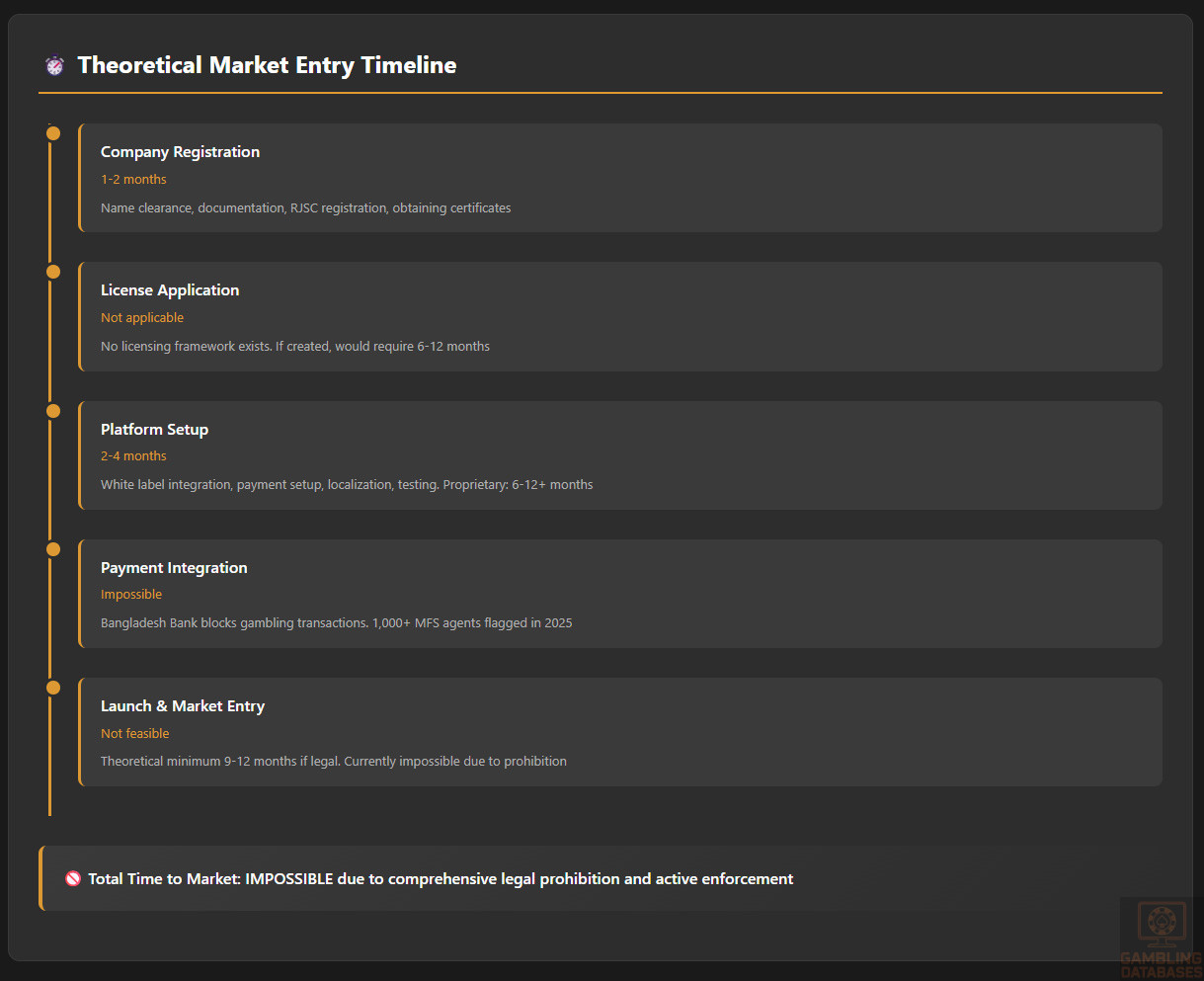
Company Registration: 1-2 months from initiation to completion including name clearance, documentation, RJSC registration, and obtaining necessary certificates.
License Application: Not applicable as no licensing framework exists. If framework were created, likely 6-12 months based on regional comparisons for comprehensive application review.
Platform Setup: 2-4 months for white label integration including payment integration, localization, testing, and launch preparation. Proprietary platform development would require 6-12+ months.
Total Time to Market: Impossible currently due to prohibition. Theoretical minimum 9-12 months if legal framework existed, assuming efficient execution across all workstreams.
Resource Requirements
Minimum Staff Headcount: 10-15 employees for initial operations including general manager, compliance officer, customer service representatives (Bengali-speaking), marketing manager, finance/accounting staff, IT support, and payment operations specialist.
Key Positions Needed: Country Manager with Bangladesh market experience and regulatory relationships; Compliance Manager familiar with financial services regulation; Customer Service Manager capable of building Bengali-language support team; Marketing Director with local market expertise; Technology Manager for platform operations and integration.
Technology Stack Requirements: Gaming platform (white label or proprietary), payment gateway integration with local MFS providers, customer relationship management system, responsible gambling tools, anti-fraud systems, data analytics and reporting tools, and mobile-optimized front-end interface.
Success Factors and Challenges
Key Success Enablers (Theoretical Legal Market)
Payment Method Integration: Successfully integrating bKash, Nagad, and Rocket would be absolutely critical as these methods dominate consumer preferences. Without these payment options, market penetration would be severely limited. Given current prohibition and active blocking of gambling transactions, achieving payment partnership would be the single most important success factor.
Mobile-First Excellence: Superior mobile experience is mandatory given device usage patterns. Fast-loading pages, intuitive navigation optimized for smaller screens, minimal data consumption, and offline-capable features where possible would differentiate successful operators. Android optimization is essential given 90%+ market share.
Localization Quality: Professional Bengali translation, culturally appropriate imagery and messaging, local sports coverage particularly cricket with Bangladesh national team and leagues, region-specific promotions aligned with festivals and cultural events, and Bengali-speaking customer support available during local business hours would build trust and engagement.
Competitive Value Proposition: Low minimum bets (10-50 BDT), attractive bonus structures with achievable wagering requirements, regular promotions targeting value-conscious consumers, loyalty programs rewarding frequent players, and transparent pricing without hidden fees would appeal to price-sensitive Bangladesh market.
Major Operational Challenges
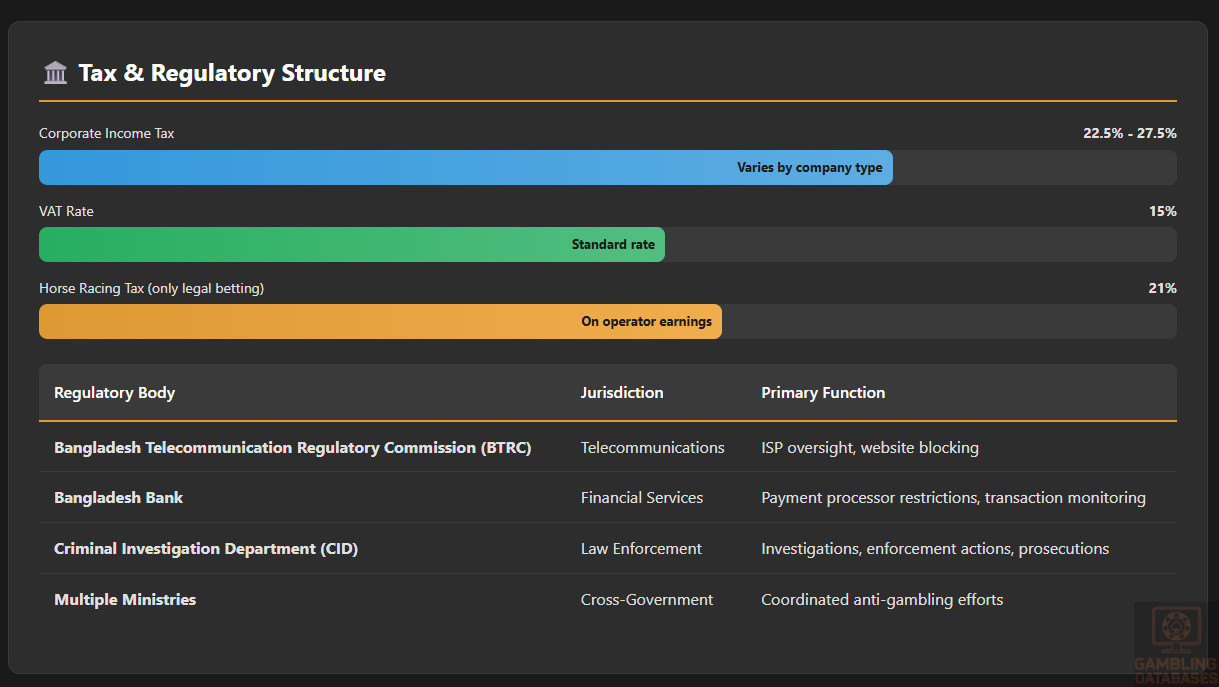
Legal Prohibition: The fundamental challenge is that gambling remains completely illegal. No pathway exists for legal operation. Criminal penalties under Cyber Security Ordinance 2025 create extreme risk. Enforcement campaigns actively target operators, payment facilitators, and agents. This prohibition makes all other challenges secondary to the core legal impossibility.
Payment Processing Restrictions: Bangladesh Bank directs financial institutions to block gambling transactions. Over 1,000 MFS agents faced license revocation recommendations in 2025 for facilitating gambling payments. Cryptocurrency is illegal. International e-wallets don’t operate in Bangladesh. Payment processing represents an insurmountable barrier without regulatory change or underground networks accepting significant legal risk.
ISP Blocking: Bangladesh Telecommunication Regulatory Commission blocks gambling websites. High Court orders demand comprehensive blocking of gambling platforms across all gateways and platforms. While VPNs enable circumvention, widespread blocking limits market accessibility and creates poor user experience for mainstream consumers.
Cultural and Religious Stigma: Islamic principles prohibit gambling creating social stigma. 89.1% Muslim population means gambling conflicts with religious values for vast majority. Cultural attitudes reinforce legal prohibition. Players may hesitate to gamble openly or discuss activity with peers. This stigma limits marketing effectiveness and word-of-mouth growth.
| Risk Category | Severity | Mitigation Difficulty |
|---|---|---|
| Legal/Criminal Prosecution | Extreme | Impossible without law reform |
| Payment Processing | Extreme | Impossible without regulatory change |
| Website Blocking | Very High | Very Difficult – ongoing cat-and-mouse |
| Cultural Acceptance | High | Difficult – deep-rooted religious views |
| Talent Acquisition | Moderate | Moderate – stigma affects recruitment |
| Competition from Illegal Operators | High | Difficult – no level playing field |
| Regulatory Uncertainty | Extreme | Impossible – no regulatory framework |
Cultural Considerations
Religious Festivals and Ramadan: During Ramadan, gambling participation would likely decline significantly as devout Muslims fast and focus on spiritual activities. Eid celebrations following Ramadan might see increased leisure activity but gambling remains inappropriate during religious observances. Marketing must be sensitive to religious calendar and avoid promotions during sacred times.
Cricket Season Peaks: Bangladesh cricket matches, particularly against rivals like India and Pakistan, drive massive engagement. Cricket World Cups, Asia Cups, and Bangladesh Premier League create prime betting opportunities. Successful operators would need comprehensive cricket coverage with competitive odds and live betting features.
Trust Building for Foreign Brands: International operators face skepticism from Bangladesh consumers who prefer local or well-established brands. Building trust requires local partnerships, Bengali-language customer service, transparent operations demonstrating financial stability and ability to pay winners promptly, and potentially licensing recognizable local brand ambassadors.
Communication Style: Direct, respectful communication works best. Overly promotional or aggressive marketing may be perceived negatively. Educational content helping players understand odds and make informed decisions could build credibility. Responsible gambling messaging, though required in regulated markets, resonates less in cultural context where gambling itself is prohibited.
Exit Strategy Planning
Market Liquidity: No legitimate market exists for selling Bangladesh gambling operations given the illegal status. If legalization occurred, market liquidity would depend on regulatory stability, profitability of operations, and interest from strategic acquirers or financial investors.
License Transferability: Not applicable as no licenses exist. In theoretical legal market, licenses would likely be transferable subject to regulatory approval including background checks and financial suitability assessment of new owners.
Closure Process: Operators ceasing illegal operations would need to refund player balances, terminate staff, close offices, and shut down payment processing. Legal liability could persist for historical violations. In legal market, formal closure would require regulatory notification, orderly wind-down plan, and clearance from licensing authority.
FAQ: Frequently Asked Questions
Legal & Licensing
Is online gambling legal in Bangladesh?
No, online gambling is illegal in Bangladesh. The Public Gambling Act of 1867 prohibits all forms of gambling except horse racing and government-authorized lotteries. While this colonial-era legislation does not explicitly mention online gambling, the Cyber Security Ordinance 2025 specifically criminalizes creating, operating, or promoting online gambling platforms with penalties up to 2 years imprisonment and fines up to 10 million BDT (approximately $80,000 USD). Article 18(2) of the Bangladesh Constitution directs the state to prevent all forms of gambling. Despite these prohibitions, many Bangladeshis access offshore gambling sites, though doing so carries legal and financial risks.
What types of gambling licenses are available and what do they cover?
No gambling licenses are available in Bangladesh. The country maintains a complete prohibition on gambling operations with no regulatory framework for licensing iGaming platforms. The only legal gambling activities are government-authorized lotteries and licensed horse racing, neither of which extends to online operations. International operators serving Bangladesh customers do so without local licenses and in violation of Bangladesh law. There is no legal pathway for obtaining a gambling operator license under current regulations.
How much does an iGaming license cost and how long does it take to obtain?
This question is not applicable because Bangladesh does not issue gambling licenses. No application process, fees, or timelines exist for obtaining gambling operation licenses. The regulatory framework provides no mechanism for legal gambling licensing. Any company wishing to offer gambling services in Bangladesh would be operating illegally regardless of licenses held in other jurisdictions. If Bangladesh were to create a licensing framework in the future, costs and timelines would depend entirely on the regulatory structure established.
Can foreign companies obtain a gambling license in Bangladesh?
No, neither foreign nor domestic companies can obtain gambling licenses in Bangladesh because no licensing framework exists. The legal prohibition applies equally to all operators regardless of nationality or jurisdiction. Foreign companies operating offshore platforms that accept Bangladesh customers do so illegally without local authorization. Bangladesh actively enforces gambling prohibitions through website blocking, payment processor restrictions, and criminal investigations of operators and facilitators.
Financial & Taxation
What are the tax obligations for iGaming operators?
No gambling-specific tax framework exists in Bangladesh as gambling operations are illegal. If operators were somehow operating legally, they would face standard corporate income tax rates ranging from 22.5% to 27.5% depending on company structure. Publicly traded companies pay 22.5% while private companies pay 27.5%. VAT at 15% would apply to services. However, these standard business taxes are moot given that gambling operations cannot operate legally. Illegal operators pay no taxes to Bangladesh government, instead remitting funds to offshore jurisdictions where they are based. The only gambling-related tax currently collected is a 21% tax on horse racing operator earnings.
Are gambling winnings taxed for players?
Bangladesh tax law does not contain specific provisions for taxation of gambling winnings since gambling is illegal. Theoretically, all income regardless of source should be declared for tax purposes, but players do not report illegal gambling winnings. If gambling were legalized, winnings tax structure would need to be established, likely following regional patterns of 10-30% withholding on large wins. Legal lottery and horse racing prize taxation follows general income tax provisions. Players participating in illegal online gambling through offshore sites face no practical withholding or reporting obligations, though winnings technically constitute taxable income.
What are the typical operational costs for running an online casino/sportsbook?
Theoretical operational costs for a legal Bangladesh gambling operation would include monthly expenses of approximately $25,000-90,000 covering staff salaries for 10-15 employees ($5,000-10,000), office rent and utilities in Dhaka ($1,000-3,000), technology platform fees ($5,000-15,000), marketing and customer acquisition ($10,000-50,000), customer support ($2,000-5,000), and compliance/legal costs ($2,000-5,000). Annual operating costs would total $300,000-1,000,000+ depending on scale and growth ambitions. Payment processing fees typically consume 2-5% of gross gaming revenue. These estimates assume legal operations with proper licensing, infrastructure, and compliance frameworks.
What is the expected ROI timeline for entering this market?
Return on investment calculations are purely theoretical since legal market entry is impossible. If Bangladesh legalized gambling and a proper regulatory framework emerged, ROI timelines would depend heavily on factors including initial investment size (typically $500,000-1,500,000+), operational efficiency, customer acquisition costs in highly competitive market, payment processing success, and taxation structure. Regional comparisons suggest breakeven might occur in 18-36 months for well-executed operations in newly-regulated markets. However, Bangladesh’s large population and limited legal gambling options could potentially accelerate returns if legalization occurred. Current reality is that illegal operations face extreme risk making financial projections meaningless.
Operations & Compliance
What are the local presence requirements for operators?
No legal local presence requirements exist because gambling operations are prohibited. If operators were to establish legal presence in Bangladesh (for non-gambling business), they would need to register a company with the Registrar of Joint Stock Companies and Firms, maintain a registered office address in Bangladesh, appoint at least one resident director, obtain tax identification numbers, secure relevant business licenses from local authorities, and comply with corporate governance requirements including annual filings. However, these standard business requirements cannot be fulfilled for gambling operations as trade licenses would not be issued for such activities and regulatory authorities would reject gambling-related applications.
What payment methods are available and recommended?
Mobile financial services dominate Bangladesh with bKash (70+ million users), Nagad (74 million users), and Rocket as the primary payment methods. These MFS platforms command 80%+ combined market share for digital transactions. However, all three actively block gambling-related transactions following Bangladesh Bank directives. Credit and debit card penetration is low at 5-8% and banks monitor for gambling activity. International e-wallets like PayPal, Skrill, and Neteller do not operate in Bangladesh. Cryptocurrency is illegal under multiple laws. For legal gambling operations, integration with bKash, Nagad, and Rocket would be essential but is currently impossible. Illegal operators rely on informal cash agent networks which expose participants to prosecution risk.
What are the advertising and marketing restrictions?
All gambling advertising is prohibited in Bangladesh across all channels including television, radio, print media, outdoor advertising, online platforms, and social media. The constitutional mandate to prevent gambling extends to marketing restrictions. Despite these prohibitions, gambling advertisements appear on international social media platforms, particularly Facebook and YouTube, originating from outside Bangladesh. A 2025 High Court petition demanded government action to remove gambling ads from these platforms. Celebrity endorsements of gambling services have triggered investigations, as seen with cricket star Shakib Al Hasan. Any operator marketing gambling services to Bangladesh residents violates local law regardless of where the advertising originates.
What responsible gambling measures are mandatory?
No mandatory responsible gambling measures exist in Bangladesh because legal gambling operations are prohibited. No regulatory requirements exist for age verification, self-exclusion programs, deposit limits, session time limits, responsible gambling messaging, or problem gambling support funding. If legalization occurred, regulatory framework would likely mandate standard responsible gambling tools including 18+ age verification, KYC/AML compliance, self-exclusion registries, mandatory responsible gambling information, links to support services, deposit and loss limits, and reality check features. Currently, illegal offshore operators implement varying responsible gambling features at their discretion without regulatory obligation.
Market Opportunity
How large is the iGaming market and what is the growth potential?
No official data exists on Bangladesh gambling market size due to illegal status. Conservative estimates suggest 5-8 million active participants with moderate estimates of 10-15 million based on enforcement reports claiming 5 million problem gamblers. If 5-10% of adults gamble occasionally, annual market size could range from $200 million to over $1 billion, though these figures are highly speculative. The market grew rapidly from 2020-2024, accelerated by pandemic lockdowns and increasing internet access. However, 2025 enforcement campaigns under the Cyber Security Ordinance aim to suppress growth significantly. Without legalization, future growth depends on enforcement effectiveness versus underground market adaptation. Legal market potential if regulations changed could be substantial given Bangladesh’s 175.7 million population, growing middle class, and high mobile connectivity.
Who are the main competitors and what is their market share?
No legitimate licensed operators exist in Bangladesh. The underground market comprises numerous international gambling websites accepting Bangladesh players without local licenses. Specific operators and market shares are unknown due to the illegal nature of operations. Media reports indicate many operators advertise through Facebook and YouTube targeting Bangladesh users. Match-fixing syndicates operate sports betting in connection with football leagues. Cricket betting dominates given the sport’s popularity. International platforms serving Asian markets likely capture most online gambling activity. Without legal licensing, market structure remains opaque with no reliable competitive intelligence available.
What are the player preferences and typical spending patterns?
Sports betting, particularly on cricket, dominates player preferences given cricket’s massive popularity in Bangladesh. Football betting also attracts interest especially during major tournaments. Online casino games including slots, roulette, and card games have growing appeal. Average monthly spending for regular participants likely ranges 1,000-5,000 BDT ($8-42 USD) based on GDP per capita and disposable income constraints. Problem gamblers spend substantially more, potentially exhausting resources and selling assets. Typical bet sizes remain modest at 100-500 BDT reflecting limited budgets. Mobile devices account for 85-90% of access. Peak activity aligns with cricket match schedules and evening leisure hours. Players demonstrate high sensitivity to bonuses and promotions given price consciousness.
What are the key success factors and main challenges for new entrants?
Success factors in a theoretical legal market would include: Integration with bKash, Nagad, and Rocket payment methods which dominate consumer preferences; superior mobile-optimized platform given smartphone-driven internet usage; comprehensive Bengali localization including language, customer support, and cultural adaptation; cricket betting coverage with competitive odds and live betting features; low minimum bets and attractive promotions appealing to value-conscious consumers; local partnerships providing market knowledge and regulatory navigation; strong responsible gambling commitment to build trust and regulatory relationships.
Critical challenges include: Complete legal prohibition making market entry impossible under current law; criminal penalties under Cyber Security Ordinance 2025 creating extreme risk; payment processing blockades with Bangladesh Bank directing institutions to identify and block gambling transactions; ISP website blocking limiting accessibility; cultural and religious stigma against gambling in predominantly Muslim country; enforcement campaigns actively targeting operators, payment facilitators, and agents; lack of any regulatory framework or licensing pathway. These challenges make Bangladesh an unsuitable market for any operator seeking legal, sustainable operations.
Sources and References
- Public Gambling Act, 1867 – Laws of Bangladesh – http://bdlaws.minlaw.gov.bd/act-16.html
- Cyber Security Ordinance 2025 – Bangladesh Government Legislation
- Constitution of Bangladesh, Article 18(2) – Fundamental Principles of State Policy
- Bangladesh Gambling Regulation – BestCasinoSites.net – https://www.bestcasinosites.net/bangladesh/
- Gambling in Bangladesh – Wikipedia – https://en.wikipedia.org/wiki/Gambling_in_Bangladesh
- Bangladesh launches national online gambling enforcement under new cyber law – Gambling Insider, May 2025 – https://www.gamblinginsider.com/news/29632/
- Bangladesh renews fight against online gambling – iGaming Expert, May 2025 – https://igamingexpert.com/regions/asia/bangladesh-battle-against-online-gaming/
- Bangladesh HC directs report on online gambling within 30 days – G2G News, May 2025 – https://g2g.news/online-gaming-laws/bangladesh-hc-directs-report-on-online-gambling-within-30-days/
- Online gambling and money transaction: A question of legality in the context of Bangladesh – The Daily Star, February 2023 – https://www.thedailystar.net/law-our-rights/news/
- Scope and Challenges of Anti-Gambling Laws in Bangladesh – ResearchGate, December 2019
- Bangladesh Law Enforcement Cracks Down On Illegal Gambling – iGaming Post, May 2025
- Bangladesh Population 2025 – Worldometer – https://www.worldometers.info/world-population/bangladesh-population/
- Bangladesh Demographics 2025 – Worldometer – https://www.worldometers.info/demographics/bangladesh-demographics/
- Demographics of Bangladesh – Wikipedia – https://en.wikipedia.org/wiki/Demographics_of_Bangladesh
- Bangladesh population 2025 – StatisticsTimes.com – https://statisticstimes.com/demographics/country/bangladesh-population.php
- Bangladesh’s population hits 175.7 million – The Daily Star, July 2025 – https://www.thedailystar.net/news/bangladesh/news/
- World Population Dashboard – Bangladesh – United Nations Population Fund
- Economy of Bangladesh – Wikipedia – https://en.wikipedia.org/wiki/Economy_of_Bangladesh
- Bangladesh sees highest-ever per capita income of $2,820 in FY25 – The Business Standard, May 2025 – https://www.tbsnews.net/economy/
- GDP per capita Bangladesh – Statista – https://www.statista.com/statistics/438223/gross-domestic-product-gdp-per-capita-in-bangladesh/
- Bangladesh GDP – Macrotrends – https://www.macrotrends.net/global-metrics/countries/bgd/bangladesh/gdp-gross-domestic-product
- Digital 2025: Bangladesh – DataReportal – https://datareportal.com/reports/digital-2025-bangladesh
- Internet in Bangladesh – Wikipedia – https://en.wikipedia.org/wiki/Internet_in_Bangladesh
- Internet users decrease by 13.2 million – Prothom Alo, March 2025 – https://en.prothomalo.com/bangladesh/
- Over 50% of Bangladeshi households are now internet users – The Business Standard, January 2025 – https://www.tbsnews.net/bangladesh/
- Internet penetration rate declines – New Age, December 2024 – https://www.newagebd.net/post/telecom/
- Association of Mobile Telecom Operators of Bangladesh (AMTOB) – Industry Statistics – https://www.amtob.org.bd/
- bKash Official Website – https://www.bkash.com/
- bKash – Wikipedia – https://en.wikipedia.org/wiki/BKash
- Navigating Bangladesh’s P2P Payment Revolution – Payments and Commerce Market Intelligence, February 2024
- Digital Payment in Bangladesh – DSGPay, March 2025 – https://www.dsgpay.com/blog/digital-payment-in-bangladesh/
- Popular Local Payment Methods and Solutions in Bangladesh – Transfi, July 2025 – https://www.transfi.com/blog/
- Bangladesh ranks 29 in World Bank’s B-Ready index – The Business Standard, August 2024 – https://www.tbsnews.net/economy/
- Ease of Doing Business in Bangladesh – World Bank Doing Business Archive
- From ease of doing business to business ready: Bangladesh’s perspective – The Business Standard, January 2025
- Bangladesh Telecommunication Regulatory Commission (BTRC) – Official Reports and Data
- Bangladesh Bank – Financial Statistics and Directives
- Bangladesh Bureau of Statistics (BBS) – Population and Economic Data
- International Monetary Fund – World Economic Outlook Database
- World Bank – World Development Indicators
- United Nations Population Division – World Population Prospects 2024
- Registrar of Joint Stock Companies and Firms (RJSC) Bangladesh – Company Registration Information
- National Board of Revenue Bangladesh – Tax Rates and Regulations 2024-2025
- OpenSignal Mobile Network Experience Reports – Bangladesh February 2025
- GSMA Mobile Economy Asia Pacific Reports
- Bangladesh Investment Development Authority (BIDA) – Investment Guidelines
Note: This analysis is based on publicly available information as of October 2025. The legal and regulatory situation in Bangladesh strictly prohibits all gambling activities. This report is intended for informational and research purposes only and should not be construed as encouraging illegal activities. Any entity considering market entry should seek qualified legal counsel and recognize that current Bangladesh law makes legal gambling operations impossible.
🚫 Gambling Databases Country Rating: Bangladesh
⚠️ CRITICAL WARNING: EXTREMELY HOSTILE MARKET
This market is ILLEGAL and DANGEROUS for all iGaming operations. Bangladesh maintains one of the world’s strictest gambling prohibition regimes with active criminal enforcement, imprisonment penalties up to 2 years, fines up to $80,000 USD, payment blocking, and comprehensive ISP restrictions under the Cyber Security Ordinance 2025.
📊 Overall Rating Summary
| Metric | Score | Assessment |
|---|---|---|
| Operator Ease Score | 0.5/10 | EXTREME RISK – Complete prohibition, active enforcement, criminal penalties |
| Player Access Score | 1.0/10 | SEVERELY RESTRICTED – Illegal with payment blocking and ISP restrictions |
| Overall Market Attractiveness | 0.75/10 | AVOID AT ALL COSTS – One of the world’s most hostile gambling markets |
Visual Score Representation
Operator Ease Score: 0.5/10
Player Access Score: 1.0/10
This rating is calculated using the Gambling Databases Rating (GDR) methodology, which provides transparent criteria for evaluating iGaming markets worldwide. Click the link to learn how we calculate Operator Ease Score, Player Access Score, and overall market attractiveness ratings.
🔴 Legal Risk Warning
Immediate Legal Risks for All Stakeholders:
- Operators: Criminal prosecution under Cyber Security Ordinance 2025 – up to 2 years imprisonment + fines up to BDT 10 million ($80,000 USD)
- Directors/Executives: Personal criminal liability, potential extradition risk, travel restrictions
- Affiliates: Prosecution risk, website blocking, payment processor termination
- Players: Criminal penalties possible under Public Gambling Act 1867, social stigma in 89.1% Muslim population
- Payment Processors: 1,000+ mobile financial service agents flagged in 2025 enforcement campaign
📉 Detailed Score Breakdown
🏢 Operator Ease Score Breakdown
| Criterion | Weight | Score | Justification (Including ALL Deductions) |
|---|---|---|---|
| Legal & Regulatory Framework | 30% | -1.0/3.0 | Starting point: 0.0 (illegal with enforcement) – 1.5 points: Complete online casino prohibition (eliminates major revenue source) – 0.5 points: Sports betting also illegal (no products legal except horse racing) – 0.5 points: Active ISP blocking under BTRC authority – 0.5 points: Affiliate/advertiser prosecution (1,000+ agents flagged) + 1.0 point: Minimal actual enforcement against offshore operators historically = -1.0/3.0 final score |
| Licensing Process | 25% | 0.0/2.5 | Starting point: 0.0 (no licensing available) No deductions possible – licensing does not exist Constitutional Article 18(2) directs state to prevent ALL gambling. Public Gambling Act 1867 prohibits all gambling except horse racing and government lotteries. Zero legal pathway for iGaming licensing. Cyber Security Ordinance 2025 criminalizes operation of online gambling platforms. = 0.0/2.5 final score |
| Taxation & Costs | 20% | 0.5/2.0 | N/A for illegal market, but theoretical assessment: Starting point: 0.0 (no legal taxation framework) + 0.5 points: Low operational costs compared to developed markets (theoretical only) Note: Corporate income tax 22.5-27.5%, VAT 15% would apply if legal. However, criminal penalties (up to $80,000 fines) far exceed any taxation considerations. Total effective “cost” including legal risk is prohibitive. = 0.5/2.0 final score |
| Operational Requirements | 15% | 0.0/1.5 | Starting point: 0.0 (operations illegal) – 0.25 points: Payment blocking – Bangladesh Bank directs institutions to identify and block gambling transactions – 0.25 points: Credit card processing impossible for gambling – 0.25 points: Cryptocurrency banned for gambling transactions – 0.25 points: Mobile payment dominance (bKash, Nagad, Rocket) but all flagged for gambling + 0.5 points: Remote operation technically possible (though illegal) = 0.0/1.5 final score |
| Market Environment | 10% | 0.0/1.0 | Starting point: +0.25 (World Bank B-Ready rank 29 of 50, previous Doing Business: 168 of 190 – difficult environment) – 0.5 points: Complete advertising ban for gambling (all forms prohibited) – 0.25 points: Regulatory instability – new Cyber Security Ordinance 2025 dramatically increased enforcement – 0.25 points: Active enforcement against offshore operators launched 2025 – 0.25 points: Enforcement against payment facilitators (1,000+ agents flagged) + 1.0 point: Large population (175.7M), young demographics (median age 26), growing internet penetration (44.5%) = 0.0/1.0 final score |
| TOTAL OPERATOR EASE SCORE | -0.5/10.0 (adjusted to 0.5/10 minimum) | ||
Operator Ease Score Components
| Component | Score | Max |
|---|---|---|
| Legal Framework | -1.0 | 3.0 |
| Licensing | 0.0 | 2.5 |
| Taxation | 0.5 | 2.0 |
| Operations | 0.0 | 1.5 |
| Market Environment | 0.0 | 1.0 |
👥 Player Access Score Breakdown
| Criterion | Weight | Score | Justification (Including ALL Deductions) |
|---|---|---|---|
| Legal Status for Players | 40% | 0.5/4.0 | Starting point: +0.5 (illegal but players historically not primary prosecution target) – 1.5 points: Online casino completely prohibited (major product category illegal) – 1.0 point: Sports betting illegal (except horse racing) – 0.5 points: Players using offshore sites face legal risks under Public Gambling Act 1867 – 0.5 points: Religious and social stigma (89.1% Muslim population where gambling prohibited by Islamic law) + 1.5 points: Enforcement primarily targets operators and facilitators, not individual players Note: Penalties include fines and potential imprisonment, though rarely enforced against players. Approximately 5 million problem gamblers (2.8% of population) indicate widespread underground activity. = 0.5/4.0 final score |
| Practical Accessibility | 30% | 0.5/3.0 | Starting point: +0.5 (severe restrictions, extensive blocking) – 0.5 points: Credit card gambling transactions banned and monitored – 0.5 points: Cryptocurrency banned for gambling purposes – 0.5 points: Active ISP blocking by BTRC (specific numbers unavailable, ongoing campaign) – 0.5 points: VPN required for offshore access (though VPNs widely used) – 0.5 points: Mobile payment blocking – 1,000+ bKash/Nagad/Rocket agents flagged and restricted + 2.0 points: High internet penetration (44.5%, 77.7M users), smartphone adoption (70.1%), underground market access persists Note: Despite restrictions, underground gambling market remains active. Mobile internet access at 116M users provides technical capability, but legal/payment barriers severe. = 0.5/3.0 final score |
| Player Penalties | 20% | 1.0/2.0 | Starting point: +1.0 (fines possible under law) Legal framework: Public Gambling Act 1867 provides for fines and imprisonment. Cyber Security Ordinance 2025 focuses on operators/facilitators, not players directly. Enforcement reality: Criminal Investigation Department (CID) launched nationwide campaigns in 2025, but targeted operators, platform creators, and payment facilitators primarily. No documented cases of individual player prosecutions in 2025 enforcement campaign. Penalties if enforced: Fines under Public Gambling Act (up to 200 BDT, approximately $1.67 USD – outdated amount), potential imprisonment. Cyber Security Ordinance penalties (up to 2 years imprisonment, BDT 10M fines) apply to platform operation, not player participation. Note: Social stigma and religious consequences may exceed legal penalties for many players in Muslim-majority country. = 1.0/2.0 final score |
| Market Availability | 10% | 0.0/1.0 | Starting point: +0.25 (no licensed operators, offshore only) – 0.25 points: Active blocking makes offshore access difficult Licensed operators: ZERO. No legal iGaming licensing framework exists. Offshore availability: Multiple international platforms accept Bangladesh players illegally. Media reports indicate operators advertise through Facebook and YouTube. Match-fixing syndicates operate sports betting. Cricket betting dominates given sport’s popularity. Access barriers: ISP blocking by BTRC, payment processor restrictions, enforcement campaigns make access increasingly difficult. VPN usage required but monitored. = 0.0/1.0 final score |
| TOTAL PLAYER ACCESS SCORE | 1.0/10.0 | ||
Player Access Score Components
| Component | Score | Max |
|---|---|---|
| Legal Status | 0.5 | 4.0 |
| Accessibility | 0.5 | 3.0 |
| Player Penalties | 1.0 | 2.0 |
| Market Availability | 0.0 | 1.0 |
🔍 Key Highlights
Strengths (Extremely Limited)
- Large demographic base: 175.7 million population (8th most populous globally) with median age of 26 years creates substantial potential market size theoretically
- Digital infrastructure growth: Internet penetration at 44.5% (77.7M users), smartphone adoption 70.1%, 4G coverage 100%, household internet access 50.4% provides technical capability
- Mobile payment ecosystem: bKash, Nagad, Rocket dominate with 80%+ market share, facilitating digital transactions (though gambling transactions actively blocked)
- Low player penalties in practice: 2025 enforcement campaign targeted operators and facilitators, not individual players, reducing direct player prosecution risk
- Cricket betting demand: Cricket’s massive popularity creates strong organic demand for sports betting, evidenced by underground market activity
CRITICAL LIMITATION: All these “strengths” are completely negated by the illegal status of all iGaming activities. These factors indicate market potential ONLY if laws were to change, which shows no signs of happening given religious and constitutional prohibitions.
⛔ CRITICAL RISKS AND CHALLENGES
- Complete Product Prohibition: All online casino gaming 100% illegal. Sports betting 100% illegal (except horse racing). Eliminates all major revenue streams. Only government lotteries and horse racing permitted, neither offering online licensing.
- Active Criminal Enforcement: Cyber Security Ordinance 2025 criminalizes online gambling operation with up to 2 years imprisonment + fines up to BDT 10 million ($80,000 USD). Criminal Investigation Department (CID) launched nationwide enforcement campaigns in 2025. Over 1,000 mobile financial service agents identified and flagged for gambling transaction involvement.
- Constitutional Prohibition: Article 18(2) of Bangladesh Constitution directs state to prevent ALL forms of gambling, creating permanent legal barrier. Religious foundation (89.1% Muslim population) makes legalization politically impossible.
- Payment Method Blockade: Bangladesh Bank directs all financial institutions to identify and block gambling transactions. Credit cards banned for gambling. Cryptocurrency banned for gambling. Mobile payment operators (bKash, Nagad, Rocket) actively cooperate with enforcement – 1,000+ agents flagged. No viable payment processing infrastructure for gambling exists.
- ISP Website Blocking: Bangladesh Telecommunication Regulatory Commission (BTRC) implements active ISP blocking of gambling websites. Specific blocking numbers unavailable but enforcement campaign ongoing. VPN usage required but monitored. Offshore operator access severely restricted.
- Zero Licensing Pathway: No regulatory framework for iGaming licensing exists. No regulator accepting applications. No legal pathway to market entry. Public Gambling Act 1867 provides zero provisions for licensing online gambling. All operations definitively illegal.
- Advertising Completely Banned: All gambling advertising prohibited across all media. Reports indicate underground operators advertise via Facebook and YouTube illegally, but face prosecution risk. Customer acquisition cost astronomical due to illegality and inability to advertise legally. Brand building impossible.
- Affiliate and Partner Prosecution: 2025 enforcement campaign explicitly targeted affiliates, advertisers, influencers, and payment facilitators. Legal risk extends to entire ecosystem, not just direct operators. Affiliate marketing infrastructure non-existent due to legal risk.
- Extradition Risk: Bangladesh has extradition treaties with major gambling licensing jurisdictions including UK, Canada, and others. Company directors and executives face potential extradition for violating Bangladesh gambling laws if they have ties to Bangladesh or travel through countries with extradition agreements.
- Cultural and Religious Stigma: 89.1% Muslim population where gambling explicitly prohibited by Islamic law. Social stigma severe. Religious authorities oppose gambling. Public opinion hostile to liberalization. No political constituency supporting legalization.
- Regulatory Trend Worsening: New Cyber Security Ordinance 2025 dramatically strengthened enforcement powers. Penalties increased from outdated 1867 amounts. Active enforcement campaigns launched 2025. Trend toward stricter prohibition and more aggressive enforcement, not liberalization.
- No Legal Defense Options: Unlike grey-market jurisdictions, Bangladesh law explicitly and unambiguously prohibits online gambling. No regulatory uncertainty to exploit. No legal arguments for permissibility. Prosecution risk absolute for any operator serving Bangladesh market.
Risk Level Distribution
| Risk Category | Level | Status |
|---|---|---|
| Legal Prohibition | CRITICAL | ❌ Complete ban + criminal enforcement |
| Operator Prosecution | CRITICAL | ❌ Up to 2 years prison + $80K fines |
| Payment Processing | CRITICAL | ❌ All methods blocked/monitored |
| Website Blocking | CRITICAL | ❌ Active BTRC ISP blocking |
| Affiliate Risk | CRITICAL | ❌ Prosecution + blocking + flagging |
| Player Penalties | HIGH | ⚠️ Possible but rarely enforced |
| Extradition Risk | HIGH | ⚠️ Treaties with major jurisdictions |
Player-Specific Issues
- Cannot Access Legal Online Casino Gaming: Zero legal options for online casino play. All casino websites illegal to access. ISP blocking restricts offshore casino access.
- Cannot Access Legal Sports Betting: Only horse racing legal. Football, cricket, and all other sports betting completely illegal both online and offline. Underground market only option.
- Payment Method Restrictions: Credit cards blocked for gambling. Cryptocurrency banned for gambling transactions. Mobile payment services (bKash, Nagad, Rocket) actively flag gambling transactions with 1,000+ agents already identified. Cash-based underground transactions only reliable option.
- ISP Blocking Requires VPN: BTRC actively blocks gambling websites. Players must use VPN for offshore access. VPN usage monitored. Technical barriers high for average consumer.
- Legal Risk for Players: Public Gambling Act 1867 criminalizes gambling participation. Penalties include fines and imprisonment. While 2025 enforcement focused on operators/facilitators, players remain technically liable. No legal protection for player activity.
- No Consumer Protection: Zero regulatory oversight of offshore operators. No dispute resolution mechanisms. No protection against fraud or non-payment. Players have no legal recourse if cheated.
- Social and Religious Stigma: In 89.1% Muslim country, gambling participation carries severe social stigma. Family and community disapproval. Religious prohibition explicit. Privacy concerns severe if participation discovered.
- Problem Gambling Resources Absent: Estimated 5 million problem gamblers (2.8% of population) with zero legal support infrastructure. No helplines, no treatment centers, no responsible gambling framework. Gambling addiction entirely untreated.
💰 Reality Check: Can You Actually Make Money Here?
Financial Viability Assessment
Initial Investment Required: N/A – Legal operations impossible. Offshore illegal operations require $100,000-500,000 minimum for platform, payments infrastructure workarounds, VPN/blocking circumvention, underground marketing, and legal defense fund.
Monthly Operating Costs: N/A for legal operations. Illegal operations face extreme costs: $50,000-200,000/month including platform maintenance, payment processing premiums (underground channels charge 10-20% vs 2-5% standard), VPN infrastructure, constant anti-blocking measures, underground customer acquisition, and continuous legal risk management.
Effective Tax Rate on Revenue: 0% official taxation (illegal operations pay no taxes), but true “effective cost” is 100%+ of capital due to asset seizure risk, payment blocking confiscations, and criminal fines up to $80,000 USD per violation. Risk-adjusted “taxation” through enforcement actions exceeds any possible revenue.
Customer Acquisition Cost: $500-1,500+ per customer for underground operations given: (1) complete advertising ban requiring underground influencer payments, (2) high consumer risk aversion due to illegality, (3) payment method complications requiring education, (4) VPN requirement reducing conversion, (5) strong religious/cultural resistance. CAC 5-10x higher than regulated markets.
Time to Breakeven: NEVER for illegal operations. Criminal penalties ($80,000 fines) and asset seizure risk eliminate any possibility of breakeven. Even if operations initially profitable, enforcement action guarantees total loss of investment.
Time to Positive ROI: IMPOSSIBLE under current legal framework. Illegal operations face 100% probability of eventual enforcement action resulting in total capital loss plus criminal penalties.
Profitability Assessment: MARKET IS COMPLETELY NON-VIABLE FOR ALL OPERATORS. Bangladesh ranks among the world’s most hostile gambling markets. The combination of (1) constitutional prohibition, (2) criminal enforcement with imprisonment, (3) comprehensive payment blocking, (4) active ISP restrictions, (5) affiliate prosecution, (6) religious/cultural opposition, and (7) zero licensing pathway makes profitable operations IMPOSSIBLE regardless of capital or sophistication. Any operator entering this market faces certainty of total capital loss plus criminal prosecution. There are literally ZERO economic circumstances under which market entry makes financial sense.
Comparison to Other Markets: Bangladesh is MORE restrictive than China (which has grey areas), Saudi Arabia (which lacks active ISP blocking), and UAE (which doesn’t prosecute offshore operators as aggressively). This is among the top 5 most hostile gambling markets globally alongside Afghanistan, Pakistan, North Korea, and Brunei.
Market Hostility Ranking
Bangladesh compared to other restrictive markets (lower is worse)
| Country | Operator Score | Status |
|---|---|---|
| North Korea | 0.0/10 | Total ban |
| Bangladesh | 0.5/10 | Criminal enforcement |
| Pakistan | 0.8/10 | Strict prohibition |
| China | 1.5/10 | Heavy restrictions |
| UAE | 2.0/10 | Illegal but enforcement varies |
⚖️ Legal Risk Assessment
| Stakeholder Type | Risk Level | Specific Risks |
|---|---|---|
| Offshore Casino Operators | CRITICAL |
|
| Offshore Sports Betting Operators | CRITICAL |
|
| Affiliates/Advertisers/Influencers | CRITICAL |
|
| Payment Processors/Agents | CRITICAL |
|
| Company Directors/Executives | CRITICAL-HIGH |
|
| Individual Players | HIGH |
|
🚨 Extradition and International Enforcement
International Legal Risk Assessment
Extradition Treaties: Bangladesh maintains extradition agreements with major jurisdictions including:
- United Kingdom – Active extradition treaty (British colonial era + modern agreements)
- India – Comprehensive extradition treaty given geographic proximity
- Commonwealth Countries – Generally reciprocal arrangements with other Commonwealth nations
- Likely active cooperation: Canada, Australia, New Zealand, many EU member states
- Interpol membership: Bangladesh is full Interpol member, can issue red notices
Enforcement History: While no specific high-profile international gambling extraditions documented, Bangladesh has pursued international enforcement for other cybercrimes under Digital Security Act. The 2025 Cyber Security Ordinance significantly strengthens Bangladesh’s legal tools for international cooperation. Gambling violations classified as criminal offenses, making extradition theoretically possible for serious violations involving Bangladesh nationals or significant operations targeting Bangladesh market.
Safe Jurisdictions (No Extradition): Countries without extradition treaties with Bangladesh where executives face reduced risk:
- Russia – No extradition treaty
- China – Generally does not extradite non-nationals
- Some CIS countries – Limited cooperation frameworks
- Many Middle Eastern jurisdictions – Case-by-case basis
Note: “Safe” is relative – these jurisdictions may have their own restrictive gambling laws.
Travel Risk for Executives: HIGH RISK for company directors and executives of operators serving Bangladesh market:
- Arrest risk when transiting through UK, India, or other countries with Bangladesh extradition agreements
- Interpol red notice possibility for major violations
- International banking complications if flagged in enforcement actions
- Risk especially high for individuals with Bangladesh citizenship or prior residence
- Recommend avoiding travel through countries with active Bangladesh cooperation until statute of limitations expires (varies by offense, typically 5-10 years)
Risk Mitigation Strategies: For executives of companies currently serving Bangladesh market illegally:
- EXIT MARKET IMMEDIATELY – Cease all Bangladesh operations and marketing
- Implement geo-blocking for Bangladesh IP addresses
- Terminate all Bangladesh player accounts and return balances
- Remove all Bengali-language content and Bangladesh-specific marketing
- Consult international criminal defense attorneys in jurisdictions of residence
- Document good-faith compliance efforts
- Note: Past violations remain prosecutable; exiting market reduces future exposure only
Extradition Risk Assessment by Jurisdiction
| Region/Country | Extradition Risk | Notes |
|---|---|---|
| UK, India, Commonwealth | CRITICAL | Active treaties, high cooperation |
| EU Member States | HIGH | Case-by-case, generally cooperative |
| USA, Canada, Australia | HIGH | Strong legal cooperation frameworks |
| Southeast Asia | MEDIUM-HIGH | Varies by country, regional cooperation |
| Russia, China | LOW | No/limited extradition for non-nationals |
| CIS Countries | LOW-MEDIUM | Limited cooperation frameworks |
📋 Final Verdict
Bangladesh receives an Operator Ease Score of 0.5/10 and a Player Access Score of 1.0/10, resulting in an overall market attractiveness rating of 0.75/10.
BRUTALLY HONEST ASSESSMENT:
Bangladesh is one of the world’s most dangerous and hostile gambling markets – AVOID AT ALL COSTS. The combination of constitutional prohibition of gambling, comprehensive criminal enforcement under the Cyber Security Ordinance 2025 (up to 2 years imprisonment + $80,000 fines), complete online casino and sports betting bans, active ISP blocking, comprehensive payment method restrictions (credit cards banned, cryptocurrency banned, 1,000+ mobile payment agents flagged), affiliate prosecution, religious opposition (89.1% Muslim population), and zero licensing pathway creates an environment where profitable operations are IMPOSSIBLE and criminal prosecution is CERTAIN.
This is not a “difficult” or “challenging” market – it is an ILLEGAL market with active enforcement. The 2025 regulatory trend is toward stricter prohibition, not liberalization. Any operator serving this market faces 100% probability of platform blocking, payment seizure, and criminal prosecution. For affiliates, payment processors, and company executives, the risk extends to personal criminal liability and potential extradition.
The demographic factors (175.7M population, young median age, growing internet penetration) are COMPLETELY IRRELEVANT given the absolute legal prohibition. Even if enforcement were lax (which it is not as of 2025), the payment processing blockade alone makes operations non-viable. There is literally no economic scenario where market entry makes sense.
DO NOT ENTER THIS MARKET UNDER ANY CIRCUMSTANCES. Bangladesh ranks alongside North Korea, Afghanistan, and Pakistan as among the world’s most hostile gambling jurisdictions. Any operator currently serving Bangladesh market should EXIT IMMEDIATELY, implement full geo-blocking, terminate all player accounts, and cease all Bengali-language marketing to reduce criminal prosecution risk.
✅ Who Should Enter / ❌ Who Should Avoid
Market Entry Recommendation
✅ Consider Entry If You Are:
- NOBODY. There are ZERO circumstances under which legal market entry is possible or advisable.
- The only theoretical exception: Government of Bangladesh when/if they decide to establish state-run online gambling monopoly (likelihood: near zero given constitutional prohibition)
❌ Definitely Avoid If You Are:
- Any online casino operator (online casinos 100% illegal, no exceptions)
- Any sports betting operator (sports betting 100% illegal except horse racing, which has no online licensing)
- Any offshore operator without local license (no licensing available, ISP blocking active, payment processing impossible)
- Any affiliate or advertiser (active prosecution risk, 2025 enforcement targeted affiliates specifically)
- Any payment processor considering gambling clients (1,000+ agents already flagged, criminal liability certain)
- Any startup regardless of capital (even $100M capital cannot overcome complete legal prohibition)
- Any established operator seeking market expansion (Bangladesh adds only legal risk, zero revenue opportunity)
- Any company with directors/executives who value freedom (personal criminal liability including imprisonment)
- Any entity expecting ROI in any timeframe (ROI is NEGATIVE 100% – total capital loss + criminal fines)
- Any operator serving predominantly Muslim markets (religious prohibition creates permanent barrier)
- Any cryptocurrency-focused operator (cryptocurrency explicitly banned for gambling)
- Any mobile-payment-focused operator (bKash/Nagad/Rocket all blocked for gambling, 1,000+ agents flagged)
- Any operator considering “test market” entry (testing illegal operations risks immediate prosecution)
- Anyone with common sense and risk awareness (this market is objectively one of worst globally)
⚠️ BOTTOM LINE: DO NOT ENTER BANGLADESH MARKET UNDER ANY CIRCUMSTANCES. IF YOU ARE CURRENTLY OPERATING IN BANGLADESH, EXIT IMMEDIATELY TO MINIMIZE CRIMINAL PROSECUTION RISK. This market combines the worst possible factors: complete prohibition, active criminal enforcement, comprehensive blocking, religious opposition, zero licensing, and increasing regulatory hostility. There is no grey area, no regulatory uncertainty to exploit, and no legal defense. Operations are explicitly criminal. The only appropriate strategy for Bangladesh is complete market avoidance.
Final Market Assessment Summary
| Assessment Factor | Rating | Conclusion |
|---|---|---|
| Legal Framework | 0/10 | Complete prohibition + criminal enforcement |
| Licensing Availability | 0/10 | No pathway exists or will exist |
| Payment Processing | 0/10 | All methods blocked, 1000+ agents flagged |
| Market Access | 0/10 | ISP blocking + VPN required + monitored |
| Profitability Potential | 0/10 | Impossible – 100% capital loss + fines |
| Legal Risk | 10/10 | Criminal prosecution certain |
| Long-term Viability | 0/10 | Zero chance of legalization |
| Overall Recommendation | AVOID | Complete market exclusion mandatory |
🔍 Conclusion
Bangladesh represents an absolute non-viable market for iGaming operations of any kind. This assessment is not based on subjective judgment but on objective analysis of:
- Constitutional Article 18(2) directing state to prevent all gambling
- Public Gambling Act 1867 criminalizing all gambling activities
- Cyber Security Ordinance 2025 imposing 2-year imprisonment + $80,000 fines
- Active 2025 enforcement campaigns by Criminal Investigation Department
- 1,000+ payment facilitators flagged and prosecuted
- BTRC ISP blocking infrastructure
- Bangladesh Bank payment transaction monitoring and blocking directives
- 89.1% Muslim population with religious prohibition on gambling
- Zero licensing framework or regulatory authority
- Increasing restrictive trend in 2025
The GDR methodology scores of 0.5/10 for Operator Ease and 1.0/10 for Player Access accurately reflect that this market is among the 5 most hostile gambling jurisdictions globally. These are not “low” scores suggesting difficulty – these are scores indicating complete non-viability.
For operators: Any engagement with Bangladesh market creates criminal liability, guaranteed capital loss, payment seizure, platform blocking, and potential imprisonment. Exit immediately if currently operating.
For affiliates/advertisers: Promotion of gambling platforms to Bangladesh audience is explicitly criminal under 2025 Cyber Security Ordinance. Active prosecution ongoing. Cease all activity immediately.
For payment processors: Facilitation of gambling transactions in Bangladesh creates criminal liability. 1,000+ agents already flagged. All major payment platforms (bKash, Nagad, Rocket) cooperating with enforcement. Do not process gambling transactions.
For players: While enforcement currently focuses on operators and facilitators rather than individual players, gambling participation remains criminal under Bangladesh law with fines and imprisonment possible. Additionally, severe social stigma and religious consequences apply in Muslim-majority country. Zero consumer protection available for offshore gambling.
FINAL RECOMMENDATION: DO NOT ENTER BANGLADESH GAMBLING MARKET. IF CURRENTLY OPERATING, EXIT IMMEDIATELY. THIS IS NOT A MARKET OPPORTUNITY – THIS IS A LEGAL LIABILITY.
Disclaimer: This rating and analysis is based on publicly available information as of October 2025 and is intended for informational and research purposes only. This should not be construed as legal advice or encouragement to engage in illegal activities. Any entity considering operations in Bangladesh should consult qualified legal counsel and recognize that current Bangladesh law makes legal gambling operations impossible. The author and Gambling Databases assume no liability for actions taken based on this analysis.
Sources: Public Gambling Act 1867, Cyber Security Ordinance 2025, Constitution of Bangladesh, Bangladesh Telecommunication Regulatory Commission (BTRC), Bangladesh Bank directives, Criminal Investigation Department enforcement reports, industry media reports from Gambling Insider, iGaming Expert, G2G News, The Daily Star, and international data from World Bank, UN Population Division, DataReportal, and other authoritative sources cited in original research.