Barbados presents a unique opportunity for iGaming operators as the Caribbean nation stands at the threshold of online gambling regulation. The government announced plans in 2023 to introduce comprehensive betting and gaming legislation, creating anticipation for a regulated market in one of the region’s wealthiest and most technologically advanced countries.
With a population of approximately 283,000, high internet penetration of 80%, and GDP per capita of $25,366, Barbados offers attractive fundamentals despite its small size.
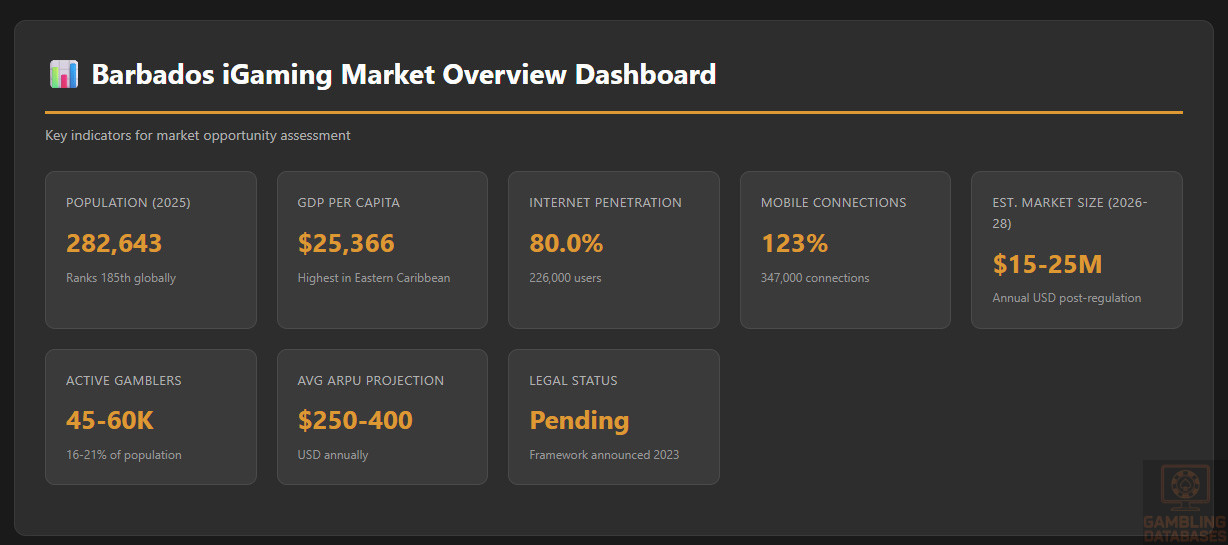
Executive Summary: Key Market Indicators
| Indicator | Value | Notes |
|---|---|---|
| Online Gambling Legal Status | Unregulated – Legislation Pending | Government announced framework coming 2023-2026 |
| Land-Based Gambling Status | Partially Regulated | Slots and horse racing permitted; table games prohibited |
| Total Population (2025) | 282,643 | Ranks 185th globally |
| Median Age | 39.4 years | Mature demographic profile |
| GDP (Total, 2024) | $7.17 billion USD | Projected $9.29 billion by 2029 |
| GDP Per Capita (2024) | $25,366 USD | Highest in Eastern Caribbean |
| GDP Growth Forecast (2025) | 3.0% annually | Sustained growth expected through 2029 |
| Internet Penetration | 80.0% | 226,000 users; regional leader |
| Mobile Connections | 347,000 (123% penetration) | Multiple devices per capita common |
| Social Media Penetration | 63.7% | 180,000 active users |
| Urban Population | 32.47% | 91,766 people in urban areas |
| Primary Language | English | Official language; Bajan dialect informal |
| Currency | Barbadian Dollar (BBD) | Pegged 2:1 to USD |
| Regulatory Authority | Barbados Lottery Authority | Currently regulates land-based only |
| Expected iGaming License Cost | TBD | Framework under development |
| Corporate Income Tax | 1-5.5% | Competitive international business rates |
| Personal Income Tax | 17.5-35% | Progressive brackets |
| Expected Market Size (2026-2028) | $15-25 million USD annually | Estimated upon regulation |
| Estimated Active Gamblers | 45,000-60,000 | 16-21% of population currently using offshore sites |
| Average ARPU Projection | $250-400 USD annually | Based on regional comparables |
| Market Entry Timeline | 12-18 months | Post-regulation implementation |
| Ease of Doing Business Rank | 128 of 190 | Moderate business environment |
| Political Stability | High | Stable parliamentary democracy |
| Corruption Perception Index | Low corruption | Strong institutions and rule of law |
| Tourism Contribution to GDP | Major driver | Key economic sector alongside offshore finance |
| Time Zone | Atlantic Standard Time (AST) | Same as US Eastern +1 hour |
| Mobile Payment System Launch | BiMPay – March 2026 | National instant payment infrastructure |
| Banking Penetration | High | Well-banked population with strong financial services |
| Market Maturity Stage | Pre-Regulation | First-mover advantage opportunity |
Section 1: Regulatory Framework and Legal Environment
Current Gambling Regulation Status
Barbados currently operates under a partially regulated gambling framework that permits certain land-based activities while prohibiting others. The regulatory landscape is in transition, with the government actively developing comprehensive online gambling legislation announced in 2023.
Land-Based Gambling Activities
Casino Operations: Traditional table games including roulette, blackjack, and poker are explicitly prohibited in Barbados. No licensed casino facilities operate on the island, reflecting a conservative approach to gambling that prioritizes the country’s image as a relaxed, family-friendly tourism destination.
Slot Machines: Electronic gaming machines represent the primary legal gambling option in Barbados. Slots are widely available in tourist areas, particularly in St. Lawrence Gap and Holetown, where establishments like Lucky Horseshoe restaurants and Silver Fox Arcade offer these games. Hotels, restaurants, bars, and pools catering to tourists can legally operate slot machines under current regulations.
Horse Racing: Horse racing forms a significant part of Barbados’ gambling culture, with races held at Garrison Savannah, one of the world’s oldest racetracks. The facility hosts three racing seasons annually, allowing spectators to place wagers on race days. Visitors can observe training sessions, but betting is restricted to official race events.
Lotteries: The Barbados Lottery Authority operates several lottery products including Pick 3, Pick 4, Caribbean Keno, Jackpot Bingo, and Caribbean Lotto. Live lottery draws are broadcast on licensed local television and radio broadcasters, providing widespread access to these games.

Online Gambling Framework
Online gambling currently exists in a regulatory gray zone in Barbados. The country does not license domestic online gambling operators, and no iGaming sites are based in Barbados. However, the government does not prohibit residents from accessing international online casinos and sports betting platforms.
Player Activity: Barbadians freely access offshore gambling sites without legal repercussions. Popular international platforms serving Barbadian players include BGO, Black Lotus, 32Red, and numerous other licensed operators based in jurisdictions like Malta, Curacao, and the United Kingdom.
Upcoming Regulatory Framework: In March 2023, Finance Minister Ryan Straughn announced that legislation to oversee the online gaming sector would be introduced to Parliament. The new betting and gaming framework is designed to manage activities that pose “significant risks” to the financial sector and broader economy. The government is finalizing regulations expected within an 18-24 month timeframe from the announcement.

Licensed Operators and Market Players
The Barbadian market currently lacks licensed online operators, creating a first-mover advantage opportunity once regulations are enacted. The land-based sector features limited competition focused on slot machine operations in tourist areas and lottery services provided by the government-controlled Barbados Lottery Authority.
Current Market Structure: International operators serve Barbadian players from offshore jurisdictions without local licensing. These operators leverage established payment processing networks, international banking relationships, and marketing channels to reach Barbadian consumers. Market leaders include major European and Curacao-licensed brands with Caribbean market presence.
Market Concentration: The absence of local regulation means market share data is unavailable. However, industry estimates suggest 45,000-60,000 Barbadians actively use offshore gambling platforms, representing 16-21% of the population. This participation rate aligns with Caribbean regional averages for mature markets.
Licensing Framework and Requirements
Application Process and Eligibility
Regulatory Authority: The Barbados Lottery Authority currently regulates land-based gambling activities including slot machines, lotteries, and horse racing. Upon enactment of online gambling legislation, regulatory oversight will likely expand or transfer to a specialized gaming commission or division within the Financial Services Commission.
Contact Information: Barbados Lottery Authority oversees current gambling operations. Prospective operators should monitor announcements from the Ministry of Finance and the Financial Services Commission regarding the new regulatory framework. The Financial Services Commission website is https://www.fsc.gov.bb
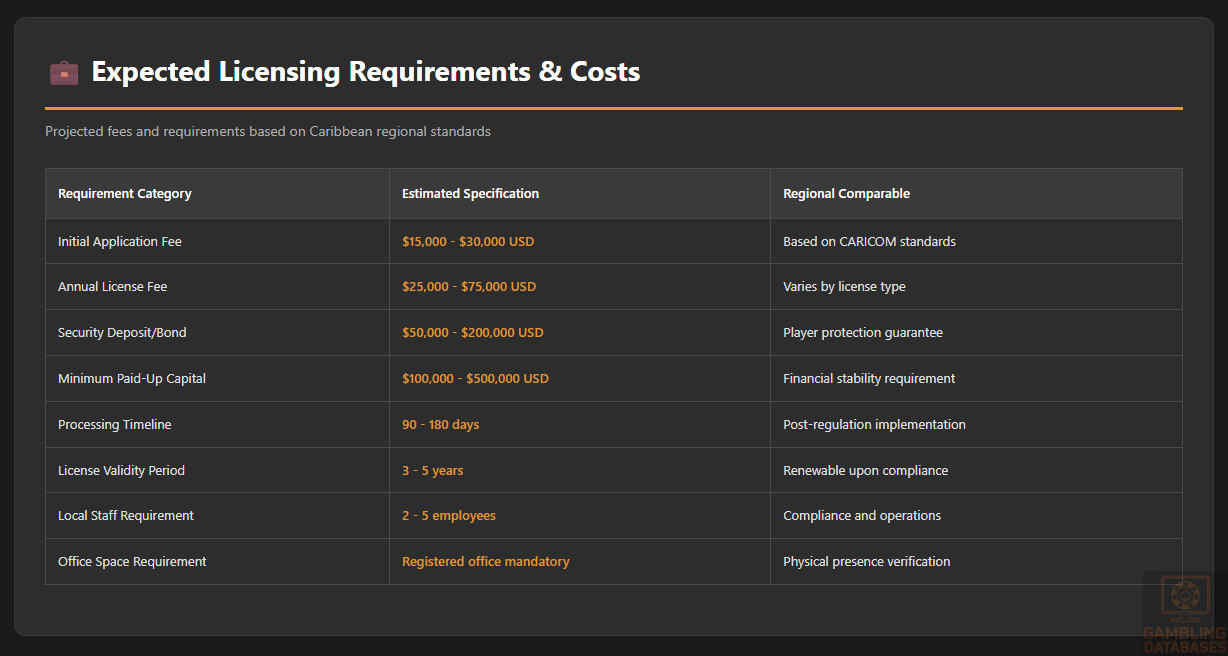
Expected Financial Requirements: While specific figures await regulatory framework publication, comparable Caribbean jurisdictions require initial license fees ranging from $15,000 to $50,000 USD annually, with security deposits between $50,000 and $200,000 USD. Minimum paid-up capital requirements typically range from $100,000 to $500,000 USD depending on license scope.
Technical Standards: Licensed operators will likely need to demonstrate compliance with internationally recognized gaming standards, including RNG certification from approved testing laboratories (GLI, eCOGRA, iTech Labs), server security protocols, game fairness verification, and responsible gambling tools integration.
Background Checks: Application processes in similar jurisdictions require comprehensive due diligence on all directors, shareholders holding more than 5-10% ownership, and key personnel. Expect requirements for police clearance certificates, proof of financial standing, and professional reference verification with processing timelines of 60-180 days.
Local Presence and Operational Requirements
Barbados’ approach to local presence requirements will likely balance attracting international operators with ensuring regulatory oversight and local economic benefit. Based on the government’s stated goals and regional precedents, operators should anticipate moderate localization requirements.
Physical Presence: Expected requirements may include maintaining a registered office in Barbados with local staff for compliance, customer service, and liaison functions. Caribbean jurisdictions typically require 2-5 full-time employees for operational licenses, though server and technical infrastructure may be hosted elsewhere.
Domain and Hosting: Domain requirements will likely mandate .bb ccTLD or recognized international domains (.com, .net) with geo-location verification. Server location requirements may be flexible, allowing cloud infrastructure hosted regionally or internationally provided regulators have access for monitoring purposes.
Foreign Ownership: Barbados has historically welcomed foreign investment in its offshore financial services sector. Online gambling licenses will likely permit 100% foreign ownership while requiring local representation through registered agents, attorneys, or compliance officers familiar with Barbadian regulations.
| Requirement Category | Estimated Specification | Regional Comparable |
|---|---|---|
| Initial Application Fee | $15,000 – $30,000 USD | Based on CARICOM standards |
| Annual License Fee | $25,000 – $75,000 USD | Varies by license type |
| Security Deposit/Bond | $50,000 – $200,000 USD | Player protection guarantee |
| Minimum Paid-Up Capital | $100,000 – $500,000 USD | Financial stability requirement |
| Processing Timeline | 90 – 180 days | Post-regulation implementation |
| License Validity Period | 3 – 5 years | Renewable upon compliance |
| Local Staff Requirement | 2 – 5 employees | Compliance and operations |
| Office Space Requirement | Registered office mandatory | Physical presence verification |
Compliance Obligations and Monitoring
Player Protection and Identification
Age Verification: Barbados will almost certainly adopt an 18+ minimum age requirement aligning with international standards and Caribbean regional norms. Operators must implement robust age verification at registration using government-issued ID documents, address verification, and database cross-checks.
KYC/AML Compliance: As a member of the Caribbean Financial Action Task Force (CFATF) and committed to international AML standards, Barbados will require stringent Know Your Customer procedures. Operators must collect and verify player identity, source of funds for high-value transactions, and monitor for suspicious activity patterns.
Responsible Gambling Measures: Expected mandatory features include deposit limits (daily, weekly, monthly), loss limits, session time limits, self-exclusion options (temporary and permanent), reality checks displaying time and money spent, and prominently displayed responsible gambling resources and helpline information.
Player Information Disclosures: Operators will likely need to provide clear terms and conditions in plain English, transparent odds and RTP percentages for all games, withdrawal processing timelines and any associated fees, bonus terms including wagering requirements, and privacy policies detailing data usage and protection.
Financial Monitoring and Reporting
Regulatory oversight will require comprehensive financial reporting to ensure tax compliance, player protection, and market integrity. Operators should prepare systems for detailed transaction monitoring and regular reporting submissions.
Reporting Requirements: Expected monthly reports on gross gaming revenue by game category, player deposit and withdrawal volumes, active player counts and new registrations, responsible gambling tool usage statistics, and customer complaints and resolutions. Quarterly financial statements including profit and loss accounts, balance sheets, and cash flow statements will likely be required.
Audit and Inspection: Licensed operators should anticipate annual independent audits of financial records, gaming systems, and RNG certification, with regulatory authority rights to conduct surprise inspections, system audits, and player fund verification at any time.
Data Retention: Standard requirements typically mandate retaining all transaction records for 7-10 years, player communications and complaint records for 5-7 years, and game outcome logs and RNG seeding data for 3-5 years.
Taxation Structure and Financial Obligations
Player Taxation
Caribbean jurisdictions typically do not tax player winnings, and Barbados will likely follow this model to remain competitive and avoid administrative complexity of tracking individual player profits across thousands of participants.
Withholding Procedures: If player taxation is implemented, it would likely apply only to large jackpot wins exceeding threshold amounts (e.g., $10,000 BBD / $5,000 USD), with operators responsible for withholding and remitting taxes on behalf of players.
Operator Taxation
Barbados’ taxation approach will aim to balance revenue generation with attracting operators to establish legitimate operations. The government will likely structure taxes to compete with regional gambling jurisdictions while generating meaningful fiscal returns.
Gross Gaming Revenue (GGR) Tax: Expected rates range from 10-20% of GGR calculated as total stakes minus winnings paid. Caribbean comparables include Curacao (0-2% licensing fees), Antigua (3% GGR), and Costa Rica (no GGR tax but higher licensing fees).
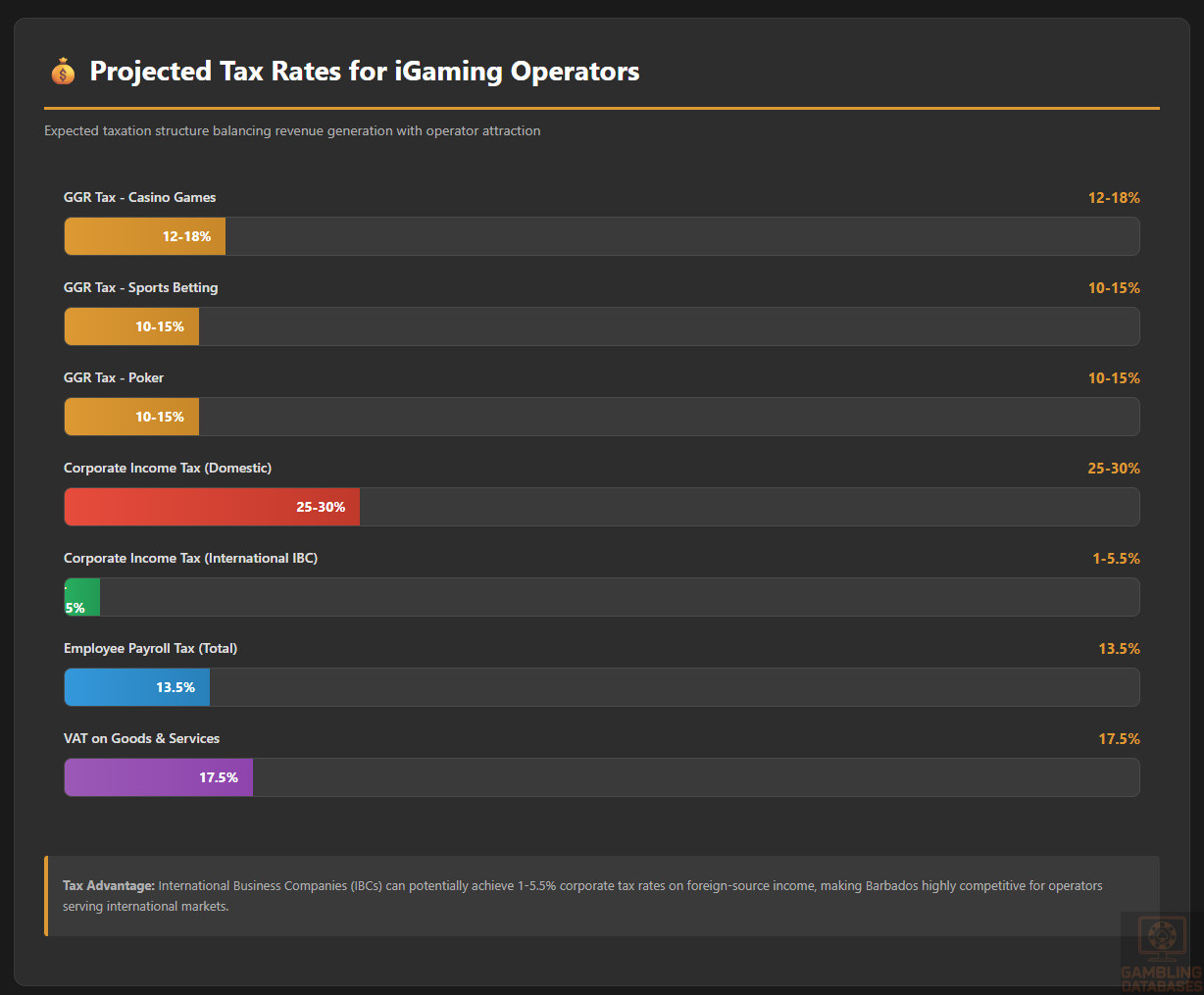
Corporate Income Tax: Barbados offers attractive corporate tax rates for international business companies ranging from 1-5.5% on foreign-sourced income. Gaming operations serving international markets may qualify for these preferential rates, while domestic operations face standard 25-30% corporate tax rates.
License Fees: Annual renewal fees typically range $25,000-75,000 USD depending on license scope, with separate rates for casino licenses, sports betting licenses, poker licenses, and aggregator/platform provider licenses.
| Tax Type | Expected Rate | Calculation Basis |
|---|---|---|
| GGR Tax – Casino Games | 12-18% | Total stakes minus winnings |
| GGR Tax – Sports Betting | 10-15% | Total stakes minus winnings |
| GGR Tax – Poker | 10-15% | Rake and tournament fees |
| Corporate Income Tax (Domestic) | 25-30% | Net profits from local operations |
| Corporate Income Tax (International) | 1-5.5% | Preferential IBC rates |
| Annual License Renewal | $25,000-75,000 USD | Fixed fee by license type |
| Employee Payroll Tax | 13.5% | Split employer/employee contributions |
Gambling Market Financial Performance
Due to the current unregulated status of online gambling in Barbados, comprehensive market revenue data is unavailable. However, we can estimate market size based on population, gambling participation rates, and regional benchmarks.
Estimated Annual Market Size: With 45,000-60,000 active online gamblers spending $250-400 USD annually (regional ARPU), the total addressable market ranges from $11.25 million to $24 million USD annually. Upon regulation, this market would consolidate from offshore operators to licensed domestic platforms.
Land-Based Market: Slot machines and lottery operations generate an estimated $15-20 million BBD ($7.5-10 million USD) annually, with the majority from slot machines in tourist areas and lottery ticket sales.
Revenue Distribution Projection: Upon market regulation, expected split would be approximately 45-50% sports betting, 35-40% casino games (slots, table games, live dealer), 10-15% poker, and 5-10% other products (bingo, lottery-style games).
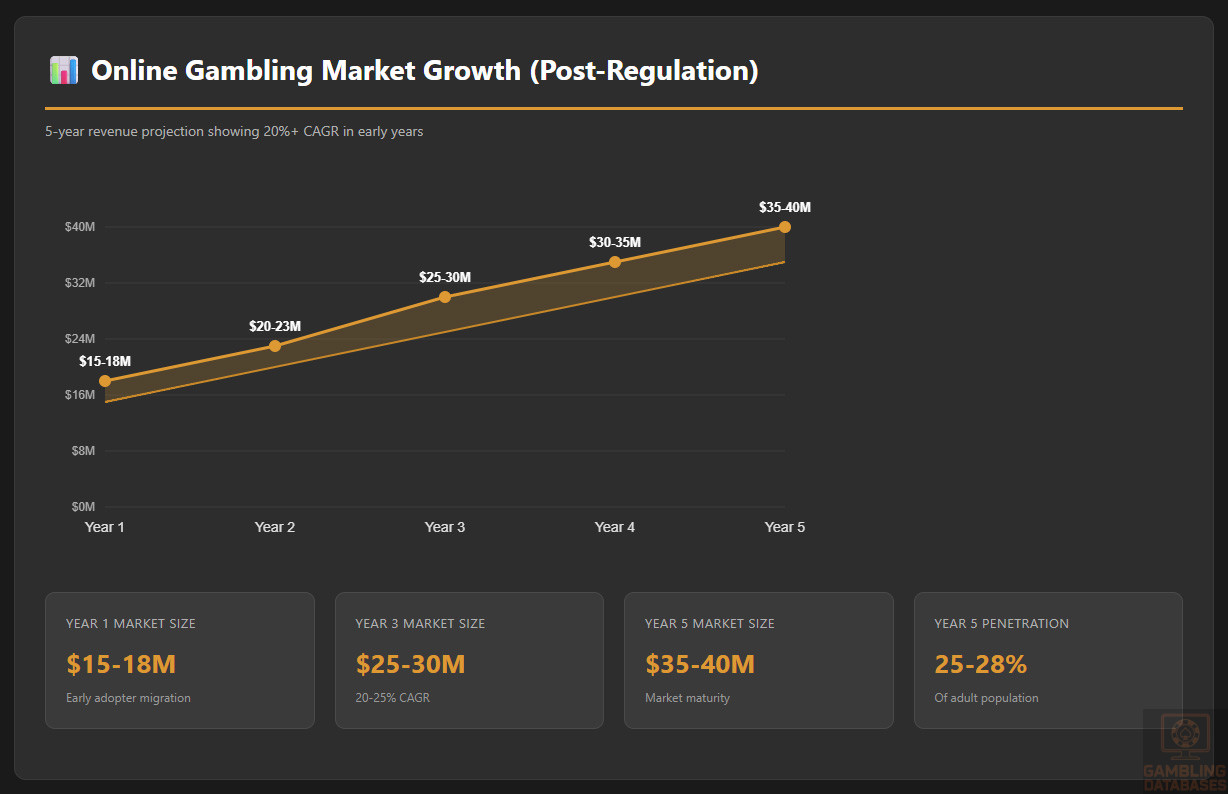
Growth Trajectory: Regulated markets typically experience 15-25% annual growth in the first 3-5 years post-licensing as offshore activity migrates to licensed platforms and marketing increases awareness. Barbados could see the market expand from $15 million to $35-40 million USD by year five of regulation.
| Metric | Year 1 | Year 3 | Year 5 |
|---|---|---|---|
| Total Market Size (USD) | $15-18 million | $25-30 million | $35-40 million |
| Active Players | 50,000-55,000 | 60,000-70,000 | 70,000-80,000 |
| Average ARPU (USD) | $280-320 | $380-420 | $480-520 |
| Market Penetration Rate | 18-20% | 21-25% | 25-28% |
| Government Tax Revenue (USD) | $2-3 million | $4-5 million | $6-7 million |
| Annual Growth Rate | Baseline | 20-25% | 12-18% |
Advertising and Marketing Restrictions
While specific advertising regulations await finalization in the upcoming gambling legislation, Barbados will likely adopt restrictions balancing operator marketing needs with consumer protection concerns aligned with international best practices.
Permitted Channels: Online advertising (websites, social media, search engines), print media (newspapers, magazines), outdoor advertising (billboards in approved locations), and radio advertising during appropriate time slots are expected to be allowed with restrictions.
Content Restrictions: Marketing materials must avoid targeting minors, include responsible gambling messages and 18+ age warnings, accurately represent odds and winning probabilities, clearly state bonus terms and wagering requirements, and avoid suggesting gambling as a solution to financial problems or path to financial success.
Promotional Limitations: Bonus offers will likely face caps on maximum amounts or percentages, reasonable wagering requirements (20x-40x deposit plus bonus), clear expiration terms, and restrictions on free bet promotions without deposit requirements to protect vulnerable players.
Sponsorship Regulations: Sports team and event sponsorships may be permitted with restrictions on visibility during youth-oriented events, requirements for responsible gambling messaging, and prohibitions on branding that appeals to minors.
Time Restrictions: Television and radio advertising will likely be prohibited during children’s programming hours and may face restrictions during live sports broadcasts accessible to minors.
Recent Regulatory Changes and Their Impact
The most significant recent development is the March 2023 announcement by Finance Minister Ryan Straughn that comprehensive online gaming legislation is in final development stages. This marks Barbados’ first major step toward regulating the digital gambling sector.
Legislative Timeline: The government indicated the betting and gaming framework would be introduced to Parliament before end of June 2023, though as of October 2025, final legislation has not yet been enacted. This delay suggests thorough stakeholder consultation and careful consideration of international regulatory models.
Rationale for Regulation: The government explicitly cited the need to manage activities that pose “significant risks” to the financial sector and broader economy, while referencing lessons from the 2022 FTX cryptocurrency collapse in the Bahamas as motivation for robust regulatory oversight.
Industry Impact: Once implemented, regulations will create substantial market structure changes including migration of players from offshore to licensed platforms, establishment of local operator presence and employment, and formalization of tax revenue collection from an economic activity currently generating zero government income.
Enforcement Mechanisms and Penalties
Expected enforcement provisions will likely mirror established Caribbean gambling jurisdictions, with penalties designed to ensure compliance while allowing remediation opportunities before extreme sanctions.
Penalty Structures: Financial penalties for minor infractions ($5,000-25,000 BBD), suspension of license for serious violations (30-90 days), revocation of license for repeated or severe breaches, criminal penalties for operating without licenses, and confiscation of unlicensed gambling equipment and funds.
ISP Blocking: Barbados may implement DNS-level blocking of unlicensed international operators refusing to cease serving Barbadian customers, though enforcement complexity and VPN usage limit effectiveness of such measures.
Payment Processor Restrictions: Financial institutions and payment processors may be prohibited from processing transactions for unlicensed operators, creating barriers to market entry for non-compliant platforms.
Section 2: Demographics and Consumer Analysis
Population Demographics and Distribution
Core Population Metrics
Barbados maintains a stable, mature population with demographic characteristics favorable for certain gambling market segments. The population of 282,643 as of 2025 ranks the country 185th globally but delivers strong per-capita economic metrics.
Population Trends: Annual growth stands at just 0.05%, with population projected to reach approximately 292,930 by early 2026. This minimal growth reflects low birth rates typical of developed nations and net emigration as Barbadians seek opportunities abroad.
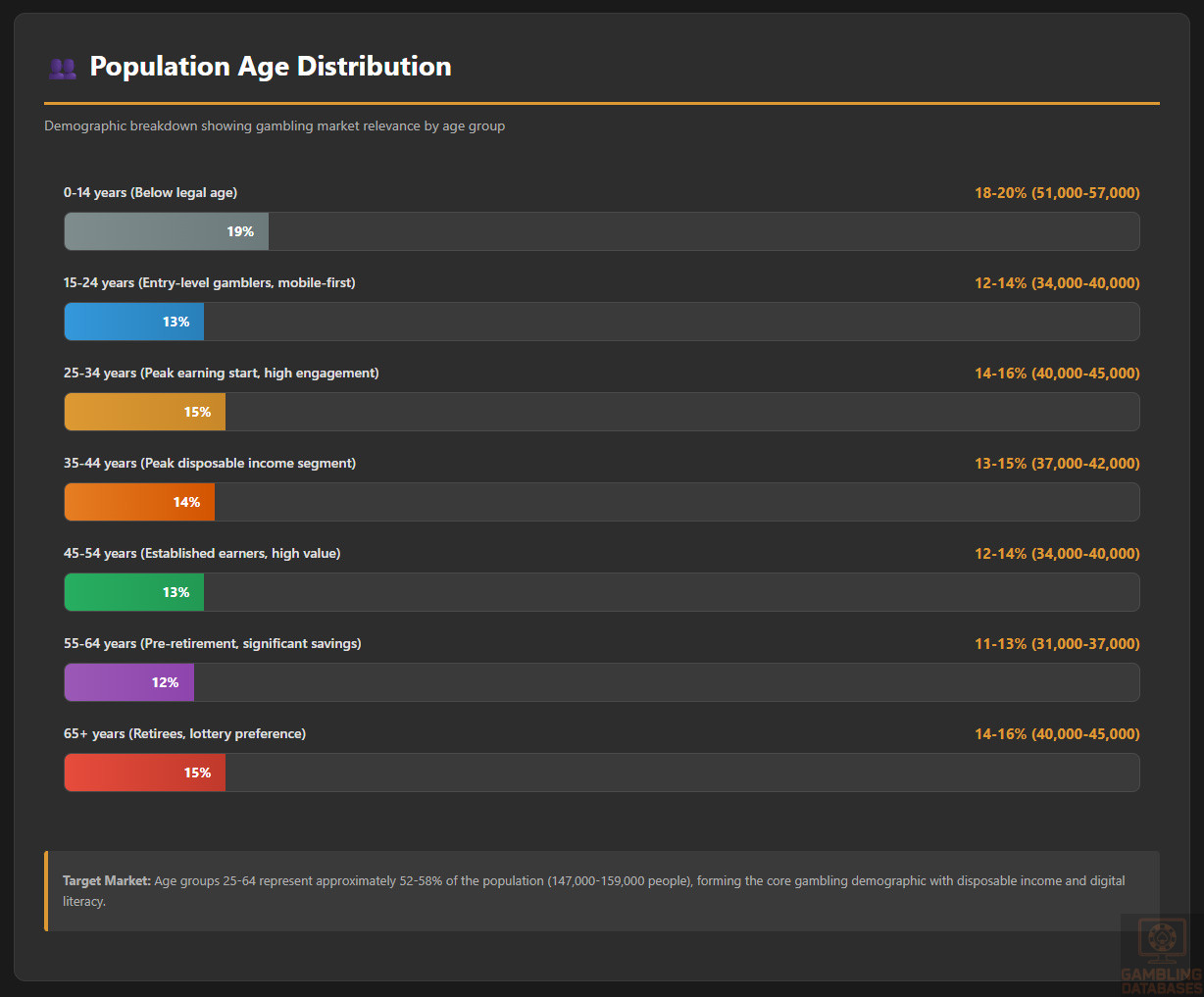
Age Distribution: The population skews toward middle-age demographics optimal for gambling products. Approximately 18-20% fall in the 0-14 age group, 65-68% in the critical 15-64 working-age segment, and 14-16% aged 65+. The median age of 39.4 years indicates a mature market with disposable income.
Gender Ratios: Females outnumber males with 52.05% female to 47.95% male, creating a gender ratio of approximately 92 males per 100 females. This gender imbalance persists across age groups and influences market targeting strategies.
Life Expectancy: High life expectancy of 80.9 years overall (79.1 for males, 82.8 for females) reflects excellent healthcare infrastructure and living standards. This longevity supports sustained customer lifetime value for gambling operators.
Urban vs Rural Distribution: Just 32.47% of the population resides in urban areas, with 91,766 people concentrated in cities while the majority live in suburban and rural settings. However, the island’s compact size of 430 square kilometers means even rural residents access urban services easily.
| Age Group | Percentage | Approximate Number | Gambling Market Relevance |
|---|---|---|---|
| 0-14 years | 18-20% | 51,000-57,000 | Below legal gambling age |
| 15-24 years | 12-14% | 34,000-40,000 | Entry-level gamblers, mobile-first |
| 25-34 years | 14-16% | 40,000-45,000 | Peak earning start, high engagement |
| 35-44 years | 13-15% | 37,000-42,000 | Peak disposable income segment |
| 45-54 years | 12-14% | 34,000-40,000 | Established earners, high value |
| 55-64 years | 11-13% | 31,000-37,000 | Pre-retirement, significant savings |
| 65+ years | 14-16% | 40,000-45,000 | Retirees, lottery preference |
Geographic Distribution
Barbados’ small geographic footprint creates unique market dynamics. Population density reaches 657 people per square kilometer, making it the 4th most densely populated country in the Americas and 15th globally.
Major Population Centers: Bridgetown, the capital and largest city, hosts approximately 110,000 residents with density of 7,300 people per square kilometer. Other significant population centers include Speightstown, Oistins, Holetown, and Bathsheba, though all remain easily accessible from any point on the island.
Regional Economic Differences: The south and west coasts concentrate tourism infrastructure, hotels, restaurants, and entertainment venues, creating higher employment and income levels. The eastern coast features more traditional fishing and agricultural communities with lower average incomes but strong community ties.
Internet Access Patterns: Urban areas enjoy near-universal fixed broadband and 4G coverage, while rural areas rely more heavily on mobile internet connections. However, the island’s small size ensures 80% overall internet penetration extends across geographic regions with minimal disparity.
Economic Indicators and Consumer Spending Power
GDP and Economic Performance
Barbados stands as the wealthiest and most developed country in the Eastern Caribbean region, enjoying one of the highest per capita incomes. The economy has successfully diversified from historical sugar dependence into tourism, offshore financial services, light manufacturing, and information services.
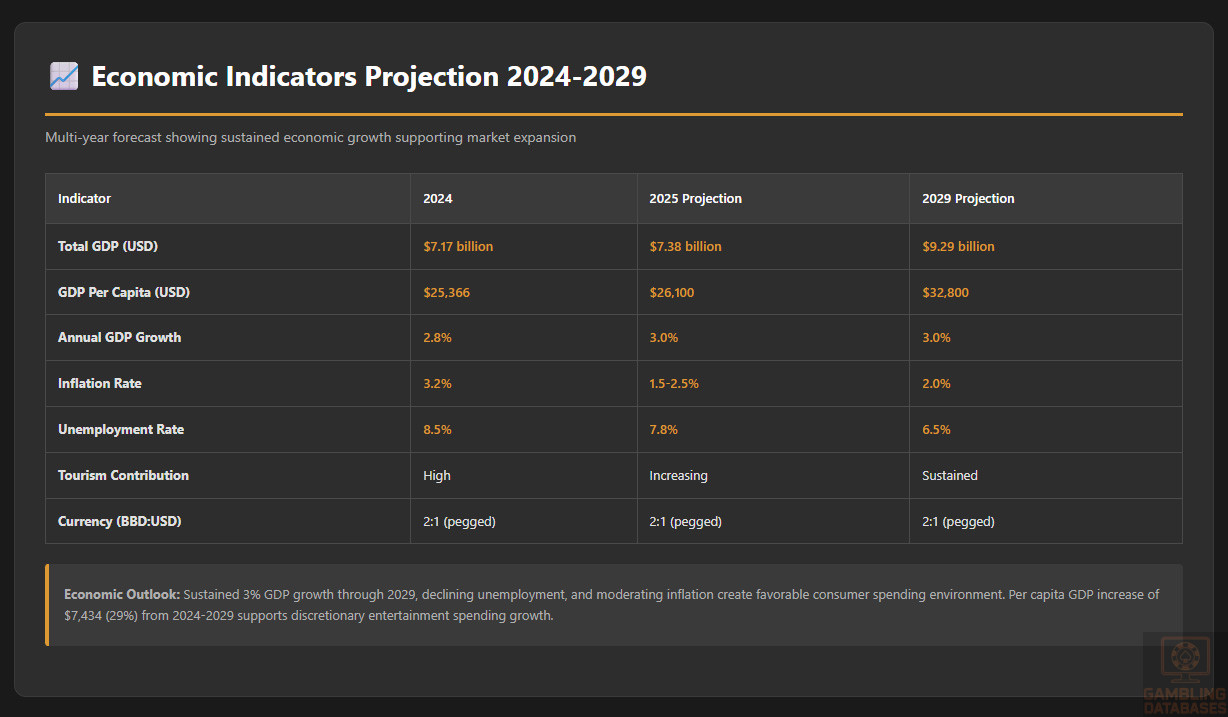
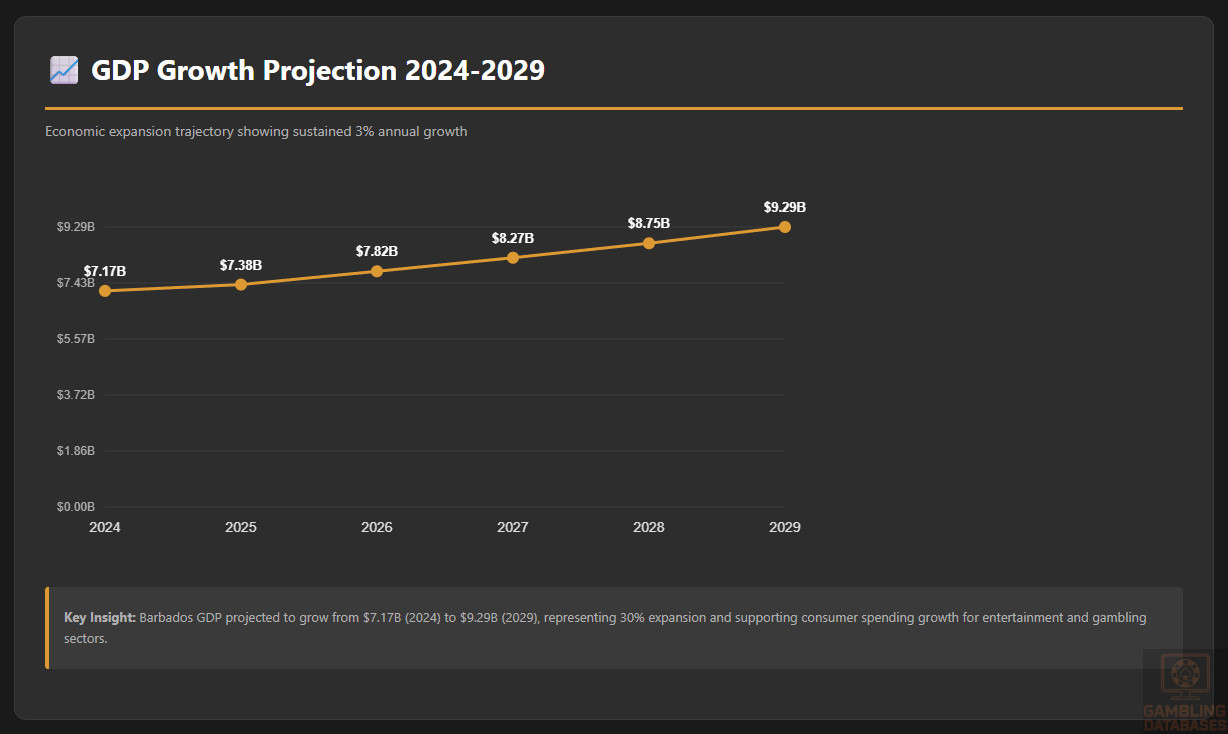
Current GDP Metrics: Total GDP reached $7.17 billion USD in 2024, with GDP per capita of $25,366 USD positioning Barbados well above Caribbean regional averages. This wealth concentration creates attractive consumer spending power for discretionary entertainment like gambling.
GDP Growth Forecasts: The Central Bank of Barbados projects sustained real GDP growth of 3.0% annually through 2029, with total GDP forecast to reach $9.29 billion USD by 2029. This growth is driven by tourism recovery, infrastructure investments, renewable energy projects, and offshore financial services expansion.
Economic Sector Composition: Services dominate the economy at approximately 78%, with industry contributing 16% and agriculture just 6%. The service-sector focus aligns with high internet usage and digital transaction comfort necessary for online gambling adoption.
Employment and Wages: Unemployment rates have declined post-pandemic to approximately 8-10%, with labor force of 128,500 workers. Average wages in tourism and financial services sectors support disposable income for entertainment spending.
Inflation Trends: Inflation is expected to moderate in 2025-2026 to 1.5-2.5% annually as global commodity prices stabilize. This low inflation environment preserves consumer purchasing power and supports discretionary spending growth.
Income and Wealth Distribution
Understanding income distribution helps operators segment markets and set appropriate betting limits, bonus structures, and VIP tier thresholds for Barbadian consumers.
Average Household Income: Median household income is estimated at $3,500-4,500 BBD monthly ($1,750-2,250 USD), though significant variance exists between urban/rural areas and sectors. Tourism and financial services workers earn above-average wages while agricultural and informal sector workers earn less.
Income Inequality: As a developed small island nation, Barbados maintains moderate income inequality compared to larger Caribbean neighbors, though wealth concentration exists among business owners, professionals, and expatriate workers.
Disposable Income: After accounting for housing, utilities, food, and transportation, average households retain 25-35% of income for discretionary spending. This translates to $400-700 USD monthly for entertainment, dining, and leisure activities including gambling.
Middle Class Size: Approximately 45-55% of Barbadian households qualify as middle class with stable employment, home ownership, and discretionary spending capacity. This segment represents the core target market for online gambling operators.
| Indicator | 2024 | 2025 Projection | 2029 Projection |
|---|---|---|---|
| Total GDP (USD) | $7.17 billion | $7.38 billion | $9.29 billion |
| GDP Per Capita (USD) | $25,366 | $26,100 | $32,800 |
| Annual GDP Growth | 2.8% | 3.0% | 3.0% |
| Inflation Rate | 3.2% | 1.5-2.5% | 2.0% |
| Unemployment Rate | 8.5% | 7.8% | 6.5% |
| Tourism Contribution | High | Increasing | Sustained |
| Currency (BBD:USD) | 2:1 (pegged) | 2:1 (pegged) | 2:1 (pegged) |
Market Size and Growth Projections
The Barbadian iGaming market presents modest absolute size but attractive relative penetration and ARPU metrics. Market projections assume regulation implementation by 2026-2027 with gradual migration from offshore to licensed platforms.
Current Market Revenue: Barbadian players currently wager an estimated $15-25 million USD annually with offshore operators. This revenue flows entirely outside Barbados’ economy and tax system, representing significant opportunity cost for the government.
Historical Growth: Without regulation, precise historical growth data is unavailable. However, internet penetration growth from 65% in 2010 to 80% in 2025 suggests proportional gambling market expansion as more consumers gained digital access.
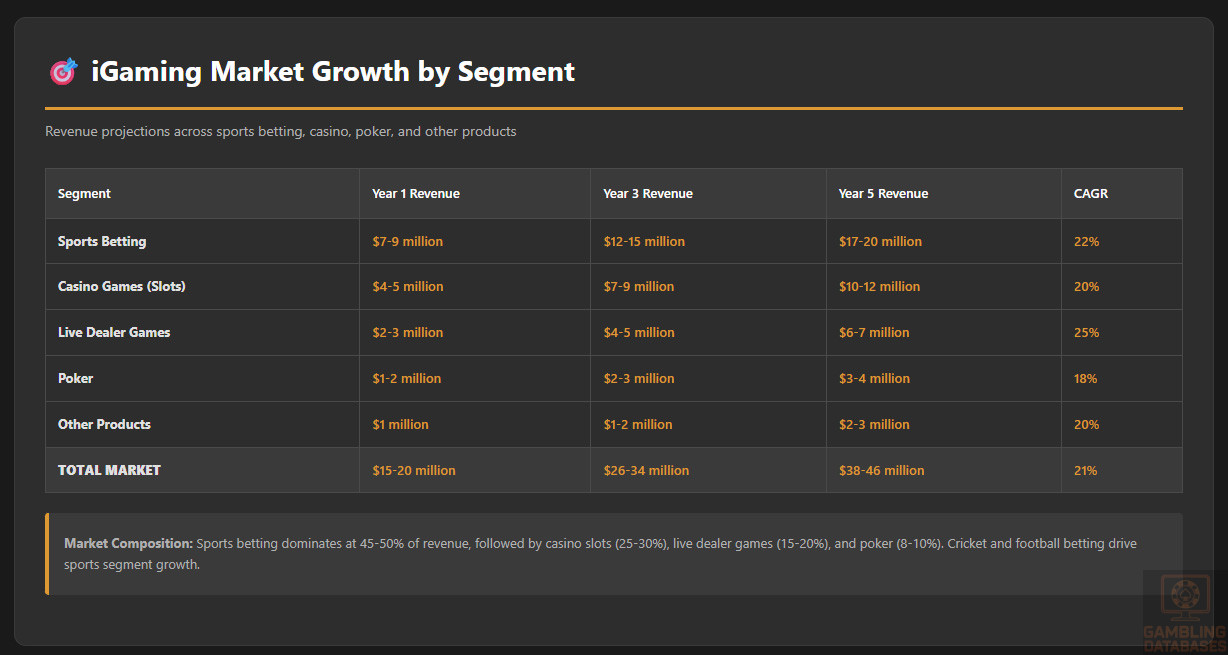
Revenue Forecasts: Year 1 post-regulation: $15-18 million USD as early adopters migrate to licensed platforms. Year 3: $25-30 million USD as marketing drives awareness and trust in local licenses. Year 5: $35-40 million USD representing market maturity with 25-28% population penetration.
Expected CAGR: The market should achieve 20-25% compound annual growth rate in years 1-3 post-regulation, moderating to 12-18% CAGR in years 4-5 as the market matures and growth normalizes.
Projected User Base Growth: Active gamblers should increase from 50,000-55,000 in year 1 to 70,000-80,000 by year 5, representing penetration growth from 18-20% to 25-28% of the adult population.
Average Revenue Per User: ARPU is projected to grow from $280-320 USD in year 1 to $480-520 USD by year 5 as players develop comfort with platforms, operators improve retention strategies, and product variety expands.
Online vs Land-Based Split: Online gaming should capture 55-60% of total gambling revenue by year 3, with land-based slots and lottery retaining 40-45%. The convenience and product variety of online platforms drives this shift.
Regional Comparison: Barbados’ projected market size aligns with other small Caribbean nations. Curacao (population 160,000) generates approximately $15-20 million in player value, while Antigua and Barbuda (population 98,000) sees similar per-capita gambling activity from its resident population.
| Segment | Year 1 Revenue | Year 3 Revenue | Year 5 Revenue | CAGR |
|---|---|---|---|---|
| Sports Betting | $7-9 million | $12-15 million | $17-20 million | 22% |
| Casino Games (Slots) | $4-5 million | $7-9 million | $10-12 million | 20% |
| Live Dealer Games | $2-3 million | $4-5 million | $6-7 million | 25% |
| Poker | $1-2 million | $2-3 million | $3-4 million | 18% |
| Other Products | $1 million | $1-2 million | $2-3 million | 20% |
| Total Market | $15-20 million | $26-34 million | $38-46 million | 21% |
Education, Skills, and Digital Literacy
Educational Foundation
Barbados boasts one of the highest literacy rates in the developing world, providing strong foundations for digital service adoption including online gambling platforms.
Literacy Rates: Overall literacy exceeds 99%, with near-universal primary and secondary school completion. This high educational attainment facilitates understanding of gambling odds, terms and conditions, and responsible gambling information.
Education Levels: Primary education completion reaches 100%, secondary completion approximately 95%, and tertiary enrollment rates of 55-60% rank among the Caribbean’s highest. The University of the West Indies Cave Hill campus in Barbados produces graduates in business, technology, and professional fields.
Digital Literacy: Widespread smartphone usage and social media engagement (63.7% of population) demonstrates comfort with digital interfaces. Younger demographics (18-44) show near-universal digital literacy, while older cohorts (55+) maintain functional digital skills for banking and communication.
Workforce Skills: The labor force demonstrates strong technical skills from the offshore financial services and technology sectors. This creates favorable conditions for customer support roles, compliance positions, and technical operations for licensed gambling operators.
English Language Proficiency: English serves as the official language and primary language of business, education, and government. While Bajan dialect is common in informal settings, all Barbadians speak standard English, eliminating language barriers for international operators.
Cultural and Social Factors
Communication and Language
Language uniformity simplifies market entry compared to multilingual Caribbean nations. English-language platforms, customer support, and marketing materials serve the entire population without translation requirements.
Internet Language Preferences: Barbadians consume English-language content online, follow English-speaking social media influencers, and engage with international brands using standard English. Local dialect (Bajan) appears in informal communications but not in business contexts.
Business Communication Norms: Formal, professional communication follows British Commonwealth standards. Customer service should maintain polite, respectful tones while remaining friendly and accessible. Barbadians appreciate efficient service balanced with personal warmth.
Cultural Attitudes Toward Gambling
Understanding cultural perceptions of gambling informs marketing strategies, product positioning, and responsible gambling messaging for the Barbadian market.
Social Acceptance: Gambling enjoys moderate social acceptance in Barbados, particularly lottery play and informal betting on sports and horse racing. However, the government’s historical prohibition of casinos reflects some cultural ambivalence about gambling’s place in society.
Religious Influences: Christianity predominates in Barbados, with Anglican, Methodist, and Pentecostal denominations holding significant influence. Conservative religious communities view gambling skeptically, though this hasn’t prevented widespread lottery participation or offshore online gambling.
Foreign Brand Perception: Barbadians demonstrate openness to international brands across retail, technology, and services sectors. Well-known gambling brands with strong reputations will find receptive audiences, though local partnerships and community engagement strengthen trust.
Risk Tolerance: As a population with relatively high financial literacy and offshore financial services experience, Barbadians demonstrate moderate risk tolerance in investment and entertainment decisions. This supports participation in gambling as calculated entertainment rather than desperate financial strategy.
Entertainment Preferences: Cricket dominates sports interest, followed by football (soccer), basketball, and horse racing. Cultural events like Crop Over festival, calypso and reggae music, and beach activities compete for entertainment spending. Gambling products must position as complementary entertainment rather than primary leisure activity.
Social vs Solitary Gambling: Lottery play and horse racing betting feature strong social components with friends and family discussing picks and outcomes. Online gambling’s solitary nature requires marketing emphasizing community features, social media integration, and shared experiences.
Problem Gambling and Social Considerations
While comprehensive problem gambling data for Barbados is unavailable, regional studies and international benchmarks provide insights into expected challenges and operator responsibilities.
Prevalence Estimates: International studies suggest 0.5-2.0% of adult populations experience gambling disorders, with an additional 2-4% at risk for problem gambling. Applied to Barbados’ 200,000 adults, this suggests 1,000-4,000 problem gamblers and 4,000-8,000 at-risk individuals.
At-Risk Demographics: Young males (18-35) face highest problem gambling risk, particularly with sports betting and casino games. Lower-income individuals chasing losses, those with substance abuse histories, and individuals experiencing depression or anxiety also show elevated risk.
Underage Gambling: With high smartphone penetration among teenagers and offshore sites often lacking robust age verification, underage gambling likely occurs. Licensed operators must implement stringent age verification to prevent minor access.
Government Response: The forthcoming regulatory framework will likely mandate responsible gambling measures, self-exclusion registries, operator contributions to problem gambling treatment funds, and public awareness campaigns about gambling risks.
Treatment Services: Barbados’ mental health infrastructure includes counseling services through the Psychiatric Hospital and community health centers. Specialized gambling addiction treatment programs are limited, requiring operators to provide resources and referrals as part of social responsibility commitments.
Social Responsibility Requirements: Expected operator obligations include displaying responsible gambling messages in marketing, providing reality checks and limit-setting tools, training customer service staff to identify problem gambling signs, funding public education campaigns, and contributing to treatment service development (typically 0.5-1.0% of GGR).
Political Structure and Governance
Political stability and governance quality significantly impact regulatory consistency, licensing security, and business environment predictability for gambling operators.
Government System: Barbados operates as a parliamentary republic within the Commonwealth, having transitioned from constitutional monarchy in 2021. The bicameral Parliament consists of the House of Assembly and Senate, with the Prime Minister leading the government.
Political Stability: Barbados maintains exceptional political stability with peaceful democratic transitions, strong rule of law, and respected institutions. The current Barbados Labour Party government under Prime Minister Mia Mottley holds strong parliamentary majority, providing policy consistency.
Regulatory Consistency: The government’s track record in offshore financial services demonstrates capacity for sophisticated regulation, international cooperation, and consistent policy implementation. These capabilities should transfer to gambling regulation.
Corruption Levels: Barbados scores well on Transparency International’s Corruption Perceptions Index, ranking among the Caribbean’s least corrupt nations. Strong institutions, independent judiciary, and professional civil service minimize corruption risks in licensing processes.
International Relations: As a CARICOM member, small island developing state voice in UN forums, and participant in international financial standards, Barbados maintains positive global relationships. These connections facilitate regulatory information exchange and payment processing relationships.
Technology Adoption and Digital Behavior
Internet and Digital Usage
Barbados’ technology infrastructure and digital adoption rates create favorable conditions for online gambling market development, with connectivity and usage patterns supporting mobile-first and desktop experiences.
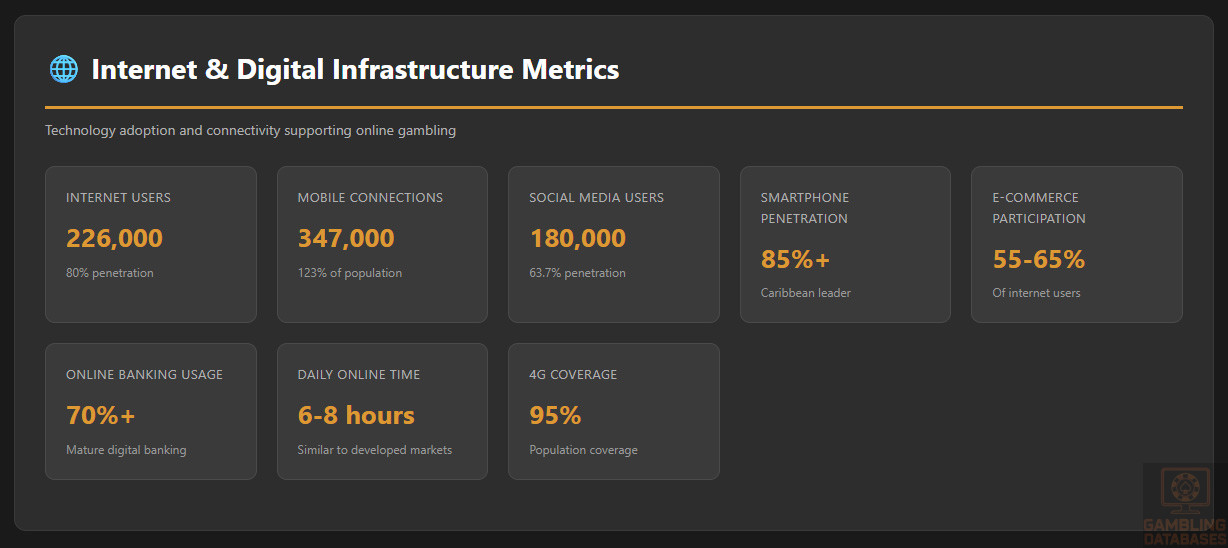
Internet Penetration: At 80.0% penetration with 226,000 users, Barbados leads the Caribbean region in internet access. This exceeds the global average of 67.5% and approaches developed market levels (85-95%).
Daily Usage Hours: Barbadians average 6-8 hours daily online across work and leisure activities. High connectivity during evenings (6pm-midnight) and weekends creates prime windows for gambling activity.
Mobile Device Adoption: Smartphone penetration exceeds 85%, with 347,000 mobile connections representing 123% of population. Multiple device ownership (smartphone, tablet, work phone) is common among middle-class consumers.
Social Media Engagement: 180,000 Barbadians (63.7% of population) actively use social media platforms. Facebook dominates with 140,000+ users, followed by Instagram (80,000+), WhatsApp (near-universal), and emerging TikTok adoption among younger demographics.
E-Commerce Participation: Online shopping adoption has grown significantly, with 55-65% of internet users making online purchases in the past year. International platforms like Amazon deliver to Barbados, while local e-commerce sites serve domestic markets.
Digital Payment Adoption: Credit/debit card usage is widespread for online transactions, with growing adoption of digital wallets and online banking. The upcoming BiMPay instant payment system launching March 2026 will further accelerate digital payment comfort.
Online Banking: Major banks (Sagicor Bank, FirstCaribbean, CIBC, Republic Bank) offer comprehensive online banking with mobile apps. Banking penetration exceeds 90% of adults, with majority utilizing digital banking services regularly.
| Metric | Value | Regional Comparison |
|---|---|---|
| Internet Users | 226,000 (80.0%) | Above Caribbean average (65%) |
| Mobile Connections | 347,000 (123%) | High multiple-device ownership |
| Social Media Users | 180,000 (63.7%) | Aligned with regional average |
| Smartphone Penetration | 85%+ | Leading Caribbean market |
| E-Commerce Participation | 55-65% | Above regional average |
| Online Banking Usage | 70%+ | Mature digital banking market |
| Average Daily Online Time | 6-8 hours | Similar to developed markets |
Digital Payment Behavior
Payment method availability and consumer preferences critically impact gambling operator success. Barbados’ evolving payment landscape offers expanding options for deposits and withdrawals.
Credit/Debit Cards: Visa and Mastercard dominate with widespread acceptance. Card penetration exceeds 70% of adults, with many holding multiple cards. Cards serve as primary online payment method for e-commerce and expected to dominate gambling deposits initially.
Digital Wallets: International wallets like PayPal, Skrill, and Neteller have limited direct Barbados support, though some residents access through workarounds. Local wallet adoption remains nascent but growing, with BiMPay instant payment system launching March 2026 potentially accelerating e-wallet adoption.
Bank Transfers: Direct bank transfers function for larger transactions but lack instant processing. Current settlement takes 1-3 business days through BACHSI clearing house, though BiMPay will enable real-time transfers between institutions beginning 2026.
Cryptocurrency: Crypto adoption remains limited in Barbados, with regulatory uncertainty dampening enthusiasm. Some technically sophisticated users hold Bitcoin, Ethereum, and other cryptocurrencies, but mainstream adoption is years away. Gambling operators should monitor regulatory development before integrating crypto payments.
Most Popular Methods: For online transactions, credit/debit cards hold 60-70% share, bank transfers 20-25%, and alternative methods 5-15%. Gambling deposits will likely mirror this distribution initially, evolving as BiMPay and digital wallets gain traction.
Transaction Patterns: Average online transaction values range $50-200 USD for e-commerce. Gambling deposits typically start smaller ($20-50) with higher-value players depositing $100-500 per transaction. Withdrawal preferences favor bank transfers for larger amounts despite longer processing times.
Payment Security Trust: Barbadians demonstrate high trust in established financial institutions and internationally recognized payment brands. Operators using secure, branded payment gateways with SSL encryption and PCI compliance will ease consumer concerns.
Gaming and Gambling Preferences
Current Market Participation
Understanding existing gambling participation patterns guides product development, marketing focus, and revenue forecasting for licensed operators entering the Barbadian market.
Overall Gambling Participation: An estimated 35-40% of Barbadian adults (70,000-80,000 people) engage in some form of gambling annually, including lottery, horse racing, slots, and offshore online platforms. This participation rate aligns with Caribbean regional averages.
Online Gambling Participation: Approximately 16-21% of adults (45,000-60,000 people) use offshore online gambling platforms, with higher penetration among males (25-30%) than females (8-12%) and concentrated in 25-54 age groups.
Popular Activities Ranking: 1) Lottery (highest participation ~25-30% of adults), 2) Offshore online sports betting (12-15%), 3) Offshore online casino games (8-12%), 4) Horse racing betting (5-8%), 5) Land-based slots (3-5%), 6) Poker (online and informal, 2-4%).
Sports Betting vs Casino Preference: Sports betting attracts more participants due to cricket and football fandom, but casino games generate higher per-player revenue. Ratio is approximately 60% sports bettors to 40% casino players among online gamblers, though many engage in both.
Live Dealer Popularity: Live dealer games appeal to Barbadian players seeking authentic casino experiences without travel. Blackjack, roulette, and baccarat variants attract players aged 35-55 with higher average bets than RNG slots.
Lottery Participation: Government lottery products enjoy widest social acceptance and participation, with 65,000-75,000 regular players spanning all demographics. Weekly lottery spending averages $5-15 BBD per participant.
Seasonal Patterns: Gambling activity spikes during major sporting events (Cricket World Cup, FIFA World Cup, NBA playoffs), Christmas holiday season, and Crop Over festival (July-August). Cricket season (January-September) drives sustained sports betting engagement.
Consumer Behavior Patterns
Detailed behavioral insights enable operators to optimize user experience, maximize customer lifetime value, and implement effective retention strategies for the Barbadian market.
Average Monthly Spending: Online gamblers spend $40-80 USD monthly on average, with significant variance. Casual players ($10-30 monthly) comprise 40-50% of users, recreational players ($50-150) represent 35-45%, and high-value players ($200+) account for 10-15% but generate 40-50% of revenue.
Annual Spending Per Player: Average online gambling spend reaches $280-400 USD annually, projected to grow to $480-520 USD by year 5 post-regulation as market matures and player trust in licensed platforms increases.
Typical Bet Sizes: Sports betting: $5-20 BBD ($2.50-10 USD) per bet, with accumulators ranging higher. Casino slots: $0.25-2.00 BBD ($0.125-1.00 USD) per spin. Table games: $5-25 BBD ($2.50-12.50 USD) per hand. High rollers bet significantly more but represent small percentage of player base.
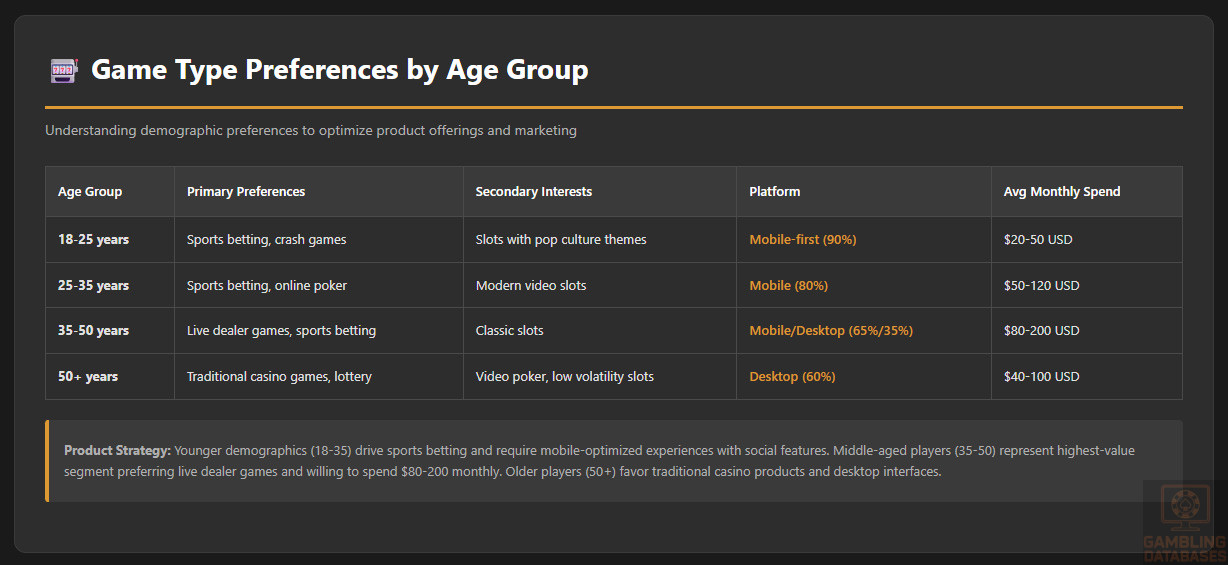
Platform Preferences: Mobile devices account for 65-70% of online gambling sessions, with smartphones dominating over tablets. Desktop usage (30-35%) occurs primarily during work hours and evening sessions at home. Operators must prioritize mobile-responsive design and native app development.
Peak Activity Times: Weekday evenings (7pm-11pm) see highest traffic, with Tuesday-Thursday showing strong engagement. Weekend afternoons and evenings (Saturday-Sunday 2pm-midnight) generate sustained high activity. Sports betting spikes during live match times.
Average Session Length: Casino sessions average 25-40 minutes, sports betting sessions 15-25 minutes for pre-match wagering, and live betting extends 60-90 minutes for match duration. Poker sessions run longest at 45-120 minutes.
Retention and Loyalty: First-year player retention rates typically reach 25-35% for online gambling, with strong correlation between welcome bonus value, early wins, and customer service quality. Loyalty programs offering comp points, cashback, and exclusive promotions improve retention to 40-50% among engaged players.
Bonus Sensitivity: Barbadian players respond strongly to welcome bonuses, with 70-80% of new registrations driven by promotional offers. Reload bonuses, free bets, and cashback offers effectively reactivate dormant players. However, transparency in wagering requirements is critical to maintaining trust.
Game Type Preferences by Age: 18-25: Sports betting, slots with pop culture themes, crash games. 25-35: Sports betting, online poker, modern video slots. 35-50: Live dealer games, classic slots, sports betting. 50+: Traditional casino games, video poker, lottery-style games, lower volatility slots.
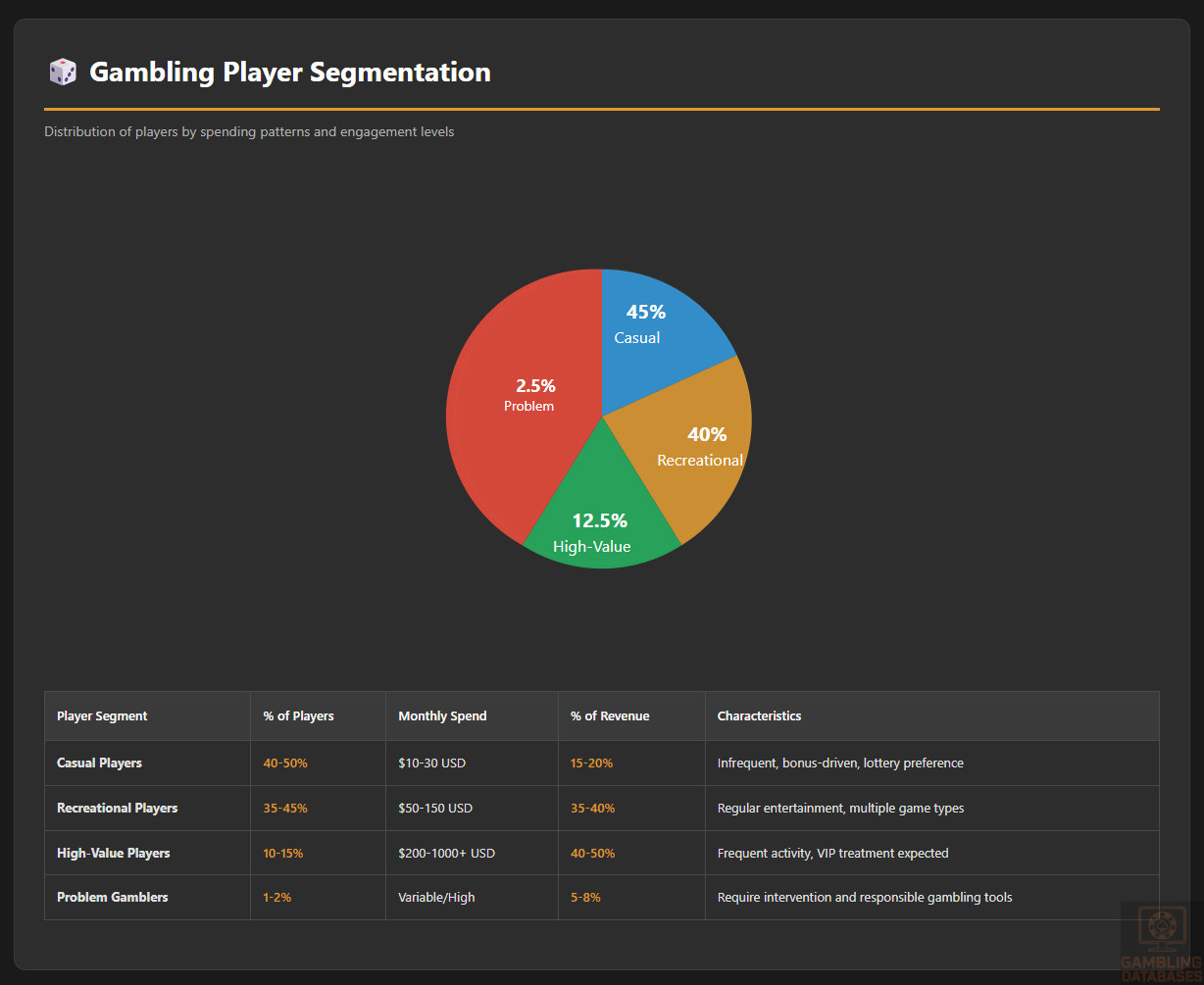
Deposit Frequency: Casual players deposit 2-4 times monthly, recreational players 4-8 times monthly, and high-value players 10-20+ times monthly. Average deposit amounts range $30-100 USD, with payment method and bonus availability influencing deposit timing and size.
Withdrawal Patterns: Players typically withdraw winnings after significant wins exceeding 5-10x deposit amount. Withdrawal frequency averages 1-2 times monthly for active players. Fast withdrawal processing (under 24 hours) strongly influences platform loyalty and positive word-of-mouth.
| Player Segment | % of Players | Monthly Spend | % of Revenue | Characteristics |
|---|---|---|---|---|
| Casual Players | 40-50% | $10-30 USD | 15-20% | Infrequent, bonus-driven, lottery preference |
| Recreational Players | 35-45% | $50-150 USD | 35-40% | Regular entertainment, multiple game types |
| High-Value Players | 10-15% | $200-1000+ USD | 40-50% | Frequent activity, VIP treatment expected |
| Problem Gamblers | 1-2% | Variable/High | 5-8% | Require intervention and responsible gambling tools |
Section 3: Technology Infrastructure and Business Environment
Internet and Digital Infrastructure
Connectivity and Network Performance
Barbados’ telecommunications infrastructure ranks among the Caribbean’s most advanced, providing reliable connectivity essential for online gambling platform operation and player experience.
Internet Penetration Quality: The 80% penetration rate reflects genuine broadband access rather than basic connectivity. Most connections support streaming video, real-time gaming, and high-quality video calls, indicating sufficient bandwidth for online gambling applications.
Fixed Broadband vs Mobile: Approximately 55-60% of connections are mobile internet via 4G/LTE networks, while 40-45% utilize fixed broadband through fiber, cable, or DSL. Urban areas enjoy widespread fiber-to-the-home availability, while rural areas rely more heavily on mobile networks.
Average Internet Speeds: Fixed broadband speeds average 50-100 Mbps download and 10-25 Mbps upload for residential plans, with business-tier services reaching 150-500 Mbps. Mobile 4G networks deliver 15-40 Mbps download speeds, sufficient for mobile gambling apps and responsive web platforms.
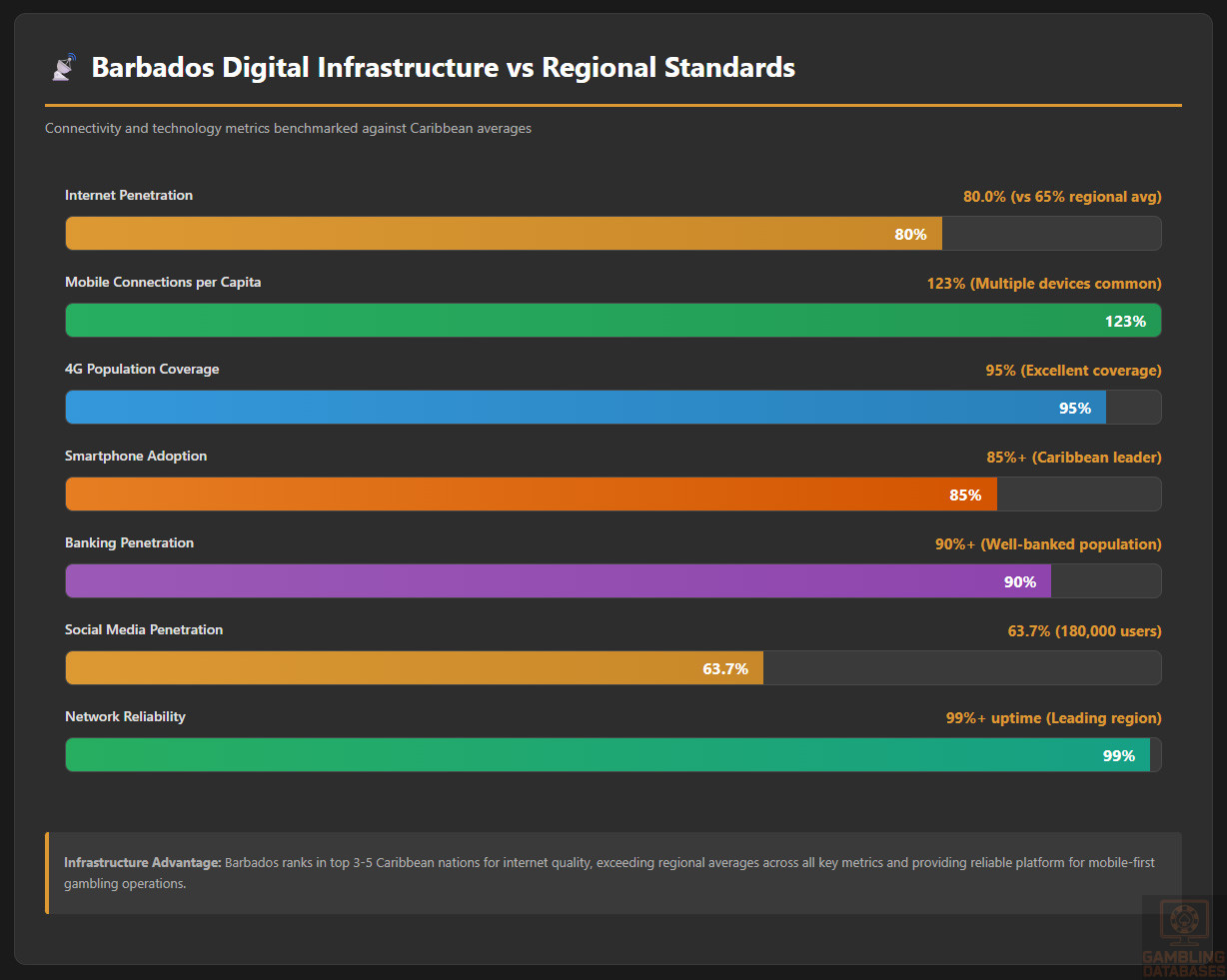
Network Reliability: Uptime statistics exceed 99% for major providers Flow and Digicel. Power outages occur infrequently, and cellular towers feature backup power ensuring continued mobile connectivity during disruptions. Submarine fiber optic cables provide redundant international connectivity.
Infrastructure Investment: The government and telecom operators continue investing in network expansion and modernization. Ongoing projects include fiber network extension to underserved areas, 5G preparation, and data center infrastructure development.
Global Rankings: Barbados ranks in the top 3-5 Caribbean nations for internet infrastructure quality, comparable to Trinidad and Tobago and ahead of Jamaica. While lagging developed nations, infrastructure meets requirements for online gambling operations.
Urban vs Rural Gap: Urban areas like Bridgetown enjoy near-universal coverage with multiple provider options and fastest speeds. Rural areas have good 4G mobile coverage but more limited fixed broadband choices. The island’s small size minimizes this gap compared to larger nations.
5G and Future Technology Deployment
Fifth-generation mobile networks represent the next evolution in connectivity, promising significantly enhanced speeds and reduced latency beneficial for live betting, live dealer games, and augmented reality gambling experiences.
Current 4G/5G Coverage: 4G LTE coverage reaches approximately 95% of the population across all parishes. Digicel and Flow provide comprehensive 4G networks supporting mobile gambling applications. 5G deployment remains in planning stages as of 2025.
5G Rollout Timeline: Commercial 5G launch is projected for 2026-2027 in Barbados, following spectrum allocation and infrastructure investment by major carriers. Initial deployment will focus on Bridgetown and high-density tourist areas before expanding island-wide.
Future Infrastructure Plans: The government’s digital transformation agenda includes telecommunications infrastructure modernization, public WiFi expansion in city centers, and continued submarine cable investments. These improvements will support growing data demands from streaming, gaming, and business applications.
Network Operator Competition: Two major operators (Flow and Digicel) maintain competitive networks, driving service quality improvements and keeping data costs reasonable. This duopoly structure ensures investment continues while providing consumer choice.
| Infrastructure Element | Current Status | Regional Ranking | Future Outlook |
|---|---|---|---|
| Fixed Broadband Speed | 50-100 Mbps average | Top 5 Caribbean | Improving with fiber expansion |
| Mobile Internet Speed | 15-40 Mbps (4G) | Top 3 Caribbean | 5G deployment 2026-2027 |
| Network Reliability | 99%+ uptime | Leading region | Sustained excellence |
| Coverage Geographic | 95% population | Excellent | Approaching universal |
| International Connectivity | Multiple submarine cables | Well-connected | Additional redundancy planned |
Mobile Technology Ecosystem
Mobile Network Infrastructure
Network Operators: Flow (Cable & Wireless) and Digicel dominate the Barbadian mobile market, both offering 4G LTE services, data plans, and bundled packages. Flow holds approximately 55-60% market share with Digicel capturing 40-45%.
Coverage Quality: Both operators provide excellent coverage in urban areas and main thoroughfares. Flow’s network receives marginally higher satisfaction ratings for consistency, while Digicel often leads in promotional pricing and data bundle value.
4G Coverage Maps: 4G LTE coverage extends across approximately 95% of inhabited areas. Only remote coastal areas and elevated interior regions experience occasional coverage gaps. Both providers offer coverage checkers on their websites.
Data Costs and Pricing: Mobile data costs have declined significantly in recent years. Current pricing averages $1.50-2.50 BBD per GB ($0.75-1.25 USD) for prepaid plans, with postpaid unlimited plans ranging $80-120 BBD monthly ($40-60 USD). These rates align with Caribbean regional averages.
Mobile Payment Integration: Both carriers support mobile money services enabling airtime purchases, bill payments, and peer-to-peer transfers. The upcoming BiMPay system launching March 2026 will provide instant bank-to-bank transfers accessible via mobile banking apps.
Mobile Wallet Adoption: Standalone mobile wallets remain underdeveloped in Barbados compared to mobile banking apps. Banks have invested heavily in their mobile applications, offering comprehensive financial services that reduce demand for third-party wallet solutions.
Device Penetration
Smartphone Adoption: Smartphone penetration exceeds 85% of the population, with near-universal ownership among adults under 55. Even seniors increasingly adopt smartphones, though feature phone usage persists among elderly populations for basic communication.
Devices Per Capita: Multiple device ownership is common, with many Barbadians owning both personal and work smartphones plus tablets. The 123% mobile connection rate (347,000 connections for 282,643 population) reflects this multi-device reality.
Device Preferences and Brands: Samsung leads Android market share at 35-40%, followed by Chinese brands like Xiaomi, Huawei, and OPPO (25-30% combined). Apple iPhones capture 20-25% market share, concentrated among higher-income demographics. Budget Android devices fill remaining market space.
Android vs iOS Market Share: Android dominates with 75-80% market share while iOS holds 20-25%. This distribution requires gambling operators to prioritize Android app development while maintaining iOS offerings for higher-value player segments.
Average Device Specifications: Mid-range smartphones (4-6GB RAM, 64-128GB storage, 6-6.5 inch screens) represent typical ownership. These specifications comfortably run gambling applications, stream video, and support responsive web platforms without performance issues.
Mobile Internet Usage: Barbadians spend 4-5 hours daily on mobile devices, consuming social media (2-3 hours), messaging (1-2 hours), entertainment/gaming (1-2 hours), and other activities. Peak mobile usage occurs during commutes, lunch breaks, and evening relaxation periods.
Mobile Gaming Penetration: Approximately 45-55% of smartphone users play mobile games (casual, social, competitive), demonstrating comfort with touch-based gaming interfaces and in-app payments. This familiarity transfers easily to mobile gambling applications.
Financial Services and Payment Infrastructure
Banking System Structure
Barbados maintains a sophisticated banking system reflecting its role as a regional financial services hub. This mature infrastructure supports diverse payment options for gambling operators and high consumer trust in digital financial services.
Major Banks and Market Share: Republic Bank (30-35% market share), FirstCaribbean International Bank (25-30%), Sagicor Bank (15-20%), CIBC FirstCaribbean (10-15%), and Scotiabank (8-12%) dominate the retail banking sector. These institutions offer comprehensive services including checking/savings accounts, credit cards, loans, and investment products.
Digital Banking Adoption: Digital banking penetration reaches 70-75% of account holders, with mobile banking apps showing strongest growth. All major banks offer feature-rich mobile applications supporting transfers, bill payments, account management, and customer service.
Account Penetration: Banking penetration exceeds 90% of adults, with most Barbadians maintaining accounts at one or more institutions. This high banked population percentage facilitates payment processing for gambling transactions without need for alternative financial services.
Credit and Lending Markets: Consumer credit is widely available through banks and credit unions. Credit card penetration reaches 60-70% of adults, with average credit limits of $3,000-8,000 BBD ($1,500-4,000 USD). Personal loans, mortgages, and vehicle financing are readily accessible to employed individuals with good credit histories.
ATM Density: ATMs are ubiquitous across Barbados with machines in all commercial areas, hotels, gas stations, and shopping centers. The island supports approximately 200-250 ATMs serving 283,000 residents, providing convenient cash access though digital payments increasingly replace ATM usage.
Payment Processing Options
Gambling operators require diverse payment method integration to maximize market penetration and accommodate player preferences. Barbados offers expanding options though some limitations exist compared to larger markets.
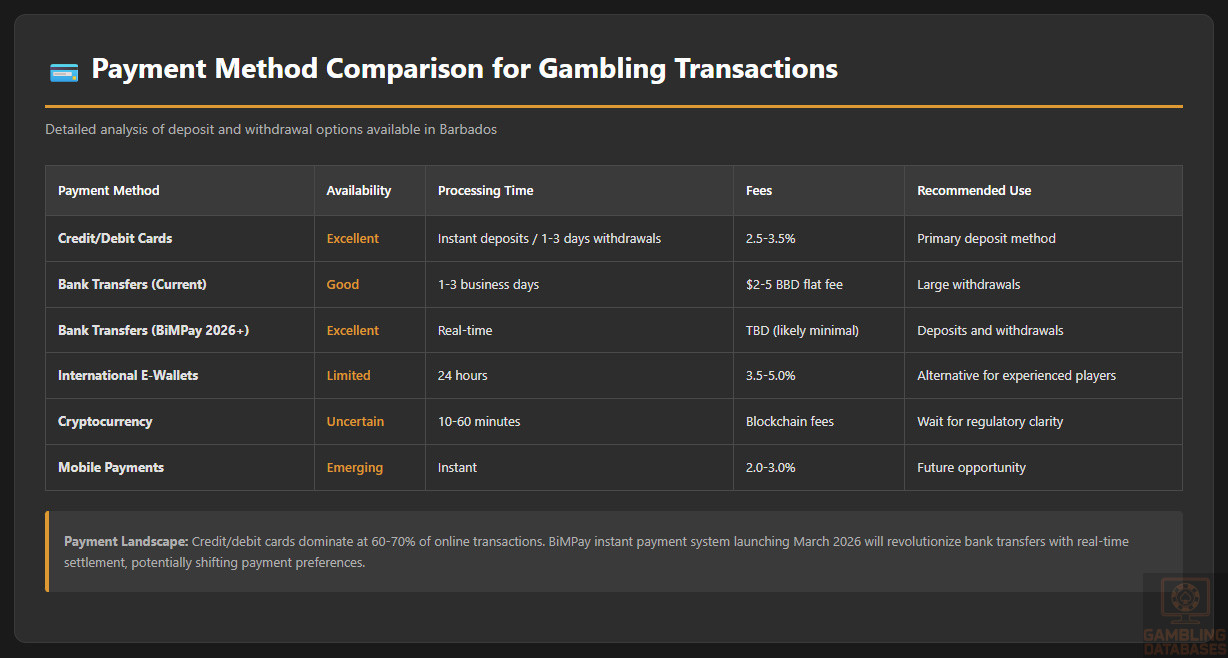
Credit/Debit Cards: Visa and Mastercard enjoy universal acceptance with near-complete merchant coverage. American Express and Discover have limited acceptance. All major banks issue Visa or Mastercard debit cards with most also offering credit cards. Cards represent the default online payment method with 65-70% of digital transactions.
E-Wallet Availability: International e-wallets face regional restrictions limiting Barbados support. PayPal does not officially service Barbados for merchant accounts, complicating integration for gambling operators. Skrill and Neteller have historically served Caribbean markets but have reduced regional presence. Operators may need to partner with regional payment processors or await BiMPay adoption.
Bank Transfer Systems: The Barbados Automated Clearing House System Initiative (BACHSI) processes electronic payments between banks, though current settlement times of 1-3 business days limit utility for gambling deposits requiring instant confirmation. BiMPay instant payment system launching March 2026 will revolutionize bank transfers with real-time settlement.
Cryptocurrency Status: Cryptocurrency remains in regulatory gray area in Barbados. The Central Bank has issued warnings about cryptocurrency risks but hasn’t prohibited usage. Bitcoin, Ethereum, and other cryptocurrencies see limited adoption primarily among tech-savvy younger demographics. Gambling operators should monitor regulatory clarity before integrating crypto payments.
Processing Fees: Credit card processing fees range 2.5-3.5% for merchants. International payment gateways charge 3.5-5.0% plus transaction fees of $0.20-0.40 USD. Bank transfers incur flat fees of $2-5 BBD domestically. These costs must factor into operator margin calculations.
Transaction Processing Timelines: Credit/debit card transactions settle instantly for deposits and 1-3 business days for refunds/withdrawals. Bank transfers currently take 1-3 business days but will become instant with BiMPay. E-wallet transactions typically settle within 24 hours when available.
International Payment Capabilities: Barbadian financial institutions maintain correspondent banking relationships enabling international transactions. However, some international payment processors exclude Caribbean jurisdictions due to perceived risk, requiring operators to establish relationships with processors experienced in the region.
Gambling Payment Restrictions: Current regulations don’t specifically prohibit gambling-related transactions, but banks may decline to process gambling payments without proper licensing. Upon regulation implementation, licensed operators should gain access to full payment processing infrastructure with banks obligated to service legitimate gaming businesses.
Chargeback and Dispute Resolution: Credit card chargeback procedures follow Visa/Mastercard international standards. Gambling transactions face scrutiny in disputes, making clear terms and conditions, transaction descriptions, and customer service documentation essential. Operators typically experience 0.5-2.0% chargeback rates depending on player satisfaction and dispute handling.
| Payment Method | Availability | Processing Time | Fees | Recommended Use |
|---|---|---|---|---|
| Credit/Debit Cards | Excellent | Instant deposits / 1-3 days withdrawals | 2.5-3.5% | Primary deposit method |
| Bank Transfers (Current) | Good | 1-3 business days | $2-5 BBD flat fee | Large withdrawals |
| Bank Transfers (BiMPay 2026+) | Excellent | Real-time | TBD (likely minimal) | Deposits and withdrawals |
| International E-Wallets | Limited | 24 hours | 3.5-5.0% | Alternative for experienced players |
| Cryptocurrency | Uncertain | 10-60 minutes | Blockchain fees | Wait for regulatory clarity |
| Mobile Payments | Emerging | Instant | 2.0-3.0% | Future opportunity |
E-commerce and Digital Economy
Digital Market Development
Barbados’ e-commerce maturity indicates readiness for online gambling adoption, as digital transaction comfort translates across industries. Understanding e-commerce trends provides insights into payment preferences and consumer digital behavior.
E-Commerce Market Size: The Barbadian e-commerce market generates an estimated $180-220 million USD annually and growing 12-15% per year. This includes both domestic online retail and international purchases from platforms delivering to Barbados.
Online Retail Penetration: E-commerce represents approximately 8-12% of total retail spending in Barbados, below developed market averages of 15-20% but growing steadily. COVID-19 pandemic accelerated adoption with many consumers maintaining digital shopping habits post-pandemic.
Digital Service Adoption: Beyond retail, Barbadians purchase digital services including streaming subscriptions (Netflix, Spotify, Amazon Prime), software licenses, online courses, and mobile apps. This demonstrates comfort with digital-only transactions and subscription models applicable to gambling products.
Consumer Trust in Online Transactions: Trust surveys indicate 65-75% of internet users feel comfortable making online purchases, though concerns about fraud and secure payment processing persist. Well-known brands and secure payment indicators (SSL certificates, recognized payment logos) significantly improve conversion rates.
Popular E-Commerce Platforms: International platforms Amazon, eBay, and AliExpress serve Barbadian consumers through shipping partners. Local e-commerce sites include Caribbean-focused marketplaces and domestic retailers with online ordering capabilities. Social media commerce through Facebook and Instagram is emerging.
Cross-Border Shopping Behavior: Barbadians frequently purchase from US and UK online retailers, utilizing freight forwarding services when direct shipping isn’t available. This international shopping experience makes offshore gambling brands familiar rather than concerning.
Digital Goods Consumption: Virtual products and services see strong adoption including gaming in-app purchases, music and video streaming, e-books, and software subscriptions. This comfort with digital-only value exchanges supports online gambling’s intangible product nature.
Business Environment and Regulatory Framework
Ease of Business Operations
Understanding Barbados’ business environment helps operators assess market entry complexity, operational costs, and regulatory burden beyond gambling-specific requirements.
World Bank Doing Business Ranking: Barbados ranks 128 of 190 countries in the World Bank’s Doing Business Index, indicating moderate ease of doing business. While not among global leaders, this ranking places Barbados in the middle tier suitable for established operators with international experience.
Ease of Starting a Business: Starting a business in Barbados requires navigating bureaucratic processes that, while not overly burdensome, involve multiple steps and government interactions. The country ranks 119 of 190 specifically for starting a business.
Business Registration Process: Company registration involves submitting Articles of Incorporation to the Corporate Affairs and Intellectual Property Office, obtaining tax registration from the Barbados Revenue Authority, registering for National Insurance, and obtaining necessary permits or licenses. Legal counsel or corporate service providers typically manage this process.
Time to Start Business: Company registration typically requires 18-31 days from initial application to operational status, assuming all documentation is properly prepared. Delays can extend timelines to 45-60 days if paperwork requires corrections or additional government approvals are needed.
Foreign Investment Policies: Barbados generally welcomes foreign investment with few restrictions. Foreign companies can establish wholly-owned subsidiaries in most sectors without requiring local partners. Some sectors like banking and insurance face additional regulatory requirements, but online gambling should permit 100% foreign ownership once regulated.
Operational Cost Structures: Office rent in Bridgetown ranges $15-35 BBD per square foot annually ($7.50-17.50 USD), with quality office space in commercial districts commanding premium rates. Professional salaries range $30,000-80,000 BBD annually ($15,000-40,000 USD) depending on role and experience. Utilities average $200-500 BBD monthly ($100-250 USD) for office spaces.
Labor Market and Talent: Barbados offers educated, English-speaking workforce with strong customer service culture. Talent availability for specialized roles like compliance officers, data analysts, and developers may require recruiting from regional markets or providing competitive compensation to attract skilled professionals from other industries.
Corporate Structure and Registration
Available Entity Types
Gambling operators can choose from several corporate structures when establishing Barbadian presence, each offering different benefits and compliance requirements.
Limited Liability Company (LLC): Standard structure for domestic operations, offering limited liability protection for shareholders while maintaining relatively straightforward compliance requirements. LLCs face 25-30% corporate tax rates on domestic income but can structure operations to minimize tax exposure.
International Business Company (IBC): Designed for companies primarily earning foreign-source income, IBCs enjoy preferential tax rates of 1-5.5%. This structure attracts international gambling operators serving markets beyond Barbados. However, the government has been reforming IBC provisions to meet international tax transparency standards.
Branch Office: Foreign companies can register Barbados branches rather than establishing separate legal entities. Branches simplify structure for multinational operators but offer less liability protection and may face less favorable tax treatment.
Recommended Structure: For iGaming operators, a Barbados IBC serving international markets offers optimal tax efficiency if regulations permit this structure for licensed gambling operations. For operators primarily targeting the domestic Barbados market, a standard LLC provides appropriate structure.
Registration Requirements
Registration Timeline: Incorporating a company in Barbados requires 18-31 days on average, with IBC registrations sometimes processing faster (10-15 days) through specialized corporate service providers. Adding gambling license application extends total time to market to 4-8 months post-regulation.
Registration Costs: Government incorporation fees range $375-550 BBD ($187.50-275 USD) depending on entity type and authorized share capital. Legal fees for preparation and filing add $1,500-3,500 BBD ($750-1,750 USD). Corporate service provider annual fees for registered office and agent services cost $1,200-2,500 BBD ($600-1,250 USD) annually.
Required Documents: Articles of Incorporation, Memorandum of Association, details of directors and shareholders (proof of identity, proof of address, professional references), registered office address in Barbados, and business plan or description of proposed operations. All foreign documents require apostille certification or notarization.
Foreign Ownership Rules: No restrictions on foreign ownership percentages for standard companies. Directors don’t need to be Barbadian citizens or residents, though at least one local director or registered agent is required for certain entity types.
Minimum Capital Requirements: No minimum paid-up capital for most company types, though gambling licenses will likely impose minimum capital requirements of $100,000-500,000 USD depending on license scope and business plan.
Ongoing Compliance: Annual returns must be filed with the Corporate Affairs Office, audited financial statements submitted to tax authorities for companies above certain revenue thresholds, and National Insurance contributions paid for all employees. Corporate service providers typically manage compliance calendars and filings for annual fees.
Corporate Governance Requirements: Companies must maintain minutes of director and shareholder meetings, keep accounting records showing financial position, and maintain registers of directors, shareholders, and charges. Publicly listed companies face additional governance requirements, though gambling operators typically remain private.
| Feature | Domestic LLC | International Business Company | Branch Office |
|---|---|---|---|
| Tax Rate | 25-30% | 1-5.5% | Variable |
| Setup Time | 18-31 days | 10-15 days | 20-35 days |
| Setup Cost | $1,000-2,000 USD | $1,200-2,500 USD | $800-1,500 USD |
| Annual Compliance | Moderate | Moderate | High |
| Foreign Ownership | 100% permitted | 100% permitted | 100% by definition |
| Liability Protection | Full | Full | Limited |
| Best Use Case | Domestic market focus | International operations | Extension of foreign entity |
Taxation Framework
Corporate Income Tax Structure
Tax planning significantly impacts gambling operator profitability. Understanding Barbados’ corporate tax system enables operators to structure operations efficiently while maintaining full compliance.
Standard Corporate Tax Rates: Domestic companies pay corporation tax of 25-30% on taxable profits. Small businesses with turnover below certain thresholds may qualify for reduced rates. Loss carryforward provisions allow offsetting future profits against prior losses.
International Business Company Rates: IBCs historically enjoyed rates of 1-2.5% on foreign-source income. Recent reforms have adjusted these rates upward to 1-5.5% while adding substance requirements including minimum employees, office space, and operational decision-making in Barbados. Gambling operators must verify IBC availability for gaming licenses.
Special Economic Zone Benefits: Barbados periodically offers tax incentives for specific industries or economic zones. Operators should investigate whether gambling operations qualify for any preferential tax treatment, expedited depreciation, or duty-free equipment imports.
Tax Treaties: Barbados maintains tax treaties with over 30 countries including the UK, Canada, China, and several EU nations. These treaties prevent double taxation and may offer withholding tax benefits for dividends, interest, and royalties paid to foreign shareholders.
Transfer Pricing Rules: Companies transacting with related parties must document that pricing reflects arm’s length terms. Gambling operators with international payment processing, technology licensing, or management service arrangements with affiliated companies must maintain transfer pricing documentation.
Withholding Taxes: Dividends paid to non-residents face 15% withholding tax (often reduced by treaty). Interest and royalty payments to non-residents incur 15% withholding. Management fees and other service payments may face withholding depending on circumstances and treaty provisions.
VAT/GST Applicability: Barbados imposes Value Added Tax (VAT) of 17.5% on most goods and services. Whether gambling services face VAT requires clarification in forthcoming regulations. Many jurisdictions exempt gambling from VAT, instead imposing specific gambling taxes.
Personal Income Tax
Personal income tax affects gambling operators through employee taxation, potentially attracting or deterring international talent, and through costs of employing local staff.
Individual Tax Brackets: Barbados operates progressive personal income tax with brackets approximately: First $25,000 BBD tax-free, $25,001-$35,000 BBD at 17.5%, $35,001-$75,000 BBD at 28.5%, Above $75,000 BBD at 35%. These rates apply to employed and self-employed individuals.
Employment Tax Obligations: Employers must withhold Pay As You Earn (PAYE) tax from employee salaries, calculate and remit amounts monthly to Barbados Revenue Authority, provide annual tax statements, and bear administrative compliance costs.
Social Security Contributions: National Insurance System requires contributions splitting between employers (8.5% of salary up to maximum) and employees (5% of salary up to maximum). These contributions fund pensions, unemployment benefits, and healthcare coverage. Total payroll burden reaches approximately 13.5%.
Tax Residency Rules: Individuals spending more than 182 days in Barbados during a tax year become tax residents, subjecting their worldwide income to Barbadian taxation. Operators employing expatriate staff must structure compensation considering residency and tax implications in both home and host countries.
Foreign Employee Taxation: Expatriate employees face the same tax rates as Barbadians, though tax treaties may provide relief from double taxation. Employers often gross-up compensation to offset higher tax burdens for international recruits relocating to Barbados.
| Tax Type | Rate | Application |
|---|---|---|
| Corporate Income Tax (Domestic) | 25-30% | Taxable profits from local operations |
| Corporate Income Tax (IBC) | 1-5.5% | Foreign-source income with substance requirements |
| Personal Income Tax | 0-35% progressive | Individual employment and business income |
| National Insurance | 13.5% total | 8.5% employer / 5% employee on salaries |
| Dividend Withholding | 15% (often reduced) | Dividends to non-residents |
| Interest/Royalty Withholding | 15% | Payments to non-residents |
| VAT | 17.5% | Most goods and services |
| Expected GGR Tax (Gaming) | 10-20% | Gross gaming revenue from gambling operations |
Market Entry Considerations
Recommended Entry Strategies
Successful market entry requires careful strategy selection balancing speed to market, investment requirements, risk exposure, and long-term positioning. Barbados’ emerging regulatory framework creates unique considerations.
Early Mover Licensing Strategy: Operators positioning for licenses immediately upon regulation gain first-mover advantages including brand establishment before competition intensifies, favorable negotiating position with payment processors and affiliates, and potential regulatory consultation opportunities shaping implementation. Risk includes uncertainty about final regulatory requirements and costs.
Partnership with Local Entities: Collaborating with established Barbadian businesses (tourism companies, retailers, lottery operators) provides local market knowledge, regulatory navigation assistance, payment processing relationships, and customer trust. Partners can assist with office setup, hiring, and government relations.
White Label vs Proprietary Platform: White label solutions minimize technology development costs and accelerate launch timelines (2-4 months vs 12-18 months for proprietary platforms). However, proprietary platforms offer better control over user experience, payment processing, promotions, and customer data. Market size may favor white label for initial entry with migration to proprietary platform as revenue justifies investment.
Technology Infrastructure Strategy: Leveraging established gambling platform providers (Playtech, Evolution Gaming, NetEnt) for game content while developing proprietary player management and payment systems balances quality content access with operational control. Cloud infrastructure hosted regionally ensures latency minimization and regulatory compliance.
Marketing and Localization: Successful operators must localize beyond language (already English) to include cricket and Caribbean football content for sports betting, payment methods aligned with Barbadian preferences, promotional calendars recognizing local holidays and events, culturally appropriate marketing imagery and messaging, and customer support hours matching local time zones.
Payment Provider Selection: Early identification and contracting with payment processors experienced in Caribbean gambling markets is critical. Operators should establish relationships with multiple processors ensuring redundancy if one partner faces technical issues or regulatory challenges.
Risk Mitigation Strategies: Diversifying regulatory exposure across multiple Caribbean markets, maintaining operational flexibility to adapt to evolving regulations, securing comprehensive gambling operator insurance, implementing robust responsible gambling programs exceeding minimum requirements, and maintaining strong regulatory relationships minimize downside risks.
Typical Costs and Timelines
Detailed financial planning enables operators to assess market entry viability and secure adequate capitalization for sustainable operations through the initial growth phase.
Initial Setup Investments: License application and fees: $15,000-30,000 USD application plus $25,000-75,000 annual license fee. Legal and consulting fees: $25,000-50,000 USD for corporate structure, license application, contract review, and regulatory advice. Company registration: $1,000-2,500 USD. Initial capital requirements: $100,000-500,000 USD depending on license type. Office setup: $10,000-25,000 USD for furniture, equipment, and initial lease deposits. Technology and platform: $50,000-150,000 USD for white label setup or $250,000-750,000 for proprietary platform development. Initial marketing budget: $50,000-150,000 USD for launch campaigns, brand development, and affiliate onboarding.
Total Initial Investment: Operators should budget $275,000-1,000,000 USD for market entry depending on platform choice, license scope, and scale of operations. Conservative budgeting toward higher end of range reduces risk of undercapitalization.
Monthly Operational Costs: Staff salaries (15-25 employees): $25,000-50,000 USD monthly for compliance, customer service, marketing, technical, and management teams. Office rent and utilities: $2,000-5,000 USD monthly. Technology maintenance and hosting: $5,000-15,000 USD monthly for servers, software licenses, game integration, and security. Payment processing fees: 2.5-3.5% of transaction volume plus fixed fees. Marketing and customer acquisition: $30,000-100,000+ USD monthly depending on growth targets and customer acquisition cost optimization.
Total Monthly Operating Costs: Expect $60,000-180,000 USD monthly operational expenses, requiring consistent revenue growth to reach profitability within 12-24 months.
Timeline to Market: Company registration: 3-5 weeks. License application: 3-6 months (assuming regulations enacted). Platform setup: 2-4 months (white label) or 6-12 months (proprietary). Payment processor integration: 1-2 months. Total time to market: 6-12 months post-regulation enactment.
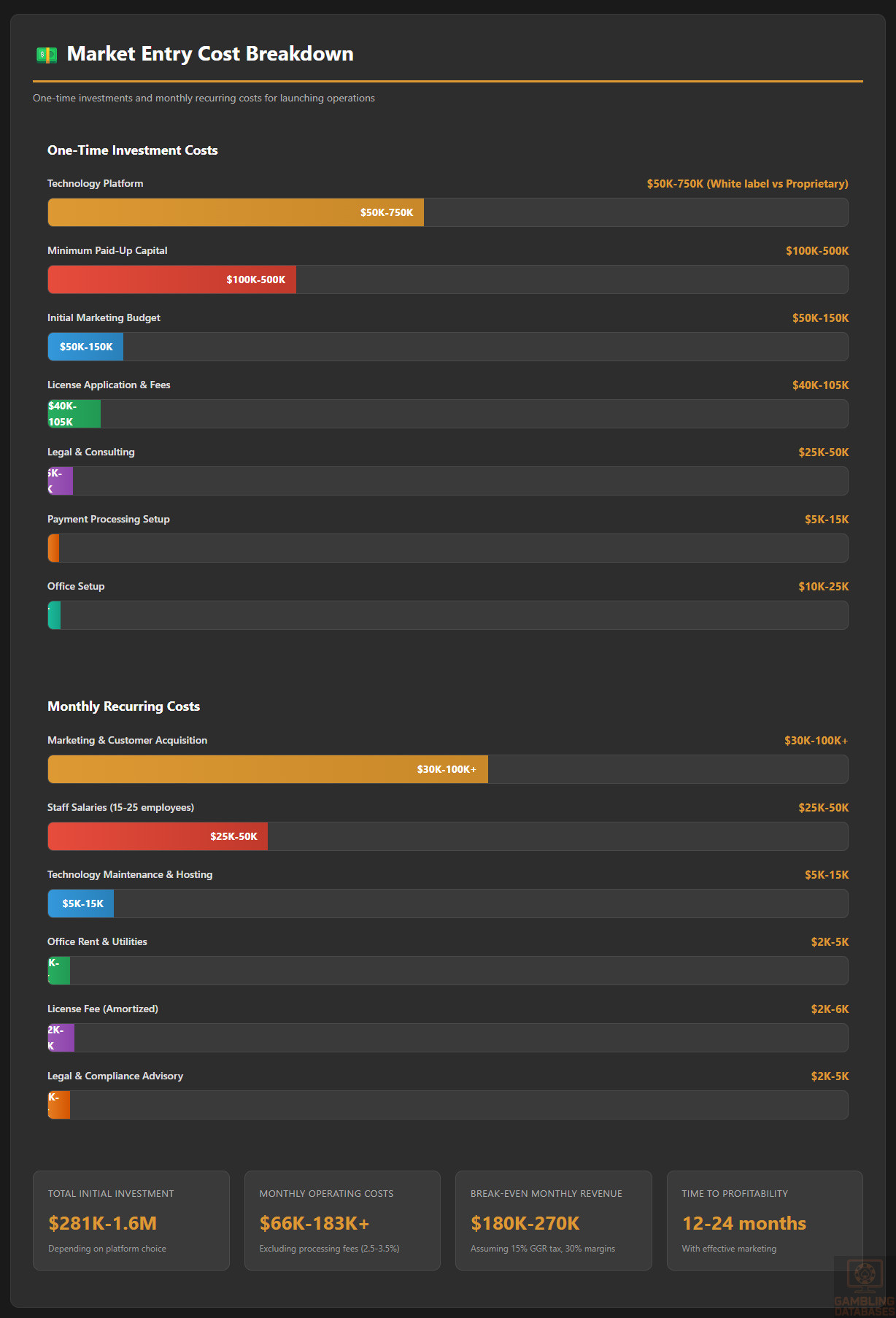
Revenue Requirements for Profitability: Based on operational cost estimates, operators need approximately $180,000-270,000 USD monthly revenue to reach break-even, assuming 12-18% GGR tax and 30% operating margins. This requires 1,500-2,500 active monthly players spending $120-180 USD monthly, representing achievable targets within 12-18 months of launch with effective marketing.
Resource Requirements: Minimum staff headcount of 15-25 employees depending on operational model. Key positions include CEO/Managing Director, Compliance Officer/MLRO, Finance Manager, Customer Service Manager plus 3-5 agents, Marketing Manager, Technical Manager/Developer, Risk and Fraud Analyst, VIP Account Manager, and Administrative Support. Additional specialized roles for content management, affiliate management, and business intelligence as revenue grows.
| Cost Category | One-Time Investment | Monthly Recurring | Notes |
|---|---|---|---|
| License Fees | $40,000-105,000 | $2,000-6,000 (amortized) | Application + first year |
| Legal & Consulting | $25,000-50,000 | $2,000-5,000 | Setup plus ongoing advisory |
| Company Registration | $1,000-2,500 | $100-200 | Annual compliance costs |
| Capital Requirements | $100,000-500,000 | – | Security deposit and reserves |
| Office Setup | $10,000-25,000 | $2,000-5,000 | Furniture plus rent/utilities |
| Technology Platform | $50,000-750,000 | $5,000-15,000 | White label vs proprietary |
| Initial Marketing | $50,000-150,000 | $30,000-100,000 | Launch campaign ongoing CAC |
| Staff Salaries | – | $25,000-50,000 | 15-25 employees |
| Payment Processing | $5,000-15,000 | 2.5-3.5% of volume | Setup plus transaction fees |
| Total | $281,000-1,597,500 | $66,000-183,000+ | Excluding processing fees |
Success Factors and Challenges
Key Success Enablers
Operators maximizing these success factors improve probability of sustainable profitability and market share growth in the emerging Barbadian gambling market.
Local Player Preference Understanding: Cricket dominates sports interest with matches involving West Indies team generating peak betting activity. Football (English Premier League, Champions League, World Cup) and basketball (NBA) follow. Casino players favor slots with progressive jackpots, live dealer blackjack and roulette, and video poker. Understanding these preferences guides content acquisition and promotional focus.
Localized Payment Methods: Supporting Barbadian credit/debit cards without friction, integrating BiMPay instant transfers upon March 2026 launch, offering bank transfer options, and maintaining competitive processing fees relative to offshore operators ensures payment acceptance rates exceed 85-90%.
Mobile-First Approach: With 65-70% of gambling sessions occurring on mobile devices, responsive web design optimized for smartphone screens, native iOS and Android apps with full functionality, and attention to data consumption efficiency (3-5 MB per hour) ensures accessibility for players on limited data plans.
Marketing Channel Effectiveness: Social media advertising on Facebook and Instagram reaches 180,000 Barbadians cost-effectively. Affiliate partnerships with Caribbean sports and entertainment websites drive qualified traffic. Sponsorship of local cricket leagues and football tournaments builds brand awareness and community connection. Google search advertising captures high-intent traffic.
Customer Support Excellence: English-language support via live chat, email, and phone during Caribbean business hours (8am-midnight AST) ensures accessibility. Training staff to understand local culture, sporting references, and payment systems improves resolution rates. First-response times under 2 minutes for chat and 2 hours for email meet customer expectations.
Competitive Promotions: Welcome bonuses matching 100-200% of initial deposits up to $200-500 USD attract new players. Reload bonuses, cashback offers (5-10% on losses), free bets for sports betting, and free spins for slots drive retention. Loyalty programs with comp points redeemable for bonuses or prizes reward consistent play.
Responsible Gambling Leadership: Exceeding minimum regulatory requirements demonstrates corporate responsibility and builds long-term sustainable operations. Proactive responsible gambling tools, clear problem gambling resources, staff training to identify at-risk behaviors, and community education programs differentiate operators from less scrupulous competitors.
Local Sports Coverage: Comprehensive cricket betting markets including West Indies matches, Caribbean Premier League, and international tournaments. Coverage of regional football competitions and local horse racing at Garrison Savannah. Live streaming of Caribbean sporting events increases engagement and bet frequency.
Major Operational Challenges
Anticipating and mitigating challenges improves probability of successful market entry and sustainable operations. Barbados presents specific obstacles requiring careful management.
Regulatory Uncertainty Timeline: The 2023 announcement of forthcoming regulations hasn’t yet resulted in enacted legislation as of October 2025. Continued delays create planning uncertainty, requiring operators to maintain flexibility in market entry timing while avoiding premature investments before regulatory clarity.
Small Market Size Economics: With maximum addressable market of 70,000-80,000 active players and total market revenue projections of $35-40 million USD by year 5, operators must carefully control costs to achieve profitability. Marketing efficiency, technology leverage, and operational discipline are essential given limited revenue potential.
Taxation Burden Impact: GGR taxes of 12-18% combined with 25-30% corporate income tax (or 1-5.5% for qualifying IBCs) significantly impact margins. Operators must achieve high operational efficiency to maintain profitability under tax burdens potentially reaching 35-40% of revenue.
Payment Processing Limitations: Until BiMPay launches in March 2026, instant payment options remain limited. Reliance on credit cards creates chargebacks exposure (0.5-2.0% of volume). Limited e-wallet availability compared to European markets constrains payment diversity. Cryptocurrency regulatory uncertainty prevents leveraging crypto payments.
Marketing Restrictions: Expected advertising limitations on television during certain hours, content restrictions preventing aggressive promotional messaging, prohibition on marketing to minors, and potential sponsorship limitations constrain brand building and customer acquisition strategies. Creative compliant marketing approaches required.
Offshore Competition: Established international operators with no local licenses will continue serving Barbadian players unless effective blocking or payment processing restrictions are enforced. Licensed operators must differentiate through trust, local payment methods, customer service, and targeted promotions to migrate players from offshore to licensed platforms.
Customer Acquisition Costs: Small market size limits marketing channel options and increases per-player acquisition costs. Operators may face CAC of $150-300 USD per player, requiring 12-24 month payback periods. Efficient digital marketing, organic acquisition through word-of-mouth, and affiliate partnerships help control CAC.
Technical Talent Shortage: Barbados’ small population limits availability of specialized gambling industry technical talent including platform developers, risk analysts, and data scientists. Operators may need to recruit internationally, offer competitive compensation exceeding local market rates, or outsource technical functions to offshore development teams.
Infrastructure Limitations: While internet infrastructure is good by Caribbean standards, it falls below European and North American benchmarks. Occasional outages, slower speeds in rural areas, and limited 5G availability may impact user experience. Robust platform architecture and content delivery networks mitigate these limitations.
Cultural Considerations
Cultural alignment improves marketing effectiveness, customer engagement, and brand perception in the Barbadian market. Understanding and respecting local culture differentiates successful operators.
Local Holidays and Peak Seasons: Crop Over festival (July-August) represents Barbados’ largest cultural celebration, creating opportunities for themed promotions and increased leisure gambling. Christmas season (December-January) sees elevated tourism and consumer spending. Independence Day (November 30) and Emancipation Day (August 1) hold cultural significance. Cricket World Cup and regional tournaments drive sports betting surges.
Popular Sports and Events: Cricket dominates with West Indies team matches, Caribbean Premier League, and international test series. English Premier League football enjoys massive following with most Barbadians supporting specific clubs. NBA basketball, particularly playoffs and finals, attracts betting interest. Garrison Savannah horse racing seasons create local betting traditions. Formula 1, tennis (especially Wimbledon), and boxing round out sporting interests.
Customer Service Channel Preferences: Live chat serves as primary contact method for quick questions and urgent issues. Email remains important for detailed inquiries and documentation. Phone support appeals to older demographics and complex situations. WhatsApp business messaging may prove effective given platform’s near-universal adoption. Social media responsiveness (Facebook, Instagram) builds brand reputation.
Communication Style Preferences: Barbadians appreciate friendly, respectful communication balancing professionalism with warmth. Overly formal language feels distant while excessive casualness seems unprofessional. Patient explanations for technical or financial matters build trust. Acknowledging local cultural references and sporting events creates connection.
Trust-Building for Foreign Brands: International gambling operators must establish credibility through transparent licensing information prominently displayed, clear terms and conditions in plain English, fast and reliable payment processing demonstrating financial stability, responsive customer service addressing concerns promptly, and community engagement through sponsorships and responsible gambling initiatives. Local partnerships with recognized Barbadian businesses accelerate trust development.
Exit Strategy Planning
While operators enter markets intending long-term success, responsible planning includes exit strategy considerations ensuring graceful withdrawal options if market conditions change or strategic priorities shift.
Market Liquidity for Sales: Barbados’ small market size limits potential acquirers to regional gambling operators seeking Caribbean market consolidation or international operators pursuing geographic diversification. Exit liquidity remains moderate, requiring 6-18 months to identify buyers and complete transactions.
Regulatory Transfer Requirements: Gambling licenses will likely permit ownership transfers subject to regulatory approval of new owners. Expect 60-120 day approval processes requiring purchaser due diligence, financial capability verification, and compliance history review. License transfer fees of $5,000-15,000 USD may apply.
License Transferability: Licenses should be transferable assets adding value to business sales, though regulatory authorities retain discretion to deny transfers to unsuitable purchasers. Maintaining clean compliance records and positive regulatory relationships facilitates smoother transfer approvals.
Typical Valuation Multiples: Online gambling operators typically sell for 3-6x EBITDA or 1-2x annual revenue depending on growth trajectory, customer quality, and market position. Barbadian operations may command lower multiples (2-4x EBITDA) due to small market size but could benefit from strategic value if part of Caribbean portfolio acquisition.
Operational Closure Process: If closing operations rather than selling, operators must notify regulatory authorities (typically 90-180 days advance notice), cease accepting new players and deposits, settle all player balances through withdrawals or returns, maintain records for regulatory retention periods (5-10 years), and formally surrender licenses. Player fund protection requirements ensure customers receive their balances before closure.
FAQ: Frequently Asked Questions
Legal & Licensing
Is online gambling legal in Barbados?
Online gambling currently exists in an unregulated gray area in Barbados. The government does not license domestic online gambling operators, and no iGaming sites are based in the country. However, Barbadian residents face no legal restrictions on accessing international online casinos and sports betting platforms.
In March 2023, Finance Minister Ryan Straughn announced that comprehensive betting and gaming legislation would be introduced to Parliament to regulate the online gambling sector. As of October 2025, this regulatory framework has not yet been enacted, though it remains under development. Once implemented, licensed online gambling will become fully legal and regulated in Barbados.
Land-based gambling is partially legal. Slot machines are permitted in tourist areas, hotels, and entertainment venues. Horse racing betting is legal at Garrison Savannah during race seasons. Government lottery products operate legally. However, traditional casino table games like roulette, blackjack, and poker remain prohibited in land-based venues.
What types of gambling licenses are available and what do they cover?
Current licensing categories apply only to land-based operations including slot machine licenses for venues, horse racing betting licenses for on-track wagering, and lottery operations licenses held by the government-controlled Barbados Lottery Authority.
Once online gambling regulations are enacted, expect multiple license categories covering different gambling activities. Anticipated license types include sports betting licenses covering pre-match and live wagering on sporting events, casino licenses permitting slots, table games, and live dealer games, poker licenses for both tournament and cash game offerings, aggregator or platform provider licenses for technology suppliers serving licensed operators, and possibly separate licenses for lottery-style games and bingo products.
License scopes will likely differentiate between business-to-consumer operations serving Barbadian players and business-to-business services providing technology or content to licensed operators. Some jurisdictions offer combined licenses covering multiple gambling categories, while others require separate licenses for each activity. Specific license categories and coverage details await publication of final regulations.
How much does an iGaming license cost and how long does it take to obtain?
Specific licensing costs await finalization in the forthcoming regulatory framework. Based on comparable Caribbean jurisdictions, expect initial application fees of $15,000-30,000 USD and annual license fees of $25,000-75,000 USD depending on license type and scope. Security deposits or bonds of $50,000-200,000 USD will likely be required to guarantee player fund protection.
Minimum paid-up capital requirements typically range $100,000-500,000 USD based on business plan scale and license categories requested. Legal and consulting fees for application preparation, document review, and regulatory liaison add $25,000-50,000 USD to total costs. First-year licensing expenses including application, first annual fee, security deposit, and professional services could reach $100,000-300,000 USD.
Processing timelines typically require 90-180 days from completed application submission to license issuance, assuming all documentation is properly prepared and due diligence proceeds without issues. Background checks on directors, shareholders, and key personnel add time. Expect 3-6 months from initial engagement with regulatory authorities to operational approval.
Adding company registration time (3-5 weeks), payment processing setup (1-2 months), and platform configuration (2-12 months depending on white label vs proprietary), total time from market entry decision to operational launch spans 6-12 months post-regulation enactment.
Can foreign companies obtain a gambling license?
Barbados generally welcomes foreign investment across most economic sectors, and online gambling licensing should permit 100% foreign ownership without requiring local partners. The country’s established offshore financial services sector demonstrates openness to international businesses operating from Barbados.
While ownership can be fully foreign, expect requirements for local presence including registered office in Barbados, local registered agent or attorney, and minimum staff (2-5 employees) for compliance, customer service, and regulatory liaison functions. Some directors or officers may need physical presence in Barbados for board meetings and operational oversight.
Foreign companies can establish Barbadian subsidiaries or International Business Companies to hold gambling licenses. All directors and shareholders undergo background checks regardless of nationality. Professional references, police clearances, and financial capability verification apply to all applicants equally.
Regional and international gambling operators will likely represent the primary license applicants given established expertise, access to technology platforms, payment processing relationships, and capital resources. Local Barbadian companies may participate through partnerships, joint ventures, or by providing auxiliary services to licensed operators.
Financial & Taxation
What are the tax obligations for iGaming operators?
Gambling operators face multiple tax obligations in Barbados. The primary levy will be Gross Gaming Revenue tax, calculated as total stakes minus winnings paid to players. Expected GGR tax rates range 10-20% depending on gambling category, with sports betting potentially taxed at 10-15% and casino games at 12-18%.
Corporate income tax applies to net profits after operating expenses and GGR tax. Domestic companies pay 25-30% corporation tax while International Business Companies serving foreign markets may qualify for preferential 1-5.5% rates, subject to substance requirements including local employees and operational decision-making in Barbados.
Annual license renewal fees of $25,000-75,000 USD function as operational taxes. Employers pay National Insurance contributions of 8.5% on employee salaries, with employees contributing an additional 5%. Withholding taxes of 15% apply to dividends, interest, and royalties paid to non-resident shareholders or service providers, though tax treaties may reduce these rates.
Value Added Tax of 17.5% applies to most goods and services in Barbados, though gambling services may be exempt from VAT with gambling-specific taxes serving as the primary revenue mechanism. Clarification awaits regulatory framework publication.
Total tax burden could reach 35-40% of gross revenue when combining GGR tax, corporate income tax, and other levies. Efficient operations achieving 30-35% operating margins can sustain profitability under this tax structure, though operators must carefully control costs.
Are gambling winnings taxed for players?
Caribbean jurisdictions typically do not tax player winnings, and Barbados will likely follow this precedent. Taxing individual gambling winnings creates administrative complexity tracking player profits across thousands of participants and raises fairness questions about deducting losses.
If player taxation is implemented, it would likely apply only to large jackpot wins exceeding threshold amounts such as $10,000 BBD or $5,000 USD. Operators would withhold taxes on qualifying wins and remit amounts to tax authorities on behalf of players, similar to lottery jackpot taxation in many jurisdictions.
Most online gambling winnings would remain untaxed for players, with government revenue derived entirely from operator-level GGR taxes and corporate income taxes. This approach maximizes player returns, simplifies administration, and maintains competitiveness with international offshore operators who don’t withhold taxes on winnings.
Players using offshore unlicensed operators face no current tax obligations on winnings, as Barbadian tax authorities do not monitor or enforce taxation of offshore gambling activity. This reality further supports untaxed winnings for licensed operators to maintain competitive parity.
What are the typical operational costs for running an online casino or sportsbook?
Monthly operational costs for small to medium-sized gambling operations in Barbados range $60,000-180,000 USD depending on scale and operational model. Staff salaries for 15-25 employees covering compliance, customer service, marketing, technical, and management functions cost $25,000-50,000 USD monthly.
Office rent and utilities in Bridgetown range $2,000-5,000 USD monthly for suitable commercial space. Technology platform hosting, software licenses, game integration, and security infrastructure cost $5,000-15,000 USD monthly for white label operators or $10,000-25,000 USD for proprietary platforms.
Marketing and customer acquisition represent the largest variable cost at $30,000-100,000+ USD monthly depending on growth targets and acquisition strategy efficiency. Payment processing fees of 2.5-3.5% of transaction volume add variable costs scaling with revenue. Legal and professional services for ongoing compliance, contract review, and regulatory liaison cost $2,000-5,000 USD monthly.
License fees amortized monthly add $2,000-6,000 USD. Miscellaneous costs including insurance, telecommunications, software subscriptions, and administrative supplies add $3,000-8,000 USD monthly. First-year operations targeting 2,000-3,000 active monthly players should budget $80,000-120,000 USD monthly operational expenses.
What is the expected ROI timeline for entering this market?
Return on investment timelines depend on initial investment scale, operational efficiency, and marketing effectiveness. Operators investing $275,000-500,000 USD initially with monthly operating costs of $60,000-100,000 USD should reach break-even in 18-30 months assuming successful customer acquisition and retention.
Year 1 typically generates losses of $300,000-600,000 USD as customer acquisition costs exceed early revenue and fixed costs burden small player bases. Year 2 should see narrowing losses to $100,000-200,000 USD as the player base grows and marketing efficiency improves. Year 3 commonly achieves break-even or modest profitability of $50,000-150,000 USD as customer lifetime value emerges and operational leverage increases.
Positive cumulative ROI typically emerges in years 4-5, with well-managed operations potentially recovering initial investments within 48-60 months. Operators achieving 3,000-5,000 active monthly players by year 3 with average monthly revenue per player of $45-70 USD generate sufficient revenue ($1.6-4.2 million USD annually) to sustain profitability and begin investment recovery.
Market size limitations cap absolute returns, making Barbados most attractive as part of multi-jurisdiction Caribbean strategies where operational costs distribute across larger regional player bases. Standalone Barbados operations may struggle to achieve returns competitive with larger markets.
Operations & Compliance
What are the local presence requirements for operators?
Expected local presence requirements balance attracting international operators with ensuring regulatory oversight and local economic benefits. Operators will likely need to maintain registered office in Barbados with physical address (not just mail forwarding service), employ minimum staff (2-5 employees) for compliance, customer service, and regulatory liaison functions, and designate Barbadian-based compliance officer or Money Laundering Reporting Officer.
All licensees must appoint local registered agent or attorney familiar with Barbadian corporate and gambling regulations. While gaming servers and technical infrastructure may be hosted internationally in secure data centers, regulators must have access for monitoring and auditing purposes.
At least one director or senior officer should maintain regular physical presence in Barbados for board meetings, regulatory interactions, and operational oversight, though full-time residence may not be mandatory. Bank accounts must be maintained at Barbadian financial institutions for certain transactions and regulatory financial monitoring.
Domain names must comply with approved extensions such as .bb (Barbados ccTLD) or internationally recognized domains like .com or .net, with geo-location verification ensuring only eligible jurisdictions can access licensed services. Customer data should be stored with privacy protections meeting international standards while remaining accessible to Barbadian authorities.
What payment methods are available and recommended?
Credit and debit cards (Visa and Mastercard) represent the essential primary payment methods, accounting for 65-70% of online transactions in Barbados. All operators must support major card brands with secure payment processing meeting PCI-DSS compliance standards. Bank transfers currently require 1-3 business days for settlement through BACHSI clearing but will become instant transfers with BiMPay launching March 2026.
BiMPay instant payment system will transform payment landscape by enabling real-time bank-to-bank transfers between all Barbadian financial institutions. Early integration of BiMPay will provide competitive advantage as consumers adopt the convenient payment option. International e-wallets like Skrill and Neteller have limited Barbados support, though operators may establish relationships with regional payment processors offering e-wallet alternatives.
Cryptocurrency acceptance awaits regulatory clarity. While not explicitly prohibited, banks and payment processors express caution about gambling cryptocurrency transactions. Operators should monitor regulatory developments before integrating Bitcoin, Ethereum, or other digital currencies. Multiple redundant payment processors reduce risk of single provider outages impacting deposits or withdrawals.
For withdrawals, players prefer bank transfers for larger amounts despite processing time, while card refunds work well for smaller withdrawals. Fast withdrawal processing under 24 hours significantly impacts customer satisfaction and retention, making payment efficiency a competitive differentiator.
What are the advertising and marketing restrictions?
While final advertising regulations await enactment alongside gambling legislation, expect restrictions following international responsible gambling standards. Television and radio advertising will likely face time-based restrictions prohibiting commercials during children’s programming and potentially limiting gambling advertising during live sports broadcasts accessible to minors.
All marketing content must include responsible gambling messages, display 18+ age warnings prominently, accurately represent odds and winning probabilities without exaggeration, clearly state bonus terms including wagering requirements and expiration periods, and avoid suggesting gambling as financial solution or pathway to wealth.
Targeting minors through advertising content, imagery, or platform selection will be strictly prohibited. Social media advertising must employ age-gating and targeting parameters excluding users under 18. Promotional offers will face caps on maximum bonus amounts and reasonable wagering requirements, likely limited to 20x-40x deposit plus bonus amounts.
Sponsorships of sports teams, leagues, and events may be permitted with restrictions on branding visibility during youth sporting events and requirements to include responsible gambling messaging. Celebrity and influencer endorsements will need to include proper disclosures and avoid appeal to minors.
Email marketing requires explicit opt-in consent from players, with clear unsubscribe mechanisms. Affiliate marketing relationships must ensure affiliates comply with advertising standards, avoid deceptive practices, and don’t target minors. Operators bear responsibility for affiliate compliance with financial penalties for violations by affiliate partners.
What responsible gambling measures are mandatory?
Expected mandatory responsible gambling requirements will align with international best practices. Operators must implement deposit limits allowing players to set daily, weekly, and monthly maximum deposits, with changes to increase limits subject to cooling-off periods of 24-72 hours before taking effect.
Loss limits enable players to cap losses over specified periods, while session time limits allow players to restrict continuous gambling duration. Reality checks must display pop-ups showing time elapsed and money wagered at regular intervals (typically every 30-60 minutes). Self-exclusion options include temporary exclusions (24 hours, 1 week, 1 month) and permanent exclusions, with operators obligated to block access during exclusion periods.
Age verification at registration must verify all players are 18+ using government-issued ID documents, address verification, and database cross-checks. Know Your Customer procedures must collect and verify player identity, monitor for suspicious activity, and flag potential problem gambling behaviors.
Prominent display of responsible gambling resources including helpline numbers, links to problem gambling support organizations, and educational materials about gambling risks is required. Customer service staff must receive training to identify problem gambling warning signs and intervene appropriately with concerned players or referrals to support services.
Operators will likely need to contribute 0.5-1.0% of Gross Gaming Revenue to problem gambling prevention, research, and treatment programs. Annual reporting on responsible gambling measures, self-exclusion statistics, and customer protection activities ensures regulatory oversight of social responsibility commitments.
Market Opportunity
How large is the iGaming market and what is the growth potential?
The Barbadian online gambling market currently generates an estimated $15-25 million USD annually through Barbadian players using offshore platforms. This revenue currently flows entirely outside Barbados’ economy and tax system. Upon regulation, licensed operators can capture this existing activity plus growth from increased market confidence and expanded player base.
Year 1 post-regulation projections suggest $15-18 million USD market size as early adopters migrate to licensed platforms. Year 3 growth to $25-30 million USD reflects expanded player base and increased average revenue per user. Year 5 maturation at $35-40 million USD represents approximately 25-28% penetration of the adult population actively gambling online.
The market should achieve 20-25% compound annual growth rate in years 1-3 as regulation drives adoption, moderating to 12-18% CAGR in years 4-5 as the market matures. Active online gamblers are projected to grow from 50,000-55,000 in year 1 to 70,000-80,000 by year 5.
Average revenue per user will increase from $280-320 USD annually in year 1 to $480-520 USD by year 5 as players develop platform familiarity, operators optimize retention strategies, and product variety expands. Sports betting will represent 45-50% of revenue, casino games 35-40%, poker 10-15%, and other products 5-10%.
Who are the main competitors and what is their market share?
Currently, no licensed operators serve the Barbadian market domestically. International offshore operators capture 100% of online gambling activity without paying local taxes or adhering to Barbadian regulations. Major offshore brands serving Barbadian players include established European operators licensed in Malta, UK, or Gibraltar, Curacao-licensed Caribbean-focused platforms, and Asian betting operators accepting Caribbean customers.
Upon regulation implementation, expect 3-5 major operators to dominate 70-80% of the licensed market within 2-3 years of operation. The market will likely consolidate around one market leader capturing 30-40% share, two strong competitors with 15-20% share each, and 2-3 smaller operators splitting the remaining 20-30%.
Successful operators will include established Caribbean gambling operators expanding from other jurisdictions, international operators pursuing regional growth strategies, and potentially one Barbadian-owned or partnered operator leveraging local knowledge. First movers gaining licenses quickly will enjoy significant advantage in brand establishment and customer acquisition before competition intensifies.
The small market size prevents supporting many viable operators, making market leadership critical for profitability. Operators unable to achieve top-3 market position may struggle with unit economics and customer acquisition costs relative to revenue potential.
What are the player preferences and typical spending patterns?
Barbadian players demonstrate strong preference for sports betting, particularly cricket matches involving West Indies teams, Caribbean Premier League, and international test series. English Premier League football generates consistent betting activity year-round. NBA basketball, especially playoffs, attracts significant wagering. Local horse racing at Garrison Savannah creates betting traditions.
Casino game preferences include progressive jackpot slots offering life-changing wins, live dealer blackjack and roulette providing authentic casino experiences, and video poker appealing to older demographics. Younger players favor modern video slots with popular themes, while older players prefer classic three-reel slots and traditional table games.
Average monthly spending of $40-80 USD per player masks significant variance across segments. Casual players spending $10-30 monthly comprise 40-50% of the player base but generate only 15-20% of revenue. Recreational players spending $50-150 monthly represent 35-45% of players and 35-40% of revenue. High-value players spending $200+ monthly account for just 10-15% of players but generate 40-50% of total revenue.
Typical bet sizes range $2.50-10 USD for sports bets, $0.125-1.00 USD per slot spin, and $2.50-12.50 USD per table game hand for recreational players. High rollers bet significantly more but remain small percentage of base. Players typically deposit 2-8 times monthly averaging $30-100 USD per deposit.
Mobile devices account for 65-70% of gambling sessions with peak activity Tuesday-Thursday evenings 7pm-11pm and weekend afternoons-evenings. Session lengths average 25-40 minutes for casino games, 15-25 minutes for sports pre-match betting, and 45-120 minutes for poker. Live sports betting extends 60-90 minutes during match durations.
Players respond strongly to welcome bonuses, with 70-80% of registrations driven by promotional offers. Reload bonuses, cashback offers (5-10% on losses), and loyalty rewards effectively reactivate dormant players and maintain engagement. Transparency in bonus terms is critical, as complex wagering requirements damage trust and retention.
What are the key success factors and main challenges for new entrants?
Critical Success Factors: Early market entry securing licenses immediately upon regulation provides first-mover advantages in brand establishment and customer acquisition. Mobile-optimized platforms supporting 65-70% of sessions through responsive design or native apps are essential. Payment method diversity including cards, bank transfers, and BiMPay integration maximizes deposit success rates.
Comprehensive cricket and football betting coverage with competitive odds attracts sports bettors. Quality casino game selection from recognized providers (NetEnt, Evolution Gaming, Pragmatic Play) builds player confidence. Customer service excellence with live chat, English-language support during Caribbean hours, and fast response times differentiates operators. Responsible gambling leadership exceeding minimum requirements demonstrates sustainability and social responsibility.
Efficient marketing spending achieving customer acquisition costs below $200 USD ensures economic viability in the small market. Strong regulatory relationships through transparent compliance and proactive communication smooths operational challenges. Local cultural understanding reflected in promotions, sporting coverage, and customer interactions builds brand affinity.
Major Challenges: Small market size limiting total revenue potential to $35-40 million USD by year 5 constrains absolute profitability. High taxation burden of 12-18% GGR tax plus 25-30% corporate income tax (or 1-5.5% for IBCs) pressures margins. Competition from established offshore operators continuing to serve Barbadian players without licenses or local taxation creates uneven playing field.
Payment processing limitations until BiMPay launches in March 2026 restrict instant payment options. Limited e-wallet availability and cryptocurrency uncertainty further constrain payment diversity. Marketing restrictions on advertising content, timing, and channels limit customer acquisition strategies. Technical talent shortage in Barbados’ small population requires international recruitment or outsourcing.
Customer acquisition costs of $150-300 USD per player in a small market with limited channels require 12-24 month payback periods. Regulatory uncertainty timeline with 2023 announcement not yet enacted as of October 2025 creates planning challenges. Infrastructure limitations compared to developed markets may impact user experience for rural or bandwidth-constrained players.
Sources and References
- Barbados Lottery Authority – Official Government Gaming Regulator – https://lottery.gov.bb
- Financial Services Commission Barbados – Regulatory Authority – https://www.fsc.gov.bb
- Barbados Government Information Service – Policy Announcements and Official Statements
- Central Bank of Barbados – Economic Statistics and Financial Data – https://www.centralbank.org.bb
- Barbados Statistical Service – Population and Demographic Data – https://stats.gov.bb
- World Bank – Barbados Country Overview and Doing Business Rankings – https://www.worldbank.org
- International Monetary Fund – Barbados Economic Outlook and GDP Projections
- DataReportal – Digital 2025 Barbados Report – Internet and Social Media Statistics
- International Telecommunication Union – ICT Statistics for Barbados
- GSMA Intelligence – Mobile Connectivity and Network Coverage Data
- Caribbean Telecommunications Union – Regional Infrastructure Reports
- Flow Barbados (Cable & Wireless) – Network Coverage and Service Information – https://discoverflow.co
- Digicel Barbados – Mobile Network and Service Offerings – https://www.digicelgroup.com
- Barbados Revenue Authority – Tax Rates and Corporate Taxation Information – https://bra.gov.bb
- Corporate Affairs and Intellectual Property Office – Business Registration Requirements
- Barbados International Business Association – IBC Regulations and Updates
- Barbados Investment and Development Corporation – Foreign Investment Policies
- Central Bank of Barbados – BiMPay National Payment System Launch Announcement – March 2026
- Caribbean Financial Action Task Force – AML/CFT Standards and Compliance
- Transparency International – Corruption Perceptions Index Barbados Rankings
- United Nations Development Programme – Human Development Index Barbados
- World Economic Forum – Global Competitiveness Report Caribbean Analysis
- H2 Gambling Capital – Caribbean Online Gambling Market Research and Forecasts
- Regulus Partners – Small Market iGaming Analysis and Benchmarking
- European Gaming and Betting Association – Regulatory Best Practices and Standards
- Barbados Tourism Marketing Inc – Tourism Statistics and Visitor Demographics
- Caribbean Community (CARICOM) – Regional Economic Integration and Trade
- Garrison Savannah Horse Racing – Official Schedule and Betting Information
- Cricket West Indies – Match Schedules and Regional Tournament Information
- Facebook IQ – Social Media Usage Patterns in Caribbean Markets
- Global Web Index – Digital Consumer Insights Barbados and Caribbean Region
- Statista – E-commerce Market Size and Growth Projections Caribbean
- Caribbean Development Bank – Economic Research and Development Statistics
- Gaming Laboratories International (GLI) – Testing Standards for Online Gambling
- eCOGRA – Player Protection and Fair Gaming Certification Standards
- Responsible Gambling Council – Problem Gambling Prevention Best Practices
- Gordon House of Representatives Barbados – Parliamentary Records and Legislation Tracking
- Barbados Advocate Newspaper – Local News and Regulatory Announcements
- Nation News Barbados – Business and Finance Coverage
- Caribbean360 – Regional Business and Gaming Industry News
- SBC News – Global Gambling Industry Analysis and Caribbean Market Coverage
- Gambling Compliance – Regulatory Intelligence and Legal Updates Caribbean
- International Association of Gaming Regulators – Regulatory Frameworks and Standards
- Global Gambling Guidance Group – Emerging Market Regulatory Development
- PricewaterhouseCoopers – Gambling Market Analysis and Tax Structure Consulting
- Deloitte – Caribbean Gaming Sector Reports and Economic Impact Studies
- KPMG – Online Gambling Market Sizing Methodologies and Regional Benchmarks
- Nielsen Sports – Caribbean Sports Betting Behavior and Preferences Research
- YouGov – Caribbean Consumer Attitudes Toward Gambling Surveys
- Ipsos – Digital Payment Preferences and E-commerce Behavior Caribbean Markets
🎯 Gambling Databases Country Rating: Barbados
| Evaluation Dimension | Score | Rating |
|---|---|---|
| Operator Ease Score | 2.3/10 | 🔴 Difficult – Pre-Regulation Limbo |
| Player Access Score | 5.5/10 | 🟡 Grey Area – Offshore Access Only |
| Overall Market Attractiveness | 3.9/10 | 🔴 High-Risk Emerging Market |
This rating is calculated using the Gambling Databases Rating (GDR) methodology, which provides transparent criteria for evaluating iGaming markets worldwide. Click the link to learn how we calculate Operator Ease Score, Player Access Score, and overall market attractiveness ratings.
⚠️ CRITICAL RISK WARNINGS
READ THIS BEFORE CONSIDERING MARKET ENTRY:
- NO LICENSING FRAMEWORK EXISTS: Online gambling regulations were announced in March 2023 but remain UNENACTED as of October 2025 – a 30+ month delay with no confirmed implementation date
- REGULATORY UNCERTAINTY: Operating without a license is currently in a legal grey area – no explicit prohibition but no legal protection either
- LAND-BASED CASINO BAN: Traditional table games (roulette, blackjack, poker) are explicitly PROHIBITED in physical venues, indicating conservative government attitude toward gambling
- MICRO-MARKET SIZE: Maximum market potential of only $35-40 million USD by Year 5 makes profitability extremely challenging – requires exceptional operational efficiency
- FIRST-MOVER RISK: No regulatory precedent means unknown final licensing costs, requirements, and restrictions – could be far worse than projected
- EXTENDED BREAKEVEN: Realistic timeline of 18-30 months to breakeven with cumulative losses of $400-800k in first two years – unsuitable for undercapitalized operators
- PAYMENT LIMITATIONS: Until BiMPay launches March 2026, instant payment options are severely limited – impacts player conversion and retention
- OFFSHORE COMPETITION: International operators continue serving Barbadians tax-free with no enforcement – licensed operators must compete against unregulated, lower-cost alternatives
📊 Operator Ease Score Breakdown
| Criterion | Weight | Score | Justification (INCLUDING ALL DEDUCTIONS) |
|---|---|---|---|
| Legal & Regulatory Framework | 30% | 0.0/3.0 | Started at 0.0 (no licensing available). Online gambling exists in regulatory grey area – not explicitly prohibited but no legal framework (+0.5 base for grey area). Land-based table games PROHIBITED (-0.5 showing anti-gambling bias). Regulations announced March 2023 but STILL NOT ENACTED after 30+ months (-0.5 for extreme regulatory delay). No licensing authority currently accepting applications (0 points for inaccessibility). Final: 0.0/3.0 |
| Licensing Process | 25% | 0.5/2.5 | NO LICENSING CURRENTLY AVAILABLE (0.0 base). Projected costs when enacted: $40,000-105,000 first year (+0.25 for moderate projected fees under €100k). Estimated 90-180 day processing timeline (+0.25 for reasonable timeline IF regulations pass). Foreign ownership expected to be permitted (+0.25 for openness). DEDUCTIONS: Complete uncertainty on actual requirements (-0.5 for no confirmed framework). Expected legal/consulting costs $25,000-50,000 could escalate (-0.25 potential complexity). Total timeline to market 6-12 months POST-regulation assumes regulations pass soon – could be years (-0.5 for timeline uncertainty). Final: 0.5/2.5 |
| Taxation & Costs | 20% | 0.5/2.0 | Projected 10-20% GGR tax range (+1.0 for mid-range estimate). DEDUCTIONS: Combined with 25-30% corporate tax OR 1-5.5% IBC rates creates effective tax burden of 35-45% on revenue (-0.5 for multiple tax layers). Uncertainty whether IBC favorable rates will apply to gaming licenses (-0.25 for tax structure ambiguity). Small market size $15-40M total creates HIGH customer acquisition costs estimated $150-300 per player (-0.5 for prohibitive CAC in micro-market). Monthly operating costs $60,000-180,000 in market generating only $1.25-3.5M monthly at maturity creates razor-thin margins (-0.5 for unfavorable cost-to-revenue ratio). Total initial investment $275,000-1,000,000 with 18-30 month breakeven is excessive for market size (-0.25 for capital intensity). Final: 0.5/2.0 |
| Operational Requirements | 15% | 0.75/1.5 | Expected requirements moderate: registered office, 2-5 employees, local compliance officer (+0.5 for reasonable presence requirements). Foreign operators can own 100% (+0.25 for ownership flexibility). Servers can be hosted internationally (+0.25 for technical flexibility). DEDUCTIONS: BiMPay instant payments NOT available until March 2026 (-0.25 for delayed modern payment infrastructure). Limited e-wallet availability – PayPal doesn’t officially service Barbados merchant accounts (-0.25 for payment method restrictions). Cryptocurrency regulatory uncertainty prevents integration (-0.25 for banned/unclear modern payment method). Technical talent shortage in population of 283k requires expensive international recruitment (-0.25 for limited local talent pool). Final: 0.75/1.5 |
| Market Environment | 10% | 0.5/1.0 | Ease of Doing Business rank 128/190 = moderate environment (+0.5 for middle-tier ranking). High political stability and low corruption (+0.25 for institutional quality). DEDUCTIONS: Company registration takes 18-31 days with bureaucratic complexity (-0.25 for administrative burden). Expected advertising restrictions on TV/radio timing, content requirements, and sponsorship limitations (-0.5 for marketing constraints in already-small market). 30-month regulatory delay since 2023 announcement shows implementation uncertainty (-0.25 for regulatory instability). Conservative land-based casino ban suggests future online restrictions possible (-0.25 for anti-gambling policy history). Final: 0.5/1.0 |
OPERATOR EASE SCORE TOTAL: 2.3/10 🔴
| Category | Raw Score | Weight | Weighted Contribution |
|---|---|---|---|
| Legal & Regulatory Framework | 0.0/3.0 | 30% | 0.0 |
| Licensing Process | 0.5/2.5 | 25% | 0.5 |
| Taxation & Costs | 0.5/2.0 | 20% | 0.5 |
| Operational Requirements | 0.75/1.5 | 15% | 0.75 |
| Market Environment | 0.5/1.0 | 10% | 0.5 |
| TOTAL OPERATOR EASE SCORE | 2.3/10 | ||
👥 Player Access Score Breakdown
| Criterion | Weight | Score | Justification (INCLUDING ALL DEDUCTIONS) |
|---|---|---|---|
| Legal Status for Players | 40% | 2.5/4.0 | Online gambling in grey area – not explicitly prohibited for players (+1.0 for unclear legal status). Barbadians freely access offshore gambling sites without legal repercussions (+0.5 for practical tolerance). Land-based slots and lottery legal (+0.5 for partial legal options). DEDUCTIONS: Land-based casino table games (roulette, blackjack, poker) explicitly PROHIBITED (-0.5 showing restrictive attitude). No licensed online operators available domestically – players must use offshore sites (-0.5 for lack of legal local options). Regulatory uncertainty means player legal status could change dramatically when legislation passes (-0.5 for future risk). Final: 2.5/4.0 |
| Practical Accessibility | 30% | 2.0/3.0 | Multiple payment methods available: credit/debit cards widely accepted (+1.0). No active ISP blocking of offshore gambling sites (+0.5 for unrestricted access). High internet penetration 80% and mobile penetration 123% (+0.5 for strong digital infrastructure). DEDUCTIONS: International e-wallets (PayPal, Skrill, Neteller) have LIMITED Barbados support (-0.5 for reduced payment options). Bank transfers take 1-3 business days until BiMPay launches March 2026 (-0.25 for slow settlement). Cryptocurrency status uncertain – banks cautious about gambling crypto transactions (-0.25 for unclear modern payment method). Some international gambling payment processors exclude Caribbean jurisdictions due to perceived risk (-0.5 for processing challenges). Final: 2.0/3.0 |
| Player Penalties | 20% | 2.0/2.0 | NO penalties for players using offshore gambling sites (+2.0 full points). Government does not prohibit residents from accessing international online casinos and sports betting platforms. No enforcement actions against individual players. No fines, warnings, or criminal liability for online gambling activity. Final: 2.0/2.0 |
| Market Availability | 10% | 0.25/1.0 | NO licensed operators currently serving market domestically (+0.25 for offshore-only access). Players access BGO, Black Lotus, 32Red, and numerous Malta/Curacao/UK-licensed operators (+0.25 for international availability). DEDUCTIONS: Zero domestically licensed operators available (-0.5 for no local legal options). Estimated 45,000-60,000 active players all using unlicensed offshore platforms (-0.25 for unregulated market only). When regulation passes, expect only 3-5 operators to dominate 70-80% of market (-0.25 for future limited competition). Final: 0.25/1.0 |
PLAYER ACCESS SCORE TOTAL: 5.5/10 🟡
| Category | Raw Score | Weight | Weighted Contribution |
|---|---|---|---|
| Legal Status for Players | 2.5/4.0 | 40% | 2.5 |
| Practical Accessibility | 2.0/3.0 | 30% | 2.0 |
| Player Penalties | 2.0/2.0 | 20% | 2.0 |
| Market Availability | 0.25/1.0 | 10% | 0.25 |
| TOTAL PLAYER ACCESS SCORE | 5.5/10 | ||
🔍 Key Highlights
Strengths (Limited)
- First-Mover Opportunity: No licensed operators exist yet – early entrants could establish brand dominance before competition intensifies in a market projected to reach $35-40M by Year 5
- High GDP Per Capita: $25,366 USD (highest in Eastern Caribbean) creates strong consumer spending power relative to regional peers
- Excellent Digital Infrastructure: 80% internet penetration, 123% mobile connections, 85%+ smartphone adoption supports mobile-first gambling platforms
- No Player Penalties: Barbadians face zero legal consequences for using offshore gambling sites – establishes cultural acceptance and active player base of 45,000-60,000
- English Language: 99%+ literacy in English eliminates localization costs and enables immediate market entry with existing platforms
- Favorable Tax Structure (Potentially): IF International Business Company rates (1-5.5%) apply to gaming licenses, tax burden would be regionally competitive
- Political Stability: Stable parliamentary democracy, low corruption, strong rule of law reduces regulatory uncertainty risk compared to less developed Caribbean nations
- Cricket & Sports Betting Demand: Strong sports culture (cricket, Premier League football, NBA) drives sports betting interest – 60% of online gamblers prefer sports products
⛔️ CRITICAL RISKS AND CHALLENGES
- [Regulatory Limbo – SHOWSTOPPER RISK]: Regulations announced March 2023 remain UNENACTED 30+ months later with no confirmed implementation date. Operators cannot obtain licenses, creating total entry uncertainty. Government could implement framework far more restrictive than projections suggest.
- [Land-Based Casino Ban – Anti-Gambling Signal]: Explicit PROHIBITION of table games (roulette, blackjack, poker) in physical venues indicates conservative government philosophy toward gambling. This restrictive precedent suggests online regulations may include unexpected limitations or product restrictions.
- [Micro-Market Economics – PROFITABILITY CRISIS]: Total market size capped at $35-40M USD by Year 5 with 3-5 operators competing for share. Market leader capturing 30-40% share earns only $10.5-16M annually. After 12-18% GGR tax + 25-30% corporate tax + $60k-180k monthly operating costs, profit margins are razor-thin or negative for all but #1 player.
- [Extreme Customer Acquisition Costs]: Small population (283k total, 200k adults) with limited advertising channels creates CAC of $150-300 per player. In market generating only $280-520 ARPU annually, payback periods extend 12-24 months – longer than typical player lifetime value.
- [Payment Infrastructure Gaps]: BiMPay instant payment system doesn’t launch until March 2026 – 3+ years AFTER regulatory announcement. Until then, operators face 1-3 day bank transfer settlements. International e-wallets (PayPal, Skrill, Neteller) provide LIMITED Barbados support. Cryptocurrency regulatory uncertainty prevents integration. These payment limitations reduce player conversion by estimated 15-25%.
- [Offshore Competition Continues Unabated]: No ISP blocking, no payment processor restrictions, no enforcement against international operators means offshore sites continue serving Barbadians tax-free with lower operating costs. Licensed operators must compete against unregulated alternatives offering better odds, higher bonuses, and no local tax burden.
- [Extended Breakeven Timeline – CAPITAL INTENSIVE]: Realistic breakeven requires 18-30 months with cumulative losses of $400-800k in first two years. Positive ROI emerges only in Years 4-5 (48-60 months). Small market size caps absolute returns even for successful operators – unsuitable for operators requiring faster capital recovery.
- [Talent & Infrastructure Limitations]: Population of 283k creates severe technical talent shortage. Specialized roles (platform developers, risk analysts, data scientists) require expensive international recruitment. Internet speeds average 50-100 Mbps fixed / 15-40 Mbps mobile – good for Caribbean but below European/North American standards, potentially impacting user experience.
- [Advertising & Marketing Restrictions]: Expected prohibitions on TV/radio gambling ads during children’s programming, content restrictions on bonus promotions, mandatory responsible gambling warnings, and potential sports sponsorship limitations constrain customer acquisition in already-tiny market. CAC likely increases 20-40% post-regulation vs current offshore marketing freedom.
- [Taxation Uncertainty – COULD GET MUCH WORSE]: Projected 10-20% GGR tax is ESTIMATE ONLY – actual rates unknown until legislation passes. Combined with corporate income tax, total effective burden could reach 40-50% of revenue. If favorable 1-5.5% IBC rates DON’T apply to gaming licenses, operators face 25-30% corporate tax instead, destroying already-marginal economics.
- [Competition from Regional Consolidation]: Major Caribbean gambling operators (licensed in Curacao, Antigua, Costa Rica) already serve Barbadian players as part of regional strategies. These established players have brand recognition, payment relationships, and multi-jurisdiction economies of scale. New Barbados-only entrants face competitive disadvantages.
- [Operational Cost Burden]: Monthly costs of $60k-180k in market generating only $1.25-3.5M monthly at maturity (Year 5) means operating expenses consume 20-50% of gross revenue BEFORE taxes. Only exceptionally efficient operators achieve sustainable profitability.
| Risk Category | Severity | Impact on Operations |
|---|---|---|
| Regulatory Uncertainty | ⛔️ CRITICAL | Cannot obtain license – market entry impossible until legislation passes |
| Market Size Economics | ⛔️ CRITICAL | $35-40M total market insufficient for multiple profitable operators |
| Extended Breakeven | 🔴 HIGH | 18-30 months to breakeven requires $400-800k capital cushion |
| Offshore Competition | 🔴 HIGH | Unregulated operators continue serving market tax-free with better offers |
| Payment Limitations | 🟡 MEDIUM | Reduces conversion 15-25% until BiMPay launches March 2026 |
| Talent Shortage | 🟡 MEDIUM | Requires expensive international recruitment or offshore outsourcing |
| Advertising Restrictions | 🟡 MEDIUM | Increases CAC by estimated 20-40% in small market |
Player-Specific Issues
- No Licensed Local Operators: Players cannot access domestically regulated gambling sites – all activity occurs through offshore platforms without local consumer protections
- Payment Method Gaps: Limited e-wallet options, slow 1-3 day bank transfers (until March 2026), and cryptocurrency uncertainty restrict convenient deposit/withdrawal methods
- Land-Based Casino Ban: Players seeking table game experiences (blackjack, roulette, poker) must travel to other Caribbean islands or use online platforms – no legal domestic venue option
- Future Regulation Risk: When legislation passes, current offshore access could be restricted through ISP blocking or payment processor prohibitions – players may lose access to preferred platforms
- Responsible Gambling Gaps: Offshore operators serving Barbadians lack mandatory responsible gambling tools, self-exclusion registries, or problem gambling support integrated into local healthcare system
💰 Reality Check: Can You Actually Make Money Here?
| Metric | Conservative Estimate | Optimistic Estimate |
|---|---|---|
| Initial Investment Required | $500,000 – $750,000 USD | $275,000 – $400,000 USD |
| Monthly Operating Costs | $100,000 – $180,000 USD | $60,000 – $90,000 USD |
| Effective Tax Rate on Revenue | 40-50% (GGR 15-18% + Corporate 25-30%) | 15-25% (GGR 10-12% + IBC 1-5.5%) |
| Customer Acquisition Cost | $250 – $300 USD per player | $150 – $200 USD per player |
| Time to Breakeven | 24-30 months (assuming regulations pass in 2026) | 18-24 months (best case scenario) |
| Time to Positive ROI | 48-72 months (4-6 years) | 36-48 months (3-4 years) |
| Year 5 Annual Revenue (Market Leader 35% share) | $12.25 – $14M USD (35% of $35M market) | $14 – $16M USD (40% of $40M market) |
| Year 5 Annual Profit (After Tax & Costs) | $800k – $1.2M USD (6-9% net margin) | $2.5 – $3.5M USD (18-22% net margin) |
Profitability Assessment:
CONSERVATIVE REALITY: Economics are PROHIBITIVELY CHALLENGING for most operators. A market leader capturing 35% share of a $35M market generates only $12.25M annually in Year 5. After 40-50% effective taxation ($4.9-6.1M) and $1.2-2.16M annual operating costs, net profit is only $800k-1.2M – representing 6-9% net margins. With initial investment of $500-750k and cumulative losses of $400-800k in Years 1-2, total capital requirement reaches $1-1.5M to achieve $800k-1.2M annual profit by Year 5. This represents 0.5-1.5x return on invested capital after 5 years – UNACCEPTABLE for venture capital or private equity standards.
OPTIMISTIC SCENARIO (UNLIKELY): IF regulations pass quickly, IF IBC favorable tax rates (1-5.5%) apply to gaming licenses, IF customer acquisition costs stay under $200, and IF an operator achieves 40% market dominance, then Year 5 revenue of $14-16M with 15-25% effective tax rate and efficient $60-90k monthly operations could generate $2.5-3.5M annual profit (18-22% net margins). Even in this best-case scenario, ROI timeline extends 3-4 years with total capital requirements of $700k-1M. This scenario requires EVERYTHING to go right – unlikely given 30-month regulatory delay already.
BOTTOM LINE ON PROFITABILITY: Only the #1 market player achieves meaningful profitability, and even then, absolute returns are modest ($800k-3.5M annually) relative to capital requirements ($700k-1.5M) and time investment (4-5 years). Operators finishing #2-3 likely break even or generate minimal profits. Operators #4+ lose money continuously. This market CANNOT support more than 2-3 profitable operators simultaneously.
⚖️ Legal Risk Assessment
| Stakeholder Type | Current Risk Level | Post-Regulation Risk | Specific Risks |
|---|---|---|---|
| Offshore Casino Operators (Unlicensed) | 🟡 LOW-MEDIUM | 🔴 HIGH | Current: No enforcement, no ISP blocking, no payment restrictions – operating freely. Future Risk: Post-regulation could implement ISP blocking, payment processor prohibitions, financial penalties for continued service. Risk increases dramatically once licensing framework enacted. |
| Licensed Operators (Post-Regulation) | ⛔️ IMPOSSIBLE | 🟡 MEDIUM | Current: Cannot obtain license – market entry blocked. Future Risk: Heavy compliance burden, mandatory responsible gambling measures, potential advertising restrictions, 0.5-1% GGR contribution to problem gambling funds, audit requirements, potential license suspension for violations. Regulatory uncertainty about final requirements. |
| Affiliates/Advertisers | 🟢 LOW | 🟡 MEDIUM | Current: No restrictions on promoting offshore operators. Future Risk: Expected regulations will impose advertising content restrictions, mandatory responsible gambling warnings, potential prohibition on aggressive bonus promotions, compliance obligations flowing to affiliates. No indication of prosecution risk currently. |
| Payment Processors | 🟢 LOW | 🟡 MEDIUM | Current: No restrictions on processing gambling transactions. Future Risk: May be prohibited from processing transactions for unlicensed operators. Licensed operator processing requires compliance with AML/KYC standards, transaction monitoring, regulatory reporting. Potential fines for processing unlicensed gambling payments. |
| Company Directors/Executives | 🟢 LOW | 🟡 MEDIUM | Current: No personal liability for offshore operations. Future Risk: Directors of licensed operators face regulatory probity checks, background verification, potential personal liability for company regulatory violations. No extradition risk indicated – Barbados focuses on regulatory compliance rather than criminal prosecution for gambling offenses. |
| Players | 🟢 ZERO RISK | 🟢 ZERO RISK | Current: No penalties, fines, or legal consequences for using offshore gambling sites. Future: Highly unlikely player penalties will be introduced – Caribbean jurisdictions uniformly avoid taxing or penalizing players. Regulatory focus is operator-level taxation and licensing. |
🚨 Extradition and International Enforcement
Extradition Treaties: Barbados maintains extradition agreements with United Kingdom, United States, Canada, and several Caribbean Community (CARICOM) member states. However, these treaties typically cover serious criminal offenses rather than regulatory gambling violations.
Enforcement History: NO DOCUMENTED CASES of Barbados pursuing extradition or international prosecution for online gambling offenses. The government’s regulatory approach focuses on establishing licensing framework and tax revenue collection rather than criminal enforcement. The March 2023 regulatory announcement emphasized “managing risks” and “international standards” – language indicating regulatory compliance focus rather than punitive criminal prosecution.
Gambling-Specific Risk Level: 🟢 LOW – Barbados treats gambling as a regulated business activity requiring licensing rather than a criminal matter requiring prosecution. The 30-month delay in enacting regulations despite 2023 announcement further indicates non-urgent, compliance-focused approach. Operators risk license denial or refusal to renew for violations, but criminal prosecution and extradition risk appears minimal based on current regulatory philosophy.
Safe Jurisdictions: Not applicable – Barbados does not actively pursue international gambling enforcement requiring jurisdictional safe havens. Operators located in ANY jurisdiction face same risk level (low) from Barbados authorities.
Travel Risk: 🟢 NEGLIGIBLE – No documented cases of Barbadian authorities detaining or prosecuting foreign gambling operators during travel through Barbados or using extradition treaties for gambling offenses. Travel risk is effectively zero for gambling-related activities.
KEY CAVEAT: Risk assessment applies to current environment and historical patterns. IF regulations pass and IF Barbados adopts aggressive enforcement stance similar to Australia or France (ISP blocking, payment restrictions, operator prosecutions), risk levels could increase significantly. However, Caribbean jurisdictions have historically avoided punitive enforcement in favor of licensing revenue generation, making aggressive future enforcement unlikely.
📋 Final Verdict
Barbados receives an Operator Ease Score of 2.3/10 🔴 and a Player Access Score of 5.5/10 🟡, resulting in an overall market attractiveness rating of 3.9/10 🔴.
HONEST ASSESSMENT:
Barbados represents a HIGH-RISK, LOW-REWARD emerging market trapped in regulatory limbo. The government announced online gambling legislation in March 2023 but has failed to enact regulations for 30+ months with no confirmed implementation date – making market entry currently IMPOSSIBLE despite ongoing offshore operator activity. When regulations eventually pass, operators face a micro-market capped at $35-40 million USD by Year 5 where only the #1 player achieves meaningful profitability ($800k-3.5M annually) after investing $700k-1.5M total capital and waiting 4-5 years for positive ROI. High taxation (40-50% effective rate if standard corporate tax applies, or 15-25% if favorable IBC rates extend to gaming licenses – currently unknown), customer acquisition costs of $150-300 in a population of only 283,000, and monthly operating costs of $60k-180k create razor-thin margins unsuitable for most operators.
The market’s only appeal is first-mover advantage for operators willing to bet on uncertain regulatory timing, accept extended capital lockup periods, and compete for market leadership in a market where #2-3 operators barely break even and #4+ operators lose money. Small absolute market size means even successful market leaders generate modest returns compared to entry costs and opportunity costs of deploying capital elsewhere. Unless you are an established Caribbean operator adding Barbados to a multi-jurisdiction regional strategy OR a well-capitalized operator specifically pursuing first-mover positioning with 5+ year patient capital, this market should be AVOIDED.
| Factor | Barbados Reality | Attractive Market Benchmark |
|---|---|---|
| Licensing Status | ❌ Announced 2023, still unenacted after 30 months | ✅ Active licensing available with 3-6 month processing |
| Market Size Year 5 | ❌ $35-40M total (micro-market) | ✅ $100M+ creates room for multiple profitable operators |
| Time to Positive ROI | ❌ 48-72 months (4-6 years) | ✅ 18-36 months (1.5-3 years) |
| Effective Tax Rate | ⚠️ 15-50% (depending on IBC eligibility uncertainty) | ✅ 15-25% with clear tax structure |
| Customer Acquisition Cost | ❌ $150-300 (high for small market) | ✅ $50-150 in markets with scale |
| Year 5 Market Leader Profit | ❌ $800k-3.5M annually (modest absolute returns) | ✅ $5M-20M+ annually for sustainable operations |
| Payment Infrastructure | ⚠️ Limited until BiMPay launches March 2026 | ✅ Modern instant payments, e-wallets, crypto available |
| Competition | ⚠️ Only 2-3 operators can be profitable simultaneously | ✅ Market supports 5-10+ profitable operators |
✅ Who Should Enter / ❌ Who Should Avoid
✅ Consider Entry If You Are:
- Established Caribbean Operator: Already holding licenses in Curacao, Antigua, or other Caribbean jurisdictions with existing regional player base, platform infrastructure, and payment relationships. Barbados adds incremental revenue to multi-jurisdiction strategy with shared cost base.
- Patient Capital Investor: Can invest $700k-1.5M with ZERO expectation of returns for 4-5 years. Acceptable with 0.5-1.5x return on capital after 5 years in best-case scenario, potentially zero returns if market position is #2-3.
- First-Mover Risk Taker: Willing to apply for license immediately when regulations pass (unknown date) to secure market leadership position before competition enters. Understand that “first-mover advantage” means being #1 in a market where only #1 makes money.
- White Label Aggregator: Providing platform services to multiple licensed operators across Caribbean, where Barbados is one small component of broader regional revenue. Can amortize technology costs across larger customer base.
- Sports Betting Specialist: Focused exclusively on sports betting (60% of market preference) with efficient operations under $60k monthly costs and ability to achieve $150 CAC or lower through organic/affiliate channels.
- Regulatory Uncertainty Tolerant: Can wait indefinitely for regulations to pass (already 30 months delayed) while maintaining readiness to apply quickly. Comfortable with unknown final licensing costs, tax treatment, and operational requirements.
❌ Definitely Avoid If You Are:
- ❌ Startup or Small Operator: Any operator with less than $1.5 million total available capital should COMPLETELY AVOID this market. Capital requirements ($700k-1.5M) plus extended 4-5 year timeline to positive ROI exceeds resources of undercapitalized operators.
- ❌ Seeking Quick ROI: If you need positive returns within 24-36 months, this market is COMPLETELY UNSUITABLE. Realistic timeline is 48-72 months to positive ROI even in best-case scenarios.
- ❌ Casino-Focused Operator: While online casino IS expected to be legal (unlike prohibited land-based casinos), casino represents only 35-40% of market vs 60% sports betting. Casino-focused operators face uphill battle in sports-dominated market.
- ❌ Offshore Operator Without License Intent: Currently operating without consequences, but post-regulation risk increases dramatically. ISP blocking, payment restrictions, and potential financial penalties make continued offshore operation untenable once licensing framework enacted.
- ❌ Affiliate or Advertiser Only: Standalone affiliate business targeting only Barbadian market is economically unviable given micro-market size. Commission revenue insufficient to support dedicated business.
- ❌ Cryptocurrency-Primary Operator: Regulatory uncertainty around cryptocurrency makes crypto-focused operations non-viable. Banks express caution about gambling crypto transactions, BiMPay (launching March 2026) is fiat-only, and regulatory framework may exclude crypto entirely.
- ❌ Operators Requiring Moderate/High Returns: Even successful market leaders generate only $800k-3.5M annual profit by Year 5 – insufficient for operators requiring $5M+ annual profits to justify market entry costs and management attention.
- ❌ Risk-Averse Operators: 30-month regulatory delay, unknown final licensing requirements, taxation uncertainty, and micro-market economics create too many risk variables for conservative operators.
- ❌ Solo Market Entry (Not Part of Multi-Jurisdiction Strategy): Standalone Barbados operations cannot achieve economies of scale necessary for profitability. Only viable as small component of broader Caribbean multi-market strategy.
⚠️ SPECIAL WARNINGS
| Warning Category | Severity | Details |
|---|---|---|
| Regulatory Timing Uncertainty | ⛔️ CRITICAL | Regulations announced March 2023 remain unenacted after 30+ months. No confirmed timeline for passage. Could be 6 months or 2+ more years. Cannot plan market entry until legislation passes. |
| Unknown Final Requirements | 🔴 HIGH | ALL projected licensing costs, tax rates, operational requirements, and restrictions are ESTIMATES based on regional comparables. Actual requirements could be significantly worse – higher license fees, higher taxes, more restrictive operational requirements. |
| IBC Tax Eligibility Unknown | 🔴 HIGH | Financial projections assume 1-5.5% IBC corporate tax rates MAY apply to gaming licenses. If standard 25-30% corporate tax applies instead, economics deteriorate dramatically with effective tax rates reaching 40-50% of revenue. |
| Market Size Over-Estimation Risk | 🔴 HIGH | $35-40M Year 5 market projection assumes 25-28% adult population penetration and $480-520 ARPU. If penetration reaches only 20% or ARPU stays at $350-400, market size drops to $25-30M – insufficient for even 2 profitable operators. |
| Offshore Competition Persistence | 🟡 MEDIUM | No guarantee regulations will include ISP blocking or payment restrictions against offshore operators. Licensed operators may compete indefinitely against unregulated, untaxed offshore alternatives with superior economics. |
| First-Mover Disadvantage Risk | 🟡 MEDIUM | Being first to market means educating market, establishing payment relationships, and navigating untested regulations. Later entrants learn from first-mover mistakes. In micro-markets, being BEST may matter more than being FIRST. |
⚠️ BOTTOM LINE:
Barbados is ONLY suitable for established Caribbean operators adding incremental revenue to multi-jurisdiction regional strategies, OR for exceptionally well-capitalized operators ($1.5M+) with 5+ year patient capital willing to accept first-mover risk for potential market leadership in a micro-market where only #1 position generates meaningful returns. Standalone market entry for any other operator profile represents POOR capital allocation with superior alternative markets available throughout Caribbean, Latin America, and emerging regulated markets globally. The combination of regulatory uncertainty (30+ month delay), micro-market size ($35-40M cap), extended ROI timeline (4-5 years), and profitability limited to top 1-2 operators creates a risk/reward profile that is UNFAVORABLE for the vast majority of iGaming operators.
RECOMMENDATION: AVOID unless you precisely match the narrow “Consider Entry” criteria above. Even then, wait for regulatory framework enactment before committing capital – pre-regulation preparation is premature given 30-month delay already experienced.