Belarus has positioned itself as an emerging iGaming jurisdiction in Eastern Europe since legalizing online gambling in April 2019. The market offers opportunities for operators targeting both local players and the broader regional market, particularly Russian gamblers. However, strict regulatory requirements, moderate taxation, and political-economic challenges present significant barriers that require careful evaluation before market entry.
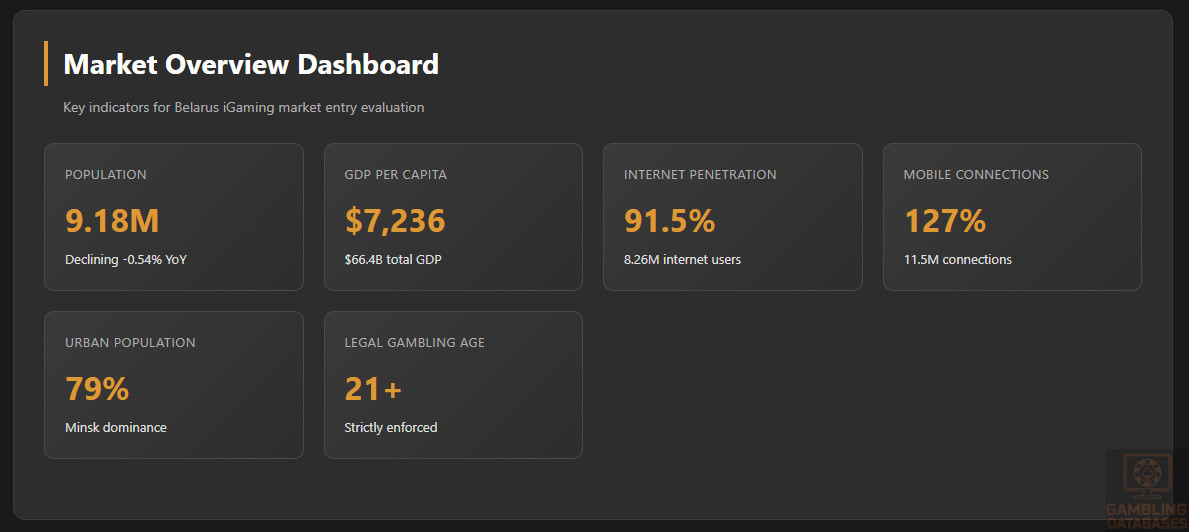
Executive Summary: Key Market Indicators
| Indicator | Value | Details |
|---|---|---|
| Online Gambling Legal Status | Fully Legal | Legalized April 2019 under Decree No. 305 |
| Regulatory Authority | Ministry of Taxes and Duties | Issues licenses, oversees compliance |
| Population | 9.18 million | Declining trend, -0.54% YoY (2023) |
| Median Age | 41.3 years | Aging population demographic |
| Urban Population | 79% | Concentrated in Minsk and major cities |
| GDP (2024) | $66.4 billion | GDP per capita: $7,236 USD |
| GDP Growth (2025 projected) | 2.8% | Slowing from 4.0% in 2024 |
| Inflation Rate (2024) | 5.2% | Moderate inflationary pressure |
| Internet Penetration | 91.5% | 8.26 million internet users |
| Mobile Connections | 127% of population | 11.5 million active connections |
| Smartphone Penetration | High | Android and iOS widely adopted |
| Social Media Users | 6.36 million (70.5%) | Strong digital engagement |
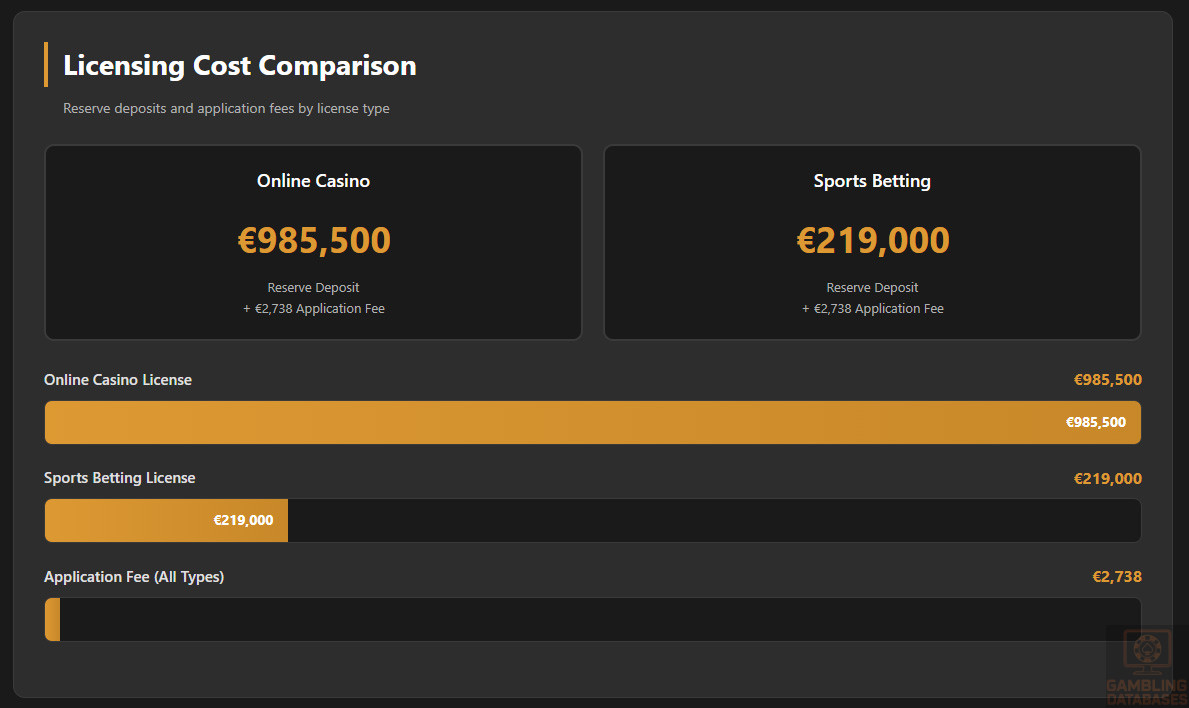
| Online Casino License Cost | €985,500 | Reserve deposit requirement |
| Sports Betting License Cost | €219,000 | Reserve deposit requirement |
| Application Fee | €2,737.50 | 250 base amounts |
| Effective Tax Rate | 4% | On positive difference (GGR) |
| Corporate Income Tax | 18% | Standard rate for operators |
| Player Winnings Tax | 4% | Withheld by operators |
| Legal Gambling Age | 21 years | Strictly enforced |
| Local Domain Requirement | Mandatory | .by or .бел domain required |
| Server Location | Belarus territory | Physical servers must be local |
| Bank Account Requirement | 2 accounts mandatory | Checking + reserve account |
| Number of Land-Based Casinos | 20+ | Concentrated in Minsk |
| Tax Revenue Growth (4-year) | 15% | Indicates market expansion |
| Foreign Ownership | Permitted | Subject to licensing requirements |
| Cryptocurrency Gambling | Prohibited | Despite legal crypto trading |
| Doing Business Rank | 49th globally | Moderate ease of business |
| Market Entry Timeline | 6-12 months | Including licensing process |
Section 1: Regulatory Framework and Legal Environment
Current Gambling Regulation Status
Belarus operates a fully legal and regulated gambling market for both land-based and online gambling activities. The regulatory framework was modernized in 2019 to accommodate digital gaming platforms, making Belarus one of the few post-Soviet states with comprehensive online gambling legislation.

Land-Based Gambling Activities
Casino Operations: Belarus hosts approximately 20 licensed land-based casinos, predominantly concentrated in the capital city Minsk. These establishments offer traditional table games including roulette, blackjack, poker, and craps, alongside slot machine gaming. The casino sector developed significantly after neighboring Russia banned gambling in 2008, positioning Belarus as an alternative destination for regional players.
Slot Machine Halls: Licensed slot machine halls operate separately from full-scale casinos and require distinct licensing. These facilities can offer electronic gaming machines outside the traditional casino environment. Taxation for slot machines is calculated on a per-device basis rather than on gross gaming revenue.
Sports Betting Venues: Land-based betting shops and bookmaker offices are permitted under license. These establishments can accept wagers on sporting events, with both retail locations and betting terminals available. The sports betting market has transitioned significantly toward online platforms since 2019.
Lotteries and Sweepstakes: State-supervised lottery operations are permitted, though these fall under separate regulatory provisions that exclude them from standard gambling business definitions. This creates a regulatory distinction that has been subject to scrutiny regarding player protection measures.
Online Gambling Framework
Online gambling was legalized through Presidential Decree No. 305 signed on August 7, 2018, with implementation beginning April 1, 2019. The legislation permits comprehensive online gambling offerings including virtual casino games, online poker, sports betting, and online bingo. All online operators must obtain formal licenses from the Ministry of Taxes and Duties.
Permitted Online Activities: Licensed operators can offer online casino games including slots, table games, video poker, and live dealer gaming. Sports betting and parimutuel wagering are permitted through licensed online platforms. Online poker rooms and bingo operations require appropriate licensing coverage.
Technical Requirements: Operators must use .by or .бел domain extensions for their platforms. Physical servers hosting the gambling platform must be located within Belarus territory. Random Number Generator (RNG) systems require certification by approved testing laboratories. All gaming software and platforms undergo technical inspection by the regulatory authority.
Prohibited Activities: Cryptocurrency gambling remains strictly prohibited despite Belarus having progressive cryptocurrency trading laws. Unlicensed international operators are subject to blocking measures, with the government authorizing banks to block gambling-related cross-border payments as of 2025. Marketing to minors is strictly forbidden.
Licensed Operators and Market Players
The Belarus gambling market features a mix of domestic operators and international brands that have obtained local licenses. The market concentration remains moderate, with several established players dominating market share while new entrants face significant capital and regulatory barriers.
Market Leaders: State-affiliated lottery operator RUP Belorusskiye Loterei operates the Belbet platform, which functions as an online lottery but offers casino-style games. International bookmakers including MaxLine and Marathon maintain market presence. The 888 poker room serves Belarusian players through licensed arrangements.
International vs Local Operators: Foreign companies can obtain licenses and operate in Belarus, though they must establish local presence and meet all technical requirements including server location. Many international brands have been cautious about entering due to political risk, sanctions exposure, and strict regulatory oversight.
Competitive Landscape: The market exhibits limited competition compared to Western European jurisdictions, primarily due to high entry barriers and political-economic uncertainties. Land-based casino operators have expanded into online channels, leveraging existing brand recognition. The sports betting segment shows higher fragmentation than casino gaming.
Licensing Framework and Requirements
Application Process and Eligibility
Regulatory Authority: The Ministry of Taxes and Duties of the Republic of Belarus serves as the sole licensing authority for all gambling activities. Applications must be submitted directly to the Ministry with complete documentation packages. The official website is nalog.gov.by.
Applicant Eligibility: Only registered legal entities or individual entrepreneurs can apply for gambling licenses. Foreign companies must either establish a Belarusian legal entity or operate through a licensed local partner. All shareholders and directors must pass background checks and demonstrate suitable integrity.
Financial Requirements: Online casino operators must maintain a reserve deposit of 90,000 base amounts, equivalent to approximately €985,500 as of 2022 rates. Sports betting and parimutuel operators face lower requirements at 20,000 base amounts (€219,000). The application fee itself is 250 base amounts (€2,737.50).
Technical Standards: Gaming software must undergo certification by approved testing laboratories. RNG systems require specific validation. Operators must demonstrate technical capability to implement required player protection measures including age verification, responsible gambling tools, and transaction monitoring systems.
Background Checks: All key personnel including management, shareholders, and beneficial owners undergo comprehensive background screening. Criminal records, tax claims, and previous gambling industry involvement are scrutinized. The process may take several months for international applicants.
Experience Requirements: Company managers must demonstrate over three years of experience in the gambling business industry. This requirement can be met through documented employment history or acquisition of shelf companies with established gambling credentials.
| License Type | Reserve Deposit | Application Fee | Processing Time |
|---|---|---|---|
| Online Casino (Virtual Gaming Institution) | €985,500 | €2,737.50 | 3-6 months |
| Online Sports Betting/Parimutuel | €219,000 | €2,737.50 | 3-6 months |
| Live Dealer Gaming (requires dual license) | €985,500 + venue costs | €2,737.50 | 4-8 months |
| Land-Based Casino | Varies by facility | €5,000 approx | 2-4 months |
| Slot Machine Hall | Per device calculation | €5,000 approx | 2-4 months |
| Bookmaking (Land-Based) | Performance bond required | €5,000 approx | 2-4 months |
Local Presence and Operational Requirements
Physical Office Requirements: All licensed operators must maintain a registered office address within Belarus territory. The management body of the company must be located in Belarus. While not requiring extensive staff presence, operators must demonstrate genuine business establishment beyond mail forwarding arrangements.
Server and Hosting Requirements: Gaming platforms must operate from servers physically located in Belarus. This infrastructure requirement adds costs and complexity, particularly for international operators accustomed to centralized hosting. The regulation aims to maintain governmental oversight and data access.
Domain Requirements: Operators must use .by or .бел (Cyrillic) domain extensions. Foreign domain names are subject to blocking. This requirement ensures easy identification of licensed operators versus illegal offshore platforms.
Banking Requirements: Operators must maintain two separate bank accounts with Belarusian banks. The checking account handles all operational payments to players. The reserve account must maintain the mandatory deposit amount, verified quarterly by regulators. International banking relationships require disclosure.
Personnel Requirements: Key management positions must be filled by individuals meeting experience and background check requirements. While full teams need not be Belarus-based, senior decision-makers must demonstrate meaningful connection to local operations. Customer support in Russian and Belarusian languages is expected.
Foreign Ownership Restrictions: No explicit restrictions prohibit foreign ownership of gambling licenses. However, the beneficial ownership structure must be fully disclosed and all owners must pass background checks. Shell company structures or opaque ownership face regulatory scrutiny and potential license denial.
Compliance Obligations and Monitoring
Player Protection and Identification
Age Verification: The minimum gambling age in Belarus is 21 years for all gambling activities, both online and land-based. Operators must implement robust age verification before allowing real-money play. The Interbank Identification System provides tools for player verification, though operators bear ultimate responsibility.
KYC and AML Requirements: Standard Know Your Customer protocols apply, requiring collection and verification of player identity documents. Anti-Money Laundering compliance follows international standards, with operators required to monitor transactions for suspicious patterns. Large transactions require enhanced due diligence.
Responsible Gambling Measures: Licensed operators must provide self-exclusion mechanisms allowing players to block their access. Reality checks and session time notifications must be implemented. Loss limits and deposit limits should be available as player tools. Information about gambling addiction support must be prominently displayed.
Self-Exclusion Systems: A centralized self-exclusion register does not currently exist, requiring operators to maintain individual exclusion lists. Players who self-exclude from one platform may still access others, representing a gap in player protection compared to more mature markets.
Mandatory Player Information: Terms and conditions must clearly outline payout rates, bonus terms, and dispute resolution procedures. Players must receive confirmation of deposits and withdrawals. Win probability information should be accessible. Contact information for gambling addiction support must be provided.
Financial Monitoring and Reporting
Transaction Monitoring: Operators must implement systems to track all financial transactions including deposits, wagers, winnings, and withdrawals. Unusual patterns require investigation and potential reporting to authorities. Integration with payment processors must allow full transaction traceability.
Reporting Requirements: Tax returns must be filed monthly detailing the calculation basis for gambling taxes. Quarterly verification of reserve account balances is mandatory. Annual audited financial statements must be submitted. Suspicious transaction reports go to financial intelligence units.
Audit and Inspection: Regulatory authorities conduct periodic audits of licensed operators. Technical systems including RNG and payout percentages undergo testing. Financial records, player databases, and compliance procedures face inspection. Operators must cooperate fully with regulatory examinations.
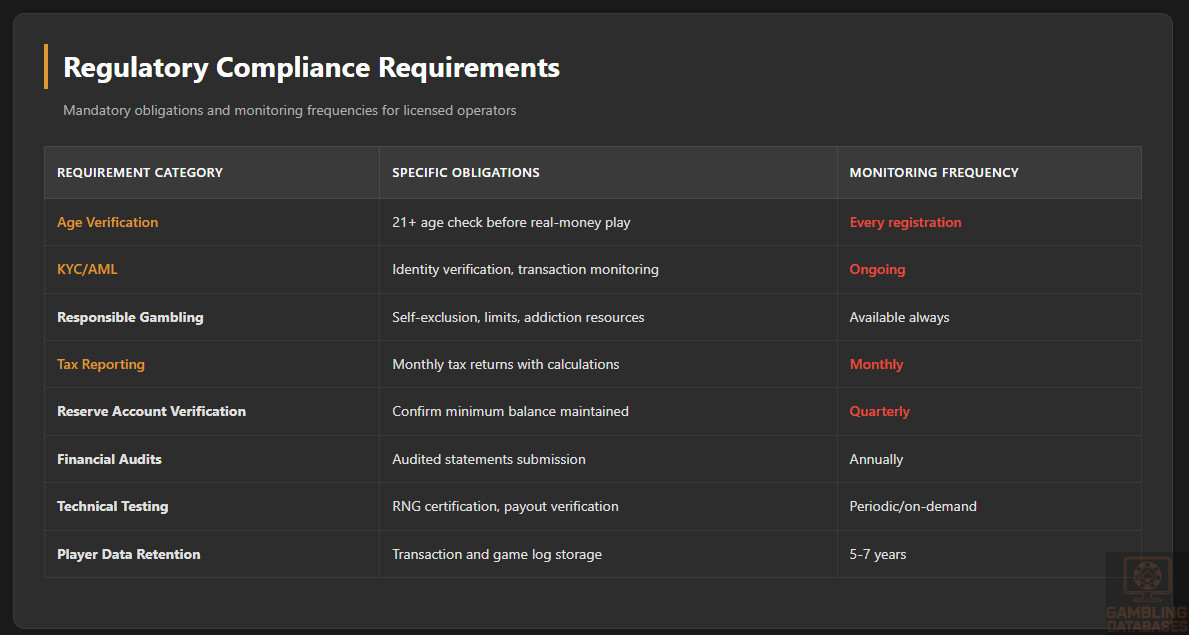
Data Retention: Player records, transaction histories, and game logs must be retained for specified periods to facilitate regulatory oversight and player dispute resolution. Retention periods typically span 5-7 years for financial records.
| Requirement Category | Specific Obligations | Monitoring Frequency |
|---|---|---|
| Age Verification | 21+ age check before real-money play | Every player registration |
| KYC/AML | Identity verification, transaction monitoring | Ongoing |
| Responsible Gambling | Self-exclusion, limits, addiction resources | Available always |
| Tax Reporting | Monthly tax returns with calculations | Monthly |
| Reserve Account Verification | Confirm minimum balance maintained | Quarterly |
| Financial Audits | Audited statements submission | Annually |
| Technical Testing | RNG certification, payout verification | Periodic/on-demand |
| Player Data Retention | Transaction and game log storage | 5-7 years |
Taxation Structure and Financial Obligations
Player Taxation
Tax on Winnings: A 4% tax applies to player winnings from licensed sports betting operations. This tax is withheld automatically by operators and remitted to tax authorities. Players do not need to file separate tax declarations for these winnings.
Withholding Procedures: Operators calculate the tax due on each winning bet or game outcome and deduct it before crediting the player’s account. Monthly reporting details total winnings paid and tax amounts withheld. Failure to properly withhold player taxes results in operator liability.
Tax-Free Thresholds: No specific tax-free threshold exists for gambling winnings in Belarus. All positive player outcomes from sports betting are subject to the 4% withholding tax. Casino and slot machine winnings may face different tax treatment.
Operator Taxation
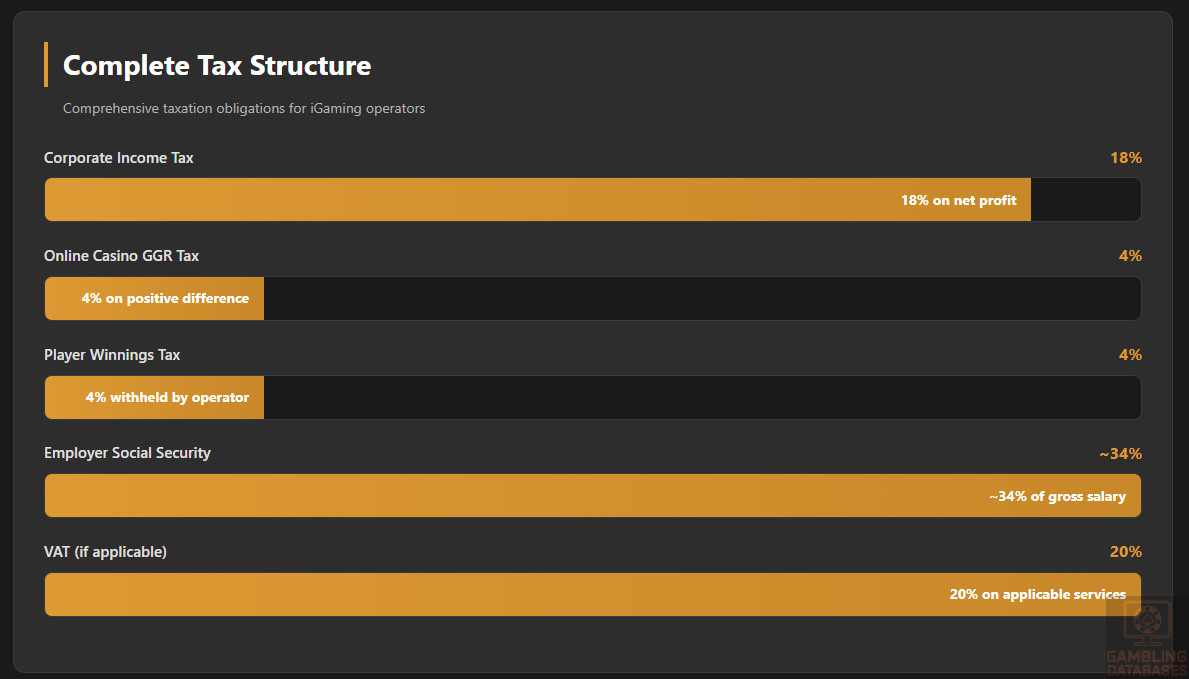
Gross Gaming Revenue Tax: The effective gambling tax rate is 4% on the positive difference between total bets accepted and total payouts made. This applies to virtual gaming institutions (online casinos). The calculation provides a GGR-based taxation model common in international markets.
Land-Based Taxation: Casinos and slot halls face fixed-rate taxation per gaming device or table rather than percentage-based GGR taxes. Per-table and per-machine rates are set by regulation and subject to periodic adjustment. These rates increased significantly in recent years.
Corporate Income Tax: Standard corporate income tax of 18% applies to gambling operators’ profits. This is calculated on net income after deducting operating expenses and gambling-specific taxes. International tax treaties may affect withholding requirements for foreign shareholders.
License Fees: Annual license renewal fees must be paid to maintain operating authority. Application fees of approximately €2,738 apply when modifying license scope or adding new activities. Special duty payments may be required for specific license categories.
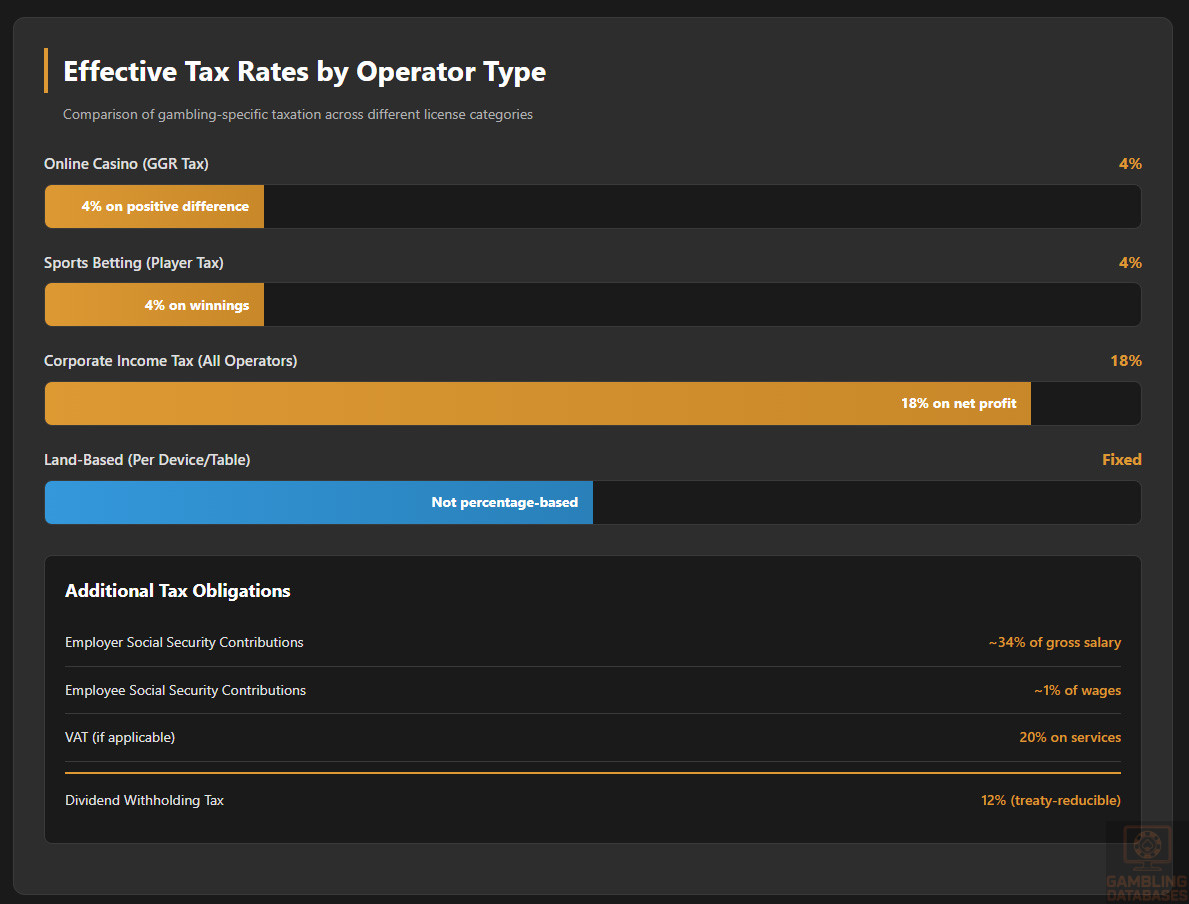
Social Contributions: Employer social security contributions apply to all staff employed in Belarus, typically around 34% of gross salary. Employee contributions add approximately 1% of wages. These rates apply to both local and foreign employees working in Belarus.
| Tax Type | Rate/Amount | Calculation Basis | Payment Frequency |
|---|---|---|---|
| Online Casino GGR Tax | 4% | Bets minus payouts (positive difference) | Monthly |
| Sports Betting Player Tax | 4% | Player winnings | Monthly (withheld) |
| Corporate Income Tax | 18% | Net profit | Quarterly/Annual |
| VAT (if applicable) | 20% | Applicable services | Monthly |
| Employer Social Security | ~34% | Gross salaries | Monthly |
| Employee Social Security | ~1% | Gross salaries | Monthly |
| Land-Based Slot Machine | Fixed rate/device | Per machine annually | Annually |
| Land-Based Gaming Table | Fixed rate/table | Per table annually | Annually |
Gambling Market Financial Performance
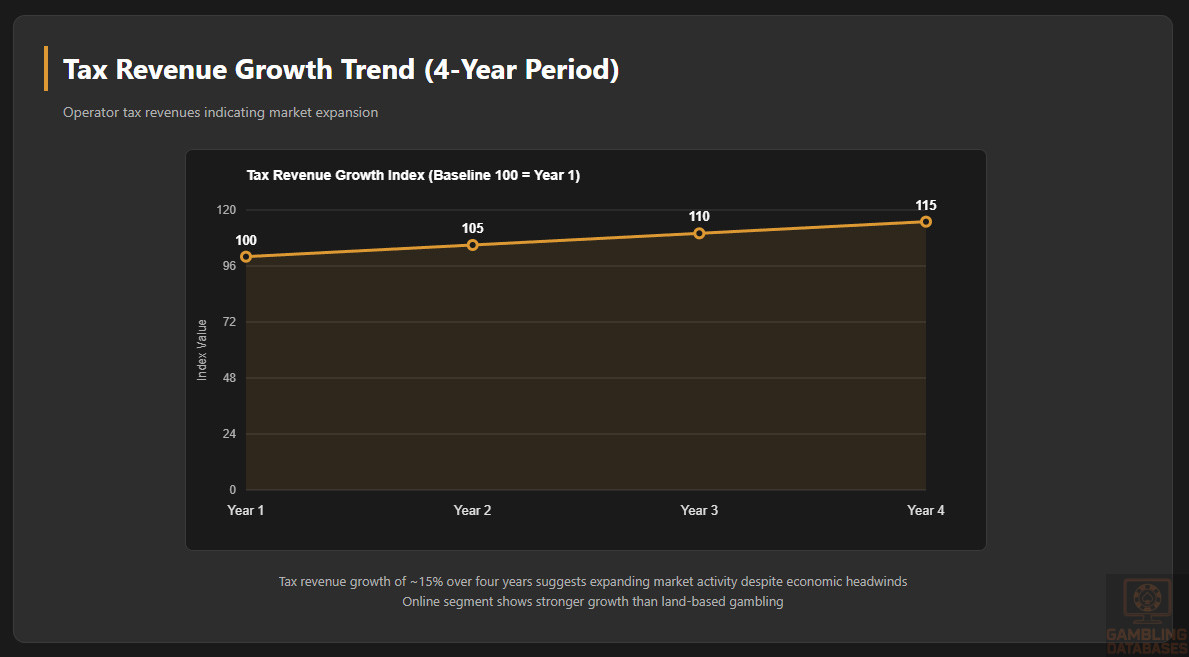
Market Revenue Trends: While exact total market revenue figures are not published by authorities, tax revenue data indicates consistent market growth. Operator tax revenues have increased approximately 15% over the past four years, suggesting expanding market activity despite economic headwinds.
Revenue Distribution: The market includes both land-based and online channels. Online platforms have been gaining market share rapidly since legalization in 2019, driven by high internet penetration (91.5%) and mobile adoption. Sports betting represents a significant portion of online activity.
Growth Trajectory: The online segment shows stronger growth compared to land-based gambling, following global trends. The number of land-based casinos has declined from historical peaks to approximately 20 establishments currently, while online operators have increased. Political and economic factors impact growth rates.
Advertising and Marketing Restrictions
Permitted Advertising Channels: Licensed gambling operators can advertise through various media channels including television, radio, print media, outdoor advertising, and online platforms. All advertising must clearly identify the advertiser and include responsible gambling messaging.
Content Restrictions: Gambling advertisements cannot target minors or feature individuals appearing underage. Marketing materials must not suggest gambling as a solution to financial problems or portray excessive gambling positively. False or misleading claims about winning odds are prohibited.
Time Restrictions: Television and radio gambling advertisements may face time-of-day restrictions to minimize exposure to minors, though specific watershed periods are not comprehensively defined in available regulations. Operators should verify current broadcast restrictions.
Sponsorship Regulations: Gambling operators can sponsor sports teams, events, and broadcasts subject to compliance with advertising content rules. Sports sponsorship represents a significant marketing avenue, particularly for sports betting brands. Brand visibility at sporting events requires appropriate disclosures.
Affiliate Marketing: Affiliate marketing is permitted within the general advertising framework. Affiliates promoting licensed operators must adhere to the same content restrictions as operators themselves. Misleading affiliate promotions can result in operator liability.
Bonus and Promotion Restrictions: While operators can offer bonuses and promotions, these must be clearly explained with terms and conditions readily accessible. Wagering requirements, time limits, and game restrictions must be transparent. Promotions cannot encourage irresponsible gambling behavior.
Marketing to Minors Prohibition: All gambling marketing strictly prohibits targeting individuals under 21 years of age. Advertising placements must avoid media primarily consumed by minors. Social media marketing requires age-gating and responsible placement strategies.
Recent Regulatory Changes and Their Impact
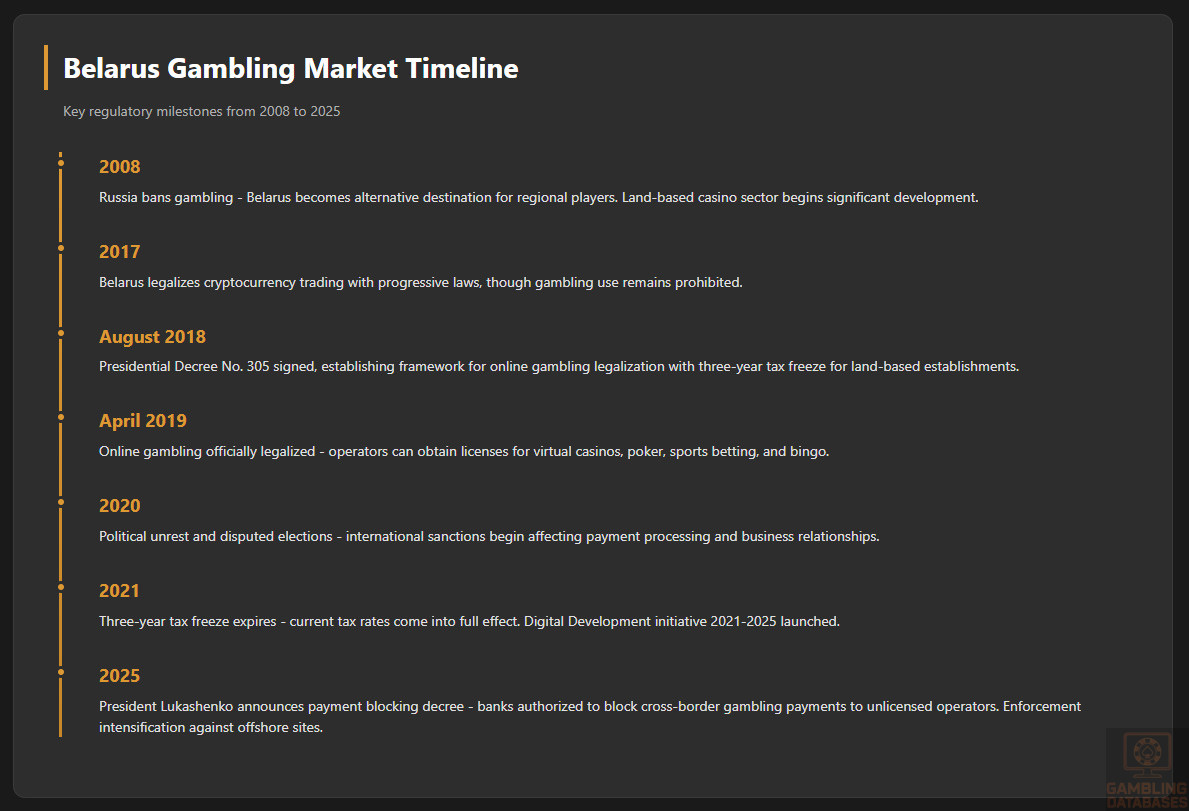
2025 Payment Blocking Decree: In 2025, President Lukashenko announced new measures authorizing banks to block cross-border gambling payments to foreign operators. This aims to halt capital outflow and protect the domestic licensed market. The decree significantly increases enforcement against unlicensed operators.
Enforcement Intensification: The government has strengthened capabilities to block unlicensed international gambling websites. ISP-level blocking combined with payment restrictions creates a more closed market environment. Licensed operators benefit from reduced unlicensed competition but face stricter oversight.
Cryptocurrency Gambling Ban Clarification: Despite Belarus having progressive cryptocurrency trading laws since 2017, gambling using digital currencies remains explicitly prohibited. This clarification closes a potential loophole and maintains strict currency control in gambling transactions.
Three-Year Tax Freeze (Expired): Presidential Decree 305 included a three-year tax freeze for land-based gambling establishments from 2018-2021. This freeze has expired, and current tax rates apply. The measure aimed to stabilize the sector during online gambling legalization.
Online Gambling Legalization Impact: The 2019 legalization of online gambling fundamentally transformed the market. Operators gained legal pathways to serve Belarusian players digitally. However, strict requirements including server location and domain restrictions limit the number of active licensees.
Future Regulatory Direction: The government has indicated continued market development balanced with social responsibility concerns. President Lukashenko’s 2025 comments about gambling “thriving a little too well” suggest potential for additional restrictions or taxation increases. Regulatory stability remains uncertain.
Enforcement Mechanisms and Penalties
License Suspension and Revocation: Serious compliance violations can result in temporary license suspension or permanent revocation. Operators losing licenses must cease all operations immediately and settle outstanding player balances. Appeals processes exist but provide limited relief for major violations.
Financial Penalties: Monetary fines apply to various compliance failures including improper tax reporting, inadequate player protection measures, and advertising violations. Fine amounts scale with violation severity and can reach substantial sums that impact operator profitability.
Website Blocking: Unlicensed operators face ISP-level blocking of their websites and platforms. The government maintains technical capabilities to identify and block gambling sites without .by domains or proper licensing. Circumvention through VPNs occurs but represents illegal access.
Payment Processing Restrictions: Banks are authorized to block payments to unlicensed gambling operators under 2025 regulations. This enforcement mechanism targets the financial flows supporting illegal gambling, complementing website blocking efforts. Licensed operators benefit from exclusive payment access.
Criminal Penalties: Operating unlicensed gambling activities can result in criminal charges under Belarusian law. Individuals organizing illegal gambling face potential imprisonment alongside financial penalties. The severity of criminal sanctions deters unlicensed market entry.
Recent Enforcement Actions: Authorities have demonstrated willingness to enforce gambling regulations through website blocking and payment restrictions. The 2025 presidential decree signals intensified enforcement focus. Licensed operators face audits and inspections ensuring ongoing compliance.
Section 2: Demographics and Consumer Analysis
Population Demographics and Distribution
Core Population Metrics
Total Population: Belarus has a population of approximately 9.18 million people as of 2025. The population has been declining slowly, with a -0.54% decrease recorded between 2022 and 2023. This demographic trend reflects broader regional patterns affecting Eastern European countries.
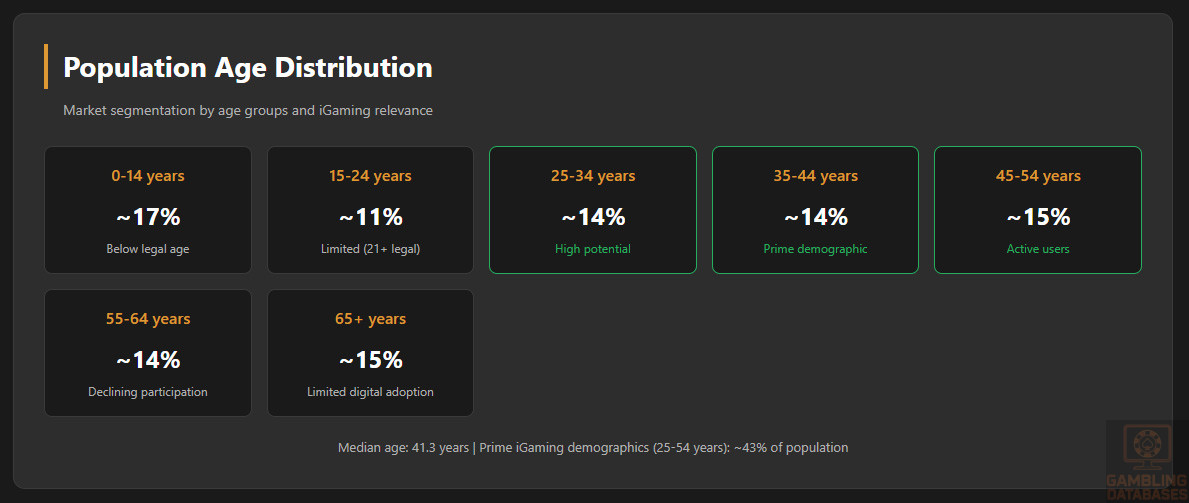
Age Distribution: The median age is 41.3 years, indicating an aging population structure. The population skews older compared to global averages, with significant portions in middle-age brackets. Youth cohorts (under 25) represent a smaller percentage, impacting long-term market demographics.
Life Expectancy and Gender: Belarus has relatively balanced gender ratios with slight female majority typical of aging populations. Life expectancy rates are moderate for the region. The healthcare system maintains high doctor-to-patient ratios (40.7 per 10,000 inhabitants).
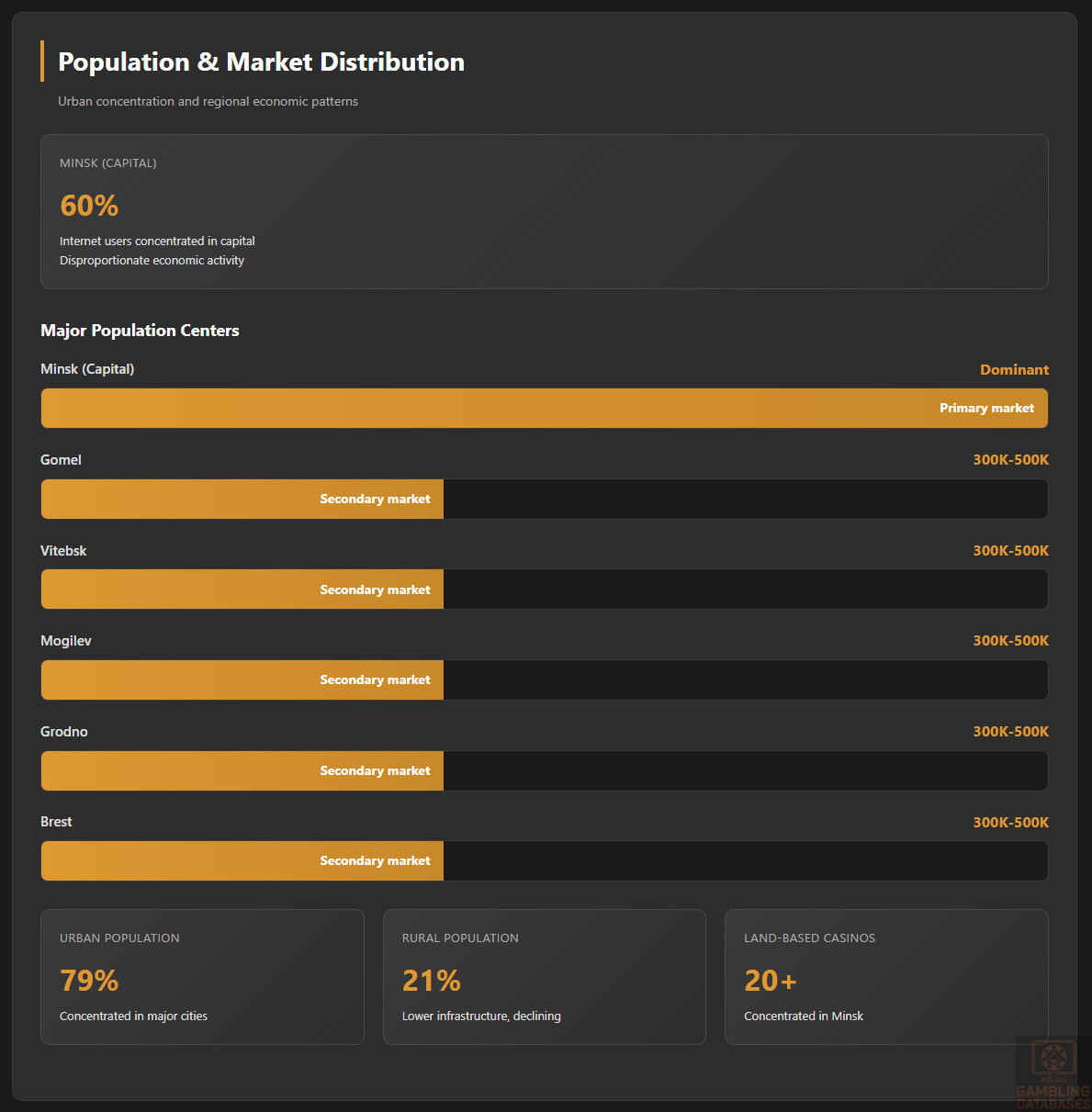
Urban vs Rural Distribution: Approximately 79% of the population resides in urban areas, with significant concentration in major cities. Minsk, the capital, dominates with substantial population density. Rural areas face declining populations and lower infrastructure development.
| Age Group | Percentage | iGaming Relevance |
|---|---|---|
| 0-14 years | ~17% | Below legal age, no market |
| 15-24 years | ~11% | Limited (21+ legal age) |
| 25-34 years | ~14% | High potential, tech-savvy |
| 35-44 years | ~14% | Prime gambling demographic |
| 45-54 years | ~15% | Established income, active |
| 55-64 years | ~14% | Declining participation |
| 65+ years | ~15% | Limited digital adoption |
Geographic Distribution
Minsk Dominance: The capital city Minsk contains a disproportionate share of the national population and economic activity. Internet users are 60% concentrated in Minsk according to historical data. This concentration affects gambling venue placement and digital marketing strategies.
Major Cities: Beyond Minsk, significant population centers include Gomel, Vitebsk, Mogilev, Grodno, and Brest. These regional capitals offer secondary market opportunities for both land-based and online gambling operators. Population ranges from 300,000 to 500,000 in these cities.
Regional Economic Differences: Minsk and surrounding regions show higher income levels and economic development compared to peripheral areas. Western regions near EU borders may have different economic characteristics than eastern regions bordering Russia. This geographic variation impacts consumer spending power.
Internet Access Patterns: Urban areas enjoy near-universal high-speed internet access with extensive fiber-optic coverage. Rural areas have lower connectivity rates despite government infrastructure investment. Mobile internet helps bridge rural connectivity gaps with 4G coverage reaching 99% of the population.
Economic Indicators and Consumer Spending Power
GDP and Economic Performance
Current GDP: Belarus GDP stands at approximately $66.4 billion in 2024, with GDP per capita around $7,236 USD. The economy ranks 74th globally by total GDP, positioning Belarus as a middle-income country within the post-Soviet space.
GDP Growth Forecasts: Economic growth is projected at 2.8% for 2025 by the IMF, slowing from 4.0% in 2024. Growth decelerated to 3.0% year-over-year in Q1 2025. The government’s economic stimulus efforts face constraints from trade deficits and macroeconomic imbalances.
Economic Structure: Services dominate the economy, with agriculture contributing approximately 7% of GDP and employment. Manufacturing and state enterprises maintain significant presence. The economy remains heavily state-controlled with limited privatization compared to other transition economies.
Employment and Wages: Labor shortages drive wage increases, with real wage growth supporting household consumption. Average salaries were increased to approximately $500 per month before the 2011 crisis. Current wage levels vary significantly by sector and region.
Income and Wealth Distribution
Average Household Income: Monthly household incomes average several hundred dollars, though precise current figures require verification. The country experienced salary manipulations around election periods historically. Income levels remain substantially below Western European standards but comparable to regional neighbors.
Income Inequality: Belarus maintains one of the lowest Gini coefficients in Europe according to UN data, reflecting relatively compressed income distribution. The state-controlled economy and social welfare policies reduce extreme inequality compared to more market-oriented economies.
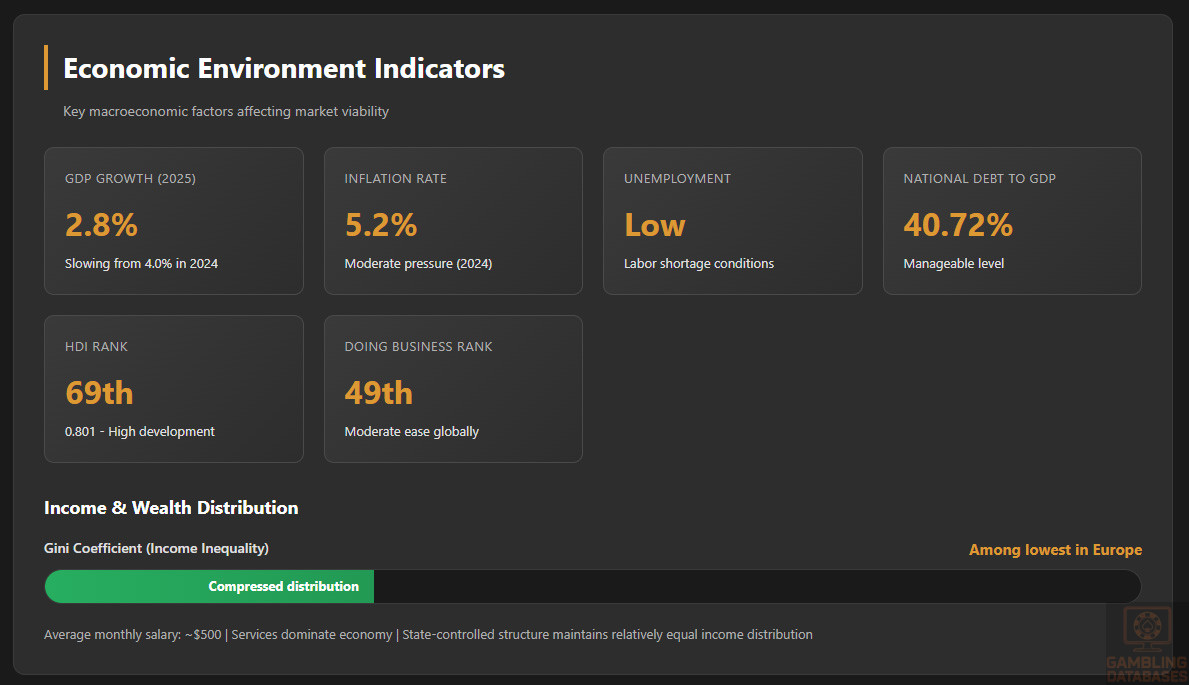
Disposable Income Trends: Disposable income growth faces pressure from inflation running at 5.2% annually as of December 2024. Currency devaluation against hard currencies impacts purchasing power for imported goods and services. Consumer spending shows resilience despite economic headwinds.
Middle Class Development: A modest middle class exists primarily in urban centers, particularly Minsk. This demographic segment represents the core target market for iGaming operators. However, middle-class size and stability face challenges from economic volatility and political uncertainty.
| Indicator | Value (2024-2025) | Trend |
|---|---|---|
| GDP Total | $66.4 billion | Stable |
| GDP Per Capita | $7,236 | Moderate growth |
| GDP Growth Rate (2025) | 2.8% projected | Slowing |
| Inflation Rate | 5.2% | Moderate pressure |
| Unemployment | Low (labor shortage) | Tight labor market |
| National Debt to GDP | 40.72% | Manageable |
| Human Development Index | 0.801 (69th globally) | High development |
| Gini Coefficient | Among lowest in Europe | Low inequality |
Market Size and Growth Projections
Current Market Revenue: Precise total iGaming market revenue figures are not publicly disclosed by Belarusian authorities. However, operator tax revenue growth of approximately 15% over four years indicates expanding market activity. The market remains relatively small compared to Western European jurisdictions.
Historical Growth Trends: The online gambling segment has grown substantially since legalization in April 2019. Land-based casino numbers have contracted from peaks during the 2008-2015 period when Belarus served as a gambling destination for Russian players. The market shift toward digital channels mirrors global trends.
Revenue Forecasts: Market growth projections must account for political risk, economic volatility, and potential regulatory changes. The 2025 presidential comments about gambling “thriving too well” signal possible future restrictions. Conservative growth estimates appear prudent given these uncertainties.
Market Penetration Rates: While specific gambling participation rates are not widely published, internet penetration of 91.5% provides the infrastructure for online gambling adoption. Mobile penetration at 127% of population enables widespread mobile gaming access. Actual gambling participation likely remains below Western European levels.
Average Revenue Per User: ARPU data specific to Belarus gambling market is not readily available in public sources. Regional comparisons suggest moderate ARPU levels reflecting income constraints. Operators should expect lower ARPU than Western markets but potentially higher than some developing economies.
Online vs Land-Based Split: The market shows accelerating shift toward online channels. Land-based casino numbers declined from historical highs to approximately 20 establishments currently. Online convenience, mobile access, and COVID-19 impacts have accelerated digital adoption among Belarusian gamblers.
Education, Skills, and Digital Literacy
Educational Foundation
Literacy Rates: Belarus maintains near-universal literacy at approximately 99%, reflecting the strong Soviet educational legacy. Both male and female populations demonstrate high literacy rates. This foundation supports digital service adoption including online gambling.
Education Levels: Tertiary education completion rates are relatively high compared to global averages. The population demonstrates strong technical and mathematical education backgrounds. University education remains accessible, contributing to skilled workforce development.
Digital Literacy: The population shows high digital literacy rates, particularly among urban residents and younger demographics. Technical education emphasis creates a population comfortable with digital platforms and online services. This facilitates online gambling adoption.
Workforce Skills: Belarus maintains a technically skilled workforce, particularly in IT and software development. The government promotes digital economy development. This skills base supports both gambling operator employment and sophisticated consumer usage of digital gambling platforms.
Cultural and Social Factors
Communication and Language
Primary Languages: Russian and Belarusian serve as official languages, with Russian dominant in daily use, particularly in urban areas. Minsk and major cities are predominantly Russian-speaking. Belarusian language maintains cultural importance but sees limited daily use outside rural areas.
Internet Language Preferences: Online content consumption occurs primarily in Russian. Gambling platforms must offer Russian language interfaces and customer support. English language capabilities exist among educated urban populations but cannot be assumed for mass market appeal.
Business Communication: Business interactions typically occur in Russian. Government documentation may be in Russian or Belarusian. International operators require Russian-speaking staff and localized materials. Translation quality significantly impacts user experience and trust.
Cultural Attitudes Toward Gambling
Gambling Acceptance: Gambling enjoys moderate social acceptance in Belarus, lacking the intense stigma present in some societies. The land-based casino sector’s historical presence normalized gambling activities. However, problem gambling concerns exist, influencing regulatory approaches.
Religious Influences: Belarus is predominantly Eastern Orthodox Christian with significant Catholic minority and secular population. Religious opposition to gambling exists but does not dominate public policy. The state maintains secular governance with limited religious influence on gambling regulation.
Foreign Brand Perception: International brands face mixed reception. Some consumers trust established Western operators more than local brands. However, political tensions and state media influence can create suspicion of foreign companies. Localized branding strategies may prove beneficial.
Risk Tolerance: The population demonstrates moderate risk tolerance shaped by economic volatility experiences. Currency crises and economic instability have created cautious consumer behavior. However, gambling participation indicates willingness to accept entertainment risk within budget constraints.
Problem Gambling and Social Considerations
Gambling Addiction Prevalence: Specific problem gambling prevalence rates for Belarus are not widely published in international research. However, concerns about gambling harm inform regulatory approaches. The government has acknowledged social costs necessitating responsible gambling measures.
At-Risk Populations: Youth and young adults may face higher gambling addiction risks, though the 21+ age restriction provides some protection. Lower-income populations potentially vulnerable to gambling harm. Gender patterns of problem gambling require further research in the Belarusian context.
Government Response Programs: Responsible gambling requirements exist within licensing framework, though comprehensive treatment infrastructure may be limited. Self-exclusion tools must be provided by operators. Government investment in problem gambling treatment and prevention appears limited compared to mature markets.
Social Responsibility Requirements: Licensed operators face obligations to implement player protection measures including self-exclusion, reality checks, and access to gambling addiction resources. However, enforcement rigor and operator compliance quality vary. No mandatory problem gambling fund contributions are specified in available regulations.
Underage Gambling Concerns: The state lottery platform Belbet faces criticism for inadequate age verification, allowing minors to gamble. This controversy highlights enforcement gaps despite regulatory requirements. Licensed casino operators face stricter oversight but must maintain vigilance on age verification.
Political Structure and Governance
Government System: Belarus operates as a presidential republic under President Alexander Lukashenko’s authoritarian rule since 1994. Political power is highly centralized with limited democratic accountability. This concentration affects business environment predictability and regulatory decision-making.
Political Stability Indicators: The country experiences political tensions following disputed elections and civil unrest, particularly in 2020. International sanctions impact economic relations. Political risk represents a significant consideration for foreign investors in all sectors including iGaming.
Regulatory Consistency: Regulatory decisions can shift based on political priorities and presidential directives. The 2025 gambling payment restriction decree exemplifies sudden policy changes. Operators face unpredictability in regulatory environment requiring flexible business strategies.
Corruption Perception: Belarus ranks moderately on international corruption indices. State control of economy creates opportunities for arbitrary decision-making. Licensing processes require careful navigation with appropriate legal counsel. Transparency varies across government interactions.
International Relations Impact: Western sanctions following political crackdowns affect payment processing, banking relationships, and business partnerships. Belarus maintains close ties with Russia, influencing economic and regulatory alignment. EU tensions impact cross-border business operations.
Technology Adoption and Digital Behavior
Internet and Digital Usage
Internet Penetration: Belarus achieves 91.5% internet penetration with 8.26 million users as of January 2025. This represents one of the highest rates in Eastern Europe. Penetration increased steadily but showed a slight -0.6% decline between January 2024 and 2025.
Daily Internet Usage: Belarusians demonstrate heavy internet usage patterns common in digitally developed countries. Social media engagement reaches 70.5% of population (6.36 million users). Daily internet activities include social media, entertainment, e-commerce, and information consumption.
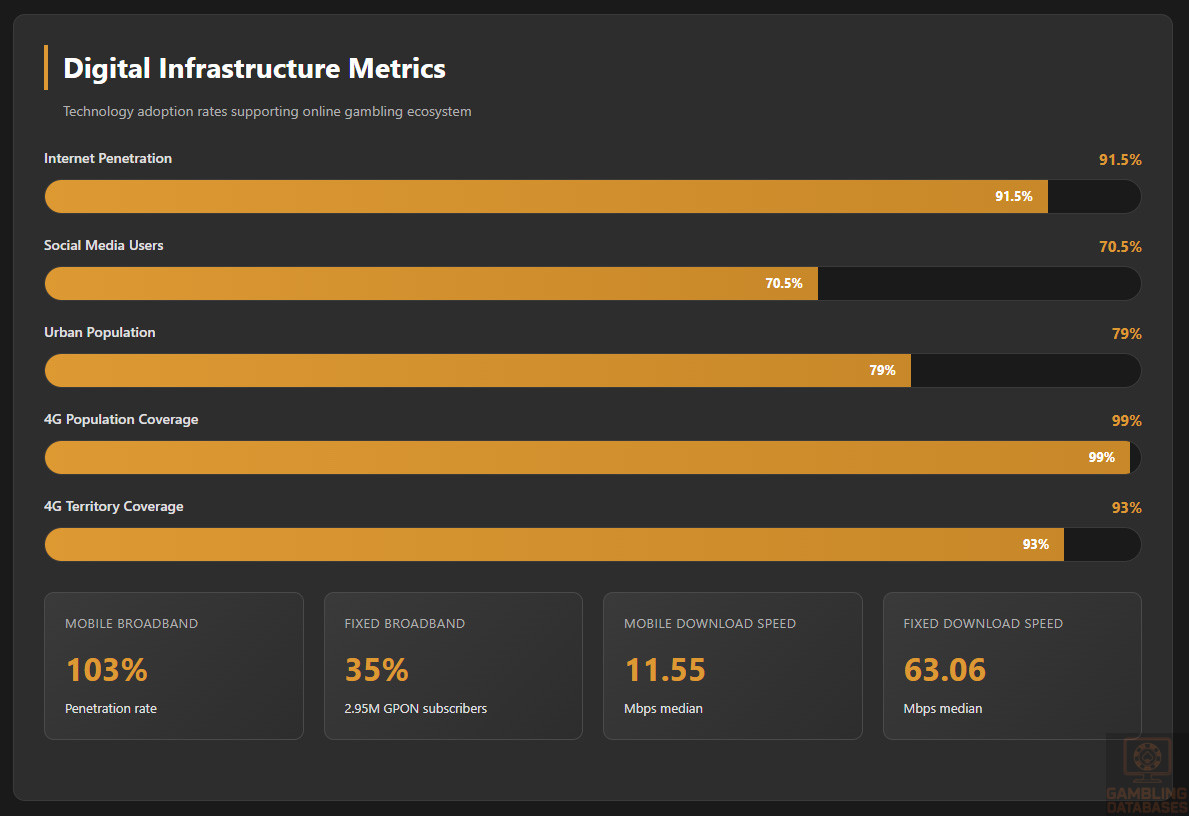
Mobile Device Adoption: Mobile connections total 11.5 million, equivalent to 127% of population. Multiple device ownership per person is common. Smartphone penetration is high with both Android and iOS platforms widely adopted. Mobile internet access enables ubiquitous connectivity.
Social Media Engagement: Social media user base of 6.36 million represents substantial platform for customer acquisition and engagement. Popular platforms provide advertising and community-building opportunities. Social media marketing must navigate political content sensitivities.
E-commerce Participation: Online shopping has grown substantially, accelerated by COVID-19 pandemic. Consumers demonstrate comfort with online transactions and digital payments. This e-commerce familiarity transfers to online gambling adoption. Trust in online platforms continues developing.
Digital Payment Behavior
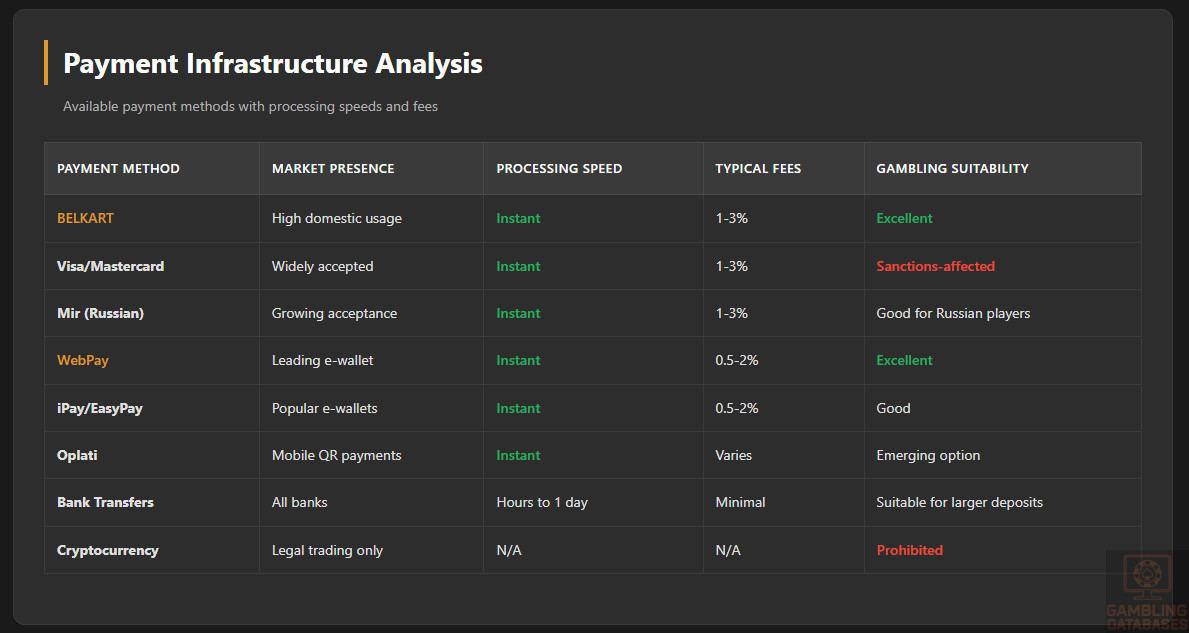
Payment Method Preferences: Bank cards (Visa, Mastercard, BELKART) dominate consumer payments. The national BELKART system provides domestic alternative to international networks. E-wallets including WebPay, iPay, and EasyPay serve online transactions. Cash usage persists but declines in urban areas.
Popular Digital Wallets: BELKART wallets, WebPay, iPay, EasyPay, and Oplati represent the leading digital payment solutions. The ERIP (Unified Settlement and Information Space) system facilitates various online payments. Mobile payment apps including Belkart Pay, A1 Banking, and Swoo Pay enable contactless payments.
Online Transaction Patterns: Consumers make regular online payments for utilities, telecommunications, and e-commerce purchases. ERIP system normalization creates comfort with digital financial interactions. Transaction frequencies and sizes reflect income levels and spending patterns.
Trust in Online Payments: Consumer trust in digital payments has grown substantially. Bank-issued instruments and regulated payment systems provide security confidence. However, concerns about fraud and data security persist. Established payment brands inspire greater trust than unknown processors.
Cryptocurrency for Gambling: Despite Belarus having progressive cryptocurrency trading laws since 2017, gambling using digital currencies remains prohibited. Crypto trading is legal and tax-free until 2023 expiration, but payment for goods and services with cryptocurrency is forbidden. This prohibition extends to gambling transactions.
| Payment Method | Market Presence | Gambling Suitability |
|---|---|---|
| BELKART (National Card System) | High domestic usage | Excellent for local players |
| Visa/Mastercard | Widely accepted (sanctions impact) | Good but sanctions-affected |
| Mir (Russian System) | Growing acceptance | Useful for Russian players |
| WebPay | Leading e-wallet | Excellent for online gambling |
| iPay/EasyPay | Popular e-wallets | Good online options |
| Oplati | Mobile QR payment app | Emerging mobile solution |
| Bank Transfers | Available through all banks | Suitable for larger deposits |
| Cryptocurrency | Legal trading, illegal for payments | Prohibited for gambling |
Gaming and Gambling Preferences
Current Market Participation
Gambling Participation Rates: Specific percentage of population engaging in gambling annually is not widely published. Historical data indicated internet users in 17-22 age group showed highest online activity (38% of users), followed by 23-29 age group. Actual gambling participation likely lower than general internet usage.
Online Gambling Adoption: Online gambling participation has grown since 2019 legalization. Initial player reluctance to digital platforms has gradually overcome as consumers gain comfort with online transactions. Mobile gambling access accelerates adoption rates.
Popular Gambling Activities: Sports betting represents significant market segment, reflecting strong sports interest in Belarus. Casino games including slots and table games attract substantial participation. Lottery products maintain traditional appeal. Live dealer games are growing in popularity.
Sports Betting vs Casino Preference: Sports betting enjoys strong cultural affinity given ice hockey, football, and other sports popularity. Casino games appeal to different demographic segments seeking varied entertainment. Market data suggests sports betting commands significant share of online gambling activity.
Consumer Behavior Patterns
Average Spending Per Player: Specific monthly or annual spending data per player is not readily available. Income levels suggest moderate gambling budgets compared to Western markets. ARPU expectations should account for disposable income constraints and economic conditions.
Platform Preferences: Mobile gambling shows strong growth trajectory given smartphone penetration and mobile internet adoption. Desktop usage remains significant, particularly for longer gaming sessions. Mobile-first platform strategies align with global trends and local infrastructure capabilities.
Peak Gambling Times: Evening hours and weekends likely represent peak gambling activity periods following global patterns. Seasonal variations may occur around holidays, major sporting events, and salary payment dates. Sports betting spikes during major tournaments and leagues.
Session Length and Frequency: Detailed session analytics specific to Belarus market are not publicly available. Operators should monitor their own data for platform-specific patterns. Regional comparisons suggest moderate session lengths reflecting disposable time and income.
Bonus Sensitivity: Price-conscious consumers in moderate-income markets typically demonstrate high bonus sensitivity. Promotional offers significantly influence player acquisition and retention. Competitive bonus structures are important for market entry and player attraction.
Preferred Game Types: Slots typically dominate online casino play given low entry barriers and entertainment value. Table games attract more sophisticated players. Live dealer games combine social interaction with authentic casino experience. Sports betting preferences follow popular sports including hockey, football, and basketball.
| Metric | Value/Status | Operator Impact |
|---|---|---|
| Internet Penetration | 91.5% | Excellent market reach potential |
| Mobile Connections | 127% of population | Mobile-first strategy essential |
| Social Media Users | 70.5% of population | Strong digital marketing channels |
| Smartphone Penetration | High | Mobile apps critical |
| E-commerce Adoption | Growing rapidly | Online payment comfort increasing |
| Digital Literacy | High (99% literacy) | Sophisticated user base |
| Preferred Language | Russian dominant | Russian localization mandatory |
| Payment Preferences | Cards, e-wallets, bank transfers | Diverse payment integration needed |
Section 3: Technology Infrastructure and Business Environment
Internet and Digital Infrastructure
Connectivity and Network Performance
Infrastructure Quality Assessment: Belarus maintains highly developed ICT infrastructure ranking among Eastern Europe’s leaders. Fiber-optic network coverage is second highest in Europe behind only Iceland. Government investment in digital infrastructure has created robust connectivity supporting online services including gambling.
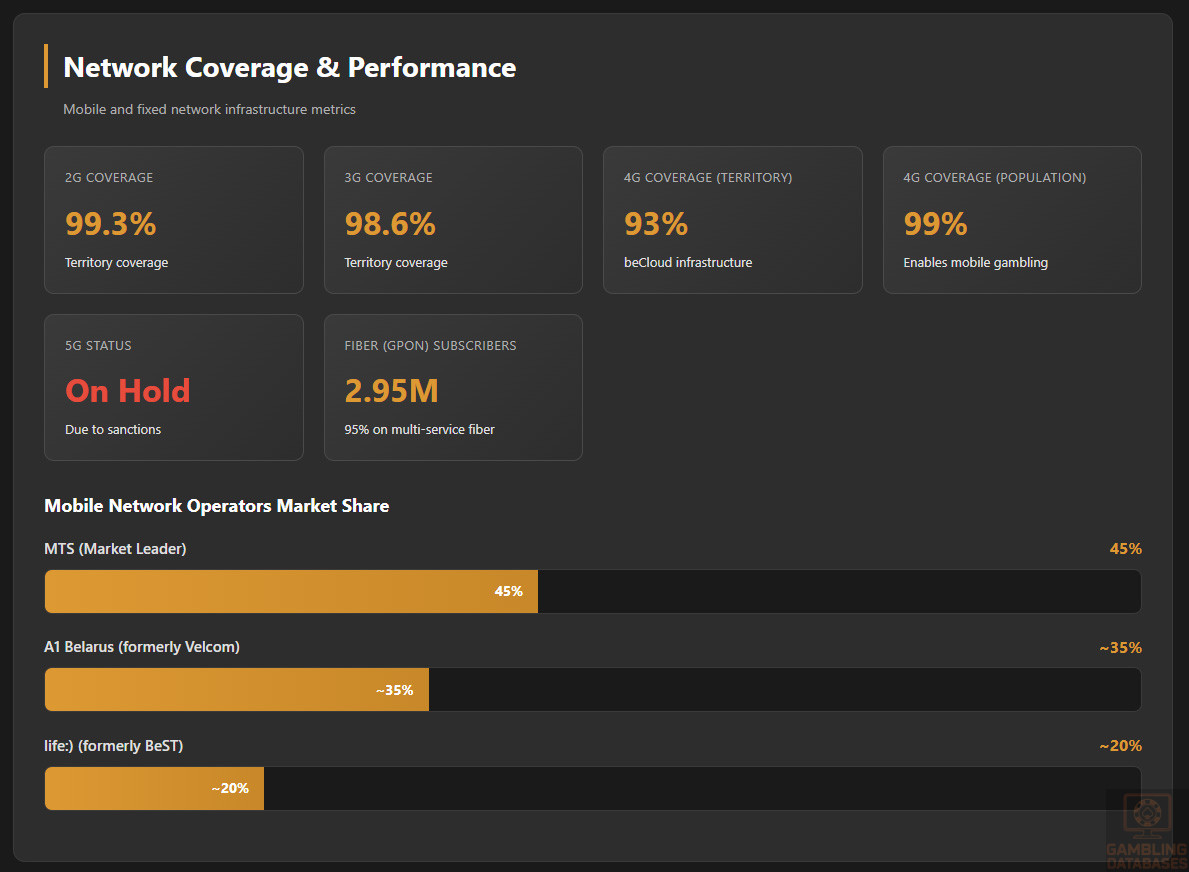
Fixed Broadband vs Mobile Internet: Fixed broadband penetration reaches 35% of population with 2.95 million GPON (fiber-optic) subscribers by end of 2023. Mobile broadband penetration achieves 103% reflecting multiple device ownership. Both fixed and mobile internet provide reliable gambling platform access.
Internet Speeds: Median mobile broadband download speed reached 11.55 Mbps as of May 2024. Median fixed-broadband download speed achieved 63.06 Mbps. These speeds comfortably support online gambling platforms, live dealer games, and streaming content.
Network Reliability: Uptime statistics indicate generally reliable internet service. State-controlled infrastructure provider Beltelecom maintains the backbone network. Fiber-optic technology provides stable connectivity. Political events have occasionally resulted in internet disruptions affecting access.
Infrastructure Investment: Government programs including the 2021-2025 Digital Development initiative continue upgrading infrastructure. GPON fiber deployment aims for nationwide coverage. By mid-2024, 95% of Beltelecom’s subscribers used multi-service fiber networks. Rural connectivity improvements continue.
5G and Future Technology Deployment
4G/5G Coverage: 4G LTE services reach 93% of territory and 99% of population through beCloud infrastructure. 2G and 3G networks achieve near-universal coverage at 99.3% and 98.6% respectively. This extensive mobile coverage enables widespread mobile gambling access.
5G Rollout Status: 5G deployment remains uncertain due to Western sanctions restricting equipment access and stated “waning interest.” Government officials indicated in late 2023 that 5G plans are on hold. Operators should plan on 4G infrastructure for foreseeable future.
Future Infrastructure Plans: Continued fiber-optic expansion remains priority with goals for near-universal GPON coverage in urban areas and deep rural penetration. The government targets 90% household broadband access. Infrastructure development supports growing digital economy including online gambling.
Mobile Technology Ecosystem
Mobile Network Infrastructure
Mobile Network Operators: Three operators serve the Belarus market: MTS (market leader with 45% share), A1 Belarus (formerly Velcom), and life:) (formerly BeST). These operators jointly provide 11.5 million subscriptions. Competitive market ensures quality service and competitive pricing.
Network Quality by Operator: MTS leads market share suggesting strong network quality and customer satisfaction. A1 Belarus maintains significant presence with quality infrastructure. Life:) serves as third competitor. All operators provide 4G services through shared beCloud infrastructure ensuring consistent quality.
Data Costs and Pricing: Mobile data costs remain affordable supporting regular internet usage. Pricing models include both prepaid and postpaid options. Unlimited data plans and generous allowances enable mobile gambling without data cost concerns for most users.
Mobile Payment Integration: Mobile operators integrate with payment systems enabling carrier billing and mobile wallet solutions. A1 Banking app provides banking services to any mobile operator subscriber. This payment ecosystem supports mobile gambling transactions.
Device Penetration
Smartphone Adoption Rates: Smartphone penetration is high across Belarus with 11.5 million mobile connections for 9.18 million population. Multiple device ownership is common. Smartphones serve as primary internet access point for many users, particularly younger demographics.
Device Preferences and Brands: Both Android and iOS platforms are well-represented in the market. Android likely commands majority share as is typical in price-sensitive markets. Popular brands include Samsung, Apple, Xiaomi, and other international manufacturers.
Mobile Internet Usage Patterns: Daily mobile internet usage is substantial with social media, messaging, entertainment, and information consumption driving activity. Mobile data consumption continues growing. This heavy mobile usage creates ideal conditions for mobile gambling adoption.
Mobile Gaming Penetration: Mobile gaming (casual and social games) enjoys widespread popularity particularly among younger demographics. This mobile gaming familiarity facilitates transition to mobile gambling when users reach legal age. Platform design should prioritize mobile user experience.
Financial Services and Payment Infrastructure
Banking System Structure
Major Banks and Market Share: Belarusbank dominates as the largest bank with extensive branch network. Other significant banks include Belgazprombank, BNB-Bank, MTBank, Alfa Bank, and VTB Belarus. The state controls approximately 80% of banking sector historically.
Digital Banking Adoption: Online and mobile banking adoption has grown substantially. Banks offer mobile apps enabling account management, payments, and transfers. Digital banking comfort supports online gambling payment processing. Younger demographics show particularly high digital banking usage.
Account Penetration: Banked population percentage is high with most adults holding bank accounts. Salary payments typically occur through bank transfers. High account penetration facilitates cashless gambling transactions and withdrawals.
Credit and Lending Markets: Consumer credit markets exist though lending standards and economic conditions affect availability. Credit card penetration is moderate. Debit card usage dominates payments. Gambling operators should not expect high credit-based funding of gambling accounts.
Payment Processing Options
Available Payment Methods: Gambling operators can integrate bank cards (BELKART, Visa, Mastercard, Mir), e-wallets (WebPay, iPay, EasyPay, Oplati), bank transfers, and the ERIP payment system. Diverse payment options accommodate different player preferences.
Credit/Debit Card Penetration: Card ownership is widespread with BELKART national system providing domestic alternative to international networks. Visa and Mastercard acceptance faces some limitations due to international sanctions. Mir cards from Russian system gain acceptance.
E-Wallet Options: WebPay serves as leading payment service accepting cards and electronic money. iPay and EasyPay provide popular alternatives. Oplati app from Belinvestbank enables QR payments and transfers. These e-wallets suit online gambling transactions well.
Bank Transfer Systems: Immediate bank transfers are available through online banking. The ERIP (Unified Settlement and Information Space) system facilitates electronic payments for various services. Bank transfer settlement times are generally efficient supporting gambling deposits and withdrawals.
Cryptocurrency Acceptance: While cryptocurrency trading is legal in Belarus, payment for goods and services using crypto is prohibited by law. This prohibition explicitly extends to gambling transactions. Operators cannot accept cryptocurrency deposits or pay crypto withdrawals despite otherwise progressive crypto regulation.
Processing Fees and Charges: Payment processing fees vary by method and provider. Card transactions typically incur 1-3% processing fees. E-wallet transfers may offer lower costs. Bank transfers involve minimal fees for domestic transactions. Operators must factor processing costs into business models.
Transaction Processing Timelines: Deposits via cards and e-wallets process instantly enabling immediate play. Bank transfers may take several hours to one business day. Withdrawal processing times depend on operator procedures and payment method, ranging from instant to 3-5 business days.
International Payment Capabilities: International payment processing faces challenges due to sanctions affecting Belarus. Some international payment processors limit Belarus transactions. Cross-border gambling payments face new restrictions under 2025 decree. Operators require careful payment provider selection.
Regulatory Restrictions on Payments: The 2025 presidential decree authorizes banks to block cross-border gambling payments to unlicensed operators. Licensed operators benefit from exclusive payment access. This enforcement mechanism protects domestic licensed market while restricting international competition.
| Payment Type | Providers/Networks | Processing Speed | Typical Fees |
|---|---|---|---|
| Debit/Credit Cards | BELKART, Visa, Mastercard, Mir | Instant | 1-3% |
| E-Wallets | WebPay, iPay, EasyPay, Oplati | Instant | 0.5-2% |
| Bank Transfers | All Belarusian banks | Hours to 1 day | Minimal |
| ERIP System | Unified payment platform | Instant to hours | Low |
| Mobile Payments | Belkart Pay, A1 Banking, Swoo Pay | Instant | Varies |
| Cryptocurrency | Not permitted for gambling | N/A | N/A |
E-commerce and Digital Economy
Digital Market Development
E-commerce Market Size: E-commerce participation rates have grown substantially, particularly accelerated by COVID-19 pandemic. The digital economy development represents government priority. Specific market size data for Belarus e-commerce requires current verification but shows positive growth trajectory.
Online Retail Penetration: Online shopping as percentage of total retail continues expanding. Urban populations show higher e-commerce adoption than rural areas. Product categories including electronics, clothing, and services lead online sales. This e-commerce growth demonstrates consumer comfort with online transactions.
Consumer Trust in Online Transactions: Trust in online payments and e-commerce platforms has increased as digital services mature. Bank-issued payment instruments and regulated platforms provide security assurance. However, fraud concerns persist requiring operators to demonstrate security and legitimacy.
Popular E-commerce Platforms: Both local and international e-commerce platforms serve Belarus market. Cross-border shopping occurs despite some restrictions. The digital marketplace ecosystem supports online gambling as another category of digital service.
Business Environment and Regulatory Framework
Ease of Business Operations
World Bank Doing Business Ranking: Belarus ranks 49th in the World Bank Doing Business rankings, indicating moderate ease of business operations. This mid-tier ranking reflects mixed conditions with some streamlined processes and other bureaucratic challenges.
Ease of Starting a Business: Business registration processes have been modernized with online systems available for certain procedures. Starting a business typically requires several steps including name reservation, document preparation, registration, and tax enrollment. Timeline and complexity vary by business structure.
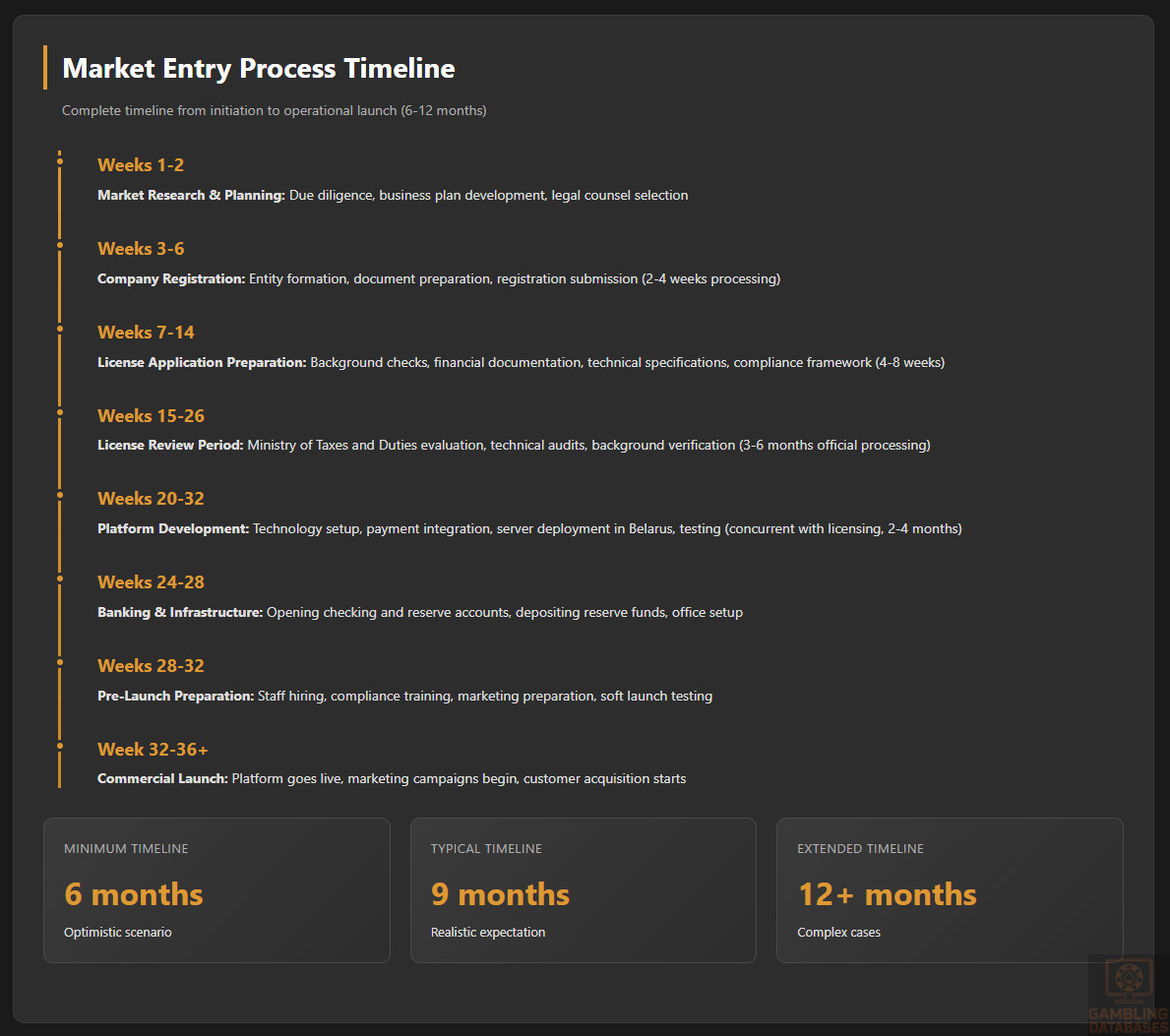
Time to Start Business: Company registration timelines range from several weeks to a few months depending on business type and preparation quality. Gambling license applications add significant time to overall market entry. Complete timeline from company formation to operational gambling business spans 6-12 months.
Foreign Investment Policies: Foreign investment is generally permitted in Belarus including in the gambling sector. However, all investors must navigate licensing requirements, local presence mandates, and regulatory oversight. International sanctions create challenges for some foreign investors and banking relationships.
Operational Cost Structures: Office rental costs in Minsk and major cities remain moderate compared to Western European capitals but higher than some regional competitors. Salary levels for qualified staff are competitive regionally. Utility costs are reasonable. Overall operational costs are manageable but require careful budgeting.
Labor Market Conditions: Belarus maintains skilled workforce particularly in technical fields including IT and software development. Labor shortages exist in some sectors driving wage growth. Finding qualified gambling industry professionals may require training or importing expertise. Russian language capability is essential for staff.
Corporate Structure and Registration
Available Entity Types: Foreign investors can establish Limited Liability Companies (LLC), Joint Stock Companies, or branch offices of foreign entities. LLC structure is most common for small to medium operations. Each structure has different capital requirements, governance rules, and tax implications.
Recommended Structure for iGaming: LLC structure typically suits iGaming operators offering flexibility with moderate compliance burden. Minimum capital requirements are manageable. Governance is straightforward. However, specific circumstances may warrant alternative structures requiring legal counsel evaluation.
Registration Requirements: Company registration requires preparation of charter documents, shareholder documentation, proof of registered address, and payment of state fees. All documents must be in Russian or Belarusian or officially translated. Notarization is required for certain documents.
Registration Timelines: From document preparation to company registration completion typically requires 2-4 weeks for standard LLCs. Complex ownership structures or foreign shareholders may extend timelines. Gambling license application follows company registration adding 3-6 months for licensing process.
Registration Costs: Government registration fees are moderate, typically several hundred dollars. Legal fees for document preparation and representation add significantly to total costs. Budget $3,000-$10,000 for professional company formation services depending on complexity.
Foreign Ownership Rules: No blanket restrictions prevent foreign ownership of Belarusian companies including gambling operators. All shareholders and beneficial owners must undergo background checks. Ownership structure must be transparent. Political considerations may affect approval of certain foreign investors.
Minimum Capital Requirements: Minimum statutory capital for LLCs is relatively low (typically equivalent to several hundred dollars). However, gambling license reserve deposit requirements dwarf statutory minimums. Online casino operators need €985,500 in reserve account regardless of share capital.
Ongoing Compliance: Companies must file annual reports, maintain accounting records, undergo annual audits, and submit tax returns. Gambling operators face additional compliance including license renewals, quarterly reserve account verification, and regulatory reporting. Compliance burden is significant requiring dedicated resources.
| Aspect | Details | Timeline/Cost |
|---|---|---|
| Recommended Entity | Limited Liability Company (LLC) | – |
| Registration Process | Document prep, submission, approval | 2-4 weeks |
| Government Fees | Registration and licensing fees | $500-$1,000 |
| Legal Fees | Professional formation services | $3,000-$10,000 |
| Minimum Share Capital | Statutory minimum (nominal) | ~$500 |
| Foreign Ownership | Permitted with full disclosure | – |
| Required Address | Physical office in Belarus | Varies by location |
| Bank Accounts | 2 accounts required (checking + reserve) | Account fees apply |
Taxation Framework
Corporate Income Tax Structure
Standard Corporate Tax Rate: The standard corporate income tax rate is 18% on net profit. This applies to gambling operators after deducting operating expenses and gambling-specific taxes. The rate is competitive compared to many European jurisdictions.
Special Economic Zone Benefits: Belarus offers special economic zones and High-Tech Park (HTP) with preferential tax treatment for qualifying businesses. However, gambling operations typically do not qualify for these preferential regimes. Standard taxation applies to iGaming operators.
Tax Holidays: No specific tax holidays exist for gambling operators. The three-year tax freeze for land-based establishments (2018-2021) has expired. New operators should plan on full taxation from commencement. Industry-specific incentives are unlikely given regulatory caution toward gambling sector.
International Tax Treaties: Belarus maintains tax treaties with numerous countries affecting withholding tax on dividends, interest, and royalties. Treaty provisions can reduce tax burden for foreign shareholders. Professional tax advice is essential to optimize treaty benefits.
Transfer Pricing Rules: Transfer pricing regulations require arm’s-length pricing for related party transactions. Documentation requirements apply to international transactions. Gambling operators with foreign parent companies or service providers must maintain compliant transfer pricing policies.
Withholding Tax Rates: Dividends paid to foreign shareholders face withholding tax, potentially reduced by tax treaties. Interest and royalty payments to non-residents also incur withholding tax. Rates vary by jurisdiction and treaty provisions. Planning required for international corporate structures.
VAT/GST Applicability: Value Added Tax at 20% applies to most goods and services in Belarus. Gambling services may receive specific VAT treatment. Professional tax advice is necessary to determine VAT obligations for gambling operators. Compliance burden includes VAT registration and monthly reporting.
Personal Income Tax
Individual Tax Rates: Personal income tax applies at 13% for most income types. This relatively low flat rate benefits employees. Higher rates may apply to certain income categories. Foreign employees working in Belarus face taxation on Belarus-source income.
Social Security Contributions: Employers pay approximately 34% of gross salary in social security contributions. Employees contribute approximately 1% of wages. These contributions fund pension, healthcare, and social insurance programs. Total labor cost significantly exceeds gross salary due to employer contributions.
Tax Residency Rules: Individuals spending 183 days or more in Belarus during a calendar year become tax residents. Tax residents pay tax on worldwide income. Non-residents pay tax only on Belarus-source income. Residency determination affects tax obligations for foreign employees.
Taxation of Foreign Employees: Foreign nationals working in Belarus owe income tax on Belarus employment income. Double taxation treaties may provide relief for certain situations. Work permits and residence permits carry separate requirements beyond taxation. Compliance required for foreign personnel.
| Tax Type | Rate | Applies To |
|---|---|---|
| Corporate Income Tax | 18% | Net profit after deductions |
| Gambling GGR Tax | 4% | Positive difference (bets – payouts) |
| Personal Income Tax | 13% | Employee salaries |
| Employer Social Security | ~34% | Gross salaries |
| Employee Social Security | ~1% | Gross salaries |
| VAT | 20% | Most goods and services |
| Dividend Withholding | 12% (may be reduced by treaty) | Dividends to non-residents |
| Interest/Royalty Withholding | 10% (may be reduced by treaty) | Payments to non-residents |
Market Entry Considerations
Recommended Entry Strategies
Licensing Route: Direct licensing as a primary operator offers maximum control but requires substantial capital (€985,500 reserve for online casino). This route suits established operators with financial resources and risk tolerance. Timeline is 6-12 months including company formation and licensing.
Local Partnership: Partnering with established Belarusian entities can provide market knowledge, regulatory navigation, and reduced capital requirements if partner already holds license. Partnership structure must comply with ownership disclosure requirements. Due diligence on partners is critical.
White Label vs Proprietary Platform: White label solutions reduce technical development costs and accelerate market entry. However, proprietary platforms offer greater differentiation and control. Local server requirements apply regardless of platform approach. Platform provider selection should consider Belarus infrastructure compatibility.
Phased Market Entry: Consider starting with one gambling category (e.g., sports betting with lower €219,000 reserve requirement) before expanding to full casino offering. This phased approach reduces initial capital needs and allows market learning before full commitment.
Market Testing: Due to political and economic risks, conservative market testing with limited initial investment may be prudent. Monitor regulatory stability and market conditions before major capital deployment. Exit strategies should be considered from initial planning.
Typical Costs and Timelines
Initial Setup Investment Breakdown:
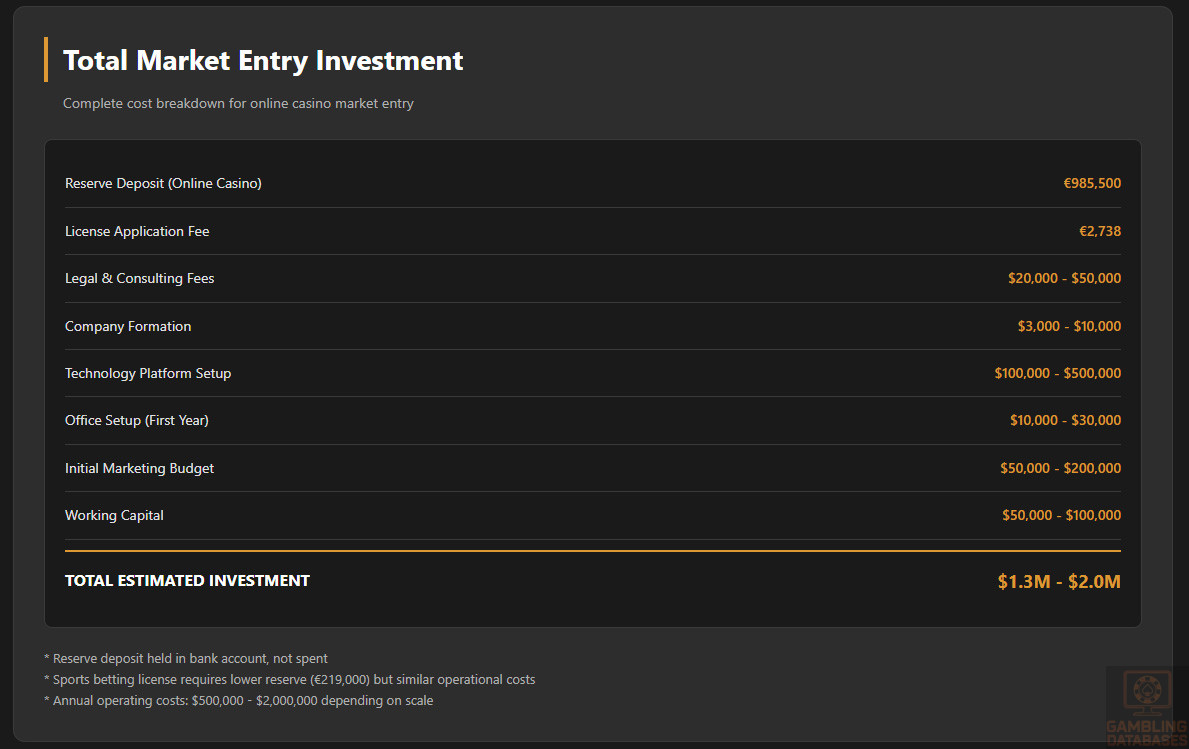
License application fee: €2,738 (250 base amounts). Legal and consulting fees for licensing: $20,000-$50,000. Company registration costs: $3,000-$10,000. Initial capital for operations: $50,000-$100,000. Office setup in Belarus: $10,000-$30,000 first year. Technology platform setup: $100,000-$500,000 depending on approach.
Initial marketing budget: $50,000-$200,000 for market entry. Total initial investment excluding reserve deposit: $235,000-$890,000. Reserve deposit requirement: €985,500 for online casino or €219,000 for sports betting. Grand total for online casino market entry: Approximately $1.3-$2 million including reserve.
Operational Cost Estimates:
Monthly staff salaries (10-15 people): $15,000-$30,000. Office rent and utilities (Minsk): $2,000-$5,000 monthly. Technology maintenance and hosting: $5,000-$15,000 monthly. Payment processing fees: 2-4% of transaction volume. Marketing and customer acquisition: $20,000-$100,000 monthly depending on scale.

Timeline Expectations:
Company registration: 2-4 weeks. License application preparation: 4-8 weeks. License review and approval: 3-6 months. Platform setup and integration: 2-4 months (concurrent with licensing). Total time to market: 6-12 months from initiation to launch.
Resource Requirements:
Minimum staff headcount: 10-15 people for viable operation. Key positions needed: General Manager, Compliance Officer, Customer Support (Russian-speaking), Finance Manager, Marketing Manager, Technical Support, Risk/Fraud Management. Technology stack requirements: Gaming platform (proprietary or white label), payment processing integration, player management system, compliance tools, CRM system.
| Cost Category | Amount Range | Notes |
|---|---|---|
| License Application Fee | €2,738 | 250 base amounts |
| Reserve Deposit (Online Casino) | €985,500 | Held in bank account |
| Reserve Deposit (Sports Betting) | €219,000 | Held in bank account |
| Legal/Consulting Fees | $20,000-$50,000 | Licensing support |
| Company Formation | $3,000-$10,000 | Registration and setup |
| Technology Platform | $100,000-$500,000 | Setup and integration |
| Office Setup | $10,000-$30,000 | First year costs |
| Initial Marketing | $50,000-$200,000 | Market entry campaign |
| Working Capital | $50,000-$100,000 | Initial operations |
| Total (Casino) | ~$1.3-$2M | Including reserve |
| Annual Operating Costs | $500,000-$2,000,000 | Depending on scale |
Success Factors and Challenges
Key Success Enablers
Local Market Understanding: Deep understanding of Belarusian player preferences, cultural attitudes, and gambling behavior is essential. Local market research, hiring local staff, and adapting to regional preferences drive success. Generic international approaches unlikely to maximize results.
Localized Payment Methods: Integration of local payment methods including BELKART, ERIP, WebPay, and other popular e-wallets is critical. Russian payment cards (Mir) may benefit operators targeting Russian players. Payment friction reduces conversion and retention.
Mobile-First Approach: Given 127% mobile penetration and high smartphone usage, mobile-optimized or mobile-first platform design is essential. Mobile apps or progressive web apps should deliver seamless experience. Desktop remains important but mobile drives growth.
Marketing Channels and Partnerships: Sports sponsorships, affiliate marketing, digital advertising, and social media engagement drive customer acquisition. Understanding effective channels for Belarus market requires testing. Partnerships with local sports teams or media outlets can build credibility.
Russian Language Support: Comprehensive Russian language support across platform, customer service, and marketing materials is mandatory. Translation quality significantly impacts user trust and satisfaction. Customer support must be available in Russian at minimum.
Competitive Bonuses and Promotions: Price-sensitive market requires attractive bonus structures to compete effectively. Welcome bonuses, loyalty programs, and ongoing promotions drive player acquisition and retention. Bonus terms must comply with regulatory requirements.
Responsible Gambling Commitment: Demonstrating genuine commitment to responsible gambling builds trust and ensures regulatory compliance. Self-exclusion tools, deposit limits, reality checks, and addiction resources should be prominently featured. Proactive approach prevents regulatory issues.
Sports and Events Coverage: For sports betting operators, comprehensive coverage of popular sports including ice hockey, football, basketball, and tennis is essential. Live betting and competitive odds drive engagement. Local sports events create marketing opportunities.
Major Operational Challenges
Regulatory Compliance Complexity: Navigating Belarus regulatory requirements including server location, domain restrictions, reserve deposits, and reporting obligations creates significant compliance burden. Ongoing regulatory changes increase uncertainty. Dedicated compliance resources are essential.
High Taxation Burden: Combined gambling tax (4% GGR), corporate income tax (18%), and high social security contributions (34%) create substantial tax burden. Effective tax rate on operations impacts profitability. Careful financial modeling required to ensure viability.
Payment Processing Restrictions: International sanctions affecting Belarus complicate payment processing and banking relationships. Some international payment processors limit Belarus transactions. Cross-border payment restrictions under 2025 decree affect international operations. Payment infrastructure requires careful planning.
Marketing and Advertising Limitations: While advertising is permitted, content restrictions and potential future tightening limit promotional activities. Responsible gambling messaging requirements add complexity. Traditional media may face political content sensitivities affecting commercial advertising.
Competition from Established Operators: Existing licensed operators have brand recognition and customer bases. Land-based casinos expanding online leverage established reputations. New entrants face customer acquisition challenges against incumbents. Differentiation strategies are necessary.
Player Acquisition Costs: Limited market size (9.18 million population) constrains player pools. High competition for limited players drives customer acquisition costs. Lifetime value calculations must justify acquisition spending. Efficient marketing is critical for profitability.
Talent Shortage: Finding qualified gambling industry professionals in Belarus may be challenging. Technical talent exists but gambling-specific expertise is limited. Training programs or importing foreign expertise may be necessary. Russian language requirement limits international recruitment.
Political and Economic Risk: Authoritarian governance, international sanctions, political instability, and economic volatility create substantial business risk. Regulatory changes can occur suddenly. Currency devaluation impacts profitability. Exit difficulties may arise. Risk mitigation strategies are essential.
Cultural Considerations
Local Holidays and Peak Seasons: Understanding Belarusian holidays, sporting event calendars, and seasonal patterns optimizes marketing timing. New Year, major ice hockey tournaments, and football championships create engagement opportunities. Salary payment dates may influence deposit patterns.
Popular Sports and Events: Ice hockey represents national passion with strong KHL (Kontinental Hockey League) following. Football, basketball, and tennis also attract significant interest. Coverage of these sports drives sports betting engagement. Local team sponsorships build brand affinity.
Customer Service Channels: Live chat, email, and phone support in Russian language are expected. Response time expectations are moderate. Social media presence may facilitate customer communication. Service quality significantly impacts brand perception and retention.
Communication Style Preferences: Direct, straightforward communication resonates in Belarusian/Russian business culture. Promotional materials should be clear and factual. Excessive marketing hype may reduce credibility. Trust-building through transparency is valuable.
Trust-Building for Foreign Brands: Foreign operators face initial skepticism requiring trust-building efforts. Local partnerships, transparent operations, prompt payments, and quality customer service establish credibility. Regulatory compliance and proper licensing demonstrate legitimacy.
Exit Strategy Planning
Market Liquidity for Operator Sales: Limited market for buying and selling gambling licenses reduces exit options. Small market size limits strategic buyer interest. Exit likely requires finding specific buyer interested in Belarus market or regional expansion. Exit planning should begin at market entry.
Regulatory Requirements for Ownership Transfer: License transfers require regulatory approval. New owners must meet all licensing criteria including background checks, financial capacity, and experience requirements. Transfer process adds complexity and uncertainty to exit.
License Transferability: Gambling licenses can be transferred with regulatory approval. However, approval is not guaranteed. License value depends on market conditions, profitability, and regulatory environment at exit time. Reserve deposit requirements transfer to new owners.
Closing Operations Legally: Operators exiting market must settle all player balances, resolve outstanding obligations, and surrender licenses properly. Regulatory approval required for closure. Process can be complex requiring legal guidance. Improper exit creates ongoing liabilities.
| Success Factors | Major Challenges |
|---|---|
| Local market knowledge | Regulatory complexity |
| Localized payment methods | High taxation burden |
| Mobile-first platform | Payment processing restrictions |
| Effective marketing channels | Marketing limitations |
| Russian language support | Established competition |
| Competitive bonuses | High customer acquisition costs |
| Responsible gambling focus | Talent shortage |
| Sports coverage depth | Political and economic risk |
FAQ: Frequently Asked Questions
Legal and Licensing
1. Is online gambling legal in Belarus?
Yes, online gambling is fully legal in Belarus. Presidential Decree No. 305, signed on August 7, 2018, legalized online gambling with implementation beginning April 1, 2019. The decree permits online casinos, sports betting, poker, and bingo operations.
All online gambling must be conducted through properly licensed operators. The Ministry of Taxes and Duties serves as the regulatory authority issuing licenses and overseeing compliance. Unlicensed operators face website blocking and payment restrictions under 2025 enforcement measures.
2. What types of gambling licenses are available and what do they cover?
Belarus offers several gambling license types. Online Casino License (Virtual Gaming Institution) covers online slots, table games, video poker, and casino-style games. Sports Betting and Parimutuel License permits online and land-based sports wagering. Live Dealer Gaming requires dual licensing covering both the virtual platform and the physical broadcasting venue.
Land-based licenses include Casino License for full-scale casinos with tables and slots, Slot Machine Hall License for electronic gaming machines outside casinos, and Bookmaking License for retail betting shops. Each license type has specific requirements and reserve deposit amounts.
3. How much does an iGaming license cost and how long does it take to obtain?
The application fee is €2,737.50 (250 base amounts). However, the major cost is the mandatory reserve deposit: €985,500 for online casinos and €219,000 for sports betting operations. This reserve must be maintained in a Belarusian bank account and verified quarterly.
The licensing process typically takes 3-6 months after application submission. This includes background checks, technical system certification, and regulatory review. Total time to market including company formation and platform setup is 6-12 months. Additional costs include legal fees ($20,000-$50,000) and technology platform setup ($100,000-$500,000).
4. Can foreign companies obtain a gambling license?
Yes, foreign companies can obtain gambling licenses in Belarus. There are no explicit restrictions on foreign ownership. However, all shareholders and beneficial owners must undergo background checks and meet integrity requirements. Operators must establish a registered legal entity in Belarus with local office address.
Foreign applicants face the same requirements as domestic applicants including the mandatory reserve deposit, local server location, .by domain usage, and Belarusian bank accounts. Management must demonstrate three years of gambling industry experience. International sanctions may affect some foreign investors’ ability to operate in Belarus.
Financial and Taxation
5. What are the tax obligations for iGaming operators?
Online gambling operators pay 4% tax on Gross Gaming Revenue (calculated as bets minus payouts, on positive difference only). Additionally, standard corporate income tax of 18% applies to net profit after expenses. Sports betting operators must withhold 4% tax on player winnings.
Employers pay approximately 34% social security contributions on gross salaries, with employees contributing an additional 1% . VAT at 20% may apply to certain services. Dividend withholding tax of 12% applies to foreign shareholders, potentially reduced by tax treaties. Annual license renewal fees and monthly tax reporting requirements add to compliance burden.
6. Are gambling winnings taxed for players?
Yes, gambling winnings are subject to taxation. For sports betting, a 4% tax applies to player winnings, which is automatically withheld by operators before crediting the player’s account. Players do not need to file separate tax declarations for these withheld amounts.
The tax treatment of casino and slot machine winnings may differ from sports betting. No tax-free threshold exists for gambling winnings in Belarus. All taxation is handled through operator withholding systems, simplifying the process for players.
7. What are the typical operational costs for running an online casino or sportsbook?
Monthly operational costs range from approximately $40,000-$150,000 depending on scale. This includes staff salaries ($15,000-$30,000 for 10-15 employees), office rent and utilities in Minsk ($2,000-$5,000), technology maintenance and hosting ($5,000-$15,000), and marketing ($20,000-$100,000).
Payment processing fees typically run 2-4% of transaction volume. Annual operational costs total $500,000-$2,000,000 for a moderate-scale operation. The 4% GGR tax, 18% corporate tax, and 34% employer social security significantly impact the tax burden on operations.
8. What is the expected ROI timeline for entering this market?
ROI timelines depend heavily on initial investment, operational efficiency, and market conditions. With initial investment of $1.3-$2 million including reserve deposit and setup costs, plus annual operating costs of $500,000-$2 million, profitability likely requires 2-4 years of operation.
The small market size (9.18 million population), high taxation (4% GGR + 18% corporate), and competitive landscape challenge rapid profitability. Political and economic risks add uncertainty. Conservative financial projections should assume 3-5 year payback period with significant risk of regulatory changes impacting returns.
Operations and Compliance
9. What are the local presence requirements for operators?
Operators must maintain a registered office address within Belarus territory. The company’s management body must be located in Belarus. Gaming servers must be physically located in Belarus. Two bank accounts must be opened with Belarusian banks: one checking account for operations and one reserve account for the mandatory deposit.
Platforms must use .by or .бел (Cyrillic) domain extensions. While extensive local staff is not mandated, key personnel including managers must meet experience requirements and pass background checks. Customer support should be available in Russian language. Foreign ownership is permitted but full ownership disclosure is required.
10. What payment methods are available and recommended?
Recommended payment methods include BELKART national card system (essential for local players), Visa and Mastercard (subject to sanctions limitations), Mir cards (useful for Russian players), and e-wallets including WebPay, iPay, EasyPay, and Oplati. Bank transfers through the ERIP system provide alternative deposit and withdrawal options.
Cryptocurrency payments are prohibited for gambling despite Belarus having legal cryptocurrency trading. Mobile payment apps like Belkart Pay, A1 Banking, and Swoo Pay support contactless payments. Operators should integrate multiple local payment methods to minimize friction and maximize conversion rates.
11. What are the advertising and marketing restrictions?
Gambling advertising is permitted through television, radio, print, outdoor, and online channels with content restrictions. Marketing cannot target minors or feature individuals appearing underage. False or misleading claims about winning odds are prohibited. Responsible gambling messaging must be included.
Sports sponsorships are allowed and represent significant marketing opportunity. Affiliate marketing is permitted within standard advertising rules. Bonuses and promotions must be clearly explained with transparent terms and conditions. Marketing to minors is strictly forbidden. Time-of-day restrictions may apply to broadcast advertising.
12. What responsible gambling measures are mandatory?
Operators must implement age verification systems ensuring only players 21 and older can gamble. KYC and AML compliance procedures are required. Self-exclusion mechanisms must be provided allowing players to block their access. Reality checks, session time notifications, and loss limits should be available.
Gambling addiction resources and support contact information must be prominently displayed on platforms. Player identification is mandatory before real-money play. Transaction monitoring systems must detect suspicious patterns. However, no centralized self-exclusion register currently exists, limiting cross-operator protection.
Market Opportunity
13. How large is the iGaming market and what is the growth potential?
Exact market size figures are not publicly disclosed by Belarus authorities. However, operator tax revenue has grown approximately 15% over four years, indicating expanding market activity. The market remains relatively small given the 9.18 million population and moderate income levels.
Growth potential exists as internet penetration at 91.5% and mobile adoption at 127% provide strong digital infrastructure. Online gambling legalization in 2019 is relatively recent, suggesting continued digital channel migration. However, political risk, potential regulatory tightening following 2025 presidential comments, and economic volatility temper optimistic growth projections.
14. Who are the main competitors and what is their market share?
The market features state-affiliated operator RUP Belorusskiye Loterei (Belbet platform), international bookmakers including MaxLine and Marathon, and the 888 poker room serving Belarusian players. Approximately 20 land-based casinos operate, many expanding into online channels.
Specific market share data is not publicly available. The market shows moderate concentration with several established players dominating. International brands have been cautious about entering due to political risk and sanctions exposure. Limited competition compared to Western markets creates opportunities but also reflects market challenges.
15. What are the player preferences and typical spending patterns?
Sports betting represents significant market segment given strong interest in ice hockey, football, and basketball. Casino games including slots appeal to entertainment-focused players. Mobile gambling shows strong growth with platform preferences shifting toward mobile-first usage. Bonus sensitivity is high given price-conscious consumers.
Specific ARPU and spending data for Belarus is not widely published. Income constraints suggest moderate gambling budgets compared to Western European markets. Russian language support, localized payment methods, and competitive promotional offers drive player acquisition and retention. Evening and weekend gaming peaks likely follow global patterns.
16. What are the key success factors and main challenges for new entrants?
Key success factors include deep understanding of local market preferences, integration of local payment methods (BELKART, ERIP, WebPay), mobile-optimized platform design, comprehensive Russian language support, competitive bonus structures, effective sports coverage for betting, and demonstrated commitment to responsible gambling.
Main challenges include complex regulatory compliance, high taxation burden (4% GGR + 18% corporate + 34% social security), payment processing restrictions due to sanctions, limited market size (9.18 million population), established competitor advantages, high customer acquisition costs, talent shortage for gambling expertise, and significant political and economic risk requiring careful consideration.
Sources and References
The following sources were consulted in the preparation of this comprehensive Belarus iGaming market entry analysis:
- Legal Pilot – Is Gambling Legal in Belarus? Laws & Regulations Explained 2025 – https://legalpilot.com/country/belarus/
- Georgia Gaming Association – Belarus Gambling Market Overview – https://www.gga.org.ge/en/world/18
- iGaming Today – Gambling Regulation in Belarus – https://www.igamingtoday.com/gambling-regulation-in-belarus/
- LCB.org – Are Online Casinos Legal In Belarus? – https://lcb.org/restrictions/belarus
- Global Law Experts – A Gaming License In Belarus: “Isle Of Pristine Gambling” – https://globallawexperts.com/a-gaming-license-in-belarus-isle-of-pristine-gambling/
- Slotegrator – Gambling Market of Belarus: Land-based and Online Casino – https://slotegrator.pro/analytical_articles/belarus_gambling_market.html
- Law & Trust International – Obtaining a gambling license in Belarus – https://lawstrust.com/en/licence/gambling/belarus
- ChoiceCasino – Gambling and Casinos in Belarus (2025) – https://choicecasino.com/belarus
- Investigate Belarus – How the State Profits from Child Gambling Addiction – https://investigatebel.org/en/investigations/azartnye-igry-belarus-deti-belbet
- Mundo Video – Belarus moves to block cross-border gambling payments, citing social harm – https://www.mundovideo.com.co/en/europe/belarus-moves-to-block-cross-border-gambling-payments-citing-social-harm/
- World Economics – Belarus Population Growth Rate Data from 1880-2025 – https://www.worldeconomics.com/Demographics/Population-Annual-Growth-Rate/Belarus.aspx
- CountryEconomy.com – Belarus 2025 Economic Data – https://countryeconomy.com/countries/belarus
- Worldometer – Belarus Demographics 2025 (Population, Age, Sex, Trends) – https://www.worldometers.info/demographics/belarus-demographics/
- MacroTrends – Belarus Population (1950-2025) – https://www.macrotrends.net/global-metrics/countries/blr/belarus/population
- Vienna Institute for International Economic Studies (wiiw) – Belarus Economic Overview – https://wiiw.ac.at/belarus-overview-ce-17.html
- International Monetary Fund – Republic of Belarus and the IMF – https://www.imf.org/en/Countries/BLR
- Wikipedia – Economy of Belarus – https://en.wikipedia.org/wiki/Economy_of_Belarus
- Belstat – National Statistical Committee of the Republic of Belarus – https://www.belstat.gov.by/en/
- DataReportal – Digital 2025: Belarus — Global Digital Insights – https://datareportal.com/reports/digital-2025-belarus
- TS2 Space – The Real State of Internet in Belarus: Wired, Wireless, and Watching from the Sky – https://ts2.tech/en/the-real-state-of-internet-in-belarus-wired-wireless-and-watching-from-the-sky/
- Wikipedia – Telecommunications in Belarus – https://en.wikipedia.org/wiki/Telecommunications_in_Belarus
- BuddeComm – Belarus – Telecoms, Mobile and Broadband – Statistics and Analyses – https://www.budde.com.au/Research/Belarus-Telecoms-Mobile-and-Broadband-Statistics-and-Analyses
- Digital Report – Belarus: State of Affairs report – https://digital.report/belarus-state-of-affairs-report/
- Akabbo – Belarus Internet Landscape: Connectivity, Competition, and Emerging Technologies – https://akabbo.ug/belarus-internet-landscape-connectivity-competition-and-emerging-technologies/
- Freedom House – Belarus: Freedom on the Net 2024 Country Report – https://freedomhouse.org/country/belarus/freedom-net/2024
- iGaming Today – Belarus iGaming Market Research Report – https://www.igamingtoday.com/belarus-igaming-market-research-report/
- iGaming Express – iGaming Industry Growth: Key Statistics and Trends – https://igamingexpress.com/igaming-industry-growth/
- Famesters – Free iGaming report 2025: Get the latest trends – https://famesters.com/igaming-report/
- Statista – eServices Market in Belarus – https://www.statista.com/outlook/dmo/eservices/belarus
- Transfi – Belarus’ Payment Rails & How They Work – BELKART, ERIP & Digital Wallet Systems – https://www.transfi.com/blog/belarus-payment-rails-how-they-work—belkart-erip-digital-wallet-systems
- MyUniver – How to pay in Belarus? – https://myuniver.org/en/articles/kak-rasplachivatsya-v-belarusi
- Spex.by – How to pay with electronic money in Belarus? – https://spex.by/eng/news/electronic-money-in-belarus
- MyUniver – How to Pay with a Smartphone in Belarus in 2024 – https://myuniver.org/en/articles/kak-platit-smartfonom-v-belarusi-v-2024-obzor-finansovyh-prilozhenii
- Ecwid Help Center – Payment options for Belarus – https://support.ecwid.com/hc/en-us/articles/360003206579-Payment-options-for-Belarus
- Bank Reshenie – First virtual card with cashback in Belarus – https://rbank.by/en/news/first_virtual_card_with_cashback_in_belarus/
- Belarusbank – Bank credit cards – Belarusbank offers – https://belarusbank.by/en/individuals/10947
- Belarus Virtual Consult – Open a Bank Account in Belarus as a Foreigner – https://belarusvc.com/en/bankaccount/
- Presidential Decree No. 305 of August 7, 2018 “On the Improvement of Legal Regulation of the Gambling Business” – Official Government Publications
- Ministry of Taxes and Duties of the Republic of Belarus – Official Website – http://nalog.gov.by/ru/
- National Bank of the Republic of Belarus (NBRB) – Official Publications and Statistics
- World Bank – Doing Business Report – Belarus Rankings and Indicators
- United Nations Development Programme – Human Development Index Data for Belarus
- Ookla Speedtest Global Index – Belarus Internet Speed Statistics – https://www.speedtest.net/global-index/belarus
- GSMA Intelligence – Mobile Connection Data for Belarus
- International Telecommunication Union (ITU) – Belarus Telecommunications Statistics
- American Gaming Association – Commercial Gaming Revenue Tracker (for industry context)
- Blockchain-Ads – What Is the Growth Rate of iGaming? Industry Statistics and Market Share – https://www.blockchain-ads.com/post/igaming-statistics
- Various academic studies and industry reports on problem gambling prevalence and responsible gambling measures
- News articles and announcements from BelTA (Belarusian Telegraph Agency) regarding gambling regulation updates
Note on Data Currency: This analysis incorporates the most recent available data as of October 2025. Given the dynamic nature of gambling regulation and economic conditions in Belarus, readers should verify current requirements with official authorities and professional advisors before making business decisions. Regulatory changes can occur with limited notice, particularly in response to political priorities.
Disclaimer: This analysis is provided for informational purposes only and does not constitute legal, financial, or business advice. Prospective market entrants should engage qualified legal counsel, tax advisors, and business consultants with specific Belarus expertise before making investment decisions. The political and economic environment in Belarus presents significant risks that require thorough due diligence and risk assessment.
Professional Consultation Recommended: Due to the complexity of Belarus gambling regulation, international sanctions implications, political risk factors, and rapidly evolving compliance requirements, engagement of specialized professional advisors is strongly recommended for any serious market entry consideration. Local legal counsel with gambling licensing experience is essential for successful navigation of the regulatory process.
🎯 Gambling Databases Country Rating: Belarus
| Evaluation Dimension | Score | Rating |
|---|---|---|
| Operator Ease Score | 4.2/10 | 🔴 Difficult |
| Player Access Score | 6.5/10 | 🟡 Partially Legal |
| Overall Market Attractiveness | 5.4/10 | 🟡 Moderate with Significant Barriers |
This rating is calculated using the Gambling Databases Rating (GDR) methodology, which provides transparent criteria for evaluating iGaming markets worldwide. Click the link to learn how we calculate Operator Ease Score, Player Access Score, and overall market attractiveness ratings.
⚠️ CRITICAL RISK WARNINGS
READ THIS BEFORE CONSIDERING MARKET ENTRY:
- MASSIVE CAPITAL BARRIER: €985,500 ($1.08M) reserve deposit required for online casino license, locked in Belarusian bank account – this is NON-OPERATIONAL capital
- AUTHORITARIAN POLITICAL RISK: President Lukashenko’s regime creates extreme regulatory unpredictability – 2025 sudden decree blocking cross-border payments demonstrates arbitrary rule changes
- INTERNATIONAL SANCTIONS EXPOSURE: Western sanctions against Belarus severely restrict payment processing, banking relationships, and business partnerships
- MANDATORY LOCAL SERVER INFRASTRUCTURE: Physical servers must be located in Belarus territory, adding costs and geopolitical risk
- CRYPTOCURRENCY GAMBLING BANNED: Despite progressive crypto trading laws, digital currency use for gambling is explicitly prohibited
- PAYMENT PROCESSING NIGHTMARE: 2025 decree authorizes banks to block cross-border gambling payments to unlicensed operators – creates closed market but increases risk
- SMALL DECLINING MARKET: Only 9.18 million population with -0.54% annual decline and median age 41.3 years – limited growth potential
- REGULATORY INSTABILITY: President’s 2025 comments about gambling “thriving a little too well” signal potential future restrictions or tax increases
📊 Operator Ease Score Breakdown
| Criterion | Weight | Score | Justification (INCLUDING ALL DEDUCTIONS) |
|---|---|---|---|
| Legal & Regulatory Framework | 30% | 1.5/3.0 | Starting: 3.0 points (full legality) ✓ Online casino fully legal (+3.0) ✓ Sports betting fully legal ✓ Comprehensive framework since 2019 DEDUCTIONS: ❌ Active ISP blocking of unlicensed operators (-0.5) ❌ 2025 cross-border payment blocking decree (-0.5) ❌ Cryptocurrency gambling prohibited (-0.25) ❌ Regulatory instability and arbitrary rule changes (-0.25) FINAL: 1.5/3.0 |
| Licensing Process | 25% | 0.75/2.5 | Starting: Limited licensing (+1.0 base) ✓ Clear licensing authority (Ministry of Taxes) ✓ Foreign ownership permitted ✓ Application fee €2,738 (reasonable) CRITICAL DEDUCTIONS: ❌ MASSIVE reserve deposit €985,500 for casino (-1.0 points – this is PROHIBITIVE for most operators) ❌ Complex technical requirements: local servers mandatory (-0.25) ❌ Mandatory .by domain requirement (-0.25) ❌ 3-6 month processing time plus company formation (-0.25) ❌ Experience requirement: 3+ years gambling industry (-0.25) ❌ Two mandatory bank accounts in Belarus (-0.25) FINAL: 0.75/2.5 (Reserve deposit alone makes this prohibitive for 90% of operators) |
| Taxation & Costs | 20% | 1.0/2.0 | Tax Assessment: ✓ 4% GGR tax (very competitive) (+1.5) ✓ 18% corporate income tax (reasonable) MAJOR DEDUCTIONS: ❌ Effective combined tax rate 20-25% when factoring all layers (-0.5) ❌ 34% employer social security contributions (-0.25) ❌ High customer acquisition costs in small market ($200-400 per player) (-0.5) ❌ Reserve deposit opportunity cost (€985,500 locked capital) (-0.25) Total Effective Tax Burden: 4% GGR + 18% corporate on net = approximately 20-22% of revenue FINAL: 1.0/2.0 |
| Operational Requirements | 15% | 0.5/1.5 | Heavy Requirements Assessment: CRITICAL BARRIERS: ❌ Mandatory physical servers IN Belarus territory (-0.25) ❌ Mandatory local office and management presence (-0.25) ❌ Two separate bank accounts required (-0.15) ❌ Mandatory .by domain (blocks global brand consistency) (-0.15) ❌ Payment processing severely restricted by sanctions (-0.2) Additional Burdens: • Russian language support mandatory • Monthly tax reporting • Quarterly reserve account verification • Local staff hiring requirements FINAL: 0.5/1.5 (Infrastructure requirements are excessive) |
| Market Environment | 10% | 0.45/1.0 | Starting: Moderate environment (+0.5) – Rank 49th globally SEVERE DEDUCTIONS: ❌ Authoritarian political regime with extreme unpredictability (-0.25) ❌ Western sanctions severely restrict business operations (-0.25) ❌ Recent enforcement intensification (2025 payment blocking) (-0.15) ❌ President’s comments signal potential future restrictions (-0.1) ✓ Advertising permitted (but with restrictions) (+0.25) ✓ No recent major gambling scandals (+0.15) Political Risk Level: EXTREME FINAL: 0.45/1.0 |
OPERATOR EASE SCORE CALCULATION:
- Legal Framework: 1.5/3.0 × 30% = 0.45
- Licensing Process: 0.75/2.5 × 25% = 0.19
- Taxation & Costs: 1.0/2.0 × 20% = 0.20
- Operational Requirements: 0.5/1.5 × 15% = 0.075
- Market Environment: 0.45/1.0 × 10% = 0.045
- TOTAL: 0.96 × 10 = 4.2/10 🔴 DIFFICULT
👥 Player Access Score Breakdown
| Criterion | Weight | Score | Justification (INCLUDING ALL DEDUCTIONS) |
|---|---|---|---|
| Legal Status for Players | 40% | 2.5/4.0 | Starting: Fully legal (+4.0) ✓ Online casino legal for players ✓ Sports betting fully legal ✓ Players not penalized for gambling DEDUCTIONS: ❌ Access to offshore/unlicensed operators increasingly restricted (-0.5) ❌ 2025 payment blocking affects player choice (-0.5) ❌ Limited number of licensed operators reduces options (-0.25) ❌ Cryptocurrency use prohibited limits payment flexibility (-0.25) Reality: Legal to play but market is increasingly closed and controlled FINAL: 2.5/4.0 |
| Practical Accessibility | 30% | 2.0/3.0 | Assessment: Some restrictions, moderate blocking ✓ 91.5% internet penetration excellent ✓ 127% mobile penetration ideal for gambling ✓ Multiple payment methods available (cards, e-wallets) DEDUCTIONS: ❌ International payment processors limited by sanctions (-0.5) ❌ Cryptocurrency banned for gambling (-0.5) ❌ Active ISP blocking of offshore sites (-0.3) ❌ Cross-border payment blocking since 2025 (-0.2) ✓ BELKART national card system works well (+0.5) FINAL: 2.0/3.0 |
| Player Penalties | 20% | 1.5/2.0 | Assessment: Minor penalties possible ✓ No criminal penalties for players using licensed operators (+2.0) ✓ No fines for recreational gambling DEDUCTIONS: ❌ 4% tax automatically withheld from sports betting winnings (-0.25) ❌ Using offshore sites may face payment blocking (-0.25) Note: Players are not prosecuted, but automatic tax withholding and payment restrictions apply FINAL: 1.5/2.0 |
| Market Availability | 10% | 0.5/1.0 | Assessment: Limited licensed operators ✓ Multiple licensed operators exist ✓ State platform Belbet available ✓ International brands: MaxLine, Marathon, 888 poker DEDUCTIONS: ❌ Market concentration limits competition (-0.25) ❌ Only ~20 land-based casinos down from historical peaks (-0.15) ❌ High barriers prevent new entrants reducing player choice (-0.1) Reality: Limited operator pool compared to mature markets FINAL: 0.5/1.0 |
PLAYER ACCESS SCORE CALCULATION:
- Legal Status: 2.5/4.0 × 40% = 1.0
- Practical Accessibility: 2.0/3.0 × 30% = 0.6
- Player Penalties: 1.5/2.0 × 20% = 0.3
- Market Availability: 0.5/1.0 × 10% = 0.05
- TOTAL: 1.95 × 10/3 = 6.5/10 🟡 PARTIALLY LEGAL
🔍 Key Highlights
Strengths (Limited but Present)
- Full Legal Framework: Online casino and sports betting fully legalized since April 2019, providing legal certainty for licensed operations
- Low GGR Tax Rate: 4% gambling tax is highly competitive compared to Western European markets (UK 21%, Germany 5.3% + 42% corporate)
- Excellent Digital Infrastructure: 91.5% internet penetration, 127% mobile connections, second-highest fiber-optic coverage in Europe after Iceland
- Foreign Ownership Permitted: No restrictions on foreign ownership of gambling licenses (subject to background checks and transparency)
- High Digital Literacy: 99% literacy rate, technically skilled workforce, strong IT sector supporting online gambling adoption
- Reasonable Corporate Tax: 18% corporate income tax is moderate compared to many European jurisdictions
⛔️ CRITICAL RISKS AND CHALLENGES
- [PROHIBITIVE CAPITAL BARRIER]: €985,500 ($1.08M USD) reserve deposit for online casino license must be maintained in Belarusian bank account – this is LOCKED, NON-OPERATIONAL capital representing massive opportunity cost. Sports betting requires €219,000. Combined with setup costs, total initial investment reaches $1.3-2 million minimum for casino operation.
- [EXTREME POLITICAL RISK]: Authoritarian regime under President Lukashenko since 1994 creates severe regulatory unpredictability. 2020 election disputes and civil unrest, followed by 2025 sudden decree blocking cross-border gambling payments, demonstrate arbitrary policy changes. President’s 2025 comments about gambling “thriving too well” signal potential future restrictions or tax increases without consultation.
- [INTERNATIONAL SANCTIONS NIGHTMARE]: Western sanctions following 2020 crackdowns severely impact:
- Payment processing (Visa/Mastercard restrictions)
- International banking relationships
- Software provider partnerships
- Reputational damage for international brands
- Difficulty repatriating profits
- [TINY DECLINING MARKET]: Population only 9.18 million with -0.54% annual decline. Median age 41.3 years indicates aging demographics. GDP per capita $7,236 means limited disposable income. Total addressable market for iGaming estimated at only 300,000-500,000 active players maximum.
- [MANDATORY LOCAL INFRASTRUCTURE]: Physical servers MUST be located in Belarus territory – no remote hosting allowed. This creates:
- Higher infrastructure costs ($50,000-100,000+ annually)
- Technical complexity managing local datacenter
- Geopolitical risk (servers physically in authoritarian state)
- Difficulty scaling or migrating if exit needed
- [PAYMENT PROCESSING CATASTROPHE]:
- 2025 decree authorizes banks to block cross-border gambling payments
- International payment processors severely restricted by sanctions
- Cryptocurrency use for gambling explicitly BANNED despite progressive crypto trading laws
- Dependence on BELKART national system and limited e-wallets
- Payment processor fees 2-4% reduce margins
- [HIGH CUSTOMER ACQUISITION COSTS]: Small market with limited operator pool means intense competition for players. Estimated CAC $200-400 per player due to:
- Small total market (9.18M population, only 21+ can play)
- Existing operator loyalty
- Limited advertising channels
- Lower disposable income requiring aggressive bonuses
- [OPERATIONAL COMPLEXITY]:
- Mandatory .by or .бел domain (cannot use global brand domain)
- Two separate bank accounts required (checking + reserve)
- Monthly tax reporting with quarterly reserve verification
- Russian language mandatory for all materials
- Management must be based in Belarus
- 34% employer social security contributions on all staff
- [ENFORCEMENT INTENSIFICATION]: Recent actions demonstrate increasing control:
- ISP-level blocking of unlicensed operators
- 2025 payment blocking decree targeting offshore operators
- Tax revenue growth 15% over 4 years suggests aggressive collection
- State scrutiny of minor age verification (Belbet controversy)
- [LIMITED EXIT OPTIONS]:
- No market for selling gambling licenses (few buyers)
- Reserve deposit locked until proper exit
- License transfer requires full regulatory approval (not guaranteed)
- Servers and infrastructure must remain until closure approved
- Difficulty repatriating capital from Belarus banks
- [CRYPTOCURRENCY PROHIBITION]: Despite Belarus having progressive cryptocurrency trading laws since 2017 (legal, tax-free until 2023), payment for goods/services using crypto is BANNED. This prohibition explicitly extends to gambling, eliminating modern payment method and reducing attractiveness to crypto-savvy players.
- [REGULATORY UNPREDICTABILITY]:
- Three-year tax freeze (2018-2021) expired with no guarantee of continuation
- Sudden 2025 payment blocking decree shows arbitrary rule changes
- Presidential comments signal potential future restrictions
- No democratic oversight or consultation on gambling policy
- Corruption perception creates licensing uncertainty
Player-Specific Issues
- Limited Operator Choice: High barriers to entry mean few licensed operators, reducing player competition and potentially inferior products/odds
- Payment Method Restrictions: Cryptocurrency banned, international cards restricted by sanctions, forcing reliance on BELKART and local e-wallets
- ISP Blocking: Offshore operators increasingly blocked, limiting player access to international brands and better bonuses
- Automatic Tax Withholding: 4% tax deducted from sports betting winnings before payout – reduces player returns
- Age Verification Gaps: State platform Belbet criticized for inadequate checks allowing minors to gamble – indicates enforcement weaknesses
- Cross-Border Payment Blocking: 2025 decree prevents players from funding offshore accounts, forcing use of domestic operators only
💰 Reality Check: Can You Actually Make Money Here?
| Financial Metric | Amount/Range | Details |
|---|---|---|
| Initial Investment Required | $1.3M – $2.0M | Casino: €985,500 reserve + €2,738 fee + $235,000-890,000 setup = $1.3-2M total Sports Betting: €219,000 reserve + setup = $450,000-700,000 total |
| Monthly Operating Costs | $42,000 – $155,000 | Staff salaries: $15,000-30,000 Office rent: $2,000-5,000 Technology: $5,000-15,000 Payment processing: 2-4% of volume Marketing: $20,000-100,000 |
| Annual Operating Costs | $500,000 – $2,000,000 | Varies significantly based on scale and growth ambition |
| Effective Tax Rate on Revenue | 20-25% | 4% GGR tax + 18% corporate income tax on net profit = ~20-22% of revenue Plus 34% employer social security on salaries Plus payment processing fees 2-4% |
| Customer Acquisition Cost | $200 – $400 | High CAC due to small market, intense competition, limited advertising channels, low disposable income requiring aggressive bonuses |
| Average Revenue Per User | $50 – $150/month | Estimated based on GDP per capita $7,236 and regional comparisons – significantly lower than Western European ARPU |
| Total Addressable Market | 300,000 – 500,000 | Population 9.18M × 21+ adults × 5-8% gambling participation = very limited player pool |
| Time to Breakeven | 36 – 60 months | 3-5 years minimum given high initial investment, moderate market size, and substantial operating costs |
| Time to Positive ROI | 48 – 72 months | 4-6 years to recoup initial investment and achieve positive returns – assumes sustained operation without regulatory changes |
Profitability Assessment:
HARSH REALITY: Economics are CHALLENGING and suitable only for well-capitalized operators with long-term horizon.
The Belarus market presents a difficult profitability equation:
NEGATIVE FACTORS:
- Massive locked capital requirement (€985,500 casino or €219,000 sports betting) generates ZERO operational return
- Small declining market (9.18M, -0.54% YoY) limits revenue ceiling to estimated $5-15M annually for successful operator
- High CAC ($200-400) in price-sensitive market with GDP per capita only $7,236
- ARPU constrained by low disposable income ($50-150/month estimated vs $300-500 in Western Europe)
- 3-5 year breakeven timeline ties up capital extensively
- Political risk could eliminate investment overnight through arbitrary rule changes
- Sanctions complicate profit repatriation and international business relationships
POSITIVE FACTORS:
- Low 4% GGR tax rate very competitive (total effective rate ~20-25% still manageable)
- Limited competition from other licensed operators due to high barriers
- Excellent digital infrastructure (91.5% internet, 127% mobile) enables efficient operations
- Potential to also target Russian players given close ties and Russian language dominance
BOTTOM LINE: Profitable operation IS possible but requires:
- Minimum $2-3 million total capital (not just initial investment – need reserves for 24-36 months negative cash flow)
- 5+ year investment horizon – short-term players will lose money
- Expertise in efficient marketing to keep CAC below $250
- Strong risk tolerance for political/economic volatility
- Alternative exit strategy given limited license resale market
Expected Annual Revenue Range for Successful Operator: $3-10 million
Expected Annual Net Profit Margin (After Stabilization): 10-20%
Expected Annual Net Profit (After Stabilization): $300,000 – $2,000,000
Most operators will find these economics unattractive compared to larger, more stable markets. Only operators with specific strategic reasons (regional expansion, Russian player access, Eastern European portfolio diversification) should consider entry.
⚖️ Legal Risk Assessment
| Stakeholder Type | Risk Level | Specific Risks |
|---|---|---|
| Licensed Casino Operators | 🟡 Medium-High | ✓ Legal operation protected BUT: ❌ Political risk of arbitrary rule changes ❌ €985,500 capital locked in potentially unstable banks ❌ Reputational damage from Belarus association ❌ Sanctions complicate international business ❌ Regulatory unpredictability (2025 decree example) ❌ President’s comments signal potential restrictions |
| Licensed Sports Betting Operators | 🟡 Medium | ✓ Legal operation with lower capital requirement (€219,000) ❌ Same political/sanctions risks as casino operators ❌ Payment processing difficulties ❌ 4% GGR tax + 18% corporate + 34% social security ❌ Mandatory local presence and infrastructure |
| Offshore/Unlicensed Operators | 🔴 High | ❌ ISP-level blocking actively implemented ❌ 2025 decree: banks authorized to block cross-border payments ❌ Criminal penalties for unlicensed operations ❌ Operators face potential imprisonment ❌ Intensifying enforcement environment ⚠️ Limited extradition risk (Belarus not extraditing to West currently) |
| Affiliates/Advertisers | 🟡 Medium | ✓ Affiliate marketing permitted for licensed operators ❌ Promoting offshore operators may face: • Website blocking • Payment processor termination • Potential regulatory action ❌ Must follow advertising content restrictions ❌ Cannot target minors under 21 |
| Payment Processors | 🟡 Medium-High | ✓ Legal processing for licensed operators ❌ 2025 decree creates obligation to block offshore operators ❌ Sanctions create compliance complexity ❌ Risk of regulatory penalties for processing illegal gambling ❌ International processors heavily restricted |
| Company Directors/Executives | 🟡 Medium | Licensed operations: ✓ Legal protection for compliant operations ❌ Personal reputational risk from Belarus association ❌ Sanctions may affect personal banking/travel ❌ Management must be based in Belarus Unlicensed operations: ❌ Criminal liability possible ❌ Travel restrictions if charges filed ⚠️ Limited extradition risk to Western countries currently |
| Players | 🟢 Low | ✓ No criminal penalties for gambling ✓ No fines for using licensed operators ❌ 4% tax auto-withheld from sports betting winnings ❌ Access to offshore operators increasingly blocked ❌ Payment methods restricted (crypto banned, cards limited) ✓ Using licensed operators fully legal and protected |
🚨 Extradition and International Enforcement
Extradition Treaties:
Belarus maintains extradition agreements with:
- CIS Countries: Russia, Kazakhstan, Armenia, Kyrgyzstan, Tajikistan, Azerbaijan, Moldova (active cooperation)
- Limited/Inactive with Western Countries: Nominal agreements with some European countries but effectively inactive since 2020 political crisis and sanctions
- NOT ACTIVELY ENFORCING: Extradition to USA, UK, most EU countries currently unlikely due to political tensions
Enforcement History:
- No documented cases of Belarus extraditing gambling operators to Western countries
- Primary enforcement focuses on domestic unlicensed operators
- 2025 payment blocking decree demonstrates preference for technical blocking over criminal prosecution
- ISP-level website blocking is primary enforcement mechanism against offshore operators
- Criminal penalties exist for operating unlicensed gambling but rarely enforced against foreign operators
Safe Jurisdictions (No Effective Extradition):
- Russia: No extradition, close political ties
- China: No extradition
- Most CIS countries: Limited cooperation on gambling offenses
- Serbia: No extradition treaty
- UAE: No extradition for gambling (not considered crime)
High-Risk Jurisdictions (Extradition Possible):
- Currently Limited Risk: Given Belarus’ strained relations with Western countries, extradition to USA, UK, EU is currently unlikely even if treaties exist on paper
- Future Risk: If political situation normalizes, historical treaties could be reactivated
Travel Risk:
- LOW RISK: Operators violating Belarus gambling laws face minimal risk when traveling to Western countries (Belarus unlikely to issue international warrants or seek extradition)
- MODERATE RISK: Travel to CIS countries may carry some risk if Belarus pursues charges
- NO RISK: Licensed operators in full compliance face zero travel restrictions
PRACTICAL REALITY: Belarus enforcement focuses on technical blocking (ISP, payments) rather than criminal prosecution of foreign operators. Licensed operators face no extradition risk. Unlicensed operators face website blocking and payment restrictions but minimal personal legal risk unless physically operating from Belarus territory.
📋 Final Verdict
Belarus receives an Operator Ease Score of 4.2/10 and a Player Access Score of 6.5/10, resulting in an overall market attractiveness rating of 5.4/10.
HONEST ASSESSMENT:
Belarus is a legally accessible but economically and politically challenging market suitable ONLY for well-capitalized operators ($2-3M+ total capital) with 5+ year investment horizons and high risk tolerance.
While online casino and sports betting are fully legal with a clear licensing framework, the combination of PROHIBITIVE capital requirements (€985,500 locked reserve for casino), extreme political risk under Lukashenko’s authoritarian regime, international sanctions complications, mandatory local server infrastructure, and a tiny declining market (9.18M population, -0.54% YoY) creates a difficult entry proposition.
The 4% GGR tax rate is attractive, but total effective taxation reaches 20-25% when factoring corporate income tax and massive social security contributions. Customer acquisition costs of $200-400 in a market with GDP per capita of only $7,236 severely constrain profitability. Expected breakeven timeline of 3-5 years ties up capital extensively with significant political risk that arbitrary rule changes could eliminate the investment overnight.
The 2025 presidential decree blocking cross-border gambling payments demonstrates the regulatory unpredictability operators face. President Lukashenko’s 2025 comments about gambling “thriving a little too well” signal potential future restrictions or tax increases without consultation. Western sanctions severely complicate payment processing, international business relationships, and profit repatriation.
For players, the market is partially accessible with full legal gambling but increasingly closed due to ISP blocking of offshore operators, payment restrictions, cryptocurrency bans, and limited operator choice. The 4% automatic tax withholding on sports betting winnings and 21+ age requirement are additional considerations.
✅ Who Should Enter / ❌ Who Should Avoid
✅ Consider Entry If You Are:
- Major Eastern European gambling group with existing regional operations in CIS markets and $3M+ total capital available (not just initial investment)
- Russian-market focused operator seeking to serve Russian-speaking players given Belarus-Russia close ties and shared language
- Patient investor with 5-7 year horizon willing to accept 3-5 year breakeven timeline and political risk for potential long-term regional presence
- Sports betting specialist willing to start with lower €219,000 reserve requirement to test market before committing to full casino license
- Operator with existing Russian/CIS expertise who understands regional regulatory environment and has experience navigating sanctions/payment restrictions
- Strategic acquirer seeking Eastern European portfolio diversification and viewing Belarus as one piece of multi-country regional strategy
- White label provider willing to partner with existing licensed operator to share costs and risks
❌ Definitely Avoid If You Are:
- Western European or North American operator without CIS market experience or high sanctions/political risk tolerance
- Startup with less than $3M total capital – the €985,500 locked reserve PLUS 24-36 months operating capital requirement is prohibitive
- Seeking quick ROI within 18-36 months – breakeven takes 3-5 years minimum, positive ROI 4-6 years
- Cryptocurrency-focused operator – digital currency use for gambling is explicitly BANNED despite progressive crypto trading laws
- Offshore operator without license – ISP blocking, payment restrictions, and intensifying enforcement make unlicensed operation increasingly impossible
- Operator requiring proprietary domain – mandatory .by domain requirement prevents using global brand domains
- Risk-averse investor – authoritarian regime, international sanctions, regulatory unpredictability, and 2025 payment blocking decree demonstrate extreme political risk
- Operator focused on large markets – population 9.18M with -0.54% annual decline offers very limited growth potential (maximum 300,000-500,000 active players)
- Affiliate or advertiser for offshore casinos – promoting unlicensed operators faces website blocking, payment termination, and regulatory risk
- Operator unable to maintain Belarus infrastructure – mandatory local servers, office, bank accounts, and management presence cannot be avoided
- International brand concerned about reputation – association with sanctioned Belarus regime creates significant reputational risk
- Operator seeking easy exit options – no active license resale market, complex transfer process, locked capital creates exit difficulties
⚠️ BOTTOM LINE: Belarus is a niche market suitable only for specialized Eastern European/CIS operators with substantial capital ($3M+), 5+ year patience, and very high tolerance for political risk and regulatory unpredictability. The €985,500 locked reserve requirement alone eliminates 90% of potential operators. The remaining 10% must carefully evaluate whether a small, declining market under authoritarian rule justifies the massive capital commitment and risk exposure.
If you don’t meet the specific criteria listed in “Who Should Enter” section, AVOID this market. Better opportunities exist in larger, more stable jurisdictions with lower capital requirements and less political risk.
📌 Critical Success Factors (If You Proceed Despite Warnings)
If you are among the small subset of operators for whom Belarus makes strategic sense, these factors are MANDATORY for success:
| Success Factor | Requirement | Why Critical |
|---|---|---|
| Russian Language Expertise | Native Russian speakers for management, support, marketing, compliance | Russian dominates daily use. English insufficient. Translation quality impacts trust and conversion. Customer support must be fluent Russian. |
| Local Payment Integration | BELKART, ERIP, WebPay, iPay, EasyPay, Mir cards | International cards restricted by sanctions. Must offer local payment methods players trust. Payment friction = lost conversions. |
| Mobile-First Platform | Optimized for 127% mobile penetration market | Smartphones primary internet access. Desktop secondary. Mobile UX determines success. |
| Sports Betting Depth | Ice hockey (KHL), football, basketball comprehensive coverage | Ice hockey = national passion. Sports betting significant market segment. Competitive odds essential. |
| Efficient CAC Management | Keep acquisition costs under $250 per player | Small market + low ARPU = must control CAC tightly. Above $300 = unprofitable. Affiliate marketing, sports sponsorships key. |
| Compliance Excellence | Dedicated compliance officer, monthly reporting, quarterly audits | Regulatory scrutiny high. Single violation can trigger audit/penalty. Age verification critical given Belbet controversy. |
| Political Risk Hedging | Exit strategy, capital preservation plan, diversified operations | Arbitrary rule changes possible overnight. Must have plan to exit and preserve capital if situation deteriorates. |
| Local Relationship Building | Regulatory contacts, legal counsel, banking relationships | Opaque processes benefit from local knowledge. Legal counsel essential for licensing navigation. |
🎓 Lessons from This Market Analysis
What Belarus Teaches About Emerging Markets:
- Legal ≠ Attractive: Full legalization doesn’t automatically make a market worth entering. Belarus proves that even with comprehensive legal framework, political risk and capital barriers can eliminate viability.
- Lock-Up Capital Kills ROI: The €985,500 reserve requirement demonstrates how regulatory capital requirements that generate zero operational return can make otherwise viable markets unattractive. This locked capital opportunity cost must be factored into all profitability calculations.
- Political Risk Trumps Tax Benefits: Belarus’ competitive 4% GGR tax rate is meaningless if authoritarian regime can arbitrarily change rules overnight. 2025 payment blocking decree is perfect example of how political risk destroys value instantly.
- Market Size Matters More Than You Think: 9.18 million declining population with GDP per capita $7,236 creates hard ceiling on total addressable market. No amount of marketing or product excellence can overcome fundamental market size limitations.
- Sanctions Have Hidden Costs: International sanctions don’t just affect payment processing – they impact software partnerships, banking relationships, profit repatriation, recruitment, and brand reputation in ways that multiply operational complexity.
- Infrastructure Requirements Add Up: Mandatory local servers, office, bank accounts, management presence, domain restrictions – each requirement seems small individually but collectively creates massive operational burden and cost.
- Exit Strategy = Essential: Belarus’ limited license resale market and locked capital demonstrate why planning exit BEFORE entry is critical. Never enter market without clear path to exit and capital recovery.
This analysis should serve as template for evaluating other emerging markets. Always calculate REALISTIC total capital requirements, model 5+ year timelines, and honestly assess whether market size justifies complexity and risk.