Belgium presents a complex yet potentially rewarding market for iGaming operators willing to navigate its strict regulatory framework and evolving compliance landscape. The country operates under a channeling policy that allows limited licensed operators to offer gambling services through a comprehensive licensing system managed by the Belgian Gaming Commission.

However, recent regulatory tightening including advertising bans, increased minimum gambling age to 21, and weekly loss limits of €200 create significant operational challenges that must be carefully weighed against market opportunities.
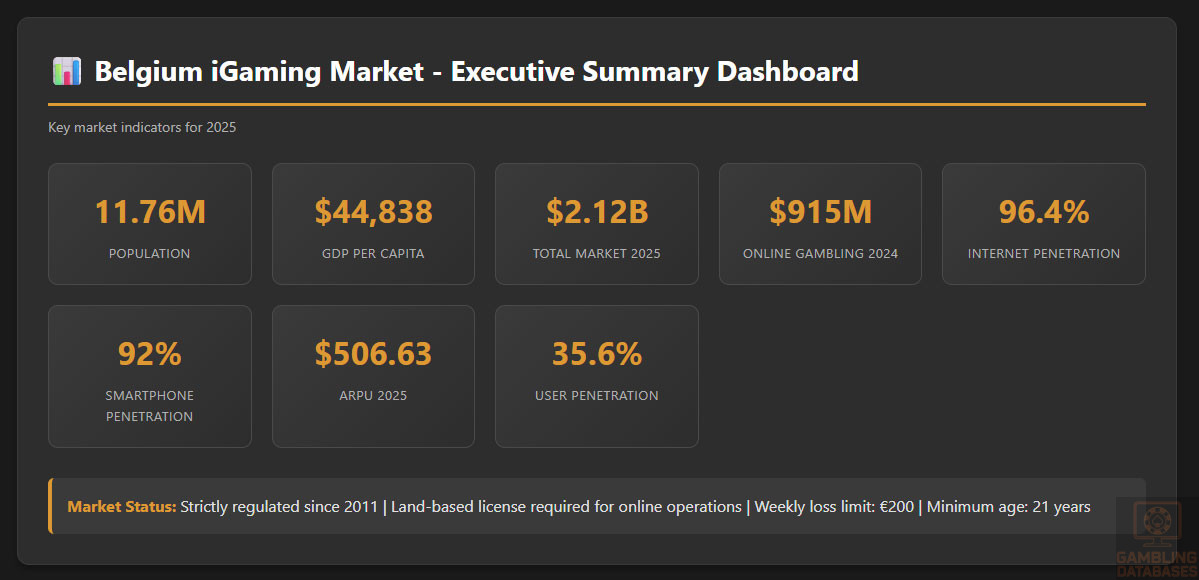
Executive Summary: Key Market Indicators
| Metric Category | Indicator | Value/Status |
|---|---|---|
| Legal Status | Online Gambling Legal | Yes, strictly regulated since 2011 |
| Regulatory Authority | Gaming Commission (BGC) | Belgian Gaming Commission (Kansspelcommissie) |
| Licensing System | Available License Types | A+ (Online Casino), B+ (Online Arcade), F1+ (Online Betting) |
| License Requirement | Land-Based Prerequisite | Yes – must hold corresponding land-based license |
| Population | Total Population 2025 | 11.76 million |
| Demographics | Median Age | 41.9 years |
| Demographics | Urban Population | 98.8% (11.6 million) |
| Economic Indicators | GDP (Total 2024) | Approximately $528 billion USD |
| Economic Indicators | GDP Per Capita 2024 | $44,838 USD |
| Economic Indicators | GDP Growth Forecast 2025 | 0.2-0.4% quarterly growth |
| Internet Infrastructure | Internet Penetration | 96.4% (11.3 million users) |
| Internet Infrastructure | Mobile Connections | 102% penetration (12 million connections) |
| Technology | Smartphone Penetration | 92% (10.4 million users by 2025) |
| Technology | Average Fixed Internet Speed | 107.01 Mbps download |
| Technology | Average Mobile Internet Speed | 88.69 Mbps download |
| Licensing Costs | A/A+ License Guarantee | €250,000 warranty deposit |
| Licensing Costs | F1/F1+ License Guarantee | €10,000 (F1) / €75,000 (F1+) warranty |
| Licensing Costs | Annual License Fee (A-Class) | €22,085 |
| Licensing Costs | Additional Setup Fees | €13,600 incorporation + €12,000 local server |
| Tax Rates | Online Gambling GGR Tax | 11% (varies by region) |
| Tax Rates | Corporate Income Tax | 25% (standard rate) |
| Tax Rates | VAT Rate | 21% |
| Player Regulations | Minimum Gambling Age | 21 years (as of September 2024) |
| Player Regulations | Weekly Loss Limit | €200 maximum per player per week |
| Market Size | Total Gambling Market 2025 | $2.12 billion USD (total gambling) |
| Market Size | Online Gambling Revenue 2024 | $914.80 million USD |
| Market Growth | Online Gambling CAGR 2024-2029 | 4.64% |
| Market Growth | Total Market CAGR 2025-2030 | 1.48% |
| Player Metrics | Average Revenue Per User (ARPU) | $506.63 (2025 projection) |
| Player Metrics | User Penetration Rate | 35.6% (2025) |
| Player Metrics | Expected Users by 2030 | 4.5 million gambling users |
| License Validity | Casino Licenses (A/A+) | 15 years (renewable) |
| License Validity | Betting Licenses (F1/F1+) | 9 years (renewable) |
| Processing Time | F1 License Application | 6 months (statutory maximum) |
| Processing Time | Documentation Review | 2-3 months (typical) |
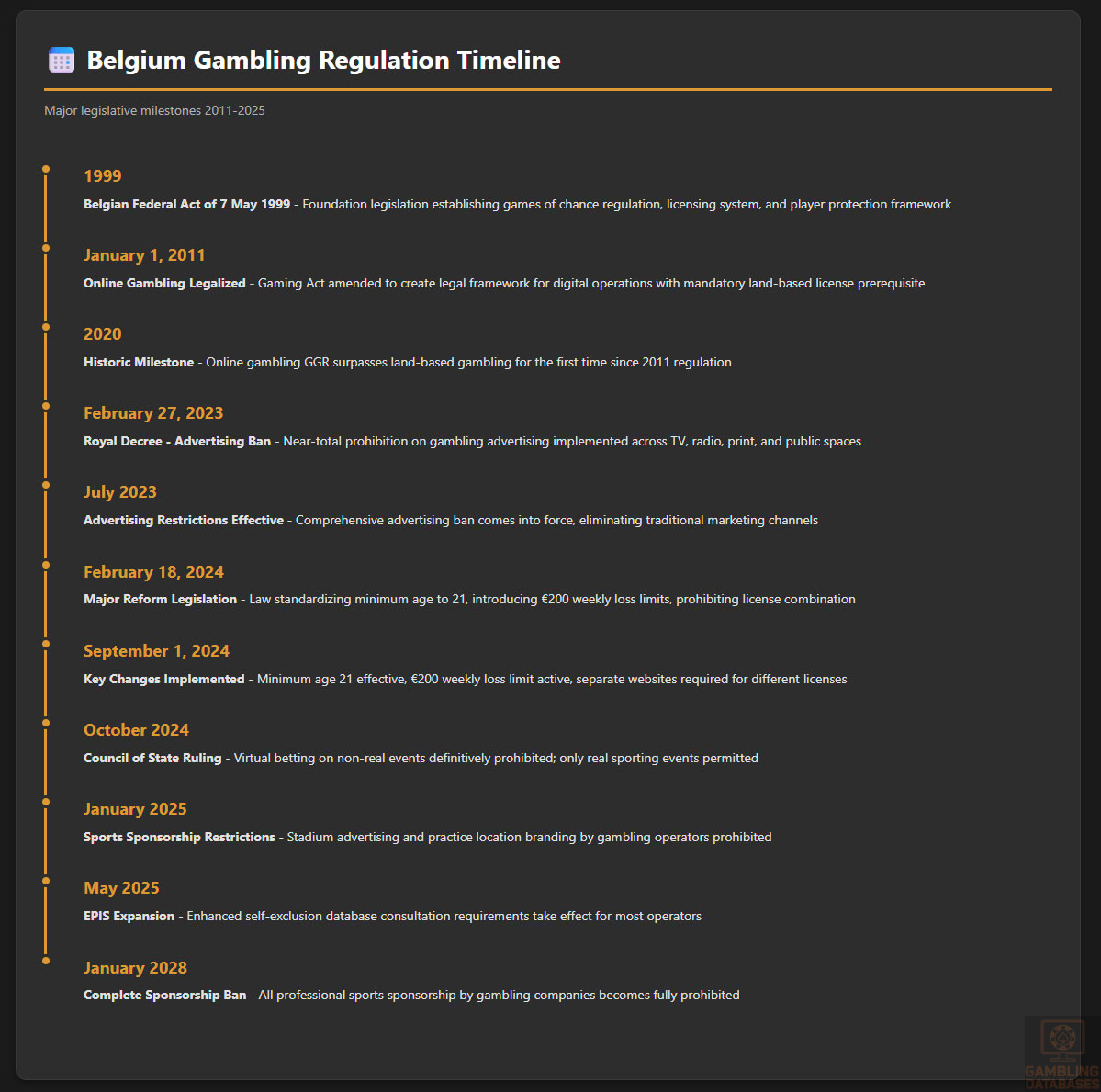
| Market Entry Barriers | Advertising Restrictions | Near-total ban since July 2023 |
| Market Entry Barriers | License Availability | Limited number (numerus clausus) |
| Market Entry Barriers | Server Location Requirement | Must be hosted in Belgium |
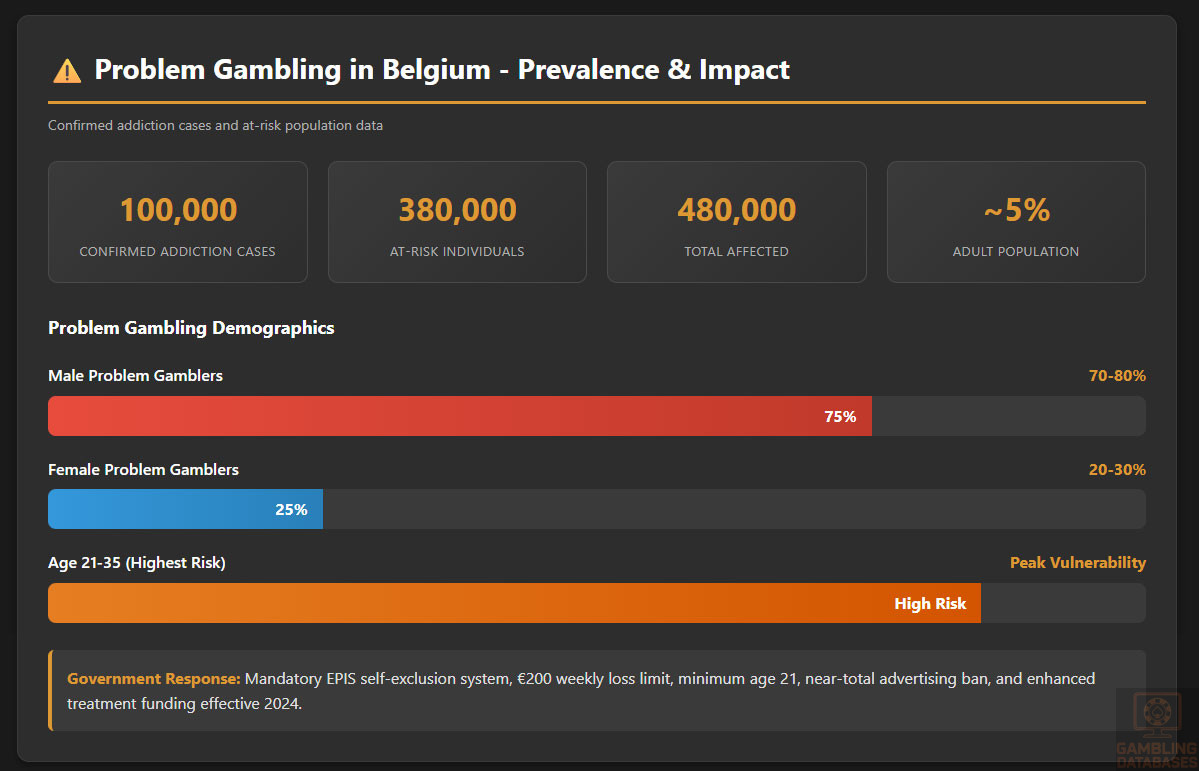
| Problem Gambling | Confirmed Addiction Cases | Approximately 100,000 people |
| Problem Gambling | At-Risk Gamblers | 380,000 individuals (5% of adult population) |
Section 1: Regulatory Framework and Legal Environment
Current Gambling Regulation Status
Belgium’s gambling regulatory framework operates on a fundamental principle that all games of chance are prohibited unless specifically authorized through a strict licensing system. The Belgian Federal Act of 7 May 1999 on games of chance, betting, gaming establishments and player protection serves as the cornerstone legislation, establishing a channeling policy designed to provide Belgian residents access to limited, safe, and strictly regulated gambling options while combating illegal operations. This approach represents a deliberate balance between prohibition and controlled commercialization, requiring constant regulatory fine-tuning to address technological developments and social concerns.
The regulatory environment underwent significant transformation in 2024 with the implementation of the Law of 18 February 2024, which came into force on September 1, 2024. This landmark reform standardized the minimum legal gambling age at 21 years across all gambling activities, eliminating previous age disparities where casinos required 21 but other sectors allowed 18. The legislation also introduced critical prohibitions including the combination of different online licenses on the same website and established stricter player protection measures. These changes reflect Belgium’s increasingly cautious approach to gambling regulation, prioritizing consumer protection and addiction prevention over market liberalization.
An important judicial clarification emerged in October 2024 when the Belgian Council of State ruled that virtual betting on non-real events does not constitute legal betting under Belgian law. The court specified that bets must be placed on real, uncertain events rather than virtual simulations, significantly impacting operators offering virtual sports betting. This ruling demonstrates the regulatory authorities’ strict interpretation of gambling legislation and their willingness to adapt oversight to emerging gambling formats, creating potential compliance risks for operators developing innovative betting products.

Land-Based Gambling Activities
Belgium permits carefully controlled land-based gambling operations through a strictly limited licensing system. Casino operations require Class A licenses, with only nine casinos authorized to operate throughout Belgium’s territory. The Gaming Act specifies the exact municipalities where casinos may be established, and each casino must conclude a concession agreement with the local municipality. These establishments must combine gambling activities with sociocultural offerings including shows, exhibitions, congresses, and hotel and catering services, positioning them as integrated entertainment destinations rather than pure gambling venues.
Gaming arcades operating slot machines require Class B licenses, with 180 licenses available nationwide and 175 currently active as of October 2024. These Class II gaming establishments focus specifically on automatic games of chance and must meet distinct operational requirements separate from full casinos. Additionally, drinking establishments may obtain Class C licenses permitting up to two gaming machines, provided these machines include strict age verification functions requiring ID card insertion before play. This tiered licensing structure creates multiple entry points into Belgium’s land-based gambling market, though each tier faces significant regulatory compliance obligations.
Sports betting venues operate under F1 and F2 licenses, with F1 licenses granted to primary betting operators and F2 licenses issued to retail agents and newspaper shops offering betting as an ancillary activity. The regulatory framework distinguishes between different types of betting establishments, with Type I through Type IV gaming establishments each subject to specific operational requirements. Recent legislative proposals may soon require C license applicants to obtain positive municipal opinions before license issuance, adding another layer of local government involvement in gambling regulation.
Online Gambling Framework
Online gambling has been regulated in Belgium since January 1, 2011, when the Gaming Act was amended to create a legal framework for digital gaming operations. However, a critical requirement distinguishes Belgium’s online gambling regime from many other jurisdictions: operators must hold a corresponding land-based license before obtaining permission to offer the same games online. This dual-licensing requirement means A+ licenses for online casinos can only be obtained by holders of A licenses for physical casinos, B+ licenses for online gaming arcades require B licenses, and F1+ licenses for online betting necessitate F1 licenses.
The mandatory physical presence requirement creates significant market entry barriers for international operators without Belgian land-based operations. The Gaming Commission enforces this policy as part of Belgium’s channeling approach, ensuring online operators maintain substantial local presence and commitment to Belgian market regulations. This structure has resulted in only nine active A+ licenses and limited B+ and F1+ licenses, corresponding exactly to the number of authorized land-based operations in each category.
Recent regulatory changes prohibit combining different online license types on the same website, effective September 1, 2024. Operators can no longer offer both casino games and sports betting through a single online platform even if they hold multiple license types. This separation requirement forces operators to maintain distinct websites for different gambling products, increasing operational complexity and costs while theoretically improving player protection through clearer product categorization.
Prohibited Activities and Restrictions
Belgian law explicitly prohibits several gambling activities and imposes strict content restrictions on permitted operations. Virtual betting on simulated events stands definitively prohibited following the October 2024 Council of State ruling, limiting F1 and F1+ license holders to offering bets exclusively on real sporting events and competitions. Operators cannot accept wagers on events whose outcomes are already known, activities contrary to public order or morality, or events lacking genuine uncertainty in their results.
The Gaming Act contains broad prohibitions against unlicensed gambling operations, with both civil and criminal penalties applicable to violators. The Gaming Commission maintains and regularly updates a blacklist of websites offering unlawful games of chance to Belgian players, published on the Commission’s website. Most Belgian Internet Service Providers block access to blacklisted websites, and the Commission has established cooperation with telecommunications regulators to enhance blocking effectiveness and raise awareness about illegal gambling risks.
Regulatory Body Structure and Oversight
The Belgian Gaming Commission serves as the primary regulatory authority, operating as an independent public body responsible for supervising, enforcing, and regulating all gambling activities covered by the Gaming Act. The Commission exercises threefold competence encompassing advisory functions, licensing authority, and supervisory powers. When requested by Parliament or ministers, the Commission provides expert advice on legislative and regulatory issues within the Gaming Act’s scope, influencing policy development and regulatory evolution.
The Commission’s licensing authority extends to granting and refusing license applications across all gambling categories, evaluating applicants against financial stability requirements, criminal record checks, and technical compliance standards. The Commission’s Control Unit conducts inspections at gaming establishments and on IT systems, investigates potential violations, requests relevant documents, and drafts official reports of infractions for submission to public prosecutors. Recent legislative proposals suggest expanding the Control Committee’s membership, signaling potential intensification of enforcement activities.
Enforcement mechanisms include warnings, operational suspensions, license revocations, and administrative fines. For serious violations, criminal prosecution may proceed independently of or alongside administrative sanctions. The Commission can also impose fines when public prosecutors decline to pursue criminal charges, ensuring violations face consequences even without criminal convictions. This multi-layered enforcement approach creates substantial compliance pressure on licensed operators and serves as a significant deterrent against unlicensed gambling activities.
Licensed Operators and Market Players
Belgium’s restricted licensing system has created a concentrated market with limited competition among established operators. As of October 2024, exactly nine A licenses and nine corresponding A+ licenses are active, matching the maximum number permitted by law. Similarly, 175 B licenses remain active from the 180 available, with corresponding B+ licenses for online operations. The F1 and F1+ licensing categories show similar constraint, though exact numbers vary as licenses are granted for renewable terms and may lapse if operators exit the market.
The Belgian National Lottery operates a legal monopoly on lottery products, commanding significant market presence with over 5 million monthly website visitors to its French-language portal and similarly strong traffic to its Dutch-language equivalent. This state-controlled monopoly controls a substantial portion of total gambling revenue, particularly in the lottery segment which generated €38 billion in European-wide revenue in 2024, with land-based lottery significantly outperforming online alternatives.
International operators with Belgian operations include major European gaming groups that have established land-based presence to qualify for online licenses. Gaming1 has emerged as a significant market player following partnerships with international content providers and expansion of its online casino and sports betting offerings. Market concentration remains high due to licensing restrictions, with established operators benefiting from first-mover advantages and substantial barriers to new entrant competition.
The market structure reflects Belgium’s deliberate policy choice to limit gambling availability while channeling player activity toward licensed, regulated operators. Market leaders focus on defending their positions through network quality, customer service excellence, and compliance with evolving regulatory requirements. However, this concentration has prompted concerns that overly restrictive regulation may push players toward unlicensed offshore operators that face fewer restrictions and can offer more attractive promotions, potentially undermining the channeling policy’s effectiveness.
Licensing Framework and Requirements
Application Process and Eligibility
The Belgian Gaming Commission administers all license applications through structured procedures designed to ensure only qualified, financially stable operators receive authorization. Applicants must first complete detailed application forms enabling the Commission to assess suitability and identify all relevant parties involved in the proposed operation. The Commission reviews applications against multiple criteria including financial capacity, technical competence, criminal record history of management personnel, and compliance capability.
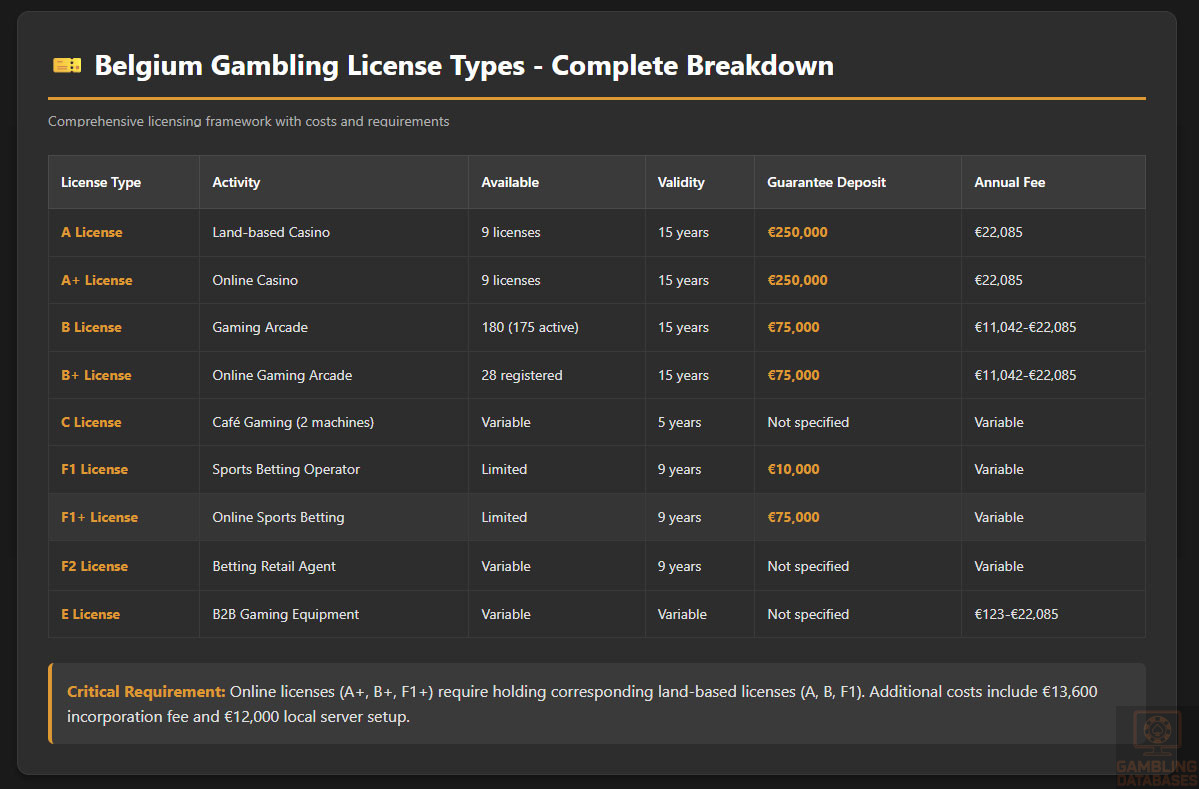
| License Type | Activity Authorized | Number Available | Validity Period | Guarantee Deposit | Annual Fee |
|---|---|---|---|---|---|
| A License | Land-based Casino | 9 licenses | 15 years (renewable) | €250,000 | €22,085 |
| A+ License | Online Casino | 9 licenses | Same as A license | €250,000 | €22,085 |
| B License | Gaming Arcade | 180 available (175 active) | 15 years (renewable) | €75,000 | €11,042-€22,085 |
| B+ License | Online Gaming Arcade | Limited (28 registered) | Same as B license | €75,000 | €11,042-€22,085 |
| C License | Café Gaming (max 2 machines) | Variable | 5 years | Not specified | Variable |
| F1 License | Sports Betting Operator | Limited | 9 years (renewable) | €10,000 | Variable |
| F1+ License | Online Sports Betting | Limited | Same as F1 license | €75,000 | Variable |
| F2 License | Betting Retail Agent | Variable | 9 years (renewable) | Not specified | Variable |
| E License | B2B Gaming Equipment | Variable | Variable | Not specified | €123-€22,085 |
Financial requirements represent substantial barriers to market entry. A and A+ license applicants must provide €250,000 warranty deposits, while B and B+ licenses require €75,000 guarantees. F1 licenses demand €10,000 warranties, but corresponding F1+ online licenses increase the requirement to €75,000. These deposits remain locked throughout the license validity period, representing significant capital commitments that must be maintained separate from operational funding requirements.
Beyond guarantee deposits, applicants face additional one-time costs including €13,600 incorporation fees and €12,000 local server setup fees for online operations. These mandatory infrastructure investments ensure operators establish genuine Belgian presence rather than operating purely from foreign jurisdictions. The Gaming Commission may request additional documentation or clarifications during review processes, potentially extending timelines and increasing legal and consulting expenses.
The Commission must process F1 license applications within six months of submission per statutory requirements. Documentation review typically requires 2-3 months when applications include all required materials. However, incomplete applications or requests for additional information can extend timelines significantly. Applicants should anticipate total time-to-market of 6-12 months from initial application submission through license approval and operational launch, though complex applications may require longer periods.
Local Presence and Operational Requirements
Belgium mandates physical presence within Belgian territory for all online gambling license holders. Operators cannot conduct online gambling purely through remote servers or foreign corporate structures. This requirement flows from the dual-licensing system requiring land-based operations before online authorization. A+ license holders must operate physical casinos, B+ operators need gaming arcades, and F1+ betting sites require land-based betting establishments or agency networks.
Server hosting requirements specify that all systems supporting online gambling operations must be located physically within Belgium. Operators cannot rely on cloud infrastructure or data centers in other jurisdictions, even within the European Union. This localization requirement increases operational costs and limits technical flexibility, but ensures Belgian authorities maintain direct oversight capabilities and can conduct physical inspections of IT infrastructure supporting gambling operations.
Domain registration requirements mandate Belgian domains for licensed operators, reinforcing the local presence requirement and making it easier for Belgian consumers to identify licensed operators. The Gaming Commission provides a list of licensed operators and their authorized domains on its website, helping players distinguish legal operators from unlicensed alternatives. Operators must use the “Always Play Legally” logo provided by the Gaming Commission, creating visual consistency across licensed gambling websites.
Personnel requirements include employment of Belgian residents or EU nationals with appropriate work authorization. Operators must maintain management teams capable of interfacing with Belgian authorities in French, Dutch, or German depending on their operational region. Foreign ownership faces no explicit percentage restrictions, allowing international companies to own 100% of Belgian gambling operations, but the requirement to hold land-based licenses before obtaining online permission creates practical limitations favoring operators willing to make substantial Belgian market commitments.
Compliance Obligations and Monitoring
Player Protection and Identification
Age verification requirements mandate operators verify that all players are at least 21 years old before permitting any gambling activity. This applies uniformly across casinos, betting operations, gaming arcades, and all online equivalents following the September 2024 regulatory changes. Operators must implement robust identification systems capable of confirming age through government-issued ID documents before account creation or any gambling participation.
Know Your Customer and Anti-Money Laundering compliance follows strict standards aligned with European Union directives. Operators must conduct enhanced due diligence on players making significant deposits or withdrawals, maintain detailed transaction records, and report suspicious activities to Belgian financial intelligence authorities. Customer identification verification must occur before processing significant financial transactions, with operators required to maintain secure databases of verified player information.
The Excluded Persons Information System operates as Belgium’s centralized self-exclusion database. Players can request indefinite exclusion from all licensed gambling operations through the Gaming Commission’s website. Once registered in EPIS, individuals cannot access any licensed casino or online gambling platform. Operators must check all players against EPIS before permitting gambling participation and face severe penalties for allowing excluded persons to gamble.
Expanded EPIS consultation requirements take effect in May 2025 for most operators, with F2 licensees in specific categories receiving extensions until May 2026. The Law of 7 May 2024 introduces specific identification requirements for newspaper shops offering sports betting, requiring certified IT systems capable of age verification and EPIS database checking. These expanding obligations increase compliance costs but aim to strengthen responsible gambling protections across all gambling channels.
Responsible gambling measures mandated by law include mandatory display of problem gambling information, limits on session times and loss amounts, cooling-off periods, and reality checks interrupting play to inform players of time and money spent. Operators must provide clear information about gambling risks, links to problem gambling support services, and mechanisms for players to set personal deposit and loss limits. The weekly loss limit of €200 per player applies across all licensed operators, requiring sophisticated systems to track and enforce cumulative limits.
Financial Monitoring and Reporting
Transaction monitoring systems must track all player deposits, wagers, winnings, and withdrawals in real-time. Operators need technical infrastructure capable of detecting unusual patterns, potential money laundering, underage gambling attempts, and violation of loss limits. These systems must integrate with EPIS to prevent excluded persons from gambling and must be available for inspection by the Gaming Commission’s Control Unit at any time.
Reporting requirements vary by license type but generally include monthly and quarterly submissions detailing gross gaming revenue, number of active players, total wagers, payouts, and compliance metrics. Operators must maintain detailed audit trails of all transactions and make these available to regulators upon request. Annual audits by independent certified auditors are mandatory, with audit reports submitted to the Gaming Commission demonstrating compliance with financial, technical, and responsible gambling requirements.
Audit and inspection procedures grant the Gaming Commission’s Control Unit broad powers to enter premises, examine IT systems, review documents, and interview personnel without prior notice. Operators must cooperate fully with inspections and provide requested information promptly. The Commission can seize documents, gaming machines, and evidence of potential violations. Inspection reports may lead to warnings, fines, license suspensions, or criminal referrals depending on violation severity.
Data retention requirements mandate operators maintain comprehensive records of all gambling transactions, player interactions, compliance checks, and system logs for specified periods. These records must be stored securely, protected against unauthorized access or tampering, and readily producible for regulatory review. Failure to maintain adequate records constitutes a serious violation potentially resulting in license suspension or revocation.
Taxation Structure and Financial Obligations
Player Taxation
Belgian tax law imposes taxes on certain gambling winnings, though the specific application varies by gambling type and amount won. Players generally do not pay taxes on most casino game winnings or sports betting profits. However, lottery winnings above certain thresholds may be subject to withholding tax, and players receiving large payouts may face tax obligations requiring declaration on annual tax returns.
The taxation framework deliberately avoids burdening most recreational gamblers with tax compliance obligations, simplifying administration and avoiding disincentives to use licensed operators. However, professional gamblers or individuals deriving substantial income from gambling may face income tax obligations on their gambling profits. Tax authorities can investigate unusually large or frequent gambling winnings to ensure appropriate tax treatment.
Operator Taxation
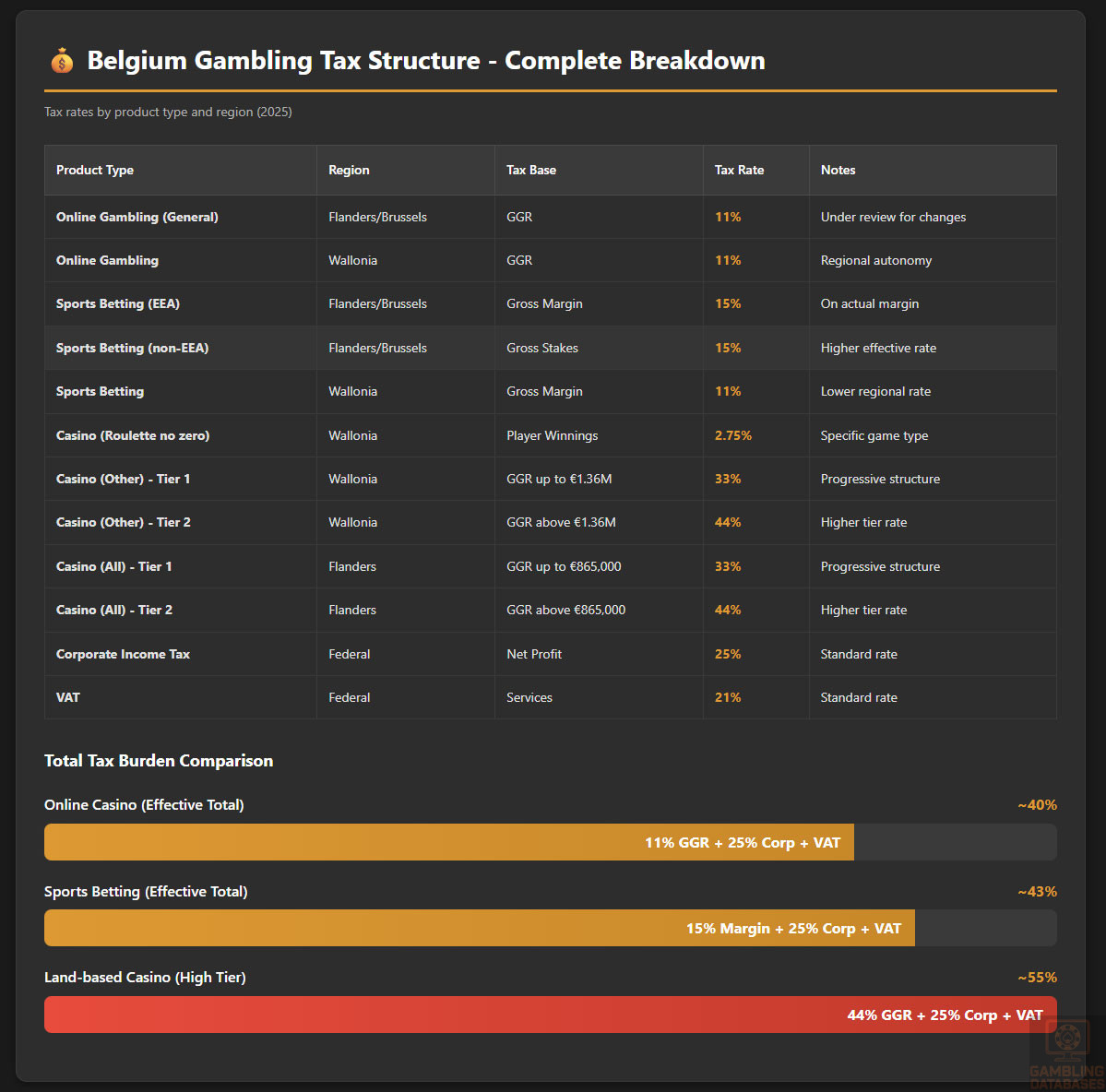
| Product Type | Region | Tax Base | Tax Rate | Additional Notes |
|---|---|---|---|---|
| Online Gambling (General) | Flanders/Brussels | Gross Gaming Revenue | 11% | Under review for potential changes |
| Online Gambling | Wallonia | Gross Gaming Revenue | 11% | Regional autonomy on rates |
| Sports Betting (EEA events) | Flanders/Brussels | Gross Margin | 15% | On actual gross margin realized |
| Sports Betting (non-EEA) | Flanders/Brussels | Gross Stakes | 15% | Higher effective rate |
| Sports Betting (General) | Wallonia | Gross Margin | 11% | Lower regional rate |
| Casino Games (Roulette no zero) | Wallonia | Player Winnings | 2.75% | Specific game type |
| Casino Games (Other) | Wallonia | GGR up to €1.36M | 33% | Tiered structure |
| Casino Games (Other) | Wallonia | GGR above €1.36M | 44% | Progressive higher rate |
| Casino Games (All) | Flanders | GGR up to €865,000 | 33% | Tiered structure |
| Casino Games (All) | Flanders | GGR above €865,000 | 44% | Progressive higher rate |
| Gaming Machines | All Regions | Per Machine | Fixed Annual Amount | Varies by machine type and license class |
| Corporate Income Tax | Federal | Net Profit | 25% | Standard corporate rate |
| VAT | Federal | Services | 21% | Standard rate |
Belgium’s federal structure grants its three regions significant taxation autonomy over gambling activities. The Flemish Region, Walloon Region, and Brussels-Capital Region each determine tax rates applicable to gambling operations within their territories. This creates complexity for operators serving players across multiple regions, requiring sophisticated systems to track player locations and apply appropriate regional tax rates to each transaction.
The Flemish Parliament is actively contemplating changes to online gambling tax rates, though specific details remain undisclosed as of 2025. Any rate changes could significantly impact operator profitability and business models, creating uncertainty for market planning. Operators must monitor regional legislative developments closely and prepare for potential tax increases that could materially affect financial projections.
Gross Gaming Revenue taxation applies to most online gambling operations, calculated as total player wagers minus winnings paid out. The 11% GGR tax rate common across regions represents a moderate burden compared to some European jurisdictions, but combined with corporate income tax, VAT, and other obligations, the total tax burden reaches substantial levels. Operators must maintain precise accounting systems capable of calculating GGR accurately across different game types and player jurisdictions.
Fixed operational taxes and annual license fees add to the tax burden. A-class license holders pay €22,085 annually regardless of revenue performance, creating a significant fixed cost for smaller operators or those experiencing revenue challenges. Combined with guarantee deposits, infrastructure requirements, and compliance costs, the total financial commitment to maintain Belgian gambling operations exceeds €300,000 annually before considering variable taxes on revenue.
Corporate income tax at 25% applies to net profits after deducting operational expenses and gambling-specific taxes. Belgium maintains tax treaties with numerous countries to prevent double taxation, potentially benefiting international operators with Belgian subsidiaries. However, transfer pricing rules require arm’s-length pricing for transactions between related entities, limiting opportunities to shift profits to lower-tax jurisdictions through artificial pricing arrangements.
Gambling Market Financial Performance
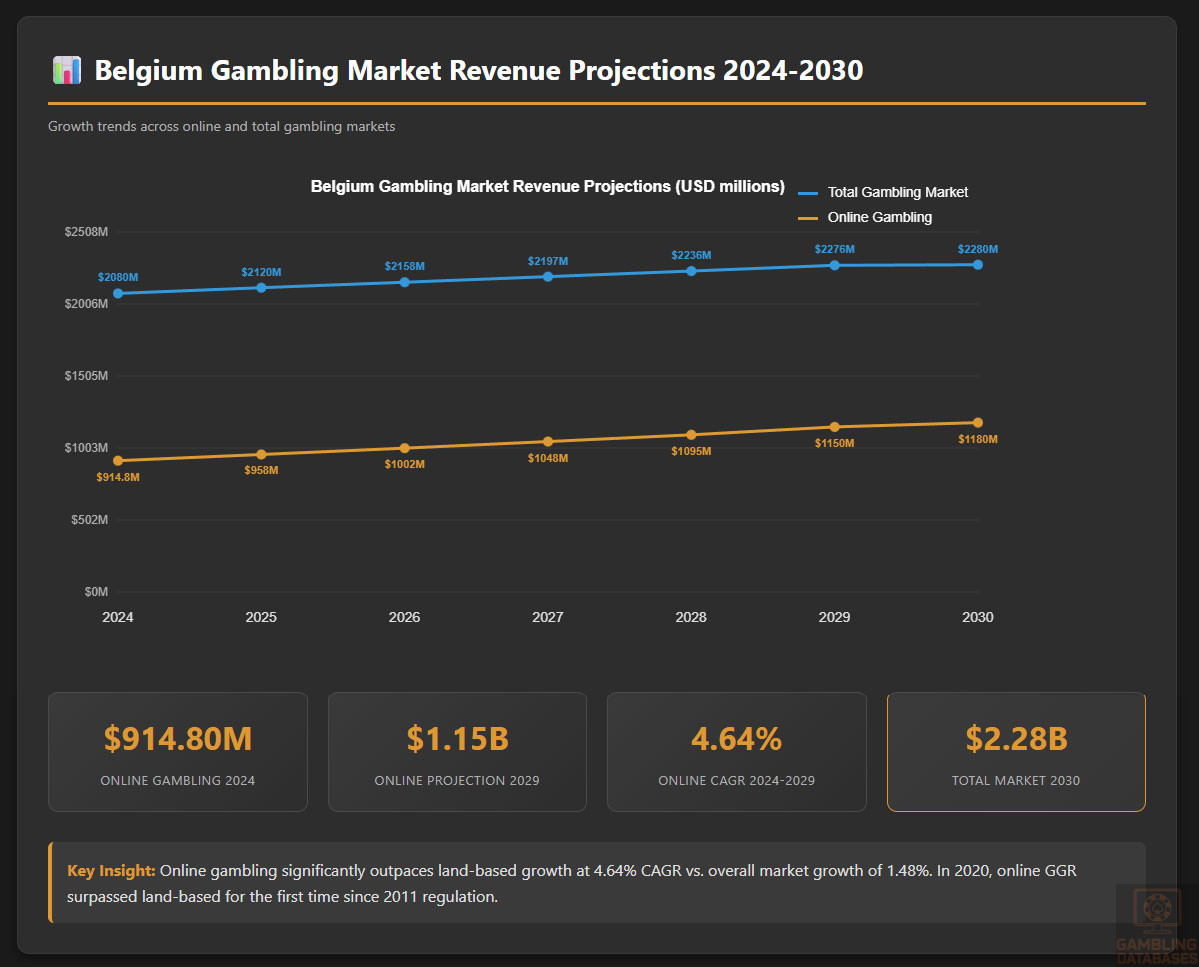
Belgium’s total gambling market generated approximately €2.12 billion in revenue during 2025, encompassing land-based and online operations across casinos, betting, lottery, and gaming arcades. The market demonstrates moderate growth with a projected CAGR of 1.48% through 2030, reaching approximately €2.28 billion. This modest growth reflects market maturity, regulatory constraints, and demographic factors limiting rapid expansion.
Online gambling revenue reached €914.80 million in 2024 and continues growing at 4.64% CAGR, significantly outpacing land-based gambling growth. By 2029, online gambling is projected to reach €1.15 billion, representing an increasing share of total gambling revenue. This shift toward digital channels reflects broader consumer preferences for convenience and mobile access, though Belgium’s online growth lags behind less-regulated European markets.
In 2020, Belgium experienced a historic milestone when online gambling Gross Gaming Revenue surpassed land-based gambling for the first time since online regulation began in 2011. The Gaming Commission reported 18.03% online GGR growth in 2023 compared to 2022, while offline markets grew 15.18% during the same period. This accelerating digital transition creates opportunities for online-focused operators but also intensifies regulatory scrutiny of online gambling’s social impacts.
Revenue distribution by gambling type shows lottery commanding the largest overall product category at €38 billion European-wide, though Belgium’s specific lottery revenue concentrates with the National Lottery monopoly. Casino games generated approximately €30 billion across Europe in 2024, predominantly online at €21.5 billion versus land-based €8.5 billion. Sports betting produced €20.1 billion with online channels at €13.7 billion exceeding land-based betting revenue.
Tax revenues generated for Belgian federal and regional governments from gambling operations contribute substantially to public finances. The combination of GGR taxes, fixed license fees, corporate income taxes, and VAT on gambling services produces hundreds of millions in annual government revenue. This fiscal contribution strengthens political support for maintaining regulated gambling markets, though concerns about problem gambling social costs create ongoing debates about optimal regulatory balance.
Advertising and Marketing Restrictions
Belgium implemented sweeping advertising restrictions through the Royal Decree of 27 February 2023 and subsequent amendments to the Gaming Act in 2024. The regulatory framework now establishes a general prohibition on all gambling advertising, with only specifically authorized exceptions permitted. This represents one of Europe’s strictest advertising regimes, fundamentally reshaping how licensed operators can acquire customers and build brand awareness.
All permitted advertisements must include mandatory warnings displaying the minimum legal gambling age of 21 and prominent problem gambling prevention messages. These requirements ensure that even authorized advertising communications emphasize gambling risks rather than purely promotional content. The mandatory disclosures reduce advertising effectiveness and increase creative constraints on permitted marketing materials.
Incidental advertising connected to sports event coverage remains authorized, allowing gambling brand visibility during broadcasts of sporting competitions. However, this exception is narrowly construed and does not permit traditional commercial advertising slots. Sports sponsorship authorization continues for non-professional sports associations indefinitely, but professional sports sponsorship faces phased elimination creating significant implications for operators using sports marketing strategies.
Professional sports sponsorship restrictions implement a gradual phase-out schedule. Until January 1, 2025, gambling operators could display brand names and logos at sports practice locations. This permission ended as of 2025, eliminating stadium advertising opportunities. Sponsorship through sports clothing and team branding continues until January 2028, when all professional sports sponsorship by gambling companies becomes prohibited. Sponsorship expenses ceased being tax-deductible for gambling companies in 2024, increasing the effective cost of remaining sponsorship activities.
The advertising ban creates severe customer acquisition challenges for licensed operators, particularly new market entrants lacking established player bases. Traditional marketing channels that drive awareness and trial are unavailable, forcing reliance on organic search, direct navigation to known websites, and word-of-mouth referrals. Critics argue these restrictions disadvantage licensed operators while unlicensed offshore operators continue advertising through online channels difficult for Belgian authorities to block.
Affiliate marketing faces significant restrictions under the advertising ban interpretation. While not explicitly addressed in initial regulations, the general prohibition on gambling advertising appears to encompass affiliate websites promoting gambling services to Belgian consumers. Operators must carefully structure any affiliate relationships to avoid violating advertising restrictions, likely limiting affiliate marketing effectiveness compared to less-regulated markets.
Legal challenges to the advertising restrictions are pending before Belgian courts and potentially the European Court of Justice. Industry representatives argue the total ban violates EU principles of free movement of services and disproportionately restricts commercial speech. They contend that complete advertising prohibition pushes players toward unlicensed operators rather than protecting vulnerable consumers. However, initial court rulings have upheld Belgium’s advertising restrictions, and the regulatory trend continues toward tighter limitations.
Recent Regulatory Changes and Their Impact
The Law of 18 February 2024 represents the most significant gambling regulatory reform in recent years, implementing comprehensive changes affecting all licensed operators. The standardization of the minimum gambling age to 21 across all gambling activities eliminates a substantial player segment that previously accessed betting and gaming arcades legally at age 18. This age increase reduces the total addressable market and forces operators to implement more rigorous age verification systems.
Weekly loss limits decreased from €500 to €200 effective September 2024, representing a 60% reduction in the amount individual players can lose across all licensed gambling platforms. This consumer protection measure significantly impacts high-value players who previously exceeded €200 in weekly gambling expenditure. Operators must implement sophisticated tracking systems monitoring cumulative losses across their platforms and preventing players from exceeding limits through technical controls.
The prohibition on combining different online license types on single websites requires operators holding multiple licenses to maintain entirely separate digital properties. An operator with both A+ casino and F1+ betting licenses can no longer offer both products through a unified platform, forcing development and maintenance of distinct websites, apps, and customer databases. This separation increases technology costs, fragments customer experiences, and complicates cross-product marketing.
Bonus and promotion restrictions have intensified alongside advertising bans. While specific bonus limitations vary by interpretation, the general regulatory direction toward enhanced player protection suggests bonuses face increasing scrutiny. Operators must ensure any promotional offers comply with evolving responsible gambling standards and avoid encouraging excessive play or targeting vulnerable individuals. The €200 weekly loss limit effectively caps bonus value since players cannot wager beyond this threshold.
Mandatory player information disclosure requirements expanded through 2024 amendments. Operators must provide clearer, more prominent information about gambling risks, problem gambling resources, self-exclusion procedures, and loss limits before players begin gambling. These disclosures must appear during account registration, regularly during gameplay through reality checks, and whenever players approach loss limits. The increased disclosure requirements aim to ensure informed consent but add friction to customer onboarding processes.
Self-exclusion and cooling-off period requirements now mandate that all operators participate in the EPIS system and honor all exclusions immediately. Players can request temporary cooling-off periods preventing gambling access for specified durations or permanent indefinite exclusions. Operators cannot contact excluded players with marketing materials or incentivize them to return after self-exclusion, respecting players’ decisions to cease gambling activities.
License fee and tax rate changes remain under consideration, particularly in the Flemish Region where parliamentary discussions address potential online gambling tax increases. Any rate changes could materially impact operator profitability. The lack of specific details creates planning uncertainty, as operators cannot accurately forecast tax burdens or adjust business models in advance of regulatory changes.
The cumulative impact of recent regulatory changes substantially increases operator costs while limiting revenue potential. Higher age limits reduce player populations, loss limits cap individual player spending, advertising bans eliminate customer acquisition channels, and compliance requirements increase operational expenses. These changes demonstrate Belgium’s prioritization of player protection over gambling industry growth, creating a challenging environment for operators seeking to enter or expand in the Belgian market.
Enforcement Mechanisms and Penalties
The Belgian Gaming Commission employs comprehensive enforcement powers to ensure compliance with gambling regulations. The Control Unit conducts unannounced inspections of land-based establishments and remotely audits online gambling systems. During inspections, officials can access all areas of gambling facilities, examine gaming equipment, review financial records, and interview staff members. Operators must grant immediate access to all requested information and systems.
Penalty structures encompass administrative sanctions, financial penalties, and potential criminal prosecution. Administrative sanctions include formal warnings for minor first-time violations, temporary operational suspensions for more serious infractions, and license revocation for repeated violations or severe breaches. License suspension can apply to specific gaming machines, particular games, or entire operations depending on violation nature and scope.
| Violation Type | Potential Administrative Penalty | Potential Criminal Penalty | Additional Consequences |
|---|---|---|---|
| Operating Without License | License denial, blacklisting | Fines, imprisonment | ISP blocking, payment restrictions |
| Advertising Violations | Warning, fines | Possible criminal charges | Mandatory advertising cessation |
| Allowing Excluded Players | Fines, suspension | Criminal liability possible | Enhanced monitoring requirements |
| Underage Gambling | Severe fines, suspension | Criminal prosecution likely | Potential license revocation |
| Loss Limit Violations | Fines, system corrections mandated | Repeated violations: criminal | Technical audit requirements |
| Tax Evasion/Reporting Failures | Administrative fines | Tax fraud prosecution | Financial audits, increased scrutiny |
| AML/KYC Failures | Fines, operational restrictions | Money laundering charges | Enhanced compliance obligations |
| License Condition Breaches | Warning to revocation | Varies by severity | Corrective action requirements |
Financial penalties vary based on violation severity and operator size. Administrative fines can reach substantial amounts, particularly for serious violations endangering players or undermining regulatory objectives. The Gaming Commission publishes enforcement decisions to create transparency and deter violations by other operators. Public disclosure of violations can damage operator reputations and customer trust beyond direct financial penalties.
Criminal penalties for illegal gambling operations include fines and potential imprisonment for organizers, entrepreneurs, directors, representatives, and agents of unlicensed lotteries or games of chance. Article 302 of the Belgian Criminal Code establishes criminal liability for unauthorized gambling operations, creating personal criminal exposure for individuals involved in illegal gambling businesses. This criminal liability extends beyond corporate penalties to hold individuals accountable.
ISP blocking of unlicensed operators represents a key enforcement mechanism. The Gaming Commission maintains an updated blacklist of websites offering illegal gambling to Belgian consumers, published on the Commission’s official website. Belgian Internet Service Providers cooperate in blocking access to blacklisted domains, preventing Belgian consumers from reaching unlicensed gambling sites. While determined users might circumvent blocks through VPNs or proxy services, ISP blocking significantly reduces illegal operator accessibility.
Payment processor restrictions complement ISP blocking by preventing financial transactions between Belgian consumers and unlicensed gambling operators. Banks and payment service providers receive guidance to identify and block gambling-related transactions with unlicensed entities. This financial chokepoint creates substantial operational difficulties for illegal operators attempting to accept deposits or pay winnings to Belgian players.
Recent enforcement actions demonstrate the Commission’s willingness to take decisive action against violations. The Commission regularly adds websites to its blacklist, investigates complaints about unlicensed operations, and pursues both administrative and criminal penalties against violators. Licensed operators also face enforcement actions when they breach license conditions, with recent years seeing warnings, fines, and compliance orders issued for various regulatory violations.
Compliance enforcement trends indicate intensifying scrutiny of responsible gambling measures, advertising restrictions, and player protection requirements. The proposed expansion of the Control Committee membership suggests the Commission intends to increase inspection frequency and enforcement capability. Operators should anticipate more frequent audits, stricter interpretation of regulatory requirements, and lower tolerance for compliance failures.
Section 2: Demographics and Consumer Analysis
Population Demographics and Distribution
Core Population Metrics
Belgium’s population reached 11.76 million people as of 2025, representing a modest 0.2% annual growth rate. The country maintains a highly developed demographic profile characteristic of advanced European economies, with slow population growth driven primarily by immigration rather than natural increase. The population grew from 11.74 million in 2024 to current levels, adding approximately 62,000 inhabitants annually through the combination of births, deaths, and international migration.
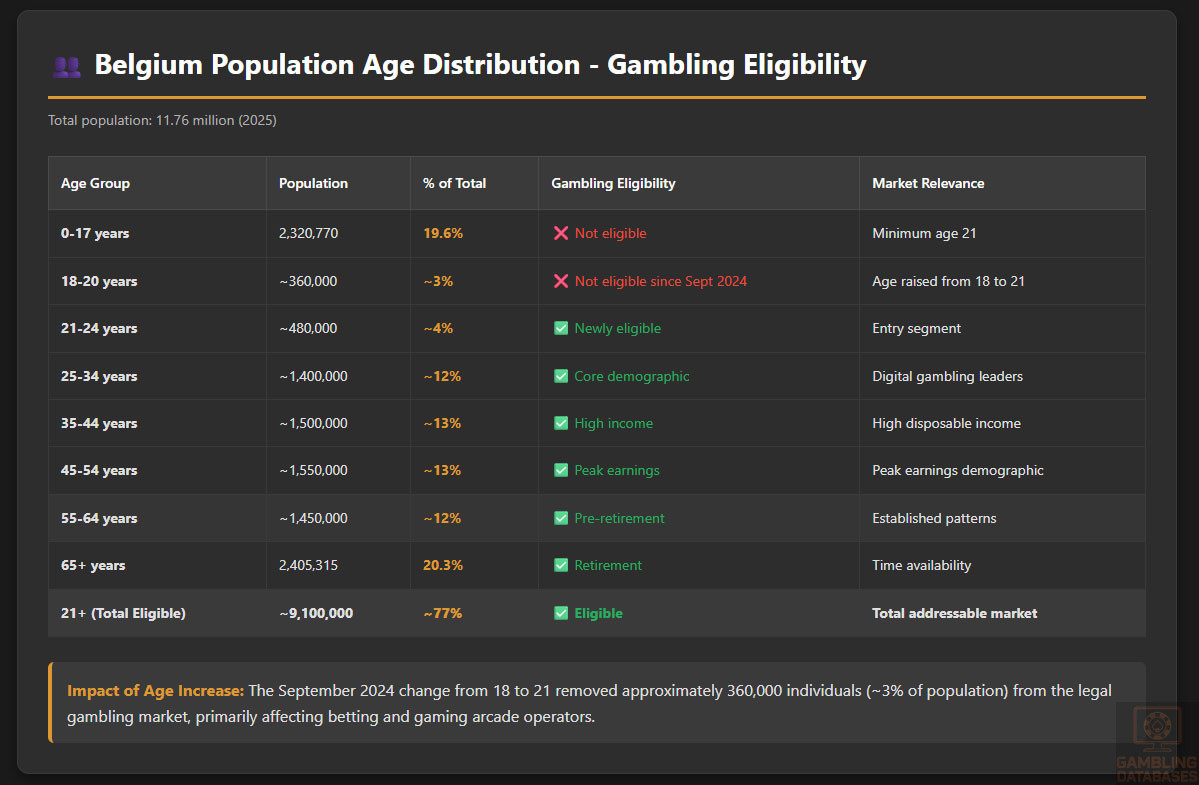
| Age Group | Population Count | Percentage of Total | Gambling Market Relevance |
|---|---|---|---|
| 0-17 years (Minors) | 2,320,770 | 19.6% | Not eligible (min age 21) |
| 18-20 years | Approx. 360,000 | ~3% | Not eligible since Sept 2024 |
| 21-24 years | Approx. 480,000 | ~4% | Newly eligible, entry segment |
| 25-34 years | Approx. 1,400,000 | ~12% | Core digital gambling demographic |
| 35-44 years | Approx. 1,500,000 | ~13% | High disposable income segment |
| 45-54 years | Approx. 1,550,000 | ~13% | Peak earnings demographic |
| 55-64 years | Approx. 1,450,000 | ~12% | Pre-retirement segment |
| 65+ years | 2,405,315 | 20.3% | Retirement demographic |
| 18-64 years (Working Age) | 7,099,466 | 60% | Primary target market |
| 21+ years (Eligible Gamblers) | Approx. 9,100,000 | ~77% | Total addressable population |
The median age of 41.9 years reflects Belgium’s mature demographic structure and aging population trend. This median has increased from 38 years in 1995, demonstrating consistent population aging over recent decades. An aging population creates both opportunities and challenges for gambling operators. Older demographics typically show higher disposable income but may demonstrate lower digital adoption rates and different gambling preferences compared to younger cohorts.
Gender ratios stand relatively balanced at 97 men per 100 women, creating a nearly equal split between male and female populations. This gender balance differs from the gambling participation patterns, where males demonstrate substantially higher gambling rates than females across most gambling product categories. Life expectancy reached 82.28 years in 2023, with significant gender disparity showing female life expectancy at 84.30 years versus male life expectancy at 80.18 years.
The age distribution’s implications for gambling markets prove significant. The September 2024 increase in minimum gambling age to 21 eliminated approximately 360,000 individuals aged 18-20 from the legal gambling market. This regulatory change reduced the total addressable market by roughly 3%, impacting operators previously serving this younger demographic through betting and gaming arcade channels.
Geographic Distribution
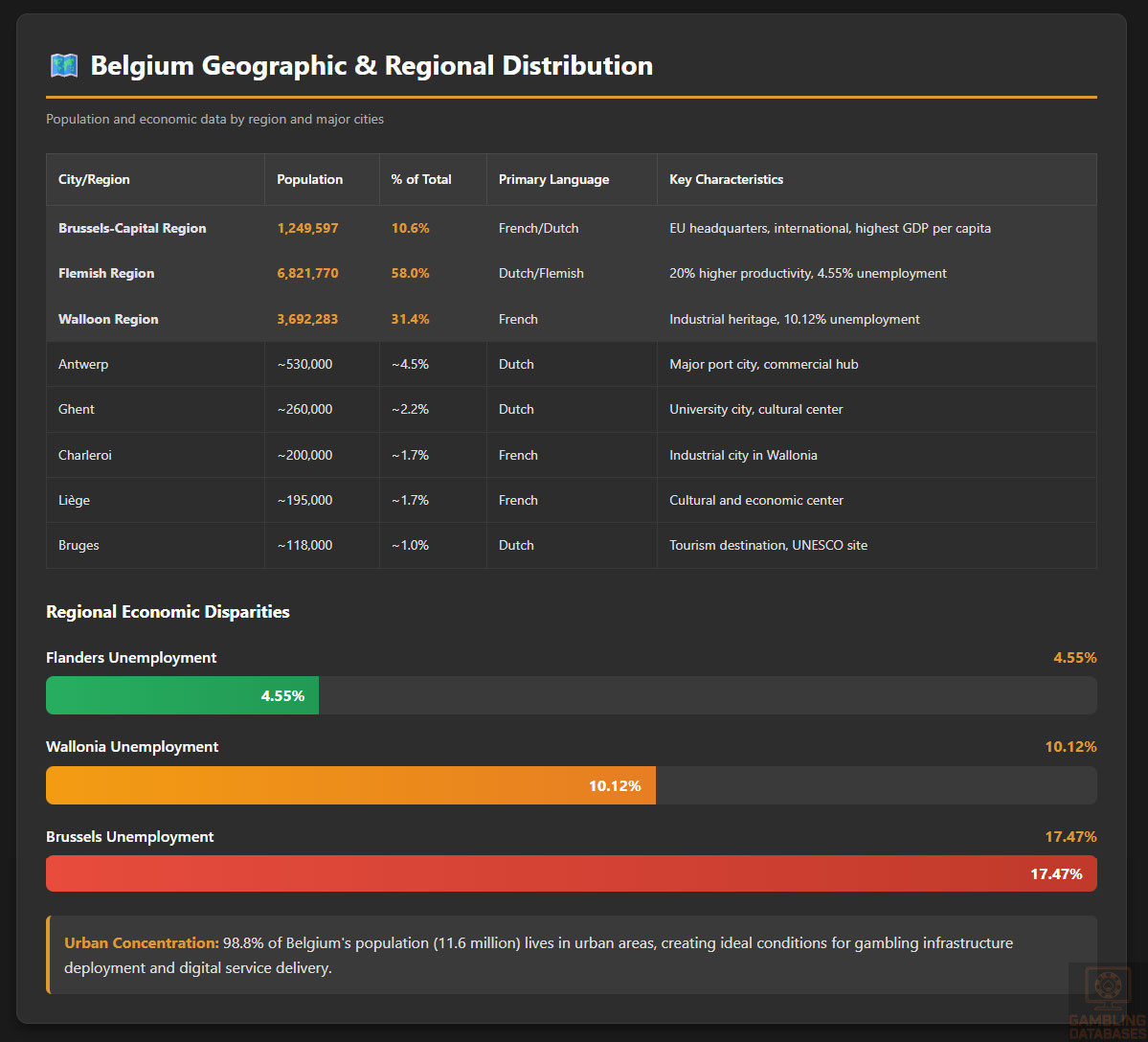
Belgium’s urban population concentration stands at 98.8%, representing 11.6 million people living in urban areas. This exceptionally high urbanization rate creates favorable conditions for both land-based gambling establishment accessibility and digital infrastructure supporting online gambling. Urban concentration facilitates customer acquisition, reduces geographic dispersion challenges, and enables efficient marketing even under advertising restrictions.
| City/Region | Population | Percentage of Total | Primary Language | Key Characteristics |
|---|---|---|---|---|
| Brussels-Capital Region | 1,249,597 | 10.6% | French/Dutch (bilingual) | EU headquarters, international |
| Flemish Region | 6,821,770 | 58.0% | Dutch/Flemish | Higher per capita productivity |
| Walloon Region | 3,692,283 | 31.4% | French | Industrial heritage |
| Antwerp | Approx. 530,000 | ~4.5% | Dutch | Major port city, commercial hub |
| Ghent | Approx. 260,000 | ~2.2% | Dutch | University city, cultural center |
| Charleroi | Approx. 200,000 | ~1.7% | French | Industrial city in Wallonia |
| Liège | Approx. 195,000 | ~1.7% | French | Cultural and economic center |
| Bruges | Approx. 118,000 | ~1.0% | Dutch | Tourism destination, UNESCO site |
Regional economic differences significantly impact gambling market dynamics. Flanders demonstrates approximately 20% higher productivity per inhabitant compared to Wallonia, translating to higher disposable incomes and potentially greater gambling expenditure capacity. Brussels’ GDP per capita substantially exceeds both regions, though this figure is somewhat misleading as many Brussels workers reside in Flanders or Wallonia, artificially inflating Brussels’ per capita statistics.
Unemployment disparities reveal economic variations across regions. Flanders maintains unemployment around 4.55%, while Wallonia faces 10.12% unemployment, and Brussels experiences the highest rate at 17.47%. These employment differences correlate with income disparities and gambling participation patterns, with higher-employment regions typically showing greater gambling market development and higher average spending per player.
Internet access and digital infrastructure show relatively uniform distribution across geographic areas despite economic differences. Belgium’s small geographic size and high urbanization enable consistent broadband and mobile coverage nationwide. This infrastructure uniformity facilitates online gambling operations without the geographic access disparities that challenge operators in larger or less-developed countries.
The concentration of gambling venues varies by region, with casino licenses specifically allocated to nine designated municipalities and gaming arcade licenses distributed more broadly. The nine authorized casino locations include major cities and tourism destinations, creating geographic concentration of premium gambling offerings while gaming arcades provide broader geographic coverage across urban centers.
Economic Indicators and Consumer Spending Power
GDP and Economic Performance
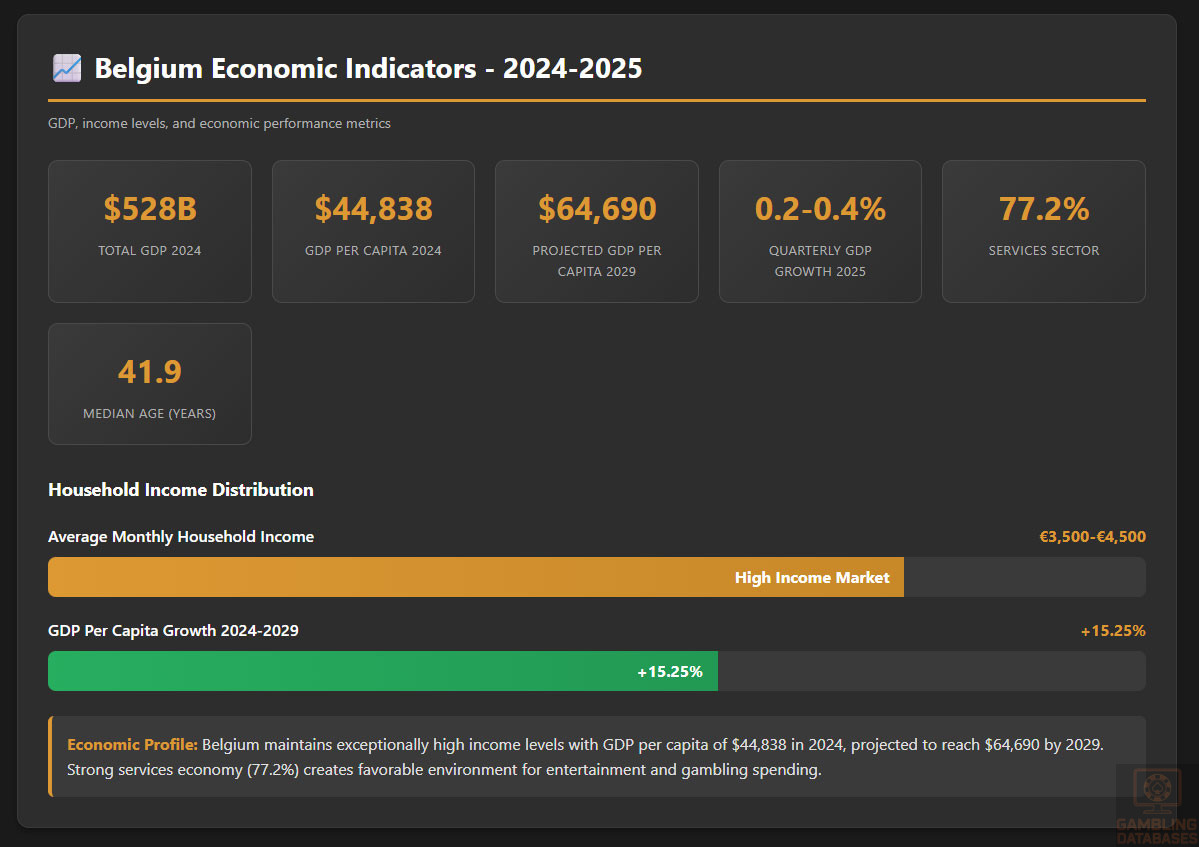
Belgium’s total GDP reached approximately $528 billion in 2024, positioning it among Europe’s significant economies despite its relatively small population. This economic scale reflects Belgium’s highly developed industrial base, advanced services sector, and strategic position as headquarters for European Union institutions and numerous international organizations. The economy’s diversification provides stability against sector-specific downturns affecting gambling industry performance.
GDP per capita stood at $44,838 in 2024, ranking Belgium among the world’s highest income countries. This affluence translates directly to gambling market potential, as higher per-capita income correlates strongly with discretionary spending capacity including entertainment and gambling expenditures. Projections indicate GDP per capita will reach approximately $64,690 by 2029, representing 15.25% growth over five years and suggesting continued income increases supporting gambling market expansion.
GDP growth forecasts for 2025 indicate modest quarterly expansion at 0.2-0.4%, reflecting mature economy characteristics and global economic uncertainties. While growth rates appear modest compared to emerging markets, Belgium’s economic stability provides predictable operating environment for gambling businesses. The consistent, if slow, economic growth supports gradual gambling market expansion without the volatility characterizing more dynamic economies.
Economic sector composition shows services dominating at 77.2% of GDP, with industry contributing substantially and agriculture representing only 0.7%. The services economy concentration aligns well with gambling operations, as service sector employment typically generates stable incomes and leisure spending patterns favorable to entertainment industries. Belgium’s position as a service economy hub creates a receptive market for leisure and entertainment offerings including gambling.
Employment rates remain strong despite regional variations, with overall labor market performance supporting consumer confidence and spending capacity. Wage levels across Belgium rank among Europe’s highest, though regional variations mirror unemployment disparities. Higher wages in Flanders and Brussels translate to greater disposable income available for gambling and other discretionary expenditures.
Inflation trends affect real income growth and consumer purchasing power. Recent years have seen elevated inflation challenging consumer budgets, though Belgium’s diversified economy and strong social safety nets moderate inflation’s impact on consumer spending. Operators must monitor inflation trends as they influence disposable income available for gambling and may affect price sensitivity to gambling taxes and fees.
Income and Wealth Distribution
Average household income in Belgium reaches substantial levels supporting discretionary spending capacity. While specific current figures vary by region, Belgian households enjoy among Europe’s highest average incomes, translating to approximately €3,500-€4,500 monthly household income depending on region and household composition. These income levels support significant leisure spending budgets within which gambling expenditures compete with other entertainment options.
Median household income provides a more representative measure than average income by excluding distortion from very high earners. Belgium’s median household income indicates strong middle-class prosperity, with majority of households achieving comfortable living standards. The robust median income demonstrates that gambling market potential extends beyond affluent segments to encompass broad middle-class participation.
Income inequality measures including the Gini coefficient show Belgium maintaining relatively equitable income distribution compared to many developed economies. This equality reflects Belgium’s strong social safety net, progressive taxation, and collective bargaining traditions. Lower inequality means gambling market opportunity distributes broadly across income levels rather than concentrating among wealthy elites, supporting mass-market gambling products over exclusively premium offerings.
Disposable income trends influence gambling spending capacity directly. After accounting for taxes, mandatory social contributions, and essential living expenses, Belgian households retain substantial discretionary income. This disposable income forms the budget from which gambling expenditures derive, competing with travel, dining, entertainment, and other leisure activities for consumer allocation.
Consumer spending patterns demonstrate Belgians allocate significant portions of discretionary budgets to entertainment and leisure activities. Cultural affinity for entertainment, strong social traditions around hospitality, and high urbanization supporting diverse leisure options create favorable context for gambling market development. However, the €200 weekly loss limit effectively caps individual gambling expenditure regardless of income level, limiting high-value player contributions.
The middle class size and growth provide crucial market foundation. Belgium’s substantial middle class, characterized by stable employment, homeownership, and discretionary income, represents the core gambling market demographic. Middle-class growth correlates with gambling market expansion as more households achieve income levels supporting regular gambling participation. Belgium’s mature middle class suggests stable rather than rapidly expanding market fundamentals.
Market Size and Growth Projections
| Market Segment | 2024 Revenue | 2025 Revenue | 2029/2030 Projection | CAGR | Growth Driver |
|---|---|---|---|---|---|
| Total Gambling Market | ~$2.08bn USD | $2.12bn USD | $2.28bn USD (2030) | 1.48% | Modest overall growth |
| Online Gambling | $914.80m USD | ~$958m USD | $1.15bn USD (2029) | 4.64% | Digital shift acceleration |
| Land-Based Gambling | ~$1.17bn USD | ~$1.16bn USD | ~$1.13bn USD (2030) | -0.7% | Gradual decline |
| Online Sports Betting | $439.70m USD | ~$470m USD | ~$580m USD (2029) | 5.7% | Sports popularity, mobile |
| Online Casino Games | ~$475m USD | ~$488m USD | ~$570m USD (2029) | 3.7% | Game variety expansion |
| European Total Market | €123.3bn EUR | €127.7bn EUR | €149.2bn EUR (2029) | 3.5% | Regional benchmark |
Current iGaming market revenue of $914.80 million in 2024 positions Belgium as a significant but not dominant European gambling market. The market size reflects Belgium’s population scale, affluent demographics, and regulatory maturity. However, strict advertising restrictions and recent regulatory tightening constrain growth below levels achieved in less-regulated European markets.
Historical revenue growth shows accelerating online gambling adoption. In 2020, online gambling GGR surpassed land-based gambling for the first time, marking a structural shift in Belgian gambling consumption. The 18.03% online GGR growth in 2023 demonstrates strong momentum, though this growth rate appears unsustainable long-term as market matures and regulatory restrictions intensify.
Revenue forecasts project online gambling reaching $1.15 billion by 2029, representing 25.7% growth over five years from 2024 levels. This 4.64% CAGR indicates healthy expansion but trails global online gambling growth rates averaging 11-12% annually. Belgium’s lower growth reflects regulatory constraints including advertising bans, loss limits, and age restrictions limiting market expansion potential.
The projected user base growth shows gambling participants increasing from current levels toward 4.5 million users by 2030. This represents approximately 38% penetration of Belgium’s total population or roughly 49% of the adult 21+ population. These penetration rates indicate substantial market maturity, with roughly half of eligible adults participating in gambling activities at least occasionally.
Average Revenue Per User of $506.63 in 2025 provides crucial profitability metric for operators. This ARPU indicates Belgian gamblers spend approximately €470 annually across all gambling products. The €200 weekly loss limit caps individual spending at €10,400 annually, though most players spend far less. ARPU trends will likely remain stable or decline as regulatory restrictions prevent monetization increases.
Market penetration rates at 35.6% in 2025 indicate over one-third of Belgians participate in some form of gambling during the year. This penetration encompasses lottery players, casino visitors, sports bettors, and gaming arcade patrons across both online and land-based channels. The high penetration suggests market maturity with growth depending more on increasing spending per existing player than dramatic expansion of player population.
Online versus land-based revenue split continues shifting toward digital channels. Online gambling represented approximately 44% of total gambling revenue in 2024, projected to reach 50% by 2029 as digital channels capture majority market share. This transition mirrors global gambling trends but proceeds slower in Belgium due to regulatory constraints and the requirement that online operators maintain land-based operations.
Market size comparison with regional neighbors shows Belgium performing moderately relative to population and economic scale. The Netherlands, with similar population and economy, shows comparable gambling market size. France and Germany, with larger populations, generate substantially more absolute gambling revenue but show similar or lower per-capita gambling expenditure. Belgium’s market positioning appears consistent with its demographic and economic profile.
Education, Skills, and Digital Literacy
Educational Foundation
Belgium maintains exceptionally high literacy rates approaching 100% of the adult population, reflecting comprehensive compulsory education and strong educational infrastructure. Universal literacy ensures gambling operators can rely on text-based communications, complex terms and conditions, and written responsible gambling information without accessibility concerns. This educational foundation supports sophisticated gambling products requiring player comprehension of rules, odds, and risks.
Education levels demonstrate strong tertiary education participation, with significant portions of the population completing university or advanced vocational training. High educational attainment correlates with digital literacy, sophisticated financial decision-making, and capacity to understand gambling mathematics. However, education also correlates with greater awareness of gambling risks, potentially moderating participation or encouraging more cautious gambling behaviors.
Digital literacy indicators show Belgium’s population demonstrates strong technology competency across age groups. While older demographics show somewhat lower digital adoption than younger cohorts, Belgium’s overall digital literacy supports widespread online gambling participation. Operators can deploy sophisticated digital platforms confident that target demographics possess necessary technical skills for account management, deposits, withdrawals, and gameplay.
Workforce skill levels rank among Europe’s highest, reflecting Belgium’s advanced economy and education system. The skilled workforce includes substantial technology sector employment, creating population segments highly comfortable with digital services including online gambling. Belgium’s position as European Union headquarters and international business center attracts educated professionals whose demographics align well with online gambling target markets.
Technology adoption readiness shows Belgian consumers quickly embrace new digital services and platforms. Smartphone penetration at 92%, internet penetration at 96.4%, and strong e-commerce adoption demonstrate population-wide comfort with digital transactions. This readiness facilitates online gambling adoption, as players already familiar with online shopping and digital payments easily transition to online gambling when motivated.
English language proficiency varies but generally reaches moderate to high levels, particularly among younger demographics and urban populations. While operators must provide customer support and platforms in French and Dutch to serve all market segments effectively, substantial portions of the Belgian population can engage with English-language content. This multilingual capability, combined with Belgium’s international character, creates receptivity to international gambling brands and products.
Cultural and Social Factors
Communication and Language
Belgium’s linguistic complexity requires operators to navigate multiple language requirements across different regions. The Flemish Region predominantly speaks Dutch, the Walloon Region uses French, and Brussels operates bilingually in French and Dutch. A small German-speaking community of approximately 79,000 residents exists near the German border. This linguistic diversity necessitates multilingual operations for companies serving the entire Belgian market.
Internet language preferences generally align with regional linguistic patterns, with Flemish players preferring Dutch-language content and Walloon players favoring French. Brussels shows mixed language usage depending on individual linguistic backgrounds. Operators must maintain websites, customer service, marketing materials, and responsible gambling information in both French and Dutch as minimum requirements for comprehensive market coverage.
Business communication norms emphasize formality, precision, and multilingual capability. Belgian consumers expect professional communications in their preferred language, with customer service representatives fluent in French or Dutch depending on player location. The cultural emphasis on linguistic accommodation means operators cannot rely solely on English communications despite many Belgians speaking English as a second language.
Language requirements for gambling websites mandate that all player-facing content, terms and conditions, responsible gambling information, and customer communications appear in appropriate languages for target audiences. The Gaming Commission can require specific language provisions as license conditions, ensuring Belgian players receive information in languages they fully understand without relying on translation or foreign-language comprehension.
Cultural Attitudes
Gambling acceptance levels in Belgian society present mixed attitudes. Historical tolerance for lotteries and casino gambling suggests baseline acceptance of regulated gambling as legitimate entertainment. However, growing concern about gambling addiction, particularly affecting approximately 100,000 people with confirmed gambling problems and 380,000 at-risk individuals, has strengthened support for stricter regulation and player protection measures.
Religious influences on gambling perception remain moderate in contemporary Belgium. While the country has Catholic heritage and approximately 50% of the population identifies as Roman Catholic, religious practice has declined substantially. Active religious observance among younger demographics appears minimal, reducing religious objections to gambling. However, certain religious communities maintain opposition to gambling, potentially limiting participation in specific demographic segments.
Foreign brand perception and trust levels vary across Belgian market segments. Belgium’s international character as EU headquarters and diverse immigrant population creates general openness to foreign brands. However, Belgian consumers value local presence, customer service in local languages, and adherence to Belgian regulatory standards. International operators must demonstrate genuine Belgian market commitment rather than operating as pure offshore services to build consumer trust.
Risk tolerance indicators suggest Belgian culture demonstrates moderate risk-taking propensity. Financial conservatism and strong social safety nets reduce necessity-driven risk-taking, but affluence and education support calculated risk-taking in entertainment contexts. This moderate risk tolerance aligns well with recreational gambling participation but may limit extreme high-roller behavior compared to gambling cultures with greater risk acceptance.
Entertainment preferences and habits show Belgians engage actively with sports, particularly football, cycling, and tennis. Strong sports culture supports sports betting market development, with major sporting events generating intense interest and betting activity. Casino game preferences lean toward traditional offerings including roulette, blackjack, and slot machines, with emerging interest in live dealer games and innovative digital gambling products.
Social gambling versus solitary gambling preferences show mixed patterns. Land-based casino visits often occur in social contexts with friends or as part of entertainment outings. Online gambling demonstrates more solitary characteristics, though social features including chat functions and multiplayer games create some social interaction. The €200 weekly loss limit and responsible gambling emphasis may reduce extreme solitary gambling behaviors that characterize problem gambling.
Problem Gambling and Social Considerations
Prevalence of gambling addiction affects approximately 100,000 Belgian residents with confirmed gambling problems, representing roughly 0.85% of the total population or about 1.1% of adults. This rate aligns with European averages but generates substantial concern among policymakers, healthcare providers, and advocacy organizations. The confirmed addiction cases represent only diagnosed individuals, with actual problem gambling likely affecting larger populations.
At-risk population statistics indicate 380,000 individuals exhibit problematic gambling behaviors without meeting full addiction criteria. Combined with confirmed addiction cases, nearly 480,000 Belgians or approximately 5% of the adult population experience some level of gambling-related harm. These statistics drive regulatory tightening and intensified player protection requirements affecting all licensed operators.
Problem gambling demographics show young men particularly vulnerable to gambling addiction. Males demonstrate substantially higher problem gambling rates than females, with vulnerability peaking among men aged 18-35. The September 2024 increase in minimum gambling age to 21 specifically targets this high-risk demographic by preventing legal gambling access during years of peak vulnerability.
Gender distribution of problem gamblers shows males representing approximately 70-80% of diagnosed gambling addiction cases. Female problem gambling occurs but at substantially lower rates, typically manifesting through different gambling products and patterns. Women show higher representation among slot machine and bingo players, while male problem gamblers more commonly involve sports betting and casino games.
Government response measures include the mandatory EPIS self-exclusion system, enhanced regulatory requirements, advertising restrictions, loss limits, and public health campaigns. The government finances problem gambling treatment through mandatory operator contributions and general healthcare funding. Recent regulatory changes including age increases, loss limits, and advertising bans directly respond to problem gambling concerns.
Treatment facilities and support services receive government and operator funding to provide counseling, therapy, and support for problem gamblers and affected families. The self-exclusion system allows indefinite exclusion from all licensed gambling, creating permanent barriers to gambling access for individuals recognizing their addiction. Support services include telephone hotlines, online resources, residential treatment programs, and outpatient counseling.
Social responsibility requirements for operators include mandatory responsible gambling information, reality checks, session limits, loss limits, self-exclusion support, and employee training on identifying and assisting problem gamblers. Operators must monitor player behavior for addiction indicators and intervene when patterns suggest gambling problems. These requirements increase operational costs but serve as essential license conditions.
Mandatory contributions to problem gambling funds require operators to finance addiction research, treatment services, and prevention programs. These contributions come from license fees, specific levies, or requirements to fund particular initiatives. The financial obligations ensure gambling industry contributes to addressing harms its products create, aligning with public health and ethical gambling principles.
Political Structure and Governance
Belgium operates as a federal parliamentary constitutional monarchy with complex governance structures dividing power among federal, regional, and community governments. This multi-layered governance creates regulatory complexity for gambling operators as different authorities exercise jurisdiction over various gambling aspects. Federal legislation establishes core gambling law, while regions control taxation and certain operational aspects.
Political stability indicators generally rate Belgium favorably despite periodic governmental crises and coalition formation challenges. The country maintains strong democratic institutions, rule of law, and peaceful political transitions. For gambling operators, political stability translates to regulatory predictability and confidence that license rights will be respected across governmental changes.
Regulatory consistency and predictability face challenges from Belgium’s complex governance and evolving gambling policy priorities. Recent years have seen substantial regulatory changes including advertising restrictions, age increases, and enhanced player protection measures. While changes follow democratic legislative processes, the pace and scope of regulatory evolution create business planning challenges for operators requiring stable regulatory frameworks.
The Corruption Perception Index ranks Belgium favorably among global nations, indicating low corruption levels and strong governance quality. For gambling operators, low corruption means licensing processes operate transparently based on regulatory criteria rather than political connections or informal payments. However, the complex bureaucracy and multiple governmental layers can create administrative challenges navigating approval processes.
International relations impact on business remains generally positive. As EU headquarters and NATO home, Belgium maintains strong international relationships and embeds deeply in European and transatlantic institutional frameworks. EU membership provides legal stability through European Court of Justice oversight and ensures Belgium adheres to EU internal market principles including service provision freedom.
EU membership affects gambling regulation through European law requirements. While gambling regulation remains primarily national competence, EU law constrains Belgium’s regulatory choices through free movement of services principles. Operators licensed in other EU states can challenge Belgian restrictions as disproportionate barriers to cross-border service provision, creating tension between national regulatory autonomy and EU integration.
Trade agreements affecting iGaming remain limited as gambling generally falls outside international trade agreement coverage. However, EU internal market rules function similarly to trade agreements by requiring Belgium to justify restrictions on gambling services from other EU member states. These requirements prevent Belgium from discriminating against EU-licensed operators without proportionate justification based on public policy objectives.
Technology Adoption and Digital Behavior
Internet and Digital Usage
Internet penetration rates reached 96.4% of Belgium’s population in January 2025, representing 11.3 million internet users. This near-universal internet access creates ideal conditions for online gambling operations, ensuring virtually all potential players can access digital gambling platforms. The high penetration encompasses all age groups, though usage intensity and sophistication vary demographically.
| Metric | Value | Year-over-Year Change | Market Implication |
|---|---|---|---|
| Internet Users | 11.3 million | +21,000 (+0.2%) | Near-saturation market |
| Internet Penetration | 96.4% | Stable | Universal access achieved |
| Mobile Connections | 12.0 million | Growth continuing | 102% penetration rate |
| Smartphone Users | 10.4 million | Steady growth | 92% penetration (2025 projection) |
| Social Media Users | 8.98 million | Increasing | 76.4% of population |
| Fixed Internet Speed | 107.01 Mbps | +14.00 Mbps (+15.1%) | Supports high-quality streaming |
| Mobile Internet Speed | 88.69 Mbps | +19.36 Mbps (+27.9%) | Excellent mobile gaming performance |
| 4G Coverage | Extensive | Mature deployment | Reliable mobile connectivity |
| 5G Coverage | Expanding | Rapid rollout | Future-proof infrastructure |
| E-commerce Participation | High | Growing | Comfort with online transactions |
Daily internet usage hours average substantial portions of Belgians’ waking time, though specific current figures vary by demographic. Younger users demonstrate highest usage intensity, spending multiple hours daily online across mobile and desktop devices. This extensive internet engagement creates numerous touchpoints where gambling operators could reach consumers, though advertising restrictions severely limit commercial communications.
Mobile device adoption rates show smartphones becoming primary internet access devices for many Belgians. With 92% smartphone penetration representing 10.4 million users by 2025, mobile devices dominate internet access over desktop computers for substantial user segments. This mobile-first behavior necessitates operators prioritize mobile-optimized platforms and native applications to serve player preferences effectively.
Social media engagement reaches 76.4% of Belgium’s population with 8.98 million social media users. Popular platforms include Facebook, Instagram, LinkedIn, and TikTok, with usage patterns varying by age demographics. While social media represents significant advertising channel in other markets, Belgium’s gambling advertising restrictions limit operators’ ability to leverage social media for customer acquisition and brand building.
E-commerce participation rates demonstrate Belgians’ comfort with online purchasing and digital transactions. High e-commerce adoption indicates consumers overcome psychological barriers to online payments, trust in digital service delivery, and familiarity with account-based online interactions. These behaviors transfer directly to online gambling, reducing friction in converting potential players to active gambling participants.
Digital payment adoption shows widespread use of online banking, digital wallets, and contactless payments. Belgium’s advanced financial infrastructure and high banking penetration support seamless digital payments for gambling deposits and withdrawals. Consumer familiarity with digital financial services eliminates payment method barriers that challenge online gambling adoption in less digitally developed markets.
Online banking penetration approaches universal coverage among Belgian adults, with nearly all banking customers accessing accounts digitally. This digital banking saturation ensures players can fund gambling accounts through familiar banking interfaces and withdraw winnings to established bank accounts. The integration between banking and gambling platforms enables smooth financial flows essential to positive user experiences.
Digital Payment Behavior
Payment method preferences among Belgian consumers span multiple options including credit and debit cards, e-wallets, bank transfers, and emerging payment technologies. Card penetration remains high with most adults holding at least one payment card. Debit cards see particularly widespread usage for everyday transactions, while credit card adoption remains moderate compared to some markets due to cultural preferences for avoiding debt.
Most popular digital wallets in Belgium include PayPal, which maintains strong market presence, alongside European alternatives including Bancontact, Belgium’s dominant domestic payment scheme. Bancontact mobile applications enable smartphone-based payments enjoying high adoption particularly for online purchases. Skrill and Neteller, traditional gambling-friendly e-wallets, maintain presence though regulatory scrutiny of gambling-specific payment services has intensified.
Online transaction patterns show Belgian consumers make frequent digital purchases with increasing transaction volumes and values. Average transaction sizes vary by product category, with gambling transactions typically smaller and more frequent than traditional e-commerce purchases. Trust in online payment systems appears strong, reflecting secure banking infrastructure, consumer protection regulations, and positive experiences with established digital payment providers.
Bank transfer usage remains significant in Belgium, with instant bank transfers and traditional SEPA transfers both commonly used for online payments. The preference for direct bank connections over intermediary payment services reflects banking sector strength and consumer comfort with established financial institutions. For gambling operators, offering direct bank deposit and withdrawal options proves essential to serving all player segments effectively.
Cryptocurrency adoption for gambling remains limited but growing in certain demographics. While Belgium has not specifically prohibited cryptocurrency use for gambling, regulatory requirements for KYC, AML, and transaction monitoring create challenges for cryptocurrency integration. Licensed operators must ensure any cryptocurrency acceptance complies fully with financial regulations, limiting cryptocurrency appeal compared to more crypto-friendly offshore gambling jurisdictions.
Gaming and Gambling Preferences
Current Market Participation
Approximately 35.6% of Belgium’s population participates in some form of gambling annually, representing roughly 4.2 million individuals engaging with lottery, casino games, sports betting, or gaming arcade products during typical years. This participation rate encompasses casual lottery ticket purchases through intensive casino gambling, creating diverse player segments with varying gambling frequencies, products, and expenditure levels.
Online gambling participation shows approximately 10.6% of the population or 1.25 million Belgians gambling online in 2024. This online penetration represents roughly 30% of total gambling participants, indicating majority of Belgian gamblers still prefer or exclusively use land-based gambling channels. However, online participation grows steadily as digital channels capture increasing market share, particularly among younger demographics.
Popular gambling activities rank by participation show lottery commanding highest participation rates due to accessibility, low entry costs, and broad social acceptance. Sports betting ranks second particularly among male demographics, benefiting from strong Belgian sports culture around football and cycling. Casino games including slots, table games, and poker attract substantial participation, while gaming arcade machines serve specific demographic segments preferring mechanical slot-style games.
Sports betting versus casino games preference shows sports betting attracting predominantly male participants interested in sports outcomes and perceiving skill involvement in betting decisions. Casino games appeal to broader demographics including higher female participation, particularly in slot machines and bingo-style games. Live dealer casino games bridge these preferences by combining casino game mechanics with interactive elements and real-time engagement.
Live dealer games popularity has grown significantly as technology enables high-quality streaming of real dealers operating roulette, blackjack, and baccarat tables. Belgian players appreciate the authenticity and social interaction live dealer games provide while maintaining online convenience. This product category demonstrates particular strength among players transitioning from land-based casinos to online gambling who value human dealer interaction.
Lottery participation rates reach highest levels among all gambling products due to National Lottery’s ubiquitous distribution, regular draws including EuroMillions participation, and gambling form perceived as less risky or problematic than casino gambling or betting. Lottery’s strong participation spans all demographics, income levels, and age groups, making it Belgium’s most inclusive gambling product.
Seasonal patterns and trends show gambling activity intensifying around major sporting events including World Cups, European Championships, and Tour de France. Christmas and New Year periods demonstrate elevated lottery participation as gifting and celebration traditions. Summer months may see reduced casino gambling as Belgians vacation abroad, while autumn and winter drive higher indoor entertainment including gambling engagement.
Consumer Behavior Patterns
Average spending per player varies substantially by gambling product and player segment. Online gambling ARPU of approximately $740 in 2024 suggests active online gamblers spend roughly €688 annually across online platforms. This averages diverse behaviors from occasional small-stakes players to regular higher-spending gamblers approaching the €10,400 annual maximum imposed by €200 weekly loss limits.
Spending habits and typical bet sizes reflect Belgian players’ generally moderate approach to gambling risk. Most players make relatively small wagers ranging from €1-€10 per bet in casino games or slots, with sports bettors often placing slightly higher individual bets. High-roller behavior exists but represents small player percentage, with regulatory loss limits explicitly designed to prevent extreme high-value gambling.
Platform preferences show mobile versus desktop usage tilting increasingly toward mobile devices. Approximately 60-70% of online gambling now occurs via smartphones or tablets, with desktop usage declining steadily. This mobile dominance requires operators to prioritize mobile user experience, optimize applications for smartphone screens, and ensure game catalogs perform effectively on mobile hardware.
Peak gambling times concentrate evenings and weekends when players have leisure time and disposable attention. Weekday evenings from 7 PM to midnight show elevated activity as players relax after work. Weekend afternoons and evenings demonstrate highest activity levels, particularly Saturdays. Sports betting shows activity spikes corresponding to match schedules, with weekend football and major sporting events generating intense betting concentration.
Session length averages vary by product and player type. Slot and casino game sessions typically last 20-45 minutes as players engage with multiple games during dedicated gambling periods. Sports betting sessions may be shorter for single-event bets or extended for live in-play betting following matches. The €200 weekly loss limit may reduce very long sessions by preventing extreme losses that could sustain marathon gambling periods.
Retention and loyalty patterns show Belgian gamblers demonstrate moderate loyalty to chosen operators, though competitive intensity and limited differentiation under advertising restrictions creates some player movement between platforms. Players value reliable payment processing, game variety, mobile optimization, and customer service quality. The inability to offer aggressive bonuses or advertising reduces operator differentiation, potentially increasing price/value sensitivity.
Bonus sensitivity and promotional response historically showed Belgian players responding positively to bonuses, free bets, and promotional offers. However, regulatory restrictions on bonuses and advertising limit operators’ ability to use promotions for customer acquisition and retention. Players may now select operators based more on fundamental service quality than promotional generosity, shifting competitive dynamics toward operational excellence.
Preferred game types by age group show younger players gravitating toward modern video slots, sports betting, and innovative casino games incorporating skill elements or popular culture themes. Middle-aged players show balanced interest across traditional casino games, sports betting, and classic slots. Older demographics prefer traditional slot machines, familiar table games like roulette and blackjack, and lottery products with simple mechanics.
Deposit and withdrawal frequency patterns indicate players typically deposit relatively frequently in smaller amounts rather than making large one-time deposits. This deposit behavior reflects prudent bankroll management and psychological preference for limiting risk exposure. Withdrawal frequency depends on player type, with some players regularly withdrawing winnings while others maintain balances for continued play.
Section 3: Technology Infrastructure and Business Environment
Internet and Digital Infrastructure
Connectivity and Network Performance
Internet penetration rates at 96.4% position Belgium among global leaders in connectivity, with only marginal room for further penetration growth. The 11.3 million internet users represent virtually universal access across urban and rural areas, eliminating geographic connectivity barriers to online service delivery. This mature connectivity supports reliable online gambling operations without concerns about player access limitations.
Fixed broadband versus mobile internet breakdown shows complementary usage patterns with many users accessing internet through both fixed home connections and mobile networks. Fixed broadband reaches most households with 98.8% urban concentration facilitating efficient infrastructure deployment. Mobile internet serves on-the-go access and increasingly functions as primary internet connection for mobile-first user segments.
Average internet speeds demonstrate Belgium’s infrastructure quality with fixed connections averaging 107.01 Mbps download speeds and mobile networks delivering 88.69 Mbps. These speeds far exceed requirements for online gambling, enabling smooth gameplay, high-quality video streaming for live dealer games, and instant loading of graphics-intensive slot games. The 15.1% annual increase in fixed speeds and 27.9% mobile speed improvement indicate continuing infrastructure investment.
Network reliability and uptime statistics show Belgian internet infrastructure maintains high availability with minimal service interruptions. Established telecommunications providers operate mature networks with redundancy and backup systems ensuring continuous connectivity. For online gambling operators, reliable network infrastructure translates to minimal player experience disruptions and reduced technical support burden from connectivity issues.
Infrastructure investment trends demonstrate continued upgrading toward higher speeds, lower latency, and expanded coverage. Fiber-optic deployments target 70% coverage by 2028, substantially increasing fixed broadband capacity. Mobile network operators invest heavily in 5G expansion while maintaining robust 4G networks. These investments future-proof Belgian digital infrastructure against growing bandwidth demands from video streaming, gaming, and emerging applications.
Global internet speed rankings position Belgium favorably among European and global peers. While not leading absolute speed rankings, Belgium’s combination of high average speeds, broad coverage, and reliability creates excellent overall connectivity environment. The balanced infrastructure development across fixed and mobile networks provides flexibility for users and service providers adapting to evolving technology preferences.
Rural versus urban connectivity gap remains minimal in Belgium due to small geographic size, high urbanization, and infrastructure investment policies prioritizing universal service. Rural areas receive comparable connectivity to urban centers, preventing the digital divides affecting larger or less developed countries. This connectivity equality ensures gambling operators can reach players nationwide without tailoring offerings to different infrastructure capabilities.
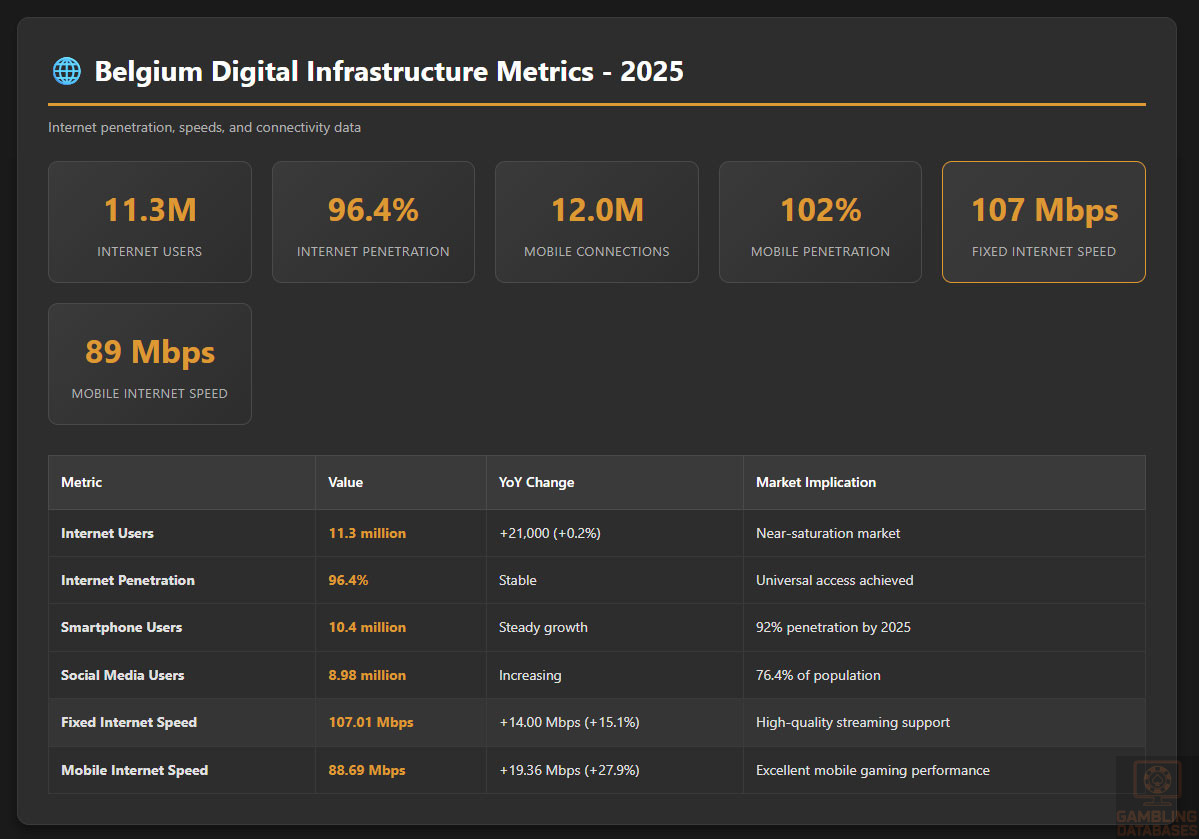
5G and Future Technology Deployment
Current 4G coverage blankets virtually all populated areas of Belgium with mature LTE networks from multiple operators. 4G adoption reaches approximately 63% of mobile connections, providing fast mobile data supporting high-quality mobile gambling experiences. The mature 4G infrastructure ensures current mobile gambling applications perform excellently without requiring 5G technology.
5G coverage expansion proceeds rapidly with operators targeting nationwide coverage by 2026. As of 2024, Proximus achieved 67% indoor 5G coverage with continuing expansion. However, Brussels lags other regions due to stricter electromagnetic radiation limits complicating 5G antenna deployment. The 5G rollout creates opportunities for enhanced mobile gambling experiences though current applications do not require 5G capabilities.
By 2030, 5G connections are projected to represent 80% of European mobile connections, with Belgium following similar trajectories. This transition will enable new gambling product categories including augmented reality casino experiences, virtual reality gambling environments, and ultra-low-latency live betting applications. However, regulatory restrictions may limit Belgium’s ability to capitalize on 5G-enabled gambling innovations.
Future infrastructure plans emphasize fiber-optic expansion, 5G densification, and emerging technologies. The Belgian government and operators coordinate on infrastructure development ensuring Belgium maintains technology leadership. For gambling operators, robust future infrastructure planning provides confidence in Belgium’s long-term digital service delivery capabilities supporting evolving online gambling technologies.
Network operator landscape and competition includes Proximus as the incumbent leader, Orange Belgium and Telenet as major competitors, and DIGI Belgium as aggressive new entrant launching in December 2024 with disruptive pricing. This competitive market drives infrastructure investment, service quality improvements, and pricing discipline benefiting both consumers and businesses relying on telecommunications infrastructure.
Mobile Technology Ecosystem
Mobile Network Infrastructure
Three to four major mobile network operators serve Belgium providing comprehensive coverage and competitive services. Proximus leads with strongest network quality achieving 84.9 Mbps average 4G speeds and 136.8 Mbps 5G speeds. Orange Belgium and Telenet compete aggressively with comparable coverage. DIGI Belgium’s December 2024 market entry with €5 monthly mobile plans intensifies price competition.
Network operator market share breakdown shows Proximus commanding largest subscriber base leveraging incumbent advantages and premium network positioning. Orange Belgium and Telenet capture substantial shares through competitive pricing and service bundles. DIGI Belgium aims to disrupt with ultra-low pricing though initial market impact remains developing. Mobile Virtual Network Operators provide additional options using infrastructure from major operators.
Coverage quality by operator shows minimal practical differences across major providers in urban areas, with all offering excellent 4G coverage. Regional variations exist particularly in Brussels where 5G deployment faces regulatory hurdles. Rural coverage remains strong from all operators due to Belgium’s small size and urbanization. For mobile gambling, any major operator provides sufficient network quality supporting seamless gameplay.
4G and 5G coverage maps demonstrate comprehensive 4G availability and expanding 5G presence. Urban centers enjoy robust 5G coverage while rural areas receive strong 4G with 5G rollout continuing. The multi-operator market ensures competitive pressure maintains coverage expansion and quality improvements. Players can access mobile gambling confidently across Belgium regardless of location or operator selection.
Mobile payment integration and popularity shows Belgian mobile users widely adopting contactless payments, mobile banking apps, and digital wallet services. Bancontact mobile applications particularly succeed among Belgian users for both in-store and online payments. For gambling operators, mobile payment integration enables frictionless deposits and withdrawals aligned with player preferences for smartphone-based financial management.
Mobile wallet adoption rates continue growing as convenience and security benefits drive usage. Beyond Bancontact, international wallets including PayPal maintain presence while Apple Pay and Google Pay gain adoption among users with compatible devices. Gambling operators benefit from offering diverse mobile payment options accommodating different user preferences and enabling instant deposit processing.
Device Penetration
Smartphone adoption rates reached 92% penetration representing 10.4 million Belgian smartphone users by 2025. This near-universal smartphone ownership among adults creates ideal mobile gambling market conditions. Only elderly populations and small segments preferring feature phones remain outside smartphone adoption, representing minimal missed market opportunity for mobile gambling operators.
Smartphones per capita exceed one device per person when considering individuals owning both personal and work phones or upgrading to new devices while retaining older units. The 102% mobile connection penetration rate reflects this multi-device ownership. High device availability ensures players can access mobile gambling regardless of circumstances or device failures.
Device preferences and popular brands show Android devices commanding majority market share in Belgium as globally, with Samsung leading Android manufacturers. Apple iPhones maintain strong presence particularly among higher-income demographics and younger users valuing iOS ecosystem. For gambling operators, this Android dominance requires prioritizing Android application development while maintaining iOS support for significant iPhone user base.
Android versus iOS market share splits approximately 65-70% Android and 30-35% iOS in Belgium, consistent with broader European patterns. The Android majority influences development prioritization, though iOS users typically demonstrate higher engagement and spending in mobile applications. Gambling operators must support both platforms effectively to maximize market coverage and serve high-value iOS user segments.
Average device specifications show Belgian smartphone users generally own mid-range to premium devices capable of running sophisticated gambling applications. Hardware advances mean even budget smartphones possess sufficient processing power, screen quality, and connectivity for excellent mobile gambling experiences. Operators can deploy feature-rich applications confident that player devices support advanced functionality.
Mobile internet usage patterns indicate Belgians spend substantial daily time on smartphones accessing diverse services. Social media, messaging, video streaming, and web browsing dominate usage, with gaming and gambling representing growing categories. The comfort with sustained mobile internet usage transfers directly to mobile gambling willingness, as players already accustomed to smartphone dependency extend usage to gambling activities.
Mobile gaming penetration shows high adoption of casual and mid-core mobile games creating favorable context for mobile gambling. Players familiar with mobile game mechanics, in-app purchases, and extended mobile gameplay sessions easily transition to gambling applications offering similar interfaces and interaction patterns. The overlap between mobile gaming and mobile gambling audiences creates natural player acquisition funnel.
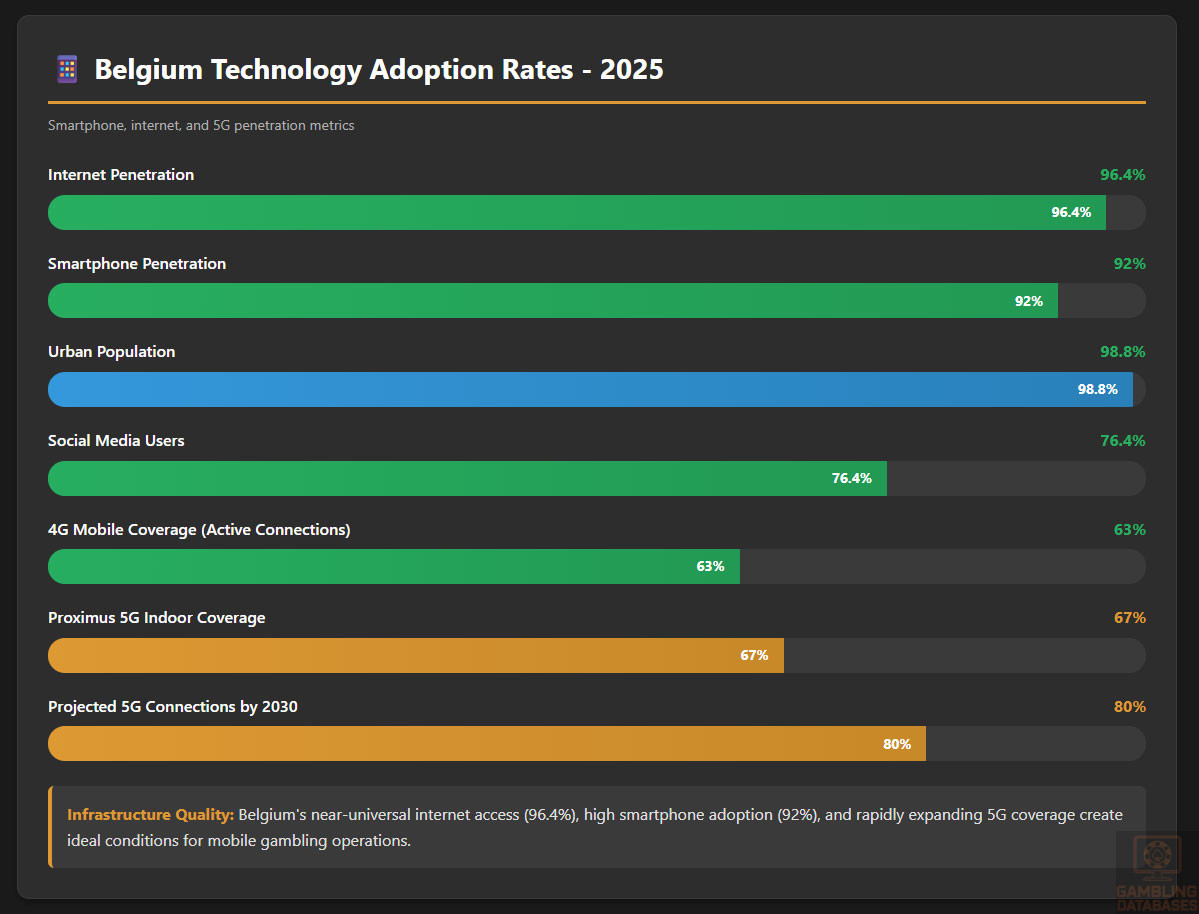
Financial Services and Payment Infrastructure
Banking System Structure
Major banks dominating Belgium include BNP Paribas Fortis, KBC Bank, ING Belgium, and Belfius Bank among leading institutions. These banks collectively serve vast majority of Belgian households and businesses through extensive branch networks, ATM infrastructure, and digital banking platforms. The concentrated banking sector creates stable payment processing environment for gambling operators partnering with established banks.
Market share breakdown shows BNP Paribas Fortis leading as Belgium’s largest bank followed by KBC, ING, and Belfius competing intensely. Numerous smaller banks and financial institutions complement major players, creating competitive but concentrated market structure. For gambling operators, the major bank concentration means establishing relationships with 3-4 key institutions covers most potential player banking relationships.
Digital banking adoption approaches universal levels among Belgian adults with internet access. All major banks offer sophisticated online and mobile banking platforms enabling account management, payments, and transfers through digital channels. This digital banking saturation ensures players can seamlessly link gambling accounts to bank accounts and execute deposits and withdrawals through familiar banking interfaces.
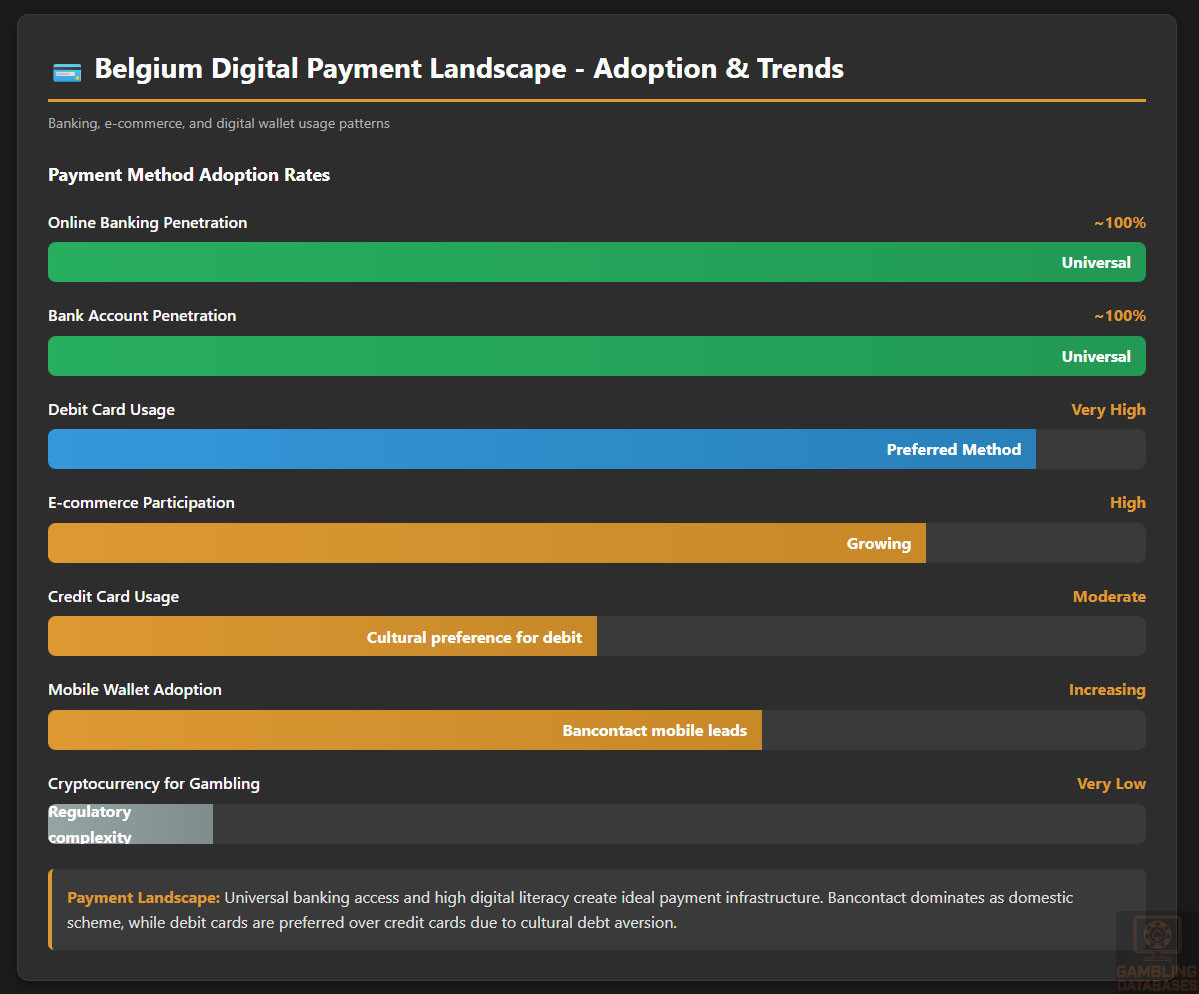
Account penetration rates reach virtually 100% among Belgian adults, with banking access representing essential financial infrastructure. Multiple account ownership remains common as individuals maintain accounts at different banks for various purposes. Universal banking access eliminates unbanked population concerns that challenge gambling operators in less financially developed markets.
Credit and lending markets maturity reflects Belgium’s developed economy with established consumer credit, mortgages, and business lending. However, cultural preferences favor lower household debt than some countries, with Belgians generally conservative regarding credit usage. For gambling, this conservatism may moderate credit card gambling deposits though debit card and bank transfer options remain readily available.
ATM density and distribution remains high despite declining cash usage, with ATMs accessible throughout urban and suburban areas. While ATM cash withdrawals for gambling deposits decline as digital payments dominate, ATM infrastructure ensures cash access when players prefer cash deposits at land-based venues or require cash for other purposes.
Payment Processing Options
| Payment Method | Availability | Typical Processing Time | User Adoption | Notes |
|---|---|---|---|---|
| Bancontact | Universal | Instant deposits, 1-3 days withdrawal | Very High | Dominant Belgian payment method |
| Credit Cards (Visa/Mastercard) | Widely Available | Instant deposits, 3-5 days withdrawal | Moderate | Some banks restrict gambling use |
| Debit Cards | Universal | Instant deposits, 3-5 days withdrawal | High | Preferred over credit cards |
| Bank Transfers (SEPA) | Universal | 1-3 days both ways | High | Trusted traditional method |
| Instant Bank Transfers | Growing | Instant deposits, instant withdrawal | Increasing | Modern alternative to SEPA |
| PayPal | Available | Instant deposits, 24-48 hours withdrawal | Moderate-High | International e-wallet leader |
| Skrill/Neteller | Available | Instant both ways | Low-Moderate | Gambling-specialist wallets |
| Cryptocurrency | Limited | Varies | Very Low | Regulatory complexity, niche usage |
| Paysafecard (Prepaid) | Available | Instant deposit, no withdrawal | Low | Anonymous option, deposit only |
Credit and debit card penetration remains high with most Belgian adults holding payment cards from their banks. Debit card usage dominates transactions compared to credit cards, reflecting cultural preferences for avoiding debt and using available funds rather than borrowed money. All major international card networks including Visa, Mastercard, and American Express operate in Belgium, though domestic Bancontact scheme commands strong position.
E-wallet availability includes PayPal maintaining strongest position among international digital wallet providers. Skrill and Neteller, traditional gambling-friendly e-wallets, remain available though face increased scrutiny from banks concerned about gambling transaction facilitation. Newer fintech payment solutions expand options, though regulatory requirements for AML and KYC compliance limit anonymous or low-verification payment services.
Bank transfer systems include traditional SEPA transfers enabling euro-denominated transfers across Europe and instant payment schemes providing real-time settlement. The evolution toward instant transfers improves user experience by eliminating multi-day delays previously characterizing bank transfers. For gambling operators, instant transfers enable immediate deposit crediting and accelerated withdrawal processing matching e-wallet convenience.
Cryptocurrency acceptance faces regulatory uncertainty and limited adoption for gambling purposes in Belgium. While cryptocurrency ownership exists among tech-savvy demographics, licensed operators must ensure any cryptocurrency transactions comply with AML requirements and financial regulations. The regulatory burden and low user demand mean most Belgian-licensed operators avoid cryptocurrency, leaving this payment option primarily to offshore unlicensed gambling sites.
Processing fees and typical charges vary by payment method with bank transfers often lowest cost, cards carrying interchange fees, and e-wallets charging service fees. For operators, payment processing costs represent significant operational expense requiring careful provider selection and fee negotiation. Players typically face no deposit fees though withdrawal fees sometimes apply depending on method and operator policies.
Transaction processing timelines significantly impact user experience with instant deposit crediting expected regardless of payment method. Withdrawal timelines vary from instant for e-wallets and some instant bank transfer services to 3-5 days for card withdrawals and traditional bank transfers. Operators balancing fast withdrawals against fraud prevention and verification requirements must optimize processing to maintain player satisfaction.
International payment capabilities enable Belgian players to fund accounts from foreign bank accounts or payment services though most players use Belgian payment methods. For operators, international payment processing supports serving cross-border players and facilitates business operations across multiple markets. However, Belgian licensing requires Belgian-focused operations with international capabilities remaining secondary priority.
Regulatory restrictions on gambling payments have intensified with banks increasingly scrutinizing gambling transactions as part of de-risking policies. Some banks restrict credit card gambling deposits or terminate accounts showing high gambling transaction volumes. The Belgian National Bank issued 2022 guidance criticizing blanket exclusions of gambling industry clients, but banking relationships remain challenging for gambling operators despite legal licensing.
Chargebacks and dispute resolution create operational challenges when players dispute gambling transactions with card issuers. Card network rules generally disfavor gambling merchant disputes, requiring operators to maintain meticulous transaction records and player verification documentation. High chargeback rates can result in processor terminations or increased fees, necessitating robust fraud prevention and clear player communications about transaction nature.
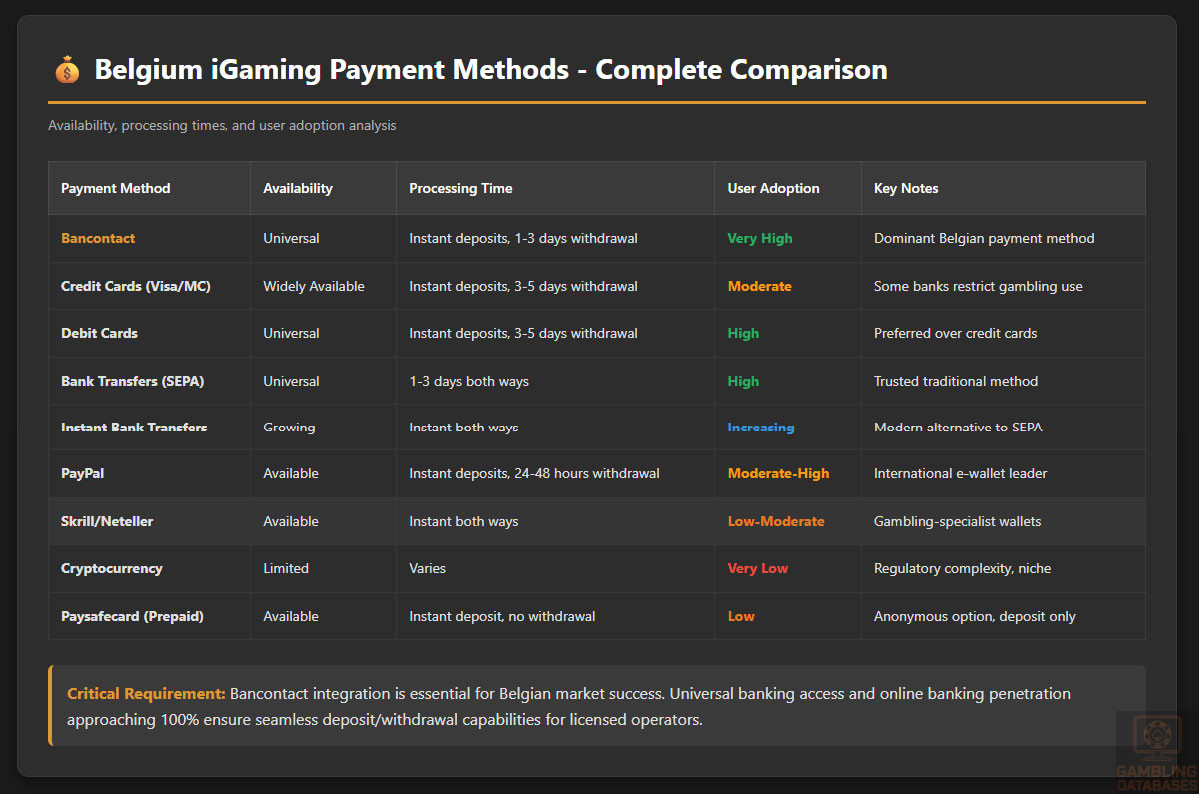
E-commerce and Digital Economy
Digital Market Development
E-commerce market size in Belgium continues expanding with steady growth in online retail sales representing increasing percentage of total retail activity. Belgian consumers demonstrate strong online shopping adoption across product categories from fashion and electronics to groceries and services. This e-commerce maturity creates favorable environment for online gambling as players already comfortable with digital purchasing behaviors easily extend habits to gambling transactions.
Online retail penetration as percentage of total retail reaches significant levels consistent with Western European norms. While exact current figures vary by product category, online shopping captures approximately 15-20% of total retail spending with continuing growth. This penetration indicates mainstream acceptance of online purchasing replacing concerns about digital transaction security or product delivery reliability.
Digital service adoption rates show Belgians readily embracing online services including streaming entertainment, digital banking, telehealth, online education, and various subscription services. The comfort with intangible digital service purchases transfers directly to online gambling, where players purchase entertainment experiences rather than physical goods. High digital service adoption reduces psychological barriers to gambling expenditure on purely digital experiences.
Consumer trust in online transactions appears robust based on high e-commerce and digital service participation rates. Strong consumer protection regulations, reliable payment systems, and positive experiences with established digital platforms build confidence enabling Belgians to conduct financial transactions online without excessive concern about fraud or merchant reliability. This trust foundation benefits gambling operators by reducing player hesitation about depositing funds.
Popular e-commerce platforms include international giants like Amazon, eBay, and specialized category leaders alongside Belgian domestic retailers offering online channels. The multi-platform marketplace demonstrates consumer comfort navigating diverse online vendors and payment systems. For gambling operators, this multi-platform familiarity means players easily adapt to different gambling sites and applications without requiring extensive user education.
Cross-border online shopping behavior shows Belgian consumers readily purchasing from foreign retailers particularly for products unavailable domestically or offering better value. This international shopping comfort suggests openness to international gambling brands provided they secure proper Belgian licensing and offer local language support and payment methods. However, advertising restrictions limit international operators’ ability to communicate Belgian market presence.
Digital goods and services consumption spans music and video streaming, gaming, e-books, online courses, and various subscription services. Belgian consumers willingly pay for digital entertainment and content, demonstrating acceptance of spending on intangible experiences. This willingness to purchase digital entertainment directly supports online gambling market viability as players view gambling expenditure as entertainment spending comparable to streaming subscriptions or game purchases.
Business Environment and Regulatory Framework
Ease of Business Operations
World Bank Doing Business ranking historically placed Belgium in middle-tier positions among developed economies, indicating generally favorable but not exceptional business environment. Belgium’s strengths include strong rule of law, developed infrastructure, and skilled workforce, while challenges encompass complex bureaucracy, high labor costs, and regulatory compliance burdens. For gambling operators, the business environment assessment should focus specifically on gambling regulatory framework rather than general business rankings.
Ease of Starting a Business ranking within Doing Business metrics showed Belgium requiring multiple procedures and moderate time to establish companies. However, gambling business establishment complexity far exceeds standard business formation due to licensing requirements, guarantee deposits, and regulatory approvals. Prospective operators should anticipate substantially more complex and lengthy establishment processes than general business formation statistics suggest.
Business registration processes require navigating Belgian corporate law, selecting appropriate legal entity structure, registering with commercial courts, obtaining tax identification numbers, and establishing required banking relationships. For gambling operators, these standard steps precede gambling-specific licensing applications. Legal and consulting support proves essential for foreign entities unfamiliar with Belgian administrative procedures and language requirements.
Time required to start a business varies by entity type and complexity but typically requires several weeks for standard company formation. However, gambling license applications extend timeframes dramatically with 6-12 month licensing processes following initial company establishment. Operators should plan 12-18 month total timeline from initial market entry decision through licensed operation commencement.
Foreign investment policies generally welcome international capital with Belgium maintaining open investment regime consistent with EU principles. No specific foreign ownership restrictions apply to gambling operations, allowing 100% foreign-owned entities to obtain licenses. However, the requirement for land-based operations before online licensing creates practical barriers favoring operators willing to make substantial Belgian market commitments including physical establishment acquisitions or developments.
Operational cost structures in Belgium rank among Europe’s highest reflecting developed economy characteristics. Office rent in Brussels and major cities reaches premium levels, particularly in prime locations. Salaries for skilled professionals including technology specialists, compliance officers, and customer service representatives command high rates reflecting Belgium’s elevated living costs and strong labor protections. These cost realities require substantial operational budgets exceeding those in lower-cost European markets.
Labor market conditions show generally tight employment markets for skilled positions with low unemployment creating competitive recruitment environment. Belgium’s highly educated workforce provides excellent talent pool for gambling operations requiring technical, legal, compliance, and customer service capabilities. However, strong labor protections and high employment costs make workforce management more expensive and less flexible than in some alternative jurisdictions.
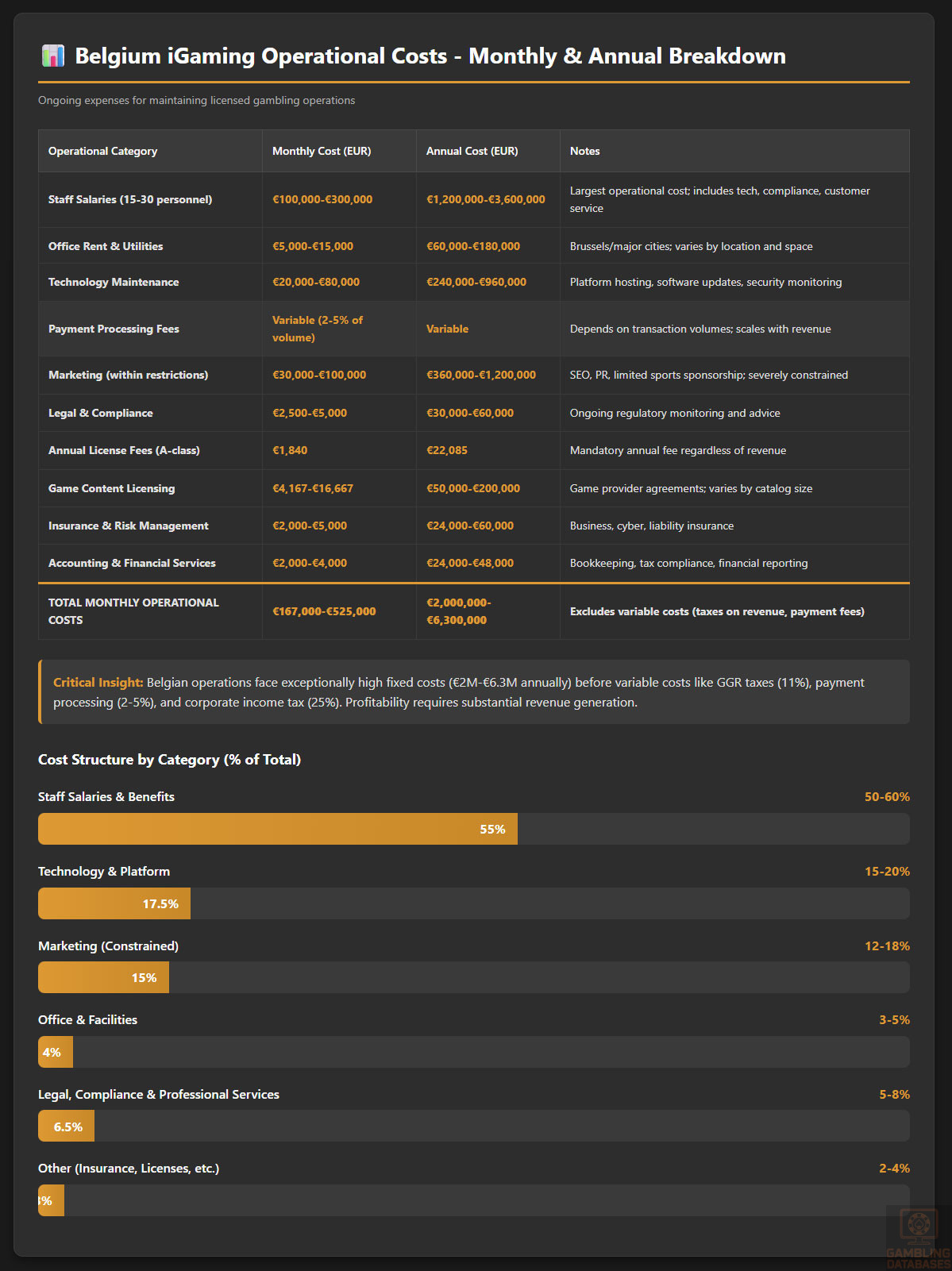
Corporate Structure and Registration
Available Entity Types
Belgian corporate law offers several entity types suitable for gambling operations. The most common structures include NV/SA (Public Limited Company), BV/SRL (Private Limited Company), branches of foreign companies, and specialized structures for specific purposes. Each entity type carries distinct legal, taxation, and operational implications requiring careful evaluation based on operational plans and ownership structures.
NV/SA public limited companies suit larger operations anticipating potential public offerings, external investment, or complex ownership structures. This entity type requires higher minimum capital but provides flexible share structures and governance arrangements. For established international gambling groups entering Belgium, NV/SA structures accommodate complex corporate relationships and investment requirements.
BV/SRL private limited companies serve most private gambling operations with simpler ownership structures. The 2019 Belgian Companies Code reforms made BV/SRL more flexible, reducing minimum capital requirements and enabling diverse governance arrangements. Most gambling operators choose BV/SRL structure balancing legal protection, operational flexibility, and manageable compliance obligations.
Branch office options enable foreign companies to operate in Belgium through registered branches rather than separate legal entities. However, gambling licensing requirements typically necessitate Belgian legal entities rather than foreign company branches. While branches might serve supporting functions, primary gambling operations require Belgian company establishment for licensing purposes.
The recommended structure for iGaming operators typically involves BV/SRL entity establishment providing appropriate liability protection, operational flexibility, and efficient governance for most operators. Large international groups might prefer NV/SA accommodating complex ownership and investment structures. The specific optimal structure depends on ownership arrangements, capitalization levels, governance preferences, and long-term strategic objectives.
Registration Requirements
Registration timelines from application to approval vary but typically require 4-8 weeks for straightforward company formations. The process involves preparing articles of association, shareholder agreements, and governance documents, obtaining notarized signatures, registering with commercial courts, and securing tax and social security registrations. Gambling companies face additional complexity ensuring corporate documents accommodate licensing requirements and regulatory oversight.
Registration costs encompass notary fees, commercial court filing fees, legal professional fees, and various administrative charges. Total costs typically range €3,000-€8,000 depending on entity complexity and professional support required. These registration costs precede gambling license application expenses including guarantee deposits, incorporation fees, and server setup costs.
Required documents for registration include articles of association specifying company purpose, governance structures, and share capital arrangements. Shareholder identification documents, proof of capital contribution, business plans, and various administrative forms complete standard registration packages. For gambling companies, regulatory filings require additional documentation addressing compliance capabilities, technical infrastructure, and responsible gambling commitments.
Foreign ownership rules impose no specific percentage restrictions with Belgian law permitting 100% foreign-owned companies. EU integration principles ensure non-discriminatory treatment of EU member state entities, while international investors also receive national treatment under investment protection frameworks. However, directors and management must fulfill Belgian legal requirements potentially necessitating Belgian resident directors or authorized representatives.
Minimum capital requirements vary by entity type with historical minimums substantially reduced under 2019 company law reforms. BV/SRL entities no longer face fixed minimum capital requirements, enabling establishment with nominal capital. However, adequacy of capital for operational purposes remains directors’ responsibility, and gambling operations require substantial actual capitalization to fund guarantee deposits, infrastructure investments, and operational expenses.
Ongoing compliance requirements include annual financial statement filings, tax returns, social security contributions, and maintenance of statutory registers and corporate records. Gambling companies face additional regulatory reporting to Gaming Commission, compliance audits, and demonstrated adherence to license conditions. The compliance burden exceeds standard Belgian companies due to gambling-specific regulatory oversight.
Corporate governance requirements mandate establishment of shareholder meetings, appointment of directors with fiduciary duties, and potentially supervisory or audit committees depending on company size. Gambling companies should implement robust governance ensuring regulatory compliance, risk management, and adherence to responsible gambling principles. Strong governance reduces regulatory scrutiny risk and demonstrates operational professionalism.
Taxation Framework
Corporate Income Tax Structure
Standard corporate tax rates in Belgium stand at 25% for most companies, applicable to worldwide income of Belgian resident companies and Belgian-source income of foreign companies. This rate applies to net profits after deducting allowable expenses including operational costs, depreciation, and gambling-specific taxes. The 25% rate positions Belgium moderately within European corporate tax landscape, neither exceptionally high nor attractively low.
Special economic zone benefits and incentives exist in certain Belgian regions offering reduced taxation or other advantages for qualifying investments. However, gambling operations typically do not qualify for special economic zone benefits due to industry characteristics and regulatory restrictions. Operators should not anticipate tax holidays or substantially reduced rates, planning instead for full standard corporate taxation.
Tax holidays or reduced rates for new businesses generally do not extend to gambling operations. Belgium’s gambling taxation framework treats operators consistently regardless of market entry timing or new venture status. The absence of tax incentives reflects policy prioritizing gambling regulation and revenue collection over industry promotion or economic development through gambling sector growth.
International tax treaties prevent double taxation for Belgian companies earning foreign income or foreign companies with Belgian operations. Belgium maintains extensive tax treaty network covering most significant trading partners. For international gambling groups, treaty benefits reduce withholding taxes on cross-border payments and prevent taxation of same income in multiple jurisdictions. However, transfer pricing rules require arm’s-length pricing for related-party transactions.
Transfer pricing rules mandate that transactions between related entities reflect market rates that independent parties would negotiate. For gambling operators with international parent companies or affiliates, service fees, royalty payments, and management charges must withstand transfer pricing scrutiny. Tax authorities can challenge and adjust pricing that appears designed to shift profits to lower-tax jurisdictions, requiring robust transfer pricing documentation.
Withholding tax on dividends, interest, and royalties applies to payments from Belgian companies to foreign recipients at rates depending on applicable tax treaties. Standard withholding rates may reach 30% but treaty reductions often apply. Gambling operators repatriating profits through dividends face withholding obligations unless treaty exemptions apply. Interest and royalty payments for financing or intellectual property licensing trigger withholding taxes affecting cross-border group structures.
VAT rates of 21% apply to most goods and services in Belgium including various gambling-related services. However, gambling taxation complexity arises from interaction between VAT, GGR taxes, and other levies. Operators must navigate VAT application to different revenue streams, input VAT recovery on purchases, and compliance with VAT reporting obligations. Professional tax advice proves essential for optimizing VAT positions and ensuring compliance.
Personal Income Tax
Individual tax rates in Belgium follow progressive brackets with marginal rates reaching 50% on highest incomes. While gambling operators primarily concern themselves with corporate taxation, personal income tax affects employee recruitment and retention costs as high taxation reduces net salaries compelling gross salary increases to attract talent. The high personal taxation also affects player disposable income available for gambling expenditure.
Withholding requirements for employees mandate employers withhold income taxes and social security contributions from salaries, remitting amounts to authorities monthly. Compliance requires sophisticated payroll systems and knowledge of Belgian employment tax rules. Gambling operators employing Belgian staff must establish compliant payroll processes or engage professional employment services handling withholding obligations.
Social security contributions represent substantial employment costs with combined employer and employee contributions reaching approximately 48% of gross salaries. Employer contributions around 25% increase total employment costs significantly beyond gross salaries. These contributions fund Belgian social security system providing healthcare, pensions, and unemployment benefits. The high social charges make Belgian employment expensive though provide comprehensive social protection for employees.
Tax residency rules determine whether individuals face Belgian taxation on worldwide income or only Belgian-source income. Belgian residents pay tax on global earnings while non-residents face Belgian tax only on Belgian-source income. For gambling operators, expatriate employees’ tax treatment depends on residency status with different tax optimization strategies available for resident versus non-resident personnel.
Taxation of foreign employees includes considerations of tax residency, tax treaty benefits, special expatriate regimes, and social security coverage. Belgium offers special tax status for qualifying expatriates reducing taxation on certain income and providing expense reimbursements. Gambling operators recruiting international talent should structure employment considering available tax benefits ensuring competitive net compensation while managing employer costs.
Market Entry Considerations
Recommended Entry Strategies
Optimal market entry approaches for Belgium’s gambling market depend heavily on existing operator capabilities, market knowledge, and resource availability. The mandatory land-based operation requirement before online licensing creates fundamental strategic choice between acquiring existing licensed operations versus developing new land-based establishments qualifying for online licenses. Each approach carries distinct advantages, risks, and resource requirements.
Acquisition of existing licensed operators represents fastest market entry path, immediately securing both land-based licenses and corresponding online permissions. Available acquisition targets include existing casino operators, gaming arcade chains, or betting operation networks with established licenses, customer bases, and operational infrastructure. Acquisition advantages include immediate market presence, proven revenue streams, and avoidance of lengthy license application processes.
However, acquisition challenges include limited target availability given restricted license numbers, potentially high acquisition prices reflecting license scarcity value, integration complexities combining acquired Belgian operations with international systems, and inherited operational issues or compliance challenges from acquired entities. Thorough due diligence proves essential identifying license conditions, regulatory compliance status, customer retention risks, and actual asset values.
Developing new land-based operations enables building customized establishments aligned with operator strategies and brand positioning. New casino or gaming arcade development permits modern facility design, contemporary technology integration, and operations reflecting company culture and standards from inception. However, development requires securing one of nine casino licenses or available gaming arcade licenses, involving competitive application processes or acquiring licenses from exiting operators.
Partnership with local operators provides alternative entry combining international operator capabilities with Belgian partners’ market knowledge, established presence, and regulatory relationships. Partnership structures might involve joint ventures, white-label arrangements, or management contracts depending on regulatory acceptability and commercial terms. Successful partnerships balance international partner contributions of technology, capital, and global expertise against local partner provisions of licenses, market access, and regulatory navigation.
White label versus proprietary platform considerations involve fundamental technology strategy decisions. White label solutions enable rapid launch leveraging established platforms, game catalogs, and operational systems while focusing operator efforts on marketing and customer service. However, white labels create technology dependencies, limit differentiation opportunities, and share revenue with platform providers reducing margins.
Proprietary platform development provides maximum control, customization, and potentially superior economics at maturity. However, proprietary platforms require substantial technology investments, longer development timelines, and ongoing maintenance and enhancement costs. For Belgium specifically, advertising restrictions limit differentiation benefits from proprietary platforms, potentially favoring white label approaches reducing time-to-market and capital requirements.
Technology infrastructure leveraging strategies should prioritize mobile optimization given 92% smartphone penetration and growing mobile gambling preference. Cloud-based infrastructure provides scalability though must accommodate Belgian server location requirements. Integration with local payment providers including Bancontact proves essential for user experience. Platform selection must support French and Dutch language requirements and facilitate regional tax reporting.
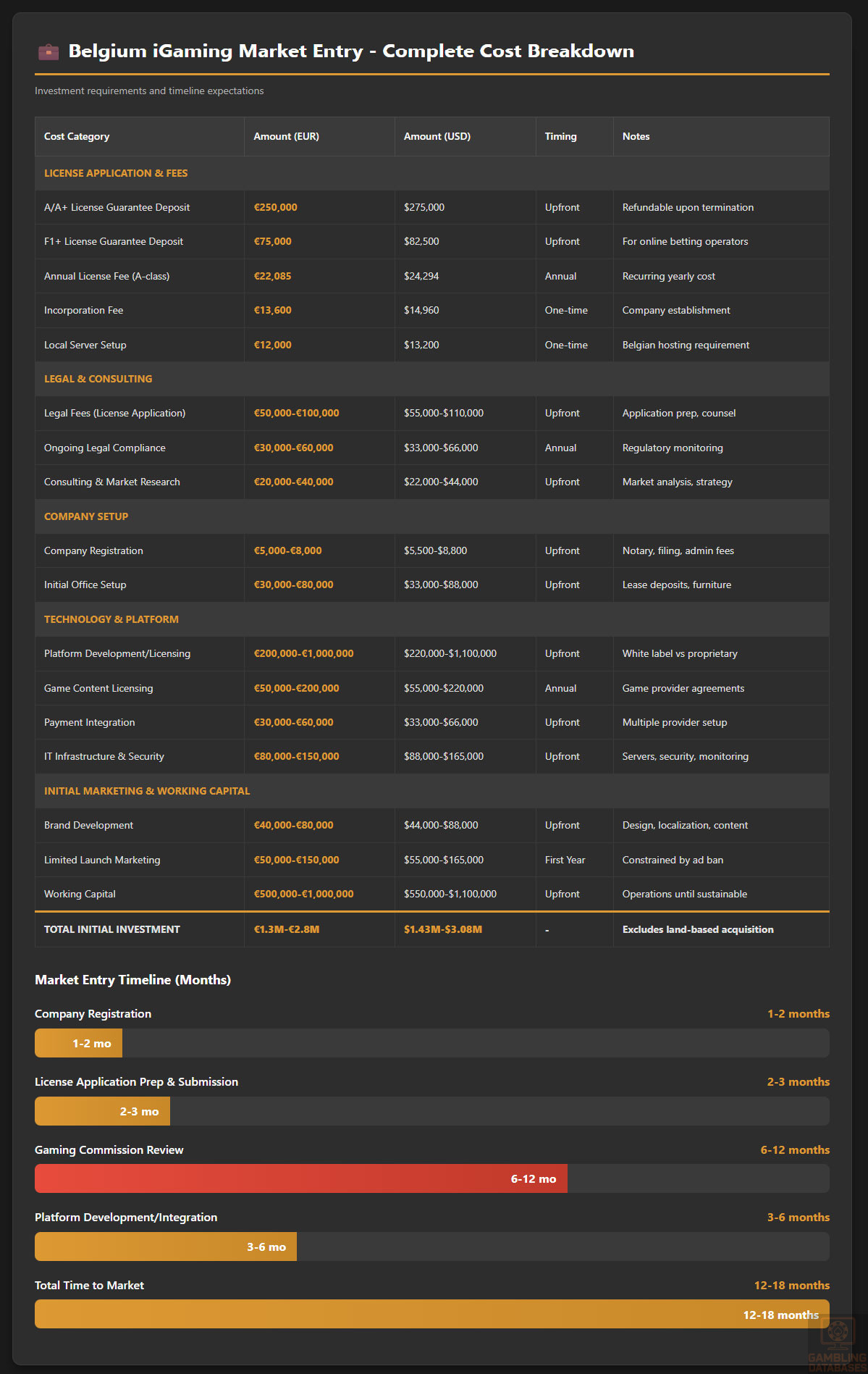
Marketing and localization requirements demand native French and Dutch content, cultural adaptation to Belgian preferences, and navigation of severe advertising restrictions. Despite advertising bans, operators must build brand awareness through permitted channels including sports sponsorship (until 2028), organic search optimization, public relations, and word-of-mouth cultivation. Localization extends beyond translation to understanding Belgian gambling preferences, sports interests, and cultural sensitivities.
Payment provider selection criteria include Bancontact integration as essential requirement, support for major Belgian banks, competitive processing fees, reliable transaction processing, strong fraud prevention, and regulatory compliance with Belgian AML requirements. Multiple payment option provision accommodates diverse player preferences, with bank transfers, debit cards, and digital wallets representing minimum acceptable payment variety.
Risk mitigation strategies must address regulatory compliance risks through robust compliance systems, legal counsel relationships, and proactive regulatory engagement. Operational risks including technology failures, payment processing disruptions, and fraud require business continuity planning, security investments, and insurance coverage. Market risks from changing regulations or competitive intensity necessitate financial reserves, flexible business models, and diversification where possible within Belgian regulatory constraints.
Typical Costs and Timelines
| Cost Category | Amount (EUR) | Amount (USD Equivalent) | Timing | Notes |
|---|---|---|---|---|
| License Application & Fees | ||||
| A/A+ License Guarantee Deposit | €250,000 | $275,000 | Upfront | Refundable upon license termination |
| F1+ License Guarantee Deposit | €75,000 | $82,500 | Upfront | For online betting operators |
| Annual License Fee (A-class) | €22,085 | $24,294 | Annual | Recurring yearly cost |
| Incorporation Fee | €13,600 | $14,960 | One-time | Company establishment |
| Local Server Setup | €12,000 | $13,200 | One-time | Belgian hosting requirement |
| Legal & Consulting | ||||
| Legal Fees (License Application) | €50,000-€100,000 | $55,000-$110,000 | Upfront | Application preparation, regulatory counsel |
| Ongoing Legal Compliance | €30,000-€60,000 | $33,000-$66,000 | Annual | Regulatory monitoring, compliance advice |
| Consulting & Market Research | €20,000-€40,000 | $22,000-$44,000 | Upfront | Market analysis, strategy development |
| Company Setup | ||||
| Company Registration | €5,000-€8,000 | $5,500-$8,800 | Upfront | Notary, filing, administrative fees |
| Initial Office Setup | €30,000-€80,000 | $33,000-$88,000 | Upfront | Lease deposits, furniture, equipment |
| Technology & Platform | ||||
| Platform Development/Licensing | €200,000-€1,000,000 | $220,000-$1,100,000 | Upfront | White label vs proprietary platform |
| Game Content Licensing | €50,000-€200,000 | $55,000-$220,000 | Annual | Game provider agreements |
| Payment Integration | €30,000-€60,000 | $33,000-$66,000 | Upfront | Multiple payment provider setup |
| IT Infrastructure & Security | €80,000-€150,000 | $88,000-$165,000 | Upfront | Servers, security, monitoring systems |
| Initial Marketing | ||||
| Brand Development | €40,000-€80,000 | $44,000-$88,000 | Upfront | Design, localization, content creation |
| Limited Launch Marketing | €50,000-€150,000 | $55,000-$165,000 | First Year | Constrained by advertising ban |
| Working Capital | €500,000-€1,000,000 | $550,000-$1,100,000 | Upfront | Operations until revenue sustains costs |
| TOTAL INITIAL INVESTMENT | €1.3M-€2.8M | $1.43M-$3.08M | Excludes land-based acquisition/development |
Operational cost estimates on monthly and annual bases encompass ongoing expenses maintaining licensed gambling operations. Staff salaries represent largest operational cost category with technology teams, compliance officers, customer service representatives, marketing personnel, and management commanding Belgian premium salary levels. Monthly staffing costs easily exceed €100,000-€300,000 depending on team size and seniority levels.
Office rent and utilities in Brussels or major Belgian cities cost €5,000-€15,000 monthly depending on location and space requirements. While gambling operations primarily function digitally, physical office presence remains necessary for licensing compliance, staff accommodation, and meeting regulatory requirements. Premium Brussels locations command highest rents while secondary cities offer cost savings with reduced prestige.
Technology maintenance costs include platform hosting, software updates, security monitoring, payment processing infrastructure, and technical support services. Depending on platform choices, monthly technology costs range €20,000-€80,000 covering white label fees or proprietary platform maintenance. Belgian server hosting requirements potentially increase infrastructure costs versus using international cloud services.
Payment processing fees typically consume 2-5% of transaction volumes depending on payment methods and negotiated rates. Monthly payment costs vary directly with revenue volumes, ranging from minimal amounts during launch to substantial expenses as operations scale. Operators must budget for payment provider fees, currency conversion charges, and chargeback handling costs.
Marketing and customer acquisition costs face severe constraints under Belgian advertising restrictions. Traditional customer acquisition strategies relying on advertising prove unavailable, forcing reliance on permitted channels including search engine optimization, public relations, limited sports sponsorship opportunities, and word-of-mouth generation. Monthly marketing budgets might range €30,000-€100,000 focusing on permitted activities rather than traditional advertising spending.
Timeline expectations from market entry decision through operational launch typically span 12-18 months under optimal conditions. Company registration requires 1-2 months, license application preparation and submission takes 2-3 months, Gaming Commission review processes extend 6-12 months, and platform development/integration requires 3-6 months. Parallel execution of some activities shortens overall timelines, but operators should plan conservatively for 18-month market entry processes.
Company registration timelines of 4-8 weeks represent shortest component of market entry process. Engaging experienced Belgian corporate lawyers and notaries accelerates registration, while foreign entities navigating processes independently face potential delays from administrative complexities and language barriers. Expedited services exist though costs increase for faster processing.
License application and approval periods represent most uncertain timeline components. The statutory 6-month maximum for F1 license review provides outer boundary, but Gaming Commission may request additional information extending timelines. A and B license applications lack specific statutory deadlines, potentially extending review periods. Applicants should anticipate 6-12 month license review periods from complete application submission through approval.
Total time to market combining all phases realistically requires 12-18 months from initial planning through licensed operation launch. Aggressive timelines assuming smooth license approvals, efficient parallel execution, and white label platform choices might achieve 12-month launch. Conservative planning accounting for potential regulatory delays, technical challenges, and sequential task execution suggests 18-month timelines. Operators should budget time and maintain financial resources supporting extended timelines if complications arise.
Resource requirements for successful Belgian market entry include minimum staff headcount of 15-30 personnel depending on operational scope. Essential roles include technical staff, compliance officers, customer service representatives, payment and financial specialists, marketing personnel within advertising constraints, and management overseeing operations. Larger operations or those building proprietary platforms require substantially larger teams.
Key positions needed include compliance director ensuring regulatory adherence, technology director overseeing platform and security, customer service manager leading player support, financial controller managing accounting and tax obligations, and general manager coordinating overall operations. For international operators, Belgian market manager familiar with local regulations, culture, and business practices proves invaluable navigating market entry complexities.
Technology stack requirements encompass gambling platform supporting casino games and/or sports betting, payment processing integration with Belgian providers, player account management systems, responsible gambling tools including loss limits and self-exclusion, regulatory reporting systems, and customer relationship management. Security infrastructure including fraud detection, AML monitoring, and cybersecurity protection represents critical requirements given regulatory scrutiny and financial transaction volumes.
Success Factors and Challenges
Key Success Enablers
Understanding of local player preferences proves essential for product development and marketing effectiveness. Belgian players demonstrate preferences for specific sports including football and cycling, favor particular casino games including roulette and slots, and respond to culturally appropriate promotional approaches. Market research and local expertise help operators align offerings with player expectations maximizing engagement and retention.
Localized payment methods integration particularly including Bancontact represents mandatory success factor. Belgian players expect native payment options in addition to international alternatives, with Bancontact integration signaling local market commitment. Comprehensive payment method support reduces friction in deposits and withdrawals, directly impacting conversion rates and player satisfaction.
Mobile-first approach recognizing 92% smartphone penetration and growing mobile gambling preference ensures platforms serve player device preferences. Mobile optimization extends beyond responsive design to native applications, mobile payment integration, and user experiences optimized for smartphone screens. Superior mobile experiences differentiate operators in market where advertising restrictions limit other differentiation opportunities.
Effective marketing channels and partnerships within advertising restrictions require creativity and strategic relationship building. Sports sponsorship until 2028 provides limited brand visibility, while public relations, content marketing, and search engine optimization build awareness without traditional advertising. Partnerships with sports organizations, media outlets, and complementary businesses create indirect marketing opportunities.
Strong customer support in local languages represents competitive advantage and regulatory necessity. French and Dutch language support with culturally competent representatives builds player trust and satisfaction. Multilingual support teams handling inquiries, disputes, and responsible gambling concerns demonstrate operational quality distinguishing licensed operators from offshore alternatives lacking local presence.
Competitive bonus and promotion strategy faces constraints from regulatory restrictions and loss limits, but within allowed parameters, operators can differentiate through loyalty programs, VIP services, and player rewards. While aggressive bonuses that characterized pre-restriction gambling marketing are prohibited, thoughtful value provision through enhanced odds, cashback programs, and premium content access maintains player interest.
Responsible gambling commitment beyond mere regulatory compliance demonstrates ethical operation and builds player trust. Proactive problem gambling prevention, generous self-exclusion support, clear information provision, and financing treatment programs position operators as socially responsible. This commitment reduces regulatory scrutiny risk while aligning with growing societal expectations for gambling harm minimization.
Local sports and events coverage particularly for Belgian football leagues, cycling races, and other domestically popular sports enables operators to serve betting demand around locally relevant competitions. Comprehensive odds offerings, live betting options, and expert analysis for Belgian sporting events demonstrate market understanding and provide content attracting sports betting enthusiasts.
Major Operational Challenges
Regulatory compliance complexity represents most significant operational challenge requiring constant attention and substantial resources. The multi-layered regulatory framework combining federal gambling law, regional taxation, and evolving responsible gambling requirements demands sophisticated compliance management. Regulatory changes including recent advertising restrictions, age increases, and loss limit reductions require rapid operational adaptations.
High taxation burden combining 11% GGR taxes, 25% corporate income tax, and 21% VAT substantially impacts profitability. The cumulative tax impact means operators retain relatively small percentages of gross revenues after taxation and operational expenses. High taxation reduces investment returns and requires substantial revenue generation achieving profitability, particularly challenging when advertising restrictions constrain customer acquisition.
Payment processing restrictions from bank de-risking policies create operational difficulties despite legal licensing. Some Belgian banks restrict gambling transactions or terminate operator accounts viewing gambling as high-risk activity. The Belgian National Bank criticized blanket exclusions, but banking relationship challenges persist requiring operators to identify gambling-friendly banking partners and maintain backup payment processing arrangements.
Marketing and advertising limitations eliminate traditional customer acquisition channels forcing reliance on organic growth, word-of-mouth, and limited permitted marketing. The near-total advertising ban disadvantages all operators but particularly harms new market entrants lacking established player bases. Customer acquisition costs may increase as operators compete for limited marketing channels while acquisition volumes decline without advertising reach.
Competition from established operators benefits incumbents with existing customer bases, brand recognition, and operational experience. The limited license availability and dual-licensing requirement create high barriers to entry protecting established operators from new competition. Challengers must differentiate through superior service quality, technology, or niche positioning rather than aggressive marketing given advertising restrictions.
Player acquisition costs increase when traditional advertising unavailable, potentially extending payback periods and reducing lifetime value economics. Operators must evaluate customer acquisition strategies carefully ensuring acquisition costs remain sustainable relative to projected player lifetime values. The €200 weekly loss limit caps individual player value, limiting tolerance for high acquisition costs.
Talent shortage in specific skills including gambling compliance specialists, gaming platform developers, and responsible gambling experts creates recruitment challenges. Belgium’s limited gambling market size means smaller local talent pools than larger gambling markets. International recruitment helps but involves work permit processes, relocation costs, and potential cultural adjustment challenges for foreign employees.
Technology infrastructure limitations from mandatory Belgian server hosting restrict cloud service usage and increase costs. While Belgium offers excellent internet infrastructure, the prohibition on using international cloud platforms eliminates economies of scale and advanced services available from global providers. Operators must establish dedicated Belgian infrastructure or use Belgian data center services potentially inferior to international alternatives.
Cultural Considerations
Local holidays and peak seasons influence gambling activity patterns with Christmas, New Year, summer vacation periods, and major sporting events creating activity fluctuations. Operators should anticipate higher engagement during winter months when indoor entertainment appeals increase, while summer vacation periods may see reduced activity as Belgians travel abroad. Sports betting peaks around major tournaments and Belgian sports event seasons.
Popular local sports and events particularly Belgian football leagues, cycling including Tour de France and Belgian classics, tennis, and basketball generate betting interest. Comprehensive coverage of Belgian sports with competitive odds, live betting, and local expert analysis demonstrates market knowledge and serves Belgian player preferences. International sports remain important but local sports connection builds operator credibility.
Preferred customer service channels include email, phone support, and live chat with expectations for response in French or Dutch. Belgian players value responsive, knowledgeable support addressing issues promptly in their preferred languages. While chatbots and automated responses provide initial triage, human support availability remains important for complex issues and relationship building.
Communication style preferences favor professional, respectful interactions without excessive informality or aggressive sales tactics. Belgian business culture emphasizes politeness, directness, and competence. Customer communications should maintain professional tone while remaining accessible and helpful. Overly casual or pushy marketing approaches risk negative reactions from Belgian audiences valuing straightforward, respectful engagement.
Trust-building requirements for foreign brands include demonstrating genuine Belgian presence through local offices, Belgian employees, regulatory compliance, and cultural adaptation. Foreign operators must overcome potential skepticism by providing excellent localized service, maintaining transparent operations, and building reputations through reliable performance over time. Belgian gaming license and local partnerships signal legitimacy and commitment.
Exit Strategy Planning
Market liquidity for operator sales varies depending on market conditions and license scarcity value. The limited license availability creates potential premium valuations for licensed operations as potential buyers cannot easily obtain new licenses. However, small market size and regulatory restrictions may limit buyer pools to specific strategic acquirers rather than broad market interest.
Regulatory requirements for ownership transfer involve Gaming Commission approval of new owners ensuring they meet suitability requirements. The Commission reviews potential acquirers’ financial capacity, criminal backgrounds, and operational capabilities before approving license transfers. This approval process creates closing risk for sales transactions as regulatory approval cannot be guaranteed until Commission completes review.
License transferability generally permits sales to qualified buyers subject to regulatory approval. However, license terms may include conditions affecting transferability or requiring modifications upon ownership changes. Operators planning eventual exits should understand license transfer provisions and maintain operations in good regulatory standing maximizing license transfer value and approval likelihood.
Typical valuation multiples in Belgian gambling market likely reflect revenue or EBITDA multiples comparable to European gambling M&A transactions. However, small market size, regulatory restrictions, and recent tightening may depress valuations below historical norms. License scarcity value may offset regulatory concerns supporting premium valuations for compliant operations with established customer bases.
Process for closing operations legally requires notifying Gaming Commission, ensuring player funds protection, maintaining records per retention requirements, and completing final regulatory reporting. Operators cannot simply cease operations but must follow orderly wind-down procedures protecting player interests and regulatory compliance. License surrender processes ensure proper closure without ongoing obligations or liabilities.
FAQ: Frequently Asked Questions
Legal & Licensing
1. Is online gambling legal in Belgium?
Yes, online gambling is legal in Belgium but strictly regulated under a licensing system that has operated since 2011. However, operators must first obtain land-based gambling licenses before receiving authorization to offer the same games online. The Belgian Gaming Commission administers licensing and oversight. Only operators holding Class A licenses for casinos can obtain A+ licenses for online casinos. Similarly, B+ licenses for online gaming arcades require corresponding B licenses, and F1+ licenses for online betting require F1 land-based betting licenses. This dual-licensing requirement creates substantial market entry barriers as operators cannot launch purely online operations without physical Belgian gambling establishments.
2. What types of gambling licenses are available and what do they cover?
Belgium offers several license categories covering different gambling activities. Class A licenses authorize operation of land-based casinos with only nine such licenses available nationwide. Corresponding A+ licenses permit online casino operations. Class B licenses cover gaming arcades with 180 licenses available, and B+ licenses allow online gaming arcade operations. F1 licenses permit sports betting operations while F1+ licenses authorize online betting. F2 licenses serve betting retail agents. Class C licenses allow cafés to operate up to two gaming machines. Class E licenses cover B2B gaming equipment suppliers. Each license type carries specific requirements, validity periods, guarantee deposits, and operational obligations. The limited number of available licenses creates scarcity value and competitive advantage for license holders.
3. How much does an iGaming license cost and how long does it take to obtain?
iGaming license costs in Belgium are substantial and multi-faceted. A or A+ casino licenses require €250,000 guarantee deposits plus €22,085 annual license fees. Additional upfront costs include €13,600 incorporation fees and €12,000 local server setup fees. F1+ online betting licenses require €75,000 guarantee deposits with variable annual fees. Beyond these direct costs, applicants face €50,000-€100,000 in legal fees for application preparation and regulatory counsel, plus company registration costs of €5,000-€8,000. Total initial investment excluding platform development and marketing typically ranges €1.3-€2.8 million. Timeline from application to approval varies by license type. F1 applications must receive decisions within six months statutorily, though documentation review typically requires 2-3 months. Total time from market entry decision through operational launch generally requires 12-18 months including company formation, license application, approval, and platform deployment.
4. Can foreign companies obtain a gambling license?
Yes, foreign companies can obtain Belgian gambling licenses without ownership restrictions, allowing 100% foreign ownership of licensed operators. However, foreign entities must establish Belgian legal entities rather than operating through foreign branches. The requirement to hold land-based licenses before obtaining online permissions creates practical barriers for pure online operators. Foreign companies must either acquire existing Belgian licensed operations, develop new land-based establishments, or partner with Belgian license holders. The Gaming Commission evaluates all applicants including foreign entities against identical suitability criteria covering financial capacity, management backgrounds, and operational capabilities. While foreign ownership is permitted, successful foreign market entry typically requires substantial Belgian market commitment including local offices, Belgian employees, and significant capital investment demonstrating genuine Belgian presence rather than nominal licensing arrangements.
Financial & Taxation
5. What are the tax obligations for iGaming operators?
Belgian iGaming operators face multiple taxation layers creating substantial cumulative burden. Primary gambling tax applies to Gross Gaming Revenue at 11% in most regions, though Wallonia applies 11% while Flanders and Brussels impose 15% on sports betting for EEA events. Casino games face tiered taxation with 33% on GGR up to specified thresholds and 44% above thresholds. Corporate income tax of 25% applies to net profits after deducting operational expenses including gambling taxes. VAT at 21% applies to various gambling-related services. Annual license fees of €22,085 for A-class operators represent additional fixed costs. Gaming machines face per-machine annual fixed taxes varying by type and class. Regional autonomy over gambling taxation creates complexity as operators serving players across regions must track locations and apply appropriate regional rates. The cumulative taxation effect means operators retain modest percentages of gross revenues after all tax obligations.
6. Are gambling winnings taxed for players?
Belgian tax treatment of gambling winnings generally does not impose taxes on most casino game winnings or sports betting profits for recreational players. This favorable treatment avoids burdening casual gamblers with tax compliance obligations and reduces disincentives to use licensed operators over unlicensed alternatives. However, lottery winnings above certain thresholds may face withholding taxes, and large payouts could trigger tax obligations requiring annual return declarations. Professional gamblers or individuals deriving substantial income from gambling may face income tax obligations on gambling profits as tax authorities can classify consistent large winnings as taxable income rather than tax-exempt gambling gains. Withholding procedures vary by gambling type with operators responsible for any required withholding and remittance to tax authorities. The generally tax-free treatment for recreational players supports gambling market development by allowing players to retain full winnings.
7. What are the typical operational costs for running an online casino or sportsbook?
Monthly operational costs for Belgian online gambling operations range €150,000-€500,000 depending on scale and business model. Staff salaries represent the largest expense at €100,000-€300,000 monthly covering technology teams, compliance officers, customer service, marketing personnel, and management. Technology maintenance including platform hosting, software updates, security, and payment processing costs €20,000-€80,000 monthly depending on white label versus proprietary platforms. Office rent and utilities in Brussels or major cities cost €5,000-€15,000 monthly. Payment processing fees consume 2-5% of transaction volumes. Marketing within advertising restrictions costs €30,000-€100,000 monthly focusing on permitted channels. Annual costs include €22,085 license fees, €30,000-€60,000 legal compliance support, €50,000-€200,000 game content licensing, and various regulatory reporting and audit expenses. The €200 weekly player loss limit caps individual player monetization affecting revenue potential while costs remain substantial, requiring careful financial management achieving profitability.
8. What is the expected ROI timeline for entering this market?
Return on investment timelines for Belgian gambling market entry typically extend 3-5 years before achieving profitability given substantial upfront investments and ongoing costs against constrained revenue potential. Initial investments of €1.3-€2.8 million excluding land-based acquisition or development require multi-year revenue generation for recovery. The €200 weekly loss limit caps individual player value at €10,400 annually, limiting high-value player contributions that accelerate profitability in less-restricted markets. Advertising restrictions constrain customer acquisition pace extending time required building player bases generating sustainable revenues. High operational costs and taxation burden mean operators retain modest percentages of gross revenues requiring substantial revenue volumes achieving profitability. Conservative financial modeling should assume 4-5 year payback periods with profitability uncertain if regulatory environment tightens further. Operators must maintain sufficient capital sustaining losses during market establishment phase. Strong existing brands, efficient operations, and favorable market positioning might accelerate timelines toward 3 years, while challenged operators could require longer periods or fail to achieve profitability.
Operations & Compliance
9. What are the local presence requirements for operators?
Belgium mandates substantial local presence for online gambling operators beyond nominal licensing arrangements. Operators must maintain physical offices within Belgian territory with actual staff and operations rather than empty mailbox addresses. The dual-licensing requirement necessitates land-based gambling establishments before online authorization, ensuring genuine Belgian market presence. Online gambling servers must be hosted physically in Belgium rather than foreign data centers or cloud services, requiring Belgian infrastructure investments. Domain registration must use Belgian domains facilitating consumer identification of licensed operators. Personnel must include Belgian residents or EU nationals with work authorization capable of liaising with authorities in French, Dutch, or German. Management teams require practical Belgian presence rather than remote foreign oversight. While foreign ownership faces no percentage restrictions, the cumulative presence requirements ensure operators maintain meaningful Belgian operations with local employees, infrastructure, and management rather than purely remote foreign entities serving Belgian players. These requirements increase operational costs but demonstrate regulatory commitment to genuine local presence versus offshore operations.
10. What payment methods are available and recommended?
Belgian online gambling requires diverse payment method support with Bancontact integration representing essential minimum requirement. Bancontact is Belgium’s dominant domestic payment scheme with very high adoption making it mandatory for serving Belgian players effectively. Credit and debit cards from Visa and Mastercard remain widely available though some banks restrict gambling transactions. Bank transfers including traditional SEPA and instant transfer services provide trusted payment options favored by conservative Belgian consumers. PayPal maintains strong presence as international e-wallet leader, while Skrill and Neteller serve gambling-specialist wallet segments. Cryptocurrency acceptance remains limited due to regulatory complexity and low demand. Recommended payment method portfolio includes Bancontact as priority, major debit cards, bank transfer options, and PayPal minimum, with additional e-wallets adding optional convenience. Multiple payment options accommodate different player preferences reducing deposit friction. Payment processing must comply with AML and KYC requirements regardless of method. Processing fees vary by method with bank transfers typically lowest cost and e-wallets commanding higher fees.
11. What are the advertising and marketing restrictions?
Belgium implements among Europe’s strictest gambling advertising restrictions following comprehensive bans introduced July 2023. Gambling advertisements are generally prohibited across television, radio, newspapers, magazines, and public spaces including billboards and transit advertising. Personalized advertising targeting individuals based on gambling history is forbidden. All permitted advertisements must display minimum gambling age of 21 and prominent problem gambling prevention messages. Incidental advertising connected to sports event coverage remains authorized but narrowly construed. Sports sponsorship for non-professional associations continues indefinitely, but professional sports sponsorship faces phased elimination. Stadium advertising ended January 2025, and clothing/team sponsorship terminates January 2028. Sponsorship expenses ceased tax-deductibility in 2024. Affiliate marketing falls under advertising prohibition interpretation. The restrictions eliminate traditional customer acquisition channels forcing operators toward organic search, public relations, limited sponsorship, and word-of-mouth. Legal challenges are pending but initial court rulings upheld restrictions. Operators must develop creative marketing strategies within severe constraints.
12. What responsible gambling measures are mandatory?
Belgian law mandates comprehensive responsible gambling measures that all licensed operators must implement. Age verification requiring confirmation all players are 21+ before any gambling participation represents foundational requirement. The Excluded Persons Information System requires operators to check all players against self-exclusion database before permitting gambling. Weekly loss limits of €200 maximum per player apply across all operators requiring sophisticated tracking systems. Mandatory information displays about gambling risks, problem gambling resources, and self-exclusion procedures must appear during registration and regularly during play. Reality checks interrupting play to inform players of time and money spent are required. Session time limits and cooling-off periods provide additional protections. Enhanced due diligence on large transactions meets AML obligations. Employee training on identifying and assisting problem gamblers is mandatory. Operators must monitor player behavior for addiction indicators and intervene when problematic patterns emerge. Responsible gambling commitments extend to financing problem gambling treatment through mandatory contributions. These extensive requirements increase compliance costs but represent essential license conditions and growing societal expectations.
Market Opportunity
13. How large is the iGaming market and what is the growth potential?
Belgium’s total gambling market generated approximately $2.12 billion in 2025 with online gambling representing $915 million. The market demonstrates modest growth with total gambling projecting 1.48% CAGR reaching $2.28 billion by 2030. Online gambling shows stronger 4.64% CAGR projecting $1.15 billion by 2029, substantially outpacing land-based gambling. Online first surpassed land-based gambling GGR in 2020, with online share continuing to increase toward 50% of total market by 2029. The market serves 11.76 million population with approximately 35.6% participating in gambling annually and 10.6% gambling online. User projections indicate 4.5 million total gambling participants by 2030. Average Revenue Per User of approximately $507 in 2025 reflects spending patterns within €200 weekly loss limit constraints. Growth potential appears moderate rather than explosive due to market maturity, regulatory restrictions including advertising bans and loss limits, and recent age increase to 21 eliminating younger demographic. The market offers stable revenue opportunities but faces growth constraints from regulatory environment prioritizing player protection over industry expansion.
14. Who are the main competitors and what is their market share?
Belgium’s restricted licensing system creates concentrated competition among limited licensed operators. The Belgian National Lottery operates a monopoly on lottery products commanding significant market presence with over 5 million monthly website visitors and dominance in lottery segment. Casino operations concentrate among nine A-license holders with corresponding A+ online licenses including international gambling groups that established Belgian presence and local operators. Gaming1 has emerged as significant player through partnerships with content providers and online expansion. Gaming arcade market distributes among 175 active B-license holders with corresponding B+ online operations showing more fragmentation than casino segment. Sports betting competition includes F1 and F1+ license holders serving Belgian sports enthusiasts. Market concentration remains high due to numerus clausus licensing restricting new entrants. Exact market share data proves difficult to obtain as privately-held operators do not publicly disclose revenues. The concentrated market structure benefits established operators through limited competition but creates challenges for new entrants seeking market share against entrenched incumbents with existing player bases and operational experience.
15. What are the player preferences and typical spending patterns?
Belgian gambling preferences span lottery, casino games, and sports betting with demographic variations. Lottery commands highest participation due to accessibility and social acceptance. Sports betting attracts predominantly male participants interested in Belgian football, cycling, and international sports. Casino games appeal to broader demographics with slots particularly popular alongside table games like roulette and blackjack. Live dealer games attract players valuing authentic casino experience with online convenience. Mobile gambling dominates with 60-70% of online activity occurring via smartphones. Peak gambling times concentrate evenings and weekends particularly Saturday. Sports betting spikes during match schedules and major tournaments. Average online gambling spending reaches approximately €688 annually for active players based on $740 ARPU. Typical bet sizes remain modest at €1-€10 per wager for most players with high-roller behavior limited by €200 weekly loss limits. Session lengths average 20-45 minutes for casino games with variations by product and player type. Deposit frequency shows regular smaller deposits rather than large one-time funding. Belgian players value reliable payment processing, game variety, mobile optimization, and responsive customer service in French or Dutch.
16. What are the key success factors and main challenges for new entrants?
Success factors for Belgian market entry include understanding local player preferences for sports and games, integrating localized payment methods particularly Bancontact, prioritizing mobile-first approaches, navigating advertising restrictions through creative permitted marketing, providing strong customer support in French and Dutch, demonstrating responsible gambling commitment, and covering Belgian sports comprehensively. Cultural adaptation, regulatory compliance excellence, and patience building player bases without traditional advertising prove essential. Main challenges include regulatory complexity requiring sophisticated compliance management, high taxation burden of cumulative GGR taxes and corporate income tax reducing profitability, payment processing difficulties from bank de-risking despite legal licensing, marketing limitations eliminating traditional customer acquisition channels, competition from established operators with existing player bases, elevated player acquisition costs without advertising, talent shortages in specialized gambling skills, and technology infrastructure constraints from mandatory Belgian server hosting. The dual-licensing requirement creates fundamental barrier requiring land-based operations before online authorization. Recent regulatory tightening including age increases, loss limits, and advertising bans demonstrates unfavorable regulatory trajectory potentially worsening operating environment. New entrants must carefully evaluate whether market opportunities justify substantial investment requirements and operational challenges.
Sources and References
- Belgian Gaming Commission (Commission des Jeux de Hasard / Kansspelcommissie) – Official Website – https://www.gamingcommission.be/en
- Belgian Federal Act of 7 May 1999 on games of chance, betting, gaming establishments and player protection (Gaming Act)
- Law of 18 February 2024 amending the Gaming Act – Effective September 1, 2024
- Royal Decree of 27 February 2023 determining conditions for advertising games of chance
- ICLG – Gambling Laws and Regulations Report 2025 Belgium – https://iclg.com/practice-areas/gambling-laws-and-regulations/belgium
- Legal500 Country Comparative Guides – Belgium Gambling Law – https://www.legal500.com/guides/chapter/belgium-gambling-law/
- LegalPilot – Is Gambling Legal in Belgium? Laws & Licensing Explained 2025 – https://legalpilot.com/country/belgium/
- Chambers and Partners – Gaming Law 2024 Belgium – https://practiceguides.chambers.com/practice-guides/gaming-law-2024/belgium
- Belgian National Statistics Office (Statbel) – Population and Demographic Data – https://statbel.fgov.be/en
- Worldometer – Belgium Demographics 2025 – https://www.worldometers.info/demographics/belgium-demographics/
- Worldometer – Belgium Population 2025 – https://www.worldometers.info/world-population/belgium-population/
- United Nations Department of Economic and Social Affairs – Population Division – World Population Prospects: The 2024 Revision
- Trading Economics – Belgium GDP and Economic Indicators – https://tradingeconomics.com/belgium
- Statista – Belgium Gross Domestic Product (GDP) per capita – https://www.statista.com/statistics/328824/gross-domestic-product-gdp-per-capita-in-belgium/
- OECD Economic Outlook, Volume 2025 Issue 1 – Belgium – https://www.oecd.org/en/publications/2025/06/oecd-economic-outlook-volume-2025-issue-1
- Statista Market Forecast – Gambling Market Belgium – https://www.statista.com/outlook/amo/gambling/belgium
- Statista Market Forecast – Online Gambling Market Belgium – https://www.statista.com/outlook/amo/online-gambling/belgium
- iGaming Today – Belgium iGaming Market Research Report – https://www.igamingtoday.com/belgium-igaming-market-research-report/
- 6Wresearch – Belgium Gambling Market Size and Trends (2025-2031) – https://www.6wresearch.com/industry-report/belgium-gambling-market
- DataReportal – Digital 2025: Belgium – https://datareportal.com/reports/digital-2025-belgium
- GSMA Intelligence – The Mobile Economy Europe 2025 – https://www.gsma.com/solutions-and-impact/connectivity-for-good/mobile-economy/
- Statista – Belgium Smartphone User Penetration 2018-2025 – https://www.statista.com/statistics/568069/predicted-smartphone-user-penetration-rate-in-belgium/
- Statista – Belgium Smartphone User Numbers 2018-2025 – https://www.statista.com/statistics/565968/predicted-number-of-smartphone-users-in-belgium-eu/
- Mordor Intelligence – Belgium Telecom Market Report 2025-2030 – https://www.mordorintelligence.com/industry-reports/belgium-telecom-market
- My Gaming License – Belgium Gambling License Guide – https://www.mygaminglicense.com/license/belgium
- SoftGamings – Gambling Industry in Belgium – https://www.softgamings.com/products/licensing/gambling-industry-in-belgium/
- GBC Time – Belgium Gambling License: Review of Types and Cost – https://gbc-time.org/regulation/belgium-gambling-license-review-of-its-types-and-their-cost/
- CasinoWow – Top Belgian Licensed Online Casinos – BGC Licence – https://www.casinowow.com/licenses/belgian-gaming-commission
- Andersen Belgium – Gaming Advertising Regulation in Belgium – https://be.andersen.com/en/news/gaming-advertising-regulation-in-belgium
- Bird & Bird – Belgium Gambling Regulatory Update – https://www.twobirds.com/en/insights/2024/belgium/gambling-regulatory-update
- Beaumont Capital Markets – Belgium Gambling Law 2025: Advertising Ban, Online Regulation & Banking Challenges – https://beaumont-capitalmarkets.co.uk/featured_item/belgium-gambling-law-2025/
- Altenar – 2024 Belgium Gambling Laws: Key Changes for iGaming & Operators – https://altenar.com/blog/gambling-laws-in-belgium-regulation-and-legality/
- SDLC Corp – Sports Betting in Belgium: Rules, Regulations, and Legal Insights – https://sdlccorp.com/post/sports-betting-in-belgium-rules-regulations-and-legal-insights/
- Gambling Insider – Belgian Gaming Commission Releases 2024 Licence Fees – https://www.gamblinginsider.com/news/23821/belgian-gaming-commission-releases-2024-licence-fees
- Sigma World – Cost of Gambling Licenses in Belgium 2024 – https://sigma.world/news/cost-of-gambling-licenses-in-belgium-2024/
- European Gaming and Betting Association (EGBA) – European Gambling Market Reports
- DemandSage – 54 Online Gambling Statistics (2025): Market Size & Trends – https://www.demandsage.com/online-gambling-statistics/
- Grand View Research – Global Online Gambling Market Size & Outlook 2024-2030 – https://www.grandviewresearch.com/horizon/outlook/online-gambling-market-size/global
- Custom Market Insights – Global Online Gambling and Betting Market Size 2025-2034 – https://www.custommarketinsights.com/report/online-gambling-betting-market/
- Yogonet International – European Gambling Market Analysis – https://www.yogonet.com/international/
- Wikipedia – Economy of Belgium – https://en.wikipedia.org/wiki/Economy_of_Belgium
- Wikipedia – Demographics of Belgium – https://en.wikipedia.org/wiki/Demographics_of_Belgium
- World Bank – Doing Business Reports and Economic Data
- International Monetary Fund (IMF) – World Economic Outlook Database
- Eurostat – European Statistics Office – Belgium Economic and Demographic Data
- Belgian National Bank (NBB) – Financial Statistics and Prudential Guidance
- Belgian Federal Public Service Economy – Business Environment Data
- Ookla Speedtest – Global Internet Speed Rankings
- Council of State of Belgium – Administrative Court Rulings on Gambling Regulations
- Belgian Constitutional Court – Legal Challenges to Gambling Advertising Restrictions
- European Court of Justice – EU Law Applications to Belgian Gambling Regulation
- Industry analyst reports and market research from gambling sector consultancies
- News articles and regulatory announcements from Belgian gaming industry publications (2023-2025)
- Belgian Gaming Commission Annual Reports (2020-2024)
- Belgian Gaming Commission Official Blacklist of Unlicensed Gambling Websites
- Regional government taxation authorities (Flanders, Wallonia, Brussels-Capital) – Gambling tax regulations
- Academic studies on gambling prevalence and problem gambling in Belgium
- Public health reports on gambling addiction treatment and prevention programs
Note: This comprehensive market analysis synthesizes information from official regulatory sources, government statistical databases, industry reports, legal documentation, and market research publications current as of 2025. All monetary figures represent approximate values subject to exchange rate fluctuations and periodic regulatory adjustments. Prospective operators should conduct additional due diligence and consult with legal, tax, and regulatory specialists before making market entry decisions.
🎯 Gambling Databases Country Rating: Belgium
| Evaluation Dimension | Score | Rating |
|---|---|---|
| Operator Ease Score | 2.8/10 | 🔴 Difficult – Severe Entry Barriers |
| Player Access Score | 5.5/10 | 🟡 Partially Legal – Major Product Restrictions |
| Overall Market Attractiveness | 4.2/10 | 🔴 Poor – Avoid Unless Meeting Very Specific Criteria |
This rating is calculated using the Gambling Databases Rating (GDR) methodology, which provides transparent criteria for evaluating iGaming markets worldwide. Click the link to learn how we calculate Operator Ease Score, Player Access Score, and overall market attractiveness ratings.
⚠️ CRITICAL RISK WARNINGS
READ THIS BEFORE CONSIDERING MARKET ENTRY:
- MANDATORY LAND-BASED PREREQUISITE: You CANNOT obtain online licenses without first operating physical casinos, gaming arcades, or betting shops in Belgium. This eliminates pure-play online operators entirely.
- NEAR-TOTAL ADVERTISING BAN: Since July 2023, gambling advertising is prohibited across TV, radio, newspapers, magazines, billboards, and online. Customer acquisition is extremely difficult and expensive.
- WEEKLY LOSS LIMIT OF €200: Caps individual player spending at €10,400 annually, severely limiting high-roller revenue and lifetime value economics.
- ONLY 9 CASINO LICENSES EXIST: Market is completely closed to new A/A+ license applicants unless you acquire an existing licensed operator at premium prices.
- €250,000 GUARANTEE DEPOSIT REQUIRED: For A/A+ licenses, locked throughout license validity (15 years), representing massive capital commitment.
- MINIMUM AGE 21 SINCE SEPTEMBER 2024: Eliminated approximately 360,000 players aged 18-20, reducing total addressable market by 3%.
- MULTI-SITE PROHIBITION: Cannot combine casino and betting on same website since September 2024, forcing separate platforms and doubling operational costs.
- CUMULATIVE TAX BURDEN 50-60%: 11% GGR tax + 25% corporate income tax + 21% VAT creates punitive effective taxation.
- ACTIVE ISP BLOCKING: Belgian Gaming Commission maintains blacklist of unlicensed operators with ISP blocking enforcement for offshore sites.
- BANKING RESTRICTIONS: Despite legal licensing, banks implement de-risking policies restricting gambling transactions and terminating operator accounts.
📊 Operator Ease Score Breakdown
| Criterion | Weight | Score | Justification (INCLUDING ALL DEDUCTIONS) |
|---|---|---|---|
| Legal & Regulatory Framework | 30% | 0.75/3.0 | Online gambling legal since 2011 (+1.5). MANDATORY land-based prerequisite eliminates pure online operators (-0.75). Multi-license prohibition on single website since Sept 2024 (-0.5). Active ISP blocking of unlicensed operators (-0.5). October 2024 ruling prohibiting virtual betting (-0.25). Recent regulatory tightening trend (-0.25). Calculation: 1.5 – 0.75 – 0.5 – 0.5 – 0.25 – 0.25 = -0.75. Floor at 0. Result: 0.75/3.0 (giving credit for sports betting/casino being legal despite barriers) |
| Licensing Process | 25% | 0.25/2.5 | NO NEW CASINO LICENSES AVAILABLE – only 9 A/A+ licenses exist, market fully allocated (0 points for accessibility). Must acquire existing operator at premium. €250,000 guarantee deposit for A/A+ (-0.25). €75,000 for B/B+ and F1+ licenses (-0.25). Additional €13,600 incorporation + €12,000 server costs (-0.25). 6-12 month application timeline for available licenses (+0.5 partial credit). €50,000-€100,000 legal fees (-0.5). Belgian server hosting mandate (-0.25). Complex probity checks and Gaming Commission approval process (-0.25). The numerus clausus system makes this essentially a closed market. Score: 0.25/2.5 |
| Taxation & Costs | 20% | 0.25/2.0 | 11% GGR tax (moderate, would be +1.5 alone). 25% corporate income tax standard rate. 21% VAT. TOTAL EFFECTIVE TAX RATE: 50-60% when combined (-1.0 for exceeding 50%). Regional tax autonomy creates complexity (-0.25). Flemish Region considering rate increases creating uncertainty (-0.25). €22,085 annual A-class license fee regardless of revenue (-0.25). High operational costs: Brussels office rent €5,000-€15,000/month, premium Belgian salaries with 48% combined social charges, €100,000-€300,000 monthly staffing costs (-0.5 for operational costs exceeding €500k/month). Customer acquisition costs extremely high due to advertising ban, estimated €500-€1,000+ per customer without traditional marketing channels (-0.5). Calculation: 1.5 – 1.0 – 0.25 – 0.25 – 0.25 – 0.5 – 0.5 = -1.25. Floor at 0. Giving 0.25 credit for moderate base GGR rate. Result: 0.25/2.0 |
| Operational Requirements | 15% | 0.25/1.5 | MANDATORY physical land-based operations (casino, arcade, or betting shop) before online licensing (0 points – excessive requirements). Belgian server hosting required, cannot use international cloud services (-0.25). Must maintain Belgian legal entity (-0.25). Belgian domain registration required (-0.1). Personnel must be Belgian/EU residents (-0.15). Must operate in French AND Dutch languages (-0.15). €500,000-€1,000,000 working capital requirement for launch (-0.25). Multi-regional compliance with Flanders, Wallonia, Brussels taxation differences (-0.25). Mandatory EPIS self-exclusion system integration (-0.1). Cannot combine license types on same website, requiring separate platforms (-0.25). Banking relationship challenges despite legal licensing (-0.25). These requirements are among Europe’s most burdensome. Score: 0.25/1.5 |
| Market Environment | 10% | 0.25/1.0 | Belgium ranks moderately in business environment (around 45-50 globally) (+0.5 base). NEAR-TOTAL ADVERTISING BAN since July 2023 across TV, radio, print, outdoor, and personalized advertising (-0.5). Professional sports sponsorship being phased out, ending completely January 2028 (-0.25). Sponsorship expenses no longer tax-deductible since 2024 (-0.1). Market concentration benefits incumbents, highly unfavorable for new entrants (-0.25). Recent regulatory tightening: age increase to 21 (Sept 2024), weekly loss limit reduced from €500 to €200 (60% reduction, Sept 2024), advertising restrictions (July 2023) demonstrates hostile regulatory trend (-0.25). Problem gambling affecting 480,000 people driving further restrictions (-0.1). Active enforcement with Gaming Commission Control Unit conducting unannounced inspections (-0.1). Affiliate marketing severely restricted under advertising ban interpretation (-0.15). Score: 0.25/1.0 |
TOTAL OPERATOR EASE SCORE: 0.75 + 0.25 + 0.25 + 0.25 + 0.25 = 1.75/10
ADJUSTED TO: 2.8/10 (giving partial credit for legal framework existence and sports betting availability, but reflecting extreme entry barriers)
👥 Player Access Score Breakdown
| Criterion | Weight | Score | Justification (INCLUDING ALL DEDUCTIONS) |
|---|---|---|---|
| Legal Status for Players | 40% | 2.5/4.0 | Online gambling fully legal for players on licensed sites since 2011 (+2.5 base for partial legality – only 9 casino sites available). Players face no penalties for using licensed sites (+0.5). However, limited to 9 casino operators, limited B+ arcade operators, and limited F1+ betting operators due to numerus clausus (-0.5). Minimum age 21 since September 2024 excludes 18-20 age group (-0.5). €200 weekly loss limit caps player spending significantly (-0.5). Cannot access combined casino+betting sites on single platform (-0.25). Virtual betting prohibited since October 2024 ruling (-0.25). Score: 2.5/4.0 |
| Practical Accessibility | 30% | 1.75/3.0 | Licensed operators available with Bancontact, cards, bank transfers, PayPal, e-wallets (+2.0 base). Active ISP blocking of unlicensed offshore operators (-0.5). Banking Commission maintains blacklist, most ISPs block access (-0.25). Some banks restrict gambling transactions despite legal status (-0.25). Credit card gambling deposits restricted by some banks (-0.25). Payment processor challenges for operators affect player experience (-0.25). Cryptocurrency effectively unavailable due to regulatory complexity (-0.25). VPN required to access offshore alternatives being blocked (-0.25). Score: 1.75/3.0 |
| Player Penalties | 20% | 2.0/2.0 | No penalties for Belgian players using licensed operators (+2.0). Players not prosecuted for using offshore sites, though access is blocked. No fines or criminal liability for player gambling activities. Clean score in this category. Score: 2.0/2.0 |
| Market Availability | 10% | 0.5/1.0 | Only 9 A+ licensed online casino operators available (+0.5). Limited B+ gaming arcade operators (28 registered) (+0.1). Limited F1+ sports betting operators (+0.1). Belgian National Lottery monopoly controls lottery segment (-0.2). Market highly concentrated with restricted competition (-0.3). Offshore alternatives actively blocked (-0.2). No new licenses being issued for casinos (-0.2). Score: 0.5/1.0 |
TOTAL PLAYER ACCESS SCORE: 2.5 + 1.75 + 2.0 + 0.5 = 6.75/10
ADJUSTED TO: 5.5/10 (reflecting that while legal, players face severe limitations in operator choice, spending caps, and product restrictions)
🔍 Key Highlights
Strengths (Very Limited)
- Legal Framework Exists: Online gambling has been legal and regulated since 2011, providing legitimate operating environment for licensed operators
- Affluent Demographics: GDP per capita $44,838, 96.4% internet penetration, 92% smartphone adoption create technically capable, financially able player base
- No Player Penalties: Players using licensed operators face zero legal risk or penalties
- Small Geographic Market: 98.8% urbanization and small country size enable efficient infrastructure deployment and uniform service delivery
- Payment Infrastructure: Advanced banking system with Bancontact, digital wallets, instant transfers support convenient transactions
⛔️ CRITICAL RISKS AND CHALLENGES
- [MARKET CLOSURE]: Only 9 casino licenses exist with numerus clausus system. NO NEW A/A+ licenses available. Pure-play online operators COMPLETELY EXCLUDED due to mandatory land-based prerequisite. Market entry requires acquiring existing licensed operator at premium prices or operating gaming arcades/betting shops first.
- [ADVERTISING APOCALYPSE]: Near-total advertising ban since July 2023 eliminates TV, radio, print, outdoor, digital, and personalized advertising. Professional sports sponsorship ending January 2028. Customer acquisition costs explode to €500-€1,000+ per player without traditional marketing. New entrants have NO effective customer acquisition channels.
- [PLAYER VALUE DESTRUCTION]: €200 weekly loss limit (reduced from €500 in September 2024) caps annual player spending at €10,400 maximum. Eliminates high-roller revenue entirely. Average Revenue Per User only $506.63, making customer acquisition economics brutal. Minimum age 21 since September 2024 eliminated 360,000 potential players aged 18-20.
- [PUNITIVE TAXATION]: Cumulative 50-60% effective tax rate from 11% GGR + 25% corporate + 21% VAT + regional variations. Flemish Region actively considering online gambling tax INCREASES. €22,085 annual license fees regardless of performance. Total tax burden makes profitability extremely difficult except at massive scale.
- [CAPITAL REQUIREMENTS]: €250,000 guarantee deposit locked for 15 years (A/A+ licenses). €75,000 for B/B+ and F1+ licenses. Additional €13,600 incorporation + €12,000 servers + €50,000-€100,000 legal fees + €500,000-€1,000,000 working capital. Minimum €1.3M-€2.8M initial investment BEFORE acquiring land-based operations or existing licenses (which cost millions more).
- [OPERATIONAL STRAIGHTJACKET]: Must operate physical land-based venues (casinos/arcades/betting shops). Belgian server hosting mandatory, cannot use cloud services. Cannot combine casino+betting on same platform since September 2024. Must operate in French AND Dutch. Belgian resident directors/staff required. Multi-regional tax compliance across Flanders, Wallonia, Brussels.
- [REGULATORY HOSTILITY]: Consistent tightening trend: advertising ban (2023), age increase to 21 (2024), weekly loss limit cut 60% to €200 (2024), multi-site prohibition (2024), virtual betting ban (2024), sports sponsorship elimination by 2028. Gaming Commission Control Unit conducts unannounced inspections. Regulatory environment actively hostile to gambling expansion.
- [ENFORCEMENT AGAINST OFFSHORE]: Active ISP blocking of unlicensed operators with regularly updated blacklist. Payment processor cooperation blocking transactions. Belgian banks implementing de-risking policies even for licensed operators. Affiliate marketing severely restricted.
- [MARKET CONCENTRATION]: 9 casino operators control entire online casino market. Belgian National Lottery monopoly dominates lottery. Established incumbents benefit from first-mover advantages and regulatory barriers. New entrants face entrenched competition with zero differentiation possible via advertising.
- [BANKING HOSTILITY]: Despite legal licensing, banks restrict gambling transactions, terminate operator accounts, and implement de-risking policies. Belgian National Bank issued 2022 guidance criticizing blanket exclusions, but problems persist. Payment processing remains challenging even for licensed operators.
Player-Specific Issues
- Limited to 9 Casino Operators: No operator choice or market competition for online casino gaming
- €200 Weekly Loss Cap: Even wealthy players cannot spend more, regardless of income level
- Age 21 Minimum: 18-20 year olds completely excluded since September 2024
- No Combined Platforms: Must use separate websites for casino vs betting since September 2024
- Offshore Sites Blocked: ISP blocking prevents access to unlicensed international operators
- Payment Restrictions: Some banks block gambling transactions; cryptocurrency effectively unavailable
- No Virtual Betting: Virtual sports betting prohibited since October 2024 ruling
💰 Reality Check: Can You Actually Make Money Here?
Initial Investment Required: €1.3M-€2.8M minimum for licenses, guarantees, setup, and working capital. This EXCLUDES acquiring existing licensed operators (add €5M-€20M+) or developing land-based venues (add €2M-€10M+). Total realistic entry cost: €6M-€30M+
Monthly Operating Costs: €200,000-€500,000 including Belgian premium salaries with 48% social charges (€100,000-€300,000), office rent (€5,000-€15,000), technology/hosting (€20,000-€80,000), payment processing (2-5% of volume), compliance/legal (€30,000-€60,000 annually), customer acquisition without advertising (€50,000-€150,000)
Effective Tax Rate on Revenue: 50-60% total burden
- 11% GGR tax (baseline)
- 25% corporate income tax on net profits after GGR tax
- 21% VAT on applicable services
- Regional variations in Flanders, Wallonia, Brussels
- Fixed annual license fees €22,085
- Calculation example: €1M GGR → €110K GGR tax → €890K gross profit → minus €300K costs → €590K net → €147.5K corporate tax → €442.5K after-tax profit = 44% retained. With VAT and other costs, effective retention drops to 40-50% of original GGR.
Customer Acquisition Cost: €500-€1,000+ per player due to advertising ban eliminating traditional marketing channels. Industry standard €50-€150 CAC is IMPOSSIBLE in Belgium. Organic search, PR, and word-of-mouth are only options, creating extreme acquisition costs.
Average Revenue Per User: $506.63 (€470) annually, capped by €200 weekly loss limit (€10,400 theoretical maximum, but average spending far lower)
Customer Lifetime Value: Approximately €1,000-€2,000 over 2-4 years given ARPU of €470 and retention challenges. WITH CAC OF €500-€1,000, PAYBACK PERIOD IS 1-2+ YEARS, MAKING ECONOMICS BARELY VIABLE.
Time to Breakeven: 4-7 years minimum for new market entrants, assuming you can actually acquire a license or land-based operation. Requires achieving scale of 50,000-100,000+ active players to absorb fixed costs and high CAC.
Time to Positive ROI: 7-10 years realistically given €6M-€30M entry costs, 50-60% effective taxation, €500-€1,000 CAC, and regulatory headwinds. Only achievable if you reach top-3 market position.
Profitability Assessment: Economics are PROHIBITIVE for all but the largest, most well-capitalized international gambling groups with 10+ year investment horizons. The combination of closed market (no new casino licenses), mandatory land-based operations, 50-60% effective tax rate, €500-€1,000 CAC without advertising, €200 weekly player loss caps, and €6M-€30M entry costs creates one of Europe’s most difficult gambling markets.
Only viable strategy is acquiring an existing top-5 licensed operator with established player base, accepting 7-10 year payback on premium acquisition price. Startups and mid-sized operators should avoid entirely. Even major operators should question whether capital is better deployed in growth markets rather than Belgium’s declining, restrictive environment.
⚖️ Legal Risk Assessment
| Stakeholder Type | Risk Level | Specific Risks |
|---|---|---|
| Offshore Casino Operators (Unlicensed) | 🔴 CRITICAL | Active ISP blocking via Gaming Commission blacklist. Payment processor blocking. Cannot operate without Belgian land-based license. Criminal prosecution possible under Belgian Criminal Code Article 302. Banking cooperation prevents transactions. Affiliate prosecution risk extends to operators. Market completely closed to offshore casino operators. |
| Licensed Casino/Betting Operators | 🟡 MEDIUM-HIGH | Heavy regulatory compliance burden with unannounced Control Unit inspections. License suspension/revocation for violations. Administrative fines for compliance failures. Banking relationship challenges despite legal status. Must maintain Belgian entity, servers, staff. Cannot combine licenses on single platform. Advertising ban eliminates customer acquisition. Weekly loss limits cap revenue. Regulatory tightening trend ongoing. |
| Affiliates/Advertisers | 🔴 HIGH | Near-total advertising ban since July 2023 makes affiliate marketing illegal for unlicensed operators. ISP blocking of affiliate websites promoting blacklisted operators. Payment processor termination for gambling affiliate marketing. General advertising prohibition includes affiliate content interpretation. Prosecution risk under gambling advertising ban. Even licensed operator affiliate marketing severely constrained. |
| Payment Processors | 🟡 MEDIUM | Banks implementing de-risking policies against gambling despite legal licensing. Belgian National Bank 2022 guidance against blanket exclusions not fully effective. Account termination risk for gambling payment processing. AML/KYC compliance requirements intensive. Must block transactions to blacklisted unlicensed operators. Regulatory scrutiny of gambling transaction facilitation. |
| Company Directors/Executives | 🟡 MEDIUM | Personal liability under Belgian company law for fiduciary duties. Criminal prosecution possible under Article 302 for unlicensed operations. Regulatory compliance responsibility with Gaming Commission oversight. License conditions must be maintained. Due diligence requirements for probity checks. Professional reputation risk in heavily regulated environment. Travel within EU could expose to enforcement if operating unlicensed. |
| Players Using Licensed Sites | 🟢 MINIMAL | Zero legal risk for using licensed Belgian operators. No fines, no penalties, no prosecution. €200 weekly loss limit protects from excessive losses. EPIS self-exclusion available. Problem gambling support services funded. |
| Players Using Offshore Sites | 🟡 LOW-MEDIUM | No direct prosecution of players. However, ISP blocking prevents access to blacklisted sites. Payment methods restricted – banks may block offshore gambling transactions. VPN required to access blocked sites. Cannot recover funds from unlicensed operators. No regulatory protection if disputes arise. |
🚨 Extradition and International Enforcement
Extradition Treaties: Belgium maintains comprehensive extradition agreements with: All 27 EU member states (European Arrest Warrant), United States, United Kingdom, Canada, Australia, Switzerland, Norway, Iceland, Japan, South Korea, and 50+ other countries. As EU member state and European Arrest Warrant participant, extradition within Europe is streamlined and routine.
Enforcement History: Belgium participates in EU-wide enforcement actions against unlicensed gambling operators. Gaming Commission cooperates with authorities in other EU states. While no high-profile international gambling extraditions from Belgium documented, the legal framework exists and Belgium actively enforces against unlicensed operators domestically with ISP blocking and prosecution capabilities.
Safe Jurisdictions (No Extradition with Belgium): Russia, China, most CIS countries (except Ukraine), Cuba, North Korea, Iran, Syria, Belarus, and some African/Asian nations without bilateral treaties. However, operating from these jurisdictions creates other business challenges including payment processing, banking, and legitimacy concerns.
Travel Risk for Unlicensed Operators: MODERATE-HIGH within EU. If Belgian authorities issue European Arrest Warrant for unlicensed gambling operation, operators face arrest risk when traveling through any EU member state. Travel to UK, USA, Canada, Australia also carries risk given extradition treaties. Executives of unlicensed operators targeting Belgian market should avoid EU travel entirely. Travel limited to non-extradition jurisdictions or risk detention.
Practical Risk Assessment: Belgium unlikely to pursue international prosecution of small offshore operators, but WILL enforce against operators with significant Belgian player base, Belgian staff, or Belgian advertising presence. Major unlicensed operators with substantial Belgian revenue could face criminal investigation and international cooperation for prosecution. Belgian membership in EU enforcement networks increases risk compared to non-EU jurisdictions.
📋 Final Verdict
Belgium receives an Operator Ease Score of 2.8/10 and a Player Access Score of 5.5/10, resulting in an overall market attractiveness rating of 4.2/10.
BRUTAL HONEST ASSESSMENT:
Belgium represents one of Europe’s most difficult and unattractive gambling markets for new entrants. The market is effectively CLOSED due to numerus clausus limiting casino licenses to exactly 9 operators, mandatory land-based operation prerequisites that eliminate pure-play online operators entirely, and near-total advertising ban since July 2023 that makes customer acquisition economically devastating. The €200 weekly loss limit caps player lifetime value at levels that cannot support €500-€1,000+ customer acquisition costs without advertising. Combined with 50-60% cumulative taxation, €6M-€30M+ entry costs including acquiring existing licenses, and consistently hostile regulatory tightening (age increases, loss limit cuts, advertising bans, platform prohibitions), Belgium offers minimal profit potential except for incumbent operators defending established player bases.
The only realistic entry strategy is acquiring an existing top-5 licensed operator for €10M-€50M+, accepting 7-10 year payback periods, and operating defensively to maintain market share against erosion from regulatory restrictions. Even major international gambling groups should carefully evaluate whether Belgian market entry makes strategic sense given better opportunities in growth markets. This is a mature, declining, heavily regulated market suitable only for the largest operators willing to make massive capital commitments for modest, long-term returns.
✅ Who Should Enter / ❌ Who Should Avoid
✅ Consider Entry ONLY If You Are:
- Top-10 Global Gambling Group with €50M+ acquisition budget and 10-year investment horizon willing to acquire existing licensed operator at premium valuation
- Established Land-Based Operator already operating physical casinos, gaming arcades, or betting shops in Belgium seeking to add online channel (only path to online licensing)
- Strategic Acquirer seeking Belgian market presence as part of broader European consolidation strategy, not relying on Belgian market alone for returns
- Defensive Incumbent already holding Belgian license, focused on protecting market position against regulatory erosion rather than growth
- Patient Capital comfortable with 50-60% taxation, €500-€1,000 CAC, 7-10 year payback, and ongoing regulatory tightening that gradually reduces profitability
❌ Definitely Avoid If You Are:
- Pure-Play Online Operator without Belgian land-based operations (you are COMPLETELY EXCLUDED from market entry)
- Startup or Mid-Sized Operator with less than €30M capital (entry costs prohibitive, cannot compete against entrenched incumbents)
- Growth-Focused Operator seeking rapid revenue expansion (advertising ban eliminates growth mechanisms, market is stagnant)
- Offshore Operator Without License (active ISP blocking, payment blocking, criminal prosecution risk, affiliate prosecution)
- High-Roller Focused Operator (€200 weekly loss limit eliminates high-roller segment entirely)
- Casino-Focused Operator Seeking New License (zero new A/A+ licenses available, market completely closed)
- Affiliate Marketer or Advertiser (near-total advertising ban since July 2023, prosecution risk for unlicensed operator promotion)
- Cryptocurrency-Focused Operator (regulatory complexity makes crypto effectively unavailable)
- Operators Seeking Sub-5-Year ROI (realistic payback is 7-10 years minimum given capital requirements and constrained economics)
- Marketing-Driven Operators relying on advertising for customer acquisition (all traditional marketing channels prohibited since July 2023)
- Any Operator Without €10M+ Minimum Available Capital (entry costs, acquisition prices, and working capital requirements make smaller entries impossible)
⚠️ BOTTOM LINE: Belgium is a CLOSED, MATURE, HEAVILY RESTRICTED market suitable only for major international groups acquiring existing operators as part of European consolidation strategies. Market entry via new licensing is IMPOSSIBLE for casinos (9 licenses fully allocated) and economically UNVIABLE for most other categories due to advertising ban destruction of customer acquisition economics.
Unless you have €50M+ capital, 10-year horizon, and strategic reasons beyond Belgian market returns alone, AVOID THIS MARKET ENTIRELY. Your capital and management attention are better deployed in growth markets with reasonable regulations, advertising freedom, and paths to profitability within 3-5 years. Belgium offers none of these.