Belize presents a unique iGaming opportunity for international operators seeking cost-effective licensing in Central America. The country offers a streamlined regulatory framework with one of the lowest tax caps in the industry at just 0.75% of gross annual turnover with a maximum of USD 250,000 annually.
With an English-speaking population, proximity to North American markets, and fast licensing approval processes as quick as 24 hours, Belize has positioned itself as an attractive offshore jurisdiction despite a mandatory USD 500,000 security deposit requirement.
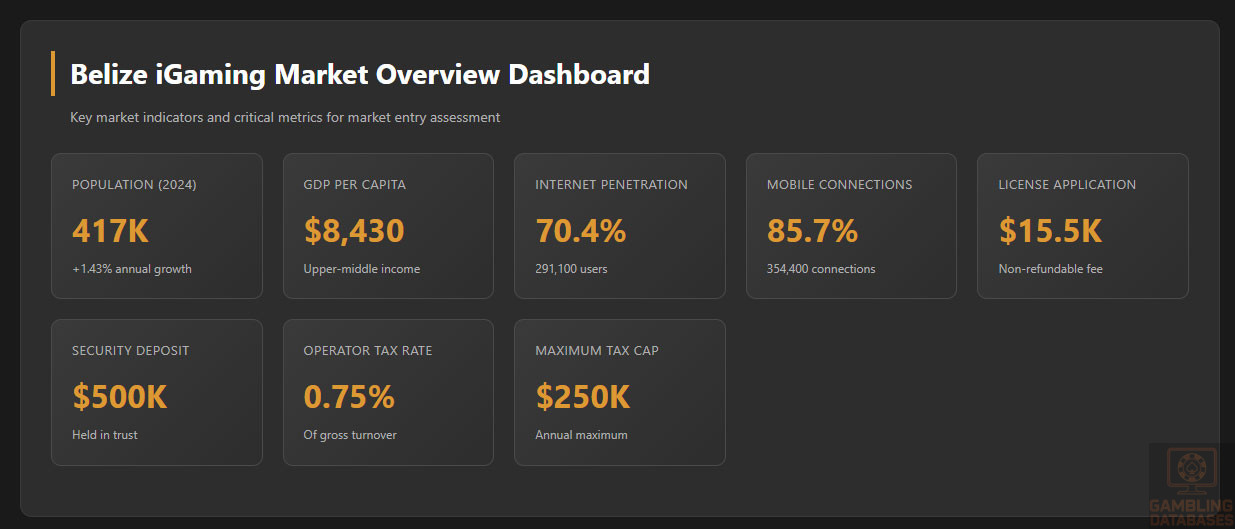
Executive Summary: Key Market Indicators
| Category | Metric | Value |
|---|---|---|
| Legal Status | Online Gambling Legal Framework | Legal and regulated since 2004 |
| Legal Status | Regulatory Authority | Gaming Control Board (GCB) |
| Legal Status | Primary Legislation | Computer Wagering Licensing Act (1995), Gaming Control (Online Gaming) Regulations (2004) |
| Legal Status | License Coverage | Single comprehensive license covers all online gambling activities |
| Legal Status | Local Market Access | Prohibited – licensees cannot offer services to Belize residents |
| Licensing | Initial Application Fee | USD 15,500 |
| Licensing | Annual Renewal Fee | USD 10,000 |
| Licensing | Security Deposit | USD 500,000 (held in trust with Central Bank) |
| Licensing | License Validity Period | 12 months from grant date |
| Licensing | Processing Time | 24 hours to 6 months (typically 3-6 months) |
| Taxation | Operator Tax Rate | 0.75% of gross annual turnover |
| Taxation | Maximum Annual Tax Cap | USD 250,000 |
| Taxation | Corporate Income Tax | Standard corporate rate applies to IBC structure |
| Taxation | Player Winnings Tax | No tax on player winnings |
| Demographics | Population (2024) | 417,000 |
| Demographics | Population Growth Rate | 1.43% annually |
| Demographics | Median Age | 26.9 years |
| Demographics | Urban Population | ~46% |
| Economic | GDP (2024) | USD 3.5 billion |
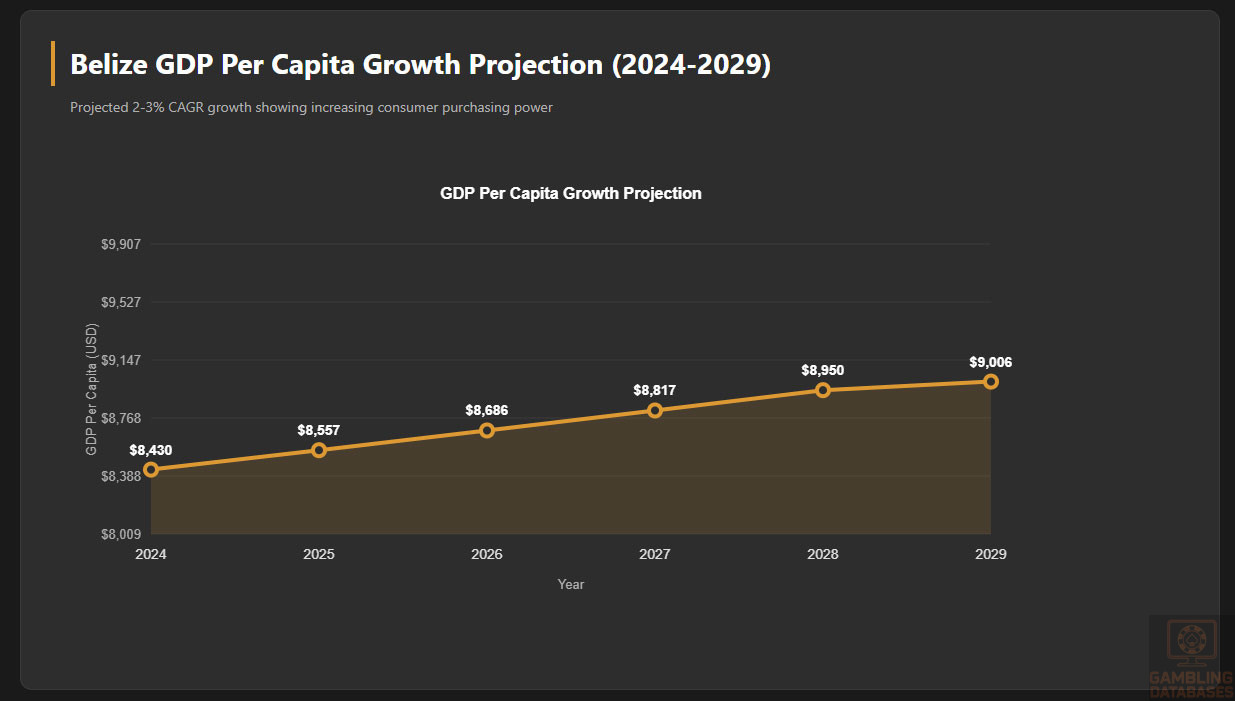
| Economic | GDP Per Capita (2024) | USD 8,430 |
| Economic | GDP Growth Forecast (2025-2029) | 2-3% CAGR |
| Economic | Projected GDP Per Capita (2029) | USD 9,006 |
| Technology | Internet Penetration (2024) | 70.4% |
| Technology | Mobile Connections | 354,400 (85.7% of population) |
| Technology | Social Media Users | 223,500 (54.0% of population) |
| Technology | Mobile Internet Speed | 12.22 Mbps median |
| Technology | Fixed Broadband Speed | 44.31 Mbps median |
| Language | Official Language | English |
| Language | Primary Home Language | Kriol (37%), Spanish (33%), English (5.6%) |
| Market Size | Local iGaming Market | Restricted – operators serve international markets only |
Section 1: Regulatory Framework and Legal Environment
Current Gambling Regulation Status
Belize has operated a regulated gambling framework since 1981 following independence from British rule. The country recognized the economic potential of the iGaming industry early, introducing the Computer Wagering Licensing Act in 1995. This forward-thinking legislation established Belize as one of the first Central American jurisdictions to regulate online gambling.
The comprehensive regulatory update came in October 2004 with the Gaming Control (Online Gaming) Regulations, which remain the primary framework governing digital wagering activities today. These regulations were deliberately designed to attract international operators by creating a business-friendly environment with minimal regulatory burden while generating revenue for the government through licensing fees and operator taxation.

Land-Based Gambling Activities
Land-based gambling in Belize is permitted and regulated under the Gaming Control Act of 2000. The country currently operates eight regulated casinos, though many additional venues operate without proper AML/CFT supervision according to recent transparency assessments. Most established casinos are located in major hotels and tourist areas, serving the country’s tourism industry.

Lottery operations in Belize include both government-run programs and licensed private operators. The most notable arrangement was the exclusive license held by Brad’s Gaming Group Ltd from 2009 until early 2023 for operating government boledo and lottery games. Recent regulatory reforms have addressed transparency concerns in beneficial ownership structures for gaming entities.
Online Gambling Framework
Belize’s online gambling framework specifically targets international operators seeking offshore licensing. The regulations create a unique structure where licensed operators can serve global markets but are explicitly prohibited from offering services to Belize residents. This approach allows the country to generate revenue from licensing fees and taxes without exposing the domestic population to gambling activities.
The licensing framework permits all forms of online gambling under a single comprehensive license. This includes casino games, sports betting, poker rooms, lottery services, bingo, and any other form of wagering conducted via computer or telecommunication devices. The one-size-fits-all approach simplifies compliance for operators who can offer multiple product verticals without obtaining separate authorizations.
Licensed operators must maintain customer service operations within Belize, though servers and technical infrastructure can be located elsewhere. This requirement creates employment opportunities while keeping operational costs manageable. The Gaming Control Board oversees compliance through the Investment Promotion and Compliance Unit (IPCU), which processes applications and ensures ongoing adherence to regulatory standards.
Prohibited activities include any gambling services marketed to or accepting customers from Belize. Violations can result in license suspension, revocation, and financial penalties drawn from the mandatory security deposit. The regulatory body takes a relatively hands-off approach to day-to-day operations, focusing primarily on financial compliance and ensuring proper reserves are maintained.
Licensed Operators and Market Players
Belize maintains a relatively exclusive licensing regime compared to larger offshore jurisdictions. As of 2024, the country has issued only one online gaming license according to recent regulatory oversight reports. This contrasts sharply with jurisdictions like Curaçao or Malta that host hundreds of licensed operators.
The limited number of licenses reflects both the high security deposit requirement and the country’s focus on attracting established operators rather than pursuing volume. The existing licensee operates servers internationally while maintaining required customer service presence in Belize. Market concentration is therefore extremely high, with a single operator holding the active license.
International operators viewing Belize as a licensing jurisdiction typically fall into specific categories. These include emerging iGaming companies seeking cost-effective entry into the industry, established operators looking for a low-tax supplementary license for specific markets, and white-label operators requiring quick licensing approval. The jurisdiction has proven particularly popular with operators targeting Latin American markets due to geographic proximity and cultural familiarity.
Historical data shows that Belize had more active licenses in the past, with the annual renewal fee declining from USD 50,000 in 1995 to USD 10,000 by 2022. This reduction aimed to increase competitiveness against other offshore jurisdictions, though the substantial security deposit remains a significant barrier to entry for smaller operators.
Licensing Framework and Requirements
Application Process and Eligibility
The Gaming Control Board serves as the primary regulatory authority overseeing all gambling activities in Belize. The Investment Promotion and Compliance Unit (IPCU) processes online gaming applications on behalf of the board. Applicants must first establish an International Business Company (IBC) incorporated in Belize before applying for a gaming license.
The application package requires extensive documentation demonstrating financial stability and management integrity. Applicants must submit audited financial statements for the previous three years, including complete balance sheets and profit-loss accounts. For newer entities without three years of history, alternative financial documentation demonstrating adequate capitalization is required.
All beneficial owners and persons with financial interest in the applying entity must undergo background checks. This includes submitting full fingerprints, copies of personal identification documents, and two recent passport-style photographs. The Gaming Control Board reviews criminal history in Belize and internationally, automatically disqualifying anyone convicted of crimes within the previous three years or individuals considered of undesirable character.
Technical requirements include demonstrating approved gaming software compliance and proper security protocols. Applicants must designate an approved compliance officer and retain an approved auditor from any jurisdiction. The company structure must include at least two shareholders, and detailed organizational charts showing ownership structures must be provided.
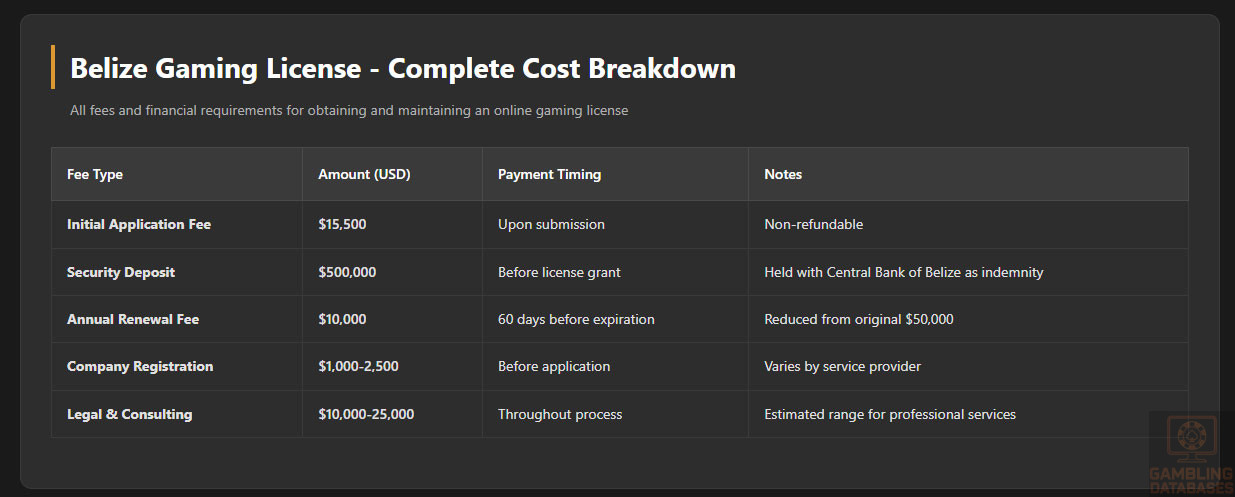
| Fee Type | Amount (USD) | Payment Timing | Notes |
|---|---|---|---|
| Initial Application Fee | 15,500 | Upon submission | Non-refundable |
| Security Deposit | 500,000 | Before license grant | Held with Central Bank of Belize as indemnity |
| Annual Renewal Fee | 10,000 | 60 days before expiration | Significantly reduced from original USD 50,000 |
| Company Registration | 1,000-2,500 | Before application | Varies by service provider |
| Legal & Consulting | 10,000-25,000 | Throughout process | Estimated range for professional services |
Local Presence and Operational Requirements
All licensed online gaming operators must establish physical presence in Belize. This requirement mandates maintaining a registered office address within the country and conducting customer service operations from Belize-based facilities. The regulation aims to create employment opportunities while ensuring regulatory oversight capability.
Server infrastructure and gaming platforms can be hosted internationally, providing operational flexibility. This hybrid model allows operators to leverage global content delivery networks and data centers while meeting the local presence mandate. The Gaming Control Board does not require servers to be physically located in Belize or mandate use of .bz domain extensions.
Personnel requirements include hiring local staff for customer support functions. While specific headcount minimums are not explicitly stated in regulations, practical implementation typically requires at least 3-5 customer service representatives to demonstrate meaningful local operations. Management positions can be filled by foreign nationals, though this may require separate work permit processes.
Foreign ownership faces no restrictions in the IBC structure commonly used for gaming licenses. International operators can maintain 100% ownership of their Belize-licensed entities without requiring local partners or shareholders. This contrasts with jurisdictions mandating local ownership percentages or requiring domestic business partnerships.
Domain and hosting requirements remain flexible compared to more restrictive jurisdictions. Operators can use international domain names and host websites on servers in jurisdictions with robust infrastructure. The primary requirement centers on customer service accessibility from Belize-based operations rather than technical infrastructure location.
Compliance Obligations and Monitoring
Player Protection and Identification
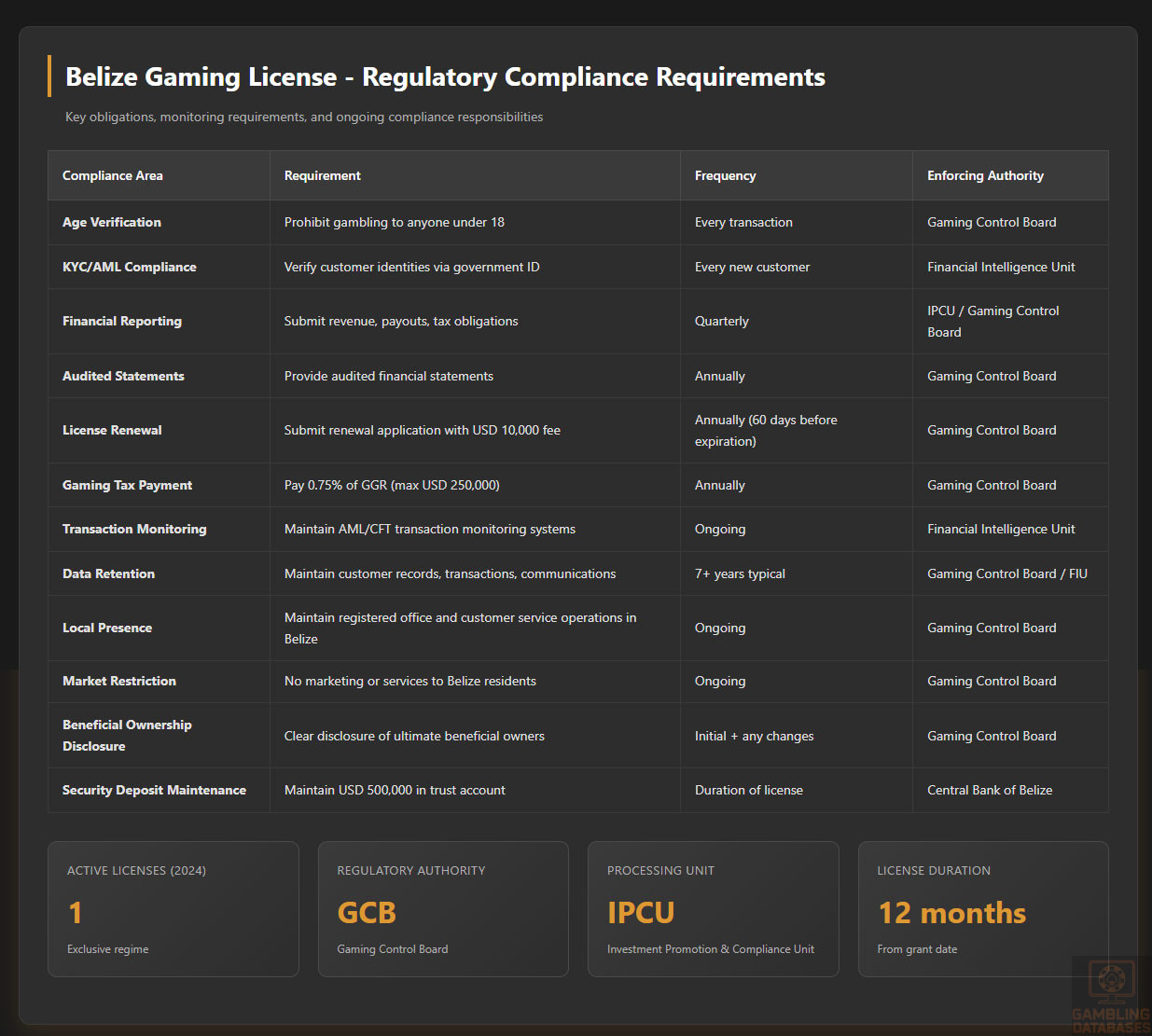
Age verification requirements prohibit gambling services to anyone under 18 years of age. Operators must implement robust systems confirming customer age before allowing real-money wagering. The Gaming Control Board has not prescribed specific technical standards for age verification, allowing operators flexibility in methodology while maintaining the underlying prohibition.
Know Your Customer (KYC) and Anti-Money Laundering (AML) compliance follows international standards despite historically limited enforcement. Operators must verify customer identities through government-issued identification documents and maintain records of verification procedures. Recent regulatory reforms have strengthened AML/CFT oversight following international pressure to address money laundering vulnerabilities.
Responsible gambling measures are not extensively mandated in current regulations compared to European jurisdictions. Operators are not required to implement mandatory session time limits, loss limits, or deposit caps. Self-exclusion systems are encouraged but not legally mandated. Player information disclosure requirements remain minimal, reflecting the jurisdiction’s operator-friendly regulatory philosophy.
The regulatory framework does not specify mandatory responsible gambling tool implementations such as reality checks, time-out periods, or cooling-off requirements. This lighter-touch approach appeals to operators seeking fewer compliance obligations but may face criticism from player protection advocates. Operators serving markets with stricter player protection requirements must implement those standards regardless of Belize’s more permissive framework.
Financial Monitoring and Reporting
Transaction monitoring systems are required under recent AML/CFT reforms implemented between 2020-2024. The Financial Intelligence Unit (FIU) oversees 1,311 Designated Non-Financial Businesses and Professions, including gaming operators. Enhanced oversight procedures and sector-specific guidelines have been introduced to address previously identified vulnerabilities.
Reporting requirements to the Gaming Control Board include regular financial statements demonstrating revenue, payouts, and tax obligations. While specific reporting frequencies are not publicly detailed, standard practice includes quarterly financial reporting and annual audited statements. The Investment Promotion and Compliance Unit reviews submissions to ensure proper tax calculation and payment.
Audit and inspection procedures have been strengthened following international mutual evaluation reports identifying gaps in gaming sector oversight. The Gaming Control Board can conduct on-site inspections of customer service facilities and demand access to financial records. Recent regulatory evolution demonstrates increasing focus on compliance enforcement rather than the previously more permissive approach.
Data retention requirements mandate maintaining customer transaction records, identification documentation, and communication logs. While specific retention periods are not explicitly codified in public regulations, international AML standards typically require seven-year retention periods. Operators should implement comprehensive record-keeping systems exceeding minimum requirements to ensure compliance across multiple jurisdictions.
Taxation Structure and Financial Obligations
Player Taxation
Belize does not impose taxes on player winnings from gambling activities. This zero-tax approach for players applies to both local residents gambling at foreign-licensed sites and international players using Belize-licensed platforms. Players face no withholding requirements, tax declaration obligations, or reporting mandates related to gambling winnings.
The absence of player taxation creates administrative simplicity for operators who do not need to implement withholding systems or report player winnings to tax authorities. This stands in contrast to jurisdictions imposing withholding taxes on significant wins or requiring operators to report player activity. The player-friendly tax structure potentially enhances market attractiveness for operators targeting jurisdictions without similar player tax burdens.
Operator Taxation
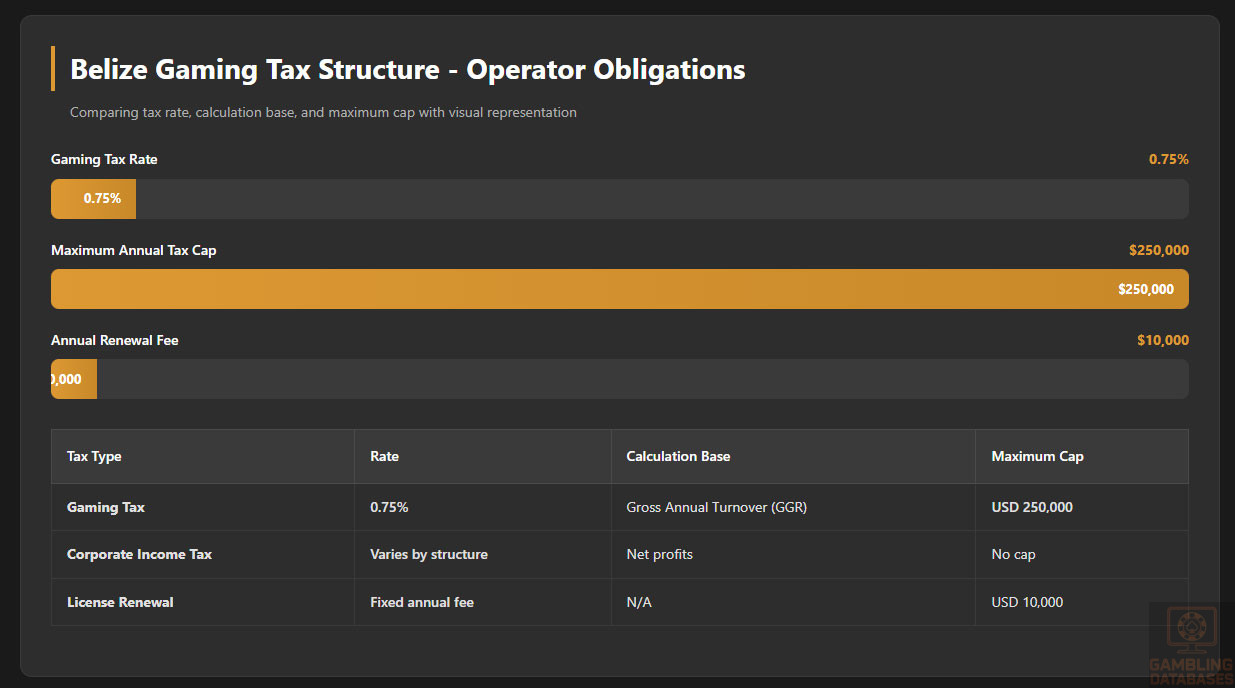
Operator taxation in Belize represents one of the jurisdiction’s primary competitive advantages. The tax rate stands at just 0.75% of gross annual turnover with an absolute maximum cap of USD 250,000 per year. This structure makes Belize one of the most tax-advantaged gaming jurisdictions globally.
Gross Gaming Revenue (GGR) calculation follows standard industry methodology – total bets received minus winnings paid out to players. The tax applies uniformly across all gaming verticals without differentiation between casino games, sports betting, poker, or other products. This simplified approach eliminates complex tax calculations required in jurisdictions with different rates per product type.
The USD 250,000 annual cap means operators generating significant revenue pay the same absolute tax as moderately successful operations once the threshold is reached. An operator generating USD 100 million in annual GGR pays the same USD 250,000 tax as one generating USD 35 million, both hitting the cap at 0.75%. This creates substantial tax advantages for high-volume operations.
Corporate income tax applies to the International Business Company structure beyond the gaming-specific tax. Belize offers various IBC tax benefits and structures, though specific rates depend on company configuration and residency status. Operators should engage local tax advisors to optimize corporate structure and understand total tax obligations beyond the capped gaming tax.
| Tax Type | Rate | Calculation Base | Maximum Cap |
|---|---|---|---|
| Gaming Tax | 0.75% | Gross Annual Turnover (GGR) | USD 250,000 |
| Corporate Income Tax | Varies by structure | Net profits | No cap |
| License Renewal | Fixed annual fee | N/A | USD 10,000 |
Gambling Market Financial Performance
Comprehensive public data on Belize’s gambling market financial performance remains limited due to the jurisdiction’s focus on offshore licensing rather than domestic market operations. The prohibition on serving local players means GGR data reflects international operator revenue rather than Belizean gambling activity.
Available information indicates the single active online gaming license generates revenue for the government through the USD 10,000 annual renewal fee plus gaming tax revenues. With the USD 250,000 tax cap, government revenue from online gaming taxation likely ranges from USD 260,000 annually (renewal fee plus capped tax) for high-performing operators.
Historical trends show fluctuation in licensing activity. The reduction in annual fees from USD 50,000 to USD 10,000 between 2004 and 2022 aimed to increase competitiveness, though the substantial USD 500,000 security deposit requirement limits market growth. Land-based casino operations contribute additional tax revenue, though exact figures are not publicly reported.
The limited transparency in market financial data reflects both the offshore nature of operations and historical gaps in regulatory oversight. Recent reforms implementing stronger AML/CFT controls and beneficial ownership transparency requirements may improve data availability in future reporting periods.
Advertising and Marketing Restrictions
Belize’s regulatory framework does not impose extensive advertising and marketing restrictions on licensed operators for their international activities. The primary prohibition centers on marketing gambling services to Belize residents, which aligns with the complete ban on serving local customers.
Licensed operators cannot advertise gambling services through Belizean media channels targeting local audiences. This includes television broadcasts, radio programming, print publications, outdoor advertising, and digital channels accessible to Belize residents. The restriction ensures compliance with the prohibition on domestic market participation.
For international marketing activities, Belize does not mandate specific content restrictions, bonus caps, wagering requirement limitations, or sponsorship regulations. Operators remain free to structure marketing campaigns according to target market requirements and competitive dynamics. This regulatory flexibility contrasts sharply with jurisdictions imposing detailed advertising content rules.
Marketing to minors faces prohibition consistent with the minimum age requirement of 18 years. While specific enforcement mechanisms are not detailed, operators must implement age-gating on advertising content and avoid marketing approaches likely to appeal to underage audiences. Time restrictions for television and radio advertising do not apply given the prohibition on local market advertising.
Affiliate marketing programs face no specific Belizean regulatory requirements beyond the prohibition on promoting services to local residents. Operators can structure affiliate compensation, implement player tracking systems, and manage partner relationships according to business needs and target market regulations.
Recent Regulatory Changes and Their Impact
Between 2020 and 2024, Belize enacted or amended 17 laws affecting its financial services and gaming sectors. This substantial regulatory reform reflects international pressure to strengthen anti-money laundering controls and improve beneficial ownership transparency. The reforms represent the most significant regulatory evolution since the initial online gaming regulations in 2004.
Key legislative updates include significant amendments to the Belize Criminal Code, introduction of the Civil Asset Recovery and Unexplained Wealth Act (CARUWA), and revisions to the Business Companies Act, Money Lenders Act, International Banking Act, and Domestic Banks and Financial Institutions Act. These changes create a more robust compliance environment for gaming operators.
The Financial Intelligence Unit expanded its investigative and prosecutorial staff in 2023, with further expansion planned as CARUWA implementation proceeds. This increased enforcement capacity signals a shift from the historically permissive oversight approach toward more active compliance monitoring. Civilian financial experts now support police investigators following adoption of Belize’s AML/CFT/CPF policy and national action plan in February 2023.
Virtual asset activities remain restricted until December 31, 2025, under the Financial Services Commission Act. This moratorium prevents gaming operators from implementing cryptocurrency payment options or blockchain-based gaming products during the restriction period. The temporary ban allows regulators time to develop appropriate oversight frameworks for digital asset integration.
The impact on operator costs has been moderate. Enhanced compliance obligations require investment in more robust AML systems, beneficial ownership documentation, and transaction monitoring capabilities. However, the core licensing fees and tax structure remain unchanged, preserving Belize’s competitive positioning. Operators should budget for enhanced compliance infrastructure and potential increased scrutiny during license renewals.
Enforcement Mechanisms and Penalties
The Gaming Control Board maintains authority to impose penalties ranging from financial fines to license suspension and revocation. The most significant enforcement mechanism is the USD 500,000 security deposit held with the Central Bank of Belize. Violations of license conditions, failure to pay required taxes, or fraud can result in withdrawal from this deposit to cover penalties and player obligations.
License suspension represents an intermediate enforcement step before revocation. The board can temporarily suspend operations while investigating alleged violations, preventing the operator from accepting new wagers or processing new customer registrations. During suspension, the operator must continue honoring existing player obligations and withdraw requests.
License revocation permanently terminates the operator’s authorization to conduct gaming activities. Revoked operators must wind down operations, return all player funds, and settle outstanding obligations before closing. The security deposit provides financial backing for player protections during the wind-down process. Belize does not publish comprehensive data on historical enforcement actions, making it difficult to assess typical penalty severity.
Internet Service Provider (ISP) blocking of unlicensed operators is not systematically implemented in Belize given the prohibition on serving local players. The regulatory focus centers on licensed operator compliance rather than blocking foreign websites accessible to Belizean residents. This differs from jurisdictions actively maintaining blocklists of unlicensed gambling sites.
Payment processor restrictions have been strengthened under recent AML/CFT reforms. Financial institutions face enhanced due diligence requirements for gaming-related transactions, potentially complicating payment processing for unlicensed operations. Licensed operators benefit from clearer regulatory status when establishing banking relationships and payment processing arrangements.
Criminal penalties for illegal gambling operations can include fines and potential imprisonment under the Gambling Prevention Act. Operating without a license constitutes an offense, though enforcement historically focused on land-based illegal operations rather than online activities. The regulatory environment is evolving toward stronger enforcement as international compliance standards are adopted.
Section 2: Demographics and Consumer Analysis
Population Demographics and Distribution
Core Population Metrics
Belize’s population stood at approximately 417,000 as of 2024, making it one of the smallest nations in Central America by population. The country experiences steady population growth of 1.43% annually, adding roughly 5,800-6,000 residents per year. This growth rate ranks 77th globally and reflects positive natural increase combined with migration patterns.
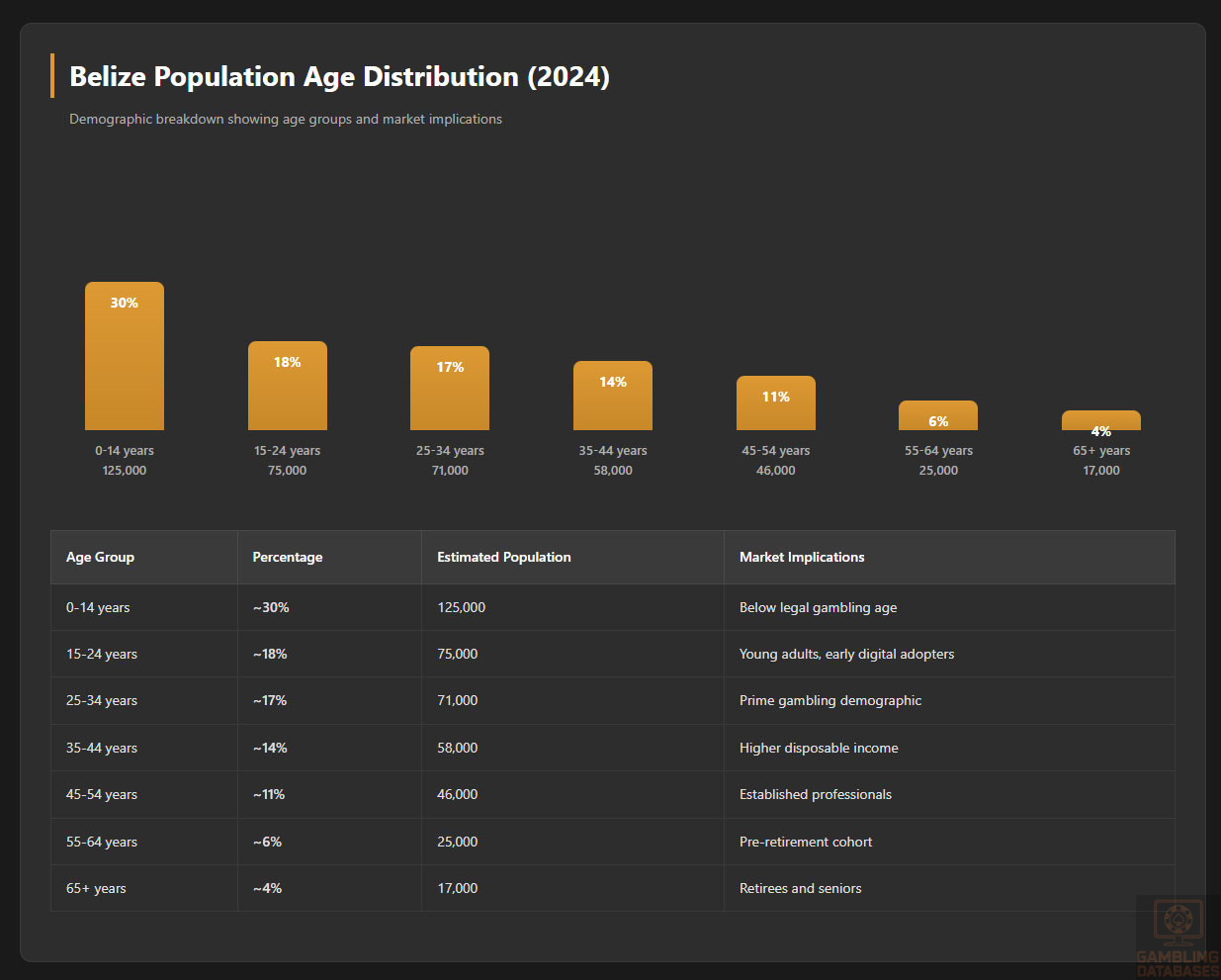
The population demonstrates a young demographic profile with a median age of 26.9 years. This youthful population structure creates potential market advantages for digital entertainment and technology adoption. Age distribution shows 0-14 years representing approximately 30% of the population, 15-64 years comprising 65%, and 65+ accounting for roughly 5% of residents.
Gender distribution is nearly balanced with 50.46% male and 49.54% female population. Males outnumber females by approximately 3,812 individuals, creating a sex ratio of 101.845 males per 100 females. Life expectancy averages in the mid-70s, with females typically living longer than males consistent with global patterns.
Urban versus rural distribution shows approximately 46% of the population living in urban areas with 54% in rural settings. This relatively balanced distribution differs from more urbanized nations where 70-80% concentrate in cities. About one-fourth of the total population resides in Belize City, the principal port, commercial center, and former capital.
| Age Group | Percentage of Population | Estimated Population | Market Implications |
|---|---|---|---|
| 0-14 years | ~30% | 125,000 | Below legal gambling age |
| 15-24 years | ~18% | 75,000 | Young adults, early digital adopters |
| 25-34 years | ~17% | 71,000 | Prime gambling demographic |
| 35-44 years | ~14% | 58,000 | Higher disposable income |
| 45-54 years | ~11% | 46,000 | Established professionals |
| 55-64 years | ~6% | 25,000 | Pre-retirement cohort |
| 65+ years | ~4% | 17,000 | Retirees and seniors |
Geographic Distribution
Belize City dominates the urban landscape with approximately 100,000 residents representing roughly one-quarter of the national population. As the former capital and primary commercial hub, Belize City concentrates financial services, port activities, and business operations. The city serves as the main gateway for international arrivals and commercial trade.
Other major population centers include Belmopan (the current capital with approximately 20,000 residents), San Ignacio/Santa Elena in Cayo District (18,000), Orange Walk Town (14,000), and Corozal Town (10,000). These secondary cities serve as regional commercial and administrative centers with more limited infrastructure compared to Belize City.
Regional economic differences are pronounced between coastal areas, where tourism and fishing drive economic activity, and interior regions focused on agriculture and forestry. The northern districts of Corozal and Orange Walk have strong agricultural economies, particularly sugar cane production. The western Cayo District benefits from tourism related to Mayan archaeological sites and eco-tourism attractions.
Internet access patterns follow the urban-rural divide, with significantly higher penetration rates in Belize City and major towns compared to rural areas. Mobile connectivity has helped bridge this gap, with 85.7% mobile connection penetration nationwide exceeding fixed broadband availability. Rural areas increasingly rely on mobile internet rather than fixed-line connections.
Gambling venue concentration historically focused on tourist areas, particularly Belize City and coastal resort zones. The eight regulated casinos primarily serve international tourists rather than local populations, reflecting tourism’s importance to the gambling sector. Land-based gambling participation among residents remains limited due to economic constraints and cultural factors.
Economic Indicators and Consumer Spending Power
GDP and Economic Performance
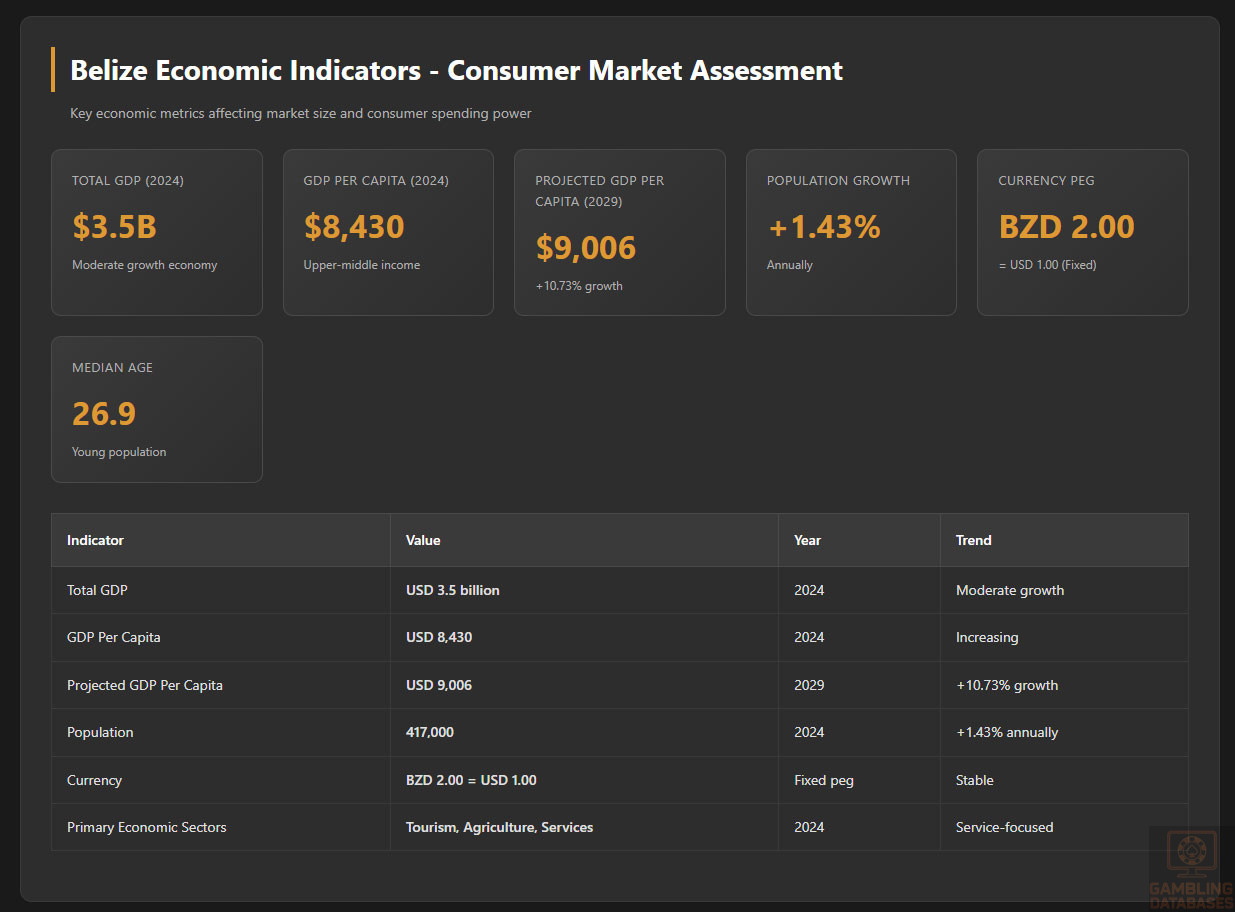
Belize’s economy generated approximately USD 3.5 billion in total GDP during 2024. This positions Belize as a small economy even by Central American standards, smaller than neighbors like Guatemala and Honduras but comparable to other Caribbean economies. The economic structure heavily depends on tourism, agriculture (particularly sugar and citrus), and financial services including offshore banking and licensing.
GDP per capita reached USD 8,430 in 2024, representing a critical economic indicator for assessing consumer spending power. This figure places Belize in the upper-middle-income category but below regional leaders like Costa Rica and Panama. The per capita income has shown recovery following COVID-19 impacts, with 2024 levels exceeding 2023 figures.
GDP growth forecasts project 2-3% annual expansion through 2029, with per capita GDP expected to reach approximately USD 9,006 by 2029. This represents a 10.73% increase over the forecast period. Growth drivers include tourism recovery, infrastructure investments, and renewable energy development. The US Millennium Challenge Corporation committed support in 2024 for educational modernization and energy sector enhancement.
Economic sector composition shows services dominating at approximately 60% of GDP, driven by tourism, financial services, and government operations. Agriculture contributes roughly 10-12% despite employing a larger workforce percentage. Industry including manufacturing and construction represents 15-20% of economic output. This service-heavy composition aligns with small island and coastal economies.
Employment rates and wage levels reflect the developing economy status. Formal sector employment concentrates in tourism, government, and commercial activities in urban areas. Rural employment focuses on agriculture with lower wage levels. Remittances from Belizeans working abroad, particularly in the United States, provide important supplementary income for many households.
Inflation trends have varied significantly in recent years. The country experienced elevated inflation during global supply chain disruptions and energy price increases. Stabilization efforts by the Central Bank of Belize aim to maintain price stability while supporting economic growth. The Belize dollar maintains a fixed peg to the US dollar at BZD 2 to USD 1, providing monetary stability.
Income and Wealth Distribution
Average household income in Belize varies substantially by region and employment sector. Urban households, particularly in Belize City, command higher average incomes than rural agricultural households. Estimates suggest average household income ranges from USD 800-1,200 monthly for middle-class urban families, with significant variation above and below this range.
Median household income provides a more representative measure of typical economic conditions, likely falling in the USD 600-800 monthly range. This median reflects the reality that income distribution skews toward higher earners in tourism, professional services, and government employment, while many households earn substantially less in agriculture and informal sectors.
Income inequality measures indicate moderate to high inequality levels typical of developing economies. While specific Gini coefficient data for Belize is limited in recent publications, regional patterns suggest values in the 0.45-0.53 range. Wealth concentrates among business owners, professionals, and those with connections to tourism and international commerce.
Disposable income trends show limited growth for many households, with rising costs for food, fuel, and utilities consuming larger portions of household budgets. Middle-class households have some discretionary spending capacity for entertainment and non-essential goods, though this remains constrained compared to developed economies. Lower-income households operate with minimal discretionary spending.
Consumer spending patterns prioritize essentials like food, housing, and transportation. Entertainment spending remains limited for most households, with gambling participation constrained by economic realities. The relatively low GDP per capita compared to developed markets means consumer gambling expenditure potential is modest even if regulatory restrictions on local market participation were removed.
| Indicator | Value | Year | Trend |
|---|---|---|---|
| Total GDP | USD 3.5 billion | 2024 | Moderate growth |
| GDP Per Capita | USD 8,430 | 2024 | Increasing |
| Projected GDP Per Capita | USD 9,006 | 2029 | +10.73% growth |
| Population | 417,000 | 2024 | +1.43% annually |
| Currency | BZD 2.00 = USD 1.00 | Fixed peg | Stable |
| Primary Economic Sectors | Tourism, Agriculture, Services | 2024 | Service-focused |
Market Size and Growth Projections
The domestic Belize iGaming market remains theoretical rather than actual due to regulatory prohibition on serving local players. Licensed operators cannot offer gambling services to Belize residents, meaning no legal local market exists. This fundamental restriction eliminates traditional market size analysis based on local player participation and spending.
If hypothetically opened to local participation, market size projections would face significant constraints. With GDP per capita of USD 8,430 and limited disposable income, potential market revenue would likely remain under USD 10 million annually. This estimate assumes 5-10% of the adult population participating with average annual spending of USD 200-400 per active player.
Global iGaming market context shows the worldwide online gambling sector reached USD 95.5 billion in 2024 with projected growth to USD 257 billion by 2034 at 10.5% CAGR. Regional markets in Latin America and the Caribbean demonstrate varied development levels, with mature markets in Colombia and emerging opportunities in Brazil following recent legalization.
Belize’s value proposition centers on licensing revenue rather than local market development. The jurisdiction competes with Curaçao, Panama, Costa Rica, and other offshore licensing centers for international operators seeking cost-effective regulatory authorization. Market growth for Belize depends on attracting additional licensed operators rather than developing domestic gambling participation.
Operator revenue potential from Belize licensing relates to target markets served rather than Belize’s population. Operators using Belize licenses typically target Latin American markets, unregulated jurisdictions, or specific niches where the license provides legitimacy. Revenue potential depends entirely on the operator’s market strategy, product quality, and marketing effectiveness in chosen target markets.
Education, Skills, and Digital Literacy
Educational Foundation
Belize maintains relatively strong literacy rates for the region, with overall literacy estimated at 85-90% of the adult population. Gender parity in literacy has improved substantially, with female literacy rates approaching male rates particularly among younger cohorts. Educational instruction in English provides advantages for technology adoption and international business engagement.
Education levels show primary completion rates exceeding 90%, reflecting effective basic education access. Secondary school completion rates are lower at approximately 65-70%, with economic pressures causing some students to leave school for employment. Tertiary education completion remains limited to roughly 15-20% of the population, concentrated among urban middle and upper-class families.
Digital literacy varies significantly by age and education level. Younger populations demonstrate high comfort with smartphones, social media, and mobile applications. Older generations show lower technology proficiency, though mobile phone adoption has become nearly universal across age groups. Formal computer education in schools has expanded but remains less comprehensive than developed nations.
Workforce skill levels reflect the educational attainment patterns. Tourism and service sectors employ workers with secondary education and on-the-job training. Professional services require tertiary education, with some positions filled by expatriates due to limited local expertise in specialized fields. Technical skills in IT and software development remain constrained, with limited local talent pools.
Technology adoption readiness is moderate, with enthusiasm for consumer technology like smartphones and social media but limited exposure to advanced digital services. E-commerce adoption grows gradually, though cash remains dominant for most transactions. Online banking penetration is expanding among urban professionals but remains limited in rural areas.
English language proficiency provides significant advantages for international business and technology adoption. While only 5.6% speak English as their primary home language, 54% can speak it very well and another 26% have some English capability. This widespread English comprehension facilitates access to global digital content and services primarily available in English.
Cultural and Social Factors
Communication and Language
English serves as the official language and primary language of government, education, and formal business. This English-language foundation differentiates Belize from Spanish-dominant Central American neighbors and creates cultural affinity with Anglophone Caribbean nations. Official documents, signage, and business communications use English as standard.
Kriol represents the most common primary home language at 37% of the population. This English-based creole evolved during colonial times and remains integral to Belizean identity. Kriol speakers can understand English, creating bilingual capability even among those primarily speaking creole at home. The linguistic similarity between Kriol and English facilitates communication and comprehension.
Spanish is spoken by approximately 33% as a primary language, reflecting significant Hispanic/Mestizo population presence particularly in northern and western districts. Many Spanish speakers also have English capability, creating trilingual proficiency (Spanish-English-Kriol) among portions of the population. Indigenous Mayan languages including Q’eqchi’ and Yucatec Maya are spoken in specific communities, primarily in Toledo and Orange Walk districts.
Internet language preferences heavily favor English for digital content consumption. Most websites, applications, and online services accessed by Belizeans use English interfaces. Spanish-language content attracts the Hispanic population segment, while Kriol remains primarily an oral rather than written language with limited digital presence.
Business communication norms follow English-language professional standards inherited from British colonial influence. Formal written communications use standard English grammar and vocabulary. Verbal business discussions may incorporate Kriol expressions, particularly in less formal contexts. International business interactions exclusively use English, advantaging Belizean professionals in global commerce.
Cultural Attitudes
Gambling acceptance levels in Belizean society remain moderate with mixed attitudes. Land-based casinos operating since the 1980s have normalized gambling as entertainment for tourists and some locals. However, religious and cultural influences promote caution about gambling’s social impacts. The government’s prohibition on online gambling services for residents reflects concerns about protecting citizens from gambling-related harm.
Religious influences shape cultural perspectives significantly. Christianity dominates with Catholics representing 40.1% and various Protestant denominations comprising 31.7% of the population. Religious teachings often emphasize financial responsibility and caution against gambling’s addictive potential. Church leadership influences social attitudes and policy discussions around gambling expansion.
Foreign brand perception shows general trust and positive associations. Belizeans commonly consume international products and media, particularly from the United States and United Kingdom. Foreign companies in tourism, consumer goods, and services operate successfully. Online services from international providers encounter fewer trust barriers than in markets with strong preferences for domestic brands.
Risk tolerance indicators suggest moderate risk appetite influenced by economic constraints. Limited disposable income encourages financial conservatism for most households. Entrepreneurial activity exists particularly in tourism and services, but major financial risks remain unaffordable for average families. This economic reality limits potential gambling participation even if regulatory restrictions were removed.
Entertainment preferences include sports (particularly football/soccer and basketball), music festivals, cultural celebrations, and outdoor activities. Television viewing, social media engagement, and mobile gaming represent growing digital entertainment. Traditional communal activities maintain importance, balancing modern digital entertainment with social gatherings and family time.
Problem Gambling and Social Considerations
Problem gambling prevalence data for Belize remains extremely limited due to the prohibition on serving local residents with online gambling and limited land-based gambling participation. No comprehensive national surveys have assessed gambling addiction rates or problem gambling prevalence among the population. This data gap reflects both the small market size and regulatory restrictions limiting gambling access.
Estimated problem gambling rates would likely mirror regional developing economy patterns if gambling were more accessible, potentially ranging from 0.5-2% of the adult population. This would suggest 1,500-7,000 individuals might experience gambling-related problems if services were widely available. However, current restrictions and limited gambling access mean actual problem gambling likely remains minimal.
Underage gambling issues face similar data limitations. The regulatory framework prohibits gambling to anyone under 18, with enforcement focused on land-based venues. Online gambling prohibition for all residents eliminates concerns about minors accessing Belize-licensed platforms. International sites accessible to Belizeans may present underage access risks similar to other jurisdictions.
Gender distribution of problem gamblers typically skews male in most markets, with men representing 60-75% of problem gambling cases globally. No Belize-specific data confirms whether this pattern would hold locally. Age groups most affected typically include young adults (18-35) and middle-aged men (35-55) based on international patterns.
Government response measures remain minimal given limited gambling access for residents. No dedicated problem gambling treatment facilities or specialized counseling services exist. General mental health and addiction services might address gambling issues within broader addiction treatment frameworks. The lack of specialized resources reflects limited perceived need due to gambling restrictions.
Social responsibility requirements for operators remain underdeveloped in Belize’s regulatory framework. Operators face no mandatory contributions to problem gambling prevention funds, research initiatives, or treatment programs. This contrasts sharply with jurisdictions requiring operators to fund responsible gambling infrastructure. The operator-friendly approach minimizes compliance costs but provides limited player protection resources.
Political Structure and Governance
Belize operates as a parliamentary constitutional monarchy within the British Commonwealth. The country gained independence from the United Kingdom in 1981 while maintaining Queen Elizabeth II and subsequently King Charles III as head of state, represented locally by a Governor-General. The Prime Minister serves as head of government, leading the majority party in the elected House of Representatives.
Political stability indicators show moderate stability with regular democratic elections and peaceful power transitions. The two-party system dominated by the People’s United Party (PUP) and United Democratic Party (UDP) has maintained democratic governance throughout independence. Political competition remains robust, with parties alternating power through electoral processes.
Recent political history shows a PUP government elected in 2020 under Prime Minister Juan Briceño, replacing the UDP administration. The transition occurred peacefully through democratic elections, maintaining Belize’s track record of stable governance. Political discourse focuses on economic development, infrastructure, education, and managing relationships with neighboring Guatemala over territorial disputes.
Corruption perception remains a concern with Belize facing challenges common to small developing economies. Transparency International rankings place Belize in moderate-risk categories, with ongoing efforts to strengthen institutional oversight and reduce corruption vulnerabilities. Gaming sector reforms specifically address beneficial ownership transparency following identified weaknesses in previous regulatory oversight.
International relations impact business through US financial assistance, trade relationships with CARICOM partners, and historical UK ties. The US Millennium Challenge Corporation’s 2024 support demonstrates strong US-Belize cooperation. Trade agreements through CARICOM facilitate regional commerce. These international partnerships generally support business-friendly policies while encouraging governance improvements.
Technology Adoption and Digital Behavior
Internet and Digital Usage
Internet penetration in Belize reached 70.4% of the total population as of early 2024, with 291,100 internet users among the 413,800 population. This represents significant growth from 62% in 2021 and just 28.2% in 2010. The expansion reflects improved infrastructure, increased smartphone adoption, and falling data costs making internet access more affordable.
The remaining 29.6% without internet access (approximately 122,700 people) primarily includes rural residents, elderly populations, and lower-income households. Geographic barriers, infrastructure limitations, and affordability constraints prevent universal access. Mobile internet has proven crucial for extending connectivity to previously underserved areas where fixed broadband infrastructure remains limited.
Daily internet usage hours average 4-6 hours for regular users, concentrated among younger demographics and urban residents. Social media, messaging applications, video streaming, and mobile gaming consume significant usage time. Work-related internet use has expanded, particularly following COVID-19 pandemic remote work adoption. Educational institutions increasingly rely on internet connectivity for learning resources.
Mobile device adoption rates demonstrate near-universal smartphone penetration among internet users. Total mobile connections reached 354,400 in early 2024, equivalent to 85.7% of the population. Many individuals maintain multiple SIM cards or devices, explaining why connection numbers approach population totals. Smartphone ownership enables internet access for users without fixed broadband availability.
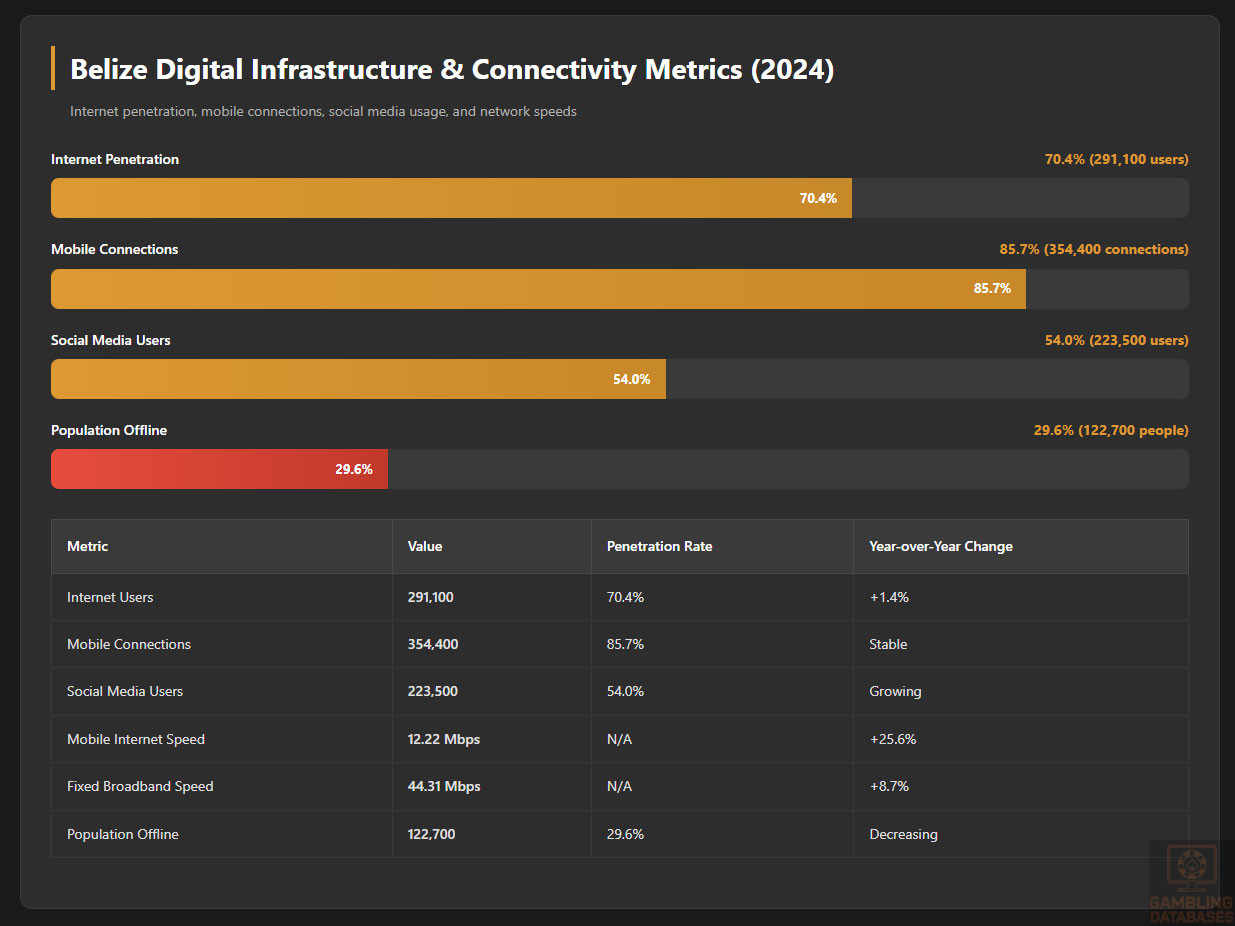
Social media engagement shows 223,500 active users as of January 2024, representing 54.0% of the total population. Facebook dominates platform usage, followed by WhatsApp for messaging, Instagram for photo sharing, and YouTube for video content. Social media has become integral to communication, business marketing, and information sharing across Belizean society.
E-commerce participation remains developing with gradual adoption of online shopping. International platforms like Amazon ship to Belize, though delivery costs and times limit usage. Local e-commerce platforms remain limited compared to more developed markets. Credit card penetration constraints and preference for cash transactions slow e-commerce growth, though this is gradually changing.
Digital payment adoption shows moderate penetration concentrated in urban areas and among younger, more educated demographics. Mobile money services have launched but face competition from traditional cash and bank transfer preferences. Credit and debit card usage for online transactions remains limited to roughly 20-30% of the population with formal banking relationships.
Online banking penetration is expanding among formal banking customers, with major banks offering mobile apps and web platforms. Adoption remains concentrated among urban professionals and younger customers comfortable with digital financial services. Rural populations and older demographics continue preferring in-person banking for most transactions.
| Metric | Value | Penetration Rate | Year-over-Year Change |
|---|---|---|---|
| Internet Users | 291,100 | 70.4% | +1.4% |
| Mobile Connections | 354,400 | 85.7% | Stable |
| Social Media Users | 223,500 | 54.0% | Growing |
| Mobile Internet Speed | 12.22 Mbps | N/A | +25.6% |
| Fixed Broadband Speed | 44.31 Mbps | N/A | +8.7% |
| Population Offline | 122,700 | 29.6% | Decreasing |
Digital Payment Behavior
Payment method preferences in Belize heavily favor cash for everyday transactions, with an estimated 70-80% of consumer purchases conducted in physical currency. Cultural familiarity, universal acceptance, and limited banking access for some populations sustain cash dominance. Small merchants often lack card processing capabilities, reinforcing cash usage patterns.
Credit and debit card usage serves primarily for larger purchases, online transactions, and interactions with established businesses. Card penetration among adults likely ranges 30-40%, concentrated in urban areas and middle-to-upper income households. International cards from Visa and Mastercard dominate, with local bank-issued cards linked to deposit accounts or credit facilities.
Digital wallets have limited market presence compared to more developed e-commerce markets. International services like PayPal face restricted availability in Belize. Regional platforms and local mobile money initiatives exist but have not achieved mass-market penetration. Trust barriers, limited merchant acceptance, and entrenched cash preferences slow digital wallet adoption.
Bank transfers using traditional banking infrastructure serve for larger transactions, bill payments, and business-to-business transactions. Wire transfers and ACH-equivalent systems facilitate domestic fund movements. International remittances through services like Western Union and MoneyGram remain important for families receiving support from abroad.
Cryptocurrency adoption for any purpose including gambling remains nascent. The restriction on virtual asset activities until December 31, 2025, limits formal cryptocurrency integration. Some technically sophisticated individuals may hold cryptocurrencies for investment, but mainstream adoption remains minimal. Gaming operators cannot offer cryptocurrency deposits or withdrawals under current restrictions.
Online transaction patterns show increasing comfort among digitally-engaged populations, though overall volumes remain small compared to developed markets. E-commerce transactions, online bill payments, and digital service subscriptions grow steadily. Security concerns and fraud risks create some hesitation, particularly among older demographics less familiar with digital security practices.
Average transaction sizes for digital payments typically range from USD 20-200, depending on transaction type. Larger purchases like airline tickets or hotel bookings commonly use cards. Smaller routine purchases under USD 20 overwhelmingly remain cash-based. Digital payment adoption correlates strongly with transaction size and merchant sophistication.
Gaming and Gambling Preferences
Current Market Participation
Gambling participation data for Belize residents remains extremely limited due to regulatory prohibition on domestic market services. No licensed operators serve Belize residents, eliminating legal gambling channels beyond land-based casino access for those physically visiting regulated venues. This regulatory structure prevents traditional market participation measurement.
International online gambling sites accessible to Belizeans technically allow participation, though no reliable data quantifies actual usage rates. Some residents likely access foreign-licensed platforms, particularly for sports betting on international football matches and basketball games. Participation likely remains under 5% of the adult population given economic constraints and limited marketing exposure.
Land-based casino participation serves primarily international tourists rather than local residents. The eight regulated casinos focus on tourist traffic from cruise ships and resort visitors. Local participation occurs but remains limited to higher-income urban residents treating casino visits as occasional entertainment. Economic constraints prevent regular gambling participation for most Belizean households.
Popular gambling activities internationally accessed would likely favor sports betting given strong sports interest in Belizean culture. Football (soccer) dominates sports enthusiasm, with English Premier League, Spanish La Liga, and Champions League matches attracting significant following. Basketball, particularly NBA games, also commands substantial viewership and fan engagement.
Lottery participation represents the most accessible gambling form historically available to residents. Government lottery programs and the boledo system operated under exclusive license through 2023 provided legal wagering opportunities. Lottery tickets remain affordable for lower-income populations, driving broader participation than casino gaming. Weekly draws create routine participation patterns for engaged players.
Consumer Behavior Patterns
Average spending per player remains impossible to quantify accurately given regulatory restrictions on serving Belize residents. If the market were open, spending would likely remain modest given GDP per capita of USD 8,430. Hypothetical average monthly spending might range USD 15-40 for regular participants, with annual spending of USD 180-480 per active player.
- Spending habits would necessarily reflect limited disposable income, with most participants likely wagering small amounts on sporadic occasions rather than regular high-stakes gambling. Economic realities would create price-sensitive customers seeking entertainment value from modest wagers. Bonus promotions and free play offers would likely drive significant engagement given budget constraints.
- Platform preferences would almost certainly favor mobile given smartphone penetration rates of 85.7% and limited desktop computer ownership. Mobile-optimized websites and dedicated applications would capture the vast majority of engagement. Desktop usage would remain secondary, limited to office workers and households with computer access.
- Peak gambling times would likely align with sporting event schedules, particularly evening matches in European football leagues accounting for time zone differences. Weekend entertainment spending would increase participation, with Friday and Saturday evenings showing higher activity. Monthly patterns might spike around paydays when disposable income temporarily increases.
- Session lengths would likely remain shorter than developed markets given economic constraints limiting prolonged play. Average sessions might last 15-30 minutes focused on specific sporting events or slot game sessions. The limited bankroll available to most potential players would naturally curtail session duration compared to higher-income markets.
- Retention and loyalty patterns would depend heavily on promotional incentives given price sensitivity. Players would likely rotate between operators based on bonus offers and promotional campaigns. Building long-term loyalty would require consistent value delivery and localized payment methods accommodating cash-based preferences through retail vouchers or mobile money integration.
- Bonus sensitivity would be extremely high, with free bets, deposit matches, and cashback offers driving acquisition and engagement. The constrained economic environment makes promotional value critical for attracting and retaining players. Operators would need aggressive promotional strategies to compete effectively, though this must balance with profitability given low average revenue per user.
Preferred game types would likely include sports betting (particularly football and basketball), lottery-style games offering jackpot dreams at low cost, and simple slot games with entertainment themes. Complex casino games requiring strategic knowledge like poker or blackjack would attract limited engagement. Cultural preferences and gaming experience levels would drive simple, accessible game popularity.
Section 3: Technology Infrastructure and Business Environment
Internet and Digital Infrastructure
Connectivity and Network Performance
Internet penetration of 70.4% represents significant achievement for a developing Central American nation, though the remaining 29.6% offline population indicates continued infrastructure challenges. Growth from 28.2% in 2010 to current levels demonstrates substantial investment in connectivity expansion. However, quality varies significantly between urban and rural areas.
Fixed broadband infrastructure concentrates in Belize City and major towns, with limited availability in rural communities. Cable and DSL services provide primary fixed connectivity where available. Fiber optic deployment remains limited compared to developed markets, though expansion continues gradually. Rural areas often lack economic justification for fixed infrastructure investment given low population density.
Mobile internet has become the primary connectivity method for many users, particularly in areas without fixed broadband access. The 85.7% mobile connection penetration enables internet access beyond fixed infrastructure reach. Mobile networks provide the most practical solution for extending connectivity to underserved populations, though quality varies by location and network congestion.
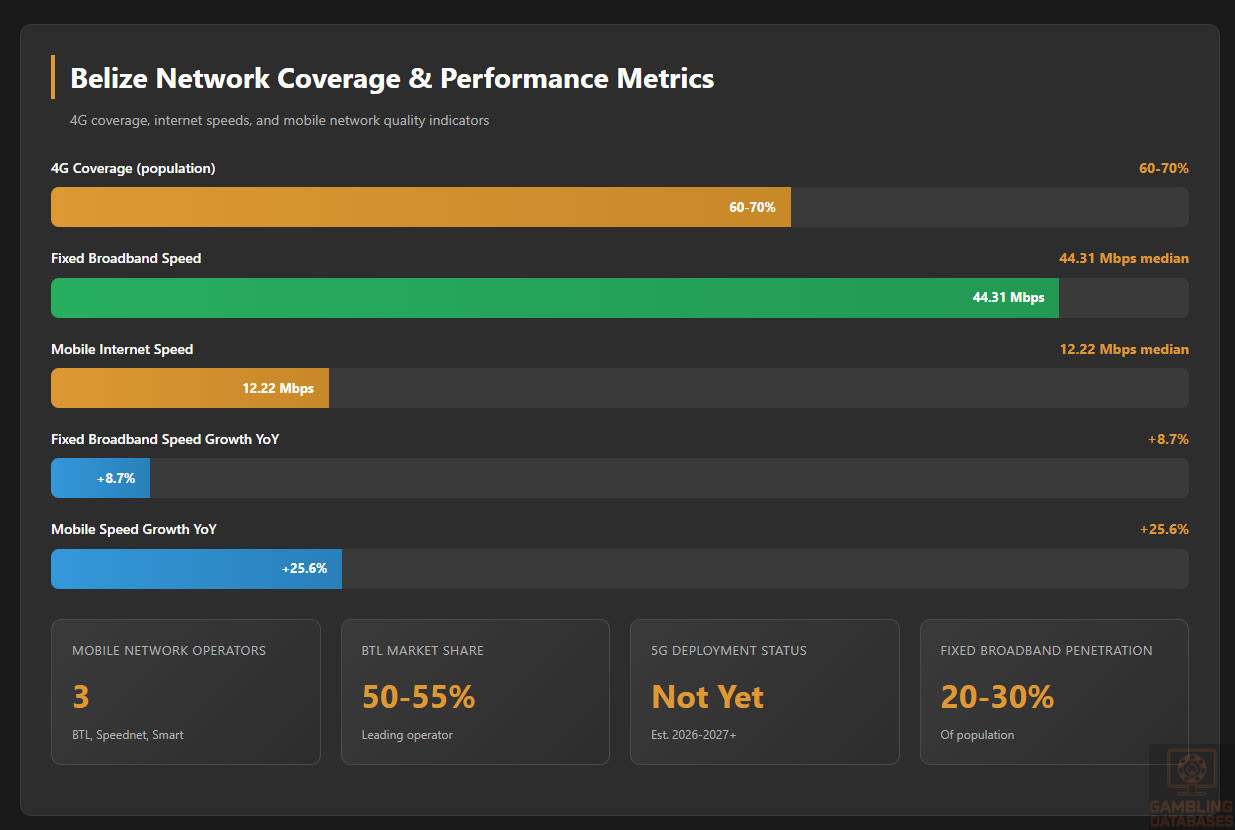
Average internet speeds show mobile connections delivering median 12.22 Mbps download speeds as of late 2023, representing 25.6% year-over-year improvement. This speed suffices for basic web browsing, social media, and mobile gaming but limits high-definition video streaming or data-intensive applications. Mobile speeds vary significantly by location, carrier, and network congestion.
Fixed broadband median speeds of 44.31 Mbps substantially exceed mobile performance, providing adequate bandwidth for streaming, gaming, and multiple simultaneous users. Fixed connections serve households and businesses where available, though geographic coverage remains concentrated in urban areas. The 8.7% annual speed improvement indicates ongoing infrastructure investment.
Network reliability and uptime data is not comprehensively published, though users report occasional service interruptions particularly during severe weather events. Hurricane season can disrupt both mobile and fixed infrastructure, creating temporary connectivity loss. Urban areas generally experience better reliability than rural regions with less redundant infrastructure.
Infrastructure investment trends show continued expansion driven by competition among telecommunications providers and government development priorities. The 2024-2028 Belize Electricity Limited plan includes supporting telecommunications infrastructure alongside energy improvements. International connectivity through submarine cables linking to broader regional networks ensures adequate international bandwidth capacity.
Global internet speed rankings place Belize in the lower-middle range globally but competitive within Central America. The country outperforms some regional neighbors while trailing Costa Rica and Panama in infrastructure sophistication. Continued investment is narrowing gaps, though developed nation speeds remain substantially higher.
Rural versus urban connectivity gaps remain pronounced, with urban areas enjoying 80-90% connectivity while rural regions may have 50-60% penetration. Mobile coverage extends to most populated areas, but signal quality and data speeds decline in remote regions. Bridging the digital divide requires continued infrastructure investment and innovative solutions like satellite internet for extremely remote locations.
5G and Future Technology Deployment
Current network technology is predominantly 4G/LTE for mobile services in urban areas and major towns. 4G coverage reaches approximately 60-70% of the population, concentrated in Belize City and district capitals. Expansion continues to secondary towns and well-traveled corridors. Rural areas often rely on 3G service or limited 4G coverage with variable quality.
5G deployment has not yet commenced in Belize as of 2024. The country lacks immediate 5G rollout plans, with telecommunications providers focusing on expanding and improving 4G coverage. Economic factors, limited demand from the small market, and infrastructure investment priorities delay 5G introduction compared to larger regional markets.
Future infrastructure plans emphasize improving 4G coverage quality and geographic reach rather than advancing to 5G technology. The small population and developing economy status make Belize a lower priority for cutting-edge mobile technology deployment. Providers will likely introduce 5G in the late 2020s or early 2030s, following broader regional adoption patterns.
Network operator landscape includes Belize Telemedia Limited (BTL) and Digi, providing competitive mobile and internet services. BTL historically dominated as the incumbent provider, while Digi entered more recently creating market competition. Competition has driven improved service quality and competitive pricing, benefiting consumers through better connectivity options.
Mobile Technology Ecosystem
Mobile Network Infrastructure
Two primary mobile network operators serve Belize – Belize Telemedia Limited (BTL) and Digi. BTL maintains the largest market share as the established incumbent, while Digi has gained share through competitive pricing and targeted marketing. Both providers offer prepaid and postpaid mobile services with voice, SMS, and data packages.
Network operator market share shows BTL commanding approximately 60-65% of mobile subscribers with Digi holding 35-40%. Competition has intensified in recent years with both operators investing in network improvements and customer acquisition. Market dynamics favor prepaid services over postpaid contracts, reflecting consumer preferences and economic conditions.
Coverage quality varies by operator and location. BTL’s longer operational history provides more extensive geographic coverage including rural areas. Digi focuses on urban centers and high-traffic corridors where population density justifies infrastructure investment. Both operators provide adequate coverage in Belize City and major towns with progressive degradation in remote areas.
4G/5G coverage maps show 4G availability in Belize City, district capitals, and major highways. The North Highway to Mexico, Western Highway to Guatemala, and Southern Highway show improving coverage. Interior regions and less-traveled areas maintain 3G service or limited connectivity. Neither operator offers 5G service currently.
Mobile payment integration shows early-stage development with both operators offering mobile money services. Adoption remains limited compared to East African markets where mobile money revolutionized financial services. Cultural attachment to cash, limited merchant acceptance, and competition from traditional banking slow mobile payment growth in Belize.
Mobile wallet adoption rates likely remain under 15% of mobile subscribers, concentrated among younger urban users. Services enable peer-to-peer transfers, bill payments, and mobile top-ups. Merchant payment capabilities exist but face limited acceptance outside major retailers. Expansion requires broader merchant adoption and increased consumer awareness and trust.
Device Penetration
Smartphone adoption approaches near-universal levels among mobile users, with an estimated 85-90% of mobile subscribers using smartphones rather than feature phones. This high smartphone penetration enables internet access and mobile application usage. The rapid smartphone adoption reflects falling device prices and strong consumer demand for digital connectivity and social media access.
Smartphones per capita calculations show many individuals own or regularly use smartphones, though some households share devices among family members. The 354,400 mobile connections among 417,000 population (85.7%) includes both smartphones and feature phones. Economic constraints mean lower-income households may have one smartphone shared among multiple family members.
Device preferences favor affordable Android smartphones from Chinese manufacturers including Huawei, Xiaomi, and Oppo. These brands offer feature-rich devices at accessible price points for Belizean consumers. Samsung maintains presence in mid-range and premium segments. Apple iPhone ownership remains limited to upper-income consumers given premium pricing.
Android versus iOS market share heavily favors Android with an estimated 85-90% of smartphones running Android operating systems. iOS devices represent roughly 10-15% of the smartphone market, concentrated among higher-income professionals and expatriates. The Android dominance aligns with developing market patterns where device affordability drives platform selection.
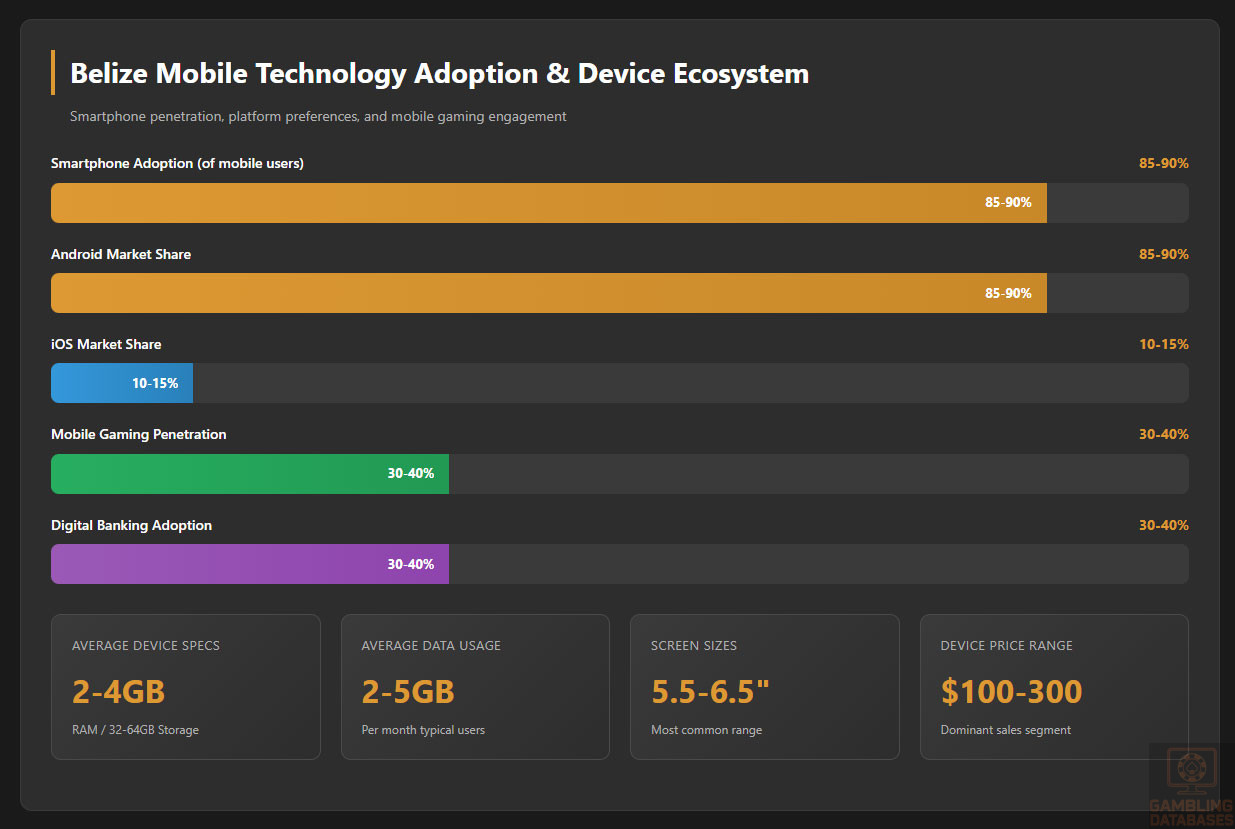
Average device specifications trend toward budget and mid-range capabilities. Most devices feature 2-4GB RAM, 32-64GB storage, and mid-tier processors adequate for social media, messaging, web browsing, and casual mobile gaming. Premium flagship devices remain uncommon outside upper-income segments. Screen sizes typically range 5.5-6.5 inches favoring larger displays for media consumption.
Mobile internet usage patterns show social media, messaging applications, and video streaming consuming the majority of data usage. Facebook, WhatsApp, YouTube, and Instagram dominate application usage time. Mobile gaming has grown substantially, with casual games and some international titles attracting engagement. Data consumption averages 2-5GB monthly for typical users with unlimited packages enabling higher usage.
Mobile gaming penetration reaches approximately 30-40% of smartphone users, concentrated among younger demographics. Casual games like puzzle and arcade titles dominate over complex multiplayer games requiring high-speed connections. International gaming apps from Google Play Store provide primary gaming access. Local game development remains minimal due to limited technical talent and small market size.
Financial Services and Payment Infrastructure
Banking System Structure
Major banks in Belize include Belize Bank, Atlantic Bank, Heritage Bank, and ScotiaBank. Belize Bank commands the largest market share with extensive branch network and established customer relationships. Atlantic Bank and Heritage Bank serve as significant domestic competitors. ScotiaBank provides international banking expertise through the Canadian parent organization.
The total number of licensed banks is four domestic commercial banks plus a few international banks serving the offshore sector. The relatively small number reflects the modest market size and capital requirements for banking operations. All banks maintain supervision from the Central Bank of Belize ensuring financial system stability.
Digital banking adoption has accelerated particularly following COVID-19 pandemic disruptions that limited branch access. Banks offer mobile applications and online banking platforms for balance checking, transfers, bill payments, and transaction history. Adoption rates vary by bank and customer demographics, with younger urban professionals showing highest engagement.
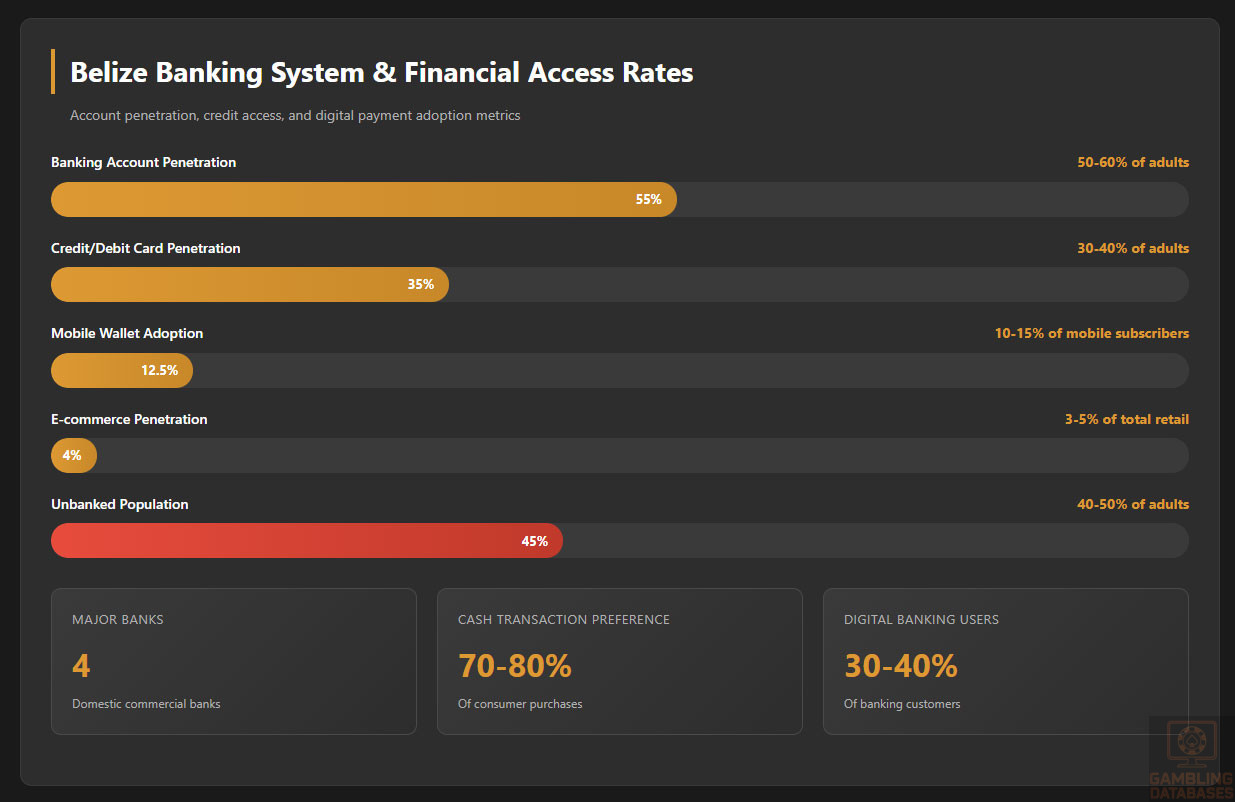
Account penetration rates show approximately 50-60% of adults maintaining formal banking relationships through deposit accounts or credit facilities. Urban residents and formal sector employees typically hold bank accounts, while rural populations and informal workers face lower banking access. Financial inclusion initiatives aim to expand banking access to underserved populations.
Credit and lending markets remain moderately developed serving businesses and consumers with verifiable income. Mortgage lending supports home purchases for qualifying borrowers. Consumer loans finance vehicle purchases and other significant expenditures. Credit card availability is limited to established banking customers with demonstrated creditworthiness and stable income.
ATM density concentrates in Belize City and major towns with machines accessible in commercial districts and bank branches. Rural areas face limited ATM access, requiring reliance on bank branches or cash from retail purchases. The ATM network supports domestic card withdrawals, though international compatibility varies by network agreements.
Payment Processing Options
Available payment methods for iGaming would include credit/debit cards, bank transfers, and potentially mobile money if regulatory restrictions were lifted. International e-wallets like PayPal, Skrill, and Neteller face limited availability in Belize. Operators serving international markets from Belize licensing must integrate payment methods suitable for target markets rather than Belizean domestic options.
Credit and debit card penetration of 30-40% among adults creates a viable though limited payment channel. Visa and Mastercard networks dominate card processing. International gaming operators typically process card transactions through offshore payment gateways rather than domestic Belizean merchant services. Card processing supports international customer deposits and withdrawals.
E-wallet options available to Belizean residents remain limited. PayPal restrictions prevent many Belizean users from creating accounts or limit functionality. Neteller and Skrill have limited adoption due to setup complications and restricted availability. International operators may offer these options to customers in other markets while maintaining different payment methods for any Belizean users.
Bank transfer systems include domestic wire transfers through commercial banks and international SWIFT transfers for cross-border transactions. Processing timelines vary from same-day for domestic transfers to 3-5 business days for international wires. Costs depend on transfer size and destination, with fees ranging from BZD 10-50 for typical transactions.
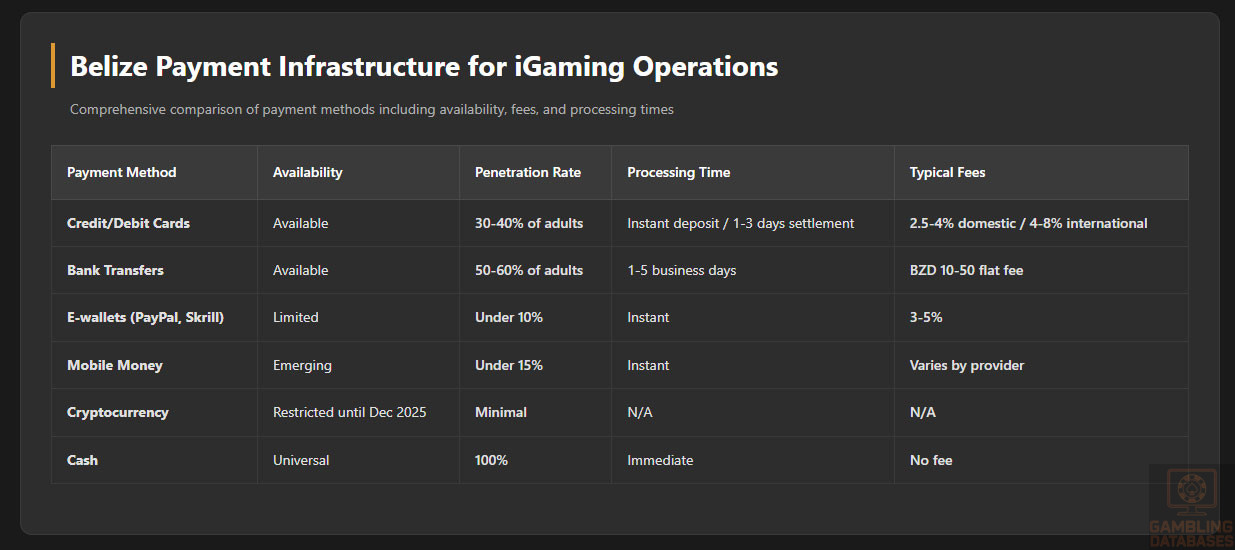
Cryptocurrency acceptance faces regulatory restrictions until December 31, 2025, preventing legal cryptocurrency integration for gambling or other commercial purposes. Technical infrastructure for cryptocurrency transactions exists through international exchanges, but formal commercial acceptance remains prohibited. The restriction eliminates cryptocurrency as a payment option for Belize-licensed operators currently.
Processing fees for card transactions typically range 2.5-4% of transaction value, varying by merchant category and processing volume. International payment processing for gaming often incurs higher fees of 4-8% due to risk categorization. Bank transfers carry flat fees rather than percentage-based charges, making them economical for larger transactions but expensive for small deposits.
Transaction processing timelines vary substantially by method. Card deposits process instantly for customer credit while settlement to merchants occurs in 1-3 business days. Bank transfers require 1-5 days depending on domestic or international routing. E-wallet transfers process rapidly for customers while merchant payouts follow platform-specific schedules.
International payment capabilities are essential for operators serving global markets from Belize licensing. Payment service providers specializing in iGaming offer multi-currency processing, global payment method integration, and fraud prevention tools. Operators must establish relationships with international payment processors rather than relying on domestic Belizean infrastructure.
| Payment Method | Availability | Penetration Rate | Processing Time | Typical Fees |
|---|---|---|---|---|
| Credit/Debit Cards | Available | 30-40% of adults | Instant deposit / 1-3 days settlement | 2.5-4% domestic / 4-8% international |
| Bank Transfers | Available | 50-60% of adults | 1-5 business days | BZD 10-50 flat fee |
| E-wallets (PayPal, Skrill) | Limited | Under 10% | Instant | 3-5% |
| Mobile Money | Emerging | Under 15% | Instant | Varies by provider |
| Cryptocurrency | Restricted until Dec 2025 | Minimal | N/A | N/A |
| Cash | Universal | 100% | Immediate | No fee |
E-commerce and Digital Economy
Digital Market Development
E-commerce market size in Belize remains modest, with total online retail representing an estimated 5-10% of total retail sales. The small market size, limited payment infrastructure, delivery challenges, and cash preference constrain e-commerce growth. Urban areas show higher e-commerce adoption than rural regions where delivery logistics and internet access create barriers.
Annual growth in e-commerce accelerated during COVID-19 pandemic restrictions, with year-over-year increases of 15-25% as consumers sought safer shopping alternatives. Growth has moderated post-pandemic but continues at 8-12% annually as digital adoption progresses. Younger demographics drive growth through comfort with online transactions and digital payment methods.
Online retail penetration remains low compared to developed markets where e-commerce represents 20-30% of retail sales. The gap reflects infrastructure limitations, payment challenges, and established in-person shopping preferences. Improvement requires better payment infrastructure, expanded delivery networks, and increased consumer trust in online transactions.
Digital service adoption encompasses mobile phone top-ups, utility bill payments, and increasingly subscription services like streaming entertainment. Mobile operator apps facilitate phone credit purchases. Bank portals enable bill payment. Netflix, Spotify, and other international platforms attract subscriptions among digitally-engaged consumers with international payment methods.
Consumer trust in online transactions grows gradually as positive experiences accumulate and fraud prevention improves. Older demographics remain cautious, preferring cash transactions and in-person verification. Younger consumers demonstrate greater comfort with digital payments, driving generational shift in transaction preferences. Bank security improvements and consumer education gradually build confidence.
Popular e-commerce platforms include international services like Amazon (with shipping to Belize), eBay, and AliExpress for product purchases. Local platforms remain limited, with classified sites and Facebook Marketplace facilitating peer-to-peer sales. Regional platforms from neighboring countries attract some cross-border shopping for products unavailable locally.
Cross-border online shopping serves as primary e-commerce channel given limited domestic platform development. Belizeans purchase from US, UK, and Chinese retailers with international shipping. Freight forwarding services in Miami provide US mailing addresses for consolidated shipping to Belize, enabling access to retailers not shipping directly to the country.
Digital goods and services consumption includes mobile apps, games, music streaming, video streaming, and software subscriptions. Google Play and Apple App Store purchases occur regularly among smartphone users. Streaming services like Netflix, Disney+, and Spotify attract subscribers willing to pay monthly fees. The digital services market grows faster than physical goods e-commerce due to delivery simplicity.
Business Environment and Regulatory Framework
Ease of Business Operations
World Bank Doing Business rankings historically placed Belize in moderate positions globally, typically ranking 120-140 among 190 economies assessed. The country scores reasonably well on some indicators while facing challenges in areas like construction permitting and contract enforcement. Recent years show gradual improvements reflecting regulatory reforms and digitalization initiatives.
Ease of Starting a Business rankings show Belize performing better than overall scores, typically ranking in the 90-110 range globally. The relatively straightforward company registration process and modest requirements create accessible business formation. Online registration systems introduced in recent years have streamlined previously paper-intensive processes.
Business registration processes require selecting business structure, registering with the Companies Registry, obtaining tax identification numbers, and securing any required licenses or permits. International Business Companies (IBCs) popular for offshore activities follow simplified procedures compared to domestic companies. Professional service providers facilitate registration for international clients.
Time required to start a business averages 20-30 days for straightforward registrations, though complex structures or additional licensing can extend timelines to 60-90 days. IBC registration can occur more quickly, sometimes within 1-2 weeks when using experienced service providers. Gaming license applications add 3-6 months beyond company registration.
Foreign investment policies welcome international capital with minimal restrictions across most sectors. The International Business Companies Act creates favorable structures for offshore business. Restrictions exist in specific sectors like telecommunications and fisheries, but most industries remain open. Gaming licensing specifically targets international operators, encouraging foreign investment.
Operational cost structures vary significantly between Belize City and smaller towns or rural areas. Office rent in Belize City commercial districts ranges USD 8-15 per square foot monthly for standard space. District capitals offer USD 5-10 per square foot. Professional wages for skilled workers run USD 800-1,500 monthly. Customer service representatives earn USD 500-800 monthly.
Labor market conditions show adequate availability of customer service workers, administrative staff, and general business support roles. Technical talent in IT, software development, and specialized professional services is limited. Companies requiring advanced technical expertise often must recruit internationally or utilize offshore talent remotely. English language proficiency aids customer service recruitment for international operations.
Corporate Structure and Registration
Available entity types include International Business Companies (IBCs), domestic limited liability companies, corporations, partnerships, and branch offices of foreign entities. Each structure offers different advantages regarding taxation, reporting requirements, and operational flexibility. Gaming operations typically utilize IBC structures for favorable tax treatment and offshore operational benefits.
The recommended structure for iGaming operators is the International Business Company incorporated under the International Business Companies Act. This structure provides tax advantages, simplified reporting requirements, confidentiality protections, and compatibility with Gaming Control Board licensing requirements. All online gaming applicants must incorporate as Belizean IBCs before license application.
Differences between entity types primarily involve taxation, reporting obligations, and operational requirements. IBCs pay no local income tax on offshore income and face minimal reporting requirements. Domestic companies pay standard corporate income tax and maintain more extensive reporting obligations. Branch offices create local presence without separate legal entity status.
Registration Requirements
Registration timelines for IBCs typically require 5-10 business days from complete documentation submission to certificate issuance. Standard domestic companies may take 10-20 business days. Additional time is required for securing tax registrations, business licenses, and permits. Gaming license applications extend the total timeline substantially to 3-6 months for complete approval.
Registration costs include government filing fees of approximately USD 1,000-1,500 for IBCs, plus registered agent fees of USD 500-1,500 annually. Legal fees for company formation typically run USD 1,500-3,000 depending on complexity. Domestic company costs may vary slightly. These costs exclude gaming license application fees which add USD 15,500 plus the USD 500,000 security deposit.
Required documents include articles of incorporation or memorandum and articles of association, director and shareholder declarations, registered office address confirmation, and identification documents for all beneficial owners. Gaming applications require additional documentation including financial statements, background checks, fingerprints, and compliance infrastructure descriptions.
Foreign ownership rules for IBCs permit 100% foreign ownership without local shareholder requirements. This structure allows international operators full control without mandatory Belizean partners. Domestic companies face no foreign ownership restrictions in most sectors. Gaming regulations explicitly target foreign operators, creating no barriers to 100% foreign-owned licensed entities.
Minimum capital requirements vary by entity type. IBCs typically require minimum authorized capital of USD 50,000 though issued capital can be lower. Gaming license applications must demonstrate adequate financial resources through audited statements and the USD 500,000 security deposit. Specific minimum capitalization requirements beyond the deposit are not explicitly mandated but financial strength must be demonstrated.
Ongoing compliance requirements include annual registered agent fees, annual returns filing with the Companies Registry, maintaining current director and officer information, and preserving adequate corporate records. Gaming licensees face additional compliance including annual license renewal, quarterly financial reporting, tax payments, and AML/CFT documentation. Failure to maintain compliance can result in administrative penalties or license issues.
Corporate governance requirements for IBCs are minimal compared to public companies, requiring at least one director (who can be a foreign national) and one shareholder. Board meeting frequency is not mandated, allowing flexible governance structures. Gaming operations should maintain professional governance practices including documented board decisions, financial oversight, and compliance management regardless of minimum legal requirements.
Gaming and Gambling Preferences
Current Market Participation
Gambling participation data for Belize remains extremely limited due to the prohibition on licensed operators serving local residents. No comprehensive surveys have measured what percentage of the population gambles annually through any channel. The regulatory restriction eliminates the legal local online market that would generate participation statistics.
Land-based casino participation likely remains under 5% of the adult population annually, concentrated among tourists and higher-income urban residents. The eight regulated casinos primarily target international visitors, with local participation constrained by economic factors and limited venue accessibility outside major tourist areas. Informal lottery and small-scale wagering may occur but lacks systematic measurement.
Online gambling participation by Belizeans using foreign-licensed platforms cannot be accurately quantified. While residents can legally access international gambling sites, no data tracks usage levels. International platforms generally do not report country-level player counts for small markets. Participation likely remains minimal given limited disposable income and relatively low internet penetration compared to developed markets.
Popular gambling activities globally include sports betting, casino slots, table games like blackjack and roulette, poker, and lottery products. If the Belize market were opened, sports betting would likely attract significant interest given regional passion for football/soccer and basketball. Casino games would appeal to entertainment-seeking players, while lottery products traditionally attract broad participation across income levels.
Sports betting versus casino games preference would likely favor sports betting based on regional patterns. Latin American and Caribbean markets demonstrate strong sports betting engagement driven by football fandom and increasingly basketball following. Casino games attract a more dedicated gambling enthusiast segment, while sports betting draws broader casual participation.
Live dealer games popularity would depend on internet infrastructure quality and player sophistication. The median mobile internet speed of 12.22 Mbps could support basic live dealer experiences but might struggle with high-definition multi-camera streams. Urban areas with 44.31 Mbps fixed broadband could support premium live dealer products.
Lottery participation historically shows broad appeal across demographics and income levels in markets where available. If Belize expanded legal lottery access beyond current limited offerings, participation could potentially reach 30-50% of adults based on regional patterns. Lottery’s low entry price point and simple mechanics appeal to casual players.
Consumer Behavior Patterns
Average spending per player estimates for Belize remain speculative given the restricted market. If gambling were legally accessible, monthly spending would likely range USD 20-50 for casual players and USD 100-300 for regular participants. Annual spending might average USD 200-400 per active player, substantially below developed market levels due to income constraints.
Spending habits would likely favor smaller bet sizes reflecting economic realities. Average bets of USD 0.50-2.00 on slots and USD 5-20 on sports wagers would align with disposable income levels. High-roller play would be extremely limited, with only small wealthy segments capable of sustaining significant gambling expenditure.
Platform preferences would strongly favor mobile over desktop based on device ownership patterns. With 85.7% mobile connection penetration versus limited desktop/laptop ownership, mobile-first design would be essential. Smartphone-optimized interfaces, mobile payment integration, and data-efficient designs would drive engagement. Desktop usage might represent only 10-20% of total activity.
Peak gambling times would likely align with leisure hours: evenings after work (7pm-11pm), weekends, and holidays. Sports betting would spike during major matches, particularly World Cup, Champions League, and NBA finals. Casino game play would distribute more evenly but increase during evening entertainment hours.
Session length averages would likely remain shorter than developed markets due to limited budgets constraining play duration. Average sessions of 15-30 minutes for casino games and quick in-out behavior for sports betting would be typical. Extended multi-hour gambling sessions would be rare except among the small wealthy segment.
Retention and loyalty patterns would challenge operators given economic constraints. Player lifetime value would remain low compared to developed markets, requiring high-volume acquisition to achieve profitability. Churn rates would likely be elevated as budget constraints force periodic gambling cessation. Loyalty programs would need careful calibration to remain economically viable.
Bonus sensitivity and promotional response would be extremely high. Free bet offers, deposit bonuses, and no-deposit promotions would drive significant response given budget consciousness. However, this creates risk of bonus abuse and unprofitable player acquisition. Wagering requirements and bonus terms would need careful structuring to balance player appeal with operator economics.
Preferred game types by age group would likely show younger players (18-35) favoring sports betting and modern video slots with popular themes. Middle-aged players (35-55) might prefer traditional casino games, poker, and major sports events. Older players would likely show lower overall participation with preferences for simple lottery-style games.
Deposit and withdrawal frequency would demonstrate strong preference for immediate access to funds. Players would likely favor deposit methods offering instant availability like cards or e-wallets over slower bank transfers. Withdrawal speed would be critical for player satisfaction, with delays causing frustration and potential complaints.
Section 3: Technology Infrastructure and Business Environment
Internet and Digital Infrastructure
Connectivity and Network Performance
Internet penetration of 70.4% positions Belize above global average (67.5%) but below developed market standards exceeding 90%. The growth trajectory from 28.2% in 2010 demonstrates substantial infrastructure investment and improved access. However, the 29.6% still offline primarily in rural areas represents an ongoing connectivity challenge.
Fixed broadband versus mobile internet breakdown shows mobile dominating connectivity. Mobile connections at 85.7% of population substantially exceed fixed broadband availability estimated at 20-30% penetration. This mobile-first connectivity pattern reflects infrastructure economics favoring cellular network deployment over comprehensive fixed-line infrastructure in a small, geographically dispersed market.
Average internet speeds show significant disparity between fixed and mobile connections. Fixed broadband delivers median speeds of 44.31 Mbps, adequate for high-quality video streaming, online gaming, and business applications. Mobile internet averages just 12.22 Mbps median speed, sufficient for basic browsing and standard-definition streaming but limiting for data-intensive applications.
Network reliability and uptime statistics are not comprehensively published but anecdotal evidence suggests moderate reliability with periodic outages particularly during tropical storms and adverse weather. Urban areas generally experience better reliability than rural zones. Business-grade connections with service-level agreements provide higher reliability for commercial users.
Infrastructure investment trends show continued expansion by telecommunications providers. Belize Electricity Limited’s 2024-2028 plan includes USD 500 million for energy infrastructure supporting digital connectivity. Mobile network operators continue expanding 4G coverage and preparing for eventual 5G deployment. Government initiatives promote digital inclusion, though implementation remains gradual.
Global internet speed rankings place Belize in the lower-middle range internationally. The 12.22 Mbps mobile speed grew 25.6% year-over-year, demonstrating improvement trends. Fixed broadband’s 44.31 Mbps increased 8.7% annually. While improving, speeds remain below regional leaders like Uruguay and Chile.
Rural versus urban connectivity gap remains pronounced. Belize City and major towns enjoy relatively strong connectivity with multiple provider options and better speeds. Rural areas rely primarily on mobile networks with more limited speeds and coverage gaps. This digital divide impacts access to online services, education, and economic opportunities.
5G and Future Technology Deployment
Current 4G coverage extends to approximately 60-70% of the population, concentrated in urban and peri-urban areas. Major towns and tourist zones have reliable 4G access, while rural areas may only access 3G or experience coverage gaps. The three mobile network operators have progressively expanded 4G footprints but have not achieved universal coverage.
5G deployment remains in early planning stages with no commercial 5G networks operational as of 2024. The small market size, limited investment capacity, and focus on extending 4G coverage delay 5G introduction. Regional 5G rollouts in larger markets like Mexico may eventually influence Belize deployment timelines.
5G rollout timeline projections suggest potential limited deployment in Belize City by 2026-2027 at earliest, with nationwide coverage unlikely before 2030. Initial deployment would likely target business districts and high-traffic tourist areas rather than comprehensive population coverage. The investment requirements relative to small subscriber base create economic challenges for rapid 5G deployment.
Future infrastructure plans emphasize expanding 4G coverage, improving network speeds, and increasing fixed broadband availability. The government’s National Energy Policy 2023-2040 includes digital infrastructure components. Telecommunications regulatory frameworks aim to promote competition and investment while ensuring service quality standards.
Network operator landscape includes three primary mobile providers creating a moderately competitive environment. Belize Telemedia Limited (BTL), Speednet, and Smart operate mobile networks with varying coverage footprints and service quality. Fixed broadband services come from BTL and smaller regional providers with limited geographic reach.
Mobile Technology Ecosystem
Mobile Network Infrastructure
Three mobile network operators serve the Belize market, creating sufficient competition to drive service improvements while avoiding fragmentation that could slow infrastructure development. Belize Telemedia Limited holds the largest market share as the legacy incumbent operator, with Speednet and Smart providing competitive alternatives.
Network operator market share distribution shows BTL commanding approximately 50-55% of mobile subscribers, Speednet with 25-30%, and Smart holding 15-20%. These estimates reflect competitive dynamics where the incumbent maintains leadership but faces meaningful competition. Service quality and coverage differences influence operator selection.
4G coverage maps show strongest deployment in Belize City, San Ignacio, Orange Walk, and Corozal with good coverage extending along major highways. Coastal tourist areas including Ambergris Caye and Placencia have reliable 4G. Interior rural areas and less-populated regions experience coverage gaps requiring fallback to 3G or lacking service entirely.
Data costs and pricing models reflect competitive pressure with rates declining in recent years. Prepaid data packages ranging from 1GB for USD 5-8 to 10GB for USD 20-30 provide various options. Unlimited plans with fair usage policies are emerging. Pricing remains higher than developed markets but has improved from previously expensive data costs.
Mobile payment integration shows developing capabilities with operators offering mobile money services and payment platforms. Adoption remains limited compared to markets like Kenya where M-Pesa achieved transformative penetration. Cultural cash preference and banking system availability limit mobile payment growth, though the foundation for expansion exists.
Mobile wallet adoption rates likely reach only 10-15% of the population with active usage. Services face competition from traditional banking and cash while lacking the ubiquitous merchant acceptance needed for mainstream adoption. Cross-platform interoperability limitations further constrain utility.
Device Penetration
Smartphone adoption rates are estimated at 65-75% of the population, with higher penetration among younger demographics and urban residents. The 85.7% mobile connection rate includes both smartphones and feature phones, though smartphones increasingly dominate new device sales. Economic constraints mean device upgrade cycles extend longer than developed markets.
Smartphones per capita calculations suggest many users own only one device, contrasting with developed markets where multiple device ownership is common. Some business professionals and higher-income individuals maintain multiple devices, but average residents typically operate a single smartphone. SIM card switching to access different operator promotions is more common than owning multiple devices.
Device preferences favor mid-range Android smartphones from brands like Samsung, Huawei, and various Chinese manufacturers. Budget constraints make premium devices like iPhone accessible only to wealthy segments. The USD 100-300 price range dominates sales, with devices offering adequate performance for social media, messaging, and basic gaming.
Android versus iOS market share heavily favors Android at approximately 80-85% of smartphones, with iOS representing 15-20% concentrated among higher-income users. Android’s diverse price points and availability through multiple retailers drive dominance. Apple’s premium pricing limits market share despite aspirational brand appeal.
Average device specifications cluster around 3-4GB RAM, 32-64GB storage, and mid-range processors capable of handling standard applications. Screen sizes of 5.5-6.5 inches are popular. Cameras of 12-48MP meet social media needs. These specifications adequately support messaging, social media, video streaming, and mobile gaming.
Mobile internet usage patterns show data consumption of 3-5GB monthly for average users, with heavier users consuming 10-15GB. Social media, video streaming, messaging, and web browsing drive consumption. Gaming and video streaming represent the most data-intensive activities. Wifi usage at home and work supplements mobile data, particularly for large downloads.
Mobile gaming penetration reaches an estimated 30-40% of smartphone owners who have played mobile games in the past month. Casual gaming dominates with titles like Candy Crush, PUBG Mobile, and Free Fire popular. Gaming frequency and session duration vary widely, from daily hardcore players to occasional casual engagement.
Financial Services and Payment Infrastructure
Banking System Structure
Major banks in Belize include Belize Bank Limited, Atlantic Bank Limited, Heritage Bank, and ScotiaBank Belize. Belize Bank holds the largest market share at approximately 40-45%, followed by Atlantic Bank at 25-30%, with Heritage and ScotiaBank splitting the remainder. This concentration creates an oligopolistic structure with limited competition.
Four domestic banks and one foreign bank subsidiary serve a population of 417,000, creating reasonable access in urban areas but limited physical presence in rural zones. Branch networks concentrate in major towns, requiring rural residents to travel significant distances for in-person banking. This geographic limitation sustains cash preference in underserved areas.
Digital banking adoption grows steadily among urban professionals and younger customers comfortable with technology. All major banks offer mobile apps and online banking platforms enabling account management, transfers, and bill payments. Adoption likely reaches 30-40% of banking customers, though many maintain both digital and branch-based banking habits.
Account penetration rates indicate approximately 50-60% of adults maintain formal bank accounts. This leaves 40-50% unbanked or underbanked, relying on cash and informal financial services. Barriers to banking include minimum balance requirements, documentation requirements, physical distance to branches, and preference for cash-based operations.
Credit and lending markets remain relatively underdeveloped compared to mature economies. Personal lending focuses on secured loans for vehicles and property rather than unsecured consumer credit. Credit card availability is limited to banking customers meeting income and credit requirements. Microfinance institutions and credit unions supplement bank lending.
ATM density and distribution show reasonable coverage in urban areas with machines at banks, shopping centers, and high-traffic locations. Belize City offers extensive ATM access, while smaller towns have limited options. Rural areas may lack ATMs entirely, requiring cash withdrawal during town visits. International card acceptance at ATMs facilitates tourist access.
Payment Processing Options
Available payment methods for iGaming would include international credit/debit cards, bank transfers, and potentially e-wallets if operators integrate regional platforms. Cryptocurrency remains restricted until the December 31, 2025 virtual asset moratorium ends. Local payment method availability would be limited given the prohibition on serving Belize residents.
Credit and debit card penetration among the banked population likely reaches 60-70%, though active online usage is lower. Visa and Mastercard dominate with near-universal acceptance. Cards enable international online transactions, though some cardholders hesitate due to security concerns or unfamiliarity with online purchasing.
E-wallet options face limited availability in Belize. PayPal restricts full functionality in the market. Regional platforms like AstroPay or local mobile money services provide alternatives but lack the universal acceptance of global platforms. Operators serving other markets would need to integrate payment providers operating in target jurisdictions rather than Belize-specific options.
Bank transfer systems include domestic ACH-equivalent services and international wire transfers. Domestic transfers can process same-day or next-day depending on banks involved. International transfers typically require 3-5 business days. Costs range from USD 5-15 for domestic transfers to USD 25-50 for international wires.
Cryptocurrency acceptance remains legally restricted until December 31, 2025 under the virtual asset moratorium. Following expiration, regulatory frameworks will determine cryptocurrency integration parameters. Current restrictions prevent licensed operators from offering crypto deposits or withdrawals. Illegal usage may occur but cannot be quantified.
Processing fees and typical charges vary by method. Credit card processing typically costs merchants 2.5-3.5% plus fixed fees. Bank transfers incur flat fees of USD 5-50 depending on type. E-wallets charge 1-3% processing fees. International transactions add currency conversion costs of 2-4% above wholesale rates.
Transaction processing timelines show instant availability for card deposits, same-day to next-day for bank transfers, and instant to 24-hours for e-wallet transfers. Withdrawal processing depends on operator verification procedures and payment method, typically ranging from 24 hours to 5 business days. Faster withdrawal processing provides competitive advantage.
International payment capabilities remain essential for Belize-licensed operators serving global markets. Integration with international payment processors, multi-currency support, and compliance with payment network regulations enables cross-border transactions. Operators require relationships with acquiring banks and payment service providers supporting iGaming transactions.
| Payment Method | Availability | Processing Time | Typical Fees | Notes |
|---|---|---|---|---|
| Credit/Debit Cards | High | Instant | 2.5-3.5% + fixed fee | Visa, Mastercard widely accepted |
| Bank Transfers | Moderate | 1-5 business days | USD 5-50 per transfer | Domestic and international options |
| E-Wallets | Limited | Instant – 24 hours | 1-3% | Regional platforms, limited penetration |
| Cryptocurrency | Restricted | N/A | N/A | Prohibited until Dec 31, 2025 |
| Mobile Wallets | Developing | Instant – 24 hours | Varies | Low adoption, limited acceptance |
E-commerce and Digital Economy
Digital Market Development
E-commerce market size in Belize remains small in absolute terms, estimated at USD 30-50 million annually. The small population, limited internet penetration, cash preference, and geographic constraints limit market development. However, growth rates of 15-20% annually demonstrate increasing consumer comfort with online purchasing.
Online retail penetration represents roughly 3-5% of total retail sales, substantially below developed markets where e-commerce captures 15-25% of retail. Physical shopping remains dominant due to cultural preferences, desire to inspect products, cash payment preference, and concerns about online security and delivery reliability.
Digital service adoption shows stronger traction than physical goods e-commerce. Bill payments, mobile phone top-ups, and digital content purchases like streaming subscriptions demonstrate growing acceptance. Services requiring no physical delivery remove logistical barriers while offering convenience advantages over in-person transactions.
Consumer trust in online transactions improves gradually but remains lower than developed markets. Security concerns, fraud fears, and unfamiliarity with dispute resolution processes create hesitation. Positive experiences with reputable platforms build confidence, though negative experiences spread quickly through word-of-mouth in the small market.
Popular e-commerce platforms include international giants like Amazon delivering to Belize, regional platforms serving Central America and the Caribbean, and local classified sites facilitating peer-to-peer transactions. Facebook Marketplace has become a popular channel for local buying and selling, leveraging high social media penetration.
Cross-border online shopping attracts Belizeans seeking products unavailable locally or at better prices than domestic retail. US-based retailers ship to Belize through various channels, though shipping costs and delivery times of 7-14 days create friction. Consolidation services in the US forward packages to Belize addresses for customers without direct shipping options.
Digital goods and services consumption includes streaming entertainment (Netflix, Spotify), mobile gaming, software subscriptions, and online learning. These categories avoid physical delivery challenges while offering entertainment and productivity value. Subscription models gain acceptance as payment infrastructure and consumer familiarity improve.
Business Environment and Regulatory Framework
Ease of Business Operations
World Bank Doing Business rankings historically placed Belize in the middle range globally, though the Doing Business report series has been discontinued. Historical rankings showed Belize around 120-130th of 190 economies, indicating moderate business environment challenges. Specific metrics showed strengths in some areas and challenges in others.
Ease of Starting a Business rankings showed moderate difficulty with procedures requiring approximately 2-3 weeks and multiple steps. Registering a business requires company name reservation, registration with the Companies Registry, obtaining tax identification numbers, and registering with social security. Costs remain reasonable compared to regional neighbors.
Business registration processes involve submitting incorporation documents, articles of association, and memorandum to the Companies Registry. International Business Companies (IBCs) used for gaming licenses follow streamlined procedures designed to attract offshore business. Domestic companies face more extensive requirements including local director mandates.
Time required to start a business averages 2-4 weeks for IBC registration, while domestic companies may require 4-6 weeks. Professional service providers specializing in company formation can accelerate timelines through established processes and relationships with registry officials. DIY registration without professional assistance may extend timelines.
Foreign investment policies generally welcome international capital without excessive restrictions. The gaming licensing framework explicitly targets foreign operators. Investment promotion efforts by BELTRAIDE (Belize Trade and Investment Development Service) facilitate foreign business establishment. Some sectors maintain restrictions, but most business activities remain open to foreign participation.
Operational cost structures vary significantly between Belize City and smaller towns. Office rent in Belize City ranges USD 500-1,500 monthly for small commercial spaces, with premium locations commanding higher rates. Smaller towns offer lower rents of USD 300-800 monthly. Utility costs including electricity average USD 150-300 monthly for small offices.
Labor market conditions provide adequate talent pools for basic business operations, customer service, and administrative functions. Tourism industry experience creates customer service skills transferable to gaming operations. Specialized technical skills remain limited, often requiring expatriate hiring or outsourcing. Salary expectations are moderate compared to developed markets.
Corporate Structure and Registration
Available entity types include International Business Companies (IBCs), domestic corporations, limited liability companies, partnerships, and branch offices of foreign companies. IBCs represent the preferred structure for gaming operations due to tax benefits, streamlined registration, and regulatory framework familiarity among offshore business service providers.
Recommended structure for iGaming operators is the International Business Company (IBC) incorporated under the International Business Companies Act. This structure aligns with Gaming Control Board expectations and provides tax planning flexibility. The IBC must maintain a registered office and registered agent in Belize while allowing 100% foreign ownership.
Differences between entity types center on taxation, reporting requirements, and operational flexibility. IBCs benefit from favorable tax treatment and simplified compliance compared to domestic companies facing full corporate tax obligations. Branch offices require less setup but provide limited liability protection. Partnerships face pass-through taxation but unlimited liability concerns.
Registration timelines for IBCs typically range 1-2 weeks when using professional service providers. The process includes name reservation (1-2 days), document preparation and submission (2-3 days), registry processing (3-5 days), and certificate issuance (1-2 days). Expedited processing may be available for premium fees.
Registration costs for IBC formation range USD 1,000-2,500 depending on service provider and complexity. Basic packages include company registration, registered office first year, and registered agent services. Additional costs include apostilled documents, director services if needed, and optional bank account opening assistance.
Required documents include passport copies of beneficial owners and directors, proof of address, professional references or bank references, company name options, and articles of association/memorandum. Due diligence questionnaires gather information on business activities, expected transaction volumes, and source of funds.
Foreign ownership rules for IBCs permit 100% foreign shareholding without local partner requirements. Directors can be foreign nationals or corporate directors. This flexibility attracts international operators seeking complete ownership control without forced partnerships or local director mandates common in some jurisdictions.
Minimum capital requirements for IBCs are nominal, often USD 50,000 authorized capital with USD 1 minimum paid-up capital. Gaming licenses separately require the USD 500,000 security deposit, which represents the substantive capital commitment. The IBC capitalization requirement creates minimal additional financial burden.
Ongoing compliance requirements include annual registered office and registered agent fees (USD 500-1,000), annual government fees (USD 100-300), and maintaining statutory records. IBCs generally avoid audited financial statement requirements unless triggered by size thresholds or specific business activities. Minutes of annual meetings and updated shareholder registers must be maintained.
Corporate governance requirements for IBCs are minimal compared to public companies. Director meetings and shareholder meetings should occur annually with minutes documenting decisions. Share registers must be current. Directors owe fiduciary duties to the company. Recent beneficial ownership transparency reforms require clearer disclosure of ultimate beneficial owners to authorities.
Taxation Framework
Corporate Income Tax Structure
Standard corporate tax rates for domestic companies in Belize range from 1.75% on gross revenue for commercial businesses to 25% on net profits depending on business type and structure. International Business Companies enjoy preferential tax treatment designed to attract offshore business, though specific rates depend on configuration and whether the company generates local-source versus foreign-source income.
Special economic zones and designated processing areas offer tax incentives including tax holidays, reduced rates, and duty exemptions for qualifying investments. The Export Processing Zone regime provides up to 20-year tax holidays for approved manufacturers and service exporters. Gaming operations don’t typically qualify for these industrial incentives focused on manufacturing and physical exports.
Tax holidays or reduced rates for new businesses are available under various investment incentive programs administered by BELTRAIDE. Qualifying criteria include minimum investment thresholds, employment creation targets, and specific industry sectors. Gaming operations may access some incentives depending on employment levels and infrastructure investments in Belize-based operations.
International tax treaties provide relief from double taxation for companies operating across multiple jurisdictions. Belize maintains tax information exchange agreements and some limited double taxation treaties. The network is less extensive than major economies but provides framework for cross-border tax planning and compliance.
Transfer pricing rules require arm’s length pricing for transactions between related entities. Documentation requirements have strengthened under recent tax authority reforms. Companies with significant intercompany transactions should maintain transfer pricing studies and contemporaneous documentation supporting pricing methodologies. Penalties for non-compliance include tax adjustments and potential penalties.
Withholding tax on dividends, interest, and royalties varies by payment type and recipient jurisdiction. Standard withholding rates apply to payments to non-residents unless reduced by treaty. Gaming operators should structure financing and intellectual property arrangements considering withholding tax implications. Professional tax advice is essential for optimizing corporate structure.
VAT or GST systems in Belize impose General Sales Tax (GST) at 12.5% on most goods and services. Gaming services face unique GST treatment with exemptions or zero-rating potentially available depending on specific service characterization. International gaming services targeting foreign markets may qualify for zero-rating, eliminating GST burden while allowing input credit recovery.
Personal Income Tax
Individual tax rates in Belize follow progressive brackets starting at 0% on the first BZD 26,000 (USD 13,000) of annual income, rising to 25% on income between BZD 26,001-27,000, and 30% on income exceeding BZD 27,000 (USD 13,500). These brackets haven’t been significantly adjusted for inflation in recent years, causing bracket creep as wages rise.
Withholding requirements for employees mandate employers deduct income tax from salaries under Pay-As-You-Earn (PAYE) systems. Monthly withholding applies progressive rates to projected annual income. Employers must remit withheld amounts monthly to tax authorities. Employees with only employment income generally have no additional filing obligations if withholding is accurate.
Social security contributions require both employer and employee payments. Employers contribute approximately 8% of employee wages while employees contribute 8%, totaling 16% for social security funding. These contributions cover retirement pensions, sickness benefits, and other social protections. Maximum contribution caps apply based on salary thresholds.
Tax residency rules determine whether individuals owe tax on worldwide income or only Belize-source income. Residents are taxed on global income while non-residents pay tax only on Belize-source earnings. Residency typically establishes through physical presence exceeding 183 days annually or maintaining permanent home in Belize.
Taxation of foreign employees follows the same rate structure as citizens, with residency status determining tax base. Non-resident foreign workers pay tax only on Belize employment income. Work permits for foreign employees require employer sponsorship and government approval, with fees and processing times varying by position and nationality.
Market Entry Considerations
Recommended Entry Strategies
Optimal market entry approaches for Belize licensing focus on establishing an International Business Company, securing the gaming license, and implementing customer service operations while hosting technical infrastructure internationally. This hybrid model leverages Belize’s tax advantages and streamlined regulation while avoiding infrastructure limitations that could compromise service quality.
Direct licensing represents the primary entry route for established operators seeking additional jurisdictions or new companies entering the iGaming industry. The process involves IBC incorporation, security deposit placement, license application, and operational setup. Timeline from initial planning to go-live typically spans 4-8 months depending on preparation thoroughness and document readiness.
Local partnership requirements don’t exist for online gaming licenses, eliminating forced joint ventures or local shareholder mandates. However, engaging local legal counsel, corporate service providers, and consultants familiar with Gaming Control Board procedures significantly smooths the application process. These partnerships are commercial relationships rather than ownership requirements.
White label versus proprietary platform considerations depend on operator capabilities and market strategy. White label solutions from established platform providers offer faster market entry, proven technology, and reduced technical risk. Proprietary platforms provide greater control and differentiation but require substantial development investment and technical expertise. Most new entrants favor white label models.
Technology infrastructure leveraging strategies should utilize international data centers and content delivery networks for game hosting while maintaining required customer service presence in Belize. Cloud infrastructure from providers like AWS or Google Cloud offers scalability and reliability exceeding locally available options. Edge caching can optimize performance for target markets.
Marketing and localization requirements depend entirely on target markets rather than Belize’s small population given the prohibition on serving locals. Operators must research target market languages, payment preferences, popular sports and games, and cultural factors. Marketing budgets should focus on customer acquisition in chosen markets rather than any Belize domestic marketing.
Payment provider selection criteria include coverage of target markets, transaction approval rates, processing fees, settlement timelines, and iGaming industry experience. Providers familiar with gambling payment processing understand risk management and chargeback mitigation. Multi-provider strategies reduce dependency risk and improve coverage across different geographic markets and payment methods.
Risk mitigation strategies include maintaining the mandatory USD 500,000 security deposit, implementing robust AML/CFT compliance systems exceeding Belize minimums, securing comprehensive insurance coverage, and maintaining compliance with all target market regulations. Diversifying licensing across multiple jurisdictions reduces concentration risk if any single license faces issues.
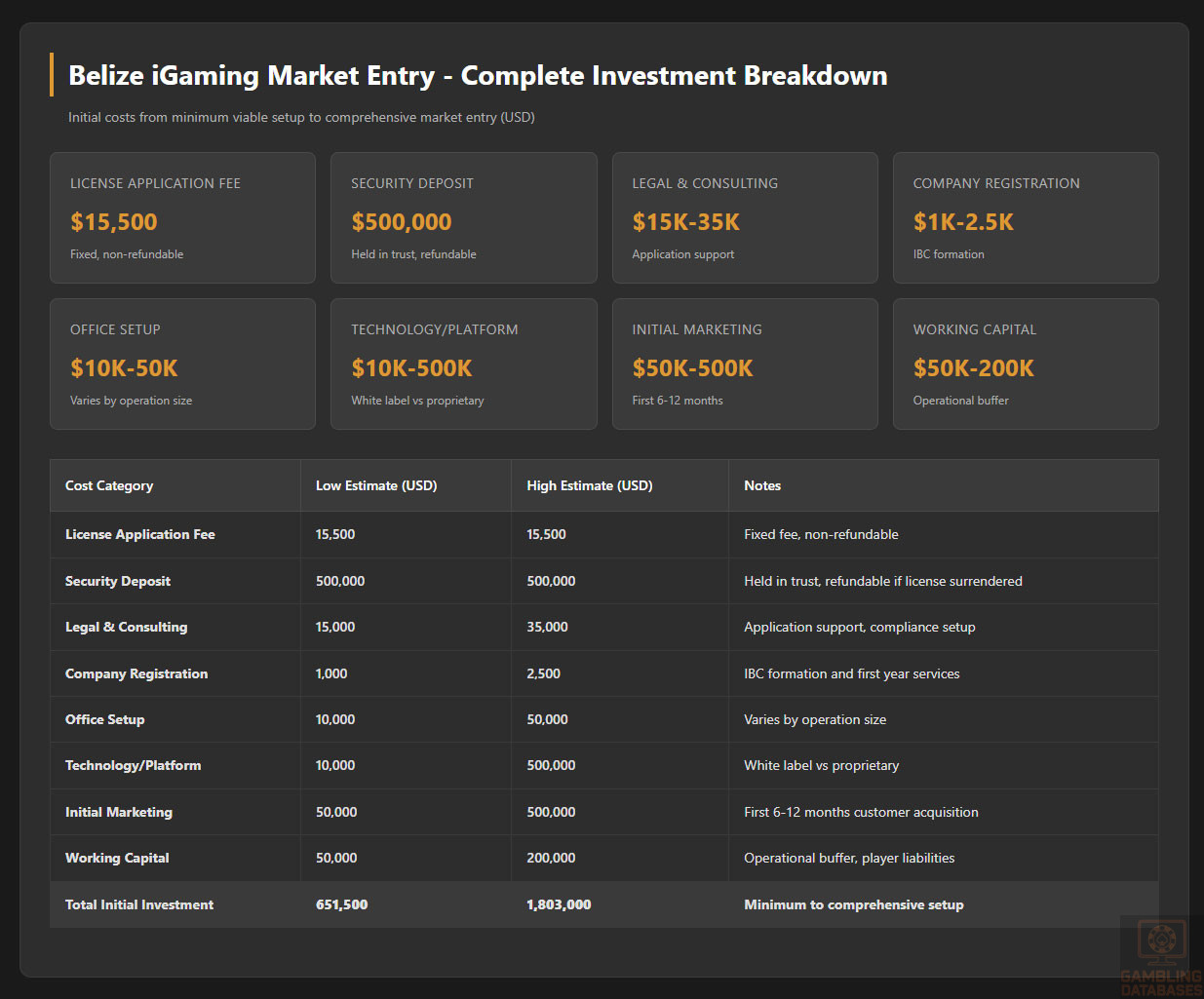
Typical Costs and Timelines
Initial setup investment breakdown provides essential budgeting framework for market entry planning. License application and fees total USD 515,500 including the USD 500,000 security deposit, USD 15,500 application fee. Legal and consulting fees typically range USD 15,000-35,000 covering application assistance, document preparation, and regulatory guidance.
Company registration costs for IBC establishment range USD 1,000-2,500 for basic formation. Registered office and agent services add USD 500-1,000 annually. Initial capital requirements beyond the security deposit are minimal for the IBC structure itself, though adequate capitalization for operational expenses is essential.
Office setup costs in Belize depend on customer service operation scale. Small facilities with 3-5 staff might require USD 10,000-20,000 for office space deposits, furniture, computers, telecommunications equipment, and initial supplies. Larger operations with 10-15 customer service representatives could require USD 30,000-50,000 initial setup investment.
Technology and platform costs vary dramatically between white label and proprietary solutions. White label arrangements typically require USD 10,000-30,000 setup fees plus monthly platform fees of USD 5,000-15,000 depending on features and player volumes. Proprietary platform development requires USD 200,000-500,000+ for comprehensive sportsbook and casino solutions.
Initial marketing budgets should align with target market customer acquisition costs and revenue goals. Minimum viable budgets of USD 50,000-100,000 enable initial market testing and player acquisition. Serious market entry attempts typically require USD 200,000-500,000+ first-year marketing investment depending on market competitiveness and growth objectives.
| Cost Category | Low Estimate (USD) | High Estimate (USD) | Notes |
|---|---|---|---|
| License Application Fee | 15,500 | 15,500 | Fixed fee, non-refundable |
| Security Deposit | 500,000 | 500,000 | Held in trust, refundable if license surrendered |
| Legal & Consulting | 15,000 | 35,000 | Application support, compliance setup |
| Company Registration | 1,000 | 2,500 | IBC formation and first year services |
| Office Setup | 10,000 | 50,000 | Varies by operation size |
| Technology/Platform | 10,000 | 500,000 | White label vs proprietary |
| Initial Marketing | 50,000 | 500,000 | First 6-12 months customer acquisition |
| Working Capital | 50,000 | 200,000 | Operational buffer, player liabilities |
| Total Initial Investment | 651,500 | 1,803,000 | Minimum to comprehensive setup |
Operational cost estimates on monthly and annual basis provide ongoing expense visibility. Staff salaries for Belize-based customer service team range USD 1,000-1,500 monthly per representative, totaling USD 3,000-7,500 monthly for 3-5 person team. Management salaries add USD 3,000-6,000 monthly. Annual salary costs therefore range USD 72,000-162,000 for minimal staffing.
Office rent and utilities in Belize City average USD 500-1,500 monthly rent plus USD 150-300 utilities, totaling USD 650-1,800 monthly or USD 7,800-21,600 annually. Smaller towns offer lower costs but may challenge professional staff recruitment. Telecommunications costs including internet and phone services add USD 200-500 monthly.
Technology maintenance for white label arrangements typically costs USD 5,000-15,000 monthly platform fees plus transaction processing fees of 2-4% of deposits. Proprietary platforms require hosting (USD 1,000-5,000 monthly), maintenance (USD 3,000-10,000 monthly), and ongoing development (USD 5,000-20,000 monthly). Annual technology costs range USD 60,000-300,000+ depending on approach.
Payment processing fees typically consume 2-5% of deposit volumes depending on methods and geographies served. An operator processing USD 1 million monthly in deposits pays USD 20,000-50,000 monthly payment processing costs. Failed transactions, chargebacks, and fraud prevention add additional costs. Annual payment costs scale with transaction volumes.
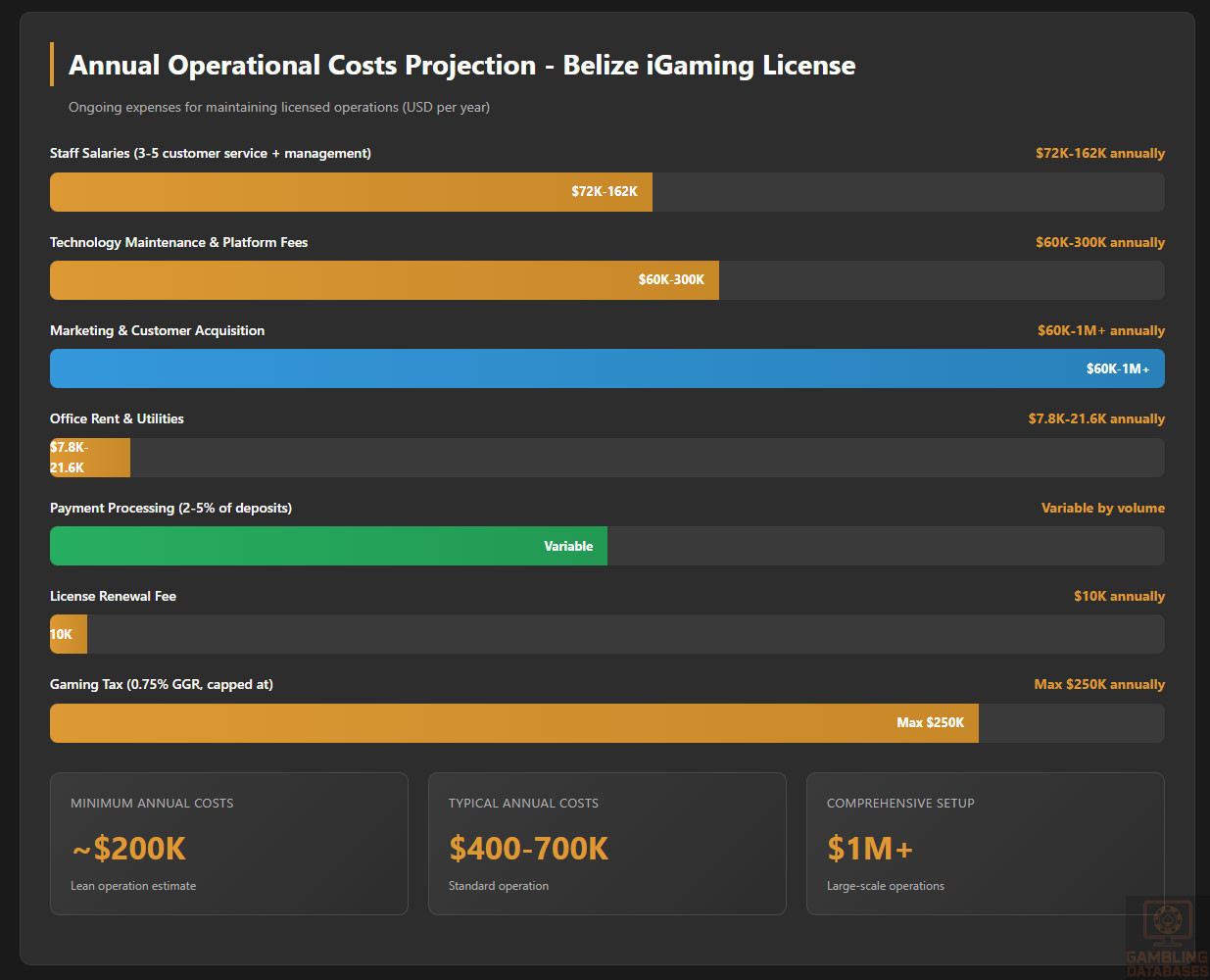
Marketing and customer acquisition costs vary dramatically by target market competitiveness. Cost per first-time depositor ranges USD 50-300 in competitive markets. Acquiring 100 new depositors monthly costs USD 5,000-30,000. Operators should budget minimum USD 60,000-360,000 annually for sustained customer acquisition, with successful operations typically spending USD 200,000-1,000,000+ annually.
Timeline expectations from decision to market entry follow this typical sequence. Company registration requires 2-4 weeks from document preparation to certificate issuance. License application processing officially takes 3-6 months but can occasionally complete faster with well-prepared applications or extend longer if deficiencies require remediation.
Platform setup timeline depends on technology approach. White label integration typically requires 4-8 weeks for configuration, testing, payment integration, and game library setup. Proprietary platform development spans 6-12+ months depending on scope and complexity. Concurrent platform work during license processing optimizes time-to-market.
Total time to market from initial planning to accepting real-money wagers typically requires 6-12 months for efficient executions. Delays in documentation, security deposit funding, platform development, or regulatory questions can extend timelines to 12-18 months. Experienced operators with established processes and relationships can occasionally achieve faster launches.
Resource requirements for successful operation include minimum staff headcount of 3-5 customer service representatives supporting 24/7 coverage through shift scheduling. Additional roles include compliance officer, finance/accounting, marketing coordinator, and general manager. Total headcount of 8-12 supports lean operations, while larger ambitions require 15-25+ employees.
Key positions needed include a licensed compliance officer approved by Gaming Control Board, customer service manager supervising support team, finance manager handling payments and reporting, marketing manager driving player acquisition, and general manager overseeing total operation. Technical support may be outsourced to platform provider or require dedicated IT staff for proprietary platforms.
Technology stack requirements include gaming platform (white label or proprietary), payment processing integration, customer relationship management (CRM) system, fraud detection and prevention tools, responsible gambling tools, affiliate tracking system, and business intelligence/reporting analytics. Integration complexity depends on build versus buy decisions across these components.
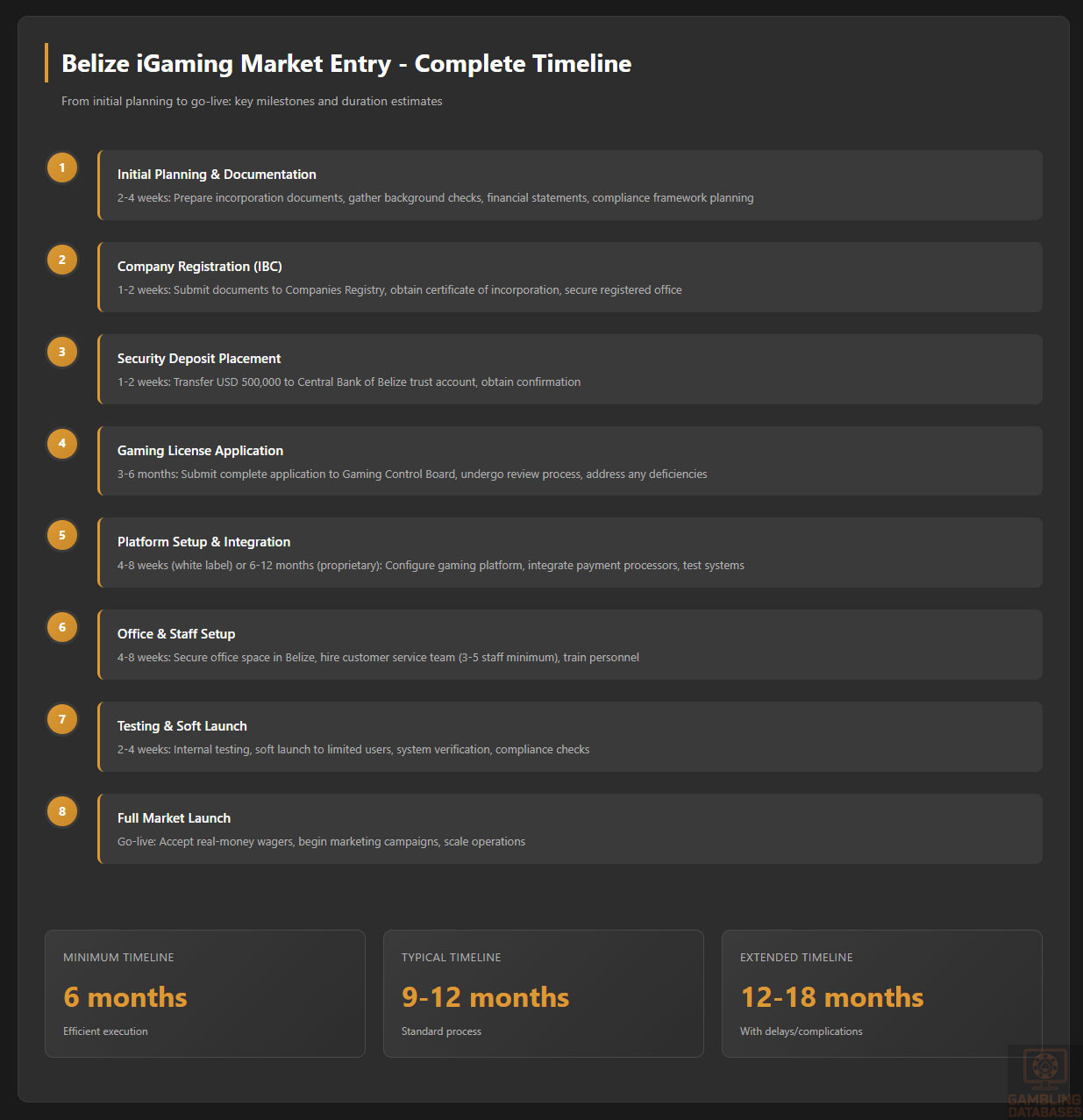
Success Factors and Challenges
Key Success Enablers
Understanding of local player preferences in target markets represents the foundation of successful operations. Belize-licensed operators must research and adapt to the markets they serve rather than focusing on Belizean preferences due to the local market prohibition. Comprehensive market research covering gaming preferences, payment methods, customer service expectations, and cultural factors drives product-market fit.
Localized payment methods integration determines conversion rates and player satisfaction. Operators must offer payment options popular in target markets, which vary significantly across regions. Latin American markets may prioritize local bank transfers and cash vouchers, while European players expect e-wallets and instant banking. Payment strategy must align with target market infrastructure.
Mobile-first approach is essential given global trends toward mobile gambling and the reality that many markets show 70-80% mobile engagement. Responsive design, native applications for iOS and Android, mobile-optimized payment flows, and data-efficient content delivery ensure quality mobile experiences. Desktop optimization remains important but mobile drives growth.
Effective marketing channels and partnerships vary dramatically by target market. Digital marketing through search, display, and social media offers scalability. Affiliate partnerships provide performance-based customer acquisition. Sports sponsorships and influencer marketing build brand awareness. Marketing channel selection must align with target audience media consumption patterns.
Strong customer support in local languages builds trust and retention. Multilingual support teams covering target market languages via live chat, email, and phone create competitive advantages. 24/7 availability across time zones ensures players receive timely assistance. Cultural sensitivity and market-specific knowledge improve service quality beyond language translation.
Competitive bonus and promotion strategy attracts new players while managing profitability. Welcome bonuses must be competitive with market offers while avoiding unsustainable economics. Ongoing promotions drive engagement and retention. Free bet offers, reload bonuses, and VIP programs create player value. Wagering requirements and terms must balance player appeal with operator sustainability.
Responsible gambling commitment protects players and regulatory relationships even though Belize mandates minimal player protection measures. Implementing deposit limits, self-exclusion, reality checks, and cooling-off periods demonstrates social responsibility. These tools may be required in target markets regardless of Belize requirements. Proactive responsible gambling practices build trust and reduce regulatory risk.
Local sports and events coverage for sports betting operations must reflect target market preferences. Football/soccer dominates Latin American and European markets, basketball and American football appeal to US markets, cricket serves South Asian audiences. Live betting, comprehensive markets, and competitive odds on locally relevant events drive sportsbook success.
Major Operational Challenges
Regulatory compliance complexity extends beyond Belize licensing to encompass all target markets. Operators must simultaneously comply with Belize requirements and any regulations in markets where they accept players. Conflicting requirements across jurisdictions create compliance burdens. Recent AML/CFT reforms in Belize add compliance costs and complexity previously absent.
High taxation burden, while low by global standards, still impacts profitability particularly combined with target market taxes where applicable. The 0.75% gaming tax with USD 250,000 cap creates minimal burden for high-revenue operators but represents more significant cost for smaller operations. Corporate income tax, social security contributions, and other levies add to total tax burden.
Payment processing restrictions and challenges affect many iGaming operations globally. Banking relationships can be difficult to establish and maintain given financial institution risk aversion toward gambling. Payment processor reluctance, high fees, and transaction declines frustrate operators and players. Diversified payment strategies and processor relationships mitigate but don’t eliminate these challenges.
Marketing and advertising limitations vary by target market with some jurisdictions imposing severe restrictions on gambling advertising. Content restrictions, channel prohibitions, and bonus advertising limitations constrain marketing effectiveness. Compliance with diverse advertising regulations across multiple markets increases complexity and legal costs.
Competition from established operators creates significant challenges for new entrants. Major operators with global brands, extensive game libraries, and massive marketing budgets dominate many markets. New entrants must identify underserved niches, offer differentiated products, or compete on price through better bonuses or odds. Breaking through competitive clutter requires substantial investment.
Player acquisition costs in competitive markets often exceed USD 200-400 per first-time depositor. Converting acquired players to profitability requires strong retention and lifetime value optimization. Inefficient customer acquisition quickly depletes budgets without generating sustainable returns. Sophisticated marketing analytics and optimization separate successful from failed operations.
Talent shortage affects specific technical and gambling industry skills. Experienced compliance professionals, fraud analysts, trading/pricing specialists for sportsbooks, and gaming platform developers are scarce and expensive. Belize’s small population limits local talent pools, requiring international recruitment. Remote work arrangements and outsourcing partially address talent challenges.
Technology infrastructure limitations within Belize itself aren’t showstoppers given the ability to host platforms internationally, but maintaining customer service operations in Belize can present challenges. Internet reliability for customer service operations, telecom infrastructure quality, and power stability require contingency planning. Backup systems and redundancy protect against infrastructure failures.
Cultural Considerations
Local holidays and peak seasons affect operational planning even though Belize-licensed operators serve international markets. Staff availability during Belizean holidays requires workforce planning to maintain customer support coverage. Target market holidays and sporting events drive player activity peaks requiring adequate staffing and technical capacity.
Popular local sports and events in target markets determine sportsbook product focus. The World Cup, Champions League, Olympics, NBA Finals, and regional tournaments drive betting activity. Event-specific promotions and comprehensive market offerings capitalize on elevated engagement. Advance planning for major events ensures technical readiness and marketing preparation.
Preferred customer service channels vary by market and demographic. Live chat dominates for quick questions particularly among younger players. Email serves complex issues requiring detailed documentation. Phone support appeals to traditional customers and high-value VIP players. Social media channels increasingly handle customer service interactions particularly complaints and public relations issues.
Communication style preferences differ across cultures. Latin American markets may prefer warmer, more personal interactions. Northern European markets favor efficient, transactional communications. Asian markets emphasize respect and face-saving. Customer service training must account for cultural communication preferences in target markets.
Trust-building requirements for foreign brands vary by market maturity and player sophistication. Newer markets may show higher skepticism requiring extensive trust signals like licensing badges, responsible gambling tools, and security certifications. Mature markets with established player bases evaluate brands on product quality and promotional value. Social proof through reviews and forums influences trust.
Exit Strategy Planning
Market liquidity for operator sales depends entirely on target market value rather than Belize jurisdiction itself. Established operations with profitable player databases, proven marketing systems, and clean compliance records attract buyers. Small unprofitable operations struggle to find buyers at meaningful valuations. Recent transaction multiples for online gambling operators range 5-15x EBITDA depending on growth, margins, and market.
Regulatory requirements for ownership transfer involve Gaming Control Board approval of new license holders. Background checks, financial due diligence, and suitability assessments apply to acquiring parties. The process can take several months requiring advance planning. License transferability is permitted but not automatic, requiring regulatory consent.
License transferability provides flexibility for exit planning but doesn’t guarantee transferability at desired valuations or timelines. The limited number of active licenses in Belize may reduce buyer pool specifically seeking Belize licensing. However, buyers often focus on customer database, revenue, and margins rather than specific jurisdiction. Portfolio sales including multiple licenses across jurisdictions are common.
Typical valuation multiples for iGaming businesses range 5-8x EBITDA for stable, profitable operations with clean compliance. High-growth operations may command 10-15x EBITDA. Struggling or declining operations might only achieve 2-4x EBITDA or require discounted revenue multiples. Valuation depends on growth trajectory, margin sustainability, regulatory risk, customer concentration, and market position.
Process for closing operations legally requires Gaming Control Board notification, player fund protection, outstanding bet settlement, and orderly license surrender. Operators must fulfill all player obligations before ceasing operations. The USD 500,000 security deposit provides financial backing for player protections during wind-down. Proper closure procedures enable security deposit refund once all obligations are satisfied.
FAQ: Frequently Asked Questions
Legal & Licensing
Is online gambling legal in Belize?
Yes, online gambling has been legal and regulated in Belize since 2004 when the Gaming Control (Online Gaming) Regulations came into effect. The regulatory framework builds on the Computer Wagering Licensing Act introduced in 1995, making Belize one of the earliest Central American jurisdictions to regulate iGaming.
The Gaming Control Board oversees all gambling activities including online gaming through its Investment Promotion and Compliance Unit. However, there’s an important restriction: licensed operators are prohibited from offering gambling services to Belize residents. The licensing regime specifically targets international operators seeking to serve foreign markets rather than developing a domestic gambling industry.
Belize residents can legally access and use foreign-licensed gambling sites without legal restrictions. The prohibition only applies to Belize-licensed operators serving locals, not to residents gambling on international platforms.
What types of gambling licenses are available and what do they cover?
Belize offers a single comprehensive online gaming license covering all types of internet gambling activities. This one-size-fits-all approach provides significant operational flexibility compared to jurisdictions requiring separate licenses for different product verticals.
The comprehensive license covers casino games including slots and table games, sports betting and in-play wagering, poker rooms and tournaments, lottery services and number games, bingo operations, and any other form of wagering conducted via computer or telecommunication devices. Operators can offer any combination of these products under the single license without additional authorizations.
The license permits maintaining servers and technical infrastructure outside Belize while requiring customer service operations be conducted within the country. This hybrid structure provides technology flexibility while ensuring local economic benefits through employment.
How much does an iGaming license cost and how long does it take to obtain?
The total initial cost for a Belize gaming license is USD 515,500, broken down into a USD 15,500 application fee and a mandatory USD 500,000 security deposit. The security deposit is held in trust by the Central Bank of Belize as indemnity against fraud or violations. Annual renewal costs USD 10,000, significantly reduced from the original USD 50,000 fee when licensing was introduced.
Processing time officially ranges from 24 hours to 6 months depending on application completeness and Gaming Control Board workload. Well-prepared applications with all required documentation, proper background checks, and pre-established banking relationships can occasionally achieve approval in days or weeks. More typical timelines span 3-6 months from initial submission to license grant.
Factors affecting timeline include completeness of initial application, speed of background check processing, complexity of ownership structures requiring beneficial ownership documentation, and concurrent applications creating processing queues. Engaging experienced local counsel familiar with Gaming Control Board procedures significantly improves process efficiency.
Can foreign companies obtain a gambling license?
Yes, foreign companies can and are expected to obtain Belize gambling licenses. The regulatory framework specifically targets international operators, with 100% foreign ownership permitted through the International Business Company structure. No local partnership, shareholding, or director requirements exist.
Foreign applicants must first establish an International Business Company incorporated in Belize before applying for the gaming license. The IBC can be wholly owned by foreign individuals or entities without restrictions. All beneficial owners undergo background checks regardless of nationality, with criminal history, financial stability, and character assessments applied uniformly.
The requirement to maintain customer service operations within Belize creates local presence mandates but doesn’t require local ownership. Foreign operators employ Belizean staff for customer support while retaining full ownership and control of operations.
Financial & Taxation
What are the tax obligations for iGaming operators?
iGaming operators in Belize face a highly favorable tax structure consisting of a 0.75% tax on gross annual turnover with an absolute maximum cap of USD 250,000 per year. This represents one of the lowest gaming tax rates globally and creates significant competitive advantages, especially for high-volume operations that quickly reach the cap.
Beyond gaming-specific taxes, operators must pay the USD 10,000 annual license renewal fee and comply with corporate income tax obligations applicable to their International Business Company structure. Corporate tax treatment depends on whether the IBC generates Belize-source or foreign-source income, with preferential rates available for offshore business activities.
Additional tax considerations include General Sales Tax (GST) at 12.5% on goods and services, though international gaming services may qualify for zero-rating. Social security contributions of approximately 16% combined (8% employer, 8% employee) apply to Belizean employee wages. Withholding taxes may apply to cross-border payments for services, interest, or royalties depending on payment type and recipient jurisdiction.
The capped gaming tax creates dramatic advantages at scale. An operator generating USD 100 million in annual GGR pays the same USD 250,000 gaming tax as one generating USD 35 million, both hitting the cap. This flat maximum tax regardless of revenue above the threshold makes Belize particularly attractive for operators projecting significant scale.
Are gambling winnings taxed for players?
No, Belize does not impose any taxes on player gambling winnings. Players face no withholding requirements, tax declaration obligations, or reporting mandates related to winnings from gambling activities. This zero-tax approach for players applies uniformly regardless of win size or player residence.
The absence of player taxation creates administrative simplicity for operators who don’t need to implement withholding systems, report player winnings to tax authorities, or maintain complex tracking for tax purposes. This contrasts with jurisdictions imposing withholding taxes on significant wins or requiring operators to report player activity.
For Belize residents gambling on foreign-licensed platforms, no local tax obligations exist on winnings. Players accessing international gambling sites keep 100% of winnings without reporting or taxation. Tax treatment in the player’s home jurisdiction may differ, but Belize imposes no local taxation on gambling winnings.
What are the typical operational costs for running an online casino or sportsbook?
Monthly operational costs for a small to medium Belize-licensed operation typically range USD 15,000-40,000, scaling to USD 50,000-150,000+ for larger operations. The largest variable cost is marketing and customer acquisition, which can consume 30-50% of total budgets for growth-focused operations.
Staff salaries for Belizean customer service teams average USD 1,000-1,500 monthly per representative. A minimal 3-5 person team costs USD 3,000-7,500 monthly, while larger 10-15 person operations require USD 10,000-22,500 monthly. Adding management, compliance, and administrative staff brings total monthly salary costs to USD 6,000-30,000+ depending on scale.
Technology costs vary dramatically between white label and proprietary platforms. White label monthly platform fees range USD 5,000-15,000 plus percentage-based revenue shares of 10-30% in some arrangements. Proprietary platforms require hosting (USD 1,000-5,000 monthly), maintenance (USD 3,000-10,000 monthly), and ongoing development (USD 5,000-20,000 monthly).
Payment processing fees typically consume 2-5% of deposit volumes. An operator processing USD 500,000 monthly deposits pays USD 10,000-25,000 in payment processing costs. Office rent, utilities, telecommunications, and administrative expenses add USD 1,500-4,000 monthly. The gaming tax and license renewal fees add USD 300-21,000 monthly depending on revenue levels.
What is the expected ROI timeline for entering this market?
Return on investment timelines for Belize-licensed operations vary significantly based on target markets, execution quality, and market conditions. Well-executed operations in favorable markets might achieve profitability within 12-18 months, while challenging markets or poor execution can result in losses extending 24-36+ months or never reaching profitability.
The substantial upfront investment of USD 650,000-1,800,000 (including security deposit, licensing fees, setup costs, and initial marketing) creates a high hurdle requiring significant revenue generation before achieving positive returns. The USD 500,000 security deposit, while refundable upon license surrender, represents locked capital reducing available working funds.
Realistic profitability expectations depend on market positioning and scale. Small operations might generate USD 50,000-150,000 monthly GGR with 15-25% EBITDA margins after reaching maturity, producing USD 7,500-37,500 monthly profit. Medium operations could achieve USD 300,000-1,000,000 monthly GGR with similar margins, generating USD 45,000-250,000 monthly profit at scale.
Full ROI including security deposit recovery typically requires either sustained profitable operations over 3-5 years or successful exit through business sale. The refundable nature of the security deposit means operators can recover that capital upon exit, but it remains locked during active operations. Patient capital and realistic growth expectations are essential for Belize market entry success.
Operations & Compliance
What are the local presence requirements for operators?
Operators must maintain a registered office in Belize and conduct customer service operations from within the country. The registered office serves as the official address for legal and regulatory correspondence, while customer service operations require actual staffing and physical facilities in Belize.
Customer service requirements mandate having Belizean-based staff handling player support, though specific headcount minimums are not explicitly codified. Practical implementation typically requires at least 3-5 customer service representatives to provide meaningful coverage. Support can be delivered via phone, email, live chat, or messaging from Belize-based facilities.
Technical infrastructure including game servers, databases, and platforms can be hosted internationally. Operators commonly use data centers in jurisdictions with robust internet infrastructure and favorable latency to target markets. Cloud platforms like AWS, Google Cloud, or Azure provide scalable hosting without Belize infrastructure limitations.
Management and key personnel can be located internationally or in Belize. The compliance officer must be approved by the Gaming Control Board but can operate remotely with periodic Belize visits. Most operators maintain lean Belize operations focused on required customer service with management, technical teams, and marketing operating from other jurisdictions.
What payment methods are available and recommended?
Available payment methods depend on target markets rather than Belize-specific infrastructure given the prohibition on serving local players. Operators must integrate payment processors serving their chosen markets, which varies dramatically by geography. Latin American markets require local bank transfers and cash vouchers, European markets expect e-wallets and instant banking, while Asian markets favor different payment ecosystems.
Recommended payment strategies include international credit/debit cards (Visa, Mastercard) for broad coverage, regional e-wallets popular in target markets (Skrill, Neteller, PayPal where available, regional alternatives), bank transfers including instant banking where available, and alternative methods like prepaid cards or cash vouchers for markets with limited banking penetration.
Cryptocurrency integration remains restricted in Belize until the December 31, 2025 virtual asset moratorium expires. Following expiration, regulatory frameworks will determine crypto payment parameters. Many international markets increasingly demand cryptocurrency options, creating competitive pressure to offer crypto deposits and withdrawals where legally permissible.
Payment provider selection should prioritize processors experienced with iGaming transactions, as many mainstream processors restrict gambling merchants. Specialized gaming payment providers understand industry risk profiles and offer better approval rates. Multiple provider relationships reduce dependency risk and improve geographic coverage.
What are the advertising and marketing restrictions?
Belize imposes minimal advertising and marketing restrictions on licensed operators for their international activities. The primary prohibition prevents marketing gambling services to Belize residents, aligning with the complete ban on serving local customers. Operators cannot advertise through Belizean media targeting local audiences or market services to individuals within Belize.
For international marketing to target markets, Belize regulations do not mandate specific content restrictions, bonus caps, wagering requirement limitations, sponsorship rules, or time-of-day advertising restrictions. This regulatory flexibility allows operators to structure marketing according to target market requirements and competitive dynamics.
However, operators must comply with advertising regulations in all markets where they accept players. Many jurisdictions impose detailed restrictions on gambling advertising content, channels, bonus promotions, and marketing to minors. European markets like the UK, Sweden, and Spain have extensive advertising codes. Operators need robust compliance frameworks addressing all applicable market regulations.
Affiliate marketing faces no specific Belizean restrictions beyond the prohibition on promoting to locals. Operators can structure affiliate programs, set commission rates, and manage partnerships according to business needs. Responsible affiliate practices include prohibiting underage marketing, avoiding misleading advertising, and ensuring affiliates understand and comply with applicable regulations.
What responsible gambling measures are mandatory?
Belize’s regulatory framework mandates minimal responsible gambling measures compared to European jurisdictions. The primary requirement is age verification to prevent gambling by anyone under 18 years old. Operators must implement systems confirming customer age before allowing real-money wagering, though specific technical standards for verification are not prescribed.
KYC and AML compliance following international standards is required under recent regulatory reforms. Operators must verify customer identities through government-issued identification and maintain records of verification procedures. Transaction monitoring systems and suspicious activity reporting align with Financial Intelligence Unit requirements.
Self-exclusion systems, deposit limits, loss limits, session time limits, and reality checks are not explicitly mandated by Belize regulations. This lighter-touch approach differs dramatically from jurisdictions requiring comprehensive responsible gambling tools. However, operators serving markets with mandatory player protection requirements must implement those standards regardless of Belize’s permissive framework.
Best practice recommendations include implementing voluntary responsible gambling tools even without Belize mandates, providing information about gambling risks and support resources, training customer service staff to recognize problem gambling indicators, and maintaining responsible gambling policies demonstrating commitment to player welfare. These measures protect players, reduce regulatory risk, and build brand reputation.
Market Opportunity
How large is the iGaming market and what is the growth potential?
The Belize domestic iGaming market is non-existent due to regulatory prohibition on serving local residents. Licensed operators cannot accept Belize players, eliminating local market opportunities. Any market analysis must therefore focus on international markets served by Belize-licensed operators rather than domestic market potential.
Global iGaming market context shows the worldwide online gambling sector reached USD 95.5 billion in 2024 with projected growth to USD 257 billion by 2034, representing 10.5% CAGR. Sports betting dominates at approximately 56% of market revenue, with casino games, poker, and other products comprising the remainder. Mobile platforms drive growth with 80% of users accessing gambling via smartphones.
Regional market opportunities for Belize-licensed operators vary significantly. Latin American markets show strong growth potential with increasing smartphone penetration, improving payment infrastructure, and gradual regulatory development. Brazil’s recent legalization creates massive opportunities. European markets remain highly competitive but offer sophisticated player bases with high lifetime values.
Growth potential for Belize as a licensing jurisdiction depends on attracting additional operators seeking cost-effective authorization. The low tax cap and streamlined regulations appeal to operators, but the USD 500,000 security deposit creates entry barriers. Competition from Curaçao, Malta, Costa Rica, and other jurisdictions influences Belize’s market share of international licensing.
Who are the main competitors and what is their market share?
Belize currently has only one active online gaming license according to recent regulatory oversight reports, making traditional competitive analysis inapplicable within the jurisdiction itself. The limited licensing reflects both the high security deposit requirement and Belize’s positioning as a boutique offshore jurisdiction rather than mass-market licensing center.
Competitive dynamics exist at the licensing jurisdiction level where Belize competes with other offshore centers. Curaçao dominates offshore licensing with hundreds of operators attracted by established infrastructure, reasonable costs, and international recognition. Malta offers premium EU-licensed status with higher costs but greater legitimacy. Panama, Costa Rica, and Gibraltar provide alternative offshore options.
Market concentration within Belize is absolute with a single active licensee. This creates no competitive dynamics among Belize-licensed operators. The relevant competition occurs in target markets where Belize-licensed operators compete against operators holding licenses from various jurisdictions. Market share depends on operator execution rather than licensing jurisdiction.
International market leaders like Flutter Entertainment (owner of PokerStars, Paddy Power, FanDuel), Entain (owner of bwin, PartyPoker, Ladbrokes), Bet365, and DraftKings dominate global markets through brand strength, product quality, and massive marketing budgets. Belize-licensed operators typically occupy smaller niches or serve specific regional markets rather than competing directly with industry giants.
What are the player preferences and typical spending patterns?
Player preferences vary dramatically by target market rather than following Belize-specific patterns given the prohibition on local market participation. Sports betting generally attracts broader audiences with casual player participation driven by sports fandom, while casino games serve more dedicated gambling enthusiasts seeking entertainment.
Regional preference patterns show Latin American markets favoring football/soccer betting, with basketball, boxing, and local sports generating additional interest. European markets demonstrate strong interest in football, tennis, and racing. North American markets prefer American football, basketball, and baseball. Casino game preferences lean toward slots globally with cultural variations in table game popularity.
Mobile versus desktop usage trends heavily toward mobile with 70-80% of activity on smartphones in most markets. Younger demographics show even higher mobile preference approaching 85-90%. Desktop usage persists among older players and for complex activities like poker or live dealer games benefiting from larger screens.
Average spending varies by market income levels and gambling culture. Developed markets like UK, Australia, and Scandinavia show annual spending of USD 500-2,000 per active player. Emerging markets demonstrate lower spending of USD 100-500 annually. High-rollers in any market may spend exponentially more, but represent small percentages of player bases.
What are the key success factors and main challenges for new entrants?
Key success factors include thorough target market understanding, competitive product offerings with quality games and odds, efficient customer acquisition through effective marketing, strong payment processing with high approval rates and fast withdrawals, excellent customer service building trust and retention, and robust compliance systems protecting against regulatory and fraud risks.
Technology platform selection represents a critical decision. White label solutions offer faster time-to-market and proven functionality but limit differentiation and may constrain margins through revenue-sharing arrangements. Proprietary platforms provide greater control and potentially better economics at scale but require substantial development investment and technical expertise.
Marketing effectiveness determines customer acquisition costs and lifetime values. Operators must identify cost-effective channels, optimize conversion funnels, implement retention programs maximizing lifetime value, and carefully manage marketing spend to achieve sustainable unit economics. Inefficient marketing quickly depletes budgets without building viable businesses.
Main challenges include intense competition from well-funded established operators, high customer acquisition costs in competitive markets, payment processing difficulties due to banking restrictions on gambling, regulatory complexity across multiple jurisdictions, talent shortages in specialized roles, and achieving scale necessary for profitability against high fixed costs.
The USD 500,000 security deposit creates significant entry barriers for under-capitalized operators. Combined with setup costs, technology investment, and marketing budgets, total capital requirements of USD 1-2 million minimum limit market entry to well-funded ventures. Undercapitalized operations face high failure rates unable to sustain marketing investment through the ramp-up period.
Sources and References
- Gaming Control Board of Belize – Official regulatory authority – https://www.governmentofbelize.gov.bz/
- Belize Gaming Control Act (Chapter 152), 2000 Revision – Primary gambling legislation
- Computer Wagering Licensing Act, 1995 – Foundation for online gaming regulation
- Gaming Control (Online Gaming) Regulations, 2004 – Specific online gambling framework
- Statistical Institute of Belize – Population and economic data – https://sib.org.bz/
- World Bank Data – Belize GDP, demographics, and development indicators – https://data.worldbank.org/
- United Nations Population Division – World Population Prospects 2024 Revision
- International Monetary Fund – Belize economic forecasts and GDP projections
- DataReportal – Digital 2024: Belize – Internet and social media statistics – https://datareportal.com/reports/digital-2024-belize
- Ookla Speedtest – Belize internet speed data, 2023-2024
- Global Financial Integrity – Casino Beneficial Ownership in Belize: Transparency Challenges and Regulatory Gaps, August 2024
- Slotegrator – How to get a gambling license in Belize 2025 – https://slotegrator.pro/analytical_articles/obtaining-a-gaming-license-in-belize-2022/
- iGaming Today – Gambling Regulation in Belize, September 2024 – https://www.igamingtoday.com/gambling-regulation-in-belize/
- Belize Press Office – Gaming Control Board notices and announcements
- Financial Services Commission Act – Virtual asset restrictions and financial regulation
- Civil Asset Recovery and Unexplained Wealth Act (CARUWA) – Anti-money laundering reforms
- Belize Business Companies Act – Corporate registration and governance
- International Business Companies Act – IBC structure and requirements
- BELTRAIDE (Belize Trade and Investment Development Service) – Investment promotion information
- Central Bank of Belize – Financial statistics and monetary policy – https://www.centralbank.org.bz/
- Millennium Challenge Corporation – US assistance programs in Belize, 2024
- Belize Electricity Limited – Energy infrastructure and development plans, 2024-2028
- Government of Belize National Energy Policy 2023-2040
- Grand View Research – Online Gambling Market Size & Share Analysis, 2024-2030
- Statista – Global online gambling market statistics and forecasts
- GM Insights – Online Gambling Market Analysis, 2024-2034
- IMARC Group – Online Gambling Market Research Report, 2025-2033
- American Gaming Association – Commercial Gaming Revenue Tracker
- European Gaming & Betting Association (EGBA) – European market regulation reports
- Transparency International – Corruption Perceptions Index
- UNESCO Institute for Statistics – Education data for Belize
- UNFPA World Population Dashboard – Belize demographic indicators
- Worldometer – Belize population and vital statistics
- MacroTrends – Belize GDP and economic historical data
- Federal Reserve Bank of St. Louis (FRED) – Belize economic indicators
- Trading Economics – Belize economic data and forecasts
- Wikipedia – Demographics of Belize, Belize country information
- LCB.org – Belize country restrictions for gambling
- Slogold – Belize gambling license information and procedures
- Be Parifiduciaries – Belize gambling licensing services
- RUE.ee – Belize gambling license guide, December 2024
- Global Findex Database 2025 – Digital and financial inclusion data
- GSMA – The State of Mobile Internet Connectivity Report 2024
- ITU (International Telecommunication Union) – Internet penetration statistics
- Countrymeters – Belize population statistics and projections
- StatisticsTimes – Belize demographics and population data
- Focus Economics – Belize GDP per capita forecasts
- DemandSage – Online Gambling Statistics 2025
- Globe Newswire – Global Online Gambling Market projections
- Industry publications and reports on iGaming licensing jurisdictions
- Legal and regulatory documentation from Belize government sources
- Academic studies on gambling regulation in offshore jurisdictions
- News articles and press releases on Belize gaming sector developments
- Professional services firms specializing in Belize company formation and licensing
- Tax authority publications on Belize corporate and gaming taxation
- International compliance standards for AML/CFT in gaming
- Market research on Latin American and Caribbean gambling markets
- Telecommunications industry reports on Belize infrastructure
- Banking sector analysis for Belize financial services
🎯 Gambling Databases Country Rating: Belize
| Evaluation Dimension | Score | Rating |
|---|---|---|
| Operator Ease Score | 4.8/10 | 🟡 Moderate |
| Player Access Score | 0.5/10 | ⛔️ Prohibited |
| Overall Market Attractiveness | 2.7/10 | 🔴 Offshore Licensing Only – No Local Market |
This rating is calculated using the Gambling Databases Rating (GDR) methodology, which provides transparent criteria for evaluating iGaming markets worldwide. Click the link to learn how we calculate Operator Ease Score, Player Access Score, and overall market attractiveness ratings.
⚠️ CRITICAL RISK WARNINGS
READ THIS BEFORE CONSIDERING BELIZE LICENSING:
- ZERO LOCAL MARKET ACCESS: Licensed operators are COMPLETELY PROHIBITED from offering services to Belize residents. This is pure offshore licensing with no domestic revenue potential.
- MASSIVE CAPITAL REQUIREMENT: USD 500,000 security deposit held with Central Bank of Belize is MANDATORY and NON-NEGOTIABLE. This is among the highest deposits globally for offshore jurisdictions.
- ONLY ONE ACTIVE LICENSE: As of 2024, Belize has issued only ONE online gaming license. This extreme market concentration indicates regulatory reluctance to expand licensing.
- STRENGTHENING AML/CFT ENFORCEMENT: 17 laws amended between 2020-2024 following international pressure. Previously permissive oversight is rapidly tightening with expanded Financial Intelligence Unit staff and enhanced compliance requirements.
- LIMITED PAYMENT OPTIONS: Cryptocurrency BANNED until December 31, 2025. Payment processing infrastructure is underdeveloped, forcing reliance on international processors.
- SMALL TALENT POOL: Population of 417,000 limits available skilled workforce. Technical talent is scarce, requiring international recruitment or remote arrangements.
- HISTORICAL TRANSPARENCY ISSUES: Past cases like Brad’s Gaming Group revealed beneficial ownership obscurity. New transparency requirements add compliance complexity.
- INFRASTRUCTURE LIMITATIONS: Median mobile internet speed of only 12.22 Mbps. Fixed broadband at 44.31 Mbps only available in urban areas. Customer service operations face connectivity reliability challenges.
📊 Operator Ease Score Breakdown
| Criterion | Weight | Score | Justification (INCLUDING ALL DEDUCTIONS) |
|---|---|---|---|
| Legal & Regulatory Framework | 30% | 1.5/3.0 | All online gambling products legal under single comprehensive license (+1.5). HOWEVER: Operators PROHIBITED from serving Belize residents (-1.5 deduction, eliminates local market). Only ONE active license issued as of 2024 indicating extremely restrictive approach (-0.5). Recent AML/CFT crackdown with 17 laws amended 2020-2024 shows tightening environment (-0.5). Gaming Control Board historically took hands-off approach but enforcement increasing. Final: 1.5/3.0 |
| Licensing Process | 25% | 1.0/2.5 | Clear licensing process through Gaming Control Board/IPCU (+0.5). Timeline of 24 hours to 6 months, typically 3-6 months (+0.5). Application fee USD 15,500 reasonable (+0.25). MAJOR DEDUCTIONS: USD 500,000 security deposit is MASSIVE barrier (-0.5 points). Total initial costs USD 651,500-1,803,000 extremely high (-0.5). Only ONE license issued shows extreme selectivity (-0.25). Extensive background checks including fingerprints, 3 years financial statements, all beneficial owners investigated adds complexity (-0.25). Must establish Belize IBC before application (+0.25 for clarity). Final: 1.0/2.5 |
| Taxation & Costs | 20% | 1.5/2.0 | EXCELLENT tax structure: 0.75% of GGR with USD 250,000 annual cap is among world’s lowest (+2.0). HOWEVER: High operational costs reduce appeal. USD 500,000 security deposit opportunity cost (-0.25). Monthly operating costs USD 10,000-30,000+ for staffing/office (-0.15). Corporate income tax applies to IBC structure beyond gaming tax (-0.1). Total initial investment USD 651,500+ creates high barrier (-0). Final: 1.5/2.0 |
| Operational Requirements | 15% | 0.6/1.5 | Servers can be hosted internationally (+0.5). 100% foreign ownership permitted (+0.25). MAJOR DEDUCTIONS: Mandatory physical presence in Belize for customer service (-0.3). Must hire local staff, typically 3-5 minimum customer service reps (-0.3). Limited technical talent pool requires international recruitment (-0.2). Internet infrastructure challenges: 12.22 Mbps mobile, 44.31 Mbps fixed broadband only in cities (-0.2). Cryptocurrency BANNED until Dec 31, 2025 (-0.25). Payment processing must use international providers due to limited local infrastructure (-0.15). Small population 417,000 limits talent availability (-0.2). Final: 0.6/1.5 |
| Market Environment | 10% | 0.2/1.0 | World Bank Doing Business ranking 120-140 of 190 economies indicates moderate challenges (+0.25). English-speaking population aids international operations (+0.15). MAJOR DEDUCTIONS: Only ONE active license shows minimal competition/growth (-0.3). Recent regulatory reforms with 17 laws amended 2020-2024 indicates instability (-0.25). Historical gaps in AML/CFT oversight now being corrected creates uncertainty (-0.2). Small GDP USD 3.5 billion limits local business ecosystem (-0.1). Limited transparency in historical market data (-0.1). Brad’s Gaming Group beneficial ownership scandal damaged reputation (-0.15). Final: 0.2/1.0 |
👥 Player Access Score Breakdown
| Criterion | Weight | Score | Justification (INCLUDING ALL DEDUCTIONS) |
|---|---|---|---|
| Legal Status for Players | 40% | 0.0/4.0 | COMPLETE PROHIBITION: Licensed operators are EXPLICITLY BANNED from offering services to Belize residents (0 points, -4.0 total deduction). This is not grey area – it’s absolute prohibition in licensing terms. Players can only access international offshore sites, which operate without Belize regulatory authorization. No legal local market exists whatsoever. Final: 0.0/4.0 |
| Practical Accessibility | 30% | 0.3/3.0 | Players can technically access international offshore sites (+0.5). MAJOR DEDUCTIONS: No licensed operators serve Belize residents, all access is offshore/unregulated (-1.0). Credit/debit card penetration only 30-40% limits payment options (-0.4). Cryptocurrency BANNED until Dec 31, 2025 (-0.5). E-wallet availability extremely limited, PayPal restricted (-0.3). 70.4% internet penetration leaves 29.6% offline (-0.2). Mobile internet only 12.22 Mbps median limits gaming quality (-0.3). Cash dominates 70-80% of transactions, digital payments underdeveloped (-0.5). Final: 0.3/3.0 |
| Player Penalties | 20% | 0.2/2.0 | No specific penalties mentioned for players using offshore sites (+0.5). Enforcement focuses on licensed operators not serving locals rather than player prosecution (+0.5). DEDUCTIONS: Legal uncertainty since there’s no framework for legal player access (-0.5). Using offshore unlicensed sites carries inherent risks (-0.3). Final: 0.2/2.0 |
| Market Availability | 10% | 0.0/1.0 | ZERO licensed operators serve local market (0 points). Only ONE total license exists and that operator is PROHIBITED from serving Belize residents (-1.0 total deduction). Players limited to offshore sites only. Eight land-based casinos exist but primarily serve tourists, not locals. Final: 0.0/1.0 |
🔍 Key Highlights
Strengths (Limited)
- Tax Structure: 0.75% GGR tax capped at USD 250,000 annually is genuinely among world’s lowest for offshore jurisdictions
- English Language: Official English with 80% speaking English well facilitates international business operations
- Simple License Structure: Single comprehensive license covers all gambling products (sports, casino, poker, lottery) without separate authorizations
- Fast Initial Processing: Company registration 1-2 weeks, some applications processed in 24 hours (though 3-6 months typical)
- Server Flexibility: Technical infrastructure can be hosted internationally, not restricted to Belize
- 100% Foreign Ownership: No local partner requirements or mandatory domestic shareholders
- No Player Taxation: Zero tax on player winnings creates administrative simplicity
⛔️ CRITICAL RISKS AND CHALLENGES
- ZERO LOCAL MARKET: Licensed operators COMPLETELY PROHIBITED from serving Belize’s 417,000 residents. This eliminates any domestic revenue potential and makes Belize purely an offshore licensing jurisdiction competing with Curaçao, Malta, and others.
- USD 500,000 SECURITY DEPOSIT: Among highest security deposits globally for offshore jurisdictions. This massive capital requirement (held with Central Bank) is a prohibitive barrier for small/medium operators. Opportunity cost alone is USD 25,000-50,000 annually at 5-10% returns.
- ONLY ONE ACTIVE LICENSE: Belize issued just ONE online gaming license as of 2024. This extreme selectivity means market entry is exceptionally difficult. Historical data shows more licenses existed previously, but numbers declined dramatically.
- TIGHTENING REGULATORY ENVIRONMENT: 17 laws enacted/amended 2020-2024 following international pressure on AML/CFT. Financial Intelligence Unit expanded staff in 2023. Previously permissive “hands-off” approach rapidly evolving to active enforcement. Compliance costs rising.
- PAYMENT METHOD RESTRICTIONS: Cryptocurrency BANNED until December 31, 2025 minimum. E-wallets like PayPal severely restricted. Only 30-40% of population has credit/debit cards. 70-80% of transactions are cash. Payment processing infrastructure underdeveloped, forcing reliance on expensive international processors at 4-8% fees.
- INFRASTRUCTURE LIMITATIONS: Mobile internet median 12.22 Mbps (improved 25.6% YoY but still slow). Fixed broadband 44.31 Mbps only in urban areas. 29.6% of population (122,700 people) completely offline. Customer service operations required in Belize face connectivity reliability issues during storms/adverse weather.
- TALENT SHORTAGE: Population only 417,000 total. Limited technical talent in IT, software development, compliance, fraud analysis. Customer service staff available but specialized gambling expertise scarce. International recruitment or remote work arrangements required for most specialized roles.
- HIGH TOTAL COSTS: Initial investment USD 651,500-1,803,000 including security deposit, license fees, legal costs, office setup, technology. Monthly operating costs USD 10,000-30,000+ for minimal staffing. These costs are HIGH for an offshore jurisdiction providing no local market access.
- HISTORICAL TRANSPARENCY ISSUES: Brad’s Gaming Group case (2009-2023) revealed beneficial ownership obscurity through St. Lucia/Dominica structures. New transparency requirements implemented but practical application still developing. Reputational damage from past oversight gaps.
- REGULATORY UNCERTAINTY: Annual renewal fee dropped from USD 50,000 (1995) to USD 10,000 (2022) shows policy instability. Recent rapid reforms create compliance uncertainty. Operators cannot predict future regulatory direction given dramatic recent changes.
- MINIMAL MARKET DATA: Limited public financial data on gambling sector performance. Single active license means no competition benchmarks. Transparency gaps make market assessment difficult.
- COMPETITIVE DISADVANTAGES VS OTHER JURISDICTIONS: Curaçao offers similar offshore licensing without USD 500,000 deposit. Malta provides EU legitimacy. Isle of Man/Gibraltar offer superior infrastructure. Belize struggles to differentiate beyond low tax rate.
Player-Specific Issues
- NO LEGAL LOCAL ACCESS: Belize residents cannot legally use licensed Belize operators – complete prohibition
- OFFSHORE SITES ONLY: Players limited to international unlicensed sites with no local regulatory protection
- LIMITED PAYMENT OPTIONS: Only 30-40% have credit/debit cards, e-wallets restricted, cryptocurrency banned
- POOR INTERNET ACCESS: 29.6% completely offline, median mobile speed only 12.22 Mbps limits gaming quality
- LOW DISPOSABLE INCOME: GDP per capita USD 8,430 means limited gambling spending capacity even if legal
- CASH-BASED ECONOMY: 70-80% transactions in cash makes online gambling deposits difficult
💰 Reality Check: Can You Actually Make Money Here?
| Financial Metric | Amount/Timeline | Reality Check |
|---|---|---|
| Initial Investment Required | USD 651,500 – 1,803,000 | EXTREMELY HIGH for offshore jurisdiction with NO local market access |
| Security Deposit | USD 500,000 (locked) | Opportunity cost USD 25,000-50,000/year at 5-10% alternative returns |
| Monthly Operating Costs | USD 10,000 – 30,000+ | Salaries USD 3,000-7,500 (3-5 staff), rent USD 650-1,800, technology USD 5,000-15,000, payment processing 2-5% of deposits |
| Effective Tax Rate on Revenue | 0.75% GGR (max USD 250k) + Corporate Tax | BEST FEATURE: Tax is genuinely low. High-volume operators benefit most from USD 250k cap |
| Annual Fixed Costs | USD 10,000 license renewal | DOWN from USD 50,000 historically – competitive improvement |
| Customer Acquisition Cost | Depends entirely on target market | NO local market means all CAC directed at international markets where Belize faces intense competition |
| Time to Breakeven | 18-36+ months realistic | ONLY if successfully penetrating target international markets at scale |
| Time to Positive ROI | 3-5+ years realistic | Assumes sustained growth and no regulatory complications |
Profitability Assessment: Belize’s economics are ONLY viable for operators who can successfully acquire and retain players in competitive international markets. The USD 500,000 security deposit creates enormous opportunity cost (USD 25,000-50,000/year) that must be recovered through operations. Monthly costs of USD 10,000-30,000+ require significant revenue just to break even.
The 0.75% tax rate with USD 250,000 cap is genuinely attractive ONLY for high-volume operators generating USD 35M+ annual GGR (where cap is reached). Smaller operators pay the same 0.75% but without the scaling benefits.
CRITICAL REALITY: You’re not licensing to access Belize’s market – you’re licensing to access OTHER markets while carrying Belize’s costs and restrictions. Success depends entirely on your ability to compete in target markets (Latin America, unregulated jurisdictions, specific niches) against operators with similar or better licensing at potentially lower cost.
VERDICT: Only consider Belize if you have (1) USD 1M+ readily available capital, (2) proven ability to acquire players in specific target markets, (3) established payment processing relationships, (4) 3-5 year investment horizon, and (5) clear competitive differentiation. For most operators, Curaçao offers similar offshore licensing without USD 500,000 deposit requirement.
⚖️ Legal Risk Assessment
| Stakeholder Type | Risk Level | Specific Risks |
|---|---|---|
| Licensed Belize Operators | 🟡 Medium | Must comply with target market regulations (Belize license provides limited legitimacy). Strengthening AML/CFT enforcement increases compliance burden. Security deposit at risk if violations occur. Increasingly active Gaming Control Board oversight. Cannot serve Belize residents (violation risks deposit forfeiture). |
| Operators Serving Belize Residents | 🔴 High | EXPLICIT PROHIBITION against serving local market. Licensed operators violating this face license suspension/revocation and security deposit forfeiture. Gaming Control Board has clear authority to penalize. Recent AML/CFT reforms increase enforcement capability. |
| Unlicensed Offshore Operators | 🟡 Medium-Low | No systematic ISP blocking in Belize (unlike Australia/Netherlands). Limited enforcement against foreign unlicensed sites. Payment processing challenges due to underdeveloped infrastructure rather than active blocking. Risk is practical (no legitimacy) rather than enforcement-based. |
| Affiliates/Advertisers | 🟢 Low | No specific affiliate prosecution mentioned. Marketing to Belize residents prohibited (aligns with operator prohibition) but no evidence of affiliate enforcement. International affiliate operations face normal target market risks. |
| Payment Processors | 🟡 Medium | Enhanced AML/CFT requirements under 2020-2024 reforms. Financial institutions face due diligence obligations for gaming transactions. Cryptocurrency banned until Dec 31, 2025. Strengthening Financial Intelligence Unit oversight. |
| Company Directors/Executives | 🟡 Medium | Background checks mandatory including fingerprints, criminal history. Automatic disqualification for convictions within 3 years. Beneficial ownership transparency requirements strengthened following Brad’s Gaming Group scandal. Directors face fiduciary duties and potential liability for violations. |
| Players (Belize Residents) | 🟢 Low | No player penalties mentioned for using offshore sites. Enforcement focuses on operators not serving locals. Players face practical challenges (payment methods, internet access) rather than legal penalties. |
🚨 Extradition and International Enforcement
Extradition Treaties: Belize maintains extradition relationships primarily with Commonwealth nations (UK, Canada) and the United States through various bilateral agreements and Commonwealth arrangements. As a small developing nation, enforcement capacity for international gambling violations is limited.
Enforcement History: No documented cases of Belize pursuing extradition for gambling-related offenses. Enforcement focuses on domestic compliance by licensed operators rather than international pursuit. The Gaming Control Board’s limited resources and recent formation of enforcement capabilities mean international prosecution is unlikely.
International Cooperation: The 2020-2024 AML/CFT reforms were driven by international pressure from FATF and mutual evaluation processes. This demonstrates Belize’s willingness to cooperate with international financial crime efforts. Financial Intelligence Unit expansion indicates growing capacity for cross-border cooperation, though gambling specifically hasn’t been enforcement focus.
Practical Risk Assessment: Extradition risk for gambling violations through Belize is VERY LOW. The country lacks resources and political will to pursue international gambling enforcement. Risks are primarily: (1) license revocation and security deposit forfeiture for violations, (2) compliance with target market laws (where enforcement may occur), (3) financial crime violations triggering AML/CFT international cooperation.
Travel Risk: Minimal for gambling-related issues specifically. Directors of licensed operators can travel freely without gambling-related concerns. Those violating Belize gaming laws (e.g., serving local residents) risk detention if visiting Belize but unlikely to face international pursuit.
📋 Final Verdict
Belize receives an Operator Ease Score of 4.8/10 and a Player Access Score of 0.5/10, resulting in an overall market attractiveness rating of 2.7/10.
HONEST ASSESSMENT:
Belize is a NICHE offshore licensing jurisdiction suitable ONLY for specific operators with substantial capital and clear international market strategies. The complete prohibition on serving Belize’s 417,000 residents eliminates any local market potential – you’re licensing purely for offshore operations while carrying Belize’s costs and restrictions.
The USD 500,000 security deposit is a MASSIVE barrier creating USD 651,500-1,803,000 total initial investment. This is EXTRAORDINARY for an offshore jurisdiction – Curaçao offers similar licensing without this capital lock-up. The deposit’s opportunity cost alone (USD 25,000-50,000 annually) must be recovered through operations.
Belize’s ONLY compelling feature is the 0.75% GGR tax capped at USD 250,000 annually – genuinely among the world’s lowest. However, this advantage benefits only HIGH-VOLUME operators generating USD 35M+ annual GGR where the cap is reached. Smaller operators get low tax rates but not the scaling benefits.
The existence of only ONE active license as of 2024 (down from more historically) signals extreme regulatory selectivity or market disinterest. Either interpretation is concerning – it suggests Gaming Control Board is highly restrictive OR the jurisdiction isn’t attracting operators despite low taxes.
Recent AML/CFT reforms (17 laws amended 2020-2024) show the previously “permissive” offshore environment is rapidly tightening. Compliance costs are rising, transparency requirements increasing, and the hands-off regulatory approach is ending. Brad’s Gaming Group beneficial ownership scandal damaged Belize’s reputation.
Infrastructure challenges (12.22 Mbps mobile internet, cryptocurrency banned until Dec 2025, limited payment options, small talent pool of 417,000 population) add operational complexity. Mandatory local customer service presence faces connectivity reliability issues.
BOTTOM LINE: Belize competes with Curaçao, Panama, Costa Rica, and other offshore jurisdictions. Unless you specifically need Belize licensing for particular target markets, the USD 500,000 deposit requirement makes it economically inferior to alternatives. Only suitable for well-capitalized operators (USD 1M+ available capital) with proven international player acquisition capabilities and 3-5 year horizons.
✅ Who Should Enter / ❌ Who Should Avoid
✅ Consider Belize Licensing If You Are:
- High-volume established operator expecting USD 35M+ annual GGR where the USD 250,000 tax cap provides maximum benefit
- Well-capitalized company with USD 1M+ readily available capital where USD 500,000 deposit doesn’t strain resources
- Targeting specific Latin American markets where Belize licensing provides geographic/cultural advantages
- Seeking low-tax supplementary license to complement existing licensing in other jurisdictions
- Operating white-label platform where technology hosting internationally avoids Belize infrastructure limitations
- Experienced with offshore operations and understand compliance requirements across multiple jurisdictions
- Have 3-5 year investment horizon accepting slow breakeven timelines
- Already have payment processing relationships for target markets (not relying on Belize infrastructure)
❌ Definitely Avoid Belize If You Are:
- Seeking to serve Belize’s local market (COMPLETELY PROHIBITED – zero exceptions)
- Startup or small operator with less than USD 1M capital (USD 500,000 deposit creates unsustainable opportunity cost)
- Expecting quick ROI within 12-24 months (realistic timeline is 3-5+ years)
- Cryptocurrency-focused operator (banned until Dec 31, 2025 minimum, future uncertain)
- Lacking established payment processing relationships (Belize infrastructure insufficient, must use international processors at 4-8% fees)
- Unable to staff customer service operations in Belize (mandatory local presence requirement)
- Needing technical talent locally (population 417,000 offers minimal specialized workforce)
- First-time license applicant (only ONE license issued as of 2024 suggests extreme selectivity – start elsewhere)
- Seeking regulatory certainty (17 laws amended 2020-2024, rapid reforms create uncertainty)
- Cannot navigate strengthening AML/CFT compliance (Financial Intelligence Unit expanding, requirements tightening)
- Budget-conscious operator (USD 651,500-1,803,000 initial investment is HIGH for offshore jurisdiction)
- Operator focused on markets requiring respected licensing (Belize lacks the legitimacy of Malta, Gibraltar, Isle of Man for regulated markets)
⚠️ BOTTOM LINE: Belize is a specialized offshore licensing option suited ONLY for well-capitalized, experienced operators with specific needs. The USD 500,000 security deposit makes it economically inferior to Curaçao and other offshore alternatives for most operators. Unless you’re generating USD 35M+ GGR annually where the tax cap provides real savings, or specifically need Belize for target market positioning, choose a less capital-intensive jurisdiction. This is NOT a beginner-friendly or budget-friendly licensing option.
🎯 Competitive Positioning vs Alternative Jurisdictions
| Jurisdiction | Security Deposit | Tax Rate | Initial Costs | Active Licenses | Key Advantage |
|---|---|---|---|---|---|
| Belize | USD 500,000 | 0.75% (cap USD 250k) | USD 651k-1.8M | 1 (as of 2024) | Lowest tax cap for high-volume |
| Curaçao | ~USD 0-50k | Varies by sublicense | USD 50k-150k | 300+ active | Lowest entry barrier, established ecosystem |
| Costa Rica | None required | No gaming tax | USD 10k-30k | Data license only | Minimal cost, true offshore |
| Panama | USD 200,000 | Variable | USD 250k-500k | Limited active | Geographic positioning |
| Malta | EUR 100,000+ | 5% GGR (varies) | EUR 500k-1M+ | 300+ active | EU legitimacy, regulated markets |
| Gibraltar | GBP 100,000+ | 1% GGR (varies) | GBP 500k-1M+ | 20+ active | UK proximity, reputation |
Competitive Reality: Belize’s USD 500,000 security deposit is 10x higher than Curaçao and 2.5x higher than Panama for similar offshore positioning. Unless the 0.75% tax cap provides savings exceeding USD 25,000-50,000 annually (the opportunity cost of the locked deposit), Curaçao offers superior economics. For operators seeking legitimacy in regulated markets, Malta and Gibraltar provide far better positioning despite higher total costs.
📈 Market Entry Timeline
| Phase | Duration | Key Activities | Costs |
|---|---|---|---|
| Planning & Preparation | 4-8 weeks | Market research, business plan, funding secured, service providers engaged | USD 5,000-15,000 |
| Company Formation | 2-4 weeks | Belize IBC incorporation, registered office/agent, bank account | USD 1,000-2,500 |
| License Application Prep | 4-8 weeks | Document collection, background checks, financial statements, compliance policies | USD 15,000-35,000 legal/consulting |
| Security Deposit Funding | 1-2 weeks | USD 500,000 transferred to Central Bank of Belize trust account | USD 500,000 (locked capital) |
| License Application Review | 12-24 weeks | Gaming Control Board review, probity checks, IPCU processing (officially “24 hours to 6 months, typically 3-6 months”) | USD 15,500 application fee |
| Platform Setup (White Label) | 4-8 weeks | Platform configuration, payment integration, game library, testing | USD 10,000-30,000 setup |
| Platform Development (Proprietary) | 24-48 weeks | Custom platform build, sportsbook, casino, payment systems, testing | USD 200,000-500,000+ |
| Office & Staff Setup | 4-8 weeks | Office lease, equipment, staff hiring (minimum 3-5 customer service), training | USD 10,000-50,000 |
| Payment Processing Integration | 2-6 weeks | Acquiring bank relationships, PSP integration, testing, compliance | Variable, often included in platform |
| Compliance Systems | 4-8 weeks | AML/CFT procedures, KYC systems, transaction monitoring, reporting | USD 10,000-30,000 |
| Marketing Preparation | 4-8 weeks | Website, brand assets, affiliate program, acquisition strategy for target markets | USD 20,000-50,000 |
| Soft Launch & Testing | 2-4 weeks | Limited release, testing, refinement, compliance verification | USD 10,000-30,000 |
| TOTAL WHITE LABEL PATH | 9-12 months | From decision to full operations (assuming efficient execution and no delays) | USD 651,500-1,000,000+ |
| TOTAL PROPRIETARY PATH | 18-24 months | From decision to full operations (includes custom platform development) | USD 1,000,000-1,803,000+ |
Timeline Reality Check: The “24 hours” processing time mentioned in regulations is HIGHLY MISLEADING. Realistic expectation is 3-6 months for license approval, and with only ONE license issued as of 2024, approval is uncertain regardless of preparation quality. Budget 9-12 months minimum for white label operations, 18-24 months for proprietary platforms. Delays in any phase extend total timeline significantly.