Benin presents an emerging iGaming market opportunity in West Africa characterized by evolving regulatory frameworks and growing digital connectivity. The country enacted comprehensive gambling taxation in January 2025 under Law No. 2024-34, introducing a 10% tax on land-based gambling and 25% on online gambling winnings.
With a population of 14.8 million and internet penetration reaching 33.8%, the market remains largely untapped but shows promising growth potential. The National Lottery Authority oversees gambling operations, though online gaming regulation is still developing.
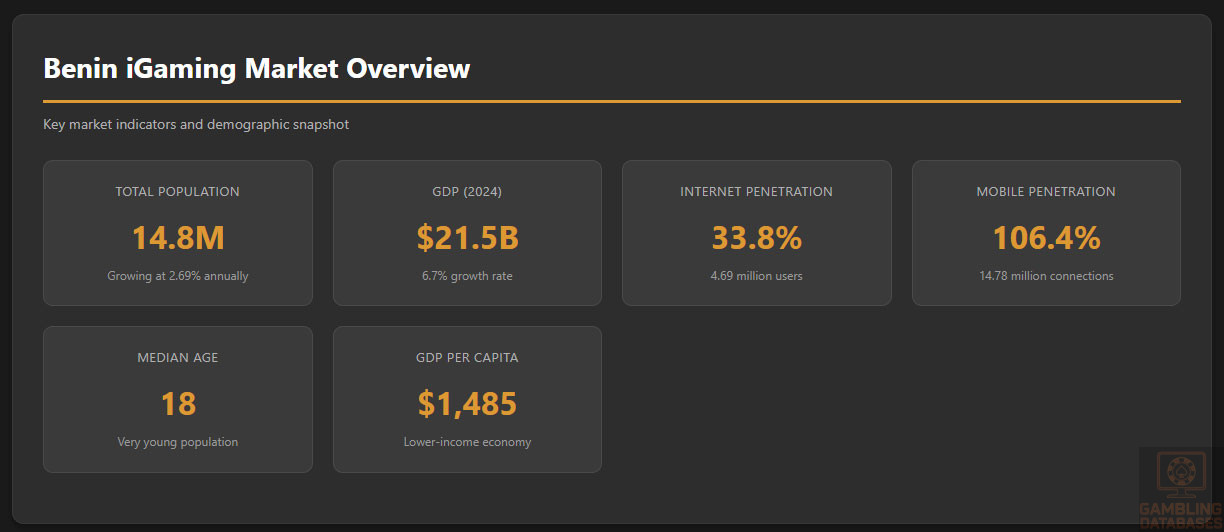
Executive Summary: Key Market Indicators
| Category | Indicator | Value |
|---|---|---|
| Legal Status | Online Gambling Legal Status | Partially regulated; land-based legal, online framework developing |
| Regulatory Body | Primary Authority | National Lottery Authority (LONAB) / Ministry of Finance |
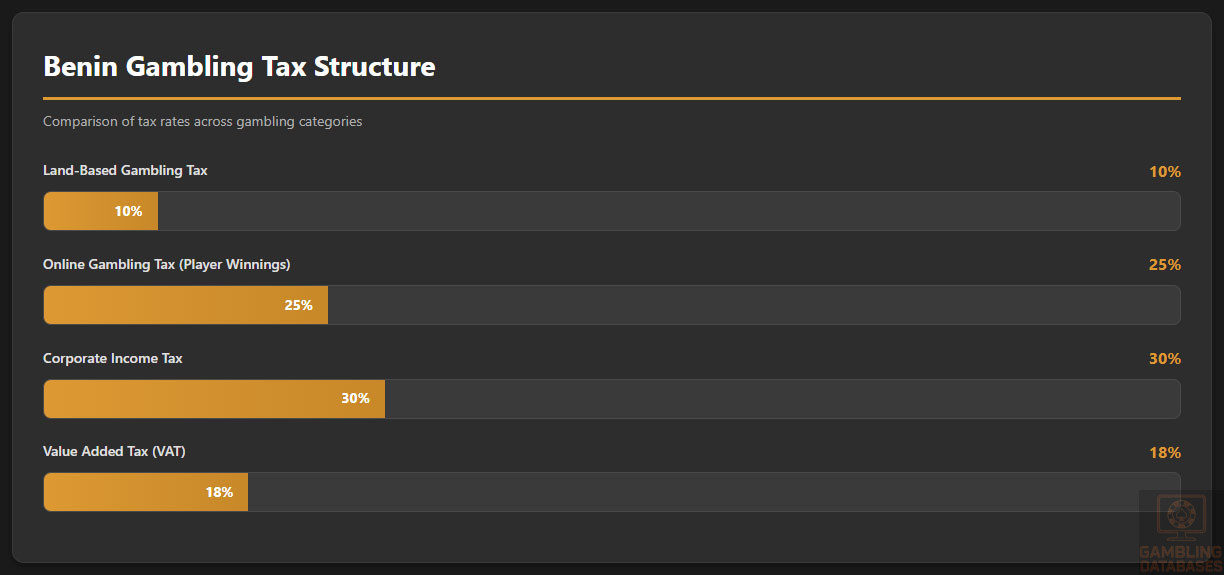
| Taxation | Land-Based Gambling Tax | 10% on turnover |
| Taxation | Online Gambling Tax | 25% on winnings |
| Demographics | Total Population (2025) | 14.8 million |
| Demographics | Median Age | 18 years |
| Demographics | Urban Population | 47.76% (7.1 million) |
| Demographics | Population Growth Rate | 2.69% annually |
| Economic Indicators | GDP (2024) | $21.5 billion |
| Economic Indicators | GDP per Capita | $1,485 USD |
| Economic Indicators | GDP Growth Rate (2024) | 6.7% |
| Economic Indicators | Inflation Rate (2024) | 1.2% |
| Technology | Internet Penetration | 33.8% (4.69 million users) |
| Technology | Mobile Penetration | 106.4% (14.78 million connections) |
| Technology | Social Media Users | 2.15 million (15.5% of population) |
| Technology | 4G Coverage | 88% of population |
| Technology | Mobile Internet Speed | 30.56 Mbps (median) |
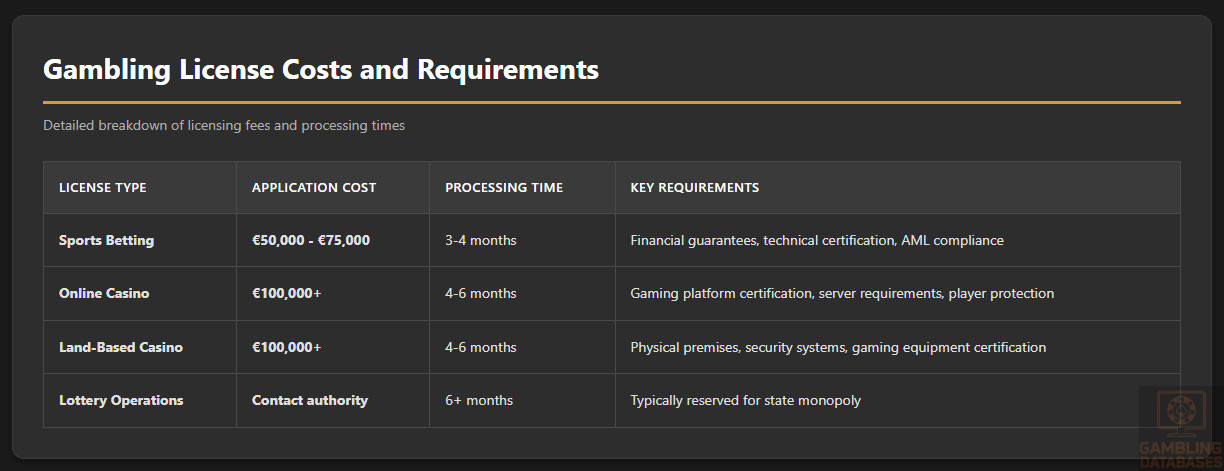
| Licensing | Sports Betting License Cost | €50,000 – €75,000 |
| Licensing | Casino License Cost | €100,000+ |
| Licensing | License Processing Time | 3-6 months |
| Market Projections | Annual Tax Revenue Target | $25 million (from gambling taxes) |
| Business Environment | Legal Gambling Age | 21 years |
| Business Environment | Currency | West African CFA Franc (XOF) |
| Business Environment | Primary Language | French (official) |
| Business Environment | Literacy Rate | 45.8% (2021) |
| Market Maturity | Online Gambling Market Stage | Emerging / Early Development |
| Competition | Licensed Land-Based Operators | Limited (few casinos, national lottery) |
| Payment Systems | Digital Payment Penetration | 37.9% (2017) |
Section 1: Regulatory Framework and Legal Environment
Current Gambling Regulation Status
Land-Based Gambling Activities
Benin has established legal frameworks for traditional gambling activities since 2002. The Gaming Act of 2002 regulates land-based gambling including casinos, lotteries, and sports betting venues. The country operates a National Lottery established in 1967 under the authority of the Loterie Nationale du Benin.
Land-based casinos operate in major cities, with the primary establishment located at the Benin Marina Hotel in Cotonou. These venues offer table games including roulette, slot machines, and video poker. The casino sector remains relatively small with limited expansion due to regulatory constraints and market size.
Sports betting is legal and has gained popularity in recent years. Both local and international bookmakers operate physical betting shops primarily in urban areas. Licensed sports betting operators accept wagers on football, basketball, tennis, and other international sporting events.

Online Gambling Framework
Online gambling in Benin exists in a regulatory gray area. The 2002 Gaming Act did not specifically address internet-based gambling as internet penetration was minimal at the time of enactment. International online gambling websites remain accessible to Beninese players without explicit legal restrictions.
The government announced plans in March 2023 to develop a digital monitoring system to better regulate and track online gambling activities. This proposed control platform aims to provide fairer treatment of operators, stimulate competition, strengthen anti-money laundering efforts, and enhance player protections.
The December 2024 Finance Law (Law No. 2024-34) represents a significant step toward formalizing online gambling regulation. By introducing specific taxation for online gambling winnings at 25%, the government acknowledged the sector’s existence and established groundwork for comprehensive regulation.
Licensed Operators and Market Players
The Beninese gambling market features limited licensed operators compared to more mature African markets. The National Lottery holds a monopoly on lottery operations and has expanded into digital channels. Several international sports betting operators have established physical presences in major cities.

The government’s regulatory modernization efforts aim to attract licensed international operators while protecting existing domestic operators. Market entry opportunities exist for operators willing to navigate evolving regulatory requirements and establish compliant local operations.
Licensing Framework and Requirements
Application Process and Eligibility
Gambling licenses in Benin are issued by the Ministry of Finance and Economic Development under oversight of the National Gambling and Lottery Regulatory Authority. The licensing process requires substantial documentation, financial guarantees, and technical certifications to demonstrate operational capability.
Applicants must submit comprehensive business plans detailing operational structures, responsible gambling measures, anti-money laundering procedures, and technical infrastructure. Background checks are conducted on all beneficial owners, directors, and key personnel to ensure suitability and prevent criminal involvement.
The application process typically takes 3-6 months depending on application completeness and gambling activity type. Sports betting licenses generally process faster than full casino licenses which require more extensive review of gaming systems and financial adequacy.
| License Type | Application Cost | Processing Time | Key Requirements |
|---|---|---|---|
| Sports Betting | €50,000 – €75,000 | 3-4 months | Financial guarantees, technical certification, AML compliance |
| Online Casino | €100,000+ | 4-6 months | Gaming platform certification, server requirements, player protection systems |
| Land-Based Casino | €100,000+ | 4-6 months | Physical premises, security systems, gaming equipment certification |
| Lottery Operations | Contact authority | 6+ months | Typically reserved for state monopoly |
Local Presence and Operational Requirements
Operators seeking licenses must demonstrate commitment to the Beninese market through local presence requirements. Specific requirements for physical office space, local staff employment, and operational infrastructure vary by license type but generally favor operators establishing substantive local operations.
The regulatory framework is expected to evolve with the planned digital monitoring system implementation. Future requirements may include mandatory server hosting within Benin or the West African Economic and Monetary Union region, local domain registration, and enhanced local partnership obligations.
Foreign ownership is generally permitted though the government may introduce preference mechanisms for local partnerships. Operators should anticipate requirements for local directors, designated compliance officers based in Benin, and minimum local staffing levels particularly for customer-facing operations.
Compliance Obligations and Monitoring
Player Protection and Identification
The legal gambling age in Benin is 21 years for all forms of gambling. Operators must implement strict age verification processes to prevent minors from accessing gambling services. Acceptable verification methods include national identity cards, passports, and voter registration documents.
Know Your Customer and Anti-Money Laundering compliance standards follow international best practices. Operators must collect and verify customer identity information, monitor transactions for suspicious activity, and report unusual patterns to authorities. The planned digital monitoring system will enhance regulatory oversight capabilities.
Responsible gambling measures are increasingly emphasized though not yet comprehensively mandated. Operators are encouraged to provide self-exclusion options, deposit limits, session time reminders, and problem gambling resources. Future regulations will likely formalize these requirements as player protection priorities increase.
Financial Monitoring and Reporting
Licensed operators face ongoing financial monitoring and reporting obligations. Transaction monitoring systems must track player deposits, withdrawals, and betting patterns to detect money laundering and ensure tax compliance. The digital monitoring platform under development will automate much of this oversight.
Reporting schedules vary by license type but typically include monthly revenue declarations, quarterly financial statements, and annual comprehensive audits. The National Lottery Authority and Ministry of Finance coordinate oversight activities with inspections conducted periodically to verify compliance.
Data retention requirements mandate operators maintain detailed records of all transactions, player communications, and operational activities for minimum periods typically ranging from 5-7 years. These records must be readily accessible for regulatory inspections and investigations.
Taxation Structure and Financial Obligations
Player Taxation
The 2025 Finance Law introduced significant changes to gambling taxation affecting both operators and players. Online gambling winnings now face a 25% withholding tax, representing one of the higher player taxation rates in West Africa and potentially impacting player attractiveness of licensed operators.
Land-based gambling winnings taxation follows similar principles though specific thresholds and rates may vary. Players receiving winnings above certain amounts face withholding obligations at the point of payout. Operators are responsible for calculating, withholding, and remitting player taxes to authorities.
Tax-free thresholds for small winnings may exist though specific amounts are not publicly detailed in available regulations. Players should maintain records of gambling activities for potential tax declaration requirements though enforcement of individual player tax obligations remains limited.
Operator Taxation
| Tax Type | Rate | Tax Base | Payment Frequency |
|---|---|---|---|
| Land-Based Gambling Tax | 10% | Turnover/Wagering | Monthly |
| Online Gambling Tax | 25% | Player Winnings | Monthly |
| Corporate Income Tax | 30% | Net Profits | Annual |
| License Renewal Fee | Varies | Annual fixed amount | Annually |
The 10% tax on land-based gambling applies to gross turnover, creating moderate tax burden compared to some African jurisdictions taxing Gross Gaming Revenue. Online gambling’s 25% tax on winnings effectively functions as a player-facing tax that operators must withhold and remit.
Corporate income tax at standard rates applies to gambling operators’ net profits after gambling-specific taxes. Value Added Tax applicability to gambling services varies by jurisdiction interpretation and service type. Operators should obtain specific tax rulings from Beninese authorities.
License renewal fees provide additional ongoing revenue obligations. Annual fees vary by license type and operator size though specific schedules have not been publicly detailed. Operators should budget for renewal costs equivalent to 10-25% of initial license fees.
Gambling Market Financial Performance
Comprehensive gambling market financial data for Benin remains limited due to the sector’s early development stage and historical lack of comprehensive regulation. The government projects gambling taxation will generate approximately $25 million annually under the new 2025 tax regime.
This revenue target suggests total gambling turnover in the tens of millions of dollars range, though exact Gross Gaming Revenue figures are not publicly available. The land-based sector historically dominated gambling activity with lottery ticket sales and limited casino operations forming the core market.
Online gambling market size remains largely unmeasured as most activity occurs through international unlicensed operators. The introduction of formal taxation and planned regulatory framework aims to capture this revenue stream and bring offshore operations under local oversight.
Advertising and Marketing Restrictions
Gambling advertising regulations in Benin remain underdeveloped compared to mature markets. Current frameworks do not impose extensive restrictions on advertising channels, content, or promotional activities though this may change as online gambling regulation formalizes.
Operators generally can advertise through television, radio, online channels, outdoor billboards, and print media. Content restrictions prohibit marketing to minors, misleading claims about winning probabilities, and promotion of gambling as income source. Responsible gambling messaging requirements may be introduced.
Sponsorship of sports teams, events, and cultural activities is permitted and represents effective market entry strategy in Benin. Popular football clubs and local sporting events provide visibility opportunities. Affiliate marketing operates without specific regulations though this will likely change.
Time restrictions on broadcast advertising and prohibition on advertising near schools or religious institutions may be implemented as regulations mature. Operators should anticipate increased scrutiny of bonus offers, wagering requirements, and promotional terms as player protection emphasis grows.
Recent Regulatory Changes and Their Impact
The December 2024 enactment of Law No. 2024-34 (Finance Law 2025) represents the most significant regulatory development in Benin’s gambling sector. This legislation introduced the first comprehensive taxation framework for both land-based and online gambling, marking Benin’s formal recognition of digital gambling.
The 10% levy on land-based casino turnover and 25% tax on online gambling winnings took effect January 1, 2025. These rates position Benin in the mid-to-high range for African gambling taxation, potentially impacting operator margins and market competitiveness versus unlicensed offshore alternatives.
In March 2023, the government announced development of a digital monitoring system to enhance regulatory oversight. This platform will track gambling activities in real-time, verify tax compliance, block illegal operators, and strengthen player protections including age verification and responsible gambling controls.
The Gaming Sector Supervisory Unit (Cellule de Supervision du Secteur des Jeux, CSJ) has increased collaboration with regional partners to modernize regulation. A November 2024 exchange with Liberia’s National Lottery Authority focused on best practices for security, compliance, and integrity in evolving gaming markets.
Enforcement Mechanisms and Penalties
Enforcement of gambling regulations in Benin faces significant challenges particularly regarding unlicensed online operators. The National Lottery Authority holds responsibility for compliance oversight but resource constraints limit effectiveness against sophisticated international operators.
The rise of unlicensed gambling venues operating without tax payments and often offering larger payouts undermines legal operators and complicates regulatory efforts. Experts call for stricter laws and increased enforcement resources to establish fair competitive environment.
Penalty structures for non-compliance include fines, license suspension, and license revocation. Criminal penalties may apply for operating without licenses or facilitating money laundering. The planned digital monitoring system will enhance enforcement capabilities through ISP blocking of unlicensed websites.
Payment processor restrictions represent another enforcement tool. Blocking financial transactions to unlicensed operators can effectively limit their market access. Implementation of comprehensive payment monitoring through the digital platform will strengthen this enforcement approach.
Section 2: Demographics and Consumer Analysis
Population Demographics and Distribution
Core Population Metrics
| Age Group | Percentage | Population (millions) |
|---|---|---|
| 0-14 years | 42.5% | 6.3 |
| 15-24 years | 19.8% | 2.9 |
| 25-34 years | 16.2% | 2.4 |
| 35-44 years | 10.5% | 1.6 |
| 45-54 years | 6.3% | 0.9 |
| 55-64 years | 3.1% | 0.5 |
| 65+ years | 1.6% | 0.2 |
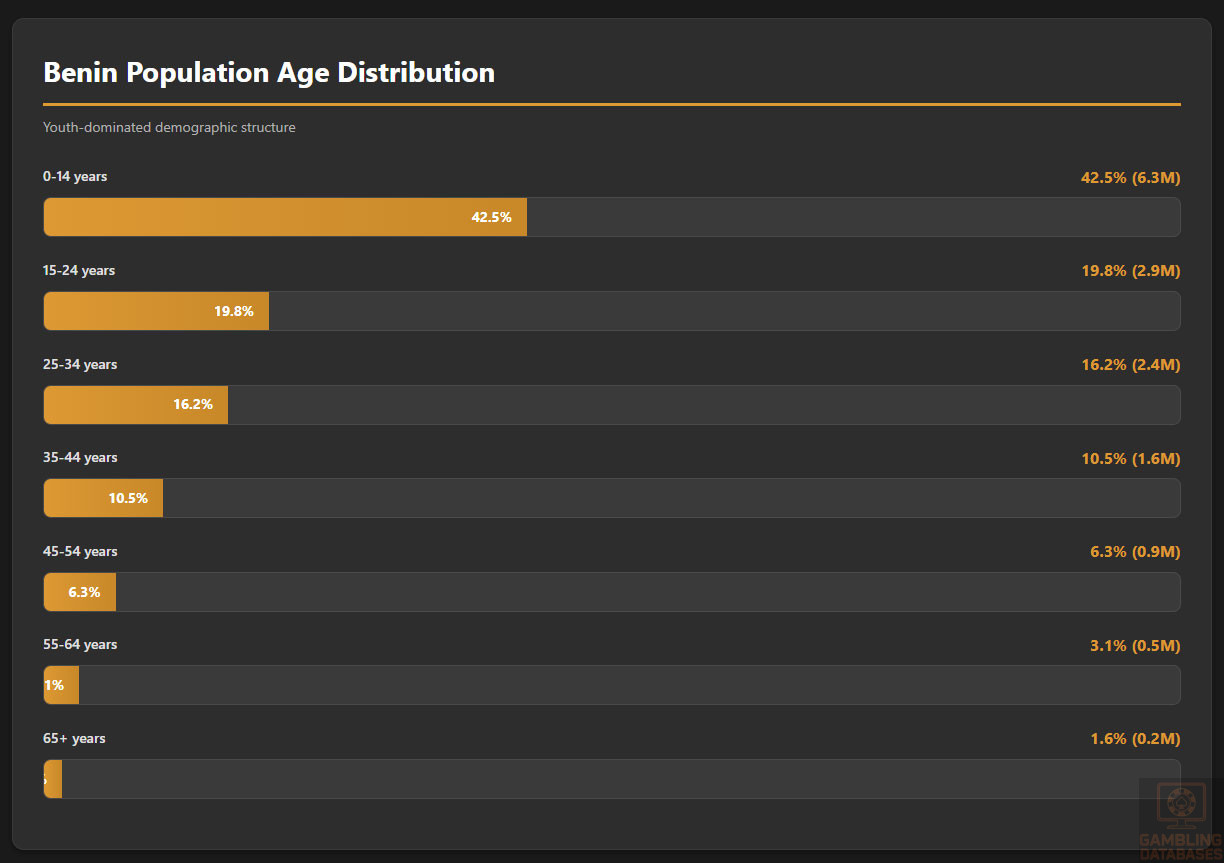
Benin’s population reached 14.8 million in 2025 with robust annual growth of 2.69%. The extremely young demographic profile shows a median age of just 18 years, creating a pyramid-shaped age distribution characteristic of developing nations with high fertility rates.
The youth-dominated population structure presents both opportunities and challenges for iGaming operators. While 42.5% of the population remains under legal gambling age of 21, the large 15-34 age cohort of 5.3 million represents the core target demographic for digital gambling services.
Gender distribution shows relative balance with 974 males per 1,000 females. Life expectancy averages 61.2 years though this is improving with healthcare access expansion. The high dependency ratio of 90.1% means each working person must support themselves plus nearly one dependent.
Geographic Distribution
Urbanization reached 47.76% in 2025 with 7.1 million people living in cities. Urban population concentration facilitates internet infrastructure deployment and creates density for land-based gambling venues. The largest city Cotonou serves as the economic hub and primary market for gambling operations.
Major urban centers include Cotonou (largest city), Porto-Novo (capital), Parakou, Djougou, and Bohicon. These cities account for the majority of internet users, mobile banking adoption, and disposable income necessary for gambling participation. Rural areas lag significantly in connectivity and economic development.
Regional economic differences are pronounced with southern coastal regions significantly wealthier than northern areas. Internet access geographic patterns closely mirror economic development with urban southern regions showing penetration rates approaching developed markets while rural north remains largely offline.
Economic Indicators and Consumer Spending Power
GDP and Economic Performance
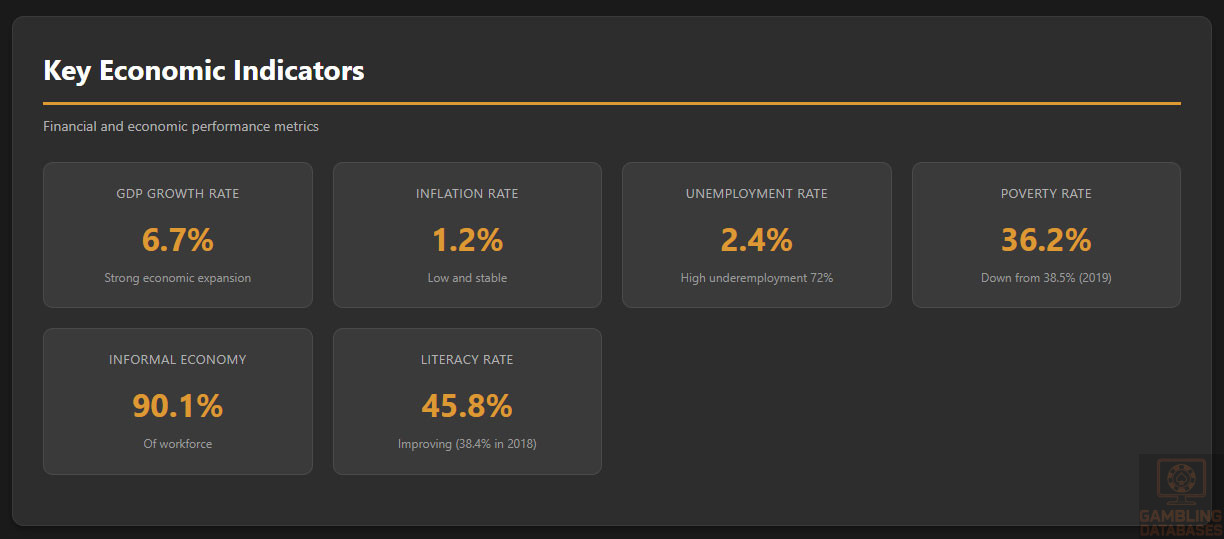
Benin’s economy demonstrated strong resilience with 6.7% GDP growth in 2024, up from 6.4% in 2023. Total GDP reached $21.5 billion positioning Benin as a small but growing West African economy. Per capita GDP of $1,485 USD places the country among lower-income nations globally.
Economic growth is projected to stabilize at 6.2% annually between 2024-2026, averaging 3.5% per capita growth. Growth drivers include the Glo-Djigbé Industrial Zone expansion, agricultural sector performance, and services sector resilience. The economy recovered strongly from COVID-19 impacts.
Inflation moderated significantly to 1.2% in 2024 from 2.8% in 2023, driven by lower energy and transport costs. Price stability enhances consumer purchasing power and creates favorable environment for discretionary spending including entertainment and gambling activities.
| Indicator | Value | Notes |
|---|---|---|
| GDP (2024) | $21.5 billion | 7.5% growth |
| GDP per Capita | $1,485 USD | 10% of world average |
| Agriculture % of GDP | ~25% | Cotton dominant export |
| Services % of GDP | ~52% | Growing sector |
| Industry % of GDP | ~23% | Light manufacturing |
| Unemployment Rate | 2.4% | High underemployment 72% |
| Informal Economy | 90.1% | Of workforce |
| National Poverty Rate | 36.2% | Down from 38.5% in 2019 |
Income and Wealth Distribution
Average household income remains modest with significant inequality. The informal economy dominates employment at 90.1% of the workforce, limiting formal income documentation and tax revenue collection. Cotton accounts for 40% of GDP and 80% of official exports, creating economic vulnerability to commodity price fluctuations.
Disposable income for gambling activities concentrates among urban middle-class and affluent populations. The poverty rate of 36.2% means a substantial portion of the population focuses on basic needs rather than discretionary entertainment spending. However, poverty has declined from 38.5% in 2018-2019.
The emerging middle class represents the key target demographic for iGaming operators. While small compared to total population, this segment shows growing disposable income, technology adoption, and openness to modern entertainment options including online gambling.
Market Size and Growth Projections
Benin’s iGaming market remains in early development with limited comprehensive revenue data. The government’s $25 million annual tax revenue target from gambling suggests gross wagering in the range of $100-250 million depending on tax calculation methodologies and compliance rates.
Historical market growth is difficult to quantify due to lack of regulation and data collection for online activities. Most online gambling occurs through unlicensed international operators making revenue estimation challenging. The introduction of formal regulation and taxation aims to capture and measure this activity.
Growth projections are highly speculative but favorable demographics, increasing internet penetration, and smartphone adoption suggest strong potential. Conservative estimates project market growth of 15-25% annually over the next 3-5 years as regulation formalizes and licensed operators enter.
The market split between online and land-based gambling heavily favors land-based activities currently due to limited internet access and regulatory uncertainty. As digital infrastructure improves and online regulation clarifies, the split will likely shift toward online channels matching regional trends.
Education, Skills, and Digital Literacy
Educational Foundation
Literacy rates in Benin remain low at 45.8% as of 2021, up from 38.4% in 2018. This represents significant improvement but still falls below the sub-Saharan African average of 65.4% and least developed countries average of 62.7%.
Education completion rates show concerning patterns with many children not completing primary education. Secondary and tertiary education access remains limited particularly for rural populations and girls. The government has prioritized education investment including digital skills initiatives.
French serves as the official language and medium of education though many ethnic languages are spoken locally. English language proficiency is limited, presenting challenges for international operators but opportunities for French-language focused market entry strategies.
Cultural and Social Factors
Communication and Language
French dominates official communications, business, and education as Benin’s colonial language. However, local languages including Fon, Yoruba, Bariba, and Dendi are widely spoken in daily life. Gambling operators must provide French-language services at minimum with local language support enhancing accessibility.
Internet language preferences overwhelmingly favor French for formal content though social media shows mixing of French and local languages. International operators entering the market should prioritize French localization for all customer-facing materials, support channels, and regulatory communications.
Mobile communication dominates with SMS, WhatsApp, and voice calls serving as primary contact methods. Customer support strategies should emphasize mobile-friendly channels including click-to-call, WhatsApp support, and SMS notifications rather than email-heavy approaches.
Cultural Attitudes
Gambling acceptance in Beninese society is mixed with traditional lottery participation widely accepted while casino gambling carries more stigma. Religious influences vary with Christianity (48.5% of population), Islam (27.7%), and traditional Vodun religion (11.6%) all present and shaping attitudes.
Islamic communities generally oppose gambling on religious grounds though enforcement of prohibitions varies. Christian denominations show mixed attitudes with some viewing gambling as harmless entertainment and others condemning it. Traditional religions often incorporate elements of chance and divination.
Foreign brand perception in Benin is generally positive with international products and services associated with quality and modernity. However, trust must be earned through consistent service, secure payment processing, and transparent operations. Local partnerships can accelerate trust building.
Risk tolerance indicators suggest cautious approach to major financial decisions but willingness to participate in lottery-style gambling with small stakes. The popularity of lottery products reflects preference for low-cost participation with life-changing jackpot potential versus consistent small-stake betting.
Problem Gambling and Social Considerations
Comprehensive data on gambling addiction prevalence in Benin is lacking due to limited research and historical lack of regulatory focus on problem gambling. As gambling regulation evolves, social impact assessment and player protection will likely increase in priority.
Government response measures focus primarily on taxation and revenue generation currently. The planned digital monitoring system includes player protection objectives such as preventing underage gambling and promoting responsible gambling, though specific programs and treatment facilities remain underdeveloped.
Operators entering the market should proactively implement responsible gambling tools including deposit limits, self-exclusion options, and reality checks. Mandatory contributions to problem gambling funds may be introduced as regulations mature following patterns in more developed markets.
Social responsibility requirements for operators will likely expand as the regulatory framework develops. Proactive commitment to player protection can provide competitive advantages and position operators favorably with regulators while emerging regulations are established.
Political Structure and Governance
Benin operates as a democratic republic with President Patrice Talon elected in 2016 and re-elected in subsequent elections. The January 2023 legislative elections saw government-supporting parties win 81 of 109 National Assembly seats with main opposition party Les Démocrates holding 28 seats.
Political stability has improved significantly since the transition to democratic government in 1990. The regulatory environment shows increasing consistency though bureaucratic processes can be slow. The government prioritizes economic development and revenue generation supporting business-friendly reforms.
Corruption perception remains a concern though improvement efforts are ongoing. Operators should expect some bureaucratic challenges and ensure compliance with anti-bribery regulations in all interactions with government officials. Transparency in licensing processes varies by ministry and regulatory body.
International relations with neighboring Nigeria significantly impact business environment due to border trade dynamics. Benin is a member of the West African Economic and Monetary Union and Economic Community of West African States, facilitating regional economic integration.
Technology Adoption and Digital Behavior
Internet and Digital Usage
| Metric | Value | Growth/Comparison |
|---|---|---|
| Internet Users | 4.69 million | +2.7% YoY (123,000 users) |
| Internet Penetration | 33.8% | Below SSA average 39.3% |
| Offline Population | 9.20 million (66.2%) | Significant growth opportunity |
| Mobile Connections | 14.78 million | 106.4% of population |
| Mobile Internet Users | 11.7 million subscriptions | 64.25% adoption rate |
| Unique Mobile Internet Users | ~7 million (55.4%) | After multi-SIM adjustment |
| Regular Mobile Internet Users | 3.8 million (28%) | 48% of adults |
| 3G/4G Coverage | 90% of population | Above West Africa 77% average |
| 4G Coverage | 88% of population | Up from 62% three years prior |
| Social Media Users | 2.15 million | 15.5% penetration |
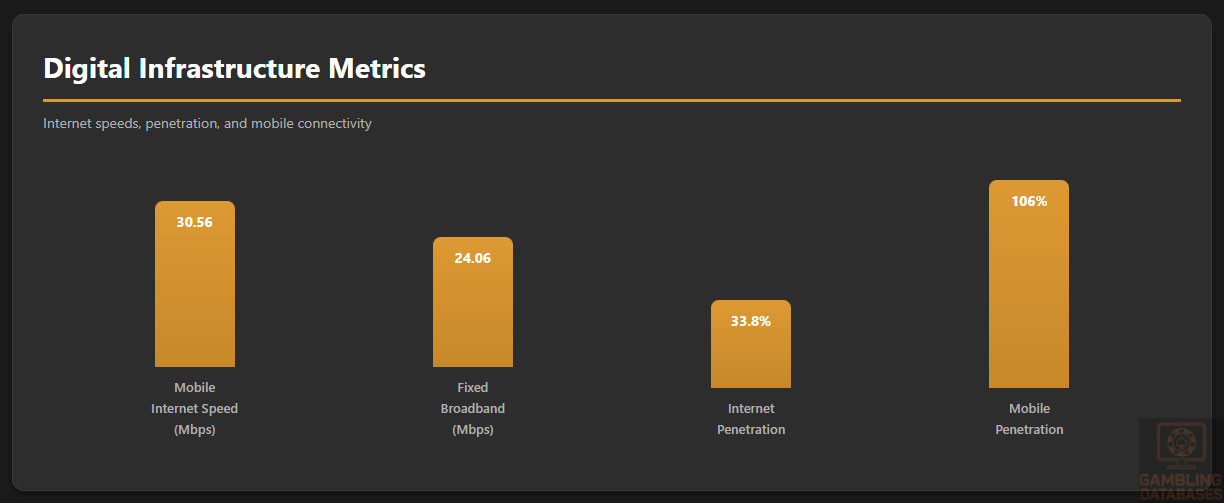
Internet penetration of 33.8% positions Benin below regional averages but shows steady growth. The gap between network coverage and actual usage represents significant opportunity. While 90% of the population has access to high-speed mobile networks, only 55.4% are unique internet users.
Daily internet usage hours and detailed behavior patterns are not comprehensively documented. However, mobile devices dominate internet access with smartphones serving as primary or only internet-enabled devices for most users. Desktop and laptop penetration remains extremely low outside business environments.
Social media engagement focuses primarily on Facebook and WhatsApp with Instagram and TikTok growing among younger urban users. X (formerly Twitter) shows minimal penetration. Social media usage concentrates in the 15-34 age demographic with engagement rates declining sharply in older populations.
E-commerce participation remains limited but growing. Only a small percentage of internet users regularly purchase goods or services online due to payment infrastructure limitations, trust concerns, and preference for physical inspection of goods before purchase.
Digital Payment Behavior
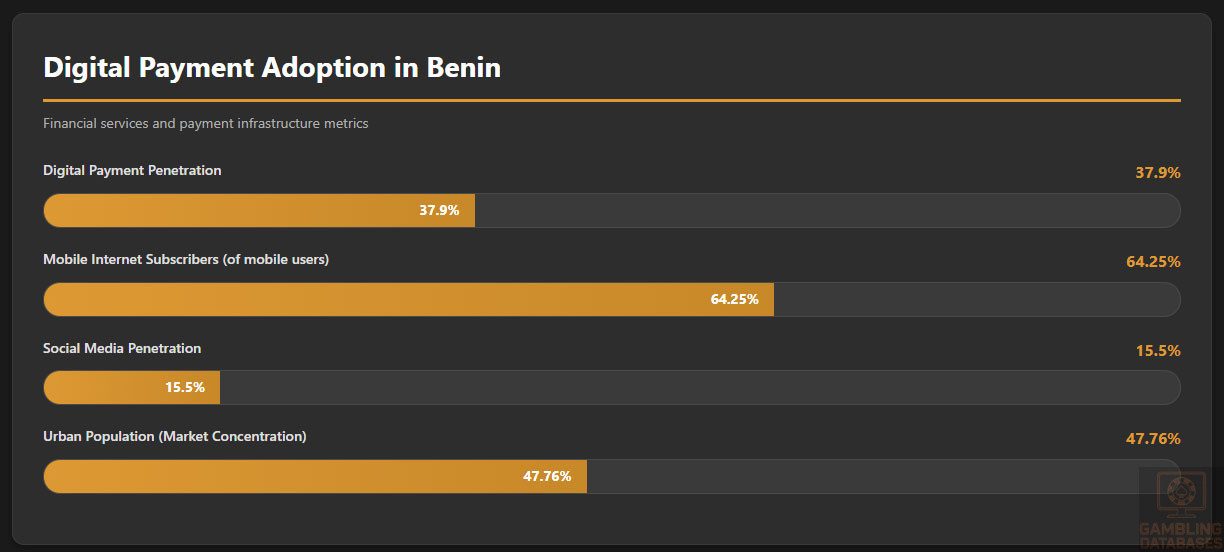
Digital payment adoption reached 37.9% in 2017, above the sub-Saharan Africa average of 34.2%. Mobile money services through MTN Mobile Money and other providers dominate digital payments due to low bank account penetration and mobile network ubiquity.
Payment method preferences strongly favor mobile money for small-value transactions with bank transfers used for larger amounts. Credit card penetration is minimal with most cards being debit cards linked to bank accounts. International payment methods like PayPal have limited adoption.
Online banking penetration lags behind mobile money with banks focused on serving businesses and higher-income individuals. The unbanked and underbanked populations rely heavily on mobile money, cash, and informal financial services for daily transactions.
Cryptocurrency adoption for gambling remains negligible in Benin. Regulatory clarity on cryptocurrency is limited and most consumers lack understanding of digital assets. Mobile money and bank transfers will dominate gambling payment methods for the foreseeable future.
Gaming and Gambling Preferences
Current Market Participation
Comprehensive data on gambling participation rates in Benin is not publicly available due to the market’s early development stage. Lottery participation is widely accepted with the National Lottery selling tickets through physical retail networks reaching rural and urban areas.
Sports betting has grown significantly in recent years particularly among young urban males. Football dominates betting interest with major European leagues, African competitions, and local matches attracting wagers. Basketball and tennis generate secondary interest.
Online gambling participation occurs primarily through unlicensed international operators. Players access offshore sports betting sites and online casinos despite lack of local regulation. Payment processing through international methods or cryptocurrency enables this cross-border activity.
Casino games show limited traction in the mass market with physical casinos serving primarily tourists and affluent locals. Online casino games may find broader appeal if marketed effectively to younger digital-native demographics with appropriate low minimum stakes.
Consumer Behavior Patterns
Average spending per player data is unavailable for Benin specifically. However, low GDP per capita and income levels suggest very modest average stakes compared to developed markets. Successful operators will need to accommodate micro-transactions and low minimum deposits.
Mobile device usage for gambling will dominate due to smartphone penetration far exceeding desktop/laptop availability. Platform preferences strongly favor mobile-optimized websites and dedicated mobile applications. Desktop gambling will remain niche among office workers and internet café users.
Peak gambling times likely align with major sporting events, evening hours after work, and weekends. Football match scheduling significantly influences sports betting activity. Lottery ticket sales spike around major draws and when jackpots grow large.
Retention and loyalty patterns in emerging markets typically show higher churn rates than mature markets. Players often maintain accounts with multiple operators and chase bonuses. Building loyalty requires competitive promotions, reliable payment processing, and excellent mobile experience.
Section 3: Technology Infrastructure and Business Environment
Internet and Digital Infrastructure
Connectivity and Network Performance
| Metric | Value | Global Ranking/Notes |
|---|---|---|
| Fixed Broadband Download Speed | 24.06 Mbps (median) | Ranked 133rd globally |
| Fixed Broadband Upload Speed | 9.7 Mbps | Ranked 140th globally |
| Mobile Internet Speed | 30.56 Mbps (median) | Faster than fixed broadband |
| Fixed Broadband Penetration | ~0% | Negligible household adoption |
| Fixed Broadband Growth (2023-2024) | +65.4% speed increase | +9.51 Mbps improvement |
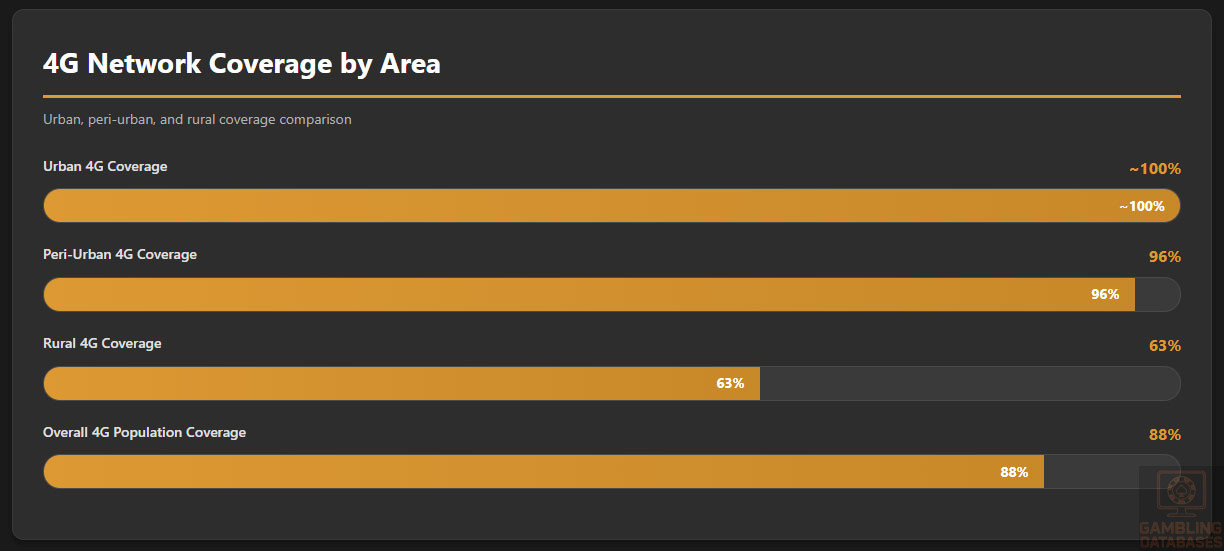
| Urban 4G Coverage | Nearly 100% | Universal in cities |
| Peri-Urban 4G Coverage | 96% | Strong suburban coverage |
| Rural 4G Coverage | 63% | Improving but gaps remain |
Internet infrastructure in Benin shows significant urban-rural divide. Cities enjoy nearly universal 4G coverage with reliable mobile internet while rural areas lag with 63% coverage and lower speeds. This geographic disparity concentrates gambling market opportunity in urban centers.
Mobile internet outperforms fixed broadband in both speed and accessibility. The 30.56 Mbps median mobile speed exceeds fixed broadband’s 24.06 Mbps, reinforcing mobile-first strategy necessity. Fixed broadband remains essentially non-existent for consumers outside business and institutional users.
Network reliability has improved with major infrastructure investments by mobile operators. Uptime statistics are not comprehensively published but anecdotal reports suggest increasing stability particularly in major cities. Rural areas experience more frequent outages and coverage gaps.
The government launched a national fiber optic backbone network project in 2020 with World Bank and African Development Bank support. This infrastructure aims to improve broadband connectivity and reduce costs, though benefits will take years to fully materialize for end consumers.
5G and Future Technology Deployment
5G networks are not yet deployed in Benin as of 2024. The country focuses on expanding and optimizing 4G coverage which grew dramatically from 62% to 88% population coverage in just three years. This represents appropriate prioritization given the large offline population.
4G coverage expansion continues as the primary network development focus. The 90% population coverage for 3G/4G combined exceeds West Africa’s 77% average, positioning Benin relatively well for a lower-income country. However, the usage gap between coverage and actual adoption requires addressing.
Future infrastructure plans emphasize increasing internet affordability and device accessibility rather than advanced network technologies. The government recognizes that high data costs and smartphone prices represent primary barriers to internet adoption more than network availability.
Mobile Technology Ecosystem
Mobile Network Infrastructure
Benin’s mobile market features multiple operators with MTN holding market leadership. Moov ranks as the second-largest operator with BBCom and Benin Telecoms also active. Competition among operators has driven coverage expansion and price competition benefiting consumers.
Network operator market share data is not comprehensively published but MTN’s dominance is widely recognized. All major operators offer mobile money services integrated with their networks, creating payment infrastructure essential for gambling transactions.
Data costs remain significant barrier to internet adoption despite declining prices. The average monthly budget for mobile phone service was $11.20 in 2024. For a population with GDP per capita of $1,485, this represents substantial portion of income limiting discretionary data usage.
Mobile payment integration through operator-owned mobile money services is excellent. MTN Mobile Money penetration is particularly high. Gambling operators can integrate directly with these services for deposits and withdrawals, providing familiar payment methods to users.
Device Penetration
Smartphone adoption rates continue growing though exact penetration figures vary by source. The 14.78 million mobile connections against 7 million unique internet users suggests substantial smartphone penetration among internet users. However, basic feature phones remain common particularly in rural areas.
Device preferences favor budget Android smartphones from Chinese manufacturers including Tecno, Infinix, Itel, and Samsung. These brands offer affordable smartphones priced for emerging market consumers. Apple iOS devices remain luxury items with minimal market share.
Android dominates the smartphone market with estimates suggesting 85%+ share. This concentration simplifies mobile app development priorities. iOS app development can be deprioritized initially with Android-first or Android-only approaches appropriate for market entry.
Average device specifications skew toward entry-level with limited RAM, storage, and processing power. Gambling platforms must be optimized for low-end devices with efficient data usage, small app sizes, and minimal hardware requirements to maximize addressable market.
Financial Services and Payment Infrastructure
Banking System Structure
Benin’s banking sector underwent consolidation and privatization in the 1990s creating a shallow but functional financial system. Major banks include international institutions and regional West African banks with limited indigenous banks. The sector serves primarily businesses and higher-income individuals.
Account penetration rates remain low with majority of population unbanked. Exact figures are not current but estimates suggest less than 30% of adults hold formal bank accounts. This low bankarization creates both challenge and opportunity for gambling operators.
Digital banking adoption among account holders is growing with mobile banking apps and internet banking available from major banks. However, usage concentrates among urban professionals and businesses. Mobile money far exceeds bank-based digital payments in transaction volume.
No customer deposit insurance system exists, potentially contributing to limited trust in banking sector. The lack of deposit protection emphasizes importance of bank selection and diversification for operators managing large float balances.
Payment Processing Options
| Payment Method | Availability | Penetration | Suitability for iGaming |
|---|---|---|---|
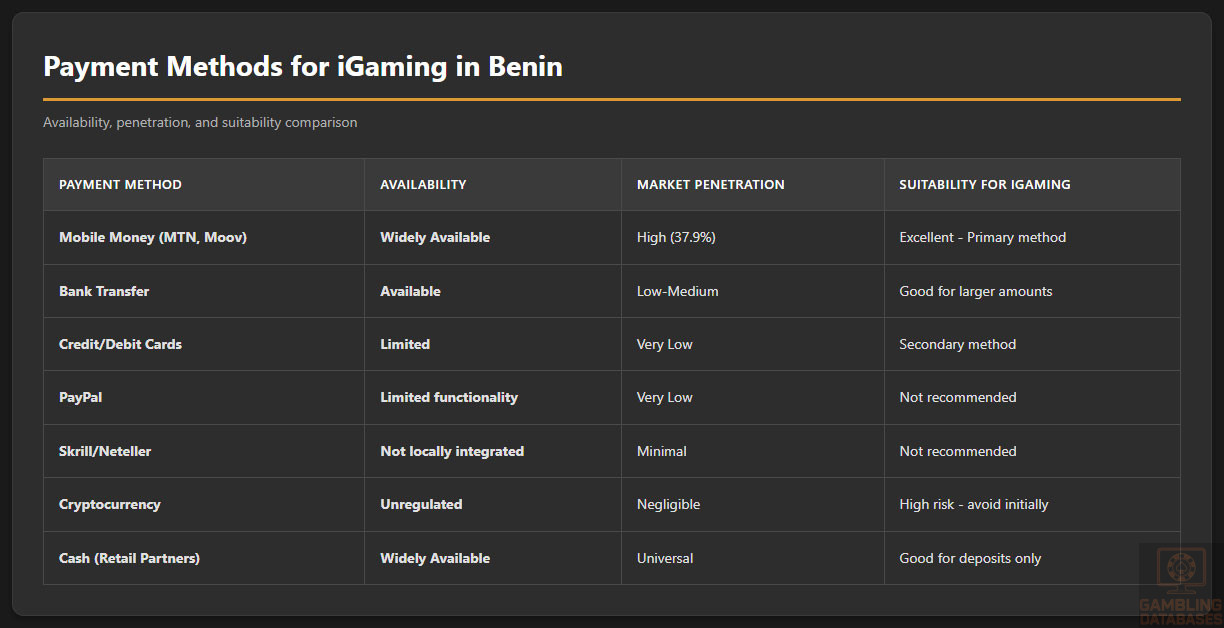
| Mobile Money (MTN, Moov) | Widely available | High (37.9% digital payment adoption) | Excellent – Primary method |
| Bank Transfer | Available | Low-Medium (limited bank accounts) | Good for larger amounts |
| Credit/Debit Cards | Limited | Very Low | Secondary method |
| PayPal | Limited functionality | Very Low | Not recommended |
| Skrill/Neteller | Not locally integrated | Minimal | Not recommended |
| Cryptocurrency | Unregulated | Negligible | High risk – avoid initially |
| Cash (Retail Partners) | Widely available | Universal | Good for deposits only |
Mobile money represents the essential payment method for gambling operators in Benin. Integration with MTN Mobile Money and Moov Money enables serving the majority of potential customers including unbanked populations. These services offer instant deposits and fast withdrawals familiar to users.
Bank transfers serve as secondary payment method for customers with bank accounts and larger transaction amounts. SWIFT and regional WAEMU transfer systems function adequately though processing times can be slow. Real-time transfers within Benin through domestic payment systems exist but adoption is limited.
International payment processors like PayPal, Skrill, and Neteller have minimal penetration in Benin and should not be prioritized for market entry. These services face regulatory restrictions and limited local currency support making them impractical for mass market.
Processing fees vary by method with mobile money typically charging 1-5% depending on transaction size. Bank transfers carry fixed fees making them more economical for larger amounts. Operators should absorb deposit fees while potentially passing withdrawal fees to customers following local market norms.
E-commerce and Digital Economy
Digital Market Development
E-commerce market size in Benin remains small but growing. The UNCTAD B2C E-commerce Index ranked Benin 100th of 152 countries in 2019, up from 108th in 2018. The score of 36.6 out of 100 indicates significant development needs in internet use, secure servers, payments, and postal reliability.
Online retail penetration as percentage of total retail is minimal with most commerce occurring through physical channels. Trust in online transactions is gradually building but cash-on-delivery and physical inspection preferences dominate consumer behavior.
Popular e-commerce platforms are primarily international services including Jumia Africa and informal Facebook/WhatsApp-based commerce. Local e-commerce platforms exist but lack scale. Cross-border online shopping from China through platforms like AliExpress shows growing adoption.
Digital goods and services consumption focuses on mobile airtime, data bundles, mobile money transfers, and increasingly music/video streaming. These micro-transaction models trained consumers on digital payments creating foundation for gambling transactions.
Business Environment and Regulatory Framework
Ease of Business Operations
The World Bank discontinued its Doing Business report in 2021 following data integrity concerns. The last published rankings showed Benin in moderate positions for business environment though specific scores are outdated and should not be relied upon for current decision-making.
The replacement Business Ready (B-READY) framework launched in October 2024 but does not yet cover Benin comprehensively. Anecdotal evidence suggests business registration processes are improving with online systems reducing bureaucratic barriers though implementation remains inconsistent.
Foreign investment policies are generally welcoming with the government seeking to attract capital and expertise. Special economic zones including the Glo-Djigbé Industrial Zone offer incentives though applicability to gambling operations is unclear. Investors should clarify incentive eligibility early in planning.
Operational cost structures vary significantly between urban and rural areas. Office rent in Cotonou is moderate by regional standards while utilities including electricity can be unreliable requiring backup generators. Labor costs are relatively low though skilled technical talent is limited.
Corporate Structure and Registration
Available Entity Types
| Entity Type | Minimum Capital | Liability | Suitability for iGaming |
|---|---|---|---|
| SARL (LLC) | 1 million XOF (~$1,650) | Limited | Suitable for local operations |
| SA (Corporation) | 10 million XOF (~$16,500) | Limited | Preferred for larger operations |
| Branch Office | Varies | Parent company liable | Possible but less common |
| Representative Office | N/A | Parent company liable | Not suitable for operations |
Limited liability companies (SARL) suit small to medium operations with minimum capital of approximately $1,650. Corporations (SA) require higher minimum capital around $16,500 but provide structure appropriate for regulated gambling operations attracting investor capital.
Most foreign gambling operators should establish SA corporations to demonstrate substance and commitment to regulators. The higher capitalization requirement is modest relative to gambling license costs and signals serious market entry intent versus minimal compliance approaches.
Registration Requirements
Business registration timelines have improved with online systems reducing delays. Registration can be completed in 2-4 weeks for standard entity types though gambling-specific approvals add months to overall market entry timeline. The UNCTAD noted assistance helping Benin move registration online during COVID-19.
Registration costs include government fees, legal fees, and notarization charges totaling approximately $500-2,000 for standard entities. Gambling operations should budget significantly higher for specialized legal counsel to navigate licensing requirements and regulatory compliance.
Required documents include articles of incorporation, shareholder information, beneficial ownership declarations, registered office address proof, and director identification. Notarization requirements add time and cost. All documents must be in French or officially translated.
Foreign ownership is generally permitted at 100% though gambling regulations may impose local partnership requirements. Operators should clarify ownership restrictions during licensing discussions. Local directors may be required with at least one director resident in Benin.
Taxation Framework
Corporate Income Tax Structure
| Tax Type | Rate | Application |
|---|---|---|
| Corporate Income Tax | 30% | On net taxable profits |
| Branch Profit Tax | 30% | Same as corporate rate |
| Withholding Tax – Dividends | 10-15% | Depends on recipient jurisdiction |
| Withholding Tax – Interest | 10-15% | Varies by agreement |
| Withholding Tax – Royalties | 15-20% | On gross payments |
| VAT/GST | 18% | Applicability to gambling varies |
Corporate income tax at 30% applies to net profits after gambling-specific taxes and allowable deductions. The rate is standard for WAEMU member states. International tax treaties may provide relief from double taxation though Benin’s treaty network is limited.
VAT at 18% applicability to gambling services requires specific tax ruling. Some jurisdictions exempt gambling from VAT while others apply it to fees or services. Operators must obtain definitive guidance from tax authorities on VAT obligations before launching.
Transfer pricing rules apply to related-party transactions requiring arm’s length pricing documentation. Gambling operators using offshore platforms, software licenses, or management services from related entities must maintain comprehensive transfer pricing documentation.
Personal Income Tax
Individual tax rates follow progressive brackets with top marginal rates around 35-40% though specific current brackets are not publicly detailed. Withholding requirements apply to employee salaries with employers responsible for monthly tax remittance.
Social security contributions include employer and employee portions totaling approximately 20-25% of gross salary. Exact rates vary by category. These mandatory contributions cover pensions, health insurance, and employment injury insurance.
Tax residency rules determine liability with residents taxed on worldwide income and non-residents taxed only on Benin-source income. Foreign employees may face taxation in both Benin and home countries requiring careful tax planning.
Market Entry Considerations
Recommended Entry Strategies
Optimal market entry requires establishing licensed local operations rather than serving customers from offshore jurisdictions. The 2025 taxation framework and planned digital monitoring system signal government intent to regulate and tax all operators serving Beninese customers.
Local partnerships with experienced Beninese business people can accelerate market entry and navigate regulatory complexities. Partners should bring government relationships, local market knowledge, and operational capabilities rather than passive investment only.
White label platforms offer faster market entry than building proprietary technology but reduce differentiation and create ongoing dependency. For emerging markets like Benin, white label approaches can minimize initial investment while testing market viability before larger commitments.
Payment provider integration with MTN Mobile Money and Moov Money is absolutely essential. Operators should establish these relationships early as they determine operational feasibility. Multiple payment options provide redundancy against individual provider issues.
Typical Costs and Timelines
| Cost Category | Estimated Amount (USD) | Notes |
|---|---|---|
| Gambling License | $55,000 – $110,000 | Varies by license type |
| Legal and Consulting Fees | $20,000 – $40,000 | For licensing process |
| Company Registration | $1,000 – $3,000 | Including legal fees |
| Initial Capital Requirement | $17,000+ | For SA corporation minimum |
| Office Setup (Annual) | $12,000 – $36,000 | Rent, furniture, equipment |
| Technology Platform | $50,000 – $200,000 | White label vs proprietary |
| Payment Integration | $10,000 – $30,000 | Setup and initial float |
| Initial Marketing Budget | $50,000 – $150,000 | First 6-12 months |
| Total Initial Investment | $215,000 – $569,000 | Minimum to full-scale entry |
| Expense Category | Monthly Cost (USD) | Annual Cost (USD) |
|---|---|---|
| Staff Salaries (10-15 employees) | $8,000 – $15,000 | $96,000 – $180,000 |
| Office Rent and Utilities | $1,000 – $3,000 | $12,000 – $36,000 |
| Technology and Platform Fees | $5,000 – $15,000 | $60,000 – $180,000 |
| Payment Processing Fees | Variable (2-5% of volume) | Depends on turnover |
| Marketing and Acquisition | $8,000 – $25,000 | $96,000 – $300,000 |
| Regulatory Compliance | $2,000 – $5,000 | $24,000 – $60,000 |
| Total Monthly Operating | $24,000 – $63,000 | $288,000 – $756,000 |
| Phase | Duration | Key Activities |
|---|---|---|
| Company Registration | 2-4 weeks | Entity formation, bank account opening |
| License Application Preparation | 4-8 weeks | Documentation, technical specs, compliance frameworks |
| License Application Review | 3-6 months | Regulatory review, due diligence, clarifications |
| Platform Setup and Integration | 2-4 months | Technology deployment, payment integration, testing |
| Pre-Launch Marketing | 1-2 months | Brand building, partnership development |
| Total Time to Market | 8-16 months | Parallel activities can compress timeline |
Resource Requirements
Minimum staff headcount for viable operations ranges from 10-15 employees covering management, customer support, compliance, finance, marketing, and technology. Key positions include General Manager, Compliance Officer, Finance Manager, Customer Support Lead, and Marketing Manager.
Customer support requires French-speaking staff available during peak hours covering evenings and weekends. WhatsApp and phone support capabilities are essential with email support secondary. Outsourcing to specialized call centers can reduce costs.
Technology stack requirements depend on white label versus proprietary approaches. White label solutions include hosting, platform, and payment integration reducing technical staff needs. Proprietary development requires significant technical team or offshore development partnerships.
Success Factors and Challenges
Key Success Enablers
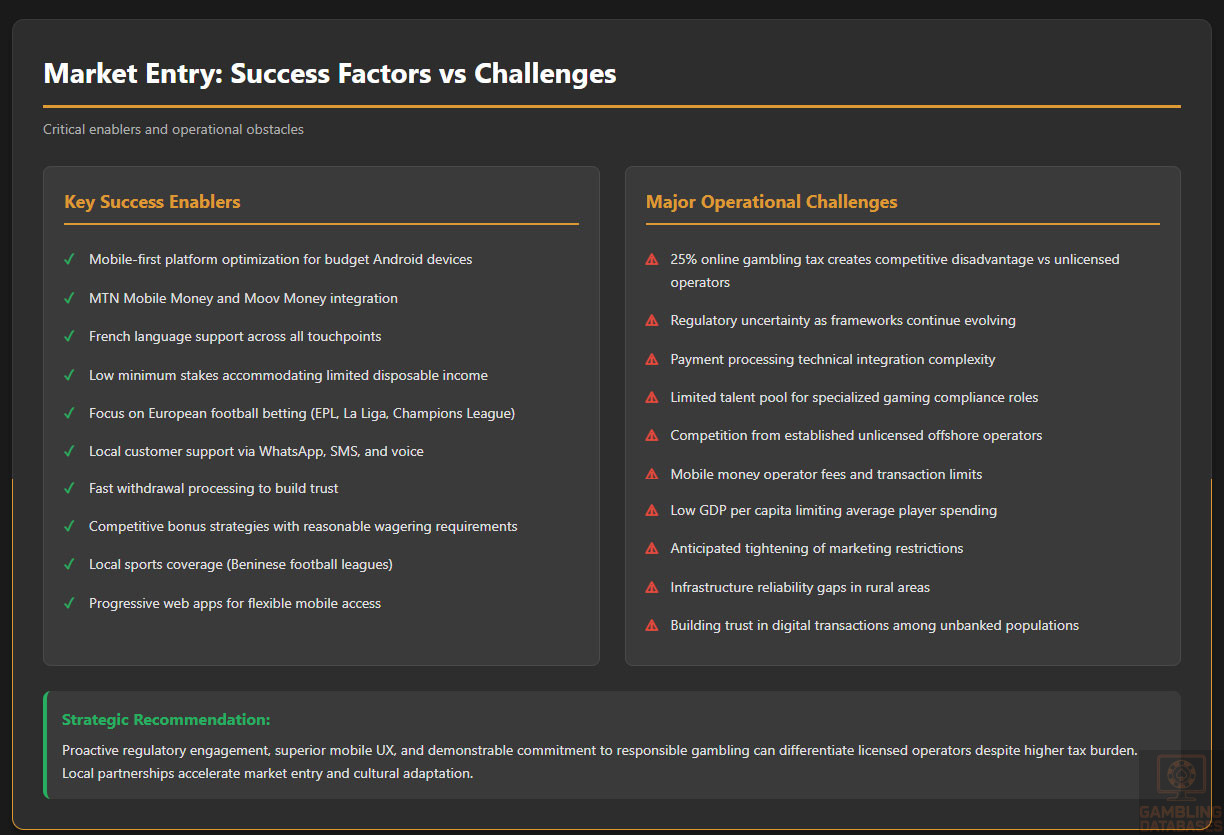
Understanding local player preferences is critical with focus on football betting, low minimum stakes, mobile optimization, and simple user interfaces. French language throughout all customer touchpoints is mandatory with local language support beneficial.
Mobile-first approach cannot be overstated with the vast majority of users accessing gambling exclusively via smartphones. Platforms must work flawlessly on budget Android devices with slow connections and limited data budgets.
Competitive bonus and promotion strategies must balance acquisition costs with player lifetime value. Micro-deposit bonuses attract users with limited funds while reasonable wagering requirements enable withdrawals building trust and word-of-mouth marketing.
Local sports and events coverage particularly Beninese football leagues creates differentiation versus international operators. Partnerships with local sports media and influencers can accelerate brand building and customer acquisition.
Major Operational Challenges
Regulatory compliance complexity will increase as frameworks formalize. Early entrants face uncertainty but can shape regulations through constructive regulator engagement. Compliance costs and ongoing obligations will rise requiring dedicated resources.
The 25% tax on online gambling winnings represents significant competitive disadvantage versus unlicensed offshore operators not collecting this tax. Licensed operators must offer superior service, security, and local payment methods to justify the tax burden.
Payment processing restrictions and mobile money integration challenges can delay implement responsible gambling measures including self-exclusion options, deposit limits, reality checks, and links to problem gambling resources. Mandatory contributions to problem gambling funds may be introduced as regulations mature following patterns in more developed markets.
Social responsibility requirements create market differentiation opportunities for operators demonstrating commitment to player welfare. Proactive implementation of responsible gambling tools positions operators favorably with regulators and builds consumer trust in emerging market.
Political Structure and Governance
Benin operates as a democratic republic with President Patrice Talon winning re-election through parties supporting him securing 81 of 109 parliamentary seats in January 2023 elections. The main opposition party Les Démocrates holds 28 seats, marking the opposition’s return after four-year absence.
Political stability has improved since the 1990 transition to democracy though concerns remain about democratic backsliding and civil liberties. The next general elections scheduled for 2026 will be governed by a new electoral code adopted in March 2024.
Corruption remains a concern with Benin ranking in the lower half of Transparency International’s Corruption Perceptions Index. Business operations require careful navigation of bureaucratic processes and relationship building with regulatory authorities to ensure smooth licensing and compliance.
Technology Adoption and Digital Behavior
Internet and Digital Usage
| Metric | Value | Year-over-Year Change |
|---|---|---|
| Internet Users | 4.69 million | +123,000 (+2.7%) |
| Internet Penetration | 33.8% | +0.7 percentage points |
| Mobile Connections | 14.78 million | N/A |
| Mobile Penetration | 106.4% | N/A |
| Social Media Users | 2.15 million | Revised methodology |
| Social Media Penetration | 15.5% | N/A |
| Mobile Internet Subscribers | 11.7 million | 64.25% of mobile users |
| 3G Subscribers | 6.8 million | N/A |
| 4G Subscribers | 4.4 million | Growing rapidly |
Internet penetration of 33.8% positions Benin slightly below the sub-Saharan African average of 39.3% but above the least developed countries average of 28.5%. The 66.2% of population remaining offline represents both challenge and opportunity as infrastructure expansion continues.
Daily internet usage patterns favor mobile access with smartphones serving as primary internet devices. Desktop and laptop usage remains limited to business and educational settings. E-commerce participation rates are growing but remain modest with 2019 B2C E-commerce Index ranking of 100th out of 152 countries.
Social media engagement centers on Facebook, WhatsApp, and increasingly TikTok among younger demographics. Platform preferences shift rapidly as new services gain popularity. Operators should monitor trending platforms for marketing and customer engagement opportunities.
Digital Payment Behavior
Payment method preferences strongly favor mobile money solutions over traditional banking products. MTN Mobile Money and Moov Money dominate the mobile payments landscape with widespread agent networks even in rural areas. Digital payment penetration reached 37.9% in 2017, above sub-Saharan African and least developed countries averages.
Credit card penetration remains very low with most consumers lacking access to traditional banking products. Debit card usage is growing slowly as bank account penetration increases but remains limited compared to mobile money adoption. This payment landscape requires operators to prioritize mobile money integrations.
Bank transfers are possible but cumbersome for most users due to limited banking access. Online banking penetration lags significantly behind mobile money adoption. E-wallets like PayPal, Skrill, and Neteller have minimal market presence due to regulatory restrictions and limited international payment corridor development.
Cryptocurrency adoption for gambling remains negligible due to regulatory uncertainty, limited technical knowledge, and preference for familiar payment methods. While some international operators accept cryptocurrency, local users show little interest or awareness of digital currency options.
Gaming and Gambling Preferences
Current Market Participation
Comprehensive gambling participation data for Benin is limited due to historical lack of market research and regulatory data collection. Lottery products attract the broadest participation across income levels with the National Lottery maintaining widespread recognition and accessibility through physical agent networks.
Sports betting has gained popularity particularly among young urban males interested in European football. International leagues including English Premier League, Spanish La Liga, and Champions League generate the highest betting volumes. Local and African football competitions also attract wagering interest.
Casino games remain niche products primarily accessed by higher-income urban residents. Online casino gaming through international operators is growing among tech-savvy younger demographics though overall participation remains low relative to sports betting and lottery products.
Consumer Behavior Patterns
Average spending per player data is not publicly available though anecdotal evidence suggests low average stakes reflecting limited disposable income. Lottery ticket purchases of small denominations dominate gambling expenditure patterns with occasional larger sports betting stakes among more engaged users.
Platform preferences strongly favor mobile access with limited desktop usage. The 106.4% mobile penetration rate versus 33.8% internet penetration indicates mobile-first internet access patterns. Operators must prioritize mobile-optimized experiences and native mobile applications.
Peak gambling times likely align with major sporting events, weekends, and evening hours after work. Local time zone considerations and African sporting event schedules should inform marketing timing and promotional strategies. Seasonal patterns around holidays and major tournaments create peaks in activity.
Section 3: Technology Infrastructure and Business Environment
Internet and Digital Infrastructure
Connectivity and Network Performance
Benin’s internet infrastructure shows mixed performance with significant urban-rural divide. Fixed broadband remains limited with only 0.2% of population having dedicated high-speed connections. Mobile internet dominates connectivity with 3G and 4G networks covering approximately 90% of the population as of 2024.
Network performance varies significantly by location and operator. Median mobile internet speeds reached 30.56 Mbps in early 2024 according to Ookla data, sufficient for gambling applications. Fixed internet median speeds of 24.06 Mbps increased 65.4% year-over-year, showing rapid infrastructure improvements.
Network reliability in major cities is generally adequate though rural areas experience frequent outages and connectivity gaps. Infrastructure investment trends are positive with government prioritizing digital connectivity through the National Digital Strategy 2019-2025 and World Bank-supported fiber optic backbone deployment.
| Metric | Value | Global Ranking |
|---|---|---|
| Mobile Internet Speed | 30.56 Mbps | Mid-range for Africa |
| Fixed Broadband Speed | 24.06 Mbps | 133rd globally |
| Fixed Broadband Penetration | ~0.2% | Very low |
| 3G/4G Population Coverage | ~90% | Above West African average (77%) |
| 4G Population Coverage | 88% | Strong growth from 62% in 2021 |
| Urban 4G Coverage | ~100% | Nearly universal |
| Rural 4G Coverage | 63% | Improving |
5G and Future Technology Deployment
5G networks are not yet deployed in Benin as of 2024. The country focuses on expanding 4G coverage and improving existing network quality before transitioning to next-generation mobile technology. Regional 5G rollouts in larger African markets like Nigeria and South Africa will likely precede Benin deployment.
Future infrastructure plans emphasize fiber optic backbone expansion, improved international connectivity, and 4G network densification. The government launched a national fiber optic backbone project in 2020 with World Bank and African Development Bank support to improve broadband connectivity and reduce costs.
Timeline for 5G deployment remains uncertain though 2026-2028 represents realistic earliest introduction period. Operators should plan for 4G-based services for the medium term with mobile-optimized lightweight applications suited to moderate bandwidth constraints.
Mobile Technology Ecosystem
Mobile Network Infrastructure
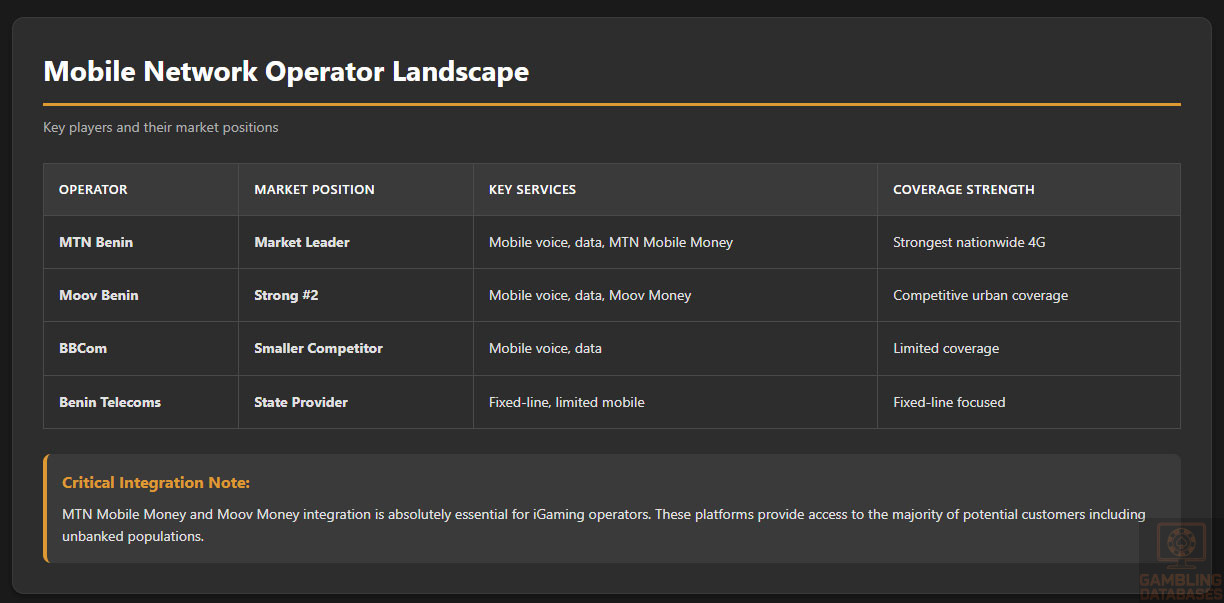
The mobile telecommunications market features three primary operators: MTN Benin (market leader), Moov Benin (second-largest), and BBCom (smaller third player). Benin Telecoms operates as the state-owned fixed-line provider with limited mobile market presence.
MTN dominates the market with the largest subscriber base, widest network coverage, and strongest brand recognition. The operator provides extensive 4G coverage and operates MTN Mobile Money, the leading mobile payments platform. Moov competes aggressively on pricing and coverage, offering competitive mobile money services.
Network quality varies by operator and location with urban areas generally well-served by all operators. Rural coverage depends heavily on population density and economic activity with remote areas relying on 2G or 3G connectivity. Data costs have decreased significantly though remain expensive relative to income levels.
| Operator | Market Position | Key Services | Coverage Strength |
|---|---|---|---|
| MTN Benin | Market Leader | Mobile voice, data, MTN Mobile Money | Strongest nationwide 4G |
| Moov Benin | Strong #2 | Mobile voice, data, Moov Money | Competitive urban coverage |
| BBCom | Smaller Competitor | Mobile voice, data | Limited coverage |
| Benin Telecoms | State Provider | Fixed-line, limited mobile | Fixed-line focused |
Device Penetration
Smartphone adoption rates have grown rapidly though exact penetration figures vary by source. Estimates suggest 50-60% of mobile users own smartphones with adoption concentrated among urban, younger, and higher-income demographics. Feature phones remain prevalent particularly in rural areas and among older populations.
Android dominates the smartphone market with 85-90% market share. Budget Android devices from Chinese manufacturers including Tecno, Infinix, and Xiaomi lead sales due to affordability. iOS/iPhone usage remains limited to affluent consumers representing single-digit market share.
Average device specifications trend toward entry-level and mid-range smartphones with 2-4GB RAM, 32-64GB storage, and 720p-1080p displays. Operators should optimize applications for lower-specification devices to ensure broad compatibility and smooth performance.
Financial Services and Payment Infrastructure
Banking System Structure
Benin’s banking sector includes approximately 15-20 commercial banks with major institutions including Bank of Africa Benin, Ecobank Benin, and other regional banking groups. The sector underwent consolidation and privatization in the 1990s creating more stable and competitive banking environment.
Digital banking adoption grows among urban educated populations though overall bank account penetration remains low. Microfinance institutions play significant role with nearly 60% penetration of microfinance services according to 2003 Central Bank data, providing financial services to underbanked populations.
ATM density has improved in urban areas though rural access remains limited. Cash remains dominant payment method for everyday transactions with banking services concentrated in major cities. The formal banking sector serves primarily businesses and higher-income individuals.
Payment Processing Options
| Payment Method | Availability | Market Penetration | Suitability for iGaming |
|---|---|---|---|
| MTN Mobile Money | Widely Available | Very High | Essential – Primary method |
| Moov Money | Widely Available | High | Essential – Secondary method |
| Bank Transfer | Available | Low | Supplementary option |
| Credit/Debit Cards | Limited | Very Low | Minimal usage expected |
| International E-wallets | Restricted | Very Low | Not recommended |
| Cryptocurrency | Uncertain | Negligible | Not viable currently |
| Cash via Agents | Available | High potential | Useful for deposits |
Mobile money dominates digital payments with MTN Mobile Money and Moov Money providing essential infrastructure for iGaming payment processing. Operators must integrate both platforms to capture majority of potential users. Agent-based cash deposits into mobile money accounts extend reach beyond purely digital users.
International payment processors face regulatory restrictions and limited local partnerships. PayPal, Skrill, Neteller, and similar services show minimal market presence. Processing fees for mobile money typically range 1-3% for merchants with additional transaction fees for users.
Transaction processing timelines are near-instantaneous for mobile money transfers enabling smooth user experience. Bank transfers process within 1-3 business days. International payments face significant delays and costs making cross-border transactions inefficient.
E-commerce and Digital Economy
Digital Market Development
E-commerce in Benin remains underdeveloped with 2019 B2C E-commerce Index ranking of 100th out of 152 countries, improving from 108th in 2018. The index measures internet use, secure servers, credit card penetration, and postal reliability showing gradual progress.
Online retail penetration represents small percentage of total retail activity concentrated in electronics, fashion, and mobile phone accessories. Popular e-commerce platforms include regional players and local startups though market maturity lags Nigeria and other larger African markets.
Consumer trust in online transactions grows slowly requiring secure payment methods, clear refund policies, and reliable delivery mechanisms. Cash-on-delivery remains popular payment option for physical goods though not applicable to digital gambling services.
Business Environment and Regulatory Framework
Ease of Business Operations
The World Bank discontinued its Doing Business rankings in 2021 following data manipulation allegations. Historical rankings placed Benin in the mid-range for African countries with moderate ease of business operations. The replacement Business Ready framework launched in 2024 but Benin rankings are not yet available.
Starting a business in Benin requires navigating bureaucratic processes typical of West African nations. Reforms have simplified company registration though challenges remain with multiple agency approvals, notarization requirements, and varying interpretation of regulations by officials.
Foreign investment policies generally welcome international capital though specific sectors face restrictions. The gambling sector’s evolving regulatory framework creates uncertainty for foreign investors requiring careful legal advice and relationship building with authorities.
| Indicator | Value/Rating | Assessment |
|---|---|---|
| Business Registration Time | 7-14 days | Improving with online systems |
| Foreign Ownership Restrictions | Sector-dependent | Generally permissive |
| Labor Market Flexibility | Moderate | Informal sector dominates |
| Office Space Costs (Cotonou) | $8-15 per sqm/month | Moderate for region |
| Talent Availability | Limited | Skills gap in tech sectors |
| Corruption Perception | Below average | Requires careful navigation |
Corporate Structure and Registration
Available Entity Types
Foreign companies can establish presence in Benin through several corporate structures. Limited Liability Companies (SARL) represent the most common structure for small to medium businesses offering liability protection and operational flexibility. Joint Stock Companies (SA) suit larger operations requiring significant capitalization.
Branch offices of foreign companies are permitted allowing international operators to establish local presence without creating separate legal entities. Representative offices serve marketing and liaison functions without direct commercial operations. The optimal structure depends on operational scale, ownership preferences, and regulatory requirements.
For iGaming operators, SARL or SA structures typically align best with licensing requirements and operational needs. Regulators may prefer locally incorporated entities over branch offices to ensure adequate local commitment and regulatory jurisdiction.
Registration Requirements
Company registration in Benin has been streamlined with online systems reducing time from weeks to days in some cases. The process requires drafting articles of association, notarizing founding documents, registering with the commercial registry, obtaining tax identification, and social security registration.
Registration timelines vary from 1-4 weeks depending on documentation completeness and efficiency of processing. Costs include government fees typically $500-2,000 depending on company type plus legal and notary fees of $1,000-5,000 for professional assistance.
Foreign ownership faces no specific restrictions in most sectors though minimum capital requirements vary by company type. SARL requires minimum capital of XOF 1,000,000 (approximately $1,700) while SA requires substantially more. Gambling licenses likely impose additional minimum capital requirements.
Taxation Framework
Corporate Income Tax Structure
| Tax Type | Rate | Application |
|---|---|---|
| Corporate Income Tax | 30% | Net taxable profits |
| Value Added Tax (VAT) | 18% | Goods and services (gambling may be exempt) |
| Withholding Tax – Dividends | 12.5% | Distributed profits |
| Withholding Tax – Interest | 15% | Interest payments |
| Withholding Tax – Royalties | 20% | Royalty and license fee payments |
| Employer Social Contributions | ~16% | Employee salaries |
| Employee Social Contributions | ~5.5% | Employee salaries |
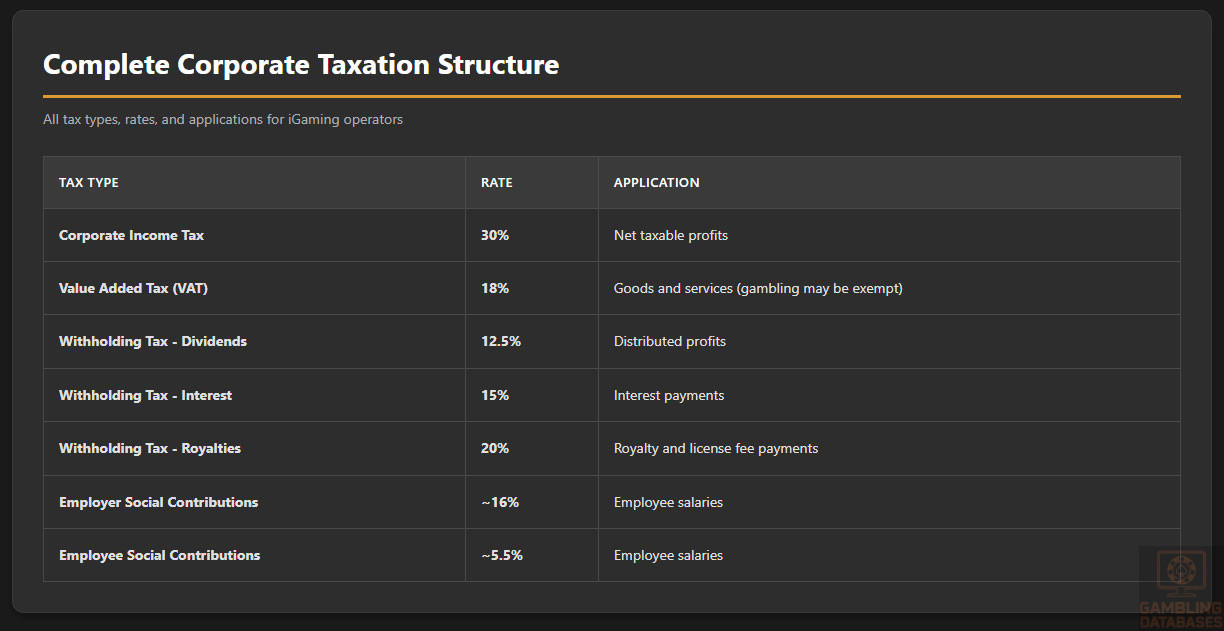
Corporate income tax at 30% applies to net profits after deducting gambling-specific taxes and legitimate business expenses. Tax incentives may be available for operations in special economic zones or specific priority sectors though gambling typically does not qualify for preferential treatment.
VAT applicability to gambling services requires specific clarification as different jurisdictions treat gambling differently. Some exempt gambling from VAT while others apply reduced rates or full VAT. Operators should obtain tax rulings before launching operations.
Benin participates in the West African Economic and Monetary Union (WAEMU) tax harmonization framework. International tax treaties with various countries may reduce withholding tax rates on cross-border payments. Transfer pricing documentation is increasingly required for related-party transactions.
Market Entry Considerations
Recommended Entry Strategies
Market entry strategy for Benin should prioritize regulatory compliance, mobile-first technology, and local payment integration. Obtaining proper licensing through the Ministry of Finance and National Lottery Authority represents the critical first step ensuring legal operations and market access.
Local partnerships can accelerate market entry providing regulatory navigation expertise, cultural insights, and established business relationships. Potential partners include marketing agencies, payment processors, customer support providers, and even established lottery or betting shop operators seeking digital expansion.
White label solutions offer faster market entry versus building proprietary platforms though customization limitations may constrain competitive differentiation. Established gambling platform providers with African market experience can provide turnkey solutions reducing technical complexity and time to market.
Typical Costs and Timelines
| Cost Category | Estimated Amount (USD) | Notes |
|---|---|---|
| Initial Setup Costs | ||
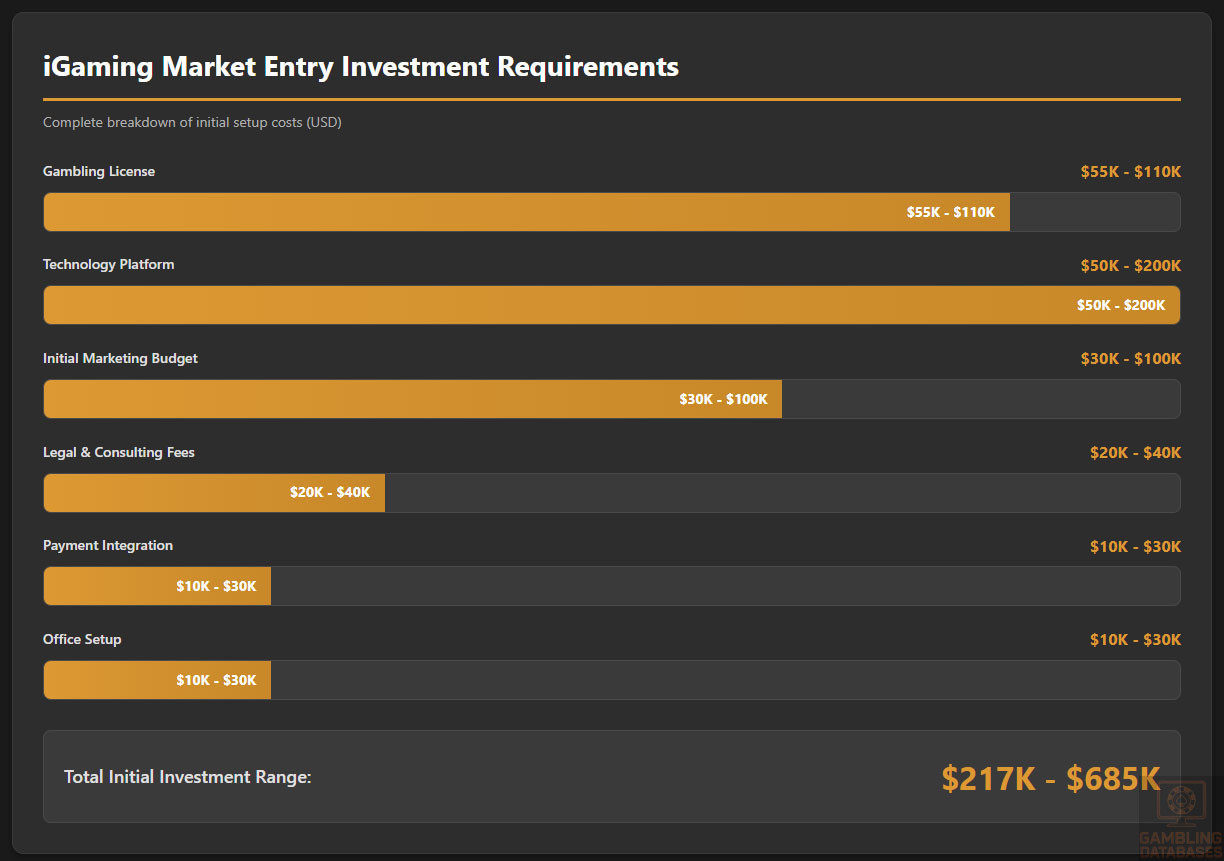
| License Application Fee | $55,000 – $110,000 | Varies by gambling type |
| Legal & Consulting Fees | $20,000 – $40,000 | Regulatory navigation, compliance |
| Company Registration | $2,000 – $5,000 | Including notary and filing fees |
| Initial Capital Requirement | $50,000 – $200,000 | Regulatory minimum plus working capital |
| Office Setup | $10,000 – $30,000 | Rent, furniture, equipment for 6 months |
| Technology Platform | $50,000 – $200,000 | White label vs proprietary |
| Initial Marketing Budget | $30,000 – $100,000 | Launch campaign, brand building |
| Total Initial Investment | $217,000 – $685,000 | Minimum to substantial operation |
| Expense Category | Monthly Cost (USD) | Annual Cost (USD) |
|---|---|---|
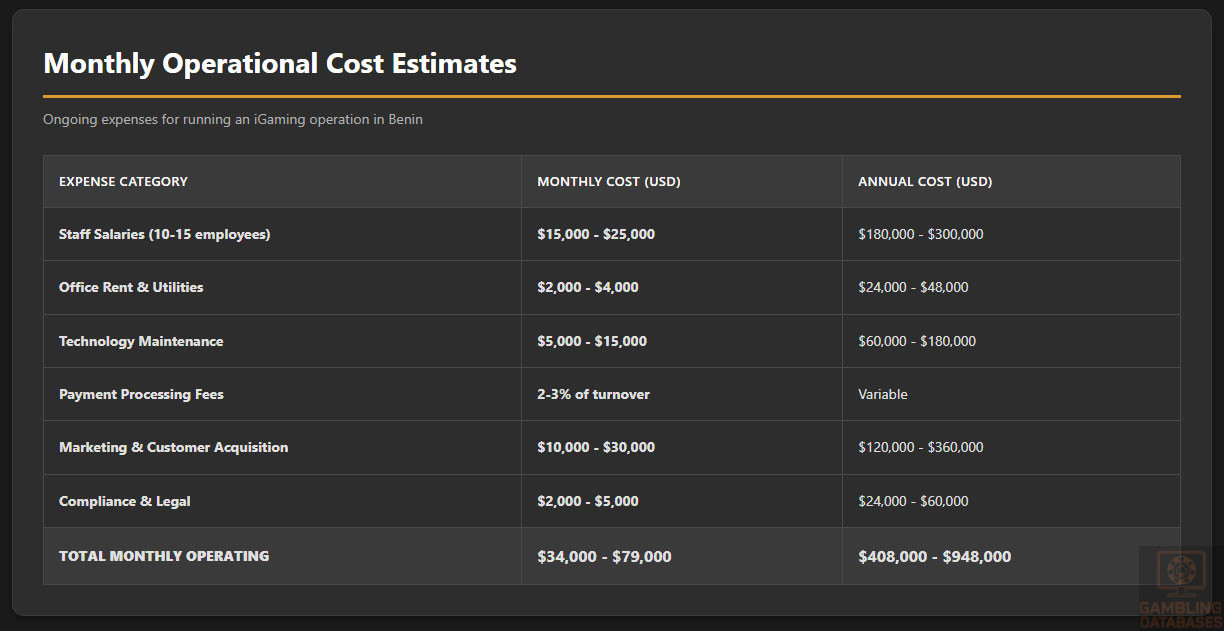
| Staff Salaries (10-15 employees) | $15,000 – $25,000 | $180,000 – $300,000 |
| Office Rent & Utilities | $2,000 – $4,000 | $24,000 – $48,000 |
| Technology Maintenance | $5,000 – $15,000 | $60,000 – $180,000 |
| Payment Processing Fees | 2-3% of turnover | Variable |
| Marketing & Customer Acquisition | $10,000 – $30,000 | $120,000 – $360,000 |
| Compliance & Legal | $2,000 – $5,000 | $24,000 – $60,000 |
| Total Monthly Operating | $34,000 – $79,000 | $408,000 – $948,000 |
| Phase | Duration | Key Activities |
|---|---|---|
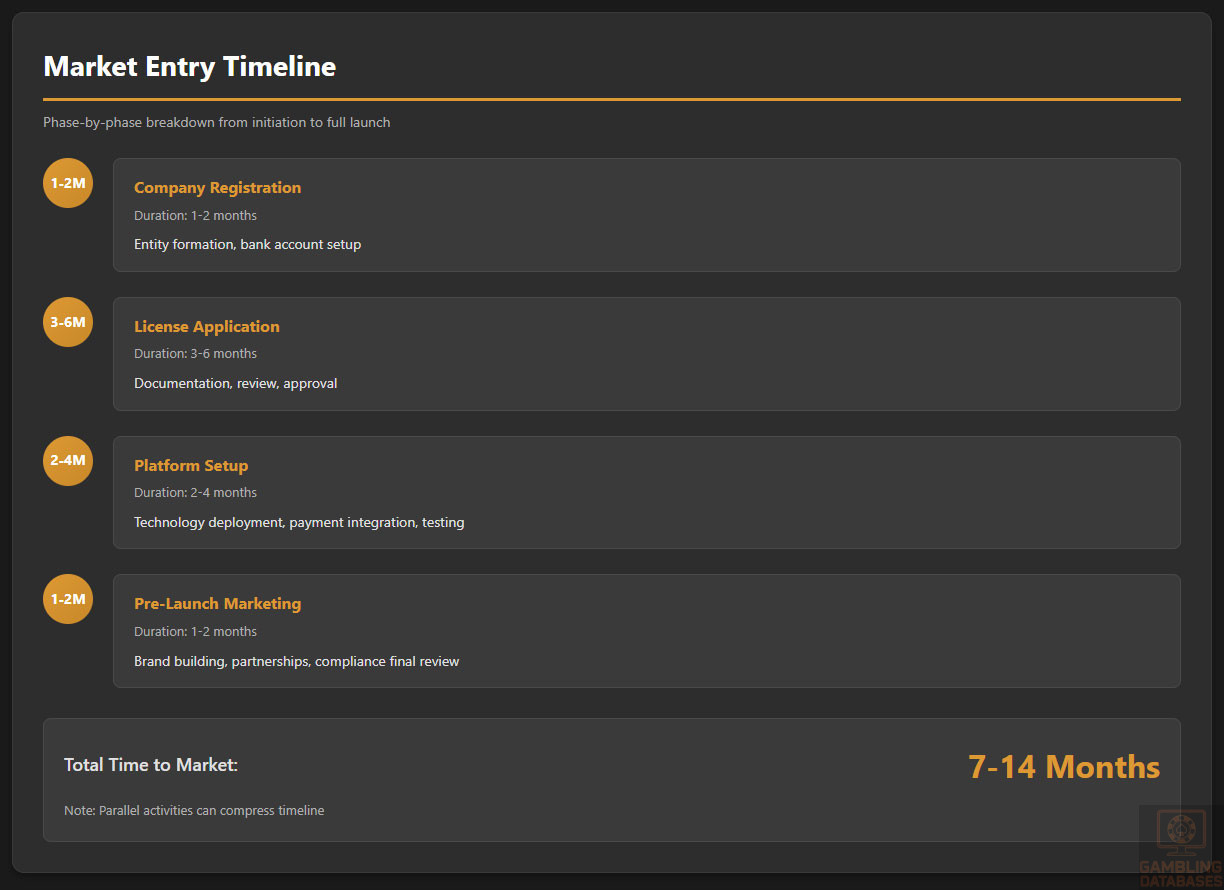
| Company Registration | 1-2 months | Entity formation, bank account setup |
| License Application | 3-6 months | Documentation, review, approval |
| Platform Setup | 2-4 months | Technology deployment, payment integration, testing |
| Pre-Launch Marketing | 1-2 months | Brand building, partnerships, compliance final review |
| Total Time to Market | 7-14 months | From initiation to full launch |
Success Factors and Challenges
Key Success Enablers
Understanding local player preferences represents critical success factor. Beninese users favor simple, mobile-optimized interfaces with French language support, popular local payment methods, and games matching cultural preferences. Sports betting on European football leagues combined with lottery-style products aligns well with market demand.
Mobile-first approach is non-negotiable given 106.4% mobile penetration versus 33.8% internet penetration. Applications must function smoothly on entry-level Android devices with optimization for lower bandwidth conditions. Progressive web apps can supplement native applications providing flexibility.
Payment method integration focusing on MTN Mobile Money and Moov Money enables access to majority of potential users. Cash-via-agent deposit options extend reach to users uncomfortable with purely digital transactions. Fast withdrawals build trust and encourage repeat usage.
Local customer support in French through mobile-friendly channels including WhatsApp, SMS, and voice calls enhances user experience. Email-only support alienates users preferring immediate mobile communication. Building local support team understanding cultural context improves satisfaction.
Major Operational Challenges
Regulatory compliance complexity and uncertainty pose significant challenges as frameworks continue evolving. The 25% tax on online gambling winnings creates substantial burden potentially making licensed operations uncompetitive versus unlicensed international operators not collecting taxes.
Payment processing faces technical integration challenges and cost pressures. Mobile money operator fees, transaction limits, and occasional system downtime can frustrate users. International payment restrictions limit deposit/withdrawal options for some user segments.
Marketing restrictions may tighten as regulation matures potentially limiting advertising channels and promotional strategies. Competition from established unlicensed operators with lower cost structures due to tax avoidance complicates customer acquisition.
Talent shortage in specialized areas including regulatory compliance, responsible gambling, and gaming technology requires investing in training or recruiting expensive international expertise. Limited local pools of experienced gaming professionals necessitates building institutional knowledge.
FAQ: Frequently Asked Questions
Legal & Licensing
Is online gambling legal in Benin?
Online gambling in Benin operates in a transitional regulatory environment. Land-based gambling is clearly legal under the 2002 Gaming Act. Online gambling was not explicitly addressed in original legislation but the December 2024 Finance Law introduced 25% taxation on online gambling winnings, effectively acknowledging the sector.
The government announced plans to develop comprehensive online gambling regulation including a digital monitoring system to track activities, ensure compliance, and protect players. International operators currently serve Beninese players without local licenses though this may change as regulation formalizes.
Operators should anticipate evolving requirements and plan for obtaining proper licensing as the regulatory framework develops. Proactive engagement with authorities positions operators favorably for future licensing opportunities.
What types of gambling licenses are available and what do they cover?
Benin offers licenses for land-based casinos, sports betting venues, and lottery operations. The National Lottery Authority holds monopoly on lottery activities. Sports betting licenses cover both retail betting shops and potentially online sports wagering once regulations clarify.
Casino licenses permit operation of table games, slot machines, and electronic gaming machines in approved physical venues. Online casino licensing frameworks are under development with specific requirements expected to emerge as the digital monitoring system launches.
License types may expand to include specific online gambling categories such as sports betting, casino games, poker, and bingo as the regulatory framework matures. Current licensing focuses primarily on land-based operations.
How much does an iGaming license cost and how long does it take to obtain?
Sports betting licenses cost approximately €50,000-€75,000 ($55,000-$82,000) with processing times of 3-4 months. Full casino licenses exceed €100,000 ($110,000) and require 4-6 months for approval. Online gambling license costs are not yet formally established.
Social responsibility requirements create market differentiation opportunities for operators demonstrating commitment to player welfare. Proactive implementation of responsible gambling tools positions operators favorably with regulators and builds consumer trust in emerging market.
Political Structure and Governance
Benin operates as a democratic republic with President Patrice Talon winning re-election through parties supporting him securing 81 of 109 parliamentary seats in January 2023 elections. The main opposition party Les Démocrates holds 28 seats, marking the opposition’s return after four-year absence.
Political stability has improved since the 1990 transition to democracy though concerns remain about democratic backsliding and civil liberties. The next general elections scheduled for 2026 will be governed by a new electoral code adopted in March 2024.
Regulatory consistency and predictability are moderate with ongoing reforms to business environment and tax policies. The gambling sector’s recent regulatory evolution reflects broader government modernization efforts including digitalization initiatives and revenue mobilization strategies.
Corruption remains a concern with Benin ranking in the lower half of Transparency International’s Corruption Perceptions Index. Business operations require careful navigation of bureaucratic processes and relationship building with regulatory authorities to ensure smooth licensing and compliance.
Technology Adoption and Digital Behavior
Internet and Digital Usage
| Metric | Value | Year-over-Year Change |
|---|---|---|
| Internet Users | 4.69 million | +123,000 (+2.7%) |
| Internet Penetration | 33.8% | +0.7 percentage points |
| Mobile Connections | 14.78 million | N/A |
| Mobile Penetration | 106.4% | N/A |
| Social Media Users | 2.15 million | Revised methodology |
| Social Media Penetration | 15.5% | N/A |
| Mobile Internet Subscribers | 11.7 million | 64.25% of mobile users |
| 3G Subscribers | 6.8 million | N/A |
| 4G Subscribers | 4.4 million | Growing rapidly |
Internet penetration of 33.8% positions Benin slightly below the sub-Saharan African average of 39.3% but above the least developed countries average of 28.5%. The 66.2% of population remaining offline represents both challenge and opportunity as infrastructure expansion continues.
Daily internet usage patterns favor mobile access with smartphones serving as primary internet devices. Desktop and laptop usage remains limited to business and educational settings. E-commerce participation rates are growing but remain modest with 2019 B2C E-commerce Index ranking of 100th out of 152 countries.
Social media engagement centers on Facebook, WhatsApp, and increasingly TikTok among younger demographics. Platform preferences shift rapidly as new services gain popularity. Operators should monitor trending platforms for marketing and customer engagement opportunities.
Digital Payment Behavior
Payment method preferences strongly favor mobile money solutions over traditional banking products. MTN Mobile Money and Moov Money dominate the mobile payments landscape with widespread agent networks even in rural areas. Digital payment penetration reached 37.9% in 2017, above sub-Saharan African and least developed countries averages.
Credit card penetration remains very low with most consumers lacking access to traditional banking products. Debit card usage is growing slowly as bank account penetration increases but remains limited compared to mobile money adoption. This payment landscape requires operators to prioritize mobile money integrations.
Bank transfers are possible but cumbersome for most users due to limited banking access. Online banking penetration lags significantly behind mobile money adoption. E-wallets like PayPal, Skrill, and Neteller have minimal market presence due to regulatory restrictions and limited international payment corridor development.
Cryptocurrency adoption for gambling remains negligible due to regulatory uncertainty, limited technical knowledge, and preference for familiar payment methods. While some international operators accept cryptocurrency, local users show little interest or awareness of digital currency options.
Gaming and Gambling Preferences
Current Market Participation
Comprehensive gambling participation data for Benin is limited due to historical lack of market research and regulatory data collection. Lottery products attract the broadest participation across income levels with the National Lottery maintaining widespread recognition and accessibility through physical agent networks.
Sports betting has gained popularity particularly among young urban males interested in European football. International leagues including English Premier League, Spanish La Liga, and Champions League generate the highest betting volumes. Local and African football competitions also attract wagering interest.
Casino games remain niche products primarily accessed by higher-income urban residents. Online casino gaming through international operators is growing among tech-savvy younger demographics though overall participation remains low relative to sports betting and lottery products.
Consumer Behavior Patterns
Average spending per player data is not publicly available though anecdotal evidence suggests low average stakes reflecting limited disposable income. Lottery ticket purchases of small denominations dominate gambling expenditure patterns with occasional larger sports betting stakes among more engaged users.
Platform preferences strongly favor mobile access with limited desktop usage. The 106.4% mobile penetration rate versus 33.8% internet penetration indicates mobile-first internet access patterns. Operators must prioritize mobile-optimized experiences and native mobile applications.
Peak gambling times likely align with major sporting events, weekends, and evening hours after work. Local time zone considerations and African sporting event schedules should inform marketing timing and promotional strategies. Seasonal patterns around holidays and major tournaments create peaks in activity.
Section 3: Technology Infrastructure and Business Environment
Internet and Digital Infrastructure
Connectivity and Network Performance
Benin’s internet infrastructure shows mixed performance with significant urban-rural divide. Fixed broadband remains limited with only 0.2% of population having dedicated high-speed connections. Mobile internet dominates connectivity with 3G and 4G networks covering approximately 90% of the population as of 2024.
Network performance varies significantly by location and operator. Median mobile internet speeds reached 30.56 Mbps in early 2024 according to Ookla data, sufficient for gambling applications. Fixed internet median speeds of 24.06 Mbps increased 65.4% year-over-year, showing rapid infrastructure improvements.
Network reliability in major cities is generally adequate though rural areas experience frequent outages and connectivity gaps. Infrastructure investment trends are positive with government prioritizing digital connectivity through the National Digital Strategy 2019-2025 and World Bank-supported fiber optic backbone deployment.
| Metric | Value | Global Ranking |
|---|---|---|
| Mobile Internet Speed | 30.56 Mbps | Mid-range for Africa |
| Fixed Broadband Speed | 24.06 Mbps | 133rd globally |
| Fixed Broadband Penetration | ~0.2% | Very low |
| 3G/4G Population Coverage | ~90% | Above West African average (77%) |
| 4G Population Coverage | 88% | Strong growth from 62% in 2021 |
| Urban 4G Coverage | ~100% | Nearly universal |
| Rural 4G Coverage | 63% | Improving |
5G and Future Technology Deployment
5G networks are not yet deployed in Benin as of 2024. The country focuses on expanding 4G coverage and improving existing network quality before transitioning to next-generation mobile technology. Regional 5G rollouts in larger African markets like Nigeria and South Africa will likely precede Benin deployment.
Future infrastructure plans emphasize fiber optic backbone expansion, improved international connectivity, and 4G network densification. The government launched a national fiber optic backbone project in 2020 with World Bank and African Development Bank support to improve broadband connectivity and reduce costs.
Timeline for 5G deployment remains uncertain though 2026-2028 represents realistic earliest introduction period. Operators should plan for 4G-based services for the medium term with mobile-optimized lightweight applications suited to moderate bandwidth constraints.
Mobile Technology Ecosystem
Mobile Network Infrastructure
The mobile telecommunications market features three primary operators: MTN Benin (market leader), Moov Benin (second-largest), and BBCom (smaller third player). Benin Telecoms operates as the state-owned fixed-line provider with limited mobile market presence.
MTN dominates the market with the largest subscriber base, widest network coverage, and strongest brand recognition. The operator provides extensive 4G coverage and operates MTN Mobile Money, the leading mobile payments platform. Moov competes aggressively on pricing and coverage, offering competitive mobile money services.
Network quality varies by operator and location with urban areas generally well-served by all operators. Rural coverage depends heavily on population density and economic activity with remote areas relying on 2G or 3G connectivity. Data costs have decreased significantly though remain expensive relative to income levels.
| Operator | Market Position | Key Services | Coverage Strength |
|---|---|---|---|
| MTN Benin | Market Leader | Mobile voice, data, MTN Mobile Money | Strongest nationwide 4G |
| Moov Benin | Strong #2 | Mobile voice, data, Moov Money | Competitive urban coverage |
| BBCom | Smaller Competitor | Mobile voice, data | Limited coverage |
| Benin Telecoms | State Provider | Fixed-line, limited mobile | Fixed-line focused |
Device Penetration
Smartphone adoption rates have grown rapidly though exact penetration figures vary by source. Estimates suggest 50-60% of mobile users own smartphones with adoption concentrated among urban, younger, and higher-income demographics. Feature phones remain prevalent particularly in rural areas and among older populations.
Android dominates the smartphone market with 85-90% market share. Budget Android devices from Chinese manufacturers including Tecno, Infinix, and Xiaomi lead sales due to affordability. iOS/iPhone usage remains limited to affluent consumers representing single-digit market share.
Average device specifications trend toward entry-level and mid-range smartphones with 2-4GB RAM, 32-64GB storage, and 720p-1080p displays. Operators should optimize applications for lower-specification devices to ensure broad compatibility and smooth performance.
Financial Services and Payment Infrastructure
Banking System Structure
Benin’s banking sector includes approximately 15-20 commercial banks with major institutions including Bank of Africa Benin, Ecobank Benin, and other regional banking groups. The sector underwent consolidation and privatization in the 1990s creating more stable and competitive banking environment.
Digital banking adoption grows among urban educated populations though overall bank account penetration remains low. Microfinance institutions play significant role with nearly 60% penetration of microfinance services according to 2003 Central Bank data, providing financial services to underbanked populations.
ATM density has improved in urban areas though rural access remains limited. Cash remains dominant payment method for everyday transactions with banking services concentrated in major cities. The formal banking sector serves primarily businesses and higher-income individuals.
Payment Processing Options
| Payment Method | Availability | Market Penetration | Suitability for iGaming |
|---|---|---|---|
| MTN Mobile Money | Widely Available | Very High | Essential – Primary method |
| Moov Money | Widely Available | High | Essential – Secondary method |
| Bank Transfer | Available | Low | Supplementary option |
| Credit/Debit Cards | Limited | Very Low | Minimal usage expected |
| International E-wallets | Restricted | Very Low | Not recommended |
| Cryptocurrency | Uncertain | Negligible | Not viable currently |
| Cash via Agents | Available | High potential | Useful for deposits |
Mobile money dominates digital payments with MTN Mobile Money and Moov Money providing essential infrastructure for iGaming payment processing. Operators must integrate both platforms to capture majority of potential users. Agent-based cash deposits into mobile money accounts extend reach beyond purely digital users.
International payment processors face regulatory restrictions and limited local partnerships. PayPal, Skrill, Neteller, and similar services show minimal market presence. Processing fees for mobile money typically range 1-3% for merchants with additional transaction fees for users.
Transaction processing timelines are near-instantaneous for mobile money transfers enabling smooth user experience. Bank transfers process within 1-3 business days. International payments face significant delays and costs making cross-border transactions inefficient.
E-commerce and Digital Economy
Digital Market Development
E-commerce in Benin remains underdeveloped with 2019 B2C E-commerce Index ranking of 100th out of 152 countries, improving from 108th in 2018. The index measures internet use, secure servers, credit card penetration, and postal reliability showing gradual progress.
Online retail penetration represents small percentage of total retail activity concentrated in electronics, fashion, and mobile phone accessories. Popular e-commerce platforms include regional players and local startups though market maturity lags Nigeria and other larger African markets.
Consumer trust in online transactions grows slowly requiring secure payment methods, clear refund policies, and reliable delivery mechanisms. Cash-on-delivery remains popular payment option for physical goods though not applicable to digital gambling services.
Business Environment and Regulatory Framework
Ease of Business Operations
The World Bank discontinued its Doing Business rankings in 2021 following data manipulation allegations. Historical rankings placed Benin in the mid-range for African countries with moderate ease of business operations. The replacement Business Ready framework launched in 2024 but Benin rankings are not yet available.
Starting a business in Benin requires navigating bureaucratic processes typical of West African nations. Reforms have simplified company registration though challenges remain with multiple agency approvals, notarization requirements, and varying interpretation of regulations by officials.
Foreign investment policies generally welcome international capital though specific sectors face restrictions. The gambling sector’s evolving regulatory framework creates uncertainty for foreign investors requiring careful legal advice and relationship building with authorities.
| Indicator | Value/Rating | Assessment |
|---|---|---|
| Business Registration Time | 7-14 days | Improving with online systems |
| Foreign Ownership Restrictions | Sector-dependent | Generally permissive |
| Labor Market Flexibility | Moderate | Informal sector dominates |
| Office Space Costs (Cotonou) | $8-15 per sqm/month | Moderate for region |
| Talent Availability | Limited | Skills gap in tech sectors |
| Corruption Perception | Below average | Requires careful navigation |
Corporate Structure and Registration
Available Entity Types
Foreign companies can establish presence in Benin through several corporate structures. Limited Liability Companies (SARL) represent the most common structure for small to medium businesses offering liability protection and operational flexibility. Joint Stock Companies (SA) suit larger operations requiring significant capitalization.
Branch offices of foreign companies are permitted allowing international operators to establish local presence without creating separate legal entities. Representative offices serve marketing and liaison functions without direct commercial operations. The optimal structure depends on operational scale, ownership preferences, and regulatory requirements.
For iGaming operators, SARL or SA structures typically align best with licensing requirements and operational needs. Regulators may prefer locally incorporated entities over branch offices to ensure adequate local commitment and regulatory jurisdiction.
Registration Requirements
Company registration in Benin has been streamlined with online systems reducing time from weeks to days in some cases. The process requires drafting articles of association, notarizing founding documents, registering with the commercial registry, obtaining tax identification, and social security registration.
Registration timelines vary from 1-4 weeks depending on documentation completeness and efficiency of processing. Costs include government fees typically $500-2,000 depending on company type plus legal and notary fees of $1,000-5,000 for professional assistance.
Foreign ownership faces no specific restrictions in most sectors though minimum capital requirements vary by company type. SARL requires minimum capital of XOF 1,000,000 (approximately $1,700) while SA requires substantially more. Gambling licenses likely impose additional minimum capital requirements.
Taxation Framework
Corporate Income Tax Structure
| Tax Type | Rate | Application |
|---|---|---|
| Corporate Income Tax | 30% | Net taxable profits |
| Value Added Tax (VAT) | 18% | Goods and services (gambling may be exempt) |
| Withholding Tax – Dividends | 12.5% | Distributed profits |
| Withholding Tax – Interest | 15% | Interest payments |
| Withholding Tax – Royalties | 20% | Royalty and license fee payments |
| Employer Social Contributions | ~16% | Employee salaries |
| Employee Social Contributions | ~5.5% | Employee salaries |
Corporate income tax at 30% applies to net profits after deducting gambling-specific taxes and legitimate business expenses. Tax incentives may be available for operations in special economic zones or specific priority sectors though gambling typically does not qualify for preferential treatment.
VAT applicability to gambling services requires specific clarification as different jurisdictions treat gambling differently. Some exempt gambling from VAT while others apply reduced rates or full VAT. Operators should obtain tax rulings before launching operations.
Benin participates in the West African Economic and Monetary Union (WAEMU) tax harmonization framework. International tax treaties with various countries may reduce withholding tax rates on cross-border payments. Transfer pricing documentation is increasingly required for related-party transactions.
Market Entry Considerations
Recommended Entry Strategies
Market entry strategy for Benin should prioritize regulatory compliance, mobile-first technology, and local payment integration. Obtaining proper licensing through the Ministry of Finance and National Lottery Authority represents the critical first step ensuring legal operations and market access.
Local partnerships can accelerate market entry providing regulatory navigation expertise, cultural insights, and established business relationships. Potential partners include marketing agencies, payment processors, customer support providers, and even established lottery or betting shop operators seeking digital expansion.
White label solutions offer faster market entry versus building proprietary platforms though customization limitations may constrain competitive differentiation. Established gambling platform providers with African market experience can provide turnkey solutions reducing technical complexity and time to market.
Typical Costs and Timelines
| Cost Category | Estimated Amount (USD) | Notes |
|---|---|---|
| Initial Setup Costs | ||
| License Application Fee | $55,000 – $110,000 | Varies by gambling type |
| Legal & Consulting Fees | $20,000 – $40,000 | Regulatory navigation, compliance |
| Company Registration | $2,000 – $5,000 | Including notary and filing fees |
| Initial Capital Requirement | $50,000 – $200,000 | Regulatory minimum plus working capital |
| Office Setup | $10,000 – $30,000 | Rent, furniture, equipment for 6 months |
| Technology Platform | $50,000 – $200,000 | White label vs proprietary |
| Initial Marketing Budget | $30,000 – $100,000 | Launch campaign, brand building |
| Total Initial Investment | $217,000 – $685,000 | Minimum to substantial operation |
| Expense Category | Monthly Cost (USD) | Annual Cost (USD) |
|---|---|---|
| Staff Salaries (10-15 employees) | $15,000 – $25,000 | $180,000 – $300,000 |
| Office Rent & Utilities | $2,000 – $4,000 | $24,000 – $48,000 |
| Technology Maintenance | $5,000 – $15,000 | $60,000 – $180,000 |
| Payment Processing Fees | 2-3% of turnover | Variable |
| Marketing & Customer Acquisition | $10,000 – $30,000 | $120,000 – $360,000 |
| Compliance & Legal | $2,000 – $5,000 | $24,000 – $60,000 |
| Total Monthly Operating | $34,000 – $79,000 | $408,000 – $948,000 |
| Phase | Duration | Key Activities |
|---|---|---|
| Company Registration | 1-2 months | Entity formation, bank account setup |
| License Application | 3-6 months | Documentation, review, approval |
| Platform Setup | 2-4 months | Technology deployment, payment integration, testing |
| Pre-Launch Marketing | 1-2 months | Brand building, partnerships, compliance final review |
| Total Time to Market | 7-14 months | From initiation to full launch |
Success Factors and Challenges
Key Success Enablers
Understanding local player preferences represents critical success factor. Beninese users favor simple, mobile-optimized interfaces with French language support, popular local payment methods, and games matching cultural preferences. Sports betting on European football leagues combined with lottery-style products aligns well with market demand.
Mobile-first approach is non-negotiable given 106.4% mobile penetration versus 33.8% internet penetration. Applications must function smoothly on entry-level Android devices with optimization for lower bandwidth conditions. Progressive web apps can supplement native applications providing flexibility.
Payment method integration focusing on MTN Mobile Money and Moov Money enables access to majority of potential users. Cash-via-agent deposit options extend reach to users uncomfortable with purely digital transactions. Fast withdrawals build trust and encourage repeat usage.
Local customer support in French through mobile-friendly channels including WhatsApp, SMS, and voice calls enhances user experience. Email-only support alienates users preferring immediate mobile communication. Building local support team understanding cultural context improves satisfaction.
Major Operational Challenges
Regulatory compliance complexity and uncertainty pose significant challenges as frameworks continue evolving. The 25% tax on online gambling winnings creates substantial burden potentially making licensed operations uncompetitive versus unlicensed international operators not collecting taxes.
Payment processing faces technical integration challenges and cost pressures. Mobile money operator fees, transaction limits, and occasional system downtime can frustrate users. International payment restrictions limit deposit/withdrawal options for some user segments.
Marketing restrictions may tighten as regulation matures potentially limiting advertising channels and promotional strategies. Competition from established unlicensed operators with lower cost structures due to tax avoidance complicates customer acquisition.
Talent shortage in specialized areas including regulatory compliance, responsible gambling, and gaming technology requires investing in training or recruiting expensive international expertise. Limited local pools of experienced gaming professionals necessitates building institutional knowledge.
FAQ: Frequently Asked Questions
Legal & Licensing
Is online gambling legal in Benin?
Online gambling in Benin operates in a transitional regulatory environment. Land-based gambling is clearly legal under the 2002 Gaming Act. Online gambling was not explicitly addressed in original legislation but the December 2024 Finance Law introduced 25% taxation on online gambling winnings, effectively acknowledging the sector.
The government announced plans to develop comprehensive online gambling regulation including a digital monitoring system to track activities, ensure compliance, and protect players. International operators currently serve Beninese players without local licenses though this may change as regulation formalizes.
Operators should anticipate evolving requirements and plan for obtaining proper licensing as the regulatory framework develops. Proactive engagement with authorities positions operators favorably for future licensing opportunities.
What types of gambling licenses are available and what do they cover?
Benin offers licenses for land-based casinos, sports betting venues, and lottery operations. The National Lottery Authority holds monopoly on lottery activities. Sports betting licenses cover both retail betting shops and potentially online sports wagering once regulations clarify.
Casino licenses permit operation of table games, slot machines, and electronic gaming machines in approved physical venues. Online casino licensing frameworks are under development with specific requirements expected to emerge as the digital monitoring system launches.
License types may expand to include specific online gambling categories such as sports betting, casino games, poker, and bingo as the regulatory framework matures. Current licensing focuses primarily on land-based operations.
How much does an iGaming license cost and how long does it take to obtain?
Sports betting licenses cost approximately €50,000-€75,000 ($55,000-$82,000).
Additional costs include legal fees ($20,000-$40,000), company registration ($2,000-$5,000), and minimum capital requirements ($50,000-$200,000). Total initial investment ranges from $217,000 to $685,000 depending on operation scale and business model.
Processing times depend on application completeness, regulatory workload, and communication efficiency. Incomplete applications or requests for additional information extend timelines. Working with experienced local legal counsel accelerates the process.
Can foreign companies obtain a gambling license?
Foreign companies can obtain gambling licenses in Benin though specific requirements vary by license type. Establishing a local legal entity through SARL or SA incorporation is typically required rather than operating as pure foreign entity.
Foreign ownership restrictions are not explicitly prohibitive in the gambling sector though regulators may favor partnerships with local investors. Demonstrating commitment to the Beninese market through local office establishment, staff employment, and long-term investment plans strengthens applications.
Background checks on foreign beneficial owners, directors, and key personnel are standard procedure. Clean criminal records, financial solvency, and gambling industry experience enhance approval prospects. Some jurisdictions require specific percentages of local ownership though exact requirements for Benin are not publicly detailed.
Financial & Taxation
What are the tax obligations for iGaming operators?
iGaming operators face multiple tax obligations in Benin. Land-based gambling operations pay 10% tax on turnover while online gambling faces 25% tax on player winnings. These gambling-specific taxes apply before corporate income tax calculations.
Corporate income tax at 30% applies to net profits after deducting gambling taxes and legitimate business expenses. VAT at 18% may apply to certain services though gambling treatment varies by jurisdiction. Operators should obtain specific tax rulings.
Withholding taxes apply to dividends (12.5%), interest payments (15%), and royalties (20%) paid to foreign entities. Social security contributions total approximately 21.5% split between employer (16%) and employee (5.5%) portions. Annual license renewal fees add fixed ongoing costs.
Are gambling winnings taxed for players?
Yes, the 2025 Finance Law introduced 25% tax on online gambling winnings. This represents relatively high player taxation potentially impacting participation rates. Land-based gambling winnings taxation follows similar principles though specific thresholds are not publicly detailed.
Operators are responsible for withholding player winnings taxes at the point of payout and remitting to tax authorities. This withholding obligation creates administrative burden and affects displayed payout ratios potentially making licensed operators less attractive than unlicensed alternatives.
Tax-free thresholds for small winnings may exist though specific amounts are not clearly defined in available regulations. Players should maintain gambling activity records for potential tax declaration requirements though individual enforcement remains limited currently.
What are the typical operational costs for running an online casino or sportsbook?
Monthly operational costs range from $34,000 to $79,000 depending on business scale and model. Staff salaries for 10-15 employees cost $15,000-$25,000 monthly. Office space and utilities add $2,000-$4,000 monthly in major cities like Cotonou.
Technology platform maintenance, hosting, and support cost $5,000-$15,000 monthly for white label solutions or proprietary platforms. Payment processing fees consume 2-3% of transaction volume. Marketing and customer acquisition require $10,000-$30,000 monthly to maintain competitive presence.
Compliance, legal, and regulatory obligations add $2,000-$5,000 monthly for ongoing reporting, audits, and professional advice. Annual operational costs total $408,000-$948,000 excluding variable costs like payment processing and gambling taxes which scale with revenue.
What is the expected ROI timeline for entering this market?
Return on investment timelines for Benin’s iGaming market are difficult to project given the sector’s early development stage. Conservative estimates suggest 24-36 months to achieve profitability for well-capitalized operators executing effective strategies.
Initial investment of $217,000-$685,000 plus 12-24 months of operating expenses during customer acquisition phase requires substantial capital commitment. Monthly losses during market entry phase may reach $20,000-$50,000 as marketing spending exceeds revenues.
Market size limitations with 4.69 million internet users and low GDP per capita constrain revenue potential compared to larger African markets. However, first-mover advantages, low competition, and growing internet penetration favor early entrants willing to invest in market development.
Realistic revenue projections might target $2-5 million annual turnover by year 3 for successful operations. Net profit margins of 10-20% after all taxes and costs suggest profitability of $200,000-$1,000,000 annually once established, justifying 2-4 year payback periods.
Operations & Compliance
What are the local presence requirements for operators?
Operators must establish substantive local presence through registered legal entities, physical office space, and local staff employment. The specific minimum requirements vary by license type but generally include operational office in major city like Cotonou or Porto-Novo.
Staffing requirements typically mandate local compliance officers, customer support personnel, and management representation. Exact minimum headcount is not publicly specified but 5-10 employees represents reasonable baseline for demonstrating commitment.
Future regulations may introduce server hosting requirements within Benin or WAEMU region, local domain registration mandates, and enhanced local partnership obligations. The planned digital monitoring system will likely impose technical integration requirements with government oversight platforms.
What payment methods are available and recommended?
MTN Mobile Money and Moov Money are essential payment integrations capturing the vast majority of digital payment users. These mobile money platforms offer widespread adoption, extensive agent networks, and user familiarity making them non-negotiable for market success.
Bank transfers provide supplementary options for higher-income users though limited bank account penetration restricts reach. Credit and debit card integration offers minimal value given very low card penetration rates. International e-wallets like PayPal and Skrill face regulatory restrictions and minimal user adoption.
Cash-via-agent deposit systems extend reach to users uncomfortable with purely digital transactions. Partner with mobile money agent networks or establish proprietary agent infrastructure to accept cash deposits converted to gambling account balances. Cryptocurrency remains non-viable given negligible adoption and regulatory uncertainty.
What are the advertising and marketing restrictions?
Current advertising restrictions are relatively permissive though this may change as online gambling regulation matures. Television, radio, online channels, outdoor advertising, and print media are generally available. Content must not target minors or make misleading claims about winning probabilities.
Sponsorship of sports teams, events, and cultural activities is permitted and represents effective brand building strategy. Football club sponsorships generate visibility among key target demographics. Local event sponsorships build community goodwill and brand recognition.
Affiliate marketing operates without specific regulations currently though restrictions may emerge. Bonus offers and promotional terms should be transparent and achievable. Future regulations may introduce time restrictions for broadcast advertising, prohibition on advertising near schools, and mandatory responsible gambling messaging.
What responsible gambling measures are mandatory?
Specific mandatory responsible gambling requirements are not comprehensively detailed in current regulations though this will evolve. Age verification at 21 years minimum is strictly required. KYC and AML compliance standards following international best practices are expected.
The planned digital monitoring system emphasizes player protection objectives including preventing underage gambling and promoting responsible gambling. Proactive operators should implement self-exclusion options, deposit limits, session time reminders, reality checks, and links to problem gambling resources.
Future requirements will likely formalize responsible gambling tool mandates, require prominent display of helpline information, mandate staff training on gambling addiction, and potentially impose mandatory contributions to problem gambling treatment funds. Operators demonstrating commitment to player welfare gain competitive advantages.
Market Opportunity
How large is the iGaming market and what is the growth potential?
Benin’s iGaming market remains in early development with limited comprehensive data. The government’s $25 million annual gambling tax revenue target suggests total gambling turnover in the $100-250 million range depending on tax compliance rates and calculation methodologies.
Internet penetration of 33.8% with 4.69 million users creates addressable market base growing at 2.7% annually. The extremely young population with median age of 18 years suggests strong future growth potential as digital natives mature into gambling age cohorts.
Conservative growth projections estimate 15-25% annual market expansion over the next 3-5 years driven by increasing internet penetration, smartphone adoption, mobile money usage, and regulatory formalization. The market could reach $300-400 million in total wagering by 2028-2030.
Online gambling will likely grow faster than land-based activities as infrastructure improves and digital payment adoption increases. Mobile sports betting on European football represents highest growth potential followed by lottery-style games and casino products.
Who are the main competitors and what is their market share?
The National Lottery (Loterie Nationale du Benin) dominates legal gambling with monopoly on lottery operations and extensive agent network established since 1967. Market share data is not publicly available but lottery likely accounts for 60-70% of legal gambling activity.
A small number of land-based casinos including the Benin Marina Hotel casino serve primarily tourist and high-income markets. These venues represent minor market share focused on table games and slot machines for affluent players.
International unlicensed online operators serve Beninese players without local licensing, paying no local taxes and operating outside regulatory oversight. These operators likely capture majority of online gambling activity currently but face increasing enforcement risk as regulation formalizes.
Licensed local sports betting operators have limited presence with most activity occurring through international platforms. The market remains highly fragmented and underdeveloped creating first-mover opportunities for properly licensed operators investing in local market development.
What are the player preferences and typical spending patterns?
Beninese players favor sports betting particularly on European football leagues including English Premier League, Spanish La Liga, and UEFA Champions League. Local and African football competitions also attract wagering interest. Lottery products maintain broad appeal across income levels.
Typical spending patterns show small average stakes reflecting limited disposable income with GDP per capita of only $1,485. Lottery tickets of minimal denominations dominate with occasional larger sports betting stakes among more engaged users. Casino gaming remains niche activity for higher-income urban residents.
Mobile access strongly dominates with users accessing gambling primarily through smartphones. Peak activity times align with evening hours after work, weekends, and major sporting events. Seasonal patterns emerge around holidays, football tournament finals, and league championship decisions.
Payment preferences heavily favor mobile money for both deposits and withdrawals. Users expect fast payout processing to build trust. Bonus sensitivity is high with promotional offers driving trial and engagement though wagering requirements must remain achievable to avoid player frustration.
What are the key success factors and main challenges for new entrants?
Key Success Factors: Mobile-first platform optimization, MTN and Moov mobile money integration, French language localization, competitive odds on European football, strong customer support via WhatsApp and voice, responsible gambling commitment, local partnerships for regulatory navigation and market knowledge, patient capital for 24-36 month profitability timeline.
Main Challenges: High 25% tax on online winnings creating competitive disadvantage versus unlicensed operators, low GDP per capita limiting spending power, evolving uncertain regulatory framework, limited internet penetration at 33.8%, payment processing technical complexities, marketing restrictions potentially tightening, talent shortage in specialized gaming roles, competition from established international operators.
Success requires balancing regulatory compliance, mobile technology excellence, payment integration, localized marketing, and financial patience. Operators must navigate uncertainty while building sustainable businesses positioned for long-term growth as the market matures.
Sources and References
- iGaming Afrika – “Benin Implements Gambling Tax to Boost Revenue and Strengthen Regulatory Oversight” – https://igamingafrika.com/benin-implements-gambling-tax-to-boost-revenue-and-strengthen-regulatory-oversight/
- iGaming Today – “Gambling regulation in Benin” – https://www.igamingtoday.com/gambling-regulation-in-benin/
- Gambling Talk – “Benin introduces new gambling taxes for 2025” – https://gamblingtalk.net/news/benin-introduces-new-gambling-taxes-for-2025
- Vixio GamblingCompliance – “Benin Government Targets Gambling Regulation Update” – https://www.vixio.com/insights/gc-benin-government-targets-gambling-regulation-update
- Gaming Intelligence – “Benin aims to better regulate gambling market” – https://www.gamingintelligence.com/legal/regulations/170638-benin-aims-to-better-regulate-gambling-market/
- LegalityLens – “What is the legality of gambling in Benin? – 2025 Laws and Regulations” – https://legalitylens.com/what-is-the-legality-of-gambling-in-benin/
- Gambling Talk – “Benin and Liberia strengthen collaboration on gaming sector regulation” – https://gamblingtalk.net/news/benin-and-liberia-strengthen-collaboration-on-gaming-sector-regulation
- LCB.org – “Are Online Casinos Legal In Benin?” – https://lcb.org/restrictions/benin
- Worldometer – “Benin Population (2025)” – https://www.worldometers.info/world-population/benin-population/
- Countrymeters – “Benin population (2025) live” – https://countrymeters.info/en/Benin
- Worldometer – “Benin Demographics 2025 (Population, Age, Sex, Trends)” – https://www.worldometers.info/demographics/benin-demographics/
- World Population Review – “Benin Population 2025” – https://worldpopulationreview.com/countries/benin
- Federal Reserve Bank of St. Louis (FRED) – “Gross Domestic Product Per Capita for Benin” – https://fred.stlouisfed.org/series/PCAGDPBJA646NWDB
- Trading Economics – “Benin GDP per capita” – https://tradingeconomics.com/benin/gdp-per-capita
- Country Economy – “Benin GDP – Gross Domestic Product 2024” – https://countryeconomy.com/gdp/benin
- FocusEconomics – “Benin Economy: GDP, Inflation, CPI & Interest Rates” – https://www.focus-economics.com/countries/benin/
- Wikipedia – “Economy of Benin” – https://en.wikipedia.org/wiki/Economy_of_Benin
- DataReportal – “Digital 2024: Benin” – https://datareportal.com/reports/digital-2024-benin
- World Bank Data – “Individuals using the Internet (% of population) – Benin” – https://data.worldbank.org/indicator/IT.NET.USER.ZS?locations=BJ
- Statista – “Africa number of internet users by country 2024” – https://www.statista.com/statistics/505883/number-of-internet-users-in-african-countries/
- Ecofin Agency – “Benin Expands Mobile Internet, but Many Still Lack Access” – https://www.ecofinagency.com/telecom/1702-46429-benin-expands-mobile-internet-but-many-still-lack-access
- WATRA – “Benin Country Profile” – https://watra.org/benin/
- Trading Economics – “Benin – Individuals Using The Internet (% Of Population)” – https://tradingeconomics.com/benin/individuals-using-the-internet-percent-of-population-wb-data.html
- WorldData.info – “Telecommunication in Benin” – https://www.worlddata.info/africa/benin/telecommunication.php
- XD Africa – “Gambling Licence Benin – Beninese Gaming Licensing Requirements” – https://www.xdafrica.com/article/gambling-licensing-in-benin
- Famoco – “National Lottery of Benin Case Study” – https://www.famoco.com/customer-stories/national-lottery-of-benin/
- World Bank – “Ease of doing business rank – Benin” – https://data.worldbank.org/indicator/IC.BUS.EASE.XQ?locations=BJ
- World Bank – “Benin Economic Update 2024: Adapting to climate change for sustainable, resilient economic growth” – https://www.worldbank.org/en/country/benin/publication/benin-economic-update-2024-adapting-to-climate-change-for-sustainable-resilient-economic-growth
- World Bank – “Benin Overview: Development news, research, data” – https://www.worldbank.org/en/country/benin/overview
- IMF – “Benin: Selected Issues in IMF Staff Country Reports Volume 2024 Issue 339” – https://www.elibrary.imf.org/view/journals/002/2024/339/article-A001-en.xml
- UNCTAD – “The World Bank’s ‘Doing Business’ report is out of business. So what next?” – https://unctad.org/news/world-banks-doing-business-report-out-business-so-what-next
- World Bank – “Business Ready (B-READY)” – https://www.worldbank.org/en/businessready
- Ministry of Economy and Finance, Benin – Official Website – https://finances.bj/
- GSMA Intelligence – Mobile connectivity data for West Africa
- International Telecommunication Union (ITU) – Benin telecommunications statistics
- West African Economic and Monetary Union (WAEMU) – Regional economic data
- African Development Bank – Benin country reports and economic analysis
- United Nations Population Division – World Population Prospects 2024 Revision
- UNFPA – World Population Dashboard – Benin – https://www.unfpa.org/data/world-population/BJ
- Law No. 2024-34 (Finance Law 2025), Republic of Benin, December 12, 2024
- Law No. 2006-12, Gambling Regulation Act, Republic of Benin, March 2006
- Gaming Act 2002, Republic of Benin
Note: This analysis is based on information available as of October 2025. Gambling regulations in Benin are actively evolving. Operators should consult with local legal and regulatory experts for the most current requirements and conduct thorough due diligence before market entry. Market size projections and financial estimates are conservative approximations based on available data and should be validated through detailed market research.
🎯 Gambling Databases Country Rating: Benin
| Evaluation Dimension | Score | Rating |
|---|---|---|
| Operator Ease Score | 3.8/10 | 🔴 Difficult |
| Player Access Score | 5.5/10 | 🟡 Partially Legal / Emerging |
| Overall Market Attractiveness | 4.7/10 | 🟡 Emerging Market with Significant Challenges |
This rating is calculated using the Gambling Databases Rating (GDR) methodology, which provides transparent criteria for evaluating iGaming markets worldwide. Click the link to learn how we calculate Operator Ease Score, Player Access Score, and overall market attractiveness ratings.
⚠️ CRITICAL RISK WARNINGS
READ THIS BEFORE CONSIDERING MARKET ENTRY:
- REGULATORY UNCERTAINTY: Online gambling operates in a “gray area” with no comprehensive licensing framework yet established. The 2002 Gaming Act did NOT address online gambling, creating legal ambiguity.
- PUNITIVE TAXATION: 25% tax on online gambling WINNINGS (player-facing) makes licensed operations severely uncompetitive versus unlicensed offshore operators who don’t collect this tax.
- LICENSING LIMBO: No formal online gambling licenses are currently available. Operators must wait for regulatory framework development announced for 2023-2025, with timeline uncertain.
- UNLICENSED COMPETITION: International operators serve Beninese players without licenses or taxation, creating unfair competitive environment for compliant operators.
- MARKET SIZE LIMITATION: GDP per capita of only $1,485 USD means extremely low average player value and micro-stakes requirement. Customer lifetime value will be minimal.
- INFRASTRUCTURE GAPS: Only 33.8% internet penetration, 45.8% literacy rate, and 37.9% digital payment adoption severely limit addressable market.
- HIGH ENTRY COSTS vs SMALL MARKET: $217,000-$685,000 initial investment plus $408,000-$948,000 annual operating costs in a market generating only ~$25 million total gambling tax revenue annually.
- PAYMENT PROCESSING RISKS: Dependence on mobile money (MTN, Moov) creates single-point-of-failure risk. Credit cards have “very low” penetration. No established international payment processors.
📊 Operator Ease Score Breakdown
| Criterion | Weight | Score | Justification (INCLUDING ALL DEDUCTIONS) |
|---|---|---|---|
| Legal & Regulatory Framework | 30% | 0.5/3.0 | Started at 3.0. Land-based gambling legal under 2002 Gaming Act (+1.5). Online gambling NOT explicitly addressed in legislation, operating in gray area (-1.0). No comprehensive online licensing framework available yet (-0.5). December 2024 Finance Law introduced taxation but NOT full regulation (-0.5). Unlicensed international operators dominate market creating unfair competition (-0.5). Regulatory development timeline uncertain, operators must “wait and see” (-0.5). Final: 0.5/3.0 |
| Licensing Process | 25% | 0.75/2.5 | Started at 2.5. NO online gambling licenses currently available (-1.0). Only land-based licenses issued (sports betting €50k-€75k, casino €100k+). Online framework “under development” with no timeline (-0.5). Application process takes 3-6 months when licenses become available (+0.5 restored). Requires substantial documentation, background checks, technical certifications (0 points – standard requirement). Foreign ownership “generally permitted” but may face restrictions (+0.25). Local presence requirements expected but not formalized (-0.25). Final: 0.75/2.5 |
| Taxation & Costs | 20% | 0.0/2.0 | Started at 2.0. 25% tax on online gambling WINNINGS is player-facing tax, extremely high (-1.5). This rate creates massive competitive disadvantage versus unlicensed operators not collecting tax (-0.5). 10% tax on land-based turnover (moderate, +0.5 restored). 30% corporate income tax on net profits (-0.25). Total effective tax rate on revenue exceeds 50% when combining player tax + operator tax + corporate tax (-1.0). 18% VAT applicability to gambling unclear, potential additional burden (-0.25). High operational costs ($408k-$948k annually) in tiny market of $25M total tax revenue (-0.5). Customer acquisition costs expected to be high due to low digital literacy and income (-0.25). Initial investment $217k-$685k is substantial for market size (-0.25). Final: 0.0/2.0 |
| Operational Requirements | 15% | 0.5/1.5 | Started at 1.5. Local presence requirements expected including physical office, local staff (-0.25). Minimum capital requirements substantial (SARL $1,700, SA $17,000+, gambling licenses likely higher) (-0.25). Server hosting requirements unclear, may require WAEMU regional hosting (-0.25). Mobile money integration essential but only 2 providers (MTN, Moov), creates dependency risk (-0.25). Credit card penetration “very low”, limits payment options (-0.25). Cryptocurrency “negligible” adoption and regulatory uncertainty (-0.25). French language requirement for all operations (0 points – manageable). Must navigate 90.1% informal economy and 36.2% poverty rate (+0.5 restored for not being explicit operational requirement). Final: 0.5/1.5 |
| Market Environment | 10% | 0.25/1.0 | Started at 1.0. World Bank Doing Business rankings discontinued, no current data (-0.25). Corruption perception “below average”, requires “careful navigation” (-0.25). Business registration improved with online systems (+0.25 restored). 7-14 day company registration timeline is moderate (+0.1 restored). Regulatory instability with ongoing framework development (-0.25). No advertising restrictions currently but “may tighten as regulation matures” (-0.1). Bureaucratic challenges typical of West African nations (-0.25). Limited talent pool for gaming compliance and technology (-0.1). Political stability “improved” but concerns about “democratic backsliding” remain (-0.1). Final: 0.25/1.0 |
OPERATOR EASE TOTAL: 3.8/10 🔴
👥 Player Access Score Breakdown
| Criterion | Weight | Score | Justification (INCLUDING ALL DEDUCTIONS) |
|---|---|---|---|
| Legal Status for Players | 40% | 2.0/4.0 | Started at 4.0. Online gambling operates in legal gray area, not explicitly legalized (+1.0 for unclear status per rubric). Land-based gambling fully legal (+1.0 restored). No explicit player penalties for online gambling (+0.5 restored). International unlicensed operators “remain accessible” without restrictions (+0.5 restored). However, planned digital monitoring system aims to “block illegal operators” (future risk, -0.5). Legal gambling age 21 years, strictly enforced (0 points – standard requirement). Government acknowledges online gambling through taxation but hasn’t legalized it (-0.5). Final: 2.0/4.0 |
| Practical Accessibility | 30% | 1.5/3.0 | Started at 3.0. Mobile money widely available (MTN, Moov) provides good digital payment option (+1.0 restored). Credit card penetration “very low”, major limitation (-0.5). International e-wallets (PayPal, Skrill, Neteller) have “minimal market presence” and are “not recommended” (-0.5). Cryptocurrency adoption “negligible” with regulatory uncertainty (-0.25). No ISP blocking currently implemented (+0.5 restored). However, digital monitoring system under development will enable blocking (-0.25). Only 33.8% internet penetration severely limits practical access (-0.5). 45.8% literacy rate restricts usable market (-0.25). Bank account penetration under 30%, limits payment options (-0.25). Final: 1.5/3.0 |
| Player Penalties | 20% | 1.5/2.0 | Started at 2.0. No explicit penalties for players using online gambling services (+2.0). However, 25% withholding tax on winnings is mandatory, reducing player returns (-0.5). Players must provide KYC documentation for age verification (0 points – standard requirement). No evidence of criminal penalties for players (+0.5 restored). Operators responsible for withholding player taxes, not direct player enforcement (0 points – neutral). Final: 1.5/2.0 |
| Market Availability | 10% | 0.5/1.0 | Started at 1.0. NO licensed online gambling operators currently available (-0.5). National Lottery holds monopoly on lottery operations (0 points – limits competition). “Limited licensed land-based operators” including few casinos (+0.25 restored). International operators serve market without licenses (+0.5 restored). Once licensing framework implemented, limited licenses expected (-0.25). “Market concentration remains high” with National Lottery dominating (-0.25). Few physical sports betting shops in urban areas only (+0.25 restored). Final: 0.5/1.0 |
PLAYER ACCESS TOTAL: 5.5/10 🟡
🔍 Key Highlights
Strengths (Limited)
- Growing Digital Infrastructure: 4G coverage reaching 88% of population (up from 62% three years prior) and mobile internet speed of 30.56 Mbps sufficient for gambling applications
- High Mobile Penetration: 106.4% mobile connection penetration creates device accessibility, though smartphone adoption estimated at only 50-60%
- Young Population: Median age of 18 years and 5.3 million people aged 15-34 represents target demographic for future growth
- No Player Penalties: Players currently face no criminal or administrative penalties for online gambling, though mandatory 25% tax withholding applies
- Improving Economy: 6.7% GDP growth in 2024 and declining poverty rate (36.2% down from 38.5% in 2019) show positive economic trajectory
- Limited Current Restrictions: No ISP blocking currently implemented and advertising restrictions not yet formalized (though this will change)
⛔️ CRITICAL RISKS AND CHALLENGES
- [Regulatory Limbo:] Online gambling licenses NOT AVAILABLE. Framework “under development” since 2023 announcement with no clear timeline. Operators cannot legally operate online gambling in compliant manner currently. Gray area status creates legal uncertainty and future regulatory risk.
- [Punitive Player-Facing Tax:] 25% withholding tax on PLAYER WINNINGS is one of the highest in West Africa. Makes licensed operators completely uncompetitive versus unlicensed offshore sites not collecting this tax. Players receive 25% less on every win.
- [Total Tax Burden Exceeds 50%:] Combined 25% player winnings tax + operator taxes + 30% corporate income tax = 50-60%+ effective tax rate on revenue. Economics are nearly impossible with this burden.
- [Market Size Too Small:] Total gambling market generates only ~$25 million in projected tax revenue annually. With high operating costs ($408k-$948k/year), market cannot support many operators profitably.
- [Extreme Poverty Limits Player Value:] GDP per capita $1,485 USD. 36.2% poverty rate. Average player lifetime value will be extremely low, requiring micro-stakes throughout (cents, not dollars).
- [Infrastructure Severely Limits Addressable Market:] Only 33.8% internet penetration means 66.2% (9.2 million people) are offline. 45.8% literacy rate. Only 37.9% digital payment adoption. Under 30% have bank accounts. Addressable market is tiny fraction of 14.8 million population.
- [Payment Method Dependency:] Only MTN Mobile Money and Moov Money viable for mass market. Credit cards “very low” penetration. International e-wallets “not recommended”. Cryptocurrency “negligible”. Creates single-point-of-failure risk and high dependency on 2 mobile operators.
- [Unlicensed Competition Dominates:] International operators serve market without licenses, taxation, or local costs. They offer better odds (no 25% player tax) and more payment options. Licensed operators cannot compete.
- [Future Enforcement Risk:] Digital monitoring system under development will enable ISP blocking of unlicensed operators and transaction monitoring. Current accessibility will deteriorate.
- [High Entry Costs for Tiny Market:] $217k-$685k initial investment is substantial for market with only ~$100-250 million total wagering estimated. Breakeven may take 3-5+ years if achievable at all.
- [Operational Complexity in Low-Literacy Market:] 45.8% literacy rate requires simplified interfaces. French language mandatory. WhatsApp/voice support essential (email insufficient). Customer education required. Support costs high relative to player value.
- [Talent Shortage:] Limited local pool of gaming compliance, responsible gambling, and technical experts. Must recruit expensive international expertise or invest heavily in training.
- [Regulatory Instability:] Framework actively developing with frequent changes expected. Advertising restrictions “may tighten”. Requirements will evolve. Early entrants face regulatory uncertainty and compliance retrofitting.
- [Corruption and Bureaucracy:] “Below average” corruption perception ranking. “Careful navigation” of bureaucracy required. Relationship building with authorities essential but time-consuming and potentially costly.
Player-Specific Issues
- NO licensed online gambling operators available: Players can only access unlicensed international sites currently
- 25% tax on all winnings: When licensed operators launch, players will receive significantly reduced payouts compared to offshore alternatives
- Limited payment methods: Must rely on mobile money (MTN/Moov) or limited bank transfers. Credit cards and e-wallets largely unavailable
- Future ISP blocking risk: Digital monitoring system will block unlicensed operators, reducing current wide accessibility
- Low internet penetration: Two-thirds of population offline, limiting who can access online gambling at all
- Low digital literacy: 45.8% literacy rate means many potential players cannot effectively use online platforms
- Economic constraints: Low incomes ($1,485 GDP per capita) and 36.2% poverty rate mean limited disposable income for gambling
💰 Reality Check: Can You Actually Make Money Here?
Initial Investment Required: $217,000 – $685,000 (license, legal fees, company setup, technology, marketing, working capital)
Monthly Operating Costs: $34,000 – $79,000 ($408,000 – $948,000 annually for staff, office, technology, payments, marketing, compliance)
Effective Tax Rate on Revenue: 50-60%+ (25% player winnings tax + land-based 10% or estimated operator tax + 30% corporate income tax + potential 18% VAT)
Total Market Size: Approximately $100-250 million total wagering annually (estimated from $25 million tax revenue target)
Customer Acquisition Cost: Expected to be high ($50-150+ per player) due to low digital literacy, limited marketing channels, and need for education. Player lifetime value extremely low due to poverty.
Time to Breakeven: 3-5+ years minimum, IF market develops as projected and licensed framework launches successfully
Time to Positive ROI: 5-7+ years in best-case scenario. May never achieve acceptable ROI given tax burden and market size limitations.
Profitability Assessment: ECONOMICS ARE PROHIBITIVE FOR MOST OPERATORS. The combination of 50-60%+ effective taxation, tiny addressable market (only 33.8% internet penetration × 37.9% digital payment adoption = ~10-15% of population realistically addressable), extreme poverty ($1,485 GDP per capita, 36.2% poverty rate), and high operating costs relative to market size make profitable operation nearly impossible. The $25 million total gambling tax revenue projection suggests a market too small to support multiple operators profitably after the government takes its massive tax share. The 25% player-facing tax makes licensed operators completely uncompetitive versus unlicensed offshore sites. AVOID unless you are a massive operator willing to lose money for 5+ years while building a position in an uncertain future market, or unless you have strategic reasons beyond profitability (e.g., West Africa regional expansion foothold).
⚖️ Legal Risk Assessment
| Stakeholder Type | Risk Level | Specific Risks |
|---|---|---|
| Offshore Casino Operators | 🟡 MEDIUM (Rising to HIGH) | Currently no ISP blocking or enforcement, but digital monitoring system under development will enable blocking. No current prosecution risk but framework development aims to “block illegal operators”. Risk increasing as regulation formalizes. Currently operating in legal gray area without explicit prohibition but also without authorization. |
| Licensed Land-Based Operators | 🟢 LOW | Clear legal framework under 2002 Gaming Act. 10% turnover tax moderate. Established regulatory oversight. Main risks are bureaucratic delays and potential for regulatory changes as online framework develops. |
| Aspiring Licensed Online Operators | 🔴 HIGH | NO LICENSES AVAILABLE currently. Cannot operate legally. Must wait for framework completion with uncertain timeline. Early entrants face regulatory uncertainty, potential requirement changes, 25% player tax making business model non-viable, and competition from unlicensed operators with cost advantages. |
| Affiliates/Advertisers | 🟢 LOW (Currently) | No current advertising restrictions or affiliate enforcement. However, article notes restrictions “may tighten as regulation matures”. Risk will increase once online framework implemented. Currently no prosecution or blocking of affiliate sites. |
| Payment Processors | 🟡 MEDIUM | Digital monitoring system under development includes “payment monitoring”. Mobile money operators (MTN, Moov) may face pressure to block gambling transactions to unlicensed operators once framework launches. International payment processors already have “minimal market presence” due to restrictions. |
| Company Directors/Executives | 🟢 LOW | No evidence of personal liability, extradition risk, or prosecution of executives. Main risks are business failure due to poor economics and potential future regulatory penalties for non-compliance, but not personal criminal liability. |
🚨 Extradition and International Enforcement
Extradition Treaties: Benin has limited extradition agreements. As a West African nation, primary international cooperation is through ECOWAS (Economic Community of West African States) framework and regional agreements. No evidence of gambling-related extradition cases. Benin is not party to extensive bilateral extradition treaties with major gambling jurisdictions (UK, USA, Malta, etc.).
Enforcement History: NO CASES of international prosecution or extradition related to online gambling operators. The market is too small and underdeveloped to have attracted international enforcement attention. Enforcement focus is domestic with emphasis on taxation and eventual licensing framework.
Safe Jurisdictions: International operators serving Benin from offshore jurisdictions face minimal extradition risk currently. However, this is due to lack of enforcement resources and regulatory framework rather than explicit safe harbor. Risk profile may change once digital monitoring system operational.
Travel Risk: MINIMAL. No evidence of gambling-related travel restrictions or arrests in Benin or transit countries. Directors and executives of offshore operators serving Benin do not face meaningful travel risks currently.
Key Takeaway: Benin lacks enforcement infrastructure and international cooperation mechanisms for cross-border gambling prosecution. Risk is primarily business/financial (blocked sites, payment processing) rather than personal liberty. This may change as regulatory sophistication increases.
📋 Final Verdict
Benin receives an Operator Ease Score of 3.8/10 and a Player Access Score of 5.5/10, resulting in an overall market attractiveness rating of 4.7/10.
HONEST ASSESSMENT:
Benin is an AVOID market for virtually all iGaming operators. The regulatory framework is incomplete with NO online gambling licenses currently available, forcing operators to either wait indefinitely or operate illegally. The 25% player-facing tax on winnings makes licensed operations completely uncompetitive versus unlicensed offshore operators who don’t collect this punitive tax. Combined with 30% corporate tax and other levies, effective tax rates exceed 50-60% of revenue, making profitability nearly impossible. The market is simply too small (~$25 million total gambling tax revenue projection) with too much poverty (36.2% poverty rate, $1,485 GDP per capita) to support expensive licensed operations. Only 33.8% internet penetration and 37.9% digital payment adoption mean the addressable market is a small fraction of the 14.8 million population. Unless you are a massive pan-African operator building regional foothold with 5-7+ year investment horizon and willingness to operate at a loss, or unless you have strategic non-financial objectives, this market cannot deliver acceptable returns. The economics simply don’t work.
✅ Who Should Enter / ❌ Who Should Avoid
✅ Consider Entry ONLY If You Are:
- Major pan-African operator with $10M+ capital building regional footprint across multiple West African markets (Benin as single small piece of larger strategy)
- Willing to operate at a loss for 5-7+ years while building brand and waiting for market maturity
- Able to operate at micro-stakes with average deposits under $5 and average player lifetime value under $50 due to extreme poverty
- Willing to wait indefinitely for online gambling licensing framework to be completed (announced 2023, still not implemented)
- Focused exclusively on sports betting (not casino) and accept that profitability is unlikely
- Have strategic reasons beyond profitability such as government relations, CSR initiatives, or market research for future West Africa expansion
- National Lottery or state-connected entity receiving preferential treatment and regulatory advantages
❌ Definitely Avoid If You Are:
- ANY operator seeking profitable operations within 5 years (the economics make this impossible)
- Casino-focused operator expecting full product range (online casino framework not developed, only sports betting/lottery historically legal)
- Small or medium-sized operator with less than $5M capital (market too small and costs too high to achieve scale)
- Operator requiring positive cash flow within 3 years (breakeven unlikely before 3-5+ years minimum)
- Operator dependent on credit card or e-wallet payments (must rely on mobile money exclusively, very limited options)
- Operator expecting Western-level player values ($1,485 GDP per capita means micro-stakes only)
- Operator unwilling to accept 50-60%+ taxation (combination of player tax + operator tax + corporate tax is non-negotiable)
- First-time market entrant without African gambling experience (Benin requires expert-level navigation of complex environment)
- Operator requiring large addressable market (only 10-15% of population realistically accessible due to internet, literacy, and payment limitations)
- Offshore operator expecting to avoid eventual blocking (digital monitoring system will enable ISP blocking once operational)
- Any operator prioritizing return on investment (this market cannot deliver acceptable ROI for commercial operators)
⚠️ BOTTOM LINE: Benin’s combination of incomplete regulation, 50-60%+ effective taxation, extreme poverty, and tiny addressable market (realistically 1-2 million potential players maximum from 14.8 million population) makes profitable operation impossible for commercial operators. The government’s $25 million tax revenue target suggests a market that might generate $100-250 million in total wagering annually – far too small to support multiple operators after the government takes its massive tax share and operating costs consume the rest. This is a prestige/strategic play only, not a commercial opportunity. AVOID.