Bosnia and Herzegovina presents a complex yet emerging opportunity for iGaming operators, characterized by a fragmented regulatory landscape divided between two entities with distinct gambling frameworks. The market operates under dual regulatory systems, with the Federation of Bosnia and Herzegovina and Republika Srpska maintaining separate licensing regimes and taxation structures.
Despite regulatory challenges and modest market size, the country demonstrates growing internet penetration, increasing smartphone adoption, and a young population segment receptive to digital entertainment, positioning it as a potential entry point for operators targeting the Balkan region.
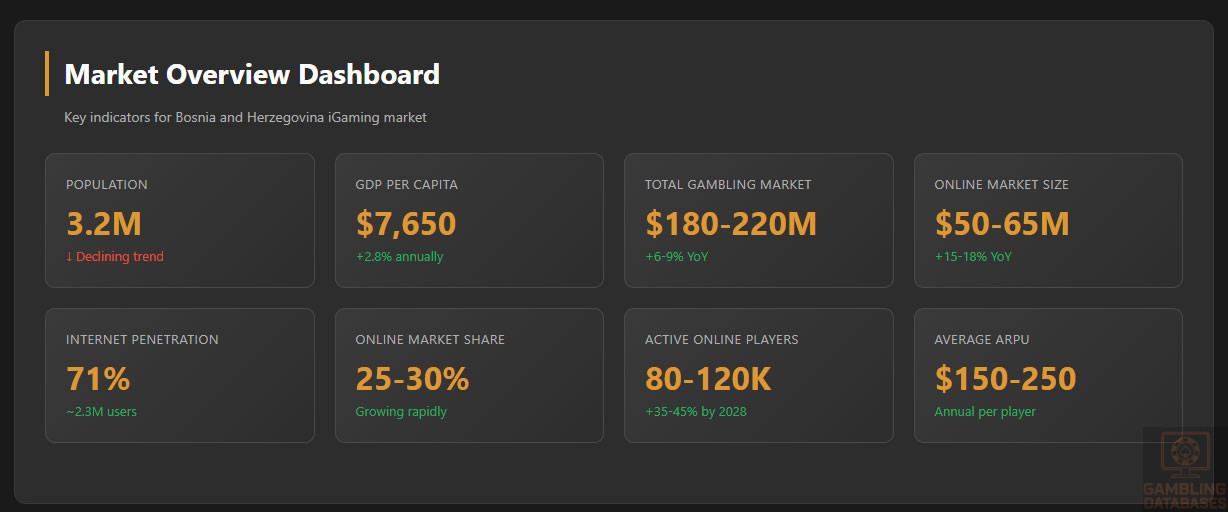
Executive Summary: Key Market Indicators
| Indicator | Value | Notes |
|---|---|---|
| Gambling Legal Status | Legal with restrictions | Dual regulatory system across two entities |
| Online Gambling Status | Partially regulated | Different frameworks in FBiH and RS |
| Regulatory Bodies | Entity-level authorities | No unified national framework |
| Population | 3.2 million | Declining population trend |
| Median Age | 43.5 years | Aging population structure |
| Urban Population | 49% | Balanced urban-rural distribution |
| GDP Total | 24.5 billion USD | 2024 estimate |
| GDP Per Capita | 7,650 USD | Lower-middle income economy |
| GDP Growth Forecast | 2.8% annually | 2025-2027 projection |
| Average Monthly Income | 550-650 USD | Varies by entity and sector |
| Internet Penetration | 71% | Approximately 2.3 million users |
| Mobile Penetration | 94% | Multiple SIM ownership common |
| Smartphone Adoption | 65% | Growing among younger demographics |
| License Cost (FBiH) | 50,000-100,000 BAM | 26,000-52,000 USD annually |
| License Cost (RS) | 30,000-80,000 BAM | 15,600-41,600 USD annually |
| GGR Tax Rate (FBiH) | 10% | Plus municipal taxes |
| GGR Tax Rate (RS) | 5-10% | Varies by game type |
| Corporate Income Tax | 10% | Among lowest in Europe |
| Total Gambling Market Size | 180-220 million USD | 2024 estimate, all channels |
| Online Market Share | 25-30% | Approximately 50-65 million USD |
| Market Growth CAGR | 8-12% | 2025-2028 online segment projection |
| Online Gambling Participation | 8-12% | Of adult population |
| Average ARPU | 150-250 USD | Annual per active player |
| Mobile Gaming Share | 55-60% | Of online gambling revenue |
| Sports Betting Share | 70% | Dominant gambling vertical |
| Time to License | 6-12 months | From complete application |
| Minimum Capital Requirement | 50,000-100,000 BAM | Varies by entity and license type |
| Doing Business Rank | 90th globally | World Bank ranking |
| Payment Method Preference | Cash, cards, e-wallets | Digital payments growing |
Section 1: Regulatory Framework and Legal Environment
Current Gambling Regulation Status
Bosnia and Herzegovina operates under a unique constitutional structure that creates a fragmented gambling regulatory environment. The country comprises two autonomous entities: the Federation of Bosnia and Herzegovina and Republika Srpska, each maintaining independent legislative authority over gambling activities within their territories. This dual system results in parallel regulatory frameworks, different licensing procedures, and varying tax structures, requiring operators to navigate multiple jurisdictions even within a single small market.
The absence of a unified national gambling law means that operators seeking comprehensive market coverage must obtain separate licenses from each entity. Additionally, the Brčko District, a self-governing administrative unit, maintains its own gambling regulations, further complicating the regulatory landscape. This fragmentation creates both challenges and opportunities, as operators can strategically choose their entry point based on more favorable regulatory conditions in one entity while potentially expanding to the other later.

Land-Based Gambling Activities
Casino Operations: Both entities permit casino operations under regulated frameworks requiring specific licenses and compliance with technical standards. The Federation of Bosnia and Herzegovina authorizes casino licenses for establishments offering table games, electronic gaming machines, and related gambling activities. Casinos must maintain physical premises meeting prescribed standards, employ certified gaming staff, and implement comprehensive player monitoring systems. Minimum investment thresholds and facility requirements vary by canton within the Federation.

Sports Betting Venues: Land-based sports betting represents the most popular and widespread gambling activity in Bosnia and Herzegovina. Both entities license betting shops extensively, with hundreds of retail locations operating across the country. The Federation requires sports betting operators to obtain licenses at the cantonal level, creating multiple regulatory touchpoints for operators seeking broad geographic coverage. License requirements include premises standards, betting terminal specifications, and connection to centralized monitoring systems.
In Republika Srpska, sports betting licenses are issued by the entity-level authorities with more streamlined procedures compared to the cantonal system in the Federation. Operators must maintain physical betting locations, employ trained staff, and implement real-time reporting systems connecting all betting terminals to regulatory oversight platforms. The high density of betting shops in urban areas reflects strong consumer demand for sports wagering opportunities.
Slot Machine Halls and Gaming Parlors: Electronic gaming machines operate under separate licensing categories in both entities. Gaming halls dedicated to slot machines require specific authorizations distinct from casino licenses. The Federation regulates the number of machines per location, technical specifications for gaming devices, and payout percentages. Operators must use certified gaming equipment meeting technical standards and maintain server-based monitoring systems.
Republika Srpska imposes limits on machine density and requires gaming halls to implement player identification systems and loss tracking mechanisms. The entity has established zones where gaming halls can operate and restricts their proximity to schools and religious institutions. Both entities require operators to purchase gaming machine permits in addition to facility licenses, creating multiple fee obligations.
Lottery Operations: Lottery activities operate under state monopoly or exclusive concession models in both entities. The Federation authorizes lottery operations through entity-level concessions, with the official lottery operator holding exclusive rights for traditional lottery products, instant win games, and related activities. Republika Srpska similarly maintains a lottery monopoly system with a designated operator.
Online Gambling Framework
Digital Gaming Regulations: The online gambling regulatory framework in Bosnia and Herzegovina remains underdeveloped compared to land-based gambling legislation. The Federation of Bosnia and Herzegovina has begun implementing online gambling regulations, permitting licensed operators to offer digital betting and gaming services. However, the regulatory framework lacks the comprehensive detail found in more mature markets, creating ambiguity around technical requirements, player protection standards, and compliance procedures.
Online gambling licenses in the Federation cover sports betting and casino gaming delivered via internet platforms and mobile applications. Licensed operators must demonstrate technical capability, maintain servers within approved jurisdictions, and implement geolocation verification to restrict services to authorized territories. The regulatory framework requires online operators to meet similar player protection standards as land-based venues, including age verification, self-exclusion capabilities, and responsible gambling tools.
Republika Srpska has taken steps toward regulating online gambling, with legislation authorizing digital gambling services under entity oversight. The regulatory approach focuses primarily on online sports betting, which dominates player interest. Casino gaming, poker, and other online gambling verticals face more restrictive treatment, with unclear authorization pathways. Operators must obtain specific licenses for online operations, which remain separate from land-based authorizations.
Prohibited Activities and Restrictions: Both entities maintain prohibitions on certain gambling activities and impose restrictions on online gambling operations. Skill games with gambling characteristics face regulatory scrutiny, with authorities distinguishing between games of chance requiring licenses and lawful skill-based competitions. Online poker rooms and peer-to-peer betting exchanges operate in regulatory gray zones, with unclear authorization pathways.
Fantasy sports platforms and social gaming applications with real-money elements have emerged without clear regulatory oversight, creating uncertainty for operators considering these verticals. Cryptocurrency gambling faces restrictions related to broader digital asset regulations, with authorities requiring transparency around payment methods and maintaining skepticism toward anonymous gambling transactions. Both entities prohibit gambling services targeting minors and impose restrictions on gambling advertising content and placement.
Regulatory Body Structure and Oversight: The Federation of Bosnia and Herzegovina distributes gambling regulatory authority across cantonal governments, creating a decentralized oversight structure. Each canton maintains its own gambling regulatory body or assigns gambling oversight to existing administrative departments. This creates significant complexity for operators seeking Federation-wide coverage, as they must engage with multiple regulatory authorities, each with distinct procedures and requirements.
Republika Srpska centralizes gambling regulation under entity-level authorities, providing more streamlined oversight compared to the Federation’s cantonal system. The entity’s gambling regulatory body maintains responsibility for licensing, compliance monitoring, and enforcement across all gambling activities in Republika Srpska territory. This centralized approach simplifies regulatory engagement for operators but still requires separate authorization from Federation authorities for cross-entity operations.
Licensed Operators and Market Players
Market Structure and Licensed Operators: The Bosnia and Herzegovina gambling market hosts a mix of domestic operators with deep local market knowledge and international operators leveraging regional scale and brand recognition. The land-based betting sector features intense competition, with numerous licensed operators maintaining extensive retail networks. Premier, Mozzart, Meridian, and other regional brands operate betting shop chains across both entities, competing for market share in urban centers and secondary cities.
Online gambling operations include both domestic operators transitioning from land-based to digital channels and international platforms securing local licenses to enter the market legally. The competitive landscape remains fragmented, with no single operator dominating across all verticals and territories. Market leadership positions vary by entity, with different operators achieving prominence in the Federation versus Republika Srpska.
International Operators and Market Entry Strategies: Several international gambling groups have entered the Bosnia and Herzegovina market through acquisition of local operators, partnership arrangements, or direct licensing applications. Regional operators from neighboring Serbia, Croatia, and Slovenia have leveraged their Balkan presence to expand into Bosnia and Herzegovina, bringing established brands and operational expertise. These operators typically employ localized marketing strategies, sponsor popular football clubs, and adapt their product offerings to local preferences.
Entry strategies vary based on regulatory complexity and market opportunities in each entity. Some international operators have chosen to establish presence in one entity initially, using it as a foundation for potential expansion to the other entity. Others have pursued simultaneous licensing in both entities despite the additional complexity and cost. White-label arrangements and technology platform partnerships have enabled smaller operators to enter the market without developing proprietary gaming platforms.
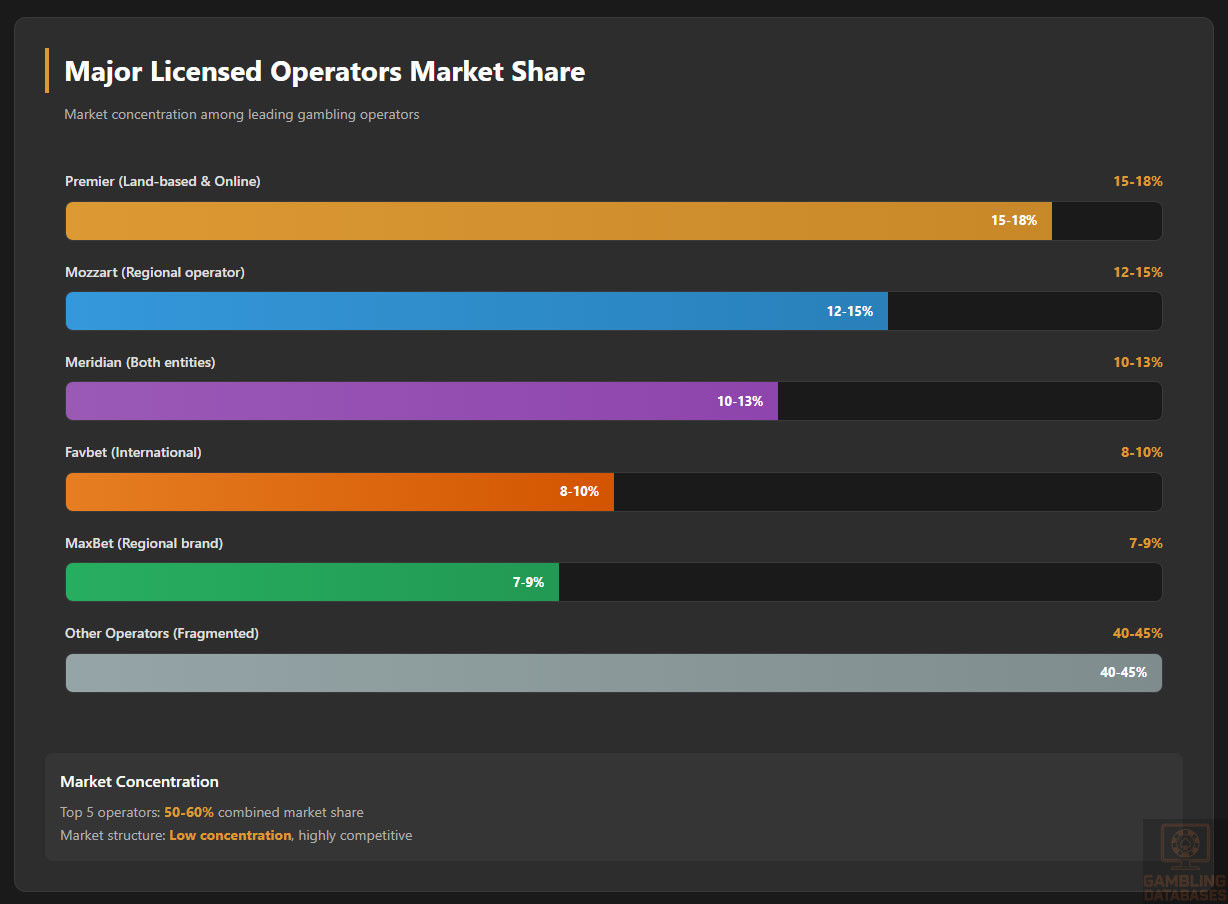
Market Share and Competitive Dynamics: Market concentration in Bosnia and Herzegovina remains relatively low, with the top five operators collectively holding approximately 50-60 percent of the total gambling market. Sports betting operators dominate market share given the vertical’s popularity, with leading betting brands capturing 15-20 percent individual market shares in their strongest territories. Online operations show even more fragmentation, with no single operator holding more than 10-15 percent of the digital gambling market.
Competition focuses heavily on betting shop density and location quality in the land-based segment, with operators competing for prime retail positions in city centers and near transportation hubs. Online competition emphasizes mobile application quality, odds competitiveness, and promotional offers. Customer acquisition costs remain manageable compared to Western European markets, but retention proves challenging given the small market size and intense promotional competition among operators.
| Operator | License Type | Market Presence | Estimated Market Share |
|---|---|---|---|
| Premier | Land-based and online betting | Both entities, extensive retail network | 15-18% |
| Mozzart | Sports betting (retail and online) | Regional operator, strong in RS | 12-15% |
| Meridian | Betting shops and digital platforms | Both entities, growing online presence | 10-13% |
| Favbet | Online and retail betting | International operator, selective presence | 8-10% |
| MaxBet | Betting and gaming | Regional brand, land-based focus | 7-9% |
| Others | Various licenses | Fragmented smaller operators | 40-45% |
Licensing Framework and Requirements
Application Process and Eligibility
Regulatory Authority Engagement: Prospective operators must identify the appropriate regulatory authority based on their intended operational territory. In the Federation of Bosnia and Herzegovina, operators must engage with cantonal-level gambling authorities if operating physical establishments or the entity-level authority for online gambling licenses. Contact information and application procedures vary by canton, requiring operators to research specific requirements for their target cantons.
Republika Srpska centralizes licensing through entity-level authorities, simplifying initial regulatory engagement. Operators should initiate contact with the relevant ministry or gambling regulatory department early in their planning process to clarify current requirements, as regulations and procedures evolve. Regulatory authorities typically require preliminary consultations where operators present their business plans and proposed operations before submitting formal applications.
Financial Requirements and Guarantees: License applications require substantial financial documentation demonstrating the operator’s capability to conduct gambling operations responsibly. The Federation of Bosnia and Herzegovina typically requires bank guarantees ranging from 50,000 to 100,000 BAM depending on license type and scope. Online gambling licenses sit at the higher end of this range, while single betting shop licenses require lower guarantees.
Republika Srpska imposes similar financial guarantee requirements, with amounts varying based on operational scale. Operators planning extensive retail networks face higher aggregate guarantee requirements across all licensed locations. Bank guarantees must come from recognized financial institutions, typically banks operating within Bosnia and Herzegovina or international banks with local correspondent relationships. Guarantees remain in force throughout the license validity period and may be called upon for regulatory violations or unpaid obligations.
Minimum capital requirements apply to the licensed entity itself, separate from bank guarantees. Operators must demonstrate sufficient capitalization to sustain operations, meet player obligations, and cover potential liabilities. The Federation typically requires minimum capital of 50,000 to 100,000 BAM for corporate entities holding gambling licenses. Republika Srpska imposes similar minimum capital thresholds, with specific amounts depending on the license category and anticipated operational scale.
Technical Standards and Certifications: Gambling equipment and software platforms must meet technical standards established by regulatory authorities. Gaming machines require certification from approved testing laboratories confirming compliance with random number generation standards, payout percentage requirements, and security specifications. Both entities maintain lists of acceptable testing laboratories, typically including international certification bodies recognized across multiple jurisdictions.
Online gambling platforms must undergo technical evaluation covering game fairness, data security, player protection mechanisms, and system integrity. Operators must provide detailed technical documentation describing their platform architecture, security measures, and player data protection protocols. Some licenses require operators to use certified gaming content from approved providers, while others permit proprietary games subject to certification processes.
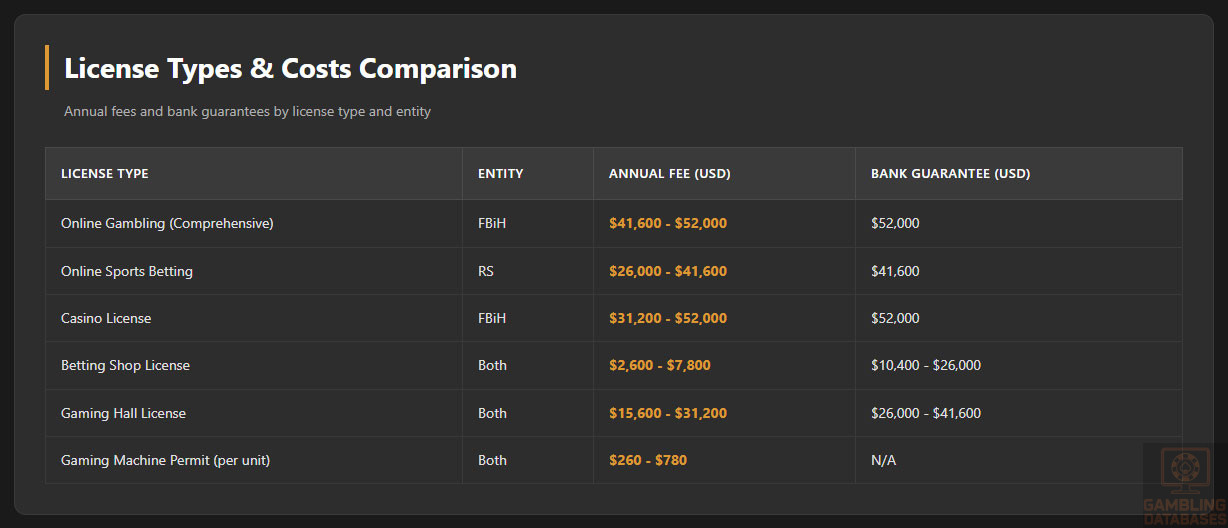
| License Type | Entity | Annual Fee (BAM) | Annual Fee (USD) | Bank Guarantee |
|---|---|---|---|---|
| Online Gambling (Comprehensive) | FBiH | 80,000-100,000 | 41,600-52,000 | 100,000 BAM |
| Online Sports Betting | RS | 50,000-80,000 | 26,000-41,600 | 80,000 BAM |
| Casino License | FBiH | 60,000-100,000 | 31,200-52,000 | 100,000 BAM |
| Betting Shop License | Both | 5,000-15,000 | 2,600-7,800 | 20,000-50,000 BAM |
| Gaming Hall License | Both | 30,000-60,000 | 15,600-31,200 | 50,000-80,000 BAM |
| Gaming Machine Permit (per unit) | Both | 500-1,500 | 260-780 | N/A |
Background Check Procedures and Timelines
Due Diligence Requirements: Regulatory authorities conduct comprehensive background investigations on license applicants, covering beneficial owners, directors, and key management personnel. Individuals with ownership stakes exceeding specified thresholds undergo detailed scrutiny, typically those holding 5 percent or more of company equity. Background checks examine criminal records, financial history, previous gambling industry involvement, and regulatory compliance records in other jurisdictions.
Applicants must provide extensive documentation including police clearance certificates, financial statements, business references, and detailed curriculum vitae for key personnel. Documents originating outside Bosnia and Herzegovina require notarization, apostille certification, and official translation into the local language. The authentication process adds time and cost to application preparation, particularly for international operators assembling documentation from multiple jurisdictions.
Background check timelines vary considerably based on application complexity and the number of individuals requiring investigation. Simple applications with few stakeholders and domestic ownership may complete background checks within 2-3 months. Complex applications involving multiple international beneficial owners, corporate ownership structures, and extensive gambling industry histories can extend background investigations to 6-9 months. Authorities may request additional information or clarification during reviews, further extending timelines.
Application Processing Timeline: Complete license applications in the Federation of Bosnia and Herzegovina typically require 6-12 months from submission to final approval, assuming no significant complications or deficiencies. Cantonal authorities process land-based establishment licenses, with timelines varying by canton based on administrative capacity and application volume. Entity-level online gambling licenses follow more complex review procedures, contributing to longer processing periods.
Republika Srpska maintains similar overall timelines, with complete applications requiring 6-10 months for final approval. The entity’s centralized regulatory structure potentially enables slightly faster processing compared to the Federation’s cantonal system, though actual timelines depend heavily on application quality and completeness. Incomplete applications or those requiring substantial clarification can extend well beyond these typical ranges, potentially reaching 18-24 months in problematic cases.
Local Presence and Operational Requirements
Physical Presence Mandates: Both entities require licensed gambling operators to maintain physical business presence within their respective territories. Operators must establish registered legal entities incorporated under Bosnia and Herzegovina law, either as limited liability companies or other recognized corporate forms. The registered entity must maintain a physical office address within the licensing territory, not merely a virtual office or mail forwarding service.
Office requirements vary by license type and operational scale. Online gambling operators must maintain functional offices with adequate staff to conduct business operations, respond to regulatory inquiries, and handle customer service functions. While regulations do not always specify minimum office sizes or staff counts, authorities expect operational substance matching the license scope. Operators running extensive online gambling platforms require larger facilities and more substantial local teams than small-scale betting operations.
Land-based gambling establishments inherently satisfy physical presence requirements through their gaming venues. However, operators must maintain administrative offices separate from customer-facing gambling facilities for corporate functions, regulatory compliance, and financial operations. Multi-site operators often centralize administrative functions in a single office location while maintaining the required physical presence at each licensed gambling venue.
Domain and Hosting Requirements: Online gambling regulations address technical infrastructure requirements, though specifics vary between entities and evolve as authorities refine their approaches. The Federation of Bosnia and Herzegovina requires online operators to use approved domains, typically mandating .ba country-code top-level domains or specific subdomain structures for licensed gambling operations. Domain registration must reflect the licensed entity, establishing clear attribution for regulatory and enforcement purposes.
Server and hosting requirements remain less strictly defined than in some European markets. Authorities generally do not mandate server physical location within Bosnia and Herzegovina, recognizing the impracticality for the small market. However, operators must ensure regulatory authorities can access systems for monitoring and inspection purposes. Data retention requirements may necessitate maintaining certain records on servers within Bosnia and Herzegovina or European Union territories with acceptable data protection standards.
Personnel and Management Obligations: Licensed operators must employ qualified personnel meeting regulatory standards for key positions. Gaming managers, compliance officers, and technical staff often require specific certifications or demonstrated competency. Some licenses mandate that key management positions be filled by individuals physically present in Bosnia and Herzegovina, preventing purely remote management structures.
Staff training requirements cover responsible gambling, anti-money laundering procedures, and customer service standards. Operators must document training programs and maintain records demonstrating employee competency. Customer-facing staff in land-based venues require particular attention to age verification procedures, intoxicated patron identification, and problem gambling recognition. Online operators must similarly train staff handling customer communications and account verification processes.
Foreign Ownership Restrictions: Bosnia and Herzegovina generally permits foreign ownership of gambling operators without absolute prohibitions, though practical considerations and regulatory preferences influence ownership structures. Neither entity imposes strict caps on foreign ownership percentages for most gambling license categories. However, authorities may scrutinize applications from entirely foreign-owned entities more closely than those with local ownership participation.
Some operators pursue joint ventures or partnership structures with local businesses to facilitate market entry and regulatory approval. Local partners provide market knowledge, regulatory relationships, and cultural understanding that international operators lack. However, partnership arrangements introduce complexity around profit sharing, operational control, and exit strategies. Operators must carefully structure arrangements to protect their interests while satisfying regulatory preferences for local involvement.
Compliance Obligations and Monitoring
Player Protection and Identification
Age Verification Requirements: Both entities mandate strict age verification procedures to prevent underage gambling. The minimum legal gambling age stands at 18 years throughout Bosnia and Herzegovina. Operators must verify player ages before permitting gambling participation, both in land-based venues and online platforms. Land-based establishments must request government-issued identification from any patron appearing younger than 25 years, implementing age verification at entry points and gaming positions.
Online operators face more complex age verification challenges given the remote nature of transactions. Registration processes must capture identification document information, with operators verifying authenticity through document checks and data validation. Leading practices include identity verification services cross-referencing provided information against official databases and document authentication technology detecting fraudulent identification.
Operators bear liability for permitting underage gambling, facing penalties including fines, license suspension, and potential criminal charges for serious violations. Regulatory authorities conduct mystery shopping exercises and compliance audits examining age verification procedures. Documented policies, staff training records, and verification logs provide evidence of compliance efforts during regulatory inspections.
KYC and Anti-Money Laundering Compliance: Bosnia and Herzegovina gambling operators must comply with anti-money laundering regulations aligned with international standards. Know Your Customer procedures require operators to identify and verify customer identities, understand the nature of customer relationships, and monitor transactions for suspicious activity. Enhanced due diligence applies to high-value customers, politically exposed persons, and transactions from higher-risk jurisdictions.
Customer identification requirements mandate collection of full names, dates of birth, addresses, and identification document details. Operators must verify provided information through reliable sources, maintaining verification records throughout customer relationships and for specified periods after account closures. Source of funds inquiries become necessary when customer transaction patterns or volumes raise questions about fund origins.
Transaction monitoring obligations require operators to implement systems detecting unusual patterns that may indicate money laundering. Large cash deposits, rapid high-volume betting with minimal gambling activity, and structured transactions designed to evade reporting thresholds warrant enhanced scrutiny. Operators must file suspicious transaction reports with financial intelligence units when detecting activity suggesting money laundering or terrorist financing.
Responsible Gambling Measures: Regulatory frameworks require operators to implement responsible gambling protections addressing problem gambling risks. Self-exclusion programs allow players to voluntarily ban themselves from gambling activities for specified periods. Both entities require operators to maintain self-exclusion registries and prevent excluded individuals from gambling during exclusion periods. Land-based operators must train staff to recognize self-excluded individuals and deny them access to gaming areas.
Online operators must implement technical controls preventing self-excluded players from accessing gambling platforms. Account closure procedures, IP address blocking, and payment method restrictions help enforce exclusions. Some regulations require operators to participate in shared self-exclusion databases enabling exclusions across multiple operators, though implementation across Bosnia and Herzegovina’s fragmented regulatory landscape remains incomplete.
Deposit limits, loss limits, and session time limits empower players to control their gambling behavior. While not universally mandated across all license types, leading operators offer these tools voluntarily or in response to specific regulatory requirements. Reality checks interrupting play sessions to inform players of elapsed time and losses sustained help maintain player awareness during extended gambling sessions.
Mandatory Player Information Disclosures: Operators must provide players with clear information about gambling risks, odds of winning, and available support resources for problem gambling. Terms and conditions must use plain language explaining betting rules, payout structures, and bonus conditions. Misleading advertising or promotional materials violate consumer protection standards and gambling regulations.
Online platforms must display prominent warnings about gambling addiction risks, links to problem gambling support organizations, and clear information about self-exclusion options. House edges, return-to-player percentages, and game rules should be readily accessible to players before they commit to wagering. Transparency requirements extend to payment processing, with operators clearly communicating deposit methods, withdrawal procedures, processing timelines, and applicable fees.
Financial Monitoring and Reporting
Transaction Monitoring Systems: Licensed operators must implement transaction monitoring systems capable of tracking all gambling activity, financial transactions, and player account movements. Land-based operators connect betting terminals and gaming machines to centralized monitoring platforms providing real-time visibility to regulatory authorities. These systems capture bet placement, outcomes, payouts, and operator hold percentages across all gaming devices.
Online operators similarly must implement comprehensive transaction logging capturing all player interactions, bets placed, game outcomes, deposits, withdrawals, and account balance changes. Audit trails must be tamper-proof and maintained for regulatory inspection. Authorities may conduct remote monitoring or require regular data feeds providing visibility into operator activities without requiring physical inspections.
Reporting Requirements and Schedules: Regulatory authorities impose periodic reporting obligations providing visibility into operator activities and market performance. Monthly reports typically include gross gaming revenue, number of active players, total amounts wagered, and payouts to players. Reports break down activity by game type, allowing authorities to analyze market composition and identify trends.
Ad hoc reporting obligations arise when authorities investigate specific issues or respond to complaints. Operators must provide requested information within prescribed timeframes, which may range from immediate provision for urgent matters to several weeks for comprehensive data requests. Failure to submit accurate and timely reports constitutes license violations potentially resulting in penalties.
Audit and Inspection Procedures: Regulatory authorities maintain rights to audit operator activities and inspect facilities without advance notice. Audits examine financial records, player transaction data, responsible gambling program implementation, and technical system compliance. Inspectors may visit land-based establishments to observe operations, interview staff, and examine equipment. Online operators receive requests for system access, data extracts, and documentation evidencing compliance with technical and operational standards.
Operators must cooperate fully with regulatory inspections, providing requested information and access to personnel, systems, and records. Obstruction of regulatory inspections represents serious violations potentially resulting in license revocation. Third-party audits from independent accounting firms or technical testing laboratories supplement regulatory inspections, with operators often required to commission periodic independent assessments of their operations.
Taxation Structure and Financial Obligations
Player Taxation
Tax on Winnings: Bosnia and Herzegovina does not impose comprehensive taxation on gambling winnings at the player level. Individual players generally do not face withholding requirements or tax declaration obligations for gambling winnings from licensed operators. This approach aligns with many European jurisdictions that tax gambling operators rather than individual players, simplifying tax administration and reducing compliance burdens on casual gamblers.
However, professional gamblers or individuals deriving substantial income from gambling may face income tax obligations on their gambling-related earnings. Tax authorities may examine individuals whose primary income source appears to be gambling, potentially classifying substantial gambling winnings as taxable income. The threshold between recreational gambling and taxable gambling income remains somewhat ambiguous, with determinations made on case-by-case bases.
Large single-event winnings occasionally trigger reporting requirements, though specific thresholds and procedures vary between entities. Operators paying out substantial winnings may request identification information for reporting purposes, particularly when anti-money laundering obligations intersect with large transactions. Players winning jackpots or tournament prizes occasionally face tax inquiries, though systematic withholding remains uncommon.
Operator Taxation
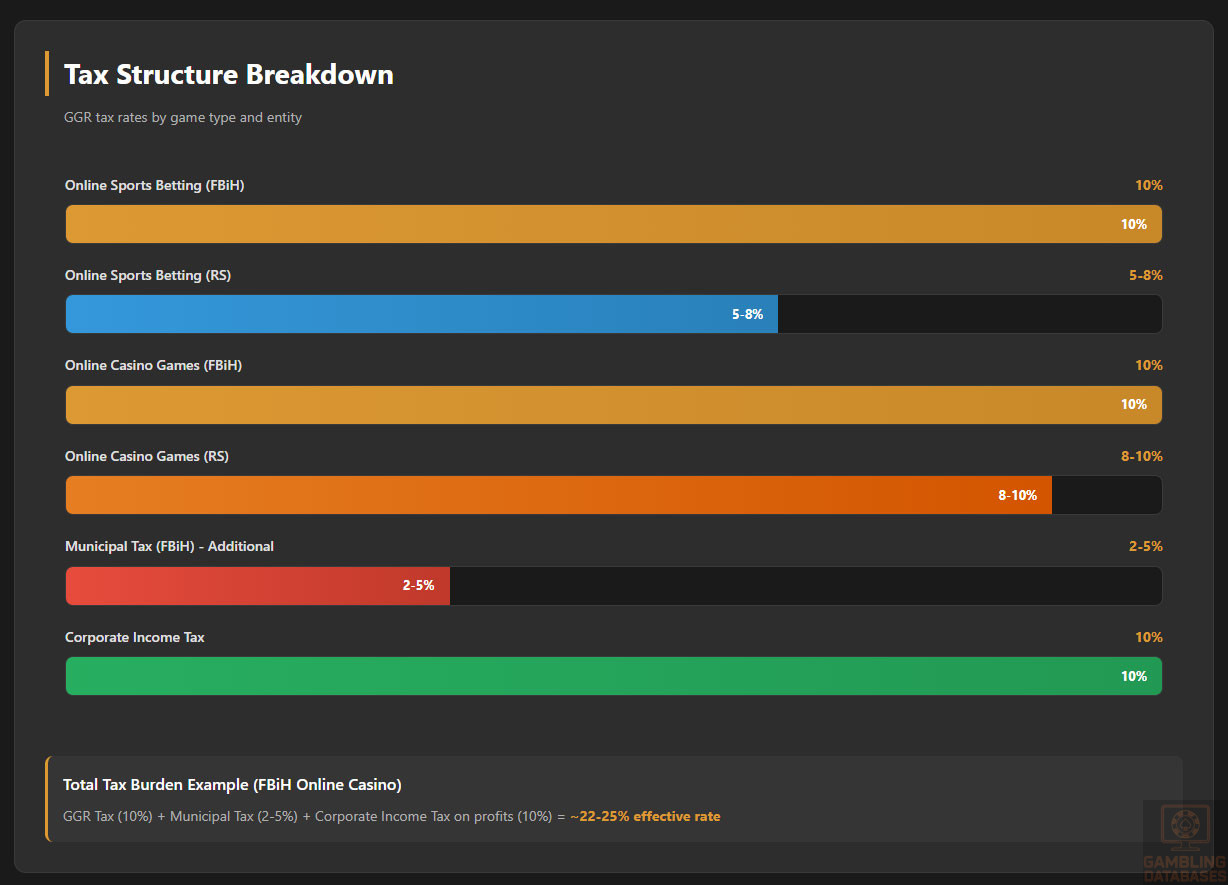
Gross Gaming Revenue Taxation: The primary gambling-specific tax burden falls on operators through gross gaming revenue taxation. The Federation of Bosnia and Herzegovina imposes a 10 percent GGR tax rate on licensed gambling operations. GGR represents total amounts wagered minus payouts to players, before deducting operational expenses. This calculation method ensures taxation on operator revenue rather than turnover, aligning with international best practices.
Republika Srpska implements variable GGR tax rates depending on gambling activity type. Sports betting typically faces 5-8 percent GGR taxation, while casino gaming and slots may incur 8-10 percent rates. The entity periodically adjusts rates through legislative amendments, creating some uncertainty around long-term tax obligations. Online gambling operations generally face similar tax rates to their land-based equivalents, though specific treatment continues evolving.
Tax calculation methodologies require careful attention to ensure accurate compliance. Operators must maintain detailed records supporting GGR calculations, including total wagers accepted, all payouts made, and adjustments for voided bets or cancelled transactions. Bonus costs and promotional expenses typically do not reduce taxable GGR, with bonuses considered operator marketing expenses rather than player payouts. Free bet costs may receive different treatment depending on specific regulatory guidance.
| Game Type | FBiH GGR Tax | RS GGR Tax | Additional Fees |
|---|---|---|---|
| Online Sports Betting | 10% | 5-8% | Municipal taxes may apply |
| Online Casino Games | 10% | 8-10% | License fees separate |
| Land-Based Betting | 10% | 5-8% | Municipal taxes 2-5% |
| Casino Table Games | 10% | 8-10% | Facility-based fees |
| Slot Machines/EGMs | 10% | 8-10% | Per-machine fees |
| Lottery Products | Varies | Varies | Monopoly concessions |
Corporate Income Tax: Beyond gambling-specific taxes, licensed operators pay corporate income tax on their profits. Bosnia and Herzegovina maintains a competitive 10 percent corporate income tax rate, among the lowest in Europe. This rate applies to all corporate entities operating in the country, including gambling operators. The low corporate tax burden partially offsets higher gambling-specific taxes and regulatory costs.
Tax base calculations follow standard accounting principles, allowing deduction of legitimate business expenses from gross revenues to determine taxable profits. Gambling taxes paid represent deductible expenses reducing corporate income tax obligations. International operators structuring operations across multiple jurisdictions must navigate transfer pricing requirements ensuring that profits are appropriately allocated to Bosnia and Herzegovina operations rather than shifted to lower-tax jurisdictions.
Municipal and Other Taxes: Local municipalities in the Federation of Bosnia and Herzegovina levy additional taxes on gambling operations within their territories. Municipal gambling taxes typically range from 2-5 percent of GGR, adding to entity-level tax burdens. Operators must register with municipal authorities and comply with local tax payment schedules separate from entity-level obligations. The aggregate tax burden combining entity and municipal taxes can reach 12-15 percent of GGR in the Federation.
Republika Srpska generally does not impose municipal gambling taxes beyond entity-level obligations, simplifying tax compliance for operators in that territory. However, municipalities may levy standard business taxes, real estate taxes, and utility fees applicable to all businesses regardless of industry. Land-based venues pay property taxes based on facility valuations, while all operators incur standard employment-related taxes and social contributions.
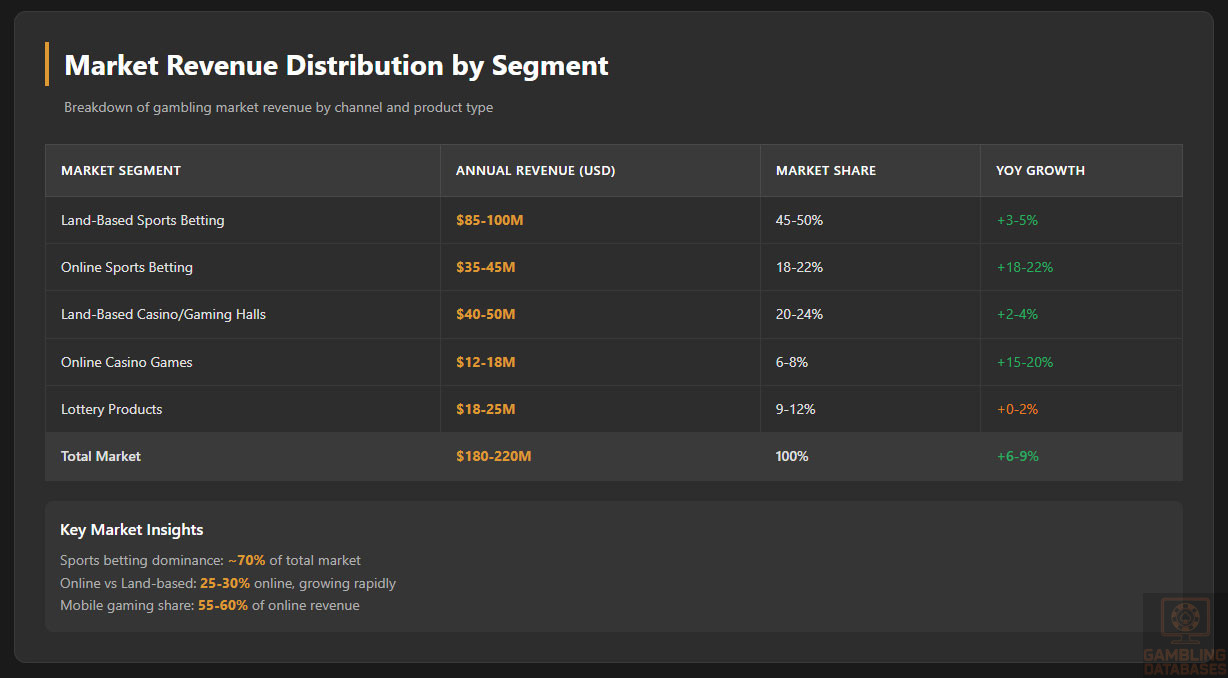
Gambling Market Financial Performance
Market Revenue and Growth Trends: The total Bosnia and Herzegovina gambling market generates approximately 180-220 million USD annually across all channels and operators. Land-based gambling activities account for roughly 70-75 percent of total market revenue, reflecting the traditional dominance of retail betting shops and gaming halls. Sports betting represents the single largest segment, contributing approximately 60 percent of total gambling revenue given Bosnian consumers’ strong preferences for sports wagering.
Online gambling has grown rapidly over recent years, reaching 50-65 million USD in annual revenue representing 25-30 percent of the total market. The COVID-19 pandemic accelerated digital adoption as land-based venues faced closures and capacity restrictions, permanently shifting some consumer behavior toward online channels. Annual growth rates for online gambling range from 15-20 percent, significantly exceeding land-based market growth of 2-5 percent annually.
Casino gaming including table games and electronic gaming machines contributes approximately 25-30 percent of total market revenue. The casino segment shows more modest growth than sports betting, constrained by limited tourism inflows and domestic consumer preferences favoring sports wagering over casino products. Lottery operations maintain steady but declining market share, representing approximately 10-15 percent of gambling revenue with minimal growth given the mature nature of lottery markets.
Tax Revenue Generation: Gambling taxes contribute 20-30 million USD annually to government revenues across both entities, representing a meaningful but not transformational revenue source. The Federation of Bosnia and Herzegovina collects higher absolute gambling tax revenues given its larger population and more extensive gambling market, though per-capita gambling tax contributions remain modest compared to Western European benchmarks.
Republika Srpska’s lower tax rates partially offset by high gambling participation rates result in meaningful gambling tax revenues for the entity’s budget. The gambling sector’s tax contribution has grown steadily over recent years as online gambling expansion and land-based market maturation generate increasing revenues. However, gambling taxes represent only 1-2 percent of total government revenue, limiting authorities’ fiscal dependence on the sector.
Municipal gambling tax collections in the Federation vary significantly based on local gambling venue density and operational scale. Sarajevo and other major cities collect substantial municipal gambling taxes, while rural municipalities with limited gambling presence receive minimal gambling-related revenue. This geographic variation creates different municipal attitudes toward gambling regulation, with some municipalities actively encouraging gambling operations to enhance tax collections while others restrict licensing to limit social impacts.
| Market Segment | Annual Revenue (USD millions) | Market Share | YoY Growth Rate |
|---|---|---|---|
| Land-Based Sports Betting | 85-100 | 45-50% | 3-5% |
| Online Sports Betting | 35-45 | 18-22% | 18-22% |
| Land-Based Casino/Gaming Halls | 40-50 | 20-24% | 2-4% |
| Online Casino Games | 12-18 | 6-8% | 15-20% |
| Lottery Products | 18-25 | 9-12% | 0-2% |
| Total Market | 180-220 | 100% | 6-9% |
Advertising and Marketing Restrictions
Permitted Advertising Channels: Bosnia and Herzegovina permits gambling advertising across multiple channels with varying restrictions by medium and entity. Television advertising faces the most comprehensive regulation, with both entities restricting gambling advertisements during certain time periods to minimize exposure to minors. The Federation typically prohibits gambling advertising on television between 6:00 AM and 10:00 PM, limiting commercials to late evening and overnight hours when younger audiences are less likely to be watching.
Republika Srpska implements similar television advertising restrictions with some variation in specific time windows and content requirements. Radio advertising faces less stringent timing restrictions but must include responsible gambling warnings and avoid content appealing to minors. Print media including newspapers and magazines can generally carry gambling advertisements with content restrictions around imagery and messaging that might attract underage interest.
Online advertising operates in a less regulated environment, with fewer restrictions on digital display advertising, search engine marketing, and social media promotions. However, operators must ensure online advertising does not target minors through content selection, placement on youth-oriented websites, or use of appealing imagery and themes. Affiliate marketing arrangements between operators and promotional websites remain permitted, with operators bearing responsibility for affiliate compliance with advertising standards.
Content Restrictions and Guidelines: Advertising content must not present gambling as a solution to financial problems, social success pathway, or necessary activity for social acceptance. Advertisements cannot portray excessive gambling as socially acceptable or glamorize problem gambling behaviors. Use of celebrities, sports figures, or cultural icons in advertising faces scrutiny, particularly when these individuals have substantial youth followings that might increase underage appeal.
All gambling advertisements must include responsible gambling messaging, typically warnings that gambling involves risks and players should gamble responsibly. Contact information for problem gambling support organizations should appear in advertising materials. Advertisements cannot make misleading claims about winning odds, suggest guaranteed returns, or minimize the risks inherent in gambling activities. Terms and conditions for bonuses and promotions must be clearly disclosed with no hidden requirements or unrealistic wagering conditions.
Sponsorship Regulations: Gambling operators actively sponsor football clubs, sports leagues, and sporting events throughout Bosnia and Herzegovina, representing major marketing investments. The Federation and Republika Srpska generally permit gambling sponsorships with some content restrictions. Sponsored teams and athletes cannot promote gambling to minors or use youth-oriented imagery in sponsorship materials. Stadium signage and jersey sponsorships must comply with general advertising content standards.
Controversy occasionally arises around gambling sponsorship’s prominence in Bosnian sports, with some advocacy groups calling for restrictions similar to tobacco advertising bans. However, gambling operators remain major sports sponsors given limited corporate sponsorship alternatives in the small economy. Sports betting operators particularly leverage sponsorships to build brand awareness and associate their brands with popular football clubs and competitions.
Bonus and Promotion Restrictions: Welcome bonuses, free bets, and promotional offers face increasing regulatory scrutiny across both entities. Authorities have begun limiting bonus amounts, requiring transparent wagering requirements, and restricting promotional mechanics that might encourage excessive gambling. Maximum bonus values help prevent operators from using unsustainable promotions to acquire customers, while clear wagering requirements ensure players understand what’s required to withdraw bonus-related winnings.
Some restrictions prohibit promotional offers targeting players who have self-excluded or shown problem gambling behaviors. Operators must not send promotional communications to self-excluded individuals or those who have requested no marketing contact. Bonus terms must be clearly presented before players accept offers, with no hidden conditions or unfair requirements that make bonus fulfillment virtually impossible.
Recent Regulatory Changes and Their Impact
Regulatory Evolution 2022-2025: Bosnia and Herzegovina’s gambling regulatory framework has experienced ongoing development over recent years as authorities respond to market changes and online gambling growth. The Federation implemented revised online gambling regulations clarifying licensing requirements and compliance obligations for digital operators. These amendments addressed previous regulatory ambiguities that created uncertainty for operators considering market entry.
Republika Srpska similarly updated gambling legislation enhancing online gambling oversight and strengthening player protection requirements. Amendments introduced clearer technical standards for online platforms, mandatory responsible gambling tools, and enhanced financial monitoring obligations. The entity also adjusted tax rates for certain gambling activities, though changes remained modest compared to dramatic tax increases seen in some European markets.
Enhanced Player Protection Requirements: Recent regulatory changes across both entities strengthened player protection obligations for licensed operators. New requirements mandate comprehensive self-exclusion systems, enhanced age verification procedures, and mandatory responsible gambling training for staff. Online operators must implement reality checks interrupting play sessions and informing players of time elapsed and losses incurred.
Deposit limit requirements enable players to set daily, weekly, or monthly deposit caps preventing excessive spending. While some operators voluntarily offered these tools previously, new regulations mandate their availability across all licensed platforms. Enhanced protection for vulnerable players includes requirements to identify potential problem gambling behaviors and intervene with account restrictions, mandatory cooling-off periods, or direct contact to offer support resources.
Advertising and Bonus Restrictions: Regulatory amendments have progressively tightened advertising and promotional activity restrictions. New rules limit television advertising to late-night hours exclusively, expanding previous restrictions that permitted some daytime advertising. Content standards became more stringent, requiring prominent responsible gambling warnings and prohibiting testimonials suggesting gambling success or financial gain.
Bonus restrictions introduced caps on welcome offer values and requirements for transparent presentation of wagering conditions. Some proposed amendments would prohibit certain promotional mechanics considered particularly risky, such as loss rebates that might encourage players to chase losses. The regulatory direction clearly favors enhanced consumer protection even at the cost of limiting operator marketing flexibility.
Impact on Operator Costs and Strategy: Regulatory changes have increased operator compliance costs through enhanced monitoring system requirements, mandatory responsible gambling tool implementation, and stricter reporting obligations. Smaller operators face particular challenges absorbing compliance costs that represent larger proportional burdens relative to their revenues. Some marginal operators have exited the market unable to justify continued operations under more stringent regulatory requirements.
Marketing restrictions have forced operators to adjust customer acquisition strategies, emphasizing brand building over aggressive promotional offers. The limitation on television advertising hours concentrates gambling commercials in late-night time slots, potentially reducing their effectiveness while increasing competition for limited advertising inventory. Operators increasingly focus on digital marketing channels, sponsorship activations, and retention of existing customers rather than aggressive new customer acquisition.
Enforcement Mechanisms and Penalties
Penalty Structures: Regulatory authorities maintain graduated penalty structures addressing compliance violations. Minor infractions typically result in warnings and requirements to remedy issues within specified timeframes. Repeated or more serious violations trigger financial penalties proportional to violation severity and operator size. Fine amounts range from several thousand BAM for minor infractions to hundreds of thousands BAM for serious compliance failures.
License suspension represents a more severe penalty, temporarily halting operator activities until compliance issues are resolved. Suspensions create substantial financial harm given revenue losses during suspension periods and reputational damage with customers and business partners. License revocation constitutes the ultimate penalty, permanently terminating an operator’s authorization to conduct gambling activities. Revoked licenses may not be reinstated, requiring operators to submit entirely new applications if seeking to re-enter the market.
Recent Enforcement Actions: Regulatory authorities have demonstrated increasing willingness to enforce compliance requirements, imposing penalties on both domestic and international operators. Recent enforcement actions have targeted inadequate age verification procedures, failures to implement self-exclusion systems effectively, and violations of advertising restrictions. Some operators faced license suspensions for serious anti-money laundering compliance failures, sending strong signals about regulatory expectations.
Enforcement trends indicate authorities prioritizing player protection violations over technical compliance issues. Operators permitting underage gambling, failing to identify problem gambling behaviors, or violating self-exclusion requirements face particularly serious consequences. Financial penalties have increased in recent years, with authorities imposing fines large enough to impact operator profitability and motivate compliance investments.
Unlicensed Operator Enforcement: Both entities actively combat unlicensed gambling operations through multiple enforcement mechanisms. Internet service provider blocking prevents consumer access to offshore gambling websites operating without local licenses. Payment processor restrictions complicate financial transactions between Bosnian consumers and unlicensed operators, reducing the appeal of offshore alternatives. Authorities periodically publish lists of blocked websites and warn consumers about gambling with unlicensed operators.
Criminal penalties apply to individuals operating unlicensed gambling activities within Bosnia and Herzegovina. Police raid illegal gambling establishments, confiscate equipment, and file criminal charges against operators. While enforcement focuses primarily on land-based illegal gambling venues, authorities have begun pursuing individuals promoting offshore gambling websites within Bosnia and Herzegovina. However, practical enforcement challenges limit effectiveness against sophisticated international online operators targeting Bosnian consumers from foreign jurisdictions.
Section 2: Demographics and Consumer Analysis
Population Demographics and Distribution
Core Population Metrics
Total Population and Growth Trends: Bosnia and Herzegovina has a population of approximately 3.2 million people, experiencing gradual decline over recent decades due to emigration, low birth rates, and aging demographics. The population peaked in the early 1990s before declining through conflict-related population losses and sustained emigration waves. Current demographic trends show continued slow population decrease of approximately 0.5-1.0 percent annually, driven primarily by youth emigration to Western Europe seeking better economic opportunities.
This declining population trend presents challenges for market growth, limiting the potential customer base for gambling operators. However, the negative demographic trajectory may stabilize as emigration rates potentially moderate and economic conditions gradually improve. Operators must account for shrinking population when projecting long-term market growth, recognizing that revenue increases will depend more on increasing gambling participation rates and spending per player rather than population expansion.
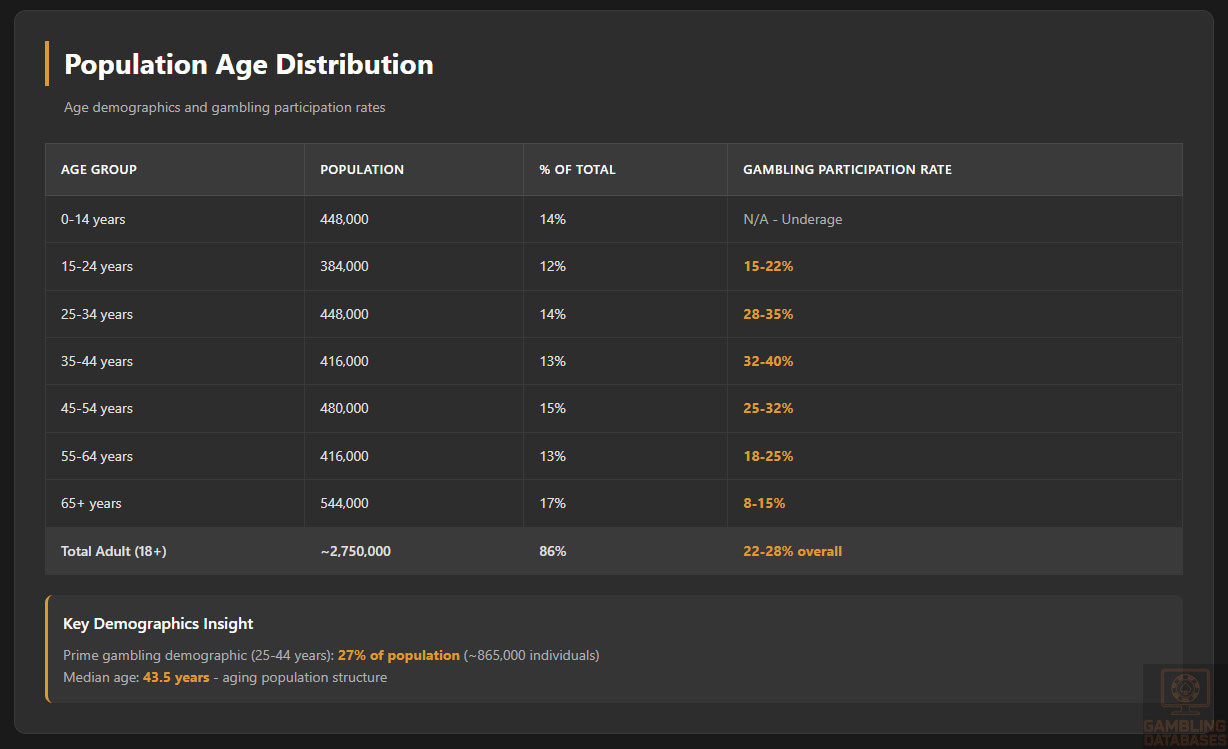
Age Distribution and Market Implications: Bosnia and Herzegovina displays an aging population structure with median age around 43.5 years, significantly higher than the global median. The age distribution skews older, with substantial population concentrations in middle-aged and senior categories while younger age groups represent diminishing proportions of total population. Approximately 14 percent of the population falls under age 15, while 17 percent exceeds 65 years old.
The 25-44 age bracket, representing prime gambling demographics, comprises approximately 27 percent of the population or roughly 865,000 individuals. This cohort demonstrates highest gambling participation rates and spending levels, making them primary targets for operator marketing. The 45-64 age group represents another 28 percent of population with significant gambling interest, particularly for land-based betting and traditional casino games. Younger adults aged 18-24 account for roughly 9 percent of population, showing growing interest in online gambling and mobile betting platforms.
| Age Group | Population (thousands) | Percentage of Total | Gambling Participation Rate |
|---|---|---|---|
| 0-14 years | 448 | 14% | N/A – Underage |
| 15-24 years | 384 | 12% | 15-22% |
| 25-34 years | 448 | 14% | 28-35% |
| 35-44 years | 416 | 13% | 32-40% |
| 45-54 years | 480 | 15% | 25-32% |
| 55-64 years | 416 | 13% | 18-25% |
| 65+ years | 544 | 17% | 8-15% |
| Total Adult Population (18+) | ~2,750 | 86% | 22-28% overall |
Gender Distribution and Life Expectancy: Bosnia and Herzegovina maintains relatively balanced gender distribution with slight female majority, approximately 51 percent female and 49 percent male. Life expectancy averages around 77 years, with women living approximately 4-5 years longer than men on average. Gender differences in gambling participation show typical patterns, with men demonstrating higher overall gambling participation rates and spending levels particularly for sports betting.
Male gambling participation rates reach 35-45 percent of the adult male population, while female participation ranges from 12-18 percent. However, female participation in online gambling has grown more rapidly than male participation in recent years, narrowing gender gaps particularly among younger demographics. Women show stronger preferences for casino games, slots, and lottery products compared to male-dominated sports betting participation.
Geographic Distribution
Urban and Rural Population Patterns: Bosnia and Herzegovina displays balanced urban-rural distribution with approximately 49 percent urban population and 51 percent rural population. This distribution differs from more urbanized European countries, reflecting the country’s mountainous terrain, historical settlement patterns, and limited industrialization. However, urban areas concentrate economic activity, internet infrastructure, and gambling venues despite representing only half the population.
Rural areas face challenges including limited internet access, lower income levels, and reduced entertainment options compared to cities. Gambling participation rates in rural areas lag urban levels, though land-based betting shops have penetrated even smaller towns given the popularity of sports betting. Online gambling adoption shows stronger urban concentration, with rural players facing connectivity limitations and lower digital literacy rates.
Major Population Centers: Sarajevo, the capital and largest city, has a population of approximately 275,000 in the core city and 420,000 in the greater metropolitan area. As the political, economic, and cultural center, Sarajevo concentrates gambling activities with numerous betting shops, casinos, and the highest online gambling participation rates. The city’s younger, more educated, and higher-income population represents prime gambling demographics.
Banja Luka, the largest city in Republika Srpska with approximately 185,000 residents, serves as the entity’s administrative and economic center. The city hosts substantial gambling infrastructure including multiple casinos, extensive betting shop networks, and growing online gambling adoption. Tuzla, the third-largest city with around 110,000 residents, represents another significant gambling market with established operator presence and competitive market dynamics.
Mostar, Zenica, Bijeljina, and other secondary cities with populations ranging from 40,000 to 95,000 comprise important regional markets. These cities host gambling venues and demonstrate solid gambling participation, though at lower absolute volumes than major urban centers. Operators targeting comprehensive market coverage must establish presence in these secondary cities beyond just focusing on Sarajevo and Banja Luka.
| City | Population | Entity | Gambling Venues | Market Characteristics |
|---|---|---|---|---|
| Sarajevo | 275,000 (420,000 metro) | FBiH | High density | Largest market, high online adoption |
| Banja Luka | 185,000 | RS | High density | RS capital, strong betting culture |
| Tuzla | 110,000 | FBiH | Moderate-high | Industrial center, working-class demographics |
| Zenica | 95,000 | FBiH | Moderate | Industrial city, betting shops dominant |
| Mostar | 85,000 | FBiH | Moderate | Tourism potential, mixed market |
| Bijeljina | 75,000 | RS | Moderate | Border city, some cross-border traffic |
| Prijedor | 67,000 | RS | Low-moderate | Regional center, developing market |
Economic Indicators and Consumer Spending Power
GDP and Economic Performance
Current Economic Output: Bosnia and Herzegovina’s economy generates approximately 24.5 billion USD in annual GDP, positioning it as a lower-middle income country by World Bank classifications. GDP per capita stands around 7,650 USD, significantly below European Union averages but comparable to other Western Balkan economies. The economy relies heavily on services sector contributing approximately 60 percent of GDP, with industry representing 25 percent and agriculture 8 percent.
Economic growth has remained modest but positive in recent years, averaging 2-3 percent annually. Growth faces constraints from political fragmentation, limited foreign investment, infrastructure deficiencies, and continued emigration of working-age population. However, remittances from diaspora workers in Western Europe provide meaningful economic support, supplementing domestic income and sustaining consumption levels above what GDP figures alone suggest.
GDP Growth Forecasts: Economic projections for 2025-2027 anticipate continued modest growth of 2.5-3.5 percent annually, driven by services sector expansion, gradual infrastructure improvements, and potential EU accession progress. Tourism development, particularly in Sarajevo and Herzegovina region, could provide growth stimulus. However, demographic decline and continued emigration limit growth potential, as shrinking working-age population constrains economic expansion.
The gambling market’s growth potential exceeds overall GDP growth rates as online gambling adoption accelerates and gambling participation increases. Market analysts project iGaming revenue growing 8-12 percent annually over the next 3-5 years, significantly outpacing general economic growth. This divergence reflects gambling’s transition from primarily land-based to increasingly digital channels and rising smartphone penetration enabling convenient gambling access.
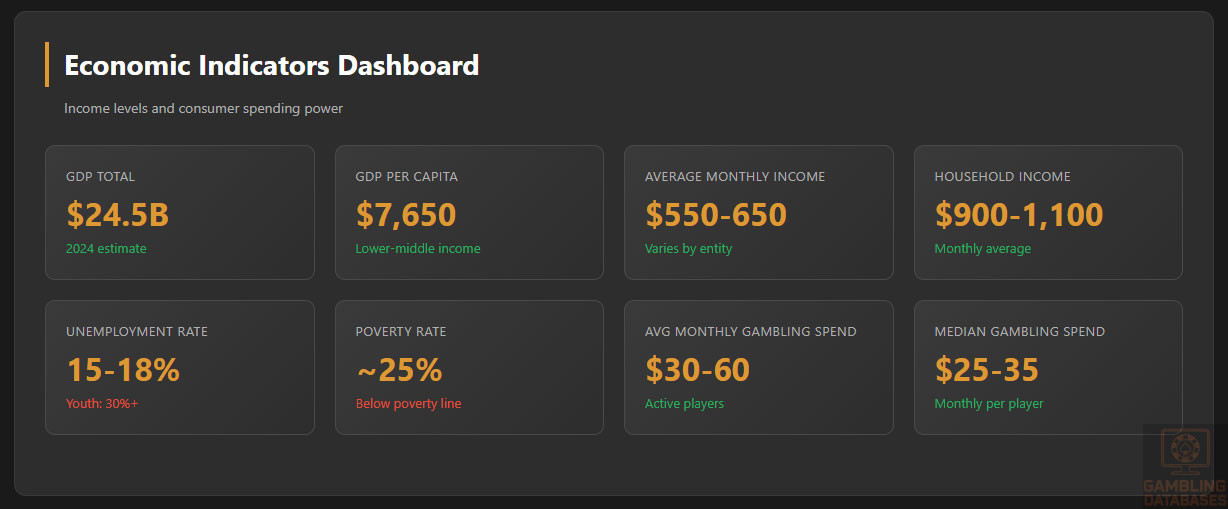
Employment and Wage Levels: Unemployment rates in Bosnia and Herzegovina remain elevated compared to EU standards, officially reported around 15-18 percent though real rates likely exceed official statistics when accounting for underemployment and discouraged workers. Youth unemployment poses particular challenges, exceeding 30 percent and driving emigration among younger demographics. High unemployment suppresses wage growth and limits consumer spending power.
Average monthly wages vary substantially between entities, sectors, and skill levels. The Federation reports average monthly net wages around 600-650 USD, while Republika Srpska averages slightly lower at 550-600 USD. Public sector employees typically earn higher wages than private sector workers, while wages in Sarajevo exceed other regions. However, significant portions of economic activity occur in grey economy not reflected in official wage statistics.
Income and Wealth Distribution
Household Income Levels: Average household monthly income approximates 900-1,100 USD across Bosnia and Herzegovina, though significant regional and demographic variation exists. Urban households generally earn 20-30 percent more than rural households. Remittances from family members working abroad supplement many household incomes, providing crucial financial support particularly in rural areas and economically depressed regions.
Median household income sits somewhat below average figures, around 800-900 USD monthly, indicating right-skewed income distribution with relatively small high-income populations pulling averages upward. The concentration of higher incomes in Sarajevo and other major cities creates geographic wealth disparities. Disposable income after essential expenses limits discretionary spending capacity for many households, constraining gambling spending potential for lower and middle-income consumers.
Income Inequality and Distribution: Bosnia and Herzegovina displays moderate income inequality with Gini coefficient around 0.33-0.36, lower than many developed economies but indicating meaningful wealth concentration. Approximately 25 percent of the population lives below national poverty lines, struggling with basic needs and having minimal discretionary spending capacity. The middle class represents roughly 40-50 percent of population, with sufficient income for modest discretionary spending including occasional gambling.
Higher-income households comprising perhaps 15-20 percent of population concentrate in urban areas and professional occupations. This segment demonstrates highest gambling spending capacity and participation rates. However, the relatively small wealthy population limits total addressable market for premium gambling products. Operators must focus on middle-income mass market players rather than relying on high-roller segments given wealth distribution patterns.
Consumer Spending Patterns: Bosnian households allocate large portions of income to necessities including housing, food, and utilities, leaving limited discretionary spending. Average household spending on entertainment and recreation represents approximately 5-8 percent of total expenditure. Within entertainment spending, gambling competes with dining out, cultural events, sports activities, and other leisure pursuits for limited discretionary budgets.
Monthly household spending on gambling among participating households averages approximately 30-60 USD, though significant variation exists from occasional small-stakes bettors spending 10-15 USD monthly to regular players wagering 150-300 USD monthly. Higher-income players and problem gamblers skew averages upward, while median spending sits lower around 25-35 USD monthly among active gambling participants. Spending concentrates around major sporting events, particularly European football competitions and international tournaments.
Market Size and Growth Projections
Current Market Revenue Analysis: The Bosnia and Herzegovina iGaming market generates approximately 50-65 million USD in annual revenue from online gambling activities, representing 25-30 percent of the total gambling market. Online sports betting dominates digital gambling revenue contributing 65-70 percent of online totals, reflecting strong consumer preference for sports wagering. Online casino games including slots, table games, and live dealer products contribute 25-30 percent of online revenue.
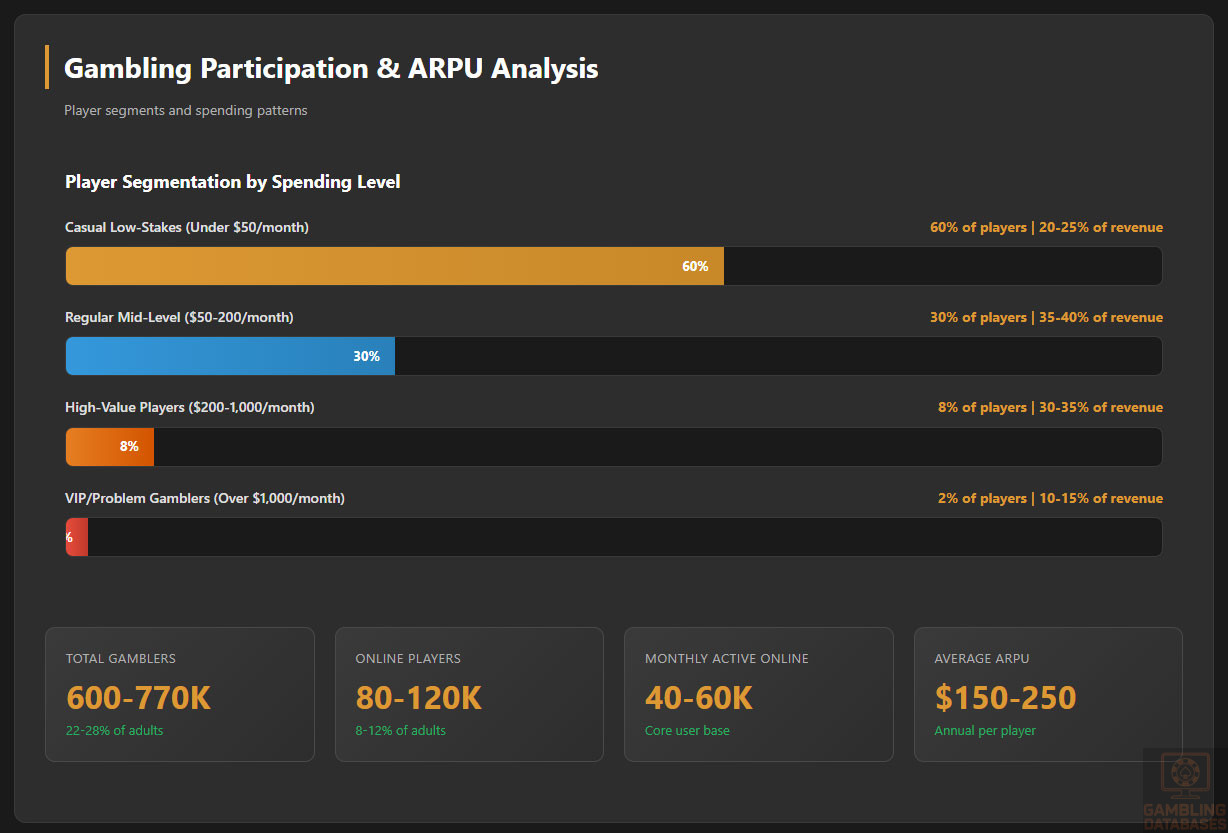
The total addressable market includes approximately 250,000-350,000 adults who gamble at least occasionally, representing 9-13 percent of the adult population. Among these participants, roughly 80,000-120,000 individuals engage in online gambling with varying frequency. Active monthly online gambling participants number approximately 40,000-60,000, representing the core customer base generating the majority of online gambling revenue. This relatively small active player base concentrates revenue, with top 20 percent of players generating 60-70 percent of total revenue.
Historical Revenue Growth: Online gambling revenue has grown substantially over the past 3-5 years, with compound annual growth rates of 18-25 percent. Growth accelerated significantly during 2020-2021 as COVID-19 restrictions closed land-based venues and drove digital adoption. While growth rates have moderated from pandemic peaks, they remain robust at 12-18 percent annually as digital gambling continues displacing land-based activities and new players enter online gambling markets.
Land-based gambling revenue growth has stagnated or declined slightly in recent years, with modest 0-3 percent annual growth failing to keep pace with inflation. The channel shift from retail betting shops to online platforms explains divergent growth trajectories. Some land-based operators have closed unprofitable locations while expanding online operations, recognizing changing consumer preferences. Total market growth averaging 6-9 percent annually reflects the mix of declining land-based and rapidly growing online segments.
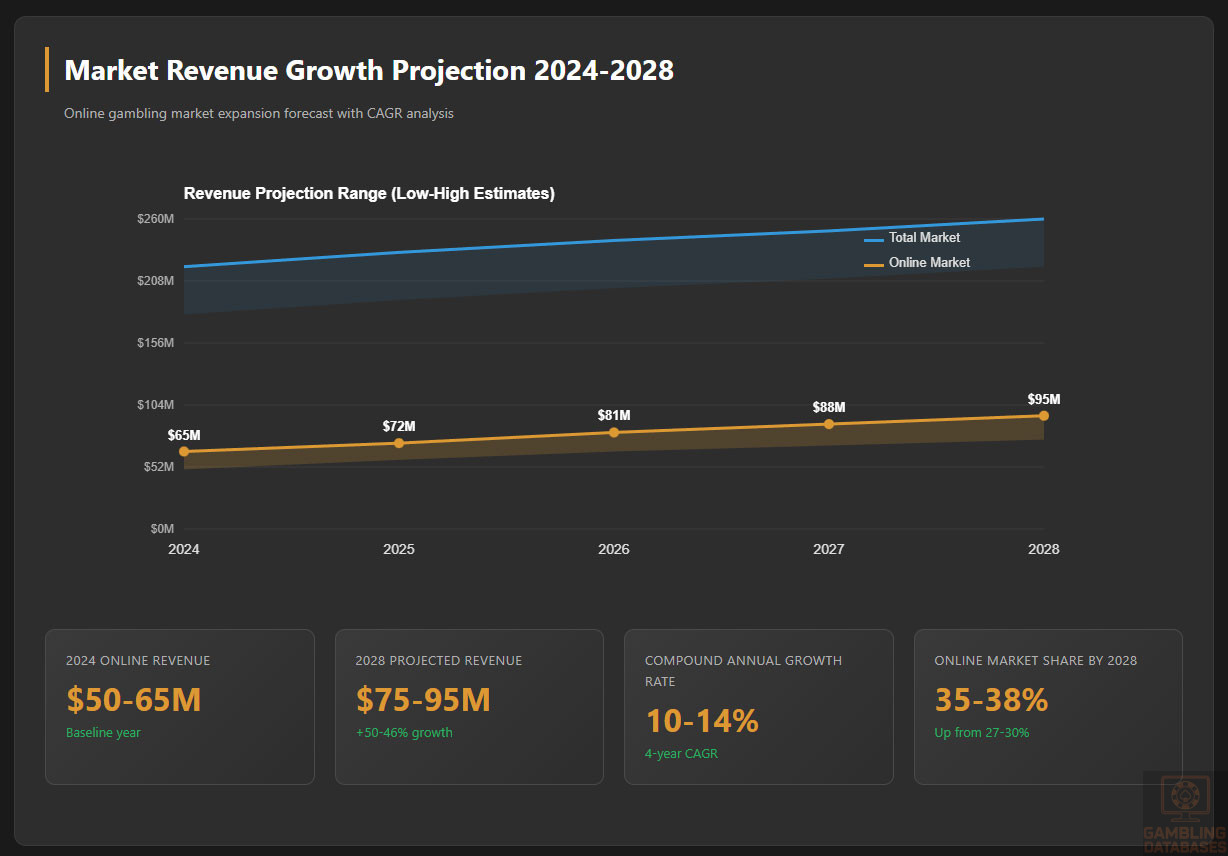
Revenue Forecasts 2025-2028: Market analysts project online gambling revenue reaching 75-95 million USD by 2028, representing compound annual growth of 10-14 percent. Growth drivers include continued smartphone adoption, improved internet infrastructure, expanding payment method options, and generational shifts as younger digitally-native consumers enter gambling markets. Sports betting revenue should grow 8-12 percent annually, while online casino gaming may achieve 15-20 percent growth from its smaller base.
Total gambling market revenue including both online and land-based channels should reach 220-260 million USD by 2028, growing 5-8 percent annually. Online gambling’s market share will expand to 35-40 percent of total gambling revenue by 2028 as digital channels continue gaining ground. Land-based revenue may stabilize or decline slightly in absolute terms as venue closures offset per-venue revenue growth, with the channel increasingly serving older demographics less comfortable with digital alternatives.
| Year | Online Revenue (USD millions) | Total Market (USD millions) | Online Market Share | YoY Growth Rate |
|---|---|---|---|---|
| 2024 (Actual) | 50-65 | 180-220 | 27-30% | 15-18% |
| 2025 (Projected) | 58-72 | 192-232 | 29-31% | 12-15% |
| 2026 (Projected) | 65-81 | 202-242 | 31-34% | 11-14% |
| 2027 (Projected) | 70-88 | 210-250 | 33-36% | 10-13% |
| 2028 (Projected) | 75-95 | 220-260 | 35-38% | 10-12% |
User Base Growth Projections: The active online gambling user base should expand from current 80,000-120,000 individuals to 120,000-170,000 by 2028, representing 35-45 percent growth. Monthly active users will grow from 40,000-60,000 to 65,000-95,000 over the same period. Growth will come from conversion of land-based-only players to omnichannel users, attraction of younger adults entering gambling age, and increased female participation in online gambling.
However, population decline limits user base expansion potential. Growth depends on increasing gambling participation rates among existing population rather than population growth adding new potential customers. Operators must focus on activation of currently non-gambling adults and increasing engagement among occasional gamblers to drive user base growth given demographic constraints.
Average Revenue Per User Trends: ARPU currently ranges from 150-250 USD annually per active online gambling participant, though significant variation exists between casual small-stakes players and high-value customers. ARPU has grown modestly over recent years as players increase gambling frequency and spending per session. However, competitive pressures and bonus costs limit ARPU expansion, with operators sacrificing some revenue per player to acquire and retain customers in competitive markets.
ARPU projections suggest moderate growth to 180-280 USD annually by 2028, representing 4-6 percent annual increases. Growth will come from players shifting more gambling spending from land-based to online channels where they tend to gamble more frequently given accessibility. Cross-selling casino products to sports bettors and vice versa should increase per-customer revenue. However, ARPU growth faces headwinds from income constraints and competitive promotional intensity.
Education, Skills, and Digital Literacy
Educational Foundation
Literacy and Educational Attainment: Bosnia and Herzegovina maintains high literacy rates exceeding 98 percent among adults, reflecting historical emphasis on education during Yugoslav period. Primary and secondary school enrollment reaches nearly universal levels, ensuring baseline educational foundations across the population. However, educational quality varies significantly between urban and rural areas, with city schools generally offering superior facilities and instruction.
Tertiary education completion rates approximate 20-25 percent of the adult population, below European Union averages but reasonable for the region. University graduates concentrate in urban areas, particularly Sarajevo which hosts multiple universities. Vocational and technical education provides pathways for non-university-bound students, though quality and labor market relevance vary. Brain drain affects educational outcomes as many highly educated individuals emigrate after completing studies.
Digital Literacy and Technology Skills: Digital literacy levels vary considerably by age, education, and urban-rural location. Younger adults under 35 demonstrate relatively strong digital skills, comfortable navigating websites, using mobile applications, and conducting online transactions. Middle-aged adults show more variable digital competency, with educated urban professionals highly digital-literate while older rural residents struggle with technology. Senior citizens generally display limited digital skills, preferring traditional channels for banking, shopping, and entertainment.
Approximately 65-70 percent of adults demonstrate sufficient digital literacy to navigate online gambling platforms without significant difficulty. However, building trust in online transactions and overcoming concerns about payment security require operator effort beyond just technical accessibility. Digital literacy improvements as younger generations age should expand the potential online gambling customer base over time, while current older demographics remain more oriented toward land-based gambling venues.
Language Skills and Communication: Bosnian, Croatian, and Serbian represent the three official languages, which are mutually intelligible and collectively understood across the population. Linguistic fragmentation creates some complexity for operators, as ethnic groups have sensitivities around language designation. Most operators use neutral language or offer content in all three variants to avoid alienating customer segments. English proficiency remains limited outside educated urban populations and younger adults, requiring operators to provide comprehensive local language customer support and content.
Cultural and Social Factors
Communication and Language Preferences
Language in Business and Digital Contexts: Operators must provide gambling platforms, customer service, and marketing materials in local languages to effectively serve the market. English-only platforms face significant adoption barriers given limited English proficiency across much of the population. Translation quality matters greatly, as poor translations damage credibility and create confusion around terms and conditions, bonus requirements, and betting rules.
Customer service availability in local languages represents a competitive differentiator, with players preferring operators offering support in their preferred language variant. Live chat, email support, and telephone assistance should all accommodate local language needs. Social media marketing and content must similarly use appropriate local languages and avoid linguistic choices that might alienate segments of the ethnically diverse population.
Cultural Attitudes Toward Gambling
Social Acceptance of Gambling: Gambling enjoys relatively high social acceptance in Bosnia and Herzegovina, particularly sports betting which many view as a legitimate entertainment activity and social pastime. Betting shops serve as gathering places where men watch sports and discuss betting strategies, creating social dimensions beyond pure gambling. However, casino gambling faces more mixed perceptions, with some viewing it as morally questionable or associated with vice and excess.
Religious influences on gambling attitudes vary across the population. Muslim populations, representing approximately 51 percent of the total, show diverse attitudes ranging from complete abstinence based on religious principles to active participation viewing gambling as personal choice. Orthodox Christian populations around 31 percent and Catholic populations around 15 percent similarly display varied attitudes. Overall, religious opposition to gambling does not prevent substantial market participation, though it influences some individuals’ choices and creates social stigma in certain communities.
Gender and Gambling Culture: Gambling in Bosnia and Herzegovina historically skewed heavily male, particularly for sports betting and casino gambling. Land-based betting shops cater primarily to men, with gender ratios often exceeding 80-90 percent male in retail venues. This male-dominated culture can discourage female participation in land-based gambling despite no formal restrictions.
Online gambling presents opportunities to reach female audiences in more comfortable, private environments. Women demonstrate growing online gambling participation, particularly for casino games, slots, and bingo-style products. Operators targeting female players should emphasize welcoming brand positioning, avoid masculine sports-focused marketing stereotypes, and provide customer service approaches that appeal to women. Breaking the male-dominated gambling culture could significantly expand the total addressable market.
Risk Tolerance and Gambling Preferences: Bosnian gamblers generally display moderate risk tolerance, preferring relatively conservative betting strategies with frequent small-stakes wagers rather than infrequent large bets. Sports betting appeal stems partly from beliefs that knowledge and skill can improve outcomes, even though randomness ultimately dominates results. Accumulator bets combining multiple selections with higher odds attract players seeking bigger potential payouts from small stakes.
Casino gambling preferences lean toward slots and simple games rather than complex table games requiring substantial rules knowledge. Live dealer games have gained popularity as they combine online convenience with social interaction and perceived fairness from visible dealers. Lottery products remain popular for their simplicity and very small stake requirements, accessible even to lowest-income populations.
Problem Gambling and Social Considerations
Gambling Addiction Prevalence: Problem gambling affects an estimated 0.5-1.5 percent of the adult population in Bosnia and Herzegovina, translating to roughly 15,000-45,000 individuals experiencing gambling-related harm. At-risk gamblers who haven’t developed full addiction but display concerning behaviors represent an additional 2-4 percent of adults. These rates align with international averages for countries with legal gambling markets, though limited research specific to Bosnia and Herzegovina creates uncertainty around precise figures.
Young adult males demonstrate highest problem gambling rates, particularly those betting frequently on sports. Easy access to betting shops, aggressive marketing, and social normalization of gambling contribute to elevated risks in this demographic. Online gambling’s convenience and 24/7 availability exacerbate risks for vulnerable individuals, as digital platforms enable continuous gambling without the natural breaks that land-based gambling involves.
Demographic Patterns in Problem Gambling: Problem gambling affects men at approximately 3-5 times the rate of women, reflecting both higher overall male gambling participation and cultural factors that may enable or encourage excessive male gambling. Age patterns show elevated problem gambling among young adults 18-35, who may lack maturity to recognize developing problems and exercise appropriate restraint. Middle-aged problem gamblers often experience more severe financial and family consequences given their life stage with dependents and financial obligations.
Lower-income populations face disproportionate gambling harm, as gambling spending represents larger proportions of their income and losses create more severe financial distress. However, higher-income problem gamblers can sustain longer gambling careers and accumulate larger absolute losses before hitting financial breaking points. Educational attainment shows inverse correlation with problem gambling, as higher education associates with better impulse control and risk assessment.
Support Services and Treatment: Bosnia and Herzegovina lacks comprehensive problem gambling treatment infrastructure compared to more developed gambling markets. Specialized gambling addiction treatment centers remain limited, with problem gamblers often seeking help through general mental health services or addiction programs focused primarily on substance abuse. This creates barriers to appropriate treatment, as gambling addiction requires specific therapeutic approaches differing from substance addictions.
Non-profit organizations and some government health services provide limited gambling addiction counseling and support groups. However, awareness of available resources remains low among both potential patients and healthcare providers. Social stigma around gambling problems discourages help-seeking, particularly in communities viewing gambling addiction as moral failing rather than treatable mental health condition. Cultural expectations of male stoicism and self-reliance further inhibit men from seeking needed support despite representing majority of problem gambling cases.
Operator Social Responsibility Requirements: Licensed operators must implement responsible gambling measures including self-exclusion systems, deposit limits, and reality checks interrupting play. However, enforcement of these requirements varies, with some operators implementing minimal compliance while others adopt more comprehensive approaches. Industry funding for problem gambling treatment and prevention remains limited compared to markets with mandatory operator levies supporting addiction services.
Recent regulatory developments increasingly emphasize operator social responsibility, with authorities recognizing the need to address gambling harm. Future regulations may mandate operator contributions to problem gambling treatment funds, similar to models in other European markets. Operators should anticipate increasing social responsibility obligations and proactively implement strong player protection measures to demonstrate commitment to gambling harm minimization.
| Category | Estimated Prevalence | Affected Population | Notes |
|---|---|---|---|
| Problem Gamblers | 0.5-1.5% of adults | 15,000-45,000 | Severe gambling-related harm |
| At-Risk Gamblers | 2-4% of adults | 60,000-120,000 | Concerning behaviors, not yet addicted |
| Male Problem Gamblers | 75-80% of problem gamblers | 11,000-36,000 | 3-5x higher rate than females |
| Young Adults (18-35) Problem Rate | 1.5-2.5% of age cohort | 8,000-15,000 | Highest risk age group |
| Underage Gambling Incidents | 3-8% of minors report gambling | 10,000-35,000 | Significant enforcement concern |
| Treatment Seeking Rate | 5-10% of problem gamblers | 750-4,500 | Low treatment engagement |
Political Structure and Governance
Government System and Stability: Bosnia and Herzegovina operates under a complex constitutional structure established by the 1995 Dayton Agreement that ended the Bosnian War. The country consists of two entities with significant autonomy plus the self-governing Brčko District. Political power-sharing arrangements among Bosniak, Serb, and Croat ethnic groups create governance challenges and sometimes gridlock on national-level issues. Entity-level governments exercise substantial authority over economic regulation, including gambling, while national government authority remains limited.
Political stability has improved significantly since the conflict era, with violence virtually eliminated and democratic processes generally functioning. However, political fragmentation and ethnic tensions occasionally resurface, creating regulatory uncertainty and complicating business operations. International supervision has gradually decreased as the country demonstrates increasing self-governance capacity, though EU accession processes provide external reform incentives and oversight mechanisms.
Regulatory Consistency and Business Environment: The dual regulatory structure creates challenges for businesses operating across both entities, as regulations, tax structures, and administrative procedures differ. Regulatory changes require approval at entity level rather than unified national frameworks, potentially resulting in divergent policy directions. Operators must monitor regulatory developments in both entities and maintain compliance with multiple sometimes conflicting requirements.
Corruption remains a concern despite anti-corruption reforms, with Transparency International rankings placing Bosnia and Herzegovina in the lower half globally for corruption perception. Business dealings may involve informal payments or connections influencing regulatory approvals and administrative processes. However, the gambling sector operates under relatively formal frameworks with licensing processes that, while sometimes slow, generally follow established procedures rather than operating purely on informal relationships.
Technology Adoption and Digital Behavior
Internet and Digital Usage
Internet Penetration and Access: Internet penetration in Bosnia and Herzegovina reaches approximately 71 percent of the population, translating to around 2.3 million internet users. Penetration rates have grown steadily over the past decade, though they remain below Western European averages of 85-95 percent. Urban areas demonstrate significantly higher internet adoption at 80-85 percent compared to rural regions at 55-65 percent. This urban-rural digital divide reflects infrastructure limitations in mountainous and remote areas where deployment costs exceed commercial viability.
Fixed broadband internet reaches approximately 45-50 percent of households, concentrated heavily in cities and larger towns. Mobile internet access extends more broadly, with mobile networks covering roughly 95 percent of the population though speeds and reliability vary considerably. Many users rely primarily or exclusively on mobile internet given infrastructure gaps in fixed broadband availability and the convenience of smartphone-based connectivity.
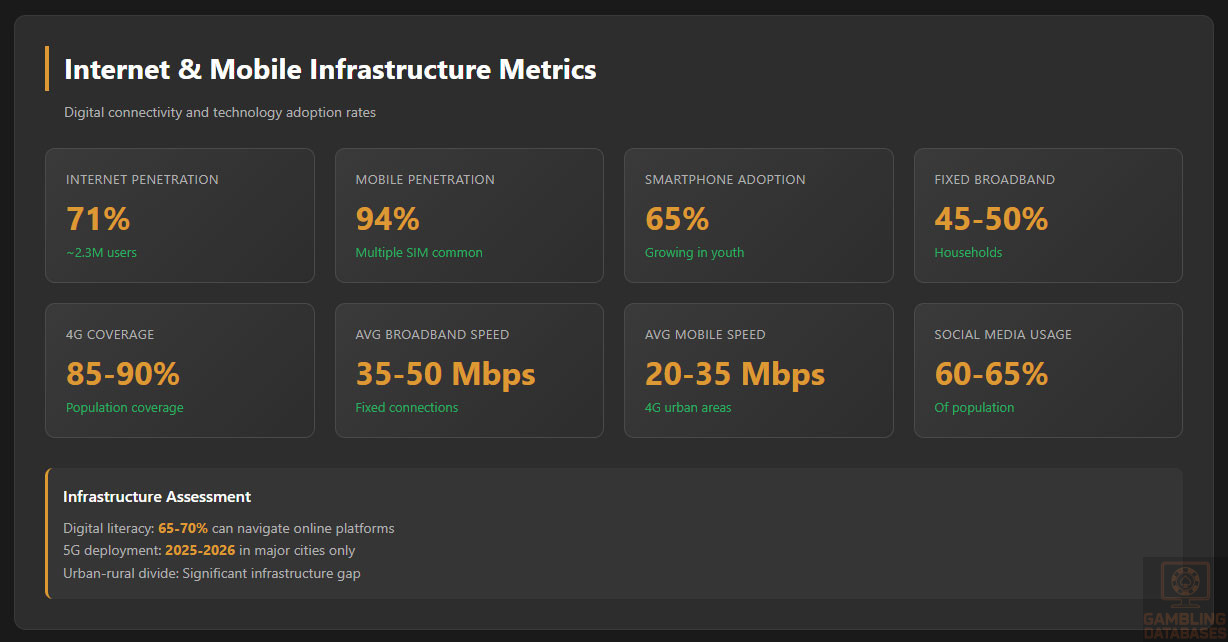
Daily Internet Usage Patterns: Active internet users spend an average of 6-7 hours daily online, though this includes both mobile and desktop usage across personal and professional contexts. Younger adults under 35 demonstrate highest usage at 7-8 hours daily, while older adults average 4-5 hours. Social media consumption represents substantial portions of online time, with messaging apps, video streaming, and social networking dominating leisure internet usage.
Evening hours from 7:00 PM to midnight see peak internet traffic as users browse content, communicate with friends and family, and engage in entertainment activities. Online gambling similarly peaks during evening hours and weekends, aligning with broader internet usage patterns. Major sporting events drive traffic spikes as fans stream matches and place bets on games in progress.
Mobile Device Adoption: Mobile phone penetration exceeds 94 percent in Bosnia and Herzegovina, though this figure reflects multiple SIM card ownership rather than unique users. Many individuals maintain multiple mobile subscriptions to take advantage of different carrier promotions or separate personal and business communications. Unique mobile subscriber rates approximate 75-80 percent of the population.
Social Media and Digital Platform Engagement: Social media usage reaches approximately 60-65 percent of the population, with Facebook dominating as the most popular platform with 1.8-2.0 million users. Instagram attracts younger users with approximately 800,000-1,000,000 accounts, while YouTube serves as the primary video content platform. TikTok has gained traction among teenagers and young adults, though penetration remains below Western European levels.
Messaging apps including WhatsApp, Viber, and Facebook Messenger facilitate daily communications, with Viber particularly popular in Bosnia and Herzegovina given its early market entry and network effects. Social media serves as important marketing channel for gambling operators, enabling targeted advertising, influencer partnerships, and community building around sports betting content. However, advertising restrictions limit direct gambling promotion on some platforms.
E-commerce Participation and Digital Transactions: E-commerce adoption remains relatively low compared to Western Europe, with approximately 35-45 percent of internet users making online purchases annually. Trust concerns, preference for cash transactions, and limited local e-commerce infrastructure constrain online shopping adoption. However, pandemic-driven digital acceleration has expanded e-commerce participation, particularly for electronics, clothing, and food delivery services.
Cross-border e-commerce from international platforms including Amazon, AliExpress, and regional sites exceeds domestic online retail given limited local offerings. Payment challenges including international transaction fees and delivery complications sometimes discourage cross-border purchases. Digital service consumption including streaming subscriptions and online gaming has grown more rapidly than physical goods e-commerce, as digital delivery eliminates logistics challenges.
Digital Payment Behavior
Payment Method Preferences: Cash remains the dominant payment method in Bosnia and Herzegovina for daily transactions, with approximately 70-80 percent of consumer purchases conducted in cash. Cultural preferences, merchant acceptance limitations, and trust factors contribute to cash dominance. However, card payments have grown steadily, particularly in urban areas and for larger transactions. Online gambling necessarily requires electronic payment methods, driving digital payment adoption among gambling participants.
Debit cards demonstrate higher usage than credit cards given limited credit market development and consumer wariness of debt. Bank-issued debit cards linked to checking accounts enable ATM access and point-of-sale payments. Credit card ownership reaches only 20-25 percent of adults, concentrated among higher-income urban populations. International card networks Visa and Mastercard dominate card payments, with some local card schemes operating on smaller scales.
E-wallet and Alternative Payment Methods: Digital wallet adoption remains in early stages, with limited penetration compared to more digitally advanced markets. International e-wallet services including Skrill, Neteller, and PayPal have user bases among online gamblers and international shoppers, though overall population penetration stays below 10 percent. Local digital wallet initiatives have struggled to gain traction given network effect challenges and consumer comfort with traditional banking.
Bank transfers represent important payment methods for larger transactions and online gambling deposits, with many banks offering online banking services enabling immediate or near-immediate transfers. However, interbank transfer times vary, with same-bank transfers processing immediately while inter-bank transfers may require 1-3 business days. Instant payment systems have not yet achieved the ubiquity seen in some European markets.
Cryptocurrency adoption for payments remains minimal in mainstream commerce, though some online gambling operators accept cryptocurrency deposits from players seeking privacy or bypassing traditional banking restrictions. Regulatory uncertainty around cryptocurrency creates challenges for operators considering cryptocurrency payment integration. Most operators focus on conventional payment methods given low cryptocurrency usage among target demographics.
| Payment Method | Usage Rate | Processing Speed | Player Preference |
|---|---|---|---|
| Debit Cards (Visa/Mastercard) | 60-65% | Instant | High – most convenient |
| Bank Transfer | 20-25% | Instant to 2 days | Medium – for larger deposits |
| E-wallets (Skrill, Neteller) | 10-15% | Instant | Medium – privacy conscious |
| Credit Cards | 8-12% | Instant | Low-Medium – limited ownership |
| Prepaid Cards/Vouchers | 3-5% | Instant | Low – declining usage |
| Cryptocurrency | 1-2% | 15 mins to 1 hour | Very Low – niche adoption |
Trust in Online Payments and Security Concerns: Trust in online payment security represents a significant barrier to digital payment adoption, with many consumers expressing concerns about fraud, data theft, and merchant reliability. News coverage of payment fraud incidents amplifies anxieties, making consumers cautious about providing payment credentials online. Established international brands including major banks and recognized e-commerce platforms enjoy higher trust than smaller or unfamiliar entities.
Online gambling operators must invest in building payment trust through security certifications, transparent payment processing, and reliable withdrawal fulfillment. Delays in processing withdrawals severely damage player trust and generate negative reviews spreading through gambling communities. Clear communication around payment processing times, security measures, and customer data protection helps establish credibility with cautious players.
Gaming and Gambling Preferences
Current Market Participation
Overall Gambling Participation Rates: Approximately 22-28 percent of adults in Bosnia and Herzegovina gamble at least occasionally, representing 600,000-770,000 individuals who engage in gambling activities with varying frequency. Regular gamblers participating monthly or more frequently number approximately 300,000-400,000 individuals. The remaining occasional gamblers may place bets a few times annually around major sporting events or holidays without establishing regular gambling patterns.
Online gambling participation reaches 8-12 percent of adults, translating to 220,000-330,000 individuals who have gambled online at least once. Regular online gambling participants number approximately 80,000-120,000, representing the core online gambling market. Many players engage in both land-based and online gambling, maintaining omnichannel relationships with operators offering both retail and digital access.
Gambling Activity Preferences: Sports betting overwhelmingly dominates Bosnian gambling preferences, with approximately 70 percent of gamblers primarily betting on sports. Football betting represents the most popular activity, driven by widespread football fandom and extensive coverage of domestic leagues, UEFA competitions, and international tournaments. Basketball betting ranks second in popularity, benefiting from strong basketball culture particularly in urban areas.
Casino games attract approximately 20-25 percent of gambling participants, with slots most popular followed by roulette and blackjack. Live dealer games have gained traction as online gambling adoption increases, offering interactive experiences that appeal to players seeking social elements. Lottery products maintain steady participation around 15-20 percent of gamblers, though lottery players often engage only occasionally with small stakes rather than regular high-frequency play.
Poker rooms and poker tournaments attract niche audiences, with participation around 3-5 percent of gamblers. Virtual sports betting has emerged as growing category, offering rapid betting cycles and consistent availability compared to real sports schedules. However, virtual sports remain substantially less popular than real sports betting given perceptions around fairness and entertainment value.
Consumer Behavior Patterns
Spending Levels and Betting Patterns: Average monthly gambling spending among active participants approximates 50-80 USD, though median spending sits lower around 30-40 USD as high-spending players skew averages upward. Approximately 60 percent of gamblers spend less than 50 USD monthly, representing casual low-stakes players. Mid-level players spending 50-200 USD monthly comprise roughly 30 percent of gamblers, while high-value players exceeding 200 USD monthly represent about 10 percent of players but generate 40-50 percent of total revenue.
Typical bet sizes for sports betting range from 2-10 BAM (1-5 USD) for casual bettors to 20-100 BAM (10-50 USD) for more serious players. Accumulator bets combining multiple selections with higher potential payouts represent popular betting strategies, allowing players to risk small stakes for larger potential returns. Single-game bets at longer odds appeal to players seeking value, while safer short-odds bets attract more conservative approaches.
Casino gambling average session spending ranges from 10-30 USD for casual slot players to 50-200 USD for table game players. Slot players typically engage in longer sessions with smaller per-spin stakes, while table game players make larger per-hand wagers in shorter sessions. Live dealer games sit between these patterns, offering moderate-length sessions with varying bet sizes depending on game type and player bankroll.
Platform and Device Preferences: Mobile devices have become the dominant platform for online gambling, accounting for approximately 55-60 percent of online gambling revenue. Smartphones enable convenient anytime-anywhere betting, particularly attractive for sports betting where live in-game betting opportunities create urgency. Younger players under 35 demonstrate even higher mobile usage at 70-75 percent of their gambling activity, while older players maintain stronger desktop preferences.
Tablet usage remains minimal for gambling at approximately 5-8 percent of online gambling activity, as users migrate to smartphones for portability or desktops for larger screens. Desktop gambling maintains relevance particularly for casino games where larger screens enhance visual experiences and enable easier navigation of game libraries. Players often use mobile for quick sports bets while preferring desktop for longer casino gaming sessions.
Peak Gambling Times and Seasonal Patterns: Gambling activity concentrates heavily during evening hours from 6:00 PM to midnight when players finish work and have leisure time. Weekends show elevated gambling volumes compared to weekdays, with Friday and Saturday evenings representing peak activity periods. Sunday afternoons see significant sports betting given typical football match schedules, though evening hours remain busiest overall.
Seasonal patterns follow major sporting events, with UEFA Champions League, European Championships, and World Cup tournaments driving massive engagement spikes. Domestic football seasons from August through May generate steady weekly betting patterns, while summer months show reduced sports betting activity offset somewhat by increased travel and leisure time. Holiday periods including New Year’s and religious holidays see mixed patterns, with some players gambling more given leisure time while others reduce activity during family-focused periods.
Retention, Loyalty, and Churn: Customer retention challenges affect all operators given competitive intensity and player willingness to switch operators for better odds or promotions. Monthly retention rates average 60-70 percent, meaning 30-40 percent of active players in a given month don’t return the following month. However, many supposedly churned players return in subsequent months, creating cyclical activity patterns rather than permanent losses.
Operator loyalty programs attempt to increase retention through rewards points, VIP tiers, and exclusive promotions. However, Bosnian players demonstrate relatively low loyalty, actively maintaining accounts with multiple operators and directing bets toward whoever offers best value at a given moment. Sports betting commodification contributes to low loyalty, as odds differences and promotional offers matter more than brand affinity for price-sensitive players.
Bonus Sensitivity and Promotional Response: Players demonstrate high bonus sensitivity, with welcome offers critically important for new customer acquisition. Operators report that 60-80 percent of new players sign up specifically because of advertised welcome bonuses. Ongoing promotions including deposit bonuses, free bets, and odds boosts drive engagement among existing players, with promotional activity generating 20-40 percent more betting volume than baseline periods.
However, bonus abuse and bonus hunting behavior creates challenges for operators. Some players maintain multiple accounts across operators to repeatedly claim welcome bonuses, or deposit only when promotional offers provide value while remaining dormant otherwise. Operators must balance attractive bonuses for customer acquisition against profitability impacts from bonus costs and low-value bonus hunters.
| Player Segment | % of Players | Monthly Spend | % of Revenue | Characteristics |
|---|---|---|---|---|
| Casual Low-Stakes | 60% | Under 50 USD | 20-25% | Occasional bettors, small stakes, low frequency |
| Regular Mid-Level | 30% | 50-200 USD | 35-40% | Weekly gambling, moderate stakes, loyal to 2-3 operators |
| High-Value Players | 8% | 200-1,000 USD | 30-35% | Daily gambling, larger bets, multi-product users |
| VIP/Problem Gamblers | 2% | Over 1,000 USD | 10-15% | Very high frequency/stakes, potential addiction concerns |
Section 3: Technology Infrastructure and Business Environment
Internet and Digital Infrastructure
Connectivity and Network Performance
Internet Quality and Speed Assessment: Bosnia and Herzegovina’s internet infrastructure has improved significantly over the past decade but remains below Western European standards. Average fixed broadband download speeds approximate 35-50 Mbps, adequate for standard online gambling applications but limiting for bandwidth-intensive activities. Upload speeds average 10-20 Mbps, sufficient for typical consumer uses including video streaming and online gaming.
Mobile internet speeds vary considerably depending on location and network operator, averaging 20-35 Mbps for 4G connections in urban areas. Rural mobile internet often delivers slower speeds of 10-20 Mbps given network congestion and infrastructure limitations. Network reliability shows mixed performance, with urban areas generally maintaining stable connections while rural regions experience more frequent disruptions during weather events or peak usage periods.
International internet connectivity relies on fiber optic links through neighboring countries to European backbone networks. While Bosnia and Herzegovina lacks direct submarine cable connections given its landlocked geography, transit agreements ensure reasonable international connectivity. Latency to major European servers ranges from 30-60 milliseconds, acceptable for online gambling applications including live dealer games requiring real-time interaction.
Infrastructure Investment Trends: Telecommunications operators have invested steadily in infrastructure improvements, expanding fiber optic networks in cities and upgrading mobile networks to 4G across most populated areas. Government infrastructure programs aim to improve rural connectivity, though funding constraints and challenging terrain slow deployment. EU pre-accession funding may support additional infrastructure investments as Bosnia and Herzegovina progresses toward potential EU membership.
Private sector investment drives most infrastructure development, with competitive pressures motivating operators to improve network quality and coverage. However, the relatively small market and modest consumer purchasing power limit investment scale compared to larger European markets. Infrastructure improvements continue but at gradual pace constrained by economic realities.
Global Internet Speed Rankings: International speed testing organizations rank Bosnia and Herzegovina around 80th-100th globally for fixed broadband speeds and 70th-90th for mobile speeds. These rankings place the country in the lower-middle tier internationally, ahead of many developing nations but significantly behind Western European leaders. Regional comparisons show Bosnia and Herzegovina roughly comparable to neighboring Albania and North Macedonia but trailing Serbia, Croatia, and Montenegro.
5G and Future Technology Deployment
Current 4G Coverage: 4G/LTE networks cover approximately 85-90 percent of the population, concentrating in cities and along major transportation corridors. Rural mountainous regions often rely on 3G connectivity or face coverage gaps entirely. Network operators including BH Telecom, HT Eronet, and m:tel have deployed 4G infrastructure in commercially viable areas, though universal coverage remains elusive given geographic challenges and cost constraints.
4G network quality varies by operator and location, with urban areas generally receiving strong signals and fast speeds while rural coverage shows more inconsistent performance. Network congestion during peak hours occasionally degrades speeds in densely populated areas. However, 4G infrastructure generally supports online gambling applications adequately, enabling mobile betting and casino gaming for users within coverage areas.
5G Rollout Timeline: 5G network deployment in Bosnia and Herzegovina remains in very early stages, with limited commercial launches expected in 2025-2026 in major cities. Financial constraints, spectrum allocation delays, and infrastructure investment requirements slow 5G rollout compared to Western European markets already operating extensive 5G networks. Initial 5G deployments will concentrate in Sarajevo, Banja Luka, and other major cities before gradually expanding to smaller urban areas.
Full nationwide 5G coverage appears unlikely before 2030 given investment requirements and limited commercial incentives for rural deployment. However, 5G availability in major cities will benefit online gambling operators by enabling enhanced mobile experiences including higher-quality streaming for live dealer games and faster transaction processing. The gradual 5G rollout means operators should continue optimizing for 4G performance for years to come rather than assuming universal 5G availability.
Mobile Technology Ecosystem
Mobile Network Infrastructure
Network Operator Landscape: Three major mobile network operators serve Bosnia and Herzegovina: BH Telecom operating primarily in the Federation, HT Eronet (subsidiary of Croatian Hrvatski Telekom) with Federation focus, and m:tel (part of Telekom Srpske) dominant in Republika Srpska. This structure reflects the country’s entity divisions, with operators historically aligned with different territorial and ethnic communities though competition crosses entity boundaries.
Market share distribution approximates 35-40 percent for BH Telecom, 30-35 percent for m:tel, and 25-30 percent for HT Eronet, though exact figures vary by data source and measurement methodology. Competition among operators generally benefits consumers through competitive pricing and service improvements, though coordination challenges sometimes result in duplicative infrastructure investment and market inefficiencies.
Coverage Quality and Network Performance: Network quality varies significantly by operator and geographic location. BH Telecom maintains strong coverage in Federation territories, particularly around Sarajevo and central Bosnia. M:tel dominates Republika Srpska with extensive coverage and good network performance in Banja Luka and surrounding regions. HT Eronet leverages parent company resources to offer competitive coverage and international roaming advantages.
Users often maintain subscriptions with multiple operators to ensure coverage across all areas they visit, contributing to mobile penetration rates exceeding 100 percent of population. This multi-SIM behavior reflects coverage gaps and weak inter-operator roaming, creating consumer need for multiple provider relationships. Operators offer prepaid and postpaid plans, with prepaid dominance given consumer preference for spending control and limited credit availability.
Data Costs and Pricing Models: Mobile data costs in Bosnia and Herzegovina remain relatively affordable compared to consumer incomes, with competitive pricing driving operator strategies. Typical prepaid data packages offer 5-10 GB monthly for 10-20 BAM (5-10 USD), adequate for moderate online gambling usage. Postpaid plans with larger data allowances or unlimited data cost 30-60 BAM (15-30 USD) monthly, targeting heavier users and business customers.
Data pricing has declined steadily in recent years through competitive pressures and regulatory encouragement of affordable broadband access. However, Bosnia and Herzegovina’s data costs as percentage of income remain higher than Western European markets given lower consumer purchasing power. Unlimited data plans have become more common, eliminating data cap concerns that previously constrained mobile online gambling adoption.
Device Penetration and Usage
Smartphone Adoption and Device Preferences: Smartphone penetration approximates 65 percent of the population, with significantly higher rates among younger demographics and urban residents. Android devices dominate with approximately 75-80 percent market share, reflecting Android’s stronger presence in mid-range and budget device segments popular with price-sensitive consumers. Apple iOS devices represent 15-20 percent of smartphones, concentrated among affluent urban consumers and younger adults attracted to Apple’s brand prestige.
Popular device brands include Samsung, Xiaomi, Huawei, and other manufacturers offering good value propositions in mid-range price segments. Premium flagship devices remain niche given high prices relative to incomes, with most consumers purchasing devices in 150-400 USD price range. Device lifespans average 2-4 years, with consumers replacing phones when they become dysfunctional rather than upgrading to latest models annually.
Mobile Internet Usage Patterns: Smartphone users consume an average of 8-15 GB monthly data for personal use, primarily for social media, messaging apps, video streaming, and web browsing. Online gambling data consumption remains relatively modest at 500 MB to 2 GB monthly for typical players, as betting interfaces and casino games optimize for mobile data efficiency. Live streaming of sports events or live dealer casino games consumes more data, potentially reaching 3-5 GB monthly for heavy users.
Mobile operating system versions show reasonable currency, with majority of Android devices running versions 10-14 ensuring compatibility with modern applications. However, some budget devices run older Android versions, requiring operators to maintain backward compatibility for maximum market coverage. iOS devices generally run recent operating system versions given Apple’s strong update support and user adoption of updates.
Financial Services and Payment Infrastructure
Banking System Structure
Banking Sector Overview: Bosnia and Herzegovina’s banking sector comprises approximately 25 banks operating across both entities, including domestic banks, subsidiaries of international banking groups, and branches of foreign banks. The sector remains fragmented with relatively low market concentration, as the largest bank holds only 12-15 percent market share. Entity-level banking regulations create some operational complexities, though harmonization efforts have reduced regulatory divergences.
Major banks include UniCredit Bank, Raiffeisen Bank, Intesa Sanpaolo Bank, Sparkasse Bank, and various domestic institutions. International banking groups provide access to global financial networks and transfer modern banking technology and practices to the local market. Domestic banks often maintain stronger local relationships and understanding of Bosnian market conditions, serving customers underserved by international banks.
Digital Banking Adoption: Online banking penetration reaches approximately 40-50 percent of banked population, growing steadily as younger digitally-comfortable customers increasingly use digital channels while older customers gradually adopt online banking. Mobile banking applications offered by major banks provide account access, bill payment, and transfer capabilities. However, many customers maintain hybrid approaches, using online banking for simple transactions while visiting branches for complex services.
Banking system modernization has progressed significantly since the conflict era, with contemporary core banking systems, ATM networks, and payment card infrastructure now standard. However, the banking sector still lags Western European counterparts in innovation velocity and digital service sophistication. Account penetration rates approximate 70-75 percent of adults, leaving significant unbanked population primarily in older demographics and rural areas.
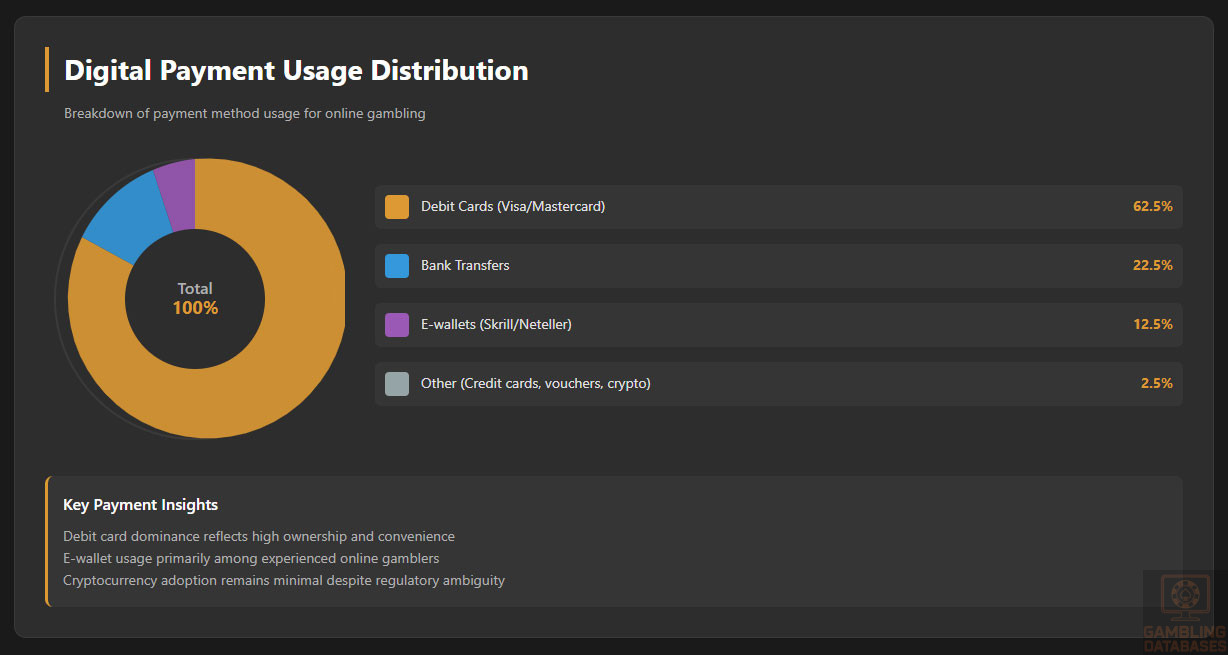
Payment Processing Options
Available Payment Methods for iGaming: Online gambling operators in Bosnia and Herzegovina must offer diverse payment methods to accommodate player preferences and overcome infrastructure limitations. Bank cards including Visa and Mastercard debit cards represent the most widely used deposit methods, offering instant processing and familiar checkout experiences. Card processing infrastructure generally functions reliably, though occasional transaction declines frustrate players when their banks flag gambling transactions as potentially fraudulent.
Bank transfers enable direct deposits from player bank accounts, popular for larger deposits given security comfort with direct bank channels. However, processing times vary from instant for some domestic same-bank transfers to 1-3 days for inter-bank transfers, limiting appeal for players seeking immediate gambling access. Some operators integrate instant bank transfer services providing immediate account crediting while maintaining bank-level security.
E-wallets including Skrill and Neteller serve the online gambling community, offering instant deposits and withdrawals with privacy advantages over direct card/bank methods. However, limited e-wallet adoption among general population constrains these methods primarily to experienced online gamblers. PayPal availability remains limited given the company’s selective market entry and concerns around gambling transaction processing.
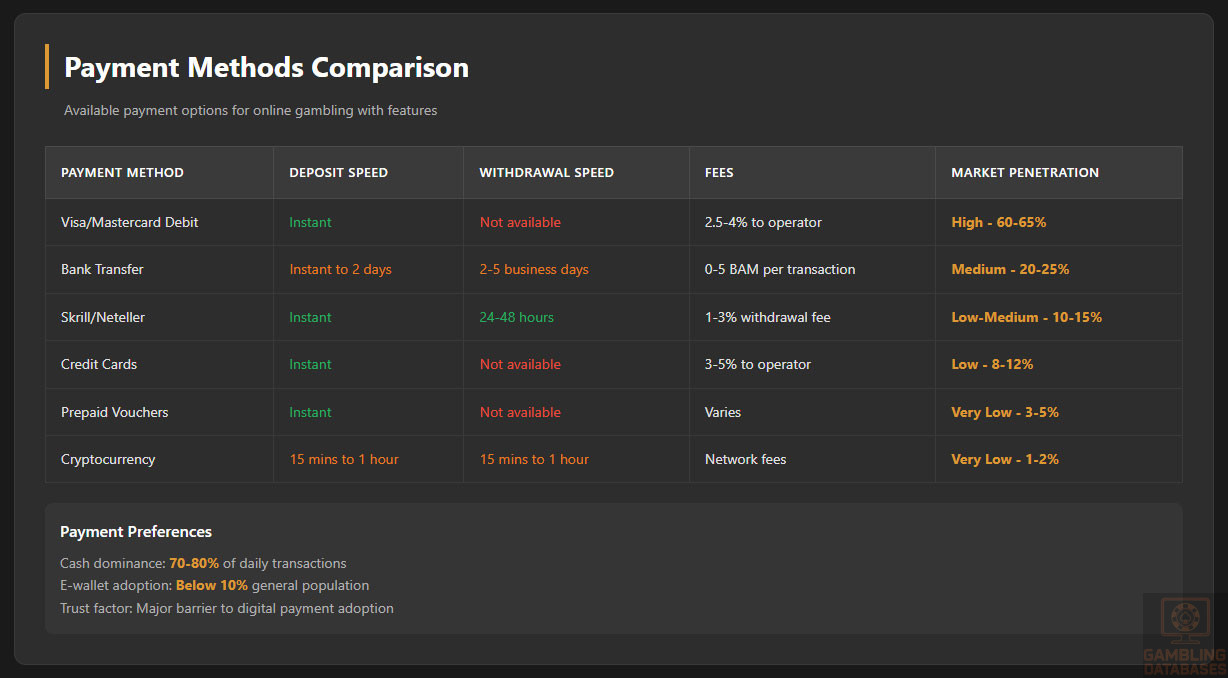
Cryptocurrency Payment Options: Cryptocurrency payment integration remains limited among licensed Bosnia and Herzegovina operators given regulatory ambiguity and limited consumer adoption. Bitcoin, Ethereum, and other cryptocurrencies appeal to privacy-conscious players and those seeking to bypass traditional banking restrictions. However, cryptocurrency users represent only 1-2 percent of online gambling population, limiting commercial incentive for operators to invest in cryptocurrency payment integration.
Regulatory authorities have not issued clear guidance on cryptocurrency gambling transactions, creating compliance uncertainty for operators. Some operators accept cryptocurrency deposits through third-party payment processors converting crypto to fiat currency, avoiding direct cryptocurrency handling. As cryptocurrency adoption potentially increases and regulatory clarity emerges, cryptocurrency payment options may become more standard, though widespread adoption appears years away.
Processing Fees and Transaction Costs: Payment processing fees vary by method and provider, impacting both operator economics and player experiences. Card processing fees typically range from 2.5-4.5 percent of transaction value plus small fixed fees per transaction. International card transactions incur higher fees than domestic transactions, motivating operators to establish local payment processing relationships where possible.
Bank transfer fees vary by bank and transfer type, ranging from free for some online transfers to 2-5 BAM for certain transaction types. E-wallet services charge operators merchant fees similar to card processing while often charging players withdrawal fees of 1-3 percent. These fee structures create tension between offering players free transactions to enhance satisfaction and passing costs through to manage operator expenses.
Withdrawal Processing and Timelines: Withdrawal processing speed significantly impacts player satisfaction and operator reputation. Leading operators process withdrawal requests within 24-48 hours for verified accounts, though first withdrawals requiring identity verification may take 2-5 business days. E-wallet withdrawals typically process fastest, often within 24 hours, while bank transfers may require 2-5 business days depending on banking relationships and transfer methods.
Operators delaying withdrawals beyond reasonable timeframes face player complaints and regulatory scrutiny. Some operators have damaged reputations through excessive withdrawal delays, creating opportunities for competitors emphasizing fast reliable payouts. Withdrawal limits and verification requirements must balance fraud prevention and regulatory compliance against player convenience and expectations for timely access to winnings.
| Payment Method | Deposit Speed | Withdrawal Speed | Fees | Market Penetration |
|---|---|---|---|---|
| Visa/Mastercard Debit | Instant | Not available for withdrawal | 2.5-4% to operator | High – 60-65% |
| Bank Transfer | Instant to 2 days | 2-5 business days | 0-5 BAM per transaction | Medium – 20-25% |
| Skrill/Neteller | Instant | 24-48 hours | 1-3% withdrawal fee | Low-Medium – 10-15% |
| Credit Cards | Instant | Not available | 3-5% to operator | Low – 8-12% |
| Prepaid Vouchers | Instant | Not available | Varies | Very Low – 3-5% |
E-commerce and Digital Economy
Digital Market Development
E-commerce Market Size and Growth: Bosnia and Herzegovina’s e-commerce market remains underdeveloped relative to internet penetration, generating approximately 200-300 million USD annually. This represents only 3-5 percent of total retail sales, far below the 15-25 percent typical in Western European markets. Limited local e-commerce platforms, logistics infrastructure challenges, cash payment preferences, and trust concerns constrain online retail growth despite increasing internet access.
Annual e-commerce growth rates of 15-20 percent suggest gradual market development as younger consumers embrace online shopping and pandemic-driven behavioral changes persist. Electronics, clothing, and household goods represent the largest e-commerce categories. Food delivery services have grown rapidly, normalizing digital payments and delivery expectations that benefit other digital services including online gambling.
Consumer Trust in Online Transactions: Trust in online transactions has improved but remains below Western European levels, with many consumers expressing concerns about payment security, product quality, and merchant reliability. Established international brands including Amazon, eBay, and major retailers enjoy higher trust than unfamiliar local sites. Customer reviews and word-of-mouth recommendations heavily influence trust formation, as Bosnian consumers rely on social proof given limited institutional consumer protections.
Business Environment and Regulatory Framework
Ease of Business Operations
World Bank Doing Business Rankings: Bosnia and Herzegovina ranks approximately 90th globally in the World Bank’s Doing Business Index, indicating moderate business environment challenges compared to international standards. The country performs reasonably on some indicators including access to electricity and resolving insolvency, while struggling with starting a business, dealing with construction permits, and enforcing contracts. Political fragmentation and dual regulatory systems contribute to complexity and administrative burdens.
Compared to regional neighbors, Bosnia and Herzegovina lags behind North Macedonia, Montenegro, and Serbia in overall business environment rankings while performing comparably to Albania. The gap with EU member states Croatia and Slovenia remains substantial, indicating significant room for regulatory improvement and administrative streamlining. However, gradual improvements in recent years suggest positive trajectory as reform efforts progress.
Business Registration Processes: Establishing a legal entity in Bosnia and Herzegovina requires navigating entity-level registration procedures, with processes differing somewhat between the Federation and Republika Srpska. The Federation requires business registration through cantonal commercial courts, creating multiple possible registration jurisdictions within the entity. Republika Srpska centralizes registration through entity-level institutions, providing somewhat more streamlined processes.
Starting a business typically requires 7-12 steps including name reservation, articles of association preparation, notarization, registration with commercial courts, tax authority registration, and social security registration. Total timeline from initiation to completed registration spans approximately 20-40 business days for straightforward cases, though complex corporate structures or administrative delays can extend this to 2-3 months. Many businesses engage legal advisors or specialized agencies to navigate registration procedures, adding costs but accelerating timelines.
Time and Cost to Start Business: Official registration fees for limited liability companies range from 200-500 BAM depending on entity and canton, relatively modest compared to capital requirements and other startup costs. However, notary fees, legal advisory costs, and translation expenses for foreign investors add substantially to total registration costs. All-in costs for foreign investors establishing LLC entities typically reach 2,000-5,000 BAM when including professional services.
Capital requirements for LLCs mandate minimum paid-in capital of 1-2 BAM per ownership share with total minimum capital requirements often around 1,000-2,000 BAM. However, gambling licenses impose substantially higher minimum capital requirements ranging from 50,000-100,000 BAM depending on license type and entity, making basic LLC capital requirements largely irrelevant for gambling operators who must meet sector-specific financial standards.
Foreign Investment Policies: Bosnia and Herzegovina generally welcomes foreign investment without absolute prohibitions or severe restrictions in most economic sectors. Foreign investors enjoy equal treatment with domestic investors under law, able to establish wholly-owned subsidiaries without mandatory local partnership requirements. However, practical considerations including regulatory relationships, market knowledge, and operational support often motivate foreign investors to pursue partnerships with local entities.
Profit repatriation faces no formal restrictions, allowing foreign investors to transfer profits abroad freely after paying applicable taxes. Currency convertibility through the pegged Bosnia and Herzegovina convertible mark to euro provides stability and facilitates international transactions. However, banking system limitations and currency exchange practices occasionally create friction in international fund movements.
Operational Cost Structures: Office rental costs vary dramatically between cities and locations, with prime Sarajevo office space commanding 10-20 EUR per square meter monthly while secondary cities and lower-grade space cost 5-10 EUR per square meter. A modest office suitable for small online gambling operation might require 80-150 square meters costing 800-2,000 EUR monthly depending on location and quality.
Labor costs remain competitive compared to Western Europe, with average monthly gross salaries for skilled technology workers ranging from 1,000-2,000 EUR. Customer service representatives earn 600-1,000 EUR monthly, while senior management positions command 2,000-4,000 EUR. However, employer social contribution obligations add approximately 40-50 percent to gross salaries, significantly increasing total labor costs beyond stated wages.
| Cost Category | Monthly Cost (EUR) | Annual Cost (EUR) | Notes |
|---|---|---|---|
| Office Rent (100 sqm) | 800-1,500 | 9,600-18,000 | Varies significantly by location |
| Utilities and Services | 200-400 | 2,400-4,800 | Internet, electricity, water, etc. |
| Salaries (5-8 staff) | 6,000-12,000 | 72,000-144,000 | Including social contributions |
| Technology Platform | 3,000-8,000 | 36,000-96,000 | Platform license or white label fees |
| Payment Processing | 1,500-4,000 | 18,000-48,000 | % of transactions, varies with volume |
| Marketing and Customer Acquisition | 5,000-15,000 | 60,000-180,000 | Critical for growth, highly variable |
| Legal and Compliance | 1,000-2,500 | 12,000-30,000 | Ongoing compliance and advisory |
| Total Operating Costs | 17,500-43,400 | 210,000-520,800 | Excludes taxes and license fees |
Corporate Structure and Registration
Available Entity Types
Limited Liability Company (LLC): The LLC structure represents the most common corporate form for gambling operators in Bosnia and Herzegovina, offering limited liability protection, flexible ownership structures, and reasonable administrative requirements. LLCs can have single or multiple owners, making them suitable for both wholly-owned foreign subsidiaries and joint venture arrangements. Minimum capital requirements remain modest for basic LLC formation, though gambling licenses impose higher standards.
LLC owners enjoy limited liability, with personal assets protected from company obligations beyond invested capital. This structure suits gambling operations given regulatory and financial risks inherent in the sector. Management flexibility allows owners to directly manage operations or appoint professional managers, accommodating various operational approaches. Annual reporting requirements include financial statements and tax filings, manageable for businesses with proper accounting support.
Joint Stock Company: Joint stock companies represent alternative corporate structures suitable for larger operations or those seeking capital market access. These entities involve more complex governance requirements including shareholder meetings, supervisory boards, and detailed financial reporting. Minimum capital requirements exceed LLC thresholds, typically 50,000 BAM or higher. Most gambling operators find LLC structures sufficient for their needs, with joint stock companies reserved for very large operations or special circumstances.
Branch Office Registration: Foreign companies can establish branch offices in Bosnia and Herzegovina representing the parent company rather than creating separate legal entities. Branches operate under foreign company licenses and liability, with parent company assuming full responsibility for branch activities. This structure may suit international operators testing the market before committing to full subsidiary establishment, though gambling license requirements may mandate subsidiary establishment rather than permitting branch operations.
Registration Requirements and Procedures
Registration Timeline and Process: LLC registration timelines span approximately 4-6 weeks for well-prepared applications with complete documentation. The process begins with name reservation ensuring the desired company name remains available and meets regulatory standards. Founders then prepare articles of association defining company structure, ownership, management, and operational scope. These documents require notarization by licensed notaries, adding costs and scheduling requirements.
Court registration follows document preparation, with founders submitting applications to appropriate commercial courts along with required documentation and fees. Court processing times vary by jurisdiction and application volume, typically requiring 2-4 weeks. Following court registration, companies must register with tax authorities, social security institutions, and relevant regulatory bodies. Gambling operators face additional licensing procedures beyond basic company registration.
Required Documentation for Foreign Investors: Foreign investors must provide extensive documentation including passport copies, proof of address, and certificates of no criminal record from countries of residence. Corporate investors must submit registration certificates, articles of association, and ownership documentation for parent companies. All foreign documents require apostille certification and official translation into local languages, adding time and expense to registration processes.
Due diligence documentation for gambling licenses extends beyond basic registration requirements, requiring detailed financial records, business plans, source of funds documentation, and background checks on all significant stakeholders. The comprehensive documentation requirements reflect regulatory emphasis on preventing money laundering and ensuring operator financial stability.
Ongoing Compliance Requirements: Registered companies must file annual financial statements with commercial courts, submit tax returns to relevant tax authorities, and maintain proper corporate governance including shareholder meetings and decision documentation. Gambling operators face additional reporting obligations including regular gaming revenue reports, player statistics submissions, and compliance certifications. Failure to meet reporting deadlines triggers penalties ranging from fines to potential license suspension.
Corporate governance requirements mandate maintaining registered office addresses, proper accounting records, and documentation of significant corporate decisions. Foreign-owned companies may face enhanced scrutiny, with authorities ensuring operations maintain genuine economic substance in Bosnia and Herzegovina rather than serving as shell entities for foreign operations.
Taxation Framework
Corporate Income Tax Structure
Standard Corporate Tax Rates: Bosnia and Herzegovina maintains a competitive 10 percent corporate income tax rate across both entities, among the lowest in Europe. This flat rate applies to corporate profits calculated according to local accounting standards and tax regulations. The low corporate tax burden helps offset other regulatory costs and creates favorable environment for foreign investment. Tax base determination allows deduction of legitimate business expenses including salaries, rent, professional services, and gambling-specific taxes paid.
Tax years align with calendar years, with companies filing annual corporate tax returns by April 30 following the tax year. Advance tax payments occur quarterly based on previous year’s tax liability, with final reconciliation upon annual return filing. Profitable companies make advance payments throughout the year, reducing year-end tax obligations. Loss-making companies can carry forward losses to offset future years’ profits, though carryforward periods face limitations.
International Tax Treaties: Bosnia and Herzegovina maintains double taxation treaties with numerous countries including most European nations, helping foreign investors avoid double taxation on profits repatriated to home countries. Treaty provisions typically reduce or eliminate withholding taxes on dividends, interest, and royalties paid to foreign parent companies. Investors should verify specific treaty provisions with their home countries to optimize tax structures and ensure compliance with both Bosnian and home country tax obligations.
Transfer Pricing Regulations: Transfer pricing rules require transactions between related parties to occur at arm’s length prices comparable to transactions between independent parties. These regulations prevent profit shifting to lower-tax jurisdictions through artificial pricing of intercompany transactions. International gambling operators must carefully document technology platform fees, management charges, and other intercompany transactions to satisfy regulatory scrutiny. Transfer pricing documentation requirements have intensified as authorities prioritize tax base protection.
Personal Income Tax and Employment Taxes
Individual Tax Rates: Personal income tax follows progressive rate structures in both entities, with rates ranging from 0-10 percent depending on income levels and entity. The Federation implements progressive taxation with rates of 0 percent for low incomes up to 10 percent for higher earners. Republika Srpska similarly applies progressive rates topping out around 10 percent. These modest personal income tax rates compare favorably to Western European standards where top rates often exceed 40-50 percent.
Employers withhold income tax from employee salaries, remitting withheld amounts to tax authorities monthly. Annual reconciliation occurs through individual tax returns where necessary, though most employees with single employers face no additional tax obligations beyond withholdings. Foreign employees working in Bosnia and Herzegovina become tax residents and subject to local taxation after spending significant time in-country, typically 183 days annually.
Social Security Contributions: Social security contributions represent substantial employment costs beyond gross salaries and income taxes. Employer social contributions approximate 30-40 percent of gross salaries, covering pensions, healthcare, unemployment insurance, and other social programs. Employee contributions add another 30-35 percent deducted from gross salaries. Combined employer and employee contributions can total 60-75 percent of gross salaries, dramatically increasing total employment costs.
These high social contribution burdens motivate some informal employment and drive some businesses toward contractor arrangements rather than formal employment. However, gambling operators as licensed regulated entities must maintain full compliance with employment and social security regulations, precluding grey economy labor approaches common in some sectors.
| Tax Type | Rate/Amount | Basis | Payment Frequency |
|---|---|---|---|
| Corporate Income Tax | 10% | Taxable profits | Quarterly advance + annual |
| GGR Tax (FBiH) | 10% | Gross Gaming Revenue | Monthly |
| GGR Tax (RS) | 5-10% | Gross Gaming Revenue | Monthly |
| Municipal Tax (FBiH) | 2-5% | Gross Gaming Revenue | Monthly |
| Employer Social Contributions | 30-40% | Gross salaries | Monthly |
| Employee Social Contributions | 30-35% | Gross salaries | Monthly (withheld) |
| Personal Income Tax | 0-10% | Salaries | Monthly (withheld) |
| Dividend Withholding Tax | 5-10% | Dividend payments | Upon distribution |
Market Entry Considerations
Recommended Entry Strategies
Direct Licensing Approach: International operators with substantial resources and risk appetite can pursue direct licensing in one or both entities, establishing wholly-owned subsidiaries and building operations from ground up. This approach provides maximum control over branding, operations, and strategy while capturing all profits without partnership obligations. However, direct entry requires navigating complex regulatory processes, building local teams without existing infrastructure, and establishing market presence without initial brand recognition.
Direct licensing suits established gambling operators with regional presence seeking to expand their footprint into Bosnia and Herzegovina as part of broader Balkan strategies. Operators already active in neighboring Serbia, Croatia, or Montenegro can leverage regional expertise and potentially achieve operational synergies across multiple markets. Brand recognition from regional operations may transfer partially to Bosnia and Herzegovina, reducing customer acquisition challenges.
Partnership and Joint Venture Models: Partnerships with established local operators provide alternative entry routes, offering local market knowledge, existing infrastructure, regulatory relationships, and immediate market presence. Joint ventures can take various forms from minority stakes in local operators to 50-50 partnerships to majority ownership with local partners retaining significant roles. Partnership structures must carefully define governance, profit sharing, operational control, and exit provisions.
Local partners bring valuable assets including established customer databases, operational teams, retail networks for omnichannel strategies, and political relationships facilitating regulatory navigation. However, partnerships introduce challenges around strategic alignment, decision-making authority, and profit distribution. Cultural differences, varying operational standards, and divergent growth ambitions can create friction requiring ongoing management attention.
White Label and Technology Platform Approaches: Smaller operators or those testing the market with limited initial commitments can pursue white label arrangements where established platform providers supply technology infrastructure, payment processing, and operational support while the licensee focuses on marketing and customer acquisition. White label models dramatically reduce upfront technology investment and operational complexity, enabling faster market entry with lower capital requirements.
However, white label operators sacrifice some profit margins to platform providers, face limitations on product differentiation, and depend heavily on platform provider reliability and capabilities. Technology platform selection critically impacts player experience, game variety, and operational efficiency. Operators should carefully evaluate platform providers based on track records, technology quality, compliance capabilities, and commercial terms before committing to white label arrangements.
Typical Costs and Timelines
Initial Setup Investment Breakdown: Market entry requires substantial upfront investments spanning licensing, company establishment, technology platform, marketing, and working capital. License application fees range from 5,000-15,000 USD depending on entity and license scope, representing relatively modest portions of total setup costs. Bank guarantees of 25,000-50,000 USD must be posted and remain tied up throughout operation, though they don’t constitute cash expenses unless called upon for violations.
Legal and consulting fees for license applications, company registration, and regulatory compliance setup typically total 30,000-60,000 USD for international operators engaging specialized advisors. These professional services prove essential for navigating complex regulatory landscapes and avoiding costly mistakes, making them worthwhile investments despite significant costs. Technology platform costs vary dramatically based on proprietary development versus white label models, ranging from 50,000-200,000 USD for initial setup.
Office setup including rent deposits, furniture, equipment, and initial months’ rent requires 10,000-25,000 USD depending on office size and location quality. Initial staffing costs for core team before revenue generation begins represent substantial investments, potentially 50,000-100,000 USD for 6-12 months of runway. Marketing budgets for launch and initial customer acquisition demand 100,000-300,000 USD to establish market presence and build initial customer base.
Total initial investment requirements for serious market entry typically range from 350,000-750,000 USD, with smaller-scale white label operations potentially entering for 200,000-400,000 USD and full-scale operations by major operators reaching 1-2 million USD. These capital requirements represent significant commitments for entering a relatively small market, requiring operators to develop clear paths to profitability and acceptable return on investment timelines.
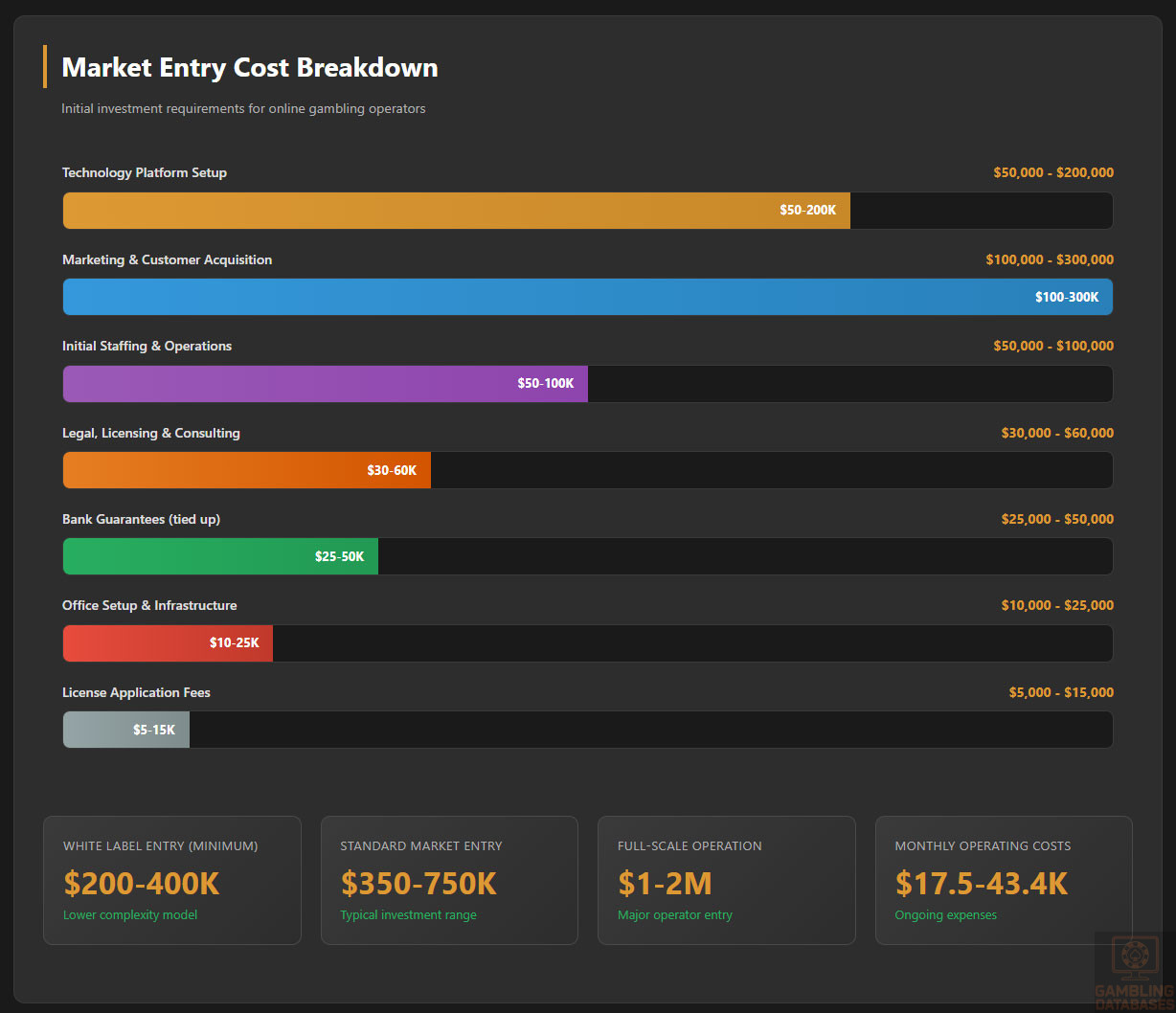
Timeline Expectations: Company registration requires approximately 6-8 weeks from initiating process to completed registration, assuming well-prepared documentation and no significant complications. License application processes span 6-12 months from submission to approval, representing the longest critical path item in market entry timelines. Operators should begin license applications early in planning processes, potentially before finalizing all operational decisions, to avoid timeline delays.
Platform setup timelines vary based on approach, with white label implementations potentially completing in 6-12 weeks while proprietary platform development or major customizations may require 4-6 months. Payment integration, localization, and compliance feature implementation consume significant time even for established platforms. Marketing preparation including brand development, website creation, and campaign planning requires 2-3 months concurrent with other activities.
Total time from project initiation to market launch typically spans 9-15 months for well-executed entries, with 12 months representing realistic planning assumption. Aggressive operators with experienced teams and favorable regulatory processing might compress timelines to 7-9 months, while complex situations or administrative delays can extend to 18-24 months. Operators should plan for longer timelines and view faster execution as upside rather than base case.
| Phase | Duration | Key Activities | Investment Required (USD) |
|---|---|---|---|
| Planning and Research | 1-2 months | Market analysis, regulatory research, strategy development | 10,000-25,000 |
| Company Establishment | 1.5-2 months | Entity registration, office setup, initial hiring | 25,000-60,000 |
| License Application | 6-12 months | Application preparation, submission, regulatory review | 50,000-120,000 |
| Platform Development | 2-6 months | Technology setup, integration, testing | 50,000-200,000 |
| Pre-Launch Marketing | 2-3 months | Brand building, marketing materials, partnerships | 50,000-150,000 |
| Launch and Initial Operations | 3-6 months | Market launch, customer acquisition, optimization | 150,000-350,000 |
| Total Market Entry | 9-15 months | From initiation to sustainable operations | 350,000-750,000+ |
Success Factors and Challenges
Key Success Enablers
Localization and Market Understanding: Success in Bosnia and Herzegovina requires deep understanding of local player preferences, cultural nuances, and competitive dynamics rather than simply transplanting approaches from other markets. Localized content including sports coverage of regional leagues, payment methods matching local preferences, and customer service in appropriate languages proves essential. Operators demonstrating genuine commitment to the local market through localized operations outperform those treating Bosnia and Herzegovina as afterthought in regional strategies.
Mobile-First Platform Strategy: Given high smartphone penetration and mobile usage patterns, operators must prioritize mobile experience quality in platform development and optimization. Mobile-optimized websites and native mobile applications providing smooth betting experiences, fast loading times, and intuitive navigation prove critical for customer acquisition and retention. Poor mobile experiences drive players to competitors offering better mobile functionality given the ease of switching operators online.
Competitive Odds and Attractive Promotions: Price-sensitive Bosnian players compare odds across operators and direct betting volume toward best-value providers. Operators must maintain competitive odds on popular sports and markets to attract and retain sports bettors. However, aggressive odds alone prove insufficient without promotional programs including welcome bonuses, regular deposit bonuses, free bets, and loyalty rewards keeping players engaged and incentivizing continued activity.
Strong Customer Support: Responsive customer support available through multiple channels including live chat, email, and telephone helps build trust and resolve issues before they drive player churn. Local language support proves essential, with support agents understanding cultural context and communication styles. Extended support hours covering evening peak gambling times ensures assistance availability when players need it most.
Responsible Gambling Commitment: Operators demonstrating genuine commitment to responsible gambling through comprehensive player protection tools, staff training, and problem gambling prevention efforts build reputational advantages and reduce regulatory risks. While responsible gambling features may slightly constrain revenue from problem gamblers, they provide long-term sustainability and align with evolving regulatory expectations. Leading operators proactively implement responsible gambling measures exceeding minimum requirements.
Major Operational Challenges
Regulatory Complexity and Dual Entity System: Operating across both Federation and Republika Srpska territories requires maintaining dual regulatory compliance, separate licenses, and parallel administrative processes. This fragmentation increases operational costs, creates compliance challenges, and complicates business planning. Regulatory changes in one entity may not apply to the other, forcing operators to maintain flexible systems accommodating divergent requirements. The lack of unified national regulatory framework represents ongoing challenge unlikely to resolve quickly given political realities.
Small Market Size and Scale Limitations: Bosnia and Herzegovina’s total gambling market of 180-220 million USD and online segment of 50-65 million USD limit revenue potential relative to larger European markets. Small absolute market size constrains economies of scale, making it challenging to amortize technology investments, marketing costs, and compliance infrastructure over sufficient revenue bases. Operators must carefully manage cost structures and may need to operate Bosnia and Herzegovina as part of multi-market regional strategies rather than standalone profitable operations.
The modest player base of 80,000-120,000 online gambling participants creates intense competition for limited customers. Customer acquisition costs can consume substantial portions of player lifetime value in competitive small markets where operators compete for the same relatively price-sensitive players. Market saturation risks increase as additional operators enter without corresponding market growth, potentially making profitability elusive for marginal operators.
Payment Processing and Banking Challenges: Limited payment method options and occasional payment processing difficulties create friction in player deposit and withdrawal experiences. Some international payment processors avoid gambling transactions or charge premium fees, limiting operator options for cost-effective payment processing. Players occasionally face card transaction declines when banks flag gambling payments as potentially fraudulent, frustrating players and causing lost deposits for operators.
Cross-border payment complexities for international operators repatriating funds or managing treasury operations add costs and administrative burdens. Currency exchange considerations given the Bosnia and Herzegovina convertible mark require careful management, though the mark’s euro peg provides stability. Banking relationship quality varies substantially between institutions, making bank selection important for smooth payment operations.
Talent Acquisition and Retention: Finding qualified personnel combining gambling industry knowledge, technical capabilities, and local market understanding proves challenging in the small Bosnian labor market. Brain drain affects talent availability as educated professionals emigrate to Western Europe seeking higher salaries and better opportunities. Technology talent shortages particularly affect operators seeking developers, data analysts, and digital marketing specialists with specialized gambling industry expertise.
Salary expectations have risen as competition for talent intensifies and employees gain awareness of Western European compensation levels. However, operators face constraints on salary offers given revenue limitations in the small market. Training junior staff requires time and investment, with risks that trained employees may depart for competitors or emigrate after gaining valuable experience. International operators may need to consider hybrid staffing models combining local teams with regional or global support functions.
High Taxation and Regulatory Costs: Combined GGR taxes of 12-15 percent in the Federation including municipal levies plus corporate income tax create substantial tax burdens reducing operator profitability. License fees, bank guarantee requirements, compliance costs, and ongoing regulatory reporting obligations add further financial pressures. Marketing restrictions limit customer acquisition channels while responsible gambling requirements constrain revenue from high-value players who might pose problem gambling risks.
Smaller operators struggle more with fixed regulatory costs representing larger proportions of their revenues compared to scaled operators amortizing compliance costs over larger revenue bases. Cost structures must carefully balance regulatory compliance, competitive service offerings, and sustainable profitability. Operators should model taxation and compliance costs conservatively in business planning to avoid profitability surprises.
Competition from Unlicensed Operators: Offshore gambling sites operating without local licenses compete for Bosnian players while avoiding local taxes, regulatory compliance costs, and advertising restrictions. These unlicensed operators can offer more aggressive bonuses, better odds, and avoid responsible gambling restrictions, creating unfair competitive advantages. While authorities implement website blocking and payment restrictions against unlicensed operators, enforcement limitations enable continued illegal operation attracting some price-sensitive players.
Licensed operators face difficult balance between maintaining competitive offerings to retain players versus adhering to regulatory restrictions that unlicensed competitors ignore. However, licensed operators benefit from legal certainty, ability to advertise and sponsor sports teams, payment processing through mainstream channels, and player trust in regulated environments. Emphasizing regulatory compliance, security, and fair gaming helps licensed operators differentiate from unregulated alternatives.
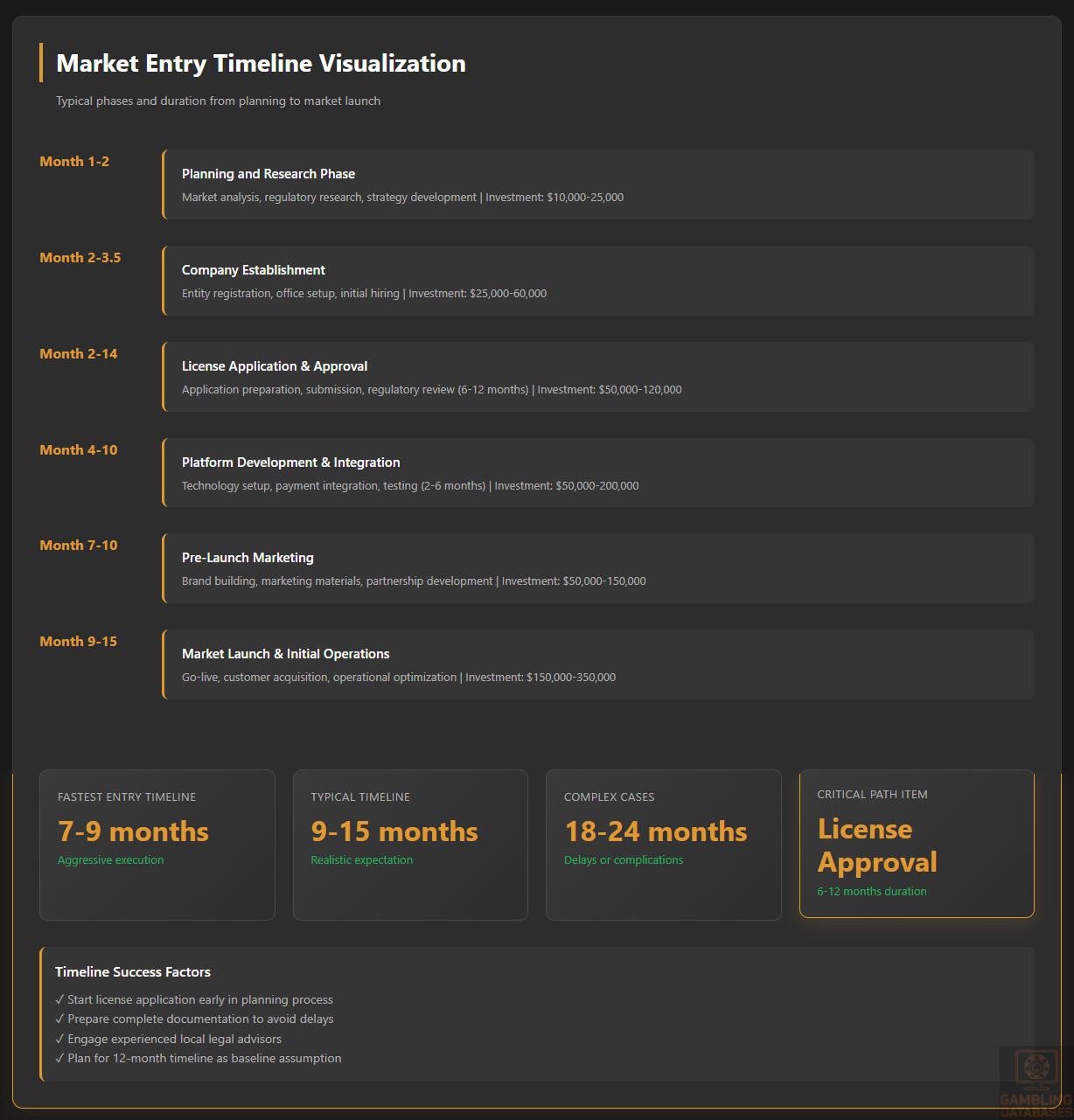
Cultural Considerations for Success
Local Sports and Events Coverage: Success in the sports betting-dominated market requires comprehensive coverage of football leagues popular with Bosnian audiences, including domestic Premier League of Bosnia and Herzegovina, Serbian SuperLiga, Croatian Prva HNL, and major European leagues. Basketball coverage including regional ABA League and NBA also proves important. Offering competitive odds on local team matches and regional derbies demonstrates market commitment and attracts passionate local fans.
Understanding seasonal sports patterns allows operators to adjust marketing and operational focus across football seasons, summer breaks, and major tournament periods. European football tournaments including Champions League, Europa League, and international competitions drive peak engagement requiring adequate platform capacity and customer support availability. Tennis, handball, and other sports with regional followings deserve coverage despite lower betting volumes than football and basketball.
Communication Style and Customer Service Approach: Bosnian communication culture values personal relationships, warmth, and directness in customer interactions. Customer service approaches should emphasize friendly helpful support rather than scripted corporate formality. Live chat agents who engage personally with players while efficiently resolving issues build stronger customer relationships than impersonal automated responses. Understanding cultural communication norms including appropriate greetings, formality levels, and conflict resolution approaches improves customer satisfaction.
Language sensitivity matters given ethnic and linguistic diversity within Bosnia and Herzegovina. Operators should offer content in Bosnian, Croatian, and Serbian variants where feasible, or use neutral language avoiding terminology that might alienate specific communities. Customer service staff should demonstrate cultural awareness and linguistic flexibility to serve diverse customer base comfortably.
Trust-Building for Foreign Brands: International operators face skepticism from Bosnian consumers accustomed to established local brands and wary of unfamiliar foreign entities. Building trust requires sustained local presence, reliable service delivery, transparent operations, and demonstrated commitment to the market rather than treating it as temporary profit opportunity. Sponsorships of popular sports teams, partnerships with trusted local brands, and visible community engagement help establish credibility.
Withdrawal reliability proves particularly critical for trust building, as players heavily weight withdrawal experiences in operator evaluations and recommendations. Operators consistently processing withdrawals quickly and without unnecessary complications build positive reputations spreading through word-of-mouth and online gambling communities. Any withdrawal delays or disputes severely damage operator reputations in the small interconnected market where player experiences circulate quickly.
Exit Strategy Planning
Market Liquidity for Operator Sales: The relatively small Bosnian gambling market offers limited exit liquidity compared to larger European markets attracting more potential acquirers. Potential buyers include regional gambling groups pursuing Balkan expansion, international operators seeking market entry through acquisition, or local operators consolidating market positions. However, the small market size and complex regulatory environment may deter some potential acquirers, limiting bidder competition and potentially depressing valuations.
Operators should consider exit strategy implications when structuring initial market entry, including ownership structures enabling clean sales, corporate governance facilitating due diligence, and operational systems supporting smooth transitions. Building sustainable profitable operations with clean compliance records enhances attractiveness to potential acquirers compared to operations dependent on founder relationships or operating in regulatory grey areas.
License Transferability and Regulatory Processes: Gambling license transfers require regulatory approval from licensing authorities who must evaluate proposed new owners through similar due diligence processes as initial license applications. Transfer processes can span several months, creating transition period uncertainty and potentially allowing targets to terminate acquisition agreements if regulatory approvals face delays or unexpected conditions. Buyers should account for regulatory approval risks and timelines in acquisition planning and purchase agreements.
Some license types may have restrictions on transfers or changes of control requiring new license applications rather than simple transfer processes. Understanding specific license provisions and regulatory requirements around ownership changes proves essential for both buyers and sellers planning transactions. Legal advisors specializing in gambling regulatory matters should guide transaction structuring to optimize regulatory approval prospects.
Valuation Considerations: Bosnian gambling operator valuations typically range from 1.5-4.0x annual EBITDA depending on growth trajectories, competitive positions, and regulatory standing. Online operators with strong growth and scalable platforms command higher multiples toward the upper range, while land-based operators or struggling businesses trade at lower multiples. The small market size and regulatory complexity typically result in lower valuation multiples than Western European gambling operators achieving 5-8x EBITDA multiples in more established markets.
Buyers conduct extensive due diligence examining financial performance, customer acquisition costs, retention rates, regulatory compliance, pending legal issues, and technology infrastructure quality. Clean regulatory records, sustainable growth, and operational efficiency enhance valuations, while compliance concerns, declining performance, or technology debt depress values. Operators considering eventual exits should maintain operations with acquisition readiness in mind rather than optimizing purely for short-term results at expense of long-term sustainability.
FAQ: Frequently Asked Questions
Legal and Licensing Questions
Is online gambling legal in Bosnia and Herzegovina?
Online gambling is legal and regulated in Bosnia and Herzegovina, though the regulatory framework differs between the country’s two entities. The Federation of Bosnia and Herzegovina and Republika Srpska each maintain separate licensing regimes for online gambling operations. Licensed operators can legally offer online sports betting and casino games to players within their licensed territories. However, the regulatory framework remains less developed than mature European gambling markets, with ongoing evolution as authorities refine requirements.
Operators must obtain appropriate licenses from the relevant entity authorities before offering online gambling services. Unlicensed offshore gambling operations technically violate local laws, though enforcement against international operators proves challenging. Players can legally gamble with licensed operators without facing legal consequences. The dual regulatory system creates complexity requiring operators to navigate multiple licensing processes for comprehensive market coverage.
What types of gambling licenses are available and what do they cover?
Bosnia and Herzegovina offers several gambling license categories covering different activities. Online gambling licenses authorize digital betting and gaming services including sports betting and casino games delivered via websites and mobile applications. Sports betting licenses cover both land-based betting shops and online platforms. Casino licenses permit operation of physical casino venues with table games and electronic gaming machines. Gaming hall licenses authorize slot machine operations in dedicated facilities.
License categories vary somewhat between the Federation and Republika Srpska, with different scopes and requirements. Comprehensive online gambling licenses in the Federation typically cover both sports betting and casino gaming, while Republika Srpska may issue more segmented licenses. Land-based licenses generally apply per establishment, requiring separate licenses for each betting shop or casino location. Operators seeking both online and land-based presence must obtain multiple license types accommodating their intended operational scope.
How much does an iGaming license cost and how long does it take to obtain?
Online gambling license fees range from 50,000 to 100,000 BAM annually (approximately 26,000-52,000 USD) depending on entity and license scope. The Federation of Bosnia and Herzegovina typically charges toward the higher end of this range for comprehensive online licenses, while Republika Srpska fees may be moderately lower. Beyond annual license fees, operators must post bank guarantees of 80,000-100,000 BAM (41,000-52,000 USD) remaining in place throughout operation.
Application processing timelines span 6-12 months from complete application submission to license approval. Background checks on beneficial owners, financial due diligence, and technical reviews contribute to lengthy timelines. Initial applications from new market entrants typically require longer processing than renewals or applications from established operators. Incomplete applications or deficiencies in documentation can extend timelines substantially, potentially reaching 18-24 months in problematic cases. Operators should plan for 12-month licensing timelines as realistic base case expectations.
Can foreign companies obtain a gambling license?
Foreign companies can obtain gambling licenses in Bosnia and Herzegovina without facing absolute prohibitions on foreign ownership. Both entities permit wholly foreign-owned licensed operators, though foreign applicants undergo thorough due diligence examining parent company backgrounds, financial stability, and gambling industry track records. Foreign operators must establish local legal entities incorporated under Bosnia and Herzegovina law rather than operating through branch offices or foreign entities.
While no mandatory local partnership requirements exist, foreign operators often pursue partnerships or joint ventures with local entities to facilitate regulatory approval, provide market knowledge, and establish operational infrastructure. Authorities may view applications more favorably when they include local business participation, though this represents practical consideration rather than legal requirement. Foreign operators should demonstrate commitment to sustainable local operations rather than appearing to pursue quick profit extraction without genuine market investment.
Financial and Taxation Questions
What are the tax obligations for iGaming operators?
Online gambling operators face multiple tax obligations in Bosnia and Herzegovina. The primary gambling-specific tax is the Gross Gaming Revenue tax levied at 10 percent in the Federation of Bosnia and Herzegovina and 5-10 percent in Republika Srpska depending on game type. GGR represents total wagers minus player payouts before deducting operational expenses. Federation operators also pay municipal gambling taxes of 2-5 percent GGR in addition to entity-level taxes.
Beyond gambling taxes, operators pay standard 10 percent corporate income tax on profits after deducting legitimate business expenses including gambling taxes paid. Employer social security contributions of 30-40 percent apply to gross salaries, while employees face 30-35 percent social contributions and 0-10 percent income tax withheld from wages. The aggregate tax burden including gambling taxes, corporate income tax, and employment-related taxes typically consumes 30-45 percent of operator gross revenues depending on specific circumstances and cost structures.
Are gambling winnings taxed for players?
Bosnia and Herzegovina generally does not impose taxes on gambling winnings at the player level for recreational gamblers. Individual players receiving winnings from licensed operators face no withholding requirements or tax declaration obligations in most cases. This approach follows common European practice of taxing gambling operators rather than individual players, simplifying tax administration and encouraging gambling participation.
However, individuals deriving substantial income primarily from gambling activities may face income tax obligations on gambling earnings. Professional gamblers or those whose main income source appears to be gambling could have their winnings classified as taxable income subject to normal personal income tax rates. The threshold between recreational gambling and taxable gambling income remains somewhat ambiguous, with determinations made case-by-case. Most casual players need not concern themselves with gambling winnings taxation.
What are the typical operational costs for running an online casino or sportsbook?
Monthly operational costs for small to medium online gambling operations in Bosnia and Herzegovina range from 17,500 to 43,000 EUR depending on scale and operational approach. Major cost categories include staff salaries with social contributions (6,000-12,000 EUR monthly for 5-8 employees), technology platform fees (3,000-8,000 EUR for white label or platform licenses), marketing and customer acquisition (5,000-15,000 EUR), and payment processing fees (1,500-4,000 EUR varying with transaction volumes).
Additional costs include office rent and utilities (1,000-2,000 EUR), legal and compliance services (1,000-2,500 EUR), and various administrative expenses. Annual license fees of 26,000-52,000 USD plus bank guarantees add regulatory costs beyond monthly operating expenses. Customer acquisition costs prove particularly variable based on competitive intensity and marketing effectiveness, potentially consuming 30-50 percent of gross revenues in competitive periods. Operators should budget 250,000-500,000 EUR annually for sustainable operations before accounting for taxes and owner compensation.
What is the expected ROI timeline for entering this market?
Operators entering the Bosnia and Herzegovina online gambling market should expect 24-36 month timelines to achieve breakeven and begin generating positive returns on investment. Initial 12-18 months typically involve heavy customer acquisition spending, platform optimization, and market establishment generating operating losses. Months 18-30 see customer base maturation, reduced acquisition cost ratios as retention improves, and movement toward profitability as scale effects emerge.
Cumulative cash-on-cash returns reach positive territory in years 3-4 for successful operators, with full ROI on initial investments potentially requiring 4-6 years given modest market size and competitive intensity. Higher growth operators or those achieving strong market positions may accelerate profitability timelines, while struggling entrants may never achieve satisfactory returns. The small market size limits absolute profit potential, making Bosnia and Herzegovina more suitable as component of regional multi-market strategies rather than standalone major investment focus for international operators.
Operations and Compliance Questions
What are the local presence requirements for operators?
Licensed gambling operators must maintain genuine physical presence in Bosnia and Herzegovina including registered office addresses with functional operations, not merely virtual offices or mail forwarding services. Operators must establish local legal entities incorporated under Bosnia and Herzegovina law, typically limited liability companies. Office requirements vary by operational scale, but authorities expect substance matching license scope including adequate staff, equipment, and facilities to conduct genuine business operations.
Online gambling operators need office space for administrative functions, customer service, compliance activities, and management operations even though their primary service delivery occurs digitally. Land-based gambling establishments inherently satisfy physical presence requirements through their venues. Operators must employ local staff for core functions, though specific staffing requirements vary by license type. Some key management positions may need to be filled by individuals physically present in Bosnia and Herzegovina rather than managed remotely from foreign locations.
What payment methods are available and recommended?
Online gambling operators should offer multiple payment methods accommodating diverse player preferences. Visa and Mastercard debit cards represent essential payment options, accounting for 60-65 percent of deposit transactions and offering instant processing familiar to most players. Bank transfers enable deposits for players uncomfortable with card payments or preferring direct banking channels, though processing times range from instant to 2-3 days depending on banking relationships.
E-wallet services including Skrill and Neteller serve experienced online gamblers seeking privacy and fast withdrawals, though penetration remains limited to 10-15 percent of players. Credit card acceptance provides convenience for the minority of players holding credit cards, though usage rates remain modest. Operators should prioritize reliable withdrawal processing, as withdrawal experience quality critically impacts player satisfaction and retention. Bank transfers and e-wallets serve as primary withdrawal methods given restrictions on card withdrawals.
What are the advertising and marketing restrictions?
Gambling advertising faces increasing restrictions across Bosnia and Herzegovina, particularly for television broadcasting. The Federation prohibits gambling television advertisements during daytime and evening hours, restricting commercials to late-night time slots typically after 10:00 PM. Republika Srpska implements similar television advertising windows. All gambling advertisements must include responsible gambling warnings and avoid content appealing to minors or presenting gambling as solution to financial problems.
Online advertising operates under fewer restrictions than television, though operators must ensure digital advertising does not target underage audiences or appear on youth-oriented websites. Print media and outdoor advertising face moderate restrictions around content standards and placement proximity to schools. Sports sponsorships remain permitted and represent major marketing channels for operators, though sponsored content must comply with advertising restrictions. Bonus and promotional offers face emerging restrictions around maximum values and transparency requirements for wagering conditions.
What responsible gambling measures are mandatory?
Licensed operators must implement comprehensive responsible gambling programs including self-exclusion systems allowing players to ban themselves from gambling for specified periods. Operators must maintain self-exclusion registries and prevent excluded individuals from accessing gambling services during exclusion periods. Reality check features interrupting play sessions to inform players of time elapsed and losses incurred help maintain player awareness during extended gambling.
Deposit limits, loss limits, and session time limits should be offered to players seeking to control their gambling behavior, though not universally mandated across all license types yet. Age verification procedures prevent underage gambling through identity document checks at registration and ongoing monitoring. Operators must provide clear information about gambling risks, display responsible gambling warnings prominently, and offer links to problem gambling support resources. Staff training on identifying problem gambling behaviors and intervening appropriately represents another key responsible gambling requirement.
Market Opportunity Questions
How large is the iGaming market and what is the growth potential?
The Bosnia and Herzegovina online gambling market generates approximately 50-65 million USD in annual revenue, representing 25-30 percent of the total 180-220 million USD gambling market. The online segment has grown rapidly at 15-20 percent annually over recent years, significantly outpacing 2-5 percent growth in land-based gambling. Market projections suggest continued online growth of 10-14 percent annually through 2028, potentially reaching 75-95 million USD as digital adoption continues and younger demographics enter gambling age.
The active online gambling user base of 80,000-120,000 individuals should expand to 120,000-170,000 by 2028, though population decline limits growth potential from demographic expansion. Market growth will depend primarily on increasing gambling participation rates among existing population and conversion of land-based players to online channels rather than population growth. While absolute market size remains modest by European standards, solid growth rates and increasing digitalization create opportunities for well-positioned operators despite competitive intensity.
Who are the main competitors and what is their market share?
The Bosnia and Herzegovina gambling market features fragmented competition with no single operator dominating. Premier, one of the leading operators, holds approximately 15-18 percent market share through extensive retail betting networks and growing online presence. Mozzart, a regional operator particularly strong in Republika Srpska, controls roughly 12-15 percent market share. Meridian maintains 10-13 percent share with both land-based and digital operations across both entities.
International operators including Favbet and MaxBet have established presence capturing 8-10 percent and 7-9 percent market shares respectively through selective market entry strategies. The remaining 40-45 percent of market share distributes across numerous smaller operators, independent betting shops, and gaming halls. No operator achieves dominant position, creating competitive market dynamics where customer acquisition and retention require ongoing marketing investment and competitive service offerings. Market concentration remains lower than many European markets given regulatory fragmentation and modest barriers enabling multiple operators to coexist.
What are the player preferences and typical spending patterns?
Bosnian gambling participants strongly prefer sports betting, which accounts for approximately 70 percent of total gambling activity. Football betting dominates within sports betting given widespread football fandom and extensive coverage of domestic and international competitions. Basketball ranks as the second most popular sports betting category. Players typically place small-stakes bets of 2-10 BAM (1-5 USD) with accumulator bets combining multiple selections to achieve higher potential payouts from modest stakes.
Average monthly gambling spending among active participants ranges from 50-80 USD, with median spending around 30-40 USD as high-value players skew averages. Approximately 60 percent of gamblers spend under 50 USD monthly as casual low-stakes players, while 30 percent spend 50-200 USD as regular mid-level players, and 10 percent exceed 200 USD monthly as high-value customers. Casino gaming attracts roughly 20-25 percent of gamblers, with slots most popular followed by live dealer games gaining traction. Mobile devices account for 55-60 percent of online gambling activity, with evening hours and weekends showing peak engagement.
What are the key success factors and main challenges for new entrants?
Success factors for Bosnia and Herzegovina market entry include deep local market understanding through localized content and services, mobile-optimized platforms given smartphone dominance, competitive odds and attractive promotions for price-sensitive players, reliable fast payment processing, and strong customer support in local languages. Operators must balance aggressive customer acquisition with sustainable unit economics, emphasizing retention and player lifetime value over pure acquisition volume. Local sports coverage, responsible gambling commitment, and building trust through consistent reliable operations prove essential.
Major challenges include navigating complex dual entity regulatory systems requiring parallel licensing and compliance, small absolute market size limiting scale economies and revenue potential, intense competition from numerous established operators and unlicensed offshore sites, payment processing difficulties and limited method options, talent shortages in specialized gambling industry roles, and high combined tax burden reducing profitability. Marketing restrictions limit customer acquisition channels while regulatory compliance costs represent substantial fixed expenses. New entrants should view Bosnia and Herzegovina as long-term investment requiring patience to achieve profitability rather than expecting rapid returns.
Sources and References
- Bosnia and Herzegovina Gambling Regulatory Authorities – Federation of Bosnia and Herzegovina Cantonal Gaming Authorities – Official regulatory websites and licensing documentation
- Republika Srpska Gambling Regulatory Authority – Ministry responsible for gambling oversight – Official regulations and license requirements
- Agency for Statistics of Bosnia and Herzegovina – Population statistics, demographic data, economic indicators – http://www.bhas.ba
- Central Bank of Bosnia and Herzegovina – Financial statistics, economic data, payment system information – http://www.cbbh.ba
- Communications Regulatory Agency of Bosnia and Herzegovina – Internet penetration data, telecommunications statistics – http://www.rak.ba
- World Bank – Doing Business Report Bosnia and Herzegovina – Business environment indicators and rankings – http://www.worldbank.org
- International Telecommunication Union (ITU) – Digital infrastructure statistics, internet speed data, mobile penetration rates
- Transparency International – Corruption Perceptions Index data for Bosnia and Herzegovina
- European Gaming and Betting Association (EGBA) – Regional gambling market analysis and industry reports
- H2 Gambling Capital – Bosnia and Herzegovina gambling market size estimates and forecasts
- Eurostat – Comparative European economic and demographic statistics
- Bosnia and Herzegovina Tax Authorities – Corporate tax regulations, personal income tax rates, social contribution requirements – Entity-level tax authority publications
- Gambling Compliance – Regulatory updates, market analysis, compliance requirement documentation for Bosnia and Herzegovina
- Regional Gambling Market Reports – Balkan gambling market analysis, operator landscape, competitive intelligence from regional industry publications
- Mobile Network Operator Reports – BH Telecom, HT Eronet, m:tel – Coverage statistics, subscriber data, network infrastructure information
- Payment Industry Reports – Local payment processing infrastructure, e-wallet adoption, card penetration statistics
- Academic Studies – Problem gambling prevalence research, gambling behavior studies, demographic participation analysis from regional universities
- Sports Betting Market Analysis – Sports betting volume data, popular sports categories, betting pattern analysis from industry research firms
- Operator Financial Reports – Licensed operator annual reports, revenue disclosures, market share estimates where publicly available
- Legal Databases – Gambling legislation texts, regulatory amendments, enforcement action precedents from Federation and Republika Srpska official gazettes
- International Monetary Fund (IMF) – Economic outlook reports, GDP forecasts, macroeconomic analysis for Bosnia and Herzegovina
- Gaming Industry Conferences and Publications – Balkan Gaming Summit, European Gaming Congress, industry publication archives covering Bosnia and Herzegovina market developments
- Responsible Gambling Organizations – Problem gambling prevalence data, treatment services information, player protection best practices
- Digital Marketing Research – Online advertising restrictions, social media usage patterns, digital consumer behavior studies
- Banking Sector Reports – Banking system structure, digital banking adoption, payment infrastructure analysis from financial sector publications
Note on Data Currency: This analysis incorporates the most current available data as of early 2025. Gambling regulations, market statistics, and economic indicators are subject to change. Operators should verify current requirements with regulatory authorities and conduct updated due diligence before making market entry decisions. Some market estimates reflect informed projections based on available data and industry analysis where official statistics are limited or unavailable.
Disclaimer: This market analysis provides general information for planning purposes and should not be considered legal, financial, or regulatory advice. Prospective operators must engage qualified legal counsel, financial advisors, and regulatory consultants for specific guidance on market entry, licensing procedures, compliance requirements, and business operations in Bosnia and Herzegovina. Regulatory requirements and market conditions evolve continuously, requiring ongoing monitoring and professional advisory support.
🎯 Gambling Databases Country Rating: Bosnia and Herzegovina
| Evaluation Dimension | Score | Rating |
|---|---|---|
| Operator Ease Score | 4.8/10 | 🟡 Moderate (Significant Challenges) |
| Player Access Score | 6.5/10 | 🟡 Partially Legal (Product Restrictions Apply) |
| Overall Market Attractiveness | 5.7/10 | 🟡 Marginal – Only Viable for Regional Players or Niche Strategies |
This rating is calculated using the Gambling Databases Rating (GDR) methodology, which provides transparent criteria for evaluating iGaming markets worldwide. Click the link to learn how we calculate Operator Ease Score, Player Access Score, and overall market attractiveness ratings.
⚠️ CRITICAL RISK WARNINGS
READ THIS BEFORE CONSIDERING MARKET ENTRY:
- FRAGMENTED REGULATORY NIGHTMARE: No unified national framework – you need SEPARATE licenses from Federation of Bosnia and Herzegovina AND Republika Srpska to cover the full market, doubling compliance costs and complexity
- TINY MARKET SIZE: Total online gambling market only $50-65 million annually with just 80,000-120,000 active online players – scale economics are BRUTAL
- REGULATORY AMBIGUITY: Online casino regulations remain “underdeveloped” with “ambiguity around technical requirements” – you’re operating in legal gray zones even when licensed
- COMBINED TAX BURDEN 12-15%+: 10% GGR tax (FBiH) + 2-5% municipal taxes + 10% corporate income tax = total effective tax rate potentially exceeding 50-60% on profits
- HIGH ENTRY COSTS vs. SMALL RETURNS: $350,000-750,000 initial investment to access a market generating only $50-65M total online revenue – ROI timeline 3-5+ years
- UNLICENSED COMPETITION: Offshore operators avoid all local costs and restrictions while you bear the full burden – “enforcement limitations enable continued illegal operation”
- PAYMENT INFRASTRUCTURE WEAK: Limited payment methods, “occasional payment processing difficulties,” and banking challenges create friction that kills conversions
- DECLINING POPULATION: Population shrinking 0.5-1.0% annually due to emigration – your potential customer base is literally disappearing
📊 Operator Ease Score Breakdown
| Criterion | Weight | Score | Justification (INCLUDING ALL DEDUCTIONS) |
|---|---|---|---|
| Legal & Regulatory Framework | 30% | 1.5/3.0 | Partial legality: Online sports betting and casino gaming legal in both entities (+1.5). HOWEVER: “Underdeveloped” regulatory framework with “ambiguity around technical requirements” (-0.25). Dual entity system requiring separate licenses (-0.25). Poker and peer-to-peer betting in “regulatory gray zones” (-0.25). Fantasy sports “without clear regulatory oversight” (-0.25). Total deductions: -1.0. Final: 1.5/3.0 |
| Licensing Process | 25% | 1.0/2.5 | Limited licensing available (+1.0). Timeline 6-12 months (+0.5). Application costs moderate: FBiH €41,600-52,000 + RS €26,000-41,600 + bank guarantees $25,000-50,000 + legal fees $30,000-60,000 = €150,000-200,000 total (+0.25). BUT: Dual licensing required for full market coverage (-0.25). “Cantonal-level” complexity in Federation with multiple regulatory touchpoints (-0.25). Background checks can extend to 18-24 months for complex cases (-0.25). Final: 1.0/2.5 |
| Taxation & Costs | 20% | 0.8/2.0 | GGR tax 10% (FBiH) and 5-10% (RS) – average 8-10% (+1.5 for under 15% range). Corporate income tax 10% competitive (+0.3). BUT MASSIVE DEDUCTIONS: Municipal taxes add 2-5% on top in FBiH (-0.5 for multiple tax layers). Total effective tax rate on profits 50-60% when combining all taxes (-1.0). High operational costs relative to tiny market – $210,000-520,800 annually for small operation serving $50-65M total market (-0.5). Final: 0.8/2.0 |
| Operational Requirements | 15% | 0.8/1.5 | Moderate requirements: Local legal entity required, physical office mandatory (+1.0). BUT: Must maintain “operational substance” not just virtual office (-0.2). Servers don’t need to be in-country (+0.3). Payment infrastructure weak: “Limited payment method options” and “occasional payment processing difficulties” (-0.25). No crypto clarity: “Regulatory ambiguity” around cryptocurrency (-0.25). Dual entity compliance systems needed (-0.2). Final: 0.8/1.5 |
| Market Environment | 10% | 0.7/1.0 | Doing Business Rank 90th globally = difficult environment (+0.25). Advertising restrictions: TV ads only late-night 10PM-6AM (-0.25). “Controversy around gambling sponsorship” and calls for restrictions (-0.1). Unlicensed offshore operators create unfair competition (-0.25). Regulatory framework “continues evolving” = instability (-0.15). Fragmented 25-bank sector complicates banking relationships (-0.1). Positive: 10% corporate tax rate (+0.3). Final: 0.7/1.0 |
👥 Player Access Score Breakdown
| Criterion | Weight | Score | Justification (INCLUDING ALL DEDUCTIONS) |
|---|---|---|---|
| Legal Status for Players | 40% | 3.0/4.0 | Partially legal: Sports betting and casino gaming legal when licensed (+2.0). Players not penalized for gambling (+1.0). BUT: Poker and fantasy sports in gray zones (-0.5). Online casino regulations “underdeveloped” creating uncertainty even for legal products (-0.5). Final: 3.0/4.0 |
| Practical Accessibility | 30% | 2.0/3.0 | Multiple payment methods available: cards, bank transfer, e-wallets (+2.0). BUT: E-wallet adoption only 10-15% limiting options (-0.25). “Occasional payment processing difficulties” and card declines from banks flagging gambling (-0.25). Limited cryptocurrency – only 1-2% usage with “regulatory ambiguity” (-0.25). ISP blocking exists against unlicensed operators (-0.25). Cash still dominates 70-80% of transactions showing trust issues (-0.25). Final: 2.0/3.0 |
| Player Penalties | 20% | 2.0/2.0 | No penalties for players using licensed operators (+2.0). Tax on winnings generally not applied to recreational players (+0 as this is baseline). Professional gamblers may face income tax scrutiny but not systematic enforcement. Final: 2.0/2.0 |
| Market Availability | 10% | 0.7/1.0 | 5+ licensed operators including Premier, Mozzart, Meridian, Favbet, MaxBet (+1.0). BUT: “Fragmented smaller operators” indicate market concentration issues (-0.15). Top 5 operators hold only 50-60% share showing fragmentation but also fierce competition (-0.15). Final: 0.7/1.0 |
🔍 Key Highlights
Strengths (Limited)
- Low Corporate Tax: 10% corporate income tax among lowest in Europe provides some cost relief
- Legal Online Gambling: Unlike some Balkan neighbors, online sports betting and casino gaming are actually legal (though regulations are underdeveloped)
- No Player Penalties: Players face no legal consequences for gambling with licensed operators
- Growing Online Penetration: Online share growing from 25-30% toward 35-40% by 2028 as digital adoption increases
- Mobile-First Population: 65% smartphone adoption and 55-60% of online gambling already via mobile creates opportunity for mobile-optimized operators
⛔️ CRITICAL RISKS AND CHALLENGES
- [Dual Regulatory Nightmare]: NO unified national framework – separate licenses required from Federation AND Republika Srpska. Federation has CANTONAL complexity requiring “multiple regulatory touchpoints.” This literally doubles your compliance costs, legal fees, and administrative burden
- [Impossibly Small Market]: Total online market only $50-65M with just 80,000-120,000 active players. For comparison, that’s smaller than a mid-sized European city. “Small market size and regulatory complexity typically result in lower valuation multiples” – even exit opportunities are limited
- [Crushing Combined Tax Burden]: 10% GGR + 2-5% municipal (FBiH) + 10% corporate = 50-60% effective tax rate on profits. Article explicitly states: “aggregate tax burden combining entity and municipal taxes can reach 12-15 percent of GGR” BEFORE corporate income tax
- [Unfair Competition from Unlicensed Operators]: “Offshore gambling sites operating without local licenses compete…while avoiding local taxes, regulatory compliance costs, and advertising restrictions” creating “unfair competitive advantages.” Enforcement is weak: “enforcement limitations enable continued illegal operation”
- [Regulatory Ambiguity Even When Legal]: Framework “lacks the comprehensive detail found in more mature markets, creating ambiguity around technical requirements.” Translation: even WITH a license, you don’t have clear rules
- [Payment Infrastructure Mess]: “Limited payment method options” and “occasional payment processing difficulties create friction.” Card transactions “occasionally” declined by banks flagging gambling. E-wallet penetration only 10-15%. Crypto has “regulatory uncertainty”
- [Demographic Death Spiral]: Population declining 0.5-1.0% annually due to “sustained emigration waves.” Youth emigration exceeding 30% unemployment means your target demographic is leaving the country. “Operators must account for shrinking population”
- [Unprofitable Economics]: $350,000-750,000 entry cost to access $50-65M market with 50-60% taxes. Article admits: “Small absolute market size constrains economies of scale…challenging to amortize technology investments”
- [Advertising Restrictions]: TV advertising ONLY between 10PM-6AM. “Controversy occasionally arises around gambling sponsorship’s prominence” suggesting future restrictions coming
- [Talent Shortage]: “Brain drain affects talent availability” and “finding qualified personnel…proves challenging in the small Bosnian labor market”
Player-Specific Issues
- Poker rooms and fantasy sports exist in “regulatory gray zones with unclear authorization pathways”
- Payment method restrictions: low e-wallet adoption (10-15%), cryptocurrency unclear, cash still dominates showing digital payment distrust
- ISP blocking exists for unlicensed operators – players using offshore sites face access problems
- Licensed operator choice limited in practice due to market fragmentation
💰 Reality Check: Can You Actually Make Money Here?
Initial Investment Required: $350,000-750,000 (small operator) to $1-2M (full-scale operation)
Monthly Operating Costs: $17,500-43,400 ($210,000-520,800 annually) for small 5-8 person operation
Effective Tax Rate on Revenue: 50-60% on profits (10% GGR + 2-5% municipal + 10% corporate income tax on remaining profits)
Customer Acquisition Cost: $150-250 annually per player (article states “manageable compared to Western European markets” but in absolute terms still substantial for tiny market)
Time to Breakeven: 3-5 years realistically, assuming you successfully capture meaningful market share in the fragmented competitive environment
Time to Positive ROI: 5-7+ years for most operators given small market size and high combined tax burden
Profitability Assessment: Economics are MARGINAL AT BEST for most operators. The article explicitly states: “Small market size and regulatory complexity…make profitability elusive for marginal operators” and “Smaller operators struggle more with fixed regulatory costs representing larger proportions of their revenues.” You’re investing $500,000-1M+ to access a $50-65M total market where you’ll face 50-60% effective taxation, compete against 5+ established operators AND unlicensed offshore sites, all while serving a declining population. Only viable as part of broader Balkan regional strategy where you can amortize costs across multiple markets. Standalone entry makes no economic sense unless you have unique advantages or are already regionally present.
⚖️ Legal Risk Assessment
| Stakeholder Type | Risk Level | Specific Risks |
|---|---|---|
| Offshore Unlicensed Operators | 🟡 MEDIUM-HIGH | ISP blocking active (“authorities periodically publish lists of blocked websites”), payment processor restrictions implemented, enforcement exists but “practical enforcement challenges limit effectiveness against sophisticated international online operators.” Risk is access blocking not prosecution, but player access gets cut off. |
| Licensed Sports Betting/Casino Operators | 🟢 LOW (Legal Risk) / 🔴 HIGH (Business Risk) | Legal risk low if properly licensed and compliant. BUSINESS risk is extreme: dual entity licensing, 50-60% effective tax rate, tiny market, unfair competition from unlicensed operators, regulatory ambiguity, declining population. Financial failure risk is much higher than legal risk. |
| Affiliates/Advertisers | 🟡 MEDIUM | No explicit mention of affiliate prosecution, but advertising restrictions tight (late-night TV only). Promoting unlicensed operators could trigger enforcement. “Some restrictions prohibit promotional offers targeting players who have self-excluded or shown problem gambling behaviors.” |
| Payment Processors | 🟡 MEDIUM | “Payment processor restrictions complicate financial transactions between Bosnian consumers and unlicensed operators.” Processors serving unlicensed operators face restrictions. Licensed operator processors face “limited payment method options” and infrastructure challenges. |
| Company Directors/Executives | 🟢 LOW | No indication of personal liability for executives of licensed compliant operators. Main risk is business failure not criminal prosecution. Foreign ownership “generally permitted without absolute prohibitions.” |
🚨 Extradition and International Enforcement
Extradition Treaties: Bosnia and Herzegovina maintains standard European extradition agreements including with EU member states, UK, and likely USA through Interpol cooperation. As an EU candidate country pursuing accession, extradition cooperation is strengthening.
Enforcement History: Article mentions “Criminal penalties apply to individuals operating unlicensed gambling activities within Bosnia and Herzegovina. Police raid illegal gambling establishments, confiscate equipment, and file criminal charges.” However, enforcement focuses on land-based illegal venues. No specific cases mentioned of international gambling-related extraditions.
Safe Jurisdictions: Standard non-extradition countries (Russia, China, some CIS nations) would apply, but Bosnia and Herzegovina is not actively pursuing international gambling prosecutions based on available information.
Travel Risk: LOW for licensed operators operating compliantly. MEDIUM for unlicensed operators – while Bosnia isn’t actively pursuing international prosecutions, as EU candidate increasing cooperation could change enforcement posture.
📋 Final Verdict
Bosnia and Herzegovina receives an Operator Ease Score of 4.8/10 and a Player Access Score of 6.5/10, resulting in an overall market attractiveness rating of 5.7/10.
HONEST ASSESSMENT: This market is a FRAGMENTED REGULATORY NIGHTMARE with MARGINAL ECONOMICS that only makes sense as part of a broader Balkan regional strategy. While online gambling is technically legal, the dual entity licensing requirement, underdeveloped regulatory framework, 50-60% effective tax burden, and microscopic $50-65M online market size create a perfect storm of complexity and poor returns. You’re investing $500K-1M+ for 5-7 year ROI timeline to serve 80,000-120,000 active players in a DECLINING population. Unless you’re already operating in Serbia/Croatia/Montenegro and can share infrastructure costs, or you’re a regional operator pursuing comprehensive Balkan coverage, AVOID THIS MARKET. The juice isn’t worth the squeeze.
✅ Who Should Enter / ❌ Who Should Avoid
✅ Consider Entry If You Are:
- Regional Balkan operator already present in Serbia, Croatia, or Montenegro who can amortize technology and operational costs across multiple markets
- Established brand with existing customer database who can cross-sell into Bosnia at marginal incremental cost
- Willing to pursue white-label approach to minimize technology investment and focus only on marketing
- Have 5-7 year investment horizon and can tolerate 50-60% effective tax rates
- Prepared to obtain DUAL licenses (Federation AND Republika Srpska) and maintain separate compliance systems
- Focused on mobile-first strategy targeting the 65% smartphone-using population
❌ Definitely Avoid If You Are:
- Standalone operator seeking single-market entry (economics don’t work on standalone basis)
- Startup with less than $1M capital (entry costs $350K-750K and you need runway for 3-5 year breakeven)
- Expecting ROI within 3 years (realistic timeline is 5-7+ years)
- Unwilling to navigate dual regulatory systems and obtain multiple licenses
- Cannot tolerate 50-60% effective taxation on profits
- Offshore operator unwilling to get proper license (ISP blocking and payment restrictions will kill your access)
- Expecting Western European market conditions (infrastructure, payments, digital adoption all lag)
- Seeking large-scale market (total online gambling market only $50-65M – this is TINY)
⚠️ BOTTOM LINE: Bosnia and Herzegovina is a small, fragmented, over-taxed market with marginal standalone economics. Only regional operators who can share costs across multiple Balkan markets should consider entry. Everyone else should look elsewhere – your capital will generate better returns in larger, less complex markets.