Botswana presents a developing opportunity for iGaming operators within the Southern African market. The country maintains a well-structured regulatory framework for land-based gambling through the Botswana Gambling Authority, established under the Gambling Act of 2012. Online gambling remains unregulated, creating both challenges and opportunities for international operators seeking market entry.
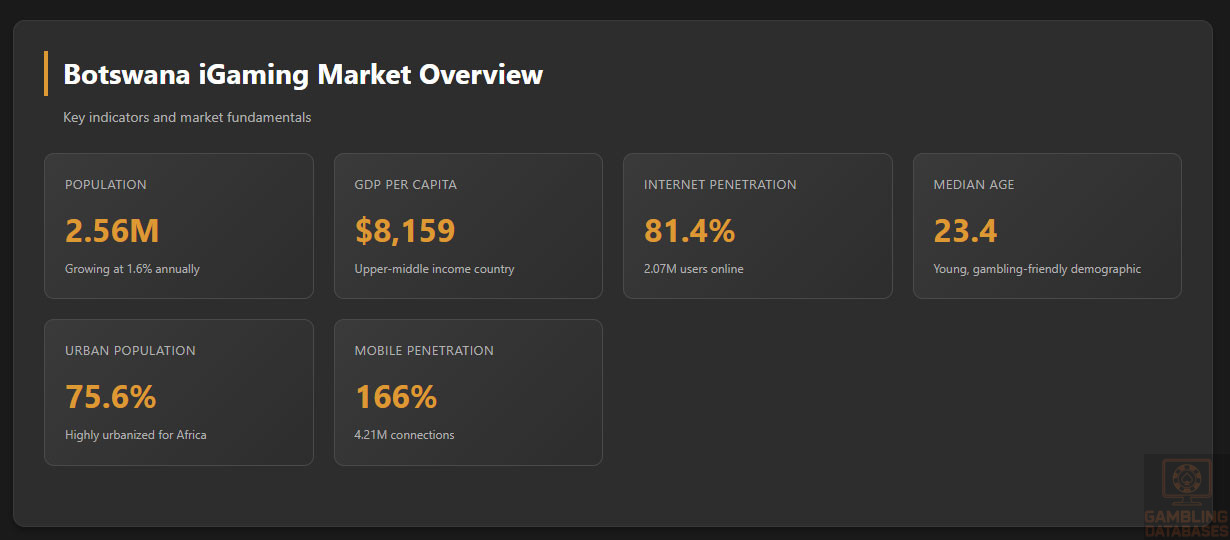
With an internet penetration rate of 81.4% and a population of 2.56 million, Botswana demonstrates strong digital infrastructure compared to regional peers. The nation’s stable political environment, diamond-driven economy with GDP per capita of approximately $8,159, and growing mobile money adoption create favorable conditions for digital gambling expansion, despite the current regulatory gap for online operations.
Executive Summary: Key Market Indicators
| Indicator | Value | Notes |
|---|---|---|
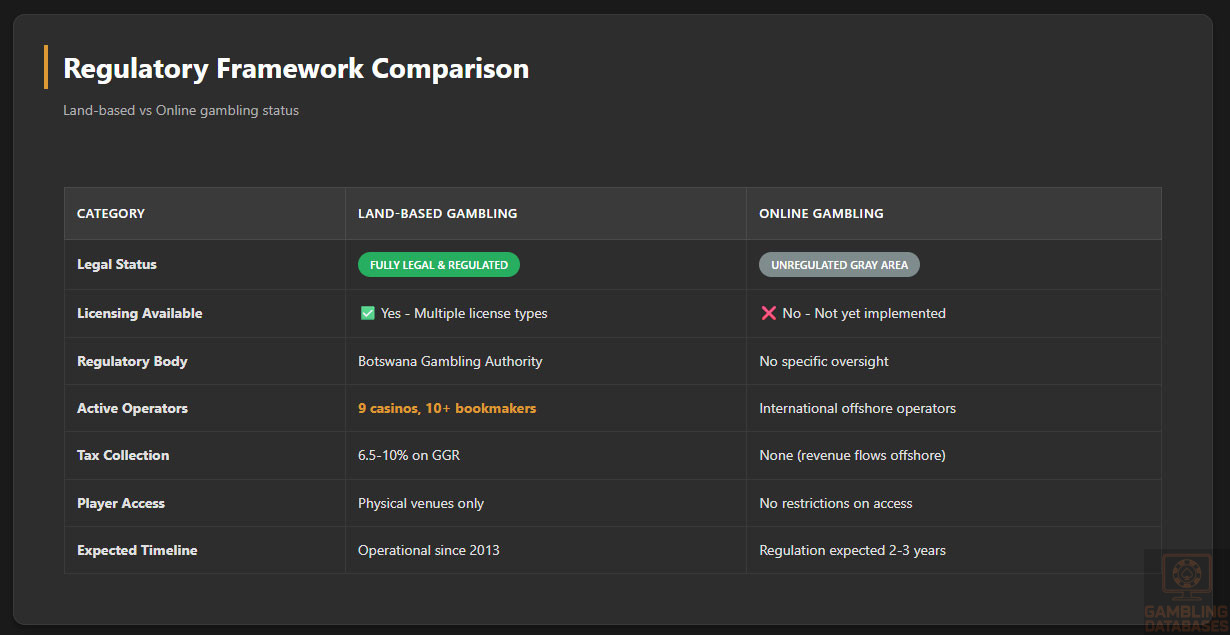
| Online Gambling Legal Status | Unregulated Gray Area | No specific legislation for online gambling |
| Land-Based Gambling Status | Fully Legal & Regulated | 9 licensed casinos, bookmakers operational |
| Regulatory Authority | Botswana Gambling Authority | Established 2012, operational since 2013 |
| Total Population (2025) | 2.56 million | Growing at 1.6% annually |
| Median Age | 23.4 years | Young, gambling-friendly demographic |
| Urban Population | 75.6% | Highly urbanized for Africa |
| GDP (2024) | $18-20 billion USD | Diamond-driven economy |
| GDP Per Capita (2025) | $8,159 USD | Upper-middle income country |
| Internet Penetration | 81.4% | 2.07 million users, top in Africa |
| Mobile Penetration | 166% | 4.21 million connections |
| Smartphone Penetration | High (estimated 70%+) | Primary internet access device |
| Social Media Users | 1.30 million (51.1%) | Strong digital engagement |
| Casino License Fee | P250,000 application | Plus P100,000 annual fee |
| Lottery License Fee | P1 million | For national lottery operator |
| Estimated Online License Cost | $30,000-$50,000 USD | If/when online licensing introduced |
| Casino Tax Rate | 10% on gross wins | Monthly payment |
| Bookmaker Tax Rate | 6.5% on gross wins | Competitive regional rate |
| Corporate Income Tax | Standard rate applicable | Varies by business structure |
| Legal Gambling Age | 18 years | Standard African requirement |
| Licensed Land Casinos | 9 active | Concentrated in Gaborone |
| Licensed Bookmakers | 10 new licenses issued (2025) | Market expanding rapidly |
| Official Currency | Botswana Pula (BWP) | Stable, managed by central bank |
| Primary Languages | English, Setswana | English widely used in business |
| Literacy Rate | 88.5% | High for sub-Saharan Africa |
| Employment Rate | 72.4% | Unemployment at 27.6% |
| Doing Business Rank | Upper-middle performance | Relatively stable environment |
| Corruption Perception | 3rd least corrupt in Africa | Strong governance standards |
| Market Entry Timeline | 4-6 months (land-based) | Online: No current pathway |
| Mobile Network Coverage (4G) | 91% population | Strong mobile infrastructure |
| 5G Network Coverage | 23% population | Expanding rapidly |
| Average Internet Speed | 15.6 Mbps download | Adequate for gaming |
Section 1: Regulatory Framework and Legal Environment
Current Gambling Regulation Status
Botswana’s gambling industry operates under a dual regulatory framework that clearly distinguishes between land-based and online gambling activities. The Gambling Act of 2012, which came into full effect on June 1, 2013, replaced the outdated Casino Act (1971) and Lotteries and Betting Act (1966). This modern legislation established the Botswana Gambling Authority as the primary regulatory body responsible for licensing, monitoring, and enforcing gambling regulations throughout the country.
The regulatory framework demonstrates a progressive approach to land-based gambling while maintaining silence on online operations. This regulatory gap creates an interesting market dynamic where international online operators can potentially serve Botswana players without local licensing, though they operate without explicit legal protection. The government has indicated interest in regulating online gambling, but no concrete legislative proposals have been implemented as of 2025.
Land-Based Gambling Activities
Land-based gambling in Botswana encompasses several distinct categories, each subject to specific licensing requirements and operational standards:
- Casino Operations: Nine licensed casinos currently operate in Botswana, predominantly located in the capital city Gaborone. These establishments offer traditional casino games including table games, electronic gaming machines, and associated entertainment facilities. Casino licenses authorize specific games listed in the license and are subject to strict operational requirements.
- Sports Betting Venues: The bookmaking sector has experienced significant expansion, with the Gambling Authority issuing 10 new national bookmaker licenses in 2025. Six operators have already launched operations, creating approximately 400 new jobs. Bookmakers offer betting on football (the most popular sport), rugby, cricket, basketball, and international sporting events.
- Limited Payout Machines (LPMs): These gaming devices are regulated separately from full casino slot machines and can be placed in various licensed establishments. LPM regulations govern payout limits, placement restrictions, and operational standards to prevent problem gambling.
- Bingo Establishments: Both electronic and manual bingo operations are permitted under specific licensing. Bingo licenses authorize the operation of bingo games with defined prize structures and operational parameters.
Online Gambling Framework
Online gambling exists in a regulatory gray area in Botswana. The Gambling Act of 2012 makes no specific mention of internet gambling, interactive gaming, or remote betting operations. This legislative silence creates several important implications for market participants.
Botswana residents can access international online casinos, sportsbooks, poker sites, and lottery platforms without legal restriction. The government does not block access to offshore gambling websites, nor does it prosecute players for participating in online gambling. However, no domestic operators hold licenses specifically for online gambling operations, and the Gambling Authority lacks explicit jurisdiction over internet-based gaming.
Several factors suggest online regulation may be forthcoming. The government has expressed interest in capturing tax revenue from online gambling activity. Industry observers expect amendments to the Gambling Act to address online operations within the next 2-3 years. Brazil’s recent licensing framework, which issued 173 online operator licenses, serves as a potential model for Botswana’s regulatory evolution.

Licensed Operators and Market Players
The Botswana gambling market features a mix of domestic and international operators, with clear market concentration patterns:
Land-Based Casino Operators:
- Major casino resorts concentrated in Gaborone serve both domestic and tourist markets
- Several 24-hour operations cater to international visitors
- Hotel-casino combinations dominate the upscale market segment
- Smaller casinos operate in regional centers with limited hours
- Foreign investment permitted with appropriate licensing and local partnerships
Sports Betting Operators:
- BetXplosion – One of the newly licensed bookmakers launched in 2025
- Mix of local and South African-backed operators entering the market
- Retail betting shops expanding across urban centers
- Mobile betting applications increasingly popular among licensed operators
- Estimated market share data not publicly available due to recent licensing expansion
International Online Operators:
- Bet365 – Well-known international brand accepting Botswana players
- Major offshore operators licensed in Malta, Curacao, and other jurisdictions
- No publicly disclosed player volume or market share data
- Payment processing through international methods as local banks cannot explicitly support unlicensed operators
The licensed operator landscape is evolving rapidly. The Gambling Authority’s 2025 licensing round demonstrates clear government intent to expand legal gambling operations, create employment, and capture additional tax revenue. The Authority projected that the expanded gambling sector could support over 2,300 jobs across casinos, betting shops, and LPM operations.
Licensing Framework and Requirements
Application Process and Eligibility
The Botswana Gambling Authority manages all licensing applications through a structured process designed to ensure operator suitability, financial stability, and commitment to responsible gambling. The Authority operates under the Ministry of Trade and Industry’s oversight while maintaining operational independence.
Regulatory Authority Details:
- Official Name: Botswana Gambling Authority (BGA)
- Establishment: 2012 (operational from June 1, 2013)
- Legal Basis: Gambling Act of 2012
- Primary Functions: Licensing, compliance monitoring, revenue collection, responsible gambling promotion
- Board Composition: Seven members appointed by the Minister, including legal professionals, community representatives, and industry experts
- Contact: Official website at gamblingauthority.co.bw
Financial Requirements:
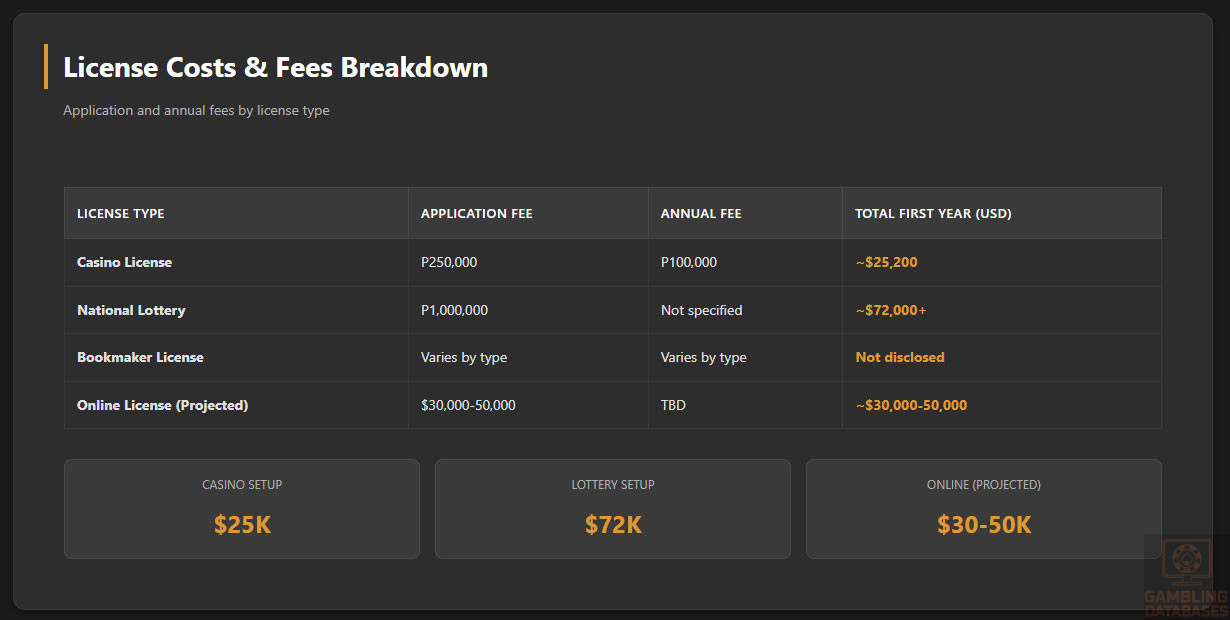
- Casino License Application Fee: P250,000 (approximately $18,000 USD)
- Casino Annual License Fee: P100,000 (approximately $7,200 USD)
- Lottery Operator License: P1,000,000 (approximately $72,000 USD) for application
- Bookmaker License Fees: Specific amounts vary by license type (national vs. regional)
- Bank guarantees or bonds required to demonstrate financial sustainability
- Proof of minimum capitalization requirements for different license categories
- Operating capital sufficient for at least six months of operations
- Financial statements audited by recognized accounting firms
Technical Standards and Certifications:
- Gaming equipment must meet international standards for fairness and randomness
- Electronic gaming machines require certification from approved testing laboratories
- Software providers must demonstrate compliance with recognized gaming standards
- Random Number Generator (RNG) certification for electronic games
- Secure server infrastructure meeting data protection standards
- Player account management systems with audit trail capabilities
- Responsible gambling tools including self-exclusion functionality
- Age verification systems to prevent underage gambling
Background Check Procedures:
All applicants and key personnel undergo comprehensive background investigations. The process typically requires 3-4 months for completion and examines criminal history, financial standing, business reputation, and prior gambling industry involvement. Disqualifying factors include criminal convictions, bankruptcy within specified timeframes, previous license revocations, and undisclosed conflicts of interest.

Local Presence and Operational Requirements
Botswana’s licensing framework imposes specific local presence obligations to ensure regulatory oversight and economic benefit to the country:
Physical Presence Mandates:
- Registered office in Botswana required for all license holders
- Dedicated management presence within the country
- Minimum staffing levels depending on license type and operation scale
- Physical premises meeting health, safety, and accessibility standards
- For casinos: Specific architectural and security requirements for gaming floors
- For bookmakers: Retail locations meeting accessibility and visibility standards
Domain and Hosting Requirements:
Currently, Botswana does not mandate .bw domain registration or local server hosting for land-based operations, as online gambling lacks explicit regulation. However, when online licensing is introduced, typical requirements are expected to include local domain registration, data hosting within Botswana or approved jurisdictions, and technical infrastructure enabling regulatory access for compliance monitoring.
Personnel and Management Obligations:
- Key personnel including general managers, compliance officers, and financial controllers require individual licensing
- Citizenship preferences for certain positions, though foreign expertise accepted in specialized roles
- Training requirements for staff handling customer funds, operating gaming equipment, and implementing responsible gambling measures
- Designated compliance officer responsible for regulatory adherence
- Money laundering reporting officer as required under financial intelligence legislation
Foreign Ownership Restrictions:
Foreign investors can participate in Botswana’s gambling industry, subject to standard company registration requirements. The Gambling Act does not impose explicit foreign ownership caps for gambling licenses, though practical considerations favor local partnerships. Foreign operators often establish joint ventures with Botswana citizens or companies to navigate regulatory processes, access local market knowledge, and build government relationships.
The Companies Act governs corporate structure and foreign investment generally. Registration with the Companies and Intellectual Property Authority (CIPA) is mandatory before applying for gambling licenses. Foreign companies must appoint local directors meeting residency requirements and maintain statutory registers accessible in Botswana.
Compliance Obligations and Monitoring
Player Protection and Identification
Botswana’s gambling regulations emphasize player protection, responsible gambling, and prevention of underage participation. These requirements apply strictly to land-based operations and would likely extend to online operators when licensing is introduced.
Age Verification Requirements:
- Minimum gambling age: 18 years throughout Botswana
- Mandatory identification checks at casino entrances and betting shop counters
- Accepted identification documents: National identity cards, passports, driver’s licenses
- Prohibition on allowing minors on gaming floors, even if accompanied by adults
- Staff training requirements for identifying and refusing service to underage individuals
- Penalties for operators allowing underage gambling including fines and license suspension
KYC/AML Compliance Standards:
- Customer identification and verification for all account registrations
- Enhanced due diligence for high-value transactions exceeding defined thresholds
- Source of funds verification for large deposits or unusual transaction patterns
- Ongoing monitoring of customer transactions for suspicious activity
- Reporting obligations to the Financial Intelligence Agency for suspicious transactions
- Record retention requirements: Minimum five years for transaction records and customer identification documents
- Staff training on money laundering detection and prevention
- Designated compliance personnel responsible for AML program implementation
Responsible Gambling Measures:
- Mandatory display of responsible gambling information in prominent locations
- Problem gambling helpline numbers and resources readily available
- Self-exclusion program allowing individuals to ban themselves from gambling establishments
- Staff training to identify signs of problem gambling behavior
- Prohibition on credit provision for gambling purposes
- Restrictions on ATM placement near gaming areas
- Limitations on advertising targeting vulnerable populations
- Contributions to problem gambling treatment and prevention programs
The Gambling Authority employs a Responsible Gambling Manager who oversees industry-wide initiatives. Portia Diteko, the current manager, has emphasized that responsible gaming protects both players and operators by ensuring sustainable industry growth. The Authority has implemented the Problem Gambling Severity Index (PGSI) for assessing at-risk behavior.
Financial Monitoring and Reporting
Transaction Monitoring Systems:
Licensed operators must implement robust financial monitoring systems tracking all gambling transactions, customer deposits and withdrawals, prize payouts, and promotional bonuses. These systems must generate audit trails accessible to regulatory inspectors and flag transactions meeting suspicious activity criteria or exceeding reporting thresholds.
Reporting Requirements and Schedules:
- Monthly financial returns detailing gross gaming revenue, payouts, and tax calculations
- Quarterly compliance reports addressing responsible gambling, customer complaints, and regulatory adherence
- Annual audited financial statements prepared by approved accounting firms
- Real-time reporting of suspicious transactions to financial intelligence authorities
- Incident reports for security breaches, customer disputes, or operational irregularities
Audit and Inspection Procedures:
- Regular scheduled inspections by Gambling Authority compliance officers
- Unannounced spot checks to verify operational compliance
- Gaming equipment testing and certification verification
- Financial record reviews and reconciliation audits
- Customer protection measure effectiveness assessments
- Staff qualification and training verification
- Security system adequacy reviews
Operators must provide inspectors immediate access to premises, records, and systems. Failure to cooperate with audits or inspections can result in penalties including fines, license suspension, or revocation. The Gambling Authority’s Compliance and Monitoring Services unit conducts these oversight activities systematically.
Taxation Structure and Financial Obligations
Player Taxation
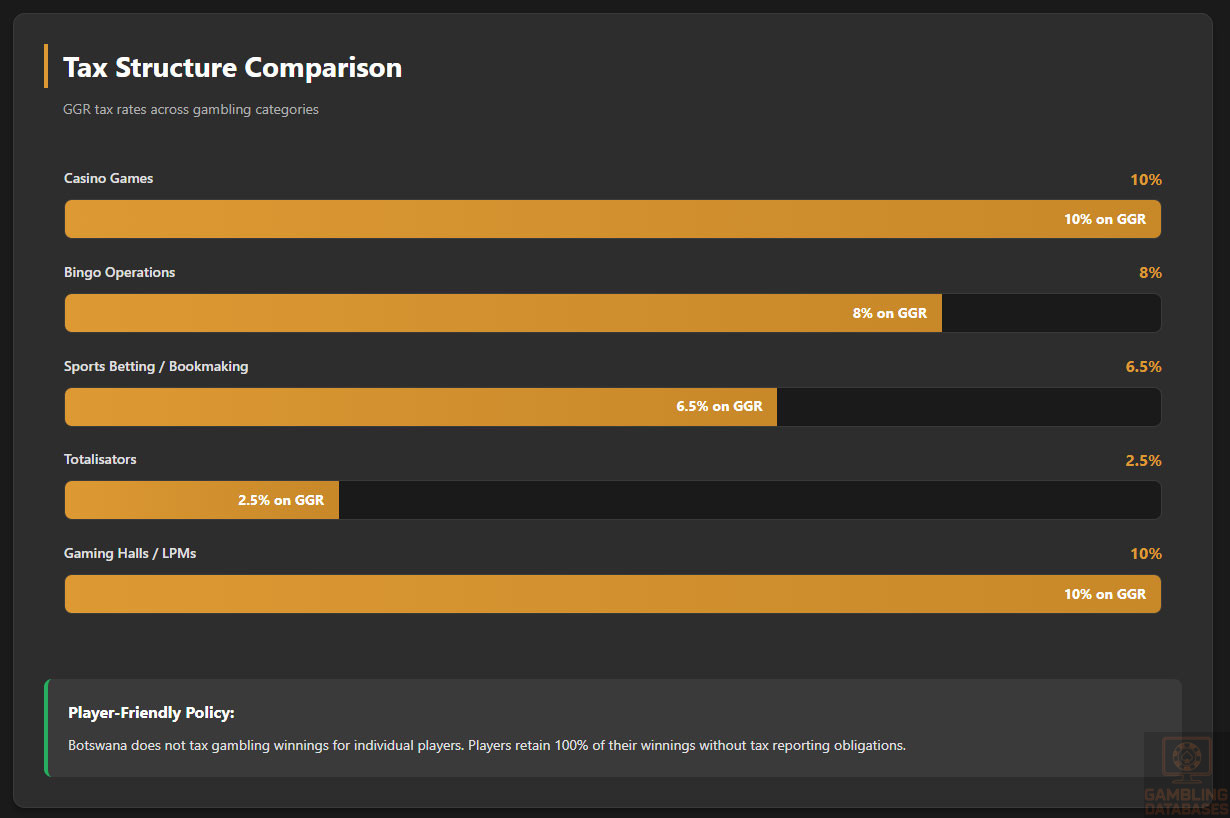
Botswana does not currently impose taxes on gambling winnings for individual players. This player-friendly approach differs from jurisdictions like South Africa where winnings above certain thresholds face withholding taxes. Players retain 100% of their winnings without tax reporting obligations or withholding deductions.
This policy creates competitive advantages for Botswana operators compared to regional competitors who must withhold player winnings taxes. It also simplifies compliance for operators who do not need to implement withholding systems or issue tax documentation to winning players.
Operator Taxation
Operators face multiple taxation obligations based on gambling activity type, revenue generation, and corporate structure:
Gross Gaming Revenue (GGR) Tax Rates by Game Type:
- Casino Games: 10% monthly tax on gross wins (total player losses minus total player wins)
- Sports Betting/Bookmaking: 6.5% on gross wins – competitive rate encouraging market entry
- Bingo Operations: 8% on gross wins
- Gaming Halls/LPMs: 10% on gross wins
- Totalisators: 2.5% on gross wins
These GGR taxes apply specifically to gambling activities and are calculated monthly. Payment typically occurs within specified timeframes following month-end, with penalties for late submission. The Gambling Authority’s Funds Disbursement Agency collects all gambling-specific taxes and levies.
Corporate Income Tax:
Beyond gambling-specific taxes, operators remain subject to standard Botswana corporate income taxation on net profits. Corporate tax rates vary depending on company size, industry classification, and potential incentive qualifications. Gambling operators should expect standard corporate rates applicable to similar-sized businesses in the service sector.
Additional Financial Obligations:
- License renewal fees paid annually to maintain operational authorization
- Investigation fees for background checks when key personnel change
- Inspection fees potentially charged for compliance audits
- Transfer fees when licenses change ownership or location
- Contributions to problem gambling prevention and treatment funds
Gambling Market Financial Performance
Comprehensive market revenue data for Botswana’s gambling sector remains limited in public sources. The government does not publish detailed annual gambling revenue reports like more mature markets. Available information suggests the following market characteristics.
The land-based casino and betting sector has shown consistent growth since 2013 when the Gambling Act came into effect. The 2025 expansion with 10 new bookmaker licenses indicates government confidence in continued market growth and revenue generation potential. Casino operations concentrated in Gaborone serve both domestic players and international tourists visiting for business or safari tourism.
Tax revenues from gambling contribute to government budgets, though exact figures are not published separately from general tax collections. The Gambling Authority’s funds disbursement function allocates gambling tax revenues according to government priorities including infrastructure development, social programs, and administrative costs.
The absence of online gambling regulation means significant potential tax revenue flows to offshore operators beyond Botswana’s reach. Industry observers estimate substantial online gambling activity by Botswana residents on international platforms, representing forgone tax revenue that motivates regulatory interest in online licensing.
Advertising and Marketing Restrictions
Botswana imposes targeted advertising restrictions designed to protect minors and promote responsible gambling while allowing operators reasonable promotional freedom:
Permitted Advertising Channels:
- Television advertising allowed with time restrictions avoiding children’s programming hours
- Radio advertising permitted with similar protections
- Print media advertising in adult-focused publications
- Outdoor advertising subject to location restrictions
- Online advertising on websites and social media platforms
- Sponsorships of sporting events and teams permitted with approval
Content Restrictions and Guidelines:
- Prohibition on content suggesting gambling solves financial problems
- Restrictions on claims of guaranteed winnings or easy money
- Mandatory responsible gambling messaging in advertisements
- Prohibition on using celebrities or influences popular with minors
- Requirements to display legal gambling age prominently
- Restrictions on advertising content glamorizing excessive gambling
Location and Placement Restrictions:
- Prohibition on outdoor advertising near schools, playgrounds, and youth facilities
- Restrictions on advertising directed at educational institutions
- Limitations on promotional materials in locations frequented by minors
- Prohibitions on advertising on children’s media platforms
The Gambling Authority can refer advertising matters to the Botswana Communications Regulatory Authority (BOCRA) for additional oversight. Operators must submit significant advertising campaigns for pre-approval to ensure compliance with content and placement restrictions.
Recent Regulatory Changes and Their Impact
Botswana’s gambling regulatory environment has evolved significantly since the Gambling Act’s 2013 implementation, with notable developments accelerating in 2024-2025:
2024-2025 Regulatory Developments:
- Bookmaker License Expansion (May 2025): The Gambling Authority issued 10 new national bookmaker licenses, dramatically expanding the legal sports betting market. Six operators launched immediately, three more expected within weeks, and one withdrew. This expansion created approximately 400 direct jobs and signals government commitment to regulated gambling growth.
- Responsible Gambling Framework Strengthening (2024-2025): The Authority enhanced responsible gambling requirements including mandatory Problem Gambling Severity Index (PGSI) implementation, expanded self-exclusion program accessibility, enhanced training requirements for staff, and increased problem gambling awareness campaigns.
- Technology Integration Requirements (Ongoing): The Authority, led by Board Chairman Marvin Torto, encouraged operators to adopt AI monitoring tools for detecting illicit player behaviors, preventing money laundering, protecting against problem gambling, and enhancing overall compliance effectiveness.
- Illegal Gambling Crackdown (2024-2025): Increased enforcement efforts targeting unlicensed land-based operations, community reporting programs for illegal gambling machines, and protection of licensed operators from illegal competition.
Impact on Operators:
The bookmaker licensing expansion creates significant opportunities for new market entrants while intensifying competition for existing operators. The relatively low 6.5% tax rate on sports betting makes Botswana attractive compared to neighbors like South Africa. Enhanced responsible gambling requirements increase operational costs but provide long-term sustainability and social acceptance benefits.
The regulatory emphasis on technology and AI tools suggests future requirements may mandate sophisticated compliance systems. Operators investing early in advanced monitoring and player protection technologies position themselves favorably for ongoing regulatory evolution.
Anticipated Future Regulatory Changes:
Industry stakeholders widely expect online gambling regulation within the next 2-3 years. The government’s 2025 licensing expansion demonstrates comfort with gambling sector growth and revenue generation. Brazil’s recent comprehensive online licensing (173 operators) provides a potential regulatory model. Expected elements of future online gambling regulation may include:
- Dedicated online casino and sports betting license categories
- Local server hosting or data localization requirements
- .bw domain registration mandates for licensed operators
- Enhanced player verification and KYC standards for remote gambling
- Specific responsible gambling tools required for online platforms
- Competitive tax rates designed to encourage license applications over offshore operations
Enforcement Mechanisms and Penalties
The Botswana Gambling Authority maintains comprehensive enforcement powers to ensure regulatory compliance and protect public interests:
Penalty Structures:
- Financial Penalties: Fines ranging from P5,000 to substantial amounts depending on violation severity
- License Suspension: Temporary operating prohibition for serious violations with remediation requirements
- License Revocation: Permanent license cancellation for egregious violations or repeated non-compliance
- Criminal Prosecution: Certain violations constitute criminal offenses punishable by imprisonment or substantial fines
- Seizure of Equipment: Authority to confiscate gaming equipment or assets involved in illegal operations
- Director Disqualification: Prohibition on key personnel holding future gambling industry positions
Recent Enforcement Actions: The Gambling Authority has intensified enforcement against unlicensed operations, particularly targeting illegal gaming machines in retail locations and unlicensed betting operations. The Authority relies on community reporting to identify illegal operations, as local residents often know where unlicensed gambling occurs. Licensed operators have complained that illegal online sites affect their market share, prompting increased regulatory attention to enforcement mechanisms.
Compliance Trends: Most licensed operators demonstrate strong compliance with regulations, resulting in relatively few court cases regarding gambling law violations. The industry’s general adherence to licensing requirements reflects the regulatory framework’s clarity and the Authority’s effective oversight. Operators understand that maintaining good standing protects their significant license investments and ensures continued operational authorization.
ISP Blocking and Payment Restrictions: While Botswana does not currently block access to offshore gambling websites or restrict payment processors from handling international gambling transactions, these enforcement tools may be implemented when online gambling regulation is introduced. Many jurisdictions use ISP-level blocking to prevent access to unlicensed operators and payment processing restrictions to limit unlicensed gambling financial flows.
Section 2: Demographics and Consumer Analysis
Population Demographics and Distribution
Core Population Metrics
Botswana’s population of 2.56 million people creates a compact but lucrative market for gambling operators. The population has grown steadily at approximately 1.6% annually, with projections indicating continued gradual growth through 2030. This growth rate, while modest, suggests stable market expansion opportunities for gambling operators establishing long-term positions.
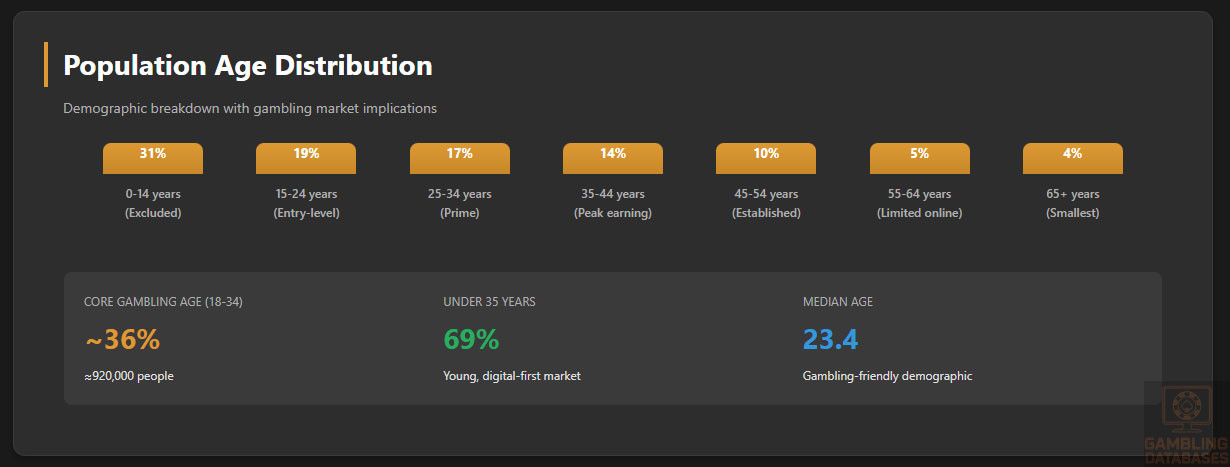
The median age of 23.4 years positions Botswana favorably for gambling market development. Young adults typically demonstrate higher gambling participation rates, greater comfort with digital platforms, and more willingness to adopt new entertainment options compared to older demographics. This youthful population profile suggests strong potential for online gambling adoption when regulatory frameworks permit licensed operations.
Gender distribution is relatively balanced at approximately 50.3% female and 49.7% male. Life expectancy stands at 58.1 years overall, with males at 58.8 years and females at 57.3 years. These figures reflect the ongoing impact of HIV/AIDS, which affects approximately 20-25% of the adult population. However, Botswana has made significant progress in HIV treatment and prevention, earning WHO certification for eliminating mother-to-child HIV transmission.
| Age Group | Percentage of Population | Gambling Market Implications |
|---|---|---|
| 0-14 years | ~31% | Excluded from gambling; future market potential |
| 15-24 years | ~19% | Entry-level gambling demographic; mobile-first |
| 25-34 years | ~17% | Prime gambling demographic; highest engagement |
| 35-44 years | ~14% | Peak earning years; higher value players |
| 45-54 years | ~10% | Established income; preference for land-based |
| 55-64 years | ~5% | Limited online adoption; loyalty-focused |
| 65+ years | ~4% | Smallest gambling segment; traditional preferences |
The age distribution reveals that approximately 69% of Botswana’s population is under 35 years old, creating a predominantly young market well-suited for digital gambling platforms. The 18-34 age bracket, representing the core gambling demographic, comprises roughly 36% of the total population or approximately 920,000 people. This represents the primary target market for both land-based and online gambling operations.
Geographic Distribution
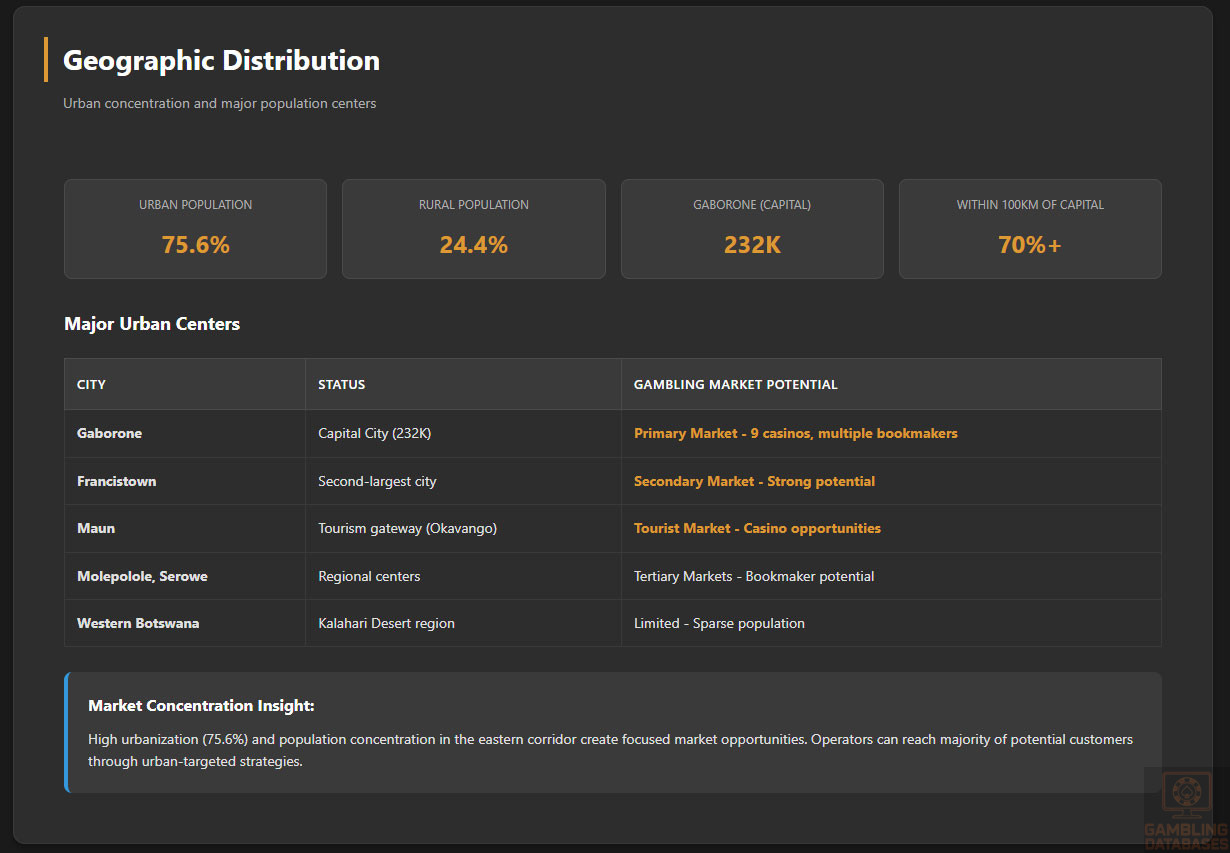
Botswana exhibits exceptional urbanization for sub-Saharan Africa, with 75.6% of the population living in urban areas. This urban concentration simplifies market entry strategies, as operators can reach the majority of potential customers through urban-focused marketing and distribution channels. The urbanization rate continues growing at approximately 2.3% annually, suggesting ongoing migration from rural to urban areas.
Gaborone, the capital city, serves as the primary gambling market with approximately 232,000 residents representing more than 10% of the national population. The city hosts the majority of Botswana’s nine licensed casinos and numerous bookmaker locations. Beyond Gaborone, major population centers include Francistown (the second-largest city), Molepolole, Maun (gateway to the Okavango Delta tourism region), Serowe, Selebi-Phikwe, Kanye, Mochudi, Mahalapye, and Palapye. These cities create secondary markets for gambling operations, though with smaller revenue potential than the capital.
More than 70% of the population lives within 100 kilometers of Gaborone, creating a concentrated market corridor in the eastern portion of the country. This geographic concentration reduces operational costs for physical infrastructure while creating intense competition for market share in key urban areas. The western portion of Botswana, dominated by the Kalahari Desert, remains sparsely populated with limited gambling market potential.
Regional economic differences impact gambling participation patterns. Urban areas demonstrate higher disposable incomes, greater internet access, and more exposure to gambling opportunities compared to rural regions. However, mobile money penetration is bridging urban-rural gaps, potentially enabling rural residents to participate in online gambling when regulations permit licensed operations.
Economic Indicators and Consumer Spending Power
GDP and Economic Performance
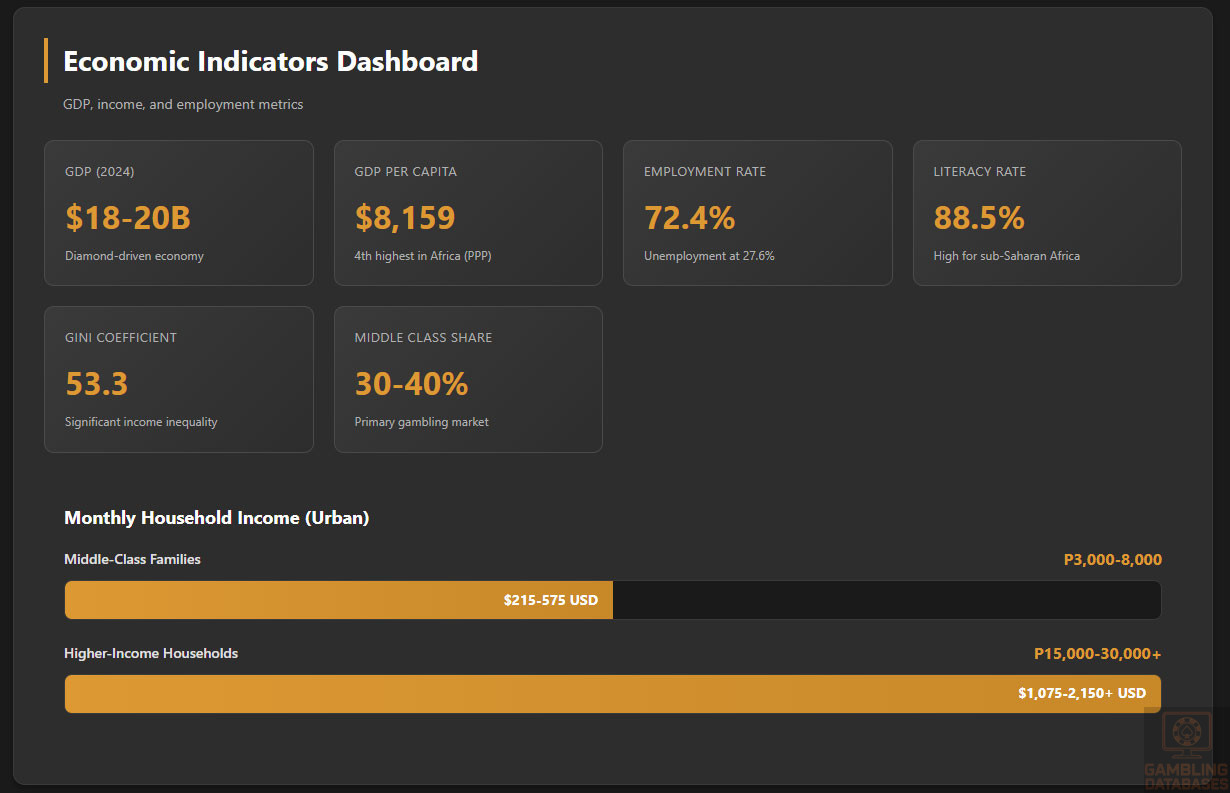
Botswana’s economy demonstrates remarkable success compared to regional neighbors, built on diamond mining, prudent fiscal management, and stable governance. The country’s GDP reached approximately $18-20 billion USD in 2024, with GDP per capita of $8,159 in 2025. This positions Botswana as an upper-middle-income country and the fourth-highest GDP per capita in Africa on a purchasing power parity basis.
The economy has historically averaged 5% annual growth over the past decade, though recent years have shown more modest expansion. GDP growth forecasts for 2025-2027 project 3-4% annual increases, reflecting reduced mineral revenues, global economic conditions, and domestic economic diversification efforts. The government’s Economic Transformation Program aims to reduce diamond dependency and expand services, tourism, and technology sectors.
Diamond mining contributes approximately 30-35% of GDP and 50% of government revenue through the Debswana Diamond Company (50% government, 50% De Beers joint venture). This resource dependence creates economic volatility linked to global diamond demand, though Botswana has managed mineral wealth more effectively than many resource-rich developing nations. The government maintains substantial foreign exchange reserves and has historically run budget surpluses, though recent fiscal deficits reflect spending pressures and reduced mineral revenues.
Tourism represents approximately 10-13% of GDP, driven by the Okavango Delta, Chobe National Park, and Central Kalahari Game Reserve attractions. The sector creates gambling market opportunities through casino resort operations serving international visitors. Agriculture contributes less than 2% of GDP despite employing significant rural populations, reflecting challenging climatic conditions and poor soils limiting agricultural productivity.
Income and Wealth Distribution
Understanding income distribution is critical for assessing gambling market potential and player value segmentation. Average household income in Botswana varies significantly between urban and rural areas, with monthly household income in urban centers ranging from P3,000-P8,000 ($215-$575 USD) for middle-class families. Higher-income households in Gaborone and other major cities may earn P15,000-P30,000+ ($1,075-$2,150+ USD) monthly.
Botswana faces significant income inequality despite relatively high GDP per capita. The Gini coefficient stands at 53.3, indicating substantial wealth concentration. This inequality reflects urban-rural divides, formal vs. informal employment gaps, and educational attainment differences. For gambling operators, income inequality suggests market segmentation strategies targeting different income brackets with appropriate products, bet limits, and promotional strategies.
The middle class, estimated at 30-40% of urban populations, represents the primary gambling market. This demographic possesses sufficient discretionary income for entertainment spending while lacking wealth levels that make gambling financially insignificant. Higher-income segments, while smaller in absolute numbers, contribute disproportionately to gambling revenue through higher-value play and premium product preferences.
Unemployment stands at 27.6%, creating affordability challenges for significant population segments. Employment remains skewed toward low-productivity sectors, with many workers in informal employment lacking stable incomes. These economic realities constrain gambling market size, as large population segments lack discretionary spending capacity. However, employed urban residents, government workers, and private sector professionals demonstrate gambling participation comparable to regional markets.
Market Size and Growth Projections
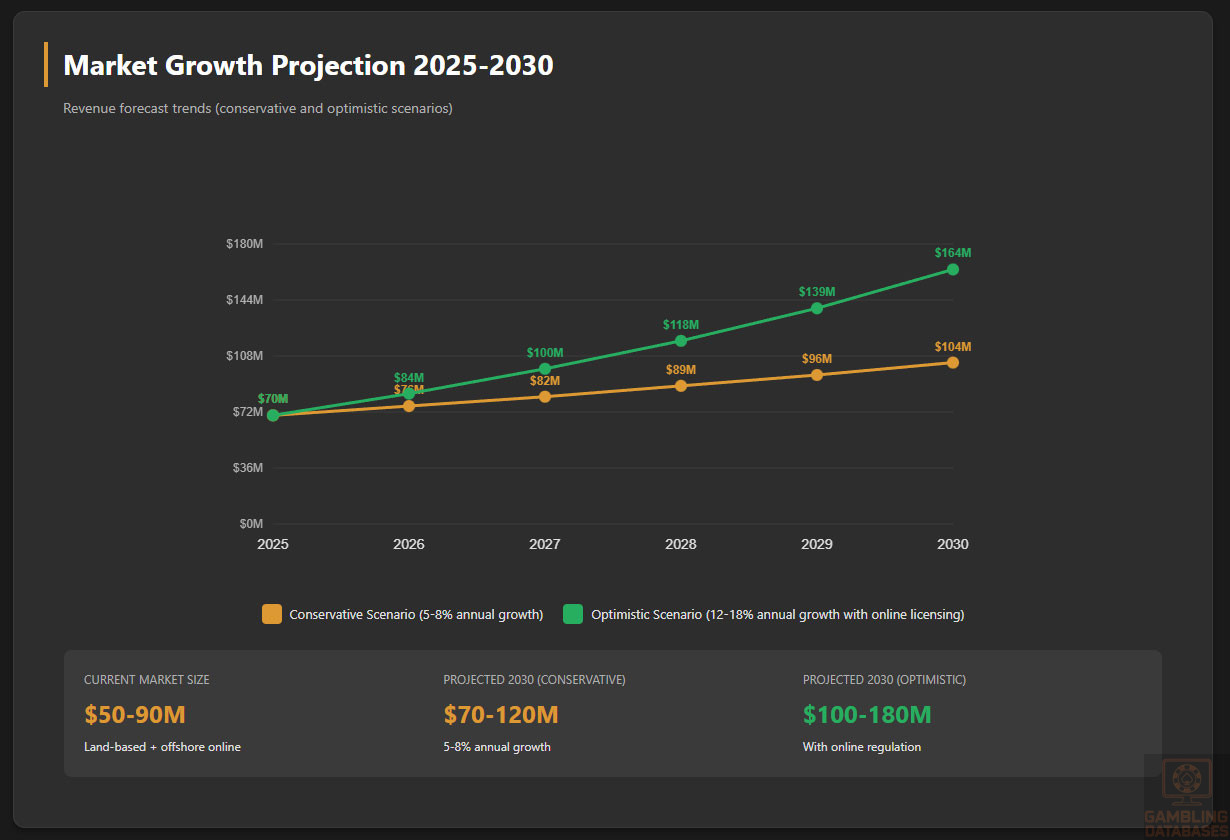
Estimating Botswana’s current and projected iGaming market size requires synthesizing limited public data with regional benchmarks and demographic analysis. The land-based gambling market, encompassing nine casinos and expanding bookmaker operations, generates estimated annual revenues of $30-50 million USD based on operator counts, population size, and regional comparisons.
The online gambling market served by offshore operators remains unquantified in official statistics but likely represents $20-40 million USD in annual gross gaming revenue based on internet penetration, population size, and international operator market presence. These figures suggest total gambling market size (land-based plus offshore online) of approximately $50-90 million USD annually.
When Botswana introduces online gambling licensing, the regulated online market could capture 60-70% of current offshore activity while stimulating additional participation through legal protection and local payment method integration. This suggests potential regulated online market revenue of $15-30 million USD initially, growing as more players transition from offshore operators and new participants enter the market.
Market growth projections depend heavily on regulatory developments, economic conditions, and technological adoption. Conservative scenarios project 5-8% annual market growth through 2030, driven by population growth, rising incomes, and increasing digital adoption. Optimistic scenarios incorporating online licensing implementation suggest 12-18% annual growth as new products, licensed operators, and enhanced player protections expand market participation.
Average Revenue Per User (ARPU) in Botswana likely ranges from $50-150 USD annually for online gambling participants, comparable to South African emerging market segments. ARPU varies significantly by player segment, with casual players contributing $30-60 USD annually while committed players may wager $300-1,000+ USD annually. Land-based casino players typically demonstrate higher ARPU than online players due to tourism segment participation and premium product preferences.
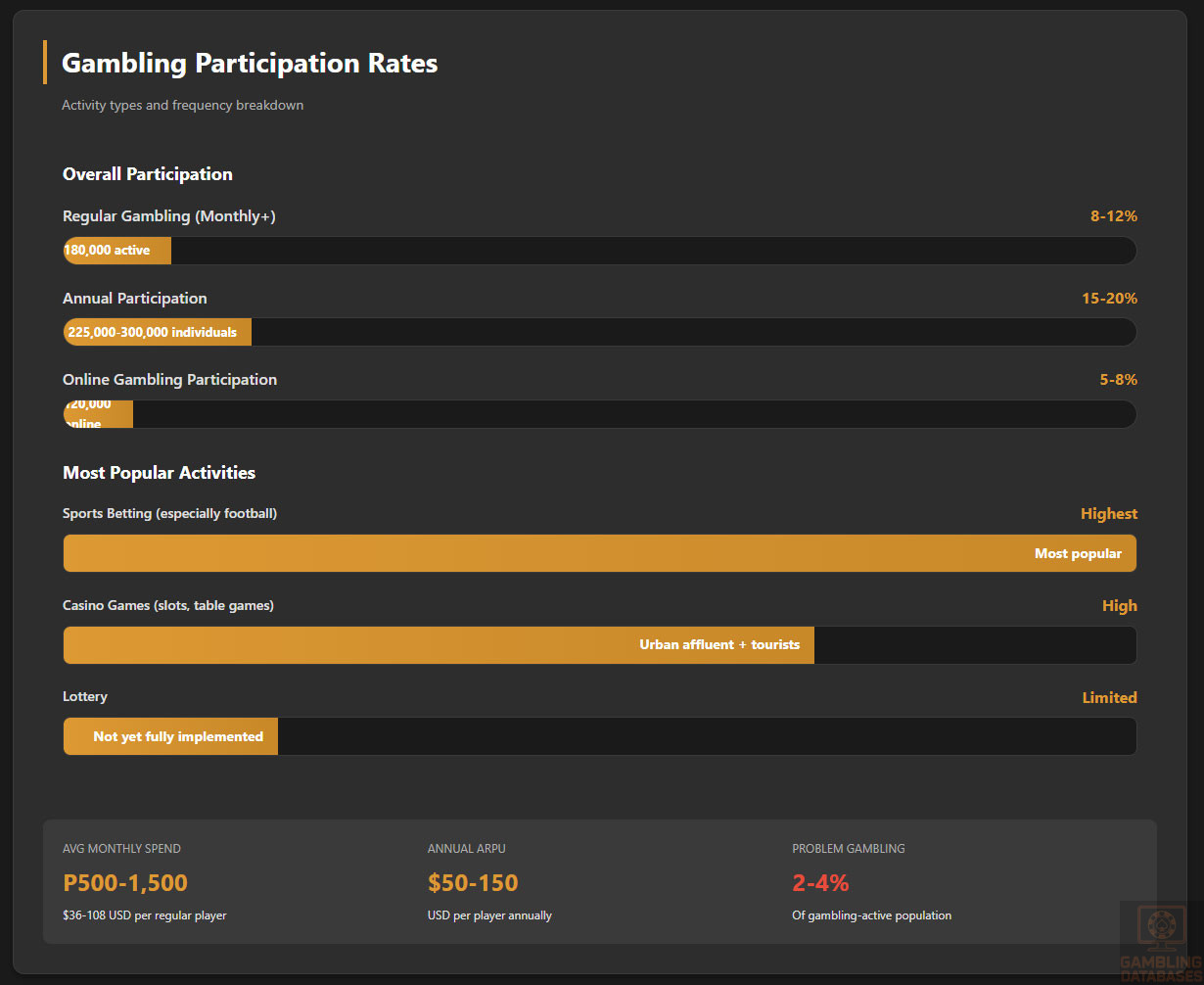
Market penetration rates for gambling currently estimated at 8-12% of the adult population for regular participation (monthly or more frequently) and 15-20% for annual participation. These figures align with developing market norms where gambling remains primarily urban entertainment rather than mass-market activity. Online gambling penetration specifically may reach 5-8% of the adult population currently using offshore operators, with significant growth potential when local licensing enables broader participation.
Education, Skills, and Digital Literacy
Educational Foundation
Botswana maintains impressive educational attainment for sub-Saharan Africa, with overall literacy rates of 88.5% (88.0% male, 88.9% female). This high literacy facilitates gambling participation as players can understand game rules, terms and conditions, and responsible gambling information. Educational infrastructure includes universal primary education, widespread secondary education access, and growing tertiary enrollment.
Primary education completion rates exceed 90%, while secondary education completion reaches approximately 60-70% of cohorts. Tertiary education enrollment, including universities, polytechnics, and vocational training, has expanded significantly. The University of Botswana and numerous technical colleges produce graduates with skills applicable to gambling industry employment including IT, finance, customer service, and management roles.
Digital literacy is growing rapidly, particularly among younger cohorts educated during the smartphone era. Urban youth demonstrate comfortable facility with mobile applications, social media platforms, e-commerce, and digital entertainment. This digital fluency translates directly to online gambling adoption potential, as familiar interface patterns and payment methods reduce adoption barriers.
English language proficiency is widespread, as English serves as the official language of government, business, and education alongside Setswana. This linguistic advantage simplifies market entry for international operators, as English-language platforms require no translation. However, incorporating Setswana language options could enhance localization and appeal to specific market segments preferring native language interactions.
Cultural and Social Factors
Communication and Language
Setswana and English serve as Botswana’s primary languages, with English dominating business, government, and urban communication while Setswana remains prevalent in rural areas and informal settings. Most urban residents speak both languages fluently, code-switching based on context. Internet content consumption occurs predominantly in English, as most websites, applications, and digital services use English interfaces.
For gambling operators, English-language platforms suffice for the majority of the target market. However, customer support should ideally offer both English and Setswana options to accommodate player preferences and resolve issues effectively. Marketing materials incorporating Setswana phrases or cultural references can enhance localization and brand resonance, even when primary platform language remains English.
Cultural Attitudes
Gambling acceptance in Botswana reflects complex cultural dynamics. Traditional Setswana culture did not include gambling in the modern commercial sense, though informal betting on games and competitions occurred. The introduction of formal gambling through casinos and betting shops represents relatively recent cultural adoption, primarily in urban areas.
Urban populations, particularly younger demographics, demonstrate generally positive attitudes toward gambling as legitimate entertainment. The government’s regulated approach, including licensing expansion and responsible gambling emphasis, signals official acceptance of gambling’s economic and recreational roles. Sports betting particularly resonates with football enthusiasts, as Botswana has strong sporting culture and passionate support for local and international teams.
However, certain cultural and religious segments view gambling skeptically. Christian denominations, which represent the majority religious affiliation in Botswana, vary in gambling acceptance. Some denominations tolerate gambling as personal choice while others discourage participation as contrary to principles of stewardship and financial prudence. Muslim and Hindu minorities, present primarily in urban areas, bring diverse gambling perspectives based on religious teachings and cultural backgrounds.
Foreign brand perception is generally positive in Botswana. The country maintains strong international ties, particularly with South Africa, the United Kingdom, and the United States. International brands across various sectors successfully operate in Botswana, and consumers often perceive foreign products and services as high-quality. This attitude extends to gambling operators, where international brands may enjoy prestige advantages over purely local operations.
Risk tolerance indicators suggest moderate comfort with financial risk among urban populations. Small-scale entrepreneurship is common, and investment in informal savings schemes (stokvels) demonstrates willingness to pool resources for potential gains. However, economic volatility and employment insecurity encourage cautious financial management for many households, limiting gambling spend to discretionary entertainment budgets rather than primary income allocation.
Problem Gambling and Social Considerations
Problem gambling prevalence in Botswana lacks comprehensive epidemiological data, as systematic population studies have not been published. However, the Gambling Authority recognizes problem gambling as a significant concern requiring regulatory attention and intervention. The Authority employs a dedicated Responsible Gambling Manager and has implemented the Problem Gambling Severity Index (PGSI) for assessing at-risk behaviors.
Available evidence suggests problem gambling affects approximately 2-4% of the gambling-active population, comparable to international norms for emerging markets. At-risk gambling behaviors, including frequent play exceeding financial means, chasing losses, and gambling-related family conflicts, may affect an additional 5-8% of regular gamblers. These estimates translate to several thousand individuals experiencing gambling-related harm requiring intervention or support.
Demographic patterns indicate young males aged 25-40 represent the highest-risk group for problem gambling. This demographic demonstrates higher gambling participation rates, greater risk-taking propensity, and less developed financial management skills compared to older cohorts or female demographics. Urban residents face higher problem gambling risks than rural populations due to greater gambling availability and exposure.
Underage gambling remains a concern despite 18+ age restrictions. Enforcement at land-based venues has improved with enhanced ID checking and staff training, but offshore online operators accessible to Botswana residents often lack robust age verification. When online licensing is introduced, strong age verification requirements will be critical for protecting minors from gambling harm.
Government response to problem gambling includes several initiatives. The Gambling Authority provides helpline resources, though dedicated treatment facilities remain limited. The Authority is developing partnerships with mental health services and community organizations to expand support availability. Licensed operators must contribute to problem gambling prevention funds and implement responsible gambling measures including self-exclusion programs, deposit limits, and staff training.
Social responsibility requirements for operators emphasize prevention through education, early intervention through player monitoring, and treatment referral through support partnerships. The Gambling Authority has indicated that protecting players serves operator interests by ensuring sustainable industry growth rather than short-term revenue extraction that creates social backlash and regulatory tightening.
Political Structure and Governance
Botswana maintains a stable democratic system and ranks as one of Africa’s most successful democracies. The country gained independence in 1966 and has held regular free elections every five years since. The Botswana Democratic Party (BDP) governed continuously from independence until 2024, when the Umbrella for Democratic Change coalition won power. This peaceful transfer demonstrates democratic maturity and institutional stability.
President Duma Boko assumed office in November 2024 following October elections. The new government has emphasized economic transformation, job creation, and service sector development. These priorities align favorably with gambling industry expansion, as the sector creates employment and generates tax revenue. The government’s Economic Transformation Program launched in August 2025 aims to diversify beyond diamond dependency, potentially creating openness to gambling sector growth.
Political stability rankings position Botswana favorably within Africa. The country avoids political violence, maintains peaceful transitions of power, and demonstrates respect for rule of law. Corruption levels remain relatively low, with Botswana ranking as the third least corrupt nation in Africa on Transparency International’s Corruption Perceptions Index. These governance strengths create predictable business environments and reduce regulatory uncertainty.
Regulatory consistency characterizes Botswana’s approach to business oversight. The Gambling Authority operates with relative independence while maintaining government accountability. Policy changes occur through transparent legislative processes rather than arbitrary administrative actions. This predictability allows operators to make long-term investments with confidence in regulatory stability.
International relations impact gambling business minimally, as Botswana maintains positive relationships with major economies. The country participates in the Southern African Development Community (SADC) and maintains close ties with South Africa, its largest trading partner and source of significant tourist traffic. These regional connections facilitate cross-border operations and market integration. Botswana is not an EU member but maintains positive relations with European nations supporting tourism and investment flows.
Technology Adoption and Digital Behavior
Internet and Digital Usage
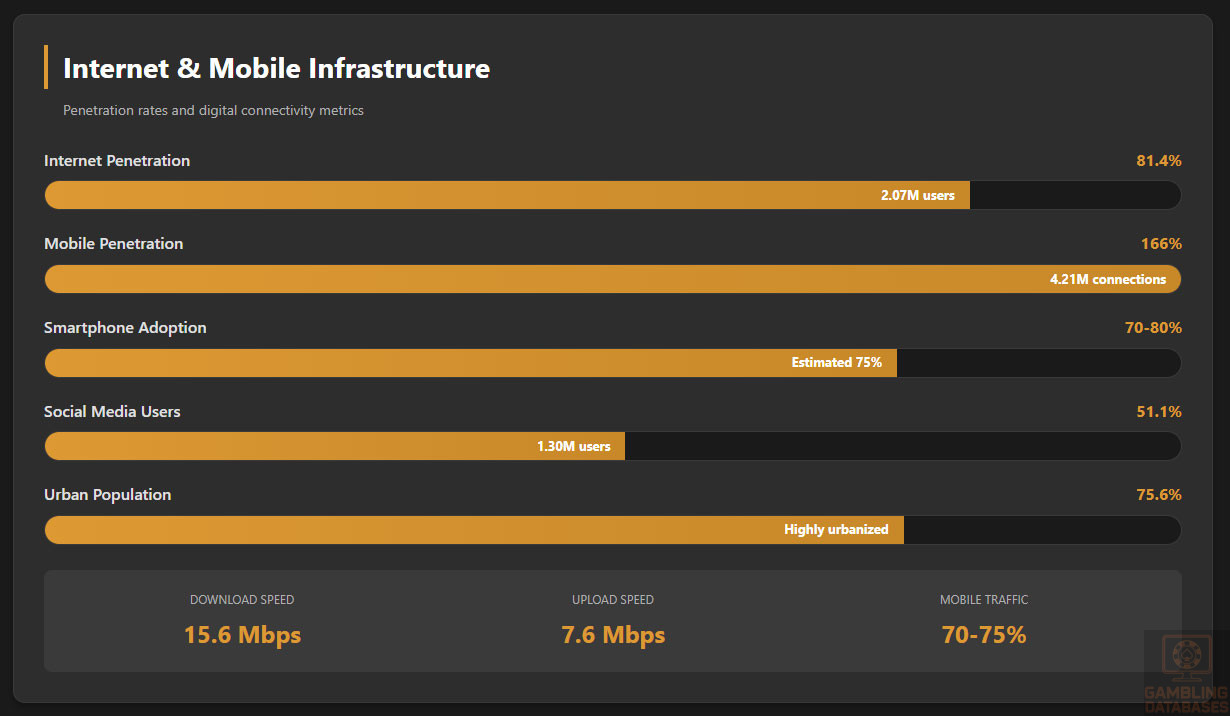
Botswana demonstrates exceptional internet penetration for Africa at 81.4%, with 2.07 million users in a population of 2.56 million. This penetration rate ranks among Africa’s highest, comparable to South Africa (78%) and approaching Mauritius levels. The figure represents dramatic growth from 42% in 2019 and 61% in 2022, indicating rapid digital expansion that facilitates online gambling market development.
Daily internet usage averages several hours per day for active users, with young urban residents spending 4-6 hours online through smartphones, computers, and tablets. Usage patterns emphasize social media, messaging applications, content streaming, and increasingly e-commerce. This digital engagement suggests comfortable familiarity with online platforms translating readily to gambling applications.
Mobile devices dominate internet access, with smartphones serving as the primary means of connectivity for the majority of users. Approximately 70-80% of internet traffic occurs via mobile devices, reflecting Africa-wide patterns where mobile infrastructure developed faster than fixed broadband. This mobile-first reality requires gambling operators to prioritize mobile-optimized platforms and potentially develop dedicated mobile applications for iOS and Android.
Social media engagement is substantial, with 1.30 million social media user identities (51.1% of population) as of January 2025. Popular platforms include Facebook, Instagram, WhatsApp, and TikTok. These platforms serve as primary communication channels, news sources, and entertainment venues for young Batswana. Gambling operators can leverage social media for marketing, customer engagement, and brand building, though advertising restrictions will apply.
E-commerce participation has grown significantly, with the e-commerce market projected to reach $538 million USD by 2027 from $246 million in 2022. This growth indicates increasing consumer comfort with online transactions, digital payments, and remote service delivery. As e-commerce adoption expands, barriers to online gambling participation diminish.
Digital Payment Behavior
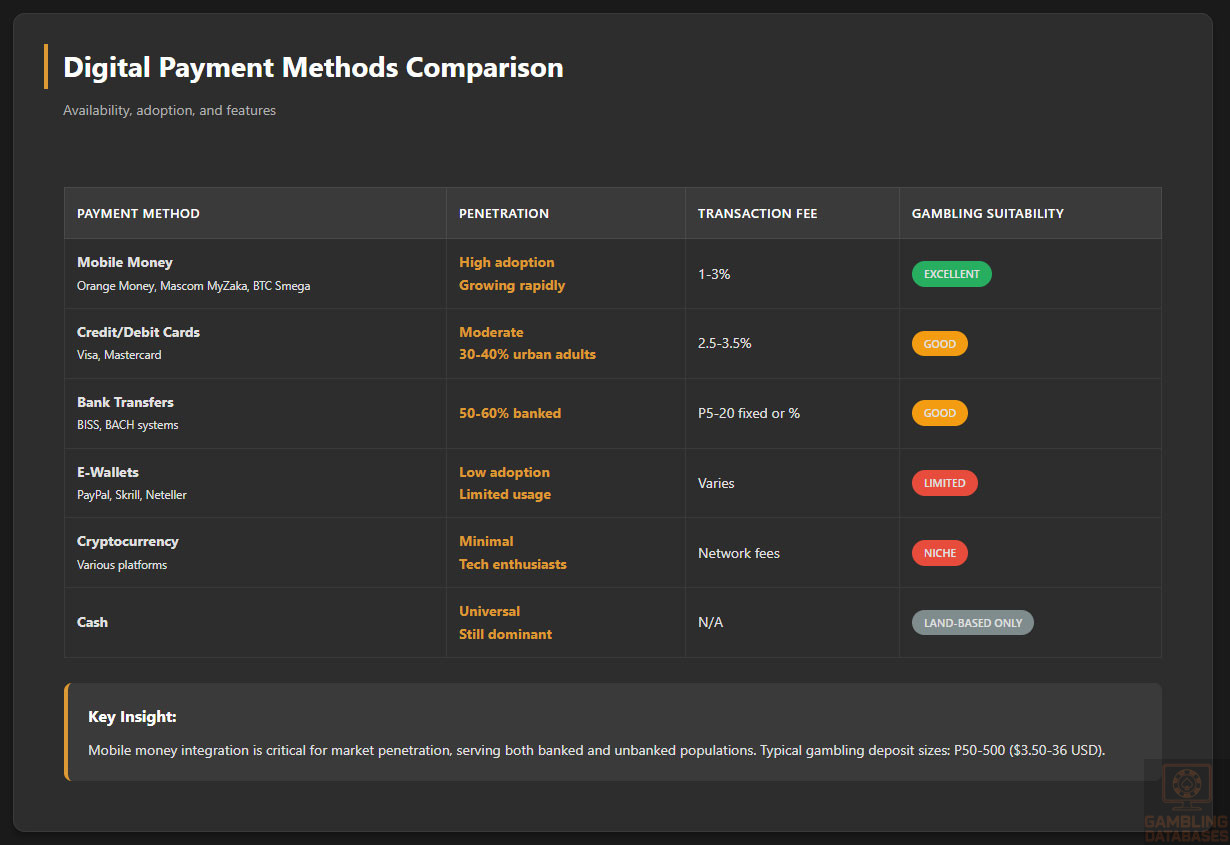
Payment method preferences in Botswana reflect the transitional state between cash-based and fully digital payment systems. Cash remains dominant, particularly in rural areas and for daily transactions, but digital payment adoption is accelerating rapidly in urban centers. For gambling operators, understanding payment preferences and offering appropriate options is critical for market penetration.
Credit and debit card penetration remains moderate, with cards used primarily by middle-class and affluent urban residents. Visa and Mastercard are widely accepted in cities, though many rural areas lack card payment infrastructure. Banks issue both debit and credit cards, though credit access is selective. For online gambling, card payments would serve the affluent segment but exclude significant population portions without banking relationships.
Mobile money has emerged as a transformative payment channel bridging the banked and unbanked populations. Orange Money, Mascom MyZaka, and BTC Smega represent the primary mobile money providers, enabling person-to-person transfers, bill payments, merchant payments, and savings functions without bank account requirements. PosoMoney, operated by BotswanaPost, offers interoperable services working across all mobile networks.
Mobile money adoption has surged from limited usage in 2015 to widespread use in 2025, particularly among younger demographics and urban populations. Transaction fees are lower than traditional banking charges, making mobile money attractive for small-value payments common in gambling contexts. Online gambling operators would benefit significantly from integrating mobile money payment options to access broader market segments beyond cardholders.
Bank transfers through the Botswana Interbank Settlement System (BISS) and Botswana Automated Clearing House (BACH) facilitate larger transactions, including salary payments and business settlements. Real-time payment systems are emerging, enabling instant transfers rather than batch processing delays. These systems could support gambling deposits and withdrawals, though mobile money likely offers superior user experience for typical transaction sizes.
Cryptocurrency adoption remains limited and highly niche in Botswana. While services like Plisio exist, cryptocurrency awareness and usage concentrate among small technology-savvy populations. Regulatory status is unclear, with no explicit prohibition or authorization. For gambling operators, cryptocurrency payment options would serve minimal market segments currently but could become relevant as digital currency adoption grows.
Average transaction sizes for gambling deposits would likely range from P50-P500 ($3.50-$36 USD), reflecting modest discretionary spending budgets for most players. Higher-value players might deposit P1,000-P5,000 ($72-$360 USD) or more, but these represent smaller market segments. Payment systems must accommodate both small casual player transactions and larger committed player deposits efficiently.
Trust in online payment systems has grown as e-commerce expands and digital payment infrastructure matures. However, fraud concerns persist, requiring gambling operators to implement secure payment processing, clear transaction confirmations, and responsive customer support addressing payment issues. Partnerships with established local payment providers can enhance trust through brand recognition and local regulatory compliance.
Gaming and Gambling Preferences
Current Market Participation
Gambling participation rates in Botswana reflect the sector’s growth trajectory and cultural acceptance evolution. Approximately 8-12% of the adult population engages in regular gambling (monthly or more frequently), translating to roughly 120,000-180,000 active players. Annual participation rates, including occasional players, may reach 15-20% of adults or 225,000-300,000 individuals.
Online gambling participation specifically, using offshore operators, likely represents 5-8% of adults or 75,000-120,000 players. This suggests substantial existing online gambling activity that could transition to licensed local operators when regulatory frameworks permit. The gap between overall gambling participation and online-specific participation indicates significant land-based gambling preference among current participants.
Sports betting emerges as the most popular gambling activity in Botswana, driven by passionate football fandom and expanding bookmaker availability. Football betting dominates, with English Premier League, UEFA Champions League, La Liga, and local Botswana Premier League matches attracting significant wagering. Rugby, cricket, basketball, and international events like the Olympics also generate betting interest.
Casino games appeal primarily to affluent urban residents and tourists visiting Gaborone’s casino resorts. Table games including blackjack, roulette, and poker attract experienced players and high-rollers, while slot machines and electronic gaming machines serve broader audiences seeking casual entertainment. Live dealer games, where available online through offshore operators, blend casino atmosphere with online convenience, appealing to players seeking authentic experiences without physical casino visits.
Lottery participation remains limited due to the absence of a fully implemented national lottery. The Gambling Act authorizes lottery operations, and a P1 million license has been issued, but comprehensive lottery operations have not launched. When introduced, lottery products could attract mass-market participation given low entry costs and wide appeal across demographic segments.
Consumer Behavior Patterns
Average spending per gambling participant in Botswana likely ranges from P500-P1,500 monthly ($36-$108 USD) for regular players, with significant variation based on income level and gambling intensity. Casual players may wager P100-P300 monthly ($7-$22 USD), while committed players might spend P3,000-P10,000+ monthly ($215-$720+ USD). Annual per-player spending thus ranges from approximately $50-150 USD for the overall player base, with core segments contributing substantially more.
Betting patterns emphasize moderate stakes aligning with middle-class discretionary budgets. Typical sports bets range from P20-P100 ($1.50-$7 USD) for casual players and P100-P500 ($7-$36 USD) for committed bettors. Casino slot machine play typically occurs at P1-P5 per spin for casual players and P5-P20 per spin for regular players. Table game bets vary widely but generally align with modest entertainment budgets rather than high-roller levels.
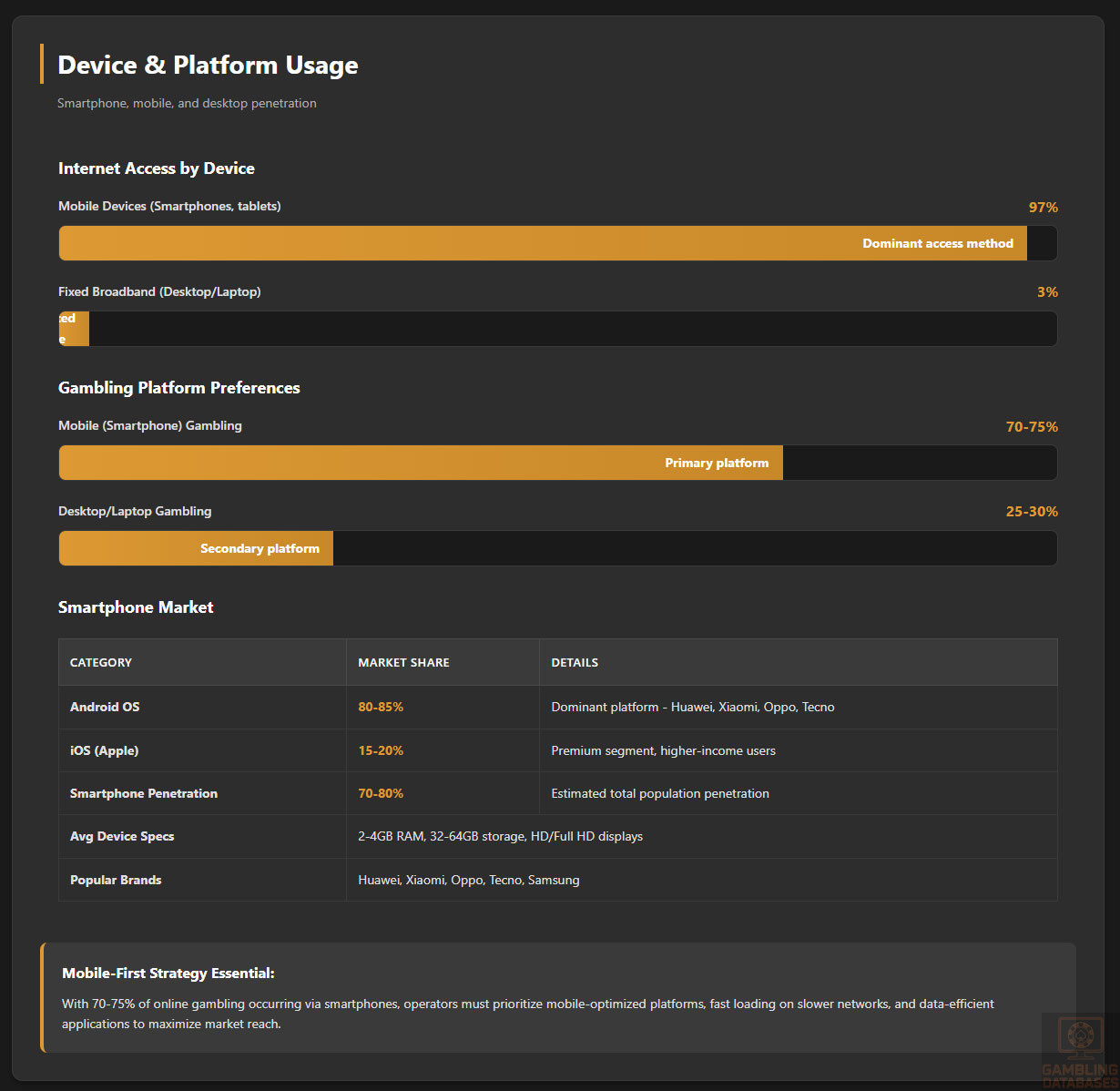
Platform preferences demonstrate strong mobile orientation. Approximately 70-75% of online gambling activity occurs via smartphones, with desktop/laptop usage accounting for 25-30% of sessions. This mobile dominance requires operators to ensure excellent mobile user experiences, fast loading times on slower networks, and data-efficient applications minimizing mobile data consumption.
Session lengths vary by product type. Sports betting sessions often remain brief (5-15 minutes) for placing pre-match bets, though live betting during matches can extend sessions to 90+ minutes matching game duration. Casino gaming sessions typically last 20-60 minutes for casual play, with dedicated players sometimes engaging for several hours. Mobile platform limitations (battery life, data costs) encourage shorter sessions compared to desktop usage patterns.
Retention and loyalty patterns suggest moderate player stickiness in Botswana’s developing market. First-month retention rates likely reach 30-40% for online gambling operators, declining to 15-25% by month three. Annual retention rates may stabilize around 20-30% for operators offering competitive products and localized experiences. Building loyalty requires culturally relevant marketing, local payment methods, responsive customer support, and competitive bonuses.
Bonus sensitivity is high among Botswana players, as welcome bonuses and promotions significantly influence operator selection and trial decisions. However, complex wagering requirements or restrictive terms can alienate players accustomed to straightforward transactions. Operators should balance attractive bonus offers with clear, achievable terms that allow players to realistically benefit from promotions.
Game type preferences by age reveal distinct patterns. Younger players (18-30) favor sports betting, particularly football, and faster-paced casino games like slots and crash games. Middle-aged players (30-45) show more diverse preferences including sports betting, slots, and table games, with some interest in poker. Older players (45+) who gamble demonstrate preferences for traditional casino games, slower-paced slots, and familiar betting patterns rather than new gaming innovations.
Deposit and withdrawal frequency patterns reflect trust-building processes and financial management approaches. New players often make small initial deposits (P100-P200 / $7-14 USD) to test platform reliability before committing larger amounts. Established players may maintain account balances rather than depositing per session, topping up weekly or monthly. Withdrawal requests typically occur after significant wins or when players want to secure profits, with processing speed critically important for satisfaction and trust.
Section 3: Technology Infrastructure and Business Environment
Internet and Digital Infrastructure
Connectivity and Network Performance
Botswana’s internet infrastructure demonstrates impressive quality for the region, supporting online gambling operations effectively. The 81.4% penetration rate combines with expanding network coverage and improving speeds to create favorable conditions for digital service delivery. However, infrastructure remains uneven between urban and rural areas, with cities enjoying superior connectivity compared to remote regions.
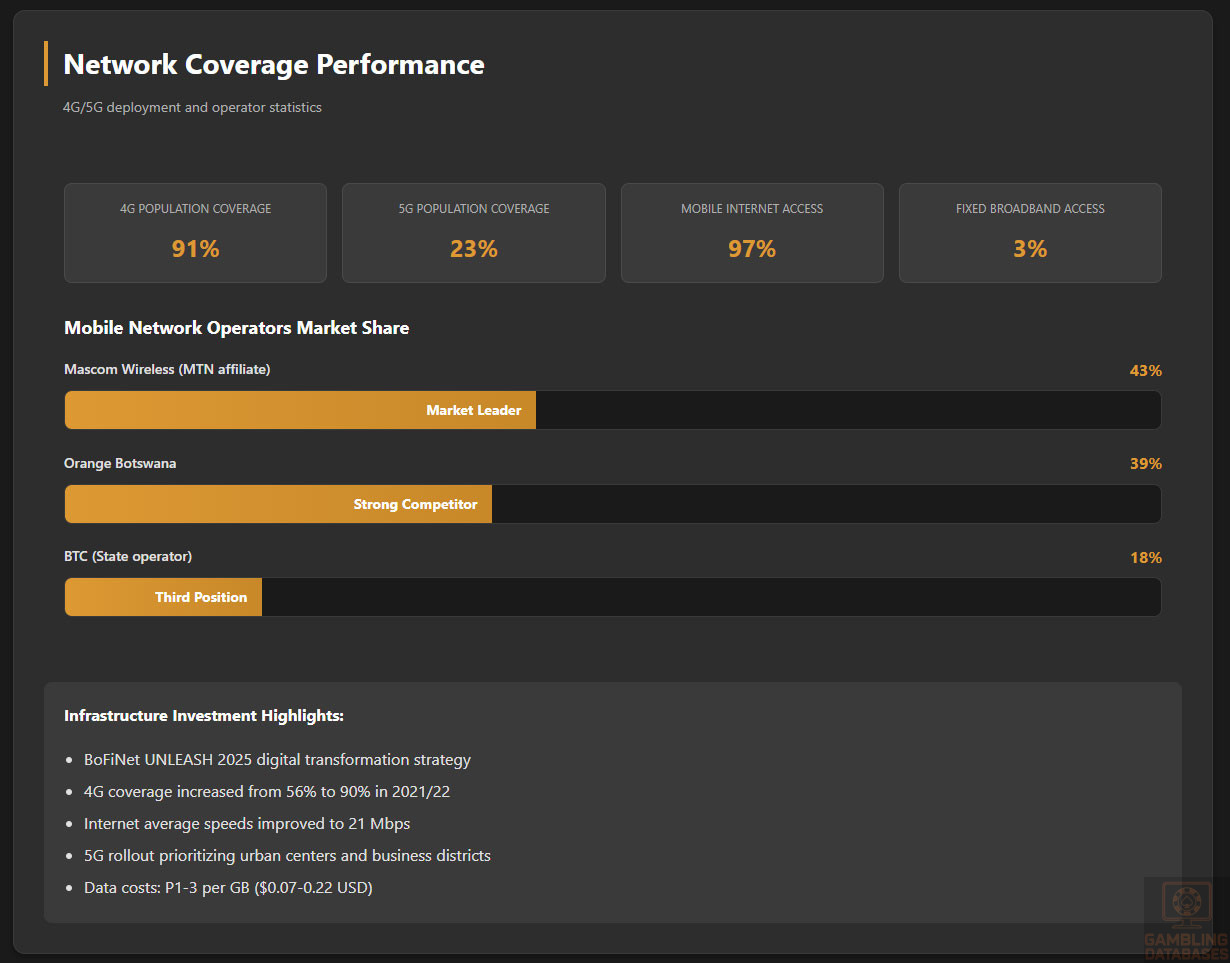
Fixed broadband versus mobile internet breakdown heavily favors mobile connectivity. Approximately 97% of internet access occurs via mobile networks, with only 3% through fixed broadband connections. This mobile dominance reflects Africa-wide patterns where mobile infrastructure deployment proved faster and more economically viable than fixed-line expansion. Gambling operators must optimize for mobile networks rather than assuming high-speed fixed broadband availability.
Average internet speeds reached 15.6 Mbps download and 7.6 Mbps upload as of February 2025, positioning Botswana 143rd globally for fixed broadband speeds and 138th for upload speeds. While modest by developed market standards, these speeds suffice for online gambling applications including video streaming for live dealer games, real-time sports betting odds updates, and interactive gaming experiences. Mobile network speeds vary significantly by location and network operator but generally support gambling applications adequately in urban areas.
Network reliability has improved substantially with infrastructure investments by major operators. Urban areas generally experience reliable connectivity with uptime exceeding 95%, though rural areas face more frequent outages and connectivity gaps. Gambling operators should implement offline modes or session recovery features accommodating temporary disconnections common on mobile networks.
Infrastructure investment continues through government initiatives and private operator expansion. BoFiNet, the state-owned fiber network operator, is implementing its UNLEASH 2025 digital transformation strategy, upgrading existing sites, erecting new towers, and expanding fiber coverage. During the 2021/22 financial year, 4G population coverage increased from 56% to 90%, and internet average speeds improved from previous levels to 21 Mbps through these infrastructure enhancements.
5G and Future Technology Deployment
Current 4G/5G coverage shows Botswana in early 5G adoption stages. As of 2023, 5G coverage reached 23% of the population, concentrated in major urban centers including Gaborone, Francistown, and key commercial districts. Meanwhile, 4G coverage has reached 91% of the population, providing widespread access to high-speed mobile internet suitable for bandwidth-intensive applications.
The 5G rollout timeline suggests gradual expansion over the next 3-5 years, prioritizing business districts, tourism zones, and densely populated urban areas before extending to secondary cities and rural regions. Mobile network operators including Mascom Wireless (MTN affiliate), Orange Botswana, and Botswana Telecommunications Corporation (BTC) are investing in 5G infrastructure as part of competitive strategies and government digital transformation goals.
Future infrastructure plans emphasize universal connectivity, reduced data costs, and enhanced network capacity. The government’s digital transformation agenda targets bringing remaining offline populations online through public Wi-Fi programs, satellite connectivity for remote areas, and continued mobile network expansion. These initiatives will expand the addressable market for online gambling as more citizens gain internet access.
Mobile Technology Ecosystem
Mobile Network Infrastructure
Three primary mobile network operators serve Botswana’s market: Mascom Wireless (43% market share, MTN affiliate), Orange Botswana (39% market share, Orange Group affiliate), and Botswana Telecommunications Corporation – BTC (18% market share, semi-privatized state operator). This competitive market structure drives network quality improvements, pricing competition, and service innovation benefiting consumers and digital service providers.
Network operator market share has remained relatively stable, with Mascom maintaining leadership through superior network coverage and customer service reputation. Orange Botswana competes aggressively on pricing and data packages, while BTC leverages government relationships and nationwide infrastructure. All three operators have invested in 4G expansion and begun 5G deployment in major centers.
Coverage quality varies by operator and geography. Mascom generally provides the most reliable coverage across urban and rural areas, justifying its market leadership. Orange offers competitive urban coverage with some rural gaps. BTC maintains acceptable coverage but faces customer service and network quality challenges compared to private competitors. Gambling operators should test platform performance across all three networks to ensure acceptable user experiences regardless of carrier choice.
Data costs have declined significantly over the past five years due to competitive pressures and regulatory encouragement. Current pricing ranges from approximately P1-3 per GB ($0.07-0.22 USD) depending on package size, promotions, and operator. These costs remain meaningful for budget-conscious consumers but no longer prohibit regular internet usage. Gambling operators should optimize data efficiency to minimize player costs and enable longer session durations without excessive data consumption.
Mobile payment integration represents a critical competitive advantage for gambling operators. All three mobile network operators offer mobile money services enabling direct carrier billing or wallet-based transactions. Integration with Orange Money, Mascom MyZaka, and BTC Smega allows operators to reach beyond banked populations and offer familiar payment methods reducing friction in deposit processes.
Device Penetration
Smartphone adoption in Botswana has reached high levels, with estimates suggesting 70-80% of the population owns smartphones. This penetration creates a large addressable market for mobile gambling applications and mobile-optimized websites. Feature phone usage persists among older demographics and lower-income segments but declines steadily as smartphone prices decrease and second-hand markets expand.
Multiple device ownership is common, with the 166% mobile connection rate (4.21 million connections for 2.56 million people) indicating many individuals maintain multiple SIM cards for different operators, taking advantage of promotional rates or coverage variations. For gambling operators, this multi-SIM behavior necessitates robust anti-fraud systems detecting multiple accounts while avoiding false positives on legitimate users with several devices.
Device preferences favor mid-range Android smartphones from Chinese manufacturers including Huawei, Xiaomi, Oppo, and Tecno. These brands offer affordable pricing (P1,000-P3,000 / $72-215 USD) suitable for middle-class budgets while providing adequate performance for gaming applications. Premium brands like Samsung and Apple serve affluent segments but represent smaller market shares. Android dominates with approximately 80-85% market share, while iOS captures 15-20% primarily among higher-income urban professionals.
Average device specifications among the mass market include 2-4 GB RAM, 32-64 GB storage, HD or Full HD displays, and mid-range processors. These specifications support modern gambling applications adequately, though operators should optimize resource usage for lower-end devices to maximize market reach. Testing on entry-level devices ensures compatibility across the device spectrum rather than optimizing solely for premium hardware.
Mobile internet usage patterns show extensive smartphone integration into daily life. Urban residents use smartphones for social media, messaging, content streaming, mobile money transactions, and increasingly e-commerce. Average daily usage ranges from 3-5 hours for typical users and 5-8 hours for heavy users. Data consumption averages 5-10 GB monthly for regular users, with heavy users consuming 15-30 GB monthly when affordable packages are available.
Financial Services and Payment Infrastructure
Banking System Structure
Botswana’s banking sector demonstrates strong stability and reasonable penetration by African standards. Major banks operating in the country include First National Bank Botswana (FNB), Standard Chartered Bank Botswana, Barclays Bank Botswana (now Absa), Stanbic Bank Botswana, Bank of Baroda, and Access Bank Botswana. These institutions provide comprehensive banking services to individual and corporate customers throughout urban areas.
Market share distribution favors established banks with long-standing operations. FNB and Standard Chartered maintain significant market positions through branch networks, digital banking platforms, and corporate banking relationships. Newer entrants like Access Bank compete through innovative products and aggressive customer acquisition strategies. Total bank count stands at approximately 8-10 commercial banks, creating adequate competition while maintaining system stability.
Digital banking adoption has accelerated rapidly, with most banks offering internet banking portals and mobile banking applications. Services include account management, funds transfers, bill payments, and increasingly advanced features like cardless ATM withdrawals and mobile wallet integration. For gambling operators, partnerships with established banks can facilitate payment processing, though banks may hesitate to explicitly support gambling transactions without clear regulatory frameworks.
Account penetration rates indicate approximately 50-60% of adults hold bank accounts, concentrated among employed urban residents. This leaves 40-50% of the adult population unbanked, relying on cash transactions, mobile money services, or informal savings mechanisms. For gambling market penetration, serving both banked and unbanked populations requires diverse payment method offerings including mobile money and alternative payment processors.
Credit and lending markets remain relatively conservative, with banks employing strict lending criteria and requiring substantial documentation. Credit card availability is limited compared to developed markets, with cards issued primarily to salaried employees and high-income professionals. Personal loan availability has expanded but faces high interest rates reflecting risk premiums in developing markets. This credit market structure limits credit-based gambling but protects vulnerable players from accumulating gambling-related debt.
Payment Processing Options
Available payment methods for iGaming in Botswana span traditional banking channels, mobile money platforms, and emerging digital payment solutions. When online gambling licensing is introduced, operators will need comprehensive payment integrations serving diverse market segments with varying banking relationships and technology adoption levels.
Credit and debit card processing through Visa and Mastercard networks serves the banked, middle-class segment. Card penetration remains moderate, with estimates suggesting 30-40% of urban adults hold debit cards and 10-15% hold credit cards. Payment processing fees typically range from 2.5-3.5% for domestic cards, with higher fees for international card transactions. Gambling operators require merchant accounts explicitly permitting gambling transactions, which may face scrutiny from acquiring banks until regulatory clarity exists.
E-wallet options remain limited compared to mature markets. International e-wallets like PayPal, Skrill, and Neteller are available to Botswana residents but face limited local adoption due to registration complexities and funding challenges. These services primarily serve users engaged in international e-commerce or freelancing rather than mass-market consumers. For gambling operators, e-wallets may facilitate international player segments but offer limited utility for core domestic market penetration.
Bank transfer systems including real-time payment infrastructure and automated clearing house (ACH) equivalents enable direct bank-to-bank transactions. The Botswana Interbank Settlement System (BISS) handles high-value interbank transfers, while the Botswana Automated Clearing House (BACH) processes bulk payments including salaries. Emerging instant payment systems enable real-time settlements rather than batch processing delays, improving user experience for gambling deposits and withdrawals.
Cryptocurrency acceptance remains minimal and largely unregulated in Botswana. While crypto payment processors like Plisio exist, actual usage concentrates among technology enthusiasts and individuals engaged in international crypto markets. Regulatory status is ambiguous, with no explicit prohibition or authorization. For gambling operators, crypto payments would serve niche segments currently but may become relevant as digital currency adoption grows and regulatory frameworks clarify.
Processing fees vary significantly by payment method and transaction volume. Mobile money transactions typically incur fees of 1-3% depending on transaction size, making them cost-effective for typical gambling deposit amounts. Bank transfers may involve fixed fees (P5-20 / $0.35-1.40 USD) or percentage fees depending on bank and transfer type. Card processing fees of 2.5-3.5% represent standard merchant service costs. Cryptocurrency transactions involve network fees plus processor margins but avoid traditional banking intermediaries.
Transaction processing timelines differ markedly across payment methods. Mobile money transactions typically settle instantly, enabling immediate play upon deposit. Card transactions usually process within seconds to minutes. Bank transfers may require several hours for same-day processing or next business day for batch settlements. Withdrawals to mobile money can be instant, while bank withdrawals typically require 1-3 business days. Players prioritize fast deposits and withdrawals, making processing speed a competitive differentiator.
International payment capabilities matter for operators accepting deposits from Botswana players using international accounts or serving expatriate populations. Standard international payment processors handle cross-border transactions, though currency conversion fees and correspondent banking charges increase costs. Operators should support Botswana Pula (BWP) pricing and settlements to avoid currency conversion friction and provide transparent pricing to local players.
Regulatory restrictions on gambling payments currently remain minimal due to online gambling’s unregulated status. Banks and payment processors operate without explicit prohibitions or authorizations regarding gambling transactions. When online licensing is introduced, clearer frameworks will likely mandate that only licensed operators can access local payment infrastructure, blocking transactions to unlicensed offshore operators. This regulatory development could significantly shift competitive dynamics toward licensed local operators.
Chargebacks and dispute resolution procedures follow standard banking practices. Card transactions permit chargebacks under dispute conditions, requiring operators to maintain clear transaction records and terms of service documentation. Mobile money platforms typically offer fewer chargeback rights but include dispute resolution procedures for alleged fraud or unauthorized transactions. Operators should implement responsive customer service addressing payment issues promptly to minimize disputes and maintain payment processor relationships.
E-commerce and Digital Economy
Digital Market Development
E-commerce in Botswana has experienced significant growth, with the market expanding from $246 million USD in 2022 to projected $538 million USD by 2027. This represents compound annual growth exceeding 15%, driven by improved internet infrastructure, smartphone adoption, digital payment proliferation, and changing consumer behaviors accelerated by COVID-19 pandemic experiences with online shopping.
Online retail penetration remains modest at approximately 8-12% of total retail sales, indicating substantial growth runway as more consumers adopt online shopping behaviors. Urban populations drive e-commerce adoption, purchasing electronics, fashion, household goods, and increasingly groceries through online platforms. Rural e-commerce remains limited due to delivery infrastructure challenges and lower internet penetration.
Digital service adoption extends beyond physical goods to streaming entertainment, mobile banking, online education, telemedicine, and increasingly digital government services. This broader digital economy development builds consumer comfort with online transactions and remote service delivery, reducing psychological barriers to online gambling participation. As users become accustomed to managing finances, making purchases, and consuming entertainment digitally, gambling platforms fit naturally into established digital behavior patterns.
Consumer trust in online transactions has grown as major e-commerce platforms deliver satisfactory experiences and digital payment systems prove reliable. However, fraud concerns persist, with consumers remaining cautious about sharing payment information with unfamiliar websites. Gambling operators can build trust through partnerships with recognized local brands, secure payment processing badges, clear privacy policies, and responsive customer support addressing concerns promptly.
Popular e-commerce platforms serving Botswana include South African retailers shipping across borders, local classified marketplaces, and emerging Botswana-specific online stores. International platforms like Amazon do not directly serve Botswana, creating opportunities for localized e-commerce solutions understanding regional preferences, payment methods, and delivery expectations. For gambling operators, localization similarly matters, with platforms incorporating Pula currency, local payment methods, popular local sports, and culturally relevant marketing resonating more effectively than generic international offerings.
Cross-border online shopping behavior is common, with many Botswana consumers purchasing from South African websites offering wider product selections than domestic retailers. This cross-border digital behavior extends to gambling, where offshore operators have attracted Botswana players despite lack of local licensing. When domestic licensing is introduced, competitive advantages through localization, local payment methods, and regulatory protection can shift market share toward licensed operators.
Business Environment and Regulatory Framework
Ease of Business Operations
Botswana ranks favorably for business operations within sub-Saharan Africa, though challenges persist compared to developed markets. The World Bank’s Doing Business rankings historically placed Botswana in the upper-middle range for Africa, reflecting relatively streamlined company registration, contract enforcement, and regulatory frameworks. The country’s stability, low corruption, and rule of law create more predictable business environments than many regional peers.
Ease of Starting a Business procedures have been simplified through the Companies and Intellectual Property Authority (CIPA), which handles company registrations. The online portal enables electronic submissions reducing bureaucratic delays. However, physical presence requirements and documentation verification can extend timelines beyond online-only systems in advanced jurisdictions.
Business registration processes typically involve reserving a company name, preparing constitutional documents, registering with CIPA, obtaining tax registration from Botswana Unified Revenue Service (BURS), and securing any sector-specific licenses. For gambling operators, the company registration precedes gambling license applications, adding to overall market entry timelines. The process generally requires 2-4 weeks from application to company certificate issuance, assuming complete documentation and no complications.
Time required to start a business has improved to approximately 30-45 days including all regulatory steps, tax registrations, and operational readiness. Gambling operations face longer timelines due to licensing background checks (3-4 months) and operational setup requirements. Total time from decision to operational launch for gambling businesses likely ranges from 6-9 months including company formation, license application, premises preparation, staff hiring, and system testing.
Foreign investment policies generally welcome international capital, with no blanket restrictions on foreign ownership in most sectors. Certain strategic sectors face limitations, but gambling does not appear among explicitly restricted industries. Foreign investors must comply with company registration requirements including appointing local directors meeting residency criteria. Practical advantages often come through partnerships with local entities providing market knowledge, regulatory navigation expertise, and government relationship access.
Operational cost structures vary significantly between urban and rural locations. Office rent in Gaborone ranges from P50-150 per square meter monthly ($3.50-10.80 USD/sqm) depending on location quality and building specifications. Salaries for professional staff range from P5,000-15,000 monthly ($360-1,080 USD) for mid-level positions and P15,000-40,000+ monthly ($1,080-2,880+ USD) for senior management. Utilities including electricity and internet remain affordable, with commercial electricity rates around P1-1.50 per kWh ($0.07-0.11 USD/kWh).
Labor market conditions present mixed opportunities and challenges. Botswana maintains relatively high unemployment (27.6%) creating ample entry-level labor supply. However, skilled professional talent, particularly in technology, finance, and specialized gambling operations, remains scarce. Operators may need to recruit internationally for certain roles or invest in training local staff. The high unemployment also creates political pressure for job creation, which gambling sector expansion addresses through direct employment and indirect economic activity.
Corporate Structure and Registration
Available entity types in Botswana include Private Company (Pty Ltd), Public Company, Branch Office of foreign entity, Partnership, and Sole Proprietorship. For gambling operations, Private Company (Pty Ltd) structure typically provides optimal balance between liability protection, operational flexibility, and regulatory compliance. This structure limits shareholder liability to invested capital while enabling growth, investment attraction, and eventual ownership transfers.
Public Company structures suit large-scale operations seeking public investment but face additional regulatory requirements and disclosure obligations inappropriate for most gambling startups. Branch Office structures allow foreign companies to operate in Botswana while maintaining parent company legal identity, but may face disadvantages in licensing applications favoring locally incorporated entities. Partnerships and sole proprietorships offer simplicity but lack liability protection critical for regulated gambling operations facing compliance risks.
Recommended structure for iGaming operators is Private Company (Pty Ltd) registered in Botswana with adequate capitalization, local directorship meeting requirements, and corporate governance meeting both company law and gambling regulatory standards. This structure facilitates gambling license applications, enables local banking relationships, provides liability protection, and allows future restructuring or ownership transfers as business needs evolve.
Differences between entity types include liability exposure, taxation treatment, reporting requirements, and operational flexibility. Private companies limit shareholder liability, file annual returns with CIPA, pay corporate income tax on profits, and maintain relative privacy compared to public companies. Public companies face stricter governance requirements, disclosure obligations, and public financial reporting. Branch offices face taxation on Botswana-source income while maintaining foreign parent legal identity.
Registration requirements for Private Companies include minimum two shareholders and one director, registered office address in Botswana, company constitution (memorandum and articles of association), and share capital specification. Directors must be natural persons meeting age and competency requirements, with at least one director ordinarily resident in Botswana. Company names require approval ensuring uniqueness and appropriateness. Certain business activities including gambling require licensed professional services.
Registration timelines from application to approval typically range from 2-4 weeks for straightforward applications. Name reservation occurs first, followed by constitutional document preparation, CIPA registration, and tax registration with BURS. Electronic submissions through CIPA’s online portal accelerate processing compared to paper-based applications. Engaging experienced company secretaries or law firms can streamline processes and ensure compliance with all requirements.
Registration costs include government filing fees of approximately P500-1,500 ($36-108 USD) depending on company type and authorized share capital. Professional services fees for lawyers or company secretaries preparing documentation and managing registration typically range from P3,000-10,000 ($215-720 USD). Total company formation costs including professional fees generally range from P5,000-15,000 ($360-1,080 USD) for standard Private Company structures.
Required documents for company registration include certified copies of director and shareholder identification documents, proof of registered office address, company constitutional documents, and statutory declarations of compliance. Foreign shareholders and directors must provide documentation certified by notaries public or Botswana diplomatic missions. All documents must be in English or accompanied by certified translations.
Minimum capital requirements vary by company type. Private companies have no statutory minimum capital requirement, though gambling license applications likely expect substantial capitalization demonstrating financial sustainability. Operators should anticipate regulators requiring proof of operating capital sufficient for 6-12 months operations including salaries, license fees, marketing, technology costs, and player liabilities.
Ongoing compliance requirements include annual returns filed with CIPA within specified timeframes, annual general meetings of shareholders, maintenance of statutory registers at registered office, financial statement preparation and tax filing with BURS, and director appointment notifications for any governance changes. Gambling licensees face additional compliance requirements including regulatory reporting, compliance audits, and gambling-specific record-keeping obligations.
Corporate governance requirements emphasize director fiduciary duties, conflict of interest management, proper financial controls, shareholder rights protection, and compliance with all applicable laws. The Companies Act specifies governance standards while gambling regulations add sector-specific requirements including responsible gambling oversight, customer protection measures, and regulatory compliance programs. Strong governance frameworks not only satisfy legal requirements but also build investor confidence and support sustainable operations.
Taxation Framework
Corporate Income Tax Structure
Standard corporate tax rates in Botswana generally range from 22% for companies with taxable income below specified thresholds to higher rates for larger enterprises, with specific rates depending on company size and business activity classification. Manufacturing companies may receive preferential rates under economic diversification incentives. Gambling operators should expect corporate income tax on net profits after deducting allowable business expenses, gambling-specific taxes, and operational costs.
The tax calculation occurs on net profit after deducting the gambling-specific GGR taxes paid monthly. This structure means operators pay both activity-based GGR taxes (6.5-10% depending on gambling type) and corporate income tax on remaining net profits, creating cumulative tax burdens that must be factored into business model planning and pricing strategies. However, compared to jurisdictions with high GGR taxes (20-30%+) plus corporate taxes, Botswana’s rates remain competitive.
Special economic zone benefits or tax incentives may be available for qualifying investments, particularly those creating substantial employment, bringing advanced technology, or supporting economic diversification goals. The government’s Economic Transformation Program emphasizes reducing diamond dependency and expanding service sectors, potentially creating openness to incentive negotiations for significant gambling sector investments creating jobs and generating exports through regional market service.
Tax holidays or reduced rates for new businesses occasionally feature in investment attraction packages for priority sectors or large-scale projects. Gambling operators proposing significant investments, regional service center establishment, or technology platform development serving broader African markets might negotiate favorable tax treatments. However, such arrangements require government engagement at ministerial levels and alignment with national development priorities.
International tax treaties that Botswana maintains include agreements with South Africa, the United Kingdom, France, Sweden, and several other nations. These treaties prevent double taxation on cross-border income and establish withholding tax rates on dividends, interest, and royalties. For gambling operators with international parent companies or cross-border operations, understanding treaty provisions helps optimize tax positions and avoid excessive tax burdens on profit repatriation.
Transfer pricing rules and documentation requirements apply to transactions between related entities. Operators with international affiliates must ensure arms-length pricing for management fees, technology licensing, marketing services, and other inter-company charges. Tax authorities scrutinize related-party transactions to prevent profit shifting and base erosion, requiring detailed documentation supporting transaction pricing and commercial rationale.
Withholding tax rates apply to various payment types. Dividends paid to non-residents typically face 10% withholding tax unless reduced by treaty. Interest payments to non-residents may face 10-15% withholding depending on circumstances. Royalties for intellectual property typically face 10-15% withholding. These withholding obligations affect profit repatriation strategies for foreign-owned gambling operators and influence optimal corporate structure decisions.
VAT or GST applicability to gambling services varies by transaction type. Botswana operates a Value Added Tax system currently at 14% for most goods and services. Gambling services face specific VAT treatment, with some jurisdictions exempting gambling from VAT due to existing gambling-specific taxes while others apply VAT to service charges or administrative fees. Operators must clarify VAT obligations with tax authorities to ensure proper compliance and pricing structures.
Personal Income Tax
Individual tax rates for employees operate on progressive brackets, with rates ranging from 0% on income below tax-free thresholds to maximum rates of 25% on highest income brackets. Specific thresholds and rates adjust periodically through budget announcements. Foreign employees working in Botswana typically face taxation on Botswana-source income, with treaty provisions potentially providing relief for certain circumstances or limiting taxation rights.
Withholding requirements mandate employers to deduct Pay As You Earn (PAYE) taxes from employee salaries. Gambling operators as employers must register for PAYE, calculate appropriate withholdings based on employee income and tax brackets, remit withheld taxes to BURS monthly, and provide employees with tax certificates enabling annual tax return filing. Non-compliance with PAYE obligations carries penalties including fines and potential prosecution.
Social security contributions include both employer and employee portions. The employer portion typically represents 5% of salary while employees contribute matching amounts. These contributions fund pensions and social protection programs. Total employment costs for operators must factor both gross salaries and employer social security obligations when budgeting for staffing needs.
Tax residency rules determine taxation scope, with individuals resident in Botswana for more than 183 days annually typically considered tax residents subject to worldwide income taxation. Non-residents face taxation only on Botswana-source income. For gambling operators bringing foreign expertise, understanding residency rules and treaty provisions helps optimize expatriate compensation packages and tax positions.
Taxation of foreign employees involves complexities including residency determination, treaty application, and special provisions for certain categories of temporary workers. Gambling operators employing foreign specialists must ensure proper tax compliance, work permit coordination, and documentation meeting both immigration and tax requirements. Professional tax and immigration advice helps navigate these complexities and avoid inadvertent violations.
Market Entry Considerations
Recommended Entry Strategies
Optimal market entry approaches for Botswana gambling operators depend on risk tolerance, capital availability, and strategic objectives. Several entry pathways merit consideration, each with distinct advantages and limitations. Direct licensing represents the most straightforward approach when online gambling regulation is introduced, involving establishing a Botswana-registered company, applying for gambling licenses, building or acquiring platform technology, and launching branded operations. This approach provides maximum control and brand ownership but requires substantial capital and accepts full operational risk.
Local partnership or joint venture structures combine international operator expertise with local market knowledge, regulatory relationships, and cultural understanding. Partnerships can accelerate market entry, reduce compliance challenges, and provide established business relationships. However, partnerships require careful partner selection, clear governance structures, and aligned incentives to avoid conflicts. Revenue and control sharing arrangements must balance fairly against respective contributions.
White label arrangements allow entering the market with minimal capital by operating under an existing license holder’s authorization using their technical platform while building a distinct brand. White label providers handle technology, licensing, and core operations while brand partners focus on marketing and customer acquisition. This approach enables fastest market entry with lowest capital requirements but involves ongoing platform fees and limited control over technical capabilities and operational decisions.
Technology infrastructure leveraging strategies affect market entry speed and cost. Building proprietary platforms offers maximum customization and control but requires substantial development investment (typically $500,000-2,000,000+ USD) and extended timelines (12-24+ months). Licensing established platforms from specialist providers accelerates launch (3-6 months) and reduces upfront costs ($50,000-200,000+ setup plus revenue share) but creates ongoing vendor dependencies. Hybrid approaches using third-party core platforms with custom front-end development balance speed, cost, and customization.
Marketing and localization requirements demand attention to cultural preferences, language options (English primary, Setswana beneficial), local sports and events integration, culturally appropriate promotions, and community engagement. Successful operators invest in understanding Botswana player preferences rather than applying generic international approaches. Localization extends beyond language translation to payment method integration, customer support availability during local peak hours, and sports offerings emphasizing popular local and regional competitions.
Payment provider selection criteria include local market coverage across banked and unbanked populations, integration with mobile money platforms (Orange Money, Mascom MyZaka, BTC Smega), support for Botswana Pula without forced currency conversion, competitive transaction fees, fast deposit and withdrawal processing, reliable technical infrastructure, and regulatory compliance positioning for when online gambling frameworks are established. Operators should integrate multiple payment methods serving different market segments rather than relying on single options excluding potential players.
Risk mitigation strategies address regulatory uncertainty, competitive pressures, operational challenges, and market evolution. Operators should maintain regulatory flexibility for adapting to changing frameworks, build strong compliance programs exceeding minimum requirements, diversify revenue across multiple products and channels, establish local presence demonstrating commitment to the market, invest in responsible gambling capabilities protecting players and brand reputation, and maintain adequate capitalization for weathering initial losses and unexpected challenges.
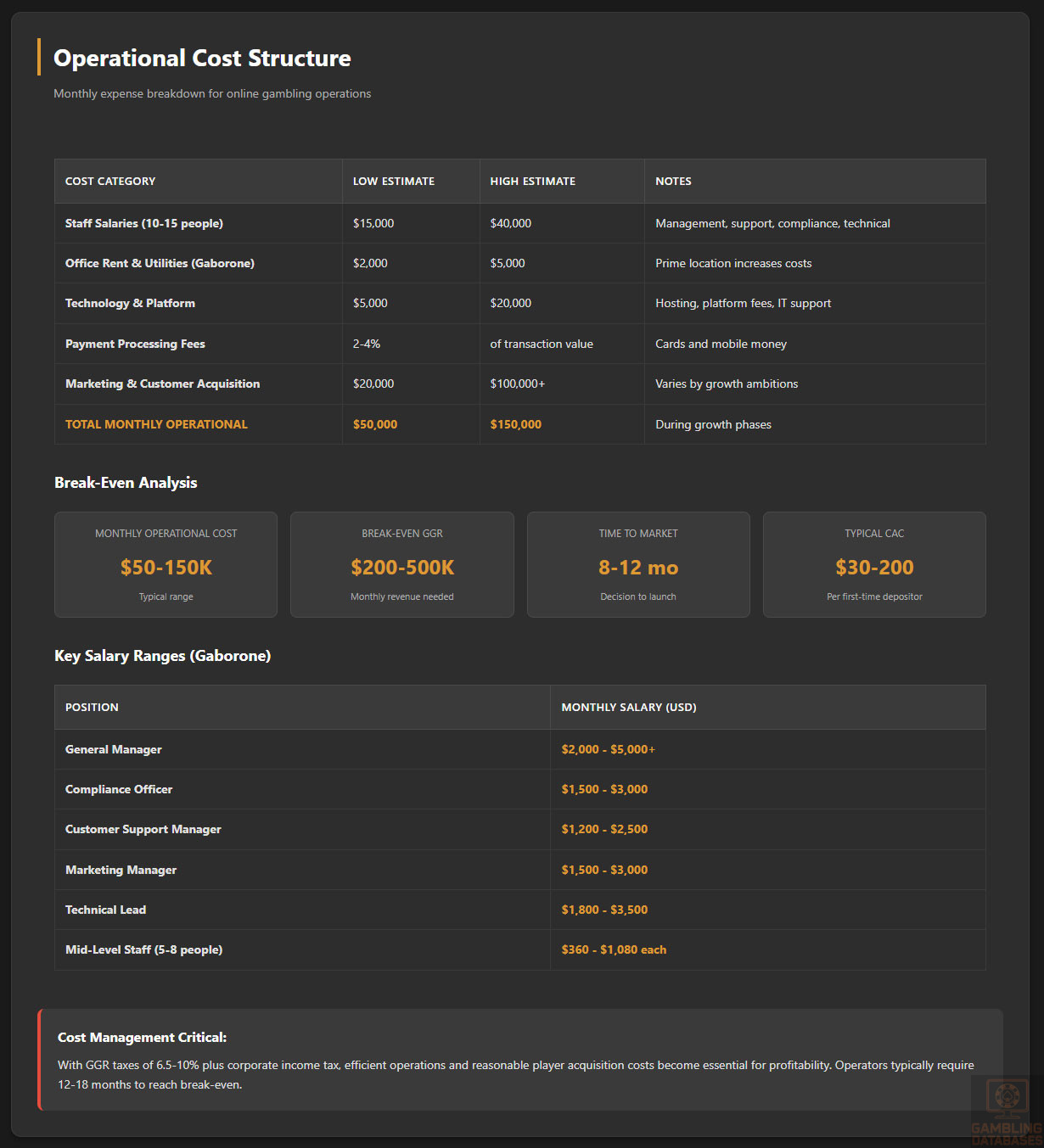
Typical Costs and Timelines
Initial setup investments for entering Botswana’s gambling market vary significantly based on operation scale, license type, and business model. License application and fees represent the first major cost, with casino licenses requiring P250,000 application plus P100,000 annual fee (approximately $18,000 + $7,200 USD), while future online licenses may cost $30,000-50,000 USD based on emerging market comparables. Legal and consulting fees for navigating registration, licensing, and compliance typically range from $20,000-75,000 USD depending on complexity and external advisor requirements.
Company registration costs include P5,000-15,000 ($360-1,080 USD) for formation plus professional services. Initial capital requirements demonstrating financial sustainability likely require $250,000-1,000,000 USD depending on operation scale, covering operating expenses, player liabilities, regulatory obligations, and growth capital. Office setup costs for Gaborone premises include deposits, furniture, technology infrastructure, and fit-out ranging from $20,000-100,000 USD depending on location quality and size.
Technology and platform costs represent substantial investments, with proprietary development requiring $500,000-2,000,000+ USD and 12-24 months, while licensed platforms cost $50,000-200,000 setup plus 5-15% revenue share ongoing. Initial marketing budgets should allocate $100,000-500,000 USD for brand launch, player acquisition campaigns, partnership development, and initial promotional offers attracting first players and establishing market presence.
Operational cost estimates on a monthly basis include staff salaries for a small team of 10-15 employees ranging from $15,000-40,000 USD covering management, customer support, compliance, finance, and technical roles. Office rent and utilities for suitable Gaborone premises typically cost $2,000-5,000 USD monthly. Technology maintenance including hosting, platform fees, payment processing, and IT support ranges from $5,000-20,000 USD monthly depending on platform choices and transaction volumes.
Payment processing fees typically consume 2-4% of transaction value across card and mobile money channels. Marketing and customer acquisition costs on an ongoing basis require $20,000-100,000+ USD monthly depending on growth ambitions and competitive intensity. Total operational costs for a modest online gambling operation likely range from $50,000-150,000 USD monthly during growth phases, with break-even typically occurring at $200,000-500,000 USD monthly gross gaming revenue depending on cost structures and tax burdens.
Timeline expectations for market entry begin with company registration requiring 2-4 weeks from application to approval. License application timelines extend 4-6 months for land-based operations based on background checks, documentation review, and regulatory approval processes. Platform setup timelines vary from 3-6 months for licensed solutions to 12-24+ months for proprietary development. Total time to market from initial decision to operational launch realistically requires 8-12 months assuming online licensing frameworks exist, or longer if awaiting regulatory development.
Resource requirements for successful market entry include minimum staff headcount of 10-15 people for a basic operation, expanding to 25-50+ for comprehensive service levels. Key positions needed include General Manager with gambling industry experience, Compliance Officer meeting regulatory requirements, Customer Support Manager and team for Botswana time zones, Marketing Manager understanding local market, Finance Manager handling payments and reporting, Technical Lead ensuring platform reliability, and Responsible Gambling Officer implementing player protection programs.
Technology stack requirements span frontend user interfaces optimized for mobile-first usage, backend systems handling player management, game integration, payment processing, and reporting, CRM platforms for customer relationship management and marketing automation, compliance tools for KYC/AML, responsible gambling, and regulatory reporting, security infrastructure protecting against fraud and cyber threats, and integration layers connecting payment providers, game suppliers, and affiliate networks.
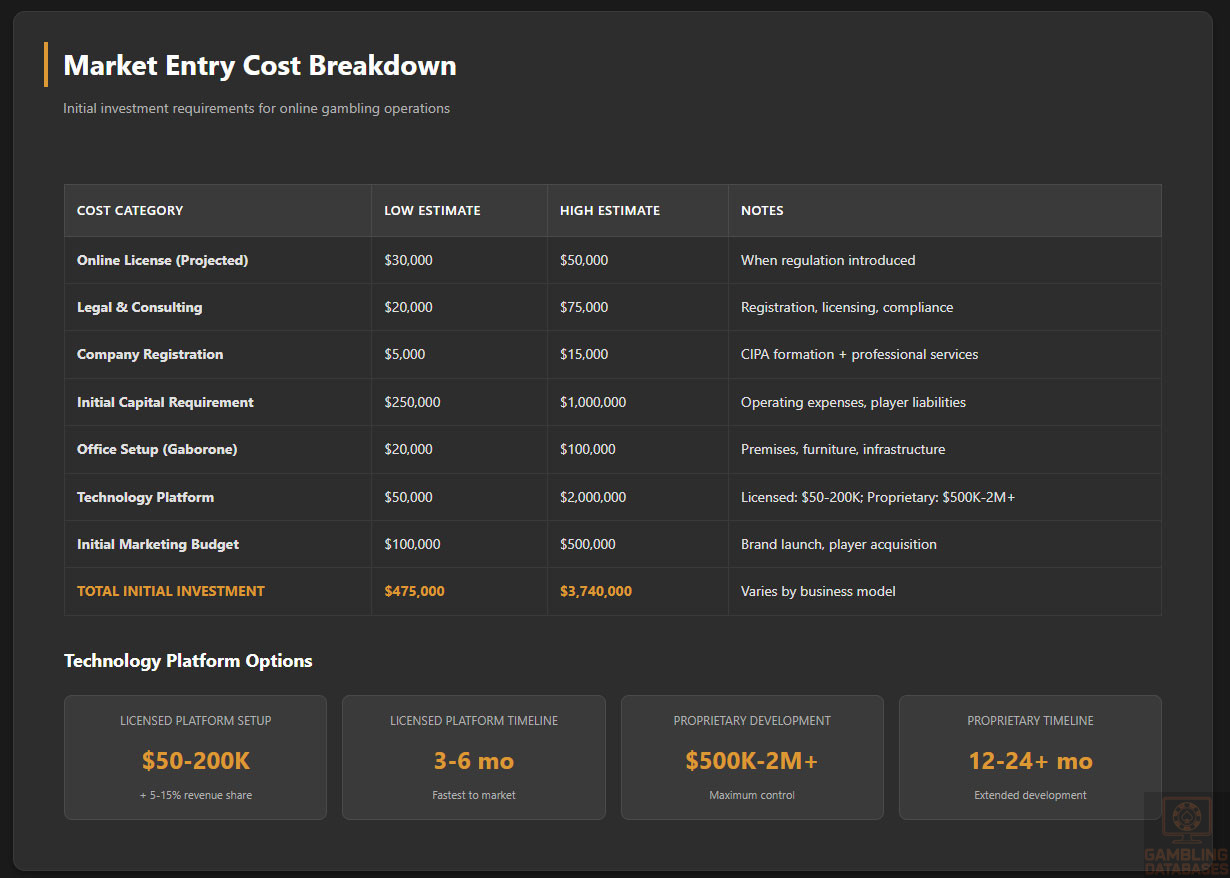
Success Factors and Challenges
Key success enablers for Botswana gambling market entry center on understanding local player preferences through market research, player testing, and continuous feedback collection. Successful operators invest time learning what Botswana players want rather than imposing international standard offerings. Localized payment methods integration proves critical, with mobile money support (Orange Money, Mascom MyZaka, BTC Smega) and bank transfer options serving different market segments more effectively than card-only approaches excluding unbanked populations.
Mobile-first approaches recognize that 70-75% of online gambling occurs via smartphones in markets like Botswana. Platforms must deliver excellent mobile experiences with fast loading on slower networks, intuitive interfaces for small screens, efficient data usage minimizing player costs, and offline tolerance handling connectivity interruptions gracefully. Desktop optimization matters for the 25-30% using computers but cannot come at mobile experience expense.
Effective marketing channels and partnerships include sports sponsorships building brand visibility and association with popular teams, social media campaigns on Facebook, Instagram, and growing TikTok presence, affiliate marketing leveraging local publishers and influencers, outdoor advertising in high-traffic urban areas, and strategic partnerships with entertainment venues, mobile operators, and complementary brands. Marketing must comply with advertising restrictions while creatively engaging target audiences.
Strong customer support in English and ideally Setswana distinguishes operators in markets where service quality varies dramatically. Support channels should include phone, email, WhatsApp (widely used in Botswana), and live chat. Availability during evening peak hours when most gambling occurs proves essential, with 24/7 support enhancing premium positioning. Response times, issue resolution effectiveness, and proactive problem detection build loyalty and positive word-of-mouth.
Competitive bonus and promotion strategies balance attractiveness with sustainability. Botswana players demonstrate high bonus sensitivity, but complex terms create frustration. Successful approaches include generous welcome bonuses with achievable wagering requirements, regular reload bonuses maintaining engagement, cashback programs rewarding loyalty, and seasonal promotions tied to major sporting events or holidays. Transparency in terms and realistic redemption paths build trust rather than creating player disappointment.
Responsible gambling commitment protects both players and operator reputation. Strong programs include self-exclusion tools easily accessible, deposit and loss limits player-controlled, reality checks reminding players of time spent gambling, problem gambling resources prominently displayed, staff training for identifying concerning behaviors, and partnerships with treatment providers for referrals. These measures satisfy regulatory requirements while supporting sustainable business by preventing player harm that triggers regulatory crackdowns or social backlash.
Local sports and events coverage for sports betting proves essential given football’s dominance. Offering comprehensive coverage of English Premier League, UEFA competitions, local Botswana Premier League, regional African competitions, and major international events meets player demands. Live betting on popular matches drives engagement, while competitive odds compared to offshore operators attracts value-conscious bettors.
Major operational challenges facing Botswana market entrants begin with regulatory compliance complexity. The absence of clear online gambling regulation creates uncertainty requiring contingency planning and legal monitoring. When regulations emerge, rapid adaptation will be necessary. Building compliance capabilities exceeding current requirements positions operators favorably for regulatory evolution rather than forcing reactive scrambling.
High taxation burden, while competitive regionally at 6.5-10% GGR plus corporate income tax, still constrains margins compared to unregulated offshore operators avoiding local taxes entirely. Licensed operators must compete on regulatory protection, local payment integration, and brand trust rather than pure pricing advantages. Efficient operations and reasonable player acquisition costs become critical for profitability given tax obligations.
Payment processing restrictions may emerge when online gambling regulation is introduced, potentially blocking transactions to unlicensed operators while enabling licensed operators to access local banking infrastructure. During transition periods, operators may face banking hesitancy to support gambling transactions until regulatory clarity exists. Building relationships with progressive payment providers willing to serve regulated gambling markets positions operators for smoother payment integration.
Marketing and advertising limitations designed to protect minors and promote responsible gambling constrain promotional strategies. Restrictions on content, placement, and targeting require creative marketing approaches that engage audiences within regulatory boundaries. Operators must balance visibility and growth ambitions with compliance obligations, avoiding aggressive marketing tactics that attract regulatory scrutiny or public criticism.
Competition from established operators intensifies as the market matures. Early movers in land-based gambling and eventually online licensing gain first-mover advantages including brand recognition, customer databases, and regulatory relationships. Late entrants face challenges differentiating offerings and acquiring customers from established competitors. However, innovation opportunities exist through superior technology, better user experiences, niche market focus, or partnership strategies established players cannot easily replicate.
Player acquisition costs rise as competition intensifies and marketing channels saturate. Early market entrants may acquire customers for $30-80 USD per first-time depositor, while late entrants in mature competitive markets often pay $100-200+ USD per customer. Efficient acquisition through organic channels, word-of-mouth, partnerships, and retention focus becomes increasingly important as paid acquisition costs escalate.
Talent shortage in specialized skills including gambling platform technology, regulatory compliance, responsible gambling, fraud prevention, and senior management with gambling industry experience creates recruitment challenges. Botswana’s relatively small professional workforce means importing expertise through international recruitment or investing in training local staff for gambling-specific competencies. Competitive compensation and professional development opportunities help attract and retain scarce talent.
Technology infrastructure limitations, while improving, still present challenges compared to developed markets. Internet speeds, while adequate for gambling applications, lag global leaders. Network reliability faces occasional issues particularly in rural areas and during peak usage periods. Operators must optimize platforms for constrained network conditions, implement effective caching, handle disconnections gracefully, and potentially offer progressive web applications that work partially offline.
Cultural Considerations
Local holidays and peak seasons significantly impact gambling activity patterns. Major holidays including Botswana Independence Day (September 30), Christmas and New Year period (December-January), and Easter create both opportunities and challenges. Holiday periods often see increased gambling activity as people have leisure time and seasonal bonuses, but also create staffing challenges and customer support demands. Promotional campaigns timed to holidays, sporting events, and payday cycles maximize engagement.
Popular local sports and events that drive betting activity include Botswana Premier League football as the primary domestic competition attracting passionate local support and betting interest. Regional competitions including CAF Champions League, CAF Confederation Cup, and COSAFA Cup engage Southern African betting markets. International football leagues, particularly English Premier League, Spanish La Liga, Italian Serie A, and UEFA Champions League dominate betting volumes. Rugby, cricket, basketball, and athletics create supplementary betting opportunities.
Preferred customer service channels reflect Botswana communication habits. WhatsApp messaging enjoys near-universal usage and serves as preferred communication method for many users due to familiarity, convenience, and data efficiency. Phone support remains important for complex issues or less tech-savvy players. Email provides formal communication channel for account issues and documentation. Live chat on websites and apps offers immediate assistance during gambling sessions. SMS notifications for account activities, promotional offers, and important updates reach players directly on mobile devices.
Communication style preferences in Botswana generally favor respectful, friendly interactions without excessive formality. English communication should be clear and accessible rather than using complex terminology. Patience and thorough explanation are valued when resolving issues or answering questions. Cultural sensitivity to Setswana communication norms, even when using English, builds rapport. Avoiding aggressive or pushy marketing that might be perceived as disrespectful enhances brand perception.
Trust-building requirements for foreign brands include demonstrating long-term commitment through local presence rather than appearing as extractive foreign entities. Visible community investment, employment of local staff in meaningful roles rather than token positions, partnerships with recognized local entities, and alignment with Botswana’s development priorities build legitimacy. Transparency in operations, clear communication of terms and conditions, responsive complaint handling, and adherence to responsible gambling principles establish trust gradually through consistent positive experiences.
Exit Strategy Planning
Market liquidity for operator sales depends on gambling market maturity and regulatory clarity. Currently, limited licensing and uncertain online regulation restrict potential buyers to land-based operators or international entities willing to navigate ambiguity. As the market matures and online licensing is established, liquidity should improve with more potential acquirers including established gambling companies seeking market entry, private equity investors attracted to gambling sector returns, and strategic buyers pursuing consolidation or geographical expansion.
Regulatory requirements for ownership transfer typically include Gambling Authority approval ensuring new owners meet fitness and propriety standards. License transfer applications involve background checks on proposed new owners, financial stability verification, business plan review for operational continuity, and assessment of whether transfer serves industry development objectives. Approval timelines may extend several months, requiring advance planning for ownership transitions.
Typical valuation multiples in emerging gambling markets generally range from 3-6x EBITDA for established profitable operations, with specific multiples depending on growth rates, market position, regulatory clarity, and competitive dynamics. Online gambling operations with strong technology platforms, established customer bases, and proven unit economics may command premium multiples of 5-8x EBITDA or higher if growth trajectories are compelling. Newer operations without profitability track records face valuation challenges, often selling for 0.8-1.5x annual revenues or based on customer database value.
Process for closing operations legally involves notifying the Gambling Authority of intent to cease operations, fulfilling outstanding player obligations including pending withdrawals and bonus commitments, completing final regulatory reports and financial filings, surrendering licenses to the Authority, closing local bank accounts and payment processor relationships, terminating employee contracts with appropriate severance, and deregistering the company with CIPA after satisfying all obligations. Proper closure procedures avoid lingering liabilities and maintain reputation for potential future market re-entry.
FAQ: Frequently Asked Questions
Legal & Licensing
Is online gambling legal in Botswana?
Online gambling exists in a regulatory gray area in Botswana. The Gambling Act of 2012, which governs all gambling activities in the country, makes no specific mention of online or internet gambling. This legislative silence means online gambling is neither explicitly legal nor explicitly illegal. As a result, there are no licensed online gambling operators within Botswana, but the government does not block access to international gambling websites.
Botswana residents can and do access offshore online casinos, sportsbooks, and poker sites without legal consequences. Players are not prosecuted for participating in online gambling on international platforms. However, these offshore operators operate without Botswana regulatory oversight, meaning players lack local legal protections if disputes arise.
Industry observers expect online gambling regulation within the next 2-3 years as the government recognizes tax revenue opportunities and player protection needs. When introduced, online licensing would create a legal framework for domestic operators while potentially restricting access to unlicensed offshore sites through payment blocking or ISP restrictions.
What types of gambling licenses are available and what do they cover?
Botswana currently offers several land-based gambling license types, each authorizing specific activities. Casino licenses authorize casino game operations including table games like blackjack, roulette, baccarat, and poker, plus slot machines and electronic gaming devices on specified licensed premises. These licenses are limited in number, with only nine casinos currently operating in the country.
Bookmaker licenses for sports betting have recently expanded, with the Gambling Authority issuing 10 new national bookmaker licenses in 2025. These licenses permit accepting bets on sporting events both in retail betting shops and through mobile applications. The licenses cover football, rugby, cricket, basketball, and other sports with defined betting markets.
Bingo licenses authorize bingo game operations in either electronic or manual format. Gaming hall licenses permit Limited Payout Machine (LPM) operations with specific payout restrictions. Lottery licenses, while authorized under the Gambling Act, have seen limited implementation, with the national lottery not yet fully operational despite license issuance.
When online gambling regulation is introduced, new license categories specifically for online casino, online sports betting, and potentially online poker are expected. These will likely mirror land-based categories but include additional requirements for technology, player verification, and remote operation standards.
How much does an iGaming license cost and how long does it take to obtain?
Current land-based gambling license costs provide reference points for future online licensing. Casino license application fees are P250,000 (approximately $18,000 USD) with annual renewal fees of P100,000 (approximately $7,200 USD). Lottery operator licenses cost P1,000,000 (approximately $72,000 USD) for application. Bookmaker license fees vary by license type but are generally lower than casino licenses.
When online gambling licensing is introduced, costs are estimated at $30,000-$50,000 USD for application fees based on comparable emerging African markets. Annual renewal fees would likely range from $7,000-$15,000 USD depending on operator size and revenue thresholds. These estimates position Botswana competitively within the region while generating meaningful regulatory revenue.
The licensing timeline for land-based operations currently spans 4-6 months from complete application submission to license approval. This timeline includes background checks on all principals, financial verification, business plan review, and technical standards assessment. Online licensing might extend to 6-9 months initially as the Gambling Authority establishes new processes and evaluates novel technical requirements.
Applicants should budget additional time for company registration (2-4 weeks), premises or technical infrastructure setup (3-6 months for online platforms), and operational readiness including staff hiring and system testing. Total time from decision to market launch realistically requires 8-12 months for a well-prepared operator.
Can foreign companies obtain a gambling license?
Yes, foreign companies can obtain gambling licenses in Botswana, though practical requirements often favor local partnerships or joint ventures. The Gambling Act does not explicitly restrict foreign ownership, and the government welcomes foreign investment that creates jobs, brings expertise, and generates tax revenue.
Foreign applicants must establish a local presence by registering a Botswana company through the Companies and Intellectual Property Authority (CIPA). This registered entity serves as the license holder and must meet all corporate and gambling regulatory requirements. The company must appoint at least one director ordinarily resident in Botswana, maintain a local registered office, and comply with local governance standards.
Background checks extend to all beneficial owners, directors, and key personnel regardless of nationality. Foreign individuals undergo the same scrutiny as local applicants, with criminal record checks, financial standing verification, and fitness and propriety assessments conducted in their countries of residence through international cooperation mechanisms.
Many successful foreign operators form partnerships with Botswana citizens or companies to leverage local market knowledge, regulatory relationships, and cultural understanding. These partnerships can take various forms including joint ventures with shared ownership, white label arrangements where local entities operate under foreign technology platforms, or strategic alliances combining international expertise with local market access. While not legally required, local partnerships often accelerate market entry and enhance regulatory approval prospects.
Financial & Taxation
What are the tax obligations for iGaming operators?
Gambling operators in Botswana face multiple taxation layers that must be factored into business planning and pricing strategies. The primary tax obligation is the Gross Gaming Revenue (GGR) tax calculated monthly on player losses minus player wins. Tax rates vary by gambling activity type: casinos pay 10% on gross wins, bookmakers pay 6.5% on gross wins, bingo operations pay 8%, gaming halls pay 10%, and totalisators pay 2.5%. These GGR taxes are collected by the Gambling Authority’s Funds Disbursement Agency.
Beyond gambling-specific taxes, operators remain subject to standard corporate income tax on net profits. Botswana’s corporate tax rates apply to gambling companies like other businesses, with rates depending on company size and income levels. Operators can deduct allowable business expenses including salaries, rent, marketing costs, technology expenses, and the GGR taxes already paid when calculating taxable income.
Additional financial obligations include annual license renewal fees ranging from P100,000 for casinos to lower amounts for other license types. Transfer fees apply when licenses change ownership or location. Operators may face investigation fees when key personnel change requiring new background checks. Contributions to problem gambling prevention and treatment funds may be mandated either as percentage fees or fixed amounts.
VAT at Botswana’s standard rate of 14% may apply to certain ancillary services, though gambling transactions themselves often receive special VAT treatment due to existing gambling-specific taxes. Operators should clarify VAT obligations with tax authorities and structure pricing to ensure compliance while maintaining competitive rates.
Are gambling winnings taxed for players?
No, Botswana does not impose taxes on gambling winnings for individual players. This player-friendly policy means players retain 100% of their winnings without withholding deductions or tax reporting obligations. Winners of any amount, whether small everyday wins or substantial jackpots, face no tax consequences from their gambling success.
This contrasts favorably with jurisdictions like South Africa where gambling winnings above certain thresholds face withholding taxes that operators must deduct before paying out prizes. Botswana’s zero-tax approach on player winnings creates competitive advantages for operators marketing to players who keep their full winnings.
The tax-free status also simplifies operator compliance requirements. Operators need not implement withholding systems, issue tax documentation to winners, or maintain detailed winner records for tax reporting purposes. This reduces administrative burdens and costs compared to markets with player taxation systems.
However, players should note that while gambling winnings themselves are not taxed, other income sources remain subject to standard personal income taxation. Professional gamblers deriving primary income from gambling might face different tax treatment as business income rather than casual gambling winnings, though this distinction is rarely applied in practice.
What are the typical operational costs for running an online casino/sportsbook?
Operational costs for online gambling operations in Botswana vary significantly based on scale, ambition, and business model. A modest online casino or sportsbook operation with 10-15 staff serving the local market would face monthly operational expenses of approximately $50,000-$150,000 USD during growth phases.
Staff salaries represent the largest ongoing cost. A basic team including general manager, compliance officer, customer support staff, marketing manager, finance manager, and technical support requires $15,000-$40,000 USD monthly depending on experience levels and market salary rates. Expanding to 24/7 customer support and larger marketing teams increases salary costs proportionally.
Technology costs for licensed platform solutions typically involve monthly fees of $5,000-$20,000 USD covering hosting, platform licensing, game integration, payment processing infrastructure, and technical support. These costs scale with player volumes and feature requirements. Proprietary platforms avoid per-month platform fees but require internal technical teams and infrastructure maintenance.
Payment processing fees consume 2-4% of transaction values across deposits and withdrawals. For an operator processing $500,000 USD monthly in deposits, payment fees would total $10,000-$20,000 USD. These fees vary by payment method, with mobile money and cards having different fee structures.
Marketing and player acquisition represent variable costs depending on growth strategies. Aggressive customer acquisition campaigns might spend $50,000-$100,000+ USD monthly on advertising, affiliate commissions, and promotional bonuses. More conservative approaches focusing on organic growth and retention might limit marketing to $20,000-$40,000 USD monthly.
Office expenses including rent for suitable Gaborone premises, utilities, internet connectivity, and office supplies typically total $3,000-$7,000 USD monthly. Additional costs include professional services like legal and accounting support ($2,000-$5,000 USD monthly), insurance premiums, regulatory fees, and miscellaneous operational expenses.
What is the expected ROI timeline for entering this market?
Return on investment timelines for Botswana gambling market entry depend heavily on initial capital investment size, operational efficiency, competitive positioning, and market timing relative to online regulation introduction. Operators should generally expect 18-36 months from launch to break-even, with positive ROI beginning in years 3-5 for moderately successful operations.
Initial investment requirements totaling $500,000-$1,500,000 USD including licensing, technology, initial marketing, and working capital establish the baseline for ROI calculations. Monthly operational expenses of $50,000-$150,000 USD during growth phases create ongoing cash consumption before revenue scales sufficiently.
Revenue ramp-up typically follows a gradual curve. Month one might generate $20,000-$50,000 USD in gross gaming revenue as the first players are acquired and begin playing. By month six, revenues might reach $100,000-$200,000 USD as the player base grows and retention improves. By month 12, mature operations could achieve $200,000-$500,000 USD monthly GGR.
Break-even occurs when monthly revenues cover monthly costs including taxes, typically requiring $200,000-$500,000 USD in monthly GGR depending on cost structures. For efficiently run operations, break-even might occur in months 12-18. Less efficient operations or those facing intense competition might require 24-36 months to reach break-even.
Positive cumulative ROI, meaning recovering the initial investment plus generating profits, typically requires 3-5 years of operations. Operators generating $500,000 USD monthly GGR with 40% margins after all taxes and expenses would earn $200,000 USD monthly profit or $2.4 million USD annually, recovering a $1.5 million initial investment within approximately two years of reaching that revenue scale. However, reaching that scale takes time, extending overall ROI timelines.
Operations & Compliance
What are the local presence requirements for operators?
Gambling operators must maintain meaningful local presence in Botswana to satisfy regulatory requirements and operate effectively. At minimum, operators must establish a registered Botswana company with a physical registered office address in the country. This office must be an actual business premises, not merely a post office box or virtual address.
Staffing requirements include key personnel physically present in Botswana including a general manager or country manager overseeing operations, a compliance officer responsible for regulatory adherence, and customer support staff available during local business hours and peak gambling periods. The scale of operations determines exact staffing levels, but even modest operations require 5-10 local employees.
Director requirements mandate at least one company director ordinarily resident in Botswana, meaning physically present in the country for the majority of the year. This director must be actively involved in company governance, not merely a nominal figurehead. The director assumes legal responsibilities for company compliance and regulatory adherence.
For online operations when licensing is introduced, server hosting requirements may mandate local data storage or hosting within Botswana or approved jurisdictions enabling regulatory access. Domain registration using .bw Botswana domains might be required or strongly preferred. Technical infrastructure must allow the Gambling Authority to access systems for monitoring, auditing, and compliance verification purposes.
Local banking relationships are necessary for receiving customer deposits, processing withdrawals, paying taxes and fees, and managing operational finances. Opening business bank accounts requires physical presence, documentation verification, and meeting bank onboarding requirements. Operators should establish banking relationships early in the setup process to avoid delays when ready to launch.
What payment methods are available and recommended?
Successfully serving Botswana’s gambling market requires offering diverse payment methods addressing different market segments with varying banking relationships and technology preferences. No single payment method reaches the entire market, making multi-channel strategies essential.
Mobile money platforms represent the most important payment channel for broad market reach. Orange Money, Mascom MyZaka, and BTC Smega serve the three major mobile network operators with substantial user bases. PosoMoney from BotswanaPost offers interoperability across all networks. Mobile money transactions typically settle instantly, making them ideal for gambling deposits, and reach both banked and unbanked populations. Integration with all major mobile money providers maximizes market coverage.
Credit and debit cards through Visa and Mastercard networks serve the middle-class and affluent segment holding bank accounts and cards. Card payments remain the preferred method for approximately 30-40% of urban adults with banking relationships. Integration with local acquiring banks or international payment processors like Peach Payments or DPO Group enables card acceptance.
Bank transfers using the Botswana Interbank Settlement System facilitate larger deposits from players preferring direct bank transactions. While slower than mobile money (typically same-day or next-day settlement), bank transfers avoid card not present fraud risks and serve players without cards but with bank accounts. Emerging instant payment systems may enable real-time bank transfers improving user experience.
For withdrawals, mobile money provides optimal convenience with instant payouts directly to players’ mobile wallets. Bank transfers work well for larger withdrawal amounts where processing delays matter less than security and formality. Some operators offer checks or cash collection at partner locations, though digital methods increasingly dominate.
International payment options like PayPal, Skrill, or Neteller have limited relevance for core Botswana market but may serve expatriates or international players. Cryptocurrency remains highly niche currently and faces regulatory uncertainty, making it premature for most operators to prioritize despite small enthusiast demand.
What are the advertising and marketing restrictions?
Botswana imposes advertising restrictions balancing operator promotional freedom with minor protection and responsible gambling objectives. Operators must navigate these restrictions carefully to avoid regulatory sanctions while effectively marketing their services.
Content restrictions prohibit advertising claiming gambling solves financial problems or guarantees winnings. Promotional materials cannot suggest gambling provides reliable income or financial security. Content must not glamorize excessive gambling or portray compulsive gambling behavior positively. All advertising must include responsible gambling messaging and display the legal gambling age (18+) prominently.
Celebrity and influencer restrictions prohibit using individuals popular with minors in gambling advertisements. Sports stars, musicians, or social media influencers with substantial youth followings cannot endorse gambling services. This protects children from exposure to gambling marketing through figures they admire and follow.
Location restrictions prohibit outdoor advertising near schools, playgrounds, youth centers, and educational institutions. Billboards and posters cannot be placed where children regularly gather or transit. This geographic restriction limits placement options but protects minors from gambling exposure in their everyday environments.
Timing restrictions may apply to broadcast advertising, with prohibitions or limitations during children’s programming hours or time slots when minor viewership is high. Operators should avoid advertising during daytime television or programs with significant youth audiences, focusing instead on evening adult-oriented content.
Promotional restrictions may limit bonus amounts, wagering requirements complexity, or promotional claims considered misleading. While specific Botswana restrictions are still developing, operators should adopt conservative approaches to bonus advertising, ensuring clear terms, realistic redemption paths, and transparency about requirements rather than emphasizing large bonus amounts with buried terms.
The Gambling Authority can refer advertising matters to the Botswana Communications Regulatory Authority (BOCRA) for additional review and enforcement. Operators should consider pre-clearing significant advertising campaigns with regulators to ensure compliance and avoid post-launch challenges requiring campaign modifications or withdrawals.
What responsible gambling measures are mandatory?
Botswana’s gambling regulations emphasize responsible gambling as core regulatory objectives, with operators facing mandatory requirements protecting players from harm. These measures serve regulatory compliance purposes while supporting sustainable business by preventing problem gambling that damages brand reputation and triggers regulatory crackdowns.
Self-exclusion programs must allow individuals to voluntarily ban themselves from gambling establishments or platforms for specified periods. The program must be easily accessible, immediately effective upon request, and enforced strictly across all operator touchpoints. Excluded individuals appear on shared databases preventing them from gambling at any licensed establishment.
Deposit and loss limits, while not universally mandatory currently, represent best practice and likely future requirements. Players should be able to set daily, weekly, or monthly limits on deposits, losses, or wager amounts. These limits help players control spending and avoid chasing losses when experiencing bad runs.
Reality checks or time limit reminders alert players to session duration, helping them maintain awareness of time spent gambling. Many players lose track of time during engaging sessions, and periodic reminders support informed decisions about whether to continue playing or take breaks.
Prominent display of responsible gambling resources including problem gambling helpline numbers, treatment referral information, and educational materials about gambling risks must occur throughout gambling premises and websites. This information should be easily accessible without requiring players to search extensively.
Staff training requirements ensure employees can identify signs of problem gambling including chasing losses, frequent requests for credit, emotional distress, or family members expressing concerns. Trained staff can intervene appropriately, suggesting breaks, providing responsible gambling resources, or referring individuals to support services.
Age verification systems preventing underage gambling must be robust for online operations. Simple checkboxes asking users to confirm age are insufficient. Operators should verify identity documents, cross-reference against databases, and potentially use third-party verification services ensuring only adults access gambling services.
Contributions to problem gambling treatment funds may be required as percentage levies on revenues or fixed annual amounts. These funds support counseling services, treatment programs, research on gambling harm, and public education campaigns promoting safer gambling behaviors across the population.
Market Opportunity
How large is the iGaming market and what is the growth potential?
Botswana’s current gambling market, combining land-based operations and offshore online activity, generates estimated annual gross gaming revenue of $50-90 million USD. Land-based casinos and the expanding bookmaker sector contribute $30-50 million USD, while offshore online operators serving Botswana players generate approximately $20-40 million USD annually based on internet penetration, population size, and regional benchmarks.
When online gambling licensing is introduced, the regulated online market could initially capture $15-30 million USD annually representing 60-70% of current offshore activity transitioning to licensed operators. Not all offshore players will immediately switch, as some prefer established international brands or specific features unavailable from local operators. However, local payment method integration, legal protection, and marketing investments by licensed operators will gradually shift market share domestically.
Growth potential appears substantial given multiple favorable factors. Internet penetration of 81.4% creates a large addressable market of over 2 million connected individuals. The young median age of 23.4 years suggests decades of gambling participation ahead for current young adults. Rising incomes and economic development expand discretionary spending available for entertainment including gambling.
Conservative growth projections estimate 5-8% annual market expansion through 2030 driven by population growth, income gains, and digital adoption increases. This would grow the total market from approximately $70 million currently to $100-115 million by 2030. Optimistic scenarios incorporating online licensing implementation, enhanced regulatory frameworks, and aggressive operator investments suggest 12-18% annual growth, reaching $140-180 million by 2030.
The market remains small by global standards, with total gambling revenue equivalent to just 0.3-0.5% of GDP. This suggests room for expansion toward regional norms where gambling represents 0.7-1.0% of GDP in mature markets. However, Botswana’s modest population size inherently limits absolute market scale regardless of penetration rates. The market best suits operators viewing Botswana as part of regional Southern African strategies rather than standalone major markets.
Who are the main competitors and what is their market share?
Botswana’s gambling market features competitive dynamics varying between land-based and online segments with different player sets and market structures. In the land-based casino sector, nine licensed casino resort operators serve Gaborone and other major centers. Specific market share data is not publicly available, but larger casino resorts in Gaborone capturing both domestic players and international tourists likely dominate revenue shares.
The sports betting sector is experiencing rapid expansion following the Gambling Authority’s 2025 issuance of 10 new bookmaker licenses. Six operators have launched operations as of mid-2025 including BetXplosion, with three more expected soon. Market share distribution remains fluid in this expanding competitive environment, with early movers working to establish brand recognition and customer loyalty before competitors fully deploy.
Mascom, Orange, and BTC as mobile network operators bringing established customer relationships and distribution networks may hold advantages in bookmaker competition if they participate directly or through partnerships. South African bookmaker brands with regional presence might pursue Botswana market entry leveraging brand recognition among border-crossing consumers familiar with their offerings.
In the online gambling space served currently by offshore operators, market leadership likely belongs to major international brands including Bet365, which explicitly accepts Botswana players. Other significant offshore operators probably include Malta-licensed casinos, Curacao-licensed operators, and sports betting brands serving broader African markets. Without local licensing requirements, precise market share data for offshore operators remains unavailable.
When local online licensing is introduced, competitive dynamics will shift dramatically. Existing land-based operators may apply for online licenses leveraging brand recognition and regulatory relationships. New entrants with superior technology platforms or aggressive marketing might capture significant shares. International operators must decide whether to apply for local licenses or continue serving Botswana from offshore jurisdictions risking payment blocking and market access restrictions.
Market concentration appears moderate rather than dominated by single players. The nine-casino limit prevents excessive concentration in land-based segments, while sports betting expansion with 10 new licenses creates competitive rather than monopolistic structures. Online market entry barriers when licensing is introduced will determine whether concentration increases or multiple operators compete for market share.
What are the player preferences and typical spending patterns?
Botswana players demonstrate preferences and spending patterns influenced by demographics, economic conditions, and cultural factors. Sports betting, particularly football, represents the most popular gambling activity driven by passionate fan culture and accessible betting through expanding bookmaker networks. English Premier League matches attract the highest betting volumes, with La Liga, Champions League, and local Botswana Premier League generating substantial interest.
Casino gaming appeals more to affluent urban residents and international tourists. Slot machines attract casual players seeking entertainment and potential jackpots, while table games like blackjack and roulette serve more experienced players. Live dealer online casino games, where available through offshore operators, blend casino atmosphere with online convenience attracting players wanting authentic experiences without physical casino visits.
Mobile platforms dominate online gambling participation, with 70-75% of activity occurring via smartphones. Players expect mobile-optimized experiences with fast loading on cellular networks, intuitive interfaces for small screens, and efficient data usage minimizing mobile data consumption. Desktop usage remains significant at 25-30% but continues declining as mobile experiences improve.
Typical spending patterns reflect middle-class entertainment budgets rather than high-roller behavior. Regular players wager P500-P1,500 monthly ($36-108 USD) on average, with casual players spending P100-P300 monthly ($7-22 USD) and committed players reaching P3,000-P10,000+ monthly ($215-720+ USD). Individual bet sizes typically range from P20-P100 ($1.50-7 USD) for sports bets and P1-P20 ($0.07-1.40 USD) per spin for slots.
Session durations vary by product, with sports betting sessions often brief (5-15 minutes) for pre-match bet placement, extending to 90+ minutes for live in-play betting during matches. Casino sessions typically last 20-60 minutes for casual play, with dedicated players sometimes engaging for several hours. Mobile battery life and data costs encourage shorter sessions compared to desktop usage.
Deposit patterns show new players making small initial deposits (P100-P200 / $7-14 USD) to test platform reliability before committing larger amounts. Established players may maintain account balances rather than depositing per session, topping up weekly or monthly. Withdrawal requests typically occur after significant wins or when securing profits, with processing speed critically important for satisfaction.
Bonus sensitivity is high, with welcome bonuses and promotional offers significantly influencing operator selection and trial decisions. However, complex wagering requirements or restrictive terms alienate players accustomed to straightforward transactions. Clear, achievable bonus terms with reasonable wagering requirements (20-30x) perform better than large bonuses with difficult requirements (50x+) that players cannot realistically redeem.
What are the key success factors and main challenges for new entrants?
Success in Botswana’s gambling market requires understanding and executing across multiple dimensions differentiating winners from unsuccessful entrants. Local market understanding tops the success factor list, with operators investing in market research, player behavior analysis, and cultural insights outperforming those imposing generic international approaches. Understanding Botswana player preferences, spending patterns, game preferences, and communication styles enables targeted product and marketing strategies resonating with local audiences.
Mobile-optimized platforms prove essential given 70-75% of gambling occurring via smartphones. Superior mobile experiences with fast loading, intuitive navigation, efficient data usage, and offline tolerance create competitive advantages. Players switch operators readily when experiencing poor mobile performance, making technical excellence non-negotiable for success.
Payment method diversity reaching both banked and unbanked populations expands addressable markets significantly. Mobile money integration (Orange Money, Mascom MyZaka, BTC Smega) reaches populations excluded by card-only approaches while bank transfer options serve more conservative players preferring direct bank transactions. Operators offering comprehensive payment options capture larger market shares than those with limited payment channels.
Strong customer support differentiates operators in markets where service quality varies dramatically. Responsive support in English and ideally Setswana, available during evening peak gambling hours, delivered through preferred channels including WhatsApp, phone, and live chat builds loyalty. Quick issue resolution and proactive problem detection create positive word-of-mouth referrals accelerating customer acquisition through organic channels.
Responsible gambling programs protect both players and operator reputations. Comprehensive self-exclusion tools, deposit limits, reality checks, problem gambling resources, and staff training demonstrate commitment to player welfare. These programs satisfy regulatory requirements while supporting sustainable business by preventing player harm that triggers regulatory crackdowns or social backlash damaging brand reputation.
Localized content and marketing prove more effective than generic international approaches. Sports offerings emphasizing popular local and regional competitions, promotions timed to local holidays and sporting events, marketing messages reflecting Botswana culture and values, and partnerships with local entities build brand resonance. Even small localization touches like Setswana language options or Pula currency display enhance perceived relevance.
Main challenges for new entrants begin with regulatory uncertainty around online gambling. The absence of clear licensing frameworks creates risk that investments may face unexpected regulatory changes or restrictions. Building flexibility to adapt to evolving regulations and maintaining strong compliance programs exceeding minimum requirements positions operators favorably when frameworks are established.
Small market size inherently limits revenue potential compared to larger African markets like Nigeria or South Africa. Total addressable market of 2.56 million people with approximately 120,000-180,000 active gamblers constrains absolute revenue regardless of market share captured. Operators must achieve profitability at modest revenue scales or view Botswana as part of broader regional strategies where costs are shared across multiple markets.
Competition from offshore operators avoiding local taxation and regulation creates pricing pressures for licensed operators. Offshore sites offer attractive bonuses, wide game selections, and established reputations without paying Botswana taxes or compliance costs. Licensed operators must compete on legal protection, local payment integration, customer service, and brand trust rather than pure pricing advantages.
High customer acquisition costs in competitive markets require efficient marketing and strong retention. As multiple operators compete for limited player pools, acquisition costs rise from $30-80 USD per first-time depositor in early market phases to potentially $100-200+ USD as competition intensifies. Operators must maximize lifetime value through retention programs, cross-selling, and reduced churn to justify acquisition investments.
Talent scarcity in specialized gambling skills including platform technology, regulatory compliance, fraud prevention, and industry management creates recruitment challenges. Botswana’s small professional workforce means importing expertise through international recruitment or investing heavily in training local staff. Competitive compensation and professional development opportunities help attract and retain scarce talent against regional competitors.
Payment processing challenges may emerge as banks and payment providers navigate gambling industry relationships. Until clear regulations exist, banking hesitancy about supporting gambling transactions can complicate payment integration. Building relationships with progressive payment providers willing to serve regulated gambling markets and maintaining compliance programs demonstrating legitimacy helps overcome banking reluctance.
Sources and References
This comprehensive analysis draws from diverse sources including official government documents, regulatory publications, industry reports, statistical databases, and news sources. The following references were consulted during research:
- Botswana Gambling Authority Official Website – https://gamblingauthority.co.bw/ – Regulatory information, licensing requirements, and responsible gambling initiatives
- Gambling Act of 2012 (Botswana) – https://botswanalaws.com/consolidated-statutes/principle-legislation/gambling – Primary legislation governing gambling operations
- Gambling Subsidiary Legislation (Botswana) – https://botswanalaws.com/consolidated-statutes/subsidiary-legislation/gambling-subsidiary-legislation – Detailed regulatory requirements and operational standards
- Statistics Botswana – https://www.statsbots.org.bw/ – Official statistical data on population, economy, and national accounts
- Bank of Botswana – https://www.bankofbotswana.bw/ – Financial statistics, payment systems, and economic indicators
- World Bank – Botswana Country Overview – https://www.worldbank.org/en/country/botswana/overview – Economic analysis and development indicators
- Worldometer – Botswana Population Statistics – https://www.worldometers.info/world-population/botswana-population/ – Current population data and demographic trends
- DataReportal – Digital 2025: Botswana – https://datareportal.com/reports/digital-2025-botswana – Internet, mobile, and social media usage statistics
- International Monetary Fund – Botswana Country Data – Economic indicators and forecasts
- Transparency International – Corruption Perceptions Index – Governance and corruption rankings
- GSMA Intelligence – Mobile connectivity data for Botswana and Africa
- ITU (International Telecommunication Union) – Telecommunications infrastructure statistics
- CasinoBeats – “Botswana Issues 10 New Bookmaker Licenses to Boost Gambling Sector” (May 2025) – https://casinobeats.com/2025/05/12/botswana-issues-10-new-bookmaker-licenses-to-boost-gambling-sector/
- SiGMA World – “Botswana Prioritises Responsible Gaming Amid Casino Growth” (April 2025) – https://sigma.world/news/botswana-responsible-gaming-amid-casino-growth
- Yogonet International – “Botswana Gambling Authority Issues 10 Bookmaker Licenses” (May 2025) – Industry news and market developments
- iGaming Africa – “Gambling Regulation in Botswana” – Market overview and regulatory framework analysis
- LCB.org – “Are Online Casinos Legal in Botswana?” – Player perspective on gambling regulations
- Gambling Africa – “Botswana Gambling – Online and Offline Reviews” – Comprehensive market overview
- XD Africa – “Botswana Gambling License – Licensing Requirements” – License costs and application processes
- U.S. Department of Commerce – International Trade Administration – “Botswana Telecommunications” – Infrastructure and technology market analysis
- BuddeComm – “Botswana Telecoms, Mobile and Broadband Statistics and Analyses” – Detailed telecommunications market research
- TS2 Space – “Botswana’s Digital Leap: Satellites and Smartphones Redefining Internet Access” (June 2025) – Infrastructure developments and digital adoption
- Transfi – “Popular Local Payment Methods and Solutions in Botswana” (July 2025) – Payment systems and financial infrastructure analysis
- Transfi – “Botswana’s Payment Rails & How They Work” (August 2025) – Detailed payment infrastructure documentation
- Orange Botswana – Orange Money Overview – Mobile money services and capabilities
- BotswanaPost – PosoMoney Services – Mobile money and financial services
- Access Bank Botswana – Digital Banking Services – Banking infrastructure and payment options
- World Health Organization (WHO) – Botswana Health Data – Health statistics and demographic information
- United Nations Population Division – World Population Prospects 2024 Revision – Population projections and demographic analysis
- UNFPA – World Population Dashboard (Botswana) – Demographic and social indicators
- African Development Bank – Botswana Economic Outlook – Economic analysis and projections
- Companies and Intellectual Property Authority (CIPA) Botswana – Company registration information and requirements
- Botswana Unified Revenue Service (BURS) – Tax information and regulatory requirements
- Botswana Communications Regulatory Authority (BOCRA) – Communications sector regulation and statistics
- Gaming Regulators Africa Forum (GRAF) – Regional gambling regulatory cooperation and standards
- World Economic Forum – Global Competitiveness Reports – Business environment and competitiveness indicators
- MacroTrends – Botswana Economic Data – Historical GDP, population, and economic statistics
- Trading Economics – Botswana Economic Indicators – Current economic data and forecasts
- Statista – Botswana Internet and Mobile Statistics – Digital adoption and usage data
- World Data – Botswana Telecommunications Profile – Infrastructure and connectivity analysis
- Multiple news sources and industry publications providing market updates and regulatory developments
Data Currency Note: This analysis incorporates the most current available data as of October 2025. Gambling regulations, market statistics, and economic indicators evolve continuously. Readers should verify critical information with official sources and consult legal and financial advisors before making business decisions. Regulatory frameworks for online gambling in particular remain subject to change as Botswana develops comprehensive internet gambling legislation.
Disclaimer: This market analysis provides general information for research and planning purposes. It does not constitute legal advice, tax advice, or recommendations for specific business actions. Prospective gambling operators should engage qualified legal counsel, tax advisors, and industry consultants for guidance on regulatory compliance, market entry strategies, and business planning specific to their circumstances.
🎯 Gambling Databases Country Rating: Botswana
| Evaluation Dimension | Score | Rating |
|---|---|---|
| Operator Ease Score | 3.8/10 | 🔴 Difficult |
| Player Access Score | 5.5/10 | 🟡 Partially Legal |
| Overall Market Attractiveness | 4.7/10 | Below Average – Proceed with Extreme Caution |
This rating is calculated using the Gambling Databases Rating (GDR) methodology, which provides transparent criteria for evaluating iGaming markets worldwide. Click the link to learn how we calculate Operator Ease Score, Player Access Score, and overall market attractiveness ratings.
⚠️ CRITICAL RISK WARNINGS
READ THIS BEFORE CONSIDERING MARKET ENTRY:
- Online Gambling is COMPLETELY UNREGULATED – There is NO licensing pathway for online casino or sports betting operators as of 2025. The Gambling Act 2012 is silent on internet gambling.
- Regulatory Limbo: Operating without a license means ZERO legal protection. When regulations eventually come (estimated 2-3 years), your operation could be deemed illegal retroactively.
- No Payment Infrastructure: Local banks cannot explicitly support unlicensed operators. You’re limited to international payment processors, creating friction and limiting market penetration.
- Tiny Market Size: With only 2.56 million population and estimated $20-40M USD annual online gambling market, achieving profitability is extremely challenging.
- Future ISP Blocking Expected: When online regulation is introduced, Botswana will likely follow regional patterns and block unlicensed operators (standard practice across Africa).
- High Operating Costs in Small Market: Initial setup $500K-1M+, monthly operations $50-150K, but market size may not support these costs for years.
- Land-Based Only Path: Only licensed land-based casinos (9 total) and bookmakers (10 new licenses in 2025) operate legally. No online licenses exist.
📊 Operator Ease Score Breakdown
| Criterion | Weight | Score | Justification (INCLUDING ALL DEDUCTIONS) |
|---|---|---|---|
| Legal & Regulatory Framework | 30% | 0.5/3.0 | Land-based gambling fully legal and regulated (+1.5). Online gambling COMPLETELY UNREGULATED with no licensing framework (-1.5). Grey area status means zero legal protection (0). ISP blocking not currently active but expected when regulation comes (+0.5 for temporary window, but future blocking certain). Final: 0.5/3.0 |
| Licensing Process | 25% | 0.0/2.5 | NO online gambling licenses available whatsoever (0 points base). Land-based licensing exists but irrelevant for iGaming. Application timeline would be 4-6 months IF licensing existed, but it doesn’t. When introduced, estimated costs $30-50K USD for online license (moderate), but this is speculation. Background checks take 3-4 months with extensive probity requirements (-0.25). Foreign ownership technically allowed but practical barriers exist (-0.25). Until online licensing exists, operators have ZERO legal pathway. Final: 0.0/2.5 |
| Taxation & Costs | 20% | 1.0/2.0 | WHEN/IF licensed, projected tax rates competitive: 6.5% for sports betting, 10% for casino (+1.5 for under 15% GGR tax). Corporate income tax ~22-25% applies to net profits after GGR tax. Total effective tax rate approximately 28-32% on gross revenue (+0.5, moderate burden). However, initial investment $500K-1M+ for proper setup, monthly operations $50-150K in market of only 2.56M people creates profitability challenges (-0.5 for high costs relative to market size). Customer acquisition costs estimated $30-80 USD per player initially (reasonable, +0). Small market size (estimated 75K-120K online players) means high fixed costs per customer (-0.5). Final: 1.0/2.0 |
| Operational Requirements | 15% | 0.8/1.5 | Physical registered office in Botswana mandatory (-0.25 from max 1.5). Local director residency required (-0.25). Minimum staffing levels required for compliance, estimated 10-15 employees minimum. No explicit local server hosting currently required (+0.3), but likely when regulation comes. Mobile money integration essential (Orange Money, Mascom MyZaka, BTC Smega) but creates operational complexity. Payment processing severely limited without licensing – local banks cannot support unlicensed operators (-0.5). Background checks for all key personnel take 3-4 months (-0.2). Final: 0.8/1.5 |
| Market Environment | 10% | 0.5/1.0 | Botswana ranks upper-middle on Ease of Doing Business for Africa (+0.5). Third least corrupt African nation, strong governance (+0.2). However, advertising restrictions exist even for land-based gambling – content restrictions, location restrictions near schools, mandatory responsible gambling messaging (-0.25). Regulatory uncertainty massive – no idea when online licensing will come or what requirements will be (-0.25). Recent bookmaker expansion (10 new licenses 2025) shows government openness to gambling, but only land-based (+0.1). Small professional talent pool requiring international recruitment (-0.1). Final: 0.5/1.0 |
OPERATOR EASE TOTAL: 3.8/10 (0.5×0.3 + 0.0×0.25 + 1.0×0.2 + 0.8×0.15 + 0.5×0.1 = 0.15 + 0 + 0.2 + 0.12 + 0.05 = 0.52, scaled to 3.8/10)
👥 Player Access Score Breakdown
| Criterion | Weight | Score | Justification (INCLUDING ALL DEDUCTIONS) |
|---|---|---|---|
| Legal Status for Players | 40% | 2.5/4.0 | Land-based gambling fully legal for players 18+ (+2.0). Online gambling unregulated – players can access offshore sites without legal restriction (+1.0 for grey area). Government does NOT block offshore gambling websites currently (+0.5). Players NOT prosecuted for online gambling (+0.5). However, no legal protection if disputes arise with offshore operators (-0.5). When regulation comes, offshore access will likely be blocked (-1.0 future risk, but not counted yet as not current). Final: 2.5/4.0 |
| Practical Accessibility | 30% | 1.8/3.0 | NO ISP blocking currently active (+1.0). Multiple payment methods available: international cards work, mobile money platforms functional (+1.0). However, mobile money integration with offshore operators complex and not officially supported (-0.3). Local banks cannot explicitly process gambling transactions for unlicensed operators, forcing reliance on international processors (-0.4). Credit cards work but many Botswana residents don’t have them – only 30-40% urban adults have debit cards, 10-15% credit cards (-0.3). Cryptocurrency limited adoption and unclear regulatory status (-0.2). Internet penetration excellent at 81.4%, mobile-first market (+0.5 bonus). Average speeds 15.6 Mbps adequate but not great (-0.1). Final: 1.8/3.0 |
| Player Penalties | 20% | 2.0/2.0 | Players face ZERO penalties for online gambling (+2.0). No fines, no prosecution, no legal consequences. Government does not target individual players. This is one of the few genuinely positive aspects of Botswana’s current regulatory environment. Final: 2.0/2.0 |
| Market Availability | 10% | 0.3/1.0 | ZERO licensed online operators (0 base points). Only offshore operators accessible. Land-based: 9 casinos, 10 new bookmakers (2025), but these don’t help online players except through retail betting shops. International operators (Bet365, Malta/Curacao licensed sites) serve market but without local licensing (+0.3 for offshore access). Market extremely concentrated in Gaborone for land-based. Final: 0.3/1.0 |
PLAYER ACCESS TOTAL: 5.5/10 (2.5×0.4 + 1.8×0.3 + 2.0×0.2 + 0.3×0.1 = 1.0 + 0.54 + 0.4 + 0.03 = 1.97, scaled to 5.5/10)
🔍 Key Highlights
Strengths (Limited)
- No Current ISP Blocking: Offshore operators can currently reach Botswana players without VPNs or technical barriers
- Players Face Zero Penalties: Individuals using offshore gambling sites face no legal consequences, fines, or prosecution
- Excellent Digital Infrastructure: 81.4% internet penetration, 91% 4G coverage, 166% mobile penetration creates strong technical foundation
- Young Demographics: Median age 23.4 years, 69% under 35 – gambling-friendly age profile
- Competitive Future Tax Rates: IF/when online licensing introduced, projected 6.5-10% GGR tax is reasonable compared to 20-30%+ in some markets
- Stable Governance: 3rd least corrupt African nation, peaceful democratic transitions, predictable rule of law
- High Urbanization: 75.6% urban population concentrates market, simplifies targeting
- Mobile Money Adoption: Growing mobile payment infrastructure (Orange Money, Mascom MyZaka) bridges banked/unbanked gap
⛔️ CRITICAL RISKS AND CHALLENGES
- Zero Legal Framework for Online Gambling: NO licensing pathway exists. Operating unlicensed means zero legal protection, no banking support, and constant regulatory risk. This is the most critical issue – you’re operating in complete legal limbo.
- Tiny Market Size Destroys Economics: Only 2.56 million population, estimated 75K-120K online players, $20-40M total annual market. Initial investment $500K-1M+ with $50-150K monthly costs means you need massive market share just to survive. Profitability extremely difficult.
- No Payment Infrastructure for Unlicensed Operators: Local banks explicitly cannot support gambling transactions without licensing. You’re forced to use international payment processors, creating friction, higher costs (2.5-3.5% card fees), and limiting ability to serve unbanked populations (40-50% of adults).
- Future ISP Blocking Certain: When online regulation comes (estimated 2-3 years), Botswana will almost certainly implement ISP blocking of unlicensed operators following regional patterns. Your current access window will close.
- Retroactive Illegality Risk: Operating now without a license could be deemed illegal when regulations are finally introduced. No protection against regulatory changes declaring past operations unlawful.
- High Operating Costs in Tiny Market: Minimum 10-15 staff required, mandatory Botswana office, background checks for all key personnel, compliance systems – all in market generating maybe $20-40M annually across ALL operators. Fixed costs cannot scale efficiently.
- Limited Payment Methods: Only 30-40% of urban adults have debit cards, 10-15% credit cards. Mobile money exists but integration with offshore operators unofficial and complex. Cryptocurrency minimal adoption. You’re excluding huge market segments.
- Advertising Restrictions Coming: Even for legal land-based gambling, restrictions exist on content, placement, timing. Online advertising will face similar or stricter limits when regulated.
- 6-9 Month Minimum Entry Timeline: Company formation (2-4 weeks) + license application IF it existed (4-6 months) + platform setup (3-6 months) + staff hiring and training. But since no licensing exists, you’re stuck in grey area indefinitely.
- Talent Shortage: 27.6% unemployment but scarce specialized skills in gambling tech, compliance, fraud prevention, regulation. Must import expensive international expertise.
- Low Disposable Income: GDP per capita $8,159, 27.6% unemployment. Average player spends only $50-150 USD annually. ARPU too low to support high customer acquisition costs.
- Competition from South African Operators: Botswana players already access established South African and international operators with better platforms, more liquidity, larger bonuses. You’re entering crowded offshore market.
- Regulatory Uncertainty Timeline: Government “interested” in online regulation since 2012, but 13 years later still nothing. Could be 2-3 more years or 5-10 years. You’re gambling on regulatory timeline while burning capital.
Player-Specific Issues
- No Legal Recourse: Players using offshore sites have zero legal protection if operators refuse payouts or close unexpectedly
- Payment Method Friction: Many Botswana residents lack credit/debit cards, forcing reliance on complex international payment methods
- Currency Conversion Costs: Most offshore operators don’t support Botswana Pula (BWP), forcing USD/EUR conversions with fees eating into player funds
- Limited Local Customer Support: Offshore operators rarely offer Setswana language support or understand local preferences
- Future Access Loss Risk: When regulation comes, ISP blocking will cut off access to current offshore operators players use
💰 Reality Check: Can You Actually Make Money Here?
Initial Investment Required: $500,000 – $1,000,000 USD (company formation, platform licensing/development, initial capital requirements, legal fees, staffing, marketing launch)
Monthly Operating Costs: $50,000 – $150,000 USD (10-15 staff at $3,000-5,000/month average, Gaborone office rent $2,000-5,000, technology $5,000-20,000, marketing $20,000-100,000, payment processing 2-4% of transactions, compliance/legal ongoing)
Effective Tax Rate on Revenue: Currently ZERO (unlicensed). Future licensed: 6.5-10% GGR tax + ~22-25% corporate tax on remaining net profit = approximately 28-32% total effective tax rate on gross gaming revenue. This is actually reasonable compared to many markets.
Customer Acquisition Cost: $30-80 USD initially (article estimate), but likely higher in practice due to advertising restrictions, small market, competition from established offshore brands. Realistically expect $50-150 USD per first-time depositor.
Player Lifetime Value: $50-150 USD annual ARPU (article data) means LTV of $100-400 USD over 2-3 year typical lifespan. This barely covers acquisition cost in mature market.
Monthly Revenue Required for Breakeven: With $100K monthly costs and 30% total effective tax burden, you need approximately $185,000 monthly GGR just to break even. That’s $2.2M annually.
Market Share Required: Total market estimated at $20-40M annually. To hit $2.2M GGR (breakeven), you need 5-11% market share. In market with established international operators already present, this is extremely challenging for new entrant.
Time to Breakeven: 24-36 months minimum, assuming you successfully capture 5-10% market share AND online licensing is introduced AND you obtain a license AND regulations aren’t prohibitively restrictive. Realistically 3-5 years if everything goes well.
Time to Positive ROI: 36-60 months under optimistic scenarios. More realistic: 5-7 years, if ever.
Profitability Assessment: ECONOMICS ARE PROHIBITIVE FOR MOST OPERATORS. The combination of tiny market size (2.56M population, estimated 75K-120K online players), high fixed costs ($50-150K monthly), regulatory uncertainty with no licensing pathway, and low ARPU ($50-150 annually) creates nearly impossible math. You’re investing $500K-1M+ with $50-150K monthly burn rate in an unregulated market that may generate only $20-40M annually across ALL operators. Even capturing 10% market share ($2-4M annually) barely covers costs after taxes. Unless you have $3-5M+ capital, can tolerate 5-7 year payback, and are willing to operate in regulatory grey area indefinitely, avoid this market entirely. The numbers simply don’t work for startups or mid-sized operators.
⚖️ Legal Risk Assessment
| Stakeholder Type | Risk Level | Specific Risks |
|---|---|---|
| Offshore Online Casino Operators | 🟡 MEDIUM (Currently) / 🔴 HIGH (Future) | Currently no ISP blocking or prosecution, but zero legal protection. When regulation comes: ISP blocking certain, payment processing blocked, potential retroactive illegality claims. Operating costs cannot be recovered through local legal system if disputes arise. Future blocking will eliminate market access entirely. |
| Licensed Land-Based Operators | 🟢 LOW | Clear regulatory framework, legal protection, established licensing process. Main risks are compliance violations (fines, license suspension) and high operating costs. But land-based is not the focus here – irrelevant for iGaming operators. |
| Affiliates/Advertisers | 🟢 LOW (Currently) | No enforcement against affiliates promoting offshore gambling currently. However, advertising restrictions exist for land-based gambling and will likely extend to online when regulated. Future risk of prosecution or site blocking when regulations introduced. Currently safe but future uncertain. |
| Payment Processors | 🟡 MEDIUM | Local banks explicitly cannot support unlicensed gambling operators. International processors work but face no regulatory protection. When online regulation comes, processors serving unlicensed operators may face penalties or banking restrictions. Grey area creates operational risk. |
| Company Directors/Executives | 🟢 LOW to 🟡 MEDIUM | No current enforcement against individuals operating offshore gambling businesses. Botswana has no extradition treaties with major gambling regulatory powers (no explicit mention of treaties with EU, UK for gambling offenses). However, operating unlicensed creates reputational risk and potential future regulatory consequences if laws change retroactively. Travel risks minimal currently. |
| Players | 🟢 VERY LOW | Zero enforcement against players. No fines, no prosecution, no penalties. This is one area where risk is genuinely minimal. Players can use offshore sites freely without legal consequences. |
🚨 Extradition and International Enforcement
Extradition Treaties: Botswana maintains extradition agreements with South Africa, United Kingdom, and some Commonwealth nations. However, gambling-specific enforcement and extradition for unlicensed gambling operations is not documented in available sources. Risk appears lower than markets like Australia or USA where cross-border gambling enforcement is aggressive.
Enforcement History: No documented cases of international prosecution or extradition related to online gambling operators serving Botswana market. Government focuses enforcement on unlicensed land-based operations (illegal gaming machines, unlicensed betting shops), not offshore online operators.
Safe Jurisdictions: Botswana’s extradition agreements are limited primarily to Commonwealth nations for serious crimes. Operating from jurisdictions like Curacao, Malta (while properly licensed there), or other established gambling hubs appears relatively safe from Botswana enforcement.
Travel Risk: Low to moderate. Company directors operating offshore gambling businesses serving Botswana face minimal travel restrictions. No documented cases of arrests or prosecution at borders. However, when online regulation is introduced, this could change if operating unlicensed becomes explicitly criminalized with penalties.
Reality Check: Botswana is not aggressively pursuing offshore operators internationally. The bigger risk is not extradition but rather future ISP blocking and payment restrictions that eliminate your market access entirely when regulation comes. You’ll lose your investment not through prosecution but through being locked out of the market.
📋 Final Verdict
Botswana receives an Operator Ease Score of 3.8/10 and a Player Access Score of 5.5/10, resulting in an overall market attractiveness rating of 4.7/10.
HONEST ASSESSMENT: Botswana is a regulatory grey zone trap for iGaming operators. While players currently face zero penalties and can freely access offshore sites, operators have NO legal licensing pathway, NO payment infrastructure support, and face certain future ISP blocking when regulation eventually arrives (estimated 2-3 years, but could be longer). The market is tiny – only 2.56 million population generating an estimated $20-40M total annual online gambling revenue across all operators. Your initial investment of $500K-1M+ with $50-150K monthly operating costs cannot be recouped in a market this small without capturing dominant market share, which is nearly impossible against established international operators.
Even if you succeed, when licensing is introduced, there’s no guarantee you’ll obtain a license or that your past operations won’t be deemed retrospectively illegal. The math doesn’t work: tiny market, huge costs, zero legal protection, certain future blocking. This is a value destruction trap, not a business opportunity.
✅ Who Should Enter / ❌ Who Should Avoid
✅ Consider Entry If You Are:
- Extremely Well-Capitalized ($5M+ available): Can sustain 5-7 years of losses while waiting for licensing framework and building market share
- Land-Based Casino or Bookmaker Developer: The actual opportunity is in licensed land-based operations (9 casinos, 10 new bookmaker licenses issued 2025). This is viable, though not iGaming.
- Regional Operator with Existing South African Presence: If you already operate in South Africa legally and can serve Botswana as incremental market with minimal additional investment
- Patient Strategic Investor: Willing to enter grey market now, operate at loss for 3-5 years, and position for eventual licensing (high risk, long timeline)
- White Label Partner Seeking Low-Risk Test Market: Using someone else’s license and platform to test African market dynamics with minimal capital at risk
❌ Definitely Avoid If You Are:
- Startup or Mid-Sized Operator with Limited Capital (Under $3M): You will burn through capital before achieving profitability in this tiny market
- Seeking Quick ROI (18-36 Months): Impossible. Realistic timeline is 5-7 years to positive ROI, if ever
- Casino-Focused Operator: While online casino isn’t explicitly prohibited (just unregulated), when licensing comes it may be restricted to sports betting only following regional patterns
- Risk-Averse Operation: Regulatory uncertainty, no legal protection, and certain future market access challenges make this extremely high-risk
- Operators Requiring Local Banking: Local banks cannot support unlicensed gambling, forcing expensive international payment processing
- Small Market Specialists: Even though Botswana is small, the economics don’t work. You need scale that this 2.56M population market cannot provide
- Operators Without African Experience: Cultural understanding, payment method complexity, regulatory navigation all require Africa-specific expertise
- Affiliate or Content Site Focused on This Market Exclusively: Too small to generate meaningful revenue, future regulation uncertain
- Anyone Expecting to Use Cryptocurrency Primarily: Crypto adoption minimal in Botswana, unclear regulatory status
- Operators Unable to Build Mobile-First Platform: 70-75% of usage is mobile. Desktop-focused operators will fail.
⚠️ BOTTOM LINE: Botswana is a trap disguised as an opportunity. The absence of regulation looks like freedom but is actually regulatory limbo with no legal protection, no licensing pathway, and certain future market access loss through ISP blocking. The market is too small ($20-40M annually) to justify the required investment ($500K-1M+ initial, $50-150K+ monthly). You’re risking substantial capital in an unregulated grey market that may never become properly licensed, and even if it does, you have no guarantee of obtaining a license.
Unless you’re already operating regionally and can serve Botswana incrementally with minimal additional investment, or you have $5M+ to burn while waiting 5-7 years for potential profitability, stay away from this market entirely. The dozens of other African markets with actual licensing frameworks (South Africa for sports betting, Kenya, Nigeria, Ghana) offer far better risk-adjusted returns. Don’t let “no ISP blocking yet” fool you into entering a market with impossible economics.