

Brunei Darussalam represents one of the world’s most restrictive jurisdictions for gambling and iGaming operations, with a comprehensive prohibition under both civil law and Sharia law that has been strengthened since 2014. The Southeast Asian nation of 466,000 people enforces a zero-tolerance policy on all gambling activities, making it entirely unsuitable for iGaming market entry.
This analysis examines the legal framework, enforcement mechanisms, demographic characteristics, and technological infrastructure that define Brunei’s absolute prohibition on gambling activities.
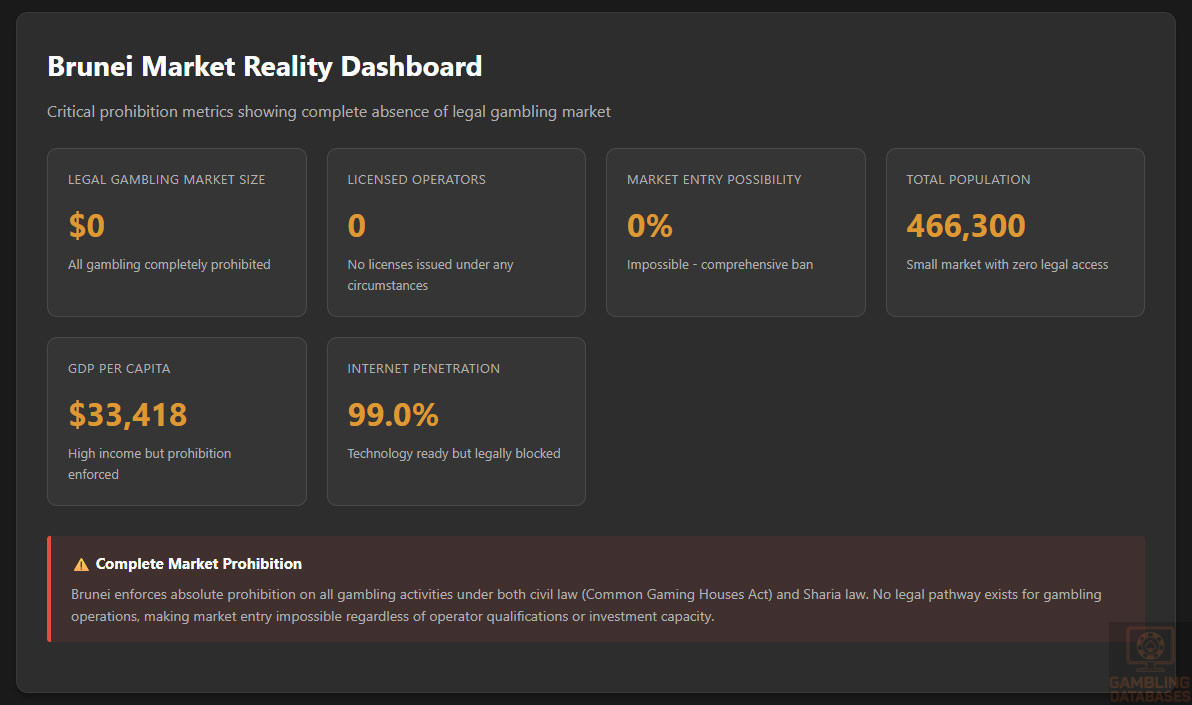
Executive Summary: Key Market Indicators
| Indicator Category | Metric | Value/Status |
|---|---|---|
| Legal Status | Gambling Legality | Completely Prohibited |
| Regulatory Framework | Land-Based Gambling | Illegal – Common Gaming Houses Act |
| Regulatory Framework | Online Gambling | Illegal – All Forms Prohibited |
| Regulatory Framework | Sports Betting | Illegal – No Exceptions |
| Regulatory Framework | Lotteries | Illegal Under All Circumstances |
| Licensing | Licensing Regime | Non-Existent – No Licenses Issued |
| Licensing | Licensing Authority | Ministry of Home Affairs (Enforcement Only) |
| Licensing | Application Cost | Not Applicable – No Applications Accepted |
| Penalties | Individual Gambling Offenses | Up to BND 10,000 Fine + 6 Months Imprisonment |
| Penalties | Operating Gambling Operations | Severe Penalties Under Civil and Sharia Law |
| Penalties | Foreign Nationals | Same Penalties as Citizens |
| Taxation | Gambling Tax Rate | Not Applicable – All Activities Illegal |
| Taxation | Winnings Tax | Not Applicable – No Legal Gambling |
| Demographics | Total Population | 466,300 (2025) |
| Demographics | Median Age | 32.7 Years |
| Demographics | Urban Population | 80.1% (373,730 People) |
| Demographics | Male Population | 53.1% (247,000) |
| Economy | GDP Per Capita | USD 33,418 (2024) |
| Economy | GDP Growth Rate | 2.5% Projected (2025) |
| Economy | Primary Economic Sector | Oil and Gas (90% Government Revenue) |
| Technology | Internet Penetration | 99.0% (460,000 Users) |
| Technology | Mobile Connections | 133% of Population (620,000 Connections) |
| Technology | Social Media Penetration | 64.4% (299,000 Users) |
| Technology | 5G Coverage | 90% of Populated Areas |
| Market Reality | Licensed Operators | Zero – None Permitted |
| Market Reality | Market Size | Zero – No Legal Market Exists |
| Market Reality | CAGR Forecast | Not Applicable – Permanent Prohibition |
| Market Reality | Average Revenue Per User | Zero – All Activities Illegal |
| Market Entry | Entry Possibility | Impossible – Comprehensive Ban |
| Market Entry | Regulatory Timeline | No Change Expected – Islamic Law Basis |
Section 1: Regulatory Framework and Legal Environment
Current Gambling Regulation Status
Brunei Darussalam enforces one of the world’s most comprehensive and严格 gambling prohibitions, operating under a dual legal system that combines English common law with Islamic Sharia law. All forms of gambling, gaming, betting, and wagering activities are strictly illegal throughout the country without exception. The prohibition applies universally to citizens, permanent residents, temporary visitors, and foreign nationals present within Brunei’s territory.

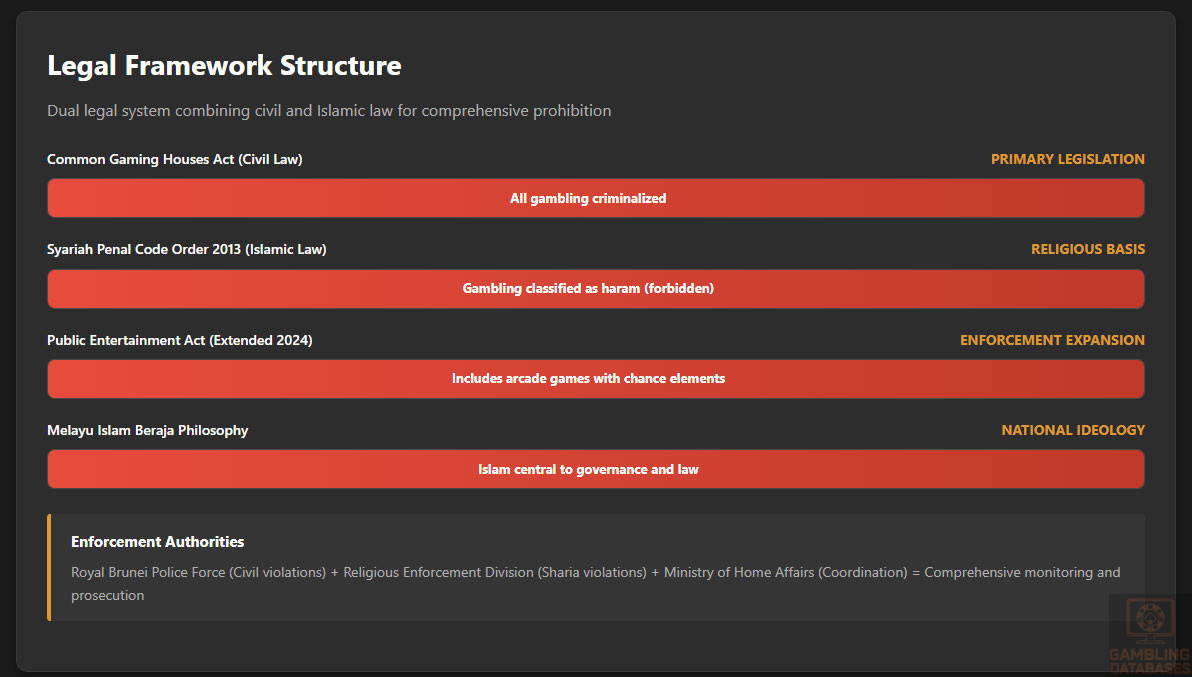
Since 2014, Brunei has progressively implemented the Syariah Penal Code Order 2013, which reinforces gambling prohibition through Islamic legal principles. Under Sharia law, gambling is explicitly classified as haram, meaning religiously forbidden and morally impermissible. The implementation of Sharia law has intensified enforcement and expanded the scope of prohibited activities to include any form of chance-based monetary gain.
The government’s commitment to maintaining this prohibition stems from the country’s official national philosophy of Melayu Islam Beraja, which emphasizes the centrality of Islam in daily life and governance. Sultan Hassanal Bolkiah, who has ruled since 1967, has strengthened the enforcement of Islamic principles in legislation, making gambling prohibition a permanent feature of the country’s legal landscape with no prospect of liberalization.
Land-Based Gambling Activities
Brunei prohibits all terrestrial gambling operations without exception. There are no legal casinos, gaming halls, betting shops, or lottery retailers operating within the country’s borders. The Common Gaming Houses Act specifically criminalizes the establishment, management, or operation of any premises used for gambling purposes. Property owners who knowingly allow their premises to be used for gambling activities face prosecution alongside operators and participants.
Traditional forms of gambling that exist in neighboring Southeast Asian countries are entirely absent from Brunei’s landscape. Casino gaming, slot machine operations, bingo halls, and poker rooms are prohibited under both civil and religious law. Sports betting venues, whether for international football matches or local sporting events, cannot legally operate. Even amusement arcades must carefully avoid any machines or games that could be construed as gambling devices.
Recent enforcement actions have expanded the definition of prohibited gambling activities to include devices previously considered entertainment. In 2024, authorities banned claw machines and similar arcade games under the Public Entertainment Act after determining these devices constituted gambling due to their chance-based prize distribution. This aggressive interpretation demonstrates the government’s commitment to preventing any activity that resembles gambling, regardless of nominal entertainment value.
Cockfighting and animal wagering, which historically occurred in some rural areas as traditional practices, remain illegal despite cultural significance. Law enforcement authorities conduct regular operations to identify and prosecute individuals engaged in such activities. The prohibition extends to informal betting circles, private gambling events, and social gaming involving money or valuable consideration.

Online Gambling Framework
Digital gambling platforms face the same comprehensive prohibition as land-based operations, with authorities treating online gambling as an extension of illegal gaming houses. The Common Gaming Houses Act’s prohibition on gambling applies regardless of the medium or technology used to facilitate wagering. Online casinos, sports betting websites, poker platforms, and lottery sites are all illegal to operate from within Brunei or to access from Brunei territory.
Brunei’s enforcement approach includes active monitoring of internet usage for gambling-related activities. The Royal Brunei Police Force and Religious Enforcement Division coordinate surveillance efforts to identify individuals accessing online gambling platforms. Authorities have seized computers and electronic devices used for online gambling, prosecuting users under the Common Gaming Houses Act. These enforcement actions apply equally to accessing international websites and participating in offshore gambling operations.
The government does not distinguish between skill-based and chance-based online gaming when determining illegality. Fantasy sports platforms, daily fantasy sports contests, esports betting, and online poker are all prohibited regardless of whether operators or participants claim skill predominates over chance. Social gaming applications that involve any form of monetary wagering or prize distribution face prohibition even when marketed as entertainment or social networking tools.
Internet service providers operating in Brunei may receive directives to block access to known gambling websites, though the extent of filtering varies. The small size of the country and concentrated population make physical enforcement more practical than comprehensive internet censorship. Authorities focus on prosecuting individuals caught gambling online rather than attempting to block all possible gambling websites, maintaining a deterrent effect through visible enforcement actions.
Licensed Operators and Market Players
Brunei’s gambling market contains zero licensed operators because the government does not issue gambling licenses under any circumstances. The concept of a regulated gambling industry does not exist within Brunei’s legal framework. There is no licensing authority, no application process, no regulatory oversight body for gambling operators, and no possibility of obtaining legal authorization to conduct gambling activities.
The Ministry of Home Affairs serves as the primary enforcement authority for gambling prohibitions rather than a regulatory body. This ministry coordinates with the Royal Brunei Police Force and the Sharia Court system to investigate violations, conduct raids on illegal gambling operations, and prosecute offenders. The State Mufti’s Office provides religious guidance that reinforces the secular prohibition, issuing fatwas that identify activities or devices constituting gambling under Islamic law.
No international gambling operators maintain legal presence in Brunei. Major global casino companies, sports betting brands, lottery operators, and online gambling platforms do not seek licenses or establish operations in the country because the legal framework provides no pathway to authorization. Foreign gambling websites that accept customers from other countries typically block registrations from Brunei IP addresses to avoid legal complications and maintain compliance with international banking regulations.
The absence of any legal gambling infrastructure means there is no market competition, no market share distribution among operators, and no competitive dynamics to analyze. Underground illegal gambling operations occasionally surface and face immediate law enforcement action. These illegal operations typically involve private betting circles for international sports events or clandestine poker games, but they exist entirely outside legal frameworks and participants face prosecution when discovered.
Licensing Framework and Requirements
Application Process and Eligibility
Brunei provides no mechanism for applying for gambling licenses because the government categorically refuses to authorize gambling operations. No application forms exist, no regulatory body reviews license applications, and no eligibility criteria have been established because gambling authorization contradicts fundamental government policy rooted in Islamic law. The concept of licensed gambling is incompatible with Brunei’s legal and religious framework.
Potential operators hoping to establish gambling operations in Brunei face absolute legal barriers rather than challenging but navigable regulatory requirements. The government’s position is not that gambling operations must meet stringent standards to obtain authorization, but rather that gambling operations cannot exist within Brunei under any circumstances. This represents a categorical prohibition rather than a regulated prohibition with exceptions or special circumstances.
Foreign gambling companies investigating Southeast Asian expansion opportunities find Brunei entirely closed to their business model. The country offers no special economic zones where gambling might be permitted, no carve-outs for tourist-focused casino resorts, no exemptions for online-only operations based outside physical territory, and no consideration of licensing regimes that exist in other Islamic countries. Brunei’s prohibition is absolute and applies uniformly to all gambling formats and business structures.
Local Presence and Operational Requirements
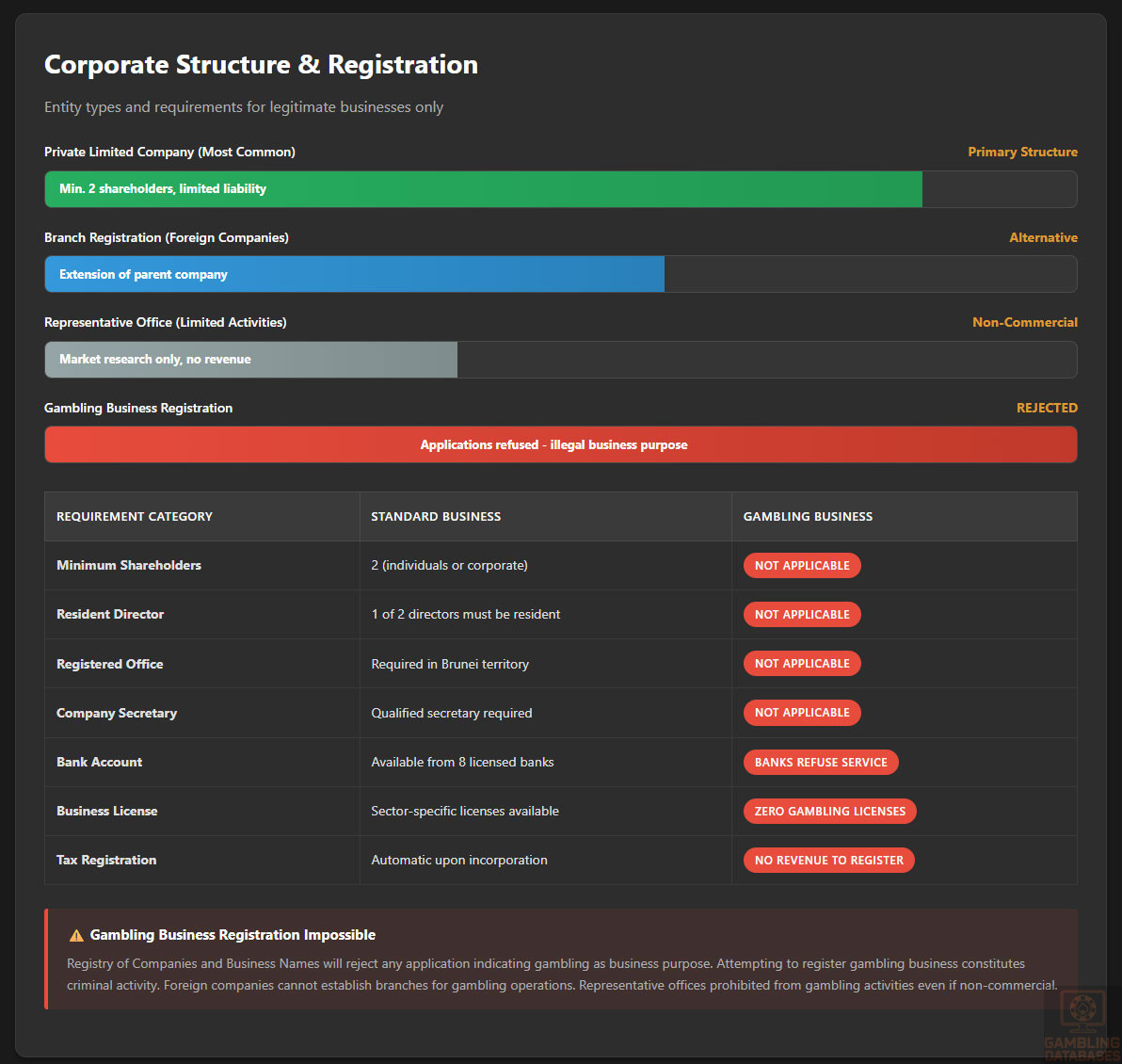
Because gambling operations cannot legally exist in Brunei, there are no local presence requirements, no operational standards to meet, and no compliance obligations for gambling operators. Attempting to establish local presence for gambling purposes would constitute criminal activity subject to prosecution. Foreign companies cannot register gambling businesses with the Registry of Companies and Business Names because such registrations would be rejected as illegal business purposes.
The prohibition extends to ancillary gambling services including payment processing for gambling transactions, advertising gambling services, and providing technical infrastructure for gambling platforms. Banks operating in Brunei will not process gambling-related transactions or provide services to known gambling operators. Payment service providers face restrictions against facilitating gambling payments, and businesses discovered processing gambling transactions risk license revocation and criminal prosecution.
Compliance Obligations and Monitoring
Player Protection and Identification
Brunei implements player protection through complete prohibition rather than regulatory frameworks for responsible gambling. The government’s position holds that the most effective player protection measure is preventing access to gambling entirely. There are no self-exclusion programs, deposit limit systems, responsible gambling helplines, or problem gambling treatment services because these would acknowledge the existence of legal gambling requiring such protections.
Age verification systems, know-your-customer procedures, and anti-money laundering requirements specific to gambling do not exist because gambling operations are illegal. However, Brunei maintains robust financial monitoring systems through the Autoriti Monetari Brunei Darussalam to prevent money laundering and terrorist financing. These systems focus on banking, remittance, and money changing sectors rather than gambling operations which have no legal presence.
Financial Monitoring and Reporting
Gambling operators have no financial monitoring or reporting obligations because they cannot legally exist. Banks and financial institutions must report suspicious transactions that might involve illegal gambling proceeds under anti-money laundering requirements. The Financial Intelligence Unit monitors transactions and works with law enforcement to investigate cases involving proceeds from gambling, fraud, or other illegal activities.
Taxation Structure and Financial Obligations
Player Taxation
Brunei does not tax gambling winnings because all gambling is illegal and any winnings would constitute proceeds of illegal activity subject to confiscation. The country has no personal income tax system, so even if gambling were legal, individual winnings would likely remain untaxed consistent with broader tax policy. However, this tax treatment is purely theoretical as gambling cannot legally occur.
Operator Taxation
Gambling operators face no tax obligations because they cannot legally operate. There are no gross gaming revenue taxes, no licensing fees, no gaming duties, and no special gambling-related taxes because the framework for imposing such taxes does not exist. The government generates no revenue from gambling activities and has rejected gambling as a revenue source despite its profitability in other jurisdictions.
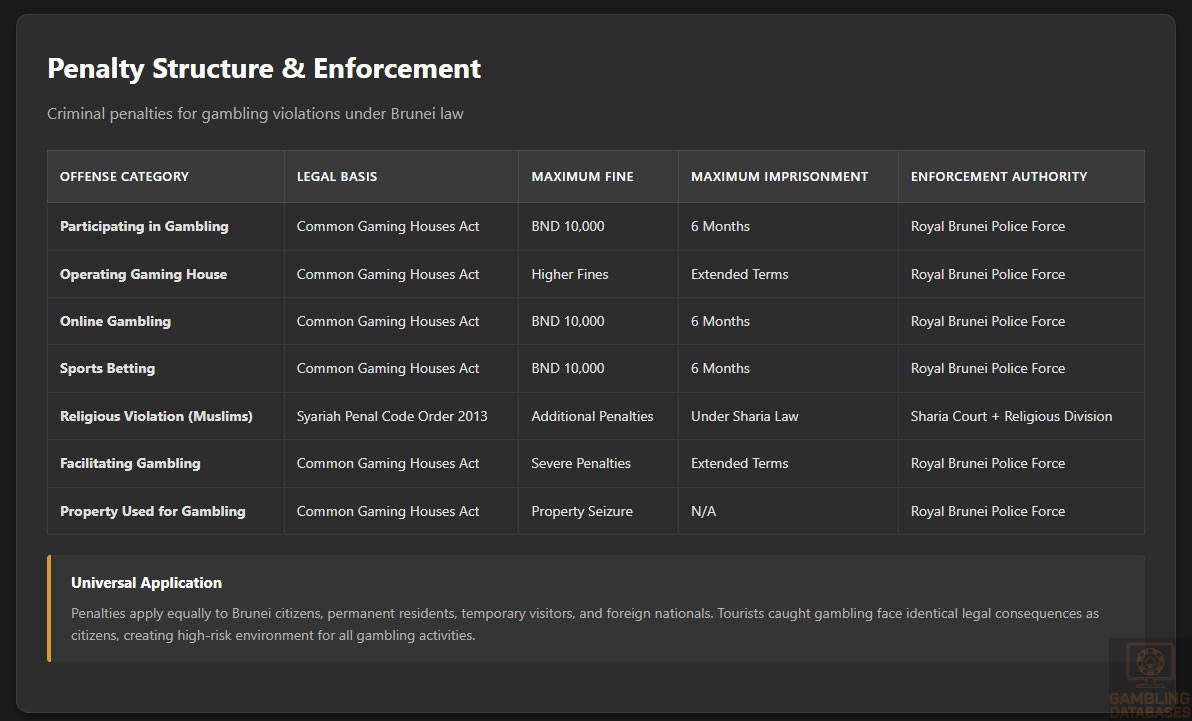
| Offense Category | Legal Basis | Maximum Penalty | Enforcement Authority |
|---|---|---|---|
| Participating in Gambling | Common Gaming Houses Act | BND 10,000 Fine + 6 Months Imprisonment | Royal Brunei Police Force |
| Operating Gaming House | Common Gaming Houses Act | Higher Fines + Extended Imprisonment | Royal Brunei Police Force |
| Online Gambling | Common Gaming Houses Act | BND 10,000 Fine + 6 Months Imprisonment | Royal Brunei Police Force |
| Sports Betting | Common Gaming Houses Act | BND 10,000 Fine + 6 Months Imprisonment | Royal Brunei Police Force |
| Religious Violation (Muslims) | Syariah Penal Code Order 2013 | Additional Sharia Law Penalties | Sharia Court + Religious Enforcement Division |
| Facilitating Gambling | Common Gaming Houses Act | Severe Penalties + Property Seizure | Royal Brunei Police Force |
Gambling Market Financial Performance
Brunei generates zero revenue from gambling because all gambling activities are prohibited. There is no legal gambling market to measure, no gross gaming revenue to report, no tax collections from gambling operations, and no economic contribution from gambling industry. The government’s prohibition eliminates gambling as an economic sector entirely.
Underground illegal gambling activity may occur despite prohibition, but such activity generates no tax revenue, provides no employment through legitimate channels, and contributes nothing to official economic statistics. Law enforcement efforts focus on eliminating illegal gambling rather than regulating or taxing it. Penalties collected from gambling prosecutions represent enforcement actions rather than ongoing revenue streams.
Advertising and Marketing Restrictions
Brunei prohibits all gambling advertising, marketing, and promotional activities without exception. The ban extends to advertisements for foreign gambling operators, sponsored content promoting gambling websites, social media marketing for betting applications, and any form of gambling brand visibility. Media outlets, websites, and advertising platforms operating in Brunei cannot accept gambling-related advertising regardless of advertiser location or target audience.
The prohibition includes indirect gambling promotion through sponsorships, branded entertainment, affiliate marketing, and influencer partnerships. Sports teams cannot accept sponsorships from gambling companies, events cannot feature gambling brand logos, and content creators face restrictions against promoting gambling services to Brunei audiences. These restrictions apply regardless of whether the promoted gambling service is legal in other jurisdictions.
Foreign media accessible in Brunei that contains gambling advertising does not violate domestic law, but domestic distributors cannot actively promote or facilitate access to gambling-related content. International sports broadcasts featuring gambling advertisements are not censored, but Brunei-based advertisers cannot purchase gambling-related commercial time and domestic media cannot carry gambling promotions.
Recent Regulatory Changes and Their Impact
Brunei’s regulatory approach to gambling has remained consistently prohibitionist with enforcement intensifying rather than relaxing over time. The most significant development occurred with the progressive implementation of the Syariah Penal Code beginning in 2014 and completing in 2019. This implementation strengthened the religious basis for gambling prohibition and expanded enforcement authority to include Sharia Court jurisdiction alongside civil courts.
In 2024, authorities extended gambling prohibition to claw machines and similar arcade devices, demonstrating an expansive interpretation of what constitutes gambling. This regulatory action signals the government’s vigilance in preventing activities that blur the line between entertainment and gambling. The willingness to classify ambiguous activities as prohibited gambling indicates an enforcement philosophy of eliminating gray areas rather than creating carve-outs for borderline activities.
There have been no regulatory changes moving toward liberalization, no pilot programs for regulated gambling, no discussions of licensing frameworks for controlled operations, and no indication that Brunei will reconsider its prohibition. The government’s commitment to Islamic principles in governance makes gambling legalization politically and religiously impossible under current leadership and constitutional structure.
Enforcement Mechanisms and Penalties
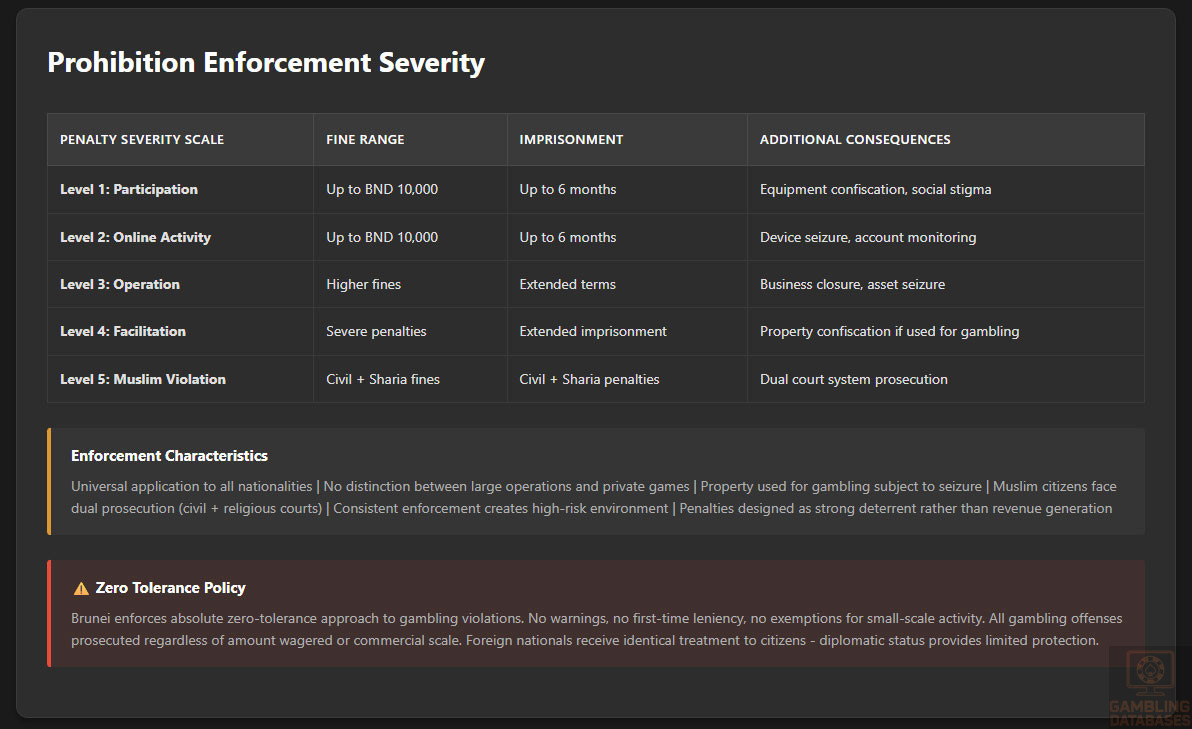
Brunei enforces gambling prohibition through coordinated efforts between civil and religious authorities. The Royal Brunei Police Force conducts investigations, raids illegal gambling operations, and prosecutes offenders under the Common Gaming Houses Act. The Religious Enforcement Division monitors compliance with Islamic law including gambling prohibitions, particularly for Muslim citizens subject to Sharia Court jurisdiction. These enforcement bodies cooperate to ensure comprehensive coverage of gambling-related offenses.
Enforcement actions include surveillance of suspected gambling locations, monitoring of internet usage for online gambling activity, seizure of gambling equipment and winnings, arrest and prosecution of operators and participants, and confiscation of property used for gambling purposes. Authorities do not differentiate between large-scale commercial operations and small private games when applying penalties, treating all gambling activities as serious offenses warranting prosecution.
The government maintains strict enforcement against both Brunei citizens and foreign nationals. Tourists caught gambling face the same penalties as residents, and diplomatic status provides limited protection from gambling prosecutions. This universal application of prohibition serves as a strong deterrent to both domestic and international gambling activity within Brunei territory.
Penalties for gambling offenses can include substantial fines reaching BND 10,000, imprisonment for up to six months or longer for operating offenses, confiscation of gambling proceeds and equipment, and for Muslim citizens, additional penalties under Sharia law. The severity of penalties and consistency of enforcement create a high-risk environment for any gambling-related activity, making illegal gambling operations financially and personally dangerous for participants and operators.
Section 2: Demographics and Consumer Analysis
Population Demographics and Distribution
Core Population Metrics
Brunei Darussalam maintains a relatively small population of approximately 466,300 people as of 2025, ranking it among the world’s smaller nations at 176th globally. The population demonstrates steady but modest growth at an annual rate of approximately 0.75 percent, reflecting the country’s developed economy status and demographic transition toward lower birth rates. This small population size fundamentally limits market potential for any consumer service including hypothetical gambling operations.
The population exhibits a young demographic profile with a median age of 32.7 years, indicating a substantial working-age cohort that in other markets might represent prime gambling demographics. Age distribution shows balanced proportions across working-age categories, with significant populations in the 25-54 age ranges that typically demonstrate highest gambling participation in markets where such activities are legal. However, these favorable demographic characteristics remain irrelevant given absolute gambling prohibition.
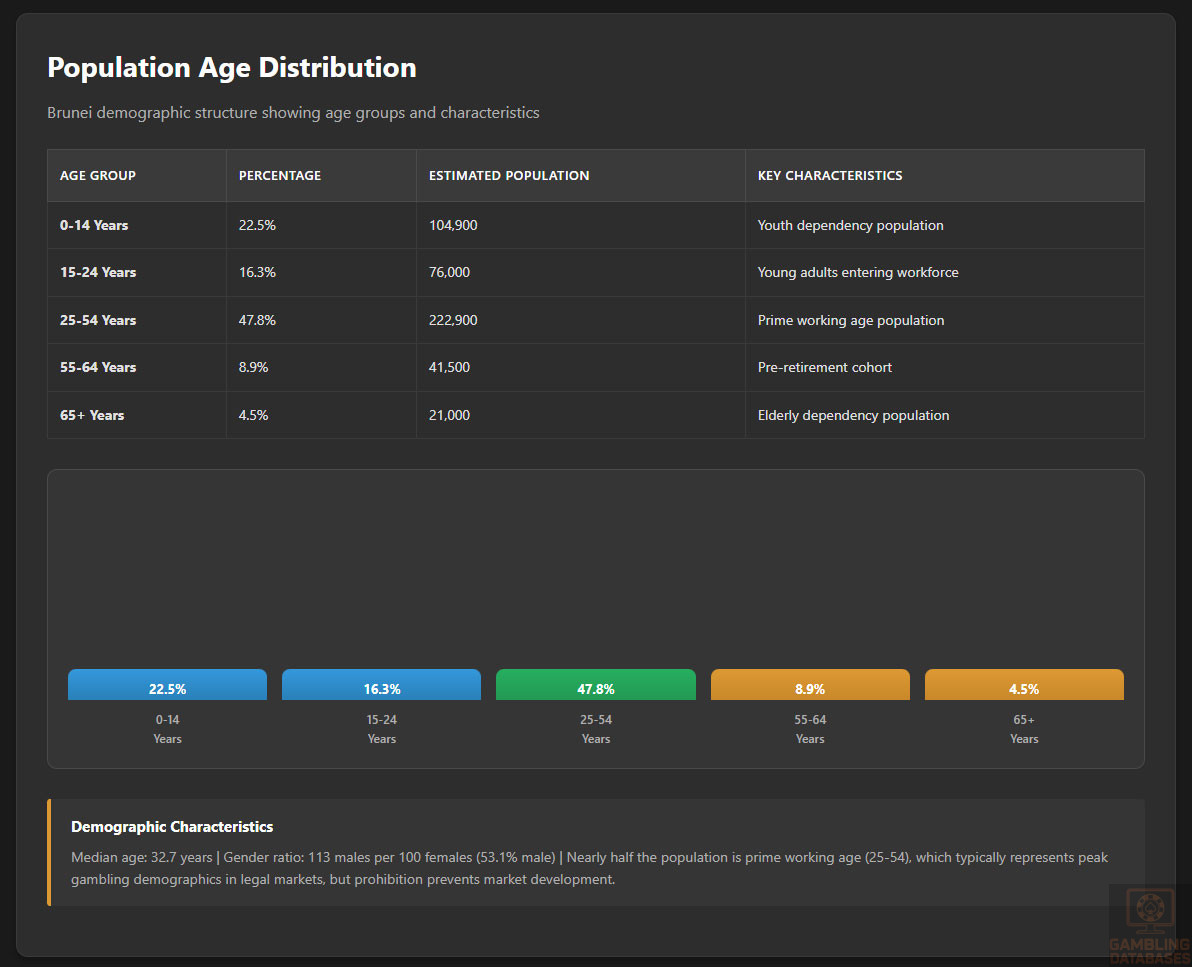
Gender distribution in Brunei skews notably male with 53.1 percent of the population being male compared to 46.9 percent female, creating a gender ratio of 113 males per 100 females. This male predominance differs from most developed countries and reflects labor migration patterns bringing foreign male workers to the oil and gas sector. In gambling markets globally, male populations typically demonstrate higher participation rates, but this demographic advantage cannot be leveraged in Brunei’s prohibition environment.
| Age Group | Percentage of Population | Estimated Population | Key Characteristics |
|---|---|---|---|
| 0-14 Years | 22.5% | 104,900 | Youth dependency population |
| 15-24 Years | 16.3% | 76,000 | Young adults entering workforce |
| 25-54 Years | 47.8% | 222,900 | Prime working age population |
| 55-64 Years | 8.9% | 41,500 | Pre-retirement cohort |
| 65+ Years | 4.5% | 21,000 | Elderly dependency population |
Geographic Distribution
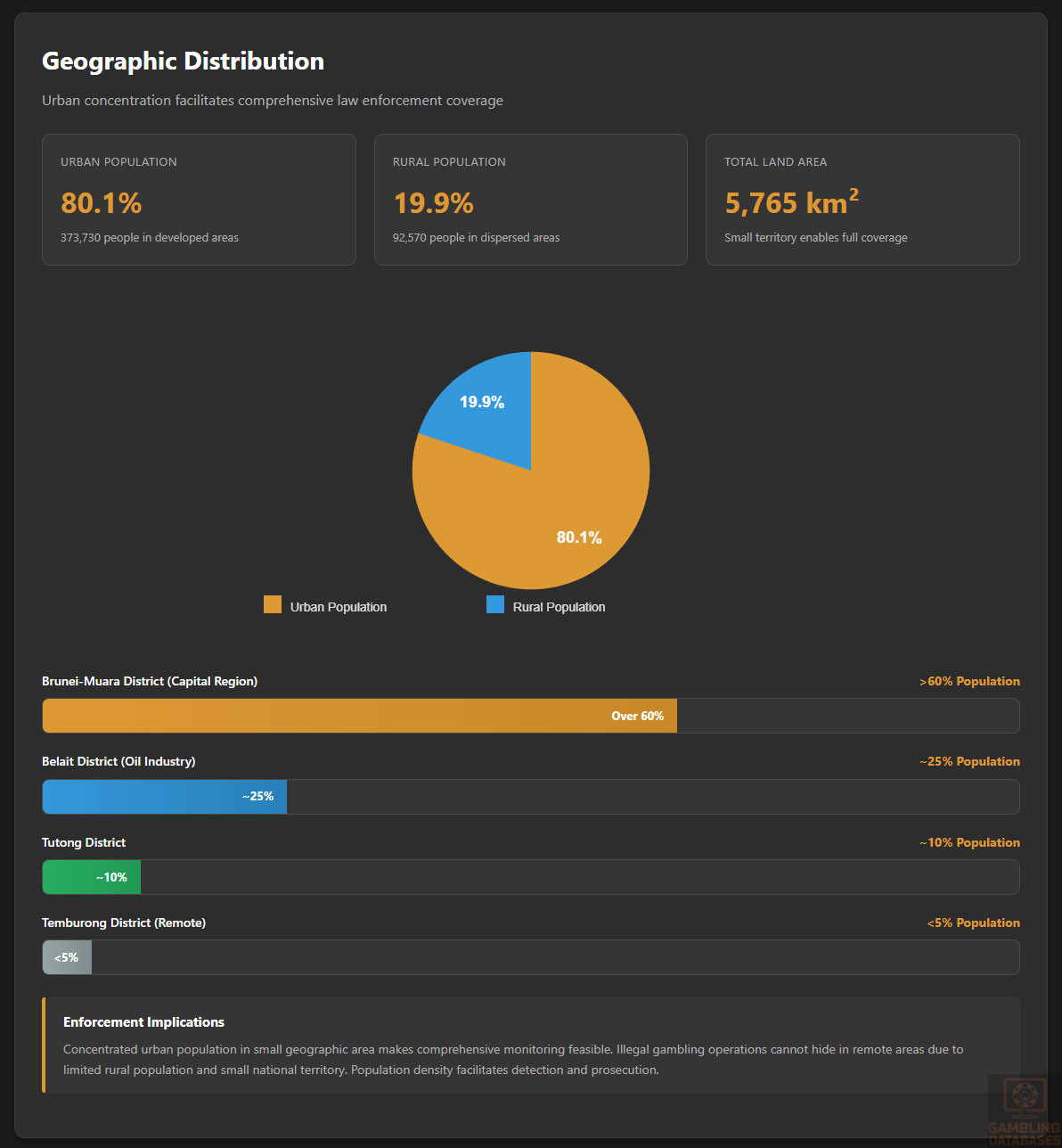
Brunei demonstrates high urbanization with 80.1 percent of the population residing in urban areas, totaling approximately 373,730 people concentrated in developed centers. The urban concentration simplifies infrastructure development and service delivery but also facilitates law enforcement monitoring of gambling activities. The capital Bandar Seri Begawan and surrounding Brunei-Muara District contain more than half the country’s population, creating a dense urban core where any illegal gambling operations would face rapid detection.
The country divides administratively into four districts with vastly different population densities. Brunei-Muara District dominates with over 60 percent of national population, followed by Belait District housing oil industry workers, Tutong District with moderate population, and Temburong District remaining sparsely populated and geographically separated from the western districts. This concentrated settlement pattern means that monitoring for illegal activities including gambling requires coverage of limited geographic area.
Rural populations account for less than 20 percent of inhabitants, primarily residing in Temburong District’s mountainous interior and small villages throughout other districts. The small rural population and limited geographic dispersal mean that gambling operations cannot hide in remote areas beyond law enforcement reach. The country’s small total land area of 5,765 square kilometers makes comprehensive law enforcement coverage feasible unlike in larger countries where remote regions may escape monitoring.
Economic Indicators and Consumer Spending Power
GDP and Economic Performance
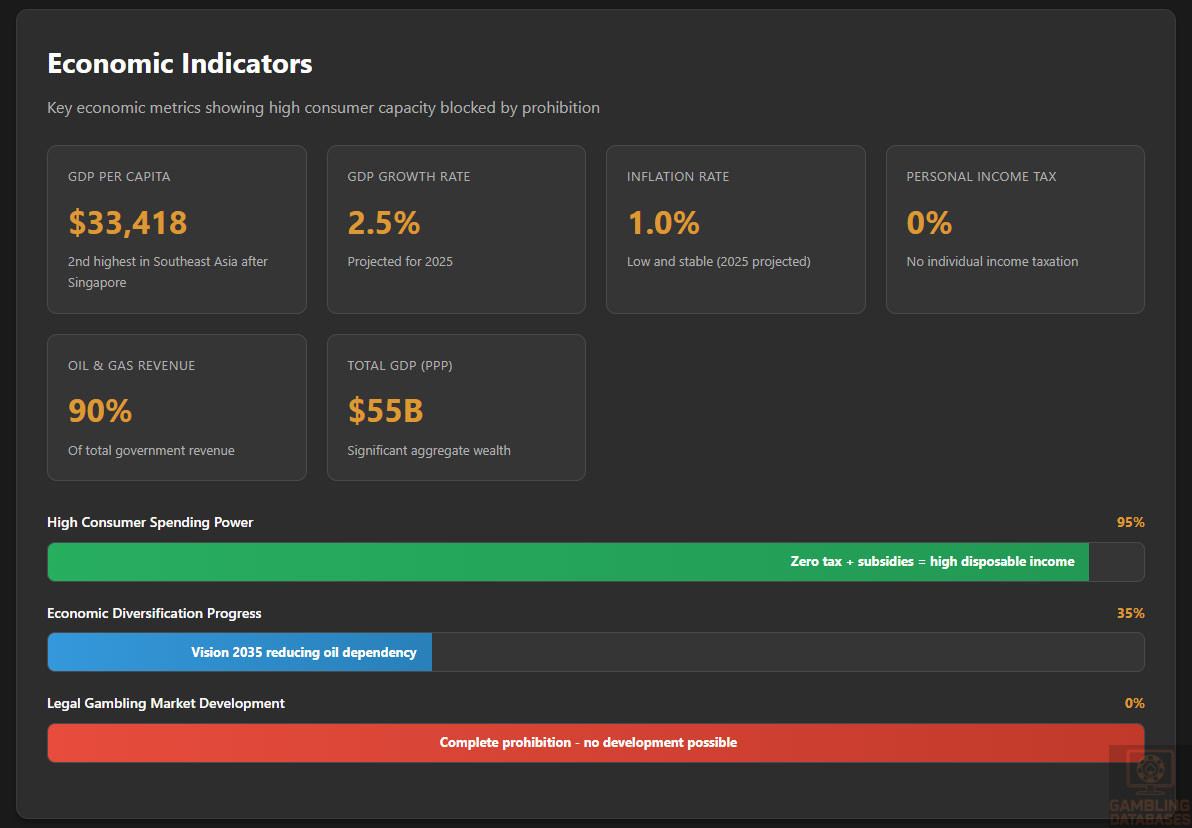
Brunei maintains a high-income economy with GDP per capita of USD 33,418 as of 2024, placing it among the wealthier nations globally and the highest in Southeast Asia after Singapore. The country’s wealth derives primarily from extensive petroleum and natural gas reserves that account for approximately 90 percent of government revenue and over half of GDP. This oil-dependent economy provides citizens with substantial income levels that would support significant gambling expenditure if such activities were legal.
Economic growth projections for 2025 estimate GDP expansion of 2.5 percent with inflation remaining controlled at approximately 1.0 percent annually. The government actively pursues economic diversification to reduce dependence on hydrocarbon exports through Vision 2035, promoting development in downstream industries, tourism, financial services, and technology sectors. Despite diversification efforts, oil and gas remain dominant, and economic performance remains sensitive to global energy prices.
The total GDP approaches USD 55 billion at purchasing power parity, generating significant aggregate wealth despite small population size. Per capita GDP projections suggest continued growth reaching USD 43,628 by 2029, indicating sustained prosperity that would typically support robust consumer spending on entertainment and gaming in jurisdictions where such activities are legal. However, religious and legal prohibitions prevent this economic capacity from translating into gambling market potential.
Income and Wealth Distribution
Brunei provides extensive social welfare through government subsidies covering housing, healthcare, and education, creating relatively equitable living standards despite income variation. The absence of personal income tax means citizens retain higher proportions of earnings compared to countries with progressive taxation, increasing disposable income available for discretionary spending. Government employment provides stable middle-class incomes for significant portions of the workforce, while oil industry positions offer premium compensation.
Wealth concentration exists among business elites and the royal family, but broad-based prosperity through government welfare programs prevents extreme inequality. The government subsidizes essential goods including fuel, housing, and utilities, reducing cost of living and increasing disposable income across income brackets. This combination of high average incomes, low taxation, and subsidized essentials creates substantial consumer spending power that could hypothetically support gambling expenditure in a legal market environment.
Foreign workers comprise approximately 30 percent of the labor force, primarily in oil and gas, construction, and service sectors. These workers typically earn lower incomes than citizens but still maintain spending capacity. However, foreign workers face particular vulnerability to gambling prosecutions and typically avoid illegal activities that could jeopardize employment visas and work permits, eliminating this demographic as potential gambling customers.
Market Size and Growth Projections
The gambling market in Brunei is zero with no legal operations, no licensed operators, no registered users, no gross gaming revenue, and no growth trajectory. There is no addressable market to analyze because gambling activities cannot legally occur. Underground illegal gambling may exist in limited forms, but such activity generates no measurable economic data, contributes nothing to official statistics, and faces elimination through law enforcement rather than growth potential.
Hypothetical market potential based on demographic and economic factors is irrelevant because legal and religious prohibitions create insurmountable barriers to market development. Even if Brunei’s population demonstrated strong propensity for gambling when traveling to legal jurisdictions, this demand cannot be served domestically and will not generate in-country revenue. The absence of any legal gambling market means concepts like compound annual growth rate, market penetration, and revenue per user have no application to Brunei’s context.
| Economic Indicator | Value (2024-2025) | Regional Comparison | Gambling Market Relevance |
|---|---|---|---|
| GDP Per Capita (USD) | 33,418 | 2nd Highest in Southeast Asia | High Consumer Spending Power (Theoretical Only) |
| GDP Growth Rate | 2.5% (2025 Projected) | Moderate Compared to Regional Average | No Market Development Possible |
| Inflation Rate | 1.0% (2025 Projected) | Low and Stable | Supports Spending Power But Irrelevant |
| Personal Income Tax | 0% | Among Lowest Globally | High Disposable Income Cannot Be Leveraged |
| Total Population | 466,300 | Smallest in Southeast Asia | Market Too Small Even If Legal |
| Urban Population | 80.1% | High Urbanization | Easy Law Enforcement Coverage |
| Legal Gambling Market Size | USD 0 | Only Country With Zero Market | Complete Prohibition Enforced |
Education, Skills, and Digital Literacy
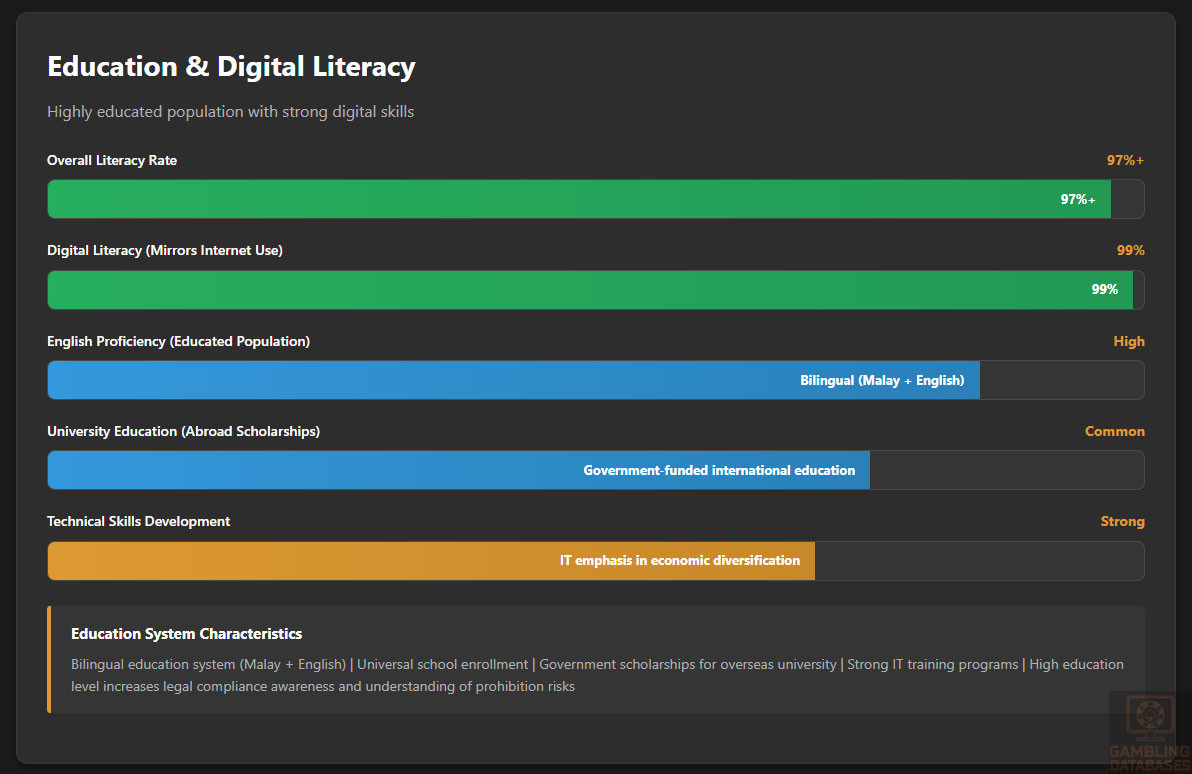
Brunei maintains high literacy rates exceeding 97 percent across the population, reflecting strong investment in education and universal school enrollment. The education system operates in both Malay and English, producing bilingual graduates with strong communication skills. Government scholarships fund university education abroad for qualified students, creating a well-educated workforce with international exposure. This high education level translates to strong digital literacy and technological adoption.
The workforce demonstrates significant technical skills development through government training programs and oil industry requirements. Information technology education receives particular emphasis as part of economic diversification strategy. Digital literacy rates mirror internet penetration at near-universal levels, with populations comfortable using smartphones, online services, and digital payment systems. This technological competence would support online gambling adoption if such activities were legal.
English proficiency among educated populations facilitates access to international content and services. University graduates commonly speak English fluently alongside Malay, enabling navigation of English-language websites and applications. This bilingual capacity means language barriers would not impede access to international gambling platforms if prohibition were not enforced. However, high education levels also correlate with awareness of legal risks and stronger compliance with prohibition.
Cultural and Social Factors
Communication and Language
Malay serves as the official language and primary medium for government communications, religious instruction, and cultural expression. English functions as a co-official language dominant in business, higher education, and technical fields. Most urban Bruneians operate comfortably in both languages with code-switching common in daily conversation. Chinese dialects persist among the ethnic Chinese minority comprising approximately 11 percent of the population.
Internet content consumption occurs predominantly in English with significant Malay-language usage for local news and social media. The bilingual population accesses international English-language entertainment, news, and online services without difficulty. This linguistic accessibility means Bruneians can easily access foreign gambling websites if they choose to violate prohibition, but legal risks and cultural values provide stronger deterrents than language barriers.
Cultural Attitudes
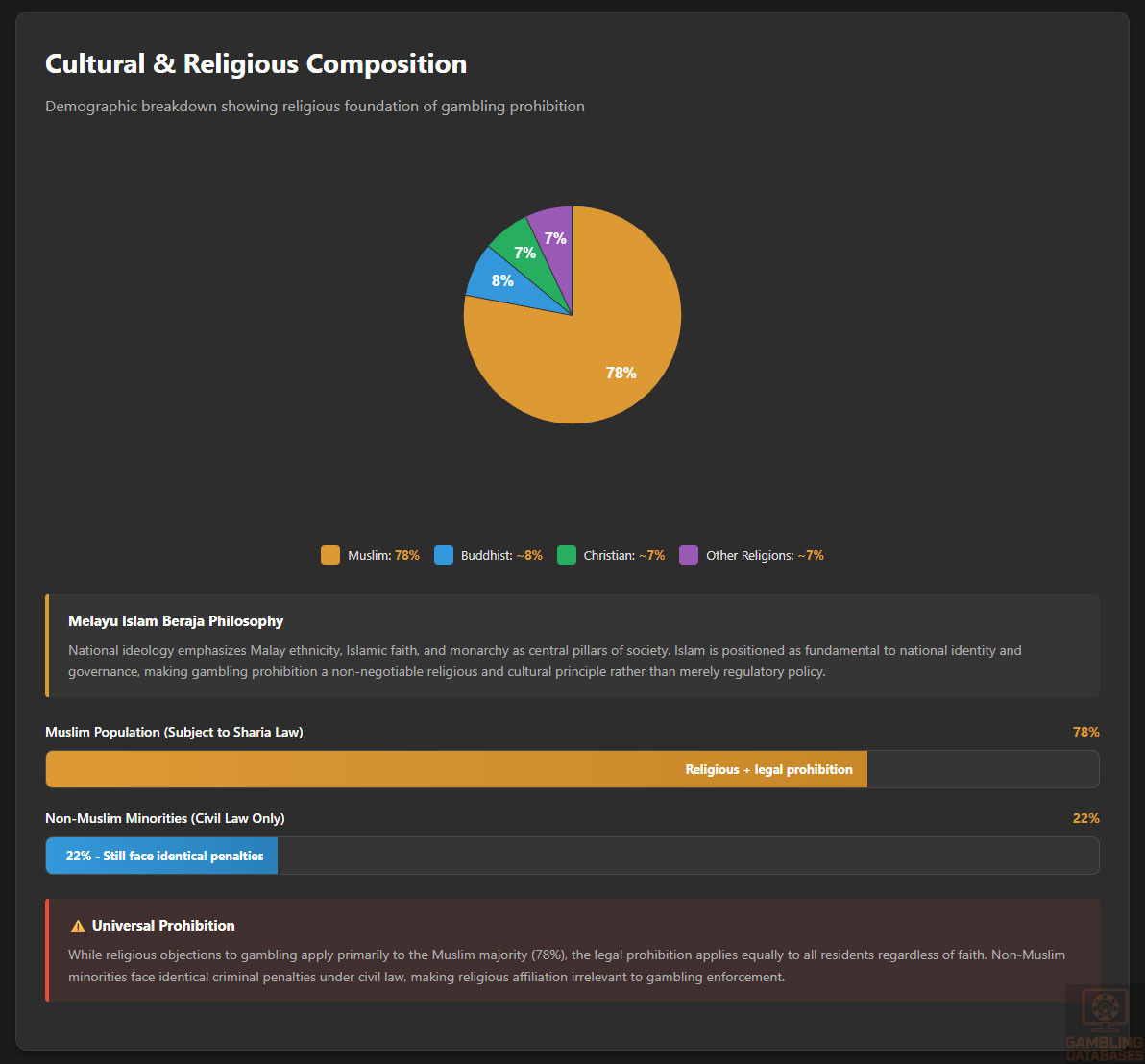
Brunei’s culture strongly emphasizes Islamic values through the government’s Melayu Islam Beraja philosophy that positions Islam as central to national identity and daily life. Religious teachings condemning gambling as haram permeate society through mosque sermons, religious education, and government messaging. For the Muslim majority comprising approximately 78 percent of the population, gambling prohibition carries religious significance beyond mere legal compliance, creating genuine moral opposition to gambling activities.
The conservative social environment discourages behaviors perceived as un-Islamic or Western. Public opinion generally supports gambling prohibition as consistent with religious values and social stability. Unlike in some Muslim-majority countries where secular segments of society question religious restrictions, Brunei’s small size and tight-knit communities create strong social pressure for compliance with Islamic norms. Individuals caught gambling face not only legal penalties but social stigma and family disapproval.
Non-Muslim minorities including Buddhists, Christians, and followers of traditional Chinese religions comprise approximately 22 percent of the population. While these communities may not share religious objections to gambling, they live within the same legal framework and face identical penalties for violations. The absolute nature of Brunei’s prohibition means religious beliefs about gambling become irrelevant as legal prohibition applies universally regardless of individual faith.
Foreign brands and international products enjoy acceptance in Brunei’s consumer market, but this openness does not extend to gambling services. The population distinguishes between acceptable foreign goods like electronics and automobiles versus prohibited activities like gambling and alcohol sales. Entertainment preferences trend toward shopping, dining, travel to neighboring countries, and digital content consumption through streaming services, with gambling explicitly excluded from acceptable leisure activities.
Problem Gambling and Social Considerations
Brunei maintains no statistical data on problem gambling prevalence because gambling activities are prohibited and no legal gambling occurs to generate problem gambling cases. The government’s prevention approach relies on complete prohibition rather than harm reduction strategies employed in jurisdictions with legal gambling. There are no problem gambling treatment programs, no gambling addiction helplines, no counseling services for gamblers, and no self-exclusion registries because these would acknowledge legal gambling requiring such interventions.
Public health authorities do not identify gambling as a social issue requiring intervention because prohibition theoretically eliminates gambling behavior. Any gambling addiction cases that develop from illegal activity or overseas gambling likely go unreported due to legal risks of disclosure. Mental health services operate within broader frameworks not specifically tailored to gambling-related disorders. The absence of treatment infrastructure reflects the government’s position that prohibition prevents gambling harm rather than merely managing it.
Social responsibility requirements for gambling operators do not exist because operators cannot legally function. There are no mandatory contributions to problem gambling research, no requirements for responsible gambling messaging, no obligations to fund treatment services, and no player protection standards because the regulatory framework for imposing such requirements is absent. The government views prohibition itself as the ultimate social responsibility measure.
Political Structure and Governance
Brunei operates as an absolute monarchy under Sultan Hassanal Bolkiah, who serves simultaneously as head of state, head of government, prime minister, and minister of defense. The sultan wields comprehensive executive authority with limited institutional constraints, enabling rapid policy implementation but also concentrating power in a single leader. This governance structure means gambling policy reflects the sultan’s commitment to Islamic principles without requiring legislative approval or public referendums.
The political system lacks democratic elections for national leadership positions. The Legislative Council functions in a purely consultative capacity with all members appointed by the sultan. This authoritarian structure ensures policy continuity and prevents political movements from challenging gambling prohibition. There is no electoral process through which pro-gambling constituencies could advocate for policy changes, and no organized political opposition exists to question government positions on social issues.
Political stability remains high with the House of Bolkiah maintaining rule since independence from Britain in 1984 and the current sultan reigning since 1967. This stability creates predictable policy environments for businesses but also ensures that fundamental policies like gambling prohibition face no prospect of reversal through political transition. International relations emphasize ASEAN cooperation and Islamic solidarity, neither of which creates pressure for gambling liberalization.
Technology Adoption and Digital Behavior
Internet and Digital Usage
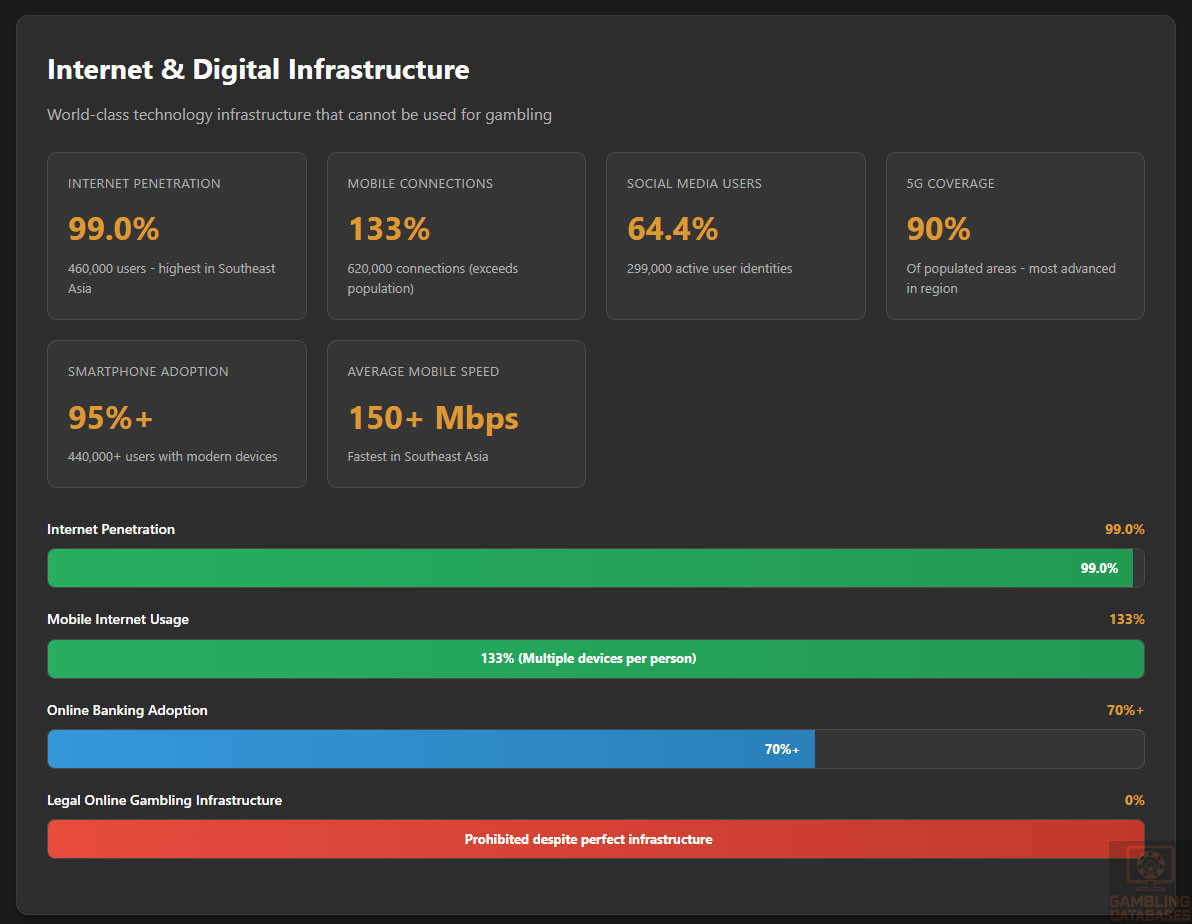
Brunei achieves exceptional internet penetration at 99.0 percent of the population as of January 2025, placing it among the world’s most connected societies. Approximately 460,000 individuals access the internet regularly from a population of 466,300, indicating near-universal connectivity across all demographics. This exceptional penetration reflects strong telecommunications infrastructure, affordable internet services, and government digital transformation initiatives promoting online services.
Mobile internet access dominates with 620,000 cellular mobile connections active in early 2025, equivalent to 133 percent of the population. This figure exceeds population due to individuals maintaining multiple connections for personal and work purposes and the prevalence of eSIM technology enabling easy management of multiple numbers. Mobile-first internet usage patterns mirror global trends with smartphones serving as primary devices for accessing online services, social media, and digital content.
Internet usage intensity shows Bruneians spending substantial time online daily for communication, entertainment, shopping, and information seeking. Social media penetration reaches 64.4 percent with 299,000 active user identities engaging on platforms like Facebook, Instagram, WhatsApp, and TikTok. This active digital engagement demonstrates comfort with online platforms and digital transactions that would facilitate online gambling adoption if legal restrictions did not exist.
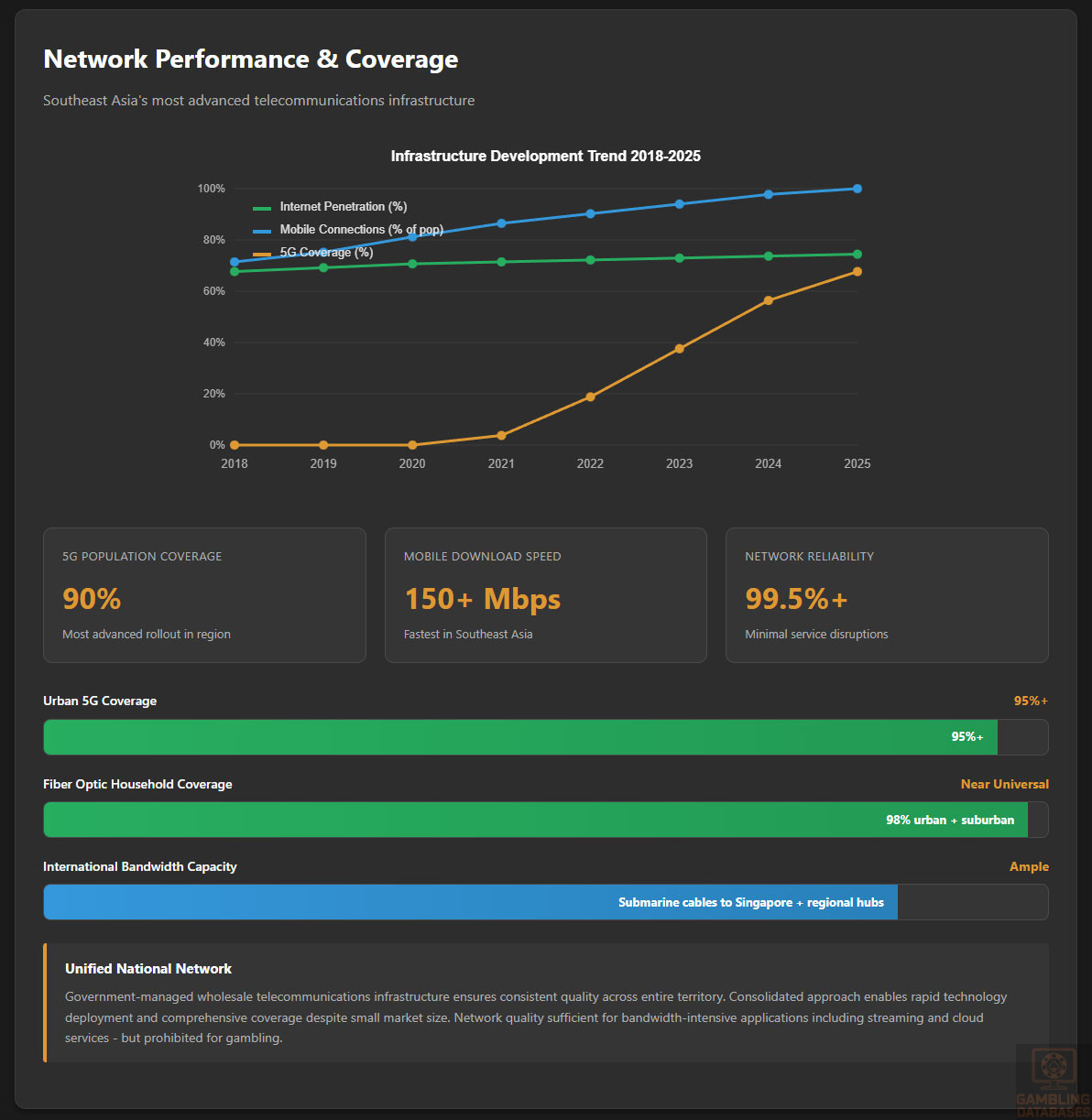
The country achieved a major milestone in internet infrastructure development with 5G networks covering approximately 90 percent of populated areas, providing Southeast Asia’s fastest mobile internet speeds. The Unified National Network integrates telecommunications infrastructure under a single wholesale network operated by government authority, ensuring consistent service quality and coverage. This advanced infrastructure supports high-bandwidth applications including video streaming, online gaming, and potentially gambling if prohibition were lifted.
Digital Payment Behavior
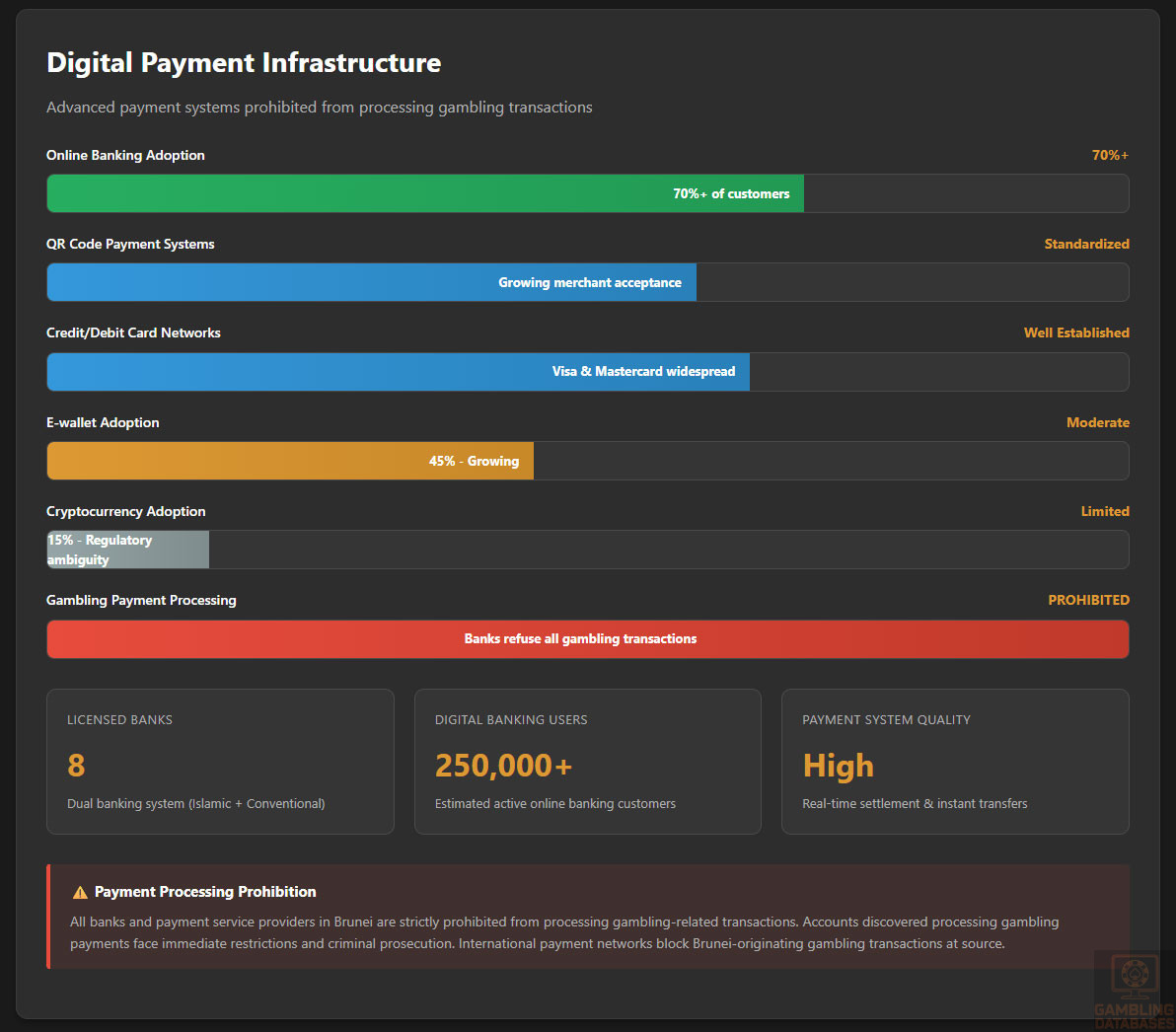
Brunei’s digital payment ecosystem has evolved significantly with widespread adoption of online banking, mobile payment applications, and contactless payment methods. Major banks including Bank Islam Brunei Darussalam, Baiduri Bank, and Perbadanan Tabung Amanah Islam Brunei offer comprehensive digital banking services enabling account management, bill payments, and transfers through mobile applications and web portals. Online banking adoption exceeds 70 percent of banking customers, reflecting strong digital payment comfort.
The government introduced standardized QR code payment systems to facilitate merchant transactions and reduce cash dependency. Major banks support QR code payments through their mobile banking applications, enabling customers to pay merchants by scanning codes. Real-time gross settlement systems and automated clearing house infrastructure support instant bank transfers, making digital payments as convenient as cash transactions. The Brunei Darussalam Central Bank oversees payment system development, promoting digital payment adoption as part of broader financial sector modernization.
Credit and debit card penetration remains moderate with Visa and Mastercard networks well-established but cash still preferred for small transactions. Cards see primary usage for larger purchases, online shopping, and international transactions. E-wallet adoption has grown with services like Baiduri’s digital wallet and regional payment applications gaining users. Mobile payment solutions integrate with telecommunications providers, though adoption lags behind the more developed e-wallet markets in Singapore and Malaysia.
Cryptocurrency awareness exists among technology-savvy segments but regulatory frameworks remain undeveloped. The central bank has not authorized cryptocurrency exchanges or provided clear guidance on digital asset legality. This regulatory ambiguity limits cryptocurrency adoption for payments, though some individuals hold digital assets through foreign exchanges. The combination of advanced digital payment infrastructure and high digital literacy would support gambling payment processing if operations were legal, but prohibition prevents this infrastructure from serving gambling purposes.
Gaming and Gambling Preferences
Current Market Participation
Legal gambling market participation in Brunei is zero because all gambling activities are prohibited. There are no surveys measuring gambling participation rates, no data on preferred gambling activities, no statistics on gambling expenditure, and no market research on gambling preferences because conducting such research would acknowledge illegal activity. Any gambling behavior occurs through illegal channels either domestically through underground operations or internationally when Bruneians travel to jurisdictions with legal gambling.
Anecdotal reports suggest some Bruneians engage in gambling when traveling to neighboring Malaysia and Singapore, where casinos and legal gambling venues operate. Marina Bay Sands and Resorts World Sentosa in Singapore attract regional visitors including some from Brunei, though Bruneian visitor numbers remain small relative to tourists from Malaysia, Indonesia, and China. Travel-based gambling generates no domestic economic benefit and leaves no measurable data within Brunei’s statistics.
Underground illegal gambling likely focuses on sports betting for international football matches, as these events generate global interest and betting markets. Private betting circles may operate clandestinely for major tournaments like the FIFA World Cup and English Premier League matches. However, such activity remains limited due to enforcement risks and strong social stigma. The absence of organized illegal gambling infrastructure prevents development of substantial underground markets despite prohibition.
Consumer Behavior Patterns
Because legal gambling does not exist in Brunei, there are no consumer behavior patterns to analyze regarding gambling spending, platform preferences, peak usage times, session lengths, or retention patterns. Entertainment spending directs toward legal activities including dining, shopping, international travel, cinema, and digital content subscriptions. The absence of legal gambling channels means consumer behavior around risk-taking and chance-based entertainment cannot manifest in gambling contexts.
Digital entertainment consumption focuses on streaming services, mobile gaming without gambling mechanics, social media, and e-commerce. Bruneians demonstrate willingness to subscribe to international digital services including Netflix, Spotify, and gaming platforms, showing comfort with online payments for entertainment. This digital consumption behavior would translate readily to online gambling if prohibition were lifted, but current behavior patterns provide no indication of gambling preferences due to complete market absence.
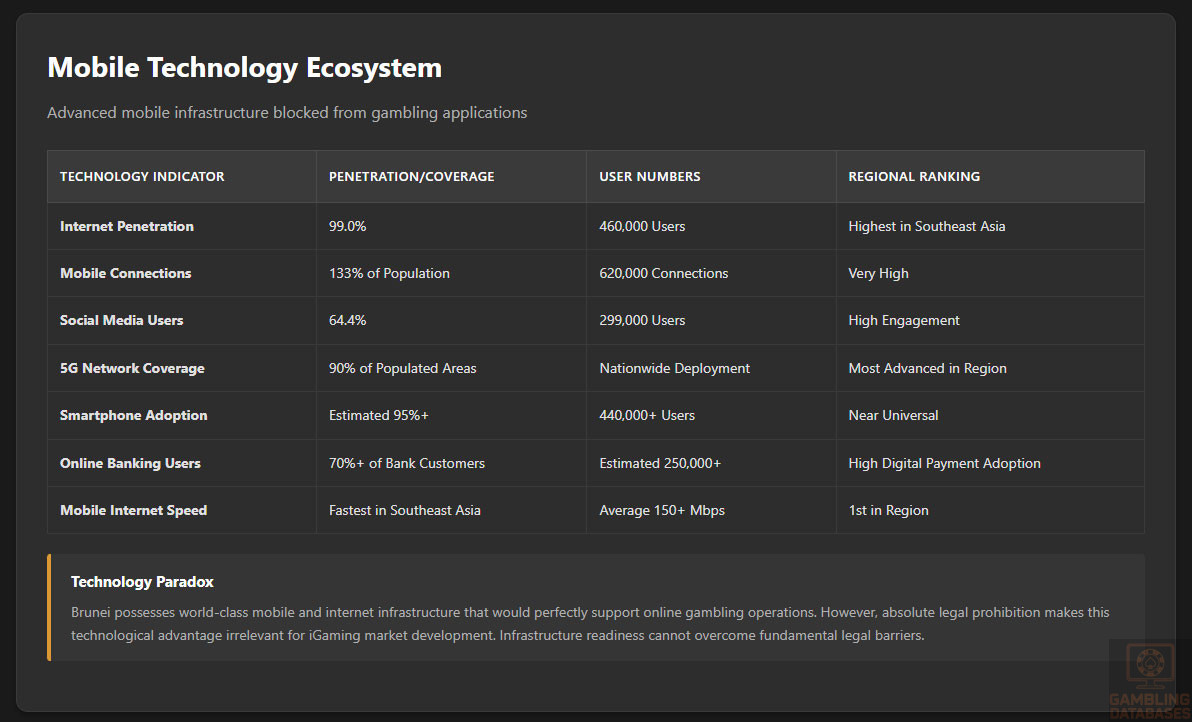
| Technology Indicator | Penetration/Coverage | User Numbers | Regional Ranking |
|---|---|---|---|
| Internet Penetration | 99.0% | 460,000 Users | Highest in Southeast Asia |
| Mobile Connections | 133% of Population | 620,000 Connections | Very High |
| Social Media Users | 64.4% | 299,000 Users | High Engagement |
| 5G Network Coverage | 90% of Populated Areas | Nationwide Deployment | Most Advanced in Region |
| Smartphone Adoption | Estimated 95%+ | 440,000+ Users | Near Universal |
| Online Banking Users | 70%+ of Bank Customers | Estimated 250,000+ | High Digital Payment Adoption |
| Mobile Internet Speed | Fastest in Southeast Asia | Average 150+ Mbps | 1st in Region |
Section 3: Technology Infrastructure and Business Environment
Internet and Digital Infrastructure
Connectivity and Network Performance
Brunei’s telecommunications infrastructure represents one of Southeast Asia’s most advanced networks with the Unified National Network consolidating all telecommunications services under integrated wholesale architecture. This government-managed infrastructure ensures consistent quality of service across the small territory while enabling efficient resource allocation and network upgrades. The consolidated approach differs from competitive telecommunications markets but delivers high-quality connectivity to the entire population.
Broadband internet services achieve near-universal household coverage with fiber-optic networks extending to urban and suburban areas. Internet speeds rank among the region’s fastest with average mobile download speeds exceeding 150 Mbps, significantly higher than regional averages. Fixed broadband connections deliver even higher speeds supporting bandwidth-intensive applications. This infrastructure quality ensures that connectivity would not constrain online gambling operations if such services were legal.
Network reliability remains high with minimal service disruptions and robust redundancy built into critical infrastructure. The small geographic area of 5,765 square kilometers simplifies network maintenance and enables rapid response to technical issues. International connectivity links Brunei to global internet through submarine cables connecting to Singapore and other regional hubs, providing ample international bandwidth for data-intensive services including streaming and cloud applications.
5G and Future Technology Deployment
Brunei launched 5G network deployment in 2021 with unified telecoms authority progressing toward comprehensive nationwide coverage. As of 2025, 5G networks cover approximately 90 percent of populated areas including Bandar Seri Begawan, major towns in Brunei-Muara District, and key economic zones. The rapid rollout positions Brunei ahead of many Southeast Asian neighbors in 5G adoption, though the small geographic area makes comprehensive coverage more achievable than in larger countries.
Future infrastructure development focuses on expanding 5G to remaining populated areas and improving network density in urban centers. The government’s Digital Economy Masterplan 2025 emphasizes telecommunications infrastructure as enabling foundation for digital economy transformation. Enhanced connectivity supports emerging technologies including Internet of Things applications, smart city initiatives, and cloud-based services, creating technical environment suitable for sophisticated online services if gambling prohibition were not in effect.
Mobile Technology Ecosystem
Mobile Network Infrastructure
The Unified National Network operates mobile telecommunications through a wholesale model with retail service providers utilizing shared infrastructure. This structure differs from traditional competitive mobile markets but achieves high coverage and quality. Imagine, DST Communications, and Progresif Cellular serve as primary retail mobile operators offering voice, SMS, and data services to consumers and businesses through the wholesale network.
Network coverage extends to virtually all populated areas with strong signal strength in urban zones and adequate coverage in rural regions. The small territory size enables cost-effective comprehensive coverage without requiring extensive infrastructure investment. Mobile data costs remain affordable relative to income levels, facilitating high mobile internet adoption. Unlimited data plans and generous data allowances support heavy mobile internet usage including video streaming and online gaming.
Device Penetration
Smartphone adoption in Brunei approaches universal levels with estimates suggesting 95 percent or more of the population uses smartphones as primary computing devices. Device preferences favor mid-range to premium smartphones from brands including Apple, Samsung, Xiaomi, Oppo, and Huawei. The affluent population can afford latest-generation devices, and government subsidies for technology purchases support device upgrades. This high-quality device penetration ensures technical capability for sophisticated mobile applications including gambling apps if legal.
Mobile operating system distribution follows global patterns with significant representation of both iOS and Android platforms. Android maintains slight majority market share due to device variety and price ranges, while iOS captures substantial share among affluent consumers preferring Apple ecosystem. This dual-platform environment requires gambling operators to develop both iOS and Android applications to capture full market, though prohibition prevents such development.
Financial Services and Payment Infrastructure
Banking System Structure
Brunei operates a dual banking system incorporating both Islamic and conventional banking institutions under oversight of the Brunei Darussalam Central Bank. The system comprises eight licensed banks including one Islamic bank, seven conventional banks, and the Tabung Amanah Islam Brunei trust fund. Three international banks, three regional banks, and two domestic banks create competitive but concentrated banking market dominated by Bank Islam Brunei Darussalam and Baiduri Bank.
Bank Islam Brunei Darussalam operates as the largest domestic bank offering Shariah-compliant financial products. Baiduri Bank serves as the primary conventional domestic bank with comprehensive retail and commercial banking services. International banks including Standard Chartered Bank, Bank of China, United Overseas Bank, Maybank, and RHB Bank provide services focused primarily on corporate and commercial clients rather than retail banking.
Banking sector regulation emphasizes financial stability and consumer protection through conservative lending standards and capital requirements. The central bank conducts monetary policy, issues currency, and supervises banks and financial institutions. Anti-money laundering and counter-terrorist financing regulations align with international standards through the Financial Intelligence Unit monitoring suspicious transactions. Banks strictly avoid gambling-related transactions and will not process payments to gambling operators or accept gambling proceeds.
Payment Processing Options
Brunei’s payment infrastructure supports multiple transaction methods including bank transfers, card payments, mobile payments, and emerging QR code systems. The Real-Time Gross Settlement system and Automated Clearing House enable instant bank transfers and batch payment processing respectively. These payment rails support domestic transactions efficiently, and businesses can receive payments through various channels. However, payment service providers face restrictions against facilitating gambling transactions under the prohibition framework.
Credit and debit card networks operate through Visa and Mastercard infrastructure with most banks issuing branded cards. Card acceptance at merchants has expanded significantly with point-of-sale terminals widely deployed in retail environments. Online card payments function for e-commerce with 3D Secure authentication protecting transactions. Banks monitor card transactions for unusual patterns including gambling-related charges, and cardholders face account restrictions if gambling transactions are detected.
Mobile payment adoption continues growing with banks launching proprietary wallet applications and QR code payment solutions. Baiduri Bank’s digital wallet and BIBD’s mobile banking application enable QR code merchant payments, person-to-person transfers, and bill payments. The standardized QR code framework promotes interoperability among banking applications, simplifying merchant adoption. Cryptocurrency adoption remains limited due to regulatory ambiguity and lack of authorized exchanges, though tech-savvy individuals access digital assets through foreign platforms.
International payment processing functions through correspondent banking relationships and international card networks. Businesses can accept payments from foreign customers, and Bruneians can make international online purchases without significant friction. However, FATCA requirements have led most banks except Standard Chartered to decline service to US citizens, limiting banking options for American residents. Payment infrastructure quality would support gambling payment processing if operations were legal, but prohibition prevents this application.
E-commerce and Digital Economy
Brunei’s e-commerce sector has grown substantially driven by high internet penetration, digital payment adoption, and consumer comfort with online transactions. Major regional e-commerce platforms including Shopee, Lazada, and AliExpress serve Brunei market alongside domestic platforms. Cross-border e-commerce thrives with Bruneians purchasing from international retailers including Amazon, eBay, and specialized merchants. The small domestic market limits purely local e-commerce development, but international platform integration provides comprehensive product access.
Digital service adoption extends beyond physical goods to encompass streaming entertainment, software subscriptions, online education, and cloud services. Netflix, Spotify, Adobe Creative Cloud, and Microsoft 365 count Bruneian subscribers who comfortably pay recurring subscription fees for digital content. This subscription-based payment behavior would transfer readily to gambling services if prohibition were lifted, as the payment mechanisms and consumer behavior patterns already exist for digital subscription services.
Government digital services have expanded significantly with e-government portals enabling online submission of applications, payment of fees and taxes, and access to government information. The One Common Portal consolidates business registration and licensing processes, reducing bureaucracy for entrepreneurs. This digital government transformation demonstrates institutional capability for online service delivery that could theoretically extend to gambling regulation if policy positions changed, though no indication suggests such shifts.
Business Environment and Regulatory Framework
Ease of Business Operations
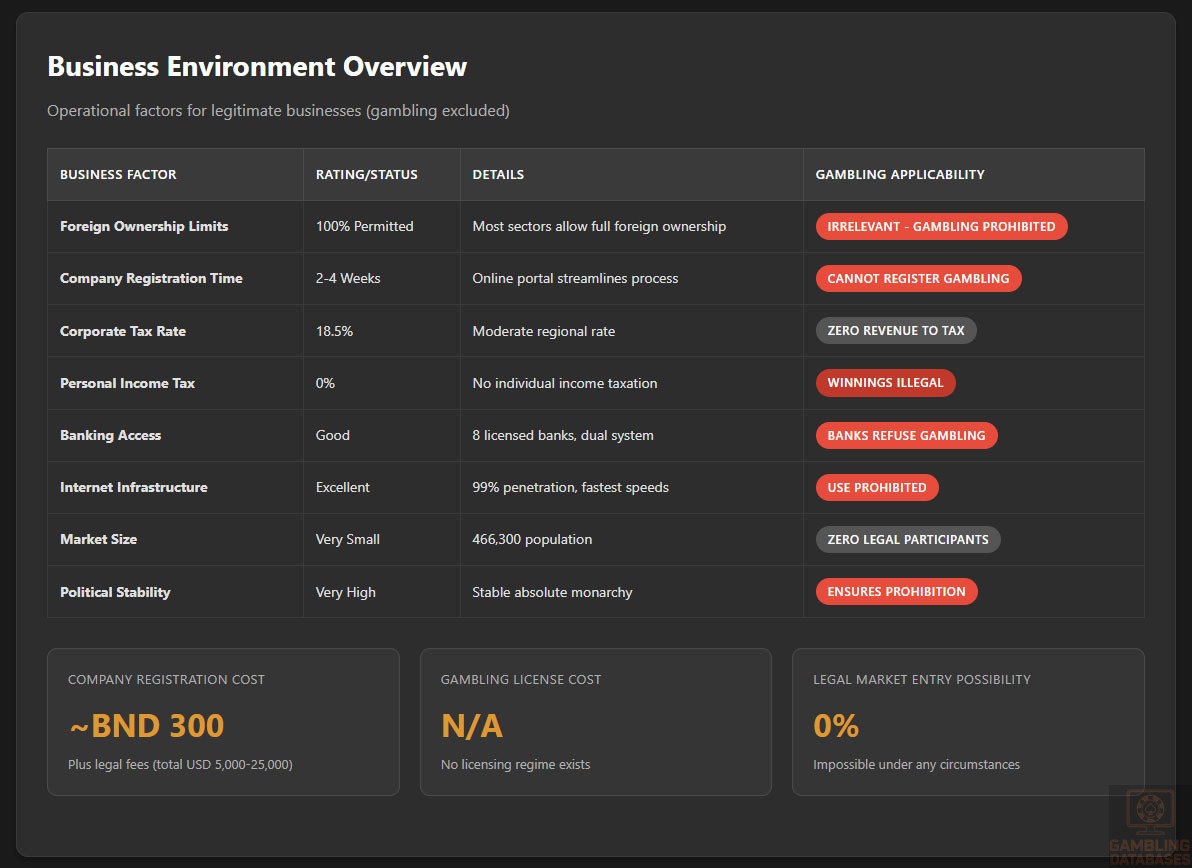
Brunei ranks moderately on international ease of doing business assessments with strong performance in some areas offset by challenges in others. The World Bank’s historical Doing Business reports placed Brunei in the middle range globally, noting strengths in political stability and low taxation alongside weaknesses in regulatory efficiency and market size constraints. Company registration processes have streamlined through the One Common Portal, reducing administrative burden and processing times for business formation.
Foreign investment regulations generally welcome international capital with 100 percent foreign ownership permitted in most sectors. Exceptions exist for specific industries including banking and insurance where licensing requirements impose restrictions. The government encourages foreign direct investment through the Brunei Economic Development Board and Darussalam Enterprise which facilitate investment applications and provide support services. However, sole proprietorships and partnerships remain restricted to citizens and permanent residents.
Operational costs in Brunei vary by sector with labor costs generally lower than Singapore but higher than Malaysia, Indonesia, and other lower-income ASEAN members. Commercial real estate costs remain moderate outside prime locations, and utility expenses benefit from government subsidies keeping electricity and water affordable. The small domestic market limits economies of scale for businesses focused purely on local sales, making Brunei more suitable as a regional operational hub rather than standalone market.
Corporate Structure and Registration
Available Entity Types
Foreign investors can establish business presence in Brunei through several entity structures with limited liability companies being the most common choice. A private limited company provides separate legal personality from shareholders with liability limited to share capital or guarantees. This structure requires minimum two shareholders who can be individuals or corporate entities from any nationality, making it accessible to international investors.
Companies can organize as private companies limited by shares with shareholders’ liability restricted to unpaid share amounts, or companies limited by guarantee where members commit to contribute specified amounts if winding up occurs. Public limited companies theoretically exist under the Companies Act but lack practical relevance due to absence of stock exchange. Most businesses operate as private limited companies which balance liability protection with operational flexibility.
Foreign companies can establish Brunei presence through branch registration rather than incorporating separate local entity. A branch operates as extension of the foreign parent company without separate legal personality, conducting the same business activities as the parent. Representative offices provide another option for foreign companies seeking Brunei presence for market research and relationship building without conducting commercial transactions. However, representative offices cannot generate revenue or sign contracts, limiting their utility.
Registration Requirements
Company registration in Brunei requires submission of formation documents to the Registry of Companies and Business Names under the Ministry of Finance and Economy. The One Common Portal centralizes the registration process enabling online submission of applications and documents. Registration typically completes within two to four weeks after submission of complete documentation, though timelines vary based on application complexity and authority workload.
Formation requires selecting unique company name not resembling existing businesses or including prohibited words like “Royal,” “Brunei,” “Sultan,” or terms suggesting government affiliation. Name reservation requires approval before proceeding with incorporation. Documents needed include memorandum and articles of association, shareholder information, director details, registered office address, and secretary appointment. At least one of two directors must be Brunei citizen, permanent resident, or resident in Brunei unless exemption is granted.
Registration fees total approximately BND 300 for standard private limited companies plus additional costs for name reservation, professional services, and registered office provision. Total incorporation costs including legal fees, nominee director services if needed, and first-year registered address typically range from USD 5,000 to USD 25,000 depending on complexity and service provider selection. Foreign investors generally engage local corporate service providers to navigate registration requirements and ensure compliance with local regulations.
Post-registration compliance includes annual filing of returns within 28 days of annual general meeting, maintenance of statutory registers, and filing of financial statements. Companies must appoint qualified secretary and maintain registered office within Brunei. Tax registration with the Ministry of Finance occurs automatically upon company registration, and businesses must file annual tax returns by June 30 each year through the e-filing system.
Taxation Framework
Corporate Income Tax Structure
Brunei imposes corporate income tax at standard rate of 18.5 percent on chargeable income of companies resident in Brunei or deriving income from Brunei sources. This moderate rate compares favorably to many countries though it exceeds Singapore’s 17 percent and Malaysia’s 24 percent rates. The first BND 100,000 of chargeable income for companies with paid-up capital not exceeding BND 1 million receives exemption, effectively reducing tax burden for small businesses.
Pioneer status incentives provide tax holidays for qualifying businesses in priority sectors. Companies receiving pioneer status enjoy income tax exemption for specified periods ranging from five to eight years depending on investment amount and strategic importance. The Investment Incentives Order 2001 governs these incentives, aiming to attract foreign investment in manufacturing, technology, agriculture, and other targeted sectors aligned with economic diversification goals.
Special tax treatment applies to companies in Special Economic Zones with potential for reduced tax rates or exemptions. However, implementation of special economic zone frameworks remains limited compared to neighboring countries. Capital allowances provide depreciation deductions for capital expenditure on qualifying assets including machinery, equipment, and buildings. Loss carryforward allows unused losses to offset future years’ profits, though carryforward periods face limitations.
Dividend payments from Brunei companies generally do not incur withholding tax, making Brunei attractive for holding company structures. Interest and royalty payments to non-residents face withholding taxes at rates varying based on double taxation agreements. Brunei maintains tax treaties with several countries including United Kingdom, Vietnam, and others, providing reduced withholding rates and elimination of double taxation for qualifying income.
Personal Income Tax
Brunei does not impose personal income tax on individuals, representing significant attraction for high-earning professionals and business owners. This zero personal income tax policy has existed for decades as a benefit of oil wealth enabling government to fund operations without income taxation. Employees retain gross salaries without withholding for income tax, significantly increasing disposable income compared to countries with progressive income taxation.
While income tax is absent, employees contribute to Tabung Amanah Pekerja employee provident fund at 5 percent of monthly salary with employers contributing 5 percent, totaling 10 percent combined contribution. This mandatory retirement savings program operates similarly to social security systems in other countries but imposes lower burden than combined income tax and social security in many jurisdictions. The absence of income tax and low provident fund contribution create high take-home pay relative to gross salary.
The zero income tax policy applies to both citizens and foreign workers, though foreign workers must obtain appropriate work permits and employment passes to work legally. This tax advantage helps attract expatriate professionals to Brunei despite its small market and remote location. For gambling operations hypothetically operating legally, the absence of income tax would benefit employees and executives, though player winnings would receive no special tax treatment since there’s no income tax system to apply.
| Tax/Cost Category | Rate/Amount | Application | Regional Comparison |
|---|---|---|---|
| Corporate Income Tax | 18.5% | On Chargeable Income | Moderate (Lower than Malaysia, Higher than Singapore) |
| Personal Income Tax | 0% | No Individual Income Tax | Among World’s Lowest |
| Sales Tax/VAT | Not Implemented | No VAT or Sales Tax System | Unusual Globally |
| Withholding Tax (Dividends) | 0% | Generally No Withholding on Dividends | Attractive for Holding Companies |
| Employee Provident Fund | 10% Combined | 5% Employee + 5% Employer | Lower than Most Regional Systems |
| Company Registration Fee | BND 300 | Standard Private Limited Company | Moderate |
| Gambling License Fee | Not Applicable | No Licensing Regime Exists | N/A – Complete Prohibition |
| Gambling Operator Tax | Not Applicable | All Gambling Illegal | N/A – No Legal Operations |
Market Entry Considerations
Recommended Entry Strategies
Market entry for iGaming operations in Brunei is impossible due to comprehensive legal prohibition. No entry strategy can overcome the fundamental barrier of absolute gambling prohibition under both civil and Sharia law. The government does not offer pathways for licensing, does not permit special economic zones with gambling exemptions, and does not grant exceptions for online-only operations or foreign-based services targeting Brunei customers.
For companies researching Southeast Asian expansion, Brunei should be immediately excluded from market entry analysis. Resources should focus on jurisdictions with legal gambling frameworks or regulatory development toward legalization. Singapore, Philippines, and Cambodia offer legal casino industries. Malaysia permits limited forms of gambling. Even countries without comprehensive licensing may show movement toward regulation. Brunei demonstrates no such trajectory and offers zero possibility of legal operation.
Companies considering serving Brunei customers through offshore platforms face legal risks including prosecution of operators if they enter Brunei territory, potential blocking of payment processing by Brunei banks, and liability for facilitating illegal gambling by Brunei citizens. The small market size of 466,300 people makes Brunei an insignificant target not worth the legal and reputational risks of potentially violating local laws.
Typical Costs and Timelines
Discussion of setup costs and operational timelines for gambling operations is irrelevant because such operations cannot legally exist. Any attempt to establish gambling operations would immediately face law enforcement action and criminal prosecution. The only relevant cost discussion involves penalties: fines up to BND 10,000, imprisonment up to six months, legal defense costs, and reputational damage from gambling prosecution. These negative costs make any gambling venture financially and legally catastrophic.
For legitimate businesses considering Brunei for non-gambling operations, typical company setup costs range from USD 5,000 to USD 25,000 including incorporation, registered office, legal fees, and initial compliance. Registration timelines span two to twelve weeks depending on complexity. Corporate bank account opening requires four to eight weeks with documentation demonstrating legitimate business purpose. These costs and timelines apply only to legal businesses in permitted sectors, not gambling operations.
Success Factors and Challenges
Success factors for gambling operations are irrelevant because success cannot be achieved in a market where operations are categorically illegal. The primary “success factor” would be avoiding detection and prosecution, which represents criminal enterprise rather than legitimate business success. Any discussion of operational excellence, customer acquisition, retention strategies, or profitability optimization is meaningless when the fundamental business activity faces criminal penalties.
The challenges facing gambling operations in Brunei are insurmountable legal and enforcement barriers rather than typical business challenges. Strong law enforcement with coordinated civil and religious authority monitoring creates high detection risk. Universal application of prohibition to citizens and foreigners eliminates safe customer bases. Banking system refusal to process gambling transactions prevents payment processing. Small population size makes anonymity impossible in tight-knit communities. Social stigma and religious disapproval create reputational risks beyond legal penalties.
Cultural considerations emphasize the religious foundation of gambling prohibition. Operating gambling services in Brunei demonstrates profound disrespect for Islamic values central to national identity. Foreign operators attempting to circumvent prohibition through offshore platforms or online services would generate intense hostility beyond mere legal violation. The cultural context makes gambling prohibition non-negotiable and deeply embedded in social values rather than mere regulatory preference subject to change through lobbying or market pressure.
Exit Strategy Planning
Exit strategy planning for gambling operations is unnecessary because entry is impossible. Gambling businesses cannot be established, cannot generate value, and therefore require no exit planning. The only exit strategy relevant to gambling in Brunei is immediate cessation of any illegal activity and withdrawal from the jurisdiction to avoid prosecution. For individuals caught gambling, the exit strategy involves legal defense, payment of fines, serving sentences if imposed, and avoiding future gambling to prevent repeat prosecutions.
| Business Factor | Rating/Status | Details | Gambling Applicability |
|---|---|---|---|
| Foreign Ownership Limits | 100% Permitted (Most Sectors) | Foreign investors can fully own companies | Irrelevant – Gambling Prohibited |
| Company Registration Time | 2-4 Weeks | Online portal streamlines process | Cannot Register Gambling Business |
| Corporate Tax Rate | 18.5% | Moderate regional rate | No Legal Gambling Revenue to Tax |
| Personal Income Tax | 0% | No individual income taxation | Winnings Cannot Be Legally Obtained |
| Banking Access | Good | Dual banking system with 8 licensed banks | Banks Refuse Gambling Transactions |
| Internet Infrastructure | Excellent | 99% penetration, fastest speeds in region | Technology Exists But Use Prohibited |
| Digital Payment Systems | Well Developed | Online banking, QR codes, mobile payments | Cannot Process Gambling Payments |
| Market Size | Very Small | 466,300 population | Zero Legal Market Participants |
| Political Stability | Very High | Stable absolute monarchy | Ensures Prohibition Continuity |
| Regulatory Predictability | High for Legal Sectors | Clear policies, consistent enforcement | Predictably Anti-Gambling Forever |
| Gambling License Availability | Zero | No licensing regime exists | Complete Market Impossibility |
| Legal Gambling Revenue Potential | USD 0 | All operations illegal | Cannot Generate Legal Revenue |
FAQ: Frequently Asked Questions
Legal and Licensing
Is online gambling legal in Brunei?
No, online gambling is completely illegal in Brunei under the same legal framework that prohibits land-based gambling. The Common Gaming Houses Act makes all forms of gambling illegal regardless of whether they occur physically or through electronic means including internet platforms. The prohibition applies to both operating gambling websites from within Brunei and accessing online gambling services from Brunei territory, even if the operator is based in another country where gambling is legal.
Brunei’s Syariah Penal Code reinforces this prohibition through Islamic law, classifying gambling as haram and imposing additional religious penalties on Muslim citizens. Both the Royal Brunei Police Force and Religious Enforcement Division actively monitor for online gambling activity, and individuals caught accessing online gambling platforms face prosecution. Authorities have seized computers and devices used for online gambling and prosecuted users under gambling laws that make no distinction between physical and digital gambling formats.
What types of gambling licenses are available and what do they cover?
No gambling licenses are available in Brunei because the government does not license gambling operations under any circumstances. There is no licensing authority for gambling, no application process, no license types for different gambling formats, and no regulatory framework for issuing gambling authorizations. The concept of licensed gambling contradicts Brunei’s fundamental legal position that all gambling is prohibited under civil and Islamic law.
Unlike jurisdictions that regulate gambling through licensing systems distinguishing between casino operations, sports betting, lotteries, and online gambling, Brunei prohibits all these activities uniformly without creating regulated pathways for legal operation. The government’s position is that gambling cannot be made acceptable through licensing or regulation because Islamic principles classify it as inherently harmful and morally impermissible. This makes Brunei fundamentally different from regulated gambling markets where licenses provide legal authorization to operate specific gambling services.
How much does an iGaming license cost and how long does it take to obtain?
This question cannot be answered because iGaming licenses do not exist in Brunei. The government does not issue gambling licenses at any cost or under any timeline because gambling authorization contradicts national law and Islamic principles. There are no application fees to pay, no processing timelines to wait through, and no approval processes to navigate because the entire concept of legal gambling operations is absent from Brunei’s regulatory framework.
Attempting to apply for a gambling license would be rejected immediately if authorities even accepted such application, which they would not. Any inquiry about gambling licensing would likely trigger scrutiny from law enforcement wondering why someone seeks authorization for illegal activities. The only costs associated with gambling in Brunei are penalties imposed on those caught violating prohibition: fines up to BND 10,000, imprisonment costs, and legal defense expenses.
Can foreign companies obtain a gambling license?
Foreign companies cannot obtain gambling licenses because gambling licenses do not exist in Brunei regardless of applicant nationality. The prohibition applies universally to domestic and foreign entities, individuals and corporations, online and offline operations. Brunei does not create exceptions for foreign casino operators, international betting companies, or offshore online gambling platforms. The absolute nature of prohibition means nationality and corporate structure are irrelevant factors because no applicant can obtain authorization.
Foreign companies exploring Southeast Asian gambling markets must exclude Brunei entirely from expansion strategies. While countries like Philippines, Singapore, and Cambodia offer pathways for foreign gambling operators through licensing and foreign investment frameworks, Brunei provides no such opportunities. The government has never issued gambling licenses historically and shows no indication of policy change. Foreign companies attempting to operate in Brunei face the same criminal penalties as domestic operators including prosecution, asset seizure, and deportation.
Financial and Taxation
What are the tax obligations for iGaming operators?
iGaming operators have no tax obligations in Brunei because they cannot legally operate. The question presumes legal gambling operations subject to taxation, but this premise is false in Brunei’s context. There are no gross gaming revenue taxes, no licensing fees, no gaming duties, no corporate income tax on gambling profits, and no special gambling-related levies because the framework for imposing such taxes does not exist. The government generates zero revenue from gambling taxation because gambling activities are prohibited rather than regulated and taxed.
If gambling were hypothetically legal, operators would likely face the standard corporate income tax rate of 18.5 percent on profits plus potentially special gambling taxes common in regulated markets. However, this speculation is meaningless because legalization will not occur under Brunei’s Islamic governance framework. The actual financial obligation for anyone attempting gambling operations is criminal penalties rather than tax compliance.
Are gambling winnings taxed for players?
Gambling winnings are not taxed in Brunei, but this is irrelevant because gambling winnings cannot be legally obtained. Brunei imposes no personal income tax on any income source, so even if gambling were legal, winnings would likely remain untaxed consistent with broader zero-income-tax policy. However, since all gambling is illegal, any gambling winnings represent proceeds of illegal activity subject to confiscation rather than taxation.
Players caught gambling face penalties including fines and imprisonment rather than tax obligations on winnings. If authorities discover gambling winnings, these funds can be seized as evidence of illegal activity. The absence of personal income taxation creates no tax advantage for gambling because obtaining gambling winnings requires violating criminal law, making the tax treatment irrelevant compared to criminal liability.
What are the typical operational costs for running an online casino or sportsbook?
Operational costs for gambling operations in Brunei are irrelevant because such operations cannot legally exist. Any discussion of typical costs for licensing, technology platforms, payment processing, customer acquisition, compliance, and staffing is meaningless when the fundamental business activity is illegal. The only costs relevant to gambling in Brunei are negative consequences including criminal fines up to BND 10,000, imprisonment expenses, legal defense costs, asset seizure losses, and reputational damage.
For legitimate businesses in permitted sectors, operational costs in Brunei vary by industry but generally include moderate office rental, reasonable labor costs lower than Singapore but higher than Indonesia, affordable utilities due to government subsidies, and corporate tax at 18.5 percent. However, these normal business costs cannot be applied to gambling operations which face prohibition rather than standard regulatory compliance.
What is the expected ROI timeline for entering this market?
The expected return on investment for gambling operations in Brunei is negative infinity because operations are illegal and generate zero legitimate revenue while incurring criminal penalties. There is no timeline for profitability because profitability cannot be achieved in a market where the business activity is prohibited. Any investment in gambling operations would be total loss plus criminal fines and imprisonment costs, making the financial return catastrophically negative.
The small population of 466,300 people would limit market potential even if gambling were legal, but this limitation is secondary to the fundamental impossibility of legal operation. Market entry analysis for Brunei should conclude immediately with “market entry impossible due to legal prohibition” rather than proceeding to ROI calculations that presume legal operation capability.
Operations and Compliance
What are the local presence requirements for operators?
Local presence requirements are irrelevant for gambling operators because gambling operations cannot legally exist. Standard business regulations require companies to maintain registered office addresses in Brunei and appoint at least one director who is a citizen, permanent resident, or resident in Brunei. However, these requirements apply only to legitimate businesses in permitted sectors. Attempting to establish local presence for gambling purposes would constitute criminal facilitation of illegal activity.
Banks and corporate service providers will not assist with establishing gambling operations. Registered office providers refuse to associate with gambling businesses. Directors and officers face personal liability for participating in illegal gambling operations. The legal framework designed to facilitate legitimate business establishment becomes irrelevant when the business purpose is illegal, making all local presence requirements inapplicable to gambling ventures.
What payment methods are available and recommended?
Brunei offers well-developed payment infrastructure including online banking, credit and debit cards, mobile payments, and QR code systems. Banks provide comprehensive digital services, and payment processing technology meets international standards. However, these payment methods cannot be used for gambling transactions because banks and payment service providers are prohibited from facilitating gambling payments. Financial institutions monitor transactions for gambling-related activity and will freeze accounts or report suspicious transactions to authorities.
The question of “recommended payment methods” for gambling presumes legal gambling operations accepting payments. Since such operations cannot exist, there are no recommended payment methods because all gambling payments are illegal. Any attempt to process gambling payments through Brunei’s banking system would result in transaction rejection, account closure, and potential prosecution for money laundering or facilitating illegal activity.
What are the advertising and marketing restrictions?
All gambling advertising, marketing, and promotional activity is completely prohibited in Brunei. The ban extends to advertisements for domestic gambling operations, promotion of foreign gambling websites, sponsored content featuring gambling brands, social media marketing for betting applications, and any form of gambling-related commercial communication. Media outlets, advertising platforms, and content creators cannot accept gambling advertising or promote gambling services under any circumstances.
The prohibition includes indirect gambling promotion through sponsorships, affiliate marketing, influencer partnerships, and branded entertainment. Sports teams cannot accept gambling company sponsorships, events cannot display gambling logos, and online platforms cannot carry gambling affiliate links. These restrictions apply regardless of whether the promoted gambling service operates legally in other jurisdictions. Violating advertising prohibition can result in penalties for both advertisers and media outlets carrying gambling promotions.
What responsible gambling measures are mandatory?
There are no mandatory responsible gambling measures in Brunei because gambling operations do not exist legally. Jurisdictions with regulated gambling typically require operators to implement player protection measures including self-exclusion programs, deposit limits, reality checks, underage gambling prevention, and problem gambling resources. Brunei implements “player protection” through complete prohibition rather than harm reduction strategies, treating prevention of access as the ultimate responsible gambling measure.
The absence of responsible gambling requirements reflects the government’s position that gambling cannot be made safe through regulatory measures and must be eliminated entirely. There are no problem gambling helplines, no treatment programs for gambling addiction, no self-exclusion databases, and no mandatory operator contributions to gambling harm research because these would acknowledge legal gambling requiring such interventions. The responsible gambling philosophy is absolute prohibition preventing gambling harm rather than managing harm from legal gambling activity.
Market Opportunity
How large is the iGaming market and what is the growth potential?
The iGaming market in Brunei is zero with no legal operations, no revenue generation, and no growth potential. There is no addressable market because gambling activities cannot legally occur. While Brunei’s population of 466,300 people with high internet penetration of 99 percent and GDP per capita of USD 33,418 might theoretically support gambling spending, this potential cannot be realized due to comprehensive legal prohibition under civil and Sharia law.
Growth potential is also zero because prohibition shows no signs of being lifted. The government’s commitment to Islamic governance principles makes gambling legalization impossible under current political structure. There are no regulatory discussions about licensing frameworks, no pilot programs for limited gambling, no indication of policy evolution toward legalization. The market will remain at zero indefinitely, making growth projections irrelevant. Any analysis suggesting growth potential fundamentally misunderstands Brunei’s permanent prohibition stance.
Who are the main competitors and what is their market share?
There are no legal gambling competitors in Brunei because gambling operations are prohibited. The concept of market share distribution among competing operators does not apply when no operators can legally function. Underground illegal gambling operations may exist but cannot be analyzed as competitive market participants because they operate entirely outside legal frameworks and face elimination through law enforcement rather than competitive market dynamics.
Some Bruneians may access online gambling platforms operated from foreign jurisdictions despite prohibition, but these operators face legal risks and cannot openly compete for Brunei customers. International gambling websites typically block Brunei IP addresses or refuse registrations from Brunei residents to avoid facilitating illegal gambling. The absence of legal market means competitive analysis tools like market share, competitive positioning, and strategic differentiation have no application to Brunei’s gambling context.
What are the player preferences and typical spending patterns?
Player preferences and spending patterns cannot be measured in Brunei because legal gambling does not exist to generate behavioral data. There are no surveys of gambling preferences, no transaction data revealing spending patterns, no analytics on game popularity, no metrics on session frequency or duration. Any gambling behavior occurs through illegal channels that generate no measurable statistics and cannot be researched openly due to legal risks facing participants.
Anecdotal observations suggest some Bruneians gamble when traveling to Singapore, Malaysia, or other countries with legal gambling, but this travel-based gambling generates no domestic data and provides limited insight into preferences. The small numbers engaging in overseas gambling and reluctance to discuss illegal activity due to social stigma prevent meaningful data collection on player behavior. Entertainment spending in Brunei directs toward legal activities including dining, shopping, and digital content subscriptions rather than gambling.
What are the key success factors and main challenges for new entrants?
Success factors for gambling operations in Brunei do not exist because success cannot be achieved when operations are categorically illegal. The primary challenge is insurmountable: absolute legal prohibition under both civil and religious law with strict enforcement and severe penalties. This challenge cannot be overcome through any business strategy, technological innovation, or market positioning. Unlike regulated markets where challenges like licensing costs, competition, and regulatory compliance can be addressed through proper planning and investment, Brunei’s prohibition creates an absolute barrier to entry.
Additional challenges reinforce the impossibility of gambling operations including active law enforcement monitoring with coordinated civil and religious authority collaboration, banking system refusal to process gambling transactions preventing payment acceptance, social stigma and religious disapproval creating reputational risks beyond legal penalties, small population size making market financially insignificant even if legal, and political structure ensuring prohibition permanence under Islamic absolute monarchy. These factors combine to make Brunei the least viable gambling jurisdiction globally.
Sources and References
- Common Gaming Houses Act (Cap. 28) – Brunei Darussalam Legal Framework – Attorney General’s Chambers
- Syariah Penal Code Order 2013 – Brunei Darussalam Islamic Legal Framework
- Ministry of Home Affairs Brunei – Gambling Enforcement Authority – Official Government Portal
- LegalPilot – Gambling Laws in Brunei – https://legalpilot.com/country/brunei/
- iGamingToday – Gambling Regulation in Brunei – https://www.igamingtoday.com/gambling-regulation-in-brunei/
- U.S. Department of State – International Travel Information Brunei – https://travel.state.gov/content/travel/en/international-travel/International-Travel-Country-Information-Pages/Brunei.html
- Altenar – Sports Betting Bans Global Analysis – https://altenar.com/blog/assessing-the-no-go-zones-where-sportsbooks-are-banned-and-why/
- Worldometer – Brunei Demographics 2025 – https://www.worldometers.info/demographics/brunei-darussalam-demographics/
- United Nations Population Division – World Population Prospects 2024 Revision
- International Monetary Fund – Brunei Darussalam Country Data – https://www.imf.org/en/Countries/BRN
- World Bank – Brunei GDP Per Capita Statistics – https://www.macrotrends.net/global-metrics/countries/BRN/brunei/gdp-per-capita
- Trading Economics – Brunei Economic Indicators – https://tradingeconomics.com/brunei/gdp-per-capita
- Global Finance Magazine – Brunei GDP and Economic Data – https://gfmag.com/country/brunei-gdp-country-report/
- DataReportal – Digital 2025 Brunei Darussalam – https://datareportal.com/reports/digital-2025-brunei-darussalam
- Seasia.co – Internet Speed Ranking Southeast Asia 2025 – https://seasia.co/2025/08/26/internet-speed-ranking-in-southeast-asia-revealed-brunei-takes-first-place
- Brunei Darussalam Central Bank (BDCB) – Banking and Payment Services – https://www.bdcb.gov.bn/
- U.S. Department of Commerce – Brunei Trade Financing – https://www.trade.gov/country-commercial-guides/brunei-trade-financing
- TransFi – Brunei Payment Rails and Digital Banking – https://www.transfi.com/blog/bruneis-payment-rails-how-they-work
- U.S. Department of State – 2021 Investment Climate Statements Brunei – https://www.state.gov/reports/2021-investment-climate-statements/brunei
- Tetra Consultants – Register Company in Brunei – https://www.tetraconsultants.com/jurisdictions/register-company-in-brunei/
- Wikipedia – Economy of Brunei – https://en.wikipedia.org/wiki/Economy_of_Brunei
- Wikipedia – Brunei Country Overview – https://en.wikipedia.org/wiki/Brunei
- PMC – Fantasy Sports and Gambling Regulation Asia-Pacific – https://pmc.ncbi.nlm.nih.gov/articles/PMC8380019/
- U.S. Department of State – 2021 International Religious Freedom Report Brunei – https://www.state.gov/reports/2021-report-on-international-religious-freedom/brunei/
- Outright International – Sharia Law Implementation Brunei 2019 – https://outrightinternational.org/insights/last-phase-sharia-law-implemented-brunei
- Facts and Details – Brunei Travel Warnings and Legal Information – https://factsanddetails.com/southeast-asia/Brunei/sub5_10d/entry-6740.html
- Simon’s Online Casino Gambling Blog – Gambling in Brunei Guide – https://simonsblogpark.com/onlinegambling/simons-guide-gambling-brunei/
- LCB.org – Online Casino Restrictions Brunei – https://lcb.org/restrictions/brunei
- Department of Economic Planning and Statistics Brunei – Population and Economic Data – https://deps.mofe.gov.bn/
- Baiduri Bank Official Website – Banking Services Brunei – https://www.baiduri.com.bn/
🎯 Gambling Databases Country Rating: Brunei Darussalam
| Evaluation Dimension | Score | Rating |
|---|---|---|
| Operator Ease Score | 0.0/10 | ⛔️ IMPOSSIBLE – Complete Prohibition |
| Player Access Score | 0.0/10 | ⛔️ ILLEGAL – Criminal Penalties Apply |
| Overall Market Attractiveness | 0.0/10 | ⛔️ ABSOLUTE PROHIBITION – NO LEGAL PATHWAY EXISTS |
This rating is calculated using the Gambling Databases Rating (GDR) methodology, which provides transparent criteria for evaluating iGaming markets worldwide. Click the link to learn how we calculate Operator Ease Score, Player Access Score, and overall market attractiveness ratings.
⚠️ CRITICAL RISK WARNINGS
READ THIS BEFORE CONSIDERING MARKET ENTRY:
- ALL GAMBLING IS COMPLETELY PROHIBITED – Both land-based and online gambling are illegal under the Common Gaming Houses Act and Syariah Penal Code Order 2013. There are ZERO exceptions.
- DUAL LEGAL SYSTEM ENFORCEMENT – Violations prosecuted under BOTH civil law (Common Gaming Houses Act) AND Sharia law, with gambling classified as “haram” (religiously forbidden).
- UNIVERSAL PENALTIES – Fines up to BND 10,000 + 6 months imprisonment for participation. HIGHER penalties for operating gambling operations. Penalties apply equally to citizens, residents, AND foreign nationals.
- NO LICENSING REGIME EXISTS – The government categorically refuses to authorize gambling operations under any circumstances. There is no application process, no regulatory body, and no pathway to legalization.
- COORDINATED ENFORCEMENT – Royal Brunei Police Force and Religious Enforcement Division conduct active surveillance, raids, equipment seizure, and prosecutions of both operators and participants.
- ZERO TOLERANCE POLICY – Even claw machines and arcade games banned in 2024 for resembling gambling. Government aggressively interprets any chance-based activity as prohibited gambling.
- BANKING SYSTEM BLOCKS GAMBLING – All 8 licensed banks refuse to process gambling transactions. Payment processors face criminal prosecution and license revocation for facilitating gambling payments.
- PERMANENT PROHIBITION – Islamic law basis (Melayu Islam Beraja national philosophy) makes gambling legalization politically and religiously impossible under current constitutional structure.
- SMALL POPULATION ENABLES TOTAL SURVEILLANCE – 466,300 people in 5,765 km² with 80% urban concentration makes anonymity impossible. Tight-knit communities create high detection risk.
- PROPERTY SEIZURE – Premises used for gambling face confiscation. Property owners prosecuted alongside operators and participants.
📊 Operator Ease Score Breakdown
| Criterion | Weight | Score | Justification (INCLUDING ALL DEDUCTIONS) |
|---|---|---|---|
| Legal & Regulatory Framework | 30% | -1.0/3.0 | ALL gambling COMPLETELY ILLEGAL under dual legal system (0 points base). Active enforcement by police and religious authorities (-1.0 points). Common Gaming Houses Act criminalizes all forms including online. Syariah Penal Code adds religious penalties. NO legal products exist. NO exceptions granted. Final: -1.0/3.0 |
| Licensing Process | 25% | 0.0/2.5 | NO licensing regime exists (0 points). No application process available. No regulatory body issues licenses. Government categorically refuses authorization under any circumstances. Ministry of Home Affairs enforces prohibition only – does not regulate. Attempting to register gambling business = immediate criminal prosecution. Final: 0.0/2.5 |
| Taxation & Costs | 20% | 0.0/2.0 | Not applicable – all gambling illegal (0 points). No tax structure exists because no legal operations possible. Only “costs” are criminal penalties: BND 10,000 fines + 6 months imprisonment + legal defense costs + property seizure. Cannot generate legal revenue. Final: 0.0/2.0 |
| Operational Requirements | 15% | 0.0/1.5 | Cannot legally operate (0 points). All 8 banks refuse gambling transactions. Payment processors face prosecution. Internet providers may receive blocking directives. No compliance framework exists – only prohibition enforcement. Attempting operations = criminal enterprise. Final: 0.0/1.5 |
| Market Environment | 10% | 0.0/1.0 | Absolute monarchy with Islamic law basis ensures permanent prohibition (0 points). 2024: Claw machines banned, expanding definition of prohibited gambling. No regulatory movement toward liberalization. Sultan’s commitment to Islamic principles makes policy change impossible. Coordinated civil and religious enforcement. Final: 0.0/1.0 |
TOTAL OPERATOR EASE SCORE: -1.0/10 (Rounded to 0.0/10 for display)
👥 Player Access Score Breakdown
| Criterion | Weight | Score | Justification (INCLUDING ALL DEDUCTIONS) |
|---|---|---|---|
| Legal Status for Players | 40% | 0.0/4.0 | ALL gambling illegal for players (0 points). Participating in gambling = BND 10,000 fine + 6 months imprisonment under Common Gaming Houses Act. Muslim citizens face additional Sharia law penalties. NO distinction between skill/chance games. Sports betting, casino, lottery, poker ALL prohibited. Applies to citizens AND foreign nationals equally. Final: 0.0/4.0 |
| Practical Accessibility | 30% | 0.0/3.0 | Severe restrictions with active enforcement (0 points). Banks refuse gambling transactions. Police monitor internet usage for gambling activity. Authorities seize computers/devices used for online gambling. ISP blocking directives issued. Payment processors prohibited from facilitating gambling. Physical enforcement more practical than comprehensive censorship due to small population. Final: 0.0/3.0 |
| Player Penalties | 20% | 0.0/2.0 | Criminal penalties apply (0 points). Up to BND 10,000 fine + 6 months imprisonment for gambling participation. Police conduct raids and arrests. Prosecutors pursue both operators AND participants equally. Muslim citizens face additional religious court penalties. Tourists receive same penalties as residents. Diplomatic status provides limited protection. Final: 0.0/2.0 |
| Market Availability | 10% | 0.0/1.0 | ZERO licensed operators (0 points). No legal gambling market exists. Underground operations immediately face law enforcement action when discovered. International operators block Brunei IP addresses to avoid legal complications. No domestic or offshore legal access. Final: 0.0/1.0 |
TOTAL PLAYER ACCESS SCORE: 0.0/10
🔍 Key Highlights
Strengths (If Any)
- NONE EXIST FOR GAMBLING OPERATIONS. The only “strength” is clarity: the prohibition is absolute, comprehensive, and unambiguous. There is no regulatory uncertainty because the answer is always “NO.”
- High GDP per capita (USD 33,418) and 99% internet penetration theoretically indicate consumer capacity, but this is completely irrelevant given absolute prohibition.
- Zero personal income tax means high disposable income, but cannot be leveraged for gambling spending as all gambling is illegal.
⛔️ CRITICAL RISKS AND CHALLENGES
- [TOTAL PROHIBITION:] ALL forms of gambling illegal under both Common Gaming Houses Act and Syariah Penal Code. Sports betting, casino, lottery, poker, online gambling, land-based gambling – ALL prohibited without exception. NO legal products exist.
- [DUAL LEGAL SYSTEM:] Violations prosecuted under BOTH civil law (secular courts) AND Sharia law (religious courts). Gambling classified as “haram” – religiously forbidden. Islamic law basis makes legalization impossible.
- [ACTIVE ENFORCEMENT:] Royal Brunei Police Force + Religious Enforcement Division coordinate surveillance, raids, arrests, equipment seizure. 2024: Expanded prohibition to include claw machines. Enforcement intensifying, not relaxing.
- [CRIMINAL PENALTIES:] BND 10,000 fines + 6 months imprisonment for participants. HIGHER penalties for operators. Property seizure for premises used for gambling. Penalties apply to foreign nationals and tourists equally.
- [NO LICENSING PATHWAY:] Government categorically refuses to authorize gambling under ANY circumstances. No licensing regime, no application process, no regulatory body. Attempting business registration for gambling = immediate rejection and prosecution.
- [BANKING BLOCKADE:] All 8 licensed banks refuse gambling transactions. Payment processors face criminal prosecution and license revocation. No payment infrastructure available for gambling.
- [TOTAL SURVEILLANCE:] Population of only 466,300 in 5,765 km² with 80% urban concentration enables comprehensive monitoring. Small, tight-knit communities eliminate anonymity. High detection risk.
- [PERMANENT POLICY:] Melayu Islam Beraja national philosophy positions Islam as central to governance. Absolute monarchy under Sultan Hassanal Bolkiah (since 1967) ensures policy continuity. NO prospect of liberalization through political transition.
- [SOCIAL STIGMA:] 78% Muslim majority with strong religious opposition to gambling. Individuals caught gambling face family disapproval and community stigma beyond legal penalties.
- [EXPANDING DEFINITIONS:] Government aggressively interprets ambiguous activities as prohibited gambling. 2024 ban on claw machines shows willingness to expand prohibition scope rather than create carve-outs.
Player-Specific Issues
- Players CANNOT legally access ANY gambling – sports betting, casino, lottery, poker all prohibited
- Criminal penalties up to BND 10,000 + 6 months imprisonment for gambling participation
- Police monitor internet usage and seize devices used for online gambling
- Banks refuse to process gambling transactions – payment methods blocked
- ISP blocking directives issued against gambling websites
- Muslim citizens face additional Sharia court penalties beyond civil law
- Foreign nationals and tourists receive identical penalties to citizens
- Underground illegal gambling results in immediate prosecution when discovered
💰 Reality Check: Can You Actually Make Money Here?
Initial Investment Required: N/A – Cannot legally operate
Monthly Operating Costs: Only criminal defense costs when prosecuted
Effective Tax Rate on Revenue: N/A – No legal revenue possible. Only penalties.
Customer Acquisition Cost: Infinite – No customers can be legally acquired
Time to Breakeven: Never – Operations immediately face criminal prosecution
Time to Positive ROI: Impossible – All investment results in losses + penalties
Profitability Assessment: GAMBLING OPERATIONS IN BRUNEI ARE IMPOSSIBLE, NOT MERELY UNPROFITABLE. This is not a difficult market with challenging economics – it is a market that DOES NOT EXIST and CANNOT EXIST under current legal framework. Any attempt to operate results in criminal prosecution, fines up to BND 10,000, imprisonment up to 6 months, property seizure, and permanent criminal record. The question is not “Can you make money?” but “How much will you lose before being arrested?” The only financially rational decision is complete avoidance.
⚖️ Legal Risk Assessment
| Stakeholder Type | Risk Level | Specific Risks |
|---|---|---|
| Offshore Casino Operators | ⛔️ CRITICAL | Criminal prosecution if entering Brunei territory. Banking blockade prevents payment processing. ISP blocking limits access. Brunei customers using offshore sites face prosecution. Operators facilitating illegal activity by Brunei citizens risk international complications. International gambling operators typically block Brunei IP addresses. |
| Licensed Sports Betting Operators | ⛔️ IMPOSSIBLE | NO LICENSES EXIST. Cannot operate legally. Sports betting completely prohibited under Common Gaming Houses Act. Government refuses authorization under any circumstances. Attempting operations = immediate criminal prosecution. |
| Affiliates/Advertisers | ⛔️ CRITICAL | Facilitating gambling prohibited under Common Gaming Houses Act. Media outlets cannot accept gambling advertising regardless of advertiser location. Promoting gambling to Brunei audiences faces prosecution risk. Payment processors will not serve gambling affiliates. High detection risk in small, monitored market. |
| Payment Processors | ⛔️ CRITICAL | Criminal prosecution for facilitating gambling transactions. License revocation for payment service providers processing gambling payments. All 8 banks refuse gambling transactions. Discovered gambling payment processing = severe penalties. |
| Company Directors/Executives | ⛔️ CRITICAL | Personal criminal liability for operating gambling operations. BND 10,000+ fines + imprisonment. Property seizure. Permanent criminal record in absolute monarchy with no statute of limitations. Directors prosecuted alongside companies. |
| Players/Customers | ⛔️ CRITICAL | Criminal penalties: BND 10,000 fine + 6 months imprisonment for gambling participation. Police raids and device seizure. Muslim citizens face additional Sharia court penalties. Social stigma and family disapproval. Applies equally to citizens, residents, and foreign tourists. |
🚨 Extradition and International Enforcement
Extradition Treaties: Brunei maintains extradition agreements with several Commonwealth countries including United Kingdom, Malaysia, Singapore, and others. However, extradition for gambling offenses is unlikely to be pursued internationally for offshore operators not physically present in Brunei.
Enforcement History: Enforcement focuses on domestic territory. Brunei authorities prosecute individuals caught gambling within Brunei borders but do not actively pursue international prosecutions of offshore operators. The government’s approach prioritizes preventing gambling within territory rather than extraterritorial enforcement.
Safe Jurisdictions: Operators based outside Brunei face minimal international prosecution risk if they never enter Brunei territory. However, facilitating illegal gambling by Brunei citizens creates potential legal complications if operators later seek business relationships with Brunei institutions.
Travel Risk: Gambling operators with outstanding violations in Brunei should avoid traveling to Brunei or countries with strong extradition relationships. However, international pursuit remains unlikely for offshore operators who never physically operated in Brunei.
CRITICAL NOTE: The primary risk is NOT extradition but rather the impossibility of legal operation. Operators cannot access banking, cannot process payments, cannot advertise, and face immediate detection and prosecution if attempting physical presence. International enforcement is irrelevant when domestic operation is impossible.
📋 Final Verdict
Brunei Darussalam receives an Operator Ease Score of 0.0/10 and a Player Access Score of 0.0/10, resulting in an overall market attractiveness rating of 0.0/10.
HONEST ASSESSMENT:
Brunei Darussalam represents the world’s most restrictive gambling jurisdiction with ABSOLUTE PROHIBITION under dual civil and Sharia law systems. This is not a difficult market – it is an IMPOSSIBLE market. NO gambling operations can legally exist, NO licensing pathway exists, and NO prospect of liberalization exists given the Islamic law foundation of national governance. All gambling activities – land-based, online, sports betting, casino, lottery, poker – are completely illegal with criminal penalties including BND 10,000 fines and 6-month imprisonment applying to operators, participants, and facilitators equally. The government enforces prohibition through coordinated police and religious authority surveillance, prosecuting both citizens and foreign nationals. Banking blockades, payment processor restrictions, and active internet monitoring eliminate operational infrastructure. Brunei’s small population (466,300) and tight-knit communities enable total surveillance and high detection risk. The only appropriate strategy for gambling operators regarding Brunei is COMPLETE AVOIDANCE. Do not attempt market entry. Do not target Brunei customers from offshore. Do not establish any presence. This market does not exist and will never exist under current constitutional structure.
✅ Who Should Enter / ❌ Who Should Avoid
✅ Consider Entry If You Are:
- NOBODY. There is no circumstance under which gambling market entry in Brunei is appropriate, legal, or possible.
- ABSOLUTELY NOBODY. Even with unlimited capital, government connections, or willingness to operate illegally, entry remains impossible and criminally prosecutable.
- NO EXCEPTIONS EXIST. The prohibition is absolute, universal, and permanent.
❌ Definitely Avoid If You Are:
- ANY GAMBLING OPERATOR (ALL gambling completely illegal – casino, sports betting, lottery, poker, all formats)
- Offshore operator hoping to serve Brunei customers (criminal facilitation, banking blockade, ISP blocking)
- Affiliate or advertiser for any gambling services (prosecution risk under Common Gaming Houses Act)
- Payment processor considering gambling transactions (criminal prosecution + license revocation)
- Investor seeking gambling industry opportunities (zero legal market, zero growth prospect, permanent prohibition)
- Any individual or entity considering ANY involvement with gambling in Brunei (universal criminal penalties)
⚠️ BOTTOM LINE: Brunei is not merely the world’s worst gambling market – it is the only major jurisdiction with ZERO legal gambling market and ZERO possibility of legal operations under any circumstances. Complete avoidance is the only rational strategy.








It is crucial to emphasize that Brunei operates under a dual legal system, utilizing both Civil and Syariah Penal Code. Unlike other restrictive Asian markets where enforcement might be lax, the penalties here are severe. For any regulated operator, this jurisdiction is strictly a ‘no-go’ zone due to the extreme compliance risks involved.