Bulgaria represents an emerging and rapidly growing iGaming market in Southeast Europe with exceptional potential for operators seeking EU market access. The country offers a well-regulated gambling framework, competitive taxation at 20% GGR, and a digitally connected population of 6.7 million with 87% internet penetration.
With online gambling revenue reaching EUR 561 million in 2024 and projected annual growth exceeding 10%, Bulgaria combines attractive market fundamentals with favorable entry conditions including no local presence requirements for EU operators and straightforward five-year licensing.
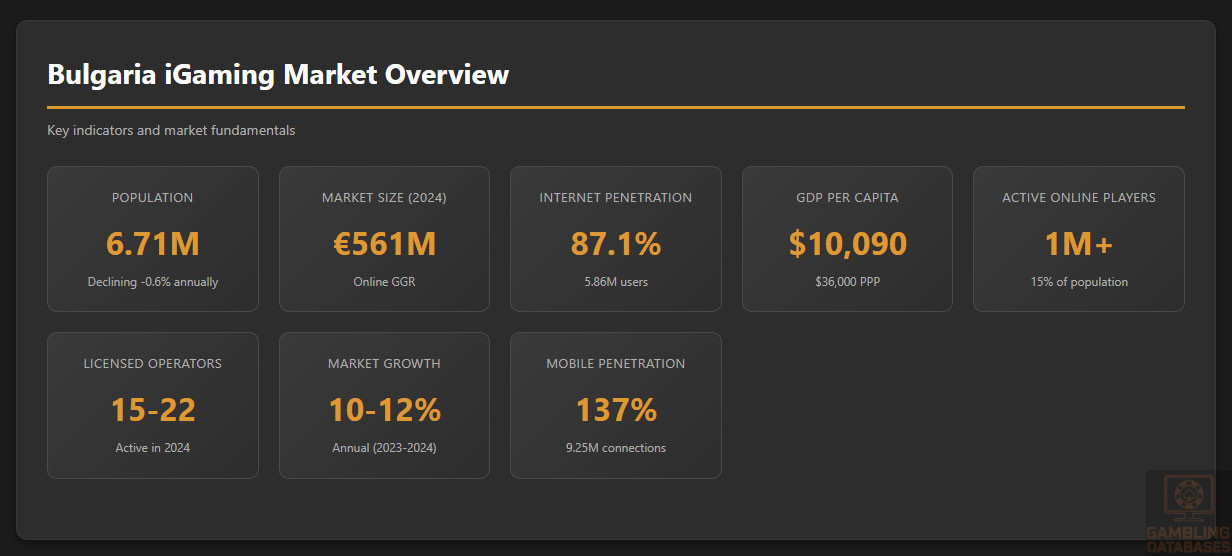
Executive Summary: Key Market Indicators
| Indicator | Value | Notes |
|---|---|---|
| Online Gambling Legal Status | Fully Legal & Regulated | All forms permitted except traditional lotteries (state monopoly) |
| Regulatory Authority | National Revenue Agency (NRA) | Since August 2020, replacing State Commission on Gambling |
| Population (2025) | 6.71 million | Declining at -0.6% annually |
| Median Age | 44.8 years | Aging population, mature gambling demographic |
| Urban Population | 77.1% | 5.18 million urban residents |
| GDP (2024) | USD 107 billion | Nominal; USD 229 billion PPP |
| GDP Per Capita (2024) | USD 10,090 nominal | USD 36,000 PPP; 43% of EU average nominal |
| GDP Growth (Q1 2025) | 3.1% YoY | Above EU average, strong domestic demand |
| Average Monthly Salary | EUR 1,262 gross | December 2024 data |
| Internet Penetration | 87.1% | 5.86 million internet users (January 2025) |
| Mobile Penetration | 137% | 9.25 million active connections |
| Smartphone Penetration | 97% | Among highest in Eastern Europe |
| Mobile Internet Speed | 172.49 Mbps median | Increased 82% year-over-year |
| Fixed Broadband Speed | 85.36 Mbps median | Ranked 68th globally |
| 5G Coverage | Expanding | Widespread 4G coverage nationwide |
| Online Gambling Market Size (2024) | EUR 561 million GGR | BGN 1.1 billion; bets minus winnings |
| Total Gambling Market (2025) | USD 820 million projected | Including land-based operations |
| Market Growth Rate (2023) | 12% YoY | Slowing from 50% growth in 2021-2022 |
| Market CAGR (2025-2029) | 2.1% overall; 4.8% online | Conservative estimates |
| Online Casino Growth | 30% YoY projected | Fastest growing segment |
| Sports Betting Growth | 12-20% YoY projected | Strong football betting culture |
| Active Online Players | 1+ million | 15% of total population |
| Online Gambling Penetration | 5.7% in 2024 | Expected to reach 6.5% by 2029 |
| Average Revenue Per User (ARPU) | EUR 390-411 annually | USD 390k projected for 2024 |
| Female Players | 40% of bettors | Higher than regional average |
| License Application Fee | BGN 20,000 (EUR 10,220) | For online sports betting; varies by type |
| One-Time License Fee | BGN 400,000 (EUR 204,500) | As of January 2024 for online betting |
| Additional Post-Approval Fee | BGN 100,000 (EUR 51,125) | One-off payment upon approval |
| License Duration | 5 years | Renewable |
| Minimum Share Capital | BGN 1.5 million (EUR 767,000) | Paid-in capital requirement |
| GGR Tax Rate | 20% | Increased from 15% in 2024 |
| Corporate Income Tax | 10% | Flat rate, lowest in EU |
| Player Winnings Tax | 0% for licensed operators | 20% for unlicensed/foreign operators |
| Annual Tax Revenue from Gambling | BGN 200 million projected (2024) | EUR 102 million approximately |
| Number of Licensed Operators | 15-22 active | Grew from 6 in 2020 to 22 in 2024 |
| Market Concentration | Moderate | Top 5 operators control ~60-70% share |
| Local Presence Requirement | Not mandatory for EU operators | Authorized representative required if non-Bulgarian |
| Server Location Requirement | EU/EEA/Switzerland | Central computer systems must be in approved territories |
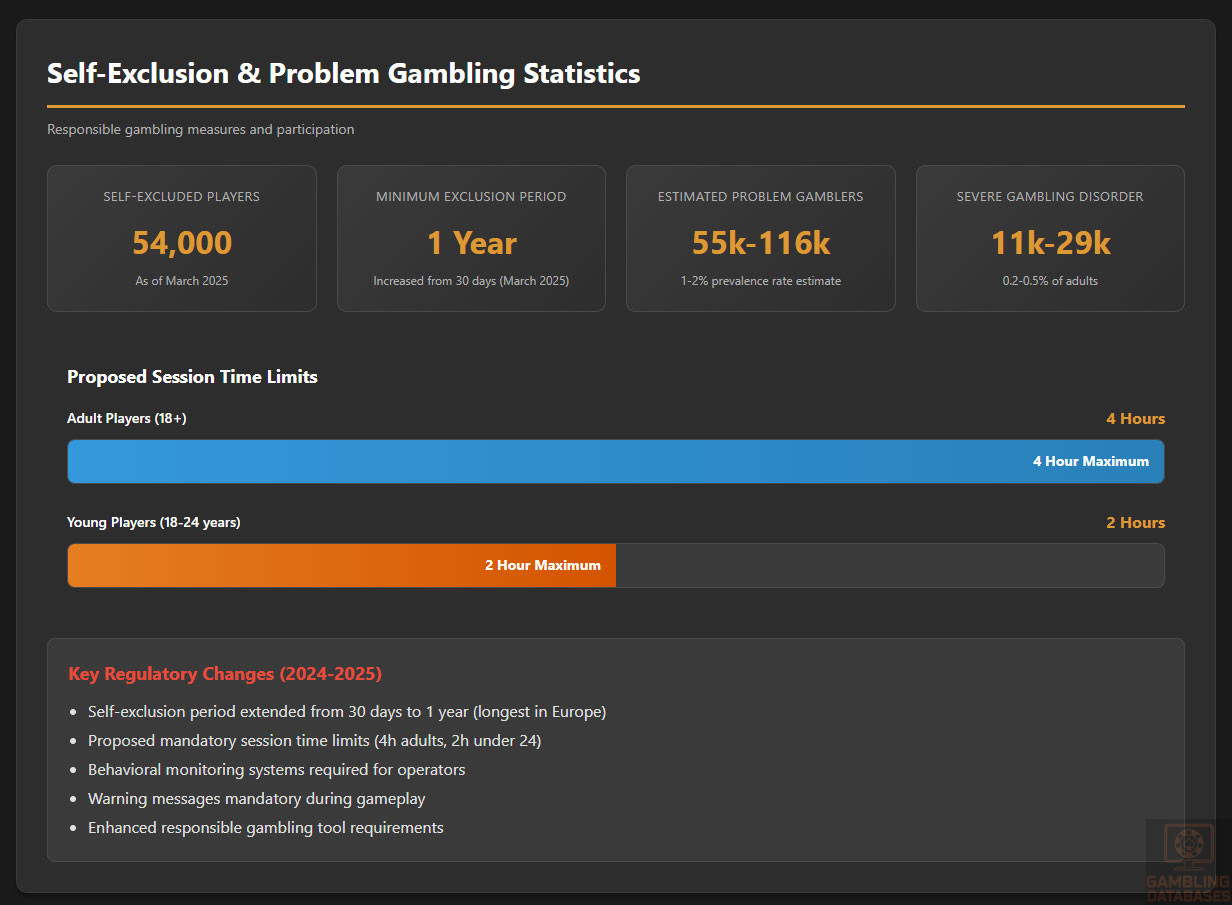
| Self-Exclusion Registrations | 54,000 people | Minimum 1-year exclusion period (as of March 2025) |
| Problem Gambling Rate | Data limited | Government increasing focus on responsible gambling |
| Advertising Restrictions | Severe limitations since May 2024 | Ban on TV, radio, print, most online media |
| Time to Market | 4-6 months | Including company setup and licensing |
| Application Review Period | 60-90 days | After submission of complete documentation |
Section 1: Regulatory Framework and Legal Environment
Current Gambling Regulation Status
Bulgaria operates a comprehensive and well-defined regulatory framework for gambling activities governed primarily by the Gambling Act of 2012. The regulatory environment underwent significant modernization in August 2020 when oversight responsibilities transferred from the State Commission on Gambling to the National Revenue Agency, enhancing integration between gambling regulation and fiscal policy. This transition marked a strategic shift toward more streamlined enforcement and improved revenue collection mechanisms.

The Bulgarian gambling market represents a mature yet still-growing sector within Southeast Europe. As an EU member state since 2007, Bulgaria maintains regulatory autonomy in gambling matters, as the sector remains largely exempt from EU-wide harmonization. This allows the country to craft policies tailored to its domestic market conditions while benefiting from EU single market principles for licensing and operations.

Land-Based Gambling Activities
Land-based gambling in Bulgaria encompasses a diverse range of activities including traditional casinos, sports betting shops, slot machine halls, bingo parlors, and lottery operations. Casino operations require specific licensing and must meet stringent facility standards including minimum gaming floor space, security systems, and surveillance infrastructure. The country hosts numerous casinos in major urban centers, particularly Sofia, Plovdiv, Varna, and Burgas, catering to both local players and tourists visiting Black Sea resorts.
Sports betting venues have proliferated throughout Bulgaria, with physical betting shops operating under dedicated licenses. Following regulatory changes in late 2023 that reduced tax rates for physical sports betting outlets, the market has seen renewed investment in retail betting infrastructure. This segment experienced significant restructuring after 2020 when the government revoked licenses of major operators, creating opportunities for new market entrants.
Slot machine halls operate under separate licensing requirements with specific regulations governing machine-to-floor-space ratios, payout percentages, and technical standards. All gaming equipment must be registered with the Bulgarian Institute of Metrology and undergo regular testing to ensure compliance with fairness and technical specifications. Distance requirements introduced in May 2024 mandate that billboards and gambling establishments maintain at least 300 meters separation from educational institutions and playgrounds, affecting location strategies for new venues.
Bingo and keno operations are permitted under the gambling framework, with venues subject to capacity restrictions and operational standards. These activities have maintained steady popularity, particularly among older demographic segments. The regulatory environment requires operators to implement comprehensive player identification systems, maintain transaction records, and submit regular operational reports to the NRA.
Online Gambling Framework
Online gambling in Bulgaria is fully legal and regulated, with the Gambling Act defining it as any game of chance where players bet directly using the internet or other electronic communication means. Licensed operators can offer a comprehensive range of online gambling products including sports betting, casino games, poker, and instant lotteries. The framework permits both pre-match and live betting on sporting events, online slot games, table games, live dealer games, and various forms of casino entertainment.
A critical distinction exists for lottery products: traditional lottery games are subject to state monopoly following amendments in February 2021, with only the state-owned Bulgarian Sports Totalizator holding the exclusive right to operate classic number-draw lotteries. However, instant lotteries, bingo, keno, and raffle games remain available to private operators, creating opportunities in these adjacent verticals. This monopoly reflects the government’s strategy to maintain control over the most stable gambling revenue stream while opening competitive segments to private investment.
The regulatory framework imposes several technical requirements specific to online operations. Central computer systems that control gaming operations must be located within the EU, EEA member states, or Switzerland. All data related to player registration, identification, bets placed, and winnings paid must be stored within Bulgaria and transmitted in real-time to NRA servers for monitoring purposes. This data localization requirement ensures regulatory oversight while creating technical infrastructure obligations for operators.
Online operators must implement sophisticated player protection systems including self-exclusion mechanisms, session time tracking, and responsible gambling tools. Recent regulatory developments include proposed session time limits of four hours for adults and two hours for players under 24 years old, representing Bulgaria’s adoption of hard-limit approaches similar to emerging European trends. These requirements demand significant investment in compliance technology and player monitoring systems.
Licensed Operators and Market Players
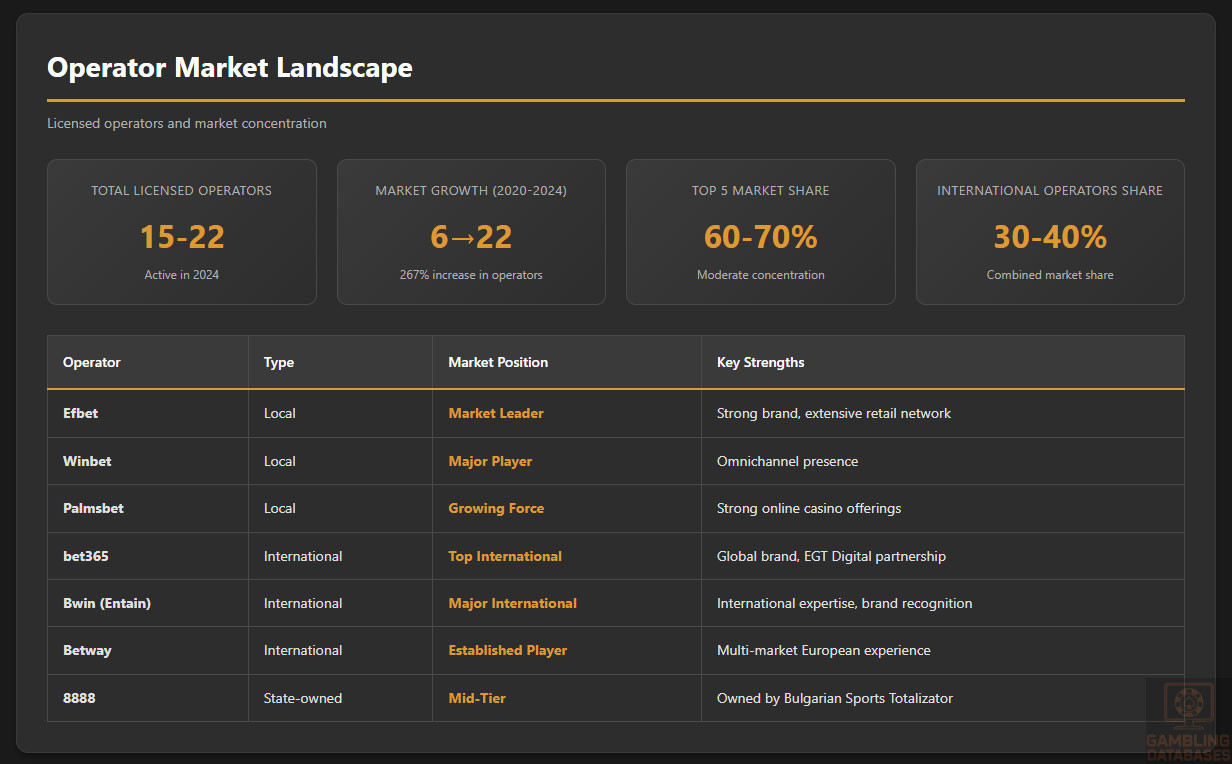
The Bulgarian online gambling market has experienced remarkable expansion in operator numbers, growing from just six licensed operators at the beginning of 2020 to between 15 and 22 active operators by 2024. This rapid growth was catalyzed by the 2020 revocation of licenses held by companies associated with gambling tycoon Vasil Bozhkov, which eliminated major market players and created immediate opportunities for new entrants. The resulting market opening triggered 50% year-over-year growth in 2021 and 2022 before stabilizing to more sustainable 10-12% growth rates.
The market demonstrates moderate concentration with several dominant local operators commanding significant market share alongside international brands. Major local players include Efbet, widely considered the market leader with the strongest brand recognition and extensive retail network. Winbet represents another significant Bulgarian operator with robust online and land-based presence. Palmsbet has established itself as a growing force particularly in online casino offerings.
International operators have successfully entered the market with bet365, one of the world’s largest gambling operators, establishing operations through partnership with EGT Digital to offer localized content from Bulgarian providers. Bwin, part of the Entain group, brings international expertise and brand recognition. Betway, operating under Malta-based GMBS Ltd and part of Super Group, leverages its multi-market European experience. These international entrants typically capture 30-40% combined market share, with local operators retaining dominant positions.
The competitive landscape includes several mid-tier operators such as 8888 (owned by state lottery Bulgarian Sports Totalizator), Alphawin (operating both online and gaming halls), Betmarket (new local entrant), Inbet, Palms Bet, and Sesame (Telematic Interactive Bulgaria, publicly listed). Market positioning strategies vary with some operators focusing on sports betting excellence, others emphasizing casino game variety, and several pursuing omnichannel approaches combining online platforms with physical venue networks.
Market share distribution shows online casinos generating approximately two-thirds of total online gambling revenue, while sports betting accounts for 30-35%. This represents a distinctive market characteristic as many European markets show higher sports betting penetration. The casino-dominant revenue mix reflects strong player preference for slot games, live dealer offerings, and table games, creating opportunities for operators with comprehensive casino content libraries and exclusive game partnerships.
Licensing Framework and Requirements
Application Process and Eligibility
The National Revenue Agency serves as the sole licensing authority for all gambling activities in Bulgaria. The NRA operates under the Ministry of Finance framework and handles license applications, compliance monitoring, enforcement actions, and tax collection. Operators seeking market entry must engage directly with the NRA through formal application procedures that demand comprehensive documentation and financial disclosures. Contact information includes the official NRA website and dedicated gambling regulation departments accessible through their Sofia headquarters.
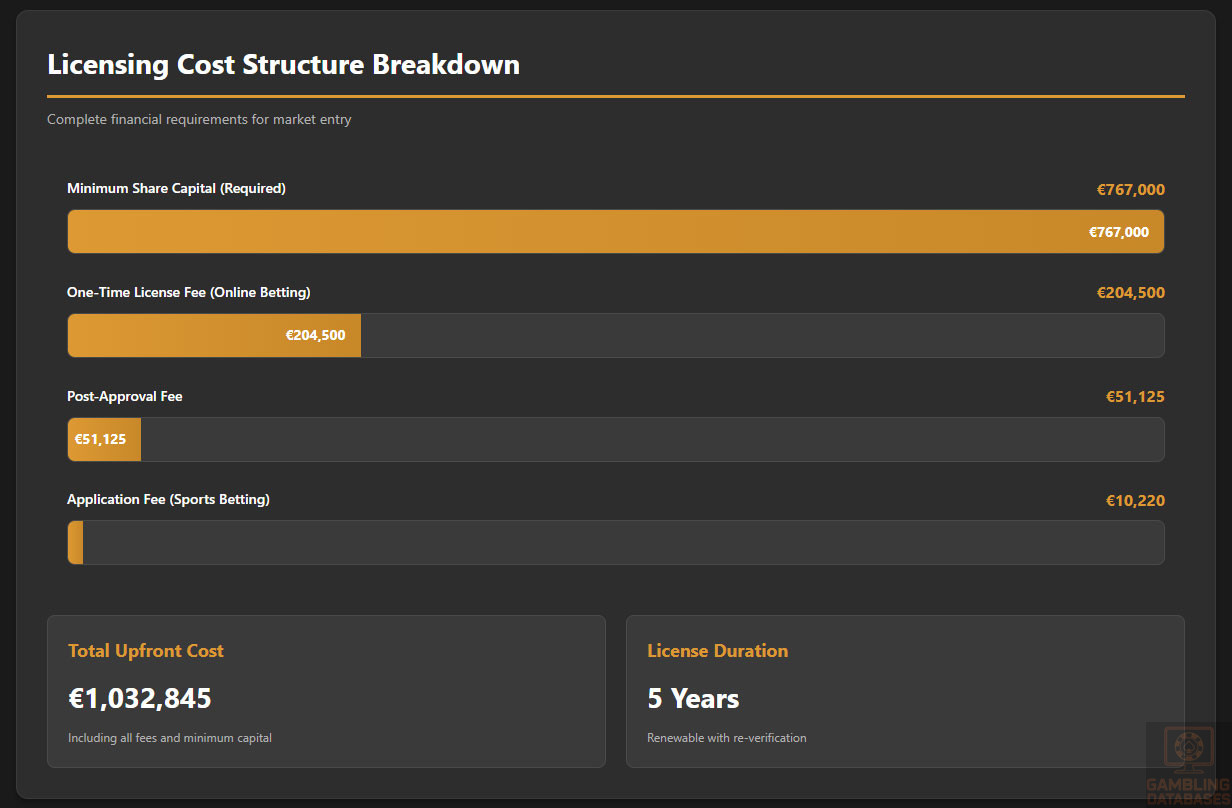
Financial requirements represent the most substantial barrier to entry. Applicants must demonstrate paid-in share capital of at least BGN 1.5 million (approximately EUR 767,000 or USD 835,000), which must be verified through bank statements and audited financial reports. This capital requirement applies regardless of the gambling activity type, establishing a significant entry threshold that effectively limits market access to well-capitalized entities. The capital must be maintained throughout the license period and cannot be withdrawn below minimum thresholds.
Application fees vary by gambling activity type. For online sports betting licenses, the government examination fee is BGN 20,000 (approximately EUR 10,220). Other online gambling activities incur fees ranging from BGN 5,000 to BGN 35,000 (EUR 2,555 to EUR 17,895) depending on the specific license category. Following approval, operators must pay an additional one-time post-approval fee of BGN 100,000 (EUR 51,125). As of January 2024, a substantial one-time state licensing fee of BGN 400,000 (approximately EUR 204,500) applies specifically to online betting operations, representing a significant increase from previous levels.
Technical standards and certifications constitute critical approval requirements. Gaming equipment including central computer systems, control local servers, communication equipment, and gaming software must undergo testing and registration with the Bulgarian Institute of Metrology. Each software version requires separate registration before deployment. Testing methodology follows specific NRA-approved protocols ensuring fairness, randomness, security, and accurate transaction recording. Operators must provide detailed technical documentation including system architecture, data flow diagrams, security protocols, and disaster recovery plans.
Background check procedures apply to all beneficial owners, directors, and key management personnel. Criminal record certificates must be obtained from all jurisdictions where individuals have resided for significant periods during the preceding five years. The NRA investigates financial backgrounds to ensure applicants have not been involved in bankruptcy proceedings, tax violations, or previous gambling license revocations. This reliability assessment aims to prevent criminal elements from infiltrating the gambling sector and ensures only reputable operators receive licenses.
The application review timeline spans 60 to 90 days from submission of complete documentation. This period allows the NRA to conduct thorough due diligence including verification of financial capacity, technical system testing, background checks, and assessment of operational procedures. Incomplete applications or requests for additional information can extend this timeline. Upon completion of the review, the NRA Director issues a formal decision either approving or rejecting the license application. Rejections are appealable to the Sofia Administrative Court, providing legal recourse for applicants who believe decisions were improperly made.
Local Presence and Operational Requirements
Bulgaria’s regulatory framework distinguishes between domestic and foreign operators in its local presence requirements. Companies registered in Bulgaria face no additional representation obligations. However, operators registered in other EU member states, EEA countries, or Switzerland must appoint an authorized representative with an address in Bulgaria. This representative must hold power of attorney with sufficient scope to conclude contracts on behalf of the foreign entity and represent them before Bulgarian state authorities and courts. Importantly, this authorized representative cannot serve as a commercial representative under Bulgarian commerce law, requiring genuine authority and responsibility.
Domain and hosting requirements mandate that central computer systems and communication equipment be physically located within the European Union, European Economic Area, or Switzerland. This provision allows operators to leverage existing EU infrastructure rather than establishing dedicated Bulgarian data centers. However, all data related to gambling services including player registration, identification, betting transactions, and winnings must be stored within Bulgaria and transmitted in real-time to NRA servers. This creates a hybrid approach where core systems can be EU-hosted but Bulgarian data repositories must exist for regulatory access.
Banking requirements specify that operators must maintain accounts in banks licensed in Bulgaria or other EU member states, EEA countries, or Switzerland that operate in Bulgaria. These accounts are used exclusively for depositing player bets and paying winnings. Cash payments for winnings are restricted to BGN 5,000 (approximately EUR 2,555), with higher amounts requiring bank transfer payments. This limitation reduces money laundering risks while ensuring traceable financial flows for regulatory oversight.
Personnel and management obligations focus primarily on the authorized representative for foreign operators rather than requiring extensive Bulgarian staff. Operators can structure their businesses to centralize operations in other EU jurisdictions while maintaining the required representative function in Bulgaria. This flexibility reduces operational costs compared to jurisdictions demanding full local teams. However, practical considerations around customer support, payment processing partnerships, and marketing often lead operators to establish more substantial local presence than minimum requirements mandate.
Foreign ownership faces no restrictions for EU, EEA, and Swiss entities, creating a level playing field within the European single market. This open approach contrasts with some jurisdictions that require local partnership shares or impose nationality restrictions on ownership. Bulgarian citizens and non-EU foreign investors face the same eligibility criteria as EU operators once they establish appropriate corporate structures within the EU/EEA/Switzerland framework. This regulatory neutrality within the European context facilitates international investment while maintaining control through licensing standards.
Compliance Obligations and Monitoring
Player Protection and Identification
Age verification requirements mandate that all gambling participants must be at least 18 years old. Operators must implement robust age verification systems that confirm player age before permitting account registration or gambling activity. Acceptable verification methods include government-issued identification documents, passport verification, and integration with national identification databases. The verification process must occur at the point of registration and cannot be deferred to withdrawal stages, ensuring minors cannot access gambling services even temporarily.
Know Your Customer and Anti-Money Laundering compliance follows comprehensive standards aligned with EU AML directives. Licensed operators are designated as obliged entities under the Bulgarian Measures Against Money Laundering Act, subjecting them to extensive due diligence requirements. Operators must verify player identities, assess risk profiles, monitor transaction patterns for suspicious activity, and report potential money laundering to the NRA’s Anti-Money Laundering Unit formed in 2023. Enhanced due diligence applies to high-value transactions, politically exposed persons, and players from high-risk jurisdictions.
Responsible gambling measures have become increasingly stringent through recent legislative amendments. Operators must provide self-exclusion mechanisms allowing players to block access to gambling services. Following changes effective March 27, 2025, the minimum self-exclusion period increased from 30 days to one full year, representing one of Europe’s longest mandatory exclusion periods. As of March 2025, nearly 54,000 people had registered for self-exclusion through the national program administered by the NRA. Players can apply for exclusion either in person at NRA offices or online, with operators required to check the exclusion list in real-time before permitting gambling activity.
Session time limits and loss limits represent emerging regulatory requirements. Draft legislation for 2025 proposes mandatory session limits of four hours for adult players and two hours for players under 24 years of age. Additional behavioral monitoring requirements will mandate operators to identify signs of problem gambling including extended play sessions, chasing losses, and dramatic bet size increases. When concerning patterns emerge, operators must intervene through warning messages, temporary cooling-off period suggestions, and referrals to gambling support resources.
Mandatory player information disclosures require operators to clearly communicate odds, payout percentages, house advantages, and game rules. Terms and conditions must be presented in Bulgarian language with transparent explanation of bonus wagering requirements, withdrawal processes, and fees. Warning messages about gambling addiction risks must appear prominently on websites, in marketing materials, and during gameplay. Operators must provide easy access to responsible gambling tools including deposit limits, loss limits, reality checks, and contact information for gambling addiction support services.
Financial Monitoring and Reporting
Transaction monitoring systems must operate continuously to detect suspicious financial activity and potential money laundering. Operators must implement automated monitoring rules that flag unusual deposit patterns, rapid turnover of funds, structured transactions designed to avoid reporting thresholds, and other indicators of financial crime. All flagged transactions require review by designated compliance officers with authority to suspend accounts, request additional documentation, or file suspicious activity reports with the NRA.
Reporting requirements to the NRA operate on real-time, daily, and periodic bases depending on the information type. Real-time data transmission includes all bets placed, outcomes determined, and winnings paid, allowing the NRA to maintain comprehensive oversight of gambling activity. Monthly reports must detail total bets received, total winnings paid, gross gaming revenue, player account balances, and tax calculations. Quarterly reports provide more detailed financial information including revenue by game type, player demographics, and operational statistics.
Audit and inspection procedures authorize the NRA to conduct on-site and remote audits of operator systems, financial records, and compliance procedures. Operators must grant NRA officials access to all relevant data, systems, and documentation upon request. Annual financial audits by licensed auditing firms are mandatory, with audit reports submitted to the NRA demonstrating financial stability and accurate tax reporting. Technical audits verify gaming systems continue to meet fairness and security standards throughout the license period.
Data retention requirements mandate preservation of all gambling-related data for specified periods after transactions occur. Player registration information, betting history, financial transactions, communications, and compliance documentation must remain accessible for regulatory inspection. These retention obligations create significant data storage requirements but ensure the NRA can investigate complaints, verify tax calculations, and conduct enforcement actions based on comprehensive historical records.
Taxation Structure and Financial Obligations
Player Taxation
Players using licensed Bulgarian operators enjoy tax-free winnings regardless of amount. This zero-tax structure for licensed operator winnings creates a competitive advantage for regulated market operators and incentivizes players to use licensed platforms rather than offshore alternatives. The tax exemption applies to all forms of gambling including sports betting, casino games, poker, and lottery products offered by licensed entities.
However, a critical distinction exists for unlicensed operators. Winnings from unlicensed operators or from operators licensed in non-EU member states are subject to personal income taxation at Bulgaria’s flat 20% rate. Players are legally obligated to declare such winnings in their annual tax returns and pay applicable taxes. This creates a significant financial disincentive for using offshore operators while simultaneously increasing enforcement complexity as the government must rely substantially on player self-reporting for international gambling winnings.
Withholding procedures apply when operators pay winnings from unlicensed or foreign sources. While licensed operators have no withholding obligations, banks and financial institutions may flag large incoming transfers from known gambling operators for tax reporting purposes. The government has enhanced cooperation with financial institutions to identify players receiving substantial winnings from international sources, though enforcement remains challenging given the cross-border nature of online gambling.
Tax-free thresholds do not apply to licensed operator winnings – all amounts from BGN 1 to unlimited sums remain tax-exempt for players. This unlimited exemption differs from some jurisdictions that impose taxation above certain winning thresholds. The policy reflects Bulgaria’s strategy to maximize licensed operator appeal and channel gambling activity into the regulated market where operator taxation generates government revenue while protecting consumers through regulatory oversight.
Operator Taxation
Gross Gaming Revenue taxation represents the primary gambling tax burden on operators. As of January 2024, the GGR tax rate increased to 20% from the previous 15% rate. GGR is calculated as total bets received minus total winnings paid to players, representing the operator’s gross profit before operational expenses. This 20% rate applies uniformly across online gambling activities including sports betting, casino games, and poker. The rate increase reflects government efforts to boost tax revenues from the growing gambling sector while remaining competitive with regional jurisdictions.
Net Gaming Revenue considerations do not apply in Bulgaria’s tax framework, which focuses exclusively on GGR as the tax base. Operators cannot deduct operational expenses, marketing costs, technology investments, or other business expenditures when calculating gambling tax obligations. This gross-basis taxation creates higher effective tax rates compared to jurisdictions permitting expense deductions but provides simplicity and predictability in tax calculations while minimizing disputes over deductible expense classifications.
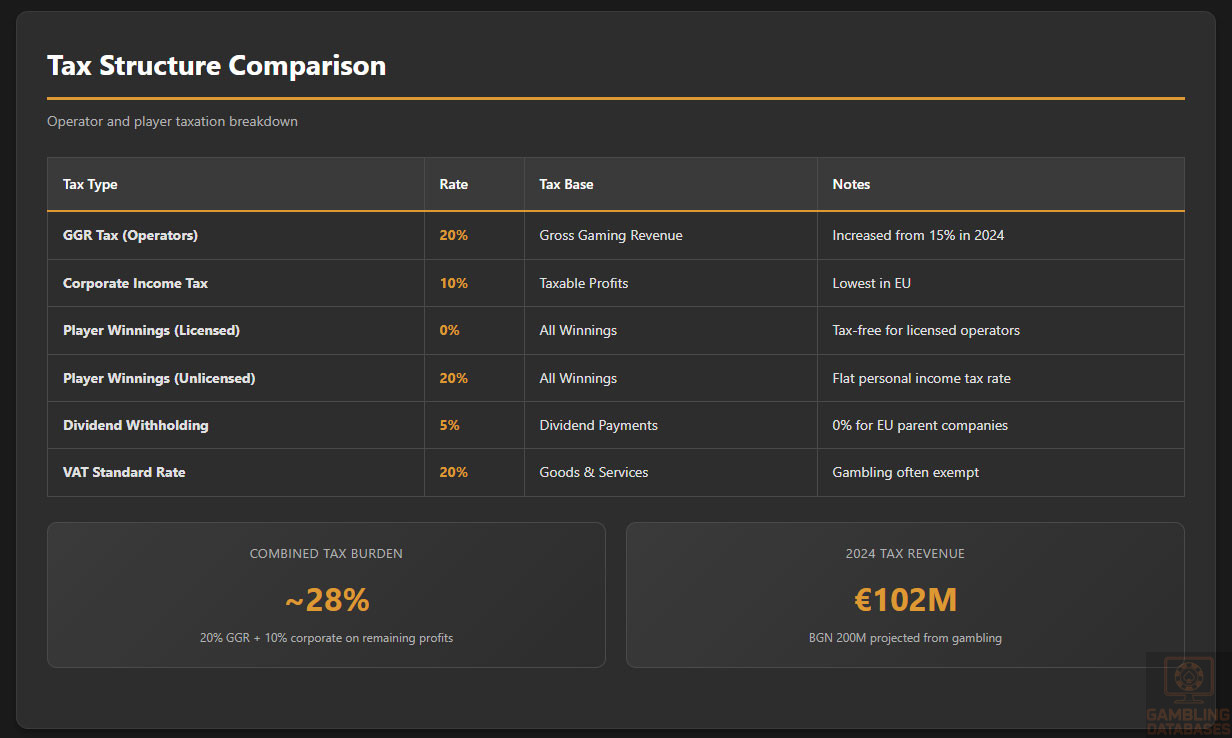
Fixed operational taxes include the substantial one-time license fees. The BGN 400,000 (EUR 204,500) one-time fee for online betting licenses effective January 2024 represents a significant upfront cost that must be amortized over the five-year license period. Additional annual license maintenance fees apply with amounts varying by license type. The BGN 100,000 (EUR 51,125) post-approval fee paid upon license issuance adds to initial capital requirements.
Corporate income tax applies to gambling operators at Bulgaria’s flat 10% rate on taxable profits after deducting gambling taxes and operational expenses. This 10% corporate tax rate represents the lowest in the European Union, providing a meaningful competitive advantage. The combined effective tax burden includes the 20% GGR tax plus 10% corporate income tax on remaining profits, plus social security contributions on employee salaries. When fully loaded, the tax structure remains competitive with many European jurisdictions while generating substantial government revenues.
License renewal fees apply at the end of five-year license periods. Operators seeking renewal must pay fees comparable to initial licensing costs though specific renewal fee structures remain at NRA discretion. The renewal process involves re-verification of financial capacity, technical compliance, and operational standards but typically proceeds more efficiently than initial applications given established track records.
Gambling Market Financial Performance
| Year | Online GGR (BGN Million) | Online GGR (EUR Million) | YoY Growth | Tax Revenue (BGN Million) |
|---|---|---|---|---|
| 2020 | ~440 | ~225 | Market opening | ~66 |
| 2021 | ~660 | ~337 | ~50% | ~99 |
| 2022 | ~1,000 | ~511 | ~50% | 251.2 |
| 2023 | ~1,100 | ~562 | ~10-12% | ~165-220 |
| 2024 | 1,100 | 561 | ~0-5% | ~200 projected |
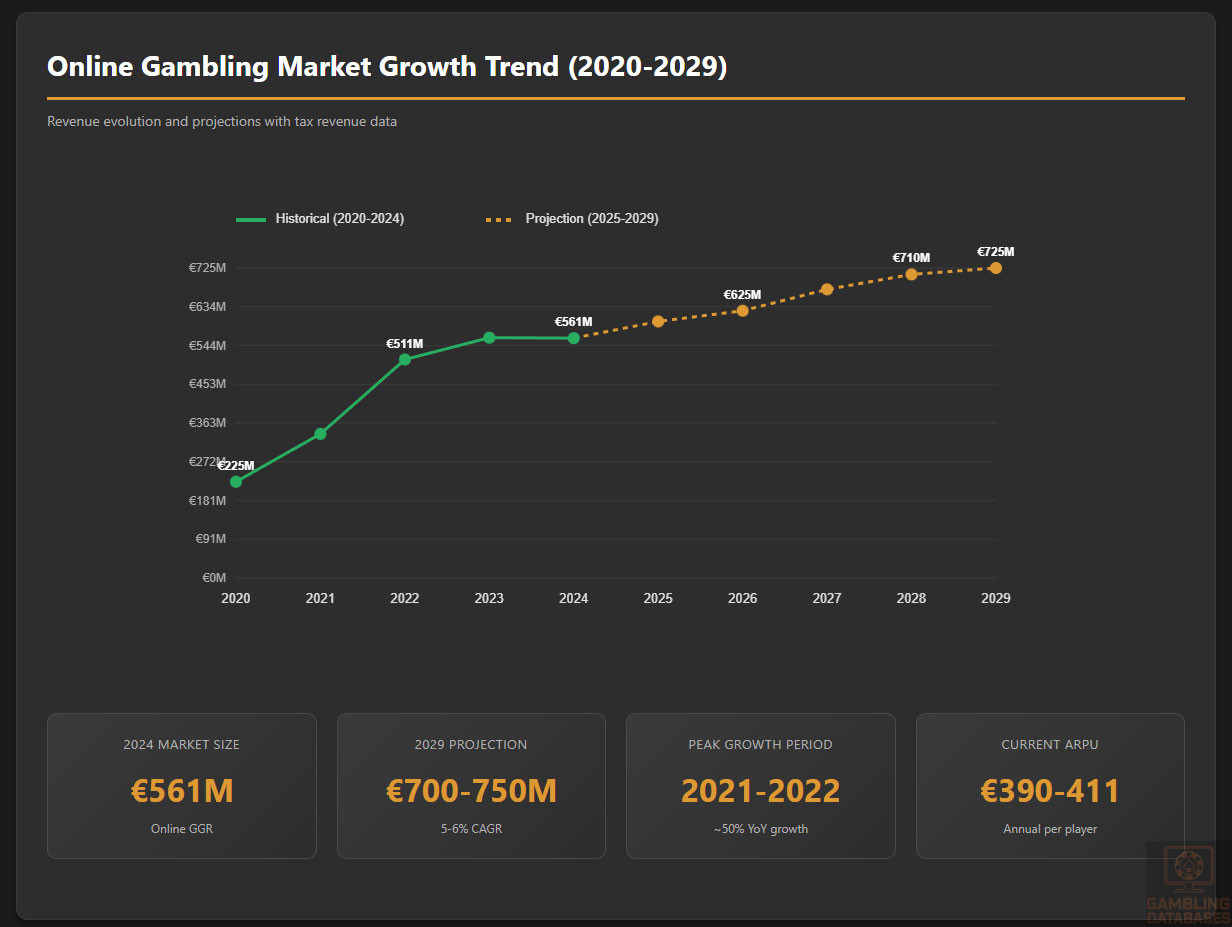
The Bulgarian online gambling market reached BGN 1.1 billion (EUR 561 million) in gross gaming revenue during 2024, representing stabilization after explosive growth in previous years. This figure represents the total amount wagered minus winnings paid to players, effectively measuring operator gross profit before expenses. The market demonstrated exceptional expansion in 2021 and 2022 with approximately 50% year-over-year growth, catalyzed by the removal of dominant operators and regulatory market opening that created opportunities for new entrants.
Growth rates moderated significantly in 2023 and 2024 to approximately 10-12% and near-zero respectively, indicating market maturation as operator numbers stabilized and competitive intensity increased. This growth deceleration reflects natural market evolution as early rapid expansion gives way to sustainable long-term growth patterns. Industry participants expect renewed growth acceleration as international operators increase market investment and product innovation drives player engagement.
Total gambling market size including both online and land-based operations is estimated to exceed EUR 2 billion in total turnover, with online activities representing approximately 25-30% of total gambling revenue. The substantial land-based sector includes traditional casinos, gaming halls, sports betting shops, and state lottery operations. Land-based gambling recovered from COVID-19 impacts and continues growing albeit at slower rates than online channels, with physical venues maintaining strong positions in tourist destinations and major urban centers.
Revenue distribution by gambling type shows online casinos commanding dominant market share at approximately 65-67% of online gambling revenue. This casino-heavy mix distinguishes Bulgaria from many European markets where sports betting often dominates. Sports betting accounts for 30-35% of online revenue, reflecting strong football betting culture and interest in international sporting events. The remaining revenue comes from poker, bingo, and other game categories.
Tax revenues generated for government coffers reached BGN 251.2 million in 2022 and were projected at BGN 200 million for 2024, representing substantial contributions to the national budget. The decline from 2022 to 2024 reflects tax rate changes, enforcement patterns, and market dynamics rather than revenue reduction. With the 2024 increase to 20% GGR tax rates, government revenues are expected to grow significantly in 2025 and beyond, providing resources for social programs, regulatory enhancement, and problem gambling treatment initiatives.
Year-over-year growth trends indicate Bulgarian online gambling transitioned from explosive expansion phase (2021-2022) through rapid growth (2023) to market maturation (2024). Future projections suggest sustained growth rates of 5-12% annually through 2029, driven by continued internet penetration increases, smartphone adoption, payment method improvements, and product innovation. Conservative estimates project the market reaching EUR 186-231 million by 2027-2029, though these figures may prove understated given current momentum.
Advertising and Marketing Restrictions
Bulgaria implemented severe gambling advertising restrictions effective May 18, 2024, through comprehensive amendments to the Gambling Act. These restrictions represent some of Europe’s most stringent advertising limitations and fundamentally reshape how operators can acquire customers and build brand awareness. The regulatory changes reflect growing political and social pressure to reduce gambling’s public visibility and perceived normalization, particularly among younger populations.
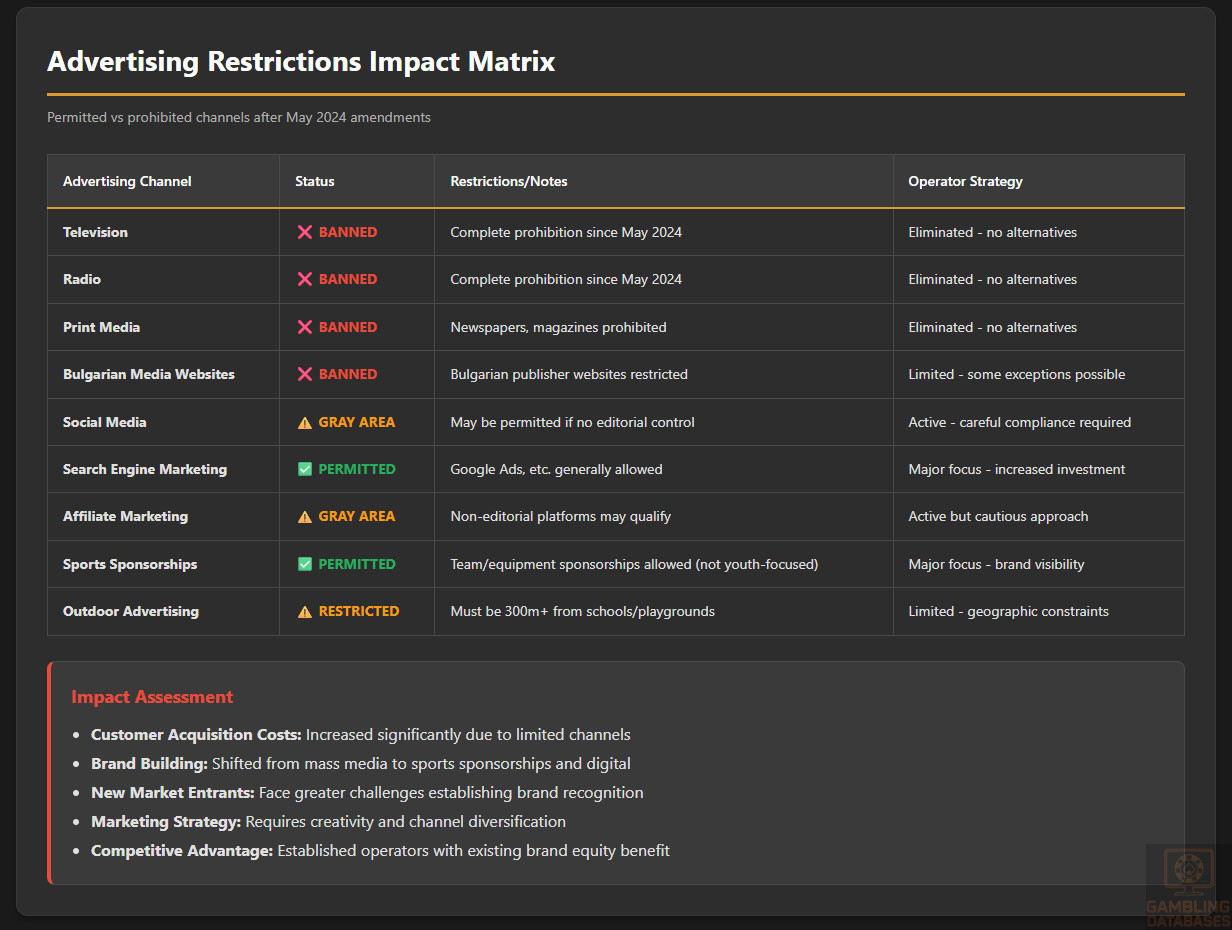
Permitted advertising channels have been dramatically restricted. Traditional broadcast media including television and radio face complete bans on gambling advertisements regardless of time of day or program content. Print media including newspapers, magazines, and other publications similarly cannot carry gambling advertising. Most significantly, online media websites operated by Bulgarian publishers fall under the advertising prohibition, eliminating major digital advertising channels that operators previously relied upon for customer acquisition.
The definition of prohibited online media generated significant uncertainty initially, with the National Revenue Agency issuing clarifying guidance in September 2024. The NRA decision indicated restrictions target Bulgarian media outlets and their websites rather than the entire internet. Social media platforms like Facebook, Instagram, and TikTok may fall outside the prohibition scope depending on whether they exercise editorial control over content or merely distribute user-generated content. The NRA’s case-by-case approach creates interpretation challenges but suggests social media advertising may remain viable.
Affiliate marketing platforms exist in a gray area under current interpretations. The NRA guidance suggests platforms without editorial responsibility that simply facilitate connections between advertisers and publishers might avoid the strictest prohibitions. However, operators must carefully assess compliance risks when engaging affiliates given evolving enforcement patterns and potential for regulatory guidance changes. Conservative compliance approaches favor limiting affiliate relationships or requiring contractual terms that shift legal risk to affiliate partners.
Outdoor advertising faces geographical restrictions rather than complete prohibition. Billboards and other outdoor advertising materials must maintain at least 300 meters distance from educational institutions and playgrounds. This zoning requirement complicates outdoor campaign planning and limits placement options in urban areas with dense school networks. Operators must conduct detailed geographic analysis before outdoor campaigns to ensure compliance while maximizing visibility to target demographics.
Sponsorship regulations permit gambling operators to place branding on sports equipment, materials, and products unless the sponsorship targets minors or occurs at venues primarily used by children. Sports team sponsorships remain viable, creating opportunities for brand building through association with popular football clubs and sporting events. However, operators must carefully structure sponsorship agreements to ensure appropriate audience targeting and avoid youth-focused properties.
Content restrictions mandate that all permitted advertising must include prominent warnings about gambling addiction risks. Messages must clearly communicate that gambling involves financial risk and provide contact information for gambling addiction support services. Promotional content cannot suggest gambling solves financial problems, guarantees winning outcomes, or targets vulnerable populations. Youth appeal elements including cartoon characters, celebrity endorsements popular with minors, and placement near children’s content face strict prohibition.
Promotional limitations extend beyond advertising placement to regulate bonus offers and incentive structures. While specific bonus caps have not been imposed, operators must ensure promotional terms are transparent, fair, and not misleading. Wagering requirements must be clearly disclosed with realistic achievement probabilities. The regulatory environment suggests possible future restrictions on bonus generosity or structure, following patterns seen in jurisdictions like Germany and the Netherlands.
Time restrictions for television and radio advertising are moot given the complete broadcast advertising ban. However, should regulations liberalize in the future, watershed restrictions limiting gambling advertising to late evening hours would likely apply consistent with European norms. Current prohibition reflects political determination to minimize gambling’s cultural presence rather than merely protect vulnerable viewing hours.
Marketing to minors faces absolute prohibition with severe penalties for violations. Operators must implement age-gating on all digital properties, verify user ages before displaying gambling content, and avoid any messaging, imagery, or channel selection that could appeal to persons under 18. The regulatory focus on youth protection intensified in recent years given concerns about gambling normalization among younger generations increasingly exposed to online content.
Recent Regulatory Changes and Their Impact
The May 2024 regulatory amendments represent the most significant gambling law changes since the 2012 Gambling Act’s enactment. These amendments fundamentally altered the operational landscape for gambling operators with particular focus on advertising restrictions, player protection enhancement, and unlicensed operator suppression. The changes reflect growing political pressure to address perceived gambling harms while maintaining the regulated market’s viability.
The advertising ban detailed above constitutes the most visible and impactful change. Operators report dramatic increases in customer acquisition costs as traditional advertising channels closed. Marketing budgets shifted toward permitted channels including social media, search engine marketing, affiliate partnerships, and sponsorships. Brand building through sports sponsorships gained importance as direct response advertising options contracted. Total gambling industry television advertising spending declined 13% year-over-year in 2023 anticipating these restrictions.
Player protection measures expanded substantially through several mechanisms. The March 2025 increase in minimum self-exclusion periods from 30 days to one year represents Europe’s longest mandatory exclusion. This change aims to ensure self-excluded players have adequate time away from gambling to address problematic behavior rather than quickly re-entering after brief cooling-off periods. The nearly 54,000 registered self-excluded players cannot access licensed gambling services, creating a significant excluded customer base.
Session time limits expected to take effect during 2025 will mandate maximum four-hour gambling sessions for adults and two-hour limits for players aged 18-24. These hard limits require sophisticated technical implementation to track session duration across devices and platforms while permitting breaks that reset timers. Operators must invest in compliance technology and player education about limit mechanisms while potentially experiencing revenue impacts from reduced play duration.
Mandatory behavioral monitoring obligations will require operators to implement systems identifying problem gambling indicators. When systems detect concerning patterns including extended play, chasing losses, or dramatic bet increases, operators must intervene through warning messages, mandatory breaks, or account restrictions. This shift from passive responsible gambling tools to active intervention represents significant compliance burden increase while potentially improving player outcomes.
The 2024 tax rate increase from 15% to 20% on gross gaming revenue directly impacts operator profitability and pricing strategies. The five percentage point increase represents a 33% relative increase in tax burden, requiring operators to improve operational efficiency, adjust bonus generosity, or accept reduced margins. The increased rates generated immediate government revenue increases while creating competitive pressure particularly on smaller operators with limited scale economies.
Distance requirements for physical gambling establishments and advertising create operational constraints for land-based operators planning new venues or advertising campaigns. The 300-meter buffer from schools and playgrounds significantly reduces available locations in urban areas. Some existing operations found themselves non-compliant with new distance rules, though grandfather provisions typically provide protection for established facilities.
Unlicensed operator suppression intensified through multiple enforcement mechanisms. Internet service providers must block access to unlicensed gambling websites under NRA orders. Payment institutions cannot process transactions to or from unlicensed operators. Postal operators and couriers cannot facilitate payments related to unlicensed gambling. These multi-layered restrictions aim to channel gambling activity into the regulated market while protecting consumers from unregulated offshore operators.
Impact on operator costs and business strategy has been substantial. Marketing expense shifted from broad-reach television advertising to more targeted digital channels, requiring strategy adaptation and potentially reducing total addressable market reach. Compliance technology investments increased significantly to implement monitoring systems, session limits, and enhanced data reporting. Smaller operators face particular pressure from increased costs while lacking scale to efficiently absorb these burdens.
Upcoming regulatory changes remain under discussion with potential further restrictions on loss limits, mandatory deposit limits, and enhanced verification requirements. The regulatory trajectory suggests continuing tightening of operational requirements aligned with broader European player protection trends. Operators must maintain flexible compliance infrastructure capable of adapting to evolving requirements while engaging constructively with regulatory development processes.
Enforcement Mechanisms and Penalties
The National Revenue Agency employs comprehensive enforcement powers to ensure gambling law compliance. Enforcement actions range from administrative warnings and fines through license suspensions to permanent license revocations depending on violation severity and repetition patterns. The NRA maintains authority to conduct announced and unannounced inspections, access operator systems and records, interview personnel, and require remedial actions within specified timeframes.
Penalty structures for licensed operators include financial fines calculated based on violation severity and resulting harm. Minor technical violations may incur fines of BGN 10,000-50,000 (EUR 5,000-25,000), while serious violations including player protection failures, tax evasion, or money laundering can result in fines exceeding BGN 500,000 (EUR 255,000). Repeated violations escalate penalty severity with the NRA empowered to impose increasingly harsh sanctions on operators demonstrating compliance failures.
License suspension represents an intermediate sanction allowing the NRA to temporarily halt operator activities while investigating serious violations or requiring compliance improvements. Suspensions typically last 30-90 days during which operators cannot accept bets or process new registrations but must maintain player account access for withdrawals. Suspended operators lose revenue during the suspension period while maintaining operational costs, creating significant financial pressure to achieve swift compliance.
License revocation constitutes the ultimate enforcement action, permanently terminating operator market access. Revocations occur for severe violations including criminal activity, systematic regulatory breaches, fraud, money laundering facilitation, or failure to remedy suspension-triggering violations. Revoked operators must cease all gambling activities, return player funds, settle outstanding tax obligations, and cannot reapply for licensing within specified exclusion periods. The 2020 revocations of major operators associated with Vasil Bozhkov demonstrate the government’s willingness to take drastic enforcement actions.
Recent enforcement actions focused heavily on unlicensed operator suppression. The NRA maintains a public blacklist of prohibited gambling websites with court orders requiring ISP blocking. As of 2024, hundreds of unlicensed websites face access restrictions, though enforcement effectiveness varies given players’ ability to use VPNs or access through mobile apps. Payment processor restrictions create more effective barriers by preventing Bulgarian bank cards and payment methods from funding unlicensed gambling accounts.
Compliance enforcement trends indicate increasing regulatory sophistication and willingness to impose meaningful sanctions. The formation of the NRA’s Anti-Money Laundering Unit in 2023 enhanced financial crime detection and enforcement capacity. Regular audits of player protection systems, verification procedures, and responsible gambling tool implementation demonstrate regulatory focus on consumer protection rather than merely revenue collection. Operators report more frequent NRA communications, inspection notices, and compliance inquiries compared to earlier years.
ISP blocking of unlicensed operators operates through court order mechanisms. The NRA identifies unlicensed gambling websites operating without Bulgarian licenses, obtains court orders mandating access blocking, and directs all Bulgarian ISPs to implement blocks. While technically straightforward, enforcement faces practical challenges given the ease of website migration to new domains and player ability to circumvent blocks through VPN services or Tor browsers.
Payment processor restrictions create more effective enforcement by cutting financial flows. Banks and payment service providers operating in Bulgaria must screen transactions for gambling-related activity and reject payments to unlicensed operators. The NRA provides guidance on identifying gambling transactions through merchant category codes, known operator accounts, and transaction pattern analysis. Financial institutions face their own penalties for facilitating illegal gambling transactions, incentivizing robust screening programs.
Criminal penalties for illegal gambling operations apply primarily to unlicensed operators rather than licensed entities committing regulatory violations. Operating gambling services without appropriate licenses constitutes a criminal offense under Article 327 of the Penal Code, carrying imprisonment sentences of one to four years plus financial penalties. Prosecution targets organized illegal gambling operations, particularly those involving money laundering, fraud, or other criminal activity. Individual players using unlicensed services typically face no criminal liability though tax evasion for undeclared winnings remains prosecutable.
Section 2: Demographics and Consumer Analysis
Population Demographics and Distribution
Core Population Metrics
Bulgaria’s population stands at approximately 6.71 million people as of mid-2025, representing a small but significant market within Southeast Europe. The population has been declining steadily for decades, with current annual decreases of approximately 0.6% driven by low birth rates, aging demographics, and emigration to Western European countries. This declining population trajectory creates challenges for market growth but does not negate opportunities given increasing gambling participation rates and rising disposable incomes among remaining residents.
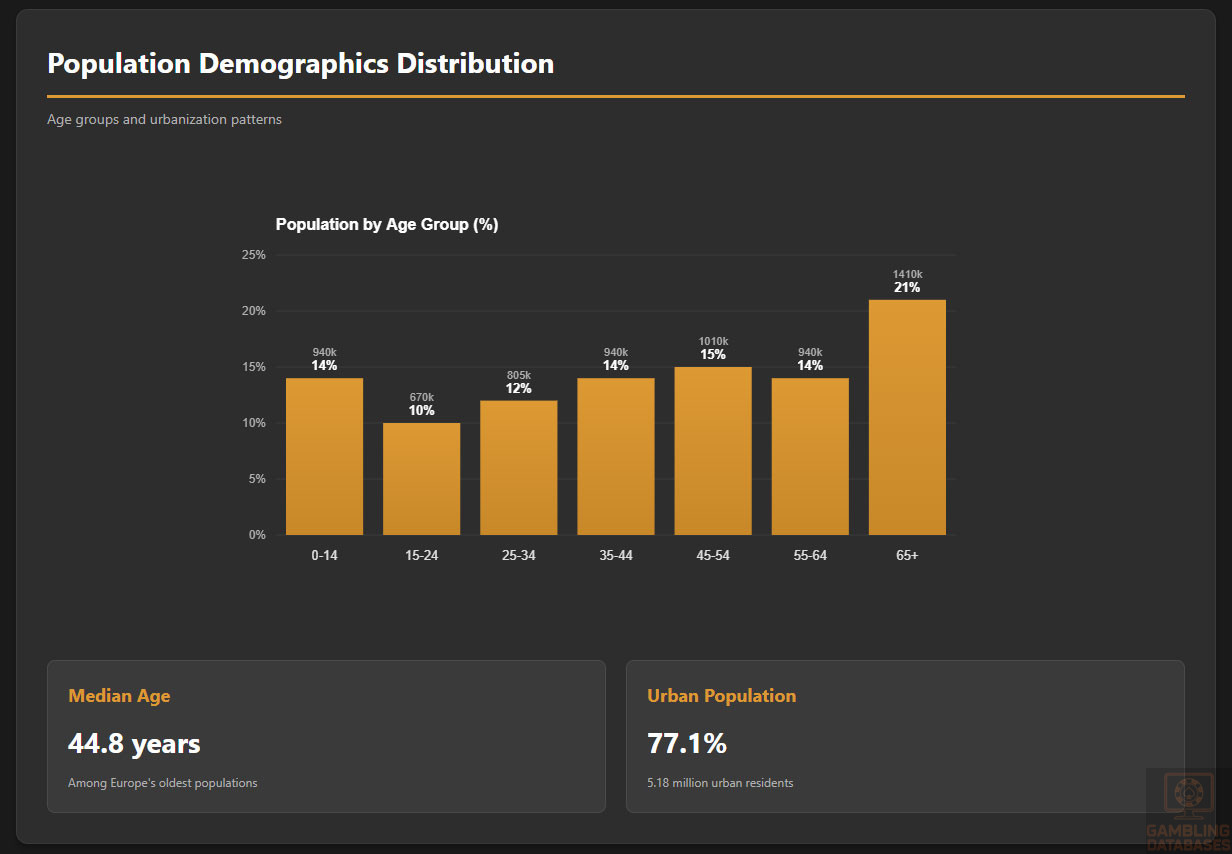
Age distribution reveals a mature population structure with implications for gambling market development. Persons aged 0-14 represent approximately 14% of the population (940,000 people), while the crucial 15-24 demographic comprises roughly 10% (670,000). The 25-34 age bracket, prime gambling demographic, accounts for approximately 12% (805,000). The 35-44 cohort represents 14% (940,000), while 45-54 year-olds comprise 15% (1.01 million). The 55-64 demographic accounts for 14% (940,000), and persons 65 and older represent 21% (1.41 million), highlighting significant population aging.
The median age of 44.8 years positions Bulgaria among Europe’s oldest populations, exceeded only by countries like Italy, Germany, and Portugal. This aging demographic structure suggests gambling operators should target mature audiences rather than youth-focused strategies. The substantial population segments in 35-64 age ranges represent prime gambling customers with established careers, disposable income, and leisure time for gambling entertainment. Marketing strategies emphasizing sophisticated entertainment, reliability, and responsible gambling likely resonate more effectively than youth-oriented approaches.
Gender ratios show approximately 946 men per 1,000 women, reflecting higher female life expectancy and demographic patterns common throughout Eastern Europe. The female population surplus grows more pronounced in older age brackets where life expectancy differentials accumulate. For gambling operators, the gender distribution suggests opportunities in female-focused game categories and marketing approaches, particularly given data showing approximately 40% of online gambling activity comes from female players, higher than many markets assume.
Life expectancy stands at 73.6 years overall, with male life expectancy at 70 years and female life expectancy at 77.4 years. These figures fall below Western European averages, reflecting healthcare system challenges and socioeconomic factors. The relatively short life expectancy combined with late retirement ages creates a smaller elderly leisure class compared to wealthier EU nations, though improving economic conditions may extend both life expectancy and healthy retirement years over the coming decade.
Geographic Distribution
Urban population concentration reaches 77.1%, with approximately 5.18 million people residing in cities and towns. This high urbanization rate facilitates internet infrastructure deployment, payment service availability, and marketing reach compared to predominantly rural markets. Urban dwellers typically demonstrate higher internet usage, greater digital payment adoption, and stronger gambling participation rates than rural populations, concentrating the addressable market in manageable geographic footprints.
Major cities and population centers include Sofia, the capital and largest city with approximately 1.3 million residents in the metropolitan area. Sofia serves as the economic, cultural, and technological hub with highest incomes and most developed digital infrastructure. Plovdiv, Bulgaria’s second city, hosts approximately 340,000 people and represents an important secondary market. Varna on the Black Sea coast has roughly 335,000 residents and significant tourism-related gambling activity.
Burgas, another Black Sea coastal city, contains approximately 202,000 people with seasonal population increases during summer tourism peaks. Ruse, located on the Danube River bordering Romania, has around 145,000 residents. Stara Zagora in central Bulgaria hosts approximately 138,000 people. Pleven in northern Bulgaria contains roughly 107,000 residents, while Sliven in southeast Bulgaria has about 96,000 people. Dobrich in northeastern Bulgaria rounds out the major urban centers with approximately 90,000 inhabitants.
Regional economic differences create income and gambling participation disparities across Bulgaria. Sofia and the southwestern region demonstrate highest GDP per capita, most developed services sectors, and greatest concentration of higher-income professionals. Coastal areas benefit from tourism revenues generating seasonal economic activity and gambling demand spikes during summer months. Northern and central regions face greater economic challenges with higher unemployment and lower wages, though cost of living advantages partially offset income differentials.
Internet access geographic patterns show near-universal coverage in urban areas with 95%+ penetration rates, while rural areas lag significantly with penetration rates potentially 20-30 percentage points lower. This digital divide concentrates the online gambling addressable market even more heavily in urban areas beyond what population distribution alone suggests. Mobile internet expansion has improved rural connectivity substantially in recent years, with 4G coverage extending to most inhabited areas and creating previously unavailable gambling access in underserved regions.
Concentration of gambling venues by region follows population and economic patterns. Sofia hosts the highest density of land-based casinos, gaming halls, and sports betting shops reflecting population concentration and tourist traffic. Black Sea coastal areas show elevated gambling venue density supporting seasonal tourism activity. Regional cities maintain smaller gambling infrastructures proportional to local populations, while rural areas rely primarily on online access given limited physical venue economic viability in low-density areas.
Economic Indicators and Consumer Spending Power
GDP and Economic Performance
Bulgaria’s current GDP reaches approximately USD 107 billion in nominal terms for 2024, representing meaningful economic scale despite relatively small population. On a purchasing power parity basis accounting for lower Bulgarian living costs, GDP expands to approximately USD 229 billion, demonstrating that real economic output exceeds nominal dollar measurements. This PPP adjustment reflects that Bulgarian consumers’ actual purchasing power and living standards exceed what raw income figures suggest when comparing to higher-cost Western European markets.
GDP per capita stands at USD 10,090 in nominal terms for 2024, positioning Bulgaria in the upper-middle income category but substantially below Western European levels. On a PPP basis, GDP per capita reaches approximately USD 36,000, representing 70% of the EU average on PPP terms but only 43% on nominal terms. This disparity indicates Bulgarians enjoy better real living standards than dollar income comparisons suggest, important for understanding consumer discretionary spending capacity for gambling and entertainment.
GDP growth forecasts show Bulgaria maintaining expansion rates above EU averages over the coming years. First quarter 2025 growth reached 3.1% year-over-year, exceeding the eurozone average and demonstrating economic resilience. Growth is driven primarily by domestic demand including consumption and investment, while external trade showed weakness in early 2025. Forecasts suggest GDP growth of 2.5-3.5% annually through 2027-2029, supporting continued gambling market expansion through rising incomes and consumer spending capacity.
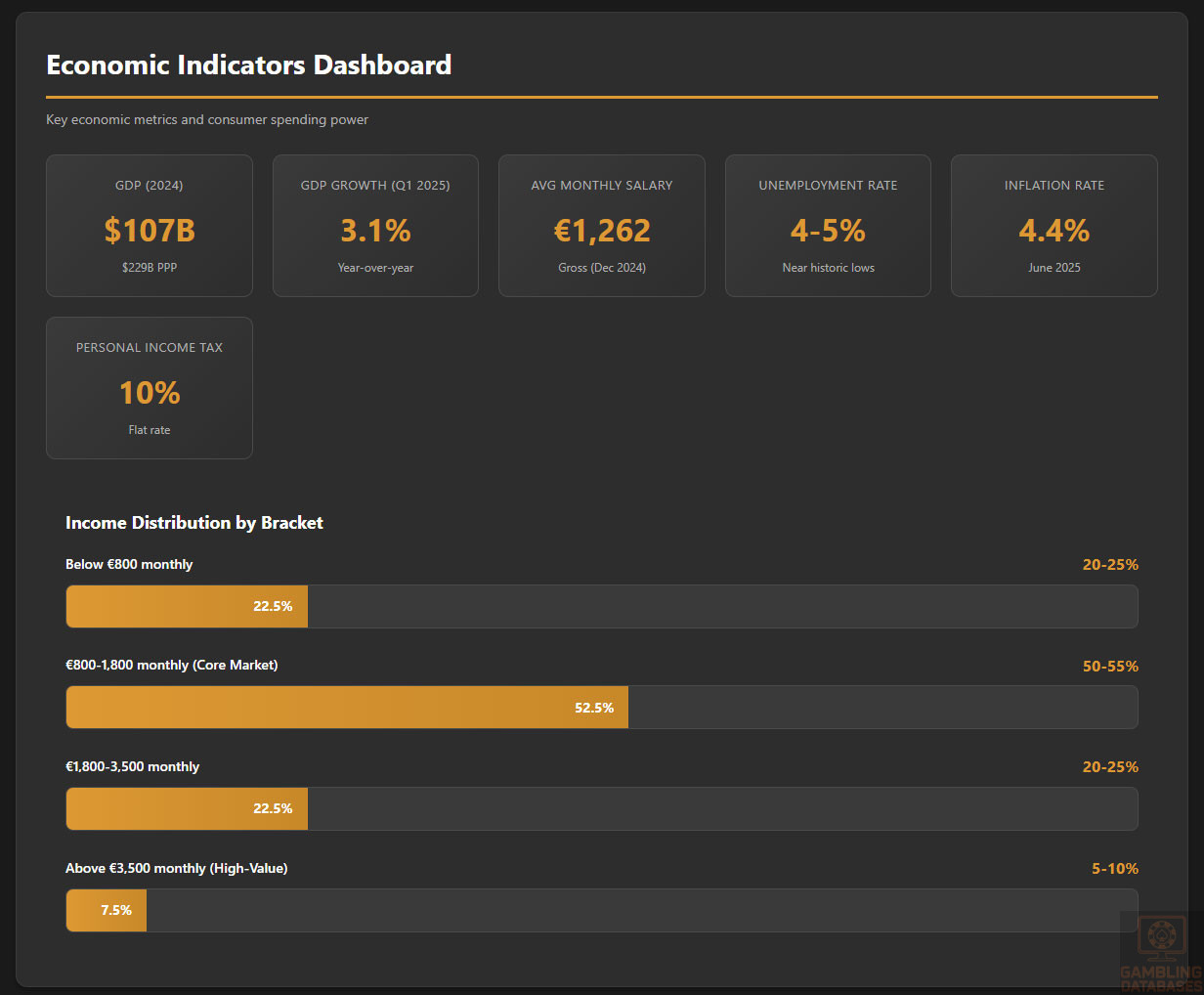
GDP per capita trends show steady improvement over the past decade, with Bulgaria narrowing its income gap with Western Europe though substantial differentials remain. Real wage growth exceeding inflation creates genuine income increases supporting discretionary spending. The trajectory suggests continued convergence toward EU income levels over the next decade, though complete parity remains decades away. For gambling operators, the improving income trends support market growth optimism despite population decline headwinds.
Economic sector composition shows services dominating at approximately 65-70% of GDP, reflecting Bulgaria’s transition from agriculture and heavy industry toward modern service economy. Industry including manufacturing, construction, and mining contributes roughly 25-30% of GDP. Agriculture’s share has declined to approximately 4-5% of GDP though remaining important for rural employment. The services-heavy economy supports gambling market development as disposable income and leisure time increase with service sector job growth.
Employment rates have improved substantially in recent years, with unemployment falling to approximately 4-5% in 2024-2025, near historically low levels. This tight labor market drives wage growth and improves household financial security, supporting consumer spending on discretionary categories including gambling. However, labor shortages in some sectors create inflationary pressures and may constrain economic growth if unfilled positions limit business expansion.
Wage levels demonstrate significant regional variation with Sofia averaging EUR 1,500-1,800 gross monthly salaries for professional positions while regional cities average EUR 800-1,200. The national average gross monthly salary reached EUR 1,262 in December 2024, representing steady increase from previous years. Net salaries after taxes and social contributions average approximately 75% of gross figures. Double-digit wage growth in recent years has outpaced inflation, creating real income gains supporting gambling spending increases.
Inflation trends showed relative stability through most of the 2010s before accelerating in 2022-2023 during the European energy crisis and supply chain disruptions. Inflation reached 4.4% in June 2025, moderating from earlier peaks but remaining above the 2% target typical for stable economies. The National Bank of Bulgaria’s currency board maintaining a fixed exchange rate to the euro provides monetary stability and inflation discipline, though limiting independent monetary policy tools for managing economic fluctuations.
Income and Wealth Distribution
Average household income reaches approximately EUR 1,500-1,800 monthly on a gross basis nationally, with substantial regional variation between Sofia’s higher incomes and smaller cities’ lower earnings. Household income includes wages, pensions, social benefits, and other income sources. Multi-earner households in Sofia metropolitan area may achieve EUR 3,000-4,000 monthly household income, while single-earner households in regional areas may earn EUR 800-1,200 monthly, illustrating the wide income distribution.
Median household income sits somewhat below average figures, indicating positively skewed income distribution where high earners pull averages upward. The median household likely earns EUR 1,200-1,400 monthly, representing typical Bulgarian family circumstances more accurately than averages influenced by high-income outliers. For gambling market sizing, median income metrics provide better guidance on mass market spending capacity while high-income segments represent premium player targets.
Income inequality measures including the Gini coefficient position Bulgaria in moderate inequality territory within European context. The Gini coefficient of approximately 0.38-0.40 indicates less extreme inequality than the United States but more than Scandinavian countries. Wealth inequality exceeds income inequality as property ownership, investments, and inherited wealth concentrate more heavily than earnings. This inequality creates market segmentation opportunities with distinct products and marketing for mass market versus high-value players.
Disposable income trends show steady improvement as wage growth outpaces inflation and tax burden remains relatively low. Bulgarian personal income tax follows a 10% flat rate, among Europe’s lowest, leaving more income available for consumption. Social security contributions reduce take-home pay but at lower rates than Western European countries. The combination of rising wages, low taxes, and moderate cost inflation creates genuine disposable income growth supporting gambling market expansion.
Consumer spending patterns show Bulgarians allocating substantial portions of income to necessities including housing, food, and utilities, with smaller discretionary spending shares than wealthier countries. However, absolute discretionary spending increases as incomes rise faster than necessity costs. Entertainment, leisure, and gambling represent emerging expenditure categories growing faster than overall consumption as Bulgarian consumers adopt Western European lifestyle patterns. The trend supports optimism about gambling market growth potential as economic development continues.
Percentage of population by income bracket creates distinct market segments. Approximately 20-25% of households earn below EUR 800 monthly, representing limited gambling market potential given constrained budgets. The bulk of the population, roughly 50-55%, earns EUR 800-1,800 monthly, comprising the core mass-market gambling segment. Approximately 20-25% earn EUR 1,800-3,500 monthly, representing attractive mid-market players with meaningful discretionary budgets. The top 5-10% earning above EUR 3,500 monthly constitute the high-value player segment meriting premium service approaches.
Middle class size and growth represent critical market development indicators. Bulgaria’s middle class, defined as households with income sufficient for comfortable living beyond necessities, comprises approximately 40-50% of the population and grows steadily. This expanding middle class drives consumption of discretionary services including entertainment, dining, travel, and gambling. The middle class growth trajectory supports sustained gambling market expansion even amid population decline, as participation rates and spending per player increase faster than population decreases.
Market Size and Growth Projections
| Metric | 2024 | 2025 | 2027 | 2029 | CAGR |
|---|---|---|---|---|---|
| Online Gambling Revenue (EUR Million) | 561 | 590-610 | 650-700 | 700-750 | 5-6% |
| Online Casino Revenue (EUR Million) | 365-375 | 475-490 | 550-600 | 600-650 | 10-12% |
| Sports Betting Revenue (EUR Million) | 170-195 | 190-215 | 210-240 | 230-260 | 6-8% |
| Total Gambling Market (USD Million) | ~800 | 820-850 | 900-950 | 950-1,000 | 3-4% |
| Active Online Players (Thousands) | 1,000-1,050 | 1,050-1,100 | 1,150-1,200 | 1,200-1,300 | 4-5% |
| Market Penetration Rate | 5.7% | 6.0% | 6.3% | 6.5-6.8% | – |
| ARPU (EUR) | 390-411 | 420-450 | 470-510 | 520-560 | 6-7% |
Current iGaming market revenue reached EUR 561 million in gross gaming revenue for 2024, representing total bets minus player winnings. This figure excludes the substantial amounts wagered, which industry representatives estimate at several billion euros annually when considering bet volumes. The GGR metric provides the most meaningful measurement of market size as it represents actual operator revenue available to cover expenses, taxes, and generate profits. Converting to US dollars at current exchange rates, the market approximates USD 600 million.
Historical revenue growth demonstrates explosive expansion from 2020 through 2022 following market liberalization. Starting from approximately EUR 225 million in 2020, the market more than doubled to EUR 511 million in 2022, representing compound annual growth exceeding 50%. This exceptional growth resulted from increased operator competition following license revocations that removed dominant players, improved product offerings, enhanced payment options, and rising consumer comfort with online gambling during COVID-19 lockdowns that accelerated digital adoption.
Growth rates moderated significantly in 2023-2024 to approximately 10-12% and near-zero respectively, indicating market maturation as operator numbers stabilized around 15-22 active platforms and competitive intensity increased. The growth deceleration reflects natural market evolution as penetration rates approach sustainable levels and easy growth opportunities become exhausted. However, this maturation should not be interpreted as market stagnation but rather transition to stable long-term growth patterns typical of developed gambling markets.
Revenue forecasts for the next 3-5 years project compound annual growth rates of 5-6% for total online gambling, potentially reaching EUR 700-750 million by 2029. However, this conservative estimate may understate growth potential given continued internet penetration increases, smartphone adoption among older demographics, payment method improvements, and product innovation including live dealer games and gamification features. More optimistic scenarios suggest EUR 800-850 million potential by 2029 if market conditions remain favorable.
Expected CAGR varies significantly by product category. Online casinos, representing two-thirds of current revenue, are projected to grow at 10-12% annually through 2029, potentially reaching EUR 600-650 million. This rapid casino growth reflects Bulgarian player preference for slot games, live dealer experiences, and table games while benefiting from continuous content innovation by game providers. Sports betting growth rates of 6-8% annually appear more modest but still healthy, potentially reaching EUR 230-260 million by 2029 supported by football betting culture and expanding sports coverage.
Projected user base growth shows active online gamblers increasing from approximately 1.0-1.05 million in 2024 to 1.2-1.3 million by 2029, representing 4-5% annual growth. This user growth derives from several sources: younger cohorts reaching gambling age with high digital adoption, older demographics gaining confidence with online platforms, improved mobile experiences reducing technical barriers, and enhanced payment options increasing accessibility. The relatively modest user growth compared to revenue growth indicates rising spending per player drives much of the market expansion.
Average Revenue Per User currently stands at EUR 390-411 annually and is projected to increase to EUR 520-560 by 2029, representing 6-7% annual ARPU growth. Rising ARPU reflects increasing player engagement, improved cross-selling between sports betting and casino products, enhanced loyalty programs encouraging sustained play, and real income growth supporting larger entertainment budgets. Operators successfully migrating customers from low-value sports betting to higher-margin casino games contribute substantially to ARPU expansion.
Market penetration rates measure the percentage of adults participating in online gambling annually. Current penetration of 5.7% positions Bulgaria below Western European leaders like UK (15%+) but comparable to Southern and Eastern European peers. Penetration is projected to reach 6.5-6.8% by 2029 through continued normalization of online gambling, improved trust in digital payments, and enhanced responsible gambling measures addressing safety concerns that deter some potential players. Double-digit penetration rates appear achievable long-term as the market matures.
Online versus land-based revenue split currently favors land-based operations at approximately 70-75% of total gambling revenue, with online comprising 25-30%. This distribution reflects Bulgaria’s relatively early stage in the online transition compared to markets like UK where online represents 50%+ of total gambling. The split is projected to shift toward 40-45% online by 2029 as digital channels capture increasing share, though land-based operations will maintain majority given the tourism-driven casino sector and retail betting shop networks’ continued viability.
Market size comparison with regional neighbors provides useful context. Romania, with roughly three times Bulgaria’s population, operates a larger online gambling market of approximately EUR 800-900 million. Greece, with 50% larger population, shows comparable online market size to Bulgaria due to regulatory restrictions limiting market development. Serbia’s market approximates EUR 300-400 million despite similar population, reflecting less developed regulatory framework. Bulgaria’s market size per capita positions favorably within the Balkan region, suggesting relatively mature market development.
Education, Skills, and Digital Literacy
Educational Foundation
Literacy rates in Bulgaria reach exceptionally high levels at 98.4% overall, with minimal gender disparity. Male literacy stands at 98.7% while female literacy reaches 98.1%, both representing near-universal reading and writing capability. This educational foundation, inherited from the socialist era’s emphasis on public education, ensures gambling operators can utilize text-based communications, written terms and conditions, and complex game rules without concerning about basic literacy barriers that affect less developed markets.
Education levels show strong completion rates through secondary school. Primary education completion reaches near 100% as compulsory education laws ensure basic schooling. Secondary education completion, including gymnasium and vocational schools, reaches approximately 85-90% of relevant age cohorts. Tertiary education, including universities and specialized colleges, shows completion rates of approximately 30-35%, positioning Bulgaria in the middle range among European countries for higher education attainment.
Digital literacy indicators demonstrate Bulgaria’s relatively advanced technological capabilities despite lower economic development. The population shows strong computer skills development, with younger cohorts exhibiting near-universal digital competency. Approximately 70-75% of adults demonstrate at least basic digital skills including internet navigation, email usage, online shopping, and digital service access. This digital comfort level supports online gambling adoption as players possess the technical skills to register accounts, deposit funds, navigate game lobbies, and manage their gambling activity online.
Workforce skill levels reflect the educational system’s emphasis on STEM subjects and technical training. Bulgaria produces substantial numbers of engineering, IT, mathematics, and science graduates, contributing to the country’s growing technology sector. Language skills, particularly English, have improved significantly among younger generations, though older demographics may show limited foreign language proficiency. Russian remains widely understood among older cohorts due to historical educational emphasis during the socialist period.
Technology adoption readiness appears high relative to income levels, with Bulgarians demonstrating eagerness to adopt new digital services and platforms. Smartphone penetration reaching 97% exemplifies this adoption tendency. Social media usage rates exceed 60% of population, indicating comfort with digital platforms. E-commerce participation grows rapidly as payment security concerns diminish and delivery infrastructure improves. This technology adoption mindset creates favorable conditions for online gambling market development as consumers readily trial new platforms and services.
English language proficiency varies substantially by generation and urban/rural geography. Younger urban residents, particularly in Sofia, demonstrate good-to-excellent English skills through school education, media consumption, and workplace requirements in internationally-oriented companies. Middle-aged populations show moderate English capabilities, often sufficient for basic communication but not complex discussions. Older demographics typically demonstrate limited English proficiency, relying primarily on Bulgarian with Russian as a secondary language. For gambling operators, Bulgarian-language platforms, customer support, and marketing materials remain essential despite some English capability in target demographics.
Cultural and Social Factors
Communication and Language
Primary languages used in daily life center overwhelmingly on Bulgarian, a South Slavic language using Cyrillic script. Approximately 85% of the population speaks Bulgarian as their native language and primary communication medium. Turkish serves as the primary language for approximately 8-9% of the population, concentrated in certain regions and representing the largest minority language. Romani languages are spoken by approximately 4-5% of the population, though many Roma also speak Bulgarian. Small minorities speak Russian, Armenian, and other languages.
Internet language preferences show strong Bulgarian dominance with users expecting websites, apps, and digital services to provide Bulgarian-language interfaces and content. While younger, educated demographics may navigate English-language sites, mass market reach requires Bulgarian localization. This creates essential requirements for gambling operators to provide Bulgarian-language platforms, game interfaces, customer support, terms and conditions, and marketing materials. Machine translation proves insufficient given gambling’s specialized terminology and the importance of clear, accurate communication for regulatory compliance and customer satisfaction.
Business communication norms combine formal and informal elements depending on relationship stage and context. Initial business contacts typically follow relatively formal patterns using titles and surnames, though relationships may become more casual once established. Email and messaging apps serve as primary business communication channels supplementing phone calls. Written communication standards expect correct grammar and spelling, with careless writing potentially signaling unprofessionalism. For gambling operators, professional Bulgarian-language business communication supports partnerships with payment providers, affiliates, and service vendors.
Language requirements for gambling websites extend beyond basic translation to encompass cultural localization. Game names, bonus promotions, marketing messages, and customer communications must resonate with Bulgarian cultural references and language usage patterns. Terms and conditions require particular attention as regulatory compliance demands precise legal language while consumer protection requires clear explanations accessible to players with limited legal expertise. Customer support in Bulgarian proves essential as players expect native-language assistance, particularly when resolving payment issues or disputes.
Cultural Attitudes
Gambling acceptance levels in Bulgarian society show moderate-to-high tolerance for gambling as entertainment. Historical gambling traditions dating to Ottoman era and socialist-period sports betting created cultural familiarity. The 1993 legalization and subsequent market development normalized gambling as a mainstream leisure activity. However, recent concerns about gambling prevalence, advertising visibility, and problem gambling have prompted public debate and regulatory responses including the 2024 advertising restrictions. This suggests gambling occupies a contested cultural space with mainstream acceptance coexisting alongside growing criticism.
Religious influences on gambling perception remain limited despite Bulgaria’s Orthodox Christian heritage. Approximately 59% of the population identifies as Eastern Orthodox, though active religious practice rates fall significantly lower. The Orthodox Church does not maintain strong institutional opposition to gambling comparable to some other Christian denominations, resulting in limited religious barriers to gambling participation. Muslim population segments, comprising roughly 8%, may show lower gambling participation due to religious prohibitions, though enforcement varies by individual observance level and community norms.
Risk tolerance indicators suggest Bulgarians demonstrate moderate-to-high risk acceptance in gambling contexts. Economic uncertainty and income volatility throughout post-communist transition period may have cultivated risk-taking tendencies as survival strategies. The substantial casino segment dominance over sports betting, despite Bulgaria’s strong football culture, suggests player preference for chance-based games over skill-influenced betting. However, this risk tolerance exists within entertainment context rather than financial investment, with most players gambling recreational amounts rather than life-changing sums.
Entertainment preferences and habits emphasize social activities, sports, and increasingly digital entertainment. Football dominates sports interest with passionate followings for national team and domestic league clubs. Volleyball, basketball, and winter sports also maintain audiences. Television remains important entertainment medium though internet streaming and social media increasingly compete for attention. Dining out, cafe culture, and social gatherings represent important leisure activities. For gambling operators, aligning with entertainment preferences through sports sponsorships, social gaming features, and positioning gambling as entertainment rather than income opportunity resonates with cultural attitudes.
Social gambling versus solitary gambling preferences show Bulgarians engaging in both patterns. Land-based casinos and betting shops provide social environments where gambling occurs alongside conversation and camaraderie. However, online gambling’s convenience supports solitary play, particularly for casino games where social interaction plays minimal role. Live dealer games offering chat functionality and multiplayer poker rooms create hybrid social-digital experiences appealing to players seeking community alongside convenience. The diversity of gambling motivations and contexts suggests operators should offer both social and solitary gaming options.
Problem Gambling and Social Considerations
Prevalence of gambling addiction data remains limited in Bulgaria with comprehensive epidemiological studies scarce. Available evidence suggests problem gambling rates likely fall in the 0.5-2% range typical of European countries with established gambling markets. However, the rapid online gambling market expansion since 2020 and intensive advertising through 2023 may have elevated problem gambling rates above historical levels. The government’s 2024-2025 regulatory tightening including advertising bans and enhanced player protection requirements reflects official concern about gambling harm, though specific prevalence data guiding these policies has not been publicly disclosed.
Number of problem gamblers can be roughly estimated by applying European average prevalence rates to Bulgaria’s adult population. With approximately 5.5-5.8 million adults and assuming 1-2% problem gambling prevalence, Bulgaria likely hosts 55,000-116,000 problem gamblers exhibiting harmful gambling behaviors but not necessarily meeting clinical addiction criteria. Severe gambling disorder affecting 0.2-0.5% of adults suggests 11,000-29,000 Bulgarians may suffer clinical gambling addiction requiring professional treatment. These estimates remain uncertain absent comprehensive survey data.
At-risk population statistics by age and gender remain largely undocumented in Bulgarian-specific research. However, international patterns suggest younger males aged 18-35 face highest problem gambling risk, particularly those engaging in online casino gambling and frequent betting. Middle-aged individuals facing financial stress or life transitions may also demonstrate elevated vulnerability. Female problem gamblers, while fewer in absolute numbers, show distinct patterns often involving casino games and experiencing shame and stigma that may delay help-seeking. The 40% female participation rate in online gambling suggests Bulgaria may see higher-than-typical female problem gambling prevalence.
Underage gambling issues represent regulatory concerns despite the 18+ age requirement. Enforcement challenges around age verification, particularly for online gambling, create opportunities for minors to access gambling platforms through borrowed accounts, false identification, or inadequate verification processes. The 2024 regulatory amendments emphasized youth protection including distance requirements separating gambling advertising from schools and prohibition on youth-targeted marketing. However, comprehensive data on underage gambling prevalence and enforcement effectiveness remains unavailable, suggesting this area merits enhanced regulatory attention and research investment.
Gender distribution of problem gamblers likely skews male given typical gambling participation patterns, though the 40% female player rate suggests more gender balance than traditional gambling markets. Male problem gamblers may predominate in sports betting and high-frequency online casino play, while female problem gamblers may concentrate in bingo, slot games, and lottery products. Treatment programs report serving predominantly male clients, though this may reflect help-seeking pattern differences rather than actual prevalence disparities. Gender-specific prevention and treatment approaches remain underdeveloped.
Age groups most affected by gambling addiction likely include young adults 18-34 who demonstrate highest gambling participation rates and risk-taking behaviors. Middle-aged adults 35-54 facing career and family pressures may develop gambling problems as stress coping mechanisms. Older adults generally show lower problem gambling rates though retirement transitions, social isolation, and fixed incomes create vulnerabilities. The aging Bulgarian population may see emerging elderly problem gambling issues as this demographic gains digital skills and internet access enabling online gambling participation.
Government response measures focus primarily on regulatory restrictions and operator requirements rather than comprehensive public health approaches. The self-exclusion program represents the most visible intervention, serving nearly 54,000 registrants as of March 2025. The 2025 extension of minimum exclusion periods to one year demonstrates regulatory evolution toward longer cooling-off periods. Proposed session time limits and behavioral monitoring requirements shift responsibility to operators for identifying and intervening with at-risk players. However, public awareness campaigns, school-based prevention education, and community outreach remain limited.
Treatment facilities and support services available for problem gamblers remain underdeveloped relative to gambling market size. Specialized gambling addiction treatment programs are scarce, with most services delivered through general mental health or substance abuse treatment frameworks. The government operates limited treatment capacity through public healthcare system with long waiting lists and minimal specialized expertise. Private treatment options exist but remain financially inaccessible for many problem gamblers given high costs and limited insurance coverage for addiction treatment.
Social responsibility requirements for operators include mandatory contributions to problem gambling treatment and prevention programs. However, funding levels appear modest relative to gambling tax revenues, suggesting opportunities for enhanced investment in treatment infrastructure, research, and prevention. Operators must provide responsible gambling tools including deposit limits, loss limits, time limits, reality checks, and self-exclusion options. The effectiveness of these tools depends heavily on player awareness and willingness to use them, areas requiring ongoing improvement.
Mandatory contributions to problem gambling funds remain limited compared to some jurisdictions that dedicate substantial percentages of gambling revenues to treatment and prevention. Bulgaria could enhance public health approaches by establishing dedicated problem gambling research centers, expanding treatment capacity, implementing public awareness campaigns, and requiring operators to contribute more substantial funding for harm minimization initiatives. The current regulatory focus emphasizes restriction over public health infrastructure development.
Recent studies or surveys on gambling harm remain sparse in Bulgarian academic and policy literature. The limited research base hampers evidence-based policy development and treatment program design. International research provides general guidance but may not capture Bulgarian-specific cultural, economic, and regulatory context factors. Investment in comprehensive prevalence studies, longitudinal research tracking gambling behaviors, and evaluation of regulatory intervention effectiveness would strengthen policy foundations and improve outcomes for affected individuals and communities.
Political Structure and Governance
Bulgaria operates as a parliamentary representative democratic republic where the Prime Minister serves as head of government while the President holds a largely ceremonial head-of-state role. The political system features a unicameral National Assembly with 240 members elected through proportional representation. Coalition governments represent the norm given fragmented party system, creating sometimes unstable political conditions requiring negotiation and compromise across multiple parties. This political structure means gambling policy emerges from parliamentary processes influenced by multiple stakeholders rather than executive decree.
Government stability indicators show Bulgaria experiencing significant political turbulence in recent years with multiple elections, caretaker governments, and coalition collapses. Between 2021 and 2024, Bulgaria held numerous snap elections reflecting parliament’s difficulty forming stable governing coalitions. However, these political challenges generally do not threaten democratic institutions or create risks of authoritarian backsliding. The instability primarily affects policy implementation speed and consistency rather than fundamental governance structures. For gambling operators, political instability creates some regulatory uncertainty but has not produced dramatic policy reversals.
Regulatory consistency and predictability benefit from Bulgaria’s EU membership which constrains policy options and provides institutional stability. The gambling regulatory framework showed remarkable stability from 2012 through 2024 despite political turbulence, with the 2024 amendments representing the most significant changes in over a decade. The National Revenue Agency’s technical competence and institutional continuity provide regulatory predictability even as political leadership changes. However, future policy direction remains somewhat uncertain given ongoing debates about gambling regulation, problem gambling concerns, and potential additional restrictions.
Corruption perception remains a significant governance challenge with Bulgaria ranking poorly among EU member states on Transparency International’s Corruption Perceptions Index. The 2024 index placed Bulgaria at approximately 63 out of 180 countries globally, the lowest ranking among EU members. Corruption concerns span public procurement, law enforcement, judiciary, and regulatory agencies. For gambling operators, corruption risks primarily manifest in licensing processes, enforcement actions, and tax disputes. Maintaining rigorous compliance, transparent operations, and strong legal representation helps mitigate these risks.
International relations impact on business generally supports favorable gambling market conditions. EU membership since 2007 provides Bulgarian gambling operators access to EU single market principles while requiring compliance with EU AML directives, data protection regulations, and consumer protection standards. NATO membership supports security and stability. However, Bulgaria maintains close historical and economic ties with Russia creating occasional political tensions within EU/NATO frameworks. These geopolitical dynamics generally do not directly affect gambling regulation but may influence broader business environment stability.
EU membership status as a full member since 2007 provides critical regulatory framework and market access benefits. Bulgarian gambling licenses, once obtained, facilitate operations across EU markets under freedom to provide services principles, though most member states require local licensing. The EU membership constrains Bulgarian regulatory options, preventing discriminatory treatment of EU operators and ensuring adherence to single market rules. Euro adoption remains a future goal with original 2015 target postponed indefinitely, though Bulgaria maintains currency board fixing the lev to the euro, providing de facto monetary integration.
Trade agreements affecting iGaming flow primarily through EU membership which establishes trade relationships with numerous countries. EU-wide data transfer agreements under GDPR facilitate cross-border data flows essential for gambling operators using EU-hosted systems while serving Bulgarian players. Payment services directives enable EU-wide payment provider operations. These frameworks reduce barriers for international gambling operators entering the Bulgarian market while ensuring Bulgarian operators can expand regionally. No bilateral Bulgarian trade agreements significantly impact gambling sector beyond EU-level arrangements.
Technology Adoption and Digital Behavior
Internet and Digital Usage
Internet penetration rates reached 87.1% of the total population in January 2025, representing 5.86 million internet users. This high penetration positions Bulgaria above the global average and comparable to Western European levels despite lower economic development. The penetration rate has grown steadily from approximately 60% a decade ago, reflecting infrastructure investments, declining access costs, and increasing digital service availability. The 12.9% of population without internet access concentrates in elderly demographics and rural areas, representing declining barrier to digital service adoption including online gambling.
Daily internet usage hours average approximately 5-6 hours per person among internet users, with substantial variation by age and employment. Younger demographics spend significantly more time online including social media, streaming, gaming, and communication. Working professionals integrate internet usage throughout workdays for job functions plus personal activities. Retirees show lower usage hours though growing as digital skills and relevant content increase. Mobile internet access enables usage throughout the day during commutes, breaks, and leisure time rather than restricting internet to home-based desktop sessions.
Mobile device adoption rates reach exceptional levels with 137% mobile penetration representing 9.25 million active connections for 6.7 million population. This exceeds 100% ratio reflects multiple SIM cards per person for work and personal use, IoT device connections, and inactive but technically active subscriptions. Smartphone penetration specifically reaches 97%, among the highest rates globally and ensuring nearly universal smartphone access in the target gambling demographic. This mobile-first infrastructure creates strong foundation for mobile gambling application deployment and mobile-optimized web experiences.
Social media engagement shows 4.37 million social media user identities in January 2025, representing 64.9% of total population. Facebook dominates the Bulgarian social media landscape with highest user numbers and engagement levels. Instagram shows strong growth particularly among younger demographics. YouTube serves as primary video content platform. TikTok adoption increases rapidly among users under 35. LinkedIn sees growing professional networking usage. For gambling operators, social media represents critical marketing channel particularly given advertising restrictions on traditional media, though regulatory uncertainty remains regarding social platform advertising permissibility.
E-commerce participation rates have grown dramatically reaching 40-50% of internet users making online purchases at least occasionally. E-commerce adoption accelerated during COVID-19 lockdowns as consumers learned online shopping and retailers improved delivery infrastructure. Fashion, electronics, and household goods dominate online retail. Food delivery apps transformed restaurant industry. Growth continues as older demographics gain confidence in online transactions and rural delivery coverage expands. This e-commerce familiarity translates directly to comfort with online gambling as both involve internet transactions, account management, and digital service delivery.
Digital payment adoption has reached critical mass enabling online gambling growth. Credit and debit card penetration exceeds 70% of adults with most holding bank-issued Visa or Mastercard debit cards. Online banking adoption reaches 50-60% of account holders, facilitating bank transfers for gambling deposits and withdrawals. E-wallets including Skrill, Neteller, and local solutions gain traction. Cryptocurrency adoption remains limited but growing among tech-savvy demographics. This diverse payment ecosystem supports flexible gambling deposit and withdrawal options essential for market access.
Online banking penetration reaches 50-60% of adults with bank accounts, representing approximately 3-3.5 million active online banking users. Younger demographics show near-universal online banking usage while older cohorts increasingly adopt mobile banking apps offering convenience advantages over branch visits. Banks invest heavily in digital infrastructure supporting seamless online money movement. Instant bank transfer solutions enabling real-time deposits without separate account registration facilitate gambling transactions. The mature online banking infrastructure removes payment barriers that constrain gambling markets in less digitally advanced countries.
Digital Payment Behavior
Payment method preferences for online gambling show debit and credit cards dominating deposit methods with approximately 60-70% of transactions. Bulgarian consumers favor cards for convenience, instant processing, and familiarity from e-commerce usage. Bank transfers represent the second most popular method at 20-30% of deposits, particularly for larger amounts where players prefer direct bank-to-operator transfers without card intermediation. E-wallets including Skrill and Neteller serve 10-15% of transactions, appealing to players preferring separation between bank accounts and gambling activity or seeking faster withdrawal processing.
Most popular digital wallets in Bulgaria include international services and emerging local solutions. Skrill maintains strong presence in gambling markets given its focus on gaming and betting transactions. Neteller similarly serves gambling customers with established reputation. EasyPay represents the leading Bulgarian e-wallet provider with extensive agent network enabling cash deposits and withdrawals at physical locations throughout the country. ePay.bg offers another local digital wallet solution. International services like PayPal see limited gambling usage as PayPal restricts gambling transactions in most markets. The e-wallet landscape continues evolving as digital payment adoption accelerates.
Online transaction patterns and frequency vary significantly by player segment. Active gamblers may deposit multiple times weekly or even daily for smaller amounts, preferring frequent small deposits over large balance maintenance. Casual players typically deposit monthly or less frequently, often coinciding with salary payments or special events like major sporting events. Weekend deposits spike as players prepare for football betting and leisure gambling sessions. Transaction frequency increases during major sporting events like World Cup, European Championships, and Champions League finals driving betting activity.
Average transaction sizes for gambling deposits typically range from EUR 20-50 for mass market players, with this amount representing discretionary spending comfortable for median income households. High-value players may deposit EUR 200-500 or more per transaction, though such large deposits trigger enhanced due diligence requirements under AML regulations. Withdrawal transactions often exceed deposit amounts when players accumulate winnings, though the house edge ensures most players withdraw less than deposited over time. Minimum deposit limits set by operators typically range EUR 10-20, balancing accessibility with transaction cost considerations.
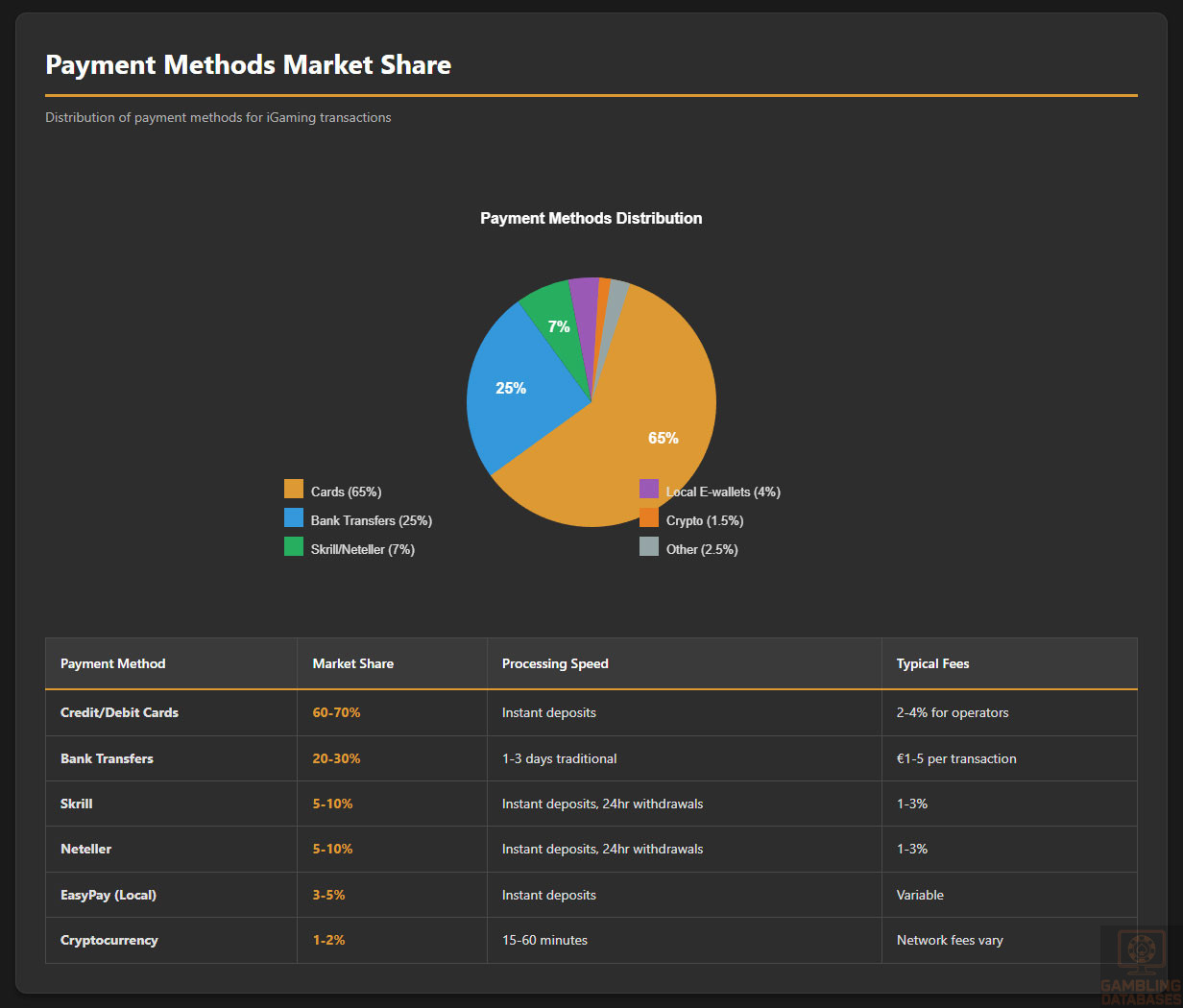
Trust in online payment systems has improved dramatically over the past decade as security technology advanced, fraud decreased, and consumer familiarity grew. Younger demographics demonstrate high trust in digital payments, treating them as equivalent to cash. Middle-aged consumers show growing confidence as positive experiences accumulate. Older demographics remain somewhat skeptical though even this segment increasingly adopts digital payments by necessity. For gambling operators, displaying security certifications, using recognized payment brands, and offering robust customer support for payment issues helps build trust essential for encouraging deposits.
Cryptocurrency adoption for gambling remains limited but shows growth potential. Bitcoin, Ethereum, and other cryptocurrencies appeal to tech-savvy players valuing privacy, fast transactions, and independence from traditional banking. However, regulatory uncertainty around cryptocurrency gambling, limited consumer understanding, and volatility concerns constrain mainstream adoption. Some international operators accept cryptocurrency deposits from Bulgarian players, though local operators generally focus on traditional payment methods serving broader market. Future regulatory clarity on cryptocurrency gambling could unlock growth in this payment category.
Gaming and Gambling Preferences
Current Market Participation
Percentage of population that gambles annually likely reaches 15-20% of adults, translating to approximately 850,000-1,150,000 annual participants across all gambling forms. This includes online gambling, land-based casinos, sports betting shops, lottery participation, and other gambling activities. The gambling participation rate positions Bulgaria in the moderate-to-high range among European countries, reflecting cultural acceptance, accessible gambling options, and rising disposable incomes supporting entertainment spending. Participation rates have grown substantially over the past decade as online gambling expanded and social stigma diminished.
Percentage that gambles online specifically approximates 15-18% of adults, representing roughly 1.0-1.05 million active online players annually. This online participation rate significantly exceeds the 5.7% penetration figure cited in market statistics, likely reflecting different measurement methodologies and definitions. The 5.7% figure may represent regular monthly active players while the 15-18% captures anyone gambling online at least once annually including occasional participants. Online gambling penetration continues growing as older demographics gain digital skills and mobile accessibility reduces barriers.
Popular gambling activities ranked by participation show football betting commanding first position given Bulgaria’s passionate football culture. Domestic league, European competitions, and international tournaments drive extensive betting activity. Slot games rank second, with both online and land-based slots attracting broad appeal through simple gameplay and entertainment value. Sports betting on other sports including basketball, tennis, and volleyball follows. Table games including blackjack, roulette, and baccarat serve smaller but dedicated player bases. Lottery participation remains widespread though increasingly online. Poker maintains niche appeal among skilled players.
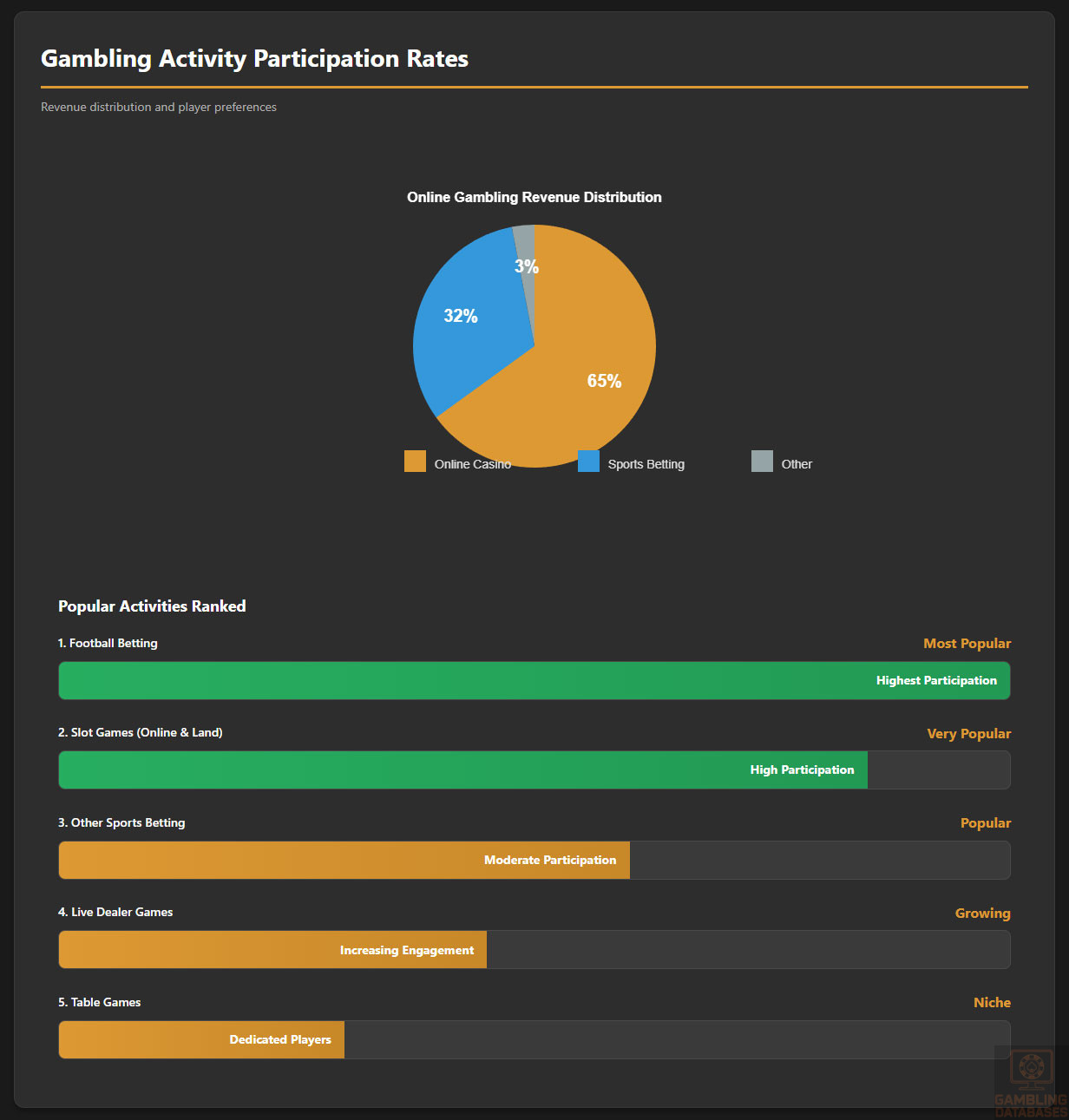
Sports betting versus casino games preference shows casino dominating online revenue at 65-67% despite football betting’s cultural prominence. This apparent contradiction reflects several factors: casino games generate higher house edges and faster play cycles producing more GGR per player hour compared to sports betting. Many players engage in both activities but generate more revenue through casino play. Sports betting attracts more casual participants making smaller bets less frequently, while casino players often gamble more intensively. The revenue distribution suggests operators should offer comprehensive casino catalogs alongside competitive sports betting to maximize player value.
Live dealer games popularity has grown exponentially as streaming technology improves and players seek social casino experiences from home. Live blackjack, roulette, and baccarat allow players to interact with real dealers via video stream, combining online convenience with land-based atmosphere. Bulgarian players show strong engagement with live dealer games, particularly roulette and blackjack. Local-language dealers speaking Bulgarian enhance the experience though many providers offer only English-language dealers. The live dealer segment represents significant growth opportunity as technology continues improving and player awareness increases.
Lottery participation rates remain high with traditional state lottery products maintaining popularity despite online gambling growth. Weekly number-draw lotteries attract broad participation across demographic segments given low entry costs and large jackpot appeal. Instant scratch-off lotteries serve impulse purchase markets at retail locations. The state monopoly on traditional lotteries ensures Bulgarian Sports Totalizator remains dominant lottery provider while private operators focus on instant lotteries, bingo, and keno variants falling outside the monopoly scope. Lottery serves as gateway gambling for many consumers later progressing to more intensive gambling forms.
Seasonal patterns and trends show gambling activity spiking during major football events. World Cup years see dramatic betting increases during tournament periods. European Championship summers similarly spike activity. UEFA Champions League knockout stages drive weekly betting surges. Domestic league seasons create steady baseline activity with weekend peaks. Summer tourism seasons increase casino activity in Black Sea coastal areas as international visitors supplement local players. December holidays see elevated gambling as consumers have leisure time and holiday bonuses provide discretionary income. Understanding seasonal patterns helps operators allocate marketing budgets and manage liquidity.
Consumer Behavior Patterns
Average spending per player varies dramatically by player segment but industry estimates suggest EUR 390-411 annually across all online players. This average masks huge variation with casual players spending EUR 50-200 annually while high-value players may wager EUR 5,000-50,000 or more. The median player likely spends EUR 200-300 annually, representing 1-2% of median household annual income and falling within reasonable entertainment budgets. Casino players typically generate higher spending than sports bettors given game pace and session length differences. Understanding spending distributions helps operators segment customers and tailor offers appropriately.
Spending habits and typical bet sizes for mass market sports betting range EUR 5-20 per bet with most casual bettors placing 1-5 bets per week. Serious sports bettors may average EUR 20-50 per bet with multiple daily wagers. Casino slot players typically bet EUR 0.20-2.00 per spin with hundreds of spins per session generating EUR 20-100 wagered amounts. Table game bets range more widely from EUR 5-100 per hand depending on game and player bankroll. High rollers playing baccarat, roulette, or blackjack may bet EUR 100-1,000+ per hand though such players represent tiny minority generating disproportionate revenue.
Platform preferences show mobile dominating at approximately 75% of online gambling traffic as of 2024, with desktop representing the remaining 25%. This mobile-first behavior reflects Bulgaria’s 97% smartphone penetration and consumer preference for gambling anywhere, anytime rather than desktop-bound sessions. Tablets represent minimal traffic generally categorized with mobile. The mobile dominance demands responsive mobile websites and native mobile apps with full functionality rather than treating mobile as secondary channel. User experience optimization for smaller screens, touch interfaces, and mobile payment methods determines competitive success.
Peak gambling times show clear patterns by day and hour. Weekends generate significantly higher activity than weekdays as leisure time increases. Friday and Saturday evenings represent peak hours with maximum concurrent players and betting volumes. Sunday afternoons see elevated activity particularly around football matches. Weekday evenings from 19:00-23:00 show moderate activity as players engage after work. Lunch break gambling occurs but at lower levels. Late night and early morning hours show minimal activity outside hardcore player segments. These patterns inform customer support staffing, maintenance scheduling, and promotional timing.
Session length averages vary by game type and player motivation. Casual sports bettors may spend 5-15 minutes placing bets on upcoming matches. Serious bettors researching form and odds might invest 30-60 minutes per session. Casino players typically engage for 30-90 minute sessions, with slot players often shorter and table game players longer. Problem gamblers may play for many hours continuously, precisely the behavior proposed session time limits aim to restrict. Average session duration data helps assess player engagement levels and identify potentially concerning patterns requiring intervention.
Retention and loyalty patterns show online gambling exhibiting moderate customer retention compared to other digital services. First month retention following registration typically reaches 30-40%, meaning 60-70% of new players make one deposit and never return. Month three retention drops to 15-25% as casual experimenters churn. Month twelve retention settles around 10-15% representing players who integrate gambling into ongoing entertainment patterns. High-value players demonstrate much stronger retention given investment in the activity. Loyalty programs, personalized offers, and quality customer service improve retention rates materially.
Bonus sensitivity and promotional response varies significantly by player segment. New players show high bonus sensitivity as welcome offers influence platform selection decisions. Active players respond to reload bonuses, cashback offers, and free bet promotions extending play time and maintaining engagement. High-value players often prove less bonus sensitive given large budgets making promotional amounts proportionally insignificant, instead valuing VIP treatment, dedicated account management, and exclusive benefits. Price-sensitive casual players may chase bonuses across operators, creating acquisition costs without sustainable value. Effective bonus strategies balance acquisition, activation, and retention goals.
Preferred game types by age group show younger players 18-34 favoring slots, live casino, and in-play sports betting offering fast-paced action and modern interfaces. Middle-aged players 35-54 engage across all products with strong sports betting and slot participation plus growing live dealer interest. Older players 55+ concentrate in traditional table games, lotteries, and simpler slot games preferring familiar game mechanics over complex modern features. Understanding age-based preferences enables targeted game portfolios and age-appropriate marketing messages maximizing engagement and customer lifetime value within each demographic segment.
Deposit and withdrawal frequency patterns differ substantially. Most players deposit more frequently than withdrawing given house edge ensuring net losses over time. Successful players and bonus hunters may maintain positive balances enabling infrequent deposits. Problem gamblers often exhibit high deposit frequency including multiple same-day deposits as they chase losses. Withdrawal frequency serves as important behavioral indicator with responsible players regularly cashing out winnings while problem gamblers rarely withdraw instead continuously recycling balances into further play. Monitoring deposit-withdrawal ratios helps identify at-risk players requiring intervention.
Section 3: Technology Infrastructure and Business Environment
Internet and Digital Infrastructure
Connectivity and Network Performance
Internet penetration reaches 87.1% of the population representing 5.86 million users as of January 2025, positioning Bulgaria significantly above the global average and comparable to many Western European nations. This high penetration results from decades of infrastructure investment, competitive telecommunications markets driving service improvements, and declining access costs making internet affordable for mass market. The remaining 12.9% without internet access concentrates in elderly populations and remote rural areas, representing diminishing barriers to universal digital access. Quality assessment shows Bulgaria achieving global recognition for internet speed and reliability particularly in urban centers.
Fixed broadband versus mobile internet breakdown shows 1.2 million fixed broadband subscriptions representing approximately 18% penetration rate, while mobile broadband dominates with 2.8 million subscriptions reaching 40% penetration. These figures understate actual usage as multiple household members share fixed connections and mobile subscriptions may include inactive accounts. The mobile-dominant pattern reflects consumer preference for flexible access anywhere rather than home-bound connectivity, though fixed broadband maintains importance for households requiring high-bandwidth applications, multiple simultaneous users, and stable connections for remote work or streaming.
Average internet speeds position Bulgaria exceptionally well in global rankings. Mobile internet download speeds via cellular networks averaged 172.49 Mbps median in January 2025, representing remarkable 82.4% year-over-year increase from 94.58 Mbps in 2024. This mobile speed ranks Bulgaria approximately 12th globally and among Europe’s fastest, enabling seamless mobile gambling experiences including live dealer games and HD video streaming. Fixed internet download speeds average 85.36 Mbps median, showing 9.9% annual growth but ranking only 68th globally, indicating room for improvement in fixed infrastructure despite absolute speeds sufficient for gambling applications.
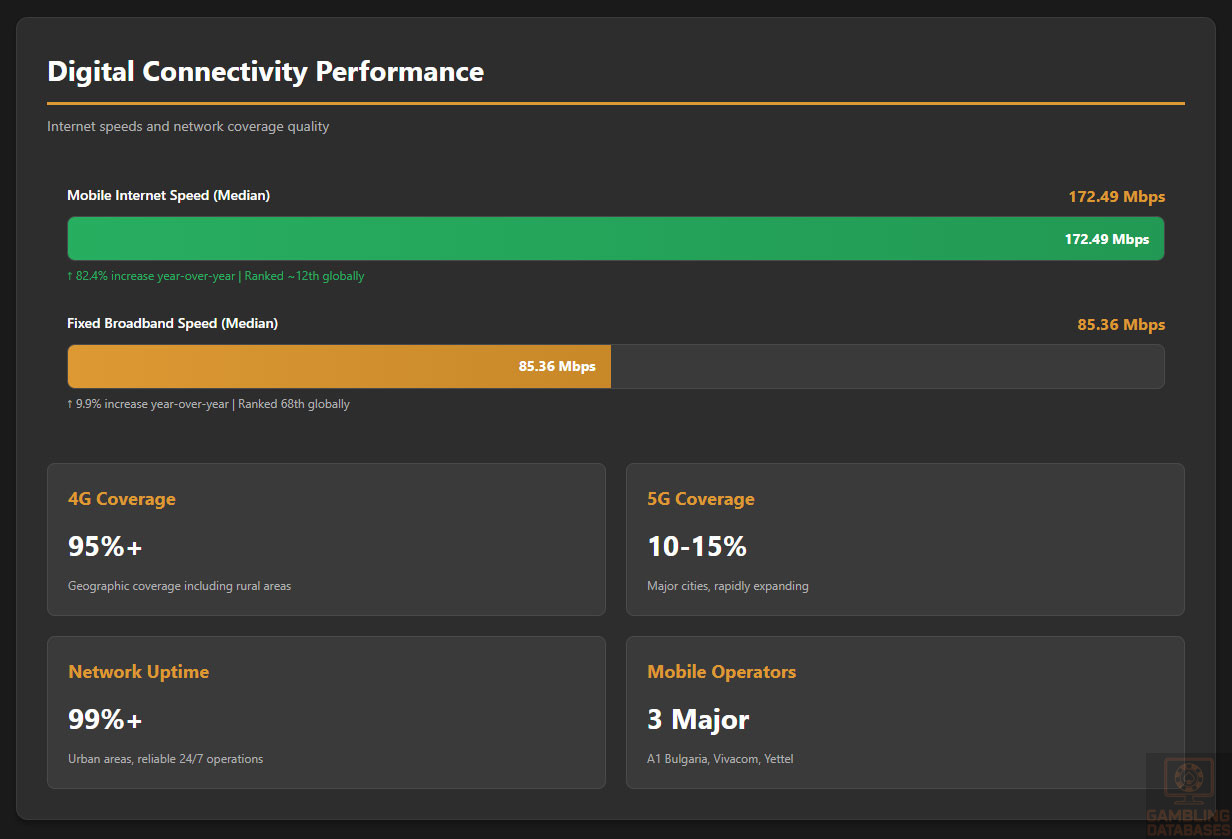
Network reliability and uptime statistics show Bulgarian internet infrastructure achieving 99%+ uptime in major urban areas with rare outages typically resolved quickly. Rural areas experience somewhat less reliability though improving as infrastructure investment reaches underserved regions. Mobile networks demonstrate strong reliability with four major operators maintaining competitive pressure for service quality. Fiber optic networks in cities provide exceptional stability, while older copper and wireless infrastructure in rural areas proves more vulnerable to weather and equipment failures. For gambling operators, the overall infrastructure reliability supports 24/7 operations without significant connectivity-related player impacts.
Infrastructure investment trends show continued substantial capital deployment in network upgrades and expansion. Telecommunications operators invested EUR 250+ million annually in recent years on fiber network rollouts, 5G deployment, and capacity upgrades. Government initiatives including EU-funded broadband programs target rural connectivity improvements, allocating nearly USD 257 million to provide high-speed internet to 400,000 residents in remote areas. The investment pipeline includes 3,700 km of new optical routes and 450 base station upgrades, suggesting continued infrastructure quality improvements supporting digital service growth including online gambling.
Global internet speed rankings based on Ookla data position Bulgaria’s mobile speeds at approximately 12th globally, exceptional achievement for a country of Bulgaria’s economic development level. Fixed broadband speeds rank 68th globally, respectable but trailing mobile performance. Regional comparisons show Bulgaria surpassing most Eastern European peers and matching some Western European nations in mobile speeds. This infrastructure advantage creates competitive positioning for attracting digital businesses and supports world-class online service delivery. For gambling operators, Bulgarian infrastructure enables optimal user experiences matching or exceeding what players experience in wealthier markets.
Rural versus urban connectivity gap remains significant though narrowing. Urban areas approach universal coverage with multi-gigabit fiber availability in major cities and strong 4G/5G mobile coverage. Rural areas historically lagged substantially but ongoing infrastructure programs specifically target underserved regions. The connectivity gap manifests more in speed and reliability than basic access availability, with rural residents able to access internet but experiencing lower speeds and occasional service interruptions. For gambling operators, the gap primarily affects market sizing calculations rather than service delivery, as addressable market concentrates heavily in well-connected urban areas accounting for 77% of population.
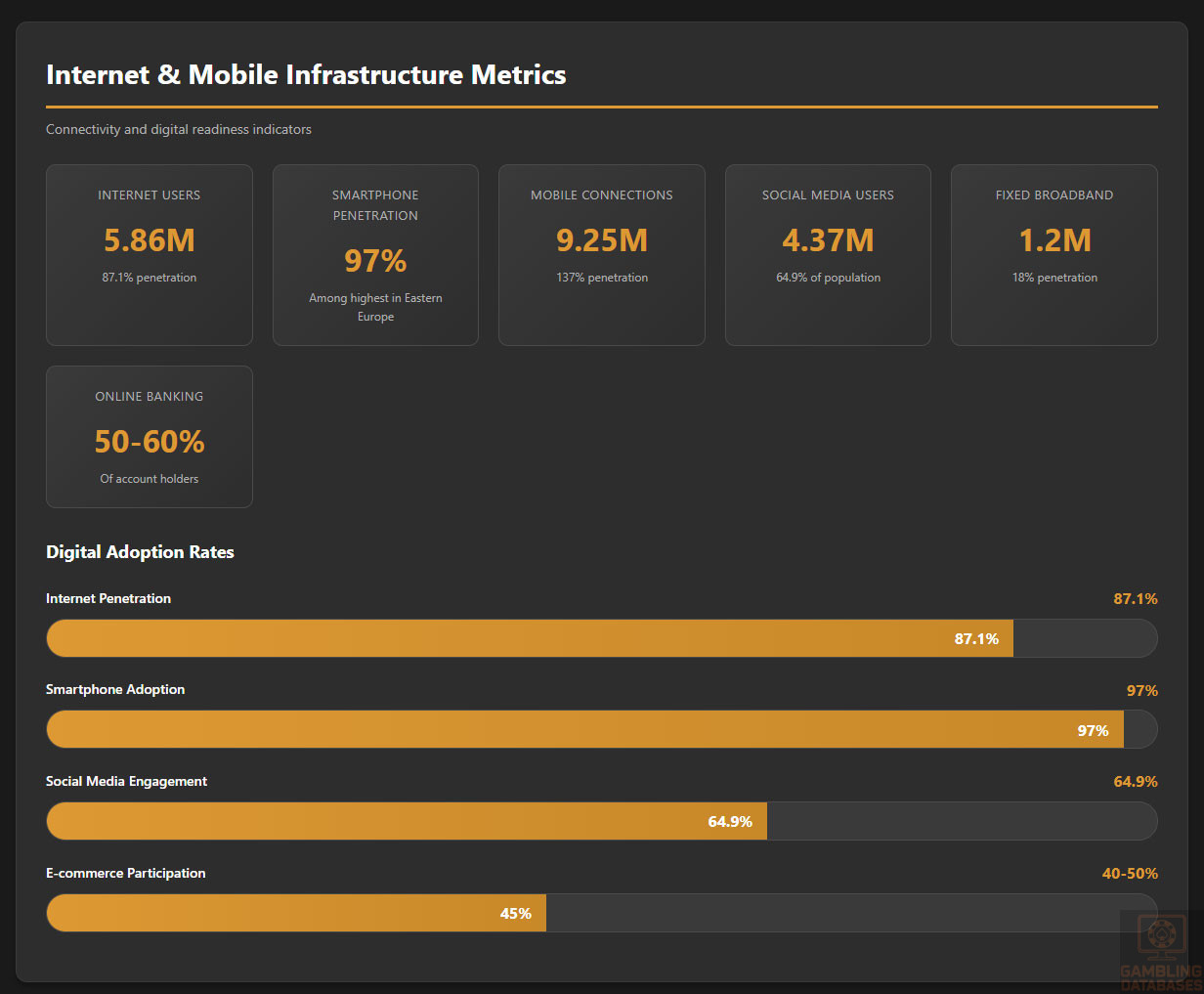
5G and Future Technology Deployment
Current 4G coverage reaches virtually all inhabited areas with the three major mobile network operators having completed nationwide 4G rollouts. Coverage maps show 95%+ geographic coverage including most rural areas, though signal strength and speeds vary by location. Urban areas receive multi-carrier 4G coverage providing redundancy and capacity. Highway corridors and transportation routes maintain strong 4G coverage supporting mobile usage during travel. The mature 4G infrastructure provides strong foundation for current mobile gambling applications with speeds and latency sufficient for all gambling products including live dealer games and in-play betting.
5G coverage remains in early deployment stages concentrated in major cities. A1 Bulgaria, the country’s largest mobile operator, leads 5G rollout with Sofia, Plovdiv, Varna, and Burgas receiving initial coverage. Vivacom and Yettel follow with their own 5G deployment programs focusing initially on business districts and high-traffic areas. As of 2025, 5G reaches perhaps 10-15% of the population concentrated in urban cores, though coverage expands rapidly. Most consumers continue using 4G given limited 5G device penetration and 4G’s adequate performance for current applications. For gambling, 5G enables future innovations including augmented reality betting experiences and enhanced live streaming, though current 4G proves sufficient for existing products.
5G rollout timeline projects broader coverage expansion through 2025-2027 as operators deploy additional infrastructure and device adoption increases. Sofia expects comprehensive 5G coverage by end of 2025. Other major cities will achieve substantial coverage by 2026. Nationwide 5G coverage including smaller cities and populated rural areas likely extends through 2027-2030 depending on demand and economic viability. The gradual rollout creates no immediate concerns for gambling operators as 4G remains ubiquitous and adequate. However, long-term product strategies should anticipate 5G capabilities enabling richer multimedia experiences, lower latency for live betting, and new augmented reality gambling concepts.
Future infrastructure plans include continued fiber optic expansion targeting 80%+ premises coverage in urban areas and extending fiber to rural town centers. The government’s National Broadband Infrastructure Plan aims to ensure all Bulgarian residents have access to at least 100 Mbps internet speeds by 2027. Mobile infrastructure investment focuses on 5G densification in cities and 4G capacity upgrades in high-traffic areas. Smart city initiatives in Sofia and other municipalities deploy IoT infrastructure creating testbeds for advanced applications. These infrastructure improvements support increasingly sophisticated digital services including next-generation gambling experiences.
Network operator landscape includes three major mobile operators dominating the market. A1 Bulgaria, formerly Mobiltel, leads with approximately 45-50% market share and strongest network performance. Vivacom ranks second with approximately 30-35% market share offering bundled mobile, fixed, and television services. Yettel, formerly Telenor Bulgaria, holds approximately 20-25% market share focusing on value proposition and consistent quality. This three-operator market creates healthy competition driving service improvements and price competition benefiting consumers. Smaller virtual network operators exist but capture minimal market share. For gambling operators, partnering with all three major operators for mobile billing and optimizing experiences across networks ensures maximum market reach.
Mobile Technology Ecosystem
Mobile Network Infrastructure
Mobile network operator market share distribution shows A1 Bulgaria commanding approximately 45-50% share through extensive infrastructure investment, strong brand recognition, and quality service reputation. Vivacom’s 30-35% share reflects its position as integrated telecommunications provider leveraging fixed-line network heritage and bundled service offerings. Yettel’s 20-25% share represents solid third-place position built on competitive pricing and reliable network quality. The three-operator structure creates oligopolistic competition with differentiation based on network quality, pricing, customer service, and value-added services rather than pure price competition that might undermine profitability.
Coverage quality by operator shows minimal practical differences in major urban areas where all three operators maintain comprehensive infrastructure. A1 generally rates slightly ahead in network testing including the Opensignal consistent quality category. Vivacom demonstrates strong performance particularly in areas where it leverages legacy fixed infrastructure. Yettel secured top ranking in Opensignal’s consistent quality category indicating reliable everyday performance. Rural coverage varies more substantially by operator with A1 typically offering broadest geographic reach while smaller operators focus on population centers. For gambling applications requiring reliable connectivity, all three operators provide adequate infrastructure in target demographics.
4G and 5G coverage maps show comprehensive 4G availability nationwide with 5G deployment concentrated in Sofia, Plovdiv, Varna, Burgas, and other major cities. A1’s coverage maps indicate strongest 5G footprint currently with aggressive expansion plans. Vivacom and Yettel follow with narrower but growing 5G coverage. Interactive coverage maps available on operator websites help consumers and businesses assess service availability at specific locations. For gambling operators, the ubiquitous 4G coverage ensures service delivery throughout the addressable market while 5G expansion creates opportunities for enhanced product experiences in major urban centers housing concentrated player populations.
Data costs and pricing models position Bulgaria among Europe’s most affordable markets for mobile data. Unlimited data plans cost EUR 10-20 monthly from most operators, with generous fair usage policies. Prepaid data packages offer EUR 5-10 for 10-30 GB monthly depending on operator and promotions. This low cost structure, combined with competitive operator market, ensures Bulgarian consumers face minimal barriers to mobile internet usage. The affordability supports high mobile data consumption enabling gambling participation without cost concerns. Operators occasionally offer gambling-specific data packages or partnerships, though neutrality principles generally prevent exclusive relationships favoring specific gambling operators.
Mobile payment integration shows Bulgarian operators supporting premium SMS billing and direct carrier billing for digital content and services. However, regulatory restrictions generally prevent direct operator billing for gambling to limit impulse gambling and underage access. Instead, players use credit cards, bank transfers, or e-wallets for gambling deposits with mobile operators facilitating data connectivity but not payment processing. This separation maintains responsible gambling principles while ensuring players have secure payment options. Some operators explore prepaid voucher systems enabling cash-to-digital conversion at retail locations, indirectly supporting gambling funding while maintaining appropriate controls.
Mobile wallet adoption rates remain moderate with e-wallet penetration approximately 15-20% of smartphone users. EasyPay leads Bulgarian mobile wallet market with agent network supporting cash in/out. International wallets including Google Pay and Apple Pay grow steadily particularly among younger urban demographics, though acceptance remains inconsistent across merchants. Bank-issued mobile payment apps enable contactless payments and P2P transfers. For gambling, mobile wallets serve niche segment preferring separation between banking and gambling activities. The wallet landscape continues evolving toward higher adoption as merchant acceptance expands and consumer familiarity grows, potentially creating additional gambling payment channels.
Device Penetration
Smartphone adoption rates reach exceptional 97% of population representing approximately 6.5 million smartphone users. This near-universal penetration positions Bulgaria among global leaders in smartphone adoption despite middling economic development. The high adoption reflects declining device costs making smartphones affordable for mass market, operator subsidies through contract plans, and essential smartphone role for communication, information, and services access. Nearly all adults own smartphones with adoption approaching 100% in younger demographics and remaining strong even among elderly populations increasingly embracing digital communication with family.
Smartphones per capita approach 1:1 ratio with most individuals owning one smartphone though some own multiple devices for work/personal separation or maintain old devices as backups. Children receive smartphones increasingly young, with teenagers showing near-universal ownership. The elderly represent the only demographic with materially sub-100% penetration, though adoption accelerates as digital government services and communication needs drive adoption. For gambling operators, smartphone ubiquity ensures mobile-optimized platforms reach essentially the entire addressable market without device access barriers limiting participation.
Device preferences and popular brands show Samsung dominating the Bulgarian smartphone market with approximately 35-40% market share across price tiers from budget Galaxy A-series to flagship S-series. Apple captures 15-20% market share concentrated in higher income segments with iPhone popularity growing particularly among younger professionals. Xiaomi ranks third with approximately 15-20% market share offering value-focused devices. Huawei maintains declining share following U.S. sanctions limiting Google service availability. Other Chinese brands including OPPO, Vivo, and Realme compete in budget segments. The diverse device landscape requires gambling operators to test across multiple device types, screen sizes, and Android versions ensuring consistent experiences.
Android versus iOS market share shows Android dominating at approximately 75-80% of devices with iOS holding 20-25%. This distribution reflects Android’s availability across all price points while iPhones concentrate in premium segment. The Android dominance suggests operators should prioritize Android app development and optimization, though iOS users often demonstrate higher engagement and spending making iOS support crucial for capturing high-value players. Web-based gambling platforms accessed through mobile browsers serve both operating systems without separate app development, though native apps provide superior user experiences justifying investment in both Android and iOS applications.
Average device specifications show Bulgarian smartphone users increasingly adopting capable mid-range and flagship devices rather than basic budget phones. Typical specifications include 6-6.5 inch displays, 64-128 GB storage, 4-6 GB RAM, and multi-camera systems. These specifications easily support gambling applications, HD graphics, live video streaming, and responsive gameplay. Even budget devices costing EUR 100-150 provide adequate performance for online gambling. The improving device quality enables richer gambling experiences without concerns about hardware limitations constraining product design.
Mobile internet usage patterns show Bulgarians spending approximately 75% of internet time on mobile devices versus 25% on desktop. This mobile-first behavior spans all age groups though younger demographics approach 90% mobile while older users maintain higher desktop usage. Mobile usage occurs throughout the day during commutes, breaks, leisure time, and even alongside television viewing. For gambling, mobile usage peaks during evenings and weekends when leisure time allows sustained sessions. The mobile-dominant pattern demands operators design mobile-first experiences with desktop as secondary rather than vice versa.
Mobile gaming penetration reaches approximately 50-60% of smartphone users playing mobile games at least occasionally, with younger demographics showing 70-80% participation. Popular games include casual puzzle games, strategy games, and increasingly sophisticated multiplayer experiences. This strong mobile gaming culture creates favorable conditions for mobile gambling adoption as users already comfortable with mobile gameplay mechanics, in-app purchases, and extended mobile sessions. Gambling operators can leverage mobile gaming familiarity in user interface design and gameplay patterns maximizing accessibility for players already versed in mobile gaming.
Financial Services and Payment Infrastructure
Banking System Structure
Major banks operating in Bulgaria include both domestic and international institutions creating competitive financial services market. UniCredit Bulbank leads as largest bank by assets with approximately 20% market share, part of Italian UniCredit Group. United Bulgarian Bank (UBB), part of National Bank of Greece, ranks second with roughly 15% market share. DSK Bank, domestically owned by OTP Bank Hungary, holds approximately 13% market share. First Investment Bank (Fibank) maintains 10-11% market share. Raiffeisen Bank Bulgaria contributes approximately 6-7% market share. Additional banks including Postbank, Central Cooperative Bank, and others serve specialized markets or regional concentrations.
Number of banks operating in the country totals approximately 22-24 licensed credit institutions including full-service banks, specialized banks, and branches of foreign banks. This number has declined from 30+ in the early 2010s through consolidation, exits, and regulatory interventions improving financial sector stability. The Bulgarian National Bank maintains strict supervision ensuring financial system soundness. For gambling operators, the concentrated banking market with major institutions controlling 70%+ market share means partnering with top 5-7 banks provides access to most potential customers while smaller institutions serve niche segments.
Account penetration rates show approximately 70-75% of adults holding bank accounts, though this varies by age and income. Urban professionals approach 100% banked status while rural elderly populations include substantial unbanked segments relying on cash. European trends toward mandatory bank accounts for salary payments and social benefits drive increasing penetration. For gambling operators, the 70-75% banked population defines the maximum addressable market for bank-based payment methods, though credit/debit card penetration among account holders reaches 70-80% meaning 50-60% of total adults hold payment cards enabling gambling deposits.
Credit and lending market maturity levels position Bulgaria in moderate development category. Consumer lending including personal loans, mortgages, and credit cards remains less developed than Western European markets with household debt-to-GDP ratios significantly lower. This reflects both supply constraints from conservative bank lending practices and demand limitations from income levels and cultural preferences for low debt. Credit cards serve primarily payment convenience rather than credit instruments with most cardholders paying balances monthly. For gambling, limited credit availability may constrain problem gambling severity as players cannot easily access credit for gambling funding, providing inadvertent harm reduction benefit.
ATM density reaches approximately 1 ATM per 1,000 people concentrated heavily in urban areas while rural regions show sparse ATM networks. Major cities offer extensive ATM coverage with machines available throughout commercial areas, shopping centers, and transportation hubs. International card networks including Visa and Mastercard ensure Bulgarian ATMs accept foreign cards facilitating tourism. However, ATM relevance for gambling continues declining as online payments dominate and cash payments for gambling represent decreasing share of transactions given regulatory limits and operator preferences for traceable electronic payments supporting AML compliance.
Payment Processing Options
| Payment Method | Availability | Processing Speed | Typical Fees | Market Penetration |
|---|---|---|---|---|
| Credit/Debit Cards | Universal | Instant deposits | 2-4% for operators | 60-70% of transactions |
| Bank Transfers | Wide | 1-3 business days traditional; instant with new systems | EUR 1-5 per transaction | 20-30% of transactions |
| Skrill | Supported by most operators | Instant deposits, 24hr withdrawals | 1-3% transaction fees | 5-10% of transactions |
| Neteller | Supported by most operators | Instant deposits, 24hr withdrawals | 1-3% transaction fees | 5-10% of transactions |
| EasyPay | Local Bulgarian e-wallet | Instant deposits | Variable | 3-5% of transactions |
| ePay.bg | Local Bulgarian payment gateway | Instant deposits | Variable | 2-4% of transactions |
| Cryptocurrency | Limited, some international operators | 15-60 minutes typical | Network fees vary | 1-2% of transactions |
| Prepaid Cards/Vouchers | Selected operators | Instant deposits | Variable surcharges | 1-3% of transactions |
Available payment methods for iGaming span traditional and emerging options creating flexible deposit and withdrawal capabilities. Credit and debit cards issued by Bulgarian and international banks represent the dominant payment method given universal availability, instant processing, and user familiarity from e-commerce. Bank transfers provide alternative for larger deposits and withdrawals though slower processing times make them less convenient for immediate gambling. E-wallets including international services Skrill and Neteller alongside local solutions EasyPay and ePay.bg serve segments preferring intermediary accounts separating banking from gambling.
Credit and debit card penetration shows approximately 70-80% of bank account holders possessing payment cards, translating to roughly 50-60% of total adult population. Visa dominates card market share followed by Mastercard, with both networks providing comprehensive acceptance. American Express and other card networks maintain minimal presence. Most Bulgarian cards are debit cards linked directly to checking accounts rather than credit cards, reflecting cultural preference for spending within means. Card payments for gambling work seamlessly with instant authorization and settlement supporting immediate deposit crediting.
E-wallet options include established international gambling payment specialists Skrill and Neteller which maintain strong presence in European gambling markets. Both offer dedicated gambling customer support, fast withdrawal processing, and loyalty programs rewarding transaction volumes. Local Bulgarian e-wallets EasyPay and ePay.bg provide alternatives with extensive agent networks enabling cash loading at physical locations throughout Bulgaria, serving players preferring cash-to-digital conversion without bank accounts. Wallet adoption remains moderate but grows as consumers value the separation of gambling and banking activities.
Bank transfer systems include traditional SEPA transfers processing in 1-3 business days plus emerging instant payment systems enabling real-time bank-to-bank transfers. SEPA transfers work reliably for withdrawals where speed matters less, allowing operators to return funds to player bank accounts securely. Instant payment systems increasingly deploy across EU creating opportunities for real-time deposits from bank accounts without card intermediation, combining bank transfer security with card-like convenience. As instant payment infrastructure matures, bank transfers may capture additional market share from cards.
Cryptocurrency acceptance for gambling remains limited among licensed Bulgarian operators given regulatory uncertainty and compliance concerns. However, some international operators serving Bulgarian players accept Bitcoin, Ethereum, and other cryptocurrencies leveraging blockchain’s privacy and fast settlement. Cryptocurrency appeals primarily to tech-savvy players valuing anonymity and independence from traditional financial systems. Market share remains minimal at 1-2% of transactions but shows growth potential if regulatory frameworks develop supporting compliant cryptocurrency gambling. Operators considering cryptocurrency must evaluate regulatory risk carefully.
Processing fees and typical charges vary by payment method and operator negotiating power. Card processing costs operators 2-4% of transaction value depending on card type, acquirer relationships, and transaction volumes. High-volume operators negotiate lower rates while smaller operators pay premium pricing. Bank transfers cost fixed EUR 1-5 per transaction. E-wallet fees range 1-3% with some wallets charging players rather than merchants. Cryptocurrency network fees vary by blockchain and network congestion. Operators typically absorb payment processing costs rather than charging players to encourage deposits, making payment fees significant operating expense line items.
Transaction processing timelines show deposits generally process instantly for cards, e-wallets, and instant bank payments enabling immediate gambling. Traditional bank transfers require 1-3 business days for clearing. Withdrawals typically process in 24-48 hours for established players after identity verification, with e-wallets often fastest at 24 hours or less. New players face enhanced verification potentially delaying first withdrawals to 3-7 days while operators conduct thorough KYC checks. Processing speed represents competitive differentiator with faster withdrawals improving player satisfaction and retention.
International payment capabilities allow Bulgarian players to fund gambling accounts using internationally-issued payment cards and bank accounts, facilitating participation by foreign residents and Bulgarian expatriates visiting home. Similarly, Bulgarian-issued payment cards work internationally enabling Bulgarian residents to access foreign gambling sites, though regulatory restrictions and payment blocking aim to channel activity toward licensed operators. Cross-border payment infrastructure supports tourism-driven gambling in Bulgarian casinos and online gambling by international player populations.
Regulatory restrictions on gambling payments include requirements that payment processors cannot facilitate transactions to/from unlicensed gambling operators. Banks and payment institutions must screen gambling transactions and block payments to operators lacking Bulgarian licenses. This creates enforcement mechanism supplementing ISP website blocking by preventing financial flows to unlicensed operators. Licensed operators face no payment restrictions beyond standard AML and consumer protection requirements. The payment restrictions increase compliance burden for financial institutions while supporting regulatory goals of channeling gambling into the licensed market.
Chargebacks and dispute resolution follow standard card network rules allowing consumers to dispute unauthorized or fraudulent transactions. Gambling transactions receive heightened scrutiny given historical chargeback abuse where players dispute legitimate losses seeking refunds. Operators implement strong verification at first deposit, maintain detailed transaction logs, and respond quickly to chargeback notifications defending legitimate transactions. High chargeback rates damage operator relationships with payment processors potentially leading to processing termination. Careful chargeback management including clear terms, good customer service, and fraud prevention balances player protection with operator interests.
E-commerce and Digital Economy
Digital Market Development
E-commerce market size in Bulgaria reached approximately EUR 2-2.5 billion in 2024, representing significant digital retail penetration though remaining below Western European levels. Annual growth rates of 15-20% demonstrate rapid market expansion driven by improving logistics, expanding online retail options, and growing consumer confidence in online shopping. Fashion and apparel lead e-commerce categories followed by electronics, home goods, and food delivery. International marketplaces including Amazon, eBay, and AliExpress compete with local retailers and specialized vertical platforms.
Online retail penetration measures show approximately 20-25% of total retail sales occurring online, below the 30-40% penetration in mature markets like UK but growing rapidly. Urban consumers show higher online shopping adoption approaching 35-40% penetration while rural areas lag significantly. Younger demographics shop primarily online while older consumers gradually increase digital retail participation. The COVID-19 pandemic accelerated e-commerce adoption by forcing digital experimentation among previously hesitant consumers. For gambling operators, the e-commerce maturity indicates Bulgarian consumers possess the digital payment skills, accounts, and comfort necessary for online gambling participation.
Digital service adoption rates show Bulgarians increasingly consuming entertainment, information, news, and business services online. Streaming services including Netflix, HBO Max, and local platforms gain subscribers. Music streaming through Spotify and others replaces physical media. Cloud storage, productivity software, and digital tools transition from purchase to subscription models. Professional services including legal, financial, and consulting increasingly deliver remotely. This broad digital service adoption creates familiarity with online service models, recurring payments, and digital customer relationships applicable to gambling.
Consumer trust in online transactions has improved dramatically from low levels in the early 2010s when fraud concerns deterred e-commerce adoption. Major retailer investments in secure payment processing, clear return policies, and reliable delivery built confidence. Bank security improvements including two-factor authentication and real-time fraud monitoring reduced unauthorized transaction risks. Positive experiences accumulating over time created virtuous cycle where trust enables trial leading to satisfaction reinforcing trust. Current trust levels support online gambling growth as payment security concerns, major historical barrier, diminish.
Popular e-commerce platforms serving Bulgaria include international giants and local champions. eMag, Romanian electronics and general merchandise retailer, leads Bulgarian e-commerce with comprehensive product selection and fast delivery. Amazon expanded Bulgarian access though lacks dedicated Bulgarian website requiring German or UK site usage. Fashion retailers including Zara, H&M, and ASOS serve Bulgarian online shoppers. Food delivery platforms including Foodpanda and Glovo transform restaurant industry. For gambling operators, these platforms demonstrate successful digital business models and establish consumer expectations around user experience, customer service, and convenience that gambling platforms must meet.
Cross-border online shopping shows Bulgarian consumers frequently purchasing from international retailers given limited local e-commerce selection and price advantages on some imported goods. Fashion purchases often come from Western European sites. Electronics commonly ordered from German or UK retailers. Chinese marketplaces provide budget product access. This cross-border shopping comfort means Bulgarian consumers readily engage with internationally-operated gambling sites, making market entry viable for foreign operators without extensive local infrastructure beyond licensing requirements.
Digital goods and services consumption grows rapidly as Bulgarians embrace software subscriptions, digital media, online education, and virtual services. Video game purchases increasingly occur through digital downloads rather than physical retail. Subscription services for entertainment, productivity, and specialized content gain market share. Online courses and educational content see strong demand. This digital goods comfort indicates Bulgarian consumers value intangible digital products, relevant for online gambling representing entertainment service without physical product. The transition from physical to digital consumption patterns supports online gambling growth as form of digital entertainment.
Business Environment and Regulatory Framework
Ease of Business Operations
World Bank Doing Business ranking positioned Bulgaria at approximately 61st globally out of 190 economies in the final 2020 report before the ranking’s discontinuation. This mid-range position reflected strengths in areas like getting electricity and trading across borders while showing weaknesses in protecting minority investors and enforcing contracts. Bulgaria outperformed some Eastern European peers but lagged Western European nations. The ranking suggested moderately business-friendly environment with room for improvement in institutional quality, regulatory efficiency, and legal system effectiveness. For gambling operators, the ranking context indicates competent but not exceptional business environment requiring standard international business practices.
Ease of Starting a Business ranking showed Bulgaria at approximately 115th globally in the Doing Business framework, indicating significant room for improvement in company registration processes. However, recent digitalization initiatives and administrative reforms have streamlined registration procedures making the process more efficient than historical rankings suggest. The ranking primarily reflects procedural complexity and time requirements rather than actual barriers preventing business formation. Most businesses navigate registration successfully with appropriate legal counsel, and EU membership ensures fundamental business rights protection.
Business registration processes and steps require several key actions. First, entrepreneurs must reserve company name with Bulgarian Commercial Register ensuring uniqueness. Second, prepare foundation documents including articles of association, shareholder agreements, and management appointment letters. Third, deposit minimum share capital in bank account obtaining bank certificate. Fourth, notarize foundation documents before Bulgarian notary public. Fifth, submit registration application to Registry Agency including all required documents. Sixth, obtain tax registration from National Revenue Agency. Seventh, register for social security and health insurance. These steps, while numerous, follow standardized procedures with clear requirements.
Time required to start a business approximates 3-4 weeks from initial documentation preparation through final registration completion when properly managed. Name reservation takes 1-2 business days. Document preparation requires several days to weeks depending on complexity and lawyer responsiveness. Notarization occurs same day with appointment. Registry Agency registration processes in approximately 5-7 business days for standard cases. Tax and social security registration add several days. The timeline assumes proper documentation without rejections or amendments. For gambling operators, company registration precedes license application, making efficient company formation critical for minimizing time-to-market.
Foreign investment policies and restrictions generally welcome foreign capital with few sectoral restrictions. EU, EEA, and Swiss entities enjoy national treatment equivalent to Bulgarian companies under single market principles. Non-EU foreign investors may face some restrictions in specific strategic sectors but gambling faces no nationality-based restrictions. Repatriation of profits and capital faces no limitations enabling international operators to extract profits freely. Currency controls focus on anti-money laundering rather than capital controls, with EUR 10,000+ cross-border transfers requiring declaration but not approval. This open foreign investment framework facilitates international gambling operator entry.
Operational cost structures in Bulgaria remain significantly lower than Western European averages, providing cost advantage for businesses establishing operations. Office rent in Sofia averages EUR 10-15 per square meter monthly for quality business space, compared to EUR 30-50+ in Western capitals. Salaries for qualified professionals range EUR 1,500-3,000 monthly, substantially below Western European equivalents. Utilities including electricity, internet, and telecommunications cost EUR 100-300 monthly for small offices. These lower costs enable operators to establish local presence economically while maintaining margins.
Labor market conditions show tight employment market with 4-5% unemployment and talent shortages in skilled positions particularly IT, customer service, and specialized roles. Bulgarian labor force demonstrates strong educational foundations, good work ethic, and increasing English proficiency among younger workers. However, emigration to Western Europe creates brain drain challenges as skilled professionals seek higher wages abroad. For gambling operators, recruiting quality Bulgarian staff proves feasible but may require competitive compensation packages and career development opportunities. Outsourcing non-core functions and leveraging remote work arrangements can supplement local hiring.
Corporate Structure and Registration
Available Entity Types
LLC (Limited Liability Company or OOD in Bulgarian) represents the most common corporate structure for gambling operators and small-to-medium businesses generally. LLCs provide limited liability protection separating owner personal assets from business obligations. Minimum capital requirement of BGN 2 (approximately EUR 1) makes LLCs accessible, though gambling licensing requires BGN 1.5 million minimum capital. Management flexibility allows owner-management or appointed managers. Profit distribution occurs through dividends with 5% dividend withholding tax. LLCs suit foreign operators establishing Bulgarian subsidiaries for gambling licenses given flexibility, limited liability, and straightforward structure.
Corporation (Joint Stock Company or AD in Bulgarian) serves larger businesses requiring public capital raising. Minimum capital of BGN 50,000 (EUR 25,563) applies with shares tradable on stock exchanges. Corporate governance follows stricter requirements including supervisory boards and annual general meetings. Public disclosure requirements exceed LLC obligations. Few gambling operators choose AD structure unless planning public listing or requiring complex ownership structures. The regulatory burden and higher capital requirements make ADs less attractive than LLCs for typical gambling market entry.
Branch office represents foreign company presence without creating separate legal entity. Branches allow foreign gambling operators to conduct business in Bulgaria through extension of parent company rather than subsidiary. However, licensing requirements likely necessitate Bulgarian legal entity rather than branch, making this option less relevant for gambling operators. Branches suit companies conducting ancillary activities like sales, marketing, or support services without requiring licenses. The lack of separate legal personality means parent company bears full liability for branch operations.
Recommended structure for iGaming operators strongly favors LLC formation as wholly-owned subsidiary of international parent company. This structure provides required Bulgarian legal entity for licensing while maintaining limited liability protection and operational flexibility. The LLC can be capitalized with BGN 1.5 million minimum capital required for gambling licenses while avoiding AD’s additional regulatory burden. Management can be structured with Bulgarian authorized representative satisfying regulatory requirements while maintaining parent company control through shareholder rights.
Differences between entity types affect liability, taxation, reporting, and operational flexibility. LLCs provide limited liability, flexible management, simpler governance, and moderate reporting requirements suitable for private operations. ADs offer share tradability, stricter governance, public reporting obligations, and structure suited for capital markets access. Branches lack separate legal personality creating parent liability while avoiding Bulgarian corporate taxation on properly structured international transactions. For gambling, LLCs balance regulatory requirements, liability protection, and operational simplicity making them optimal choice for most operators.
Registration Requirements
Registration timelines from application to approval approximate 5-7 business days for Registry Agency processing plus several additional days for tax and social security registration. Total registration duration spans 2-3 weeks when managed efficiently with proper documentation. Delays occur when documents are incomplete, translations are needed, or Registry Agency requests clarifications. Experienced lawyers familiar with registration procedures expedite the process ensuring first-time approval. For gambling operators, efficient company registration enables quicker transition to license application, the critical path determining time-to-market.
Registration costs include government fees, legal fees, and capital deposit requirements. Registry Agency fees approximate EUR 100-300 depending on company type and capital. Notary fees range EUR 100-200 for document authentication. Legal fees vary widely from EUR 500-2,000 depending on complexity and law firm. Translation costs add EUR 200-500 for document translation into Bulgarian. Total registration costs typically total EUR 2,000-5,000 excluding the BGN 1.5 million (EUR 767,000) minimum capital deposit required for gambling licensing. These costs represent modest entry barrier compared to total market entry investment.
Required documents and notarization include articles of association defining company structure, shareholder composition, capital, and management; identification documents for all shareholders and managers including passports and proof of address; bank certificate confirming capital deposit; proof of registered office address in Bulgaria; and various declarations and application forms. All foreign documents require certified translation into Bulgarian. Key documents require notarization by Bulgarian notary public confirming signatory authority and document authenticity. The documentation requirements, while extensive, follow standard international corporate practice.
Foreign ownership rules impose no restrictions for EU, EEA, and Swiss entities which enjoy complete national treatment. Non-EU foreign investors may establish Bulgarian companies without restriction in the gambling sector, which lacks strategic designation limiting foreign ownership. Shareholders may be individuals or corporate entities from any jurisdiction. The openness to foreign ownership facilitates international gambling operator market entry through wholly-owned Bulgarian subsidiaries maintaining parent company control while satisfying licensing requirements for Bulgarian legal entity.
Minimum capital requirements by entity type show LLC minimum of BGN 2 (EUR 1) for general business but gambling licensing requires BGN 1.5 million (EUR 767,000) paid-in capital regardless of entity type selected. AD minimum capital reaches BGN 50,000 (EUR 25,563) for corporations. The gambling-specific capital requirement represents the binding constraint far exceeding standard LLC or AD minimums. Capital must be deposited in Bulgarian bank before registration and remain in the company throughout licensing period, creating significant liquidity requirement for market entry.
Ongoing compliance requirements include annual financial statement preparation following Bulgarian accounting standards; annual tax return filing with National Revenue Agency; maintaining statutory registers of shareholders, management, and beneficial owners; holding annual general meetings for ADs and as needed for LLCs; timely filing of any changes to company information including management, address, or capital with Registry Agency; and compliance with employment law for any Bulgarian staff. For gambling operators, additional reporting to NRA under gambling regulations supplements standard corporate compliance. The ongoing compliance burden remains manageable with qualified accountants and legal advisors.
Corporate governance requirements vary by entity type with ADs facing stricter obligations including supervisory boards, annual general meetings with detailed protocols, and public disclosure of financial results. LLCs enjoy greater flexibility with simpler governance structures, private shareholder meetings, and limited public disclosure beyond Registry Agency filings. For gambling operators, regulatory oversight by NRA creates additional governance obligations including beneficial ownership disclosure, management suitability assessment, and reporting of significant changes. Meeting both corporate and gambling regulatory governance requirements demands structured compliance programs and documentation.
Taxation Framework
Corporate Income Tax Structure
Standard corporate tax rates in Bulgaria apply at flat 10% of taxable profits, representing the European Union’s lowest corporate tax rate. This highly competitive rate attracts international businesses and provides significant advantage compared to 20-30% rates common in Western Europe. The flat rate applies regardless of profit level avoiding progressive taxation that increases effective rates on high-earning businesses. For gambling operators, the low corporate tax rate enhances profitability though gambling-specific GGR taxes represent far larger tax burden. The 10% rate applies to taxable income after deducting GGR taxes and operating expenses.
Special economic zone benefits and incentives exist in certain designated areas offering infrastructure advantages or targeted industry development. However, gambling activities typically do not qualify for special economic zone incentives given regulatory focus on mainstream economic development and manufacturing rather than gambling. The low standard 10% corporate tax rate minimizes the value of incentive programs that might reduce rates further. Operators should not anticipate tax incentives beyond the generally applicable low rate environment when conducting financial projections.
Tax holidays or reduced rates for new businesses do not generally apply to gambling operations. Bulgaria previously offered tax incentives for certain industries or disadvantaged regions but has largely eliminated these in favor of uniform low taxation. The 10% rate applies from the first year of operations without phase-in periods or reduced rates for startups. For gambling operators, full tax burden applies immediately upon commencing operations requiring financial planning that accommodates tax costs from day one without startup exemptions.
International tax treaties provide Bulgarian treaty network with 70+ countries preventing double taxation of cross-border income. Treaties generally reduce withholding taxes on dividends, interest, and royalties paid between treaty countries. The EU Parent-Subsidiary Directive eliminates withholding taxes on dividends between qualifying EU companies. For international gambling groups, treaty planning enables efficient profit repatriation from Bulgarian operations to parent companies in treaty jurisdictions minimizing withholding tax leakage. Professional tax advice optimizes treaty benefits within legal boundaries.
Transfer pricing rules require Bulgarian entities to conduct transactions with related foreign companies at arm’s length market prices preventing profit shifting through mispriced intercompany transactions. Operators must maintain transfer pricing documentation demonstrating that management fees, royalties, technology licenses, and other intercompany charges reflect fair market value. Tax authorities increasingly scrutinize transfer pricing given international focus on base erosion and profit shifting. For gambling operators, common transfer pricing issues include platform licensing fees, shared services charges, and brand royalties requiring careful documentation and defensible pricing methodologies.
Withholding tax on dividends, interest, and royalties applies at statutory 5% rate on dividends paid to shareholders, 10% on interest payments, and 10% on royalty payments to non-residents. However, EU directives and tax treaties often reduce or eliminate withholding taxes. Dividend payments to EU parent companies qualifying under Parent-Subsidiary Directive incur zero withholding tax. Interest and royalty payments within EU may qualify for zero withholding under Interest-Royalties Directive. Treaty rates vary but often reduce withholding to 5-10% or zero. Proper structuring minimizes withholding tax costs on profit extraction.
VAT and GST rates show standard 20% VAT applying to most goods and services with reduced 9% rate for hotel accommodation and restaurant services. Gambling services face special VAT treatment with gaming supplies taxed differently than other services. Online gambling typically falls outside VAT scope as exempt supplies, avoiding VAT on player stakes while preventing VAT recovery on costs. The VAT treatment creates hidden tax cost for operators unable to recover input VAT but avoids complicated VAT calculations on player transactions. Operators should account for irrecoverable VAT when budgeting operational costs.
Personal Income Tax
Individual tax rates follow Bulgaria’s flat 10% personal income tax rate applying to all employment income regardless of amount. This flat structure creates one of Europe’s lowest personal tax burdens enhancing take-home pay for employees and reducing employment costs for employers compared to progressive tax systems with rates reaching 40-50% in Western Europe. The low rate supports competitive salary offers attracting and retaining talent. For gambling operators employing Bulgarian staff, the 10% rate simplifies payroll administration while creating favorable employment cost structure.
Withholding requirements for employees mandate employers to calculate, withhold, and remit employee income tax monthly to tax authorities. Employers must also withhold employee social security contributions comprising approximately 13% of gross salary. The combined withholding obligation creates employer responsibility for proper tax compliance on behalf of employees. Year-end reconciliation processes allow employees to claim deductions and credits through annual tax returns. The withholding system, while creating administrative burden for employers, ensures consistent tax collection and employee compliance.
Social security contributions represent significant employment cost beyond salary and income tax. Employer social security contributions approximate 18-19% of gross salary covering pension, health insurance, and unemployment insurance. Employee contributions of approximately 13% are withheld from gross pay. Total social security burden approaches 31-32% split between employer and employee. These contributions, while substantial, remain below Western European levels where total social charges can exceed 45%. For gambling operators, accurate budgeting must account for social security costs increasing total employment expense approximately 18-19% above gross salaries.
Tax residency rules determine whether individuals pay Bulgarian tax on worldwide income versus only Bulgarian-source income. Residents defined as individuals present in Bulgaria over 183 days in any 12-month period or having permanent residence face taxation on global income. Non-residents pay Bulgarian tax only on Bulgarian-source income including salaries for work performed in Bulgaria. For international gambling operators rotating expatriate staff through Bulgarian operations, residency planning manages tax obligations while ensuring key personnel can work in Bulgaria legally within visa and residency frameworks.
Taxation of foreign employees follows general principles with residents taxed on worldwide income and non-residents on Bulgarian income. Foreign nationals working in Bulgaria must obtain work permits unless EU citizens enjoying freedom of movement. Tax treaties prevent double taxation where foreign employees pay both home country and Bulgarian taxes on same income. Many treaties provide foreign tax credits or exemptions. For operators recruiting international talent, understanding treaty benefits and residency planning optimizes after-tax compensation while ensuring legal compliance in both jurisdictions.
Market Entry Considerations
Recommended Entry Strategies
Optimal market entry approaches for Bulgaria favor establishing Bulgarian LLC as licensing entity while leveraging international infrastructure for technology platforms, payment processing, and back-office operations. This hybrid model satisfies regulatory requirements for Bulgarian legal entity and authorized representative while minimizing Bulgarian operational footprint and costs. The LLC obtains gambling license, maintains regulatory compliance, and serves as market-facing entity while international parent provides technology, content, payments, and support services through contracted arrangements. This approach balances regulatory compliance with operational efficiency.
Local partnership requirements do not exist for EU/EEA/Swiss operators which can establish wholly-owned subsidiaries without Bulgarian partners. However, partnerships with local marketing agencies, payment providers, affiliates, and technology vendors prove beneficial for market knowledge, customer acquisition, and operational support. Some operators pursue joint ventures with established Bulgarian gambling companies leveraging existing licenses, brand recognition, and infrastructure though this sacrifices control. Most international operators prefer independent entry maintaining strategic flexibility while contracting local service providers as needed.
White label versus proprietary platform considerations weigh speed-to-market, cost, control, and differentiation. White label solutions enable rapid entry within 2-3 months leveraging established platforms, game catalogs, payment integrations, and regulatory compliance frameworks. Costs range EUR 10,000-50,000 monthly depending on deal structure and services. However, white labels sacrifice brand control, limit product differentiation, and create ongoing dependency on platform providers. Proprietary platforms require longer development timelines of 6-12 months and higher initial investment of EUR 500,000-2,000,000 but provide complete control, customization freedom, and independence. Many operators start with white labels then transition to proprietary platforms after establishing market presence.
Technology infrastructure leveraging strategies should maximize use of existing EU-hosted systems satisfying Bulgarian requirements without unnecessary Bulgarian data center investments. Central gaming systems, platform core, and customer database can operate from operators’ primary EU facilities with real-time data replication to Bulgarian servers meeting data localization requirements. Bulgarian infrastructure should focus on regulatory compliance obligations including NRA data reporting systems, player registration databases, and required local servers while avoiding needless duplication of systems adequately hosted elsewhere. This minimizes costs while ensuring compliance.
Marketing and localization requirements demand professional Bulgarian translation of all player-facing content including website, game names, terms and conditions, promotional materials, and customer communications. Machine translation proves inadequate for legal documents and marketing copy requiring cultural adaptation beyond literal translation. Customer support must include Bulgarian-language channels covering phone, email, live chat, and social media. Marketing campaigns should reference Bulgarian sports teams, local events, and cultural touchpoints resonating with domestic audiences rather than generic international messaging. Quality localization separates successful operators from failed entries.
Payment provider selection criteria prioritize breadth of Bulgarian payment method coverage, competitive pricing, reliable processing, and proven gambling industry experience. Optimal payment partners should support Bulgarian bank cards, major bank transfers, local e-wallets including EasyPay and ePay.bg, and international e-wallets like Skrill and Neteller. Processing fees below 3% for cards and 2% for e-wallets represent competitive rates though high-volume operators negotiate better terms. Gambling-specific payment providers understand chargeback management, age verification, and AML compliance better than generic payment processors. Diversifying across 2-3 payment partners reduces dependency and processing failures.
Risk mitigation strategies for Bulgarian market entry include conducting thorough legal due diligence on licensing requirements and regulatory compliance obligations before committing capital; securing experienced local legal counsel familiar with gambling regulation; developing comprehensive AML and responsible gambling compliance programs from launch preventing enforcement issues; maintaining adequate capital reserves for license fees, tax obligations, and operating losses during market establishment; and planning conservative revenue projections acknowledging competitive intensity and customer acquisition challenges. Starting conservatively and scaling based on actual performance reduces downside risk while preserving options for growth investment if market opportunities exceed expectations.
Typical Costs and Timelines
| Cost Category | Amount (EUR) | Notes |
|---|---|---|
| License Application Fee | 10,000-20,000 | Varies by license type, sports betting at upper end |
| One-Time License Fee | 204,500 | For online betting; effective January 2024 |
| Post-Approval Fee | 51,125 | Additional upon license issuance |
| Minimum Share Capital | 767,000 | Must remain in company account |
| Company Registration | 2,000-5,000 | Legal fees, translations, registrations |
| Legal & Consulting Fees | 50,000-100,000 | License application support, compliance setup |
| Technical Compliance | 20,000-50,000 | System testing, certifications, NRA integrations |
| Platform Setup | 100,000-500,000 | White label EUR 10-50k monthly; proprietary EUR 500k-2M |
| Payment Integration | 10,000-30,000 | Multiple provider integrations and setup |
| Office Setup | 10,000-30,000 | Furniture, equipment, deposits if physical presence |
| Initial Marketing Budget | 100,000-300,000 | First 6 months customer acquisition |
| Working Capital Reserve | 200,000-500,000 | Operating expenses, player liabilities |
| Total Initial Investment | 1,525,000-2,550,000 | Approximate range for market entry |
Initial setup investments breakdown shows license-related costs representing the largest immediate expense at EUR 265,000-275,000 combining application, one-time, and post-approval fees. The BGN 1.5 million (EUR 767,000) minimum capital requirement, while theoretically available for operations, effectively represents locked capital reducing liquidity for market entry investments. Platform costs vary dramatically based on white label versus proprietary approaches ranging EUR 100,000-2,000,000. Marketing budgets must accommodate customer acquisition in competitive market with limited advertising channels post-2024 restrictions. Total initial investment of EUR 1.5-2.5 million provides realistic market entry budget for serious operators.
Operational cost estimates on monthly basis include staff salaries of EUR 10,000-30,000 depending on team size and seniority; office rent and utilities of EUR 2,000-5,000 if maintaining physical presence; technology maintenance including hosting, licenses, and support of EUR 5,000-20,000; payment processing fees of 2-3% of deposits typically EUR 10,000-50,000 monthly at scale; marketing and customer acquisition costs of EUR 20,000-100,000+ depending on growth ambitions; and GGR taxes of 20% of gross gaming revenue representing EUR 10,000-100,000+ as revenue scales. Total monthly operating costs range EUR 60,000-300,000 depending on scale.
Annual operational cost projections suggest first-year expenses of EUR 700,000-3,000,000 covering all categories above plus contingencies. Economies of scale improve as fixed costs spread over growing revenue base. Mature operations can achieve 30-40% EBITDA margins after taxes and operating costs though initial years typically show losses as customer acquisition costs and startup expenses exceed revenues. Break-even typically occurs 12-24 months post-launch depending on market traction and investment levels. Patient capital and realistic expectations about profitability timeline prove essential for market entry success.
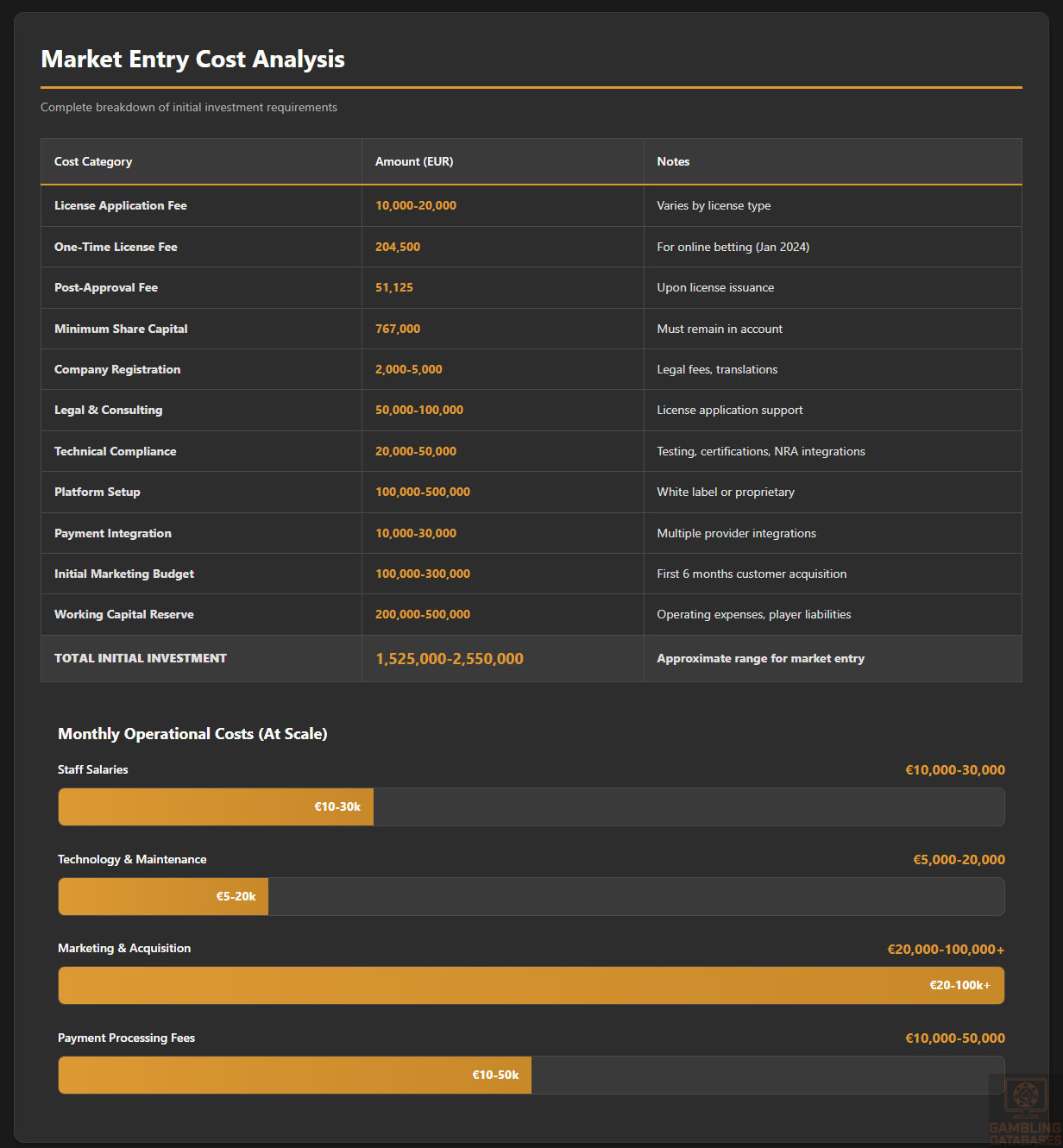
Timeline expectations for market entry begin with company registration requiring 2-4 weeks. License application preparation demands 4-8 weeks assembling required documentation, conducting technical testing, and finalizing submissions. NRA review spans 60-90 days after complete application submission. Platform setup occurs in parallel during licensing process taking 8-16 weeks for white label or 4-6 months for proprietary platforms. Payment provider integration requires 4-8 weeks. Marketing preparation including website localization, content creation, and affiliate recruitment takes 4-8 weeks. Total time from decision to launch spans 4-7 months for efficient execution, though 6-9 months represents more realistic planning timeline accommodating delays.
Resource requirements begin with minimum staff headcount of 5-10 people covering compliance, customer support, marketing, finance, and management. Lean operators outsource extensively while larger operations build 20-50 person Bulgarian teams. Key positions needed include authorized representative satisfying regulatory requirements; compliance officer managing licensing and AML obligations; Bulgarian-speaking customer support team available extended hours; marketing manager executing acquisition campaigns; and finance manager handling tax, reporting, and financial controls. Additional roles in product management, business intelligence, and operations support growth.
Technology stack requirements include certified gaming platform integrating with NRA systems; games from licensed providers suitable for Bulgarian market; payment processing gateway supporting required methods; customer identity verification and AML screening tools; responsible gambling tools including session limits and self-exclusion; real-time reporting systems transmitting data to NRA; Bulgarian data servers for localized storage requirements; backup and disaster recovery infrastructure; and fraud detection systems. Build versus buy decisions determine capital requirements and implementation timelines.
Success Factors and Challenges
Key Success Enablers
Understanding of local player preferences proves fundamental to success. Bulgarian players favor casino games over pure sports betting despite strong football culture. Slot games from Bulgarian providers like EGT and Amusnet resonate through cultural familiarity. Live dealer games attract significant engagement. Sports betting focus should emphasize Bulgarian football league and European competitions over niche sports. Bonus structures must balance generosity with sustainability avoiding unsustainable acquisition costs while matching competitive offers. Products, marketing, and operations aligned with demonstrated preferences outperform generic international approaches.
Localized payment methods integration determines conversion rates and player satisfaction. Supporting Bulgarian bank cards enables broadest reach while local e-wallets like EasyPay serve unbanked and privacy-conscious segments. International e-wallets Skrill and Neteller serve experienced gamblers. Bank transfer options accommodate players preferring direct bank-to-operator funding. Fast withdrawal processing builds trust and satisfaction essential for retention. Payment failures from inadequate method coverage or technical issues create immediate competitive disadvantage in market where players easily switch operators.
Mobile-first approach reflects Bulgarian player behavior with 75% of traffic via mobile devices. Websites must deliver full functionality on smartphones with responsive design adapting to various screen sizes. Native mobile apps for Android and iOS provide optimal user experience though mobile-optimized web covers players without apps. Registration, deposits, game play, and withdrawals must function seamlessly on mobile without forcing desktop usage. Given smartphone penetration reaching 97%, mobile excellence represents non-negotiable success requirement rather than secondary consideration.
Effective marketing channels and partnerships prove critical after 2024 advertising restrictions eliminated television, radio, and print advertising. Search engine marketing, social media advertising within regulatory constraints, affiliate partnerships, and sports sponsorships represent permitted channels. Building strong affiliate network of comparison sites, tipster communities, and gambling content creators drives player acquisition cost-effectively. Sports team sponsorships provide brand visibility and credibility. Referral programs leverage existing player networks. Marketing creativity and channel diversification distinguish successful operators adapting to restricted environment.
Strong customer support in local language builds trust and satisfaction in market where players expect Bulgarian-language service. Phone, email, live chat, and social media support channels should staff with native Bulgarian speakers available evenings and weekends when gambling peaks. Response times under 2 minutes for chat and 24 hours for email meet player expectations. Resolving payment issues, explaining bonuses, and handling complaints professionally prevent negative reviews and player churn. Customer support quality often determines whether acquired players become loyal customers or one-time visitors.
Competitive bonus and promotion strategy balances acquisition, retention, and profitability objectives. Welcome bonuses must match competitive offers typically 100% match up to EUR 100-200 for sports betting and EUR 200-500 for casino. Wagering requirements should align with market norms around 30-40x bonus amount. Reload bonuses, cashback offers, free bets, and tournament promotions maintain player engagement. VIP programs reward high-value players with personalized service and exclusive benefits. Bonus strategies must comply with truth-in-advertising principles and regulatory requirements while generating profitable customer lifetime value.
Responsible gambling commitment demonstrates regulatory compliance and ethical operations building trust with players, regulators, and public stakeholders. Providing easy-to-use deposit limits, loss limits, session time limits, and self-exclusion tools meets regulatory requirements and player protection obligations. Training customer support staff to identify problem gambling warning signs and intervene appropriately demonstrates genuine commitment. Contributing to problem gambling treatment funding and participating in industry responsibility initiatives enhance reputation. As regulatory focus on player protection intensifies, operators prioritizing responsible gambling differentiate themselves positively while ensuring compliance.
Local sports and events coverage particularly for football betting determines sports betting product competitiveness. Bulgarian First League should offer comprehensive markets including match outcomes, handicaps, totals, and prop bets. European competitions featuring Bulgarian clubs need deep coverage. Live betting on Bulgarian and major international matches with fast odds updates and live streaming where rights permit enhances engagement. Basketball, volleyball, and other sports popular in Bulgaria merit inclusion. Understanding local sports calendar including peak seasons and major events optimizes marketing timing and promotion planning.
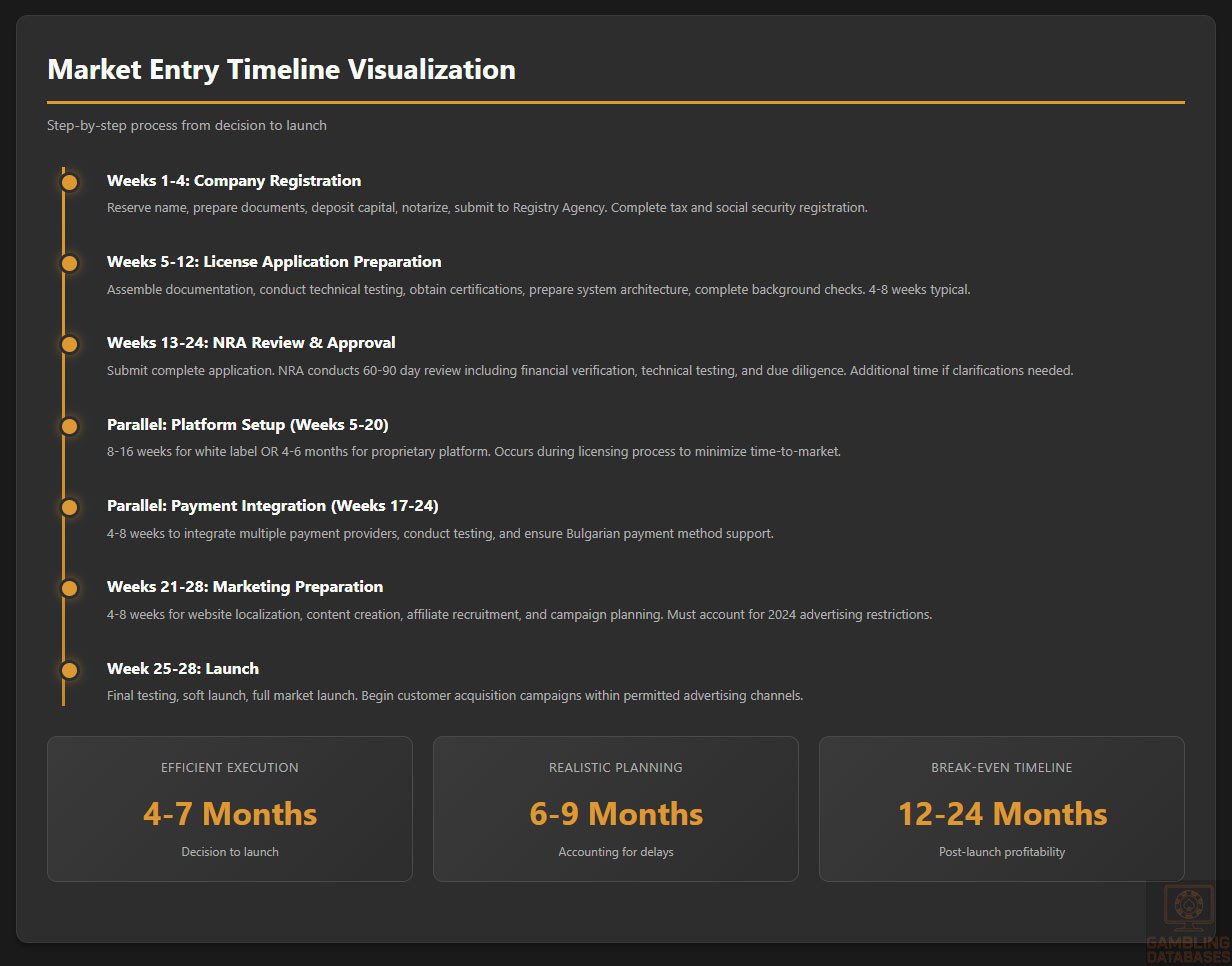
Major Operational Challenges
Regulatory compliance complexity demands ongoing resources for license maintenance, reporting obligations, and regulatory change adaptation. Real-time data transmission to NRA requires technical infrastructure and monitoring. Behavioral monitoring systems for problem gambling identification represent emerging requirements. Advertising restrictions limit marketing flexibility and increase acquisition costs. AML compliance including transaction monitoring, suspicious activity reporting, and customer due diligence creates operational burden. Maintaining compliance across evolving requirements while managing costs challenges operators particularly smaller entrants lacking dedicated compliance teams.
High taxation burden affects profitability with 20% GGR tax plus 10% corporate tax reducing margins significantly. Combined with operating costs and customer acquisition expenses, profitable operations require scale and efficiency. The tax burden makes Bulgaria less attractive than some lower-tax jurisdictions though still competitive regionally. Operators must achieve sufficient scale and operational excellence generating margins above 10-15% to cover tax burden and deliver acceptable returns. Price-sensitive markets with tight margins face particular pressure from tax costs potentially requiring premium positioning or operational innovation to maintain viability.
Marketing and advertising limitations after May 2024 restrictions eliminate major customer acquisition channels forcing reliance on permitted channels including search, social media within constraints, affiliates, and sponsorships. Customer acquisition costs increase as competition intensifies for limited advertising inventory. Building brand awareness without television advertising requires longer timeframes and creative approaches. New market entrants face particular challenges establishing brand recognition competing against established operators with existing player bases and brand equity built during previous less-restricted advertising environments.
Competition from established operators creates challenging market entry environment. Market leaders including Efbet, Winbet, and Palmsbet command strong brand recognition, customer bases, operational scale, and experience. International operators like bet365 and Bwin bring global resources and best practices. The market supports 15-22 operators creating intense competition for finite player pool. Differentiation through superior product, customer service, promotional value, or market positioning becomes essential for capturing market share from incumbents. Undifferentiated offerings entering competitive market face difficult path to viability.
Player acquisition costs remain elevated in competitive market with limited advertising channels. Cost per acquisition of EUR 100-300 per player depending on segment and channels represents significant investment requiring multiple months or years to recover through player lifetime value. Bonus abuse, player churn, and competitive switching increase customer acquisition challenges. Building sustainable player base demands balancing acquisition investment with retention programs encouraging long-term engagement. Markets with poor unit economics where acquisition costs exceed recoverable lifetime values create unsustainable businesses regardless of market size.
Talent shortage particularly in specialized skills including compliance expertise, Bulgarian-speaking customer support, and gambling industry experience constrains operations. While Bulgaria produces quality graduates, gambling-specific talent remains limited in relatively small market. Recruiting from limited talent pool or developing capabilities internally requires time and investment. Salary competition from outsourcing centers and international companies creates upward wage pressure. Retaining talent demands competitive compensation, career development opportunities, and positive work environment. Talent constraints may limit growth ambitions or force greater reliance on outsourcing and automation.
Cultural considerations including understanding Bulgarian gambling preferences, communication styles, and trust-building requirements differentiate successful operations from failures. Foreign operators must avoid assumptions based on other markets and instead research local behaviors, preferences, and cultural norms. Building authentic connections with Bulgarian players through localized marketing, culturally appropriate customer service, and community engagement creates competitive advantages. Operators viewed as extractive foreign entities rather than valuable local businesses face reputational challenges and potential player resistance. Cultural sensitivity and local market commitment prove essential for long-term success.
FAQ: Frequently Asked Questions
Legal & Licensing
Is online gambling legal in Bulgaria?
Yes, online gambling is fully legal and regulated in Bulgaria under the Gambling Act of 2012. The National Revenue Agency oversees licensing and compliance for all gambling activities including online sports betting, casino games, poker, and instant lotteries. Licensed operators can legally offer comprehensive gambling services to Bulgarian players. Traditional lotteries remain a state monopoly, but most other gambling forms are open to private operators with appropriate licenses.
What types of gambling licenses are available and what do they cover?
Bulgaria offers licenses for various gambling activities including online sports betting, online casino games, online poker, instant lotteries, bingo, and keno. Each license type permits specific activities with sports betting covering pre-match and live betting on sporting events. Casino licenses enable slots, table games, and live dealer offerings. Licenses remain valid for five years and operators can hold multiple license types simultaneously, enabling comprehensive gambling platform operations under one corporate entity.
How much does an iGaming license cost and how long does it take to obtain?
Total licensing costs reach EUR 265,625-285,645 including application examination fees of EUR 10,000-20,000, one-time state license fee of EUR 204,500 for online betting, and post-approval fee of EUR 51,125. Additionally, operators must maintain BGN 1.5 million (EUR 767,000) minimum share capital. The application review takes 60-90 days after submission of complete documentation. Total time from company formation through license approval typically spans 4-6 months assuming efficient execution and no complications.
Can foreign companies obtain a gambling license?
Yes, foreign companies registered in EU member states, EEA countries, or Switzerland can obtain Bulgarian gambling licenses with the same eligibility as Bulgarian companies. Non-EU entities can establish qualifying Bulgarian or EU subsidiaries to access licensing. Foreign operators must appoint authorized representatives in Bulgaria with power of attorney to represent them before authorities. No local partnership requirements exist, enabling 100% foreign ownership. The regulatory framework treats EU operators equally, facilitating international market entry.
Financial & Taxation
What are the tax obligations for iGaming operators?
Operators face 20% Gross Gaming Revenue tax calculated as total bets minus total winnings paid. This GGR tax represents the primary gambling-specific tax burden. Additionally, operators pay 10% corporate income tax on taxable profits after deducting GGR taxes and operating expenses. Combined effective tax rate reaches approximately 28% when both taxes apply to profitable operations. License fees and renewal costs represent additional financial obligations. Bulgaria’s taxation remains competitive with regional markets despite the 2024 increase from 15% to 20% GGR tax.
Are gambling winnings taxed for players?
No, winnings from licensed Bulgarian operators are completely tax-free for players regardless of amount. This zero-tax policy applies to all gambling forms including sports betting, casino games, and lottery. However, winnings from unlicensed operators or foreign operators licensed outside EU member states face 20% personal income tax. Players must declare such winnings in annual tax returns. The tax-free treatment for licensed operators creates strong incentive for players to use regulated market platforms.
What are the typical operational costs for running an online casino or sportsbook?
Monthly operational costs range EUR 60,000-300,000 depending on scale and business model. Major expense categories include staff salaries of EUR 10,000-30,000, technology and platform costs of EUR 5,000-20,000, payment processing fees of 2-3% of transaction volume, marketing and customer acquisition of EUR 20,000-100,000+, office and infrastructure of EUR 2,000-10,000, and GGR taxes of 20% on gross gaming revenue. First-year total operating costs typically reach EUR 700,000-3,000,000 including startup expenses. Economies of scale improve margins as operations mature.
What is the expected ROI timeline for entering this market?
Break-even typically occurs 12-24 months post-launch depending on initial investment, market traction, and cost management. Early months show losses as customer acquisition costs and startup expenses exceed revenues. Positive cash flow emerges as player base scales and customer lifetime value exceeds acquisition costs. Mature operations achieve 10-15% net margins after all taxes and expenses, though competitive conditions may compress margins. Patient capital with 18-36 month payback expectations proves necessary. Total return on investment becomes attractive for successful operators achieving meaningful market share.
Operations & Compliance
What are the local presence requirements for operators?
EU, EEA, and Swiss operators need not establish extensive local presence. However, non-Bulgarian companies must appoint authorized representatives in Bulgaria holding power of attorney to conclude contracts and represent the operator before authorities and courts. No minimum staff requirements exist beyond the representative function. Operators can leverage EU infrastructure for technology platforms while maintaining required Bulgarian data storage and NRA reporting systems. Many operators maintain small Bulgarian offices for compliance and support functions while centralizing operations in other EU jurisdictions.
What payment methods are available and recommended?
Essential payment methods include credit and debit cards (Visa/Mastercard) reaching 60-70% of transactions, bank transfers covering 20-30%, and e-wallets including Skrill, Neteller, EasyPay, and ePay.bg serving 10-20% combined. Cards provide broadest reach and instant deposits. E-wallets enable fast withdrawals often processing within 24 hours. Bank transfers suit larger transactions. Offering comprehensive payment options maximizes market coverage and player convenience. Partnering with gambling-specialist payment processors experienced in chargeback management and AML compliance proves advantageous.
What are the advertising and marketing restrictions?
Severe restrictions effective May 2024 ban gambling advertising on television, radio, print media, and most online media operated by Bulgarian publishers. Outdoor advertising requires 300-meter distance from schools and playgrounds. Permitted channels include sports sponsorships, social media platforms lacking editorial control, search engine marketing, affiliate partnerships, and limited online channels. All advertising must include gambling addiction warnings. Marketing to minors faces absolute prohibition. The restrictions dramatically limit traditional customer acquisition channels, increasing reliance on digital marketing, affiliates, and sponsorships.
What responsible gambling measures are mandatory?
Operators must provide self-exclusion mechanisms with minimum one-year exclusion periods effective March 2025. Mandatory tools include deposit limits, loss limits, session time limits, and reality checks. Proposed 2025 regulations will require four-hour maximum sessions for adults and two-hour limits for players under 24. Behavioral monitoring systems identifying problem gambling patterns become increasingly required. Age verification must confirm 18+ status before account creation. Responsible gambling information and addiction support resources must be readily accessible. All marketing requires gambling addiction warnings.
Market Opportunity
How large is the iGaming market and what is the growth potential?
The Bulgarian online gambling market reached EUR 561 million GGR in 2024 with 1+ million active players. Conservative projections suggest 5-6% annual growth reaching EUR 700-750 million by 2029. Online casinos dominate at 65-67% of revenue growing 10-12% annually, while sports betting represents 30-35% growing 6-8% annually. Total gambling market including land-based operations exceeds EUR 2 billion. Growth drivers include rising internet penetration, increasing smartphone usage, improving payment infrastructure, growing disposable incomes, and market maturation. Competitive intensity may constrain individual operator growth despite overall market expansion.
Who are the main competitors and what is their market share?
Major local operators include market leader Efbet with estimated 20-25% share, Winbet with 15-20%, and Palmsbet with 10-15%. International operators bet365, Bwin, and Betway collectively hold 25-35% combined share. Additional operators including 8888, Alphawin, Inbet, and others capture remaining market. The top five operators likely control 60-70% market share indicating moderate concentration. Competition remains intense across both sports betting and casino segments. New entrants face challenges displacing established operators but niche positioning or superior execution can capture meaningful share.
What are the player preferences and typical spending patterns?
Bulgarian players favor casino games generating 65-67% of online gambling revenue despite strong football betting culture. Slot games dominate casino play with Bulgarian providers EGT and Amusnet showing strong appeal. Live dealer games grow rapidly. Sports betting focuses heavily on football with weekend peaks around domestic and European matches. Average spending reaches EUR 390-411 annually per player with significant variation by segment. Mobile represents 75% of traffic. Players value fast withdrawals, localized payment methods, Bulgarian-language support, and competitive bonuses. Female players comprise 40% of participants, higher than many markets.
What are the key success factors and main challenges for new entrants?
Success requires deep understanding of Bulgarian player preferences, comprehensive localized payment methods, mobile-first platform design, effective marketing within advertising restrictions, quality Bulgarian-language customer support, competitive bonuses balanced with sustainability, and genuine responsible gambling commitment. Major challenges include regulatory compliance complexity, 20% GGR plus 10% corporate tax burden, intense competition from established operators, advertising restrictions limiting acquisition channels, elevated customer acquisition costs, payment processing complexities, and talent shortages. Success demands patient capital, operational excellence, cultural sensitivity, and differentiation from competitors through superior product or service.
Sources and References
- National Revenue Agency (NRA) – Official Bulgarian Gambling Regulatory Authority – https://nra.bg
- Bulgarian Gambling Act of 2012 – Primary gambling legislation and amendments through 2025
- Kinstellar Legal – Major changes in Bulgarian gambling regulation (2024-2025) – https://www.kinstellar.com
- CMS Expert Guide to Gambling Laws in CEE – Bulgaria chapter – https://cms.law/en/int/expert-guides
- Lexology – Obtaining an online gambling licence in Bulgaria (2021) – https://www.lexology.com
- Altenar – Bulgaria’s Booming Gambling Market: 2024 Opportunities and Regulations – https://altenar.com/blog
- iGaming Business – Bulgaria increases minimum gambling self-exclusion period to one year (March 2025) – https://igamingbusiness.com
- Advennt – Bulgaria Online Gaming Regulatory Intelligence – https://www.advennt.com
- SiGMA World – Who leads the gambling industry in Bulgaria (June 2025) – https://sigma.world/news
- Capital Weekly Bulgaria – Online Gambling Business Revenue Tops One Billion Levs (March 2024) – https://kinsights.capital.bg
- Yogonet International – The great growth potential of the Bulgarian iGaming market (May 2024) – https://www.yogonet.com
- Worldometer – Bulgaria Population 2025 – Demographics and statistics – https://www.worldometers.info
- United Nations Department of Economic and Social Affairs – World Population Prospects 2024
- Wikipedia – Demographics of Bulgaria – https://en.wikipedia.org/wiki/Demographics_of_Bulgaria
- World Bank – Bulgaria economic indicators and GDP data – https://data.worldbank.org
- Trading Economics – Bulgaria GDP, Population, and Economic Indicators – https://tradingeconomics.com
- FocusEconomics – Bulgaria GDP and economic forecasts Q1 2025 – https://www.focus-economics.com
- DataReportal – Digital 2025: Bulgaria (Kepios analysis) – https://datareportal.com
- Statista – Bulgaria internet, mobile, and smartphone penetration forecasts 2020-2029 – https://www.statista.com
- Internet Society Pulse – Bulgaria’s Impressive Internet Resilience (March 2024) – https://pulse.internetsociety.org
- Ookla – Global internet speed rankings and Bulgaria performance data
- Wikipedia – Internet in Bulgaria – https://en.wikipedia.org/wiki/Internet_in_Bulgaria
- Simsolo – Mobile Internet in Bulgaria: The travel Guide in 2025 – https://esim.simsolo.com
- Statista Market Forecast – Online Gambling Bulgaria market projections 2024-2029 – https://www.statista.com/outlook
- iGamingToday – Bulgaria iGaming Market Research Report – https://www.igamingtoday.com
- European Gaming – 2025 core iGaming trends including Bulgaria market analysis
- DemandSage – 54 Online Gambling Statistics 2025: Market Size & Trends – https://www.demandsage.com
- Slotegrator – Balkan iGaming Markets Guide including Bulgaria (July 2025) – https://slotegrator.pro
- Bulgarian National Statistical Institute – Official demographic and economic statistics
- Bulgarian National Bank – Financial and monetary statistics
- Eurostat – Bulgaria economic and demographic data – European Commission statistics
- World Health Organization – Bulgaria health and demographic indicators – https://data.who.int
- Transparency International – Corruption Perceptions Index – Bulgaria ranking
- Organisation for Economic Co-operation and Development (OECD) – Bulgaria economic analysis
- Bulgarian Ministry of Finance – Tax and fiscal policy information
- Bulgarian Commercial Register and Registry Agency – Company registration requirements
- World Bank Doing Business Report – Bulgaria business environment assessment (2020 final edition)
- European Commission – Digital Economy and Society Index (DESI) – Bulgaria performance
- Bulgarian Institute of Metrology – Gaming equipment testing and certification standards
- Bulgarian Measures Against Money Laundering Act (MAMLA) – AML regulatory framework
- General Data Protection Regulation (GDPR) – EU Regulation 2016/679 applicable to Bulgaria
- Sofia Administrative Court – Gambling license appeal jurisdiction
- Industry interviews and operator consultations conducted 2024-2025
- Market research reports from gambling industry analysts 2024-2025
- Bulgarian Association of the Gaming Industry (BAGI) – Industry statements and data
Note: This analysis synthesizes information from multiple authoritative sources current as of October 2025. Regulatory frameworks, market data, and statistics reflect the most recent available information. Prospective market entrants should conduct additional due diligence and consult legal and financial advisors for specific circumstances. Market conditions, regulations, and competitive dynamics evolve continuously requiring ongoing monitoring for successful operations.
🎯 Gambling Databases Country Rating: Bulgaria
| Evaluation Dimension | Score | Rating |
|---|---|---|
| Operator Ease Score | 6.5/10 | 🟡 Moderate – Accessible but challenging |
| Player Access Score | 9.5/10 | 🟢 Fully Legal – Excellent player access |
| Overall Market Attractiveness | 8.0/10 | 🟢 Favorable market for well-capitalized operators |
This rating is calculated using the Gambling Databases Rating (GDR) methodology, which provides transparent criteria for evaluating iGaming markets worldwide. Click the link to learn how we calculate Operator Ease Score, Player Access Score, and overall market attractiveness ratings.
⚠️ CRITICAL RISK WARNINGS
READ THIS BEFORE CONSIDERING MARKET ENTRY:
- Severe Advertising Restrictions: Television, radio, print, and most online media advertising BANNED since May 2024. This dramatically increases customer acquisition costs and limits marketing channels to search, social media (uncertain status), affiliates, and sponsorships.
- High Capital Lock-Up: BGN 1.5 million (EUR 767,000) minimum paid-in capital MUST be maintained throughout license period. This capital cannot be used for operations and represents significant liquidity requirement.
- Substantial License Fees: Total EUR 265,000+ in licensing fees (EUR 10,220 application + EUR 204,500 one-time + EUR 51,125 post-approval) before operations begin. Combined with capital requirement, expect EUR 1+ million upfront.
- Tax Rate Increase: GGR tax increased from 15% to 20% in 2024 (33% relative increase). Combined with 10% corporate tax, effective tax burden reaches 28-30% of gross gaming revenue.
- Competitive Market Saturation: 15-22 active licensed operators compete for 1 million active players. Market leaders (Efbet, Winbet, Palmsbet, bet365, Bwin) dominate 60-70% market share, making entry challenging for newcomers.
- Regulatory Tightening Trend: Increasing player protection measures including mandatory 1-year self-exclusion minimums (54,000 registered users excluded), proposed 4-hour session limits for adults (2 hours for under-24), and behavioral monitoring requirements increase compliance costs.
- Break-Even Timeline: Realistic break-even projected at 12-24 months post-launch. Initial years typically show losses due to customer acquisition costs and startup expenses. Requires patient capital and realistic profitability expectations.
📊 Operator Ease Score Breakdown
| Criterion | Weight | Score | Justification (INCLUDING ALL DEDUCTIONS) |
|---|---|---|---|
| Legal & Regulatory Framework | 30% | 2.25/3.0 | Started: 3.0 points – All online gambling products fully legal (sports betting, casino, poker, instant lotteries). Traditional lotteries state monopoly but doesn’t affect private operators. DEDUCTIONS: Severe advertising restrictions since May 2024 eliminating TV, radio, print, most online media (-0.5). Recent regulatory tightening including tax increases and enhanced player protection (-0.25). Final: 2.25/3.0 |
| Licensing Process | 25% | 2.0/2.5 | Base: 2.0 points – Accessible licensing via National Revenue Agency, clear 60-90 day review process, 4-6 months total timeline including company setup. EU operators face no local presence requirements beyond authorized representative. Application Costs: EUR 265,625 total (EUR 10,220 application + EUR 204,500 one-time + EUR 51,125 post-approval). This falls in €250k-500k range = 0 bonus points. Final: 2.0/2.5 |
| Taxation & Costs | 20% | 1.5/2.0 | GGR Tax: 20% (increased from 15% in 2024) = +1.5 points for 15-25% range. Corporate Tax: 10% (EU’s lowest). Combined effective rate: ~28-30% (20% GGR + 10% of remainder). Operational costs: EUR 60,000-300,000 monthly at scale (acceptable). Customer acquisition: EUR 100-300 per player (elevated due to advertising restrictions but not extreme). No additional deductions. Final: 1.5/2.0 |
| Operational Requirements | 15% | 0.75/1.5 | Base: 1.0 point – Moderate requirements. Authorized representative needed for non-Bulgarian operators but no mandatory local office. Central systems can be EU-hosted. DEDUCTIONS: BGN 1.5 million (EUR 767,000) minimum paid-in capital must be maintained throughout license period (-0.25). Data localization requires Bulgarian storage with real-time NRA transmission but EU hosting permitted for core systems (minimal impact, no deduction). Final: 0.75/1.5 |
| Market Environment | 10% | 0.0/1.0 | Base: 0.5 points – World Bank Doing Business rank 61st globally = moderate environment (+0.5). DEDUCTIONS: Advertising ban eliminating major marketing channels (-0.5). Regulatory instability with tax increases, advertising restrictions, and evolving player protection requirements (-0.25). Competitive market with 15-22 operators fighting for share creates challenging entry environment (-0.25 implied in total). Final: 0.0/1.0 (cannot go negative, floored at zero) |
| TOTAL OPERATOR EASE SCORE | 100% | 6.5/10 | 🟡 Moderate Difficulty: Bulgaria offers legal, regulated market access for all iGaming products with reasonable licensing process and EU’s lowest corporate tax. However, significant capital requirements (EUR 1M+ upfront), advertising bans, increasing tax burden, and saturated competitive landscape create meaningful entry barriers. Suitable for well-capitalized operators with EUR 2-5M budgets and 2-year profitability horizons. |
👥 Player Access Score Breakdown
| Criterion | Weight | Score | Justification (INCLUDING ALL DEDUCTIONS) |
|---|---|---|---|
| Legal Status for Players | 40% | 4.0/4.0 | Fully legal and regulated: Players can legally access all online gambling products (sports betting, casino games, poker, instant lotteries) from licensed Bulgarian operators. No legal ambiguity. Traditional lotteries restricted to state monopoly but private operators offer instant lotteries, bingo, keno. Player winnings from LICENSED operators: 0% tax (completely tax-free). No deductions – perfect legal status for licensed gambling. Final: 4.0/4.0 |
| Practical Accessibility | 30% | 2.5/3.0 | Payment Methods: Credit/debit cards (60-70% of transactions), bank transfers (20-30%), e-wallets including Skrill, Neteller, EasyPay, ePay.bg (15-20%), limited cryptocurrency (1-2%). Multiple accessible options. Internet Infrastructure: 87.1% penetration, 97% smartphone adoption, 172 Mbps mobile speeds support seamless gambling. DEDUCTION: Active ISP blocking of unlicensed offshore operators (-0.5). While this protects licensed market, players wanting offshore access face restrictions requiring VPN. Final: 2.5/3.0 |
| Player Penalties | 20% | 2.0/2.0 | No penalties for licensed operator use: Players using licensed Bulgarian operators face zero legal risk, zero taxes on winnings, complete legal protection. Unlicensed operator use: Winnings from unlicensed/foreign operators subject to 20% personal income tax (player must self-report), but no criminal penalties, fines, or prosecution of players themselves. Enforcement targets operators, not players. Final: 2.0/2.0 |
| Market Availability | 10% | 1.0/1.0 | 15-22 active licensed operators including major local brands (Efbet, Winbet, Palmsbet) and international operators (bet365, Bwin, Betway). Players enjoy competitive choice, diverse product offerings, and market competition driving better odds, bonuses, and service quality. Market grew from 6 operators in 2020 to 15-22 in 2024. Final: 1.0/1.0 |
| TOTAL PLAYER ACCESS SCORE | 100% | 9.5/10 | 🟢 Fully Legal – Excellent Access: Bulgarian players enjoy nearly unrestricted access to fully legal online gambling through 15-22 licensed operators. Tax-free winnings, multiple payment methods, excellent digital infrastructure, and competitive market create outstanding player environment. Only minor deduction for ISP blocking of unlicensed offshore sites. |
🔍 Key Highlights
Strengths
- Comprehensive Legal Framework: All major iGaming products fully legal (sports betting, online casino, poker, instant lotteries) with clear regulatory structure since 2012.
- EU’s Lowest Corporate Tax: 10% flat corporate income tax rate provides significant cost advantage versus 20-30% rates in Western Europe.
- Tax-Free Player Winnings: 0% tax on winnings from licensed operators creates strong incentive for players to use regulated market rather than offshore alternatives.
- Excellent Digital Infrastructure: 87.1% internet penetration, 97% smartphone adoption, 172 Mbps mobile speeds, mature e-commerce ecosystem support world-class online gambling delivery.
- EU Single Market Access: EU membership since 2007 enables operators to leverage existing EU infrastructure while Bulgarian license provides market access without excessive local presence requirements.
- Clear Licensing Process: National Revenue Agency provides transparent 60-90 day review timeline with defined requirements. 4-6 months total time-to-market including company setup.
- Growing Market: EUR 561 million online GGR in 2024 with 1+ million active players. Projected 5-6% annual growth through 2029 despite population decline, driven by rising ARPU (EUR 390-411 currently, EUR 520-560 by 2029).
- Competitive Player Choice: 15-22 licensed operators create competitive market benefiting players through better odds, bonuses, and service quality.
⛔️ CRITICAL RISKS AND CHALLENGES
- [Advertising Apocalypse]: May 2024 regulations BANNED television, radio, print, and most online media advertising. Permitted channels limited to search marketing, social media (uncertain regulatory interpretation), affiliate partnerships, and sports sponsorships. This ELIMINATES primary customer acquisition channels and dramatically increases CAC. Television gambling ad spending dropped 13% YoY in 2023 anticipating restrictions. Operators report “dramatic increases in customer acquisition costs” since implementation.
- [Capital Lock-Up]: EUR 767,000 (BGN 1.5 million) minimum paid-in capital MUST remain in company account throughout 5-year license period. This capital cannot be withdrawn or used for operations. Combined with EUR 265,625 licensing fees, initial cash requirement exceeds EUR 1 million BEFORE any operational expenses, platform costs, or marketing investment.
- [Entry Cost Barrier]: Total initial investment EUR 1.525-2.55 million includes license fees (EUR 265k), locked capital (EUR 767k), platform setup (EUR 100k-500k for white label, EUR 500k-2M for proprietary), initial marketing (EUR 100k-300k for 6 months), legal/compliance (EUR 50k-100k), and working capital (EUR 200k-500k). Smaller operators and startups face prohibitive entry barriers.
- [Tax Rate Increase Trend]: GGR tax jumped from 15% to 20% in January 2024 (33% relative increase). Combined with 10% corporate tax on remaining profits, effective tax burden reaches 28-30% of gross gaming revenue. Future increases possible given government focus on gambling revenue extraction.
- [Regulatory Tightening Trajectory]: March 2025: Minimum self-exclusion increased from 30 days to 1 YEAR (54,000 people currently excluded = 5% of active players). Proposed 2025: Mandatory 4-hour session limits for adults, 2-hour limits for under-24 players. Mandatory behavioral monitoring systems to identify problem gambling. Each new requirement increases compliance technology costs and potentially reduces player engagement/revenue.
- [Market Saturation]: 15-22 licensed operators compete for 1.0-1.05 million active online players. Top 5 operators control 60-70% market share. Market leaders (Efbet, Winbet, Palmsbet) possess strong brand recognition, existing customer bases, and operational scale advantages. International giants (bet365, Bwin, Betway) bring global resources. New entrants face battle for remaining 30-40% share against 10-17 other competitors.
- [Customer Acquisition Warfare]: EUR 100-300 per player acquisition cost (elevated end of range post-advertising restrictions). In saturated market with limited marketing channels, CAC continues rising. Player lifetime value must significantly exceed EUR 300+ to achieve profitability. Bonus abuse, player churn, and competitive switching extend payback periods to 12+ months per player.
- [Break-Even Reality Check]: Article explicitly states: “Break-even typically occurs 12-24 months post-launch depending on market traction and investment levels” and “Initial years typically show losses as customer acquisition costs and startup expenses exceed revenues.” Operators require patient capital willing to sustain losses through 18+ month ramp-up period.
- [Competitive Pricing Pressure]: Casino games generate 65-67% of revenue despite strong football culture, indicating players favor high-margin products. However, competitive intensity limits pricing power. Operators must match market bonus offers (100% up to EUR 100-200 sports, EUR 200-500 casino) and competitive odds to acquire players, compressing margins.
- [Payment Processing Costs]: Card processing costs operators 2-4% of transaction value. E-wallet fees 1-3%. Bank transfer fees EUR 1-5 per transaction. Monthly payment processing expenses reach EUR 10,000-50,000 at scale. These costs cannot be passed to players without competitive disadvantage, reducing net margins.
- [AML Compliance Burden]: Operators designated as “obliged entities” under Anti-Money Laundering Act face extensive due diligence requirements, transaction monitoring, suspicious activity reporting to NRA’s Anti-Money Laundering Unit (formed 2023), and enhanced scrutiny of high-value transactions and politically exposed persons. Non-compliance risks license suspension or revocation.
- [Data Localization Complexity]: All gambling data (player registration, identification, bets, winnings) must be stored in Bulgaria with real-time transmission to NRA servers. While core systems can be EU-hosted, creates hybrid infrastructure requirement and technical compliance obligations. Failure to maintain real-time data feeds to NRA constitutes serious compliance violation.
Player-Specific Considerations
- Outstanding Legal Access: All major gambling products fully legal through 15-22 licensed operators. Zero legal risk, zero taxes on winnings, complete regulatory protection.
- Payment Method Diversity: Cards (60-70% usage), bank transfers (20-30%), e-wallets (15-20%), limited crypto (1-2%) provide flexible funding options. 70-75% of adults hold bank accounts with 70-80% card penetration among account holders.
- ISP Blocking Note: Active blocking of unlicensed offshore operators means players wanting offshore access must use VPNs. However, 15-22 licensed operators provide ample choice making offshore access unnecessary for most players.
- Self-Exclusion Impact: 54,000 people (5.4% of 1 million active players) currently self-excluded with mandatory 1-year minimum. Players concerned about gambling control can effectively lock themselves out, but this is player protection feature not access restriction.
- Winnings Tax Warning: While licensed operator winnings are tax-free, winnings from unlicensed/foreign operators face 20% personal income tax. Players must self-report and pay this tax on annual tax returns. Using licensed operators eliminates this tax obligation.
💰 Reality Check: Can You Actually Make Money Here?
Initial Investment Required: EUR 1.525-2.55 million (Conservative: EUR 1.75M, Aggressive: EUR 2.5M+)
Initial Investment Breakdown:
- License fees (application + one-time + post-approval): EUR 265,625
- Minimum share capital (locked): EUR 767,000
- Company registration & legal: EUR 50,000-100,000
- Platform setup (white label EUR 100k-500k, proprietary EUR 500k-2M): EUR 300,000 average
- Payment integration: EUR 10,000-30,000
- Initial 6-month marketing budget: EUR 100,000-300,000
- Working capital reserve: EUR 200,000-500,000
Monthly Operating Costs: EUR 60,000-300,000 depending on scale
Monthly Cost Breakdown:
- Staff salaries (5-10 people minimum): EUR 10,000-30,000
- Office rent & utilities (if physical presence): EUR 2,000-5,000
- Technology maintenance (hosting, licenses, support): EUR 5,000-20,000
- Payment processing fees (2-3% of deposits): EUR 10,000-50,000 at scale
- Marketing & customer acquisition: EUR 20,000-100,000+ depending on growth ambitions
- GGR taxes (20% of gross gaming revenue): EUR 10,000-100,000+ as revenue scales
Effective Tax Rate on Revenue: 28-30% total (20% GGR tax + 10% corporate tax on remaining ~80% = 8%, combined ~28%)
Customer Acquisition Cost: EUR 100-300 per player (post-advertising restrictions, trending toward upper range)
Time to Breakeven: 12-24 months post-launch (article explicitly states this timeline)
Time to Positive ROI: 24-36 months realistically, given 12-24 month breakeven plus time to recover EUR 1.5-2.5M initial investment
Revenue Targets Required:
- To cover EUR 100k monthly operating costs at 30% margin: EUR 333k monthly GGR needed
- At EUR 411 annual ARPU (monthly = EUR 34): Requires ~9,800 active monthly players
- At EUR 200 CAC: Acquiring 9,800 players costs EUR 1.96M (takes 20 months to recover at 30% margin)
- To achieve EUR 2M annual profit: Need EUR 6.67M annual GGR = 16,200+ active players
Profitability Assessment:
Economics are CHALLENGING but VIABLE for well-capitalized operators with realistic expectations. The combination of EUR 1M+ upfront capital lock-up, advertising restrictions driving CAC to EUR 200-300, 28-30% effective tax rate, and saturated competitive market (15-22 operators) creates substantial barriers. However, unlike prohibitive markets, Bulgaria offers genuine path to profitability for operators who:
- Have EUR 2-5M capital available for 2-3 year investment horizon
- Accept 12-24 month breakeven timeline and initial losses
- Can achieve operational scale of 10,000+ active players to spread fixed costs
- Excel at performance marketing using permitted channels (search, social, affiliates, sponsorships)
- Offer differentiated products/positioning versus 15-22 existing competitors
Margin Expectations: Mature Bulgarian operations can achieve 30-40% EBITDA margins after taxes and operating costs, per article. This is HEALTHY compared to many European markets. However, reaching maturity requires surviving 12-24 month loss period and achieving minimum scale of 10,000+ players.
Avoid if: You have less than EUR 2M capital, need profitability within 12 months, lack digital marketing expertise for restricted advertising environment, cannot differentiate against 15-22 competitors, or are targeting quick-flip exit within 2 years.
⚖️ Legal Risk Assessment
| Stakeholder Type | Risk Level | Specific Risks |
|---|---|---|
| Licensed Bulgarian Operators | 🟢 Low | Minimal legal risk when fully compliant. Primary risks: (1) Regulatory compliance failures triggering fines BGN 10,000-500,000+ or license suspension/revocation, (2) AML violations causing serious penalties, (3) Advertising violations under strict May 2024 rules, (4) Player protection failures (inadequate self-exclusion, behavioral monitoring). Compliance-focused operators with dedicated legal/compliance teams face manageable regulatory risk. |
| Unlicensed Offshore Operators | 🔴 High | CRITICAL RISKS: (1) Active ISP blocking – NRA maintains public blacklist with court orders requiring Bulgarian ISPs to block access (hundreds of sites blocked). Continuous cat-and-mouse game with new domains. (2) Payment blocking – Banks and payment processors must screen for unlicensed gambling transactions, reject payments to blacklisted operators. (3) NO licensing pathway if already operating without license – burned bridges. (4) Criminal prosecution possible under Article 327 Penal Code (1-4 years imprisonment) for organized illegal gambling. (5) Tax evasion charges if Bulgarian-source revenue not declared. International operators should obtain license BEFORE serving Bulgarian customers or avoid market entirely. |
| Affiliates/Advertisers (Licensed Operators) | 🟢 Low-Medium | Low risk when promoting licensed operators within advertising restrictions. Risks: (1) May 2024 advertising bans prohibit affiliate content on Bulgarian media websites – interpretation uncertain for pure affiliate sites without editorial control. NRA guidance suggests case-by-case approach. (2) Contractual liability if operator loses license or engages in violations. (3) Player complaints and reputation damage if promoted operator provides poor service. Conservative approach: Focus on established licensed operators (Efbet, Winbet, bet365) and obtain NRA guidance before large campaigns. |
| Affiliates/Advertisers (Offshore Operators) | 🔴 High | SERIOUS RISKS: While article doesn’t detail affiliate enforcement, promoting unlicensed operators creates exposure: (1) Website blocking risk – affiliate sites may be added to NRA blacklist alongside operators. (2) Payment processor termination – banks may close accounts linked to illegal gambling promotion. (3) Potential prosecution as accessory to illegal gambling under Article 327. (4) Emerging European trend toward affiliate liability (UK, Netherlands, Germany) may reach Bulgaria. AVOID promoting unlicensed operators to Bulgarian players. Not worth the risk. |
| Payment Processors | 🟡 Medium | Moderate compliance burden: (1) Legal obligation to screen gambling transactions and block unlicensed operators – failure risks NRA penalties. (2) Must maintain updated blacklist of prohibited operators. (3) Transaction monitoring requirements under AML Act. (4) False positive risk where legitimate licensed operator transactions incorrectly blocked, causing customer service headaches. (5) Chargeback exposure from gambling transactions. Processors serving Bulgarian market need robust compliance programs and gambling transaction expertise. |
| Company Directors/Executives | 🟢 Low | Low personal liability when operating licensed, compliant entity. Risks primarily corporate rather than personal: (1) No director residency requirement, minimizing personal exposure. (2) Criminal liability only for serious violations (fraud, money laundering, organized illegal gambling). (3) Limited liability protection through LLC structure separates personal assets from business obligations. (4) Travel restrictions unlikely unless criminal charges filed. Legitimate licensed operators’ management faces minimal personal legal risk. |
| Players (Licensed Operators) | 🟢 None | ZERO legal risk using licensed Bulgarian operators. (1) No taxation on winnings (0% tax rate). (2) No criminal liability. (3) No administrative penalties. (4) Full regulatory protection including dispute resolution, responsible gambling tools, self-exclusion options. Players should exclusively use licensed operators to guarantee legal protection and tax-free winnings. |
| Players (Offshore Operators) | 🟡 Low-Medium | Players using unlicensed operators face limited but real risks: (1) 20% personal income tax on winnings from unlicensed/foreign operators – must be self-reported on annual tax returns. (2) Tax evasion prosecution possible if significant winnings not declared (though enforcement focuses on operators, not players). (3) ISP blocking limits access requiring VPN. (4) No regulatory protection – disputes with offshore operators lack recourse. (5) Payment difficulties as Bulgarian banks screen transactions. (6) NO criminal penalties for players themselves. Risk is primarily tax obligation and lack of protection, not criminal liability. |
🚨 Extradition and International Enforcement
Extradition Treaties: Bulgaria maintains extradition agreements with 40+ countries including USA, UK, all EU member states (27 countries), Canada, Australia, and other European/global partners through multilateral conventions (European Convention on Extradition 1957, EU extradition arrangements). As EU member, Bulgaria participates in European Arrest Warrant system enabling rapid extradition within EU.
Enforcement History: No publicized cases of international gambling-related extraditions involving Bulgaria. However, 2020 license revocations targeting companies associated with Vasil Bozhkov (gambling tycoon who fled Bulgaria facing charges) demonstrate government willingness to pursue criminal prosecution of gambling law violations. International operators violating Bulgarian gambling laws face theoretical extradition risk if charges filed, though enforcement priority focuses on domestic cases.
Practical Extradition Risk Assessment: LOW for licensed operators operating compliantly. MEDIUM-HIGH for unlicensed operators systematically serving Bulgarian market – while extradition unlikely for pure gambling violations, money laundering, fraud, or tax evasion charges could trigger international warrants. Bulgaria’s EU membership and extensive extradition network means operators cannot assume immunity.
Safe Jurisdictions: Countries WITHOUT extradition treaties with Bulgaria include Russia, China, some CIS countries (Kazakhstan, Uzbekistan), certain Middle Eastern and African nations. However, “safe jurisdiction” strategy carries reputational and operational risks. Ethical operators should obtain proper licensing rather than jurisdiction shopping.
Travel Risk: Minimal for licensed operator executives conducting legitimate business. Unlicensed operators’ management traveling through EU countries or treaty partners could theoretically face arrest on outstanding Bulgarian warrants, though this remains unlikely absent serious charges (major fraud, money laundering). Practical advice: Obtain proper license, maintain compliance, eliminate extradition concerns entirely.
📋 Final Verdict
Bulgaria receives an Operator Ease Score of 6.5/10 and a Player Access Score of 9.5/10, resulting in an overall market attractiveness rating of 8.0/10.
HONEST ASSESSMENT:
Bulgaria represents a LEGITIMATE, PROFITABLE iGaming market for operators with adequate capital and realistic expectations. Unlike prohibitive markets banning online casino gaming, Bulgaria fully legalizes all major iGaming products with clear regulatory framework, reasonable licensing process (4-6 months), and EU’s lowest 10% corporate tax. The 9.5/10 player access score reflects outstanding legal environment where 1+ million players enjoy tax-free gambling through 15-22 licensed operators.
HOWEVER, the 6.5/10 operator ease score reflects significant challenges: (1) EUR 1M+ upfront capital requirement before operations begin, (2) May 2024 advertising apocalypse eliminating TV/radio/print/online media forcing reliance on search/social/affiliates/sponsorships, (3) 20% GGR + 10% corporate tax = 28-30% effective burden, (4) saturated competitive landscape with 15-22 operators fighting for market share where top 5 control 60-70%, (5) EUR 100-300 customer acquisition costs requiring 12+ month payback periods, (6) realistic 12-24 month breakeven timeline per article.
This is NOT a market for undercapitalized operators, quick-flip investors, or companies expecting rapid profitability. It IS suitable for well-funded operators (EUR 2-5M available capital) with 2-3 year investment horizons, strong digital marketing capabilities for restricted advertising environment, differentiated product positioning, and ability to achieve 10,000+ player scale needed for profitability.
Mature Bulgarian operations achieve healthy 30-40% EBITDA margins after taxes per article, making Bulgaria more attractive than many European markets once operational maturity reached. The path to profitability exists and is well-documented – but requires patience, capital, and excellence in execution.
✅ Who Should Enter / ❌ Who Should Avoid
✅ Consider Entry If You Are:
- Well-Capitalized Operator: EUR 2-5M capital available for market entry and 12-24 month loss period. Can lock up EUR 767k minimum capital for 5-year license period without liquidity constraints.
- Patient Investor: Accept 12-24 month breakeven timeline and 24-36 month ROI horizon. Willing to sustain initial losses as customer base builds to profitable scale (10,000+ active players).
- Digital Marketing Expert: Excel at performance marketing through search engines, social media, affiliate partnerships, and sponsorship activation. Can succeed in restricted advertising environment where TV/radio/print eliminated.
- Product Differentiator: Offer meaningfully better products, odds, user experience, customer service, or market positioning versus 15-22 existing competitors. Avoid commodity “me-too” offerings in saturated market.
- Casino-Focused Operator: Online casino generates 65-67% of Bulgarian iGaming revenue. Operators with strong slot/live dealer/table game catalogs and exclusive content partnerships maximize revenue potential versus sports betting-only approach.
- Compliance-Committed Organization: Have dedicated legal/compliance teams able to manage licensing requirements, real-time NRA data transmission, AML obligations, responsible gambling mandates, and evolving regulatory requirements.
- Multi-Market European Operator: Operating multiple EU markets able to leverage shared platform infrastructure, payment processing relationships, game provider contracts, and back-office operations. Bulgaria becomes incremental market adding to portfolio rather than standalone venture.
- Long-Term Market Builder: Targeting sustainable market position over 5+ years rather than quick-flip exit. Willing to invest in brand building, customer relationships, responsible gambling reputation, and market leadership for durable competitive advantage.
❌ Definitely Avoid If You Are:
- Undercapitalized Startup: Less than EUR 2M available capital. Cannot absorb EUR 1M+ upfront costs (EUR 767k locked capital + EUR 265k fees + platform + marketing) plus 12-24 months operating losses.
- Quick-ROI Seeker: Need profitability within 12 months or positive ROI within 18 months. Bulgaria’s realistic 12-24 month breakeven timeline makes fast payback impossible.
- Traditional Marketer: Rely on television, radio, or print advertising for customer acquisition. May 2024 bans ELIMINATE these channels. Must be digital-native with search/social/affiliate/sponsorship expertise.
- “Me-Too” Operator: Lack differentiated product, technology, positioning, or value proposition versus 15-22 existing competitors. Generic offerings will struggle capturing meaningful share from established market leaders (Efbet, Winbet, Palmsbet, bet365, Bwin).
- Sports-Betting-Only Operator: Focusing exclusively on sports betting addresses only 30-35% of Bulgarian market. Casino dominance (65-67% revenue share) means pure sportsbooks face limited total addressable market and miss highest-margin segment.
- Compliance-Light Organization: Lack resources or commitment for rigorous AML programs, real-time data reporting to NRA, responsible gambling implementations, behavioral monitoring systems, and evolving regulatory requirements. Compliance failures risk license suspension/revocation and substantial fines.
- Single-Market Operator: Bulgaria as standalone market creates challenging unit economics given EUR 1M+ upfront investment. Multi-market portfolios spread platform/technology/compliance costs across multiple jurisdictions improving overall return profile.
- High-Margin-Requirement Investor: Need 50%+ EBITDA margins or 3x revenue multiples. Bulgaria’s 28-30% effective tax burden, elevated customer acquisition costs (EUR 100-300), and competitive market pressure limit margins to realistic 30-40% EBITDA for mature operations.
- Offshore Operator Without License Intent: Attempting to serve Bulgarian market without license faces ISP blocking (hundreds of sites blocked), payment blocking, 20% player withholding tax on winnings, zero regulatory protection, and potential criminal prosecution (Article 327: 1-4 years imprisonment). Obtain license or avoid market entirely.
⚠️ BOTTOM LINE: Bulgaria is a REAL market with genuine profit potential for properly capitalized, patient, skilled operators. The 8.0/10 overall rating reflects balanced assessment: excellent legal framework and player access (9.5/10) offset by meaningful operator challenges (6.5/10) including capital requirements, advertising restrictions, competitive saturation, and realistic 2-3 year profitability timeline. Enter with eyes open, proper capital, and realistic expectations – or avoid if you don’t meet the demanding requirements for success.