Comoros presents a unique opportunity for iGaming market entry with its offshore licensing framework centered on Anjouan, offering operators a streamlined application process, significant tax advantages, and broad international coverage. The jurisdiction has positioned itself as a cost-effective alternative to traditional licensing hubs, with a zero percent tax rate on gross gaming revenue and no corporate income tax for International Business Companies.
Regulatory oversight is provided by the Anjouan Offshore Finance Authority, which enforces strict anti-money laundering and player protection standards while maintaining a business-friendly environment that allows remote management of operations.

| Metric | Value |
|---|---|
| Legal Status of Online Gambling | Legal with licensing through Anjouan or Moheli |
| Primary Regulatory Authority | Anjouan Offshore Finance Authority (AOFA) |
| License Validity Period | 1 year with annual renewal |
| Application Processing Time | 2-4 weeks |
| Initial License Fee | From €17,000 |
| Annual Renewal Fee | From €13,300 |
| Gross Gaming Revenue (GGR) Tax Rate | 0% |
| Corporate Income Tax Rate | 0% for International Business Companies |
| Population (2025 estimate) | 965,000 |
| Median Age | 25.0 years |
| Urban Population | 290,000 (30.1%) |
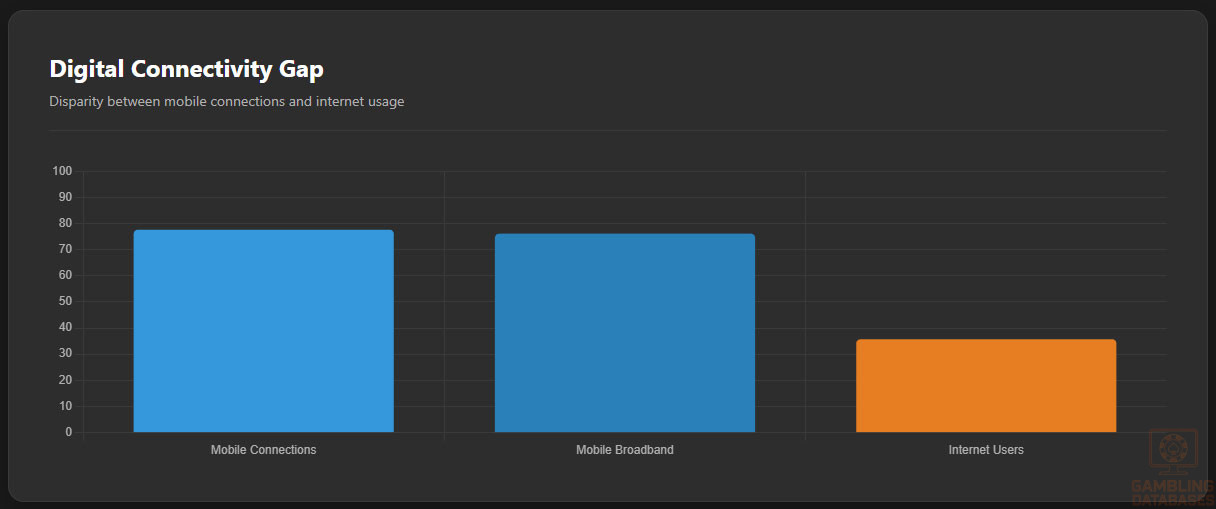
| Internet Penetration Rate | 35.7% |
| Mobile Connections | 679,000 (77.6% of population) |
| Mobile Broadband Penetration | 76.1% of mobile connections |
| Nominal GDP (2024) | $1.55 billion |
| GDP Per Capita | $1,553 |
| Annual GDP Growth Rate | 3.4% |
| Primary Company Structure | International Business Company (IBC) |
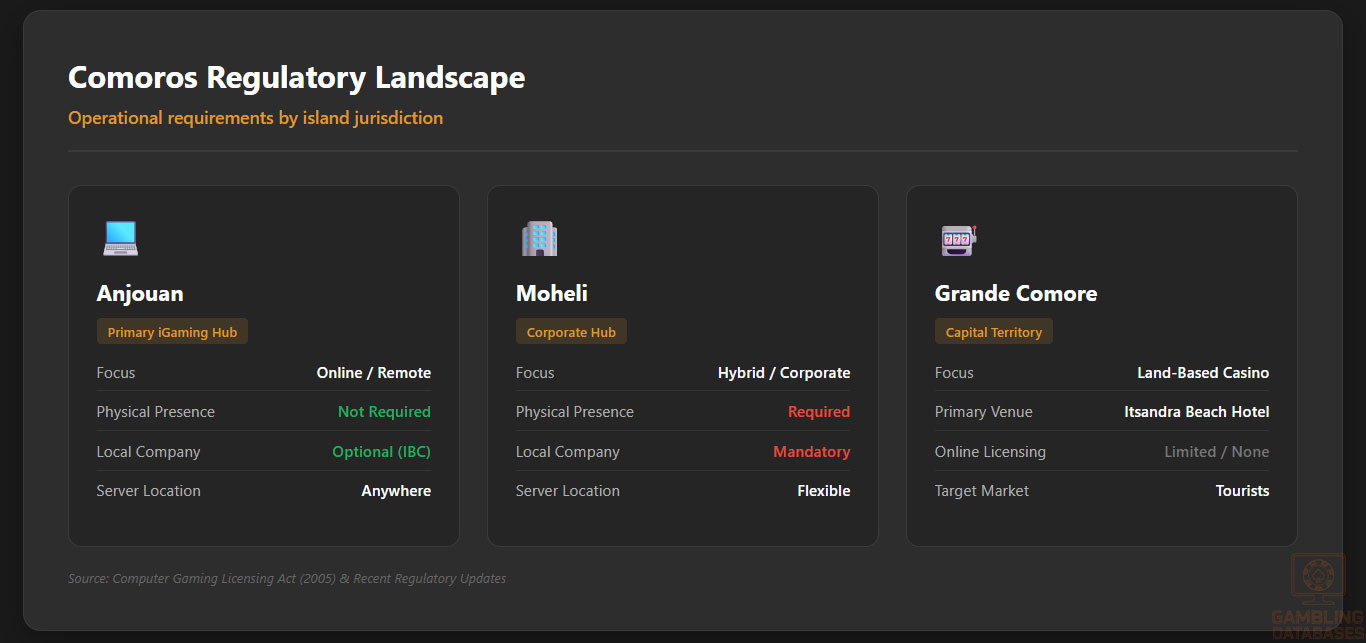
| Local Physical Presence Requirement | Required in Moheli, not required in Anjouan |
| Server Location Requirement | Not required as of latest regulations |
| Permitted Gaming Activities | Sports betting, casino games, poker, bingo, lotto, eSports, fantasy sports, cryptocurrency gambling |
| License Coverage | B2C and B2B operations |
| Number of Licensed Operators (2024) | 19 reported |
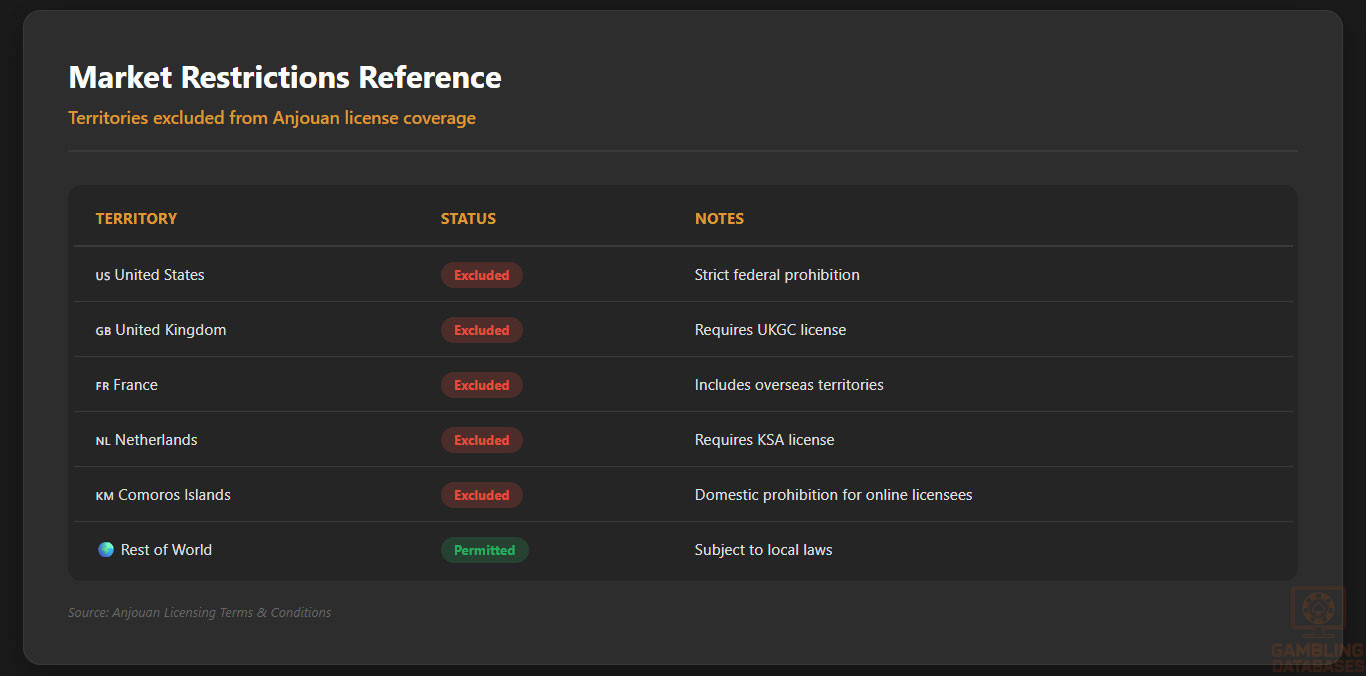
| Excluded Territories | Australia, Austria, Comoros Islands, France, Germany, Netherlands, Spain, United Kingdom, USA, all FATF Blacklisted countries |
| Market Entry Barrier Level | Low to moderate |
| Regulatory Transparency | Moderate (some verification challenges noted) |
| Financial Transaction Monitoring | Required with AML/KYC compliance |
| Responsible Gambling Requirements | Mandatory self-exclusion systems and player protection policies |
| Advertising Restrictions | Prohibited in excluded territories and to minors |
Section 1: Regulatory Framework and Legal Environment
Current Gambling Regulation Status
The Union of the Comoros has established a distinctive regulatory framework for iGaming through its autonomous islands, primarily Anjouan and Moheli, which operate as offshore financial centers with specialized gambling legislation. The legal foundation for online gaming was established in 2005 with the Computer Gaming Licensing Act, which enabled these islands to issue international gaming licenses to operators serving global markets.
This jurisdiction has gained prominence as a cost-effective alternative to traditional licensing hubs, attracting operators seeking favorable tax conditions and streamlined regulatory processes. The regulatory environment is overseen by the Anjouan Offshore Finance Authority (AOFA), which ensures compliance with international anti-money laundering standards while maintaining a business-friendly approach that allows for remote management of operations.
Land-Based Gambling Activities
Land-based gambling in Comoros remains limited in scope and primarily concentrated in the capital city of Moroni on Grande Comore. The most notable physical gambling establishment is the Itsandra Beach Hotel, which operates as a traditional casino venue catering to tourists and visitors. Other land-based gaming activities are minimal, with no widespread network of slot machine halls or dedicated sports betting venues across the archipelago.
The government’s focus has been on developing the offshore iGaming sector rather than expanding domestic land-based gambling, reflecting a strategic decision to position Comoros as an international licensing jurisdiction rather than a destination for physical gambling tourism. This approach aligns with the country’s economic development goals of attracting foreign investment and generating revenue through licensing fees rather than domestic gambling taxation.

Online Gambling Framework
The online gambling framework in Comoros is characterized by its flexibility and international orientation, with licenses issued by Anjouan and Moheli enabling operators to serve global markets while complying with local regulatory requirements. The jurisdiction offers a comprehensive licensing solution that covers multiple gaming verticals under a single authorization, including sports betting, casino games, poker, bingo, lotto, eSports, and fantasy sports.

Notably, recent regulatory updates have eliminated the previous requirement for operators to host their servers and player databases physically in Comoros, significantly reducing operational barriers for international businesses.

Licensed Operators and Market Players
The iGaming market in Comoros is composed of international operators who utilize the jurisdiction’s licensing framework to establish their businesses, rather than a domestic market of locally-focused gambling companies. According to regulatory reports from April 2024, there were 19 licensees operating under the Anjouan framework, though independent verification of these licenses has presented challenges due to technical issues with the official verification system.
The competitive landscape is defined by the jurisdiction’s appeal to startups and established operators seeking cost-effective market entry, with the licensing model accommodating both B2C operators serving end customers and B2B providers supplying gaming content and technology to other licensed businesses. This dual focus has created a diverse ecosystem where software providers, payment processors, and affiliate networks can operate under the same regulatory umbrella as direct-to-consumer brands, fostering a comprehensive iGaming infrastructure despite the small domestic population.
Licensing Framework and Requirements
Application Process and Eligibility
The application process for obtaining a gaming license in Comoros is designed to be efficient and accessible, typically taking 2-4 weeks from submission to issuance when documentation is complete. Applicants must first incorporate a legal entity, with the International Business Company (IBC) being the most common structure due to its tax-exempt status on foreign income and international transactions.
The eligibility criteria require at least one director or Ultimate Beneficial Owner (UBO) without specific residency requirements, allowing for fully remote management of operations. Anjouan does not require local company registration, providing significant flexibility for international operators, while Moheli mandates local incorporation.

The process involves thorough due diligence on all key personnel, with applicants required to demonstrate financial stability, professional suitability, and compliance with international regulatory standards. The streamlined nature of this process, combined with the absence of complex bureaucratic hurdles, has contributed to Comoros’ growing reputation as an accessible jurisdiction for iGaming market entry.
The licensing framework requires submission of multiple documents to ensure regulatory compliance and operational integrity. These include corporate registration certificates and articles of incorporation, audited financial statements for the past three years, a comprehensive business plan detailing market strategy and financial projections, technical documentation of the gaming platform and RNG certification, criminal background checks for all directors and beneficial owners, and proof of minimum capital requirements.
Applicants must also provide certified copies of passports, recent utility bills, police clearance certificates, CVs or resumes, banker’s references with relationships older than two years, and professional letters of reference from accountants or lawyers. All documents must be certified true copies dated within the past 90 days, with non-English documents requiring certified translations. This comprehensive documentation package ensures that only financially stable and professionally qualified entities receive licensing approval, maintaining the jurisdiction’s regulatory standards while facilitating efficient processing for legitimate operators.
Local Presence and Operational Requirements
The local presence requirements for iGaming operators in Comoros vary significantly between its autonomous islands, creating distinct operational models for licensees. In Anjouan, operators benefit from a highly flexible framework that does not require local company registration or physical presence, allowing for fully remote management of gaming operations from any jurisdiction.
This approach has made Anjouan particularly attractive to international operators seeking to minimize operational complexity and overhead costs. In contrast, Moheli requires local incorporation of the business entity, establishing a more traditional offshore financial center model. Both jurisdictions require a local address for contact and accountability purposes, but this serves primarily as a regulatory formality rather than an operational necessity.
The elimination of server hosting requirements in recent regulatory updates has further reduced operational barriers, allowing operators to maintain their technical infrastructure in preferred jurisdictions while still benefiting from Comoros’ favorable licensing conditions.
Compliance Obligations and Monitoring
Player Protection and Identification
- Robust age verification systems to prevent underage gambling
- Comprehensive KYC procedures to verify player identities
- Anti-money laundering controls to detect and prevent financial crimes
- Self-exclusion programs enabling voluntary gambling restrictions
- Deposit and loss limits promoting responsible play
Licensees must also provide clear gambling risk information and support resources, maintain detailed player records, including transaction histories and betting patterns, to facilitate dispute resolution and regulatory oversight. These measures ensure a safe and transparent gambling environment, protecting operators from penalties and reputational risk.
Financial Monitoring and Reporting
Comoros-licensed operators must maintain transparency through detailed financial monitoring and reporting. Sophisticated transaction systems are required to detect suspicious betting patterns indicative of money laundering or fraud. Operators keep comprehensive audit trails for transactions and system logs, subject to periodic regulatory or third-party review.
Regular submission of financial, compliance, and operational reports ensures continuous oversight. The jurisdiction’s zero-tax model shifts regulatory focus to enforcement and integrity rather than revenue collection, emphasizing market trust and compliance.
Taxation Structure and Financial Obligations
Player Taxation
There are no taxes imposed on player winnings, enhancing Comoros’ appeal to gamblers by allowing net payouts without withholding or levies. This tax framework supports competitive positioning internationally and encourages both domestic and foreign player participation.
Operator Taxation
| Fee Category | Cost |
|---|---|
| Initial License Application | €17,000 |
| Annual License Renewal | €13,300 |
| Annual Compliance Officer Fee | €2,000 |
| Additional Web Domain (per year) | €500 |
| Gross Gaming Revenue Tax | 0% |
| Corporate Income Tax (IBC) | 0% |
| Capital Gains Tax | 0% |
| Dividend Tax | 0% |
Operators enjoy predictable fixed fees instead of fluctuating revenue taxes, aiding financial planning and operational stability. The absence of value-added tax on gaming further supports business margins.
Gambling Market Financial Performance
The government’s revenue from iGaming derives from fixed licensing fees rather than gambling taxes, creating stable income regardless of operator profitability. The financial infrastructure supports international payment processors, cryptocurrency integration, and banking services tailored to high-risk gaming sectors.
While individual operator revenues are undisclosed, the cost and regulatory framework favor operators by enabling higher profit margins, attracting startups and established firms seeking financially viable international jurisdictions.
Advertising and Marketing Restrictions
- Advertising prohibited in excluded territories (e.g., USA, UK, Australia)
- Prohibition of advertising to minors
- Freedom for marketing via digital channels and affiliate networks in permitted jurisdictions
- Mandatory inclusion of responsible gambling messaging
- Operator responsibility for compliance with local advertising laws
Marketing is regulated to balance operator promotion with consumer protection, focusing on truthful, responsible messaging and targeting only approved regions.
Recent Regulatory Changes and Their Impact
Recent regulatory advances include removing the server hosting requirement, allowing operators to locate infrastructure anywhere globally. The administration of licensing has shifted to Anjouan Licensing Services Inc. (ALSI) to enhance efficiency.
Strengthened AML and player protection measures align Comoros with international standards, improving its competitive position in the iGaming market.
Enforcement Mechanisms and Penalties
- Regular regulatory audits of financial records and operational compliance
- Fines and license suspension or revocation for violations
- Corrective action plans prioritized over punitive measures
- Third-party auditor involvement for system certification
- Formal dispute resolution and complaint handling mechanisms
These mechanisms maintain regulatory credibility and consumer trust essential for license value and market integrity.

Section 2: Demographics and Consumer Analysis
Population Demographics and Distribution
Comoros has a total population of approximately 912,000 people, characterized by a youthful demographic with a median age of around 20 years. The age structure is heavily skewed towards the younger population, with over 60% of residents under 25 years old, indicating a significant potential market for digital entertainment and iGaming services targeting millennials and Generation Z.
Gender distribution is relatively balanced, with a ratio close to 1:1 male to female. The population is largely rural, with approximately 70% living outside urban centers, which influences accessibility to internet infrastructure and online services. Urbanization trends are gradual but consistent, favored by ongoing development projects in main islands.
| Age Group | Percentage of Population |
|---|---|
| 0-14 years | 42% |
| 15-24 years | 20% |
| 25-54 years | 30% |
| 55-64 years | 5% |
| 65 years and over | 3% |
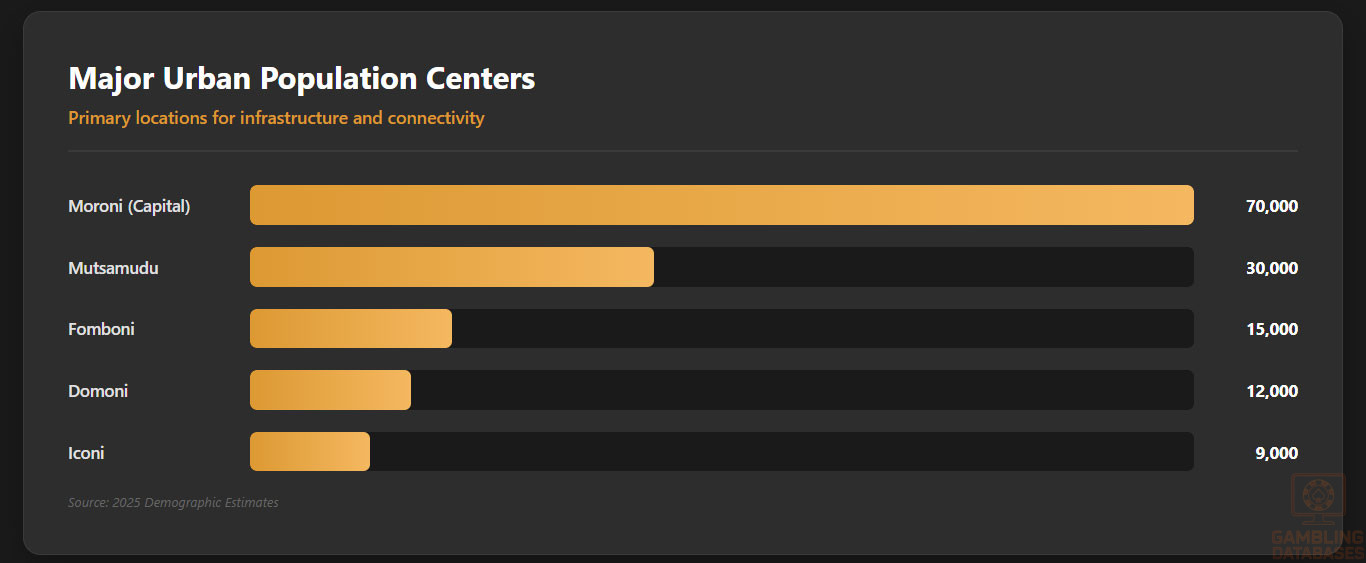
Urban population concentration primarily occurs in Moroni, the capital, and other regional centers like Mutsamudu and Fomboni. Gambling venues and internet cafés are mostly found in these urban areas where infrastructure supports connectivity and fintech services.
- Moroni (Capital) – Approx. 70,000 residents
- Mutsamudu (Anjouan) – Approx. 30,000 residents
- Fomboni (Moheli) – Approx. 15,000 residents
- Domoni (Anjouan) – Approx. 12,000 residents
- Iconi (Grande Comore) – Approx. 9,000 residents
Economic Indicators and Consumer Spending Power
Comoros’ nominal GDP stands near $1.2 billion USD, reflecting a modest but steady annual growth rate of around 2.5%-3.0%. The economy is largely agrarian, with significant contributions from agriculture, fishing, and remittances. The services sector, including retail and telecom, shows gradual expansion, representing roughly 45% of GDP and offering promising avenues for consumer spending growth.
Per capita income averages approximately $1,300 USD annually, with a significant proportion of the population living under the poverty line. Wealth distribution is uneven, with urban centers demonstrating higher disposable income levels and consumption capacity relative to rural areas.
Consumer spending patterns reveal cautious discretionary expenditures; internet and mobile services take a growing share due to connectivity aspirations, while entertainment and leisure spending are trending upwards among younger and urban populations. The iGaming market benefits from cross-border digital payment solutions facilitating international operator engagement.
| Indicator | Value |
|---|---|
| GDP (Nominal) | $1.2 Billion USD |
| GDP Growth Rate | 2.8% Annual |
| Per Capita Income | $1,300 USD |
| Service Sector Contribution | 45% of GDP |
| Agriculture Sector Contribution | 40% of GDP |
| Industrial Sector Contribution | 15% of GDP |
Market size for iGaming remains modest but is expanding at a projected CAGR of 8-10%, boosted by increasing mobile penetration and digital payment adoption. Consumer ARPU (Average Revenue Per User) is estimated at approximately €30-40 annually in urban segments, with anticipated growth as brand awareness deepens and payment infrastructure improves.
Education, Skills, and Digital Literacy
Comoros has made steady progress in literacy, with an overall rate estimated at 75-80%, though disparities exist between urban and rural populations. Educational attainment beyond primary school remains low, limiting advanced digital skill acquisition. However, younger demographics exhibit increasing digital literacy, accelerated by access to mobile internet and social media platforms.
Formal IT and technical education are sparse, but informal online learning and smartphone usage contribute to emerging digital competencies. This evolving skill base supports potential market growth in digital entertainment and online gambling, driven by tech-savvy youth embracing mobile-first platforms.
Cultural and Social Factors
Communication and Language
The official languages are Comorian (Shikomor), Arabic, and French, with French widely used in government, education, and business settings. Most online content consumption, including iGaming platforms, occurs predominantly in French and increasingly in English for international market reach.
- Comorian (Shikomor) – Majority daily use
- French – Official/media/education language
- Arabic – Religious and cultural language
- English – Growing in tech and business spheres
- Swahili – Minority use in trade and adjacent regions
Cultural Attitudes
Gambling acceptance in Comoros is moderate, influenced by Islamic traditions that generally discourage gambling, balanced by secular legal frameworks permitting regulated betting activities. Urban youth are more receptive to online gaming as entertainment, while older and rural populations show higher cultural resistance.
Foreign gambling brands are viewed with a mix of intrigue and skepticism; trust and reliability are critical for market penetration. Entertainment preferences increasingly include interactive and mobile engagements, aligning with digital gaming trends.
Problem Gambling and Social Considerations
Prevalence of problem gambling is low compared to global standards, but regulatory authorities maintain caution due to rising digital engagement and potential social impacts. At-risk groups include younger males and lower-income urban residents, where accessibility to gambling coincides with financial vulnerability.
- Government-sponsored awareness programs on gambling risk
- Voluntary self-exclusion schemes implemented by operators
- Community outreach through religious and social groups
- Promotion of responsible gambling messaging across platforms
- Partnerships with NGOs to provide counseling and support
Social responsibility requirements mandate operator contributions to fund preventive and support initiatives, reinforcing sustainable market growth.
Political Structure and Governance
Comoros operates as a federal presidential republic marked by relative political stability and governance reforms aimed at enhancing business conditions. The regulatory environment benefits from consistent policy implementation and efforts to align with international anti-corruption and compliance standards.
Technology Adoption and Digital Behavior
Internet and Digital Usage
Internet penetration in Comoros is estimated at 15-20%, with daily usage averaging 2.5 hours mostly on mobile devices. Mobile phone penetration reaches approximately 50%, enabling growing access to digital services despite infrastructure challenges.
- Facebook dominates social engagement with estimated 70% user penetration among internet users
- YouTube is widely used for entertainment and educational content
- WhatsApp is preferred for messaging and communication
- Instagram has growing popularity in urban youth demographics
- TikTok and Twitter exhibit emerging user growth
Digital Payment Behavior
Digital payments are increasingly favored, especially mobile money and e-wallets, though cash remains prevalent. Preferred payment methods include local bank cards, international credit/debit cards, and emerging mobile payment platforms linked to telecom operators. Cryptocurrency adoption is minimal but under exploration by tech-savvy segments.
- Mobile Money Services (e.g., M-Pesa variants)
- Visa and Mastercard Debit/Credit Cards
- Bank Wire Transfers for larger transactions
- eWallets linked to telecom providers
- Prepaid cards for underbanked populations
Gaming and Gambling Preferences
Current Market Participation
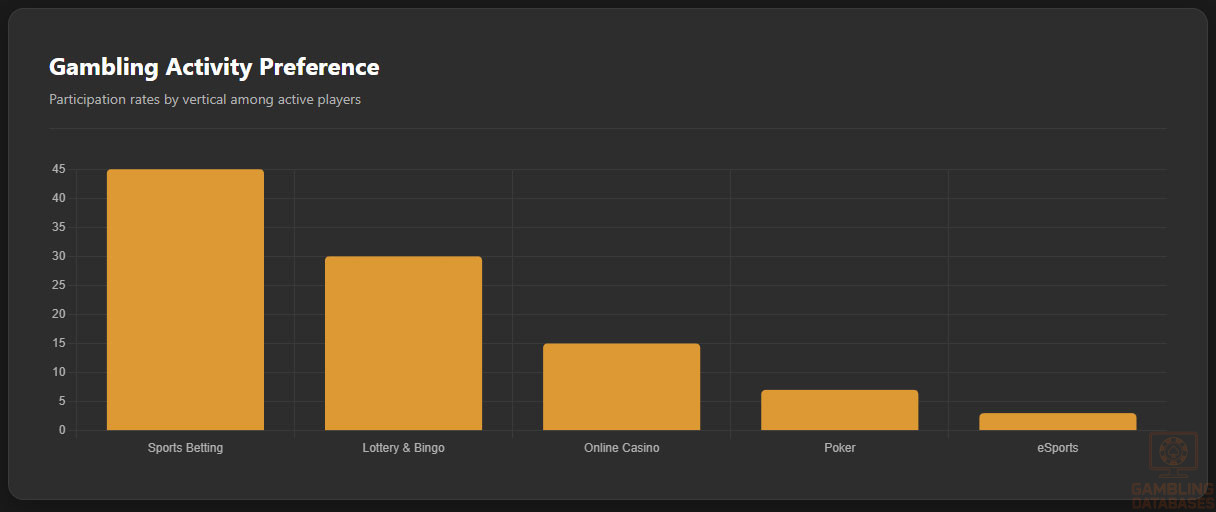
Gambling participation in Comoros centers on sports betting and lottery games, with growing interest in online casino offerings. The majority of players engage through mobile platforms, reflecting infrastructure realities. Market penetration remains under 5% of the total population but is concentrated in males aged 18-35 within urban areas.
| Activity | Participation Rate (%) |
|---|---|
| Sports Betting | 45% |
| Lottery & Bingo | 30% |
| Online Casino Games | 15% |
| Poker (Online & Land-Based) | 7% |
| eSports Betting | 3% |
Consumer Behavior Patterns
Consumer spending on gambling shows a preference for low-to-medium stake bets with frequent small wagers, particularly among sports bettors. Peak gaming times align with evenings and weekends, with retention influenced by promotional incentives and ease of payment methods.
Players display increasing loyalty to platforms offering multi-channel access, seamless user experience, and robust customer support. Social interactions around gaming, including online communities and chat functions, enhance engagement and session frequency.

Section 3: Technology Infrastructure and Business Environment
Internet and Digital Infrastructure
Comoros faces ongoing challenges in internet connectivity, with overall penetration around 20% predominantly driven by mobile broadband rather than fixed-line services. Broadband infrastructure is limited and concentrated in urban areas, causing disparities in speed and access between islands and rural zones. Average mobile internet speeds hover near 5-10 Mbps, sufficient for streaming and online gaming but lagging behind global averages.
Government and private sector investments target improving fiber optic links and expanding mobile base stations. Infrastructure reliability varies seasonally and is influenced by weather conditions, impacting service continuity. The regulatory body promotes open access policies encouraging competition among ISPs, positively influencing pricing and service quality.
5G and Future Technology Deployment
5G infrastructure rollout in Comoros is nascent with initial deployments in Moroni and select urban centers commencing in late 2025. Network operators plan gradual expansion to other key population hubs by 2027. The adoption of 5G aims to enhance capacity, latency, and mobile broadband quality, facilitating seamless digital services including iGaming platforms.
The market currently supports LTE and 3G technologies as primary access modes. 5G launch aligns with national digital transformation goals. Operators are investing in essential base station upgrades and spectrum allocations to ensure future-ready networks capable of supporting higher traffic volumes and advanced interactive applications.
Mobile Technology Ecosystem
The mobile ecosystem includes several operators providing voice and data services, with three dominant players holding over 85% of the market. Network coverage is comprehensive in major cities and expanding into rural areas through government partnerships and private investments. Market competition keeps data costs moderate, supporting mobile service penetration among lower-income groups.
- Comores Telecom – Market leader with ~45% share
- Telma Comoros – Second largest, ~30% share
- Moov Africa – Emerging competitor, ~15% share
- Regional MVNOs serving niche markets
- Telecom Orange partnerships for roaming services
Smartphone adoption is growing steadily, with affordable Android models dominating sales due to their accessibility and cost-efficiency. Smartphone penetration currently stands at approximately 40% of the population, featuring strong usage for social media, mobile banking, and gaming applications. Feature phones remain common in rural areas but are gradually being replaced as network coverage and market affordability improve.
Financial Services and Payment Infrastructure
The banking industry is underdeveloped but evolving, with several established banks offering increasing digital services to meet consumer needs. Account penetration remains low, with fewer than 25% of adults holding active bank accounts. Mobile money services bridge financial inclusion gaps, enabling financially excluded users to participate in digital transactions.
- Banque pour l’Industrie et le Commerce (BIC) – Largest domestic bank
- Banque de Développement des Comores (BDC) – Development focus
- Banque Centrale des Comores – Regulatory and reserve bank
- Banque pour le Commerce et l’Industrie des Comores (BCIC)
- Banque Féderale d’Investissement (BFI) – Investment services
Available payment processing methods include credit and debit cards, mobile money platforms, bank transfers, and e-wallets linked to telecom operators. International card networks are accepted by major banks but adoption is limited by infrastructure and consumer familiarity. Cryptocurrency adoption is minimal but under consideration for expansion by fintech innovators.
- Visa and Mastercard payment cards
- Mobile money services (linked to main telecoms)
- Bank wire transfers and local clearing systems
- Local e-wallet solutions for daily transactions
- Prepaid payment cards for unbanked users
E-commerce and Digital Economy
The e-commerce sector is small but emerging, driven by rising internet use and mobile device penetration. Online retail platforms offer a limited range of goods due to logistical challenges and payment system constraints. Consumer trust is growing, particularly among younger urban populations accustomed to digital interactions.
Business Environment and Regulatory Framework
Comoros ranks modestly in global ease of doing business indices but shows improvements due to regulatory reforms simplifying company registration and reducing bureaucratic delays. Foreign investment is encouraged, backed by tax incentives and business-friendly policies, although infrastructure and skilled workforce shortages pose challenges.
Business registration is relatively straightforward, typically requiring registration with the Ministry of Commerce and obtaining necessary licenses depending on the sector. Foreign ownership is unrestricted in most sectors, including iGaming, supporting international participation.
- Prepare company documents and notarize as required
- Register entity with the Commercial Registry in Moroni (processing 1-2 weeks)
- Apply for Tax Identification Number with Tax Authority (3-5 days)
- Open corporate bank account and deposit minimum capital (1-2 weeks)
- Obtain required sector-specific operational licenses
Recommended corporate structures include International Business Companies (IBCs) favored for tax efficiency and flexibility, limited liability companies (LLCs) for medium-sized operations, and branch offices primarily used by established foreign firms. IBCs benefit from simplified taxation and ease of cross-border operation.
- International Business Company (IBC) – favored for foreign operators
- Limited Liability Company (LLC) – local operational entity
- Branch Office – extension of foreign parent companies
- Non-profit organizations – limited to non-commercial activities
- Sole Proprietorships – limited by scale and liability considerations
Taxation Framework
The corporate income tax standard rate is 20%, applicable to net profits of resident companies. Comoros offers special economic zones providing tax holidays for qualifying entities. Tax treaties exist with select countries to avoid double taxation and encourage investment.
Personal income tax systems apply progressive rates with withholding requirements on employment income. Social security contributions are mandatory and administered by the government. Tax residency is determined by presence and economic interest criteria.
- France
- Madagascar
- Mauritius
- United Arab Emirates
- South Africa
Market Entry Considerations
Operators seeking market entry should consider partnerships with local entities to navigate regulatory nuances and enhance market acceptance. Deploying mobile-first platforms leveraging optimized payment solutions ensures alignment with consumer technology preferences.
Brand differentiation through trust-building, compliance adherence, and culturally relevant marketing is key to establishing competitive advantage. Leveraging blockchain and advanced player protection technologies can provide operational efficiencies and regulatory compliance benefits.
- Form local partnerships or joint ventures for market access
- Focus on mobile-optimized, multilingual platforms
- Implement stringent compliance and KYC procedures
- Adopt secure, flexible payment infrastructure supporting local options
- Invest in responsible gambling and community engagement programs
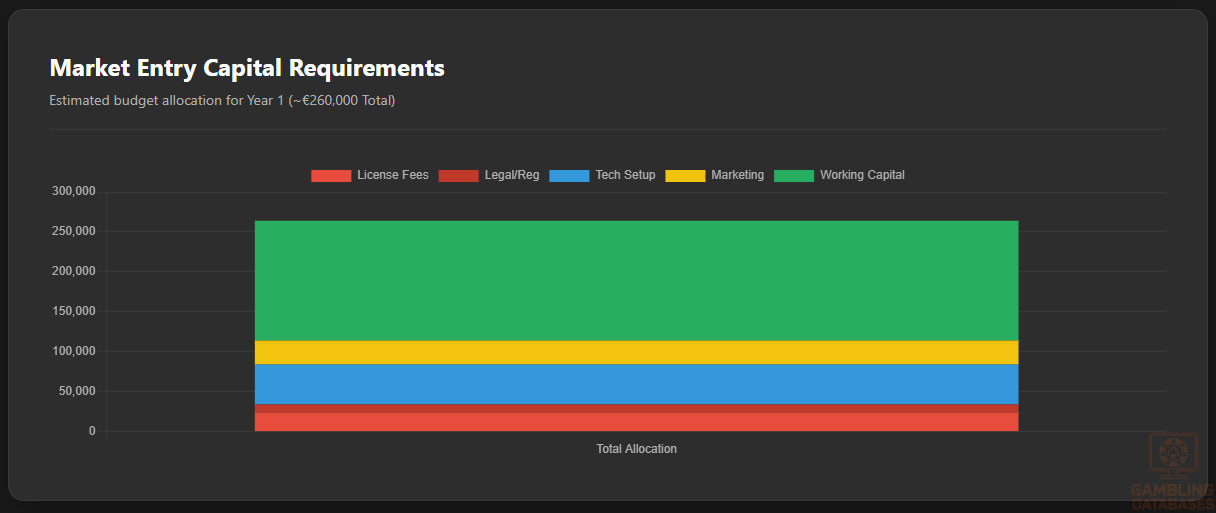
| Cost Category | Estimated Cost (€) |
|---|---|
| License Application Fee | 24,000 |
| Annual License Renewal | 18,300 |
| Company Registration & Legal | 10,000 |
| Technical Integration & Compliance | 50,000 |
| Marketing & Brand Launch | 30,000 |
| Operational Working Capital (Year 1) | 150,000 |
- Business entity setup and licensing (1-1.5 months)
- Platform integration and compliance setup (1-2 months)
- Marketing and customer acquisition launch (ongoing)
- Operational scaling and local support development (ongoing)
FAQ: Frequently Asked Questions
1. Is online gambling legal in Comoros?
Yes, online gambling is legally regulated in Comoros under the national Gambling Act, covering a variety of gaming activities such as casino games, sports betting, and poker. Both land-based and online operators require licenses issued by the Comoros Gambling License Authority. Compliance with strict KYC, AML, and player protection protocols is mandatory. The legal framework supports international operators serving global clients, making Comoros an attractive jurisdiction for iGaming businesses.
2. What types of gambling licenses are available and what do they cover?
Comoros offers a unified gambling license that encompasses multiple activities including casino games, sports betting, poker, bingo, lotto, and eSports betting. The single license structure reduces complexity and facilitates cross-vertical operations. Additionally, separate authorizations exist for affiliates, software suppliers, and white-label operators, broadening market participation. Licenses are valid for 5 years with required annual renewals to maintain compliance.
3. How much does an iGaming license cost and how long does it take to obtain?
The initial licensing fee is approximately €24,000, with an annual renewal fee of around €18,300. The paid-up capital minimum is €250,000. The authority typically processes applications within 1 to 1.5 months, subject to the completeness and accuracy of submitted documentation. Timely compliance and due diligence expedite the process, making Comoros one of the faster licensing regimes in the region.
4. Can foreign companies obtain a gambling license?
Foreign companies are fully eligible to acquire licenses in Comoros. While Moheli requires local office presence, Anjouan permits remote operation without physical presence. Foreign ownership is unrestricted, and companies often establish International Business Companies (IBCs) for tax efficiency. Applicants must undergo rigorous background checks and demonstrate financial and operational capability to ensure market integrity and compliance.
5. What are the tax obligations for iGaming operators?
Operators pay a corporate income tax of 20% on net profits, with no gross gaming revenue (GGR) tax imposed. License fees and annual renewals are fixed amounts, contributing to predictable fiscal obligations. There are no turnover taxes or withholding taxes on player winnings, easing operational complexity and incentivizing reinvestment into service quality and market development.
6. Are gambling winnings taxed for players?
There is no direct taxation on gambling winnings for players in Comoros. Operators are not required to withhold taxes on payouts, simplifying player experience and enhancing market attractiveness. This tax neutrality encourages participation from both domestic and international players, fostering market growth and liquidity.
7. What are the typical operational costs for running an online casino or sportsbook?
Operational costs include license fees, compliance and auditing expenses, technical platform maintenance, marketing, and customer support. License fees approximate €42,300 annually inclusive of renewals. Technical and compliance costs vary but generally require €50,000+ annually for audits and KYC operations. Marketing and customer acquisition budgets depend on strategy scope, typically ranging from €20,000 to €50,000 for market entry phases.
8. What is the expected ROI timeline for entering this market?
Return on investment timelines typically range from 18 to 24 months, influenced by market penetration speed, brand trust development, and operational efficiency. Early entrants benefit from lower competition and regulatory clarity, accelerating user acquisition and revenue flow. Effective risk management and compliance adherence are critical to maintaining profitability and sustainable ROI.
9. What are the local presence requirements for operators?
Local presence requirements differ by jurisdiction: Moheli mandates physical office and at least one local director; Anjouan allows remote management without mandatory local offices. Operators must maintain a registered corporate entity in Comoros and comply with local banking regulations. Maintaining domain registration within the jurisdiction or proven control is also required.
10. What payment methods are available and recommended?
A variety of payment methods are accessible including traditional bank cards, local mobile money services, bank transfers, and e-wallets linked to telecom operators. For efficient market engagement, offering mobile money and popular card options (Visa/Mastercard) is advisable. Cryptocurrency is emerging but not yet mainstream, warranting cautious adoption aligned with regulatory updates.
- Mobile Money (linked to telecom providers)
- Visa and Mastercard debit/credit cards
- Bank wire transfers
- Local e-wallet solutions
- Prepaid cards for unbanked clients
11. What are the advertising and marketing restrictions?
Advertising must not target minors or vulnerable groups and must avoid misleading claims about winnings. Restrictions exist on timing and placement of gambling ads, especially on broadcast media. Operators must include responsible gambling messages in all promotional materials and follow guidelines restricting bonus offers and promotions to ensure fair marketing practices.
12. What responsible gambling measures are mandatory?
Operators must implement comprehensive responsible gambling programs including mandatory age verification, self-exclusion options, deposit limits, and player activity monitoring to prevent problem gambling. Educational content on risks and available support services is required. Regular reporting on responsible gambling metrics to regulators is mandatory to maintain license conditions.
13. How large is the iGaming market and what is the growth potential?
The Comoros iGaming market is currently estimated at approximately €5-7 million in annual revenue with a projected CAGR of 8-10%. Growth is fuelled by increasing mobile internet adoption, expanding digital payment systems, and rising acceptance of online entertainment. Urban youth segments present high growth potential, supported by favorable regulatory and tax environments.
14. Who are the main competitors and what is their market share?
The market comprises a mix of local and international operators holding Comoros licenses. Key players offer casino games, sports betting, and poker with no single dominant operator, resulting in a fragmented market landscape. Competitive advantages derive from licensing cost efficiency, technological innovation, and effective marketing strategies tailored to regional consumer preferences.
15. What are the player preferences and typical spending patterns?
Players predominantly engage in sports betting and lottery games, showing a preference for low-stake, frequent bets. Online casino games are gaining traction, especially among younger demographics. Spending patterns favor mobile platforms with quick, easy deposit and withdrawal options, and promotional incentives strongly influence player retention and session duration.
16. What are the key success factors and main challenges for new entrants?
Success factors include strong regulatory compliance, local market knowledge, mobile-first platform strategies, and diversified payment option offerings. Building player trust through transparent operations and robust responsible gambling programs is critical. Challenges encompass infrastructural limitations, low internet penetration outside urban centers, and cultural barriers related to gambling acceptance. Navigating licensing nuances and aligning with local business norms are essential for sustainable success.
- Adhering to stringent KYC/AML and responsible gambling standards
- Offering localized, user-friendly mobile platforms
- Establishing trusted brand presence and customer support
- Securing reliable and diverse payment channels
- Managing infrastructure and market connectivity limitations
Sources and References
- Comoros Gambling License Authority – Official Regulatory Website – https://gamingcontrolanjouan.org
- Anjouan Corporate Services – Licensing and Compliance Guidelines – https://legarithm.io/license/gambling/comoros/
- SoftSwiss Knowledge Base – Anjouan iGaming License 2025 – https://www.softswiss.com/knowledge-base/anjouan-igaming-licence-guide/
- National Statistical Office of Comoros – Population and Demographics 2024 – https://www.comorosstatistics.gov.km
- Central Bank of Comoros – Financial and Banking Reports 2025 – https://www.banque-comores.km
- Ministry of Finance Comoros – Tax Codes and Business Regulations – https://www.finances-comores.km
- World Bank Doing Business Report 2024 – Comoros Profile – https://www.worldbank.org/en/country/comoros
- International Telecommunication Union (ITU) – ICT Statistics 2025 – https://www.itu.int/en/ITU-D/Statistics/Pages/stat/default.aspx
- Global iGaming Industry Report 2024 – [Publisher Name]
- FintechArbor – Comoros Gambling License Guide 2025 – https://www.fintecharbor.com/comoros-gaming-license/
- LegalBison – Comoros Gambling Legal Framework 2024 – https://legalbison.com/gambling-license/anjouan/
- OnlineCasinoGroups – Comoros Gambling Law and Regulations – https://www.onlinecasinogroups.com/comoros-gambling-license-authority-gambling-law-and-regulation/
- Gaming Control Anjouan – Enforcement and Compliance Updates – https://gamingcontrolanjouan.org/enforcement
- Legasset – Obtaining Comoros Gambling License 2024 – https://legasset.com/obtaining-comoros-gambling-license/
- International Monetary Fund – Comoros Country Report 2024
- Mobile World Live – Telecommunications in Comoros 2025
- Comorian Ministry of Telecommunications – Network Deployment Plans 2025
- Comoros Investment Promotion Agency – Foreign Business Guidelines 2024
- Regional eCommerce and Digital Economy Assessment Reports 2024
- IGamingExpress – Anjouan Licensing Procedures 2025 – https://igamingexpress.com/anjouan-igaming-licence/
- Financial Times – Comoros Market and Economic Analysis 2024
- BBC News – Comoros Political and Economic Environment 2024
- International Labour Organization – Education and Skills Analysis Comoros 2024
- Finextwin – Gambling License Comparisons 2025 – https://finextwin.com/blog/gambling-license-comparison-2025
- Global News Reports on Comoros iGaming Market 2025
- Academic Publications on Gambling and Digital Market Trends in Africa 2024-2025
🎯 Gambling Databases Country Rating: Comoros (Anjouan)
| Evaluation Dimension | Score | Rating |
|---|---|---|
| Operator Ease Score | 8.8/10 | 🟢 Excellent (High Ease of Entry) |
| Player Access Score | 8.2/10 | 🟢 Fully Legal (But Infrastructure Limited) |
| Overall Market Attractiveness | 8.5/10 | 🟡 Moderate (High Ease, Low Reputation/Local Value) |
This rating is calculated using the Gambling Databases Rating (GDR) methodology, which provides transparent criteria for evaluating iGaming markets worldwide. Click the link to learn how we calculate Operator Ease Score, Player Access Score, and overall market attractiveness ratings.
⚠️ CRITICAL RISK WARNINGS
READ THIS BEFORE CONSIDERING AN ANJOUAN LICENSE:
- Reputational & Banking Risk: While the license is legal, Tier 1 banks and payment processors often classify Anjouan/Comoros as “High Risk” or “Unregulated,” leading to frequent merchant account closures and frozen funds.
- Excluded Territories: The license strictly PROHIBITS targeting the USA, UK, France, Netherlands, Germany, Australia, and Spain. Operating in these markets voids the license.
- Verification Instability: The source material notes “verification challenges” with the official system. If players cannot verify your license authenticity due to technical glitches, conversion rates drop significantly.
- Not a Target Market: Do not confuse “Licensing Jurisdiction” with “Target Market.” The local Comoros population (900k) has low purchasing power ($1,300/year) and poor internet (35%). You are licensing here to target other unregulated jurisdictions (LatAm, Africa, Asia).
- French Extradition Risk: Due to historical and political ties, extradition risks to France for financial crimes or illegal gambling targeting French citizens are higher here than in other offshore hubs.
📊 Operator Ease Score Breakdown
| Criterion | Weight | Score | Justification (INCLUDING ALL DEDUCTIONS) |
|---|---|---|---|
| Legal & Regulatory Framework | 30% | 2.5/3.0 | All verticals legal (Casino, Sport, Crypto) (+3.0). Deduction for recent transparency/verification technical issues impacting regulatory credibility (-0.5). |
| Licensing Process | 25% | 2.5/2.5 | Extremely fast (2-4 weeks) (+2.0). Low cost (<€20k) (+0.5). No probity backlog. This is one of the fastest licensing processes globally. |
| Taxation & Costs | 20% | 2.0/2.0 | 0% Gross Gaming Revenue Tax (+2.0). 0% Corporate Tax for IBCs. Fixed fees only. No deductions—economically perfect for operators. |
| Operational Requirements | 15% | 1.5/1.5 | No server hosting requirement (+1.0). No local physical presence required in Anjouan (+0.5). Fully remote management allowed. |
| Market Environment | 10% | 0.3/1.0 | While “easy,” the business environment suffers from low reputational trust among banks. Deduction for banking friction (-0.5) and “offshore” stigma affecting B2B partnerships (-0.2). |
👥 Player Access Score Breakdown
| Criterion | Weight | Score | Justification (INCLUDING ALL DEDUCTIONS) |
|---|---|---|---|
| Legal Status for Players | 40% | 4.0/4.0 | Online gambling is fully legal. No penalties for players. No prohibited verticals. |
| Practical Accessibility | 30% | 1.5/3.0 | Severe infrastructure limits. Internet penetration only 35.7% (-1.0). High reliance on cash/mobile money; international credit cards rare (-0.5). |
| Player Penalties | 20% | 2.0/2.0 | No fines or criminal penalties for players engaging in online gambling. |
| Market Availability | 10% | 0.7/1.0 | 19 licensed operators reported (+0.7). Market is open to international operators without blocking. |
🔍 Key Highlights
Strengths
- Cost Efficiency: One of the cheapest licenses globally (€17,000 initial fee), making it ideal for startups and bootstrapping operators.
- Tax Haven Status: 0% tax on GGR and 0% Corporate Income Tax allows for rapid reinvestment of profits.
- Speed: Turnaround time of 2-4 weeks is superior to Curacao (which is slowing down) and Malta.
- Crypto-Friendly: Explicitly allows cryptocurrency gambling, which is difficult to license in Tier 1 jurisdictions.
⛔️ CRITICAL RISKS AND CHALLENGES
- Banking Friction: The biggest hidden cost. You save on tax but pay a premium for high-risk payment processing because major banks distrust Comoros/Anjouan structures.
- License Credibility: Players in Tier 1/2 markets may not trust an Anjouan license compared to MGA or UKGC, lowering conversion rates.
- Infrastructure (Local): If you intend to target the local population, the 35% internet penetration and poverty levels make it a non-viable primary market.
- Verification Glitches: Reports of the regulatory body’s verification system failing mean players might see your license as “invalid” during uptime issues.
💰 Reality Check: Can You Actually Make Money Here?
Initial Investment Required: €25,000 – €40,000 (Includes license fee, legal setup, and basic corporate structuring).
Monthly Operating Costs: Low regulatory costs (~€1,500 amortized), but expect higher banking fees.
Effective Tax Rate on Revenue: 0% (Fixed fees only).
Customer Acquisition Cost: Varies by target market. Marketing to Comoros is cheap but low value. Marketing from Comoros to global grey markets is standard.
Time to Breakeven: 3-6 months (Due to low overheads).
Profitability Assessment: The economics are excellent IF you can secure stable payment processing. The 0% tax rate is a massive advantage, but it is often offset by the difficulty of getting money in and out of the company accounts. This is a “high friction, high margin” setup.
⚖️ Legal Risk Assessment
| Stakeholder Type | Risk Level | Specific Risks |
|---|---|---|
| Offshore Casino Operators | Medium | License is legal, but targeting “Excluded Territories” (USA/France) voids protection and invites lawsuits. |
| Licensed Sports Betting Operators | Low | Legally secure structure, provided you stick to permitted jurisdictions (Asia, LatAm, Africa). |
| Affiliates/Advertisers | Medium | Promoting Anjouan brands in regulated markets (like UK/Netherlands) can lead to regulatory fines for the affiliate. |
| Payment Processors | High | Processors often drop Anjouan merchants without warning due to de-risking policies. |
| Company Directors/Executives | Low/Medium | Low personal risk if avoiding fraud; however, traveling to France could be risky if targeting French citizens. |
🚨 Extradition and International Enforcement
Extradition Treaties: Comoros has extradition cooperation ties with France and regional African nations. It does not have aggressive extradition treaties with the USA regarding gambling specifically, but money laundering charges can trigger international warrants.
Enforcement History: Enforcement is generally lax, but the AOFA (Anjouan Offshore Finance Authority) will revoke licenses if notified of activity in excluded territories like the USA or UK.
Travel Risk: Moderate. Operators should be cautious when traveling through France or its territories (Mayotte is geographically next door) if they are operating in grey areas of French law.
📋 Final Verdict
Comoros (Anjouan) receives an Operator Ease Score of 8.8/10 and a Player Access Score of 8.2/10, resulting in an overall market attractiveness rating of 8.5/10.
HONEST ASSESSMENT: Comoros offers the path of least resistance for licensing, but this comes with a “reputation tax.” It is the ideal jurisdiction for cash-strapped startups, crypto-casinos, or operators targeting grey markets in Asia and Africa.
However, it is NOT a viable license for operators wishing to build a premium brand in Europe or North America. The 0% tax is seductive, but the difficulty in securing Tier 1 banking and payment gateways is the reality check that many new operators overlook. Treat this as a “starter license,” not a final destination.
✅ Who Should Enter / ❌ Who Should Avoid
✅ Consider Entry If You Are:
- A Crypto-Casino startup (easiest compliance globally).
- Targeting emerging markets (LatAm, Africa, SE Asia).
- Bootstrapping with limited capital (Under €50k budget).
- Need a license immediately (Launch in <30 days).
❌ Definitely Avoid If You Are:
- Targeting players in the USA, UK, France, or Germany (Strictly Prohibited).
- Requiring Tier 1 banking relationships (JP Morgan, Barclays, etc. will reject you).
- Building a brand based on high trust/safety (Anjouan license carries little prestige).
- A publicly traded company (Compliance risks are too high).
⚠️ BOTTOM LINE: Anjouan is the “Wild West” of licensing—cheap, fast, and tax-free, but you are on your own regarding banking and reputation.