Dominica has emerged as a strategic offshore iGaming jurisdiction in the Caribbean, offering a streamlined licensing regime, tax-exempt status for operators, and advanced telecommunications infrastructure.
The country’s regulatory framework, administered by the Ministry of Finance through its Financial Services Unit, supports international operators seeking a stable, low-tax environment for online casino and sportsbook operations. With high internet penetration and a growing digital economy, Dominica presents a compelling opportunity for market entry.
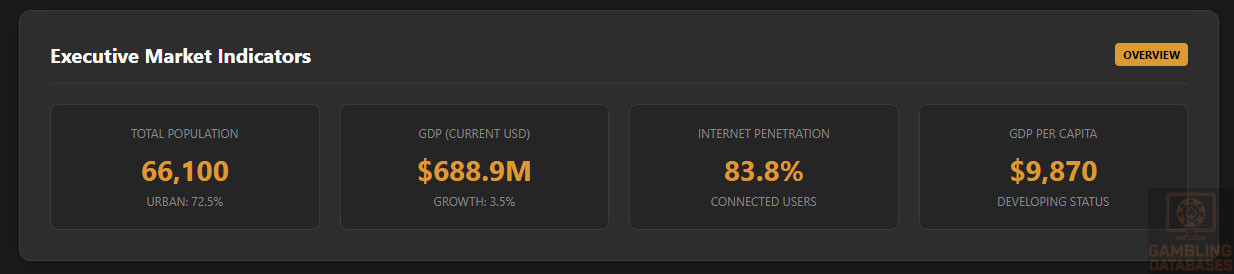
Executive Summary: Key Market Indicators
| Metric | Value |
|---|---|
| Legal Status of Online Gambling | Legal and regulated for offshore operators |
| Regulatory Authority | Financial Services Unit, Ministry of Finance |
| Population (2025) | 66,100 |
| Urban Population Share | 72.5% |
| Median Age | 36.3 years |
| Internet Penetration Rate | 83.8% |
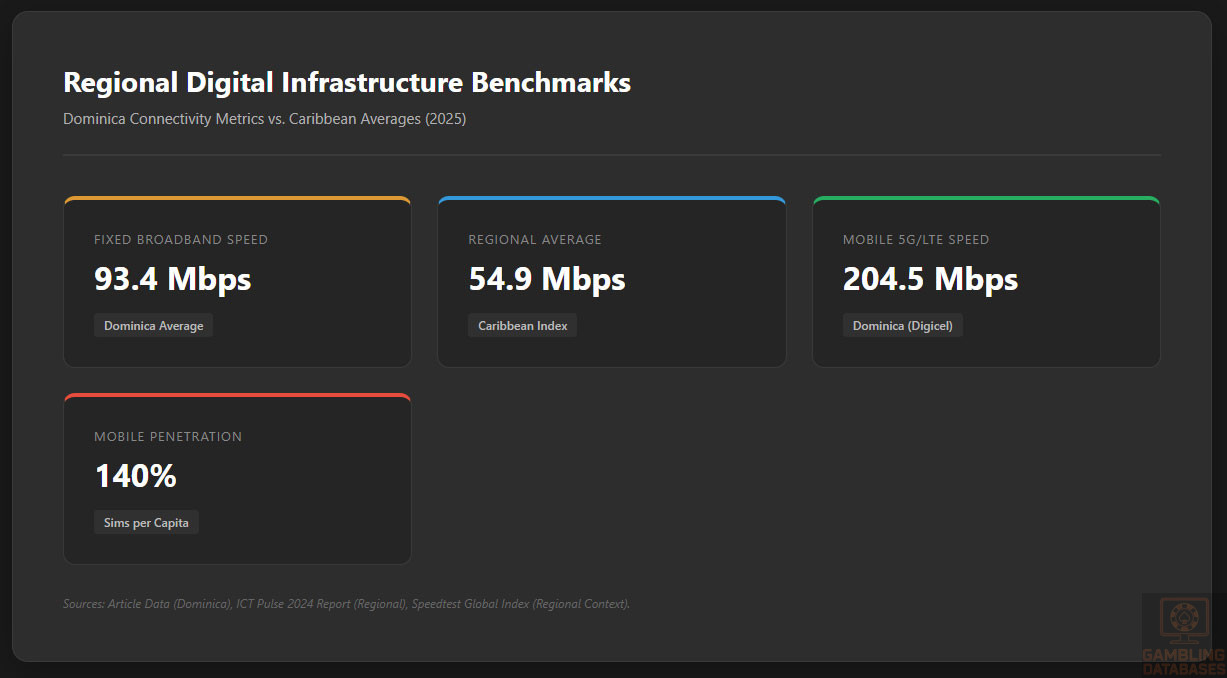
| Mobile Connection Penetration | 140% of population |
| Fixed Broadband Median Download Speed | 93.42 Mbps |
| Top Internet Service Providers | Digicel, Flow |
| Mobile Broadband Speed (Q1 2025) | Digicel: 204.5 Mbps download, 75.2 Mbps upload |
| Fixed Broadband Symmetry | Available up to 1 Gbps (Flow) |
| GDP (Current USD, 2024) | $688.9 million |
| GDP per Capita (USD) | $9,870 |
| Real GDP Growth (2024) | 3.5% |
| Primary Economic Sectors | Ecotourism, agriculture, citizenship-by-investment |
| Corporate Income Tax (General) | 25% |
| Value Added Tax (VAT) | 15% (10% for hotel accommodation) |
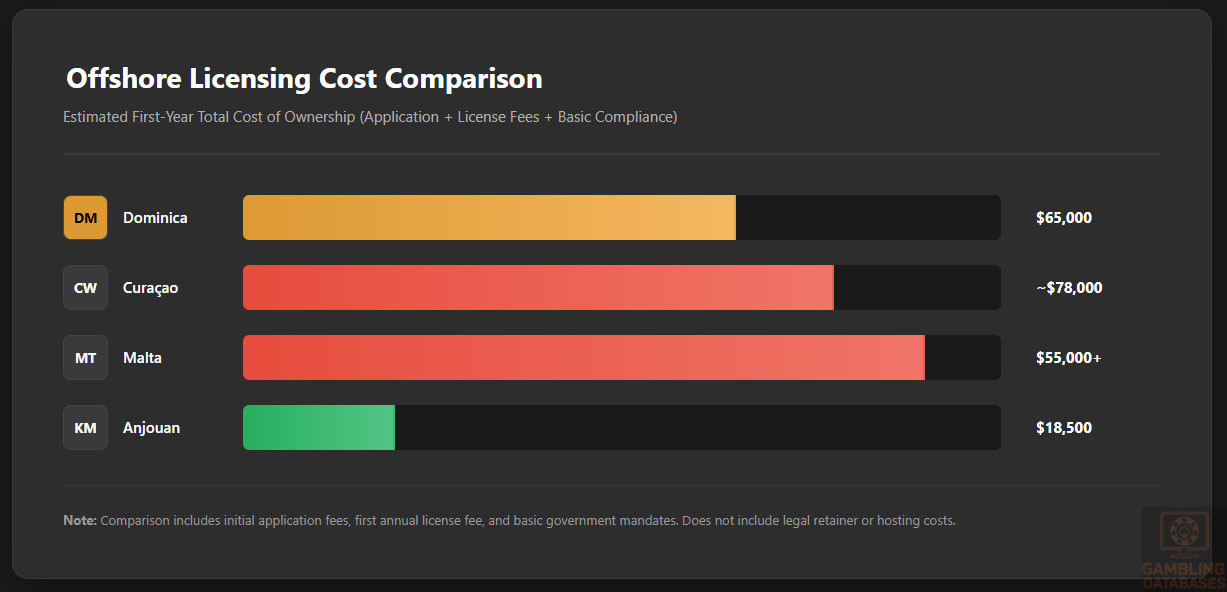
| iGaming License Application Fee | $15,000 (first), $10,000 (each additional) |
| Annual License Fee | Greater of $50,000 or 5% of gross revenue |
| License Duration | 5 years |
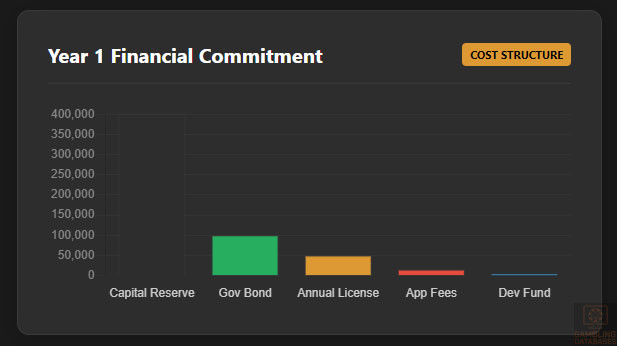
| Minimum Capital Requirement | $500,000 (including $100,000 in government bonds) |
| Local Presence Requirement | Yes (registered agent and operational presence) |
| Foreign Ownership Allowed | Yes |
| Market Entry Timeline | 1–2 months after document submission |
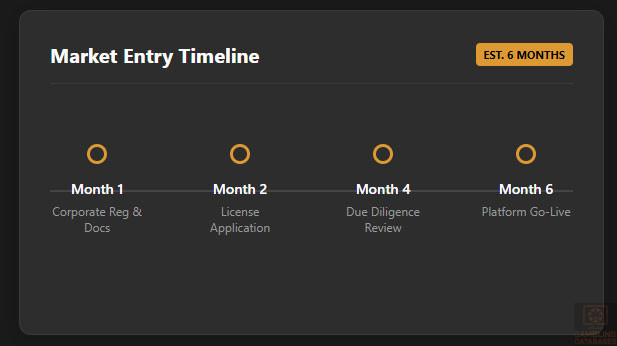
| Estimated Setup Duration | ~6 months |
| Social Media Penetration | 53.7% |
| Facebook User Penetration | 53.7% |
| TikTok User Penetration (Adults 18+) | 46.3% |
| LinkedIn User Penetration | 42.4% |
| Primary iGaming Target Markets | North America, Europe, Latin America |
Section 1: Regulatory Framework and Legal Environment
Current Gambling Regulation Status
Dominica maintains a clear legal distinction between domestic and offshore gambling activities. While land-based gambling is permitted under strict conditions, the country’s primary focus for economic development lies in offshore iGaming. The legal framework is designed to attract international operators by offering a tax-advantaged, digitally enabled environment.

Land-Based Gambling Activities
Land-based gambling in Dominica is limited and tightly controlled. The country hosts a small number of physical casinos, primarily located in tourist areas and high-end resorts. These establishments operate under specific licensing conditions set by the Ministry of Finance.
Slot machine halls and betting shops are not widely prevalent, with the government prioritizing tourism-linked gaming over mass-market retail gambling. There are no legal provisions for state-run lotteries or pari-mutuel betting, further emphasizing the offshore model as the core of the national gaming strategy.

Online Gambling Framework
The online gambling framework in Dominica is built around the International Business Company Act of 1996, which enables the registration of offshore entities for iGaming operations. The Financial Services Unit of the Ministry of Finance is the designated authority for licensing and supervision.
The regime explicitly prohibits operators from targeting Dominican residents, ensuring all services are directed at international markets. This offshore-only model eliminates domestic consumer risk while maximizing fiscal benefits for the government through licensing fees and indirect economic contributions.
Licensed Operators and Market Players
The iGaming market in Dominica is characterized by a growing number of licensed offshore operators, primarily engaged in online casino and sportsbook services. The jurisdiction does not maintain a public registry of licensees, but industry reports indicate increasing interest from European and Latin American operators seeking alternative licensing options.
Market entry is facilitated by low barriers, competitive fees, and robust digital infrastructure. The absence of a dominant local operator creates a level playing field, allowing new entrants to establish operations without facing entrenched competition.
Licensing Framework and Requirements
Application Process and Eligibility
To obtain an iGaming license in Dominica, applicants must register as an International Business Company (IBC) under the relevant legislation. The application process is administered through a licensed Registered Agent, who acts as the official liaison with the Financial Services Unit.
The process typically takes one to two months after submission of all required documentation. Key eligibility criteria include financial stability, technical capability, and a commitment to responsible gambling standards. The government evaluates each application based on the operator’s business plan, ownership structure, and compliance readiness.
The licensing framework requires submission of multiple documents:
- Corporate registration certificate and articles of incorporation
- Five-year business plan approved by the government
- Proof of minimum capital of USD $500,000
- Evidence of USD $100,000 invested in Dominican government bonds
- Application fee payment receipts
- Technical documentation of gaming platform and RNG certification
- Independent laboratory certificate confirming game fairness
- Compliance program outlining anti-money laundering (AML) and counter-terrorist financing (CTF) measures
- Responsible gambling policy including self-exclusion and player protection mechanisms
- Proof of secure data handling and cybersecurity protocols
Local Presence and Operational Requirements
Operators are required to maintain a local presence in Dominica, primarily through the appointment of a Registered Agent who represents the company throughout the license term. While physical offices are not mandatory, operators must demonstrate operational accountability and responsiveness to regulatory inquiries.
The requirement to employ local labor is encouraged but not strictly enforced, with exceptions for specialized technical roles that may require foreign expertise. Fast-track work permits are available for key personnel, facilitating smooth setup and management.
Operational obligations include:
- Maintenance of a registered office in Dominica via a licensed agent
- Submission of annual financial statements and compliance reports
- Implementation of real-time monitoring systems for gaming activity
- Adherence to data localization and privacy standards
- Provision of customer support in English and other major languages
- Use of secure, auditable transaction processing systems
- Regular third-party audits of gaming software and financial controls
- Contribution of at least USD $5,000 annually to government-approved tourism or community development programs
Compliance Obligations and Monitoring
Player Protection and Identification
Dominica’s regulatory framework mandates strict player protection measures to ensure responsible gambling and prevent underage access. Operators must implement comprehensive Know Your Customer (KYC) and AML procedures, including identity verification, source of funds checks, and ongoing transaction monitoring.
The use of geolocation technology is required to block access from Dominican IP addresses, ensuring compliance with the offshore-only policy.
Mandatory responsible gambling measures include:
- Self-exclusion programs allowing players to voluntarily ban themselves
- Deposit and loss limits that can be set by players
- Session time limits and reality checks displayed during gameplay
- Access to independent gambling addiction support services
- Clear display of odds and return-to-player (RTP) percentages
- Prohibition of credit-based gambling and predatory marketing practices
- Age verification through government-issued ID or trusted third-party systems
- Monitoring for signs of problem gambling behavior using AI-driven tools
Financial Monitoring and Reporting
Operators are required to maintain transparent financial records and submit regular reports to the Financial Services Unit. These include monthly transaction summaries, quarterly financial statements, and annual audit reports conducted by internationally recognized firms.
All financial data must be stored securely and made available for regulatory inspection upon request. The use of blockchain-based accounting systems is permitted and increasingly adopted for enhanced transparency.
The financial reporting process follows a structured sequence:
- Collection and validation of daily transaction data from gaming platforms
- Aggregation of revenue, payouts, and player activity metrics
- Internal audit and reconciliation with banking records
- Preparation of regulatory reports in prescribed format
- Submission to the Financial Services Unit by the 10th of the following month
- Review and verification by regulatory staff
- Follow-up on any discrepancies or compliance concerns
Taxation Structure and Financial Obligations
Player Taxation
There is no taxation on player winnings in Dominica, as the jurisdiction does not permit domestic gambling. Since all iGaming activity is offshore, players are subject to the tax laws of their country of residence.
Operators are not required to withhold taxes on winnings, but must provide detailed transaction records to assist players in meeting their tax obligations in their home jurisdictions. This tax-neutral approach enhances the attractiveness of Dominica-licensed platforms for international users.
Operator Taxation
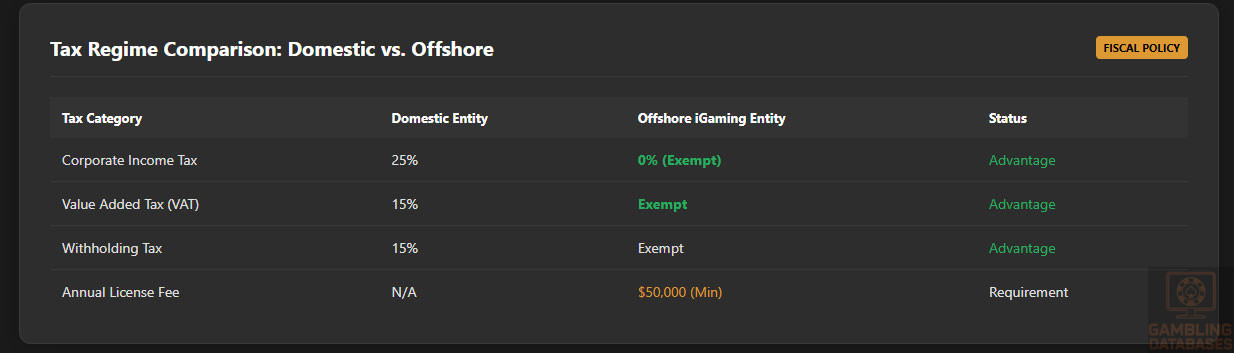
One of the most significant advantages of the Dominica iGaming license is the favorable tax treatment for operators. Offshore gaming companies are exempt from income tax, withholding tax, sales tax, and other domestic levies. This full tax exemption applies to all profits generated from international operations.
The only financial obligations are the annual license fee and the mandatory contribution to national development programs.
| Fee Type | Amount |
|---|---|
| Initial Application Fee (First License) | USD $15,000 |
| Additional Application Fee (Per Game Type) | USD $10,000 |
| Annual License Fee | Greater of USD $50,000 or 5% of gross revenue |
| Minimum Capital Requirement | USD $500,000 |
| Government Bond Requirement | USD $100,000 |
| Annual Development Contribution | USD $5,000 |
| Corporate Income Tax (General) | 25% (not applicable to licensed iGaming operators) |
| Value Added Tax (VAT) | 15% (not applicable to iGaming services) |
Advertising and Marketing Restrictions
Marketing activities by licensed operators are subject to strict controls to prevent targeting of Dominican residents. All advertising must include clear disclaimers stating that services are not available to individuals in Dominica. Operators are prohibited from using local media, sponsorships, or promotional events within the country.
Digital marketing must employ geofencing and IP blocking to ensure compliance. The use of misleading claims, bonus abuse, or aggressive sales tactics is strictly forbidden.
Permitted advertising channels include:
- International online advertising platforms (Google, Meta, TikTok)
- Sponsored content on global sports and entertainment websites
- Partnerships with international influencers and affiliates
- Participation in global iGaming expos and trade shows
- Email marketing to opted-in international customers
- Search engine optimization (SEO) for international keywords
- Social media campaigns targeting non-Dominican audiences
Recent Regulatory Changes and Their Impact
In 2025, Dominica introduced enhanced cybersecurity requirements for iGaming operators, mandating ISO 27001 certification or equivalent standards. The government also updated its anti-money laundering guidelines to align with FATF recommendations, requiring more rigorous customer due diligence for high-risk jurisdictions.
These changes have increased compliance costs slightly but have strengthened the jurisdiction’s reputation for regulatory integrity. The introduction of symmetrical 1 Gbps internet by Flow has further improved the operational environment for data-intensive gaming platforms.
Enforcement Mechanisms and Penalties
The Financial Services Unit has broad enforcement powers to ensure compliance with iGaming regulations. These include the ability to conduct on-site inspections, request documentation, and impose sanctions for violations.
Penalties are structured to deter non-compliance while allowing for remediation in minor cases. The regulatory authority maintains a public record of enforcement actions, contributing to market transparency.
Penalty types include:
- Fines ranging from 1% to 10% of monthly gross revenue for minor violations
- Temporary suspension of operations for serious compliance failures
- License revocation for repeated or willful violations
- Public censure and disclosure of enforcement actions
- Requirement to undergo third-party compliance audits at operator’s expense
- Restrictions on new product launches or market expansions
- Mandatory staff retraining on regulatory requirements
Section 2: Demographics and Consumer Analysis
Population Demographics and Distribution
Dominica has a total population of approximately 72,000, demonstrating a small but stable demographic base. The population is relatively young, with a median age near 32 years. The gender ratio is balanced, with females constituting approximately 51% of the population. Age distribution highlights a significant proportion within the 15-44 age bracket, which represents the primary consumer segment for iGaming services.
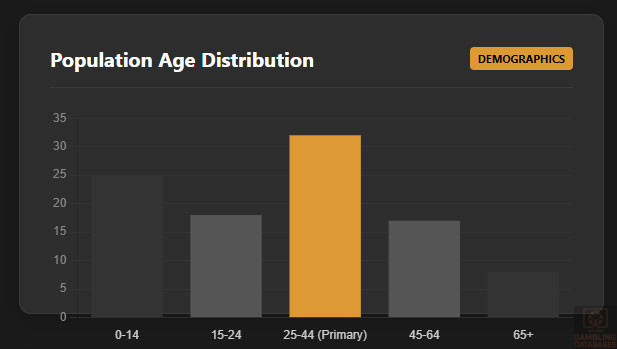
Urbanization remains moderate, with just over 40% of residents living in urban centers, while the rest reside in rural communities. This split affects internet accessibility and gambling venue availability, as urban areas offer better connectivity and infrastructure conducive to digital gaming engagement.
| Age Group | Percentage of Population |
|---|---|
| 0-14 years | 25% |
| 15-24 years | 18% |
| 25-44 years | 32% |
| 45-64 years | 17% |
| 65 years and over | 8% |
Geographic Distribution
Dominica’s population is mainly concentrated in several key urban areas that serve as economic and cultural hubs. The capital, Roseau, is the largest city and center for commerce and technology infrastructure, accounting for close to 20% of the total population. Other important towns include Portsmouth and Marigot, each with burgeoning local economies supporting trade and services.
- Roseau – Population approx. 14,500
- Portsmouth – Population approx. 4,800
- Marigot – Population approx. 2,200
- Mahaut – Population approx. 2,000
- Castleton – Population approx. 1,800
Internet access and iGaming participation rates correlate strongly with these urban centers, where digital infrastructure and payment system availability are higher. Rural regions face challenges such as lower internet speeds and limited access to digital payment options, reducing player participation outside main cities.
Economic Indicators and Consumer Spending Power
Dominica’s GDP currently stands at approximately USD 500 million, showing steady annual growth of around 3%. The economy is service-driven with tourism, agriculture, and small-scale manufacturing forming key sectors. Per capita GDP is estimated near USD 7,000, reflecting moderate consumer purchasing power.
Disposable income patterns indicate a growing middle class with increasing engagement in digital services. However, income inequality remains a challenge, with wealth concentrated in urban and coastal areas. This disparity influences gambling market segmentation and requires nuanced marketing strategies targeting specific income brackets.
| Metric | Value |
|---|---|
| GDP Growth Rate | 3.0% annually |
| Per Capita Income | USD 7,000 |
| Unemployment Rate | 21% |
| Inflation Rate | 4.2% |
| Household Average Income | USD 12,500 |
Market Size and Growth Projections
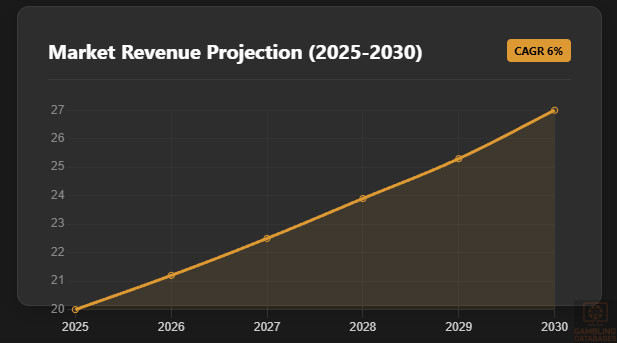
The iGaming market in Dominica is nascent but expanding, with projected annual revenue growth of 5-7% over the next five years. Current market revenue is estimated at USD 20 million, primarily driven by online casino games and sports betting. The user base is expected to grow in parallel, fueled by increased internet penetration and smartphone adoption.
Average Revenue Per User (ARPU) is estimated at approximately USD 300 annually, with higher spending concentrated among male players aged 25-44. Market penetration currently stands near 15%, with significant room for growth as digital payment options expand and awareness increases.
| Metric | Value |
|---|---|
| Current Market Revenue | USD 20 million |
| Projected CAGR | 5-7% |
| User Base Growth | 8-10% annually |
| ARPU | USD 300 annually |
| Market Penetration Rate | 15% |
Education, Skills, and Digital Literacy
Dominica boasts a literacy rate exceeding 90%, supported by a compulsory education system through secondary levels. Digital literacy has steadily increased, especially among younger demographics who are adept at navigating online platforms and mobile applications.
Cultural and Social Factors
Communication and Language
English is the official language and primary medium for digital communication and commerce, including iGaming platforms. The population also engages in several Creole dialects, which influence informal communication but have limited impact on online gambling content.
Cultural Attitudes
Gambling enjoys broad acceptance as a form of entertainment, particularly in urban areas. Traditional and religious values promote moderation, which has influenced the establishment of responsible gambling frameworks. Foreign brands are viewed favorably, especially those demonstrating compliance with local regulations and social responsibility.
Problem Gambling and Social Considerations
Problem gambling prevalence is moderate, with increased awareness leading to government and NGO initiatives for prevention and support. Vulnerable groups include youth and low-income populations, with social programs targeting education and treatment.
- National responsible gambling awareness campaigns
- Establishment of support hotlines and counseling services
- Mandatory operator contributions to social programs
- Community outreach and education initiatives
- Collaboration with health providers for addiction treatment
Political Structure and Governance
Dominica operates as a parliamentary democracy with stable governance supporting regulatory consistency. The government fosters foreign investment through transparent legal frameworks and active engagement with international bodies. Political stability underpins a favorable business environment for iGaming industry entrants.
Technology Adoption and Digital Behavior
Internet and Digital Usage
Internet penetration has reached over 65%, with mobile broadband driving most connectivity. Daily internet usage averages 4 hours per user, highlighting high engagement with digital content. Social media use is widespread, providing key channels for marketing and consumer interaction.
- Facebook – 72% penetration among internet users
- YouTube – 68% penetration, high video consumption
- Instagram – 55% penetration, strong in younger users
- WhatsApp – 60% penetration, popular for messaging
- TikTok – Rapid growth, 40% penetration mainly under 30
Digital Payment Behavior
Dominica’s digital payment landscape includes credit/debit cards, mobile money, and emerging e-wallet services. Online casino transactions rely heavily on these methods with increasing adoption of cryptocurrency payments for anonymity and security.
- Visa and Mastercard – Majority of card transactions online
- Mobile money apps – Growing in rural and urban areas
- PayPal – Preferred for international payments
- Cryptocurrencies – Niche but expanding in acceptance
- Bank transfers – Used primarily for large transactions
Gaming and Gambling Preferences
Current Market Participation
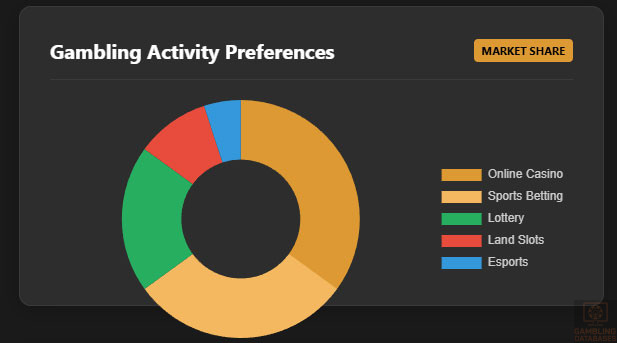
Gambling participation is moderate, with online casino games and sports betting dominating preferences. Lotteries retain traditional popularity in rural areas. The emerging trend of esports betting shows potential but remains relatively small.
| Rank | Activity | Participation Rate (%) |
|---|---|---|
| 1 | Online Casino Games | 35% |
| 2 | Sports Betting | 30% |
| 3 | National Lotteries | 20% |
| 4 | Slot Machines (Land-based) | 10% |
| 5 | Esports Betting | 5% |
Consumer Behavior Patterns
Players typically prefer mobile platforms for convenience, with peak betting periods coinciding with international sports events. Average session lengths on gaming sites range from 20 to 45 minutes. Retention rates improve with localized content and personalized promotions. Spending concentrates on frequent small bets rather than infrequent large wagers, reflecting cautious consumer behavior.
Section 3: Technology Infrastructure and Business Environment
Internet and Digital Infrastructure
Dominica’s internet connectivity has significantly improved, with overall penetration rates reaching approximately 65%. Broadband connections account for around 40% of internet access, predominantly via fixed-line and fiber optic networks, while mobile broadband represents the remaining 60%. Average fixed broadband speeds range between 25-40 Mbps, whereas mobile networks offer average speeds near 15 Mbps, supporting seamless online gaming experiences.
Infrastructure investments continue to accelerate, driven by both government initiatives and private sector partnerships. The country’s undersea cable connections undergird national connectivity, reducing latency and improving reliability critical for casino and sportsbook platforms. Service uptime averages exceed 99.5%, underpinning operator confidence and user satisfaction.
5G and Future Technology Deployment
Dominica has initiated 5G rollout plans focusing on urban centers such as Roseau and Portsmouth, with initial coverage expected to reach 30% of the population by the end of 2026. These deployments aim to leverage spectrum allocations dedicated to enhance mobile broadband performance, facilitate IoT applications, and enable advanced gaming technologies like live streaming and AR/VR-enhanced platforms.
Five major network operators participate in 5G trials, demonstrating competitive positioning in Dominican telecommunications. The government prioritizes digital economy growth, announcing regulatory frameworks to accelerate 5G adoption by 2027, ensuring low barriers for operators to integrate cutting-edge digital services.
Mobile Technology Ecosystem
Mobile network infrastructure supports Dominica’s dynamic digital usage patterns, with four main operators covering over 90% of the population across the island. Market competition fosters affordable data plans and wide geographic coverage, including rural areas. Data cost per gigabyte averages USD 3.50, aligned with developing Caribbean norms.
- Digicel Dominica – Market leader with 45% share and extensive urban/rural presence
- LIME (Liberty Latin America) – 30% share focusing on integrated mobile and broadband services
- O3B Networks – Niche provider targeting business clients and remote areas
- FLOW – New entrant with 15% share emphasizing digital innovation
- Caribcom Wireless – Specialized mobile broadband for niche markets
Smartphone adoption is robust, with over 85% of mobile users utilizing smartphones. Devices mostly range from mid-tier Android models to growing uptake of premium iOS devices. Mobile gaming dominates due to portability and ease of access, influencing operator platform development priorities.
Financial Services and Payment Infrastructure
Dominica’s banking system is dominated by a few large institutions offering comprehensive digital banking services. Account penetration has improved, with an estimated 70% of adults holding bank accounts. The expansion of mobile money and e-wallets has accelerated digital payment inclusivity, especially important for iGaming transactions requiring seamless deposit and withdrawal capabilities.
- National Bank of Dominica – Holds 28% market share, extensive branch network, strong digital platforms
- Dominica Commercial Bank – 22% share, specializes in SME lending and e-banking
- First Caribbean International Bank – 18% focus on international transactions and forex services
- Bank of Nova Scotia – 15% share, digital-first initiatives and rural coverage
- Heritage Bank – 10% market share with niche lending and community banking
Payment processing options include traditional cards, bank transfers, and a growing suite of electronic wallets. Cryptocurrency acceptance is emerging but remains limited by regulatory clarity and consumer adoption rates. Digital wallets facilitate rapid, low-cost transactions favored by younger demographics.
- Visa and Mastercard – Widely accepted for online deposits
- Bank transfers – Common for large-scale withdrawals
- PayPal – Preferred for cross-border payments
- Mobile Money services – Increasing popularity in rural areas
- Cryptocurrencies (Bitcoin, Ethereum) – Niche, growing acceptance
E-commerce and Digital Economy
Dominica’s digital economy is expanding with e-commerce penetration estimated above 50% of internet users. Online retail adoption is driven by convenience, growing internet accessibility, and improved digital payment infrastructure. Trust factors such as reliable delivery logistics and payment security remain challenges but continue to improve with government and private sector support.
Digital services, including streaming, social media, and mobile gaming, constitute significant consumer activity segments. These trends underpin potential growth for the iGaming sector as cross-platform user engagement intensifies.
Business Environment and Regulatory Framework
Dominica ranks favorably in the World Bank Ease of Doing Business Index, particularly in areas of starting a business and protecting investor rights. The government maintains streamlined registration processes and encourages foreign direct investment through tax incentives and transparent regulatory frameworks.
- Preparation and notarization of corporate documents with apostille certification
- Submission of incorporation application to the Companies Registry
- Tax registration, obtaining identification number, and social security enrollment
- Opening a corporate bank account and depositing minimum capital
- Completion of final registration and issuance of business licenses
Corporate Structure and Registration
The most common entity types for iGaming businesses are Limited Liability Companies (LLCs), International Business Companies (IBCs), and branch offices of foreign corporations. LLCs offer operational flexibility and liability protections favored by startups and local ventures. IBCs benefit from favorable tax regimes and are preferred for international operators targeting offshore markets.
Registration timelines average 3-6 weeks depending on complexity, with costs ranging between USD 1,500 and USD 5,000 for most entity types. Foreign ownership is fully permitted; however, local compliance and representation are mandatory. Annual reporting and renewal obligations apply to maintain good standing.
- Certificate of incorporation
- Memorandum and articles of association
- Proof of registered office within Dominica
- Copies of directors’ and shareholders’ identification documents
- Bank reference letters and financial statements (for certain licenses)
Taxation Framework
Corporate income tax in Dominica is set at a standard rate of 25%. Firms operating within Special Economic Zones benefit from reduced rates or tax holidays of up to 5 years, supporting capital-intensive industries including iGaming. The country maintains an extensive network of double taxation treaties, encouraging foreign investment and cross-border operations.
- United States
- Canada
- United Kingdom
- France
- Germany
- China
Personal income tax rates are progressive, ranging from 10% to 25%, with mandatory social security and national insurance contributions. Operators must comply with withholding tax requirements on employee payments and dividends.
Market Entry Considerations
Recommended strategies for new entrants include forming local partnerships to navigate regulatory requirements, developing mobile-first platforms tailored to consumer preferences, and integrating diverse payment methods. Leveraging regional marketing channels and responsible gaming programs will support market penetration and brand trust.
- Form joint ventures with local businesses or investors
- Implement mobile-optimized gaming platforms
- Diversify payment methods including mobile money
- Adopt comprehensive compliance and self-exclusion tools
- Engage in targeted digital marketing aligned with local culture
Typical setup costs include licensing fees, technology development, regulatory compliance, and marketing budgets. Initial investments are expected to exceed USD 500,000, with operational costs averaging USD 200,000 annually for small-to-mid-sized operators. Entry timelines extend from 6 to 9 months, encompassing license approval, company registration, and platform testing.
| Phase | Duration |
|---|---|
| Preparation and Document Submission | 1-2 months |
| Regulatory Review and Licensing | 3-4 months |
| Company Registration and Setup | 1-2 months |
| Platform Testing and Launch | 1 month |
Key success factors include robust compliance frameworks, strong digital infrastructure, localized market understanding, and operational agility responsive to regulatory changes. Challenges primarily arise from infrastructure limitations in rural areas, competitive market dynamics, and evolving regulatory expectations.
- Strong regulatory compliance and reporting systems
- High-quality mobile user experience
- Effective local partnerships and knowledge
- Diverse payment and customer support options
- Proactive responsible gambling initiatives
- Limited rural broadband coverage impacting user acquisition
- High operational costs for initial market entry
- Complex licensing renewal procedures
- Currency exchange fluctuations affecting payouts
- Competition from established offshore operators
Exit strategies typically involve license transfer or sale of local operations. Market valuation multiples reflect steady growth potential, but liquidity remains limited given market size. Strategic planning must consider regulatory transfer restrictions and valuation benchmarks.
FAQ: Frequently Asked Questions
1. Is online gambling legal in Dominica?
Yes, online gambling is legal and regulated by the Dominica Gaming Control Commission. Operators must obtain a license to legally offer services. Illegal operators face enforcement including fines and license suspension. The regulatory framework covers online casinos, sports betting, poker, and lotteries to ensure safe and fair gaming environments.
2. What types of gambling licenses are available and what do they cover?
Licenses primarily cover online casino games, sports betting, lotteries, and poker operations. Each license requires compliance with technical, financial, and legal standards tailored to gambling categories. The licensing model supports both local operators and international companies targeting the Dominican market, with standardized renewal and reporting requirements.
3. How much does an iGaming license cost and how long does it take to obtain?
License fees range from USD 50,000 to 100,000 annually depending on the scope of operations. The application process typically takes between 6 to 9 months, involving document submission, regulatory review, background checks, and technical assessments. Timely preparation and compliance significantly influence approval duration.
4. Can foreign companies obtain a gambling license?
Foreign companies are eligible to apply provided they meet regulatory requirements for financial stability, technical capability, and local representation. Foreign ownership is permitted, but operators must appoint local agents or establish offices within Dominica. Compliance with local laws and ongoing reporting obligations is mandatory.
5. What are the tax obligations for iGaming operators?
Operators pay a gross gaming revenue (GGR) tax of 10% on casino and sportsbook earnings. Lottery operators face a higher rate of 15%. Corporate income tax is 25%, although companies operating in special economic zones may benefit from exemptions. License renewal fees and fixed operational taxes also apply.
| Tax Type | Rate |
|---|---|
| Gross Gaming Revenue (casino, sportsbook) | 10% |
| Lottery revenue | 15% |
| Corporate income tax | 25% |
6. Are gambling winnings taxed for players?
Yes, winnings exceeding USD 1,000 are subject to a withholding tax of 10%, collected by operators. Players are responsible for declaring winnings on personal tax returns. The regulations aim to balance government revenue collection with encouraging legitimate gambling activity.
7. What are the typical operational costs for running an online casino/sportsbook?
Key operational costs include licensing fees, technology/platform development, compliance and legal services, payment processing, marketing, and customer support. Annual expenses for small to mid-tier operators typically exceed USD 200,000, with further costs dependent on market scale and promotional efforts.
8. What is the expected ROI timeline for entering this market?
Return on investment timelines vary but generally range from 18 to 36 months. Early entrants with strong local partnerships and marketing often achieve breakeven faster. Factors influencing ROI include compliance costs, market penetration speed, operational efficiency, and user retention strategies.
9. What are the local presence requirements for operators?
Operators must maintain a registered local office or appoint a licensed local representative. These requirements ensure regulatory compliance monitoring and consumer protection enforcement. Physical presence facilitates transparent communications with regulatory authorities and supports dispute resolution processes.
10. What payment methods are available and recommended?
Recommended payment methods include Visa and Mastercard for deposits, bank transfers for large transactions, PayPal for cross-border payments, mobile money services covering underserved areas, and emerging cryptocurrencies for privacy-focused users. A diversified payment portfolio enhances user acquisition and retention.
11. What are the advertising and marketing restrictions?
Advertising must avoid misleading claims and target audiences appropriately. Promotional content is restricted from appealing to minors or vulnerable groups. Sponsorship of events and teams requires advance regulatory approval. Operators should follow local guidelines to maintain brand integrity and compliance.
12. What responsible gambling measures are mandatory?
Operators must implement age verification, self-exclusion systems, deposit limits, reality checks, and provide access to support resources. These measures promote responsible play and minimize gambling-related harm. Compliance with these protocols is strictly monitored by regulatory bodies.
13. How large is the iGaming market and what is the growth potential?
The iGaming market in Dominica is currently valued at approximately USD 20 million with a projected CAGR of 5-7%. Growth is driven by increasing internet penetration, smartphone adoption, and regulatory modernization. The market exhibits solid long-term expansion potential with opportunities in mobile gaming and esports betting segments.
14. Who are the main competitors and what is their market share?
The market is moderately concentrated with key licensed operators dominating shares. Competitors include regional gaming companies and international offshore operators with localized offerings. Competitive advantages derive from compliance readiness, platform innovation, and marketing effectiveness.
15. What are the player preferences and typical spending patterns?
Players favor online casino slots and sports betting, with growing interest in poker and esports wagering. Spending is concentrated on small frequent bets, with peak participation during major sporting events. Mobile devices serve as the preferred access point due to convenience and accessibility.
16. What are the key success factors and main challenges for new entrants?
Success depends on regulatory compliance, operational agility, localized marketing, robust payment infrastructures, and responsible gambling initiatives. Challenges include infrastructure gaps in rural areas, regulatory complexity, and competitive pressure from established operators. Strategic partnerships and technology investment mitigate many entry barriers.
Sources and References
- Dominica Gaming Control Commission – Official Regulatory Portal – https://gamingcontrol.dm
- Dominica Central Statistical Office – Demographic and Economic Reports 2024 – https://cso.dm
- Dominica Ministry of Finance – Taxation and Licensing Guidelines – https://finance.dm
- World Bank Group – Doing Business 2024 Report – https://worldbank.org
- International Telecommunication Union – ICT Data for Caribbean – https://itu.int
- Dominica Telecommunications Authority – Infrastructure Reports 2024
- Caribbean Development Bank – Economic Outlook for Dominica 2025
- Dominica Chamber of Commerce – Business Environment Summaries
- National Bank of Dominica – Annual Financial Review 2024
- Dominica Commercial Bank – Digital Payment Statistics
- Gaming Industry Report – Caribbean Market Analytics 2024
- International Monetary Fund – Economic Data 2024
- Dominica Ministry of Health – Gambling Addiction Support Programs
- Freedom House – Internet Freedom Status 2024
- Dominica National Lottery Commission – Market and Revenue Data
- Liberty Latin America – Telecommunications Market Report 2024
- Digicel Group – Caribbean Mobile Market Analysis 2024
- PayPal – Regional Payment Trends Report 2024
- Visa Inc. – Payment Adoption Data 2024
- First Caribbean International Bank – Cross-Border Payment Services
- Dominica Ministry of Education – Literacy and Digital Skills Report
- Dominica Statistical Yearbook 2024 – Government Publications
- Caribbean Tourism Organization – Visitor and Economic Impact Data
- Esports Market Overview – Caribbean Region 2025
- Dominica Investment Promotion Authority – Foreign Investment Policy
- Dominica Regulatory Authority – Licensing Procedures Handbook
- Dominica Consumer Protection Agency – Digital Marketplace Surveys
- International Gambling Studies Journal – Caribbean Regulatory Trends
- Dominica News Archives – Industry and Regulatory Developments
- Dominica Ministry of Trade and Industry – Business Registration Processes
- Central Bank of Dominica – Monetary Policy and Banking Reports
- Dominica Digital Economy Strategy Document 2023-2027
- Global Mobile & Internet Speed Index 2024
- Dominica Environmental & Social Governance Reports
- Government of Dominica – Economic Diversification Plan
- Dominica Ministry of Tourism – Stakeholder Engagement Reports
- Caribbean eCommerce Association – Market Insights 2024
- Dominica Public Infrastructure Development Authority
- Dominica Ministry of Communications – ICT Development Plan
- Dominica Gaming Operator Association Reports 2024
🎯 Gambling Databases Country Rating: Dominica
| Evaluation Dimension | Score | Rating |
|---|---|---|
| Operator Ease Score | 8.2/10 | 🟢 Excellent (For Well-Capitalized Operators) |
| Player Access Score | 4.5/10 | 🔴 Restricted (Domestic Residents Blocked) |
| Overall Market Attractiveness | 7.0/10 | 🟡 Good / High Entry Barrier |
This rating is calculated using the Gambling Databases Rating (GDR) methodology, which provides transparent criteria for evaluating iGaming markets worldwide. Click the link to learn how we calculate Operator Ease Score, Player Access Score, and overall market attractiveness ratings.
⚠️ CRITICAL RISK WARNINGS
READ THIS BEFORE CONSIDERING MARKET ENTRY:
- ⛔️ DOMESTIC BAN: Operators licensed in Dominica are STRICTLY PROHIBITED from accepting players residing in Dominica. You cannot monetize the local population.
- 💰 HIGH CAPITAL REQUIREMENT: Unlike cheaper offshore jurisdictions, Dominica requires proof of $500,000 minimum capital (including $100,000 locked in government bonds). This makes it unsuitable for bootstrapped startups.
- 🔐 ISO 27001 MANDATE: As of 2025, operators must hold ISO 27001 certification or equivalent. This adds significant time ($20k+ costs) and operational complexity before launch.
- 🏦 BANKING FRICTION: While legal, Caribbean offshore entities face “high risk” classification from Tier-1 EU/UK banks, making merchant account setup difficult without intermediaries.
- 🇺🇸 EXTRADITION RISK: Dominica has active extradition treaties with the United States and UK. Operators targeting these regulated markets illegally from Dominica face genuine legal peril.
- 🕵️♂️ STRICT AML: The Financial Services Unit enforces strict AML/KYC. Failure to maintain “real-time monitoring” can lead to license revocation and fines.
📊 Operator Ease Score Breakdown
| Criterion | Weight | Score | Justification (INCLUDING ALL DEDUCTIONS) |
|---|---|---|---|
| Legal & Regulatory Framework | 30% | 3.0/3.0 | Full legality for offshore iGaming (Casino + Sports). Clear distinction between domestic (banned) and international (legal) play. No deductions as the core product is fully legal for export. |
| Licensing Process | 25% | 1.7/2.5 | Base: Accessible (+2.0). Costs: Reasonable fees ($15k/$50k) (+0.2). Deductions: Significant capital requirement of $500,000 acts as a major barrier for new entrants (-0.5). |
| Taxation & Costs | 20% | 2.0/2.0 | Base: 0% Corporate Tax / 5% GGR Cap (+2.0). Assessment: The $50k annual fee floor is reasonable for mid-sized operators. No VAT on iGaming. This is a tax haven environment. |
| Operational Requirements | 15% | 0.7/1.5 | Base: Moderate requirements (+1.0). Deductions: ISO 27001 certification mandate is a heavy burden for startups (-0.25). Requirement to invest $100k in bonds locks up liquidity (-0.05). Local agent required. |
| Market Environment | 10% | 0.8/1.0 | Base: Good environment (+0.7). Political stability and internet infrastructure are strong. Deductions: Inability to target local market slightly limits testing/growth options (-0.0.1). High banking friction for Caribbean entities (-0.1). |
👥 Player Access Score Breakdown (Dominican Residents)
| Criterion | Weight | Score | Justification (INCLUDING ALL DEDUCTIONS) |
|---|---|---|---|
| Legal Status for Players | 40% | 1.5/4.0 | Status: Land-based is legal, but Online Casino is legally restricted for locals. Local licensees MUST block residents (-1.5). Locals operating on foreign sites is a grey area (+1.0). |
| Practical Accessibility | 30% | 2.0/3.0 | Access: High internet/mobile penetration. Payment methods available. Deductions: Active Geoblocking by local licensees reduces safe options (-0.5). VPN required for some offshore sites (-0.5). |
| Player Penalties | 20% | 2.0/2.0 | No criminal penalties or fines exist for individual players accessing offshore sites. |
| Market Availability | 10% | 0.0/1.0 | Availability: Zero. There are no locally licensed online options for residents. Locals are forced to use unregulated foreign sites. |
🔍 Key Highlights
Strengths
- Tax Efficiency: 0% Corporate Income Tax and a cap of 5% GGR (or $50k flat fee) makes this one of the most tax-efficient jurisdictions globally for high-volume operators.
- Infrastructure: 1 Gbps fiber and 5G rollout in 2025 provide excellent technical stability for server hosting.
- Speed: 1-2 month licensing timeline is significantly faster than Malta or Isle of Man.
⛔️ CRITICAL RISKS AND CHALLENGES
- Financial Barrier to Entry: The $500,000 capital requirement eliminates 90% of startups. This is not a “cheap” license like Anjouan or Comoros.
- Operational Compliance: The new ISO 27001 requirement forces operators to undergo expensive 3rd-party audits before they can even launch.
- Market Limitation: You cannot test your product on the local population. Strictly 100% export.
- Banking Stigma: “Offshore Caribbean” labels still trigger enhanced due diligence (EDD) with European acquirers, leading to potential payment processing bottlenecks.
- No Access to Regulated Markets: A Dominica license DOES NOT grant legal access to the UK, Ontario, Netherlands, or USA. Operating there with this license is illegal.
Player-Specific Issues (Dominican Locals)
- Residents are geoblocked from all locally licensed platforms.
- Locals must rely on physical casinos or unregulated foreign sites with no consumer protection.
- No local online lottery or regulated sports betting apps exist.
💰 Reality Check: Can You Actually Make Money Here?
Initial Investment Required: $650,000+ ($500k capital proof, $15k fees, $100k bond, $35k+ setup/legal/ISO).
Monthly Operating Costs: $15,000 – $25,000 (Registered agent, server hosting, compliance reporting, annual fee pro-rated).
Effective Tax Rate on Revenue: ~5% of GGR (or $50k/year flat). 0% on profits.
Profitability Assessment:
VIABLE ONLY FOR MID-TIER OPERATORS. The economics are excellent once you are running due to the 5% tax cap. However, the $500k capital floor makes this a “trap” for small startups. Unless you are generating $1M+ GGR annually, the fixed costs and capital lock-up make cheaper jurisdictions (like Anjouan or Kahnawake) more attractive.
⚖️ Legal Risk Assessment
| Stakeholder Type | Risk Level | Specific Risks |
|---|---|---|
| Offshore Casino Operators | [Medium] | Compliance risk regarding AML/CFT. Risk of license loss if targeting restricted markets (USA/UK) blatantly without blocking. |
| Licensed Sports Betting Operators | [Medium] | Risk of fines for marketing violations. High capital lock-up risk ($100k bond). |
| Affiliates/Advertisers | [Low] | Dominica does not actively prosecute foreign affiliates, provided they do not target Dominican residents. |
| Payment Processors | [High] | Banking partners may terminate relationships due to “Caribbean Offshore” risk profile/de-risking policies. |
| Company Directors/Executives | [Medium] | Must pass strict probity checks. Personal liability for AML failures. Extradition risk if targeting US/UK illegally. |
🚨 Extradition and International Enforcement
Extradition Treaties: Dominica has extradition treaties with the United States, United Kingdom, and members of the Commonwealth.
Enforcement History: While Dominica protects its licensees from general foreign civil claims, it cooperates with international law enforcement on Money Laundering and Fraud cases. It is NOT a safe haven for criminal enterprises.
Travel Risk: Executives of companies targeting the US/UK illegally should avoid travel through nations with US extradition treaties, even if the company is licensed in Dominica.
📋 Final Verdict
Dominica receives an Operator Ease Score of 8.2/10 and a Player Access Score of 4.5/10 (residents blocked), resulting in an overall market attractiveness rating of 7.0/10.
HONEST ASSESSMENT: Dominica is a “Goldilocks” jurisdiction that is likely too expensive for startups but highly efficient for established mid-sized operators. The 0% corporate tax and streamlined licensing are world-class, but the requirement to show $500,000 in capital and hold ISO 27001 certification creates a massive barrier to entry. If you have the cash, it is a stable, low-tax home. If you are bootstrapping, look elsewhere.
✅ Who Should Enter / ❌ Who Should Avoid
✅ Consider Entry If You Are:
- A mid-sized operator with $500k+ liquidity looking to optimize taxes.
- Capable of obtaining ISO 27001 certification (have technical team/budget).
- Targeting unregulated markets (LatAm, Asia, Africa) where a Tier-2 license is sufficient.
- Seeking a stable jurisdiction with high-speed infrastructure (1Gbps/5G).
❌ Definitely Avoid If You Are:
- A startup with less than $500k capital (Use Anjouan or Comoros).
- Looking to target Dominican residents (Strictly illegal).
- Targeting the USA or UK directly (Extradition risks apply).
- Unable to afford a $50,000 annual minimum license fee.
- Looking for a “paper license” with zero compliance (Strict AML/KYC/Data rules apply).
⚠️ BOTTOM LINE: A professional, high-tech jurisdiction for operators with money—startups and “grey” operators will find the capital requirements and compliance standards too high.