Lithuania’s strategic modernization of its gambling sector offers a competitive and transparent environment for iGaming operators.
This Baltic nation boasts a comprehensive regulatory framework that facilitates both land-based and online gambling activities.
Recent reforms have made market entry more accessible, especially through the introduction of online-only licenses without land-based prerequisites.
Executive Summary: Key Market Indicators
| Metric | Value |
|---|---|
| Gambling Legal Status | Licensed and regulated for land-based and online gambling |
| Regulatory Authority | Gambling Supervision Authority (under Ministry of Finance) |
| Population | 2.8 million |
| Legal Gambling Age | 21 years (effective from July 1, 2025) |
| GDP (2024) | Approx. €65 billion |
| Average Monthly Income | ~€1,600 |
| Internet Penetration Rate | ~85% |
| Mobile Penetration Rate | ~110% (active subscriptions per 100 people) |
| Online Gambling License Fee | €500,000 (online-only license); €1,000,000 (combined land & online license) |
| Capital Requirements | €144,000 – €1,158,000 depending on game type |
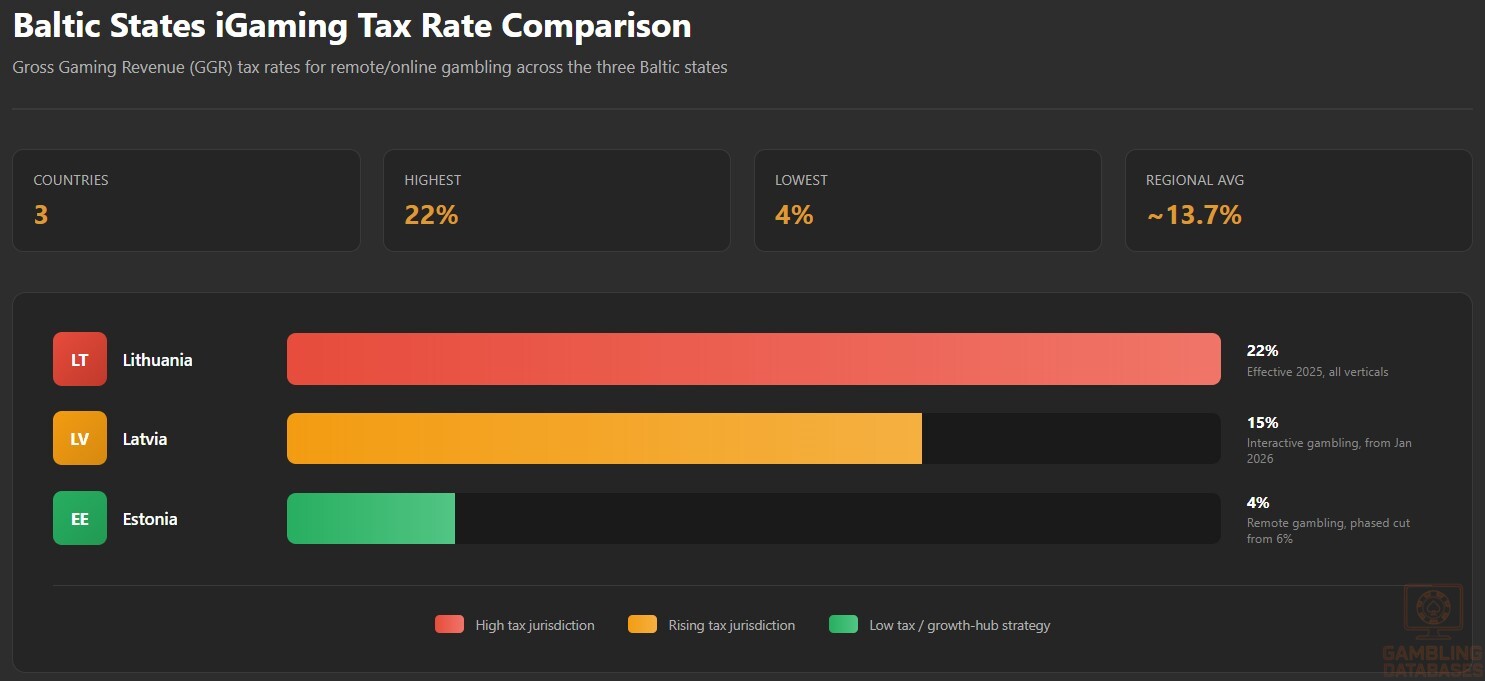
| GGR Tax Rate | 22% across slots, table games, bingo, betting, and remote gambling |
| License Duration | Online licenses indefinite; land-based licenses max 5 years |
| Number of Licensed Operators (2025) | 12 licensed operators |
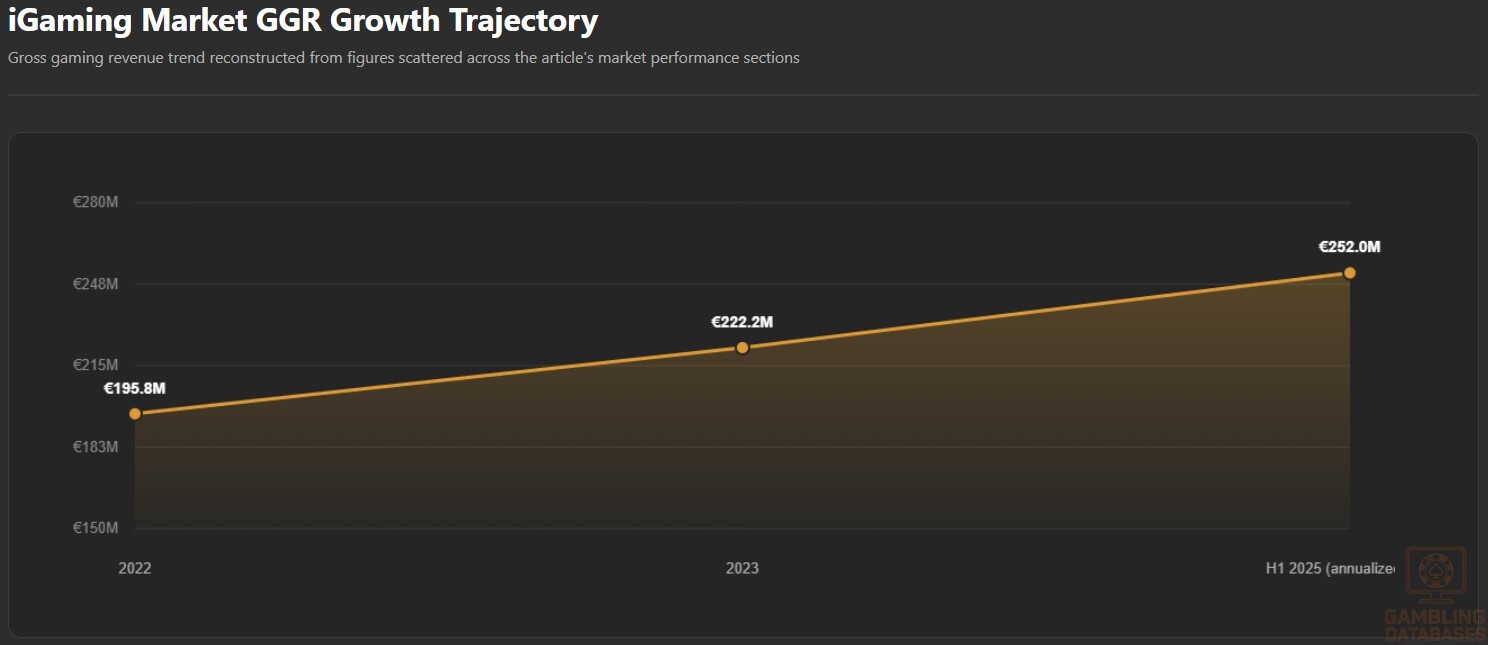
| Market Size (GGR 2023) | €222.2 million |
| Year-on-Year GGR Growth | 13.5% (2022-2023) |
| Average Revenue Per User (ARPU) | €300-350 estimated |
| Market Entry Barriers | High capital and licensing fees, regulatory compliance, local presence for land-based |
| License Application Time | 6-9 months typical |
| Advertising Restrictions | Strict ban on external gambling ads from July 2025, full ban by 2028 |
| Anti-Money Laundering Compliance | Mandatory KYC, transaction monitoring, financial audits |
| Player Protection Measures | Self-exclusion system, age verification, responsible gambling programs |
| Payment Restrictions | Blocking payments to unlicensed operators mandatory |
| Enforcement Penalties | Fines up to €1,500 for minor breaches; license revocation for serious violations |
| Foreign Ownership Restrictions | Permitted with no explicit cap; local presence for land-based required |
| Technology Standards | Certified gaming equipment, RNG certification required |
| Compliance Reporting | Monthly activity reports, financial disclosures required |
| Responsible Gambling Training | Mandatory staff training in gambling venues |
| Blacklisting of Illegal Operators | Active blacklist with payment and domain blocking enforced |
Section 1: Regulatory Framework and Legal Environment
Current Gambling Regulation Status
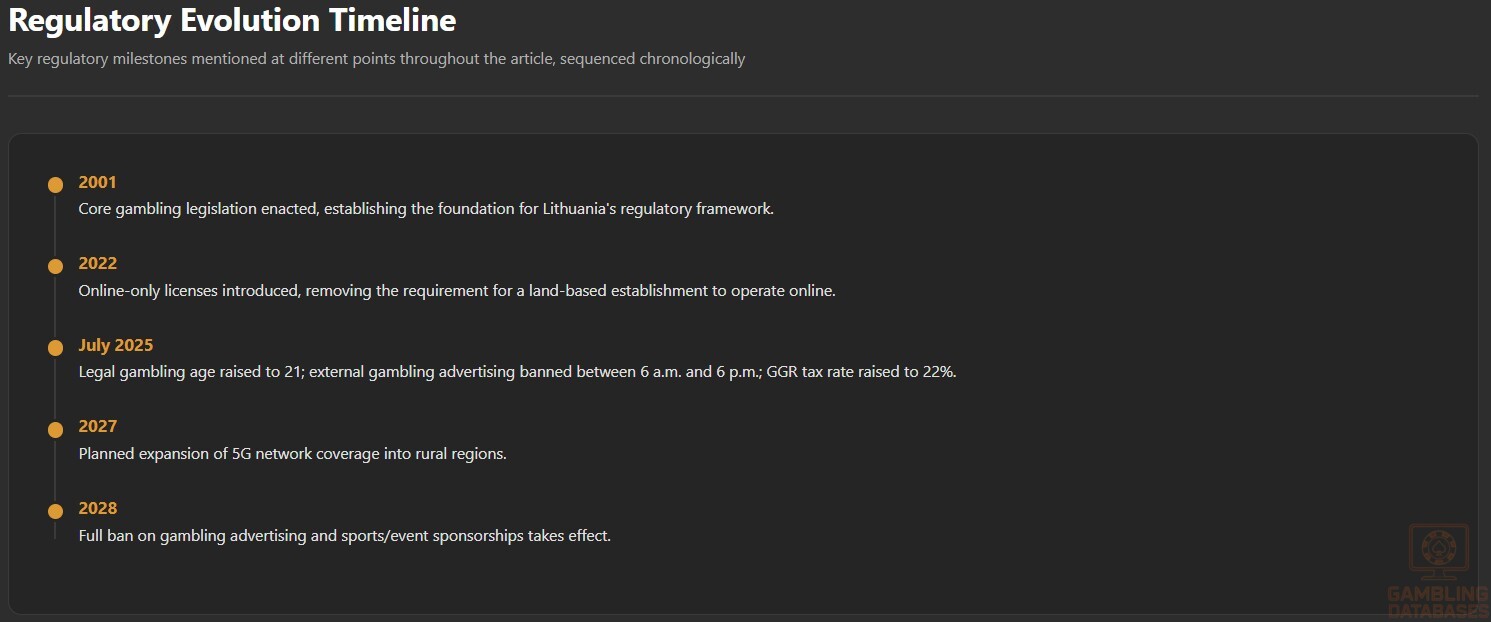
Lithuania regulates a broad spectrum of gambling categories including land-based casinos, sports betting venues, slot machine halls, bingo halls, and online gambling platforms. With legislation enacted in 2001 and frequently updated, the regulatory framework serves to protect consumers, maintain market integrity, and foster industry growth.
Land-based gambling involves regulated operations of casinos, betting shops, and gaming machine facilities. These venues must comply with specific licensing, operational, and physical presence requirements, including staff training and monitoring obligations to ensure responsible gambling.
The online gambling framework has evolved significantly, removing the prior requirement for licensees to maintain land-based establishments for online operations. Since 2022, operators can obtain an online-only license, expanding market accessibility and encouraging international participation while maintaining strict regulatory control.
Land-Based Gambling Activities
Lithuania supports a variety of land-based gambling formats:
- Licensed casinos offering table games and category A slot machines
- Sports betting shops with authorised betting activities
- Slot machine halls featuring category B machines
- Bingo halls with regulated gaming sessions
- Other regulated gaming venues including totalisator and specialized amusement devices
These venues are subject to municipal council approvals, with licenses for land-based operations lasting up to five years. They must adhere to strict operational standards including age verification, responsible gambling staff presence, and transparency obligations.
Online Gambling Framework
The Lithuanian regulatory authority, Gambling Supervision Authority (GSA), oversees online gambling activities through a structured licensing system. Online gambling operators must be licensed specifically for remote gaming and are required to implement advanced player verification systems, secure payment processing, and robust compliance procedures.
The framework strictly prohibits offering gambling services without a valid license and mandates blocking access to unauthorized operators. Operators are subject to continuous oversight, including transaction monitoring and suspicious activity detection. The minimum legal gambling age online is set at 21, with mandatory age verification at account registration and recurring assessments during gameplay.
Licensed Operators and Market Players
The Lithuanian iGaming market features a competitive landscape dominated by a dozen licensed operators. These include prominent international groups like Olympic Casino Group alongside smaller local operators. Market entry requires substantial financial investment, with operators often pursuing multi-vertical licenses to maximize market scope.
Market players focus on compliance, technology innovation, and adhering to new advertising restrictions. The move towards online-only licenses has increased competition by lowering physical presence barriers. Operators employ strategies such as localized content, enhanced player protection tools, and partnerships with technology providers to optimize market share.
Licensing Framework and Requirements
Application Process and Eligibility
The Gambling Supervision Authority (GSA), under Lithuania’s Ministry of Finance, administers licensing. The application process includes comprehensive evaluation of financial stability, technical capabilities, and operational integrity. Licenses are issued for specific gambling verticals and types of games with fee structures tied to the scope of activity.
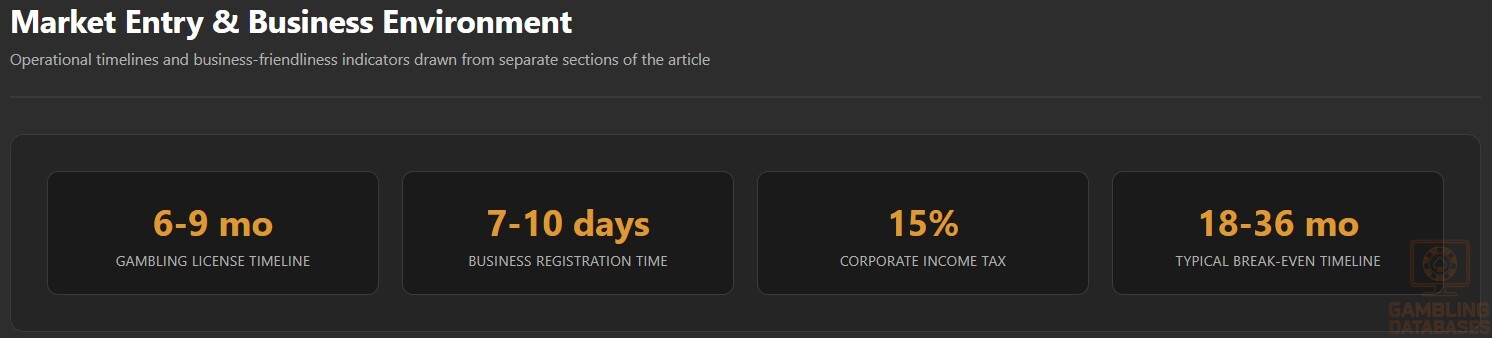
Application fees vary based on game type and license scope. The new online-only license costs €500,000, whereas combined land-based and online licenses can reach €1,000,000. Licensing timelines typically span six to nine months, pending complete documentation and successful evaluation.
Eligibility criteria focus on ethical business conduct, anti-money laundering capabilities, and compliance readiness. Applicants undergo criminal background checks, must demonstrate a minimum authorised capital between €144,000 and €1,158,000 depending on the gaming categories, and must submit detailed technical certifications for gaming systems.
Required documents include corporate registration, financial history, compliance plans, technical documentation, criminal records, and proof of minimum capital commitments.
- Corporate registration certificate and articles of incorporation
- Audited financial statements for past three years
- Business plan including risk and compliance management
- Technical documentation of game software and certified RNG
- Criminal background checks for directors and beneficial owners
- Proof of minimum capital deposit in licensed bank
- Compliance policies including KYC and AML procedures
Local Presence and Operational Requirements
While online-only licenses no longer require a land-based presence, licenses permitting land-based operations must have physical locations approved by local municipal councils. Operational mandates include designated responsible gambling officers, mandatory staff training, and data retention for regulatory review.
Foreign ownership is allowed without explicit caps, but operators must comply with all legal and financial transparency rules. The operator’s website must be domain-registered in Lithuania and meet local accessibility and security standards.
Compliance Obligations and Monitoring
Player Protection and Identification
Lithuania enforces strict measures to protect players, including age verification systems that must be in place at account creation and continually throughout gaming activity. The legal gambling age is 21 for all formats, with operators required to block access for underaged individuals.
Anti-money laundering (AML) standards demand comprehensive KYC processes, ongoing transaction monitoring, and reporting suspicious activity. Operators have implemented self-exclusion mechanisms enabling players to voluntarily restrict their access, supporting responsible gambling.
- Mandatory age verification at registration and gameplay
- Comprehensive KYC processes for all players
- Self-exclusion and player cooling-off schemes
- Transaction monitoring to detect suspicious behavior
- Regular reporting of compliance to regulatory authority
- Mandatory display of responsible gambling information on platforms
Financial Monitoring and Reporting
Operators must submit periodic financial reports detailing gross gaming revenue, payout percentages, and taxation. The reporting process follows a strict timeline with monthly submissions required to the Gambling Supervisory Authority. Audits and on-site inspections are conducted regularly to ensure compliance with financial standards and anti-fraud protocols.
- Monthly submission of detailed revenue and payout reports
- Declaration and payment of due gambling taxes within prescribed deadlines
- Submission of suspicious transaction reports for AML review
- Periodic operational audits and compliance inspections by regulators
Taxation Structure and Financial Obligations
Player Taxation
Players in Lithuania are generally not subject to direct taxation on gambling winnings under typical thresholds. However, winnings above defined limits must be reported and can be subject to withholding rules, depending on individual circumstances. The operator is responsible for ensuring proper reporting and withholding where applicable.
Operator Taxation
| Game Type | Gross Gaming Revenue Tax Rate | Additional License Fees |
|---|---|---|
| Slot Machines (Category A & B) | 22% | €300,000 license fee |
| Table Games and Casino | 22% | €300,000 license fee |
| Bingo | 22% | €100,000 license fee |
| Sports Betting | 22% | €100,000 license fee |
| Online Gambling (Remote) | 22% | €500,000 license fee (online-only license) |
A corporate income tax applies separately at 15%, applicable to operator profits. License renewal fees and turnover-based levies are customary but not uniformly fixed, depending on the gaming vertical and operator scale.
Gambling Market Financial Performance
Lithuania’s gambling sector demonstrated strong growth with a gross gaming revenue of €222.2 million in 2023, marking a 13.5% increase from the previous year. Tax revenues from gambling have risen accordingly, reflecting robust participation and a clear regulatory environment. Market analysts forecast steady growth driven by digital expansion and increased consumer protection measures.
Advertising and Marketing Restrictions
Since July 2025, Lithuania enforces stringent restrictions on gambling advertising to reduce exposure and minimize problem gambling risks. External gambling advertisements are banned between 6 a.m. and 6 p.m., with an anticipated full ban on all gambling-related advertising and sponsorships by 2028.
- Ban on external gambling ads from 6 a.m. to 6 p.m.
- Prohibition of sponsorship in sports and events by 2028
- No advertising targeting minors or vulnerable groups
- Restrictions on promotional incentives and bonuses
- Mandatory responsible gambling messaging in all permissible ads
Recent Regulatory Changes and Their Impact
Recent amendments raised the legal gambling age from 18 to 21, increased licensing fees, and imposed a higher gambling tax rate of 22% effective in 2025. Enhanced enforcement powers for the Gambling Supervision Authority have tightened controls over illegal operators and payment blocking.
The cumulative effect has been a safer gambling environment with higher operational costs for licensed operators, promoting responsible market growth and improved consumer protections.
Enforcement Mechanisms and Penalties
Enforcement mechanisms are rigorous, including fines, license suspensions, and revocations for non-compliance. Monitoring includes transaction audits and domain blocking of unauthorized operators. Penalties escalate for repeated or severe breaches to maintain market integrity.
- Monetary fines up to €1,500 for minor violations
- License suspension or revocation for severe non-compliance
- Payment and access blocking for unlicensed operators
- Legal actions against operators circumventing regulations
- Mandatory compliance audits and reporting
Section 2: Demographics and Consumer Analysis
Population Demographics and Distribution
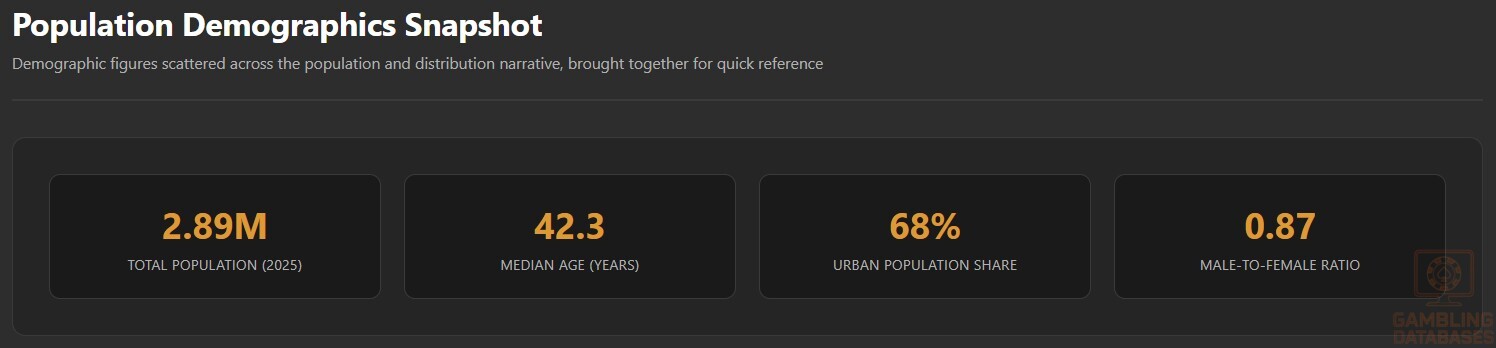
Lithuania’s population is estimated at approximately 2.89 million in 2025, reflecting a slow decline due to negative natural increase and migration. The median age is relatively high at around 42.3 years, indicative of an aging population with low fertility rates below the replacement level.
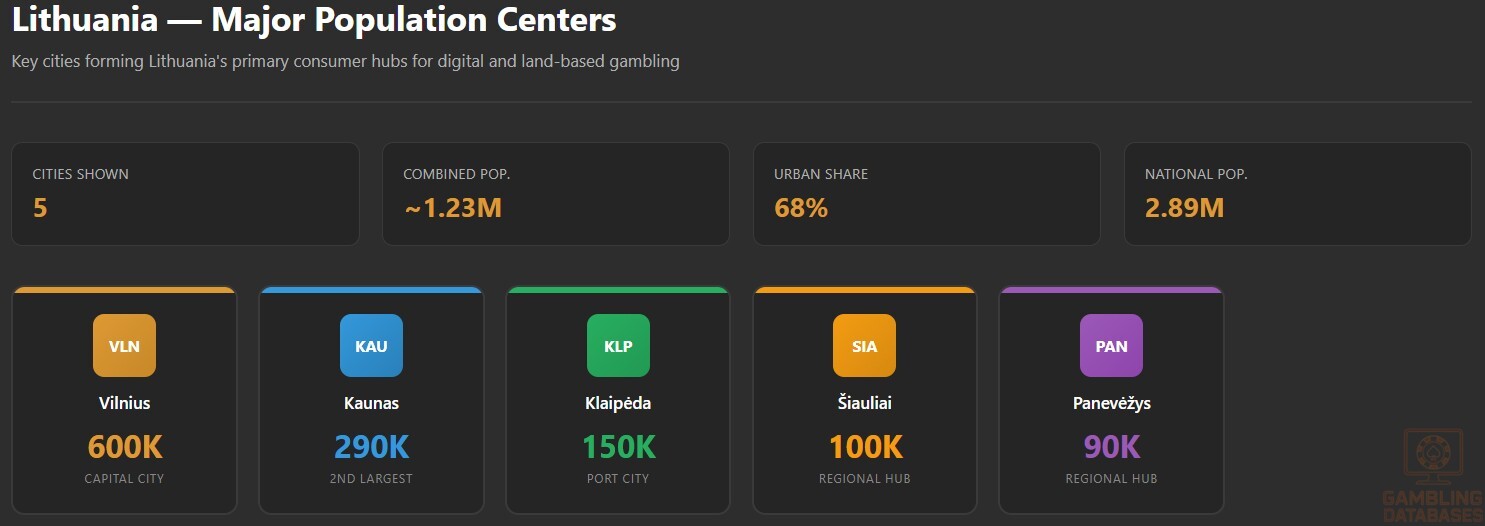
The gender ratio skews female, with about 0.87 males per female nationally. The population is distributed unevenly between urban and rural areas, with roughly 68% residing in urban centers, creating concentrated consumer hubs primarily around major cities.
| Age Group | Percentage of Total Population |
|---|---|
| 0-14 years | 14.8% |
| 15-64 years | 65.2% |
| 65 years and older | 19.9% |
The largest age cohort is working-age adults (15-64), forming the primary demographic for consumer activity and digital engagement. The senior population is nearly 20%, posing unique social and economic implications for market targeting and social responsibility.
Major population centers include Vilnius, Kaunas, Klaipėda, Šiauliai, and Panevėžys. These cities form dense economic and social clusters with higher internet penetration and access to gambling venues, both physical and online.
- Vilnius: ~600,000 inhabitants
- Kaunas: ~290,000 inhabitants
- Klaipėda: ~150,000 inhabitants
- Šiauliai: ~100,000 inhabitants
- Panevėžys: ~90,000 inhabitants
Economic Indicators and Consumer Spending Power
Lithuania’s economy continues steady expansion with an estimated GDP of about €65 billion in 2024 and projected growth around 2.8% for 2025. The economic structure is dominated by services (~60%), followed by industry and manufacturing (~30%), and agriculture (~10%).
Disposable income trends show gradual improvement, with average monthly household income near €1,600. Income inequality remains moderate with a Gini coefficient around 35, reflecting balanced but not overly equalized wealth distribution.
Consumer spending power is improving, supporting growth in discretionary sectors including entertainment and digital services. Higher incomes in urban centers further reinforce purchasing capacity for gambling and iGaming services.
| Indicator | Value |
|---|---|
| GDP (2024) | €65 billion |
| GDP Growth Forecast (2025) | 2.8% |
| Average Monthly Income | €1,600 |
| Unemployment Rate (2025) | 6.8% |
| Inflation Rate (2025) | 2.6% |
Market Size and Growth Projections
The Lithuanian iGaming market shows vibrant growth, fueled principally by online gambling. Total gross gambling revenue (GGR) for 2023 reached approximately €222 million, with a projected year-on-year growth rate around 13.4% in the first half of 2025 patterning continued momentum.
Online gambling revenue represents more than two-thirds of the market, driven by slots, online sports betting, and table games. Player base growth and higher participation rates support expansion, with an estimated average revenue per user (ARPU) in the €300-350 range.
| Metric | Value |
|---|---|
| Total GGR 2023 | €222 million |
| GGR Growth (H1 2025) | 13.4% |
| Online Gambling Revenue | €96 million (H1 2025) |
| ARPU Estimate | €300-350 |
| Active Player Base | ~400,000 |
Education, Skills, and Digital Literacy
Lithuania boasts high literacy rates, with nearly 100% adult literacy. Education attainment is strong, supported by a well-developed public education system and continuously expanding digital skills programs. By 2024, over 60% of adults rated their computer and internet skills as fully satisfactory.
Digital literacy has grown notably over the last decade, reinforced by government initiatives and library-based training. Access to fast internet at public libraries and homes supports broad-based digital inclusion, crucial for online gambling adoption and digital commerce participation.
Cultural and Social Factors
Communication and Language
Lithuanian is the official language spoken by the vast majority of the population. Russian is understood by a significant minority, particularly among older generations, with English proficiency increasing among younger adults and professionals.
Cultural Attitudes
The general societal attitude towards gambling is cautiously positive, balancing entertainment appeal with growing awareness about problem gambling. Religious and social values emphasize responsible behavior, reflected in public support for tighter regulations and age restrictions.
International gambling brands are generally well received, provided they comply with local legal and advertising constraints. Entertainment preferences skew increasingly digital, resonating with younger demographics inclined towards online platforms and esports betting.
Problem Gambling and Social Considerations
Problem gambling prevalence is an acknowledged concern, prompting government and industry collaboration to implement robust social responsibility frameworks. The increased legal gambling age to 21 and new licensing conditions underscore efforts to protect vulnerable groups.
- National helpline and counseling services for problem gamblers
- Mandatory responsible gambling messaging in all gaming platforms
- Self-exclusion programs accessible online and offline
- Public awareness campaigns on gambling risks
- Staff training for intervention and support in gambling venues
Political Structure and Governance
Lithuania’s parliamentary republic framework provides a stable political environment with consistent regulatory policies. The government maintains clear commitment to EU-compliant regulatory practices, offering a predictable legal backdrop for market entrants. International relations focus on economic cooperation supporting market integration within the Baltic region.
Technology Adoption and Digital Behavior
Internet and Digital Usage
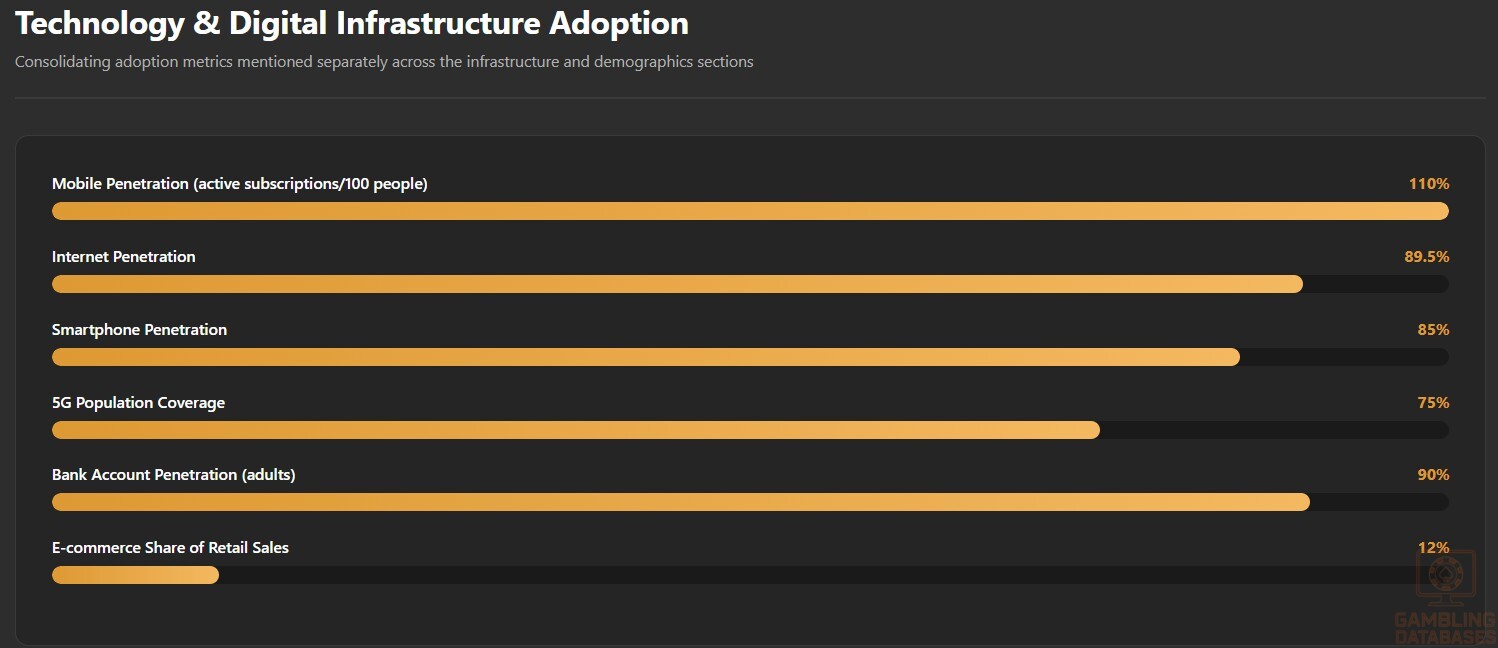
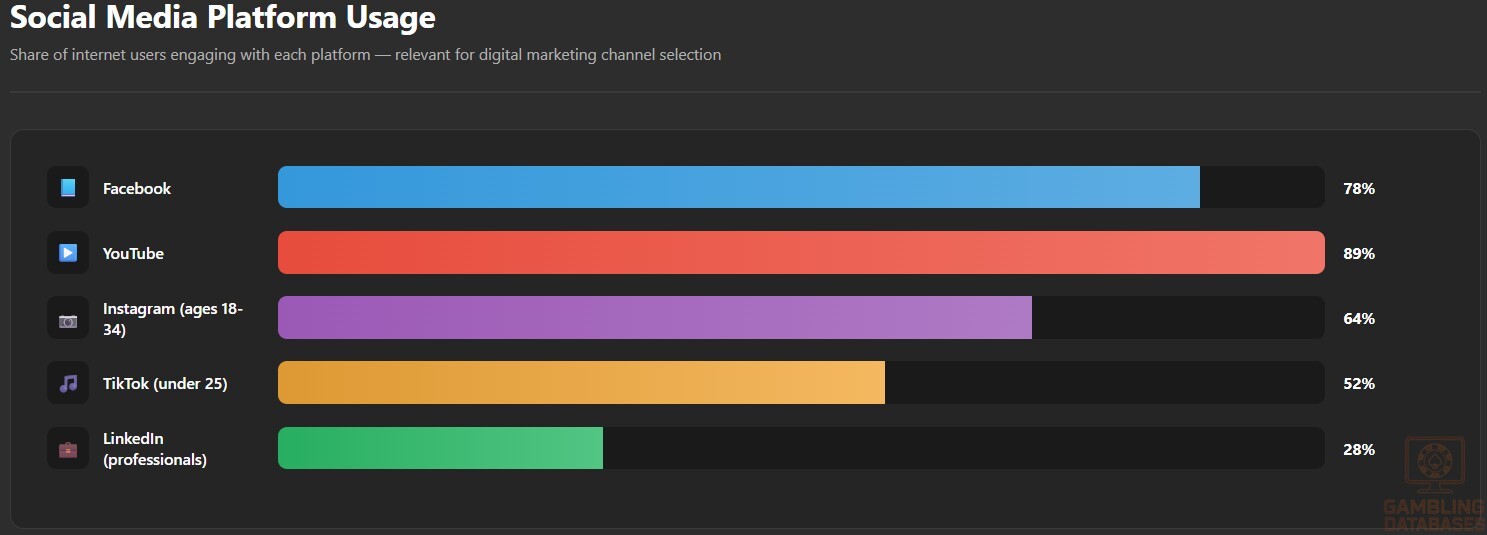
Lithuania reports an internet penetration rate near 89.5%, with approximately 2.55 million users as of early 2025. Daily online engagement averages several hours, driven largely by social media, e-commerce, and digital entertainment consumption.
- Facebook penetrates 78% of internet users with over 2 hours daily use
- Instagram popular with younger demographics, ~64% usage in ages 18-34
- YouTube reaches 89% of users with 45 minutes average viewing daily
- TikTok rapidly expanding, reaching 52% among users under 25
- LinkedIn utilized by 28% of professionals for networking and career
Digital Payment Behavior
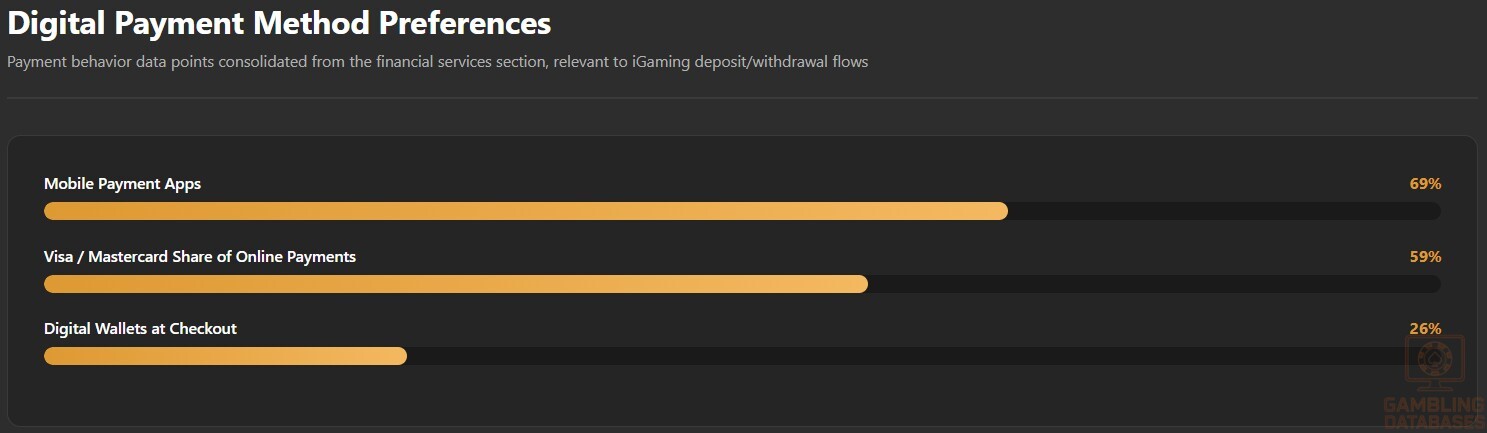
Payment preferences in Lithuania favor card payments and digital wallets, supporting seamless online gambling transactions. Debit cards are the most prevalent payment method, followed by bank transfers and digital wallets such as Google Pay and Revolut.
- Visa and Mastercard dominate with 59% of online payments
- BankLink (open banking) usage growing with instant payment support
- Mobile payment apps used by 69% of residents
- Digital wallets chosen by 26% of online shoppers at checkout
- Cash-on-delivery remains relevant for physical goods but minimal for digital
Gaming and Gambling Preferences
Current Market Participation
The Lithuanian population exhibits diverse gambling habits, with online slot gaming, sports betting, and lotteries ranking highest in participation. The expansion of online platforms has shifted preferences heavily towards remote gambling formats, sustained by convenience and variety.
- Online slot machines (most popular)
- Sports betting (both online and land-based)
- Lotteries
- Online table games
- Bingo
Consumer Behavior Patterns
Consumer engagement peaks during evenings and weekends, with average session durations of 30-45 minutes on digital platforms. Loyalty programs, local language offerings, and mobile accessibility enhance player retention. Spending is broadly distributed with a small segment of high-value players contributing disproportionately to revenues.
Section 3: Technology Infrastructure and Business Environment
Internet and Digital Infrastructure
Lithuania demonstrates a highly developed internet infrastructure with over 89.5% internet penetration as of 2025. Broadband connections dominate urban areas, supporting high-speed fiber-optic networks with average download speeds exceeding 150 Mbps. Rural zones increasingly benefit from mobile broadband where fixed-line deployment is limited, ensuring near-nationwide connectivity.
Network reliability is strong, supported by continuous investments in fiber and infrastructure modernization. Government initiatives emphasize digital economy growth, prioritizing expanded access and fast internet for both consumer and business sectors.
5G and Future Technology Deployment
5G rollout in Lithuania is extensive, covering more than 75% of the population with comprehensive urban and suburban network presence. Leading operators deploy 5G using mid-band and mmWave spectrums to support enhanced mobile broadband and low latency applications essential for real-time gaming.
Future plans focus on expanding 5G to rural regions by 2027 and integrating emerging technologies such as edge computing to enhance digital service delivery. The telecom market is competitive with multiple operators vigorously expanding 5G capacity and coverage.
Mobile Technology Ecosystem
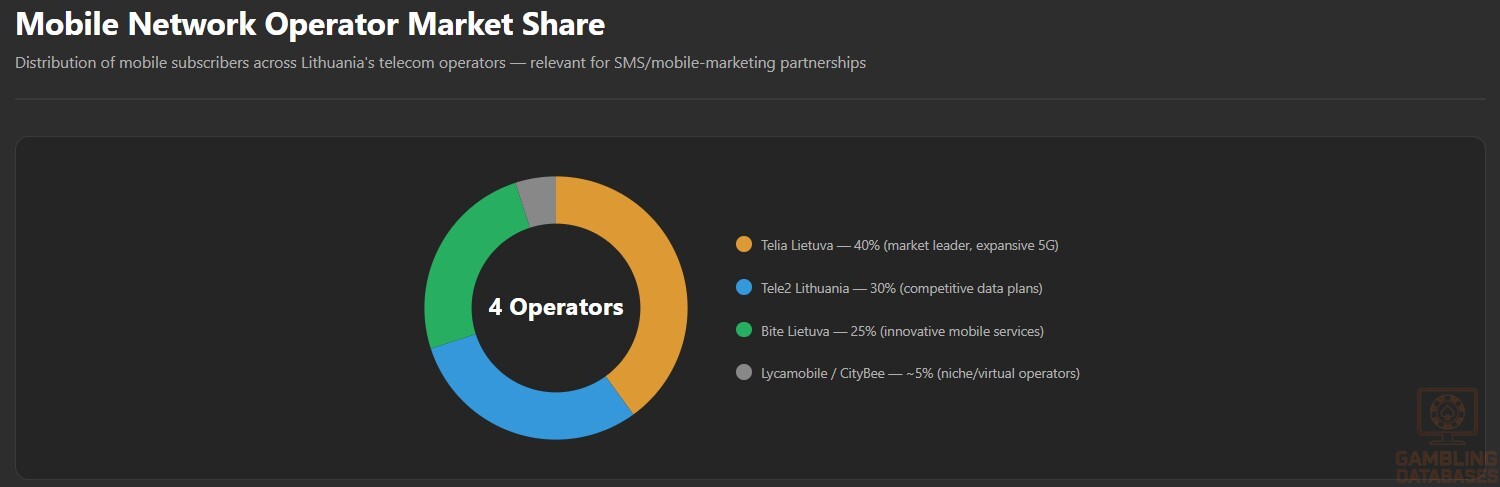
The mobile network ecosystem comprises several prominent operators providing extensive national coverage and competitive pricing. Data costs are moderate compared to the EU average, supporting widespread mobile internet adoption which is critical for mobile gaming growth.
- Telia Lietuva: Market leader with 40% share, expansive 5G network
- Tele2 Lithuania: 30% share, competitive data plans and good rural reach
- Bite Lietuva: 25% share, positioning on innovative mobile services
- Lycamobile: Niche player focusing on prepaid and immigrant segments
- CityBee Mobile: Emerging virtual operator targeting urban youth
Smartphone penetration is over 85%, with popular devices including mid to high-range Android models and Apple’s iPhone series. Device usage favors mobile-first internet access, with a growing trend towards large-screen smartphones and tablets enhancing user experience for gambling and entertainment applications.
Financial Services and Payment Infrastructure
Lithuania’s banking sector is advanced, showing deep digital banking adoption and comprehensive financial service coverage. Account penetration exceeds 90% of adults, with online and mobile banking integral to everyday financial management.
- SEB Bankas: Largest by assets and digital banking platform
- Swedbank Lithuania: Major retail and SME banking provider
- Luminor Bank: Formed by merger, focused on innovation
- Šiaulių Bankas: Regional bank with strong SME focus
- Revolut Lithuania: Fast-growing digital bank with youthful user base
Payment processing systems support a broad range of methods essential for the iGaming industry, including card payments, instant bank transfers, and e-wallets. Lithuania is a leader in adoption of open banking protocols, enabling seamless payment integration and enhanced security.
- Visa and Mastercard domination with secure 3D Secure protocols
- BankLink open banking for instant account-to-account payments
- Popular e-wallets: Skrill, Neteller, Revolut, and Google Pay
- Cryptocurrency payments limited but increasing in niche segments
- Mobile payments utilizing smartphone wallets and NFC technologies
E-commerce and Digital Economy
E-commerce is rapidly growing in Lithuania, with digital retail accounting for over 12% of total retail sales as of 2025. Consumer trust in online payments and delivery logistics continues improving, supported by robust cybersecurity frameworks and regulatory compliance.
Digital services, including online entertainment and gambling platforms, benefit from widespread smartphone use and high-speed internet. Government digital economy initiatives promote cross-border commerce and digital entrepreneurship, cultivating fertile ground for iGaming innovations.
Business Environment and Regulatory Framework
Lithuania ranks highly in the World Bank’s Ease of Doing Business, particularly excelling in starting a business, enforcing contracts, and protecting minority investors. Business registration is streamlined, typically completed within 7-10 business days with simplified electronic processes.
Foreign investment policies are liberal, with full foreign ownership permitted across sectors, encouraging international iGaming operators to establish entities. Operational costs remain moderate compared to Western Europe, enhancing Lithuania’s attractiveness for service and technology companies.
Corporate Structure and Registration
The primary legal entities for business include limited liability companies (LLC), joint stock companies, and representative branch offices. LLCs are the most common structure for iGaming operators, offering liability protection combined with flexible management.
Branch offices allow foreign firms to operate without full incorporation but require compliance with local regulations. Recommended structures depend on operational scope, taxation strategy, and business scale.
- Limited Liability Company (UAB): Most favored, separate legal entity
- Joint Stock Company (AB): Suitable for larger enterprises with public trading ambitions
- Branch Office: Used for foreign companies expanding operations
- Individual Enterprise: For smaller-scale or sole proprietorship activities
- Partnerships: Rare for iGaming due to liability concerns
Registration Requirements
Registration requires submission of corporate documents, tax registration, and compliance with sector-specific licensing. Foreign ownership does not impose restrictions but must adhere to transparency and anti-money laundering regulations.
- Articles of Association and Incorporation documents
- Shareholders’ and directors’ identification and declarations
- Taxpayer registration certificate application
- Bank account opening confirmation for initial capital deposit
- Proof of registered office address in Lithuania
Taxation Framework
The corporate income tax rate applies uniformly at 15%, with incentives available in designated special economic zones. Lithuania benefits from an extensive network of double tax treaties supporting smooth cross-border business operations.
- Estonia
- Latvia
- Poland
- Germany
- United Kingdom
- France
- Netherlands
- Sweden
- Norway
- Denmark
Personal income tax combines a flat rate system with social security contributions, impacting individual contractors and employees in the iGaming sector. Tax residency rules align with EU standards, emphasizing substance and physical presence considerations.
Market Entry Considerations
Recommended strategies for entering Lithuania’s iGaming market include forming local partnerships, securing online-only licenses, and leveraging compliant payment processing ecosystems. Technology localization with Lithuanian language support and mobile-optimized interfaces enhances player acquisition.
Competition is rising; success depends on regulatory adherence, innovative marketing (within advertising constraints), and investment in player protection technologies.
- Obtain online-only license to reduce initial capital outlay
- Partner with local marketing and payment providers
- Invest in responsible gambling and compliance software
- Focus on mobile-friendly platforms and app development
- Utilize data analytics for personalized player engagement
| Cost Category | Estimated Cost (€) |
|---|---|
| License Application and Fees | €500,000 – €1,000,000 |
| Legal and Consultancy Services | €50,000 – €100,000 |
| Technology and Platform Setup | €250,000 – €400,000 |
| Marketing and Customer Acquisition | €100,000 – €300,000 |
| Operational and Staffing Costs (Year 1) | €400,000 – €700,000 |
- Prepare and notarize all corporate registration documents
- Submit application to Companies Registry with payment of fees
- Register for taxes and obtain tax identification number
- Open corporate bank accounts and deposit required capital
- Apply for gambling licenses with the Gambling Supervision Authority
- Build and test technology platforms compliant with regulations
- Launch marketing campaigns after regulatory approval
FAQ: Frequently Asked Questions
1. Is online gambling legal in Lithuania?
Yes, online gambling is legal and regulated under the Lithuanian Law on Gambling. Operators must obtain licenses from the Gambling Supervision Authority to provide online casino, sports betting, poker, and other remote gaming services. Since 2022, it is possible to obtain an online-only gambling license without a land-based operation, increasing market accessibility.
2. What types of gambling licenses are available and what do they cover?
Licenses cover land-based casinos, online gambling, betting shops, lotteries, and slot machine halls. Online licenses can be remote-only or combined with a land-based license. Different gaming categories require specific license types, ensuring regulatory oversight of each vertical. There are also licenses for totalisator betting and other niche gaming activities.
3. How much does an iGaming license cost and how long does it take to obtain?
Online-only licenses cost approximately €500,000, while combined licenses can reach €1 million. The application review typically takes 6 to 9 months, contingent on submission completeness and compliance validation. Operators should budget additional months for preparation and technical certifications.
4. Can foreign companies obtain a gambling license?
Yes, foreign companies can hold licenses without ownership restrictions. They must comply with Lithuanian laws, submit required documentation, and demonstrate financial and operational capability. A local presence is not mandatory for online licenses but is required for land-based operations.
5. What are the tax obligations for iGaming operators?
Operators pay a gross gaming revenue (GGR) tax of 22% across all gaming verticals. Corporate income tax of 15% applies on net profits. Tax incentives are available in special economic zones. Annual license fees and turnover levies might also apply depending on activity scale.
6. Are gambling winnings taxed for players?
Players generally are not taxed on winnings below certain thresholds. Above thresholds, winnings may be subject to withholding taxes. Operators are responsible for ensuring compliance with reporting and tax collection where applicable.
7. What are the typical operational costs for running an online casino/sportsbook?
Key costs include licensing fees, technology setup, payment processing fees, marketing, and ongoing compliance. Annual operational expenses for staffing, platform maintenance, and regulatory reporting can be significant. Operators should budget several hundred thousand euros annually for stable operations.
8. What is the expected ROI timeline for entering this market?
ROIs vary widely; new entrants typically reach break-even within 18 to 36 months, depending on marketing effectiveness, portfolio diversity, and player retention. Regulatory compliance and localized strategies accelerate profitability.
9. What are the local presence requirements for operators?
Online-only license holders do not require a physical presence. Land-based gambling operators must maintain approved physical venues with staff and responsible gambling officers. All operators must maintain local domain registration and comply with data retention laws.
10. What payment methods are available and recommended?
Recommended methods include Visa, Mastercard, local bank transfers via BankLink, and popular e-wallets like Skrill and Neteller. Cryptocurrency use is growing but not yet mainstream. Payment methods must support secure processing and quick settlement.
11. What are the advertising and marketing restrictions?
Lithuania imposes strict advertising rules, banning gambling ads during 6 a.m. to 6 p.m. and aiming for a full ban by 2028. Sponsorship of sports and events will also be prohibited. Marketing must not target minors or vulnerable groups, with mandatory responsible gambling messages.
12. What responsible gambling measures are mandatory?
Operators must implement age verification, self-exclusion programs, transaction monitoring, and clearly display responsible gambling information. Staff training in responsible gambling procedures is compulsory, alongside regular compliance reporting to regulators.
13. How large is the iGaming market and what is the growth potential?
The market generated over €222 million in GGR in 2023, growing at double-digit rates fueled by remote gambling adoption. With increasing digital penetration and regulatory improvements, sustained growth above 10% annually is expected for the next five years.
14. Who are the main competitors and what is their market share?
The market is moderately consolidated with about a dozen licensed operators, including large international groups and local firms. Olympic Casino Group is a leading player with significant market share, followed by emerging online specialists. Competition intensifies as new licenses and online innovations proliferate.
15. What are the player preferences and typical spending patterns?
Players favor online slots and sports betting, complemented by table games and lotteries. Spending is concentrated among a core group of high-value players, with most users engaging moderately and favoring mobile-accessible platforms and loyalty programs for retention.
16. What are the key success factors and main challenges for new entrants?
Success depends on regulatory compliance, local partnerships, cultural adaptation, and robust technology. Challenges include high licensing costs, tight marketing restrictions, and competitive pressure from established operators. Navigating complex reporting and AML obligations also demands investment in compliance systems.
- Understanding and adhering to strict local regulations
- Building localized marketing strategies within advertising limits
- Investing in mobile-first technology platforms
- Implementing strong player protection and responsible gambling tools
- Developing partnerships with local payment and service providers
Sources and References
- Lithuanian Gambling Supervision Authority – Official Portal – https://www.gsa.lt
- Ministry of Finance of Lithuania – Gambling Legislation and Taxation – https://finmin.lrv.lt
- Eurostat – Lithuania Economic and Demographic Data – https://ec.europa.eu/eurostat
- World Bank – Ease of Doing Business Report 2024 – https://worldbank.org
- Lithuanian Department of Statistics – Population and Income Reports – https://stat.gov.lt
- European Commission – Digital Economy and Society Index 2025 – https://ec.europa.eu/digital-single-market/en/desi
- National Communications Regulatory Authority – Telecom and Internet Stats – https://rrt.lt
- SEB Bank Lithuania – Annual Financial Reports – https://seb.lt
- Swedbank Lithuania – Market and Payment Insights – https://swedbank.lt
- Lithuanian Bank Association – Payment System Reports – https://lb.lt
- Digital Lithuania – National Digital Literacy Programs – https://digital.lt
- International Telecommunication Union – ICT Data for Lithuania – https://itu.int
- iGaming Industry Europe – Market Analysis 2024-2025 – https://igaming.europe
- Statista – Gambling and Payment Preferences in Lithuania – https://statista.com
- Trading Economics – Lithuania Macro Data – https://tradingeconomics.com
- IGaming Express – Lithuania Market Growth and Projections 2025 – https://igamingexpress.com
- Lithuanian Ministry of Economy – Business Registration Guidelines – https://economy.lrv.lt
- Latvian-Lithuanian Intelligent Transport Cooperation Report – 2025
- European Gaming and Betting Association – Compliance Reports – https://egba.eu
- Global Betting and Gaming Consultants – Market Forecast 2025 – https://gbgc.com
- Casinobeats – Lithuania Regulatory and Market Updates 2024-2025 – https://casinobeats.com
- National Anti-Money Laundering Authority Lithuania – Compliance Guidelines
- Google Digital Insights – Lithuania Social Media Usage 2025
- Financial Times – European Digital Economy Reports 2025
- Reuters – Lithuania Market Entry and Regulation News 2025
- Bloomberg – Baltic States Economic Forecast 2024-2026
- World Economic Forum – Technological Readiness Index 2025
- International Monetary Fund – Regional Economic Outlook 2025
- Government of Lithuania – Online Gambling Advertising Laws 2025
- European Parliament – Digital Services Act Impact on Gambling
- Sigma World – Gambling Taxation and Market Overview – 2025
- Local Lithuanian news portals – Gambling and Regulatory Developments 2025