
Saudi Arabia presents a complex environment for iGaming market entry characterized by stringent legal prohibitions rooted in Islamic law. While all forms of gambling, including online platforms, are strictly forbidden, the Kingdom’s large population and expanding internet access highlight an underlying latent demand.
This analysis provides a deep dive into Saudi Arabia’s regulatory framework, legal environment, and market characteristics vital for any operator or investor considering entry. Understanding compliance risks and enforcement trends is crucial in navigating this tightly controlled market.
Executive Summary: Key Market Indicators
| Metric | Value |
|---|---|
| Gambling Legal Status | Illegal under Sharia law |
| Population | Approx. 35 million |
| GDP (Nominal) | ~$1.1 trillion (2024) |
| GDP per Capita | ~$31,000 |
| Internet Penetration Rate | ~98% |
| Mobile Penetration Rate | ~90% |
| Licensing Availability | None – Gambling licenses not issued |
| Regulatory Authority | Saudi Communications and Information Technology Commission (CITC) |
| Penalty Types for Gambling | Fines, imprisonment, asset confiscation, deportation |
| Reported Maximum Fine | Up to €100,000 per gambling device |
| Taxation on Gambling | Not applicable due to illegality |
| Illegal Gambling Enforcement | High – advanced monitoring and blockades |
| VPN Usage for Online Gambling | Common workaround by players |
| Online Gambling Market Size | Unreported due to illegality |
| Advertising Restrictions | Complete prohibition on gambling ads |
| Operational Barriers | Complete ban, no local presence allowed |
| Average Revenue Per User (ARPU) | Unavailable |
| Market Penetration Rate | Negligible legal penetration |
| Market Entry Timeline | Indefinite – no legal framework for entry |
| Technology Infrastructure | Highly developed telecom and broadband |
| Business Environment Rank | 37 (World Bank Ease of Doing Business 2024) |
| Regulatory Change Trend | Stricter enforcement and fines (increased 2024-2025) |
| Responsible Gambling Regulations | Not applicable |
| Player Protection Policies | Enforced via prohibition rather than regulation |
| Illegal Operator Penalties | Fines up to €2 million (targeting operators abroad) |
| Social Impact Considerations | High due to religious and cultural norms |
| Enforcement Agencies | Cybercrime units, CITC, Saudi Ministry of Interior |
Section 1: Regulatory Framework and Legal Environment
Current Gambling Regulation Status
Saudi Arabia enforces a complete prohibition on all types of gambling activities under its strict adherence to Sharia law. Gambling is considered haram (forbidden) according to Islamic principles and is explicitly banned by law.
The ban covers land-based gambling such as casinos, sports betting venues, and slot halls. No legal framework exists to authorize or regulate these activities within the Kingdom.
Online gambling is similarly prohibited, with comprehensive restrictions enforced on digital platforms. The Saudi Communications and Information Technology Commission (CITC) actively blocks access to gambling websites and related applications through advanced internet censorship technologies.
Despite these restrictions, some residents use VPNs to access offshore licensed platforms, although this remains illegal and exposes them to severe penalties.
Land-Based Gambling Activities
No legal land-based gambling venues operate in Saudi Arabia. Any operational or physical gambling establishments are considered illegal. The government intensifies enforcement actions against unlicensed physical gambling terminals and devices, including modern mobile gambling units.
The regulatory regime imposes severe sanctions on owners or operators of illegal gambling venues. Penalties include monetary fines calculated per gambling device, imprisonment, and asset seizures.
Online Gambling Framework
The Kingdom’s legal framework strictly forbids online gambling. Digital platforms offering games of chance, sports betting, lotteries, or similar services to Saudi residents face blocking and legal prohibitions.
Operators cannot register or acquire any gambling licenses in Saudi Arabia, as no such system exists. The CITC continuously monitors internet traffic, employing filtering mechanisms to prevent access to unauthorized gambling sites.
All forms of digital gambling are treated under the broader cybercrime laws, with active prosecution against those facilitating or participating in illegal online gambling activities.
Licensed Operators and Market Players
Due to the outright ban, no licensed gambling operators exist within Saudi Arabia. Markets remain fully closed to legal gambling business models, and no official operators are authorized by Saudi regulators.
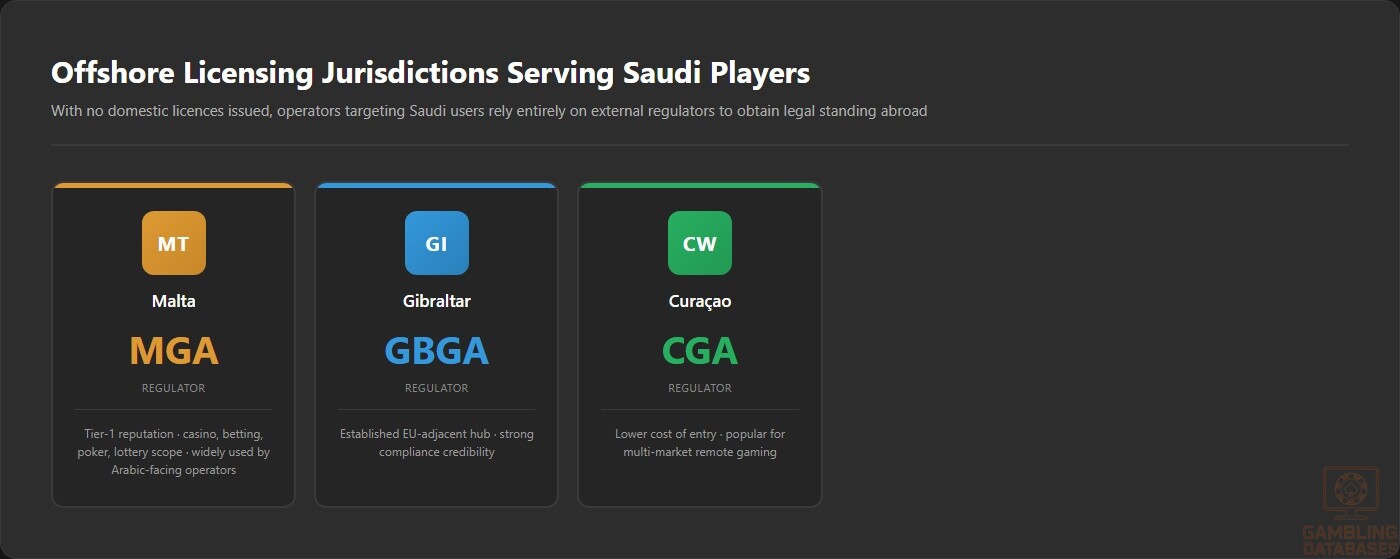
International operators targeting Saudi players typically rely on licenses issued by reputable external jurisdictions such as Malta or Curaçao. These platforms must navigate strict access restrictions domestically and rely heavily on VPN use among players.
The Saudi government aggressively targets illegal providers and their affiliates through fines and interdiction, seeking to deter unauthorized remote gambling access.
Licensing Framework and Requirements
Application Process and Eligibility
Saudi Arabia does not offer any licensing process for gambling operations due to the prohibition under Sharia law. Consequently, there are no application procedures, fees, or technical standards for gambling licenses within the Kingdom.
International regulatory bodies or jurisdictions are the only entities issuing licenses for operators aiming to serve Saudi players indirectly. Any intention to formally establish gambling operations within Saudi Arabia is legally unfeasible under current statutes.
Local Presence and Operational Requirements
The regulatory environment mandates no gambling-related physical presence or operational infrastructure within Saudi Arabia, as gambling activities are strictly illegal.
Foreign ownership rules and partnership requirements specific to gambling businesses are irrelevant since the sector is closed. No domains or servers can be registered or legally operated for gambling services targeted at Saudi residents.
Compliance Obligations and Monitoring
Player Protection and Identification
Player protection in Saudi Arabia operates through prohibition rather than formal regulatory mandates. Age verification and KYC procedures are implemented by international operators outside Saudi jurisdiction.
The government enforces strict measures to prevent underage and vulnerable individuals from accessing illegal gambling. Self-exclusion systems do not exist domestically as gambling itself is criminalized.
Financial Monitoring and Reporting
Financial transaction monitoring related to gambling occurs primarily through criminal enforcement and cybercrime investigations. Saudi authorities cooperate with payment providers and financial institutions to identify and block gambling-related transactions.
No formal regulatory reporting processes exist for operators, given the absence of legal gambling entities in the Kingdom.
Taxation Structure and Financial Obligations
Player Taxation
There is no official taxation on gambling winnings as all gambling is illegal. Instead, players engaging in gambling face criminal penalties including fines and imprisonment rather than tax liabilities.
Operator Taxation
No operator taxation system is applicable within Saudi Arabia’s jurisdiction due to the gambling ban. Offshore operators are not subject to Saudi corporate or gaming taxes on revenue generated from Saudi players.
| Game Type | GGR Tax Rate | Other Taxes |
|---|---|---|
| Online Casino Slots | — | — |
| Sports Betting | — | — |
| Poker | — | — |
| Lottery | — | — |
Gambling Market Financial Performance
Official data on market size, revenue, or wagered amounts does not exist due to illegality. However, enforcement agencies report growing fines and confiscations related to illicit gambling devices and online activity.
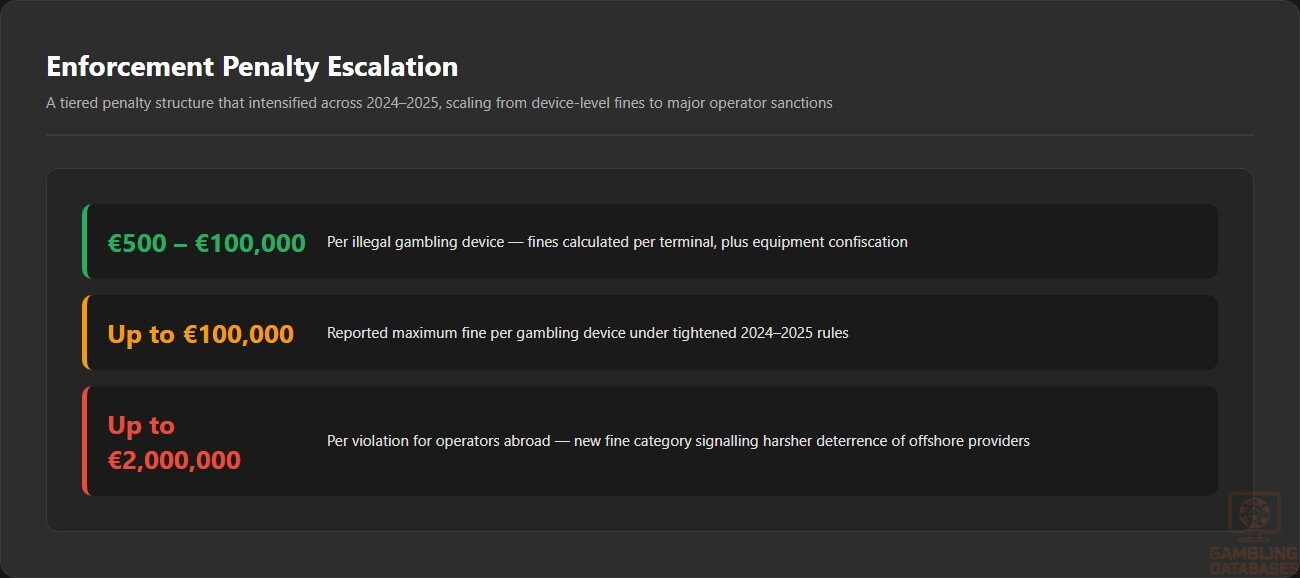
The tightening of fines in 2024-2025, with penalties up to €100,000 per illegal gambling terminal, reflects governmental efforts to curb underground gambling economies.
Advertising and Marketing Restrictions
All gambling-related advertising is banned comprehensively in Saudi Arabia. Broadcast, online, print, and influencer promotions of gambling are prohibited.
- No advertisements on TV or radio for gambling
- Strict ban on online and social media promotions
- Prohibition on sponsorships in sports or events
- Restrictions on indirect advertising such as affiliate marketing
- Heavy penalties for breaches including fines and content removal
This zero-tolerance stance limits any form of brand visibility within the Kingdom.
Recent Regulatory Changes and Their Impact
Over the past two years, Saudi Arabia has enhanced enforcement measures against illegal gambling. Legislative amendments have increased financial penalties and expanded cybercrime monitoring capabilities.
The introduction of new fine categories, with ranges up to €2 million per violation for operators, signals harsher deterrence strategies. These changes increase operational risks and costs for illicit actors and foreign providers indirectly serving Saudi customers.
Enforcement Mechanisms and Penalties
Enforcement is strict and multi-faceted, involving technology-driven website blocking, financial transaction monitoring, and criminal prosecution.
- Monetary fines ranging from €500 to €100,000 per illegal device
- Confiscation of gambling equipment and assets
- Imprisonment for individuals involved in gambling activities
- Deportation for expatriates caught gambling
- Closure and blocking of websites and online portals
Authorities also target facilitators such as promoters and affiliates to dismantle gambling networks comprehensively.
Section 2: Demographics and Consumer Analysis
Population Demographics and Distribution
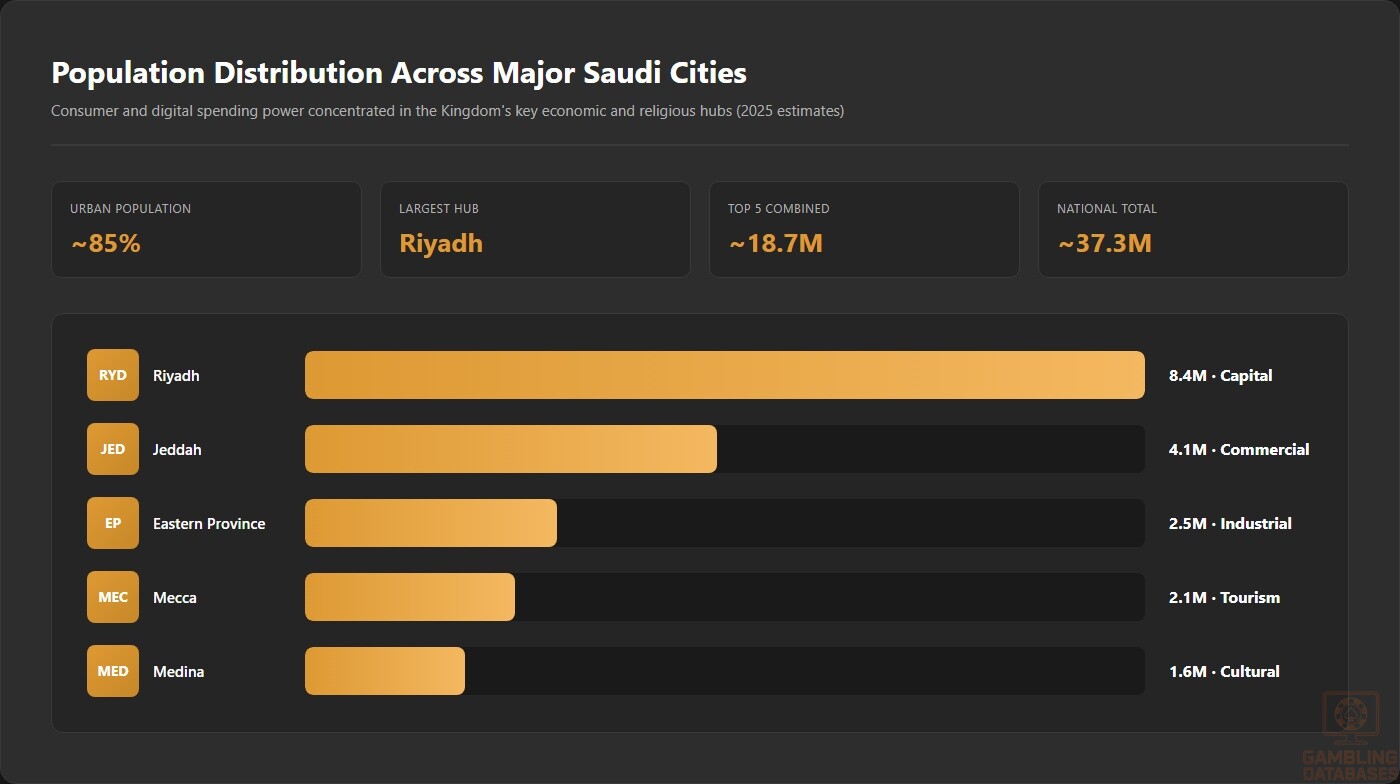
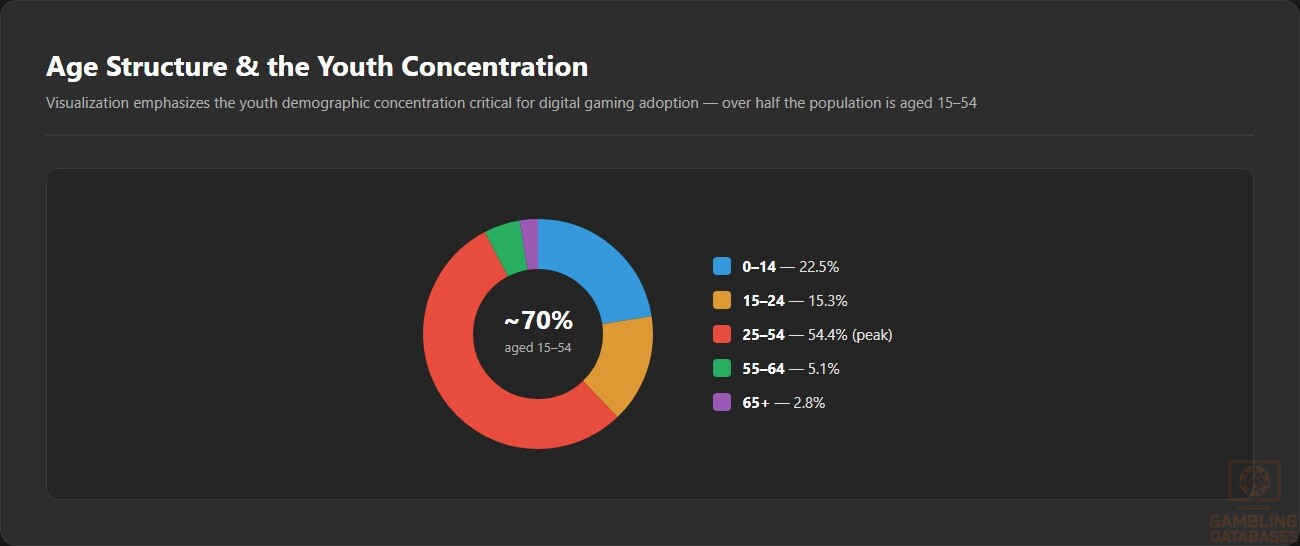
Saudi Arabia’s population in 2025 is estimated at approximately 37.3 million, with a median age of 32.8 years. The population is young, characterized by a strong working-age cohort that dominates demographic composition. About 54% of the population is aged between 25 and 54 years, indicating a robust labor force critical for economic growth and consumption potential.
Children aged 0-14 years represent roughly 22%, while young adults aged 15-24 make up over 15%. Older populations (55 years and above) constitute less than 8%, reflecting the Kingdom’s relatively youthful demographic profile combined with rising life expectancy.
| Age Group | Population (Millions) | Percentage (%) |
|---|---|---|
| 0-14 years | 8.3 | 22.5 |
| 15-24 years | 5.6 | 15.3 |
| 25-54 years | 20.1 | 54.4 |
| 55-64 years | 1.9 | 5.1 |
| 65+ years | 1.0 | 2.8 |
Urbanization is advanced, with roughly 85% of the population residing in urban centers. The demographic gender ratio favors males at approximately 1,327 men per 1,000 women due to expatriate worker influx. This influences consumer behavior and market segmentation strategies.
Geographic Distribution
The Kingdom’s major population centers serve as economic and technological hubs, concentrating consumer spending power and digital connectivity.
- Riyadh: ~8.4 million inhabitants, the political and economic capital
- Jeddah: ~4.1 million, major commercial center and port
- Mecca: ~2.1 million, religious tourism driver
- Medina: ~1.6 million, religious and cultural significance
- Eastern Province (Dammam/Khobar/Dhahran): ~2.5 million, energy and industrial hub
Internet and smartphone penetration are highest in Riyadh and Jeddah, enabling greater digital service adoption. Rural areas witness lower connectivity and limited exposure to entertainment sectors, including gambling-related content.
Economic Indicators and Consumer Spending Power
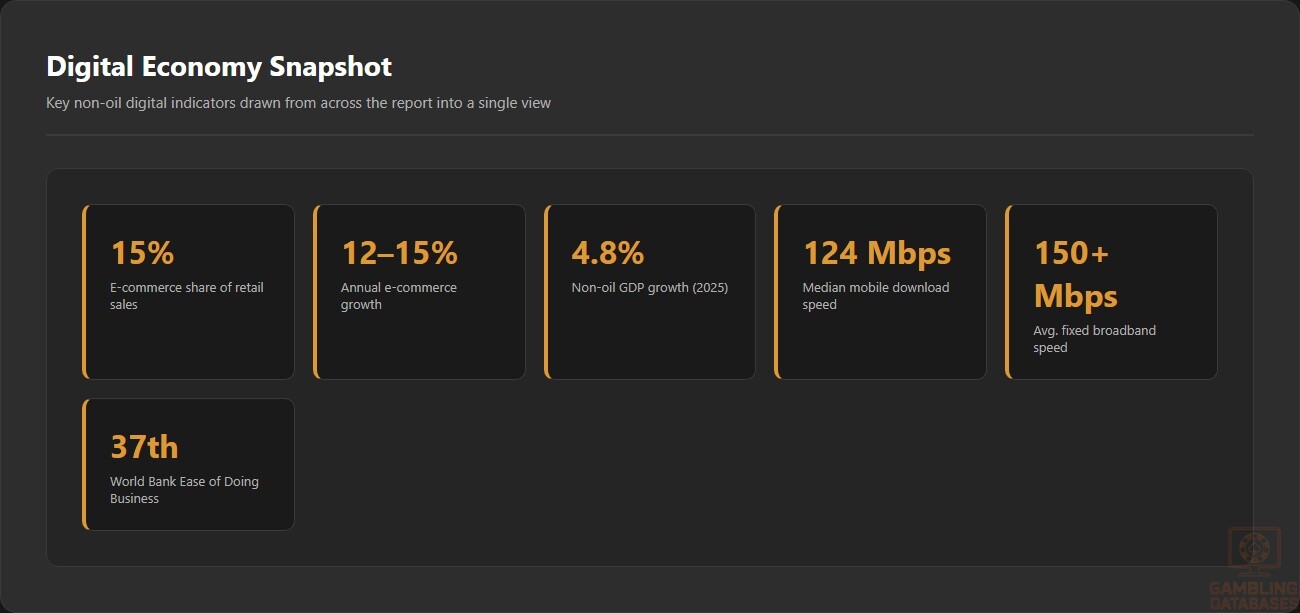
Saudi Arabia’s nominal GDP is estimated at approximately $1.1 trillion in 2025, with a per capita GDP near $31,000. The economy is diversifying under Vision 2030 initiatives, with non-oil sectors expected to grow by approximately 4.8% in 2025.
The Saudi non-oil economy expansion highlights rising domestic demand and private sector investments. Services and industry sectors are the primary contributors, while oil remains a significant but gradually decreasing GDP share.
| Indicator | Value |
|---|---|
| GDP (Nominal) | $1.1 trillion |
| GDP per Capita | $31,000 |
| Non-oil GDP Growth | 4.8% |
| Inflation Rate | 2.1% |
| Unemployment Rate | 3.1% |
Household income varies widely across regions and occupational groups. Urban households benefit from public sector wages and growing private employment, while rural incomes tend to be lower and more dependent on subsidies.
Wealth distribution demonstrates moderate inequality with rising middle-class segments. Consumer spending is increasingly directed toward digital entertainment and mobile services, reflecting rising disposable incomes among younger populations.
Market Size and Growth Projections
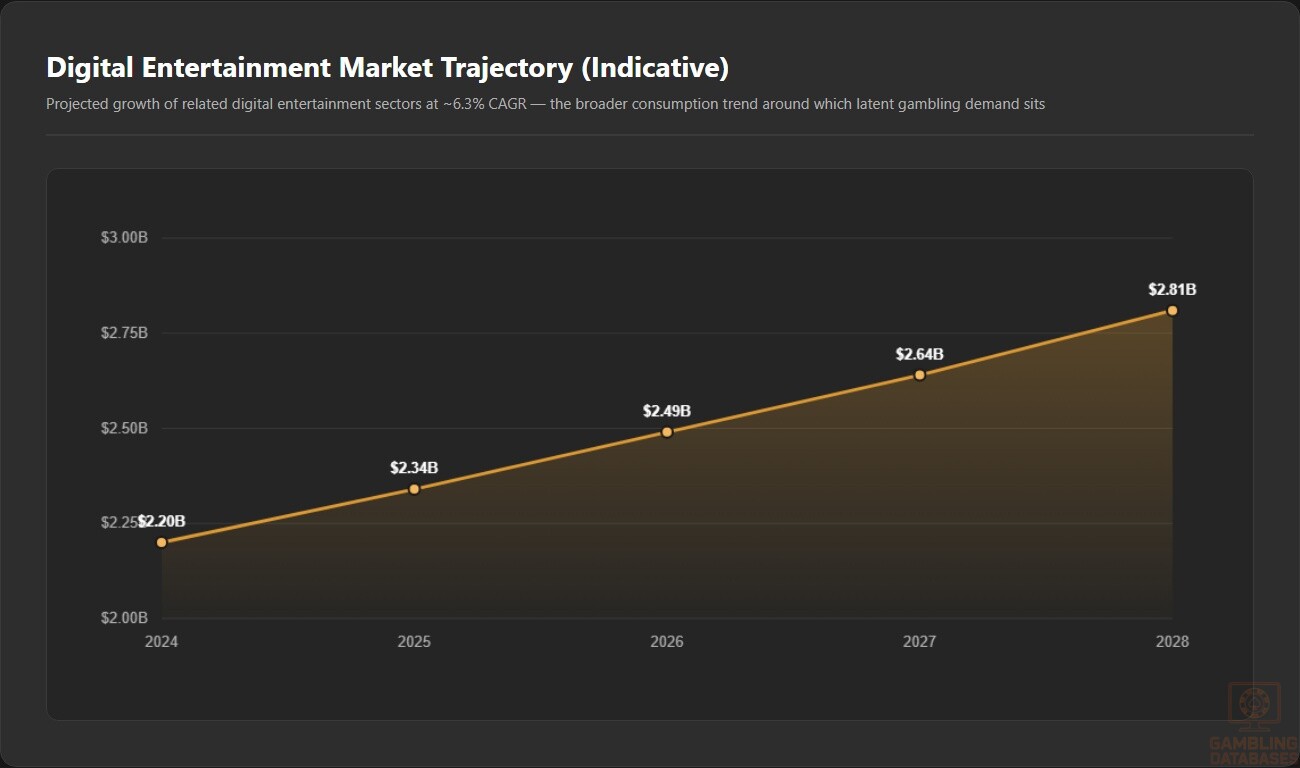
Despite the official ban on gambling, a latent underground market exists driven largely by expatriate residents and youth accessing offshore platforms. Market growth estimates remain speculative due to illegality, but behavioral surveys suggest significant informal engagement.
Annual growth in digital consumption areas and indirect gambling activity is expected to reflect general economic trends, with a projected CAGR of approximately 6% in related digital entertainment sectors over the next five years.
| Year | Estimated Market Size (USD Billions) | CAGR (%) |
|---|---|---|
| 2024 | 2.2 | — |
| 2025 | 2.34 | 6.4 |
| 2026 | 2.49 | 6.3 |
| 2027 | 2.64 | 6.3 |
| 2028 | 2.81 | 6.4 |
Education, Skills, and Digital Literacy
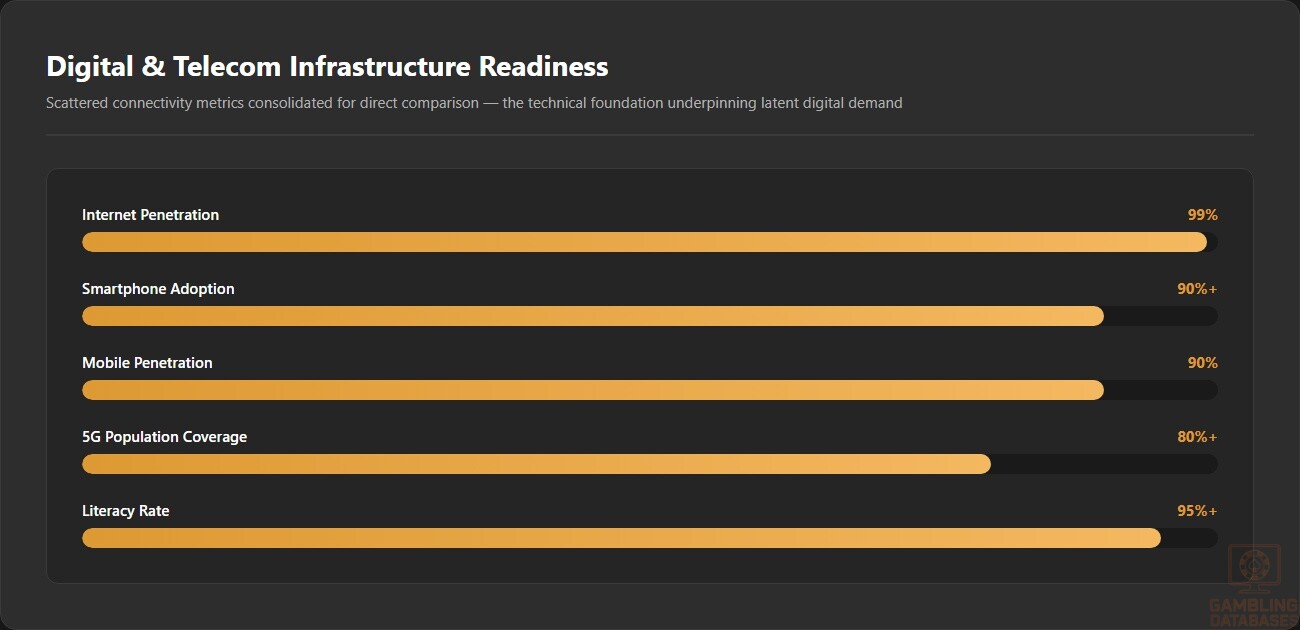
Saudi Arabia boasts a literacy rate exceeding 95% and significant investment in higher education has raised the skills base substantially. Digital literacy—especially among youth—is robust, with widespread smartphone adoption and internet familiarity.
The workforce is increasingly skilled in IT and digital sectors, aligning with Kingdom objectives to foster a knowledge-based economy. These factors contribute to high engagement levels in online services, including entertainment and digital payment usage.
Cultural and Social Factors
Communication and Language
Arabic is the official language, with English widely used in business and digital contexts. Internet content consumption occurs mainly in Arabic and English, with localization critical for market engagement.
- Arabic: predominant communication and content language
- English: second language among professionals and youth
- Urdu and Tagalog: significant expatriate community languages
- French and other European languages: less common but present
- Other regional languages linked to immigrant populations
Cultural Attitudes
Gambling is culturally and religiously taboo in Saudi Arabia, with strong Islamic values shaping public opinion. Gambling-related activities are broadly rejected at social and community levels.
Foreign brands face a dual challenge: respecting conservative norms while appealing to younger, digitally connected demographics seeking entertainment alternatives. Brand acceptance often depends on subtlety and contextual sensitivity.
Problem Gambling and Social Considerations
Due to prohibition, no official data exists on problem gambling prevalence within Saudi society. However, informal studies indicate occasional engagement, primarily among expatriate males.
- Government educational programs address risks of gambling
- Religious counseling provides community support
- Family-based intervention remains a common response
- Online monitoring initiatives target illegal gambling access
- Social media campaigns promote awareness against gambling
Political Structure and Governance
Saudi Arabia is a monarchy with high political stability and a governance system emphasizing religious and social conformity. Regulatory consistency underpins strict control of social and digital activities.
International relations prioritize economic diversification and openness, yet regulatory frameworks maintain conservative stances on sectors like gambling reflecting cultural values and societal priorities.
Technology Adoption and Digital Behavior
Internet and Digital Usage
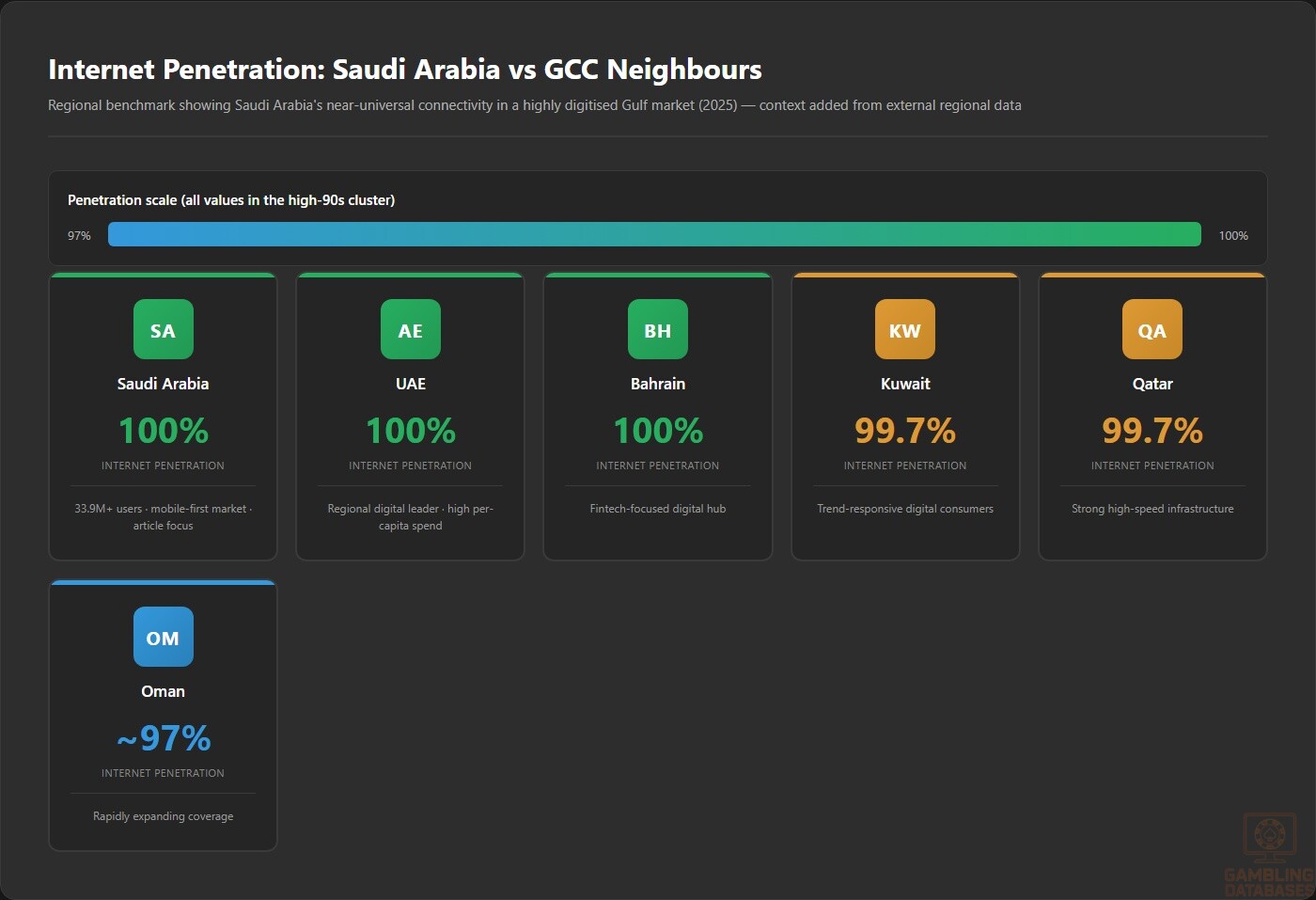
Internet penetration is exceptionally high at approximately 99%, with over 33.9 million users as of early 2025. Mobile broadband dominates access modes, supported by median mobile download speeds exceeding 124 Mbps.
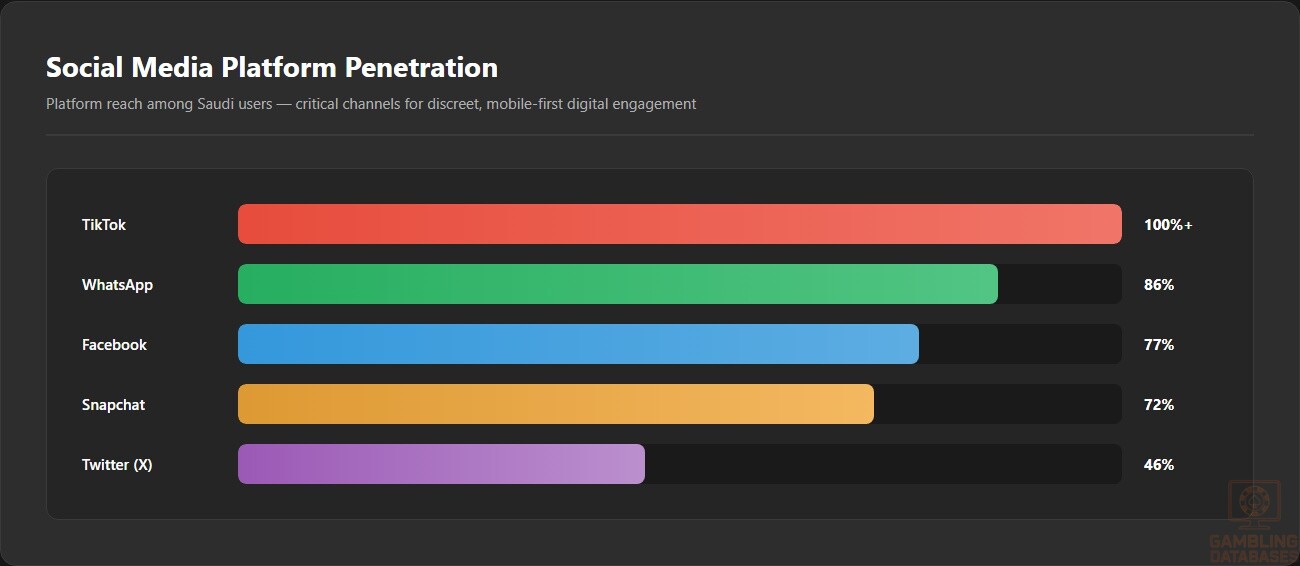
Social media engagement is among the world’s highest, driven by youth and urban populations actively participating across platforms.
- WhatsApp: 86% penetration with over 29 million users
- Facebook: 77% penetration and growing
- Snapchat: 72% penetration, favored for privacy
- TikTok: 100%+ penetration, dominant among youth
- Twitter (X): Around 46% penetration, popular for news and discourse
Digital Payment Behavior
Digital payments dominate online transactions, with widespread adoption of mobile wallets, credit cards, and bank transfers. The government promotes fintech innovation, accelerating e-commerce and digital service consumption.
- STC Pay leads as the most popular digital wallet
- Apple Pay and Google Pay growing rapidly
- Traditional credit and debit cards remain widespread
- Bank transfers used for higher-value transactions
- Cryptocurrency adoption is limited but emerging
Gaming and Gambling Preferences
Current Market Participation
Despite illegality, surveys indicate that around 38% of Saudi adults have engaged in some form of sports betting or games of chance within the previous year, mostly through online or informal peer-to-peer channels.
| Activity | Participation Rate (%) |
|---|---|
| Sports betting | 38.2 |
| Peer-to-peer sports bets | 21.7 |
| Online sports bets | 17.4 |
| Lottery / games of chance | 12.2 |
Consumer Behavior Patterns
Players generally prefer mobile platforms for convenience and discretion, typically engaging in short, frequent sessions. Peak gambling activity correlates with major sporting events, with football being the most popular focus.
Retention rates are influenced by promotional offerings from offshore operators, though consumer trust is affected by censorship and legal penalties. Digital wallets and instant payment methods enhance transaction ease.
Section 3: Technology Infrastructure and Business Environment
Internet and Digital Infrastructure
Saudi Arabia boasts near-universal internet penetration, reaching approximately 99% of the population by 2025. The balance between fixed broadband and mobile internet access slightly favors mobile connectivity, reflecting widespread smartphone use and ongoing infrastructure investments.
Average fixed broadband speeds exceed 150 Mbps, while 4G LTE mobile networks provide stable data rates averaging 70-90 Mbps. The government continues steady investment in fiber optic expansion and network resilience to support digital transformation objectives.
5G and Future Technology Deployment
Saudi Arabia’s 5G rollout, initiated in 2019, now covers over 80% of the population with plans for nationwide coverage by 2027. Multiple mobile network operators actively compete to expand 5G capacity and enterprise applications.
The 5G ecosystem enables innovations in IoT, cloud gaming, and digital payments, which indirectly impact entertainment consumption including gaming sectors. Future technologies like AI-driven network management and advanced cybersecurity will enhance service reliability.
Mobile Technology Ecosystem
Mobile Network Infrastructure
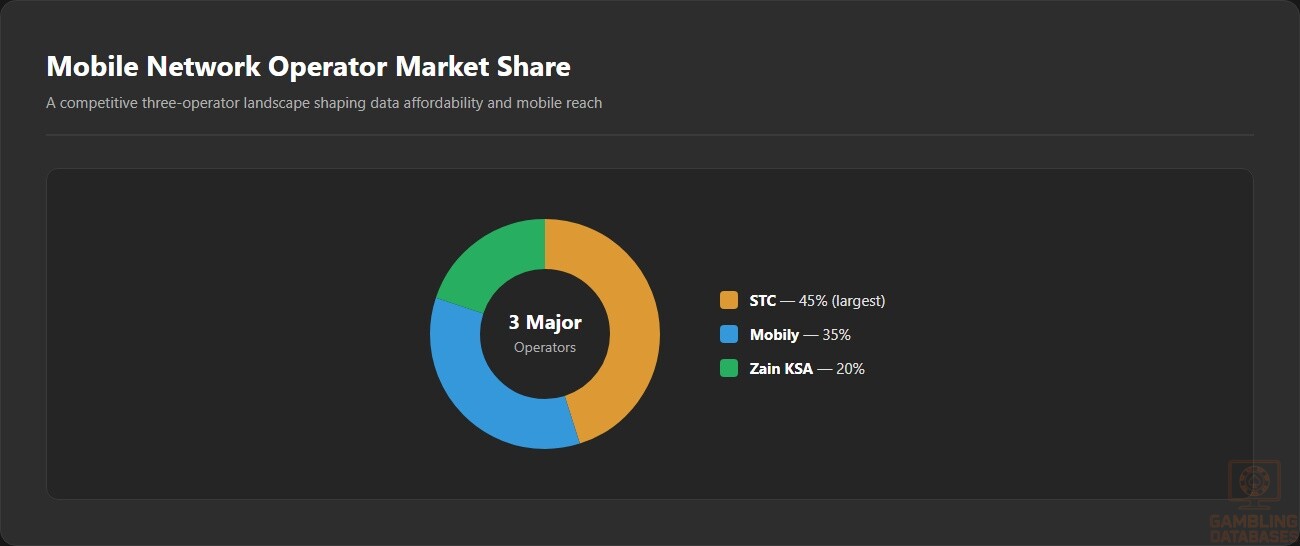
The Saudi mobile market is highly competitive with several major operators controlling distinct market segments. Network quality is generally high, with comprehensive 4G and growing 5G coverage even in suburban and rural areas.
- Saudi Telecom Company (STC) – Largest operator with approximately 45% market share
- Mobily (Etihad Etisalat) – Second largest, holding around 35%
- Zain KSA – Around 20%, focusing on competitive pricing and urban areas
- Virgin Mobile Saudi – Virtual operator targeting youth and niche digital segments
- Lebara and other MVNOs – Serving expatriate communities with specialized offerings
Device Penetration
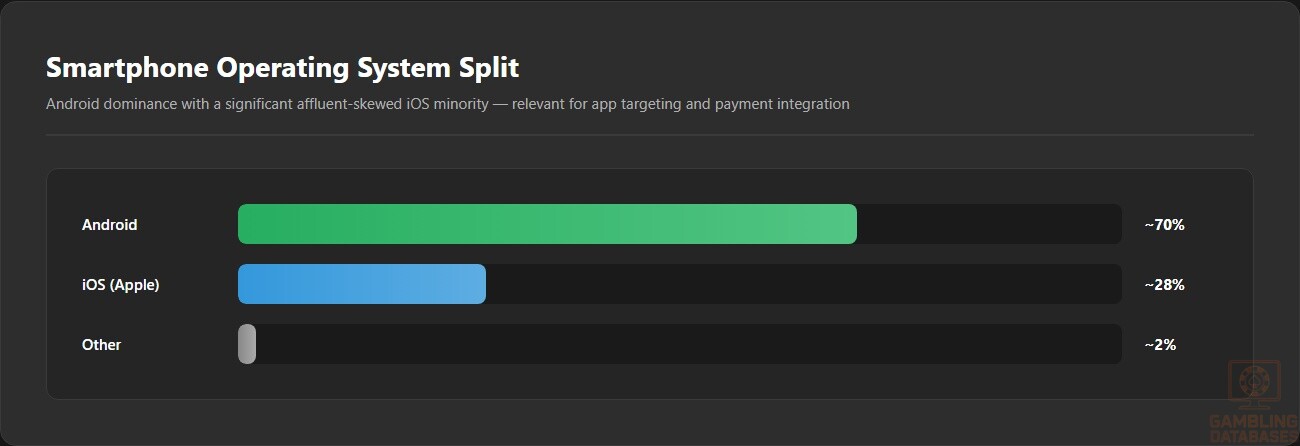
Smartphone adoption is estimated at over 90%, with Android devices forming roughly 70% of the market share. Apple iOS devices account for approximately 28%, favored in urban and affluent demographics.
Devices are primarily used for social media, digital payments, and streaming services. High mobile data affordability encourages extensive mobile app usage including gaming and entertainment applications.
Financial Services and Payment Infrastructure
Banking System Structure
Saudi Arabia’s banking system is mature and technologically advanced, featuring several major banks with extensive digital platforms delivering retail and corporate services.
- National Commercial Bank (NCB) – Largest, with comprehensive fintech services
- Al Rajhi Bank – Leading Islamic bank with huge retail customer base
- Samba Financial Group – Robust digital banking capabilities
- Riyad Bank – Strong SME and corporate banking focus
- Banque Saudi Fransi – Noted for international business facilitation
Payment Processing Options
Digital and card payments dominate online transactions. The government supports several schemes to boost cashless payments and broaden financial inclusion.
- STC Pay – Leading e-wallet with extensive merchant acceptance
- MADA – National payment network enabling card transactions
- Apple Pay and Google Pay – Growing adoption for convenience
- Bank transfers – Used primarily for large payments and business transactions
- Emerging cryptocurrencies – Limited regulatory acceptance and consumer usage
E-commerce and Digital Economy
Saudi Arabia’s e-commerce sector is expanding rapidly, fueled by high internet penetration and consumer preference shifts. Online retail accounts for approximately 15% of total retail sales with growth expected at 12-15% annually.
Consumers exhibit strong trust in digital payment security, supported by regulatory frameworks enhancing consumer protection. The digital economy heavily leverages social media marketing and influencer engagement.
Business Environment and Regulatory Framework
Ease of Business Operations
Saudi Arabia ranks 37th globally on the World Bank’s Ease of Doing Business index, reflecting progressive reforms streamlining business setup. Foreign investment is encouraged with various incentives, though certain sectors remain restricted.
Operational costs such as labor, utilities, and office space are competitive relative to global benchmarks, with expat-friendly regulations easing market entry complexities.
Corporate Structure and Registration
Common corporate forms include Limited Liability Companies (LLCs), Joint Stock Companies (Corporations), and Branch Offices. LLCs are preferred for foreign investors due to liability protection and operational flexibility.
Registration processes typically take 2-4 weeks, involving multiple government agencies and compliance checks. Foreign ownership restrictions are gradually easing under Vision 2030 policies, facilitating easier capital inflow and control.
- Commercial Registration Certificate (CR)
- Articles of Association notarization
- Copy of valid foreign investment license
- Proof of office lease or premises
- Bank account opening confirmation
- Shareholder and director identification documents
Taxation Framework
The corporate income tax standard rate is 20%, with exemptions and reduced rates available in special economic zones and for qualifying projects. Saudi Arabia has concluded numerous double tax treaties enhancing investor certainty.
- United States
- United Kingdom
- Germany
- Japan
- France
- Others totaling over 50 treaty partners
There is no personal income tax on salaries or gambling winnings, creating a tax-friendly environment for individuals.
Market Entry Considerations
Recommended Entry Strategies
Given the regulatory prohibition on gambling, direct operational entry is not feasible. Operators need to consider indirect approaches focusing on offshore licensing and partnerships with digital platforms targeting expatriates and international customers.
- Establish offshore licensing with reputed jurisdictions
- Leverage VPN and proxy solutions for access
- Partner with payment processors specializing in cross-border transfers
- Invest in localized marketing respecting cultural sensitivities
- Focus on mobile-first platforms to capture young users
Typical Costs and Timelines
Initial setup costs depend on offshore jurisdictions and technology investment. Annual compliance in offshore hubs ranges from €100,000 to €250,000, with local marketing expenses varying widely.
| Category | Estimated Cost (EUR) |
|---|---|
| License application and fees | 100,000 – 250,000 |
| Technology platform and integration | 200,000 – 400,000 |
| Marketing and localization | 50,000 – 150,000 |
| Legal and compliance consulting | 30,000 – 80,000 |
| Operational overhead and staffing | 100,000 – 300,000 |
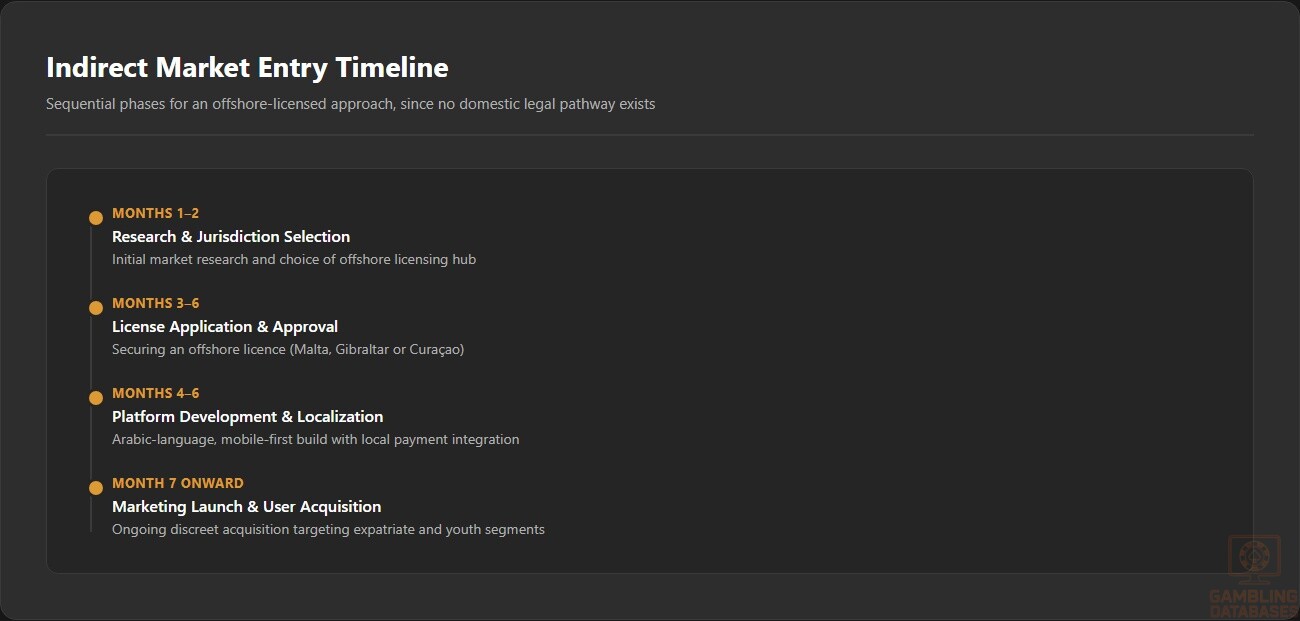
- Initial market research and jurisdiction selection: 1-2 months
- License application and approval: 3-6 months
- Platform development and localization: 4-6 months
- Marketing launch and user acquisition: ongoing from month 7
Success Factors and Challenges
Key success drivers include robust compliance frameworks, culturally tailored marketing, technology agility, and user trust-building under restrictive legal conditions. Challenges stem from strict governmental controls, payment processing hurdles, and high-risk enforcement environments.
- Compliance with strict advertising bans
- Efficient KYC/AML processes for offshore users
- Navigating payment gateways for Saudi users
- Mitigating VPN and geo-block circumvention risks
- Building brand credibility within conservative culture
Exit Strategy Planning
Liquidity for gambling operators focusing on Saudi Arabia is constrained by regulatory prohibitions. Ownership transfers in offshore licensed entities depend on jurisdictional rules, with valuation primarily driven by user base stability and technological assets.
Exit planning requires attention to compliance record and regional expansion prospects to preserve enterprise value.
FAQ: Frequently Asked Questions
1. Is online gambling legal in Saudi Arabia?
Online gambling is explicitly illegal under Saudi law, guided by Islamic legal principles that prohibit all forms of gambling. No licenses are issued, and access to gambling sites is actively blocked. Engaging in gambling activities, including online betting, carries criminal penalties such as fines and imprisonment for individuals.
2. What types of gambling licenses are available and what do they cover?
Saudi Arabia currently does not offer any gambling licenses as all gambling is banned. International operators wishing to target Saudi players must obtain licenses from offshore jurisdictions such as Malta, Gibraltar, or Curaçao. These licenses cover various activities such as online casino games, sports betting, poker, and lottery but do not grant legality within Saudi borders.
3. How much does an iGaming license cost and how long does it take to obtain?
Costs for an iGaming license vary by offshore jurisdiction but typically range from €100,000 to €250,000 in application and annual fees. The licensing process can take between 3 to 6 months, depending on regulatory complexity. Saudi Arabia does not provide licensing; operators must work through external regulators for market access.
4. Can foreign companies obtain a gambling license?
Foreign companies cannot obtain gambling licenses issued by Saudi authorities as gambling is illegal. Instead, they must seek licenses from international regulatory bodies recognized for online gaming. These offshore licenses enable operations targeting multiple global markets including restricted regions but require careful compliance with local laws.
5. What are the tax obligations for iGaming operators?
Within Saudi Arabia, tax obligations for iGaming operators do not exist due to the ban on gambling. Offshore operators servicing Saudi players are subject to tax regimes of their licensing jurisdiction. Saudi corporate income tax applies only to legal business activities, currently not including gambling operations.
6. Are gambling winnings taxed for players?
No official taxes are levied on gambling winnings in Saudi Arabia; however, gambling itself is prohibited, and players risk fines or criminal charges. Taxation of gambling winnings is therefore not formally applied within the Kingdom.
7. What are the typical operational costs for running an online casino or sportsbook?
Operational costs vary significantly but generally include licensing and regulatory fees, platform development, payment processing, marketing, staffing, and customer support. These can collectively range from €500,000 to over €1 million annually for established operators targeting similar regional markets.
8. What is the expected ROI timeline for entering this market?
ROI timelines can extend to 3-5 years given high market entry risks, regulatory challenges, and competition. Returns depend heavily on offshore licensing success, user acquisition strategies, technology investments, and ability to navigate access restrictions within Saudi Arabia.
9. What are the local presence requirements for operators?
There are no permissible local presence requirements for gambling operators since activities are banned. Any physical establishment related to gambling is illegal. Operators must operate entirely offshore and deliver services remotely without Saudi-based infrastructure.
10. What payment methods are available and recommended?
In Saudi Arabia, popular payment methods for online transactions include credit/debit cards, local e-wallets like STC Pay, bank transfers, and mobile wallet solutions. Cryptocurrencies see limited use. Operators should integrate multiple payment channels to accommodate diverse user preferences securely.
11. What are the advertising and marketing restrictions?
All gambling advertising is prohibited in Saudi Arabia across all media, including digital and social platforms. This prevents brand promotion or affiliate marketing within the Kingdom. Marketing efforts must focus on offshore audiences and comply with local content restrictions.
12. What responsible gambling measures are mandatory?
Saudi Arabia enforces a zero-tolerance policy, thus no formal responsible gambling program exists domestically. International operators targetting Saudi players often deploy KYC verification, self-exclusion tools, and spending limits in compliance with global standards.
13. How large is the iGaming market and what is the growth potential?
The iGaming market within Saudi Arabia is unofficial and undeveloped due to strict prohibitions. However, informal usage patterns suggest significant latent demand among younger demographics. Growth potential exists primarily through offshore operator services targeted discreetly at Saudi users.
14. Who are the main competitors and what is their market share?
No domestic legal operators are present. Leading offshore operators licensed in Malta, Gibraltar, and Curaçao indirectly compete by offering Arabic-language platforms and payment methods accommodating Saudi users. Market share data is limited due to clandestine nature.
15. What are the player preferences and typical spending patterns?
Saudi players inclined toward sports betting, especially football, and casual games accessed via mobile devices. Betting typically occurs in small amounts with frequent transactions. User preference shifts toward platforms with enhanced privacy and swift payment options.
16. What are the key success factors and main challenges for new entrants?
Success requires intricate understanding of regulatory risks, technological adaptability, and effective cultural localization. Challenges include stringent legal bans, aggressive enforcement, payment system constraints, and limited marketing opportunities.
- Robust legal risk management framework
- Localized product offerings and language support
- Flexible payment and withdrawal systems
- Strong technological infrastructure for uptime
- Trust-building and reputation management
Sources and References
- Saudi Arabia Gambling Regulatory Authority – Official Website
- National Statistical Office – Population and Economic Data 2025
- Central Bank of Saudi Arabia – Financial Statistics and Reports
- Ministry of Finance Saudi Arabia – Tax Regulations and Guidelines
- World Bank – Doing Business Report 2024
- International Telecommunication Union – ICT Statistics 2025
- Gambling Insider – KSA Regulatory Updates 2025
- iGaming Today – Saudi Online Gambling Analysis 2025
- Global Media Insight – Saudi Arabia Demographics 2025
- DataReportal – Digital Saudi Arabia 2025 Report
- PopulationPyramid.net – Saudi Arabia Age Statistics 2025
- IMF – Saudi Arabia Economic Assessment 2025
- Riyad Capital – Saudi Economic Chartbook Q1 2025
- Saudi Arabia Ministry of Communications – 5G Rollout Plans
- SoftSwiss – 2025 iGaming Trends Report
- Worldometers – Saudi Arabia Population 2025
- Saudi Arabian Monetary Authority – Banking Sector Overview
- European Gaming – KSA Gambling Taxation Review
- Digital 2025 Saudi Arabia – Social Media & Payment Insights
- Eclipse Ad Agency – Social Media Trends Saudi Arabia 2025
- 6W Research – Saudi Arabia Gambling Market Forecast 2026
- International Monetary Fund – Saudi Arabia Concluding Statement 2025
- Wikipedia – Demographics of Saudi Arabia 2025
- GamingTec News – Licensing and Compliance 2025
- FocusGN – KSA Economic Measures 2025
- Next.io – KSA Regulation Impact and Enforcement Updates
- AffPapa – Saudi Gambling Tax Analysis 2025
- BlockChain Ads – Global iGaming Regulation Overview 2025
- Sigma World – Saudi Supervisory Agenda 2025
- SoftSwiss News – iGaming Market Insights 2025
- Radom – Online Gambling Risk Analysis Saudi Arabia
- Eclipse Agency – Saudi Social Media Marketing Trends 2025
- Arabaa – Social Media Usage Saudi Arabia 2025
- TGM Research – Gambling Market Survey Saudi Arabia 2025
- Trading Economics – Saudi Arabia Indicators 2025
Section 3: Technology Infrastructure and Business Environment
Internet and Digital Infrastructure
Saudi Arabia boasts near-universal internet penetration, reaching approximately 99% of the population by 2025. The balance between fixed broadband and mobile internet access slightly favors mobile connectivity, reflecting widespread smartphone use and ongoing infrastructure investments.
Average fixed broadband speeds exceed 150 Mbps, while 4G LTE mobile networks provide stable data rates averaging 70-90 Mbps. The government continues steady investment in fiber optic expansion and network resilience to support digital transformation objectives.
5G and Future Technology Deployment
Saudi Arabia’s 5G rollout, initiated in 2019, now covers over 80% of the population with plans for nationwide coverage by 2027. Multiple mobile network operators actively compete to expand 5G capacity and enterprise applications.
The 5G ecosystem enables innovations in IoT, cloud gaming, and digital payments, which indirectly impact entertainment consumption including gaming sectors. Future technologies like AI-driven network management and advanced cybersecurity will enhance service reliability.
Mobile Technology Ecosystem
Mobile Network Infrastructure
The Saudi mobile market is highly competitive with several major operators controlling distinct market segments. Network quality is generally high, with comprehensive 4G and growing 5G coverage even in suburban and rural areas.
- Saudi Telecom Company (STC) – Largest operator with approximately 45% market share
- Mobily (Etihad Etisalat) – Second largest, holding around 35%
- Zain KSA – Around 20%, focusing on competitive pricing and urban areas
- Virgin Mobile Saudi – Virtual operator targeting youth and niche digital segments
- Lebara and other MVNOs – Serving expatriate communities with specialized offerings
Device Penetration
Smartphone adoption is estimated at over 90%, with Android devices forming roughly 70% of the market share. Apple iOS devices account for approximately 28%, favored in urban and affluent demographics.
Devices are primarily used for social media, digital payments, and streaming services. High mobile data affordability encourages extensive mobile app usage including gaming and entertainment applications.
Financial Services and Payment Infrastructure
Banking System Structure
Saudi Arabia’s banking system is mature and technologically advanced, featuring several major banks with extensive digital platforms delivering retail and corporate services.
- National Commercial Bank (NCB) – Largest, with comprehensive fintech services
- Al Rajhi Bank – Leading Islamic bank with huge retail customer base
- Samba Financial Group – Robust digital banking capabilities
- Riyad Bank – Strong SME and corporate banking focus
- Banque Saudi Fransi – Noted for international business facilitation
Payment Processing Options
Digital and card payments dominate online transactions. The government supports several schemes to boost cashless payments and broaden financial inclusion.
- STC Pay – Leading e-wallet with extensive merchant acceptance
- MADA – National payment network enabling card transactions
- Apple Pay and Google Pay – Growing adoption for convenience
- Bank transfers – Used primarily for large payments and business transactions
- Emerging cryptocurrencies – Limited regulatory acceptance and consumer usage
E-commerce and Digital Economy
Saudi Arabia’s e-commerce sector is expanding rapidly, fueled by high internet penetration and consumer preference shifts. Online retail accounts for approximately 15% of total retail sales with growth expected at 12-15% annually.
Consumers exhibit strong trust in digital payment security, supported by regulatory frameworks enhancing consumer protection. The digital economy heavily leverages social media marketing and influencer engagement.
Business Environment and Regulatory Framework
Ease of Business Operations
Saudi Arabia ranks 37th globally on the World Bank’s Ease of Doing Business index, reflecting progressive reforms streamlining business setup. Foreign investment is encouraged with various incentives, though certain sectors remain restricted.
Operational costs such as labor, utilities, and office space are competitive relative to global benchmarks, with expat-friendly regulations easing market entry complexities.
Corporate Structure and Registration
Common corporate forms include Limited Liability Companies (LLCs), Joint Stock Companies (Corporations), and Branch Offices. LLCs are preferred for foreign investors due to liability protection and operational flexibility.
Registration processes typically take 2-4 weeks, involving multiple government agencies and compliance checks. Foreign ownership restrictions are gradually easing under Vision 2030 policies, facilitating easier capital inflow and control.
- Commercial Registration Certificate (CR)
- Articles of Association notarization
- Copy of valid foreign investment license
- Proof of office lease or premises
- Bank account opening confirmation
- Shareholder and director identification documents
Taxation Framework
The corporate income tax standard rate is 20%, with exemptions and reduced rates available in special economic zones and for qualifying projects. Saudi Arabia has concluded numerous double tax treaties enhancing investor certainty.
- United States
- United Kingdom
- Germany
- Japan
- France
- Others totaling over 50 treaty partners
There is no personal income tax on salaries or gambling winnings, creating a tax-friendly environment for individuals.
Market Entry Considerations
Recommended Entry Strategies
Given the regulatory prohibition on gambling, direct operational entry is not feasible. Operators need to consider indirect approaches focusing on offshore licensing and partnerships with digital platforms targeting expatriates and international customers.
- Establish offshore licensing with reputed jurisdictions
- Leverage VPN and proxy solutions for access
- Partner with payment processors specializing in cross-border transfers
- Invest in localized marketing respecting cultural sensitivities
- Focus on mobile-first platforms to capture young users
Typical Costs and Timelines
Initial setup costs depend on offshore jurisdictions and technology investment. Annual compliance in offshore hubs ranges from €100,000 to €250,000, with local marketing expenses varying widely.
| Category | Estimated Cost (EUR) |
|---|---|
| License application and fees | 100,000 – 250,000 |
| Technology platform and integration | 200,000 – 400,000 |
| Marketing and localization | 50,000 – 150,000 |
| Legal and compliance consulting | 30,000 – 80,000 |
| Operational overhead and staffing | 100,000 – 300,000 |
- Initial market research and jurisdiction selection: 1-2 months
- License application and approval: 3-6 months
- Platform development and localization: 4-6 months
- Marketing launch and user acquisition: ongoing from month 7
Success Factors and Challenges
Key success drivers include robust compliance frameworks, culturally tailored marketing, technology agility, and user trust-building under restrictive legal conditions. Challenges stem from strict governmental controls, payment processing hurdles, and high-risk enforcement environments.
- Compliance with strict advertising bans
- Efficient KYC/AML processes for offshore users
- Navigating payment gateways for Saudi users
- Mitigating VPN and geo-block circumvention risks
- Building brand credibility within conservative culture
Exit Strategy Planning
Liquidity for gambling operators focusing on Saudi Arabia is constrained by regulatory prohibitions. Ownership transfers in offshore licensed entities depend on jurisdictional rules, with valuation primarily driven by user base stability and technological assets.
Exit planning requires attention to compliance record and regional expansion prospects to preserve enterprise value.
FAQ: Frequently Asked Questions
1. Is online gambling legal in Saudi Arabia?
Online gambling is explicitly illegal under Saudi law, guided by Islamic legal principles that prohibit all forms of gambling. No licenses are issued, and access to gambling sites is actively blocked. Engaging in gambling activities, including online betting, carries criminal penalties such as fines and imprisonment for individuals.
2. What types of gambling licenses are available and what do they cover?
Saudi Arabia currently does not offer any gambling licenses as all gambling is banned. International operators wishing to target Saudi players must obtain licenses from offshore jurisdictions such as Malta, Gibraltar, or Curaçao. These licenses cover various activities such as online casino games, sports betting, poker, and lottery but do not grant legality within Saudi borders.
3. How much does an iGaming license cost and how long does it take to obtain?
Costs for an iGaming license vary by offshore jurisdiction but typically range from €100,000 to €250,000 in application and annual fees. The licensing process can take between 3 to 6 months, depending on regulatory complexity. Saudi Arabia does not provide licensing; operators must work through external regulators for market access.
4. Can foreign companies obtain a gambling license?
Foreign companies cannot obtain gambling licenses issued by Saudi authorities as gambling is illegal. Instead, they must seek licenses from international regulatory bodies recognized for online gaming. These offshore licenses enable operations targeting multiple global markets including restricted regions but require careful compliance with local laws.
5. What are the tax obligations for iGaming operators?
Within Saudi Arabia, tax obligations for iGaming operators do not exist due to the ban on gambling. Offshore operators servicing Saudi players are subject to tax regimes of their licensing jurisdiction. Saudi corporate income tax applies only to legal business activities, currently not including gambling operations.
6. Are gambling winnings taxed for players?
No official taxes are levied on gambling winnings in Saudi Arabia; however, gambling itself is prohibited, and players risk fines or criminal charges. Taxation of gambling winnings is therefore not formally applied within the Kingdom.
7. What are the typical operational costs for running an online casino or sportsbook?
Operational costs vary significantly but generally include licensing and regulatory fees, platform development, payment processing, marketing, staffing, and customer support. These can collectively range from €500,000 to over €1 million annually for established operators targeting similar regional markets.
8. What is the expected ROI timeline for entering this market?
ROI timelines can extend to 3-5 years given high market entry risks, regulatory challenges, and competition. Returns depend heavily on offshore licensing success, user acquisition strategies, technology investments, and ability to navigate access restrictions within Saudi Arabia.
9. What are the local presence requirements for operators?
There are no permissible local presence requirements for gambling operators since activities are banned. Any physical establishment related to gambling is illegal. Operators must operate entirely offshore and deliver services remotely without Saudi-based infrastructure.
10. What payment methods are available and recommended?
In Saudi Arabia, popular payment methods for online transactions include credit/debit cards, local e-wallets like STC Pay, bank transfers, and mobile wallet solutions. Cryptocurrencies see limited use. Operators should integrate multiple payment channels to accommodate diverse user preferences securely.
11. What are the advertising and marketing restrictions?
All gambling advertising is prohibited in Saudi Arabia across all media, including digital and social platforms. This prevents brand promotion or affiliate marketing within the Kingdom. Marketing efforts must focus on offshore audiences and comply with local content restrictions.
12. What responsible gambling measures are mandatory?
Saudi Arabia enforces a zero-tolerance policy, thus no formal responsible gambling program exists domestically. International operators targeting Saudi players often deploy KYC verification, self-exclusion tools, and spending limits in compliance with global standards.
13. How large is the iGaming market and what is the growth potential?
The iGaming market within Saudi Arabia is unofficial and undeveloped due to strict prohibitions. However, informal usage patterns suggest significant latent demand among younger demographics. Growth potential exists primarily through offshore operator services targeted discreetly at Saudi users.
14. Who are the main competitors and what is their market share?
No domestic legal operators are present. Leading offshore operators licensed in Malta, Gibraltar, and Curaçao indirectly compete by offering Arabic-language platforms and payment methods accommodating Saudi users. Market share data is limited due to clandestine nature.
15. What are the player preferences and typical spending patterns?
Saudi players inclined toward sports betting, especially football, and casual games accessed via mobile devices. Betting typically occurs in small amounts with frequent transactions. User preference shifts toward platforms with enhanced privacy and swift payment options.
16. What are the key success factors and main challenges for new entrants?
Success requires intricate understanding of regulatory risks, technological adaptability, and effective cultural localization. Challenges include stringent legal bans, aggressive enforcement, payment system constraints, and limited marketing opportunities.
- Robust legal risk management framework
- Localized product offerings and language support
- Flexible payment and withdrawal systems
- Strong technological infrastructure for uptime
- Trust-building and reputation management
Sources and References
- Saudi Arabia Gambling Regulatory Authority – Official Website
- National Statistical Office – Population and Economic Data 2025
- Central Bank of Saudi Arabia – Financial Statistics and Reports
- Ministry of Finance Saudi Arabia – Tax Regulations and Guidelines
- World Bank – Doing Business Report 2024
- International Telecommunication Union – ICT Statistics 2025
- Gambling Insider – KSA Regulatory Updates 2025
- iGaming Today – Saudi Online Gambling Analysis 2025
- Global Media Insight – Saudi Arabia Demographics 2025
- DataReportal – Digital Saudi Arabia 2025 Report
- PopulationPyramid.net – Saudi Arabia Age Statistics 2025
- IMF – Saudi Arabia Economic Assessment 2025
- Riyad Capital – Saudi Economic Chartbook Q1 2025
- Saudi Arabia Ministry of Communications – 5G Rollout Plans
- SoftSwiss – 2025 iGaming Trends Report
- Worldometers – Saudi Arabia Population 2025
- Saudi Arabian Monetary Authority – Banking Sector Overview
- European Gaming – KSA Gambling Taxation Review
- Digital 2025 Saudi Arabia – Social Media & Payment Insights
- Eclipse Ad Agency – Social Media Trends Saudi Arabia 2025
- 6W Research – Saudi Arabia Gambling Market Forecast 2026
- International Monetary Fund – Saudi Arabia Concluding Statement 2025
- Wikipedia – Demographics of Saudi Arabia 2025
- GamingTec News – Licensing and Compliance 2025
- FocusGN – KSA Economic Measures 2025
- Next.io – KSA Regulation Impact and Enforcement Updates
- AffPapa – Saudi Gambling Tax Analysis 2025
- BlockChain Ads – Global iGaming Regulation Overview 2025
- Sigma World – Saudi Supervisory Agenda 2025
- SoftSwiss News – iGaming Market Insights 2025
- Radom – Online Gambling Risk Analysis Saudi Arabia
- Eclipse Agency – Saudi Social Media Marketing Trends 2025
- Arabaa – Social Media Usage Saudi Arabia 2025
- TGM Research – Gambling Market Survey Saudi Arabia 2025
- Trading Economics – Saudi Arabia Indicators 2025








Saw a compliance thread on Reddit last month about operators trying the ‘technical loophole’ angle in restricted markets, and the consensus was pretty clear: Saudi enforcement isn’t a joke. CITC blocking combined with cybercrime units means you’re looking at actual fines hitting operators abroad, not just theoretical penalties. Someone posted about a Curacao-licensed site getting hit with the €2M operator fine, and that scared off half the discussion. The VPN workaround exists but players doing it are risking serious consequences including deportation for expats. Honestly, this market just isn’t viable for legitimate operators right now.
You’re right about the enforcement trend accelerating. The €2M operator penalties started showing up more frequently in 2024, particularly targeting platforms with payment processing still flowing through regional hubs. What’s interesting from a compliance perspective is that CITC has shifted from passive blocking to active investigation of payment flows, which makes even the indirect routes riskier than they were 18 months ago. The Reddit discussion you mentioned reflects what we’re seeing in enforcement data: operators are pulling out rather than doubling down. The deportation risk for expat players is real but often underestimated in market entry discussions, since it creates a chilling effect on user acquisition itself. Worth noting that some analysts still point to potential liberalization scenarios tied to Vision 2030 economic diversification, but that’s speculative and not reflected in any regulatory signals yet.