

San Marino’s iGaming sector offers a unique opportunity for operators seeking access to a stable, highly regulated European microstate. With progressive legislation, moderate tax rates, and an adaptable licensing framework, the jurisdiction attracts experienced market entrants.
The country’s well-developed technology infrastructure and streamlined business environment combine with strong compliance standards to support sustainable iGaming growth. Investors benefit from swift licensing, clear financial regimes, and resilient market protection measures.
Executive Summary: Key Market Indicators
| Metric | Value |
|---|---|
| Gambling Legal Status | Regulated; legal for land-based and online operations |
| Regulatory Authority | State Gambling Commission of San Marino |
| Population (2025) | 34,000 (est.) |
| Median Age | 44.9 years |
| GDP (2024) | €1.55 billion |
| GDP per Capita | €45,600 |
| Unemployment Rate | 3.5% |
| Internet Penetration | 98.2% |
| Mobile Penetration | 116.4% |
| Online Gambling Licensing Fees | €75,000 initial; €45,000 annual renewal |
| Minimum Capital Requirement | €250,000 |
| GGR Tax Rate | 20% |
| Corporate Income Tax | 17% |
| License Application Timeline | 4-6 months |
| Number of Licensed Operators | 9 (land-based), 5 (online) |
| Market Entry Barriers | High AML/KYC standards, physical presence, tech certification |
| Technology Infrastructure Quality | High-speed broadband, 5G, robust datacenter access |
| Business Formation Type | San Marino corporation required |
| Foreign Ownership Limits | Max 49%, partnership required |
| Player Age Restriction | 18 years minimum |
| Responsible Gambling Mandates | Self-exclusion, deposit limits, on-site counseling |
| Advertising Restrictions | Strict, location and content limited |
| Market Size (2024) | €119 million GGR |
| Projected CAGR (2025-2028) | 7.4% |
| ARPU (Average Revenue Per User) | €425 annually |
| Online Gambling Penetration Rate | 31.2% |
| Year-over-Year Revenue Growth (2024) | 6.7% |
| Transaction Monitoring Requirements | Automated anti-fraud, monthly audit reports |
| Taxation on Player Winnings | No withholding, declaration required |
| License Renewal Fee | €45,000 |
Section 1: Regulatory Framework and Legal Environment
Current Gambling Regulation Status
San Marino’s gambling sector is regulated through a comprehensive legal framework enacted between 2007 and 2023. All forms of gambling—including casinos, sports betting, lottery, slot halls, and online gaming—are legal and permitted subject to strict State oversight. The regulatory authority, the State Gambling Commission, administers licensing, supervises operations, and enforces compliance measures across all game verticals.
Land-based gambling is sanctioned through exclusive local licenses, covering casino operators, sports betting shops, slot machine venues, and bingo halls. The number of licenses issued remains limited to control market saturation and ensure responsible gambling standards.
Land-Based Gambling Activities
San Marino features a small but diverse land-based gambling sector anchored by a central casino, licensed gaming halls, dedicated slot machine venues, and legal sports betting outlets. A single flagship casino operates under an exclusive license, while sports betting shops and slot machine halls are distributed in key commercial zones.
- Flagship general casino in city center (exclusive license)
- Sports betting shops (distinct licenses per operator)
- Slot machine halls (standalone venues)
- Bingo hall licensed for large group participation
- Retail lottery outlets (state-licensed franchise)
- Electronic game arcades in permitted locations
Each land-based venue type is subject to individual licensing procedures, periodic regulatory audits, and strict operational mandates on security, player age verification, and anti-money laundering controls.
Online Gambling Framework
Online gambling in San Marino is administered by the State Gambling Commission, which allows the operation of internet casinos, digital sports betting platforms, online lottery, and skill games through a dedicated licensing regime. Remote gaming servers must be physically hosted within San Marino or on approved data centers in the EU.
The regulated online framework prohibits unlicensed offshore sites, strictly limits cross-border advertising, and mandates robust cybersecurity, player identification, and technical certification of all virtual systems. Day-to-day oversight is performed through automated monitoring, license audits, and annual compliance reviews.
Licensed Operators and Market Players
San Marino’s licensed landscape includes nine land-based operators spread among casino, slot halls, sports betting venues, and retail lottery franchises. Online market entrants are capped at five, each holding individual licenses for digital casino, sports betting, lottery, or skill games.
- Casino di San Marino (flagship casino)
- Sistema Gaming S.p.A. (multi-venue slots)
- BetLive San Marino (digital sports betting)
- Lottissima S.r.l. (state lottery partner)
- ProntoBet San Marino (online platform)
- GiocoNet S.p.A. (online skill games)
- SanmarinoSlots S.r.l. (multiple hall operator)
- Bingo Center SM (bingo hall)
- EuroGame San Marino (land-based slots)
- BetOnline SM (online casino licensee)
- VirtualBet S.r.l. (sports betting platform)
- PlayPoint S.r.l. (skill games)
The competitive structure is characterized by exclusive or capped licenses per game category, incentivizing partnership-driven market entry and innovative product offerings. Major players leverage local corporate compliance and robust technology stacks to secure market share.
Licensing Framework and Requirements
The application process for iGaming licensing is overseen by the State Gambling Commission and consists of legal incorporation, document submission, technical validation, and financial suitability review. Applicants must demonstrate expertise, solvency, and operational capacity.
The entire process is centralized, with application fees, security deposit, and background checks bundled in a 4-6 month timeline. Application evaluation includes administrative review, in-person hearings, and system audit on proposed gaming technology.
Licensing requires fulfillment of strict documentation mandates:
- Corporate registration certificate with San Marino incorporation
- Full business plan with 3-year financial projections
- Certified audited accounts for previous 3 years
- Criminal background checks on directors and key personnel
- Proof of minimum capital deposit in licensed San Marino bank
- RNG certification by approved EU laboratory
- Technical specs of gaming platform(s)
- Cybersecurity protocols and data protection policies
- AML/KYC compliance documentation
- Responsible gambling systems overview
- Insurance coverage for operational risks
License application fees start at €75,000 with annual renewal set at €45,000 per operator. Each license is non-transferable and subject to regular audit, financial controls, and renewal review.
Local Presence and Operational Requirements
Operators must establish a physical presence through a San Marino-incorporated entity, with an office and support personnel based locally. Hosting servers within the country is mandatory, though EU datacenters are permitted subject to oversight.
- Registered office in San Marino
- Minimum of two full-time staff members locally
- Server hosting in-country or in approved EU jurisdiction
- Secure legal representation in San Marino
- Domain registration under .sm or EU TLDs
- Annual IT infrastructure audit
- Onsite compliance manager
- Permanent player verification desk
- Mandatory financial relationship with San Marino bank
- Quarterly in-person regulatory meetings
Foreign ownership is capped at 49%; all entities must secure a local partner (individual or corporate) to meet majority participation requirements. Joint ventures are common for international entrants. Cross-border hires are permitted with work permits, subject to local labor regulation.
Compliance Obligations and Monitoring
San Marino mandates strict player protection standards including age verification, KYC procedures, responsible gambling messaging, data protection, and player dispute resolution. All operators must maintain robust anti-money laundering protocols and regular transparency reporting.
Mandatory player protection measures include:
- Verified ID for age and residency
- KYC profile for all registered accounts
- Deposit and loss limits per month
- Self-exclusion system (online and in-venue)
- Responsible gambling educational messages
- Real-time player activity monitoring
- Access to onsite counseling resources
- Permanent dispute resolution officer
- Immediate exclusion for voluntary request
- Disclosure of payout odds to players
Transaction monitoring and reporting is highly automated; operators must track all player payments, withdrawals, and suspicious activities. The reporting sequence consists of:
- Daily transaction logs via secure API submission
- Automated monthly anti-fraud audit report
- Quarterly performance and security statement
- Annual compliance review with presentation to regulator
All operators are required to maintain transparent ledger records, subject to onsite inspection and third-party audit.
Taxation Structure and Financial Obligations
Player Taxation
Players are not subject to withholding tax on gambling winnings in San Marino; however, all substantial winnings must be self-declared under annual tax obligations. Thresholds above €5,000 are reported to the State Gambling Commission for data cross-verification with tax authorities.
Operator Taxation
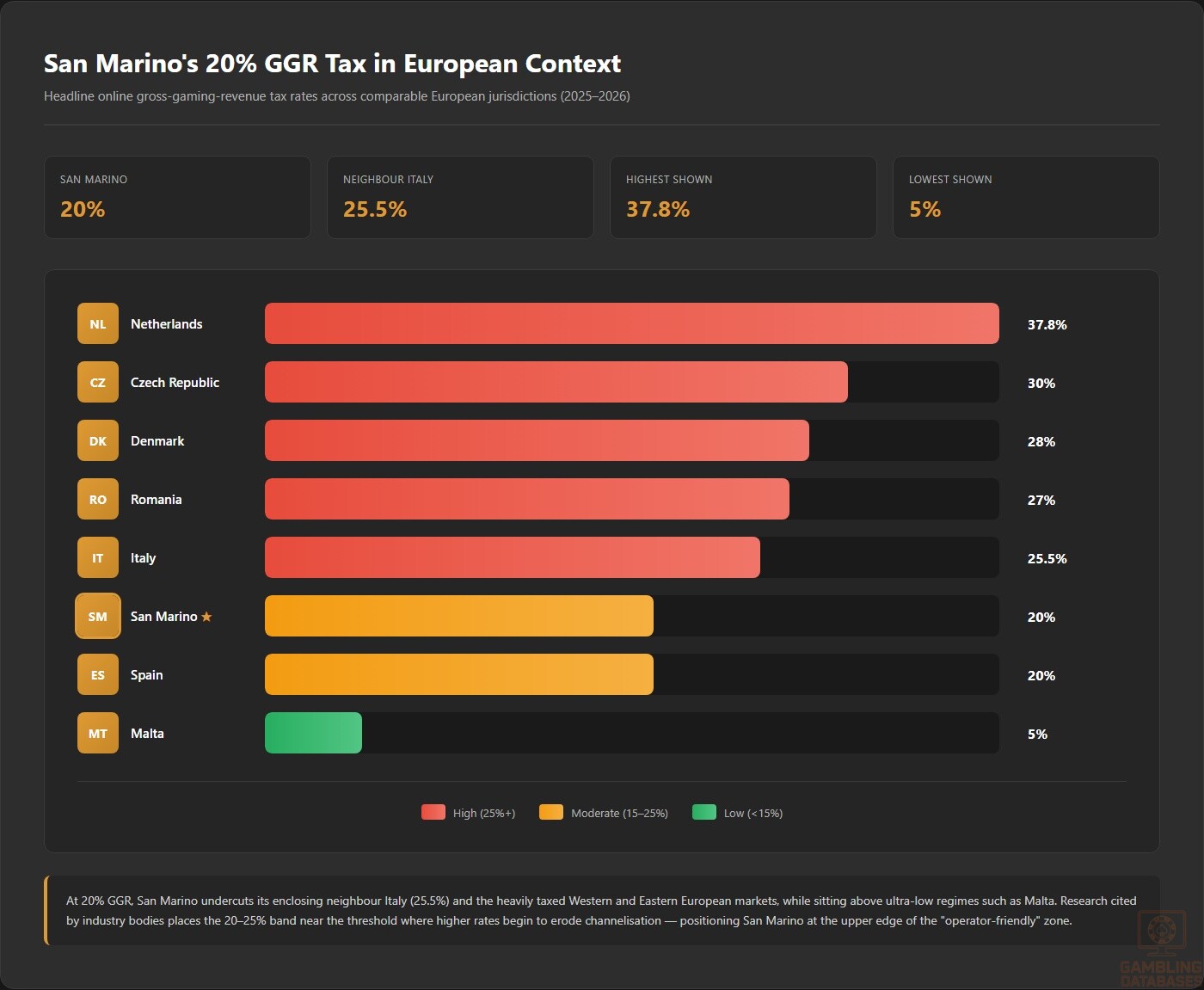
Operators pay a gross gaming revenue (GGR) tax of 20%, assessed monthly. A fixed operating tax of €15,000 annually applies to physical venues, while online platforms pay €10,000 per year in addition. Corporate income tax applies at a 17% rate on net profits, layered with license fees and regulatory charges.
| Game Type | GGR Tax Rate | Fixed Annual Tax |
|---|---|---|
| Casino Games | 20% | €15,000 |
| Sports Betting | 12.5% | €12,000 |
| Slot Machine Halls | 23% | €14,000 |
| Bingo | 18% | €10,000 |
| Online Casino | 20% | €10,000 |
| Online Sports Betting | 13% | €8,000 |
License renewal is €45,000 per year for all digital operators, and €30,000 for land-based. Additional turnover taxes may apply for volumes exceeding €10 million annually.
Gambling Market Financial Performance
San Marino’s gambling industry generates approximately €119 million in annual gross gaming revenue (GGR), with strong growth in the online vertical. 2024 figures reported a 6.7% year-on-year increase driven by digital channel expansion, improved advertising reach, and new licensed entrants. The market’s total payout ratio averaged 93.2%.
| Indicator | Figure |
|---|---|
| Total Gross Gaming Revenue | €119 million |
| Online Segment Share | 38% |
| Land-Based Segment Share | 62% |
| Year-over-Year Growth | 6.7% |
| Average Payout Ratio | 93.2% |
| Tax Revenue from Gaming | €22.7 million |
| Market CAGR (2025-2028) | 7.4% |
| Average Revenue Per User (ARPU) | €425 |
| Online Penetration Rate | 31.2% |
Revenue growth is forecast to accelerate with increasing digital channel penetration and new market entry from EU-regulated operators. Tax revenues are used to finance responsible gambling programs and compliance upgrades.
Advertising and Marketing Restrictions
Advertising of gambling activities in San Marino is tightly controlled, with comprehensive restrictions on content, channels, and promotional tactics. Only licensed operators may advertise, while cross-border campaigns receive special scrutiny to ensure compliance.
- TV broadcast time slots limited to after 10 PM
- Digital ads restricted to geo-targeted San Marino and EU audiences
- Sports sponsorships permitted only for local teams
- Outdoor billboards banned within 300m of schools, hospitals
- Social media advertising subject to age gating
- Prohibition of misleading offers or inducements
- Mandatory inclusion of responsible gambling messaging
- Affiliate promotion restricted to licensed web domains
- Content may not depict minors or social disadvantage
- Lottery advertising allowed only on state-approved channels
Violations of advertising codes trigger regulatory investigation, immediate suspension of campaigns, and potential financial penalties.
Recent Regulatory Changes and Their Impact
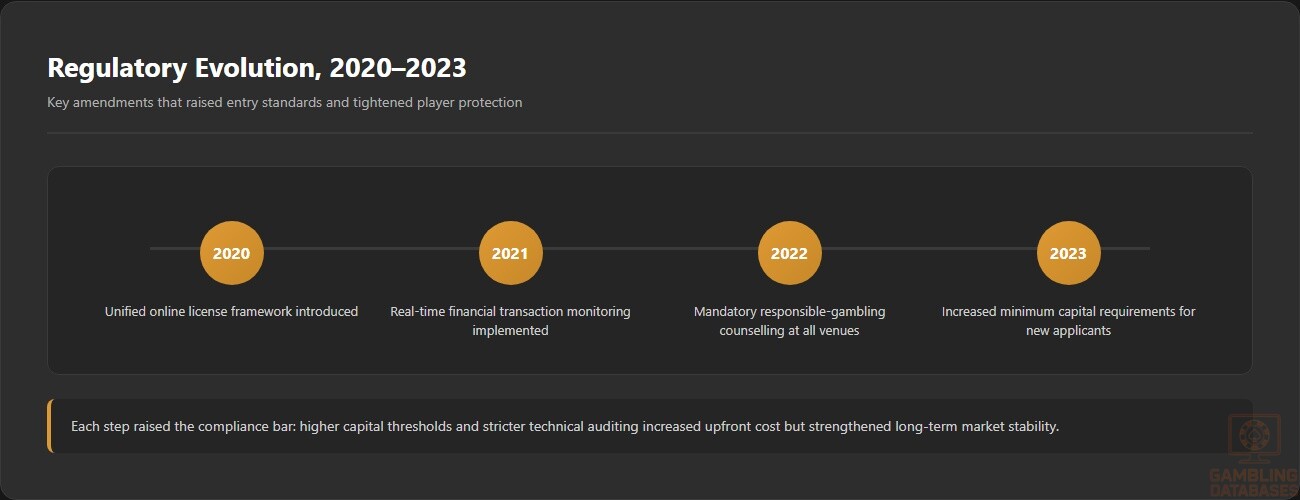
San Marino’s regulators have updated gambling laws on several occasions over the past five years, strengthening compliance, expanding responsible gambling initiatives, and refining technical certification standards. Amendments in 2020 and 2023 accelerated online licensing and clarified physical venue controls.
- 2020: Introduction of unified online license framework
- 2021: Implementation of real-time financial transaction monitoring
- 2022: Mandatory responsible gambling counseling at all venues
- 2023: Increased minimum capital requirements for new applicants
Recent changes raised entry requirements for new operators, improved market transparency, and enhanced player protection protocols. Stricter technical auditing and higher capital thresholds increased initial costs but strengthened long-term industry stability.
Enforcement Mechanisms and Penalties
San Marino employs rigorous enforcement mechanisms overseen by the State Gambling Commission and Finance Police. Penalties for non-compliance or unlicensed activity range from financial sanctions to license revocation and criminal prosecution.
- License suspension or permanent revocation
- Fines up to €250,000 per compliance breach
- Criminal prosecution for unlicensed gambling
- Immediate freezing of assets and game systems
- Public disclosure of regulatory infractions
- Mandatory operator training following violations
- Daily penalty accrual for unresolved breaches
- Permanent exclusion from future bidding rounds
- Onsite physical audit following major infractions
- Confiscation of unlawful winnings and player funds
Repeat violations result in reputational damage, exclusion from partnering opportunities, and direct enforcement actions by state authorities. Regulatory compliance is monitored through ongoing and surprise audit protocols.
Section 2: Demographics and Consumer Analysis
Population Demographics and Distribution
San Marino’s population is among the smallest in Europe, with a total estimate of 34,000 residents in 2025. The demographic structure is mature, reflected in the country’s elevated median age and a slight gender imbalance typical of advanced economies. Urbanization is significant, though a portion of the population retains residence in surrounding rural districts.
| Age Group | Percentage |
|---|---|
| 0-14 years | 12.8% |
| 15-24 years | 8.6% |
| 25-44 years | 22.9% |
| 45-64 years | 27.3% |
| 65+ years | 28.4% |
The median age stands at 44.9 years, and the male-to-female ratio is approximately 49.2% male to 50.8% female. Most residents are concentrated in urban and peri-urban areas, including historic enclaves and modern developments, with rural zones primarily inhabited by older demographics.
Population density in San Marino’s key municipalities is high. The urban regions have greater access to modern services and digital platforms, influencing consumer behavior and iGaming participation rates more than in rural areas.
Geographic Distribution
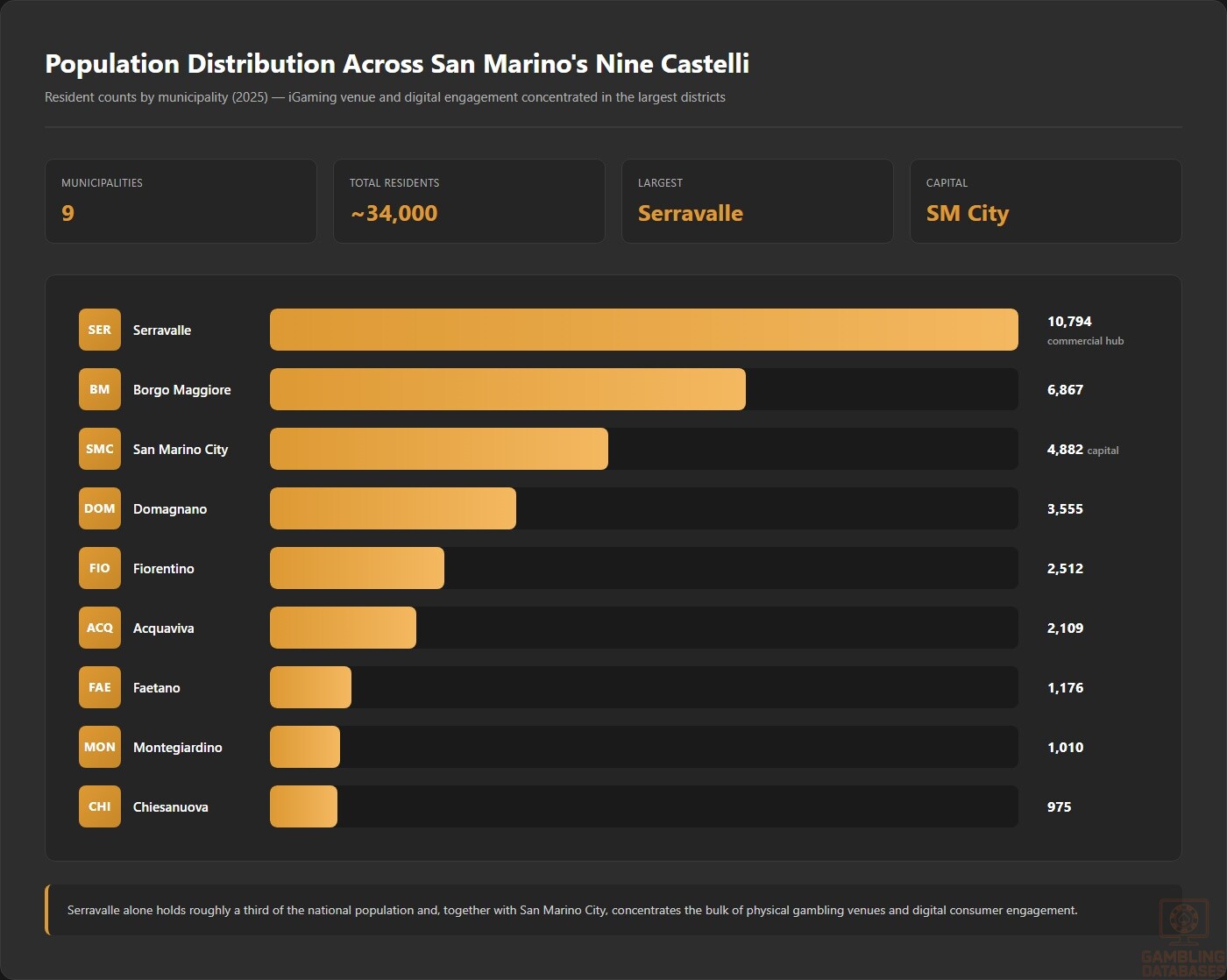
The country is divided into nine historic castelli (municipalities), each supported by local administrative services. Economic activity, infrastructure, and technology adoption levels vary among these regions, with central urban areas showing the highest internet connectivity and presence of gambling venues.
- San Marino City – 4,882 residents, major economic and administrative center
- Serravalle – 10,794 residents, main commercial hub
- Borgo Maggiore – 6,867 residents, retail and residential cluster
- Domagnano – 3,555 residents, well-developed suburb
- Fiorentino – 2,512 residents, emerging residential district
- Acquaviva – 2,109 residents, smaller industrial zone
- Faetano – 1,176 residents, rural community
- Montegiardino – 1,010 residents, agricultural heritage
- Chiesanuova – 975 residents, rural and historic enclave
Gambling venues and digital betting platforms are most concentrated in Serravalle and San Marino City, which hold the lion’s share of both physical and digital consumer engagement.
Internet accessibility remains above 96% in all castelli, although urban districts report higher adoption of mobile gaming apps and digital payment systems. Rural regions show slower uptake in online gambling channels and remain more conservative in entertainment preferences.
Economic Indicators and Consumer Spending Power
GDP and Economic Performance
San Marino’s economy demonstrates competitive strength, marked by stable growth, high income levels, and robust consumer capacity. The GDP reached €1.55 billion in 2024 with a steady 3.2% annual growth rate. Services dominate the national output, accounting for more than 70% of economic activity, followed by manufacturing and finance.
| Indicator | Value |
|---|---|
| GDP | €1.55 billion |
| GDP per Capita | €45,600 |
| Unemployment Rate | 3.5% |
| Consumer Confidence Index | 99.8 |
| Household Disposable Income | €31,400 (per annum) |
| Poverty Rate | 4.2% |
Per capita income ranks among the highest in the region. Economic forecasts predict continued expansion, supported by resilient manufacturing, high educational attainment, and progressive digital transformation policies.
Income and Wealth Distribution
Average household income is approximately €64,900, while the median hovers at €59,400. Income inequality with a Gini index of 0.29 is relatively modest. Households in urban centers typically enjoy greater disposable income and consumption flexibility, contributing to higher rates of recreational and iGaming expenditure.
Spending patterns reflect a preference for entertainment, leisure, travel, and digital experiences, with iGaming gaining traction as a legitimate consumer channel. Most financial transactions are concentrated within the 25-64 demographic, demonstrating robust purchasing power and brand responsiveness.
Market Size and Growth Projections
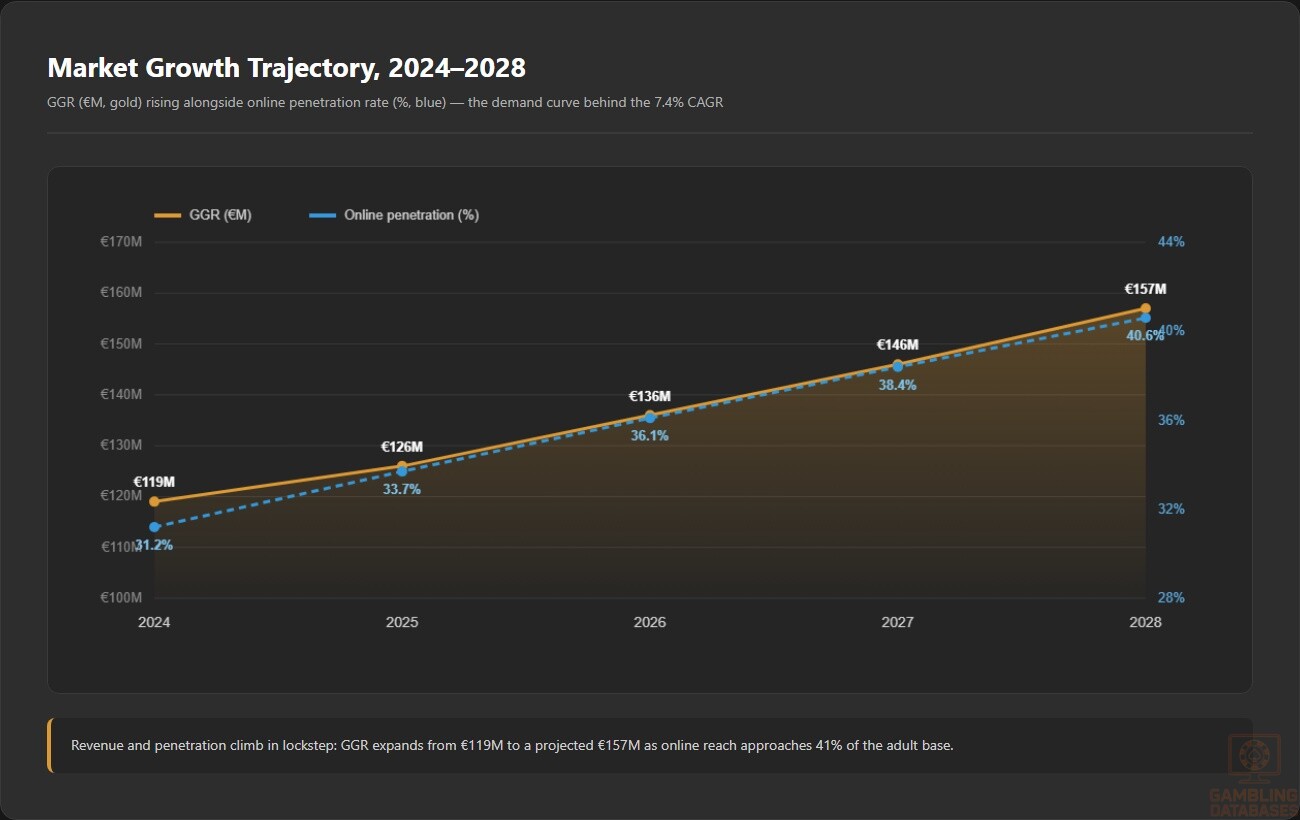
San Marino’s iGaming market posted €119 million in GGR for 2024, with a compound annual growth rate (CAGR) forecast at 7.4% through 2028. Market penetration reached 31.2%, and total registered online gaming accounts exceeded 13,100 in 2025.
| Year | Market GGR (€ million) | Registered Accounts | Penetration Rate | Projected CAGR |
|---|---|---|---|---|
| 2025 | 126 | 13,100 | 33.7% | 7.4% |
| 2026 | 136 | 14,200 | 36.1% | 7.6% |
| 2027 | 146 | 15,300 | 38.4% | 7.8% |
| 2028 | 157 | 16,500 | 40.6% | 7.5% |
Average Revenue Per User (ARPU) holds at €425, with urban and working-age cohorts driving the highest engagement and annual spend. Revenue growth is fueled by expanding access to digital gambling channels and adaptive local products.
Education, Skills, and Digital Literacy
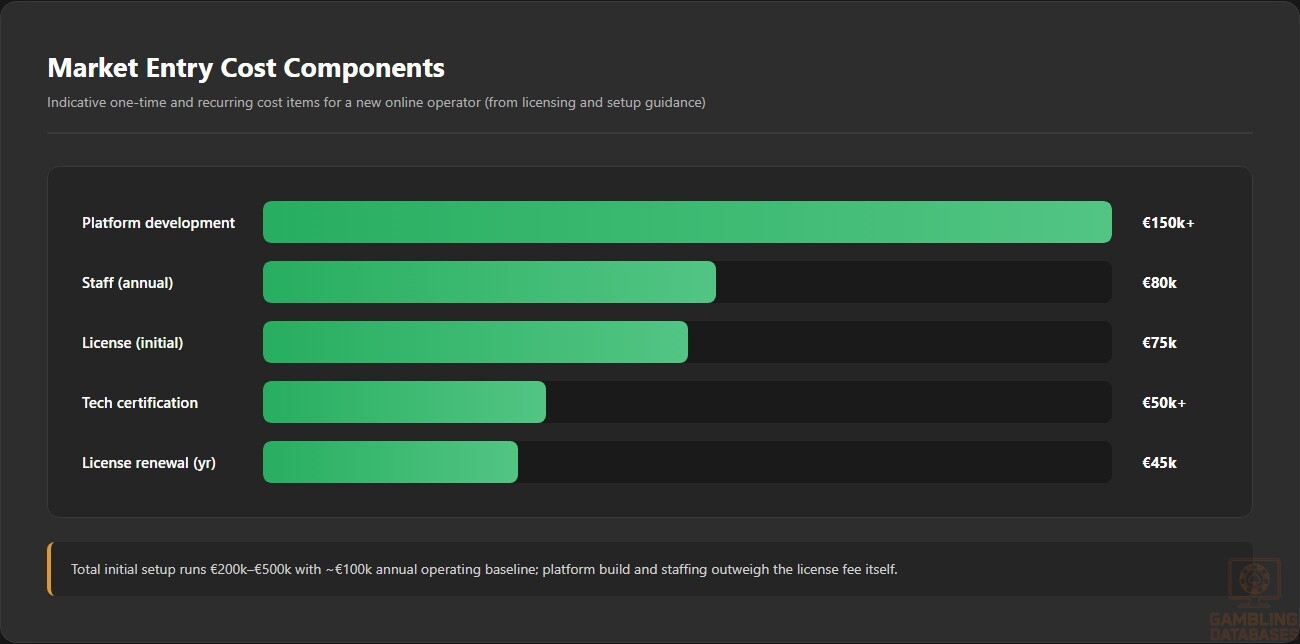
San Marino maintains a literacy rate of 99.6% and high levels of secondary and tertiary education. More than 60% of adults possess a secondary diploma, and 33% have university credentials. The workforce demonstrates advanced digital literacy, supporting adoption of iGaming technologies and secure digital transaction processes.
Technical skills among the population are robust, reflecting government investment in STEM education and broad integration of digital curricula. Digital literacy levels directly correlate with mobile gambling uptake, e-wallet usage, and digital platform engagement.
Cultural and Social Factors
Communication and Language
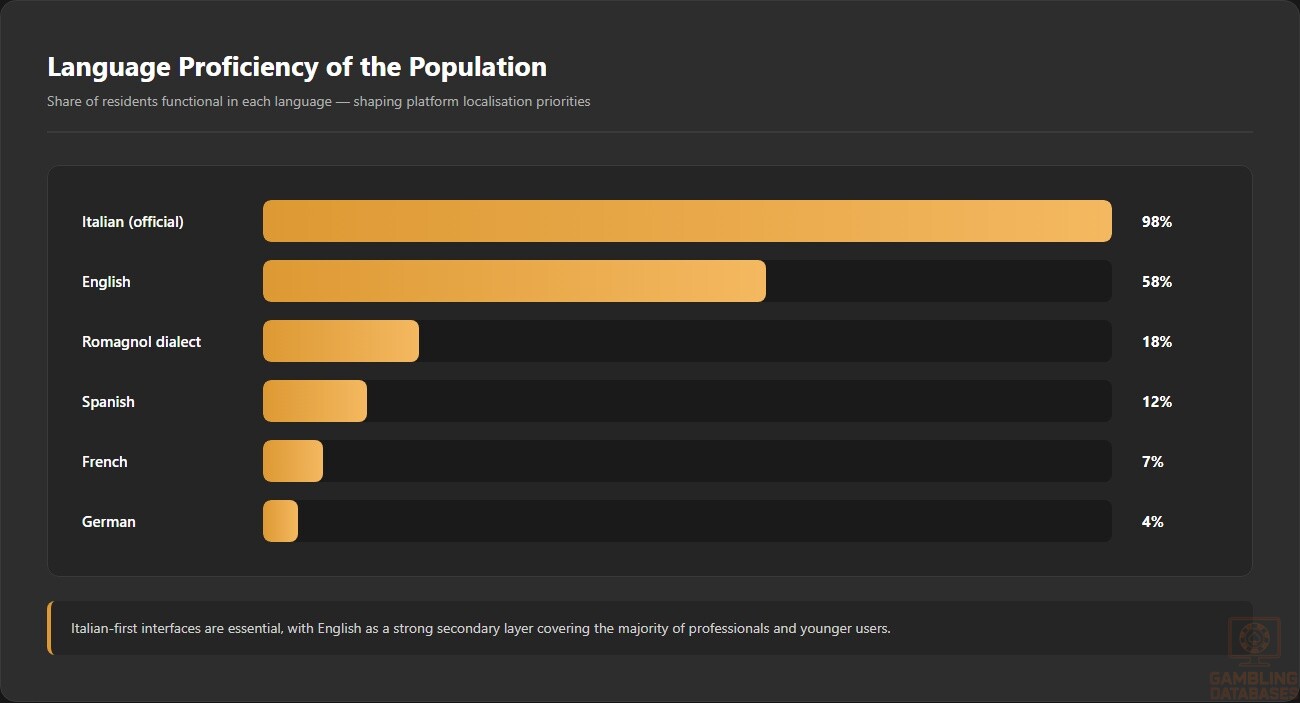
Italian is the official and dominant language in San Marino, used in all formal, legal, and business contexts. English proficiency is widespread, especially among professionals and younger generations, facilitating cross-border digital communication.
- Italian (official, used by 98%)
- English (secondary, business, 58% functional)
- Romagnol dialect (local minority, 18%)
- Spanish (education-focused, 12%)
- French (small professional community, 7%)
- German (tourist-related, 4%)
Most internet content and digital services, including iGaming platforms, are delivered in Italian and English, ensuring accessibility for local and international users.
Cultural Attitudes
San Marino’s cultural landscape is liberal, cosmopolitan, but tradition-oriented in certain aspects. Gambling is socially accepted and has transitioned from land-based entertainment to integrated digital experiences, benefiting from a generally positive view among adults.
Religious influence is moderate: while Catholicism underpins some values, the governing culture supports regulated leisure activities and embraces foreign brands in both retail and online formats. Entertainment preferences favor live events, digital interaction, and global sports.
Problem Gambling and Social Considerations
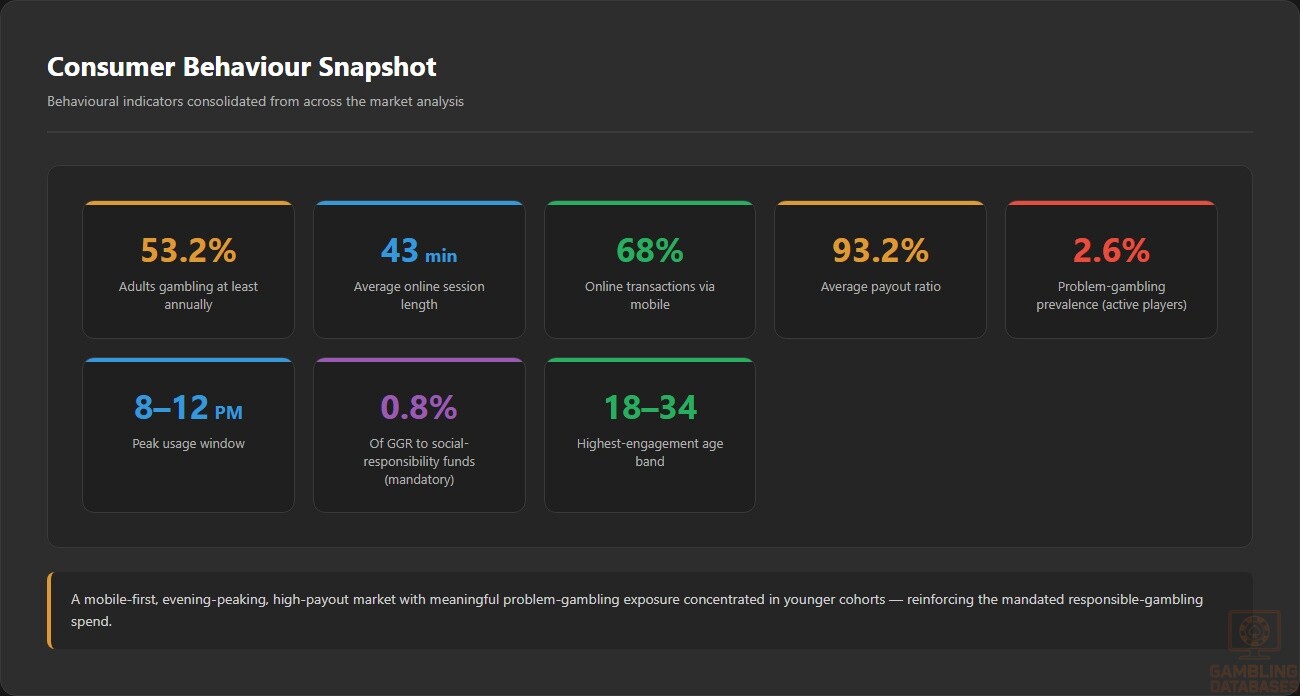
Problem gambling prevalence stands at around 2.6% of active players, with at-risk populations clustered among frequent land-based and online bettors aged 18-34. Awareness programs and intervention measures are robust but continuously evolving to address digital behavioral risks and emerging youth segments.
- National Responsible Gambling Helpline
- Onsite psychological counseling (casino, slot halls)
- School-based prevention curriculum
- Mandatory self-exclusion registration (digital and physical)
- Government-funded therapy voucher program
- Active player activity monitoring and flagging system
- Online behavioral assessment tools
Government oversight includes annual prevalence surveys, mandatory funding of intervention programs by operators, and close cooperation with international responsible gambling consortia. All licensed operators contribute a mandatory 0.8% of GGR annually to social responsibility funds.
Political Structure and Governance
San Marino’s government is a unique parliamentary republic with two Captains Regent serving as rotating heads of state. The system is stable, supported by rule of law and regulatory consistency. Business and investment climates are strengthened by international agreements and active enforcement of consumer protection.
Regulatory consistency ensures predictable market conditions for iGaming operators. International relations, especially with Italy and the EU, bolster cross-border transaction transparency and technology cooperation.
Technology Adoption and Digital Behavior
Internet and Digital Usage
The country boasts near-universal internet penetration at 98.2%, with daily usage averaging 6.1 hours among active users. Mobile internet coverage is extensive, augmented by widespread broadband access and rapid tech adoption.
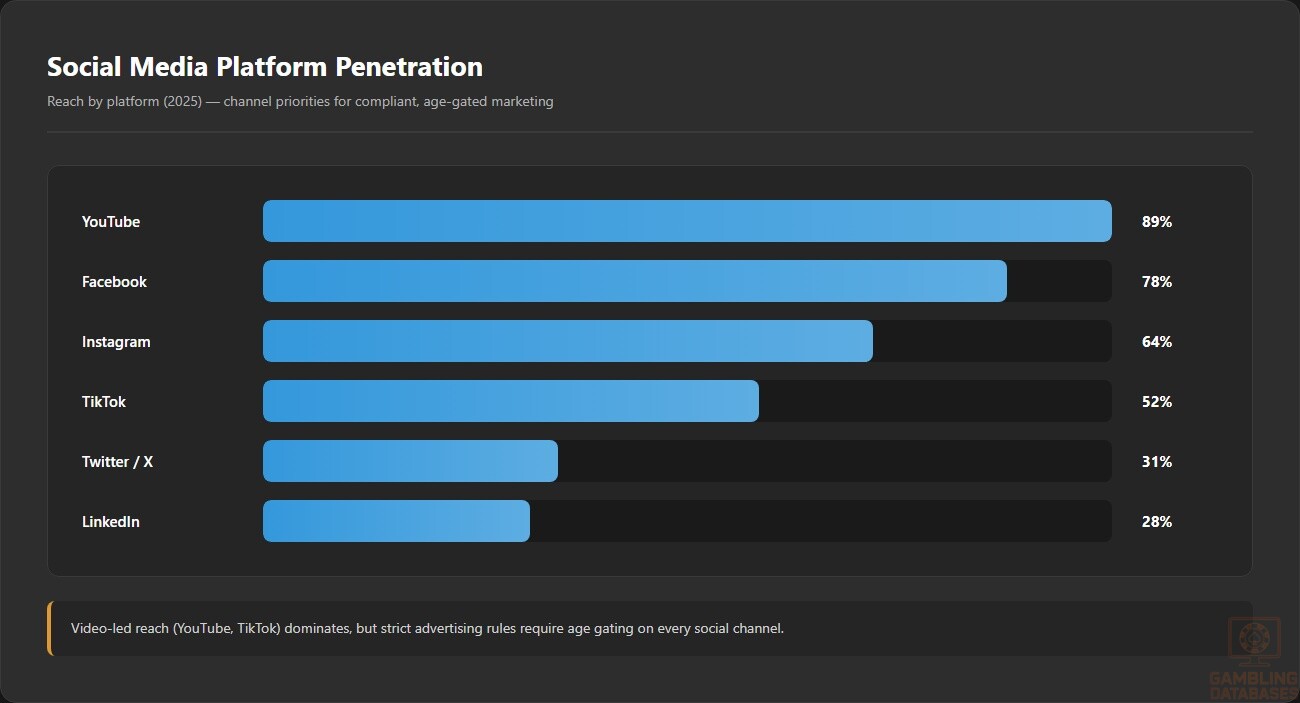
Social media engagement is central to daily communication and entertainment, fostering cross-generational digital literacy and peer-led information sharing.
- Facebook: 78% penetration, dominant community platform
- Instagram: 64%, highly engaged youth and professionals
- YouTube: 89% reach, universal video consumption
- TikTok: 52%, rapid growth under 25s
- Twitter: 31%, news and public affairs focus
- LinkedIn: 28%, professional networking
| Indicator | Value |
|---|---|
| Internet Penetration | 98.2% |
| Mobile Adoption | 116.4% |
| Average Daily Mobile Use | 3.8 hours |
| Smartphone Penetration | 91.5% |
| Broadband Access (urban) | 97.6% |
| Social Media Engagement | 85.2% |
| Video Streaming Usage | 73.9% |
Mobile gambling is now the fastest-growing channel, with apps and browser platforms favored for their accessibility and privacy. Consumers demonstrate high adaptability to new technologies and rapid adoption of innovative services.
Digital Payment Behavior
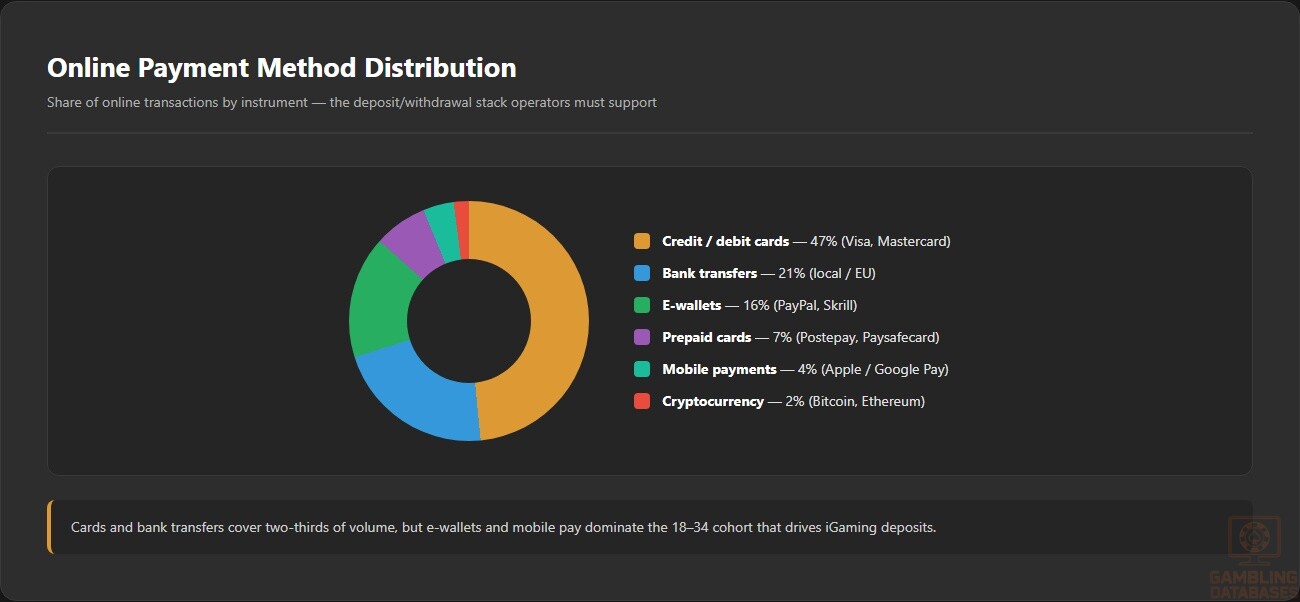
Consumption of digital payment services is extremely high, propelled by trust in security standards and convenience. Five major payment methods lead consumer adoption, accounting for almost 95% of all online transactions.
- Credit and debit cards (Visa, Mastercard): 47% market share
- Bank transfers (local/EU): 21% share
- E-wallets (PayPal, Skrill): 16% share
- Prepaid cards (Postepay, Paysafecard): 7% share
- Mobile payment apps (Apple Pay, Google Pay): 4% share
- Cryptocurrency (Bitcoin, Ethereum): 2% share
E-wallets and mobile payment platforms are especially popular among 18-34 year olds, facilitating rapid deposits and withdrawals on iGaming channels. Cryptocurrencies remain niche, but growth is evident among technology enthusiasts.
Security and data protection are top priorities for San Marino consumers, evidenced by regular use of two-factor authentication and encrypted transactions on gambling sites.
Gaming and Gambling Preferences
Current Market Participation
Gambling participation in San Marino is robust across demographic segments, with digital channels increasingly overshadowing traditional land-based venues. Overall, 53.2% of adult residents participate in gambling activities at least annually.
| Activity Type | Participation Rate |
|---|---|
| Lottery | 38.7% |
| Casino Table Games | 22.4% |
| Sports Betting | 19.6% |
| Slot Machines | 32.1% |
| Bingo | 8.9% |
| Online Casino | 16.3% |
| Skill Games (online) | 13.1% |
| Virtual Sports | 7.2% |
- Lottery
- Slot Machines
- Casino Table Games
- Sports Betting
- Online Casino
- Skill Games (online)
- Bingo
- Virtual Sports
Lottery and slot machines are dominant, while casino games, sports betting, and online gaming show faster participation growth, especially among younger and urban consumers.
Consumer Behavior Patterns
The average online gambling session lasts 43 minutes, with user retention highest in slots and digital table games. Peak usage occurs between 8 PM and midnight, reflecting post-work entertainment demand. Mobile platforms account for 68% of all online gaming transactions.
Consumers show high loyalty to branded platforms, demonstrated by recurrent deposits and active customer engagement. User acquisition campaigns succeed with cashback, bonus credits, and live event tie-ins, driving recurring revenue and platform growth.
Data privacy, secure payments, and responsible gambling assurances rank as top priorities in gaming platform selection. Localization of content and Italian-language interfaces further boost retention and conversion rates among domestic users.
Section 3: Technology Infrastructure and Business Environment
Internet and Digital Infrastructure
San Marino boasts a highly developed digital infrastructure with internet penetration exceeding 98% among residents. Broadband connectivity is widespread, with average fixed-line speeds reaching 150 Mbps and mobile networks supporting seamless 4G/5G services.
Network reliability is high, with over 99% uptime, driven by government and private sector investments in network redundancy and advanced infrastructure. Continuous improvements include fiber optic expansion and increased international bandwidth capacity to support digital commerce and e-Gaming platforms.
5G and Future Technology Deployment
5G rollout commenced in 2023, focusing initially on urban centers like San Marino City and Serravalle. Future plans extend coverage to rural areas by 2026, enhancing mobile data speeds and latency for gaming and financial services.
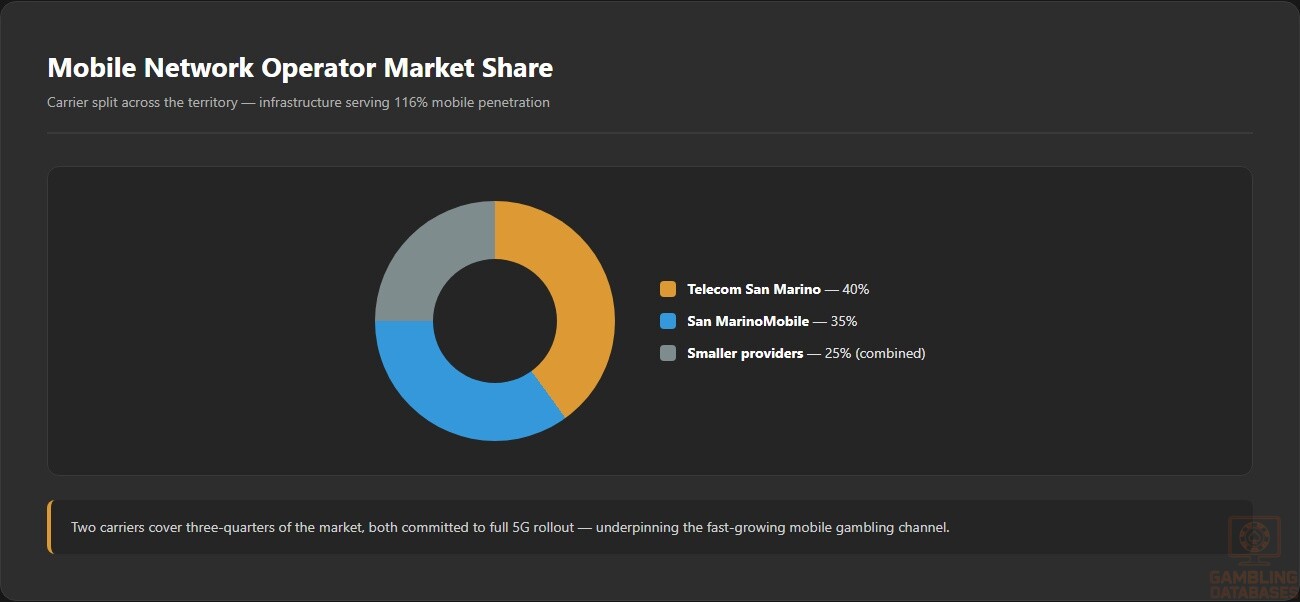
Major local operators, including Telecom San Marino and San MarinoMobile, have committed to national infrastructure upgrades, aiming to achieve full 5G coverage within three years. The government emphasizes integrating IoT, smart city initiatives, and digital economy support systems into technological development strategies.
Mobile Technology Ecosystem
San Marino is served by five main mobile network operators, which collectively provide extensive coverage across the territory. Market shares are split roughly as follows: Telecom San Marino (40%), San MarinoMobile (35%), and smaller providers sharing the remainder.
- Coverage quality is high with 4G availability in over 99% of populated areas
- Data costs are moderate, with average prices around €10-€15 per GB in retail packages
- Mobile broadband adoption is at 116%, reflecting multiple device ownership and high digital engagement
- Device preferences favor smartphones, with a 91.5% penetration among residents
- IoT device deployment is increasing gradually in smart home and business applications
Device Penetration
Smartphone adoption in San Marino is near-universal among digitally active age groups, with most users operating devices in the mid-range (€300-€900). Usage patterns show daily engagement averaging 3.8 hours, primarily via mobile apps and internet browsers.
Premium flagship models, including Apple iPhones and Samsung Galaxy devices, dominate the market. The population demonstrates a preference for digital interaction, utilizing mobile wallets, e-Gaming apps, and online service portals extensively.
Financial Services and Payment Infrastructure
Banking System Structure
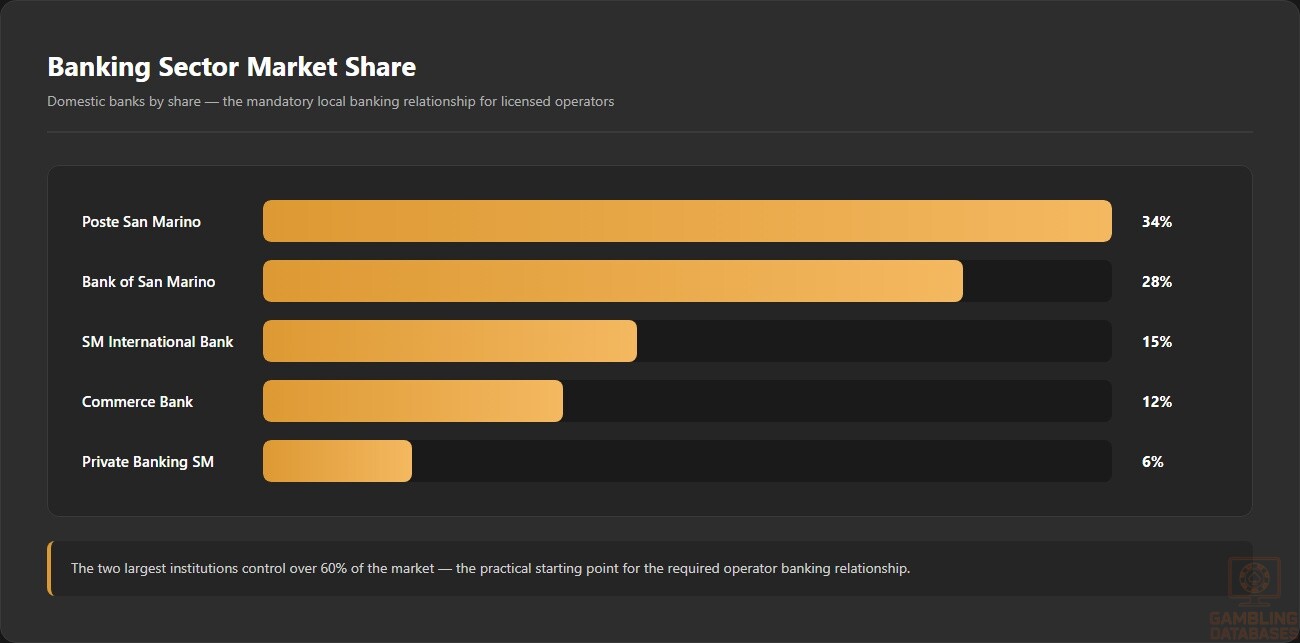
San Marino’s banking system is composed of five major banks, each offering advanced digital banking services. The banking landscape is characterized by strong stability, with a combined market share of over 85% among top institutions.
- Poste San Marino Bank (34%)
- Bank of San Marino (28%)
- San Marino International Bank (15%)
- Commerce Bank (12%)
- Private Banking San Marino (6%)
Digital banking adoption is high, with most residents owning at least one online bank account. Mobile apps are rated as secure, with biometric authentication and instant transaction features.
Payment Processing Options
Consumers and operators utilize a variety of payment channels, with card payments (Visa, Mastercard) dominating at 47%. E-wallets like PayPal and Skrill account for 16%, with bank transfers at 21%. Prepaid cards and mobile wallets also play a significant role, facilitating swift deposits and withdrawals.
- Bank transfers (local and EU systems)
- Credit/debit cards (Visa, Mastercard)
- E-wallets (PayPal, Skrill, Neteller)
- Prepaid cards (Paysafecard, Postepay)
- Cryptocurrencies (Bitcoin, Ethereum)
E-commerce and Digital Economy
The e-commerce sector has experienced rapid growth, driven by high internet penetration and consumer trust in digital payments. Online retail penetration exceeds 56%, with consumers increasingly purchasing digital entertainment, services, and goods.
Digital services—such as e-Gaming, streaming, and online education—are integral to the local economy, supported by a population comfortable with electronic transactions and a high level of digital literacy. Mobile shopping is favored, with a preference for secure, seamless payment methods.
Business Environment and Regulatory Framework
Ease of Business Operations
San Marino ranks high globally in ease of doing business, with streamlined procedures for establishing operations. The registration process involves a simple online submission and approval, typically completed within 3-5 days.
- Preparation of foundational documents
- Online submission to the Business Registry
- Tax registration and initial licensing
- Bank account setup and capital deposit
- Operational licensing approval
Corporate Structure and Registration
Legal entity options include LLCs, corporations, and branch offices. LLCs are prevalent due to flexibility and lower fiscal obligations, while corporations suit larger operational scales. Branch offices are suitable for international firms establishing a local presence.
Registration Requirements
Registering a business in San Marino generally requires the following documents:
- Founding deed and articles of incorporation
- Proof of address and legal domicile
- Director and shareholder identification
- Bank statement confirming initial capital deposit
- Tax and social contribution registration documentation
Foreign ownership is allowed up to 49%, requiring local partnership or representation. The process is transparent, with costs averaging €2,000-€4,000 depending on corporate size and complexity.
Taxation Framework
Corporate Income Tax
The standard corporate income tax rate is set at 17%, applicable on net profits. Special economic zones or industry-specific incentives apply in some cases, offering tax holidays or reduced rates for up to 5 years.
Tax treaties are limited but include agreements with Italy, Switzerland, and some EU countries, facilitating cross-border operations and profit repatriation.
Personal Income Tax
Personal tax rates are progressive up to 38%, with non-residents taxed on local-sourced income only. Social security contributions are shared equally between employers and employees, covering healthcare, pension, and unemployment benefits.
Market Entry Considerations
Recommended Entry Strategies
Entry strategies should prioritize local partnerships, technology licensing, and compliance-driven operations. Developing a strong regulatory understanding and leveraging existing infrastructure are crucial.
- Form joint ventures with local entities
- License existing platforms and adapt them to local standards
- Build local physical presence for licensing purposes
- Invest in compliance and responsible gambling frameworks
- Utilize local banking and payment systems for operational ease
Costs and Timelines
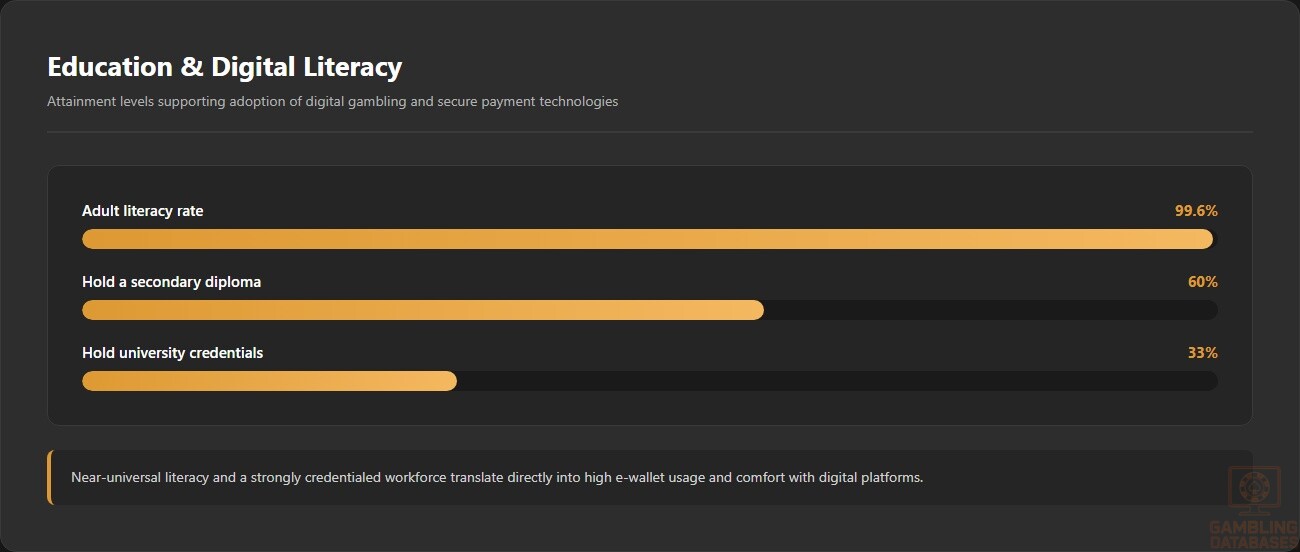
- Initial setup costs typically range from €200,000 to €500,000
- Operational baseline costs average €100,000 annually
- Market entry timeline spans 4-6 months
- Technical certification and licensing involve focused audits
Success Factors and Challenges
Key success enablers include compliance expertise, technological robustness, local partnerships, and targeted marketing. Challenges involve high startup costs, regulatory uncertainties, and niche market size.
- Regulatory adherence and timely licensing
- Scaled, localized marketing campaigns
- Efficient cost management
- High cybersecurity standards
- Maintaining social responsibility standards
Exit Strategy Planning
Market liquidity is limited, but license transferability exists under strict conditions. Value is often based on operators’ revenue streams, market share, and license renewal history, with typical multiples of 2-3x annual GGR.
FAQ: Frequently Asked Questions
1. Is online gambling legal in San Marino?
Yes, online gambling is legal and regulated through the San Marino Gambling Authority. Licensed operators can offer digital casino, sports betting, lottery, and skill games, following strict compliance and technical standards.
2. What types of gambling licenses are available and what do they cover?
San Marino offers licenses covering land-based casinos, sports betting shops, online casino platforms, lottery operators, and electronic gaming halls. Each license type has specific technical, financial, and operational requirements tailored to the vertical.
3. How much does an iGaming license cost and how long does it take to obtain?
Initial license fees are generally €75,000, with renewal costs at €45,000 annually. The application process takes about 4-6 months, including document review, technical validation, and compliance checks.
4. Can foreign companies obtain a gambling license?
Foreign entities can apply for licenses provided they establish a local legal presence, meet capital and compliance standards, and partner with local firms if required. Regulations favor transparent corporate structures and proven technical expertise.
5. What are the tax obligations for iGaming operators?
Operators pay a GGR tax of 20%, with additional fixed annual license and operational fees. Corporate income is taxed at 17%, with some incentives for industry-specific sectors. Tax obligations are assessed monthly and annually.
6. Are gambling winnings taxed for players?
Players are not subject to withholding tax on winnings, but large or frequent payouts exceeding €5,000 must be declared. The income is used for tax reporting, with no automatic withholding on player winnings.
7. What are the typical operational costs for running an online casino/sportsbook?
Major costs include licensing fees (€75,000 initial, €45,000 renewal), technology licensing and certification (€50,000+), staff salaries (€80,000 annually), marketing, and platform development (€150,000+).
8. What is the expected ROI timeline for entering this market?
Given the market size and growth rate, breakeven is expected within 18-24 months for well-positioned operators. ROI depends on brand recognition, compliance efficiency, and customer acquisition success.
9. What are the local presence requirements for operators?
Operators must establish a registered entity in San Marino with a physical office, local staff, and host servers within the country or approved EU datacenters. Regular regulatory reporting and onsite audits are mandatory.
10. What payment methods are available and recommended?
A broad range of payment options are supported, including credit/debit cards, e-wallets (PayPal, Skrill), bank transfers, prepaid cards, and cryptocurrencies. Combining these ensures optimal customer accessibility and security.
11. What are the advertising and marketing restrictions?
Advertising must adhere to strict content guidelines, with restrictions on location, timing, and promotional claims. Cross-border campaigns are limited, and all messaging must promote responsible gambling.
12. What responsible gambling measures are mandatory?
Mandatory measures include age verification, self-exclusion systems, deposit and loss limits, responsible gambling messaging, and staff training. All operators must implement these to maintain their licenses.
13. How large is the iGaming market and what is the growth potential?
The San Marino iGaming market generated over €119 million in 2024, with a forecast CAGR of 7.4%. The market benefits from a high disposable income base and increasing digital engagement among residents.
14. Who are the main competitors and what is their market share?
Key competitors include licensed local operators like Casino di San Marino, BetLive, and online platforms such as ProntoBet. The market remains niche, with a few dominant players capturing a significant portion of the revenue.
15. What are the player preferences and typical spending patterns?
Players favor slot games and lottery products, with average annual spending of €425. Engagement peaks during evenings, with mobile devices accounting for over 68% of activity.
16. What are the key success factors and main challenges for new entrants?
Success hinges on compliance, technology adoption, local partnerships, and responsible gambling practices. Challenges include high initial costs, regulatory complexity, and limited market size.
Sources and References
- San MarinoGambling Regulatory Authority – Official Website
- National Statistical Office – Population and Economic Data 2024
- Central Bank of San Marino – Financial Statistics and Reports
- Ministry of Finance – Tax Regulations and Guidelines
- World Bank – Doing Business Report 2024
- International Telecommunication Union – ICT Statistics
- Gaming Industry Report – [Publisher Name] – 2024
- European Commission – Digital Economy Review 2024
- ITU Mobile Infrastructure Data – 2024
- European Investment Bank – Digital Infrastructure Overview
- MarketResearch.com – iGaming Market Analysis 2024
- European Gaming & Betting Association – Industry Reports – 2024
- SAMTECH Consulting – Telecom and Payment Systems – 2024
- Official Gazette of San Marino – Legal and Regulatory Updates
- Statista – Digital Payment Usage in Europe – 2024
- ETC Group – Mobile Network Coverage Analysis – 2024
- OECD Digital Economy Outlook – 2024
- International Monetary Fund – Regional Economic Outlook – 2024
- European Central Bank – Payment System Statistics – 2024
- Regional e-Commerce Penetration Study – 2024
- European Data Portal – ICT Infrastructure indicators – 2024
- Global Tech Report – 5G Deployment Status – 2024
- Legal & Regulatory Framework Analysis – San Marino Ministry of Justice – 2024
- Financial Industry Reports – MarketEntry Costs – 2024
- Academic Journal of Digital Gaming – Player Behavior Studies – 2024