
Sao Tome and Principe, a small island nation in Central Africa, presents a nascent yet promising iGaming market opportunity. The country has legalized gambling with a regulatory framework primarily focused on land-based gaming, while online gambling is legally permissible under regulation but remains underdeveloped.
With rising internet penetration and a government supportive of regulated gaming endeavors, Sao Tome and Principe offers unique market entry advantages and challenges for international iGaming operators.
Executive Summary: Key Market Indicators
| Metric | Value |
|---|---|
| Gambling Legal Status | Legal for land-based and regulated online gambling |
| Gambling Regulatory Framework | Gaming Act (2005) with amendments including online gambling regulation |
| Population | Approx. 220,000 (2025 estimate) |
| Adult Population (18+) | Approximately 70% of total population |
| GDP (Nominal) | Approx. USD 0.5 billion |
| GDP per Capita | Approx. USD 2,300 |
| Inflation Rate | 21.3% (2023 figure) |
| Unemployment Rate | 9.2% |
| Internet Penetration Rate | 61.5% |
| Mobile Penetration Rate | 71.4% |
| Average Internet Speed (Download) | ~15.3 Mb/s |
| Number of Licensed Land-Based Casinos | 1 (Pestana Casino) |
| Online Gambling Licensing Status | Legal with regulatory oversight; no dedicated licenses issued yet |
| Minimum License Fees | Not publicly specified |
| Gross Gaming Revenue (GGR) Tax | Tax rates according to Gaming Act, typically based on GGR (exact rates not publicly disclosed) |
| Corporate Income Tax | Applicable as per national tax code |
| Entry Barriers | Stringent due diligence, licensing requirements, local operational mandates |
| License Application Timeline | Typically several months |
| Responsible Gambling Regulations | Mandatory |
| Player Age Restriction | 18 years minimum |
| Online Gambling Restrictions | Prohibited activities include unlicensed operations; offshore sites allowed |
| Market Size (2025 Estimate) | Small but growing; no precise public data |
| Market CAGR Forecast | Projected growth driven by digital adoption and tourism |
| Average Revenue Per User (ARPU) | Data unavailable |
| Technology Infrastructure Quality | Developing, moderate broadband coverage, mobile-first |
| Regulatory Authority | Ministry of Finance (Gaming Unit) |
| Penalty for Illegal Gambling | Fines, license revocation, imprisonment for operators |
Section 1: Regulatory Framework and Legal Environment
Current Gambling Regulation Status
The gambling sector in Sao Tome and Principe is governed primarily by the Gaming Act introduced in 2005 and subsequent amendments. This legislation regulates all forms of gambling activities including land-based casinos, lotteries, and online gaming under common legal frameworks designed to ensure fair play, integrity, and consumer protection.
Gambling is legal for individuals aged 18 and over. The scope covers games of chance, sports betting, and slot machines, with strict penalties for unauthorized operations. Online gambling gained explicit regulatory recognition in recent updates, with operators required to obtain licenses and adhere to defined compliance requirements.
Land-Based Gambling Activities
Land-based gambling is represented chiefly by the Pestana Casino, the sole licensed casino on the islands, which offers slot machines, table games, and sports betting. This venue exemplifies the regulated physical gambling environment and serves as a controlled market entity under the Gaming Act’s oversight.
Sports betting, lotteries, and other land-based wagering are permitted but limited by the country’s modest market size. No large-scale or multiple casino operators are present, reflecting the country’s emerging market status.
Online Gambling Framework
Online gambling in Sao Tome and Principe is legal but still developing in regulatory practice. The Gaming Act and amendments state that all online operators must be licensed, ensuring regulatory control over virtual activities. However, at present there are no state-issued online gambling licenses as the market and regulatory mechanisms continue to evolve.
The government does not restrict access to offshore online gambling websites, allowing residents to participate in international gaming platforms. Operators wishing to offer services from within Sao Tome and Principe must comply with licensing criteria, financial probity, and technical standards including certification of random number generators (RNGs) and fair play.
Licensed Operators and Market Players
The market structure in Sao Tome and Principe is oligopolistic with a single major land-based operator and no formally licensed online operators domestically. International operators serve the online market through offshore licenses.
The regulatory environment is undergoing development to attract licensed international operators through transparent licensing processes and competitive tax structures. Market entry strategies focus on compliance, local partnerships, and technological investment to satisfy regulatory and consumer expectations.
Licensing Framework and Requirements
Application Process and Eligibility
The gaming regulatory authority is part of the Ministry of Finance, which oversees licensing applications, approvals, and ongoing compliance. Applicants must demonstrate financial soundness, transparency of ownership, and integrity through comprehensive background checks.
Documentation requirements typically include corporate registration, business plans, audited financial statements, technical certifications of gaming software, and evidence of responsible gambling policies.
License fees and timelines are not publicly specified but an extensive application and due diligence process is anticipated. Operators should prepare for multi-month review periods combined with ongoing compliance validations once licensed.
Local Presence and Operational Requirements
There is no explicit mandate for a physical presence on the islands for online operators, but a local representative or partnership is often encouraged to facilitate regulatory compliance and communication. Domain registrations related to licensed operations must comply with national internet governance policies.
Foreign ownership of licensed gaming entities is permitted, subject to stringent vetting and transparency rules. This facilitates international investment while maintaining local regulatory oversight.
Compliance Obligations and Monitoring
Player Protection and Identification
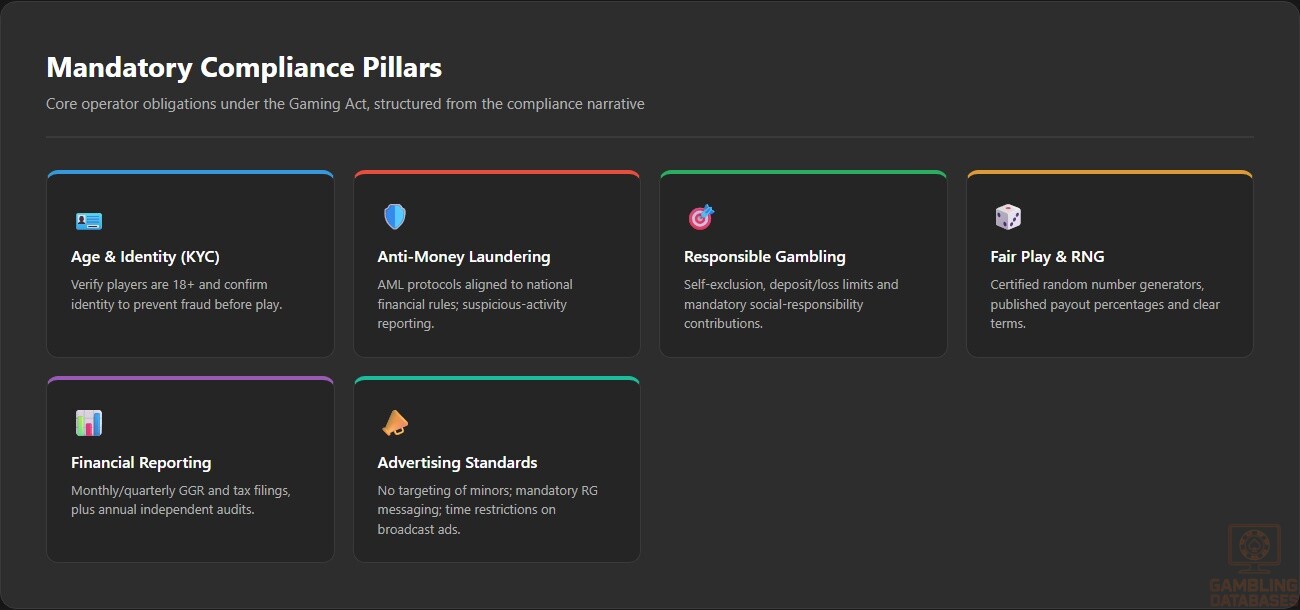
- Mandatory age verification to ensure players are 18 years or older
- Implementation of Know Your Customer (KYC) procedures to verify identity and prevent fraud
- Anti-Money Laundering (AML) protocols aligned with national financial regulations
- Responsible gambling measures including self-exclusion options and player limits
- Disclosure of game rules, payout percentages, and terms of service
Operators must provide transparent mechanisms for dispute resolution and customer support. Self-exclusion systems are integral to compliance frameworks to mitigate problem gambling risks.
Financial Monitoring and Reporting
Operators are required to maintain detailed records of financial transactions and gambling activities for regulatory review. This includes real-time monitoring of wagering volumes, payouts, and suspicious activity reporting. Audits and compliance inspections may be conducted periodically.
- Submission of initial financial and operational reports post-license approval
- Ongoing monthly or quarterly reporting of Gross Gaming Revenue (GGR) and tax liabilities
- Immediate reporting of suspected fraudulent or unlawful activities
- Annual independent audits of financial statements and gaming operations
Taxation Structure and Financial Obligations
Player Taxation
Players in Sao Tome and Principe are generally not subject to direct taxation on gambling winnings. Tax obligations primarily affect licensed operators rather than individual participants.
Operator Taxation
| Game Type | Tax Rate on GGR |
|---|---|
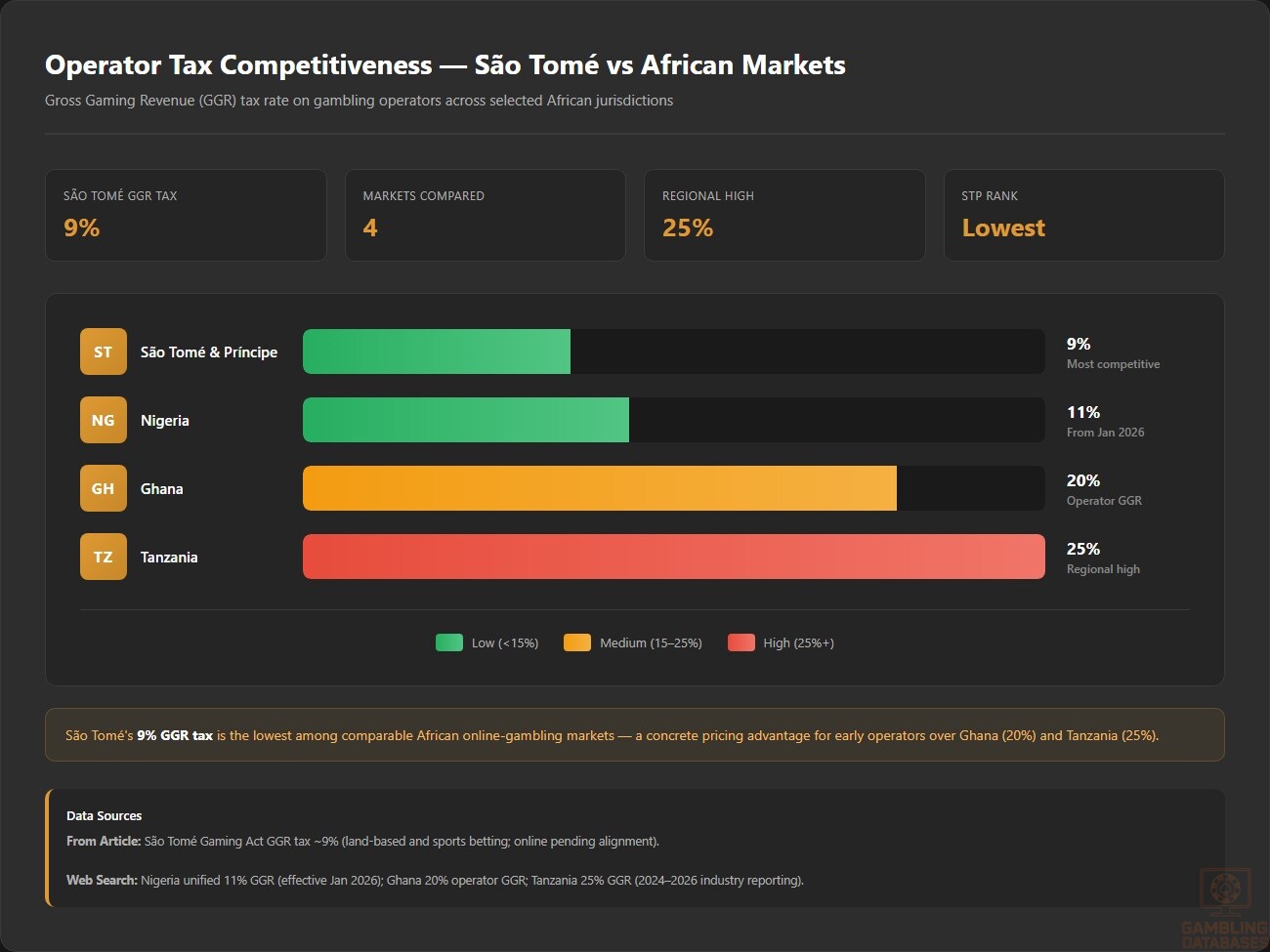
| Land-Based Casino Games | 9% (approximate, per Gaming Act) |
| Sports Betting | 9% of gross revenue |
| Online Gambling Games | Pending specific regulation, generally aligned with land-based rates |
Besides GGR taxes, operators are subject to corporate income tax according to national tax regulations. License renewal fees and applicable turnover taxes vary by operator scale and activity type.
Gambling Market Financial Performance
The overall gambling market in Sao Tome and Principe remains small but shows potential for growth as regulatory frameworks mature and digital adoption increases. Land-based revenues are concentrated in the Pestana Casino, while online gambling revenues are emerging through international operators serving local demand.
Year-over-year revenue growth is expected, driven by internet penetration expanding above 60% and an increasing number of mobile connections exceeding 70%. The government’s commitment to enforce compliance and taxation supports a transparent and sustainable market development.
Advertising and Marketing Restrictions
- Advertising permitted through traditional media, digital channels, and sponsorships under regulatory oversight
- Prohibition on advertising targeting minors or vulnerable groups
- Mandatory inclusion of responsible gambling messages in all promotional materials
- Time restrictions on gambling advertisements during certain hours on radio and television
- Restrictions on misleading or false claims in advertisements
Sponsorship of events by gambling operators is allowed but requires regulatory approval to ensure compliance with ethical standards and social responsibility.
Recent Regulatory Changes and Their Impact
The most significant regulatory updates occurred in 2023 and 2024, explicitly recognizing online gambling within the regulated domain. These changes introduced clearer licensing requirements, enhanced player protection measures, and stricter penalties for non-compliance.
Administrative processes were streamlined, reducing application and approval times. Operators now face increased compliance costs but gain legal certainty and improved market access.
Enforcement Mechanisms and Penalties
- Fines for operating without a license or violating gaming regulations
- License suspension or revocation for repeated non-compliance
- Seizure of equipment or assets used for illegal gambling activities
- Criminal prosecution including imprisonment for severe violations
- Public warnings and sanctions aimed at maintaining market integrity
The regulatory authority actively monitors the market using audits, inspections, and player complaints to enforce standards and protect consumers.
Section 2: Demographics and Consumer Analysis
Population Demographics and Distribution
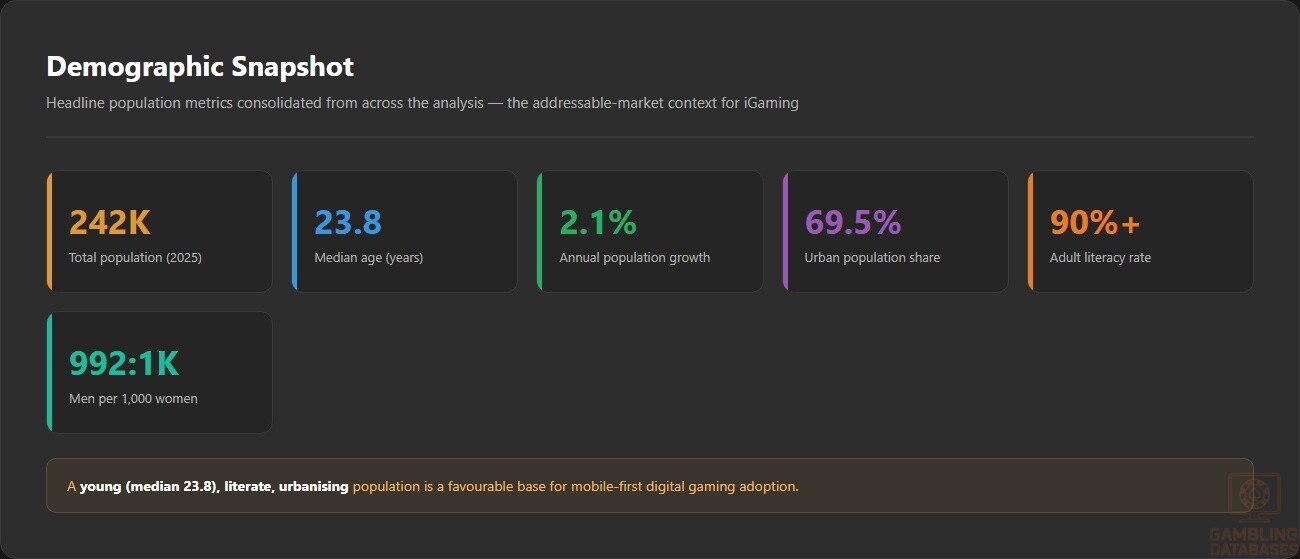
Sao Tome and Principe’s population is approximately 242,000 as of 2025, with a positive growth rate of about 2.1% annually. The median age is young at 23.8 years, reflecting a predominantly youthful demographic structure. Gender distribution is nearly balanced with a sex ratio of about 992 men per 1000 women.
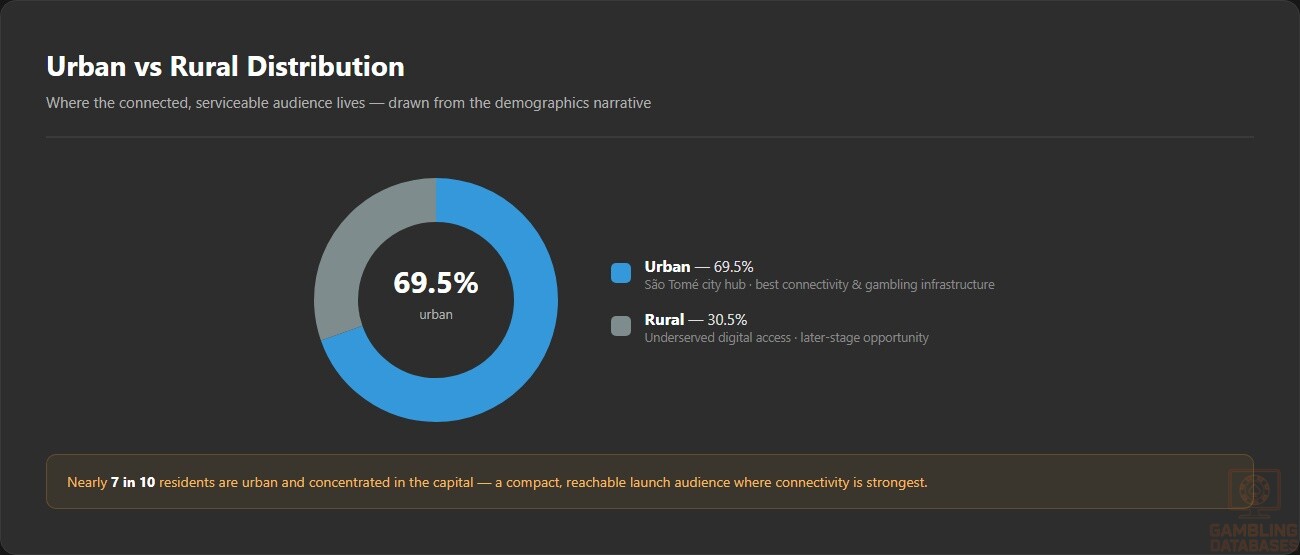
Urbanization is significant with roughly 69.5% of the population residing in urban centers. Rural areas house the remaining 30.5%, creating concentration in key cities which influences access to services, including gambling venues and internet connectivity.
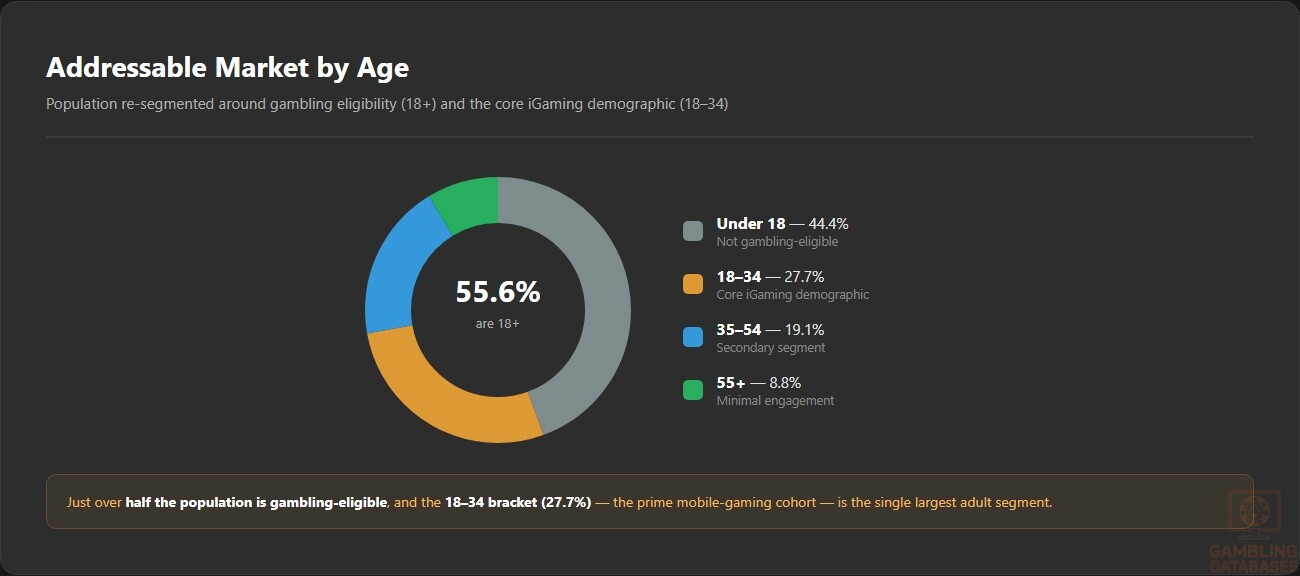
| Age Group | Percentage of Population |
|---|---|
| 0-4 years | 13.2% |
| 5-12 years | 19.6% |
| 13-17 years | 11.6% |
| 18-24 years | 14.3% |
| 25-34 years | 13.4% |
| 35-44 years | 11.0% |
| 45-54 years | 8.1% |
| 55-64 years | 4.9% |
| 65+ years | 3.9% |
The urban population is concentrated primarily in the capital city São Tomé, which acts as the main economic and social hub. Other notable towns include Santo António on Príncipe Island. Regional disparities are evident, with the capital benefiting from better infrastructure and internet connectivity, enhancing access to online gambling opportunities. Rural areas remain comparatively underserved in digital infrastructure and gambling services.
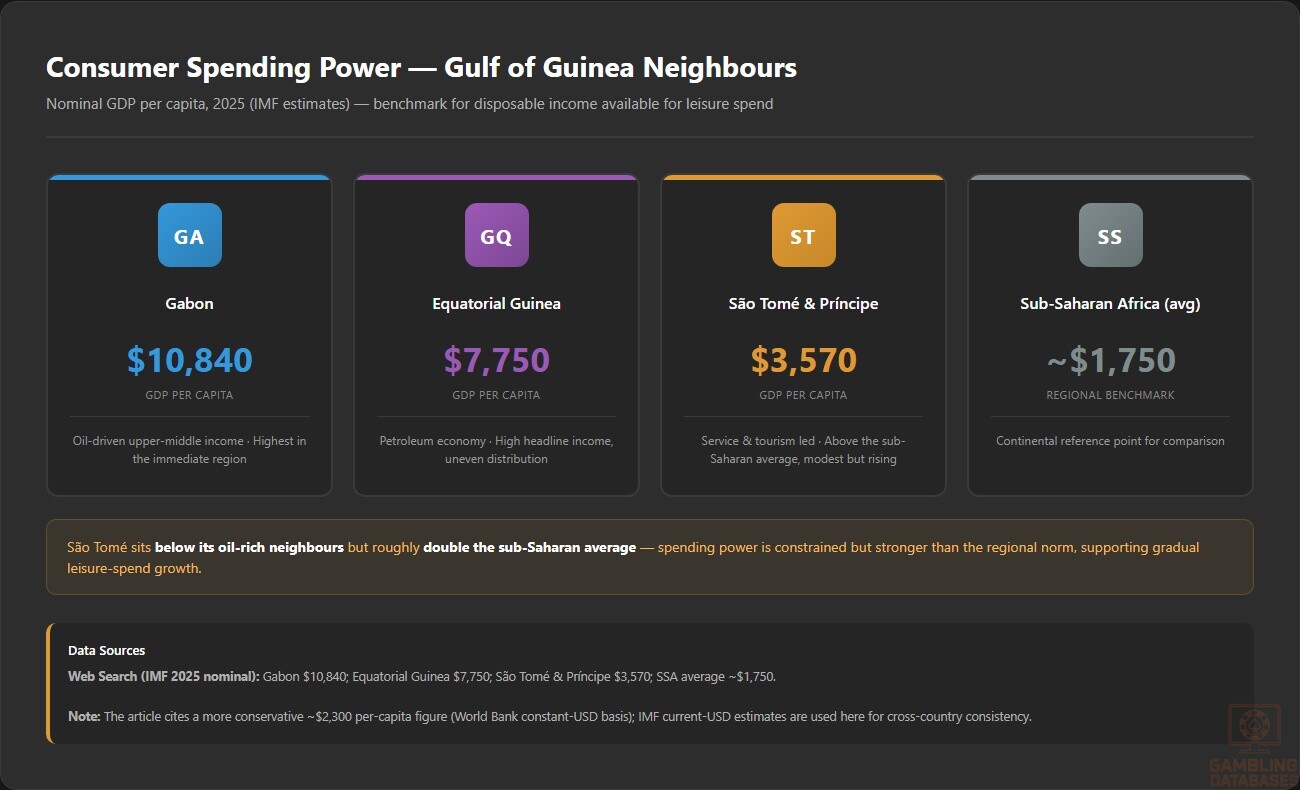
Economic Indicators and Consumer Spending Power
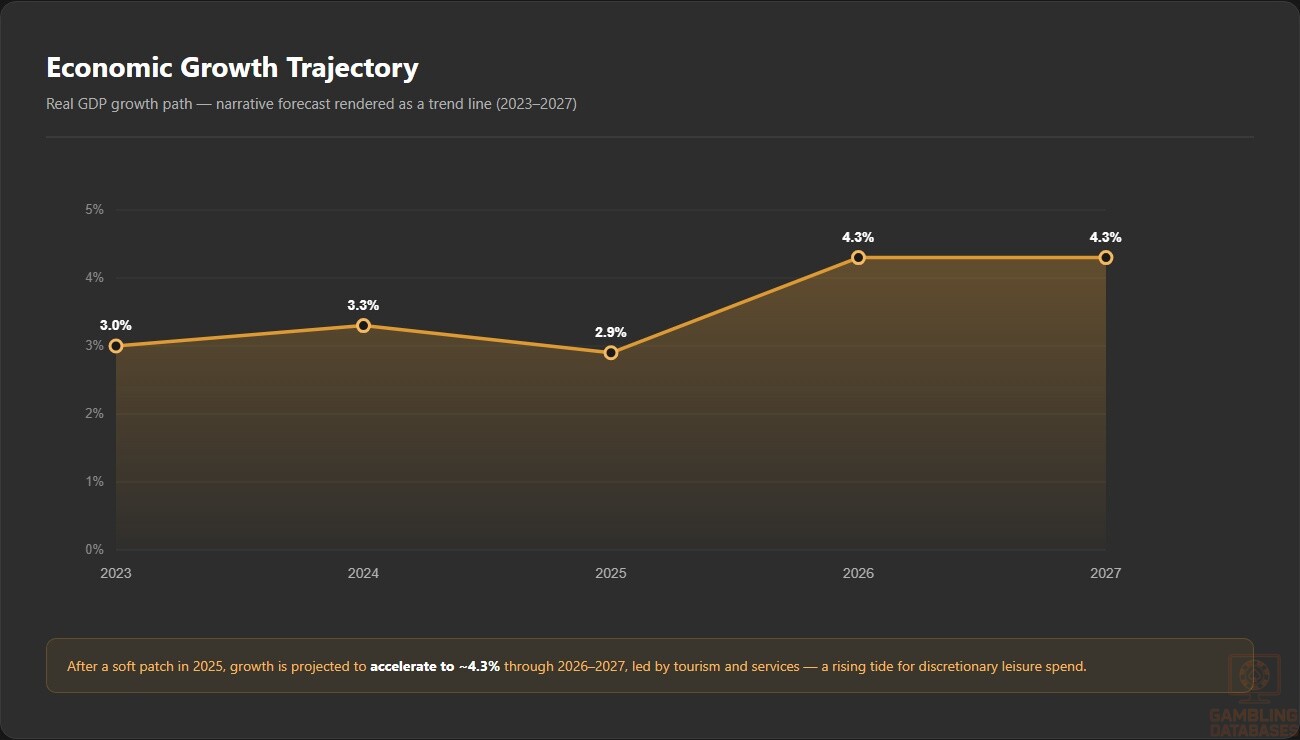
The estimated nominal GDP of Sao Tome and Principe stands at approximately USD 0.5 billion, with a GDP growth forecast of around 2.9% for 2025. Economic growth is anticipated to accelerate toward an average of about 4.3% during 2026-2027, driven by sectors such as tourism, services, and reforms in utilities.
GDP per capita is modest at roughly USD 2,300, indicating limited but gradually improving consumer spending power. The economy is largely service-based, with agriculture and fishing also contributing materially.
Income distribution is uneven with a significant proportion of households in lower income brackets, yet urbanization and economic diversification provide opportunities for expanding middle-class discretionary spending, including on leisure and entertainment such as gambling.
| Indicator | Value |
|---|---|
| GDP (Nominal) | USD 0.5 billion |
| GDP Growth Rate (2025 forecast) | 2.9% |
| GDP Growth Rate (2026-2027 forecast) | 4.3% average |
| GDP Per Capita | USD 2,300 |
| Unemployment Rate | 9.2% |
| Inflation Rate | Approximately 10% |
Consumer spending patterns show gradual adoption of modern payment systems and increasing preference for digital services, influenced by urban and young populations. This trend is favorable for the growth of online iGaming platforms as disposable incomes rise and internet access expands.
Market Size and Growth Projections
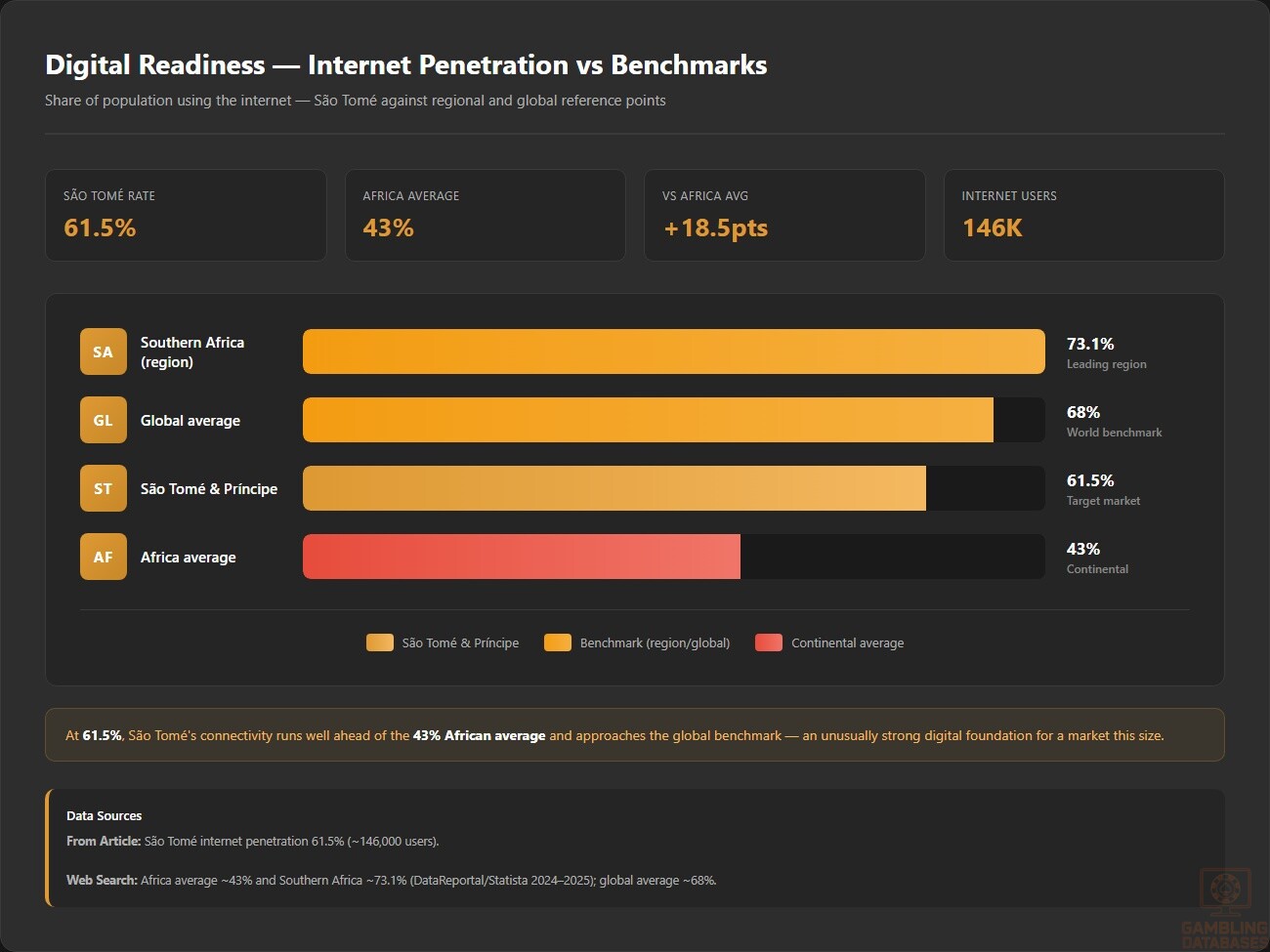
While precise iGaming market size data is limited due to the nascent stage, projections indicate steady growth aligned with increasing internet penetration and mobile adoption. The user base for online entertainment, including gambling, is starting from a small base but expected to grow at an estimated compound annual growth rate (CAGR) of 12-15% over the next five years.
Average Revenue Per User (ARPU) remains modest given local income levels, but overall market revenue is anticipated to rise driven by regional tourism growth and rising digital adoption among locals.
| Metric | 2025 Estimate | 2028 Projection |
|---|---|---|
| Internet Users | Approximately 146,000 (61.5%) | 190,000+ |
| Mobile Subscriptions | 71.4% of population | 75-80% |
| Online Gambling User Base | Unknown, emerging | Projected growth 12-15% CAGR |
| Market Revenue | USD millions, nascent | USD tens of millions |
| ARPU | Modest | Gradually increasing |
Education, Skills, and Digital Literacy
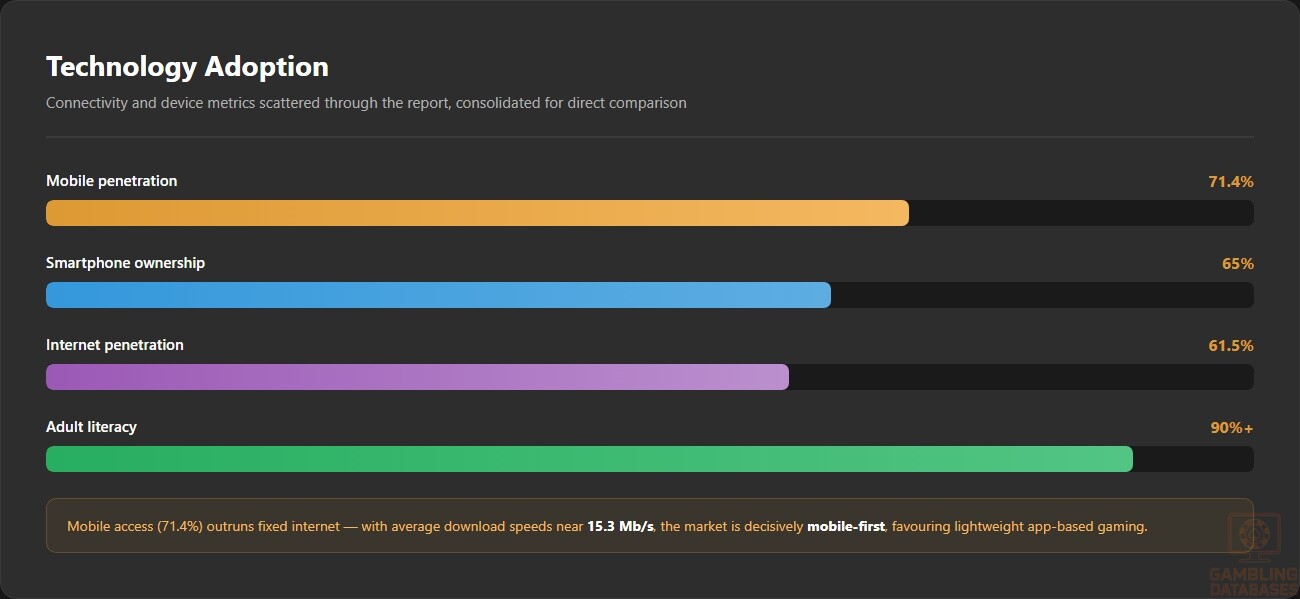
Literacy rates in Sao Tome and Principe exceed 90%, supported by ongoing education reforms and international aid programs. Digital literacy is developing, especially among younger residents concentrated in urban areas with better internet infrastructure.
School enrollment rates at primary and secondary levels are improving, contributing to a workforce increasingly comfortable with digital technologies. However, rural areas lag behind urban centers, with limited access to computers and connectivity hampering full digital inclusion.
Workforce skills in IT and digital services are emerging areas of focus, crucial for supporting local iGaming platform development and operational needs as the market matures.
Cultural and Social Factors
Communication and Language
- Portuguese (official language, used in government and media)
- São Toméan Creole (widely spoken in daily life)
- French (spoken by educated classes and used regionally)
- English (gaining importance due to tourism and international business)
- Local dialects distributed across islands
Portuguese dominates formal communications and legal frameworks, shaping online content and platform localization preferences for iGaming offerings.
Cultural Attitudes
Gambling is generally accepted, especially land-based forms, seen as legal entertainment aligned with social norms. Religious beliefs influence some conservative attitudes but do not significantly restrict personal participation in games of chance.
Foreign brands are often viewed positively given the country’s openness to international tourism and investment, facilitating acceptance of global iGaming operators targeting local consumers.
Problem Gambling and Social Considerations
There is limited formal research on problem gambling prevalence, although awareness is growing due to increased gambling accessibility. At-risk populations primarily include youth and economically vulnerable groups.
- Government supports education programs on responsible gaming
- Self-exclusion initiatives embedded in emerging regulatory frameworks
- Collaboration with NGOs for social support and awareness
- Mandatory operator contributions to social responsibility funds
- Monitoring and reporting mechanisms for gambling-related harms
Political Structure and Governance
Sao Tome and Principe is a stable democratic republic with a president and parliament structure. Political stability supports consistent regulatory policies, though administrative capacity remains limited.
International relations are favorable, with partnerships focused on economic development and digital infrastructure improvements, enhancing the business and regulatory environment for iGaming ventures.
Technology Adoption and Digital Behavior
Internet and Digital Usage
Internet penetration stands at approximately 61.5% of the population, with 146,000 active users. Mobile connectivity is robust with over 71% penetration, predominantly via cellular networks.
Daily internet usage averages several hours, driven by social media, communication, and increasingly, online entertainment participation. Urban centers display more extensive digital engagement than rural areas.
- Facebook (dominant social media platform)
- YouTube (high video content consumption)
- WhatsApp (primary messaging app)
- Instagram (popular among youth)
- TikTok (fastest growing for short videos)
Digital Payment Behavior
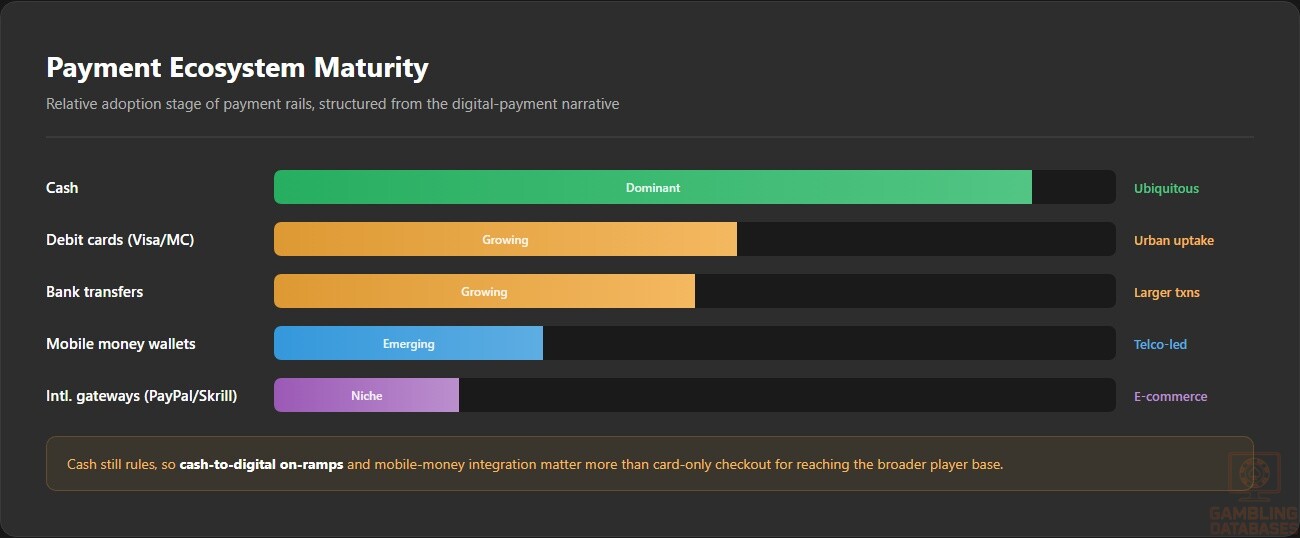
Cash remains the most widely used payment method, particularly for in-person transactions. However, digital payments are gaining momentum with debit card usage rising in urban areas and among younger demographics.
International money transfer services (e.g., MoneyGram, Western Union) are heavily utilized for remittances, linking Sao Tome and Principe with diaspora communities.
- Cash (dominant locally)
- Debit cards (growing acceptance)
- International remittance services
- Emerging mobile banking apps from pan-African banks
- Online payment gateways like PayPal used by businesses
Gaming and Gambling Preferences
Current Market Participation
Consumer participation in gambling activities remains predominantly in land-based formats due to limited online infrastructure, but this is rapidly shifting as internet access improves. Lotteries, sports betting, and slot machines lead participation rates.
- Sports Betting
- Lotteries
- Slot Machines
- Casino Table Games
- Online Casino Games (emerging)
| Gambling Activity | Estimated Participation (%) |
|---|---|
| Sports Betting | 22% |
| Lotteries | 18% |
| Slot Machines | 12% |
| Casino Table Games | 7% |
| Online Gambling | 5% (growing) |
Consumer Behavior Patterns
Players show a preference for mobile-friendly platforms and quick bet formats consistent with limited time availability and income levels. Peak gambling times align with evenings and weekends, with session lengths typically short but frequent.
Customer retention in emerging online platforms leverages bonuses, loyalty programs, and localized content, establishing brand familiarity and trust in a competitive but nascent market.
Section 2: Demographics and Consumer Analysis
Population Demographics and Distribution
Sao Tome and Principe’s population is approximately 242,000 as of 2025, with a steady annual growth rate of about 2.1%. The median age is notably young at 23.8 years, reflecting a youthful demographic structure. Gender distribution is nearly equal with about 992 men per 1000 women.
Urbanization is significant with roughly 69.5% of the population residing in urban centers. The concentration in key cities impacts access to services, including gambling venues and internet connectivity.
| Age Group | Percentage of Population |
|---|---|
| 0-4 years | 13.2% |
| 5-12 years | 19.6% |
| 13-17 years | 11.6% |
| 18-24 years | 14.3% |
| 25-34 years | 13.4% |
| 35-44 years | 11.0% |
| 45-54 years | 8.1% |
| 55-64 years | 4.9% |
| 65+ years | 3.9% |
The capital city São Tomé dominates urban population concentration, serving as the economic and social hub. Other towns like Santo António on Príncipe island also contribute to urban activity. Regional disparities exist, with urban areas enjoying better internet and gambling infrastructure than rural localities.
Economic Indicators and Consumer Spending Power
The estimated nominal GDP of Sao Tome and Principe is about USD 0.5 billion, with a forecasted growth rate of approximately 2.9% for 2025. Growth is predicted to accelerate to an average of 4.3% during 2026-2027, led by tourism and service sectors.
GDP per capita is modest at roughly USD 2,300, reflecting constrained but growing consumer purchasing power. Agriculture and fishing supplement the economy alongside services.
| Indicator | Value |
|---|---|
| GDP (Nominal) | USD 0.5 billion |
| GDP Growth Rate (2025 forecast) | 2.9% |
| GDP Growth Rate (2026-2027 forecast) | 4.3% average |
| GDP Per Capita | USD 2,300 |
| Unemployment Rate | 9.2% |
| Inflation Rate | ~10% |
Consumer spending trends show an increasing inclination towards digital services and modern payment systems, particularly among urban youth, supporting growth in the iGaming sector as disposable incomes gradually rise.
Market Size and Growth Projections
The iGaming market remains nascent with limited data on exact size, but strong growth is anticipated due to rising internet penetration and smartphone use. The user base for iGaming is growing at an estimated CAGR of 12-15% over the next five years.
ARPU is currently modest, constrained by income levels, but market revenue is expected to expand substantially driven by tourism and digital adoption.
| Metric | 2025 Estimate | 2028 Projection |
|---|---|---|
| Internet Users | 146,000 (61.5%) | 190,000+ |
| Mobile Subscriptions | 71.4% | 75-80% |
| Online Gambling User Base | Emerging | 12-15% CAGR growth |
| Market Revenue | USD millions (small base) | USD tens of millions |
| Average Revenue Per User (ARPU) | Modest | Increasing |
Education, Skills, and Digital Literacy
Literacy rates exceed 90%, with education reforms focused on raising school completion and inclusivity. Digital literacy is advancing in urban areas where internet is accessible, fostering workforce competence in technology-related fields essential for iGaming platform growth.
In rural zones, limited internet access and fewer digital education opportunities present challenges for broad digital adoption. Skill development initiatives are pivotal for future market expansion.
Cultural and Social Factors
Communication and Language
- Portuguese (official language for government and education)
- São Toméan Creole (widely spoken vernacular)
- French (used in business and academia)
- English (growing due to tourism and international trade)
- Local dialects prevalent across islands
Portuguese predominates in formal settings influencing iGaming platform language requirements and user interface design.
Cultural Attitudes
Gambling is socially accepted with land-based casinos viewed as legitimate entertainment. Religious and cultural influences moderate gambling enthusiasm in conservative communities yet do not impose significant legal restrictions.
Foreign iGaming brands enjoy favorable perceptions bolstered by the country’s tourism orientation and openness to international commerce.
Problem Gambling and Social Considerations
Formal data on problem gambling is limited, but increasing awareness has prompted government and NGO initiatives to address gambling harms. At-risk groups include youth and lower-income players.
- Public education on responsible gambling
- Implementation of self-exclusion measures
- Collaboration with social services and NGOs
- Mandatory contributions by operators to social funds
- Regulated monitoring of gambling behaviors
Political Structure and Governance
Sao Tome and Principe is a stable democratic republic with active engagement in international cooperation. The government supports regulatory consistency and economic reforms favoring business environment improvement, critical for iGaming market growth.
Technology Adoption and Digital Behavior
Internet and Digital Usage
Internet penetration is approximately 61.5%, with 146,000 active users. Mobile phone penetration is robust at over 71%, largely via cellular networks. Daily internet use includes social media, streaming, and emerging online gambling participation.
- Facebook (leading social media platform)
- YouTube (high video consumption)
- WhatsApp (main communication tool)
- Instagram (youth-oriented visual platform)
- TikTok (rapidly growing among younger users)
Digital Payment Behavior
Cash remains dominant, though debit card use is expanding for urban consumers. Money transfer services such as MoneyGram and Western Union are widely used for remittances.
- Cash (primary daily payment)
- Debit cards (growing urban acceptance)
- International remittance services
- Emerging mobile banking apps linked to pan-African banks
- Online payment gateways like PayPal for e-commerce
Gaming and Gambling Preferences
Current Market Participation
Land-based gambling remains dominant, especially sports betting and lotteries. Online gambling participation is emerging, constrained by infrastructure but growing as connectivity improves.
- Sports Betting
- Lotteries
- Slot Machines
- Casino Table Games
- Online Casino Games (nascent)
| Gambling Activity | Estimated Participation (%) |
|---|---|
| Sports Betting | 22% |
| Lotteries | 18% |
| Slot Machines | 12% |
| Casino Table Games | 7% |
| Online Gambling | 5% (growing) |
Consumer Behavior Patterns
Players prefer mobile-accessible, quick-play formats reflecting limited leisure time and cautious spending. Sessions tend to be short and frequent, with peak activity during evenings and weekends. Retention strategies include bonuses, loyalty programs, and localized content.
Section 3: Technology Infrastructure and Business Environment
Internet and Digital Infrastructure
Sao Tome and Principe boasts an internet penetration rate of approximately 61.5%, predominantly supported by mobile network access rather than fixed broadband. Broadband infrastructure remains underdeveloped, leading to reliance on cellular data networks to provide internet connectivity across the islands.
Average download speeds hover around 15 Mb/s, sufficient for streaming and interactive gaming but lagging behind more developed markets. Network reliability is improving due to recent investments but occasional outages persist, especially in rural areas.
The government and international partners continue to invest in enhancing digital infrastructure to support economic diversification, including the expansion of affordable internet access as part of the national digital governance strategy.
5G and Future Technology Deployment
5G technology deployment in Sao Tome and Principe is in early stages with trial projects underway. Full commercial rollout is expected within the next 3-5 years, contingent on network investment and regulatory approvals.
Current network operators plan phased upgrades prioritizing urban centers like São Tomé city to capitalize on higher user concentrations. Future 5G availability will significantly enhance mobile gaming experiences and support advanced iGaming platform capabilities such as live streaming and real-time betting.
Mobile Technology Ecosystem
Mobile Network Infrastructure
The country’s mobile market includes several operators whose services cover about 71% of the population. Despite a limited number of players, competition has led to improved coverage and more affordable data packages, supporting mobile-first internet consumption.
- Unitel Sao Tome – Largest market share, strong urban and island coverage
- MEO – Provides competitive data plans targeting younger demographics
- Movicel – Focuses on rural expansion and affordable voice/data services
- MTN Sao Tome – International operator with growing network footprint
- VodaCom – Newly entered with emphasis on digital service platforms
Device Penetration
Smartphone adoption is robust, with approximately 65% of the population owning a smartphone. Android devices dominate the market due to cost accessibility, with premium iOS devices less common.
Mobile phones are primary internet access points for most users, driving preference for mobile-optimized iGaming platforms and applications. Increasing affordability and improved network access bolster mobile device usage and online participation.
Financial Services and Payment Infrastructure
Banking System Structure
The banking sector features a mix of local and regional institutions with growing digital banking adoption. Account penetration remains modest but rising, particularly in urban areas with improved financial literacy and mobile banking solutions.
- Banco Central de Sao Tome e Principe – Regulatory authority overseeing banking
- Banco Internacional de Sao Tome e Principe (BISTP) – Leading commercial bank
- Banco VXL – Strong retail banking focus with digital offerings
- Banco Equador – Regional bank with SME lending services
- Banco de Desenvolvimento – Focused on development and microfinance
- Ecobank Sao Tome – Pan-African banking presence
Payment Processing Options
Payment methods are evolving, with cash still prevalent, but digital wallets, debit cards, and bank transfers gaining traction especially in urban commerce and online gaming.
- Cash (dominant for everyday transactions)
- Debit Cards (Visa and Mastercard widely accepted)
- Mobile Money Wallets (emerging via telecommunications providers)
- Bank Transfers (increasingly used for larger transactions)
- International Payment Gateways (PayPal, Skrill for e-commerce)
E-commerce and Digital Economy
The e-commerce sector is growing steadily, supported by expanding internet access and urban middle-income consumers comfortable with online shopping. Trust in digital transactions is improving, but cash-on-delivery remains popular due to limited credit card penetration.
This trend positively impacts digital entertainment sectors, including online gambling, through increased familiarity with habitual online payments and digital service consumption.
Business Environment and Regulatory Framework
Ease of Business Operations
Sao Tome and Principe ranks moderately on ease of doing business indices, with improvements seen in business registration and streamlined licensing processes. Foreign investment is encouraged, especially in sectors driving economic diversification including digital services.
Operational costs remain relatively low compared to larger African markets, offering attractive conditions for start-ups and regional subsidiaries. However, bureaucratic processes and limited specialist service providers can slow initial market entry.
Corporate Structure and Registration
Available corporate structures include Limited Liability Companies, Corporations, and Branch Offices of foreign entities. LLCs are most common for small to medium enterprises, offering flexibility and simpler compliance.
Foreign investors can fully own local entities subject to regulatory vetting. Branch offices provide an alternative for international operators seeking market presence without establishing a separate legal entity.
Registration Requirements
Company registration typically involves submission of several key documents along with compliance with local governance rules.
- Certificate of Incorporation
- Articles of Association
- Identification documents of directors and shareholders
- Proof of registered office address
- Tax identification number application
- Bank account setup confirmation
- Licensing documents specific to gambling operations
Taxation Framework
Corporate Income Tax Structure
The corporate income tax rate generally stands at 25%, applied to profits with some allowances for deductions. Special economic zones provide tax incentives including holiday periods and reduced rates to attract investment.
Sao Tome and Principe has tax treaties with several countries facilitating cross-border business and avoiding double taxation.
- Portugal
- Angola
- Brazil
- France
- Other Lusophone countries
Personal Income Tax
Personal income tax rates are progressive with withholding obligations for employers. Social security contributions are mandatory, and tax residency is defined by duration of stay and center of economic interests.
Market Entry Considerations
Recommended Entry Strategies
Successful market entry leverages partnerships with local stakeholders, adherence to regulatory compliance, and robust technology infrastructure. Emphasis on mobile-first platform development aligns with consumer behavior.
- Form alliances with local firms for regulatory facilitation
- Invest in localized marketing and customer support
- Comply strictly with licensing and reporting obligations
- Implement responsible gambling and player protection measures
- Incorporate multi-channel payment and withdrawal options
Typical Costs and Timelines
Initial costs include licensing, technology setup, marketing, and staffing. Licensing fees range moderately, while technology investments depend on platform scope. Time to market typically spans several months from application to launch.
- License application and legal fees
- Gaming platform development and certification
- Marketing and customer acquisition costs
- Operational staffing and compliance
- IT infrastructure and cybersecurity
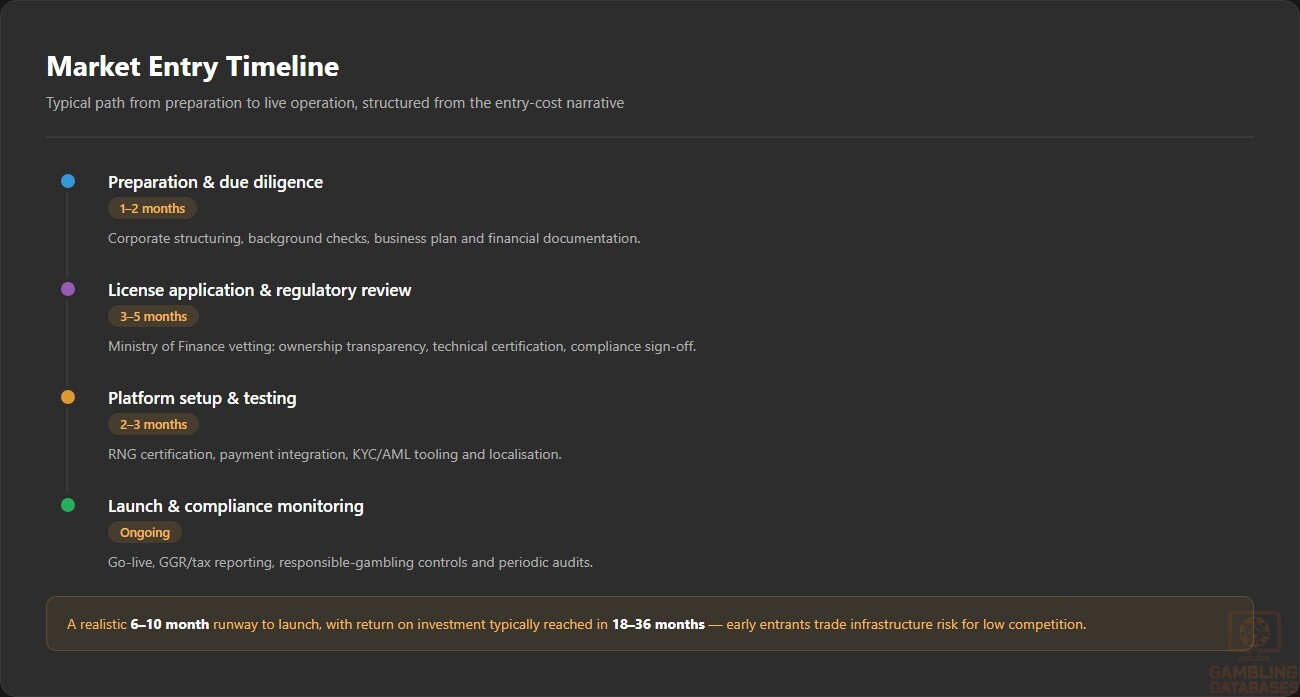
- Preparation and due diligence (1-2 months)
- License application and regulatory review (3-5 months)
- Platform setup and testing (2-3 months)
- Launch and post-launch compliance monitoring (ongoing)
Success Factors and Challenges
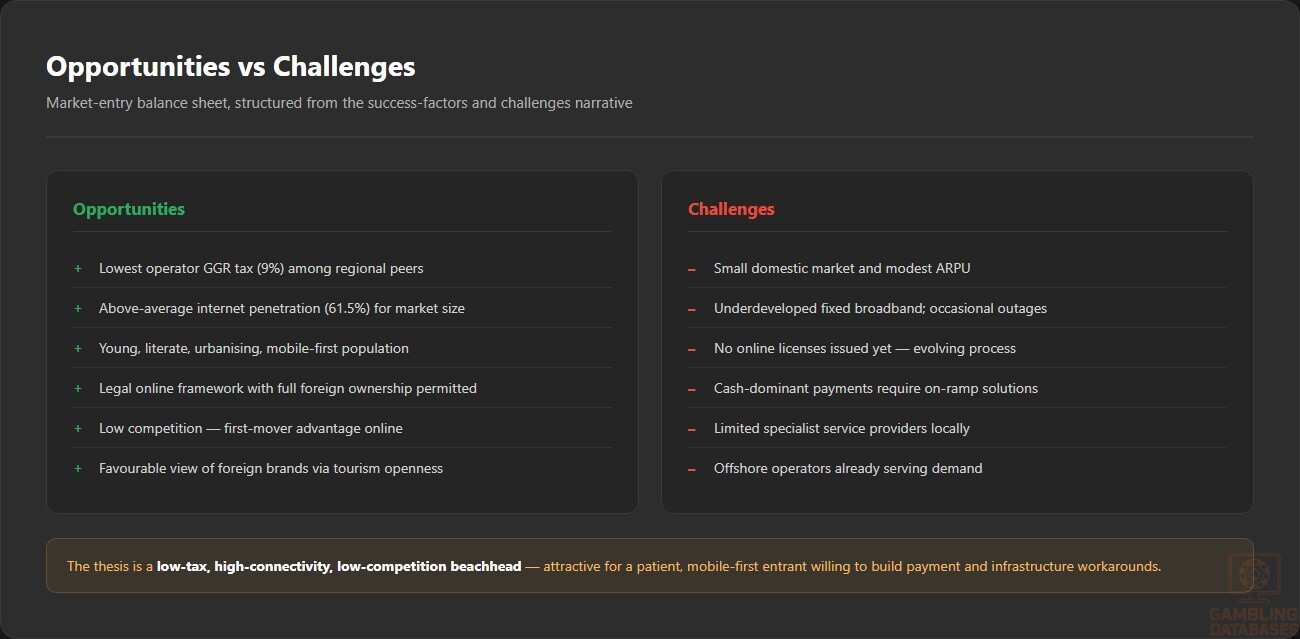
Key factors for success include strong regulatory compliance, effective local partnerships, and digital innovation aligned with user preferences. Challenges include infrastructural limitations, small market size, and evolving regulatory frameworks.
- Adapting to local regulatory changes
- Gaining player trust and brand recognition
- Ensuring secure, fast payment options
- Managing operational costs in a small economy
- Navigating limited institutional support and service providers
Exit strategies should consider market liquidity, license transfer options, and future valuation based on revenue growth and regulatory stability.
FAQ: Frequently Asked Questions
1. Is online gambling legal in Sao Tome and Principe?
Yes, online gambling is legal under specific regulation within the Gaming Act. Operators must obtain a local license to operate legally, though currently few have been issued. Residents may access international sites, but unlicensed local operations are prohibited. The government supports regulated online gambling as a sector for economic growth.
2. What types of gambling licenses are available and what do they cover?
Licenses cover land-based casinos, sports betting, lotteries, and online gambling operators. Separate authorization is typically required for each segment, ensuring tailored regulation for operational scope. Online licenses emphasize technological certification and comprehensive compliance. No more than five main types currently exist, offering flexibility for various operator models.
3. How much does an iGaming license cost and how long does it take to obtain?
License costs vary depending on the category but generally range from tens to hundreds of thousands of dollars. Application reviews and due diligence usually take 3-6 months. Additional expenses include legal fees, platform certification, and operational requirements. The process demands thorough preparation to meet technical and financial standards.
4. Can foreign companies obtain a gambling license?
Foreign companies are eligible to obtain licenses with full ownership permitted, subject to background checks and transparency requirements. Applicants must designate local representatives or comply with operational mandates facilitating regulation oversight. The government encourages international investment while ensuring market integrity.
5. What are the tax obligations for iGaming operators?
Operators are subject to gross gaming revenue tax typically around 9%, corporate income tax at 25%, and license fees. Additional turnover or operational taxes may apply. Compliance with tax reporting and payment deadlines is enforced rigorously to maintain licensing. Tax incentives may exist within special economic zones.
6. Are gambling winnings taxed for players?
Players do not generally pay direct tax on gambling winnings. The fiscal burden primarily rests on operators through GGR taxes and related charges. This supports player attraction and market growth by simplifying payout processes and reducing barriers for participants.
7. What are the typical operational costs for running an online casino or sportsbook?
Operational costs include platform licensing, software development and integration, staffing, compliance, marketing, payment processing fees, and IT infrastructure maintenance. Marketing and customer acquisition represent significant ongoing expenditures. Variable costs depend on market scale and promotional strategies.
8. What is the expected ROI timeline for entering this market?
ROI typically ranges from 18 to 36 months depending on investment scale, marketing effectiveness, and operational efficiency. Early entrants benefit from lower competition, but face challenges linked to market development pace and infrastructure maturity.
9. What are the local presence requirements for operators?
There is no hard mandate for a physical office, but having a local representative or partnership is strongly recommended for compliance facilitation. Some licensing requirements include appointing a legal agent for communication with regulators. This aids regulatory adherence and market responsiveness.
10. What payment methods are available and recommended?
Cash is dominant, but digital payments are growing in urban areas. Recommended methods include debit cards (Visa, Mastercard), mobile money solutions, bank transfers, and international payment gateways to accommodate diverse consumer preferences and ease transaction processes.
11. What are the advertising and marketing restrictions?
Advertising is regulated to prevent targeting minors and vulnerable groups. Responsible gambling messaging is mandatory. Time restrictions on gambling ads apply to radio and TV. Misleading claims and aggressive promotions are prohibited to maintain ethical marketing standards.
12. What responsible gambling measures are mandatory?
Operators must implement age verification, KYC/AML procedures, self-exclusion options, deposit and loss limits, and information disclosures on game risks. These measures protect players and promote a safe gambling environment as part of licensing conditions.
13. How large is the iGaming market and what is the growth potential?
The market is small but rapidly growing, with internet and mobile adoption fueling increased online participation. Projected CAGR is 12-15% over five years, aided by tourism expansion and improved regulatory clarity. Digital platforms stand to capture increasing market share from traditional gambling.
14. Who are the main competitors and what is their market share?
The primary competitor in land-based gaming is Pestana Casino. Online market competition is limited with few licensed domestic operators; international offshore operators serve most online players. The market remains open with significant opportunity for new entrants.
15. What are the player preferences and typical spending patterns?
Players favor mobile-friendly, quick-play gaming formats, especially sports betting and lotteries. Spending is cautious with short, frequent sessions aligned with modest income. Loyalty and reward programs effectively improve retention, appealing to both novice and regular players.
16. What are the key success factors and main challenges for new entrants?
Success factors include regulatory compliance, local market understanding, effective mobile platforms, diverse payment options, and strong customer support. Challenges involve limited infrastructure, small domestic market size, evolving regulations, and competition from offshore operators.
Sources and References
- Sao Tome and Principe Gambling Regulatory Authority – Official Website
- National Statistical Office – Population and Economic Data 2024
- Central Bank of Sao Tome and Principe – Financial Statistics and Reports
- Ministry of Finance – Tax Regulations and Guidelines
- World Bank – Doing Business Report 2024
- International Telecommunication Union – ICT Statistics
- Gaming Industry Report – iGaming Today 2024
- DataReportal – Digital 2025: Sao Tome and Principe
- Worldometers – Sao Tome and Principe Demographics 2025
- Trading Economics – Sao Tome and Principe Indicators
- Polaris Market Research – Online Gambling Market Size
- Affcatalog – Sao Tome and Principe Market Overview 2025
- LegalPilot – Gambling Laws in Sao Tome and Principe
- Global Casino Guide – Sao Tome and Principe Profile
- Transfi – Payment Methods and Digital Services 2025
- ITU – Telecommunications Reports 2025
- UNU E-Gov Project – Digital Governance Strategy
- World Bank Economic Updates – Sao Tome August 2025
- ICEPP – Taxation of Gambling in Africa Report
- Market Data Forecast – Casino Market Size and Trends
- SpeedGeo – Internet Speed Statistics
- Lawzana – Gaming Lawyers Directory Sao Tome
- 6WResearch – Subscription and Gaming Market Analysis
- TradingEconomics – Individuals Using the Internet Statistics
- Additional Industry News and Reports 2024-2025