North Macedonia presents a compelling opportunity for iGaming market entry driven by its evolving regulatory environment and growing internet penetration. The country’s recent legislative reforms aim to align with EU standards, enhancing regulatory clarity while reshaping taxation and licensing frameworks.
This market features a dominant land-based gambling sector with emerging digital opportunities. Strategic understanding of regulatory changes, licensing requirements, and compliance obligations is critical for new entrants seeking a foothold in North Macedonia’s iGaming landscape.
Executive Summary: Key Market Indicators
| Metric | Value |
|---|---|
| Gambling Legal Status | Fully Regulated, State Monopoly on Online Gambling |
| Regulatory Authority | Ministry of Finance of North Macedonia |
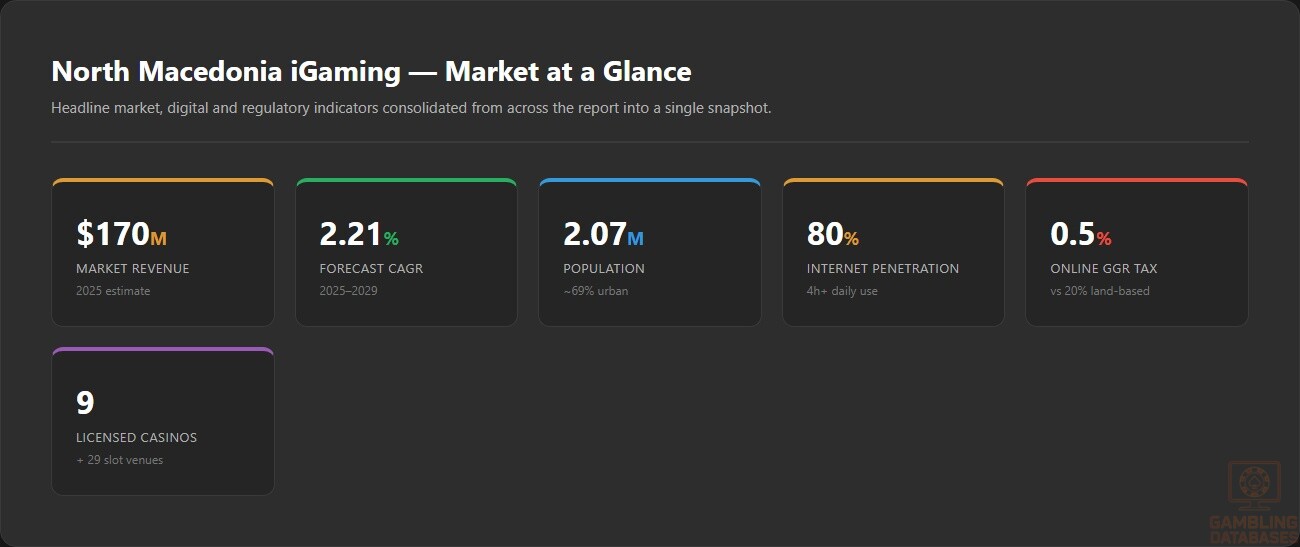
| Population | 2.07 million (2025) |
| GDP | ~$14 billion (nominal, 2025) |
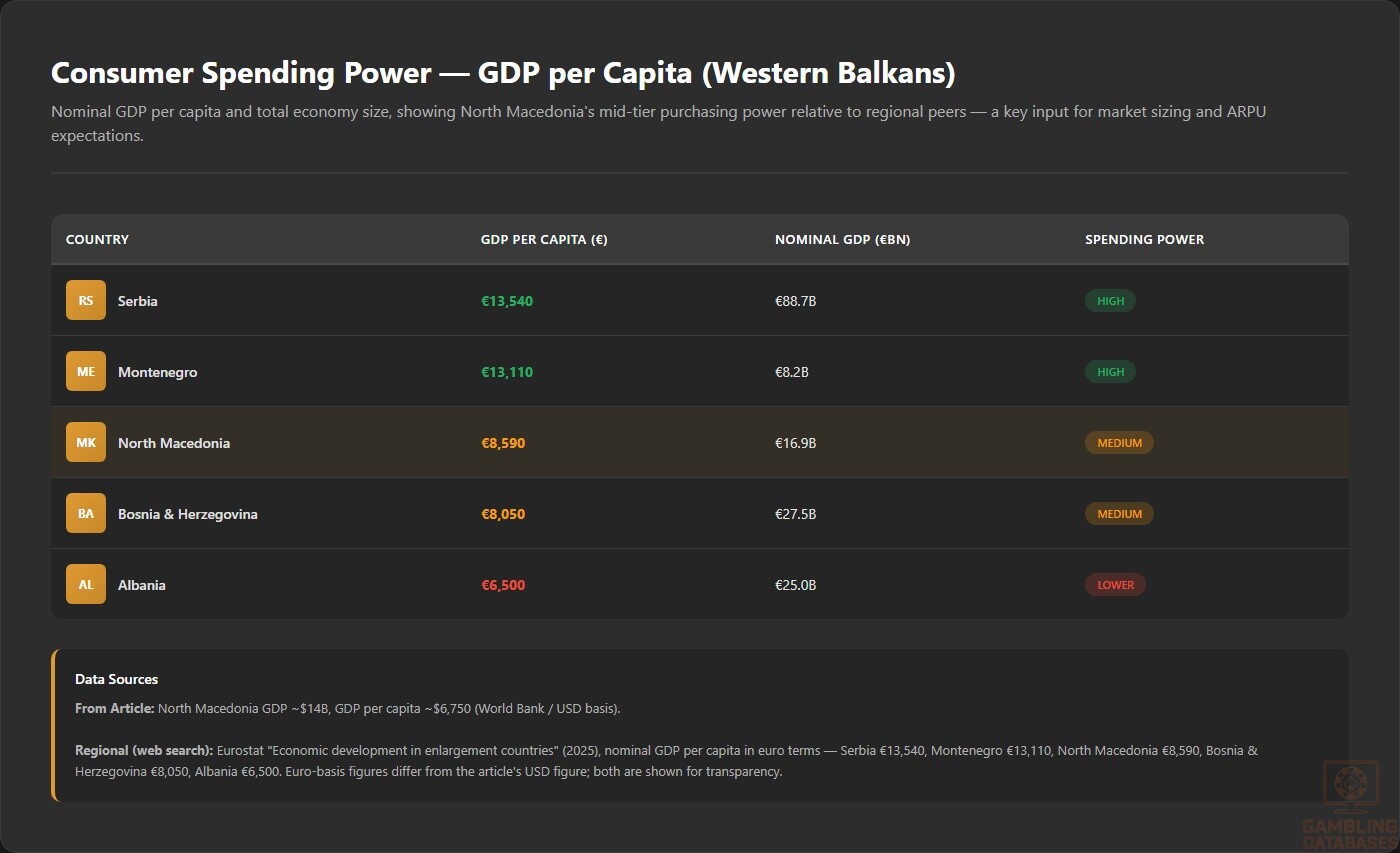
| GDP Per Capita | ~$6,750 (2025) |
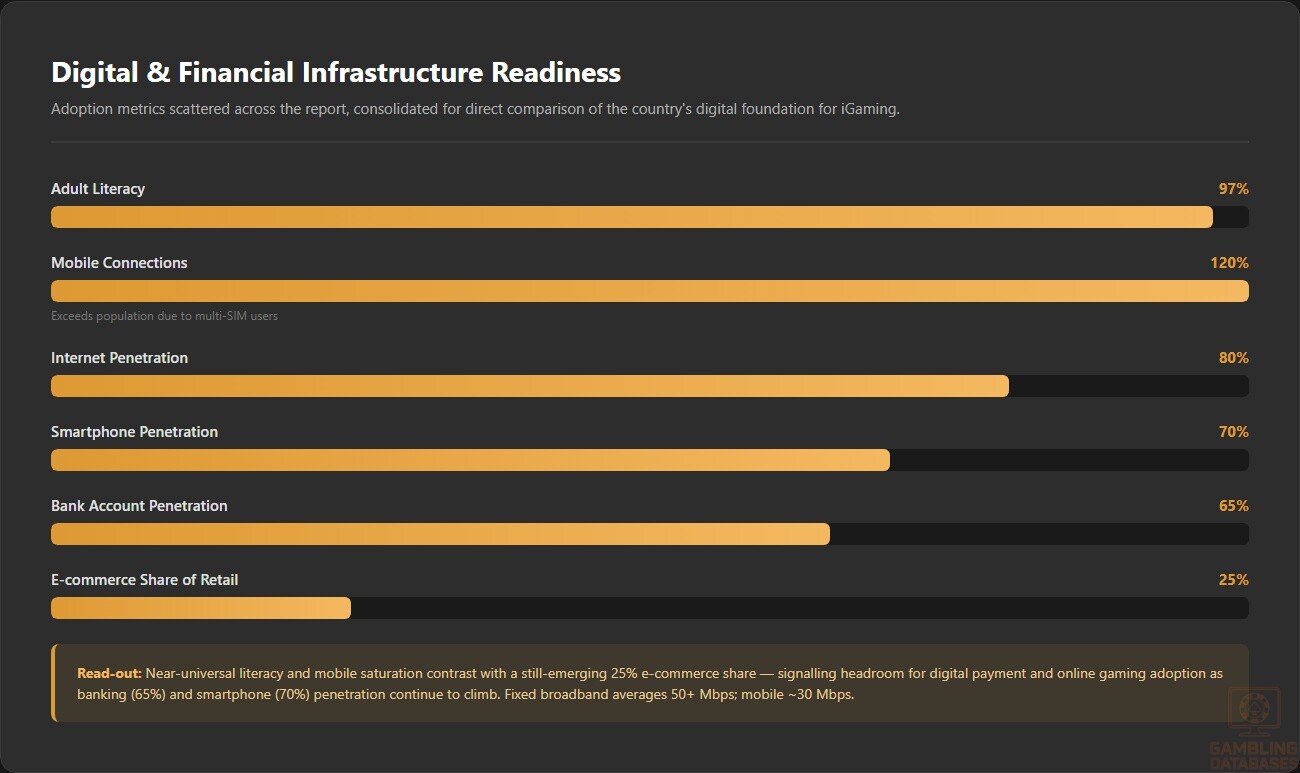
| Internet Penetration | ~80% |
| Mobile Penetration | ~120% (multi-SIM users) |
| Land-Based Casinos | 9 licensed casinos |
| Land-Based Sports Betting Outlets | 7 licensed operators |
| Slot Machine Licences | 29 licensed venues |
| Online Gambling Licences Issued | State monopoly for online gambling |
| License Application Fee (Casinos) | €600,000 |
| License Application Fee (Sports Betting) | €105,000 |
| License Application Fee (Slot Machines) | €78,750 |
| License Application Fee (Online Gambling) | €50,000 |
| Minimum Capital Requirement (Online) | €40,000 |
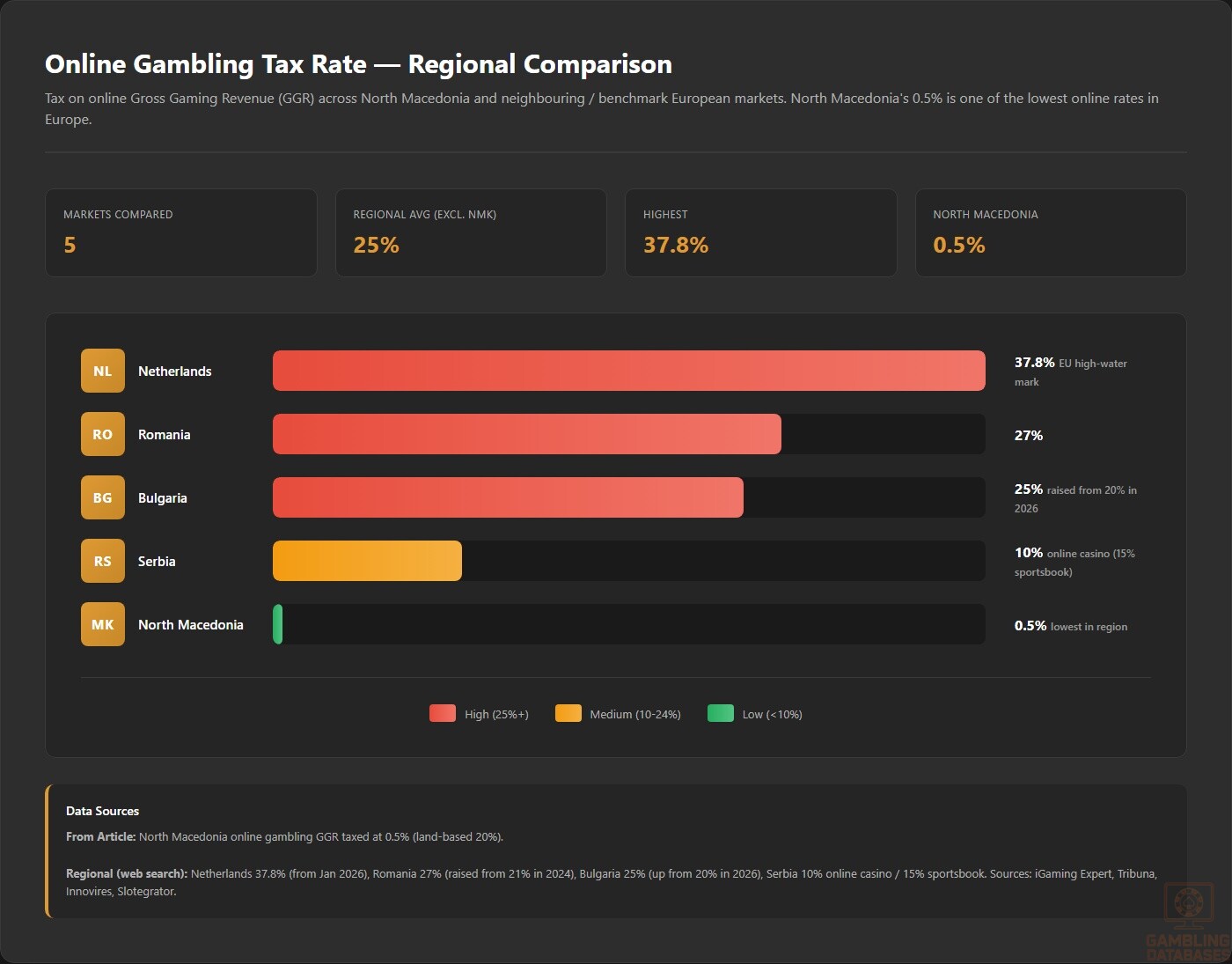
| Gross Gaming Revenue (GGR) Tax Rate | 20% (land-based), 0.5% (online) |
| Personal Income Tax Rate | Flat 10% |
| Corporate Tax Rate | 10% |
| License Validity Period (Casinos) | 6 years |
| License Validity Period (Sports Betting) | 3 years |
| License Validity Period (Online Gambling) | 4 years |
| Market Size Estimated Revenue | US$170 million (2025) |
| Market Growth Forecast (CAGR) | 2.21% (2025–2029) |
| Average Revenue Per User (ARPU) | Undisclosed |
| Market Penetration Rate | Moderate, growing digital sector |
| Regulatory Reform Timeline | Ongoing major reforms through 2025-2026 |
| Advertising Restrictions | Complete ban on gambling advertising proposed |
| Mandatory Distance from Schools | Minimum 500 meters for venues |
Section 1: Regulatory Framework and Legal Environment
Current Gambling Regulation Status
North Macedonia regulates a full spectrum of gambling activities including casinos, sports betting, slot machine halls, lotteries, and online gambling. The gambling sector is legally structured under the Ministry of Finance, which oversees licensing, compliance, and enforcement.
Land-based gambling remains the cornerstone of the market, encompassing casino resorts, sports betting shops, and dedicated slot machine venues. Casinos, often integrated within hospitality complexes particularly in cities like Skopje and Gevgelija, contribute significantly to tourism and tax revenues.
The online gambling segment is legally permitted but is predominantly a state-controlled monopoly. Private online gambling licenses are scarce, and digital operations largely fall under oversight tied to the National Video Lottery, a government-partnered entity. This creates a regulated but limited private sector environment in digital gaming.
Land-Based Gambling Activities
The land-based gambling ecosystem includes nine licensed casinos, which operate under stringent regulations demanding high capital investment and operational standards. Sports betting is conducted under specific licenses issued to seven operators. Slot machine halls number 29 licensed venues, spanning various urban and tourist locations.
The sector emphasizes responsible gambling measures and proximity restrictions. Venues must be located a minimum of 500 meters from educational institutions, reflecting recent legislative efforts to mitigate gambling harm among minors.
Online Gambling Framework
Online gambling regulation is framed for tightly controlled access with a strong government presence. The country maintains a state monopoly over most online gambling activities, managing operations principally through the National Video Lottery joint venture with Casinos Austria.
Private operators face a restrictive environment; the licensing regime for online gambling is active but limited. Licensing fees and capital requirements for online licenses are comparatively accessible but actual issuance is minimal. The regulatory framework imposes stringent technical certification and reporting protocols for licensed online platforms.
Licensed Operators and Market Players
North Macedonia’s gambling market is fragmented at the land-based level, dominated by local operators with longstanding client relationships. Key players include LeGrand Casino (part of KAK DOO Skopje), Grand Casino Skopje, Casino Metropol Ohrid, and Casino Dojran. These operators benefit from integrated hospitality services, enabling cross-sector business models.
The online sector’s state control limits international operator engagement. New entrants aiming to enter the market face challenges due to the monopoly structure online, but land-based opportunities may arise through partnerships or acquisitions within the regulated framework.
Licensing Framework and Requirements
Application Process and Eligibility
Licensing authority rests with the Ministry of Finance. Applicants must be registered trading companies with a legal seat in North Macedonia. License application evaluations are conducted within 30 days following documentation submission, with licenses valid from three to six years depending on type.
License fees vary by gambling vertical, with casino licenses commanding the highest fees. Financial prerequisites include substantial minimum capital requirements especially for casinos and online operators. Technical certifications encompass platform audits and compliance with RNG and cybersecurity standards.
The following documents are typically required for licensing:
- Corporate registration certificate and trade registration
- Proof of financial capital and solvency
- Business plan including market and financial projections
- Technical compliance certificates for software and RNG
- Criminal background checks for principals and beneficial owners
- Proof of ownership or lease of physical gambling premises
- Tax clearance and pending obligation disclosures
- Operational security and anti-money laundering plans
Local Presence and Operational Requirements
Operators must maintain a physical business presence within North Macedonia. Gambling websites must use domain registrations compliant with Macedonian jurisdiction. Key personnel, including executive management and compliance officers, are required to reside locally or demonstrate significant ties to the country.
The legislation restricts foreign ownership, requiring transparent disclosures and in some cases mandate local partner involvement. Operational mandates include responsible gambling programs, data retention policies, and real-time reporting to regulators.
Compliance Obligations and Monitoring
Player Protection and Identification
The regulatory framework imposes rigorous player protection criteria. Identification protocols include mandatory age verification at registration and ongoing Know Your Customer (KYC) checks to prevent fraud and money laundering.
- Mandatory age verification (minimum 18 years)
- Comprehensive KYC checks including identity and address verification
- Anti-Money Laundering (AML) procedures aligned with EU standards
- Implementation of self-exclusion and player limit systems
- Information disclosure on odds, payouts, and risks
- Mandatory responsible gambling messaging and intervention tools
Self-exclusion registries are maintained by licensed operators and connected to national databases for cross-platform enforcement. Player loss limits and deposit restrictions are enforced to curb addictive behaviors.
Financial Monitoring and Reporting
Operators are required to submit detailed financial reports on a monthly basis, including gross gaming revenue, tax payments, and player transaction volumes. Transaction monitoring systems must be in place to flag suspicious activities, with reports channeled to the Ministry of Finance and associated anti-corruption bodies.
- Submission of monthly financial and operational reports to regulators by the 15th of each month
- External audits of financial statements annually by certified auditors
- Reporting of suspicious transactions immediately upon detection
- Compliance reviews and inspections conducted periodically by regulatory officials
- Automatic suspension and penalties applied for non-compliance
Taxation Structure and Financial Obligations
Player Taxation
Players are generally not taxed on winnings as per current legislation. No withholding taxes on gambling winnings are imposed, making North Macedonia a player-friendly jurisdiction for prize retention.
Operator Taxation
| Game Type | Tax Rate on Gross Gaming Revenue (GGR) |
|---|---|
| Land-Based Casinos | 20% |
| Sports Betting | 20% |
| Slot Machines | 20% |
| Online Gambling | 0.5% |
| B2B Suppliers | Fixed fee €25,000 every 4 years |
Other financial obligations include a license fee payable in installments for casinos and a corporate income tax of 10%. License renewal fees and turnover-based taxes apply according to the type of gambling operations.
Gambling Market Financial Performance
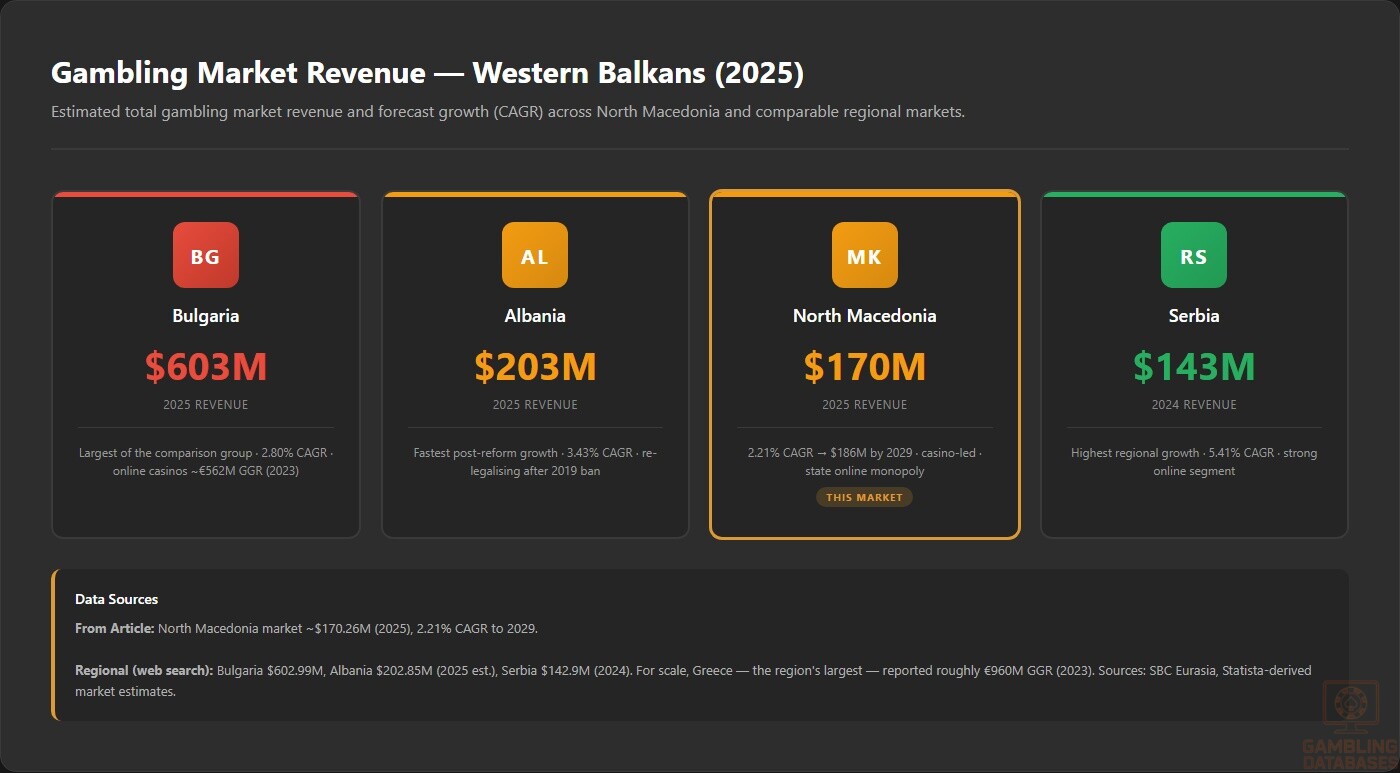
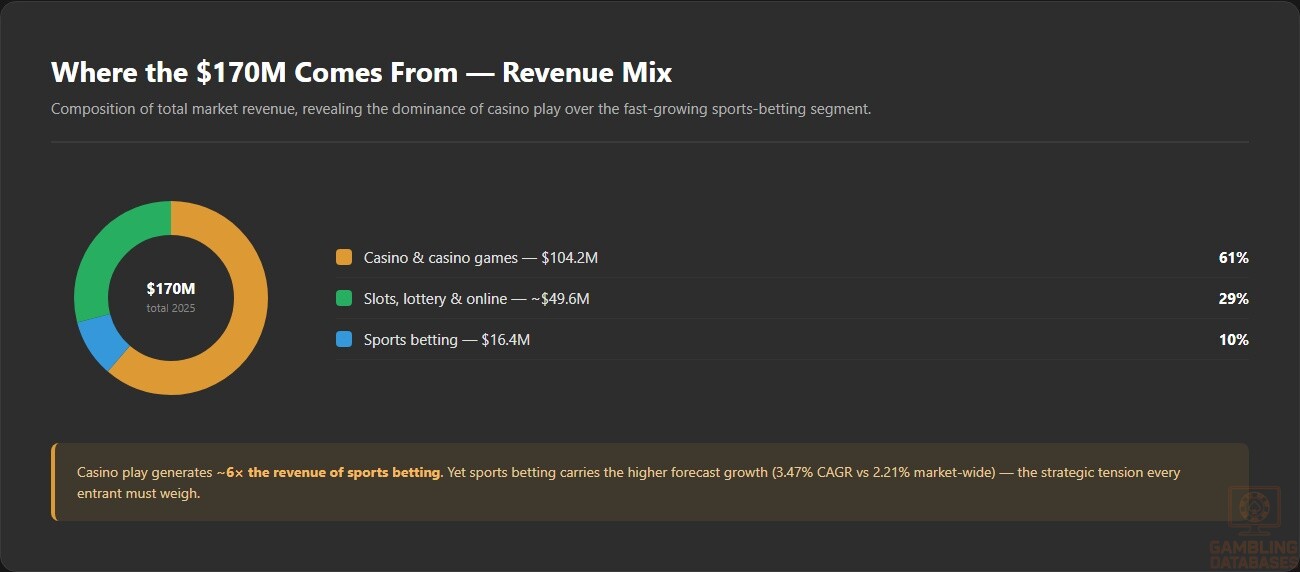
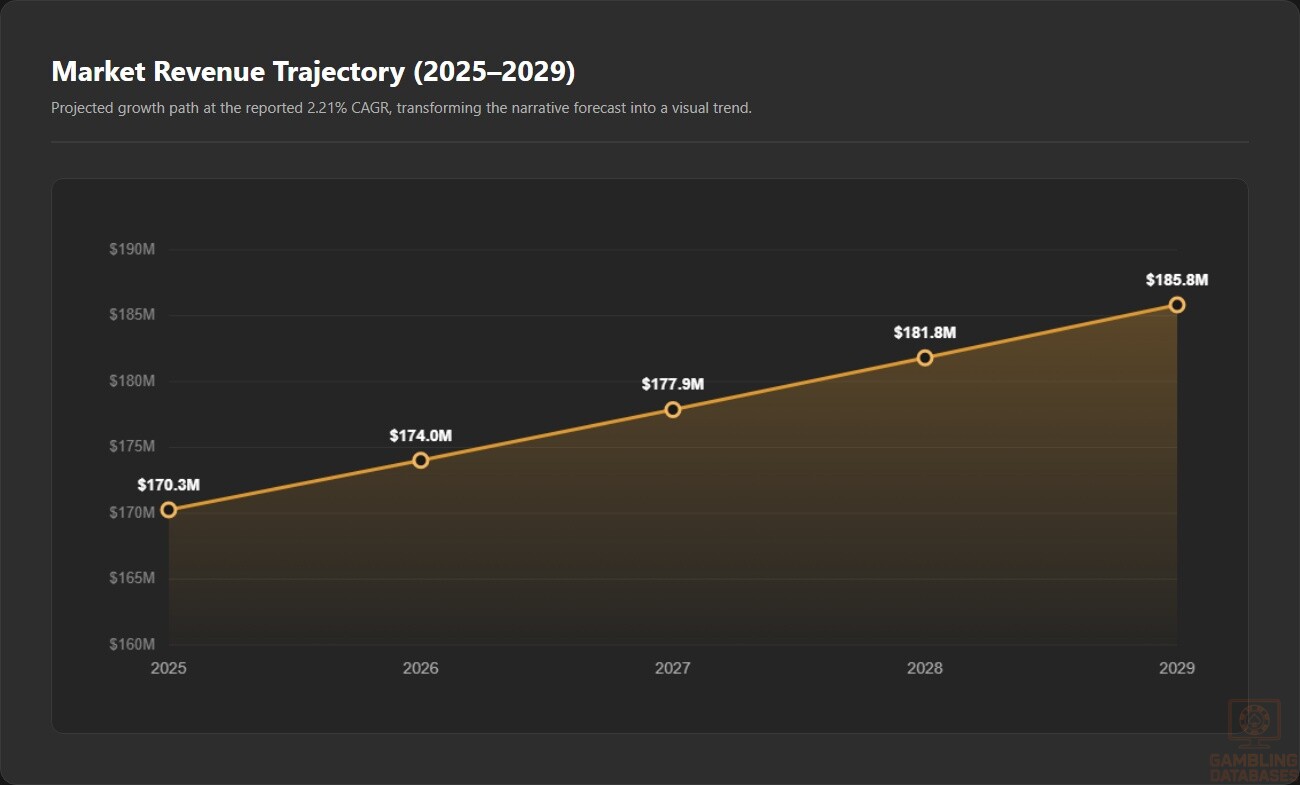
The total gambling market revenue is estimated at approximately US$170 million in 2025, with casinos contributing the largest share. The sector’s tax revenues constitute a significant part of local and national government budgets. Annual growth is forecast at 2.21% CAGR through 2029, supported by internet expansion and economic improvements.
Advertising and Marketing Restrictions
North Macedonia has introduced a comprehensive advertising ban on all gambling-related promotions, targeting social responsibility and reducing youth exposure. Sponsorship activities are highly restricted, particularly in sports and cultural events. Advertising through online media and traditional channels is prohibited under recent reforms.
- Complete ban on gambling advertising across all media
- Prohibition of sponsorships in sports and event marketing
- Restriction on promotional bonuses and offers
- Mandatory display of responsible gambling messaging
- Time-of-day restrictions on permissible advertising under limited exceptions
Recent Regulatory Changes and Their Impact
In 2024 and 2025, North Macedonia enacted fundamental reforms including a ban on gambling advertising, the introduction of a 500 meter mandatory distance rule from schools for venues, and transition toward a state-controlled online monopoly. These changes have increased operational costs and created market exit pressure for smaller operators while enhancing regulatory transparency.
Enforcement Mechanisms and Penalties
The regulatory body enforces compliance through routine inspections, financial audits, and monitoring of advertising practices. Penalties for violations range from fines to license suspension and revocation. The regulatory framework includes mechanisms to address illegal gambling and unlicensed operators aggressively.
- Fines proportional to the severity of the offence
- Temporary suspension of licenses for non-compliance
- Permanent revocation of licenses for serious breaches
- Seizure of illegal gambling equipment
- Criminal prosecution for fraud and corruption related offenses
Section 2: Demographics and Consumer Analysis
Population Demographics and Distribution
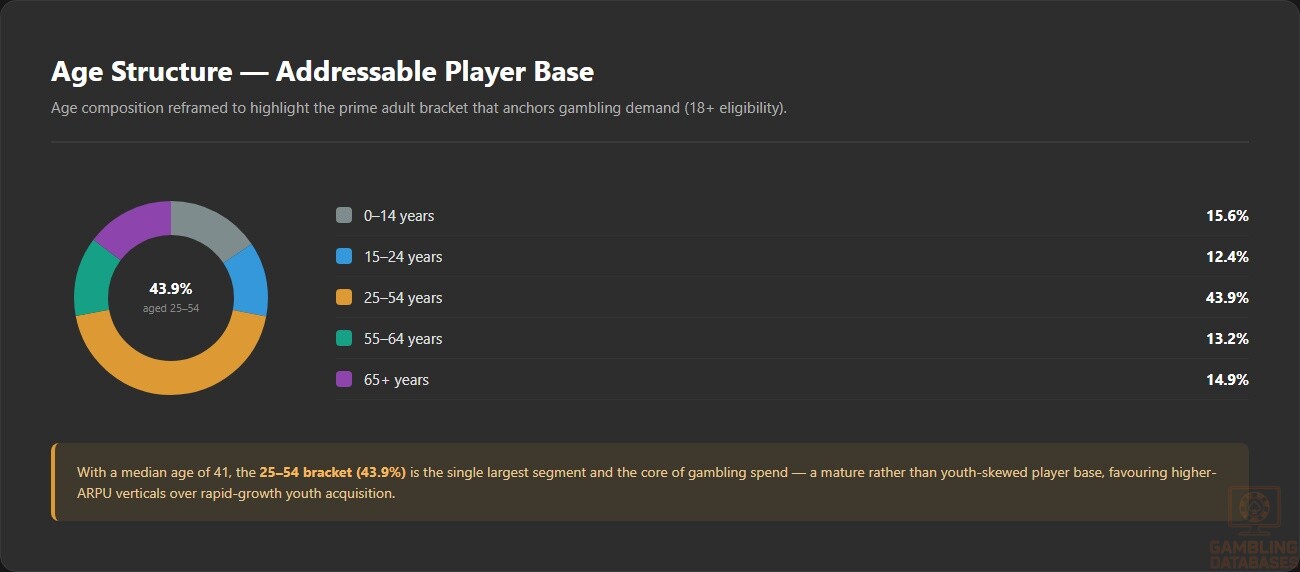
North Macedonia’s total population is approximately 1.82 million as of 2025, with a median age of 41 years, reflecting a mature population typical of developed European countries. Gender ratios are balanced, with roughly 1,004 males for every 1,000 females, indicating nearly equal gender distribution.
The population density stands at about 72 people per km², with a significant urban majority of approximately 69.4%. This demographic concentration favors urban centers, where access to digital infrastructure and gambling venues is more prevalent.
| Age Group | Percent of Total Population |
|---|---|
| 0-14 years | 15.6% |
| 15-24 years | 12.4% |
| 25-54 years | 43.9% |
| 55-64 years | 13.2% |
| 65 years and older | 14.9% |
Urbanization is centered in the capital, Skopje, and several regional hubs, facilitating higher digital literacy and access to gambling services. Rural areas continue to represent a smaller, though significant, segment of the population, often with less connectivity and lower disposable income levels.
Major cities serve as focal points for economic activity and gambling venues:
- Skopje (700,000+ residents)
- Bitola (~90,000 residents)
- Kumanovo (~80,000 residents)
- Prilep (~75,000 residents)
- Ohrid (~55,000 residents)
These cities exhibit higher internet penetration and house the majority of licensed gambling outlets, including casinos and betting shops, contributing substantially to local economies.
Economic Indicators and Consumer Spending Power
North Macedonia’s nominal GDP is estimated at approximately $14 billion in 2025, with expected growth averaging around 3.0% annually between 2025 and 2027. The economic structure is service-led, with services accounting for over half of GDP, followed by manufacturing and agriculture. Public investment and export growth are key drivers supporting steady economic expansion.
Per capita GDP is around $6,750, indicating moderate consumer purchasing power. Household income distribution reveals a concentration in low to middle-income brackets, with ongoing improvements in disposable income and consumer confidence aligned with economic recovery efforts.
| Indicator | Value |
|---|---|
| GDP (Nominal) | $14 billion |
| GDP Growth Rate | 3.0% (projected) |
| GDP Per Capita | $6,750 |
| Inflation Rate | 2.1% |
| Unemployment Rate | 15.2% |
| Average Household Income | ~€7,000 annually |
Consumer spending in North Macedonia shows a gradual shift toward digital commerce, with increasing adoption of online and mobile payment solutions. This shift positively impacts iGaming penetration, especially among younger, tech-savvy demographics.
Market Size and Growth Projections
The gambling market is valued at approximately $170 million in 2025 and is expected to grow at a compound annual growth rate (CAGR) of around 2.21% through 2029. Growth is driven by expanding internet access, increasing smartphone penetration, and evolving consumer behavior shifting from land-based to online gambling.
| Metric | 2025 Value | Projected CAGR | 2029 Forecast |
|---|---|---|---|
| Total Market Revenue | $170.26 million | 2.21% | $185.82 million |
| Casino & Casino Games Revenue | $104.20 million | – | – |
| Sports Betting Market Revenue | $16.42 million | 3.47% | $19.00 million |
| Number of Land-Based Venues | 1,000+ | – | – |
The demographic shift with a significant youth component and increasing digital literacy is expected to expand the user base and average revenue per user (ARPU), particularly in mobile and online segments with practical payment solutions.
Education, Skills, and Digital Literacy
North Macedonia boasts a high literacy rate above 97%, with widespread access to primary and secondary education. Digital literacy is progressively improving, especially in urban centers where internet infrastructure and smartphone adoption are prevalent. Workforce skills in ICT and digital marketing are expanding, aligning with national priorities to boost economic competitiveness through technology and innovation.
Government and private sector initiatives focus on equipping youth and working adults with digital skills, which fosters an environment conducive to the growth of online services, including iGaming platforms requiring sophisticated user interfaces and digital payment integration.
Cultural and Social Factors
Communication and Language
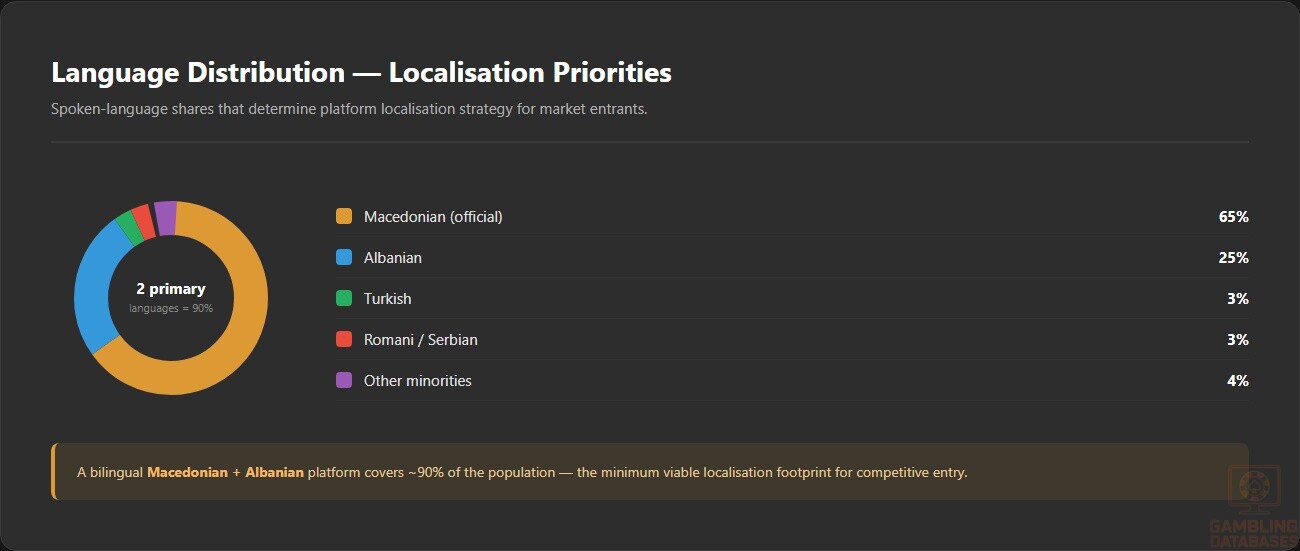
North Macedonia is multilingual, with the majority speaking Macedonian as the official language. Albanian is the second most-used language, spoken by approximately 25% of the population, followed by Turkish, Roma, Serbian, and other minority languages.
- Macedonian (Official, spoken by ~65%)
- Albanian (~25%)
- Turkish (~3%)
- Romani and Serbian (Combined ~3%)
- Other minority languages (~4%)
Internet and digital content consumption predominantly occurs in Macedonian and Albanian, affecting localization strategy for iGaming operators seeking to engage diverse linguistic segments.
Cultural Attitudes
Gambling is traditionally viewed as a popular form of entertainment among adults, albeit with cultural reservations influenced by religious and social norms. Eastern Orthodox Christianity, predominant in the ethnic Macedonian population, and Islam among Albanians, have nuanced perspectives on gambling; however, such influences generally moderate rather than prohibit gambling activity.
Foreign brand perception is positive but cautious, favoring reputable operators with transparent compliance and responsible gaming policies. Entertainment preferences increasingly favor digital formats, with youth particularly engaged in online gaming and betting.
Problem Gambling and Social Considerations
Problem gambling prevalence aligns with regional averages, estimated at around 2-3% of the population. Government and NGO efforts focus on early intervention, player education, and support services to mitigate social harms.
Measures include self-exclusion programs, counseling centers, and public awareness campaigns integrated into broader health and social services frameworks.
- National helpline for gambling addiction
- Mandatory player self-exclusion registries
- Public education campaigns on gambling risks
- Support groups and counseling services
- Research and data collection initiatives on gambling behavior
Political Structure and Governance
North Macedonia operates a parliamentary democracy with a stable political environment conducive to business investment. The government’s commitment to EU accession drives progressive regulatory reform, enhancing legal certainty and market transparency.
Regulatory consistency is supported by an active judiciary and anti-corruption frameworks, providing a stable environment for iGaming operators and investors.
Technology Adoption and Digital Behavior
Internet and Digital Usage
Internet penetration reaches approximately 80% of the population, with average daily usage exceeding four hours, reflecting high engagement. Mobile connections exceed population figures, driven by multi-SIM users, with mobile broadband as the predominant access mode.
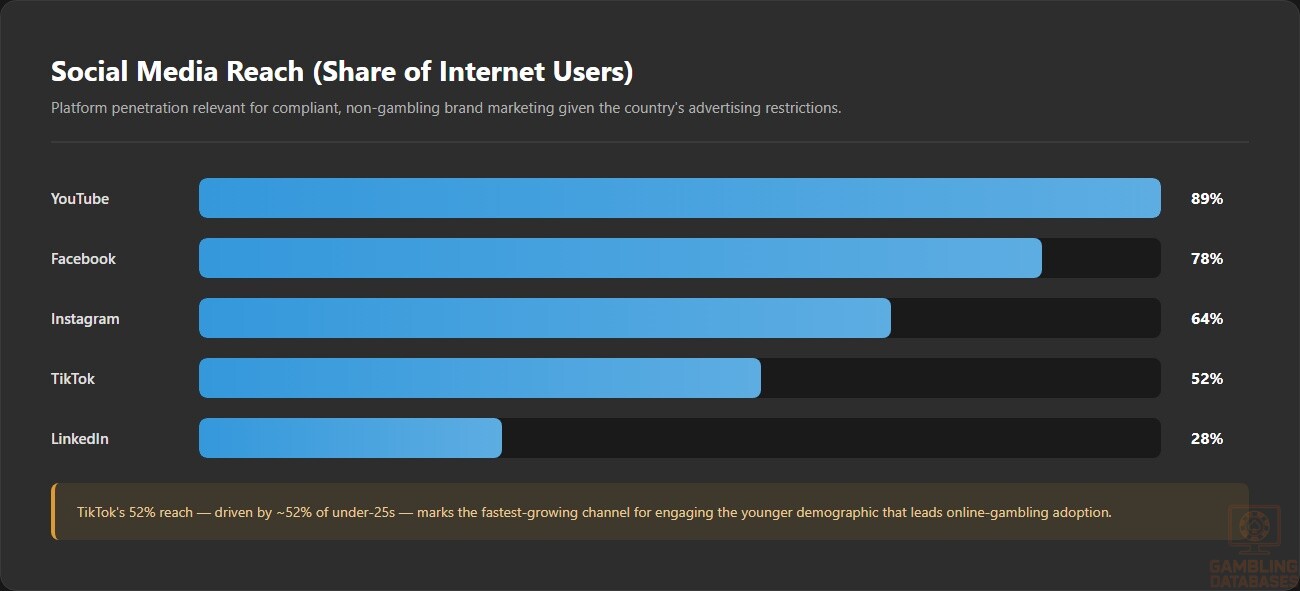
Social media usage is widespread, with dominance of platforms such as Facebook, YouTube, Instagram, TikTok, and LinkedIn, facilitating diverse digital marketing opportunities.
- Facebook (~78% internet users)
- YouTube (~89% internet users)
- Instagram (~64% young demographic)
- TikTok (rapid growth, ~52% under-25 users)
- LinkedIn (~28% professionals)
Digital Payment Behavior
Payment methods have rapidly shifted towards electronic and mobile platforms, driven by increasing smartphone penetration and the national banking infrastructure’s modernization.
Preferred methods include credit/debit cards, mobile wallets, bank transfers, and emerging QR code payments. Cryptocurrency adoption remains nascent but is monitored as a potential future trend.
- Credit and debit cards (Visa, Mastercard, Maestro)
- Mobile wallets (HalkPay, NLB Pay, Global wallets like Apple Pay)
- Bank transfers including SEPA payments
- Contactless tap-to-pay via POS terminals
- QR code payments through smartphone apps
Gaming and Gambling Preferences
Current Market Participation
Gambling participation is prominent in both land-based and digital formats. The majority engage in sports betting, followed by casino games and lottery. Online gambling, while limited by regulatory frameworks, attracts a younger demographic with growing frequency.
| Activity | Participation Rate |
|---|---|
| Sports Betting | 38% |
| Casino Games (Poker, Roulette, Blackjack) | 32% |
| Lottery | 25% |
| Slot Machines | 18% |
| Online Gambling | 15% |
Consumer Behavior Patterns
Spending on gambling is concentrated in major urban centers with preferences for quick access and convenience. Peak gambling activity occurs in evenings and weekends, with mobile platforms capturing growing share due to accessibility and privacy benefits.
Retention strategies focus on loyalty programs, responsible gambling features, and seamless payment systems. Session lengths vary widely but average around 30-45 minutes for online play, with offline sessions extending longer in physical venues.
Section 3: Technology Infrastructure and Business Environment
Internet and Digital Infrastructure
North Macedonia’s internet penetration reaches approximately 80% of the population, split nearly evenly between fixed broadband and mobile internet access. The country benefits from ongoing investments in fiber optic networks and upgraded data centers enhancing reliability and speed.
Average fixed broadband speeds exceed 50 Mbps, while mobile internet averages around 30 Mbps. Network reliability is stable, supported by multiple international fiber routes and domestic infrastructure expansions focused on reducing latency and increasing redundancy.
5G and Future Technology Deployment
5G deployment is in early stages with commercial availability primarily in Skopje and major urban centers. Operators have begun 5G rollout since late 2024, targeting full urban coverage by 2027 with phased rural expansion following.
The market features three principal mobile network operators actively investing in 5G technology and IoT infrastructure, positioning North Macedonia among regional leaders in digital connectivity and future-ready telecom services.
Mobile Technology Ecosystem
The mobile network landscape includes a small number of major operators competing vigorously on coverage and data plans. Mobile broadband accounts for the bulk of internet sessions, driven by smartphone adoption and video streaming demand.
- Vip Operator (major market share; leader in urban coverage)
- T-Mobile Macedonia (numerous subscribers, competitive pricing)
- A1 Macedonia (strong rural presence, growing data packages)
- Makedonski Telekom (largest fixed network provider, integrated mobile services)
- One (emerging virtual operator with niche services)
Smartphone penetration is above 70% across 2025 with an increasing share of mid-tier and premium devices. Android OS dominates device market share, influencing app development and payment solution choices.
Financial Services and Payment Infrastructure
North Macedonia’s banking sector is modernizing rapidly with extensive digital banking adoption. Account penetration exceeds 65%, supported by widespread ATM and POS terminal networks. Banks continuously improve mobile and online banking capabilities.
- NLB Bank (leading institution with comprehensive digital suite)
- Komercijalna Banka (strong SME and retail focus)
- Halkbank (noted for digital wallet integration)
- Stopanska Banka (regional presence and foreign currency services)
- Alpha Bank (innovative digital solutions and loan products)
- Turkiye Finans (Islamic finance offerings with digital accessibility)
Payment processing offers a broad mix of card schemes, e-wallets, and bank transfers, meeting growing consumer demand for convenience and security in e-commerce and online gambling transactions.
- Credit/Debit Cards: Visa, Mastercard, Maestro widely accepted
- E-wallets: HalkPay, NLB Pay, Global wallets (Apple Pay, Google Pay)
- Bank Transfers: Domestic and SEPA-enabled cross-border options
- Mobile Payments: QR code and contactless tap-to-pay solutions expanding
- Cryptocurrency: Emerging but limited regulatory acceptance
E-commerce and Digital Economy
The nation’s e-commerce sector is growing steadily, with online retail penetration gradually rising to approximately 25% of total retail sales. Digital service adoption spans banking, telecommunications, entertainment, and increasingly, online gaming.
Consumer trust in online platforms has improved through strengthened data protection laws and efficient delivery logistics. The convenience of mobile payments accelerates transactional volume, fostering healthy conditions for iGaming platform success.
Business Environment and Regulatory Framework
North Macedonia ranks favorably in World Bank ease of doing business reports, especially in starting operations, registering property, and accessing credit. The bureaucratic process remains manageable with an average company registration timeline of around two weeks.
Foreign investment is actively encouraged under streamlined frameworks that protect minority shareholders and facilitate repatriation of profits. Operational costs, including labor and office space, are comparatively moderate relative to the EU average, enhancing market attractiveness.
- Prepare notarized and translated incorporation documents
- Submit application and registers to the Central Registry (5-7 days processing)
- Obtain tax identification and VAT registration (3-5 days)
- Open corporate bank account and deposit minimum capital (1-2 weeks)
- Finalize business license and operational permits (variable duration)
Corporate Structure and Registration
The most common corporate forms for iGaming operators are Limited Liability Companies (LLCs) and Joint Stock Companies, with Branch Offices reserved for foreign parent firms seeking market presence without full incorporation.
LLCs offer simplified governance and liability protection, favored by small to medium operators. Joint Stock Companies suit larger ventures requiring broader capital access and investor participation. Branch offices require fiscal representation in the country but can leverage parent company resources.
- Certificate of Incorporation
- Articles of Association/Bylaws
- Identification documents for founders and directors
- Proof of registered office address
- Bank reference and capital deposit confirmation
- Tax registration confirmation
- Licenses and permits relevant to gambling activities
Taxation Framework
Corporate income tax is a flat rate of 10%, with additional incentives in Special Economic Zones offering exemptions for up to 10 years. Multiple double taxation treaties with over 40 countries optimize cross-border operations.
- Bulgaria
- Serbia
- Germany
- Austria
- Italy
- Turkey
- United Kingdom
Personal income tax is also flat at 10%, with employer and employee social security contributions applying per statutory levels. Tax residency is determined by spending more than 183 days in the country annually.
Market Entry Considerations
Successful entry requires navigating regulatory complexity and leveraging partnerships with local entities. Multi-channel platform design with mobile optimization and multi-language support is essential for competitive advantage.
- Form joint ventures or partnerships with local companies
- Establish local physical presence for compliance
- Invest in multi-language platform development (Macedonian, Albanian)
- Leverage mobile-first design and integrated payment solutions
- Engage in compliant marketing mindful of advertising bans
| Cost Category | Estimated Cost (EUR) |
|---|---|
| License Application Fees | €50,000 – €600,000 |
| Legal & Regulatory Consulting | €30,000 – €80,000 |
| Company Formation & Registration | €10,000 – €20,000 |
| Initial Capital Requirements | €40,000 – €600,000 |
| Marketing & Compliance Setup | €15,000 – €50,000 |
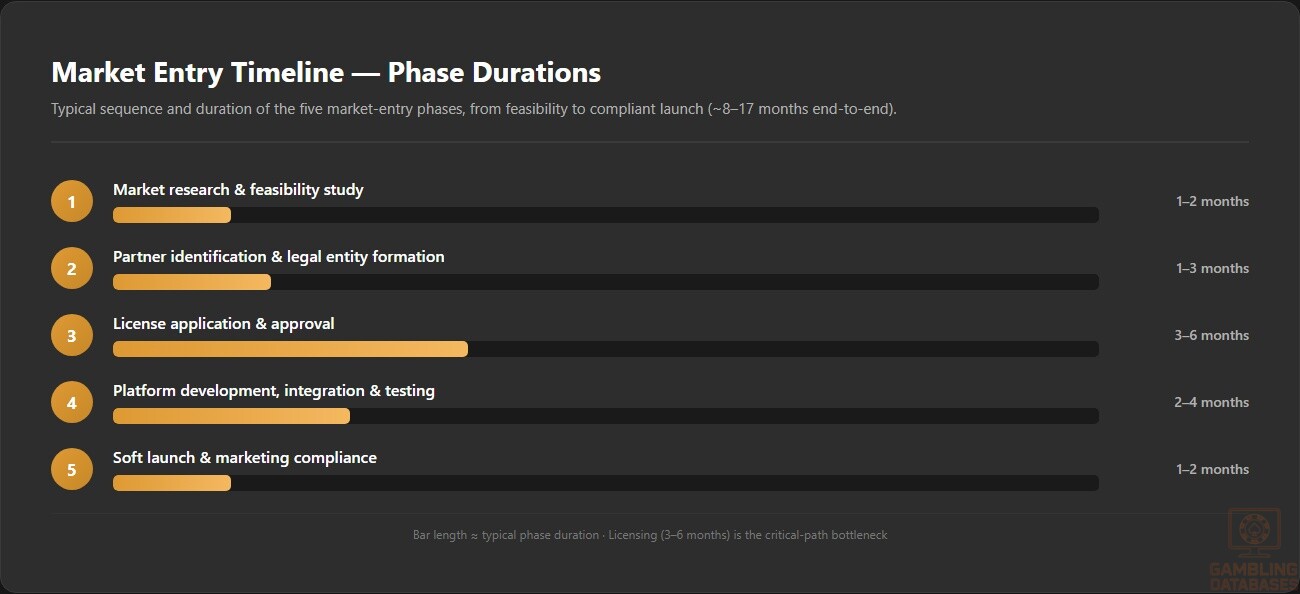
- Market research and initial feasibility study (1-2 months)
- Partner identification and legal entity formation (1-3 months)
- License application and approval process (3-6 months)
- Platform development, integration, and testing (2-4 months)
- Soft launch and marketing compliance (1-2 months)
Exit strategies should consider license transfer restrictions and market liquidity, with significant value placed on established local market presence and compliance records.
FAQ: Frequently Asked Questions
1. Is online gambling legal in North Macedonia?
Yes, online gambling is legal but primarily controlled under a state monopoly structure. Private operators can apply for licenses, but these are limited by regulatory policies favoring government partnerships, resulting in restricted private sector participation. The legal framework mandates strict compliance with licensing, player protection, and reporting standards.
2. What types of gambling licenses are available and what do they cover?
The licensing system includes several categories tailored to market segments such as:
- Casino operations (land-based)
- Sports betting (land-based)
- Slot machine venues
- Online gambling platforms
- B2B suppliers and service providers
Each license type carries specific capital requirements, fees, and operational conditions aligned with market scope.
3. How much does an iGaming license cost and how long does it take to obtain?
License application fees range from €50,000 for online gambling to €600,000 for land-based casinos. The approval process typically spans 3 to 6 months depending on documentation completeness and regulatory scrutiny. Applicants must also meet capital requirements and technical certifications prior to issuance.
4. Can foreign companies obtain a gambling license?
Foreign companies can apply but must establish legal presence in North Macedonia. They are subject to local ownership disclosure requirements and may need to partner with domestic entities. Regulatory authorities emphasize transparency and operational control within national jurisdiction.
5. What are the tax obligations for iGaming operators?
Operators are subject to a gross gaming revenue tax of 20% for land-based games and 0.5% for online gambling. Corporate income tax remains at 10%. Additional license fees and turnover taxes apply according to game categories.
6. Are gambling winnings taxed for players?
Players in North Macedonia are not taxed on gambling winnings. There is no withholding tax imposed on prizes or player payouts, which enhances the market’s appeal for high-stakes players and frequent gamblers.
7. What are the typical operational costs for running an online casino or sportsbook?
Operational costs include license fees, platform development, staff salaries, compliance costs, payment processing fees, marketing, and hosting infrastructure. The largest expenses tend to be license fees and initial capital requirements, followed by ongoing compliance and marketing expenditures.
8. What is the expected ROI timeline for entering this market?
ROI generally requires 2-4 years depending on market segment, scale of investment, and competitive positioning. Land-based operations see longer timelines due to higher upfront costs, while online operators with innovative platforms can expect accelerated ROI given growing digital adoption.
9. What are the local presence requirements for operators?
Operators must have a registered office and key personnel residing or legally domiciled in North Macedonia. Local presence ensures regulatory oversight and facilitates compliance with reporting and operational obligations, reflecting efforts to maintain market integrity.
10. What payment methods are available and recommended?
Recommended payment methods include credit/debit cards, popular mobile wallets such as HalkPay and NLB Pay, bank transfers, and contactless payments. Operators are encouraged to support multiple options to maximize user accessibility and reduce payment friction.
11. What are the advertising and marketing restrictions?
Advertising of gambling is heavily restricted under current laws. The government enforces a near-complete ban across media channels and sponsorships, demanding responsible marketing that avoids targeting minors or vulnerable populations.
12. What responsible gambling measures are mandatory?
Mandatory measures include player identification and age verification, implementation of self-exclusion programs, deposit and loss limits, mandatory responsible gambling messaging, and reporting suspicious behavior. These safeguard players and reinforce regulatory compliance.
13. How large is the iGaming market and what is the growth potential?
The market values approximately $170 million in revenue with a steady CAGR of 2.21% through 2029. Growth is driven by increasing internet penetration, youth engagement, and tightening regulatory frameworks that encourage responsible expansion.
14. Who are the main competitors and what is their market share?
The landscape is dominated by domestic land-based casino operators and a government-linked online monopoly, limiting international private competitors. Market concentration fosters opportunities for strategic partnerships and technology differentiation.
15. What are the player preferences and typical spending patterns?
Players favor sports betting, casino games, and lotteries with a preference for mobile convenience and quick access. Spending is higher in urban hubs, with younger demographics driving online segment growth and retention strategies focusing on loyalty and user experience.
16. What are the key success factors and main challenges for new entrants?
Success factors include regulatory compliance, localized marketing, robust payment integration, and multi-language support. Challenges comprise licensing complexity, advertising restrictions, market entry costs, and competition from established operators. Strategic partnerships and digital innovation are essential to overcoming these hurdles.
Sources and References
- North Macedonia Gambling Regulatory Authority – Official Website – https://www.mfin.gov.mk
- National Statistical Office of North Macedonia – Population and Economic Data 2025 – https://www.stat.gov.mk
- Central Bank of North Macedonia – Financial Reports 2025 – https://www.nbrm.mk
- Ministry of Finance – Tax Regulations and Guidelines 2025 – https://www.finance.gov.mk
- World Bank – Doing Business Report 2025 – https://www.worldbank.org
- International Telecommunication Union – ICT Statistics 2025 – https://www.itu.int
- IGaming Today – North Macedonia Market Research 2025 – https://www.igamingtoday.com
- Mundovideo – North Macedonia Gambling Overhaul – https://www.mundovideo.com.co
- BeInMacedonia – Population Reports 2025 – https://www.beinmacedonia.com
- Worldometers – North Macedonia Population 2025 – https://www.worldometers.info
- OECD – North Macedonia Scoreboard 2025 – https://www.oecd.org
- Statista – North Macedonia Sports Betting Market 2025 – https://www.statista.com
- Transfi Reports – Local Payment Methods 2025 – https://www.transfi.com
- IMF Data Mapper – North Macedonia Economic Data – https://www.imf.org
- LegalPost.eu – Regulatory Framework Overview – https://www.legalpost.eu
- Schoenherr Law Firm – Macedonian Gambling Amendments – https://www.schoenherr.eu
- CasinoRating – North Macedonia License Guide – https://www.casinorating.com
- Sigma World News – Gambling Law Revisions 2024 – https://sigma.world
- World Economics – GDP Data North Macedonia – https://www.worldeconomics.com
- NRBM.mk – Digital Payments Reports 2025 – https://www.nbrm.mk
- Lloyds Bank Trade – North Macedonia Taxes Overview – https://www.lloydsbanktrade.com
- Affmaven – Legal Gambling Guide 2025 – https://affmaven.com
- Gamingtec – Gaming Licenses Guide 2025 – https://gamingtec.com
- CEE Legal Matters – Gambling High-Stakes Industry – https://ceelegalmatters.com
- SBC News – North Macedonia Reform Updates – https://sbcnews.co.uk
- Eurofast – North Macedonia Tax Card 2025 – https://eurofast.eu
- Transfi – Electronic Payment Surge Report 2025 – https://www.transfi.com
- Intellinews – Payment Trends in North Macedonia 2025 – https://www.intellinews.com
- Mondeaq – Tax Authorities Overview 2025 – https://www.mondaq.com
- Stat.mk – Population Natural Change Reports 2025 – https://www.stat.mk
- World Population Review – North Macedonia Data 2025 – https://worldpopulationreview.com
- Legal Experts – Licensing and Compliance Reports 2025
- Various Official Government Publications and Regulatory Notices 2024-2025