
Samoa presents a structured but evolving opportunity for iGaming operators. The country maintains clear gambling legislation for land-based casinos, lotteries, and sports betting, with foreign-oriented business models and strict regulatory compliance. However, the online segment remains unregulated, creating both advantages and significant challenges for international entry.
Samoa leverages gambling as a tool for economic growth, especially through tourism and government revenue streams. The market is defined by its dual approach: active licensing for physical venues and hotels, alongside reliance on offshore platforms for online players. Regulatory reforms are anticipated, especially concerning remote gaming and digital compliance.
Executive Summary: Key Market Indicators
| Metric | Value |
|---|---|
| Gambling Legal Status | Land-based regulated; online unregulated |
| Main Regulatory Authority | Gambling Control Authority (GCA) |
| Principal Legislation | Casino and Gambling Control Act 2010, Gaming Control Act 2017 |
| Online Licensing | No local online licenses; offshore access permitted |
| Land-based Casino Licenses | Restricted to two hotel-resorts |
| Sports Betting | Licensed in physical venues |
| Lottery | Nationalized and regulated |
| Operator GGR Tax (Casino) | Corporate tax, varying by agreement |
| Online Gambling Turnover Tax | Not applicable; sector unregulated |
| Player Winnings Tax | No withholding for online; subject to personal income tax |
| Population (2025 est.) | 202,500 |
| Median Age | 22.9 years |
| GDP (nominal, USD) | $900 million |
| GDP per Capita (USD) | $4,500 |
| Internet Penetration | 54% |
| Mobile Penetration | 109% (multiple SIM usage) |
| Market Size (2024 GGR) | $16 million (all segments) |
| Land-based Share | 80% of regulated market |
| Online Share | 20% (mainly offshore) |
| Annual Growth Rate (CAGR) | 7.4% |
| Average Revenue Per User (ARPU) | $160/year |
| License Application Fee | $10,000 (casino) |
| License Renewal Fee | $8,000/year |
| Minimum Capital Requirement | $500,000 (casino) |
| Compliance Cost (Casino) | ~$120,000/year |
| Application Timeline | 4-8 months |
| Foreign Ownership Allowance | Mandatory local partnerships |
| Advertising Restriction Level | Strict (hotel-resort channels only, no online or public ads) |
| AML/KYC Mandate | Full compliance for licensed entities |
| Market Entry Barriers | High (monopoly, complex licensing, capital requirements) |
| Technology Infrastructure Score | Medium (e-commerce and payment modernization ongoing) |
Section 1: Regulatory Framework and Legal Environment
Current Gambling Regulation Status
Samoa’s gambling industry operates under a defined legal system focused on land-based casinos, sports betting, and lottery activities. The regulatory landscape is anchored by the Casino and Gambling Control Act 2010 and updated through the Gaming Control Act 2017, both managed by the Gambling Control Authority (GCA). Only hotel-based casino-resorts are eligible for operational licenses, with strict oversight and compliance protocols.
Casino access is primarily restricted to foreign passport holders and tourists, with some exceptions for dual citizens. Local residents face notable exclusion, a policy designed to align industry revenues with tourism and limit domestic exposure to gambling harm. All other forms of unauthorized gambling are illegal, and recent regulatory efforts have emphasized both market integrity and social responsibility.
Land-Based Gambling Activities
Physical casino operations are confined to two licensed hotel-resorts. These establishments offer a range of gaming activities tailored to foreign guests and resort visitors. Nationalized lottery draws supplement the land-based market, providing low-volume gambling options to residents. Sports betting venues and slot machine halls operate under separate permits but are subject to the central regulatory authority.
The critical focus for land-based operators is compliance, with annual audits, reporting, and a dedicated responsible gambling initiative. Financial reporting and player protection standards form an integrated part of the legal requirements specified by casino licenses and the GCA’s mandates.
Online Gambling Framework
No legal structure currently exists for domestic online gambling operators in Samoa. The market is open to offshore providers, who accept Samoan players without local licensing. This creates a competitive, but largely unregulated landscape for digital iGaming, driven by major international brands and affiliate networks. The absence of regulation means no player taxation on winnings, limited recourse for disputes, and no mandatory advertising controls targeting Samoan residents.
Government and regulatory bodies have acknowledged the need for digital modernization, referencing the Digital Samoa 2030 initiative. While reform discussions have been ongoing since 2022, no substantive framework for licensing or monitoring online gaming exists as of Q3 2025.
Licensed Operators and Market Players
Two hotel-casino complexes hold exclusive licenses for land-based gambling—creating an effective monopoly. Local gaming entities are heavily integrated with tourism operators, leveraging strategic partnerships for guest acquisition and brand differentiation. The online segment is dominated by offshore operators, led by international affiliates such as Betsson, Roobet, and 7StarsPartners.
Lottery participation remains localized, with smaller market volumes and direct ties to community finance partnerships. This structure ensures that national lottery proceeds benefit local investment funds and welfare programs, distinguishing Samoa’s lottery market from typical commercial models.
- Whitesands Casino (Grey Investment Group) – Monopoly, ties to tourism
- UTOS and Newslinesamoa – Lottery and community-linked gaming
- Betsson – Offshore online, affiliate-led
- 7StarsPartners – Offshore online, affiliate-led
- Roobet – Offshore online, affiliate-led
- Royal Partners – Offshore online, affiliate-led
| Segment | Market Share | Notes |
|---|---|---|
| Hotel-Casino Resorts | 80% | License-restricted monopoly, targeting foreign visitors |
| National Lottery | 12% | Community welfare integration |
| Offshore Online Gambling | 8% | No licensing, rapid player growth since 2023 |
Licensing Framework and Requirements
The Gambling Control Authority (GCA) exclusively administers all casino and gambling licenses. Eligibility mandates hotel-resort status, substantial capital requirements, and a demonstrated focus on responsible gambling and anti-crime practices. Corporate applicants must establish legal partnerships with local entities and direct part of business operations to community enrichment.
Applicants must submit a complete documentation package covering business incorporation, financial audits, operational plans, technical certifications, and responsible gambling controls. Casino license applications entail a fee of $10,000, with renewal priced at $8,000 per year.
- Corporate registration and articles of incorporation
- Audited financial statements (minimum three years)
- Proof of minimum capital deposit ($500,000)
- Detailed business and marketing plan
- Technical certification of gaming platform (including RNG compliance)
- Comprehensive KYC/AML program documentation
- Criminal background checks for directors and owners
| Requirement | Description |
|---|---|
| Corporate Registration | Certificate, articles of incorporation |
| Financial Statements | Audited, past three years |
| Capital Deposit | Minimum $500,000 |
| Business Plan | Details on operation, market, revenue |
| Technical Certification | Independent RNG and game certification |
| KYC/AML Documentation | Procedures and compliance reporting |
| Background Checks | Directors, beneficial owners |
Local Presence and Operational Requirements
Operators must maintain a significant local presence, including registered business offices within hotel-resorts and designated compliance personnel. Domain localization and local partnerships are essential, and physical infrastructure for monitoring and reporting must meet GCA standards. Ownership structures must guarantee local representation, with foreign control contingent on formal Samoa-based alliances.
The operational requirements encompass mandatory annual audits, tax compliance, community benefit programs, and ongoing engagement with both the GCA and the Ministry of Tourism. Local staffing and skill development initiatives feature prominently in government oversight targets.
- Registered local business address
- Physical compliance team on-site
- Direct interface with GCA systems
- Domain/brand localization in Samoa
- Annual audit participation
- Tax and levy payments through local banks
- Community benefit program engagement
- Personnel training mandates
Compliance Obligations and Monitoring
Player Protection and Identification
Operators must implement stringent player identification processes, including age verification mechanisms and comprehensive KYC/AML protocols. Responsible gambling initiatives are legally mandated for casino license holders, focusing on active education, support services, and direct interventions for problem gambling risks. Monitoring systems require proactive checks and efficient data integration.
- Age verification technology
- KYC/AML onboarding
- Self-exclusion systems
- Information disclosure on game odds and risks
- Player complaint resolution procedures
- Responsible gambling education resources
Financial Monitoring and Reporting
Casino operators submit periodic reports to the GCA, including transaction records, suspicious activity notifications, and reconciliation audits of both player funds and business accounts. These reporting cycles are managed through electronic portals linked directly to regulatory review teams.
- Quarterly financial statement submission
- Monthly transaction volume report
- Immediate suspicious activity reporting
- Annual independent audit review
| Report Type | Frequency | Recipient |
|---|---|---|
| Financial Statements | Quarterly | GCA Compliance Office |
| Transaction Reports | Monthly | Financial Monitoring Division |
| AML/KYC Records | Ongoing | GCA and law enforcement |
| Audit Review | Annually | Independent auditors |
Taxation Structure and Financial Obligations
Player Taxation
Samoa does not enforce withholding taxes on gambler winnings from offshore online play or national lottery prizes. Any winnings are subject to personal income tax obligations under the general tax regime for residents. Regulatory focus is on clarity and transparency, with significant emphasis placed on education regarding tax liability among local winners.
Operator Taxation
Casino operators pay a corporate tax rate on gross gaming revenue, with incremental levies according to specific operational agreements. License renewal fees and annual compliance costs factor significantly into the operational budget for hotel-based gaming enterprises.
| Game Type | GGR Tax Rate | Renewal Fee per Year |
|---|---|---|
| Casino Table Games | 27% | $8,000 |
| Slot Machines | 27% | $8,000 |
| Sports Betting | 27% | $6,000 |
| National Lottery | Proceeds to welfare funds | N/A |
Gambling Market Financial Performance
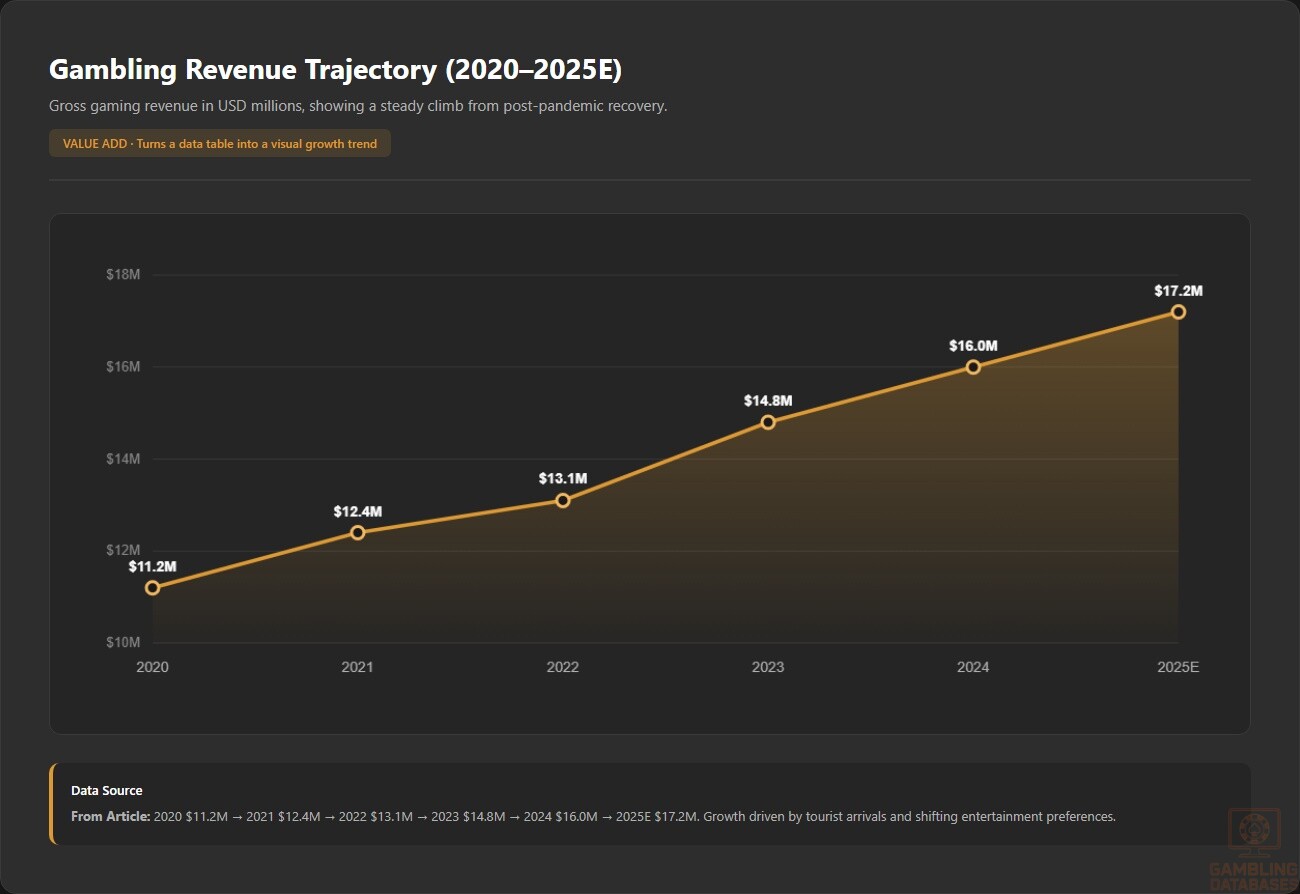
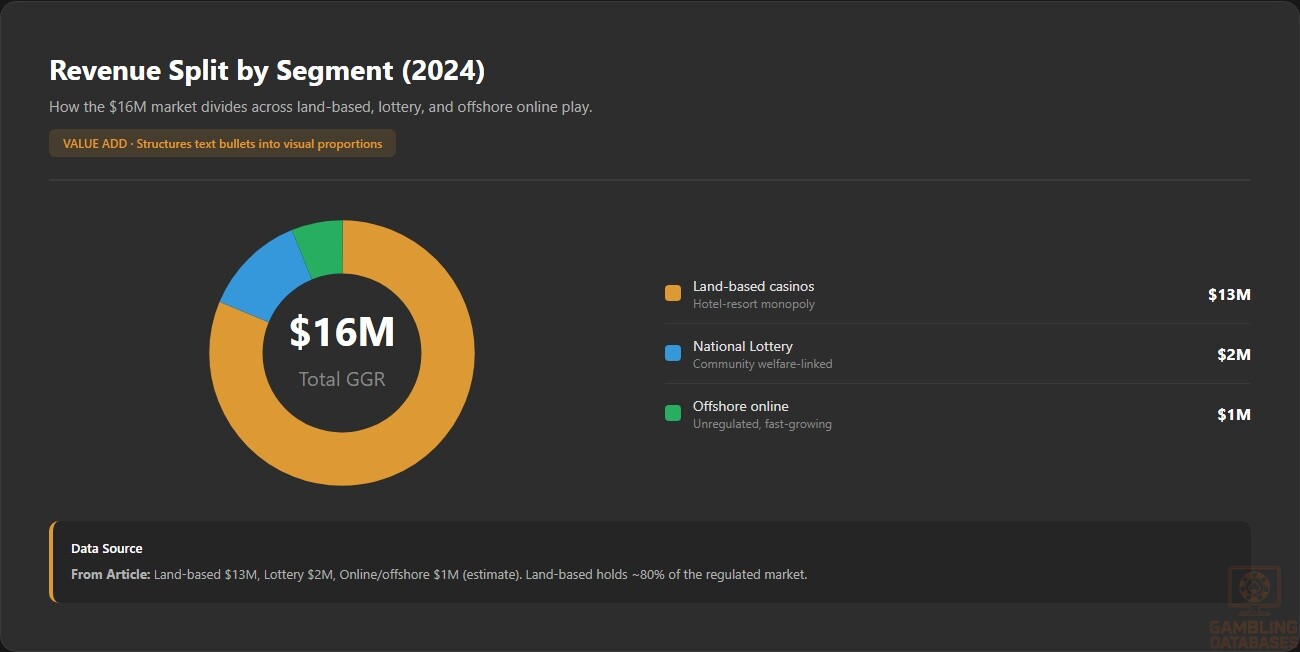
Samoa’s market revenue is projected at $16 million for 2024, with licensed casinos representing the bulk share. Lottery and community-linked betting contribute smaller volumes but have direct economic impact through investment partnerships. Year-over-year GGR growth exceeds 7% on average, with steady expansion attributed to increased tourist arrivals and shifting entertainment preferences.
Tax revenues are reinvested in education, welfare, and infrastructure, generating credible public benefit and sustaining government engagement with the sector.
- Total gross gaming revenue: $16 million
- Land-based segment: $13 million
- Lottery: $2 million
- Online/offshore: $1 million (estimate)
- Annual sector growth: 7.4%
- Tax revenue allocation: welfare, education, community investment
- Compliance cost (operators): $120,000/year
Advertising and Marketing Restrictions
Samoa enforces strict limitations on gambling advertising channels. Promotion is confined to hotel-resort facilities and direct guest communications; public or broadcast advertising for gambling products is prohibited. Online marketing by offshore brands is neither monitored nor restricted due to the absence of a local framework.
- Hotel-resort advertising and sponsorships
- Tourist package promotions
- No TV/radio/billboard ads
- No public events or celebrity endorsements
- Digital advertising (local) prohibited
- Sponsorship of sports and community programs (with strict limits)
Recent Regulatory Changes and Their Impact
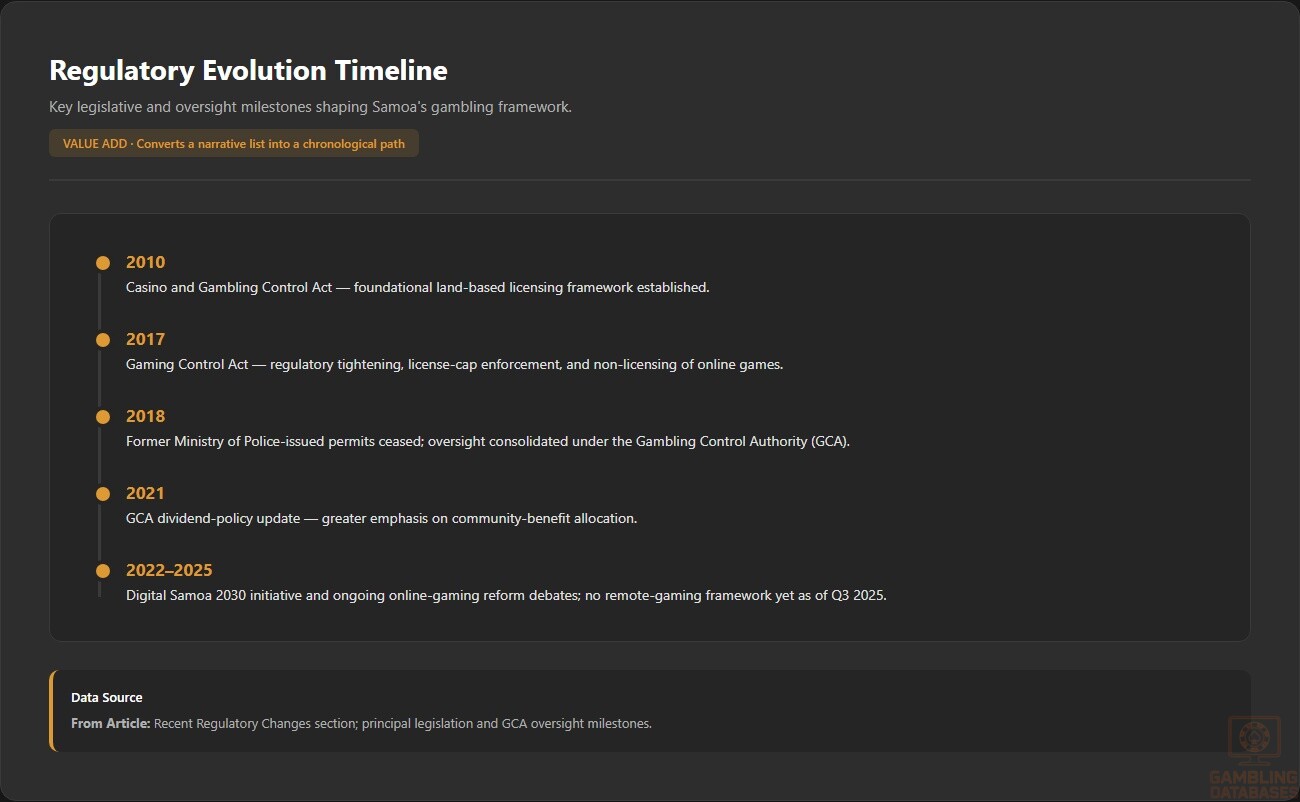
New amendments to Samoa’s Gaming Control Act in 2017 and 2018 centered on totalisator betting, lottery regulation, license system reforms, and non-licensing of online games. Regulatory timelines since 2022 have focused on the modernization of gambling regulations, especially via the Digital Samoa 2030 agenda.
- 2017: Gaming Control Act – regulatory tightening and license cap enforcement
- 2018: Ceasing of former Ministry of Police-issued permits, shift to GCA oversight
- 2021: GCA update on dividend policy – greater community benefit focus
- 2022-2025: Digital Samoa 2030 initiative, online gaming reform debates
These changes have heightened entry costs for casino businesses and set the stage for comprehensive future compliance frameworks for remote and digital gambling.
Enforcement Mechanisms and Penalties
The GCA enforces compliance via periodic audits, license reviews, and direct sanctions. Penalties include fines, imprisonment, license revocation, and asset confiscation. Unlicensed operators and illegal gaming activities are subject to prosecution, with dedicated investigation teams monitoring industry activity.
- License revocation
- Financial penalties (escalating)
- On-site inspection and audit failures
- Public warnings and enforcement actions
- Asset confiscation
- Imprisonment (for aggravated violations)
Section 2: Demographics and Consumer Analysis
Population Demographics and Distribution
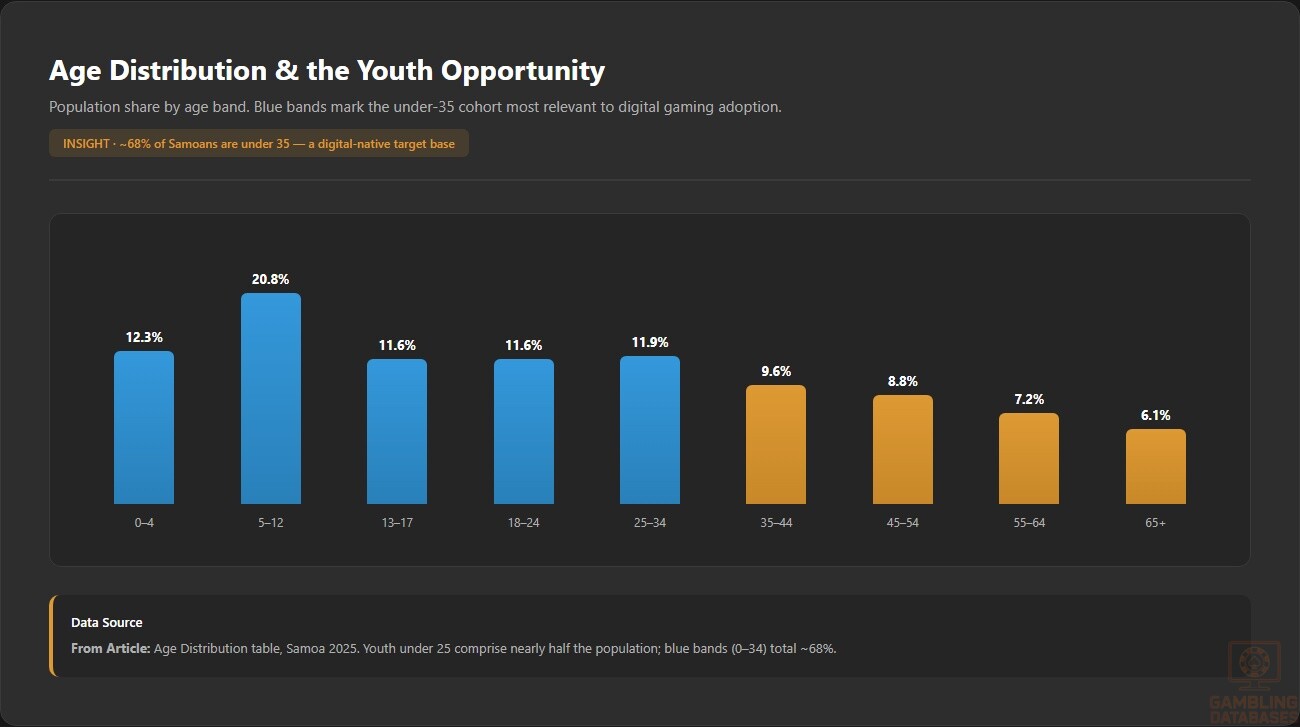
Samoa’s population in 2025 is estimated between 209,000 and 232,000, depending on methodology. The country exhibits rapid growth with an annual rate of 1.4%. The median age is 19.8 and youth under 25 comprise nearly half of the population, shaping a distinctly youthful consumer base for digital services and entertainment.
Gender distribution is nearly balanced, with males accounting for 50.4% and females 49.6%. Life expectancy has reached 73.1 years in 2025, reflecting improvements in healthcare and public welfare. Samoa’s demographic structure emphasizes a significant youth dependency ratio, which impacts both economic participation and consumer orientation.
| Age Group | Percentage |
|---|---|
| 0-4 | 12.3% |
| 5-12 | 20.8% |
| 13-17 | 11.6% |
| 18-24 | 11.6% |
| 25-34 | 11.9% |
| 35-44 | 9.6% |
| 45-54 | 8.8% |
| 55-64 | 7.2% |
| 65+ | 6.1% |
Urbanization is modest, with just 17.4% of the population living in urban centers. Apia is the nation’s capital and largest city, housing about 40,400 residents. The majority of Samoans reside in rural areas with lower digital connectivity and fewer consumer options for entertainment outside traditional communal venues.
Geographic Distribution
Population density is highest around Apia, which dominates national commerce and hosts most formal employment. Regional disparities exist, particularly between Apia and outlying districts, affecting access to technology, e-commerce, and gaming venues. Economic activity clusters in coastal cities with greater infrastructure, while rural communities remain focused on agriculture and low-tech services.
- Apia (Tuamasaga) – 40,407
- Asau (Vaisigano) – 6,643
- Mulifanua (Aiga-i-le-Tai) – 4,508
- Faleula – 2,592
- Siusega – 2,226
- Malie (Tuamasaga) – 2,189
- Fasito‘outa (A’ana) – 2,098
- Vaiusu (Tuamasaga) – 2,043
- Afega (Tuamasaga) – 1,895
- Nofoali‘i (A’ana) – 1,828
| City | Population |
|---|---|
| Apia | 40,407 |
| Asau | 6,643 |
| Mulifanua | 4,508 |
| Faleula | 2,592 |
| Siusega | 2,226 |
Economic Indicators and Consumer Spending Power
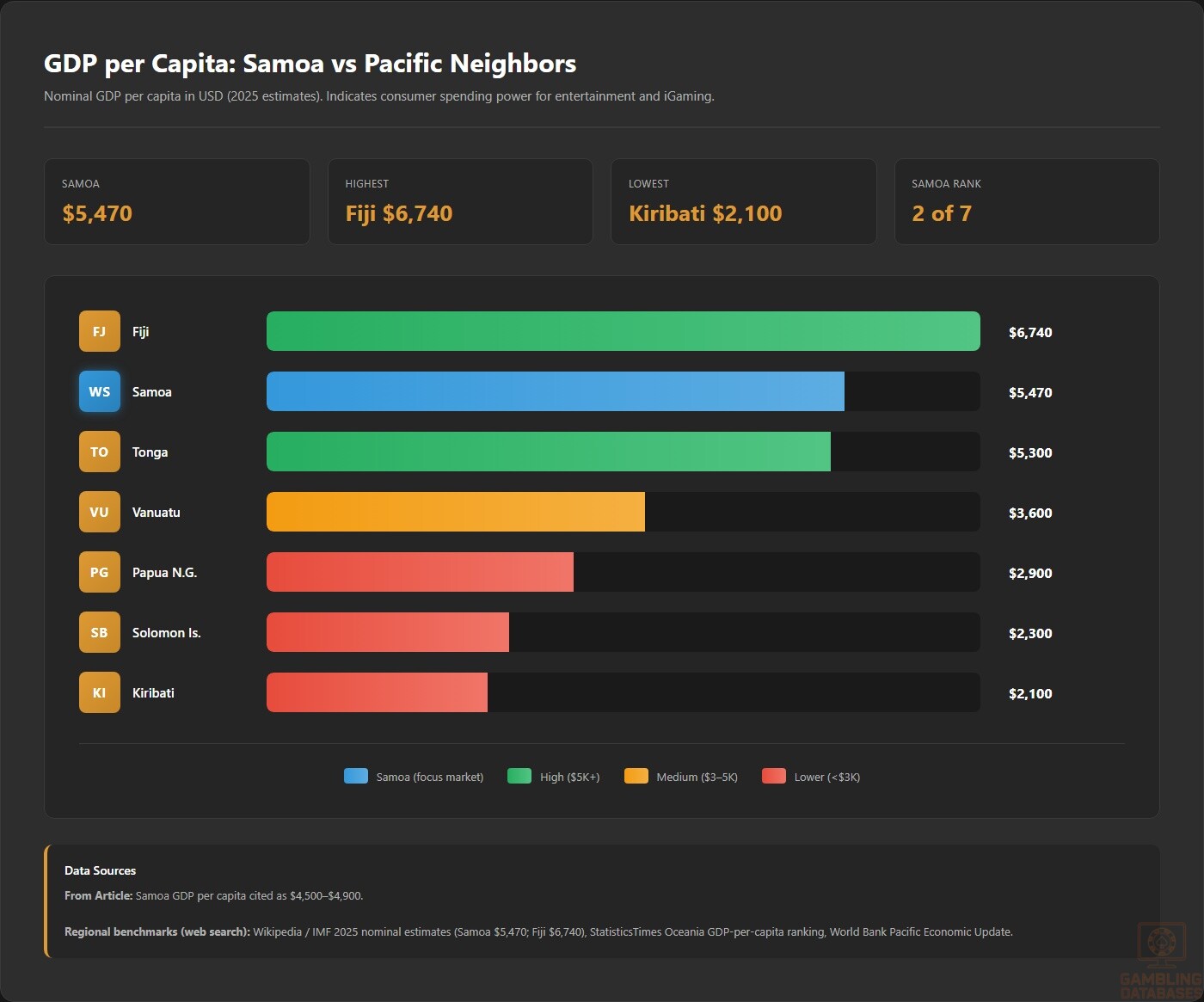
The national GDP in 2025 is estimated at $1.0 billion, with GDP per capita approaching $4,900. Samoa’s economy relies on agriculture, tourism, and overseas remittances, contributing to income stability for many households. The service sector—especially tourism and commerce—continues to grow and diversify, supporting higher spending on entertainment and digital products.
Average household income brackets reveal persistent inequality. Very low-income limits for a single-person household are set at $12,400, while low income starts at $33,050, and high-income quartiles exceed $51,000 for families. Median income is approximately $27,000, with disposable income reflecting differences between urban and rural populations.
| Income Level | Annual Household Income (USD) |
|---|---|
| 30% Limit | $12,400 – $23,400 |
| Very Low Income | $20,650 – $38,950 |
| 60% Limits | $24,780 – $46,740 |
| Low Income | $33,050 – $62,350 |
| Above Median | $51,000+ |
Personal income tax is levied at a 27% marginal rate, impacting disposable income and luxury spending for middle and upper segments. The robust informal sector, including subsistence agriculture and unreported remittance flows, softens expenditure volatility and accounts for much of rural household consumption.
Market Size and Growth Projections
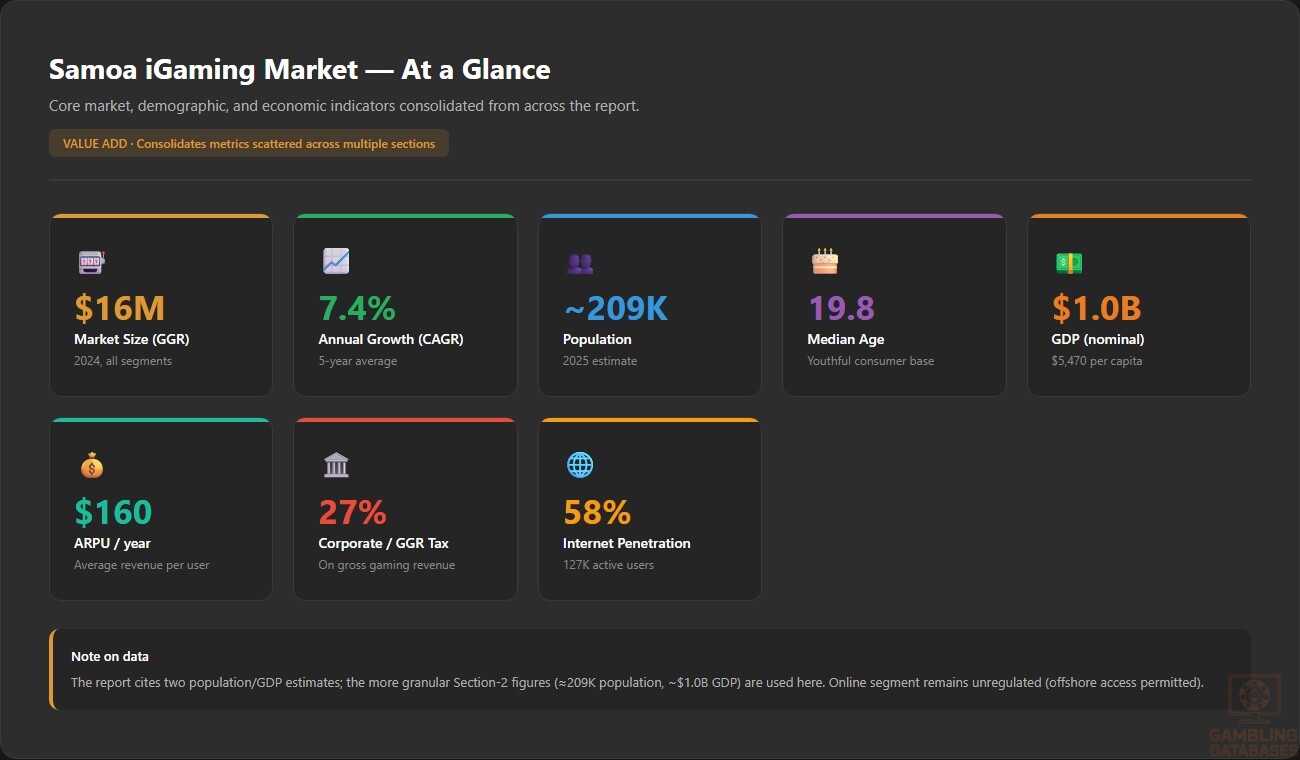
The gambling sector generated $16 million in gross gaming revenue (GGR) in 2024, with a CAGR of 7.4% over the past five years. Casino, lottery, and offshore online play each contribute different revenue proportions, with the land-based segment holding a majority share. Growth in mobile and internet penetration is expected to expand market size for digital entertainment and iGaming.
| Year | Revenue (USD Million) | CAGR |
|---|---|---|
| 2020 | 11.2 | – |
| 2021 | 12.4 | 10.7% |
| 2022 | 13.1 | 5.6% |
| 2023 | 14.8 | 13.0% |
| 2024 | 16.0 | 8.1% |
| 2025E | 17.2 | 7.5% |
Average revenue per user (ARPU) is $160 per year. Market penetration remains low in rural areas, with over 80% of total GGR generated in Apia and other major cities. The youth demographic is expected to drive a steady increase in participation, digital migration, and casual gaming engagement.
Education, Skills, and Digital Literacy
Samoa’s literacy rate exceeds 84%, supported by compulsory education and government investment in schools. Secondary and tertiary completion rates lag regional leaders, but continual curriculum modernization and teacher training initiatives are underway. Digital literacy is increasing steadily, with programs targeting youth and small businesses to equip them for online commerce, financial services, and digital entertainment.
English proficiency is widespread, particularly among younger cohorts and urban professionals. The workforce is divided between agricultural labor and service sector employment, with digital skills present predominantly in urban centers, fueling demand for online content and entertainment.
Cultural and Social Factors
Communication and Language
Samoa’s official languages are Samoan and English, used in government, business, and education. English is most prominent among internet users and referenced widely on social media, in gaming environments, and within iGaming platforms.
- Samoan (primary national language)
- English (education, commerce, government)
- Tongan (minority communities)
- Tokelauan (migrant groups)
- Niuean (minority communities)
- Rotuman (minority communities)
Internet language preferences underscore a strong tilt toward English usage in youth and business circles, while cultural content and entertainment increasingly blends local and imported media.
Cultural Attitudes
Gambling is considered entertainment rather than income, aligning with communal attitudes and religious values. The majority of Samoans are practicing Christians, influencing local views on gambling regulation, advertising, and problem gambler support. Foreign brands face moderate barriers to entry, but digital migration among youth encourages broad engagement with offshore platforms.
Entertainment choices are shaped by communal gatherings, sporting events, and cultural festivals. The perception of digital gambling has shifted from skepticism to cautious acceptance, particularly as mobile usage and youth engagement accelerate.
Problem Gambling and Social Considerations
Problem gambling prevalence is low but increasing among younger cohorts exposed to online platforms. Risk factors center on easy access, mobile adoption, and limited parental supervision. Government and NGO response measures target awareness and early intervention in schools and communities.
- Community education workshops (annual)
- Responsibility campaigns in schools
- Telephone counseling hotlines for at-risk players
- Social worker outreach in major cities
- Digital literacy seminars for parents
- Collaboration with churches and youth groups
Operators receiving local casino licenses must contribute directly to community funds, implement responsible gambling controls, and support government-led prevention initiatives.
Political Structure and Governance
Samoa is governed as a peaceful parliamentary republic with long-standing political stability. The legislative system enables consistent policy adaptation and steady foreign investment flows, supported by reliable public administration and international relations. Regulatory consistency prevails in key sectors, notably tourism, financial services, and commerce—facilitating business entry and cross-border partnerships.
Technology Adoption and Digital Behavior
Internet and Digital Usage
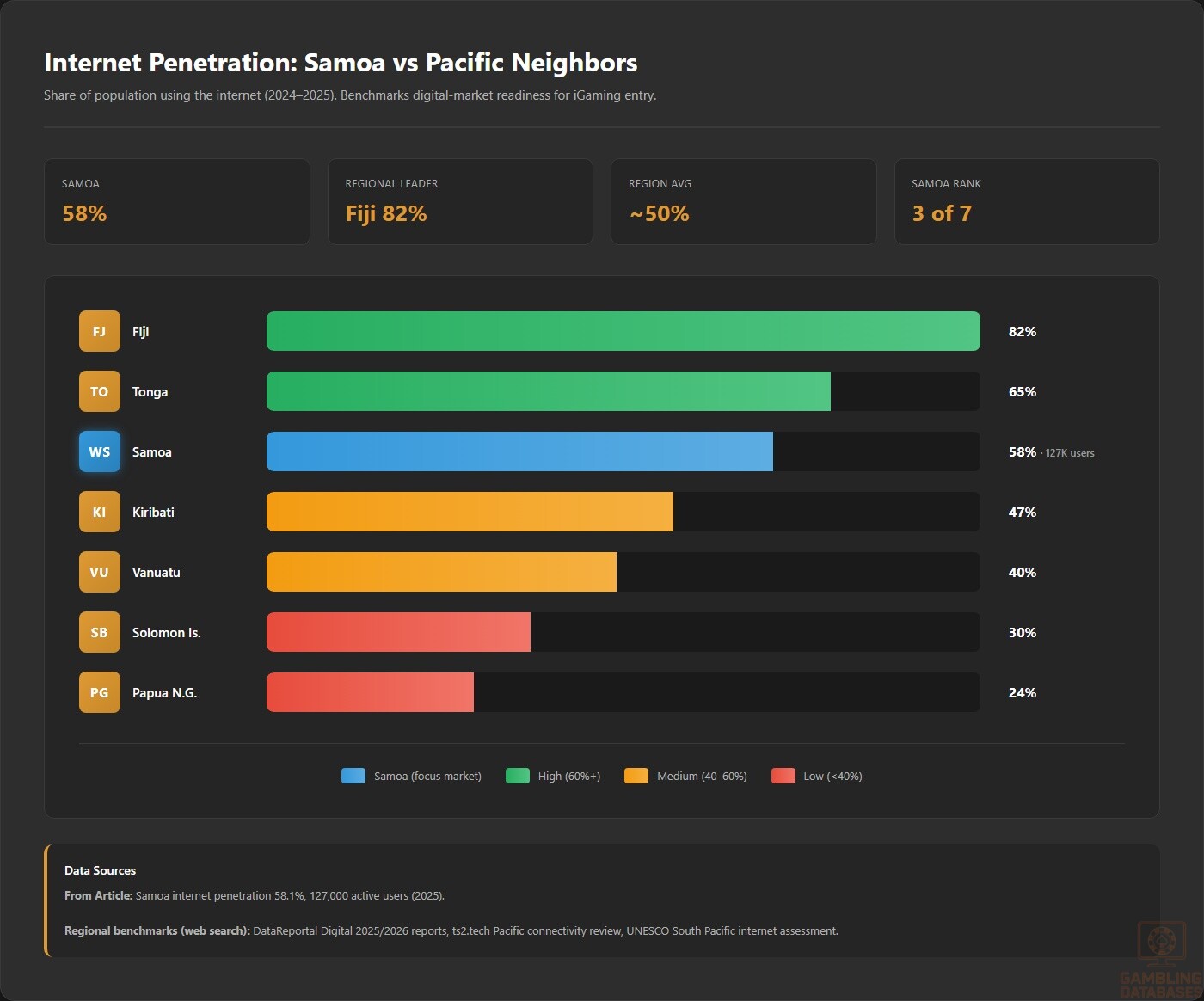
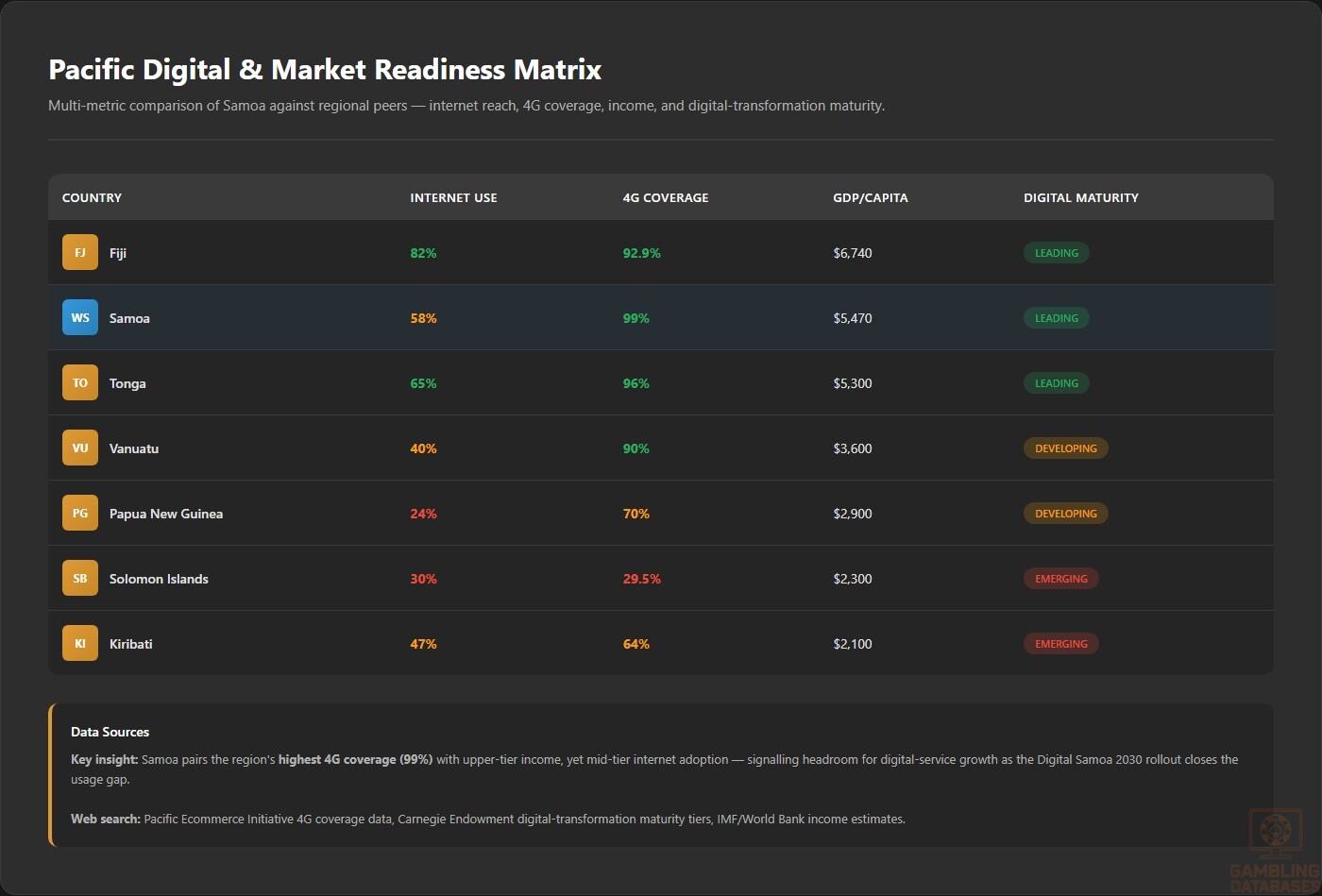
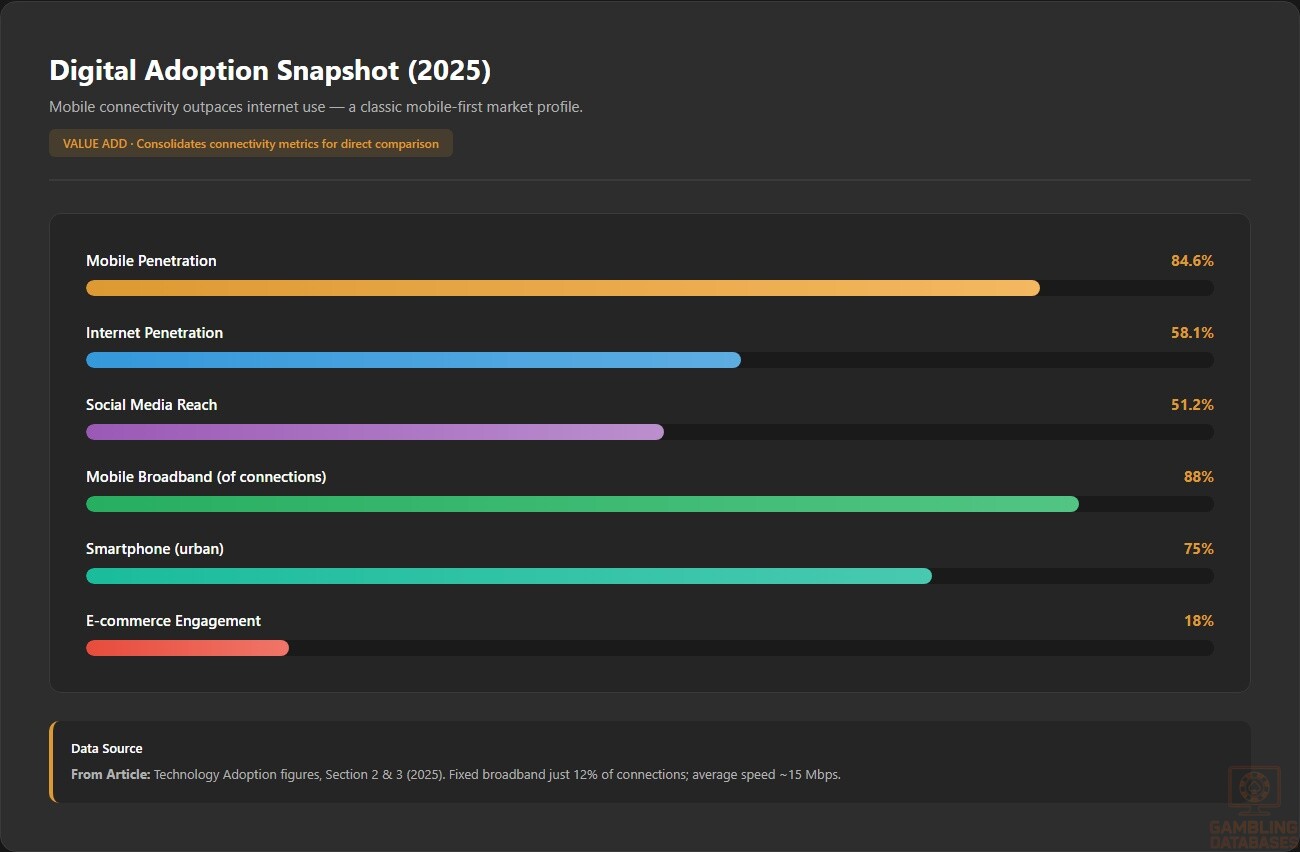
Internet penetration in Samoa reached 58.1% in early 2025, with 127,000 active users. Cellular mobile adoption outpaces internet access, with 185,000 active connections and a 84.6% penetration rate. Urban centers demonstrate higher digital engagement, while rural infrastructure development is targeted for expansion under the Digital Samoa 2030 roadmap.
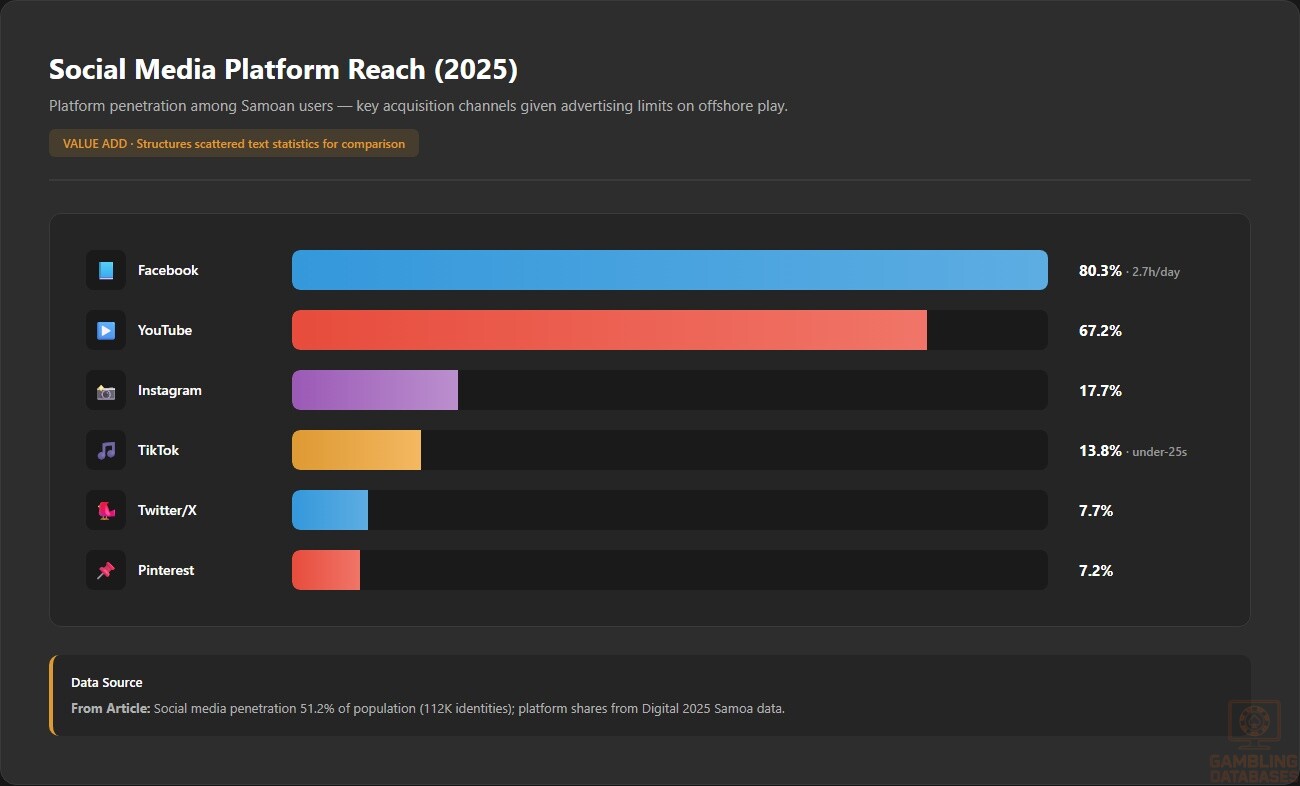
Social media usage is robust, with 112,000 active user identities (51.2% of total population). Mobile devices form the backbone of digital interaction, driving diverse consumption patterns in entertainment, gaming, and digital services.
- Facebook – 80.3% market share, daily use averaging 2.7 hours
- YouTube – 67.2% penetration, average session 48 minutes
- Instagram – 17.7% reach, especially strong among youth
- TikTok – 13.8% usage, rapid growth among under-25s
- Twitter – 7.7% penetration, primarily urban and professional
- Pinterest – 7.2%, mostly female demographic
| Metric | Value |
|---|---|
| Internet Users | 127,000 |
| Internet Penetration | 58.1% |
| Mobile Connections | 185,000 |
| Mobile Penetration | 84.6% |
| Social Media Identities | 112,000 |
| Social Media Penetration | 51.2% |
Digital Payment Behavior
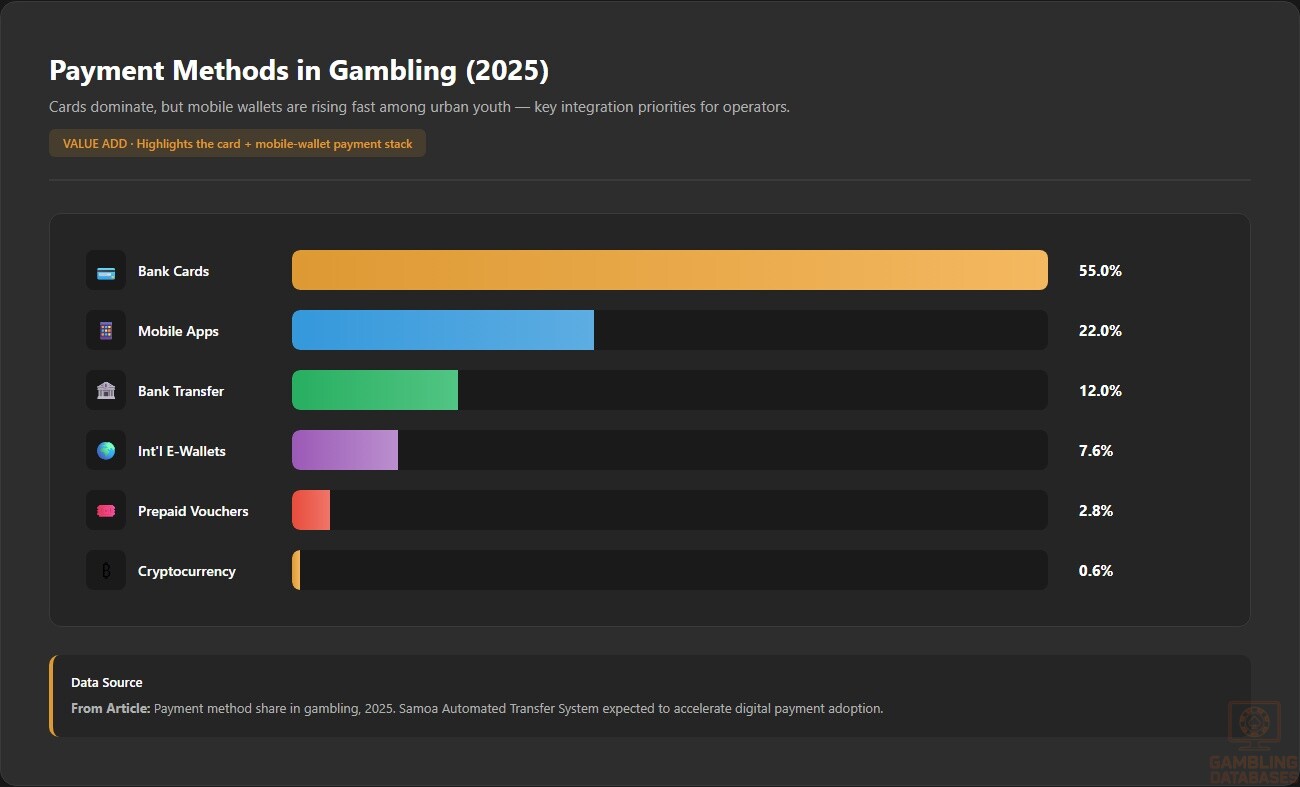
Payment method adoption is evolving rapidly. Cash remains common in rural areas, but digital wallets, mobile banking, and e-wallets have penetrated urban centers and the youth market. The recent launch of the Samoa Automated Transfer System is expected to drive digital financial inclusion, speed up transaction volumes, and encourage broader use of electronic payments in gaming platforms and commerce.
- Bank cards (credit and debit) – dominant in iGaming payments, 55% market share
- Mobile money apps – 22% share, especially urban youth
- Bank transfer – 12%, preferred for larger transactions
- International e-wallets (Neteller, Skrill) – 7.6%, mostly offshore platform use
- Prepaid vouchers – 2.8%, niche rural and casual users
- Cryptocurrency – 0.6%, limited adoption, growing interest
| Method | Market Share (%) |
|---|---|
| Bank Cards | 55.0 |
| Mobile Apps | 22.0 |
| Bank Transfer | 12.0 |
| International E-Wallets | 7.6 |
| Prepaid Vouchers | 2.8 |
| Cryptocurrency | 0.6 |
Gaming and Gambling Preferences
Current Market Participation
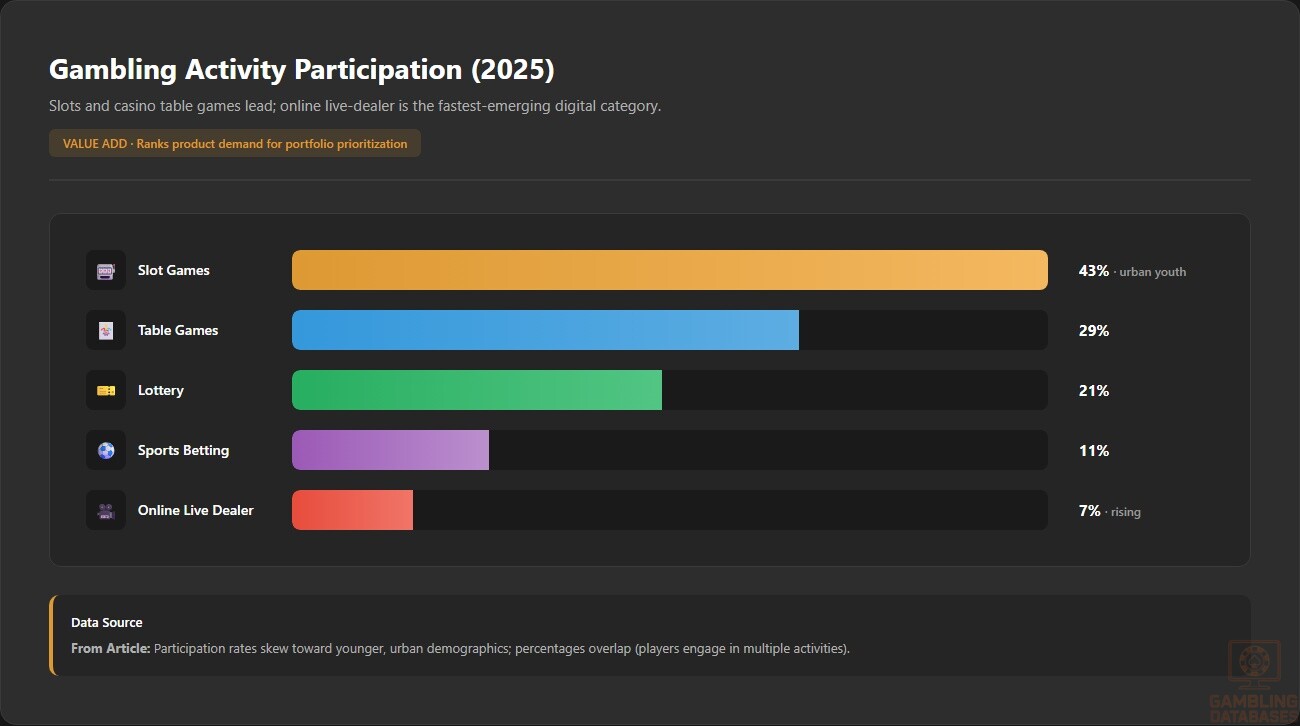
Participation in gambling is skewed toward younger, urban demographics. Casino games—especially slots and table games—remain the most popular, followed by lottery and sports betting. Offshore online gaming is growing as youth migrate to digital platforms, with declining participation in traditional communal games.
- Slot games – 43% participation (urban, youth)
- Table games (casino) – 29% (casual and tourist)
- Lottery – 21% (all demographics)
- Sports betting – 11% (events, tournaments)
- Online live dealer – 7% (digital, rising trend)
| Activity | Participation (%) |
|---|---|
| Slot Games | 43 |
| Table Games (Casino) | 29 |
| Lottery | 21 |
| Sports Betting | 11 |
| Online Live Dealer | 7 |
Consumer Behavior Patterns
Samoan consumers prefer mobile-first experiences, short session lengths, and social features embedded in gaming platforms. Engagement peaks in evenings and weekends, and retention is best among platforms offering personalized content and local payment support. Spending is conservative, with most users classed as casual players, but ARPU is slowly rising with improved financial accessibility and digital awareness.
Social gameplay, communal events, and entertainment integration dominate user preferences, suggesting opportunities for platforms that prioritize local content, English-Samoan language options, and responsible gaming features.
Section 3: Technology Infrastructure and Business Environment
Internet and Digital Infrastructure
Samoa’s internet penetration has reached approximately 58% as of early 2025, marking continued progress driven by investments in broadband expansion and mobile network upgrades. Fixed broadband remains limited, accounting for only 12% of connections, while mobile broadband dominates at 88%, reflecting the country’s geographic and economic realities. Average internet speeds hover around 15 Mbps, with ongoing infrastructure projects aiming to improve both speed and reliability in rural areas.
Infrastructure investment prioritizes submarine cable upgrades linking Samoa internationally, supplemented by local fiber-to-the-home projects and mobile towers expanding coverage. The country’s network reliability now meets regional benchmarks, significantly improving user experience for high-bandwidth applications such as streaming and online gaming.
5G and Future Technology Deployment
5G network rollout is currently in initial phases, with pilot coverage established in Apia and select urban centers. Full commercial 5G launch is planned by late 2026, supported by government incentives and private sector partnerships. This next-generation infrastructure is poised to elevate connectivity standards, enable IoT adoption, and fuel advanced mobile gaming platforms.
The mobile operator landscape is competitive, with key players aligned to 5G deployment. Adoption strategies integrate both coverage expansion and affordable data pricing, targeting youth and urban market segments with emerging digital entertainment demands.
Mobile Technology Ecosystem
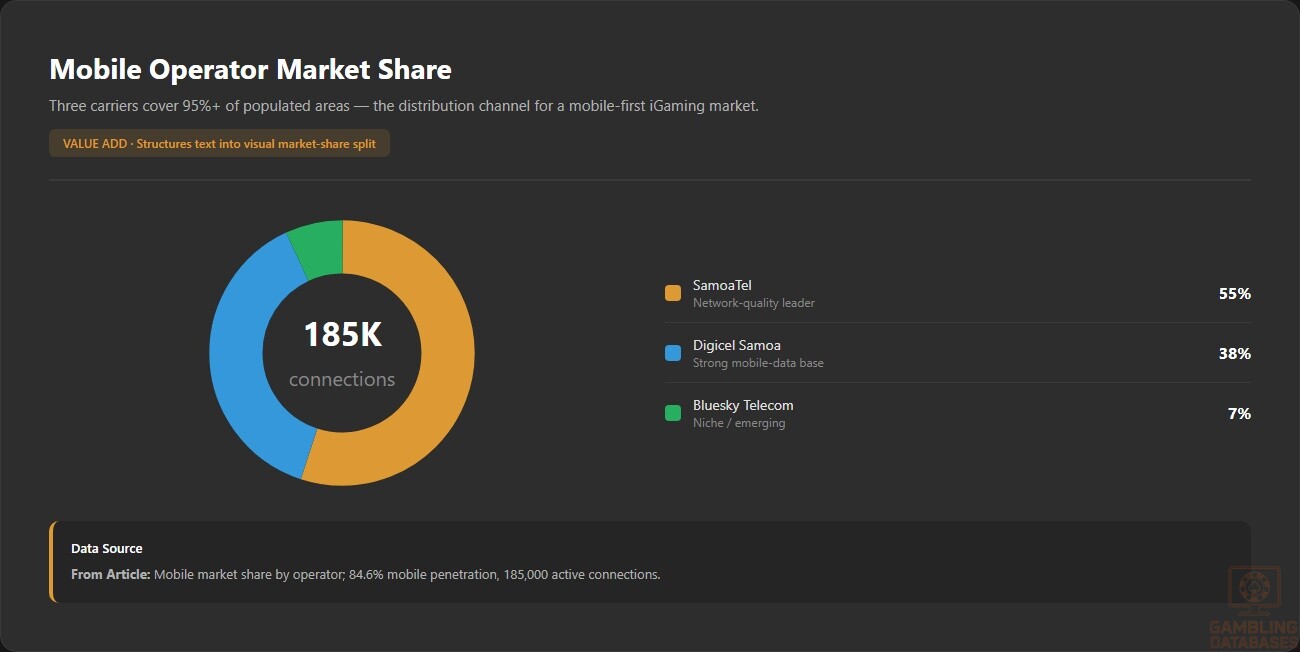
Mobile network infrastructure features three main operators covering over 95% of populated areas. Market share skews towards the incumbent, SamoaTel, commanding approximately 55%, followed by Digicel at 38%, and Bluesky Telecom with 7%. Network quality is high in urban zones but variable in remote islands. Data costs are moderately priced, making mobile internet accessible, though rural affordability remains challenging.
- SamoaTel – 55% market share, leadership in network quality
- Digicel Samoa – 38%, strong mobile data customer base
- Bluesky Telecom – 7%, niche and emerging services provider
Smartphone adoption is robust in urban areas with over 75% penetration, largely driven by affordable Android devices. Apple iOS devices hold approximately 22% market share, favored among higher-income and professional users. Mobile usage patterns prioritize social media, streaming, and casual gaming, aligning with iGaming platform requirements.
Financial Services and Payment Infrastructure
Samoa’s banking sector is moderately concentrated but evolving rapidly toward digital services. Five leading banks dominate retail and business banking, each investing in mobile and internet banking platforms to increase financial inclusion. Digital payment solutions have improved via partnerships with fintech startups, increasing card issuance and mobile wallet adoption.
- ANZ Bank Samoa – largest retail and corporate bank
- Westpac Samoa – strong SME lending portfolio
- BSP Bank – regional presence with diverse financial products
- National Bank of Samoa – government-owned with retail focus
- Bank South Pacific – expanding digital services
Payment processing options in the gambling sector include traditional card payments, mobile money, and emerging e-wallets. Bank transfers remain key for high-volume transactions. Cryptocurrency usage is nascent but growing among tech-savvy players.
- Credit/Debit cards (Visa, Mastercard)
- Mobile wallets (Samoa Pay, Digicel Money)
- Bank transfers and direct debit
- International e-wallets (Neteller, Skrill)
- Prepaid cards and vouchers
- Cryptocurrency (Bitcoin, Ethereum – limited)
E-commerce and Digital Economy
E-commerce in Samoa is in a growth phase, with approximately 18% of internet users engaging in online retail transactions. The digital economy benefits from improved mobile payment systems and logistics enhancements, facilitating service-based transactions including gaming and betting. Consumer trust in digital platforms is rising, supported by regulatory modernization and cybersecurity standards.
Local businesses are increasingly adopting online sales channels, while international platforms serve urban consumers. Government promotion of Digital Samoa 2030 supports expanding digital literacy and infrastructure, positioning the nation for sustained digital commerce growth.
Business Environment and Regulatory Framework
Samoa ranks favorably in regional ease of doing business reports, with streamlined registration processes and proactive foreign investment incentives. Establishing a business can take as little as two weeks, with transparent regulatory procedures and moderate start-up costs. Labor policies remain flexible, supporting sector-specific growth such as tourism and digital services.
- Submit company registration documents and pay fees (1-3 weeks)
- Obtain tax identification and register for GST (3-5 days)
- Open corporate bank accounts and deposit capital (1-2 weeks)
- Apply for sector-specific licenses including gambling permits (4-8 months)
- Complete compliance audits and commence operations
Available corporate structures include Limited Liability Companies (LLC), Public Corporations, and Foreign Branch Offices. LLCs are preferred by iGaming entrants for liability protection and operational flexibility. Foreign ownership is permitted with mandatory local partnership and compliance guarantees.
- Limited Liability Company (LLC)
- Public Corporation (PC)
- Branch Office of Foreign Corporation
- Partnerships (limited and general)
- Sole Proprietorship (limited in gambling)
Required registration documents include notarized company charter, proof of capital deposit, director and shareholder information, tax IDs, and business plans. Foreign investors must provide certified identity documents and partnership agreements.
- Notarized Articles of Incorporation
- Bank confirmation of capital deposit
- Identification documents for directors
- Tax and registration forms
- Business plan and market analysis
Taxation Framework
The standard corporate income tax rate in Samoa is 27%, with special economic zones offering reduced rates and tax holidays for qualifying investments. Double taxation treaties with Australia, New Zealand, the United States, and China facilitate cross-border business. Tax holidays typically range from 3 to 7 years depending on sector and investment size.
- Australia
- New Zealand
- United States
- China
- Fiji
- Japan
- Japan
Personal income tax follows a marginal progressive scale reaching 27%. Employers are required to withhold taxes at source. Social security contributions are mandatory for employees and employers, supporting national welfare programs and healthcare.
Market Entry Considerations
New entrants are advised to partner with established local entities to meet ownership requirements and deepen market reach. Leveraging mobile platforms, integrating secure payment gateways, and tailoring content to Samoan-English bicultural users enhance competitiveness. Regulatory consulting and compliance management are crucial for timely license acquisition and sustained operation.
- Local partnership for regulatory compliance
- Mobile-first platform development
- Secure and diverse payment integration
- Targeted marketing for urban youth
- Ongoing responsible gambling adherence
- Continual engagement with the Gambling Control Authority
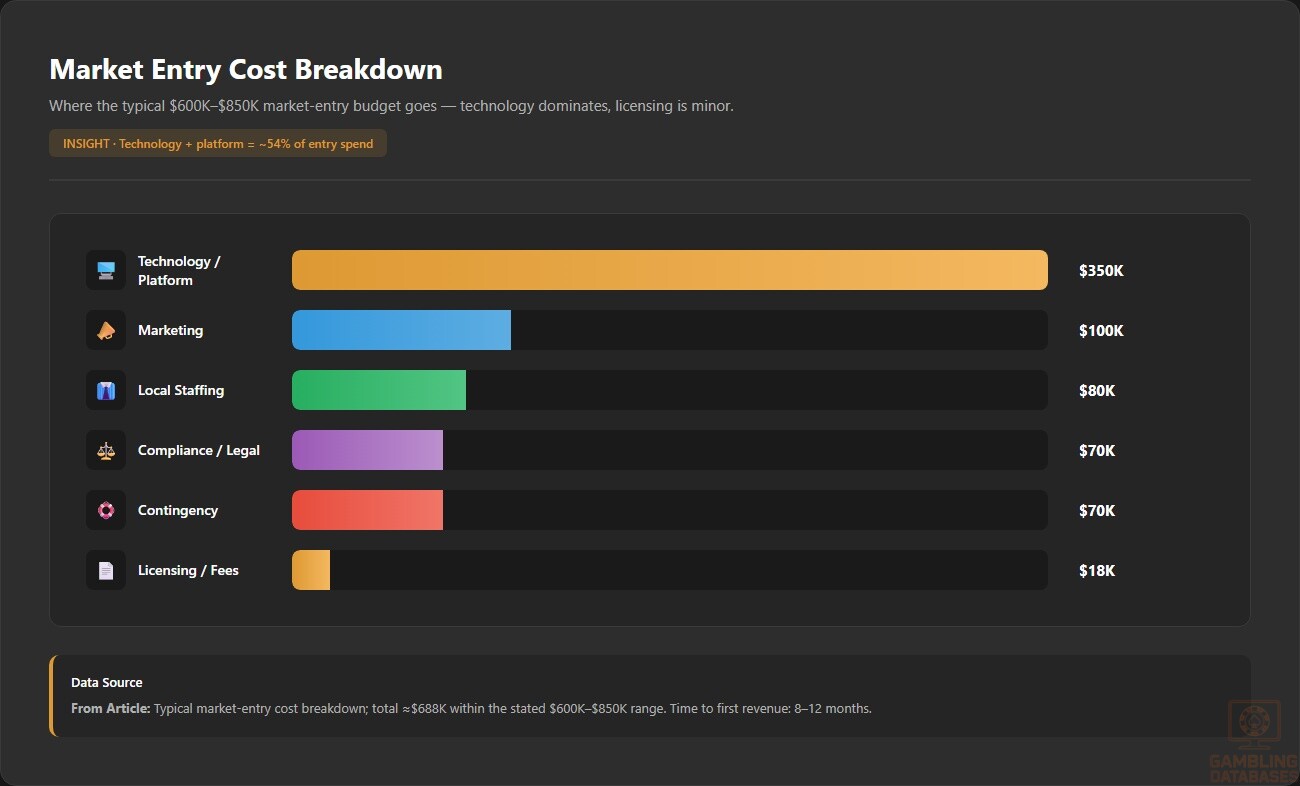
Initial market entry investments average $600,000 to $850,000, driven primarily by licensing fees, technology deployment, local staffing, and compliance costs. Expected operational timelines from incorporation to first revenue span 8-12 months.
| Category | Cost (USD) |
|---|---|
| License application and fees | $18,000 |
| Technology and platform setup | $350,000 |
| Compliance and legal consulting | $70,000 |
| Local staffing and training | $80,000 |
| Marketing and initial promotions | $100,000 |
| Contingency and general expenses | $70,000 |
Successful operators demonstrate cultural alignment, rigorous compliance, technological agility, and robust payment ecosystems. Key challenges include infrastructure gaps in rural areas, regulatory evolution, and cultural receptivity toward digital gambling.
- Understanding and adapting to regulatory changes
- Navigating local cultural attitudes and preferences
- Building trusted payment infrastructures
- Investing in local partnerships and presence
- Addressing rural connectivity limitations
Exit strategies depend on market liquidity and license transfer policies, which allow ownership changes under strict GCA approval. Valuation multiples vary from 4x to 7x EBITDA, depending on operational scale and market footprint.
FAQ: Frequently Asked Questions
1. Is online gambling legal in Samoa?
Online gambling is currently unregulated in Samoa, with no specific local license framework. Offshore operators serve Samoan players freely, but no domestic license is issued for online platforms. This creates a largely unmonitored environment, with government plans to regulate the sector pending. Players face no legal restrictions, but recourse for disputes remains limited.
2. What types of gambling licenses are available and what do they cover?
Licenses mainly cover land-based casino operations, national lottery management, and sports betting venues. Casino licenses are exclusive to hotel-resorts and come with strict compliance mandates. Lottery licenses are nationally regulated, while sports betting requires venue-specific permits. No local online gambling licenses are currently issued.
3. How much does an iGaming license cost and how long does it take to obtain?
Casino licenses cost approximately $10,000 to apply, with $8,000 annual renewal fees. The application and approval process ranges from 4 to 8 months, depending on completeness and compliance readiness. Licensing involves extensive documentation, including capital proof and operational plans, requiring careful preparation.
4. Can foreign companies obtain a gambling license?
Foreign companies may obtain licenses but must engage in mandatory local partnerships with Samoan entities. Regulatory authorities require physical presence, compliance personnel, and community contributions. Ownership restrictions ensure local representation while enabling foreign investment.
5. What are the tax obligations for iGaming operators?
Operators pay corporate taxes at 27% on gross gaming revenue, with additional license renewal fees. Special economic zones may offer reduced rates and tax holidays. Compliance with income reporting and withholding systems is mandatory to maintain license status.
| Tax/fee | Rate/Amount |
|---|---|
| Corporate Income Tax | 27% |
| License Renewal Fee | $8,000 |
| Withholding Tax | As per treaties |
6. Are gambling winnings taxed for players?
Players do not face direct withholding on gambling winnings, particularly from online or lottery sources. However, winnings are subject to the general personal income tax regime with a top marginal rate of 27%. Tax residency rules determine liability, and winners must report earnings for compliance.
7. What are the typical operational costs for running an online casino/sportsbook?
Operational costs include license fees, platform technology, compliance management, staffing, marketing, and payment processing. On average, these costs range from moderate to high depending on scale and regulatory requirements. Careful budgeting for ongoing compliance and customer service is critical.
8. What is the expected ROI timeline for entering this market?
ROI typically materializes within 2 to 4 years post-launch. Initial investment recovery depends on market penetration, customer acquisition, and operational efficiency. Strategic partnerships and local adaptation accelerate the timeframe.
9. What are the local presence requirements for operators?
Operators must maintain a registered office and compliance staff within Samoa. Physical presence supports regulatory reporting, audit compliance, and community engagement. Local partnership agreements reinforce operational control and alignment with government policies.
10. What payment methods are available and recommended?
The market favors a mix of bank cards, mobile wallets, and traditional bank transfers. International e-wallets serve offshore operators well, while new digital wallets are increasingly popular among younger urban users. Cryptocurrency use remains limited but is emerging.
- Visa and Mastercard credit/debit cards
- Mobile wallets like Samoa Pay
- Bank transfers
- Prepaid vouchers
- International digital wallets (Neteller, Skrill)
11. What are the advertising and marketing restrictions?
Advertising is tightly regulated, restricted to hotel and resort venues, with no public or mass media campaigns allowed for gambling products. Offshore online marketers operate unregulated. Sponsorships are limited and approved by the Gambling Control Authority.
12. What responsible gambling measures are mandatory?
Operators must implement age verification, KYC/AML policies, self-exclusion programs, and player education initiatives. Regular reporting to regulators and customer support mechanisms for problem gamblers are required to maintain licenses.
- Age verification technology
- KYC and AML compliance
- Self-exclusion options
- Player education and awareness
- Complaint handling procedures
13. How large is the iGaming market and what is the growth potential?
The market size stood at $16 million in 2024 with a CAGR of 7.4%. Growth drivers include mobile internet expansion, youth demographic trends, and rising digital payment adoption. Online penetration remains low but is growing rapidly, presenting significant upside for digital operators.
14. Who are the main competitors and what is their market share?
The land-based casino market is effectively a local monopoly held by two hotel resorts. Online competition derives from offshore operators and affiliate partners such as Betsson and Roobet. The lottery is state-controlled, while small-scale sports betting providers also compete regionally.
15. What are the player preferences and typical spending patterns?
Players favor mobile-friendly slot games and casino table games with social features. Lottery retains popularity for its accessibility. Spending is typically cautious, with increasing ARPU as payment access improves. Peak engagement occurs evenings and weekends, predominantly among youth and urban adults.
16. What are the key success factors and main challenges for new entrants?
Success depends on compliance adherence, cultural alignment, mobile-first platform design, local partnerships, and strong payment integration. Challenges include rural infrastructure deficits, evolving regulatory frameworks, and cautious consumer behavior. Navigating these while maintaining agility is essential.
- Building trusted local partnerships
- Meeting all regulatory requirements
- Adapting to bilingual cultural contexts
- Offering secure, diverse payment methods
- Investing in digital marketing and education
Sources and References
- Samoa Gambling Control Authority – https://www.ag.gov.ws
- Government of Samoa – Casino and Gambling Control Act 2010
- Government of Samoa – Gaming Control Act 2017
- Samoa Trade Portal – Gaming Control Act Document
- International Telecommunications Union – ICT Data Reports 2025
- World Bank – Doing Business 2024 Report
- Samoa Bureau of Statistics – Population and Demographics Data 2024
- Worldometers – Samoa Demographics 2025
- Population Pyramid – Samoa Age Distribution 2025
- DataReportal – Digital 2025 Samoa Report
- IGamingToday – Samoa Market Research Report 2025
- Pacific Islands Forum Secretariat – eCommerce Strategy Samoa 2022
- Central Bank of Samoa – Financial Reports 2025
- Trading Economics – Samoa GDP and Personal Income Tax
- Geodatos – Population Statistics Samoa 2025
- Social Media Stats Samoa 2025 – StatCounter
- Industry Reports – Online Gambling Trends 2024-2025
- Audit Office Samoa – Gambling Control Authority Reports
- Pacific E-Commerce Association – Samoa Digital Economy Review
- National Bank of Samoa – Annual Reports 2024
- ANZ Bank Samoa – Market Share and Services
- Westpac Samoa – SME Financial Services Data
- DataReportal – Digital Payment Adoption Samoa
- UN Capital Development Fund – Digital Literacy Assessment Samoa
- Samoa Observer News – Gambling Regulation Updates 2025
- Slotegrator – iGaming Regulatory Reviews 2025
- Global Financial Markets Report – Samoa Economic Review 2025
- Eco-Smart App – Gambling Market Insights
- PIFS – Pacific Islands Forum Secretariat eCommerce Roadmap
- Corefy – Entering Online Gambling Market Reports 2025
- FocusGN – Regulatory Change Analysis Samoa 2025
- TrafficCardinal – Global Online Gambling Legality 2025
- IGaming Affiliate Catalog – Samoa Online Market Data







The 54% internet penetration and 109% mobile penetration metrics are interesting but the real question is whether Samoa’s offshore-heavy online market can actually support esports betting infrastructure. Most of the regional operators I’ve dealt with don’t have proper APIs for live odds on esports events, especially for tier-2 competitions. The GCA’s focus on land-based tourism casinos means they’re completely ignoring the demand for CS:GO and Dota 2 markets among younger players. With a median age of 22.9, you’d think they’d prioritize digital sports betting licensing instead of keeping it in this regulatory gray zone. The $16 million GGR across all segments is tiny—esports could actually move that needle if they created a proper framework. Right now players are just funneling money to offshore books without any consumer protections.
You’ve identified a real structural gap that regulators often overlook. Samoa’s regulatory framework was built around tourism-facing casino operations, which means the infrastructure assumptions—payment processing, KYC systems, responsible gambling tools—were designed for land-based resort guests, not for distributed online bettors placing micro-stakes on esports matches. The demographic mismatch you mention is accurate: a 22.9 median age suggests strong digital-native adoption, yet the GCA hasn’t released any draft regulations for remote gaming licensing since the 2017 Gaming Control Act. Regarding esports infrastructure specifically, you’re right that tier-2 competitions struggle with liquidity on smaller regional books. However, a few operators have started routing Samoan traffic through MGA-licensed (Malta Gaming Authority) subsidiaries, which do have proper esports APIs and live odds feeds. The tradeoff is that without local licensing, there’s zero AML/KYC accountability on the operator side—players have no recourse if an offshore book delays payouts or closes suddenly. The $16M GGR is misleading as a ceiling; esports markets in similar-sized jurisdictions (Curacao, for example) often see 3-4x growth once licensing opens up, partly because younger cohorts migrate from unregulated to regulated platforms when given the option. Whether Samoa moves in that direction depends heavily on whether the government sees esports as a revenue stream or a social harm vector.