Serbia presents a rapidly growing iGaming market with a regulated framework aligned with EU standards, propelled by rising internet penetration and supportive government policies.
The country offers attractive opportunities for operators due to its long-term licenses, preferential tax rates, and expanding consumer base with increasing disposable income.
| Metric | Value |
|---|---|
| Gambling Legal Status | Fully regulated since 2013, online legalized in 2011 |
| Regulatory Authority | Games of Chance Administration (GCA), Ministry of Finance |
| Population | 6.7 million (2025 est.) |
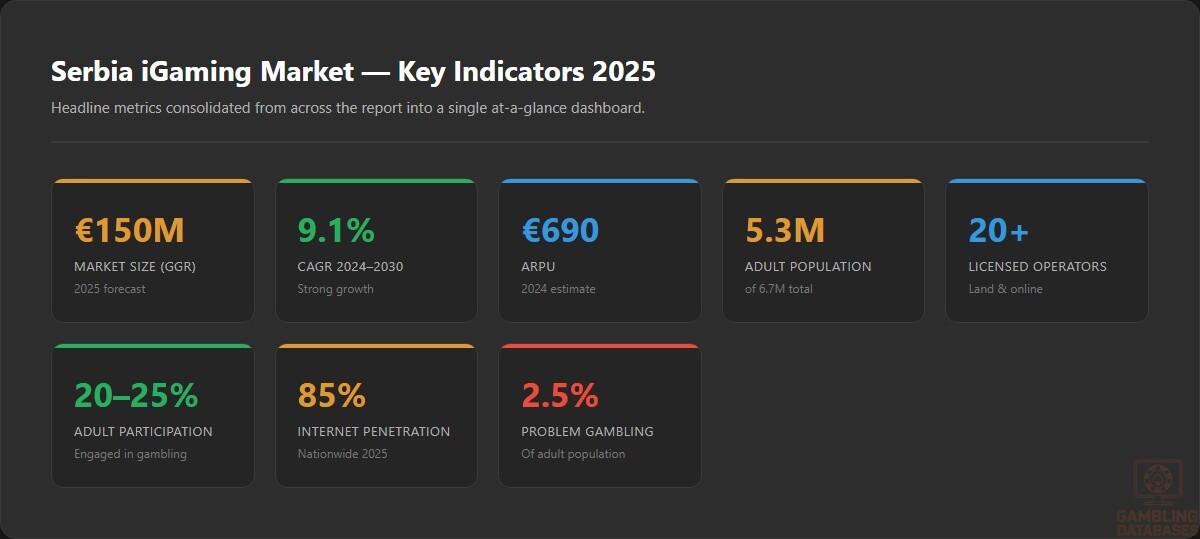
| Adult Population (18+) | Approx. 5.3 million |
| GDP per capita | €8,000 (2025 est.) |
| Internet Penetration | 85% nationwide (projected completion of fiber infrastructure in 2025) |
| Mobile Penetration Rate | Approx. 75% |
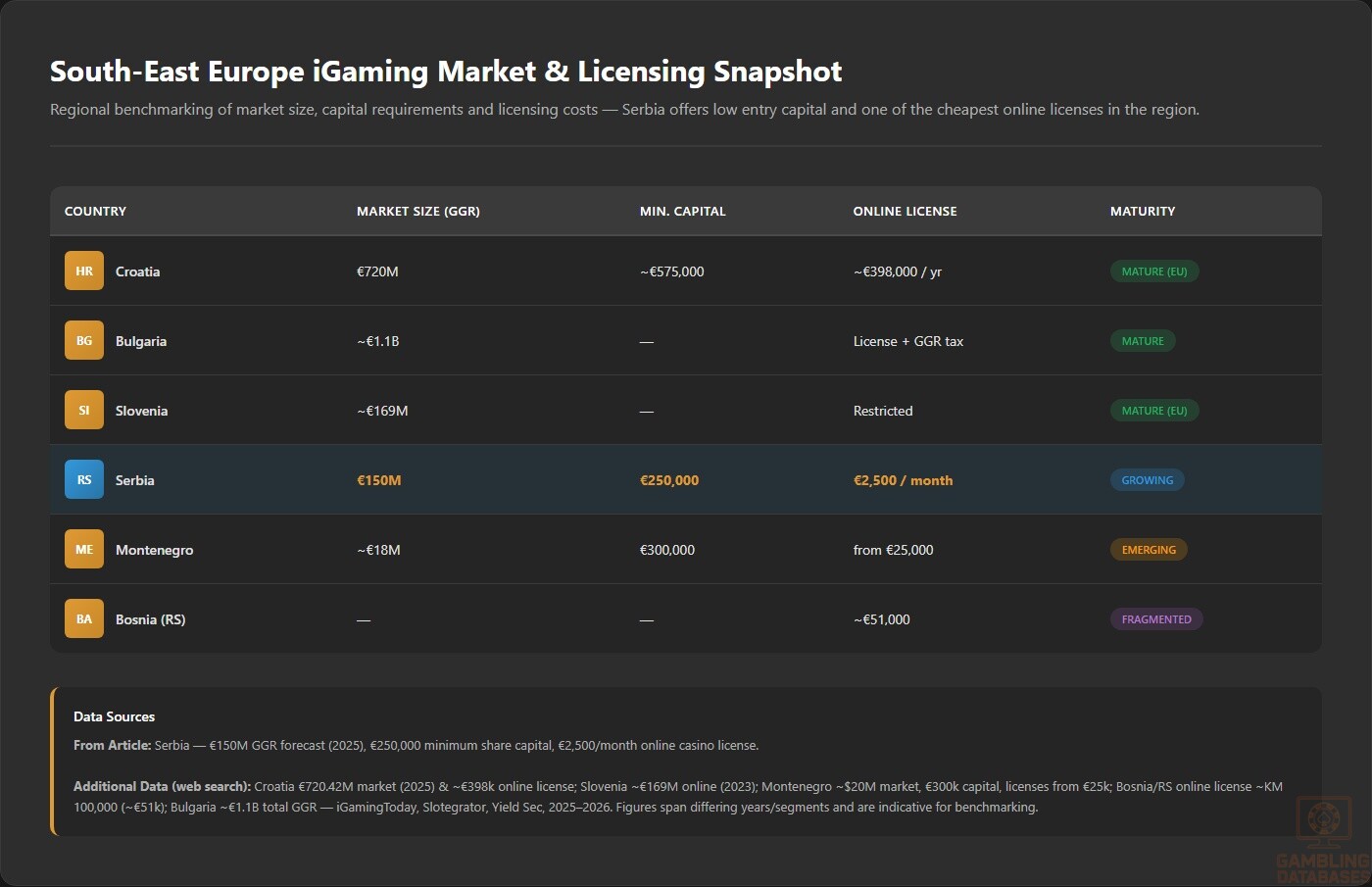
| Market Size (Gross Gaming Revenue) | €150 million (2025 forecast) |
| Market CAGR (2024-2030) | 9.1% |
| Number of Licensed Operators | 20+ (land-based and online combined) |
| Minimum Share Capital | €250,000 |
| Bank Deposit/Guarantee Requirement | €300,000 |
| Daily Risk Cash Deposit | €10,000 |
| License Validity | 10 years (online), annual renewal for land-based |
| License Fee for Land-based Casinos | €500,000 per year |
| License Fee for Online Casinos | €2,500 per month |
| Gross Gaming Revenue Tax – Sports Betting | 15% |
| Gross Gaming Revenue Tax – Slot Machines | 15% |
| Flat Tax Rate on Land-based Games | 25% |
| Player Tax on Winnings | Exempt for private games; 20% over threshold for state lottery games |
| Advertising Restrictions | Strict, prohibits targeting minors, restricts TV and online promotions |
| Anti-Money Laundering | Comprehensive KYC/AML procedures enforced |
| Responsible Gambling Measures | Mandatory self-exclusion, addiction warnings, limit setting |
| Average Revenue Per User (ARPU) | €690 (2024 est.) |
| Market Penetration Rate | 20-25% of adult population engaged in gambling |
| Internet Infrastructure Investment | €540 million fiber-optic project completing 2025 |
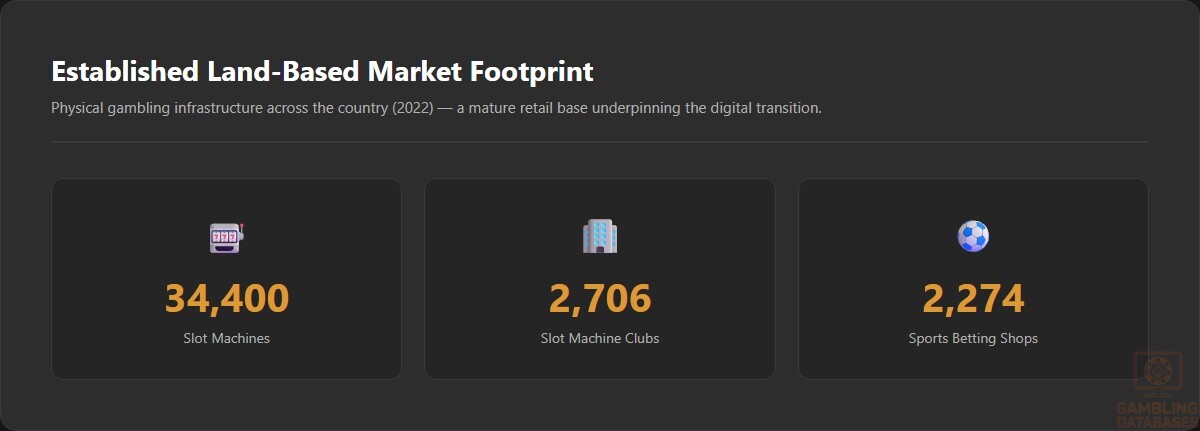
| Gaming Machine Count | 34,400 slot machines (2022) |
| Sports Betting Shops | 2,274 shops (2022) |
| Slot Machine Clubs | 2,706 clubs (2022) |
Section 1: Regulatory Framework and Legal Environment
Current Gambling Regulation Status
Serbia’s gambling sector is comprehensively regulated by the Law on Games of Chance enacted in 2011 and substantially amended through 2013 and 2020. This regulatory framework covers all categories of gambling including land-based casinos, sports betting, slot machine halls, lotteries, and online gaming.
Land-based gambling includes traditional casinos, sports betting venues, slot halls, and poker rooms. The market is mature with over 2,200 sports betting points and nearly 2,700 slot machine clubs, hosting tens of thousands of individual gaming machines.
Online gambling was formally legalized in 2011, with a licensing regime introduced in 2013. The law mandates stringent licensing, and the regulatory authority exercises tight oversight to ensure compliance with international standards and local requirements. Amendments in 2020 introduced more detailed responsible gambling policies and anti-money laundering (AML) provisions.
Land-Based Gambling Activities
The land-based sector in Serbia is characterized by three main operational categories: casinos, sports betting outlets, and slot machine halls. Casinos operate under a separate licensing scheme with higher fees, while sports betting and slot operations exhibit extensive penetration through physical outlets across the country.
Sports betting is the most popular category, concentrated on football, basketball, and other major sports with a substantial network of betting shops operated by multiple licensed companies. Slot halls and machine clubs supplement the market, providing a broad offering for casino-style gaming outside traditional casino venues.
Online Gambling Framework
The online iGaming market in Serbia is regulated under an integrated licensing and supervisory approach managed by the Games of Chance Administration (GCA). Operators must obtain a specific license authorizing online activities, including casino games, poker, and sports betting.
The legal framework prohibits unlicensed operators and mandates compliance with technical standards including RNG certification, secure transmission protocols, and responsible gambling features such as player limits and self-exclusion tools. The law restricts certain games where risks or financial impacts are not fully controllable under current regulations.
Licensed Operators and Market Players
The Serbian gambling market hosts a mix of domestic and international operators, with approximately 20 officially licensed companies operating both online and land-based betting and gaming services. The market structure is moderately consolidated with leading operators holding significant shares, particularly in sports betting.
The licensing regime and preferential tax treatment for long-term licenses incentivize foreign entrants, fostering competitive dynamics and investment in technology infrastructure. Market entry strategies typically involve establishing a local presence and compliance with jurisdictional requirements to build trust and regulatory goodwill.
Licensing Framework and Requirements
Application Process and Eligibility
The regulatory authority responsible for licensing is the Games of Chance Administration under the Ministry of Finance. Applicants must demonstrate robust financial standing, operational reliability, and adherence to technical and legal standards.
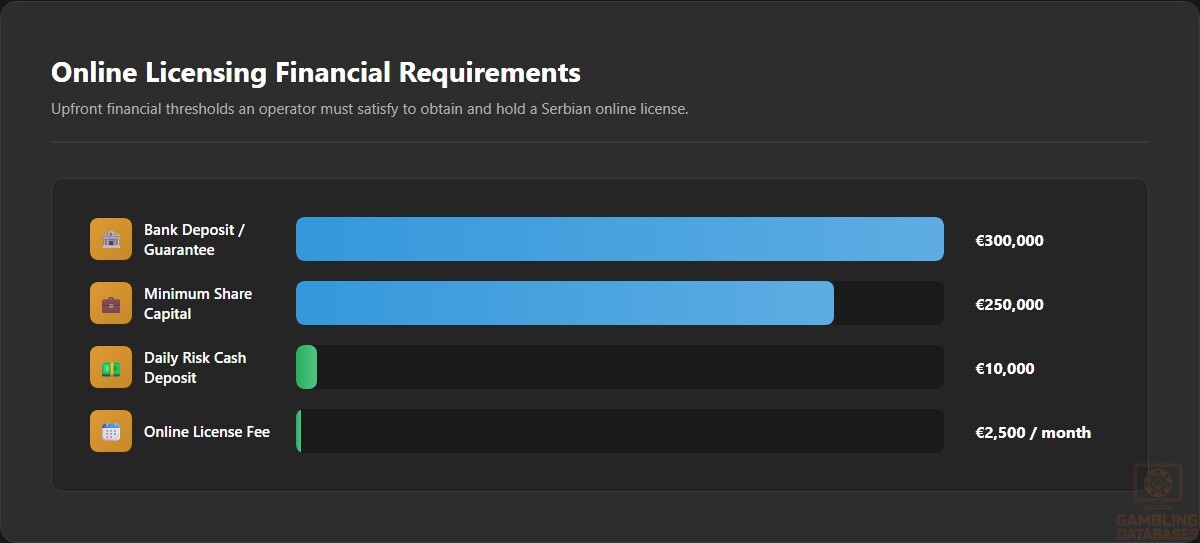
Specific financial prerequisites include a minimum share capital of €250,000, a bank deposit or guarantee of €300,000, and a daily risk cash deposit requirement of €10,000. Licenses for online operators have a validity period of 10 years, promoting long-term market stability.
Licensing fees differ by type, with land-based casino licenses costing approximately €500,000 annually, while online casino licenses require a monthly fee around €2,500. The application review process involves document scrutiny, on-site inspections, and verification of compliance with legal and technical criteria.
- Corporate registration and proof of financial stability
- Detailed business and market strategy plan
- Technical documentation including software and RNG certification
- Responsible gaming and anti-money laundering compliance policies
- Criminal background checks for owners and key personnel
- Proof of minimum capital and financial guarantees
Local Presence and Operational Requirements
Serbian regulations emphasize local operational presence, requiring licensed operators to maintain offices and staff within Serbia or the European Economic Area. Domain registration under Serbian jurisdiction is mandatory for online operators.
Personnel requirements include designated compliance officers and technical support staff to ensure ongoing adherence to regulatory standards. Foreign ownership is permitted but must comply with transparency and control provisions designed to prevent illicit activities and ensure regulatory control.
Compliance Obligations and Monitoring
Player Protection and Identification
Serbia enforces rigorous player identification standards to prevent underage gambling and combat money laundering. Age verification is mandatory, supported by electronic ID checks and verification against government databases.
Operators must implement comprehensive KYC procedures and maintain records of player activity to detect suspicious patterns. Responsible gambling mandates include self-exclusion options, spending and loss limits, and provision of addiction treatment information.
- Mandatory age verification to prevent underage participation
- Comprehensive KYC and AML checks for player onboarding
- Implementation of player self-exclusion systems
- Limits on deposits, losses, and playing time
- Information disclosure on gambling addiction and support services
Financial Monitoring and Reporting
Operators are subject to strict financial reporting requirements, including monthly submission of gaming revenue data, transaction records, and compliance audits. Regulatory oversight involves continuous monitoring of cash flows and electronic payment systems.
Transactions exceeding specific thresholds (1,175,000 dinars in 30 days) trigger enhanced scrutiny. The regulation also mandates real-time reporting of electronic wagers and issuance of confirmations to players.
- Monthly financial and operational report submission to regulatory authority
- Continuous audit of gaming and financial systems
- Transaction monitoring with automatic flagging of large or suspicious transactions
- Regular compliance inspections and on-site visits
Taxation Structure and Financial Obligations
Player Taxation
Serbian law exempts players from taxation on winnings from privately operated gambling games, regardless of amount won. Only winnings from state lottery and similar games exceeding designated thresholds are subject to a 20% tax.
This exemption for private sector winnings positions Serbia uniquely in the region, appealing strongly to players and enhancing market attractiveness.
Operator Taxation
| Game Type | Tax Rate |
|---|---|
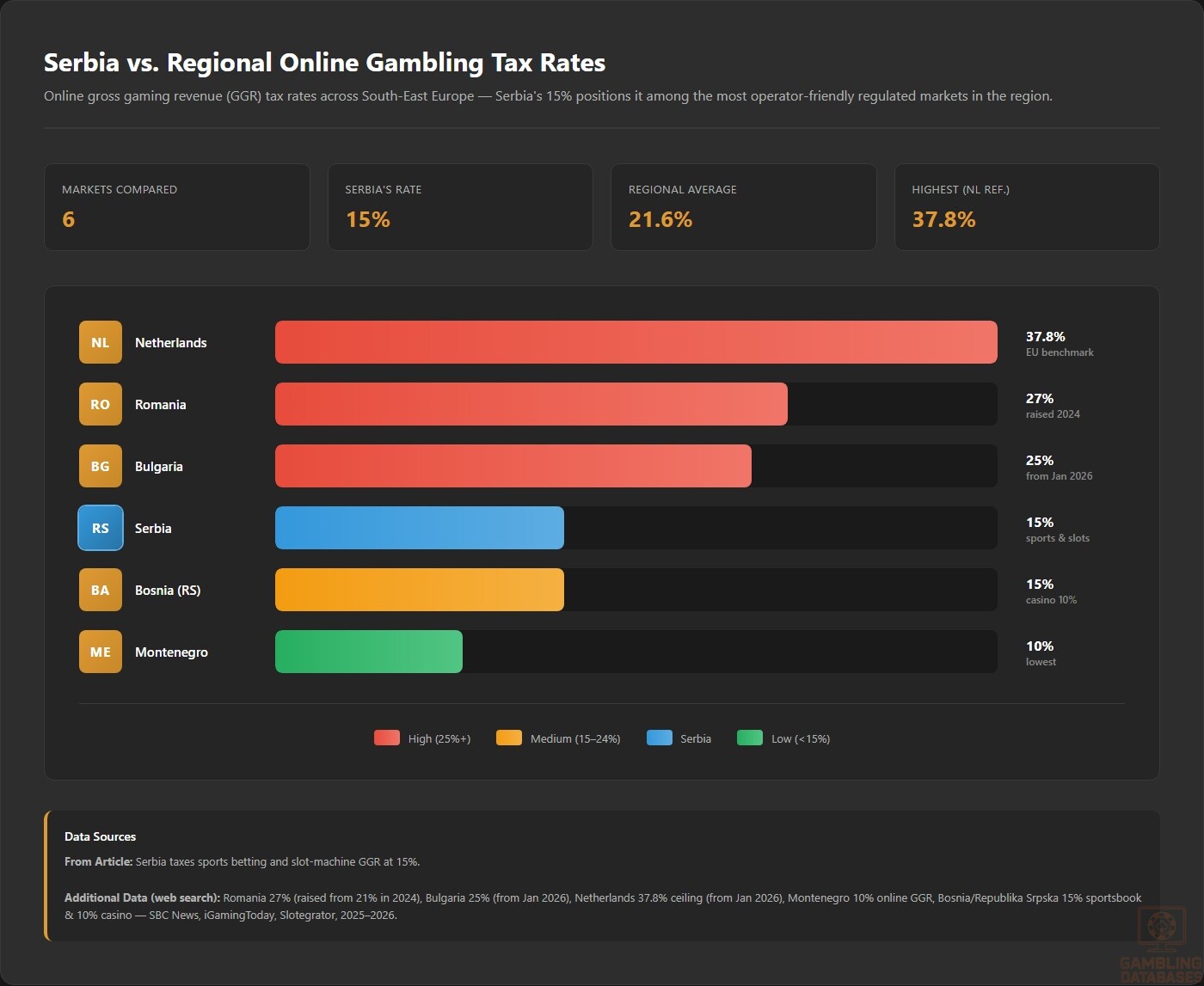
| Sports Betting (Gross Gaming Revenue) | 15% |
| Slot Machines (Gross Gaming Revenue) | 15% |
| Land-based Casino Games (Flat Rate of Revenue) | 25% |
| Corporate Income Tax | 15% |
Land-based operators pay a flat 25% rate on turnover, while online operators are taxed at 15% on gross gaming revenue (GGR). Additionally, licensing and renewal fees apply as financial commitments to maintain operational privileges.
Gambling Market Financial Performance
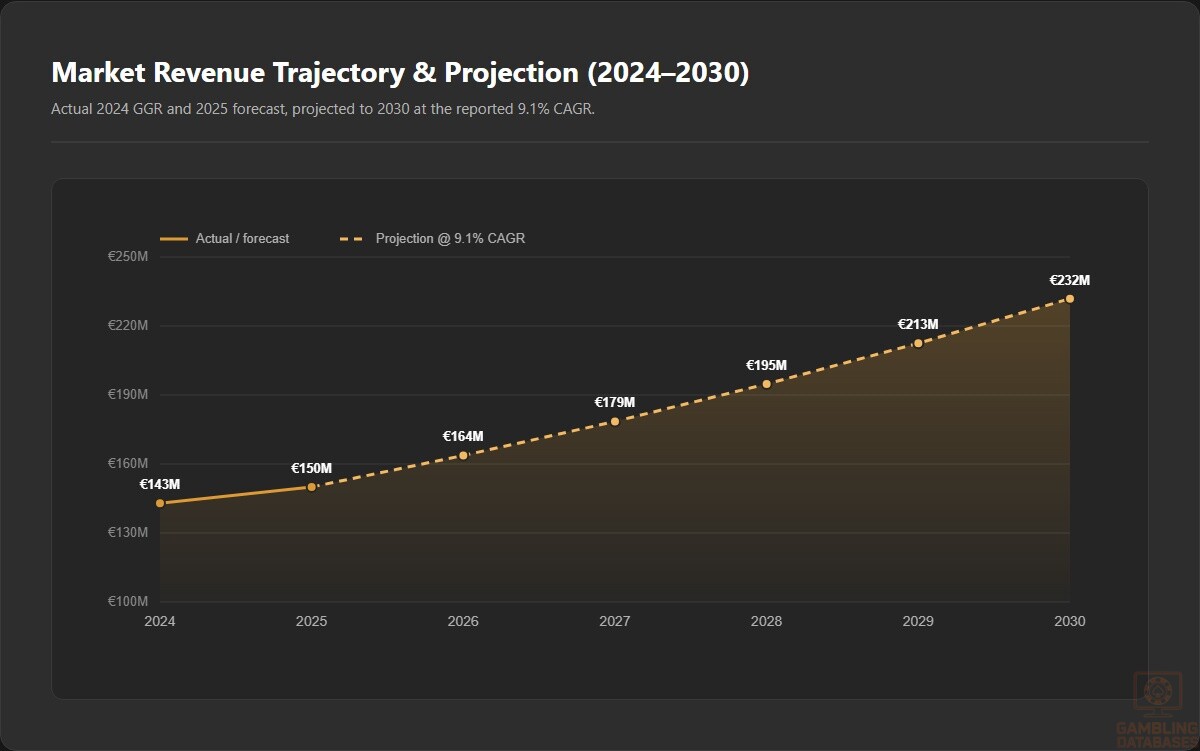
Serbia’s gambling market generated approximately €142.9 million in revenue in 2024, with strong year-over-year growth driven by online and retail segments. The total operator tax contributions for 2024 were around €320 million, reflecting robust fiscal contributions.
Revenue growth is supported by ongoing market expansion, increased consumer participation, and technological infrastructure improvements, stimulating both betting and gaming volumes across categories.
Advertising and Marketing Restrictions
Advertising of gambling products faces strict regulatory limits in Serbia. Promotions must avoid targeting minors or vulnerable groups and are prohibited during children’s programming and in certain public spaces.
Advertising channels include limited TV slots, online platforms under strict supervision, radio, and print media. Sponsorships and bonuses are regulated to prevent inducements that encourage excessive gambling.
- Ban on all gambling ads targeting minors
- Time restrictions on TV and radio promotions
- Prohibition of misleading or exaggerated claims
- Restrictions on online advertising and pop-ups
- Regulated sponsorship and promotional activity
Recent Regulatory Changes and Their Impact
In January 2025, amendments introduced enhanced controls over electronic financial transaction monitoring and tightened cash deposit limits for players. These changes aim to curb money laundering risks while supporting the industry’s integrity.
The extension of video surveillance retention periods to 90 days for land-based venues strengthens oversight. Operators have faced increased compliance costs but benefit from improved market confidence and regulatory clarity.
Enforcement Mechanisms and Penalties
Enforcement of gambling laws in Serbia involves administrative fines, license suspension, and criminal charges for severe breaches. The regulatory body conducts inspections, audits, and monitoring to ensure adherence to all legal requirements.
- Fines for unlicensed operation or non-compliance
- Suspension or revocation of licenses for repeated violations
- Sanctions on advertising breaches
- Penalties for failure to implement AML procedures
- Criminal prosecution for fraud or illicit financial activity
Section 2: Demographics and Consumer Analysis
Population Demographics and Distribution
Serbia’s total population is approximately 6.7 million in 2025, with an adult population (aged 18 and over) around 5.3 million. The median age stands at about 43 years, reflecting an aging demographic and moderate population decline trends typical of Eastern European countries.
The gender ratio is close to parity, with women slightly outnumbering men due to longer life expectancy. Approximately 56% of the population reside in urban areas while the remaining 44% live in rural regions, indicating a moderate urbanization level that affects gambling venue accessibility and digital adoption rates.
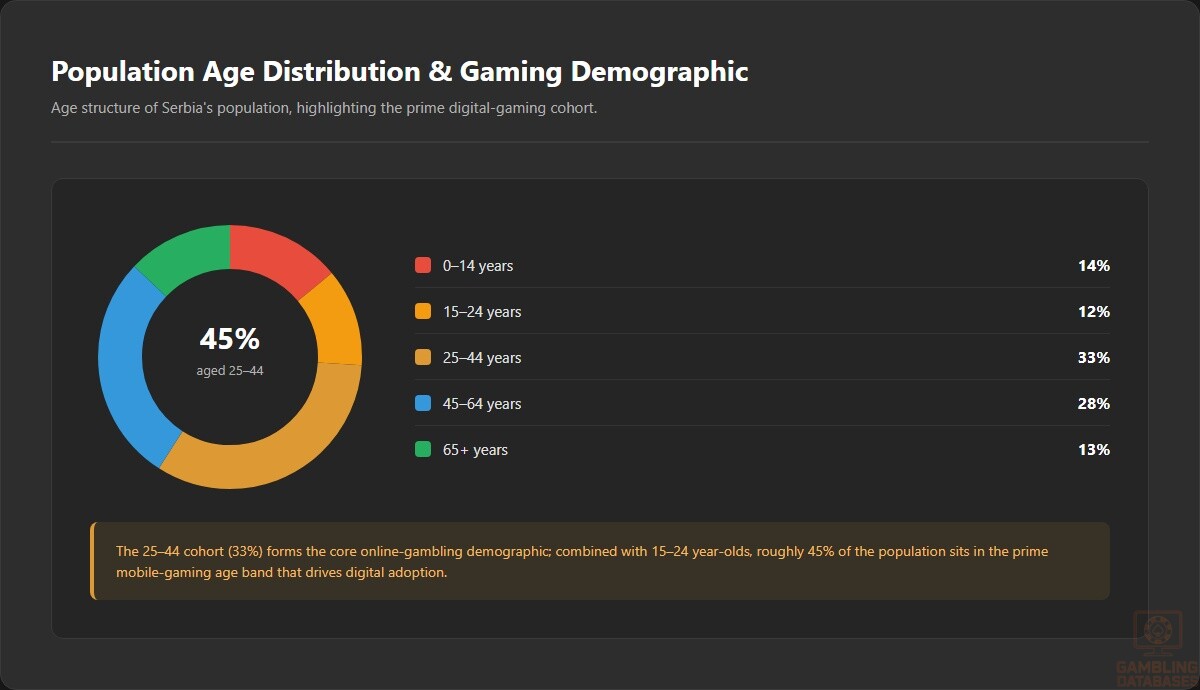
| Age Group | Percentage of Population |
|---|---|
| 0-14 years | 14% |
| 15-24 years | 12% |
| 25-44 years | 33% |
| 45-64 years | 28% |
| 65+ years | 13% |
The urban population is concentrated mainly in the capital, Belgrade, and several regional hubs. Urban centers account for the majority of gambling activity due to better infrastructure and higher average incomes than rural areas. Internet access is substantially higher in cities, supporting growth in online iGaming participation.
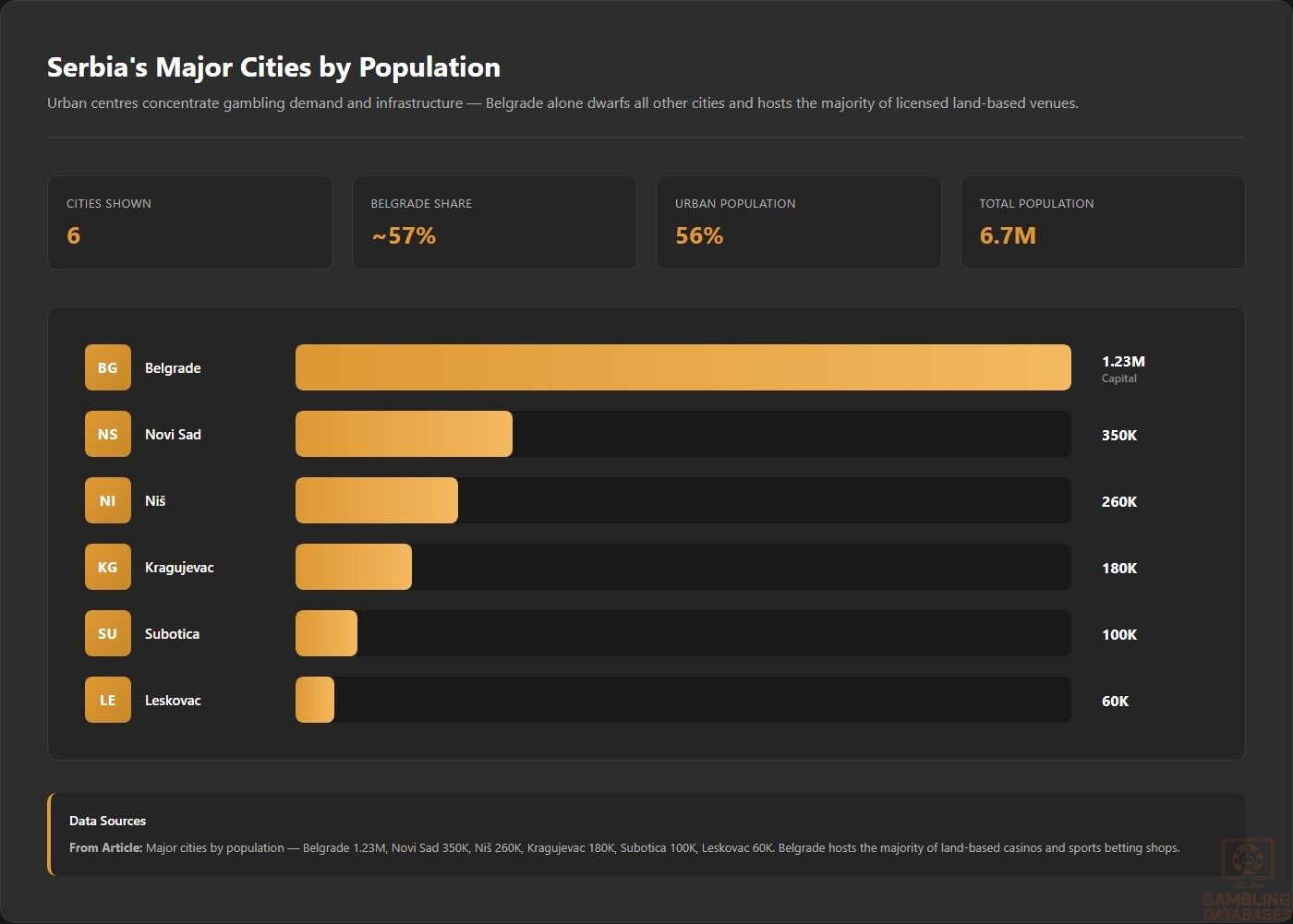
Major Cities by Population
- Belgrade – 1.23 million
- Novi Sad – 350,000
- Niš – 260,000
- Kragujevac – 180,000
- Subotica – 100,000
- Leskovac – 60,000
Concentration of licensed gambling venues aligns with these urban areas, with Belgrade hosting the majority of land-based casinos and sports betting shops. Regional economic disparities contribute to varied consumer spending power and gambling participation rates across Serbia.
Economic Indicators and Consumer Spending Power
Serbia’s GDP in 2025 is estimated at approximately €53 billion, growing at an annual rate of around 3.5%. The economy is transitioning with services contributing roughly 60% of GDP, industry at 30%, and agriculture around 10%, signaling a developing market with growing consumer spending potential.
Per capita GDP stands at approximately €8,000, reflecting moderate income levels but consistent upward trends supported by foreign investment and EU integration efforts. Consumer spending patterns show increasing discretionary income, especially in urban centers, boosting leisure and entertainment expenditures including gambling.
| Indicator | Value |
|---|---|
| GDP (€ billion) | 53 |
| GDP Growth Rate (%) | 3.5 |
| GDP per Capita (€) | 8,000 |
| Service Sector Contribution (%) | 60 |
| Industry Sector Contribution (%) | 30 |
| Agriculture Sector Contribution (%) | 10 |
| Unemployment Rate (%) | 12.5 |
| Inflation Rate (%) | 3.0 |
Household income distribution demonstrates moderate inequality with a Gini coefficient near 33. Median monthly household income is estimated around €450, with urban households generally reporting 20-30% higher earnings than rural counterparts. Disposable income is on a steady rise, favoring luxury and entertainment spending expansion.
Consumer Spending and Income Brackets
Consumer expenditure trends indicate a growing middle class with meaningful disposable income for leisure activities. The upper income bracket, representing about 15% of the population, accounts for the largest share of gambling spend, while lower-income groups exhibit lower participation but remain a significant segment in sports betting and lower-stake games.
Education, Skills, and Digital Literacy
Serbia enjoys a literacy rate exceeding 98%, reflecting a well-educated population with strong emphasis on secondary and tertiary education. University enrollment rates are around 50%, producing a workforce skilled in technology, finance, and services sectors supporting the iGaming economy.
Digital literacy is rapidly increasing, especially among the 18-44 age demographic, fueled by expanding internet access and government initiatives promoting e-governance and digital skills training. This proficiency supports adoption of online gambling platforms and mobile gaming applications.
Cultural and Social Factors
Communication and Language
Serbian is the official language and primary communication medium; however, English proficiency is moderate to high among urban youth and business communities, facilitating international operator entry and marketing communications.
- Serbian (official) spoken by 88% of the population
- Hungarian spoken by 3.5% in northern regions
- Romani spoken by 2% in minority communities
- Slovak and Romanian spoken by smaller groups
- English widely used in business and online environments
Cultural Attitudes
Gambling enjoys a broadly positive social acceptance in Serbia, embedded in cultural traditions and leisure activities. Religious influences are moderate, with the Serbian Orthodox Church holding sway but not strongly opposing regulated gambling.
Foreign gambling brands are generally welcomed, particularly from European markets, with preferences leaning towards transparent, trusted operators offering wide game selections and localized services.
Problem Gambling and Social Considerations
Prevalence of problem gambling is estimated at approximately 2.5% of the adult population. At-risk groups include young males aged 18-34 and unemployed individuals. The government and industry players collaborate on responsible gambling campaigns and support services.
- National helpline and counseling services for problem gamblers
- Mandatory operator contributions to responsible gambling funds
- Public awareness and prevention programs in schools
- Self-exclusion availability across licensed operators
- Research funding on gambling impact and social costs
Political Structure and Governance
Serbia operates as a parliamentary republic with a stable political environment supporting regulatory consistency in the gambling sector. Its governance structure promotes integration with European standards, encouraging transparency and foreign investment.
International relations, particularly constructive EU accession negotiations, contribute to evolving financial and legal frameworks beneficial to market entrants.
Technology Adoption and Digital Behavior
Internet and Digital Usage
Internet penetration in Serbia reached approximately 85% of the population by 2025, driven by national broadband expansion projects. Daily average internet use exceeds 6 hours per individual, with mobile internet access via smartphones dominant among younger cohorts.
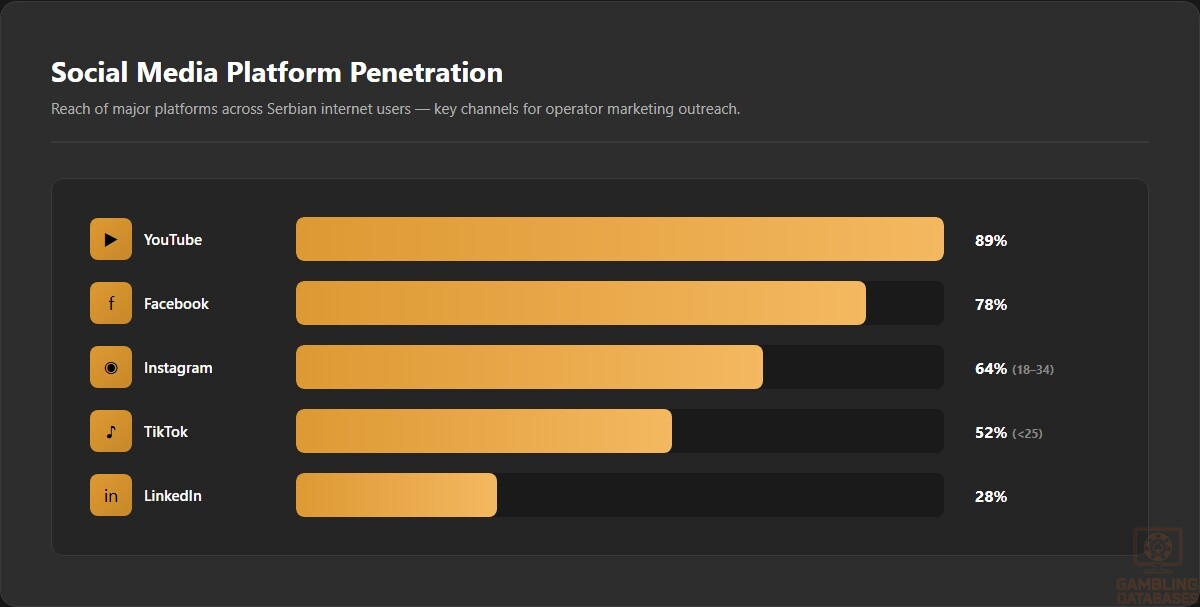
The nation has a vibrant social media landscape fostering community interaction and digital marketing outreach potential.
- Facebook dominates with 78% penetration
- Instagram used by 64%, popular among 18-34 age group
- YouTube reaches 89% penetration across demographics
- TikTok rapidly expanding with 52% users under 25 years
- LinkedIn stands at 28% among professionals
Digital Payment Behavior
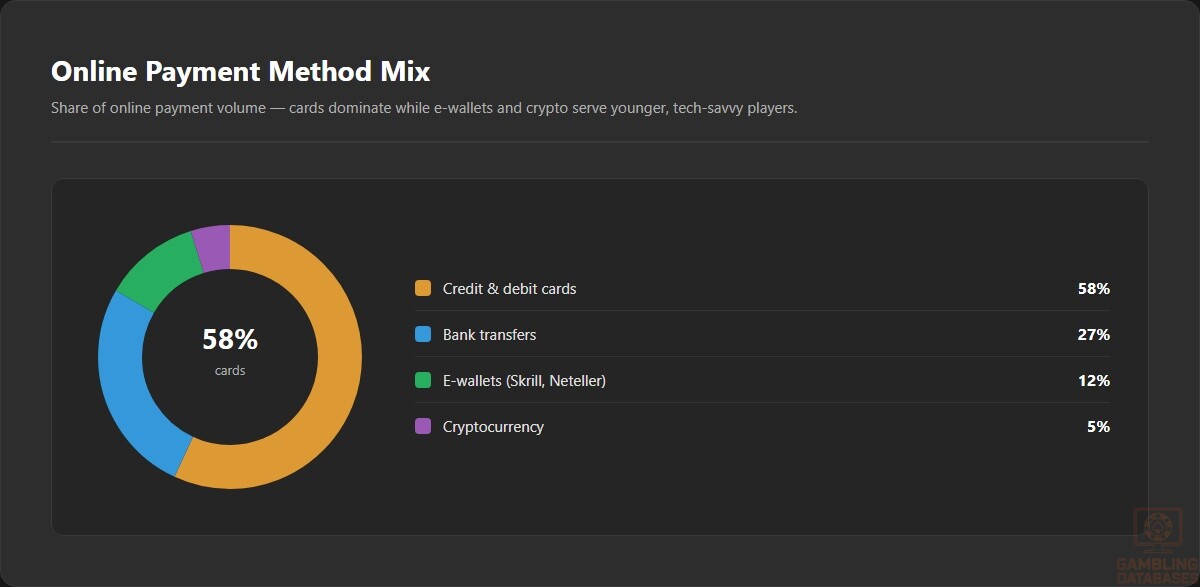
Online transaction preferences in Serbia are shifting towards digital wallets and card payments. Bank transfers remain significant for higher-value gambling deposits and withdrawals. Cryptocurrency adoption is nascent but growing, especially among tech-savvy younger players.
- Credit and debit cards account for 58% of online payments
- Bank transfers represent 27% of payment volume
- E-wallets (including Skrill, Neteller) capture 12%
- Mobile payments growing rapidly among youth demographics
- Cryptocurrency used by approximately 5% of digital gamblers
Gaming and Gambling Preferences
Current Market Participation
Approximately 20-25% of Serbian adults engage in gambling activities regularly, with sports betting leading market share followed by slot machines and online casino games.
- Sports Betting – favored for football, basketball, and tennis
- Slot Machines – extensively popular in physical venues and online
- Online Casino Games – growing rapidly with diversification of offerings
- Lottery Games – stable participation among older demographics
- Poker – niche but steady player base in both live and online contexts
| Gambling Activity | Participation Rate (%) |
|---|---|
| Sports Betting | 43 |
| Slot Machines | 27 |
| Online Casino Games | 18 |
| Lottery | 15 |
| Poker | 7 |
Consumer Behavior Patterns
Serbian gamblers typically engage in multiple gambling formats, with sports betting sessions averaging 60 minutes and casino play sessions averaging 40 minutes. Peak activity times coincide with weekends and major sporting events, reflecting recreational and entertainment-driven consumption.
Platform preference shows a strong shift towards mobile and online channels, incentivized by ease of access, diversified gaming options, and competitive promotional offerings. Retention rates are increasing with personalized marketing and loyalty schemes tailored to local market nuances.
Section 3: Technology Infrastructure and Business Environment
Internet and Digital Infrastructure
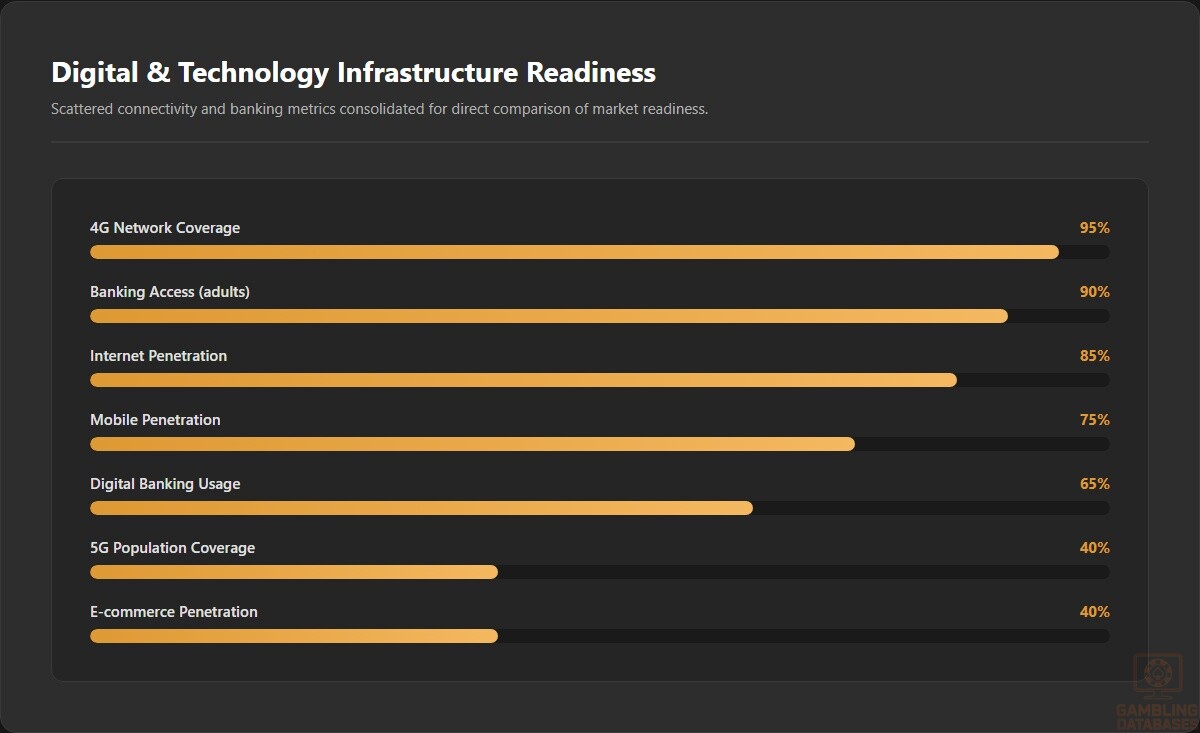
Serbia boasts an internet penetration rate of approximately 85% as of 2025, driven by extensive investment in broadband and mobile networks. Fixed broadband subscriptions stand at about 20 per 100 inhabitants, while mobile broadband dominates with over 70 subscriptions per 100 inhabitants, indicating mobility-focused internet usage.
Average broadband speeds have steadily increased, with current fixed-line download averages at 150 Mbps and mobile 4G networks delivering 50 Mbps on average. National infrastructure projects have completed major optical fiber rollouts covering urban and expanding rural areas, improving network reliability and latency.
5G and Future Technology Deployment
The rollout of 5G networks is underway, with coverage available in all major cities and key economic regions, reaching approximately 40% national population coverage by mid-2025. Key mobile operators are investing heavily in spectrum acquisition and infrastructure modernization to extend 5G reach to smaller towns by 2026.
Future plans include integration of private 5G networks for enterprise clients, particularly supporting high-demand sectors such as fintech and iGaming platforms requiring low latency and high reliability.
Mobile Technology Ecosystem
Mobile Network Infrastructure
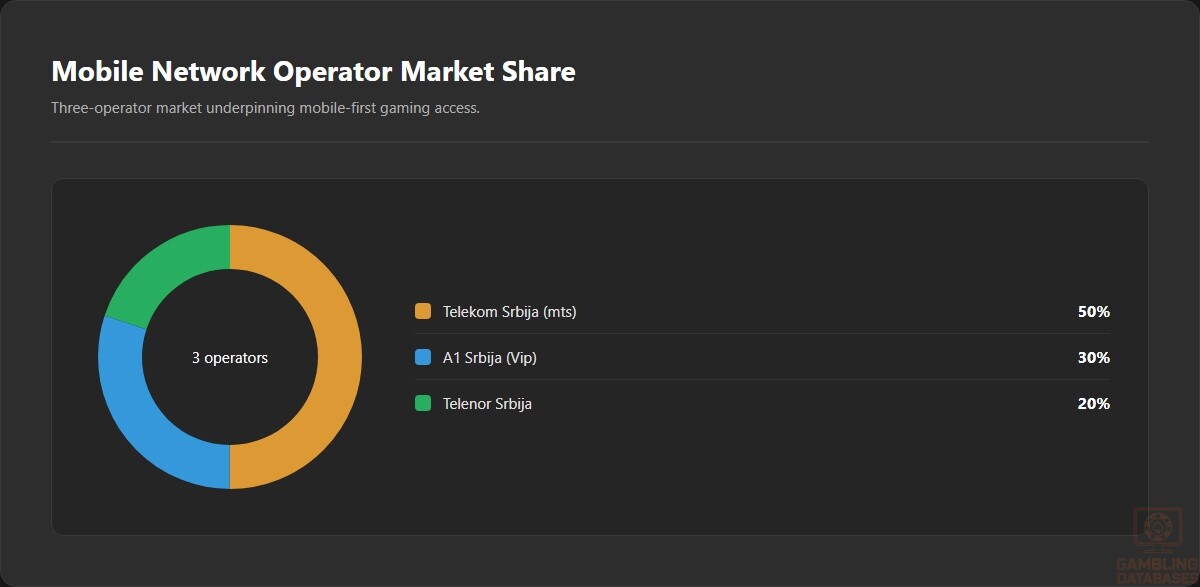
The Serbian mobile market is competitive, supported by three primary operators offering extensive 4G and expanding 5G services. Market coverage reaches over 95% of the population for 4G, with rural areas showing rapid improvement.
- Telekom Srbija (mts) – market leader with about 50% share
- Vip mobile (A1 Srbija) – approx. 30% share
- Telenor Srbija – around 20% market share
Data pricing is competitive relative to regional peers, encouraging high mobile data consumption that aligns well with mobile gaming trends.
Device Penetration
Smartphone adoption exceeds 75% of the adult population, with Android devices representing the majority market share, while iOS holds about 20%. The average replacement cycle of smartphones is every 2-3 years, with a growing trend towards higher-end models that support gaming applications.
Consumers display increasing preference for mobile betting and casino apps, facilitated by widespread 4G/5G access and secure mobile payment integration.
Financial Services and Payment Infrastructure
Banking System Structure
The Serbian banking system is well-developed with high account penetration, exceeding 90% of adults having access to banking services. Digital banking adoption is strong, with over 65% of account holders actively using mobile or internet banking platforms.
- Komercijalna Banka – largest market share, broad digital offerings
- UniCredit Bank Srbija – strong corporate and retail banking presence
- Raiffeisen Bank – emphasis on SME and digital banking products
- Eurobank – growing digital footprint and consumer segment
- Tek banka – digital-first challenger bank expanding rapidly
Payment Processing Options
Serbia’s payment landscape supports an array of methods suitable for iGaming transactions. Credit and debit cards are widely accepted, with significant uptake of e-wallets and direct bank transfers. Emerging mobile payment solutions and cryptocurrencies are beginning to gain traction among younger consumers and international operators.
- Visa and MasterCard credit/debit cards
- Local bank transfers with real-time clearing
- E-wallets including Skrill, Neteller, PayPal
- Mobile payment apps linked to bank accounts
- Cryptocurrency payments accepted by select operators
E-commerce and Digital Economy
The Serbian e-commerce market has grown significantly, with annual sales increasing by over 20% in recent years. Online retail penetration exceeds 40% of internet users, driven by expanding digital payment options and increasing consumer trust.
This digital economy growth supports an ecosystem amenable to iGaming services, with consumers accustomed to online transactions and digital content consumption.
Business Environment and Regulatory Framework
Ease of Business Operations
According to World Bank rankings, Serbia scores favorably for ease of doing business, especially in starting a business, registering property, and enforcing contracts. Registration processes have been streamlined through digital platforms to reduce administrative burden.
Foreign investment is encouraged via incentives and simplified incorporation procedures. Operational costs including labor, office space, and utilities remain competitive in the regional context, enhancing attractiveness for foreign entrants.
Corporate Structure and Registration
Legal entity options include Limited Liability Companies (LLC), Joint-Stock Companies (Corporations), and Branch offices of foreign companies. LLCs are the predominant structure for gaming operators due to simpler management and liability protections.
Branch offices are often used by international firms to maintain operational control while complying with local jurisdictional requirements.
- Notarized Articles of Incorporation
- Founders’ identification and personal data
- Company name approval certificate
- Proof of registered office address
- Bank statements demonstrating minimum capital deposit
- Tax identification number application
Registration Timelines and Foreign Ownership
Company registration typically takes 2-3 weeks from document submission. Foreign ownership is permitted without restrictions, but transparency and AML compliance are strictly enforced to prevent illicit activity and ensure market integrity.
Taxation Framework
Corporate Income Tax Structure
The standard corporate income tax rate in Serbia is 15%, with benefits available in special economic zones including tax holidays and preferential treatment. Serbia has bilateral tax treaties with over 50 countries, minimizing double taxation risks.
- Austria
- Germany
- Russia
- China
- United Arab Emirates
- Switzerland
Personal Income Tax
Personal income tax is levied at rates between 10-15% depending on income brackets. Employer and employee social security contributions constitute additional withholding responsibilities, and tax residency is generally established by a 183-day presence criterion.
Market Entry Considerations
Recommended Entry Strategies
Optimal market entry involves establishing a physical presence or partnerships with local firms, adapting platforms to Serbian language and regulatory requirements, and investing in localized payment and marketing channels.
- Direct investment with full local registration
- Strategic partnership or joint ventures
- Acquisition of existing licensed operators
- White-label agreements with Serbian license holders
- Robust compliance infrastructure implementation
Typical Costs and Timelines
Initial license fees, legal and consulting expenses, technology acquisition, marketing, and working capital constitute the bulk of initial investments. Operational expenses include ongoing license fees, taxes, staff salaries, and compliance costs.
| Cost Category | Approximate Cost (€) |
|---|---|
| License Application Fee | €50,000–€80,000 |
| Annual License Fees | €30,000–€500,000 (varies by license type) |
| Legal and Consulting | €40,000–€70,000 |
| Company Registration | €10,000–€15,000 |
| Initial Capital Deposit | €250,000+ |
| Marketing Budget | €100,000+ |
| Operational Expenses (Annual) | €200,000+ |
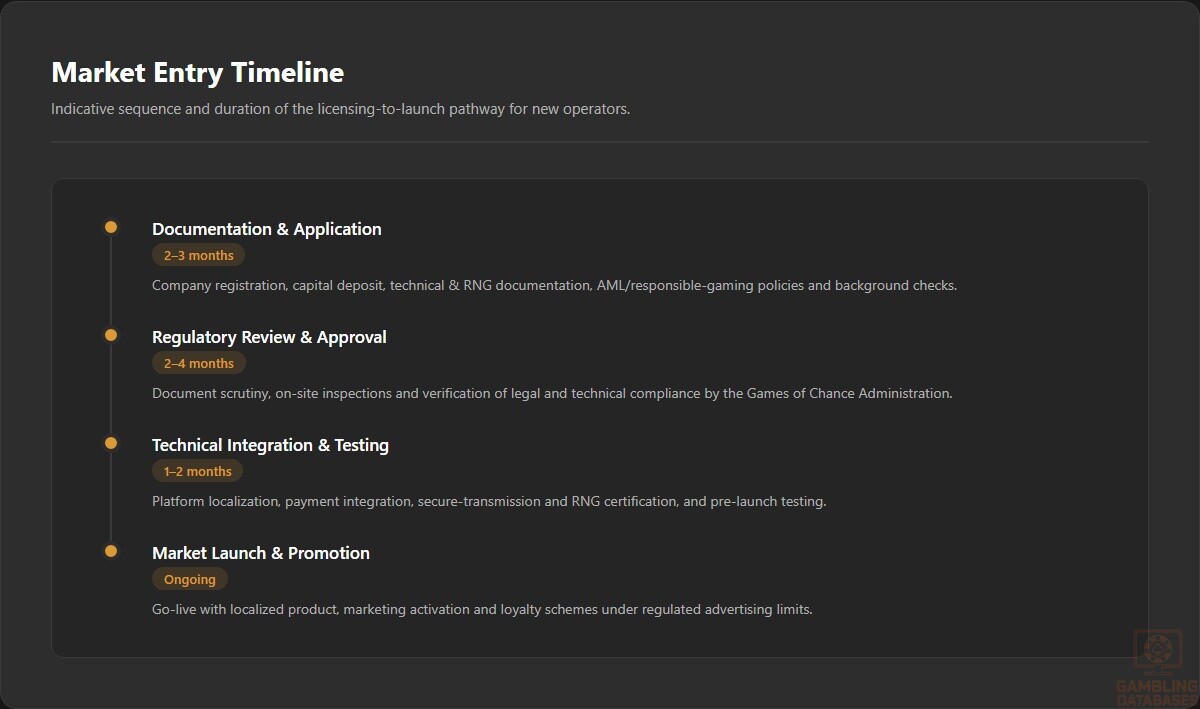
- Document preparation and licensing application (2–3 months)
- Regulatory review and approval (2–4 months)
- Technical integration and testing (1–2 months)
- Market launch and promotional activities (ongoing)
Success Factors and Challenges
Key success drivers include robust compliance, localized user experience, high-quality customer support, and efficient payment integrations. Challenges are regulatory complexity, market competition, and evolving taxation policies affecting profit margins.
- Strong regulatory compliance and transparent operations
- Market-specific product localization and language support
- Effective marketing and brand differentiation
- Efficient and diverse payment processing options
- Adapting rapidly to regulatory updates and technology shifts
Exit Strategy Planning
Market liquidity is moderate, with license transfer subject to regulatory approval and financial due diligence. Valuation multiples for gambling operators range between 5-7 times EBITDA, influenced by compliance history and market position. Operators planning exit should prepare thorough operational and financial documentation supporting license transfer or sale processes.
FAQ: Frequently Asked Questions
1. Is online gambling legal in Serbia?
Yes, online gambling is fully legal and regulated under the Law on Games of Chance. Operators must obtain a specific license issued by the Games of Chance Administration, ensuring compliance with technical, financial, and responsible gaming standards. Unauthorized online gambling is prohibited and subject to enforcement actions.
2. What types of gambling licenses are available and what do they cover?
Licenses cover land-based casinos, online casinos, sports betting, slot machine halls, and lotteries. Each license type imposes distinct operational, financial, and reporting requirements, with online licenses granting authorization for digital platforms including poker, casino games, and sports betting.
3. How much does an iGaming license cost and how long does it take to obtain?
Online gambling license fees are approximately €30,000 annually plus a monthly fee around €2,500. The application process can take 3 to 6 months, depending on completeness of documentation and regulatory reviews. Land-based licenses carry higher fees, often €500,000 annually.
4. Can foreign companies obtain a gambling license?
Yes, foreign companies are eligible to obtain gambling licenses, provided they meet financial, technical, and compliance criteria. They must establish a local presence, comply with Serbian laws, and submit required documentation including financial guarantees and background checks.
5. What are the tax obligations for iGaming operators?
Operators pay a gross gaming revenue tax of 15% for sports betting and slot machines, while land-based gaming is taxed at 25% turnover rate. Corporate income tax is 15%. Licensing fees and periodic renewals add to the tax burden but are balanced by exemptions on player winnings.
6. Are gambling winnings taxed for players?
Players are exempted from taxes on winnings from private operators. State lottery winnings over specified thresholds are subject to 20% tax. This favorable treatment enhances player retention and market growth.
7. What are the typical operational costs for running an online casino/sportsbook?
Operational costs include licensing fees, platform technology costs, staff salaries, marketing budgets, payment processing fees, and compliance monitoring. These can range annually from €200,000 to over €500,000 depending on scope and scale.
8. What is the expected ROI timeline for entering this market?
Return on investment typically occurs within 18 to 36 months, depending on the business model, marketing effectiveness, and regulatory compliance. Markets with established player bases and scalable platforms tend to achieve ROI faster.
9. What are the local presence requirements for operators?
Operators must maintain an office or representative branch in Serbia or an EEA country, staffed with compliance and technical personnel. This ensures regulatory oversight and quick responsiveness to market or legal changes.
10. What payment methods are available and recommended?
Credit/debit cards, bank transfers, e-wallets, mobile payments, and certain cryptocurrencies are widely accepted. Operators should offer multiple options to cater to diverse consumer preferences and enhance transaction security and speed.
11. What are the advertising and marketing restrictions?
Advertising must not target minors or vulnerable groups and is restricted during children’s programming hours. Misleading claims are prohibited, and promotional bonuses are regulated to prevent excessive gambling inducements.
12. What responsible gambling measures are mandatory?
Operators must provide self-exclusion systems, deposit and loss limits, addiction prevention information, mandatory player identification, and contribute to national responsible gambling programs. These measures ensure player protection and market sustainability.
13. How large is the iGaming market and what is the growth potential?
The iGaming market is valued at approximately €150 million in GGR with growth forecasted at 9.1% CAGR through 2030. Expansion is supported by increasing digital penetration, rising disposable income, and regulatory enhancements encouraging transparency.
14. Who are the main competitors and what is their market share?
Market leaders include Telekom Srbija’s mts and international operators licensed for sports betting and online casino segments. The competitive landscape comprises about 20 licensed entities with varying shares, with consolidation expected as the market matures.
15. What are the player preferences and typical spending patterns?
Players favor sports betting, especially football and basketball, followed by slot machines and online casino games. Average revenue per user is approximately €690, with peak gaming during weekends and major sports events. Mobile platforms dominate user access.
16. What are the key success factors and main challenges for new entrants?
Success relies on robust regulatory compliance, localized user experience, competitive payment options, and effective marketing. Challenges include complex licensing, tax compliance, intense competition, and adapting to evolving regulatory requirements.
Sources and References
- Statista – Gambling Market Serbia Forecast 2025
- SiGMA World – Serbia iGaming Market Overview 2025
- Law on Games of Chance, Serbia, Official Publication
- Games of Chance Administration – Republic of Serbia
- Ministry of Finance – Taxation Guidelines 2025
- National Statistical Office of Serbia – Demographic Data 2024
- World Bank – Doing Business Serbia Report 2024
- International Telecommunication Union – ICT Development Index 2025
- Central Bank of Serbia – Financial Sector Reports 2025
- SoftSwiss Compliance Guide – Serbia
- Komercijalna Banka Annual Report 2024
- A1 Srbija – Telecommunications Market Report 2025
- Telenor Serbia – Network Coverage Data 2025
- Mondaq – Serbia Gambling Law Updates 2025
- EvenBet Gaming – Emerging Markets Report 2025
- 6W Research – Serbia Gambling Market Forecast 2030
- JPM Legal Analysis – Serbia Games of Chance 2017
- Lottery Daily – Serbia Regulatory Sweep 2025
- Global Newswire – Serbia Gambling Market Report 2024-2030
- LegalPilot – Serbia Gambling Legal Framework 2025
- YBCase – Licensing Process Serbia 2025
- Boomaff – Serbia Online Gambling Market 2024
- Sigma World – Tax Revenues from Gambling 2024
- Serbian Monitor – Tax Treatment of Gambling Income 2025
- Slotegrator – How to Start Gambling Business Serbia 2025