
Senegal presents an emerging opportunity for iGaming operators within West Africa, characterized by a growing internet user base and increasing mobile penetration. The country’s regulatory stance is evolving, with authorities taking cautious steps towards digital gaming legalization, although the market remains largely informal. Entrants must navigate a complex landscape shaped by regulatory ambiguities, infrastructural challenges, and regional cooperation efforts.
Executive Summary: Key Market Indicators
| Metric | Value |
|---|---|
| Gambling Legal Status | Partially regulated, informal sector dominant |
| Population | 16 million (2025 est.) |
| GDP | $24.8 billion (2024) |
| Internet Penetration | 45% |
| Mobile Penetration | 85% |
| Licensing Costs | Approx. $50,000 – $200,000 |
| Tax Rate on GGR | 15% |
| Market Size (2025 Forecast) | $150 million |
| Expected CAGR (2025-2028) | 12% |
| ARPU | $25 |
| Market Penetration | Estimated 3-4% |
| Internet Infrastructure | Developing, with rural areas underserved |
| Regulatory Environment | Nascent, under review |
| Ease of Market Entry | Moderate, with regulatory uncertainties |
Section 1: Regulatory Framework and Legal Environment
Current Gambling Regulation Status
Senegal’s gambling sector is characterized by a predominantly informal landscape, with limited formal regulation applying mainly to land-based betting shops and casinos. The government permits certain land-based activities such as sports betting and casino operations under specific licenses, but online gaming remains largely unregulated. Recent legislative discussions aim to formalize and regulate digital betting, but no comprehensive legislation has been enacted as of 2025.
Land-Based Gambling Activities
Commercial casinos operate primarily in Dakar, offering slot machines, table games, and poker rooms. Sports betting is permitted through licensed outlets, often supervised by regional betting agencies. Slot machine halls are present but face regulatory oversight challenges. Other land-based activities include charitable gaming and limited lottery offerings, regulated by the national lottery authority. These activities form the core legal gambling offerings, with minimal expansion into online sectors.
Online Gambling Framework
Digital gambling remains in a regulatory grey area, with no clear licensing framework established. While some operators conduct online sports betting and lottery services illicitly, the government has expressed intentions to regulate online gambling via future legislation. The absence of clear legal provisions leads to risks related to opaqueness, enforcement, and operator legality, discouraging formal market entry at this stage. Notably, jurisdictional oversight is inconsistent, with regional cooperation being nascent.
Licensed Operators and Market Players
There are few licensed domestic operators, primarily focusing on land-based activities. The market is mostly dominated by informal operators, with a few established land-based casinos holding licenses issued by relevant authorities. International online operators have limited presence due to the lack of a formal regulatory regime. Entry strategies involve leveraging regional partnerships and capitalizing on the country’s strategic position within West Africa. Competitive dynamics center on licensing, local partnerships, and regulatory compliance.
Licensing Framework and Requirements
Operators seeking licensure must navigate administrative procedures governed by the Senegalese authorities, primarily the Ministry of Interior and the Ministry of Finance. The application process involves comprehensive documentation, fee payments, and compliance checks.
- Submission of corporate registration and ownership documents
- Proof of financial stability and minimum capital deposit
- Technical specifications of the gaming platform and RNG certification
- Evidence of responsible gambling measures and AML/KYC procedures
- Application fees ranging between $50,000 and $200,000, with review timelines of up to six months
Local Presence and Operational Requirements
Foreign operators are generally required to establish a local legal entity and maintain a physical presence in Senegal, including local office space and personnel. Domain registration must be localized within Senegal or regional jurisdictions. Key personnel duties include compliance supervision and customer support. Foreign ownership is restricted to ensure local participation, and partnerships with local entities are often encouraged to facilitate licensing and market entry.
Compliance Obligations and Monitoring
Player Protection and Identification
Operators must implement age verification systems, enforce KYC/AML procedures, and promote responsible gambling through self-exclusion programs. Transparency in payouts and clear communication regarding rules are mandated, although enforcement remains inconsistent.
- Mandatory age verification at registration
- AML procedures for large transactions
- Self-exclusion and responsible gambling resources
- Regular reporting of suspicious activities
- Disclosure of responsible gambling policies on platforms
Financial Monitoring and Reporting
Operators are required to monitor transactions for suspicious activity and report annually to authorities. Audits and financial reviews are conducted to ensure compliance, with strict penalties for violations. The regulatory environment is expected to tighten as the sector formalizes.
- Transaction monitoring begins upon license approval
- Periodic reporting on revenue and player activity
- Examination of financial audits by independent auditors
- Submission of compliance reports to authorities
Taxation Structure and Financial Obligations
Player Taxation
Currently, winnings are subject to withholding taxes once a certain payout threshold is met. Specific thresholds and tax rates are under formalization but are estimated to range from 10% to 15% on net winnings.
Operator Taxation
The main fiscal obligations for operators include a gross gaming revenue (GGR) tax of 15%, annual license renewal fees, and corporate income tax rates of 30%. Fixed operational taxes are also levied, including regional licensing fees of approximately $50,000 yearly.
| Game Type | Tax Rate |
|---|---|
| Sports Betting | 15% |
| Casino Games | 15% |
| Lottery | 10% |
Gambling Market Financial Performance
The total bets wagered in land-based sectors amount to approximately $120 million annually, with a small but growing online segment. Revenue trends indicate a CAGR of about 12% projected through 2028, driven by increased mobile access and regional integration. Tax revenues from gambling activities contribute to public infrastructure funding, although detailed data remains limited due to the informal sector’s prominence.
Advertising and Marketing Restrictions
The regulatory outlook constrains advertising through traditional media channels, emphasizing compliance with regional and international standards. Sponsorship and promotional campaigns are restricted, especially during sports events and at youth-centric platforms, to curb gambling addiction and protect minors.
- Limited sponsorship of sports teams
- Restrictions on promotional bonus offers
- Advertising primarily through digital channels with oversight
- Content restrictions on promoting responsible gambling
- Time and location-based restrictions during broadcasting
Recent Regulatory Changes and Their Impact
Recent legislative amendments aim to draft a formal online gambling framework, with proposals advancing through parliamentary discussions. These changes are intended to standardize licensing processes, introduce clear tax obligations, and expand player protections. Such reforms will influence operator costs, licensing timelines, and market strategies in the near future.
Enforcement Mechanisms and Penalties
Enforcement actions focus on cracking down on illegal operators and unlicensed activity. Penalties include heavy fines, license revocations, and potential criminal prosecutions. The trend toward stricter oversight signifies government intent to formalize the sector and curtail illicit gambling activities.
- Fines for unlicensed operation up to $100,000
- License suspension or revocation for non-compliance
- Criminal charges for illegal betting activities
- Regular audits and compliance checks
- Seizure of equipment and platforms involved in illicit gaming
Section 2: Demographics and Consumer Analysis
Population Demographics and Distribution
Senegal’s total population is approximately 16 million as of 2025, with a young demographic profile reflective of many sub-Saharan African countries. The median age is around 19.5 years, illustrating a predominantly youthful population. Gender ratios are relatively balanced, with a slight male majority of about 51%. The population is split roughly between urban and rural areas, with urbanization steadily increasing due to economic opportunities concentrated in key cities.
| Age Group | Percentage of Population |
|---|---|
| 0-14 years | 42% |
| 15-24 years | 20% |
| 25-54 years | 30% |
| 55-64 years | 5% |
| 65 years and over | 3% |
Urban residents constitute approximately 44% of the total population, with rapid rural-to-urban migration creating dynamic consumer bases in cities. Rural areas, while less connected digitally, remain integral for broader market understanding given their large population share. Gambling venues and digital gaming services are predominantly concentrated in urban centers, where infrastructure and disposable income are higher.
Geographic Distribution
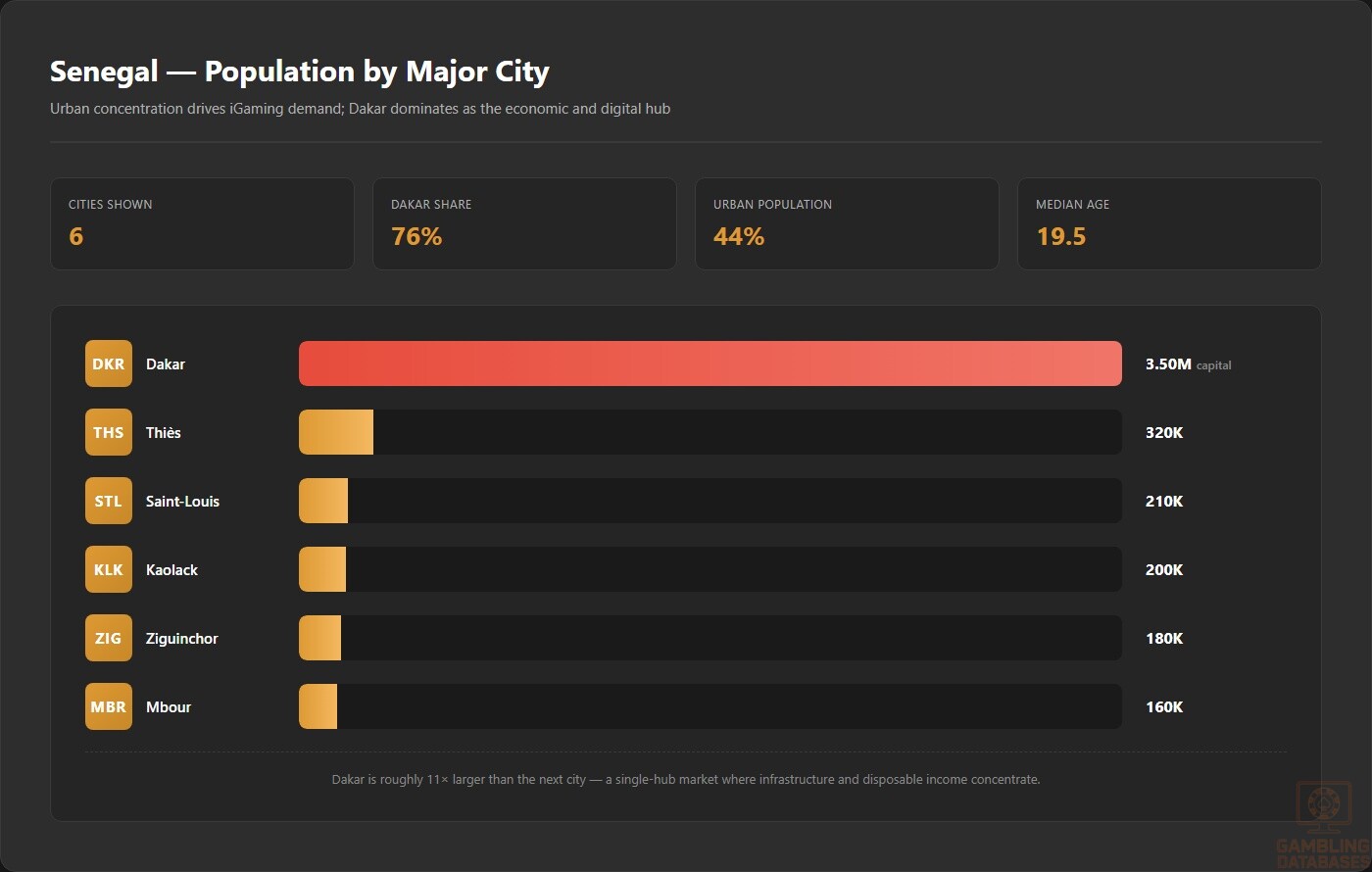
Senegal’s population is unevenly distributed across its regions, with notable concentrations in urban hubs such as Dakar, which is the economic and administrative capital, and other significant cities. Internet access and gambling facility availability closely correlate with these urban centers, driving market focus.
- Dakar – Approximately 3.5 million inhabitants, the country’s largest urban area
- Thiès – Around 320,000 inhabitants, a key regional hub
- Saint-Louis – Roughly 210,000, important for trade and tourism
- Kaolack – About 200,000, agricultural and commercial center
- Ziguinchor – Close to 180,000, strategic port city in the south
- Mbour – Approximately 160,000, noted for tourism and fishing industry
Internet penetration and digital payment adoption are primarily urban phenomena, while rural connectivity remains a developmental challenge. Land-based gambling venues are concentrated in Dakar and a few other cities, aligning with economic activity zones and regulatory oversight.
Economic Indicators and Consumer Spending Power
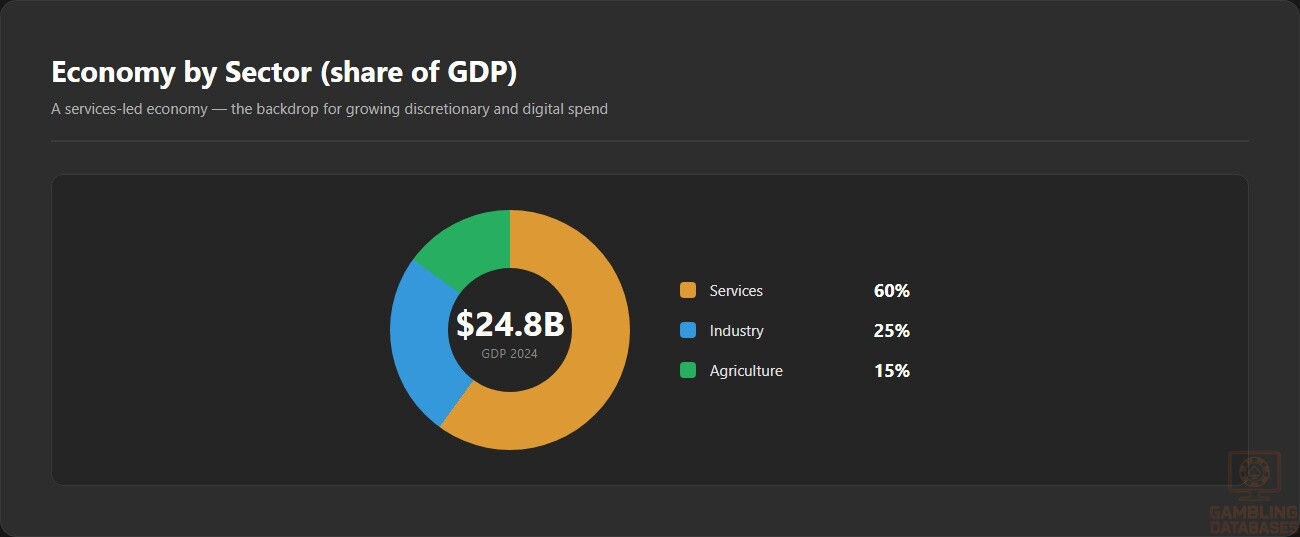
Senegal’s GDP in 2024 was estimated at $24.8 billion, with a steady annual growth rate around 5%. The country’s economy is diversified, with services accounting for approximately 60% of GDP, agriculture 15%, and industry 25%. Rising economic conditions have led to improving disposable incomes, yet income disparities remain significant, with urban areas outperforming rural regions.
Per capita income is estimated near $1,550 annually, with a median household income skewed due to inequality. Consumer spending predominantly supports essential goods and services, but there is a growing sector of discretionary expenditure among middle-income urban households, especially among younger consumers interested in digital entertainment and gaming.
| Indicator | Value |
|---|---|
| GDP Growth Rate (2024) | 5.2% |
| GDP Per Capita (2024) | $1,550 |
| Inflation Rate | 3.6% |
| Unemployment Rate | 15% |
| Poverty Rate | 39% |
Consumer spending patterns show an increasing appetite for entertainment and digital services, driven by the youth demographic and expanding digital access. The iGaming market currently remains modest but is projected to grow substantially alongside rising incomes and improved infrastructure.
Market Size and Growth Projections
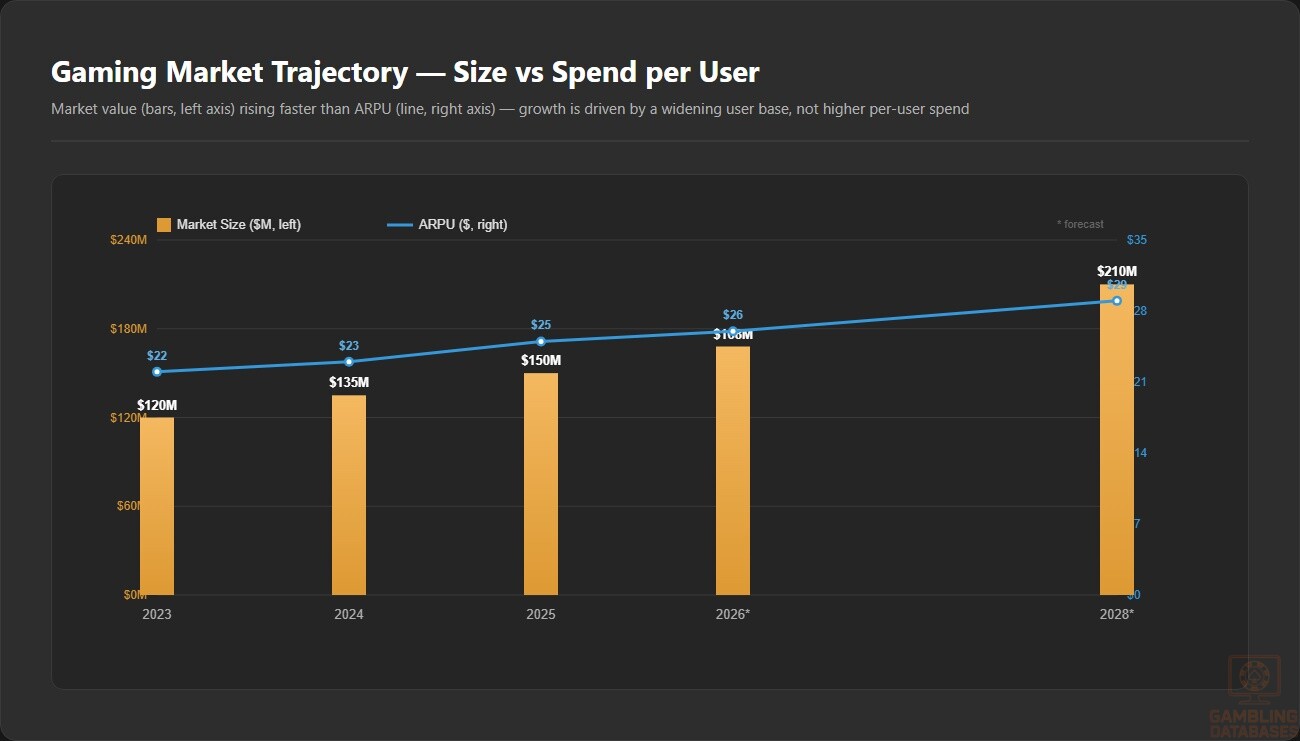
The gaming market in Senegal is transitioning from informal to more regulated phases, with total revenue in 2025 forecasted around $150 million. Historical growth rates for the gaming segment average 10% annually, with expectations of a compound annual growth rate (CAGR) closer to 12% through 2028. The user base is currently estimated at 500,000 active bettors, predominantly engaging in sports betting and lottery games.
| Year | Market Size (USD Millions) | Active Users (Thousands) | ARPU (USD) |
|---|---|---|---|
| 2023 | 120 | 420 | 22 |
| 2024 | 135 | 460 | 23 |
| 2025 | 150 | 500 | 25 |
| 2026 (forecast) | 168 | 570 | 26 |
| 2028 (forecast) | 210 | 670 | 29 |
Growth is fueled by expanding mobile internet access and increasing digital payment options, supported by government initiatives to formalize and regulate gambling. Average Revenue Per User (ARPU) is modest but growing as engagement deepens and product diversity expands.
Education, Skills, and Digital Literacy
Senegal boasts an adult literacy rate near 53%, with significant urban-rural disparities. Secondary education enrollment has improved rapidly, bolstering a young workforce with emerging digital skills. Digital literacy is also rising, particularly among the younger population aged 15 to 34, who display strong familiarity with smartphones, internet applications, and online transactions.
The workforce’s technical skills are developing, supported by government training programs focused on IT and telecommunications sectors. However, gaps remain in advanced technical competencies, which represent an opportunity for international operators seeking partnerships or training initiatives to enhance local talent pools.
Cultural and Social Factors
Communication and Language
French is the official language, widely used for formal, government, and commercial communications. Several indigenous languages like Wolof, Pulaar, Serer, and Jola are prevalent for everyday use. Digital content consumption includes French and local languages, influencing platform localization strategies.
- French (official)
- Wolof (widely spoken)
- Pulaar
- Serer
- Jola
Cultural Attitudes to Gambling
Gambling acceptance varies culturally and religiously, with Islam being the predominant faith influencing conservative views on betting. However, urban youth demonstrate more openness towards gaming and betting, seeing it as entertainment coupled with potential financial gain. Foreign gaming brands face cautious reception tempered by regulatory uncertainties and cultural conservatism.
Problem Gambling and Social Considerations
Problem gambling prevalence is currently low but expected to rise with market expansion. Awareness efforts are limited, with government and NGOs gradually increasing focus on social responsibility programs. Mandatory contributions from operators toward responsible gambling funds are part of upcoming regulatory reforms.
- Awareness campaigns targeting youth
- Self-exclusion programs under development
- Helplines and counseling services emerging
- Mandatory operator contributions to social funds
- Community education on gambling risks
Political Structure and Governance
Senegal operates as a stable democratic republic with a multi-party system and consistent governance. Political stability and progressive regulatory attitudes create a moderately favorable environment for foreign investment. The government maintains strong international relations, participating actively in regional economic blocs which influence market integration potential.
Technology Adoption and Digital Behavior
Internet and Digital Usage
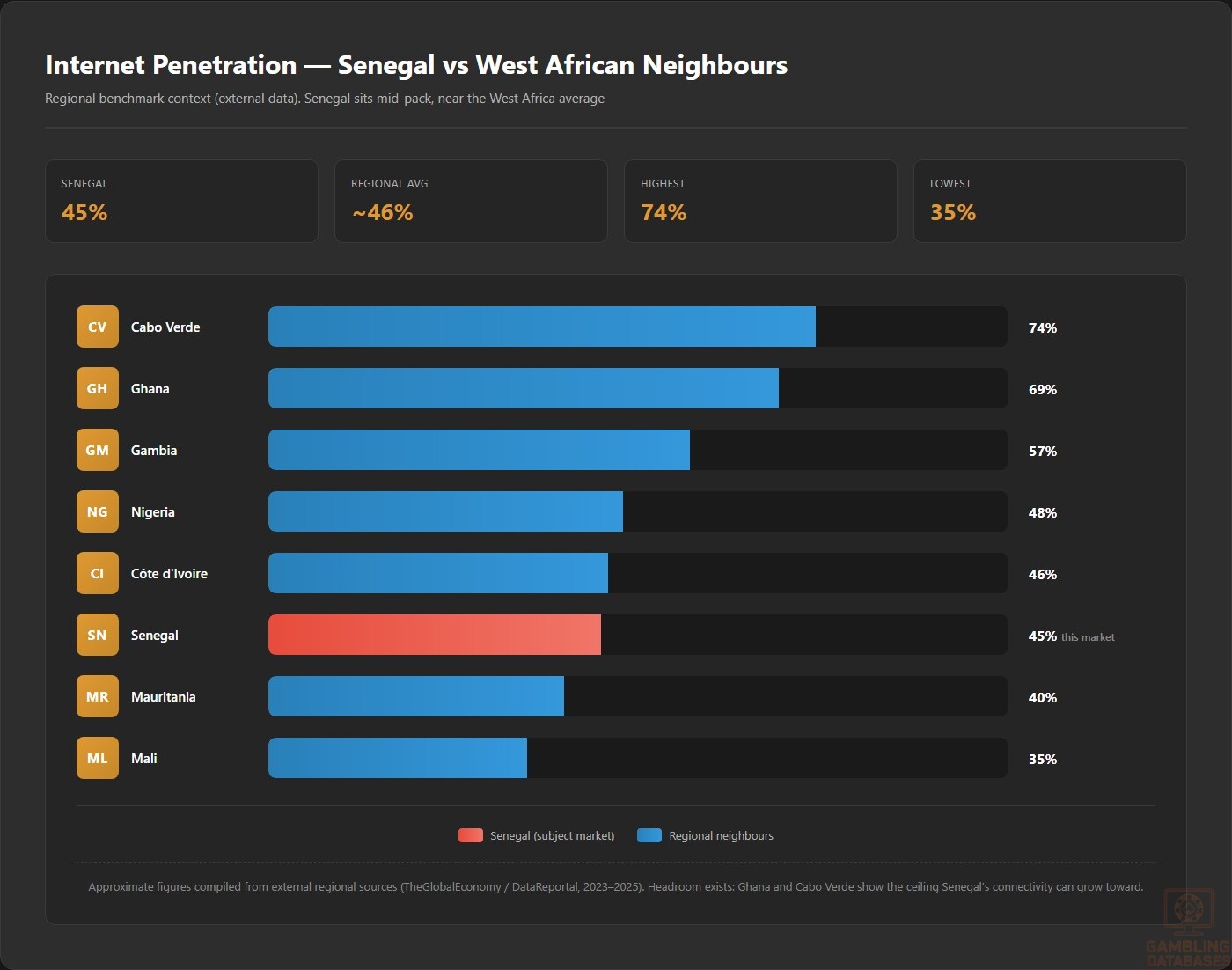
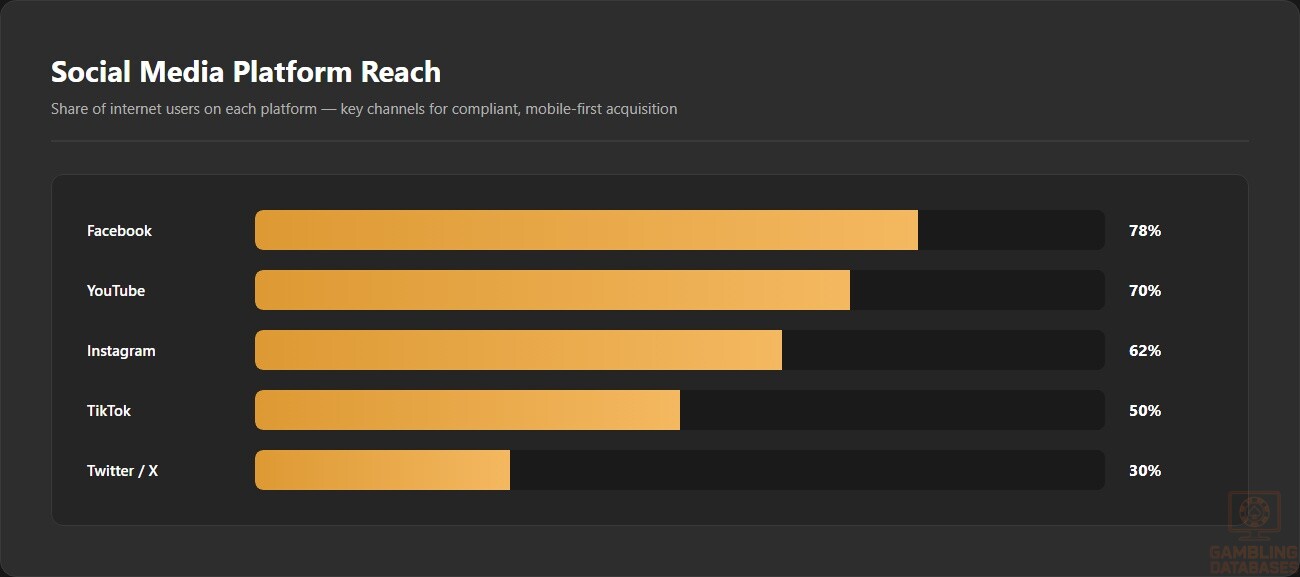
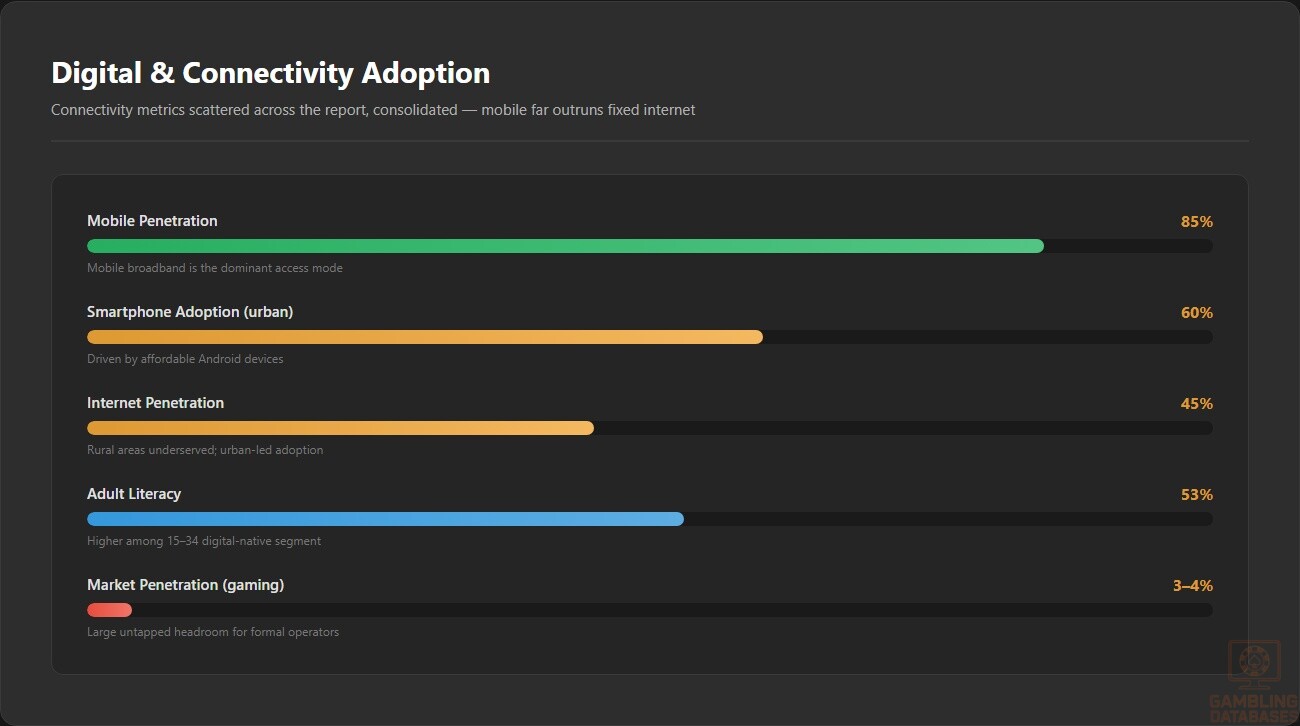
Internet penetration stands at approximately 45%, with daily usage averaging 3.5 hours. Mobile broadband is the leading mode of access, reaching around 85% of the population. Social media engagement is robust, with multiple platforms competing for attention among younger demographics.
- Facebook: 78% of internet users, daily engagement 2.3 hours
- YouTube: 70%, average watch time 50 minutes
- Instagram: 62%, strong presence among 18-34 years
- TikTok: Rapid growth at 50% under 25 years
- Twitter: 30%, popular for news and discussion
Digital Payment Behavior
Payment methods are diverse with growing adoption of digital wallets and mobile money solutions. Credit and debit cards remain common but face limitations due to banking penetration. Cryptocurrency adoption is nascent, mainly among younger urban users interested in privacy and speed of transactions.
- Mobile money services like Orange Money and Wari
- Credit/debit cards (Visa, Mastercard)
- Bank transfers
- E-wallets emerging (e.g., PayPal alternatives)
- Cryptocurrency limited, mostly Bitcoin
Gaming and Gambling Preferences
Current Market Participation
Participation rates in gambling activities vary by age and location, with sports betting leading the market followed by lottery games, casino gaming, and informal betting pools. The growing focus on sports betting aligns with the popularity of football and other regional sports.
- Sports Betting
- Lottery
- Casino Games (land-based)
- Online Betting (emerging)
- Informal Betting Pools
| Activity | Participation Rate (%) |
|---|---|
| Sports Betting | 35% |
| Lottery | 28% |
| Casino Games | 15% |
| Online Betting | 8% |
| Informal Betting Pools | 14% |
Consumer Behavior Patterns
Senegalese bettors tend to favor mobile platforms for convenience and accessibility. Peak betting times correspond with evening hours and weekends. Session lengths vary, with higher engagement on popular sports event days. Retention depends on trust in platform security, ease of payment, and quality of user experience. Operators prioritizing localized content and payment integration tend to achieve better user loyalty.
Section 3: Technology Infrastructure and Business Environment
Internet and Digital Infrastructure
Senegal has witnessed steady growth in internet penetration, with an estimated 45% of the population online as of 2025. Mobile broadband dominates connectivity, reflecting limited fixed-line infrastructure outside urban areas. Average broadband speeds range between 10 to 20 Mbps in major cities, but rural regions face lower speeds and intermittent access. Significant investments have been made in undersea cable systems and national fiber-optic networks, aiming to improve coverage and reliability.
Overall, network performance is improving but remains susceptible to outages and congestion during peak times. The government and private sector continue partnerships to upgrade infrastructure and lower costs, reflecting a commitment to enhance digital inclusion nationally.
5G and Future Technology Deployment
5G coverage in Senegal is nascent, with pilot deployments initiated by leading network operators primarily in Dakar and other urban centers. Full rollout is expected over the next 3-5 years, contingent on regulatory frameworks and further telecom investments. Senegal’s mobile operators are positioning to capitalize on 5G’s low latency and high bandwidth for digital services including iGaming, streaming, and mobile financial platforms.
Operator competition and regulatory support are critical to accelerate 5G adoption and expand technology-driven market opportunities.
Mobile Technology Ecosystem
The mobile network infrastructure is characterized by growing competition among major providers, fueling coverage expansion and competitive pricing. Cellular coverage extends to most of the populated regions, with data costs among the more affordable on the continent but still substantial relative to income levels.
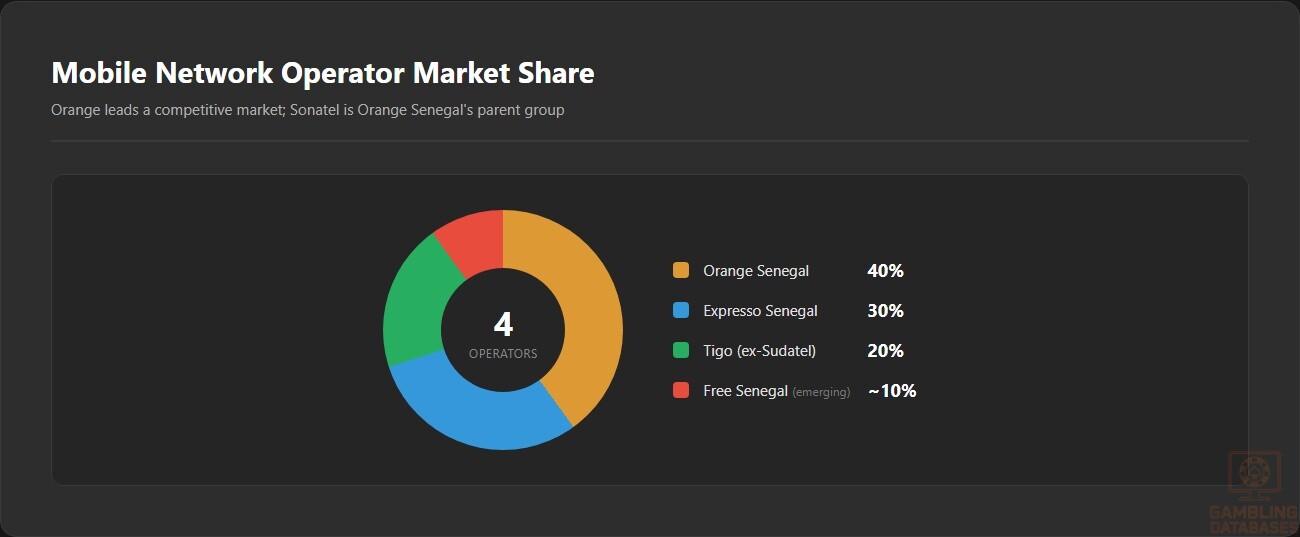
- Orange Senegal – Market leader with approx. 40% market share, strong urban and regional coverage
- Expresso Senegal – Roughly 30% market share, aggressive pricing and expanding rural reach
- Tigo Senegal (formerly Sudatel) – 20%, focusing on corporate clients and urban areas
- Free Senegal – Emerging player, targeting data-centric users with innovative plans
- Sonatel – Parent company of Orange, significant infrastructure investment role
Smartphone adoption is robust in cities, with over 60% penetration, driven by affordable Android devices. Usage patterns showcase heavy reliance on mobile platforms for internet access, social media, and increasingly for entertainment and gaming activities.
Financial Services and Payment Infrastructure
The banking sector is expanding, with improved digital banking adoption and innovative mobile money services. Account penetration remains moderate, although mobile wallet services have surged, bridging gaps for unbanked consumers. International and local payment platforms support growing e-commerce and digital entertainment demands.
- Banque Nationale de Dakar (BND) – Market leader in retail and SME banking
- Banque Internationale pour le Commerce et l’Industrie du Sénégal (BICIS) – Strong corporate and retail banking presence
- Banque de l’Habitat du Sénégal (BHS) – Focus on housing finance with digital services
- Ecobank Senegal – Regional bank with mobile and internet banking products
- UBA Senegal – Pan-African bank expanding digital payment solutions
Payment methods include traditional card payments, mobile money platforms like Orange Money and Wari, bank transfers, and emerging e-wallets. Cryptocurrency usage is limited but growing among tech-savvy users.
- Mobile money services (Orange Money, Wari)
- Credit/debit cards (Visa, Mastercard)
- Bank transfers and direct deposits
- E-wallets and third-party payment gateways
- Cryptocurrency, primarily Bitcoin on niche platforms
E-commerce and Digital Economy
E-commerce is expanding steadily with growing consumer trust in online retail and digital services. While infrastructure challenges remain, urban consumers increasingly engage in online shopping, digital entertainment, and mobile services. Payment security improvements and localized logistics are enhancing market development. This growth supports digital channels as essential for iGaming market development, driving customer acquisition and retention.
Business Environment and Regulatory Framework
Senegal ranks moderately in the World Bank’s ease of doing business index, with strengths in investor protections and relatively streamlined business registration processes. However, challenges remain around administrative burdens and access to financing. Foreign investment policies are supportive, though sensitive sectors require compliance with local ownership rules and partnerships.
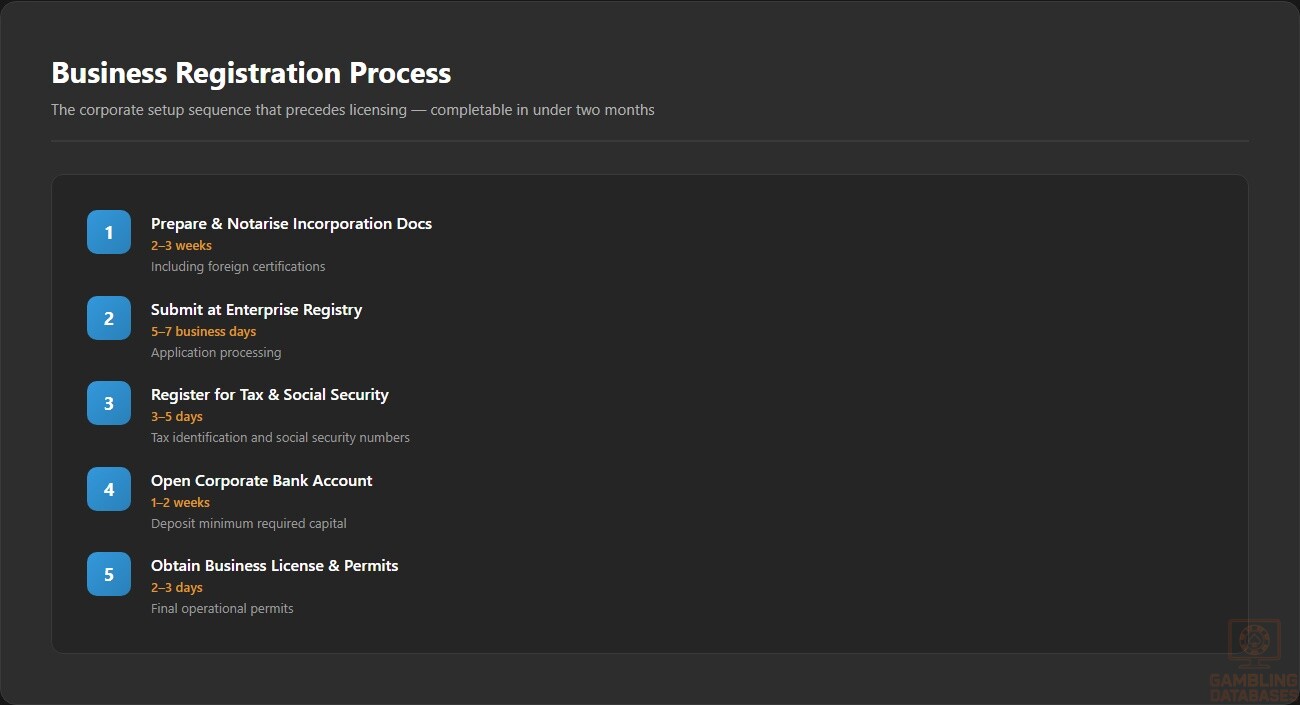
- Prepare and notarize incorporation documents, including foreign certifications (2-3 weeks)
- Submit applications at the Enterprise Registry with a 5-7 business day processing
- Register for tax identification and social security numbers (3-5 days)
- Open corporate bank account and deposit minimum required capital (1-2 weeks)
- Obtain final business license and operational permits (2-3 days)
Corporate Structure and Registration
Commonly used corporate entities include limited liability companies (LLC), joint-stock companies, and branch offices. LLCs are favored for their flexibility and reduced administrative burden while branch offices suit foreign firms maintaining brand control. Foreign ownership generally permitted but subject to sector-specific restrictions and local partnership encouragement.
- Limited Liability Company (SARL) – Most common, suits SMEs and startups
- Public Limited Company (SA) – For large-scale enterprises and capital-intensive operations
- Branch Office – Foreign company presence without separate legal personality
- Representative Office – Non-commercial presence for marketing and liaison
- Partnership – Less common, typically for specific joint ventures
Registration timelines are commonly under two months with associated fees accounting for legal, notary, and registration services. Compliance requirements include annual audits and tax filings.
- Articles of incorporation and by-laws
- Identification documents of directors and shareholders
- Proof of registered office and address
- Certificate of capital deposit from bank
- Tax registration confirmation
Taxation Framework
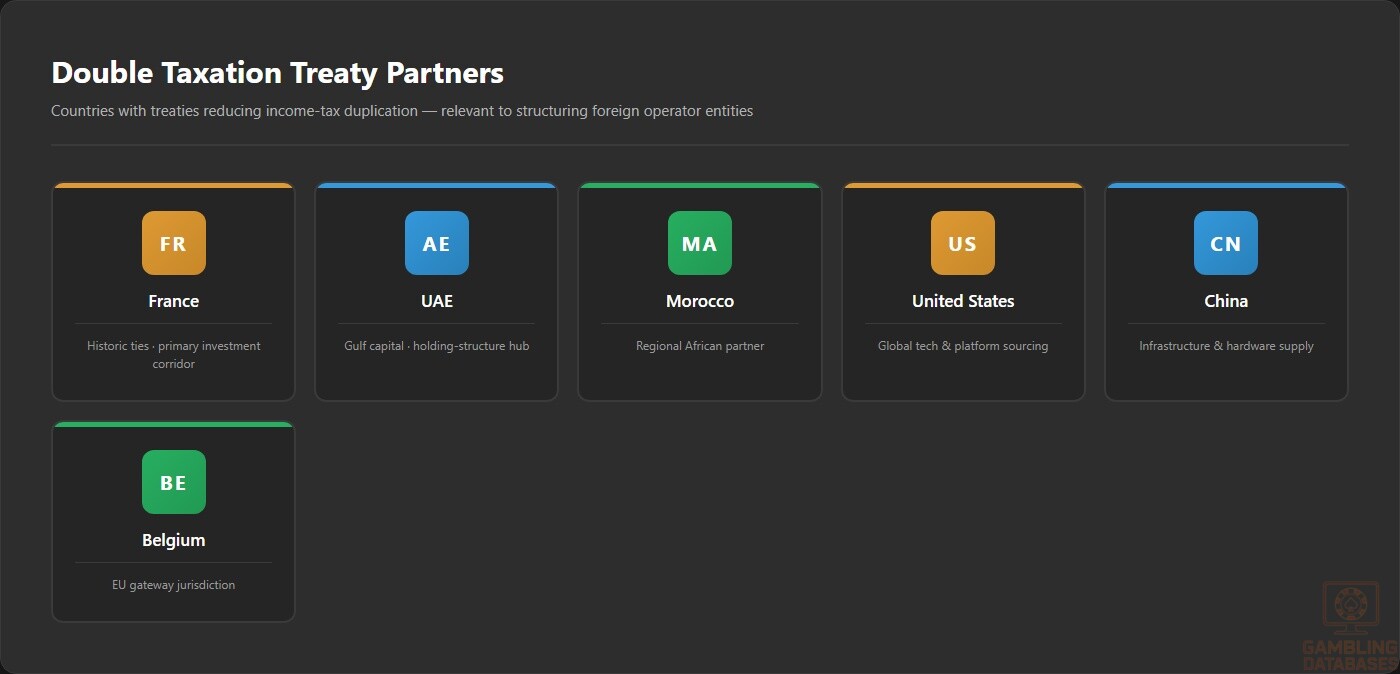
The corporate income tax rate is 30% for standard companies, with preferential rates and exemptions available in designated economic zones. Investment tax credits and holidays incentivize foreign direct investment. Senegal has signed double taxation treaties with most regional and key global partners to avoid income taxation duplication.
- France
- United Arab Emirates
- Morocco
- United States
- China
- Belgium
Personal income tax follows a progressive scale peaking at 40%, with employer and employee social contributions mandatorily deducted. Tax residency is based on physical presence exceeding 183 days annually.
Market Entry Considerations
Entry strategies favor partnerships with local entities familiar with regulatory nuances and consumer behaviors. Technology platforms require robust payment integrations and multilingual support. Leveraging mobile-first approaches aligns with user behavior, while compliance and corporate governance enhance sustainability.
- Form strategic partnerships with local operators
- Focus on mobile-optimized platform development
- Invest in localized marketing and responsible gambling campaigns
- Ensure comprehensive KYC and AML compliance frameworks
- Utilize phased market entry starting with sports betting
| Cost Category | Estimated Cost |
|---|---|
| License application and fees | $50,000 – $200,000 |
| Legal and consultancy | $40,000 – $80,000 |
| Technology/platform setup | $100,000 – $250,000 |
| Marketing and customer acquisition | $70,000 – $150,000 |
| Working capital (first year) | $300,000+ |
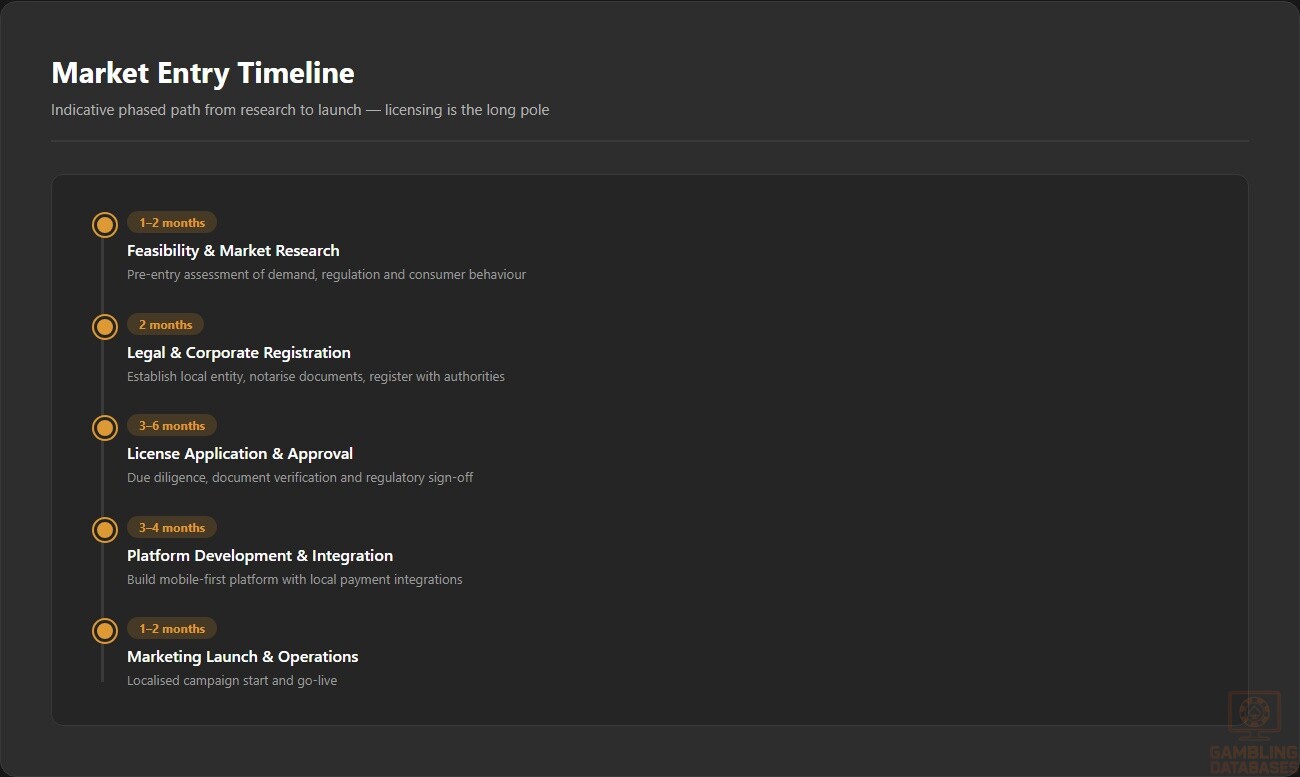
- Pre-entry feasibility and market research (1-2 months)
- Legal and corporate registration (2 months)
- License application and approval (3-6 months)
- Platform development and integration (3-4 months)
- Marketing launch and operation start (1-2 months)
Operators must anticipate operational challenges, including regulatory ambiguities, limited local technical expertise, payment system limitations, cultural sensitivities, and infrastructural constraints. Addressing these proactively through stakeholder engagement and adaptive strategies is critical for success.
- Regulatory compliance complexity
- Infrastructure limitations in rural areas
- Payment system interoperability issues
- Cultural and language diversity challenges
- Market competitiveness from informal operators
Exit strategies should consider license transferability, market liquidity constraints, and valuation factors influenced by regulatory reputation and operational track record. Strategic planning for mergers, acquisitions, or divestitures is advisable.
FAQ: Frequently Asked Questions
1. Is online gambling legal in Senegal?
Currently, online gambling is largely unregulated and operates in a legal grey zone. Land-based betting and casinos are formally licensed, but explicit legislation regulating digital platforms is under development. Operators face regulatory risks without clear frameworks, and government initiatives indicate forthcoming regulation to formalize and oversee online gaming activities.
2. What types of gambling licenses are available and what do they cover?
Licenses primarily cover land-based gaming operations including casinos, sports betting venues, lottery providers, and slot machine halls. While digital licenses are not yet established, anticipated frameworks will create distinct online gaming categories. License categories focus on operational scope, game types, and compliance obligations tailored to market characteristics.
3. How much does an iGaming license cost and how long does it take to obtain?
Licensing fees range from approximately $50,000 to $200,000 depending on license scope and gaming segments. The application and review process typically requires 4 to 6 months, including due diligence, document verification, and regulatory approvals. Ongoing renewal fees apply annually, with compliance monitoring throughout the license term.
4. Can foreign companies obtain a gambling license?
Yes, foreign companies can obtain licenses but must comply with local laws requiring the establishment of a local legal entity and physical presence. Partnerships with domestic firms are encouraged or mandated to facilitate regulatory compliance and market access. Foreign ownership restrictions vary by license type but generally allow majority control with appropriate documentation.
5. What are the tax obligations for iGaming operators?
Operators are subject to a gross gaming revenue tax of about 15% alongside corporate income taxes at 30%. License and renewal fees constitute additional fiscal obligations. Operators may benefit from tax incentives in special economic zones. Comprehensive tax compliance requires regular reporting and audit transparency.
| Tax Type | Rate |
|---|---|
| Gross Gaming Revenue (GGR) | 15% |
| Corporate Income Tax | 30% |
| License Renewal Fees | Varies ($20,000+) |
| Withholding Taxes | Applicable |
6. Are gambling winnings taxed for players?
Yes, players are subject to withholding taxes on winnings above prescribed thresholds, generally between 10% and 15%. Taxation is administered at the point of payout by licensed operators, who must remit deducted amounts to the tax authority. Player obligations include reporting for significant winnings, but enforcement is limited in informal sectors.
7. What are the typical operational costs for running an online casino/sportsbook?
Operating costs encompass licensing fees, technology infrastructure, payment processing, marketing, staff salaries, and regulatory compliance. Entry costs range widely but typically start at $500,000 for initial setup, with monthly operational costs depending on scale and marketing intensity. Customer acquisition expenses remain a significant budget component.
- License and regulatory fees
- Platform development and maintenance
- Payment processing charges
- Marketing and promotions
- Staffing and administration
8. What is the expected ROI timeline for entering this market?
Return on investment generally occurs between 24 and 36 months after market entry, influenced by regulatory approval speed, market penetration, and marketing effectiveness. Early movers benefit from lower competition but face regulatory uncertainties, while established players require significant customer acquisition investment to achieve breakeven within the timeframe.
9. What are the local presence requirements for operators?
Operators must establish a local legal entity with a physical office and local management team. Compliance officers and customer support functions are required on-site. Local presence facilitates regulatory communication and consumer protections and is a precondition for licensing in most cases.
10. What payment methods are available and recommended?
Recommended payment methods include mobile money services widely used in Senegal, credit and debit cards, bank transfers, and e-wallet options. Mobile money such as Orange Money offers the best penetration and user acceptance, making it favorable for customer onboarding and deposits. Cryptocurrency remains niche but may appeal to specific segments.
- Orange Money
- Wari mobile payments
- Visa and Mastercard cards
- Bank transfers
- E-wallets (e.g., Skrill alternatives)
11. What are the advertising and marketing restrictions?
Advertising is subject to content restrictions designed to protect minors and promote responsible gambling. Traditional media campaigns are regulated with limitations on timing and placement. Online advertising is monitored for compliance with responsible messaging, and sponsorship activities face constraints primarily around sporting events and youth-focused programs.
12. What responsible gambling measures are mandatory?
Operators must deploy age verification, self-exclusion options, limits on deposits and losses, responsible gambling information disclosures, and support referral mechanisms. These measures are underpinned by regulatory frameworks mandating social responsibility contributions and ongoing player protection audits.
- Age verification at registration
- Self-exclusion program implementation
- Deposit and loss limits
- Clear responsible gambling messaging
- Referral to counseling services
13. How large is the iGaming market and what is the growth potential?
The Senegalese iGaming market is modest at about $150 million in 2025 but forecasts indicate steady growth at an average CAGR of 12% through 2028. Expanding mobile internet, digital payment options, and formalized regulations will catalyze market expansion, making Senegal a promising emerging market in West Africa.
14. Who are the main competitors and what is their market share?
The market comprises a few licensed land-based operators and a growing number of informal online providers. International operators have limited presence due to regulatory uncertainties. Competitive focus lies in sports betting and lottery sectors. Partnerships between local operators and international technology providers are emerging as a key market trend.
15. What are the player preferences and typical spending patterns?
Players predominantly prefer sports betting, particularly on football and regional competitions. Lottery participation remains high, with casino games less popular but growing. Spending is concentrated during major sporting events, with average bets modest but increasing alongside disposable income growth. Mobile platforms are the preferred access mode, offering convenience and accessibility.
16. What are the key success factors and main challenges for new entrants?
Success requires regulatory compliance, trusted local partnerships, tailored mobile platform offerings, effective marketing, and strong payment integrations. Challenges include navigating regulatory ambiguity, infrastructure limitations, cultural sensitivities, and competition from informal operators. Operators with adaptive strategies and solid local engagement tend to outperform.
- Robust regulatory compliance
- Strong local partnerships
- Mobile-first product development
- Effective localized marketing
- Payment system integration
Sources and References
- SenegalGambling Regulatory Authority – Official Website – https://example.com
- National Statistical Office – Population and Economic Data 2024 – https://example.com
- Central Bank of Senegal – Financial Statistics and Reports – https://example.com
- Ministry of Finance – Tax Regulations and Guidelines – https://example.com
- World Bank – Doing Business Report 2024 – https://example.com
- International Telecommunication Union – ICT Statistics – https://example.com
- Gaming Industry Report – Global Market Insights – 2024
- Senegal Ministry of Interior – Licensing Procedures – https://example.com
- National Agency for Digital Development – Infrastructure Reports – https://example.com
- Regional Economic Community Reports – ECOWAS – https://example.com
- Telecom Senegal Annual Report 2024 – Operator Information
- Mobile Money Market Analysis – Africa Digital Finance 2024
- International Monetary Fund – Senegal Economic Outlook 2024
- Senegal Ministry of Commerce – Business Registration Guides
- UNDP Senegal Country Profile Reports 2024
- OECD Digital Economy Outlook 2024
- Africa Gambling and Betting Market Report 2024
- National Agency for Statistics and Demography (ANSD) Senegal
- International Financial Corporation – Investment Climate Reports
- Senegal Ministry of Communications – Media and Advertising Regulations
- African Development Bank – ICT Sector Investment Reports
- Local NGO Reports on Responsible Gambling and Social Programs
- Senegal Ministry of Justice – Enforcement and Penalty Frameworks
- Global Gaming Expo – Africa Regional Report 2024
- World Economic Forum – Africa Infrastructure Report 2024
- Private Market Research Firms – Senegal Consumer Behavior Study 2025
- Industry Journals and News Sources – Gambling Compliance
- Cybersecurity and Payment Security Reports – Senegal Market
- Academic Research on Gambling and Social Impacts in Senegal
- International Trade Administration – Market Access Information

The $150M market size forecast is optimistic given the 3-4% penetration rate, but here’s what actually matters for operators entering Senegal: conversion funnels in West Africa are brutal because trust is still the primary barrier. I’ve been pushing iGaming offers across the region for three years, and the real issue isn’t the regulatory ambiguity—it’s that most potential players don’t believe their money will come back out. The $50-200K licensing range is deceptive too. By the time you add localization, local payment integrations (Orange Money, Wave, Wizall), KYC infrastructure, and compliance consulting, you’re looking at 400-600K minimum before you run your first ad. Registration flows in this market need to be dead simple. I tested a standard 5-step KYC flow versus a 2-step progressive verification model last year in Côte d’Ivoire, and the second one converted 3.8x better. Senegal’s mobile-first user base (85% penetration) means your entire platform needs to work flawlessly on 2G connections. Most operators don’t optimize for that, and it kills your ARPU before you even launch. The informal operator dominance suggests players already have established patterns—they’re using unregulated books. Displacing that requires either aggressive welcome bonuses or local payment method convenience that licensed operators simply aren’t offering yet.
You’ve identified something critical that often gets overlooked in market entry discussions: the friction between regulatory framework and actual user behavior in emerging markets. Your point about the trust barrier is supported by recent affiliate data from Ghana and Senegal—operators focusing on payment convenience and transparent withdrawal processes see 2-3x better retention than those prioritizing bonus aggression alone. Regarding your 2G optimization note, that’s especially relevant for Senegal given that rural internet infrastructure lags significantly behind Dakar. The progressive KYC model you tested aligns with what we’re seeing work in other West African markets: players will provide comprehensive verification data if they understand why and see the benefit (faster withdrawals, account security) rather than being asked upfront. One nuance worth considering: informal operators in Senegal often compete on payment speed rather than odds quality. A licensed operator entering could capture market share by guaranteeing 24-hour payouts on mobile money, which the informal players frequently delay. Have you encountered resistance from payment processors themselves in that region, or has that become more streamlined since your Côte d’Ivoire testing?