Niger’s iGaming market remains in nascent stages with a restrictive regulatory environment primarily favoring state-controlled gambling activities. Despite limited formal regulation of online gambling, the growing internet penetration and youthful demographics present emerging opportunities for future market development.
This analysis provides a comprehensive overview of Niger’s regulatory framework, focusing on the legal environment, licensing, compliance requirements, taxation, and enforcement mechanisms critical to strategic market entry decisions in 2025.
| Metric | Value |
|---|---|
| Gambling Legal Status | State monopoly, restricted private and online gambling |
| Regulatory Authority | National Lottery of Niger (LON) and Ministry of Finance |
| Licensing Availability | Licenses issued only to state-approved entities; private operator licenses unavailable |
| License Application Fee | ~$3,000 |
| Annual License Renewal Fee | ~$1,500 |
| Licensing Timeline | 3 to 6 months |
| Tax on Operator Gross Gaming Revenue | Not clearly defined; state receives majority of revenues |
| Player Taxation | None officially imposed |
| Compliance Requirements | Basic financial and operational oversight by Ministry of Finance |
| Player Protection Framework | None officially established |
| Minimum Gambling Age | 18 years |
| Online Gambling Regulation | No formal regulation; participation largely unregulated but discouraged |
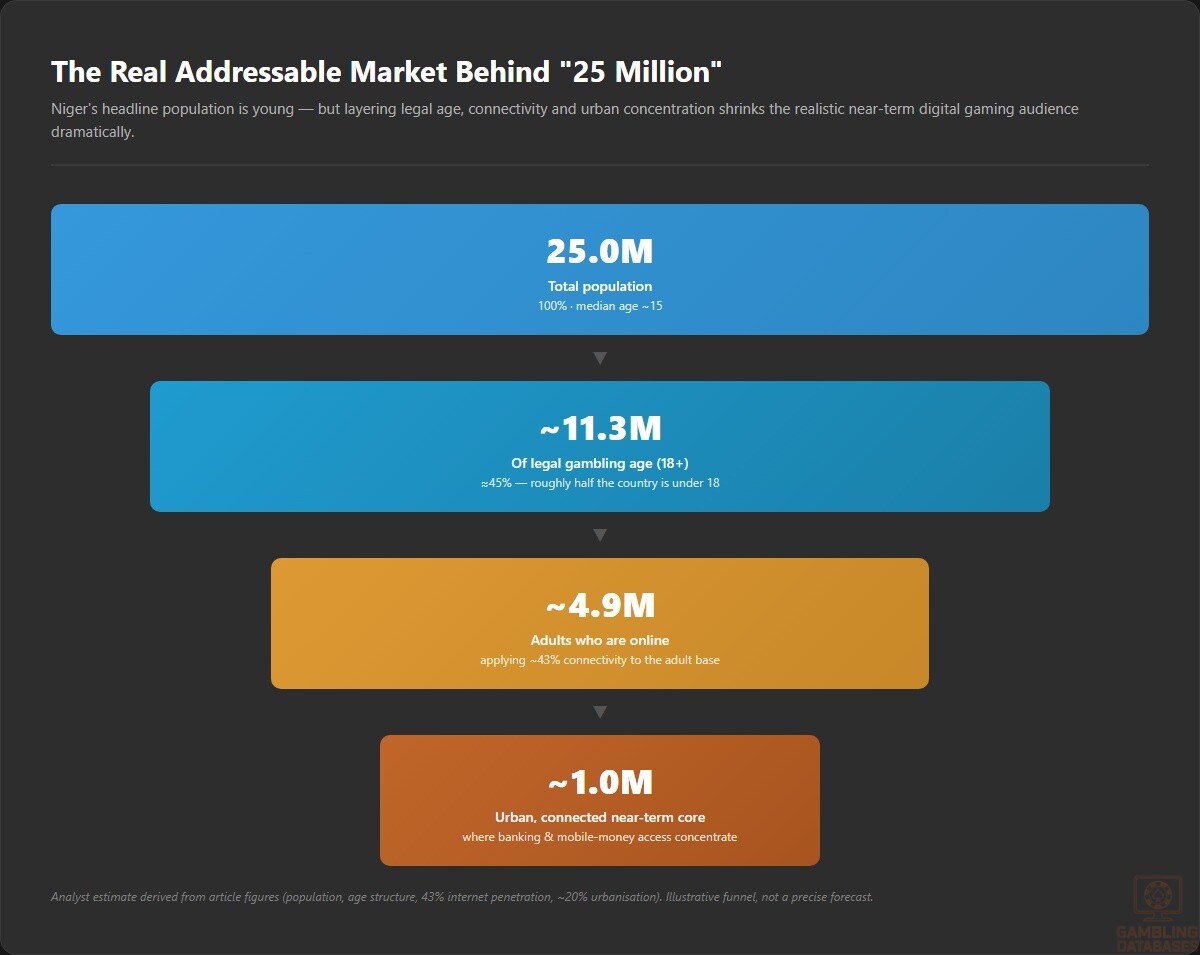
| Internet Penetration | ~43% |
| Mobile Penetration | Over 75% |
| Population | ~25 million (2025) |
| Median Age | ~15 years |
| GDP (Nominal) | ~$19 billion (2024) |
| GDP Growth Rate (CAGR) | 4-5% |
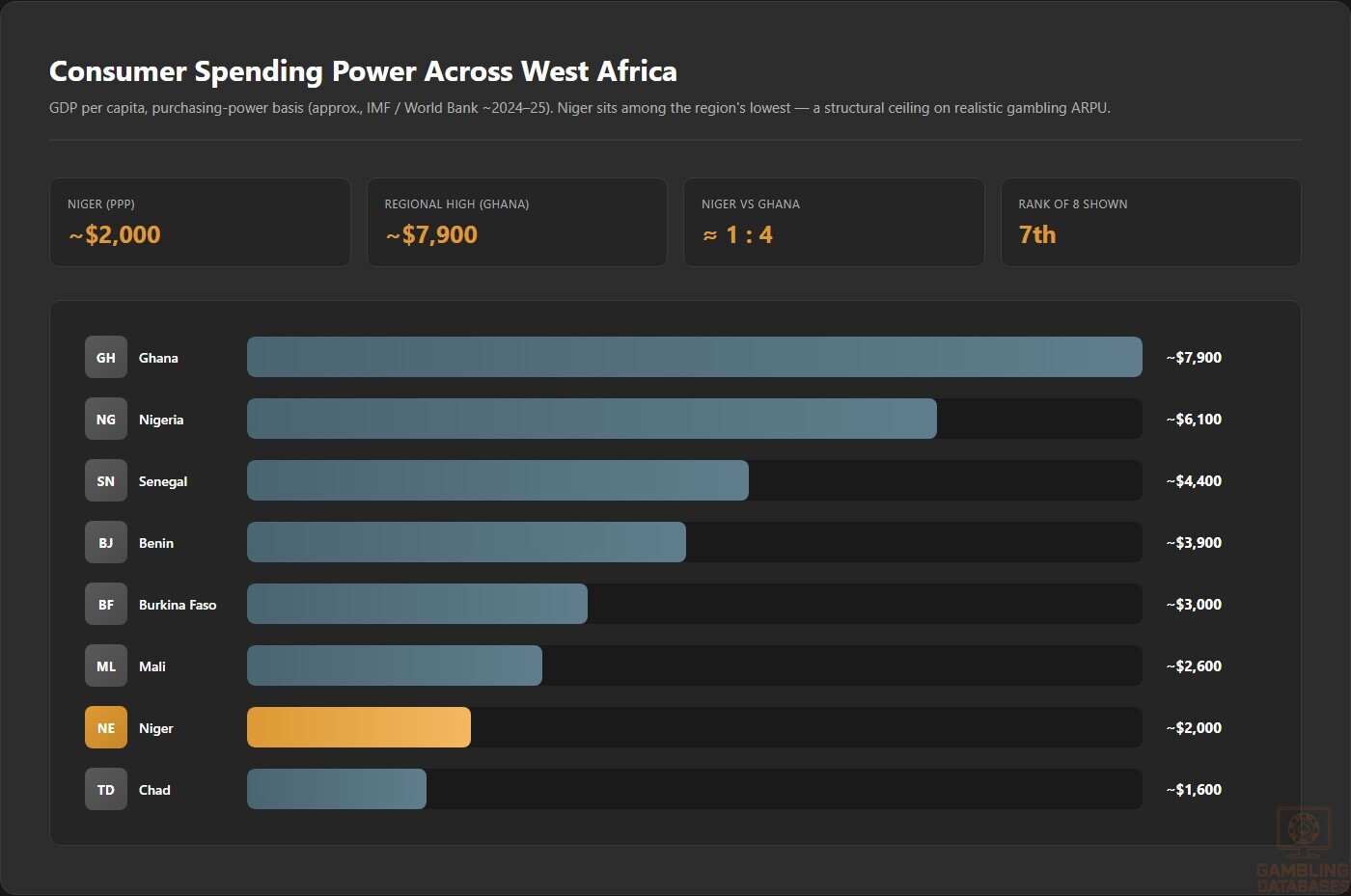
| Average Income per Capita | ~$800 |
| Market Size (Estimated Revenue) | Small, primarily state-controlled |
| Regulatory Stability | Low, regulatory reforms limited |
| Operator Presence | State monopoly; no active private licensed operators |
| Payment Infrastructure | Reliance on mobile money platforms like Orange Money |
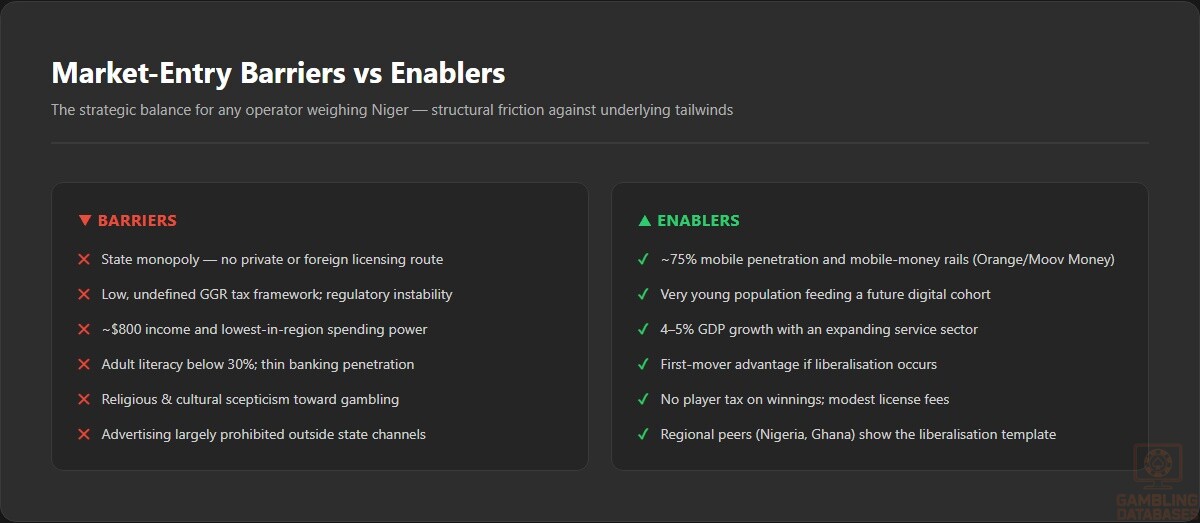
| Key Barriers to Entry | Monopoly, lack of online licensing, limited infrastructure |
| Business Environment | Challenging; low international investment in gambling sector |
| Advertising Restrictions | Strict; gambling advertising largely prohibited outside state initiatives |
Section 1: Regulatory Framework and Legal Environment
Current Gambling Regulation Status
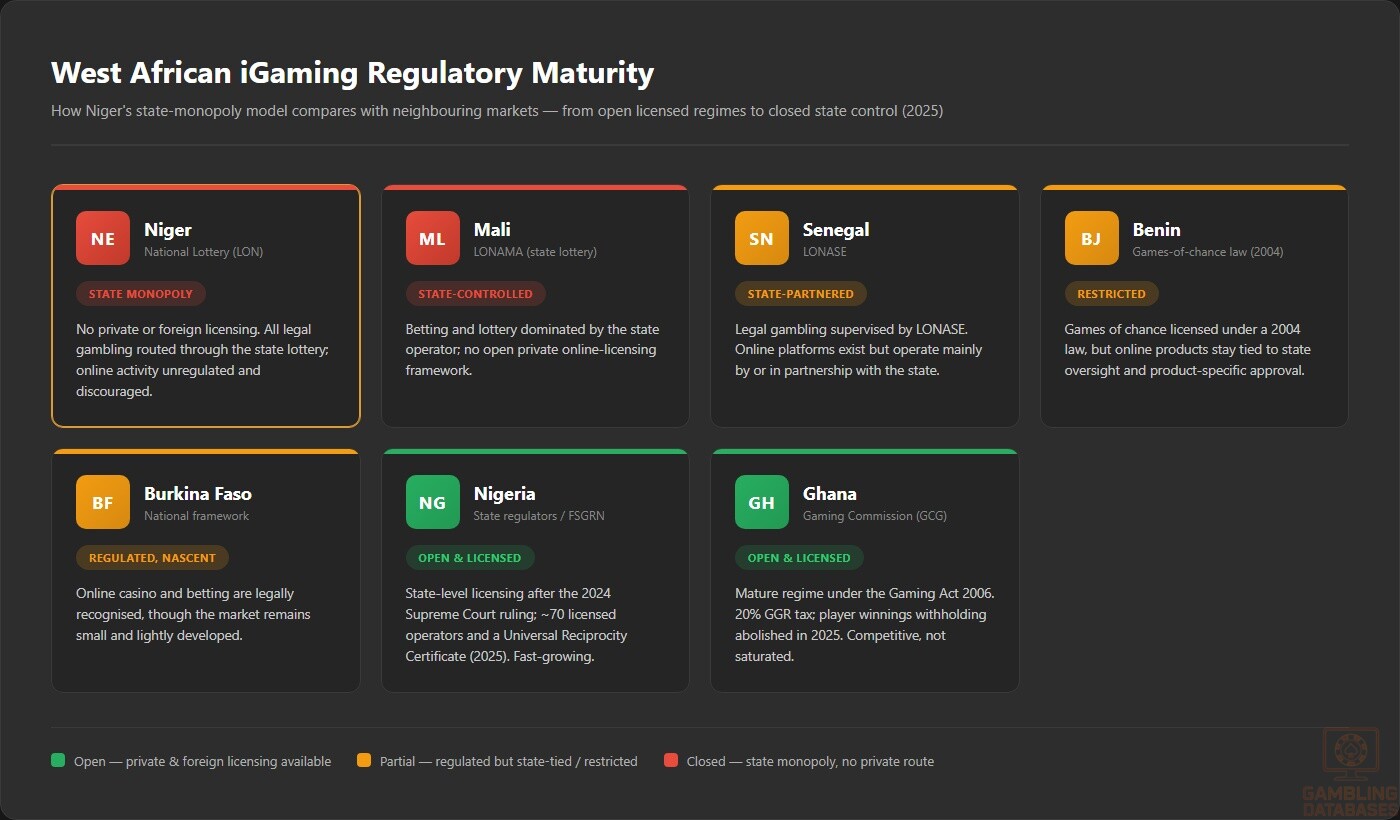
Niger’s gambling sector operates under a stringent legal framework predominantly characterized by a state monopoly. The government authorizes gambling activities exclusively through the National Lottery of Niger (LON), which is overseen by the Ministry of Finance. There is no formal licensing mechanism available for private or foreign operators, effectively restricting all commercially viable gambling operations to those sanctioned and controlled by the state.
Land-based gambling activities include limited lottery services and sports betting under state administration. Traditional casinos, slot machine halls, and other commercial gaming venues authorized in other markets are virtually non-existent in Niger. Sports betting takes place mainly through state-approved outlets and is a marginal part of the gambling landscape.
The online gambling framework is undeveloped, with no formal regulation or licensing provisions for web-based or remote gambling operators. The government discourages unregulated online gambling, and while it is widely believed that private or offshore online gambling is illegal, enforcement remains minimal and laws are not clearly articulated in this domain.
Land-Based Gambling Activities
Land-based gambling in Niger is restricted to the operations of the National Lottery of Niger, which holds exclusive rights to all legal gambling services. The scope includes:
- State-run lottery games and draws
- Authorized sports betting outlets under state control
- Charity and promotional raffles regulated by government authorities
- Absence of commercial casinos or slot halls
- Local betting shops limited to state-sanctioned products
Other traditional or commercial gambling formats are either not authorized or heavily restricted, reflecting the government’s cautious approach to gambling commercialization.
Online Gambling Framework
No formal digital gambling framework exists for online casinos, poker, or betting platforms run by private or foreign operators. Online gambling activity is presumed illegal outside of state control, yet enforcement is sporadic. The regulatory environment lacks established provisions for licensing, consumer protection, or financial oversight of remotely operated platforms.
Players often access international gambling websites despite the absence of local regulations. In this unregulated context, operators cannot legally market or operate within Niger’s borders, and there are no guidelines for responsible gambling or safeguards against problem gambling related to online products.
Licensed Operators and Market Players
The gambling market operates as a government monopoly, with the National Lottery of Niger effectively acting as the sole licensed operator. No private domestic or international operators possess licenses to run gambling operations legally within Niger.
This leads to a competitive landscape dominated exclusively by the state. Market entry, therefore, requires navigating substantial regulatory barriers or partnership with government entities, which currently do not offer licenses to private enterprises.
Licensing Framework and Requirements
Application Process and Eligibility
Licensing is tightly controlled under state mandate, and private licensing opportunities are non-existent at present. The application process to operate gambling services is formalized but only accessible to governmental entities or designated state operators.
Prospective entities wishing to operate must submit detailed documentation, including business plans focused on compliance with state oversight and financial integrity. The process involves scrutiny from the Ministry of Finance and associated agencies to ensure that operations conform strictly to legal statutes supporting the monopoly.
The licensing fees are modest relative to regional standards, with an application fee around $3,000 and annual renewal near $1,500. The timeline for license processing ranges from 3 to 6 months depending on administrative factors.
Required Documentation for Licensing
- Corporate registration documents and confirmation of government affiliation
- Detailed business plans and operational frameworks
- Financial statements audited by recognized firms
- Technical certification of gambling software and platform fairness
- Criminal background checks for management and stakeholders
- Proof of financial guarantees or capital deposits as stipulated by law
- Procedures for player protection and financial compliance systems
Local Presence and Operational Requirements
Operators must maintain a physical presence within Niger if permitted to operate under exceptions or future reforms. This includes hosting offices for regulatory compliance and financial transactions. Domain registration under Niger’s country code or locally approved domain registrars is favored.
Personnel obligations include appointing local compliance officers and maintaining transparent customer service and financial reporting processes. The government prohibits or restricts foreign ownership without partnership agreements that ensure majority local control or government oversight.
Compliance Obligations and Monitoring
Player Protection and Identification
Niger lacks comprehensive statutory frameworks mandating age verification, KYC (Know Your Customer), or AML (Anti-Money Laundering) procedures specific to gambling. However, operators under government control are expected to maintain minimal safeguards aligned with national financial regulations and public welfare considerations.
There are no official responsible gambling requirements or enforced self-exclusion systems for players. The absence of these protections places a high onus on players and operators on foreign platforms to voluntarily adopt responsible practices.
Mandatory Player Protection Measures
- Minimum age verification (18 years)
- Basic identity verification through government-issued ID
- Monitoring financial transaction patterns for suspicious activity
- Provision of information on gambling risks in state-run venues
- Limited implementation of self-exclusion or deposit limits
Financial Monitoring and Reporting
The Ministry of Finance requires operators to submit periodic financial reports on revenues and transactions. These reports focus on ensuring operations contribute to state revenue and comply with tax obligations.
Audits and inspections are carried out irregularly, reflecting limited resources for enforcement. Operators must maintain detailed financial transactions and are encouraged to liaise with banking partners to ensure transparency.
Sequential Reporting Process
- Quarterly submission of financial reports to Ministry of Finance
- Internal and external audits by government-appointed inspectors
- Verification of compliance with accounting standards and tax payments
- Review meetings for compliance improvement and penalty assessments
Taxation Structure and Financial Obligations
Player Taxation
There is currently no official taxation imposed on player winnings in Niger. Players receive their prizes gross, without withholding, reflecting limited fiscal intervention in individual gambling earnings.
Operator Taxation
Operators under state monopoly remit gaming revenues primarily through a general financial oversight regime. Specific gross gaming revenue (GGR) tax rates or turnover taxes are not formally codified but are subsumed into state revenue collection via the National Lottery framework.
License renewal fees and administrative charges represent the main direct financial obligations for authorized operators, while corporate income tax and other fiscal duties apply under Niger’s general business taxation system.
| Tax Type | Rate / Fee | Notes |
|---|---|---|
| Gross Gaming Revenue Tax (GGR) | Not explicitly defined | Included in state revenue mechanisms |
| License Application Fee | $3,000 (approx.) | One-time fee |
| Annual License Renewal Fee | $1,500 (approx.) | Mandatory |
| Corporate Income Tax | Standard rate ~30% | Applied generally |
| Player Tax | None | No official player withholding tax |
Gambling Market Financial Performance
Market revenues are low relative to regional averages due to the absence of private operators and limited consumer access. The state receives most proceeds through lottery and authorized betting activities. Growth trends remain slow, constrained by infrastructure and regulatory limitations.
Revenue distribution heavily favors state coffers, with negligible contributions from operators or ancillary services. Market expansion hinges on regulatory reform and private sector participation.
Advertising and Marketing Restrictions
Gambling advertising is tightly controlled. Marketing efforts are limited to state-run lottery promotions and approved public awareness campaigns. No commercial advertising from private or foreign operators is permitted within Niger’s jurisdiction.
Permitted Advertising Channels and Content Restrictions
- State lottery and public service announcements
- Government-approved sponsorships in community events
- Restricted use of digital and broadcast media for gambling ads
- Prohibition on advertising targeting minors
- No aggressive or incentivizing promotions permitted
Sponsorships remain heavily regulated to prevent promotion of gambling to vulnerable populations. Time restrictions and content guidelines emphasize social responsibility and public order.
Recent Regulatory Changes and Their Impact
There have been no major reforms specifically related to gambling regulation recently. The government’s focus remains on maintaining control through the National Lottery and discouraging private or online gambling expansion. This conservative stance limits market innovation and keeps entry barriers high.
Enforcement Mechanisms and Penalties
Penalties for unauthorized gambling operations include fines, license revocations, and potential criminal charges. Enforcement capacity is limited, leading to uneven application of laws. The government emphasizes public welfare and order in its regulatory approach.
Types of Penalties and Enforcement Actions
- Monetary fines for illegal gambling activities
- Confiscation of equipment used in unauthorized gambling
- Suspension or revocation of licenses for non-compliance
- Criminal prosecution in severe or repeated breaches
- Public warnings and education campaigns against illegal gambling
Section 2: Demographics and Consumer Analysis
Population Demographics and Distribution
Niger’s population is approximately 25 million in 2025, characterized by a very young demographic profile with a median age near 15 years. This youthful skew implies a growing base of potential future consumers, particularly for digital and mobile-based entertainment such as iGaming. Gender distribution is relatively balanced, with a slight male majority. The population density is low, concentrated mainly in urban regions, but with over 80% of inhabitants residing in rural areas, impacting market reach and infrastructure deployment.
| Age Group | Percentage of Population |
|---|---|
| 0-14 years | 49% |
| 15-24 years | 20% |
| 25-54 years | 25% |
| 55-64 years | 3% |
| 65 years and over | 3% |
Urbanization is concentrated in a handful of major cities, with rural areas less accessible and underserved by telecommunications or digital commerce infrastructure.
Geographic Distribution
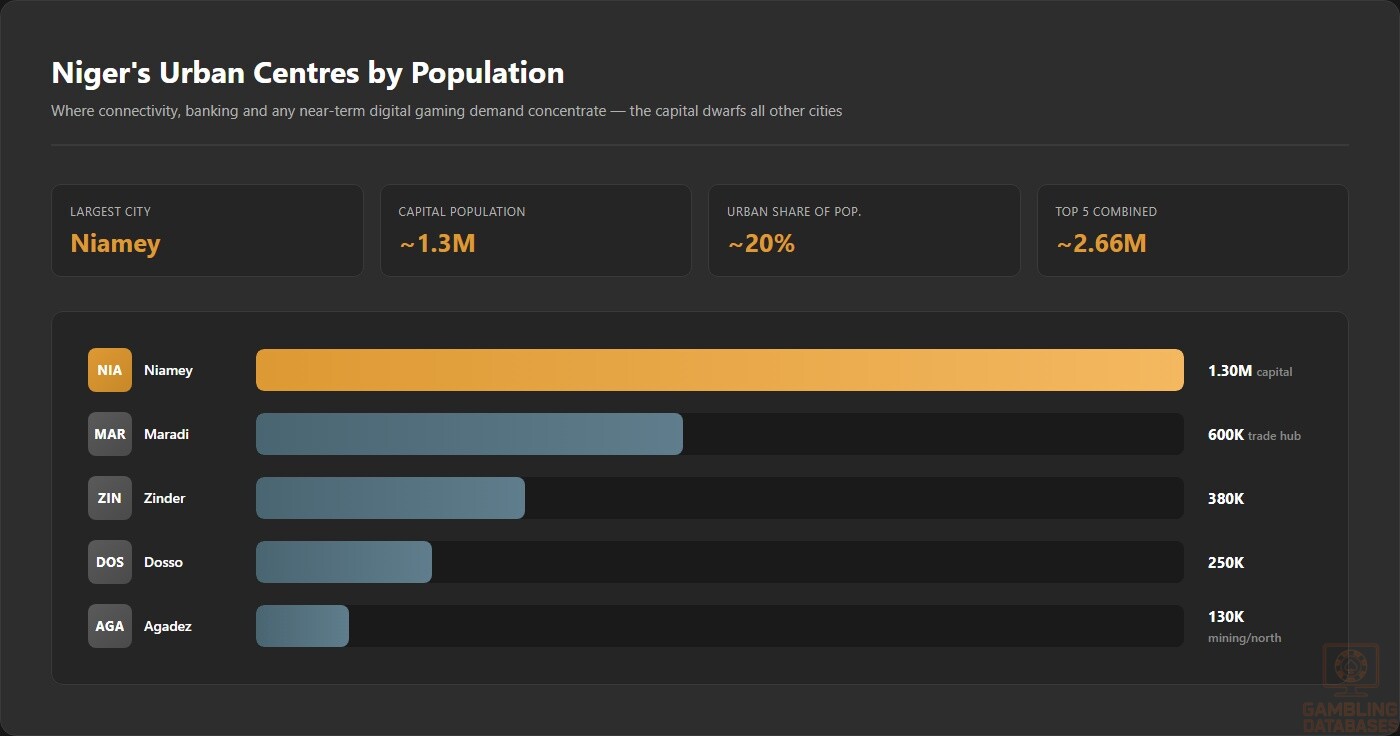
Major population centers where gambling and digital access are most feasible include the capital, Niamey, and other principal cities such as Zinder and Maradi. Regional economic activity varies, with the southern regions housing more commercial and industrial infrastructure. The north remains largely desert, sparsely populated, and economically marginal.
- Niamey – ~1.3 million inhabitants, economic and political center
- Zinder – ~380,000, important commercial hub in the southeast
- Maradi – ~600,000, one of the largest urban centers and trade center
- Dosso – ~250,000, regional market and administrative center
- Agadez – ~130,000, northern town significant for mining and tourism
Internet access is predominantly concentrated in these urban areas, where gambling venues and digital services are more accessible. Rural regions face significant connectivity and infrastructure challenges limiting market penetration.
Economic Indicators and Consumer Spending Power
Niger’s nominal GDP is estimated at approximately $19 billion (2024), with annual growth rates of around 4-5%, supported by agriculture, mining, and burgeoning service sectors. Per capita income remains low at roughly $800, reflective of widespread poverty and limited disposable income. Economic activity is heavily informal, constraining formal consumer spending data accuracy.
The service sector represents a growing share of GDP, indicating potential for digital and entertainment service consumption increase. Economic forecasts suggest steady growth, offering cautiously optimistic prospects for expanding market segments such as iGaming, contingent on digital infrastructure improvements and regulatory reform.
| Indicator | Value |
|---|---|
| Nominal GDP | $19 billion |
| GDP Growth Rate (CAGR) | 4-5% |
| Per Capita Income | $800 |
| Inflation Rate | 3-4% |
| Service Sector % GDP | 40% |
| Agriculture % GDP | 45% |
| Industry % GDP | 15% |
Income and Wealth Distribution
Income distribution in Niger is heavily skewed, with a large low-income majority and a small affluent urban minority. Median household income remains low, and inequality measures reflect disparities between urban elites and rural populations. Consumer spending on discretionary items is limited, but digital entertainment and gambling-related expenditures are expected to grow among youth in urban centers with rising disposable incomes.
Market Size and Growth Projections
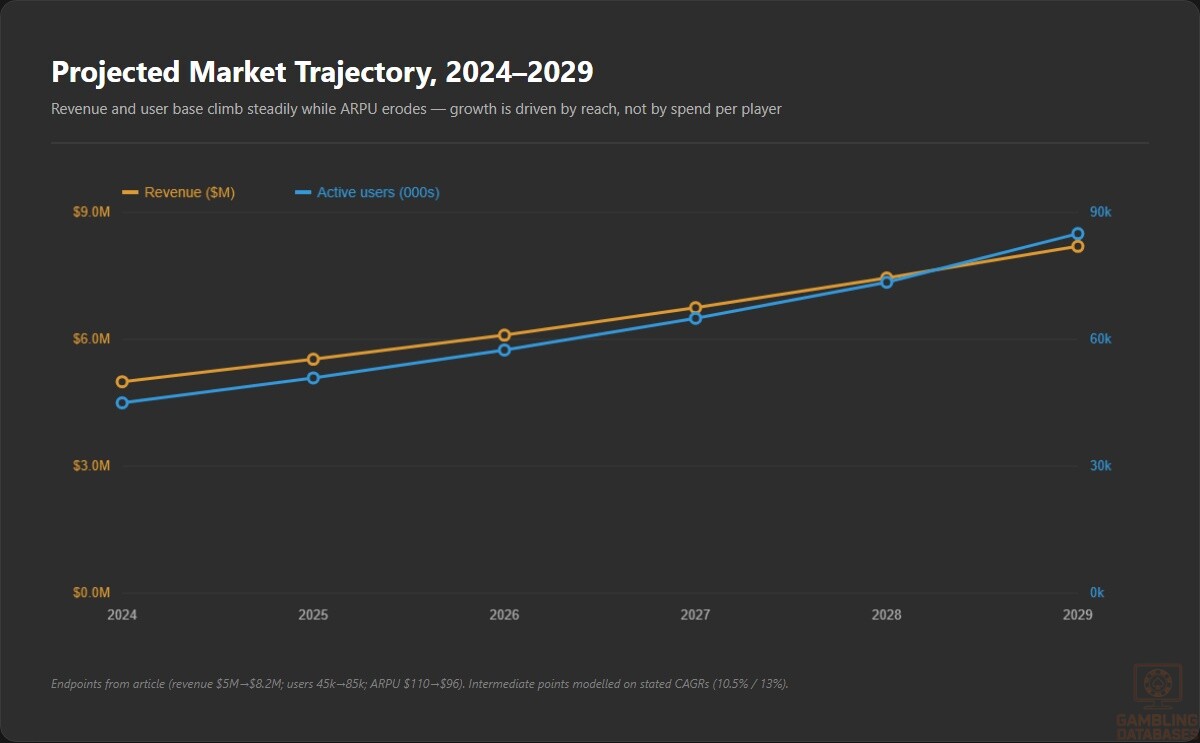
The gambling market’s formal component is modest, dominated by the state lottery and sporadic betting activities. Market size projections for iGaming are constrained by regulatory restrictions and infrastructure but could grow at a compound annual growth rate (CAGR) of 10-12% if liberalization occurs. User base expansion aligns with mobile internet growth, while average revenue per user (ARPU) remains low compared to mature markets.
| Metric | 2024 | 2029 Projection | CAGR (%) |
|---|---|---|---|
| Market Revenue (USD million) | 5 | 8.2 | 10.5 |
| Active Users (Thousands) | 45 | 85 | 13.0 |
| ARPU (USD) | 110 | 96 | -2.8 |
Education, Skills, and Digital Literacy
Literacy rates in Niger are among the lowest globally with adult literacy below 30%, impacting digital literacy levels. Education access varies significantly between urban and rural areas. However, younger generations demonstrate increasing familiarity with digital tools through mobile phone use, education initiatives, and urban schooling, gradually improving the digital skills base necessary for iGaming adoption.
Cultural and Social Factors
Communication and Language
French serves as the official language, used in government, education, and media, but several indigenous languages dominate daily communication. This linguistic diversity affects content localization strategies for iGaming operators targeting the market.
- French (official)
- Hausa
- Zarma-Songhai
- Fulfulde
- Tamasheq and other Tuareg languages
- Kanuri
Cultural Attitudes
Gambling has limited cultural acceptance and is traditionally viewed with skepticism, heavily influenced by religious norms—primarily Islam, practiced by the majority. Foreign brands face challenges in market entry due to cautious consumer attitudes and preference for state-sanctioned activities. Entertainment preferences trend towards communal and culturally familiar activities.
Problem Gambling and Social Considerations
Prevalence data on problem gambling is scarce, but emerging participation in informal bettings suggests low awareness. Government and NGOs provide limited social support programs, focusing mainly on poverty alleviation rather than gambling-specific issues.
- Limited government funding for addiction services
- Community awareness campaigns targeting youth risk behaviors
- Informal social support networks in rural areas
- Emerging partnerships for mental health awareness
- Integration of problem gambling warnings in public lotteries
Mandatory social responsibility contributions by operators are currently minimal, reflecting the nascent legal framework.
Political Structure and Governance
Niger operates as a semi-presidential republic with a history of political instability impacting regulatory consistency. Recent elections show incremental improvements in governance but with continued challenges in institutional capacity and transparency. Political risk remains a factor for foreign investors, necessitating risk mitigation in market entry strategies.
Technology Adoption and Digital Behavior
Internet and Digital Usage
Internet usage continues to grow steadily, with average daily use averaging 2-3 hours in urban areas. Mobile smartphones are the primary access point, driving social media engagement and digital service consumption.
- YouTube
- TikTok (emerging)
Digital Payment Behavior
Digital payment adoption centers on mobile money platforms that dominate small-value transaction markets. Cryptocurrency use is minimal due to regulatory uncertainty.
- Orange Money
- Moov Money
- Bank transfers
- Credit/Debit cards (limited)
- Cash remains prevalent
Gaming and Gambling Preferences
Participation in formal gambling is virtually limited to state lotteries and local betting shops. Interest in digital gaming is increasing, especially among younger urban males, influenced by mobile access.
| Activity | Participation Rate (%) |
|---|---|
| State Lottery | 12 |
| Informal Betting | 8 |
| Sports Betting (Authorized) | 5 |
| Online Gambling (Informal) | 2 |
| Casino Gambling | 1 |
Consumer behavior indicates preference for low-cost, accessible formats, with peak engagement during evening hours. Session lengths vary, with online users favoring shorter, mobile-optimized sessions and higher retention in social/networked gaming experiences.
Section 3: Technology Infrastructure and Business Environment
Internet and Digital Infrastructure
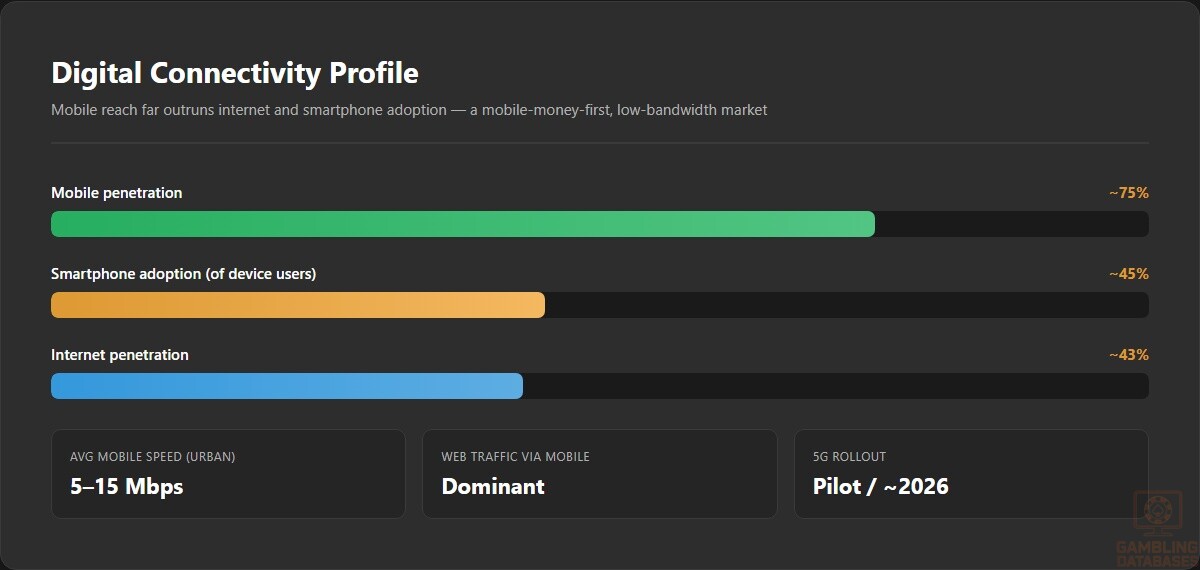
Niger’s internet penetration stands at approximately 43%, reflecting ongoing efforts to improve connectivity in a largely rural country. Broadband access remains limited, with most users relying on mobile internet networks due to scarce fixed-line infrastructure. Average mobile internet speeds are modest, ranging between 5 to 15 Mbps in urban centers, while rural areas experience significantly lower speeds and intermittent service. Investment in digital infrastructure has grown gradually, supported by partnerships with regional telecom operators and development programs focused on expanding coverage and improving reliability.
The deployment of 5G technology is in its infancy, with no formal nationwide rollout yet. Plans to introduce 5G by mid-2026 are under discussion, mainly spearheaded by major operators based on pilot projects in Niamey and other key cities. Network operators are increasingly investing in upgrading 4G LTE networks to bridge the digital divide while preparing for future 5G integration.
Mobile Technology Ecosystem
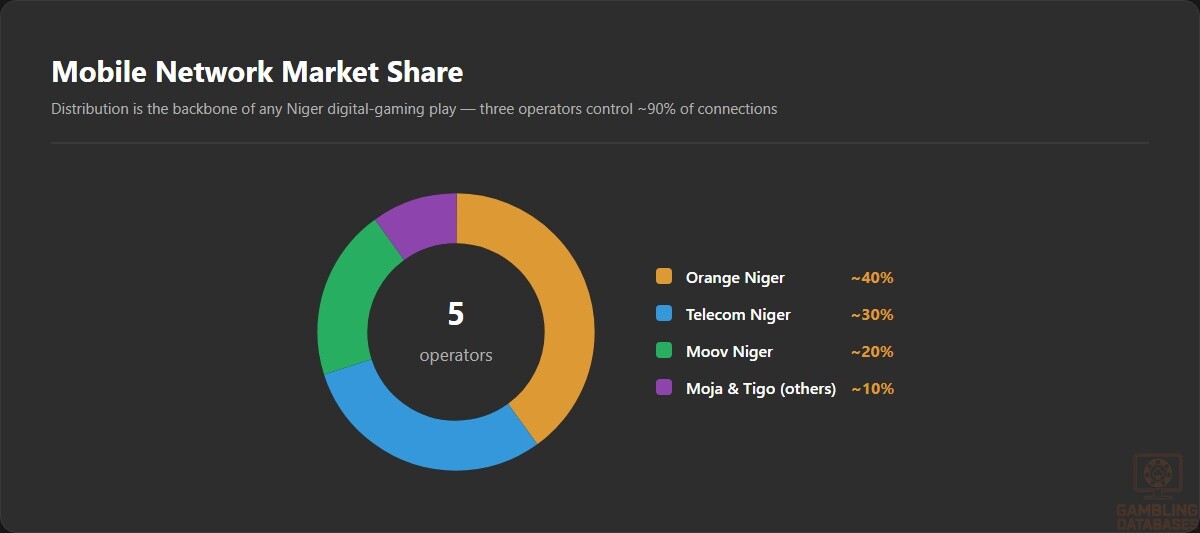
The mobile network landscape in Niger is dominated by a few established operators. Market share is divided among major players providing widespread coverage, particularly in urban areas, though gaps persist in rural regions. Data costs remain relatively high compared to income levels, limiting extensive usage despite strong mobile penetration.
- Orange Niger – Largest operator with over 40% market share and strong urban network coverage
- Telecom Niger – Accounts for approximately 30%, focusing on affordable plans for rural areas
- Moov Niger – Holds close to 20%, emphasizing data services and mobile money integration
- Moja Niger – Emerging operator targeting youth market with competitive pricing
- Tigo Niger – Smaller operator serving select urban centers with niche packages
Smartphone adoption exceeds 45% of mobile device users, with preferences leaning towards affordable Android models. Device usage patterns emphasize social media, messaging apps, and increasingly, digital payment solutions, reflecting growing digital literacy and reliance on mobile platforms for everyday activities.
Financial Services and Payment Infrastructure
Niger’s banking system includes several key institutions, though overall banking penetration remains low, with many consumers relying on informal financial mechanisms. Digital banking adoption is increasing, enabled by mobile money platforms which serve as critical financial access points.
- BICIS Bank – Largest bank with extensive branch and ATM network
- Bank of Africa Niger – Focuses on SME financing and digital services
- Orabank Niger – Regional presence with commercial banking products
- UBA Niger – International bank supporting corporate clients
- Ecobank Niger – Active in retail and mobile banking innovations
Payment processing options favor mobile money solutions, given the low card penetration. Key payment methods include bank transfers, mobile wallets, and cash-based e-money services widely used for person-to-person and small merchant transactions.
- Orange Money – Leading mobile wallet for payments and transfers
- Moov Money – Mobile payment service integrated with telecom offerings
- Bank Transfers – Limited to urban areas with banking access
- Credit/Debit Cards – Low penetration, growing among urban professionals
- Cash Payments – Dominant in rural and informal sectors
E-commerce and Digital Economy
Niger’s e-commerce market remains small but is expanding alongside internet access growth. Consumer trust in online retail is emerging slowly, influenced by payment infrastructure and delivery logistic challenges. Popular digital services include mobile airtime top-ups, utility bill payments, and some localized retail platforms. Government and private sector initiatives aim to boost digital economy adoption, targeting youth and urban consumers receptive to technology-driven commerce.
Business Environment and Regulatory Framework
Niger presents a challenging environment for business operations due to administrative inefficiencies and regulatory constraints. According to World Bank rankings, ease of doing business lags regional peers, with protracted registration processes and bureaucratic hurdles. Foreign investment policies remain restrictive, particularly in sectors like gambling that are state-controlled or sensitive.
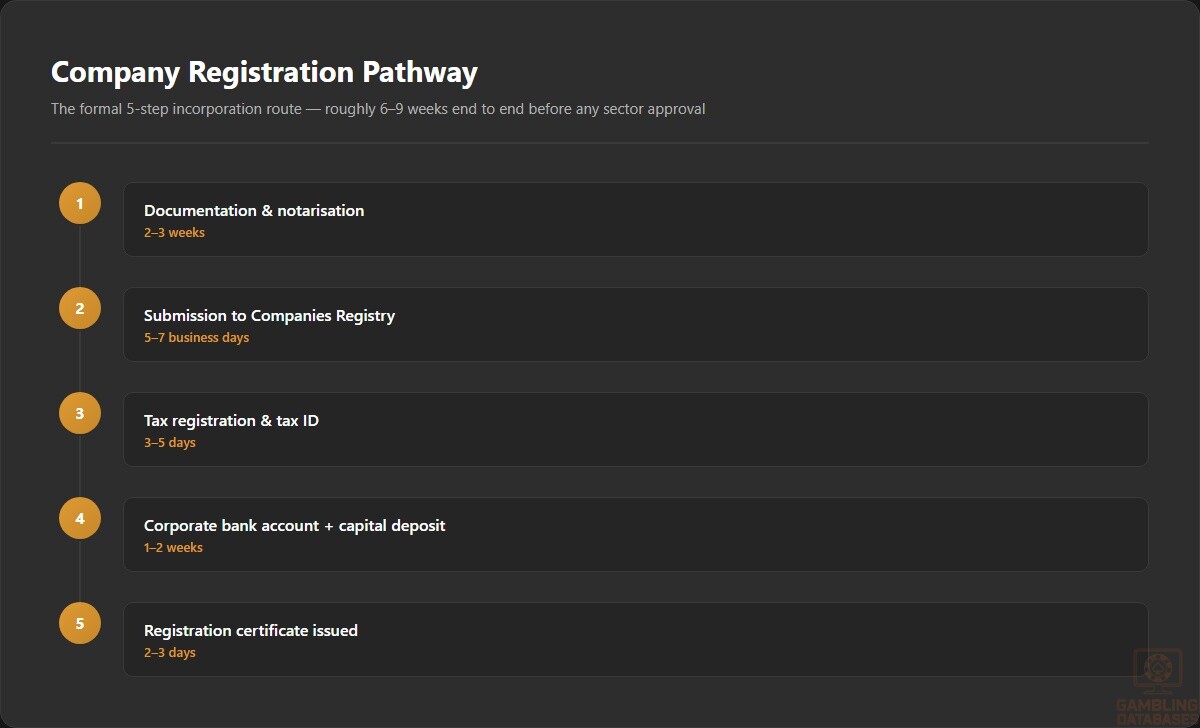
The corporate registration process follows a 5-step timeline:
- Preparation of documentation and notarization (2-3 weeks)
- Submission to the Niger Companies Registry (5-7 business days)
- Tax registration and acquisition of tax ID (3-5 days)
- Opening corporate bank accounts with minimum capital deposit (1-2 weeks)
- Final confirmation and issuance of registration certificates (2-3 days)
Corporate Structure and Registration
Available entity types include Limited Liability Companies (LLC), Public Limited Companies (PLC), and branch offices of foreign entities. LLCs are preferred for smaller operations due to simplified governance and limited liability protections. PLCs suit larger investment ventures requiring shareholder involvement, whereas branch offices offer foreign companies a presence without incorporating locally but require approval.
Registration costs include government fees, notary charges, and publication expenses, totaling approximately $1,200 to $2,000 depending on entity type and services. Foreign ownership is permitted but subject to sector-specific restrictions, generally requiring local partnerships or government approvals for sensitive industries.
- Certified Articles of Incorporation and Memorandum
- Proof of physical address in Niger
- Identification documents for directors and shareholders
- Bank statement evidencing capital deposit
- Tax registration confirmation
- Business plan and sector-specific approvals
Taxation Framework
The corporate income tax standard rate is approximately 30%, with incentives for companies operating in special economic zones offering reduced rates and tax holidays. Niger has tax treaties with several countries to avoid double taxation, facilitating foreign investment.
- France
- Morocco
- Senegal
- Algeria
- China
- Tunisia
Individual income tax follows a progressive scale, with withholding tax requirements on salaries and social security contributions mandatory for employers. Tax residency is determined by physical presence exceeding 183 days annually.
Market Entry Considerations
Recommended strategies for entering Niger’s iGaming market focus on partnerships with government entities or investing in adjacent sectors such as mobile payment services or gaming technology supply. Leveraging mobile network infrastructure is critical to overcoming rural access limitations. Due to the current absence of private gambling licenses, strategic lobbying or involvement in regulatory reform processes may prove necessary for direct gaming operations.
- Form joint ventures with state-recognized companies
- Focus on mobile-based gaming and lotteries
- Invest in digital payment solution integration
- Prepare robust compliance and financial monitoring capabilities
- Engage in market education and corporate social responsibility initiatives
Typical initial setup investments include licensing fees, technology infrastructure, compliance, and marketing. Operational costs are dominated by regulatory compliance and payment processing expenses, reflecting the nascent nature of the market.
| Cost Category | Estimated Amount |
|---|---|
| License Application and Renewal | $4,500 |
| Platform Development and Integration | $50,000 – $100,000 |
| Compliance and Legal Services | $15,000 |
| Marketing and Promotion | $20,000 |
| Operational Expenses (Year 1) | $30,000 |
Success factors include regulatory navigation skills, partnerships with local telecom operators, and culturally adapted offerings. Challenges involve limited digital infrastructure, restrictive legal frameworks, and consumer trust issues related to online gambling.
- Strong government relations
- Robust mobile platform capabilities
- Consumer education and trust-building
- Secure and compliant payment processing
- Adaptive marketing aligned with cultural norms
Exit strategies depend on regulatory developments enabling license transfers or sales. Current market illiquidity requires long-term investment horizons and contingency planning.
—
FAQ: Frequently Asked Questions
1. Is online gambling legal in Niger?
Online gambling in Niger currently lacks formal legal authorization. The market operates under a state-controlled regime, and private or foreign operators are not licensed to offer online gambling services. While online gambling is not explicitly criminalized, participation on unregulated international platforms is discouraged, and no consumer protections are provided within the country. Enforcement is inconsistent, making the market effectively restricted but not fully closed.
2. What types of gambling licenses are available and what do they cover?
Licensing is limited exclusively to state-sanctioned entities, primarily through the National Lottery of Niger. There are no separate classified licenses for different gambling sectors like sports betting, casinos, or online poker. The monopoly framework centralizes all rights under the state-run lottery authority, preventing issuance of private or commercial gambling licenses.
3. How much does an iGaming license cost and how long does it take to obtain?
The license application fee to operate authorized gambling services is approximately $3,000, with an annual renewal fee around $1,500. The licensing process typically takes between three to six months, depending on administrative factors and required documentation. Given the monopoly, these fees apply mainly to state or government-affiliated entities rather than private operators.
4. Can foreign companies obtain a gambling license?
At present, foreign companies cannot independently obtain gambling licenses in Niger. The regulatory framework favors state-controlled operations and restricts foreign ownership or independent licensing in the gambling sector. Foreign entities typically must partner with government agencies or local companies and comply with strict oversight to participate in any regulated gambling-related activities.
5. What are the tax obligations for iGaming operators?
Operators under the current monopoly remit payments and taxes primarily through generalized state revenue channels without distinct gross gaming revenue taxes for gambling. Corporate income tax applies at a standard rate of approximately 30%, while fees like license renewal represent direct gambling-related fiscal obligations. The absence of defined GGR or turnover taxes reflects the regulatory immaturity of the sector.
6. Are gambling winnings taxed for players?
There is no official taxation on gambling winnings for players in Niger. Prizes or earnings are paid out gross without withholding or additional fiscal burden on the individual. This approach reflects a regulatory focus on state revenue rather than player income.
7. What are the typical operational costs for running an online casino/sportsbook?
Operational costs are largely theoretical given the current regulatory framework. For market-ready operators, costs would include licensing fees (around $4,500 combined for application and renewal), technology platform development ($50,000 to $100,000), compliance and legal consulting (~$15,000), marketing efforts (~$20,000), and day-to-day operational expenses (~$30,000 annually). These figures are estimates based on regional averages and emerging market conditions.
8. What is the expected ROI timeline for entering this market?
Return on investment is expected to be long-term, typically spanning three to five years, particularly due to the regulatory restrictions and infrastructure challenges. Success depends on navigating market entry barriers, establishing strong local partnerships, and leveraging mobile technology adoption. Early entrants face slow growth but may benefit from first-mover advantages if regulatory frameworks liberalize.
9. What are the local presence requirements for operators?
Operators must maintain a physical presence, including registered offices and staffed compliance functions, within Niger if allowed to operate under government provisions. Additionally, domain registration and local bank accounts are required to facilitate regulatory monitoring and financial transactions. Foreign ownership is tightly controlled, often requiring majority local participation or government partnership.
10. What payment methods are available and recommended?
Mobile money platforms dominate Niger’s payment landscape, with Orange Money and Moov Money leading adoption. Bank transfers and cash remain important, especially outside urban centers. Card payments exist but are limited by low penetration. Digital wallets connected to telecom providers are recommended for seamless integration and customer acceptance.
11. What are the advertising and marketing restrictions?
Advertising of gambling activities is heavily restricted and chiefly limited to state-run lottery promotions. Commercial advertising from private operators is prohibited. Marketing materials must avoid targeting minors and cannot promote excessive or aggressive gambling behaviors. Sponsorship opportunities are tightly regulated and usually confined to community development or public welfare themes.
12. What responsible gambling measures are mandatory?
Mandatory responsible gambling measures are minimal, reflecting the nascent regulatory environment. Required safeguards include minimum age verification (18+), basic identity checks, financial monitoring for suspicious transactions, and limited initiatives to inform players of risks. Self-exclusion programs and comprehensive social responsibility frameworks have yet to be formalized by regulators.
13. How large is the iGaming market and what is the growth potential?
The iGaming market in Niger is currently very small, dominated by state lottery revenues with no formal online sector. Growth potential exists due to increasing internet penetration, expanding mobile networks, and a young population favoring digital engagement. Realizing this potential depends on regulatory reforms enabling private sector participation and investment in digital infrastructure.
14. Who are the main competitors and what is their market share?
The market is monopolized by the National Lottery of Niger, which controls essentially 100% of legalized gambling activity. No licensed private competitors exist. Any online or informal activity by foreign platforms occurs outside the legal framework and without regulated market share data.
15. What are the player preferences and typical spending patterns?
Players primarily engage with lottery and limited state-authorized sports betting. Spending is modest due to low disposable incomes and limited gambling options. Online or digital engagement is growing in urban areas among younger demographics, with interest in mobile-accessible games and betting formats emerging alongside mobile phone adoption.
16. What are the key success factors and main challenges for new entrants?
Success hinges on navigating regulatory constraints, establishing trusted local partnerships, building robust mobile platforms, and fostering consumer trust through responsible gaming initiatives. Challenges include restrictive licensing, limited infrastructure, low income levels, and consumer skepticism towards online gambling. Awareness and education campaigns are critical to expanding market acceptance.
- Regulatory engagement and compliance expertise
- Strong collaboration with telecom and financial sectors
- Effective market education and trust building
- Advanced digital payment integration
- Culturally sensitive marketing approaches
—
### Sources and References
- National Lottery of Niger – Official Government Gambling Authority Website – https://lon-niger.gov
- Ministry of Finance Niger – Tax Regulations and Compliance Guidelines – https://finances.gouv.ne
- National Institute of Statistics Niger – Population and Economic Data 2024 – https://ins.ne
- Central Bank of West African States (BCEAO) – Financial and Banking Reports – https://bceao.int
- International Telecommunication Union (ITU) – ICT Statistics for Niger 2025 – https://itu.int
- World Bank – Doing Business Report 2024 – Niger – https://worldbank.org
- GSMA Mobile Economy Report 2025 – Sub-Saharan Africa – https://gsma.com
- African Development Bank – Digital Economy and Connectivity Reports, 2024 – https://afdb.org
- UNCTAD – E-commerce and Digital Economy Reports Niger 2024 – https://unctad.org
- Fitch Solutions – Niger Gambling Market Analysis 2025
- IPEX Global Insights – African iGaming Regulatory Environment 2025
- Oxford Economics – West Africa Economic Forecast 2025
- Niger Telecom Regulatory Authority Annual Report 2024 – https://art.ne
- Orange Niger Corporate Reports 2024 – https://orange.com/ne
- Moov Niger Annual Market Share and Performance Data 2024
- Ecobank Niger Financial Services Overview 2025
- UBA Niger Banking Sector Analysis 2024
- Bank of Africa Niger – Corporate Banking Profile 2025
- International Monetary Fund – Niger Economic Outlook 2025
- United Nations Development Programme – Digital Literacy Initiatives Niger 2025
- Gaming Industry Regulatory Intelligence Africa 2025
- Legal Advisory Reports on Gambling Licensing in West Africa 2025
- MarketResearch.com – Niger Payments and Mobile Money Trends 2025
- Cybersecurity and Compliance Reports Niger 2024
- African Gambling Regulatory Newsletter – Niger Edition, 2025
- Local and Regional News Outlets Covering Gambling and Digital Infrastructure in Niger, 2024-2025