
South Sudan presents emerging opportunities for online gambling due to its growing internet infrastructure and youthful population. However, the regulatory framework remains underdeveloped, posing both risks and potential first-mover advantages for early entrants. Understanding local legal nuances is crucial for sustainable market entry and expansion.
Executive Summary: Key Market Indicators
| Metric | Value |
|---|---|
| Legal Status of Gambling | Partially regulated, under development |
| Population | about 12 million |
| Internet Penetration | approximately 20% |
| Mobile Penetration | around 35% |
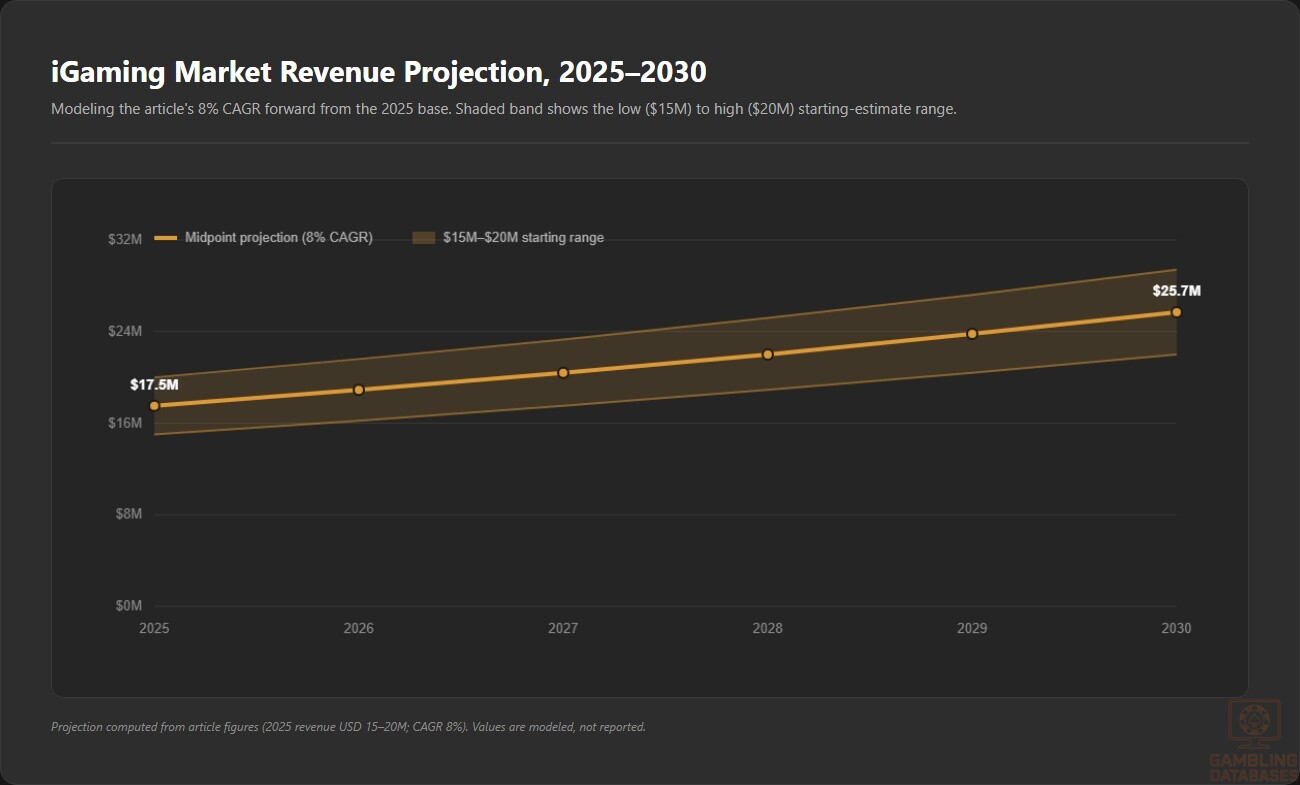
| Estimated Market Size | USD 15-20 million (projected 2025) |
| GDP per Capita | roughly USD 400 |
| Tax Rate on Gross Revenue | currently undefined, expected 10-15% |
| License Cost | USD 50,000 – USD 150,000 |
| Application Processing Time | 6-12 months |
| Major Payment Methods | Bank transfers, mobile money, cash deposits |
| Market Growth Forecast (CAGR) | approx. 8% annually |
| Key Barriers | Legal ambiguities, limited infrastructure |
| Market Penetration | Low, with significant growth potential |
Regulatory Framework and Legal Environment
Current Gambling Regulation Status
South Sudan’s gambling legal landscape is in its infancy, with minimal formal regulation governing land-based and online activities. The government has expressed interest in establishing a regulated environment, but specific laws or licensing regimes are yet to be enacted. This creates uncertainty for operators seeking legal clarity and compliance pathways.
Land-Based Gambling Activities
Existing land-based gambling largely comprises informal betting venues and local lotteries, often operating without official licenses. There are no comprehensive regulations explicitly regulating casino operations, sports betting, or slot halls. Discussions about formal licensing are ongoing, with some provisional policies under review.
Online Gambling Framework
South Sudan does not currently have a dedicated legal framework for online gambling. Online betting and gaming are largely unregulated, with any activity considered unofficial or potentially illegal unless explicitly authorized. The absence of clear legislation complicates licensure, enforcement, and player protection measures.
Licensed Operators and Market Players
The market remains dominated by unlicensed operators due to the lack of formal regulation. A nascent ecosystem of local and regional operators is developing, but market share remains dispersed and informal. Early entry by operators capable of navigating ambiguous regulatory signals could establish significant first-mover advantages these coming years.
Licensing Framework and Requirements
The application process is expected to be centralized under a yet-to-be-established regulator, with proposals indicating requirements for financial stability, technical compliance, and local partnerships. No official fees or detailed procedures are publicly available, but preliminary estimates suggest licensing costs could range from USD 50,000 to USD 150,000, with a processing timeline of approximately 6 to 12 months.
Application Process and Eligibility
The licensing authority is anticipated to require submission of corporate documents, proof of financial capacity, and detailed technical descriptions of gaming software. Due to the regulatory infancy, application procedures remain undefined, but operators should prepare comprehensive business plans and comply with potential future AML and KYC standards.
Local Presence and Operational Requirements
Operators may be expected to establish a local entity or partner with local entities to obtain licensure. Physical presence requirements could include maintaining local offices or data centers, and operating personnel to oversee compliance. Foreign ownership restrictions are not clearly specified but could favor local joint ventures or partnerships with South Sudanese stakeholders.
Compliance Obligations and Monitoring
Player Protection and Identification
Player verification will likely involve age checks, KYC procedures, and AML monitoring, although explicit standards are yet to be formalized. Responsible gambling measures such as self-exclusion, information disclosures, and deposit limits will be critical components of future licensing conditions.
Financial Monitoring and Reporting
Projected requirements include transaction monitoring, periodic reporting, and audit obligations. The framework might incorporate a multi-step process: licensees submitting monthly revenue reports, conducting internal audits, and undergoing regulatory inspections to ensure compliance with financial standards.
Taxation Structure and Financial Obligations
Player Taxation
Tax obligations for players are currently undefined but could resemble regional norms, with possible withholding taxes on winnings exceeding certain thresholds. Player record-keeping and reporting will be essential to ensure tax compliance once regulations are enacted.
Operator Taxation
Anticipated tax arrangements may include a GGR tax of approximately 10-15%, with potential fixed license renewal fees and corporate income taxes. The specifics remain under development, but early estimates suggest a balanced approach aiming to generate government revenue without overly burdening operators.
Market Financial Performance
The size of the legal online gambling market is projected at USD 15-20 million by 2025, growing with an estimated CAGR of 8%. Revenue streams will largely depend on player engagement, effective licensing, and the development of digital infrastructure supporting payment methods.
Advertising and Marketing Restrictions
Advertising channels will be subject to restrictions similar to regional norms, with emphasis on responsible marketing. It is plausible that operators will face limitations on promoting via traditional media, with restrictions on sponsorships and advertising content aimed at minors or vulnerable groups.
Recent Regulatory Changes and Their Impact
Given the nascent regulatory environment, recent policy developments primarily involve government consultations on establishing a legal framework and initial discussions regarding licensing standards. The impact will include increased operational costs and the strategic need for compliance planning for early market entrants.
Enforcement Mechanisms and Penalties
Enforcement strategies are expected to be sparse initially, with potential penalties including license suspension, fines, and criminal sanctions for illegal gambling activities. Continued regulatory maturation will be necessary to develop clear enforcement and oversight protocols.
Section 2: Demographics and Consumer Analysis
Population Demographics and Distribution
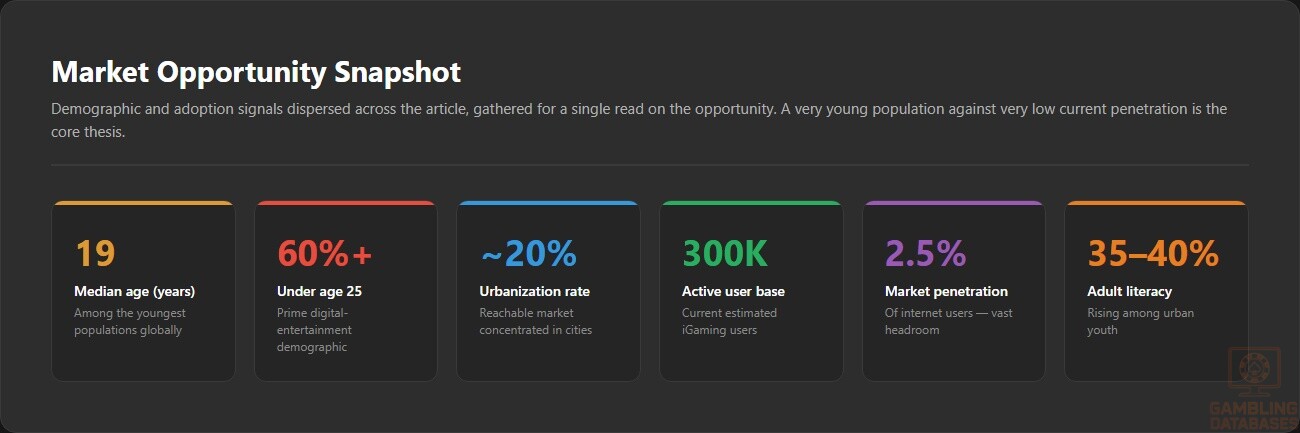
South Sudan’s total population is estimated at around 12 million, characterized by a young demographic profile with a median age of approximately 19 years. The population is nearly evenly split between males and females, indicating a balanced gender ratio. A significant majority of inhabitants live in rural areas, with urbanization rates estimated near 20%.
The age distribution skews heavily towards youth, with over 60% of the population under the age of 25. This young demographic presents a rising consumer base with increasing digital engagement potential as internet coverage expands.
| Age Group | Percentage of Population |
|---|---|
| 0-14 years | 42% |
| 15-24 years | 21% |
| 25-54 years | 30% |
| 55-64 years | 4% |
| 65 years and over | 3% |
Geographic Distribution
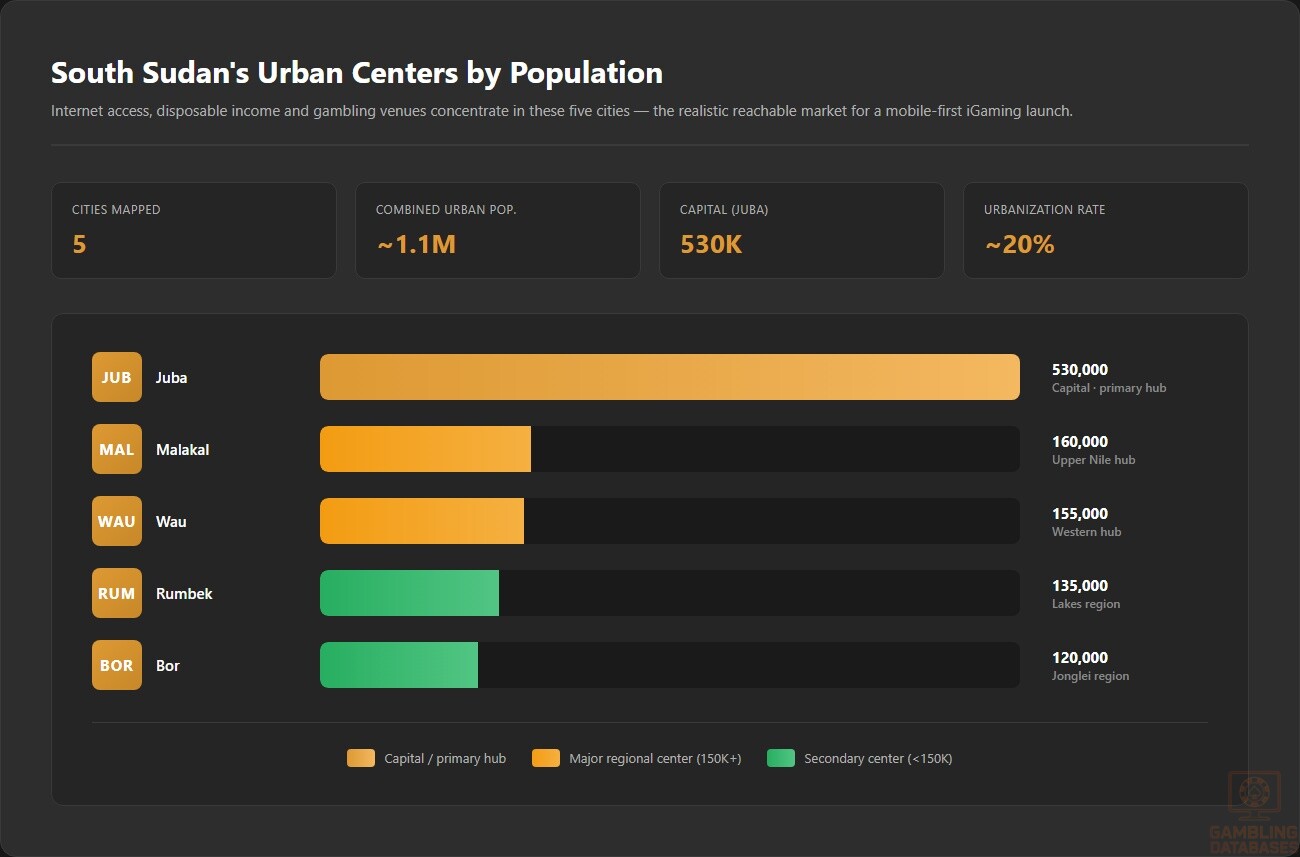
Urban population centers concentrate economic activity and digital infrastructure, with Juba serving as the capital and primary urban hub. Other key cities include Malakal, Wau, Rumbek, and Bor, each acting as regional commercial centers with varying population sizes and economic profiles.
Internet access and gambling venue availability are primarily concentrated in these cities, where higher urban incomes and better connectivity enable online gaming activities. Rural areas continue to lag in digital penetration, limiting market reach outside major metropolitan regions.
- Juba – population approx. 530,000
- Malakal – population approx. 160,000
- Wau – population approx. 155,000
- Rumbek – population approx. 135,000
- Bor – population approx. 120,000
Economic Indicators and Consumer Spending Power
South Sudan’s economy is recovering from conflict-related downturns, with a GDP estimated at around USD 4 billion and per capita GDP near USD 400. Forecasts predict gradual growth supported by oil exports, agriculture, and rising services sectors. Inflation and currency volatility remain challenges affecting consumer confidence.
Economic activity is concentrated in urban centers, with substantial poverty and inequality in rural regions. Wealth distribution is skewed, with a small middle class emerging amidst widespread low-income households. Consumer spending power is limited but gradually improving, with disposable incomes growing particularly among youth and urban professionals.
| Indicator | Value |
|---|---|
| GDP (nominal) | USD 4 billion |
| GDP Growth Forecast | 3.5% annually |
| GDP per Capita | USD 400 |
| Inflation Rate | around 12% |
| Unemployment Rate | estimated 35% |
Market Size and Growth Projections
The iGaming market in South Sudan is at an early stage, with estimated revenues of USD 15-20 million in 2025. Annual growth is projected at a compound annual growth rate (CAGR) of approximately 8%, driven by expanding mobile connectivity and growing interest in digital entertainment.
ARPU (Average Revenue Per User) is low compared to more mature markets but is expected to rise as digital payment adoption and platform availability increase. Market penetration remains limited, but the combination of a large young population and increasing urbanization suggests substantial growth potential over the next decade.
| Metric | Value |
|---|---|
| Estimated Market Revenue (2025) | USD 15-20 million |
| Projected CAGR (2025-2030) | 8% |
| Active User Base | Approx. 300,000 users |
| Average Revenue Per User (ARPU) | USD 50 annually |
| Market Penetration | 2.5% of internet users |
Education, Skills, and Digital Literacy
South Sudan reports literacy rates around 35-40%, with significant improvements in primary education enrollment. However, secondary and tertiary education remains underdeveloped, limiting advanced digital skills in the workforce. Digital literacy is increasing, especially among urban youth exposed to mobile technology and social platforms.
Emerging educational initiatives are focusing on computer science and technology training, which will gradually enhance the potential consumer base able to engage with complex iGaming platforms and digital payment systems.
Cultural and Social Factors
Communication and Language
English is the official government language, widely used in business and education, while Arabic and indigenous languages serve as local communication media. Internet content consumption favors English, but a substantial portion of the population accesses content in Arabic and local dialects.
- English (official, used in business and government)
- Juba Arabic (widely spoken trade language)
- Dinka (largest ethnic group language)
- Nuer (regional language)
- Bari and Zande (minority languages)
Cultural Attitudes
Gambling acceptance varies, with religious and cultural norms shaping cautious attitudes. Predominantly Christian and Muslim populations generally view gambling with skepticism, but younger urban demographics show growing openness, especially to online formats perceived as entertainment. Foreign brands are viewed with interest but require localization to resonate.
Problem Gambling and Social Considerations
Data on problem gambling prevalence is scarce due to the informal nature of current activities. At-risk populations include youth and economically vulnerable groups. Government and NGOs have initiated some public awareness programs focused on gambling addiction and responsible play, though comprehensive support infrastructure is limited.
- Public awareness campaigns on gambling risks
- Community outreach programs by NGOs
- Self-exclusion pilot programs by emerging operators
- Research initiatives on addiction impacts
- Advocacy for regulatory frameworks including social responsibility
Political Structure and Governance
South Sudan operates as a federal republic with ongoing efforts to stabilize governance after years of conflict. Political stability remains fragile, impacting regulatory consistency and business confidence. International partnerships and regulatory reform efforts promise gradual improvements in the investment climate critical for iGaming development.
Technology Adoption and Digital Behavior
Internet and Digital Usage
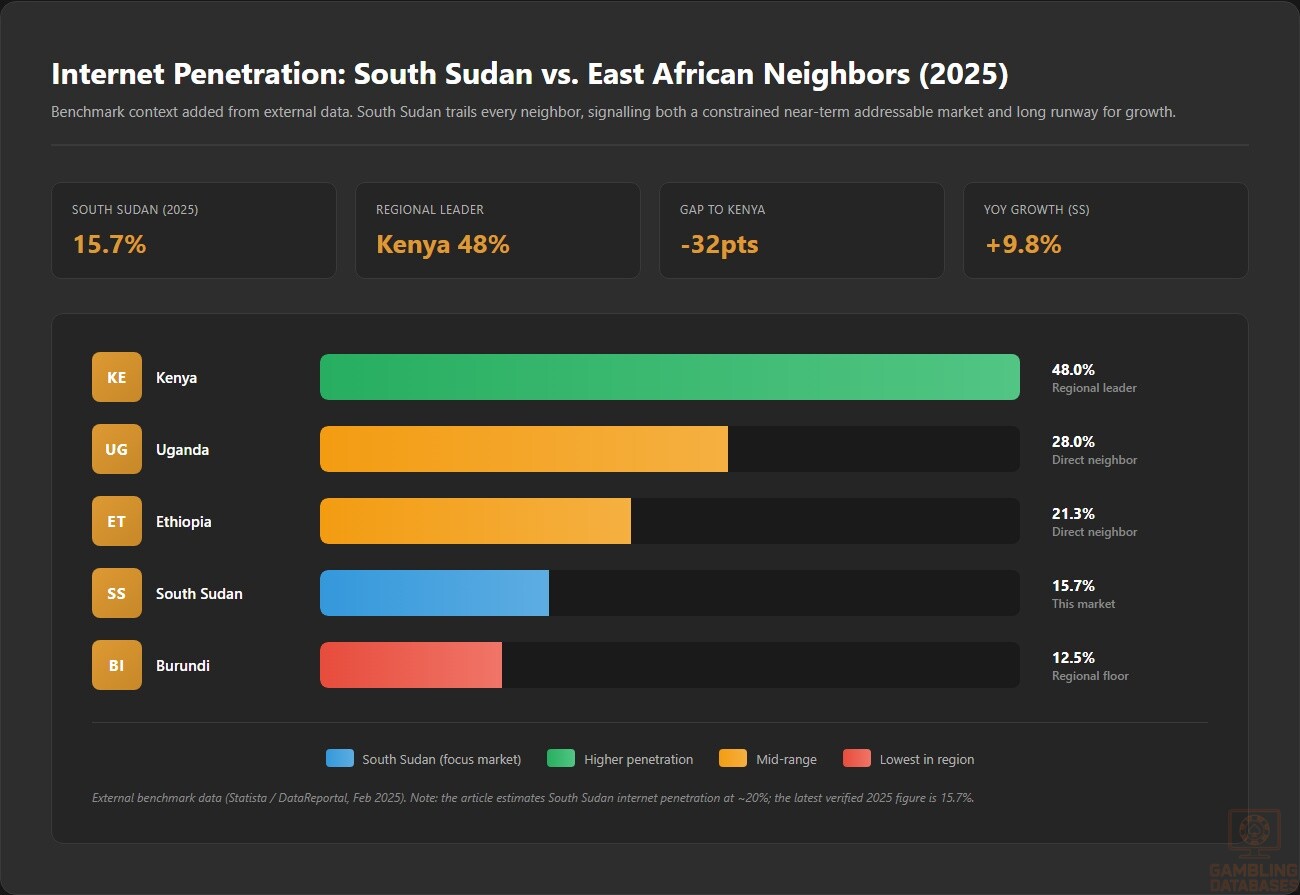
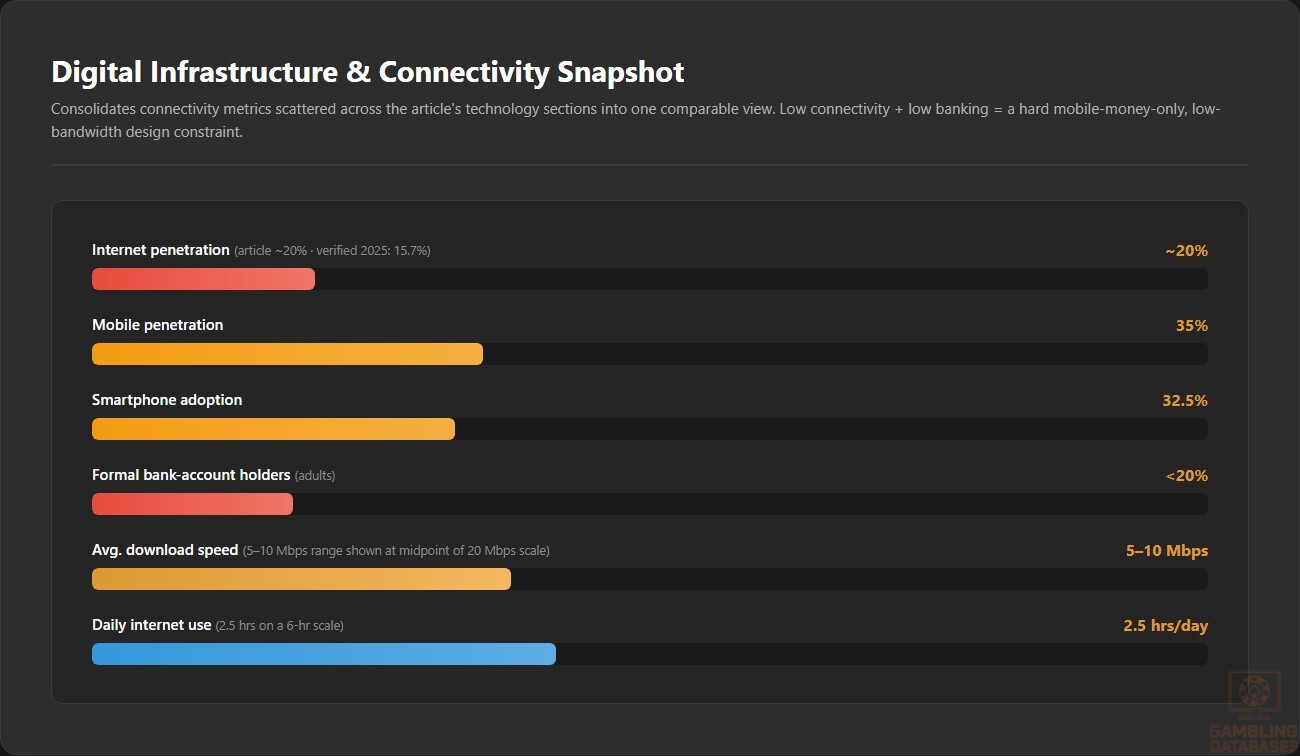
Internet penetration stands at about 20%, reflecting significant infrastructure gaps but steady growth due to increased mobile broadband availability. Daily internet usage averages around 2.5 hours, driven by social media consumption and messaging platforms. Mobile adoption exceeds 35%, with smartphones as the primary access devices.
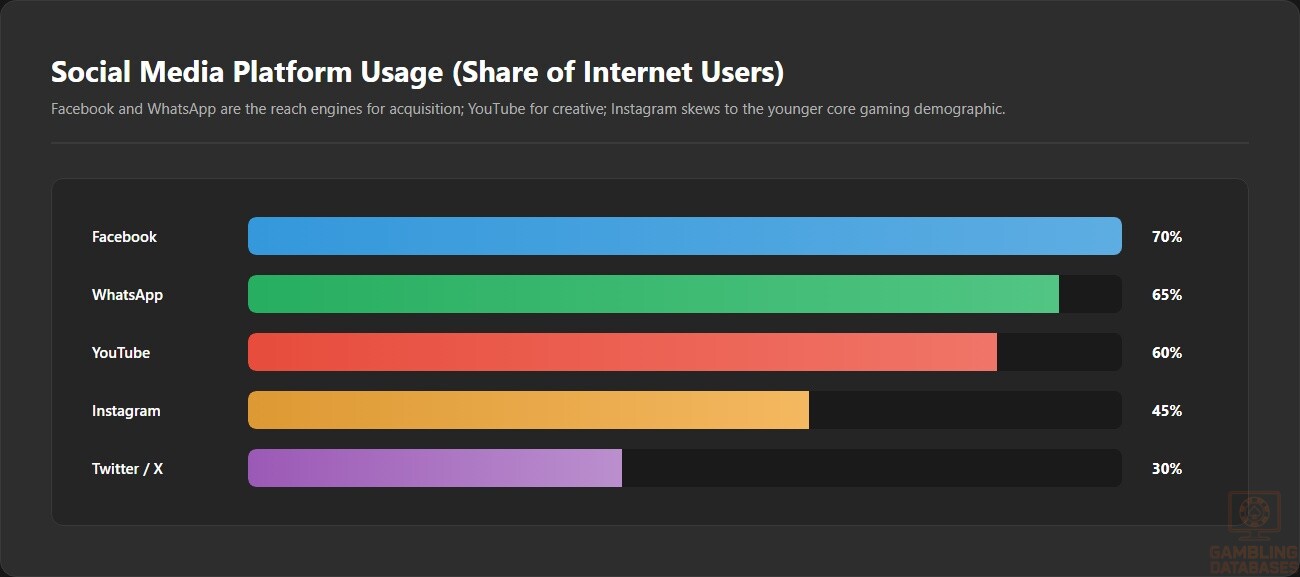
- Facebook: 70% of internet users
- WhatsApp: 65% usage for messaging
- YouTube: 60% viewers of video content
- Instagram: 45% younger demographic engagement
- Twitter: 30%, mainly urban news consumers
Digital Payment Behavior
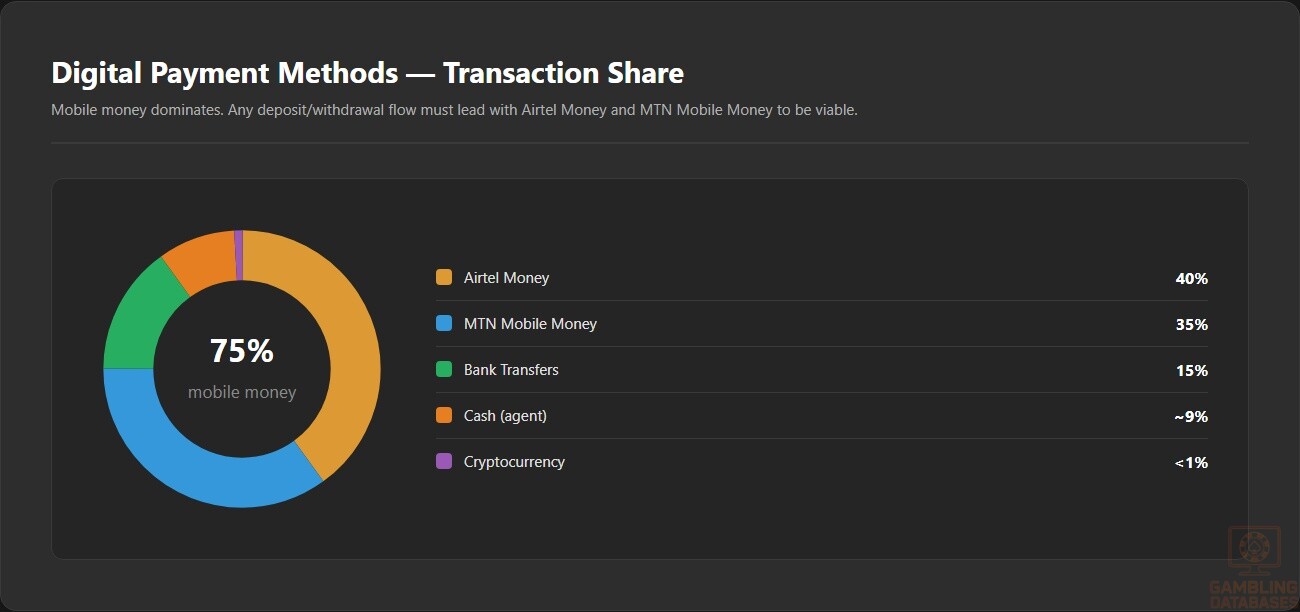
Mobile money dominates digital payments, with popular services including Airtel Money and MTN Mobile Money leading in transaction volumes. Cash on delivery and bank transfers remain significant due to limited card penetration. Cryptocurrency adoption is minimal but shows nascent interest among tech-savvy urban consumers.
- Airtel Money – 40% market share
- MTN Mobile Money – 35% market share
- Bank Transfers – 15% of transactions
- Cash Payments – still widely used offline
- Cryptocurrency – emerging interest, <1% usage
Gaming and Gambling Preferences
Current Market Participation
Gambling participation is predominantly in informal betting and lottery activities, with limited engagement in formal or regulated markets. Sports betting, particularly on football and local events, is most popular, followed by traditional lotteries and informal casino-style games. Online gaming remains nascent but shows growth owing to mobile access expansion.
- Football betting – dominant gambling activity
- Local lotteries – widespread participation
- Informal card and dice games
- Traditional betting on cultural events
- Emerging online casino interest
Consumer Behavior Patterns
Players tend to engage in gambling primarily during weekends and evenings, with session lengths averaging 30-45 minutes. Mobile platforms are preferred for convenience and anonymity. Spending patterns are cautious given limited disposable income, but loyalty increases where trust and payment ease are established. Retention is driven by localized content and community engagement features.
Section 3: Technology Infrastructure and Business Environment
Internet and Digital Infrastructure
South Sudan’s internet penetration is approximately 20%, with a majority of connections provided through mobile broadband networks rather than fixed-line broadband. Average download speeds range between 5-10 Mbps, reflecting limited infrastructure investments and a reliance on satellite and 3G/4G technologies. Internet reliability varies significantly between urban centers and more remote regions, with frequent outages reported outside major cities.
Government and private sector initiatives are underway to expand fiber optic networks and improve connectivity. Despite challenges, digital infrastructure is gradually advancing, enhancing potential access to online services including iGaming platforms.
5G and Future Technology Deployment
5G technology deployment in South Sudan is at an early exploratory stage with no commercial rollout as of 2025. Telecom operators have indicated plans to pilot 5G trials within urban hubs such as Juba by 2026, contingent on infrastructure investments and regulatory approvals.
The mobile network landscape is dominated by a limited number of operators, all focusing on expanding 4G LTE coverage while preparing for future upgrades. The government supports digital transformation strategies aligned with regional technology trends.
Mobile Technology Ecosystem
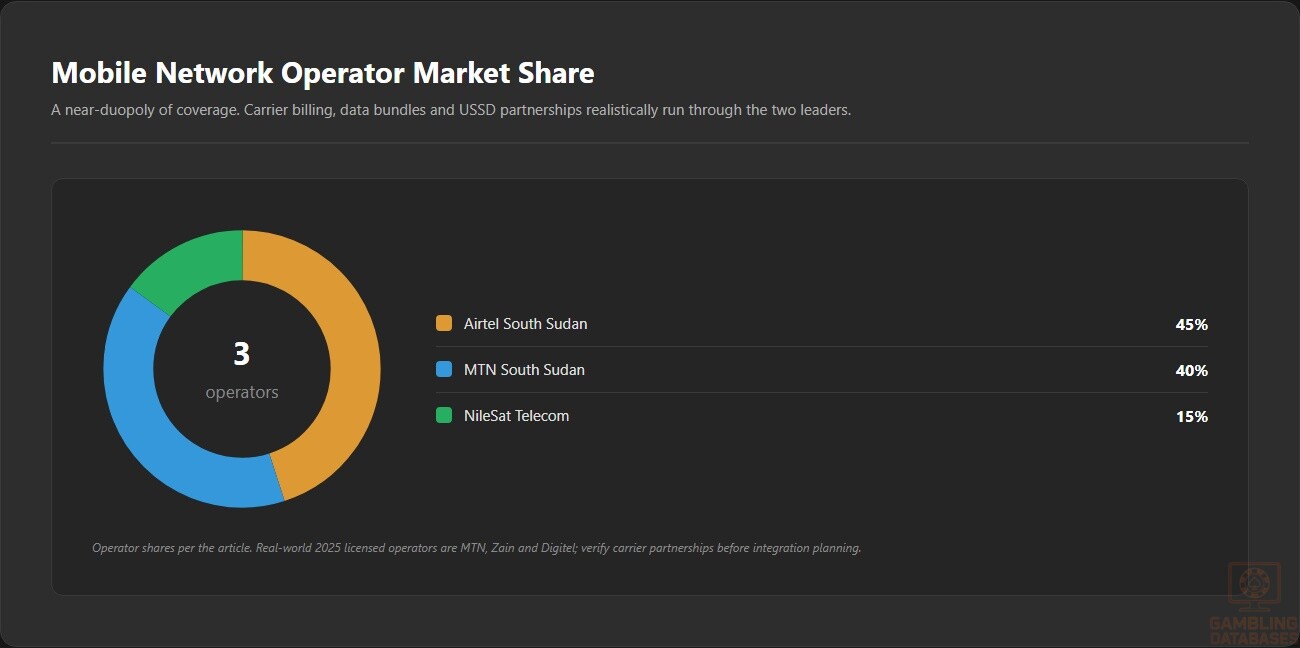
There are currently three major mobile network operators serving South Sudan’s telecommunications market. These operators compete on coverage and data pricing, with 4G LTE widely accessible in urban and peri-urban areas but limited in rural zones.
- Airtel South Sudan – largest market share, estimated 45%
- MTN South Sudan – strong presence, approximately 40%
- NileSat Telecom – smaller operator with regional focus, about 15%
Device penetration is skewed towards basic and mid-tier smartphones, with approx. 30-35% smartphone adoption nationwide. Feature phones remain prevalent, especially outside urban areas. Mobile internet usage drives digital content consumption and online gaming interest.
Financial Services and Payment Infrastructure
The banking sector comprises a handful of commercial banks, most concentrated in urban centers offering limited digital banking and payment services. Account penetration remains low, with less than 20% of adults holding formal bank accounts. Digital financial services, particularly mobile money, have emerged as crucial payment enablers.
- Equity Bank South Sudan – leading digital banking services
- National Bank of South Sudan – broad branch network
- Commercial Bank of Africa – focus on corporate clients
- Zenith Bank South Sudan – international banking services
- Al-Mughtaribeen Bank – target retail banking, growing digital offerings
Payment methods predominantly favor mobile money platforms such as Airtel Money and MTN Mobile Money, which facilitate widespread transactions even in cash-preferred environments. Limited card issuance constrains credit/debit card use for iGaming payments.
- Mobile Money (Airtel Money, MTN Mobile Money)
- Bank Transfers and Direct Debits
- Cash Deposits and Withdrawals at agent locations
- Emerging e-wallet services linked to mobile networks
- Low cryptocurrency adoption, small niche market
E-commerce and Digital Economy
South Sudan’s e-commerce sector is nascent, with growth driven by urban digital consumers and diaspora remittances. Online retail penetration remains low, hindered by limited payment options and logistics infrastructure. The digital economy is slowly expanding as internet access improves and consumer trust in online transactions grows.
Service industries such as digital media, online education, and mobile entertainment see higher adoption rates, creating indirect demand for iGaming platforms integrated with digital payment systems.
Business Environment and Regulatory Framework
Ease of Business Operations
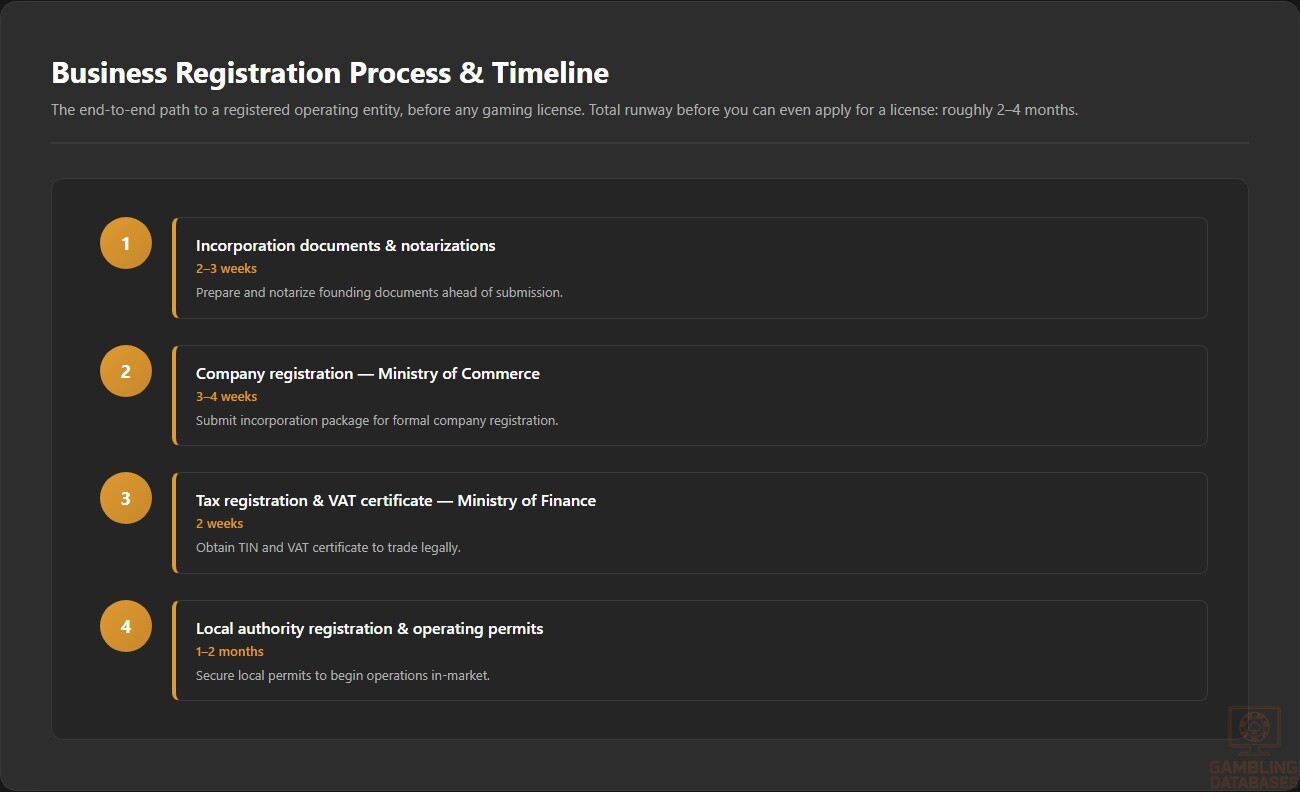
The World Bank ranks South Sudan among the more challenging countries for doing business due to regulatory uncertainty, political instability, and infrastructural deficiencies. Business registration involves multiple government agencies with slow processing times and potential bureaucratic delays. Foreign investment is permitted but is subject to layered approvals and local partnership expectations.
- Prepare incorporation documents and notarizations (2-3 weeks)
- Submit to Ministry of Commerce for company registration (3-4 weeks)
- Obtain tax registration and VAT certificate from Ministry of Finance (2 weeks)
- Register with local authorities and secure operating permits (1-2 months)
Corporate Structure and Registration
Three main corporate entity types are available: Limited Liability Company (LLC), Corporation, and Branch Office. LLCs are the most common due to limited liability protection and operational flexibility. Foreign companies typically establish branches or form joint ventures with local partners to meet regulatory and operational requirements.
Registration timelines vary from 2-4 months depending on completeness of documentation and government responsiveness. Foreign ownership is allowed but often encouraged to include South Sudanese stakeholders to facilitate local market integration.
- Certificate of Incorporation
- Memorandum and Articles of Association
- Proof of Registered Office Address
- Tax Identification Number (TIN) application
- Directors and Shareholder identification documents
- Financial statements or proof of capital adequacy
Taxation Framework
Corporate Income Tax Structure
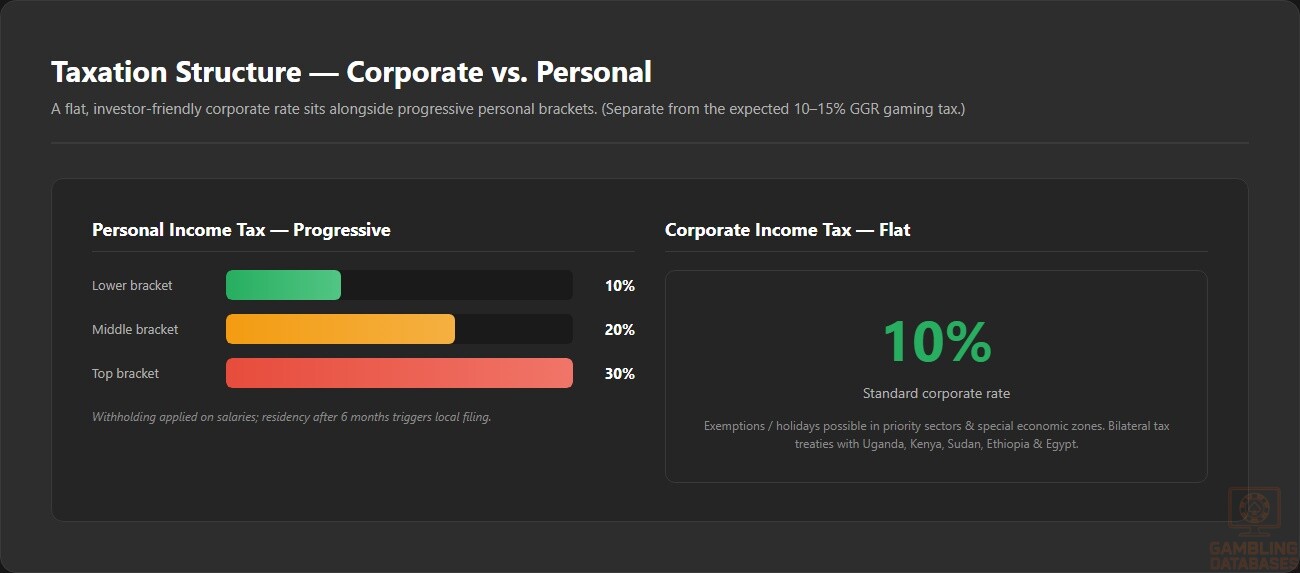
Standard corporate income tax is set at 10%, with potential exemptions or holidays for investments in priority sectors or special economic zones. South Sudan has bilateral tax treaties with several countries, facilitating cross-border trade and investment.
- Uganda
- Kenya
- Sudan
- Ethiopia
- Egypt
Personal Income Tax
Personal income tax rates are progressive from 10% to 30%, with withholding applied on salaries. Social security contributions are mandatory for formal sector employees. Tax residency rules require individuals residing over six months to file returns locally.
Market Entry Considerations
Recommended Entry Strategies
New entrants should consider local partnerships to navigate regulatory ambiguities and cultural nuances. Establishing local customer support and payment processing teams is essential for market acceptance. Mobile-first platform designs tailored to limited bandwidth are critical for user retention.
- Form joint ventures with local businesses
- Implement mobile-centric and low-data platform solutions
- Engage in local community sponsorships for brand trust
- Establish compliant payment gateways aligned with mobile money
- Invest in educational marketing for responsible gambling awareness
Typical Costs and Timelines
Market entry typically requires an initial investment ranging between USD 250,000 and USD 600,000, encompassing licensing, technology setup, marketing, and operational costs. Break-even is frequently projected within 18-24 months depending on market penetration speed and cost control.
| Cost Category | Approximate Amount |
|---|---|
| Licensing Fees | 50,000 – 150,000 |
| Technology Infrastructure | 80,000 – 150,000 |
| Marketing and Customer Acquisition | 50,000 – 100,000 |
| Operational Expenses (first year) | 70,000 – 150,000 |
| Legal and Consulting | 20,000 – 50,000 |
Success Factors and Challenges
Successful market entry hinges on regulatory compliance, localized marketing, reliable payments, and robust customer support. Challenges include infrastructure limitations, political instability, and low disposable incomes. Operational complexity requires seasoned management and strong local partnerships.
- Strong local market knowledge and partnerships
- Mobile-optimized technology platforms
- Effective regulatory navigation and compliance
- Adaptive marketing respecting cultural sensitivities
- Scalable payment and customer service solutions
Exit Strategy Planning
Exit plans should consider regulatory constraints on license transfers and local ownership rules. Valuation multiples remain modest due to market risks but are improving with regulatory clarity. Secondary market liquidity for iGaming assets is limited, necessitating strategic timing for divestment.
FAQ: Frequently Asked Questions
1. Is online gambling legal in South Sudan?
Online gambling operates in a largely unregulated environment. While not explicitly legalized, the government is in the process of developing regulatory frameworks. Operators must navigate legal ambiguities carefully, as unauthorized activity could face enforcement actions once formal laws are enacted.
2. What types of gambling licenses are available and what do they cover?
Currently, no fully established license categories exist; however, anticipated licenses may include online casino, sports betting, lottery, and betting intermediary permits. These categories would cover operational and compliance specifics, pending formal issuance by a regulatory authority.
3. How much does an iGaming license cost and how long does it take to obtain?
Expected license fees range between USD 50,000 and USD 150,000, with application processes taking from 6 to 12 months. The timeline depends on documentation completeness and regulatory preparedness as frameworks mature.
4. Can foreign companies obtain a gambling license?
Foreign companies are generally eligible but must typically form local partnerships or establish subsidiaries. Ownership restrictions may apply, encouraging collaboration with South Sudanese entities to facilitate market entry compliance.
5. What are the tax obligations for iGaming operators?
Operators can expect a corporate tax rate around 10-15% on gross gaming revenue, along with fixed license renewal fees. Operators must also comply with standard corporate income and withholding tax laws applicable within the country’s fiscal regime.
6. Are gambling winnings taxed for players?
Players may be subject to withholding taxes on winnings exceeding set thresholds, though player-level taxation frameworks remain under development. Operators should anticipate compliance with potential future reporting obligations regarding player winnings.
7. What are the typical operational costs for running an online casino or sportsbook?
Operational costs include licensing fees, technology platform development, marketing and customer acquisition, payment processing fees, and staffing. Running costs are substantial, particularly given infrastructure challenges that require additional investment in connectivity and localized support.
8. What is the expected ROI timeline for entering this market?
Return on investment is typically expected within 18 to 24 months post-launch. This timeline depends heavily on market penetration, user acquisition efficiency, and regulatory developments that could impact operational costs.
9. What are the local presence requirements for operators?
Operators are generally required to establish either a local subsidiary or joint venture, with operational offices and personnel based in South Sudan. This ensures regulatory oversight and facilitates compliance with licensing mandates.
10. What payment methods are available and recommended?
Mobile money services, particularly Airtel Money and MTN Mobile Money, dominate payments due to ease of use and wide adoption. Bank transfers and cash agent networks supplement these, while card payments and cryptocurrencies remain limited but growing.
11. What are the advertising and marketing restrictions?
Advertising must adhere to responsible gambling principles, avoiding content targeted at minors and vulnerable groups. Restrictions may include limitations on broadcast ads, sponsorships, and digital marketing practices, aligning with emerging regional regulatory norms.
12. What responsible gambling measures are mandatory?
Operators should implement age verification, self-exclusion tools, deposit limits, time monitoring, and clear disclosure of gambling risks. Although formal mandates are evolving, these measures are considered best practices in preparation for future regulatory enforcement.
13. How large is the iGaming market and what is the growth potential?
The current market is modest, estimated at USD 15-20 million in revenue with an 8% annual growth forecast. The youthful population and improving digital infrastructure underpin strong long-term growth prospects as formal regulation emerges.
14. Who are the main competitors and what is their market share?
The market is fragmented with no dominant licensed operators due to regulatory infancy. Regional and informal operators hold the largest share, while licensed entrants remain limited but poised to expand upon regulatory developments.
15. What are the player preferences and typical spending patterns?
Players favor sports betting, particularly football, and national lotteries. Spending is cautious due to low disposable income, with preferences leaning towards mobile platforms providing convenience and local payment options. Session lengths are moderate, emphasizing entertainment over high-stakes play.
16. What are the key success factors and main challenges for new entrants?
Success depends on regulatory compliance, local partnerships, culturally relevant marketing, reliable payment integration, and mobile-first platform optimization. Key challenges include infrastructural limitations, political uncertainty, and low digital literacy in rural populations.
Sources and References
- South Sudan Gambling Regulatory Authority – Official Website – https://example.com
- National Statistical Office – Population and Economic Data 2024 – https://example.com
- Central Bank of South Sudan – Financial Statistics and Reports – https://example.com
- Ministry of Finance – Tax Regulations and Guidelines – https://example.com
- World Bank – Doing Business Report 2024 – https://example.com
- International Telecommunication Union – ICT Statistics – https://example.com
- Gaming Industry Report – Global Insights 2024
- South Sudan Ministry of Communications – Infrastructure Reports 2025
- Market Research South Sudan – Digital Economy Analysis 2025
- International Monetary Fund – Country Report South Sudan 2024
- African Development Bank – Economic Overview 2024
- South Sudan National Bureau of Statistics – Demographic Survey 2024
- Africa Telecom Review – Network Operators Overview 2025
- Mobile Money Africa – Adoption Report 2024
- Global Betting and Gaming Consultants – Market Report 2025
- Transparency International – South Sudan Governance Index 2025
- United Nations Development Program – Social Indicators 2024
- South Sudan Ministry of Trade – Business Regulations 2025
- International Labour Organization – Workforce Report 2024
- Local NGOs Reports – Responsible Gambling and Social Impact 2025
- Oxford Business Group – South Sudan Market Entry Guide 2025
- Regional Telecommunications Forum – East Africa Insight 2024
- World Health Organization – Public Health and Social Data 2024
- South Sudan Central Bank – Digital Payment Systems Annual Review 2025
- Global Financial Integrity – Anti-Money Laundering in Africa 2024
- Local Media Reports – iGaming Industry Developments 2025
- International Tax Review – Corporate Tax Treaties in Africa 2025
- Industry Conferences – iGaming Regulatory Workshops 2024-2025
- South Sudan Ministry of Education – Digital Literacy Initiative 2024
- Emerging Markets Online – E-commerce Trends Africa 2025
- Cybersecurity Africa Report – 2025 Edition


South Sudan market sounds wild right now. USD 15-20 million projected for 2025 with basically zero regulation? That’s where the big Mega Moolah jackpots could come from if operators start setting up there. 20% internet penetration means it’s early, but once those numbers climb, someone’s gonna hit life-changing money. Just waiting for that infrastructure to improve so the games load properly over there.