Tajikistan presents a nascent but evolving iGaming market, with limited regulation and significant growth potential driven by increasing internet access and a young demographic. The country’s regulatory environment remains underdeveloped, creating both challenges and opportunities for foreign operators keen on market entry. Understanding the legal framework and compliance obligations is essential for effective market positioning and sustainable business operation.
Executive Summary: Key Market Indicators
| Metric | Value |
|---|---|
| Legal Status of Gambling | Partially regulated, mostly unlicensed |
| Population | 9.2 million (2025) |
| GDP | $8.3 billion (2024) |
| Internet Penetration | 65% |
| Mobile Penetration | 72% |
| Average Licensing Cost | Approx. $50,000 (initial) |
| Tax Rate on GGR | 20% (proposed; not legislated) |
| Market Entry Barriers | Limited formal licensing, unclear regulation |
| Business Environment Rank | 165/190 (2024) |
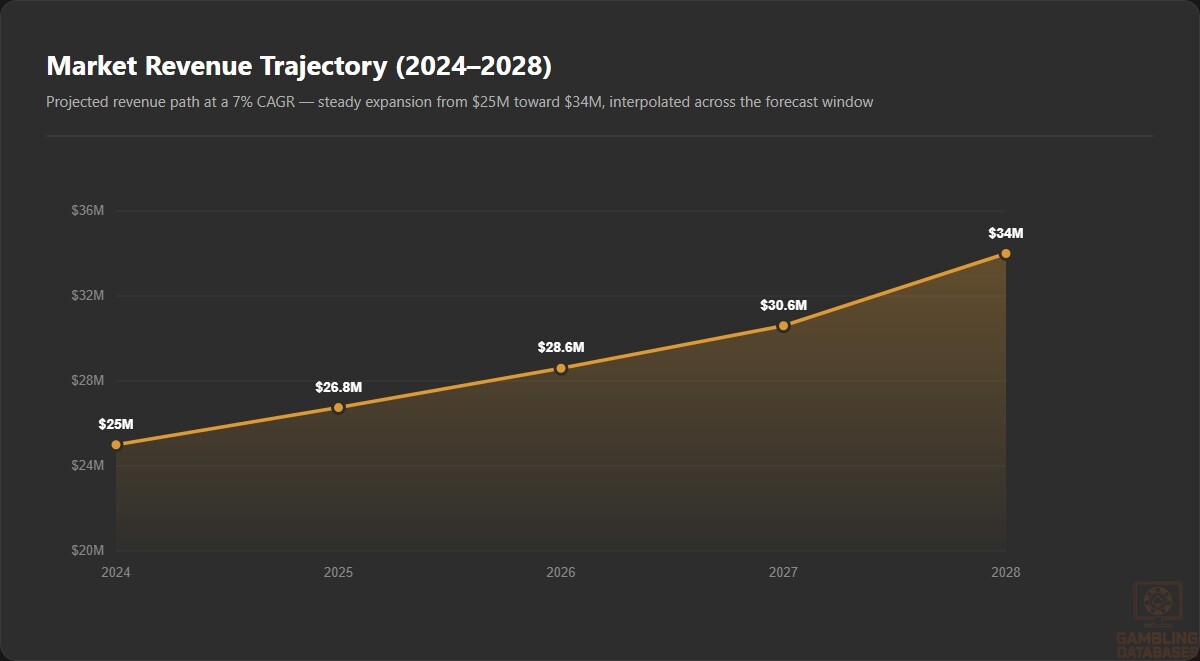
| Market Size (2024) | Estimated $25 million wagered |
| Growth Forecast (CAGR) | 7% (2024-2028) |
| ARPU | $18/month (2024) |
| Market Penetration | Low, rapid adoption phase |
Section 1: Regulatory Framework and Legal Environment
Current Gambling Regulation Status
Tajikistan’s gambling industry operates within a complex and largely informal regulatory environment. Land-based gambling activities, including casinos and slot halls, are present but minimally regulated, with isolated licensing instances. Online gambling remains largely unregulated, with no comprehensive licensing system in place as of 2025, creating a grey zone for digital operators. The government has expressed intentions to develop a clearer legal framework but has yet to formalize specific regulations or licenses.
Land-Based Gambling Activities
Officially, land-based casinos are permitted in Dushanbe and a few regional centers, but their operations face restrictive licensing conditions. Sports betting markets are limited and primarily run through state-controlled entities or unlicensed venues. Slot machine halls operate in a legal grey area, often circumventing official oversight. Other land-based activities, like lotteries, exist but are confined to government-approved entities with limited private involvement.
Online Gambling Framework
The regulation of online gambling remains undeveloped, with no dedicated legislation or licensing authority. Digital gaming activities are mostly prohibited or unofficially tolerated, creating a challenging environment for foreign operators. Despite this, many residents access online betting sites through offshore servers, which are not formally penalized but operate in a legal grey zone. The government is considering legal reforms, including licensing frameworks, but concrete measures are absent as of 2025.
Licensed Operators and Market Players
The market structure is characterized by a scarcity of licensed operators. Limited licensed gaming providers include some state-run lottery operators and minor private entities, mostly operating under provisional licenses or informal arrangements. Foreign companies seeking to enter face uncertain regulatory risks and lack clear pathways for licensing or registration, limiting competitive dynamics and market maturity.
Licensing Framework and Requirements
Application Process and Eligibility
The procedures for market licensing are underdeveloped, with no formal process yet established. Regulatory authorities are expected to be the Ministry of Finance or a specialized agency, but official regulations remain pending. Preliminary requirements would likely include proof of financial stability, technical standards compliance, and local legal registration, although specifics are not yet codified. Licensing fees are anticipated to be modest, around $50,000, but official figures are unavailable.
Local Presence and Operational Requirements
Operators are not legally mandated to establish a physical office or local entity at present. Future regulations may require local registration, domain controls, or a local representative. Foreign ownership restrictions are not explicitly clarified, but market entry will likely demand partnerships with local entities or licensed representation if regulations are formalized. No explicit domain restrictions or employee obligations are established to date.
Compliance Obligations and Monitoring
Player Protection and Identification
Presently, there are no enforceable standards for age verification, KYC, or AML processes for online or land-based operations. Future regulatory measures are expected to incorporate comprehensive responsible gambling policies, self-exclusion systems, and mandatory player identification procedures, aligned with international best practices.
Financial Monitoring and Reporting
As the online gambling sector remains unregulated, financial monitoring and reporting requirements are minimal. Should formal licensing emerge, operators would likely need to implement transaction monitoring, submit regular reports on gross gaming revenue, and undergo audits to comply with AML and tax regulations. Such processes are anticipated to follow international standards similar to other CIS jurisdictions.
Taxation Structure and Financial Obligations
Player Taxation
There is currently no specific taxation on player winnings, though future legislation might introduce withholding taxes or reporting obligations. The tentative approach suggests a flat 10-15% tax on winnings for high-stakes players if regulation is introduced.
Operator Taxation
The tax framework is undeclared but is expected to involve a 20% gross gaming revenue tax, similar to regional standards. License renewals and operational taxes are anticipated to be modest, with provisional estimates around $50,000 annually. Market revenue is often consolidated into state revenues, with little transparency on distribution.
Gambling Market Financial Performance
As of 2024, the total wagered amount is estimated at approximately $25 million, with payouts nearly matching wagers and gross revenues around $3-4 million. The growth trajectory shows a steady CAGR of about 7%, driven by internet expansion and demographic factors. Revenue streams are primarily from land-based activities, with online operations gradually increasing.
Advertising and Marketing Restrictions
Current restrictions limit gambling advertisements to official channels, with bans on offshore or unlicensed platform promotions. Sponsorships and advertisements in public media are heavily scrutinized, with strict content restrictions. Enforcement remains weak but evolving, particularly with potential future regulation.
Recent Regulatory Changes and Their Impact
Recent developments include expressions of intent to develop a formal licensing system, but no concrete legislative amendments have yet been enacted. The government’s focus remains on controlling illegal operations, with minimal direct impact on existing unregulated activities. Future reforms are expected to increase licensing costs but may also introduce clearer compliance pathways.
Enforcement Mechanisms and Penalties
Enforcement actions are sporadic, mostly targeting illegal operators rather than licensed entities. Penalties include fines, confiscation of equipment, or suspension of operations. There is a lack of specific penalties for online infractions, though this may change pending legislative development.
Section 2: Demographics and Consumer Analysis
Population Demographics and Distribution
Tajikistan has a population of approximately 9.2 million as of 2025, characterized by a youthful demographic with a median age of just under 26 years. The gender ratio is relatively balanced, with a slight male majority at 51%. The age distribution indicates a predominantly young population, creating a strong potential consumer base for digital entertainment, including iGaming.
Urbanization is moderate, with about 27% of residents living in urban centers while the majority remain in rural areas. This urban-rural divide impacts internet accessibility and gambling participation levels, as urban areas have better infrastructure and higher disposable incomes, crucial for iGaming market development.
| Age Group | Percentage of Population |
|---|---|
| 0-14 years | 33% |
| 15-24 years | 20% |
| 25-54 years | 38% |
| 55-64 years | 6% |
| 65 years and over | 3% |
Major Cities and Geographic Distribution
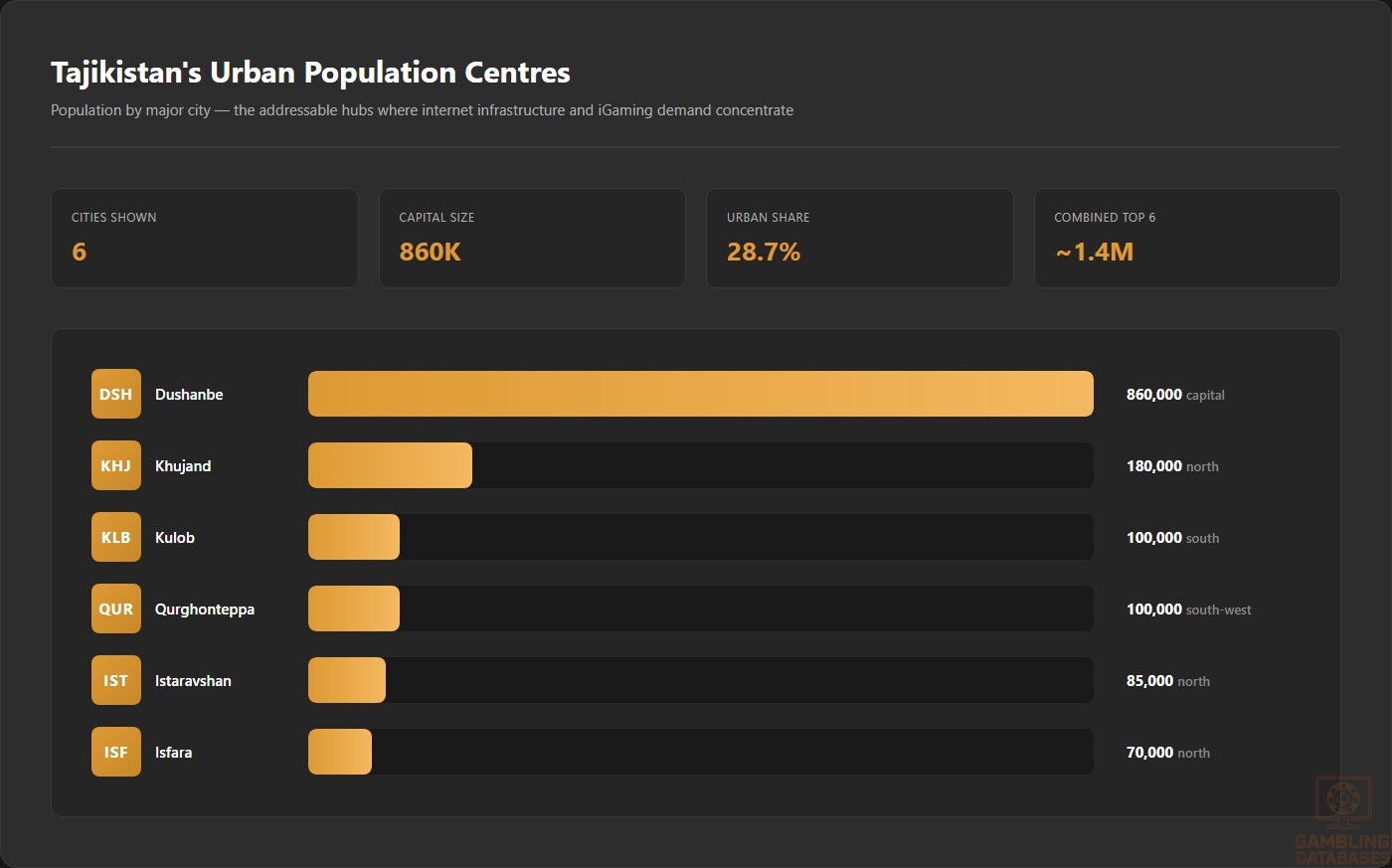
The economic and population concentration is mainly in the capital city Dushanbe and several regional centers. Internet infrastructure and gaming venues are focused around these urban hubs, while rural areas lag behind in connectivity and digital adoption.
- Dushanbe – 860,000 inhabitants
- Khujand – 180,000 inhabitants
- Kulob – 100,000 inhabitants
- Qurghonteppa – 100,000 inhabitants
- Istaravshan – 85,000 inhabitants
- Isfara – 70,000 inhabitants
Internet access is mainly concentrated in these cities, with reliable broadband and mobile networks supporting higher digital engagement and potential iGaming customers. The concentration of gambling activities is similarly urban-centered due to infrastructure and regulatory focus.
Economic Indicators and Consumer Spending Power
Tajikistan’s GDP was approximately $8.3 billion in 2024, with a moderate annual growth rate averaging about 4.5%. The economy is transitioning from agriculture toward services and light industry, though over 40% of the population remains engaged in farming. Economic reforms and foreign investment are slowly improving consumer purchasing power but disposable income remains limited.
Per capita income is estimated around $900 annually, highlighting economic challenges faced by the majority. Income distribution is uneven, with notable disparities between urban and rural households. Consumer spending is constrained by low wages, but young urban populations show increased willingness to allocate budgets to entertainment and digital services.
| Indicator | Value |
|---|---|
| GDP (Nominal) | $8.3 billion |
| GDP Growth Rate | 4.5% annually |
| Per Capita Income | $900/year |
| Urban Household Average Income | $1,200/year |
| Rural Household Average Income | $600/year |
| Service Sector Share of GDP | 45% |
Market Size and Growth Projections
The iGaming market in Tajikistan is currently small but growing, with estimated annual revenue near $25 million. The user base is expanding as internet and smartphone penetration increase. Market forecasts indicate a compound annual growth rate (CAGR) of roughly 7% over the next four years, driven by demographic trends and digital adoption.
Average Revenue Per User (ARPU) is estimated at about $18 per month, reflecting modest spending power offset by growing engagement. The nascent market is characterized by low penetration but rapid adoption potential, especially among youth in urban centers.
| Metric | Value |
|---|---|
| Current Market Revenue | $25 million |
| Annual Market Growth (CAGR) | 7% |
| Forecast Market Revenue (2028) | $34 million |
| ARPU | $18/month |
| User Base | Approx. 120,000 active players |
Education, Skills, and Digital Literacy
Tajikistan has a literacy rate exceeding 99%, with a strong emphasis on primary and secondary education. However, tertiary education and specialized digital skill levels are lower compared to regional peers. Digital literacy is improving rapidly in urban areas due to increased smartphone and internet use.
The workforce is emerging as moderately skilled, with growing availability of IT professionals and remote work adoption, enabling an increasingly tech-savvy population suitable for online entertainment platforms. The gap remains in rural regions where educational opportunities are limited, affecting digital inclusion.
Cultural and Social Factors
Communication and Language
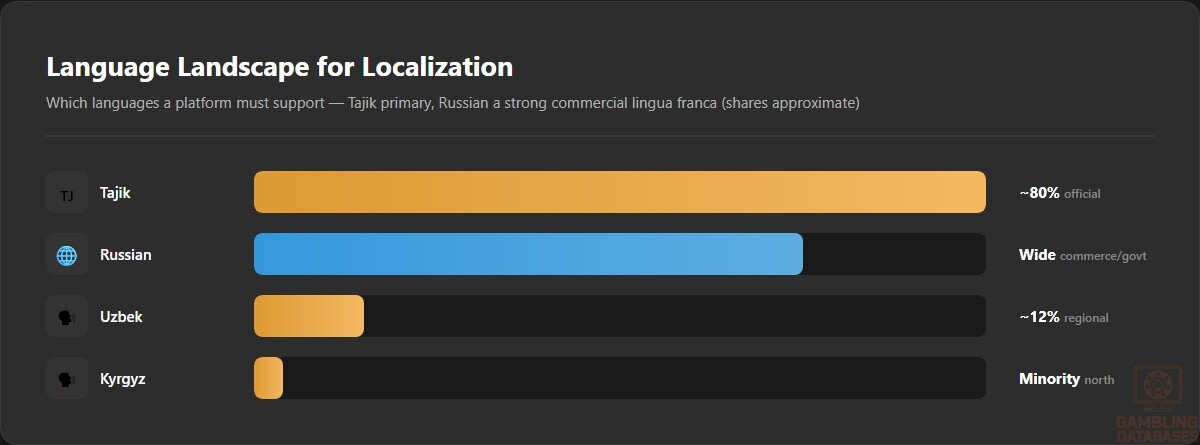
Tajik is the official language, spoken by nearly 80% of the population, while Russian remains a significant lingua franca used in business and government. Minority languages such as Uzbek and Kyrgyz are spoken in specific regions. Internet usage favors content in Tajik and Russian, shaping digital marketing and platform localization strategies.
- Tajik (primary language for 80% population)
- Russian (widely used in commerce and official communications)
- Uzbek (spoken in south and northeast regions)
- Kyrgyz (minority language in the north)
- Other local dialects present
Cultural Attitudes
Gambling holds ambivalent cultural acceptance, influenced heavily by conservative Islamic values that discourage gambling activities. Nonetheless, informal gambling persists in social settings, and younger urban populations show greater openness to online gaming and betting. Foreign brands face mixed perceptions, with trust growing in recognized global operators.
Problem Gambling and Social Considerations
The prevalence of problem gambling is not officially documented but believed to be low yet growing as market accessibility increases. Government programs targeting addiction remain embryonic with limited formal support systems. Social responsibility measures are expected to evolve alongside market formalization to address emerging risks.
- Public awareness campaigns on responsible gambling
- Support hotlines and counseling services (limited availability)
- Self-exclusion program proposals underway
- Collaboration with NGOs for addiction prevention
- Plans for mandatory operator contributions to social funds
Political Structure and Governance
Tajikistan is a presidential republic with a stable yet centralized government. Political stability is relatively strong, though regulatory consistency fluctuates, affecting business predictability. International relations focus on regional partnerships, with cautious openness to foreign investment. Governance frameworks impact the regulatory landscape and market entry complexity.
Technology Adoption and Digital Behavior
Internet and Digital Usage
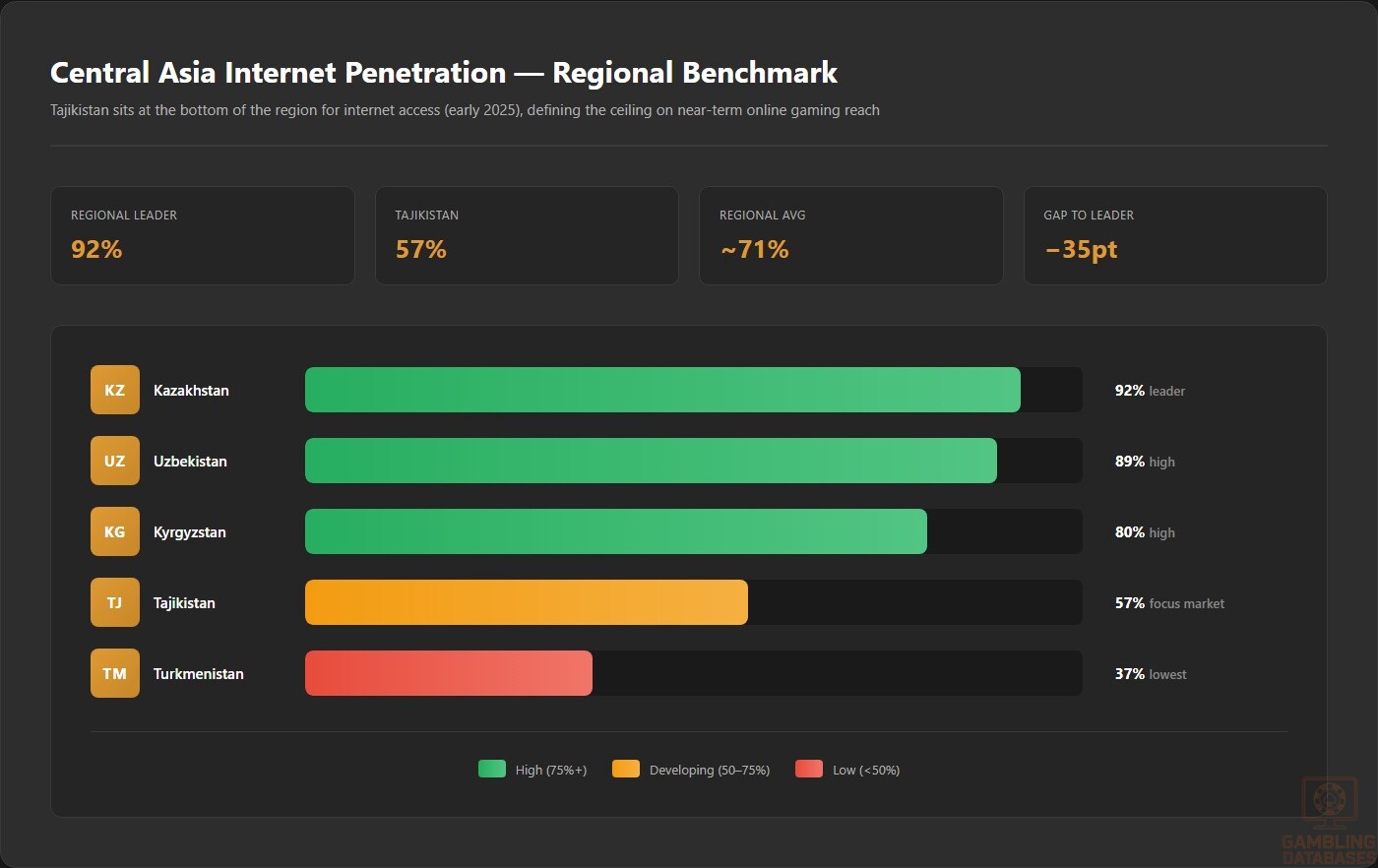
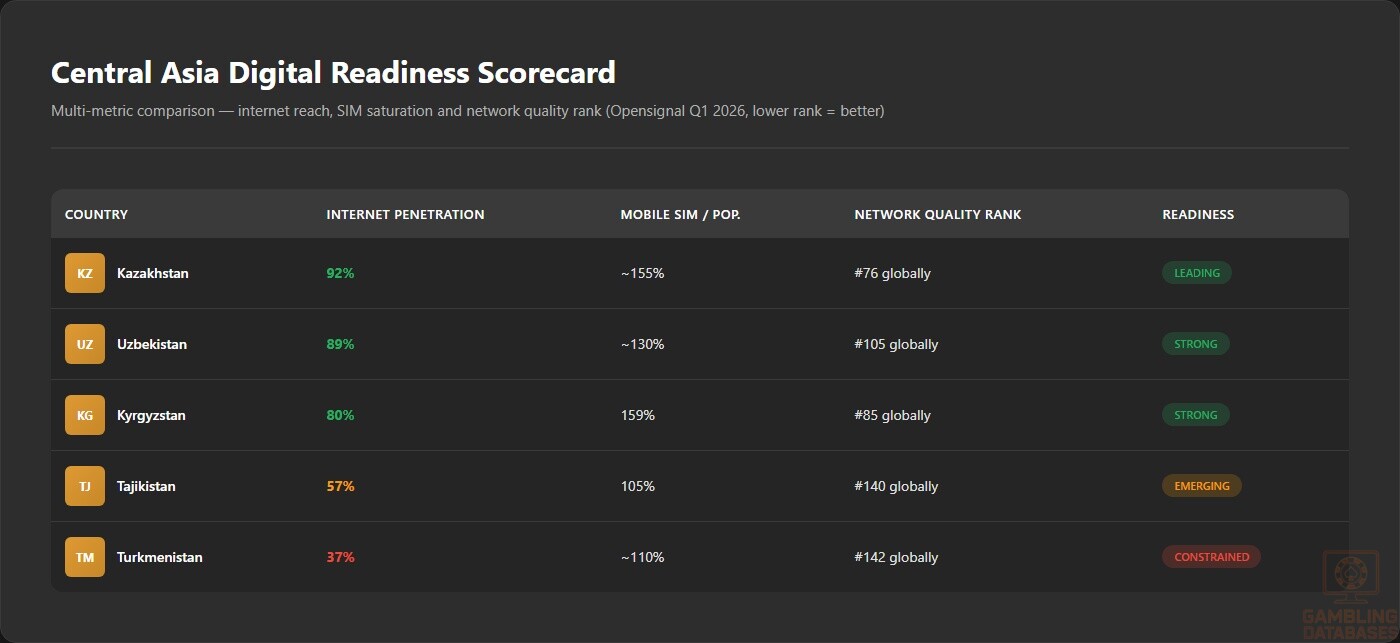
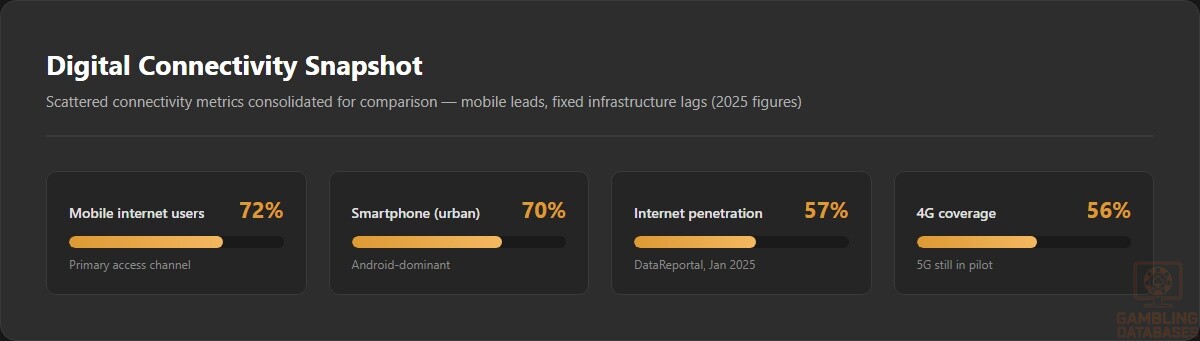
Internet penetration stands at approximately 65%, with mobile internet users representing about 72% of the population. Average daily internet usage is estimated at 3.5 hours, driven primarily by social media, messaging apps, and entertainment platforms. Urban populations exhibit higher engagement levels and faster adoption of new digital technologies than rural areas.
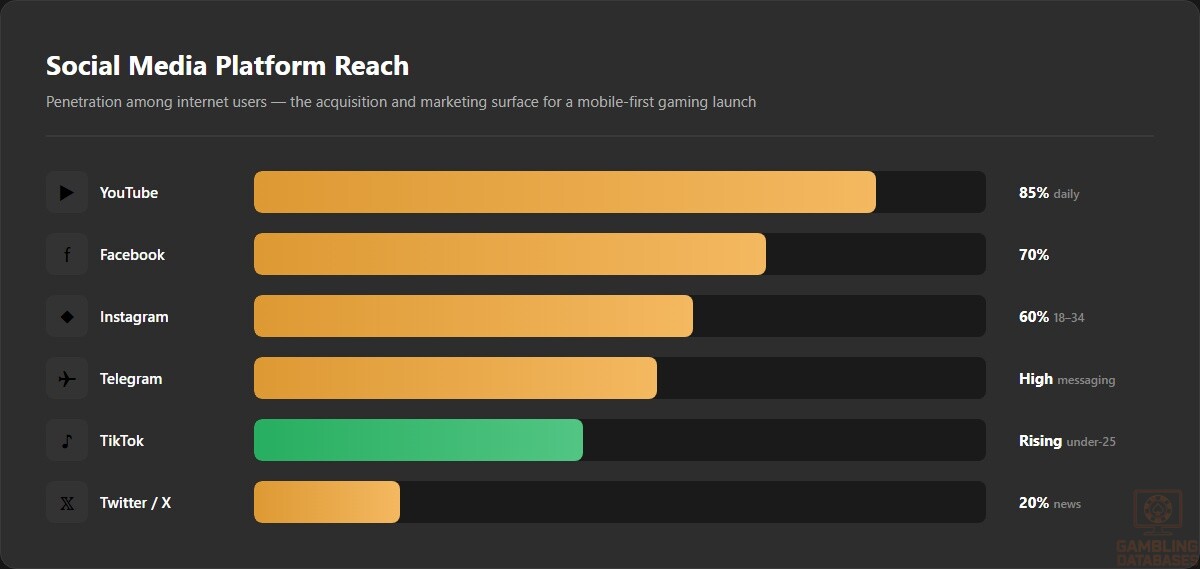
Social media platforms play a central role in communication and marketing, with varying popularity across demographics.
- Facebook with 70% penetration among internet users
- Instagram engaging 60% of 18-34 year-olds
- YouTube reaching 85% daily penetration
- TikTok growing rapidly, especially under-25 users
- Telegram widely used for messaging and groups
- Twitter used by approximately 20%, mainly for news
Digital Payment Behavior
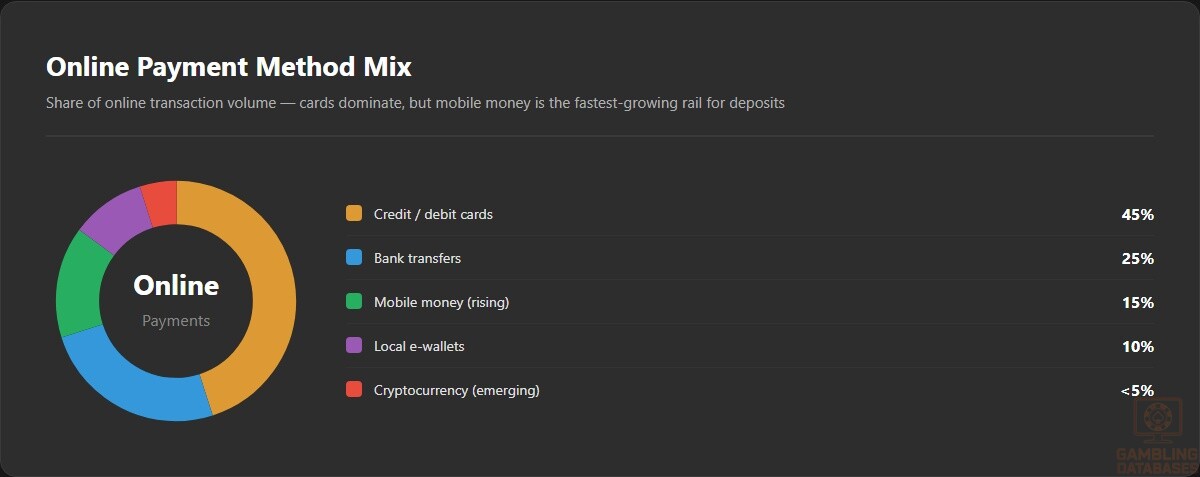
Payments for online services, including iGaming, are predominantly processed via bank cards and mobile payment systems. E-wallet adoption is growing but remains secondary to card and bank transfer usage. Cryptocurrency use is minimal but emerging among niche segments such as tech-savvy younger users.
- Credit/debit cards: 45% market share for online transactions
- Bank transfers: 25% of payment volume
- Mobile money solutions: 15%, rapidly growing
- E-wallets (e.g., WebMoney, Qiwi): 10% market share
- Cryptocurrency (Bitcoin, Ethereum): under 5%, emerging
- Cash payments via agents still common offline
Gaming and Gambling Preferences
Current Market Participation
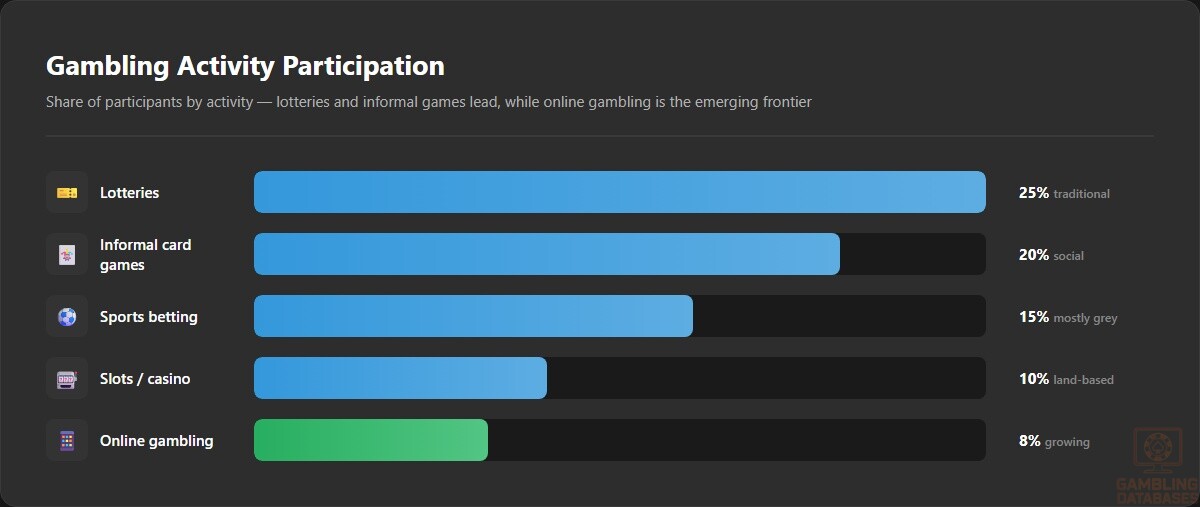
The most popular gambling activities in Tajikistan include traditional lotteries, informal card games, sports betting, and gradually increasing online gaming participation. The land-based casino segment remains small but stable. Sports betting is gaining traction mainly through unregulated channels.
- Traditional lotteries (participation approx. 25%)
- Informal card games and local betting (20%)
- Sports betting (15%)
- Slot machines and casino play (10%)
- Online gambling (growing, currently 8%)
Consumer Behavior Patterns
Players typically engage in short, frequent sessions, favoring mobile platforms over desktop due to accessibility. Spending is cautious but consistent, with a preference for low-stake games and sports betting. Retention depends heavily on localized content, language support, and flexible payment methods. Peak gaming times are evenings and weekends, aligning with global consumer behavior trends.
Section 3: Technology Infrastructure and Business Environment
Internet and Digital Infrastructure
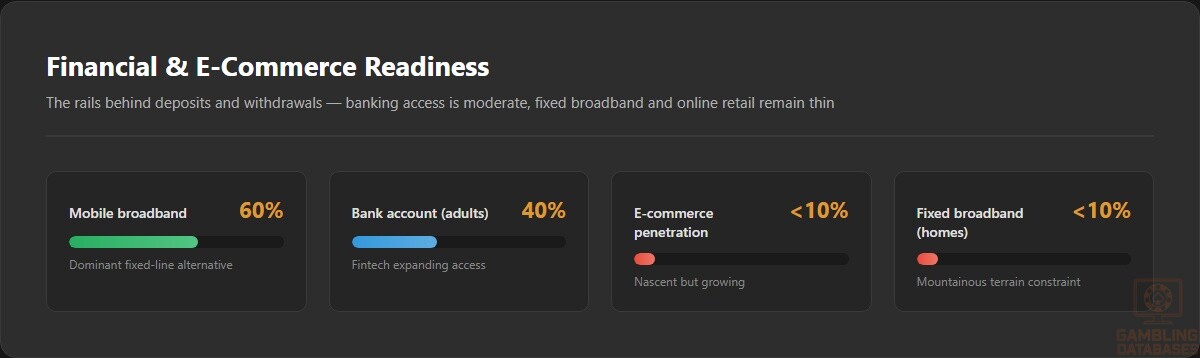
Tajikistan’s internet penetration stands at approximately 65%, with a growing but uneven distribution favoring urban centers. Fixed broadband remains limited, with less than 10% household coverage, whereas mobile broadband dominates with over 60% penetration. Average internet speeds are modest, typically ranging between 8 to 12 Mbps for fixed connections and slightly lower for mobile, hampered by infrastructure constraints and mountainous terrain.
Investment in digital infrastructure has been increasing, supported by international development initiatives aimed at improving backbone connectivity and rural access. Internet reliability varies considerably between urban and rural regions, with power outages and network instability common challenges in remote areas. Overall, the sector is in early stages of modernization, with significant room for improvement to meet growing demand from digital sectors including iGaming.
5G and Future Technology Deployment
5G technology deployment in Tajikistan is in its infancy, with pilot projects launched by select mobile operators in Dushanbe and surrounding urban areas. Nationwide coverage is not expected until 2027-2028 with phased expansion plans targeting business districts and densely populated zones first. Network operators are investing in upgrading infrastructure to support increased data capacity and enhanced mobile experiences, laying groundwork for future digital economy growth.
Current telecom regulations are supportive of 5G technology, facilitating foreign partnerships and spectrum auctions. The government recognizes 5G as a priority for advancing sectors like e-commerce, education, and gaming, despite budgetary and logistical challenges inherent to the mountainous geography.
Mobile Technology Ecosystem
Mobile Network Infrastructure
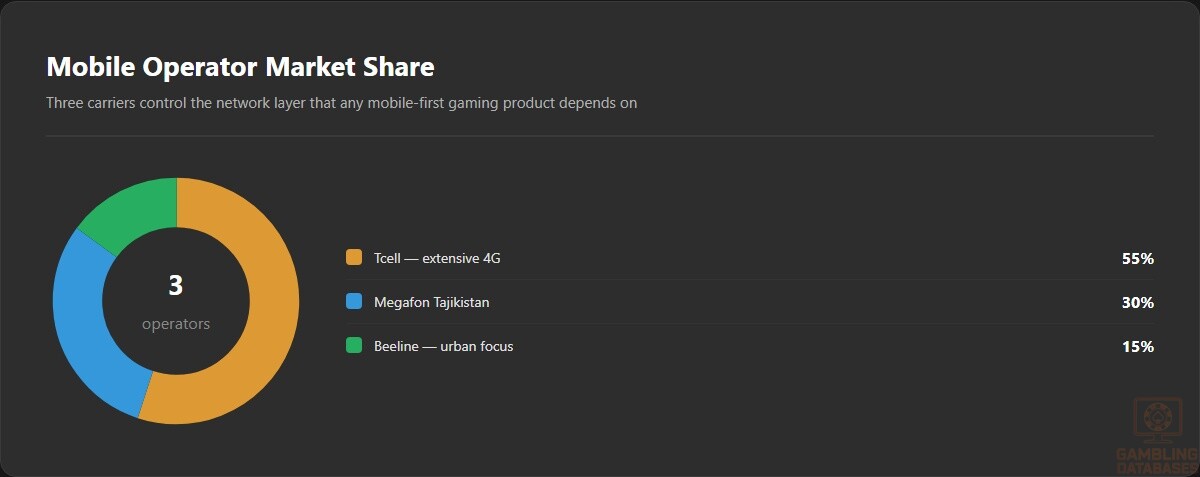
The mobile telecommunications sector is dominated by three major operators, providing extensive coverage across urban and semi-urban areas. Data costs remain moderately high relative to income levels but steadily trending downward due to market competition and foreign investment. Mobile networks primarily utilize 3G and 4G LTE technologies, with 4G coverage estimated at 56% nationwide.
- Tcell – Market leader with approximately 55% share, extensive 4G coverage
- Megafon Tajikistan – Second largest operator, holding 30% market share
- Beeline Tajikistan – Covering 15%, focused on urban centers
Device Penetration
Smartphone penetration is growing rapidly, reaching close to 70% of mobile users in urban areas. Android dominates the mobile OS market due to affordability and broad app ecosystem, while iOS holds a minority share among premium users. Device usage patterns show a preference for mid-range smartphones with adequate performance to access online gaming platforms and multimedia content.
Financial Services and Payment Infrastructure
Banking System Structure
The banking sector is composed of multiple established banks, many with regional or international ties. Adoption of digital banking services is on the rise, spurred by young urban populations. Account penetration remains moderate, with approximately 40% of adults holding formal bank accounts. The growth of mobile banking and fintech solutions is expanding access to financial services, especially for younger demographics.
- National Bank of Tajikistan – Central institution overseeing monetary policy
- Orienbank – Largest commercial bank with diversified digital offerings
- Agroinvestbank – Focused on SME and agricultural financing
- Tajik Industrial Bank – Corporate banking leader with expanding retail services
- Eskhata Bank – Known for digital innovations and youth banking products
Payment Processing Options
Payment infrastructure supports a variety of methods suitable for iGaming operators, though fintech adoption varies in sophistication. Bank card usage (Visa and Mastercard) is the primary method for online payments. Mobile money services backed by telecom operators are increasingly popular, particularly in urban settings. Local e-wallets and third-party payment processors offer alternative routes, but merchant acceptance and international remittance options remain limited. Cryptocurrency use is emergent but is hindered by regulatory uncertainty.
- Visa and Mastercard – Widely accepted for online transactions
- Mobile Money Wallets (Tcell Pay, Beeline Wallet) – Growing user base
- Bank Transfers – Common for higher-value payments and withdrawals
- Local E-wallets (Click, PayMe) – Regional fintech options expanding rapidly
- Cryptocurrencies (Bitcoin, Ethereum) – Niche but growing adoption
E-commerce and Digital Economy
Tajikistan’s e-commerce sector remains nascent but expanding steadily as internet access improves, with online retail penetration estimated at under 10%. Digital services encompassing ridesharing, food delivery, and mobile financial services are gaining traction, generating consumer familiarity with online payment ecosystems. Consumer trust remains a barrier, driven by concerns over transaction security and delivery logistics, though urban youth are more receptive to digital commerce.
The government is promoting digital economy initiatives, including electronic trade and payment infrastructure development, to stimulate economic diversification and enhance access to global markets.
Business Environment and Regulatory Framework
Ease of Business Operations
Tajikistan scores low on the World Bank’s Ease of Doing Business ranking, reflecting challenges in regulatory complexity, property registration, and contract enforcement. Registration processes often involve bureaucratic delays, though reforms are underway to streamline procedures and digitize services. Foreign investment policies provide avenues for entry but are subject to rigorous approval processes and sector-specific restrictions.
Corporate Structure and Registration
Common corporate entity options include Limited Liability Companies (LLCs), Joint Stock Companies (JSCs), and representative branch offices of foreign businesses. LLCs are the most favored for iGaming due to simpler governance and limited liability protections. Branch offices offer a presence without creating a separate legal entity but are subject to local regulation compliance.
- LLC – Flexible structure with local management and foreign ownership allowed
- Joint Stock Company – Suitable for larger ventures with share capital requirements
- Branch Office – Foreign company representation with limited operational scope
- Individual Entrepreneur – Small-scale business option without separate legal personality
- Representative Office – Marketing and liaison activities without commercial operations
Registration Requirements
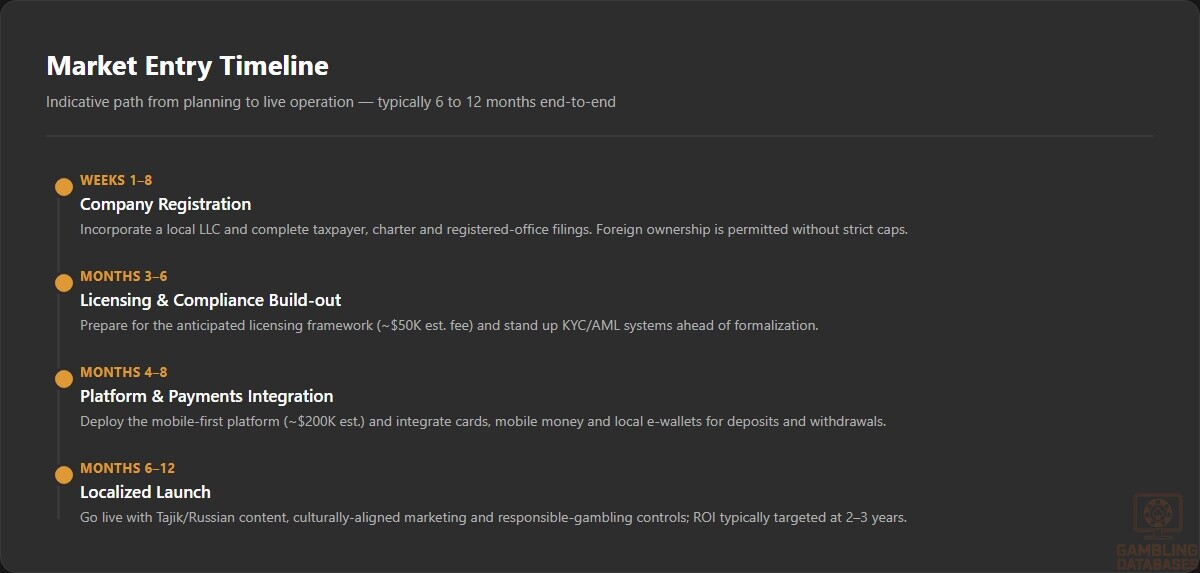
Registration timelines range between 4 to 8 weeks depending on entity type and documentation completeness. Costs include state fees and service charges, varying by region but generally affordable. Foreign ownership is permitted without strict restrictions, though sensitive sectors require government approval. Compliance mandates include tax registration, social security contributions, and obtaining necessary licenses for operations.
- Application form submission
- Charter documents and memorandum preparation
- Proof of registered office address
- Shareholder identification and notarized powers of attorney
- Taxpayer identification registration
Taxation Framework
Corporate Income Tax Structure
The standard corporate income tax rate is 15%, applying to all business sectors including iGaming. Special economic zones offer preferential tax treatments, including exemptions or reduced rates for up to five years. Tajikistan has signed treaties to avoid double taxation with several countries, facilitating foreign investment and cross-border business activities.
- Russia
- China
- Uzbekistan
- Kazakhstan
- Turkey
Personal Income Tax
Personal income tax rates are progressive, ranging from 8% to 13%, with withholding requirements for employment and contractor payments. Social security contributions are mandatory and calculated based on gross salaries. Tax residency is determined by physical presence exceeding 183 days annually or habitual residence criteria.
Market Entry Considerations
Recommended Entry Strategies
Successful market entry requires a multifaceted approach balancing regulatory compliance, partnership development, and technology adoption. Key strategies include collaborating with local entities for regulatory navigation, leveraging mobile-first platforms to capture young demographics, and integrating diverse payment methods to cater to preferred consumer behaviors.
- Establish local partnerships or joint ventures
- Focus on mobile and social gaming platforms
- Implement robust KYC and AML compliance systems
- Diversify payment options including e-wallets and mobile money
- Align marketing with cultural sensitivities and language preferences
Typical Costs and Timelines
Estimated initial capital outlay includes licensing fees around $50,000, company registration costs near $5,000, and technology platform setup expenses upwards of $200,000. Operational costs emphasize marketing, compliance, and payment processing overhead. Market entry timelines often span 6 to 12 months from planning through full launch.
| Cost Category | Estimated Amount (USD) |
|---|---|
| Licensing and Registration | $55,000 |
| Technology Platform Setup | $200,000 |
| Marketing and Promotion | $75,000 |
| Compliance and Legal | $40,000 |
| Operational Expenses (first year) | $150,000 |
Success Factors and Challenges
Key success factors include deep understanding of regulatory changes, strong local partnerships, technology adaptability, and effective consumer engagement. Challenges revolve around regulatory ambiguity, infrastructure limitations, payment processing complexities, and cultural barriers to gambling acceptance.
- Regulatory compliance agility
- Tailored marketing to local culture
- Adapting to evolving payment landscapes
- Ensuring platform mobile optimization
- Building consumer trust and responsible gambling measures
Exit Strategy Planning
Market liquidity for iGaming operators remains limited, with ownership transferability constrained by licensing conditions and regulatory consent requirements. License transfers require government approval and are not guaranteed, emphasizing the importance of stable long-term operational planning. Valuation multiples are still developing as the market matures alongside regulatory stabilization.
FAQ: Frequently Asked Questions
1. Is online gambling legal in Tajikistan?
Online gambling operates largely in a regulatory grey zone in Tajikistan. While no specific legislation explicitly legalizes or prohibits online gaming, the absence of a formal licensing framework means most digital operators function unofficially. The government is considering regulatory reforms, but current enforcement focuses primarily on land-based illegal gambling rather than online platforms. Consumers access offshore sites freely, though operators face uncertain legal risks.
2. What types of gambling licenses are available and what do they cover?
Currently, Tajikistan does not have a formal licensing structure for gambling encompassing iGaming. Existing licenses primarily cover limited land-based operations such as lotteries and select casino venues. Discussions are underway to create a licensing framework that may include separate permits for online betting, casino games, and sports wagering. Until officially enacted, operators lack clear guidance on license categories or scopes.
3. How much does an iGaming license cost and how long does it take to obtain?
Although no official iGaming licensing exists yet, preliminary estimates suggest application fees around $50,000. Processing timelines for prospective licenses are projected between three to six months, depending on regulatory development and completeness of documentation. Early entrants may face additional due diligence, and timelines could extend amid evolving legislative conditions.
4. Can foreign companies obtain a gambling license?
Foreign companies are expected to be eligible for licensing once frameworks are formalized, provided they satisfy financial, operational, and compliance criteria. They will likely need to establish local representation or partnerships to facilitate regulatory oversight. Restrictions on foreign ownership have not been formally proposed but may be introduced to safeguard national interests.
5. What are the tax obligations for iGaming operators?
Operators are expected to pay corporate income taxes at the standard rate of 15%, alongside a proposed gross gaming revenue tax around 20%. Licensing fees and regulatory levies will add to the fiscal burden. Compliance with tax reporting, including gross revenue declarations and withholding tax responsibilities, will be mandatory once legislation is enacted.
| Tax Type | Rate |
|---|---|
| Corporate Income Tax | 15% |
| Gross Gaming Revenue Tax | 20% |
| License Fee (Annual) | Approx. $50,000 |
| Withholding Tax on Winnings | 10-15% |
6. Are gambling winnings taxed for players?
Currently, player winnings are not subject to explicit taxation, though future regulation may introduce withholding taxes above specified thresholds. The government is likely to adopt policies ensuring transparency and traceability of high-value transactions for tax purposes. Players should anticipate potential reporting and withholding obligations as frameworks mature.
7. What are the typical operational costs for running an online casino/sportsbook?
Operational costs encompass licensing, regulatory compliance, platform technology, marketing, payment processing, and support services. Marketing expenses are significant to build brand awareness in a nascent market. Compliance involves ongoing KYC/AML systems and reporting. Payment fees vary depending on method but can impact margins substantially.
- Platform development and maintenance
- Marketing and customer acquisition
- Payment gateway and transaction fees
- Compliance and legal services
- Customer support and operations
8. What is the expected ROI timeline for entering this market?
Return on investment is typically expected within two to three years, factoring in regulatory uncertainty and market development pace. Initial capital outlays are significant, but growth potential is favorable in urban segments. ROI depends on effective local adaptation, payment integration, and competitive differentiation.
9. What are the local presence requirements for operators?
Currently, no formal local presence or office mandates exist. Future regulations may require operators to register a local entity or appoint a resident representative. Local presence is likely to facilitate compliance, dispute resolution, and regulatory liaison, enhancing operational legitimacy.
10. What payment methods are available and recommended?
Recommended payment options include bank cards (Visa, Mastercard), mobile money wallets, and local e-wallets offering ease of use and consumer trust. Bank transfers remain a viable option for large transactions, while cryptocurrency is an emerging method appealing to niche users. Multi-method availability enhances user retention and reduces friction.
11. What are the advertising and marketing restrictions?
Advertising is subject to regulation limiting promotions to licensed operators and prohibiting certain media channels. Sponsorships require compliance with content restrictions and time limits. Operators must align marketing messaging with cultural norms and emphasize responsible gambling. Enforcement intensity is expected to rise with regulatory formalization.
12. What responsible gambling measures are mandatory?
Mandatory measures anticipated include age verification, self-exclusion options, deposit limits, warning messages about addiction risks, and customer support for problem gambling. Operators must implement KYC/AML standards and enable user control features to align with international best practices and future regulatory mandates.
- Age verification protocols
- Self-exclusion system implementation
- Deposit and loss limit settings
- Consumer education about risks
- Access to customer support services
13. How large is the iGaming market and what is the growth potential?
The market is estimated at approximately $25 million in revenue for 2024, with steady growth projected at 7% CAGR through 2028. Expansion drivers include increasing internet penetration, mobile device adoption, and growing urban disposable incomes. Market size remains small compared to regional peers but poised for acceleration as legislative clarity emerges.
14. Who are the main competitors and what is their market share?
The market comprises few licensed operators primarily in land-based gambling and state lotteries. Offshore operators dominate online activity, serving predominantly unregulated consumer segments. No major international iGaming firms have formally launched with licenses, resulting in a fragmented competitive landscape with opportunistic entries and unclear market shares.
15. What are the player preferences and typical spending patterns?
Players favor sports betting and lottery games, with increasing interest in mobile casino games among younger demographics. Spending is cautious, with monthly ARPU around $18, concentrated in evening and weekend sessions. Preferences lean towards mobile-compatible platforms offering local language support and diversified payment methods.
16. What are the key success factors and main challenges for new entrants?
Success depends on navigating regulatory evolution, building trust through local partnerships, and deploying technologically adaptive platforms. Cultural acceptance, payment method diversity, and responsible gambling adherence are vital. Challenges include infrastructure limitations, regulatory uncertainty, payment processing hurdles, and limited digital literacy in rural areas.
- Strong local regulatory expertise
- Mobile-first user experience
- Robust compliance systems
- Adaptive payment processing
- Engagement with cultural nuances
Sources and References
- Tajikistan Gambling Regulatory Authority – Official Website
- National Statistical Office – Population and Economic Data 2024
- Central Bank of Tajikistan – Financial Statistics and Reports
- Ministry of Finance – Tax Regulations and Guidelines
- World Bank – Doing Business Report 2024
- International Telecommunication Union – ICT Statistics
- Gaming Industry Report – Global iGaming Market 2024
- Tajikistan Ministry of Communications – Digital Development Strategy
- Telekom Review – Mobile Market Analysis Tajikistan 2025
- Banking Sector Annual Report – Tajikistan 2024
- Local E-Wallet Providers Market Data – 2025
- Tajikistan Taxation Office – Corporate and Personal Tax Guide 2024
- International Monetary Fund – Tajikistan Economic Overview 2024
- Region Telecommunication Trends Report – CIS 2025
- Responsible Gambling Foundation – Central Asia Reports – 2024
- International Gaming Standards – Compliance Frameworks – 2024
- Central Asia E-commerce Study – 2025
- National Digital Literacy Survey – Tajikistan 2024
- Ministry of Industry and Commerce – Business Registration Guidelines – 2025
- Global iGaming Market Outlook – 2025 Edition
- World Bank ICT Infrastructure Index – 2024
- Telecommunications Development Plan – Tajikistan 2025-2030
- Local Market Entry Case Studies – Central Asia 2025
- International Tax Treaties Database – Tajikistan
- Digital Payment Trends – Tajikistan 2025
- Gambling Addiction Support Programs – Tajikistan Health Ministry – 2024
- Urbanization and Demographic Trends – Tajikistan Statistical Bureau – 2025
- Foreign Investment Policy Reports – Tajikistan 2025
- Mobile Device Market Analysis – Tajikistan 2024
- Cryptocurrency Usage Reports – Central Asia 2025
- Legal Analysis Reports on Tajikistan iGaming – Regional Legal Publishers – 2025
- Market Research on Tajikistan Consumer Behavior – 2025