
Syria presents a tightly restricted iGaming market environment due to comprehensive legal prohibitions rooted in social, religious, and political factors. The only legal gambling activity currently allowed is the government-run national lottery managed under strict state control.
Despite these constraints, there is a significant underground demand for online gambling services accessed through offshore platforms, primarily circumventing legal restrictions via VPNs. Understanding Syria’s regulatory environment remains essential for any market entry strategy.
Executive Summary: Key Market Indicators
| Metric | Value |
|---|---|
| Population | 17 million |
| Legal Gambling Status | All forms banned except state lottery |
| State Lottery Operator | Ministry of Finance |
| Online Gambling Legality | Prohibited; strict enforcement |
| Licensed Operators | None; illegal to operate |
| Market Type | Underground illegal betting and offshore gamblers |
| Internet Penetration | Approximately 45% |
| Mobile Phone Penetration | Over 70% |
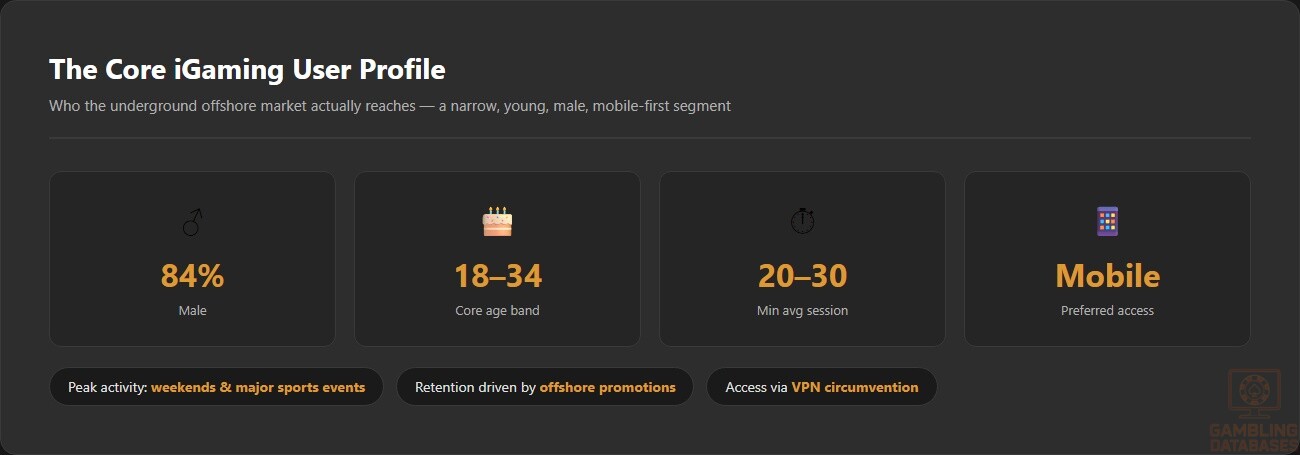
| Core iGaming Demographic | Aged 18-34, predominantly male (84%) |
| Popular Game Types | Slots, sports betting, live casino (offshore) |
| Payment Methods Used | Syrian Pound, e-wallets, cryptocurrencies |
| Regulatory Authority | Ministry of Interior (enforcement), Ministry of Finance (lottery) |
| License Availability | None; government does not issue permits |
| Licensing Costs | Not applicable |
| Taxation on Gambling Operators | None; illegal activity |
| Taxation on Players | No legal framework; winnings presumed taxable if legal |
| Market Size (Estimated) | Unknown (100% underground) |
| Revenue Projections | Unavailable due to law and market opacity |
| Market Growth Forecast (CAGR) | Not applicable legally |
| Average Revenue Per User (ARPU) | Not available |
| Entry Barriers | Strict legal prohibition, severe penalties |
| Penalties for Illegal Gambling | Fines, imprisonment, asset confiscation |
| Recent Enforcement Actions | 2024 crackdown on illegal „Ichancy“ network |
| Expected Regulatory Changes | None in near future |
| Business Environment Stability | Highly unstable due to ongoing conflict |
| Technology Infrastructure | Internet ongoing expansion constrained by sanctions |
Section 1: Regulatory Framework and Legal Environment
Current Gambling Regulation Status
Syria’s gambling legal framework is characterized by strict prohibitions on almost all forms of gambling. Grounded in conservative Islamic principles and reinforced by political instability, the legal environment forbids private casinos, sports betting, slot halls, and online gambling operations. The only exception is a state-run lottery administered by the Ministry of Finance, which operates under stringent government control.
The ban extends comprehensively to online gambling, with authorities enforcing strict measures to block access to offshore gambling sites. Internet service providers are mandated to restrict access, and users circumventing these controls using VPNs or other technologies risk legal repercussions. Despite the prohibition, illegal land-based and online betting persists underground, indicating strong consumer demand within the population.
Land-Based Gambling Activities
Traditional land-based gambling venues, including casinos and sports betting shops, do not legally operate in Syria. Previously, before the onset of conflict in 2011, limited casino operations existed, primarily in hotels catering to tourists, but these have been closed or destroyed due to ongoing violence and government crackdowns.
Slot machine halls and betting shops are also prohibited, and any such establishments discovered face immediate closure and legal penalties. Law enforcement agencies actively raid illegal operations with strict punitive measures, including imprisonment and asset seizures for offenders.
Online Gambling Framework
The online gambling sector in Syria lacks any legal recognition or regulatory framework. The government forbids all domestic online gambling activities, viewing them as criminal offenses. No licenses are issued, and there is no regulatory body overseeing digital gaming compliance or consumer protection.
Financial transactions related to gambling are highly scrutinized. Strict enforcement includes blocking websites, surveillance of illegal operators, and criminal prosecution of individuals involved in online gambling facilitation or participation. Despite enforcement efforts, players frequently use offshore platforms, predominantly international brands, accessed via VPNs, reflecting a growing underground iGaming market.
Licensed Operators and Market Players
There are no licensed gambling operators in Syria, legal or otherwise, due to the total ban on private gambling operations. The competitive landscape is essentially an unregulated underground market dominated by offshore operators targeting Syrian players. These operators include some of the largest global iGaming companies offering casino games, sports betting, and poker to Syrian customers through international platforms.
The absence of local licensing and regulation creates an environment of significant legal risk for operators and players alike. Market entry purely based on legal authorization is currently unfeasible, with any involvement in the gambling sector exposing participants to severe penalties.
Licensing Framework and Requirements
Application Process and Eligibility
Since Syria does not permit private gambling operations, there is no formal licensing process for either land-based or online gambling entities. No applications, eligibility criteria, or approvals exist for iGaming operators. Government authorities explicitly withhold licenses as gambling is illegal under national law.
The regulatory control of gambling falls under the Ministry of Finance for the state lottery and the Ministry of Interior for enforcement and prohibition of unauthorized gaming activities. There are no technical standards or financial requirements established for private operators because private gambling is banned outright.
Local Presence and Operational Requirements
Given the illegality of private gambling, Syria imposes no formal requirements related to local presence, physical offices, or operational mandates for gaming companies. Foreign ownership restrictions and partnership obligations are moot since no legal market infrastructure exists.
Companies attempting to enter the Syrian market in any gaming capacity must operate entirely offshore and without any Syrian domestic licensing or oversight. This effectively deters legitimate market entry and fuels underground operations with no regulatory safeguards.
Compliance Obligations and Monitoring
Player Protection and Identification
Without a legal gambling framework, Syria does not enforce structured player protection or responsible gaming programs. Age restrictions exist solely for the legal state lottery, which mandates a minimum age of 18 years, including formal identification verification for lottery players.
For illegal gambling activities, enforcement is punitive rather than protective. The state imposes penalties on operators and participants rather than providing consumer safeguards such as self-exclusion or problem gambling controls. Consequently, illegal operators do not implement internationally recognized KYC or AML practices.
- Legal minimum gambling age set at 18 for state lottery
- No formal KYC/AML enforcement in underground gambling
- No responsible gambling mandates for illegal operators
- Law enforcement prioritizes raids over player protection
- Age verification enforced for state lottery only
Financial Monitoring and Reporting
Syria has no established financial monitoring or reporting requirements for gambling due to its total ban on the sector. The Ministry of Finance oversees the state lottery’s financial accountability, ensuring government revenue generation and compliance with fiscal requirements.
Illegal gambling lacks any formal audit or reporting mechanisms. Financial transactions linked to gambling are monitored by security agencies as part of anti-money laundering and illegal activity investigations. Prosecution processes involve collecting evidence from transaction records, but no standardized regulatory reporting applies to operators.
- Illegal gambling financially monitored by security agencies
- Prosecution involves seizure of cash and financial assets
- No formal regulatory audits for underground operators
- State lottery subject to government financial reporting
Taxation Structure and Financial Obligations
Player Taxation
Since all gambling is illegal except the state lottery, there is no formal taxation on gambling winnings for players. In a hypothetical licensed market, winnings might be subject to taxation, but this does not apply under the current legal regime. Players are technically engaging in a criminal act when gambling privately or online offshore.
Operator Taxation
Operators are not recognized by Syrian law and therefore do not pay gambling-specific taxes domestically. The state derives revenue only from the state lottery. Other financial levies, such as corporate income taxes or turnover taxes, theoretically apply only if operators have a lawful business presence in Syria, which is not the case.
| Tax Type | Rate / Status |
|---|---|
| GGR Tax on Operators | Not applicable (illegal) |
| Player Winnings Tax | Not applicable |
| Corporate Income Tax | Standard Syrian rate applies if legal entity exists |
| License Fees | Not available (no licenses issued) |
| Turnover Tax | Not applicable |
Gambling Market Financial Performance
Due to the prohibition and total underground status of Syria’s gambling market, official financial data is unobtainable. The state lottery remains the sole legal revenue source, but its scale is limited relative to the total underground betting activity within the population.
Government crackdowns on illegal networks, such as the 2024 arrest of the “Ichancy” platform operators, reveal the size and financial value of the unregulated market. Unofficial estimates suggest significant wager volumes occur offshore, but detailed revenue figures, payout ratios, or tax contributions remain undisclosed.
Advertising and Marketing Restrictions
Advertising of gambling is completely banned in Syria except for the state lottery, which is promoted primarily through government communication channels. Gambling advertising by private operators is illegal with no permissions for marketing or sponsorship activities.
The government closely monitors media to block gambling advertisements across television, radio, print, and online platforms. Content restrictions extend to all promotional tactics, prohibiting any form of inducements or bonuses advertised domestically.
- Gambling advertising banned except for state lottery
- No private operator marketing allowed
- Promotion restricted across all media channels
- Sponsorship of events by gambling entities prohibited
- Online gambling ads blocked by internet providers
Recent Regulatory Changes and Their Impact
The regulatory stance on gambling in Syria has remained consistently prohibitive with no liberalization developments expected. Recent years saw enhanced enforcement measures, culminating in notable actions like the 2024 crackdown on large illegal online gambling networks.
The absence of legislative reform preserves the status quo of strict bans, discouraging any formal market entry. Operators face heightened risks without prospect for legalization, driving all activity underground and complicating compliance or business strategy alignment.
Enforcement Mechanisms and Penalties
The Syrian government applies rigorous enforcement mechanisms against illegal gambling. Law enforcement agencies conduct regular raids, arrests, and asset seizures targeting illegal operators and participants alike.
Penalties include heavy fines, imprisonment, and confiscation of equipment or financial proceeds. Continued violations lead to escalating punitive measures, reinforcing deterrence and state control over gambling activities.
- Periodic raids by Ministry of Interior and police
- Criminal prosecutions including imprisonment
- Fines imposed on organizers and players
- Asset confiscations of illegal gambling operations
- Internet service blocking of gambling sites
Section 2: Demographics and Consumer Analysis
Population Demographics and Distribution
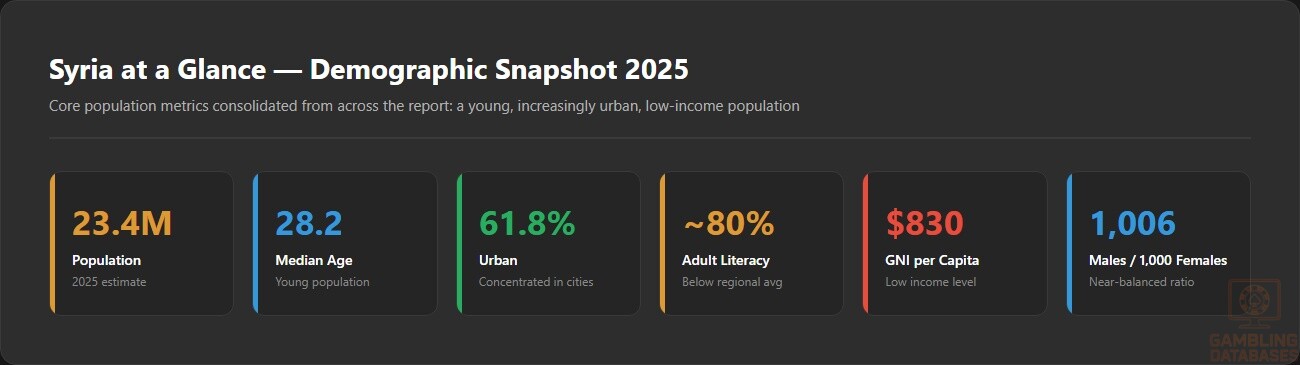
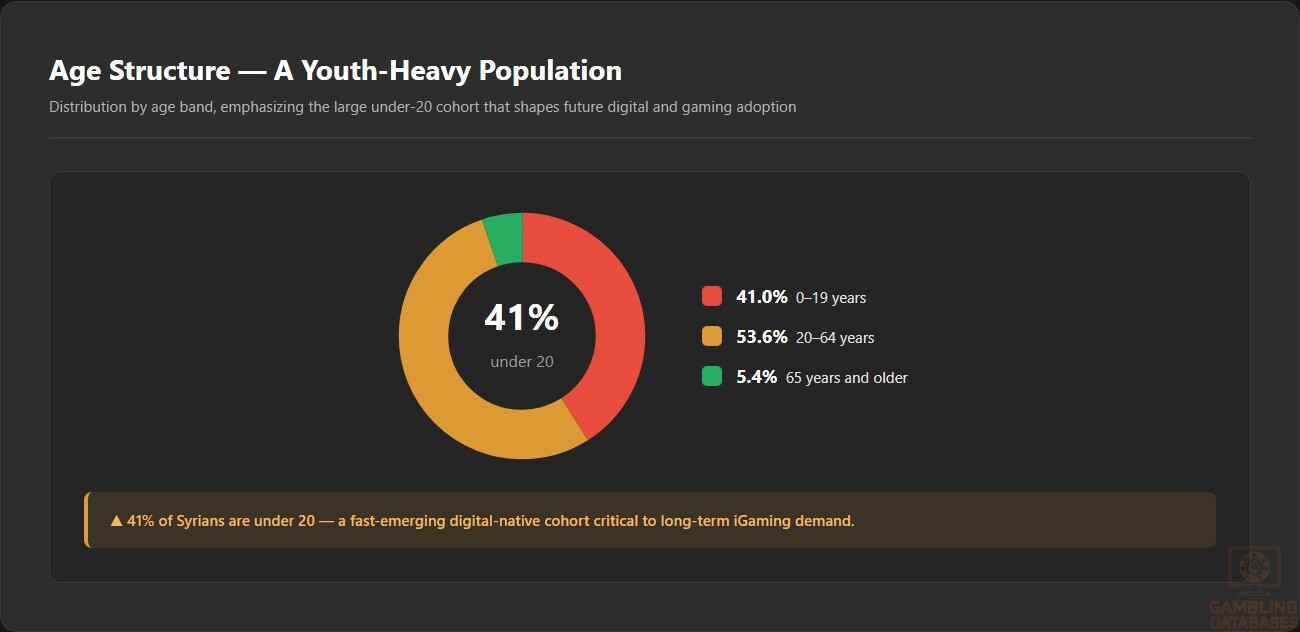
Syria’s estimated population in 2025 is approximately 23.4 million, with a median age of 28.2 years. The gender ratio is nearly balanced, with about 1,006 males per 1,000 females. The age distribution reveals a young population, where 41% are aged 19 or younger, constituting a significant youth demographic that could influence future digital behaviors.
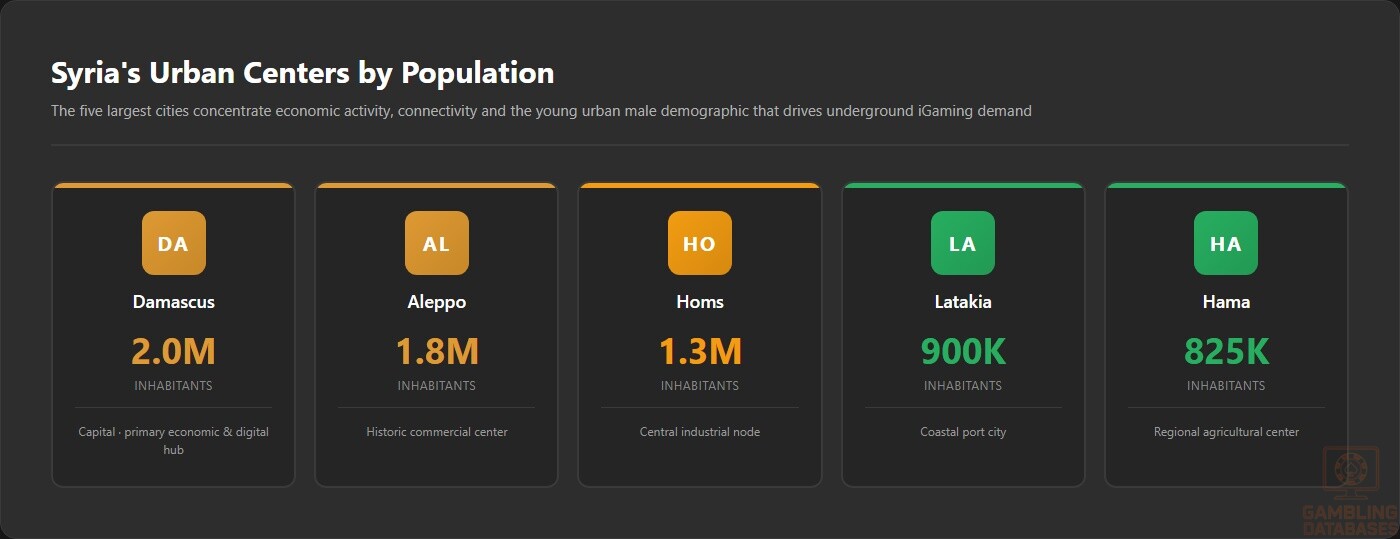
Urbanization has steadily increased, with approximately 61.8% of the population residing in urban areas. The concentration in cities like Damascus, Aleppo, and Latakia reflects centers of economic and social activity, presenting distinct differences in demographics and consumer behavior patterns compared to rural areas.
| Age Group | Percentage of Population |
|---|---|
| 0-19 years | 41.0% |
| 20-64 years | 53.6% |
| 65 years and older | 5.4% |
- Damascus: Approx. 2.0 million inhabitants
- Aleppo: Approx. 1.8 million inhabitants
- Homs: Approx. 1.3 million inhabitants
- Latakia: Approx. 900,000 inhabitants
- Hama: Approx. 825,000 inhabitants
Economic Indicators and Consumer Spending Power
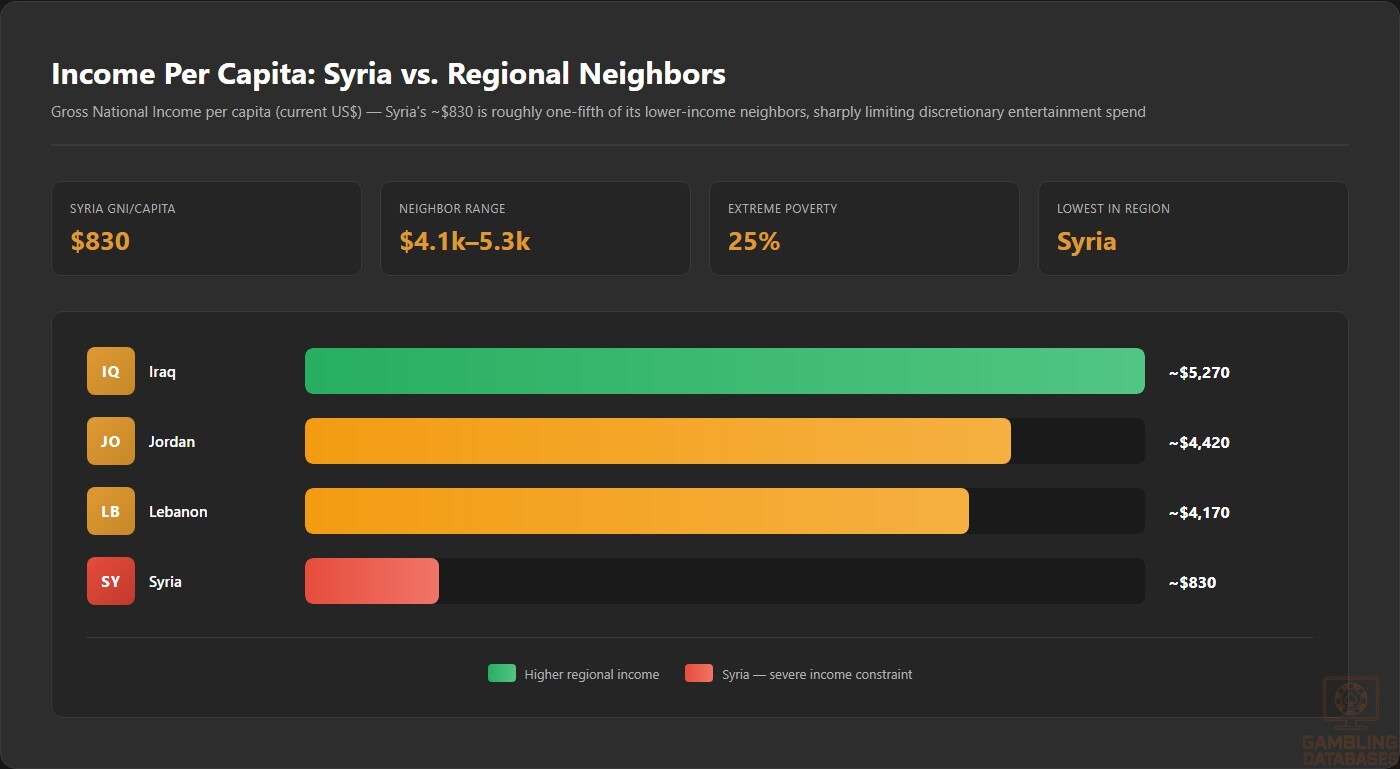
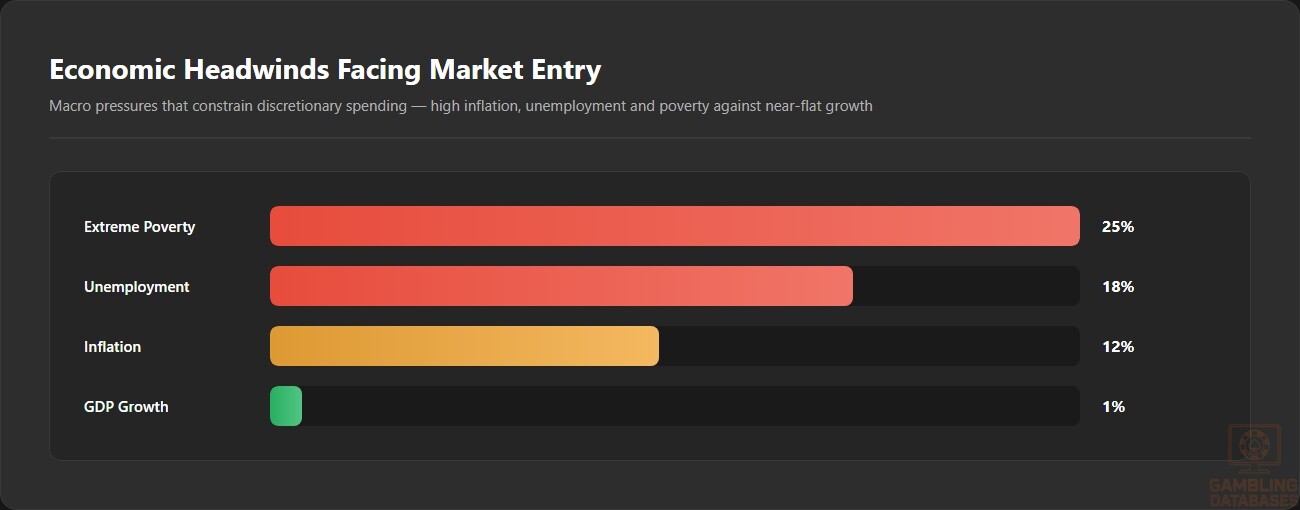
Syria’s economy continues to recover from prolonged conflict, with a modest GDP growth forecast of 1% in 2025 after contraction in previous years. The estimated Gross National Income per capita stands near $830, signaling low income levels and prevalent economic hardship affecting consumer spending.
Agriculture remains a component of the economy but the service sector predominates, accounting for over half of economic activity. Poverty remains a critical factor; nearly one in four Syrians live in extreme poverty, constraining discretionary spending potentials relevant to entertainment industries including iGaming.
| Indicator | Value |
|---|---|
| GDP Growth Rate | 1.0% |
| Gross National Income per Capita | $830 |
| Inflation Rate | 12% |
| Unemployment Rate | 18% |
| Extreme Poverty Rate | 25% |
Income distribution remains uneven with a significant portion of the population possessing constrained disposable income. Middle- and higher-income brackets are small, affecting market affordability for iGaming offerings that rely on discretionary spending and digital payments.
Education, Skills, and Digital Literacy
Literacy rates are below regional averages, impacted by years of conflict disrupting education. Approximately 80% literacy for adults is reported, with lower proficiency in rural zones. Digital literacy is emerging, especially among urban youth familiar with smartphones and internet platforms, but infrastructural challenges limit broader access.
Workforce skills emphasize basic digital competencies, with a young population increasingly exposed to mobile technology and social media. However, network disruptions and limited access to continuous education inhibit the rapid growth of high-level digital skills necessary for advanced gaming and technological use.
Cultural and Social Factors
Communication and Language
Arabic is the official and predominant language across Syria, used for all governmental, educational, and media communications. Kurdish and minority languages such as Armenian and Aramaic are present in specific communities but constitute a small overall share.
- Arabic (official, majority)
- Kurdish (minority regions)
- Armenian
- Aramaic
- Turkish (small communities)
Cultural Attitudes
Strong Islamic cultural and religious norms shape societal attitudes against gambling, contributing to its legal prohibition. Gambling is widely considered taboo, and social stigma surrounds participation, primarily channeling activity underground. Foreign brands have limited visibility but attract users digitally through offshore platforms, appealing mostly to younger urban populations.
Problem Gambling and Social Considerations
Given the illegality of gambling, formal data on problem gambling prevalence is unavailable. Social challenges include enforcement risks and lack of consumer protection. Government response is strictly punitive, focusing on eradication rather than support or rehabilitation.
- Legal prohibition and enforcement to curb gambling
- Public awareness of gambling risks is low
- Support services for problem gambling are virtually non-existent
- Social stigma limits open discussion
- Focus on law enforcement over harm reduction
Political Structure and Governance
Syria operates under a centralized authoritarian regime with ongoing conflict zones affecting governance consistency. Political instability challenges regulatory predictability and business environment stability. Despite tentative steps towards economic reform, the political climate remains high risk for foreign and digital market participants.
Technology Adoption and Digital Behavior
Internet and Digital Usage
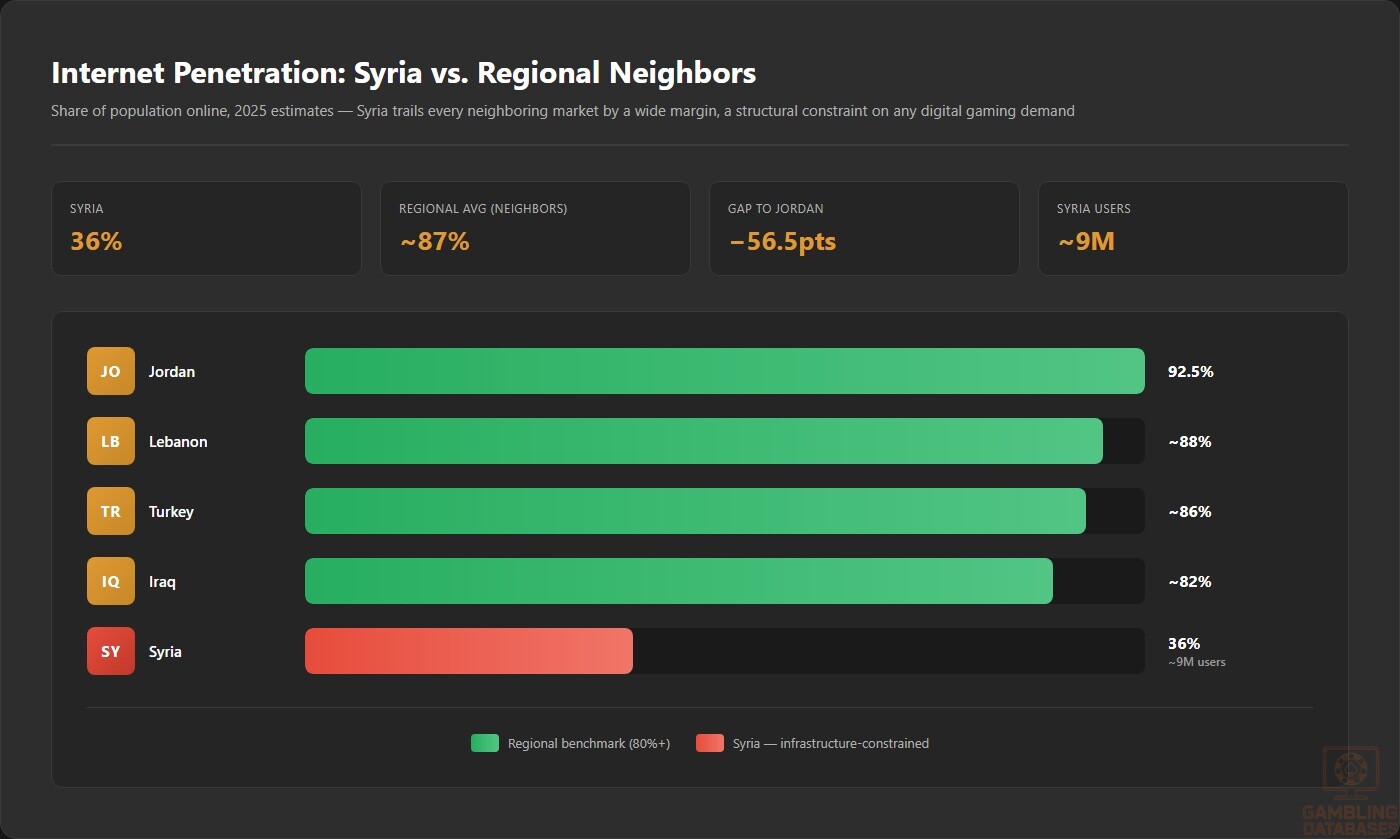
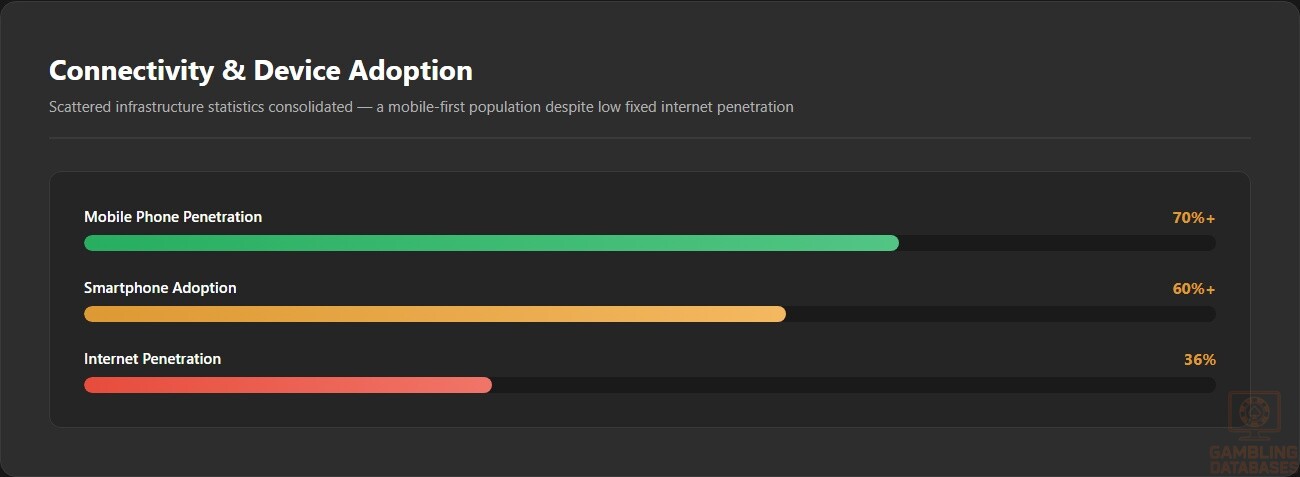
Internet penetration currently reaches approximately 35.8% of the population, representing around 9 million users. Growth is steady but constrained by infrastructure, censorship, and intermittent disruptions. Urban residents have better access and higher usage rates, enabling greater potential for online consumer engagement.
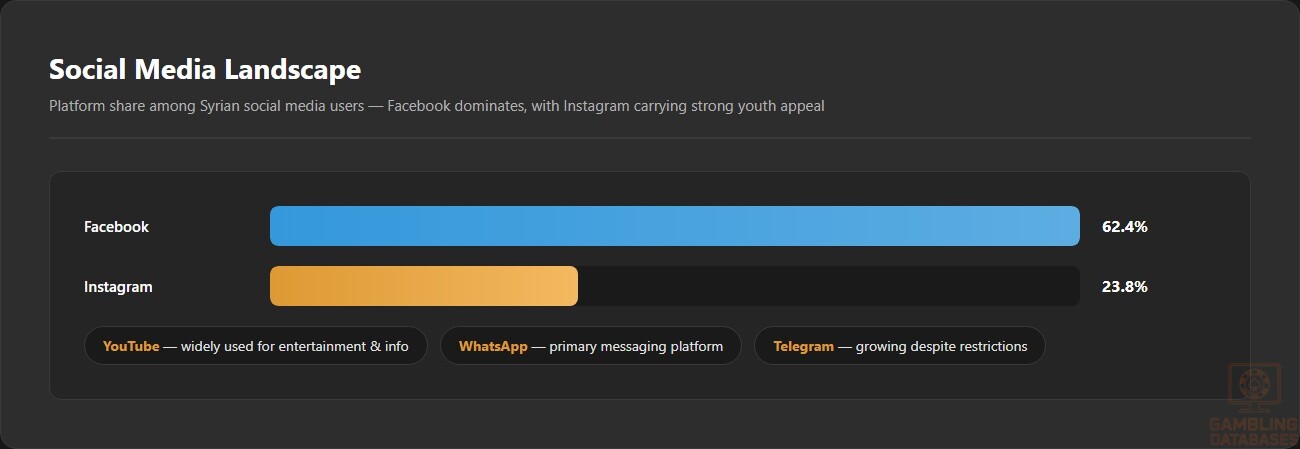
- Facebook: 62.4% market share among social media users
- Instagram: 23.8% penetration, strong youth appeal
- YouTube: Widely used for entertainment and information
- WhatsApp: Primary platform for messaging and communication
- Telegram: Growing in popularity despite restrictions
Digital Payment Behavior
Payment infrastructure is underdeveloped due to economic sanctions and banking challenges. Cash remains dominant, but digital wallets, cryptocurrencies, and informal remittance systems are gradually emerging, especially among tech-savvy youth engaging in cross-border online activities.
- Cash payments: Primary method, especially offline
- Syrian Pound transactions within limited banking system
- E-wallet usage emerging, driven by remittance platforms
- Cryptocurrency adoption growing among younger demographics
- International bank cards limited due to sanctions
Gaming and Gambling Preferences
Current Market Participation
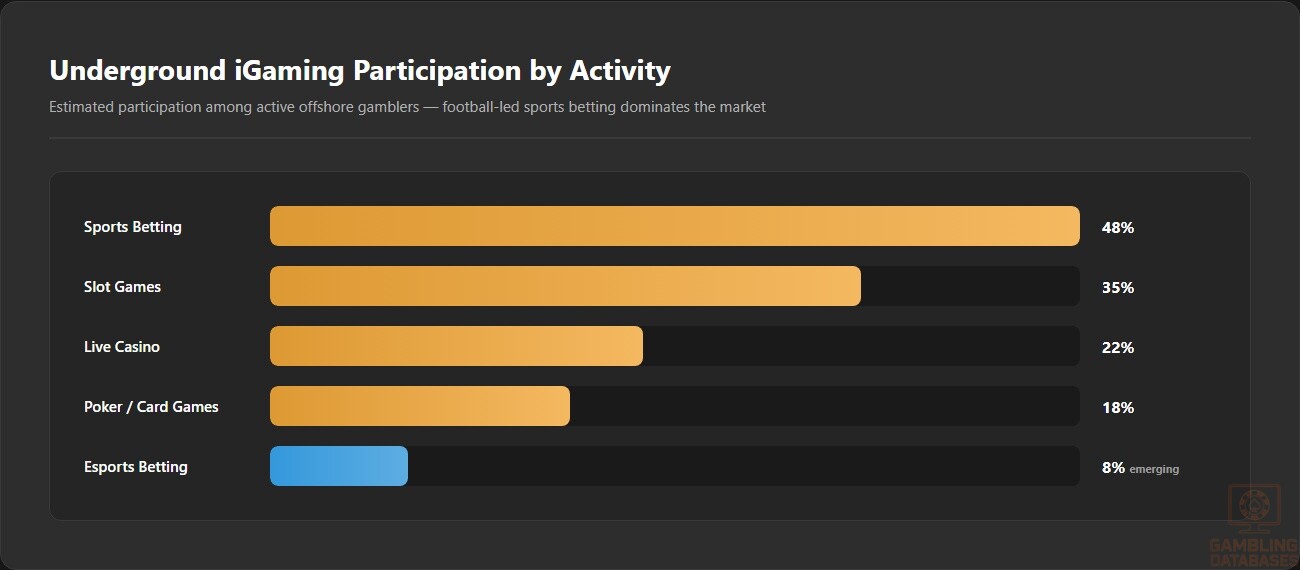
Despite legal restrictions, underground participation in online gambling and sports betting is notable, especially among urban males aged 18-34. Popular activities include betting on football, slots, and poker conducted through offshore platforms accessible via VPNs.
- Sports betting (football dominant)
- Slot games
- Live dealer casino games
- Poker and card games
- Esports betting (emerging niche)
| Activity | Estimated Participation Rate |
|---|---|
| Sports Betting | 48% |
| Slot Games | 35% |
| Live Casino | 22% |
| Poker/Card Games | 18% |
| Esports Betting | 8% |
Consumer Behavior Patterns
Syrian players demonstrate preference for mobile-accessible platforms due to widespread smartphone adoption. Peak betting activity occurs during weekends and major sports events. Session durations average 20-30 minutes, with repeat engagement driven by promotions from offshore operators. However, volatility in connectivity and economic constraints influence retention and spending behaviors.
Section 3: Technology Infrastructure and Business Environment
Internet and Digital Infrastructure
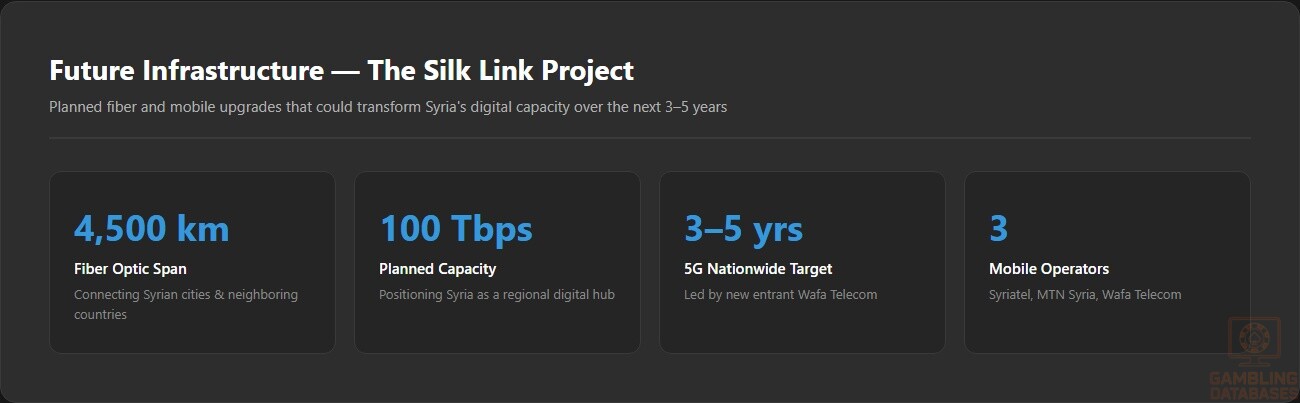
Syria’s internet penetration stands at approximately 36% in 2025, reflecting gradual recovery despite years of infrastructure damage. Broadband connectivity is limited, with a larger share of access provided through mobile networks. Average internet speeds remain modest but are expected to improve significantly as projects like the Silk Link fiber optic initiative expand regional capacity and bandwidth.
The Silk Link project, spanning 4,500 kilometers, aims to connect Syrian cities with fiber optic infrastructure, linking Syria internally and with neighboring countries. This will enhance data transmission speeds and reliability, positioning Syria as a future regional digital hub with 100 terabits per second capacity planned.
5G and Future Technology Deployment
Syria is actively advancing its telecommunications sector by reintroducing 5G services primarily through the new entrant, Wafa Telecom, which has exclusive 5G rights. Existing operators, Syriatel and MTN Syria, are upgrading to 4G and preparing for wider 5G rollout. Full 5G nationwide coverage is expected within the next 3-5 years, contingent on political stability and further infrastructure investment.
International telecom groups are participating in rebuilding efforts, signaling increased regional interest. However, ongoing challenges such as sanctions and disruption risks remain obstacles to accelerated deployment.
Mobile Technology Ecosystem
Syria’s mobile telecommunications market is served by three main operators: Syriatel, MTN Syria, and Wafa Telecom. Syriatel and MTN dominate the market with well-established GSM, 3G, and 4G LTE networks, while Wafa Telecom focuses on 5G deployment.
- Syriatel: Market leader with broad coverage and diverse service offerings
- MTN Syria: Significant market share with focus on broadband and data services
- Wafa Telecom: Newest entrant targeting 5G network expansion
- No established MVNOs currently active
- Prepaid and postpaid plans dominate consumer choice
Smartphone adoption exceeds 60%, driven by affordable Android devices with rising use of mobile internet for social media, e-commerce, and digital entertainment. Market preferences skew toward mid-range devices suitable for stable connectivity amid infrastructure challenges.
Financial Services and Payment Infrastructure
Syria’s banking sector comprises several main banks including the Central Bank of Syria, the Commercial Bank, and the International Bank. Many banks face significant liquidity and operational challenges due to sanctions and limited international access, constraining widespread adoption of digital banking services despite efforts to revitalize the sector.
- Central Bank of Syria: Key regulatory and monetary authority
- Commercial Bank: Leading provider for retail and corporate accounts
- International Bank: Handles foreign exchange and international payments
- Regional banks with focus on specific localities
- Emerging digital banks targeting young urban populations
Payment processing remains heavily cash-based, though e-wallets and remittance platforms are emerging particularly among younger users. Cryptocurrency adoption is increasing as a workaround for restricted access to international banking. Card penetration is low due to sanctions limiting use of global card networks.
- Cash payments dominate retail and informal sectors
- Local bank transfers used in business transactions
- E-wallet platforms growing on remittance and mobile payments
- Cryptocurrency gaining traction among tech-savvy users
- International credit/debit card usage limited by sanctions
E-commerce and Digital Economy
The e-commerce landscape in Syria is nascent but showing early signs of growth powered by social media-driven microenterprises. Popular platforms include localized WooCommerce sites and Facebook-based sales pages. However, low consumer trust, payment infrastructure gaps, and limited logistics constrain widespread adoption.
Most online stores have low sales volumes and visitor numbers, with the business, apparel, and health sectors driving most activity. Ongoing digital infrastructure enhancements and relaxed regulatory barriers offer potential for expansion in this growing sector.
Business Environment and Regulatory Framework
Syria ranks low in global ease of business rankings mainly due to political instability, bureaucratic complexity, and ongoing conflict impacts. Recent reforms aim to streamline registration processes but challenges remain, including inconsistent enforcement and limited institutional capacity.
Foreign investment is cautiously encouraged by the government, particularly in infrastructure and rebuilding sectors. Yet risks such as currency instability, corruption, and regulatory uncertainty persist, requiring careful due diligence and local partnerships for market entry success.
Company Registration Process
- Choose appropriate legal structure and register business name
- Submit registration with Ministry of Internal Trade and Consumer Protection
- Obtain commercial registration certificate and tax identification number
- Open corporate bank account and secure necessary permits
- Complete licensing for industry-specific operations
Registration timelines average from 4 to 8 weeks, depending on business type and completeness of documentation. Foreign companies are often required to establish joint ventures with local partners due to regulatory and operational complexities.
- Articles of Association and shareholder IDs
- Proof of capital deposit
- Lease agreements for premises
- Business plan for foreign investors
- Bank statements or guarantees
Taxation Framework
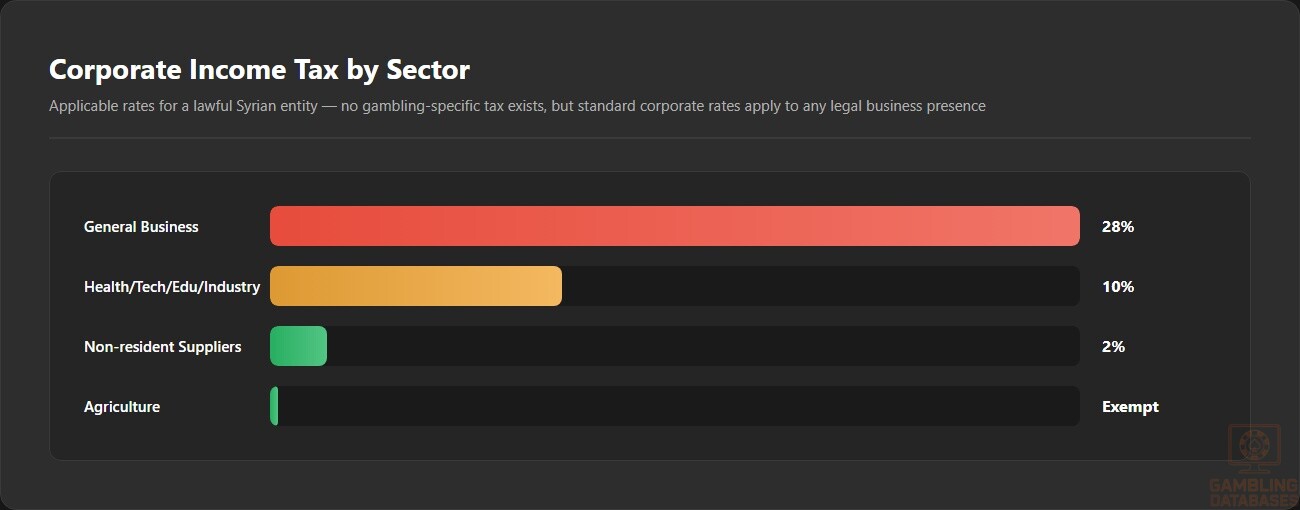
Syria’s corporate income tax rate is generally set at 28%, with planned reforms in 2026 aiming to simplify and modernize the system. Special lower rates and incentives exist for sectors like health, education, and technology, as well as exemptions for agriculture.
| Sector | Tax Rate |
|---|---|
| General Business | 28% |
| Health, Tech, Education, Industry | 10% |
| Agriculture | Exempt |
| Non-resident Suppliers | 2% |
Personal income tax is progressive with low thresholds; withholding tax and social security contributions are applied in accordance with residency status. Tax residency rules follow standard international criteria, but evolving legislation warrants close monitoring by foreign investors.
Market Entry Considerations
Optimal market entry strategies focus on forming partnerships or joint ventures with trusted local entities to navigate regulatory and operational landscapes. Leveraging offshore technology platforms is common given the lack of domestic gaming licenses. Focus areas include offering mobile-optimized services and cryptocurrency payment options due to local infrastructure limitations.
- Forming partnerships with local companies for compliance and market access
- Operating offshore with VPN access for consumers
- Utilizing mobile-first platforms for broad reach
- Exploring cryptocurrency payments to bypass banking constraints
- Investing in local digital infrastructure and user education
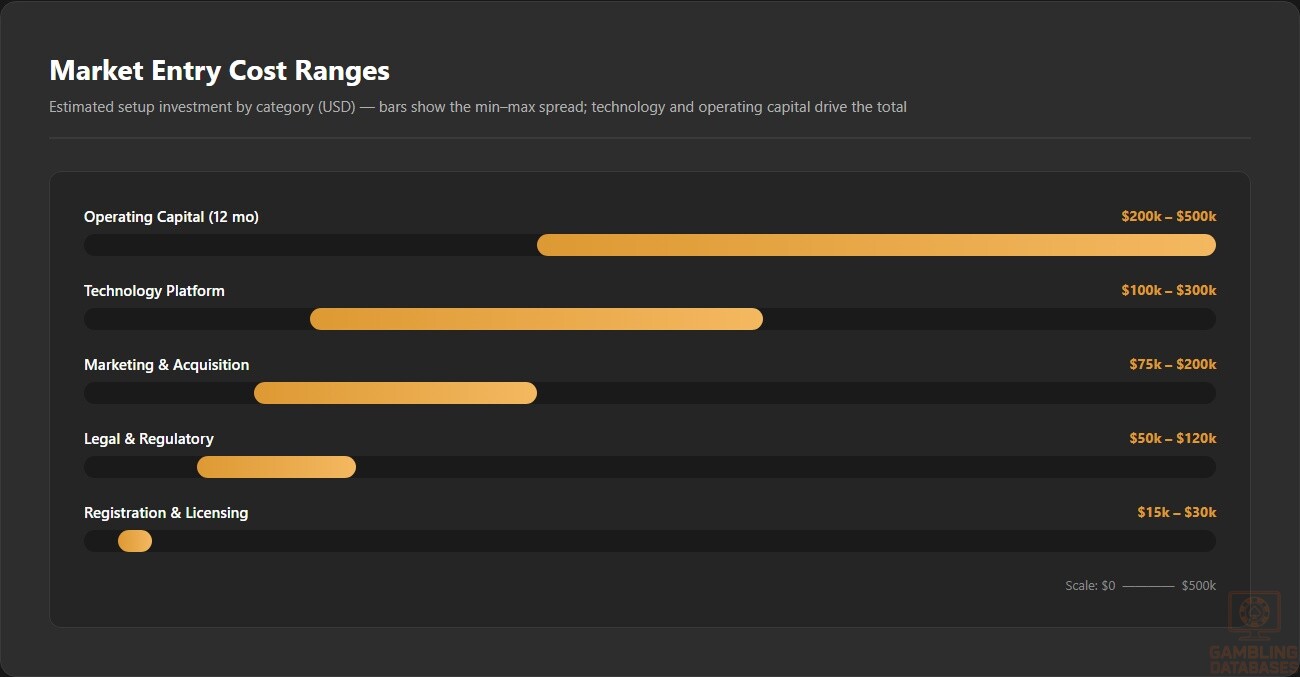
Market entry costs vary widely depending on legal, technical, and marketing expenditure but generally require considerable initial investment given risks and restrictions. Expected timelines to launch are typically 6 to 12 months, factoring setup, compliance, and infrastructure challenges.
| Cost Category | Estimated Range (USD) |
|---|---|
| Legal and Regulatory Consulting | $50,000 – $120,000 |
| Company Registration and Licensing | $15,000 – $30,000 |
| Technology Platform and Development | $100,000 – $300,000 |
| Marketing and Customer Acquisition | $75,000 – $200,000 |
| Operating Capital (12 months) | $200,000 – $500,000 |
FAQ: Frequently Asked Questions
1. Is online gambling legal in Syria?
Online gambling is strictly illegal under Syrian law. The government prohibits all forms of private gambling and enforces stringent measures to block access to unauthorized gambling sites. Only the state-run lottery is legally permitted. Participants and operators face severe legal penalties including fines and imprisonment.
2. What types of gambling licenses are available and what do they cover?
Syria does not issue gambling licenses to private operators. The sole legal gambling activity is the government-operated lottery. No licenses exist for land-based casinos, sports betting, or online gambling, reflecting the total prohibition framework in place.
3. How much does an iGaming license cost and how long does it take to obtain?
Since Syria does not grant iGaming licenses, there are no associated costs or formal timelines. Market entry through licensing is currently not feasible due to the legal prohibition of private gambling operations.
4. Can foreign companies obtain a gambling license?
Foreign companies cannot obtain gambling licenses in Syria due to the complete ban on private gambling. Any foreign involvement in gambling must operate offshore and outside Syrian jurisdiction, exposing them to legal and operational risks.
5. What are the tax obligations for iGaming operators?
As iGaming operators are not legally recognized in Syria, there are no domestic tax obligations on their operations. The government only taxes the revenue from the state lottery. Corporate income tax at standard rates applies to lawful businesses operating within Syria.
6. Are gambling winnings taxed for players?
There is no formal taxation of gambling winnings in Syria, since private gambling is illegal. The state lottery winnings are subject to regulatory oversight but do not carry specific taxes on players. Illegal winnings fall outside the legal framework.
7. What are the typical operational costs for running an online casino or sportsbook?
Operational costs include platform development, licensing and legal fees (where applicable), marketing, customer support, and payment processing. Entry into the Syrian market specifically involves high legal risk and costs related to compliance with prohibitive regulations, making cost estimates variable and generally high.
8. What is the expected ROI timeline for entering this market?
Given the illegal status of private gambling within Syria, ROI timelines are uncertain and risky. Offshore operators targeting Syrian players may see returns within 12 to 24 months depending on market penetration, regulatory enforcement, and operational costs.
9. What are the local presence requirements for operators?
Syria requires no local presence permits for private gambling since it is illegal. Any business wishing to operate legally must register with appropriate authorities for non-gambling activities and may require local partners for other sectors. Gambling operators must operate externally to avoid prosecution.
10. What payment methods are available and recommended?
Cash remains dominant within Syria, but digital payment services like e-wallets and cryptocurrencies are gaining traction online. International card use is limited due to sanctions. Cryptocurrency is recommended for offshore iGaming operations to facilitate cross-border transactions.
11. What are the advertising and marketing restrictions?
All advertising for gambling is banned except for the government-operated lottery. Private gambling marketing is illegal and closely monitored by Syrian authorities. Online gambling promotions are blocked and companies face severe penalties for any unauthorized advertising.
12. What responsible gambling measures are mandatory?
There are no formal responsible gambling requirements for operators in Syria due to the illegality of gambling. The state focuses on enforcement rather than consumer protection. The only legal entity, the state lottery, enforces age restrictions but not broader responsible gaming policies.
13. How large is the iGaming market and what is the growth potential?
The Syrian iGaming market is entirely underground and unregulated, making precise size estimates difficult. Growing internet and mobile penetration indicate substantial latent demand. Legalization and infrastructure investment could unlock significant growth, but current conditions limit market expansion.
14. Who are the main competitors and what is their market share?
There are no recognized local competitors due to prohibition. Market activity is dominated by international offshore operators providing services via VPN and other circumvention methods. The competitive landscape is fragmented and volatile.
15. What are the player preferences and typical spending patterns?
Syrian players favor sports betting, especially football, alongside slot games and live dealer casinos. Spending is concentrated during major sporting events with mobile access preferred. Economic constraints and connectivity issues impact session lengths and retention.
16. What are the key success factors and main challenges for new entrants?
Success relies on understanding the legal landscape, leveraging mobile platforms, and offering flexible payment options like cryptocurrency. Main challenges include legal risk due to total prohibition, infrastructural deficiencies, and limited payment and marketing avenues.
Sources and References
- Gambling Regulation in Syria – iGamingToday – https://www.igamingtoday.com/gambling-regulation-in-syria/
- Syria Population 2025 – Worldometers – https://www.worldometers.info/world-population/syria-population/
- Demographics of Syria – Wikipedia – https://en.wikipedia.org/wiki/Demographics_of_Syria
- Digital 2025: Syria – DataReportal – https://datareportal.com/reports/digital-2025-syria
- Syrian Ministry of Communications SilkLink Project – Enabbaladi – https://english.enabbaladi.net/archives/2025/05/syrian-ministry-of-communications-launches-silklink-project-to-develop-internet/
- Syria Telecom MNO Market – Mordor Intelligence – https://www.mordorintelligence.com/industry-reports/syria-telecom-mno-market
- Syria’s Return to Global Banking – New York Times – https://www.nytimes.com/2025/06/19/world/middleeast/syria-bank-european-transfer-swift.html
- Company Registration in Syria – ProfessionalServices-MENA – https://professionalservices-mena.com/blog/company-registration-in-syria/
- Syria Corporate Tax Rate – Trading Economics – https://tradingeconomics.com/syria/corporate-tax-rate
- Syria’s Recovery and Business Environment – MEISwitzerland – https://meiswitzerland.ch/en/themes-loc/syrias-comeback-how-business-can-lead-in-a-key-middle-east-market
- Syria E-Commerce Market 2025 – Applabx – https://blog.applabx.com/the-state-of-seo-in-syria-in-2025/
- Syria Business Environment Overview – Bridge-Connect – https://www.bridge-connect.com/post/business-in-syria
- Syria Internet Capacity Expansion – Sada News – https://www.sadanews.ps/en/news/211821.html
- Syria Market Entry July 2025 Update – SicuroGroup – https://www.sicurogroup.com/risk-management/syrian-market-entry-2025-july-update/
- Syria Tax Reform Draft 2026 – Al-Majalla – https://en.majalla.com/node/327501/business-economy/syria%E2%80%99s-new-draft-tax-system-capital-over-social-equity
- Syria Mobile Network Operators Overview – eSIMDB – https://esimdb.com/syria
- Syrian Population Statistics – Populationof.net – https://www.populationof.net/syrian-arab-republic/
- Syria Economic and Political Analysis – Welat TV – https://welattv.net/en/node/14807
- Syrian Telecommunications Rebuilding – TechPolicy.press – https://techpolicy.press/syrias-recovery-depends-on-rebuilding-its-digital-infrastructure
- Syria and the Internet: Challenges and Prospects – Tesaaworld – https://www.tesaaworld.com/en/news/syria-and-the-internet-between-the-reality-of-collapse-and-prospects-for-renewal








The live casino angle here is interesting but also frustrating. I’ve been grinding Evolution Gaming’s live tables for about two years now, mostly blackjack and occasionally their game shows like Crazy Time when I’m feeling loose. The stream quality from their Syria-based players is actually decent when you compare it to some offshore setups, but the latency on the blackjack tables gets annoying during peak hours. You’ll notice a half-second delay between when you click hit and when the dealer responds, which throws off the rhythm. What really gets me is that players there are probably using VPNs just to access basic Evolution streams, so they’re dealing with double the lag. The dealer interaction is genuinely good though, especially on the European tables where dealers actually engage. If they ever legalize this market, the infrastructure improvements alone would make it way more playable than the underground offshore garbage people are probably using now.
You’ve touched on something important about Syria’s current iGaming situation that doesn’t get enough attention. The latency issue you’re describing is actually a significant barrier that underground players face, and it compounds the already-present legal risks. Evolution Gaming’s infrastructure is built for licensed markets with stable regulatory frameworks, so Syrian players accessing via VPN not only deal with network delays but also connection instability during government bandwidth throttling or ISP-level filtering attempts. The 0.5-second lag you’re noticing from Syria-based players is likely coming from routing through multiple proxy layers, which also increases their vulnerability to detection. Regarding the game shows like Crazy Time, those are particularly risky in restricted jurisdictions because they’re high-engagement and attract enforcement attention. If Syria’s regulatory environment ever shifted, the infrastructure play would be substantial, but you’d be looking at a multi-year rebuild of internet backbone capacity first, given the current sanctions and conflict constraints mentioned in the article.