Tonga presents a unique iGaming market opportunity defined largely by its conservative regulatory stance. Gambling in all commercial forms remains prohibited, reflecting the cultural and societal values deeply embedded in the country. Despite the ban, Tonga’s population has limited access to offshore online gambling platforms, showing latent demand.
Executive Summary: Key Market Indicators
| Metric | Value |
|---|---|
| Gambling Legal Status | Prohibited in all commercial forms |
| Land-Based Casinos Licensed | None |
| Online Gambling Licensed | No licenses issued |
| Gambling Regulatory Authorities | Ministry of Police, Ministry of Internal Affairs |
| Legal Gambling Age | 18 years (applies only to charitable gambling) |
| Population | ~105,000 |
| GDP (Nominal) | Approx. USD 500 million |
| GDP per Capita | Approx. USD 4,700 |
| Internet Penetration | ~30%-40% |
| Mobile Penetration | ~55%-60% |
| Market Size (iGaming) | Negligible (offshore-driven, under USD 1 million) |
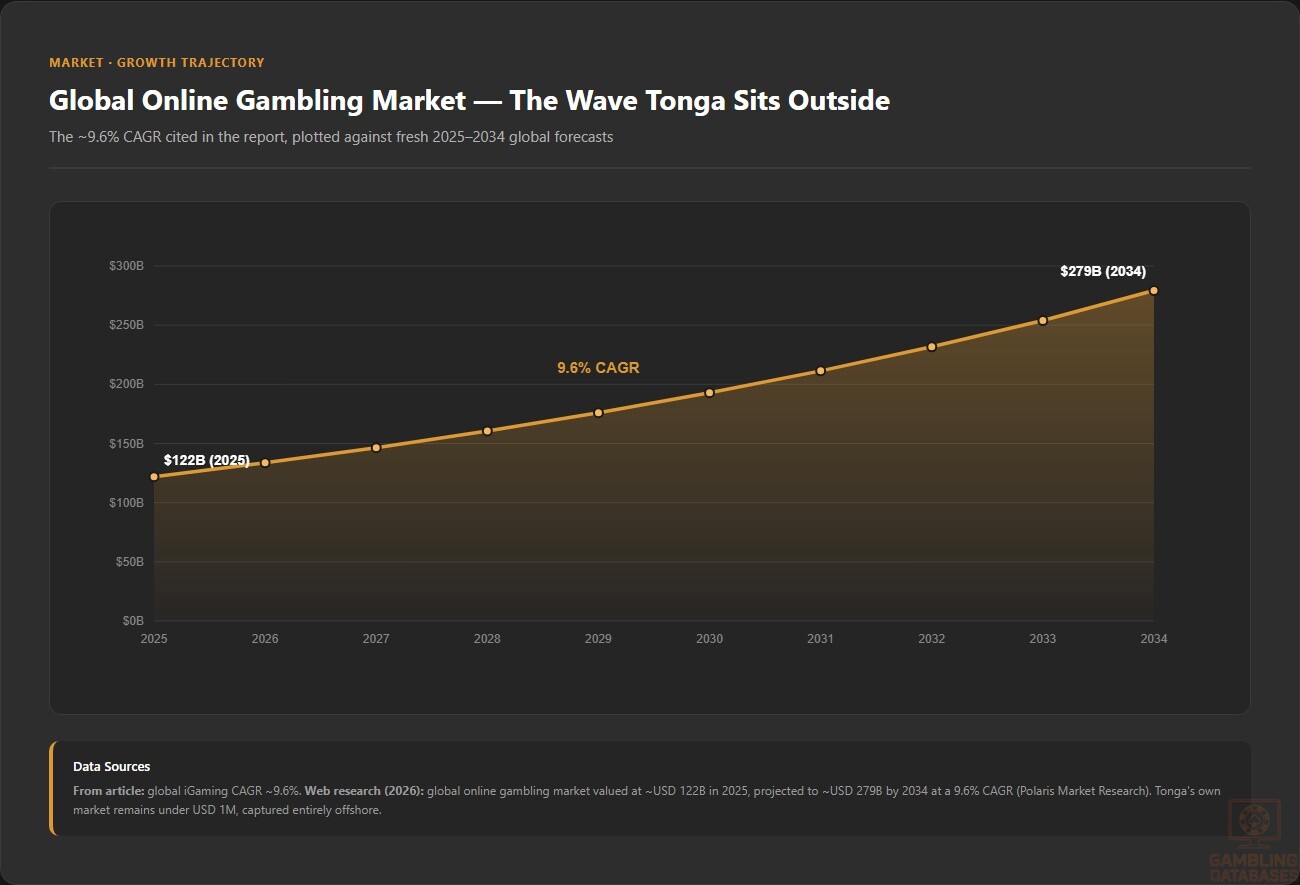
| iGaming Growth Rate (Global CAGR) | ~9.6% (2025-2034) |
| Licensed Casinos | 0 |
| Licensing Fees | Not applicable (no licensing framework) |
| Tax on Gambling Operators | Not applicable |
| Player Taxation | None |
| Compliance & Reporting Requirements | None (all forms illegal) |
| Local Presence Required | Not applicable |
| Market Entry Barriers | Legal prohibitions, no licensing regime |
| Regulatory Change Status | Limited political will for reforms (2024-2025) |
| Technology Infrastructure | Basic, limited broadband coverage |
| Business Environment | Small economy, dependency on agriculture and remittance |
| Potential Casino Projects | 1 Proposal (stalled since 2017) |
| Primary Payment Methods (Offshore) | Credit/debit cards, e-wallets via international platforms |
| Responsible Gambling Measures | None domestically mandated |
| Enforcement Agencies | Police, Ministry of Internal Affairs |
| Market Penetration Rate (iGaming) | Estimated minimal (offshore access only) |
| Average Revenue Per User (Estimated) | Minimal, due to small player base |
Section 1: Regulatory Framework and Legal Environment
Current Gambling Regulation Status
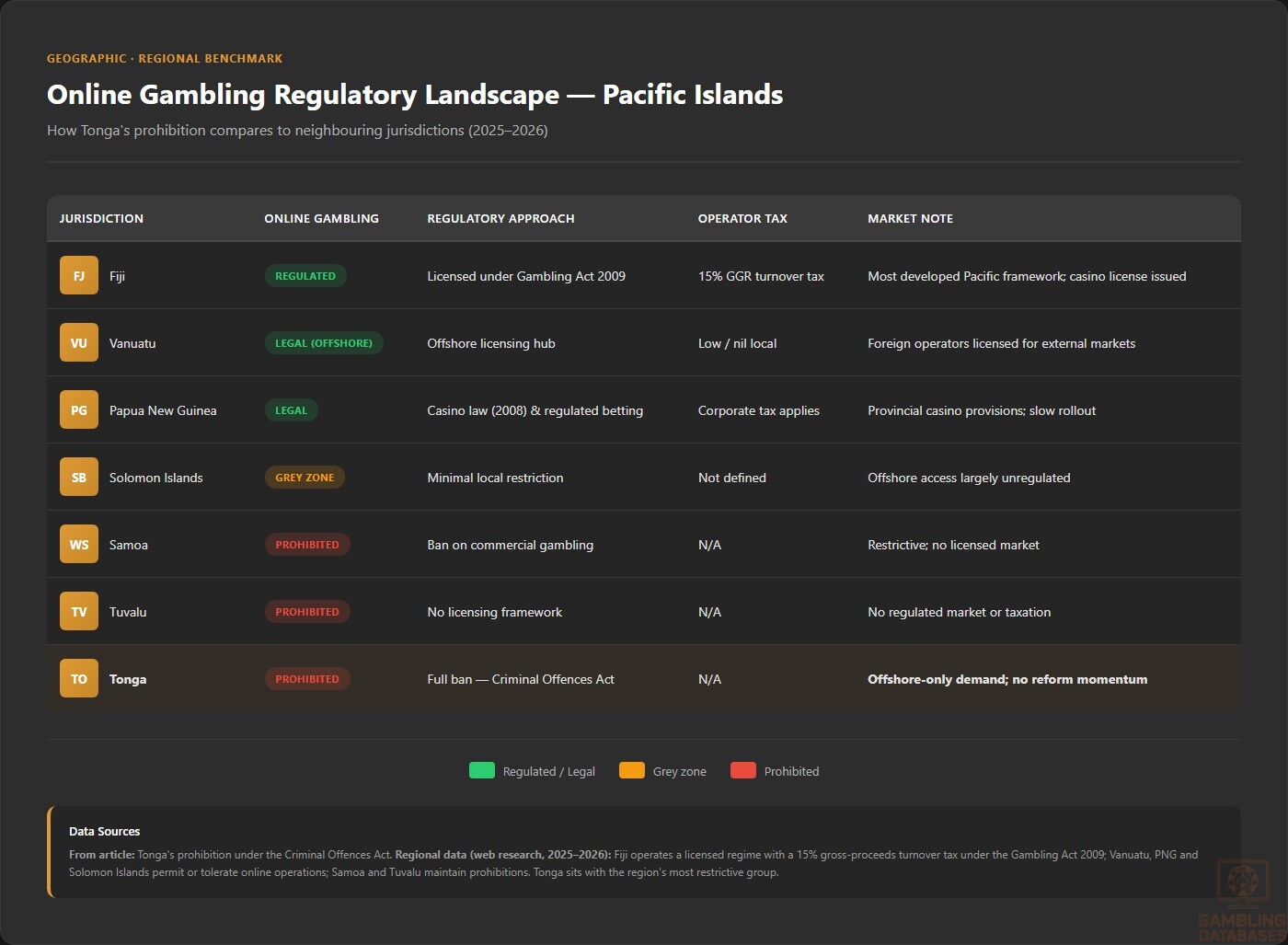
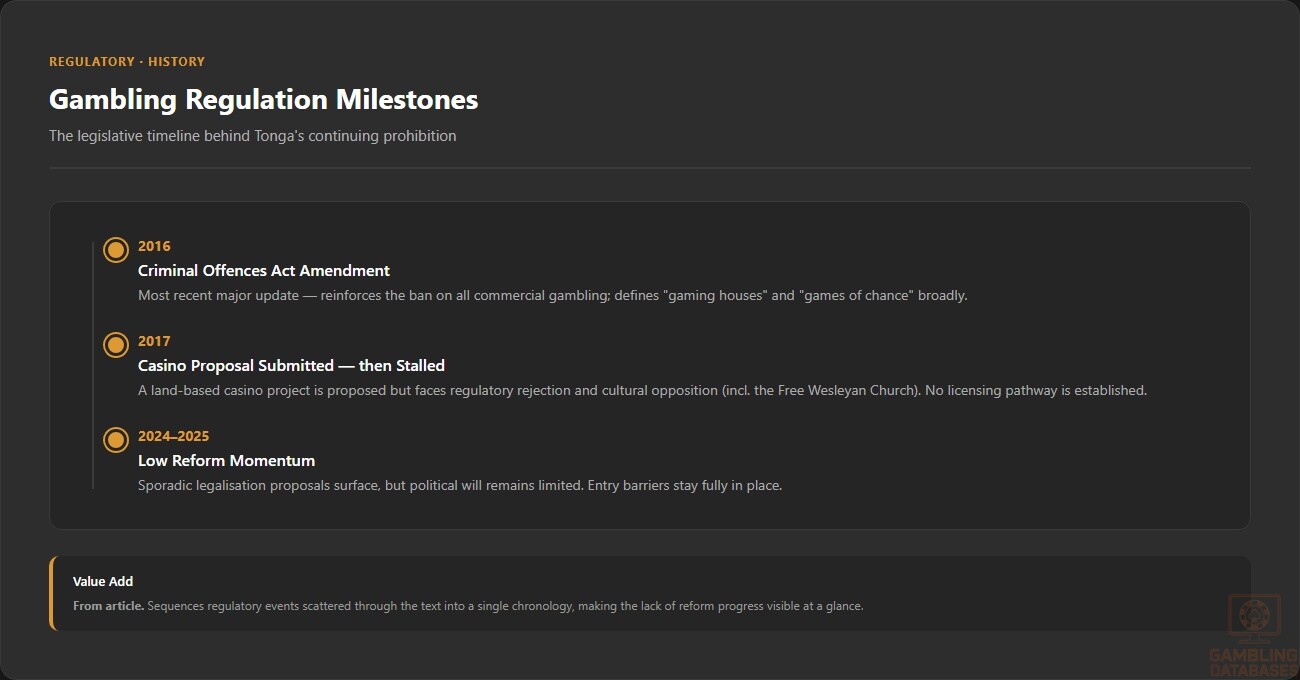
Tonga maintains a stringent legal environment against gambling activities. The Criminal Offences Act, as amended most recently in 2016, explicitly prohibits all commercial gambling operations including casinos, sports betting, lotteries, and online gaming. The law defines “gaming houses” and “games of chance” broadly, making the operation or facilitation of such activities illegal and punishable by fines and imprisonment.
The government’s primary aim is to protect societal well-being and uphold community values, balancing minor charitable gambling such as small lotteries with strong restrictions against commercial gambling enterprises. As a result, no commercial land-based or licensed online gambling entities are legally present or regulated within Tonga.
Land-Based Gambling Activities
Currently, Tonga has no licensed land-based casinos, sports betting venues, or slot machine halls. Attempts to establish casino operations have faced regulatory rejection, reflecting both legal prohibitions and cultural opposition, including expressions of disapproval by influential local groups such as the Free Wesleyan Church. Although a proposal for a casino project was made in 2017, it remains stalled with no regulatory pathway established to issue licenses for casino operations.
Legal gambling activities are limited to small-scale charitable gaming events, often tied to community fundraising. These events are closely regulated to ensure they remain within the bounds of the law and do not resemble commercial gambling operations.
Online Gambling Framework
Online gambling as a commercial activity is not recognized or regulated in Tonga. There is no licensing system for online casinos, sportsbooks, or lottery operators, and thus no legal domestic platforms. While online gambling is not expressly criminalized, the absence of a licensing framework means domestic provision is effectively prohibited.
Many Tongans access international offshore gambling sites, but these operators fall outside the jurisdiction and legal protections of Tonga’s laws. The government has not introduced measures to block or restrict access to these offshore platforms, partly due to technological and enforcement limitations.
Licensed Operators and Market Players
There are no registered or licensed operators authorized to offer gambling services within Tonga. The regulatory environment’s restrictive nature deters both domestic and international companies from establishing licensed operations locally.
The market is effectively void of legal competition, with all gambling activity driven by offshore providers. Prospective entrants face substantial barriers from the legal ban, cultural resistance, and absence of regulatory recognition, making direct market entry infeasible under current conditions.
Licensing Framework and Requirements
Application Process and Eligibility
Tonga currently lacks any formal application process, eligibility criteria, or regulated licensing system for gambling. The government does not issue licences for any form of gambling operation, and no financial or technical standards exist to regulate operators.
The Ministries responsible for gambling enforcement focus on law enforcement to prevent illegal gambling rather than regulatory oversight or granting permissions. Any attempt to initiate a commercial gambling business within Tonga is illegal and subject to prosecution.
Local Presence and Operational Requirements
Because no licensing framework exists, there are no official mandates regarding local physical presence, domain registration, or personnel requirements related to gambling operators. Tonga does not permit foreign or local gambling enterprises to operate within its jurisdiction.
There are no published rules on ownership restrictions or partnership requirements for gambling entities, reflecting the overall prohibition of these activities.
Compliance Obligations and Monitoring
Player Protection and Identification
Tonga currently does not have formal player protection mandates such as KYC (Know Your Customer), AML (Anti-Money Laundering), or responsible gambling initiatives due to the absence of legalized gambling operations.
Legal gambling age is set at 18 but applies primarily to charitable gaming activities. No self-exclusion programs or mandatory responsible gaming disclosures exist under current law since commercial gambling is banned. Enforcement focuses on preventing unlawful gambling participation rather than managing licensed operators’ consumer protections.
Financial Monitoring and Reporting
There are no established financial monitoring systems, reporting templates, or audit procedures for gambling enterprises. No licensed operators exist to submit compliance reports. Any financial activity related to gambling is implicitly illegal and subject to investigation by enforcement agencies if discovered.
Taxation Structure and Financial Obligations
Player Taxation
Players are not subject to any taxation on gambling winnings, as all forms of commercial gambling are prohibited. There are no withholding obligations or taxable thresholds for gambling activities at the player level.
Operator Taxation
| Game Type | Operator Tax Rate |
|---|---|
| Casino Table Games | 0% |
| Sports Betting | 0% |
| Slot Machines | 0% |
| Online Gambling | 0% |
| Lottery | 0% |
Since there are no licensed operators, no gross gaming revenue (GGR) taxes, corporate income taxes on gambling, licensing renewal fees, or turnover-based taxes are applied in Tonga.
Gambling Market Financial Performance
Tonga’s gambling market lacks official measurement or local revenue streams due to the ban. Estimated offshore-driven player activity is minimal, with annual wagers likely under USD 1 million. This reflects a very small unregulated market segment given the country’s population size and internet penetration.
Revenue trends follow global iGaming growth rates; however, Tonga remains excluded from direct economic contributions from gambling taxation or industry development.
Advertising and Marketing Restrictions
The absence of legal gambling operators results in no domestic advertising or marketing regulations specific to gambling. Officially, promotion of gambling is restricted as part of the prohibition framework.
No formal advertising channels, sponsorship guidelines, or promotional content restrictions for legal gambling exist, given the industry’s absence. Informal or offshore marketing towards Tongans is not regulated locally.
Recent Regulatory Changes and Their Impact
Regulatory amendments regarding gambling in Tonga have been minimal. The most significant legislative update was the Criminal Offences Act amendment in 2016, reinforcing gambling prohibitions.
Since then, despite sporadic proposals for legalization of casinos or regulated gambling, political will remains low to enact reform. Consequently, market entry barriers continue to be restrictive with no new regulations easing the operational environment.
Enforcement Mechanisms and Penalties
- Fines for illegal gambling operations and participation
- Imprisonment up to 3 months for violations under Criminal Offences Act
- Confiscation of gambling paraphernalia or proceeds from illicit gaming
- Police monitoring and enforcement of gambling prohibitions
- Community-based reporting and compliance encouragement
Authorities maintain a firm stance on enforcement, with penalties designed to deter both operators and players from engaging in unauthorized gambling activities.
Section 2: Demographics and Consumer Analysis
Population Demographics and Distribution
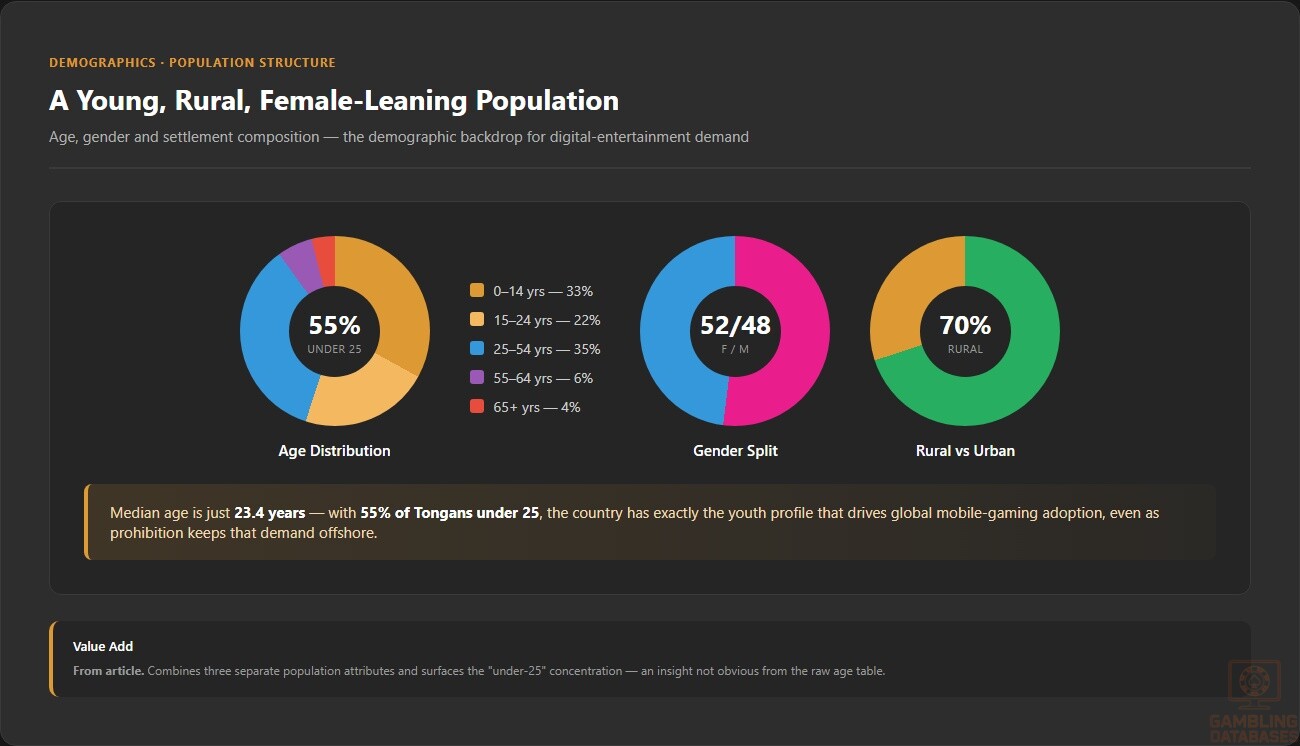
Tonga’s total population is approximately 105,000, characterized by a young demographic profile. The median age is 23.4 years, reflecting a predominantly youthful population. Age distribution reveals a large base under 30 years, while older age groups form a smaller segment. The gender ratio favors females slightly with about 52% female and 48% male distribution.
| Age Group | Percentage of Population |
|---|---|
| 0-14 years | 33% |
| 15-24 years | 22% |
| 25-54 years | 35% |
| 55-64 years | 6% |
| 65 years and over | 4% |
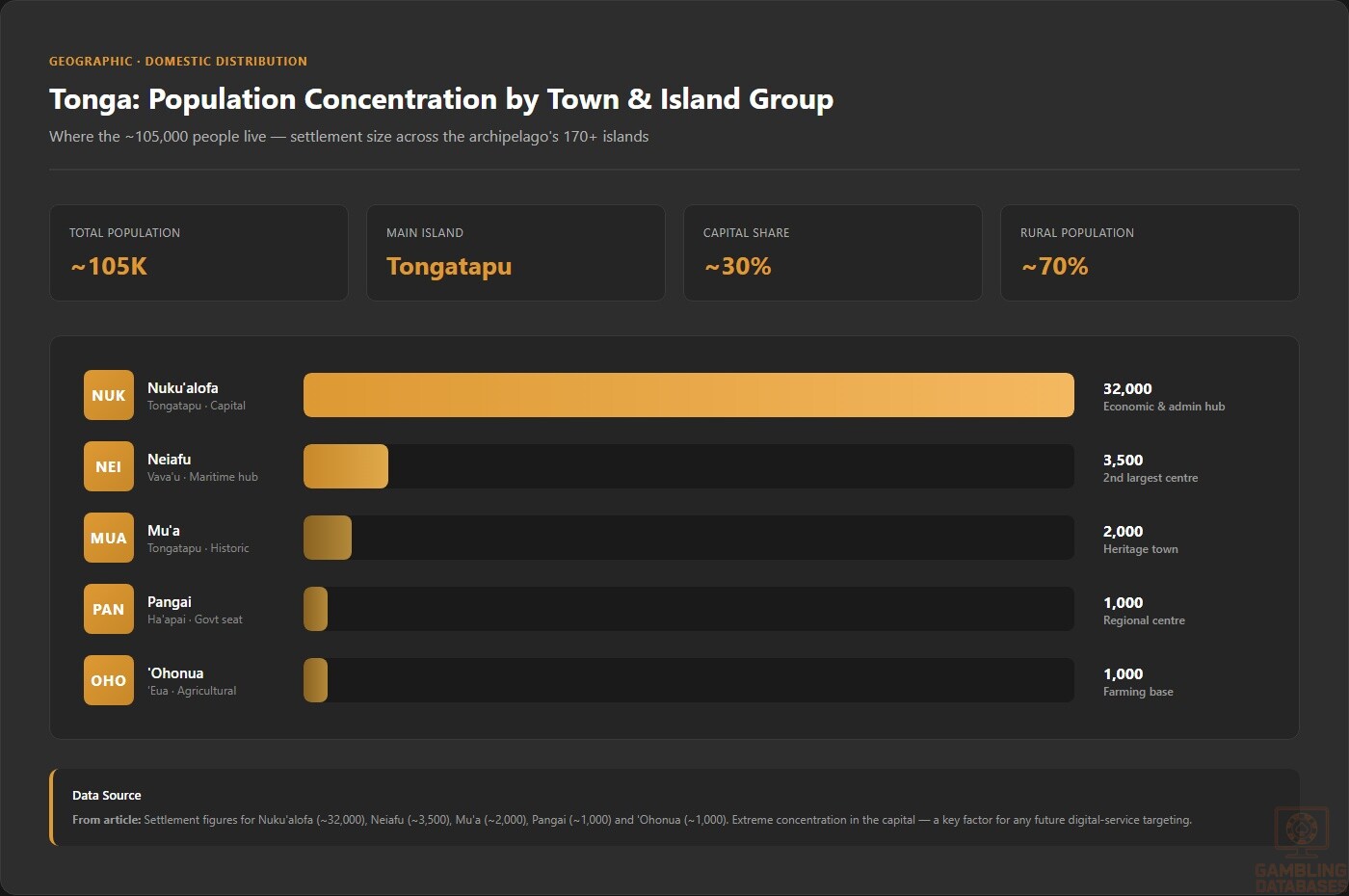
The population is predominantly rural, with approximately 70% residing in rural villages and agricultural areas. Urban centers are limited but gradually expanding. The capital city, Nuku’alofa, comprises roughly 30% of the national population, serving as the primary economic and administrative hub.
Geographic Distribution
Tonga consists of over 170 islands, with most inhabitants concentrated on the main island of Tongatapu. Other notable island groups include Vava’u and Ha’apai. Geographic dispersion impacts access to infrastructure and internet connectivity, influencing digital behaviors and market potential.
- Nuku’alofa (Capital): ~32,000 residents, main economic center
- Neiafu (Vava’u): ~3,500 residents, maritime hub
- Pangai (Ha’apai): ~1,000 residents, regional government seat
- Mu’a: Historic town with ~2,000 residents
- ‘Ohonua (Eua): ~1,000 residents, agricultural base
Internet access is highest in urban zones like Nuku’alofa, with rural internet penetration considerably lower. Physical gambling venues do not exist, and lack of urban density limits concentration of such facilities.
Economic Indicators and Consumer Spending Power
Tonga’s nominal GDP stands at approximately USD 500 million, with a per capita GDP of around USD 4,700. Economic growth remains modest, averaging 1.5-2% annually, driven mainly by agriculture, remittances, and small-scale tourism. The economy is vulnerable to external shocks due to limited diversification.
Household incomes are unevenly distributed, with the upper income tier comprising business owners, government employees, and remittance recipients. Disposable income is limited overall, restricting discretionary consumer spending. Informal sectors dominate local commerce and many households depend on family transfers.
| Indicator | Value |
|---|---|
| GDP (Nominal) | USD 500 million |
| GDP Growth Rate | 1.8% (projected) |
| GDP Per Capita | USD 4,700 |
| Inflation Rate | 3.2% |
| Unemployment Rate | 6.4% |
| Median Household Income | USD 8,000 |
Market Size and Growth Projections
The domestic iGaming market is effectively non-existent due to legal restrictions; however, growing internet connectivity and mobile usage reveal latent demand for digital betting and gaming. Offshore platforms capture most of this activity, with estimated annual wagers under USD 1 million.
Global online gambling markets are expanding at an average CAGR of around 9.6%, a trend that could benefit Tonga if legal frameworks adapt. Projected user base growth aligns with improving digital access and the youth demographic’s inclination toward online entertainment.
| Metric | Value |
|---|---|
| Current Market Revenue | Under USD 1 million |
| Annual Market Growth Rate | ~9.6% (aligned with global average) |
| Projected Market Size in 5 years | USD 1.5 million |
| Estimated User Base | ~3,000 active players |
| Average Revenue Per User (ARPU) | USD 300 |
Education, Skills, and Digital Literacy
Tonga’s literacy rate exceeds 98%, with most citizens completing primary and secondary education. However, higher education enrollment remains low, limited by economic constraints and access. Digital literacy is improving steadily, particularly among younger populations in urban areas, but remains limited in rural regions.
Employment skills are concentrated in agriculture, public services, and basic commerce, with a nascent presence of IT-related competencies. Digital adoption initiatives by government and international partners focus on expanding internet access and training to boost the digital economy.
Cultural and Social Factors
Communication and Language
Tonga’s official languages are Tongan and English, both used across media and government. English predominates internet content consumption and digital communication, especially among younger, urban populations. Local dialects are widespread in rural areas but less common online.
- Tongan (vernacular, spoken by ~95%)
- English (official, widely understood especially in education)
- Other Polynesian dialects limited to certain islands
- Sign language communities in urban centers
- English used predominantly for online gambling platforms and digital transactions
Cultural Attitudes
Traditional and religious values in Tonga heavily influence cultural attitudes towards gambling, which is broadly viewed as potentially harmful. Social stigma against gambling prevails, reinforced by the Free Wesleyan Church and other religious groups. Foreign brands face challenges navigating conservative perceptions.
Entertainment preferences favor sports, music, and family-centered events. Nevertheless, the youth urban demographic gradually embraces digital and mobile entertainment, representing an evolving market segment for online gaming and betting.
Problem Gambling and Social Considerations
Data on problem gambling prevalence is limited, reflecting the banned status of commercial gambling. However, informal gambling and offshore online participation carry emerging social risks related to financial loss and addiction, particularly among youth.
- Government maintains awareness campaigns via health services
- Local NGOs provide limited counseling and support networks
- Religious institutions actively discourage gambling participation
- No statutory framework for mandatory social responsibility contributions
- Community social support played a key role historically
Political Structure and Governance
Tonga is a constitutional monarchy with a stable government, blending tradition and modern state institutions. Political stability and relatively transparent governance create a predictable environment for business. However, slow regulatory reform processes and conservative policymaking limit rapid industry change.
International relations are largely positive, supporting development aid and regional cooperation, but limited resources constrain infrastructure and market development for emerging sectors like iGaming.
Technology Adoption and Digital Behavior
Internet and Digital Usage
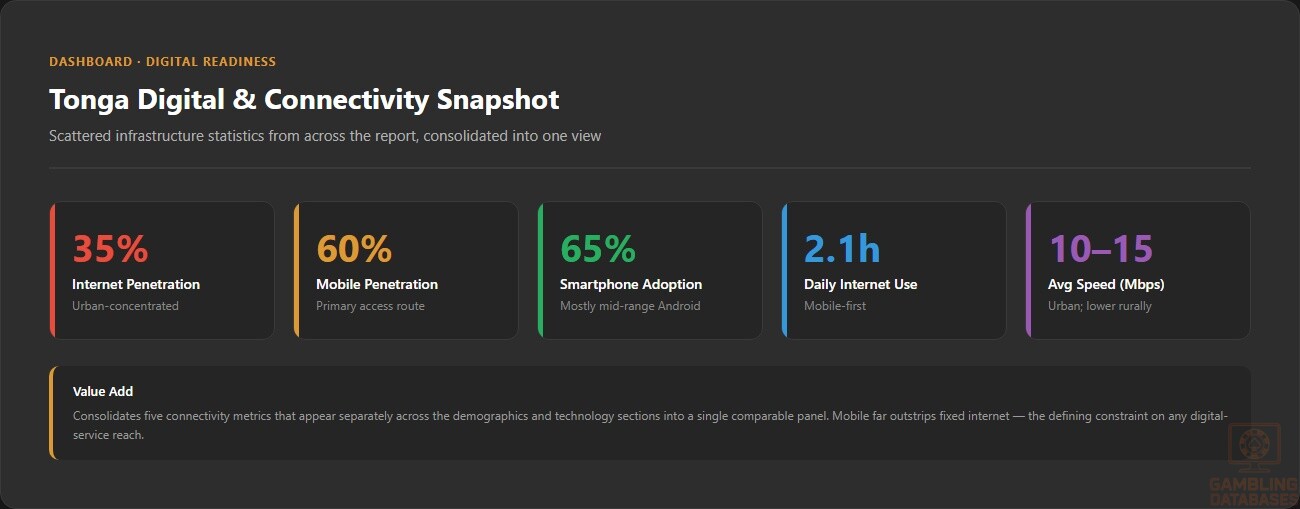
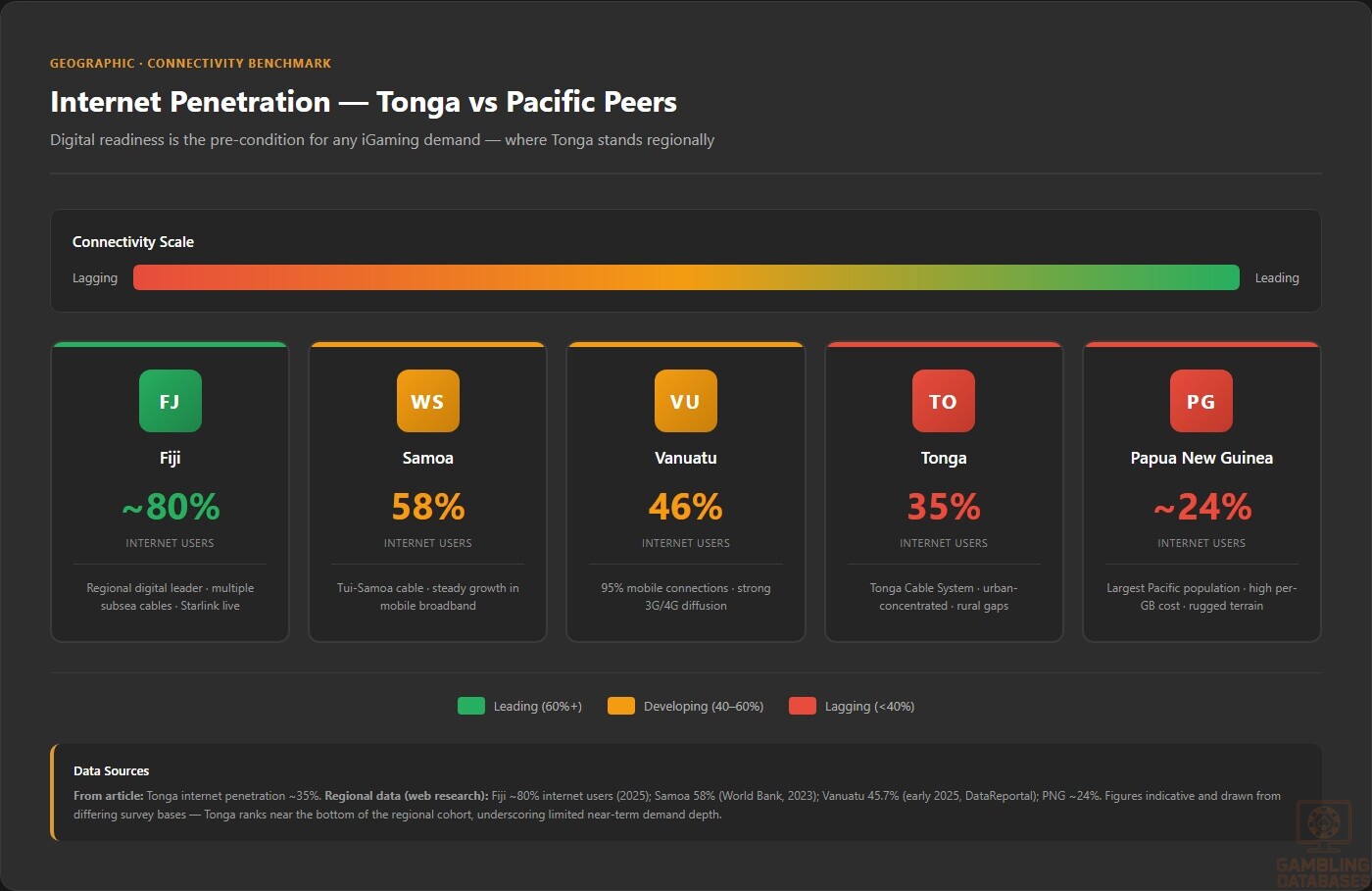
Tonga’s internet penetration rate is estimated at 35%, with mobile penetration higher at around 60%. Daily internet usage averages 2.1 hours, primarily through mobile devices. Social media engagement is strong among younger populations in urban centers, with multiple platforms actively used.
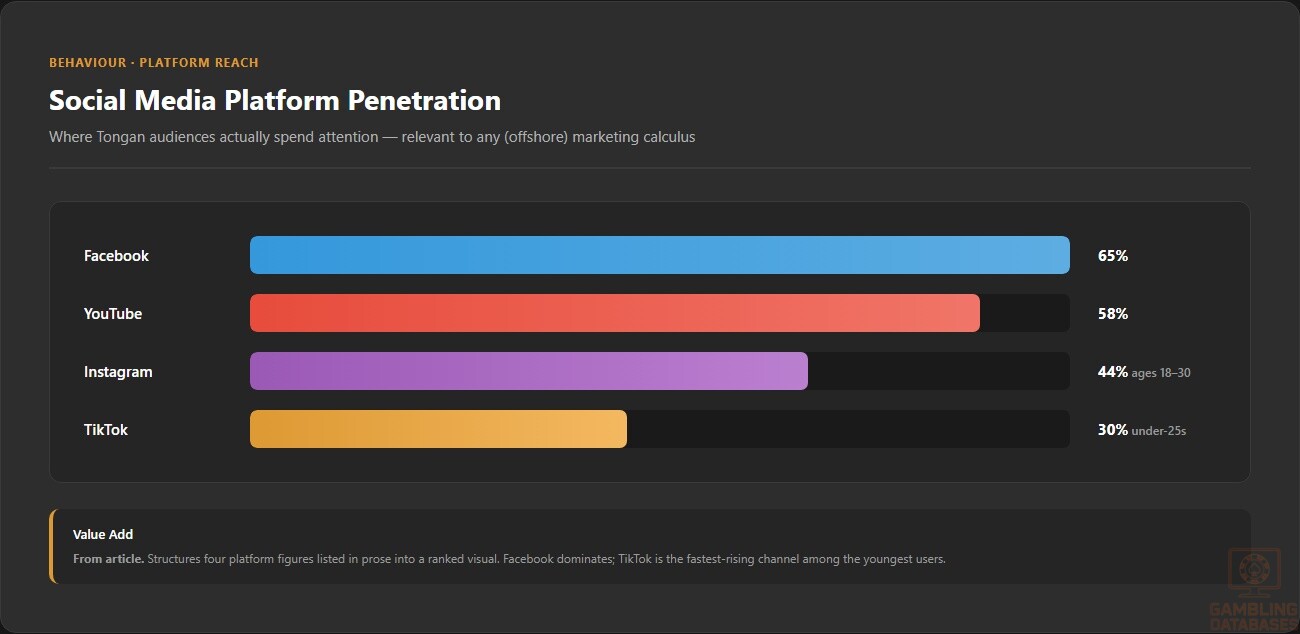
- Facebook remains the dominant social media platform with 65% user penetration
- Instagram is popular among ages 18-30 with 44% penetration
- YouTube usage stands at 58%, favored for video content
- TikTok shows rapid growth with 30% penetration in under-25 demographics
- WhatsApp is widely used for messaging and informal communications
- Twitter and LinkedIn have lower penetration, mostly business and news-related
Digital Payment Behavior
Digital payment adoption is emerging, with most digital transactions occurring on mobile money platforms and international payment cards. E-wallets and digital banking services grow slowly due to financial infrastructure constraints.
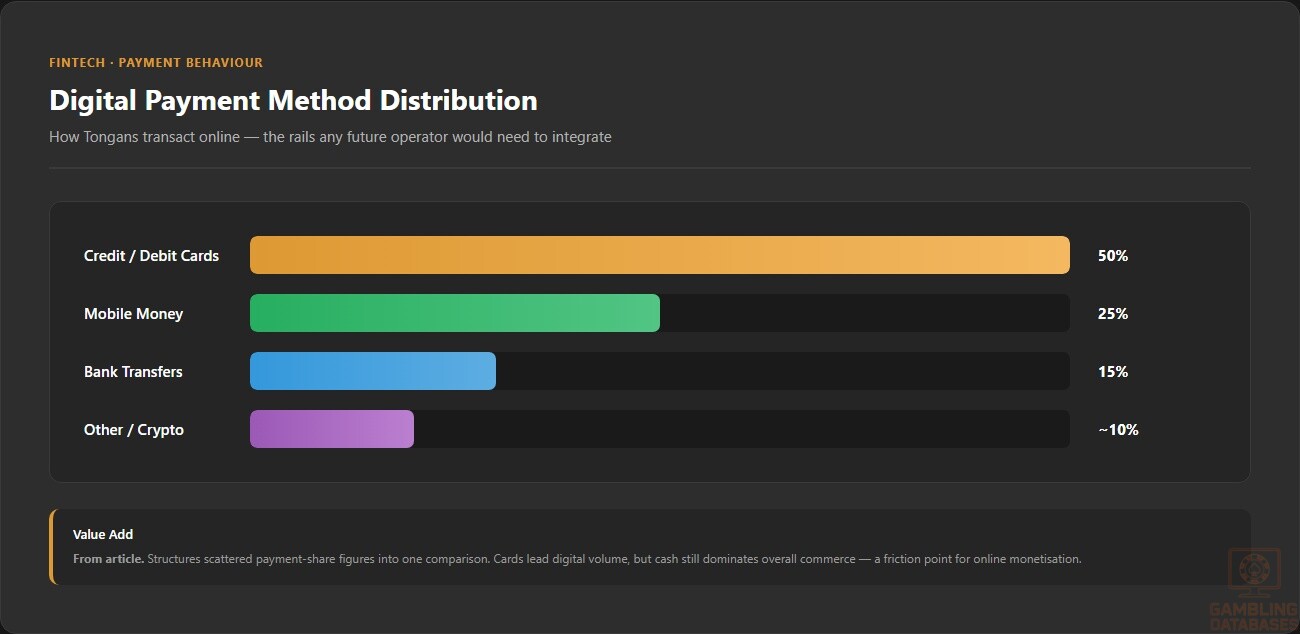
- Credit/debit cards dominate with approximately 50% transaction share
- Mobile money wallets capture 25% of digital payments
- Bank transfers represent 15% of payment volume
- Cryptocurrency usage is minimal but monitored by regulatory authorities
- Cash remains widely used, limiting full digital payment adoption
Gaming and Gambling Preferences
Current Market Participation
Legal participation in gambling is minimal and constrained by the ban on commercial operations. Informal lotteries and traditional betting on sports or competitions are the most common gambling-related activities.
- Traditional social betting (e.g., cockfighting, community pools)
- Offshore online sports betting (via international platforms)
- Informal lotteries associated with charities
- Informal card games and pool betting
- Emerging interest in digital casino games from offshore sites
| Activity | Estimated Participation Rate (%) |
|---|---|
| Traditional Social Betting | 12% |
| Offshore Online Sports Betting | 5% |
| Informal Lotteries | 7% |
| Informal Card Games | 4% |
| Online Casino Games (Offshore) | 3% |
Consumer Behavior Patterns
Spending on gambling is low and typically irregular, dominated by social and charitable betting. Offshore platform usage peaks during major international sports events, with players favoring mobile access for convenience. Session lengths average 30-45 minutes, driven by casual, exploratory engagement rather than sustained play.
Retention rates are weak due to lack of localized offerings and customer support. Brand loyalty is minimal, with consumer behavior shaped by accessibility rather than preference or service differentiation.
Section 3: Technology Infrastructure and Business Environment
Internet and Digital Infrastructure
Tonga’s internet penetration stands at approximately 35%, with mobile networks providing the bulk of connectivity. Fixed broadband availability is limited, largely restricted to urban centers like Nuku’alofa, while rural areas depend heavily on 3G and 4G mobile data services. Average internet speeds are moderate, averaging around 10-15 Mbps in urban areas but dropping significantly in rural locations where infrastructure is less developed.
Government and international partnerships have recently invested in undersea fiber optic cables and terrestrial wireless technologies to improve coverage and stability. However, challenges remain around network reliability and consistent service quality, impacting potential digital business operations such as iGaming platforms.
5G and Future Technology Deployment
5G technology rollout is in preliminary stages, with limited coverage mostly in the capital region and select commercial zones. Operators have announced plans to expand 5G usage over the next 3-5 years, aiming to support growing data demands and digital economy ambitions. Project timelines depend on investment levels and regional cooperation.
Key mobile network operators are engaged in upgrading infrastructure, leveraging 4G LTE as a bridge technology to enhance data speeds and reduce latency before full 5G deployment. The geographic dispersion of the population poses a logistical challenge for rapid nationwide 5G adoption.
Mobile Technology Ecosystem
Tonga’s mobile network market features a small number of operators serving the population with varying coverage and pricing. Data costs remain moderately high relative to income levels but competition and regulatory efforts have produced gradual affordability improvements.
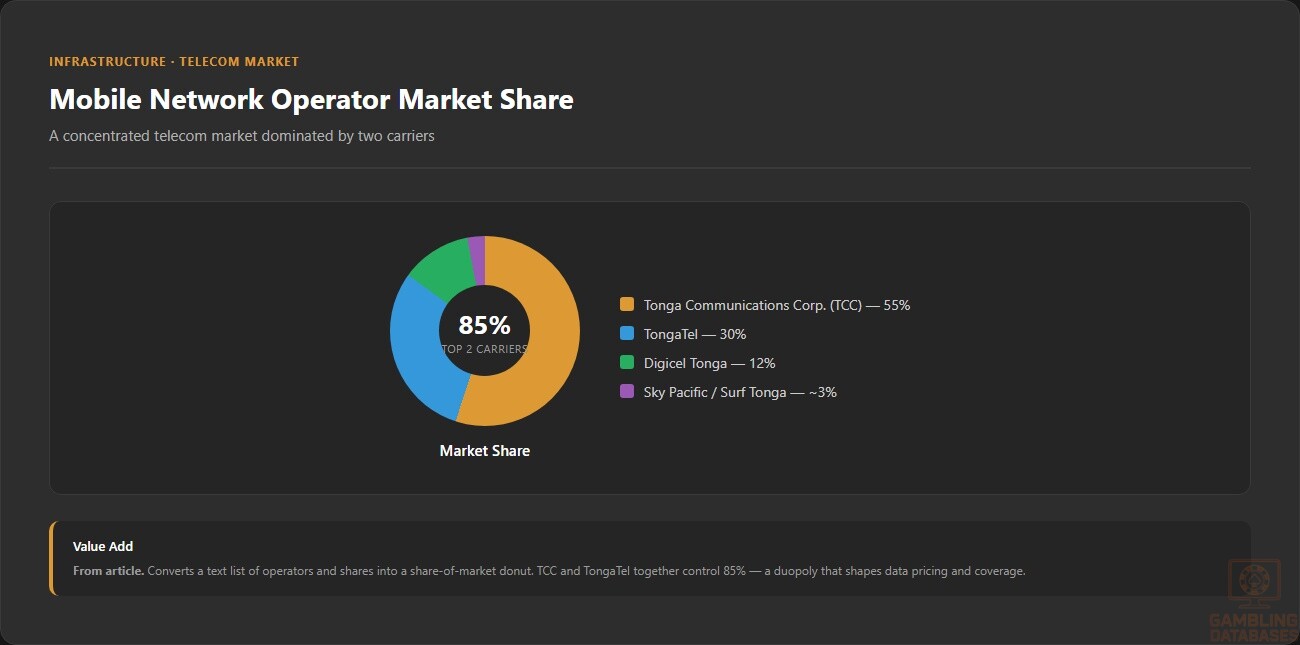
- Tonga Communications Corporation (TCC) – dominant operator with approx. 55% market share
- TongaTel – second largest player with 30% share, expanding regional coverage
- Digicel Tonga – international operator with 12% share, focused on urban centers
- Sky Pacific – minor operator, limited network but growing niche services
- Surf Tonga – emerging MVNO offering low-cost data plans
Smartphone adoption rates have increased steadily, estimated at around 65% of mobile users, predominantly mid-range Android devices. Device preferences lean toward affordability and functional performance, with iOS market share modest but concentrated among wealthier urban professionals.
Financial Services and Payment Infrastructure
Tonga’s banking sector features a limited but stable set of financial institutions. Digital banking adoption is nascent but growing, driven by efforts to modernize payment and remittance systems. Account penetration is moderate, with rural and younger populations still largely underserved.
- National Reserve Bank of Tonga – central banking authority overseeing regulation
- ANZ Bank Tonga – largest commercial bank with extensive branch and ATM network
- Westpac Tonga – significant player offering retail and business banking
- Bank South Pacific (BSP) – regional bank expanding digital services in Tonga
- Pacific Commercial Bank – locally focused with growing digital banking capabilities
Payment processing options include credit/debit cards, mobile money wallets, and traditional bank transfers. E-wallet adoption is emerging, supported by mobile network operators and fintech partnerships facilitating easier online payments.
- Visa and Mastercard widely accepted in urban retail and online contexts
- Mobile money wallets like T-Pay and Digicel’s Digicel Mobile Money
- Bank transfers predominantly used for larger payments and remittances
- Cash remains the primary mode of transaction nationally
- Limited cryptocurrency interest but noted among expatriate communities
E-commerce and Digital Economy
The e-commerce market is modest but expanding, driven primarily by urban consumers accessing international platforms. Local online retail penetration is low due to logistical constraints and limited consumer trust in digital payments. However, increasing mobile internet access is gradually enabling growth across digital services including entertainment and online gaming.
Consumer digital trust is enhanced by partnerships between government and private sector to promote cyber security awareness and strengthen transaction safeguards, critical for future expansions into iGaming and fintech sectors.
Business Environment and Regulatory Framework
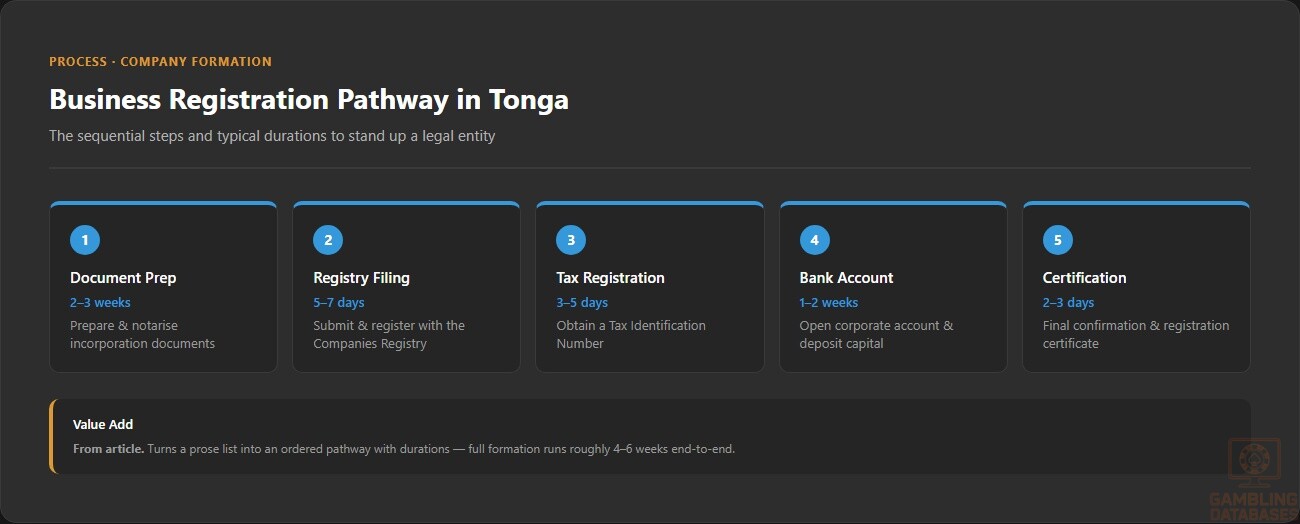
Tonga ranks moderately on the World Bank’s ease of doing business index, reflecting streamlined procedures but inherent challenges related to size and infrastructure. Starting a business requires navigating a well-defined but resource-intensive registration and compliance process, particularly for foreign investors.
- Preparation and notarization of incorporation documents (approximately 2-3 weeks)
- Submission and registration with the Companies Registry (5-7 business days)
- Tax registration and obtaining a Tax Identification Number (3-5 days)
- Opening corporate bank accounts, potentially taking 1-2 weeks
- Final confirmation and receipt of registration certificates (2-3 days)
Foreign investment is welcomed but subject to certain approvals and adherence to regulatory standards. Operational costs, including office leasing, staffing, and compliance obligations, must be strategically managed to ensure feasibility.
Corporate Structure and Registration
Common business entity types include Limited Liability Companies (LLCs), Corporations, and Branch Offices of foreign companies. LLCs are favored for their flexibility and limited liability protections, while corporations might suit larger ventures requiring issuance of shares. Branch offices represent foreign entities directly operating within Tonga but face additional regulations.
Recommended structures for iGaming ventures lean towards LLCs due to ease of management and limited shareholder obligations. Registration timelines typically span 4-6 weeks depending on completeness of documentation and approval speed.
- Corporate registration certificate and articles of incorporation
- Proof of business address
- Director and shareholder identification documents
- Tax registration certificates
- Bank account opening confirmation or proof of capital deposit
Taxation Framework
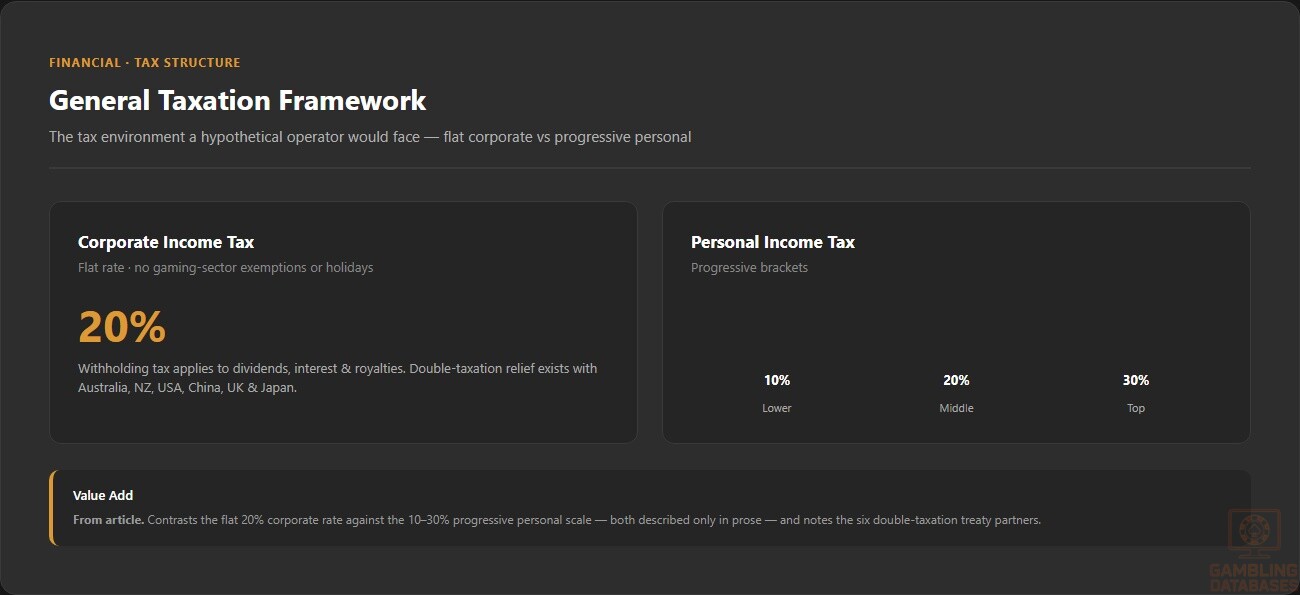
Corporate income tax is levied at a flat rate of 20% with no special exemptions currently available for the gaming sector. Tonga offers no dedicated tax holidays or incentives specifically for technology businesses or iGaming operations. However, general treaty arrangements provide some double-taxation relief.
- Australia
- New Zealand
- United States
- China
- United Kingdom
- Japan
Personal income tax rates are progressive, starting from 10% up to 30%. Withholding tax applies to dividends, interest, and royalties at standard rates. Social security contributions are mandatory for employees and employers.
Market Entry Considerations
For iGaming entrants, strategies favor partnerships with local firms or regional operators to navigate restrictive legal frameworks. Platform flexibility, compliance with evolving regulations, and payment solution integration are critical. Leveraging mobile-first user experiences aligns with consumer device trends.
- Form alliances with local or regional business partners
- Utilize offshore licensing frameworks initially with local presence plans
- Invest in mobile-optimized gaming platforms
- Build robust KYC/AML processes anticipating regulatory change
- Develop tailored marketing strategies respecting cultural sensitivities
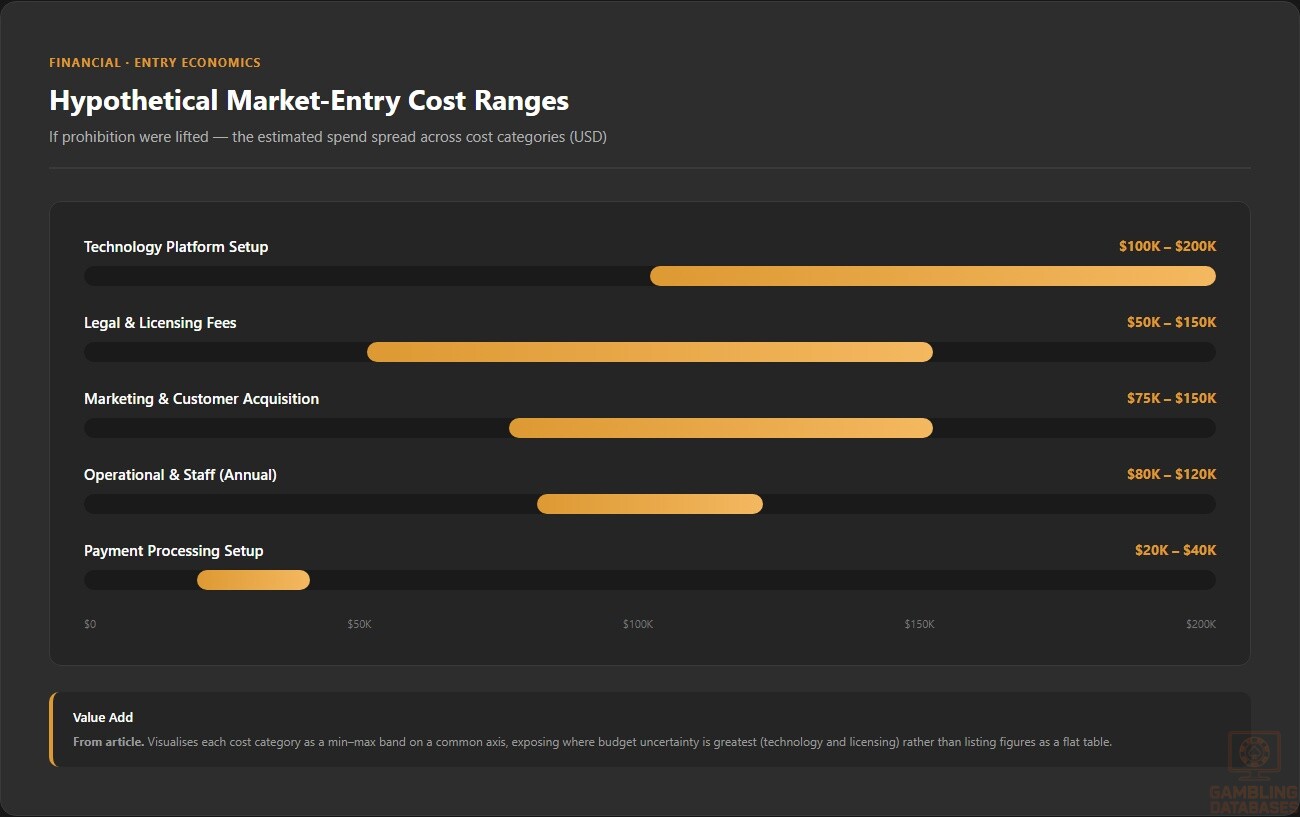
Typical market entry costs vary widely but initial investments generally include licensing/legal services, platform integration, marketing, and infrastructure setup. Timelines for full entry span between 6 to 12 months, depending on regulatory clarity and operational readiness.
| Cost Category | Estimated Cost (USD) |
|---|---|
| Legal and Licensing Fees | 50,000 – 150,000 |
| Technology Platform Setup | 100,000 – 200,000 |
| Marketing and Customer Acquisition | 75,000 – 150,000 |
| Operational and Staff Costs (Annual) | 80,000 – 120,000 |
| Payment Processing Setup | 20,000 – 40,000 |
Key success factors include understanding local market nuances, regulatory compliance, and flexible payment integration. Challenges involve legal uncertainties, infrastructure constraints, and cultural resistance toward gambling.
- Strong regulatory engagement and compliance management
- Robust mobile platform development
- Localized customer support and payment options
- Effective risk management and responsible gaming policies
- Strategic partnerships with regional operators or technology providers
Exit strategies should consider license transfer policies, valuation alignment with market maturity, and liquidity options within the wider Pacific region. Strategic exits may involve mergers or buyouts by larger regional operators seeking market foothold.
FAQ: Frequently Asked Questions
1. Is online gambling legal in Tonga?
Currently, online gambling is not legal in Tonga as the country prohibits all commercial forms of gambling. There is no official licensing or regulatory framework for online operators, effectively making domestic iGaming businesses prohibited. However, individuals may access offshore online gambling sites, though these are unregulated within Tonga.
2. What types of gambling licenses are available and what do they cover?
Tonga does not issue any gambling licenses as commercial gambling operations are banned. There are no formal license categories for casinos, sports betting, lotteries, or online gambling. Any attempt to operate such services is illegal and subject to penalties.
3. How much does an iGaming license cost and how long does it take to obtain?
Since Tonga lacks a licensing system for gambling, no official fees or timelines exist for obtaining an iGaming license. Establishing a legal gambling operation in Tonga is not currently possible under local laws.
4. Can foreign companies obtain a gambling license?
Foreign companies cannot obtain a gambling license in Tonga because no licensing framework exists. The prohibition applies equally to domestic and foreign entities, and gambling operations by foreigners without licenses are illegal.
5. What are the tax obligations for iGaming operators?
With no licensed operators, Tonga does not impose taxes on iGaming companies. Hypothetically, corporate income tax stands at 20%, but applying this to gambling operators is currently irrelevant due to legal prohibitions.
6. Are gambling winnings taxed for players?
Players in Tonga are not subject to any taxes on gambling winnings, largely because commercial gambling is illegal and there is no regulated framework for taxing player income from gambling activities.
7. What are the typical operational costs for running an online casino/sportsbook?
In legal markets, costs include licensing, technology, payment processing, marketing, and staffing. Typical categories cover:
- License fees and regulatory compliance
- Platform development and software maintenance
- Payment integration and transaction fees
- Customer acquisition and marketing campaigns
- Operational staff and customer support
8. What is the expected ROI timeline for entering this market?
ROI for iGaming markets usually ranges from 18 to 36 months depending on market entry conditions and investment scale. Given Tonga’s regulatory environment, investors face significant delays and higher risks impacting ROI timelines.
9. What are the local presence requirements for operators?
Tonga currently does not allow any licensed gambling operators; therefore, no formal local presence requirements exist. Should regulations change, typical mandates might include physical office establishment, local employee hiring, and compliance officers.
10. What payment methods are available and recommended?
Payment options in Tonga include credit/debit cards, mobile money wallets, bank transfers, and cash. For iGaming, recommended methods emphasize mobile wallets and card payments due to convenience and growing digital adoption.
11. What are the advertising and marketing restrictions?
Since gambling is prohibited, advertising for gambling is restricted or banned. Any promotion would likely face legal challenges and community opposition. Socially responsible marketing is essential in regulated markets.
12. What responsible gambling measures are mandatory?
Tonga has no statutory responsible gambling requirements due to the gambling ban. Globally recognized measures include player self-exclusion, spending limits, and educational initiatives to minimize harm.
13. How large is the iGaming market and what is the growth potential?
Tonga’s iGaming market is minimal and undeveloped but shows latent potential driven by youth demographics and increasing mobile internet access. Regional legalization and infrastructure improvements could unlock growth opportunities aligning with global CAGR trends near 9.6%.
14. Who are the main competitors and what is their market share?
There are no legal competitors within Tonga’s iGaming market. Offshore international operators dominate the informal market accessed by Tongans, but there is no licensed or regulated local competition.
15. What are the player preferences and typical spending patterns?
Players lean toward sports betting, informal lotteries, and online casino games offered by offshore platforms. Spending is modest and irregular, with higher activity during major sports events and sustained by mobile device access.
16. What are the key success factors and main challenges for new entrants?
Success depends on regulatory compliance, technological adaptability, cultural sensitivity, and payment integration. Challenges include legal prohibitions, limited infrastructure, small market size, and social resistance to gambling activities.
Sources and References
- iGaming Today – Gambling Regulation in Tonga – https://www.igamingtoday.com/gambling-regulation-in-tonga/
- SlotEGR – Where Online Gambling Is Legal 2025 – https://slotegrator.pro/analytical_articles/where-online-gambling-is-legal.html
- LegalPilot – Is Gambling Legal in Tonga? – https://legalpilot.com/country/tonga/
- Tonga Central Statistics Office – Population and Economic Reports 2024
- World Bank – Doing Business Report 2024 – https://www.worldbank.org/en/data
- International Telecommunication Union – ICT Statistics – https://www.itu.int/en/ITU-D/Statistics/
- National Reserve Bank of Tonga – Financial Data and Reports 2025
- Tonga Communications Corporation – Annual Reports 2025
- ANZ Bank Tonga – Corporate Information – https://www.anz.com/tonga/en/personal/
- Pacific Commercial Bank – Digital Banking Initiatives 2024
- Digicel Tonga – Mobile Money Services Overview
- ResearchAndMarkets – Gambling Market Report 2025
- MarketandMarkets – Online Gambling Market Forecast
- Yogonet International – Tonga Market News – https://www.yogonet.com/international/countries/149-tonga
- GamingTec – Gaming Licenses Guide 2025
- Corefy Blog – Online Gambling Industry Review 2025
- Legal and Regulatory Publications for Tonga – Ministry of Internal Affairs
- Telecom Tonga – Network Expansion Reports 2025
- World Economic Forum – Digital Economy Reports
- International Monetary Fund – Tonga Economic Outlook 2025
- Academic Journals on Pacific Island Gambling 2024
- United Nations Development Program (UNDP) Tonga Reports
- Pacific Islands Forum – Economic and Social Development Reports
- Tonga Ministry of Finance – Tax Regulation Manuals 2025
- Transparency International – Governance Indicators 2025
- Various News Outlets Covering Regional Gambling Developments
- Industry Whitepapers on iGaming Market Entry
- Global Digital Payment Industry Reports 2024
- Technology Infrastructure Studies for Pacific Islands
- Regional Telecommunications Regulatory Authorities Reports
- Community and NGO Reports on Gambling Impact in Tonga