Uganda presents a rapidly evolving opportunity for iGaming operators, spurred by a regulatory environment aiming to balance growth with player protection. The market benefits from a structured legal framework overseen by Uganda’s National Lotteries and Gaming Regulatory Board (NLGRB), covering licensing, taxation, and compliance for both land-based and online gaming activities.
Strong mobile penetration, regulatory modernization, and targeted tax policies shape the landscape, creating a promising entry point for compliant operators focused on both sports betting and casino offerings.
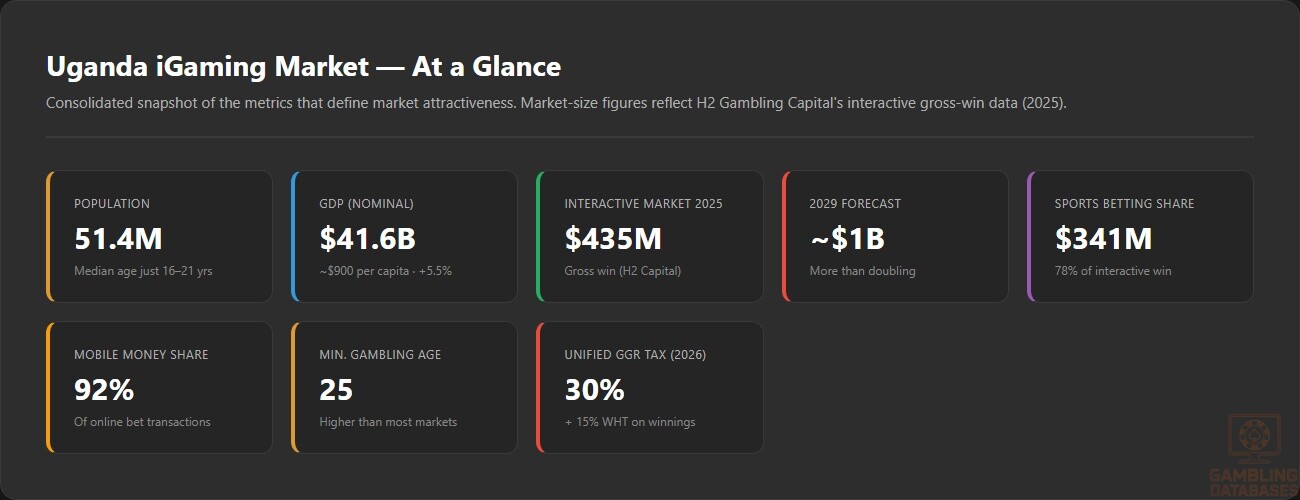
Executive Summary: Key Market Indicators
| Metric | Value |
|---|---|
| Gambling Legal Status | Legal and regulated under Lotteries and Gaming Act, 2016 |
| Regulatory Authority | National Lotteries and Gaming Regulatory Board (NLGRB) |
| Population | 46.5 million (2025 est.) |
| Median Age | 16 years (one of the youngest globally) |
| GDP (Nominal) | USD 41.6 billion (2025 est.) |
| GDP per Capita | Approx. USD 900 |
| Internet Penetration | Approximately 48% |
| Mobile Penetration | 75%+ (mobile money widespread) |
| Market Size (2025) | Estimated USD 70 million gaming revenue |
| Market Growth Forecast (CAGR) | 12-15% (next 5 years) |
| Average Revenue Per User (ARPU) | USD 15-18 (estimate) |
| Types of Licensed Gambling Activities | Sports betting, casinos, lotteries, slot routes, bingo |
| Minimum Legal Gambling Age | 25 years |
| Licensing Application Fee | UGX 20-50 million (USD 5,400 – 13,600) depending on license type |
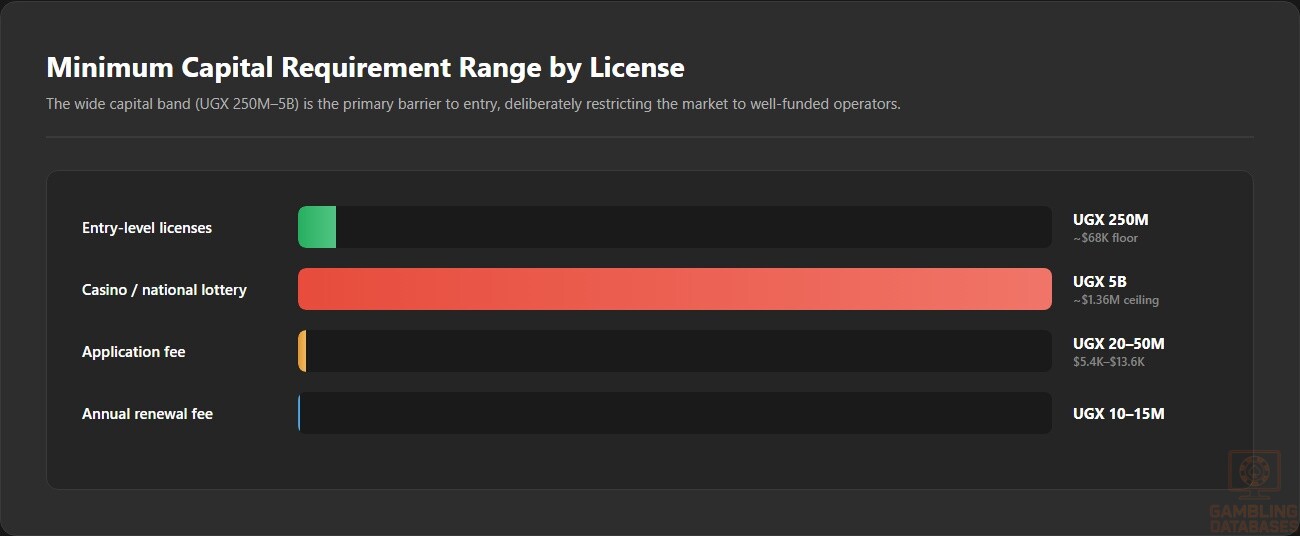
| Minimum Capital Requirements | UGX 250 million – 5 billion (USD 68,000 – 1.36 million) by license category |
| Gross Gaming Revenue (GGR) Tax | 30% for casinos and others; 20% for sports betting |
| Withholding Tax on Player Winnings | Recently removed (replaced by higher GGR tax) |
| License Renewal Fee | Varies by license type; typically UGX 10-15 million |
| Compliance Enforcement Unit | Special NLGRB Investigation and Enforcement Unit |
| Anti-Money Laundering (AML) Oversight | Mandated; integrated with national financial monitoring |
| Responsible Gambling Measures | Mandatory KYC, self-exclusion, limits on advertising |
| Regulatory Process Timeline | 3-6 months typical from application to license grant |
| Local Presence Requirement | Mandatory local incorporation and physical premises |
| Payment Methods Popularity | Mobile Money (92% online bets), Bank Transfers, Cards |
| Recent Regulatory Amendments | 2023 tax increase; 2025 centralized payment monitoring |
| Business Environment | Emerging, improving infrastructure, tax incentives evolving |
| Technology Infrastructure | Growing 4G/5G reach, increasing broadband availability |
Section 1: Regulatory Framework and Legal Environment
Current Gambling Regulation Status
Uganda’s gambling sector is governed primarily by the Lotteries and Gaming Act, 2016, enforced by the National Lotteries and Gaming Regulatory Board (NLGRB). The NLGRB supervises all types of gambling activities ranging from land-based casinos, sports betting shops, lotteries, to online gaming platforms.
The legal framework permits both land-based and online gambling while mandating strict compliance with licensing, taxation, and player protection standards. The minimum legal gambling age of 25 years is higher than most markets, aiming to mitigate youth exposure.
Land-Based Gambling Activities
Physical gambling venues in Uganda encompass full-service casinos, sports betting shops located predominantly in urban centers, dedicated slot machine halls, and lottery distribution points. Casinos require substantial capital investment, reflecting regulatory emphasis on financial solvency of operators. Sports betting dominates the physical market, propelled by widespread football enthusiasm.
Land-based operators face routine inspections and are required to implement robust player identification and responsible gambling protocols. Slot machine route operations, where machines are distributed to multiple venues, are also tightly regulated under separate licensing schemes.
Online Gambling Framework
Online gambling is legal and regulated but tightly monitored to prevent unlicensed operations. Licensed operators are allowed to offer sports betting and casino games online. The NLGRB requires online platforms to implement strong Know Your Customer (KYC) and Anti-Money Laundering (AML) controls to deter fraud and protect vulnerable groups.
The regulatory board has partnered with telecommunications providers to block access to unlicensed gambling websites, signaling a proactive enforcement stance. Additionally, new centralized payment mechanisms proposed for implementation in 2025 aim to streamline transaction transparency and tax compliance for online operators.
Licensed Operators and Market Players
Uganda’s iGaming market features a moderate number of licensed operators due to rigorous financial and technical entry requirements. High minimum capital thresholds and local incorporation mandates restrict market entry to well-capitalized entities. The competitive landscape includes regional African bookmakers, specialist casino operators, and select international entrants.
While detailed operator market shares are not publicly disclosed, the dominance of sports betting firms leveraging mobile money platforms is evident. New entrants typically adopt localization strategies, including regional partnerships and community engagement, to navigate the regulatory environment effectively.
Licensing Framework and Requirements
Application Process and Eligibility
The NLGRB manages all licensing applications, requiring comprehensive documentation and corporate vetting. License applicants must submit detailed business plans, financial statements, proof of minimum capital adequacy, technical specifications of gaming equipment or software, and compliance policies addressing responsible gambling and AML measures.
Typical application fees range between UGX 20 million and UGX 50 million, depending on the license type. Following submission, applications undergo a background check, financial scrutiny, and operational capacity assessment, usually completed within 3 to 6 months.
Licensing categories include but are not limited to sports betting, casinos, national and public lotteries, slot machine routes, bingo, and intermediary betting operators. Higher capital requirements apply for casino and national lottery licenses.
- Certified company registration documents
- Tax Identification and clearance certificates
- Police clearance certificates for key personnel
- Detailed description of intended gaming products
- Proof of minimum capital deposit or bank guarantee
- Business plan including corporate social responsibility commitments
- Technical certifications for gaming systems or software
- Details of premises for operation
- Employee CVs and work permits (if foreign staff involved)
- Bank account details and financial references
Local Presence and Operational Requirements
Foreign operators must locally incorporate Ugandan entities and maintain physical premises for their operations. This requirement ensures accountability and facilitates enforcement. Operators must also maintain local bank accounts and provide regular reports to the NLGRB.
The regulatory board enforces personnel qualifications and requires local managerial presence for operational oversight. Domain registration of online platforms must comply with Ugandan jurisdiction to align with regulatory control and taxation obligations.
Compliance Obligations and Monitoring
Player Protection and Identification
Uganda mandates strict age verification and KYC standards across all gaming platforms to minimize underage gambling and fraud. The legal requirement of a minimum age of 25 years underscores a conservative approach towards protecting younger demographics.
Operators implement responsible gambling measures including self-exclusion programs, activity and deposit limits, and public awareness campaigns. Information disclosures regarding odds, game fairness, and responsible play guidelines are compulsory.
- Mandatory age verification at registration and play
- Integrated KYC documentation (ID verification, proof of residence)
- Self-exclusion programs for problematic players
- Deposit and betting limit settings
- Continuous monitoring for suspicious betting patterns
Financial Monitoring and Reporting
Operators must maintain detailed transaction records subject to periodic audits by the NLGRB and the Uganda Revenue Authority. The reporting system includes real-time financial transaction data uploads, tax remittance declarations, and independent gaming system audits.
- Submission of quarterly turnover and revenue reports
- Payment of applicable taxes based on GGR and turnover
- Independent annual audits of accounting and gaming systems
- Provision of player activity and dispute resolution reports
Taxation Structure and Financial Obligations
Player Taxation
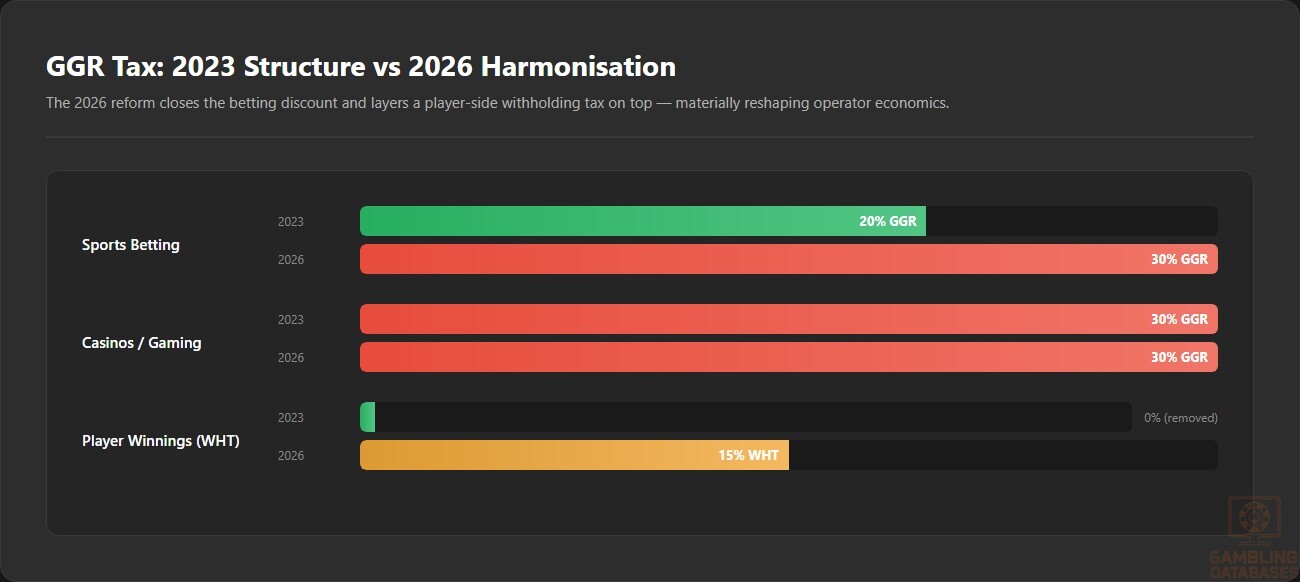
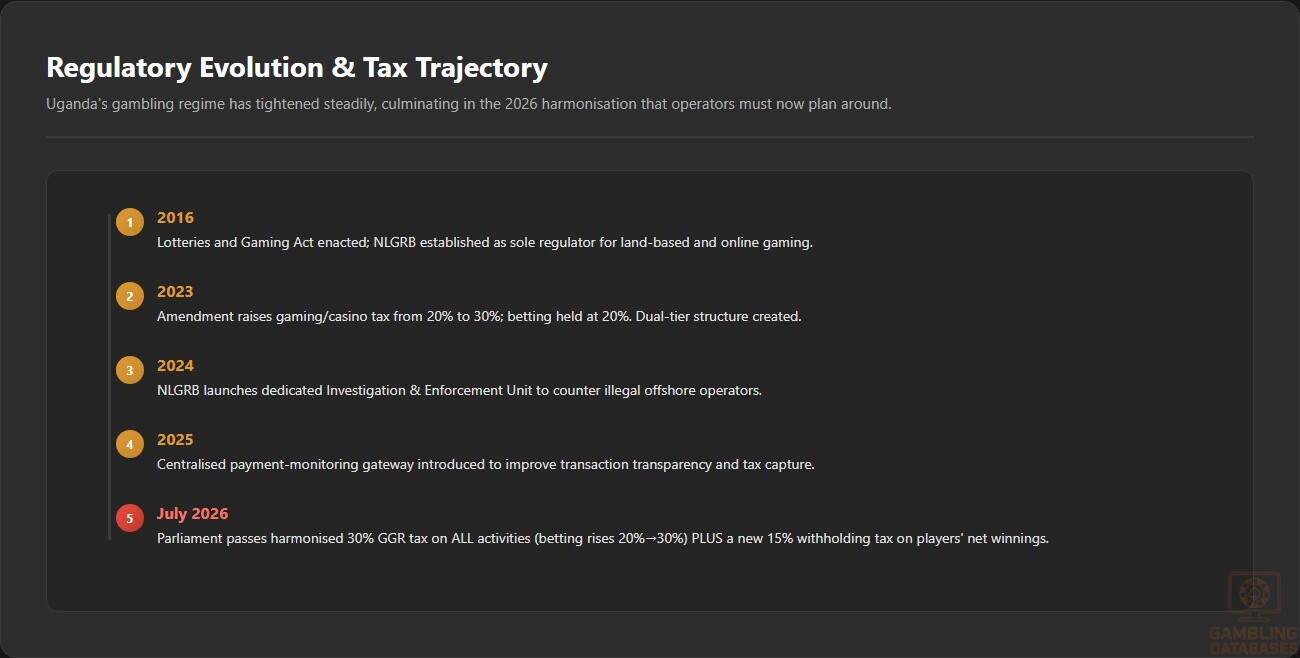
Recent legislative changes removed the 15% withholding tax on player winnings to simplify compliance. Players are not subject to direct taxation on winnings, easing their participation but shifting tax focus to operators.
Operator Taxation
Operators pay a Gross Gaming Revenue (GGR) tax set at 30% for casino and lottery activities and 20% for sports betting. This higher tax rate on casinos and lotteries reflects government efforts to optimize fiscal revenue from profitable verticals.
| Activity Type | GGR Tax Rate |
|---|---|
| Sports Betting | 20% |
| Casinos | 30% |
| Lotteries (National and Public) | 30% |
| Slot Machine Routes | 30% |
| Bingo | 30% |
Corporate income tax and additional fixed license renewal fees are applicable. License renewal fees generally range from UGX 10 million to 15 million depending on the license category.
Gambling Market Financial Performance
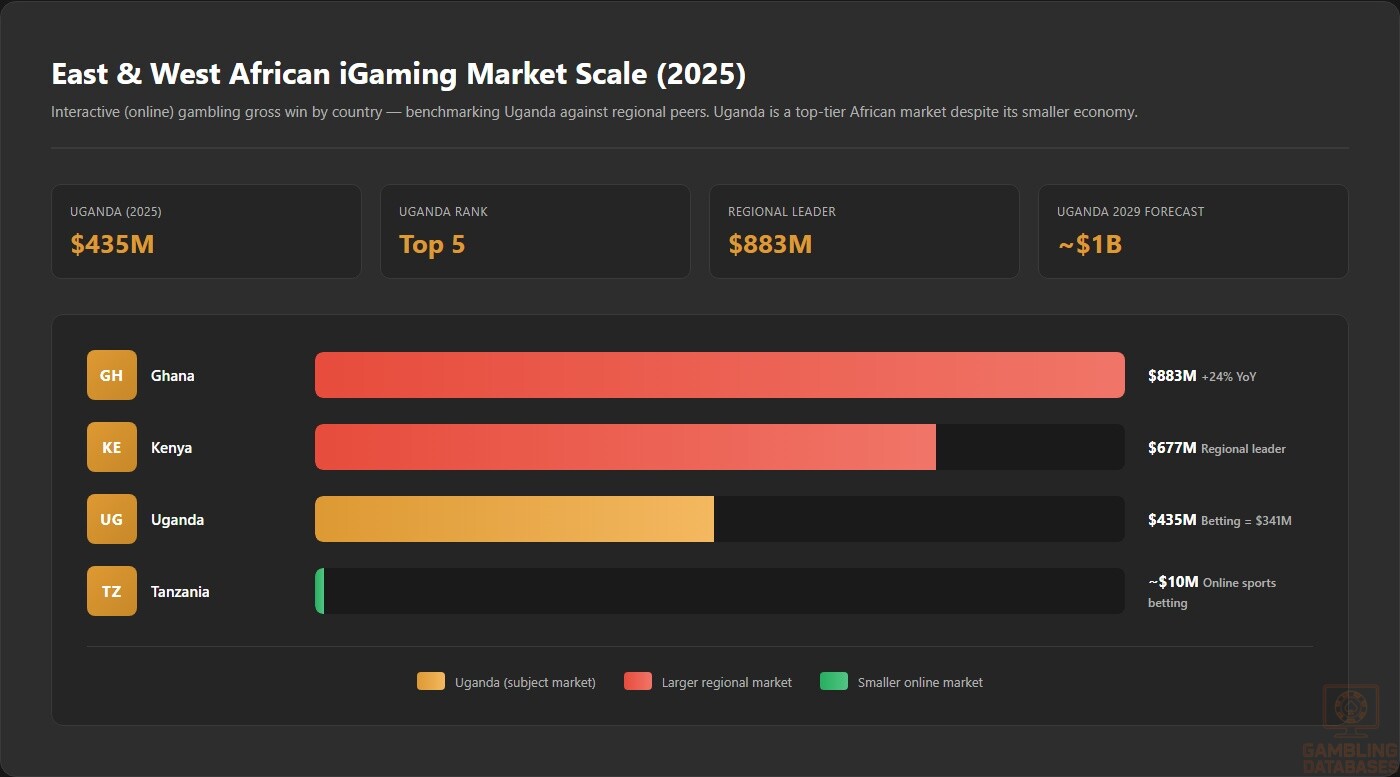
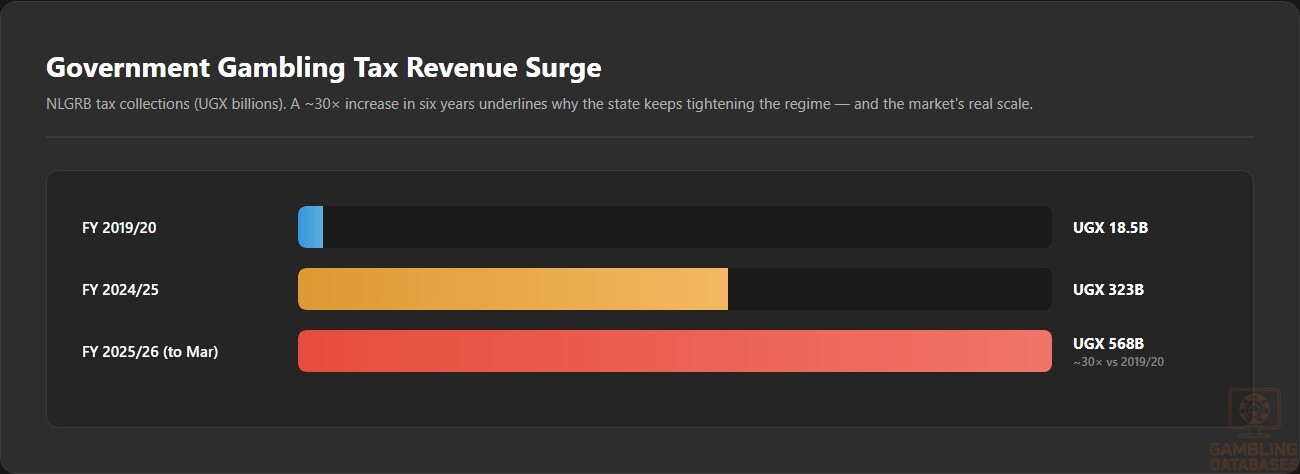
Uganda’s gaming sector generated estimated revenues of USD 70 million in 2025, exhibiting a compound annual growth rate of 12-15%, driven mainly by sports betting via mobile money platforms. Tax contributions from gaming activities are a significant and growing segment of the national budget.
Authorities report enforced audits and crackdown on illegal gambling, which helps protect market integrity and sustain growth. Proactive measures to digitize payments and integrate tax compliance systems enhance revenue transparency.
Advertising and Marketing Restrictions
Advertising of gambling services in Uganda is regulated to protect vulnerable groups and control market messaging. Operators face restrictions on advertising content, channels, and time slots to prevent excessive promotion targeting minors.
- Permitted advertising limited to radio, TV, and approved digital platforms
- Prohibition on advertising within schools and youth-oriented events
- Restrictions on use of celebrities and influencers in gambling promotions
- Limitations on bonuses and promotional offers to prevent excessive gambling
- Mandatory inclusion of responsible gambling messages in all adverts
Recent Regulatory Changes and Their Impact
In 2023, Uganda increased the gambling tax rate for most activities from 20% to 30%, aiming to boost governmental revenue while removing withholding taxes on winnings. The Lotteries and Gaming Regulatory Board also launched a new enforcement unit in 2024 to counter illegal operators more effectively.
Further, the planned 2025 introduction of a centralized payment monitoring system is expected to strengthen tax collection and compliance, presenting operational challenges and opportunities for licensed operators focused on transparency.
Enforcement Mechanisms and Penalties
The NLGRB enforces compliance through licensing sanctions, financial penalties, and criminal prosecution for breaches such as illegal operation, underage gambling facilitation, or tax evasion. Cooperation with police and telecom companies enhances enforcement reach.
- License suspension and revocation for non-compliance
- Fines proportional to offense severity and frequency
- Criminal charges in cases of fraud or money laundering
- Blocking of unlicensed online gambling websites
- Regular inspections and compliance audits
Section 2: Demographics and Consumer Analysis
Population Demographics and Distribution
Uganda’s population is estimated at 55.1 million in 2025, with a median age of just 21.2 years, making it one of the youngest populations globally. Approximately 56.4% of Ugandans are aged 19 or younger, while 41.4% are between 20 and 64 years. Only 2.2% of the population is over 65, reflecting a predominantly youthful demographic structure.
Gender distribution is nearly balanced with slightly fewer males at 992 males per 1,000 females. Urbanization is moderate; about 19.9% of the population lives in urban centers, while the majority remains rural. However, urban areas show higher internet access and concentration of gambling venues, notably in major cities.
| Age Group | Population (millions) | Percentage of Total |
|---|---|---|
| 0-19 years | 31.1 | 56.4% |
| 20-64 years | 22.8 | 41.4% |
| 65 years and above | 1.2 | 2.2% |
Geographic Distribution
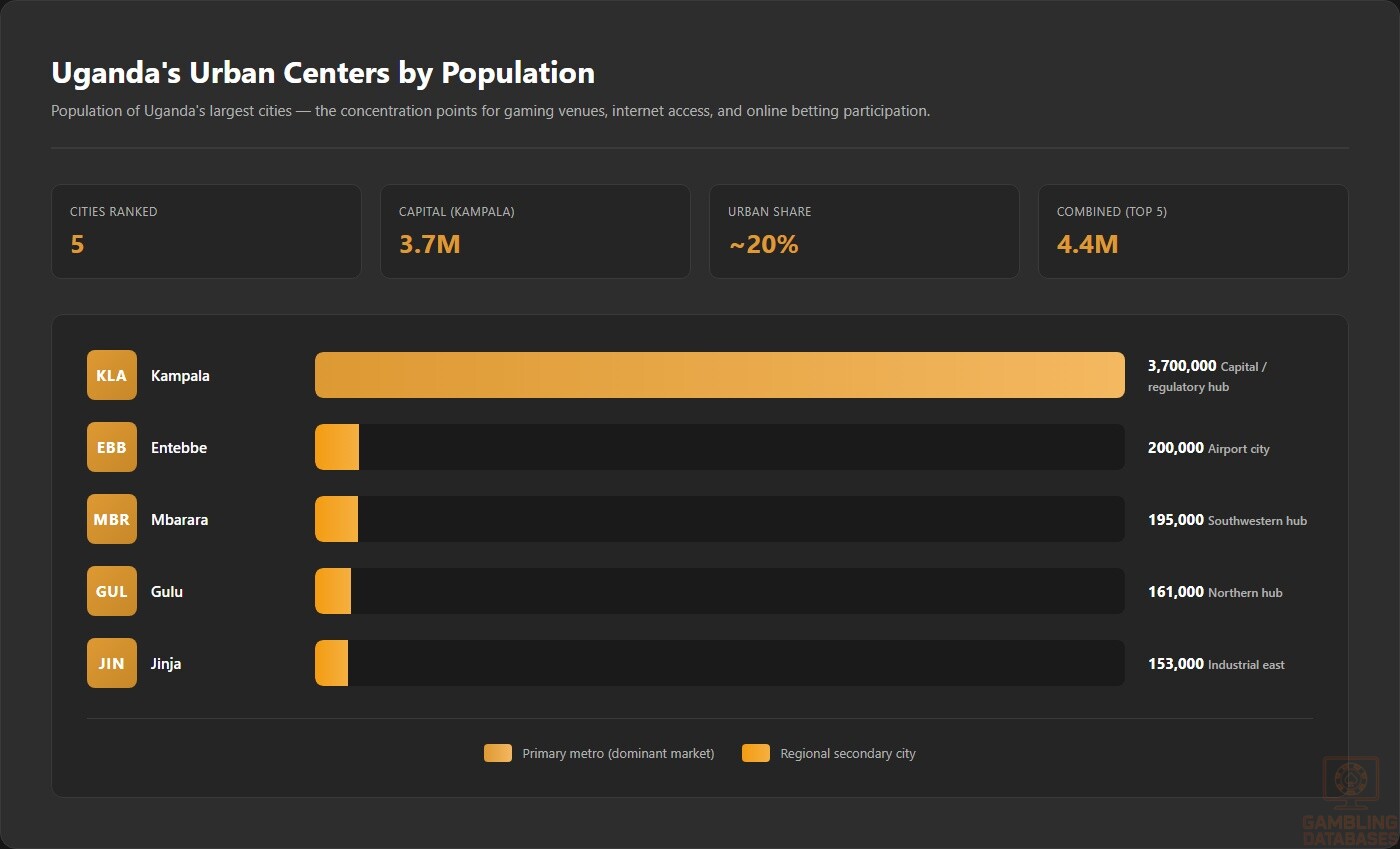
The population is unevenly distributed with higher densities in central and southwestern regions. Kampala, the capital, is the largest urban center with a population approaching 3.7 million, serving as the commercial and regulatory hub. Other notable cities include:
- Kampala – 3.7 million
- Entebbe – 200,000
- Jinja – 153,000
- Mbarara – 195,000
- Gulu – 161,000
Internet penetration is highest in these urban centers, aligning with higher levels of gaming venue availability and online gambling participation. Rural regions show limited connectivity but represent untapped growth areas for mobile-driven iGaming.
Economic Indicators and Consumer Spending Power
Uganda’s nominal GDP stands at approximately USD 41.6 billion with a per capita income near USD 900. The economy is growing steadily at around 5-6% annually, fueled by agriculture, services, and increasing industrialization. Young consumer cohorts exhibit rising disposable incomes despite overall low median incomes, fostering expansion in digital entertainment spending.
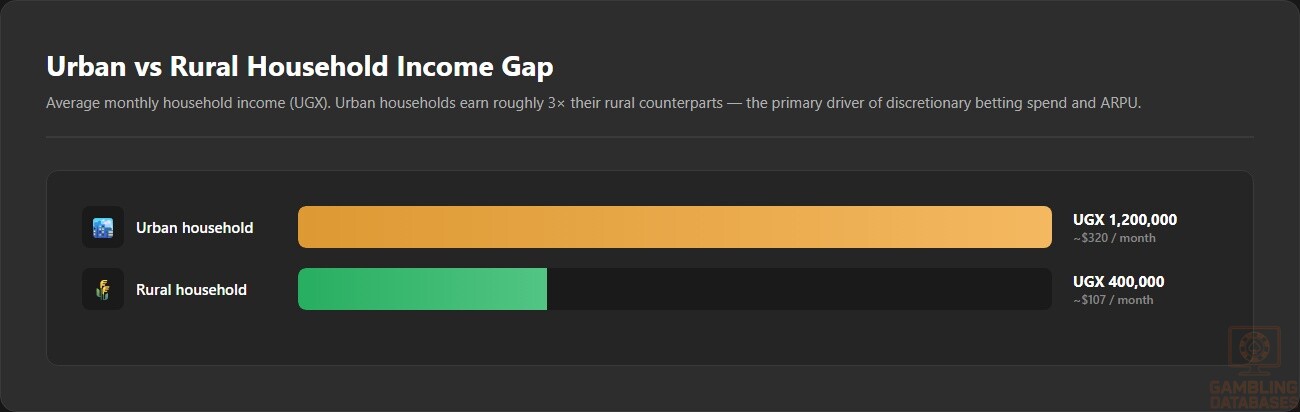
Average household income varies significantly between urban and rural regions, with urban households enjoying higher income levels and access to modern retail and financial services. Income inequality remains marked, influencing discretionary spending power and betting habits across different social strata.
Market analysts estimate that Uganda’s consumer spending on iGaming and related digital entertainment is expanding rapidly due to improving affordability of smartphones, mobile data, and payment solutions. This supports a growing base of active players with increasing ARPU levels.
| Indicator | Value |
|---|---|
| GDP (Nominal) | USD 41.6 billion |
| GDP Growth Rate | 5.5% |
| Per Capita Income | USD 900 |
| Inflation Rate | 3.8% |
| Urban Household Average Income | UGX 1,200,000 per month |
| Rural Household Average Income | UGX 400,000 per month |
Market Size and Growth Projections
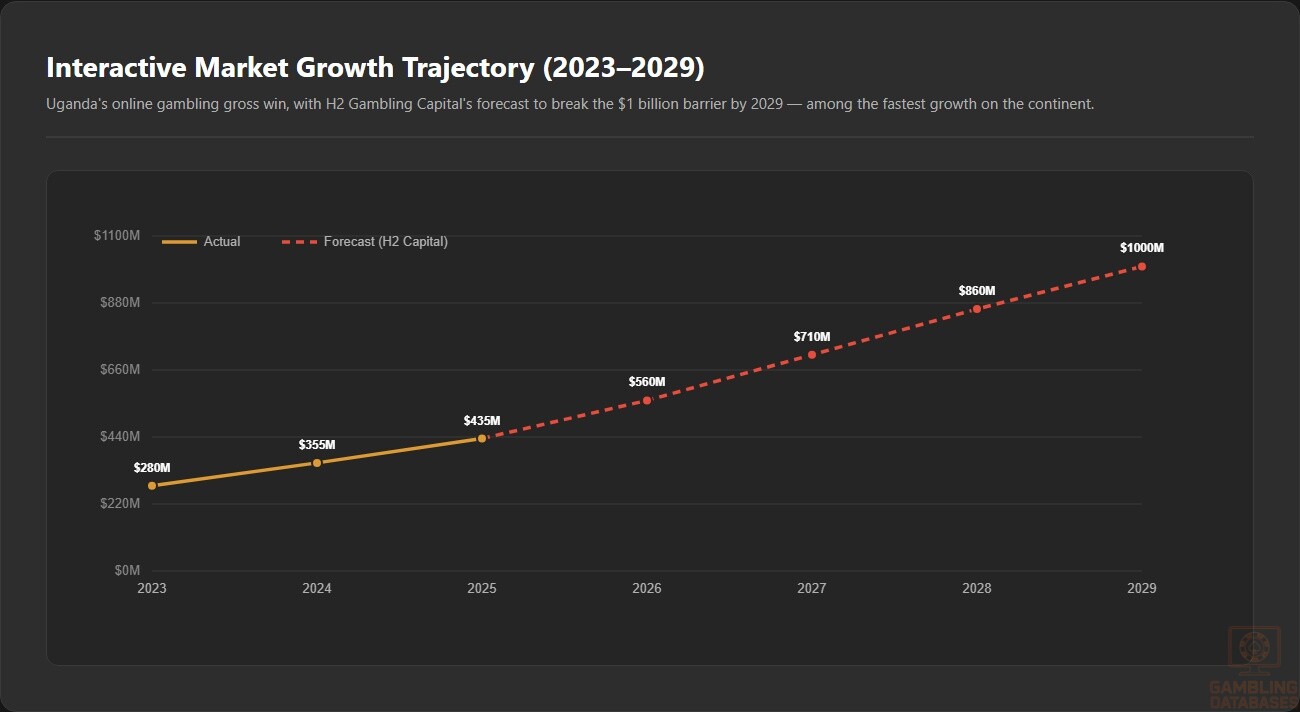
Uganda’s iGaming market revenue is estimated at around USD 70 million in 2025 with a robust compound annual growth rate (CAGR) of 12-15% expected over the next five years. The increasing base of internet and smartphone users supports growth in both sports betting and online casino segments.
Predominantly mobile-first, the market’s Average Revenue Per User (ARPU) ranges between USD 15 and 18. Projections indicate expanding user penetration driven by younger demographics and rising digital literacy, positioning Uganda as a key emerging market within Africa.
| Year | Estimated Revenue (USD million) | Growth Rate (YoY %) |
|---|---|---|
| 2023 | 57 | — |
| 2024 | 63 | 10.5% |
| 2025 | 70 | 11.1% |
| 2026 | 79 | 12.9% |
| 2027 | 90 | 14.1% |
Education, Skills, and Digital Literacy
Uganda’s literacy rate is approximately 76%, reflecting continued improvements in education access. Secondary school enrollment and completion rates have increased steadily, alongside government initiatives promoting digital skills among youth. Digital literacy is expanding rapidly, supported by affordable smartphones and internet availability, which are crucial for online gaming adoption.
The young workforce is progressively skilled in basic ICT competencies, with growing numbers engaged in digital and mobile-based services. This strengthens the consumer base for iGaming products and services delivered through mobile devices.
Cultural and Social Factors
Communication and Language
Multiple languages are spoken across Uganda, with English as the official language, widely used in digital content and commerce. Luganda is the most prominent local language, followed by Runyankole, Luo, Swahili, and Ateso, reflecting Uganda’s ethnic diversity.
- English (official and business)
- Luganda (central region)
- Runyankole (southwestern region)
- Luo (northern region)
- Swahili (regional trade and communication)
Cultural Attitudes
Gambling enjoys a broad cultural acceptance, particularly sports betting linked to football fandom. However, religious and traditional norms influence perceptions, necessitating culturally sensitive marketing by operators. Foreign brands generally enjoy favorable reputations if they localize content and engage in community outreach.
Entertainment preferences are shifting toward digital platforms, especially among younger generations, enabling iGaming growth alongside other digital entertainment forms.
Problem Gambling and Social Considerations
While gambling participation is rising, concerns about problem gambling have prompted government and industry responses. At-risk populations include young males and lower-income groups most exposed to mobile betting.
- National awareness campaigns promoting responsible gambling
- Self-exclusion and deposit limit regulations enforced by NLGRB
- Support services through NGOs and community organizations
- Mandatory operator contributions to social responsibility funds
- Research programs monitoring gambling impact on youth
Political Structure and Governance
Uganda is a stable republic with a centralized governance system overseeing consistent regulatory frameworks. Political stability supports regulatory continuity, though evolving governance mechanisms emphasize transparency and digital modernization. International relations foster trade openness, facilitating foreign investment in gaming and digital sectors.
Technology Adoption and Digital Behavior
Internet and Digital Usage
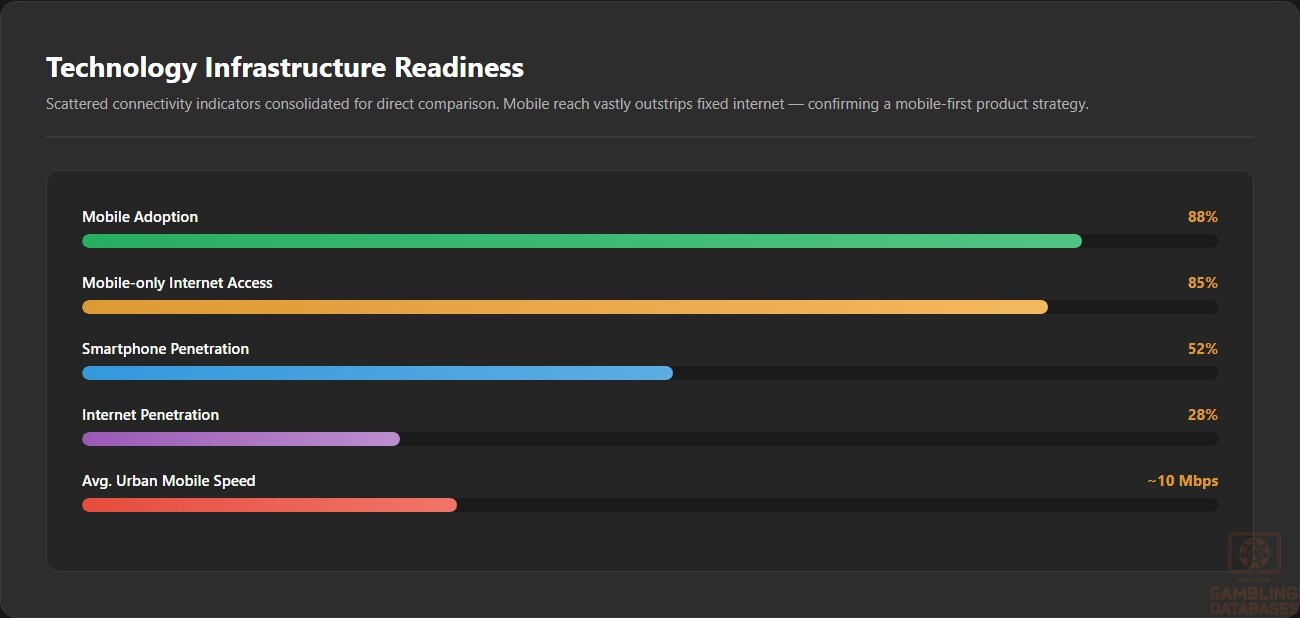
Internet penetration in Uganda is approximately 28% as of early 2025, with strong growth trends averaging 7-8% yearly increases. Approximately 14.2 million people are connected online, primarily in urban areas.
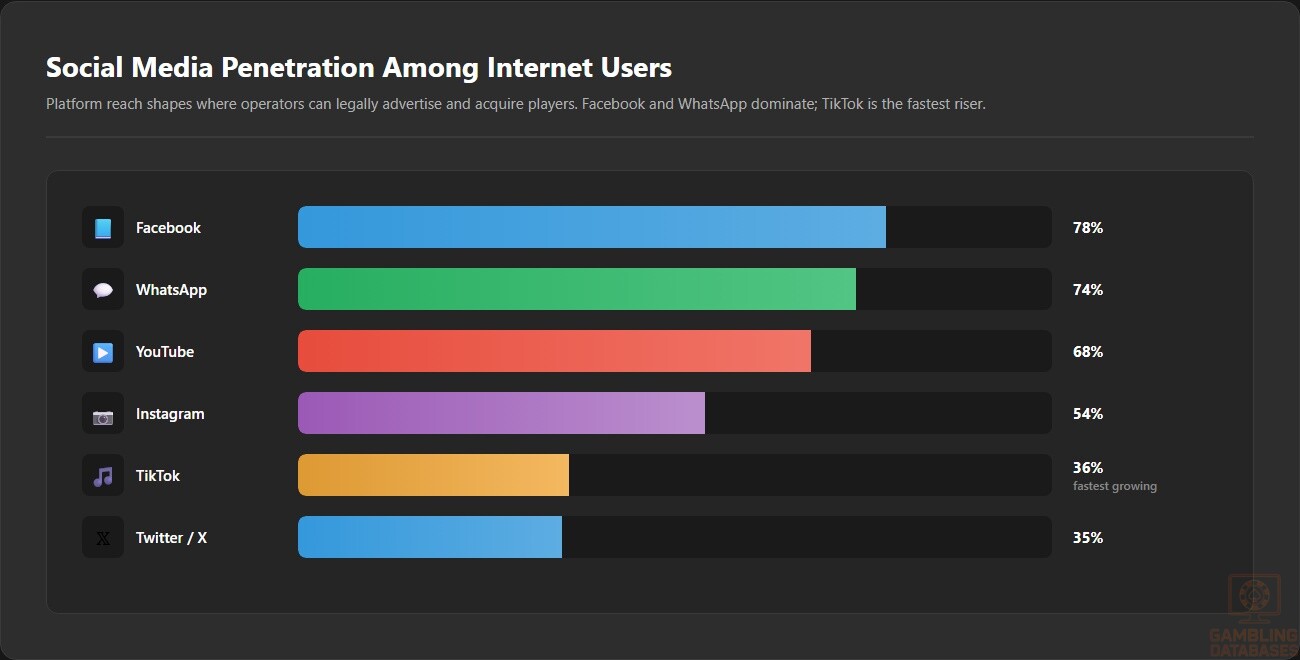
Mobile adoption is significantly higher at nearly 88%, propelled by extensive mobile money services and affordable smartphones. Social media engagement is robust across various platforms:
- Facebook – 78% penetration among internet users
- WhatsApp – dominant messaging with 74% penetration
- YouTube – 68% penetration, popular for video content
- Instagram – 54% penetration, strong among younger users
- TikTok – rising rapidly with 36% penetration
- Twitter – 35% penetration among news and opinion users
Digital Payment Behavior
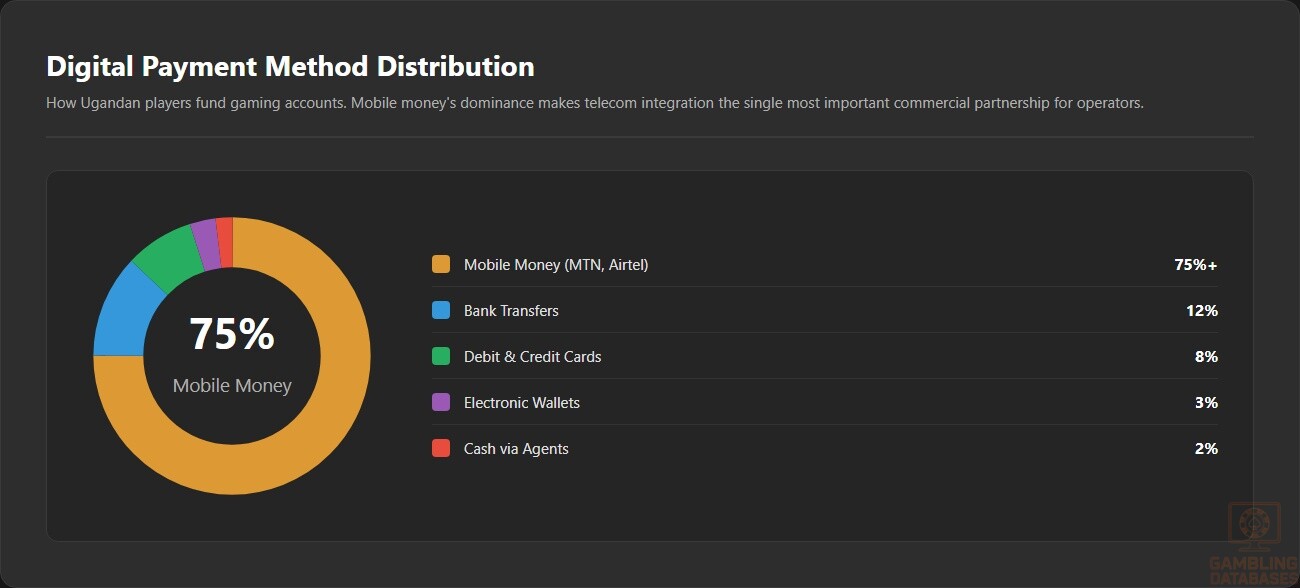
Mobile money remains the dominant digital payment method, accounting for over 75% of online transactions, including iGaming deposits and withdrawals. Bank transfers and card payments are used less frequently but are growing alongside expanding financial inclusion.
- Mobile Money (e.g., MTN Mobile Money, Airtel Money) – 75%+
- Bank Transfers – 12%
- Debit and Credit Cards – 8%
- Electronic Wallets (PayPal alternatives) – 3%
- Cash Payments via Agents – 2%
Cryptocurrency adoption remains minimal but shows early signs of interest among digital natives and tech-savvy users.
Gaming and Gambling Preferences
Current Market Participation
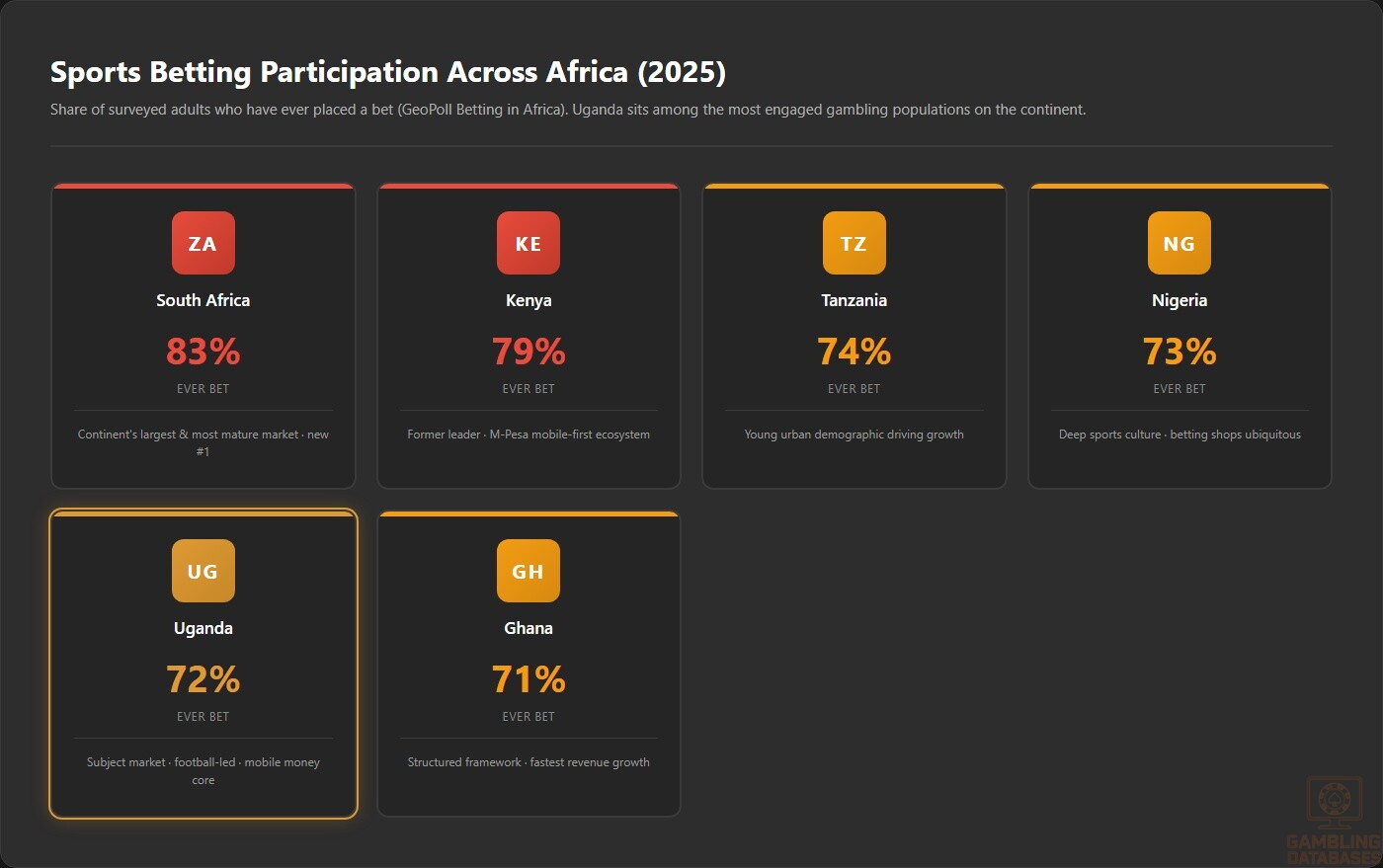
Sports betting is the most popular form of gambling, enjoying participation rates exceeding 60% of all gamblers, followed by lotteries and online casino games. Preferences skew strongly toward football betting favored across age groups.
- Sports Betting (Football-focused)
- Lotteries
- Online Casino Games (slots, table games)
- Bingo
- Other traditional betting activities
| Activity | Estimated Participation (%) |
|---|---|
| Sports Betting | 62% |
| Lotteries | 18% |
| Online Casino Games | 13% |
| Bingo | 5% |
| Other | 2% |
Consumer Behavior Patterns
Ugandan players prefer mobile-first platforms optimized for low bandwidth and mobile money integration. Peak gambling activity occurs during evening hours and weekends, coinciding with major football matches. Session lengths average 30-45 minutes, with retention supported by live betting and social interaction features.
Spending patterns reveal cautious but increasing wager sizes aligned with disposable income growth. Loyalty programs, localized content, and social gaming formats drive user engagement and retention on digital platforms.
Section 3: Technology Infrastructure and Business Environment
Internet and Digital Infrastructure
Uganda’s internet penetration is estimated at approximately 28%, with a notable divide between urban and rural areas. Broadband access remains limited, with 85% of internet users relying on mobile networks rather than fixed-line broadband. Average mobile internet speeds hover around 10 Mbps in urban centers, supporting moderate streaming and gaming experiences, whereas rural broadband infrastructure is less developed.
Significant infrastructure investments by both public and private sectors have accelerated network coverage, with fiber-optic backbone expansions and satellite internet projects underway. Despite these improvements, challenges remain in network reliability and affordability, especially outside Kampala and major cities.
5G and Future Technology Deployment
The country’s 5G rollout is in early stages, with pilot projects launched by leading telecom providers in 2024 focused on Kampala and surrounding urban zones. Full commercial 5G coverage is expected to expand gradually over the next 3-5 years driven by competitive 4G network upgrades and increasing smartphone adoption.
Five main mobile network operators currently drive market competition, each investing in next-generation technologies to gain footholds in high-value urban demographics. 5G deployment will enhance data speeds and lower latency, positioning Uganda’s digital ecosystem for advanced mobile gaming and digital payment solutions.
Mobile Technology Ecosystem
The mobile network infrastructure comprises several key players, with widespread 3G and 4G coverage across most urban and significant rural regions. This network facilitates the dominant mobile money culture and supports emerging iGaming platforms demanding reliable connectivity.
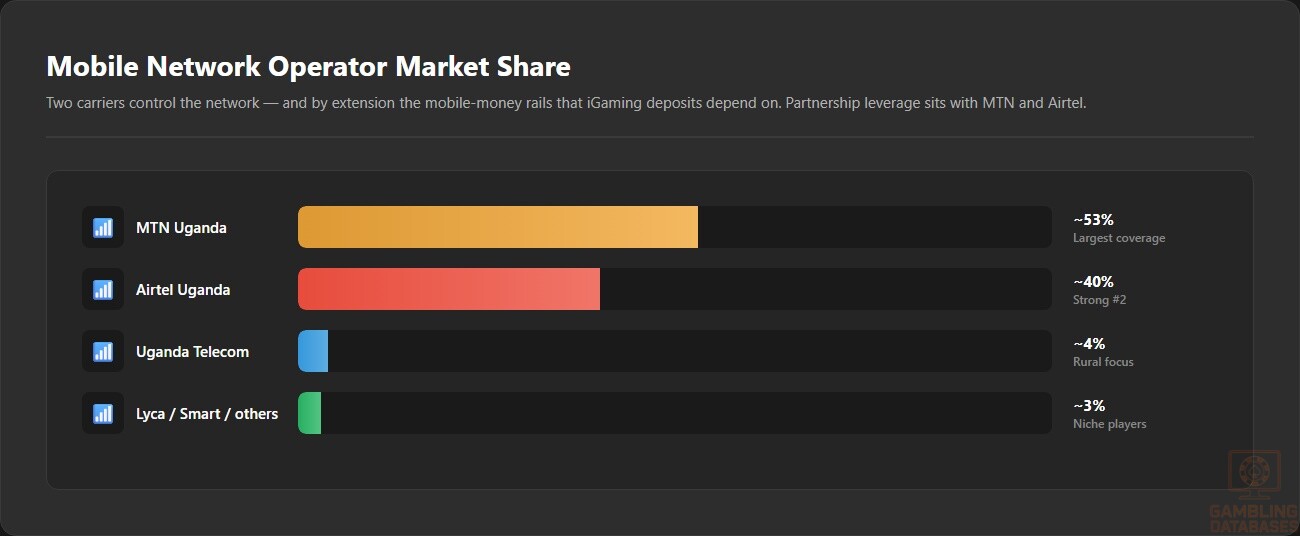
- MTN Uganda – largest market share (~53%) and extensive coverage
- Airtel Uganda – strong competitor with ~40% market share
- Uganda Telecom – government-backed operator with focus on rural areas
- Lycamobile – niche international voice and data provider
- Smart Telecom – emerging smaller player expanding 4G footprint
Smartphone penetration stands at approximately 52%, driven by affordable models targeting young consumers. Android dominates market share, with users favoring low-cost devices supporting mobile-first applications integral to the iGaming experience.
Financial Services and Payment Infrastructure
Uganda’s banking sector is moderately developed, hosting several key financial institutions that provide digital banking and mobile integration services. Mobile money services facilitate widespread financial inclusion, fueling digital payment adoption critical to iGaming transactions.
- Stanbic Bank Uganda – largest bank by assets with digital banking focus
- Centenary Bank – known for rural outreach and mobile services
- Bank of Uganda (Central Bank) – regulator fostering fintech innovation
- dfcu Bank – significant lender with expanding digital capabilities
- Equity Bank Uganda – strong mobile and SME banking presence
Payment methods encompass a range of options suited to varying consumer preferences, with mobile wallets dominating daily transactions. Bank card penetration remains low but is increasing with improved POS infrastructure and e-commerce uptake.
- Mobile Money (MTN Mobile Money, Airtel Money)
- Bank Transfers and Direct Debit services
- Debit and Credit Cards (Visa, Mastercard)
- Electronic wallets and virtual prepaid cards
- Cash deposit/withdrawal via agents and retail outlets
E-commerce and Digital Economy
Uganda’s e-commerce sector is expanding steadily, supported by growing internet accessibility and youth tech adoption. Trust-building measures including payment security protocols and consumer protection laws have boosted online retail, digital services, and remote entertainment consumption.
Online marketplaces, social commerce, and digital financial services converge to form an increasingly integrated digital economy, offering iGaming operators potential synergies and distribution channels.
Business Environment and Regulatory Framework
Uganda ranks moderately in ease of doing business, with progressive reforms simplifying company registration and tax filing processes. However, bureaucratic inefficiencies and infrastructure gaps present operational challenges for new market entrants.
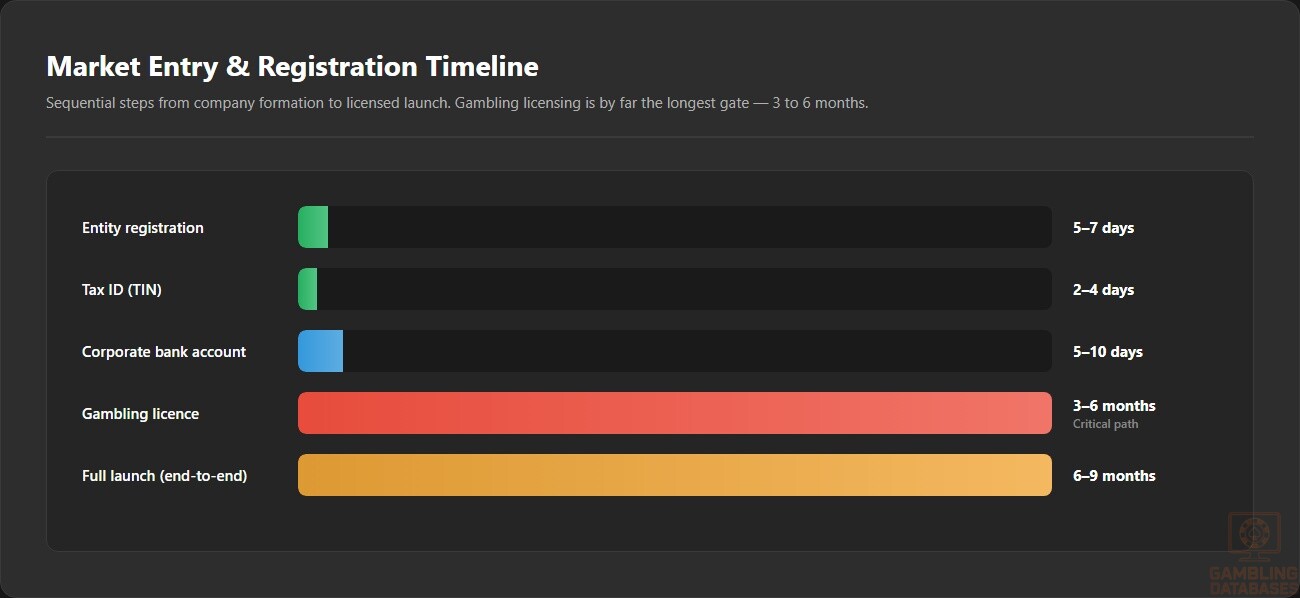
- Business name reservation and entity registration (5-7 days)
- Tax registration and obtaining Tax Identification Number (TIN) (2-4 days)
- Licensing specific to regulated sectors like gambling (3-6 months)
- Opening corporate bank accounts (5-10 days)
- Compliance verifications and local office setup (ongoing)
Corporate Structure and Registration
Operators may register as Limited Liability Companies (LLC), Corporations, or Branch Offices of foreign entities. LLCs remain the most common due to limited liability protections and operational flexibility. Branch offices are subject to additional regulatory scrutiny and limited in certain business activities including gambling.
Recommended structures depend on foreign investor strategies, with local incorporation favored for regulatory and tax efficiency. All entities must maintain registered local addresses and comply with annual filing and auditing standards.
- Certificate of Incorporation and company memorandum
- Tax Identification Number (TIN) certificate
- Business license(s) including gambling-specific permit
- Proof of local physical premises
- Directors’ and shareholders’ identification documents
- Bank account opening documents
- Compliance and anti-money laundering policies
Taxation Framework
Corporate income tax is levied at a standard rate of 30%, with incentives such as tax holidays available in designated special economic zones. Uganda participates in double taxation treaties with multiple countries to avoid double taxation on foreign income.
Individual income tax is progressive, ranging from 10% to 30% on higher earnings, with mandatory social security contributions. Tax residency criteria require individuals or corporations to file locally if domiciled or operating within Uganda.
- Double taxation treaties with UK, Kenya, South Africa, Germany, Netherlands
- Capital gains tax and withholding tax regimes integrated with FATCA compliance
- Value Added Tax (VAT) set at 18% on most goods and services
- Special tax incentives for tech startups and innovation hubs
- Tax penalties for non-compliance strictly enforced
Market Entry Considerations
Optimal entry into Uganda’s iGaming sector requires a local presence, robust compliance frameworks, and partnerships with established telecom and financial service providers. Leveraging mobile money integration and community engagement strategies significantly supports user acquisition.
- Local incorporation and license acquisition compliance
- Strategic partnerships with mobile money and telecom operators
- Adoption of mobile-first, low-bandwidth optimized platforms
- Localized marketing with cultural and language adaptations
- Robust KYC/AML and responsible gambling infrastructure
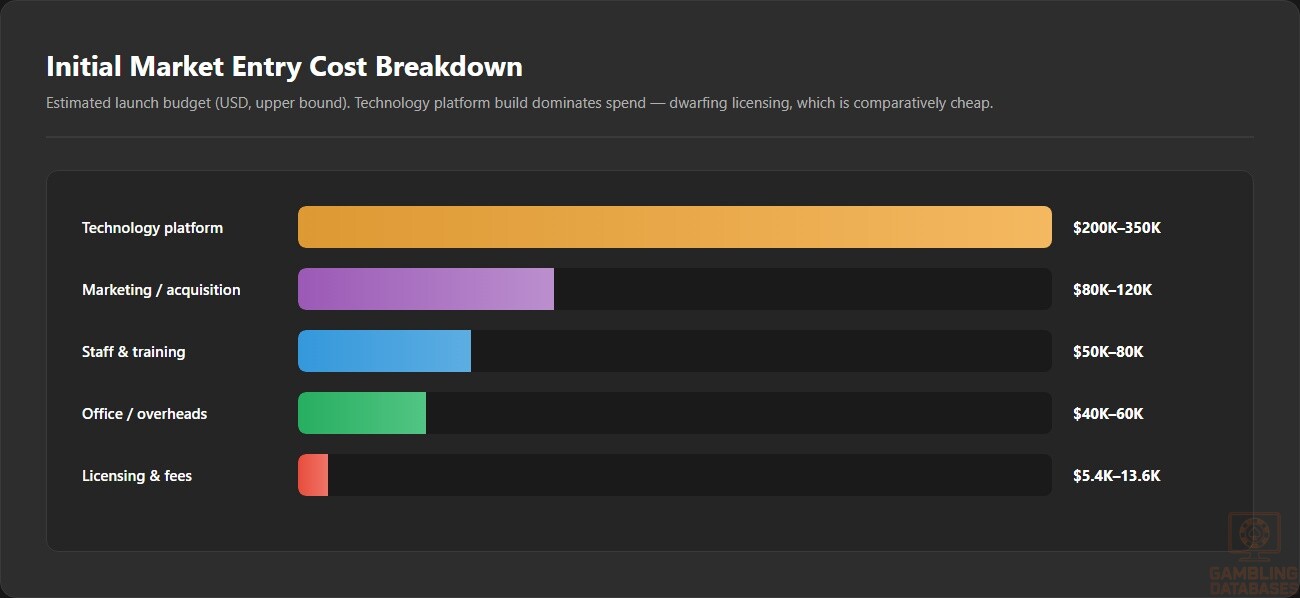
Initial investments center on licensing fees, technology platform setup, local staffing, and marketing, with operational costs influenced by regulatory compliance and infrastructure quality. Entry timelines average 6-9 months from preliminary research to full operational launch in regulated markets.
| Cost Category | Estimated Cost |
|---|---|
| License Application and Fees | 5,400 – 13,600 |
| Technology Platform Setup and Integration | 200,000 – 350,000 |
| Local Staff Recruitment and Training | 50,000 – 80,000 |
| Marketing and Customer Acquisition | 80,000 – 120,000 |
| Operational and Office Overheads | 40,000 – 60,000 |
FAQ: Frequently Asked Questions
1. Is online gambling legal in Uganda?
Yes, online gambling is legal and regulated by the National Lotteries and Gaming Regulatory Board. Operators must obtain relevant licenses and adhere to strict compliance including KYC and AML policies. Both sports betting and online casinos are permitted within the legal framework.
2. What types of gambling licenses are available and what do they cover?
Licenses cover a variety of gambling activities including sports betting, casinos, national lotteries, slot machine routes, bingo, and gaming intermediaries. Each license imposes specific capital and operational standards aligned with the type of service offered.
3. How much does an iGaming license cost and how long does it take to obtain?
Licensing fees range from UGX 20 million to 50 million (approximately USD 5,400 to 13,600), depending on the category. The approval process typically takes 3 to 6 months, involving detailed documentation, background checks, and operational evaluations.
4. Can foreign companies obtain a gambling license?
Yes, foreign entities can obtain licenses but are required to locally incorporate a Ugandan subsidiary, maintain physical offices, and comply with local regulatory obligations. Partnerships with local firms may facilitate market entry and compliance.
5. What are the tax obligations for iGaming operators?
Operators are subject to Gross Gaming Revenue (GGR) tax of 30% for casinos and lotteries, and 20% for sports betting. Corporate income tax applies at 30%, alongside fixed license renewal fees. Recent reforms removed withholding tax on player winnings, focusing tax collection on operators.
6. Are gambling winnings taxed for players?
There is no direct taxation on player winnings; Uganda eliminated the 15% withholding tax on winnings to simplify compliance and encourage participation. Players do not have additional tax obligations on gambling income.
7. What are the typical operational costs for running an online casino or sportsbook?
Operational costs include licensing fees, technology platform setup, staff salaries, marketing, and compliance expenditures. Costs for technology setup can run from USD 200,000 to 350,000, while marketing budgets depend on user acquisition strategies and competition.
8. What is the expected ROI timeline for entering this market?
Return on investment typically occurs within 2 to 3 years, depending on market positioning, user acquisition speed, and operational efficiency. High growth sectors such as sports betting see faster uptake while regulated compliance adds initial costs and complexity.
9. What are the local presence requirements for operators?
Operators must locally incorporate entities, maintain physical offices, and employ Ugandan staff. These requirements ensure regulatory oversight and facilitate enforcement of licensing conditions and tax compliance.
10. What payment methods are available and recommended?
Mobile money dominates payment methods, accounting for most deposits and withdrawals, supported by major providers like MTN Mobile Money and Airtel Money. Bank transfers, debit/credit cards, and e-wallets offer additional payment options for broader user convenience.
11. What are the advertising and marketing restrictions?
Advertising must comply with regulations limiting content, channels, and timing to protect vulnerable populations. Online platforms must include responsible gambling messaging, and direct marketing to minors is prohibited. Prominent sponsorships and social media campaigns are closely monitored.
12. What responsible gambling measures are mandatory?
Operators must implement mandatory age verification at sign-up, self-exclusion options, betting limits, continuous monitoring of player activity, and public awareness campaigns. These measures aim to reduce problem gambling and enhance player protection.
13. How large is the iGaming market and what is the growth potential?
The current market size is estimated at USD 70 million with a projected annual growth rate between 12% and 15%. Young demographics and mobile penetration underpin strong growth potential over the next five years as digital models expand.
14. Who are the main competitors and what is their market share?
The Ugandan market features regional and international operators, with dominant sports betting firms leveraging mobile money ecosystems. Exact market shares are proprietary, but competition centers around mobile-first platforms and localized customer engagement.
15. What are the player preferences and typical spending patterns?
Players prefer mobile-accessible sports betting, particularly football, combined with growing interest in online casino games. Spending patterns reveal moderate wager sizes increasing with disposable income and loyalty program incentives supporting retention.
16. What are the key success factors and main challenges for new entrants?
- Strong local partnerships and understanding of regulatory compliance
- Mobile-first technology optimized for limited bandwidth
- Culturally relevant marketing and localized content
- Effective integration with mobile money payment systems
- Robust responsible gambling and anti-fraud infrastructure
- Challenges include regulatory complexity, infrastructure gaps, and competitive pressure
- Ensuring trust and compliance amidst evolving digital payment ecosystems
- Dealing with low average income levels and variable market liquidity
- Maintaining consistent service quality in rural and constrained bandwidth areas
- Overcoming barriers related to digital literacy and consumer education
Sources and References
- National Lotteries and Gaming Regulatory Board, Uganda – https://lgrb.go.ug
- Uganda Lotteries and Gaming Act, 2016
- Uganda Ministry of Finance, Economic Reports 2025
- World Bank Doing Business Report, Uganda 2024
- Uganda Bureau of Statistics, Population Census 2025
- Central Bank of Uganda Annual Reports 2024-2025
- International Telecommunication Union, ICT Data 2025
- We Are Social and Hootsuite, Digital 2025 Uganda Report
- IMARC Group, Uganda Mobile Money Market Analysis 2023
- Statista, Digital Payments in Uganda 2025
- Uganda Communications Commission, Telecommunications Industry Report
- European Gaming Commission, Africa iGaming Market Research 2025
- IGaming Today, Uganda Market Research Report 2025
- Africa Gambling Insider, Regulatory Updates 2025
- Sigma World, Uganda Economic Growth Analysis 2025
- PopulationPyramid.net, Uganda Demographics 2025
- Online Casino Reports Uganda, Market Insights 2025
- NilePost Uganda, Digital Landscape Report 2025
- Qeios Academic Research, Gambling Prevalence Uganda
- African Gambit, Uganda Regulatory Revenue Growth 2025
- Vixio Insights, Uganda Gambling Taxation Updates 2023-2025
- Focus Gaming News, Responsible Gaming Uganda 2025
- Uganda Bankers Association Digital Lending Report 2024
- CountryMeters, Uganda Real-Time Population Statistics 2025
- The Lotteries and Gaming Licensing Regulations, Uganda 2017
- EY Uganda Tax Alert 2025
- LinkedIn Articles on African Gambling Regulations 2025
- Uganda Government Official Gazettes on Gambling Policy
- Various Industry News Outlets covering African iGaming Developments 2023-2025
- Academic Publications on Digital Literacy and Gambling in Uganda
- Official Telecommunications Companies Websites and Reports 2025
- Local and International Financial Institutions Annual Reviews
- National Anti-Money Laundering Policies, Uganda 2024
- Global Gaming Compliance Forum Reports 2024-2025
- Peer-reviewed Articles on Uganda’s Economic and Social Trends 2025