Tanzania presents a progressively regulated and promising iGaming market with formal licensing for online and land-based gambling activities. The Tanzanian government, through its Gaming Board, fosters a legal environment that supports sustainable growth and foreign investment.
Strong regulatory frameworks, rising digital adoption, and expanding gambling revenues position Tanzania as an emerging hub for iGaming operators targeting East Africa.
| Metric | Value |
|---|---|
| Gambling Legal Status | Fully regulated; legalized land-based and online gambling |
| Regulatory Body | Gaming Board of Tanzania (GBT) |
| Population (2025) | ~65 million |
| Median Age | 18 years |
| GDP (Nominal, 2025) | ~$76 billion USD |
| GDP per Capita | ~$1,170 USD |
| Internet Penetration | ~45% |
| Mobile Penetration | ~80% |
| Digital Payment Adoption | High (mobile money platforms like M-Pesa) |
| Gaming License Types | Sports betting, Casinos, Lotteries, Online gaming |
| License Application Fee | Variable; includes administrative and vetting fees |
| Licensing Period | 12 months, renewable annually |
| Minimum Capital Requirement | Specified by GBT; proof of financial capacity required |
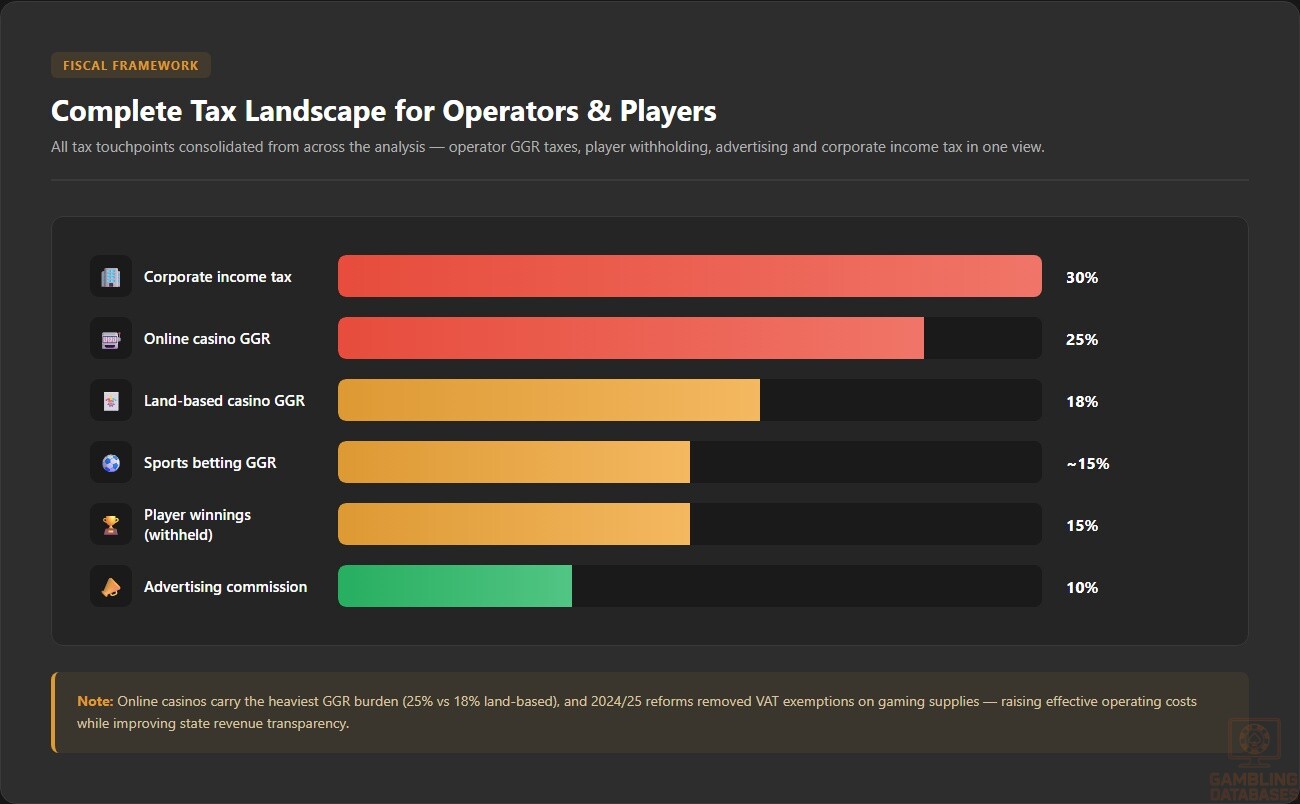
| Gross Gaming Revenue (GGR) Tax | 25% for online casinos; 18% for land-based casinos |
| Tax on Player Winnings | 15% on winnings (sports and casinos) |
| Withholding Tax on Commission | 10% on gaming advertisement commissions |
| Compliance Monitoring | Regular inspections, risk-based oversight, mandatory reporting |
| License Renewal Fee | Applicable annually |
| Time to Obtain License | Typically 3-6 months |
| Foreign Ownership Restrictions | Allowed with local presence requirements |
| Minimum Legal Gambling Age | 18 years |
| Responsible Gambling Measures | Mandatory self-exclusion, player protection policies |
| Enforcement Mechanisms | Fines, license revocation, criminal sanctions for illegal operators |
| Market Revenue 2024/25 | TZS 17.42 billion (~$6.7 million USD) |
| Projected Market Revenue 2025/26 | TZS 29.89 billion (~$11.5 million USD) |
| Market Growth CAGR | 10-12% forecasted annually |
| Average Revenue Per User (ARPU) | Moderate, reflecting income levels & growing digital adoption |
| Market Entry Barriers | High regulatory compliance, taxation, local presence |
| Technology Infrastructure | Improving broadband, widespread mobile internet |
Section 1: Regulatory Framework and Legal Environment
Current Gambling Regulation Status
Tanzania’s gambling sector is governed by a comprehensive legal framework established primarily under the Gaming Act Cap. 41 of 2003, effectively regulating all forms of gambling activities across the country. The Gaming Board of Tanzania (GBT) is the principal regulatory authority responsible for licensing, oversight, and enforcement of gaming laws.
The legal framework covers land-based casinos, sports betting, lotteries, slot machines, and online gambling operations. Tanzania is among the few African countries with explicit legislation legalizing and overseeing online gambling, reflecting a proactive stance to harness economic benefits while maintaining consumer protection and integrity of the sector.
Land-Based Gambling Activities
Land-based gambling in Tanzania includes casino establishments, licensed sports betting venues, lotteries, and slot machine halls. Licensed casinos operate primarily in major urban centers and tourist destinations such as Dar es Salaam and Zanzibar. Sports betting outlets are widespread and operate both through physical retail points and mobile platforms.
The government has strengthened controls to curtail unauthorized slot machines, especially those operated by foreign entities, to protect local business interests and ensure compliance with licensing requirements. These measures help maintain market order while encouraging lawful expansion of brick-and-mortar gambling options.
Online Gambling Framework
Tanzania’s regulatory framework explicitly permits and regulates online gambling platforms, covering virtual casinos, sports betting websites, and lottery services. To operate legally, online operators must secure licenses from the GBT and comply with technology, security, and integrity standards stipulated by the regulator.
The 2022 Online Gaming Regulations introduced advanced compliance protocols including mandatory certification of gaming systems, anti-money laundering controls, and data protection measures. Operators offering online gambling services must adhere to strict age verification and player protection standards to minimize risks such as underage gambling and addiction.
Licensed Operators and Market Players
The licensed gambling market in Tanzania is characterized by a mix of local and international operators actively competing in sports betting and online casino segments. The competitive landscape is evolving with increased foreign investment driven by the transparent regulatory environment and high mobile money usage facilitating transactions.
Top licensed operators benefit from strong brand recognition and extensive retail networks while leveraging mobile platforms for broader customer outreach. The market structure reflects a balanced competitive dynamic where newcomers must meet stringent regulatory requirements and demonstrate compliance. Illegal operators face active enforcement including shutdowns and legal actions.
Licensing Framework and Requirements
Application Process and Eligibility
The Gaming Board of Tanzania oversees the license application process, which requires applicants to demonstrate financial stability, operational capacity, and legal compliance. The process involves detailed due diligence including criminal background checks, verification of capital adequacy, and technical compliance assessments.
Applicants must show no history of license denial, suspension, or revocation in any jurisdiction. Licenses cover various gambling categories such as sports betting, casinos, lotteries, and online gambling, each with specific application requirements and fees.
The licensing period is typically 12 months with renewal required annually. The GBT may issue temporary licenses valid for up to six months during application review to facilitate entry where preliminary compliance is confirmed.
- Corporate registration certificate and company incorporation documents
- Financial statements audited by a recognized firm for the past three years
- Business plan detailing market strategy and financial projections
- Technical documentation and certification of gaming platforms and RNGs
- Criminal background checks for all directors and beneficial owners
- Proof of minimum capital and operational funds deposited in a licensed bank
- Tax clearance certificates confirming good standing
- Details on anti-money laundering systems and responsible gambling policies
Local Presence and Operational Requirements
Operators must maintain a physical administration center within mainland Tanzania to ensure local accountability and regulatory access. Domains hosting online gambling operations targeting Tanzanian players must be registered locally and comply with internet gaming regulations.
Foreign ownership is permitted but subject to mandatory local partnerships or representation in compliance with Tanzanian commercial laws. Personnel involved in day-to-day operations are required to adhere to licensing and compliance standards ensuring control over integrity and operational transparency.
- Physical office and administration center within mainland Tanzania
- Locally registered internet domains for online gambling sites
- Designated local compliance officer or representative
- Employment of staff complying with regulatory training and certification standards
- Mandatory cooperation with regulatory inspection and audit requests
Compliance Obligations and Monitoring
Player Protection and Identification
Operators are strictly required to enforce age restrictions, limiting gambling participation to persons aged 18 and above. The regulatory framework demands robust KYC (Know Your Customer) policies combined with AML (Anti-Money Laundering) procedures to prevent fraud and illicit financial flows.
Responsible gambling measures mandated by the GBT include self-exclusion programs, limits on deposit and wager amounts, and public awareness initiatives to minimize gambling harm. Detailed records of player activity and identification are maintained for audit and regulatory scrutiny to uphold market integrity.
- Verification of player age and identity prior to account creation
- Implementation of self-exclusion and cooling-off options
- Deposit and wager limit settings to promote responsible play
- Monitoring of suspicious or anomalous betting behavior
- Provision of information on gambling risks and support services
Financial Monitoring and Reporting
The GBT requires operators to regularly submit financial reports, including gross gaming revenue, tax payments, and transaction monitoring data. Regulatory oversight includes audits of accounts, verification of tax remittances, and assessment of compliance with anti-money laundering rules.
Operators must maintain transparent bookkeeping practices and provide audit trails accessible to the regulator. The scope of financial monitoring ensures tax compliance and deters economic crimes within the gambling sector.
- Monthly submission of revenue and tax reports to GBT
- Quarterly audit of operational and financial records by certified auditors
- Timely remittance of taxes including licensing fees and GGR taxes
- Ad hoc inspections and data verification initiatives based on risk assessments
Taxation Structure and Financial Obligations
Player Taxation
Players are subject to a 15% tax on winnings from sports betting and casino games, automatically withheld and remitted by the licensee acting as the withholding agent. This system ensures efficient tax collection while discouraging excessive gambling through increased costs on prize money.
Tax obligations must be settled monthly with returns filed within 15 days after the end of the calendar month to maintain regulatory compliance and avoid penalties.
Operator Taxation
| Gambling Category | Tax Rate |
|---|---|
| Online Casino Gross Gaming Revenue | 25% |
| Land-Based Casino Gross Gaming Revenue | 18% |
| Sports Betting Gross Gaming Revenue | Variable, approx. 15% |
| Withholding Tax on Commission (Advertisements) | 10% |
Operators also pay annual license renewal fees and applicable turnover taxes. The multi-tiered taxation system creates a transparent and predictable fiscal environment helping long-term financial planning for gaming companies.
Gambling Market Financial Performance
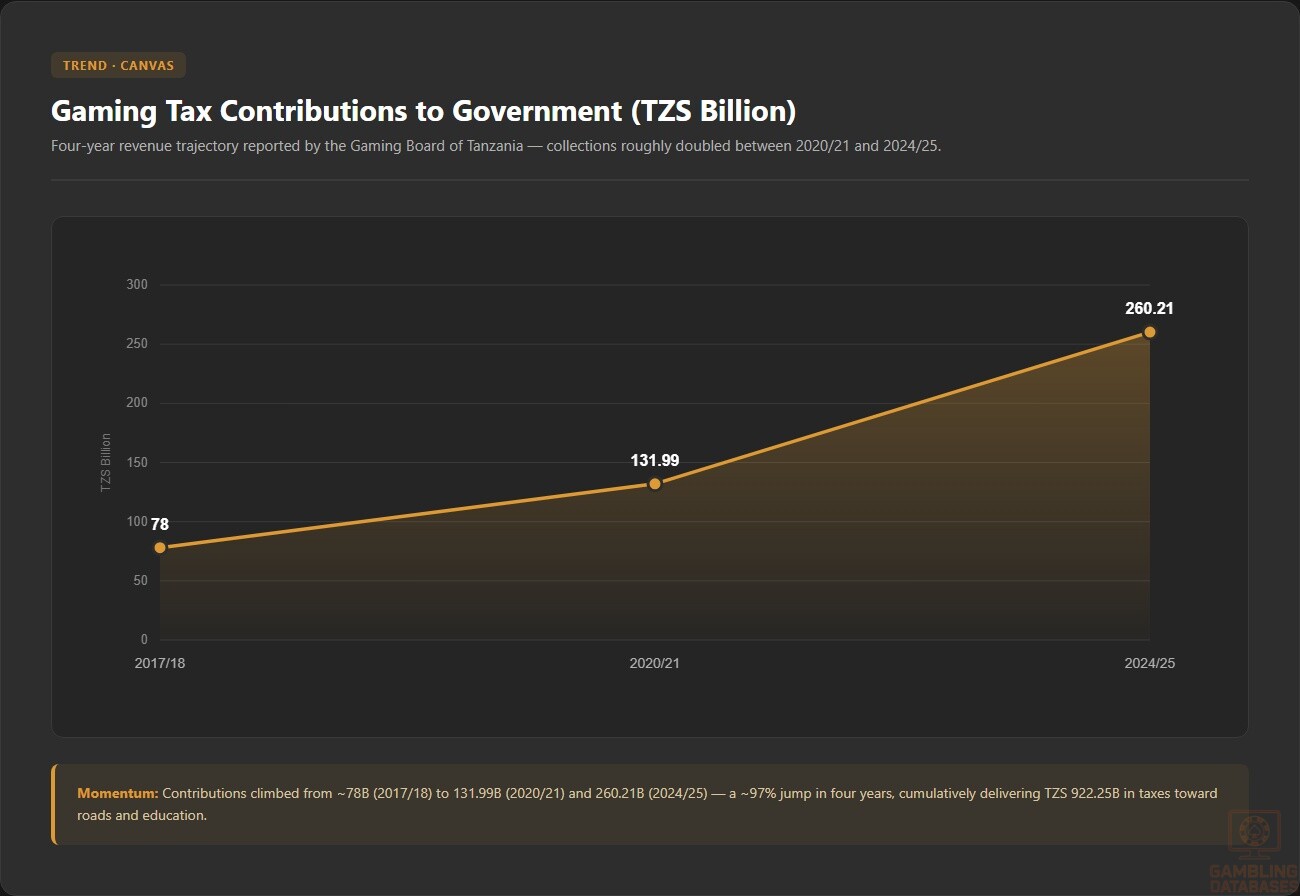
The Tanzanian gaming market is growing robustly with government-reported revenues jumping from TZS 17.42 billion in 2024/25 to forecasted TZS 29.89 billion for 2025/26. The expansion is driven by increasing digital adoption, widespread mobile money use, and expanding licensing initiatives aiming to legalize more operators.
Growth in total wagers, payout volumes, and tax contributions signals a maturing industry with improving compliance and enforcement measures. Operator revenue shares are diversifying with strong growth in online gambling alongside land-based segments.
Advertising and Marketing Restrictions
The regulatory framework places restrictions on gambling advertising to ensure responsible promotion and protect vulnerable groups. Advertising content is monitored closely for compliance with ethical standards including prohibition of targeting minors or using misleading claims.
Marketing channels permitted include televised advertisements during specific time slots, digital marketing with regulatory approval, sponsorships, and point-of-sale promotions. Excessive or aggressive advertising can lead to sanctions or license suspensions to maintain public trust.
- Television and radio ads restricted to designated timeframes
- Digital advertising subject to prior regulatory approval
- Prohibition of advertising targeting minors or vulnerable groups
- Restrictions on promotional offers encouraging excessive gambling
- Mandatory inclusion of responsible gambling messages in all adverts
Recent Regulatory Changes and Their Impact
Recent amendments in 2024-2025 included abolition of VAT exemptions on gaming supplies, introduction of a higher GGR tax rate for online casinos, and strengthened enforcement protocols. These changes increased operational costs for licensees but improved state revenues and market transparency.
Regulatory authorities have also adopted risk-based inspection frameworks, enhancing efficiency and directing resources to higher-risk operators or activities. The changes contributed to a crackdown on illegal gambling and boosted compliance across the sector.
Enforcement Mechanisms and Penalties
The Gaming Board of Tanzania employs a range of enforcement tools including fines, license suspensions, revocations, and criminal prosecutions for violations of gaming laws. Strict penalties apply to operators conducting unauthorized gambling activities or failing to comply with regulatory requirements.
Enforcement operations also involve seizure of illegal gaming equipment and shutdown of unlicensed online domains. The regulatory authority collaborates with law enforcement agencies to sustain industry integrity and protect consumer interests.
- Monetary fines for regulatory breaches
- License suspension or revocation for serious violations
- Confiscation of unlicensed gaming equipment
- Criminal prosecution for illegal gambling operations
- Ongoing risk-based inspections and compliance audits
Section 2: Demographics and Consumer Analysis
Population Demographics and Distribution
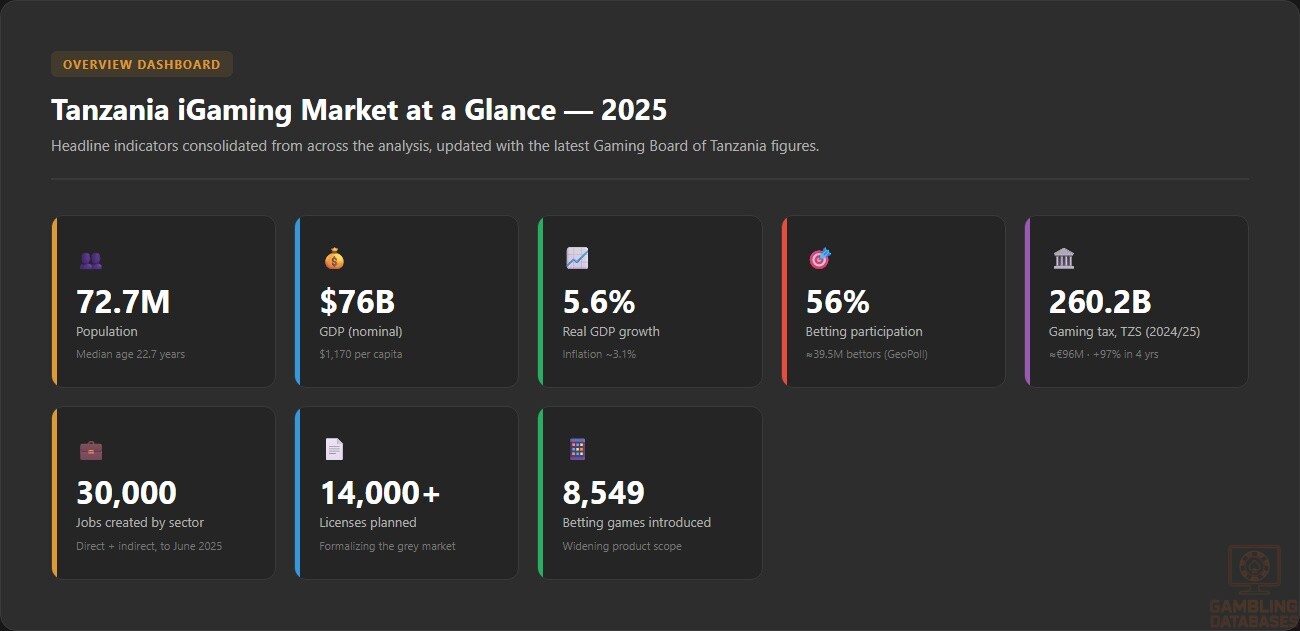
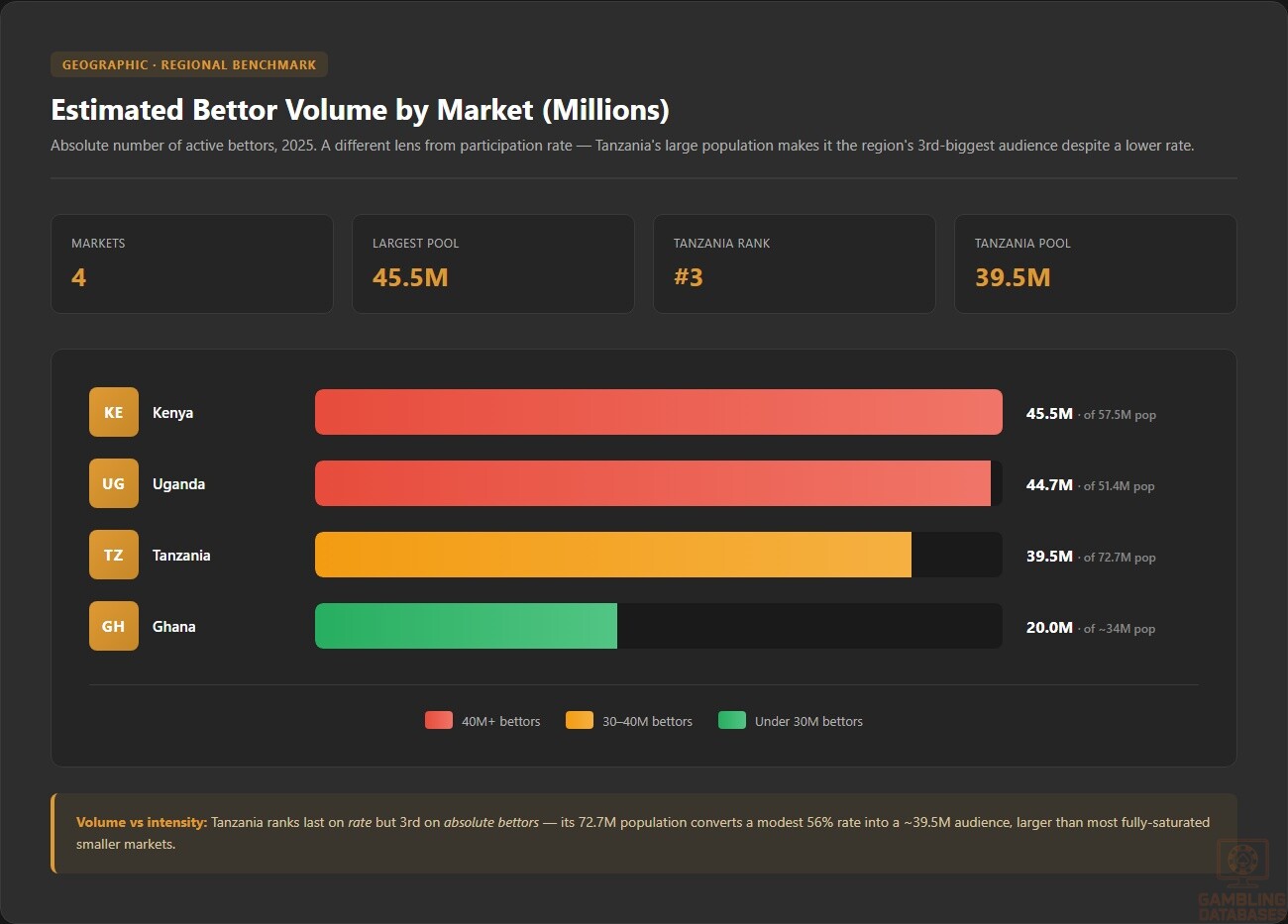
Tanzania’s population in 2025 is estimated at approximately 72.7 million, with a notably young demographic profile. More than 53% of the population is aged 19 or younger, reflecting a predominantly youthful society with significant implications for future market growth. The median age is around 22.7 years, supporting a dynamic consumer base poised to adopt new technologies and entertainment forms.
Gender distribution is relatively balanced, with about 984 men per 1,000 women. Urbanization is accelerating but remains moderate, with approximately 38.6% of the population residing in urban areas, mainly concentrated in a few large cities. Population density averages around 82 people per square kilometer, pointing to significant rural dispersal influencing service delivery.
| Age Group | Percentage of Total Population | Approximate Number (millions) |
|---|---|---|
| 0-14 years | 44.5% | 32.3 |
| 15-24 years | 18.9% | 13.7 |
| 25-54 years | 28.8% | 20.9 |
| 55-64 years | 4.6% | 3.3 |
| 65 years and older | 3.2% | 2.3 |
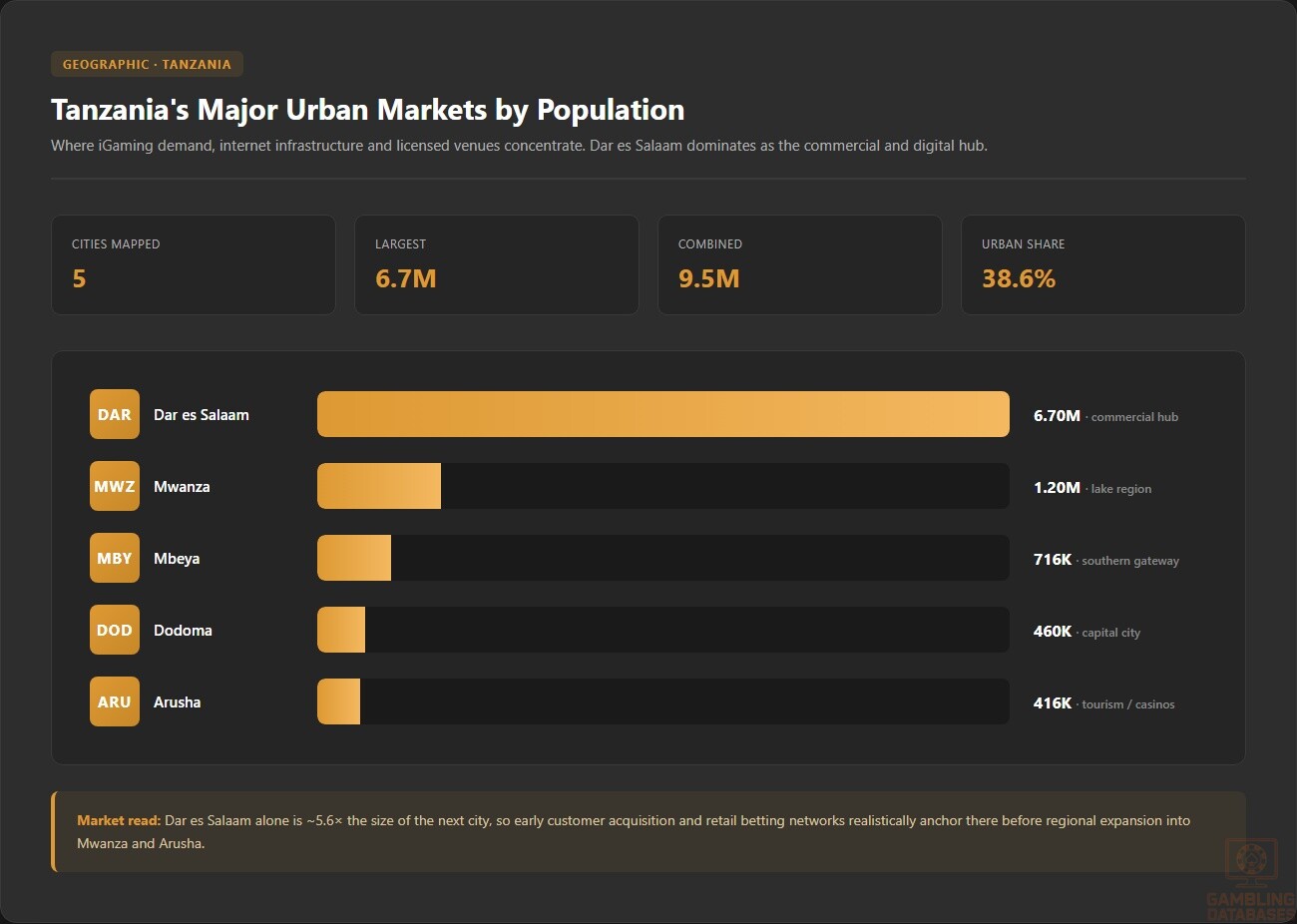
Urban centers such as Dar es Salaam, Mwanza, and Arusha serve as hubs of economic and digital activity, hosting the majority of gambling venues and internet infrastructure. Internet access and mobile penetration rates are highest in these and other major cities, reinforcing regional economic disparities.
- Dar es Salaam: ~6.7 million inhabitants
- Mwanza: ~1.2 million inhabitants
- Arusha: ~416,000 inhabitants
- Dodoma (capital city): ~460,000 inhabitants
- Mbeya: ~716,000 inhabitants
Economic Indicators and Consumer Spending Power
Tanzania’s economy shows robust growth with a GDP estimated at approximately $76 billion USD in 2025 and a real GDP growth forecast of around 5.6%. This consistent expansion is underpinned by a diverse economy dominated by agriculture, mining, manufacturing, and service sectors. Zanzibar’s economy, in particular, records accelerated growth exceeding 6% annually.
Income levels remain modest with GDP per capita near $1,170 USD, reflecting a developing country in transition. Wealth distribution is uneven, with a sizeable informal economy and significant income inequality. Average household income and disposable income growth are gradually improving, stimulated by urbanization and increased digital financial inclusion.
| Indicator | Value |
|---|---|
| GDP (Nominal) | $76 billion USD |
| GDP Growth Rate (Real) | 5.6% |
| GDP per Capita | $1,170 USD |
| Inflation Rate | ~3.1% |
| Unemployment Rate | ~9.5% |
| Urban Population Percentage | 38.6% |
The Tanzanian consumer’s spending power is expanding, especially in urban and peri-urban areas where technology adoption accelerates digital entertainment consumption. Consumer confidence is buoyed by stable macroeconomic conditions and improving infrastructure, which supports increased discretionary expenditure on iGaming and related digital leisure services.
Education, Skills, and Digital Literacy
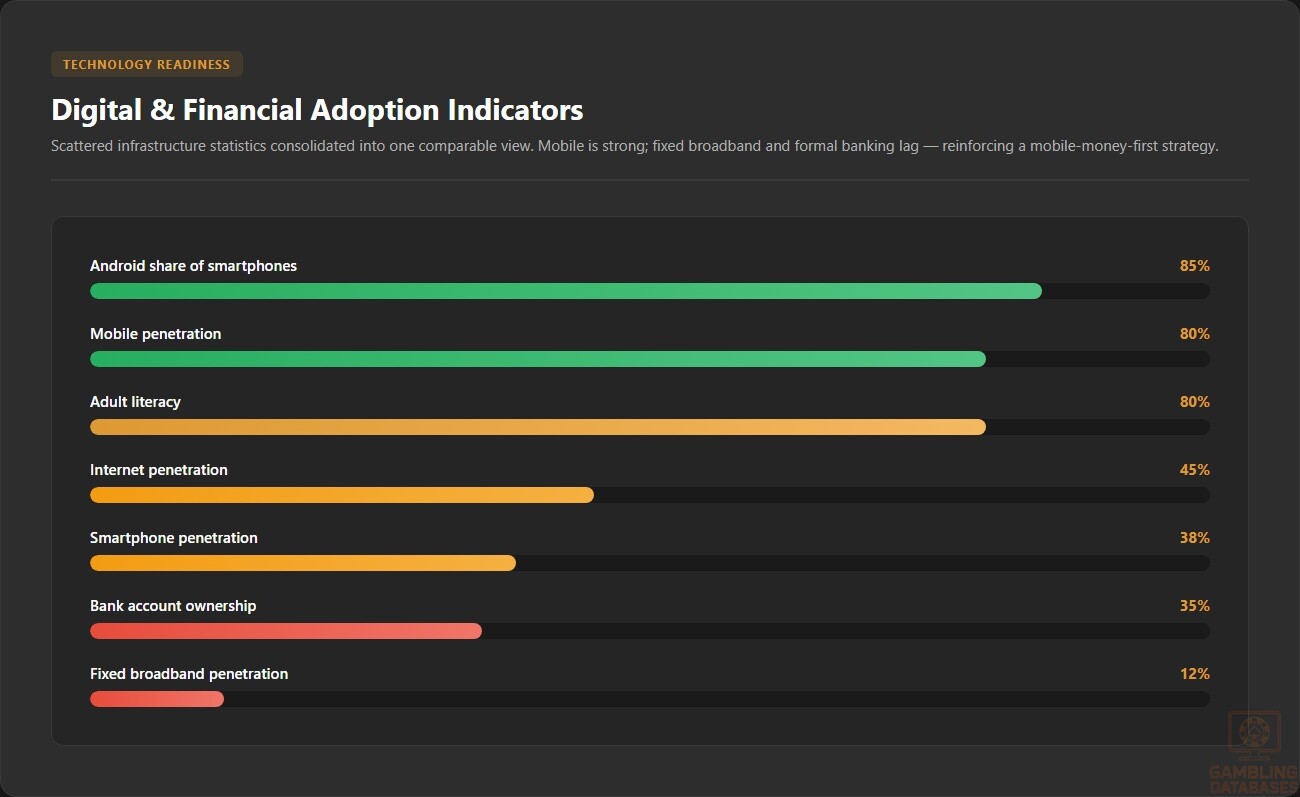
Tanzania has made substantial progress in improving literacy and educational attainment with an adult literacy rate exceeding 80%. Primary education enrollment is high, while secondary and tertiary education continue to grow, producing a workforce increasingly versed in digital skills essential for navigating online platforms.
Digital literacy is improving particularly among urban youth, supported by mobile internet proliferation and government initiatives to expand ICT training. However, rural areas face challenges including intermittent connectivity and lower access to formal education, which limits their immediate participation in digital consumer behaviors.
#### Cultural and Social Factors
Communication and Language
Swahili serves as the national language and primary medium of communication, with English widely used in business and government settings. Various indigenous dialects are spoken across regions but have limited influence on mainstream media and digital content consumption.
- Swahili (official and common language)
- English (widely used in commerce and education)
- Chaga
- Sukuma
- Haya
Cultural attitudes towards gambling are mixed. While gambling is generally accepted as a form of entertainment, conservative social and religious groups occasionally express reservations. Foreign gaming brands are increasingly recognized and trusted due to regulatory oversight that guarantees fairness and security. Entertainment preferences blend traditional forms with growing consumption of digital media and sports betting interests.
Problem gambling prevalence remains low but is emerging as a concern with increased market participation. Government and NGOs are developing social responsibility programs focusing on addiction prevention, education, and counseling. These initiatives are part of a broader strategy to ensure sustainable growth and mitigate social risks associated with gambling.
- Public awareness campaigns on gambling risks
- Self-exclusion programs managed by operators
- Counseling and support services for problem gamblers
- Mandatory operator contributions to social responsibility funds
- Collaboration with health and social service providers
The political landscape is stable with a democratic multi-party system and proactive government engagement in economic reforms. Regulatory consistency is high, and Tanzania’s international relations foster cross-border trade and investment, enhancing the business environment for iGaming entrants.
Technology Adoption and Digital Behavior
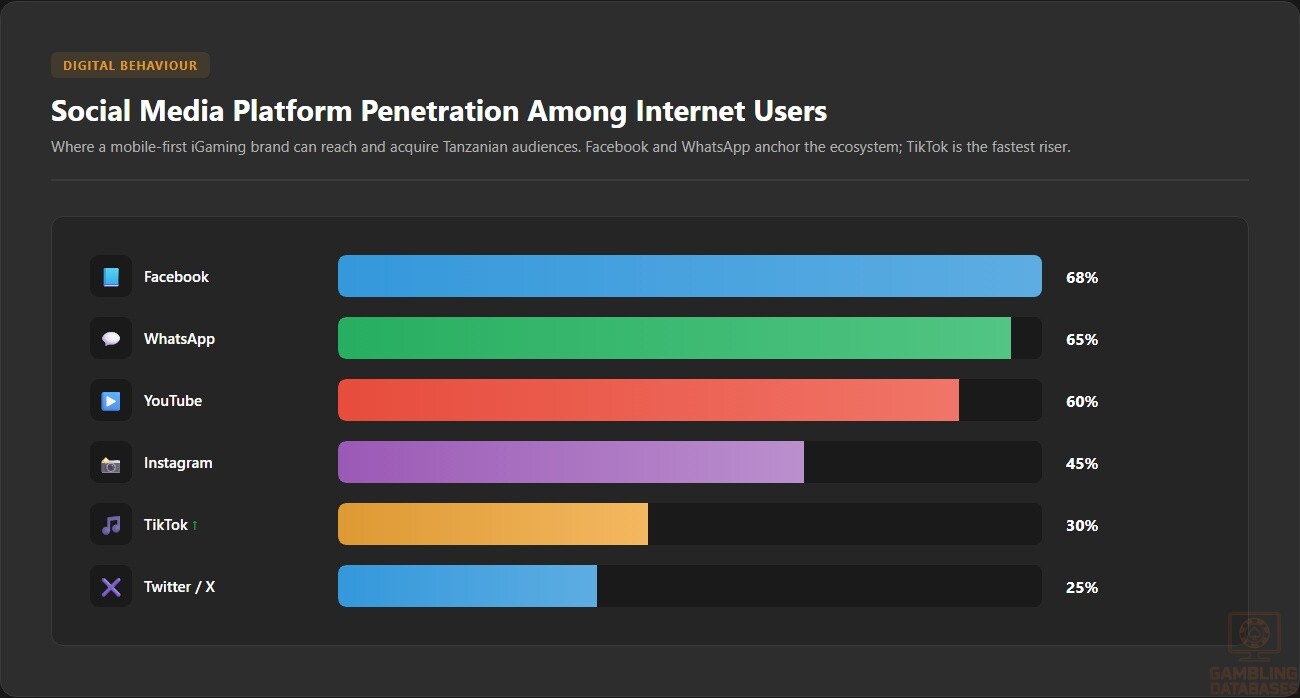
Tanzania’s internet penetration stood at approximately 45% in 2025, with around 49 million mobile internet subscriptions predominantly through wireless connections. Digital adoption is rapidly increasing, driven by smartphone affordability and expansive 3G and 4G mobile networks. Daily internet use averages around three hours among active users, underpinning robust social media engagement and digital content consumption.
- Facebook: 68% penetration among internet users
- WhatsApp: 65% active user base
- YouTube: 60% regular usage
- Instagram: 45% popularity among youth
- TikTok: rapidly growing at 30% of under-30 demographics
- Twitter: 25% used primarily for news and updates
Digital payment methods are widely welcomed, dominated by mobile money platforms like M-Pesa and Tigo Pesa, which enable seamless real-time financial transactions. Bank payments and cards are less common but growing among urban consumers. Cryptocurrency adoption is nascent but gaining curiosity among tech-savvy demographics.
- M-Pesa (market leader, ~45% of digital transactions)
- Tigo Pesa (secondary mobile money provider)
- Airtel Money
- Bank card payments (credit/debit, steadily growing)
- Mobile banking apps
Gaming and Gambling Preferences
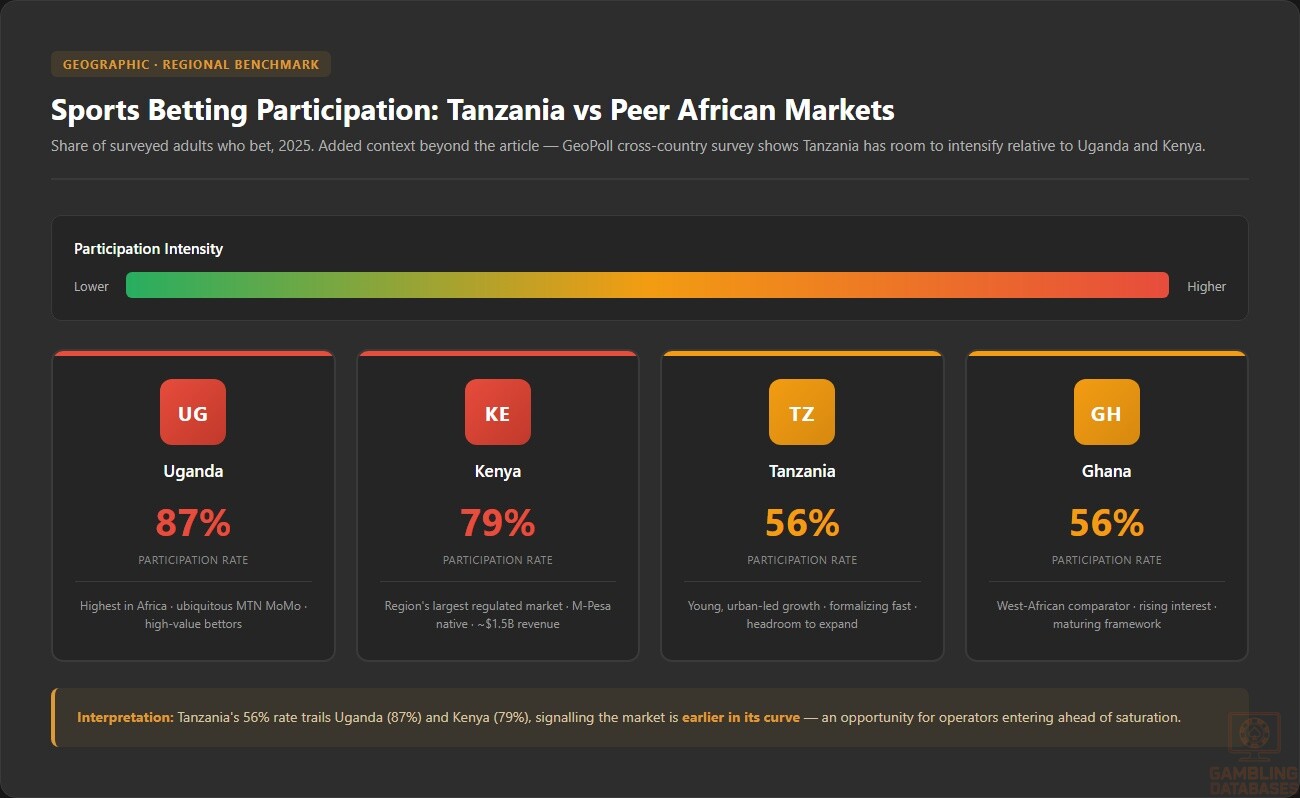
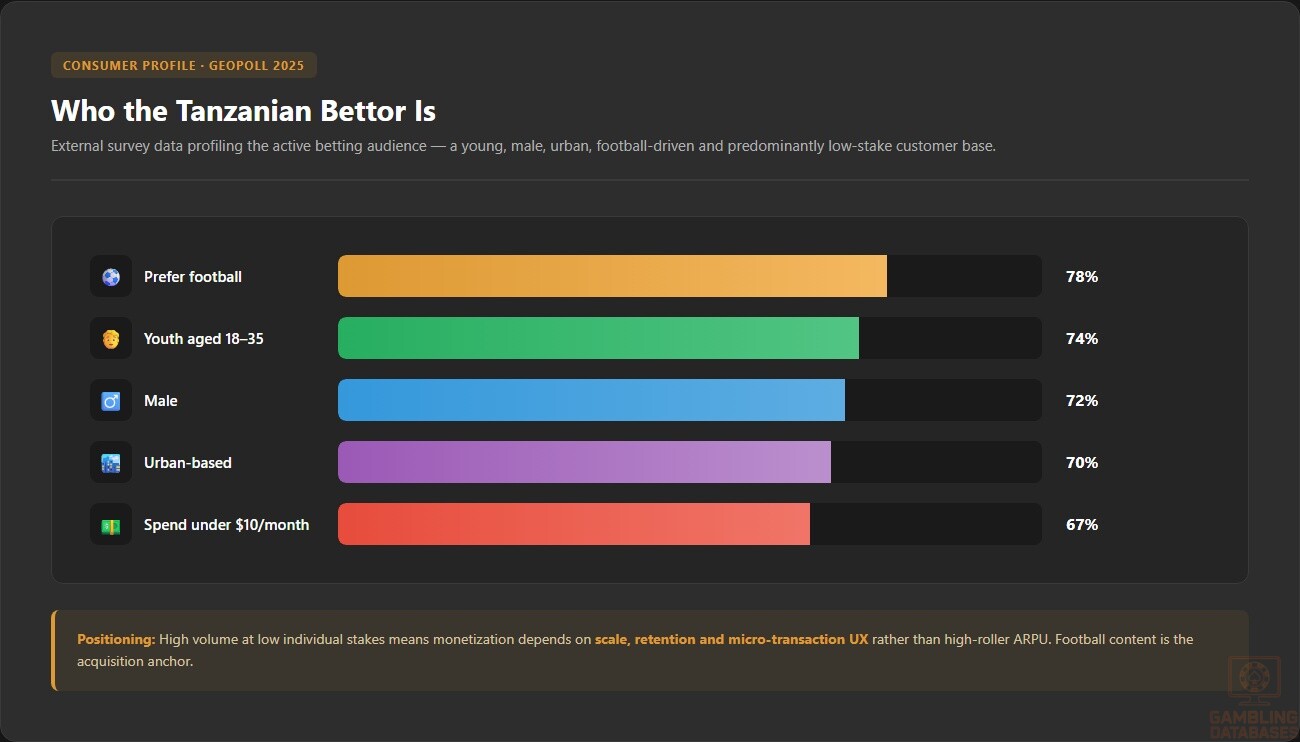
Gambling participation in Tanzania is dominated by sports betting, lottery games, and online casino offerings. Approximately 9.7% of the adult population was actively engaged in gambling activities in 2025, with strong preference for football and local sports markets. Online platforms have expanded access and convenience, increasing gaming session frequency and average wager sizes.
| Activity | Participation Percentage |
|---|---|
| Sports Betting | 45% |
| Lotteries | 25% |
| Online Casino Games | 15% |
| Slot Machines (Land-Based) | 10% |
| Traditional Betting (Informal) | 5% |
Consumer behavior trends indicate peak gambling activity during major sports events and weekends, with session lengths averaging between 30 to 45 minutes. Mobile device usage predominates, facilitating on-the-go betting and multipurpose app use. Retention rates have improved due to loyalty programs and in-app incentives integrated by operators.
Section 3: Technology Infrastructure and Business Environment
Internet and Digital Infrastructure
Tanzania’s internet infrastructure is primarily mobile broadband driven, with broadband penetration estimated at around 12% while mobile internet penetration reached approximately 45% in early 2025. Fixed-line broadband remains underdeveloped due to high costs and infrastructure gaps, making mobile networks the backbone of digital connectivity.
Average mobile internet speeds range between 10-20 Mbps in urban areas, with rural regions experiencing lower and less reliable connectivity. Ongoing infrastructure investments from both government and private sector entities target fiber-optic expansions and enhanced mobile network coverage to support the growing digital economy and e-services demand.
Internet reliability and uptime have steadily improved, yet challenges persist in rural electrification and last-mile connectivity. The government’s National ICT Broadband Backbone project continues to enhance national and regional data transit, enabling improved access for new market entrants and digital service providers.
5G and Future Technology Deployment
5G rollout in Tanzania is in its nascent phase, with pilot programs launched in major cities such as Dar es Salaam and Mwanza. Full commercial coverage is projected within 3-5 years dependent on regulatory approvals, infrastructure upgrades, and private investment scale-up.
Major telecom operators hold licenses to operate 5G networks and are actively upgrading base stations and transmission equipment to support next-generation services. The anticipated 5G deployment will enhance mobile broadband capacity, facilitate lower latency applications, and support increasingly sophisticated iGaming and fintech services.
Mobile Technology Ecosystem
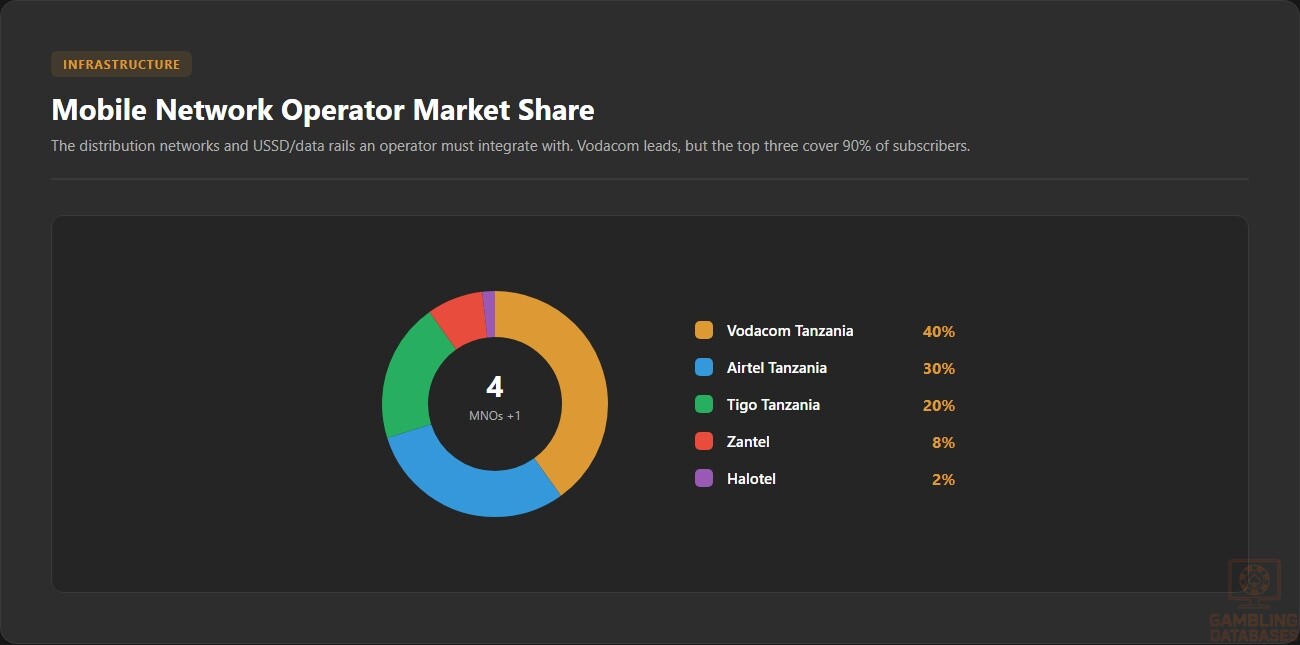
Tanzania features a competitive mobile network operator (MNO) landscape providing diverse coverage and data service packages. The four leading operators dominate market share, focusing on affordable, prepaid mobile data plans to stimulate mass market adoption.
- Vodacom Tanzania – Market leader with ~40% share and extensive nationwide network
- Airtel Tanzania – Strong player with ~30%, aggressive pricing and broad urban coverage
- Tigo Tanzania – Holds ~20% share, focused on digital services integration
- Zantel – Regional operator with ~8%, serving urban coastal areas
- Halotel – New entrant expanding rural coverage, ~2% share
Smartphone penetration stands at approximately 35-40% with rapid growth fueled by affordable imported devices and financing models. Android dominates device preferences due to pricing and app availability, representing over 85% of smartphones in use. User behaviors show high engagement with messaging, social media, and mobile financial services, creating fertile ground for mobile-first iGaming products.
Financial Services and Payment Infrastructure
The Tanzanian banking sector features a mix of domestic and international banks, with increasing adoption of digital banking products. Account penetration remains limited at an estimated 35%, but fintech-driven mobile wallets and agency banking have expanded financial inclusion significantly.
- National Microfinance Bank (NMB) – Largest bank by assets, focused on retail and SME segments
- CRDB Bank – Strong presence with robust digital banking platform
- Stanbic Bank Tanzania – Internationally affiliated, catering to corporate and private clients
- Azania Bank – Mid-sized bank with expanding retail footprint
- Exim Bank Tanzania – Regional player with growing digital capabilities
Payment processing options are diversified, emphasizing mobile money systems that dominate transactions across urban and rural areas. Card payments and bank transfers have grown steadily, supported by regulatory efforts to digitize the economy.
- Mobile money platforms (M-Pesa, Tigo Pesa, Airtel Money)
- Bank card payments (Visa, Mastercard)
- Bank transfers and mobile banking apps
- Online payment gateways (Flutterwave, Paystack)
- Emerging cryptocurrency use among niche consumers
E-commerce and Digital Economy
The e-commerce market in Tanzania reached an estimated valuation above $250 million in 2025, growing annually by over 14%. Consumer adoption is led by mobile-first users purchasing goods ranging from electronics to household items, with increasing trust in digital payment systems boosting transaction volumes.
Digital services such as mobile airtime, utility bill payments, and entertainment subscriptions have integrated into a broader ecosystem supporting the digital economy. Key challenges include logistics infrastructure and payment system interoperability, which are gradually improving through public-private collaboration.
Business Environment and Regulatory Framework
Tanzania ranks moderately on the World Bank’s Ease of Doing Business index, with steady improvements in business registration, investor protections, and access to credit. The government encourages foreign investment with streamlined company registration processes and incentives in special economic zones.
- Prepare company registration documents including business plan and tax credentials
- Submit application to the Business Registration and Licensing Agency (BRELA) with processing time of 5-10 business days
- Register for Tax Identification Number (TIN) and Value Added Tax (VAT) within 3-5 days
- Open corporate bank account and meet minimum capital requirements
- Obtain sector-specific licenses such as iGaming license from Gaming Board of Tanzania
Corporate entity options include Limited Liability Companies (LLCs), Branch Offices of foreign companies, and Public Limited Companies, with LLCs favored for operational flexibility and liability protection.
- Limited Liability Company (LLC)
- Branch Office (foreign company representation)
- Public Limited Company (for publicly traded ventures)
Registration requirements include notarized incorporation documents, proof of address, tax compliance certificates, and identification of company directors. Foreign ownership is unrestricted but must comply with local commercial laws and licensing rules.
- Certificate of Incorporation
- Articles and Memorandum of Association
- Business license application form
- Tax Identification Number
- Bank reference and proof of capital
- Director and shareholder identification documents
#### Taxation Framework
Corporate income tax in Tanzania is levied at a standard rate of 30%. Companies operating within designated special economic zones may qualify for reduced rates or tax holidays up to 5 years, encouraging investment in infrastructure and technology.
Personal income tax is progressive with rates from 9% to 30%, alongside mandatory social security contributions. Tax treaties with countries including Kenya, Uganda, and South Africa reduce withholding taxes and double taxation risks.
- Kenya
- Uganda
- South Africa
- Zambia
- India
Market Entry Considerations
Successful entry into Tanzania’s iGaming market requires aligning with stringent regulatory norms and leveraging mobile-centric strategies. Partnering with local firms facilitates meeting local presence requirements and understanding consumer nuances.
- Obtain required licenses and approvals well in advance
- Integrate mobile money payment options for consumer convenience
- Leverage existing telecom infrastructure for marketing and platform access
- Implement responsible gaming policies compliant with Tanzanian regulations
- Adapt products and marketing to local cultural and language preferences
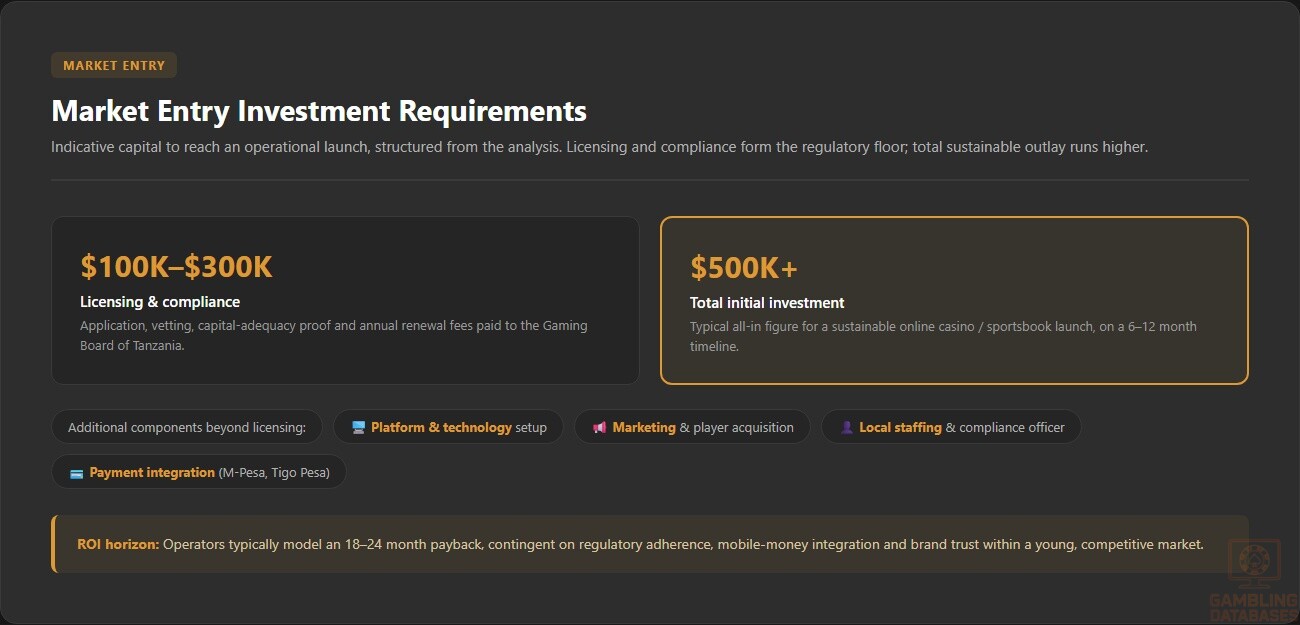
Initial costs typically involve licensing and compliance (approx. $100,000 to $300,000), technology and platform setup, marketing, and staffing. Market entry timeline ranges from 6 to 12 months from company registration to operational launch.
| Phase | Duration |
|---|---|
| Preparation and Documentation | 1-2 months |
| Company Registration and Licensing Application | 3-4 months |
| Technical Setup and Compliance Testing | 1-2 months |
| Launch and Market Penetration | 2-4 months |
Key challenges include maintaining compliance with evolving regulations, adapting technology to local payment and network environments, and building brand trust among a young but diverse consumer base.
- Complex regulatory compliance and reporting
- Infrastructure reliability in rural vs urban areas
- Competition from informal gambling markets
- Currency fluctuation and payment system integration
- Consumer education on responsible gaming
Exit strategies require regard for license transfer conditions and asset valuation in a developing but rapidly expanding market. Early engagement with regulators and local stakeholders improves strategic flexibility and valuation prospects.
FAQ: Frequently Asked Questions
1. Is online gambling legal in Tanzania?
Yes, online gambling is legal and regulated under the Gaming Act Cap. 41. The government licenses various types of iGaming operators including sports betting, online casinos, and lotteries. The regulatory framework includes player protection, anti-money laundering, and data security provisions, making Tanzania a legally sound market for online gambling.
2. What types of gambling licenses are available and what do they cover?
The Gaming Board of Tanzania issues licenses for several categories:
- Sports Betting
- Land-Based Casino Operations
- Online Casinos
- Lotteries
- Slot Machine Operations
Each license type has specific regulatory and operational requirements tailored to the particular gambling activity.
3. How much does an iGaming license cost and how long does it take to obtain?
License fees vary by gambling category and scale but typically range from $100,000 to $300,000 including application and renewal fees. The process duration is about 3 to 6 months, depending on documentation completeness and regulatory review speed. Operators may receive temporary permits during the vetting process.
4. Can foreign companies obtain a gambling license?
Foreign companies are eligible for licensing but must establish a local presence such as an administrative office or local partnership. Compliance with Tanzanian corporate and tax laws is mandatory. Foreign participation is encouraged to stimulate investment and market sophistication within regulatory frameworks.
5. What are the tax obligations for iGaming operators?
Operators pay gross gaming revenue taxes at rates ranging from 18% for land-based casinos to 25% for online casinos. Other taxes include withholding on advertising commissions at 10%. Annual renewal fees and compliance-related levies apply, creating a predictable fiscal environment.
6. Are gambling winnings taxed for players?
Yes, player winnings are subject to a 15% tax withheld at the source by operators. This withholding tax ensures compliance and revenue collection, impacting net player payouts but contributing to the regulated market structure.
7. What are the typical operational costs for running an online casino/sportsbook?
Primary costs include licensing fees, platform development and maintenance, payment processing fees, marketing, and regulatory compliance costs. Infrastructure and staffing form additional expenditures. Initial investment of $500,000 or more is commonly required for sustainable operations.
8. What is the expected ROI timeline for entering this market?
Return on investment timelines typically span 18 to 24 months with strong growth potential thereafter. ROI depends on effective market penetration, regulatory adherence, and brand establishment within a competitive digital landscape.
9. What are the local presence requirements for operators?
Operators must establish a physical office and designate a local compliance officer. Ownership participation by Tanzanian entities is not mandatory, but operational control and regulatory accessibility locally are required for licensing.
10. What payment methods are available and recommended?
Mobile money platforms are the preferred payment method due to widespread adoption. Bank card payments, e-wallets, and bank transfers are supplementary but growing alternatives. Cryptocurrency usage is emerging but is not yet mainstream.
11. What are the advertising and marketing restrictions?
Advertising is permitted within regulated guidelines that restrict exposure to minors, prohibit misleading claims, and mandate responsible gambling messages. Time restrictions apply to broadcast advertising, and digital marketing requires prior regulatory approval.
12. What responsible gambling measures are mandatory?
Operators must offer self-exclusion options, set deposit and wager limits, monitor suspicious behavior, provide gambling risk information, and contribute to social responsibility initiatives. These measures aim to minimize addiction and protect vulnerable players.
13. How large is the iGaming market and what is the growth potential?
The Tanzanian iGaming market is valued at over $11 million and is expected to grow annually by 10-12%. The young population, rising mobile penetration, and regulatory clarity support continued expansion.
14. Who are the main competitors and what is their market share?
The market features a competitive mix of international and local operators focused on sports betting and online casinos. Market shares fluctuate but leading operators control the majority of licensed betting turnovers, leveraging mobile and retail presence.
15. What are the player preferences and typical spending patterns?
Sports betting dominates in popularity, especially football-related markets, followed by lotteries and online casino games. Players tend to engage on mobile devices during evenings and weekends, with average session lengths of 30-45 minutes.
16. What are the key success factors and main challenges for new entrants?
Success relies on regulatory compliance, robust digital platform deployment, integration with local payment systems, effective marketing, and strong responsible gambling practices. Challenges include infrastructure gaps, evolving regulations, competition, and consumer education needs.
- Strong local partnerships and on-ground presence
- Understanding consumer preferences and habits
- Adhering to strict compliance and reporting
- Ensuring seamless payment and platform reliability
- Implementing comprehensive responsible gambling programs
—
Sources and References
- Gaming Board of Tanzania – Official Website – https://www.gamingboard.go.tz
- Tanzania National Bureau of Statistics – Population & Economic Data 2025 – https://www.nbs.go.tz
- World Bank – Doing Business Report 2025 – https://www.worldbank.org
- International Telecommunication Union – Tanzania ICT Report 2025 – https://www.itu.int
- Ministry of Finance Tanzania – Taxation and Regulatory Guidelines 2025 – https://www.mof.go.tz
- Worldometers – Tanzania Population Statistics 2025 – https://www.worldometers.info
- Digital 2025 Report – Tanzania – Datareportal – https://datareportal.com/reports/digital-2025-tanzania
- Statista – Gambling Market Forecast Tanzania 2025 – https://www.statista.com
- Sigma World – Tanzania Gambling Revenue Surge News 2025 – https://sigma.world/news/gambling-sector-in-tanzania-records-four-year-revenue-surge
- TICGL Tanzania – Economic Outlook 2025 – https://ticgl.com
- Alin Law Care – Gaming License Requirements Tanzania 2025 – https://clients.alinlawcare.co.tz
- Focus Gaming News – Tanzania VAT and Tax Update 2025 – https://focusgn.com
- IZAIRA – Licensed Betting Site Verification Tanzania 2025 – https://iziraa.com
- IGaming Today – Tanzania Regulatory Overview 2025 – https://www.igamingtoday.com
- Techbooky – Tanzania Digital Payments 2025 – https://www.techbooky.com
- World Economic Forum – Tanzania Country Profile 2025
- International Monetary Fund – Economic Reports Tanzania 2025 – https://www.imf.org
- SECO – Economic Report Tanzania 2025 – https://www.seco.admin.ch
- LinkedIn Article – Tanzania Gaming Tax Impact 2025
- The East African – Taxation on Gambling Tanzania 2022 – https://www.theeastafrican.co.ke