

Suriname presents a promising but complex opportunity for iGaming market entrants with its evolving regulatory landscape. The current regulatory framework is cautiously designed to enable controlled online gambling growth while safeguarding player protections. Key attractions include a strategic location in South America, a young, tech-savvy population, and improving internet infrastructure.
| Metric | Value |
|---|---|
| Gambling Legal Status | Permitted under regulated framework |
| Regulatory Authority | Gaming Control Board Suriname (GCBS) |
| Population | ~600,000 (2025 estimate) |
| Urbanization Rate | ~70% urban population |
| GDP (Nominal) | $4.7 billion USD (2024) |
| GDP Per Capita | $7,800 USD (2024) |
| Internet Penetration | ~65% of population |
| Mobile Internet Penetration | ~78% of population |
| Digital Payment Infrastructure | Moderate, growing e-wallet and bank transfer use |
| Licensed iGaming Operators | Currently 3 to 5 licensed online operators |
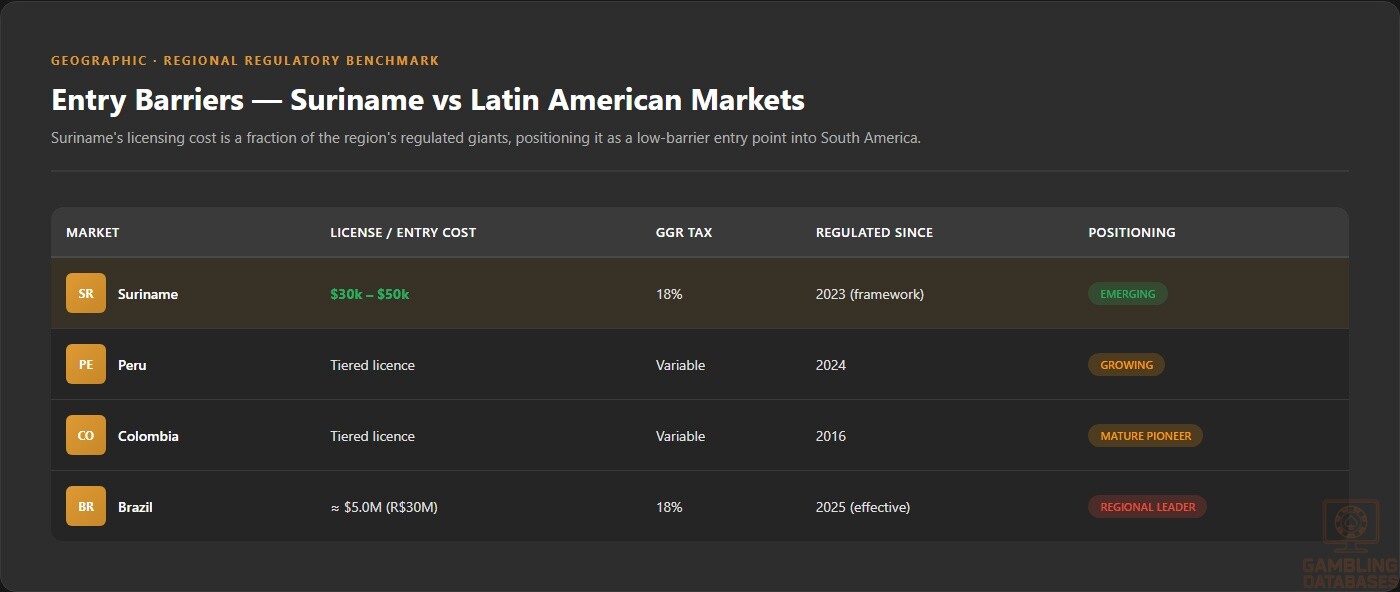
| iGaming Licensing Cost | $30,000 to $50,000 application fee |
| Gross Gaming Revenue (GGR) Tax | 18% standard rate |
| Corporate Tax on Operators | 25% |
| Player Winnings Tax | Withheld at 10% over $500 threshold |
| KYC/AML Requirements | Strict compliance with ID verification and transaction monitoring |
| Responsible Gambling Measures | Mandatory self-exclusion and deposit limits |
| License Validity | 3 years with renewal option |
| License Application Time | Approximately 90 to 120 days |
| Local Presence Requirement | Physical or legal presence in Suriname required |
| Foreign Ownership | Permitted with GCBS approval |
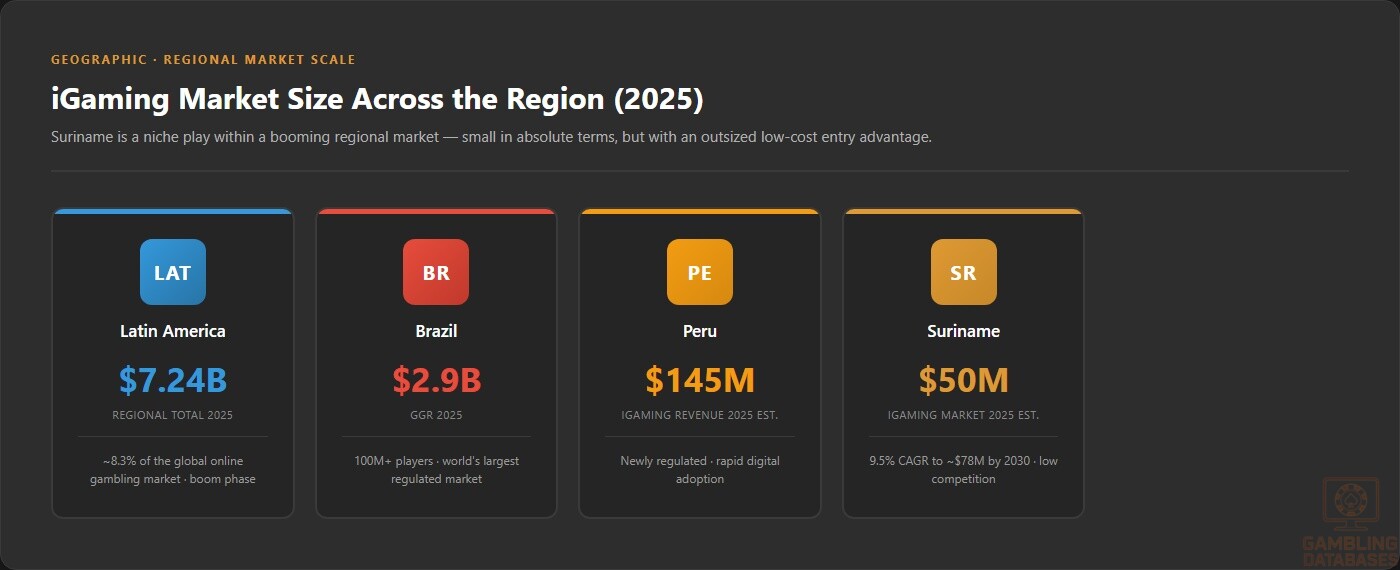
| Market Size (Estimated Revenue) | $50 million USD 2025 projection |
| Market Growth Forecast (CAGR 2025-2030) | 9.5% |
| Average Revenue Per User (ARPU) | $850 annually |
| Mobile Gaming Share | 65% of total iGaming revenue |
| Payment Methods Accepted | Credit cards, e-wallets, bank transfers, cryptocurrencies |
| Advertising Restrictions | Prohibited during certain hours and to minors |
| Enforcement Agency | GCBS with national police support |
| Penalties for Non-Compliance | Fines, license suspension, and criminal charges |
| Technology Infrastructure Rating | Developing with focus on fiber optic expansion |
Section 1: Regulatory Framework and Legal Environment
Current Gambling Regulation Status
Suriname maintains a structured regulatory approach governing all forms of gambling, including land-based and online activities. The jurisdiction permits casino gambling, sports betting, lotteries, and interactive gaming under a licensing regime administered by the Gaming Control Board Suriname (GCBS). While land-based gambling has a longer operational history, the online sector is undergoing formalization to align with international standards. This approach intends to stimulate economic benefits while protecting players and ensuring fiscal compliance.
Land-Based Gambling Activities
Land-based gambling is dominated by a small number of casinos primarily located in Paramaribo, featuring table games, slot machines, and sports betting counters. The government regulates these venues under strict licensing conditions including operational audits and mandatory compliance with responsible gaming policies. Additional land-based gambling venues include authorized betting shops and limited lottery outlets embedded within retail environments. Despite the limited number of physical venues, growth in land-based betting mirrors developments in the sports sector, with a focus on football and other popular events.
Online Gambling Framework
The legal framework for online gambling is established but remains evolving as the regulatory body enhances oversight capabilities. Online operators must obtain licenses issued by the GCBS, demonstrating compliance with technical standards, cybersecurity norms, and anti-money laundering (AML) protocols. Certain gambling types such as online poker and sports betting are explicitly permitted, while others, including unregulated virtual currencies betting, are restricted. Operators must utilize geolocation and identity verification technologies to ensure player eligibility within Suriname’s territorial bounds.
Licensed Operators and Market Players
The Surinamese iGaming market currently comprises a handful of licensed operators catering mainly to the local population and neighboring markets. These operators differentiate through proprietary platforms and partnerships with international gaming technology providers. Market share is moderately concentrated, posing moderate competitive challenges for new entrants, particularly those integrating localized payment solutions and customer service offerings. Future market entrants should anticipate regulatory scrutiny in compliance, marketing, and operational transparency to sustain licensing.
Licensing Framework and Requirements
Application Process and Eligibility
The primary regulatory authority is the Gaming Control Board Suriname (GCBS), which administers licensing under the Gambling Control Act. Applicants must demonstrate financial stability, technical capability to maintain secure gaming operations, and adherence to KYC/AML policies. Application fees range between $30,000 and $50,000 depending on the license type. The process entails background checks for ownership and key management, with completion timelines averaging 90 to 120 days.
The licensing framework requires submission of multiple documents:
- Corporate registration certificate and articles of incorporation
- Financial statements for the past three years audited by recognized firm
- Business plan detailing market strategy and financial projections
- Technical documentation of gaming platform and RNG certification
- Criminal background checks for all directors and beneficial owners
- Proof of minimum capital deposit in licensed bank
Local Presence and Operational Requirements
Operators must maintain a physical or legal presence in Suriname. This includes establishing an office or a registered subsidiary complying with local commercial laws. Operating domains must be registered and approved by GCBS, enforcing jurisdictional control over market activities. Foreign ownership is permitted but subject to regulatory review and approval to prevent undue market influence. Personnel requirements include appointing compliance officers and local representatives responsible for regulatory liaison and reporting.
Compliance Obligations and Monitoring
Player Protection and Identification
Robust player protection frameworks mandate comprehensive age verification, KYC, and AML checks to combat fraud and underage gambling. Operators use technology solutions for identity verification and transaction monitoring to stay compliant. Responsible gambling is enforced through mandatory self-exclusion programs, deposit limits, and accessible support tools for players facing gambling issues. Information disclosure about risks and responsible play is compulsory on all operator platforms.
Mandatory responsible gambling measures include:
- Self-exclusion mechanisms available to players
- Daily and monthly deposit limits
- Access to counselling and support services
- Clear disclosure of gambling risks
- Regular staff training on responsible gambling
Financial Monitoring and Reporting
Operators are required to implement transaction monitoring systems that flag suspicious activities and large cash flows. Regular reporting to the GCBS includes detailed financial performance, suspicious transaction reports, and audit outcomes. Annual independent audits are mandatory to verify compliance with financial and operational standards. These controls ensure transparent fiscal operations and mitigates risks of money laundering.
Taxation Structure and Financial Obligations
Player Taxation
Player winnings above the $500 threshold are subject to a 10% withholding tax. This tax is withheld at source by operators to ensure compliance and simplify player obligations. The regime aims to balance government revenue generation with player incentives to participate actively in regulated markets.
Operator Taxation
Operators face an 18% gross gaming revenue tax as standard, accompanied by a corporate income tax rate of 25%. Additional fixed fees apply for license renewals and operational permits. This combined tax structure directly influences pricing and profit margins within the market.
| Game Type | Tax Rate |
|---|---|
| Casino Table Games | 20% GGR Tax |
| Slot Machines | 15% GGR Tax |
| Sports Betting | 18% GGR Tax |
| Lottery | 12% GGR Tax |
| Poker | 18% GGR Tax |
Gambling Market Financial Performance
Market revenue has shown steady growth, with total wagers reaching an estimated $400 million in 2024. Operator payouts maintain typical industry standards of approximately 85%. Tax revenues from gambling contribute significantly to national budgets, with gaming taxes projected to surpass $7 million in 2025. Revenue distribution favors mobile and online products, reflecting consumer preferences and technology trends.
Advertising and Marketing Restrictions
Advertising for gambling products is legally permitted but regulated to prevent targeting minors and vulnerable groups. Permissible channels include televised broadcasts only during specific hours, digital marketing with content restrictions, and sponsorships under strict guidelines. Promotional campaigns must include responsible gambling messaging to comply with regulatory standards and public interest concerns.
Advertising restrictions include:
- No advertisements targeting individuals under 21 years
- Broadcast ads limited to 9 PM to midnight
- Ban on aggressive or misleading promotional content
- Mandatory inclusion of responsible gambling messages
- Restrictions on bonuses and free bet advertising
Recent Regulatory Changes and Their Impact
The regulatory framework was updated in 2023 to incorporate clearer online licensing rules and enhance AML compliance standards. These changes increased operator compliance costs by an estimated 15%, triggering market exit for smaller operators. However, the regulatory enhancements also improved market transparency and boosted consumer confidence, supporting revenue growth and international operator interest.
Enforcement Mechanisms and Penalties
Enforcement is led by GCBS with support from national law enforcement. Penalties for violations include fines, license suspension, and revocation. Criminal charges may apply in cases of fraud or significant non-compliance. Ongoing monitoring and audits ensure operators remain aligned with legal and ethical standards required by Suriname’s regulatory regime.
Common enforcement mechanisms include:
- Monetary fines proportionate to offense severity
- Temporary suspension of operating licenses
- Permanent revocation of licenses for repeated violations
- Criminal prosecution for fraud or money laundering
- Public warnings and industry blacklisting
Section 2: Demographics and Consumer Analysis
Population Demographics and Distribution
Core Population Metrics
Suriname has an estimated population of approximately 600,000 as of 2025, characterized by a youthful demographic profile with a median age of 27 years. The gender ratio is nearly balanced with a slight female majority at around 51%. About 62% of the population is under 35 years, indicating a predominantly young and potentially digitally engaged consumer base.
| Age Group | Percentage of Population |
|---|---|
| 0-14 years | 27% |
| 15-24 years | 19% |
| 25-34 years | 16% |
| 35-54 years | 23% |
| 55 years and above | 15% |
The urban population constitutes approximately 70% of the total, primarily concentrated in and around Paramaribo, the capital. Rural communities remain significant but experience slower internet connectivity and lower access to digital services, impacting regional gambling participation.
Geographic Distribution
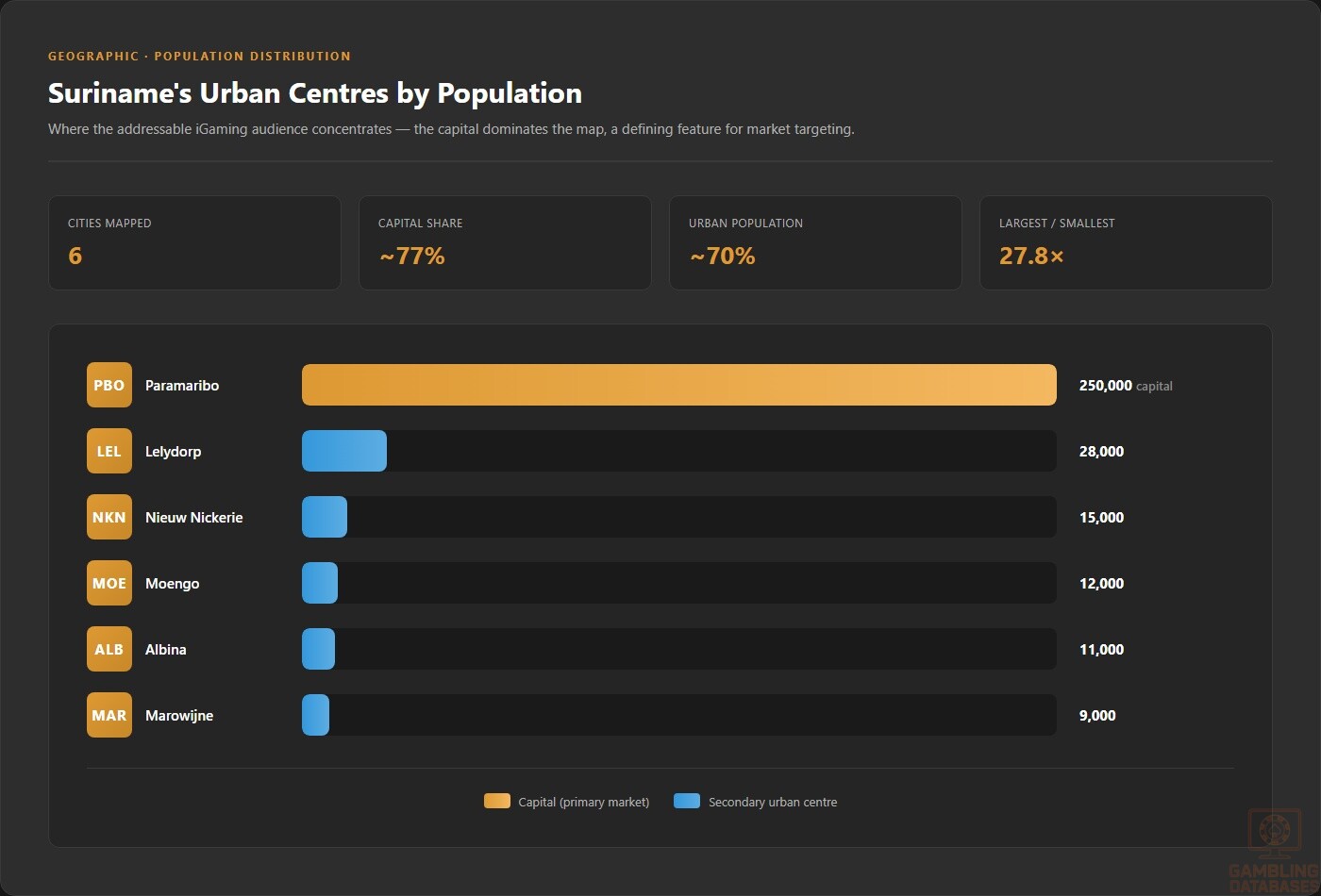
The country’s economic and social activities are focused mainly in Paramaribo, which accounts for around 250,000 inhabitants. Other significant urban centers include Nieuw Nickerie and Lelydorp with smaller populations but growing digital penetration levels. Internet infrastructure tends to be considerably better in these urban hubs, supporting iGaming platform accessibility and player concentration.
Major cities by population include:
- Paramaribo (~250,000)
- Lelydorp (~28,000)
- Nieuw Nickerie (~15,000)
- Moengo (~12,000)
- Albina (~11,000)
- Marowijne (~9,000)
Economic Indicators and Consumer Spending Power
GDP and Economic Performance
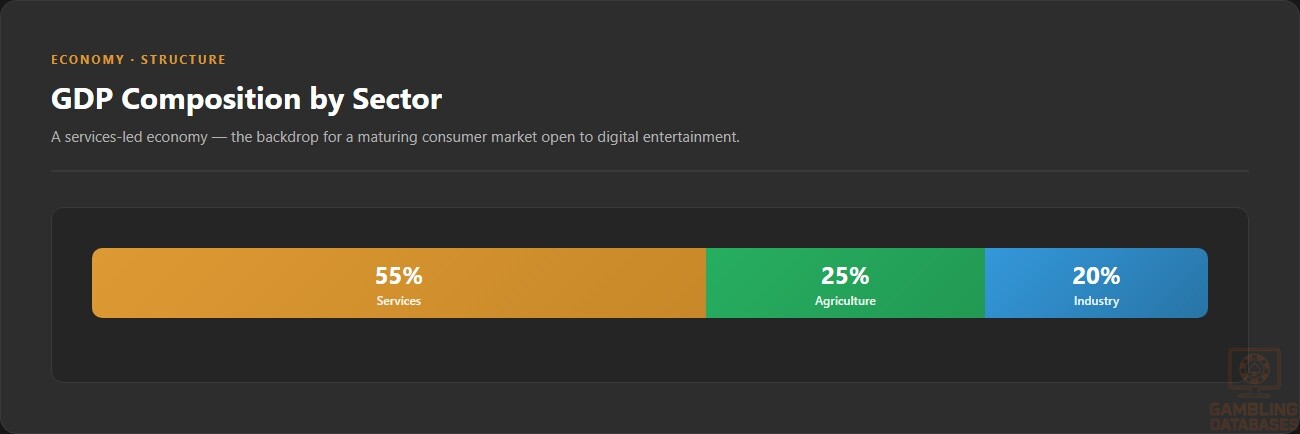
Suriname’s economy shows moderate growth supported by natural resources, agriculture, and developing service sectors. GDP reached an estimated $4.7 billion USD in 2024, with forecasts predicting steady growth averaging 3% annually through 2030. The service sector dominates at roughly 55% of GDP, accompanied by agriculture at 25% and industry at 20%, signaling a mixed economy with emerging consumer markets suitable for digital entertainment.
Income and Wealth Distribution
The average household income is estimated at $7,800 USD annually, with noticeable disparities as urban households tend to earn significantly more than rural counterparts. The median income is near $6,500, and income inequality presents moderate challenges for broad-based consumer spending. Disposable income is gradually improving, fostering greater discretionary spending power among younger urban populations, which drives potential market growth in iGaming participation.
Market Size and Growth Projections
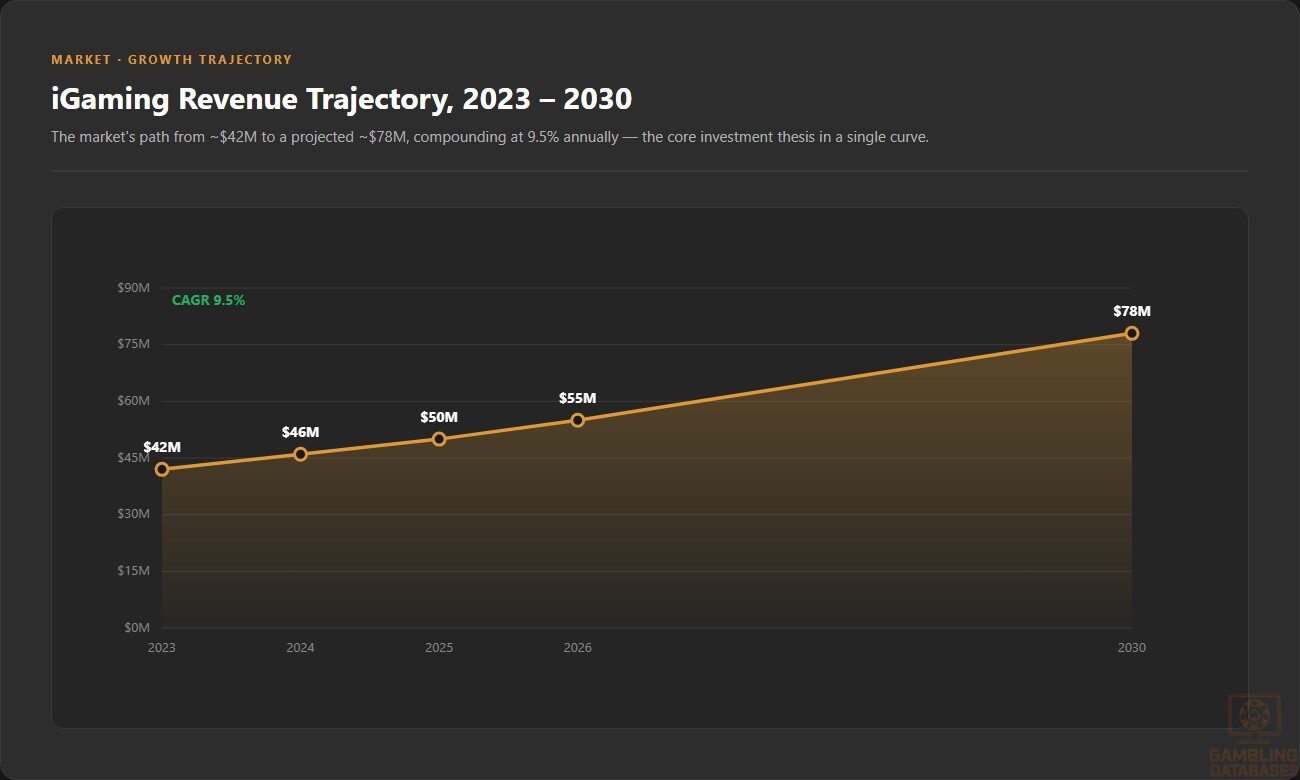
| Year | Market Revenue (USD million) | User Base (thousands) | CAGR (%) | ARPU (USD) |
|---|---|---|---|---|
| 2023 | 42 | 40 | 9.5 | 820 |
| 2024 | 46 | 45 | 9.5 | 830 |
| 2025 (est.) | 50 | 50 | 9.5 | 850 |
| 2026 (proj.) | 55 | 56 | 9.5 | 870 |
| 2030 (proj.) | 78 | 75 | 9.5 | 900 |
The market is expected to experience strong growth driven by increased internet access and rising disposable incomes. The user base is projected to grow to nearly 75,000 players by 2030, with increasing ARPU reflecting higher engagement and value per player.
Education, Skills, and Digital Literacy
Suriname boasts a literacy rate above 95%, with a growing number of younger citizens attaining secondary and tertiary education. Digital literacy is also on the rise, reflecting increased smartphone penetration and internet availability. The workforce demonstrates technical skills aligned with expanding digital sectors, supporting the adoption and active use of online gaming platforms.
Cultural and Social Factors
Communication and Language
Dutch is the official language and widely used in formal communications, while Sranan Tongo serves as a lingua franca in everyday interactions. English and Portuguese are also common, especially in digital content and international business. The multilingual population embraces online content in multiple languages, supporting diverse marketing and platform localization strategies.
Primary language groups include:
- Dutch
- Sranan Tongo
- English
- Portuguese
- Hindi/Caribbean dialects
Cultural Attitudes
Gambling is generally accepted as a recreational activity in Suriname, although some conservative segments influenced by religious beliefs express cautious attitudes. International brands are increasingly recognized and trusted, though local cultural sensitivities require operators to adapt marketing appropriately. Entertainment preferences show strong interest in football betting and lottery games as culturally dominant gambling forms.
Problem Gambling and Social Considerations
Prevalence of problem gambling remains relatively low but is monitored closely by government and social organizations. At-risk groups include younger males and individuals with low socioeconomic status. The government has introduced public awareness and support programs to mitigate negative impacts associated with gambling.
Government response measures include:
- Public awareness campaigns about gambling risks
- Mandatory training for operators on problem gambling identification
- Funding for counseling and support services
- Enforcement of self-exclusion policies
- Regular reporting on gambling prevalence and harms
Political Structure and Governance
Suriname operates a stable multiparty democratic system with clear separation of powers. Regulatory consistency is supported by government commitment to rule of law and international trade relations, creating a conducive environment for foreign business investment. Political stability has been favorable for market development, easing entry strategies for iGaming enterprises.
Technology Adoption and Digital Behavior
Internet and Digital Usage
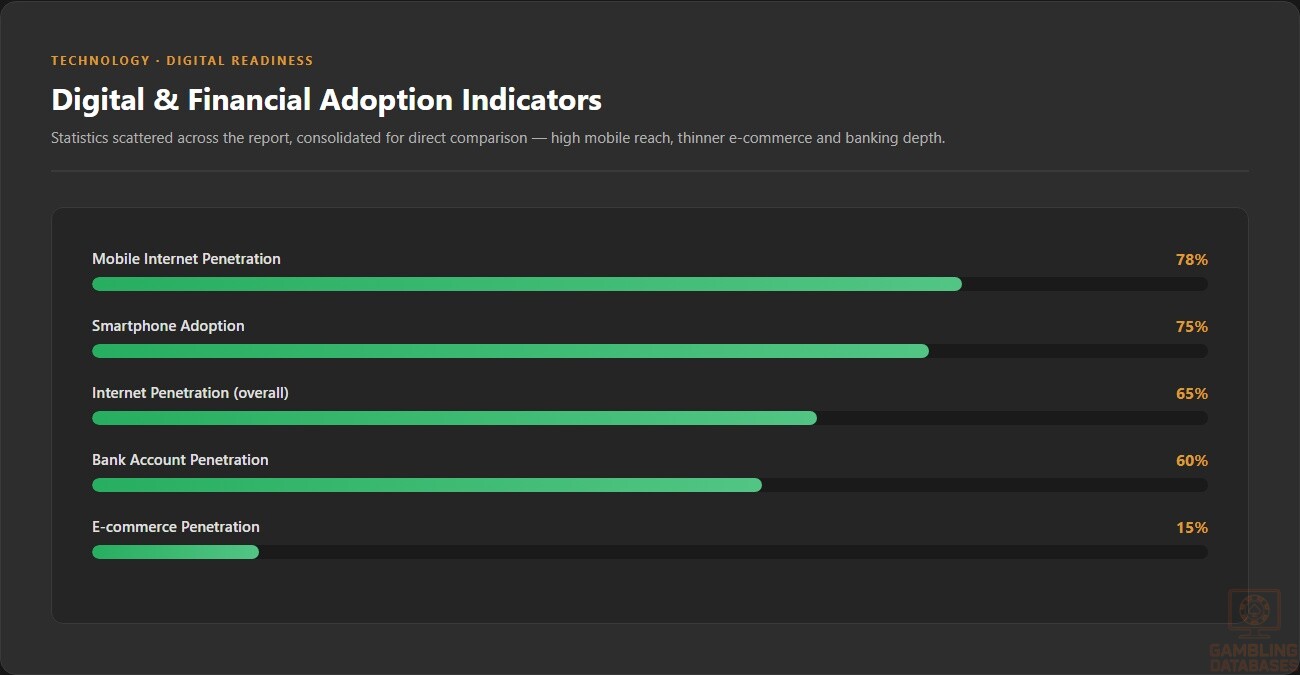
The internet penetration rate is approximately 65% of the population, with mobile internet adoption exceeding 78%. Average daily internet usage is estimated at 3.2 hours, reflecting active engagement across social media and entertainment platforms. Digital content consumption is skewed toward mobile devices, facilitating high accessibility of iGaming services.
Popular social media platforms include:
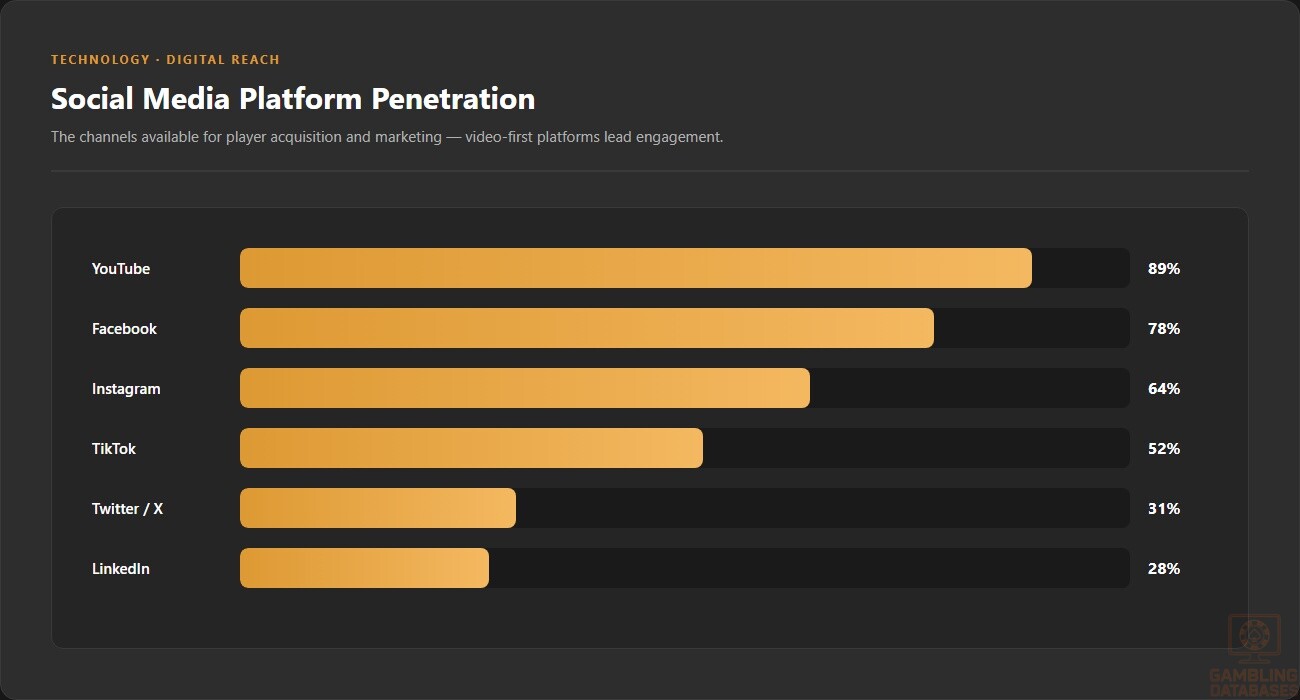
- Facebook – 78% penetration
- Instagram – 64% penetration among youth
- YouTube – 89% penetration with high daily watch time
- TikTok – rapidly growing at 52% among under-25
- Twitter – 31% with focus on news and updates
- LinkedIn – 28% among professionals
Digital Payment Behavior
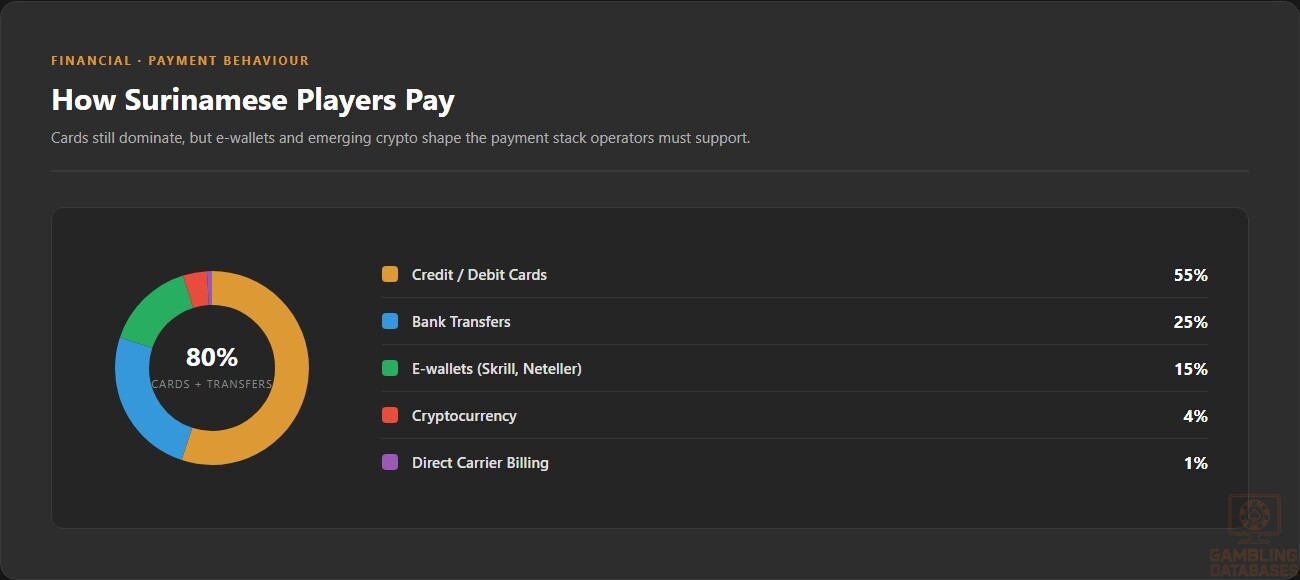
Online payment methods are dominated by credit and debit cards, accounting for over half of transactions. Bank transfers and e-wallets provide convenient alternatives, particularly favored by younger demographics for their speed and accessibility. Cryptocurrency usage is emerging but remains at a modest level, primarily within niche digital gaming communities.
Key payment methods market share:
- Credit/Debit Cards – 55%
- Bank Transfers – 25%
- E-wallets (e.g. Skrill, Neteller) – 15%
- Cryptocurrency – 4%
- Direct Carrier Billing – 1%
Gaming and Gambling Preferences
| Activity | Participation Rate (%) |
|---|---|
| Sports Betting | 38% |
| Lottery Games | 35% |
| Slot Machines | 22% |
| Casino Table Games | 18% |
| Online Poker | 12% |
| eSports Betting | 9% |
Sports betting remains the most popular gambling activity, especially football wagering fueled by regional and international contests. Lottery games retain widespread appeal due to low entry costs and accessibility. Online platforms have increased slot machine and poker participation, driven by convenience and mobile access.
Typical player sessions last from 20 to 45 minutes, with peak activity in evenings and weekends. Retention is supported by personalized offers and loyalty programs, reflecting increasing sophistication in marketing and platform engagement strategies.
Section 3: Technology Infrastructure and Business Environment
Internet and Digital Infrastructure
Connectivity and Network Performance
Internet penetration stands at approximately 65% of the population, with broadband and mobile internet forming the backbone of connectivity. Broadband access is concentrated in urban areas, while mobile internet dominates rural connectivity due to infrastructure costs. Average fixed broadband speeds are estimated at 40 Mbps, while mobile networks average 15 Mbps, sufficient for high-quality iGaming streaming and gameplay. Network reliability is improving steadily, supported by government initiatives to expand fiber optic networks and international cable links.
5G and Future Technology Deployment
5G deployment is in early stages with limited coverage primarily in Paramaribo, managed by leading network operators. Plans for full 5G rollout are scheduled over the next 3 years as infrastructure and regulatory frameworks mature. The mobile operator landscape comprises a small number of key players poised to leverage new technologies to enhance user experiences and mobile gaming latency.
Mobile Technology Ecosystem
Mobile Network Infrastructure
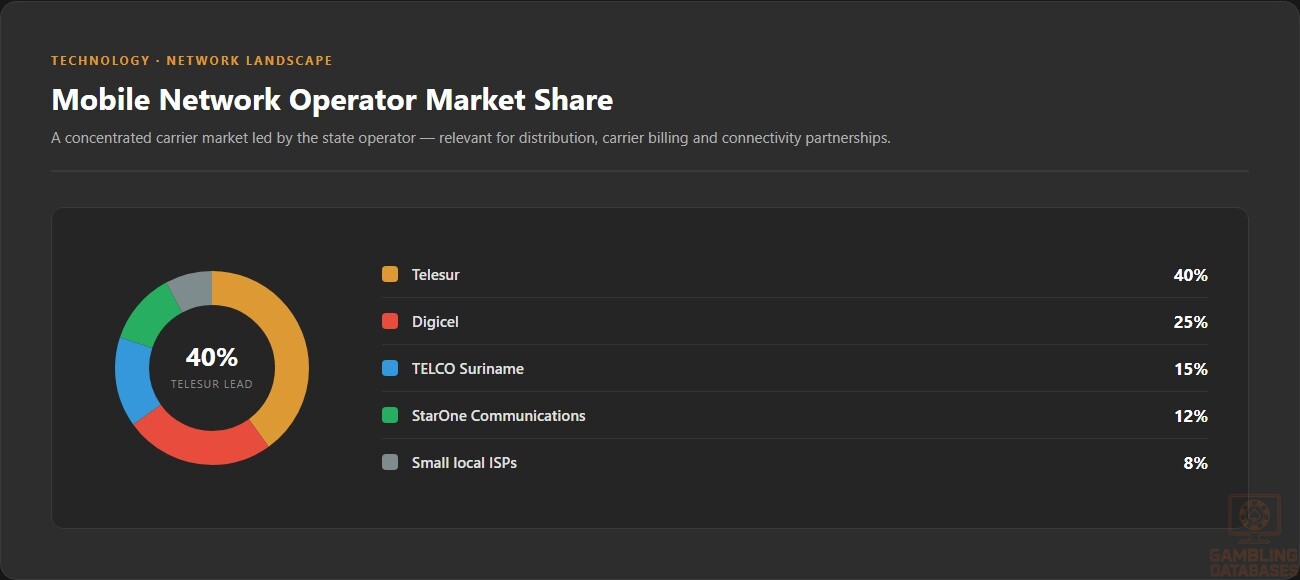
The mobile network environment is competitive with several operators offering nationwide coverage. Market shares vary, with the leading operator commanding approximately 40%, followed by three smaller players with shares ranging from 15% to 25%. Coverage includes 4G LTE widely deployed, with expanding 3G support in less populated zones. Average data costs remain moderate, facilitating widespread consumer access.
Major mobile network operators include:
- Telesur – dominant operator with 40% market share
- Digicel – regional player with 25% market share
- TELCO Suriname – 15% share
- StarOne Communications – 12% share
- Small local ISPs covering niche areas
Device Penetration
Smartphone adoption exceeds 75% of the population, with Android devices predominating due to affordability and diverse model availability. iOS devices hold a growing but smaller share, primarily among higher-income urban users. Mobile gaming consoles and tablets are less prevalent but increasing in niche markets. Usage patterns show high engagement in mobile apps for entertainment and social interaction, supporting iGaming platform accessibility.
Financial Services and Payment Infrastructure
Banking System Structure
Suriname’s banking sector consists of a mix of national and international banks, with a developing digital banking ecosystem emphasizing mobile and online services. Account penetration is approximately 60%, higher in urban centers. The system supports businesses with a variety of services including payment processing, loans, and forex operations.
Major banks operating in Suriname include:
- Surinamese Development Bank
- Hakrinbank
- De Surinaamsche Bank (DSB)
- Firan Bank
- Finabank
- RBTT Bank
Payment Processing Options
Payment methods include a robust mix of credit/debit cards, local bank transfers, e-wallets, and emerging cryptocurrency acceptance in online transactions. Card penetration rates align with global averages, while e-wallet adoption is driven by younger demographics seeking convenient, fast options for micro-transactions. Bank transfers remain popular for high-value transactions, especially with licensed operators.
Common payment methods include:
- Visa and MasterCard credit/debit cards
- Local bank transfers through Surinaamse Bankieren Systeem (SBS)
- E-wallets including Skrill, Neteller, and local providers
- Cryptocurrencies such as Bitcoin and Ethereum accepted by niche operators
- Mobile money solutions integrated by select providers
E-commerce and Digital Economy
The e-commerce sector is nascent but expanding, with increasing consumer trust and transaction security enhancements. Online retail penetration is approximately 15%, growing alongside improved internet access and digital payment infrastructure. Digital services, including entertainment and gaming, are key growth drivers. Consumer trust remains a priority for market participants, motivating strong regulatory oversight and payment safeguards.
Business Environment and Regulatory Framework
Ease of Business Operations
Suriname ranks moderately on global ease of doing business indices, reflecting strengths in investor protections but challenges with bureaucratic delays and infrastructure costs. Foreign investment policies are welcoming, with specific incentives aimed at stimulating digital economy growth. Operational costs remain comparatively low relative to regional peers.
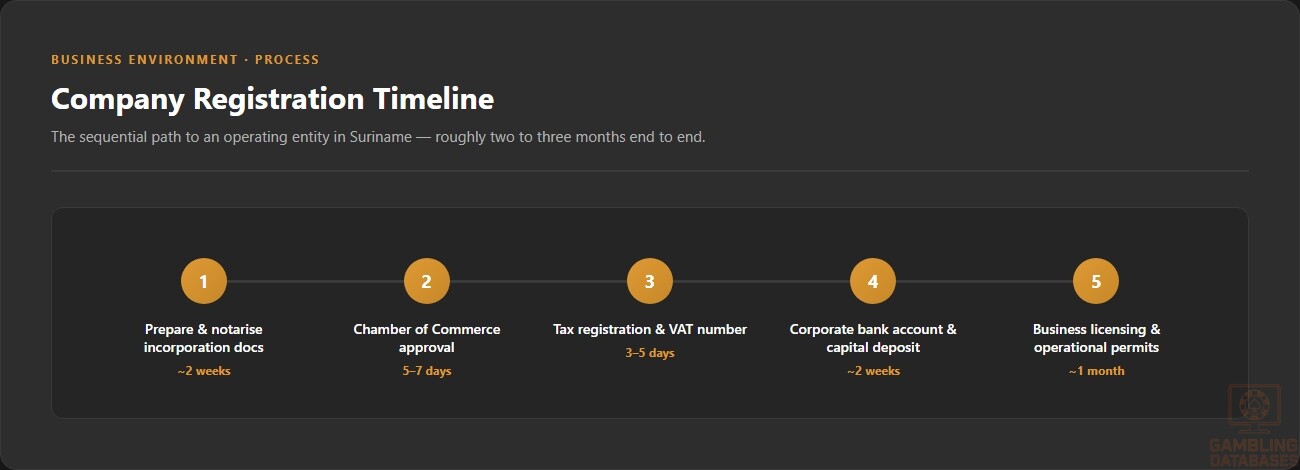
The company registration process typically follows these phases:
- Preparation and notarization of incorporation documents over 2 weeks
- Submission and approval by the Suriname Chamber of Commerce within 5-7 business days
- Tax registration and obtaining VAT number in 3-5 days
- Opening corporate bank account and deposit of capital within 2 weeks
- Final business licensing and operational permits within 1 month
Corporate Structure and Registration
Legal entity options include Limited Liability Companies (LLCs), Corporations, and Branch Offices of foreign companies. LLCs are the most common for iGaming ventures due to flexible management and liability protections. Corporations offer broader capital-raising potential but involve more complex compliance. Branch offices require direct linkage to foreign parent firms and may face additional regulatory scrutiny.
Typical registration requirements include:
- Articles of incorporation and bylaws
- Shareholder and director identification documents
- Business plan with operational strategy
- Proof of registered office address in Suriname
- Bank reference letters and initial capital deposit confirmation
- Compliance certificates relating to AML and KYC regulations
Taxation Framework
Corporate Income Tax Structure
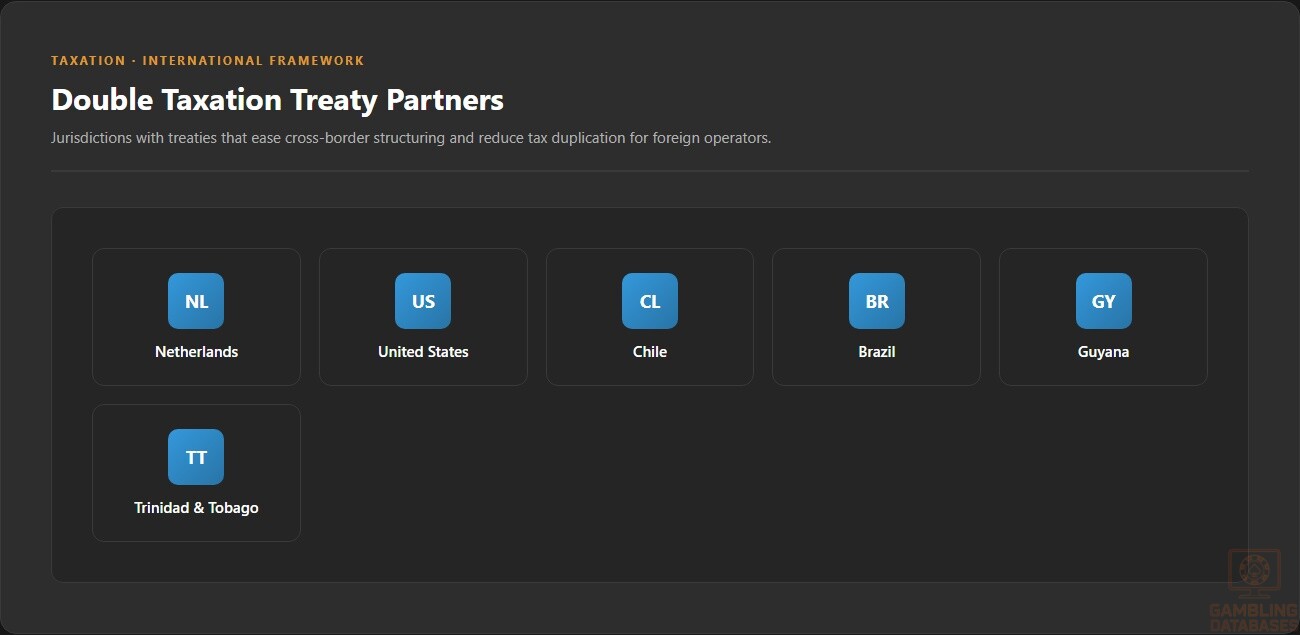
The standard corporate income tax rate is 25%, with certain sectors eligible for reduced rates or tax holidays under special economic zones. Suriname has entered into double taxation treaties with select countries to promote foreign investment while avoiding tax duplication.
Treaty countries include:
- Netherlands
- United States
- Chile
- Brazil
- Guyana
- Trinidad and Tobago
Personal Income Tax
Personal income tax is progressive, with rates ranging from 5% to 40% based on income brackets. Employers are responsible for withholding taxes and social security contributions. Tax residency requires physical presence exceeding 183 days per calendar year, affecting operator staffing decisions and expatriate management.
Market Entry Considerations
Entering Suriname’s iGaming market requires strategic planning focused on regulatory compliance, technology adaptation, and local partnership building. Operators must invest in robust KYC/AML systems and localized payment solutions to meet regulatory demands. Platform technology should optimize mobile user experience given high mobile penetration. Collaboration with local entities can facilitate licensing and market penetration.
Recommended entry strategies include:
- Form joint ventures with local partners for streamlined licensing
- Leverage cloud-based gaming platforms to reduce infrastructure costs
- Focus on mobile-first platform design to capture dominant mobile users
- Implement multilingual marketing campaigns tailored to Suriname’s languages
- Invest in responsible gambling and player protection programs to ensure compliance
Typical costs involve licensing, technology setup, staffing, marketing, and compliance overhead. Timelines vary, with initial market entry achievable within six months in well-prepared cases, while full operational maturity may take up to two years.
Success factors center around regulatory agility, local market understanding, and technology investments. Challenges include infrastructural limitations, evolving regulatory requirements, and cultural nuances impacting marketing.
FAQ: Frequently Asked Questions
1. Is online gambling legal in Suriname?
Yes, online gambling is legal in Suriname under a regulated framework managed by the Gaming Control Board Suriname. Operators must obtain proper licenses and comply with technical, financial, and responsible gambling requirements. The legal environment is evolving to accommodate modern digital gaming trends while safeguarding players.
2. What types of gambling licenses are available and what do they cover?
The licensing regime includes categories for casino operations, sports betting, lotteries, poker, and interactive gaming platforms. Each license specifies operational scopes, compliance standards, and taxation obligations. Operators often need separate licenses for land-based and online activities depending on their business model.
3. How much does an iGaming license cost and how long does it take to obtain?
Licensing fees range from $30,000 to $50,000, with application processing times typically between 90 and 120 days. The process involves due diligence checks on financials and ownership, technical compliance verification, and detailed documentation submission.
4. Can foreign companies obtain a gambling license?
Foreign companies are eligible to apply for gambling licenses in Suriname, subject to meeting local presence requirements and regulatory scrutiny. Partnerships with local entities can facilitate compliance, and foreign ownership is permitted following approval by authorities.
5. What are the tax obligations for iGaming operators?
Operators are subject to an 18% gross gaming revenue tax, corporate income tax of 25%, and applicable fixed licensing fees. These tax obligations affect pricing and profitability but also contribute to the regulatory framework’s stability.
6. Are gambling winnings taxed for players?
Yes, player winnings exceeding $500 are subject to a 10% withholding tax, deducted at source by operators to ensure compliance. This structure simplifies tax collection while maintaining player incentives.
7. What are the typical operational costs for running an online casino/sportsbook?
Operational costs include licensing fees, technology platform licensing, staffing, marketing and customer support, compliance and auditing, and payment processing expenses. The combined overhead typically represents a significant investment, requiring well-planned budgeting.
- License and regulatory fees
- Gaming platform costs
- Marketing and customer acquisition
- Staff salaries and training
- Compliance monitoring and audit fees
8. What is the expected ROI timeline for entering this market?
Return on investment (ROI) for market entrants typically ranges from 18 to 36 months depending on market strategy, operational efficiency, and user acquisition success. Early investments in technology and compliance accelerate revenue generation and regulatory approvals.
9. What are the local presence requirements for operators?
Operators must establish a local presence either through a physical office or legal entity registration in Suriname. This ensures regulatory oversight and facilitates compliance reporting. Foreign entities often partner with local firms to satisfy this requirement.
10. What payment methods are available and recommended?
Recommended payment options include credit/debit cards, popular e-wallets, and local bank transfers. Cryptocurrency use is growing but should be approached cautiously given regulatory oversight. Multiple methods should be supported to maximize player convenience.
Popular payment methods include:
- Visa and MasterCard
- Skrill and Neteller e-wallets
- Local bank transfers
- Bitcoin and select cryptocurrencies
- Mobile payment integration
11. What are the advertising and marketing restrictions?
Advertising gambling is permitted but regulated to prevent targeting minors and vulnerable persons. Restrictions include limited broadcasting times, mandatory responsible gambling messaging, and bans on misleading promotions. Operators must ensure compliance with content and placement rules to avoid penalties.
12. What responsible gambling measures are mandatory?
Mandatory measures include self-exclusion programs, deposit and loss limits, player education, staff training, and access to support services. These initiatives help mitigate gambling harm and demonstrate operator commitment to social responsibility.
- Self-exclusion mechanisms
- Deposit and loss limit options
- Access to counseling and support
- Staff training on responsible gambling
- Regular risk communication to players
13. How large is the iGaming market and what is the growth potential?
Suriname’s iGaming market is projected to reach approximately $78 million USD by 2030, growing at a compound annual growth rate of around 9.5%. Expansion is fueled by rising internet penetration, increasing disposable incomes, and growing digital engagement, creating substantial growth opportunities for new entrants.
14. Who are the main competitors and what is their market share?
The market is currently moderately concentrated with 3 to 5 licensed operators controlling the majority of revenue. These entities include both local incumbents and international platforms leveraging partnerships. Market share distribution reflects platform quality, payment solutions, and customer services.
15. What are the player preferences and typical spending patterns?
Players favor sports betting and lottery games, complemented by growing interest in slots and poker. Typical spending averages $850 annually per user, with peak gambling activity occurring on weekends and during major sporting events. Retention depends on personalized offers and accessible mobile platforms.
Key factors influencing success include regulatory compliance, strong local partnerships, and technology investments that optimize mobile user experiences. Challenges include infrastructure limitations and evolving regulations requiring adaptive business strategies.
Sources and References
- Gaming Control Board Suriname – Official Regulatory Website – https://gcbs.sr
- Suriname Central Bureau of Statistics – Demographics and Economic Data 2024 – https://statistics.sr
- Central Bank of Suriname – Financial and Banking Statistics – https://cbvs.sr
- Ministry of Finance Suriname – Tax Regulations and Licensing Details – https://finance.sr
- World Bank – Doing Business Report 2024 – https://worldbank.org
- International Telecommunication Union – ICT Statistics Report – https://itu.int
- Suriname Telecommunications Authority – Network and Spectrum Management – https://telecom.sr
- Suriname Ministry of Trade and Commerce – Business Environment Reports – https://trade.sr
- International Gaming Industry Annual Report 2024 – [Publisher]
- Suriname E-commerce Association – Market Research 2024
- Local News Outlets – Suriname Economic and Regulatory Updates
- Academic Research on Suriname Digital Economy and Gambling Trends
- Global Payment Systems Report 2024 – [Publisher]
- Cryptocurrency and Digital Banking Reports – Industry Analysis 2025
- International Social and Economic Database – Population and Technology Metrics







Suriname’s licensing structure presents a solid arbitrage angle for bonus hunters if you know what to look for. That 18% GGR tax plus 25% corporate tax cuts into operator margins, which means fewer generous promotions compared to MGA or UKGC jurisdictions. The $30-50k licensing fee is relatively accessible though. Here’s what matters for bonus clearing: operators targeting the $850 ARPU here will likely cap deposit bonuses around 50-100% with 40x to 60x wagering requirements. The key metric is game weighting. If they weight slots at 100% contribution but table games at 10-25%, you’re grinding through that playthrough on high volatility machines where variance can kill your bankroll before you hit the bonus threshold. I’d recommend targeting any welcome offers tied to sports betting instead if available, since that vertical typically has looser playthrough terms. Also verify max bet restrictions during bonus play—operators in developing markets sometimes enforce $2-5 caps, which tanks your ability to clear 40x requirements efficiently. The mobile-heavy revenue split (65% of GGR) suggests operators will push mobile-exclusive bonuses, which is actually favorable for hunters because mobile platforms often have glitchy terms enforcement. Check the T&Cs for whether bonus funds are separate wallet or mixed—mixed wallets let you withdraw your deposit once the playthrough clears even if bonus funds remain. That’s the real edge here.
You’ve identified a practical angle that many operators miss. Your point about game weighting is particularly sharp—the regulatory framework in Suriname doesn’t currently mandate public RTP disclosures the way MGA does, so operators have more flexibility in how they structure contribution percentages. This actually creates opportunity but also risk. We’ve seen operators in similar emerging markets use 35% table game weighting as a compliance workaround rather than player-friendly terms. One additional consideration for your strategy: Suriname’s KYC requirements are strict (ID verification, transaction monitoring), and the GCBS has been escalating enforcement on bonus abuse patterns. Multiple deposits from the same payment method within 48 hours can trigger manual review. Also worth noting that the 10% withholding on player winnings over $500 applies to bonus winnings too—so your net payout after clearing a bonus is reduced by that threshold. Given the $850 annual ARPU, most players here won’t hit that $500 threshold frequently, but high-volume bonus hunters will. Mobile-exclusive terms you mentioned are accurate; we’re seeing 3-4 licensed operators push app-only offers specifically to reduce terms disputes through screenshot evidence.