Somalia presents a complex and highly restrictive environment for entry into the iGaming sector due to a comprehensive ban on all forms of gambling, both offline and online. Despite growing regional interest in digital betting markets across Africa, Somalia’s legal landscape remains firmly prohibitive, strictly aligned with Islamic law and national statutes.
The country’s iGaming market is effectively closed, with no licensing regime or formal regulatory framework supporting gambling operations. This report analyzes Somalia’s regulatory framework in depth to inform international operators considering strategic positioning in the greater East African region.
Executive Summary: Key Market Indicators
| Metric | Value |
|---|---|
| Gambling Legal Status | All forms banned |
| Online Gambling Legal Status | Illegal with complete prohibition |
| Licensing Authority | No licensing authority established |
| Licensed Operators | None |
| Population (2025) | 19.9 million |
| Urbanization Rate | 37% |
| GDP (Nominal, 2025) | Approx. $7.2 billion USD |
| GDP Per Capita | ~$360 USD |
| Internet Penetration | ~35% |
| Mobile Penetration | ~60% |
| iGaming License Costs | Not applicable |
| Corporate Tax Rate | 15% standard rate |
| GGR Tax on Operators | Not applicable |
| Player Taxation | Not applicable |
| Legal Gambling Age | Minimum 18 years (statutory) |
| Market Entry Barriers | Complete prohibition, no regulatory framework |
| Regulatory Change Timeline | Ban reinforced 2023-2024 |
| Technology Infrastructure | Limited digital payments, weak banking system |
| Financial Reporting Requirements | None (no licensed operations) |
| Responsible Gambling Measures | Not regulated |
| Enforcement Authorities | National Anti-Money Laundering & Counterterrorism Commission |
| Advertising Regulations | All gambling advertising banned |
| Market Size & Revenue Projections | No formal market |
| Growth Forecast (CAGR) | Not viable |
| Average Revenue Per User (ARPU) | Not applicable |
| Mobile Gaming Compatibility | Globally accessible, no local platforms |
| Key Barriers | Religious and legal ban, lack of infrastructure, enforcement actions |
| Cross-border Player Access | Access to foreign platforms via VPN |
Section 1: Regulatory Framework and Legal Environment
Current Gambling Regulation Status
Somalia enforces a strict prohibition against all forms of gambling grounded in both national legislation and Islamic law principles. This ban encompasses land-based gambling venues, online sports betting, casino operations, lotteries, and slot machines. The prohibition is actively enforced by the National Anti-Money Laundering and Counterterrorism Financing Commission (NAMLC), which has explicitly outlawed online platforms such as 1XBET.
The legal framework does not support any form of regulated gambling market or licensing system. While some informal and unregulated gambling activity may exist due to weak state control in certain regions, official policy and legal instruments unequivocally disallow gambling operations.
Land-Based Gambling Activities
Land-based gambling is entirely illegal and absent institutional presence in Somalia. No licensed casinos, sports betting shops, or slot machine venues operate under statutory approval. Social and religious objections frame gambling as incompatible with Somali culture and law.
The government actively prohibits such venues, and enforcement includes legal actions, fines, and potential imprisonment for operators and participants. This prohibition extends to all forms of betting and games of chance traditionally found in physical gambling establishments.
Online Gambling Framework
Online gambling is explicitly banned in Somalia and has been targeted particularly for regulatory crackdowns. The government issued directives in 2023 and 2024 to block access to international gambling websites and prevent financial transactions linked to these services. Mobile and internet service providers face pressure to restrict access to betting applications and platforms.
No legal provisions exist to issue gambling licenses or regulate operators for digital wagering. This total prohibition aligns with the nation’s religious and social policies, and efforts to curb online gambling include cooperation with telecommunications companies to monitor and block illegal activity.
Licensed Operators and Market Players
There are currently no licensed operators within Somalia. The absence of a licensing regime and total market ban discourages domestic or international operators from formal market entry. However, international platforms still attract Somali players through off-shore services accessed via VPN or cryptocurrency.
The market thus remains unregulated and undeveloped domestically, with no formal competitive landscape or licensed entities. Attempts to operate illegally are met with sanctions and shutdowns, reflecting a challenging environment for market entrants.
Licensing Framework and Requirements
Application Process and Eligibility
Somalia does not have an established regulatory body or licensing framework for gambling enterprises, which effectively precludes any legal application process for gaming licenses. The government’s anti-gambling stance means financial and technical standards for licensing are not defined, and no application fees or timelines apply.
No documentation or certifications are currently solicited from applicants, as gambling operations are illegal. This legal void results in a closed market with no formal entry pathways.
Local Presence and Operational Requirements
Given the outright gambling prohibition, there is no requirement or provision for local physical presence, business registration, or local staffing related to gaming operations. Foreign ownership of gambling enterprises is not recognized or permitted under the law.
Domain registration for gambling operations, business permits, or operational licenses cannot be obtained domestically. Partnerships or joint ventures involving gambling activities are illegal, effectively barring any operational foothold in Somalia’s regulatory environment.
Compliance Obligations and Monitoring
Player Protection and Identification
Without legal gambling operations, Somalia has not established formal player protection frameworks or identification standards for gaming participants. Consequently, no KYC (Know Your Customer), AML (Anti-Money Laundering) protocols, or responsible gambling measures are regulated.
The government’s approach focuses on preventing gambling participation rather than managing player safeguards. There are no mechanisms for self-exclusion, deposit limits, or disclosure requirements associated with legal gambling.
Financial Monitoring and Reporting
Since no licensed gambling operators exist, the regulatory system does not mandate financial reporting or transaction monitoring for gambling activities. Enforcement bodies monitor and investigate unauthorized financial flows related to gambling on a case-by-case basis, often linked to anti-money laundering efforts and counterterrorism financing.
Taxation Structure and Financial Obligations
Player Taxation
There is no taxation framework for individual players as gambling winnings are not legally recognized. Players participating in illegal gambling risk potential penalties, but no systematic tax on winnings or withholding mechanisms are operational.
Operator Taxation
Somalia’s taxation regime does not include gaming-specific tax rates as gambling operations are banned. Standard corporate income taxation applies generally, but with no sector-specific levies such as Gross Gaming Revenue (GGR) tax or license renewal fees, since no permits are issued.
| Taxation Type | Rate/Status |
|---|---|
| Corporate Income Tax | 15% standard rate |
| GGR Tax | Not applicable (market banned) |
| Player Winnings Tax | None |
| License Fees | None |
| Turnover or Betting Tax | None |
Gambling Market Financial Performance
Due to the absence of legal gambling operations, there are no official financial performance data or revenue estimates for Somalia’s iGaming market. The regulatory ban has suppressed formal market development.
Any economic activity related to gambling occurs in informal or illegal channels not captured by government statistics. As a result, total wager values, payouts, and tax revenue related to gambling remain negligible or unrecorded.
Advertising and Marketing Restrictions
Advertising of gambling activities is strictly prohibited in Somalia by law. This includes all media channels such as television, radio, print, internet, and social media platforms. The ban extends to promotion of both domestic and foreign gambling services within Somali territorial jurisdiction.
- No gambling advertisements are permitted under any circumstances.
- Marketing content must not target Somali residents or encourage participation in gambling.
- Promotions by offshore operators accessible online are also blocked where possible.
- Advertisements promoting responsible gambling do not apply due to the total ban.
- Telecommunications companies are pressured to restrict promotional communications linked to gambling.
Recent Regulatory Changes and Their Impact
Between late 2023 and 2024, Somalia intensified enforcement against gambling, culminating in a formal ban publicly announced by the National Anti-Money Laundering and Counterterrorism Financing Commission. The decision followed increasing concerns about financial crimes and cultural impacts.
This regulatory tightening resulted in a ban on major international betting platforms like 1XBET, mandating internet service providers to block access. These measures have increased operational risks for illegal operators and deterred market entry by legitimate firms.
Enforcement Mechanisms and Penalties
Penalties for violating Somalia’s ban on gambling include fines, imprisonment, and confiscation of materials involved in unlawful gaming. Enforcement is conducted by national authorities with cooperation from telecommunications firms to disrupt gambling activities.
- Fines imposed on operators and promoters of illegal gambling
- Criminal prosecution and potential imprisonment for offenders
- Internet blocking and account closures by telecom providers
- Confiscation of gambling equipment and marketing materials
- Ongoing surveillance and investigation of suspicious financial transactions
Section 2: Demographics and Consumer Analysis
Population Demographics and Distribution
Somalia’s estimated population in 2025 stands at approximately 19.7 million, with a young demographic profile characterized by a median age of just 21.6 years. The gender ratio shows near parity, with approximately 993 men per 1,000 women. The majority of the population, around 56.1%, is aged 19 or younger, while the working-age group (20-64) makes up 41.1%, and only 2.8% are aged 65 and above.
Urbanization is moderate but increasing, with about 44.6% of the population living in urban centers. Population density is low at approximately 30 people per square kilometer, reflecting the country’s large geographic area and rural lifestyle prevalence.
| Age Group | Population Share |
|---|---|
| 0-19 years | 56.1% |
| 20-64 years | 41.1% |
| 65 years and over | 2.8% |
Geographic Distribution
Somalia’s population is unevenly distributed, with major cities serving as key economic and cultural hubs. Regional economic activity is concentrated mainly in urban coastal areas, while vast inland and rural zones remain sparsely populated.
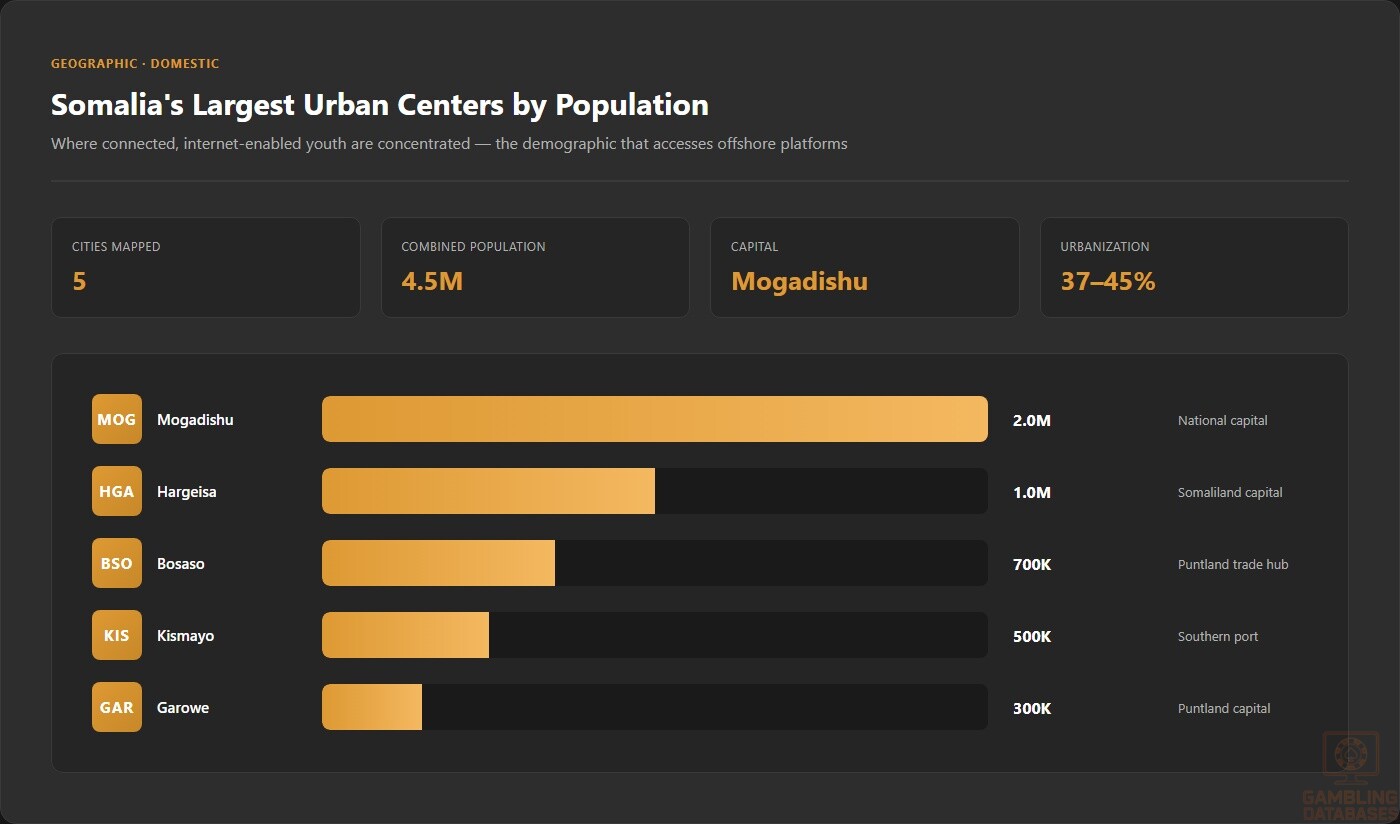
- Mogadishu (Capital) – Approximately 2 million inhabitants
- Hargeisa (Capital of Somaliland) – Around 1 million inhabitants
- Bosaso (Puntland commercial center) – Estimated 700,000 inhabitants
- Kismayo – Approximately 500,000 inhabitants
- Garowe – Around 300,000 inhabitants
Internet access and digital penetration are significantly higher in these urban areas, although connectivity gaps persist in remote regions. Land-based gambling venues are non-existent due to legal prohibitions, and online gambling platform use is limited mainly to internet-enabled urban youths accessing overseas sites.
Economic Indicators and Consumer Spending Power
Somalia’s Gross Domestic Product (GDP) in 2025 is projected around $7.2 billion USD nominally, with an estimated real GDP growth rate for the year of close to 3%. The economy is predominantly agrarian, supplemented by remittances and modest private consumption.
GDP per capita remains low at approximately $360 USD, reflecting broad income constraints. Poverty and informal employment dominate economic life, limiting widespread disposable income but leaving room for incremental consumer spending growth.
The economic landscape is characterized by dependency on external aid, constrained industrialization, and nascent financial sectors. Inflation has been moderately contained, with annual rates hovering below 5% in 2025, helping stabilize consumer purchasing power.
| Indicator | Value |
|---|---|
| GDP (Nominal) | $7.2 billion USD |
| GDP Growth Rate | ~3% |
| GDP per Capita | $360 USD |
| Inflation Rate | <5% |
| Urban Population | 44.6% |
Income and Wealth Distribution
Average household income ranges widely but is generally low by global standards, with typical monthly earnings spanning $100 to $500 USD in the formal sector. Informal sector incomes tend to be lower.
Income inequality is significant, with high levels of poverty and a substantial informal economy. The median income is depressed by limited employment opportunities and ongoing conflict effects. Disposable income for discretionary spending remains narrow for much of the population.
Consumer spending is primarily focused on essentials, though younger urban consumers show rising engagement with mobile technology and digital services, hinting at emergent pockets of spending potential particularly in telecommunications and e-commerce.
Market Size and Growth Projections
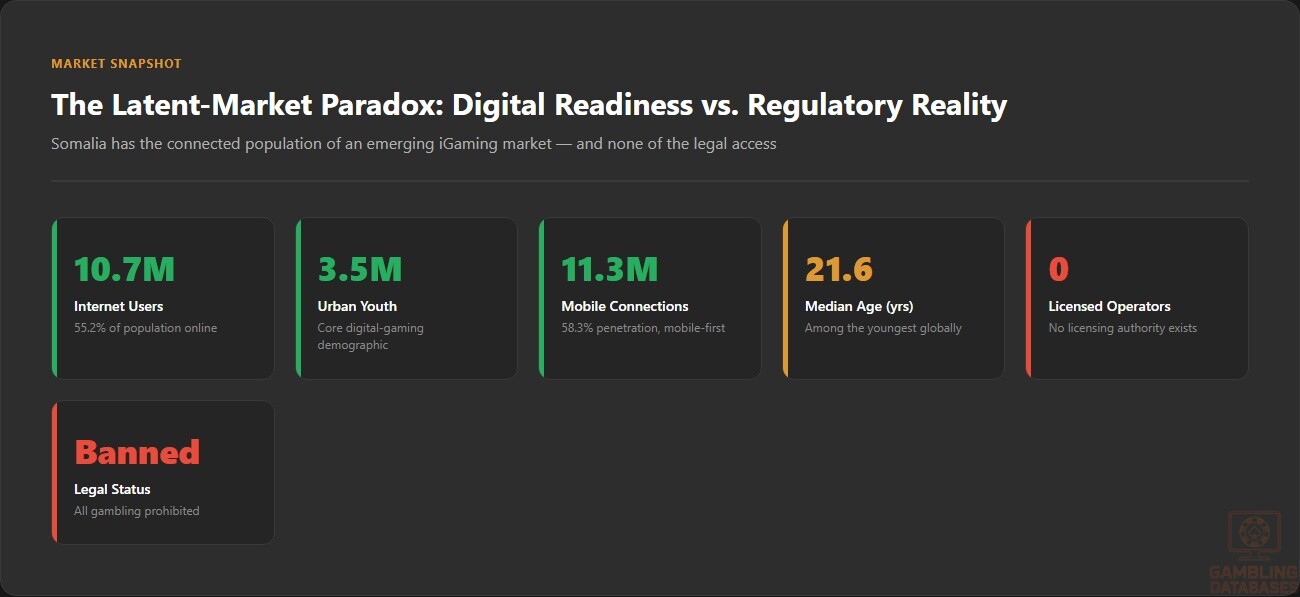
Given Somalia’s ban on gambling, no formal market size or revenue figures are available for iGaming. However, an estimated user base accessing offshore gambling sites via digital channels exists, primarily among the urban youth demographic.
ARPU (Average Revenue Per User) for legal gaming does not exist locally, while predicted growth in digital engagement driven by internet and mobile expansion suggests latent market potential, should legal reforms occur.
| Metric | Value |
|---|---|
| Internet Users | 10.7 million (~55.2% penetration) |
| Mobile Connections | 11.3 million (58.3%) |
| Broadband Mobile Connections | 72.7% of mobile users |
| Social Media Users (2024) | 2.9 million (~15.8%) |
| Urban Youth Population | Estimated 3.5 million |
Education, Skills, and Digital Literacy
Somalia faces significant challenges in education, with an adult literacy rate around 41% and a marked gender disparity—male literacy is approximately 54%, while female literacy lags at 22%. Youth literacy rates are higher, nearing 70%, reflecting gradual improvements in education access.
Digital literacy is uneven but improving, driven by increased mobile device penetration and social media usage. Formal education infrastructure remains disrupted by years of conflict, but initiatives aim to strengthen schooling at primary and secondary levels.
The general workforce skill level remains low, limiting high-tech industry growth but reinforcing potential in mobile-based digital services and communications.
Cultural and Social Factors
Communication and Language
Somalia’s primary languages are Somali and Arabic. English and Italian are also used, especially in urban centers and business contexts. Digital communication largely happens in Somali and English, with social media platforms supporting multilingual content.
- Somali (official and majority spoken)
- Arabic (official, religious use)
- English (business and digital)
- Italian (historical colonial influence)
- Regional dialects and minority languages
Cultural Attitudes
The cultural attitude toward gambling is overwhelmingly negative due to strong Islamic influences, which prohibit gambling as haram. Foreign gambling brands are generally perceived as incompatible with religious norms and social values, limiting local acceptance.
Entertainment preferences favor accessible and culturally aligned content such as music, sports, and religious programming. Digital media consumption is growing, particularly among youth, but gambling-related content remains socially stigmatized and legally proscribed.
Problem Gambling and Social Considerations
There are no official statistics on problem gambling prevalence in Somalia, reflecting the illegal status of the activity. Social stigma and religious prohibitions render gambling a largely underground phenomenon.
The government’s approach is punitive rather than rehabilitative, emphasizing prevention and enforcement over harm reduction. Limited social services address gambling-related harms, and no formal programs exist for problem gambling support.
- Enforcement of gambling bans to prevent social harm
- Religious education discouraging gambling participation
- Public awareness campaigns emphasizing financial risks
- Community-based support initiatives (informal)
- Restrictions on digital and media content promoting gambling
Political Structure and Governance
Somalia operates a federal parliamentary system with political stability still fragile but improving. Governance challenges continue due to security concerns, fragmented authority, and institutional rebuilding efforts.
Regulatory consistency is limited amid evolving government reforms, with international relations focused on development aid and security partnerships. The political environment complicates business and regulatory certainty, affecting foreign investment prospects.
Technology Adoption and Digital Behavior
Internet and Digital Usage
Internet penetration is approximately 55.2%, with close to 10.7 million users, primarily concentrated in urban areas. Mobile adoption is robust, with cellular connections exceeding 11 million, accounting for roughly 58.3% penetration.
Broadband mobile networks (3G, 4G, 5G) cover about 72.7% of mobile users, though data subscription levels are lower. Daily internet usage is growing, driven by social media engagement, messaging apps, and digital communication.
- YouTube
- TikTok
Digital Payment Behavior
Digital payments are emerging rapidly, supported by the introduction of Somalia’s first instant payment system with QR capabilities. Mobile money and digital wallets are popular, facilitating faster transactions, especially in the informal economy.
- Mobile money platforms
- Bank transfer services
- QR code payments
- International remittance services
- Cryptocurrency usage nascent but growing
Gaming and Gambling Preferences
Current Market Participation
Formal gambling participation in Somalia is negligible due to legal prohibitions, but informal and offshore online gambling occur covertly. The most involved demographic consists of urban males aged 18-34 with internet access.
- Online sports betting (offshore platforms)
- Informal local betting on sporting events
- Private lotteries and pool betting
- Informal card and dice games
- Cryptocurrency-based online gaming
Consumer Behavior Patterns
Spending on gambling is limited and sporadic, influenced by disposable income constraints and social risk concerns. Users prefer mobile-friendly platforms with low deposit minimums and fast withdrawals, leveraging VPNs to bypass restrictions.
Peak gambling activity correlates with major international sporting events, with session lengths averaging 20-30 minutes. Retention challenges arise from legal risks and low local brand presence, with consumers drawn to established offshore operators.
Section 3: Technology Infrastructure and Business Environment
Internet and Digital Infrastructure
Somalia’s internet penetration is growing rapidly with an estimated 55.2% of the population now online in 2025. Broadband access is predominantly mobile-based, with fixed-line broadband infrastructure still underdeveloped due to prolonged conflict and infrastructural deficits.
Mobile networks provide the backbone for internet connectivity, with average mobile broadband speeds ranging between 10 to 25 Mbps in urban areas. Infrastructure investment is increasing, driven by regional telecom operators, but challenges remain in rural connectivity and consistent power supply.
5G and Future Technology Deployment
5G deployment in Somalia is nascent but progressing, primarily in major cities such as Mogadishu and Hargeisa. Commercial 5G services have begun rolling out since early 2025, focusing initially on business districts and affluent urban neighborhoods.
National telecommunications regulators have outlined plans to expand 5G coverage over the next five years, leveraging partnerships with international technology providers. Network competition is fostering speed improvements and improved digital service penetration.
Mobile Technology Ecosystem
Mobile Network Infrastructure
The mobile network ecosystem consists of several key operators competing for market share. Coverage varies widely, with excellent urban service but rural gaps. Data costs remain relatively high compared to regional averages, though promotional pricing is common.
- Hormuud Telecom – Largest operator with 45% market share
- Somtel – Covers coastal and southern regions with 25%
- NationLink Telecom – 15%, strong presence in Puntland
- Telcom Somalia – 8%, niche urban segments
- Golis Telecom – Regional operator with 7% share
Device Penetration
Smartphone adoption is estimated at around 58% of the population, driven by affordable models and increasing mobile broadband. Android dominates the market, particularly among younger users, while iOS devices are less common due to cost.
Mobile devices are the primary medium for internet access and digital services, with a user preference for lightweight, data-efficient applications. This trend supports potential iGaming interest should regulatory conditions improve.
Financial Services and Payment Infrastructure
Banking System Structure
Somalia’s banking sector is rebuilding from a minimal base, with digital finance and mobile money playing a critical role in economic transactions. Formal banking penetration remains low, with less than 15% holding bank accounts.
The banking landscape includes primarily regional and local institutions, many focusing on remittances and trade finance.
- Dahabshiil Bank – Largest with remittance and commercial services
- Sahal Bank – Strong digital banking presence
- Premier Bank – Focused on corporate accounts
- International Bank of Somalia – Foreign currency specialist
- Unity Bank – New entrant with mobile banking emphasis
Payment Processing Options
Payment modalities are dominated by mobile money platforms with growing acceptance of e-wallets. Card usage is limited but emerging in urban centers.
- Mobile Money Services (e.g., Hormuud’s EVC Plus)
- Bank Transfers
- QR Code Payments
- International Remittance Systems
- Cryptocurrency (Bitcoin and stablecoins, emerging adoption)
E-commerce and Digital Economy
Somalia’s e-commerce sector is small but expanding, facilitated by mobile payments and increased internet penetration. Online retail platforms are nascent, limited by logistical challenges and levels of consumer trust, but digital services such as airtime sales and remittances are widely used.
The COVID-19 pandemic accelerated digital adoption, encouraging local entrepreneurs to explore online marketplaces, especially within the diaspora community.
Business Environment and Regulatory Framework
Ease of Business Operations
Somalia ranks low on the World Bank’s Ease of Doing Business index due to regulatory uncertainty, security concerns, and limited institutional capacity. Business registration can take upwards of two months, with variations by region.
Foreign investment is encouraged in certain sectors, but the absence of a consistent regulatory framework for gambling restricts market entry. Operational costs are moderate but include high compliance and risk management expenditures.
- Preparation and notarization of incorporation documents (3-4 weeks)
- Submission to Companies Registry and baseline screening (2-3 weeks)
- Tax registration and obtaining TIN (Tax Identification Number) (1 week)
- Opening corporate bank accounts and deposit of initial capital (2 weeks)
- Final approval and certification issuance (1-2 weeks)
Corporate Structure and Registration
Available corporate entities include Limited Liability Companies (LLCs), Joint Stock Corporations, and Branch Offices for foreign companies. LLCs are most common for small and medium enterprises, with flexibility and limited liability.
Registration processes require incorporation documents, tax registration, and adherence to compliance with anti-money laundering and counterterrorism standards. Foreign ownership is permitted but monitored closely.
- Certificate of Incorporation
- Articles of Association
- Proof of Registered Office
- Tax Registration Certificate
- Anti-Money Laundering Compliance Documentation
- Identification and Background Checks of Directors
Taxation Framework
Corporate Income Tax Structure
The standard corporate income tax rate is 15%. Somalia offers limited tax incentives, with no special economic zones conferring benefits at present. Tax treaties exist with select countries focusing on double taxation avoidance and trade facilitation.
- United Arab Emirates
- Turkey
- Saudi Arabia
- Qatar
- Pakistan
Personal Income Tax
Individual income tax rates are progressive up to a maximum of 10%, with mandatory social security contributions levied on formal sector employees. Tax residency is defined by physical presence for more than 183 days annually.
Market Entry Considerations
Recommended Entry Strategies
Given the prohibitive legal environment, entry strategies focus on regional positioning, partnerships, and technological readiness. Market entrants should monitor political and regulatory developments closely.
- Establish partnerships with regional operators experienced in East African markets
- Focus on mobile-first platforms optimized for low bandwidth environments
- Leverage licensed offshore platforms accessible to Somali players
- Monitor regulatory changes for potential legalization or licensing opportunities
- Invest in education and social responsibility initiatives to build local goodwill
Typical Costs and Timelines
Initial market entry costs encompass legal consultations, infrastructure setup, technology acquisition, and market research, typically ranging from $500,000 to $1 million in compliant jurisdictions. In Somalia, cost factors are complexified by legal risks.
| Cost Category | Estimated Cost (USD) |
|---|---|
| Legal and Regulatory Advisory | $100,000 |
| Technology Platform and Licensing | $350,000 |
| Marketing and User Acquisition | $250,000 |
| Operational Setup and Staffing | $150,000 |
| Contingency and Compliance | $100,000 |
- Preliminary market and legal analysis (1-2 months)
- Partnership and network development (3-4 months)
- Platform and payment integration (2-3 months)
- Soft launch and testing (1 month)
- Full launch and scaling (ongoing)
Success Factors and Challenges
Critical success factors include regulatory alignment, strong mobile platform capabilities, and local market insight. Key challenges entail navigating legal prohibitions, limited financial services, and infrastructural deficiencies.
- Compliance with anti-gambling laws and enforcement monitoring
- Adapting services to mobile-first, low bandwidth contexts
- Building trust within cautious consumer base
- Dealing with fragmented regulatory environments
- Security concerns impacting operational stability
Exit Strategy Planning
Exit strategies require thorough valuation assessments, especially in an unregulated context with limited liquidity. Ownership transfers and license assignments are non-applicable due to lack of licensing. Operators should prepare contingency plans aligned with regional diversification.
FAQ: Frequently Asked Questions
1. Is online gambling legal in Somalia?
Online gambling is strictly illegal in Somalia with a complete ban on all forms of betting, both land-based and digital. The government enforces prohibitions aligned with Islamic law, blocking access to international platforms and prosecuting illegal operations.
2. What types of gambling licenses are available and what do they cover?
Somalia currently has no licensing framework for gambling. Since gambling is banned, no formal operator licenses are issued. Interested operators should monitor for future regulatory developments that might establish licensing categories.
3. How much does an iGaming license cost and how long does it take to obtain?
There are no costs or official timelines as Somalia does not legally issue iGaming licenses. Any licensing process would be hypothetical pending legalization and framework establishment, which could require months to years depending on regulatory progress.
4. Can foreign companies obtain a gambling license?
Currently, foreign companies cannot legally obtain gambling licenses as no such regime exists. Any foreign operator providing services to Somali customers does so at legal risk due to the total ban on gambling activities.
5. What are the tax obligations for iGaming operators?
With no legal gambling market, specific tax obligations for iGaming operators do not exist in Somalia. Regular corporate income tax at 15% applies to legally operating businesses in other sectors, but no gaming-specific taxes are currently implemented.
6. Are gambling winnings taxed for players?
Gambling winnings are not taxed because gambling is illegal. There are no mechanisms for withholding or player taxation, and all gambling-related financial activities are prohibited under Somali law.
7. What are the typical operational costs for running an online casino or sportsbook?
Operational costs commonly include technology acquisition, licensing fees (if applicable), payment processing, marketing, staffing, and compliance. In legal markets, these can total upwards of $500,000 annually, though Somalia’s regulatory context negates formal operation costs.
8. What is the expected ROI timeline for entering this market?
Due to the ban, investment into Somalia’s gambling market carries high risk with uncertain ROI. In comparable legalized markets, ROI is expected within 2-5 years based on user acquisition and operational efficiency.
9. What are the local presence requirements for operators?
No local presence is currently permitted for gambling operators in Somalia. Foreign companies would be subject to legal enforcement if attempting to establish physical or operational facilities related to gambling activities.
10. What payment methods are available and recommended?
Mobile money services dominate payment options. Bank transfers, QR codes, and emerging cryptocurrency use are also present, making mobile payment platforms the recommended method for any digital activity, though gambling transactions are prohibited.
11. What are the advertising and marketing restrictions?
All gambling advertising is banned across media channels including TV, radio, print, and online. Telecommunications companies enforce restrictions on gambling promotions, making marketing efforts for gambling brands illegal.
12. What responsible gambling measures are mandatory?
No formal responsible gambling regulations exist due to the illegal status of gambling. The government prioritizes prevention and enforcement rather than harm reduction strategies or social responsibility requirements.
13. How large is the iGaming market and what is the growth potential?
Somalia lacks a formal gambling market due to legal prohibitions, but growing digital infrastructure implies latent demand. Potential exists only if regulatory reforms occur, with youth demographic trends supporting future growth possibilities in the digital gaming sector.
14. Who are the main competitors and what is their market share?
No licensed domestic competitors exist. Offshore international operators accessible via VPN serve Somali players unofficially. Market share data is unavailable, reflecting the underground and informal nature of gambling activity.
15. What are the player preferences and typical spending patterns?
Urban young adults are primary participants in informal online betting, favoring sports betting and mobile-friendly games. Spending is cautious and concentrated around major international sports events, with preference for low minimum bets and fast withdrawal methods.
16. What are the key success factors and main challenges for new entrants?
Success depends on compliance with evolving regulations, mobile-optimized offerings, and consumer trust building. Key challenges include legal risks, infrastructural limitations, and overcoming cultural opposition to gambling.
Sources and References
- Legal Pilot – Gambling Regulations in Somalia – https://legalpilot.com/country/somalia/
- Gambling Insider – Somalia Gambling Ban – https://www.gamblinginsider.com/news/27551/somalias-puntland-state-issues-ban-on-1xbet-operations
- World Bank – Somalia Economic Overview – https://www.worldbank.org/en/country/somalia/overview
- Worldometers – Somalia Population – https://www.worldometers.info/world-population/somalia-population/
- Datareportal – Digital 2025: Somalia – https://datareportal.com/reports/digital-2025-somalia
- Connecting Africa – Somalia Fintech – https://connectingafrica.com/fintech/somalia-launches-first-instant-payment-system
- Somalia Central Bank – Financial Reports
- Ministry of Finance Somalia – Taxation Policies
- International Telecommunication Union – ICT Data – https://www.itu.int/en/ITU-D/Statistics/
- Astute Analytica – Africa Gambling Market Report
- Gambling Talk – African Gambling Regulatory Changes 2025 – https://gamblingtalk.net/news/gambling-regulations-in-africa-key-changes-coming-in-2025
- UNFPA Somalia Statistics – https://www.unfpa.org/data/world-population/SO
- Wikipedia – Somalia Overview – https://en.wikipedia.org/wiki/Somalia
- TimeCamp – Average Salary Somalia – https://statistics.timecamp.com/average-salary/somalia/
- Hiraan Online – Somalia Gambling News – https://hiiraan.com/news4/2023/Nov/193838/somalia_outlaws_1xbet_and_all_gambling_to_curb_financial_crimes_and_protect_cultural_values.aspx
- FintechNews Africa – Somalia Instant Payment System – https://fintechnews.africa/44936/somalia/somalia-instant-payment-system-bpc/
- Industry Reports – GamingTec Comprehensive Licensing Guide 2025
- Official Somaliland Telecom Data
- Somalia National Statistical Bureau Reports
- World Bank Doing Business Report 2024
- Somalia Ministry of Commerce – Corporate Registration Guidelines
- Various new articles and academic papers on Somali digital infrastructure and economy