Sudan presents a highly restrictive environment for iGaming due to its adherence to Islamic law, which prohibits all forms of gambling. Despite growing digital infrastructure, legal constraints create formidable barriers for market entry.
This analysis provides a detailed overview of Sudan’s regulatory framework, legal environment, and compliance obligations as of 2025, essential for understanding the scope and challenges of operating within this market.
| Metric | Value |
|---|---|
| Gambling Legal Status | Completely Prohibited |
| Online Gambling Regulation | Not Regulated, Prohibited |
| Regulatory Authorities | None (Government Enforces Ban) |
| Legal Framework Basis | Sharia Law (Islamic Law) |
| Licensed Operators | None |
| Penalties for Violation | Fines, Imprisonment, Corporal Punishment |
| Population | 47.0 million (2025 est.) |
| Median Age | 20.1 years |
| GDP (Nominal) | Approx. $30 billion |
| GDP Per Capita | Approx. $650 |
| Internet Penetration | Approx. 30% |
| Mobile Penetration | Approx. 60% |
| Market Entry Barriers | Legal prohibition; no licensing available |
| Licensing Fees | N/A |
| Gaming Taxes | Not applicable |
| Technology Infrastructure | Developing with growing mobile usage |
| Business Environment | Challenging due to sanctions and regulation |
| Market Size & Revenue | No legal market activity |
| Growth Forecast (CAGR) | None (Prohibited market) |
| Average Revenue Per User (ARPU) | Not applicable |
| Market Penetration Rate | Zero legal penetration |
| Payment Methods Allowed | None legally permitted |
| Advertising Permissions | Prohibited |
| Compliance Requirements | Strict enforcement of gambling ban |
| Recent Regulatory Changes | No liberalization trends observed |
| Enforcement Intensity | High, including online access blocking |
| Foreign Ownership Restrictions | Not applicable |
Section 1: Regulatory Framework and Legal Environment
Current Gambling Regulation Status
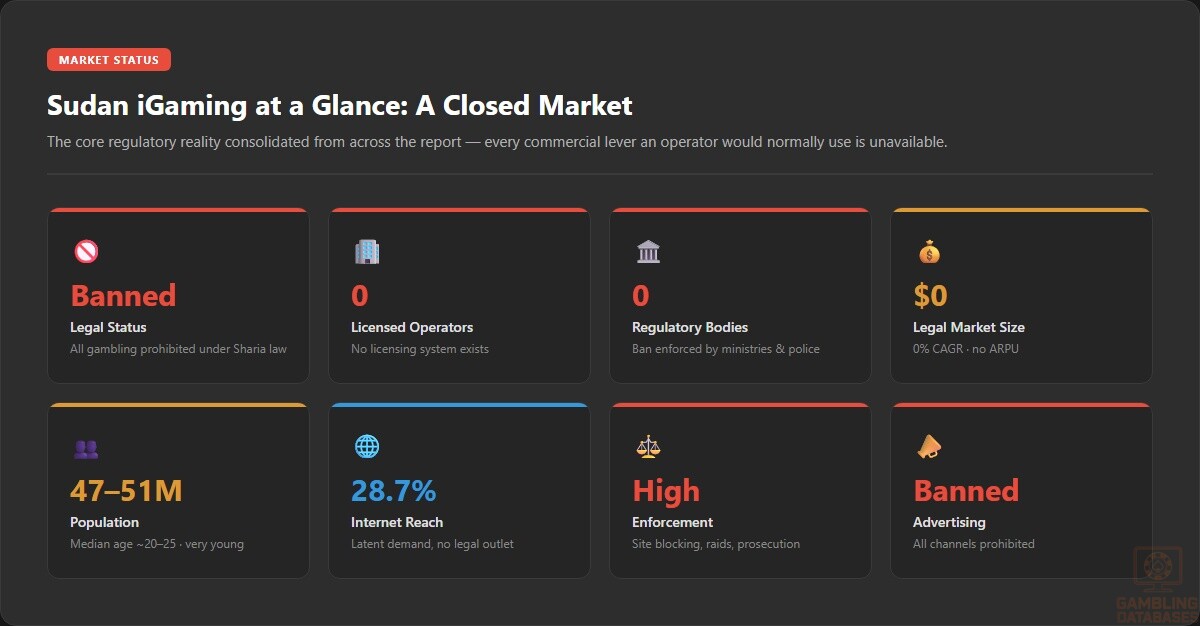
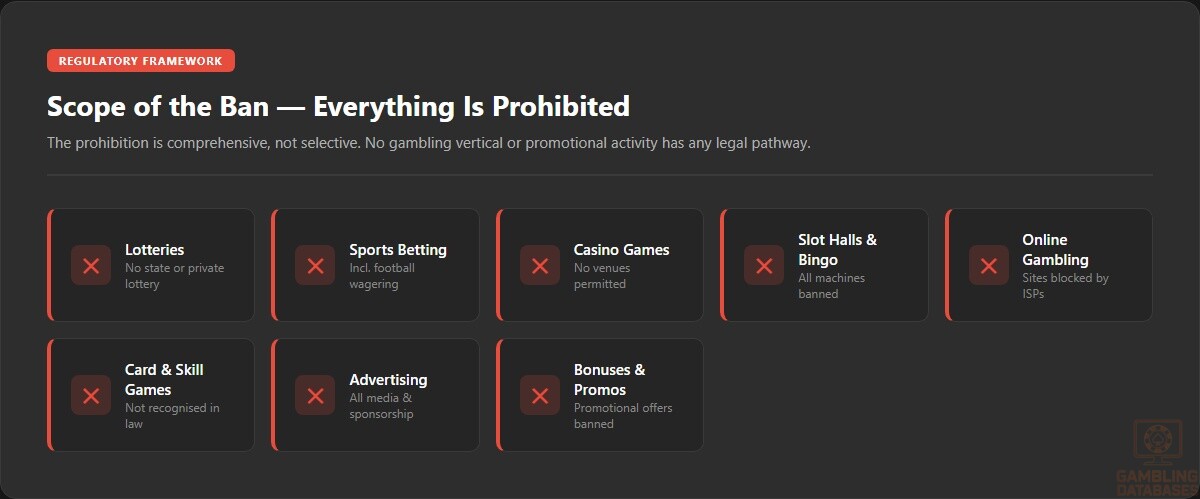
Sudan’s legal regime strictly prohibits all forms of gambling under its adherence to Sharia law. This ban extends comprehensively, covering lotteries, sports betting, casino games, online gambling, and any other wagering activities. The government enforces a zero-tolerance policy, leaving no legal framework or licensing system for gambling operations.
There is no distinct Gambling Act or regulatory authority dedicated to gaming oversight. Instead, the prohibition is embedded deeply within Sudanese criminal and religious codes, with enforcement conducted through various government ministries and law enforcement agencies. The country does not recognize or regulate skill games, betting, card games, or lotteries under any legal provisions.
Land-Based Gambling Activities
All land-based gambling venues are banned in Sudan. This includes casinos, betting shops, slot machine halls, bingo parlors, and other wagering establishments. The legal environment ensures no physical locations can lawfully operate gambling services, with violations subject to severe penalties including fines, imprisonment, and corporal punishment. The government actively monitors and raids suspected illegal gambling dens to uphold this prohibition.
Online Gambling Framework
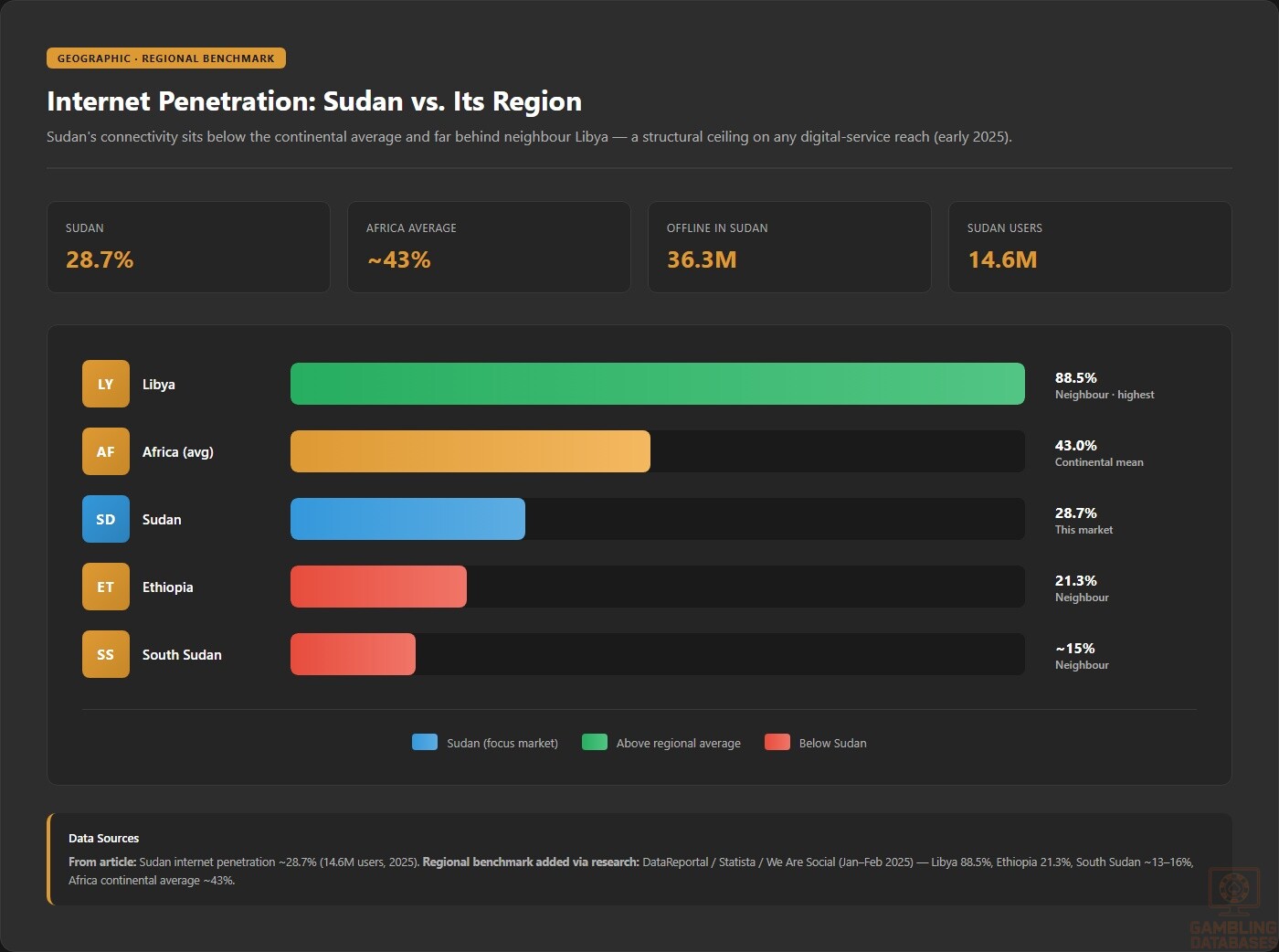
Online gambling is explicitly prohibited and unregulated in Sudan. No licensing framework or registrations exist for online operators, and internet service providers are obligated to block access to offshore gambling websites. The authorities maintain stringent surveillance of digital activities to detect and penalize attempts to engage with unauthorized gambling platforms. Online wagering is treated with equal severity as land-based gambling violations.
Licensed Operators and Market Players
Sudan possesses no licensed operators in any gambling segment due to the outright ban on all gambling. The competitive landscape is nonexistent legally, and any operators attempting to serve the Sudanese market do so offshore with no local regulatory recognition. Sudanese players accessing online gambling do so via offshore licensed platforms, but this practice remains illegal and subject to sanctions if uncovered.
Licensing Framework and Requirements
Application Process and Eligibility
Sudan offers no application or licensing process for gambling entities. There is no regulatory body tasked with issuing licenses or overseeing gaming operators. Consequently, no financial, technical, or operational criteria are established. Entities looking to operate within Sudan must bypass legal barriers or operate offshore, as no local licenses are granted.
Local Presence and Operational Requirements
The regulatory environment imposes no mandates for local presence or operational facilities due to the prohibition of gambling. No provisions for domain registration related to gambling, nor requirements for resident personnel, exist. Foreign ownership restrictions are moot since no legal operations are viable within the country.
Compliance Obligations and Monitoring
Player Protection and Identification
Compliance mandates such as KYC (Know Your Customer), AML (Anti-Money Laundering), and player protection policies are irrelevant under Sudan’s total ban on gambling. There are no established regulatory requirements for age verification or responsible gambling measures because gambling activities themselves are illegal. The government focuses enforcement efforts on preventing participation rather than regulating conduct.
Financial Monitoring and Reporting
The absence of legal gambling operations means there are no structured financial monitoring or mandatory reporting requirements for operators. Transactions involving gambling proceeds are subject to criminal investigation if linked to illicit activity. Financial institutions cooperate with authorities to detect and report suspicious activity related to gambling funds.
Taxation Structure and Financial Obligations
Player Taxation
Players in Sudan are not subject to gambling taxes because there is no legal gambling market. Any winnings derived from unauthorized gambling activities are not legally recognized, and participation itself is punishable. Taxation systems for gambling winnings do not exist under the current legal framework.
Operator Taxation
| Tax Category | Rate/Status |
|---|---|
| Gross Gaming Revenue Tax | Not Applicable (Market Prohibited) |
| Corporate Income Tax on Gambling | Not Applicable |
| License Fees | None (No Licenses Issued) |
| Turnover Tax | Not Applicable |
| Renewal Fees | Not Applicable |
Gambling Market Financial Performance
Due to the absence of legal gambling activity, there are no financial performance data or revenue projections for Sudan’s iGaming market. The government’s strict enforcement effectively suppresses any legal wagering, resulting in zero market size or growth potential within national boundaries.
Advertising and Marketing Restrictions
Advertising of gambling services is completely prohibited in Sudan. This ban covers all media channels including print, digital, broadcast, and outdoor advertising. Content promoting gambling, whether land-based or online, is banned. The government enforces restrictions through monitoring and blocking channels disseminating gambling-related marketing. Sponsorship and promotional activities linked to gambling are not permitted.
- Prohibition of all gambling advertising
- Ban on promotional offers and bonuses
- Restrictions on gambling content dissemination
- Blocking of gambling websites and digital adverts
- Monitoring and sanctioning of illegal marketing practices
Recent Regulatory Changes and Their Impact
There have been no recent liberalizations or regulatory reforms easing gambling restrictions in Sudan. The government maintains its conservative stance, guided by Sharia law principles, with no indication of legalizing or regulating gambling activities in the foreseeable future. Regulatory stability means operators face continuous prohibitive market conditions and enforcement risks remain high.
Enforcement Mechanisms and Penalties
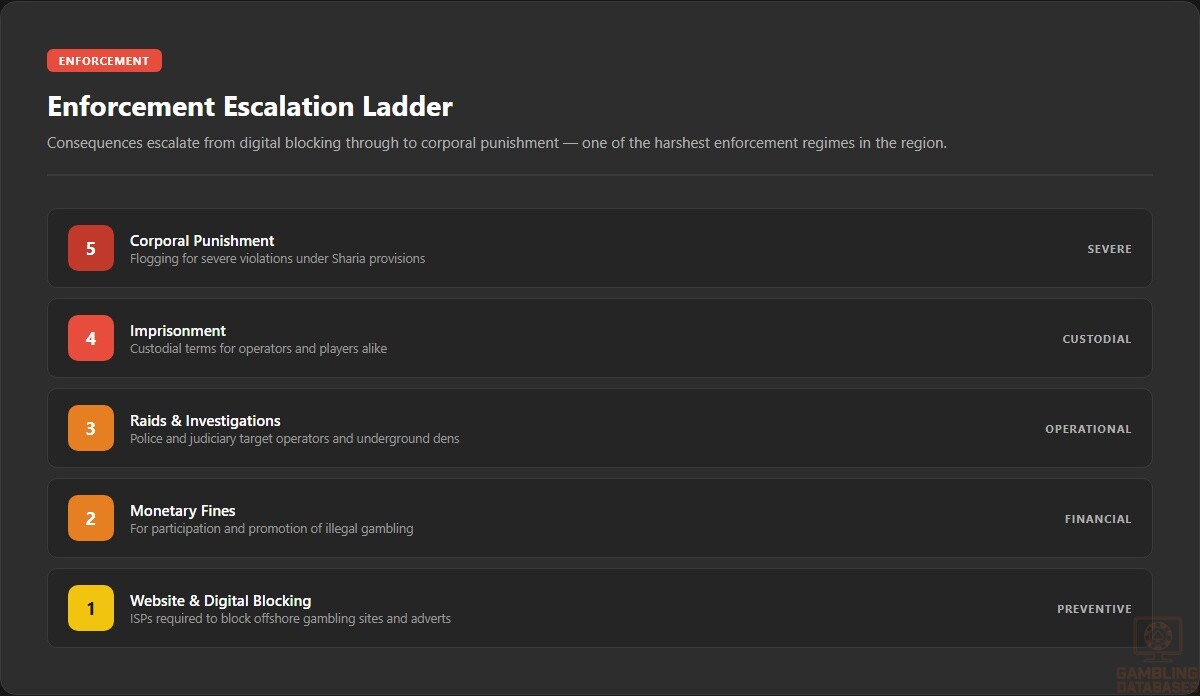
Enforcement against gambling violations in Sudan is stringent and multifaceted. Penalties include severe fines, imprisonment terms, and corporal punishment such as flogging. Law enforcement actively pursues illegal operators and gamblers through surveillance, raids, and prosecution. This strong enforcement environment deters both domestic and foreign entities from conducting gambling operations within Sudan.
- Monetary fines for illegal gambling participation and promotion
- Imprisonment for operators and players involved in unlawful gambling
- Corporal punishment including flogging for severe violations
- Internet censorship and blocking of gambling websites
- Regular raids and investigations conducted by police and judiciary
Section 2: Demographics and Consumer Analysis
Population Demographics and Distribution
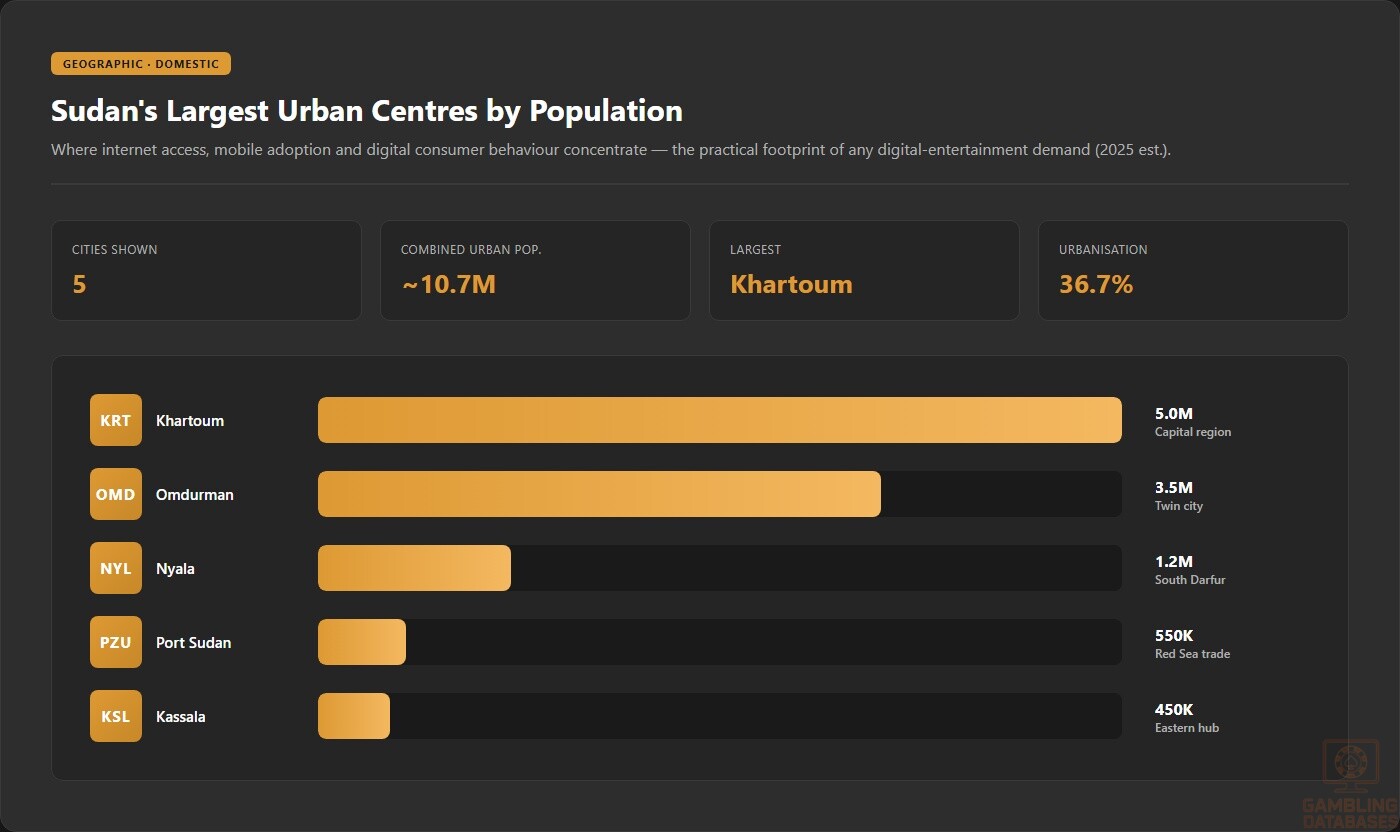
Sudan’s population is estimated at approximately 49 million in 2025, with a median age of around 24.7 years. The population is almost evenly split by gender, with roughly 1,001 men per 1,000 women, reflecting a balanced demographic structure. The country has a youthful population, with nearly half (48.8%) aged 19 or younger, reinforcing the dominance of younger generations.
Urbanization is moderate, with around 36.7% of the population living in urban areas, mainly concentrated in the capital and a handful of major cities. The rest reside in rural regions where traditional lifestyles dominate. Sudan’s population density is relatively low at about 28 persons per square kilometer, reflecting its vast geographic size combined with dispersed settlements.
| Age Group | Percentage of Population |
|---|---|
| 0-14 years | 41% |
| 15-19 years | 7.8% |
| 20-64 years | 47.3% |
| 65+ years | 3.9% |
Geographic Distribution
The largest urban centers in Sudan include Khartoum, Omdurman, and Nyala, which dominate both economic and social activity. These cities are focal points for internet access and emerging digital trends, though overall connectivity remains uneven.
Regional differences reflect varying economic roles, with the north and east focusing on trade and administration, while rural western and southern regions rely heavily on agriculture. Internet and mobile access is more concentrated in cities, influencing where digital consumer behaviors, including those around entertainment and gambling, are most notable.
- Khartoum – Approx. 5 million inhabitants
- Omdurman – Around 3.5 million inhabitants
- Nyala – Roughly 1.2 million inhabitants
- Port Sudan – Estimated 550,000 inhabitants
- Kassala – Close to 450,000 inhabitants
Economic Indicators and Consumer Spending Power
Sudan’s GDP in nominal terms stands near $30 billion, with Purchasing Power Parity (PPP) estimates much higher at around $223 billion. Economic growth remains fragile due to ongoing conflict and sanctions but retains long-term potential driven by population growth.
The economy is diversified across agriculture, industry, and services, with agriculture employing a significant portion of the workforce. GDP per capita is low, around $650, reflecting limited disposable income for discretionary spending such as entertainment or online services.
| Indicator | Value |
|---|---|
| GDP (Nominal) | $30 billion |
| GDP (PPP) | $223 billion |
| GDP Per Capita | $650 |
| Annual GDP Growth | -4% (due to instability) |
| Unemployment Rate | Approx. 20% |
Income distribution is uneven, with a majority of households earning below international poverty lines. Consumer spending is primarily allocated to essentials, limiting discretionary expenditure. Nonetheless, an emerging middle class in urban areas shows growing interest in digital consumer goods and entertainment.
Market Size and Growth Projections
Given the prohibition of gambling, Sudan’s legal iGaming market is effectively non-existent. However, illicit and offshore activity suggests latent demand tied to the youthful demographic and mobile adoption. As of 2025, there is no official revenue or user base associated with iGaming within Sudan.
Future growth prospects depend heavily on regulatory changes, internet penetration improvements, and economic stabilization. Without legalization or formal market structure, growth forecast indices remain negligible at present.
| Metric | Value |
|---|---|
| Current Market Revenue | $0 (illegal) |
| Annual Growth Forecast (CAGR) | 0% |
| Estimated User Base | Not legally tracked |
| Average Revenue Per User (ARPU) | Not applicable |
| Projected Market Size (5 years) | Dependent on legalization |
Education, Skills, and Digital Literacy
Sudan faces challenges with literacy and education, though recent efforts have improved access. The adult literacy rate hovers near 60-70%, with urban areas outperforming rural counterparts. Educational attainment beyond primary school remains limited due to socioeconomic factors and conflict.
Digital literacy is growing among young urban populations, supported by expanding mobile device penetration and social media use. However, nationwide digital skills are low, especially in rural areas, constraining broader online service adoption including iGaming platforms.
Cultural and Social Factors
Communication and Language
Arabic is the official language and primary medium of communication, followed by English in business and education circles. Numerous local languages and dialects are spoken, reflecting ethnic diversity. Arabic’s dominance shapes online content preferences and market communication strategies.
- Sudanese Arabic (primary language)
- English (official second language)
- Nubian languages
- Beja languages
- Other indigenous dialects
Cultural Attitudes
Islamic religious principles profoundly influence Sudanese cultural attitudes, including a strong disapproval of gambling. Entertainment preferences tend toward family-oriented and religiously-aligned activities. Foreign brands face challenges entering Sudanese markets due to local sensitivities and political instability.
Problem Gambling and Social Considerations
Due to the ban on gambling, formal research on problem gambling prevalence is limited. Anecdotal evidence suggests underground gambling exists primarily among youth and urban pockets, but government response remains focused on enforcement rather than harm reduction. Social stigma surrounding gambling is high, compounded by religious prohibitions.
- Government campaigns against illegal gambling
- Religious leader advocacy on gambling harms
- Limited social support structures for addiction
- Community awareness programs
- Law enforcement crackdowns on underground activity
Political Structure and Governance
Sudan is a federal republic with ongoing political instability due to recent conflicts. Governance challenges impact policy consistency and enforcement reliability. International relations remain strained, affecting economic openness and foreign investment potential, which also constrains iGaming market development.
Technology Adoption and Digital Behavior
Internet and Digital Usage
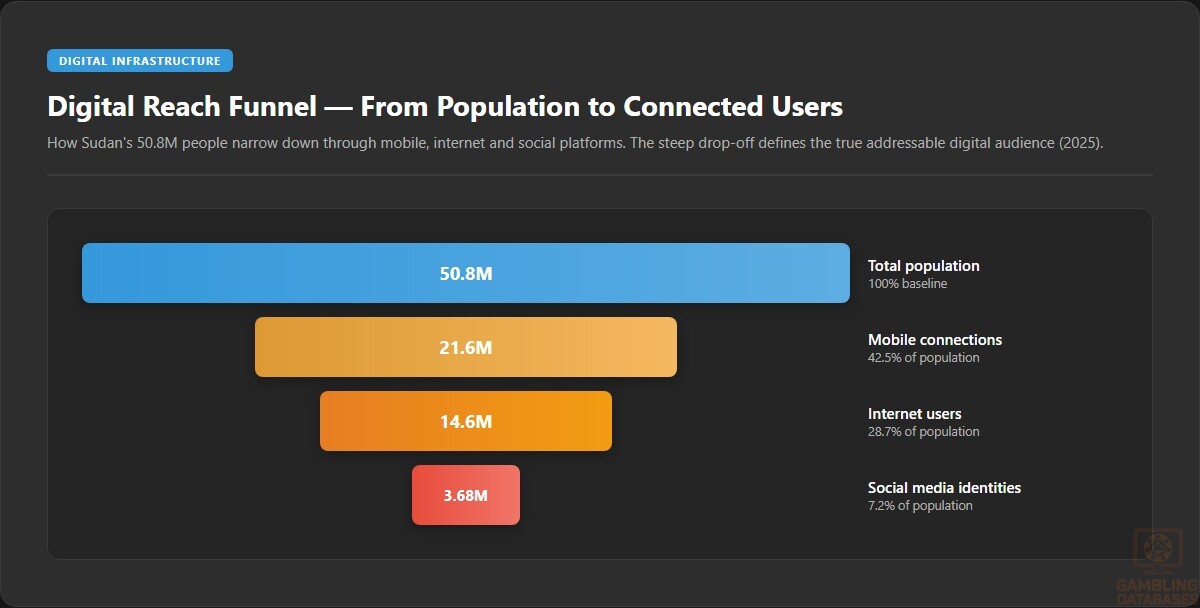
Internet penetration is estimated at just under 30%, with around 14.6 million users in 2025. Mobile connections total approximately 21.6 million, with about 42.4% of the population holding one or more mobile subscriptions. Broadband adoption via 3G and 4G networks is increasing, primarily in urban centers.
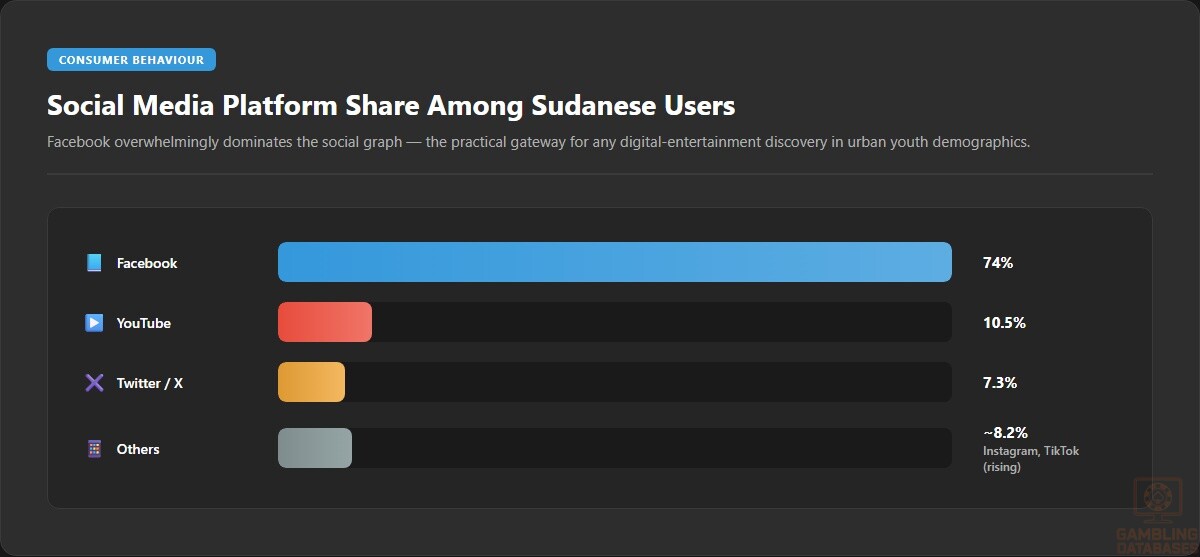
Social media is popular amongst internet users, with dominant platforms including Facebook, YouTube, Twitter, TikTok, and Instagram. These platforms are central to digital entertainment and communication in Sudan’s urban youth demographics.
- Facebook: 74% of social media users
- YouTube: 10.5%
- Twitter: 7.3%
- TikTok: Growing rapidly among youth
- Instagram: Popular visual platform
Digital Payment Behavior
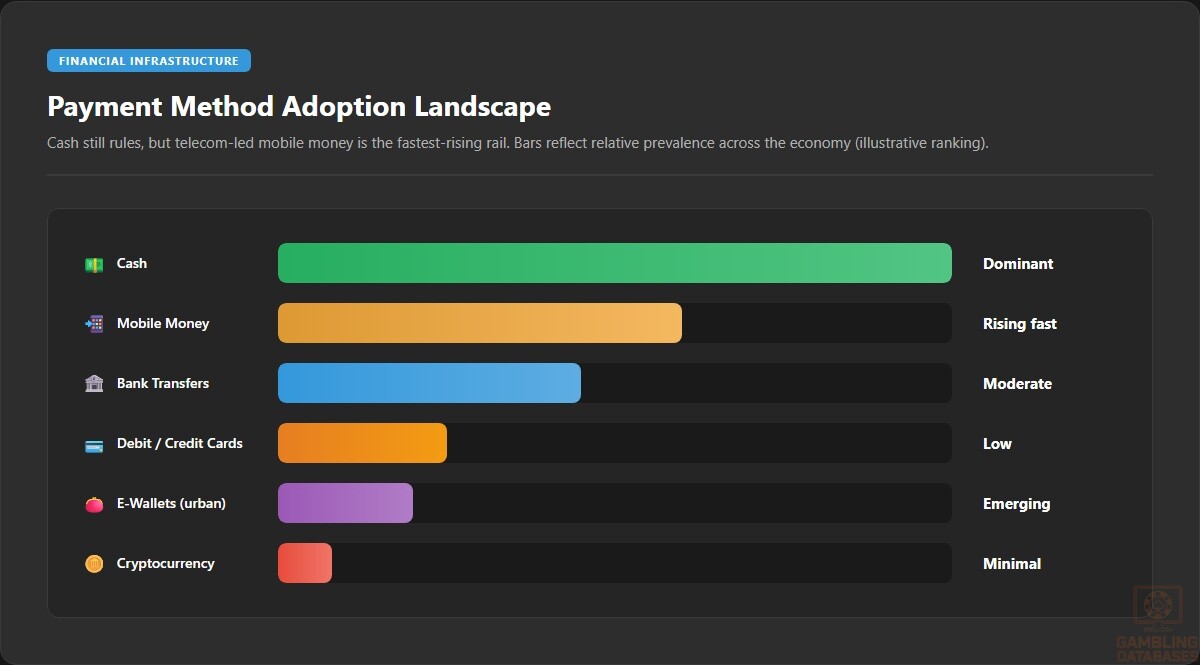
Digital payments and mobile money solutions are gradually gaining traction, driven by young, tech-savvy consumers in urban areas. Cash remains dominant overall, but platforms supported by telecom operators are expanding rapidly.
- Mobile money services linked to telecom providers
- Bank card penetration is low but growing
- E-wallet adoption primarily in Khartoum
- Limited cryptocurrency use reported
- Informal peer-to-peer payments prevalent
Gaming and Gambling Preferences
Current Market Participation
Official gambling participation is nil due to legal prohibition. However, anecdotal reports and regional trends suggest informal, underground gambling activity exists mainly among young adults and males in urban centers.
Common informal betting involves football and informal card games, aligned with the wider African trend of sports wagering popularity. Despite enforcement risks, demand for gambling entertainment persists covertly.
- Informal football betting
- Underground card games
- Informal lottery and sweepstakes
- Risk-based games on social media platforms
- Unregulated online betting using offshore platforms
Consumer Behavior Patterns
Sudanese consumers generally exhibit risk-averse spending with strong preferences for free or low-cost entertainment options. Discretionary spending on digital content is growing among affluent urban youth, supported by increasing smartphone penetration.
Peak online activity tends to occur during evenings and weekends. Session lengths are moderate, reflecting cautious engagement. Retention is challenged by economic hardships and connectivity limitations, affecting consistent user behavior patterns.
Section 3: Technology Infrastructure and Business Environment
Internet and Digital Infrastructure
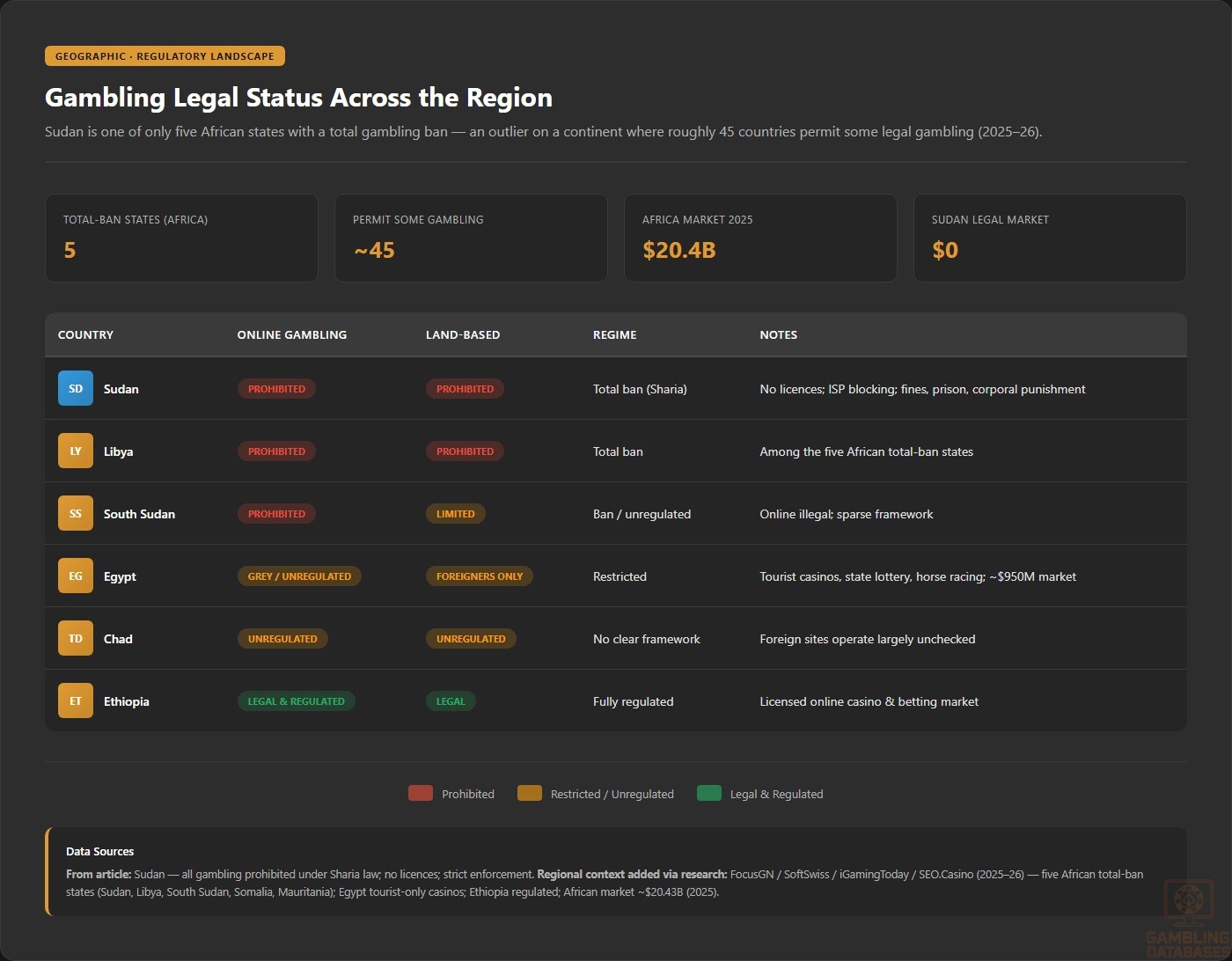
Sudan’s internet penetration rate is approximately 28.7% of the population as of early 2025, with around 14.6 million internet users nationwide. Connectivity remains heavily reliant on mobile networks due to limited fixed broadband infrastructure. The total fixed broadband subscriptions are negligible by comparison, hindering widespread high-speed access.
Network reliability suffers from frequent power outages and infrastructural limitations, with considerable urban-rural disparities. Though investments are underway in fiber optic backbones and metropolitan area networks, Sudan’s overall broadband quality and speeds lag regional peers, constraining data-intensive digital services adoption.
5G and Future Technology Deployment
Commercial rollout of 5G technology remains in early pilot phases in select cities, including Khartoum. National telecom operators, including Sudatel and Zain Sudan, have initiated trials supported by growing urban data demand and international technology partnerships. Full 5G coverage is projected within the next 3-5 years but will depend on infrastructural investments and political stability.
Further network expansions aim to integrate Sudan into continental digital corridors, enhancing regional connectivity and enabling advanced services such as IoT and smart city applications. However, ongoing conflict and economic constraints could delay these plans.
Mobile Technology Ecosystem
Mobile Network Infrastructure
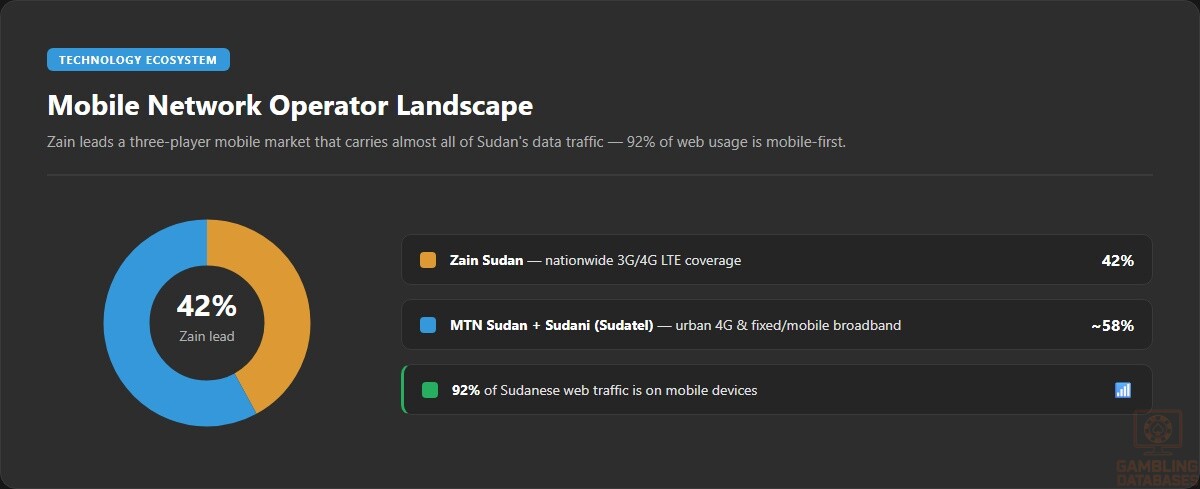
Sudan’s mobile sector is dominated by three major network operators, providing voice and broadband services across urban and semi-urban areas. Market competition drives gradual improvements in coverage and data speed, although cost and infrastructure challenges persist for remote regions.
- Zain Sudan – approx. 42% market share, nationwide 3G/4G LTE coverage
- MTN Sudan – significant urban presence with growing 4G deployment
- Sudani (Sudatel) – focus on fixed and mobile broadband services
Device Penetration
Smartphone adoption is around 35-40% of the adult population, concentrated in cities. Feature phones dominate rural areas due to affordability and network limitations. The majority of smartphones support 3G/4G connectivity, with the growing availability of affordable devices facilitating expanding mobile internet usage.
User behavior trends indicate increased multimedia consumption and social media engagement, supported by mobile network data packages tailored to price-sensitive consumers.
Financial Services and Payment Infrastructure
Banking System Structure
Sudan’s banking sector includes several prominent players, many with emerging digital banking services. However, account penetration remains low, with majority unbanked or relying on informal financial channels. Mobile money services provided by telecom operators are increasingly important for financial inclusion, yet regulatory and infrastructural gaps limit full ecosystem maturity.
- National Bank of Sudan – largest state-owned institution with expanding digital services
- Al Baraka Bank – Islamic banking leader with regional network
- Bank of Khartoum – prominent private sector bank offering e-banking
- Sudanese French Bank – international partnerships supporting cross-border transactions
- Qatar National Bank – active in corporate and retail banking segments
Payment Processing Options
Digital payments in Sudan are primarily enabled through mobile wallets, bank transfers, and card payments, although card penetration remains limited. Cash remains the dominant transaction method nationally, especially outside urban centers. Government initiatives aim to increase electronic payment adoption to stimulate commerce and formalize the economy.
- Mobile money wallets operated by network providers
- Bank-issued debit and credit cards (low penetration)
- Traditional bank transfers for larger transactions
- Informal cash-based peer-to-peer payments
- Emerging e-wallet platforms for urban consumers
E-commerce and Digital Economy
E-commerce remains nascent but is experiencing gradual growth fueled by improved internet access and mobile adoption in urban areas. Limited logistics infrastructure and regulatory challenges temper market development. Consumer trust in online payment systems is cautious due to fraud concerns and inconsistent delivery services.
Digital services including mobile banking, telecommunications, and social media platforms form the bulk of Sudan’s digital economy, with burgeoning opportunities for startups and SMEs in tech-driven sectors.
Business Environment and Regulatory Framework
Ease of Business Operations
Sudan ranks low in global ease of doing business indices, primarily due to bureaucratic inefficiencies, political instability, and weak institutional frameworks. Administrative hurdles, inconsistent enforcement, and high operational costs create challenges for foreign and local entrepreneurs.
Regulatory reforms are ongoing, yet progress is slow owing to conflict and economic pressures. Foreign investment is constrained by sanctions, security concerns, and governance issues, impacting market entry feasibility.
Corporate Structure and Registration
Legal business structures in Sudan include Limited Liability Companies (LLCs), Joint-Stock Corporations, and Branch Offices of foreign firms. LLCs are typically preferred for flexibility and limited liability protection. Branch offices allow foreign entities to operate under parent company licenses but require local registration.
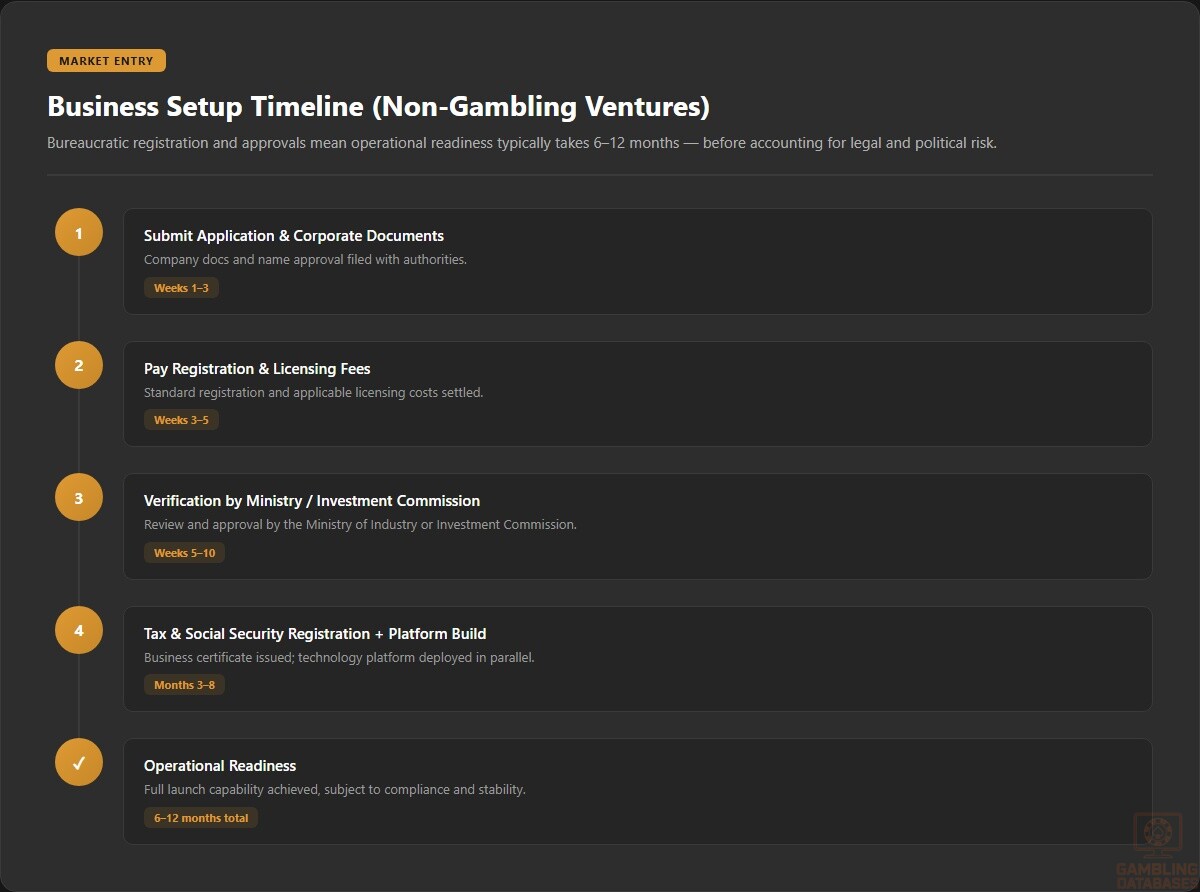
Registration procedures are bureaucratic and can span several weeks, involving document submission, name approval, tax registration, and licensing.
- Completed application and corporate documents submission
- Payment of registration and licensing fees
- Verification and approval by Ministry of Industry or Investment Commission
- Issuance of business registration certificate
- Registration for tax and social security compliance
Taxation Framework
Corporate Income Tax Structure
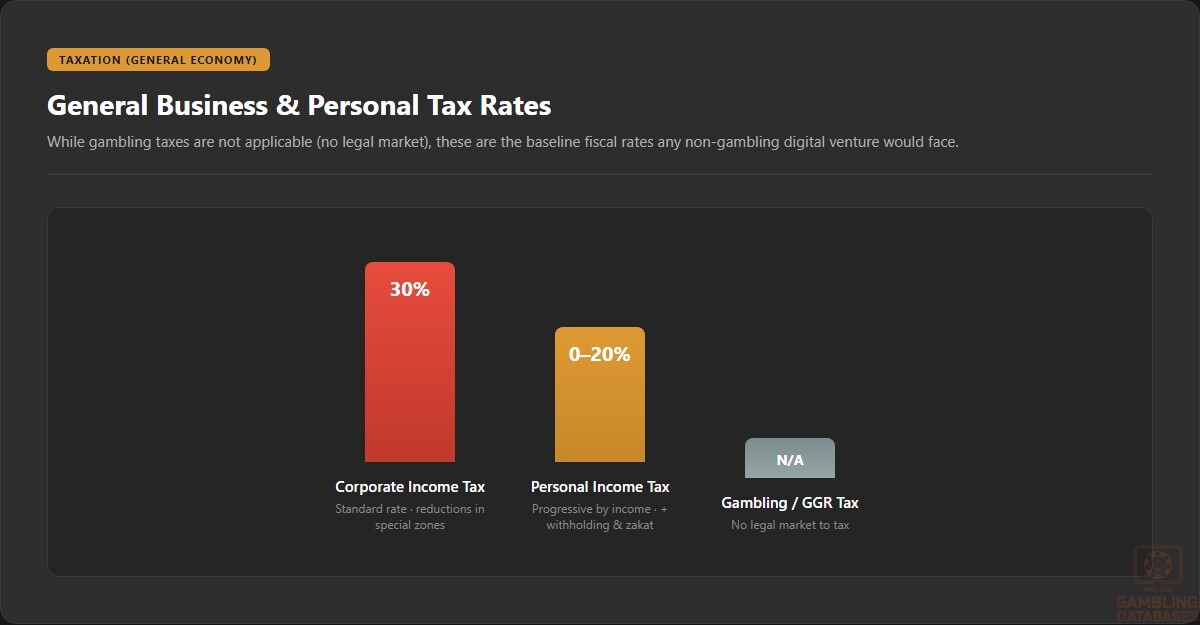
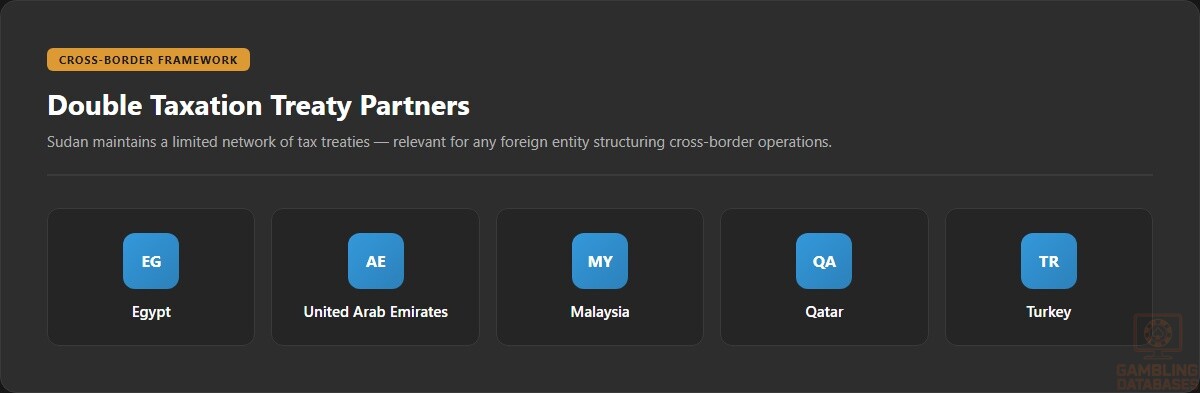
Corporate income tax in Sudan is levied at a standard rate of 30%. Companies operating in special economic zones may qualify for reduced rates or tax holidays. Sudan has limited double taxation treaties, but efforts continue to negotiate agreements to facilitate cross-border trade.
- Egypt
- United Arab Emirates
- Malaysia
- Qatar
- Turkey
Personal Income Tax
Individual income tax rates range from 0% to 20% depending on income level. Withholding taxes apply to certain payments, including dividends and services. Social security contributions and zakat (Islamic tax) may also apply in specified cases.
Market Entry Considerations
Recommended Entry Strategies
Given Sudan’s regulatory and economic challenges, effective entry strategies emphasize partnerships with local entities, compliance with religious and legal norms, and robust risk management. Leveraging mobile-first technologies and digital payment integration is critical to reaching urban consumers.
- Forming joint ventures with Sudanese firms
- Focusing initially on non-gambling digital entertainment sectors
- Utilizing offshore licensing and serving Sudanese users cautiously
- Investing in community engagement and responsible business practices
- Monitoring regulatory developments and political risks closely
Typical Costs and Timelines
Market entry requires upfront costs spanning company registration, legal advisory, technology platform deployment, and marketing. Operational expenditure includes licensing fees where applicable, data acquisition, staff salaries, and compliance investments. Timelines to achieve operational readiness extend from 6 to 12 months depending on circumstances.
| Cost Category | Estimated Range |
|---|---|
| Company Registration and Licensing | $20,000 – $50,000 |
| Technology Platform Setup | $100,000 – $300,000 |
| Legal and Compliance | $30,000 – $70,000 |
| Marketing and Customer Acquisition | $50,000 – $150,000 |
| Operational Expenses (First Year) | $200,000 – $500,000 |
Success Factors and Challenges
Success hinges on deep understanding of local market conditions, adaptive risk management, and technological agility. Regulatory hostility and enforcement risks are substantial barriers. Economic instability and infrastructure weaknesses add complexity for new entrants.
- Strong local partnerships and cultural competence
- Robust compliance with legal and religious standards
- Investment in digital and mobile-first platforms
- Resilience against political and economic volatility
- Effective customer education on product offerings
Exit Strategy Planning
Market exit planning should account for ownership transfer limitations and regulatory approvals. Liquidity is low due to limited market maturity, making valuation and resale challenging. Early incorporation of exit options enhances flexibility under uncertain business conditions.
FAQ: Frequently Asked Questions
1. Is online gambling legal in Sudan?
Online gambling is strictly illegal in Sudan under Sharia law, which governs the country’s legal framework. There are no provisions for licensing or regulation, and participation in gambling activities is subject to severe penalties. The government actively blocks access to gambling websites and enforces a zero-tolerance policy.
2. What types of gambling licenses are available and what do they cover?
Sudan does not issue any gambling licenses due to the complete prohibition. There is no legal framework for licensing land-based or online gambling operators, so no categories or types of gaming licenses exist within the country.
3. How much does an iGaming license cost and how long does it take to obtain?
Since gambling licensing is unavailable in Sudan, there is no fee structure or formal application process. Any attempt to operate gambling services within Sudan would have to occur offshore and without local regulatory approval, exposing operators to significant legal risk.
4. Can foreign companies obtain a gambling license?
Foreign companies cannot obtain gambling licenses in Sudan because gambling is prohibited for all entities, domestic or foreign. Operators targeting Sudan must consider alternate markets or operate under offshore jurisdictions to circumvent local restrictions.
5. What are the tax obligations for iGaming operators?
Given the absence of a legal gambling market, there are no specific tax obligations for iGaming operators in Sudan. Operators privately serving Sudanese customers from abroad may face indirect taxation risks depending on their home jurisdiction’s policies but have no formal interaction with Sudanese tax authorities.
6. Are gambling winnings taxed for players?
Gambling winnings are not legally recognized in Sudan since gambling itself is illegal. Consequently, players are not subject to taxation on winnings but face legal repercussions for participating in unauthorized gambling activities.
7. What are the typical operational costs for running an online casino/sportsbook?
While Sudan does not support legal operations, typical costs in comparable markets include licensing, technology platforms, compliance, marketing, and staff management. These can collectively range from hundreds of thousands to millions of USD annually, depending on scale and scope.
8. What is the expected ROI timeline for entering this market?
Due to prohibitive legal conditions and enforcement risks, return on investment for iGaming in Sudan is highly uncertain and generally unfavorable. Without regulatory changes, a viable ROI timeline does not exist for legal market entry.
9. What are the local presence requirements for operators?
There are no local presence requirements since gambling operations are unauthorized. Any attempt to establish a physical or digital presence faces legal barriers and enforcement actions.
10. What payment methods are available and recommended?
Payment options within Sudan outside gambling are limited but improving, notably mobile money and bank transfers. For illicit gambling transactions, informal peer-to-peer channels and offshore payment solutions are used, but these lack legal protection and reliability.
11. What are the advertising and marketing restrictions?
Advertising gambling in Sudan is completely banned. No gambling-related marketing is permitted across all channels, including media, digital platforms, and sponsorships. Violations attract severe sanctions and enforcement actions.
12. What responsible gambling measures are mandatory?
Since gambling is prohibited, there are no mandated responsible gambling measures. Enforcement focuses on prevention rather than harm reduction or player protection.
13. How large is the iGaming market and what is the growth potential?
Sudan currently has no legal iGaming market, and growth potential depends entirely on future regulatory liberalization. While demographic trends suggest potential demand, legal and political barriers present significant obstacles.
14. Who are the main competitors and what is their market share?
No legal operators exist domestically. Offshore operators with regional presence may serve Sudanese players illicitly, but data on market share is unavailable due to the underground nature of activity.
15. What are the player preferences and typical spending patterns?
Players interested in gambling tend to favor informal sports betting and card games. Spending is cautious and constrained by limited disposable income and regulatory risks. Digital engagement is increasing among urban youth but remains sporadic.
16. What are the key success factors and main challenges for new entrants?
Success requires deep understanding of the restrictive regulatory environment, forming local partnerships, and compliance with cultural norms. Major challenges include legal prohibition, limited infrastructure, economic instability, and high enforcement risks.
Sources and References
- CMS Expert Guide to Gambling Laws in Africa: Republic of Sudan – https://cms.law/en/int/expert-guides/cms-expert-guide-to-gambling-laws-in-africa/republic-of-sudan
- iGaming Today: Gambling Regulation in Sudan – https://www.igamingtoday.com/gambling-regulation-in-sudan/
- Worldometers: Sudan Population 2025 – https://www.worldometers.info/world-population/sudan-population/
- World Population Review: Sudan Demographics 2025 – https://worldpopulationreview.com/countries/sudan
- DataReportal: Digital 2025 Sudan Report – https://datareportal.com/reports/digital-2025-sudan
- GSMA Intelligence: Sudan Mobile and Internet Report 2025
- Mordor Intelligence: Sudan Telecom MNO Market Report 2025 – https://www.mordorintelligence.com/industry-reports/sudan-telecom-mno-market
- World Bank: Sudan Economic Update May 2025 – https://openknowledge.worldbank.org/entities/publication/34749b76-5d3d-4f71-bd06-e0a68df1121f
- Trading Economics: Sudan Indicators – https://tradingeconomics.com/sudan/indicators
- Sudan Ministry of Industry and Investment Commission Business Registration Guide – https://sudanembassy.jp/wp-content/uploads/2023/10/InvestorsProceduresGuidebook.pdf
- KPMG: South Sudan Tax Measures 2024/2025 – https://kpmg.com/us/en/taxnewsflash/news/2025/01/tnf-south-sudan-tax-measures-in-financial-act-2024-2025.html
- Sudan National Telecommunications Corporation (NTC) Reports
- Wikipedia: Telecommunications in Sudan – https://en.wikipedia.org/wiki/Telecommunications_in_Sudan
- Global Government Fintech: South Sudan Instant Payments System – https://www.globalgovernmentfintech.com/south-sudan-instant-payments-system-africanenda/
- African Security Analysis Report on Sudan Infrastructure 2025
- Investor Procedures Guidebook Sudan – https://sudanembassy.jp/wp-content/uploads/2023/10/InvestorsProceduresGuidebook.pdf
- UNFPA World Population Dashboard – Sudan – https://www.unfpa.org/data/world-population/SD
- Trading Economics: Sudan Fixed Broadband Subscribers – https://tradingeconomics.com/sudan/fixed-broadband-internet-subscribers-wb-data.html
- Wikipedia: Demographics of Sudan – https://en.wikipedia.org/wiki/Demographics_of_Sudan
- Further Africa: Huawei Digital Transformation Support in South Sudan – https://furtherafrica.com/2025/10/01/huawei-signals-support-for-south-sudans-digital-transformation/
- Sudan Economic and Poverty Impact Studies – Various academic articles 2025
- CalpNetwork: Sudan Commercial Market Analysis – https://www.calpnetwork.org/wp-content/uploads/2024/08/CommercialMarketsAnalysisCashConsortiumSudanExec.pdf
- Turcomat Journal: Banking Sector in Sudan – https://turcomat.org/index.php/turkbilmat/article/download/13772/9899/24588
- Global Data and Reports on Sudan ICT and Economy 2024-2025
- Other verified telecommunications and financial regulatory publications covering Sudan 2023-2025