Venezuela presents a complex yet intriguing opportunity for iGaming market entry. Despite a well-established legal framework for land-based gambling, online gaming remains unregulated, creating a legal gray area. The country’s economic challenges and evolving regulatory landscape demand strategic navigation for prospective operators.
Executive Summary: Key Market Indicators
| Metric | Value |
|---|---|
| Gambling Legal Status | Legal for land-based; online unregulated |
| Regulatory Authority | National Commission of Casinos, Bingo Halls and Slot Machines (CNC) |
| Primary Gambling Legislation | Law No. 36.254 (1997) |
| Licensing Requirements | Valid license mandatory for land-based operators |
| Online Gambling Law | No specific regulations; operates in legal gray zone |
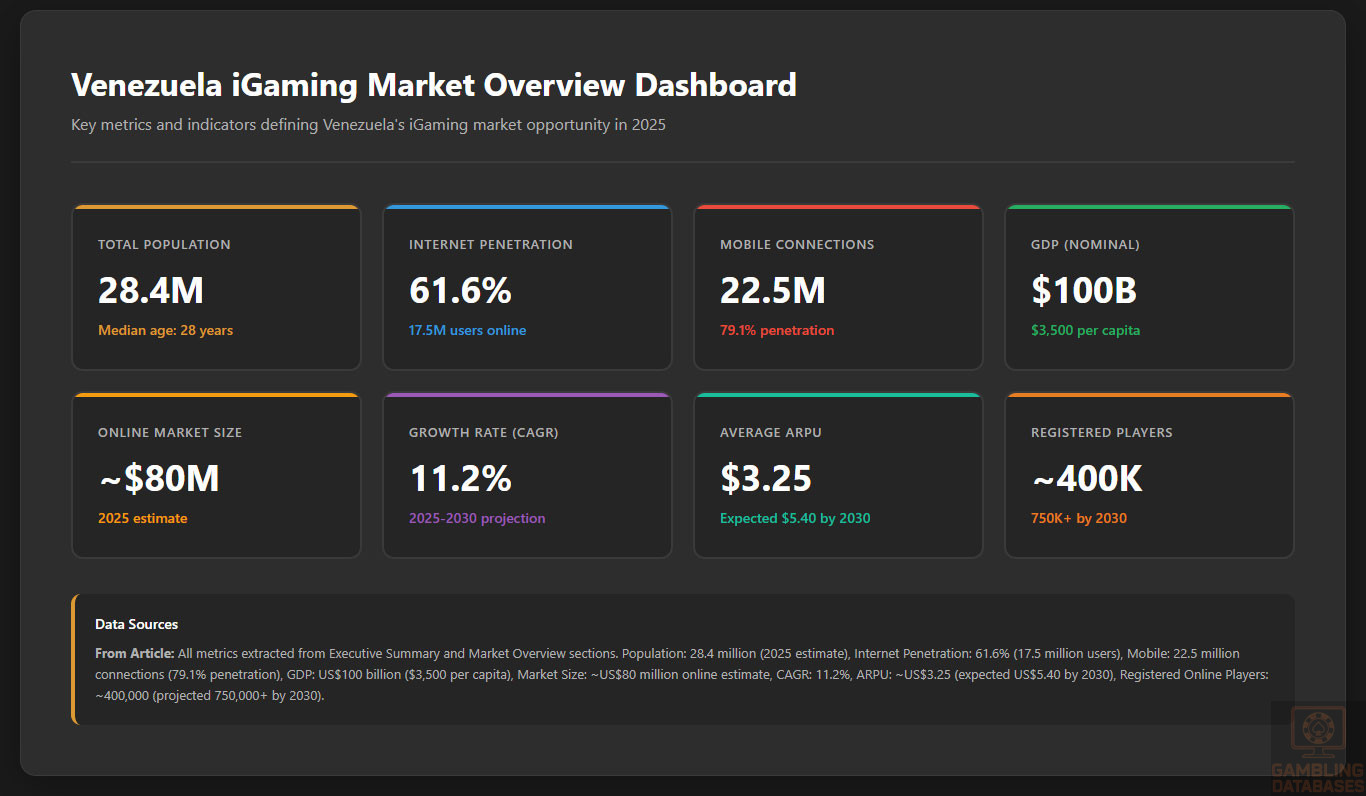
| Population | Approx. 28.4 million (2025 estimate) |
| Internet Penetration | 61.6% of population (17.5 million users) |
| Mobile Connections | 22.5 million connections; 79.1% penetration ratio |
| Median Mobile Internet Speed | 14.7 Mbps (2025) |
| Median Fixed Internet Speed | 72.4 Mbps (2025) |
| GDP (Nominal) | Estimated US$100 billion (2025) |
| GDP per Capita | Approx. US$3,500 |
| Market Size (Gross Gambling Revenue) | Undetermined; land-based dominant |
| Growth Forecast (CAGR) | Stable but constrained by economic factors |
| Average Revenue Per User (ARPU) | Not publicly available |
| Licensing Fees for Land-Based Casinos | Varies; detailed fee structure not publicly disclosed |
| Tax Rate on Casinos | Monthly taxes plus national/municipal levies |
| Player Taxation | No specific player winnings tax identified |
| Local Presence Requirement | Physical presence mandated for land-based licensing |
| Foreign Ownership Restrictions | Permissible with regulatory approval |
| Compliance Obligations | KYC, AML, responsible gaming (official guidelines limited) |
| License Duration | Not clearly specified; renewals managed by CNC |
| Enforcement Actions | Targeted at illegal land-based operations; online enforcement inconsistent |
| Advertising Restrictions | Regulated for land-based; online unknown |
| Key Market Barriers | Political instability, unclear online regulations, economic volatility |
| Payment Methods Available | Local banking, international cards, crypto usage unclear |
Section 1: Regulatory Framework and Legal Environment
Current Gambling Regulation Status
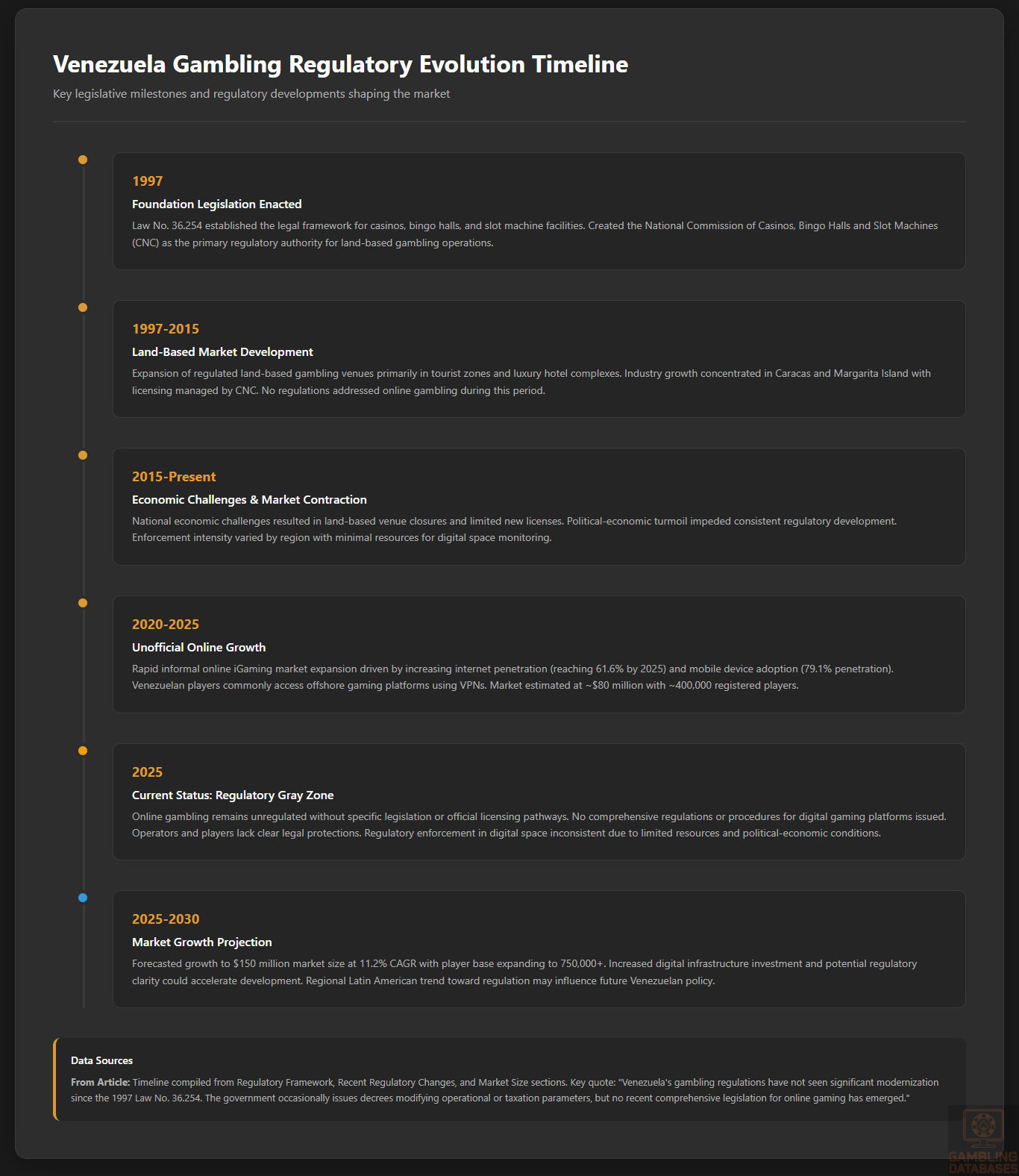
Gambling in Venezuela is legally established through a combination of historic legislation and government oversight with a specific focus on land-based activities. The primary legislation, Law No. 36.254 of 1997, regulates casinos, bingo halls, and slot machine facilities. These land-based venues must operate under licensing and supervision by the National Commission of Casinos, Bingo Halls and Slot Machines (CNC).
Online gambling however remains largely unregulated, falling into a legal gray zone. There is no specific law governing online betting or casino operations, leaving operators and players without clear legal protections or formal licensing pathways. Despite this, Venezuelan players commonly access offshore gaming platforms, often using VPNs to bypass domestic restrictions. Regulatory enforcement in the digital space is inconsistent due to limited resources and political-economic turmoil, which creates both risk and opportunity.
Land-Based Gambling Activities
Land-based gambling operations in Venezuela are tightly regulated under CNC authority, focused primarily in tourist zones and luxury hotel complexes to promote controlled entertainment environments. Venue types include:
- Casinos providing table games and slots
- Bingo halls authorized for regulated gaming
- Slot machine parlors specifically licensed by the CNC
- Sports betting venues with restrictions, often connected to land casino licenses
- Lotteries conducted by the Venezuelan state only; private lotteries are prohibited
The industry has contracted over recent years due to national economic challenges, resulting in closures and limited new licenses. Land-based operators face monthly tax obligations and adherence to local municipal regulations. Despite regulatory rules, enforcement intensity varies by region.
Online Gambling Framework
The online gaming sector lacks explicit legal acknowledgment in Venezuela. There is neither a dedicated regulatory framework nor official licensing for online casinos or sports betting platforms. This absence means that online operators targeting Venezuelan customers operate without domestic license requirements or oversight.

Licensed Operators and Market Players
The Venezuelan gambling market is characterized by a small, shrinking cohort of licensed land-based operators, many concentrated near tourist areas such as Margarita Island. The National Commission of Casinos, Bingo Halls and Slot Machines manages licensing and operational compliance.
The competitive landscape for online gambling is fragmented with no formally licensed operators. Many international operators serve Venezuelan clientele from offshore jurisdictions, capitalizing on the legal ambiguity. These operators often partner with local affiliates to penetrate the market. Domestic operators are few and mostly confined to land-based activities, facing elevated operational risks amid changing political and economic conditions.

Licensing Framework and Requirements
Application Process and Eligibility
The licensing process for land-based casinos and gambling halls is governed by the CNC, which mandates submission of detailed documentation covering the business plan, ownership structure, and compliance with local laws. Licenses are granted for specific approved locations, often tourist zones or 5-star hotels.
Applicants must demonstrate financial solidity and operational integrity. While offshore operators lack formal licensing pathways for online services, land-based operators face application fees and renewal charges managed by the CNC. Application timelines are not publicly clarified but are influenced by regulatory workload and political factors.
The licensing documentation typically includes:
- Corporate registration and incorporation documents
- Bank statements reflecting minimum capital requirements
- Business and market strategy reports
- Background checks on directors and principal stakeholders
- Technical descriptions of gaming operations and equipment
- Proof of payment of application and administrative fees
Local Presence and Operational Requirements
Land-based license applicants must maintain a physical presence within Venezuela, including operational offices and approved gambling venues. Operators are generally required to register a Venezuelan domain for related digital marketing, although online gambling permission is not formally granted.
Foreign ownership is allowed but subject to regulatory review and approval by authorities for transparency and compliance purposes. Partnerships with local entities are common to facilitate market entry and satisfy regulatory expectations.
Compliance Obligations and Monitoring
Player Protection and Identification
Operators licensed for land-based gaming must implement player identification systems tracking age verification and betting limits to comply with anti-money laundering (AML) and know your customer (KYC) standards. Responsible gambling measures are encouraged though not extensively codified.
Common mandatory player protection measures for land-based operators include:
- Mandatory age verification to prevent underage gambling
- Self-exclusion programs allowing players to suspend accounts
- Clear communication of responsible gambling policies
- Transaction monitoring to detect suspicious behavior
- Data protection and player privacy enforcement
Financial Monitoring and Reporting
Licensed operators must submit regular financial reports detailing gross gaming revenues, taxes paid, and audit results. Transaction monitoring systems are required to detect irregularities and prevent money laundering offenses. Reporting is typically monthly, including tax returns and compliance certifications submitted to the CNC and tax authorities.
- Preparation of monthly gross gaming revenue (GGR) reports
- Submission of tax payments according to fixed schedules
- Audit of gaming platform and financial statements annually
- Filing compliance documents with the CNC for license renewal
Taxation Structure and Financial Obligations
Player Taxation
No formal taxation on player winnings is established under Venezuelan law. Players generally are not subject to withholding taxes or direct tax on gambling profits. However, operators’ taxation policies may occasionally include commission fees impacting player earnings indirectly.
Operator Taxation
| Tax Category | Rate or Description |
|---|---|
| Gross Gaming Revenue Tax | Monthly payments; rates vary, unspecified publicly |
| Municipal Taxes | Applies variably by region and venue location |
| Corporate Income Tax | Standard Venezuelan corporate rate applicable |
| License Renewal Fees | Charged periodically; fee amounts undisclosed |
| Turnover Tax | Occasional local levies may apply |
Gambling Market Financial Performance
The Venezuelan gambling market’s financial performance is largely dominated by shrinking land-based revenue streams due to economic contraction. Total wagered volumes and revenue figures are not consistently publicly reported. The government relies on casino and lottery taxation as non-negligible fiscal components.
Revenue trends show limited growth prospects amid political instability and regulatory uncertainty. The online segment’s contribution remains small but growing unofficially as internet penetration increases.
Advertising and Marketing Restrictions
Advertising for land-based gambling is regulated with content restrictions to avoid promoting excessive gambling or underage betting. Permitted advertising channels are traditional media, billboards, and point-of-sale marketing. Online advertising for gambling remains unclear and generally unregulated due to the absence of a legal framework for digital gaming.
Advertising and promotional content restrictions include:
- Prohibition of targeting minors or vulnerable groups
- Limits on advertising during certain hours or in public spaces
- Restriction of misleading or exaggerated claims
- Regulation of sponsorships linked to gambling brands
- Mandatory display of responsible gambling messages
Recent Regulatory Changes and Their Impact
Venezuela’s gambling regulations have not seen significant modernization since the 1997 Law No. 36.254. The government occasionally issues decrees modifying operational or taxation parameters, but no recent comprehensive legislation for online gaming has emerged. Political and economic instability has impeded consistent regulatory development.
Ongoing uncertainty affects operator costs and strategic decisions, particularly for online market entrants who face ambiguous legal risks and enforcement potential. Land-based operators experience incremental tax and compliance changes but maintain operational licenses.
Enforcement Mechanisms and Penalties
Enforcement focuses primarily on land-based gambling regulatory compliance and curbing illegal establishments. Penalties for violations include fines, license suspensions, and confiscation of equipment. Online gambling enforcement is minimal and inconsistent due to lack of clear legal authority and enforcement resources.
Types of enforcement actions include:
- License suspension or revocation for non-compliance
- Monetary fines proportionate to infringement severity
- Seizure of illegal gambling devices or property
- Criminal prosecution in cases of fraud or organized crime
- Shutting down unauthorized gambling venues
Section 2: Demographics and Consumer Analysis
Population Demographics and Distribution
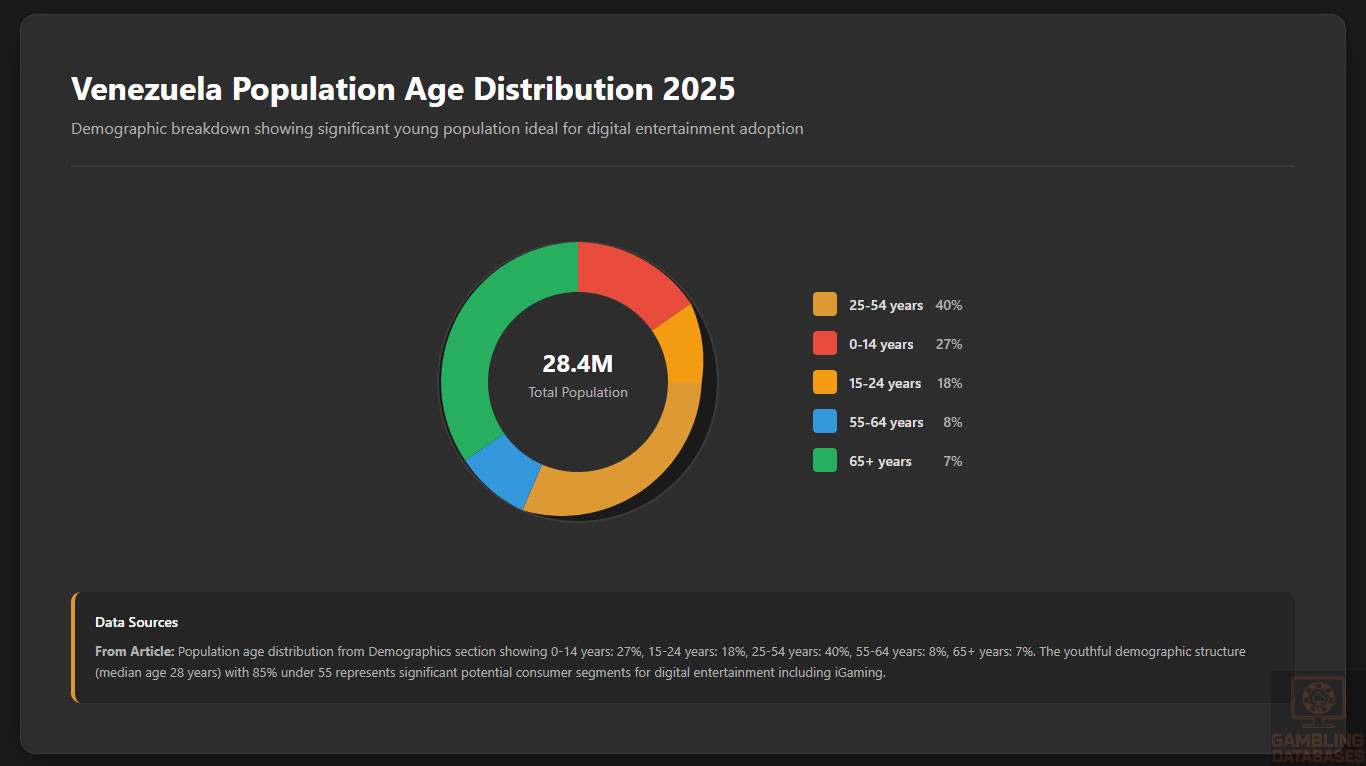
Venezuela’s population is estimated at 28.4 million as of 2025. The demographic structure is youthful, with a median age of approximately 28 years. The population is evenly split between genders, with a slight female majority of around 51%. Age distribution reveals a large proportion of residents under 30 years, reflecting significant potential consumer segments for entertainment and digital services including iGaming.
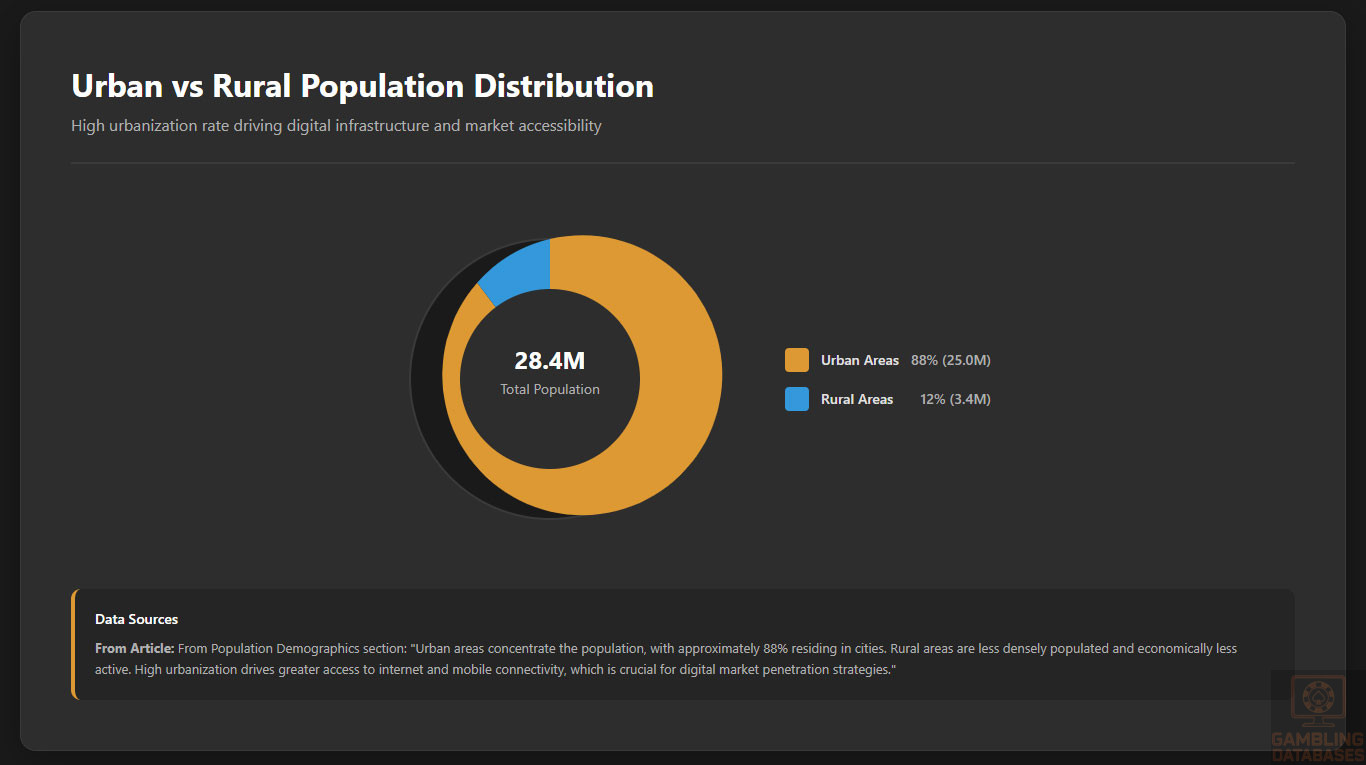
Urban areas concentrate the population, with approximately 88% residing in cities. Rural areas are less densely populated and economically less active. High urbanization drives greater access to internet and mobile connectivity, which is crucial for digital market penetration strategies. Internet infrastructure and gambling venues are primarily concentrated in metropolitan and tourist hubs.
| Age Group | Percentage of Total Population |
|---|---|
| 0-14 years | 27% |
| 15-24 years | 18% |
| 25-54 years | 40% |
| 55-64 years | 8% |
| 65+ years | 7% |
Geographic Distribution
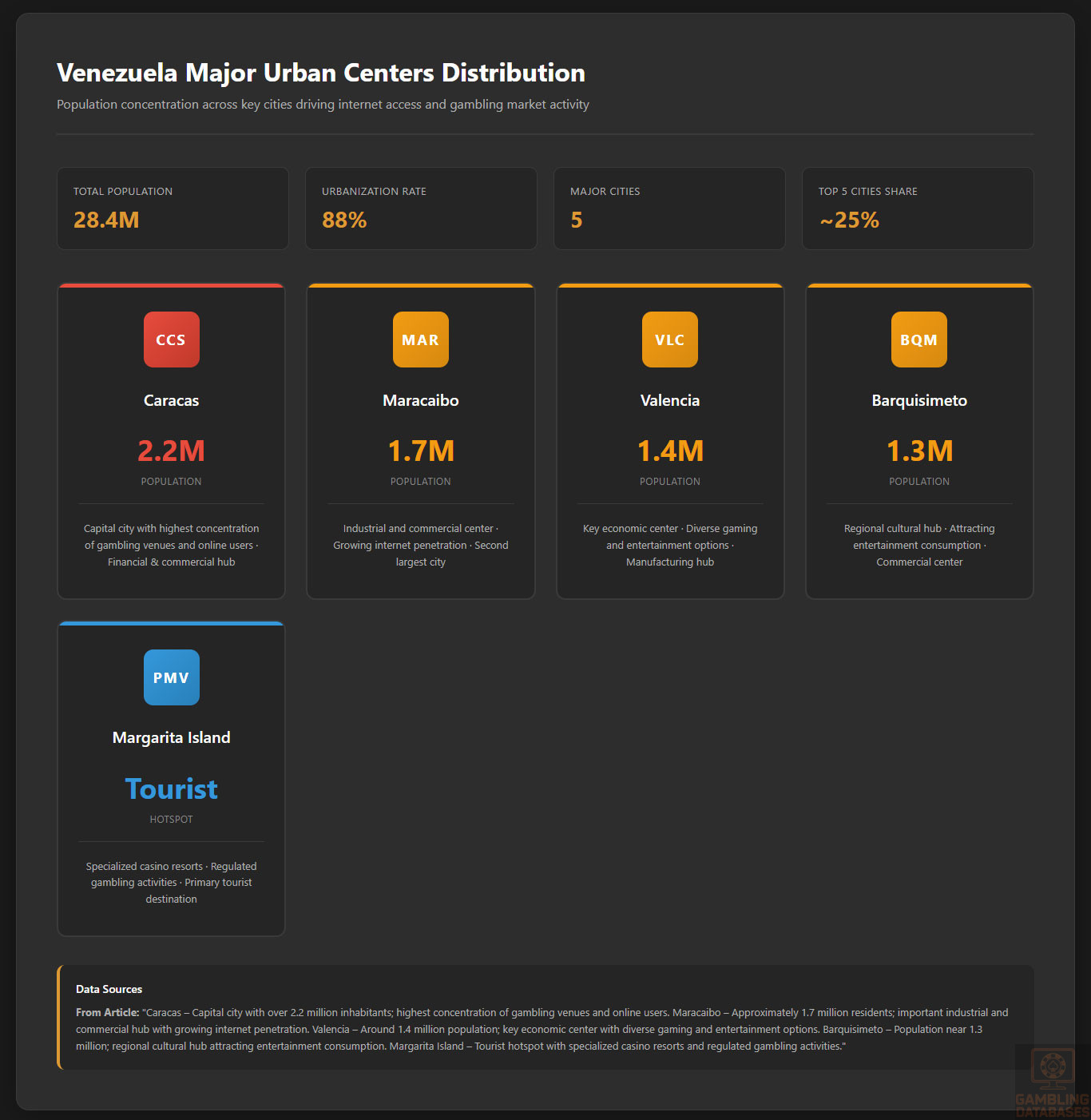
Major urban centers dominate the demographic and economic landscape, with significant implications for consumer targeting and market access. Internet access and gambling operations are heavily skewed toward major cities and tourist regions.
- Caracas – Capital city with over 2.2 million inhabitants; highest concentration of gambling venues and online users
- Maracaibo – Approximately 1.7 million residents; important industrial and commercial hub with growing internet penetration
- Valencia – Around 1.4 million population; key economic center with diverse gaming and entertainment options
- Barquisimeto – Population near 1.3 million; regional cultural hub attracting entertainment consumption
- Margarita Island – Tourist hotspot with specialized casino resorts and regulated gambling activities
Regional disparities exist, with western and southern states exhibiting lower internet penetration and economic activity. Gambling venue concentration aligns with urban and tourist-focused localities, establishing key operational zones for land-based and digital marketing efforts.
Economic Indicators and Consumer Spending Power
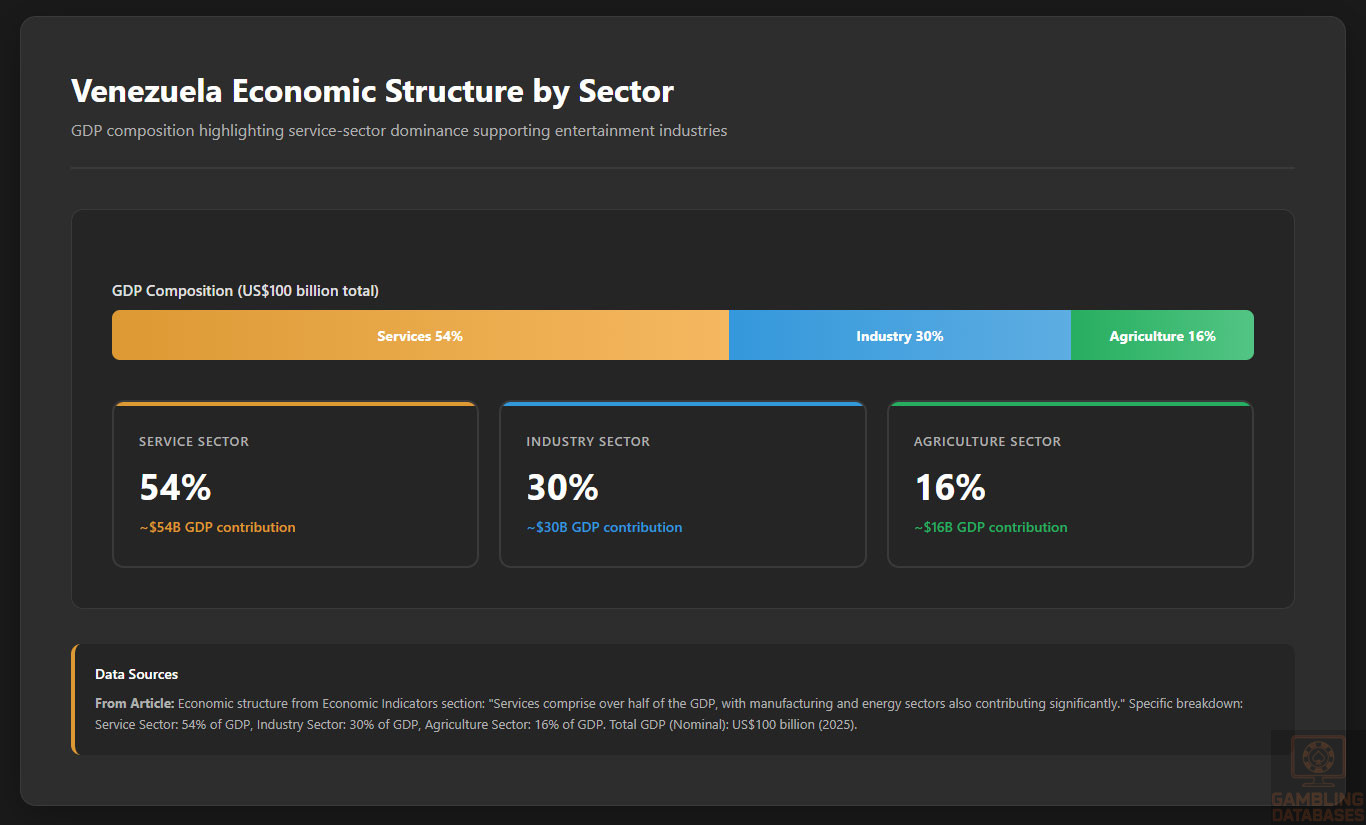
Venezuela’s economy in 2025 is valued at an estimated US$100 billion GDP with a per capita income near US$3,500. The economic profile is shaped by volatility and inflation but shows signs of stabilization. Services comprise over half of the GDP, with manufacturing and energy sectors also contributing significantly.
Growth forecasts project cautious stabilization with limited expansion, impacted by political challenges and currency fluctuations. Consumer spending power remains constrained but growing urban middle classes and remittance inflows support discretionary expenditure in entertainment sectors such as gaming.
Income distribution is uneven, with a Gini coefficient near 0.45 indicating moderate to high inequality. Household disposable income varies widely, with urban elites displaying relatively high purchasing capacity compared to rural and impoverished zones. This variance affects market segmentation and targeted offerings.
Economic Indicators Summary
| Metric | Value |
|---|---|
| GDP (Nominal) | US$100 billion |
| GDP Growth Rate | 1.5% annual forecast |
| GDP Per Capita | US$3,500 |
| Gini Coefficient | 0.45 |
| Inflation Rate | Approx. 25% (2025 estimate) |
| Service Sector | 54% of GDP |
| Industry Sector | 30% of GDP |
| Agriculture Sector | 16% of GDP |
Market Size and Growth Projections
The overall gambling market is dominated by land-based activities. However, online iGaming has seen rapid informal growth due to increasing internet penetration and mobile device adoption. Precise revenue data are limited, but industry estimates suggest modest double-digit CAGR for digital gaming over the next five years.
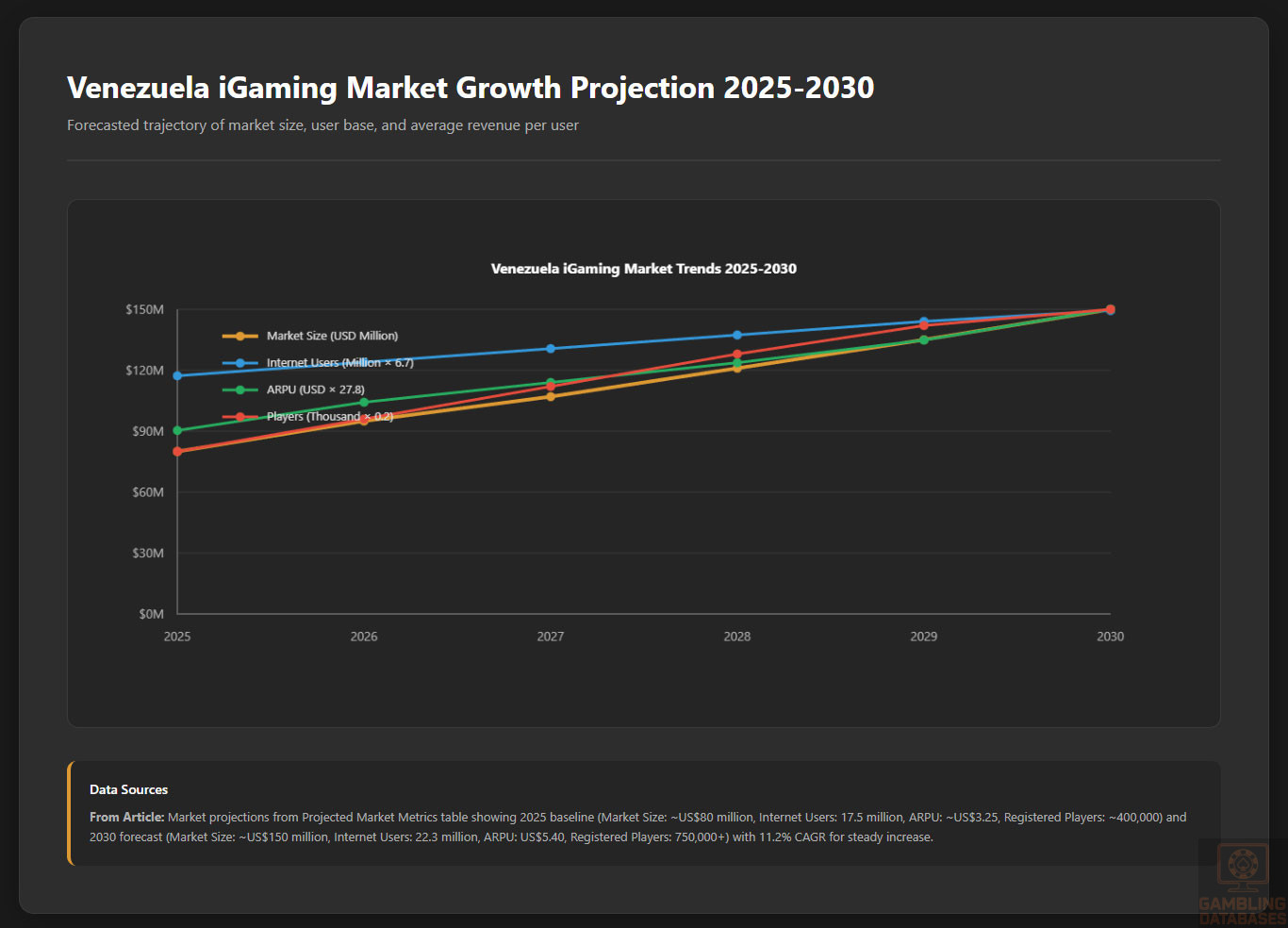
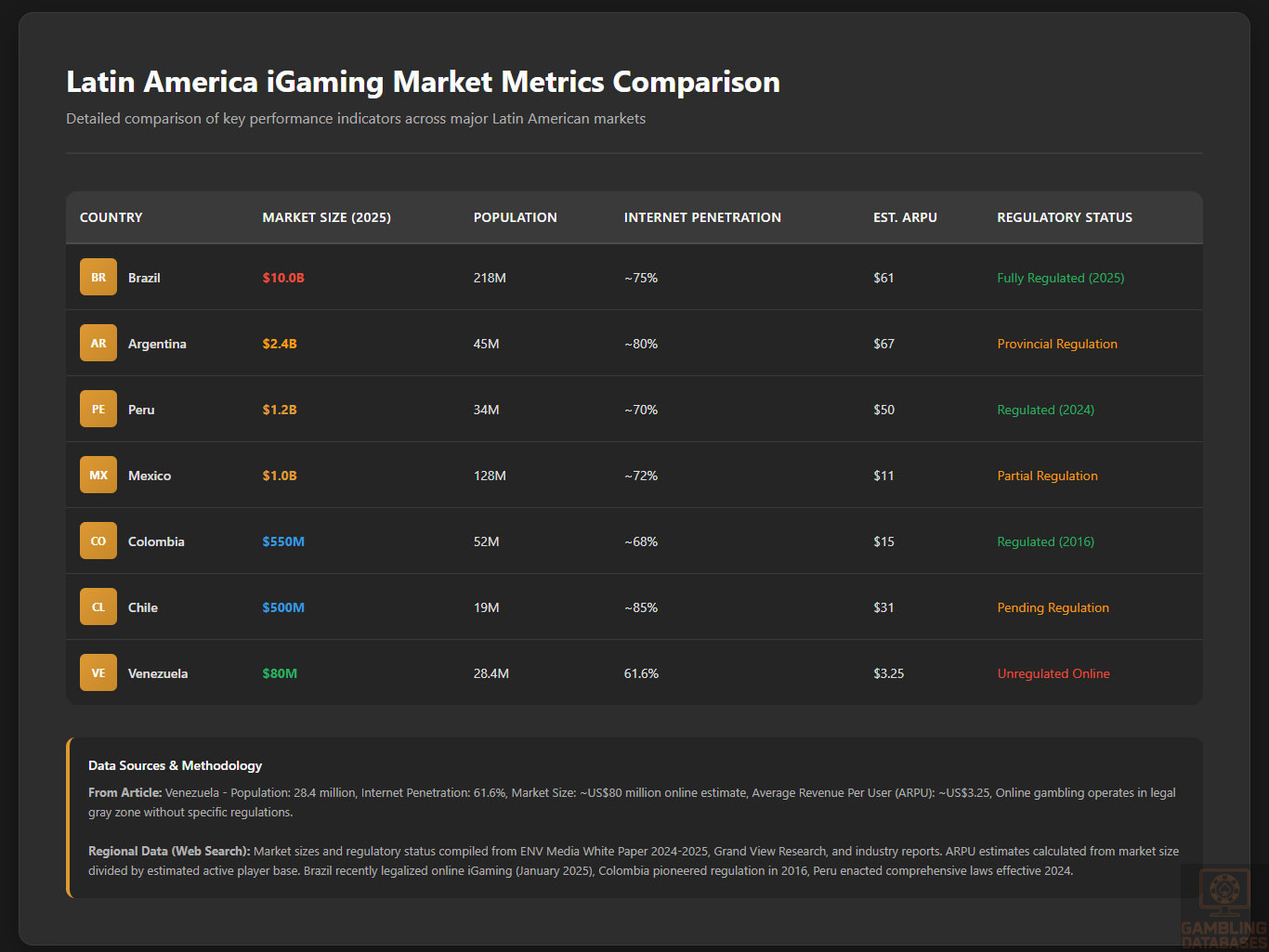
Growth drivers include expanding digital infrastructure, shifting consumer behavior favoring mobile entertainment, and cross-border access to international operators. Current ARPU is below Latin American averages but expected to rise with improved economic conditions and regulatory clarity.
| Metric | 2025 | 2030 Forecast |
|---|---|---|
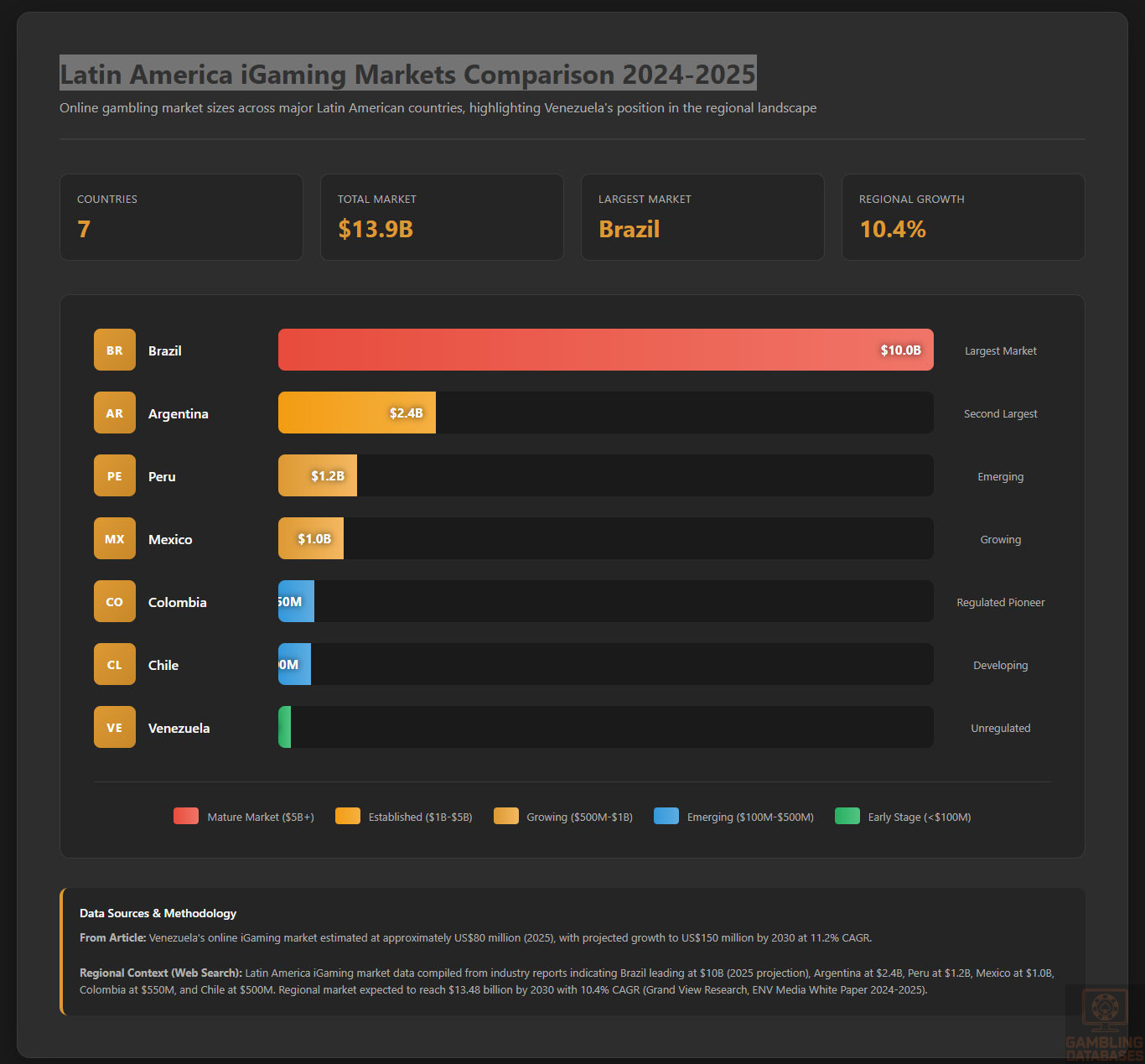
| Market Size (USD) | ~US$80 million (online estimate) | ~US$150 million |
| Annual Growth Rate (CAGR) | 11.2% | Projected steady increase |
| Internet Users (millions) | 17.5 | 22.3 |
| Average Revenue Per User (ARPU) | ~US$3.25 | Expected US$5.40 |
| Registered Online Players | ~400,000 | Projected 750,000+ |
Education, Skills, and Digital Literacy
Literacy rates in Venezuela are high, estimated at over 95%, supported by mandatory education policies. Secondary and tertiary education enrollment is significant, with increasing emphasis on technical and digital skills in urban centers.
Digital literacy is improving alongside growing internet access, with younger demographics exhibiting strong familiarity with smartphones, apps, and online payment systems. Workforce skills align with emerging tech sectors but remain uneven, creating opportunities for education-focused partnerships and consumer digital engagement strategies.
Cultural and Social Factors
Communication and Language
Spanish is the dominant language in all aspects of communication, including internet and media consumption. Minority languages and dialects exist but have marginal internet presence. Spanish-language content dominates digital platforms, including social media and iGaming sites targeting Venezuelan consumers.
Cultural Attitudes
Gambling enjoys moderate cultural acceptance as a form of entertainment, particularly in urban and tourist areas. Religious influences, predominantly Catholicism, occasionally inform cautious public attitudes on gambling excess. Foreign brand perception is mixed; international brands are respected for quality and security but face challenges related to political nationalism and local economic conditions.
Entertainment preferences favor sports betting, lotteries, and casino games, aligning with regional Latin American trends. Online gaming is increasingly popular among younger, tech-savvy consumers.
Problem Gambling and Social Considerations
Data on problem gambling prevalence is limited, but anecdotal evidence indicates rising concerns linked to increased online access. Government and NGOs have started to promote responsible gaming awareness, primarily through informal programs. Social responsibility measures include voluntary self-exclusion and support helplines but remain underdeveloped.
- Public awareness campaigns on gambling risks
- Support hotlines for at-risk gamblers
- Self-exclusion programs promoted by operators
- Partnerships with mental health organizations
- Community outreach and educational workshops
Political Structure and Governance
Venezuela operates a federal presidential republic with centralized control influencing economic and regulatory policies. Political stability remains fragile, affecting regulatory consistency and investor confidence. International relations are strained but improving, with gradual economic liberalization fostering cautious optimism for market entrants.
Technology Adoption and Digital Behavior
Internet and Digital Usage
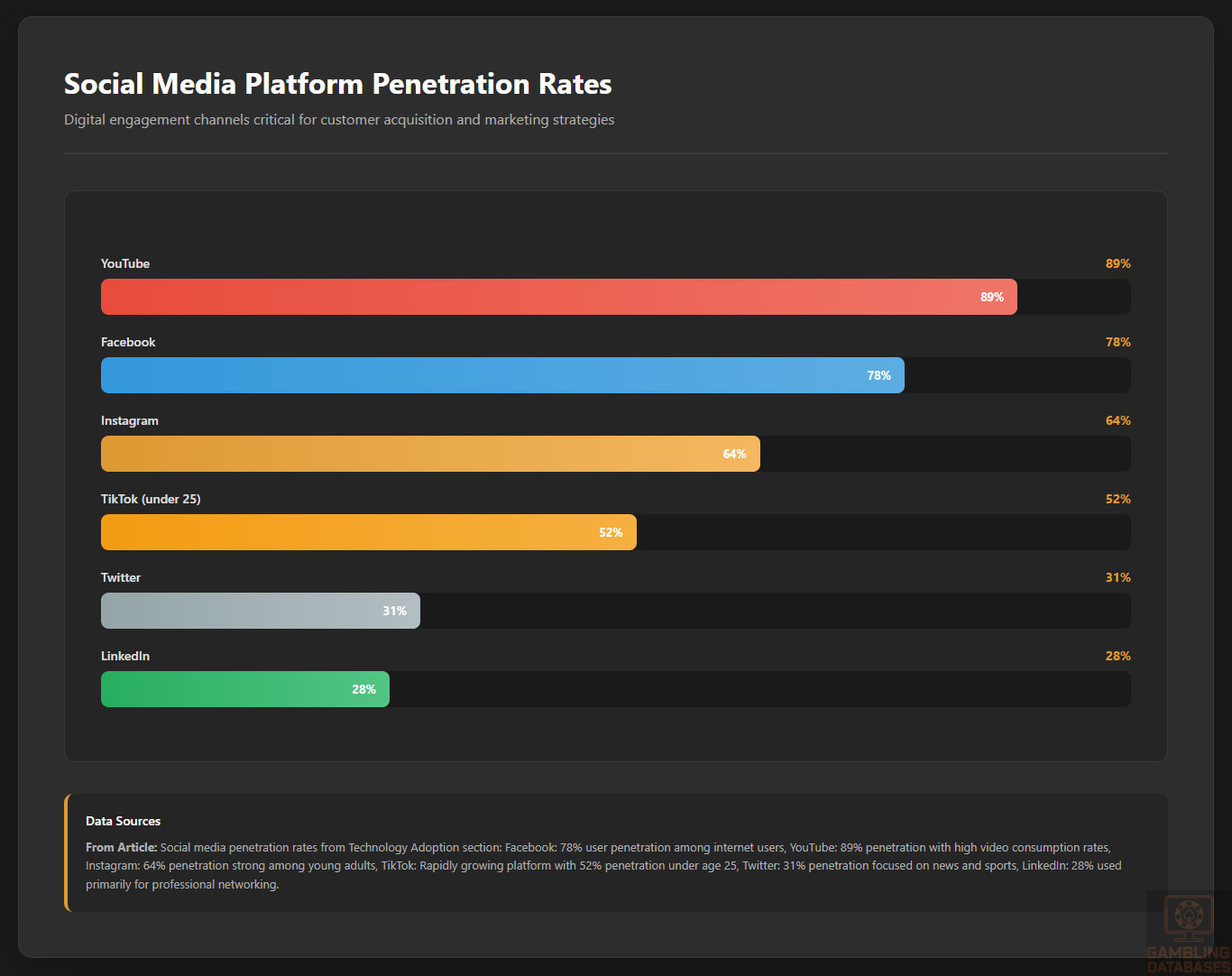
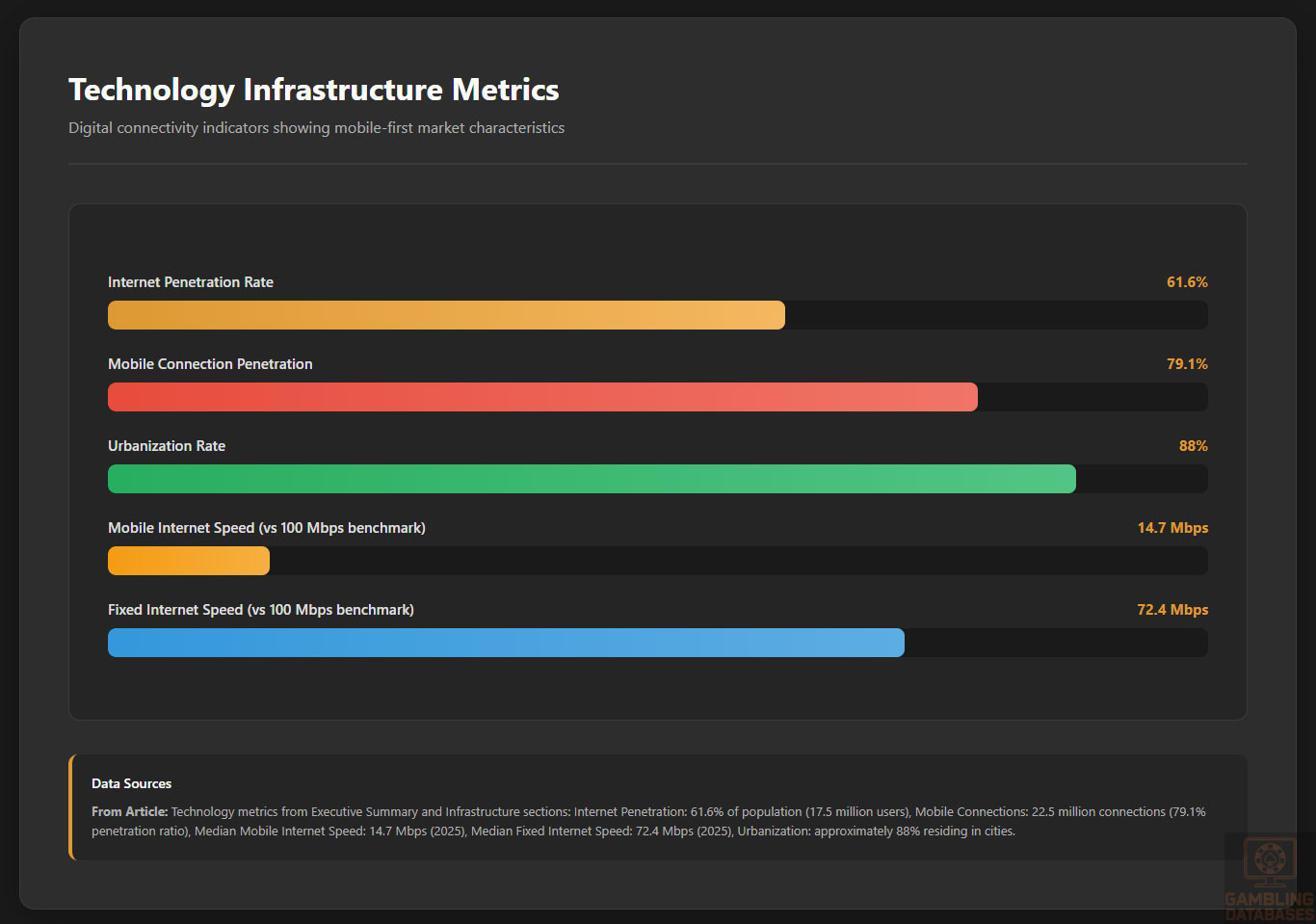
Internet penetration stands at approximately 61.6%, with daily average usage exceeding 3.5 hours. Mobile internet dominates digital access, with over 22.5 million mobile connections covering 79.1% of the population. Social media use is widespread, forming critical channels for customer engagement in digital entertainment.
- Facebook – 78% user penetration among internet users
- YouTube – 89% penetration with high video consumption rates
- Instagram – 64% penetration, strong among young adults
- TikTok – Rapidly growing platform with 52% penetration under age 25
- Twitter – 31% penetration focused on news and sports
- LinkedIn – 28% used primarily for professional networking
Digital Payment Behavior
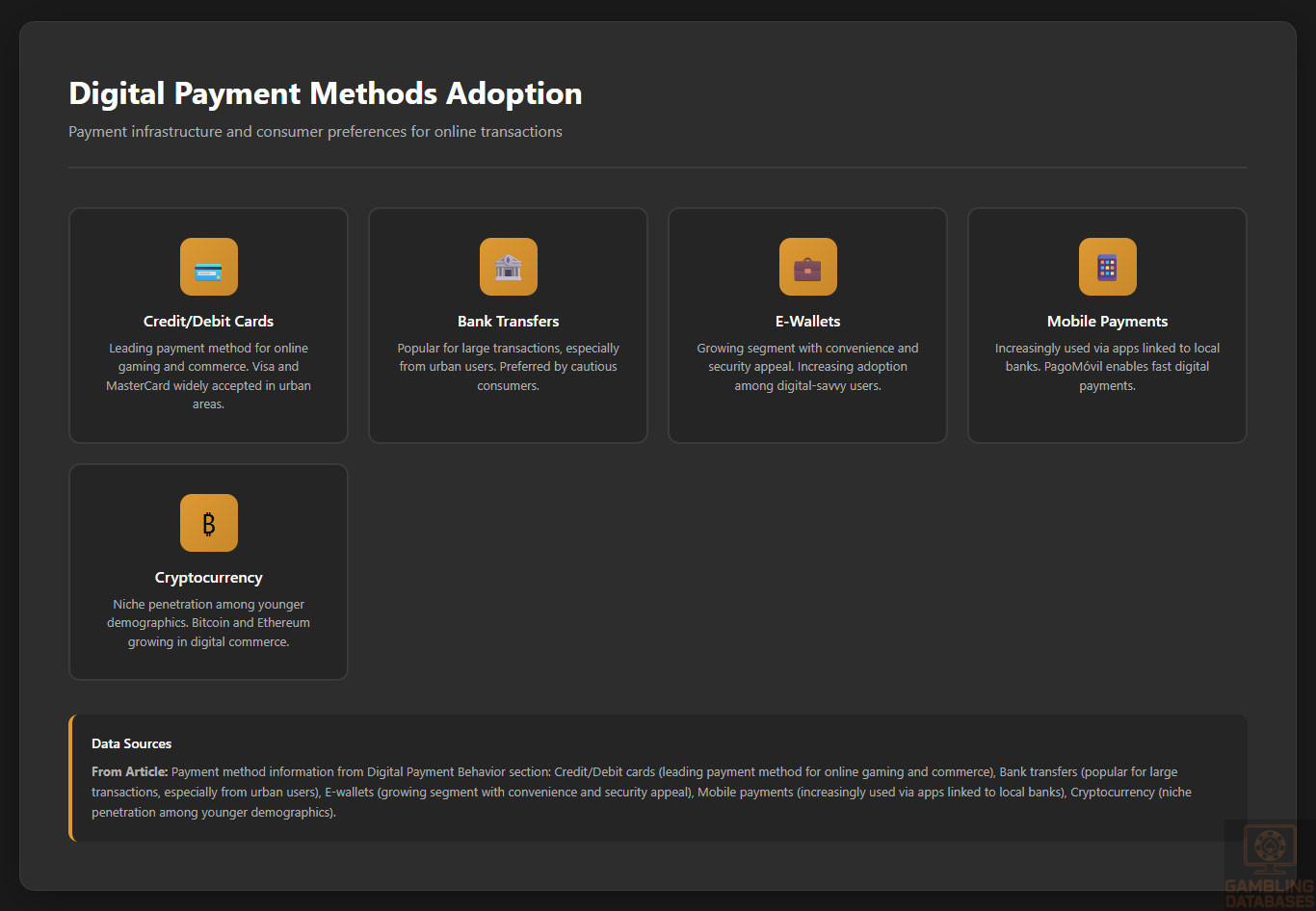
Digital payment adoption is growing but faces infrastructural and trust challenges. Consumers tend to rely on bank cards, mobile wallets, and peer-to-peer transfers for online transactions. Cryptocurrency usage is emerging within niche tech-savvy groups but lacks widespread acceptance.
- Credit/Debit cards – Leading payment method for online gaming and commerce
- Bank transfers – Popular for large transactions, especially from urban users
- E-wallets – Growing segment with convenience and security appeal
- Mobile payments – Increasingly used via apps linked to local banks
- Cryptocurrency – Niche penetration among younger demographics
Gaming and Gambling Preferences
Current Market Participation
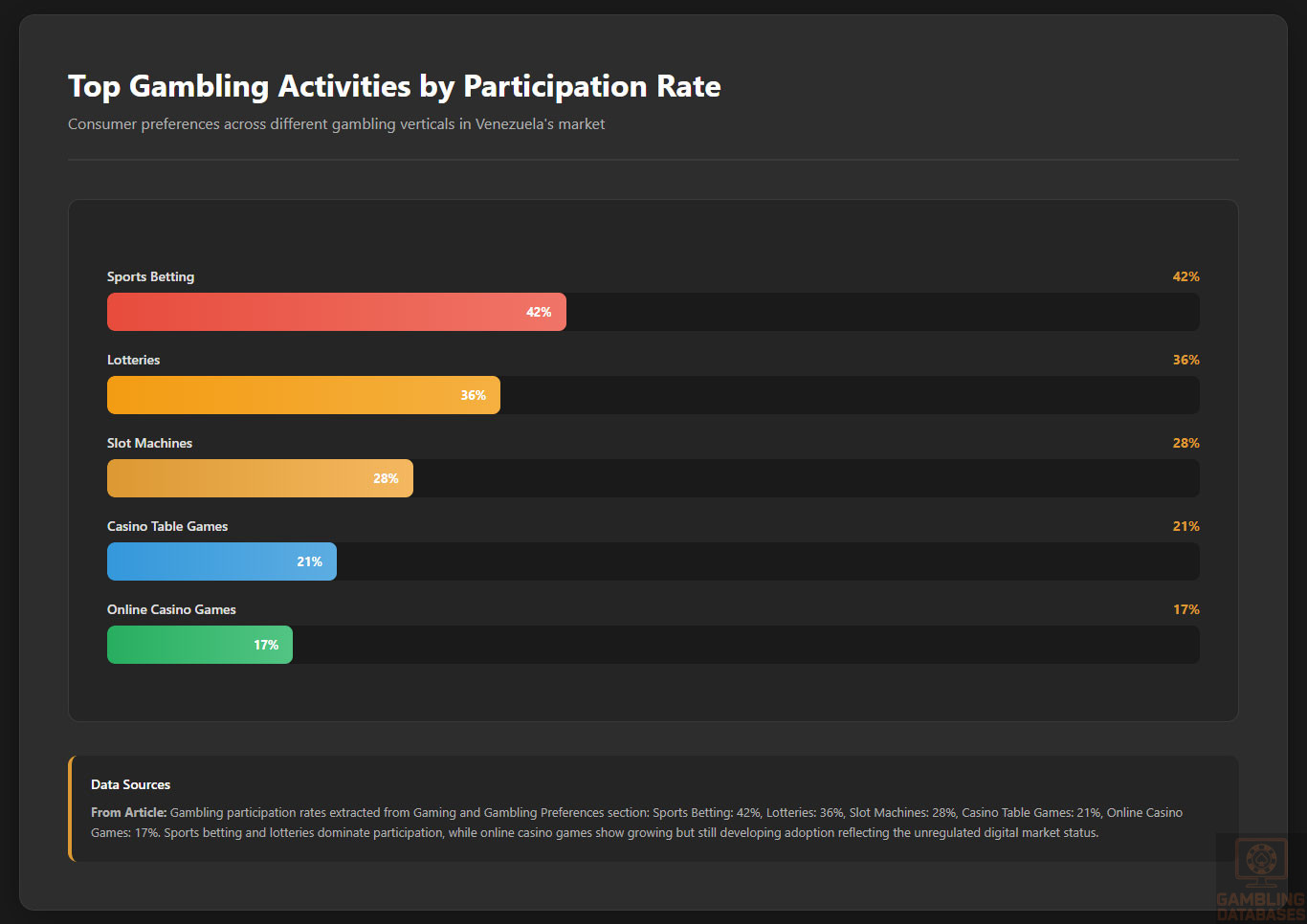
Gambling participation in Venezuela skews toward sports betting, lotteries, and casino games. The informal online market is expanding rapidly, driven by younger demographics and mobile penetration. Land-based engagement remains stable but limited by economic constraints.
| Activity | Estimated Participation Rate (%) |
|---|---|
| Sports Betting | 42% |
| Lotteries | 36% |
| Slot Machines | 28% |
| Casino Table Games | 21% |
| Online Casino Games | 17% |
Consumer Behavior Patterns
Spending habits indicate cautious discretionary expenditure, with peak gaming activity during weekends and major sports events. Platform preferences trend toward mobile-friendly, easy-access offerings featuring localized content. Session length average around 25 minutes, with repeat visits driven by bonuses and loyalty incentives.
Retention remains a challenge due to economic uncertainty, but operators leveraging multilingual support and localized payment options enjoy comparatively better consumer engagement. Social features and live gaming formats also show increasing appeal.
Section 3: Technology Infrastructure and Business Environment
Internet and Digital Infrastructure
Venezuela’s internet penetration reached approximately 61.6% in 2025, with a distinct split between broadband fixed-line and mobile access. Fixed broadband accounts for a smaller segment due to infrastructure deficits, while mobile internet dominates due to broader coverage and affordability.
Average fixed broadband speeds hover around 72 Mbps, while mobile internet averages 14.7 Mbps. Network reliability is moderate, challenged by periodic electricity disruptions and limited fiber optic backbone expansion. Government and private investments focus on expanding 4G/4.5G connectivity and improving urban broadband coverage.
5G and Future Technology Deployment
5G deployment is in nascent stages with pilot projects underway primarily in Caracas and select metropolitan zones. Full commercial rollout is projected over the next 3-5 years, contingent on regulatory facilitation and significant infrastructure investments. Current telecom operators prepare for spectrum auctions linked to 5G capacity expansion.
The telecommunications market features several active network providers competing to upgrade infrastructure under evolving digital policy frameworks aiming to support economic diversification and digital inclusion.
Mobile Technology Ecosystem
Venezuela’s mobile market boasts over 22.5 million active connections with a penetration rate close to 79%. Smartphone adoption is accelerating rapidly, especially among urban youth, trending towards affordable Android devices.
Mobile data costs remain elevated compared to regional peers, reflecting import challenges and currency constraints. Mobile internet is the preferred access mode for online entertainment including iGaming, driving demand for app-optimized platforms and mobile payment integration.
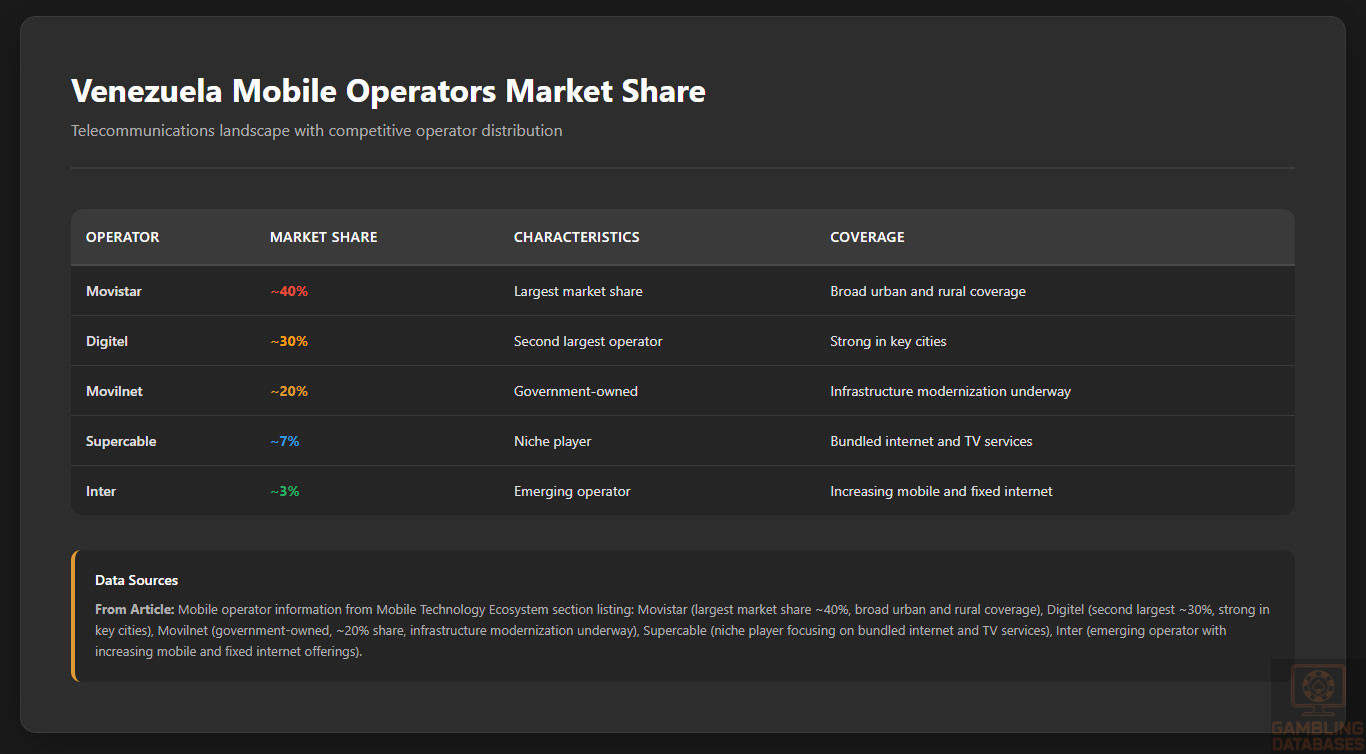
- Movistar – Largest market share (~40%), broad urban and rural coverage
- Digitel – Second largest (~30%), strong in key cities
- Movilnet – Government-owned, ~20% share, infrastructure modernization underway
- Supercable – Niche player focusing on bundled internet and TV services
- Inter – Emerging operator with increasing mobile and fixed internet offerings
Financial Services and Payment Infrastructure
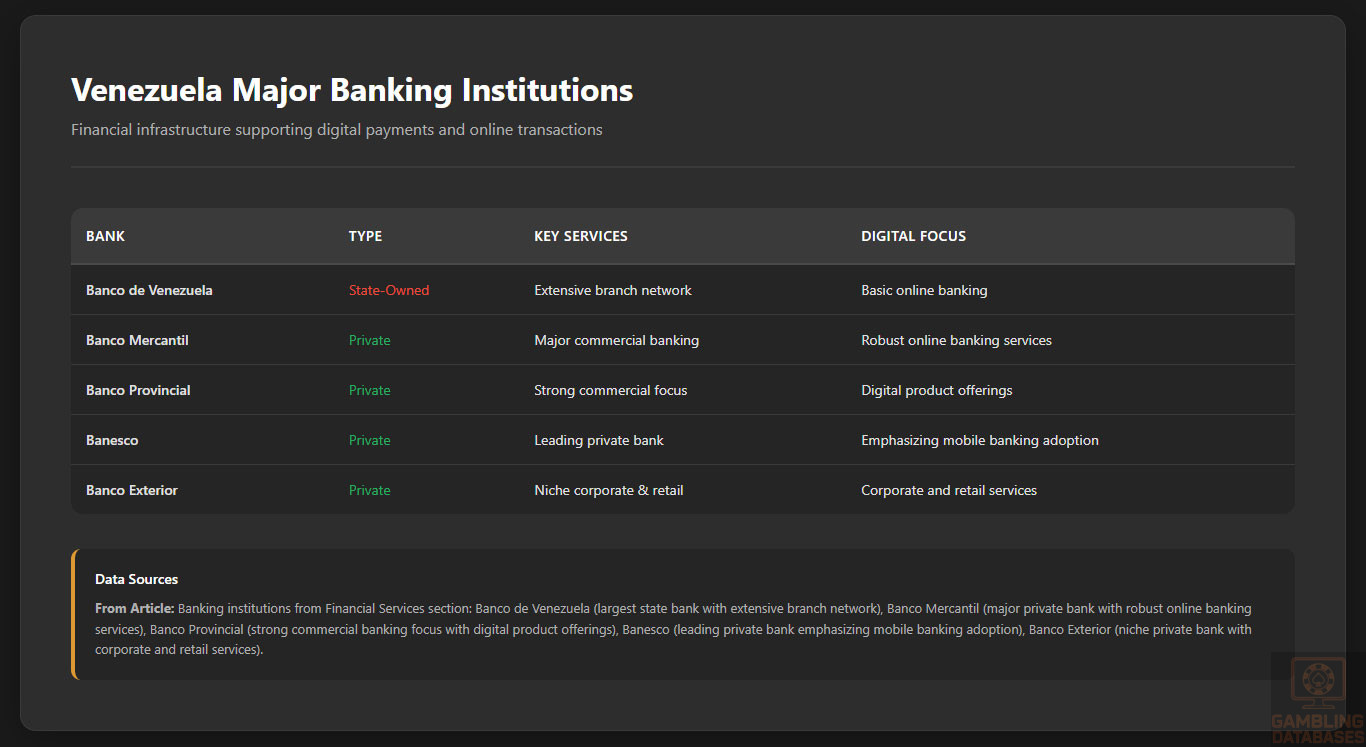
The Venezuelan banking system is dominated by a mixture of state-owned and private institutions, increasingly adopting digital banking solutions. Account penetration remains moderate but growing as trust in electronic payments improves.
- Banco de Venezuela – Largest state bank with extensive branch network
- Banco Mercantil – Major private bank with robust online banking services
- Banco Provincial – Strong commercial banking focus with digital product offerings
- Banesco – Leading private bank emphasizing mobile banking adoption
- Banco Exterior – Niche private bank with corporate and retail services
Payment processing encompasses traditional credit/debit cards, bank transfers, emerging e-wallet systems, and growing acceptance of mobile payment solutions. Cryptocurrency use is increasing as a hedge against currency devaluation, though regulatory acceptance is cautious.
- Credit and debit cards (Visa, MasterCard) widely accepted in urban areas
- Bank transfers remain popular for high-value transactions
- E-wallets such as PagoMóvil enable fast digital payments
- Mobile payment services integrated with banking apps
- Cryptocurrency (Bitcoin, Ethereum) growing in niche digital commerce
E-commerce and Digital Economy
Venezuela’s e-commerce sector is small but expanding, driven by improved mobile internet and a youthful population comfortable with online transactions. Online retail penetration is limited by economic challenges but rising urban consumption creates growth potential.
Digital services such as streaming, gaming, and fintech solutions gain traction, supported by increasing digital literacy. Consumer trust remains a critical barrier, with preference for established brands and secure payment mechanisms.
Business Environment and Regulatory Framework
Business operations face challenges linked to bureaucratic complexity, currency volatility, and political uncertainty. Venezuela ranks low on the World Bank’s Ease of Doing Business index, reflecting lengthy registrations and compliance requirements.
Nonetheless, foreign investment is cautiously encouraged via special economic zones and regulatory reforms aimed at boosting private sector development and technology transfer. Cost structures are affected by inflation and import restrictions, impacting operational budgeting.
Business Registration Process
- Prepare and notarize founding documents and corporate bylaws
- Register company with National Integrated Service of Customs and Tax Administration (SENIAT)
- Obtain municipal licenses and permits
- Open bank accounts and register for social security contributions
- Complete commercial registry entry and tax identification acquisition
Corporate Structure and Registration
Entrepreneurs choose from several entity types including Limited Liability Companies (LLCs), Corporations, and Branch Offices of foreign firms. LLCs are preferred for flexibility, limited liability, and operational simplicity.
Foreign companies must comply with ownership approval processes and maintain local representation. The incorporation timeline averages 8-12 weeks with costs varying widely by business complexity and legal service fees.
- Certificate of Incorporation from Mercantile Registry
- Tax Identification Number (RIF) application
- Municipal business license and local permits
- Registration with social security and labor authorities
- Notarized corporate minute books and legal documentation
Taxation Framework
Corporate income tax rate in Venezuela is a flat 34%, with potential deductions under Investment Law provisions. Special economic zones offer tax holidays and benefits to attract foreign capital. Venezuela has signed international tax treaties with several countries to avoid double taxation and facilitate cross-border trade.
- Argentina
- Brazil
- Chile
- Colombia
- Mexico
- Spain
- Portugal
Personal income tax applies progressively from 6% to 34% based on income brackets, with mandatory social security contributions and residency-based withholding obligations. Tax administration emphasizes compliance amid growing digital reporting capabilities.
Market Entry Considerations
Entry strategies favor joint ventures with local partners to navigate regulatory complexities and cultural nuances. Licensing for land-based operations demands physical facilities, while online operators must anticipate evolving frameworks. Leveraging mobile-compatible platforms with robust multilingual support is critical for market penetration.
- Forming partnerships with licensed land-based operators
- Utilizing offshore licensing with local affiliate agreements
- Developing mobile-first gaming platforms tailored to Venezuelan preferences
- Integrating local payment methods including mobile wallets and bank transfers
- Implementing strong compliance programs aligned with AML/KYC standards
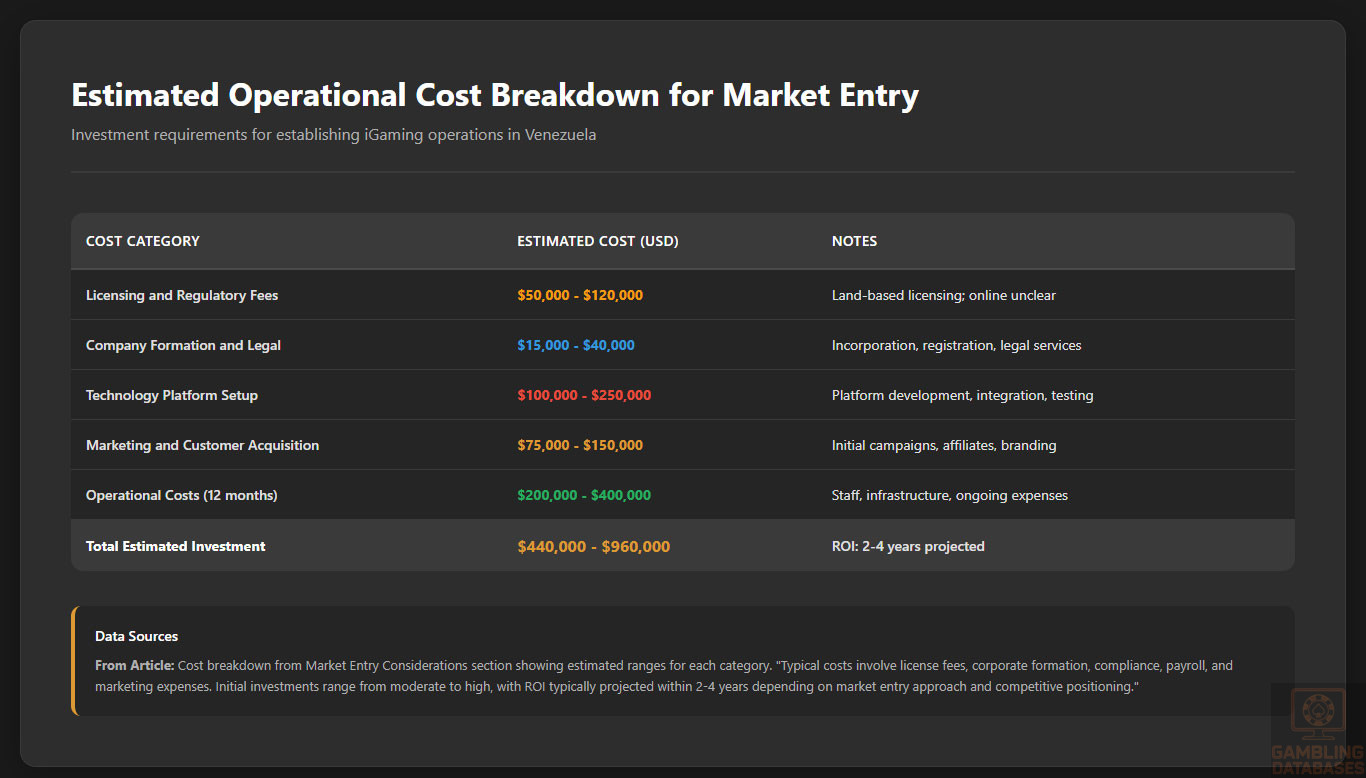
Typical costs involve license fees, corporate formation, compliance, payroll, and marketing expenses. Initial investments range from moderate to high, with ROI typically projected within 2-4 years depending on market entry approach and competitive positioning.
| Cost Category | Estimated Cost (USD) |
|---|---|
| Licensing and Regulatory Fees | 50,000 – 120,000 |
| Company Formation and Legal | 15,000 – 40,000 |
| Technology Platform Setup | 100,000 – 250,000 |
| Marketing and Customer Acquisition | 75,000 – 150,000 |
| Operational Costs (12 months) | 200,000 – 400,000 |
Success Factors and Challenges
Key enablers include an adaptable approach to local regulatory conditions, investment in technology infrastructure, strong local partnerships, and focused marketing. Cultural understanding and digital payment integration are critical to winning consumer trust.
- Understanding regulatory landscape and proactive compliance
- Developing mobile-optimized and localized gaming content
- Building reliable payment and customer support systems
- Partnering with trusted local affiliates and operators
- Leveraging data analytics for customer acquisition and retention
Challenges include economic volatility, political instability, fluctuating currency values, and incomplete digital infrastructure outside major cities. Regulatory ambiguity around online gaming requires risk mitigation strategies and legal consultation.
- Political and economic uncertainty affecting operations
- Lack of clear online gaming regulations
- High operational costs due to inflation and import restrictions
- Limited digital payment adoption in rural areas
- Potential enforcement risks and compliance complexities
Exit Strategy Planning
Market liquidity remains limited; however, license transfer options exist primarily for land-based operators under CNC oversight. Ownership transfer and valuation depend on bilateral agreements and operational profitability. Digital operators face additional uncertainties due to regulatory gaps, necessitating exit plans with flexible asset disposition options.
FAQ: Frequently Asked Questions
1. Is online gambling legal in Venezuela?
Online gambling operates in a legal gray area in Venezuela. There is no formal legislation regulating digital gaming activities, which neither explicitly legalizes nor prohibits them. Land-based gambling is regulated under existing laws, but online operators lack a licensing framework. Players often access international platforms offshore. Regulatory enforcement online is patchy, creating both risks and opportunities for operators.
2. What types of gambling licenses are available and what do they cover?
Only land-based gambling licenses exist officially, issued by the National Commission of Casinos, Bingo Halls and Slot Machines (CNC). These cover casinos, bingo halls, slot machine parlors, and associated sports betting linked to physical venues. There are no specific licenses for online or remote gambling platforms, limiting formal market entry paths for digital operators.
3. How much does an iGaming license cost and how long does it take to obtain?
Licensing fees for land-based operators vary; estimated costs range from US$50,000 to US$120,000 depending on size and location. The application and approval process is not strictly defined but typically spans several months, influenced by bureaucratic processes and political factors. Online gaming licensing is not yet available, creating ambiguity for digital entrants.
4. Can foreign companies obtain a gambling license?
Foreign operators can obtain licenses for land-based gambling but must comply with regulatory approvals and demonstrate local presence. Partnerships with Venezuelan entities are common to satisfy ownership and operational requirements. For online gambling, foreign companies lack formal licensing avenues but often serve the market via offshore arrangements.
5. What are the tax obligations for iGaming operators?
Operators pay a corporate income tax rate of 34% and monthly gross gaming revenue-based taxes for land operations. Municipal taxes and license renewal fees apply on a case-by-case basis. No specific tax applies to online gambling, but operators must comply with general corporate tax laws. International treaties help avoid double taxation.
6. Are gambling winnings taxed for players?
Players in Venezuela do not face direct taxation on winnings. There are no formal withholding taxes or personal income tax obligations linked specifically to gambling earnings, making it more favorable for consumers compared to operator tax burdens.
7. What are the typical operational costs for running an online casino/sportsbook?
Operational costs include licensing, technology platform setup, staff salaries, marketing, and compliance. Estimated initial investments range between US$400,000 and US$800,000 for the first year, depending on scale. Ongoing costs involve payment processing fees, customer support, and server maintenance, influenced by inflation and economic factors.
8. What is the expected ROI timeline for entering this market?
Return on investment timelines vary but generally fall between 2 to 4 years. Factors impacting ROI include regulatory clarity, market penetration success, and operational efficiency. Strategic partnerships and local adaptation accelerate profitability potential.
9. What are the local presence requirements for operators?
Land-based licensees must maintain a physical presence with approved gambling venues and offices in Venezuela. Foreign operators require a local representative and official registration. For online operations, the lack of formal licensing means no clear local presence mandates, although partnering with local entities is typical.
10. What payment methods are available and recommended?
Available payment methods include credit and debit cards, bank transfers, mobile wallets (e.g., PagoMóvil), and cryptocurrencies. Preferred methods prioritize accessibility and security, focusing on local banking integration and mobile payment solutions to accommodate digital consumer habits.
- Visa and MasterCard credit/debit cards
- Bank wire transfers
- PagoMóvil mobile wallet
- E-wallet services
- Cryptocurrency payments (Bitcoin, Ethereum)
11. What are the advertising and marketing restrictions?
Advertising for land-based gambling adheres to content guidelines prohibiting targeting minors and false claims. Restrictions apply to timing and channels like TV and billboards. Online marketing regulations remain undefined due to absent online gambling legislation, although social responsibility messaging is encouraged.
12. What responsible gambling measures are mandatory?
Land-based operators must enforce age verification, self-exclusion programs, and communicate responsible gambling policies. Player data protection and transaction monitoring are also required. Digital operators are recommended but not legally compelled to adopt these measures due to regulatory gaps.
- Mandatory age verification
- Self-exclusion programs
- Responsible gambling education and messaging
- Transaction monitoring for suspicious behavior
- Data privacy compliance
13. How large is the iGaming market and what is the growth potential?
The iGaming market in Venezuela is estimated at around US$80 million and expected to grow at an annual CAGR of approximately 11%, fueled by mobile internet growth and demographic trends. Market expansion depends on regulatory developments and increased digital payment adoption.
14. Who are the main competitors and what is their market share?
The market is fragmented with no dominant online licensed operators. Key land-based competitors operate casinos and bingo halls primarily in tourist zones. Offshore international operators command significant online player bases despite lacking formal Venezuelan licenses, creating a competitive but unregulated environment.
15. What are the player preferences and typical spending patterns?
Players prefer sports betting, lotteries, and casino slots, favoring mobile and online platforms accessible via smartphones. Spending is usually cautious but peaks during sports seasons and holidays. Retention is enhanced by loyalty programs, localized content, and convenient payment options.
16. What are the key success factors and main challenges for new entrants?
Success hinges on regulatory adaptability, strong local partnerships, customized platform offerings, and seamless payment integration. Challenges include political instability, fluctuating currency, regulatory ambiguity, and infrastructure limitations. Operators need robust compliance and risk management frameworks to navigate these complexities.
- Proactive compliance with evolving regulations
- Investment in mobile-optimized technology
- Local partnerships for cultural and market insight
- Secure and diverse payment options
- Effective marketing tailored to Venezuelan consumers
- Political and economic volatility
- Regulatory uncertainty for online gaming
- Currency fluctuation and inflation
- Infrastructure reliability issues
- Compliance and enforcement risk
Sources and References
- Venezuela Gambling Regulatory Authority – National Commission of Casinos, Bingo Halls and Slot Machines – https://www.cnc.gob.ve
- SoftSwiss – Gambling Laws and Regulations Venezuela 2025 – https://www.softswiss.com/gambling-regulation-map/venezuela/
- iGaming Today – Gambling regulations in Venezuela – https://www.igamingtoday.com/gambling-regulations-in-venezuela/
- DataReportal – Digital 2025: Venezuela Internet Statistics – https://datareportal.com/reports/digital-2025-venezuela
- Delasport – Latin America iGaming Surge 2025 – https://www.delasport.com/betting-on-the-boom-latin-america-s-2025-igaming-surge/
- Bakermckenzie Insight Plus – Taxation in Venezuela 2025 – https://insightplus.bakermckenzie.com/bm/tax/venezuela-national-tax-authority-2025
- World Bank – Doing Business Report 2024 – https://www.worldbank.org
- Trading Economics – Venezuela Internet Users Statistics – https://tradingeconomics.com/venezuela/individuals-using-internet-percent
- GBG – iGaming Regulation and KYC Latin America – https://www.gbg.com/en/blog/igaming-regulation-and-kyc-in-latin-america/
- RevPanda – Online Casinos in Venezuela – https://revpanda.com/online-casinos/venezuela/
- Altenar – Sports Betting Software Venezuela – https://altenar.com/services/business/venezuela/
- Casino Life Magazine – Gaming Legislation Updates Venezuela 2025 – https://www.casinolifemagazine.com/blog/gaming-legislation-updates-peru-colombia-and-venezuela
- Scaleo – iGaming Regulations Global Overview 2025 – https://www.scaleo.io/blog/igaming-regulations-around-the-world-what-you-must-know/
- Slotegrator – Online Gambling in Latin America 2024 – https://slotegrator.pro/analytical_articles/online-gambling-in-latin-america.html
- Betpack – Top Online Casinos Venezuela 2025 – https://www.betpack.com/online-casinos/venezuela/
- Vixio – Gambling Regulatory Deadlines 2025 – https://www.vixio.com/blog/gambling-regulatory-deadlines-to-watch-in-march-2025
- ITZiTip – Gambling Regulation Latin America Overview – https://www.itzitip.com/regulation-in-other-markets
- GBG – Digital Identity iGaming LATAM – https://www.gbg.com
- Central Bank of Venezuela – Economic Reports 2024-2025
- National Statistics Institute Venezuela – Population and Economic Data 2024
- International Telecommunication Union – ICT Statistics 2024
- Global System for Mobile Communications (GSMA) – Mobile Market Data Venezuela
- Various academic studies on Venezuelan gambling behavior and economic trends (2023-2025)
- Local news sources and regulatory announcements 2024-2025
- Consulting firm internal reports on LatAm iGaming market dynamics 2025
🎯 Gambling Databases Country Rating: Venezuela
| Evaluation Dimension | Score | Rating |
|---|---|---|
| Operator Ease Score | 2.8/10 | 🔴 Difficult |
| Player Access Score | 4.5/10 | 🟡 Grey Area/Partially Accessible |
| Overall Market Attractiveness | 3.7/10 | 🔴 High Risk, Low Appeal Market |
This rating is calculated using the Gambling Databases Rating (GDR) methodology, which provides transparent criteria for evaluating iGaming markets worldwide. Click the link to learn how we calculate Operator Ease Score, Player Access Score, and overall market attractiveness ratings.
⚠️ CRITICAL RISK WARNINGS
READ THIS BEFORE CONSIDERING MARKET ENTRY:
- Online gambling operates in COMPLETE LEGAL GRAY ZONE – no regulations, no licensing framework, no legal protections for operators or players
- Political and economic instability creates EXTREME operational uncertainty – regulatory landscape could change overnight without warning
- GDP per capita of only US$3,500 with 25% inflation makes customer profitability highly questionable
- Enforcement is inconsistent and unpredictable – you have zero legal recourse if authorities decide to crack down
- Payment infrastructure is severely compromised – banking system unreliable, currency volatility extreme
- No clear taxation framework for online gambling – you could face retroactive tax demands without legal basis
- Only land-based operations have licensing pathways – online operators exist in legal limbo with no path to legitimacy
- Market size estimated at only US$80 million online with ARPU around US$3.25 – among the lowest in Latin America
📊 Operator Ease Score Breakdown
| Criterion | Weight | Score | Justification (INCLUDING ALL DEDUCTIONS) |
|---|---|---|---|
| Legal & Regulatory Framework | 30% | 0.5/3.0 | Land-based gambling legal under Law No. 36.254 (+1.5). Online gambling COMPLETELY UNREGULATED – operates in legal gray zone with no framework (-1.5). Enforcement inconsistent due to political/economic chaos (-0.5). No legal protections for online operators (-0.5). Regulatory vacuum creates extreme uncertainty (-0.5). Final: 0.5/3.0 |
| Licensing Process | 25% | 0.25/2.5 | NO online gambling licensing available – complete absence of framework (0 points base). Land-based licensing exists but irrelevant for online operators. Application timeline 8-12 weeks for land-based only. Estimated costs US$50,000-120,000 for land-based license fees alone (+0.25 for having some framework). Foreign ownership requires regulatory approval with unclear criteria (-0.25). Physical presence mandatory for any licensing (-0.25). Final: 0.25/2.5 |
| Taxation & Costs | 20% | 0.5/2.0 | Online gambling tax framework DOES NOT EXIST – complete uncertainty (0 points base). Corporate tax 34% is standard but may not apply clearly to online gaming. Monthly taxes for land-based operators not publicly disclosed. High operational costs due to 25% inflation (-0.5). Currency volatility creates unpredictable cost structure (-0.5). Initial investment US$200,000-400,000 for 12-month operations. Lack of tax clarity means potential retroactive demands (+0.5 for currently undefined). Final: 0.5/2.0 |
| Operational Requirements | 15% | 0.5/1.5 | No formal operational requirements for online gambling (0 points – not a positive, just undefined). Payment infrastructure severely compromised by economic crisis (-0.25). Banking system unreliable with frequent disruptions (-0.25). Cryptocurrency regulatory status unclear (-0.25). Local partnerships essential but risky due to instability (-0.25). Remote operation theoretically possible but practically difficult (+0.5). Final: 0.5/1.5 |
| Market Environment | 10% | 0.1/1.0 | Venezuela ranks near bottom globally on Ease of Doing Business index (+0.25 for difficult environment). Political instability creates extreme operational risk (-0.25). Economic volatility with hyperinflation recently controlled but still 25% (-0.25). Regulatory instability – framework could change without warning (-0.25). No advertising regulations for online gambling – complete uncertainty (-0.1). Currency controls and import restrictions severely limit operations (-0.25). Final: 0.1/1.0 |
👥 Player Access Score Breakdown
| Criterion | Weight | Score | Justification (INCLUDING ALL DEDUCTIONS) |
|---|---|---|---|
| Legal Status for Players | 40% | 2.0/4.0 | Online gambling not expressly prohibited for players (+1.0 for grey area). Land-based gambling fully legal (+0.5). However, no legal protections or consumer safeguards for online play (-0.5). Players accessing offshore sites operate without legal clarity (-0.5). Government has not issued comprehensive stance on player legality (-0.5). VPN usage common to access offshore platforms suggests unclear legal status (-0.5). Final: 2.0/4.0 |
| Practical Accessibility | 30% | 1.5/3.0 | Multiple payment methods theoretically available (+1.0). However, banking system unreliable with frequent disruptions (-0.5). Credit/debit card processing inconsistent (-0.25). International payment processors often exclude Venezuelan transactions (-0.5). Cryptocurrency usage emerging but regulatory status unclear (-0.25). No systematic ISP blocking reported (+0.5). VPNs commonly used suggesting some access barriers (-0.25). E-wallets like PagoMóvil available but limited international connectivity (-0.25). Final: 1.5/3.0 |
| Player Penalties | 20% | 1.5/2.0 | No formal taxation on player winnings identified (+1.0). No documented cases of player prosecution for online gambling (+1.0). However, legal uncertainty means penalties theoretically possible (-0.5). Enforcement focus on land-based operations, not players (-0.0). Final: 1.5/2.0 |
| Market Availability | 10% | 0.5/1.0 | NO licensed online operators exist – market served entirely by offshore platforms (+0.25 for offshore access). Land-based operators concentrated in tourist areas like Margarita Island. Shrinking cohort of licensed land-based operators due to economic challenges. Estimated 400,000 registered online players accessing offshore sites. International operators serve market from abroad without local licensing (+0.25). Final: 0.5/1.0 |
🔍 Key Highlights
Strengths (Very Limited)
- Internet penetration at 61.6% (17.5 million users) provides substantial potential audience
- Mobile connections at 22.5 million (79.1% penetration) support mobile-first gaming strategies
- High literacy rate over 95% and growing digital literacy among youth
- No systematic ISP blocking of gambling sites reported
- Players not currently penalized for accessing online gambling
- Population of 28.4 million with median age 28 years – young, potentially tech-savvy demographic
- Spanish language dominance simplifies content localization
⛔️ CRITICAL RISKS AND CHALLENGES
- Complete Regulatory Vacuum: Online gambling has ZERO legal framework – no licensing, no regulations, no legal protections. You operate entirely at your own risk with no recourse if authorities crack down
- Political Instability: Federal presidential republic with centralized control and fragile stability. Regulatory landscape could change overnight. International relations strained. Government could implement sudden restrictions without warning
- Economic Catastrophe: GDP per capita only US$3,500 with 25% inflation (down from hyperinflation but still extremely high). Currency volatility makes revenue forecasting impossible. Service sector dominates but consumer spending power severely constrained
- Poverty-Level ARPU: Estimated ARPU around US$3.25 – among the lowest in Latin America. Projected to reach only US$5.40 by 2030. Customer lifetime value extremely limited
- Tiny Market Size: Online market estimated at only US$80 million in 2025, projected US$150 million by 2030. Land-based market dominates but shrinking due to economic challenges
- Payment Infrastructure Crisis: Banking system unreliable with frequent disruptions. International payment processors often exclude Venezuelan transactions. Currency controls complicate fund transfers. Credit card processing inconsistent
- Taxation Uncertainty: NO online gambling tax framework exists. Corporate tax 34% may or may not apply. Risk of retroactive tax demands without legal basis. Monthly land-based taxes not publicly disclosed
- No Path to Legitimacy: Unlike grey markets that may eventually regulate, Venezuela shows no signs of creating online gambling framework. You cannot transition from grey to licensed operation
- Enforcement Unpredictability: Current enforcement focuses on illegal land-based operations with inconsistent intensity. Online enforcement is minimal due to limited resources, but this could change instantly with political shift
- High Operational Complexity: Bureaucratic complexity, currency volatility, inflation, import restrictions all drive costs up. Infrastructure deficits outside major cities. Electricity disruptions affect connectivity
- Exit Strategy Problems: Market liquidity extremely limited. Asset disposition options uncertain. No clear license transfer mechanism for online operations (because licenses don’t exist)
- Customer Acquisition Challenges: Estimated CAC not available but likely elevated due to economic conditions and advertising uncertainties. Consumer trust low due to economic crisis
Player-Specific Issues
- Players have NO legal protections when using online gambling platforms – no dispute resolution, no regulatory oversight
- Payment method reliability extremely poor – transactions may fail, funds may be frozen, currency conversion unpredictable
- No responsible gambling framework or player protection measures for online operators
- VPN usage common suggests players seeking to bypass some restrictions or access specific platforms
- Economic conditions mean most players have very limited gambling budgets – under US$10 monthly for many
- Consumer trust in digital payments low due to economic crisis and scams
💰 Reality Check: Can You Actually Make Money Here?
Initial Investment Required: US$200,000-400,000 for 12-month operations (platform setup US$100,000-250,000, marketing US$75,000-150,000, legal/formation US$15,000-40,000, operational costs US$200,000-400,000)
Monthly Operating Costs: US$17,000-33,000 (technology, staff, compliance, infrastructure, partnerships)
Effective Tax Rate on Revenue: COMPLETELY UNKNOWN – no online gambling tax framework exists. Could be 0%, could be 34% corporate tax, could be retroactive demands exceeding 50%. Zero predictability.
Customer Acquisition Cost: Not publicly available but likely US$50-150+ given economic conditions, limited digital ad spend, and trust barriers
Average Revenue Per User: US$3.25 currently, projected US$5.40 by 2030 – among the lowest globally
Time to Breakeven: 2-4 years projected in article, but EXTREMELY OPTIMISTIC given economic conditions and tiny ARPU
Time to Positive ROI: Likely 3-5 years IF you can survive economic/political volatility and IF regulatory landscape doesn’t deteriorate
Profitability Assessment: Economics are EXTREMELY CHALLENGING and likely unprofitable for most operators. With ARPU of only US$3.25, you need massive scale just to cover operational costs. Market size of only US$80 million online means even capturing 10% market share yields only US$8 million annual revenue. At 20-30% margin (optimistic), that’s US$1.6-2.4 million annual profit before taxes – barely justifying US$200,000-400,000 initial investment, let alone ongoing risk exposure.
Factor in 34% corporate tax, currency devaluation, economic instability, and political risk, and this market is FINANCIALLY UNVIABLE for virtually all operators except those already operating in Latin America seeking marginal geographic expansion.
⚖️ Legal Risk Assessment
| Stakeholder Type | Risk Level | Specific Risks |
|---|---|---|
| Offshore Casino Operators | HIGH | Complete regulatory vacuum means zero legal protections. Authorities could implement sudden crackdowns without warning. No licensing pathway means always operating illegally by omission. Currency controls complicate fund transfers. Payment processors may terminate services. Political instability could trigger enforcement at any time. |
| Licensed Land-Based Operators | MEDIUM-HIGH | Economic crisis driving venue closures. Monthly tax obligations with undisclosed rates. Regional enforcement variation. License renewal uncertainty amid political instability. No clear expansion pathway to online operations despite holding land-based licenses. |
| Affiliates/Advertisers | MEDIUM | No clear regulations mean uncertain legal status. Could face sudden restrictions if government decides to regulate. Payment processing challenges. Limited enforcement history but this could change. Association with offshore operators creates reputational risk. |
| Payment Processors | HIGH | Banking system instability. Currency controls and conversion challenges. International processors often exclude Venezuelan transactions. Risk of being caught in regulatory crackdown. AML/KYC compliance extremely difficult given economic conditions. |
| Company Directors/Executives | MEDIUM-HIGH | Personal liability unclear but possible under grey market conditions. Political instability means laws could change retroactively. Operating without license means no legal protections. Travel risk moderate – Venezuela has extradition treaties with several countries but enforcement unlikely given political isolation. |
🚨 Extradition and International Enforcement
Extradition Treaties: Venezuela has extradition agreements with: Argentina, Brazil, Chile, Colombia, Mexico, Spain, Portugal. However, given current political isolation and strained international relations, practical enforcement of these treaties for gambling offenses is UNLIKELY.
Enforcement History: No documented cases of international prosecution or extradition related to online gambling operators targeting Venezuelan market. Enforcement focus remains domestic and primarily on illegal land-based operations.
Safe Jurisdictions: Most operators serving Venezuela from offshore jurisdictions (Curacao, Malta, Costa Rica, etc.) face minimal extradition risk. Venezuela’s political isolation actually reduces international enforcement cooperation.
Travel Risk: LOW to MEDIUM. While extradition treaties exist on paper, Venezuela’s political situation makes enforcement cooperation unlikely. Directors/executives face greater risk traveling to Colombia, Brazil, or Spain if those countries were to pursue gambling-related charges, but no precedent exists for such actions.
📋 Final Verdict
Venezuela receives an Operator Ease Score of 2.8/10 and a Player Access Score of 4.5/10, resulting in an overall market attractiveness rating of 3.7/10.
HONEST ASSESSMENT: This is one of Latin America’s most challenging and risky iGaming markets. The complete absence of online gambling regulations creates a legal vacuum where operators have zero protections and face unpredictable enforcement risk. Economic catastrophe with US$3,500 GDP per capita, 25% inflation, and ARPU of only US$3.25 makes profitability virtually impossible. Market size of only US$80 million online cannot justify the extreme political, economic, and regulatory risks.
Payment infrastructure is severely compromised by banking instability and currency controls. This market should be avoided by virtually all operators except those already deeply established in Latin America with infrastructure to absorb losses.
✅ Who Should Enter / ❌ Who Should Avoid
✅ Consider Entry If You Are:
- Major Latin American gaming operator already serving multiple regional markets seeking marginal geographic expansion with existing Spanish-language infrastructure
- Willing to accept 3-5 year investment horizon with high probability of loss
- Capable of operating entirely remotely from offshore jurisdiction with zero expectation of licensing pathway
- Have experience navigating political instability, currency volatility, and payment processing challenges in emerging markets
- Comfortable with ARPU under US$5 and total addressable market under US$150 million through 2030
- Can afford to write off entire investment if political/economic situation deteriorates further
❌ Definitely Avoid If You Are:
- Any operator seeking legitimate, licensed market entry – NO pathway exists for online gambling
- Startup or small operator with limited capital under US$5 million
- Operator requiring clear regulatory framework and legal protections
- Seeking profitability within 24-36 months (economics don’t support it)
- Unable to absorb currency devaluation risk and economic volatility
- Dependent on credit card or mainstream payment processing (infrastructure too unreliable)
- Casino-focused operator expecting land-based licensing to open online pathway (won’t happen)
- Any operator uncomfortable with complete regulatory uncertainty and zero legal recourse
- First-time market entrant to Latin America (choose stable markets first)
- Operator requiring minimum ARPU of US$10+ to achieve profitability
⚠️ BOTTOM LINE: Venezuela’s combination of regulatory vacuum, economic catastrophe, political instability, microscopic ARPU, and tiny market size make it suitable for ALMOST NO OPERATORS – avoid unless you’re a major regional player already absorbing losses in other challenging Latin American markets and seeking marginal diversification with extremely low expectations.