
The Central African Republic (CAR) offers an emerging and developing market for iGaming, characterized by a nascent regulatory environment and growing digital adoption in urban areas. While land-based gambling activities are regulated under defined legal frameworks, online gambling remains largely unregulated and dominated by offshore operators.
This analysis details the current regulatory framework, licensing processes, and compliance obligations critical for market entry, highlighting opportunities and challenges in this evolving gaming sector.
Executive Summary: Key Market Indicators
| Metric | Value |
|---|---|
| Gambling Legal Status | Legal with regulation for land-based; online largely unregulated |
| Regulatory Authority | National Lottery and Casino Authority (LONACA) |
| Licensed Land-Based Operators | Casinos, sports betting shops, national lottery |
| Online Gambling Regulation | Permitted but limited enforcement and no specific licensing framework |
| Gross Gaming Revenue (GGR) Tax Rate | 15% – 25% |
| Corporate Income Tax | Standard national rates applicable |
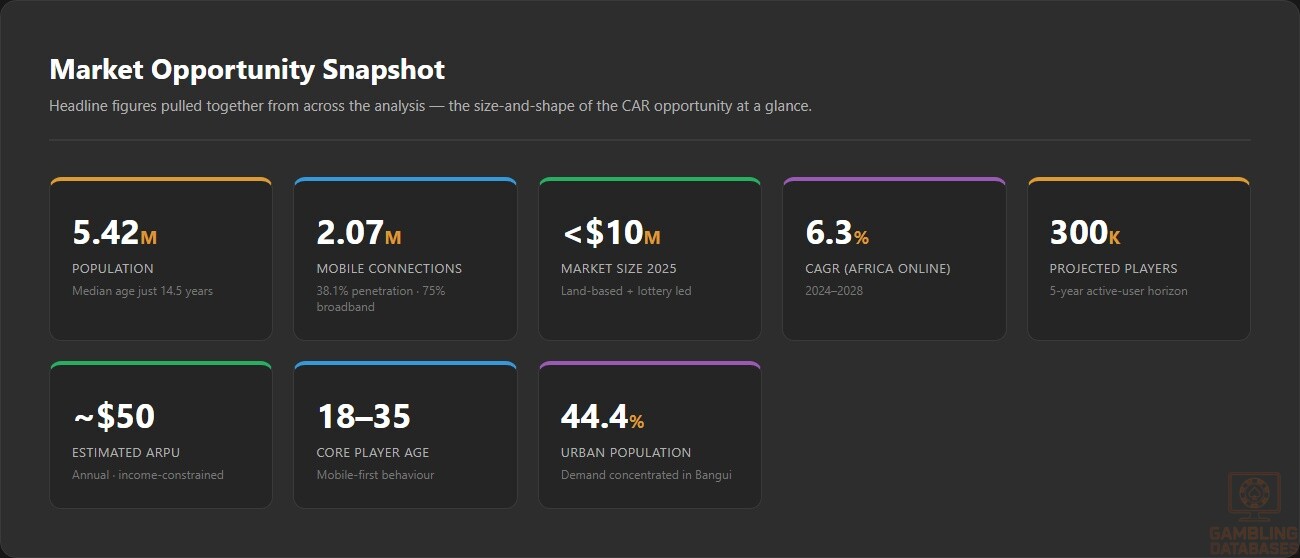
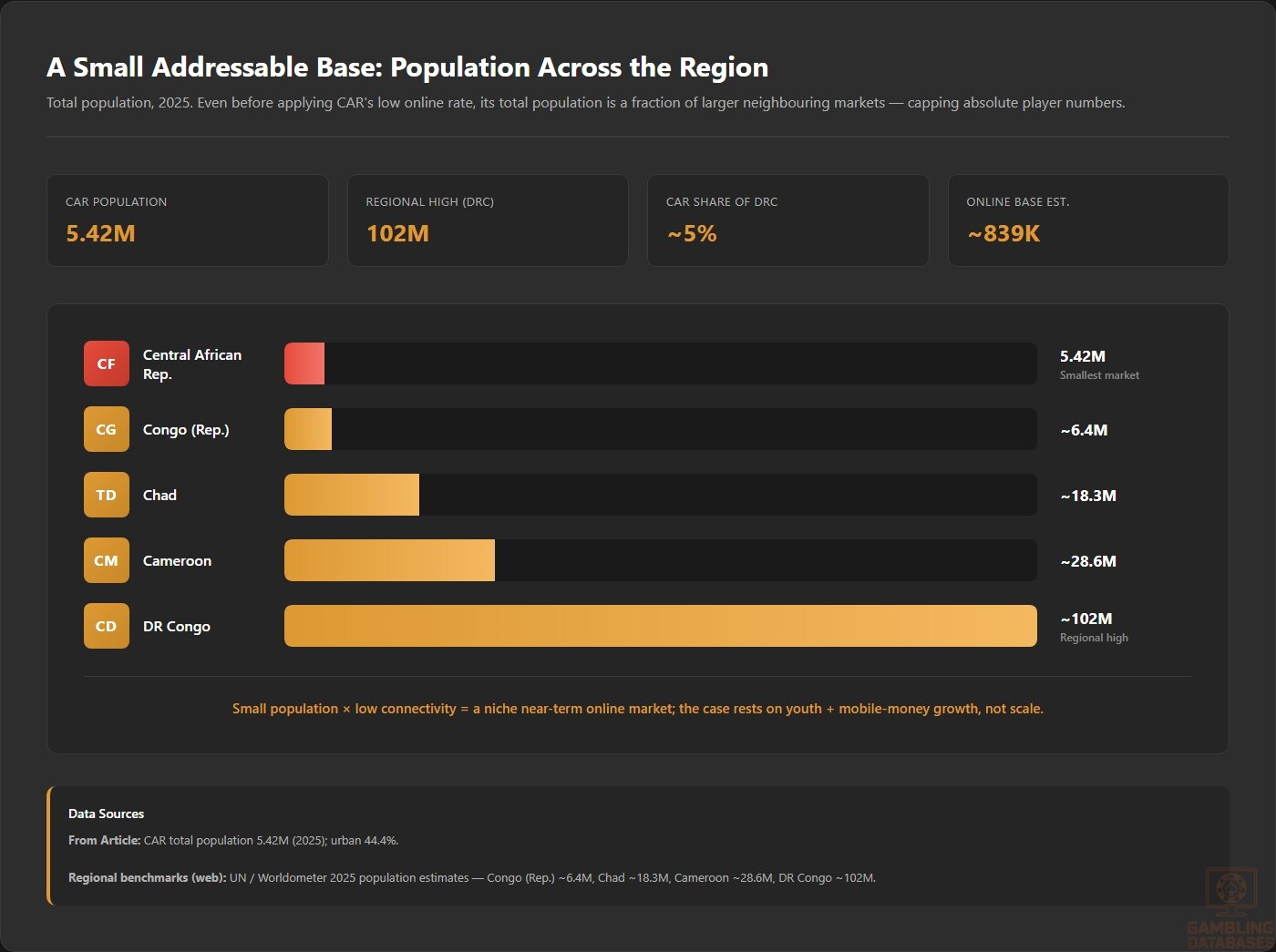
| Population Total (2025) | 5.42 million |
| Median Age | 14.5 years |
| Urban Population | 44.4% |
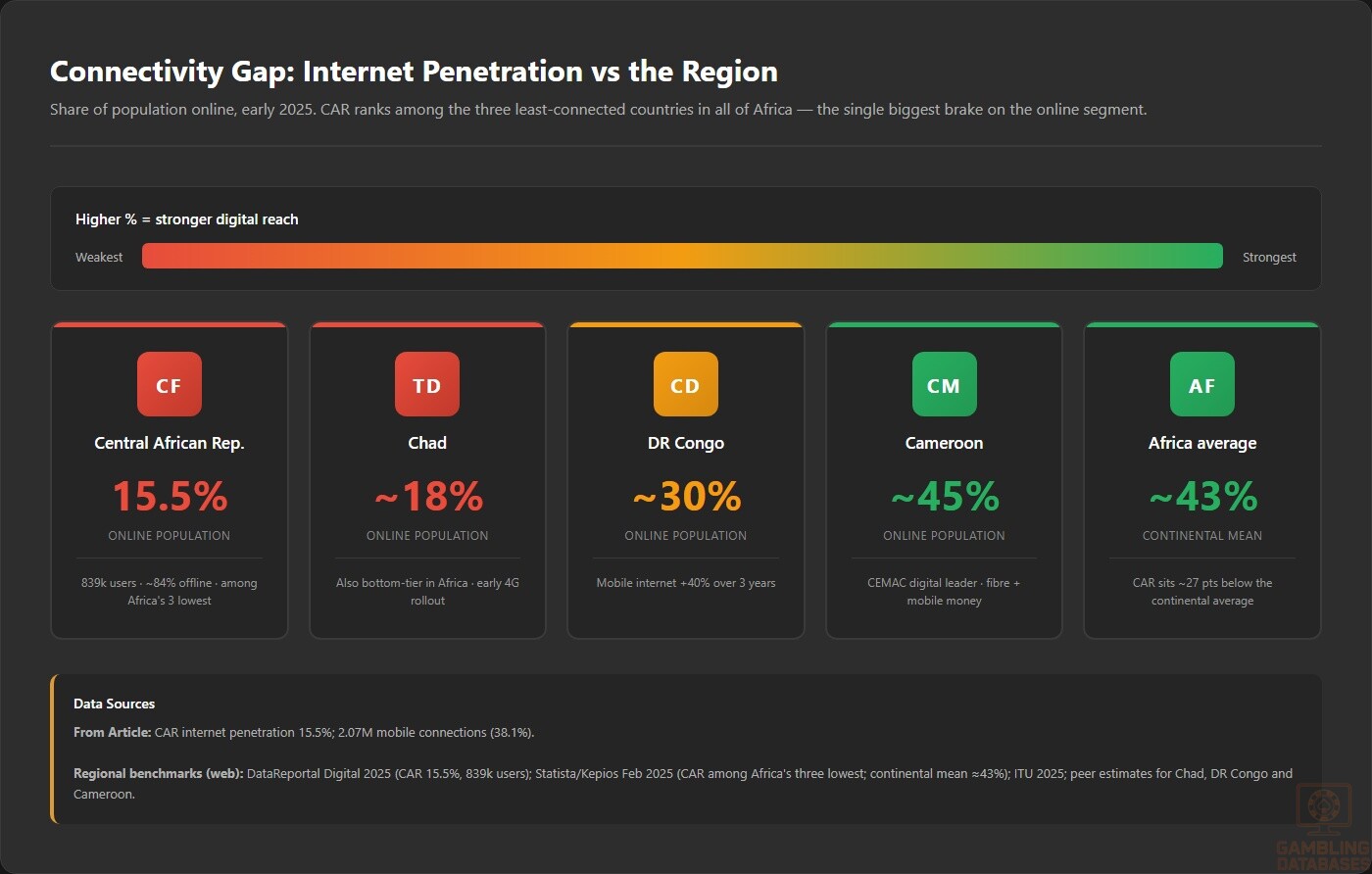
| Internet Penetration Rate | 15.5% |
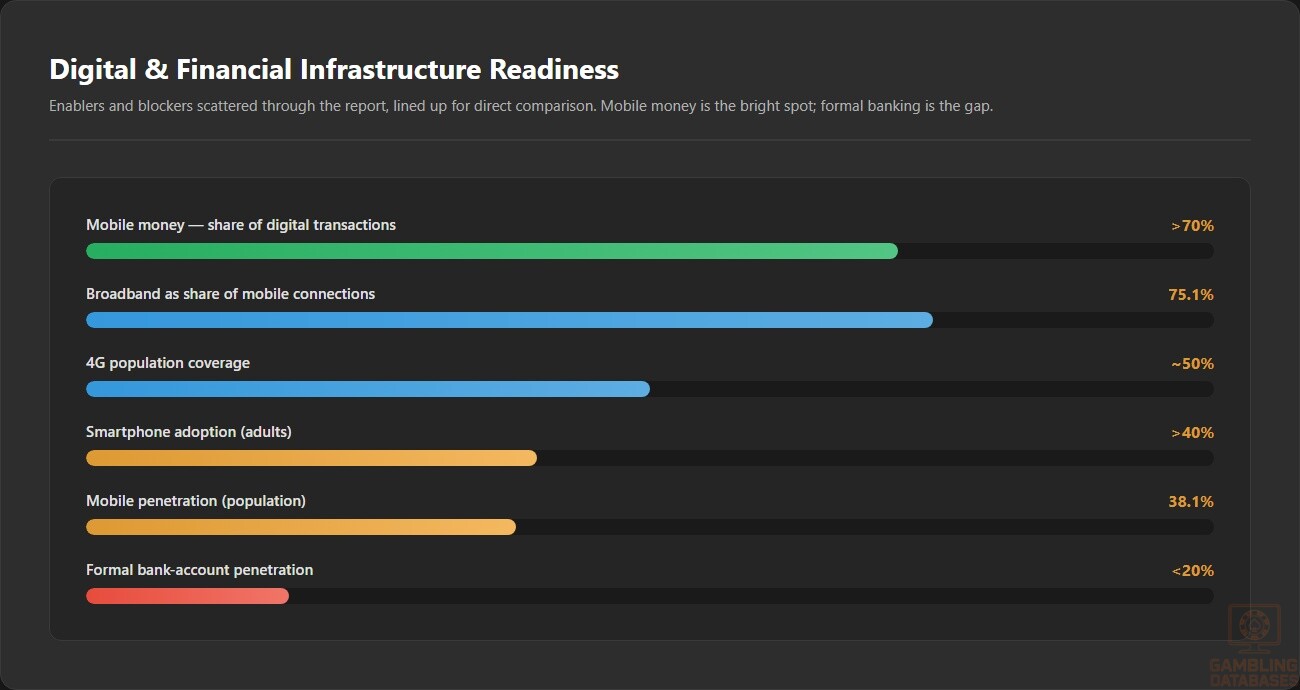
| Mobile Connections | 2.07 million (38.1% penetration) |
| Broadband Mobile Connections | 75.1% of mobile connections |
| GDP (2025, official) | Approximately $2.79 billion USD |
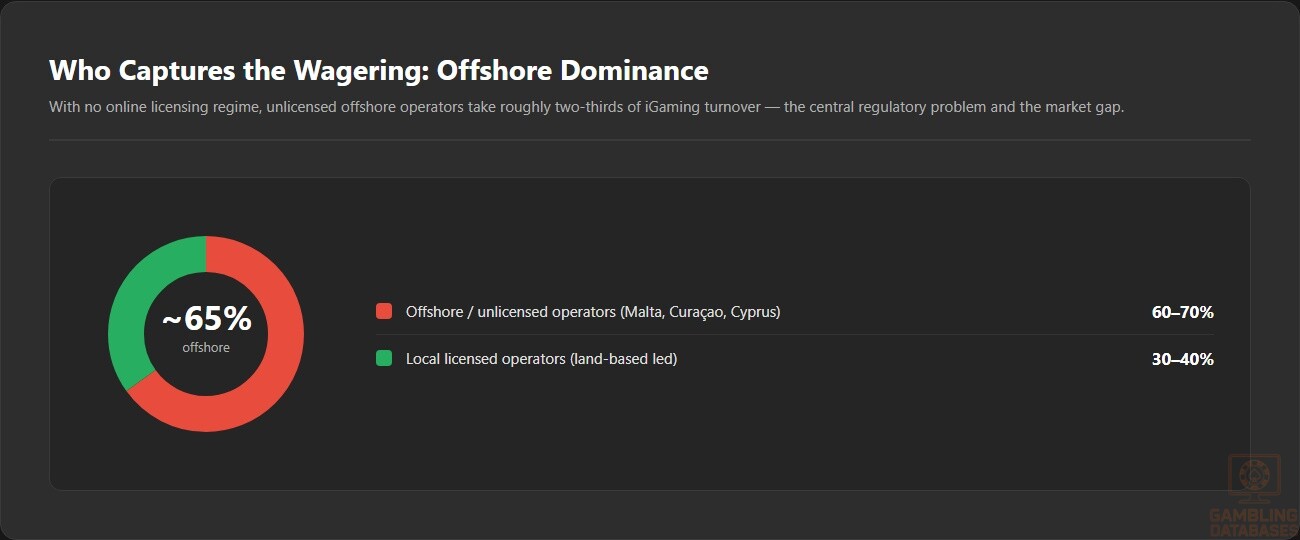
| Average iGaming Market Share (Local vs. Offshore) | Local licensed 30-40%, Offshore 60-70% |
| Popular Gambling Verticals | Sports Betting, Lottery, Casino Games |
| Core Player Age Group | 18–35 years |
| Market Growth Rate (CAGR, Africa) | 6.3% Online Gambling (2024–28) |
| License Application Timeline | Several months; varies by application complexity |
| Licensing Fees | Varies; initial and renewal fees apply |
| Key Compliance Focus | AML, Responsible Gaming, Reporting Obligations |
| Enforcement Strength | Robust land-based, weak online |
| Market Entry Barriers | Regulatory uncertainty online, infrastructure challenges |
| Average Revenue Per User (ARPU) | Modest; constrained by low internet penetration |
| Payment Methods Popularity | Mobile Money dominant |
| Responsible Gambling Measures | Mandatory for licensed operators |
| Online Gambling Legislation Status | Incomplete; modernization expected by 2028 |
| Tax Collection Efficiency | Effective for licensed land-based operators |
| Projected Regulatory Changes | Focused on licensing, tax automation, KYC upgrades |
| Major Market Risks | Enforcement gaps, informal markets, youth protection |
Section 1: Regulatory Framework and Legal Environment
Current Gambling Regulation Status
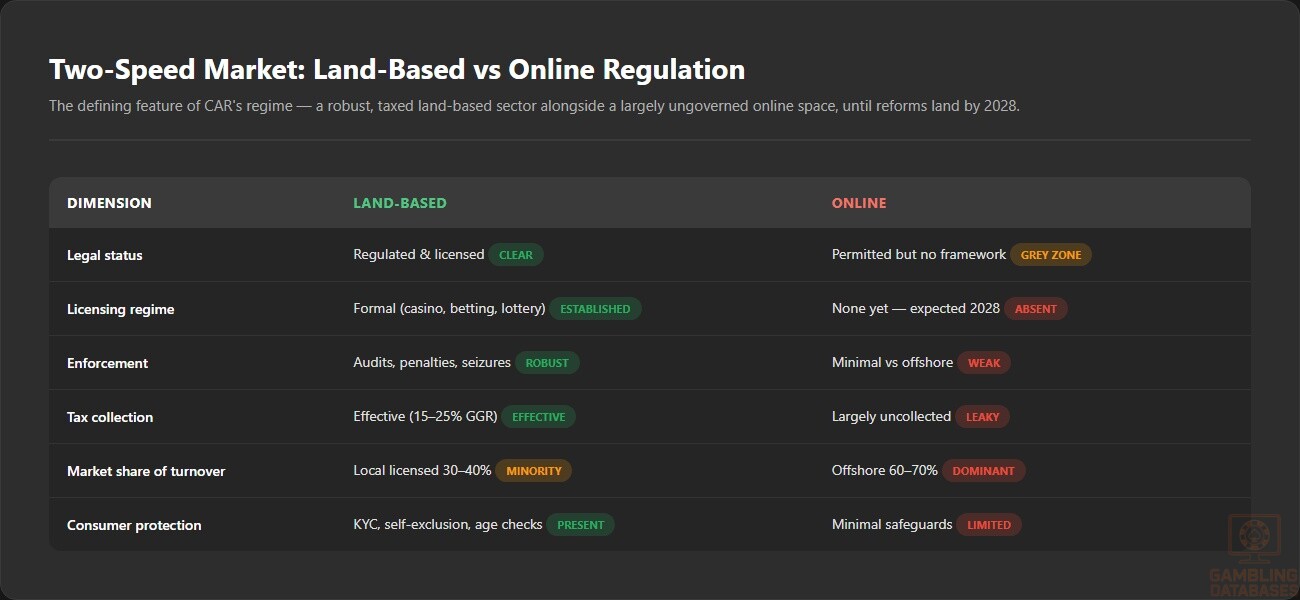
The legal status of gambling in the Central African Republic is broadly permissive for land-based activities, including casinos, sports betting, and lotteries. The National Lottery and Casino Authority (LONACA) regulates all licensed gambling operations. Land-based operators require authorization and adhere to a formal licensing regime that regulates venue operations, player protections, and tax obligations.
In contrast, online gambling operates in a regulatory grey zone. Although permitted in principle, CAR lacks a dedicated regulatory and licensing framework specifically addressing remote gaming platforms. Enforcement against offshore operators serving CAR residents is limited, allowing unlicensed international operators to dominate the digital market. This creates competitive challenges for local operators and complicates revenue and tax collection efforts.
Land-Based Gambling Activities
Land-based gambling in CAR encompasses several operational categories, primarily concentrated in urban centers such as the capital Bangui. Key activities include casinos, sports betting outlets, and government-run lotteries.
Casinos operate in controlled urban environments catering primarily to affluent local and expatriate clientele. Sports betting shops are scattered in major cities, often leveraging popular events like football (soccer) to attract players. The national lottery remains a significant state-sponsored income source and enjoys widespread participation.
Slot machine halls, electronic gaming lounges, and other forms of physical gambling venues exist but are limited by infrastructure and enforcement capabilities.
Online Gambling Framework
The online gambling sector in CAR currently has no comprehensive legislation clearly defining licensing, oversight, or operational standards. Existing laws permit gambling but fall short on addressing the specifics of internet-based gaming. Consequently, offshore operators registered in jurisdictions like Malta, Curacao, and Cyprus provide most online offerings accessible to CAR players.
The lack of enforced local licensing leads to a largely unregulated environment with minimal consumer protections, limited enforcement of AML/KYC protocols, and absent technical standards for game fairness and security. However, ongoing government discussions indicate reforms and establishment of a formal online licensing framework are targeted for introduction by 2028.
Licensed Operators and Market Players
The competitive landscape features both state-affiliated entities and private licensed operators for land-based gambling. LONACA oversees licensing, compliance, and taxation. Licensed entities include urban betting shops, lottery operators, and a few casinos.
The online segment is dominated by offshore providers who capture an estimated 60 to 70 percent of the iGaming turnover due to the unregulated digital market environment. Licensed local operators hold roughly 30 to 40 percent market share, primarily in traditional, land-based activities.
Entry strategies for operators seek to balance partnerships with local license holders and leveraging offshore platforms to capture the growing demand for remote betting and casino games.
Licensing Framework and Requirements
Application Process and Eligibility
Licensing applications in CAR are submitted to LONACA, the regulatory body responsible for granting and supervising gambling licenses. Applicants must demonstrate operational competence, financial capacity, and adherence to national gaming laws. The process involves a review of technical and business documentation, background checks, and proof of responsible gaming commitments.
Application fees vary depending on the scale and nature of the operation, with timelines typically extending over several months to allow adequate regulatory assessment. Although online-specific licensing is currently undeveloped, land-based licenses require submission of multiple documents and certifications.
The business plan, financial audits, technical game certifications, and AML programs form part of the eligibility assessment criteria.
Local Presence and Operational Requirements
Licensed operators must maintain a physical presence within the country for land-based activities, including operational offices or gaming venues. Domain registration and hosting for online operators are expected to comply with national laws once a formal online framework is adopted.
There are no explicit foreign ownership restrictions, but partnership with local entities is common to facilitate compliance and market access. Personnel requirements include staffing qualified compliance officers and management able to satisfy LONACA oversight.
Compliance Obligations and Monitoring
Player Protection and Identification
Licensees in CAR must implement multiple player protection measures, including mandatory age verification, responsible gambling tools, and KYC (Know Your Customer) protocols to reduce underage and problem gambling. Anti-money laundering (AML) compliance is enforced through customer identification and transaction monitoring frameworks tailored to local and international standards.
Operators are also required to provide self-exclusion provisions, responsible gaming information disclosure, and maintain secure data handling practices in line with evolving regulations.
- Mandatory age verification (18+ years)
- KYC identity and document verification
- Self-exclusion programs for problem gamblers
- Responsible gambling awareness and education
- Transaction and deposit limits monitoring
Financial Monitoring and Reporting
Operators must submit periodic financial reports to LONACA, detailing gross gaming revenue, tax payments, and operational audits. Compliance audits include verification of tax calculations and anti-fraud measures. Reporting also covers player complaints, disputes, and incident logs.
Revenue reporting follows a standard sequence starting from transaction recording, monthly accounting, submission of verified statements, and final clearance by regulatory authorities.
- Collection of daily financial and operational data
- Monthly reconciliation and gross gaming revenue calculation
- Submission of detailed financial reports to LONACA
- Regulatory review and audits
- Tax payment reconciliation
Taxation Structure and Financial Obligations
Player Taxation
Players in CAR are generally not subject to direct taxes on gambling winnings. Taxation is instead focused on operators through GGR and corporate income taxes.
Operator Taxation
| Game Type | Tax Rate | Notes |
|---|---|---|
| Gross Gaming Revenue (GGR) | 15% – 25% | Applies to casinos, sports betting, lottery |
| Corporate Income Tax | Standard national rate | On net profits |
| License Fees | Variable | Annual renewal fees applicable |
| Turnover Tax | None reported | Subject to future legislation |
Tax collection focuses mainly on licensed land-based operators, where enforcement is robust. Digital operators currently face minimal tax enforcement, though reforms aim to address this through improved compliance mechanisms and digital reporting tools.
Gambling Market Financial Performance
The financial performance of the gambling market in CAR remains modest but shows steady growth. Total wagered amounts are primarily from land-based operations, with online wagers growing rapidly due to increased smartphone and mobile money adoption.
Gross gaming revenue trends reflect growing urban demand and enhanced access to betting products. Tax revenues contribute meaningfully to state finances, particularly from lotteries and regulated betting shops, with expectations of growth as regulatory modernization advances.
Advertising and Marketing Restrictions
Advertising of gambling in CAR is regulated to prevent targeting minors and vulnerable groups. Permissible marketing channels are traditional media and digital platforms, subject to content restrictions prohibiting misleading claims, excessive promotion, or inducements encouraging excessive play.
- Prohibition of gambling ads targeting minors
- Ban on false or deceptive promotional content
- Restrictions on bonuses and free bet offers
- Time-of-day advertising limitations
- Monitoring of sponsorships and endorsements
Recent Regulatory Changes and Their Impact
The CAR government is pursuing regulatory reforms scheduled for phased implementation by 2028. These focus on creating a specific legal framework for online gambling, enhancing AML and responsible gaming measures, and digitizing licensing and tax collection processes.
Impacts include increased compliance costs, more rigorous operational oversight, and expanded market access opportunities for compliant operators. These reforms are expected to promote market growth while protecting consumer interests.
Enforcement Mechanisms and Penalties
LONACA enforces compliance through periodic audits, penalties for unlicensed operations, and license suspensions for breaches of regulation. Penalties include fines, temporary bans, and permanent revocation of licenses. Enforcement is strong in land-based sectors but less effective regarding offshore and online operators.
- Financial penalties for unlicensed operations
- License suspension or revocation for breaches
- Seizure of illegal gaming equipment
- Criminal prosecution for fraudulent practices
- Restriction on advertising for non-compliant operators
Section 2: Demographics and Consumer Analysis
Population Demographics and Distribution
The Central African Republic (CAR) has a total population of approximately 5.42 million residents. The median age is notably low, at around 14.5 years, reflecting a predominantly young population. The country exhibits a balanced gender ratio with slight female majority, typical in many developing nations. Urbanization is progressing, with urban areas hosting roughly 44.4% of the population, concentrated mainly in Bangui and other regional hubs.
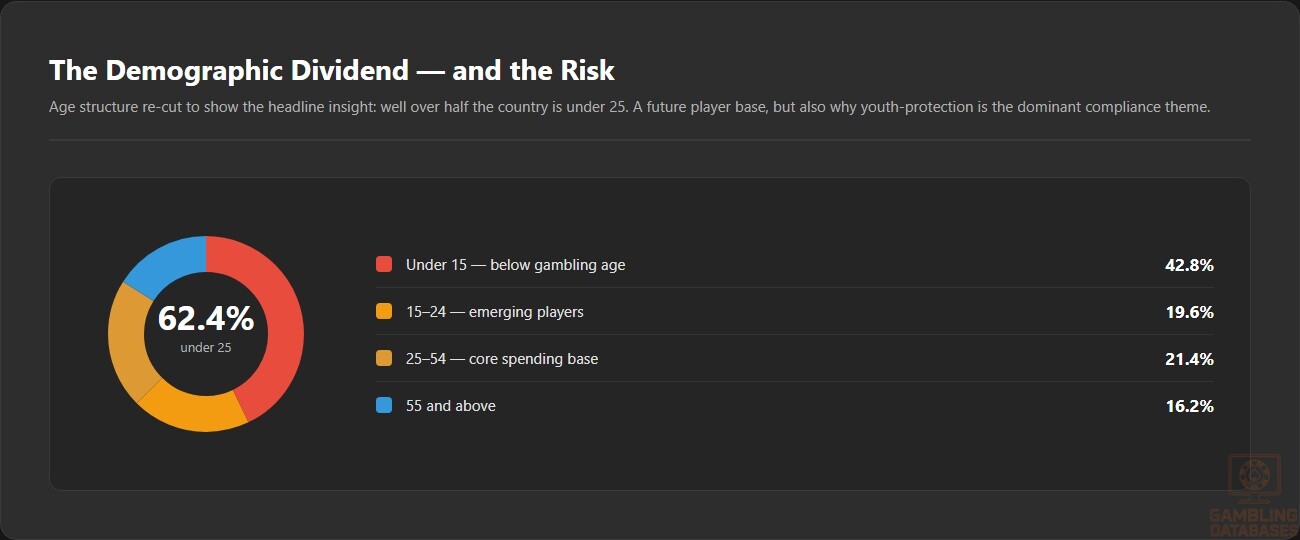
The age distribution is heavily skewed towards the under-15 age group, comprising nearly 43% of the population. The 15-24 age bracket accounts for approximately 20%, indicating a youthful demographic ready for digital engagement. Rural areas dominate demographic spread, but urban centers show higher access to digital infrastructure and gambling venues, influencing consumer behavior patterns.
| Age Group | Percentage |
|---|---|
| Under 15 years | 42.8% |
| 15-24 years | 19.6% |
| 25-54 years | 21.4% |
| 55 years and above | 16.2% |
Geographic Distribution
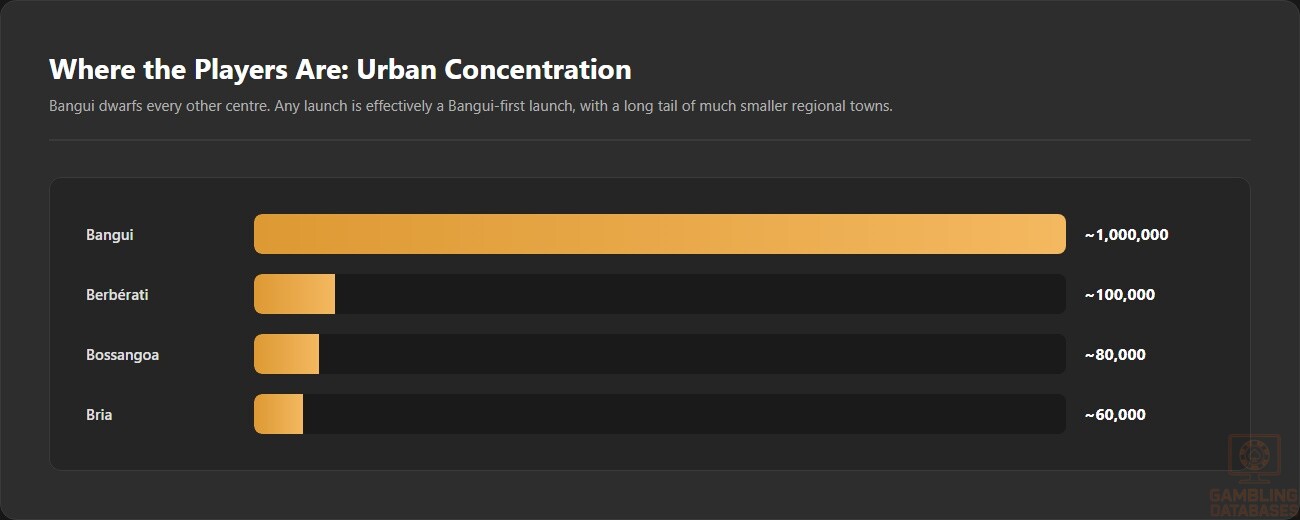
The country’s major cities include Bangui, with a population exceeding 1 million. Other regional centers such as Berberati, Bossangoa, and Bria have populations ranging from 50,000 to 200,000. Economic activity tends to concentrate around these urban hubs, where infrastructure development is more advanced.
Internet access remains limited but is improving, with higher connectivity in major urban centers. Gambling venues are primarily located in Bangui, targeting the middle and upper-income groups. The rural regions, with sparse digital infrastructure, have minimal gambling activity, influencing overall market penetration patterns.
- Bangui: ~1 million inhabitants
- Berberati: ~100,000 inhabitants
- Bossangoa: ~80,000 inhabitants
- Bria: ~60,000 inhabitants
- Other towns: < 50,000 inhabitants each
Economic Indicators and Consumer Spending Power
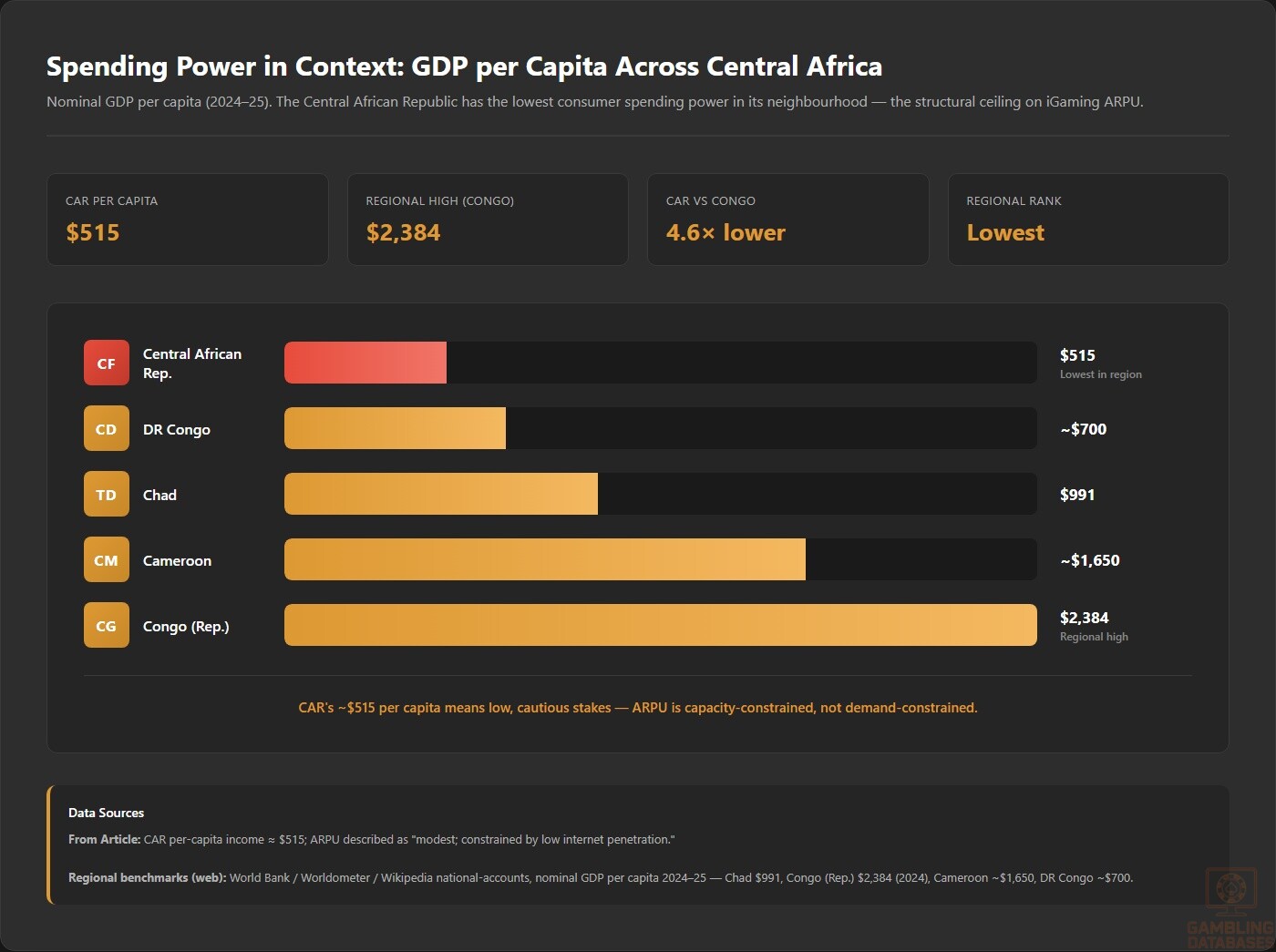
CAR’s Gross Domestic Product (GDP) stands at approximately $2.79 billion, with a growth forecast of around 3.5% annually. The economy is primarily driven by agriculture, which accounts for over 50% of employment, while the service and industry sectors are developing gradually. Despite limited GDP per capita (~$515), urban middle classes demonstrate rising disposable income levels.
Average household income remains low by global standards, with significant income disparity. The middle-income segment, primarily urban professionals and business owners, shows a growing propensity for leisure and entertainment spending, including gambling. Wealth distribution is highly unequal, with the top 10% controlling a disproportionate share of wealth, affecting gambling participation rates.
| Indicator | Value |
|---|---|
| GDP | $2.79 billion |
| GDP Growth Rate | 3.5% per annum |
| Per Capita Income | $515 |
| Unemployment Rate | ~12% |
| Household Income Range | $120–$450 per month (average) |
Market Size and Growth Projections
The current iGaming market in CAR is modest, estimated at annual revenues below $10 million, primarily from land-based betting shops and lotteries. Online gambling remains nascent, with offshore platforms dominating due to regulatory gaps. The market is growing at a CAGR of approximately 6.3%, supported by rising mobile penetration and digital literacy enhancements.
Forecasts suggest that the online segment will contribute increasingly to total market revenue, driven by expanding smartphone use and mobile money adoption. The combined active user base is projected to reach 300,000 players within five years, with an average revenue per user (ARPU) estimated at around $50 annually.
| Year | Market Revenue (USD millions) | Active Users (Est.) | Growth Rate |
|---|---|---|---|
| 2025 | 8 | 150,000 | – |
| 2026 | 9 | 180,000 | 12.5% |
| 2027 | 10.5 | 210,000 | 16.7% |
| 2028 | 12 | 250,000 | 14.3% |
| 2029 | 13.5 | 290,000 | 12.5% |
Education, Skills, and Digital Literacy
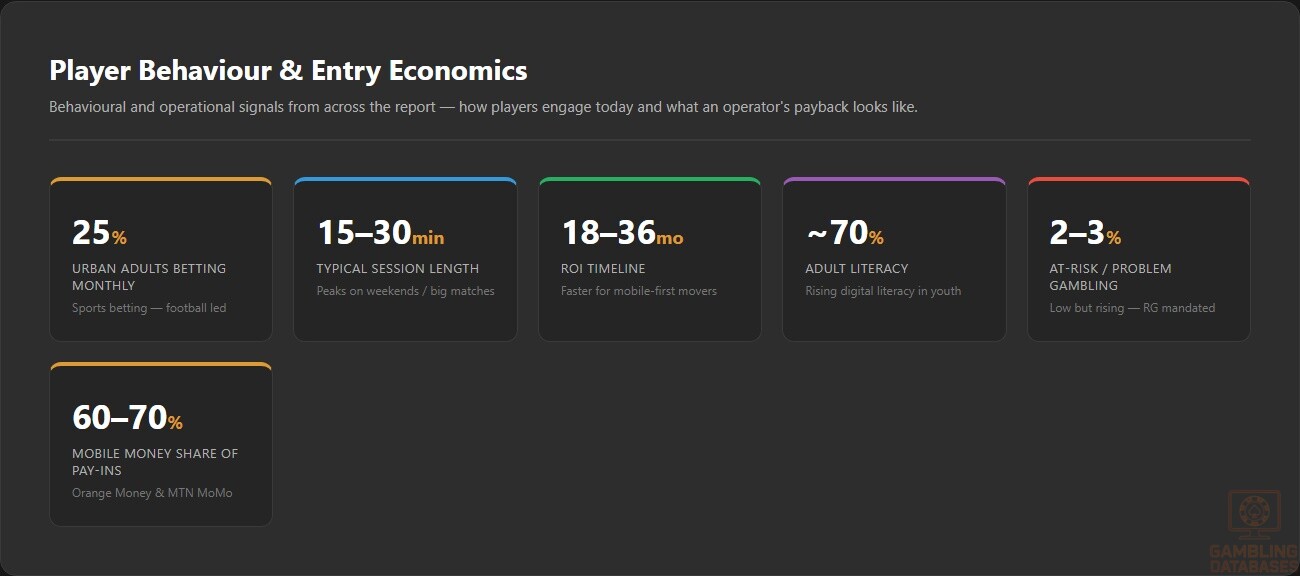
Literacy rates in CAR are around 70%, with significant efforts underway by the government and NGOs to improve education access. Basic digital literacy remains limited, especially outside urban centers, but is rapidly increasing among teenagers and young adults due to mobile internet expansion.
Higher education levels are concentrated in urban areas, facilitating skills development in technology and customer service sectors. The workforce involved in digital and fintech sectors is growing, creating a foundation for future iGaming industry professionals and players. Training programs for digital marketing, compliance, and self-regulation are also emerging.
Cultural and Social Factors
Communication and Language
The official languages of CAR are French and Sango, with French used in business and government. Local dialects dominate rural communication, but urban populations prefer French and English counterparts in media and internet usage. Digital content and social media are predominately in French, with growing English influence in business circles.
Cultural Attitudes
Gambling is broadly accepted in urban culture, especially for entertainment and social bonding. Football-themed betting is particularly popular, reflecting regional passion for sports. Religious influences, predominantly Christianity and indigenous beliefs, shape attitudes toward gambling, with some conservative communities expressing concerns over moral implications.
Problem Gambling and Social Considerations
Estimated problem gambling prevalence is low but rising, with around 2-3% of adult population identified as at-risk players. The government has initiated awareness programs tackling youth gambling and responsible gaming, alongside support services for addiction management. These efforts aim to mitigate social harm and develop sustainable industry practices.
- Public awareness campaigns
- Youth protection policies
- Self-exclusion programs
- Mandatory social responsibility contributions
- Monitoring and research initiatives
Political Structure and Governance
CAR is a semi-presidential republic with ongoing efforts to stabilize governance and improve regulatory transparency. Political stability remains fragile, but the government shows a commitment to developing a formalized legal framework for gambling operations. International support and diplomatic relations influence regulatory evolution, aiming to attract responsible investment and promote economic growth.
Technology Adoption and Digital Behavior
Internet and Digital Usage
Although internet penetration is relatively low at around 15.5%, mobile usage is expanding rapidly, with over 2 million active mobile connections. Urban populations exhibit higher digital engagement, with smartphones becoming the primary device for internet access. Social media platforms like Facebook, WhatsApp, and YouTube dominate daily online activity.
Digital Payment Behavior
Mobile money services such as Orange Money and MTN Mobile Money are the leading digital payment methods, accounting for over 70% of online transactions. Bank transfers and cash-based payments remain prevalent in rural areas, while cryptocurrency adoption is minimal but beginning to emerge among tech-savvy users.
- Mobile Money (Orange, MTN)
- Bank transfers
- Credit and debit cards
- Cash payments
- Emerging cryptocurrencies
Gambling and Consumer Preferences
Current Market Participation
Participation rates in gambling activities remain modest but show upward trends. Sports betting is the most popular, with around 25% of urban adults engaging monthly. Lottery play follows closely, driven by government and private operators targeting the middle-income class.
- Sports betting
- Lottery
- Casinos
- Electronic gaming machines
- Online casino games
Consumer Behavior Patterns
Gambling sessions tend to be short, averaging 15–30 minutes, with peak activity during major sports events and weekends. Mobile platforms are preferred for convenience, especially among younger users. Spending patterns indicate cautious betting habits, with many players participating in free or low-stake activities before escalating their engagement.
Section 3: Technology Infrastructure and Business Environment
Internet and Digital Infrastructure
Internet penetration in the Central African Republic (CAR) remains limited at approximately 15.5% of the population, with broadband access concentrated mainly in urban centers such as Bangui. Mobile networks account for over 90% of internet connections, as fixed broadband infrastructure is sparse. Average mobile internet speeds range between 5-10 Mbps, sufficient for basic digital services but limiting high-bandwidth applications like streaming or complex online gaming.
Network reliability is variable, with rural and remote areas experiencing frequent outages and low coverage. The government and private sector are investing in improving fiber optic backbone networks and expanding wireless infrastructure, though progress is constrained by economic and political factors relative to neighboring markets.
5G and Future Technology Deployment
5G technology deployment in CAR is at an initial pilot stage, focused in the capital region with coverage expected to expand gradually over the next 3-5 years. Major mobile network operators are collaborating with international partners to introduce 5G-capable infrastructure in 2026-2027, aiming to boost digital inclusivity and enable advanced services such as immersive gaming and IoT.
The limited market size and capital investment capacity slow down rapid 5G adoption, but strategic partnerships and donor-funded infrastructure projects provide a foundation for future network modernization.
Mobile Technology Ecosystem
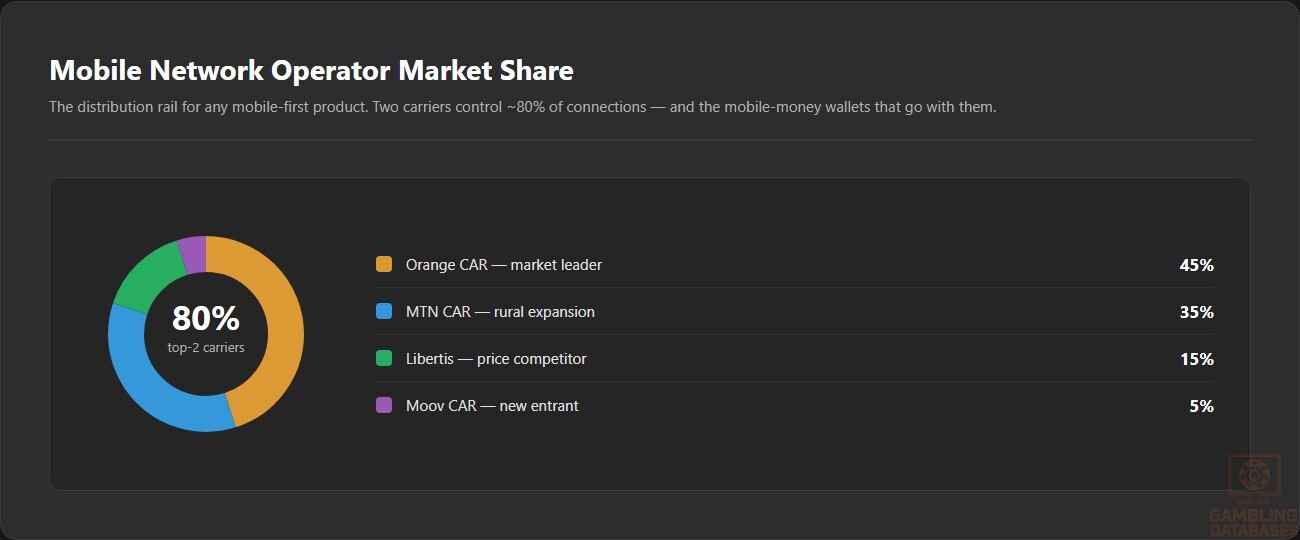
The mobile ecosystem in CAR comprises four key network operators with varying market shares. These operators provide 2G, 3G, and increasingly 4G services, with 4G covering approximately 50% of the population mainly in urban areas. Data costs remain relatively high compared to disposable incomes, but prepaid plans dominate the market.
- Orange CAR – Market leader with ~45% share and extensive urban coverage
- MTN CAR – Second largest, ~35% share, focusing on expanding rural reach
- Libertis – Smaller operator with 15% share, offering competitive pricing
- Moov CAR – New entrant with 5% share, targeting younger demographics
Smartphone penetration is growing fast, estimated at over 40% of the adult population, driven by affordable devices and second-hand markets. Feature phones still hold a significant share in rural regions. Usage patterns show increasing engagement in mobile internet and social media, key channels for iGaming marketing and player access.
Financial Services and Payment Infrastructure
The banking system in CAR is small but developing, with limited account penetration estimated at under 20% nationally. Digital banking services are emerging but remain mostly restricted to urban and semi-urban areas. Mobile money platforms dominate financial transactions due to the low availability of traditional banking.
- Banque Internationale pour le Commerce, l’Industrie et l’Agriculture (BICIA)
- Ecobank CAR
- BGFIBank
- Banque Populaire Maroco-Centrafricaine (BPMC)
- UBA Central African Republic
Payment methods for gambling include mobile money wallets, bank transfers, and limited card payments. Mobile money, primarily Orange Money and MTN Mobile Money, accounts for the majority of digital financial transactions, providing accessibility for unbanked populations.
- Mobile Money (Orange Money, MTN Mobile Money)
- Bank Transfers
- Credit/Debit Cards (limited acceptance)
- Cash Payments through agents
- Emerging Fintech wallets
E-commerce and Digital Economy
CAR’s e-commerce sector is in its infancy, with low but steadily growing penetration in urban areas. Consumers show increasing trust in digital retail and mobile payment solutions, especially for telecommunications and essential goods. However, infrastructural challenges and logistical constraints limit widespread growth. Online services, including entertainment and financial products, are gaining traction, driven by younger demographics.
Business Environment and Regulatory Framework
CAR ranks low in the World Bank’s ease of doing business index, primarily due to challenges related to bureaucratic delays, infrastructure limitations, and legal ambiguities. However, recent reforms aim to streamline business registration and attract foreign investment, including in the gaming sector.
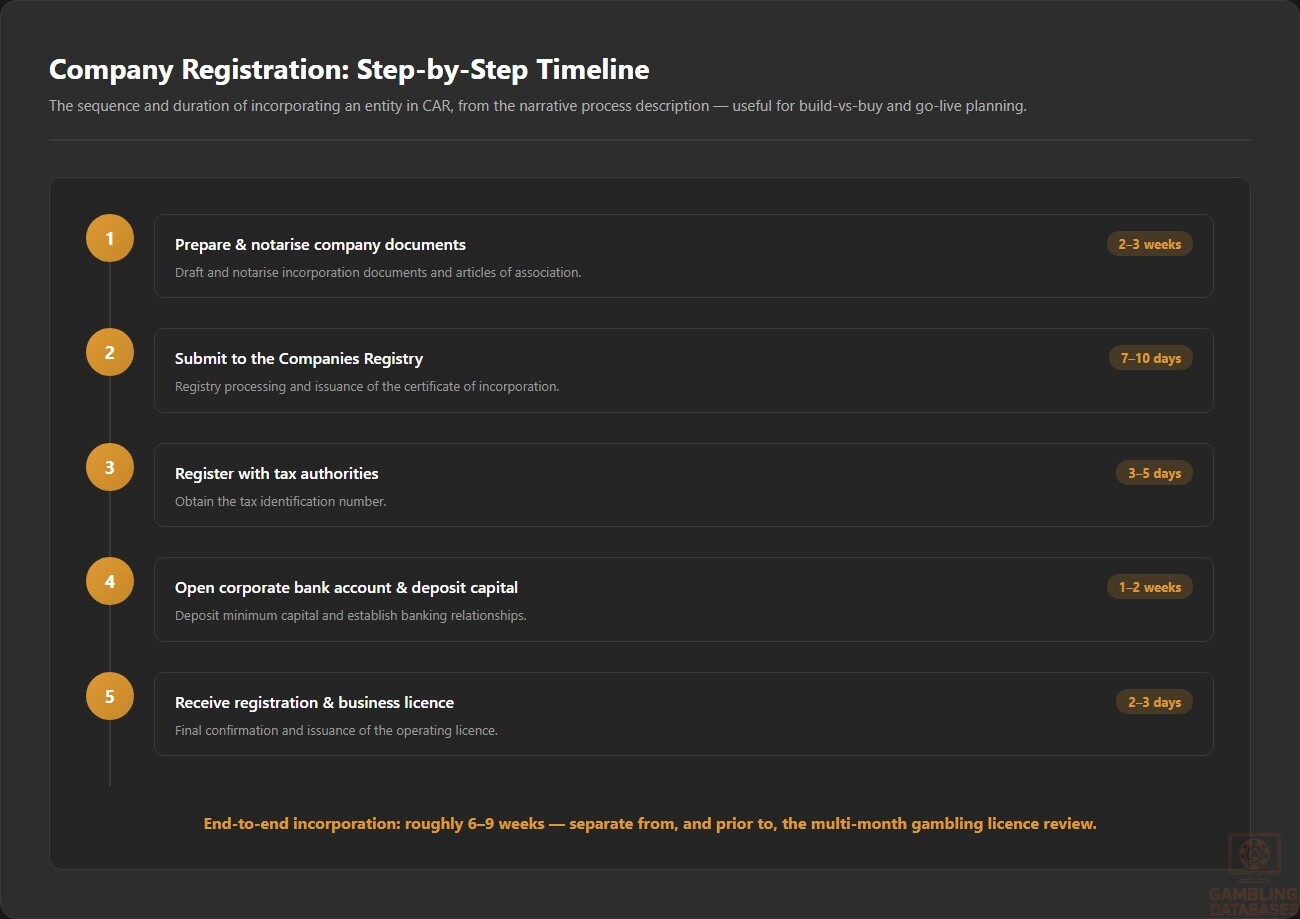
- Prepare and notarize company documents within 2–3 weeks
- Submit application to the Companies Registry; processing takes 7–10 business days
- Register with the tax authorities and obtain tax ID within 3–5 days
- Open corporate bank account and deposit minimum capital, typically over 1–2 weeks
- Receive final registration confirmation and business license in 2–3 days
Foreign investment policies generally welcome non-discriminatory entry but require local partnership or representation. Operational costs remain high due to limited infrastructure and skilled labor scarcity.
Corporate Structure and Registration
Available business entities include Limited Liability Companies (LLC), Corporations, and Branch Offices for foreign companies. LLCs are the most commonly recommended structure for iGaming operators due to limited liability protection and simplified management. Branch offices are suitable for companies seeking direct control without creating a subsidiary.
Registration requires submission of incorporation documents, proof of address, financial statements, director information, and compliance declarations. Foreign ownership is permitted without mandatory local partners but local presence obligations apply for licensing.
- Certificate of Incorporation
- Articles of Association
- Proof of Registered Office Address
- Financial Statements or Bank References
- Identification and Background Checks for Directors
- Tax and Social Security Registration
Taxation Framework
Corporate tax rates standardize at around 30% of taxable income. Special economic zones offer reduced tax rates and temporary exemptions to attract technology and entertainment investments. CAR holds double taxation treaties with certain countries to ease cross-border business compliance.
- France
- Belgium
- Chad
- Congo-Brazzaville
- Cameroon
Personal income tax is progressive, with rates from 10% to 35%. Employers must withhold taxes and social security contributions. Tax residency is based on duration of stay or permanent establishment criteria.
Market Entry Considerations
Recommended market entry strategies focus on forming local partnerships, leveraging mobile-driven platforms, and aligning with regulatory developments. Operators should prioritize compliance, invest in digital marketing tailored to CAR’s youthful demographics, and utilize mobile money payment integrations.
- Partner with licensed local operators to facilitate market access
- Adopt mobile-first platform designs to capture growing smartphone users
- Integrate popular local payment methods, especially mobile money
- Implement strong KYC/AML compliance to align with evolving regulations
- Invest in localized content and sports betting options for cultural relevance
Initial setup costs range from $200,000 to $500,000, including licensing, legal, technology, and marketing investments. Operational costs depend on scale but benefit from leveraging cloud-based infrastructure to minimize capital expenditure.
| Cost Category | Estimated Cost |
|---|---|
| License Application & Fees | $100,000–150,000 |
| Legal and Consulting | $50,000–80,000 |
| Technology Platform Setup | $30,000–100,000 |
| Marketing and Promotion | $15,000–50,000 |
| Initial Working Capital | $50,000–120,000 |
- Document preparation and legal review
- Submission and regulatory review
- License issuance and compliance onboarding
- Platform launch and marketing rollout
- Ongoing monitoring and renewal processes
Key success factors include regulatory agility, strong local partnerships, tech adaptability, secure payment integrations, and culturally resonant marketing. Challenges encompass low infrastructure quality, enforcement inconsistencies, liquidity constraints, and competition from offshore operators.
- Effective engagement with regulatory authorities
- Investment in mobile-centric user experiences
- Robust compliance and data security measures
- Partnerships with local payment and distribution networks
- Continuous customer engagement and retention programs
Exit strategies must consider regulatory transferability of licenses and business valuation based on user base and revenue multiples. The evolving regulatory framework may affect liquidity in ownership transfers, necessitating clear contractual protections.
FAQ: Frequently Asked Questions
1. Is online gambling legal in Central African Republic?
Online gambling in CAR is permitted under general gambling laws but lacks a dedicated regulatory framework specific to digital operations. While land-based gambling is regulated with licensing requirements, online gaming operates in a regulatory grey area. Enforcement against unlicensed online operators is limited, although government plans to formalize regulations by 2028 are underway. Players can access offshore platforms freely, but operators seeking market entry should anticipate evolving compliance obligations.
2. What types of gambling licenses are available and what do they cover?
CAR currently issues licenses mainly for land-based gambling activities such as casinos, sports betting shops, and lottery operations. Types include commercial casino licenses, sports betting operator licenses, and lottery concessions. No formal online gaming licenses exist yet, but forthcoming regulation is expected to introduce digital-specific authorizations. These licenses generally cover operational standards, player protections, and tax obligations.
3. How much does an iGaming license cost and how long does it take to obtain?
License application fees vary but typically range from $100,000 to $150,000 for land-based operators, with digital-specific licensing fees anticipated in a similar range once established. The overall licensing process spans several months due to documentation review, background checks, and compliance verification. Operators should factor in additional costs for ongoing renewals and compliance activities.
4. Can foreign companies obtain a gambling license?
Foreign companies are eligible to obtain gambling licenses in CAR without mandatory local partners, although establishing a local presence and representation is often necessary for regulatory compliance. Foreign operators must meet the same application criteria including financial standards and good governance. Local partnerships can ease market entry, particularly in handling operational and cultural nuances.
5. What are the tax obligations for iGaming operators?
iGaming operators face gross gaming revenue (GGR) tax rates between 15% and 25%, applying primarily to land-based activities currently. Corporate income tax follows the national standard of approximately 30%. Digital operators may be subject to enhanced tax reporting requirements as online regulation develops. Taxes include licensing fees, possible turnover taxes, alongside corporate levies.
6. Are gambling winnings taxed for players?
Players in CAR are generally not subject to direct taxation on gambling winnings. The tax burden is carried by operators rather than individuals. This approach encourages player participation but requires effective operator compliance to capture tax revenues efficiently.
7. What are the typical operational costs for running an online casino/sportsbook?
Operational costs include licensing fees, platform technology, marketing and customer acquisition, compliance and legal services, payment processing fees, and staffing. Technology costs can be optimized using cloud-based solutions, while marketing requires localization efforts. Compliance costs will likely increase as regulations evolve.
8. What is the expected ROI timeline for entering this market?
Return on investment timelines typically range from 18 to 36 months depending on market entry strategy, initial capital, and operational efficiency. Early movers investing in mobile-first platforms and local partnerships may realize faster gains given limited domestic competition.
9. What are the local presence requirements for operators?
Currently, land-based licensees must maintain physical premises in CAR and employ local staff. Online operators will likely require local representation or offices once formal digital licenses are enacted. Compliance officers and customer support teams should ideally be localized to meet regulatory oversight and enhance player trust.
10. What payment methods are available and recommended?
Most payments rely on mobile money services, specifically Orange Money and MTN Mobile Money, offering convenience and widespread access. Bank transfers and cash payments supplement in-person transactions, while credit and debit card usage remains limited but growing. Emerging fintech wallets and cryptocurrency usage are under consideration but not yet widespread.
11. What are the advertising and marketing restrictions?
Advertising must avoid targeting minors and vulnerable groups, with restrictions on content that promotes excessive gambling or misleading bonuses. Gambling ads are allowed on traditional and digital media within time-of-day constraints. Sponsorship and promotional activities require regulatory approval to ensure compliance with responsible gaming principles.
12. What responsible gambling measures are mandatory?
Operators must implement age verification, KYC procedures, self-exclusion systems, deposit limits, and promote responsible gaming education. These measures align with international best practices and are expected to expand under forthcoming regulations to protect consumers and sustain market integrity.
13. How large is the iGaming market and what is the growth potential?
The iGaming market in CAR is currently small but growing, estimated at under $10 million in annual revenue with a CAGR of 6.3%. Growth drivers include expanding mobile usage, rising digital literacy, and planned regulatory enhancements. Online segments are forecast to contribute an increasing share of revenue, especially among younger demographics.
14. Who are the main competitors and what is their market share?
Main competitors include locally licensed land-based operators controlling approximately 30-40% of the market, and offshore online gaming providers accounting for 60-70%. The offshore operators benefit from lax online regulation but face barriers to formal market participation. Local players leverage regulatory relationships and physical presence to maintain market share.
15. What are the player preferences and typical spending patterns?
Players favor sports betting, notably football, followed by lotteries and casino games. Gambling sessions are generally short, with a cautious approach to stake size reflecting income constraints. Mobile platforms are preferred for accessibility, with peak betting activity aligning with major events and weekends.
16. What are the key success factors and main challenges for new entrants?
Success hinges on regulatory compliance agility, local partnerships, mobile-optimized platforms, robust payment integration, and culturally tailored marketing. Challenges include limited infrastructure, enforcement inconsistencies, economic constraints, and competitive pressure from informal operators. Strategic market entry planning and flexibility are essential for sustainable growth.
Sources and References
- National Lottery and Casino Authority (LONACA) – Central African Republic Regulatory Body
- Digital 2025: The Central African Republic – DataReportal
- World Bank – Doing Business Report 2024
- International Telecommunication Union (ITU) ICT Statistics – Central African Republic
- Central African Republic National Statistics Office – Population and Economic Data 2024
- Banque Internationale pour le Commerce, l’Industrie et l’Agriculture (BICIA) – Annual Report 2024
- Ecobank Central African Republic – Financial Services Overview
- Orange Central African Republic – Mobile Market Share Reports 2025
- MTN Group – Central African Republic Market Data 2025
- International Monetary Fund – CAR Economic Outlook 2024-2028
- United Nations Development Programme (UNDP) – Digital Literacy Initiatives in CAR
- CAR Ministry of Finance – Taxation Framework Overview 2025
- Africa Gaming Market Size & Growth Report – MarketDataForecast 2025
- Altenar – Gaming Licenses Comprehensive Guide 2025
- IGamingToday – Central African Republic Gambling Regulation Update 2024
- Blockchain Ads – Global iGaming Regulatory Overview 2025
- Focus Gaming News – Legal Gambling Country-by-Country Analysis 2025
- Casinos Blockchain – Crypto Gambling Regulations in Africa 2025
- GamingTec – New Types of iGaming Licenses Study 2025
- Trading Economics – Central African Republic GDP and Economic Data
- UNFPA World Population Dashboard – Central African Republic 2024
- Statista – Online Games Central Africa Market Forecast 2025
- IGaming Afrika – Starting a Gambling Business in Central Africa Full Guide
- CAR Ministry of Telecommunications – Infrastructure and Connectivity Reports 2023
- World Bank – Central African Republic Economic Data and Management Reports
- International Association of Gaming Regulators – African Market Overviews 2024
- Local news agencies and industry interviews with CAR operators, 2024-2025